Key Takeaways
Robotics venture capital trends 2026 point to a market that is rewarding deployable systems, not robotics prototypes in isolation.
- Physical AI is drawing capital toward systems that combine models, machines, sensors, and software.
- Warehouse, industrial, defense, and humanoid robotics are attracting particularly strong investor attention.
- Commercial evidence, manufacturing readiness, and clear unit economics now matter as much as technical novelty.
- Government contracts, strategic investors, and non-dilutive funding are helping companies finance long development cycles.
- Founders with measurable deployment milestones will be better positioned than those relying on broad market narratives.
The state of robotics venture capital in 2026
Robotics financing has moved into a more selective phase. Capital is still available for ambitious companies, but investors increasingly want evidence that a system can leave the lab, operate safely, and create economic value in a real workflow. The result is a market split between highly funded frontier efforts and startups that must prove each step of commercialization.
The shift is visible in the growing overlap between artificial intelligence and machines that act in the physical world. A recent robotics funding surge illustrates how embodied AI has changed the sector's appeal, although headline round sizes should not be mistaken for industry-wide health. The more durable question is whether new capital supports repeatable deployments.
How funding has evolved from hardware to full-stack robotics
Earlier robotics cycles often separated mechanical hardware from control software and treated integration as a customer problem. In 2026, investors are more interested in full-stack systems: the machine, its perception and control layers, the data pipeline, and the tools required to manage deployment. That model can create a tighter feedback loop, but it also increases technical and operational responsibility for the startup.
A full-stack company still faces the economics of hardware. It must source components, maintain field units, and support customers long after a financing announcement. The investment case is therefore strongest when software improves with use while the physical platform remains manufacturable and serviceable.
Why physical AI is reshaping investor interest
Physical AI describes systems that perceive changing environments and act within them rather than producing only digital outputs. The appeal is straightforward: warehouses, factories, hospitals, farms, and infrastructure sites contain large pools of work that cannot be automated by software alone. Better models may reduce the amount of task-specific engineering required, but they do not remove the need for reliable mechanics and safe interaction.
The shift is also changing how investors evaluate data. A robot's operating history can reveal edge cases, failure modes, and useful task variations that are difficult to capture in a static dataset. That possibility helps explain why physical AI investment has become a broader hardware story rather than a narrow robotics theme.
What separates a robotics funding cycle from a broader AI cycle
A software company can sometimes scale distribution quickly after a model or application works. Robotics companies usually scale through pilots, site integration, training, maintenance, and production capacity. Each stage introduces physical constraints, so a large financing round does not automatically translate into rapid revenue growth.
The strongest robotics cycle has a different rhythm from a general AI cycle. It depends on customer labor shortages, equipment availability, safety requirements, and the cost of replacing existing processes. Investors are consequently looking for evidence of operational repetition, not only benchmark performance.
How interest rates, exits, and capital availability affect deal activity
Interest rates influence robotics in two ways. They affect the cost of capital for startups building factories and the willingness of investors to fund companies whose returns may arrive years later. When public markets and acquisition activity weaken, private investors become more demanding about cash use, while strategic and government capital can become relatively more important.
This creates uneven deal activity. A company with a credible path to deployment may still raise substantial funding, while a technically impressive company without a commercial timetable may face a long extension round or a difficult down-round. The broader global venture capital outlook reinforces the point that liquidity conditions, geography, and sector appetite now matter together.
The robotics sectors attracting the most capital
Capital is concentrating where robotics addresses a visible operational problem and where deployment can be measured. Logistics has labor and throughput pressure; manufacturing has repeatable processes; defense has urgent autonomy requirements; healthcare has clinical and demographic demand. Humanoid robotics attracts attention for a different reason: it promises a flexible form factor for environments designed around people, though its commercial timeline remains uncertain.
These sectors should not be treated as equally mature. Some support near-term automation products, while others remain long-horizon bets that require advances in reliability, cost, or regulation.
Warehouse and logistics automation
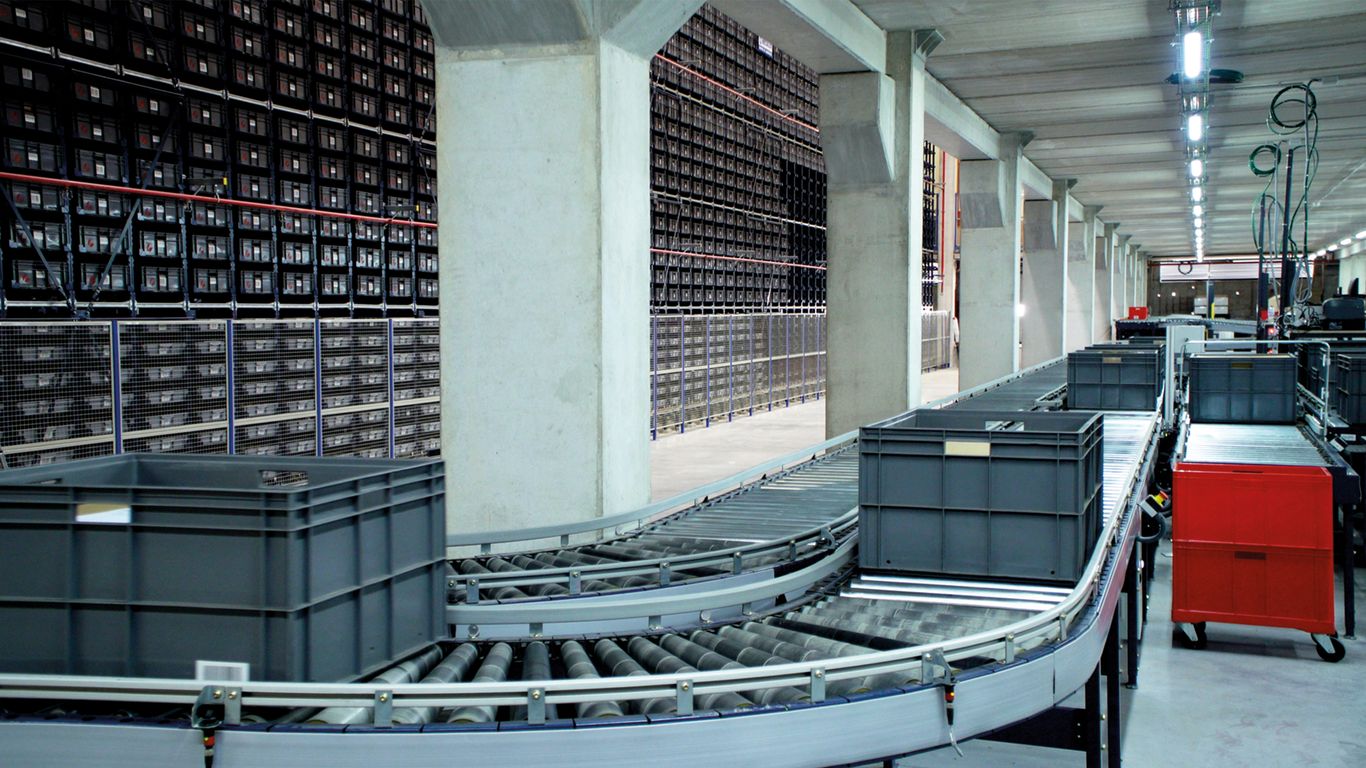
Warehouses offer investors a relatively legible starting point because tasks can be defined through throughput, pick rates, travel distance, and labor hours. Autonomous mobile robots, piece-picking systems, palletizing equipment, and orchestration software can be introduced in stages rather than as a single transformation. The commercial challenge is integrating those systems with existing warehouse-management processes.
The opportunity is broad, but buyers still prefer automation that fits a live operation. Research on warehouse robotics startups highlights modularity, integration, and coordinated systems as recurring themes. Startups that reduce disruption during installation may have an advantage over technically stronger systems that require a complete facility redesign.
Industrial robots and manufacturing systems
Manufacturing remains attractive because production lines contain structured tasks, measurable quality standards, and high costs for downtime. Investors are funding systems for inspection, assembly, machine tending, welding, material movement, and process monitoring. The best opportunities often sit in difficult niches where conventional automation is too rigid and human labor is expensive or scarce.
Industrial customers also demand long service lives. A startup must show that its robot can be maintained, reconfigured, and supported across multiple production cycles. That makes deployment engineering and after-sales service part of the investment case rather than an afterthought.
Humanoid and general-purpose robots
Humanoid systems attract capital because their form factor could let one platform work in spaces already designed for human movement. Yet general-purpose capability is a claim about breadth, not proof of dependable performance. A robot that performs one task under controlled conditions has not demonstrated economic value across a workforce.
Investors are therefore placing more weight on actual deployments, production plans, safety work, and cost targets. The humanoid deployment landscape is useful precisely because deployment scale is a more meaningful comparison than a polished demonstration. The category may become important, but its funding cycle will be judged by repeatability.
Healthcare, surgical, and eldercare robotics
Healthcare robotics combines strong demand with unusually high barriers. Surgical systems must satisfy clinical, regulatory, and training requirements; eldercare systems must operate around vulnerable people and fit existing care routines. The addressable need is large, but adoption depends on evidence, reimbursement, workflow compatibility, and trust.
This is why investors distinguish between assistive tools, tele-robotic systems, diagnostic devices, and autonomous interventions. A review of medical robotics startups shows how varied the field is, and that variety matters when assessing timelines. Clinical utility must be demonstrated in the specific setting where the system will be used.
Defense, drones, and autonomous systems
Defense has become a major source of robotics funding because governments are seeking systems that can operate in contested, dangerous, or resource-constrained environments. Drones, autonomous vessels, counter-drone systems, and ground platforms can attract both venture funding and procurement capital. Dual-use applications may widen a company's market, but defense work also brings security controls, contracting complexity, and political risk.
The strongest companies tend to connect autonomy with manufacturing capacity and field support. Investors are less interested in a one-off platform than in a system that can be produced, updated, and deployed at meaningful scale. That emphasis is part of the wider defense technology funding shift.
Where investors see the strongest startup opportunities
The most promising opportunities are not limited to robot manufacturers. A large installed base of machines creates demand for software, simulation, connectivity, maintenance, components, and operational analytics. These layers may offer a more capital-efficient entry point than building a complete robot, although they still need access to real hardware and real customer environments.
Investors are also searching for companies that turn fragmented operational data into a durable advantage. The central test is whether a startup becomes more useful as it deploys, without requiring a bespoke engineering project for every customer.
Robot intelligence, perception, and control software
Robot intelligence covers the systems that interpret sensor input, plan actions, and adjust behavior when conditions change. Perception is especially difficult outside controlled environments: lighting shifts, objects move, surfaces vary, and sensors can become dirty or occluded. Control software must then translate an uncertain estimate of the world into a safe physical action.
Investors are interested in generalizable software, but they are wary of vague claims about autonomy. A credible company can explain which tasks it supports, which operating conditions it has tested, and where a human remains in the loop. The defensible layer may be a model, a control stack, proprietary data, or the integration of all three.
Simulation, synthetic data, and digital twins
Simulation can shorten development by allowing teams to test policies and edge cases before placing a robot in a customer site. Synthetic data can supplement scarce physical examples, while a digital twin can represent the layout, equipment, and workflow of an operating environment. None of these tools eliminates the reality gap between simulated physics and messy physical execution.
The best startups measure that gap rather than hiding it. They show how simulated training transfers to hardware, how quickly new environments can be modeled, and how failures discovered in deployment feed back into development. This is one reason simulation and edge robotics are appearing together in startup analyses.
Robotics infrastructure and component suppliers
Actuators, sensors, batteries, grippers, power electronics, safety systems, and ruggedized computing all constrain robotics performance. A component supplier may not receive the same attention as a general-purpose robot company, but its technology can become essential across many platforms. The opportunity is strongest when the component solves a difficult bottleneck without creating a new integration burden.
Investors must examine qualification cycles carefully. A component can be technically superior and still fail commercially if customers cannot redesign around it or if supply is too concentrated. Reliability data and manufacturing partnerships matter as much as laboratory performance.
Fleet management, orchestration, and robot-as-a-service platforms
As deployments grow, customers need tools to monitor machines, assign tasks, schedule maintenance, manage exceptions, and measure performance. Fleet software can become the operating layer for mixed robot environments, especially when facilities use equipment from multiple suppliers. The value comes from reducing operational complexity rather than simply displaying a dashboard.
Robot-as-a-service models make this layer more visible because the provider remains responsible for uptime and performance. That model can lower adoption barriers, but it transfers financing and maintenance risk to the startup. Investors therefore examine utilization, service costs, replacement rates, and contract duration with care.
Vertical solutions for labor-constrained industries
Vertical robotics companies begin with a specific bottleneck rather than a claim to automate everything. Agriculture, construction, inspection, food processing, and specialized manufacturing each have distinct environments and purchasing processes. A narrow initial market can be an advantage if it enables faster learning and a clear return on investment.
A practical vertical strategy usually has four connected elements:
- A task with measurable labor, quality, or safety costs.
- A deployment environment that can be characterized and supported.
- A buyer with authority to approve operational change.
- A pathway from one workflow to adjacent revenue opportunities.
That sequence helps distinguish a focused wedge from a small market with no expansion path. It also aligns with the broader shift toward vertical robotics applications, where the operational problem comes before the robot's generality.
How venture capital is being deployed across the funding lifecycle
Robotics financing is not one market. Seed investors fund technical risk, later-stage investors fund commercial repetition, and strategic or public capital often supports manufacturing, procurement, or national priorities. The appropriate source of capital changes as the company moves from research to deployment.
Founders who treat every round as a valuation event can miss the more useful question: which uncertainty must the next tranche of capital remove? That framing makes fundraising more disciplined and gives investors a clearer basis for evaluating progress.
Seed-stage funding for technical breakthroughs
At seed, investors may accept limited revenue if the company has a credible technical insight and a team capable of proving it. Useful milestones include a working prototype, a validated subsystem, a repeatable test protocol, or evidence that a new approach reduces a known cost. The milestone should be specific enough that failure teaches the company something.
Seed capital is often best used to reduce technical uncertainty before a startup commits to expensive production tooling. Founders should resist spending early funds on scale that has not yet been justified by a stable design and a clear customer problem.
Series A and B criteria for commercial validation
Series A and B investors usually want more than a successful demonstration. They look for paid pilots, recurring use, customer references, deployment time, gross-margin direction, and a credible path to repeatable sales. They also examine whether the company can support several sites without adding an equal amount of engineering labor each time.
The important distinction is between interest and adoption. A long list of pilot conversations can signal demand, but signed contracts, renewals, and expansion provide stronger evidence. Capital should follow the point at which the company understands its buyer and its operating model.
Growth capital for manufacturing and deployment
Growth capital is used for inventory, tooling, production lines, field teams, certification, and customer support. These expenses can arrive before revenue, creating a financing gap that software startups rarely face at the same scale. Investors therefore scrutinize working-capital cycles and the consequences of a delayed production ramp.
Manufacturing plans should include contingency. A single supplier, an unqualified substitute, or an untested assembly process can extend delivery schedules and consume cash quickly. The company that treats production as an engineering system, rather than a procurement task, is more likely to protect its runway.
Corporate venture capital and strategic partnerships
Corporate investors can provide more than money. They may offer access to factories, distribution channels, domain expertise, component relationships, or early customers. The trade-off is that strategic capital can introduce exclusivity, governance complexity, or a perception that the startup is tied to one buyer.
A well-structured partnership defines what is shared and what remains open. It also separates a genuine commercial relationship from a press release about future collaboration. Investors want to know whether the partnership changes deployment probability or merely adds credibility.
The role of government contracts and non-dilutive funding
Grants, research programs, and government contracts can fund technical work without immediate equity dilution. They are particularly valuable for safety research, advanced components, dual-use systems, and infrastructure that has public importance but a long commercial payback period.
Non-dilutive funding still carries obligations. Reporting, milestones, procurement rules, and security requirements can affect product schedules. Founders should treat public capital as part of a coherent financing plan, not as free money that sits outside company strategy.
What investors are looking for in robotics startups
The investment standard has become more operational. A compelling demo may open a conversation, but the diligence process moves quickly to field reliability, cost, customer behavior, and production risk. In robotics, technical and commercial evidence are tightly connected because one failed deployment can affect both the product roadmap and the revenue forecast.
This is where deep tech VC evaluation offers a useful frame: scientific rigor and commercial viability need to advance together. Neither one can permanently substitute for the other.
Evidence that the technology works outside the lab
Investors want to see performance across different sites, operators, materials, lighting conditions, and failure cases. A single controlled demonstration can establish possibility; a series of deployments establishes reliability. The evidence should include what went wrong, how the system responded, and how quickly the team corrected it.
A mature startup presents test conditions plainly. It distinguishes autonomous operation from supervised operation and reports performance boundaries instead of describing every success as general intelligence. Evidence beats theatrical demos when the buyer's process is unforgiving.
Unit economics, payback periods, and deployment costs
The robot's purchase price is only one part of the customer's calculation. Installation, integration, training, maintenance, downtime, floor-space changes, and software fees can determine whether a deployment makes economic sense. A credible model shows who pays each cost and how the assumptions change at different utilization levels.
Payback periods are not universal. A system that pays back in twelve months for a high-volume warehouse may not work in a low-volume facility. Investors want a defined customer segment, a realistic utilization profile, and sensitivity analysis for the variables most likely to move.
Data advantages and defensible software layers
Robotics data becomes valuable when it improves decisions, policies, or system reliability. Simply accumulating sensor logs does not create a moat. The company must explain how data is collected, labeled, secured, and used to improve performance in a way that competitors cannot easily reproduce.
Defensibility can also come from integration knowledge, safety validation, proprietary hardware, or a trusted workflow position. Investors should be cautious about treating a generic model wrapper as a durable robotics platform when the difficult work lies in physical deployment.
Manufacturing readiness and supply-chain resilience
A prototype may use hand-selected components and intensive technician labor. A product must use repeatable processes, documented tolerances, quality checks, and a supply chain that can withstand delays. The gap between those states is often where robotics startups spend the most capital.
Manufacturing readiness is measurable through pilot-line yields, supplier qualification, repair procedures, and change-control discipline. Founders should know which components are single-sourced and which substitutions would require a new safety or performance validation.
Customer adoption, retention, and expansion potential
Customer behavior provides the clearest test of whether a robot solves a real problem. Investors examine time to deployment, usage after installation, renewal rates, expansion into additional workflows, and the reasons customers pause or cancel. A successful pilot that never becomes a standard operating process is a warning sign.
The strongest expansion paths are operationally adjacent. A company may begin with one task, then add another because the same customer, facility, data, and support team can be reused. That is more credible than assuming every customer will buy an entire product family at once.
The markets and regions shaping robotics investment
Robotics investment is geographically distributed because the sector depends on both software talent and industrial capacity. The United States has deep pools of AI research and venture capital; Europe has strong industrial automation traditions and regulatory expertise; China and other Asian markets have dense manufacturing ecosystems. No region has an uncontested lead across the full stack.
Cross-border investment can accelerate development, but it also introduces export controls, data rules, procurement restrictions, and localization requirements. For founders, geography is now part of product strategy.
The United States as a hub for AI-enabled robotics
The United States benefits from advanced AI research, large enterprise buyers, defense demand, and a mature venture market. Its challenge is translating software leadership into dependable hardware at competitive cost. Startups may need international manufacturing or suppliers even when their core intelligence is developed domestically.
The US market also rewards ambitious platform companies, but enterprise adoption remains uneven. The US robotics market outlook captures the tension between strong investment in robot learning and the practical challenge of building at scale.
Europe’s strengths in industrial automation and regulation
Europe has deep expertise in factory automation, precision engineering, safety, and industrial procurement. Its fragmented markets can slow expansion, yet that fragmentation can force companies to build products that meet demanding integration and compliance requirements. Regulatory competence may become a competitive asset as robots work more closely with people.
European startups also face a financing challenge when hardware development outlasts local venture cycles. Partnerships with industrial groups, public programs, and cross-border investors can help bridge that gap, provided the company maintains a coherent product roadmap.
China and Asia’s manufacturing and hardware ecosystems
China and wider Asia offer dense supplier networks, experienced manufacturing labor, and large domestic markets for automation. Those advantages can reduce iteration time and support production learning. They do not automatically solve software, safety, or international market-access questions.
Investors assessing Asian robotics companies must separate manufacturing scale from product differentiation. A low-cost platform may gain distribution quickly, while a specialized system may build stronger margins through performance and reliability. The right answer depends on the target workflow and region.
Cross-border funding and localization challenges
A robotics startup operating across borders must manage more than currency and tax questions. It may need to localize interfaces, safety documentation, service networks, data handling, and component sourcing. Customers often want local support even when the core product is identical.
Capital structure can become complicated as well. Foreign ownership rules, sensitive-technology reviews, and government procurement requirements may limit which investors can participate. Founders should identify those constraints before a financing process begins rather than after a term sheet is signed.
Government policy, national security, and strategic capital
Public policy is shaping robotics investment through grants, procurement, industrial incentives, and controls on sensitive technologies. National security concerns are especially relevant for autonomy, navigation, sensing, and dual-use manufacturing. Strategic capital can provide patient funding, but it may also narrow a company's customer base or affect future transactions.
Investors should ask whether policy support reflects durable demand or a temporary funding window. A strong company can benefit from public priorities while still demonstrating a commercial reason to exist beyond the program that first financed it.
The risks and constraints behind the robotics funding boom
Robotics can attract large rounds while remaining a difficult business. Hardware development takes time, customers integrate slowly, and every field environment introduces new variables. The sector's opportunity is real, but so is the possibility that capital is being allocated faster than the industry can convert prototypes into dependable products.
A sober assessment does not weaken the case for robotics. It clarifies which companies can survive the distance between a promising demonstration and a durable operating business.

Long hardware development and sales cycles
A robotics company may spend months refining a design before a customer is ready to approve a pilot. Procurement, safety review, facility preparation, and worker training can extend the timeline further. Revenue forecasts that assume software-like sales velocity are usually too optimistic.
The best response is staged evidence. Each phase should answer a defined question about performance, integration, customer willingness to pay, or production cost. That discipline helps a company raise capital against progress rather than against a distant vision.
Reliability, safety, and liability concerns
Robots operate near people, valuable inventory, production equipment, and public infrastructure. A rare failure can create disproportionate damage, from an injury to a prolonged shutdown. Safety engineering must therefore cover hardware, software, human procedures, cybersecurity, and incident response.
Liability also affects customer adoption. Buyers need to understand who is responsible when a system behaves unexpectedly and how the provider will investigate an event. Startups that treat safety as a certification exercise rather than an operating practice will struggle to earn trust.
High capital requirements and margin pressure
Robotics companies can consume cash through tooling, inventory, field support, warranties, and custom integration. Early gross margins may look weak even when the long-term product could be attractive. Investors must distinguish temporary launch costs from a business model that requires permanent services labor.
Capital efficiency is not simply spending less. It means choosing a product architecture, customer segment, and deployment model that reduce unnecessary complexity. A smaller initial market can be rational if it produces repeatable economics and useful operating data.
Talent shortages across engineering and manufacturing
Robotics teams need mechanical engineers, controls specialists, machine-learning researchers, manufacturing leaders, safety experts, field technicians, and commercial operators. These skills are scarce in combination. Hiring only for research strength can leave a company unable to industrialize; hiring only for production can limit technical differentiation.
Talent strategy should reflect the stage of the business. A research-heavy seed team may need manufacturing and customer-operations leadership before its next major deployment. Investors increasingly treat that transition as a milestone rather than an administrative detail.
Valuation risk in crowded robotics categories
Large rounds can create expectations that are difficult to meet. When several companies pursue similar humanoid, warehouse, or autonomy narratives, investors may price future scale before production and demand are established. A later financing then becomes harder if the market has cooled or if deployments have progressed slowly.
Valuation discipline matters on both sides of the table. Founders should preserve room to execute, while investors should compare technical evidence, customer quality, capital needs, and likely time to liquidity instead of relying on category enthusiasm alone.
How founders and investors can respond to the 2026 market
The market rewards clarity. Founders need a financing plan tied to technical and commercial milestones, while investors need diligence frameworks that respect long hardware cycles without excusing weak evidence. The common objective is to turn uncertainty into a sequence of testable decisions.
That approach is consistent with the wider deep tech funding direction, where tangible utility and infrastructure are receiving more attention than speculative narratives. It also leaves room for ambitious research when the path from research to deployment is explicit.
Building a funding strategy around measurable milestones
A useful financing plan links each round to a small number of outcomes: a validated subsystem, a repeatable field test, a paid deployment, a production yield, or a defined margin target. The milestone should be observable by an outside investor and meaningful to the next customer. Broad language about readiness is not enough.
Founders should also model downside cases. If a supplier slips, a pilot fails, or a certification takes longer, the company needs to know which milestone can still be achieved and how much runway remains. This is less dramatic than a large vision statement, but more useful in a financing conversation.
Choosing between product sales, leasing, and robot-as-a-service
The commercial model determines who carries installation, maintenance, utilization, and replacement risk. Product sales can produce upfront cash and familiar ownership, but they may raise the customer's initial hurdle. Leasing and robot-as-a-service can reduce that hurdle while requiring the startup to finance assets and deliver consistent uptime.
The choice should follow customer economics. If performance varies widely by site, a service model may align incentives better. If the system is standardized and easy to maintain, a sale may support faster capital recovery. The model should not be selected merely because it makes the revenue forecast appear smoother.
Demonstrating return on investment to enterprise buyers
Enterprise buyers need a business case that connects robot performance to a measurable outcome. That may be labor-hour reduction, higher throughput, fewer injuries, lower scrap, improved uptime, or access to work that cannot otherwise be staffed. The calculation should include implementation costs and the effect on existing employees.
A convincing demonstration uses the customer's baseline, not an idealized benchmark. It explains the measurement period, the exceptions, and what happens when the robot is unavailable. Credibility often increases when the startup openly states where the return is not yet proven.
Preparing for technical, regulatory, and commercial diligence
Diligence preparation begins with documentation. Founders should organize test results, failure logs, software architecture, safety analyses, supplier records, customer contracts, deployment economics, and intellectual-property ownership. A clear record allows investors to separate known limitations from unresolved risks.
Commercial diligence should be equally specific. Investors will ask who the economic buyer is, how long deployment takes, why a customer renews, and what support costs remain after installation. Teams that answer those questions consistently appear more prepared than teams that rely on a charismatic demonstration.
Identifying the robotics venture capital trends that may last beyond 2026
Several themes appear durable: intelligence moving closer to physical systems, software becoming more important in fleet operations, demand for automation in labor-constrained work, and public interest in strategic manufacturing. Their durability will depend on deployment evidence rather than on the number of funding announcements.
The long-term winners may not all be general-purpose robot makers. Some will supply components, simulation, safety systems, orchestration, or specialized machines that become essential infrastructure. The most reliable signal is not hype around a category but a growing body of customers willing to deploy, renew, and expand.
Conclusion
Robotics venture capital in 2026 is moving toward systems that can demonstrate technical performance, operational reliability, and a credible economic return at the same time. The market still has room for ambitious research, but funding is increasingly tied to measurable progress from prototype to deployment. For founders and investors, the central discipline is to treat every round as a way to remove a specific uncertainty—and to let evidence, rather than category excitement, determine what comes next.
Frequently Asked Questions
What are the main robotics venture capital trends 2026?
The main trends include stronger interest in physical AI, full-stack robotics, warehouse and industrial automation, defense systems, humanoid platforms, and software for simulation and fleet management. Investors are also placing greater weight on deployment evidence and capital efficiency.
Why is physical AI attracting so much funding?
Physical AI applies machine intelligence to systems that perceive and act in the real world. It could address labor shortages and repetitive or hazardous work, while creating data and software advantages that are difficult to reproduce without operating hardware.
Which robotics sectors are closest to commercial scale?
Warehouse automation, industrial robotics, inspection, and selected logistics applications generally offer clearer near-term use cases because their workflows and performance metrics can be defined. Healthcare, humanoid, and advanced autonomous systems may require longer validation cycles.
What do investors want to see before funding a robotics startup?
They typically look for evidence outside the lab, customer adoption, realistic unit economics, manufacturing readiness, supply-chain resilience, and a defensible software or data layer. The balance between technical novelty and commercial proof depends on the startup's stage.
How can robotics startups reduce financing risk?
Startups can tie fundraising to measurable milestones, stage production spending, qualify multiple suppliers, and choose a commercial model that fits customer economics. Grants, contracts, and strategic partnerships may also reduce dilution or extend the path to commercial revenue.
Is robot-as-a-service better than selling robots?
Neither model is universally better. Service contracts can reduce upfront customer costs and align payment with performance, while product sales can simplify ownership and improve upfront cash collection. The right choice depends on utilization, maintenance needs, financing capacity, and buyer preference.
Will robotics investment continue after 2026?
Investment is likely to continue where robots solve persistent labor, safety, productivity, or national-security problems. The pace may become more selective, with capital favoring companies that show repeatable deployments, defensible technology, and a path to sustainable margins.