Key Takeaways
Robotics and automation overlap, but they solve different parts of an operational problem.
- Automation is the broader practice of using technology to perform tasks with limited direct human intervention.
- Robotics focuses on programmable physical machines that sense, move, and act in the world.
- A robotic system can be one component inside a larger automated process.
- Software automation may be the better fit for rules-based digital work, while robotics suits physical, repetitive, or hazardous tasks.
- The right choice depends on process conditions, integration effort, economics, safety, and measurable business outcomes.
What robotics and automation mean
The robotics vs automation difference begins with scope. Automation describes an outcome or operating method: a process runs partly or entirely through technology rather than continuous manual control. Robotics describes a technical field and the physical systems it produces. The terms often appear together because robots are frequently used to automate physical work, but neither term fully contains the other.
Defining automation in practical terms
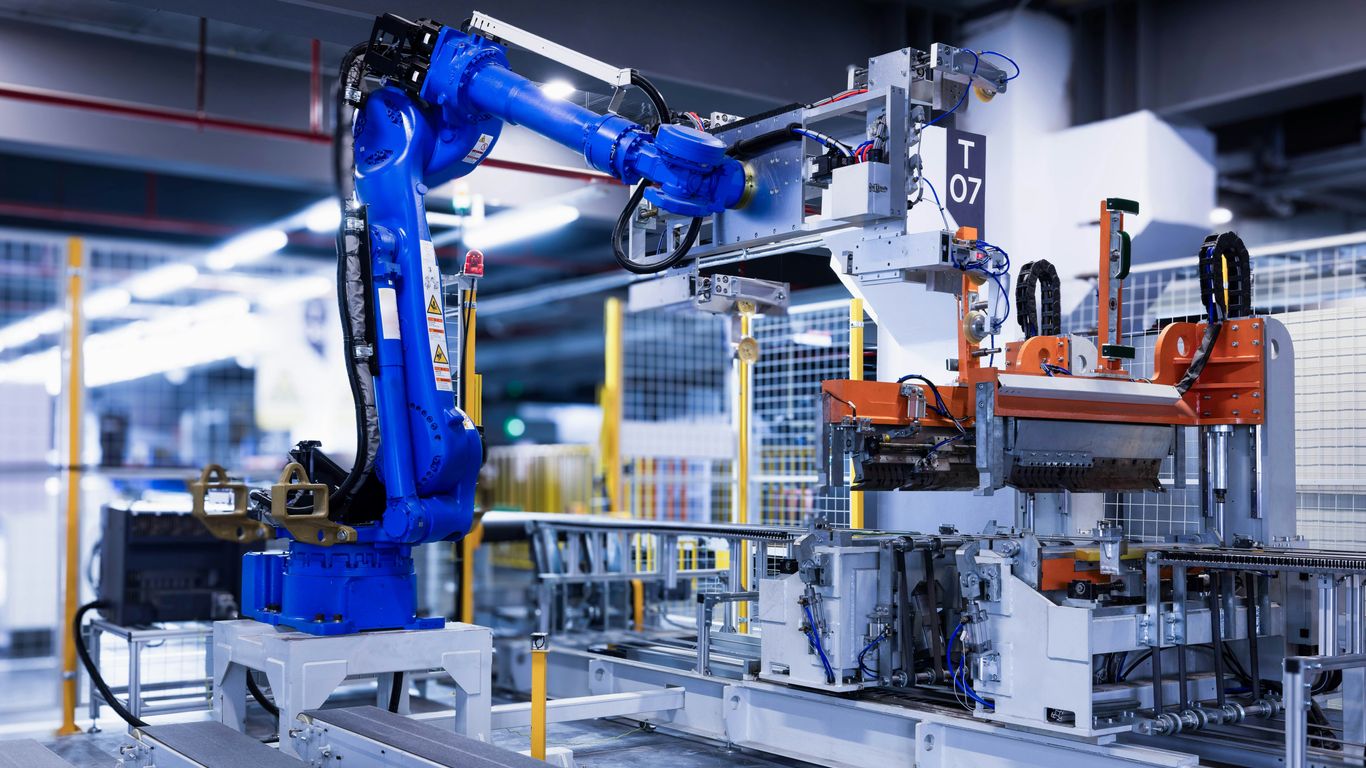
Automation is the use of software, machines, sensors, or control systems to execute a defined sequence of actions. A timer controlling a building system, a software workflow routing an invoice, and a production line adjusting machine settings can all qualify. The common thread is that the system follows rules, signals, or programmed logic so a person does not need to direct every step. For a broader comparison of the concepts, this automation and robotics overview provides a useful starting point.
Automation can be simple or highly orchestrated. It may remove a manual handoff, coordinate several machines, or manage a process across multiple software applications. It does not require a robot, and it does not necessarily imply artificial intelligence or independent decision-making.
Defining robotics and robotic systems
Robotics concerns the design, construction, programming, and operation of robots. A robotic system typically combines a mechanical structure with actuators, sensors, control software, and an operating environment. It may be stationary, mobile, or designed for specialized movement. Depending on its design, it can perform a task autonomously, semi-autonomously, or under close human supervision.
The physical dimension is the clearest distinction. A robot interacts with the material world: it may grasp, weld, transport, inspect, or manipulate an object. Its usefulness depends not only on code but also on reach, payload, accuracy, sensing, and safe interaction with its surroundings.
How robotics fits within broader automation
Robotics is often a means of achieving automation, not a synonym for it. An automated packaging cell might include a robot arm, a conveyor, barcode readers, a programmable controller, and software that tracks production status. The robot handles movement, while the surrounding system determines when work begins, what happens next, and how exceptions are handled.
That relationship explains why a company can automate a process without introducing robotics. A digital approval workflow, for example, can route documents and send notifications without any physical machine. Conversely, a robot can be used as a programmable research or service platform even when it is not part of a fully automated production process.
The role of software, hardware, and human input
Automation and robotics are best understood as systems rather than isolated machines. Hardware provides motion and sensing; software specifies behavior, schedules activity, and records results; people define objectives, monitor performance, and intervene when conditions fall outside the design envelope. The balance varies by application.
A highly structured process may rely on fixed logic and predictable inputs. A less structured environment needs more sensing, richer data, and more opportunities for human review. In both cases, system boundaries matter: the quality of an automated result depends on what the system can observe, decide, and safely control.
Robotics vs automation: The key differences
The difference becomes clearer when the technologies are compared by what they control and how much of the surrounding process they cover. Automation may coordinate a complete workflow, while robotics may provide one physical capability within that workflow. Neither is automatically more advanced or more valuable. The practical question is which layer contains the bottleneck.
Scope and system complexity
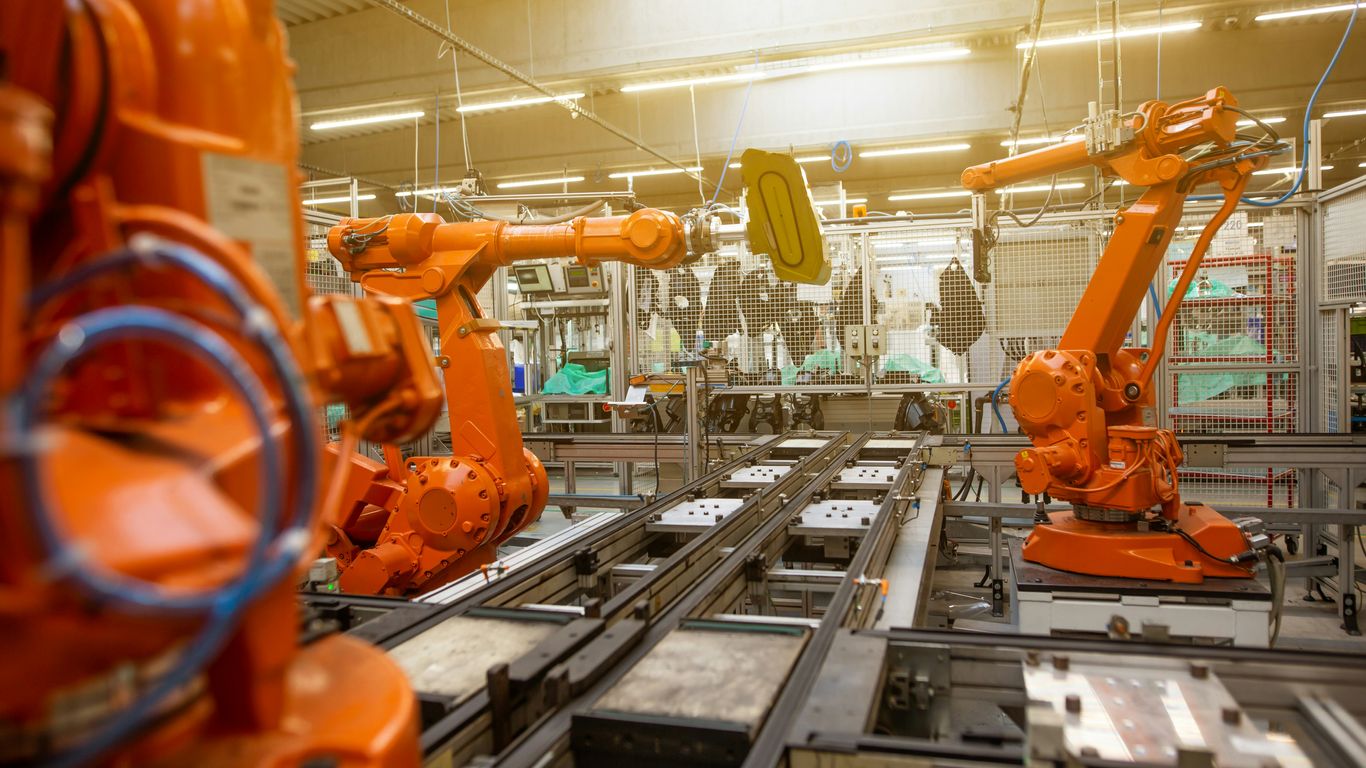
Automation can span an entire operation, from input capture and scheduling to execution, reporting, and exception handling. Robotics is narrower in one sense because it centers on robotic machines, but the supporting system around a robot can still be complex. A robot cell may require tooling, vision, safety controls, material presentation, maintenance procedures, and production software.
This distinction matters in technical planning. Buying a robot does not automate a process by itself; the process must also supply consistent inputs, define outputs, and handle failures. A software workflow may be easier to pilot, but it can still become complex when it crosses legacy systems and ambiguous business rules.
Physical movement versus process control
Robotics is concerned with physical movement and interaction. Automation is concerned with controlling a sequence or outcome, whether the work is physical, digital, or mixed. A robotic welding cell combines both: the robot moves a tool, while an automated control system coordinates fixtures, sensors, timing, and quality checks.
The distinction can be useful during problem definition. If the central issue is moving parts in a hazardous area, robotics may be central. If the issue is reconciling records across software systems, process automation may address it without any physical equipment.
Flexibility, programmability, and adaptability
Both technologies can be programmable, but flexibility has several layers. A robot may accept a new motion program yet still require new tooling or changes to how parts are presented. A software workflow may be easy to edit but remain fragile when inputs change format. Adaptability therefore depends on sensing, interfaces, data quality, and the number of assumptions built into the process.
The emerging category of AI robots illustrates why the distinction is becoming less rigid: perception and data systems can help physical machines respond to variation. That does not remove engineering constraints. It changes where the system can handle variation and where a human or redesigned process is still needed.
Typical costs and maintenance requirements
Automation costs are shaped by software development, integration, data work, licensing, controls, and process redesign. Robotics adds mechanical equipment, end effectors, safety infrastructure, calibration, spares, and physical installation. A low-cost robot can therefore create a high-cost deployment if the surrounding workflow is poorly prepared.
Maintenance also differs. Software systems require monitoring, updates, access management, and recovery procedures. Robotic systems require those disciplines plus mechanical inspection, wear management, and safe servicing. A financial comparison should include downtime, training, integration, and ongoing ownership rather than only the purchase price.
How each technology affects the workforce
Automation generally changes how people perform a process, often shifting effort from repetitive execution toward supervision, exception handling, analysis, and customer interaction. Robotics can also remove or reduce exposure to physically demanding, dangerous, or ergonomically difficult tasks. Neither outcome is automatic; job design and training determine much of the practical effect.
A responsible deployment identifies which decisions remain with people and how workers will develop the skills needed to operate, maintain, and improve the system. Workforce impact should be treated as an engineering and operating concern, not as a late communications exercise.
How robotics and automation work together
The most useful deployments combine several layers. Software establishes the workflow, controllers coordinate equipment, sensors report conditions, and robots perform physical actions where they are effective. Human operators remain part of the system, especially when judgment, accountability, or unusual conditions matter. The result is usually a chain of dependent technologies rather than one autonomous device.
Robotic process automation in software workflows
Robotic process automation, commonly called RPA, uses software agents to carry out structured actions in digital systems. These agents can move information between applications, follow rules, and trigger routine steps without a physical robot. RPA is therefore a form of automation that uses the language of robotics metaphorically: its “robot” is software.
It works best when tasks are repetitive, inputs are reasonably consistent, and the desired sequence is explicit. If a workflow depends on nuanced judgment or frequently changing interfaces, the implementation may need stronger orchestration, human review, or a different software architecture.
Industrial robots on automated production lines
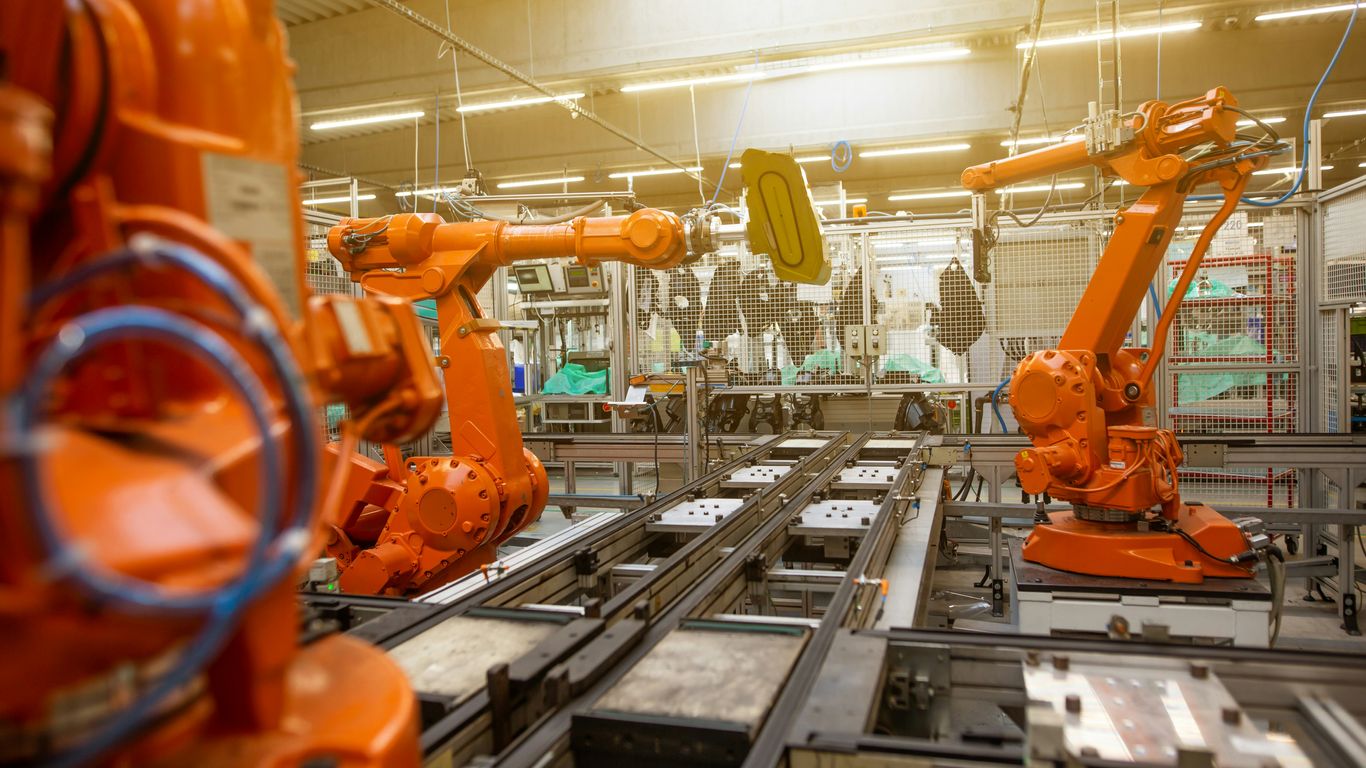
On a production line, a robot is typically one element in an automated cell. Conveyors, fixtures, machine tools, inspection equipment, controllers, and manufacturing software must coordinate with its movements. The line may stop the robot when a sensor detects an unsafe condition or divert a part when inspection data indicates a defect.
Specialized systems can target particular bottlenecks. Path Robotics, for example, is described in its coverage as applying autonomous welding technology with sensor arrays and machine learning for real-time adjustments to complex parts. That capability fits a narrow physical production problem; it should not be generalized to every form of factory automation.
Sensors, controllers, and artificial intelligence
Sensors provide observations, controllers translate logic into actions, and artificial intelligence can help interpret complex or variable inputs. Together, these components can make a system more responsive than a fixed sequence alone. Yet each layer introduces requirements for calibration, data quality, validation, and failure handling.
A system that uses vision to identify an object still needs a reliable way to grasp it, a controller that limits motion, and an operating procedure for uncertainty. The intelligence of a component does not eliminate the need to engineer the complete loop from perception to action.
Human-robot collaboration and safety systems
Human-robot collaboration is designed around shared work rather than simply placing a person near a machine. Safety may involve speed and separation monitoring, force limits, guarded zones, emergency stops, and task-specific risk assessment. The appropriate controls depend on the robot, tooling, materials, workspace, and the people using it.
The ANYbotics coverage describes autonomous legged robots in industrial settings, including sensor integration and human-robot collaboration. That example shows why mobility and sensing must be evaluated alongside safety procedures and site conditions. A safe deployment is a system property, not a label attached to a robot.
Common applications and use cases
Applications differ because the underlying tasks differ. Some environments are tightly structured, with fixed positions and repeatable inputs. Others involve changing objects, uncertain terrain, sensitive materials, or decisions that require human context. Automation and robotics can serve both categories, but the engineering burden rises as variation and consequence increase.
Manufacturing and assembly
Manufacturing remains a clear setting for robotics because many tasks involve repeated motion, controlled geometry, and measurable outputs. Robots can support assembly, welding, machine tending, packaging, material handling, and inspection. Automation around them coordinates timing, part flow, quality checks, and production records.
The strongest business case usually starts with a constrained task rather than a general ambition to “automate the factory.” A repeatable operation with a visible bottleneck offers better conditions for testing cycle time, quality, and uptime.
Warehousing, logistics, and fulfillment
Warehouses use automation for inventory records, order routing, sortation, storage, and replenishment. Robotics can add movement through autonomous mobile systems, robotic picking, palletizing, or conveyor interaction. The value depends on layout, item variability, order profiles, and the warehouse management systems that coordinate the work.
Locus Robotics is covered as a warehouse automation provider using collaborative robots and a Robotics-as-a-Service model, with attention to warehouse management system integration and peak-season flexibility. That documented scope is a useful example of how a robotic deployment can be evaluated as an operating service rather than only as purchased equipment.
Healthcare and laboratory operations
Healthcare and laboratory settings often prioritize traceability, consistency, contamination control, and careful handling. Automation can schedule tests, manage records, route samples, or enforce procedural checks. Robotics may support physical transport, dispensing, manipulation, or imaging, provided the system meets the relevant safety and validation requirements.
The physical device is only one part of the risk profile. A laboratory deployment also needs clear chain-of-custody procedures, access controls, calibration, and a response plan for uncertain or failed results. In clinical environments, efficiency cannot substitute for accountability.
Agriculture, construction, and field services
Agriculture, construction, and field services are harder to automate because conditions change. Terrain, weather, materials, site access, and human activity can all vary beyond the assumptions of a fixed process. Robotics may still help with inspection, measurement, navigation, or repetitive equipment operation, but deployment must account for the environment as carefully as the task.
For example, a roofing inspection remains a field process involving site conditions and professional judgment; Driftwood Builders Roofing describes inspections, estimates, repairs, replacement, and hail-damage assessment rather than a robotic capability. The distinction is useful: automation can support information flow around a service without replacing the expertise that evaluates the physical situation.
Office and customer service processes
Office work is often a strong candidate for software automation when inputs, rules, and approvals are defined. Examples include document routing, data entry, notifications, reconciliation, and identity-check workflows. The ID verification guidance in the coverage set emphasizes the need to balance speed, accuracy, fraud prevention, compliance, and customer experience.
Robotics is less central in these cases because the work occurs in digital systems. Physical devices may still participate through scanning or access control, but the primary challenge is usually process design, data governance, and exception management.
Benefits and limitations of each approach
Both approaches can improve operations, but neither is a universal shortcut. Automation can reduce manual coordination and make a process more observable. Robotics can bring repeatable physical performance to tasks that are tiring, hazardous, or difficult to staff. The gains appear only when the process, technology, and operating model fit together.
Where automation delivers the most value
Automation tends to deliver strong value when work is repetitive, rules-based, high-volume, and relatively stable. It can reduce handoffs, improve visibility, and make cycle times more consistent. Digital automation is often easier to scale across locations than a physical installation, although integration and governance can still be substantial.
The most credible cases define the baseline first. Without a clear view of current error rates, processing time, queue size, or rework, it is difficult to distinguish a real improvement from a shift in where work is recorded.
When robotics is the better investment
Robotics becomes more compelling when the task requires physical movement and exposes people to repetition, force, heat, hazardous materials, or difficult ergonomics. It can also help when consistent motion and throughput are more valuable than manual flexibility. The case is strongest when inputs can be presented reliably and the robot has enough utilization to justify its support infrastructure.
A robot is not necessarily the right answer for a process that changes every few minutes or depends on subtle judgment. In those settings, a smaller assistive system, better tooling, or process redesign may provide more value than a fully robotic cell.
Accuracy, speed, and repeatability gains
Automation and robotics can improve repeatability by applying the same rules or motions across many cycles. They can also create better records of what happened, when it happened, and whether a condition was detected. These qualities matter in manufacturing, logistics, laboratories, and regulated workflows.
The benefits should be stated carefully. A system is only as accurate as its sensors, training data, calibration, inputs, and acceptance criteria. Speed can also move a bottleneck downstream, so performance must be measured across the complete process rather than at the automated step alone.
Flexibility and scalability trade-offs
Fixed automation often performs well in a stable, high-volume environment but can be expensive to change. More programmable systems may accommodate variation, though they usually require better sensing, software, testing, and operational expertise. Robotics-as-a-Service models can reduce initial commitment in some cases, but they do not remove the customer's responsibility for process ownership and performance measurement.
A useful comparison separates three kinds of scale: adding volume to one deployment, replicating a deployment across sites, and adapting the system to new work. A solution that scales in one dimension may be weak in another.
Safety, integration, and workforce challenges
Safety and integration are often the least visible parts of a business case. Physical systems need risk assessments, guarding or monitored zones, maintenance access, and training. Software systems need permissions, resilient interfaces, audit trails, and recovery plans. Both require owners who can respond when assumptions fail.
A practical deployment should address at least the following questions before full rollout:
- Who owns the process after implementation?
- What happens when an input falls outside the designed range?
- Which system is the source of truth for status and performance?
- How will operators, technicians, and affected teams be trained?
These questions expose hidden costs early. They also make it easier to distinguish a technically impressive pilot from an operation that can be supported reliably.
How to choose between robotics and automation
Choosing between robotics and automation is less about selecting a fashionable category than locating the actual constraint. The best solution may be software, a physical robot, a conventional machine, or a combination of all three. A disciplined evaluation starts with the work and then tests the technology against it.
Matching the technology to the business problem
The problem statement should describe a measurable operational issue rather than a preferred technology. Long cycle times, quality variation, worker exposure, missed handoffs, and constrained capacity point to different interventions. If the issue is digital coordination, software automation may be sufficient. If it is physical handling, robotics may be relevant.
The choice should also reflect the desired time horizon. A quick workflow improvement and a multi-year production-system redesign are different investments, even when both are called automation.
Evaluating tasks, processes, and operating conditions
A technical team should map the task from inputs through exceptions and outputs. It should record variation in objects, volumes, locations, timing, environmental conditions, and human interaction. The map should include the unglamorous steps that often determine whether a deployment works, such as replenishment, cleaning, changeovers, and recovery after faults.
This evaluation is especially important in field settings. A system that succeeds in a controlled demonstration may face uneven floors, changing light, weather, or unplanned human activity in production. Conditions should be tested directly rather than assumed from a specification sheet.
Comparing implementation costs and return on investment
Return on investment should include equipment or software, integration, process redesign, training, maintenance, downtime, and the cost of capital. It should also account for utilization: a robot that runs only occasionally may not justify its fixed infrastructure, while a modest software automation may deliver value at high volume.
The economic model should use conservative assumptions and identify which benefits are hard savings, avoided costs, capacity gains, or quality improvements. A pilot can reduce uncertainty, but it should be designed to answer a financial question rather than simply demonstrate that a system can operate.
Planning integration with existing systems
Integration determines whether the new capability becomes part of operations or remains a disconnected demonstration. Physical deployments may need manufacturing execution systems, warehouse management systems, programmable controllers, safety systems, and maintenance records. Digital deployments may need APIs, identity controls, data validation, and clear ownership of exceptions.
Interfaces should be documented before deployment. The team should know what data enters the system, what it produces, how failures are reported, and how a person can safely take over. These details are often more decisive than a headline performance figure.
Measuring performance with relevant KPIs
The final choice should be tied to a small set of metrics that reflect the business problem. Useful measures may include throughput, cycle time, first-pass yield, error rate, uptime, utilization, mean time to recovery, worker exposure, and total cost per unit. The baseline and measurement method should be agreed before the pilot begins.
A good KPI set distinguishes local improvement from system-wide improvement. Faster motion is not enough if queues grow elsewhere; fewer manual steps are not enough if exception work doubles. Measurement keeps the decision grounded in operational evidence rather than the apparent sophistication of the technology.
Conclusion
Robotics is focused on programmable physical machines, while automation is the broader practice of using technology to control work and processes. They frequently operate together, but the right choice depends on the task, environment, integration demands, workforce, and economics. A careful buyer starts with the bottleneck, defines the operating conditions, and measures whether the complete system—not just the robot or software—creates durable value.
Frequently Asked Questions
Is robotics the same as automation?
No. Robotics concerns physical programmable machines, while automation is a broader concept that includes software, machines, and control systems. Robotics can be used to achieve automation, but automation does not require robotics.
Can automation exist without robots?
Yes. Digital workflows, timers, scheduling systems, document routing, and industrial control logic can automate tasks without using a physical robot.
Can a robot operate without being part of an automated process?
Yes. A robot may be used for research, demonstration, education, or supervised operation without being integrated into a larger automated workflow.
Is robotic process automation physical robotics?
Usually not. Robotic process automation generally refers to software agents that perform structured actions in digital applications. The term “robotic” describes the task model rather than a physical machine.
Which is more flexible: robotics or automation?
Neither is inherently more flexible. Flexibility depends on programmability, sensing, interfaces, process variation, tooling, data quality, and the effort required to change the system.
Does automation always reduce jobs?
Automation changes tasks and responsibilities, but its workforce effect depends on how the organization deploys it. It may reduce repetitive work while increasing demand for supervision, maintenance, analysis, exception handling, and system design.
What should a company evaluate before investing?
It should assess the process, variation, operating environment, safety requirements, integration effort, total cost, workforce implications, and measurable KPIs. A focused pilot can help test the highest-risk assumptions before a wider rollout.