Key Takeaways
AI robots are moving factory automation from fixed repetition toward perception, adaptation, and coordinated decision-making. The most credible deployments in 2026 remain tightly scoped, measurable, and designed around the people who operate them.
- AI-enabled robots can respond to variation that traditional fixed automation often cannot.
- Computer vision, edge computing, and industrial data systems are becoming as important as robot hardware.
- Assembly, inspection, machine tending, material movement, and warehouse operations are leading use cases.
- Successful programs begin with a measurable pilot rather than a broad promise of full autonomy.
- Humanoids may expand the addressable task range, but specialized robots will remain central to factory operations.
What AI robots in manufacturing 2026 look like
AI robots in manufacturing 2026 are not a single machine category. They include industrial arms with vision systems, autonomous mobile robots, collaborative robots, and emerging general-purpose platforms that combine perception with physical action. The defining shift is that software increasingly helps these machines interpret their surroundings and choose among possible actions, rather than simply repeating a preprogrammed path.
That distinction matters because factories are rarely as uniform as their diagrams suggest. Parts arrive with small variations, production schedules change, and tools wear over time. A robot that can detect those changes can remain useful across more situations, although it still operates within carefully defined safety and process boundaries.
How AI-powered robots differ from traditional industrial automation
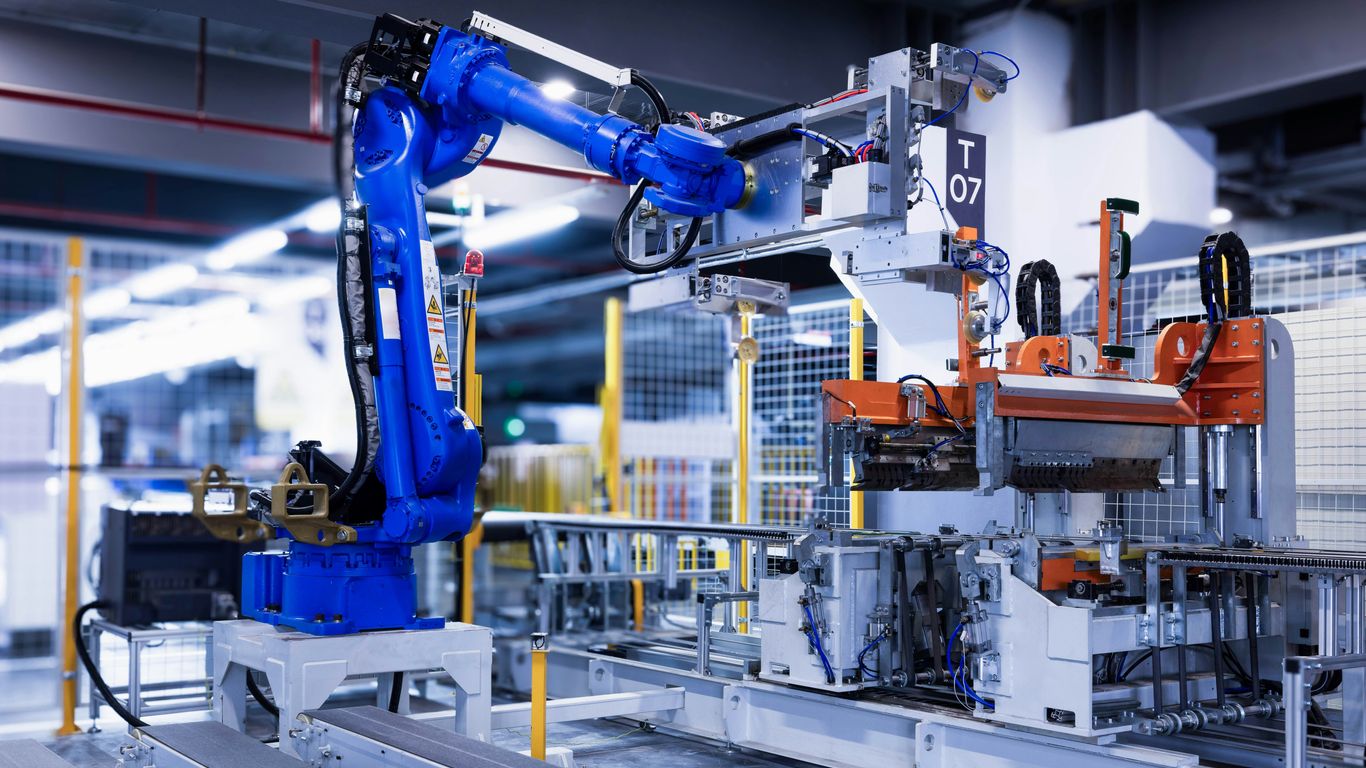
Traditional industrial automation excels when inputs, positions, and sequences are stable. A conventional robot can execute a welding, palletizing, or pick-and-place routine with remarkable repeatability, but it generally depends on fixtures, known coordinates, and explicit instructions. AI adds a layer of interpretation: the system can classify an object, estimate its pose, identify an anomaly, or select a motion from a constrained set.
This does not make the robot independently intelligent in the broad human sense. It makes the automation more tolerant of variation. The practical value is often less brittle automation: fewer hard-coded assumptions, faster changeovers, and less engineering effort when a process changes modestly.
The boundary between the two approaches is also becoming less absolute. Many effective installations pair deterministic motion planning and safety controls with learned models for perception. The learned component handles uncertainty; the conventional control system keeps the machine predictable where predictability is required.
The role of computer vision, machine learning, and edge computing
Computer vision gives a robot information about objects, surfaces, positions, and conditions that a fixed sensor or mechanical fixture may not capture. Machine-learning models can then use that information to recognize parts, detect defects, or estimate whether a grasp is likely to succeed. Edge computing places much of this processing near the machine, reducing the delay and network dependence associated with sending every image to a remote service.
The architecture is usually layered. Cameras and force sensors collect signals, a model interprets them, a planner chooses a permitted response, and the robot controller executes it. Engineers still need to define operating envelopes, failure states, and escalation paths; an accurate vision model is not a substitute for a safe control architecture.
Generative systems are also appearing around the robot rather than inside its safety-critical loop. They can help operators search manuals, explain alarms, draft routines, or translate a process description into a starting point for programming. The final procedure still requires validation on the equipment.
Why collaborative and mobile robots are expanding beyond fixed workcells
Collaborative robots are designed to work in closer proximity to people under defined conditions, while autonomous mobile robots move materials between locations rather than remaining bolted to one station. Both address a limitation of classic automation: the cost and physical permanence of a fixed cell. A mobile platform can serve several lines, and a cobot can be redeployed when product mix changes.
The decision is not simply whether a machine can share space with a worker. It depends on speed, payload, tooling, guarding, risk assessment, and the surrounding workflow. A useful cobot selection guide frames the choice around application requirements such as payload, reach, precision, sensing, and integration effort.
For smaller manufacturers, the attraction is often incremental deployment. A company can automate material presentation or machine tending without redesigning an entire facility. That flexibility is valuable, but it also makes traffic management, charging, network coverage, and exception handling central engineering concerns.
How physical AI enables robots to adapt to changing production conditions
Physical AI refers to systems that connect models to sensing and action in the physical world. In manufacturing, the loop is typically perceive, predict, and act: the robot observes a part or workspace, estimates what is happening, and takes a bounded action. Learning from demonstrations may reduce the amount of conventional programming needed for some variable tasks, though demonstrations do not remove the need for process qualification.
The important test is not whether a robot can perform a task once. It is whether performance remains acceptable across shifts, lighting conditions, part tolerances, tool changes, and recovery scenarios. That is why production teams should treat adaptation as an engineering property to measure, not a marketing adjective.
A useful overview of physical AI systems places this development in the wider movement toward embodied models and vision-language-action systems. For factories, the near-term implication is narrower and more practical: more tasks may become automatable when variation can be observed and managed instead of eliminated.
Where AI robots are creating the biggest manufacturing impact
The strongest manufacturing applications are not necessarily the most theatrical ones. They are tasks with a clear economic baseline, repeated physical demand, and enough structure for a robot to operate safely. AI expands the range of those tasks by helping machines handle modest variation in parts, routes, and inspection conditions.
Manufacturers are therefore starting where the workflow is visible and the result can be measured. Assembly support, machine tending, inspection, intralogistics, and hazardous handling each offer a different balance of technical difficulty and business value.
Automating assembly, machine tending, and material handling
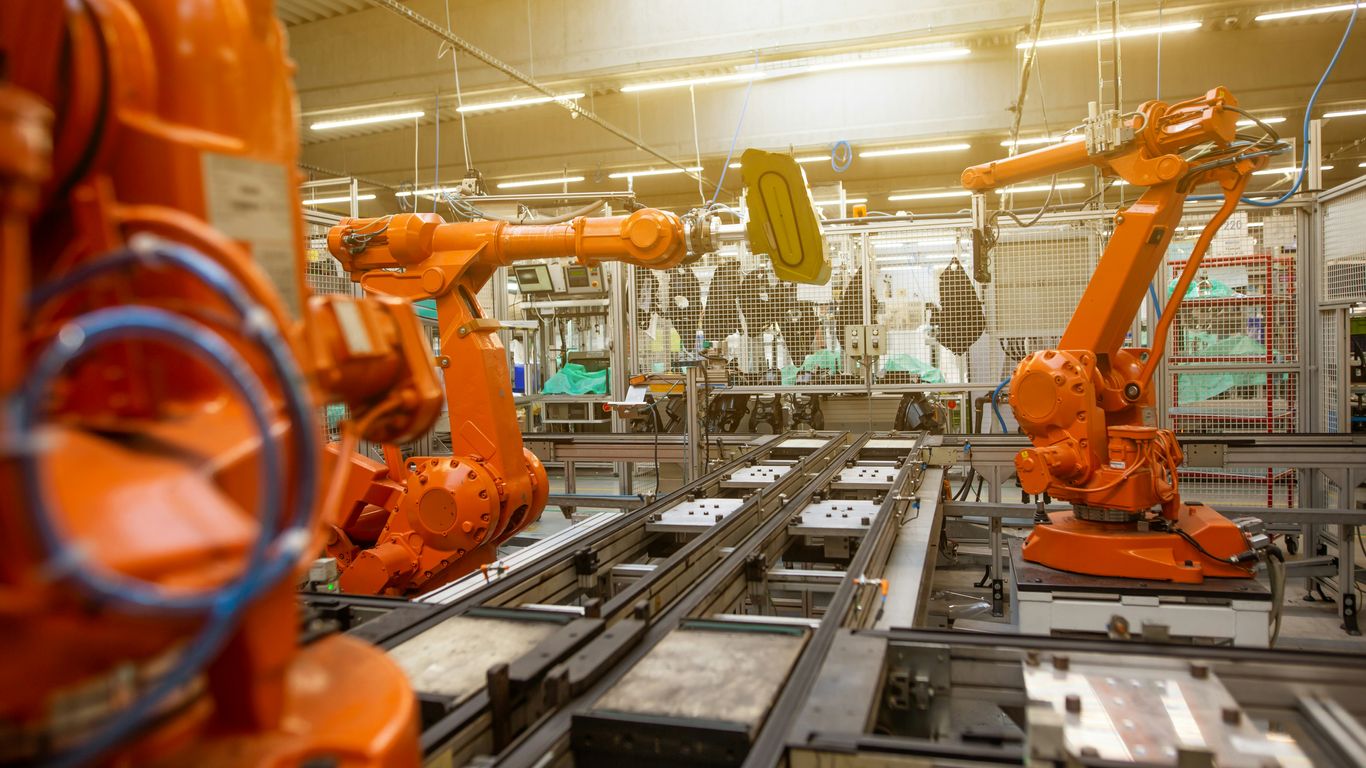
Machine tending is a natural entry point because the robot repeatedly loads and unloads equipment while a production machine performs the transformation. Vision can help locate parts, confirm orientation, or verify that a fixture is ready. In assembly, the challenge is usually greater: insertion forces, tolerances, flexible components, and sequencing errors all require more sensing and process control.
Material handling sits between the two. Robots may move bins, pallets, or components across a known route, while software coordinates destinations and priorities. The business case improves when movement consumes skilled workers' time or creates ergonomic strain, but the system must account for congestion and exceptions rather than only average travel time.
Improving quality inspection with real-time visual analysis
AI-assisted inspection can examine images at production speed and identify patterns that rule-based systems may miss. It is particularly useful when inspectors must review many similar parts or when defects vary in shape and appearance. The model should be evaluated against a representative sample, including acceptable variation, rare defects, lighting changes, and false positives.
Inspection is also a governance problem. A model that rejects too many good parts raises scrap and review costs; one that misses defects creates a quality risk. Human review remains valuable for ambiguous cases, model drift, and the continuous collection of new examples.
Supporting warehouse operations and intralogistics
Factories increasingly depend on the movement of work-in-progress, components, finished goods, and packaging. Autonomous mobile robots can support these flows by navigating between stations, while warehouse systems assign missions and track inventory. The robot is only one part of the operation: doors, elevators, floor markings, charging points, and digital location data determine whether the system performs reliably.
The same principle applies to smaller facilities. A practical warehouse robotics guide emphasizes matching the system to routes, order profiles, and labor constraints rather than assuming that a complete facility overhaul is necessary. In manufacturing, the equivalent question is which transport loop is stable enough to automate first.
Handling hazardous, repetitive, and ergonomically difficult tasks
Robots are well suited to operations involving heat, fumes, sharp edges, heavy loads, awkward reaches, or prolonged repetition. Removing exposure is often a stronger reason to automate than saving labor minutes. It can also improve consistency when fatigue or discomfort affects manual performance.
The task still needs to be decomposed carefully. A robot may handle loading while a trained employee performs a judgment-heavy setup, or it may take over a dangerous transfer while people retain process ownership. The best design reduces exposure without turning the human role into unplanned exception work.
How AI robots improve manufacturing performance
The value of robotics is often described in terms of speed, but speed alone is a weak measure. A faster cell that produces more defects, waits for material, or requires frequent intervention may reduce overall output. Performance improvement comes from the interaction of cycle time, uptime, quality, changeover effort, and labor allocation.
AI can contribute by reducing variation and improving response, yet the gain depends on the surrounding process. Plants should establish a baseline before deployment and keep the evaluation period long enough to include normal disruptions, maintenance, and product changes.
Increasing throughput without relying only on larger workforces
A robot can extend operating hours, maintain a repeatable pace, or relieve workers from low-value transfers. That does not mean one machine replaces a whole shift. More often, it allows existing teams to supervise several automated steps, handle exceptions, or concentrate on activities that require judgment and dexterity.
Throughput gains are constrained by bottlenecks. If inspection, tooling, or material supply is slower than the robot, the system merely moves the queue. A sound analysis maps the complete flow and asks whether automation increases the capacity of the constraint rather than optimizing an isolated station.
Reducing defects, downtime, and unplanned maintenance
Vision checks can catch process drift earlier, while sensor data can reveal changes in vibration, temperature, force, or motor behavior. These signals support condition-based maintenance, in which a team investigates evidence of deterioration instead of relying only on a calendar. The result is not perfect prediction; it is better prioritization of maintenance attention.
Downtime reduction also depends on recovery design. Operators need clear alarms, accessible components, spare tooling, and a known procedure for restarting the cell. A sophisticated model cannot compensate for an installation that takes hours to diagnose after a simple misfeed.
Improving production flexibility for customized products
High-mix production challenges fixed automation because the process changes frequently and batch sizes are smaller. Vision-guided picking, configurable tooling, and software-defined task parameters can reduce the cost of those changes. AI is useful when it helps the system recognize a family of parts or adapt within validated limits.
Flexibility has a price. Each new variant requires data, testing, and a decision about whether the robot should proceed automatically or request assistance. Manufacturers should compare the full changeover burden with the value of shorter runs and broader product coverage.
Measuring returns with KPIs such as OEE, cycle time, and first-pass yield
The most credible robotics programs connect technical behavior to operational measures. Overall equipment effectiveness combines availability, performance, and quality; cycle time shows how quickly a task runs; first-pass yield shows how often products meet requirements without rework. These indicators should be reviewed together, because improving one can damage another.
A simple scorecard helps distinguish a promising pilot from an expensive demonstration. The following measures cover the main dimensions without pretending that every factory has the same priorities:
| Measure | What it reveals | Useful comparison |
|---|---|---|
| OEE | Combined availability, performance, and quality | Baseline cell versus deployed cell |
| Cycle time | Time required for a defined operation | Manual, automated, and exception cases |
| First-pass yield | Quality without rework or correction | Before and after process change |
| Intervention rate | How often people must recover or guide the system | Per shift, batch, and product variant |
| Changeover time | Cost of switching between products | Current method versus configurable workflow |
The scorecard becomes meaningful only when the definitions stay stable. Teams should record downtime causes and human interventions, not just headline output, so that the economics reflect the real operating model.
The technologies powering factory robotics in 2026
Factory robotics now sits inside a broader software and data architecture. Sensors provide the local evidence, industrial networks move information, models interpret it, and business systems determine what should be produced and where materials should go. Integration quality often matters as much as the robot's mechanical specification.
This is why robotics projects increasingly involve controls engineers, data teams, maintenance leaders, and production planners. The machine may be installed on the floor, but its usefulness depends on information that crosses several layers of the enterprise.
Combining sensors, digital twins, and industrial IoT data
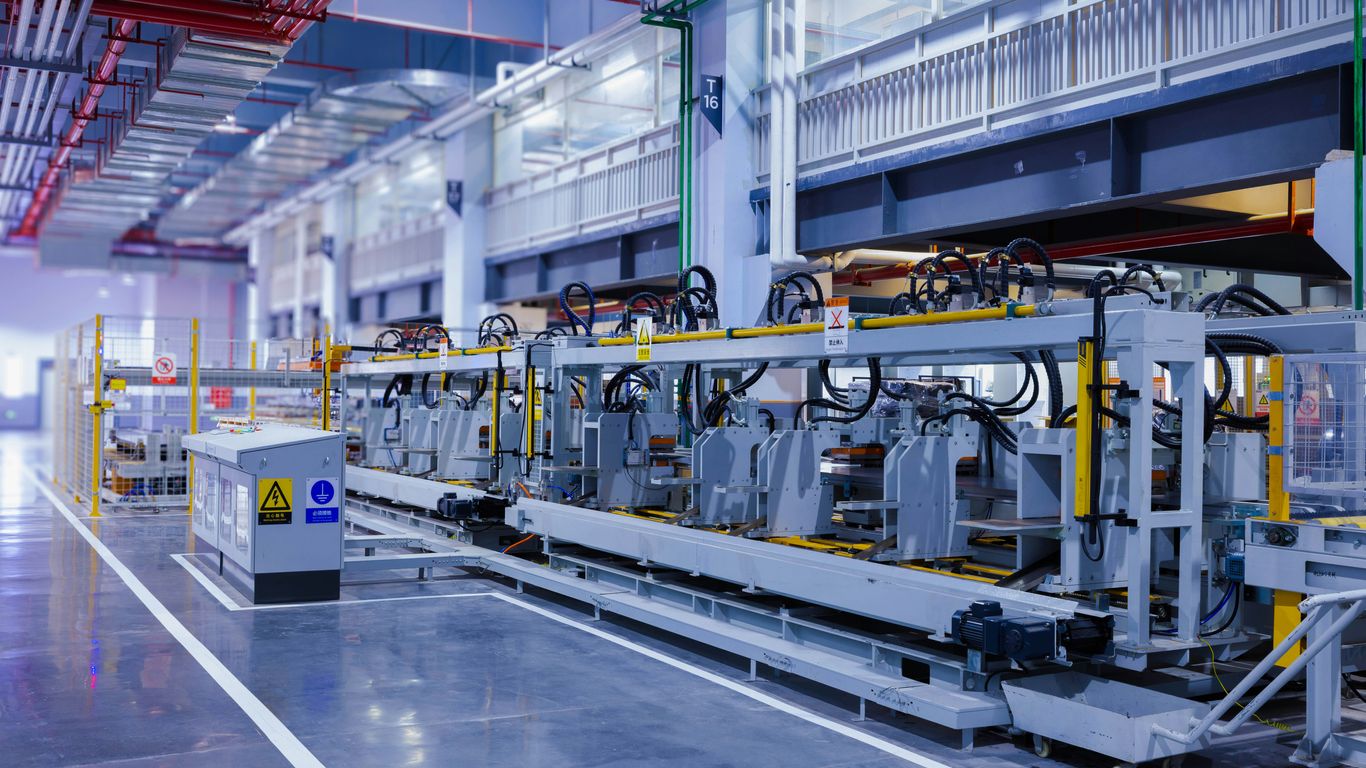
A digital twin is a software representation of an asset, process, or facility that can be updated with operational data. It may support simulation, layout planning, cycle-time analysis, or troubleshooting. Industrial IoT data adds the live signals needed to compare expected behavior with actual behavior.
The quality of the result depends on data provenance and timing. A timestamped force reading from a calibrated sensor is more useful than an unlabeled stream whose meaning changes between shifts. Teams should begin with the decisions they want to improve and collect only the signals that support those decisions.
Using generative AI for robot programming and operator assistance
Generative AI can make technical information easier to access and can produce draft code, documentation, or task instructions. An operator might describe an alarm in ordinary language and receive relevant checks, while an engineer might use a natural-language description to create a preliminary programming scaffold. In either case, the output needs review against the equipment and the approved workflow.
The same human-in-the-loop pattern appears in AI implementation planning, where data readiness, process fit, and staff training are treated as implementation requirements rather than afterthoughts. In robotics, that discipline is especially important because a plausible instruction can still produce an unsafe physical action.
Connecting robots to MES, ERP, and warehouse management systems
A manufacturing execution system can provide work orders and production context, an enterprise resource planning system can coordinate purchasing and scheduling, and a warehouse management system can direct inventory movement. Connecting these systems lets a robot receive meaningful missions instead of operating as an isolated island.
Interfaces should expose status, faults, material identity, and completion data in both directions. The factory also needs clear ownership of master data. If a part number, route, or location is inconsistent across systems, the robot may execute the wrong valid instruction.
Choosing between cloud, edge, and on-premises AI processing
Cloud processing offers elastic compute and centralized model management. Edge processing keeps inference near the machine, which can reduce latency and preserve operation during network interruptions. On-premises systems may be preferred where data residency, intellectual property, or production continuity makes external dependence unacceptable.
There is no universal winner. Safety-critical control should remain governed by deterministic systems and certified architectures, while less time-sensitive analytics can use centralized infrastructure. The right design balances latency, cost, availability, cybersecurity, and the effort required to update models across a fleet.
How manufacturers can implement AI robots successfully
Implementation is a sequencing problem before it is a purchasing problem. A factory must identify a task, define the required performance, prepare the environment, and decide how people will recover failures. Starting with a broad ambition such as “autonomous production” makes it difficult to establish accountability.
The best early programs are usually narrow enough to control and important enough to matter. They produce operational evidence that can guide the next deployment, including evidence that a proposed use case should not be automated yet.
Identifying processes that are ready for robotic automation
A strong candidate has repeatable demand, a visible workflow, accessible inputs and outputs, and a measurable pain point. It does not need to be perfectly uniform, but its variation must be observable or bounded. Process owners should document exceptions before selecting hardware.
The initial screen can be organized around four questions:
- Is the task frequent enough to justify integration and maintenance?
- Can success and failure be measured objectively?
- Are parts, tools, and workspaces accessible to the proposed robot?
- Can the safety case be made without relying on unproven behavior?
These questions prevent teams from choosing a dramatic demo that has no path to production. They also surface infrastructure work early, when it is still possible to change the scope.
Running a pilot that produces measurable business results
A pilot should have a baseline, a target, a time window, and a named owner. The target might involve intervention rate, first-pass yield, ergonomic exposure, or productive hours rather than robot speed alone. The test should include normal variation and a defined method for handling failures.
Financial analysis should include integration, tooling, training, maintenance, software, and downtime during installation. A pilot that succeeds technically but creates an unmanageable support burden has not yet proved its business case.
Preparing data, workflows, and facility infrastructure
Robots need more than training images. They need reliable part identities, calibrated sensors, stable network access, appropriate power, clear floor space, and workflows that specify what happens when the expected condition is absent. Data labeling and version control should be treated as operational work, not a one-time research exercise.
Facility preparation can expose hidden constraints. A robot may fit the drawing but fail to reach a service panel; a mobile platform may navigate the main aisle but not the fire door; a vision system may work in the morning and degrade under afternoon glare. Testing in the real environment is therefore essential.
Scaling from one robotic cell to a connected fleet
Scaling requires standards for interfaces, software versions, alarm taxonomies, spare parts, and operator training. Without those standards, every new cell becomes a custom project and the maintenance burden grows faster than the fleet. Central monitoring can help, but it should not obscure local responsibility.
Fleet expansion also creates a data opportunity. Shared performance records can reveal recurring failure modes and inform model updates. The organization must still control changes carefully: a model improvement for one line should not be pushed to every line without validation.
Workforce, safety, and operational considerations
Factory automation changes work before it eliminates work. Employees may spend less time carrying, loading, or inspecting and more time managing flow, resolving exceptions, checking quality, and improving the process. Whether that is a positive transition depends on training, job design, and how openly management explains the change.
Safety must remain a system property. It includes the robot, tooling, software, workspace, maintenance procedure, and behavior of the people around it. AI can improve perception, but it should not be treated as permission to weaken established safeguards.
Redesigning jobs around robot supervision and higher-value work
A supervised cell needs people who understand both the production objective and the robot's limits. Their work may include replenishing materials, reviewing uncertain inspections, responding to alarms, and identifying recurring causes of intervention. Those responsibilities should be reflected in staffing and performance expectations.
Job redesign works best when it is planned before installation. If workers are left with only the least predictable exceptions, automation can increase stress rather than reduce it. A balanced role combines oversight with opportunities to improve tooling, workflow, and quality.
Training employees to operate, maintain, and improve AI systems
Training should cover ordinary operation, safe recovery, data interpretation, and escalation. Maintenance staff need access to diagnostics and replacement procedures, while process engineers need to understand model limitations and validation. Operators do not need to become machine-learning researchers, but they do need a practical mental model of what the system can and cannot infer.
Continuous improvement depends on their observations. A recurring misclassification or awkward reach may be invisible in aggregate metrics but obvious on the floor. Treating those observations as engineering input makes the deployment more resilient.
Meeting functional safety, cybersecurity, and compliance requirements
Functional safety analysis should define hazards, protective measures, safe states, and validated recovery procedures. Cybersecurity adds concerns about authentication, network segmentation, remote access, software updates, and the integrity of model files. Compliance requirements vary by jurisdiction and application, so the responsible engineering and legal teams must establish the applicable framework.
A useful rule is to separate convenience from authority. A generative assistant may recommend a procedure, but it should not silently change safety parameters or deploy code to production. Every consequential change needs an accountable review path.
Managing worker trust and human-robot collaboration
Trust is neither automatic nor desirable when it means uncritical reliance. Workers should know why the system is being introduced, what data it collects, when it may be wrong, and who owns the final decision in an ambiguous situation. Demonstrating safe failure behavior can build more confidence than showcasing a perfect run.
Human-robot collaboration should therefore be designed around clear handoffs. The worker needs a visible signal that the robot has stopped, a predictable way to request assistance, and enough context to resume work safely. Good interaction design is operational infrastructure, not decoration.
The challenges and next developments in factory robotics
The next phase of robotics will be shaped less by isolated demonstrations than by deployment economics. Hardware is improving, models are becoming easier to adapt, and compute is more accessible, but factories still have uneven data, legacy equipment, and demanding uptime requirements. Those constraints reward focused systems that solve a real bottleneck.
There is also a gap between a convincing demonstration and a production asset. The difference lies in repeatability, maintainability, safety evidence, and performance over months rather than minutes. Any assessment of AI robots should keep that distinction visible.
Addressing integration costs, data quality, and technical complexity
Integration costs include mechanical design, fixturing, controls, software interfaces, validation, and operator training. Data quality problems can be equally expensive because a model trained on narrow or poorly labeled examples may fail when deployed. Legacy machines may lack the interfaces needed to expose state or accept commands.
Manufacturers can reduce risk by standardizing where possible and by choosing use cases whose data is already available. They should also budget for ongoing support. AI-enabled equipment is not maintenance-free simply because some decisions are learned rather than programmed.
Reducing risks from model errors and unpredictable robot behavior
Model errors can arise from unfamiliar objects, changed lighting, sensor faults, distribution shifts, or ambiguous instructions. The response should not be a vague promise that the model will improve. It should include confidence thresholds, controlled fallback actions, human escalation, logging, and tests that represent the conditions of actual production.
A robot should fail in a known direction. When uncertainty is high, stopping or requesting assistance may be more valuable than attempting a risky action. This conservative behavior is a feature for industrial deployment, even if it makes a demonstration look less autonomous.
Evaluating humanoid robots alongside specialized automation
Humanoid robots attract attention because their form could let them operate in spaces designed for people. They may eventually handle a wider range of tasks without dedicated fixtures, but current claims should be separated from demonstrated production performance. Balance, dexterity, battery life, reliability, and safety certification remain practical evaluation criteria.
Manufacturers can review humanoid factory deployments for a broader view of the technical and labor questions involved. The comparison should not be humanoid versus robot in the abstract; it should be a task-level assessment against a specialized cell, a mobile platform, or a human workflow.
What manufacturers should expect from AI robots after 2026
After 2026, progress is likely to appear as better integration, faster configuration, and more reliable adaptation within bounded tasks. Foundation models may help transfer skills between related environments, while fleet data may improve monitoring and maintenance. Those developments could make automation practical for more high-mix operations, but they will not erase the need for process engineering.
The most durable systems will combine learned perception with explicit controls, strong operational data, and accountable human oversight. Research demonstrations will continue to matter, but factories will judge the field by uptime, quality, recoverability, and total cost over the long arc of deployment.
Conclusion
AI robots are reshaping manufacturing by making automation more perceptive and more adaptable, not by making every factory fully autonomous overnight. The credible path in 2026 is disciplined: select a measurable task, validate the safety and economics, train the people around it, and scale only after the operating evidence supports expansion.
Frequently Asked Questions
What are AI robots in manufacturing?
They are robotic systems that use technologies such as computer vision, machine learning, and sensor fusion to interpret conditions and perform bounded physical tasks. They still rely on conventional controls, safety systems, and defined operating limits.
How do AI robots differ from traditional industrial robots?
Traditional robots usually repeat explicitly programmed motions under stable conditions. AI-enabled systems can add perception and learned decision-making, allowing them to respond to certain forms of variation without requiring every possibility to be manually programmed.
Which manufacturing tasks are best suited to AI robots?
Common candidates include machine tending, material handling, visual inspection, repetitive assembly, and hazardous operations. The best candidates have measurable outcomes, recurring demand, and variation that can be observed or constrained.
Do AI robots replace manufacturing workers?
They more often change the mix of work than remove the need for people altogether. Employees may move from repetitive physical tasks toward supervision, maintenance, exception handling, quality, and process improvement.
What metrics should a robotics pilot track?
Useful measures include OEE, cycle time, first-pass yield, intervention rate, downtime causes, changeover time, and ergonomic exposure. The baseline and definitions should be established before deployment.
Are humanoid robots ready for widespread factory use?
Some humanoid systems are being tested or demonstrated in industrial settings, but broad deployment remains uncertain. Manufacturers should compare them with specialized automation using evidence from reliability, safety, dexterity, maintenance, and total operating cost.
What is the biggest barrier to adopting AI robots?
The main barrier is usually not one missing algorithm. It is the combined difficulty of integration, data quality, facility preparation, safety validation, workforce training, and long-term maintenance.