Inside Deep Tech Editorial
Last updated: 16 August 2026
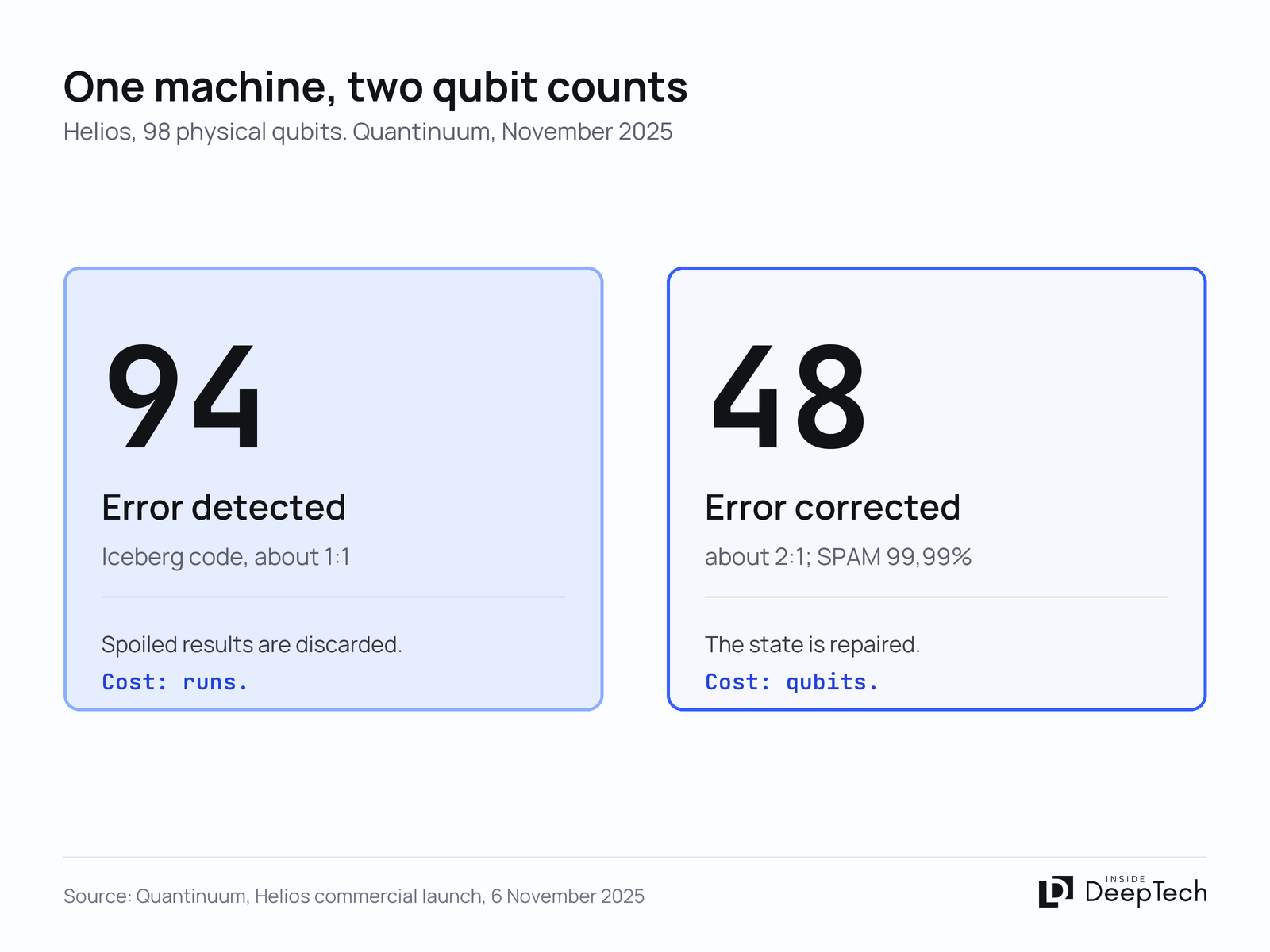
In November 2025 Quantinuum switched on a machine with 98 physical qubits and said it had produced 94 logical qubits on it. The same announcement said 48. Both numbers are correct, they describe the same hardware on the same day, and the difference between them is the difference between detecting an error and correcting one.
That gap is the story of the field this year. Nearly every headline number now arrives with a qualifier attached, the qualifier decides what the number means, and it is the part that gets dropped.
What follows separates the demonstrated from the promised, and points at the places where the two get mixed up.
The current state of quantum hardware
Three platforms are in serious contention, and none of them leads on every axis. Ranking them by qubit count produces one order. Ranking them by gate fidelity, connectivity, speed or encoding efficiency produces four different ones.
Progress in superconducting circuits
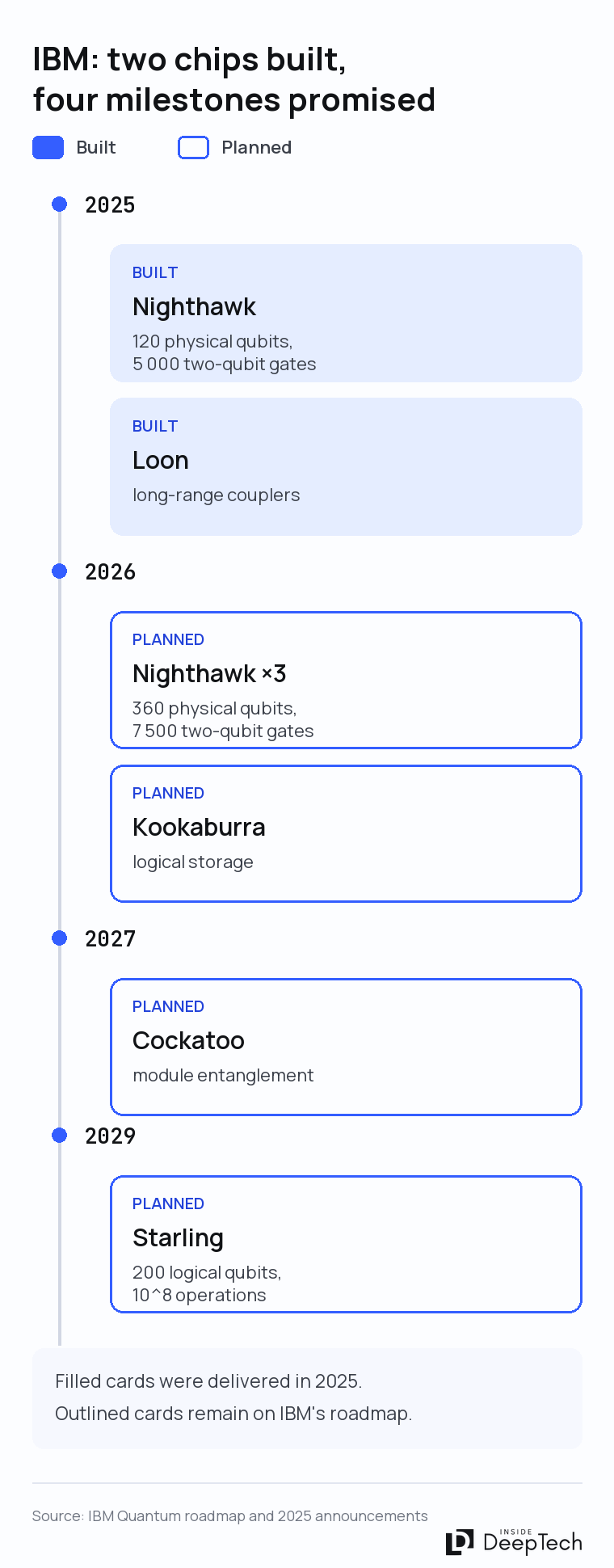
Superconducting circuits remain the industrial backbone, and 2025 was the year the manufacturing story caught up with the physics. IBM moved wafer production to a 300 mm line at Albany NanoTech and shipped Nighthawk, a processor carrying 120 physical qubits and 218 tunable couplers arranged in a square lattice, specified for circuits of 5 000 two-qubit gates. A second chip from the same year, Loon, exists to test the long-range couplers that quantum low-density parity-check codes require.
The trade-off of the platform has not changed. Superconducting qubits are fast, they are made on equipment the semiconductor industry already owns, and each one talks only to its neighbours on the lattice. Every operation between distant qubits costs extra gates, and those gates come out of the same error budget the fidelity paid for.
Advances in neutral atom and trapped-ion systems
Trapped ions hold the best published gate fidelities. Quantinuum’s Helios, launched commercially on 6 November 2025, runs 98 barium-137 ions with all-to-all connectivity, a two-qubit gate fidelity of 99,921% measured across every pair, and a single-qubit fidelity of 99,9975%. Its architecture physically moves ions between storage and logic zones, which is what buys the connectivity.
Neutral atoms scale furthest in raw array size and currently hold the logical-qubit record. A Harvard-led team with collaborators at MIT, Caltech, QuEra and NIST ran up to 96 distance-4 logical qubits simultaneously on an array of 448 atoms, using a high-rate code that packs six logical qubits into each block of sixteen. The work appeared in Nature online on 10 November 2025 and in the print issue of 1 January 2026, which is why the date is cited both ways.
Both platforms pay for this in speed. Atomic systems run roughly one hundred to one thousand times slower than superconducting ones, a figure given by Jerry Chow, director of quantum systems at IBM Quantum, in February 2026.
Scaling challenges and the qubit coherence limit
The useful comparison is the set of numbers that decide whether a given circuit will run at all, taken platform by platform.
Trapped ions lead on published fidelity. Helios reports a two-qubit gate fidelity of 99,921% across every pair, all-to-all connectivity, and 48 error-corrected logical qubits from 98 physical ones. The platform is the slowest of the three.
Superconducting circuits lead on speed and on manufacturability. Willow demonstrated below-threshold memory, with logical error suppressed by 2,14 for each two levels of code distance. Connectivity is nearest-neighbour on a lattice, and surface codes at useful distances run to hundreds or thousands of physical qubits per logical one.
Neutral atoms lead on scale. A 448-atom array ran below threshold in a four-round characterisation circuit and held 96 distance-4 logical qubits at once. Connectivity is all-to-all through physical movement of the atoms, at the same slow tier as trapped ions.
No platform leads on every count, which is why a ranking by qubit count reorders completely once fidelity, connectivity, speed or encoding is added to it.
The encoding ratio is where a qubit count finally becomes meaningful, because it converts physical qubits into logical ones at a rate that varies by more than two orders of magnitude between code families. A machine with 98 physical qubits and a two-to-one code is doing something a machine of 1 000 physical qubits running a high-distance surface code is not.
Critical milestones in quantum error correction
Moving beyond physical to logical qubits
A logical qubit is one unit of protected information spread across many physical ones, together with a procedure for spotting and repairing errors without reading the data itself. How many physical qubits that takes is the question the whole field turns on, and the honest answer is that it depends entirely on the code.
Quantinuum reports roughly two physical qubits per logical qubit for error-corrected operation on Helios, and roughly one to one for error-detected operation. The QuEra neutral-atom result packs six logical qubits into each block of sixteen. Surface codes at useful distances run into the hundreds or thousands.
A ratio quoted without naming the code is meaningless. Most published ratios are quoted without naming the code.
Implementing real-time fault tolerance
Detection and correction are different operations at different prices, and Helios shows both on one machine. The 94 logical qubits are error-detected. The system knows a result is spoiled and throws it away, which costs runs. The 48 are error-corrected: the state is repaired, the computation carries on, and the price is paid in qubits instead. Put a detected count beside a rival’s corrected count and you have compared two different things.
Correction also has to happen while the computation is still going. That is the part Google’s Willow result settled in December 2024, in a Nature paper with 249 authors. Running a distance-7 surface code on 101 qubits, the team measured 0,143% error per correction cycle, and each increase of the code distance by two suppressed the logical error rate by a factor of 2,14. The logical qubit outlived the best physical qubit on the chip by a factor of 2,4. The decoder ran with an average latency of 63 microseconds at distance 5, which means the correction kept pace with the computation instead of being reconstructed afterwards.
That factor of 2,14 is the number worth carrying into every subsequent announcement, because it says how much the machine improves as it grows. Below-threshold operation is a memory result. It says a logical qubit can be kept alive, and says nothing whatever about running a useful computation on one.
The role of error suppression in current noise models
Suppression is the cheaper cousin of correction: measure the specific noise profile of a chip, then shape the control pulses and schedule the circuit to avoid the worst of it. It adds no qubits, which is why every vendor uses it, and it does not scale, which is why none of them pretend it substitutes for a code.
The practical consequence for anyone reading benchmark results is that suppression and correction improve the same published numbers by different mechanisms, and vendors are not always explicit about which one produced a given figure.
The software and algorithmic stack
Standardization of quantum programming languages
The software layer is consolidating around a small number of stacks, and the direction is towards writing quantum and classical code in one program instead of two. Qiskit remains the widest-used entry point for gate-based work on IBM hardware, and Quantinuum shipped Helios with Guppy, a Python-based language built for exactly that mixing.
What has not been standardised is the layer underneath. A circuit written for all-to-all connectivity does not transfer to a nearest-neighbour lattice without a compiler inserting swaps, and the cost of those swaps is hardware-specific. Portability across platforms is a compiler problem that remains open, and any claim that it is solved should be read as a claim about one vendor’s stack.
Optimizing hybrid quantum-classical algorithms
Hybrid workflows hand the data-heavy work to classical processors and reserve the quantum processor for the part that needs it. In 2026 the classical half has stopped being an afterthought: Helios ships with NVIDIA hardware inside the control system, because real-time decoding is a latency-bound classical computation and general-purpose processors were not fast enough.
That is the shape of the near-term stack. The quantum processor is one accelerator among several, and the bottleneck moves between them depending on the workload.
Availability and accessibility of quantum cloud services
Access is now routine. Machines from every major vendor are reachable through cloud platforms, and in August 2026 Quantinuum and Oracle announced that a Helios system would be installed inside an Oracle Cloud Infrastructure data centre and offered as a managed service under the same controls customers use for ordinary compute.
This is worth watching for what it says about deployment. A quantum computer sold as a cloud region is being treated as infrastructure, and infrastructure gets bought by people who never touch the physics. The same route now covers photonic quantum computing as well as superconducting and trapped-ion stacks.
Industry adoption and practical use cases
Commercial activity in 2026 sits in three places. Be precise about the stage of each: none of the applications below has demonstrated a verified advantage over the best classical method on a problem a business needs solved.
Simulating molecular dynamics in chemistry
Chemistry is the application with the strongest theoretical case, because simulating quantum systems is what quantum computers are structurally suited to. Electronic structure problems in catalysis and battery chemistry scale badly on classical hardware, and the mapping onto quantum gates is direct.
The constraint is circuit depth. A useful molecule needs more sequential operations than current fidelities allow before the result decays into noise, which is why this application is usually described as the first beneficiary of fault tolerance, with the emphasis on first.
Financial modeling and portfolio optimization
Finance was the earliest adopter and is the field where claims should be read most carefully. Portfolio optimisation and derivative pricing map onto quantum algorithms cleanly on paper, and the published speedups are mostly asymptotic: they describe behaviour at problem sizes far beyond what current hardware runs.
The activity is real, and the results so far are pilots. Firms are building the internal capability now so that they are not starting from zero when the hardware arrives, which is a defensible reason to spend money and a different thing from a working system. Several of the quantum computing companies with the largest funding rounds sell primarily into this sector.
Cybersecurity and the post-quantum cryptography transition
This is the one part of the field with dates already written into regulation, and it does not depend on any of the hardware above.
NIST published the first three post-quantum standards on 13 August 2024, closing an eight-year process: ML-KEM under FIPS 203, ML-DSA under FIPS 204 and SLH-DSA under FIPS 205. National Security Memorandum 10 requires US federal agencies to inventory their cryptography and mitigate most quantum risk by 2035, and the draft NIST IR 8547 sets the retirement schedule for RSA and elliptic-curve cryptography in federal use: deprecated for new systems after 2030, disallowed entirely after 2035. The UK’s NCSC endorses the same three standards.
One point matters more than the rest, because it is the most common misunderstanding among people who do not work on this. Post-quantum cryptography needs no quantum hardware. The algorithms run on ordinary processors and are already implemented in OpenSSL, BoringSSL and liboqs. Migration is a protocol and inventory programme, and the shopping list is empty.
The deadlines sit in the 2030s while the machines are nowhere near because encrypted traffic captured today can be stored and decrypted later. For data with a twenty-year confidentiality requirement, the migration deadline passed some time ago.
The geopolitical and commercial ecosystem
Key players and private sector R&D initiatives
The hardware frontier belongs to a small number of organisations with the capital to run a fabrication line and a physics programme at once. IBM and Google on superconducting circuits, Quantinuum on trapped ions, QuEra, Pasqal and Atom Computing on neutral atoms, with national laboratories and university groups supplying most of the underlying results.
The pattern in the publication record is worth noting on its own. The Willow paper carried 249 authors, and the neutral-atom logical-qubit work brought together three universities, a company and a federal institute. Results at this scale are not produced by companies alone.
Government-funded research and national initiatives
Public money is structural in this field, and it shows up in the ownership of the machines. Magne, the system Microsoft and Atom Computing have specified at 50 logical qubits from around 1 200 physical ones, is destined for Denmark’s export and investment fund EIFO and the Novo Nordisk Foundation, with operation planned for the start of 2027. Until it runs, that is a specification.
The same pattern appears in the venture layer, where European quantum funds are anchored by state and supranational investors while American funds do not publish their backers at all.
Managing intellectual property and talent acquisition
Export controls on quantum hardware and cryogenic equipment tightened across several jurisdictions from 2024 onwards, and the practical effect falls on supply chains. Published research remains largely open.
Hiring is constrained by a smaller pool than the funding implies. The bottleneck is people who work across quantum physics, classical control engineering and compiler design at once. Very few places train that combination.
Obstacles to large-scale deployment
Cryogenic cooling and physical infrastructure requirements
Superconducting and spin-qubit machines run at millikelvin temperatures, and the refrigeration occupies more space and consumes more power than the processor it serves. Kiutra, one of the first investments made by the quantum fund 55 North, builds exactly this: the cooling that superconducting and spin qubits depend on. That a dedicated fund put early money into refrigeration says something about where the engineering constraint sits.
Trapped-ion and neutral-atom systems avoid the dilution refrigerator and pay elsewhere, in vacuum systems and in the optical apparatus. Neutral-atom roadmaps identify the laser and optics stack as the principal scaling bottleneck.
High latency and the quantum data-transfer bottleneck
Every correction cycle is a round trip: measure the syndrome, decode it classically, apply the correction, all before the state decays. Google’s 63-microsecond average decoder latency at distance 5 is the published reference point for what real-time means here.
This is why control systems are acquiring serious classical compute, and why the latency of the classical half now shows up in quantum hardware specifications.
Economic viability and cost-per-calculation metrics
There is no cost-per-calculation metric worth quoting, because there is no workload where a quantum machine and a classical cluster do the same job. Pricing today is access pricing, set by scarcity.
The honest economic statement is that the machines are research instruments sold on a cloud pricing model, and the transition to being priced like infrastructure has not happened.
The gap, measured from both ends
Two numbers describe the distance between where the hardware is and where it would have to be to break RSA-2048.
The highest verified logical-qubit count on any platform is 96.
In 2019 Craig Gidney and Martin Ekerå put the attack at 20 million noisy physical qubits running for eight hours, in work that appeared in Quantum in 2021. In May 2025 Gidney, at Google Quantum AI, revised his own figure down: fewer than a million noisy qubits, under a week. The assumptions did not change, including a uniform gate error rate of 0,1% and a surface-code cycle time of one microsecond. Better arithmetic, yoked surface codes and cheaper magic-state preparation account for it.
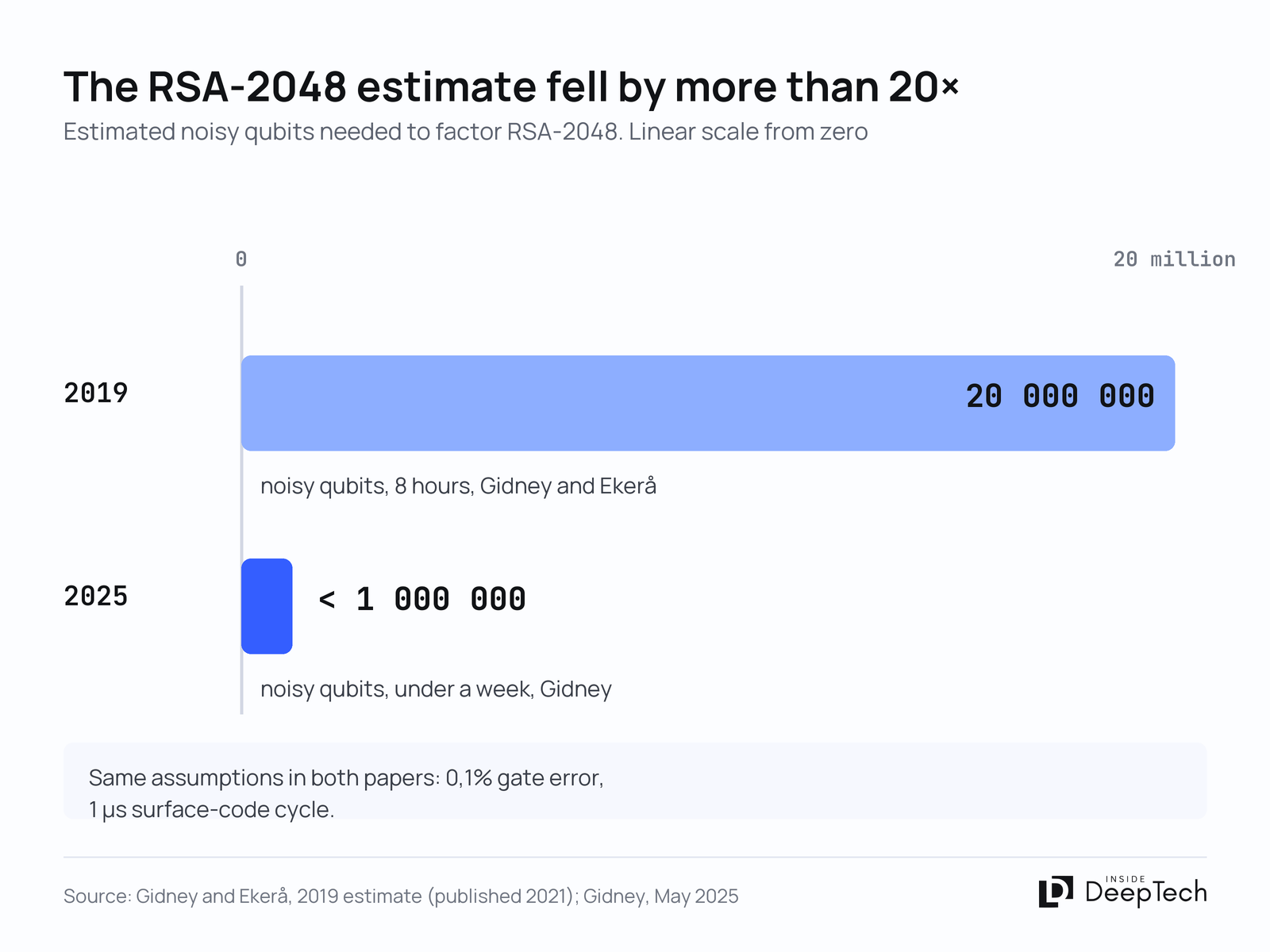
A twenty-fold reduction in the requirement, from the same author, in six years.
Most writing on quantum risk describes only one side of the approach. The hardware is moving towards the threat, and the threat has been moving towards the hardware roughly as fast. Any estimate of when the two meet has to account for both, and estimates that quote a single fixed qubit requirement have stopped tracking the literature.
Frequently Asked Questions
What are logical qubits?
A logical qubit is one unit of protected information spread across several physical qubits, with a procedure for detecting and repairing errors without reading the data. The number of physical qubits required ranges from about two to several thousand depending on the code: Quantinuum reports roughly two to one for error-corrected qubits on Helios, and surface codes at useful distances run into the hundreds or thousands.
How does quantum cooling work?
Superconducting and spin-qubit processors run in dilution refrigerators at millikelvin temperatures, where thermal energy is too low to disturb the qubit states. Trapped-ion and neutral-atom machines do not need this. They operate near room temperature and use ultra-high vacuum and laser cooling to isolate individual atoms instead, which is one reason they are easier to install in a data centre.
Is quantum computing a threat to encryption?
To asymmetric encryption, yes, in principle and on a timescale nobody can date precisely. Shor’s algorithm is proven, so the uncertainty is entirely in the hardware. The most recent published estimate puts factoring RSA-2048 at fewer than a million noisy physical qubits running for under a week, against a highest verified logical-qubit count of 96. The reason to migrate now is retrospective decryption: traffic captured today and stored until the hardware exists.
What is a hybrid quantum-classical algorithm?
One that splits the work, running the data handling and most of the arithmetic on classical processors and reserving the quantum processor for the step that needs quantum states. In 2026 the classical side includes the error-correction decoder, which has to run inside the coherence time and has pulled accelerator hardware into quantum control systems.
Can anyone use a quantum computer today?
Cloud access is available from every major vendor, and increasingly through general-purpose cloud platforms: Quantinuum and Oracle announced in August 2026 that a Helios system would run inside an Oracle Cloud Infrastructure data centre as a managed service. What is available is real hardware with real noise, which is the point of using it.
Why is qubit count a misleading metric?
It says nothing about fidelity, connectivity, speed or encoding efficiency, and those four decide whether a circuit runs. A machine with 98 physical qubits, all-to-all connectivity and a two-to-one code does things a larger machine with nearest-neighbour coupling and a surface code cannot. Any ranking by qubit count reorders completely once any of the other measures is added.
What are the main uses for quantum computers?
Chemistry and materials simulation have the strongest theoretical case, because simulating quantum systems is structurally what these machines do. Optimisation in finance and logistics is the most commercially active area and the one where published speedups are most often asymptotic. Cryptanalysis is the best-understood application and the furthest from being achievable. None of the three has demonstrated a verified advantage over the best classical method on a problem a business needs solved.
What to watch
The number to follow is not the qubit count. It is the ratio of physical to logical qubits, tracked per code family, because that is the exchange rate between what vendors build and what algorithms need.
Watch whether IBM’s stated end-of-2026 target for verified quantum advantage produces a result that survives classical simulation, since several previous advantage claims did not. Watch the resource estimates from the cryptanalysis side, which have been falling faster than most migration plans assume.
For anyone outside the field, the practical work in 2026 is the cryptographic inventory. It has deadlines, it does not depend on anything above being solved, and it is the only item on this page that is already late.
Sources
Google Quantum AI and collaborators, quantum error correction below the surface code threshold. Nature 638, 920-926, published online 9 December 2024. nature.com/articles/s41586-024-08449-y. Preprint: arxiv.org/abs/2408.13687.
Bluvstein D., Geim A. A. et al., a fault-tolerant neutral-atom architecture for universal quantum computation. Nature 649, 39-46, online 10 November 2025, print issue 1 January 2026. nature.com/articles/s41586-025-09848-5.
Quantinuum, commercial launch of Helios, 6 November 2025. Press release and technical blog.
IBM Quantum, large-scale fault-tolerant quantum computing, 2025. ibm.com/quantum/blog/large-scale-ftqc. Roadmap: ibm.com/roadmaps/quantum.pdf.
Gidney C., Ekerå M., how to factor 2048 bit RSA integers in 8 hours using 20 million noisy qubits. Quantum 5, 433, 15 April 2021. doi.org/10.22331/q-2021-04-15-433.
Gidney C., how to factor 2048 bit RSA integers with less than a million noisy qubits, 21 May 2025. arxiv.org/abs/2505.15917.
Gidney C., Newman M., Brooks P., Jones C., yoked surface codes. Nature Communications 16, 4498, 2025. nature.com/articles/s41467-025-59714-1.
Post-quantum standards: NIST FIPS 203, FIPS 204 and FIPS 205, published 13 August 2024, available from the NIST Computer Security Resource Center. Migration mandates: National Security Memorandum 10; draft NIST IR 8547; NSA CNSA 2.0; UK NCSC guidance on post-quantum cryptography.