
Key Takeaways
Robot dexterity is not simply the ability to move an arm from one point to another. It is the coordinated control of perception, contact, force, motion, and recovery in an uncertain physical world.
- Dexterous manipulation requires robots to understand objects, contacts, and task goals together.
- Real-world manipulation is harder than locomotion because small errors can change the entire task.
- Tactile sensing, compliant hardware, and fast control loops matter as much as artificial intelligence.
- Demonstrations, reinforcement learning, and simulation can accelerate learning, but data quality remains a constraint.
- Progress will be measured by reliable deployment across varied tasks, not by isolated laboratory demonstrations.
What robot dexterity and manipulation mean
Robot dexterity and manipulation explained in practical terms means understanding how a machine changes an object's position, orientation, shape, or state through controlled physical interaction. A basic robot may move an object between two known locations; a dexterous robot must adapt when the object is rotated, slippery, flexible, partly hidden, or poorly aligned. That distinction reaches from hand design to software architecture.
Dexterity versus basic pick-and-place
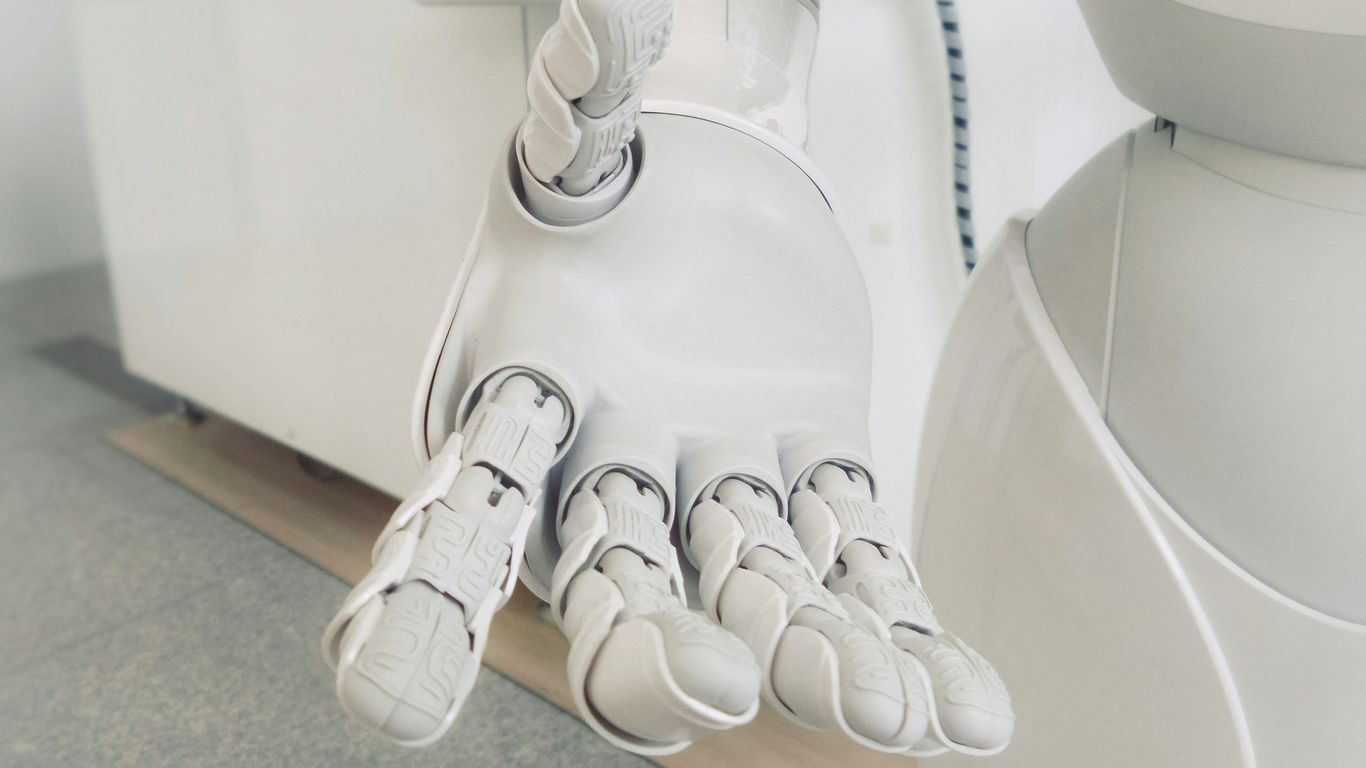
Pick-and-place works well when objects, poses, and destinations are predictable. Dexterous manipulation adds intermediate actions such as rolling an object between fingers, turning a tool in the hand, or maintaining a grip while another part of the body moves. The robot is no longer executing a fixed trajectory; it is managing a changing relationship between hand and object.
The role of contact, force, and friction
A robot can see that two surfaces touch, but vision alone does not reveal whether the contact is stable. Force determines whether an object is held, crushed, dragged, or allowed to slide, while friction determines how much control is available at the interface. Successful manipulation therefore treats contact as a source of information as well as a mechanical constraint.
Whole-body manipulation in mobile and humanoid robots
A mobile or humanoid robot may need to position its feet, torso, shoulder, arm, wrist, and hand as one system. Reaching around an obstacle can change balance; opening a heavy door can shift the load through the body. Coverage on humanoid robot engineering makes the same point from the platform perspective: human-like form is useful only when the sensing and control systems coordinate the whole machine.
Why human hand skills remain difficult to reproduce
Human hands combine dense sensing, fast reflexes, soft tissue, and years of experience with everyday objects. People also make tiny adjustments without consciously planning each finger movement. Reproducing that combination requires a robot to estimate hidden states, choose useful contacts, and correct errors in milliseconds.
Why manipulation is harder than locomotion
Walking is challenging, but its successful patterns can often be expressed through repeated contact with a relatively structured surface. Manipulation involves objects with unknown geometry, uncertain mass, variable friction, and task-specific constraints. A small change in any of those variables can invalidate an otherwise sound plan.
The uncertainty of real-world objects
An object may be partially occluded, mislabeled, damaged, or placed in an unexpected orientation. Its center of mass may not be obvious from its appearance, and the robot may not know whether a surface is wet, dusty, or deformable. The result is a control problem in which perception remains provisional rather than complete.
Deformable, fragile, and articulated items
Rigid blocks are convenient research objects because their geometry changes little under normal force. Clothes, cables, food, packaging, and biological materials behave differently: they bend, fold, tear, stretch, or conceal their own state. Hinged items add another complication because the useful motion may depend on a joint that the robot cannot directly see.
Managing many degrees of freedom
A multi-fingered hand can have many independently controlled joints, and a mobile robot adds arm and body motion to the search space. More freedom creates more possible solutions, but it also makes planning and feedback harder. The controller must find movements that satisfy contact, balance, collision, and force limits at the same time.
Recovering from slips, collisions, and mistakes
A useful system assumes that some attempts will go wrong. Recovery can involve changing the grasp, pausing to inspect the object, or abandoning one plan for a safer one. In practice, a manipulation policy should detect at least these events:
- A fingertip or gripper has lost the expected contact.
- The object has moved outside the planned pose or support region.
- A measured force or joint state suggests an obstruction.
- The visual or tactile evidence no longer matches the task model.
These signals turn failure from a terminal event into a decision point. That is one reason dexterity should be judged by recovery behavior, not only by perfect-run success rates.
The core capabilities behind dexterous manipulation
Dexterous manipulation is a stack of tightly coupled capabilities rather than a single model. Perception proposes what may be happening, planning selects a feasible action, and control continuously tests whether reality agrees. The system becomes useful when those layers exchange information quickly enough to respond to contact.
Perception and object understanding
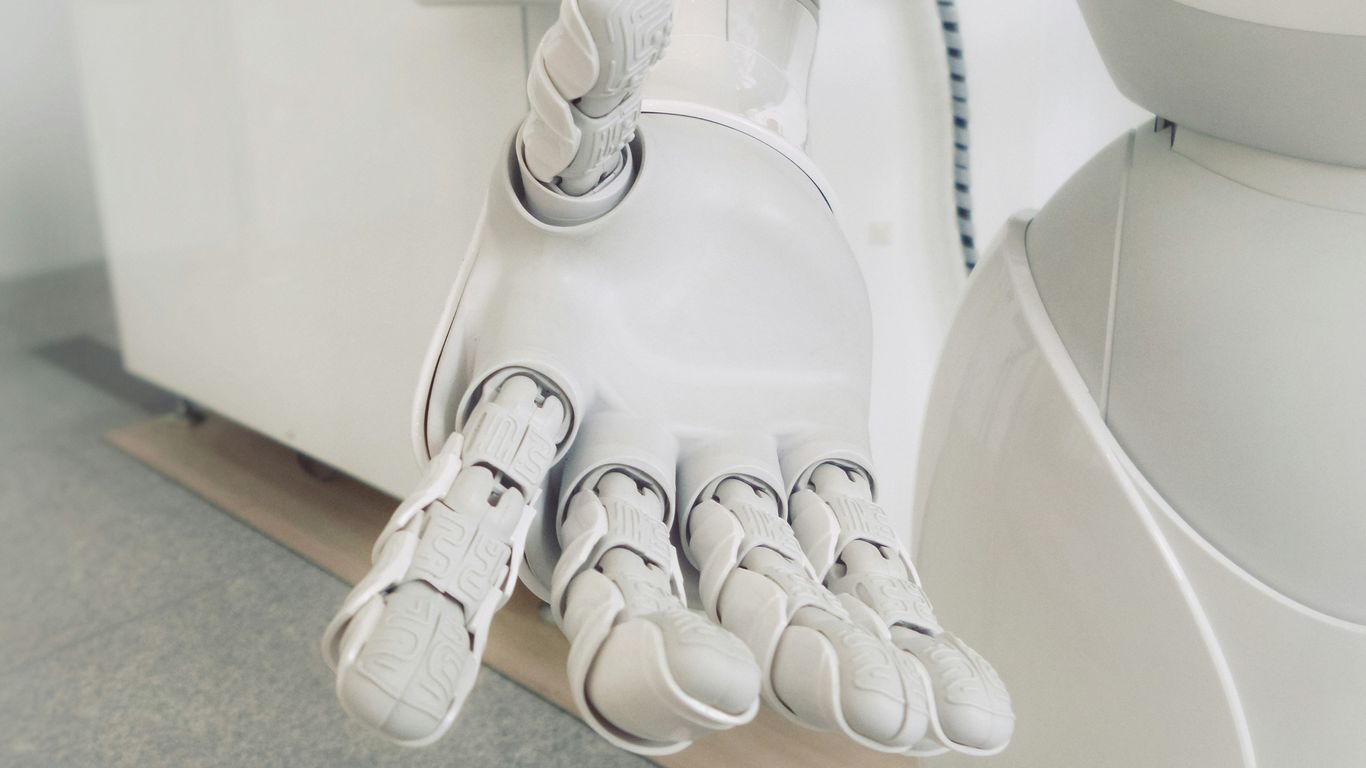
Perception must identify objects, surfaces, affordances, and likely contact points. It also needs uncertainty estimates: a camera may recognize a cup while remaining unsure whether its handle is accessible. Depth, vision, proprioception, and touch can combine into a scene model that is updated as the robot moves.
Grasp planning and hand configuration
Grasp planning asks more than where the hand should go. It considers force closure, approach direction, finger placement, object stability, and what the next action requires. A grasp that is excellent for lifting may be poor for turning a screwdriver, so the intended manipulation sequence should influence the initial configuration.
A compact comparison shows why no single end effector wins every task.
| End effector | Typical strength | Typical limitation | Useful setting |
|---|---|---|---|
| Vacuum gripper | Fast handling of smooth surfaces | Weak on porous or irregular objects | Structured packaging |
| Two-finger gripper | Simple control and maintenance | Limited in-hand repositioning | Repetitive assembly |
| Adaptive gripper | Tolerates moderate variation | Less precise than a hand | Mixed object handling |
| Multi-fingered hand | Rich contact and in-hand motion | High control and sensing burden | Dexterous research tasks |
The comparison is not a ranking. It is a reminder that hardware complexity should follow the task's actual variability rather than an abstract ambition to imitate a human hand.
Force control and tactile feedback
Force control regulates interaction instead of treating the robot as a position-only machine. Tactile sensors can reveal contact location, slip, texture, and pressure distribution, while joint sensing provides indirect evidence about load. Together they help the controller maintain a grip without applying unnecessary force.
The DEX-EE robotic hand is documented as a robotic hand engineered for machine-learning projects, with high-speed sensor networks, tactile sensing, and ROS integration. That scope illustrates why sensing hardware is central to research: it supports experiments in which contact information is part of the learning loop.
Real-time motion planning under constraints
Planning must account for obstacles, joint limits, self-collision, object collision, balance, and the changing geometry of contact. A plan that is valid before a grasp may become invalid once the object is lifted. Fast replanning and local corrections are therefore as important as the initial global route.
How robots learn manipulation skills
Programming every useful hand movement by hand does not scale to the variety found outside a factory fixture. Learning methods offer a way to extract reusable patterns from demonstrations, simulated experience, or interaction data. They do not remove the need for task definitions, safety limits, carefully designed hardware, or evaluation in the physical world.
Demonstrations from human motion and teleoperation
A person can provide examples through motion capture, a teleoperated robot, or a device that records hand and arm trajectories. Demonstrations expose timing, contact order, and recovery strategies that are difficult to specify symbolically. They also carry bias: a robot may copy a human motion that depends on human strength, soft tissue, or visual assumptions unavailable to the machine.
Reinforcement learning in simulation and the real world
Reinforcement learning improves behavior through trial, feedback, and a defined objective. Simulation allows many more trials than physical hardware, but simulated friction, contact, latency, and sensor noise rarely match reality exactly. The Dactyl research example is relevant because it showed a simulation-trained system transferring to real-world object reorientation while adapting to physical differences.
Imitation learning and foundation models
Imitation learning can turn demonstrations into policies without requiring an engineer to hand-code every intermediate action. Foundation models add broader representations from visual, language, and action data, though their apparent generality must be tested against physical constraints. Robot Foundation Models are described as systems that translate language and visual input into physical actions and support transfer across environments; that is a promising direction, not proof that general-purpose dexterity has been solved.
Sim-to-real transfer and data efficiency
The central question is how much useful behavior can be learned before data collection becomes too expensive. Domain randomization, system identification, real-world fine-tuning, and active data selection can reduce the gap between simulation and deployment. Even then, rare failures matter disproportionately because a single unusual contact can expose a weakness that thousands of easy trials never reveal.
Hardware that enables dexterity
Software cannot compensate indefinitely for an unsuitable mechanical interface. The hand, arm, sensors, actuators, and transmission system determine what kinds of contact the controller can create and measure. Hardware choices also shape maintenance, safety, energy use, and the cost of collecting training data.
Multi-fingered hands and adaptive grippers
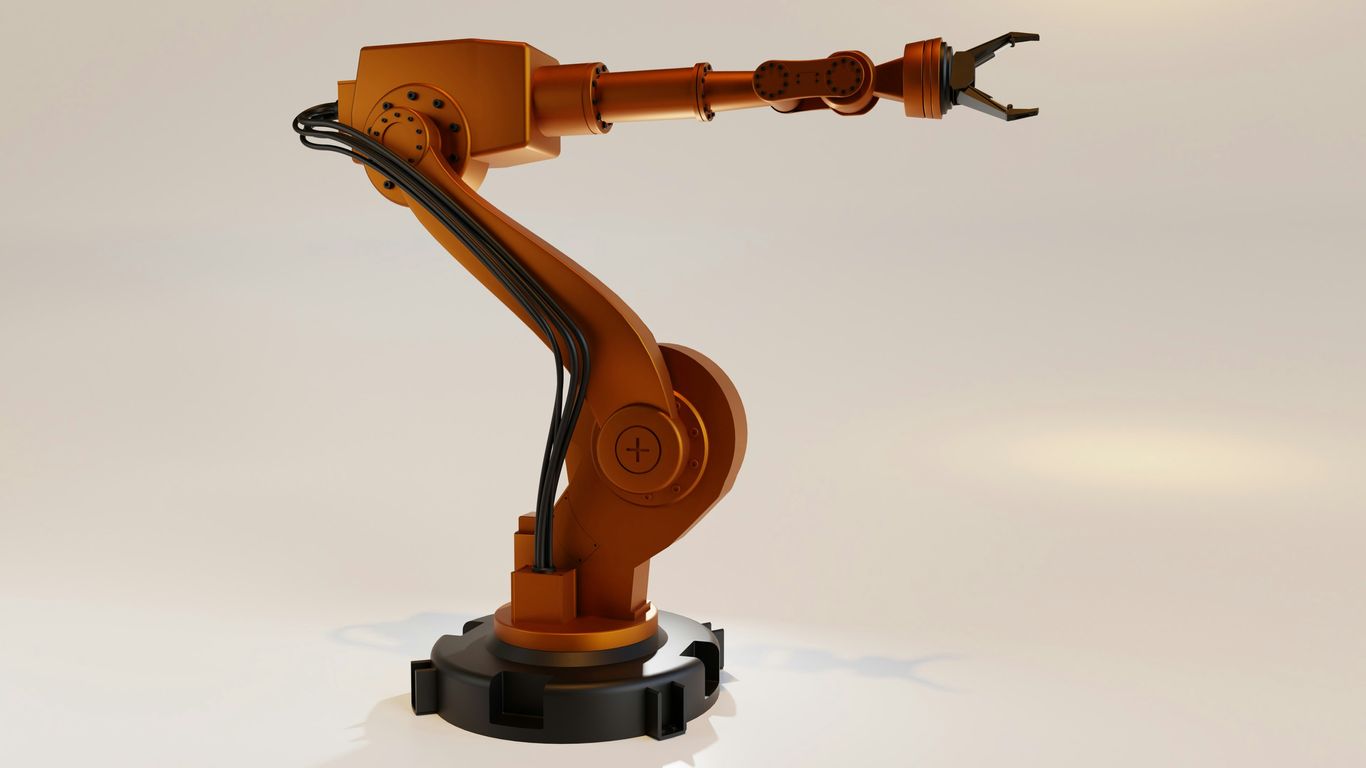
Multi-fingered hands provide more contact choices and can reposition objects without releasing them. Adaptive grippers trade some of that range for simpler control and greater tolerance of variation. The right choice depends on whether the operation needs fine in-hand motion or merely reliable acquisition and placement.
Tactile sensors and proprioception
Proprioception tells the robot where its joints and links are; tactile sensing tells it what is happening at contact surfaces. Neither is sufficient by itself. A camera may see a successful grasp while touch detects an impending slip, and joint sensors may reveal an unexpected load before the object visibly moves.
Actuators, compliance, and backdrivability
Actuators must deliver force and speed while remaining controllable near people and delicate objects. Compliance allows a mechanism to yield under contact, reducing the consequences of small alignment errors. Backdrivability can improve force transparency, although it may introduce demands on braking, transmission design, and control stability.
Hardware trade-offs in cost, durability, and precision
A research hand optimized for rich sensing may be too delicate or expensive for continuous industrial duty. Conversely, a durable gripper may omit the sensing needed for uncertain tasks. Deployment decisions should weigh the full operating cycle, including calibration, cleaning, repair, and the cost of failed manipulation.
How dexterous manipulation is evaluated
A convincing manipulation result needs more than a video of a successful trial. Evaluation should specify the objects, starting states, environmental variation, intervention rules, and number of repetitions. It should also separate a research demonstration from evidence that a system can operate safely and economically in production.
Task success and completion time
Success means completing the intended state change, not merely touching or lifting an object. Completion time matters because a slow policy may be technically capable but operationally unsuitable. A credible benchmark reports both, along with the conditions under which the task was attempted.
Precision, robustness, and repeatability
Precision measures how closely the result matches a target; robustness measures tolerance to variation; repeatability measures consistency across trials. These properties can conflict. A controller may achieve high precision in a narrow setup while failing as soon as object pose, lighting, or surface friction changes.
Generalization to new objects and environments
Generalization is the test of whether a learned behavior captures a useful principle rather than memorizing a single scene. New shapes, materials, lighting conditions, shelves, tools, and object arrangements should be introduced systematically. Results should identify where performance degrades instead of hiding the boundary of competence.
Safety, explainability, and trust in deployment
A deployed robot must make its limits legible to operators. It should detect uncertainty, slow down near people, respect force and workspace limits, and provide a useful account of why it stopped or changed strategy. Research into trustable dexterous manipulation frames this as a central engineering concern rather than an optional layer added after performance.
Where robot dexterity is headed
The near-term path is likely to be uneven. Systems will first gain value in environments where the object set, workflow, and safety envelope can be measured, then expand as perception and recovery improve. The most durable progress will come from matching capabilities to operational constraints rather than treating human form as the goal in itself.
Industrial assembly and warehouse operations
Factories and warehouses contain many tasks that are repetitive but not perfectly uniform. Robots may sort variable packages, handle components, tend machines, or perform assembly steps that currently require constant human adjustment. Coverage of AI-powered manufacturing robots emphasizes this movement from fixed repetition toward perception, adaptation, and coordinated decision-making.
Healthcare, household, and service robotics
Service settings raise the difficulty because objects, layouts, and human expectations change constantly. A robot assisting with household tasks may need to handle cloth, utensils, containers, and fragile items without damaging them. Healthcare adds strict requirements for hygiene, predictable behavior, accountability, and physical safety.
Humanoid robots and general-purpose manipulation
Humanoid platforms can use spaces and tools designed for people, which may reduce the need to rebuild workplaces. Their value, however, depends on reliable hands, power-efficient actuation, perception, and whole-body control—not on appearance alone. Agility Robotics' humanoid technology offers a useful example of how bipedal locomotion, fleet management, and industrial applications are discussed as an integrated deployment problem.
The remaining research challenges and practical limits
The hardest problems remain tightly connected: collecting representative physical data, modeling contact, operating safely around people, and proving reliability over long periods. General-purpose manipulation may arrive through gradual expansion from constrained workflows rather than one decisive breakthrough. Until robots can recognize when they do not understand a situation—and respond conservatively—dexterity will remain a measured engineering capability, not a solved property.
A related discretionary trusts guide may seem far from robotics, but it illustrates a broader point about complex systems: outcomes depend on clearly defined roles, constraints, and contingencies. The same discipline applies when specifying who may intervene in a robot's operation and what happens when an automated plan fails.
Estate planning also demonstrates why specialized systems should not be judged by a single headline metric. Readers reviewing Inheritance Tax planning advice are evaluating timing, documentation, and risk together; robotics teams likewise need to assess sensing, maintenance, safety, and workflow fit rather than dexterity in isolation.
Even mundane physical infrastructure exposes the value of context. A seamless gutter installation is selected for local water, weather, and building conditions, just as a gripper must be selected for the objects, forces, and environment it will actually encounter. The analogy is limited, but the engineering principle is sound: performance is conditional on the system around the component.
The same caution applies to biology and materials. A non-antibiotic UTI therapy is presented in its source as an approach for persistent infections involving biofilms and intracellular bacteria; it should not be generalized to every infection, just as a manipulation policy tested on rigid objects should not be generalized to deformable ones. And practical work often depends on choosing the right tape for a specific job, a small reminder that “general purpose” claims become meaningful only when the operating conditions are stated.
Conclusion
Robot dexterity is a systems problem at the boundary of intelligence and mechanics. Progress will depend on better tactile perception, compliant hardware, efficient learning, and evaluation that exposes failure rather than hiding it. The field is moving toward more capable machines, but credible deployment will come from narrow reliability expanding over time—not from assuming that a successful demonstration represents general human-level skill.
Frequently Asked Questions
What is robot dexterity?
Robot dexterity is the ability to manipulate objects through coordinated, precise control of movement, contact, and force, often while adapting to uncertainty.
How is dexterous manipulation different from pick-and-place?
Pick-and-place usually moves an object between known locations. Dexterous manipulation may change an object's orientation, grasp, shape, or state during a sequence of contact-rich actions.
Why is tactile sensing useful for robots?
Tactile sensing provides information about contact, pressure, texture, and slip that cameras may not reliably observe. It helps a controller adjust force and detect failures early.
Do humanoid robots need dexterous hands?
Not for every task. A simple gripper can be better for structured work, while a dexterous hand becomes more useful when objects vary or must be reoriented in the hand.
Can reinforcement learning teach robots manipulation?
Reinforcement learning can improve manipulation policies through repeated trials, especially in simulation. Physical transfer remains difficult because contact physics, sensors, latency, and wear differ from their simulated counterparts.
How should robot dexterity be benchmarked?
Benchmarks should report success, time, precision, repeatability, recovery behavior, and performance on new objects and environments. They should also describe safety conditions and the amount of human intervention.
When will general-purpose robot manipulation arrive?
There is no settled timetable. Useful capability is likely to expand gradually from constrained industrial and service workflows as robots become more reliable, data-efficient, and safe around people.