
Key Takeaways
Humanoid robots combine human-shaped mechanics with perception, artificial intelligence, and tightly controlled movement. Their promise is real, but so are the engineering constraints.
- A humanoid form helps a robot operate in spaces designed for people, though it also makes balance and control harder.
- Cameras, lidar, microphones, and tactile sensors give the robot partial, constantly updated information about its surroundings.
- AI can connect language and perception to task plans, but low-level control still depends on fast, specialized software.
- Simulation, imitation learning, reinforcement learning, teleoperation, and real-world data all contribute to skill development.
- Battery life, reliability, safety, maintenance, and operating economics will determine where humanoid robots become practical first.
What makes a robot humanoid
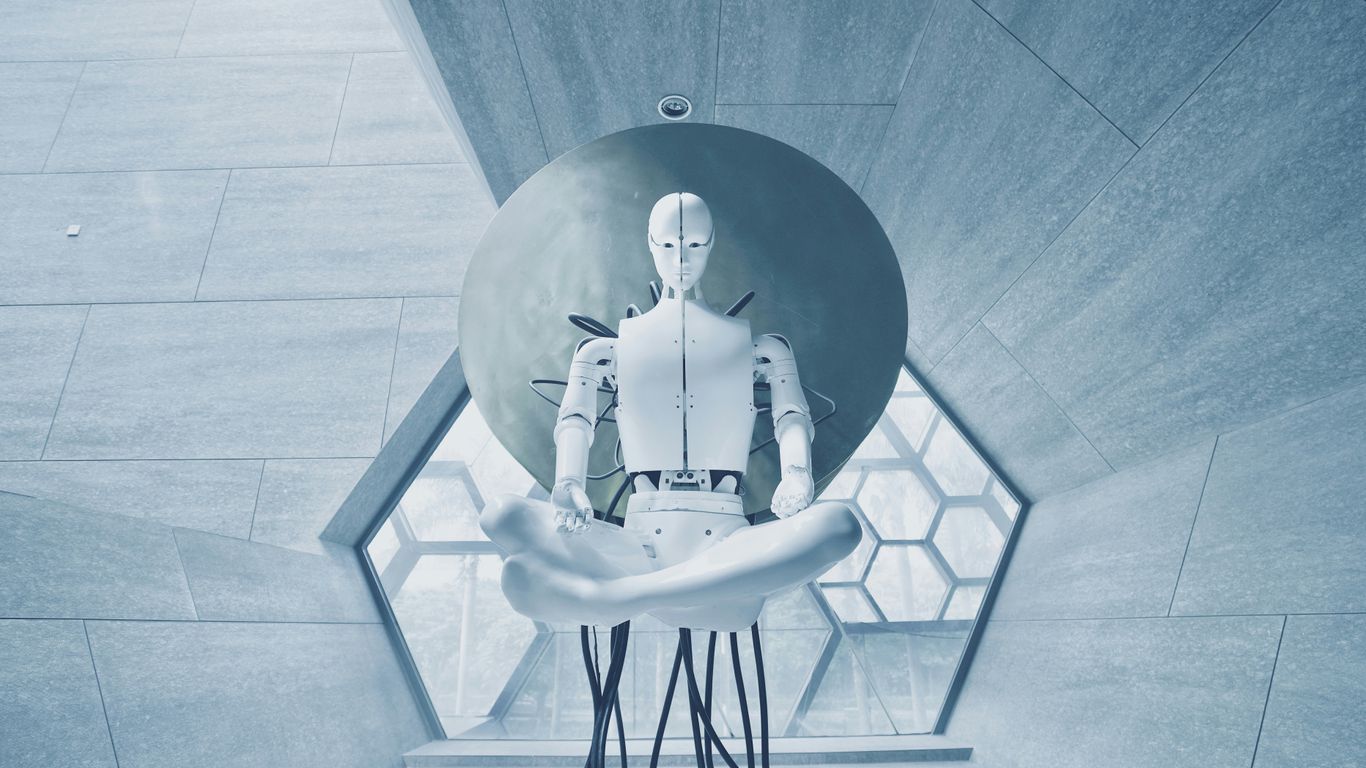
The question of how do humanoid robots work begins with their physical architecture. A humanoid robot is generally built around a torso, head, two arms, and two legs, with joints arranged to produce movements that resemble human motion. That shape is not merely cosmetic: it is an attempt to place a machine inside environments already designed around human bodies, tools, and reach. The trade-off is that every additional degree of freedom creates another control problem.
The role of a humanlike body plan
A humanlike body plan gives a robot access to shelves, workstations, stairs, handles, and tools without requiring every site to be rebuilt. It also makes the robot's actions easier for people to anticipate: a person can often infer what an arm reaching toward an object intends to do. That compatibility is one reason humanoids are being considered for manufacturing, logistics, inspection, and other settings with human-centered layouts.
The form does not automatically make a robot versatile. A machine still needs the perception, planning, dexterity, and safety systems to use that form effectively. The practical test is therefore not resemblance, but whether the body can perform useful work repeatedly in a real environment.
Degrees of freedom in the head, torso, arms, and legs
A degree of freedom is an independently controllable direction of movement. The neck may turn and tilt, the shoulders may rotate through several axes, and the hips, knees, and ankles must coordinate to position the body over its feet. More degrees of freedom allow finer movement, but they also increase the number of possible states the control system must manage.
The head and torso are not passive structures. Head movement can aim cameras and microphones, while torso motion helps shift the center of mass during a reach or step. Engineers must balance dexterity against weight, power consumption, mechanical complexity, and the difficulty of diagnosing failures across many joints.
Why bipedal walking is difficult to engineer
Walking is a controlled sequence of falling and recovering. At each instant, the robot must estimate where its body is, where its feet are, how the ground is shaped, and how its momentum will change after the next step. A small error in timing or foot placement can turn a stable stride into a stumble.
Unlike a wheeled platform, a biped cannot rely on continuous contact with the floor. It must lift one foot, transfer weight, place the foot, and absorb disturbances while keeping its center of mass within a recoverable region. Uneven surfaces, loose objects, and contact with another person make the problem harder still.
Humanoid robots versus other mobile robots
Wheels are usually more efficient on smooth floors, and fixed industrial arms can be faster and more repeatable within a constrained workspace. Humanoids become interesting when a task requires mobility, manipulation, and access to infrastructure built for people. A useful humanoid robot evaluation therefore looks beyond appearance and asks about deployment evidence, dexterity, autonomy, safety, and the operating environment.
The comparison is not a simple contest between robot shapes. A warehouse may favor wheels for long, predictable routes, while a facility with stairs, mixed tools, and changing workstations may reward legs and humanlike reach. The right design depends on the task and on the cost of modifying the surrounding environment.
How humanoid robots sense the world
A humanoid robot does not perceive the world as a person does. It receives streams of measurements from cameras, depth sensors, microphones, inertial units, joint encoders, and sometimes lidar or tactile surfaces. Software turns those signals into estimates about objects, surfaces, people, motion, and the robot's own position. Because every sensor is incomplete, perception is best understood as continuous estimation rather than a single act of recognition.
Cameras, lidar, microphones, and tactile sensors
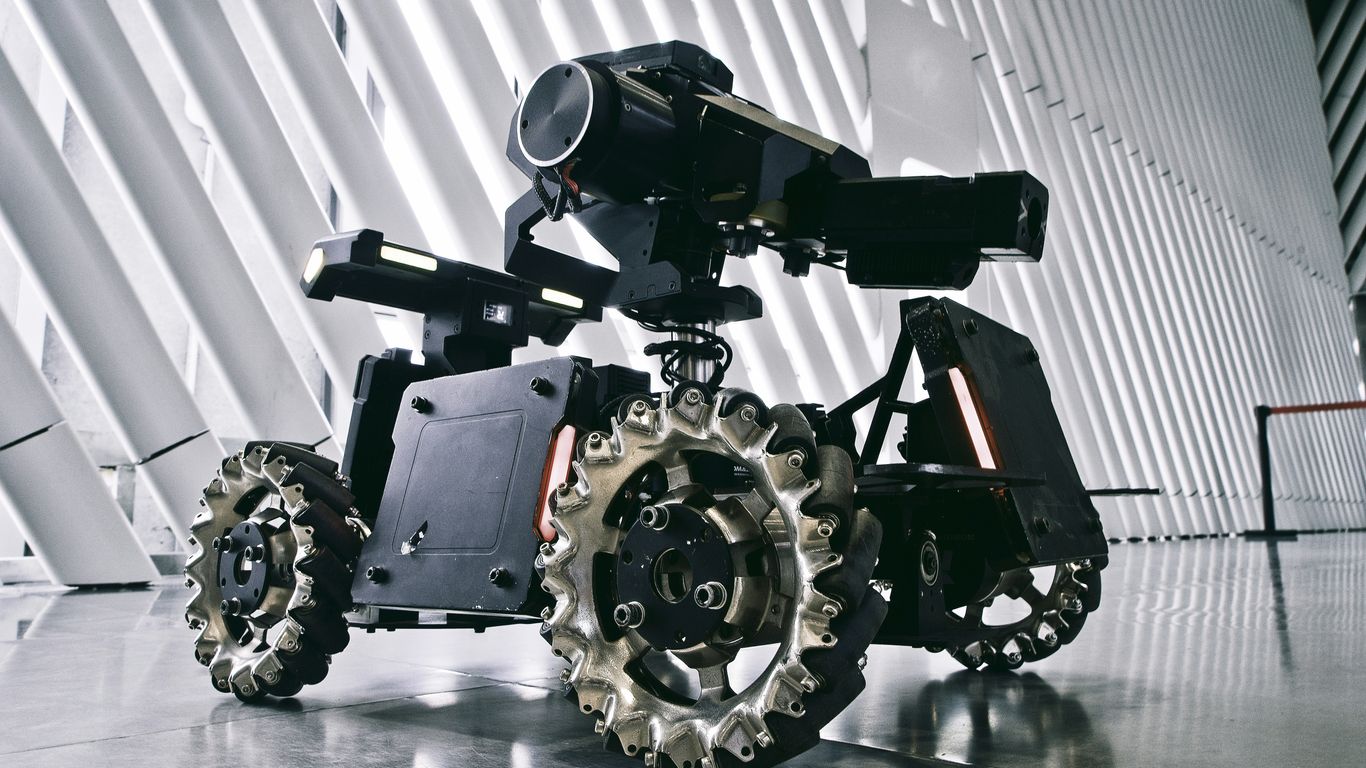
Cameras provide color and visual detail, while depth cameras or lidar help estimate distance and geometry. Microphones capture speech and environmental sounds, and inertial sensors measure acceleration and rotation as the body moves. Encoders at the joints report the mechanical state of the robot, which is essential for knowing whether a commanded movement actually occurred.
Tactile sensors add information at the point of contact. Pressure or force readings can indicate that a gripper has touched an object, that a hand is slipping, or that a robot is pushing against a surface. No single sensor is sufficient in every situation, so the system must combine complementary evidence.
Combining sensor data into a usable scene model
Sensor fusion aligns measurements that arrive at different rates and from different viewpoints. A camera may identify a box, lidar may estimate its position, and joint sensors may help calculate where the robot's hand is relative to it. The resulting scene model is not a perfect map; it is a working hypothesis updated as new observations arrive.
That model must include uncertainty. A partially hidden object, a reflective surface, or a moving person can make a prediction unreliable. Good systems preserve enough uncertainty to avoid treating an ambiguous observation as a fact, especially when the next action involves force or proximity to a human.
Recognizing objects, people, and obstacles
Object recognition is only the beginning of a useful action. The robot must also estimate an object's pose, likely grasp points, material properties, and relationship to nearby surfaces. Recognizing a person requires attention to body position and movement, not merely a label identifying a human in the image.
Obstacle detection similarly depends on context. A low table, a dangling cable, and a moving cart may all be obstacles, but they call for different responses. The robot may step around one, slow down near another, and stop altogether when its estimate is too uncertain.
Handling poor lighting, noise, and unexpected movement
Real environments are full of conditions that are absent from clean demonstrations. Shadows can confuse vision systems, machinery can overwhelm microphones, and reflective or transparent surfaces can defeat depth measurements. People also move in ways that are difficult to predict precisely, particularly in crowded workplaces.
Robots handle these conditions through redundancy, filtering, active sensing, and conservative behavior. They may change viewpoint, ask for clarification, reduce speed, or hand control back to a human. A system that knows when its perception is weak can be safer than one that produces confident but unsupported interpretations.
How AI helps humanoid robots understand and act
Artificial intelligence gives a humanoid robot ways to interpret language, identify patterns, predict outcomes, and choose among possible actions. It does not replace the mechanical and control layers beneath it. Instead, modern systems often divide responsibility: higher-level models interpret goals, while specialized software converts those goals into trajectories, forces, and actuator commands.
Large AI models for language and task planning
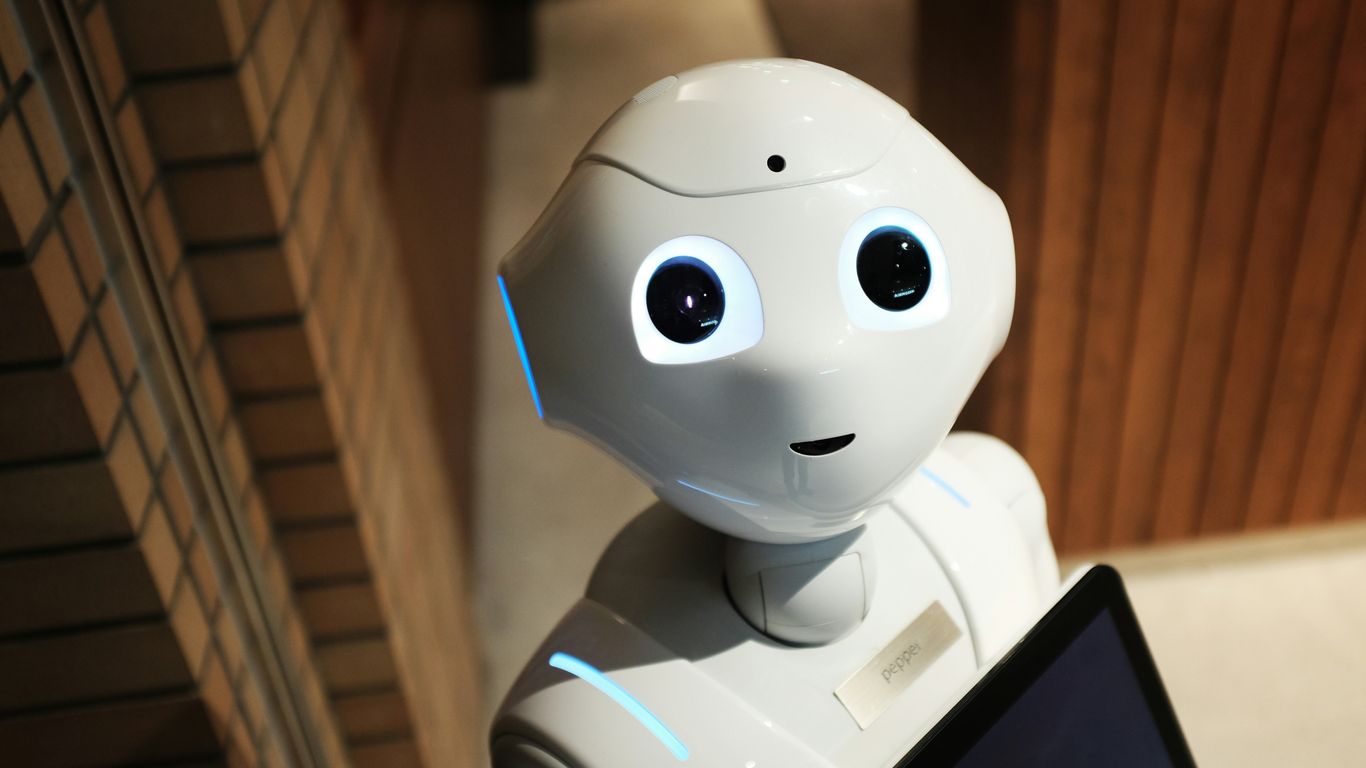
Large models can connect words, images, and task descriptions, allowing a robot to work with instructions that are less rigid than traditional code. A request such as moving supplies may require the system to identify the supplies, find a suitable destination, choose a safe route, and verify completion.
These models are useful because they can generalize across language and scenes, but they are not reliable substitutes for physical verification. A generated plan still has to be checked against reachability, collision constraints, object weight, battery state, and the robot's current surroundings. The broader discussion of robot foundation models is useful here because it separates multimodal interpretation from the physical execution that follows.
Turning spoken instructions into robot actions
Speech recognition first converts an utterance into text or structured intent. The system then resolves references such as “that box” or “over there” using visual context and recent interaction history. Finally, a planner maps the interpreted request to operations the robot can actually perform.
The process is not the same as giving a robot unrestricted conversation. The command must be grounded in the robot's available tools, workspace, and safety rules. If a phrase is ambiguous or asks for an impossible action, the correct response may be a question rather than movement.
Breaking complex goals into smaller steps
A high-level goal becomes manageable when it is decomposed into actions with observable checkpoints. For example, a system might locate an object, approach it, align a hand, establish contact, lift it, navigate to a destination, and release it. Each step can be tested against sensor feedback before the next one begins.
This decomposition also supports recovery. If the gripper fails to close around an object, the robot can retry or report the failure instead of silently continuing. Research and business discussions about AI workflows, including Microsoft, often emphasize the value of connecting high-level intent with smaller operational steps; robotics adds the requirement that each step must also survive contact with the physical world.
The difference between perception, reasoning, and control
Perception estimates what is present. Reasoning selects an interpretation or plan. Control executes a movement while responding to measurements from the robot and its environment. These layers interact, but confusing them can lead to unrealistic expectations about what a language model alone can do.
A model may reason that a cup should be picked up, yet a controller must determine how to move the hand, how much force to apply, and how to react if the cup is heavier or farther away than expected. Physical feedback closes the loop between an abstract instruction and a safe action.
How humanoid robots move and maintain balance
Movement is where software meets hardware most visibly. Motors and actuators generate joint torque, sensors report the resulting motion, and controllers continuously adjust commands. The robot must coordinate arms, legs, torso, and feet as one mechanical system rather than moving each joint in isolation.
The central challenge is not simply producing motion. It is producing motion that is stable, efficient, accurate, and appropriate to the environment. A robot that can perform one impressive step in a controlled demonstration may still need substantial engineering before it can walk, reach, and work for hours.
Motors, actuators, and joint-level control
Actuators are the components that turn electrical energy into mechanical movement. A joint controller uses position, velocity, and torque measurements to make the actuator follow a desired state. High-performance systems must respond quickly while limiting heat, vibration, and unexpected force.
The actuator's physical characteristics shape the robot's behavior. High torque can help with lifting and balance, but it may increase mass and energy use. Low-friction mechanisms can improve efficiency, while compliant elements can make contact less abrupt. These are system-level trade-offs, not isolated component choices.
Motion planning for reaching, grasping, and walking
Motion planning searches for a sequence of poses and trajectories that satisfies the task while avoiding collisions and respecting joint limits. For a reach, it must account for the hand's path, the elbow's position, the torso's balance, and the object's location. For walking, it must select foot placements and body motions that remain stable over changing terrain.
The planner may generate a broad objective, but lower-level controllers refine it in real time. This division allows a robot to pursue a goal without requiring every millisecond of motion to be specified in advance.
Balance recovery and whole-body coordination
Balance recovery can involve ankle adjustments, a wider step, a quick change in arm position, or a shift of the torso. The appropriate response depends on how large the disturbance is and how much time remains before the robot's support becomes unstable. A rigid response is often less useful than a coordinated one.
Whole-body coordination matters during ordinary work as well. Reaching overhead changes the center of mass, carrying a load alters joint torque, and turning while walking redistributes momentum. The robot has to treat these effects as part of one control problem.
Why real-world movement requires fast feedback loops
A movement planned in advance cannot account for every floor irregularity, actuator variation, or unexpected contact. Feedback loops compare the intended state with sensor measurements and adjust the command repeatedly. The faster and more reliable that loop is, the more gracefully the robot can respond to disturbances.
The following comparison shows why different control layers are needed rather than one universal motion algorithm:
| Control layer | Main responsibility | Typical feedback |
|---|---|---|
| Task planning | Select the goal and sequence of actions | Task state and completion checks |
| Motion planning | Generate feasible paths and poses | Geometry, joint limits, collision estimates |
| Whole-body control | Coordinate limbs and maintain stability | Body pose, contact state, momentum |
| Joint control | Track local position, speed, and torque | Encoders, torque sensors, actuator state |
The layers operate at different timescales, but they must remain consistent. A fast joint controller cannot rescue a plan that sends the robot toward an unreachable location, while a good high-level plan is useless if the actuators cannot track it.
How robots learn new skills
Programming every useful manipulation by hand would be slow and brittle. Robot learning offers another route: expose the system to many examples, let it practice under varied conditions, and use feedback to improve its behavior. The strongest approaches usually combine learned models with explicit constraints and conventional control.
A useful robot learning guide describes the role of simulation, digital twins, imitation learning, and reinforcement learning in developing skills. The common thread is iteration: the robot learns from data, tests a behavior, measures failure, and updates the policy or surrounding software.
Training in simulation before physical deployment
Simulation allows developers to test walking, grasping, and navigation without repeatedly risking hardware. A digital environment can vary object positions, lighting, friction, obstacles, and sensor noise, producing many training conditions at relatively low cost. Multiple versions of a policy can also be evaluated in parallel.
Simulation is not reality, however. The gap between them includes unmodeled friction, flexible objects, actuator wear, latency, and unexpected contact. Developers reduce that gap through better models, randomized training conditions, and careful validation on physical systems.
Imitation learning from human demonstrations
Imitation learning uses demonstrations to show a robot how a task can be performed. Human motion may be captured through cameras, sensors, or teleoperation interfaces, then translated into training examples. This is especially helpful for tasks whose useful details are difficult to express as a list of rules.
A demonstration does not provide a complete solution by itself. The robot must learn which parts of the movement are essential and which depend on the original person's body, timing, or environment. It must also recognize when a new scene differs enough to require adaptation.
Reinforcement learning through trial and error
Reinforcement learning improves behavior using a reward or objective signal. A walking policy might receive positive feedback for forward progress and stability, while a manipulation policy might be rewarded for completing a grasp without excessive force. Training can discover strategies that were not explicitly programmed.
Physical trial and error is expensive and potentially dangerous, so much of this process occurs in simulation. When a learned policy reaches the real robot, safeguards, limited operating envelopes, and human supervision remain necessary.
Using teleoperation and real-world data
Teleoperation lets a human guide a robot through tasks while the system records observations, actions, and outcomes. Those records can expand a training dataset and expose the robot to the irregularities of real workspaces. They may also reveal where the robot's autonomy is weakest.
A practical learning pipeline often includes several kinds of data:
- Demonstrations that show the intended task sequence.
- Sensor logs that capture variation in objects, lighting, and contact.
- Failure records that identify unsafe or ineffective actions.
- Human corrections that clarify recovery and stopping behavior.
The value of the dataset depends on coverage and quality, not merely its size. Data from a narrow, tidy environment may produce a policy that looks capable until conditions change. Real-world deployment is therefore part of the learning process, but it must be managed as a controlled engineering activity.
How humanoid robots interact with objects and people
Interaction requires more than recognizing an object and moving a hand toward it. The robot must estimate contact, control force, account for uncertainty, and communicate what it is about to do. These requirements become stricter when people share the workspace.
A successful interaction is often quiet and incremental. The robot approaches slowly, makes contact, checks the result, and adjusts rather than applying a predetermined force. That behavior is less theatrical than a fast demonstration, but it is closer to what dependable operation requires.
Grippers, hands, and force control
A gripper may be optimized for a limited set of industrial objects, while a multi-fingered hand offers more possible grasps at the cost of mechanical and control complexity. In either case, the robot needs information about contact and slip. Position alone cannot tell it whether an object has been securely held.
Force control allows the system to regulate how hard it pushes, pulls, or grips. It can help with inserting parts, opening doors, handling fragile objects, and maintaining contact on irregular surfaces. The controller must distinguish intentional contact from an unexpected collision.
Safe physical interaction around humans
Safety is a layered property. Mechanical limits can reduce the energy of a collision, software can define restricted zones, perception can track people, and operational procedures can govern speed and supervision. No single layer should be treated as sufficient.
The robot also needs predictable failure behavior. It should stop or yield when sensor readings conflict, when a person enters a protected area, or when a joint behaves outside its expected range. The design target is not perfect prediction; it is controlled risk when prediction fails.
Communicating through speech, gestures, and movement
People need to understand what the robot heard, what it intends to do, and whether it has completed the task. Speech can provide explicit confirmation, while gaze direction, arm position, speed, and pauses can signal intent without words. Clear communication reduces the chance that a person steps into an active path or assumes a task is finished.
Synthetic speech systems such as Reading AI illustrate a broader point about machine-generated voice: natural-sounding audio can make information easier to receive, but a robot still needs context-appropriate timing and content. In a physical workspace, an overly talkative or ambiguous system could create confusion rather than trust.
Adapting actions to unfamiliar objects and environments
An unfamiliar object may have a different texture, weight, shape, or center of mass from anything in the training data. The robot can respond by exploring with low force, changing its grasp, seeking another viewpoint, or asking a person for help. Adaptation is a sequence of cautious updates, not a guarantee that every object can be handled.
The same principle applies to environments. A route that worked yesterday may be blocked today, and a workstation may contain tools in different positions. A robot becomes more useful when it can adjust within defined limits while recognizing when the situation exceeds those limits.
What limits humanoid robots today
Humanoid robots bring several difficult technologies together in one platform, which means weaknesses in one subsystem can limit the whole machine. A powerful model cannot compensate for inadequate battery capacity, and excellent actuators do not solve poor perception. The relevant question is therefore not whether a robot can perform a task once, but whether it can do so safely and economically over time.
This is why practical assessment should focus on uptime, recovery, maintenance, and total operating cost rather than on a short demonstration. Even the economics of NYC long-distance moves show how operational details can matter alongside a headline price; robotics deployments likewise involve logistics, installation, training, and ongoing support.
Battery life, heat, and onboard computing
Walking, balancing, sensing, and manipulating all consume energy. Batteries add mass, and that mass requires more actuator effort, creating a difficult design loop. High-performance computing also produces heat, which must be removed without making the robot too heavy or reducing its operating time.
A robot may therefore need to recharge, swap batteries, reduce speed, or offload some computation. These choices affect whether it can fit into a production schedule. Runtime claims are meaningful only when the workload, payload, movement pattern, and supervision conditions are clear.
Reliability, maintenance, and operating costs
A humanoid has many joints, sensors, cables, bearings, and software dependencies. Wear in one component can change motion quality elsewhere, and a calibration problem may appear as a planning or perception failure. Maintenance procedures must be designed alongside the robot rather than added after deployment.
Operating cost includes more than hardware. Integration with facilities, safety reviews, training, spare parts, software updates, and downtime all influence the economics. A repair provider such as True Appliance Repair is a reminder, by analogy, that service responsiveness and transparent repair processes can matter as much as the initial purchase in any equipment-heavy operation.
Safety risks and failure modes
Failure modes include falls, unintended contact, dropped objects, navigation errors, sensor blindness, communication mistakes, and degraded batteries or actuators. Each should be tested under realistic conditions, with clear boundaries for stopping and human intervention. Safety cases must cover ordinary wear as well as unusual events.
Risk assessment also includes the surrounding system. A robot may be technically capable but poorly placed in a crowded aisle, paired with an unsuitable tool, or operated without adequate worker training. Safe deployment is an organizational and engineering problem together.
Where humanoid robots are most practical first
Early deployments are most plausible where tasks are repetitive but environments cannot easily be redesigned, where the cost of downtime is understood, and where human supervision can be provided during the transition. Manufacturing, logistics, inspection, and material movement are often discussed because they offer measurable workflows and controlled operating zones.
Domestic and highly unstructured settings are harder because they combine unpredictable objects, people, layouts, and expectations. The field's humanoid robotics comparison is useful for seeing how hardware design, AI integration, and commercialization strategies differ, but the decisive evidence will remain sustained performance in defined environments.
A sensible buyer will begin with a narrow pilot, specify measurable success criteria, and expand only after the robot demonstrates safe recovery and reliable uptime. That approach may feel slower than the hype cycle, but it is how a prototype becomes infrastructure.
Conclusion
Humanoid robots work by coordinating a humanlike mechanical body with sensors, learned models, planning software, and fast feedback control. Their form can help them operate in human environments, but it also creates demanding problems in balance, power, dexterity, safety, and maintenance. The technology is advancing through simulation, demonstrations, reinforcement learning, and real-world deployment, yet practical value will be established by repeatable work rather than isolated spectacle.
Frequently Asked Questions
What is a humanoid robot?
A humanoid robot is a machine designed with a broadly humanlike structure, typically including a torso, head, two arms, and two legs. The form is intended to support movement and manipulation in environments built for people.
How do humanoid robots see?
They use combinations of cameras, depth sensors, lidar, inertial sensors, and other measurements to estimate objects, surfaces, people, and their own position. Software fuses the data into an uncertain, continuously updated scene model.
Can humanoid robots understand spoken instructions?
They can use speech recognition and AI models to interpret spoken goals, but the instruction must be connected to available tools, locations, and safety rules. Ambiguous or impossible requests may require clarification.
How do humanoid robots keep their balance?
Controllers use measurements from inertial sensors, joint encoders, force sensors, and foot contacts to estimate body motion. They adjust joint torque, foot placement, posture, and sometimes step timing to recover from disturbances.
How are humanoid robots trained?
Training can combine simulation, imitation learning, reinforcement learning, teleoperation, and real-world sensor data. Physical testing is still needed because simulated friction, contact, latency, and wear do not perfectly match reality.
Are humanoid robots safe around people?
Safety depends on several layers, including force limits, perception, restricted zones, speed control, emergency stops, supervision, and predictable failure behavior. No single sensor or software model can eliminate every risk.
Where will humanoid robots be used first?
They are most likely to appear first in structured industrial and logistics settings where tasks are measurable, environments are partly controlled, and human oversight is available. More unstructured domestic work remains a harder problem because objects, layouts, and interactions vary widely.