Key Takeaways
Physical AI connects machine perception, learned reasoning, and physical action. Its practical progress depends as much on simulation, data, compute, and safety engineering as on the model itself.
- A robotics platform spans development tools, simulation, training infrastructure, and edge deployment.
- Physical AI must respond to changing environments rather than execute only fixed sequences.
- Digital twins and synthetic data can reduce the amount of costly physical testing.
- Foundation models may generalize skills, but task-specific adaptation and controls remain necessary.
- Deployment decisions should account for latency, safety, reliability, integration cost, and governance.
What NVIDIA's robotics platform includes
The phrase NVIDIA robotics platform explained refers less to one product than to a connected development stack. It covers the stages between robot learning and operation: modeling an environment, training policies, processing sensor data, and running inference near the machine. That distinction matters because a capable model is not, by itself, a working robot.
The role of NVIDIA Isaac in robot development
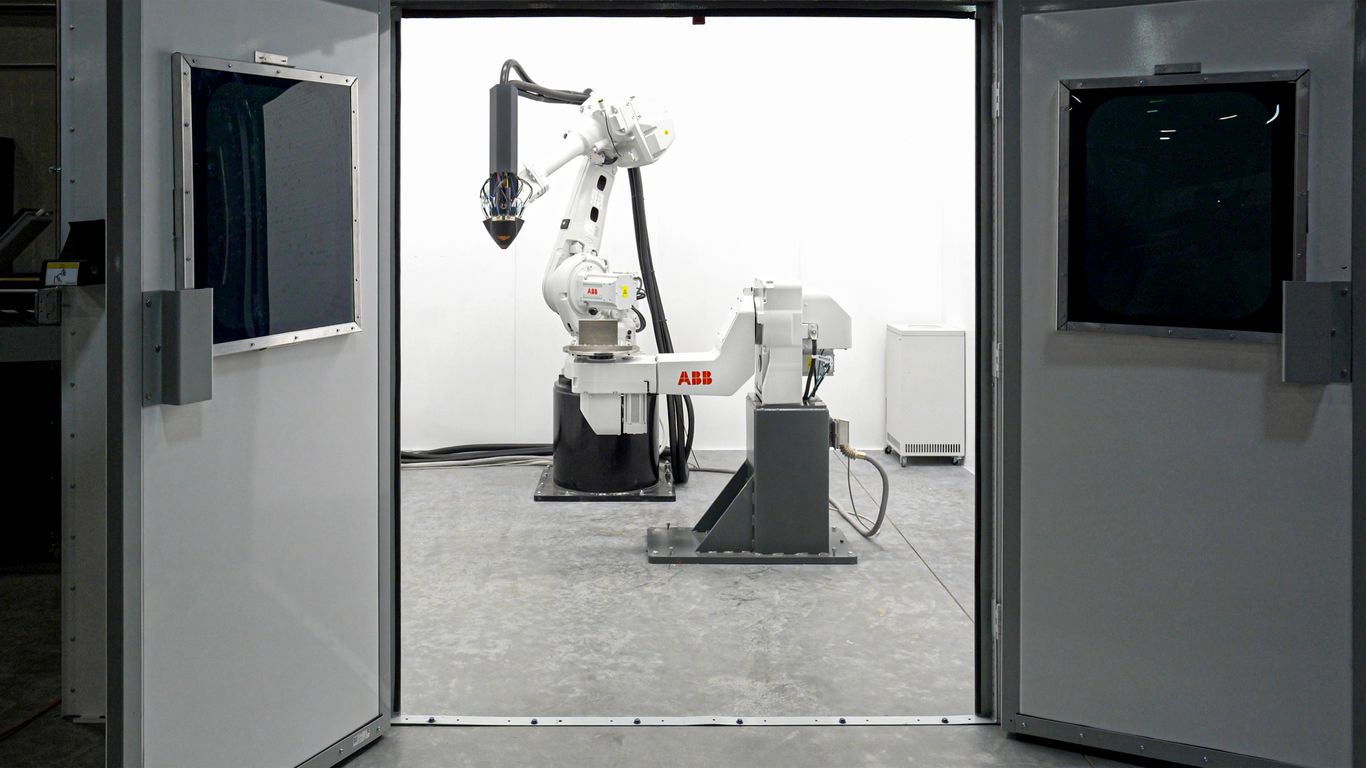
NVIDIA Isaac is described as an open robotics development platform that combines simulation and robot-learning frameworks, CUDA-accelerated libraries, AI models, and reference workflows. Those components are intended for systems including autonomous mobile robots, robot arms, manipulators, and humanoids. The NVIDIA Isaac platform is therefore best understood as a set of development paths rather than a single packaged robot controller.
Its value is in connecting activities that are often separated in conventional projects. Teams can work on perception, motion planning, learning, and deployment within related workflows, while still having to validate each behavior against the limits of a particular robot and operating environment.
How Jetson brings AI inference to edge devices
Edge inference means that a robot processes a model close to its sensors and actuators instead of sending every observation to a remote system. That can reduce dependence on network round trips, which is useful when a robot must respond to a moving object or a changing obstacle. The hardware choice still involves trade-offs among compute capacity, power use, thermal limits, and physical packaging.
The practical question is not simply whether a model can run. Engineers also need to establish whether it meets the robot's timing budget under realistic sensor loads, including periods when several perception and control tasks compete for resources.
Where Omniverse and simulation fit into the stack
Simulation gives a robotics team a controlled place to construct scenes, test interactions, and repeat experiments. A digital environment can expose a policy to variation in object placement, lighting, motion, and sensor conditions before the same trials are attempted on hardware. The Physical AI guide offers useful broader context on digital twins, edge processing, and the bridge between digital intelligence and motion.
Simulation does not remove the need for physical testing. Contact dynamics, calibration errors, wear, and unexpected human behavior can all produce differences that a virtual scene fails to capture. Its strongest role is to make iteration cheaper and more systematic, not to certify behavior on its own.
How cloud and data center systems support training
Training generally needs more compute and storage than an individual robot can carry. Data center resources can run many experiments in parallel, manage large collections of demonstrations and sensor recordings, and compare policy variants. Cloud resources add flexibility, but organizations still need to control data movement, experiment reproducibility, and access to sensitive operational information.
A useful architecture separates training from deployment without treating them as unrelated systems. The model, preprocessing steps, calibration assumptions, and version history should travel together so that a successful training run can be reconstructed at the edge.
How physical AI differs from traditional robotics
Traditional robotics often begins with explicit rules: a known path, a defined object, and a bounded sequence of actions. Physical AI adds learned representations that help a machine interpret less structured inputs and select actions under uncertainty. The difference is not that classical control disappears; it is that learned perception and decision-making become part of a larger control system.
Connecting perception, reasoning, and action
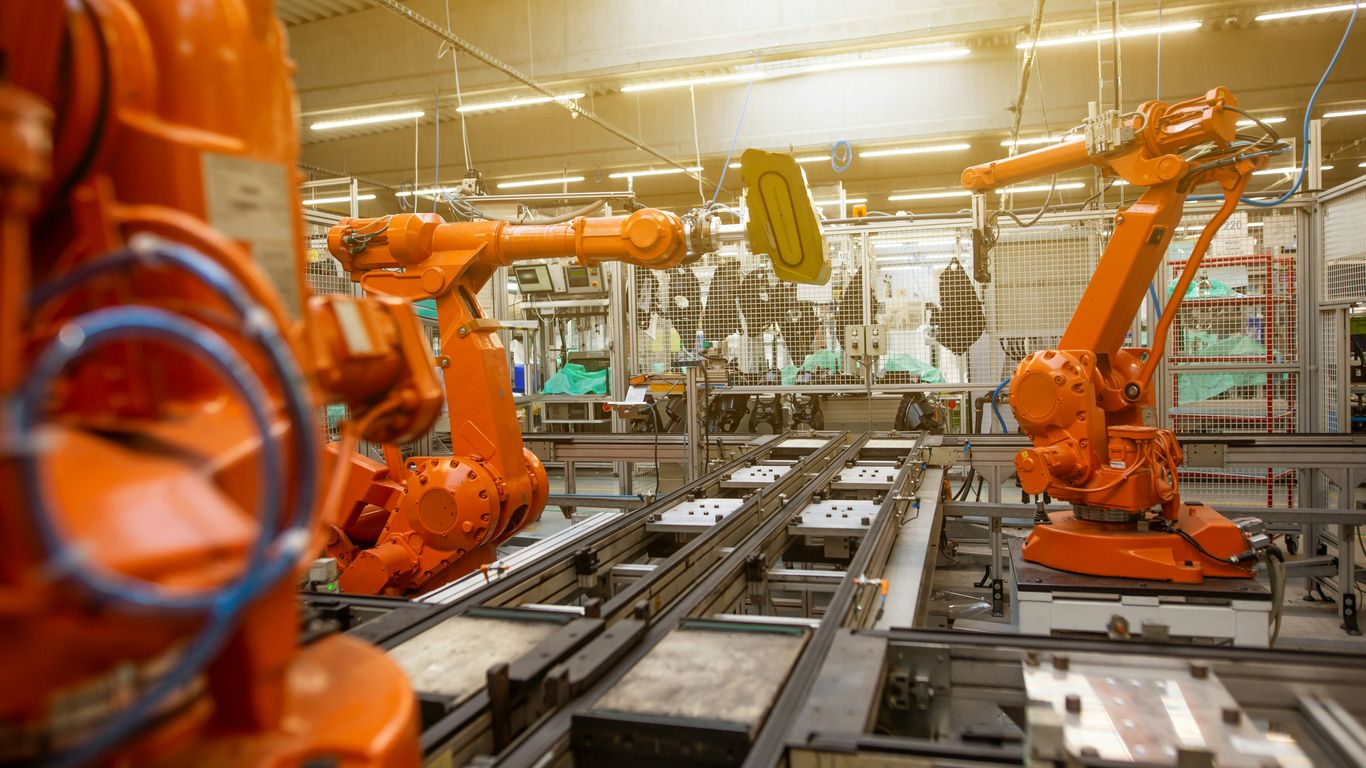
A physical system must turn pixels, depth measurements, force readings, or other sensor signals into an estimate of what is happening. It then needs to choose an action whose consequences unfold in the real world. That creates a closed loop: perception informs reasoning, reasoning proposes behavior, and the resulting motion produces new observations.
The loop also makes errors consequential. A mistaken classification in a software interface may be inconvenient; a mistaken estimate near a person or fragile object can create a safety problem. Physical AI therefore needs interfaces between learned components and established planning, control, and safety mechanisms.
Combining vision-language models with robot control
Vision-language models can associate visual scenes with language, while robot-control systems must produce timed, physically feasible actions. Combining them requires a translation layer between a high-level instruction and the low-level commands that move joints, wheels, grippers, or other actuators. That layer must account for embodiment, reachability, force, and the current state of the machine.
The result is not necessarily a single end-to-end model. In many systems, language and vision guide a task policy while conventional controllers enforce constraints. This division can make the system easier to test, although it also introduces interfaces where information may be lost or misinterpreted.
Using world models to understand environments
A world model is an internal representation of how an environment is arranged and how it may change after an action. For a robot, that representation can include objects, surfaces, free space, motion, and likely consequences. It gives the system a basis for planning beyond the next isolated motor command.
World models remain approximations. They can be incomplete, stale, or wrong when the environment contains occlusions, unusual objects, or changes outside the training distribution. Their usefulness therefore depends on continual observation and on a fallback behavior when confidence is low.
Why physical AI requires simulation and real-world feedback
Robots cannot learn everything efficiently through trial and error on production hardware. Simulation provides scale and repeatability, while real-world feedback reveals friction, sensor noise, mechanical tolerances, and social conditions that are difficult to represent perfectly. The two sources of experience work best as a loop rather than as competing alternatives.
A disciplined program uses physical results to improve the virtual environment and uses simulation to select safer, more informative physical experiments. That approach supports the broader analysis of robot foundation models, which emphasizes that generalization still depends on hardware, control, and safety engineering.
How robots are trained in NVIDIA Isaac
Robot training is a pipeline, not a single pass through a model. Teams first define the task and the environment, then gather observations, train a policy, test failure cases, and move selected behaviors toward hardware. Each stage can expose different problems, so a high simulation score is only one signal among several.
Building digital twins with Isaac Sim
A digital twin is a virtual representation of a robot and the setting in which it operates. It can include geometry, sensors, materials, and physical interactions, allowing engineers to run repeatable trials without putting the physical machine through every experiment. The fidelity required depends on the task: navigation, grasping, and contact-rich manipulation do not stress a simulation in the same way.
The twin should be treated as an engineering model with assumptions, not as a perfect copy of reality. Calibration against measured hardware behavior is essential, particularly when small differences in timing or friction alter the outcome of a learned policy.
Generating synthetic data for perception models
Synthetic data is generated from controlled virtual scenes and can vary factors that would be expensive to capture manually. It may provide labeled examples for detection, pose estimation, depth, or segmentation while exposing a model to unusual positions and lighting conditions. This is most useful when the target environment is known well enough to model and when the labels need to be precise.
Synthetic examples do not automatically match the visual statistics of a real facility. Teams should compare them with physical recordings, identify systematic gaps, and use real observations to adjust the data mixture. Otherwise, a perception model may perform well on a benchmark that does not reflect deployment.
Training policies with Isaac Lab
Policy training concerns the behavior that maps observations to actions. A policy can be trained across many simulated episodes, with rewards or demonstrations guiding it toward a task objective. Parallel trials make it possible to explore variations and failure modes more quickly than a single physical robot could.
The objective must be designed carefully. A policy that reaches a target quickly may still collide with obstacles, use excessive force, or fail when an object is slightly displaced. Training metrics should therefore include constraints and failure analysis, not only task completion.
Moving models from simulation to physical hardware
The transition from simulation to hardware is commonly called sim-to-real transfer. It involves packaging the model, matching preprocessing and coordinate systems, calibrating sensors, and checking that the policy behaves under the robot's actual timing and mechanical limits. A staged rollout is safer than moving directly from a successful virtual trial to unrestricted operation.
Teams can reduce surprises through domain randomization, hardware-in-the-loop tests, and carefully selected physical evaluations. None is a substitute for observing the deployed robot, but together they make the gap measurable rather than mysterious.
The software and hardware workflow
A working robot is an integration project. Middleware, sensors, inference runtimes, actuators, networking, and safety systems must exchange information with predictable timing. The stack may be modular in software, but its behavior is coupled through bandwidth, latency, clock synchronization, and hardware constraints.
Running ROS 2 applications with Isaac ROS
ROS 2 applications organize robot functions into communicating components, allowing teams to combine perception, planning, and control nodes. An accelerated robotics workflow can preserve those interfaces while providing optimized implementations for demanding workloads. The key engineering task is to understand what each node assumes about message formats, timing, frames, and failure behavior.
Modularity helps teams replace one component without rewriting the entire application. It does not guarantee compatibility, however. Integration testing must cover the full message path, including delayed, missing, or malformed sensor data.
Accelerating perception with GPU-optimized packages
Perception often consumes substantial compute because cameras and depth sensors produce high-rate streams. GPU-optimized packages can reduce processing time for supported operations, leaving more room for planning or additional sensors. The relevant measure is end-to-end performance, not an isolated kernel result.
A perception pipeline should be profiled under the same image sizes, sensor rates, and concurrent workloads expected in operation. This is where latency under load becomes more useful than a peak throughput figure reported in ideal conditions.
Deploying models on Jetson and other edge platforms
Edge deployment requires more than exporting a model. Engineers must check numerical compatibility, memory use, startup behavior, thermal conditions, and how the inference runtime interacts with other robot processes. A smaller model that responds consistently may be preferable to a larger model that occasionally misses its control deadline.
The deployment target also shapes the model-development process. Quantization, batching, and sensor scheduling can affect accuracy and timing, so they should be evaluated before the final field trial rather than treated as last-minute packaging details.
Connecting robot components through sensors, networks, and APIs
Sensors provide observations, networks carry them, and APIs define how software components use them. A dependable system makes those boundaries explicit: timestamps must be meaningful, coordinate frames must be consistent, and actuator commands must have clear limits. Diagnostics should reveal not only that a component failed, but whether the fault began with sensing, transport, inference, or control.
A concise integration review typically covers four areas before deployment:
- sensor calibration and timestamp integrity;
- network bandwidth, latency, and failure handling;
- model versioning and runtime compatibility;
- actuator limits, emergency behavior, and operator access.
That list is not a substitute for system testing. It is a way to keep basic integration risks visible while teams focus on model performance.
NVIDIA's foundation models for general-purpose robots
Foundation models for robotics aim to provide reusable representations and behaviors across tasks or embodiments. They are trained from combinations of language, images, video, demonstrations, and simulation rather than from one narrowly scripted sequence. The promise is broader adaptability, but general-purpose behavior still has to meet the constraints of a specific body and workplace.
What Isaac GR00T is designed to do
Isaac GR00T is presented as an open reference platform for general-purpose humanoid robots. Its documented scope includes open data and pipelines, a foundation model for generalized reasoning and skills, simulation frameworks, CUDA-X accelerated libraries, and Jetson Thor for real-time inference. It is intended to support building, training, testing, and deploying AI-powered robots, including manipulation and multi-step actions.
That scope describes an open development framework, not a guarantee that any humanoid can perform arbitrary work without adaptation. A deployment still requires an appropriate body, sensors, actuators, controls, and validation process.
Using demonstrations and multimodal data for training
Demonstrations show a system what a successful behavior looks like, while multimodal data connects language and visual context with action. Human teleoperation can capture examples that are difficult to specify as rules, especially for manipulation. Video and simulation can add variation, but each source carries its own biases and gaps.
The training set should be organized around the conditions that matter in operation. A large collection with little coverage of failure cases may be less useful than a smaller, carefully evaluated set that represents object variation, workspace changes, and recovery behavior.
Adapting generalist models to specific tasks
A generalist model usually needs adaptation before it can perform a production task. Fine-tuning, demonstrations, task-specific policy layers, and conventional controllers can narrow a broad capability to a defined workflow. The adaptation process should preserve enough flexibility to handle ordinary variation without allowing unbounded behavior.
Evaluation should separate capability from reliability. A robot that succeeds in a demonstration may still require many more trials to establish consistent performance across shifts, operators, objects, and environmental conditions.
The role of Cosmos in physical world understanding
A physical-world model can help represent how scenes evolve and how actions may change them. Within the documented GR00T reference platform, Omniverse and Cosmos are included among the simulation frameworks supporting development. Their relevance is the connection between visual context, predicted consequences, and robot learning—not a claim that simulation can replace field evidence.
The practical test remains whether a model improves decisions on the target hardware. Predictions that look plausible but fail under contact, occlusion, or timing pressure must be treated as research signals rather than deployment readiness.
How organizations can evaluate and deploy the platform
The right evaluation starts with the operating task, not with a product inventory. A warehouse robot, a laboratory manipulator, and a humanoid assistant have different sensing, safety, and uptime requirements. Organizations should define those requirements in measurable terms before selecting compute, simulation, or model components.
Choosing between simulation, edge, and data center resources
Simulation is suited to repeatable environment generation and policy experiments; edge systems are suited to local inference and immediate response; data center resources are suited to large-scale training and parallel evaluation. Most serious programs need all three, with clear boundaries between them. Energy, network access, and data sensitivity can change the balance for a particular site.
For adjacent infrastructure planning, the Helios Energy Global blog is an example of material focused on industrial energy and storage questions. That topic is separate from robot intelligence, but it illustrates why the physical operating envelope—including power availability—belongs in a deployment plan.
Measuring accuracy, latency, safety, and reliability
A credible evaluation combines task outcomes with system behavior. Accuracy alone can hide a model that is too slow, unstable under sensor degradation, or unsafe when uncertain. Metrics should be collected across representative conditions and reported with enough detail to distinguish a model failure from a mechanical or integration failure.
A practical scorecard can be organized as follows:
| Evaluation area | Example question | Why it matters |
|---|---|---|
| Accuracy | Does the robot complete the defined task? | Shows functional capability |
| Latency | Does the full loop meet its timing budget? | Connects inference to safe action |
| Safety | Does the system fail within defined limits? | Addresses people, equipment, and property |
| Reliability | Does performance hold across repeated trials? | Tests operational consistency |
The scorecard becomes useful only when the organization sets thresholds before testing. Results should also include confidence ranges, failure categories, and the conditions under which the system was evaluated.
Managing the sim-to-real gap
The sim-to-real gap is managed through calibration, domain variation, hardware-in-the-loop testing, and repeated physical checks. Teams should identify which assumptions are most likely to fail, then design experiments that challenge those assumptions. This is more informative than treating simulation transfer as a single final milestone.
The same discipline applies to model monitoring after launch. Logs, operator feedback, and incident reviews can reveal environmental changes that were absent from training. A controlled update process is essential when a new model may alter physical behavior.
Addressing cost, integration, security, and vendor lock-in
A platform decision should include the full lifecycle cost: engineering time, sensor integration, data preparation, compute, maintenance, monitoring, and safety review. It should also specify what can be replaced independently if requirements or suppliers change. Open interfaces can reduce switching costs, although they do not eliminate the work of revalidation.
Security includes access control, software provenance, update procedures, telemetry, and protection of recordings from workplaces or homes. Readers comparing governance practices may find the Travel Fx Privacy Policy and Natural Escort privacy statement useful as general examples of how data rights and security controls are documented, though those policies are not robotics standards. Broader context on adoption and market effects is available in Artificial Intelligence statistics, while discussion of applied AI workflows appears in AI strategy tools. These references reinforce a simple point: deployment is an operational and governance decision, not only a benchmark exercise.
Conclusion
Physical AI becomes practical when models, simulation, compute, control software, sensors, and safety processes are developed as one system. The platform approach can shorten iteration and make complex workflows more accessible, but it does not erase the hard work of calibration, evaluation, and deployment. For builders and investors, the durable signal is not a compelling demo; it is repeatable performance under real constraints.
Frequently Asked Questions
What is physical AI?
Physical AI describes systems that perceive and act in the physical world, often combining learned models with sensors, planning, control, and safety mechanisms.
How is physical AI different from software-only AI?
Software-only AI produces outputs within a digital environment, while physical AI must account for timing, mechanics, uncertainty, contact, and consequences in the real world.
Why is simulation useful for robotics?
Simulation provides repeatable environments for testing, synthetic-data generation, and policy training before a behavior is attempted repeatedly on physical hardware.
Can simulation replace real-world robot testing?
No. Simulation can reduce cost and risk, but physical testing is needed to expose calibration errors, sensor noise, mechanical variation, and unexpected environmental behavior.
What does sim-to-real mean?
Sim-to-real is the process of transferring a model or policy developed in simulation to a physical robot while addressing differences between the two settings.
Why do robots need edge inference?
Edge inference allows a robot to process information near its sensors and actuators, which can help meet response-time requirements and reduce dependence on network connectivity.
What should organizations measure before deployment?
They should measure task accuracy, end-to-end latency, safety behavior, reliability across repeated trials, integration effort, security exposure, and lifecycle cost.