Inside Deep Tech Editorial
Last updated: 17 August 2026
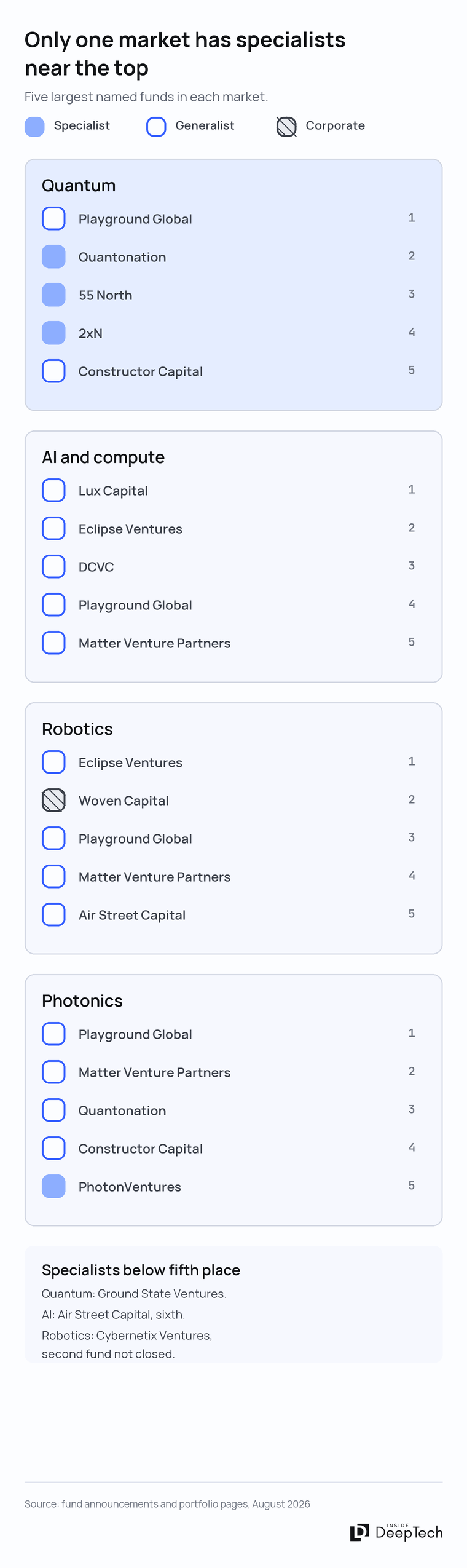
In quantum, three of the five largest investors run funds that back quantum and almost nothing else. In robotics, none of the top five does. Both markets are served by the same pool of capital, and only one of them has built specialists.
That asymmetry decides who a founder talks to first, and it does not appear in any list of investors ranked by size alone.
What follows is the top five in each of the four markets this publication covers, ranked on the size of the last fund each firm announced as closed. For the full register of firms across all four markets, see our ranking of the twenty deep tech firms funding the frontier.
How these are ranked
A firm appears in a market if it names at least one holding there in its own materials. Firms therefore appear in more than one list: Playground Global is in all four.
Ranking is by the last fund announced as closed. Where a firm has announced a target and reached only a first close, the closed figure is used and the target is noted. Amounts are given as announced and are not converted between currencies.
Holdings are those a firm names itself. What a firm publishes is not always everything it holds, so read the lists as illustrative.
Quantum
- Playground Global, US. 475 million dollars, May 2026. PsiQuantum, Phasecraft.
- Quantonation, France, US. 220 million euros, February 2026. Pasqal, Quandela, Diraq, Qblox, Nord Quantique.
- 55 North, Denmark. 134 million euros first close, October 2025. IQM, Kiutra.
- 2xN, UK. 120 million dollars, August 2022. Quantinuum, Kvantify, QuantrolOx.
- Constructor Capital, Switzerland. 110 million dollars, February 2026. QuEra, Qruise, Qendra, QDTI.
Also dedicated to quantum, below the top five: Ground State Ventures, known as QDNL Participations until April 2026, with 88 million dollars raised against an original target of 70 million and a final close approaching. Its first vehicle, 15 million euros committed in full by the foundation behind the Dutch national quantum programme, backed Qblox, QuantWare, QphoX and Q*Bird.
Playground Global leads on size and comes last on focus. Its two quantum names pull in different directions: PsiQuantum is building towards a million-qubit photonic machine, Phasecraft writes algorithms for hardware that already exists.
Quantonation is the deepest specialist on this page, with more than forty companies sorted on its own site into quantum computing, networks, sensing, and deep physics. Its holdings cover most of the hardware approaches in contention at once: neutral atoms at Pasqal, photons at Quandela and ORCA Computing, silicon spin at Diraq and Quobly, superconducting error correction at Nord Quantique.
55 North was incubated by EIFO, Denmark’s export and investment fund, and co-anchored by Novo Holdings. It is targeting 300 million euros, which would make it the largest pure quantum vehicle anywhere. Its opening cheques went into IQM’s 275 million euro Series B and a Series A-2 at Kiutra, which builds the cryogenic cooling that superconducting and spin qubits depend on.
2xN holds the oldest vintage on this page. Its 120 million dollar second fund dates from August 2022, and both founders backed Cambridge Quantum before it merged into Quantinuum. The firm calls itself quantum-inspired, and its portfolio includes companies in mobility and education, so the label sits less tightly than on Quantonation or 55 North.
Constructor Capital closed its first fund at 110 million dollars and names four quantum companies, more than either of the two firms directly above it: QuEra in neutral atoms, Qendra in control systems for trapped-ion and neutral-atom experiments, Qruise in hardware calibration, QDTI in quantum-enabled diagnostics.
Four of the six firms named in this section invest in quantum and almost nothing else. No other market on this page looks like that.
AI and compute
- Lux Capital, US. 1,5 billion dollars, January 2026. Hugging Face, Runway, MosaicML.
- Eclipse Ventures, US. 1,3 billion dollars, April 2026. Cerebras, Flex Logix.
- DCVC, US. 725 million dollars, DCVC V. Mythic, MosaicML.
- Playground Global, US. 475 million dollars, May 2026. d-Matrix, NextSilicon, Vertical Semiconductor, Snowcap.
- Matter Venture Partners, US. 300 million dollars, closed 2023. Lumafield, OpenLight.
Also dedicated to this market, below the top five: Air Street Capital, 232 million dollars, March 2026. Its mandate is artificial intelligence and nothing else, the only such case here, and it sits sixth on size.
Lux Capital took its positions before the current cycle, including Hugging Face and Runway, plus MosaicML, which Databricks bought in 2023. Defence is a declared part of the mandate.
Eclipse Ventures invests at the silicon layer, with Cerebras and Flex Logix, and describes its target as the physical economy. It disclosed its raise through filings with the Securities and Exchange Commission, the only firm on this page whose fundraising can be checked against a regulatory document.
DCVC claims authorship of the term deep tech and has been investing against it since well before the label became common. Its compute holdings run from Mythic in analogue inference silicon to MosaicML.
Playground Global is thickest here of all four markets, and the names cluster around the constraints: d-Matrix and Snowcap on inference efficiency, NextSilicon on reconfigurable architectures, Vertical Semiconductor and PowerLattice on delivering power to accelerators without cooking them.
Matter Venture Partners was founded in 2023 by two former Kleiner Perkins investors and closed its first fund at 300 million dollars after going out for 200. Its stated focus is hard tech across semiconductors, automation and electrification.
The specialist here is sixth by size. That is the whole shape of this market: the money is generalist, and the one firm with a pure mandate is smaller than the five above it.
Robotics
- Eclipse Ventures, US. 1,3 billion dollars, April 2026. Mind Robotics, Clearpath Robotics, Augury.
- Woven Capital, Japan. 800 million dollars, September 2025. Nuro.
- Playground Global, US. 475 million dollars, May 2026. Agility Robotics, Boxbot, Fabric.
- Matter Venture Partners, US. 300 million dollars, closed 2023. Dexterity.
- Air Street Capital, UK. 232 million dollars, March 2026. Sereact.
Vsquared Ventures, at 214 million euros, is level with Air Street once the currencies are set side by side, and holds Neura Robotics.
Also dedicated to robotics, below the top five: Cybernetix Ventures. It announced a second fund in June 2025 with a 100 million dollar target, describing itself in its own release as raising and not as closed. Its first vehicle reached 25 million against a 50 million target. It is the only firm on this page whose sole market is robotics and physical AI.
This is the one market with no specialist in its top five. Robotics is not a small market, and the money reaches it through generalists and corporate arms instead.
Eclipse Ventures has moved further into physical systems than any other firm here. Mind Robotics builds industrial automation, Clearpath Robotics builds research and logistics platforms, Augury does machine health monitoring.
Woven Capital is Toyota’s growth-stage arm and a wholly owned subsidiary of the carmaker since September 2025, when Fund II was established at 800 million dollars. Its first cheque, back in 2021, went to the autonomous delivery company Nuro. A corporate parent changes what the money comes with. Distribution and manufacturing access arrive with it, and so does a strategic agenda.
Playground Global runs from humanoids at Agility Robotics to warehouse sortation at Boxbot. Skydio, which the firm files under aerospace on its own site, does not carry the robotics tag at all. These lines are drawn by the firms themselves and by no standard.
Matter Venture Partners co-led investments in Dexterity before the firm existed, when its founders were still at Kleiner Perkins.
Air Street Capital reaches robotics through its AI mandate. Sereact, its holding here, builds manipulation models for warehouses. That is the pattern across this whole market: robotics capital arrives as a subset of something else.
Photonics
- Playground Global, US. 475 million dollars, May 2026. Ayar Labs, PicoJool, xLight.
- Matter Venture Partners, US. 300 million dollars, closed 2023. OpenLight.
- Quantonation, France, US. 220 million euros, February 2026. Quandela, ORCA Computing, Pixel Photonics, PINC, SteerLight.
- Constructor Capital, Switzerland. 110 million dollars, February 2026. Lumai, Akhetonics, VitreaLab.
- PhotonVentures, Netherlands. 80 million euros, October 2024. VitreaLab, QuiX Quantum, NcodiN, Astrape Networks.
PhotonVentures is the only firm here whose entire mandate is photonics, and it comes last on size. Spun out of PhotonDelta in 2023, it reached 75 million euros at its second close in April 2024 and 80 million that October when Invest-NL added five million, alongside the regional development agencies BOM and Oost NL, the research organisation TNO and the University of Twente. A final close at 100 million euros was planned for the end of 2024 and has not been announced. Invest-NL, a state institution, described it as one of the few dedicated photonics funds in Europe. Cheques run between one and 2,5 million euros, the tightest range on this page.
Playground Global tops this market through the compute bottleneck. Ayar Labs moves data between chips using light, PicoJool replaces copper with fibre inside data centres, and xLight is building an extreme ultraviolet source for lithography. All three answer the same question about where the power budget goes.
Matter Venture Partners led the 50 million dollar Series A-1 at OpenLight in April 2026, which designs application-specific photonic integrated circuits on a heterogeneous silicon platform.
Quantonation holds more photonics companies than its position suggests, because much of the quantum stack is optical: photonic quantum computers at Quandela and ORCA, single-photon detection at Pixel Photonics, nonlinear circuits in thin-film lithium niobate at PINC, and silicon-photonic lidar at SteerLight, which is not a quantum company at all.
Constructor Capital holds three optical computing and display companies: Lumai in three-dimensional optical processing, Akhetonics in all-optical logic, VitreaLab in light engines for augmented reality. VitreaLab is also in the PhotonVentures portfolio.
The asymmetry, and what it costs
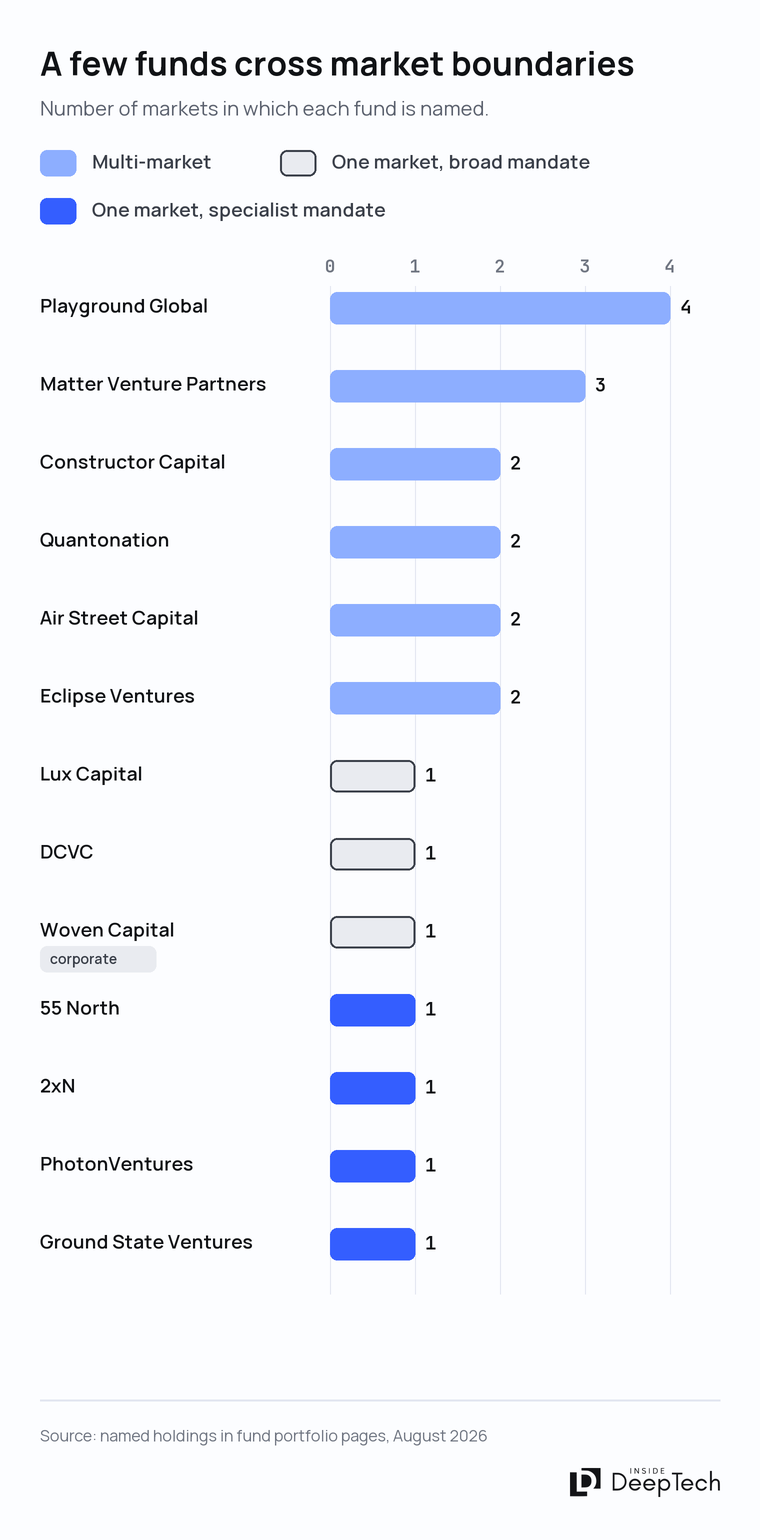
Count the specialists across the four markets and the pattern is not subtle. Quantum has three in its top five and a fourth just below it. Photonics has one, in fifth place. AI and compute has one, in sixth place. Robotics has none inside the top five, and the one dedicated firm has not closed its second fund.
Specialists cluster where the science is hardest to evaluate and the market is smallest. That is not a coincidence: a generalist can price a robotics company against comparable industrial businesses, and cannot price a trapped-ion company against anything.
For a founder the consequence is direct. In quantum and photonics there is a real choice between a specialist and a generalist, and the specialist will usually be the smaller cheque with the longer patience and the shorter follow-on reserve. In robotics that choice does not exist yet, and the terms follow from that: the money is generalist or corporate, and it will want the science explained.
Questions readers ask
Which investors fund quantum computing?
Quantonation, 55 North, 2xN and Ground State Ventures run funds dedicated to quantum. Playground Global and Constructor Capital hold quantum companies inside broader mandates. Quantonation is the largest of the specialists at 220 million euros, and Playground is the largest investor in the market overall at 475 million dollars.
Are there dedicated robotics venture funds?
One appears in this research: Cybernetix Ventures, whose sole market is robotics and physical AI. It announced a second fund with a 100 million dollar target in June 2025 and describes itself as raising. Every firm in the robotics top five invests across several markets.
Who invests in photonics?
PhotonVentures is the only fund here whose entire mandate is photonics, at 80 million euros. Playground Global, Matter Venture Partners, Quantonation and Constructor Capital all hold photonics companies inside broader strategies, and Quantonation reaches the field through the optical parts of the quantum stack.
Should a founder approach a specialist or a generalist?
Specialists understand the science and write smaller cheques. Generalists write larger cheques and will need the science explained. The practical question is which risk hurts more in your market: being misunderstood at the term sheet, or running out of follow-on capital at Series B.
Why do the same firms appear in several markets?
A firm appears wherever it names a holding, and most of these firms invest across several markets. Playground Global appears in all four and Matter Venture Partners in three. Constructor Capital, Quantonation, Air Street Capital and Eclipse Ventures appear in two each. Only the specialists appear once.
Where is the full list of deep tech firms?
In our ranking of the twenty firms funding the frontier, which covers all four markets in one register and includes firms that publish no fund size at all.
What these lists are for
A firm’s fund size tells a founder how long it can support them and how many companies it has to support alongside them. Neither number appears in a pitch, and both decide what happens at the second round.
The lists will be updated as funds close. Anything a firm would like corrected can be sent to the editorial address, and corrections are marked on the page.
Sources
Fund sizes and dates are taken from each manager’s own announcement. Holdings are taken from portfolio pages that were opened and read in August 2026 for Playground Global, Quantonation, Constructor Capital, Air Street Capital and Eclipse Ventures, and from the firms’ own announcements for the rest, which means those lists are shorter than the portfolios behind them.