Unitree Robotics listed on the Shanghai Stock Exchange's STAR Market on 19 August 2026, priced at 150,80 yuan a share, and rose as much as 629% during the day. The number that travelled furthest afterwards came out of its filings: Unitree shipped more than 5 500 humanoid robots in 2025, while Figure AI and Agility Robotics shipped around 150 each.
That comparison was reported everywhere as a finding of the prospectus. In the document itself the sentence ends differently. It says the 150 figure comes from public reports, and that none of those figures has been confirmed by the companies concerned.
Reading the filing rather closely turns out to be worth the effort, because it is the first time anyone in this industry has had to write down what the robots are, where they go and what they cost, in a document with legal consequences attached.
What the document is
On 20 March 2026 Unitree and its sponsor, CITIC Securities, published their answers to a pre-review inquiry from the Shanghai Stock Exchange. The exchange had asked eleven groups of questions covering products and competition, technology, sales channels, revenue and receivables, components, suppliers, inventory, margins, employee incentives, shareholding changes and the use of proceeds. The reply runs to several hundred pages and quotes the prospectus directly throughout. It is signed by the company, the sponsor, the law firm Beijing DeHeng and the auditor Rongcheng.
Everything below comes from that document. Amounts are given in yuan as filed and are not converted.
Where the humanoids actually go
Unitree splits humanoid revenue three ways: research and education, commercial and consumer, and industrial application.
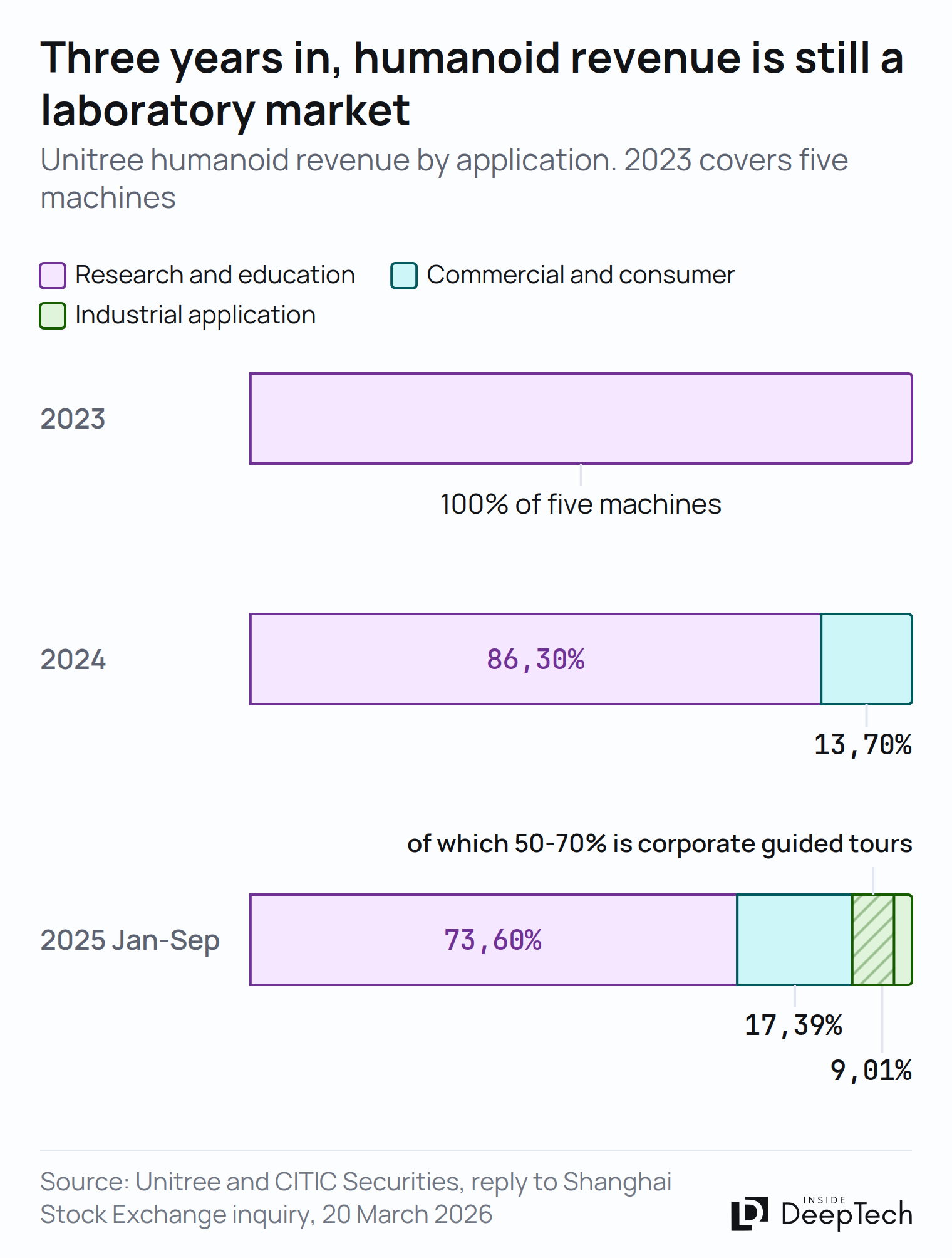
For the first nine months of 2025, research and education accounted for 438,07 million yuan, or 73,60% of humanoid revenue. Commercial and consumer took 103,52 million, or 17,39%. Industrial application took 53,60 million, or 9,01%.
A footnote to that table narrows the last figure considerably. Within industrial application, the filing says, corporate guided tours account for roughly 50% to 70%, with smart manufacturing and inspection making up the rest.
Work the arithmetic through and something under 5% of humanoid revenue comes from robots doing industrial work. The rest is laboratories and showrooms.
The trend does move. In 2023 the entire humanoid line, all five machines of it, went to research and education. In 2024 that was 86,30%. In the first nine months of 2025 it was 73,60%. Progress is real and it is measured in single-digit percentage points a year.
What the quadrupeds show
The four-legged line is older, and it has already made the move the humanoids are starting.
In 2024, research and education still took 52,69% of quadruped revenue. By the first nine months of 2025 commercial and consumer had passed it, at 206,42 million yuan against 154,12 million, and industrial application had reached 127,44 million. Unit volumes went from 2 403 in 2022 to 17 946 in the first nine months of 2025.
That is the shape a market makes when it leaves the laboratory, and it took the quadruped line about six years. Anyone reading a humanoid forecast can use it as a clock.
What moves the revenue line
Through 2024 Unitree sold more abroad than at home. In the first nine months of 2025 that reversed, with 702,16 million yuan from the domestic market against 452,79 million from overseas.
The filing explains the reversal directly. Domestic growth outpaced overseas mainly because the company's robots appeared at the Spring Festival gala broadcast at the start of 2025, which lifted brand recognition nationwide and drove domestic orders.
A company attributing a revenue reversal to a television appearance, in a document filed with a securities regulator, is describing the stage its market has reached. The overseas mix says the same thing from the other side. Research and education accounts for 68,37% of overseas humanoid and quadruped revenue, against 46,35% at home.
The industry has no comparable shipment data
The exchange asked Unitree to quantify its market position. The answer is unusually candid.
Unitree gives two datasets for 2025 humanoid shipments. A report from CCID Media and China Electronics News puts global shipments at around 17 000 units, with Unitree above 5 500 and a 32,4% share. Omdia's market radar puts global shipments of general-purpose embodied robots at around 13 300, and once Unitree's own figure is corrected upward, around 14 600, giving Unitree 37,62%.
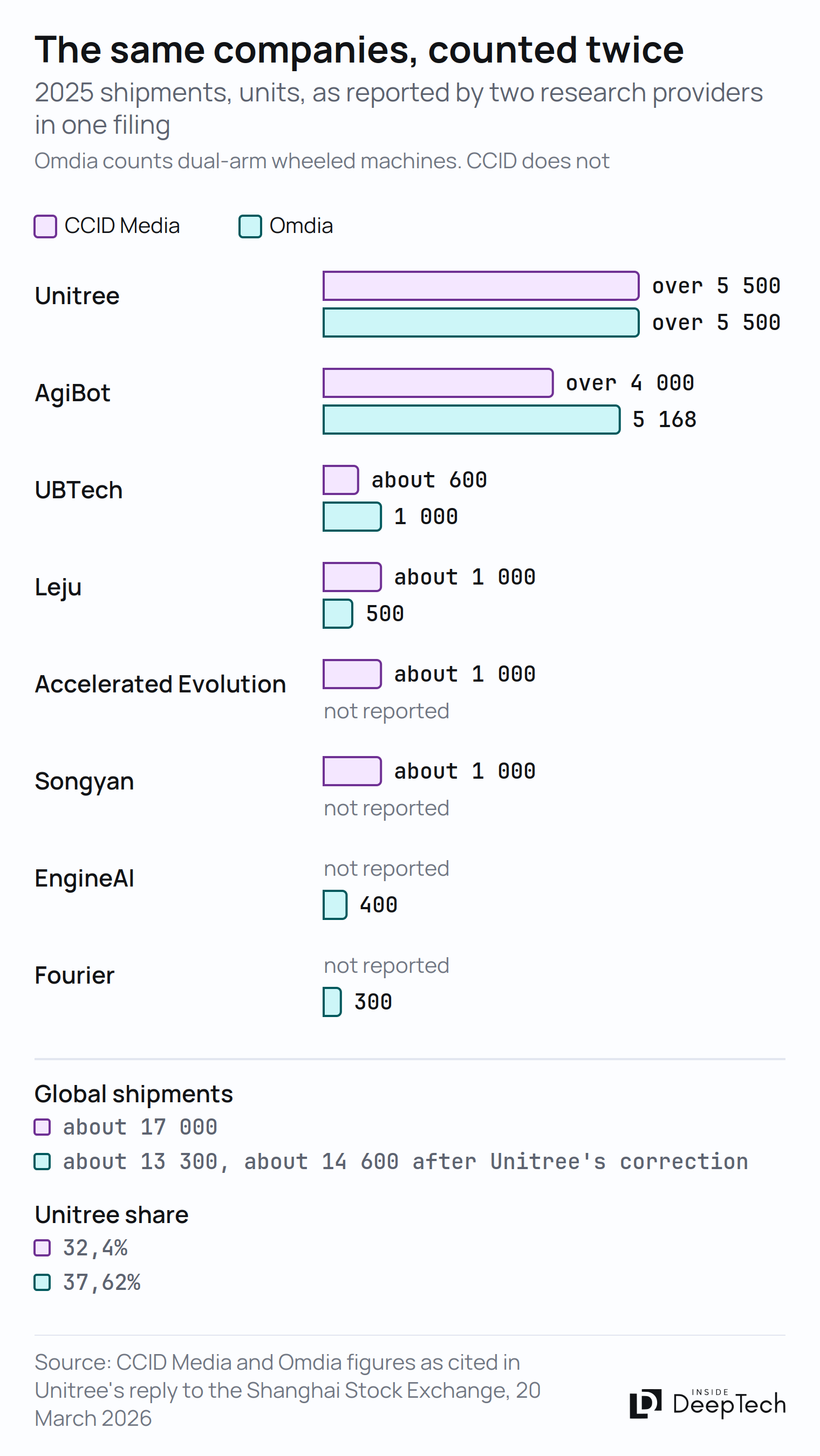
The two disagree on individual companies by wide margins. CCID puts AgiBot above 4 000 units; Omdia puts it at 5 168. CCID puts UBTech at around 600; Omdia puts it at 1 000. The gap comes from scope, since Omdia counts dual-arm wheeled machines and CCID does not.
The filing's own conclusion is that research organisations currently lack a relatively unified and comparable data source. That sentence appears in a submission to a securities regulator, from the company with the largest market share under either count.
The same problem shows up in the quadruped numbers, and the filing is precise about it. Reports that Unitree's quadruped share fell from 40,65% to 32,40% compare two different things. The first is a revenue share for 2023 from GGII, whose unit share for the same year was 69,75%. The second is a unit share for 2024 from IDC. Different agencies, different years, different measures. The document says plainly that they are not objectively comparable.
What a humanoid robot costs, and what it earns
Unitree sold 5 humanoid units in 2023 at an average of 593 400 yuan. In 2024 it sold 410 at 260 700. In the first nine months of 2025 it sold 3 551 at 167 600. The average price fell by 71,8% in two years, while volume went from five units to 3 551.
Margins went up while prices came down. In the first half of 2025 the humanoid gross margin was 62,42%, and in the third quarter 63,91%. The quadruped line ran at 56,53% and then 53,39%.
The list prices show the same movement. The full-size H1 launched in August 2023 at 499 800 yuan. The H2, launched in October 2025, starts at 199 000. The mid-size G1 has come down from 99 000 to 85 000. The R1, launched in July 2025, starts at 39 900, and the R1 Air from November 2025 at 29 900. For comparison the filing lists Figure 02 at about 59 000 US dollars and a Boston Dynamics Spot at 74 500.
Bought-in components account for 14% to 18% of total cost, excluding optional high-specification lidar and dexterous hands. Battery cells, compute modules, storage, some lidars, cameras and some dexterous hands are purchased. Motors, reducers, encoders, drivers and structural parts are designed in house.
A competitor is one of its larger customers
The exchange asked about Galbot, a Beijing humanoid company that is both a peer of Unitree and a related party.
Galbot bought 17 700 yuan of Unitree hardware in 2023 and 364 700 yuan in 2024. In the first nine months of 2025 it bought 15,14 million, which made it Unitree's largest direct-sales customer for the period, ahead of every overseas buyer. It uses the machines for its own model training and buys others to modify and resell.
The sponsor and the auditor visited Galbot's offices, looked at the robots and reported no stockpiling. Pricing sits between what dealers pay and what direct customers pay.
There is a second way to read this. In a field where the hardware is the hard part, one of the companies competing to build humanoids is buying its rival's machines by the hundred to train models on.
What the company says about its own risk
The filing quotes the risk factor from the prospectus in full. Large-scale commercial application of humanoid robots still faces uncertainty and may fall short of expectations. Technological maturity is limited in the generalisation capability of embodied large models and in the precision and durability of dexterous hands.
Asked what stands between today and large-scale deployment, the company names two things and ranks them. The first and larger is the embodied model. Training data comes from laboratories or single customised settings and does not cover cross-scenario variation, so a model meets a production line changeover or an unexpected obstacle and fails. The second is the dexterous hand, where positioning accuracy is insufficient for fine work, tactile sensing is not sensitive enough to avoid damaging delicate parts, and flexibility trades against durability.
Both answers describe capability that does not exist yet, from the company that ships more of these machines than anyone.
Questions readers ask
How many humanoid robots did Unitree ship in 2025?
More than 5 500, excluding wheeled dual-arm machines. That gives the company either 32,4% or 37,62% of the world market depending on which research provider is counting, and both put it first.
The 150 units attributed to Figure AI and Agility Robotics
The figure appears in Unitree's filing, sourced to public reports, and the filing states in the same sentence that neither company has confirmed it. Tesla is described separately as having no public sales, with its humanoids used for internal development and testing.
What are the humanoid robots used for?
For the first nine months of 2025, 73,60% of humanoid revenue came from research and education, 17,39% from commercial and consumer use, and 9,01% from industrial application. Within that last slice, the filing puts corporate guided tours at 50% to 70%.
What are Unitree's margins?
Gross margin in the third quarter of 2025 was 63,91% on humanoids and 53,39% on quadrupeds. In the first half of the year it was 62,42% and 56,53%. Prices fell across the period while margins held, which the filing puts down to in-house production of the core components.
How large is the order book?
282 million yuan at the end of 2025, up 93,15% on the year and 23,14% on the previous quarter. Against the 1 154,95 million yuan of main business revenue reported for the first nine months of 2025, that is about two months of sales, which the company puts down to a business of frequent small orders.
What about the robot rental market?
Daily rental for a G1 reached 8 000 to 15 000 yuan in early 2025 and fell to 3 000 to 5 000 by the third quarter. Rental accounts for less than 0,5% of revenue across the whole reporting period, so the price movement measures attention, and not the business.
Who buys from Unitree?
2 494 offline customers in the first nine months of 2025, of which 38 spent more than 5 million yuan. The largest single customer for the period was JD.com, at 41,36 million yuan through e-commerce warehousing. Repeat purchase rates run at 56,58% in research and education, 30,94% in industrial application and 21,25% in commercial and consumer.
What to watch
Watch the industrial percentage. It is 9,01% today with most of that being showroom tours, and it is the only number in this filing that would signal humanoid robots doing work. The quadruped line took about six years to make the same shift.
Watch whether a second company files. Unitree's disclosure is useful precisely because nobody else has to make it, and that is also its limitation, since every comparison in the document rests on research reports the company itself calls incomparable. A second filing would turn one data point into a series. Quantum computing went through that change in a single year, and five of its twelve largest companies now file with a regulator.
Watch the order book against revenue. An order book of 282 million against 1 154,95 million of nine-month revenue is a company selling small and often. That works while demand comes from laboratories buying single units. It looks different if industrial customers ever start ordering by the hundred.
Sources
All figures come from the response by Unitree Robotics and CITIC Securities to the Shanghai Stock Exchange's pre-review inquiry, published on the exchange's disclosure server on 20 March 2026, which quotes the prospectus throughout. Listing details come from the exchange's own listing announcement: stock code 688836, 40 446 434 shares at 150,80 yuan, representing 10,00% of post-offering capital, admitted to trading on 19 August 2026.
Where the filing attributes a figure to a third party, this article says so. Where two research providers disagree, both numbers appear. No figure on this page comes from an aggregator.