Inside Deep Tech Editorial
Last updated: 17 August 2026
Most lists of deep tech investors rank by reputation and do not say so. This one ranks on a single published number: the size of the last fund each firm announced as closed, taken from the firm’s own materials and dated.
Fourteen firms have such a number. Six are active by any reasonable measure and publish no fund size at all, which is itself worth knowing, so they appear in a second group that is not ranked.
The column most of these lists leave out is the one that explains the sizes.
How this is ranked
Ranking is by the size of the last fund each firm announced as closed. A firm qualifies for the page on two conditions: it describes itself as backing deep tech, frontier tech or hard tech, or one of the four markets this publication covers, on its own site; and it has either announced a fund close or named an investment since January 2024. Where a firm has announced a target and reached only a first close, the closed figure is used and the target is noted, because ranking on a target would place firms above others on money they do not yet hold. One firm here is in that position.
Fund size is the one number every firm on this page publishes about itself in the same form. Deal counts would measure publication policy as much as activity: some firms announce every cheque, others disclose a portfolio in one release and nothing between.
Amounts are given as announced and are not converted between currencies, so any two firms within roughly a tenth of each other should be read as level.
The pattern in the fundraising announcements
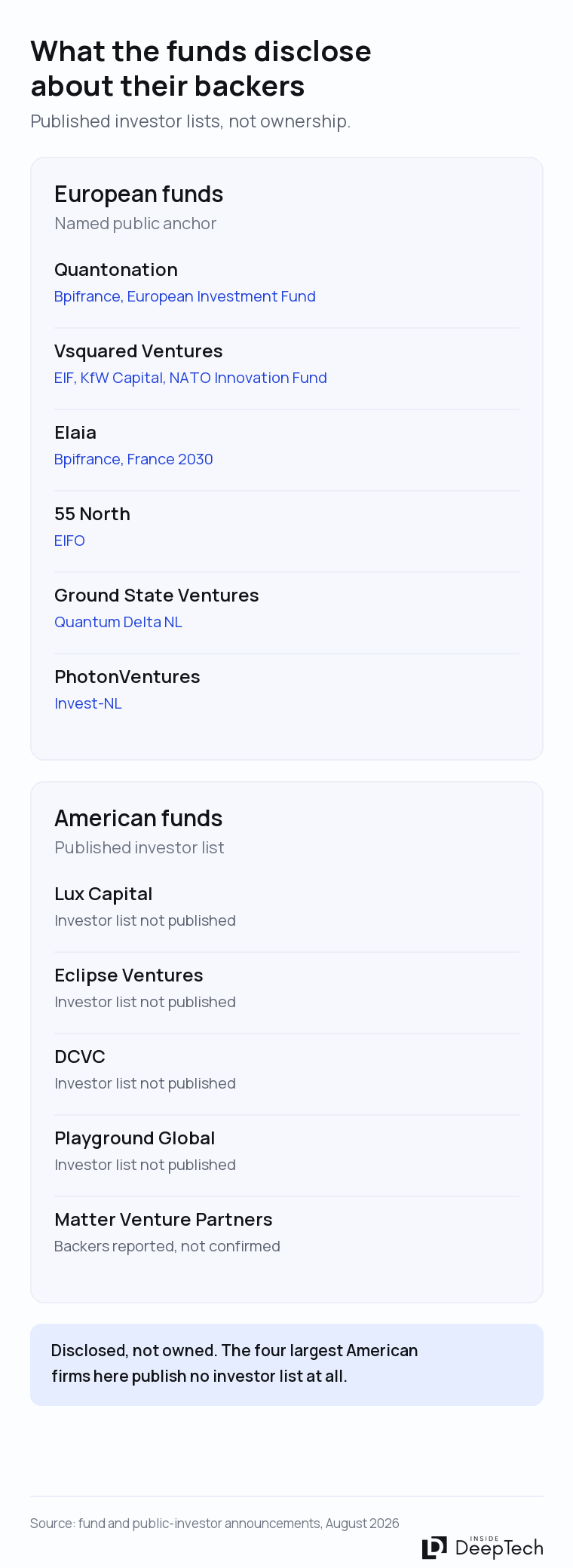
Every European firm in the ranked group names a state or supranational investor among its backers. The European Investment Fund, Bpifrance acting for the French state, KfW Capital, Denmark’s EIFO, Invest-NL, the foundation behind the Dutch national quantum programme, the NATO Innovation Fund. At Ground State Ventures, formerly QDNL Participations, the foundation behind the Dutch national quantum programme was the sole investor in the firm’s first vehicle. At Elaia the list runs through the country’s research institutions and Bpifrance under France 2030.
No American firm in these tables names a state investor. That is a different statement from saying there is none, and the distinction matters: Lux Capital, DCVC, Eclipse Ventures and Playground Global do not publish their investor lists at all. What can be compared here is disclosure, not ownership.
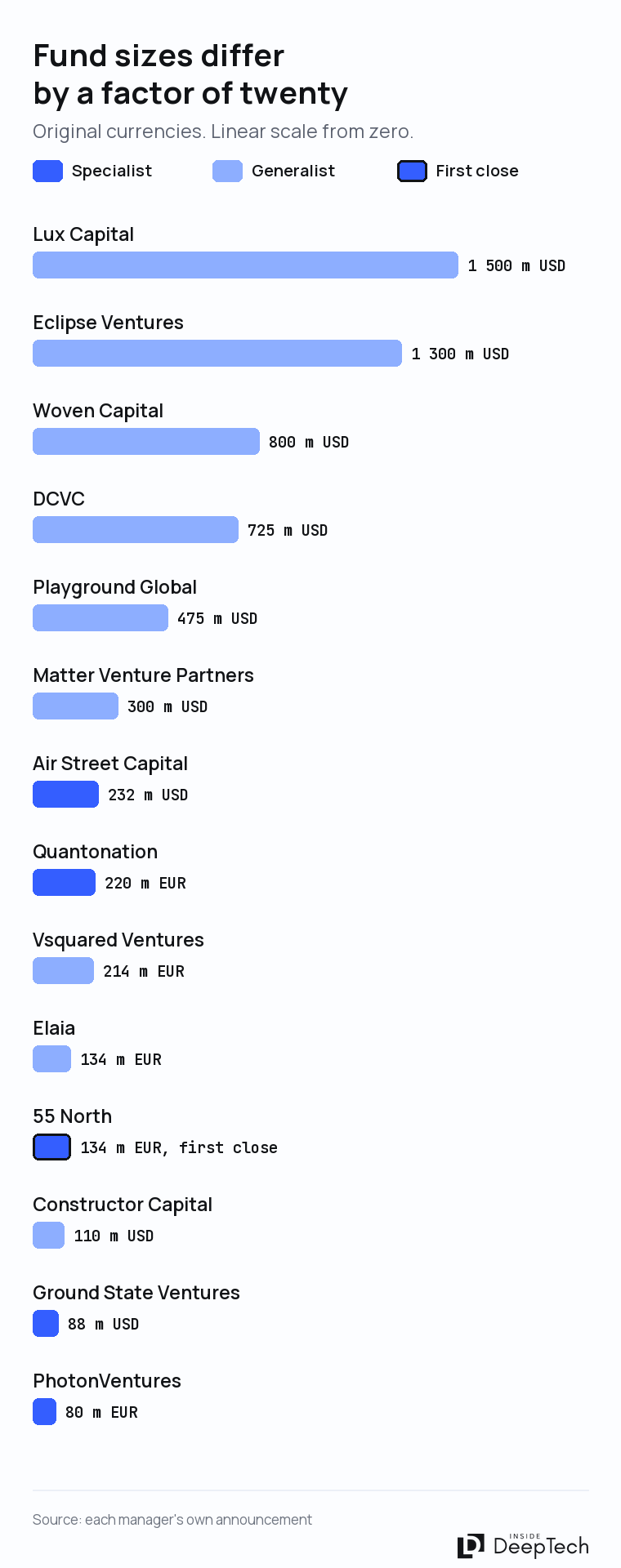
The consequence shows up in the sizes. A European specialist raises around a public anchor and the anchor sets the ceiling, which is why the largest dedicated quantum fund on this page closed at 220 million euros while the largest American generalist closed at 1,5 billion dollars. A founder choosing between them is choosing between a firm whose entire fund is smaller than one American follow-on reserve, and a firm for which their sector is one line of five.
The ranking
Every European firm in the ranking names a state or supranational backer; no American firm names one
Positions 10 and 11 carry the same figure and mean different things. Elaia’s 134 million euros is a final close. The 134 million at 55 North is a first close against a target of 300 million, which would make it the largest pure quantum vehicle anywhere if it gets there.
1. Lux Capital
Fund IX closed at 1,5 billion dollars in January 2026, the firm’s largest, taking it to seven billion under management across forty-four people. Its positions in machine learning were taken before the current cycle, including Hugging Face and Runway, plus MosaicML, which Databricks bought in 2023. Defence is a declared part of the mandate, and Anduril and Applied Intuition are the best-known holdings there.
2. Eclipse Ventures
Raised 1,3 billion dollars across two vehicles in April 2026: Fund VI at 720 million and Early Growth Fund III at 591 million. Assets under management now sit at roughly ten billion. The thesis is the physical economy, with Cerebras and Flex Logix in silicon and Clearpath Robotics and Mind Robotics in automation. Eclipse disclosed the raise through filings with the Securities and Exchange Commission, the only firm on this page whose fundraising can be checked against a regulatory document. Its own investment page carries a note that the list published there is neither complete nor representative, which is more disclosure than most firms offer.
3. Woven Capital
Toyota’s growth-stage arm, and a wholly owned subsidiary of the carmaker since September 2025, when Fund II was established at 800 million dollars, matching Fund I from 2021. The first cheque, back in 2021, went to the autonomous delivery company Nuro. A corporate parent changes what the money comes with. Distribution and manufacturing access arrive with it, and so does a strategic agenda.
4. DCVC
DCVC V closed at 725 million dollars, the firm’s eighth fund overall and roughly twice the size of the vintage before it. DCVC claims authorship of the term deep tech and has been investing against it since well before the label became common. Its compute holdings run from Mythic in analogue inference silicon to MosaicML.
5. Playground Global
Fund IV closed at 475 million dollars in May 2026, with GlobalFoundries entering as a limited partner. It is the only firm on this page with published holdings in all four of the markets covered by this publication: PsiQuantum and Phasecraft in quantum, d-Matrix and NextSilicon in compute, Agility Robotics and Boxbot in robotics, Ayar Labs and xLight in photonics. Pat Gelsinger, formerly chief executive of Intel, is a general partner.
6. Matter Venture Partners
Founded in 2023 by two former Kleiner Perkins investors and closed its first fund at 300 million dollars after going out for 200. Kleiner Perkins and TSMC have been reported among the backers, which the firm has not confirmed publicly. It led the 50 million dollar Series A-1 at OpenLight in April 2026, and holds Dexterity in robotics and Lumafield in industrial imaging.
7. Air Street Capital
Fund III closed at 232 million dollars in March 2026, the largest European fund run by a single general partner. It invests in artificial intelligence and nothing else, the only AI-only mandate in the ranked group. Holdings include Synthesia, Black Forest Labs and Sereact in warehouse manipulation. Note that several names commonly attached to the firm, including Wayve and Lambda, sit in the founder’s angel portfolio from before the fund existed.
8. Quantonation
The deepest specialist on this page. Fund II closed above target at 220 million euros in February 2026, more than twice the 91 million euro first vintage, with Bpifrance, the European Investment Fund, Novo Holdings, Vertex Holdings and Toshiba among the backers. Its forty-odd holdings cover most of the hardware approaches in contention at once: neutral atoms at Pasqal, photons at Quandela and ORCA Computing, silicon spin at Diraq and Quobly, superconducting error correction at Nord Quantique.
9. Vsquared Ventures
Fund II closed oversubscribed at 214 million euros in June 2024, above an initial target of 165 million. Backers include the European Investment Fund, KfW Capital, EIFO, Novo Holdings and the NATO Innovation Fund. Holdings include IQM in quantum hardware, Neura Robotics and Synthara. The firm is also a limited partner in 55 North, which sits two places below it here.
10. Elaia
DTS3, the third generation of the firm’s dedicated deep tech seed vehicle, closed at 134 million euros on 12 March 2026, double the previous vintage and above its 120 million target. It had already deployed into eleven companies by the final close. The fund is built on partnerships with five research institutions: PSL, INRIA, CNRS, the Barcelona Supercomputing Centre and the Max Planck Foundation, which is the clearest statement on this page of what a research-anchored European fund looks like. Cheques start at 300 000 euros.
11. 55 North
Incubated by EIFO, Denmark’s export and investment fund, and co-anchored by Novo Holdings. It has said it is targeting 300 million euros and reported a first close at 134 million in October 2025. Its opening cheques went into IQM’s 275 million euro Series B and a Series A-2 at Kiutra, which builds the cryogenic cooling that superconducting and spin qubits depend on.
12. Constructor Capital
Closed its first fund at 110 million dollars in February 2026. Its quantum holdings are unusually dense for a fund this size: QuEra in neutral atoms, Qendra in control systems, Qruise in hardware calibration, QDTI in quantum-enabled diagnostics. In photonics it holds Lumai in optical processing, Akhetonics in all-optical logic and VitreaLab in display light engines. The firm is licensed by FINMA as a portfolio manager and draws deal flow from a network of more than fifty universities.
13. Ground State Ventures
Known as QDNL Participations until April 2026, when the rebrand was announced alongside a raise of 88 million dollars, above an original target of 70 million and approaching final close. The firm began in 2022 with a 15 million euro vehicle committed in full by the foundation behind the Dutch national quantum programme, with no other investor, which is the purest case of the European pattern on this page. It has since moved from Dutch university spinouts to offices in Amsterdam, London and San Francisco. Early holdings include QuantWare, Qblox, QphoX and Q*Bird. Chad Rigetti has been a partner since 2023.
14. PhotonVentures
The only firm on this page whose entire mandate is photonics, and it comes last on size. Spun out of PhotonDelta in 2023, it reached 75 million euros at its second close in April 2024 and 80 million that October when Invest-NL added five million, alongside the regional development agencies BOM and Oost NL, the research organisation TNO and the University of Twente. Invest-NL, a state institution, described it as one of the few dedicated photonics funds in Europe. A final close at 100 million euros was planned for the end of 2024 and has not been announced. Cheques run between one and 2,5 million euros, which is the tightest range on this page. Holdings include VitreaLab, QuiX Quantum, NcodiN and Astrape Networks in optical interconnect.
Active, no published fund size
These six invest in the same companies as the firms above and cannot be ranked on the same basis, because none of them publishes a closed fund figure. That is a fact about how they are structured, and it says nothing about how active they are.
GV invests from Alphabet’s balance sheet and announces no funds. Intel Capital operates as the venture arm of a manufacturer and reports no separate vehicle. In both cases the capital is evergreen, which removes the fundraising cycle and with it the number everyone else is ranked on.
Khosla Ventures has been reported to be raising around 3,5 billion dollars. Reported raising is not closed, and until the firm says otherwise the figure stays out of the ranking.
Cybernetix Ventures is the only firm on this page whose sole market is robotics and physical AI. It announced a second fund in June 2025 with a 100 million dollar target, describing itself in its own release as raising and not as closed. Its first vehicle reached 25 million against a 50 million target.
2xN holds one of the strongest quantum portfolios in Britain, including Quantinuum, Kvantify and QuantrolOx, and both founders backed Cambridge Quantum before it merged into Quantinuum. Its last announced fund, 120 million dollars, dates from August 2022. No subsequent close has been published.
Founders Fund remains among the most visible backers of hard technology in the United States. It publishes no fund sizes, and we do not use figures we cannot trace to the firm.
What the sizes are actually telling you
A specialist fund and a generalist fund are different products. The size gap between them is structural, and it does not rank them by quality.
If you are building in quantum or photonics, the specialists are here at positions 8, 11, 13 and 14, and every one of them is smaller than the American generalists above. They will know your physics without being taught it, and their follow-on capital runs out earlier. In robotics that choice barely exists: the only dedicated firm on this page has not closed its second fund, and the money comes from generalists and corporate arms instead.
`The ranking also says where to look for money that behaves differently: six firms anchored by state institutions, two corporate. Neither kind is optimising for the same thing as a fund whose limited partners are endowments. Founders usually discover that after signing.
Questions readers ask
What counts as a deep tech VC firm?
There is no standard definition, which is why lists disagree. The working test used here is what the firm says about itself on its own site, combined with what it has published about its holdings. Firms with a broad technology mandate and no stated deep tech focus were left out, including several that appear on most comparable lists.
How big is a typical deep tech fund?
The range on this page runs from 80 million euros to 1,5 billion dollars, which is a factor of about twenty. That spread is the useful finding. European specialists cluster between 80 and 220 million euros; American generalists cluster between 300 million and 1,5 billion dollars.
Why do European funds look small next to American ones?
They are built differently. Every European firm ranked here names a state or supranational anchor investor, and the anchor sets the ceiling on the raise. American firms in the same table publish no investor list at all, so what is being compared is disclosure, and not the public or private origin of the money.
What is the difference between a first close and a final close?
A first close means the fund has enough commitments to start investing and is still raising. A final close means the raise is finished. One firm here is at first close: 55 North, with 134 million euros against a 300 million target. Rankings that use targets would place it five positions higher than the capital it holds.
Should a founder approach a specialist or a generalist?
Specialists understand the science and write smaller cheques. Generalists write larger cheques and will need the science explained. The practical question is which risk hurts more in your sector: being misunderstood at the term sheet, or running out of follow-on capital at Series B.
Do these firms invest outside their home region?
Most do. Each entry names where the management company is registered. The money travels. Quantonation operates from France and the United States, Air Street invests across Europe and the United States, and Vsquared is a limited partner in a Danish fund two places below it in the ranking.
What this list is for
A firm’s fund size tells you how long it can support you and how many companies it has to support alongside you. Neither of those appears in a pitch, and both determine what happens at your second round.
The ranking will be updated as funds close. Anything a firm would like corrected can be sent to the editorial address, and corrections are marked on the page.
Sources
Fund sizes and dates are taken from each manager’s own announcement. Investor lists are taken from those announcements and from the announcements of the investors themselves, including the European Investment Fund and Invest-NL. Portfolio holdings are taken from the firms’ own portfolio pages where those were read, and otherwise from the firms’ own announcements, which means those lists are shorter than the portfolios behind them.
Elaia: final close announcement, 12 March 2026. Quantonation: press release, 18 February 2026. 55 North: press release, 1 October 2025. Vsquared: fund announcement, 11 June 2024. PhotonVentures: fund announcements of 31 August 2023 and 16 April 2024, and the Invest-NL announcement of October 2024. Ground State Ventures, formerly QDNL Participations: announcements of 3 March 2023, 23 January 2025 and 28 April 2026. Constructor Capital: fund announcement, 2 February 2026. Lux Capital: Fund IX announcement, 7 January 2026. Eclipse Ventures: fund announcement, 7 April 2026, and filings with the Securities and Exchange Commission. Playground Global: Fund IV announcement, 18 May 2026. Air Street Capital: Fund III announcement, 23 March 2026. Woven Capital: Toyota announcement, 30 September 2025. Cybernetix Ventures: fund announcement, 3 June 2025.