Brett Adcock is the serial founder who went from a recruiting marketplace to electric air taxis to humanoid robots in about a decade, and who now runs one of the most valuable robotics startups in the world. Figure, which he founded in 2022, closed a Series C of more than $1 billion at a $39 billion post-money valuation in September 2025.
This full guide profiles the founder rather than the robot. Inside Deep Tech already has a deep dive on Figure AI the company. Here the spine is Adcock himself: his track record at Vettery and Archer, the operating thesis he brought to humanoids, the company-building choices he made at Figure, what is verified versus promotional, how he compares with other humanoid founders, and the honest limits. Last updated: November 8, 2026.
Key Takeaways
- Adcock co-founded Vettery, which Adecco bought in 2018 for a reported little over $100 million, then co-founded Archer Aviation in 2018 and left as co-CEO in April 2022, per CNBC.
- He founded Figure in 2022. The company's Series C brought in more than $1 billion at a $39 billion post-money post-money valuation, led by Parkway Venture Capital with NVIDIA, Intel Capital and others.
- His thesis is vertical integration: in-house hardware, an in-house vision-language-action model called Helix, and an in-house factory, BotQ. Figure says BotQ moved from one robot per day to one per hour, a 24x jump, and delivered more than 350 Figure 03 units.
- The strongest commercial proof is BMW. Figure says Figure 02 contributed to the assembly of 30,000 cars at Plant Spartanburg, and Figure 03 began a sequencing workflow there in June 2026.
- Adcock is a heavy public communicator and a heavy capital raiser. Figure's Nscale deal is an initial $3.5 billion compute commitment. Much of the home-robot vision is still demonstration, not deployment.
Who Brett Adcock is
Brett Adcock is the founder and CEO of Figure AI, a San Jose humanoid robotics company. He is not a roboticist by training; he is an operator and company builder who has started three venture-backed companies in three unrelated industries and taken each to a scale that investors noticed.
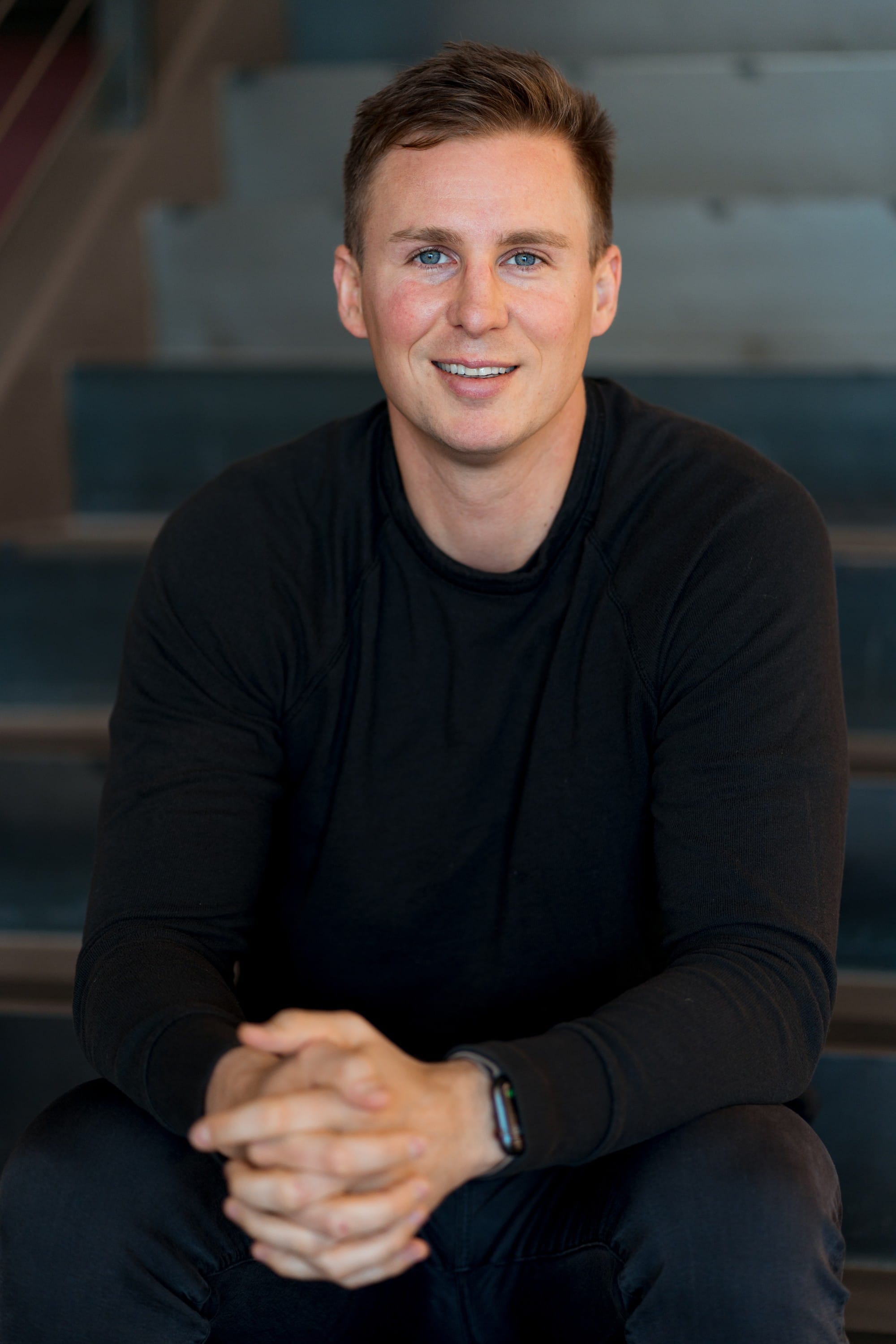
CNBC describes him as a tech entrepreneur and billionaire who previously co-founded the publicly traded aerospace company Archer Aviation and the hiring marketplace Vettery. That pattern, a generalist founder entering a hard-tech field and recruiting the specialists, explains a lot about how Figure is run.
Vettery: a marketplace exit
Vettery was a recruiting marketplace Adcock co-founded with Adam Goldstein, launched in 2014. Candidates browsed offers and employers competed for them. When Adecco Group acquired it in February 2018, TechCrunch reported a price of a little over $100 million from a source, with Adecco declining to share terms. The startup had raised $11.9 million and worked with more than 4,000 employers, per the same report.
The lesson Adcock took from Vettery is visible later: move fast, sell hard, and get to an exit. It was a software marketplace, so it says little about building hardware, but it gave him capital and a co-founder relationship he would reuse immediately.
Archer Aviation: hard tech and public markets
Archer Aviation is the electric vertical takeoff and landing (eVTOL) company Adcock co-founded with Goldstein in 2018. It went public and is still developing its Midnight aircraft. According to CNBC, Adcock served as co-CEO, stepped down in April 2022 and resigned from the board shortly afterward. CNBC reports he remains a shareholder with no executive, board or advisory role.
Archer was Adcock's first experience of the hard-tech playbook: assemble aerospace engineers, sign big strategic partners, raise large sums before revenue, and sell a vision of a new transportation category. Figure follows the same template, with one change: Adcock decided to own more of the stack himself.
The thesis: general-purpose humanoids, vertically integrated
Adcock's thesis is that a general-purpose humanoid robot is primarily an AI problem, that the AI improves with data and compute, and that the only way to get enough data is to build and deploy a large fleet of your own robots. Everything else at Figure follows from that loop.
He stated the data-and-compute half of the thesis directly in the Nscale announcement: Helix becomes more capable the same way every learned system does, with more data and compute. The fleet half shows up in Figure's own production update, which calls every robot that rolls off the BotQ line a data-collection engine as well as a unit of hardware, per its April 2026 post.
Why a humanoid form at all? Adcock's argument, repeated across Figure's materials, is that factories, warehouses and homes are already designed for human bodies. A robot shaped like a person can use the same carts, shelves, tools and stairs without retrofitting the building. The BMW sequencing post makes the industrial version of that case: Figure 03 picks thin-walled parts and also pulls a heavy cart, which Figure says is structurally infeasible for fixed automation or a six-axis arm.
Company-building choices at Figure
Adcock's defining choice at Figure is to build nearly everything in-house: the robot, the AI model, the factory, the battery packs and the actuators. The public record shows each piece being pulled inside over three years.
Helix: bringing the AI in-house
Helix is Figure's proprietary vision-language-action model, which takes camera pixels and language and outputs robot actions. CNBC describes it as enabling learning through observation and verbal commands. Figure's Helix 02 release in January 2026 extended it to full-body autonomy, and its BMW post says Helix 02 coordinates hands, arms, torso and feet so the robot can manipulate parts while stepping and repositioning. For how Helix fits the wider field, see Inside Deep Tech's humanoid robots guide.
BotQ: owning manufacturing
BotQ is Figure's in-house humanoid factory. In April 2026 Figure said BotQ had delivered more than 350 Figure 03 robots and raised its production rate from one robot per day to one per hour, a 24x throughput gain in under 120 days. The same post reported an end-of-line first-pass yield over 80%, a battery line at 99.3% first-pass yield with more than 500 packs shipped, and more than 9,000 actuators produced.
Those are company-reported manufacturing metrics, not audited figures, but they are specific, which is more than most humanoid makers publish. A demonstrated hourly cycle time is not the same as sustained hourly output, and Figure said it would continue to optimize from there.
Capital and compute at scale
Adcock raises money in very large rounds tied to infrastructure. Figure's Series C announcement said the capital would go to scaling BotQ and deployments, GPU infrastructure for training and simulation, and large data collection efforts. In September 2026, Figure signed a partnership with Nscale for up to 100,000 NVIDIA Vera Rubin GPUs, an initial commitment of $3.5 billion of compute with intent to scale to over $6 billion, targeted to start deploying in the second half of 2027.
Spectacle as a strategy
Adcock runs Figure's communications like a consumer launch. Product releases arrive as videos, and the company's September 2026 F.02 decommission post described training retired Figure 02 robots to jump into molten steel at a Finnish foundry, with Arnold Schwarzenegger involved, and selling commemorative artifacts made from the metal. The post explicitly says the footage is real, not AI-generated. It is effective marketing, and it is also a reminder that Figure's public narrative is tightly controlled by its founder.
What is proven versus what is promotional
Adcock's record has real industrial proof points and a much larger set of claims that are still demonstrations. The table separates them.
| Claim | Status (Nov 2026) | Evidence |
|---|---|---|
| Figure 02 worked on a live BMW line | Company-reported, partner-confirmed | 30,000 cars; BMW newsroom |
| Figure 03 sequencing at Spartanburg | First demonstration, June 2026 | Figure BMW post |
| BotQ at one robot per hour | Demonstrated cycle time, company-reported | 24x ramp post |
| More than 350 Figure 03 delivered | Company-reported | Ramp post |
| Robots in homes doing chores | Demonstrations (tidying, laundry, dishwashing) | Figure news posts |
| Compute for next-generation Helix | Contracted, deploying from 2H 2027 | $3.5 billion initial commitment |
| Valuation | Private round, Sept 2025 | $39 billion post-money |
Source: Figure BMW post, BMW Group newsroom, Figure production update, Nscale partnership and Series C.
The pattern is clear. Factory work at one customer is real and documented by both sides. Home robots, which are the larger part of the long-term pitch, are shown in controlled demonstrations; the Figure AI deep dive covers that gap in more product detail.
Timeline of Adcock's public record
Adcock's career compresses three companies into roughly twelve years. Every row below is dated in a public source.
| Year | Event | Source |
|---|---|---|
| 2014 | Vettery launches with co-founder Adam Goldstein | TechCrunch |
| 2018 | Adecco Group acquires Vettery | TechCrunch |
| 2018 | Co-founds Archer Aviation, serves as co-CEO | CNBC |
| April 2022 | Steps down at Archer, later leaves the board | CNBC |
| 2022 | Founds Figure AI | CNBC |
| September 2025 | Figure Series C closes above $1 billion | Figure |
| April 2026 | BotQ reaches one Figure 03 per hour | Figure |
| June 2026 | Figure 03 arrives at BMW Plant Spartanburg | Figure |
| September 2026 | Nscale compute partnership signed | Figure |
Source: the documents linked in each row.
What Adcock's track record predicts
Adcock's two earlier companies suggest how he will run Figure from here: fast fundraising, early large partners, and a willingness to hand off once the company reaches a new phase. Neither pattern is a criticism by itself, but both matter for anyone betting on Figure's long-run execution.
At Vettery, the path from launch to acquisition took about four years, according to TechCrunch. At Archer, Adcock helped take an aircraft company from founding to the public markets, then stepped back while the hardest phase, certification and production, was still ahead. Figure is now entering its own hardest phase: turning a demonstrated factory and one flagship customer into thousands of robots doing paid work, with field service, recalls and over-the-air updates that the BotQ update says Figure has started building.
The difference this time is ownership. Figure is a company Adcock founded alone, as sole founder and CEO, whereas Vettery and Archer were co-founded with Goldstein. The fair reading is that Figure's execution risk is no longer about whether the founder can raise or recruit, which he has proven, but whether a founder known for speed can also run the slow, repetitive operational grind that industrial robotics requires.
Why BMW matters more than the valuation
The most important line in Adcock's record is not the $39 billion valuation; it is the BMW plant. A paying automaker letting a humanoid work in a live assembly and logistics hall, and publishing its own newsroom release about the Figure 03 project in Spartanburg, is third-party evidence that the robot works under production conditions. Valuations can move with market sentiment. A customer's willingness to expand from pick-and-place to sequencing is a harder signal to fake.
How Adcock compares with other humanoid founders
Adcock is the most vertically integrated and most capital-intensive founder among the independent humanoid makers, and the least academic. Most rivals were founded by robotics researchers or grew out of university labs; Adcock came from marketplaces and aviation.
| Founder or leader | Company | Background | Core bet | Commercial proof point |
|---|---|---|---|---|
| Brett Adcock | Figure AI | Serial founder (Vettery, Archer) | Own robot, AI model and factory | BMW Spartanburg deployment |
| Elon Musk | Tesla (Optimus) | Automotive and space CEO | Humanoids built on Tesla's AI and manufacturing | Internal Tesla factory use |
| Jonathan Hurst (co-founder) | Agility Robotics | Legged locomotion professor | Purpose-built logistics humanoid (Digit) | Paid warehouse deployments |
| Jeff Cardenas | Apptronik | University of Texas Human Centered Robotics Lab | Partner-heavy, modular Apollo | Manufacturing and logistics pilots |
| Bernt Bornich | 1X | Robotics engineer | Soft, safe home humanoid (NEO) | Early home program |
Source: company profiles summarized in Inside Deep Tech's humanoid robots full guide; Adcock background per CNBC. For the broader field, see the top 100 physical AI companies and top 100 physical robotics companies directories.
The comparison that matters most is Musk. Tesla can fund Optimus from car profits and test it inside its own factories. Adcock has no captive factory or profit stream, so he must raise outside capital and win external customers like BMW. That is why his funding rounds and partner announcements are so central to Figure's story.
Leadership style
Adcock leads from the front: he is Figure's main spokesperson, sets aggressive public timelines, and frames the company's work as a mission to bring humanoids into every home. Figure's own Nscale post closes with that line. The style raises money and recruits talent quickly. It also means public claims tend to run ahead of verifiable deployments, and observers should separate dated, specific facts from aspirational language.
He is also protective of control. In July 2026 Figure published a notice warning about unauthorized attempts to sell Figure stock, a sign of how hot secondary demand had become and how tightly the company wants to manage its cap table.
Figure's biggest rival on scale is Tesla. Inside Deep Tech's Tesla Optimus full guide covers the Fremont line, the Gen 3 design, the Optimus Academy data plan and the honest limits of what Tesla has shown.
Honest limits
The limits of Adcock's record are the limits of humanoids in 2026: one flagship industrial customer, unaudited manufacturing numbers, and a home market that does not yet exist.
- Customer concentration. BMW is the only factory deployment documented by both sides. Figure has also announced an agreement with Catalyst Brands, but scale there is unproven.
- Self-reported metrics. The 24x ramp, 80% yield and 350-unit figures come from Figure's own blog.
- Valuation versus revenue. The $39 billion mark is a private valuation; Figure does not publish revenue.
- Compute bills arrive before results. The $3.5 billion Nscale commitment starts deploying in 2027.
- Home robots are demos. Tidying and laundry videos are not paid, unsupervised household deployments.
- Founder-driven narrative. Adcock's history at Archer, where he left as co-CEO in 2022, shows he moves on quickly; Figure has not yet shown a deep public bench of executives.
FAQ
Who is Brett Adcock?
When did Brett Adcock found Figure AI?
In 2022. Figure raised more than $1 billion in a Series C at a $39 billion post-money valuation in September 2025.
Is Brett Adcock still involved with Archer Aviation?
Not in management. CNBC reports he stepped down as co-CEO in April 2022, then left the board, and remains a shareholder with no active role.
What has Figure actually deployed?
Figure says Figure 02 contributed to assembling 30,000 cars at BMW Plant Spartanburg, and Figure 03 began a parts sequencing workflow there in June 2026. Home use is still at the demonstration stage.
How does Figure make its robots?
At BotQ, its in-house factory. Figure reported more than 350 Figure 03 units delivered and a cycle time of one robot per hour, a 24x improvement, in April 2026.
How is Adcock different from other humanoid founders?
He is a serial operator rather than a robotics academic, and he has chosen to own the robot, the AI model and the factory. See the humanoid robots guide for rivals including Tesla, Agility, Apptronik and 1X.
What to watch next
- A second large industrial customer with a public deployment, beyond BMW.
- Any audited or customer-confirmed BotQ output, not just cycle time.
- The Nscale Vera Rubin cluster coming online from the second half of 2027.
- The launch of Figure 04, which Figure's F.02 decommission post references.
- Paid home deployments, if and when they begin.
For a broader map of who else is building robots and physical AI, browse Inside Deep Tech's deep tech startup directory.