Gavin Uberti is the Harvard dropout who bet in 2022 that one AI architecture, the transformer, would dominate so completely that a chip built only for it would beat general-purpose GPUs. Four years later his company, Etched, has working silicon, a first rack running at Jane Street, and a $700M round at a $21B valuation announced in August 2026.
This full guide profiles the founder rather than the chip. It covers Uberti's background, the original transformer-ASIC thesis behind Sohu, how that thesis has quietly broadened into frontier inference clusters, the company-building choices he made, what is verified versus claimed, how he compares with other inference-chip founders, and the honest limits. Last updated: November 8, 2026.
Key Takeaways
- Uberti co-founded Etched in 2022 with Chris Zhu and Robert Wachen. TechCrunch reported all three are Harvard dropouts and Thiel Fellowship alumni, and that Uberti previously worked at OctoML and Xnor.ai.
- His original pitch was Sohu, a transformer-only ASIC on TSMC 4nm. In 2024 he claimed one Sohu server replaces 160 H100 GPUs, when Etched raised a $120 million Series A with a 35-person team.
- By June 2026 Etched had first-pass A0 silicon on TSMC N4P, a team of 400+, $800M raised and more than $1B in customer demand. Its new messaging covers MoE and non-transformer models, a broader claim than transformer-only.
- Funding then moved fast: a $300 million Series C at $10.3 billion in July 2026, then $700M at $21B led by Jane Street in August, the first customer to receive a rack.
- No independent, public benchmark of Etched's production racks exists yet. Performance claims, including running sparse MoEs at 80%+ Peak FLOPs, come from the company.
Who Gavin Uberti is
Gavin Uberti is the co-founder and CEO of Etched, a San Jose company building AI inference hardware. He is a young software-and-compiler engineer turned chip founder, and his defining trait is a willingness to make one very large, very early bet.
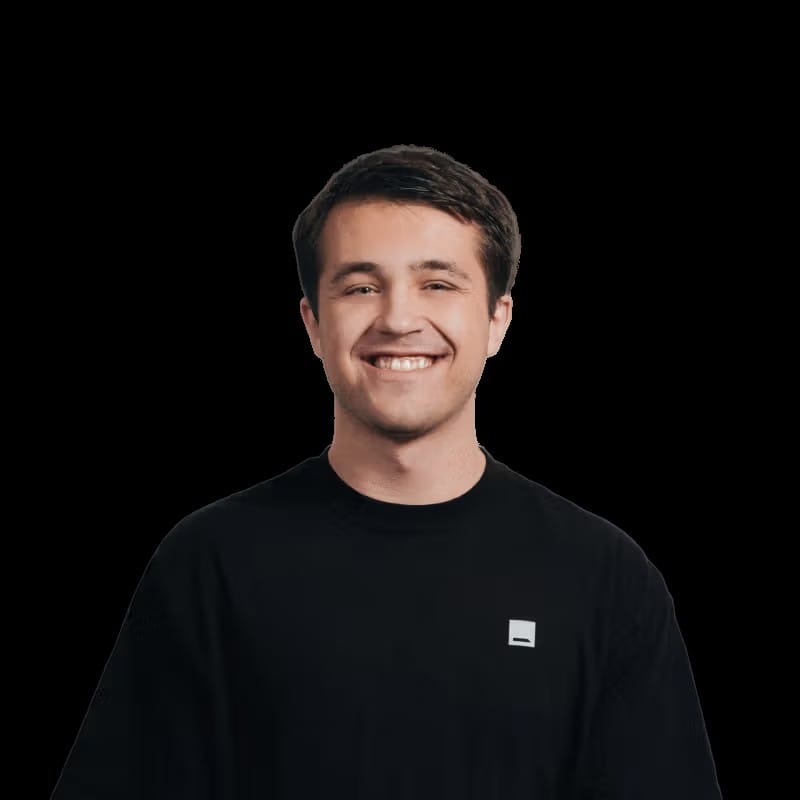
When Etched announced its Series A, TechCrunch described Uberti as ex-OctoML and ex-Xnor.ai and said he and Zhu were Harvard dropouts who founded Etched with Robert Wachen and former Cypress Semiconductor CTO Mark Ross. A later TechCrunch report said Uberti and Zhu met in an advanced math course at Harvard, while Wachen was Uberti's roommate. OctoML worked on machine-learning compilers and Xnor.ai on efficient edge inference, so the background lines up with the problem he chose: making models run efficiently on hardware.
The original thesis: a chip that only runs transformers
Uberti's founding thesis was that the transformer would win so decisively that specialization would beat flexibility. In 2024 he told TechCrunch: in 2022, we made a bet that transformers would take over the world. Sohu was designed to drop every hardware feature transformers do not need.
The headline claims were aggressive. Uberti said Sohu was an order of magnitude faster and cheaper than NVIDIA's Blackwell GB200 on text, image and video transformers, and that one Sohu server replaces 160 H100 GPUs, per TechCrunch. He also said customers would not be able to afford not to switch. Those were claims about a chip that had not yet shipped, made by a team of 35.
The obvious risk was architecture drift. TechCrunch asked what happens if transformers fall out of favor; Uberti's answer was that Etched would design a new chip. That is a drastic fallback for a company whose first chip took years to bring up.
How the thesis evolved by 2026
By the time Etched emerged from stealth in June 2026, the public pitch had shifted from transformer-only ASIC to frontier inference clusters. Etched's June 2026 post describes co-designing chips, racks, software and manufacturing so frontier models, including many-trillion-parameter MoEs, long context and agentic workloads, run with best-in-class throughput and latency for both prefill and decode.
Two named technologies carry the new story. Low Voltage Inference (LVI) runs the chip's math blocks at under half the voltage of most AI chips, which Etched says allows multiple times the FLOPs density and lets it run trillion-parameter sparse MoEs at 80%+ Peak FLOPs without thermal throttling. Cluster Scale Memory (CSM) is an HBM and SRAM hybrid with a proprietary low-latency interconnect that creates a shared memory pool across a scale-up domain, aimed at SRAM-like decode speed without SRAM-only capacity limits.
Etched's August 2026 funding release went further, saying its inference clusters were already running massive MoE models and non-transformer designs, and its June 30 launch release said the systems were running models including DeepSeek, Qwen, Mamba and Llama. Mamba is a state-space model, not a transformer. Read plainly, the founder's bet has broadened from one architecture to the family of large-model inference workloads, while keeping the specialization mindset.
The co-founders around Uberti
Uberti is the CEO and public technical voice, but Etched is a three-founder company and the division of labor is visible. Robert Wachen, co-founder and COO per TechCrunch, spoke for the company on the Series C, and his line that production is the product, quoted by DCD, defines the manufacturing strategy. Chris Zhu, who met Uberti in an advanced math course at Harvard per TechCrunch, rounds out the founding team. Mark Ross, the former Cypress Semiconductor CTO named by TechCrunch in 2024, brought the chip-industry experience the young founders lacked.
That structure matters when judging the founder. Etched's rapid fundraising is a team result, and Uberti's personal contribution is most visible in the technical bet and in the decision to stay focused on inference rather than training, a choice he has defended since the 2024 interviews.
Company-building choices
Uberti's key company-building calls were to stay in stealth for years, recruit heavily from incumbents, vertically integrate manufacturing, and raise very large rounds quickly once silicon worked.
Stealth until silicon worked
Etched raised $800M across four unannounced financings before it came out of stealth on June 30, 2026, the latest being $500 million at a $5 billion post-money valuation in December 2025, according to TechCrunch. Staying quiet until A0 silicon came back from TSMC meant the public never saw a delay story. It also meant the 2024 claims went untested in public for two years.
Hiring from the incumbents
Etched says its team of more than 400 engineers comes largely from NVIDIA, Google TPUs, Broadcom, SK Hynix and TSMC, per its June post. For a founder in his twenties without prior chip tape-outs, recruiting that bench was the critical execution step. SK Hynix later appeared as an investor in the Series C, according to TechCrunch, which links the memory supplier to the CSM design.
Production is the product
Etched has chosen to manufacture systems, not license IP or sell chips alone. The June post says it opened a Taiwan factory and built a data center, test house and NPI prototyping lab in San Jose to enable 24/7 engineering cycles, with a stated path to gigawatt scale. That makes Etched a systems company with a capital profile closer to a server maker than a fabless chip startup.
Capital at startup-record pace
Once silicon worked, Uberti raised fast. TechCrunch reported a $300 million Series C at a $10.3 billion valuation led by Sequoia in July 2026, the highest valuation for a Sequoia-led Series C according to Etched. Less than a month later Etched announced $700M at a $21B valuation led by Jane Street, which had tested the chip and taken delivery of a rack. In October, TechCrunch reported incoming offers at valuations from $40 billion to $50 billion, with Etched declining to comment.
What is proven versus what is promotional
Uberti has proven that a young team can design a large AI chip that works on first silicon and get it into a paying customer's data center. Performance leadership is still a company claim.
| Claim | Status (Nov 2026) | Evidence |
|---|---|---|
| First-pass A0 silicon on TSMC N4P | Company-reported | Etched, June 2026 |
| Rack shipped and running at a customer | Confirmed by customer quote | Jane Street quote |
| More than $1B in customer contracts | Company-reported | Etched; TechCrunch |
| One Sohu server replaces 160 H100s | 2024 claim, not independently tested | TechCrunch 2024 |
| 80%+ Peak FLOPs on sparse MoEs | Company claim | Etched |
| Gigawatt-scale deployment | Roadmap | Etched |
| Valuation | Private round | $21B, August 2026 |
Source: Etched, Etched, TechCrunch and TechCrunch.
The Jane Street quote is the most valuable data point because it is a customer speaking: the firm said it tested the chip, was pleased with early results, and had its own rack running in its data center, per Etched's August post. That is not a benchmark, but it is more than most inference startups can show.
Timeline of Uberti's public record
Etched's public history is short because the company spent most of it in stealth. The dated events below are from company posts and trade reporting.
| Date | Event | Source |
|---|---|---|
| 2022 | Etched founded by Uberti, Zhu and Wachen | TechCrunch |
| June 2024 | Sohu unveiled; Series A announced | TechCrunch; CNBC |
| December 2025 | Unannounced round at a $5 billion post-money valuation | TechCrunch |
| June 30, 2026 | Leaves stealth with working A0 silicon and 400+ staff | Etched |
| July 2026 | Series C led by Sequoia | TechCrunch |
| August 18, 2026 | Jane Street-led round; first rack shipped to Jane Street | Etched |
| October 2026 | Reported offers at $40 billion to $50 billion | TechCrunch |
Source: the documents linked in each row.
What Uberti's bet teaches about chip startups
Uberti's path challenges two assumptions about AI hardware startups: that founders need decades of semiconductor experience, and that a narrow architecture bet is fatal when models change. Neither assumption has been fully overturned, but both have been tested.
On experience, the record shows a young founder compensating by hiring. The 2024 company was 35 people, per TechCrunch. The 2026 company is more than 400, mostly from NVIDIA, Google's TPU group, Broadcom and SK Hynix, per Etched. The founder's job shifted from designing the thesis to recruiting the people who could tape it out, and the first-pass silicon result suggests that shift worked.
On specialization, the lesson is subtler. The 2022 bet that transformers would dominate was largely right: the leading frontier models of 2026 are still transformer-based, mostly with mixture-of-experts layers. But the bottlenecks moved from raw matrix math to memory capacity, memory latency and power density. Etched's 2026 technologies, LVI for power and CSM for memory, address those newer bottlenecks. In effect, Uberti kept the specialization instinct and changed what he specialized for.
For investors and buyers, the practical takeaway is that Etched should now be evaluated as a rack-scale inference systems vendor, against NVIDIA's own racks and against other specialized vendors, rather than as a single-architecture chip. That is a bigger market, and a harder competition.
How Uberti compares with other inference-chip founders
Uberti is the youngest and least credentialed of the major inference-chip founders, and the one who made the narrowest early bet. Most rivals were led by semiconductor veterans.
| Founder or leader | Company | Background | Architecture bet | Status |
|---|---|---|---|---|
| Gavin Uberti | Etched | ML compilers (OctoML, Xnor.ai), Harvard dropout | Specialized inference ASIC plus LVI and CSM | First racks shipped 2026 |
| Jonathan Ross | Groq | Google TPU originator | SRAM-first deterministic LPU | See the Groq and NVIDIA guide |
| Andrew Feldman | Cerebras | Serial systems founder (SeaMicro) | Wafer-scale engine | See the Cerebras guide |
| Jim Keller (CEO) | Tenstorrent | Veteran CPU architect | RISC-V plus AI cores, licensable IP | Shipping cards and IP |
Source: Inside Deep Tech's 9 AI chip startups challenging NVIDIA, Groq guide and Cerebras guide; Uberti background per TechCrunch.
The contrast with Groq is instructive. Groq bet on SRAM-heavy deterministic chips and had to scale out many chips to hold large models. Uberti's CSM design explicitly argues against SRAM-only chips, claiming lower cost, reliability and yield trade-offs, per Etched. Whether a hybrid memory pool beats both GPU HBM and SRAM-first designs is the central technical question for his company.
Leadership style and public posture
Uberti communicates like a founder who expects to be doubted. His 2024 statements were maximalist, and his 2026 statements are operational: three years to deliver the first rack, the next one will be much faster, and an emphasis on production. TechCrunch noted the founders had faced skeptics even after TSMC produced their first silicon. Co-founder Wachen's line that production is the product, quoted by DCD, sums up the company's current self-image.
Honest limits
The limits of Uberti's record are that the most important claims are still unbenchmarked, the company is very young as a manufacturer, and the valuation has moved faster than deployments.
- No public third-party benchmark. Throughput, latency and 80%+ Peak FLOPs claims are Etched's own.
- One named customer. Jane Street is the only public deployment; the $1B contract book is not itemized.
- Architecture risk has shifted, not vanished. The original transformer-only framing has broadened, which reduces but does not remove specialization risk.
- Manufacturing scale. A Taiwan factory and a stated gigawatt path are ambitions; Etched announced its first rack shipment, to Jane Street, in August 2026.
- Valuation velocity. Moving from $5 billion to $21B in eight months, with reported offers at $40 billion or more, prices in years of execution.
- NVIDIA's response. Etched competes against an incumbent that also absorbed Groq technology, as covered in the Groq guide.
FAQ
Who is Gavin Uberti?
Gavin Uberti is the co-founder and CEO of Etched, an AI inference hardware company founded in 2022. He previously worked at OctoML and Xnor.ai and left Harvard to start Etched, per TechCrunch.
What is the Etched Sohu chip?
Sohu was announced in 2024 as a transformer-only ASIC made on TSMC 4nm. Uberti claimed one Sohu server replaces 160 H100 GPUs, according to TechCrunch. Etched now markets rack-scale frontier inference clusters.
How much has Etched raised?
Etched said it had raised $800M before leaving stealth in June 2026, then raised a $300 million Series C in July per TechCrunch and $700M at a $21B valuation in August.
Does Etched only run transformer models?
Not any more, according to the company. Etched's June 2026 launch release said its systems run DeepSeek, Qwen, Mamba and Llama, and its June progress post targets MoE and agentic workloads. Mamba is a state-space model rather than a transformer.
Who is Etched's first customer?
Jane Street. Etched said it shipped its first rack to the trading firm, which also led the August 2026 round, per Etched.
How does Etched compare with Groq and Cerebras?
All three build specialized inference hardware. Groq uses SRAM-first LPUs and Cerebras uses wafer-scale chips, while Etched uses an HBM and SRAM hybrid called Cluster Scale Memory. See the 9 AI chip startups guide.
What to watch next
- An independent benchmark, such as MLPerf Inference results, for Etched racks.
- A second named production customer beyond Jane Street.
- Whether reported offers at $40 billion or more turn into a closed round.
- Next-generation hardware: Etched says it is building three generations in parallel.
For other startups building the AI stack, browse Inside Deep Tech's deep tech startup directory.