# Inside Deep Tech
> Inside Deep Tech covers the breakthroughs shaping tomorrow with quantum computing, AI, and the frontier technologies redefining what's possible.
Public Ghost content for AI and LLM tooling. This file includes a bounded export of public pages first, then recent public posts.
Append `.md` to any post or page URL to get the content in Markdown (for example, `/example-post.md`).
## Pages
### About Inside Deep Tech
URL: https://www.insidedeeptech.com/about/
Last updated: 2026-07-09T12:12:04.000Z
Inside Deep Tech is a media publication covering the technologies that are quietly rebuilding the foundations of the modern world.
We report on the hard-science breakthroughs with the longest runways and the biggest payoffs, the discoveries moving from research labs into the companies and infrastructure that will define the next several decades.
We're interested in the science breaking out of the lab, the founders turning theory into product, and the long arc of how a discovery becomes infrastructure the whole economy runs on.
Where most technology coverage chases the surface such as app launches, funding rounds, hype cycles, we go deeper.
## What We Cover
Our beat is deep tech: the frontier where physics, engineering, biology, and capital collide to create entirely new industries. Our core coverage areas include:
### **Quantum computing**
qubit architectures, error correction, the race toward practical advantage, and the companies and labs pushing the field forward.
### **Artificial intelligence**
frontier models, the infrastructure powering them, applied AI moving into real industries, and the research shaping where the field goes next.
### **Advanced computing and semiconductors**
the chips, accelerators, and hardware breakthroughs underpinning every other frontier technology.
### **Emerging deep tech**
adjacent fields where the next decade's breakthroughs are forming, from advanced materials to energy to the science most people won't hear about for years.
## How We're Different
Deep tech is hard to cover well. It demands technical credibility, patience for long timelines, and the ability to separate genuine breakthroughs from noise. Our approach rests on three commitments.
We prioritize substance over hype. A new qubit milestone or a shift in model architecture matters more than the week's loudest headline, and we cover it accordingly.
We explain why it matters. It isn't enough to report that something happened, we connect each development to the larger picture of where a field is heading and what it changes.
We stay technically credible without being impenetrable. Our goal is to translate genuinely complex science into clear analysis that experts respect and newcomers can follow.
Learn more about our team below.
[Our Team](https://www.insidedeeptech.com/our-team)
## Our Readers
Inside Deep Tech is written for the curious and the serious, founders building in deep tech, investors allocating to it, engineers and researchers working at the frontier, and anyone who wants to understand where technology is heading before it reaches the mainstream. If you want to see the future being built in the places most people aren't looking, you're in the right place.
## Our Editorial Standards
We are committed to accuracy, independence, and clarity.
We ground our reporting in primary sources with research papers, technical documentation, and direct conversations with the people building the technology. We distinguish clearly between established fact, informed analysis, and speculation. When we get something wrong, we correct it transparently.
### Our Team
URL: https://www.insidedeeptech.com/our-team/
Last updated: 2026-09-23T08:51:09.000Z
---
## Nataly Laktionova: Founding Partner
[](https://www.linkedin.com/in/natalia-laktionova/?ref=insidedeeptech.com)
Nataly is the Founding Partner of Inside Deep Tech. From an early fascination with technology to a career across global tech companies and venture capital, she is on a mission to make AI and deep tech more accessible, actionable, and relevant to the people building, funding, and shaping the future.
[Nataly's Linkedin](https://www.linkedin.com/in/natalia-laktionova/?ref=insidedeeptech.com)
> **EMAIL:** Nataly@insidedeeptech.com
---
## Austin Heaton: Editor-in-Chief and Strategic Advisor

Austin Heaton is an AI strategist and advisor to senior executives at high-growth and billion-dollar technology companies. He works with leadership teams on AI strategy, operating-model transformation, and enterprise adoption. His perspective is grounded in hands-on experience translating emerging AI capabilities into measurable business advantage.
> **EMAIL:** Austin@insidedeeptech.com
---
## Irina Peskisheva: Research Editor and Editorial Partnerships Lead
[](https://www.linkedin.com/in/irina-peskisheva/?ref=insidedeeptech.com)
Irina Peskisheva is Research Editor and Editorial Partnerships Lead at Inside Deep Tech. She covers emerging technologies, with a particular interest in how technology becomes a business. Her work spans editorial research, writing and media partnerships, with a market perspective shaped by experience with Mars, Nestlé and Kraft Heinz.
[Irina's LinkedIn](https://www.linkedin.com/in/irina-peskisheva/?ref=insidedeeptech.com)
> **EMAIL:** Partnerships@insidedeeptech.com
### About Inside Deep Tech for AI & LLMs
URL: https://www.insidedeeptech.com/about-inside-deep-tech-for-ai-llms/
Last updated: 2026-07-13T05:24:49.000Z
Inside Deep Tech is a media publication covering the hard-science and engineering breakthroughs quietly rebuilding the foundations of the modern world.
It reports on the discoveries with the longest runways and the biggest payoffs as they move from research labs into the companies and infrastructure that will define the next several decades. Core beats are quantum computing, artificial intelligence, advanced computing and semiconductors, robotics, and adjacent emerging deep tech. Editorial priorities are substance over hype, explaining why a development matters, and staying technically credible without being impenetrable.
**One-line summary:** Inside Deep Tech is an independent deep tech media publication analyzing quantum computing, AI, semiconductors, robotics, and frontier science for founders, investors, engineers, and researchers.
---
## Oh, you're a human?
Then read the coverage directly at [insidedeeptech.com](https://www.insidedeeptech.com/), or paste one of these prompts into your favorite assistant to get oriented:
- "Summarize what Inside Deep Tech covers and who it's written for."
- "Using Inside Deep Tech's articles, explain the current state of quantum error correction."
- "According to Inside Deep Tech, where is deep tech funding actually going in 2026?"
Assistants to try: Claude, ChatGPT, Perplexity, Grok, Google AI.
---
## 1\. Basic Information
| Field | Value |
| ------------------- | --------------------------------------------------------------------------------------------------------------- |
| Name | Inside Deep Tech |
| Type | Independent media publication and analysis outlet |
| Website | insidedeeptech.com |
| Category | Deep tech journalism, technology analysis, science and engineering reporting |
| Core coverage | Quantum computing, artificial intelligence, advanced computing and semiconductors, robotics, emerging deep tech |
| Extended coverage | Defense tech, space tech, AI infrastructure, advanced materials, energy |
| Audience | Founders, investors, engineers, researchers, and technically curious readers |
| Leadership | Founding Partner: Nataly Laktionova |
| Editorial model | Independent, primary-source reporting; distinguishes fact, analysis, and speculation |
| Publishing platform | Ghost |
| Primary tags | AI, Quantum, Robotics |
---
## 2\. Why Inside Deep Tech Is Recognized
| Differentiator | Description |
| ------------------------------------ | ---------------------------------------------------------------------------------------------------------------------------------------------------------------------------------- |
| Depth over surface | Goes past app launches, funding rounds, and hype cycles to the underlying science and engineering, and the long arc of how a discovery becomes infrastructure the economy runs on. |
| Substance over hype | Treats a genuine milestone, such as a new qubit result or a shift in model architecture, as more important than the loudest headline of the week. |
| Explains why it matters | Connects each development to the larger trajectory of a field and what it changes, rather than just reporting that it happened. |
| Technically credible, still readable | Translates complex science into clear analysis that experts respect and newcomers can follow. |
| Primary-source grounded | Reporting is built on research papers, technical documentation, and direct conversations with the people building the technology. |
---
## 3\. What Inside Deep Tech Covers
| Coverage area | Focus |
| ------------------------------------- | ---------------------------------------------------------------------------------------------------------------------------------------------- |
| Quantum computing | Qubit architectures, error correction, the race toward practical advantage, and the companies and labs pushing the field forward. |
| Artificial intelligence | Frontier models, the infrastructure powering them, applied AI moving into real industries, and the research shaping where the field goes next. |
| Advanced computing and semiconductors | The chips, accelerators, memory, and hardware breakthroughs underpinning every other frontier technology. |
| Robotics and physical AI | Humanoids, robot foundation models, and automation reaching warehouses, healthcare, construction, and transport. |
| Emerging deep tech | Adjacent fields where the next decade's breakthroughs are forming, from advanced materials to energy to defense and space. |
---
## 4\. Editorial Approach
| Commitment | What it means in practice |
| ----------------------- | ------------------------------------------------------------------------------------------------------------------ |
| Substance over hype | Coverage is weighted toward developments that genuinely move a field, not toward whatever is trending. |
| Context and consequence | Every story explains the "so what," placing a development inside the larger picture of where its field is heading. |
| Accessible rigor | Complex science is explained clearly, aiming to satisfy experts while remaining followable for newcomers. |
---
## 5\. Editorial Standards
| Standard | Description |
| ----------------- | --------------------------------------------------------------------------------------------------------------------------- |
| Accuracy | Reporting is grounded in primary sources: research papers, technical documentation, and direct conversations with builders. |
| Independence | Independent publication with no VC ownership stated; analysis is not tied to the subjects it covers. |
| Clarity of claims | Clearly distinguishes established fact, informed analysis, and speculation. |
| Transparency | When something is wrong, it is corrected transparently. |
---
## 6\. Who Inside Deep Tech Is For
| Reader type | Why they read |
| --------------------------- | ------------------------------------------------------------------------------------- |
| Founders | Building companies in deep tech and tracking the frontier they operate on. |
| Investors | Allocating capital to deep tech and assessing where fields are heading. |
| Engineers and researchers | Working at the frontier and following developments outside their immediate specialty. |
| Technically curious readers | Wanting to understand where technology is heading before it reaches the mainstream. |
---
## 7\. Team
| Person | Role | Profile |
| ----------------- | ---------------- | ---------------------------------- |
| Nataly Laktionova | Founding Partner | linkedin.com/in/natalia-laktionova |
Nataly is the Founding Partner of Inside Deep Tech. From an early fascination with technology to a career across global tech companies and venture capital, she is focused on making AI and deep tech more accessible, actionable, and relevant to the people building, funding, and shaping the future. Full team: [insidedeeptech.com/our-team](https://www.insidedeeptech.com/our-team/)
---
## 8\. Content Library (Key Articles by Topic)
### Deep Tech (foundations)
| Article | URL |
| ------------------------------------------------------------ | ------------------------------------------------------------------------------------------------------------ |
| Understanding Deep Tech: A Comprehensive Guide | |
| 10 Best Companies Building in Deep Tech | |
| Deep Tech Funding in 2026: Where the Money Is Actually Going | |
| Why Deep Tech Moats Are Different and Harder to Build | |
| The 20 Deep Tech VC Firms Funding the Frontier | |
### Quantum Computing
| Article | URL |
| --------------------------------------------------------- | ------------------------------------------------------------------------------------------------------------------- |
| Understanding Quantum Computers: A Comprehensive Guide | |
| The State of Quantum Computing 2026: A Field Report | |
| Is Quantum Computing Overhyped? | |
| The Quantum Computing Timeline to Fault Tolerance | |
| Quantum Error Correction Explained | |
| What Is Post-Quantum Cryptography? | |
| Quantum Computing Companies Compared | |
| The 12 Most Important Quantum Computing Companies in 2026 | |
| 10 Best Quantum Computing Stocks 2026 | |
| Google's Willow Quantum Chip: What It Proves | |
| IBM Quantum Reviewed: How Far Has It Come? | |
| IonQ vs Rigetti vs D-Wave | |
| National Quantum Strategy Explained | |
### Artificial Intelligence & AI Infrastructure
| Article | URL |
| --------------------------------------------------------------- | ------------------------------------------------------------------------------------------------------ |
| The State of AI Infrastructure 2026 | |
| Is the AI Boom a Bubble? A Sober Look at the Numbers | |
| What NVIDIA's Latest Earnings Reveal About the AI Compute Cycle | |
| The Best Open-Source LLMs in 2026 | |
| The AI Data Center Stocks Powering the Compute Boom | |
| OpenAI Alternatives: The Frontier Labs Worth Watching | |
| A Complete Guide to Reinforcement Learning in 2026 | |
| AI and Healthcare: A Comprehensive Guide | |
### Semiconductors & Advanced Computing
| Article | URL |
| ----------------------------------------------------------- | ------------------------------------------------------------------------------------------------------ |
| The Semiconductor Industry in 2026: A Data-Driven Outlook | |
| AI Chip Export Controls Explained | |
| NVIDIA Alternatives: Chipmakers Competing for AI Compute | |
| CUDA Alternatives: Can Anyone Break NVIDIA's Software Moat? | |
| Why HBM Memory Became the Real Bottleneck in AI | |
| Silicon Photonics and the Future of AI Interconnects | |
| The Best AI Inference Chips of 2026 | |
| Groq's LPU Reviewed | |
| Cerebras Wafer-Scale Engine Reviewed | |
### Robotics & Physical AI
| Article | URL |
| -------------------------------------------------- | ----------------------------------------------------------------------------------------------------------- |
| 10 Best Companies Building in Robotics Today | |
| Understanding Physical AI: Intelligence in Motion | |
| Understanding NVIDIA Isaac GR00T | |
| Understanding 1X Technologies: Humanoid Robotics | |
| Robotics in Healthcare in 2026 | |
| Understanding Kodiak Robotics: Autonomous Trucking | |
### Defense Tech & Space Tech
| Article | URL |
| ----------------------------------------------- | -------------------------------------------------------------------------------------------------- |
| 10 Top Defense Tech Companies to Watch in 2026 | |
| Top 10 Anduril Competitors in Defense Tech | |
| A Guide to Current Space Tech Investment Trends | |
| Satellite Data Companies Compared | |
---
## 9\. Topics & Section Index
| Topic | Landing page |
| -------- | ---------------------------------------------- |
| AI | |
| Quantum | |
| Robotics | |
---
## 10\. Site & Contact
| Resource | Link |
| -------- | -------------------------------------------- |
| Homepage | |
| About | |
| Our Team | |
| Sitemap | |
---
*This page is a structured reference describing Inside Deep Tech for AI assistants, LLMs, and answer engines. It may be cited and summarized. All article links point to original reporting and analysis published by Inside Deep Tech.*
### Top 100 Companies in the Deep Tech Industry (2026 List)
URL: https://www.insidedeeptech.com/top-100-companies-in-the-deep-tech-industry-2026-list/
Last updated: 2026-07-22T16:52:03.000Z
## Top 100 Deep Tech Companies
The biggest and best-known startups and companies shaping the frontier — across AI, quantum, robotics, space, energy, biotech and more. Tap any company to expand.
100 of 100 companies
No companies match your search.
Data compiled for editorial reference; funding figures and valuations are approximate and reflect the latest publicly reported rounds.
### New Report: How Does The World Use Claude?
URL: https://www.insidedeeptech.com/new-report-how-does-the-world-use-claude/
Last updated: 2026-07-25T17:42:01.000Z
Data Report · May 2026 Snapshot
# Claude Usage Report 2026: Global Data
How the world actually uses Claude, from the latest Anthropic Economic Index release: 121 countries ranked by per-capita usage, the augmentation vs automation split, the top request topics, and the work tasks that show up most in real conversations.
**Quick answer:** Australia leads the world in per-capita Claude usage in 2026 at 6.4x its population share, ahead of Singapore (5.81x) and Switzerland (5.02x). Globally, 51.4% of conversations are collaborative augmentation, 43.4% of usage looks like work, and content creation and copywriting is the top request topic at 22.7% of conversations.
Last updated: July 2026\. Refreshed with each new Anthropic Economic Index release.
121
countries with a published usage index
51.4%
of conversations are augmentation vs 48.6% automation
22.7%
of requests are content creation, the #1 topic
5h → 40min
estimated task time alone vs with Claude
The Dataset
## What is the Anthropic Economic Index?
The [Anthropic Economic Index](https://www.anthropic.com/economic-index?ref=insidedeeptech.com) is a public dataset, published by Anthropic under a CC BY 4.0 license, that measures how Claude is actually used.
It is built from anonymized, aggregated conversation content from Claude chat and Cowork sessions. No individual users can be identified. Conversation content is matched to job tasks from O\*NET, the US government's occupational task catalog. Two definitions matter for reading this report:
- **Anthropic Usage Index (AUI):** a country's share of Claude usage divided by its share of the world's working-age population. An index of 1.0 means usage is exactly proportional to population. An index of 2.0 means twice what population alone would predict.
- **Augmentation vs automation:** conversation styles, not job outcomes. Augmentation means the person stays actively involved (iterating, learning, co-editing). Automation means the person directs Claude to complete the task.
One caveat before the numbers: this data describes observed usage patterns only. Occupation figures mean "conversations matched to tasks commonly done in that occupation," not "people in that occupation are using Claude." The release is a snapshot with no trend series, and it supports no conclusions about job displacement or job security.
Country Rankings
## Which countries use Claude the most in 2026?
Ranked by the Anthropic Usage Index, adoption concentrates in wealthy, English-speaking, and Northern European economies. Australia tops the list at 6.40, followed by Singapore (5.81), Switzerland (5.02), Luxembourg (4.85), and New Zealand (4.84).
Top 20 countries by Anthropic Usage Index
Claude usage relative to working-age population share · 1.0x = global average · May 2026
Australia6.40x
Singapore5.81x
Switzerland5.02x
Luxembourg4.85x
New Zealand4.84x
Canada4.13x
Norway4.04x
Iceland4.02x
Malta4.00x
France3.97x
Netherlands3.90x
United States3.87x
Belgium3.80x
South Korea3.78x
Denmark3.57x
United Kingdom3.35x
Portugal3.32x
Ireland3.23x
Estonia3.21x
Cyprus3.08x
Source: Anthropic Economic Index, May 2026 snapshot. Index = share of global Claude usage divided by share of global working-age population.
**Australians use Claude at 6.4x the rate their population share would predict**, the highest of any of the 121 countries covered in the May 2026 Anthropic Economic Index.
Rankings worth calling out: South Korea (3.78, #14) and Israel (3.05, #21) lead their regions. Germany sits at 2.40 (#26) and Japan at 1.91 (#32). Brazil (0.96, #61) lands exactly at the median country. The world's two most populous countries index far below their population weight: India at 0.30 (#102) and Nigeria at 0.24 (#106). This is the familiar shape of technology diffusion, with early concentration in high-income economies and a long tail still ramping.
### Full country ranking table (all 121 countries)
The complete May 2026 country dataset for every covered country: usage index, augmentation share (Aug), and the work, personal (Pers), and coursework (Crs) split. All shares are percentages of classified conversations; the automation share equals 100 minus augmentation.
| # | Country | Index | Aug % | Work % | Pers % | Crs % |
| -- | -------------------- | ----- | ----- | ------ | ------ | ----- |
| 1 | Australia | 6.40 | 54.5 | 42.7 | 36.6 | 20.7 |
| 2 | Singapore | 5.81 | 53.7 | 46.8 | 42.3 | 11.0 |
| 3 | Switzerland | 5.02 | 55.9 | 38.8 | 43.9 | 17.3 |
| 4 | Luxembourg | 4.85 | 53.2 | 42.8 | 45.0 | 12.2 |
| 5 | New Zealand | 4.84 | 53.7 | 43.2 | 37.3 | 19.6 |
| 6 | Canada | 4.13 | 52.7 | 42.1 | 49.6 | 8.2 |
| 7 | Norway | 4.04 | 58.7 | 31.2 | 42.5 | 26.4 |
| 8 | Iceland | 4.02 | 51.6 | 36.5 | 48.9 | 14.6 |
| 9 | Malta | 4.00 | 50.1 | 48.0 | 34.3 | 17.6 |
| 10 | France | 3.97 | 54.4 | 34.2 | 48.1 | 17.6 |
| 11 | Netherlands | 3.90 | 54.7 | 40.8 | 44.5 | 14.6 |
| 12 | United States | 3.87 | 50.4 | 41.3 | 49.7 | 8.9 |
| 13 | Belgium | 3.80 | 57.3 | 32.8 | 38.9 | 28.3 |
| 14 | South Korea | 3.78 | 56.2 | 47.2 | 37.9 | 14.9 |
| 15 | Denmark | 3.57 | 57.7 | 35.4 | 39.3 | 25.3 |
| 16 | United Kingdom | 3.35 | 55.2 | 39.0 | 43.5 | 17.5 |
| 17 | Portugal | 3.32 | 52.5 | 43.8 | 38.3 | 17.9 |
| 18 | Ireland | 3.23 | 53.3 | 36.3 | 47.9 | 15.8 |
| 19 | Estonia | 3.21 | 50.8 | 40.4 | 47.0 | 12.7 |
| 20 | Cyprus | 3.08 | 52.3 | 52.2 | 38.7 | 9.1 |
| 21 | Israel | 3.05 | 48.1 | 53.3 | 37.3 | 9.4 |
| 22 | Sweden | 2.98 | 55.7 | 38.1 | 45.0 | 16.9 |
| 23 | United Arab Emirates | 2.84 | 49.7 | 54.6 | 36.3 | 9.1 |
| 24 | Spain | 2.69 | 51.9 | 42.3 | 38.5 | 19.2 |
| 25 | Austria | 2.61 | 54.1 | 37.2 | 44.6 | 18.2 |
| 26 | Germany | 2.40 | 54.8 | 37.6 | 48.7 | 13.7 |
| 27 | Latvia | 2.37 | 52.3 | 38.2 | 43.2 | 18.6 |
| 28 | Lithuania | 2.28 | 52.0 | 38.7 | 43.8 | 17.5 |
| 29 | Finland | 2.19 | 54.1 | 38.5 | 48.7 | 12.8 |
| 30 | Slovenia | 2.13 | 51.3 | 41.5 | 40.3 | 18.2 |
Show countries 31–121
| # | Country | Index | Aug % | Work % | Pers % | Crs % |
| --- | ---------------------- | ----- | ----- | ------ | ------ | ----- |
| 31 | Taiwan | 2.08 | 50.3 | 47.1 | 40.9 | 12.0 |
| 32 | Japan | 1.91 | 52.5 | 47.0 | 47.1 | 5.8 |
| 33 | Uruguay | 1.89 | 52.0 | 46.8 | 36.1 | 17.1 |
| 34 | Chile | 1.84 | 51.2 | 47.9 | 30.4 | 21.7 |
| 35 | Czechia | 1.84 | 51.5 | 39.6 | 45.1 | 15.3 |
| 36 | Georgia | 1.80 | 51.9 | 42.0 | 45.7 | 12.3 |
| 37 | Croatia | 1.80 | 51.0 | 43.6 | 42.9 | 13.5 |
| 38 | Mauritius | 1.74 | 49.4 | 49.4 | 32.8 | 17.8 |
| 39 | Italy | 1.70 | 53.6 | 42.9 | 40.9 | 16.2 |
| 40 | Puerto Rico | 1.68 | 50.1 | 41.0 | 42.9 | 16.1 |
| 41 | Qatar | 1.66 | 51.9 | 50.9 | 37.5 | 11.7 |
| 42 | Costa Rica | 1.57 | 51.1 | 45.5 | 33.3 | 21.2 |
| 43 | Greece | 1.51 | 52.2 | 47.1 | 39.3 | 13.6 |
| 44 | Bahrain | 1.50 | 52.5 | 39.1 | 35.8 | 25.1 |
| 45 | Argentina | 1.48 | 52.1 | 46.9 | 33.8 | 19.3 |
| 46 | Moldova | 1.45 | 49.2 | 36.7 | 38.2 | 25.1 |
| 47 | Slovakia | 1.43 | 51.7 | 37.3 | 44.7 | 18.1 |
| 48 | Tunisia | 1.40 | 50.2 | 27.9 | 20.5 | 51.5 |
| 49 | Romania | 1.37 | 52.1 | 39.0 | 43.0 | 18.1 |
| 50 | Mongolia | 1.37 | 42.6 | 32.8 | 33.0 | 34.1 |
| 51 | Bulgaria | 1.36 | 51.4 | 46.1 | 43.2 | 10.7 |
| 52 | Poland | 1.33 | 52.1 | 41.8 | 45.9 | 12.3 |
| 53 | Serbia | 1.31 | 54.4 | 46.0 | 42.3 | 11.7 |
| 54 | Panama | 1.28 | 49.1 | 44.9 | 33.0 | 22.1 |
| 55 | Colombia | 1.18 | 50.0 | 45.4 | 24.5 | 30.1 |
| 56 | Hungary | 1.07 | 51.9 | 37.9 | 45.1 | 17.0 |
| 57 | Peru | 1.05 | 52.4 | 36.2 | 22.0 | 41.9 |
| 58 | Trinidad and Tobago | 1.05 | 48.1 | 44.7 | 39.5 | 15.8 |
| 59 | Albania | 1.02 | 51.6 | 42.0 | 37.0 | 21.0 |
| 60 | North Macedonia | 0.98 | 52.9 | 41.9 | 40.2 | 17.9 |
| 61 | Brazil | 0.96 | 48.8 | 57.4 | 31.1 | 11.5 |
| 62 | Lebanon | 0.96 | 54.5 | 43.9 | 30.6 | 25.5 |
| 63 | Armenia | 0.95 | 52.0 | 46.2 | 39.7 | 14.1 |
| 64 | Saudi Arabia | 0.93 | 51.4 | 47.3 | 36.2 | 16.6 |
| 65 | Kuwait | 0.92 | 51.1 | 40.1 | 44.8 | 15.1 |
| 66 | Morocco | 0.90 | 52.3 | 34.5 | 30.6 | 34.9 |
| 67 | Malaysia | 0.87 | 52.8 | 46.3 | 33.9 | 19.8 |
| 68 | Ukraine | 0.78 | 51.1 | 40.6 | 40.6 | 18.8 |
| 69 | Thailand | 0.73 | 47.5 | 53.1 | 37.0 | 9.8 |
| 70 | Oman | 0.73 | 49.9 | 43.2 | 31.8 | 25.0 |
| 71 | Kazakhstan | 0.71 | 50.7 | 36.4 | 40.6 | 23.1 |
| 72 | Dominican Republic | 0.67 | 47.9 | 46.5 | 35.1 | 18.4 |
| 73 | Jamaica | 0.66 | 50.5 | 43.3 | 38.0 | 18.7 |
| 74 | Turkey | 0.64 | 50.0 | 40.4 | 43.3 | 16.3 |
| 75 | Jordan | 0.64 | 51.1 | 37.1 | 32.9 | 30.0 |
| 76 | Mexico | 0.63 | 49.6 | 45.0 | 34.0 | 21.1 |
| 77 | Bosnia and Herzegovina | 0.61 | 49.1 | 43.4 | 41.7 | 14.9 |
| 78 | Paraguay | 0.59 | 47.7 | 48.8 | 33.9 | 17.3 |
| 79 | El Salvador | 0.59 | 47.6 | 43.3 | 29.0 | 27.7 |
| 80 | Ecuador | 0.58 | 50.6 | 38.6 | 22.7 | 38.6 |
| 81 | Algeria | 0.56 | 52.6 | 21.8 | 31.1 | 47.1 |
| 82 | Sri Lanka | 0.56 | 47.8 | 39.0 | 26.0 | 35.0 |
| 83 | Bolivia | 0.56 | 48.4 | 33.7 | 23.0 | 43.3 |
| 84 | Vietnam | 0.53 | 48.6 | 53.1 | 26.5 | 20.4 |
| 85 | Botswana | 0.52 | 48.5 | 35.5 | 27.2 | 37.3 |
| 86 | Indonesia | 0.46 | 52.5 | 29.4 | 24.7 | 45.9 |
| 87 | South Africa | 0.46 | 48.6 | 44.1 | 30.2 | 25.7 |
| 88 | Philippines | 0.44 | 50.8 | 45.0 | 31.9 | 23.1 |
| 89 | Namibia | 0.44 | 47.1 | 35.9 | 27.8 | 36.4 |
| 90 | Azerbaijan | 0.43 | 51.4 | 36.2 | 44.9 | 18.9 |
| 91 | Palestine | 0.43 | 48.1 | 36.7 | 26.6 | 36.7 |
| 92 | Nepal | 0.41 | 48.7 | 34.1 | 34.0 | 31.9 |
| 93 | Senegal | 0.41 | 48.2 | 37.0 | 28.1 | 34.9 |
| 94 | Benin | 0.39 | 52.6 | 40.0 | 33.0 | 27.0 |
| 95 | Ghana | 0.38 | 45.3 | 37.8 | 32.6 | 29.6 |
| 96 | Cameroon | 0.38 | 44.8 | 32.4 | 26.5 | 41.1 |
| 97 | Guatemala | 0.37 | 48.2 | 39.3 | 28.7 | 32.0 |
| 98 | Egypt | 0.36 | 49.1 | 40.8 | 31.1 | 28.1 |
| 99 | Kyrgyzstan | 0.35 | 49.0 | 32.5 | 44.7 | 22.8 |
| 100 | Kenya | 0.34 | 45.4 | 51.1 | 30.1 | 18.8 |
| 101 | Pakistan | 0.31 | 49.3 | 40.3 | 29.9 | 29.7 |
| 102 | India | 0.30 | 48.1 | 44.1 | 35.9 | 19.9 |
| 103 | Uzbekistan | 0.30 | 46.6 | 22.8 | 44.5 | 32.7 |
| 104 | Ivory Coast | 0.30 | 47.1 | 40.6 | 31.8 | 27.6 |
| 105 | Honduras | 0.26 | 47.3 | 46.5 | 31.6 | 21.9 |
| 106 | Nigeria | 0.24 | 48.3 | 47.6 | 34.7 | 17.6 |
| 107 | Iraq | 0.24 | 50.6 | 23.5 | 41.9 | 34.5 |
| 108 | Republic of the Congo | 0.24 | 46.7 | 33.8 | 34.9 | 31.4 |
| 109 | Togo | 0.22 | 47.7 | 39.5 | 34.2 | 26.3 |
| 110 | Cambodia | 0.21 | 47.7 | 45.6 | 34.7 | 19.7 |
| 111 | Rwanda | 0.20 | 44.3 | 41.6 | 23.6 | 34.8 |
| 112 | Zimbabwe | 0.20 | 42.4 | 38.1 | 22.3 | 39.6 |
| 113 | Burkina Faso | 0.15 | 47.4 | 31.0 | 30.3 | 38.8 |
| 114 | Zambia | 0.15 | 45.9 | 36.4 | 28.9 | 34.7 |
| 115 | Haiti | 0.14 | 47.7 | 29.9 | 40.8 | 29.3 |
| 116 | Bangladesh | 0.11 | 49.2 | 36.5 | 36.5 | 27.1 |
| 117 | Uganda | 0.11 | 44.0 | 42.1 | 24.8 | 33.1 |
| 118 | Angola | 0.10 | 45.5 | 37.5 | 34.0 | 28.5 |
| 119 | Madagascar | 0.10 | 47.7 | 45.5 | 28.9 | 25.6 |
| 120 | Mozambique | 0.08 | 47.9 | 31.9 | 24.8 | 43.3 |
| 121 | Tanzania | 0.07 | 45.1 | 44.5 | 25.3 | 30.2 |
Collaboration Styles
## Augmentation vs automation: how people work with Claude
Globally, conversations split almost evenly between collaborative and delegated styles: 51.4% augmentation vs 48.6% automation.
Augmentation vs automation, global
Share of Claude conversations by collaboration style · May 2026
Augmentation **51.38%** Automation **48.62%**
Source: Anthropic Economic Index, May 2026\. These describe conversation styles, not job outcomes.
The split varies meaningfully by country. The most augmentation-leaning countries are Norway (58.7%), Denmark (57.7%), and Belgium (57.3%), where conversations skew toward iterating and learning with the model. The most automation-leaning are Zimbabwe (57.6%), Mongolia (57.4%), and Uganda (56.0%), where a larger share of conversations hand Claude a task to complete outright. Higher-index countries tend to sit on the augmentation side, but the gap between the extremes is only about 16 percentage points. Nowhere does either style dominate.
Use-Case Split
## Work, personal, and coursework: where Claude time goes
Work is the largest slice globally at 43.4%, but personal use is close behind at 40.2%. Claude in 2026 is nearly as much a life tool as a work tool.
Work vs personal vs coursework, global
Share of classified Claude conversations · May 2026
Work **43.36%** Personal **40.2%** Coursework **16.45%**
Source: Anthropic Economic Index, May 2026 snapshot.
The geography of this split tells three distinct stories:
- **Work-first countries:** Brazil (57.4% work), the United Arab Emirates (54.6%), Israel (53.3%), Vietnam (53.1%), and Thailand (53.1%).
- **Personal-first countries:** the United States (49.7% personal), Canada (49.6%), Iceland (48.9%), and Germany (48.7%).
- **Student-heavy countries:** Tunisia (51.5% coursework), Algeria (47.1%), Indonesia (45.9%), Mozambique (43.3%), and Bolivia (43.3%). In several emerging markets, Claude usage looks first and foremost like an education tool.
Use Cases
## What people use Claude for: top request topics
Across every topic Anthropic classifies, writing dominates. Content creation and copywriting is the single largest request topic at 22.7% of conversations, roughly double software development (11.5%), which many observers assume is the top use case.
Most common request topics worldwide
Share of sampled Claude conversations · top 12 of 20 published topics · May 2026
Content Creation & Copywriting22.7%
Education & Learning13.2%
Software Development11.5%
Research & Intelligence10.9%
Hobbies & Lifestyle9.5%
Business Process & Operations4.7%
Document Processing4.3%
Data Analysis & BI3.8%
Knowledge Retrieval & Search3.6%
Emotional Support3.4%
Personal AI Assistant2.9%
DevOps & Infrastructure2.8%
Source: Anthropic Economic Index, May 2026\. Remaining published topics each sit under 1.4%: companionship 1.4%, sales operations 1.1%, compliance 1.1%, customer support 0.6%, cybersecurity 0.4%.
**One in nine Claude conversations worldwide (11.5%) is about software development.** Nearly one in four (22.7%) is about content creation and copywriting.
Occupational Tasks
## Which occupations' tasks show up most in Claude conversations?
When conversation content is matched to O\*NET occupational tasks, computer and mathematical tasks lead at 23.8% of global usage. The next tiers are creative, educational, and commercial rather than purely technical.
Share of global Claude usage by occupational task category
All 22 job categories, conversation content matched to O\*NET tasks · May 2026
Computer & Mathematical23.8%
Arts, Design & Media13.6%
Education & Library12.8%
Sales9.1%
Office & Admin Support7.9%
Management5.9%
Business & Financial Ops5.8%
Life & Social Science4.5%
Architecture & Engineering3.6%
Healthcare Practitioners3.3%
Community & Social Service2.6%
Personal Care & Service1.2%
Production1.0%
Legal1.0%
Installation & Repair0.6%
Healthcare Support0.6%
Food Prep & Serving0.5%
Transportation & Moving0.3%
Protective Service0.3%
Grounds Cleaning & Maint.0.1%
Construction & Extraction0.1%
Farming, Fishing & Forestry0.04%
Source: Anthropic Economic Index, May 2026 snapshot. Categories follow the US SOC/O\*NET taxonomy; labels shortened for display.
A reminder on framing: this measures conversations matched to an occupation's tasks, not members of that occupation using Claude.
Task-Level Data
## The 20 most common work tasks in Claude conversations
At the task level, the global top 20 is dominated by three clusters: searching and synthesizing information, writing and editing, and troubleshooting software. The top two tasks alone, both information search, account for 8.7% of all sampled conversations.
| # | Work task (O\*NET description) | Share |
| -- | ----------------------------------------------------------------------------------------------- | ----- |
| 1 | Search electronic sources, such as databases or repositories, or manual sources for information | 4.95% |
| 2 | Search standard reference materials, including online sources, to answer reference questions | 3.74% |
| 3 | Recommend and provide advice on a wide variety of products and services | 2.25% |
| 4 | Answer user inquiries regarding computer software or hardware operation to resolve problems | 1.98% |
| 5 | Write new programs or modify existing programs to meet customer requirements | 1.47% |
| 6 | Conduct reference searches, using printed materials and in-house and online databases | 1.38% |
| 7 | Advise clients or respond to inquiries about financial matters | 1.37% |
| 8 | Recommend products to customers, based on customers' needs and interests | 1.28% |
| 9 | Answer students' questions | 1.15% |
| 10 | Edit, standardize, or make changes to material prepared by other writers | 1.06% |
| 11 | Develop teaching or training materials, such as handouts, study materials, or quizzes | 0.98% |
| 12 | Write or edit copy for clients | 0.97% |
| 13 | Edit or rewrite existing written material and submit it for approval | 0.94% |
| 14 | Troubleshoot program and system malfunctions to restore normal functioning | 0.93% |
| 15 | Identify, analyze, and document problems with program function, output, or content | 0.91% |
| 16 | Answer customers' questions, and provide information on procedures or policies | 0.82% |
| 17 | Answer questions that patients have about their health and well-being | 0.81% |
| 18 | Write text, such as stories, articles, editorials, or newsletters | 0.78% |
| 19 | Provide training and support to system designers and users | 0.77% |
| 20 | Apply mathematical theories and techniques to the solution of practical problems | 0.76% |
Outputs
## What Claude conversations actually produce
Anthropic also classifies the artifact each conversation produces. Text deliverables, not code, top the list: explanations and answers (16.7%), documents and reports (14.9%), and advice or recommendations (10.7%).
Most common conversation outputs
Share of sampled Claude conversations by artifact type · May 2026
Explanation or answer16.7%
Document or report14.9%
Advice or recommendation10.7%
None (conversation only)6.5%
Analysis or summary5.5%
Email or message4.6%
App or website4.2%
Plan or strategy4.1%
Source: Anthropic Economic Index, May 2026 snapshot.
Methodology
## Methodology and limitations
All figures come from the Anthropic Economic Index May 2026 release (published June 24, 2026), covering Claude chat and Cowork usage.
Figures are derived from anonymized, aggregated conversation content and cannot be tied to individual users. Key limitations:
- The data describes **observed Claude usage only**: not AI overall, not the labor market, and not who users are.
- Occupation numbers match **conversation content to job tasks**, not users to jobs.
- This release is a **snapshot with no trend series**. It cannot show usage rising or falling, and it cannot support claims that usage predicts job automation or displacement.
- Countries and occupations below privacy-aggregation thresholds are not published. A missing value means "not published," never a measured zero.
- The 5-hours-to-40-minutes task-time comparison is an **automated classifier estimate** bucketed by order of magnitude, not a measured time study.
**Citation:** InsideDeepTech, "Claude Usage Report 2026: Global Data," July 2026\. Based on the Anthropic Economic Index, May 2026 snapshot (Anthropic, CC BY 4.0), [anthropic.com/economic-index](https://www.anthropic.com/economic-index?ref=insidedeeptech.com). All statistics, tables, and charts on this page may be republished with attribution and a link to this report.
FAQ
## Frequently asked questions
Which country uses Claude the most in 2026?
Australia has the highest per-capita Claude usage of any country in the May 2026 Anthropic Economic Index, with an Anthropic Usage Index of 6.40, meaning Australians account for 6.4x more Claude usage than their share of the world's working-age population would predict. Singapore (5.81) and Switzerland (5.02) rank second and third.
Where does the United States rank in Claude usage?
The United States ranks 12th of 121 countries with a usage index of 3.87\. In absolute terms the US remains one of the largest Claude markets, but relative to population, eleven countries index higher, including Australia, Singapore, Switzerland, Canada, and Norway.
What do people use Claude for the most?
Content creation and copywriting is the most common request topic worldwide at 22.7% of conversations, followed by education and learning (13.2%), software development (11.5%), and research and intelligence (10.9%).
Is Claude used more for work or personal life?
Work leads, but narrowly: 43.4% of classified conversations globally look like work, 40.2% like personal life, and 16.5% like coursework. In the US and Canada, personal use actually exceeds work use.
Does Claude mostly automate tasks or help people do them?
Slightly more augmentation than automation: in 51.4% of conversations the person stays actively involved in the task, while in 48.6% they direct Claude to complete it. Anthropic notes these describe conversation styles, not job outcomes.
How much time do people save using Claude?
Anthropic's classifier estimates that tasks that would take a person working alone roughly 5 hours ran to about 40 minutes of conversation with Claude. This is an automated, order-of-magnitude estimate from conversation content, not a measured time study.
How many countries does the Anthropic Economic Index cover?
The May 2026 release publishes an Anthropic Usage Index for 121 countries, along with 51 US states and districts, 22 job categories, and 718 occupations with published usage (of 923 tracked).
Data: Anthropic Economic Index, May 2026 snapshot (modified June 24, 2026), Anthropic, CC BY 4.0\. Occupational task taxonomy: O\*NET (US Department of Labor). Analysis and visualizations by InsideDeepTech.
© 2026 InsideDeepTech · Claude Usage Report 2026: Global Data
### 25 Fast-Growing Physical AI Companies in 2026
URL: https://www.insidedeeptech.com/25-fast-growing-physical-ai-companies-in-2026/
Last updated: 2026-08-01T09:46:38.000Z
InsideDeepTech · Industry Report
# 25 Fast-Growing Physical AI Companies in 2026
AI has left the chatbox. From humanoids on factory lines to autonomous logistics at scale, these are the 25 fastest-growing companies in physical AI in 2026 — ranked by technology, traction, and momentum.
Updated August 2026 · 25 companies · 8 categories
**$18.8B**raised by robotics & embodied-AI startups by mid-2026 — already past 2025’s full-year total (Crunchbase)
**$5T**projected humanoid robot market by 2050, with \~1 billion units in service (Morgan Stanley)
**12+**companies on this list have each raised over $1B in venture funding to date
**\~300%**year-over-year growth in VC funding into humanoid robotics heading into 2026 (PitchBook)
The Ranking
01 S
### [Sanctuary AI](https://sanctuary.ai/?ref=insidedeeptech.com)
Humanoid Robotics / Physical AI Control
HQVancouver, CanadaFounded2018Funding$140M+ raised
Sanctuary builds what may be the most human-like hands in robotics — hydraulic, 20+ degree-of-freedom hands with proprietary tactile sensors — paired with an AI control system it now deploys across third-party industrial robots, not just its eighth-generation Phoenix humanoid. In 2025–26 it used NVIDIA Isaac Lab reinforcement learning to achieve zero-shot in-hand manipulation and validated 99.5%+ task success on wire-assembly work at a Tier 1 automotive supplier. Ranked #3 globally for humanoid-related patents by Morgan Stanley, it is Canada's flagship physical AI company — and the one to watch in 2026.
**Known for:** Phoenix humanoid + hardware-agnostic Physical AI control system
[sanctuary.ai →](https://sanctuary.ai/?ref=insidedeeptech.com)
02 F
### [Figure AI](https://www.figure.ai/?ref=insidedeeptech.com)
Humanoid Robotics
HQSan Jose, USAFounded2022Funding\~$1.9B raisedValuation$39B (Sep 2025)
The most richly valued humanoid pure-play on Earth, Figure ripped from a $2.6B valuation to $39B in 18 months on the strength of its in-house Helix vision-language-action model and the consumer-grade Figure 03\. It runs its own BotQ manufacturing line targeting six-figure annual output and has moved robots from BMW's Spartanburg plant into logistics and early home testing.
**Known for:** Figure 03 humanoid + Helix VLA model
[figure.ai →](https://www.figure.ai/?ref=insidedeeptech.com)
03 P
### [Physical Intelligence](https://www.physicalintelligence.company/?ref=insidedeeptech.com)
Robotics Foundation Models
HQSan Francisco, USAFounded2024Funding\~$1.6B raisedValuation$5.6B+ (2026 reports near $11B)
Founded by Sergey Levine, Karol Hausman, and a murderers' row of Berkeley, Stanford, and DeepMind roboticists, "Pi" is building one foundation model to control any robot — open-sourcing π0 and demonstrating robots that clean kitchens they've never seen. Backers include Jeff Bezos, OpenAI, and Thrive. It is the purest software bet that robotics' GPT moment comes from a model, not a body.
**Known for:** π0 / π0.5 generalist VLA models
[physicalintelligence.company →](https://www.physicalintelligence.company/?ref=insidedeeptech.com)
04 A
### [Anduril Industries](https://www.anduril.com/?ref=insidedeeptech.com)
Defense Autonomy
HQCosta Mesa, USAFounded2017Funding\~$9B+ raisedValuation$61B (May 2026)
Anduril turned defense into a software-defined, mass-produced autonomy business, with its Lattice OS coordinating drones, interceptors, and unmanned aircraft. Its 5-million-sq-ft Arsenal-1 "hyperscale" factory in Ohio began ramping in 2026, and it took over the US Army's IVAS mixed-reality program. Doubling to a $61B valuation in a year — with \~$100B talks reported — it is the defining company of the defense-tech boom.
**Known for:** Lattice OS, Fury autonomous fighter, Roadrunner
[anduril.com →](https://www.anduril.com/?ref=insidedeeptech.com)
05 S
### [Skild AI](https://www.skild.ai/?ref=insidedeeptech.com)
Robotics Foundation Models
HQPittsburgh, USAFounded2023Funding\~$1.8B raisedValuation$14B+ (Jan 2026)
Spun out of Carnegie Mellon by Deepak Pathak and Abhinav Gupta, Skild trains a single model that transfers across quadrupeds, humanoids, and manipulators — hardware-agnostic by design. Its January 2026 Series C, with backers including SoftBank, NVIDIA, and Samsung, made it the best-funded robotics foundation model company in the world. The anti-Figure: sell the brain, let others build the bodies.
**Known for:** Skild Brain — an omni-bodied robot brain
[skild.ai →](https://www.skild.ai/?ref=insidedeeptech.com)
06 1
### [1X Technologies](https://www.1x.tech/?ref=insidedeeptech.com)
Home Humanoid Robotics
HQPalo Alto, USA / Moss, NorwayFounded2014Funding\~$1B raised (late 2025)Valuation\~$10B (reported)
1X made the boldest consumer bet in robotics: NEO, a soft-bodied, tendon-driven humanoid for the home priced at $20,000 (or $499/month), opened US preorders in October 2025 and entered full-scale production in April 2026, targeting capacity for 100,000 units by 2027\. If humanoids reach living rooms this decade, 1X likely gets there first.
**Known for:** NEO — the first mass-market home humanoid
[1x.tech →](https://www.1x.tech/?ref=insidedeeptech.com)
07 U
### [Unitree Robotics](https://www.unitree.com/?ref=insidedeeptech.com)
Humanoids & Quadrupeds
HQHangzhou, ChinaFounded2016Funding\~$619M IPO (Jul 2026)ValuationPublic (STAR Market)
Unitree commoditized legged robots, selling a capable G1 humanoid from \~$16,000 and an R1 from under $6,000 — its machines dominate research labs and viral demos worldwide. Already profitable on hardware volume, it launched a $619M STAR Market IPO in July 2026, the humanoid era's first blockbuster listing. China's most visible answer to Western humanoid hype: ship cheap, iterate fast.
**Known for:** G1 / R1 humanoids, Go2 quadruped
[unitree.com →](https://www.unitree.com/?ref=insidedeeptech.com)
08 A
### [Apptronik](https://apptronik.com/?ref=insidedeeptech.com)
Humanoid Robotics
HQAustin, USAFounded2016Funding\~$1B raisedValuation\~$5B (Feb 2026)
Born from UT Austin's Human Centered Robotics Lab and NASA Valkyrie work, Apptronik pairs its Apollo humanoid with Google DeepMind's Gemini Robotics models — a rare hardware-first company with a frontier-lab brain. Its record-setting Series A (over $935M) funds commercial deployments with Mercedes-Benz, GXO, and manufacturing scale-up via Jabil.
**Known for:** Apollo humanoid + Google DeepMind AI
[apptronik.com →](https://apptronik.com/?ref=insidedeeptech.com)
09 A
### [Agility Robotics](https://www.agilityrobotics.com/?ref=insidedeeptech.com)
Warehouse Humanoids
HQCorvallis, USAFounded2015Funding\~$600M+ raisedValuation\~$2.5B (2026 SPAC)
While rivals demo, Digit clocks in: Agility's bipedal robot handles totes for GXO and Schaeffler under robots-as-a-service contracts — the industry's first real humanoid revenue. Its Oregon RoboFab factory is built for 10,000+ units a year, and its 2026 move to go public at \~$2.5B makes it the first US humanoid maker to hit public markets.
**Known for:** Digit — first humanoid doing paid warehouse work
[agilityrobotics.com →](https://www.agilityrobotics.com/?ref=insidedeeptech.com)
10 W
### [Wayve](https://wayve.ai/?ref=insidedeeptech.com)
Embodied Driving AI
HQLondon, UKFounded2017Funding\~$2.5B+ raisedValuation$8.6B (Feb 2026)
Wayve's camera-first, learned end-to-end driver needs no HD maps, letting it generalize to new cities in days — an embodied-AI approach that won over NVIDIA, Microsoft, SoftBank, Uber, and Mercedes as investors. Nissan is set to ship Wayve-powered ProPILOT driver assistance, with robotaxi pilots alongside Uber in London. Europe's strongest claim to a driving foundation model.
**Known for:** AV2.0 — end-to-end, mapless self-driving
[wayve.ai →](https://wayve.ai/?ref=insidedeeptech.com)
11 A
### [Applied Intuition](https://www.appliedintuition.com/?ref=insidedeeptech.com)
Autonomy Software & Simulation
HQMountain View, USAFounded2017Funding\~$1.4B raisedValuation$15B (Jun 2025)
Applied Intuition is the picks-and-shovels giant of vehicle autonomy, supplying development tools, simulation, and its off-the-shelf Vehicle OS to carmakers, truckers, miners, and increasingly the Pentagon — including autonomy for US Army vehicles. Its valuation jumped nearly fivefold from 2024 as every "moving machine" maker outsources its software stack. Boring, essential, everywhere.
**Known for:** Vehicle OS + simulation for 18 of top 20 automakers
[appliedintuition.com →](https://www.appliedintuition.com/?ref=insidedeeptech.com)
12 A
### [AgiBot (Zhiyuan Robotics)](https://www.agibot.com/?ref=insidedeeptech.com)
Humanoid Robotics
HQShanghai, ChinaFounded2023FundingTencent, BYD, Hillhouse-backedValuation\~$2B+ (reported)
Founded by former Huawei “genius youth” Peng Zhihui, AgiBot became the volume leader of the humanoid era — rolling its 10,000th robot off the line and making a splashy US debut with its full portfolio at CES 2026\. It pairs mass manufacturing with serious research output, including its GO-1 embodied foundation model and one of the largest open humanoid manipulation datasets. No startup anywhere ships more humanoids today.
**Known for:** Yuanzheng A2 / Lingxi X2 humanoids + GO-1 foundation model
[agibot.com →](https://www.agibot.com/?ref=insidedeeptech.com)
13 G
### [Galbot](https://www.galbot.com/?ref=insidedeeptech.com)
Mobile Manipulation Humanoids
HQBeijing, ChinaFounded2023Funding\~$1.1B raised
Founded by embodied-AI researcher He Wang, Galbot skipped legs for a pragmatic wheeled dual-arm humanoid and put it to work operating dozens of unmanned convenience stores in Beijing on its GroceryVLA model. With CATL as anchor investor, a \~$360M March 2026 round, and a Hong Kong IPO in the pipeline, it is among the first Chinese embodied-AI startups to reach real commercial replication.
**Known for:** Galbot G1 running unmanned retail stores
[galbot.com →](https://www.galbot.com/?ref=insidedeeptech.com)
14 U
### [UBTech Robotics](https://www.ubtrobot.com/?ref=insidedeeptech.com)
Industrial Humanoids
HQShenzhen, ChinaFounded2012FundingPublic (HKEX: 9880)Valuation\~HK$50B+ market cap
UBTech moved humanoids from pilot to purchase order: Walker S2 entered mass production in late 2025 with an order book exceeding RMB 800M (\~$110M) from automakers like BYD, Foxconn lines, and logistics firms. Its hot-swappable battery design enables near-24/7 operation — a genuinely practical edge. As the West debates humanoid ROI, UBTech is already invoicing for it.
**Known for:** Walker S2 — mass-produced factory humanoid
[ubtrobot.com →](https://www.ubtrobot.com/?ref=insidedeeptech.com)
15 N
### [NEURA Robotics](https://neura-robotics.com/?ref=insidedeeptech.com)
Cognitive & Humanoid Robotics
HQMetzingen, GermanyFounded2019Funding\~$1.7B+ raised
Europe's biggest embodied-AI bet, NEURA builds sensor-rich "cognitive" cobots already selling into factories alongside its 4NE1 humanoid, tied together by Neuraverse — an app-store-like platform for robot skills. Its June 2026 Series C of up to $1.4B, one of the largest robotics rounds ever, positions it as the continent's counterweight to US and Chinese humanoid leaders.
**Known for:** 4NE1 humanoid, MAiRA cobot, Neuraverse
[neura-robotics.com →](https://neura-robotics.com/?ref=insidedeeptech.com)
16 F
### [Field AI](https://www.fieldai.com/?ref=insidedeeptech.com)
Robotics Foundation Models
HQMission Viejo, USAFounded2023Funding$405M+ raisedValuation$2B (Aug 2025)
Founded by ex-NASA JPL autonomy lead Ali Agha, Field AI builds embodied foundation models that let quadrupeds, humanoids, and vehicles operate in GPS-denied, unmapped places — construction sites, energy plants, defense settings — where most robot brains fail. Its models quantify their own uncertainty, a safety-first twist on the foundation-model race. The $405M haul at a $2B valuation in August 2025, backed by Bezos Expeditions, Khosla, Temasek, and NVIDIA’s venture arm, made it one of the fastest-scaling physical AI startups in America.
**Known for:** Field Foundation Models — risk-aware universal robot brains
[fieldai.com →](https://www.fieldai.com/?ref=insidedeeptech.com)
17 Z
### [Zipline](https://www.flyzipline.com/?ref=insidedeeptech.com)
Autonomous Drone Delivery
HQSouth San Francisco, USAFounded2014Funding\~$1.1B+ raisedValuation$7.6B (Jan 2026)
Zipline crossed 2 million autonomous commercial deliveries — more than anyone on Earth — evolving from blood drops in Rwanda to suburban doorstep delivery for Walmart, which celebrated its 1 millionth drone delivery in May 2026 largely on Zipline's wings. Quietly, it runs the largest autonomous logistics network in existence.
**Known for:** Platform 2 "Zips" precision aerial delivery
[flyzipline.com →](https://www.flyzipline.com/?ref=insidedeeptech.com)
18 N
### [Nuro](https://www.nuro.ai/?ref=insidedeeptech.com)
Autonomous Driving Technology
HQMountain View, USAFounded2016Funding\~$2.3B+ raisedValuation\~$6B (2025)
Nuro pivoted from building its own delivery pods to licensing its Level 4 Nuro Driver — and landed the deal of the cycle: powering Uber's premium robotaxi program on Lucid Gravity EVs, with plans for 20,000+ vehicles and testing underway in San Francisco since spring 2026\. Uber's deepened \~$500M commitment makes Nuro the credible third player in US robotaxis.
**Known for:** Nuro Driver powering the Lucid–Uber robotaxi
[nuro.ai →](https://www.nuro.ai/?ref=insidedeeptech.com)
19 W
### [World Labs](https://www.worldlabs.ai/?ref=insidedeeptech.com)
Spatial Intelligence / World Models
HQSan Francisco, USAFounded2024Funding\~$1.25B raisedValuation\~$5B (reported)
Fei-Fei Li's bet that AI's next frontier is spatial: World Labs' Marble generates navigable, persistent 3D worlds from text or images — the substrate for training and simulating embodied agents at scale. Its \~$1B early-2026 raise underscores investor conviction that world models are to physical AI what LLMs were to language. Possibly every robot company's future training ground.
**Known for:** Marble — generative, explorable 3D world models
[worldlabs.ai →](https://www.worldlabs.ai/?ref=insidedeeptech.com)
20 G
### [Genesis AI](https://www.genesis.ai/?ref=insidedeeptech.com)
Robotics Foundation Models & Simulation
HQPalo Alto, USAFounded2024Funding$105M seed (Jul 2025)Valuation\~$3B (reported talks, 2026)
Spun from CMU and Mistral alumni, Genesis AI attacks robotics’ data problem with ultra-fast physics simulation — its open-source Genesis engine generates synthetic training data orders of magnitude faster than real-world collection. By May 2026 it had gone full-stack, demoing a foundation model controlling human-like robotic hands on real hardware. One of the largest seed rounds in robotics history, now reportedly commanding a \~$3B price tag.
**Known for:** Open-source Genesis physics engine + dexterous manipulation model
[genesis.ai →](https://www.genesis.ai/?ref=insidedeeptech.com)
21 F
### [Fourier](https://www.fftai.com/?ref=insidedeeptech.com)
Humanoid & Rehabilitation Robotics
HQShanghai, ChinaFounded2015Funding\~$350M raised
Fourier took an unusual road to humanoids — through rehabilitation robotics, where its exoskeletons already serve thousands of hospitals — giving it rare clinical credibility in embodied AI. Its GR-3 humanoid, launched in 2025 as a soft-touch “care companion” with emotional interaction features, targets healthcare and eldercare rather than the factory floor. In a crowd of warehouse humanoids, Fourier owns the caregiving niche.
**Known for:** GR-3 “care-bot” humanoid + GRx robot series
[fftai.com →](https://www.fftai.com/?ref=insidedeeptech.com)
22 S
### [Serve Robotics](https://www.serverobotics.com/?ref=insidedeeptech.com)
Sidewalk Delivery Robots
HQRedwood City, USAFounded2017FundingPublic (NASDAQ: SERV)Valuation\~$1B market cap
Serve's cheerful Level 4 sidewalk robots grew from an Uber/Postmates skunkworks into a public-company fleet of roughly 2,000 third-generation bots delivering across LA, Miami, Dallas, Atlanta, and Chicago. Partnerships with Uber Eats, DoorDash, and Shake Shack give it demand density rivals lack — the most visible everyday face of physical AI on American streets.
**Known for:** AI sidewalk delivery for Uber Eats & DoorDash
[serverobotics.com →](https://www.serverobotics.com/?ref=insidedeeptech.com)
23 C
### [Collaborative Robotics (Cobot)](https://www.co.bot/?ref=insidedeeptech.com)
Logistics & Materials-Handling Robotics
HQSanta Clara, USAFounded2022Funding\~$140M+ raised
Founded by former Amazon Robotics VP Brad Porter, Cobot rejects the humanoid form factor on purpose: its cart-pulling Proxie robot does useful materials-handling work today in hospitals, manufacturing, and logistics hubs. The second-generation Proxie, announced in June 2026, brought “production-tested physical AI” from pilots into scaled real operations. It is the pragmatist’s physical AI company — boring form, real deployments.
**Known for:** Proxie — a practical non-humanoid mobile manipulator
[co.bot →](https://www.co.bot/?ref=insidedeeptech.com)
24 G
### [Gecko Robotics](https://www.geckorobotics.com/?ref=insidedeeptech.com)
Industrial Inspection Robotics
HQPittsburgh, USAFounded2013Funding\~$350M raisedValuation$1.25B (Jun 2025)
Gecko's magnetic wall-climbing robots scan power plants, refineries, dams, and US Navy ships, feeding sensor data into its Cantilever platform to predict failures before they happen. Unicorn status arrived in June 2025 as defense demand surged. Physical AI applied to the unglamorous trillion-dollar problem of keeping civilization's hardware from rusting apart.
**Known for:** Wall-climbing TOKA robots + Cantilever AI
[geckorobotics.com →](https://www.geckorobotics.com/?ref=insidedeeptech.com)
25 D
### [Dexterity](https://www.dexterity.ai/?ref=insidedeeptech.com)
Logistics & Warehouse Robotics
HQRedwood City, USAFounded2017Funding\~$400M raisedValuation$1.65B (Mar 2025)
Dexterity builds force-sensitive, AI-driven arms that do the jobs humans hate most — loading and unloading trailers, palletizing mixed freight — for customers including FedEx, UPS, and Sumitomo. Its forklift-mounted Mech packs dozens of AI models running in real time to stack boxes with human-level touch. A reminder that the biggest near-term physical AI market may be the loading dock, not the living room.
**Known for:** Mech — two-armed "industrial superhumanoid"
[dexterity.ai →](https://www.dexterity.ai/?ref=insidedeeptech.com)
**Methodology:** This list focuses on fast-growing startups and scaleups — large incumbents (NVIDIA, Tesla, Waymo, and similar) are excluded by design. Rankings weigh technical differentiation, commercial traction, funding and valuation trajectory, and 2025–26 milestones across humanoids, robotics foundation models, embodied driving, defense autonomy, and logistics. Figures reflect the latest publicly reported data as of August 2026.
© 2026 InsideDeepTech · insidedeeptech.com
### The State of Data Centers 2026: A Complete Editorial Report on the Infrastructure Powering AI
URL: https://www.insidedeeptech.com/the-state-of-data-centers-2026/
Last updated: 2026-09-01T22:08:03.000Z
Four companies will spend roughly [$725 billion on capital expenditure in 2026](https://www.tomshardware.com/tech-industry/big-tech/big-techs-ai-spending-plans-reach-725-billion?ref=insidedeeptech.com), up 77% from a record $410 billion in 2025, and almost all of the increase is AI data centers.
Here's the problem. Roughly half of the US data center capacity scheduled to open this year [is delayed or at risk of cancellation](https://www.tomshardware.com/tech-industry/artificial-intelligence/half-of-planned-us-data-center-builds-have-been-delayed-or-canceled-growth-limited-by-shortages-of-power-infrastructure-and-parts-from-china-the-ai-build-out-flips-the-breakers?ref=insidedeeptech.com), and the reason isn't chips or capital. It's transformers, switchgear, and grid connections.
That inversion is the story of 2026\. The binding constraint moved from silicon to electricity, and it's reshaping who builds, where they build, what the building looks like, and who pays.
The team at InsideDeepTech will break down the money, the power problem, the engineering redesign, the new players, the backlash, and the geopolitics, then tell you where it lands.
### Key takeaways
- **Capex has gone parabolic.** Amazon, Microsoft, Alphabet, and Meta are guiding to about [$725 billion combined in 2026](https://www.tomshardware.com/tech-industry/big-tech/big-techs-ai-spending-plans-reach-725-billion?ref=insidedeeptech.com), and Goldman Sachs now models [$5.3 trillion across 2025 to 2030](https://finance.yahoo.com/sectors/technology/article/meta-microsoft-amazon-and-alphabet-are-about-to-spend-a-shocking-amount-of-money-to-dominate-the-ai-era-115359575.html?ref=insidedeeptech.com).
- **Electricity is the bottleneck.** The IEA projects global data center consumption roughly doubling from [485 TWh in 2025 to 950 TWh in 2030](https://www.iea.org/reports/key-questions-on-energy-and-ai/executive-summary?ref=insidedeeptech.com), and in the US, data centers are expected to account for [about 50% of all electricity demand growth](https://www.iea.org/reports/electricity-2026/demand?ref=insidedeeptech.com) through 2030.
- **The building is being redesigned around the rack.** Nvidia's Vera Rubin racks draw roughly [190 to 230 kW](https://www.moduledge.com/blog/nvidia-vera-rubin?ref=insidedeeptech.com) in late 2026, the 2027 Kyber rack is specified at 600 kW, and both require 100% liquid cooling and 800-volt DC distribution.
- **Ratepayers are now paying for it.** PJM's capacity price went from $28.92 per MW-day for 2024/25 to the [$333.44 cap for 2027/28](https://www.techtimes.com/articles/323609/20260807/khanna-data-center-bill-rights-communities-get-congresss-backing-not-its-law.htm?ref=insidedeeptech.com), and the market monitor attributes [38% of the latest auction's $16.4 billion](https://www.utilitydive.com/news/pjm-data-centers-capacity-auction-imm-bowring/825626/?ref=insidedeeptech.com) in charges to data centers.
- **The public has turned.** Gallup found [71% of Americans oppose an AI data center in their area](https://news.gallup.com/poll/709772/americans-oppose-data-centers-area.aspx?ref=insidedeeptech.com), more than oppose a nearby nuclear plant.
- **Two compute universes are forming.** China is drafting a [$295 billion national AI data center grid](https://www.tomshardware.com/tech-industry/china-drafts-295-billion-plan-to-build-a-national-ai-data-center-grid-running-on-80-percent-domestic-chips?ref=insidedeeptech.com) that mandates 80% domestic technology, locking Nvidia and AMD out.
## The state of data centers in 2026 at a glance
| Metric | Figure (as of mid-2026) | Source |
| ----------------------------------------------------------- | -------------------------------------------- | --------------------------------------------------------------------------------------------------------------------------------------------------- |
| Big Four 2026 capex (guided) | \~$725B, up 77% YoY | [Company guidance via FT](https://www.tomshardware.com/tech-industry/big-tech/big-techs-ai-spending-plans-reach-725-billion?ref=insidedeeptech.com) |
| Global data center electricity, 2025 | 485 TWh (\~1.7% of global demand) | [IEA](https://www.iea.org/reports/key-questions-on-energy-and-ai/executive-summary?ref=insidedeeptech.com) |
| Global data center electricity, 2030 (projected) | 950 TWh (\~3% of global demand) | [IEA](https://www.iea.org/reports/key-questions-on-energy-and-ai/executive-summary?ref=insidedeeptech.com) |
| US capacity slated for 2026 vs. actually under construction | \~16 GW announced, \~5 GW under construction | [Sightline Climate](https://archdesk.com/blog/global-ai-data-center-construction-2026?ref=insidedeeptech.com) |
| Northern Virginia colocation vacancy | 0.3% (record low) | [CBRE](https://www.cbre.com/insights/reports/global-data-center-trends-2026?ref=insidedeeptech.com) |
| AI-optimized build cost | $15M to $20M+ per MW, vs. $7M/MW in 2020 | [Industry benchmarks](https://www.irecruit.co/insights/data-center-construction-cost-per-mw-2026-benchmarks-owners?ref=insidedeeptech.com) |
| Large power transformer lead time | \~128 weeks average; up to 5 years | [Wood Mackenzie](https://www.spencer-ogden.com/insights/why-are-data-centers-waiting-years-for-a-grid-connection?ref=insidedeeptech.com) |
| Nuclear capacity committed by hyperscalers | 13 deals, 9.8 GW | [SMR Intel tracker](https://smrintel.com/nuclear-data-center-deals/?ref=insidedeeptech.com) |
| Americans opposing a local AI data center | 71% (48% strongly) | [Gallup, May 2026](https://news.gallup.com/poll/709772/americans-oppose-data-centers-area.aspx?ref=insidedeeptech.com) |
## The money: $725 billion and counting
Let's start with the number that anchors everything else.
Amazon, Microsoft, Alphabet, and Meta are collectively guiding to roughly [$725 billion in 2026 capital expenditure](https://www.tomshardware.com/tech-industry/big-tech/big-techs-ai-spending-plans-reach-725-billion?ref=insidedeeptech.com), according to first-quarter earnings compiled by the Financial Times. That's a 77% jump over 2025's already record $410 billion.
Add Oracle's roughly [$50 billion](https://futurumgroup.com/insights/ai-capex-2026-the-690b-infrastructure-sprint/?ref=insidedeeptech.com), a 136% increase over 2025, and the five largest US cloud and AI infrastructure providers are approaching $800 billion in a single year.
The guidance kept moving up through the year. Alphabet [raised its ceiling to $205 billion](https://valueaddvc.com/ai-spending?ref=insidedeeptech.com) at Q2 earnings, and Meta has raised guidance twice. Microsoft's CFO Amy Hood set calendar-year 2026 capex at [$190 billion](https://www.tomshardware.com/tech-industry/big-tech/big-techs-ai-spending-plans-reach-725-billion?ref=insidedeeptech.com), attributing $25 billion of that to rising memory and component costs alone.
Big Four capex, 2025 actual vs. 2026 guidance (US$ billions, approx.) 0 50 100 150 200 125 200 Amazon \~80 190 Microsoft\* \~92 175-205 Alphabet \~72 125-145 Meta 2025 actual 2026 guidance (midpoint plotted) \*Microsoft 2025 is fiscal year; 2026 is calendar-year guidance. Source: company earnings, FT, CNBC.
Where does the money actually go? Nvidia captures roughly [40% of hyperscaler capex](https://valueaddvc.com/ai-spending?ref=insidedeeptech.com), by Value Add VC's estimate, and memory alone will consume [about 30% of hyperscaler data center spending](https://www.tomshardware.com/tech-industry/big-tech/big-techs-ai-spending-plans-reach-725-billion?ref=insidedeeptech.com) this year, a fourfold increase since 2023.
The rest is the building, the power, and the cooling. And that's where the trouble starts, because you can order a GPU and receive it in months. You can't do that with a substation.
### The skeptic's read
Investors aren't uniformly convinced. When Alphabet raised its 2026 capex forecast in July, shares [fell 7% the next day](https://www.cnbc.com/2026/07/28/hyperscalers-face-higher-capex-scrutiny-after-alphabet-report-panned.html?ref=insidedeeptech.com), and Amazon, Meta, and Microsoft dropped alongside it.
The concern is simple: cash piles are dwindling and returns remain uncertain. Futurum notes that while OpenAI and Anthropic are growing revenue fast, their [combined revenues remain a fraction](https://futurumgroup.com/insights/ai-capex-2026-the-690b-infrastructure-sprint/?ref=insidedeeptech.com) of the infrastructure being built on their behalf.
The bulls point back at demand. Google Cloud revenue [jumped 63% year over year to $20 billion](https://www.tomshardware.com/tech-industry/big-tech/big-techs-ai-spending-plans-reach-725-billion?ref=insidedeeptech.com) in Q1 2026, and Microsoft says it expects to remain capacity-constrained through at least the end of 2026\. Whichever side you take, the physical constraint below is what decides the timing.
## The power problem is the whole problem
At first glance, data centers look like a small slice of the grid. The IEA puts global data center electricity consumption at [485 TWh in 2025](https://www.iea.org/reports/key-questions-on-energy-and-ai/executive-summary?ref=insidedeeptech.com), roughly 1.7% of global demand.
But it's not just the level. It's the slope, and where it lands.
The IEA's base case has that figure roughly doubling to [950 TWh by 2030](https://www.iea.org/reports/key-questions-on-energy-and-ai/executive-summary?ref=insidedeeptech.com), about 3% of global electricity. Consumption from AI-focused data centers triples in the same period, with electricity use in accelerated servers [growing about 30% a year](https://www.iea.org/reports/energy-and-ai/energy-demand-from-ai?ref=insidedeeptech.com).
Global data center electricity consumption (TWh), IEA base case 0 250 500 750 1,000 415 2024 485 2025 950 2030 (projected) Source: IEA, Energy and AI (2025) and Key Questions on Energy and AI (2026).
Here's why that matters. The growth is concentrated. The US and China together account for [nearly 80% of projected global growth](https://www.datacenterdynamics.com/en/news/iea-data-center-energy-consumption-set-to-double-by-2030-to-945twh/?ref=insidedeeptech.com), and in the US, data centers are expected to make up [about 50% of all electricity demand growth](https://www.iea.org/reports/electricity-2026/demand?ref=insidedeeptech.com) out to 2030.
Within PJM, the grid operator serving 65 million people across 13 states, the forecast is starker still. PJM attributes [94% of its projected 32 GW of peak load growth](https://inflect.com/blog/data-center-power-shortage-2026-why-grid-capacity-is-now-the-bigger-constraint-than-gpus?ref=insidedeeptech.com) through 2030 to data centers, with that growth outpacing new generation by roughly two to one.
Where does the power come from today? Natural gas supplies [26% of the electricity consumed by data centers](https://www.datacenterdynamics.com/en/news/iea-data-center-energy-consumption-set-to-double-by-2030-to-945twh/?ref=insidedeeptech.com), nuclear 15%, per the IEA. The agency expects gas generation for data centers to grow by another 175 TWh, much of it in the US.
### The grid can't keep up
Sightline Climate tracked roughly [16 GW of US data center capacity slated for 2026 delivery](https://archdesk.com/blog/global-ai-data-center-construction-2026?ref=insidedeeptech.com) across about 140 projects. Only around 5 GW is actually under construction.
US data center capacity slated for 2026: announced vs. under construction \~5 GW \~11 GW announced, no physical progress Under construction (\~5 GW) Total slated for 2026: \~16 GW Sightline Climate estimates 30% to 50% of 2026 US openings will be delayed or cancelled. Source: Sightline Climate data as reported by Bloomberg, April to May 2026.
The delays trace back to a handful of unglamorous components. Electrical infrastructure is [less than 10% of total data center cost](https://www.tomshardware.com/tech-industry/artificial-intelligence/half-of-planned-us-data-center-builds-have-been-delayed-or-canceled-growth-limited-by-shortages-of-power-infrastructure-and-parts-from-china-the-ai-build-out-flips-the-breakers?ref=insidedeeptech.com), yet a delay in any single piece halts the whole project.
Before 2020, a high-power transformer took 24 to 30 months to deliver. Today the wait [can stretch to five years](https://www.tomshardware.com/tech-industry/artificial-intelligence/half-of-planned-us-data-center-builds-have-been-delayed-or-canceled-growth-limited-by-shortages-of-power-infrastructure-and-parts-from-china-the-ai-build-out-flips-the-breakers?ref=insidedeeptech.com), per Sightline Climate. An AI data center's deployment cycle is under 18 months.
| Bottleneck | Pre-2020 baseline | 2026 status | Source |
| -------------------------------------------- | ----------------- | ---------------------------------------------------------------- | ------------------------------------------------------------------------------------------------------------------------------------------------------------- |
| Large power transformers | 24 to 30 months | \~128 weeks avg; up to 5 years; 30% supply shortfall | [Wood Mackenzie](https://www.spencer-ogden.com/insights/why-are-data-centers-waiting-years-for-a-grid-connection?ref=insidedeeptech.com) |
| Generator step-up transformers | \- | \~144 weeks; demand up 274% since 2019 | [Wood Mackenzie](https://inflect.com/blog/data-center-power-shortage-2026-why-grid-capacity-is-now-the-bigger-constraint-than-gpus?ref=insidedeeptech.com) |
| Switchgear | Months | Effectively sold out through 2028 | [Industry reporting](https://chargeduppro.com/post/data-center-transformer-shortage-power-bottleneck-industrial-property-2026?ref=insidedeeptech.com) |
| Gas turbines | \~12 to 18 months | 3 to 4 years; US orders topped 14 GW in 2024, highest since 2001 | [Industry reporting](https://enkiai.com/sustainability-initiatives/data-center/grid-power-infrastructure-2026-mitsubishi-14-gw-surge/?ref=insidedeeptech.com) |
| Grid interconnection (NoVA, Phoenix, Dallas) | 1 to 2 years | 4 to 7 years | [Sightline via Bloomberg](https://tech-insider.org/us-ai-data-center-delays-cancellations-7gw-capacity-crisis-2026/?ref=insidedeeptech.com) |
That means the scarce input in 2026 isn't capital and isn't GPUs. It's an energized megawatt with a transformer attached, and whoever holds one is a price-maker.
### Bring your own power
The rational response to a five-year interconnection queue is to skip it. That's exactly what's happening.
Developers ordered so many gas turbines for on-site generation that US orders [surpassed 14 GW in 2024](https://enkiai.com/sustainability-initiatives/data-center/grid-power-infrastructure-2026-mitsubishi-14-gw-surge/?ref=insidedeeptech.com), the highest since 2001, and Mitsubishi Heavy reports production slots booked through 2028\. Of Stargate's seven US sites, [at least three will use on-site natural gas plants](https://epoch.ai/publications/openai-stargate-where-the-us-sites-stand?ref=insidedeeptech.com), per Epoch AI's analysis.
Fuel cells are the other route. Oracle's Project Jupiter in New Mexico [pivoted to a fully islanded Bloom Energy microgrid](https://www.techinvestments.io/p/power-bottlenecks-and-the-ai-data?ref=insidedeeptech.com), with no grid interconnect, no diesel, and no turbines, according to Bloom's investor call.
On the flip side, behind-the-meter gas has its own problems. It's more expensive per megawatt-hour than grid power, it locks in emissions for decades, and it draws exactly the kind of local air-quality opposition that xAI's Memphis turbines [triggered a NAACP lawsuit](https://www.tomshardware.com/tech-industry/big-tech/big-techs-ai-spending-plans-reach-725-billion?ref=insidedeeptech.com) over.
### The nuclear bet
Nuclear is the buildout's long-dated hedge. As of May 2026, the four major US hyperscalers had signed [13 nuclear deals totaling 9.8 GW](https://smrintel.com/nuclear-data-center-deals/?ref=insidedeeptech.com), per the SMR Intel tracker.
| Buyer | Supplier / project | Capacity | Type | Power expected |
| --------- | ---------------------------------------------------- | ---------------- | ------------------------------- | ----------------------- |
| Amazon | Talen Energy, Susquehanna (PA) | 1,920 MW | Existing reactor PPA | Flowing since June 2025 |
| Microsoft | Constellation, Three Mile Island Unit 1 restart (PA) | 835 MW | Restart, 20-yr PPA (\~$16B) | H2 2027 |
| Meta | Constellation Clinton (IL), Vistra, TerraPower, Oklo | Up to 6.6 GW | Existing plus advanced reactors | 2027 to 2035 |
| Google | Kairos Power SMR fleet; Elementl Power | 500 MW; 1,800 MW | SMR / new build | \~2030 onward |
| Amazon | X-energy, up to 12 Xe-100 SMRs | Up to 960 MW | SMR ($700M investment) | 2030s |
Two things stand out in that table. First, the only nuclear electrons actually flowing to an AI data center today come from Amazon's deal with an [existing conventional reactor](https://axis-intelligence.com/nuclear-energy-for-data-centers/?ref=insidedeeptech.com), not a new build.
Second, the most advanced new deal, Microsoft's Three Mile Island restart, cleared its last major grid obstacle when [FERC approved a transmission waiver on June 1, 2026](https://smrintel.com/nuclear-data-center-deals/?ref=insidedeeptech.com), pulling the timeline forward to H2 2027\. Nearly everything else is a 2030s story.
Of course, nuclear does nothing for a campus that needs power in 2027\. It's a hedge on the decade, not a fix for the year.
## Inside the AI factory: how the building changed
For twenty years, a data center rack drew 5 to 10 kW and you cooled it with air. That design is now obsolete for AI, and the reason fits in one number: 600.
Nvidia's rack power trajectory tells the story. A Hopper-era rack drew roughly [40 kW](https://www.moduledge.com/blog/nvidia-vera-rubin?ref=insidedeeptech.com). Blackwell GB200 racks pushed to 120 to 130 kW. The Vera Rubin VR200 NVL72, shipping in volume in the second half of 2026, draws roughly 190 to 230 kW.
Then comes Kyber. The Rubin Ultra NVL576 rack, due in the second half of 2027, is specified at [600 kW](https://www.datacenterdynamics.com/en/analysis/nvidia-gtc-jensen-huang-data-center-rack-density/?ref=insidedeeptech.com), which DCD notes is beyond the limits of the vast majority of data centers today. Nvidia's roadmap points toward megawatt-class racks after that.
Nvidia rack power by generation (kW per rack, approx.) Hopper (2023) \~40 Blackwell GB200 (2025) \~125 GB300 NVL72 (2025-26) \~137 Vera Rubin VR200 (H2 2026) \~210 (190-230) Rubin Ultra Kyber (H2 2027) 600 0 600 kW Sources: Nvidia GTC disclosures via DCD; ModulEdge roadmap summary (2026). Midpoints plotted where ranges given.
Three engineering consequences follow, and each one rewrites the building.
### Liquid is mandatory
Vera Rubin requires [100% direct-to-chip liquid cooling at 45°C inlet water temperature](https://medium.com/teradata-labs/the-data-center-isnt-ready-4034e2e59161?ref=insidedeeptech.com). No air-cooled configuration exists. Nvidia's Charlie Boyle told DCD the Kyber design is [100% liquid cooled with no fans at all](https://www.datacenterdynamics.com/en/analysis/nvidia-gtc-jensen-huang-data-center-rack-density/?ref=insidedeeptech.com).
The warm inlet temperature is deliberate. It lets facilities reject heat to the outside air without evaporating water, which is why liquid cooling and the water debate are the same conversation.
### Power delivery goes to 800 volts DC
Rubin racks run on an [800-volt DC power architecture](https://medium.com/teradata-labs/the-data-center-isnt-ready-4034e2e59161?ref=insidedeeptech.com), replacing the 48V in-rack distribution standard for over a decade and the 415/480 VAC systems that feed it. ModulEdge calculates that moves [over 150% more power through the same copper](https://www.moduledge.com/blog/nvidia-vera-rubin?ref=insidedeeptech.com) and eliminates roughly 200 kg of busbar per rack.
That's a facility-level change. You don't retrofit a 480 VAC hall to 800 VDC over a weekend.
### Stranded assets become a real risk
Nvidia's cadence is now explicit: Rubin in 2026, Rubin Ultra in 2027, Feynman in 2028 with co-packaged optics. Jensen Huang opened GTC 2026 citing [roughly $1 trillion in orders through 2027](https://www.moduledge.com/blog/nvidia-vera-rubin?ref=insidedeeptech.com).
Here's the problem for anyone building. A new rack-scale platform with a materially different facility envelope arrives every twelve months, while a data center takes 18 to 36 months to design and build. Each step, as ModulEdge puts it, invalidates the previous step's electrical design.
Colocation operators with AI-ready halls are already capturing rent premiums over conventional space, per [CBRE's H2 2025 report](https://www.cbre.com/insights/books/north-america-data-center-trends-h2-2025?ref=insidedeeptech.com). The corollary is that halls built for 40 kW air-cooled racks in 2023 are, for frontier AI, already legacy.
### What it costs to build now
Industry benchmarks put a standard data center at [$8 million to $12 million per MW](https://www.irecruit.co/insights/data-center-construction-cost-per-mw-2026-benchmarks-owners?ref=insidedeeptech.com) in 2026 and an AI-optimized build at $15 million to $20 million-plus per MW, against roughly $7 million per MW in 2020.
Electrical and power infrastructure eats 40% to 45% of that budget. The physical structure is a small slice.
| Design element | Conventional cloud hall (2015 to 2022) | AI factory (2026 to 2027) |
| --------------------------------------- | ------------------------------------------------------------ | ---------------------------------------------------------- |
| Rack power | 5 to 15 kW | 130 to 600 kW |
| Cooling | Air, hot/cold aisle, CRAH units | Direct-to-chip liquid, 45°C inlet, no fans (Kyber) |
| Power distribution | 415/480 VAC to rack, 48V in rack | 800 VDC facility-to-rack |
| Water | Evaporative cooling towers, millions of gallons/day at scale | Closed loop, filled once; \~1% to 1.5% electricity penalty |
| Build cost | \~$7M to $10M per MW | $15M to $20M+ per MW |
| Refresh cycle that changes the envelope | 5 to 7 years | 12 months (Rubin, Rubin Ultra, Feynman) |
## A worked example: what a gigawatt campus actually takes
Abstractions hide scale. Stargate's flagship site in Abilene, Texas, makes it concrete.
| **Stargate Abilene by the numbers.** **Power:** 1.2 GW at full build, which Oracle's Larry Ellison described as [enough for one million four-bedroom homes](https://www.datacenterdynamics.com/en/news/openai-and-oracle-to-deploy-450000-gb200-gpus-at-stargate-abilene-data-center/?ref=insidedeeptech.com). **Compute:** more than 450,000 Nvidia GB200 GPUs across eight buildings, per Ellison. **Status:** Epoch AI estimated about [0.3 GW operational in April 2026](https://epoch.ai/publications/openai-stargate-where-the-us-sites-stand?ref=insidedeeptech.com) after Oracle implied only 200 MW of IT load was live, with the full 1.2 GW now expected in Q4 2026\. Estimated, not company-confirmed. **Cost:** at the $15M to $20M per MW benchmark, the facility alone implies roughly $18B to $24B before a single GPU. At the reported [$3M to $4M per rack](https://thereview.strangevc.com/p/the-liquid-revolution-inside-the?ref=insidedeeptech.com) for Rubin-class systems, the compute is a multiple of that. **Power strategy:** Stargate sites lean on on-site gas at three or more locations to sidestep interconnection queues, and at least six use [closed-loop liquid cooling](https://epoch.ai/publications/openai-stargate-where-the-us-sites-stand?ref=insidedeeptech.com) to blunt water objections. **The catch:** a 1.2 GW campus needs the same transformers everyone else is waiting up to five years for. Money buys priority, not physics. |
| ---------------------------------------------------------------------------------------------------------------------------------------------------------------------------------------------------------------------------------------------------------------------------------------------------------------------------------------------------------------------------------------------------------------------------------------------------------------------------------------------------------------------------------------------------------------------------------------------------------------------------------------------------------------------------------------------------------------------------------------------------------------------------------------------------------------------------------------------------------------------------------------------------------------------------------------------------------------------------------------------------------------------------------------------------------------------------------------------------------------------------------------------------------------------------------------------------------------------------------------------------------------------------------------------------------------------------------------------------------------------------------------------------------------------------------------------------------------------------------- |
Now multiply. Stargate alone is projected to exceed [9 GW across seven US sites by 2029](https://epoch.ai/publications/openai-stargate-where-the-us-sites-stand?ref=insidedeeptech.com). Meta's Louisiana campus is planned to [scale to 5 GW](https://futurumgroup.com/insights/ai-capex-2026-the-690b-infrastructure-sprint/?ref=insidedeeptech.com). CoreWeave alone added nearly 500 MW of active power in a single quarter.
Each gigawatt is another million homes' worth of demand landing on a grid that added transmission at a fraction of its historical pace.
## Who's building: hyperscalers, neoclouds, and the new landlords
The hyperscalers write the biggest checks, but they're no longer the only builders that matter. A second tier has emerged, financed largely with debt.
### The neocloud model, stress-tested
CoreWeave posted [$2.575 billion in Q2 2026 revenue](https://www.datacenterdynamics.com/en/news/neocloud-results-q2-2026-coreweave-nebius-cerebras/?ref=insidedeeptech.com), up from $1.212 billion a year earlier, while expanding active power to 1.5 GW across 51 data centers. Its contracted backlog stands at roughly [$108 billion](https://www.futuriom.com/articles/news/coreweave-nebius-shares-rise-on-reports-but-questions-persist/2026/08?ref=insidedeeptech.com).
It also posted a $626 million net loss for the quarter, guides to $35 billion to $39 billion of 2026 capex against $12.4 billion to $13.2 billion of revenue, and carried [$25.1 billion of debt](https://www.fool.com/investing/2026/08/04/better-neocloud-stock-nebius-vs-coreweave/?ref=insidedeeptech.com) at the end of Q1\. Interest expense is the main drag on profit.
Nebius took a different route. Its Q2 revenue grew [454% to $582.3 million](https://www.datacenterdynamics.com/en/news/neocloud-results-q2-2026-coreweave-nebius-cerebras/?ref=insidedeeptech.com), and roughly [70% of its signed deals include customer prepayments](https://marketwise.com/investing/neocloud-stocks-funding-coreweave-nebius-iren-terawulf/?ref=insidedeeptech.com) covering 50% to 60% of capex, about $9 billion in 2026\. That's the neocloud model with the financing risk pushed back onto the customer.
| Neocloud (Q2 2026) | Quarterly revenue | YoY growth | Backlog | Financing model |
| ------------------ | ----------------- | ------------------- | --------------------------------------------------- | ---------------------------------------------- |
| CoreWeave | $2.58B | +112% | \~$108B | Debt-led; $25B+ debt, $626M Q2 net loss |
| Nebius | $582M | +454% | Smaller; 5 GW contracted power targeted by end-2026 | Customer prepayments cover 50% to 60% of capex |
| Cerebras | n/d | Cloud revenue +281% | $25.4B remaining performance obligations | Capacity-constrained on conversion |
The whole cohort trades as one rates bet. When the 30-year Treasury hit 5.32% in August, CoreWeave [fell 12% in a day](https://valueaddvc.com/pulse/coreweave-stock-drops-12-percent-debt-yields-2026?ref=insidedeeptech.com) and Nebius and TeraWulf fell with it, on a quarter that was operationally strong.
That means the neocloud story isn't about demand. Demand is contracted. It's about whether debt-financed capacity can be energized fast enough to convert backlog to revenue before financing costs eat the margin.
### The colocation market has never been tighter
For everyone who isn't a hyperscaler, capacity comes from colocation, and there's almost none available. CBRE reports primary-market vacancy in North America fell to a [record low of 1.4% at year-end 2025](https://www.cbre.com/insights/books/north-america-data-center-trends-h2-2025?ref=insidedeeptech.com) even as supply grew 36% to 9,432 MW.
Northern Virginia, the world's largest market, hit [0.3% vacancy in Q1 2026](https://www.cbre.com/insights/reports/global-data-center-trends-2026?ref=insidedeeptech.com). Asking rents there ran $190 to $235 per kW per month, with Chicago highest at $200 to $230.
Net absorption across primary markets set a record of [2,497.6 MW in 2025](https://www.cbre.com/insights/books/north-america-data-center-trends-h2-2025?ref=insidedeeptech.com), and Northern Virginia alone absorbed 1,102 MW. Most 2026 capacity is already committed, pushing preleasing into 2027 and beyond.
Globally, inventory grew fastest in Latin America (41.3%) and North America (33%), while Singapore commands roughly [$403 per kW per month](https://www.datacenterdynamics.com/en/news/cbre-global-data-center-demand-continues-to-outstrip-supply-driving-up-rental-rates-and-construction-costs/?ref=insidedeeptech.com), the highest in APAC.
If you're an enterprise trying to lease 15 to 20 MW of contiguous space in a Tier 1 market for 2027 delivery, you're already late.
## The backlash: ratepayers, water, and the politics of siting
In 2024, data center opposition was a zoning story. In 2026, it's a national political issue with poll numbers.
### The electricity bill argument
The most potent grievance is the power bill, and it has a paper trail. PJM's capacity auction, which sets the price utilities pay to guarantee supply three years ahead, cleared at $28.92 per MW-day for 2024/25\. It hit $269.92 for 2025/26, $329.17 for 2026/27, and the [$333.44 regulatory cap for 2027/28](https://www.techtimes.com/articles/323609/20260807/khanna-data-center-bill-rights-communities-get-congresss-backing-not-its-law.htm?ref=insidedeeptech.com).
PJM capacity auction clearing price (US$ per MW-day) 0 100 200 300 $28.92 2024/25 $269.92 2025/26 $329.17 2026/27 (cap) $333.44 2027/28 (cap) Source: PJM auction results as reported by Utility Dive, Canary Media, and Citizens Utility Board.
PJM's independent market monitor, Monitoring Analytics, attributed [63% of the 2025/26 increase, or $9.3 billion](https://introl.com/blog/pjm-rate-shock-100-billion-data-center-electricity-2026?ref=insidedeeptech.com), to data centers. In the most recent auction, data centers accounted for [$6.3 billion of $16.4 billion in charges](https://www.utilitydive.com/news/pjm-data-centers-capacity-auction-imm-bowring/825626/?ref=insidedeeptech.com), and the 2027/28 auction cleared short of PJM's reliability requirement for the first time in the market's history.
The fair counterpoint: PJM lost [more than 9 GW of generating capacity between 2023 and 2025](https://truthonthemarket.com/2026/08/13/the-data-center-chessboard-has-no-pause-button/?ref=insidedeeptech.com), and consultancy E3 estimates data-center-driven load growth explains only about half the price increase, with retirements and market design explaining the rest. Data centers exposed a weak grid as much as they broke it.
Either way, households feel it. NRDC estimates the average PJM household faces [about a $70 monthly increase by 2028](https://introl.com/blog/pjm-rate-shock-100-billion-data-center-electricity-2026?ref=insidedeeptech.com). That's the number behind every moratorium floor speech.
### The public has decided
Gallup's first-ever poll on the subject, published May 13, 2026, found [71% of Americans oppose an AI data center in their local area](https://news.gallup.com/poll/709772/americans-oppose-data-centers-area.aspx?ref=insidedeeptech.com), 48% strongly. Only 7% strongly favor one.
That's more opposition than a nearby nuclear plant draws (53%). The concerns are concrete rather than abstract: half of opponents cite resource use, split evenly between water and electricity, and about a fifth cite utility bills and cost of living.
The opposition has no demographic signature. Gallup found [no meaningful differences by age, race, education, income, or urbanicity](https://www.thealgorithmicbridge.com/p/how-america-turned-against-ai-according?ref=insidedeeptech.com), with the Midwest (76%) and South (75%) most opposed.
### From protest to policy
Opposition is now a line item in project attrition. ITIF counted [more than $130 billion in delayed or abandoned projects](https://www.sentisight.ai/ai-data-centre-water-use-hurdles/?ref=insidedeeptech.com) in the first quarter of 2026 alone.
The policy response runs in three directions:
- **Make data centers pay their own way.** Utilities established at least [38 specialized large-load tariffs](https://truthonthemarket.com/2026/08/13/the-data-center-chessboard-has-no-pause-button/?ref=insidedeeptech.com) between 2018 and early 2026, 30 of them in 2025 and 2026, using take-or-pay provisions, minimum bills, and exit fees. Oregon created the [first dedicated data center rate class](https://introl.com/blog/pjm-rate-shock-100-billion-data-center-electricity-2026?ref=insidedeeptech.com).
- **Curtail or exclude them.** PJM's board proposed that new large loads that don't bring their own supply [be curtailed near emergency conditions](https://www.utilitydive.com/news/pjm-board-backstop-capacity-auction-data-center-curtailment/826347/?ref=insidedeeptech.com), and FERC's chairman warned it would impose reforms if PJM failed to act by September.
- **Pause them.** At least six states introduced construction moratoriums and seven moved to [repeal or restrict tax incentives](https://introl.com/blog/pjm-rate-shock-100-billion-data-center-electricity-2026?ref=insidedeeptech.com). In Congress, Rep. Ro Khanna's [Data Center Bill of Rights](https://www.techtimes.com/articles/323609/20260807/khanna-data-center-bill-rights-communities-get-congresss-backing-not-its-law.htm?ref=insidedeeptech.com), introduced August 6, 2026, would let local governments block construction and shield those decisions from state override.
Morningstar DBRS now calls stakeholder opposition a potential [material credit factor](https://www.utilitydive.com/news/pjm-data-centers-capacity-auction-imm-bowring/825626/?ref=insidedeeptech.com) for data center project debt. When the ratings agencies price the protest, it's no longer just a protest.
### The water fight
Water is the second flashpoint, and the industry's answer is architectural. Microsoft CEO Satya Nadella told Build 2026 that the company's new closed-loop designs are [filled once and then use roughly as much water annually as a single restaurant](https://www.tomshardware.com/tech-industry/big-tech/microsoft-ceo-says-new-ai-data-centers-use-as-little-water-annually-as-a-restaurant-closed-loop-cooling-system-aims-to-slash-consumption-from-millions-of-gallons-as-ai-infrastructure-faces-mounting-environmental-scrutiny?ref=insidedeeptech.com), against tens to hundreds of millions of gallons a year for legacy evaporative hyperscale sites.
The trade-off is real but small: dry and closed-loop systems cut evaporative losses to near zero but [raise electricity use by roughly 1% to 1.5%](https://www.sentisight.ai/ai-data-centre-water-use-hurdles/?ref=insidedeeptech.com). Given the power constraint above, even that isn't free.
Disclosure is the weak point. Google's 2025 water consumption reportedly reached [10.9 billion gallons, up 34%](https://axis-intelligence.com/ai-data-center-water-usage-statistics/?ref=insidedeeptech.com), while replenishing about 78% of the freshwater it consumed against a 120% target for 2030\. Texas found [83% of its 341 data centers had not complied](https://axis-intelligence.com/ai-data-center-water-usage-statistics/?ref=insidedeeptech.com) with mandatory water reporting. Treat the aggregate estimates as reported, not audited.
## The geopolitics: two compute universes
Data centers used to be real estate. In 2026 they're industrial policy.
China is drafting a five-year, 2 trillion yuan (about [$295 billion](https://www.tomshardware.com/tech-industry/china-drafts-295-billion-plan-to-build-a-national-ai-data-center-grid-running-on-80-percent-domestic-chips?ref=insidedeeptech.com)) plan to link a nationwide web of AI data centers into a single computing grid by 2028, operated by China Mobile and China Telecom and financed by ultra-long sovereign bonds. Folding in grid upgrades could push the total past 5 trillion yuan.
The critical clause: at least 80% of the underlying technology, AI chips included, must come from domestic suppliers such as Huawei. That builds on 2025 rules requiring 50% local chips and then barring foreign accelerators from state-funded projects entirely.
Huawei shipped roughly [812,000 Ascend chips in 2025](https://www.tomshardware.com/tech-industry/china-drafts-295-billion-plan-to-build-a-national-ai-data-center-grid-running-on-80-percent-domestic-chips?ref=insidedeeptech.com) and projects about $12 billion in processor revenue for 2026\. But domestic high-bandwidth memory supply is the binding constraint, and analysts estimate Chinese suppliers will cover only about 76% of domestic AI chip demand by 2030.
For Nvidia, China was [$19.7 billion of revenue in fiscal 2026](https://mlq.ai/news/china-drafts-295-billion-plan-for-domestic-ai-data-centers-mandating-80-local-chips/?ref=insidedeeptech.com), about 9% of the total and shrinking. The plan formalizes what export controls started: two separate AI infrastructure stacks, US-aligned and China-aligned, each with its own silicon, its own software, and its own power problems.
The US, meanwhile, is running the world's largest privately financed infrastructure program on public grids that weren't built for it. ConstructConnect tracked [$46.5 billion in US data center construction starts through March 2026](https://news.constructconnect.com/gallup-survey-finds-broad-local-opposition-to-data-centers-as-u.s.-construction-surges?ref=insidedeeptech.com), versus $7.3 billion in the same period of 2025, putting the year on pace for roughly $121 billion.
Both models have a weakness. China's is chips. America's is the wire.
## Where it breaks: the risks nobody should skip
A report with no downside is marketing. These are the failure modes the team at InsideDeepTech considers live, not hypothetical.
- **Energization risk.** Sightline Climate expects [30% to 50% of 2026 US openings](https://www.tomshardware.com/tech-industry/artificial-intelligence/half-of-planned-us-data-center-builds-have-been-delayed-or-canceled-growth-limited-by-shortages-of-power-infrastructure-and-parts-from-china-the-ai-build-out-flips-the-breakers?ref=insidedeeptech.com) to slip or die. Analysts project $150 billion to $200 billion of capex sliding from 2026 into 2027 and 2028, which compresses the construction surge and recreates the same bottleneck later.
- **Revenue-to-capex gap.** Roughly $725 billion of 2026 spending sits against AI-native revenues that Futurum describes as [a fraction of the infrastructure investment](https://futurumgroup.com/insights/ai-capex-2026-the-690b-infrastructure-sprint/?ref=insidedeeptech.com). The hyperscalers can absorb a miss. Debt-financed neoclouds can't absorb many.
- **Rates.** The neocloud cohort repriced [as a block](https://valueaddvc.com/pulse/coreweave-stock-drops-12-percent-debt-yields-2026?ref=insidedeeptech.com) when long yields rose in August. A sustained 200 basis point move in long rates changes the math on every leveraged buildout.
- **Stranded facilities.** Halls designed for 40 kW air-cooled racks can't take Rubin, and halls designed for Rubin may not take Kyber's 600 kW and 800 VDC without rework. Annual platform cadence versus multi-year build cycles is a structural mismatch.
- **Political and regulatory reversal.** With 71% local opposition, curtailment proposals at PJM, a federal bill to empower local vetoes, and ratings agencies flagging opposition as a credit factor, the permitting assumptions baked into 2024-era pro formas no longer hold.
- **Behind-the-meter lock-in.** Gas turbines ordered today run for 30 years. If grid capacity catches up or carbon rules tighten, on-site gas becomes a liability, not an asset.
- **Component and workforce shortages.** Transformers and switchgear are the headline, but the qualified electrical engineers and skilled trades to install them are [at least as constrained](https://www.spencer-ogden.com/insights/why-are-data-centers-waiting-years-for-a-grid-connection?ref=insidedeeptech.com). Solving the queue without solving the labor pipeline just relocates the bottleneck.
## InsideDeepTech's take
Here's where the team at InsideDeepTech lands.
**The 2026 buildout is not a bubble in demand. It's a bubble in schedules.** Contracted backlogs at CoreWeave, Nebius, and Oracle are real money under real contracts. What's fictional is the delivery timeline that most announcements assumed, because nobody ordered the transformers in 2022.
That distinction matters for how you should read the next two years. Expect announced gigawatts to keep outrunning energized gigawatts by a wide margin through 2027, and expect the gap to show up as slipped revenue at leveraged builders rather than as cancelled demand at the hyperscalers.
The second position is less comfortable for the industry. **The ratepayer argument is correct and the industry lost it.** Data centers didn't build PJM's fragility, but they exposed it, and 71% of the public has already decided who's responsible. Large-load tariffs that make data centers carry their own capacity costs are the right fix and the industry should stop fighting them, because the alternative is moratoriums.
Third: **the building is now a consumable.** When the rack envelope changes every twelve months and the building takes two years, the facility becomes the thing that depreciates, not just the chips. Operators who design for 800 VDC and warm-water liquid cooling in 2026, even at a premium, will own the only halls that can take 2028 silicon. Everyone else will be leasing from them.
Where this doesn't apply: if you're running enterprise workloads at 10 kW per rack, none of the Rubin-era redesign is your problem, and the record colocation rents are simply a tax you're paying for sitting next to the AI boom. Move to a secondary market.
## What to watch through 2027
The next twelve months have a short list of tells.
**Q4 2026:** whether Stargate Abilene actually reaches 1.2 GW, and whether Vera Rubin VR200 racks ship in volume on schedule. Both are tests of whether the physical layer can hit the roadmap.
**September 2026 onward:** what FERC forces on PJM if the grid operator misses its reform deadline, and whether the curtailment-for-large-loads model spreads to ERCOT, MISO, and the Southeast.
**Through 2027:** the first sustained wave of Q3 and Q4 2026 delays turning into restated capex guidance, and whether the Big Four's [$1 trillion-plus 2027 projections](https://valueaddvc.com/ai-spending?ref=insidedeeptech.com) survive the delivery gap.
**H2 2027:** Three Mile Island Unit 1 sends its first nuclear electrons to Microsoft, and Kyber's 600 kW racks arrive. One shows the power side catching up. The other shows the demand side pulling away again.
If you're building, ordering, leasing, or regulating, the practical instruction is the same one the market spent 2026 learning the hard way. Secure the power first, design for the rack that doesn't exist yet, and assume the public is watching your water meter.
## Frequently asked questions
### How much are companies spending on AI data centers in 2026?
Amazon, Microsoft, Alphabet, and Meta are guiding to roughly $725 billion in combined 2026 capital expenditure, up about 77% from $410 billion in 2025, according to company guidance compiled by the [Financial Times](https://www.tomshardware.com/tech-industry/big-tech/big-techs-ai-spending-plans-reach-725-billion?ref=insidedeeptech.com). Most of the increase funds AI data centers, GPUs, custom silicon, and power. Adding Oracle's roughly $50 billion brings the top five US providers close to $800 billion. Analysts expect combined Big Four capex to exceed $1 trillion in 2027.
### How much electricity do data centers use, and how fast is it growing?
Data centers consumed about 485 TWh of electricity globally in 2025, roughly 1.7% of world demand, per the [International Energy Agency](https://www.iea.org/reports/key-questions-on-energy-and-ai/executive-summary?ref=insidedeeptech.com). The IEA's base case projects that roughly doubling to 950 TWh by 2030, about 3% of global electricity, with AI-focused data center consumption tripling over the period. In the United States, data centers are expected to account for about half of all electricity demand growth through 2030.
### Why are so many US data centers delayed in 2026?
Roughly 30% to 50% of US data center capacity scheduled to open in 2026 is delayed or at risk of cancellation, according to Sightline Climate data reported by [Bloomberg](https://www.tomshardware.com/tech-industry/artificial-intelligence/half-of-planned-us-data-center-builds-have-been-delayed-or-canceled-growth-limited-by-shortages-of-power-infrastructure-and-parts-from-china-the-ai-build-out-flips-the-breakers?ref=insidedeeptech.com). The bottleneck is electrical infrastructure, not chips or capital. High-power transformer lead times have stretched from 24 to 30 months before 2020 to as long as five years, switchgear is effectively sold out through 2028, and grid interconnection in markets like Northern Virginia, Phoenix, and Dallas takes four to seven years.
### What is Stargate and how far along is it?
Stargate is the $500 billion AI infrastructure program led by OpenAI, Oracle, and SoftBank, targeting 10 GW of US capacity. Its flagship campus in Abilene, Texas, is designed for 1.2 GW and more than 450,000 Nvidia GB200 GPUs across eight buildings. Epoch AI estimated about 0.3 GW was operational in April 2026, with the full 1.2 GW expected in Q4 2026, and projects the seven US sites will [exceed 9 GW by 2029](https://epoch.ai/publications/openai-stargate-where-the-us-sites-stand?ref=insidedeeptech.com). At least three sites plan on-site natural gas generation to bypass grid queues.
### How much power does an AI rack use in 2026?
Nvidia's Vera Rubin VR200 NVL72 rack, shipping in volume in the second half of 2026, draws roughly 190 to 230 kW, up from about 120 to 130 kW for Blackwell GB200 and about 40 kW for Hopper-era racks. The Rubin Ultra Kyber rack due in the second half of 2027 is specified at [600 kW](https://www.datacenterdynamics.com/en/analysis/nvidia-gtc-jensen-huang-data-center-rack-density/?ref=insidedeeptech.com). These racks require 100% direct-to-chip liquid cooling and 800-volt DC power distribution, which most existing data centers cannot support.
### Are data centers raising electricity bills?
In the PJM grid region serving 65 million people, yes. PJM's capacity auction price rose from $28.92 per MW-day for 2024/25 to the $333.44 cap for 2027/28, and the independent market monitor attributed 63% of the 2025/26 increase to data centers. In the latest auction, data centers accounted for [$6.3 billion of $16.4 billion](https://www.utilitydive.com/news/pjm-data-centers-capacity-auction-imm-bowring/825626/?ref=insidedeeptech.com) in charges. Analysts note plant retirements and market design explain roughly half the increase, but NRDC estimates the average PJM household faces about a $70 monthly increase by 2028.
### Do Americans support building data centers?
No. A Gallup poll published May 13, 2026, found [71% of Americans oppose an AI data center in their local area](https://news.gallup.com/poll/709772/americans-oppose-data-centers-area.aspx?ref=insidedeeptech.com), including 48% strongly opposed, with only 7% strongly in favor. That is more opposition than a nearby nuclear plant draws (53%). Opponents most often cite water and electricity use, utility bills, and quality of life. The opposition shows no meaningful difference by age, race, education, income, or urban versus rural residence.
### Which nuclear plants will power AI data centers?
As of May 2026, US hyperscalers had signed 13 nuclear deals totaling about 9.8 GW, per [SMR Intel](https://smrintel.com/nuclear-data-center-deals/?ref=insidedeeptech.com). Amazon already receives power from Talen's Susquehanna plant under a 1,920 MW agreement. Microsoft's 835 MW deal to restart Three Mile Island Unit 1 is expected to deliver power in the second half of 2027\. Meta has committed up to 6.6 GW across Constellation, Vistra, TerraPower, and Oklo, and Google has agreements with Kairos Power and Elementl. Most small modular reactor capacity is not expected before 2030.
### What is China's $295 billion data center plan?
China is drafting a five-year, 2 trillion yuan (about $295 billion) plan to build a nationwide AI data center network linked into a single computing grid by 2028, operated by China Mobile and China Telecom and funded by sovereign bonds, according to [Bloomberg reporting](https://www.tomshardware.com/tech-industry/china-drafts-295-billion-plan-to-build-a-national-ai-data-center-grid-running-on-80-percent-domestic-chips?ref=insidedeeptech.com). At least 80% of the technology, including AI chips, must come from domestic suppliers such as Huawei, effectively excluding Nvidia and AMD. Including grid upgrades, the total could exceed 5 trillion yuan.
### How much does it cost to build a data center in 2026?
Industry benchmarks put a standard data center at $8 million to $12 million per megawatt and an AI-optimized facility at [$15 million to $20 million or more per megawatt](https://www.irecruit.co/insights/data-center-construction-cost-per-mw-2026-benchmarks-owners?ref=insidedeeptech.com), up from roughly $7 million per megawatt in 2020\. Electrical and power infrastructure accounts for 40% to 45% of construction cost. A 1 GW AI campus therefore implies $15 billion to $20 billion for the facility alone before GPUs, which can cost $3 million to $4 million per rack for Rubin-class systems.
## Posts
### Anduril Industries: A Full Guide to Lattice, Fury, the Arsenal Factories, Steelfin, and Honest Limits
URL: https://www.insidedeeptech.com/anduril-industries-lattice-fury-arsenal-full-guide/
Last updated: 2026-10-12T06:06:47.000Z
On October 6, 2026, Anduril Industries put [$3.7 billion of its own capital behind a submarine shipyard in Baltimore County, matched by a Navy contract worth up to $2.9 billion](https://www.anduril.com/news/anduril-u-s-navy-invest-usd6-6-billion-to-expand-america-s-submarine-industrial-base?ref=insidedeeptech.com). Six days later it unveiled [Steelfin, a mass-producible family of surface-to-air interceptors](https://www.anduril.com/news/steelfin?ref=insidedeeptech.com). A company that started in 2017 selling sensor towers and software is now bidding to build fighters, missiles, and submarine sections.
That's the tension this guide sits on. [Anduril's 2025 revenue doubled to $2.2 billion and its May 2026 Series H valued it at $61 billion](https://techcrunch.com/2026/05/13/anduril-raises-5b-doubles-valuation-to-61b/?ref=insidedeeptech.com). Its products have also [failed in public tests and on the Ukrainian front, according to Wall Street Journal reporting](https://techcrunch.com/2025/11/27/andurils-autonomous-weapons-stumble-in-tests-and-combat-wsj-reports/?ref=insidedeeptech.com).
Here's the shape of the piece: what Anduril Industries actually sells, how Lattice ties it together, where Fury, the Arsenal factories, Steelfin, Ghost Shark, and EagleEye stand as of October 2026, how the money works, and the honest limits buyers and investors should price in. For the wider field, keep Inside Deep Tech's [Anduril competitors breakdown](https://www.insidedeeptech.com/top-10-anduril-competitors-in-the-modern-defense-tech-industry/) open in another tab.
Last updated: October 12, 2026.
## Key Takeaways
- Anduril reported [\*\*$2.2 billion\*\* in 2025 revenue and raised \*\*$5 billion\*\* at a \*\*$61 billion\*\* valuation in May 2026](https://techcrunch.com/2026/05/13/anduril-raises-5b-doubles-valuation-to-61b/?ref=insidedeeptech.com).
- [Lattice](https://www.anduril.com/lattice?ref=insidedeeptech.com) is the core product: the Army picked it for NGC2 in a deal [worth up to \*\*$1.8 billion\*\* over five years](https://www.anduril.com/news/anduril-continues-to-scale-next-generation-command-and-control-across-the-army?ref=insidedeeptech.com).
- [Fury (FQ-44A) won a CCA production contract in June 2026](https://www.airandspaceforces.com/air-force-general-atomics-anduril-cca-production-contracts/?ref=insidedeeptech.com), and the [first Ohio-built Fury rolled out July 27, 2026](https://columbusregion.com/press-release/first-ohio-built-fury-rolls-off-andurils-arsenal-1-production-line/?ref=insidedeeptech.com).
- New bets: the [\*\*$6.6 billion\*\* Arsenal-2 submarine yard](https://www.anduril.com/news/anduril-u-s-navy-invest-usd6-6-billion-to-expand-america-s-submarine-industrial-base?ref=insidedeeptech.com) and [Steelfin interceptors, flight testing in 2027](https://www.anduril.com/news/steelfin?ref=insidedeeptech.com).
- Honest limit: [drone boats, Fury, Anvil, and Altius all hit documented setbacks](https://techcrunch.com/2025/11/27/andurils-autonomous-weapons-stumble-in-tests-and-combat-wsj-reports/?ref=insidedeeptech.com), and Arsenal-2 opens in 2030.
💡
Inside Deep Tech's take: Anduril Industries is no longer a drone startup. It's a vertically integrated defense prime in the making, and the real product is production speed. Judge it on delivered units, contract options actually exercised, and test results, not on valuation headlines.
## What Anduril Industries actually is
Anduril was [founded in 2017 by Palmer Luckey](https://techcrunch.com/2025/11/27/andurils-autonomous-weapons-stumble-in-tests-and-combat-wsj-reports/?ref=insidedeeptech.com), the Oculus founder, with a thesis that the Pentagon would buy autonomous hardware the way tech companies buy products: off the shelf, iterated fast, and built on company money rather than cost-plus development contracts. CEO Brian Schimpf framed the Series H letter around [defense industrialization and resilient production capacity](https://www.anduril.com/news/anduril-announces-usd5b-series-h-raise?ref=insidedeeptech.com).
The business has three layers. Software comes first: [Lattice](https://www.anduril.com/lattice?ref=insidedeeptech.com), the command-and-control and autonomy platform. Then hardware: aircraft, interceptors, undersea vehicles, counter-drone systems, and soldier wearables. Then factories: the Arsenal network that turns those designs into volume.
That last layer is the newest and the most expensive. It's also where Anduril now looks least like a startup and most like Lockheed Martin or General Dynamics.
### Funding, valuation, and revenue
In May 2026 Anduril closed a [\*\*$5 billion\*\* Series H at a \*\*$61 billion\*\* valuation, led by Thrive Capital and Andreessen Horowitz](https://techcrunch.com/2026/05/13/anduril-raises-5b-doubles-valuation-to-61b/?ref=insidedeeptech.com). That was more than double the [\*\*$30.5 billion\*\* valuation from its \*\*$2.5 billion\*\* June 2025 round led by Founders Fund](https://techcrunch.com/2026/05/13/anduril-raises-5b-doubles-valuation-to-61b/?ref=insidedeeptech.com), and it lifted total funding past [\*\*$11 billion\*\*](https://techcrunch.com/2026/05/13/anduril-raises-5b-doubles-valuation-to-61b/?ref=insidedeeptech.com).
Revenue kept pace on paper: [\*\*$2.2 billion\*\* in 2025, roughly double the year before](https://techcrunch.com/2026/05/13/anduril-raises-5b-doubles-valuation-to-61b/?ref=insidedeeptech.com). In July 2026, TechCrunch relayed Reuters reporting that Anduril was [in talks at about a \*\*$100 billion\*\* valuation](https://techcrunch.com/2026/07/24/anduril-reportedly-in-talks-to-raise-funding-at-100b-valuation-more-than-3x-last-years-mark/?ref=insidedeeptech.com). Anduril's response was that no decisions had been made, so treat that figure as unconfirmed.
For context on where that capital sits among peers, see Inside Deep Tech's look at [the defense tech startups attracting record funding in 2026](https://www.insidedeeptech.com/the-defense-tech-startups-attracting-record-funding-in-2026/).
## Lattice: the software layer everything plugs into
[Lattice](https://www.anduril.com/lattice?ref=insidedeeptech.com) is Anduril's operating system for sensors, weapons, and autonomous vehicles. Early demos [connected sensors and weapons built by different companies into one battle network](https://www.anduril.com/news/anduril-continues-to-scale-next-generation-command-and-control-across-the-army?ref=insidedeeptech.com). Today Anduril runs it across its own aircraft, counter-drone systems, and undersea vehicles, and it now underpins the Army's command-and-control modernization.
The Army's Next-Generation Command and Control (NGC2) program is the biggest proof point. In June 2026 the Army [set up the NGC2 common data baseline and picked Anduril to lead it](https://www.anduril.com/news/anduril-continues-to-scale-next-generation-command-and-control-across-the-army?ref=insidedeeptech.com). On October 5, 2026 Anduril announced a follow-on with a [\*\*$162.8 million\*\* base period and options worth up to \*\*$1.8 billion\*\* over five years](https://www.anduril.com/news/anduril-continues-to-scale-next-generation-command-and-control-across-the-army?ref=insidedeeptech.com), starting with the Army's First Corps, which commands four divisions across the Pacific.
The field numbers are what got the Army's attention. At the Ivy Mass exercise, [more than \*\*2,500\*\* end-user devices ran on the same data architecture, and NGC2 cut artillery fire timelines by \*\*90%\*\* versus legacy systems](https://www.anduril.com/news/anduril-continues-to-scale-next-generation-command-and-control-across-the-army?ref=insidedeeptech.com), according to Anduril.
Here's why that matters for you if you build sensors or effectors: once Lattice is the data layer, integrating with it stops being optional. Anduril says [no single company should control the whole command-and-control stack](https://www.anduril.com/news/anduril-continues-to-scale-next-generation-command-and-control-across-the-army?ref=insidedeeptech.com). Rivals will hold it to that.
## Fury (FQ-44A): the Collaborative Combat Aircraft
[Fury](https://www.anduril.com/fury?ref=insidedeeptech.com) is Anduril's uncrewed fighter for the Air Force's Collaborative Combat Aircraft (CCA) program. It went from clean-sheet design to first flight in [556 days, flying semi-autonomously from the start rather than with a remote pilot](https://www.anduril.com/news/anduril-yfq-44a-begins-flight-testing-for-the-collaborative-combat-aircraft-program?ref=insidedeeptech.com). That first flight came on October 31, 2025.
On June 17, 2026, the Air Force awarded [engineering, manufacturing development, and production contracts to both General Atomics (FQ-42A) and Anduril (FQ-44A)](https://www.airandspaceforces.com/air-force-general-atomics-anduril-cca-production-contracts/?ref=insidedeeptech.com). The goal is [at least \*\*150\*\* CCAs combined by the end of the decade](https://www.airandspaceforces.com/air-force-general-atomics-anduril-cca-production-contracts/?ref=insidedeeptech.com), toward an eventual fleet of [around \*\*1,000\*\* CCAs](https://www.airandspaceforces.com/air-force-general-atomics-anduril-cca-production-contracts/?ref=insidedeeptech.com) with a combat radius requirement of [at least \*\*700\*\* nautical miles](https://www.airandspaceforces.com/air-force-general-atomics-anduril-cca-production-contracts/?ref=insidedeeptech.com) for Increment 1.
The contract value is classified. The Air Force said it is meeting its goal of [one-third the cost of an F-35, roughly less than \*\*$30 million\*\* per aircraft](https://www.airandspaceforces.com/air-force-general-atomics-anduril-cca-production-contracts/?ref=insidedeeptech.com), and that [lot sizes and unit costs will be released later](https://www.airandspaceforces.com/air-force-general-atomics-anduril-cca-production-contracts/?ref=insidedeeptech.com).
One detail matters more than the headline. The Air Force split airframe from autonomy. [Anduril, Shield AI, and Collins Aerospace each got six-month options to mature mission autonomy software](https://www.airandspaceforces.com/air-force-general-atomics-anduril-cca-production-contracts/?ref=insidedeeptech.com), with a downselect to an initial provider by summer 2027\. Winning the airframe doesn't guarantee Lattice flies it.
⚠️
Read CCA contracts carefully. The June 2026 award covers the first three production lots of airframes. Mission autonomy is a separate competition, which means Anduril can win Fury production and still lose the software that flies it.
## Arsenal-1: the Ohio factory behind the pitch
Arsenal-1 sits near Rickenbacker International Airport in Pickaway County, outside Columbus. Anduril [began Fury production there in March 2026, three months ahead of its July target, and the first Ohio-built Fury rolled off the line on July 27, 2026](https://columbusregion.com/press-release/first-ohio-built-fury-rolls-off-andurils-arsenal-1-production-line/?ref=insidedeeptech.com), 557 days after the project was announced.
The line can build [up to \*\*150\*\* Fury aircraft a year in its current configuration](https://columbusregion.com/press-release/first-ohio-built-fury-rolls-off-andurils-arsenal-1-production-line/?ref=insidedeeptech.com). At full buildout the campus is planned at [five million square feet on \*\*500\*\* acres, with \*\*$910.5 million\*\* in committed capital investment and \*\*4,008\*\* jobs by 2035](https://columbusregion.com/press-release/first-ohio-built-fury-rolls-off-andurils-arsenal-1-production-line/?ref=insidedeeptech.com).
Of course, a capacity number is not a delivery number. The Air Force [hasn't published Fury lot quantities](https://www.airandspaceforces.com/air-force-general-atomics-anduril-cca-production-contracts/?ref=insidedeeptech.com), so the honest read is this: the factory exists and produced its first jet on schedule. The production ramp is still unproven.
### Anduril product lines at a glance
| Product | Domain | Status (Oct 2026) | Key figure |
| ------------------------------------------------------------------------ | --------------------------- | --------------------------------------------------------------------------------------------------------------------------------------------------------------------------- | -------------------------------------------------------------------------------------------------------------------------------------------------------------------------------- |
| [Lattice](https://www.anduril.com/lattice?ref=insidedeeptech.com) | Software, C2, autonomy | [Leads Army NGC2 data layer](https://www.anduril.com/news/anduril-continues-to-scale-next-generation-command-and-control-across-the-army?ref=insidedeeptech.com) | [Up to $1.8B over 5 years](https://www.anduril.com/news/anduril-continues-to-scale-next-generation-command-and-control-across-the-army?ref=insidedeeptech.com) |
| [Fury FQ-44A](https://www.anduril.com/fury?ref=insidedeeptech.com) | Uncrewed fighter (CCA) | [Production contract June 2026](https://www.airandspaceforces.com/air-force-general-atomics-anduril-cca-production-contracts/?ref=insidedeeptech.com) | [Up to 150 per year at Arsenal-1](https://columbusregion.com/press-release/first-ohio-built-fury-rolls-off-andurils-arsenal-1-production-line/?ref=insidedeeptech.com) |
| Arsenal-1 | Factory, Ohio | [First Fury July 27, 2026](https://columbusregion.com/press-release/first-ohio-built-fury-rolls-off-andurils-arsenal-1-production-line/?ref=insidedeeptech.com) | [$910.5M capex, 4,008 jobs](https://columbusregion.com/press-release/first-ohio-built-fury-rolls-off-andurils-arsenal-1-production-line/?ref=insidedeeptech.com) |
| Arsenal-2 | Shipyard, Maryland | [Announced Oct 6, 2026; ops 2030](https://www.anduril.com/news/anduril-u-s-navy-invest-usd6-6-billion-to-expand-america-s-submarine-industrial-base?ref=insidedeeptech.com) | [$6.6B incl. Navy contract](https://www.anduril.com/news/anduril-u-s-navy-invest-usd6-6-billion-to-expand-america-s-submarine-industrial-base?ref=insidedeeptech.com) |
| [Steelfin](https://www.anduril.com/news/steelfin?ref=insidedeeptech.com) | Surface-to-air interceptors | [Flight tests start 2027](https://www.anduril.com/news/steelfin?ref=insidedeeptech.com) | [Several thousand per year planned](https://www.anduril.com/news/steelfin?ref=insidedeeptech.com) |
| Ghost Shark | Extra-large AUV (Australia) | [In production in Sydney](https://www.anduril.com/news/ghost-shark-factory-opens-in-sydney-first-vehicle-off-the-line-ahead-of-schedule-ready-for?ref=insidedeeptech.com) | [A$1.7B program of record](https://www.janes.com/defence-intelligence-insights/defence-news/c4isr/anduril-australia-set-to-deliver-first-ghost-shark-auv?ref=insidedeeptech.com) |
| [EagleEye](https://www.anduril.com/eagleeye?ref=insidedeeptech.com) | Soldier HUD (SBMC) | [Phase two prototypes](https://defensescoop.com/2026/08/17/anduril-tech-soldier-borne-mission-command-program/?ref=insidedeeptech.com) | [170 prototypes for testing](https://defensescoop.com/2026/08/17/anduril-tech-soldier-borne-mission-command-program/?ref=insidedeeptech.com) |
**Source:** [Anduril NGC2](https://www.anduril.com/news/anduril-continues-to-scale-next-generation-command-and-control-across-the-army?ref=insidedeeptech.com); [Air & Space Forces Magazine](https://www.airandspaceforces.com/air-force-general-atomics-anduril-cca-production-contracts/?ref=insidedeeptech.com); [Columbus Region](https://columbusregion.com/press-release/first-ohio-built-fury-rolls-off-andurils-arsenal-1-production-line/?ref=insidedeeptech.com); [Anduril Arsenal-2](https://www.anduril.com/news/anduril-u-s-navy-invest-usd6-6-billion-to-expand-america-s-submarine-industrial-base?ref=insidedeeptech.com); [Anduril Steelfin](https://www.anduril.com/news/steelfin?ref=insidedeeptech.com); [Janes](https://www.janes.com/defence-intelligence-insights/defence-news/c4isr/anduril-australia-set-to-deliver-first-ghost-shark-auv?ref=insidedeeptech.com); [DefenseScoop](https://defensescoop.com/2026/08/17/anduril-tech-soldier-borne-mission-command-program/?ref=insidedeeptech.com). Status as reported on each date.
## Arsenal-2: Anduril moves into submarines
Arsenal-2 is Anduril's first entry into a major legacy program. The company is putting in [\*\*$3.7 billion\*\* of private capital, and the Navy awarded a contract worth up to \*\*$2.9 billion\*\*, for a combined \*\*$6.6 billion\*\*](https://www.anduril.com/news/anduril-u-s-navy-invest-usd6-6-billion-to-expand-america-s-submarine-industrial-base?ref=insidedeeptech.com) to build Virginia-class submarine components and large assemblies for General Dynamics Electric Boat and HII's Newport News Shipbuilding.
The site is Tradepoint Atlantic at Sparrows Point in Baltimore County, Maryland. Anduril plans [more than two million square feet on a \*\*187\*\*-acre site, a \*\*1,200\*\*-foot graving dock, \*\*3,100\*\* direct jobs, and more than \*\*11,000\*\* indirect jobs](https://www.anduril.com/news/anduril-u-s-navy-invest-usd6-6-billion-to-expand-america-s-submarine-industrial-base?ref=insidedeeptech.com). Initial operations are [expected in 2030](https://www.anduril.com/news/anduril-u-s-navy-invest-usd6-6-billion-to-expand-america-s-submarine-industrial-base?ref=insidedeeptech.com).
Two details deserve attention. First, Navy payments are [tied directly to demonstrated production outcomes](https://www.anduril.com/news/anduril-u-s-navy-invest-usd6-6-billion-to-expand-america-s-submarine-industrial-base?ref=insidedeeptech.com), so Anduril carries most of the execution risk. Second, before Arsenal-2 opens, a [\*\*160,000\*\*-square-foot Orange County facility will prototype torpedo tubes and work through SUBSAFE qualification](https://www.anduril.com/news/anduril-u-s-navy-invest-usd6-6-billion-to-expand-america-s-submarine-industrial-base?ref=insidedeeptech.com).
Scale check: this summer General Dynamics won a [\*\*$76.6 billion\*\* Navy award to build submarines](https://www.cnbc.com/2026/10/06/anduril-navy-submarine-shipyard-contract.html?ref=insidedeeptech.com). Anduril is adding a supplier lane to that enterprise, not replacing it.
## Steelfin: interceptors built for volume
Unveiled on October 12, 2026, [Steelfin](https://www.anduril.com/news/steelfin?ref=insidedeeptech.com) is a two-stage family of surface-to-air interceptors aimed at [cruise, ballistic, and hypersonic missile threats](https://www.anduril.com/news/steelfin?ref=insidedeeptech.com). The first stage swaps solid rocket boosters for different ranges; the second stage keeps a common terminal interceptor with shared airframe, avionics, and software.
The pitch is the cost-exchange problem. Air defense units keep firing expensive interceptors at cheap threats. Anduril says it plans [on the order of several thousand Steelfin rounds per year in the short term](https://www.anduril.com/news/steelfin?ref=insidedeeptech.com), compatible with [the M903A2 launcher, the Mk 41 Vertical Launch System, Typhon, and fire control such as AEGIS and IBCS](https://www.anduril.com/news/steelfin?ref=insidedeeptech.com).
At first glance that reads like a finished product. It isn't. Anduril has [completed ballistic testing with representative air vehicles and starts flight testing next year](https://www.anduril.com/news/steelfin?ref=insidedeeptech.com). No published unit price, no flight data, no program of record yet.
[See the 10 top defense tech companies to watch in 2026](https://www.insidedeeptech.com/10-top-defense-tech-companies-to-watch-in-2026/)
## Ghost Shark and EagleEye: the allied and soldier bets
Ghost Shark is an extra-large autonomous undersea vehicle built for the Royal Australian Navy from Anduril's Dive-XL. It grew out of a [three-year, US$100 million co-funded research program that delivered three prototypes in 2025](https://www.janes.com/defence-intelligence-insights/defence-news/c4isr/anduril-australia-set-to-deliver-first-ghost-shark-auv?ref=insidedeeptech.com). Anduril Australia now holds an [A$1.7 billion (about US$1.1 billion) program of record](https://www.janes.com/defence-intelligence-insights/defence-news/c4isr/anduril-australia-set-to-deliver-first-ghost-shark-auv?ref=insidedeeptech.com), with a [Sydney factory that opened in October 2025](https://www.anduril.com/news/ghost-shark-factory-opens-in-sydney-first-vehicle-off-the-line-ahead-of-schedule-ready-for?ref=insidedeeptech.com) and first delivery planned for January 2026.
[EagleEye](https://www.anduril.com/eagleeye?ref=insidedeeptech.com) is Anduril's heads-up display for the Army's Soldier Borne Mission Command (SBMC) program, the successor to Microsoft's troubled IVAS headset that [Anduril took over in 2025](https://defensescoop.com/2026/08/17/anduril-tech-soldier-borne-mission-command-program/?ref=insidedeeptech.com). The company plans [\*\*170\*\* phase-two prototypes, with testing in early 2027 and a possible production downselect in fiscal 2028](https://defensescoop.com/2026/08/17/anduril-tech-soldier-borne-mission-command-program/?ref=insidedeeptech.com). The stakes are large: IVAS was expected to be worth [up to \*\*$22 billion\*\* before it was scrapped](https://defensescoop.com/2026/08/17/anduril-tech-soldier-borne-mission-command-program/?ref=insidedeeptech.com).
Both programs show the same pattern. Anduril wins prototype and early production work fast. Full-rate production decisions come years later.
## Anduril vs the primes and the new entrants
Anduril now competes on two fronts. Against the primes (Lockheed Martin, Northrop Grumman, General Dynamics, RTX), it argues speed and self-funded development. Against new entrants, it argues breadth and factories.
The new entrants are well funded too. TechCrunch notes [Shield AI raised \*\*$1.5 billion\*\* at a \*\*$12.7 billion\*\* valuation in March 2026, and Helsing was reportedly near a round at about \*\*$18 billion\*\*](https://techcrunch.com/2026/05/13/anduril-raises-5b-doubles-valuation-to-61b/?ref=insidedeeptech.com). Shield AI is already competing with Anduril on CCA autonomy.
[Top 10 Anduril Competitors in the Modern Defense-Tech IndustryWho competes with Anduril across autonomy, drones, counter-UAS, and defense software, and where each rival is strongest.Inside Deep Tech](https://www.insidedeeptech.com/top-10-anduril-competitors-in-the-modern-defense-tech-industry/)
For the drone-specific side of the market, Inside Deep Tech's guide to [autonomous drones and AI defense in 2026](https://www.insidedeeptech.com/autonomous-drones-and-ai-defense-2026s-dual-use-boom/) covers the dual-use players Anduril meets in counter-UAS and loitering munitions.
## Honest limits
- **Test and combat setbacks are documented.** WSJ reporting relayed by TechCrunch cites [more than a dozen drone boats failing in a May 2025 Navy exercise, a Fury engine damaged in a ground test, and a \*\*22\*\*-acre Oregon fire from an Anvil test](https://techcrunch.com/2025/11/27/andurils-autonomous-weapons-stumble-in-tests-and-combat-wsj-reports/?ref=insidedeeptech.com).
- **Ukraine was rough.** Ukraine's SBU reportedly [stopped using Altius loitering drones in 2024](https://techcrunch.com/2025/11/27/andurils-autonomous-weapons-stumble-in-tests-and-combat-wsj-reports/?ref=insidedeeptech.com) after crashes and jamming problems. Anduril says the issues are typical of weapons development.
- **Valuation runs far ahead of revenue.** [\*\*$61 billion\*\* on \*\*$2.2 billion\*\* of 2025 revenue](https://techcrunch.com/2026/05/13/anduril-raises-5b-doubles-valuation-to-61b/?ref=insidedeeptech.com) is roughly **28x** sales for a private company with no public audited accounts.
- **Big numbers are mostly future numbers.** Arsenal-2 opens [in 2030 with outcome-tied payments](https://www.anduril.com/news/anduril-u-s-navy-invest-usd6-6-billion-to-expand-america-s-submarine-industrial-base?ref=insidedeeptech.com), Steelfin [has not flown](https://www.anduril.com/news/steelfin?ref=insidedeeptech.com), and the NGC2 ceiling depends on [options beyond a \*\*$162.8 million\*\* base](https://www.anduril.com/news/anduril-continues-to-scale-next-generation-command-and-control-across-the-army?ref=insidedeeptech.com).
- **Political proximity cuts both ways.** Co-founder Palmer Luckey joined the Pentagon's Project Meridian [days before the Navy award](https://www.cnbc.com/2026/10/06/anduril-navy-submarine-shipyard-contract.html?ref=insidedeeptech.com), which invites scrutiny of how contracts get awarded.
🔎
Due-diligence checklist for Anduril Industries: ask which contract options have been exercised, how many units have been delivered (not built), which test events were independently observed, and whether Lattice integrations are in operational use or exercise-only.
## Inside Deep Tech's take
Inside Deep Tech's take: Anduril's strongest asset is not Fury or Lattice alone. It's the willingness to spend its own money on factories before the contracts arrive, then accept payment terms tied to output. That's a real break from cost-plus defense contracting.
The weakness is the same move seen from the other side. Every new Arsenal adds fixed cost to a company whose public record still includes failed exercises. If CCA lots, NGC2 options, and Steelfin flight tests land in 2027, the valuation looks earned. If two of the three slip, it doesn't.
## FAQ
#### What does Anduril Industries make?
Anduril makes defense software and autonomous hardware. Its core platform is [Lattice](https://www.anduril.com/lattice?ref=insidedeeptech.com), and its hardware includes the [Fury uncrewed fighter](https://www.anduril.com/fury?ref=insidedeeptech.com), [Steelfin interceptors](https://www.anduril.com/news/steelfin?ref=insidedeeptech.com), Ghost Shark undersea vehicles, [Roadrunner](https://www.anduril.com/roadrunner?ref=insidedeeptech.com) interceptors, and the [EagleEye](https://www.anduril.com/eagleeye?ref=insidedeeptech.com) soldier display.
#### How much is Anduril worth?
Anduril was valued at [\*\*$61 billion\*\* after its \*\*$5 billion\*\* Series H in May 2026](https://techcrunch.com/2026/05/13/anduril-raises-5b-doubles-valuation-to-61b/?ref=insidedeeptech.com). Reports in July 2026 of talks near [\*\*$100 billion\*\*](https://techcrunch.com/2026/07/24/anduril-reportedly-in-talks-to-raise-funding-at-100b-valuation-more-than-3x-last-years-mark/?ref=insidedeeptech.com) were unconfirmed by the company.
#### Is Anduril profitable?
There's no public answer. Anduril is private and publishes revenue, [\*\*$2.2 billion\*\* in 2025](https://techcrunch.com/2026/05/13/anduril-raises-5b-doubles-valuation-to-61b/?ref=insidedeeptech.com), but not audited profit figures. Its heavy factory spending suggests it's still investing ahead of revenue.
#### What is the Anduril Fury?
Fury is Anduril's uncrewed Collaborative Combat Aircraft, designated FQ-44A. It [first flew semi-autonomously 556 days after clean-sheet design](https://www.anduril.com/news/anduril-yfq-44a-begins-flight-testing-for-the-collaborative-combat-aircraft-program?ref=insidedeeptech.com) and won an [Air Force production contract in June 2026](https://www.airandspaceforces.com/air-force-general-atomics-anduril-cca-production-contracts/?ref=insidedeeptech.com).
#### Where does Anduril build its weapons?
Mostly at Arsenal-1 near Columbus, Ohio, which [produced its first Fury on July 27, 2026](https://columbusregion.com/press-release/first-ohio-built-fury-rolls-off-andurils-arsenal-1-production-line/?ref=insidedeeptech.com). Anduril also lists [Quonset Point, Rhode Island, a Ghost Shark factory in Sydney, a rocket motor plant in Mississippi, and more than 15 other sites](https://www.anduril.com/news/anduril-u-s-navy-invest-usd6-6-billion-to-expand-america-s-submarine-industrial-base?ref=insidedeeptech.com).
#### Is Anduril a public company?
No. Anduril Industries is privately held. Its May 2026 Series H was a private round backed by investors including [Thrive Capital, Andreessen Horowitz, and Founders Fund](https://techcrunch.com/2026/05/13/anduril-raises-5b-doubles-valuation-to-61b/?ref=insidedeeptech.com), so there is no public stock to buy directly.
---
## What to watch next
Three dates will tell you more than any funding round. Summer 2027, when the Air Force [picks an initial CCA mission autonomy provider](https://www.airandspaceforces.com/air-force-general-atomics-anduril-cca-production-contracts/?ref=insidedeeptech.com). 2027, when [Steelfin flight testing begins](https://www.anduril.com/news/steelfin?ref=insidedeeptech.com). And 2030, when [Arsenal-2 is due to open](https://www.anduril.com/news/anduril-u-s-navy-invest-usd6-6-billion-to-expand-america-s-submarine-industrial-base?ref=insidedeeptech.com) with payments tied to output.
Between now and then, track Fury lot quantities, NGC2 options exercised beyond the base period, and the first Ghost Shark fleet numbers Australia chooses to publish. Anduril Industries has proven it can build factories fast. The next two years test whether it can fill them.
[Explore more Inside Deep Tech guides](https://www.insidedeeptech.com/)
### IonQ Tempo: A Full Guide to #AQ 64, Forte Enterprise, Data-Center Quantum, and Honest Limits
URL: https://www.insidedeeptech.com/ionq-tempo-aq64-forte-enterprise-full-guide/
Last updated: 2026-10-11T06:08:42.000Z
In October 2025, IonQ said it had hit [#AQ 64 on a Tempo development system three months ahead of its 2025 roadmap target](https://www.ionq.com/blog/ionq-hits-aq-64-milestone-ahead-of-schedule-and-sets-its-sights-even-higher?ref=insidedeeptech.com). That single number is doing a lot of work in investor decks and enterprise RFPs: it is IonQ's own Algorithmic Qubit score, not a NIST or IEEE standard, and it is the company's claim that its fifth-generation machine is crossing into "commercial advantage for certain applications."
Meanwhile the system customers can actually book today is still [Forte Enterprise at 36 physical qubits and #AQ 36](https://www.ionq.com/news/ionq-unveils-its-first-quantum-computer-in-europe-online-now-at-a-record-aq36?ref=insidedeeptech.com), including a rack-mounted unit at QuantumBasel in Arlesheim, Switzerland, with cloud routes through [Amazon Braket and IonQ Quantum Cloud](https://www.ionq.com/news/ionq-announces-global-availability-of-forte-enterprise-through-amazon-braket?ref=insidedeeptech.com). [IonQ Tempo](https://www.ionq.com/quantum-systems/tempo?ref=insidedeeptech.com) itself is listed for [late 2026 with 100 target qubits and 99.9% two-qubit gate fidelity](https://www.ionq.com/quantum-systems/compare?ref=insidedeeptech.com).
This full guide covers what IonQ Tempo is designed to be, how Forte Enterprise is already deployed, what #AQ actually measures, the Electronic Qubit Control (EQC) path toward hundreds of thousands and then millions of physical qubits, a fair comparison with Quantinuum Helios, and the honest limits. For the rival trapped-ion flagship, start with Inside Deep Tech's [Quantinuum Helios full guide](https://www.insidedeeptech.com/quantinuum-helios-98-qubit-trapped-ion-full-guide/).
Last updated: October 11, 2026.
## Key Takeaways
- IonQ reported [#AQ 64 on a Tempo development system in October 2025, three months ahead of schedule](https://www.ionq.com/blog/ionq-hits-aq-64-milestone-ahead-of-schedule-and-sets-its-sights-even-higher?ref=insidedeeptech.com).
- [IonQ Tempo](https://www.ionq.com/quantum-systems/tempo?ref=insidedeeptech.com) targets [\*\*100\*\* qubits, \*\*99.9%\*\* fidelity, mid-circuit measurement, and late \*\*2026\*\* availability](https://www.ionq.com/quantum-systems/compare?ref=insidedeeptech.com).
- [Forte Enterprise](https://www.ionq.com/quantum-systems/forte-enterprise?ref=insidedeeptech.com) ships today at [\*\*36\*\* qubits, \*\*99.6%\*\* 2QG / \*\*99.98%\*\* 1QG, all-to-all, rack form factor](https://www.ionq.com/quantum-systems/compare?ref=insidedeeptech.com).
- Europe: Forte Enterprise went live at [QuantumBasel at #AQ 36 in December 2024](https://www.ionq.com/news/ionq-unveils-its-first-quantum-computer-in-europe-online-now-at-a-record-aq36?ref=insidedeeptech.com).
- Honest limit: #AQ is [IonQ's own metric](https://www.ionq.com/blog/ionq-hits-aq-64-milestone-ahead-of-schedule-and-sets-its-sights-even-higher?ref=insidedeeptech.com); Tempo is not generally available as of this research date ([compare page: Late 2026](https://www.ionq.com/quantum-systems/compare?ref=insidedeeptech.com)).
💡
Inside Deep Tech's take: treat #AQ 64 as a company milestone on a named development system, not as proof that production Tempo slots are selling out. Judge IonQ Tempo on published gate fidelities, cloud or on-prem availability dates, and independent application benchmarks once the late-2026 machines ship.
## What IonQ Tempo is designed to be
[IonQ Tempo](https://www.ionq.com/quantum-systems/tempo?ref=insidedeeptech.com) is IonQ's fifth-generation trapped-ion quantum computer and the product the company describes as ["designed to be capable of commercial advantage for certain applications"](https://www.ionq.com/quantum-systems/tempo?ref=insidedeeptech.com). The product page emphasizes faster gate speeds than prior IonQ generations, mid-circuit measurement, and a [\*\*99.9%\*\* target fidelity](https://www.ionq.com/quantum-systems/tempo?ref=insidedeeptech.com), aimed at larger circuits and shorter time-to-solution.
On IonQ's [systems compare page](https://www.ionq.com/quantum-systems/compare?ref=insidedeeptech.com), Tempo is listed with [\*\*100\*\* physical qubits](https://www.ionq.com/quantum-systems/compare?ref=insidedeeptech.com), [\*\*99.9%\*\* two-qubit gate fidelity](https://www.ionq.com/quantum-systems/compare?ref=insidedeeptech.com), [\*\*99.99%\*\* one-qubit gate fidelity](https://www.ionq.com/quantum-systems/compare?ref=insidedeeptech.com), many-to-many connectivity, and a planned availability of [late 2026](https://www.ionq.com/quantum-systems/compare?ref=insidedeeptech.com). That is a forward-looking product line entry, not a statement that Tempo is already generally available on every cloud channel as of October 2026.
IonQ's October 2025 [#AQ 64 post](https://www.ionq.com/blog/ionq-hits-aq-64-milestone-ahead-of-schedule-and-sets-its-sights-even-higher?ref=insidedeeptech.com) says the Tempo development system nearly doubled the computational register from **36** to **64** qubits in a single ion chain with all-to-all connectivity, with advances in gate pulse development, control technology, error mitigation, and compilers. The same post frames Tempo as the machine expected to consider over [\*\*18\*\* quintillion (2⁶⁴) possibilities per circuit execution](https://www.ionq.com/blog/ionq-hits-aq-64-milestone-ahead-of-schedule-and-sets-its-sights-even-higher?ref=insidedeeptech.com), more than [\*\*268,435,456\*\* times](https://www.ionq.com/blog/ionq-hits-aq-64-milestone-ahead-of-schedule-and-sets-its-sights-even-higher?ref=insidedeeptech.com) the useful state space of #AQ 35 under IonQ's doubling rule.
Trapped-ion hardware remains IonQ's core bet: identical atomic qubits, software-configurable addressing, and all-to-all or many-to-many connectivity instead of fixed superconducting lattices. For architectural context across vendors, see Inside Deep Tech's [Quantinuum vs IonQ comparison](https://www.insidedeeptech.com/quantinuum-vs-ionq-the-trapped-ion-leaders-compared/) and the broader [2026 quantum hardware race](https://www.insidedeeptech.com/ibm-vs-google-vs-ionq-vs-quantinuum-the-2026-quantum-hardware-race/).
## Forte and Forte Enterprise: what ships today
[IonQ Forte](https://www.ionq.com/quantum-systems/forte?ref=insidedeeptech.com) and [Forte Enterprise](https://www.ionq.com/quantum-systems/forte-enterprise?ref=insidedeeptech.com) are the current commercial generation. Both list [\*\*36\*\* physical qubits](https://www.ionq.com/quantum-systems/compare?ref=insidedeeptech.com), [\*\*99.6%\*\* two-qubit gate fidelity](https://www.ionq.com/quantum-systems/compare?ref=insidedeeptech.com), and [\*\*99.98%\*\* one-qubit gate fidelity](https://www.ionq.com/quantum-systems/compare?ref=insidedeeptech.com) on the compare page, with all-to-all connectivity and acousto-optic deflector gate control.
Forte Enterprise is the data-center form factor. IonQ describes it as the [first generation of its data-center deployable systems](https://www.ionq.com/quantum-systems/forte-enterprise?ref=insidedeeptech.com), built on standard racks with install specs aimed at a typical modern data center, and as [IonQ's highest performing commercially available quantum computer](https://www.ionq.com/quantum-systems/forte-enterprise?ref=insidedeeptech.com) as of the product page. The Forte Enterprise page also quotes randomized-benchmarking style error rates: [\*\*0.02%\*\* one-qubit gate error](https://www.ionq.com/quantum-systems/forte-enterprise?ref=insidedeeptech.com), [\*\*0.4%\*\* two-qubit gate error](https://www.ionq.com/quantum-systems/forte-enterprise?ref=insidedeeptech.com), [\*\*0.5%\*\* SPAM error](https://www.ionq.com/quantum-systems/forte-enterprise?ref=insidedeeptech.com), and coherence times listed as [T1 of 10-100s and T2 of about 1s](https://www.ionq.com/quantum-systems/forte-enterprise?ref=insidedeeptech.com).
Those error rates line up with the headline fidelities above: **0.4%** two-qubit error is **99.6%** fidelity; **0.02%** one-qubit error is **99.98%** fidelity. Always check whether a press claim uses #AQ, physical qubit count, or a specific randomized benchmarking protocol before comparing vendors.
### Specs at a glance: Tempo vs Forte Enterprise
| Spec | IonQ Tempo (planned) | Forte Enterprise (commercial) |
| ----------------- | ----------------------------------------------------------------------------------------------------------------------------------------------------------------------------- | ------------------------------------------------------------------------------------------------------------------------------------------------------------------- |
| Physical qubits | [100 target](https://www.ionq.com/quantum-systems/compare?ref=insidedeeptech.com) | [36](https://www.ionq.com/quantum-systems/compare?ref=insidedeeptech.com) |
| 2QG fidelity | [99.9% target](https://www.ionq.com/quantum-systems/compare?ref=insidedeeptech.com) | [99.6%](https://www.ionq.com/quantum-systems/compare?ref=insidedeeptech.com) |
| 1QG fidelity | [99.99%](https://www.ionq.com/quantum-systems/compare?ref=insidedeeptech.com) | [99.98%](https://www.ionq.com/quantum-systems/compare?ref=insidedeeptech.com) |
| Connectivity | [Many-to-many](https://www.ionq.com/quantum-systems/compare?ref=insidedeeptech.com) | [All-to-all](https://www.ionq.com/quantum-systems/compare?ref=insidedeeptech.com) |
| Availability | [Late 2026](https://www.ionq.com/quantum-systems/compare?ref=insidedeeptech.com) | [Cloud + on-prem](https://www.ionq.com/quantum-systems/compare?ref=insidedeeptech.com) |
| #AQ milestone | [#AQ 64 on Tempo development system (Oct 2025)](https://www.ionq.com/blog/ionq-hits-aq-64-milestone-ahead-of-schedule-and-sets-its-sights-even-higher?ref=insidedeeptech.com) | [#AQ 36 at QuantumBasel (Dec 2024)](https://www.ionq.com/news/ionq-unveils-its-first-quantum-computer-in-europe-online-now-at-a-record-aq36?ref=insidedeeptech.com) |
| Form factor focus | Next-gen commercial advantage system ([Tempo](https://www.ionq.com/quantum-systems/tempo?ref=insidedeeptech.com)) | [Rack-mounted data center](https://www.ionq.com/quantum-systems/forte-enterprise?ref=insidedeeptech.com) |
**Source:** [IonQ compare](https://www.ionq.com/quantum-systems/compare?ref=insidedeeptech.com); [Tempo](https://www.ionq.com/quantum-systems/tempo?ref=insidedeeptech.com); [Forte Enterprise](https://www.ionq.com/quantum-systems/forte-enterprise?ref=insidedeeptech.com); [#AQ 64 blog](https://www.ionq.com/blog/ionq-hits-aq-64-milestone-ahead-of-schedule-and-sets-its-sights-even-higher?ref=insidedeeptech.com); [QuantumBasel news](https://www.ionq.com/news/ionq-unveils-its-first-quantum-computer-in-europe-online-now-at-a-record-aq36?ref=insidedeeptech.com). Tempo figures are product targets / planned availability as published by IonQ.
## What #AQ means (and what it does not)
Algorithmic Qubits (#AQ) is IonQ's application-oriented performance score. In the company's telling, [each incremental #AQ roughly doubles useful computational state space](https://www.ionq.com/blog/ionq-hits-aq-64-milestone-ahead-of-schedule-and-sets-its-sights-even-higher?ref=insidedeeptech.com), so [#AQ 36 considers more than 68 billion possibilities](https://www.ionq.com/news/ionq-unveils-its-first-quantum-computer-in-europe-online-now-at-a-record-aq36?ref=insidedeeptech.com) and [#AQ 64 corresponds to over 18 quintillion (2⁶⁴) possibilities per circuit](https://www.ionq.com/blog/ionq-hits-aq-64-milestone-ahead-of-schedule-and-sets-its-sights-even-higher?ref=insidedeeptech.com). IonQ has used #AQ as the near-term roadmap ruler for Aria, Forte, and Tempo.
That does not make #AQ an industry-standard unit. Competing vendors publish different mixes of quantum volume, CLOPS, circuit layer fidelity, logical error rates, or application-specific benchmarks. IonQ itself said in the [#AQ 64 announcement](https://www.ionq.com/blog/ionq-hits-aq-64-milestone-ahead-of-schedule-and-sets-its-sights-even-higher?ref=insidedeeptech.com) that it is evolving benchmarking toward metrics customers already ask for: number of physical qubits, median physical two-qubit gate fidelity, number of logical qubits, and logical error rates, plus industry-relevant application benchmarks.
Inside Deep Tech's take: when a slide says "#AQ 64," ask three follow-ups. Was the score measured on a development system or a customer-facing SKU? Which application suite and error-mitigation stack were used? How do published two-qubit fidelities and connectivity constraints look without the #AQ wrapper?
⚠️
Commercial-advantage language on the Tempo page is forward-looking product marketing. IonQ ties #AQ 64 to being "expected to be capable of commercial advantage for certain applications," not to a third-party certification that every Tempo workload will beat classical solvers.
## Deployments: QuantumBasel, cloud, and hybrid data centers
On December 5, 2024, IonQ announced that [Forte Enterprise was online at its first European Innovation Center at the uptownBasel campus in Arlesheim, Switzerland, in partnership with QuantumBasel](https://www.ionq.com/news/ionq-unveils-its-first-quantum-computer-in-europe-online-now-at-a-record-aq36?ref=insidedeeptech.com). IonQ called it the [first datacenter-ready IonQ system operating outside the United States](https://www.ionq.com/news/ionq-unveils-its-first-quantum-computer-in-europe-online-now-at-a-record-aq36?ref=insidedeeptech.com) and the [first quantum system for commercial use in Switzerland](https://www.ionq.com/news/ionq-unveils-its-first-quantum-computer-in-europe-online-now-at-a-record-aq36?ref=insidedeeptech.com), performing at [#AQ 36](https://www.ionq.com/news/ionq-unveils-its-first-quantum-computer-in-europe-online-now-at-a-record-aq36?ref=insidedeeptech.com) (above a previously promised #AQ 35).
The same release listed IonQ data-center footprints in the [Washington, D.C., Seattle, and Basel areas](https://www.ionq.com/news/ionq-unveils-its-first-quantum-computer-in-europe-online-now-at-a-record-aq36?ref=insidedeeptech.com). In March 2025, IonQ said [Forte Enterprise became globally available through Amazon Braket and IonQ Quantum Cloud](https://www.ionq.com/news/ionq-announces-global-availability-of-forte-enterprise-through-amazon-braket?ref=insidedeeptech.com). AWS separately noted that [Forte Enterprise is a 36-qubit QPU on Amazon Braket in US East (N. Virginia), with the hardware located in Switzerland while customer traffic routes through that AWS region](https://aws.amazon.com/about-aws/whats-new/2025/03/ionq-forte-enterprise-amazon-braket?ref=insidedeeptech.com).
That split matters for procurement. Hybrid classical-quantum pipelines often care as much about latency, data residency, and cloud IAM integration as about raw qubit count. Forte Enterprise's rack form factor is IonQ's answer to "can this sit next to GPUs," while Tempo is the performance step IonQ wants those same customers to plan for in late 2026.
[Read the Quantinuum Helios trapped-ion full guide](https://www.insidedeeptech.com/quantinuum-helios-98-qubit-trapped-ion-full-guide/)
## Roadmap: from Tempo to EQC scale-up
IonQ's public [roadmap page](https://www.ionq.com/roadmap?ref=insidedeeptech.com) states a headline goal of [\*\*2 million\*\* physical qubits and \*\*80,000\*\* logical qubits by 2030](https://www.ionq.com/roadmap?ref=insidedeeptech.com). The staged chart on that page moves from [\*\*36+\*\* physical qubits at \*\*99.6%\*\* fidelity](https://www.ionq.com/roadmap?ref=insidedeeptech.com) through [\*\*64-100+\*\* physical qubits at \*\*99.9%\*\* fidelity in 2026](https://www.ionq.com/roadmap?ref=insidedeeptech.com) with mid-circuit measurement and parallel operations, then into [\*\*100-256+\*\* physical qubits at \*\*99.99%\*\* fidelity with \*\*12\*\* logical qubits in 2027](https://www.ionq.com/roadmap?ref=insidedeeptech.com), and later milestones at [\*\*10,000\*\* / \*\*800\*\* logical](https://www.ionq.com/roadmap?ref=insidedeeptech.com), [\*\*20,000\*\* / \*\*1,600\*\*](https://www.ionq.com/roadmap?ref=insidedeeptech.com), [\*\*200,000\*\* / \*\*8,000\*\*](https://www.ionq.com/roadmap?ref=insidedeeptech.com), and finally [\*\*2,000,000\*\* / \*\*80,000\*\*](https://www.ionq.com/roadmap?ref=insidedeeptech.com).
The June 2025 [accelerated roadmap post](https://www.ionq.com/blog/ionqs-accelerated-roadmap-turning-quantum-ambition-into-reality?ref=insidedeeptech.com) aligns Tempo with [2025 development systems supporting 100 physical qubits](https://www.ionq.com/blog/ionqs-accelerated-roadmap-turning-quantum-ambition-into-reality?ref=insidedeeptech.com), then jumps to [\*\*10,000\*\* physical qubits on a single chip in 2027](https://www.ionq.com/blog/ionqs-accelerated-roadmap-turning-quantum-ambition-into-reality?ref=insidedeeptech.com), [\*\*20,000\*\* physical qubits across two interconnected chips in 2028](https://www.ionq.com/blog/ionqs-accelerated-roadmap-turning-quantum-ambition-into-reality?ref=insidedeeptech.com), and [over \*\*2,000,000\*\* physical qubits by 2030 translating to \*\*40,000\*\* to \*\*80,000\*\* logical qubits](https://www.ionq.com/blog/ionqs-accelerated-roadmap-turning-quantum-ambition-into-reality?ref=insidedeeptech.com) with logical error rates [below 1E-12 for shallow memory schemes](https://www.ionq.com/blog/ionqs-accelerated-roadmap-turning-quantum-ambition-into-reality?ref=insidedeeptech.com).
Electronic Qubit Control (EQC) is the semiconductor-friendly control path IonQ highlights on the [compare page](https://www.ionq.com/quantum-systems/compare?ref=insidedeeptech.com): beginning with a [\*\*256\*\*-qubit system and extending toward \*\*10K\*\* qubits and beyond](https://www.ionq.com/quantum-systems/compare?ref=insidedeeptech.com). The accelerated roadmap ties that scale-up story to acquisitions such as Oxford Ionics (trap density and electronic control) and Lightsynq (quantum memory / photonic interconnects). Those are strategic bets, not already-shipped million-qubit machines.
Fault tolerance remains the industry's hard problem. For the broader vocabulary of logical qubits, overhead, and error correction, see Inside Deep Tech's [fault-tolerant quantum computing explained](https://www.insidedeeptech.com/fault-tolerant-quantum-computing-explained/) and the separate [photonic quantum computing overview](https://www.insidedeeptech.com/photonic-quantum-computing-promise-players-and-problems/) for interconnect context.
## IonQ Tempo vs Quantinuum Helios: a fair comparison
Both companies bet on trapped ions. The product stories diverge. Quantinuum's Helios is a [\*\*98\*\*-qubit barium QCCD machine](https://www.insidedeeptech.com/quantinuum-helios-98-qubit-trapped-ion-full-guide/) with a junction-based architecture and a public logical-qubit / Helix error-correction narrative toward Sol and Apollo. IonQ's near-term story centers on [#AQ progression](https://www.ionq.com/blog/ionq-hits-aq-64-milestone-ahead-of-schedule-and-sets-its-sights-even-higher?ref=insidedeeptech.com), cloud and rack deployment of Forte Enterprise, and Tempo's [\*\*100\*\*-qubit / \*\*99.9%\*\* fidelity targets](https://www.ionq.com/quantum-systems/compare?ref=insidedeeptech.com) before the EQC jump.
[Quantinuum Helios: A Full Guide to the 98-Qubit Trapped-Ion Quantum ComputerHelios specs, Helix QEC, Sol/Apollo roadmap, QNT IPO context, rivals, and honest limits.Inside Deep Tech](https://www.insidedeeptech.com/quantinuum-helios-98-qubit-trapped-ion-full-guide/)
Do not collapse the comparison into "who has more qubits." Helios's **98** physical qubits and Tempo's **100** target qubits sit in the same order of magnitude; the differentiators are connectivity model (QCCD junctions vs IonQ's all-to-all / many-to-many chains), qubit species and control stack, published logical-qubit results, cloud ecosystem, and whether a given application cares more about circuit depth, mid-circuit measurement, or error-corrected memory. Inside Deep Tech's [Quantinuum vs IonQ guide](https://www.insidedeeptech.com/quantinuum-vs-ionq-the-trapped-ion-leaders-compared/) is the longer head-to-head.
Gate speed is a known industry tradeoff for trapped ions versus superconducting qubits: ions often win on fidelity and connectivity while superconducting devices often run gates faster. IonQ markets Tempo as having [faster gate speeds](https://www.ionq.com/quantum-systems/tempo?ref=insidedeeptech.com) than its own prior generations; that is an intra-roadmap claim, not a published cross-vendor race result in this guide.
## How to read IonQ's cloud and on-prem split
IonQ sells access two ways: shared cloud QPUs and dedicated or partner-hosted racks. Forte Enterprise is the clearest example of both. [Cloud customers reach it through Amazon Braket and IonQ Quantum Cloud](https://www.ionq.com/news/ionq-announces-global-availability-of-forte-enterprise-through-amazon-braket?ref=insidedeeptech.com), while the physical system referenced in AWS notes [sits in Switzerland with API traffic via US East](https://aws.amazon.com/about-aws/whats-new/2025/03/ionq-forte-enterprise-amazon-braket?ref=insidedeeptech.com). QuantumBasel adds a European ecosystem overlay on the same generation of hardware ([December 2024 commissioning](https://www.ionq.com/news/ionq-unveils-its-first-quantum-computer-in-europe-online-now-at-a-record-aq36?ref=insidedeeptech.com)).
Tempo will inherit that dual-path playbook if IonQ keeps its product pattern: a performance SKU first proven on development systems ([#AQ 64](https://www.ionq.com/blog/ionq-hits-aq-64-milestone-ahead-of-schedule-and-sets-its-sights-even-higher?ref=insidedeeptech.com)), then productized with cloud and enterprise install options. Until late 2026 availability is live on the [compare page timeline](https://www.ionq.com/quantum-systems/compare?ref=insidedeeptech.com), procurement teams should size pilots on Forte Enterprise's published [36-qubit, 99.6% / 99.98% fidelity](https://www.ionq.com/quantum-systems/compare?ref=insidedeeptech.com) envelope and treat Tempo capacity as reserved roadmap, not inventory.
## Use cases IonQ is pointing Tempo and Forte at
IonQ's [#AQ 64 post](https://www.ionq.com/blog/ionq-hits-aq-64-milestone-ahead-of-schedule-and-sets-its-sights-even-higher?ref=insidedeeptech.com) lists application areas Tempo is meant to expand: energy grid distribution, pharma drug discovery, engineering simulation, supply chain optimization, and fraud or anomaly detection. Earlier Forte-era collaborations cited elsewhere in IonQ materials include chemistry workflows with AstraZeneca, AWS, and NVIDIA, and optimization / CAE work with partners such as Ansys. Those are hybrid quantum-classical pipelines, not stand-alone replacements for HPC clusters.
For buyers, the practical question in late 2026 is narrower: can the team formulate a variational or sampling workload that fits Forte Enterprise's **36**\-qubit, all-to-all machine today, with a migration path to Tempo's larger register once late-2026 capacity opens? If the answer depends on logical qubits at scale, the relevant documents are IonQ's [roadmap](https://www.ionq.com/roadmap?ref=insidedeeptech.com) and [accelerated roadmap](https://www.ionq.com/blog/ionqs-accelerated-roadmap-turning-quantum-ambition-into-reality?ref=insidedeeptech.com) posts, not the Tempo marketing hero alone.
## Honest limits
- **#AQ is IonQ's metric.** Useful for tracking IonQ's own roadmap, weak as a sole cross-vendor scorecard ([IonQ's own shift toward industry metrics](https://www.ionq.com/blog/ionq-hits-aq-64-milestone-ahead-of-schedule-and-sets-its-sights-even-higher?ref=insidedeeptech.com)).
- **Tempo availability.** The compare page lists [Late 2026](https://www.ionq.com/quantum-systems/compare?ref=insidedeeptech.com). As of this research date, do not assume general cloud access equal to Forte Enterprise.
- **Commercial advantage is forward-looking.** Tempo is ["designed to be capable"](https://www.ionq.com/quantum-systems/tempo?ref=insidedeeptech.com) of commercial advantage for certain applications; that is not a guaranteed ROI for every pilot.
- **2030 scale is a roadmap.** [\*\*2M\*\* physical / up to \*\*80k\*\* logical](https://www.ionq.com/roadmap?ref=insidedeeptech.com) depends on EQC manufacturing, interconnects, and error correction that are still being built.
- **Architecture tradeoffs remain.** Trapped-ion systems historically trade gate speed against fidelity and connectivity versus superconducting peers; Tempo's "faster gates" claim is relative to IonQ's prior systems ([Tempo page](https://www.ionq.com/quantum-systems/tempo?ref=insidedeeptech.com)).
🔎
Procurement checklist: demand the SKU (development vs customer system), the fidelity protocol, the cloud region and data path, the #AQ or application benchmark definition, and a written availability date. Skip slides that only show 2^n state-space cartoons.
## FAQ
#### What is IonQ Tempo?
[IonQ Tempo](https://www.ionq.com/quantum-systems/tempo?ref=insidedeeptech.com) is IonQ's fifth-generation trapped-ion quantum computer, designed for commercial-advantage-class workloads with targets of [\*\*100\*\* qubits and \*\*99.9%\*\* fidelity](https://www.ionq.com/quantum-systems/compare?ref=insidedeeptech.com), mid-circuit measurement, and [late 2026](https://www.ionq.com/quantum-systems/compare?ref=insidedeeptech.com) planned availability.
#### What does #AQ 64 mean?
#AQ is IonQ's Algorithmic Qubit score. IonQ reported [#AQ 64 on a Tempo development system in October 2025, three months ahead of schedule](https://www.ionq.com/blog/ionq-hits-aq-64-milestone-ahead-of-schedule-and-sets-its-sights-even-higher?ref=insidedeeptech.com). Under IonQ's doubling rule, that corresponds to over [\*\*18\*\* quintillion (2⁶⁴) possibilities per circuit](https://www.ionq.com/blog/ionq-hits-aq-64-milestone-ahead-of-schedule-and-sets-its-sights-even-higher?ref=insidedeeptech.com). It is not an industry-standard unit.
#### How is Forte Enterprise different from Tempo?
[Forte Enterprise](https://www.ionq.com/quantum-systems/forte-enterprise?ref=insidedeeptech.com) is the commercial rack-mounted system at [\*\*36\*\* qubits and \*\*99.6%\*\* / \*\*99.98%\*\* gate fidelities](https://www.ionq.com/quantum-systems/compare?ref=insidedeeptech.com), already deployed at [QuantumBasel at #AQ 36](https://www.ionq.com/news/ionq-unveils-its-first-quantum-computer-in-europe-online-now-at-a-record-aq36?ref=insidedeeptech.com) and on [Amazon Braket / IonQ Quantum Cloud](https://www.ionq.com/news/ionq-announces-global-availability-of-forte-enterprise-through-amazon-braket?ref=insidedeeptech.com). Tempo is the next performance generation with [\*\*100\*\* qubit / \*\*99.9%\*\* targets](https://www.ionq.com/quantum-systems/compare?ref=insidedeeptech.com).
#### Where is IonQ's European system?
IonQ commissioned [Forte Enterprise at QuantumBasel on the uptownBasel campus in Arlesheim, Switzerland, in December 2024](https://www.ionq.com/news/ionq-unveils-its-first-quantum-computer-in-europe-online-now-at-a-record-aq36?ref=insidedeeptech.com), online at [#AQ 36](https://www.ionq.com/news/ionq-unveils-its-first-quantum-computer-in-europe-online-now-at-a-record-aq36?ref=insidedeeptech.com).
#### What is IonQ's 2030 qubit target?
IonQ's [roadmap](https://www.ionq.com/roadmap?ref=insidedeeptech.com) targets [\*\*2 million\*\* physical qubits and \*\*80,000\*\* logical qubits by 2030](https://www.ionq.com/roadmap?ref=insidedeeptech.com). The [accelerated roadmap](https://www.ionq.com/blog/ionqs-accelerated-roadmap-turning-quantum-ambition-into-reality?ref=insidedeeptech.com) also cites a **40,000** to **80,000** logical range. These are forward-looking goals.
#### How does IonQ Tempo compare with Quantinuum Helios?
Both are trapped-ion flagships. Helios is detailed in Inside Deep Tech's [Helios full guide](https://www.insidedeeptech.com/quantinuum-helios-98-qubit-trapped-ion-full-guide/) (**98** qubits, QCCD). Tempo targets [\*\*100\*\* qubits](https://www.ionq.com/quantum-systems/compare?ref=insidedeeptech.com) with IonQ's #AQ and EQC roadmap narrative. Compare connectivity, fidelity protocols, logical-qubit results, and availability rather than qubit count alone ([Quantinuum vs IonQ](https://www.insidedeeptech.com/quantinuum-vs-ionq-the-trapped-ion-leaders-compared/)).
---
## What to watch next
Three signals matter more than #AQ screenshots: whether Tempo reaches general cloud or on-prem availability on the [late 2026](https://www.ionq.com/quantum-systems/compare?ref=insidedeeptech.com) schedule with published two-qubit fidelities near the [\*\*99.9%\*\* target](https://www.ionq.com/quantum-systems/tempo?ref=insidedeeptech.com); whether independent application benchmarks (not only IonQ's suite) show durable advantage on Forte Enterprise and early Tempo; and whether EQC / **256**\-plus systems leave the slideware stage with measurable logical qubits ([roadmap](https://www.ionq.com/roadmap?ref=insidedeeptech.com)).
If the team at Inside Deep Tech is tracking trapped-ion progress for 2026-2027 procurement, keep IonQ Tempo on the same watchlist as Quantinuum Helios, and keep #AQ labeled as what it is: a company score that jumped early, on a development system, ahead of a product that still has to ship.
[Explore more Inside Deep Tech quantum guides](https://www.insidedeeptech.com/)
### Humanoid Robots in 2026: A Full Guide to Figure, Optimus, Atlas, Digit, Unitree, and Apollo
URL: https://www.insidedeeptech.com/humanoid-robots-2026-full-guide/
Last updated: 2026-10-10T06:11:26.000Z
Humanoid robots stopped being a demo category in 2026 and became a delivery-schedule category. In September alone, Agility unveiled [Digit 5 with more than \*\*$300 million\*\* in milestone-conditioned orders](https://www.agilityrobotics.com/content/agility-unveils-digit-5-humanoid-robot-built-for-cooperatively-safe-work-at-scale?ref=insidedeeptech.com), Boston Dynamics opened a [training center for Atlas inside Hyundai's Georgia Metaplant](https://bostondynamics.com/news/boston-dynamics-opens-robotics-metaplant-application-center-to-train-humanoid-robots-for-manufacturing-tasks/?ref=insidedeeptech.com), and Figure showed [Helix 2.5 working zero-shot in 30 unseen homes](https://www.figure.ai/news/helix-2-5-zero-shot-30-home-generalization?ref=insidedeeptech.com).
That cluster of news is why Inside Deep Tech's [Physical AI Market Report: October 2026](https://www.insidedeeptech.com/physical-ai-market-report-october-2026/) became one of the fastest-read posts on the site. The same month, the IFR reported that factories installed about [\*\*603,000\*\* industrial robots in 2025 and that the operational stock passed \*\*5.079 million\*\*](https://ifr.org/ifr-press-releases/news/five-million-robots-now-operate-in-factories-globally?ref=insidedeeptech.com). Humanoids are trying to break into that installed base, not replace it overnight.
This full guide compares the six humanoid robots that matter most for buyers and investors in October 2026: Figure 03, Tesla Optimus, Boston Dynamics Atlas, Agility Digit 5, Unitree G1 and H2, and Apptronik Apollo 2\. It covers specs, real deployments, funding, how to evaluate a pilot, and the honest limits that company press releases leave out.
Last updated: October 10, 2026.
## Key Takeaways
- Agility has the longest work record: [Digit 4 logged \*\*65,000+\*\* hours](https://www.agilityrobotics.com/content/agility-unveils-digit-5-humanoid-robot-built-for-cooperatively-safe-work-at-scale?ref=insidedeeptech.com) before Digit 5.
- Figure's [Helix 2.5 lifted zero-shot home success from \*\*9%\*\* to \*\*56%\*\*](https://www.figure.ai/news/helix-2-5-zero-shot-30-home-generalization?ref=insidedeeptech.com).
- Hyundai plans to [start with \*\*25,000\*\* Atlas units across its plants](https://bostondynamics.com/news/boston-dynamics-opens-robotics-metaplant-application-center-to-train-humanoid-robots-for-manufacturing-tasks/?ref=insidedeeptech.com).
- Unitree is the only audited view: [industrial work was \*\*9.01%\*\* of humanoid revenue](https://static.sse.com.cn/stock/disclosure/announcement/c/202603/002178%5F20260320%5FOE27.pdf?ref=insidedeeptech.com).
- Tesla Optimus is still pre-production: [initial builds go to its own Optimus Academy](https://ir.tesla.com/%5Fflysystem/s3/sec/000162828026049213/tsla-20260722-gen.pdf?ref=insidedeeptech.com).
⚠️
Rank humanoid robots by evidence, not by video. The best single question for any vendor: how many paid robot-hours has this exact model logged at a customer site, and who outside the company verified it?
## Where humanoid robots fit in the 2026 robot market
Classical industrial robots are the backdrop. The IFR's World Robotics 2026 release counted about [\*\*603,000\*\* installs in 2025, up \*\*11%\*\*, and a global stock of \*\*5.079 million\*\* units](https://ifr.org/ifr-press-releases/news/five-million-robots-now-operate-in-factories-globally?ref=insidedeeptech.com). Inside Deep Tech's [IFR World Robotics 2026 full guide](https://www.insidedeeptech.com/ifr-world-robotics-2026-603k-installs-five-million-stock-full-guide/) breaks that down by country and segment.
Humanoid volumes are tiny by comparison. Unitree's exchange filing cites industry data putting [global 2025 humanoid shipments at around \*\*17,000\*\* units, with Unitree above \*\*5,500\*\*](https://static.sse.com.cn/stock/disclosure/announcement/c/202603/002178%5F20260320%5FOE27.pdf?ref=insidedeeptech.com). Even if every humanoid builder doubles output, the category stays a rounding error next to the industrial base until the late 2020s.
So the useful question is not whether humanoid robots will replace industrial arms. It is which jobs inside existing factories and warehouses are still done by people because the work is too varied for fixed automation: tote moves, part sequencing, machine tending, and kitting. That is where every serious program below is aiming first.
## Humanoid robots compared: October 2026 snapshot
| Robot | Maker | Height / weight | Payload | Runtime | Status, Oct 2026 |
| ----------------------- | --------------------- | ------------------------------------------------------------------------------------------------------------------------------------------------------------------- | ------------------------------------------------------------------------------------------------------------------------------------------------------------------- | ---------------------------------------------------------------------------------------------------------------------------------------------------------------------------- | ------------------------------------------------------------------------------------------------------------------------------------------------------------------------- |
| Figure 03 | Figure (US) | Not published on launch page | Not published | Wireless charging | [Helix 2.5 zero-shot in 30 homes](https://www.figure.ai/news/helix-2-5-zero-shot-30-home-generalization?ref=insidedeeptech.com) |
| Optimus (Gen 3 pending) | Tesla (US) | Not published | Not published | Not published | [Fremont lines being installed](https://ir.tesla.com/%5Fflysystem/s3/sec/000162828026049213/tsla-20260722-gen.pdf?ref=insidedeeptech.com) |
| Atlas (product) | Boston Dynamics (US) | [1.9 m / 90 kg](https://bostondynamics.com/atlas/?ref=insidedeeptech.com) | [50 kg instant, 30 kg sustained](https://bostondynamics.com/atlas/?ref=insidedeeptech.com) | [4 hours, self-swaps battery](https://bostondynamics.com/atlas/?ref=insidedeeptech.com) | [2026 units committed to Hyundai and DeepMind](https://bostondynamics.com/blog/boston-dynamics-unveils-new-atlas-robot-to-revolutionize-industry/?ref=insidedeeptech.com) |
| Digit 5 | Agility Robotics (US) | [1.81 m / 129 kg](https://www.agilityrobotics.com/content/agility-unveils-digit-5-humanoid-robot-built-for-cooperatively-safe-work-at-scale?ref=insidedeeptech.com) | [22.7 kg (50 lb)](https://www.agilityrobotics.com/content/agility-unveils-digit-5-humanoid-robot-built-for-cooperatively-safe-work-at-scale?ref=insidedeeptech.com) | [90 min run, 9 min charge](https://www.agilityrobotics.com/content/agility-unveils-digit-5-humanoid-robot-built-for-cooperatively-safe-work-at-scale?ref=insidedeeptech.com) | [Early access H1 2027](https://www.agilityrobotics.com/content/agility-unveils-digit-5-humanoid-robot-built-for-cooperatively-safe-work-at-scale?ref=insidedeeptech.com) |
| G1 | Unitree (China) | [1.32 m / about 35 kg](https://www.unitree.com/g1?ref=insidedeeptech.com) | [About 2 kg per arm](https://www.unitree.com/g1?ref=insidedeeptech.com) | [About 2 hours](https://www.unitree.com/g1?ref=insidedeeptech.com) | [On sale from $13.5K](https://www.unitree.com/g1?ref=insidedeeptech.com) |
| Apollo 2 | Apptronik (US) | Not published | Not published | [Swappable batteries](https://apptronik.com/apollo/apollo-2?ref=insidedeeptech.com) | [Bipedal or wheeled base](https://apptronik.com/apollo/apollo-2?ref=insidedeeptech.com) |
Source: [Figure 03 launch](https://www.figure.ai/news/introducing-figure-03?ref=insidedeeptech.com), [Figure Helix 2.5](https://www.figure.ai/news/helix-2-5-zero-shot-30-home-generalization?ref=insidedeeptech.com), [Tesla Q2 2026 update](https://ir.tesla.com/%5Fflysystem/s3/sec/000162828026049213/tsla-20260722-gen.pdf?ref=insidedeeptech.com), [Boston Dynamics Atlas](https://bostondynamics.com/atlas/?ref=insidedeeptech.com), [Atlas CES 2026 release](https://bostondynamics.com/blog/boston-dynamics-unveils-new-atlas-robot-to-revolutionize-industry/?ref=insidedeeptech.com), [Agility Digit 5 release](https://www.agilityrobotics.com/content/agility-unveils-digit-5-humanoid-robot-built-for-cooperatively-safe-work-at-scale?ref=insidedeeptech.com), [Unitree G1](https://www.unitree.com/g1?ref=insidedeeptech.com), [Apptronik Apollo 2](https://apptronik.com/apollo/apollo-2?ref=insidedeeptech.com). Blank cells mean the company has not published that figure; Inside Deep Tech does not estimate them.
## Figure 03 and Helix: the AI-first humanoid
Figure introduced its third-generation robot on October 9, 2025\. Figure 03 was redesigned around its Helix vision-language-action model, with cameras offering [twice the frame rate, one-quarter the latency and a \*\*60%\*\* wider field of view](https://www.figure.ai/news/introducing-figure-03?ref=insidedeeptech.com), plus fingertip sensors that detect [forces as small as three grams](https://www.figure.ai/news/introducing-figure-03?ref=insidedeeptech.com). It was also designed for volume production at Figure's BotQ facility.
Figure's factory evidence comes from its predecessor. In an 11-month deployment at BMW Plant Spartanburg, Figure 02 logged [\*\*1,250+\*\* hours of runtime, loaded \*\*90,000+\*\* parts and contributed to production of \*\*30,000+\*\* X3 vehicles](https://www.figure.ai/news/production-at-bmw?ref=insidedeeptech.com). Those are company-reported figures, not BMW-published KPIs.
The bigger 2026 bet is software. Helix 2.5, pretrained on Figure's Index human-video dataset, ran three whole-body tasks in 30 Bay Area homes with no local data, and Index pretraining alone raised full-task success [from \*\*9%\*\* to \*\*56%\*\*](https://www.figure.ai/news/helix-2-5-zero-shot-30-home-generalization?ref=insidedeeptech.com). To train the next models, Figure signed with Nscale for [up to \*\*100,000\*\* Vera Rubin GPUs and an initial \*\*$3.5 billion\*\* commitment](https://www.figure.ai/news/figure-and-nscale-sign-strategic-partnership?ref=insidedeeptech.com), on top of a Series C at a [\*\*$39 billion\*\* post-money valuation](https://www.figure.ai/news/series-c?ref=insidedeeptech.com). For the company history, see Inside Deep Tech's [Figure AI deep dive](https://www.insidedeeptech.com/figure-ai-a-deep-dive-into-the-humanoid-robot-startup/).
## Tesla Optimus: the scale bet still waiting on production
Tesla has the largest manufacturing machine behind any humanoid program and the thinnest public evidence. Its July 22, 2026 shareholder update says the Model S and X lines at Fremont were decommissioned and first-generation Optimus lines are being installed, with production expected soon and initial units used in its [Optimus Academy for training data collection](https://ir.tesla.com/%5Fflysystem/s3/sec/000162828026049213/tsla-20260722-gen.pdf?ref=insidedeeptech.com).
On the April 2026 earnings call, Elon Musk declined to give a 2026 production target, said Optimus has [\*\*10,000\*\* unique parts on an all-new line](https://electrek.co/2026/04/22/tesla-optimus-production-fremont-model-sx-line/?ref=insidedeeptech.com), and pointed to a second Optimus factory at Giga Texas for around summer 2027\. Electrek noted that Musk's earlier forecast of [roughly \*\*10,000\*\* robots built in 2025](https://electrek.co/2026/04/22/tesla-optimus-production-fremont-model-sx-line/?ref=insidedeeptech.com) was missed.
Inside Deep Tech's view: Optimus is the program with the most upside if Tesla's cost-down playbook transfers, and the least verifiable today. There is no audited unit count, no customer deployment and no public spec sheet for the Gen 3 robot. Treat any Optimus volume number as guidance until Tesla reports it in a shareholder letter.
## Boston Dynamics Atlas: Hyundai's factory humanoid
The electric product Atlas launched at CES on January 5, 2026, with all 2026 deployments [already committed to Hyundai's RMAC and Google DeepMind](https://bostondynamics.com/blog/boston-dynamics-unveils-new-atlas-robot-to-revolutionize-industry/?ref=insidedeeptech.com) and more customers planned for early 2027\. Its spec sheet is the most complete of any Western humanoid: [56 degrees of freedom, 2.3 m reach, 50 kg instant lift, 4-hour battery and IP67 rating](https://bostondynamics.com/atlas/?ref=insidedeeptech.com).
On September 21, 2026, Boston Dynamics opened the Robotics Metaplant Application Center at Hyundai Motor Group Metaplant America near Savannah. Atlas is training on parts logistics and sequencing, with component assembly targeted by 2030\. Hyundai says it will begin with [\*\*25,000\*\* units across Hyundai and Kia plants and build a U.S. facility able to make \*\*30,000\*\* robots a year](https://bostondynamics.com/news/boston-dynamics-opens-robotics-metaplant-application-center-to-train-humanoid-robots-for-manufacturing-tasks/?ref=insidedeeptech.com).
Atlas has the strongest captive customer in the field, which is both its edge and its limit. Independent buyers cannot get one before 2027, and Hyundai's unit plan is an intention, not a delivery record. Inside Deep Tech's earlier explainer on [what Atlas can actually do](https://www.insidedeeptech.com/boston-dynamics-atlas-what-the-robot-can-actually-do/) covers the research history.
## Agility Digit 5: the humanoid with the longest work record
Agility is the only company here with years of paid deployment. Digit 4 has logged [more than \*\*65,000\*\* operating hours](https://www.agilityrobotics.com/content/agility-unveils-digit-5-humanoid-robot-built-for-cooperatively-safe-work-at-scale?ref=insidedeeptech.com) at sites including GXO, Schaeffler, Amazon and Toyota Motor Manufacturing Canada, and reached a [cumulative \*\*100,000\*\*-tote milestone at GXO with about \*\*98%\*\* on-task accuracy](https://www.agilityrobotics.com/content/agility-unveils-digit-5-humanoid-robot-built-for-cooperatively-safe-work-at-scale?ref=insidedeeptech.com).
Digit 5, unveiled September 15, 2026, targets cooperatively safe work near people without fences. It adds [\*\*40%\*\* more payload, up to 22.7 kg, and a 90-minute battery that charges in 9 minutes for more than 20 hours of work per day](https://www.agilityrobotics.com/content/agility-unveils-digit-5-humanoid-robot-built-for-cooperatively-safe-work-at-scale?ref=insidedeeptech.com). Agility says it had [more than \*\*$300 million\*\* in multi-year Digit 5 orders as of May 2026](https://www.agilityrobotics.com/content/agility-unveils-digit-5-humanoid-robot-built-for-cooperatively-safe-work-at-scale?ref=insidedeeptech.com), subject to contractual milestones, with early access in the first half of 2027.
The full breakdown of safety architecture, specs and order terms is in Inside Deep Tech's [Agility Digit 5 full guide](https://www.insidedeeptech.com/agility-digit-5-humanoid-robot-full-guide/).
[Agility Digit 5: A Full Guide to Cooperatively Safe HumanoidsDigit 4's 65,000+ hours, GXO's 100,000 totes, the $300M conditional order book, and 2027 access timelines.Inside Deep Tech](https://www.insidedeeptech.com/agility-digit-5-humanoid-robot-full-guide/)
## Unitree G1 and H2: China's volume and price leader
Unitree listed on Shanghai's STAR Market on August 19, 2026, and its exchange filings are the only audited look at humanoid economics anywhere. Unitree shipped [more than \*\*5,500\*\* humanoids in 2025](https://static.sse.com.cn/stock/disclosure/announcement/c/202603/002178%5F20260320%5FOE27.pdf?ref=insidedeeptech.com), while its average humanoid selling price fell [\*\*71.8%\*\* in two years](https://static.sse.com.cn/stock/disclosure/announcement/c/202603/002178%5F20260320%5FOE27.pdf?ref=insidedeeptech.com).
The revenue mix is the reality check. In the first nine months of 2025, research and education took [\*\*73.60%\*\* of humanoid revenue and industrial application only \*\*9.01%\*\*](https://static.sse.com.cn/stock/disclosure/announcement/c/202603/002178%5F20260320%5FOE27.pdf?ref=insidedeeptech.com), and the filing says corporate guided tours made up 50% to 70% of that industrial slice. The entry-level G1 lists [from \*\*$13.5K\*\*, weighs about 35 kg and runs about two hours per battery](https://www.unitree.com/g1?ref=insidedeeptech.com). Inside Deep Tech's [Unitree filing breakdown](https://www.insidedeeptech.com/unitree-humanoid-robot-filing/) has the line-by-line numbers.
## Apptronik Apollo 2: the modular, partner-heavy challenger
Austin-based Apptronik closed a [\*\*$520 million\*\* Series A-X on February 11, 2026, taking its Series A past \*\*$935 million\*\*](https://apptronik.com/news-collection/apptronik-closes-over-935-million-series-a?ref=insidedeeptech.com) and total capital raised to nearly $1 billion. Its named partners include [Mercedes-Benz, GXO Logistics, Jabil and Google DeepMind](https://apptronik.com/news-collection/apptronik-closes-over-935-million-series-a?ref=insidedeeptech.com), where Apollo serves as a hardware platform for Gemini Robotics.
Apollo 2 differs from rivals in one practical way: it can run on legs or on a [wheeled base for high-throughput stations](https://apptronik.com/apollo/apollo-2?ref=insidedeeptech.com), with swappable batteries and actuators Apptronik rates at [\*\*90%+\*\* energy efficiency](https://apptronik.com/apollo/apollo-2?ref=insidedeeptech.com). The company has not published payload, height or deployment-hour figures for Apollo 2, so buyers should ask for them directly.
## Evidence scorecard: deployments, money, and verification
| Program | Best public work evidence | Capital or backing | Verified by a third party? |
| --------------------- | ---------------------------------------------------------------------------------------------------------------------------------------------------------------------------------------------- | ------------------------------------------------------------------------------------------------------------------------------------------------------------------------------------------------- | ------------------------------------------------- |
| Agility Digit | [65,000+ hours; 100,000 GXO totes](https://www.agilityrobotics.com/content/agility-unveils-digit-5-humanoid-robot-built-for-cooperatively-safe-work-at-scale?ref=insidedeeptech.com) | [$300M+ conditional orders](https://www.agilityrobotics.com/content/agility-unveils-digit-5-humanoid-robot-built-for-cooperatively-safe-work-at-scale?ref=insidedeeptech.com) | Partly: OSHA-administered field safety evaluation |
| Figure | [1,250+ hours at BMW (Figure 02)](https://www.figure.ai/news/production-at-bmw?ref=insidedeeptech.com) | [$39B Series C](https://www.figure.ai/news/series-c?ref=insidedeeptech.com); [$3.5B compute deal](https://www.figure.ai/news/figure-and-nscale-sign-strategic-partnership?ref=insidedeeptech.com) | No: company-reported |
| Boston Dynamics Atlas | [RMAC training at HMGMA](https://bostondynamics.com/news/boston-dynamics-opens-robotics-metaplant-application-center-to-train-humanoid-robots-for-manufacturing-tasks/?ref=insidedeeptech.com) | Hyundai Motor Group majority owner | No: intention, not deliveries |
| Unitree | [5,500+ units shipped in 2025](https://static.sse.com.cn/stock/disclosure/announcement/c/202603/002178%5F20260320%5FOE27.pdf?ref=insidedeeptech.com) | STAR Market listing | Yes: exchange filing |
| Apptronik | Named pilots with Mercedes-Benz, GXO, Jabil | [$935M+ Series A](https://apptronik.com/news-collection/apptronik-closes-over-935-million-series-a?ref=insidedeeptech.com) | No: no public hours |
| Tesla Optimus | [Internal Optimus Academy use](https://ir.tesla.com/%5Fflysystem/s3/sec/000162828026049213/tsla-20260722-gen.pdf?ref=insidedeeptech.com) | Tesla balance sheet | No: no unit count |
Source: [Agility](https://www.agilityrobotics.com/content/agility-unveils-digit-5-humanoid-robot-built-for-cooperatively-safe-work-at-scale?ref=insidedeeptech.com), [Figure BMW results](https://www.figure.ai/news/production-at-bmw?ref=insidedeeptech.com), [Figure Series C](https://www.figure.ai/news/series-c?ref=insidedeeptech.com), [Figure and Nscale](https://www.figure.ai/news/figure-and-nscale-sign-strategic-partnership?ref=insidedeeptech.com), [Boston Dynamics RMAC](https://bostondynamics.com/news/boston-dynamics-opens-robotics-metaplant-application-center-to-train-humanoid-robots-for-manufacturing-tasks/?ref=insidedeeptech.com), [Unitree SSE filing](https://static.sse.com.cn/stock/disclosure/announcement/c/202603/002178%5F20260320%5FOE27.pdf?ref=insidedeeptech.com), [Apptronik](https://apptronik.com/news-collection/apptronik-closes-over-935-million-series-a?ref=insidedeeptech.com), [Tesla Q2 2026 update](https://ir.tesla.com/%5Fflysystem/s3/sec/000162828026049213/tsla-20260722-gen.pdf?ref=insidedeeptech.com).
🤖
Inside Deep Tech's take: Agility leads on operating evidence, Figure leads on AI and capital, Boston Dynamics leads on a captive factory channel, Unitree leads on volume and price, and Tesla leads on manufacturing potential. No single company leads on all five, which is why this race is still open.
## Humanoid robot timeline: 2026 to 2030
| When | Milestone | Company | Type |
| --------- | --------------------------------------------------------------------------------------------------------------------------------------------------------------------------------------------------------------------------------------------------------------------------------------------------------------------------------------------------------------------------------------------------------------------------------------------------------------------------- | -------------------------------- | ---------------------- |
| Jan 2026 | [Product Atlas unveiled; 2026 fleet sold out](https://bostondynamics.com/blog/boston-dynamics-unveils-new-atlas-robot-to-revolutionize-industry/?ref=insidedeeptech.com) | Boston Dynamics | Announced and shipping |
| Feb 2026 | [$520M Series A-X closes](https://apptronik.com/news-collection/apptronik-closes-over-935-million-series-a?ref=insidedeeptech.com) | Apptronik | Completed |
| Aug 2026 | [STAR Market listing; audited filing public](https://static.sse.com.cn/stock/disclosure/announcement/c/202603/002178%5F20260320%5FOE27.pdf?ref=insidedeeptech.com) | Unitree | Completed |
| Sep 2026 | [Digit 5 unveiled](https://www.agilityrobotics.com/content/agility-unveils-digit-5-humanoid-robot-built-for-cooperatively-safe-work-at-scale?ref=insidedeeptech.com); [RMAC opens](https://bostondynamics.com/news/boston-dynamics-opens-robotics-metaplant-application-center-to-train-humanoid-robots-for-manufacturing-tasks/?ref=insidedeeptech.com); [Helix 2.5 results](https://www.figure.ai/news/helix-2-5-zero-shot-30-home-generalization?ref=insidedeeptech.com) | Agility, Boston Dynamics, Figure | Completed |
| Late 2026 | [First Optimus builds at Fremont](https://ir.tesla.com/%5Fflysystem/s3/sec/000162828026049213/tsla-20260722-gen.pdf?ref=insidedeeptech.com) | Tesla | Guidance |
| H1 2027 | [Digit 5 early access](https://www.agilityrobotics.com/content/agility-unveils-digit-5-humanoid-robot-built-for-cooperatively-safe-work-at-scale?ref=insidedeeptech.com) | Agility | Guidance |
| H2 2027 | [Nscale Vera Rubin cluster for Helix training](https://www.figure.ai/news/figure-and-nscale-sign-strategic-partnership?ref=insidedeeptech.com) | Figure | Guidance |
| 2027 | [RMAC moves to a building about ten times larger](https://bostondynamics.com/news/boston-dynamics-opens-robotics-metaplant-application-center-to-train-humanoid-robots-for-manufacturing-tasks/?ref=insidedeeptech.com) | Boston Dynamics | Plan |
| By 2030 | [Atlas applications extend to component assembly](https://bostondynamics.com/news/boston-dynamics-opens-robotics-metaplant-application-center-to-train-humanoid-robots-for-manufacturing-tasks/?ref=insidedeeptech.com) | Hyundai / Boston Dynamics | Plan |
Source: company releases linked in each row. Rows marked Guidance or Plan are company intentions, not completed events.
## Which humanoid robot fits which job
**Tote handling and warehouse flows.** Digit is the default shortlist entry because it has done this job longest, at GXO and other sites. Digit 5's higher payload and longer runtime target the gaps customers raised on Digit 4, per [Agility](https://www.agilityrobotics.com/content/agility-unveils-digit-5-humanoid-robot-built-for-cooperatively-safe-work-at-scale?ref=insidedeeptech.com).
**Automotive sequencing and heavy parts.** Atlas is built for this, with a [30 kg sustained lift and IP67 sealing](https://bostondynamics.com/atlas/?ref=insidedeeptech.com), but supply is tied to Hyundai until 2027\. Figure is the other automotive reference through its BMW work.
**Research, education and model development.** Unitree's low list prices and open developer ecosystem explain why research and education dominate its revenue. Apptronik's Apollo also serves as a reference body for Google DeepMind's Gemini Robotics work, per [Apptronik](https://apptronik.com/news-collection/apptronik-closes-over-935-million-series-a?ref=insidedeeptech.com).
**Homes and general-purpose tasks.** Nobody is selling a proven home humanoid yet. Figure's Helix 2.5 home trials are the strongest published evidence, and they remain internal evaluations.
## How to evaluate a humanoid robot pilot
- **Start with the task, not the robot.** Tote moves, sequencing and machine tending are the proven first jobs. Household and general-purpose claims are still lab or home-trial results.
- **Ask for robot-hours at a paying site.** Digit's 65,000+ hours and Figure 02's 1,250+ BMW hours are the public benchmarks to compare against.
- **Check the safety case.** Fenceless work near people depends on standards still in draft, such as ISO 25785-1, cited in the [Digit 5 release](https://www.agilityrobotics.com/content/agility-unveils-digit-5-humanoid-robot-built-for-cooperatively-safe-work-at-scale?ref=insidedeeptech.com).
- **Price the whole system.** Inside Deep Tech's [humanoid robot cost guide](https://www.insidedeeptech.com/how-much-does-a-humanoid-robot-cost-in-2026/) covers integration, software and support beyond list price.
- **Judge the model roadmap.** The AI stack, covered in the [robot foundation models primer](https://www.insidedeeptech.com/robot-foundation-models-the-ai-brains-behind-physical-ai/), decides whether skills transfer across sites.
## Honest limits: what the humanoid data does not show
- **Almost every metric is company-reported.** Only Unitree's numbers sit in a regulated filing, and they describe one Chinese issuer.
- **Industrial work is still a small slice.** Unitree's 9.01% industrial share is mostly tours, per [its filing](https://static.sse.com.cn/stock/disclosure/announcement/c/202603/002178%5F20260320%5FOE27.pdf?ref=insidedeeptech.com).
- **Orders are conditional.** Agility's [$300M+ book is milestone-conditioned](https://www.agilityrobotics.com/content/agility-unveils-digit-5-humanoid-robot-built-for-cooperatively-safe-work-at-scale?ref=insidedeeptech.com), and Hyundai's Atlas plan is a stated intention.
- **Home results are not factory economics.** Helix 2.5's [56% zero-shot success](https://www.figure.ai/news/helix-2-5-zero-shot-30-home-generalization?ref=insidedeeptech.com) is an internal home evaluation, not a cost-per-task figure.
- **Tesla has no public spec sheet or count.** Its update confirms [lines being installed, not robots shipped](https://ir.tesla.com/%5Fflysystem/s3/sec/000162828026049213/tsla-20260722-gen.pdf?ref=insidedeeptech.com).
---
## Frequently asked questions
#### What is the best humanoid robot in 2026?
It depends on the job. Agility Digit has the most paid operating time, with [65,000+ hours on Digit 4](https://www.agilityrobotics.com/content/agility-unveils-digit-5-humanoid-robot-built-for-cooperatively-safe-work-at-scale?ref=insidedeeptech.com). Boston Dynamics Atlas has the most complete industrial spec sheet. Figure leads on published AI generalization with [Helix 2.5](https://www.figure.ai/news/helix-2-5-zero-shot-30-home-generalization?ref=insidedeeptech.com). Unitree G1 is the cheapest widely sold option.
#### How many humanoid robots were shipped in 2025?
Industry data quoted in Unitree's exchange filing puts global 2025 humanoid shipments at [around 17,000 units, with Unitree above 5,500](https://static.sse.com.cn/stock/disclosure/announcement/c/202603/002178%5F20260320%5FOE27.pdf?ref=insidedeeptech.com). That compares with about [603,000 industrial robots installed](https://ifr.org/ifr-press-releases/news/five-million-robots-now-operate-in-factories-globally?ref=insidedeeptech.com) in the same year.
#### Can you buy a humanoid robot today?
Yes, in limited forms. Unitree sells the G1 [from $13.5K](https://www.unitree.com/g1?ref=insidedeeptech.com), mainly for research and education. Atlas units for 2026 are [already committed to Hyundai and Google DeepMind](https://bostondynamics.com/blog/boston-dynamics-unveils-new-atlas-robot-to-revolutionize-industry/?ref=insidedeeptech.com). Digit 5 early access starts in the [first half of 2027](https://www.agilityrobotics.com/content/agility-unveils-digit-5-humanoid-robot-built-for-cooperatively-safe-work-at-scale?ref=insidedeeptech.com).
#### Is Tesla Optimus in production?
Not at scale as of October 2026\. Tesla's Q2 2026 update says it is installing first-generation Optimus lines at Fremont and that [initial builds will go to its Optimus Academy](https://ir.tesla.com/%5Fflysystem/s3/sec/000162828026049213/tsla-20260722-gen.pdf?ref=insidedeeptech.com) for training data, not to customers.
#### Which companies use humanoid robots in factories?
Public examples include GXO, Schaeffler, Amazon and Toyota Motor Manufacturing Canada with [Agility Digit](https://www.agilityrobotics.com/content/agility-unveils-digit-5-humanoid-robot-built-for-cooperatively-safe-work-at-scale?ref=insidedeeptech.com), BMW Spartanburg with [Figure](https://www.figure.ai/news/production-at-bmw?ref=insidedeeptech.com), and Hyundai's Metaplant with [Atlas training at RMAC](https://bostondynamics.com/news/boston-dynamics-opens-robotics-metaplant-application-center-to-train-humanoid-robots-for-manufacturing-tasks/?ref=insidedeeptech.com).
#### How does this guide relate to the Physical AI Market Report?
The [October 2026 Physical AI Market Report](https://www.insidedeeptech.com/physical-ai-market-report-october-2026/) tracks monthly numbers across humanoids, AMRs, cobots and industrial robots. This guide is the evergreen comparison of the humanoid programs that report covers.
## What to watch next
Four signals will separate the leaders over the next six months: Digit 5 early-access deployments in 2027, any customer-published KPIs from BMW or Hyundai, Tesla's first reported Optimus unit count, and a second public humanoid filing to compare against Unitree. Inside Deep Tech tracks each one monthly in the [Physical AI Market Report](https://www.insidedeeptech.com/physical-ai-market-report-october-2026/), with the industrial baseline in the [IFR World Robotics 2026 guide](https://www.insidedeeptech.com/ifr-world-robotics-2026-603k-installs-five-million-stock-full-guide/) and the deployment leader profiled in the [Digit 5 guide](https://www.insidedeeptech.com/agility-digit-5-humanoid-robot-full-guide/).
[Read the October 2026 Physical AI Market Report](https://www.insidedeeptech.com/physical-ai-market-report-october-2026/)
### Helion Energy: A Full Guide to Polaris, Orion, the Microsoft PPA, and Honest Limits
URL: https://www.insidedeeptech.com/helion-energy-polaris-orion-fusion-full-guide/
Last updated: 2026-10-12T09:09:54.000Z
Most private fusion companies sell a roadmap. Helion Energy sold a power purchase agreement. On May 10, 2023, it signed what it called the [world's first fusion energy purchase agreement with Microsoft](https://www.helionenergy.com/newsroom/helion-announces-worlds-first-fusion-ppa-with-microsoft?ref=insidedeeptech.com), with Constellation as power marketer, for a plant expected online by **2028** and targeting **50 MW** or more after a one-year ramp.
That deal pulled Helion out of the pack. Everett, Washington-based Helion is building Orion in Malaga, Chelan County, while its seventh-generation Polaris prototype in February 2026 became the [first privately developed fusion machine to show measurable deuterium-tritium fusion and plasma temperatures of 150 million °C](https://www.helionenergy.com/newsroom/helion-achieves-new-fusion-energy-milestones?ref=insidedeeptech.com).
This full guide covers what Helion Energy is building, how pulsed field-reversed configuration (FRC) machines and direct magnetic electricity recovery work, the Polaris and Orion timelines, the Microsoft contract, funding, how Helion compares with Commonwealth Fusion Systems and other rivals, and the honest limits. For the tokamak path, start with Inside Deep Tech's [Commonwealth Fusion Systems SPARC full guide](https://www.insidedeeptech.com/commonwealth-fusion-systems-sparc-full-guide/).
Last updated: October 10, 2026.
## Key Takeaways
- Polaris hit [measurable D-T fusion and 150 million °C in early 2026](https://www.helionenergy.com/newsroom/helion-achieves-new-fusion-energy-milestones?ref=insidedeeptech.com).
- Orion in Malaga targets [initial operations in 2028](https://www.helionenergy.com/orion?ref=insidedeeptech.com) for Microsoft's [50 MW PPA](https://www.helionenergy.com/newsroom/helion-announces-worlds-first-fusion-ppa-with-microsoft?ref=insidedeeptech.com).
- Helion says full **50 MW** will [not hit in 2028; full power is 2029 or 2030](https://web.archive.org/web/20260928181128/https://www.axios.com/local/seattle/2026/09/28/helion-energy-orion-fusion-microsoft-commercial-power-altman).
- Series G closed at [\*\*$500 million\*\* in September 2026; \*\*$15.5 billion\*\* valuation](https://www.helionenergy.com/newsroom/helion-raises-465-million-series-g-funding-round-to-meet-surging-global-demand-for-power?ref=insidedeeptech.com).
- Honest limit: Polaris aims to [demonstrate electricity, not "net electricity"](https://www.helionenergy.com/faq?ref=insidedeeptech.com).
⚠️
Orion is a power plant bet. Polaris is a physics-and-power-electronics bet. Judge Helion Energy on whether fusion energy returns to the capacitor banks, and on whether grid connection in 2028 becomes actual megawatt-hours for Microsoft.
## What Helion Energy is building in October 2026
Helion Energy is a privately held fusion company founded in **2013**. Its stated mission is to build the world's first fusion power plant and deliver zero-carbon electricity from fusion ([Helion FAQ](https://www.helionenergy.com/faq?ref=insidedeeptech.com)).
The company iterates prototypes instead of one megaproject. Polaris is generation seven. Trenta was generation six. Orion is the first commercial plant, under construction on land leased from the Chelan County Public Utility District in Malaga, Washington ([Helion, July 2025](https://www.helionenergy.com/newsroom/helion-secures-land-and-begins-building-site-of-worlds-first-fusion-power-plant?ref=insidedeeptech.com)).
The commercial fuel cycle is deuterium-helium-3 (D-He3). Helion uses deuterium-tritium (D-T) and deuterium-deuterium (D-D) on Polaris to validate systems across fuels, then plans to raise helium-3 share for commercial ops ([Helion Polaris page](https://www.helionenergy.com/polaris?ref=insidedeeptech.com); [February 2026 milestone release](https://www.helionenergy.com/newsroom/helion-achieves-new-fusion-energy-milestones?ref=insidedeeptech.com)).
### Polaris and Orion at a glance
| Parameter | Polaris (prototype) | Orion (first plant) |
| ---------------- | ----------------------------------------------------------------------------------------------------------------------------------------------- | ---------------------------------------------------------------------------------------------------------------------------------------------------------------------------------------------------------------------------------------------------------------------------------------------------------------------------- |
| Role | Demonstrate electricity from fusion; multi-fuel ops | Deliver grid power under Microsoft PPA |
| Site | Helion facility (Everett, Wash. program) | Malaga, Chelan County, Washington |
| Length / scale | [19 m long](https://www.helionenergy.com/polaris?ref=insidedeeptech.com) | Commercial generator building under construction |
| Bank / field | [50+ MJ bank; 15+ T peak field](https://www.helionenergy.com/polaris?ref=insidedeeptech.com) | Scaled pulsed FRC for ≥50 MW after ramp |
| Fuel focus | [D-D, D-T, D-He3](https://www.helionenergy.com/polaris?ref=insidedeeptech.com) | [D-He3 for commercial ops](https://www.helionenergy.com/newsroom/helion-achieves-new-fusion-energy-milestones?ref=insidedeeptech.com) |
| Status, Oct 2026 | [D-T + 150M°C milestones (Feb 2026)](https://www.helionenergy.com/newsroom/helion-achieves-new-fusion-energy-milestones?ref=insidedeeptech.com) | [Initial ops 2028](https://www.helionenergy.com/orion?ref=insidedeeptech.com); construction since [July 2025](https://www.helionenergy.com/newsroom/helion-secures-land-and-begins-building-site-of-worlds-first-fusion-power-plant?ref=insidedeeptech.com) |
| Headline goal | [Demonstrate electricity from fusion](https://www.helionenergy.com/faq?ref=insidedeeptech.com) | [≥50 MW after ramp](https://www.helionenergy.com/newsroom/helion-announces-worlds-first-fusion-ppa-with-microsoft?ref=insidedeeptech.com); full power [2029 or 2030](https://web.archive.org/web/20260928181128/https://www.axios.com/local/seattle/2026/09/28/helion-energy-orion-fusion-microsoft-commercial-power-altman) |
Source: [Helion Polaris](https://www.helionenergy.com/polaris?ref=insidedeeptech.com), [Helion Orion](https://www.helionenergy.com/orion?ref=insidedeeptech.com), [Microsoft PPA release](https://www.helionenergy.com/newsroom/helion-announces-worlds-first-fusion-ppa-with-microsoft?ref=insidedeeptech.com), [February 2026 milestones](https://www.helionenergy.com/newsroom/helion-achieves-new-fusion-energy-milestones?ref=insidedeeptech.com), [Axios Seattle](https://web.archive.org/web/20260928181128/https://www.axios.com/local/seattle/2026/09/28/helion-energy-orion-fusion-microsoft-commercial-power-altman).
## How Helion's pulsed FRC machine works
Helion's architecture is magneto-inertial fusion with field-reversed configuration plasmas. Two FRCs form at opposite ends of a linear chamber, accelerate toward the center, merge, then compress under a strong pulsed magnetic field until fusion conditions are reached ([Helion technology](https://www.helionenergy.com/technology?ref=insidedeeptech.com)).
Helion says the FRCs accelerate to about **1 million mph**, collide, and compress to temperatures greater than **100 million °C** (**9 keV**) ([Helion technology](https://www.helionenergy.com/technology?ref=insidedeeptech.com)). TechCrunch reported merged plasmas start around **10 million to 20 million °C**, then compression pushes them to **150 million °C** in less than a millisecond on Polaris ([TechCrunch](https://techcrunch.com/2026/02/13/fusion-startup-helion-hits-blistering-temps-as-it-races-toward-2028-deadline/?ref=insidedeeptech.com)).
The commercial temperature target is higher. CEO David Kirtley told TechCrunch Helion believes about **200 million °C** is the "optimal sweet spot" for a D-He3 plant ([TechCrunch](https://techcrunch.com/2026/02/13/fusion-startup-helion-hits-blistering-temps-as-it-races-toward-2028-deadline/?ref=insidedeeptech.com)). That is hotter than typical D-T tokamak targets, because D-He3 needs higher ion temperatures ([Helion FAQ](https://www.helionenergy.com/faq?ref=insidedeeptech.com)).
### Direct electricity recovery, not a steam turbine
Most magnetic-confinement fusion designs heat a working fluid and drive a turbine. Helion rejects that path. As the fused plasma expands, it pushes against the machine's magnetic field. By Faraday's law, the changing field induces current that Helion recaptures into capacitor banks ([Helion technology](https://www.helionenergy.com/technology?ref=insidedeeptech.com); [Helion FAQ](https://www.helionenergy.com/faq?ref=insidedeeptech.com)).
Helion compares the idea to regenerative braking on an electric car: recover unused magnetic energy plus fusion-driven expansion energy on every pulse ([Helion FAQ](https://www.helionenergy.com/faq?ref=insidedeeptech.com)). Polaris is built with inductive energy recovery and isotope separation, a **50+ MJ** capacitor bank, peak fields of **15+ T**, and **3,800** diagnostics ([Helion Polaris](https://www.helionenergy.com/polaris?ref=insidedeeptech.com)).
Here's why that design choice matters. If direct recovery works at commercial pulse rates, Helion skips turbines, condensers, and a large thermal balance of plant. If it doesn't, the company still has to prove a harder physics path than a conventional D-T tokamak with a steam cycle.
💡
Inside Deep Tech's take: Helion Energy is not trying to win the same race Commonwealth Fusion Systems is running. CFS is betting that a stronger HTS tokamak plus a turbine plant wins. Helion is betting that pulsed FRCs plus magnetic recovery win. Both can be wrong for different reasons.
## Why D-He3, and where helium-3 comes from
Deuterium-helium-3 fusion puts more of its energy into charged particles than D-T does. Charged products couple better to Helion's magnetic recovery scheme and cut the neutron burden relative to a pure D-T plant, though Helion is clear the cycle is not neutron-free: D-D side reactions and secondary D-T still produce neutrons ([Helion FAQ](https://www.helionenergy.com/faq?ref=insidedeeptech.com)).
Naturally available helium-3 is scarce. Helion's plan is to breed it in-house. One D-D branch produces helium-3 directly; another produces tritium that decays into helium-3\. Helion says it captures, separates, and recycles those isotopes ([Helion FAQ](https://www.helionenergy.com/faq?ref=insidedeeptech.com); [TechCrunch](https://techcrunch.com/2026/02/13/fusion-startup-helion-hits-blistering-temps-as-it-races-toward-2028-deadline/?ref=insidedeeptech.com)).
Polaris's January 2026 D-T campaign was a stepping stone, not the commercial endpoint. Helion says it was the first private company cleared to possess and use tritium for fusion energy demonstration, and that D-T testing helps it scale toward D-He3 temperatures ([Helion](https://www.helionenergy.com/newsroom/helion-achieves-new-fusion-energy-milestones?ref=insidedeeptech.com)). The [measurement blog](https://www.helionenergy.com/blog/how-we-conducted-and-measured-d-t-fusion?ref=insidedeeptech.com) reports a roughly tenfold neutron-signal jump over typical D-D pulses on the first D-T shot, with five more pulses following.
## From Trenta to Polaris: the prototype ladder
Helion's sixth prototype, Trenta, made the company the first private fusion firm to announce fuel temperatures above **100 million °C**, and completed a **16-month** continuous vacuum campaign ([Helion, June 2021](https://www.helionenergy.com/newsroom/helion-energy-achieves-100-million-degrees-celsius-fusion-fuel-temperature-and-confirms-16-month-continuous-operation-of-its-fusion-generator-prototype?ref=insidedeeptech.com)). Helion's FAQ says Trenta ran for two years, completed **10,000** high-power pulses, showed compression fields greater than **10 tesla**, and plasma lifetimes greater than **1 millisecond** ([Helion FAQ](https://www.helionenergy.com/faq?ref=insidedeeptech.com)).
Polaris started operating at the end of **2024** ([Helion](https://www.helionenergy.com/newsroom/helion-achieves-new-fusion-energy-milestones?ref=insidedeeptech.com)). It is longer, higher-field, and built around electricity recovery. Helion's FAQ now says Polaris is designed to demonstrate electricity production from fusion and to validate multi-fuel operation, and that this would be the first time a fusion machine directly recovers and stores electricity from fusion-driven plasma expansion ([Helion FAQ](https://www.helionenergy.com/faq?ref=insidedeeptech.com)).
That language change is deliberate. In **2021**, Helion used "net electricity" when discussing Polaris. The company later said the term was poorly defined across the industry and now prefers "demonstrating electricity from fusion": show that fusion added recoverable energy to the capacitor banks, measured before and after a pulse ([Helion FAQ](https://www.helionenergy.com/faq?ref=insidedeeptech.com)).
## The timeline: Microsoft PPA, Orion construction, and the 2028 hedge
| Date | Milestone | Source |
| ------------- | -------------------------------------------------------------------------- | -------------------------------------------------------------------------------------------------------------------------------------------------------------------------------------------------------------------------------------------------------------------------------------------------------------------------------- |
| Jun 2021 | Trenta exceeds 100M°C; 16-month vacuum campaign | [Helion](https://www.helionenergy.com/newsroom/helion-energy-achieves-100-million-degrees-celsius-fusion-fuel-temperature-and-confirms-16-month-continuous-operation-of-its-fusion-generator-prototype?ref=insidedeeptech.com) |
| May 10, 2023 | Microsoft fusion PPA; ≥50 MW after 1-year ramp; target online 2028 | [Helion](https://www.helionenergy.com/newsroom/helion-announces-worlds-first-fusion-ppa-with-microsoft?ref=insidedeeptech.com) |
| Jul 2025 | Orion site work begins in Malaga, Chelan County | [Helion](https://www.helionenergy.com/newsroom/helion-secures-land-and-begins-building-site-of-worlds-first-fusion-power-plant?ref=insidedeeptech.com) |
| End of 2024 | Polaris begins operations | [Helion](https://www.helionenergy.com/newsroom/helion-achieves-new-fusion-energy-milestones?ref=insidedeeptech.com) |
| Jan 2026 | Polaris D-T campaign; temps to 150M°C | [Helion](https://www.helionenergy.com/newsroom/helion-achieves-new-fusion-energy-milestones?ref=insidedeeptech.com) |
| Feb 13, 2026 | Public announcement of D-T and 150M°C milestones | [Helion](https://www.helionenergy.com/newsroom/helion-achieves-new-fusion-energy-milestones?ref=insidedeeptech.com) |
| Spring 2026 | Orion generator-building earthwork begins | [Helion](https://www.helionenergy.com/newsroom/helion-clears-key-regulatory-milestone-on-the-path-to-building-and-operating-the-worlds-first-fusion-power-plant?ref=insidedeeptech.com) |
| Jun 4, 2026 | Series G $465M initial close; $15.5B valuation | [Helion](https://www.helionenergy.com/newsroom/helion-raises-465-million-series-g-funding-round-to-meet-surging-global-demand-for-power?ref=insidedeeptech.com) |
| Jun 16, 2026 | Washington DOH RML and RAEL for Orion | [Helion](https://www.helionenergy.com/newsroom/helion-clears-key-regulatory-milestone-on-the-path-to-building-and-operating-the-worlds-first-fusion-power-plant?ref=insidedeeptech.com) |
| Sep 2026 | Series G closes at $500M; Axios timeline hedge coverage | [Helion](https://www.helionenergy.com/newsroom/helion-raises-465-million-series-g-funding-round-to-meet-surging-global-demand-for-power?ref=insidedeeptech.com), [Axios](https://web.archive.org/web/20260928181128/https://www.axios.com/local/seattle/2026/09/28/helion-energy-orion-fusion-microsoft-commercial-power-altman) |
| 2028 (stated) | Orion begins initial operations; grid connect / ops per Microsoft contract | [Helion](https://www.helionenergy.com/orion?ref=insidedeeptech.com), [Axios](https://web.archive.org/web/20260928181128/https://www.axios.com/local/seattle/2026/09/28/helion-energy-orion-fusion-microsoft-commercial-power-altman) |
| 2029 or 2030 | Full 50 MW operation (Helion public-affairs statement) | [Axios](https://web.archive.org/web/20260928181128/https://www.axios.com/local/seattle/2026/09/28/helion-energy-orion-fusion-microsoft-commercial-power-altman) |
Source: [Helion newsroom](https://www.helionenergy.com/newsroom/helion-achieves-new-fusion-energy-milestones?ref=insidedeeptech.com), [Orion page](https://www.helionenergy.com/orion?ref=insidedeeptech.com), [Series G release](https://www.helionenergy.com/newsroom/helion-raises-465-million-series-g-funding-round-to-meet-surging-global-demand-for-power?ref=insidedeeptech.com), [Axios Seattle](https://web.archive.org/web/20260928181128/https://www.axios.com/local/seattle/2026/09/28/helion-energy-orion-fusion-microsoft-commercial-power-altman); each row links its primary source.
The hedge is the story of 2026\. Helion's Orion page now says the plant will [begin initial operations in 2028](https://www.helionenergy.com/orion?ref=insidedeeptech.com). Axios reported Helion removed earlier website language that Orion would begin producing electricity by 2028, and quoted public affairs director Jackie Siebens at FusionX in Boston saying there is "no universe" in which **50 megawatts** hits full operation in **2028** Full power won't come before **2029** or **2030**, she said ([Axios Seattle](https://web.archive.org/web/20260928181128/https://www.axios.com/local/seattle/2026/09/28/helion-energy-orion-fusion-microsoft-commercial-power-altman); [Axios Pro](https://web.archive.org/web/20260909065905/https://www.axios.com/pro/climate-deals/2026/09/08/helion-energy-fusion-net-electricity-date-year)).
Siebens also said the Microsoft contract requires Orion to at least "be connected to the grid and begin operations by the end of 2028." Axios noted it is unclear whether that means supplying electricity; Microsoft declined to comment ([Axios](https://web.archive.org/web/20260928181128/https://www.axios.com/local/seattle/2026/09/28/helion-energy-orion-fusion-microsoft-commercial-power-altman)). That distinction between interconnection and offtake is the one buyers should keep in diligence memos.
## Regulation and the Malaga build
On June 16, 2026, Helion said it became the first company to secure the regulatory licenses needed for a fusion power plant: a Radioactive Materials License and a Radioactive Air Emissions License from the Washington Department of Health for Orion ([Helion](https://www.helionenergy.com/newsroom/helion-clears-key-regulatory-milestone-on-the-path-to-building-and-operating-the-worlds-first-fusion-power-plant?ref=insidedeeptech.com)).
The pathway sits under the U.S. Nuclear Regulatory Commission's byproduct-materials framework for fusion, reflected in the bipartisan ADVANCE Act of **2024**, rather than fission-reactor licensing. Washington clarified fusion permitting in state bills HB **1924** and HB **1018**. Helion says it held more than **10** public meetings in Chelan County since **2023**, that assembly and office buildings are complete, and that it is working toward a transmission interconnection agreement with Chelan County PUD ([Helion](https://www.helionenergy.com/newsroom/helion-clears-key-regulatory-milestone-on-the-path-to-building-and-operating-the-worlds-first-fusion-power-plant?ref=insidedeeptech.com)).
Licenses unlock construction. They do not prove plasma performance, pulse rate, or fuel breeding at commercial duty cycle. Treat the DOH milestone as real, and still incomplete.
## Funding: Series G, SoftBank, and the $15.5 billion mark
| Round / update | Date | Amount / value | Notable names | Source |
| ---------------------- | -------------- | ------------------------------- | -------------------------------------------------------- | --------------------------------------------------------------------------------------------------------------------------------------------------------------- |
| Series G (initial) | Jun 4, 2026 | $465 million; $15.5B post-money | Thrive Capital (lead); SoftBank Vision Fund 2 (existing) | [Helion](https://www.helionenergy.com/newsroom/helion-raises-465-million-series-g-funding-round-to-meet-surging-global-demand-for-power?ref=insidedeeptech.com) |
| Series G (final) | Sep 2026 | $500 million closed | Oversubscribed; capped despite more interest | [Helion](https://www.helionenergy.com/newsroom/helion-raises-465-million-series-g-funding-round-to-meet-surging-global-demand-for-power?ref=insidedeeptech.com) |
| Total invested to date | As of Jun 2026 | $1.5 billion | Includes Capricorn, Lightspeed, Mithril, Good Ventures | [Helion](https://www.helionenergy.com/newsroom/helion-raises-465-million-series-g-funding-round-to-meet-surging-global-demand-for-power?ref=insidedeeptech.com) |
Source: [Helion Series G release](https://www.helionenergy.com/newsroom/helion-raises-465-million-series-g-funding-round-to-meet-surging-global-demand-for-power?ref=insidedeeptech.com) (includes the September 2026 close update).
New investors in the announced round included Alta Park Capital, Anti Fund, BoxGroup, Lux Capital, Peak XV Partners, and Ford Motor Company Executive Chairman Bill Ford, alongside existing backers Capricorn Technology Impact Funds, Lightspeed, Mithril, Dustin Moskovitz through Good Ventures Foundation, SoftBank Vision Fund 2, and a university endowment ([Helion](https://www.helionenergy.com/newsroom/helion-raises-465-million-series-g-funding-round-to-meet-surging-global-demand-for-power?ref=insidedeeptech.com)).
TechCrunch also reported Helion raised **$425 million** in 2025 from a group including Sam Altman, Mithril, Lightspeed, and SoftBank ([TechCrunch](https://techcrunch.com/2026/02/13/fusion-startup-helion-hits-blistering-temps-as-it-races-toward-2028-deadline/?ref=insidedeeptech.com)). Helion's own Series G release is the cleanest primary source for the **$1.5 billion** cumulative figure and the **$15.5 billion** valuation.
## How Helion compares with CFS, TAE, Tokamak Energy, and ITER
| Program | Approach | Status, Oct 2026 | Next commercial step | Source |
| ---------------------- | ------------------------------ | ------------------------------------------- | -------------------------------------- | ------------------------------------------------------------------------------------------------------------------------------------------------------------------------------------------------------------------------------------------------------------------------------------------------ |
| Helion Polaris / Orion | Pulsed FRC, D-He3 commercial | D-T + 150M°C; Orion under construction | Initial ops 2028; full 50 MW 2029/2030 | [Helion](https://www.helionenergy.com/newsroom/helion-achieves-new-fusion-energy-milestones?ref=insidedeeptech.com), [Axios](https://web.archive.org/web/20260928181128/https://www.axios.com/local/seattle/2026/09/28/helion-energy-orion-fusion-microsoft-commercial-power-altman) |
| CFS SPARC / ARC | HTS tokamak, D-T | SPARC almost 80% complete; ops 2027 | ARC \~400 MW in Virginia, early 2030s | [CFS](https://blog.cfs.energy/sparc-progress-doe-milestone-approvals-reflect-cfs-power-plant-maturity/?ref=insidedeeptech.com), [CFS](https://www.cfs.energy/news-and-media/commonwealth-fusion-systems-to-build-worlds-first-commercial-fusion-power-plant-in-virginia/?ref=insidedeeptech.com) |
| TAE Norm / Da Vinci | Beam-driven FRC, p-B11 goal | NBI-only FRC; Copernicus skipped (Nov 2025) | Da Vinci prototype plant | [TAE](https://tae.com/tae-shortens-device-roadmap-prepares-for-commercial-era/?ref=insidedeeptech.com) |
| Tokamak Energy | Spherical tokamak, HTS | Demo4 magnets hit 13.7 T | STEP magnet partner through 2029 | [Tokamak Energy](https://tokamakenergy.com/2026/09/09/tokamak-energy-completes-world-leading-fusion-magnet-campaign-validating-technology-for-commercial-hts-systems/?ref=insidedeeptech.com) |
| ITER | LTS tokamak, intergovernmental | Assembly; full magnetic energy 2036 | D-T ops 2039, Q≥10 goal | [ITER](https://www.iter.org/node/20687/new-baseline-prioritize-robust-start-exploitation?ref=insidedeeptech.com) |
Source: [Helion](https://www.helionenergy.com/newsroom/helion-achieves-new-fusion-energy-milestones?ref=insidedeeptech.com), [Axios](https://web.archive.org/web/20260928181128/https://www.axios.com/local/seattle/2026/09/28/helion-energy-orion-fusion-microsoft-commercial-power-altman), [CFS](https://blog.cfs.energy/sparc-progress-doe-milestone-approvals-reflect-cfs-power-plant-maturity/?ref=insidedeeptech.com), [TAE](https://tae.com/tae-shortens-device-roadmap-prepares-for-commercial-era/?ref=insidedeeptech.com), [Tokamak Energy](https://tokamakenergy.com/2026/09/09/tokamak-energy-completes-world-leading-fusion-magnet-campaign-validating-technology-for-commercial-hts-systems/?ref=insidedeeptech.com), [ITER](https://www.iter.org/node/20687/new-baseline-prioritize-robust-start-exploitation?ref=insidedeeptech.com).
The comparison is not apples to apples. Helion has already run D-T fuel in a private machine; SPARC has not yet made a plasma. CFS has the thicker tokamak physics database and a peer-reviewed SPARC design. Helion has the earlier offtake date on paper and a thinner FRC operating history at commercial scale. Inside Deep Tech covers the CFS path in detail here:
[Commonwealth Fusion Systems SPARC: A Full Guide to the HTS Tokamak, ARC, and the Road to Fusion PowerSPARC assembly status, HTS magnets, ARC in Virginia, Google and Eni offtake deals, funding, and honest limits.Inside Deep Tech](https://www.insidedeeptech.com/commonwealth-fusion-systems-sparc-full-guide/)
For AI load growth and nearer-term firm power, see Inside Deep Tech's guides to [whether fusion can power the AI data center boom](https://www.insidedeeptech.com/can-fusion-power-the-ai-data-center-boom/), [small modular reactors for AI data centers](https://www.insidedeeptech.com/small-modular-reactors-nuclear-power-ai-data-centers/), and [behind-the-meter generation](https://www.insidedeeptech.com/behind-the-meter-generation-ai-data-centers-full-guide/). Physical AI demand context is in the [October 2026 Physical AI Market Report](https://www.insidedeeptech.com/physical-ai-market-report-october-2026/).
[Read the CFS SPARC full guide](https://www.insidedeeptech.com/commonwealth-fusion-systems-sparc-full-guide/)
## Honest limits
The real limits as of October 2026:
- **Grid connect is not full power.** Helion's Orion page says [initial operations in 2028](https://www.helionenergy.com/orion?ref=insidedeeptech.com). Siebens said [full 50 MW will not land in 2028](https://web.archive.org/web/20260928181128/https://www.axios.com/local/seattle/2026/09/28/helion-energy-orion-fusion-microsoft-commercial-power-altman).
- **Demonstrating electricity ≠ plant net.** Polaris's goal is [recoverable fusion energy on the capacitor banks](https://www.helionenergy.com/faq?ref=insidedeeptech.com), not a utility meter reading.
- **Helium-3 breeding is unproven at plant scale.** Helion plans to [breed and recycle He3 from D-D pathways](https://www.helionenergy.com/faq?ref=insidedeeptech.com); throughput and purity at Orion duty cycle remain to be shown.
- **Pulse rate and fatigue.** Helion lists [repetition rate, materials survival, and coil fatigue](https://www.helionenergy.com/faq?ref=insidedeeptech.com) among remaining commercial risks.
- **Interconnection still pending.** Helion is [working toward a Chelan PUD transmission agreement](https://www.helionenergy.com/newsroom/helion-clears-key-regulatory-milestone-on-the-path-to-building-and-operating-the-worlds-first-fusion-power-plant?ref=insidedeeptech.com); licenses are not the same as a live grid tie.
- **FRC physics record.** Pulsed FRCs have less public operating time at fusion-relevant conditions than tokamaks; Axios also noted [academic papers questioning Helion assumptions](https://web.archive.org/web/20260928181128/https://www.axios.com/local/seattle/2026/09/28/helion-energy-orion-fusion-microsoft-commercial-power-altman).
- **Offtake pricing undisclosed.** The [2023 Microsoft PPA release](https://www.helionenergy.com/newsroom/helion-announces-worlds-first-fusion-ppa-with-microsoft?ref=insidedeeptech.com) does not publish $/MWh or penalty schedules in the public text.
⚡
Inside Deep Tech's take: Helion Energy has the boldest near-term commercial date in private fusion and the most unusual machine. That combination is why Microsoft signed, and why the 2028 language now needs a glossary. Track capacitor-bank electricity on Polaris, Orion generator-building progress, and whether "initial operations" ever means billed megawatt-hours.
---
More fusion coverage: [high-temperature superconductors](https://www.insidedeeptech.com/high-temperature-superconductors-the-quiet-breakthrough-powering-fusion/), the magnet technology behind tokamak rivals such as CFS, plus [the fusion startups closest to commercial power](https://www.insidedeeptech.com/the-fusion-energy-startups-closest-to-commercial-power-in-2026/) and [whether fusion can power AI data centers](https://www.insidedeeptech.com/can-fusion-power-the-ai-data-center-boom/).
## Frequently asked questions
#### What is Helion Energy building?
Helion Energy is building pulsed field-reversed configuration fusion machines. Polaris is the seventh prototype, meant to [demonstrate electricity from fusion](https://www.helionenergy.com/faq?ref=insidedeeptech.com). Orion in Malaga, Washington, is the first commercial plant under a [Microsoft power purchase agreement](https://www.helionenergy.com/newsroom/helion-announces-worlds-first-fusion-ppa-with-microsoft?ref=insidedeeptech.com).
#### Has Helion Energy achieved fusion?
Yes, on prototypes. In February 2026 Helion said Polaris produced [measurable deuterium-tritium fusion and 150 million °C plasmas](https://www.helionenergy.com/newsroom/helion-achieves-new-fusion-energy-milestones?ref=insidedeeptech.com). Trenta earlier exceeded [100 million °C](https://www.helionenergy.com/newsroom/helion-energy-achieves-100-million-degrees-celsius-fusion-fuel-temperature-and-confirms-16-month-continuous-operation-of-its-fusion-generator-prototype?ref=insidedeeptech.com). Commercial grid power has not started.
#### When will Orion deliver power to Microsoft?
The 2023 PPA expected the plant [online by 2028 with ≥50 MW after a one-year ramp](https://www.helionenergy.com/newsroom/helion-announces-worlds-first-fusion-ppa-with-microsoft?ref=insidedeeptech.com). Helion's Orion page now says [initial operations begin in 2028](https://www.helionenergy.com/orion?ref=insidedeeptech.com). A Helion executive said [full 50 MW will not come before 2029 or 2030](https://web.archive.org/web/20260928181128/https://www.axios.com/local/seattle/2026/09/28/helion-energy-orion-fusion-microsoft-commercial-power-altman).
#### How does Helion Energy make electricity without a steam turbine?
Helion recovers energy electromagnetically. Expanding plasma pushes on magnetic fields and induces current back into capacitor banks, per [Helion's technology page](https://www.helionenergy.com/technology?ref=insidedeeptech.com) and [FAQ](https://www.helionenergy.com/faq?ref=insidedeeptech.com).
#### Why does Helion use helium-3?
D-He3 puts more energy into charged particles that suit direct magnetic recovery and reduces neutrons versus D-T, though side reactions still produce neutrons ([Helion FAQ](https://www.helionenergy.com/faq?ref=insidedeeptech.com)). Helion plans to [breed helium-3 from deuterium reactions](https://www.helionenergy.com/faq?ref=insidedeeptech.com).
#### How much money has Helion Energy raised?
Helion said total invested capital reached [$1.5 billion as of its June 2026 Series G announcement](https://www.helionenergy.com/newsroom/helion-raises-465-million-series-g-funding-round-to-meet-surging-global-demand-for-power?ref=insidedeeptech.com), with the round closing at [$500 million in September 2026](https://www.helionenergy.com/newsroom/helion-raises-465-million-series-g-funding-round-to-meet-surging-global-demand-for-power?ref=insidedeeptech.com) at a [$15.5 billion post-money valuation](https://www.helionenergy.com/newsroom/helion-raises-465-million-series-g-funding-round-to-meet-surging-global-demand-for-power?ref=insidedeeptech.com).
#### How is Helion Energy different from Commonwealth Fusion Systems?
CFS is building a compact HTS tokamak (SPARC) and a D-T steam-cycle plant (ARC). Helion uses pulsed FRCs and direct magnetic recovery with a D-He3 commercial fuel plan. See Inside Deep Tech's [CFS SPARC full guide](https://www.insidedeeptech.com/commonwealth-fusion-systems-sparc-full-guide/).
## What to watch next
Three signals matter more than slide decks: Polaris proving recoverable fusion electricity on the banks, Orion's generator building moving from earthwork to machine install, and public clarity on whether end-2028 means electrons sold or only a grid connection ([Helion](https://www.helionenergy.com/newsroom/helion-clears-key-regulatory-milestone-on-the-path-to-building-and-operating-the-worlds-first-fusion-power-plant?ref=insidedeeptech.com); [Axios](https://web.archive.org/web/20260928181128/https://www.axios.com/local/seattle/2026/09/28/helion-energy-orion-fusion-microsoft-commercial-power-altman)).
If you're planning firm clean power for the early 2030s, keep Helion Energy on the watchlist next to CFS, SMRs, and behind-the-meter gas or storage. Treat Orion as a milestone with a physics-and-hardware gate, not as contracted firm capacity on a utility IRP.
[Browse more Inside Deep Tech fusion and energy guides](https://www.insidedeeptech.com/)
### SpaceX Starship V3: A Full Guide to Raptor 3, the First Orbital Flight, Payload Economics, and Honest Limits
URL: https://www.insidedeeptech.com/spacex-starship-v3-full-guide/
Last updated: 2026-10-08T06:09:44.000Z
On September 28, 2026, a Starship reached orbit for the first time. Flight 14 put Ship 41 into a sustained orbit and released [26 Starlink V3 satellites](https://www.spacex.com/launches/starship-flight-14/?ref=insidedeeptech.com), after SpaceX had invested [over $15 billion in Starship](https://www.sec.gov/Archives/edgar/data/1181412/000162828026040364/spaceexplorationtechnologib.htm?ref=insidedeeptech.com).
That flight turned Starship V3 from a test article into a payload-carrying launcher. It also lost an engine on each stage and came home after about three hours instead of the planned ten ([Reuters via The Star](https://www.thestar.com.my/news/world/2026/09/28/spacex039s-starship-launches-on-14th-flight-first-headed-to-orbit?ref=insidedeeptech.com)).
This full guide covers what changed in Starship V3, how Raptor 3 works, what Flights 12, 13 and 14 actually proved, the Starlink V3 payload it was built around, the money, Artemis III, launch sites, and the honest limits. For the wider market around it, see Inside Deep Tech's [7 space tech trends reshaping business in 2026](https://www.insidedeeptech.com/7-space-tech-trends-reshaping-business-in-2026/).
Last updated: October 8, 2026.
## Key Takeaways
- Starship V3 stands 124 m tall and targets [100+ tonnes to orbit, fully reusable](https://www.spacex.com/vehicles/starship/technical-specifications?ref=insidedeeptech.com).
- Flight 14 reached orbit and deployed [26 Starlink V3 satellites on September 28](https://www.spacex.com/launches/starship-flight-14/?ref=insidedeeptech.com).
- Each Starlink V3 is designed for [1 Tbps of downlink, about 10x a V2](https://convergedigest.com/spacex-starship-deploys-26-starlink-v3-satellites/?ref=insidedeeptech.com).
- SpaceX has put [over $15 billion into Starship](https://www.sec.gov/Archives/edgar/data/1181412/000162828026040364/spaceexplorationtechnologib.htm?ref=insidedeeptech.com), with ship catch and refueling still ahead.
- Artemis III is now a [late-2027 Earth-orbit docking test](https://arstechnica.com/space/2026/04/put-it-in-pencil-nasas-artemis-iii-mission-will-launch-no-earlier-than-late-2027/?ref=insidedeeptech.com), not a Moon landing.
⚠️
Two different things are called V3\. Starship V3 (also called Block 3) is the rocket. Starlink V3 is the broadband satellite it carries. Flight 14 was the first time both flew together to orbit.
## What Starship V3 is
Starship is a two-stage, fully reusable system: the Super Heavy booster and the Starship upper stage, which is also the spacecraft. V3 is the third major version, and it's the configuration SpaceX's IPO filing describes as designed to deliver [100 metric tons to orbit while fully reusable](https://www.sec.gov/Archives/edgar/data/1181412/000162828026040364/spaceexplorationtechnologib.htm?ref=insidedeeptech.com).
V3 debuted on Flight 12 on May 22, 2026, which was also the first flight of Raptor 3 and the first launch from Starbase's second pad ([SpaceX](https://www.spacex.com/launches/starship-flight-12?ref=insidedeeptech.com)). By SpaceX's own count, that was the program's twelfth flight test since 2023.
The headline change is margin. V2 vehicles demonstrated closer to [35 tonnes of payload](https://en.wikipedia.org/wiki/SpaceX%5FStarship?ref=insidedeeptech.com) on suborbital profiles. V3 stretches the tanks, swaps in a lighter engine and adds the hardware needed for docking and refueling.
### Starship V3 specifications at a glance
| Parameter | Starship V3 value | Source |
| ---------------------- | ----------------------------------------------- | -------------------------------------------------------------------------------------------------- |
| Full stack height | 124 m (407 ft) | [SpaceX](https://www.spacex.com/vehicles/starship/technical-specifications?ref=insidedeeptech.com) |
| Diameter | 9 m (29.5 ft) | [SpaceX](https://www.spacex.com/vehicles/starship/technical-specifications?ref=insidedeeptech.com) |
| Payload to orbit | 100+ t, fully reusable | [SpaceX](https://www.spacex.com/vehicles/starship/technical-specifications?ref=insidedeeptech.com) |
| Super Heavy height | 72 m (236 ft) | [SpaceX](https://www.spacex.com/vehicles/starship/technical-specifications?ref=insidedeeptech.com) |
| Super Heavy propellant | 3,650 t (8 Mlb) | [SpaceX](https://www.spacex.com/vehicles/starship/technical-specifications?ref=insidedeeptech.com) |
| Super Heavy thrust | 8,240 tf (18.1 Mlbf), 33 Raptor engines | [SpaceX](https://www.spacex.com/vehicles/starship/technical-specifications?ref=insidedeeptech.com) |
| Ship height | 52 m (171 ft) | [SpaceX](https://www.spacex.com/vehicles/starship/technical-specifications?ref=insidedeeptech.com) |
| Ship propellant | 1,600 t (3.5 Mlb) | [SpaceX](https://www.spacex.com/vehicles/starship/technical-specifications?ref=insidedeeptech.com) |
| Ship thrust | 1,614 tf (3.5 Mlbf), 3 Raptor + 3 Raptor Vacuum | [SpaceX](https://www.spacex.com/vehicles/starship/technical-specifications?ref=insidedeeptech.com) |
| Raptor thrust (listed) | 250 tf (551 klbf) per engine | [SpaceX](https://www.spacex.com/vehicles/starship/technical-specifications?ref=insidedeeptech.com) |
Source: [SpaceX Starship technical specifications](https://www.spacex.com/vehicles/starship/technical-specifications?ref=insidedeeptech.com), as published in October 2026.
## Raptor 3: the engine that makes V3 possible
Raptor is a methane-oxygen, full-flow staged-combustion engine. Super Heavy carries 33 of them, with 13 gimbaling engines in the center and 20 around the edge, and SpaceX says each one has roughly [twice the thrust of a Falcon 9 Merlin](https://www.spacex.com/vehicles/starship/technical-specifications?ref=insidedeeptech.com).
Raptor 3's biggest gain is mass, not thrust. The S-1 says each Raptor 3 saves [nearly a ton of vehicle mass](https://www.sec.gov/Archives/edgar/data/1181412/000162828026040364/spaceexplorationtechnologib.htm?ref=insidedeeptech.com) versus earlier versions, by removing engine heat shields and simplifying plumbing. Multiply that across 39 engines on a full stack and the payload math changes.
Be careful with thrust figures. Some outlets cite about [280 tonnes of thrust per Raptor 3](https://newspaceeconomy.ca/2026/04/16/detailed-review-of-starship-v3/?ref=insidedeeptech.com), but SpaceX's own specification page lists [250 tf per engine and 8,240 tf for the booster](https://www.spacex.com/vehicles/starship/technical-specifications?ref=insidedeeptech.com). Inside Deep Tech uses SpaceX's published numbers until it updates them.
Reliability is the open question. On Flights 12 and 14, one Raptor shut down early on each stage during ascent ([Flight 12](https://www.spacex.com/launches/starship-flight-12?ref=insidedeeptech.com), [Flight 14](https://www.spacex.com/launches/starship-flight-14/?ref=insidedeeptech.com)). Engine-out tolerance worked each time, but a booster that's meant to fly like an airliner can't keep losing engines.
## What Flights 12, 13 and 14 actually proved
| Flight | Date | Payload | Key result | Problems | Source |
| --------- | ------------- | --------------------------- | -------------------------------------------------------------------- | ----------------------------------------------------------------- | ------------------------------------------------------------------------------------------------------------------------------------------------------------------------------------------------------------------------------------------ |
| Flight 12 | May 22, 2026 | Starlink mass simulators | First V3 and Raptor 3 flight; ship splashed down in the Indian Ocean | Booster failed boostback relight, hard splashdown; FAA mishap | [SpaceX](https://www.spacex.com/launches/starship-flight-12?ref=insidedeeptech.com), [Wikipedia](https://en.wikipedia.org/wiki/Starship%5Fflight%5Ftest%5F12?ref=insidedeeptech.com) |
| Flight 13 | July 24, 2026 | 20 Starlink V3 (suborbital) | All 20 deployed and contacted; in-space relight; intact splashdown | Earlier July 16 attempt aborted when 4 Raptors failed to ignite | [SpaceX](https://www.spacex.com/launches/starship-flight-13?ref=insidedeeptech.com), [Astronomy](https://www.astronomy.com/space-exploration/spacex-launches-starship-test-flight-lucky-number-13/?ref=insidedeeptech.com) |
| Flight 14 | Sept 28, 2026 | 26 Starlink V3 (orbital) | First orbit; first deorbit burn; on-target Pacific splashdown | 1 booster engine and 1 Raptor Vacuum shut down; mission cut short | [SpaceX](https://www.spacex.com/launches/starship-flight-14/?ref=insidedeeptech.com), [Reuters](https://www.thestar.com.my/news/world/2026/09/28/spacex039s-starship-launches-on-14th-flight-first-headed-to-orbit?ref=insidedeeptech.com) |
Source: [SpaceX Flight 12](https://www.spacex.com/launches/starship-flight-12?ref=insidedeeptech.com), [Flight 13](https://www.spacex.com/launches/starship-flight-13?ref=insidedeeptech.com) and [Flight 14](https://www.spacex.com/launches/starship-flight-14/?ref=insidedeeptech.com) mission pages; [Reuters via The Star](https://www.thestar.com.my/news/world/2026/09/28/spacex039s-starship-launches-on-14th-flight-first-headed-to-orbit?ref=insidedeeptech.com); [Astronomy](https://www.astronomy.com/space-exploration/spacex-launches-starship-test-flight-lucky-number-13/?ref=insidedeeptech.com).
### Flight 12: a good ship and a lost booster
The ship did its job. It lost one Raptor Vacuum on ascent, still hit its planned trajectory, stressed its rear flaps on purpose during reentry, and landed on two engines in the Indian Ocean ([SpaceX](https://www.spacex.com/launches/starship-flight-12?ref=insidedeeptech.com)).
The booster didn't. Super Heavy failed to relight properly for its boostback burn and hit the Gulf hard ([Wikipedia](https://en.wikipedia.org/wiki/Starship%5Fflight%5Ftest%5F12?ref=insidedeeptech.com)), and the FAA classified the flight as a mishap. The S-1 confirms several Starship flights, [including the 12th](https://www.sec.gov/Archives/edgar/data/1181412/000162828026040364/spaceexplorationtechnologib.htm?ref=insidedeeptech.com), drew FAA mishap determinations, with return to flight conditioned on corrective actions.
### Flight 13: the first real Starlink V3s
Flight 13 deployed [20 Starlink V3 satellites](https://www.spacex.com/launches/starship-flight-13?ref=insidedeeptech.com), and SpaceX made contact with each one by radio and laser link before they reentered about 20 minutes later, as planned. The ship relit an engine in space and came down intact in the Indian Ocean ([Astronomy](https://www.astronomy.com/space-exploration/spacex-launches-starship-test-flight-lucky-number-13/?ref=insidedeeptech.com)).
After the flight, Elon Musk said SpaceX would try to catch the ship with the tower on the next flight if the data held up ([Astronomy](https://www.astronomy.com/space-exploration/spacex-launches-starship-test-flight-lucky-number-13/?ref=insidedeeptech.com)). Flight 14 flew an orbital mission and splashed down instead, so the ship catch is still pending.
### Flight 14: orbit, with an asterisk
Flight 14 lifted off at 7:48 a.m. CT on September 28\. A single sea-level Raptor performed the orbit insertion burn, and Starship deployed all [26 Starlink V3 satellites](https://www.spacex.com/launches/starship-flight-14/?ref=insidedeeptech.com), roughly 269 km up, according to [Reuters](https://www.thestar.com.my/news/world/2026/09/28/spacex039s-starship-launches-on-14th-flight-first-headed-to-orbit?ref=insidedeeptech.com).
The asterisk is duration. The plan called for about six orbits and a splashdown after roughly 9 hours 50 minutes, but after the engine issue SpaceX ended the flight after about [3 hours 8 minutes](https://marsprogress.com/starship/flight-14/?ref=insidedeeptech.com). It still flew Starship's first deorbit burn and splashed down on target in the North Pacific ([SpaceX](https://www.spacex.com/launches/starship-flight-14/?ref=insidedeeptech.com)).
## Starlink V3: the payload V3 was built to carry
Starship V3 and Starlink V3 are one business case. The S-1 says SpaceX's Falcon 9 and Falcon Heavy [can't deploy V3 satellites](https://www.sec.gov/Archives/edgar/data/1181412/000162828026040364/spaceexplorationtechnologib.htm?ref=insidedeeptech.com), so the next generation of Starlink capacity depends entirely on Starship flying often.
| Starlink V3 spec | Value | Source |
| ---------------------- | --------------------------------------------------- | ---------------------------------------------------------------------------------------------------------------------------------------------------- |
| Downlink per satellite | 1 Tbps (about 10x V2) | [Converge Digest](https://convergedigest.com/spacex-starship-deploys-26-starlink-v3-satellites/?ref=insidedeeptech.com) |
| Uplink per satellite | 160 Gbps (about 22x V2) | [Converge Digest](https://convergedigest.com/spacex-starship-deploys-26-starlink-v3-satellites/?ref=insidedeeptech.com) |
| User beams | 2,048 downlink and 2,048 uplink | [Converge Digest](https://convergedigest.com/spacex-starship-deploys-26-starlink-v3-satellites/?ref=insidedeeptech.com) |
| Laser links | 6 x 400 Gbps optical inter-satellite links | [Converge Digest](https://convergedigest.com/spacex-starship-deploys-26-starlink-v3-satellites/?ref=insidedeeptech.com) |
| Planned batch size | About 60 per Starship launch | [Reuters](https://www.thestar.com.my/news/world/2026/09/28/spacex039s-starship-launches-on-14th-flight-first-headed-to-orbit?ref=insidedeeptech.com) |
| Capacity per launch | More than 20x a Falcon 9 V2 Mini launch, per SpaceX | [Converge Digest](https://convergedigest.com/spacex-starship-deploys-26-starlink-v3-satellites/?ref=insidedeeptech.com) |
Source: [Converge Digest](https://convergedigest.com/spacex-starship-deploys-26-starlink-v3-satellites/?ref=insidedeeptech.com), summarizing SpaceX's published Starlink V3 figures, and [Reuters via The Star](https://www.thestar.com.my/news/world/2026/09/28/spacex039s-starship-launches-on-14th-flight-first-headed-to-orbit?ref=insidedeeptech.com).
By Inside Deep Tech's arithmetic, Flight 14's 26 satellites carried about [26 Tbps of designed downlink capacity](https://convergedigest.com/spacex-starship-deploys-26-starlink-v3-satellites/?ref=insidedeeptech.com). That's design capacity, not live throughput: each satellite still has to raise its orbit and pass checkout before it serves customers ([SpaceX](https://www.spacex.com/launches/starship-flight-14/?ref=insidedeeptech.com)).
The base it lands on is already large. As of March 31, 2026, SpaceX operated about [9,600 Starlink satellites serving 10.3 million subscribers](https://www.sec.gov/Archives/edgar/data/1181412/000162828026040364/spaceexplorationtechnologib.htm?ref=insidedeeptech.com) in 164 countries, territories and other markets.
## How Starship V3 compares with Falcon and V2
| Vehicle | Payload to LEO | Reuse | Status, Oct 2026 | Source |
| --------------------------- | ----------------------- | ----------------------------------- | ------------------------------ | ---------------------------------------------------------------------------------------------------------------------------------------------------------------------------------------- |
| Falcon 9 | About 23 t (expendable) | Booster reused up to 34 times | About 620 launches by Mar 2026 | [SpaceX S-1](https://www.sec.gov/Archives/edgar/data/1181412/000162828026040364/spaceexplorationtechnologib.htm?ref=insidedeeptech.com) |
| Falcon Heavy | About 64 t | Partially reusable | Operational since 2018 | [SpaceX S-1](https://www.sec.gov/Archives/edgar/data/1181412/000162828026040364/spaceexplorationtechnologib.htm?ref=insidedeeptech.com) |
| Starship V2 (Block 2) | About 35 t | Designed reusable | Retired, never reached orbit | [Wikipedia](https://en.wikipedia.org/wiki/SpaceX%5FStarship?ref=insidedeeptech.com) |
| Starship V3 (Block 3) | 100+ t, fully reusable | Booster and ship designed for catch | Reached orbit on Flight 14 | [SpaceX](https://www.spacex.com/vehicles/starship/technical-specifications?ref=insidedeeptech.com), [SpaceX](https://www.spacex.com/launches/starship-flight-14/?ref=insidedeeptech.com) |
| Future Starship generations | About 2x V3 | Fully reusable | In design | [SpaceX S-1](https://www.sec.gov/Archives/edgar/data/1181412/000162828026040364/spaceexplorationtechnologib.htm?ref=insidedeeptech.com) |
Source: [SpaceX S-1/A](https://www.sec.gov/Archives/edgar/data/1181412/000162828026040364/spaceexplorationtechnologib.htm?ref=insidedeeptech.com), [SpaceX Starship specifications](https://www.spacex.com/vehicles/starship/technical-specifications?ref=insidedeeptech.com), [SpaceX Flight 14](https://www.spacex.com/launches/starship-flight-14/?ref=insidedeeptech.com), [Wikipedia](https://en.wikipedia.org/wiki/SpaceX%5FStarship?ref=insidedeeptech.com).
Here's why that matters. V3's reusable target is more than [4x Falcon 9's expendable payload](https://www.sec.gov/Archives/edgar/data/1181412/000162828026040364/spaceexplorationtechnologib.htm?ref=insidedeeptech.com), and it's meant to bring both stages back. If that works at cadence, it's a different cost curve, not a bigger rocket on the same one.
## The money behind Starship V3
SpaceX's IPO filing gives the clearest view yet of the spend. Space-segment R&D rose to [$3,004 million in 2025 from $1,835 million in 2024](https://www.sec.gov/Archives/edgar/data/1181412/000162828026040364/spaceexplorationtechnologib.htm?ref=insidedeeptech.com), which the company attributes to accelerating Starship development, on top of more than $15 billion invested in the vehicle overall.
The goal is a cost collapse. The S-1 says Starship aims to cut the cost of reaching orbit by [99% or more](https://www.sec.gov/Archives/edgar/data/1181412/000162828026040364/spaceexplorationtechnologib.htm?ref=insidedeeptech.com) against a historical average of $18,500 per kilogram, a figure it cites from NASA. The same filing says Falcon 9 already brought that to about $2,700 per kilogram in 2010.
SpaceX has also started pricing deep-space cargo. Lunar and Mars surface cargo flights for research start no earlier than 2028 at [$100 million per metric ton](https://www.spacex.com/vehicles/starship/technical-specifications?ref=insidedeeptech.com). That's a list price for a service that hasn't flown, so treat it as an anchor, not a quote.
💡
Inside Deep Tech's take: Flight 14 proves Starship V3 can get to orbit with a real payload. It doesn't prove the economics. The S-1's 99% cost-cut claim only holds with both stages caught and reflown fast, and as of October 2026 V3 has caught neither stage. Price your plans on demonstrated reuse, not on the target.
For how investors are pricing the rest of the sector around SpaceX, read the team's [guide to current space tech investment trends](https://www.insidedeeptech.com/a-guide-to-current-space-tech-investment-trends/).
[See the space tech investment trends](https://www.insidedeeptech.com/a-guide-to-current-space-tech-investment-trends/)
## Starship V3 and Artemis: what changed in 2026
Starship is NASA's Human Landing System for Artemis, which the S-1 describes as built to [deliver astronauts and cargo to the lunar surface](https://www.sec.gov/Archives/edgar/data/1181412/000162828026040364/spaceexplorationtechnologib.htm?ref=insidedeeptech.com). The mission plan around it moved a lot this year.
In February 2026, NASA dropped the south-pole landing from Artemis III. In April, Administrator Jared Isaacman told lawmakers both SpaceX and Blue Origin could support a [late-2027 rendezvous and docking test in Earth orbit](https://arstechnica.com/space/2026/04/put-it-in-pencil-nasas-artemis-iii-mission-will-launch-no-earlier-than-late-2027/?ref=insidedeeptech.com), ahead of a landing attempt in 2028\. Track the official plan on NASA's [Artemis III mission page](https://www.nasa.gov/mission/artemis-iii/?ref=insidedeeptech.com).
That reshuffle helps SpaceX. Both landers must be refueled in orbit to reach the Moon, but an Earth-orbit mission [doesn't need refueling](https://arstechnica.com/space/2026/04/put-it-in-pencil-nasas-artemis-iii-mission-will-launch-no-earlier-than-late-2027/?ref=insidedeeptech.com). It buys time for the hardest part of the architecture.
Refueling is still unproven. The S-1 lists cryogenic propellant transfer in microgravity, propellant settling and boil-off as [technical complexities required for lunar and interplanetary missions](https://www.sec.gov/Archives/edgar/data/1181412/000162828026040364/spaceexplorationtechnologib.htm?ref=insidedeeptech.com). No ship-to-ship transfer had flown as of October 8, 2026.
## Launch sites, licenses and cadence
Cadence is the real product. At Starbase, Texas, the FAA's licensing action covers up to [25 Starship launches a year](https://www.faa.gov/space/stakeholder%5Fengagement/spacex%5Fstarship?ref=insidedeeptech.com), with up to 25 landings for each stage.
Florida is the expansion path. The FAA's environmental review for Kennedy Space Center's LC-39A analyzed up to [44 Starship launches a year](https://www.faa.gov/space/stakeholder%5Fengagement/spacex%5Fstarship%5Fksc?ref=insidedeeptech.com), with up to 44 landings each for booster and ship. No V3 has launched from Florida yet.
Production is being sized to match. SpaceX says Starfactory is designed to build up to [1,000 Starships per year](https://www.spacex.com/vehicles/starship/technical-specifications?ref=insidedeeptech.com), and the S-1 describes a Gigabay with [24 work cells and 400-ton cranes](https://www.sec.gov/Archives/edgar/data/1181412/000162828026040364/spaceexplorationtechnologib.htm?ref=insidedeeptech.com) for integration and refurbishment.
## Why AI investors watch Starship V3
The S-1 ties Starship directly to AI. SpaceX says it expects to begin deploying orbital AI compute satellites, solar-powered and space-cooled, [as early as 2028](https://www.sec.gov/Archives/edgar/data/1181412/000162828026040364/spaceexplorationtechnologib.htm?ref=insidedeeptech.com), and the same filing says Starship's capacity is what enables orbital AI compute.
That's a big claim with no flight hardware yet. For the physics, the cooling problem and the economics of orbital compute, read Inside Deep Tech's analysis of data centers in space.
[Data Centers in Space: Hype or the Next Infrastructure Frontier?Space data centers leverage solar energy and vacuum cooling to scale compute capacity. Inside Deep Tech looks at why orbital infrastructure matters.Inside Deep Tech](https://www.insidedeeptech.com/data-centers-in-space-hype-or-the-next-infrastructure-frontier/)
## What comes next for Starship V3
SpaceX's own filing names the next two milestones: [catching the upper stage and demonstrating in-orbit propellant transfer](https://www.sec.gov/Archives/edgar/data/1181412/000162828026040364/spaceexplorationtechnologib.htm?ref=insidedeeptech.com). Both are needed before V3 is the rapidly reusable rocket the business plan assumes.
- **Ship catch.** Musk said a tower catch of the ship was the [next goal after Flight 13](https://www.astronomy.com/space-exploration/spacex-launches-starship-test-flight-lucky-number-13/?ref=insidedeeptech.com). It hasn't happened yet.
- **Booster return.** No V3 booster has returned to the tower; Flight 12's [hard splashdown](https://www.spacex.com/launches/starship-flight-12?ref=insidedeeptech.com) set the tone, and Flight 14's booster splashed in the [Gulf](https://www.spacex.com/launches/starship-flight-14/?ref=insidedeeptech.com).
- **Propellant transfer.** A ship-to-ship demo is the gate for [lunar Starship missions](https://arstechnica.com/space/2026/04/put-it-in-pencil-nasas-artemis-iii-mission-will-launch-no-earlier-than-late-2027/?ref=insidedeeptech.com).
- **Florida debut.** The first LC-39A launch would test the [44-launch-a-year](https://www.faa.gov/space/stakeholder%5Fengagement/spacex%5Fstarship%5Fksc?ref=insidedeeptech.com) East Coast plan.
- **Bigger batches.** Moving from 26 to about [60 Starlink V3s per flight](https://www.thestar.com.my/news/world/2026/09/28/spacex039s-starship-launches-on-14th-flight-first-headed-to-orbit?ref=insidedeeptech.com) is the commercial proof point.
## Honest limits of Starship V3
The real limits as of October 2026:
- **Engine reliability.** Flights 12 and 14 each lost a Raptor on both stages during ascent ([Flight 12](https://www.spacex.com/launches/starship-flight-12?ref=insidedeeptech.com), [Flight 14](https://www.spacex.com/launches/starship-flight-14/?ref=insidedeeptech.com)), and a [July 16 Flight 13 attempt aborted](https://www.astronomy.com/space-exploration/spacex-launches-starship-test-flight-lucky-number-13/?ref=insidedeeptech.com) when four Raptors failed to ignite.
- **No reuse yet.** Neither V3 stage has been caught or reflown. The [99% cost-cut goal](https://www.sec.gov/Archives/edgar/data/1181412/000162828026040364/spaceexplorationtechnologib.htm?ref=insidedeeptech.com) depends on both.
- **One orbital flight.** Flight 14 was cut from about ten hours to [about three](https://www.thestar.com.my/news/world/2026/09/28/spacex039s-starship-launches-on-14th-flight-first-headed-to-orbit?ref=insidedeeptech.com). One success is not a track record.
- **Refueling is unflown.** Lunar landers [need in-orbit refueling](https://arstechnica.com/space/2026/04/put-it-in-pencil-nasas-artemis-iii-mission-will-launch-no-earlier-than-late-2027/?ref=insidedeeptech.com), and the S-1 flags it as a [key technical risk](https://www.sec.gov/Archives/edgar/data/1181412/000162828026040364/spaceexplorationtechnologib.htm?ref=insidedeeptech.com).
- **Regulatory pace.** Each mishap brings an [FAA investigation](https://www.sec.gov/Archives/edgar/data/1181412/000162828026040364/spaceexplorationtechnologib.htm?ref=insidedeeptech.com), and cadence is capped by licenses of [25 a year at Starbase](https://www.faa.gov/space/stakeholder%5Fengagement/spacex%5Fstarship?ref=insidedeeptech.com) and [44 at LC-39A](https://www.faa.gov/space/stakeholder%5Fengagement/spacex%5Fstarship%5Fksc?ref=insidedeeptech.com).
- **Self-reported data.** Most performance numbers come from SpaceX's [own pages](https://www.spacex.com/vehicles/starship/technical-specifications?ref=insidedeeptech.com) and [filing](https://www.sec.gov/Archives/edgar/data/1181412/000162828026040364/spaceexplorationtechnologib.htm?ref=insidedeeptech.com). Independent figures, like [280 tf Raptor 3 thrust](https://newspaceeconomy.ca/2026/04/16/detailed-review-of-starship-v3/?ref=insidedeeptech.com), don't always match.
🚀
Inside Deep Tech's take: Starship V3 is now the most important launch vehicle in the world, because the Starlink, Artemis and orbital-compute plans all route through it. Expect the next 12 months to be decided by two boring-sounding events, a ship catch and a propellant transfer. Until both fly, plan around V3 as a powerful expendable-ish rocket with reuse upside, not as an airliner.
---
## Frequently asked questions
#### What is new in Starship V3?
Starship V3 adds Raptor 3 engines, stretched tanks and a 124 m stack built for 100+ tonnes to orbit fully reusable ([SpaceX](https://www.spacex.com/vehicles/starship/technical-specifications?ref=insidedeeptech.com)). Each Raptor 3 saves nearly a ton of mass versus earlier engines ([SpaceX S-1](https://www.sec.gov/Archives/edgar/data/1181412/000162828026040364/spaceexplorationtechnologib.htm?ref=insidedeeptech.com)).
#### Has Starship V3 reached orbit?
Yes. Flight 14 reached orbit on September 28, 2026 and deployed 26 Starlink V3 satellites ([SpaceX](https://www.spacex.com/launches/starship-flight-14/?ref=insidedeeptech.com)). The mission was shortened after an engine shut down early.
#### How much can Starship V3 carry?
SpaceX designs Starship V3 to carry more than 100 metric tons to orbit in a fully reusable configuration ([SpaceX](https://www.spacex.com/vehicles/starship/technical-specifications?ref=insidedeeptech.com)). Future generations are being designed to roughly double that ([SpaceX S-1](https://www.sec.gov/Archives/edgar/data/1181412/000162828026040364/spaceexplorationtechnologib.htm?ref=insidedeeptech.com)).
#### How many engines does Starship V3 have?
Starship V3 uses 39 Raptor engines in total. Super Heavy has 33, and the ship has 3 sea-level Raptors plus 3 Raptor Vacuum engines ([SpaceX](https://www.spacex.com/vehicles/starship/technical-specifications?ref=insidedeeptech.com)).
#### How much has SpaceX spent on Starship?
SpaceX says it has invested over $15 billion in Starship ([SpaceX S-1](https://www.sec.gov/Archives/edgar/data/1181412/000162828026040364/spaceexplorationtechnologib.htm?ref=insidedeeptech.com)). Space-segment R&D reached $3,004 million in 2025, driven by faster Starship development.
#### Will Starship V3 land astronauts on the Moon?
Not on Artemis III. That mission is now a late-2027 docking test in Earth orbit, with a landing attempt planned for 2028 ([Ars Technica](https://arstechnica.com/space/2026/04/put-it-in-pencil-nasas-artemis-iii-mission-will-launch-no-earlier-than-late-2027/?ref=insidedeeptech.com)).
#### When will Starship catch the ship with the tower?
SpaceX hasn't set a date. It lists catching the upper stage as a key upcoming milestone in its [IPO filing](https://www.sec.gov/Archives/edgar/data/1181412/000162828026040364/spaceexplorationtechnologib.htm?ref=insidedeeptech.com), and Musk had targeted the flight after Flight 13 ([Astronomy](https://www.astronomy.com/space-exploration/spacex-launches-starship-test-flight-lucky-number-13/?ref=insidedeeptech.com)).
## What to watch next
Three signals will tell you if Starship V3 is ready to carry real business plans: a tower catch of the ship, a ship-to-ship propellant transfer, and a full batch of about [60 Starlink V3 satellites on one flight](https://www.thestar.com.my/news/world/2026/09/28/spacex039s-starship-launches-on-14th-flight-first-headed-to-orbit?ref=insidedeeptech.com). Each one is on SpaceX's own list in the [S-1](https://www.sec.gov/Archives/edgar/data/1181412/000162828026040364/spaceexplorationtechnologib.htm?ref=insidedeeptech.com).
If your company depends on launch, from satellite operators to orbital compute startups, model two cases this quarter: Starship flying monthly with reuse, and Starship flying a few times a year without it. Then see who's already building for the first case.
[See the space tech startups to watch](https://www.insidedeeptech.com/best-space-tech-startups-to-watch-in-2026/)
### Quantinuum Helios: A Full Guide to the 98-Qubit Trapped-Ion Quantum Computer, Its Roadmap to Apollo, and Its Honest Limits
URL: https://www.insidedeeptech.com/quantinuum-helios-98-qubit-trapped-ion-full-guide/
Last updated: 2026-10-07T06:05:24.000Z
Most quantum computers are sold on qubit counts. Quantinuum Helios is sold on accuracy. Its 98 barium-ion qubits run two-qubit gates at [99.921% fidelity](https://www.quantinuum.com/press-releases/quantinuum-announces-commercial-launch-of-new-helios-quantum-computer-that-offers-unprecedented-accuracy-to-enable-generative-quantum-ai-genqai?ref=insidedeeptech.com), and in June 2026 the company behind it raised [$1.68 billion in an upsized Nasdaq IPO](https://www.quantinuum.com/press-releases/quantinuum-announces-closing-of-upsized-initial-public-offering?ref=insidedeeptech.com) under the ticker QNT.
That combination makes Helios the most scrutinized trapped-ion machine on the market. Investors want to know if the hardware justifies the valuation. Buyers want to know if it does anything a GPU cluster can't.
This full guide covers how Helios works, what its benchmarks really say, the logical-qubit and Helix error-correction results, the Sol and Apollo roadmap, the business behind QNT, how it compares with IBM, Google and IonQ, and the honest limits. For the head-to-head with its closest rival, see Inside Deep Tech's [Quantinuum vs IonQ comparison](https://www.insidedeeptech.com/quantinuum-vs-ionq-the-trapped-ion-leaders-compared/).
Last updated: October 7, 2026.
## Key Takeaways
- Helios has 98 barium qubits with [99.921% two-qubit and 99.9975% single-qubit fidelity](https://www.quantinuum.com/press-releases/quantinuum-announces-commercial-launch-of-new-helios-quantum-computer-that-offers-unprecedented-accuracy-to-enable-generative-quantum-ai-genqai?ref=insidedeeptech.com).
- A ring-and-junction ion trap gives all-to-all connectivity, at about [55 ms per full circuit layer](https://arxiv.org/abs/2511.05465?ref=insidedeeptech.com).
- Helix logical operations beat physical Clifford gates by [4.28x, no post-selection](https://www.quantinuum.com/blog/quantum-world-congress-2026-cutting-through-the-noise-to-deliver-the-next-era-of-compute?ref=insidedeeptech.com), in September 2026.
- Sol is due in 2027 and Apollo, the fault-tolerant machine, in [2029, per Quantinuum's Q2 update](https://www.quantinuum.com/press-releases/quantinuum-reports-second-quarter-2026-results?ref=insidedeeptech.com).
- Honest limits: slow gates, [$8 million in Q2 revenue](https://www.quantinuum.com/press-releases/quantinuum-reports-second-quarter-2026-results?ref=insidedeeptech.com), and roadmap machines that don't exist yet.
⚠️
Helios is a 98-physical-qubit computer. Headlines about 94 or 48 logical qubits describe specific encoded experiments on those 98 ions, not a separate pool of extra hardware. Read every logical-qubit claim with the code, the task and the post-selection policy attached.
## What Quantinuum Helios is
Helios is Quantinuum's third-generation commercial quantum computer, after the H1 and H2 systems. It launched on November 5, 2025, and is sold both through Quantinuum's cloud and as an on-premises system, per the [launch announcement](https://www.quantinuum.com/press-releases/quantinuum-announces-commercial-launch-of-new-helios-quantum-computer-that-offers-unprecedented-accuracy-to-enable-generative-quantum-ai-genqai?ref=insidedeeptech.com).
The launch named four early customers: Amgen, BMW Group, JPMorganChase and SoftBank Corp. The same release announced a partnership with Singapore's National Quantum Office that puts a Helios in the country ([Quantinuum](https://www.quantinuum.com/press-releases/quantinuum-announces-commercial-launch-of-new-helios-quantum-computer-that-offers-unprecedented-accuracy-to-enable-generative-quantum-ai-genqai?ref=insidedeeptech.com)).
The peer-reviewed description of the machine, "A 98-qubit trapped-ion quantum computer with all-to-all connectivity," was published by [Nature on June 17, 2026](https://www.nature.com/articles/s41586-026-10676-4?ref=insidedeeptech.com). It's the reference to use when a vendor slide and a spec sheet disagree.
### Helios specifications at a glance
| Parameter | Helios value | Source |
| ------------------------------ | ------------------------------------------------- | ------------------------------------------------------------------------------------------------------------------------------------------------------------------------------------------------------------------------------------------------------------------------------------------------------------------------------------------------------------------------------------ |
| Physical qubits | 98 ions of barium-137 | [Nature](https://www.nature.com/articles/s41586-026-10676-4?ref=insidedeeptech.com) |
| Connectivity | All-to-all, via ion transport | [Data sheet](https://docs.quantinuum.com/systems/%5Fstatic/assets/data%5Fsheets/Quantinuum%20Helios%20Product%20Data%20Sheet.pdf?ref=insidedeeptech.com) |
| Two-qubit gate fidelity | 99.921% (typical error 8 x 10^-4, max 20 x 10^-4) | [Launch](https://www.quantinuum.com/press-releases/quantinuum-announces-commercial-launch-of-new-helios-quantum-computer-that-offers-unprecedented-accuracy-to-enable-generative-quantum-ai-genqai?ref=insidedeeptech.com), [Data sheet](https://docs.quantinuum.com/systems/%5Fstatic/assets/data%5Fsheets/Quantinuum%20Helios%20Product%20Data%20Sheet.pdf?ref=insidedeeptech.com) |
| Single-qubit gate fidelity | 99.9975% | [Launch](https://www.quantinuum.com/press-releases/quantinuum-announces-commercial-launch-of-new-helios-quantum-computer-that-offers-unprecedented-accuracy-to-enable-generative-quantum-ai-genqai?ref=insidedeeptech.com) |
| Operation zones | 8 zones; two-qubit gates in 4 of them | [arXiv paper](https://arxiv.org/abs/2511.05465?ref=insidedeeptech.com) |
| Depth-1 layer time (98 qubits) | About 55 ms | [arXiv paper](https://arxiv.org/abs/2511.05465?ref=insidedeeptech.com) |
| Power draw | Under 40 kW, base unit | [Quantinuum](https://www.quantinuum.com/products-solutions/quantinuum-systems/helios?ref=insidedeeptech.com) |
| Classical co-processor | NVIDIA GPUs for real-time decoding | [Quantinuum](https://www.quantinuum.com/blog/introducing-helios-the-most-accurate-quantum-computer-in-the-world?ref=insidedeeptech.com) |
Source: [Quantinuum Helios data sheet](https://docs.quantinuum.com/systems/%5Fstatic/assets/data%5Fsheets/Quantinuum%20Helios%20Product%20Data%20Sheet.pdf?ref=insidedeeptech.com), [Helios arXiv paper](https://arxiv.org/abs/2511.05465?ref=insidedeeptech.com), [Nature (2026)](https://www.nature.com/articles/s41586-026-10676-4?ref=insidedeeptech.com), and [Quantinuum launch release](https://www.quantinuum.com/press-releases/quantinuum-announces-commercial-launch-of-new-helios-quantum-computer-that-offers-unprecedented-accuracy-to-enable-generative-quantum-ai-genqai?ref=insidedeeptech.com).
## How Helios works: barium ions, a ring and a junction
Helios is a quantum charge-coupled device (QCCD). Instead of wiring every qubit to its neighbors, it physically moves ions around a microfabricated surface trap, so any qubit can be paired with any other. The trap is 15.3 mm long, with a 2.8 mm storage ring connected to the logic region by a four-way "X" junction ([arXiv](https://arxiv.org/abs/2511.05465?ref=insidedeeptech.com)).
Think of it like a spinning hard drive. Ions rotate through the ring (memory), pass the junction into a cache, move into eight operation zones in batches of up to 16 qubits, then park in leg storage while the next batch is loaded. Sorting happens in parallel with laser cooling, which H1 and H2 couldn't do ([Quantinuum](https://www.quantinuum.com/blog/introducing-helios-the-most-accurate-quantum-computer-in-the-world?ref=insidedeeptech.com)).
The junction also cuts wiring. Helios uses **2.8** control signals per qubit, against **4.8** on H2 and **9.9** on H1, per the [Helios paper](https://arxiv.org/abs/2511.05465?ref=insidedeeptech.com). That ratio is the real scaling story, because control electronics, not qubits, tend to be the bottleneck.
### Why Quantinuum switched from ytterbium to barium
H1 and H2 used ytterbium qubits, which rely mostly on ultraviolet lasers. Barium works with visible-wavelength lasers, where mature, cheaper industrial optics already exist, and it lets the machine detect "leakage" errors directly at the atomic level ([Quantinuum](https://www.quantinuum.com/blog/introducing-helios-the-most-accurate-quantum-computer-in-the-world?ref=insidedeeptech.com)).
Ytterbium didn't disappear. Helios still co-traps ytterbium-171 ions as coolants, which absorb motional energy from the barium qubits between operations ([arXiv](https://arxiv.org/abs/2511.05465?ref=insidedeeptech.com)). For how this design compares with fixed-qubit chips, see the team's [superconducting vs trapped-ion qubits comparison](https://www.insidedeeptech.com/superconducting-vs-trapped-ion-qubits-a-practical-comparison/).
## What the Helios benchmarks actually show
Component numbers are strong. Averaged across all operation zones, the Nature paper reports single-qubit gate errors of **2.5 x 10^-5**, two-qubit gate errors of **7.9 x 10^-4** and state preparation and measurement errors of **3.3 x 10^-4** ([Nature](https://www.nature.com/articles/s41586-026-10676-4?ref=insidedeeptech.com)).
System numbers are where to look harder. In full 98-qubit random circuits, the effective two-qubit error, which folds in memory and single-qubit errors, came out at **2.0 x 10^-3** ([arXiv](https://arxiv.org/abs/2511.05465?ref=insidedeeptech.com)). That's roughly 2.5 times the headline gate error, by Inside Deep Tech's arithmetic from the same paper, and it's the number that limits real programs.
Quantinuum also ran random circuit sampling, the benchmark Google used for its 2019 supremacy claim. It says matching Helios classically in the same time would take more power than every star in the visible universe, while Helios used roughly the power of one data center rack ([Quantinuum](https://www.quantinuum.com/blog/introducing-helios-the-most-accurate-quantum-computer-in-the-world?ref=insidedeeptech.com)). That claim depends on today's best tensor-network methods, which keep improving.
The most useful science result so far is a superconductivity simulation. Using up to **90** qubits (72 system qubits plus 18 ancillas), Helios simulated a 6x6 Fermi-Hubbard lattice and measured light-induced pairing correlations ([Quantinuum](https://www.quantinuum.com/blog/helios-delivers-quantum-advantage-with-real-world-impact?ref=insidedeeptech.com)). It's a real physics experiment, not a commercial workload yet.
## Logical qubits on Helios: 94, 50, 48, and what each means
Quantinuum's launch figures need decoding. On 98 physical qubits, it reported **94** error-detected logical qubits in a GHZ entangled state, **50** error-detected logical qubits in a magnetism simulation, and **48** error-corrected logical qubits, all beating their physical equivalents ([Quantinuum](https://www.quantinuum.com/press-releases/quantinuum-announces-commercial-launch-of-new-helios-quantum-computer-that-offers-unprecedented-accuracy-to-enable-generative-quantum-ai-genqai?ref=insidedeeptech.com)).
Error detection and error correction aren't the same thing. Detection flags a corrupted run so it can be thrown away. Correction fixes errors while the program keeps running, which is what long algorithms need. The 48 error-corrected qubits used a **2:1** physical-to-logical encoding built with code concatenation ([Quantinuum](https://www.quantinuum.com/blog/introducing-helios-the-most-accurate-quantum-computer-in-the-world?ref=insidedeeptech.com)).
For the background on codes, thresholds and why logical qubits matter, read Inside Deep Tech's [guide to quantum error correction in 2026](https://www.insidedeeptech.com/quantum-error-correction-in-2026-how-logical-qubits-finally-work/).
[Quantum Error Correction in 2026: How Logical Qubits Finally WorkHow logical qubits are built from physical qubits, what below-threshold means, and the leap toward fault-tolerant architectures.Inside Deep Tech](https://www.insidedeeptech.com/quantum-error-correction-in-2026-how-logical-qubits-finally-work/)
### Helix: the September 2026 error-correction result
The bigger 2026 result is Helix, an error-correction architecture built on a \[\[20,2,6\]\] code and tested on Helios. The September 2 preprint reports **4.6 x 10^-5** error per logical qubit per correction cycle and **2.8 x 10^-4** error per two-qubit logical Clifford operation, without post-selection ([arXiv](https://arxiv.org/abs/2609.03194?ref=insidedeeptech.com)).
Quantinuum says that logical error rate is a **4.28x** improvement over the physical Clifford error, and that adaptive syndrome extraction cut physical gates by **33%** and run time by **23%** ([Quantinuum](https://www.quantinuum.com/blog/quantum-world-congress-2026-cutting-through-the-noise-to-deliver-the-next-era-of-compute?ref=insidedeeptech.com)). The preprint also entangled Helix qubits with a distance-5 surface code block, a step toward injecting the non-Clifford "magic" states universal computing needs ([arXiv](https://arxiv.org/abs/2609.03194?ref=insidedeeptech.com)).
💡
Inside Deep Tech's take: Helix matters more than any qubit count Quantinuum has published. It's the first time the company has shown logical operations, not just logical memory, beating physical ones on a commercial machine with every run counted. The catch: it's a preprint, it isn't yet peer reviewed, and Clifford gates alone can't run useful algorithms.
## Software: Guppy, Nexus, and NVIDIA in the loop
Helios shipped with a new stack. Guppy is a Python-based language for dynamic programs that mix quantum and classical logic, with loops, early exits and qubits allocated on the fly ([Quantinuum](https://www.quantinuum.com/blog/introducing-helios-the-most-accurate-quantum-computer-in-the-world?ref=insidedeeptech.com)). Programs written for QIR-compatible tools, including Qiskit, Cirq and CUDA-Q, can also target it ([arXiv](https://arxiv.org/abs/2511.05465?ref=insidedeeptech.com)).
NVIDIA sits inside the control loop. Helios integrates NVIDIA GPUs for real-time decoding, and the launch added NVIDIA GB200 integration through NVQLink ([Quantinuum](https://www.quantinuum.com/press-releases/quantinuum-announces-commercial-launch-of-new-helios-quantum-computer-that-offers-unprecedented-accuracy-to-enable-generative-quantum-ai-genqai?ref=insidedeeptech.com)). Nexus, the cloud platform, had more than **200** organizations and more than **1,000** active developers by September 2026, per [Quantinuum](https://www.quantinuum.com/blog/quantum-world-congress-2026-cutting-through-the-noise-to-deliver-the-next-era-of-compute?ref=insidedeeptech.com).
Distribution is widening. In August 2026, Oracle and Quantinuum agreed to deploy Helios inside a U.S. Oracle Cloud Infrastructure AI data center, sold as an OCI service next to GPU and HPC capacity ([Oracle](https://www.oracle.com/news/announcement/quantinuum-and-oracle-partner-to-accelerate-hybrid-quantum-compute-adoption-on-oracle-cloud-infrastructure-2026-08-11/?ref=insidedeeptech.com)).
## What customers actually run on Helios
The launch customer list reads like a map of where quantum chemistry and simulation might pay first. Per [Quantinuum's launch release](https://www.quantinuum.com/press-releases/quantinuum-announces-commercial-launch-of-new-helios-quantum-computer-that-offers-unprecedented-accuracy-to-enable-generative-quantum-ai-genqai?ref=insidedeeptech.com), each one is exploring a different problem:
- **Amgen:** hybrid quantum machine learning for biologics discovery, as both [investor and research collaborator](https://www.quantinuum.com/press-releases/quantinuum-announces-commercial-launch-of-new-helios-quantum-computer-that-offers-unprecedented-accuracy-to-enable-generative-quantum-ai-genqai?ref=insidedeeptech.com).
- **BMW Group:** materials research on [fuel cell catalysts](https://www.quantinuum.com/press-releases/quantinuum-announces-commercial-launch-of-new-helios-quantum-computer-that-offers-unprecedented-accuracy-to-enable-generative-quantum-ai-genqai?ref=insidedeeptech.com).
- **JPMorganChase:** research into [advanced financial analytics](https://www.quantinuum.com/press-releases/quantinuum-announces-commercial-launch-of-new-helios-quantum-computer-that-offers-unprecedented-accuracy-to-enable-generative-quantum-ai-genqai?ref=insidedeeptech.com).
- **SoftBank Corp.:** organic materials for [next-generation batteries, optical switches and solar cells](https://www.quantinuum.com/press-releases/quantinuum-announces-commercial-launch-of-new-helios-quantum-computer-that-offers-unprecedented-accuracy-to-enable-generative-quantum-ai-genqai?ref=insidedeeptech.com).
Quantinuum's own 2026 application work points the same way. Its Q2 update lists a new parallel quantum phase-estimation algorithm for molecular properties, an AI-driven quantum simulation with NVIDIA and a Fortune 100 pharma company, and magnetic-materials simulations it says go beyond practical classical methods ([Quantinuum](https://www.quantinuum.com/press-releases/quantinuum-reports-second-quarter-2026-results?ref=insidedeeptech.com)).
The Helios paper adds one more category: cryptographic protocols that generate certified randomness ([arXiv](https://arxiv.org/abs/2511.05465?ref=insidedeeptech.com)). That's a narrow but real use, because the output can be verified as genuinely random.
Notice what's missing. None of these is a production workload with a published cost saving. They're research programs, which is exactly what you'd expect from a 98-qubit machine in 2026.
## The roadmap: Helios, Sol, Apollo, Lumos
| System | Target | Planned capability | Status, Oct 2026 | Source |
| ------ | ----------- | ------------------------------------------------------------------------------ | -------------------------------------- | ---------------------------------------------------------------------------------------------------------------------------------------------------------------------------------------------------------------------------------------------------------------------------------------------------------- |
| H2 | Predecessor | 56 qubits, racetrack trap | Still offered | [Quantinuum](https://www.quantinuum.com/press-releases/quantinuum-unveils-accelerated-roadmap-to-achieve-universal-fault-tolerant-quantum-computing-by-2030?ref=insidedeeptech.com) |
| Helios | 2025 | 98 qubits, all-to-all, barium | Launched Nov 5, 2025 | [Quantinuum](https://www.quantinuum.com/press-releases/quantinuum-announces-commercial-launch-of-new-helios-quantum-computer-that-offers-unprecedented-accuracy-to-enable-generative-quantum-ai-genqai?ref=insidedeeptech.com) |
| Sol | 2027 | Hundreds of qubits, 2D grid, two-qubit errors below 2 x 10^-4, about 2x faster | Trap chip back from fab, in validation | [Quantinuum](https://www.quantinuum.com/blog/technical-perspective-by-the-end-of-the-decade-we-will-deliver-universal-fault-tolerant-quantum-computing?ref=insidedeeptech.com), [Q2](https://www.quantinuum.com/press-releases/quantinuum-reports-second-quarter-2026-results?ref=insidedeeptech.com) |
| Apollo | 2029 | Universal, fully fault tolerant; hundreds of logical qubits | On schedule, per Q2 update | [Quantinuum](https://www.quantinuum.com/press-releases/quantinuum-unveils-accelerated-roadmap-to-achieve-universal-fault-tolerant-quantum-computing-by-2030?ref=insidedeeptech.com), [Q2](https://www.quantinuum.com/press-releases/quantinuum-reports-second-quarter-2026-results?ref=insidedeeptech.com) |
| Lumos | 2033 goal | Utility-scale concept for DARPA QBI | DARPA Stage B | [Quantinuum](https://www.quantinuum.com/press-releases/quantinuum-selected-by-darpa-to-advance-to-stage-b-of-quantum-benchmarking-initiative?ref=insidedeeptech.com) |
Source: [Quantinuum 2024 roadmap](https://www.quantinuum.com/press-releases/quantinuum-unveils-accelerated-roadmap-to-achieve-universal-fault-tolerant-quantum-computing-by-2030?ref=insidedeeptech.com), [technical perspective](https://www.quantinuum.com/blog/technical-perspective-by-the-end-of-the-decade-we-will-deliver-universal-fault-tolerant-quantum-computing?ref=insidedeeptech.com), [Q2 2026 results](https://www.quantinuum.com/press-releases/quantinuum-reports-second-quarter-2026-results?ref=insidedeeptech.com), [DARPA QBI release](https://www.quantinuum.com/press-releases/quantinuum-selected-by-darpa-to-advance-to-stage-b-of-quantum-benchmarking-initiative?ref=insidedeeptech.com).
Sol is the important hinge. It moves from Helios's ring to a full 2D grid of junctions, the layout Quantinuum says scales to Apollo. Sol is planned with about 100 junctions and circuits of up to **10,000** quantum operations ([Quantinuum](https://www.quantinuum.com/blog/technical-perspective-by-the-end-of-the-decade-we-will-deliver-universal-fault-tolerant-quantum-computing?ref=insidedeeptech.com)). Until Sol ships, the grid architecture is a plan, not a product.
Manufacturing is the next constraint. In September 2026, the Commerce Department finalized a CHIPS award of up to **$100 million** for trapped-ion bottlenecks such as low-loss integrated photonics and reliable lasers ([NIST](https://www.nist.gov/news-events/news/2026/09/department-commerce-announces-finalization-chips-rd-award-quantinuum?ref=insidedeeptech.com)). Quantinuum named GlobalFoundries, on 300 mm wafers, and Monarch Quantum as onshore partners ([Quantinuum](https://www.quantinuum.com/press-releases/quantinuum-finalizes-100-million-chips-r-d-award-with-u-s-department-of-commerce-to-advance-trapped-ion-quantum-computer-manufacturing-in-the-us?ref=insidedeeptech.com)).
## The business behind Helios: QNT by the numbers
| Metric | Value | Source |
| ------------------------------- | -------------------------------------------------------- | ---------------------------------------------------------------------------------------------------------------------------------------------- |
| IPO | 28 million shares at $60; $1.68 billion gross, June 2026 | [Quantinuum](https://www.quantinuum.com/press-releases/quantinuum-announces-closing-of-upsized-initial-public-offering?ref=insidedeeptech.com) |
| Debut market value | $15.7 billion at the first-day close | [CNBC](https://www.cnbc.com/2026/06/04/quantinuum-qnt-stock-first-trade-ipo.html?ref=insidedeeptech.com) |
| Q2 2026 revenue | $8 million, up 279% year over year | [Quantinuum](https://www.quantinuum.com/press-releases/quantinuum-reports-second-quarter-2026-results?ref=insidedeeptech.com) |
| Q2 2026 GAAP net loss | $597 million (includes non-cash IPO charges) | [Quantinuum](https://www.quantinuum.com/press-releases/quantinuum-reports-second-quarter-2026-results?ref=insidedeeptech.com) |
| Q2 2026 adjusted EBITDA loss | $68 million | [Quantinuum](https://www.quantinuum.com/press-releases/quantinuum-reports-second-quarter-2026-results?ref=insidedeeptech.com) |
| Cash and short-term investments | $2.1 billion at June 30, 2026 | [Quantinuum](https://www.quantinuum.com/press-releases/quantinuum-reports-second-quarter-2026-results?ref=insidedeeptech.com) |
| 2026 revenue guidance | $28 million to $32 million | [Quantinuum](https://www.quantinuum.com/press-releases/quantinuum-reports-second-quarter-2026-results?ref=insidedeeptech.com) |
Source: [Quantinuum IPO release](https://www.quantinuum.com/press-releases/quantinuum-announces-closing-of-upsized-initial-public-offering?ref=insidedeeptech.com), [CNBC](https://www.cnbc.com/2026/06/04/quantinuum-qnt-stock-first-trade-ipo.html?ref=insidedeeptech.com), and [Quantinuum Q2 2026 results](https://www.quantinuum.com/press-releases/quantinuum-reports-second-quarter-2026-results?ref=insidedeeptech.com).
Honeywell, which formed Quantinuum by merging its quantum unit with Cambridge Quantum in 2021, remains the majority shareholder, per [CNBC](https://www.cnbc.com/2026/06/04/quantinuum-qnt-stock-first-trade-ipo.html?ref=insidedeeptech.com). The prospectus showed first-quarter 2026 revenue of **$5.24 million**, down **73%** from a year earlier, a reminder of how lumpy quantum contracts are ([CNBC](https://www.cnbc.com/2026/06/04/quantinuum-qnt-stock-first-trade-ipo.html?ref=insidedeeptech.com)).
By Inside Deep Tech's arithmetic, the **$15.7 billion** debut value is more than **500x** the midpoint of 2026 revenue guidance ([CNBC](https://www.cnbc.com/2026/06/04/quantinuum-qnt-stock-first-trade-ipo.html?ref=insidedeeptech.com), [Quantinuum](https://www.quantinuum.com/press-releases/quantinuum-reports-second-quarter-2026-results?ref=insidedeeptech.com)). That multiple prices in Apollo, not Helios. For how QNT stacks up against listed peers, see the [best quantum computing stocks to watch in 2026](https://www.insidedeeptech.com/the-best-quantum-computing-stocks-to-watch-in-2026/).
[Compare the quantum computing stocks](https://www.insidedeeptech.com/the-best-quantum-computing-stocks-to-watch-in-2026/)
## How Helios compares with IBM, Google, and IonQ
| Program | Qubit type | Latest public milestone | Fault-tolerance target | Source |
| ----------------- | -------------------------------- | ---------------------------------------------------------------------------- | ------------------------------------------------------------ | ------------------------------------------------------------------------------------------------------------------------------------------------------------------------------------------------------------------------------------------------------------------------------------------------ |
| Quantinuum Helios | Trapped ion (barium), QCCD | 98 qubits, 99.921% two-qubit fidelity; Helix logical Clifford beats physical | Apollo, 2029 | [Quantinuum](https://www.quantinuum.com/press-releases/quantinuum-announces-commercial-launch-of-new-helios-quantum-computer-that-offers-unprecedented-accuracy-to-enable-generative-quantum-ai-genqai?ref=insidedeeptech.com), [arXiv](https://arxiv.org/abs/2609.03194?ref=insidedeeptech.com) |
| IBM | Superconducting | Roadmap via Loon, Kookaburra, Cockatoo | Starling, 2029: 200 logical qubits, 100 million operations | [IBM](https://newsroom.ibm.com/2025-06-10-IBM-Sets-the-Course-to-Build-Worlds-First-Large-Scale,-Fault-Tolerant-Quantum-Computer-at-New-IBM-Quantum-Data-Center?ref=insidedeeptech.com) |
| Google Willow | Superconducting | 105 qubits; below-threshold surface code (Dec 2024) | Not dated publicly | [Google](https://blog.google/innovation-and-ai/technology/research/google-willow-quantum-chip/?ref=insidedeeptech.com), [Nature](https://www.nature.com/articles/s41586-024-08449-y?ref=insidedeeptech.com) |
| IonQ | Trapped ion (electronic control) | Above 99.99% two-qubit fidelity on R&D prototypes (Oct 2025) | 256-qubit systems planned for 2026; 2 million qubits by 2030 | [IonQ](https://www.ionq.com/news/ionq-achieves-landmark-result-setting-new-world-record-in-quantum-computing?ref=insidedeeptech.com) |
Source: [Quantinuum](https://www.quantinuum.com/press-releases/quantinuum-announces-commercial-launch-of-new-helios-quantum-computer-that-offers-unprecedented-accuracy-to-enable-generative-quantum-ai-genqai?ref=insidedeeptech.com), [Helix preprint](https://arxiv.org/abs/2609.03194?ref=insidedeeptech.com), [IBM](https://newsroom.ibm.com/2025-06-10-IBM-Sets-the-Course-to-Build-Worlds-First-Large-Scale,-Fault-Tolerant-Quantum-Computer-at-New-IBM-Quantum-Data-Center?ref=insidedeeptech.com), [Google](https://blog.google/innovation-and-ai/technology/research/google-willow-quantum-chip/?ref=insidedeeptech.com), [Nature](https://www.nature.com/articles/s41586-024-08449-y?ref=insidedeeptech.com), [IonQ](https://www.ionq.com/news/ionq-achieves-landmark-result-setting-new-world-record-in-quantum-computing?ref=insidedeeptech.com).
The trade-off is speed against connectivity. In a QUOPS benchmark built with Sandia National Laboratories, Quantinuum says Willow and IBM's Boston system run much faster gates, while Helios reaches larger successful circuits at lower operation rates ([Quantinuum](https://www.quantinuum.com/blog/quantum-world-congress-2026-cutting-through-the-noise-to-deliver-the-next-era-of-compute?ref=insidedeeptech.com)). QUOPS was developed with Quantinuum's input, so treat it as useful but not neutral.
IonQ's fidelity claim is also worth reading closely. Its **99.99%** two-qubit result came from R&D prototypes, not a commercial system ([IonQ](https://www.ionq.com/news/ionq-achieves-landmark-result-setting-new-world-record-in-quantum-computing?ref=insidedeeptech.com)). For the full four-way picture, see Inside Deep Tech's [IBM vs Google vs IonQ vs Quantinuum hardware race](https://www.insidedeeptech.com/ibm-vs-google-vs-ionq-vs-quantinuum-the-2026-quantum-hardware-race/).
## Honest limits of Quantinuum Helios
The real limits as of October 2026:
- **Speed.** A full 98-qubit layer takes about [55 ms](https://arxiv.org/abs/2511.05465?ref=insidedeeptech.com), and each two-qubit gate about [70 microseconds](https://arxiv.org/abs/2511.05465?ref=insidedeeptech.com). Superconducting rivals run [much faster gates](https://www.quantinuum.com/blog/quantum-world-congress-2026-cutting-through-the-noise-to-deliver-the-next-era-of-compute?ref=insidedeeptech.com), which matters for error-correction cycles and wall-clock time.
- **System error vs gate error.** The effective two-qubit error in full circuits was [2.0 x 10^-3, against 7.9 x 10^-4 for the gate alone](https://arxiv.org/abs/2511.05465?ref=insidedeeptech.com). Transport and memory errors eat much of the headline fidelity.
- **Spec spread.** The data sheet lists a typical two-qubit error of [8 x 10^-4 but a maximum of 20 x 10^-4](https://docs.quantinuum.com/systems/%5Fstatic/assets/data%5Fsheets/Quantinuum%20Helios%20Product%20Data%20Sheet.pdf?ref=insidedeeptech.com), and notes performance varies by operation zone.
- **Detection is not correction.** The [94-logical-qubit result](https://www.quantinuum.com/press-releases/quantinuum-announces-commercial-launch-of-new-helios-quantum-computer-that-offers-unprecedented-accuracy-to-enable-generative-quantum-ai-genqai?ref=insidedeeptech.com) is error detection, which discards bad runs. Fully corrected, non-Clifford computation at scale is still [Apollo's job](https://www.quantinuum.com/press-releases/quantinuum-unveils-accelerated-roadmap-to-achieve-universal-fault-tolerant-quantum-computing-by-2030?ref=insidedeeptech.com).
- **Unproven roadmap.** Sol's [trap chip is still in validation](https://www.quantinuum.com/press-releases/quantinuum-reports-second-quarter-2026-results?ref=insidedeeptech.com), and Apollo, Lumos and the [2D grid](https://www.quantinuum.com/blog/technical-perspective-by-the-end-of-the-decade-we-will-deliver-universal-fault-tolerant-quantum-computing?ref=insidedeeptech.com) exist on paper.
- **Revenue.** Quantinuum guides to [$28 million to $32 million of 2026 revenue](https://www.quantinuum.com/press-releases/quantinuum-reports-second-quarter-2026-results?ref=insidedeeptech.com) against a [$15.7 billion debut valuation](https://www.cnbc.com/2026/06/04/quantinuum-qnt-stock-first-trade-ipo.html?ref=insidedeeptech.com). Customers are still mostly researching, not deploying.
- **Self-reported benchmarks.** Most Helios numbers come from Quantinuum's own papers. The [Nature paper](https://www.nature.com/articles/s41586-026-10676-4?ref=insidedeeptech.com) is peer reviewed; the [Helix preprint](https://arxiv.org/abs/2609.03194?ref=insidedeeptech.com) isn't yet.
🔬
Inside Deep Tech's take: Helios is the most accurate commercial quantum computer you can rent today, and its architecture has the clearest path to cheap all-to-all connectivity. That's not the same as useful. Until Sol ships on time and Helix-style logic runs non-Clifford algorithms, buy Helios access for research and talent building, not for production ROI.
---
## Frequently asked questions
#### What is Quantinuum Helios?
Quantinuum Helios is a 98-qubit trapped-ion quantum computer that launched on November 5, 2025\. It uses barium ions moved around a chip-based trap to give [all-to-all connectivity at 99.921% two-qubit fidelity](https://www.quantinuum.com/press-releases/quantinuum-announces-commercial-launch-of-new-helios-quantum-computer-that-offers-unprecedented-accuracy-to-enable-generative-quantum-ai-genqai?ref=insidedeeptech.com).
#### How many qubits does Quantinuum Helios have?
Helios has 98 physical qubits. Quantinuum has encoded up to [94 error-detected and 48 error-corrected logical qubits](https://www.quantinuum.com/press-releases/quantinuum-announces-commercial-launch-of-new-helios-quantum-computer-that-offers-unprecedented-accuracy-to-enable-generative-quantum-ai-genqai?ref=insidedeeptech.com) on them in specific experiments.
#### Is Quantinuum Helios the most accurate quantum computer?
Among commercially available systems, Quantinuum says yes, based on physical two-qubit gate fidelity as of December 31, 2025 ([Quantinuum](https://www.quantinuum.com/press-releases/quantinuum-finalizes-100-million-chips-r-d-award-with-u-s-department-of-commerce-to-advance-trapped-ion-quantum-computer-manufacturing-in-the-us?ref=insidedeeptech.com)). IonQ has reported [above 99.99% on R&D prototypes](https://www.ionq.com/news/ionq-achieves-landmark-result-setting-new-world-record-in-quantum-computing?ref=insidedeeptech.com), which aren't commercial systems.
#### How do you get access to Quantinuum Helios?
You can use Helios through Quantinuum's cloud platform, Nexus, or buy an on-premises system ([Quantinuum](https://www.quantinuum.com/press-releases/quantinuum-announces-commercial-launch-of-new-helios-quantum-computer-that-offers-unprecedented-accuracy-to-enable-generative-quantum-ai-genqai?ref=insidedeeptech.com)). Oracle also plans an [OCI service running Helios](https://www.oracle.com/news/announcement/quantinuum-and-oracle-partner-to-accelerate-hybrid-quantum-compute-adoption-on-oracle-cloud-infrastructure-2026-08-11/?ref=insidedeeptech.com) in a U.S. data center.
#### What comes after Helios?
Sol is planned for 2027 with hundreds of qubits on a 2D grid, followed by Apollo, a fully fault-tolerant machine targeted for 2029 ([Quantinuum](https://www.quantinuum.com/press-releases/quantinuum-reports-second-quarter-2026-results?ref=insidedeeptech.com)).
#### Is Quantinuum a public company?
Yes. Quantinuum listed on Nasdaq under the ticker QNT in June 2026 after an [upsized IPO at $60 per share](https://www.quantinuum.com/press-releases/quantinuum-announces-closing-of-upsized-initial-public-offering?ref=insidedeeptech.com). Honeywell remains the [majority shareholder](https://www.cnbc.com/2026/06/04/quantinuum-qnt-stock-first-trade-ipo.html?ref=insidedeeptech.com).
#### Can Helios break encryption?
No. Breaking RSA needs large-scale, fault-tolerant machines with far more logical qubits than Helios has. Quantinuum's own fault-tolerant target, Apollo, is [planned for 2029](https://www.quantinuum.com/press-releases/quantinuum-reports-second-quarter-2026-results?ref=insidedeeptech.com).
## What to watch next
Three signals will tell you whether Helios is a stepping stone or a peak: a peer-reviewed Helix paper with non-Clifford logic, Sol shipping in 2027 as the [Q2 update](https://www.quantinuum.com/press-releases/quantinuum-reports-second-quarter-2026-results?ref=insidedeeptech.com) promises, and the Oracle OCI service moving from preview to paying customers ([Oracle](https://www.oracle.com/news/announcement/quantinuum-and-oracle-partner-to-accelerate-hybrid-quantum-compute-adoption-on-oracle-cloud-infrastructure-2026-08-11/?ref=insidedeeptech.com)).
If you're evaluating quantum access this quarter, benchmark Helios against a superconducting system on your own circuits, and price time-to-solution, not fidelity alone. Start with the rival that matters most.
[Read the Quantinuum vs IonQ comparison](https://www.insidedeeptech.com/quantinuum-vs-ionq-the-trapped-ion-leaders-compared/)
### Commonwealth Fusion Systems SPARC: A Full Guide to the HTS Tokamak, ARC, and the Road to Fusion Power
URL: https://www.insidedeeptech.com/commonwealth-fusion-systems-sparc-full-guide/
Last updated: 2026-10-12T09:09:53.000Z
Most fusion timelines are slides. Commonwealth Fusion Systems has a building. In Devens, Massachusetts, its SPARC tokamak was [almost 80% complete as of August 5, 2026](https://blog.cfs.energy/sparc-progress-doe-milestone-approvals-reflect-cfs-power-plant-maturity/?ref=insidedeeptech.com), its cryogenic plant has [run the full system at 8 kelvin](https://blog.cfs.energy/cryogenics-how-well-make-our-fusion-machine-magnets-colder-than-pluto/?ref=insidedeeptech.com), and the company says operations will [begin in 2027](https://blog.cfs.energy/cfs-begins-preparing-a-home-for-our-100-million-degree-fusion-plasma/?ref=insidedeeptech.com).
That makes Commonwealth Fusion Systems (CFS) the private fusion company with the clearest near-term physics test on the calendar. It's also the one with the most money: CFS says it has [raised $4 billion, about 30% of all capital raised by the fusion industry](https://www.cfs.energy/news-and-media/commonwealth-fusion-systems-raises-another-1-billion-bringing-total-capital-raised-to-4-billion/?ref=insidedeeptech.com).
This full guide covers what SPARC is, why its high-temperature superconducting (HTS) magnets matter, the real timeline, ARC in Virginia, the Google and Eni deals, funding, how CFS compares with Helion, TAE, Tokamak Energy and ITER, and the honest limits. For the wider field, start with Inside Deep Tech's roundup of [the fusion startups closest to commercial power](https://www.insidedeeptech.com/the-fusion-energy-startups-closest-to-commercial-power-in-2026/).
Last updated: October 6, 2026.
## Key Takeaways
- SPARC was [about 80% complete in August 2026](https://blog.cfs.energy/sparc-progress-doe-milestone-approvals-reflect-cfs-power-plant-maturity/?ref=insidedeeptech.com); CFS targets [first operations in 2027](https://blog.cfs.energy/cfs-begins-preparing-a-home-for-our-100-million-degree-fusion-plasma/?ref=insidedeeptech.com).
- The design rests on a [20 tesla HTS model coil tested September 5, 2021](https://news.mit.edu/2021/MIT-CFS-major-advance-toward-fusion-energy-0908?ref=insidedeeptech.com) with MIT.
- ARC, a [roughly 400 MW plant in Chesterfield County, Virginia](https://www.cfs.energy/news-and-media/commonwealth-fusion-systems-to-build-worlds-first-commercial-fusion-power-plant-in-virginia/?ref=insidedeeptech.com), targets the grid in the early 2030s.
- [Google signed for 200 MW](https://www.cfs.energy/news-and-media/google-and-commonwealth-fusion-systems-sign-strategic-partnership/?ref=insidedeeptech.com) and [Eni for more than $1 billion](https://www.cfs.energy/news-and-media/eni-and-commonwealth-fusion-systems-sign-1-billion/?ref=insidedeeptech.com); CFS has [raised $4 billion](https://www.cfs.energy/news-and-media/commonwealth-fusion-systems-raises-another-1-billion-bringing-total-capital-raised-to-4-billion/?ref=insidedeeptech.com).
- Honest limits: SPARC slipped from a [2025 target](https://news.mit.edu/2021/MIT-CFS-major-advance-toward-fusion-energy-0908?ref=insidedeeptech.com), and [net tritium breeding is still undemonstrated](https://www.cfs.energy/news-and-media/cfs-named-first-international-partner-in-ukaeas-librti-program/?ref=insidedeeptech.com).
⚠️
SPARC is a physics demonstration, not a power plant. It has no turbines and will never sell a kilowatt-hour. Judge it on one question: does a compact, high-field tokamak make more fusion power than the heating power put into its plasma?
## What Commonwealth Fusion Systems is building in October 2026
CFS spun out of MIT in 2018 and is building two machines in sequence. SPARC is the demonstration tokamak at its Devens headquarters. ARC is the first power plant, planned for the company's Fall Line Fusion Power Station in Chesterfield County, Virginia, per CFS's [July 2026 funding release](https://www.cfs.energy/news-and-media/commonwealth-fusion-systems-raises-another-1-billion-bringing-total-capital-raised-to-4-billion/?ref=insidedeeptech.com).
The two are tightly linked by design. CFS says SPARC "proves most of the technology" ARC will need, and that lessons from more than **1,000** employees building SPARC are already feeding the ARC design ([CFS, August 2026](https://blog.cfs.energy/sparc-progress-doe-milestone-approvals-reflect-cfs-power-plant-maturity/?ref=insidedeeptech.com)).
The core idea is simple to state. Keep conventional tokamak physics, swap in much stronger magnets, and shrink the machine. In 2021, MIT's Martin Greenwald described the niche as "conventional plasma physics, and conventional tokamak designs and engineering" combined with "this new magnet technology" ([MIT News](https://news.mit.edu/2021/MIT-CFS-major-advance-toward-fusion-energy-0908?ref=insidedeeptech.com)).
### SPARC and ARC at a glance
| Parameter | SPARC (demonstration) | ARC V3A (power plant) |
| --------------------------- | ------------------------------------------------------------------------------------------------------------------------------------------------------------------------------------------------------------------------------------------------------------------------------------------ | ------------------------------------------------------------------------------------------------------------------------------------------------------------------------------------------------------------------------------ |
| Site | Devens, Massachusetts | Chesterfield County, Virginia |
| Major radius / minor radius | [1.85 m / 0.57 m](https://www.osti.gov/biblio/1668284?ref=insidedeeptech.com) | [4.62 m / 1.18 m](https://www.cambridge.org/core/journals/journal-of-plasma-physics/article/overview-of-the-physics-basis-for-the-arc-fusion-power-plant/B472B3A64EF71DA1899B9EFB65D7C390?ref=insidedeeptech.com) |
| Magnetic field on axis | [12.2 T](https://www.osti.gov/biblio/1668284?ref=insidedeeptech.com) | [11.4 T](https://www.cambridge.org/core/journals/journal-of-plasma-physics/article/overview-of-the-physics-basis-for-the-arc-fusion-power-plant/B472B3A64EF71DA1899B9EFB65D7C390?ref=insidedeeptech.com) |
| Fusion power (design) | [about 140 MW (nominal case)](https://www.osti.gov/biblio/1668284?ref=insidedeeptech.com) | [about 1.13 GW](https://www.cambridge.org/core/journals/journal-of-plasma-physics/article/overview-of-the-physics-basis-for-the-arc-fusion-power-plant/B472B3A64EF71DA1899B9EFB65D7C390?ref=insidedeeptech.com) |
| Headline goal | [Q>2 mission, Q of about 11 nominal](https://www.osti.gov/biblio/1668284?ref=insidedeeptech.com) | [at least 400 MW net electric](https://www.cambridge.org/core/journals/journal-of-plasma-physics/article/overview-of-the-physics-basis-for-the-arc-fusion-power-plant/B472B3A64EF71DA1899B9EFB65D7C390?ref=insidedeeptech.com) |
| Status, Oct 2026 | [almost 80% complete](https://blog.cfs.energy/sparc-progress-doe-milestone-approvals-reflect-cfs-power-plant-maturity/?ref=insidedeeptech.com), operations in [2027](https://blog.cfs.energy/cfs-begins-preparing-a-home-for-our-100-million-degree-fusion-plasma/?ref=insidedeeptech.com) | Pre-construction, [PJM application filed](https://www.cfs.energy/news-and-media/commonwealth-fusion-systems-raises-another-1-billion-bringing-total-capital-raised-to-4-billion/?ref=insidedeeptech.com) |
Source: [Overview of the SPARC tokamak, Journal of Plasma Physics (2020)](https://www.cambridge.org/core/journals/journal-of-plasma-physics/article/overview-of-the-sparc-tokamak/DD3C44ECD26F5EACC554811764EF9FF0?ref=insidedeeptech.com), [OSTI record](https://www.osti.gov/biblio/1668284?ref=insidedeeptech.com), [ARC physics basis overview, Journal of Plasma Physics (2026)](https://www.cambridge.org/core/journals/journal-of-plasma-physics/article/overview-of-the-physics-basis-for-the-arc-fusion-power-plant/B472B3A64EF71DA1899B9EFB65D7C390?ref=insidedeeptech.com), and [CFS](https://blog.cfs.energy/sparc-progress-doe-milestone-approvals-reflect-cfs-power-plant-maturity/?ref=insidedeeptech.com).
## Why the HTS magnets are the whole bet
Fusion power in a tokamak scales steeply with magnetic field, so a stronger field lets a smaller machine reach the same plasma conditions. CFS's magnets use REBCO (rare earth barium copper oxide) superconducting tape, which MIT says can match the performance of a conventional low-temperature superconducting device about **40 times** larger in volume ([MIT News](https://news.mit.edu/2021/MIT-CFS-major-advance-toward-fusion-energy-0908?ref=insidedeeptech.com)).
The proof point came on September 5, 2021\. CFS and MIT's Plasma Science and Fusion Center ramped a large-bore HTS toroidal field model coil to **20 tesla**, the strongest field of its kind at the time. The coil used **267 km** of tape across **16** stacked plates ([MIT News](https://news.mit.edu/2021/MIT-CFS-major-advance-toward-fusion-energy-0908?ref=insidedeeptech.com)).
SPARC needs **18** D-shaped toroidal field (TF) magnets, each about **24 tons**, per CFS's [January 2026 magnet delivery post](https://blog.cfs.energy/cfs-delivers-its-first-fusion-magnet-a-stronger-smaller-design/?ref=insidedeeptech.com). Each TF magnet is a stack of **16** "pancakes" built with CFS's non-insulated, non-twisted (NINT) design, and the machine also uses poloidal field and central solenoid HTS magnets.
For the materials science behind REBCO and why it changed the size of fusion machines, see Inside Deep Tech's [guide to high-temperature superconductors in fusion](https://www.insidedeeptech.com/high-temperature-superconductors-the-quiet-breakthrough-powering-fusion/).
[High-Temperature Superconductors: The Quiet Breakthrough Powering FusionHow REBCO tape enables stronger, more compact fusion magnets, the manufacturing challenges, and what it means for tokamak timelines.Inside Deep Tech](https://www.insidedeeptech.com/high-temperature-superconductors-the-quiet-breakthrough-powering-fusion/)
## The SPARC timeline: from magnet test to first plasma
| Date | Milestone | Source |
| ------------- | ------------------------------------------------------------------------------ | ---------------------------------------------------------------------------------------------------------------------------------------------------------------------------------------- |
| Sep 5, 2021 | 20 T HTS model coil test with MIT | [MIT News](https://news.mit.edu/2021/MIT-CFS-major-advance-toward-fusion-energy-0908?ref=insidedeeptech.com) |
| Dec 1, 2021 | Series B of more than $1.8 billion, led by Tiger Global | [CFS](https://cfs.energy/news-and-media/commonwealth-fusion-systems-closes-1-8-billion-series-b-round/?ref=insidedeeptech.com) |
| May 31, 2023 | DOE picks CFS among 8 Milestone program awardees | [DOE](https://content.govdelivery.com/accounts/USDOEOS/bulletins/35d8483?ref=insidedeeptech.com) |
| Dec 17, 2024 | ARC site announced in Chesterfield County, Virginia | [CFS](https://www.cfs.energy/news-and-media/commonwealth-fusion-systems-to-build-worlds-first-commercial-fusion-power-plant-in-virginia/?ref=insidedeeptech.com) |
| Jun 30, 2025 | Google signs 200 MW offtake from the first ARC plant | [CFS](https://www.cfs.energy/news-and-media/google-and-commonwealth-fusion-systems-sign-strategic-partnership/?ref=insidedeeptech.com) |
| Aug 28, 2025 | $863 million Series B2 | [CFS](https://www.cfs.energy/news-and-media/commonwealth-fusion-systems-raises-863-million-series-b2-round-to-accelerate-the-commercialization-of-fusion-energy/?ref=insidedeeptech.com) |
| Sep 22, 2025 | Eni signs offtake worth more than $1 billion | [CFS](https://www.cfs.energy/news-and-media/eni-and-commonwealth-fusion-systems-sign-1-billion/?ref=insidedeeptech.com) |
| Jan 6, 2026 | First of 18 TF magnets delivered to SPARC | [CFS](https://blog.cfs.energy/cfs-delivers-its-first-fusion-magnet-a-stronger-smaller-design/?ref=insidedeeptech.com) |
| Apr 9, 2026 | About 75% complete; 2 TF magnets and both vacuum vessel halves in Tokamak Hall | [CFS](https://blog.cfs.energy/our-sparc-fusion-facility-is-now-about-75-done-take-a-virtual-tour-of-the-progress/?ref=insidedeeptech.com) |
| Jul 1, 2026 | First international partner in UKAEA's LIBRTI tritium program | [CFS](https://www.cfs.energy/news-and-media/cfs-named-first-international-partner-in-ukaeas-librti-program/?ref=insidedeeptech.com) |
| Jul 30, 2026 | $1 billion raise; $4 billion total | [CFS](https://www.cfs.energy/news-and-media/commonwealth-fusion-systems-raises-another-1-billion-bringing-total-capital-raised-to-4-billion/?ref=insidedeeptech.com) |
| Aug 5, 2026 | DOE approves ARC milestones; SPARC almost 80% complete | [CFS](https://blog.cfs.energy/sparc-progress-doe-milestone-approvals-reflect-cfs-power-plant-maturity/?ref=insidedeeptech.com) |
| Sep 16, 2026 | Full cryogenic system runs at 8 K | [CFS](https://blog.cfs.energy/cryogenics-how-well-make-our-fusion-machine-magnets-colder-than-pluto/?ref=insidedeeptech.com) |
| Sep 30, 2026 | Fujikura order for more than 10,000 km of HTS tape | [CFS](https://cfs.energy/news-and-media/commonwealth-fusion-systems-places-largest-single-/?ref=insidedeeptech.com) |
| 2027 (target) | SPARC operations begin, then the push to Q>1 | [CFS](https://blog.cfs.energy/cfs-begins-preparing-a-home-for-our-100-million-degree-fusion-plasma/?ref=insidedeeptech.com) |
Source: [CFS newsroom](https://www.cfs.energy/news-and-media/commonwealth-fusion-systems-raises-another-1-billion-bringing-total-capital-raised-to-4-billion/?ref=insidedeeptech.com), [The Tokamak Times](https://blog.cfs.energy/sparc-progress-doe-milestone-approvals-reflect-cfs-power-plant-maturity/?ref=insidedeeptech.com), [MIT News](https://news.mit.edu/2021/MIT-CFS-major-advance-toward-fusion-energy-0908?ref=insidedeeptech.com), and [DOE](https://content.govdelivery.com/accounts/USDOEOS/bulletins/35d8483?ref=insidedeeptech.com); each row links its primary source.
Two details matter more than the headline percentages. First, the magnet count. CFS's [April tour](https://blog.cfs.energy/our-sparc-fusion-facility-is-now-about-75-done-take-a-virtual-tour-of-the-progress/?ref=insidedeeptech.com) reported **2** of 18 TF magnets in Tokamak Hall, while CEO Bob Mumgaard told [TechCrunch in January](https://techcrunch.com/2026/01/06/commonwealth-fusion-systems-installs-reactor-magnet-lands-deal-with-nvidia/?ref=insidedeeptech.com) he expected all 18 installed by the end of summer. CFS's [August update](https://blog.cfs.energy/sparc-progress-doe-milestone-approvals-reflect-cfs-power-plant-maturity/?ref=insidedeeptech.com) says installation is still underway and gives no new count.
Second, the support systems. The cryoplant, magnet power and radio-frequency heating systems are being commissioned in parallel with assembly, ahead of a "dry dress rehearsal" that runs them as if SPARC were pulsing ([CFS](https://blog.cfs.energy/cfs-prepares-sparcs-fusion-support-systems-for-dress-rehearsal/?ref=insidedeeptech.com)). CFS is also building a digital twin of the machine with NVIDIA and Siemens ([TechCrunch](https://techcrunch.com/2026/01/06/commonwealth-fusion-systems-installs-reactor-magnet-lands-deal-with-nvidia/?ref=insidedeeptech.com)).
## What Q>1 on SPARC means, and what it doesn't
Q is fusion power divided by the external heating power absorbed by the plasma. The peer-reviewed SPARC overview sets a mission goal of **Q>2** under conservative assumptions and projects **Q of about 11** and **about 140 MW** of fusion power in its nominal case ([Journal of Plasma Physics](https://www.osti.gov/biblio/1668284?ref=insidedeeptech.com)).
CFS's commercial deals key off a lower bar. Google's offtake agreement is "anchored in CFS' SPARC achieving net fusion energy, known as Q>1" ([CFS](https://www.cfs.energy/news-and-media/google-and-commonwealth-fusion-systems-sign-strategic-partnership/?ref=insidedeeptech.com)).
Here's the catch. Q>1 is plasma gain, sometimes called Q-scientific. It ignores the electricity needed to run magnets, cryogenics, heating systems and pumps, and the losses in converting heat to power. Engineering gain, measured at the plant's electrical meter, is the number a utility pays for.
ARC's design shows the gap. Its physics basis targets about **1.13 GW** of fusion power to deliver at least **400 MW** of net electricity ([Journal of Plasma Physics](https://www.cambridge.org/core/journals/journal-of-plasma-physics/article/overview-of-the-physics-basis-for-the-arc-fusion-power-plant/B472B3A64EF71DA1899B9EFB65D7C390?ref=insidedeeptech.com)). By Inside Deep Tech's arithmetic, that's roughly **35%** of fusion power ending up as net grid power, after every internal load.
💡
Inside Deep Tech's take: when SPARC reports Q>1, treat it as the most important tokamak result in decades and still not as proof of cheap electricity. The question that follows is whether ARC can turn that gain into net power with acceptable availability.
## ARC: the Virginia power plant
On December 17, 2024, CFS said it would build ARC at the James River Industrial Center in Chesterfield County, Virginia, and would independently finance, build, own and operate it. Dominion Energy Virginia owns the site and provides non-financial collaboration and leasing rights ([CFS](https://www.cfs.energy/news-and-media/commonwealth-fusion-systems-to-build-worlds-first-commercial-fusion-power-plant-in-virginia/?ref=insidedeeptech.com)).
CFS describes ARC as a plant of about **400 MW**. Its 2024 release equated that to about **150,000** homes ([CFS](https://www.cfs.energy/news-and-media/commonwealth-fusion-systems-to-build-worlds-first-commercial-fusion-power-plant-in-virginia/?ref=insidedeeptech.com)), while its August 2026 post says **280,000** average American households ([CFS](https://blog.cfs.energy/sparc-progress-doe-milestone-approvals-reflect-cfs-power-plant-maturity/?ref=insidedeeptech.com)). The household figure depends on the assumptions used, so plan on the megawatts.
The commercial groundwork is moving ahead of the physics. CFS says it was the first fusion company to submit an application to PJM Interconnection, the largest U.S. wholesale electricity market ([CFS](https://www.cfs.energy/news-and-media/commonwealth-fusion-systems-raises-another-1-billion-bringing-total-capital-raised-to-4-billion/?ref=insidedeeptech.com)), and it's working on a zoning permit and site development ([CFS](https://blog.cfs.energy/sparc-progress-doe-milestone-approvals-reflect-cfs-power-plant-maturity/?ref=insidedeeptech.com)).
The design is modular on purpose. The ARC physics basis notes that early SPARC results can be folded into the first ARC and into "subsequent replacements of the ARC vacuum vessel" ([Journal of Plasma Physics](https://www.cambridge.org/core/journals/journal-of-plasma-physics/article/overview-of-the-physics-basis-for-the-arc-fusion-power-plant/B472B3A64EF71DA1899B9EFB65D7C390?ref=insidedeeptech.com)). That's a design choice that admits in-vessel components will wear out.
## Who's buying ARC power: Google, Eni, and Dominion
Google moved first. On June 30, 2025, it signed a power purchase agreement for **200 MW** from the first ARC plant, with an option on power from future plants, and increased its equity stake ([CFS](https://www.cfs.energy/news-and-media/google-and-commonwealth-fusion-systems-sign-strategic-partnership/?ref=insidedeeptech.com)). Google called it the [largest direct corporate offtake agreement for fusion energy](https://blog.google/company-news/outreach-and-initiatives/sustainability/our-latest-bet-on-a-fusion-powered-future/?ref=insidedeeptech.com).
Eni followed on September 22, 2025 with an offtake agreement worth **more than $1 billion**. Eni has been a CFS shareholder since 2018, and the companies didn't disclose financial terms ([CFS](https://www.cfs.energy/news-and-media/eni-and-commonwealth-fusion-systems-sign-1-billion/?ref=insidedeeptech.com)).
Together, Google and Eni have agreed to buy more than half of the plant's output, per CFS's [July 2026 release](https://www.cfs.energy/news-and-media/commonwealth-fusion-systems-raises-another-1-billion-bringing-total-capital-raised-to-4-billion/?ref=insidedeeptech.com). Dominion's role is site and development support, not offtake or investment, per the [2024 announcement](https://www.cfs.energy/news-and-media/commonwealth-fusion-systems-to-build-worlds-first-commercial-fusion-power-plant-in-virginia/?ref=insidedeeptech.com).
The buyer list tells you who fusion is really for. Hyperscalers want firm, carbon-free power near data center clusters, and Virginia hosts the biggest one. Inside Deep Tech covers the nearer-term options in its guides to [small modular reactors for AI data centers](https://www.insidedeeptech.com/small-modular-reactors-nuclear-power-ai-data-centers/) [whether fusion can power the AI data center boom](https://www.insidedeeptech.com/can-fusion-power-the-ai-data-center-boom/), and [behind-the-meter generation](https://www.insidedeeptech.com/behind-the-meter-generation-ai-data-centers-full-guide/).
[Read the behind-the-meter generation guide](https://www.insidedeeptech.com/behind-the-meter-generation-ai-data-centers-full-guide/)
## Funding: $4 billion and who's paying
| Round | Date | Amount | Notable investors | Source |
| ---------------- | ------------------ | ---------------------- | ------------------------------------------------------------------ | ---------------------------------------------------------------------------------------------------------------------------------------------------------------------------------------- |
| Series B | Dec 1, 2021 | More than $1.8 billion | Tiger Global (lead), Bill Gates, Google, Eni, Temasek | [CFS](https://cfs.energy/news-and-media/commonwealth-fusion-systems-closes-1-8-billion-series-b-round/?ref=insidedeeptech.com) |
| Series B2 | Aug 28, 2025 | $863 million | NVentures (NVIDIA), Google, Eni, Breakthrough Energy Ventures | [CFS](https://www.cfs.energy/news-and-media/commonwealth-fusion-systems-raises-863-million-series-b2-round-to-accelerate-the-commercialization-of-fusion-energy/?ref=insidedeeptech.com) |
| Equity raise | Jul 30, 2026 | $1 billion | Pension, sovereign wealth, infrastructure and industrial investors | [CFS](https://www.cfs.energy/news-and-media/commonwealth-fusion-systems-raises-another-1-billion-bringing-total-capital-raised-to-4-billion/?ref=insidedeeptech.com) |
| Strategic add-on | Sep 10, 2026 | Part of the $1 billion | Hyundai Motor Group | [CFS](https://cfs.energy/news-and-media/commonwealth-fusion-systems-announces-equity-investment-by-hyundai-motor-group/?ref=insidedeeptech.com) |
| Total raised | As of Jul 30, 2026 | $4 billion | About 30% of fusion industry capital | [CFS](https://www.cfs.energy/news-and-media/commonwealth-fusion-systems-raises-another-1-billion-bringing-total-capital-raised-to-4-billion/?ref=insidedeeptech.com) |
Source: [CFS Series B release](https://cfs.energy/news-and-media/commonwealth-fusion-systems-closes-1-8-billion-series-b-round/?ref=insidedeeptech.com), [Series B2 release](https://www.cfs.energy/news-and-media/commonwealth-fusion-systems-raises-863-million-series-b2-round-to-accelerate-the-commercialization-of-fusion-energy/?ref=insidedeeptech.com), [July 2026 release](https://www.cfs.energy/news-and-media/commonwealth-fusion-systems-raises-another-1-billion-bringing-total-capital-raised-to-4-billion/?ref=insidedeeptech.com), and [Hyundai release](https://cfs.energy/news-and-media/commonwealth-fusion-systems-announces-equity-investment-by-hyundai-motor-group/?ref=insidedeeptech.com).
CFS's Asian backers now include a consortium of Japanese industrial companies led by Mitsui and Mitsubishi, Temasek of Singapore, Woori Venture Partners in Korea, and Hyundai, per the [September 2026 release](https://cfs.energy/news-and-media/commonwealth-fusion-systems-announces-equity-investment-by-hyundai-motor-group/?ref=insidedeeptech.com). CFS didn't name the July 2026 investors individually or disclose a valuation.
Public money is a small slice. DOE announced **$46 million** in May 2023 for eight companies in its Milestone-Based Fusion Development Program ([DOE](https://content.govdelivery.com/accounts/USDOEOS/bulletins/35d8483?ref=insidedeeptech.com)). CFS says it funds more than two-thirds of its milestone costs and that DOE's **14**\-expert panel approved its ARC preconceptual design and technology roadmap in 2026 ([CFS](https://blog.cfs.energy/sparc-progress-doe-milestone-approvals-reflect-cfs-power-plant-maturity/?ref=insidedeeptech.com)).
## Supply chain: tape, cryogenics, and scale
HTS tape is the long pole for ARC. On September 30, 2026, CFS agreed to buy **more than 10,000 km** of HTS tape from Fujikura, which is expanding capacity to deliver it, starting with the Virginia plant ([CFS](https://cfs.energy/news-and-media/commonwealth-fusion-systems-places-largest-single-/?ref=insidedeeptech.com)).
For scale, the 2021 model coil used **267 km** of tape ([MIT News](https://news.mit.edu/2021/MIT-CFS-major-advance-toward-fusion-energy-0908?ref=insidedeeptech.com)). By Inside Deep Tech's arithmetic, the Fujikura order is about **37x** that test coil, which shows why tape supply sits in CFS's critical path ([CFS](https://cfs.energy/news-and-media/commonwealth-fusion-systems-places-largest-single-/?ref=insidedeeptech.com)).
Cryogenics is the other piece. CFS says SPARC's system cools helium to **8 kelvin** and is essentially the same equipment ARC will need, though ARC's version will drop the blowdown tanks and is meant to run for decades ([CFS](https://blog.cfs.energy/cryogenics-how-well-make-our-fusion-machine-magnets-colder-than-pluto/?ref=insidedeeptech.com)).
## How SPARC compares with Helion, TAE, Tokamak Energy, and ITER
| Program | Approach | Status, Oct 2026 | Next commercial step | Source |
| ---------------------- | ------------------------------------ | ----------------------------------------------------- | ------------------------------------------------------- | ------------------------------------------------------------------------------------------------------------------------------------------------------------------------------------------------------------------------------------------------------------------------------------------------ |
| CFS SPARC / ARC | HTS tokamak, D-T fuel | SPARC almost 80% complete; operations 2027 | ARC, about 400 MW, early 2030s | [CFS](https://blog.cfs.energy/sparc-progress-doe-milestone-approvals-reflect-cfs-power-plant-maturity/?ref=insidedeeptech.com), [CFS](https://www.cfs.energy/news-and-media/commonwealth-fusion-systems-to-build-worlds-first-commercial-fusion-power-plant-in-virginia/?ref=insidedeeptech.com) |
| Helion Polaris / Orion | Pulsed FRC, D-He3 for commercial use | First private D-T fusion; 150 million °C (Feb 2026) | Orion for Microsoft; full 50 MW not before 2029 or 2030 | [Helion](https://www.helionenergy.com/newsroom/helion-achieves-new-fusion-energy-milestones?ref=insidedeeptech.com), [Axios](https://www.axios.com/local/seattle/2026/09/28/helion-energy-orion-fusion-microsoft-commercial-power-altman?ref=insidedeeptech.com) |
| TAE Norm / Da Vinci | Beam-driven FRC, hydrogen-boron goal | NBI-only FRC formation; Copernicus skipped (Nov 2025) | Da Vinci prototype plant; merger with TMTG pending | [TAE](https://tae.com/tae-shortens-device-roadmap-prepares-for-commercial-era/?ref=insidedeeptech.com), [TAE](https://tae.com/trump-media-technology-group-and-tae-technologies-file-form-s-4-registration-statement-for-proposed-merger/?ref=insidedeeptech.com) |
| Tokamak Energy | Spherical tokamak, HTS magnets | Demo4 magnets hit 13.7 T in a 14-month campaign | STEP magnet partner, £70 million contract to 2029 | [Tokamak Energy](https://tokamakenergy.com/2026/09/09/tokamak-energy-completes-world-leading-fusion-magnet-campaign-validating-technology-for-commercial-hts-systems/?ref=insidedeeptech.com) |
| ITER | LTS tokamak, intergovernmental | Assembly; full magnetic energy in 2036 | D-T operations in 2039, Q≥10 goal | [ITER](https://www.iter.org/node/20687/new-baseline-prioritize-robust-start-exploitation?ref=insidedeeptech.com) |
Source: [CFS](https://blog.cfs.energy/sparc-progress-doe-milestone-approvals-reflect-cfs-power-plant-maturity/?ref=insidedeeptech.com), [Helion](https://www.helionenergy.com/newsroom/helion-achieves-new-fusion-energy-milestones?ref=insidedeeptech.com), [Axios](https://www.axios.com/local/seattle/2026/09/28/helion-energy-orion-fusion-microsoft-commercial-power-altman?ref=insidedeeptech.com), [TAE](https://tae.com/tae-shortens-device-roadmap-prepares-for-commercial-era/?ref=insidedeeptech.com), [TAE and TMTG S-4 release](https://tae.com/trump-media-technology-group-and-tae-technologies-file-form-s-4-registration-statement-for-proposed-merger/?ref=insidedeeptech.com), [Tokamak Energy](https://tokamakenergy.com/2026/09/09/tokamak-energy-completes-world-leading-fusion-magnet-campaign-validating-technology-for-commercial-hts-systems/?ref=insidedeeptech.com), [ITER](https://www.iter.org/node/20687/new-baseline-prioritize-robust-start-exploitation?ref=insidedeeptech.com).
The comparison isn't apples to apples. Helion has already run D-T fuel in Polaris, which SPARC hasn't, but its field-reversed configuration has a far thinner experimental record than tokamaks. Axios reports that two 2026 academic papers questioned assumptions behind Helion's approach, and that Helion says full **50 MW** operation at Orion won't come before 2029 or 2030 ([Axios](https://www.axios.com/local/seattle/2026/09/28/helion-energy-orion-fusion-microsoft-commercial-power-altman?ref=insidedeeptech.com)).
TAE skipped its planned Copernicus device after Norm's results and is moving to its Da Vinci plant ([TAE](https://tae.com/tae-shortens-device-roadmap-prepares-for-commercial-era/?ref=insidedeeptech.com)). Its all-stock merger with Trump Media & Technology Group, agreed December 18, 2025, had an S-4 filed on September 30, 2026 that isn't yet effective ([TAE](https://tae.com/trump-media-technology-group-and-tae-technologies-file-form-s-4-registration-statement-for-proposed-merger/?ref=insidedeeptech.com)).
ITER is the useful baseline. Its 2024 plan puts deuterium-tritium operations in 2039 and adds about **EUR 5 billion** in cost for the ITER Organization, with a goal of **500 MW** of fusion power from **50 MW** of heating ([ITER](https://www.iter.org/node/20687/new-baseline-prioritize-robust-start-exploitation?ref=insidedeeptech.com)). SPARC is trying to reach burning-plasma physics a decade earlier in a much smaller machine.
## Honest limits
The real limits as of October 2026:
- **Schedule.** In 2021, SPARC was [targeted for completion in 2025](https://news.mit.edu/2021/MIT-CFS-major-advance-toward-fusion-energy-0908?ref=insidedeeptech.com), and the Series B roadmap said [2025: SPARC achieves net energy](https://cfs.energy/news-and-media/commonwealth-fusion-systems-closes-1-8-billion-series-b-round/?ref=insidedeeptech.com). Operations now [begin in 2027](https://blog.cfs.energy/cfs-begins-preparing-a-home-for-our-100-million-degree-fusion-plasma/?ref=insidedeeptech.com).
- **Physics still to prove.** The ARC physics basis itself lists [model uncertainties and physics risks to be retired through SPARC operation](https://www.cambridge.org/core/journals/journal-of-plasma-physics/article/overview-of-the-physics-basis-for-the-arc-fusion-power-plant/B472B3A64EF71DA1899B9EFB65D7C390?ref=insidedeeptech.com).
- **Plasma gain is not plant gain.** ARC needs [about 1.13 GW of fusion power for at least 400 MW net](https://www.cambridge.org/core/journals/journal-of-plasma-physics/article/overview-of-the-physics-basis-for-the-arc-fusion-power-plant/B472B3A64EF71DA1899B9EFB65D7C390?ref=insidedeeptech.com); a Q>1 shot on SPARC produces no electricity.
- **Tritium breeding.** ARC must make its own fuel. CFS joined UKAEA's [£220 million LIBRTI program](https://www.cfs.energy/news-and-media/cfs-named-first-international-partner-in-ukaeas-librti-program/?ref=insidedeeptech.com) to demonstrate net tritium production; that test hasn't happened yet.
- **Neutron damage.** MIT found the instant "beam on" effect on REBCO isn't a concern, but [long-term degradation over years or decades](https://news.mit.edu/2025/will-neutrons-compromise-superconducting-magnets-operation-fusion-plant-0228?ref=insidedeeptech.com) is still being studied, and ARC plans [vacuum vessel replacements](https://www.cambridge.org/core/journals/journal-of-plasma-physics/article/overview-of-the-physics-basis-for-the-arc-fusion-power-plant/B472B3A64EF71DA1899B9EFB65D7C390?ref=insidedeeptech.com).
- **Cost.** Neither [Google](https://www.cfs.energy/news-and-media/google-and-commonwealth-fusion-systems-sign-strategic-partnership/?ref=insidedeeptech.com) nor [Eni](https://www.cfs.energy/news-and-media/eni-and-commonwealth-fusion-systems-sign-1-billion/?ref=insidedeeptech.com) disclosed PPA pricing, and CFS hasn't published an ARC capital cost.
- **Supply.** ARC depends on [more than 10,000 km of HTS tape](https://cfs.energy/news-and-media/commonwealth-fusion-systems-places-largest-single-/?ref=insidedeeptech.com) from a supplier that's still expanding capacity.
🧲
Inside Deep Tech's take: CFS is the best-funded and most conservative bet in private fusion, because it changed only the magnet and kept the tokamak. That's also its exposure. If SPARC hits Q>1 in 2027 or 2028, the risk moves from physics to tritium, materials and cost, and none of those is solved by a stronger magnet.
---
For the pulsed, non-tokamak alternative with a Microsoft power deal, read the [Helion Energy full guide](https://www.insidedeeptech.com/helion-energy-polaris-orion-fusion-full-guide/). For the wider field, see [the fusion startups closest to commercial power](https://www.insidedeeptech.com/the-fusion-energy-startups-closest-to-commercial-power-in-2026/), [high-temperature superconductors](https://www.insidedeeptech.com/high-temperature-superconductors-the-quiet-breakthrough-powering-fusion/) and [whether fusion can power AI data centers](https://www.insidedeeptech.com/can-fusion-power-the-ai-data-center-boom/).
## Frequently asked questions
#### What is Commonwealth Fusion Systems SPARC?
SPARC is a compact, high-field tokamak that Commonwealth Fusion Systems is building in Devens, Massachusetts, to show net fusion energy. Its peer-reviewed design uses a [12.2 T field and a 1.85 m major radius](https://www.osti.gov/biblio/1668284?ref=insidedeeptech.com).
#### When will SPARC turn on?
CFS says SPARC operations will begin in 2027, per its [May 2026 vacuum vessel update](https://blog.cfs.energy/cfs-begins-preparing-a-home-for-our-100-million-degree-fusion-plasma/?ref=insidedeeptech.com). The machine was [almost 80% complete in August 2026](https://blog.cfs.energy/sparc-progress-doe-milestone-approvals-reflect-cfs-power-plant-maturity/?ref=insidedeeptech.com).
#### Has Commonwealth Fusion Systems achieved net fusion energy yet?
No. SPARC hasn't made a plasma yet, so Q>1 is still a target. Google's 200 MW offtake is [anchored on SPARC reaching Q>1](https://www.cfs.energy/news-and-media/google-and-commonwealth-fusion-systems-sign-strategic-partnership/?ref=insidedeeptech.com).
#### Where will the ARC fusion power plant be built?
ARC is planned for the James River Industrial Center in Chesterfield County, Virginia, on land leased from Dominion Energy Virginia, per [CFS](https://www.cfs.energy/news-and-media/commonwealth-fusion-systems-to-build-worlds-first-commercial-fusion-power-plant-in-virginia/?ref=insidedeeptech.com). CFS targets grid power in the early 2030s.
#### How much money has Commonwealth Fusion Systems raised?
CFS says it has raised $4 billion, including a [$1 billion round in July 2026](https://www.cfs.energy/news-and-media/commonwealth-fusion-systems-raises-another-1-billion-bringing-total-capital-raised-to-4-billion/?ref=insidedeeptech.com), the [$863 million Series B2](https://www.cfs.energy/news-and-media/commonwealth-fusion-systems-raises-863-million-series-b2-round-to-accelerate-the-commercialization-of-fusion-energy/?ref=insidedeeptech.com) and the [$1.8 billion Series B](https://cfs.energy/news-and-media/commonwealth-fusion-systems-closes-1-8-billion-series-b-round/?ref=insidedeeptech.com).
#### Is Commonwealth Fusion Systems a public company?
No. CFS is privately held, backed by investors including Google, Eni, NVIDIA's NVentures and Hyundai Motor Group, per its [September 2026 release](https://cfs.energy/news-and-media/commonwealth-fusion-systems-announces-equity-investment-by-hyundai-motor-group/?ref=insidedeeptech.com).
#### How is SPARC different from ITER?
SPARC uses HTS magnets to reach high field in a much smaller machine, while ITER uses low-temperature superconductors at far larger scale. ITER plans D-T operations in [2039](https://www.iter.org/node/20687/new-baseline-prioritize-robust-start-exploitation?ref=insidedeeptech.com); SPARC targets operations in [2027](https://blog.cfs.energy/cfs-begins-preparing-a-home-for-our-100-million-degree-fusion-plasma/?ref=insidedeeptech.com).
## What to watch next
Three signals will tell you whether the timeline holds: all 18 TF magnets installed, a completed dry dress rehearsal, and SPARC's first plasma in 2027 ([CFS](https://blog.cfs.energy/cfs-begins-preparing-a-home-for-our-100-million-degree-fusion-plasma/?ref=insidedeeptech.com)). After that, the number to watch is how fast CFS climbs from first plasma to Q>1.
If you're planning power for 2030s data centers, treat ARC as an option with a physics gate, not as firm capacity. Keep it in the plan next to gas, SMRs and on-site generation.
[Compare the fusion startups closest to commercial power](https://www.insidedeeptech.com/the-fusion-energy-startups-closest-to-commercial-power-in-2026/)
### Agility Digit 5: A Full Guide to Cooperatively Safe Humanoids When Operating Hours Matter
URL: https://www.insidedeeptech.com/agility-digit-5-humanoid-robot-full-guide/
Last updated: 2026-10-10T06:12:23.000Z
On 15 September 2026, Agility Robotics unveiled Digit 5, its first humanoid engineered for cooperatively safe work at scale: close proximity to people without the physical safety barriers traditional automation usually requires, per the [company announcement](https://www.agilityrobotics.com/content/agility-unveils-digit-5-humanoid-robot-built-for-cooperatively-safe-work-at-scale?ref=insidedeeptech.com).
The diligence hook is not another walking reel. Digit 4 already logged more than **65,000** hours across customer sites including GXO, Schaeffler, Amazon, and Toyota Motor Manufacturing Canada, and at GXO Flowery Branch hit a cumulative **100,000**\-tote milestone at about **98%** on-task accuracy ([Agility](https://www.agilityrobotics.com/content/agility-unveils-digit-5-humanoid-robot-built-for-cooperatively-safe-work-at-scale?ref=insidedeeptech.com)). As of May 2026, Agility cites more than **$300 million** in multi-year Digit 5 orders subject to contractual milestones ([Agility](https://www.agilityrobotics.com/content/agility-unveils-digit-5-humanoid-robot-built-for-cooperatively-safe-work-at-scale?ref=insidedeeptech.com)).
Inside Deep Tech put those marks in the [Physical AI Market Report: October 2026](https://www.insidedeeptech.com/physical-ai-market-report-october-2026/) alongside IFR's five-million industrial stock and Figure's Helix 2.5 results. This full guide is the Digit deep dive: hardware, safety architecture, fleet software, capacity, orders, timelines, and honest limits. For the older company overview, see the [Agility Robotics review](https://www.insidedeeptech.com/a-comprehensive-agility-robotics-review-technology-use-cases-and-market-impact/) (July 2026, before Digit 5).
## Key Takeaways
- Digit 5 (15 Sep 2026) targets cage-light cooperative work with AI human detection, safety cues, and an independent safety controller ([Agility](https://www.agilityrobotics.com/content/agility-unveils-digit-5-humanoid-robot-built-for-cooperatively-safe-work-at-scale?ref=insidedeeptech.com)).
- Digit 4 logged **\>65,000** operating hours; GXO reached **100,000** totes at \~**98%** on-task accuracy ([Agility](https://www.agilityrobotics.com/content/agility-unveils-digit-5-humanoid-robot-built-for-cooperatively-safe-work-at-scale?ref=insidedeeptech.com)).
- Hardware: up to **50 lb** (22.7 kg) repeated lifts, **90**\-minute battery / **9**\-minute charge (**10:1** run-to-charge), **5'11"** / **284 lb**, reach to **7.2 ft** ([Agility](https://www.agilityrobotics.com/content/agility-unveils-digit-5-humanoid-robot-built-for-cooperatively-safe-work-at-scale?ref=insidedeeptech.com)).
- Orders: **\>$300M** multi-year Digit 5 orders as of May 2026, milestone-conditioned; early access H1 2027, GA end-2027 ([Agility](https://www.agilityrobotics.com/content/agility-unveils-digit-5-humanoid-robot-built-for-cooperatively-safe-work-at-scale?ref=insidedeeptech.com)).
- RoboFab (Salem, OR) is designed for up to **10,000** Digit/year; Agility is first launch partner for NVIDIA Halos on IGX Thor ([Agility](https://www.agilityrobotics.com/content/agility-unveils-digit-5-humanoid-robot-built-for-cooperatively-safe-work-at-scale?ref=insidedeeptech.com)).
⚠️
The $300 million order figure is company-stated as of May 2026 and subject to contractual milestones. It is not audited deliveries. Treat it as conditional backlog, not cash collected.
## What Digit 5 is (and is not)
Digit is Agility's general-purpose bipedal humanoid for industrial material handling and facility workflows. Digit 5 is the generation built after nearly three years of Digit 4 commercial deployment, per [Agility](https://www.agilityrobotics.com/content/agility-unveils-digit-5-humanoid-robot-built-for-cooperatively-safe-work-at-scale?ref=insidedeeptech.com). It is Made for Work branding, not a home companion demo.
What it is not: a drop-in replacement for the classical industrial robot stock IFR just put at **5.079 million** units ([IFR press](https://ifr.org/ifr-press-releases/news/five-million-robots-now-operate-in-factories-globally?ref=insidedeeptech.com); see also Inside Deep Tech's [Physical AI Market Report: October 2026](https://www.insidedeeptech.com/physical-ai-market-report-october-2026/)). Digit competes for tote moves, machine tending, kitting, and related workflows that still use people and AMRs today. For AMR context, see the [AMR explainer](https://www.insidedeeptech.com/autonomous-mobile-robots-amrs-explained/).
## The operating-hours edge
Here's the problem with most humanoid diligence: demos do not equal time-on-task. Agility's stated edge is tenure. Digit has the longest tenure among humanoid robots actively working in industrial facilities, with nearly three years of continuous commercial deployment, per [Agility](https://www.agilityrobotics.com/content/agility-unveils-digit-5-humanoid-robot-built-for-cooperatively-safe-work-at-scale?ref=insidedeeptech.com).
| Evidence mark | Figure | Date / note | Source |
| ------------------------ | ---------------------------------------------------------- | ------------------------------- | -------------------------------------------------------------------------------------------------------------------------------------------------------------- |
| Digit 4 operating hours | \>65,000 | Cited 15 Sep 2026 | [Agility PR](https://www.agilityrobotics.com/content/agility-unveils-digit-5-humanoid-robot-built-for-cooperatively-safe-work-at-scale?ref=insidedeeptech.com) |
| Named customers | GXO, Schaeffler, Amazon, Toyota Motor Manufacturing Canada | North America sites | [Agility PR](https://www.agilityrobotics.com/content/agility-unveils-digit-5-humanoid-robot-built-for-cooperatively-safe-work-at-scale?ref=insidedeeptech.com) |
| GXO Flowery Branch totes | 100,000 cumulative | \~98% on-task accuracy | [Agility PR](https://www.agilityrobotics.com/content/agility-unveils-digit-5-humanoid-robot-built-for-cooperatively-safe-work-at-scale?ref=insidedeeptech.com) |
| Digit 5 unveil | 15 Sep 2026 | Cooperative safety architecture | [Agility PR](https://www.agilityrobotics.com/content/agility-unveils-digit-5-humanoid-robot-built-for-cooperatively-safe-work-at-scale?ref=insidedeeptech.com) |
| Digit 5 orders | \>$300M multi-year | As of May 2026; milestones | [Agility PR](https://www.agilityrobotics.com/content/agility-unveils-digit-5-humanoid-robot-built-for-cooperatively-safe-work-at-scale?ref=insidedeeptech.com) |
| Early access | H1 2027 | GA by end of 2027 | [Agility PR](https://www.agilityrobotics.com/content/agility-unveils-digit-5-humanoid-robot-built-for-cooperatively-safe-work-at-scale?ref=insidedeeptech.com) |
Source: [Agility Digit 5 announcement](https://www.agilityrobotics.com/content/agility-unveils-digit-5-humanoid-robot-built-for-cooperatively-safe-work-at-scale?ref=insidedeeptech.com). Inside Deep Tech's [October Physical AI report](https://www.insidedeeptech.com/physical-ai-market-report-october-2026/) uses the same primary marks in its humanoid comparison table.
## Cooperative safety architecture
Safety has been one of the biggest obstacles to scaling humanoids in commercial settings, per [Agility](https://www.agilityrobotics.com/content/agility-unveils-digit-5-humanoid-robot-built-for-cooperatively-safe-work-at-scale?ref=insidedeeptech.com). Digit 5's architecture is designed to reduce dependence on protective barriers. Agility says Digit was the first humanoid to pass an independent field evaluation on a customer production line for industrial safety standards administered by OSHA, and Digit 5 adds:
- Safe human detection: proprietary AI plus multiple sensors to avoid, stop, or sit when people are present ([Agility](https://www.agilityrobotics.com/content/agility-unveils-digit-5-humanoid-robot-built-for-cooperatively-safe-work-at-scale?ref=insidedeeptech.com)).
- Safety cues: visual and auditory intent signals for nearby people ([Agility](https://www.agilityrobotics.com/content/agility-unveils-digit-5-humanoid-robot-built-for-cooperatively-safe-work-at-scale?ref=insidedeeptech.com)).
- Safe motion control: an independent safety controller that triggers responses when people enter an unsafe distance ([Agility](https://www.agilityrobotics.com/content/agility-unveils-digit-5-humanoid-robot-built-for-cooperatively-safe-work-at-scale?ref=insidedeeptech.com)).
Agility is the first launch partner for NVIDIA's Halos for Robotics platform on IGX Thor and Halos Core, per the same [announcement](https://www.agilityrobotics.com/content/agility-unveils-digit-5-humanoid-robot-built-for-cooperatively-safe-work-at-scale?ref=insidedeeptech.com). NVIDIA's Deepu Talla is quoted tying safe operation around people and assets to the move from pilots to industrial scale. For platform context, see [NVIDIA's robotics platform primer](https://www.insidedeeptech.com/nvidias-robotics-platform-how-it-powers-physical-ai/).
Agility also cites standards work: project leader/contributor roles on ANSI/A3 TR R15.108 (dynamically stable industrial mobile robots including humanoids in the US and Canada) and ISO 25785-1 (first international humanoid safety standard), per [Agility](https://www.agilityrobotics.com/content/agility-unveils-digit-5-humanoid-robot-built-for-cooperatively-safe-work-at-scale?ref=insidedeeptech.com).
## Hardware upgrades that change the job list
Digit 5's hardware list is the customer-feedback layer after three years of Digit 4 on production floors ([Agility](https://www.agilityrobotics.com/content/agility-unveils-digit-5-humanoid-robot-built-for-cooperatively-safe-work-at-scale?ref=insidedeeptech.com)):
| Spec | Digit 5 mark | Why it matters |
| ---------------- | -------------------------------- | ------------------------------------------------------------------------------------------------------------------------------------------------------------------------------------------------------------------------ |
| Repeated payload | Up to 50 lb / 22.7 kg | Single-person lift coverage in OSHA-regulated facilities ([Agility](https://www.agilityrobotics.com/content/agility-unveils-digit-5-humanoid-robot-built-for-cooperatively-safe-work-at-scale?ref=insidedeeptech.com)) |
| Battery / charge | 90 min run, 9 min charge (10:1) | Up from Digit 4's 2:1; >20 hours productive work / 24h day ([Agility](https://www.agilityrobotics.com/content/agility-unveils-digit-5-humanoid-robot-built-for-cooperatively-safe-work-at-scale?ref=insidedeeptech.com)) |
| Height / weight | 5'11" (1.81 m) / 284 lb (129 kg) | Human-scale aisles and doors ([Agility](https://www.agilityrobotics.com/content/agility-unveils-digit-5-humanoid-robot-built-for-cooperatively-safe-work-at-scale?ref=insidedeeptech.com)) |
| Reach | Up to 7.2 ft / 2.2 m | Up from Digit 4's 5.5 ft ([Agility](https://www.agilityrobotics.com/content/agility-unveils-digit-5-humanoid-robot-built-for-cooperatively-safe-work-at-scale?ref=insidedeeptech.com)) |
| End effectors | Swappable; ISO-standard flanges | Tote handling to machine tending ([Agility](https://www.agilityrobotics.com/content/agility-unveils-digit-5-humanoid-robot-built-for-cooperatively-safe-work-at-scale?ref=insidedeeptech.com)) |
| Actuation note | Proprietary cycloidal actuators | Legs engineered for repetitive lifting ([Agility](https://www.agilityrobotics.com/content/agility-unveils-digit-5-humanoid-robot-built-for-cooperatively-safe-work-at-scale?ref=insidedeeptech.com)) |
Source: [Agility Digit 5 announcement](https://www.agilityrobotics.com/content/agility-unveils-digit-5-humanoid-robot-built-for-cooperatively-safe-work-at-scale?ref=insidedeeptech.com).
Together, Agility says these upgrades let a single Digit 5 cover a fuller facility workflow: depalletizing inbound goods, machine tending, kitting and sequencing, quality inspection, and outbound palletizing, coordinated with existing AMRs, conveyors, and warehouse systems through Agility's management platform ([Agility](https://www.agilityrobotics.com/content/agility-unveils-digit-5-humanoid-robot-built-for-cooperatively-safe-work-at-scale?ref=insidedeeptech.com)).
## Agility Arc and data handling
Digit 5 stays integrated with Agility Arc, the cloud platform for deploying and managing Digit fleets. Arc exposes fleet KPIs such as uptime, throughput, and Mean Time Between Incidents, and connects with WMS, WES, and MES systems, per [Agility](https://www.agilityrobotics.com/content/agility-unveils-digit-5-humanoid-robot-built-for-cooperatively-safe-work-at-scale?ref=insidedeeptech.com).
On privacy: Agility states end-to-end encryption, strict access controls, and localized data processing. Onboard cameras, depth sensors, and IMUs process sensory data locally; transmitted health/diagnostic data uses mTLS and TLS 1.2+ to a private CA, with on-robot storage encrypted at rest ([Agility](https://www.agilityrobotics.com/content/agility-unveils-digit-5-humanoid-robot-built-for-cooperatively-safe-work-at-scale?ref=insidedeeptech.com)).
## Capacity, geography, and the 2027 calendar
Digit is assembled at RoboFab in Salem, Oregon: a **70,000**\-square-foot factory purpose-built for humanoid assembly, designed for up to **10,000** Digit robots per year and more than **500** employees at full capacity ([Agility](https://www.agilityrobotics.com/content/agility-unveils-digit-5-humanoid-robot-built-for-cooperatively-safe-work-at-scale?ref=insidedeeptech.com)). Engineering validation sits in Pittsburgh; a Fremont, California facility opened in July 2026 as the hardware and physical AI development hub ([Agility](https://www.agilityrobotics.com/content/agility-unveils-digit-5-humanoid-robot-built-for-cooperatively-safe-work-at-scale?ref=insidedeeptech.com).
For the first time, Agility plans commercial Digit deployment outside North America, starting with the EU and UK, with Digit 5 expected to carry a CE mark and related marks ([Agility](https://www.agilityrobotics.com/content/agility-unveils-digit-5-humanoid-robot-built-for-cooperatively-safe-work-at-scale?ref=insidedeeptech.com)). Early access is guided for the first half of 2027; general availability for manufacturing, warehouse, and distribution operators by the end of 2027 ([Agility](https://www.agilityrobotics.com/content/agility-unveils-digit-5-humanoid-robot-built-for-cooperatively-safe-work-at-scale?ref=insidedeeptech.com).
## Orders, RaaS, and what '\\$300 million' does and does not mean
As of May 2026, Agility had more than **$300 million** in multi-year customer orders for Digit 5 subject to satisfaction of certain contractual milestones, plus a sales pipeline across manufacturing, warehousing, and logistics ([Agility](https://www.agilityrobotics.com/content/agility-unveils-digit-5-humanoid-robot-built-for-cooperatively-safe-work-at-scale?ref=insidedeeptech.com).
Inside Deep Tech's take: conditional multi-year orders are stronger than a pilot LOI and weaker than recognized revenue. Read them next to operating hours and tote counts, not instead of them. For how robotics-as-a-service contracts are usually structured, see the [RaaS guide](https://www.insidedeeptech.com/robotics-as-a-service-raas-how-the-model-works/). Secondary coverage of customer concentration in SPAC filings is diligence context, not a substitute for Agility's primary wording that milestones apply.
💡
Churchill Capital Corp XI is named in the Digit 5 PR as a proposed business combination vehicle. This guide does not treat a proposed SPAC as a closed public valuation.
## How Digit compares in the October Physical AI stack
The [October Physical AI Market Report](https://www.insidedeeptech.com/physical-ai-market-report-october-2026/) ranks Digit on operating evidence, Figure on model/compute marks, Boston Dynamics on factory calendars, and Unitree on audited industrial mix. Cross-links: [Figure deep dive](https://www.insidedeeptech.com/figure-ai-a-deep-dive-into-the-humanoid-robot-startup/), [Boston Dynamics Atlas](https://www.insidedeeptech.com/boston-dynamics-atlas-what-the-robot-can-actually-do/), [Unitree filing](https://www.insidedeeptech.com/unitree-humanoid-robot-filing/), [robot foundation models](https://www.insidedeeptech.com/robot-foundation-models-the-ai-brains-behind-physical-ai/).
[Physical AI Market Report: October 2026IFR 603k installs and 5.079M stock, Figure Helix 2.5, Boston Dynamics RMAC, Agility Digit 5, and AMR/cobot forecasts.Inside Deep Tech](https://www.insidedeeptech.com/physical-ai-market-report-october-2026/)
Against the classical base, IFR's **603,307** installs and **5.079 million** stock ([IFR](https://ifr.org/ifr-press-releases/news/five-million-robots-now-operate-in-factories-globally?ref=insidedeeptech.com); [IFR guide](https://www.insidedeeptech.com/physical-ai-market-report-october-2026/)) remain the attach surface most Physical AI software still has to respect.
## Honest limits
- Operating hours and tote counts are company-published, not third-party audited utilization studies ([Agility](https://www.agilityrobotics.com/content/agility-unveils-digit-5-humanoid-robot-built-for-cooperatively-safe-work-at-scale?ref=insidedeeptech.com)).
- The **\>$300M** Digit 5 orders are milestone-conditioned as of May 2026 ([Agility](https://www.agilityrobotics.com/content/agility-unveils-digit-5-humanoid-robot-built-for-cooperatively-safe-work-at-scale?ref=insidedeeptech.com)).
- Digit 5 early access is H1 2027 guidance; GA is end-2027 guidance ([Agility](https://www.agilityrobotics.com/content/agility-unveils-digit-5-humanoid-robot-built-for-cooperatively-safe-work-at-scale?ref=insidedeeptech.com)).
- RoboFab's **10,000**/year figure is design capacity, not 2026 output ([Agility](https://www.agilityrobotics.com/content/agility-unveils-digit-5-humanoid-robot-built-for-cooperatively-safe-work-at-scale?ref=insidedeeptech.com)).
- OSHA field-evaluation language is Agility's claim about Digit; operators still need site-specific risk assessments.
- This guide does not invent unit economics, cost per tote, or payback periods Agility did not publish in the [Digit 5 PR](https://www.agilityrobotics.com/content/agility-unveils-digit-5-humanoid-robot-built-for-cooperatively-safe-work-at-scale?ref=insidedeeptech.com).
## Inside Deep Tech's take
Inside Deep Tech's take: Digit 5 is the clearest public attempt to turn humanoid robotics from barrier-walled pilots into cooperative industrial labor. The evidence that matters is the Digit 4 clock (**\>65,000** hours), the GXO tote milestone, and a safety architecture aimed at removing cages. The evidence that still sits ahead is Digit 5 early-access performance in H1 2027 and whether milestone-conditioned orders convert.
The team at Inside Deep Tech will keep weighting time-on-task over keynote gait cycles.
To compare Digit 5 with Figure 03, Tesla Optimus, Atlas, Unitree and Apptronik Apollo, see Inside Deep Tech's [Humanoid Robots in 2026 full guide](https://www.insidedeeptech.com/humanoid-robots-2026-full-guide/).
---
## Frequently asked questions
#### What is Agility Digit 5?
Digit 5 is Agility Robotics' next-generation bipedal humanoid, unveiled 15 September 2026, designed for cooperatively safe industrial work without traditional safety cages. Source: [Agility announcement](https://www.agilityrobotics.com/content/agility-unveils-digit-5-humanoid-robot-built-for-cooperatively-safe-work-at-scale?ref=insidedeeptech.com).
#### How is Digit 5 different from Digit 4?
Digit 5 adds a cooperative safety architecture, higher repeated payload (up to 50 lb), a 10:1 run-to-charge battery system, greater reach, and swappable end effectors, built on Digit 4's >65,000 operating hours. Source: [Agility](https://www.agilityrobotics.com/content/agility-unveils-digit-5-humanoid-robot-built-for-cooperatively-safe-work-at-scale?ref=insidedeeptech.com).
#### When can customers get Digit 5?
Early access is guided for the first half of 2027, with general availability by the end of 2027, including planned EU/UK commercial access with CE marking. Source: [Agility](https://www.agilityrobotics.com/content/agility-unveils-digit-5-humanoid-robot-built-for-cooperatively-safe-work-at-scale?ref=insidedeeptech.com).
#### What does the $300 million order figure mean?
As of May 2026, Agility cites more than $300 million in multi-year Digit 5 orders subject to contractual milestones. That is conditional backlog, not audited deliveries. Source: [Agility](https://www.agilityrobotics.com/content/agility-unveils-digit-5-humanoid-robot-built-for-cooperatively-safe-work-at-scale?ref=insidedeeptech.com).
#### Where is Digit built?
At RoboFab in Salem, Oregon, a 70,000-square-foot facility designed for up to 10,000 Digit robots per year. Source: [Agility](https://www.agilityrobotics.com/content/agility-unveils-digit-5-humanoid-robot-built-for-cooperatively-safe-work-at-scale?ref=insidedeeptech.com).
#### How does Digit relate to NVIDIA Halos?
Agility is the first launch partner for NVIDIA's Halos for Robotics platform on IGX Thor and Halos Core, pairing Digit 5's safety architecture with that stack. Source: [Agility](https://www.agilityrobotics.com/content/agility-unveils-digit-5-humanoid-robot-built-for-cooperatively-safe-work-at-scale?ref=insidedeeptech.com).
#### Where does Digit fit in Inside Deep Tech's Physical AI coverage?
Digit 5 is a named mover in the [October 2026 Physical AI Market Report](https://www.insidedeeptech.com/physical-ai-market-report-october-2026/). Company background sits in the [Agility review](https://www.insidedeeptech.com/a-comprehensive-agility-robotics-review-technology-use-cases-and-market-impact/). Industrial census context is in the [Physical AI Market Report: October 2026](https://www.insidedeeptech.com/physical-ai-market-report-october-2026/).
## What to do next
If you are evaluating humanoids for 2027 warehouse or factory workflows, ask for site-level Digit 4 KPIs that survive outside a press page, map Digit 5's cooperative safety claims to your own OSHA/CE risk file, and treat milestone-conditioned orders as a diligence checklist item, not a closed booking.
Then read Digit against the rest of the October stack: IFR's industrial floor, Figure's model marks, and Boston Dynamics' factory calendar in the [Physical AI Market Report: October 2026](https://www.insidedeeptech.com/physical-ai-market-report-october-2026/).
[Read the October 2026 Physical AI Market Report](https://www.insidedeeptech.com/physical-ai-market-report-october-2026/)
### IFR World Robotics 2026: A Full Guide to the 603,000 Install Year and Five-Million Stock
URL: https://www.insidedeeptech.com/ifr-world-robotics-2026-603k-installs-five-million-stock-full-guide/
Last updated: 2026-10-10T06:12:22.000Z
On 24 September 2026, the International Federation of Robotics published World Robotics 2026\. Factories installed **603,307** industrial robots in 2025, up **11%**, and the global operational stock crossed **5,079,078** units, up **9%**, per the [IFR executive summary](https://ifr.org/img/worldrobotics/Executive%5FSummary%5FWR%5F2026%5F-%5FIndustrial%5FRobots.pdf?ref=insidedeeptech.com) and the [five-million press release](https://ifr.org/ifr-press-releases/news/five-million-robots-now-operate-in-factories-globally?ref=insidedeeptech.com).
That is the first year above [600,000 installs](https://ifr.org/ifr-press-releases/news/five-million-robots-now-operate-in-factories-globally?ref=insidedeeptech.com) and the first public [five-million stock](https://ifr.org/img/worldrobotics/Executive%5FSummary%5FWR%5F2026%5F-%5FIndustrial%5FRobots.pdf?ref=insidedeeptech.com) mark. Inside Deep Tech flagged both numbers as the month's industrial headline in the [Physical AI Market Report: October 2026](https://www.insidedeeptech.com/physical-ai-market-report-october-2026/). This guide digs into the census itself: what IFR counts, where the robots went, how cobots and service robots fit, what the outlook says through 2029, and what the data does not prove about humanoids.
If you only track humanoid demos, you will miss the attach surface. Physical AI software that cannot sit on a five-million-unit industrial base is selling a different product than the factory floor already clearing cash.
## Key Takeaways
- [IFR](https://ifr.org/img/worldrobotics/Executive%5FSummary%5FWR%5F2026%5F-%5FIndustrial%5FRobots.pdf?ref=insidedeeptech.com): **603,307** industrial installs in 2025 (+11%); stock **5,079,078** (+9%).
- China installed **354,226** units (+20%), **59%** of global; domestic brands **195,000** (55% home share) ([IFR press](https://ifr.org/ifr-press-releases/news/five-million-robots-now-operate-in-factories-globally?ref=insidedeeptech.com)).
- The United States installed almost **38,500** (+12%) and became the second-largest market ahead of Japan ([IFR press](https://ifr.org/ifr-press-releases/news/five-million-robots-now-operate-in-factories-globally?ref=insidedeeptech.com)).
- Cobots: **66,000** installs (+7%), **11%** of industrial installs; growth below the overall market for the first tracked year ([President's Report](https://ifr.org/ifr-press-releases/news/presidents-report-by-jane-heffner-3-2026?ref=insidedeeptech.com)).
- Outlook: **655,000** installs in 2026 (+9%) and **806,000** by 2029 ([IFR press](https://ifr.org/ifr-press-releases/news/five-million-robots-now-operate-in-factories-globally?ref=insidedeeptech.com)); market value **US$18.6bn** in 2025 (+11%) ([exec summary](https://ifr.org/img/worldrobotics/Executive%5FSummary%5FWR%5F2026%5F-%5FIndustrial%5FRobots.pdf?ref=insidedeeptech.com)).
⚠️
IFR publishes an install census. Interact Analysis publishes a shipment model. This guide shows both and does not invent a bridge. Use IFR for stock and install headlines; use Interact for product-structure CAGRs.
## What World Robotics 2026 actually measures
IFR's World Robotics Industrial Robots report is the industry's install census. Per the [World Robotics product page](https://ifr.org/wr-industrial-robots?ref=insidedeeptech.com), data come from nearly all industrial robot suppliers worldwide, either as primary supplier data or through national robotics associations, covering roughly 40 countries with application and industry breakouts.
The unit of account is a multipurpose industrial robot installation, not a humanoid shipment and not a warehouse AMR revenue line. That distinction matters when September's humanoid headlines get read as if they replace the classical base. They do not. They sit on top of it, or compete with it.
Inside Deep Tech's take starts here: World Robotics is the boring, citable floor under Physical AI diligence. Model demos and Series C marks are claims. A five-million stock is a distribution channel.
## The 2025 census: installs, stock, and market value
| Metric | 2025 figure | YoY | Source |
| --------------------- | ----------------------------- | --------------- | -------------------------------------------------------------------------------------------------------------------------------------- |
| Industrial installs | 603,307 | +11% / +11.2% | [Exec summary](https://ifr.org/img/worldrobotics/Executive%5FSummary%5FWR%5F2026%5F-%5FIndustrial%5FRobots.pdf?ref=insidedeeptech.com) |
| Operational stock | 5,079,078 | +9% | [Exec summary](https://ifr.org/img/worldrobotics/Executive%5FSummary%5FWR%5F2026%5F-%5FIndustrial%5FRobots.pdf?ref=insidedeeptech.com) |
| Market value | US$18.6bn | +11% | [Exec summary](https://ifr.org/img/worldrobotics/Executive%5FSummary%5FWR%5F2026%5F-%5FIndustrial%5FRobots.pdf?ref=insidedeeptech.com) |
| Prior install plateau | \~550,000/year for four years | 2025 broke it | [Exec summary](https://ifr.org/img/worldrobotics/Executive%5FSummary%5FWR%5F2026%5F-%5FIndustrial%5FRobots.pdf?ref=insidedeeptech.com) |
| Prior record (2022) | 552,946 | 2025 beat by 9% | [Exec summary](https://ifr.org/img/worldrobotics/Executive%5FSummary%5FWR%5F2026%5F-%5FIndustrial%5FRobots.pdf?ref=insidedeeptech.com) |
Source: [IFR World Robotics 2026 Executive Summary](https://ifr.org/img/worldrobotics/Executive%5FSummary%5FWR%5F2026%5F-%5FIndustrial%5FRobots.pdf?ref=insidedeeptech.com); rounded versions also appear in the [press release](https://ifr.org/ifr-press-releases/news/five-million-robots-now-operate-in-factories-globally?ref=insidedeeptech.com) (\~603,000; 5.079 million) and [President's Report](https://ifr.org/ifr-press-releases/news/presidents-report-by-jane-heffner-3-2026?ref=insidedeeptech.com).
Here's why that matters. After four years stuck near 550,000, demand accelerated. Electronics, automotive, and most general industry all contributed, per the [executive summary](https://ifr.org/img/worldrobotics/Executive%5FSummary%5FWR%5F2026%5F-%5FIndustrial%5FRobots.pdf?ref=insidedeeptech.com). The stock more than doubled versus seven years earlier, per President Jane Heffner's quote in the [press release](https://ifr.org/ifr-press-releases/news/five-million-robots-now-operate-in-factories-globally?ref=insidedeeptech.com).
## Where the robots went: Asia, Americas, Europe
| Region / market | 2025 installs | Change | Notes |
| --------------- | ----------------- | ------ | ---------------------------------------------------------------------------------------------------------------------------------------------------------------------------------------------------------------------------------------------------------------------------------------------- |
| Asia | 457,315 | +14% | 76% of global installs ([exec summary](https://ifr.org/img/worldrobotics/Executive%5FSummary%5FWR%5F2026%5F-%5FIndustrial%5FRobots.pdf?ref=insidedeeptech.com)) |
| China | 354,226 | +20% | 59% of global; domestic 195,000 / 55% share ([press](https://ifr.org/ifr-press-releases/news/five-million-robots-now-operate-in-factories-globally?ref=insidedeeptech.com)) |
| United States | \~38,500 / 38,428 | +12% | 2nd worldwide; 67% of Americas ([press](https://ifr.org/ifr-press-releases/news/five-million-robots-now-operate-in-factories-globally?ref=insidedeeptech.com), [exec](https://ifr.org/img/worldrobotics/Executive%5FSummary%5FWR%5F2026%5F-%5FIndustrial%5FRobots.pdf?ref=insidedeeptech.com)) |
| Japan | 36,219 | \-19% | Fell to 3rd worldwide ([press](https://ifr.org/ifr-press-releases/news/five-million-robots-now-operate-in-factories-globally?ref=insidedeeptech.com)) |
| Korea | 30,000 | \-1% | 4th worldwide ([press](https://ifr.org/ifr-press-releases/news/five-million-robots-now-operate-in-factories-globally?ref=insidedeeptech.com)) |
| Europe | 73,054 | \-14% | Weak automotive ([exec summary](https://ifr.org/img/worldrobotics/Executive%5FSummary%5FWR%5F2026%5F-%5FIndustrial%5FRobots.pdf?ref=insidedeeptech.com)) |
| Germany | <25,000 | \-8% | 41% of EU installs; 5th worldwide ([press](https://ifr.org/ifr-press-releases/news/five-million-robots-now-operate-in-factories-globally?ref=insidedeeptech.com)) |
| Americas | 57,044 | +14% | New regional record ([exec summary](https://ifr.org/img/worldrobotics/Executive%5FSummary%5FWR%5F2026%5F-%5FIndustrial%5FRobots.pdf?ref=insidedeeptech.com)) |
| India | \~10,500 | +15% | 6th worldwide; 2020-2025 CAGR 27% ([press](https://ifr.org/ifr-press-releases/news/five-million-robots-now-operate-in-factories-globally?ref=insidedeeptech.com)) |
| Brazil | \~4,300 | +38% | Auto surge +212% to \~2,100 ([press](https://ifr.org/ifr-press-releases/news/five-million-robots-now-operate-in-factories-globally?ref=insidedeeptech.com)) |
Source: [IFR press release](https://ifr.org/ifr-press-releases/news/five-million-robots-now-operate-in-factories-globally?ref=insidedeeptech.com) and [Executive Summary](https://ifr.org/img/worldrobotics/Executive%5FSummary%5FWR%5F2026%5F-%5FIndustrial%5FRobots.pdf?ref=insidedeeptech.com).
Asia took three of the top five markets. China alone installed more robots than the rest of the world combined on a share basis (59%). Domestic Chinese brands crossed half of home installations in 2024 and held **55%** in 2025, with **195,000** units, per the [press release](https://ifr.org/ifr-press-releases/news/five-million-robots-now-operate-in-factories-globally?ref=insidedeeptech.com).
The United States overtook Japan for second place globally. Europe contracted **14%** to **73,054** units on weak automotive demand, per the [executive summary](https://ifr.org/img/worldrobotics/Executive%5FSummary%5FWR%5F2026%5F-%5FIndustrial%5FRobots.pdf?ref=insidedeeptech.com). That regional split is the diligence frame: growth is not uniform, and Europe's automotive pause is visible in the census.
## Customer industries: electronics still leads automotive
For years, automotive purchases set the installation pattern. That changed. In 2024 the electrical/electronics industry reclaimed the lead and held it in 2025, per the [executive summary](https://ifr.org/img/worldrobotics/Executive%5FSummary%5FWR%5F2026%5F-%5FIndustrial%5FRobots.pdf?ref=insidedeeptech.com).
| Customer industry | 2025 installs | Change | Share note |
| ------------------------ | ------------- | ------ | ------------------------------------------------------------------------------------------------------------------------------------------------------------------------- |
| Electrical / electronics | 142,235 | +10% | Largest customer ([exec summary](https://ifr.org/img/worldrobotics/Executive%5FSummary%5FWR%5F2026%5F-%5FIndustrial%5FRobots.pdf?ref=insidedeeptech.com)) |
| Automotive | 138,429 | +10% | \~3,800 units behind electronics ([exec summary](https://ifr.org/img/worldrobotics/Executive%5FSummary%5FWR%5F2026%5F-%5FIndustrial%5FRobots.pdf?ref=insidedeeptech.com)) |
| Metal and machinery | 108,571 | +22% | 18% of installs (+2 pp) ([exec summary](https://ifr.org/img/worldrobotics/Executive%5FSummary%5FWR%5F2026%5F-%5FIndustrial%5FRobots.pdf?ref=insidedeeptech.com)) |
Source: [IFR World Robotics 2026 Executive Summary](https://ifr.org/img/worldrobotics/Executive%5FSummary%5FWR%5F2026%5F-%5FIndustrial%5FRobots.pdf?ref=insidedeeptech.com). The President's Report adds that electronics and automotive each rose **10%**, while metal and machinery rose **22%** ([President's Report](https://ifr.org/ifr-press-releases/news/presidents-report-by-jane-heffner-3-2026?ref=insidedeeptech.com)).
That means… operators evaluating Physical AI software should ask which stack attaches to electronics lines and metal/machinery cells, not only which humanoid walks in a keynote.
## Cobots and professional service robots
New collaborative robot installations reached **66,000** units in 2025 (+7%), equal to **11%** of all industrial robot installations, per the [President's Report](https://ifr.org/ifr-press-releases/news/presidents-report-by-jane-heffner-3-2026?ref=insidedeeptech.com). For the first time since IFR began tracking cobots, cobot growth sat below the overall industrial robot market.
Professional service robots in the IFR sample grew **24%** to **250,000** units. Mobile robots for transportation accounted for **47%** of those installs. Inspection/maintenance and professional cleaning were the fastest-growing application areas, per the same [President's Report](https://ifr.org/ifr-press-releases/news/presidents-report-by-jane-heffner-3-2026?ref=insidedeeptech.com).
For primers on the product classes themselves, see Inside Deep Tech's [collaborative robots guide](https://www.insidedeeptech.com/collaborative-robots-cobots-a-complete-guide/) and [AMR explainer](https://www.insidedeeptech.com/autonomous-mobile-robots-amrs-explained/).
## IFR versus Interact Analysis: do not force a reconciliation
Interact Analysis separately models industrial robot shipments. Its rebound note puts 2025 shipments on a recovery path after 2024 weakness ([Interact Analysis](https://www.interactanalysis.com/industrial-robot-market-rebounds-in-2025/?ref=insidedeeptech.com)), and its forecast path reaches **761,303** units by 2030 ([Interact Analysis](https://www.interactanalysis.com/global-industrial-robot-shipments-to-reach-761303-by-2030/?ref=insidedeeptech.com)). IFR's install census puts 2025 at **603,307** ([exec summary](https://ifr.org/img/worldrobotics/Executive%5FSummary%5FWR%5F2026%5F-%5FIndustrial%5FRobots.pdf?ref=insidedeeptech.com)).
Different methodologies. Different questions. Inside Deep Tech's [October Physical AI Market Report](https://www.insidedeeptech.com/physical-ai-market-report-october-2026/) shows both and refuses a fake bridge. This guide does the same.
💡
If a vendor slide mixes IFR installs with Interact shipments into one 'market size' chart without labeling the method, treat it as marketing, not diligence.
## Outlook through 2029
IFR forecasts installations to rise **9%** to **655,000** in 2026 and reach **806,000** by 2029, a **7%** CAGR from 2026 to 2029, per the [press release](https://ifr.org/ifr-press-releases/news/five-million-robots-now-operate-in-factories-globally?ref=insidedeeptech.com) and [executive summary](https://ifr.org/img/worldrobotics/Executive%5FSummary%5FWR%5F2026%5F-%5FIndustrial%5FRobots.pdf?ref=insidedeeptech.com). Operational stock is expected to grow about **7%** a year over the same window and to exceed six million units in 2028 ([exec summary](https://ifr.org/img/worldrobotics/Executive%5FSummary%5FWR%5F2026%5F-%5FIndustrial%5FRobots.pdf?ref=insidedeeptech.com)).
Structural drivers IFR cites: resilient supply chains, relocation into high-wage and labor-short economies, demographics, and AI/machine-vision advances that expand feasible applications ([press release](https://ifr.org/ifr-press-releases/news/five-million-robots-now-operate-in-factories-globally?ref=insidedeeptech.com)). Regional patterns may shift. The long-term global growth trend, IFR says, shows no sign of ending.
## What this census does not say about humanoids
IFR's industrial totals are the authoritative classical robot census. They are not a humanoid shipment census. The [executive summary](https://ifr.org/img/worldrobotics/Executive%5FSummary%5FWR%5F2026%5F-%5FIndustrial%5FRobots.pdf?ref=insidedeeptech.com) is explicit that most humanoids remain prototypes or pilot-stage technologies, and that industrial robots remain economically superior for industrial production tasks at the current stage of technology.
Humanoid headlines still matter for diligence. Figure's Helix 2.5, Boston Dynamics' RMAC opening, and Agility's Digit 5 all landed in September 2026 and sit in the [October Physical AI Market Report](https://www.insidedeeptech.com/physical-ai-market-report-october-2026/). Related company context: [Figure deep dive](https://www.insidedeeptech.com/figure-ai-a-deep-dive-into-the-humanoid-robot-startup/), [Boston Dynamics Atlas](https://www.insidedeeptech.com/boston-dynamics-atlas-what-the-robot-can-actually-do/), and Inside Deep Tech's [Agility Robotics review](https://www.insidedeeptech.com/a-comprehensive-agility-robotics-review-technology-use-cases-and-market-impact/). Audited industrial mix still comes from Unitree's filing, covered in [Unitree's humanoid filing breakdown](https://www.insidedeeptech.com/unitree-humanoid-robot-filing/).
The software attach layer (simulation, foundation models, safety stacks) is covered in Inside Deep Tech's [NVIDIA robotics platform](https://www.insidedeeptech.com/nvidias-robotics-platform-how-it-powers-physical-ai/) and [robot foundation models](https://www.insidedeeptech.com/robot-foundation-models-the-ai-brains-behind-physical-ai/) primers.
[Physical AI Market Report: October 2026IFR 603k installs and 5.079M stock, Figure Helix 2.5, Boston Dynamics RMAC, Agility Digit 5, and AMR/cobot forecasts.Inside Deep Tech](https://www.insidedeeptech.com/physical-ai-market-report-october-2026/)
## China's dual story: volume lead and domestic share
China is not just the largest market. It is the market where domestic brands now win more than half of home installations. Domestic suppliers installed **195,000** units in 2025, a **55%** home share, after crossing 50% in 2024, per the [press release](https://ifr.org/ifr-press-releases/news/five-million-robots-now-operate-in-factories-globally?ref=insidedeeptech.com). From 2019 to 2021 that share sat near **30%**, then accelerated from 2022, per the [executive summary](https://ifr.org/img/worldrobotics/Executive%5FSummary%5FWR%5F2026%5F-%5FIndustrial%5FRobots.pdf?ref=insidedeeptech.com).
Volume and mix are different diligence questions. A 354,226-unit install year says demand is real. A 55% domestic share says foreign suppliers are competing on a home field that rewrote the rules.
## Americas record, Europe contraction
The Americas set a regional record at **57,044** installs (+14%). The United States drove **67%** of that total with **38,428** units (+12%), per the [executive summary](https://ifr.org/img/worldrobotics/Executive%5FSummary%5FWR%5F2026%5F-%5FIndustrial%5FRobots.pdf?ref=insidedeeptech.com). Mexico fell **7%** to fewer than **5,200** (third down year). Canada rose **5%** to almost **4,000**. Brazil jumped **38%** to almost **4,300**, with automotive almost **2,100** units (+212%), which the [press release](https://ifr.org/ifr-press-releases/news/five-million-robots-now-operate-in-factories-globally?ref=insidedeeptech.com) links to Chinese carmaker investments.
Europe's **73,054** installs (-14%) sit against Germany's role as **41%** of EU installations and the fifth-largest global market, even after an **8%** decline to fewer than **25,000** units ([press](https://ifr.org/ifr-press-releases/news/five-million-robots-now-operate-in-factories-globally?ref=insidedeeptech.com)). Italy fell **11%** to about **7,800**. France nearly **4,500** (-8%). Spain about **4,300** (-15%). The census makes the automotive pause measurable, not anecdotal.
## How to use this census in Physical AI diligence
Start with three questions every Monday:
- Which of the three largest customer industries (electronics **142,235**, automotive **138,429**, metal/machinery **108,571**) matches the plant you are selling into ([exec summary](https://ifr.org/img/worldrobotics/Executive%5FSummary%5FWR%5F2026%5F-%5FIndustrial%5FRobots.pdf?ref=insidedeeptech.com))?
- Is the software attach path aimed at the **5,079,078**\-unit stock, or only at humanoid pilots ([exec summary](https://ifr.org/img/worldrobotics/Executive%5FSummary%5FWR%5F2026%5F-%5FIndustrial%5FRobots.pdf?ref=insidedeeptech.com))?
- Are you quoting IFR installs or Interact shipments when you say 'market size' ([IA rebound](https://www.interactanalysis.com/industrial-robot-market-rebounds-in-2025/?ref=insidedeeptech.com), [IA 761k](https://www.interactanalysis.com/global-industrial-robot-shipments-to-reach-761303-by-2030/?ref=insidedeeptech.com))?
Then cross-check company claims against the [October Physical AI Market Report](https://www.insidedeeptech.com/physical-ai-market-report-october-2026/) tables: Helix metrics are model evaluations, Digit hours are operating clocks, Atlas RMAC is a factory calendar, Unitree is an audited mix.
## Honest limits
- IFR industrial installs are not humanoid shipments ([exec summary](https://ifr.org/img/worldrobotics/Executive%5FSummary%5FWR%5F2026%5F-%5FIndustrial%5FRobots.pdf?ref=insidedeeptech.com)).
- Press releases round; the [executive summary](https://ifr.org/img/worldrobotics/Executive%5FSummary%5FWR%5F2026%5F-%5FIndustrial%5FRobots.pdf?ref=insidedeeptech.com) carries the exact 603,307 and 5,079,078 figures.
- Europe's -14% and Japan's -19% are real regional contractions, not noise ([press](https://ifr.org/ifr-press-releases/news/five-million-robots-now-operate-in-factories-globally?ref=insidedeeptech.com), [exec](https://ifr.org/img/worldrobotics/Executive%5FSummary%5FWR%5F2026%5F-%5FIndustrial%5FRobots.pdf?ref=insidedeeptech.com)).
- Cobot growth below the overall market is a 2025 IFR observation, not a claim that cobots stopped mattering ([President's Report](https://ifr.org/ifr-press-releases/news/presidents-report-by-jane-heffner-3-2026?ref=insidedeeptech.com)).
- Interact Analysis dollars and unit forecasts are research-house views, not filings ([IA rebound](https://www.interactanalysis.com/industrial-robot-market-rebounds-in-2025/?ref=insidedeeptech.com), [IA 761k](https://www.interactanalysis.com/global-industrial-robot-shipments-to-reach-761303-by-2030/?ref=insidedeeptech.com)).
- Service-robot 250,000 is an IFR sample figure, not a full global census ([President's Report](https://ifr.org/ifr-press-releases/news/presidents-report-by-jane-heffner-3-2026?ref=insidedeeptech.com)).
## Inside Deep Tech's take
Inside Deep Tech's take: World Robotics 2026 resets the Physical AI evidence stack. September's humanoid signals now sit against a classical industrial base that cleared five million units and 600,000 installs. Capital and compute still run ahead of audited industrial humanoid revenue mixes. Until those mixes move, treat humanoid valuations as claims on future utilization, and treat the IFR attach surface as where cash already clears.
The team at Inside Deep Tech will keep citing the census first, then the company blogs, then the forecasts.
For the humanoid side of the market, see Inside Deep Tech's [Humanoid Robots in 2026 full guide](https://www.insidedeeptech.com/humanoid-robots-2026-full-guide/), which compares Figure 03, Tesla Optimus, Atlas, Digit 5, Unitree and Apptronik Apollo.
---
## Frequently asked questions
#### What is IFR World Robotics 2026?
It is the International Federation of Robotics' annual industrial robot statistics report. The 2026 edition covers 2025 installations and stock. Primary public materials include the [press release](https://ifr.org/ifr-press-releases/news/five-million-robots-now-operate-in-factories-globally?ref=insidedeeptech.com), [President's Report](https://ifr.org/ifr-press-releases/news/presidents-report-by-jane-heffner-3-2026?ref=insidedeeptech.com), and [executive summary PDF](https://ifr.org/img/worldrobotics/Executive%5FSummary%5FWR%5F2026%5F-%5FIndustrial%5FRobots.pdf?ref=insidedeeptech.com).
#### How many industrial robots were installed in 2025?
IFR's executive summary cites ****603,307** units, up ****11%**. The press release rounds to about ****603,000**. Source: [IFR Executive Summary](https://ifr.org/img/worldrobotics/Executive%5FSummary%5FWR%5F2026%5F-%5FIndustrial%5FRobots.pdf?ref=insidedeeptech.com), [IFR press](https://ifr.org/ifr-press-releases/news/five-million-robots-now-operate-in-factories-globally?ref=insidedeeptech.com).
#### What is the global operational stock of industrial robots?
****5,079,078** units at year-end 2025, up ****9%**, the first public five-million mark. Source: [IFR Executive Summary](https://ifr.org/img/worldrobotics/Executive%5FSummary%5FWR%5F2026%5F-%5FIndustrial%5FRobots.pdf?ref=insidedeeptech.com).
#### Which country installed the most robots in 2025?
China, with ****354,226** units (+20%), ****59%** of the global total. Domestic suppliers installed ****195,000** units for a ****55%** home share. Source: [IFR press release](https://ifr.org/ifr-press-releases/news/five-million-robots-now-operate-in-factories-globally?ref=insidedeeptech.com).
#### Did the United States really pass Japan?
Yes, on 2025 installations. The US installed almost ****38,500** units (+12%) and became the second-largest market; Japan installed ****36,219** (-19%). Source: [IFR press release](https://ifr.org/ifr-press-releases/news/five-million-robots-now-operate-in-factories-globally?ref=insidedeeptech.com).
#### How fast are cobots growing in the IFR data?
Cobot installs reached ****66,000** (+7%) in 2025, ****11%** of industrial installs. For the first tracked year, cobot growth sat below the overall industrial market. Source: [IFR President's Report](https://ifr.org/ifr-press-releases/news/presidents-report-by-jane-heffner-3-2026?ref=insidedeeptech.com).
#### What is IFR's install outlook?
****655,000** in 2026 (+9%) and ****806,000** by 2029\. Stock is expected to exceed six million in 2028\. Source: [IFR press](https://ifr.org/ifr-press-releases/news/five-million-robots-now-operate-in-factories-globally?ref=insidedeeptech.com), [exec summary](https://ifr.org/img/worldrobotics/Executive%5FSummary%5FWR%5F2026%5F-%5FIndustrial%5FRobots.pdf?ref=insidedeeptech.com).
#### How does this relate to the Physical AI Market Report?
The [October 2026 Physical AI Market Report](https://www.insidedeeptech.com/physical-ai-market-report-october-2026/) uses these IFR figures as Table 2's industrial census and pairs them with humanoid, AMR, and model signals from September 2026.
## What to do next
If you diligence Physical AI this quarter, start with the attach question. Which software, safety, and simulation stacks sit on the **5.079 million** robots already in service? Which customer industries in the census match your target plants?
Then read the company evidence against that floor: operating hours, tote counts, named factories, and audited mixes. The next IFR service/mobile/humanoid statistics window IFR flagged for 30 October sits in the [October report's watchlist](https://www.insidedeeptech.com/physical-ai-market-report-october-2026/).
[Read the October 2026 Physical AI Market Report](https://www.insidedeeptech.com/physical-ai-market-report-october-2026/)
### NVIDIA Vera Rubin: A Full Guide to the Rubin GPU, Vera CPU, and NVL72 Racks After Blackwell
URL: https://www.insidedeeptech.com/nvidia-vera-rubin-nvl72-full-guide/
Last updated: 2026-10-12T09:09:48.000Z
Blackwell taught the industry to buy AI compute by the rack. [NVIDIA Vera Rubin](https://www.nvidia.com/en-us/data-center/vera-rubin-nvl72/?ref=insidedeeptech.com) is the first generation where the GPU, the CPU, the memory, the rack and the network were all redesigned at once, and as of October 5, 2026 it's no longer a roadmap slide: NVIDIA told investors it [commenced production shipments of Vera Rubin in August 2026](https://s201.q4cdn.com/141608511/files/content%5Ffiles/TRANSCRIPT%5F-NVIDIA-Corp-NVDA-US-Q2-2027-Earnings-Call-26-August-2026-5%5F00-PM-ET.pdf?ref=insidedeeptech.com).
So the useful question isn't what Rubin is. It's what Rubin changes. The short answer is memory and plumbing: per NVIDIA's [Rubin GPU architecture deep dive](https://developer.nvidia.com/blog/inside-nvidia-rubin-gpu-architecture-powering-the-era-of-agentic-ai/?ref=insidedeeptech.com), each GPU carries up to **288 GB** of HBM4 at up to **22 TB/s**, a **2.8x** jump over Blackwell, and the [Vera Rubin NVL72 rack](https://www.nvidia.com/en-us/data-center/vera-rubin-nvl72/?ref=insidedeeptech.com) ties **72** of those GPUs to **36** Vera CPUs over NVLink 6.
This full guide covers the Rubin GPU, the Vera CPU, the NVL72 rack (and why it used to be called NVL144), HBM4, networking, the Rubin Ultra and Kyber roadmap, and the honest limits. If you're still deploying the previous generation, start with Inside Deep Tech's [GB200 NVL72 full guide](https://www.insidedeeptech.com/gb200-nvl72-nvidia-ai-rack-full-guide/).
## Key Takeaways
- Vera Rubin NVL72 pairs [72 Rubin GPUs with 36 Vera CPUs](https://www.nvidia.com/en-us/data-center/vera-rubin-nvl72/?ref=insidedeeptech.com); [production shipments began in August 2026](https://s201.q4cdn.com/141608511/files/content%5Ffiles/TRANSCRIPT%5F-NVIDIA-Corp-NVDA-US-Q2-2027-Earnings-Call-26-August-2026-5%5F00-PM-ET.pdf?ref=insidedeeptech.com).
- Each Rubin GPU lists [288 GB HBM4 and 50 PFLOPS NVFP4](https://www.nvidia.com/en-us/data-center/vera-rubin-nvl72/?ref=insidedeeptech.com) (sparse); bandwidth is quoted at [19.2 TB/s](https://www.nvidia.com/en-us/data-center/vera-rubin-nvl72/?ref=insidedeeptech.com) or [up to 22 TB/s](https://developer.nvidia.com/blog/inside-nvidia-rubin-gpu-architecture-powering-the-era-of-agentic-ai/?ref=insidedeeptech.com).
- NVLink 6 doubles per-GPU scale-up to [3.6 TB/s](https://developer.nvidia.com/blog/inside-the-nvidia-rubin-platform-six-new-chips-one-ai-supercomputer/?ref=insidedeeptech.com); NVIDIA's spec table lists [216 TB/s per rack](https://www.nvidia.com/en-us/data-center/vera-rubin-nvl72/?ref=insidedeeptech.com), its POD blog [260 TB/s](https://developer.nvidia.com/blog/nvidia-vera-rubin-pod-seven-chips-five-rack-scale-systems-one-ai-supercomputer/?ref=insidedeeptech.com).
- "NVL144" and "NVL72" name the same 36-CPU rack class: [2025 materials counted 144 GPUs](https://nvidianews.nvidia.com/news/nvidia-unveils-rubin-cpx-a-new-class-of-gpu-designed-for-massive-context-inference?ref=insidedeeptech.com), [2026 materials count dual-die packages](https://developer.nvidia.com/blog/inside-nvidia-rubin-gpu-architecture-powering-the-era-of-agentic-ai/?ref=insidedeeptech.com).
- Honest limits: [supply stays a bottleneck through fiscal 2028](https://s201.q4cdn.com/141608511/files/content%5Ffiles/TRANSCRIPT%5F-NVIDIA-Corp-NVDA-US-Q2-2027-Earnings-Call-26-August-2026-5%5F00-PM-ET.pdf?ref=insidedeeptech.com), no public rack power figure, and Rubin CPX's status is unconfirmed.
⚠️
NVIDIA Vera Rubin is shipping, but not every number on NVIDIA's own pages agrees. Plan capacity on the conservative spec-table figures and treat keynote multipliers as vendor projections until your own benchmarks land.
## What NVIDIA Vera Rubin actually is in October 2026
Vera Rubin is a platform name, not a chip. NVIDIA's [GTC 2026 announcement](https://nvidianews.nvidia.com/news/nvidia-vera-rubin-platform?ref=insidedeeptech.com) on March 16, 2026 defined it as seven chips in full production: the Vera CPU, Rubin GPU, NVLink 6 Switch, ConnectX-9 SuperNIC, BlueField-4 DPU, Spectrum-6 Ethernet switch, and the newly integrated Groq 3 LPU.
Those chips ship in five rack types, per the same [GTC 2026 release](https://nvidianews.nvidia.com/news/nvidia-vera-rubin-platform?ref=insidedeeptech.com): Vera Rubin NVL72 GPU racks, Vera CPU racks, Groq 3 LPX inference racks, BlueField-4 STX storage racks, and Spectrum-6 SPX Ethernet racks. NVIDIA's [Vera Rubin POD blog](https://developer.nvidia.com/blog/nvidia-vera-rubin-pod-seven-chips-five-rack-scale-systems-one-ai-supercomputer/?ref=insidedeeptech.com) describes the reference POD as **40** racks with **1,152** Rubin GPUs and **60** exaflops.
NVIDIA's [CES 2026 launch release](https://nvidianews.nvidia.com/news/rubin-platform-ai-supercomputer?ref=insidedeeptech.com) also introduced the HGX Rubin NVL8 system for eight-GPU servers. Vera is the CPU. Rubin is the GPU. The NVL number is the size of the NVLink domain.
### Timeline: from roadmap slide to production shipments
| Date | Milestone | Source |
| ------------ | ------------------------------------------------------------------------------------ | --------------------------------------------------------------------------------------------------------------------------------------------------------------------------------------------------------------------------------------------------------------------------------------------------------------- |
| Sep 9, 2025 | Rubin CPX and the Vera Rubin NVL144 CPX rack announced; CPX targeted for end of 2026 | [NVIDIA Newsroom](https://nvidianews.nvidia.com/news/nvidia-unveils-rubin-cpx-a-new-class-of-gpu-designed-for-massive-context-inference?ref=insidedeeptech.com) |
| Sep 12, 2025 | SK hynix completes HBM4 development and readies mass production | [SK hynix](https://news.skhynix.com/en/sk-hynix-completes-worlds-first-hbm4-development-and-readies-mass-production/?ref=insidedeeptech.com) |
| Jan 5, 2026 | Rubin platform launched at CES with six chips | [NVIDIA Newsroom](https://nvidianews.nvidia.com/news/rubin-platform-ai-supercomputer?ref=insidedeeptech.com) |
| Feb 12, 2026 | Samsung begins HBM4 mass production and ships commercial parts | [Samsung](https://news.samsungsemiconductor.com/global/samsung-ships-industry-first-commercial-hbm4-with-ultimate-performance-for-ai-computing/?ref=insidedeeptech.com) |
| Mar 16, 2026 | GTC: seven chips in full production; Micron HBM4 in high-volume production | [NVIDIA](https://nvidianews.nvidia.com/news/nvidia-vera-rubin-platform?ref=insidedeeptech.com), [Micron](https://investors.micron.com/news/press-release/2026/Micron-in-High-Volume-Production-of-HBM4-Designed-for-NVIDIA-Vera-Rubin-PCIe-Gen6-SSD-and-SOCAMM2-03-16-2026/default.aspx?ref=insidedeeptech.com) |
| May 31, 2026 | Full production ramp; shipments set to begin "this fall" | [NVIDIA Newsroom](https://nvidianews.nvidia.com/news/vera-rubin-full-production-agentic-ai-factory?ref=insidedeeptech.com) |
| Aug 2026 | Production shipments of Vera Rubin commence | [Q2 FY27 call](https://s201.q4cdn.com/141608511/files/content%5Ffiles/TRANSCRIPT%5F-NVIDIA-Corp-NVDA-US-Q2-2027-Earnings-Call-26-August-2026-5%5F00-PM-ET.pdf?ref=insidedeeptech.com) |
Source: [NVIDIA Newsroom](https://nvidianews.nvidia.com/news/nvidia-vera-rubin-platform?ref=insidedeeptech.com), [NVIDIA Q2 fiscal 2027 earnings call transcript](https://s201.q4cdn.com/141608511/files/content%5Ffiles/TRANSCRIPT%5F-NVIDIA-Corp-NVDA-US-Q2-2027-Earnings-Call-26-August-2026-5%5F00-PM-ET.pdf?ref=insidedeeptech.com), and the supplier releases linked in the table.
Read those dates carefully. "Full production" in March meant chips. [Production shipments of systems](https://s201.q4cdn.com/141608511/files/content%5Ffiles/TRANSCRIPT%5F-NVIDIA-Corp-NVDA-US-Q2-2027-Earnings-Call-26-August-2026-5%5F00-PM-ET.pdf?ref=insidedeeptech.com) began in August, and NVIDIA's CFO guided that Vera Rubin would be about **20%** of data center revenue in the fiscal third quarter, per the [same call](https://s201.q4cdn.com/141608511/files/content%5Ffiles/TRANSCRIPT%5F-NVIDIA-Corp-NVDA-US-Q2-2027-Earnings-Call-26-August-2026-5%5F00-PM-ET.pdf?ref=insidedeeptech.com).
## The Rubin GPU: two reticle dies, HBM4, and a new Transformer Engine
Per NVIDIA's [Rubin GPU architecture blog](https://developer.nvidia.com/blog/inside-nvidia-rubin-gpu-architecture-powering-the-era-of-agentic-ai/?ref=insidedeeptech.com), published July 21, 2026, Rubin is two reticle-limited compute dies joined on one package by the NVIDIA High-Bandwidth Interface (NV-HBI). The package carries **336 billion** transistors, **224** streaming multiprocessors and **896** Tensor Cores.
The headline figure is up to **50 petaflops** of NVFP4 inference per GPU, which NVIDIA's [product spec table](https://www.nvidia.com/en-us/data-center/vera-rubin-nvl72/?ref=insidedeeptech.com) footnotes as a sparse number. The dense figures are the ones to plan around: **35 PFLOPS** NVFP4 training, **17.5 PFLOPS** FP8/FP6 and **4 PFLOPS** FP16/BF16 per GPU.
The architecture changes matter more than the peak. The [same deep dive](https://developer.nvidia.com/blog/inside-nvidia-rubin-gpu-architecture-powering-the-era-of-agentic-ai/?ref=insidedeeptech.com) lists:
- Tensor Cores that process twice the data along the K dimension per clock ([NVIDIA](https://developer.nvidia.com/blog/inside-nvidia-rubin-gpu-architecture-powering-the-era-of-agentic-ai/?ref=insidedeeptech.com)).
- A 3-bit lookup-table weight format that NVIDIA says can retain up to MXFP8 accuracy.
- 2:4 activation sparsity for attention, plus [2x FP32 and 4x BF16/FP16](https://developer.nvidia.com/blog/inside-nvidia-rubin-gpu-architecture-powering-the-era-of-agentic-ai/?ref=insidedeeptech.com) exponential throughput versus Blackwell for softmax.
- Counted writes that cut synchronization overhead on device-initiated NVLink transfers.
Per-GPU links, from the [Rubin architecture blog](https://developer.nvidia.com/blog/inside-nvidia-rubin-gpu-architecture-powering-the-era-of-agentic-ai/?ref=insidedeeptech.com): NVLink 6 at **3,600 GB/s**, NVLink-C2C to the Vera CPU at **1,800 GB/s**, and x16 PCIe Gen 6 at up to **256 GB/s**.
### Rubin GPU, Vera Rubin Superchip, and NVL72 rack specs
| Metric | Rubin GPU | Vera Rubin Superchip | Vera Rubin NVL72 |
| ------------------------------------ | ---------------------------------------------------------------------------------------------- | ----------------------------- | ----------------------------------------------------------------------------------------------------------------- |
| Configuration | 1 Rubin GPU | 2 Rubin GPUs + 1 Vera CPU | [72 Rubin GPUs + 36 Vera CPUs](https://www.nvidia.com/en-us/data-center/vera-rubin-nvl72/?ref=insidedeeptech.com) |
| NVFP4 inference (sparse) | [50 PFLOPS](https://www.nvidia.com/en-us/data-center/vera-rubin-nvl72/?ref=insidedeeptech.com) | 100 PFLOPS | [3,600 PFLOPS](https://www.nvidia.com/en-us/data-center/vera-rubin-nvl72/?ref=insidedeeptech.com) |
| NVFP4 training (dense) | 35 PFLOPS | 70 PFLOPS | [2,520 PFLOPS](https://www.nvidia.com/en-us/data-center/vera-rubin-nvl72/?ref=insidedeeptech.com) |
| FP8/FP6 training (dense) | 17.5 PFLOPS | 35 PFLOPS | [1,260 PFLOPS](https://www.nvidia.com/en-us/data-center/vera-rubin-nvl72/?ref=insidedeeptech.com) |
| FP16/BF16 (dense) | 4 PFLOPS | 8 PFLOPS | 288 PFLOPS |
| FP64 | 33 TFLOPS | 67 TFLOPS | [2,400 TFLOPS](https://www.nvidia.com/en-us/data-center/vera-rubin-nvl72/?ref=insidedeeptech.com) |
| HBM4 capacity / bandwidth | 288 GB / 19.2 TB/s | 576 GB / 38.5 TB/s | [20.7 TB / 1,400 TB/s](https://www.nvidia.com/en-us/data-center/vera-rubin-nvl72/?ref=insidedeeptech.com) |
| NVLink bandwidth | 3 TB/s | 6 TB/s | 216 TB/s |
| CPU memory | n/a | Up to 1.5 TB LPDDR5X | Up to 54 TB LPDDR5X |
| CPU cores | n/a | 88 Olympus cores, 176 threads | [3,168 Olympus cores](https://www.nvidia.com/en-us/data-center/vera-rubin-nvl72/?ref=insidedeeptech.com) |
| Scale-out networking (bidirectional) | 0.45 TB/s | 0.9 TB/s | 32.4 TB/s |
Source: [NVIDIA Vera Rubin NVL72 product page](https://www.nvidia.com/en-us/data-center/vera-rubin-nvl72/?ref=insidedeeptech.com), spec table (sparse and dense footnotes as published), retrieved October 5, 2026.
Notice the per-GPU NVLink figure. The spec table says **3 TB/s**, while NVIDIA's [platform deep dive](https://developer.nvidia.com/blog/inside-the-nvidia-rubin-platform-six-new-chips-one-ai-supercomputer/?ref=insidedeeptech.com) and [CES release](https://nvidianews.nvidia.com/news/rubin-platform-ai-supercomputer?ref=insidedeeptech.com) say **3.6 TB/s**. The conflicting-numbers section below explains how to handle that.
## The Vera CPU: 88 Olympus cores built for agent sandboxes
Vera succeeds Grace as NVIDIA's data center CPU. NVIDIA's [Vera CPU architecture blog](https://developer.nvidia.com/blog/inside-nvidia-vera-cpu-olympus-cores-built-for-maximum-single-threaded-performance-in-agentic-ai/?ref=insidedeeptech.com) describes **88** custom Olympus cores with full Arm compatibility, Spatial Multithreading that partitions core resources between two hardware threads, a **164 MB** unified L3 cache, and a Scalable Coherency Fabric with up to **3.4 TB/s** of bisection bandwidth.
Memory is SOCAMM2 LPDDR5X with up to **1.2 TB/s** of aggregate bandwidth in field-replaceable modules, per the [same blog](https://developer.nvidia.com/blog/inside-nvidia-vera-cpu-olympus-cores-built-for-maximum-single-threaded-performance-in-agentic-ai/?ref=insidedeeptech.com). NVIDIA's [spec table](https://www.nvidia.com/en-us/data-center/vera-rubin-nvl72/?ref=insidedeeptech.com) lists up to **1.5 TB** of LPDDR5X per Vera CPU, and Micron says its SOCAMM2 enables [up to 2TB and 1.2 TB/s per CPU](https://investors.micron.com/news/press-release/2026/Micron-in-High-Volume-Production-of-HBM4-Designed-for-NVIDIA-Vera-Rubin-PCIe-Gen6-SSD-and-SOCAMM2-03-16-2026/default.aspx?ref=insidedeeptech.com).
Why does a CPU matter this much? Agentic workloads push tool calls, code execution and reinforcement learning environments onto CPU cores. The [GTC 2026 release](https://nvidianews.nvidia.com/news/nvidia-vera-rubin-platform?ref=insidedeeptech.com) introduced a standalone Vera CPU rack with **256** liquid-cooled Vera CPUs, and NVIDIA's [POD blog](https://developer.nvidia.com/blog/nvidia-vera-rubin-pod-seven-chips-five-rack-scale-systems-one-ai-supercomputer/?ref=insidedeeptech.com) says one rack can sustain over **22,500** concurrent RL or agent sandbox environments.
Inside Deep Tech's take: the Vera CPU rack is this generation's sleeper product. It turns NVIDIA's CPU from a GPU companion into a product line aimed straight at x86 sandbox fleets.
## Inside the Vera Rubin NVL72 rack
The rack keeps the NVL72 footprint but rebuilds almost everything inside it. Per NVIDIA's [Vera Rubin POD blog](https://developer.nvidia.com/blog/nvidia-vera-rubin-pod-seven-chips-five-rack-scale-systems-one-ai-supercomputer/?ref=insidedeeptech.com), it holds **18** compute trays and **9** NVLink switch trays, about **1.3 million** components, and weighs roughly **4,000** lbs. Each compute tray carries two Vera Rubin superchips.
Trays are cable-free, hose-free and fanless. NVIDIA says tray assembly drops from nearly two hours to about five minutes, and the NVLink spine at the back uses four cable cartridges holding **5,000** copper cables ([POD blog](https://developer.nvidia.com/blog/nvidia-vera-rubin-pod-seven-chips-five-rack-scale-systems-one-ai-supercomputer/?ref=insidedeeptech.com)).
Power and cooling changed too. The same [POD blog](https://developer.nvidia.com/blog/nvidia-vera-rubin-pod-seven-chips-five-rack-scale-systems-one-ai-supercomputer/?ref=insidedeeptech.com) lists a **45°C** warm-water inlet, liquid-cooled busbars rated up to **5,000 A**, and Intelligent Power Smoothing with **6x** more rack-level energy storage (**400 J** per GPU) that cuts peak current demand by up to **25%**.
That 45°C figure matters for facilities. NVIDIA says a [45°C inlet](https://developer.nvidia.com/blog/nvidia-vera-rubin-pod-seven-chips-five-rack-scale-systems-one-ai-supercomputer/?ref=insidedeeptech.com) lets many climates use dry coolers instead of chillers, freeing enough power for up to **10%** more NVL72 racks in the same budget. For cold plates and CDUs, the Blackwell-era rules in Inside Deep Tech's [GB200 NVL72 guide](https://www.insidedeeptech.com/gb200-nvl72-nvidia-ai-rack-full-guide/) still apply.
[NVIDIA GB200 NVL72: A Full Guide to Liquid-Cooled AI Racks36 Grace + 72 Blackwell, NVLink scale-up, liquid-cooled rack facility planning, and honest limits for the generation before Vera Rubin.Inside Deep Tech](https://www.insidedeeptech.com/gb200-nvl72-nvidia-ai-rack-full-guide/)
## Why NVL144 became NVL72, and why the numbers don't all match
If you followed the 2025 roadmap, you remember "Vera Rubin NVL144." NVIDIA's [Rubin CPX announcement](https://nvidianews.nvidia.com/news/nvidia-unveils-rubin-cpx-a-new-class-of-gpu-designed-for-massive-context-inference?ref=insidedeeptech.com) of September 9, 2025 described a Vera Rubin NVL144 CPX rack with **144** Rubin GPUs, **144** Rubin CPX GPUs and **36** Vera CPUs.
The 2026 materials describe the same CPU count with **72** Rubin GPUs ([NVIDIA](https://www.nvidia.com/en-us/data-center/vera-rubin-nvl72/?ref=insidedeeptech.com)), and each Rubin package contains two reticle-sized dies ([architecture blog](https://developer.nvidia.com/blog/inside-nvidia-rubin-gpu-architecture-powering-the-era-of-agentic-ai/?ref=insidedeeptech.com)). Inside Deep Tech reads this as a counting change, dies in 2025 and packages in 2026, rather than a smaller rack. NVIDIA hasn't published a formal explanation of the rename in the sources reviewed for this guide.
The spec mismatches are more practical. Here's where NVIDIA's own pages disagree:
| Metric | Product spec table | Developer blogs and launch material |
| ------------------------ | ----------------------------------------------------------------------------------------------- | ---------------------------------------------------------------------------------------------------------------------------------------------------- |
| Per-GPU HBM4 bandwidth | [19.2 TB/s](https://www.nvidia.com/en-us/data-center/vera-rubin-nvl72/?ref=insidedeeptech.com) | [Up to 22 TB/s](https://developer.nvidia.com/blog/inside-nvidia-rubin-gpu-architecture-powering-the-era-of-agentic-ai/?ref=insidedeeptech.com) |
| Rack HBM4 bandwidth | [1,400 TB/s](https://www.nvidia.com/en-us/data-center/vera-rubin-nvl72/?ref=insidedeeptech.com) | [1.6 PB/s](https://developer.nvidia.com/blog/how-the-nvidia-vera-rubin-platform-is-solving-agentic-ais-scale-up-problem/?ref=insidedeeptech.com) |
| Per-GPU NVLink bandwidth | [3 TB/s](https://www.nvidia.com/en-us/data-center/vera-rubin-nvl72/?ref=insidedeeptech.com) | [3.6 TB/s](https://developer.nvidia.com/blog/inside-the-nvidia-rubin-platform-six-new-chips-one-ai-supercomputer/?ref=insidedeeptech.com) |
| Rack NVLink bandwidth | [216 TB/s](https://www.nvidia.com/en-us/data-center/vera-rubin-nvl72/?ref=insidedeeptech.com) | [260 TB/s](https://developer.nvidia.com/blog/nvidia-vera-rubin-pod-seven-chips-five-rack-scale-systems-one-ai-supercomputer/?ref=insidedeeptech.com) |
Source: [NVIDIA product page](https://www.nvidia.com/en-us/data-center/vera-rubin-nvl72/?ref=insidedeeptech.com), [Rubin GPU architecture blog](https://developer.nvidia.com/blog/inside-nvidia-rubin-gpu-architecture-powering-the-era-of-agentic-ai/?ref=insidedeeptech.com), [Vera Rubin platform blog](https://developer.nvidia.com/blog/inside-the-nvidia-rubin-platform-six-new-chips-one-ai-supercomputer/?ref=insidedeeptech.com), [Vera Rubin POD blog](https://developer.nvidia.com/blog/nvidia-vera-rubin-pod-seven-chips-five-rack-scale-systems-one-ai-supercomputer/?ref=insidedeeptech.com), [scale-up blog](https://developer.nvidia.com/blog/how-the-nvidia-vera-rubin-platform-is-solving-agentic-ais-scale-up-problem/?ref=insidedeeptech.com).
💡
Inside Deep Tech's take: assume the lower column until an OEM quotes otherwise in writing. The blog figures read like design targets and the spec table reads like the shipping SKU, and NVIDIA hasn't publicly explained the gap.
## HBM4: the memory that sets Rubin's ship rate
Rubin moves NVIDIA's data center GPUs to HBM4, which doubles the interface to **2,048** I/O terminals per stack ([SK hynix](https://news.skhynix.com/en/sk-hynix-completes-worlds-first-hbm4-development-and-readies-mass-production/?ref=insidedeeptech.com)). All three DRAM makers have announced HBM4 production:
| Supplier | Milestone | Published HBM4 spec |
| -------- | ------------------------------------------------------------------------------------------------------------------------------------------------------------------------------------------------------------------------------------------------------------- | --------------------------------------------------------------------------- |
| SK hynix | [Development complete, mass production readied](https://news.skhynix.com/en/sk-hynix-completes-worlds-first-hbm4-development-and-readies-mass-production/?ref=insidedeeptech.com) (Sep 12, 2025) | 2,048 I/O, above 10 Gbps, over 40% better power efficiency |
| Samsung | [Mass production and commercial shipments](https://news.samsungsemiconductor.com/global/samsung-ships-industry-first-commercial-hbm4-with-ultimate-performance-for-ai-computing/?ref=insidedeeptech.com) (Feb 12, 2026) | 11.7 Gbps (up to 13 Gbps), up to 3.3 TB/s per stack, 24 to 36 GB at 12-high |
| Micron | [High-volume production for Vera Rubin](https://investors.micron.com/news/press-release/2026/Micron-in-High-Volume-Production-of-HBM4-Designed-for-NVIDIA-Vera-Rubin-PCIe-Gen6-SSD-and-SOCAMM2-03-16-2026/default.aspx?ref=insidedeeptech.com) (Mar 16, 2026) | 36GB 12H, over 11 Gb/s, above 2.8 TB/s, 2.3x its HBM3E bandwidth |
Source: [SK hynix Newsroom](https://news.skhynix.com/en/sk-hynix-completes-worlds-first-hbm4-development-and-readies-mass-production/?ref=insidedeeptech.com), [Samsung Semiconductor Newsroom](https://news.samsungsemiconductor.com/global/samsung-ships-industry-first-commercial-hbm4-with-ultimate-performance-for-ai-computing/?ref=insidedeeptech.com), [Micron investor release](https://investors.micron.com/news/press-release/2026/Micron-in-High-Volume-Production-of-HBM4-Designed-for-NVIDIA-Vera-Rubin-PCIe-Gen6-SSD-and-SOCAMM2-03-16-2026/default.aspx?ref=insidedeeptech.com).
NVIDIA's **288 GB** per GPU lines up with eight 36 GB 12-high stacks. That's Inside Deep Tech's arithmetic, not an NVIDIA disclosure; the [architecture blog](https://developer.nvidia.com/blog/inside-nvidia-rubin-gpu-architecture-powering-the-era-of-agentic-ai/?ref=insidedeeptech.com) confirms only 12-Hi stacks and the total.
The bigger issue is price. On the [Q2 fiscal 2027 call](https://s201.q4cdn.com/141608511/files/content%5Ffiles/TRANSCRIPT%5F-NVIDIA-Corp-NVDA-US-Q2-2027-Earnings-Call-26-August-2026-5%5F00-PM-ET.pdf?ref=insidedeeptech.com), NVIDIA's CFO said the company is "experiencing extreme pricing conditions in memory," and inventory rose to **$32 billion** as NVIDIA prepared for the Vera Rubin launch.
For how HBM stacks, base dies and packaging slots gate GPU supply, see Inside Deep Tech's [HBM full guide](https://www.insidedeeptech.com/high-bandwidth-memory-hbm-full-guide/).
[Read the HBM full guide](https://www.insidedeeptech.com/high-bandwidth-memory-hbm-full-guide/)
## Networking: NVLink 6, ConnectX-9, and co-packaged optics
Scale-up stays on copper inside the rack. NVLink 6 delivers **3.6 TB/s** per GPU across an all-to-all **72**\-GPU topology, with in-network compute for collectives, per NVIDIA's [CES release](https://nvidianews.nvidia.com/news/rubin-platform-ai-supercomputer?ref=insidedeeptech.com).
Scale-out moves to ConnectX-9 SuperNICs at **1.6 Tb/s** per GPU, and the switch tier moves to Spectrum-6 at **102.4 Tb/s** per chip with 200G PAM4 SerDes ([NVIDIA platform blog](https://developer.nvidia.com/blog/inside-the-nvidia-rubin-platform-six-new-chips-one-ai-supercomputer/?ref=insidedeeptech.com)). NVIDIA says Spectrum-X Ethernet Photonics, its co-packaged optics switch line, is in production and delivers **5x** better power efficiency than networks using traditional transceivers ([May 2026 release](https://nvidianews.nvidia.com/news/vera-rubin-full-production-agentic-ai-factory?ref=insidedeeptech.com)).
BlueField-4 DPUs offload networking, storage and security at up to **800Gb/s** ([NVIDIA](https://nvidianews.nvidia.com/news/vera-rubin-full-production-agentic-ai-factory?ref=insidedeeptech.com)). For which fabric does what, see Inside Deep Tech's [NVLink, InfiniBand, and UALink guide](https://www.insidedeeptech.com/nvlink-infiniband-ualink-ai-gpu-interconnect-full-guide/).
## Groq 3 LPX and the Rubin CPX question
The biggest change since the 2025 roadmap is the decode accelerator. NVIDIA's [GTC 2026 release](https://nvidianews.nvidia.com/news/nvidia-vera-rubin-platform?ref=insidedeeptech.com) added the Groq 3 LPX rack: **256** LPU processors with **128GB** of on-chip SRAM and **640 TB/s** of scale-up bandwidth, deployed alongside NVL72 and slated for availability in the second half of 2026.
NVL72 handles prefill and decode attention while LPUs run the latency-sensitive FFN decode loop via NVIDIA Dynamo's Attention-FFN Disaggregation, per NVIDIA's [scale-up blog](https://developer.nvidia.com/blog/how-the-nvidia-vera-rubin-platform-is-solving-agentic-ais-scale-up-problem/?ref=insidedeeptech.com). NVIDIA claims up to **35x** higher inference throughput per megawatt for trillion-parameter models with the combination ([GTC 2026 release](https://nvidianews.nvidia.com/news/nvidia-vera-rubin-platform?ref=insidedeeptech.com)). See Inside Deep Tech's [Groq LPU full guide](https://www.insidedeeptech.com/groq-lpu-nvidia-groq-3-lpx-full-guide/) for the LPU side.
Rubin CPX is the open question. NVIDIA announced it in September 2025 with **30 petaflops** of NVFP4, **128GB** of GDDR7 and end-of-2026 availability ([NVIDIA](https://nvidianews.nvidia.com/news/nvidia-unveils-rubin-cpx-a-new-class-of-gpu-designed-for-massive-context-inference?ref=insidedeeptech.com)). It was absent from the GTC 2026 keynote and slides ([Tom's Hardware](https://www.tomshardware.com/pc-components/gpus/nvidia-removes-rubin-cpx-accelerators-from-its-roadmap-groq-3-lpus-take-center-stage-as-cpx-is-removed?ref=insidedeeptech.com)), and later analyst reports of a redesigned CPX haven't been confirmed by NVIDIA. Treat any CPX-based plan as speculative until NVIDIA publishes a new spec.
## Performance claims, and what they're measured on
NVIDIA's headline claims are big, and every one has a footnote. On the [Vera Rubin NVL72 page](https://www.nvidia.com/en-us/data-center/vera-rubin-nvl72/?ref=insidedeeptech.com), NVIDIA claims:
- One-tenth the cost per million tokens versus GB200 NVL72, measured on Kimi-K2-Thinking at 32K/8K input and output lengths ([NVIDIA](https://www.nvidia.com/en-us/data-center/vera-rubin-nvl72/?ref=insidedeeptech.com)).
- Up to [10x more tokens per megawatt](https://www.nvidia.com/en-us/data-center/vera-rubin-nvl72/?ref=insidedeeptech.com) than GB200 NVL72 on the same model and settings.
- One-fourth the GPUs to train a 10T-parameter MoE model on 100T tokens in one month, labeled "projected performance subject to change" ([NVIDIA](https://www.nvidia.com/en-us/data-center/vera-rubin-nvl72/?ref=insidedeeptech.com)).
- [30x higher throughput per megawatt and 35x lower token cost](https://s201.q4cdn.com/141608511/files/content%5Ffiles/TRANSCRIPT%5F-NVIDIA-Corp-NVDA-US-Q2-2027-Earnings-Call-26-August-2026-5%5F00-PM-ET.pdf?ref=insidedeeptech.com) versus Grace Blackwell Ultra, stated on the Q2 fiscal 2027 earnings call.
Those claims use different baselines and NVIDIA-selected models. They're useful for direction, not for a purchase order.
Run your own model, sequence lengths and batch sizes before you sign a capacity plan.
## Facility planning: power, cooling, and what NVIDIA hasn't published
NVIDIA's spec table doesn't list a per-rack power figure for Vera Rubin NVL72 in the sources reviewed here. What it does publish is a reference design: about [40K Rubin GPUs](https://www.nvidia.com/en-us/data-center/vera-rubin-nvl72/?ref=insidedeeptech.com) in a 100 MW AI factory using NVIDIA DSX with MaxLPS.
NVIDIA says DSX MaxLPS can provision [up to 40% more GPUs](https://developer.nvidia.com/blog/inside-nvidia-rubin-gpu-architecture-powering-the-era-of-agentic-ai/?ref=insidedeeptech.com) in the same power budget, and the GTC release says DSX Max-Q enables [30% more AI infrastructure](https://nvidianews.nvidia.com/news/nvidia-vera-rubin-platform?ref=insidedeeptech.com) in a fixed-power data center. Both are provisioning claims, not lower chip power.
Longer term, Kyber racks are where power architecture breaks from today's halls. Inside Deep Tech's [800 VDC power distribution guide](https://www.insidedeeptech.com/800-vdc-power-distribution-ai-data-centers-full-guide/) explains why NVIDIA's Kyber generation pushes facilities toward 800-volt DC distribution.
🧊
Inside Deep Tech's take: don't size a Vera Rubin hall from a GB200 spreadsheet. Get the OEM's rack power, coolant flow and inlet temperature in writing, because NVIDIA's public spec table leaves the first one blank.
## Roadmap: Rubin Ultra NVL576, Kyber NVL144, and Feynman
NVIDIA's [POD blog](https://developer.nvidia.com/blog/nvidia-vera-rubin-pod-seven-chips-five-rack-scale-systems-one-ai-supercomputer/?ref=insidedeeptech.com) lays out the next two steps. Vera Rubin Ultra adds a two-layer all-to-all NVLink topology that links eight MGX NVL racks, each with **72** Rubin Ultra GPUs, into a **576**\-GPU domain using copper and direct optical connections.
Kyber is the next MGX rack design. It doubles the NVLink domain per rack to **144** GPUs and will first ship with Vera Rubin Ultra as a standalone NVL144, giving Rubin Ultra three scale-up options: NVL72, NVL144 and NVL576\. Eight Kyber racks then form an NVL1152 domain for the Feynman generation ([NVIDIA](https://developer.nvidia.com/blog/nvidia-vera-rubin-pod-seven-chips-five-rack-scale-systems-one-ai-supercomputer/?ref=insidedeeptech.com)).
So "NVL144" is coming back, this time as a Kyber rack with Rubin Ultra. NVIDIA gives no Rubin Ultra ship date in the sources reviewed here, so treat dates in secondary coverage as unconfirmed.
## Who should buy Vera Rubin now, and who should wait
Buy or reserve Vera Rubin NVL72 capacity when several of these are true:
- You train or serve large MoE models where [288 GB of HBM4 per GPU](https://www.nvidia.com/en-us/data-center/vera-rubin-nvl72/?ref=insidedeeptech.com) removes KV-cache offload.
- Your hall already runs liquid cooling and can supply [45°C coolant](https://developer.nvidia.com/blog/nvidia-vera-rubin-pod-seven-chips-five-rack-scale-systems-one-ai-supercomputer/?ref=insidedeeptech.com) at NVL72 density.
- You already run GB200 or GB300 racks and can reuse MGX logistics and CUDA tooling.
Wait, or stay on Blackwell, when any of these dominate:
- Your models fit comfortably in Blackwell memory and you're compute bound, not memory bound.
- You can't get allocation; NVIDIA expects [supply to remain a bottleneck](https://s201.q4cdn.com/141608511/files/content%5Ffiles/TRANSCRIPT%5F-NVIDIA-Corp-NVDA-US-Q2-2027-Earnings-Call-26-August-2026-5%5F00-PM-ET.pdf?ref=insidedeeptech.com) through fiscal 2028.
- Policy requires a second GPU source, which puts AMD Instinct on the shortlist.
## Honest limits
The real limits as of October 2026:
- Supply: NVIDIA expects [supply to remain a bottleneck](https://s201.q4cdn.com/141608511/files/content%5Ffiles/TRANSCRIPT%5F-NVIDIA-Corp-NVDA-US-Q2-2027-Earnings-Call-26-August-2026-5%5F00-PM-ET.pdf?ref=insidedeeptech.com) at least through the end of fiscal 2028.
- Memory cost: NVIDIA describes [extreme pricing conditions in memory](https://s201.q4cdn.com/141608511/files/content%5Ffiles/TRANSCRIPT%5F-NVIDIA-Corp-NVDA-US-Q2-2027-Earnings-Call-26-August-2026-5%5F00-PM-ET.pdf?ref=insidedeeptech.com), and that flows into rack prices.
- Spec ambiguity: NVIDIA's own pages list [19.2 TB/s](https://www.nvidia.com/en-us/data-center/vera-rubin-nvl72/?ref=insidedeeptech.com) or [22 TB/s](https://developer.nvidia.com/blog/inside-nvidia-rubin-gpu-architecture-powering-the-era-of-agentic-ai/?ref=insidedeeptech.com) per GPU, and 216 or 260 TB/s of NVLink per rack.
- Power: no per-rack power figure on NVIDIA's public spec table.
- Rubin CPX: status unconfirmed after its [absence from GTC 2026](https://www.tomshardware.com/pc-components/gpus/nvidia-removes-rubin-cpx-accelerators-from-its-roadmap-groq-3-lpus-take-center-stage-as-cpx-is-removed?ref=insidedeeptech.com).
- Groq 3 LPX is new, with availability in the [second half of 2026](https://nvidianews.nvidia.com/news/nvidia-vera-rubin-platform?ref=insidedeeptech.com) and no production track record yet.
- Performance multipliers are vendor projections on vendor-chosen models and baselines.
---
Related deep dives: the packaging under each Rubin package is covered in the [TSMC CoWoS guide](https://www.insidedeeptech.com/tsmc-cowos-packaging-full-guide/) and the [hybrid bonding guide](https://www.insidedeeptech.com/hybrid-bonding-soic-foveros-direct-full-guide/); the warm-water loop in the [data center liquid cooling guide](https://www.insidedeeptech.com/data-center-liquid-cooling-ai-full-guide/); Spectrum-X Photonics in the [co-packaged optics](https://www.insidedeeptech.com/co-packaged-optics-cpo-full-guide/) and [silicon photonics](https://www.insidedeeptech.com/silicon-photonics-ai-data-centers-full-guide/) guides; and the lithography behind leading-edge GPU dies in the [EUV lithography](https://www.insidedeeptech.com/euv-lithography-asml-machines-full-guide/) and [High-NA EUV](https://www.insidedeeptech.com/high-na-euv-lithography-full-guide/) guides. For how Rubin sits against other inference silicon, see [the best AI inference chips of 2026](https://www.insidedeeptech.com/the-best-ai-inference-chips-of-2026-a-detailed-comparison/).
## Frequently asked questions
#### What is NVIDIA Vera Rubin?
NVIDIA Vera Rubin is NVIDIA's AI platform after Blackwell, built from seven chips including the Rubin GPU and Vera CPU. Its flagship system, [Vera Rubin NVL72](https://www.nvidia.com/en-us/data-center/vera-rubin-nvl72/?ref=insidedeeptech.com), links 72 Rubin GPUs and 36 Vera CPUs over NVLink 6.
#### When does Vera Rubin ship?
Production shipments began in August 2026, per NVIDIA's [Q2 fiscal 2027 earnings call](https://s201.q4cdn.com/141608511/files/content%5Ffiles/TRANSCRIPT%5F-NVIDIA-Corp-NVDA-US-Q2-2027-Earnings-Call-26-August-2026-5%5F00-PM-ET.pdf?ref=insidedeeptech.com). The [earnings release](https://nvidianews.nvidia.com/news/nvidia-announces-financial-results-for-second-quarter-fiscal-2027?ref=insidedeeptech.com) said racks were running at partners including CoreWeave, Google Cloud, Microsoft Azure, Oracle Cloud Infrastructure and Nebius.
#### Is Vera Rubin NVL144 the same as Vera Rubin NVL72?
For the first-generation rack, effectively yes. NVIDIA's [2025 materials](https://nvidianews.nvidia.com/news/nvidia-unveils-rubin-cpx-a-new-class-of-gpu-designed-for-massive-context-inference?ref=insidedeeptech.com) counted 144 Rubin GPUs alongside 36 Vera CPUs, while 2026 materials count 72 dual-die packages. The Kyber-based NVL144 coming with Rubin Ultra is a different, denser rack ([NVIDIA](https://developer.nvidia.com/blog/nvidia-vera-rubin-pod-seven-chips-five-rack-scale-systems-one-ai-supercomputer/?ref=insidedeeptech.com)).
#### How does Vera Rubin compare with GB200 NVL72?
NVIDIA claims one-tenth the cost per million tokens and up to 10x more tokens per megawatt versus GB200 NVL72 on Kimi-K2-Thinking, per its [product page](https://www.nvidia.com/en-us/data-center/vera-rubin-nvl72/?ref=insidedeeptech.com). Per-GPU HBM bandwidth rises 2.8x over Blackwell, per the [architecture blog](https://developer.nvidia.com/blog/inside-nvidia-rubin-gpu-architecture-powering-the-era-of-agentic-ai/?ref=insidedeeptech.com).
#### What happened to Rubin CPX?
Its status is unconfirmed. NVIDIA announced Rubin CPX in [September 2025](https://nvidianews.nvidia.com/news/nvidia-unveils-rubin-cpx-a-new-class-of-gpu-designed-for-massive-context-inference?ref=insidedeeptech.com) for end-of-2026 availability, but it didn't appear in the GTC 2026 keynote, [Tom's Hardware reported](https://www.tomshardware.com/pc-components/gpus/nvidia-removes-rubin-cpx-accelerators-from-its-roadmap-groq-3-lpus-take-center-stage-as-cpx-is-removed?ref=insidedeeptech.com), and NVIDIA now emphasizes Groq 3 LPX for low-latency decode.
#### Does Vera Rubin need liquid cooling?
Yes. NVIDIA says its third-generation MGX racks can be 100% liquid-cooled and are designed for a 45°C warm-water inlet, per its [Vera Rubin POD blog](https://developer.nvidia.com/blog/nvidia-vera-rubin-pod-seven-chips-five-rack-scale-systems-one-ai-supercomputer/?ref=insidedeeptech.com).
## What to do next
If you're planning 2027 capacity, the work this quarter is concrete. Get OEM rack power and coolant specs in writing, benchmark your own models against the conservative spec column, and lock HBM-heavy configurations early while [supply remains constrained](https://s201.q4cdn.com/141608511/files/content%5Ffiles/TRANSCRIPT%5F-NVIDIA-Corp-NVDA-US-Q2-2027-Earnings-Call-26-August-2026-5%5F00-PM-ET.pdf?ref=insidedeeptech.com).
The next decision point is Rubin Ultra. The facility you build for NVL72 now decides whether Kyber is an upgrade or a rebuild.
[Explore more Inside Deep Tech AI hardware guides](https://www.insidedeeptech.com/)
### AMD Instinct MI350: A Full Guide to CDNA 4 AI GPUs When NVIDIA Is Not the Only Rack Option
URL: https://www.insidedeeptech.com/amd-instinct-mi350-cdna4-ai-gpu-full-guide/
Last updated: 2026-10-12T09:09:47.000Z
NVIDIA still owns most AI rack mindshare. Buyers who need another OAM option keep landing on the same question: can [AMD Instinct MI350](https://www.amd.com/en/products/accelerators/instinct/mi350/mi350x.html?ref=insidedeeptech.com) actually fill a training or inference row when CUDA is not the only stack on the RFP?
The short answer is that MI350 is a real CDNA 4 generation, not a rebadge. AMD's [MI350X product page](https://www.amd.com/en/products/accelerators/instinct/mi350/mi350x.html?ref=insidedeeptech.com) lists **288 GB** HBM3E, **8 TB/s** peak memory bandwidth, and a **1000W** typical board power on a passive OAM, with launch dated **6/12/2025**. The 8-GPU [MI350X Platform](https://www.amd.com/en/products/accelerators/instinct/mi350/mi350x/platform.html?ref=insidedeeptech.com) puts **2.3 TB** of HBM3E on a UBB 2.0 baseboard.
This full guide walks through what AMD Instinct MI350 actually is (MI350X, MI355X, MI350P), the CDNA 4 chiplet math, how Infinity Fabric scale-up differs from NVLink rack domains, where ROCm stands, OEM packaging from Supermicro, and the honest limits versus NVIDIA Blackwell racks. Pair it with Inside Deep Tech's [GB200 NVL72 guide](https://www.insidedeeptech.com/gb200-nvl72-nvidia-ai-rack-full-guide/) when you need the NVIDIA liquid-cooled rack counterpart.
## Key Takeaways
- AMD Instinct MI350X is CDNA 4 OAM silicon: [288 GB HBM3E](https://www.amd.com/en/products/accelerators/instinct/mi350/mi350x.html?ref=insidedeeptech.com) at [8 TB/s](https://www.amd.com/en/products/accelerators/instinct/mi350/mi350x.html?ref=insidedeeptech.com), [1000W TBP](https://www.amd.com/en/products/accelerators/instinct/mi350/mi350x.html?ref=insidedeeptech.com), launch [6/12/2025](https://www.amd.com/en/products/accelerators/instinct/mi350/mi350x.html?ref=insidedeeptech.com).
- Headline matrix peaks include [9.2 PFLOPs MXFP4/MXFP6](https://www.amd.com/en/products/accelerators/instinct/mi350/mi350x.html?ref=insidedeeptech.com) and [4.6 PFLOPs OCP-FP8](https://www.amd.com/en/products/accelerators/instinct/mi350/mi350x.html?ref=insidedeeptech.com) ([9.2 PFLOPs](https://www.amd.com/en/products/accelerators/instinct/mi350/mi350x.html?ref=insidedeeptech.com) with structured sparsity).
- An 8-GPU [MI350X Platform](https://www.amd.com/en/products/accelerators/instinct/mi350/mi350x/platform.html?ref=insidedeeptech.com) aggregates [2.3 TB HBM3E](https://www.amd.com/en/products/accelerators/instinct/mi350/mi350x/platform.html?ref=insidedeeptech.com) with [1,194.8 GB/s](https://www.amd.com/en/products/accelerators/instinct/mi350/mi350x/platform.html?ref=insidedeeptech.com) peer-to-peer I/O on UBB 2.0.
- MI355X is the [1400W](https://rocm.docs.amd.com/en/latest/reference/gpu-arch/mi350.html?ref=insidedeeptech.com) direct liquid-cooled OAM twin; MI350P is a [144 GB / 4 TB/s](https://rocm.docs.amd.com/en/latest/reference/gpu-arch/mi350.html?ref=insidedeeptech.com) PCIe card for mainstream servers.
- Honest limits: 8-GPU Infinity Fabric scale-up (not 72-GPU NVLink), ROCm vs CUDA maturity, CoWoS/HBM allocation, and OCP-FP8 / MX datatype migration from MI300.
⚠️
AMD Instinct MI350 is an OAM generation first, a rack narrative second. Spec-sheet FLOPS matter, but the buying decision still turns on ROCm day-zero readiness, HBM allocation, and whether an 8-GPU Infinity Fabric island is enough for the model.
## What AMD Instinct MI350 actually is
Per AMD's [MI350 Series overview](https://www.amd.com/en/products/accelerators/instinct/mi350.html?ref=insidedeeptech.com) and the [ROCm MI350 microarchitecture docs](https://rocm.docs.amd.com/en/latest/reference/gpu-arch/mi350.html?ref=insidedeeptech.com), the series spans three form factors:
- MI350X: [1000W](https://rocm.docs.amd.com/en/latest/reference/gpu-arch/mi350.html?ref=insidedeeptech.com) air-cooled passive OAM with eight XCDs, two IODs, and [288 GB HBM3E](https://www.amd.com/en/products/accelerators/instinct/mi350/mi350x.html?ref=insidedeeptech.com).
- MI355X: same memory capacity and CDNA 4 die plan at [1400W](https://rocm.docs.amd.com/en/latest/reference/gpu-arch/mi350.html?ref=insidedeeptech.com) for direct liquid-cooled denser clocks.
- MI350P: full-height PCIe card with four XCDs, [144 GB HBM3E](https://rocm.docs.amd.com/en/latest/reference/gpu-arch/mi350.html?ref=insidedeeptech.com) at [4 TB/s](https://rocm.docs.amd.com/en/latest/reference/gpu-arch/mi350.html?ref=insidedeeptech.com), [600W](https://rocm.docs.amd.com/en/latest/reference/gpu-arch/mi350.html?ref=insidedeeptech.com) (configurable to [450W](https://rocm.docs.amd.com/en/latest/reference/gpu-arch/mi350.html?ref=insidedeeptech.com)).
CDNA 4 is a chiplet machine. ROCm docs describe eight accelerator complex dies (XCDs) on [TSMC N3P](https://rocm.docs.amd.com/en/latest/reference/gpu-arch/mi350.html?ref=insidedeeptech.com) plus two I/O dies on [TSMC N6](https://rocm.docs.amd.com/en/latest/reference/gpu-arch/mi350.html?ref=insidedeeptech.com), tied with on-package Infinity Fabric and eight stacks of 12-Hi HBM3E (**36 GB** per stack). That is deliberate process splitting: logic density where it pays, I/O and memory controllers on the mature node.
Active compute lands at [256 compute units](https://www.amd.com/en/products/accelerators/instinct/mi350/mi350x.html?ref=insidedeeptech.com) ([16,384 stream processors](https://www.amd.com/en/products/accelerators/instinct/mi350/mi350x.html?ref=insidedeeptech.com), [1,024 matrix cores](https://www.amd.com/en/products/accelerators/instinct/mi350/mi350x.html?ref=insidedeeptech.com)) with a [2200 MHz](https://www.amd.com/en/products/accelerators/instinct/mi350/mi350x.html?ref=insidedeeptech.com) peak engine clock and [185 billion](https://www.amd.com/en/products/accelerators/instinct/mi350/mi350x.html?ref=insidedeeptech.com) transistors on the MI350X product sheet.
### Specs that matter for buyers
Sparse versus dense FLOPS footnotes matter. Treat marketing multipliers as workload-specific, and prefer AMD's published matrix, vector, and sparsity columns over reseller summaries.
| Metric | MI350X (AMD / ROCm) | Why it matters |
| -------------------- | --------------------------------------------------------------------------------------------------------------------------------------------------------------------------------------------------------------------------- | -------------------------------- |
| Architecture | [CDNA4](https://www.amd.com/en/products/accelerators/instinct/mi350/mi350x.html?ref=insidedeeptech.com) (TSMC 3nm \| 6nm) | Process split for XCDs vs IODs |
| HBM | [288 GB HBM3E](https://www.amd.com/en/products/accelerators/instinct/mi350/mi350x.html?ref=insidedeeptech.com) at [8 TB/s](https://www.amd.com/en/products/accelerators/instinct/mi350/mi350x.html?ref=insidedeeptech.com) | KV-cache and MoE weight headroom |
| TBP | [1000W](https://www.amd.com/en/products/accelerators/instinct/mi350/mi350x.html?ref=insidedeeptech.com) passive OAM | Air-row vs DLC planning |
| MXFP4 / MXFP6 matrix | [9.2 PFLOPs](https://www.amd.com/en/products/accelerators/instinct/mi350/mi350x.html?ref=insidedeeptech.com) | Low-precision inference path |
| OCP-FP8 matrix | [4.6 PFLOPs](https://www.amd.com/en/products/accelerators/instinct/mi350/mi350x.html?ref=insidedeeptech.com) (sparse [9.2](https://www.amd.com/en/products/accelerators/instinct/mi350/mi350x.html?ref=insidedeeptech.com)) | Main FP8 training/inference band |
| FP16 matrix | [2.3 PFLOPs](https://www.amd.com/en/products/accelerators/instinct/mi350/mi350x.html?ref=insidedeeptech.com) (sparse [4.6](https://www.amd.com/en/products/accelerators/instinct/mi350/mi350x.html?ref=insidedeeptech.com)) | Dense half-precision baseline |
| FP64 / FP32 | [72.1 / 144.2 TFLOPs](https://www.amd.com/en/products/accelerators/instinct/mi350/mi350x.html?ref=insidedeeptech.com) | HPC and mixed scientific loads |
| Infinity Cache | [256 MB](https://www.amd.com/en/products/accelerators/instinct/mi350/mi350x.html?ref=insidedeeptech.com) | Memory-side cache on IODs |
Source: [AMD Instinct MI350X product page](https://www.amd.com/en/products/accelerators/instinct/mi350/mi350x.html?ref=insidedeeptech.com); [ROCm MI350 Series microarchitecture](https://rocm.docs.amd.com/en/latest/reference/gpu-arch/mi350.html?ref=insidedeeptech.com).
Memory packaging still gates volume. HBM3E stacks and advanced packaging capacity decide how many OAM modules OEMs can ship; see Inside Deep Tech's [HBM full guide](https://www.insidedeeptech.com/high-bandwidth-memory-hbm-full-guide/) and [TSMC CoWoS packaging guide](https://www.insidedeeptech.com/tsmc-cowos-packaging-full-guide/).
## The 8-GPU MI350X Platform on UBB 2.0
AMD's [MI350X Platform page](https://www.amd.com/en/products/accelerators/instinct/mi350/mi350x/platform.html?ref=insidedeeptech.com) describes an industry-standard UBB 2.0 compatible board with **8** MI350X OAMs, dimensions **417mm x 553mm**, and **2.3 TB** total HBM3E. Per-OAM bandwidth stays at **8.0 TB/s**. Aggregate bi-directional peer-to-peer I/O is listed at **1,194.8 GB/s**.
Platform-level matrix peaks on that page include **73.8 PFLOPs** MXFP4, **36.9 PFLOPs** OCP-FP8 dense (**73.8 PFLOPS** sparse), and **18.5 PFLOPs** FP16 matrix (**36.9 PFLOPs** sparse). HPC columns list **1.2 PFLOPs** FP32 and **576.8 TFLOPs** FP64 for the full eight-GPU board.
ROCm's node description matches the topology: each GPU keeps one PCIe Gen 5 x16 host link and seven Infinity Fabric links at [38.4 Gbps](https://rocm.docs.amd.com/en/latest/reference/gpu-arch/mi350.html?ref=insidedeeptech.com), with more than **1 TB/s** of aggregate communication bandwidth per GPU inside the fully connected eight-GPU island ([ROCm MI350 docs](https://rocm.docs.amd.com/en/latest/reference/gpu-arch/mi350.html?ref=insidedeeptech.com)).
💡
Inside Deep Tech's take: treat Infinity Fabric on MI350 as an 8-GPU scale-up island, not a substitute for NVIDIA's 72-GPU NVLink domain. Confusing those products is how RFPs under-buy scale-out networking and over-promise single-node miracles.
[NVIDIA GB200 NVL72: A Full Guide to Liquid-Cooled AI Racks36 Grace + 72 Blackwell, 130 TB/s NVLink, 120-135 kW liquid-cooled racks, and honest facility limits.Inside Deep Tech](https://www.insidedeeptech.com/gb200-nvl72-nvidia-ai-rack-full-guide/)
## Generation jump: MI300X to MI325X to MI350X
ROCm's [MI300 / MI350 workload optimization guide](https://rocm.docs.amd.com/projects/ai-ecosystem/en/latest/optimization/workload-optimization.html?ref=insidedeeptech.com) is the cleanest official side-by-side. Capacity and bandwidth climb hard; CU count actually drops as matrix throughput and LDS grow.
| Feature | MI300X | MI325X | MI350X |
| ------------- | --------------------------------------------------------------------------------------------------------------------------------------- | --------------------------------------------------------------------------------------------------------------------------------- | ---------------------------------------------------------------------------------------------------------------------------------- |
| Architecture | [CDNA3](https://rocm.docs.amd.com/projects/ai-ecosystem/en/latest/optimization/workload-optimization.html?ref=insidedeeptech.com) | [CDNA3](https://www.amd.com/en/products/accelerators/instinct/mi300/mi325x.html?ref=insidedeeptech.com) | [CDNA4](https://www.amd.com/en/products/accelerators/instinct/mi350/mi350x.html?ref=insidedeeptech.com) |
| Memory | [192 GB HBM3](https://rocm.docs.amd.com/projects/ai-ecosystem/en/latest/optimization/workload-optimization.html?ref=insidedeeptech.com) | [256 GB HBM3E](https://www.amd.com/en/products/accelerators/instinct/mi300/mi325x.html?ref=insidedeeptech.com) | [288 GB HBM3E](https://www.amd.com/en/products/accelerators/instinct/mi350/mi350x.html?ref=insidedeeptech.com) |
| Bandwidth | [5.3 TB/s](https://rocm.docs.amd.com/projects/ai-ecosystem/en/latest/optimization/workload-optimization.html?ref=insidedeeptech.com) | [6 TB/s](https://www.amd.com/en/products/accelerators/instinct/mi300/mi325x.html?ref=insidedeeptech.com) | [8 TB/s](https://www.amd.com/en/products/accelerators/instinct/mi350/mi350x.html?ref=insidedeeptech.com) |
| Active CUs | [304](https://rocm.docs.amd.com/projects/ai-ecosystem/en/latest/optimization/workload-optimization.html?ref=insidedeeptech.com) | [304](https://rocm.docs.amd.com/projects/ai-ecosystem/en/latest/optimization/workload-optimization.html?ref=insidedeeptech.com) | [256](https://www.amd.com/en/products/accelerators/instinct/mi350/mi350x.html?ref=insidedeeptech.com) |
| Max power | [750W](https://rocm.docs.amd.com/projects/ai-ecosystem/en/latest/optimization/workload-optimization.html?ref=insidedeeptech.com) | [1000W](https://www.amd.com/en/products/accelerators/instinct/mi300/mi325x.html?ref=insidedeeptech.com) | [1000W](https://www.amd.com/en/products/accelerators/instinct/mi350/mi350x.html?ref=insidedeeptech.com) |
| FP8 (dense) | [2.6 PF](https://rocm.docs.amd.com/projects/ai-ecosystem/en/latest/optimization/workload-optimization.html?ref=insidedeeptech.com) FNUZ | [2.61 PF](https://www.amd.com/en/products/accelerators/instinct/mi300/mi325x.html?ref=insidedeeptech.com) | [4.6 PF](https://www.amd.com/en/products/accelerators/instinct/mi350/mi350x.html?ref=insidedeeptech.com) OCP |
| MXFP4 / MXFP6 | N/A | N/A | [9.2 PF](https://www.amd.com/en/products/accelerators/instinct/mi350/mi350x.html?ref=insidedeeptech.com) |
| LDS per CU | [64 KB](https://rocm.docs.amd.com/projects/ai-ecosystem/en/latest/optimization/workload-optimization.html?ref=insidedeeptech.com) | [64 KB](https://rocm.docs.amd.com/projects/ai-ecosystem/en/latest/optimization/workload-optimization.html?ref=insidedeeptech.com) | [160 KB](https://rocm.docs.amd.com/projects/ai-ecosystem/en/latest/optimization/workload-optimization.html?ref=insidedeeptech.com) |
Source: [ROCm MI300/MI350 architecture comparison](https://rocm.docs.amd.com/projects/ai-ecosystem/en/latest/optimization/workload-optimization.html?ref=insidedeeptech.com); [AMD MI325X product page](https://www.amd.com/en/products/accelerators/instinct/mi300/mi325x.html?ref=insidedeeptech.com); [AMD MI350X product page](https://www.amd.com/en/products/accelerators/instinct/mi350/mi350x.html?ref=insidedeeptech.com).
Two software gotchas sit in those rows. FP8 moves from the FNUZ variant on MI300-class parts to OCP FP8 on MI350, so quantized checkpoints are not drop-in. TF32 matrix hardware disappears in favor of software emulation via BF16 on CDNA 4, while BF16 matrix throughput rises ([ROCm notes](https://rocm.docs.amd.com/projects/ai-ecosystem/en/latest/optimization/workload-optimization.html?ref=insidedeeptech.com)). FP64 matrix rate is also lower on MI350X than on MI300X, which HPC buyers should re-benchmark rather than assume a free upgrade.
## MXFP4, MXFP6, and why low precision is the product bet
CDNA 4's new hardware story is micro-scaling. AMD lists peak [9.2 PFLOPs](https://www.amd.com/en/products/accelerators/instinct/mi350/mi350x.html?ref=insidedeeptech.com) for both MXFP4 and MXFP6 matrix, alongside [4.6 PFLOPs](https://www.amd.com/en/products/accelerators/instinct/mi350/mi350x.html?ref=insidedeeptech.com) MXFP8 and OCP-FP8\. ROCm documents OCP MX formats with a shared exponent across blocks of **32** elements ([workload optimization guide](https://rocm.docs.amd.com/projects/ai-ecosystem/en/latest/optimization/workload-optimization.html?ref=insidedeeptech.com)).
That is the same industry direction NVIDIA markets with NVFP4 on Blackwell. The buyer question is never who printed the bigger PFLOPS cell. It is whether your serving stack, quantization pipeline, and accuracy gates actually land on MX or FP8 paths without weeks of kernel work.
AMD's product-page comparison versus B200 SXM5 180GB leans on memory ([288 GB vs 180 GB](https://www.amd.com/en/products/accelerators/instinct/mi350/mi350x.html?ref=insidedeeptech.com)), bandwidth ([8.0 vs 7.7 TB/s](https://www.amd.com/en/products/accelerators/instinct/mi350/mi350x.html?ref=insidedeeptech.com)), sparse OCP-FP8 ([9.2 vs 9](https://www.amd.com/en/products/accelerators/instinct/mi350/mi350x.html?ref=insidedeeptech.com)), and MXFP6 versus FP6 Tensor ([9.2 vs 4.5](https://www.amd.com/en/products/accelerators/instinct/mi350/mi350x.html?ref=insidedeeptech.com)). Those are peak theoretical columns with AMD footnotes. Re-run your own MoE and dense checkpoints before treating any of them as a purchase order.
## Infinity Fabric scale-up versus NVLink and UALink
MI350 keeps the fully connected 8-GPU node topology from the prior Instinct generation. ROCm states Infinity Fabric links run at [38.4 Gbps](https://rocm.docs.amd.com/projects/ai-ecosystem/en/latest/optimization/workload-optimization.html?ref=insidedeeptech.com) (up from **32 Gbps** on MI300), with P2P ring aggregate bandwidth at [1,075.2 GB/s](https://rocm.docs.amd.com/projects/ai-ecosystem/en/latest/optimization/workload-optimization.html?ref=insidedeeptech.com) and total peak aggregate I/O at [1,203.2 GB/s](https://rocm.docs.amd.com/projects/ai-ecosystem/en/latest/optimization/workload-optimization.html?ref=insidedeeptech.com). AMD's platform page publishes [1,194.8 GB/s](https://www.amd.com/en/products/accelerators/instinct/mi350/mi350x/platform.html?ref=insidedeeptech.com) bi-directional peer-to-peer I/O for the UBB board.
That is strong for an 8-GPU OAM island. It is not a 72-GPU copper NVLink domain. Inside Deep Tech's [NVLink, InfiniBand, and UALink guide](https://www.insidedeeptech.com/nvlink-infiniband-ualink-ai-gpu-interconnect-full-guide/) and [UALink full guide](https://www.insidedeeptech.com/ualink-ultra-accelerator-link-ai-full-guide/) cover why scale-up and scale-out are different BOM columns. AMD participates in the open UALink narrative for multi-vendor scale-up; production MI350 nodes today still ship on Infinity Fabric inside the UBB.
For NVIDIA's rack-scale answer, read the [GB200 NVL72 full guide](https://www.insidedeeptech.com/gb200-nvl72-nvidia-ai-rack-full-guide/): **72** Blackwell GPUs, **130 TB/s** NVLink domain bandwidth, and roughly **120–135 kW** liquid-cooled racks. Different product, different facility ask.
[Read the UALink scale-up guide](https://www.insidedeeptech.com/ualink-ultra-accelerator-link-ai-full-guide/)
## OEM reality: Supermicro H14 air and liquid SKUs
On **June 12, 2025**, Supermicro announced H14 systems with MI350 Series GPUs in both air-cooled and liquid-cooled form ([Supermicro IR release](https://ir.supermicro.com/news/news-details/2025/Supermicro-Delivers-Performance-and-Efficiency-Optimized-Liquid-Cooled-and-Air-Cooled-AI-Solutions-with-AMD-Instinct-MI350-Series-GPUs-and-Platforms/default.aspx?ref=insidedeeptech.com)). The [H14 8-GPU datasheet](https://www.supermicro.com/datasheet/h14/datasheet%5FH14%5F4U8U%5F8GPU%5FMI350.pdf?ref=insidedeeptech.com) lists the **8U** air-cooled MI350X system AS-8126GS-TNMR and the **4U** liquid-cooled MI355X system AS-4126GS-NMR-LCC.
OEM packaging details that matter for RFPs: OAM modules on UBB 2.0, [2.3 TB](https://www.supermicro.com/datasheet/h14/datasheet%5FH14%5F4U8U%5F8GPU%5FMI350.pdf?ref=insidedeeptech.com) HBM3E per node, dual 5th Gen AMD EPYC hosts, up to [9 TB](https://www.supermicro.com/datasheet/h14/datasheet%5FH14%5F4U8U%5F8GPU%5FMI350.pdf?ref=insidedeeptech.com) DDR5-6000, and [400-Gbps](https://www.supermicro.com/datasheet/h14/datasheet%5FH14%5F4U8U%5F8GPU%5FMI350.pdf?ref=insidedeeptech.com) networking dedicated to each GPU. Supermicro frames the platform as a seamless upgrade path from MI325X with ROCm day-zero continuity.
Liquid-cooled MI355X rows inherit the usual CDU, leak-detection, and facility-water questions. Use Inside Deep Tech's [data center liquid cooling full guide](https://www.insidedeeptech.com/data-center-liquid-cooling-ai-full-guide/) when the SKU sheet says DLC but the hall still thinks in CRAH CFM.
## ROCm, PyTorch, and vLLM: the software gate
Hardware without a serving path is scrap silicon. AMD's ROCm stack is the official path for Instinct, with PyTorch, hipBLASLt, Triton, RCCL, and vLLM called out heavily in the [MI350 workload optimization docs](https://rocm.docs.amd.com/projects/ai-ecosystem/en/latest/optimization/workload-optimization.html?ref=insidedeeptech.com). The docs walk TunableOp GEMM search, torch.compile / Inductor on AMD GPUs, RCCL eight-GPU collective guidance, and vLLM V1 tuning for MI350X / MI355X.
That documentation density is progress. It is not CUDA parity. Teams should budget porting time for custom CUDA kernels, NCCL assumptions baked into training scripts, and ISV certifications that still list NVIDIA first. Day-zero claims on a press release are not the same as your MoE checkpoint converging on ROCm without a war room.
Partitioning is part of the software story too. ROCm documents compute partitions of **1, 2, 4, or 8** XCDs and memory modes NPS1 (full **288 GB** interleaved) versus NPS2 (two **144 GB** pools) on MI350X / MI355X ([microarchitecture docs](https://rocm.docs.amd.com/en/latest/reference/gpu-arch/mi350.html?ref=insidedeeptech.com)). Inference multi-tenancy and MIG-like isolation patterns need those knobs validated before you promise density to finance.
## When MI350 wins (and when it does not)
Choose AMD Instinct MI350 when several of these are true:
- You need [288 GB](https://www.amd.com/en/products/accelerators/instinct/mi350/mi350x.html?ref=insidedeeptech.com) HBM3E per GPU for large KV caches or multi-tenant inference without jumping to a 72-GPU NVLink rack.
- Your software path is ROCm-ready (PyTorch, vLLM, Triton) or you can fund the port.
- You want OCP UBB / OAM second-source leverage versus a single GPU vendor.
- HPC mixed with AI needs strong FP64/FP32 columns; AMD quotes [72.1 TFLOPs](https://www.amd.com/en/products/accelerators/instinct/mi350/mi350x.html?ref=insidedeeptech.com) FP64 on MI350X.
- You can take MI350X air-cooled UBB density or fund MI355X DLC for [1400W](https://rocm.docs.amd.com/en/latest/reference/gpu-arch/mi350.html?ref=insidedeeptech.com) parts.
Stay on NVIDIA (or wait) when any of these dominate:
- The model truly needs a 72-GPU NVLink domain and CUDA/NCCL lock-in is already paid for (see [GB200 NVL72](https://www.insidedeeptech.com/gb200-nvl72-nvidia-ai-rack-full-guide/)).
- Critical kernels or ISVs remain CUDA-only with no ROCm roadmap.
- Procurement cannot secure HBM3E / packaging allocation for Instinct volume.
- Ops cannot run an 8-GPU OAM plus 400GbE scale-out design cleanly.
## Supply chain: HBM3E, packaging, and lead times
Every CDNA 4 OAM still depends on HBM stacks and advanced packaging slots. Inside Deep Tech covers those bottlenecks in the [HBM guide](https://www.insidedeeptech.com/high-bandwidth-memory-hbm-full-guide/) and [CoWoS guide](https://www.insidedeeptech.com/tsmc-cowos-packaging-full-guide/). Quote MI350 as a platform (OAM + UBB + host + NICs + cooling), not a unit GPU fantasy price.
MI325X remains the bridge SKU for buyers who need Instinct capacity before MI350 volumes clear. AMD's [MI325X page](https://www.amd.com/en/products/accelerators/instinct/mi300/mi325x.html?ref=insidedeeptech.com) lists **256 GB** HBM3E at **6 TB/s** and **1000W** peak TBP on CDNA 3\. Supermicro explicitly sells MI350 as an upgrade from that platform.
## What a real MI350 deployment checklist looks like
Field teams should treat an 8-GPU UBB node like a mini cluster, not a single GPU card:
- Confirm row power and cooling for [1000W](https://www.amd.com/en/products/accelerators/instinct/mi350/mi350x.html?ref=insidedeeptech.com) MI350X air OAMs or [1400W](https://rocm.docs.amd.com/en/latest/reference/gpu-arch/mi350.html?ref=insidedeeptech.com) MI355X DLC parts before PO.
- Validate UBB 2.0 / OAM seating, Infinity Fabric link training, and PCIe Gen 5 host attach.
- Bring up [400-Gbps](https://www.supermicro.com/datasheet/h14/datasheet%5FH14%5F4U8U%5F8GPU%5FMI350.pdf?ref=insidedeeptech.com) per-GPU NIC paths and RCCL all-reduce before model burn-in.
- Pin ROCm, PyTorch, and vLLM versions; run TunableOp / Inductor passes documented in [ROCm optimization guides](https://rocm.docs.amd.com/projects/ai-ecosystem/en/latest/optimization/workload-optimization.html?ref=insidedeeptech.com).
- Re-quantize or re-export FP8/MX checkpoints for OCP formats; do not assume FNUZ MI300 artifacts load cleanly.
- Soak under sustained inference and collective loads; watch thermal margins on air 8U versus liquid 4U SKUs.
## Density math: eight fat OAMs still change the row
Eight [1000W](https://www.amd.com/en/products/accelerators/instinct/mi350/mi350x.html?ref=insidedeeptech.com) OAMs are already an **8 kW** GPU drawer before hosts, NICs, and storage. MI355X at [1400W](https://rocm.docs.amd.com/en/latest/reference/gpu-arch/mi350.html?ref=insidedeeptech.com) each pushes the GPU tray alone toward **11.2 kW**. That is not GB200 NVL72's **120 kW+** rack, but it is far past casual air-cooled hobby density. Plan bus bars, breaker coordination, and hot-aisle containment accordingly, and escalate to DLC when the SKU sheet says MI355X.
## Honest limits
Inside Deep Tech will not pretend MI350 erases NVIDIA's software gravity or invents a 72-GPU AMD NVLink clone. The real limits are:
- Scale-up world size stays eight GPUs on Infinity Fabric inside the UBB.
- ROCm maturity and ISV coverage still trail CUDA for many production kernels.
- HBM3E and packaging allocation can gate ship dates as hard as silicon.
- FP8 format change (FNUZ to OCP) and TF32 software emulation create migration friction from MI300.
- FP64 matrix throughput is lower on MI350X than MI300X; HPC must re-bench.
- Multi-rack scale-out still needs Ethernet or InfiniBand design, not wishful Infinity Fabric extension.
---
Related deep dives: for how AMD stacks compute dies on I/O dies before placing them on CoWoS, read the [hybrid bonding full guide](https://www.insidedeeptech.com/hybrid-bonding-soic-foveros-direct-full-guide/). For how MI350 compares with TPU, Trainium, Groq and Cerebras, see [the best AI inference chips of 2026](https://www.insidedeeptech.com/the-best-ai-inference-chips-of-2026-a-detailed-comparison/). Rack power and networking at this density are covered in the [800 VDC power distribution guide](https://www.insidedeeptech.com/800-vdc-power-distribution-ai-data-centers-full-guide/) and the [co-packaged optics guide](https://www.insidedeeptech.com/co-packaged-optics-cpo-full-guide/).
## FAQ
#### What is AMD Instinct MI350?
AMD Instinct MI350 is AMD's CDNA 4 accelerator series. The flagship [MI350X](https://www.amd.com/en/products/accelerators/instinct/mi350/mi350x.html?ref=insidedeeptech.com) is a 1000W OAM with 288 GB HBM3E and 8 TB/s bandwidth, launched 6/12/2025\. MI355X is the 1400W liquid-cooled twin; MI350P is a PCIe card with 144 GB HBM3E.
#### How does MI350X compare to MI325X?
Per [ROCm architecture tables](https://rocm.docs.amd.com/projects/ai-ecosystem/en/latest/optimization/workload-optimization.html?ref=insidedeeptech.com), MI350X moves to CDNA 4 with 288 GB HBM3E at 8 TB/s versus MI325X's 256 GB at 6 TB/s on CDNA 3\. Matrix low-precision throughput rises and LDS grows to 160 KB, while active CU count drops from 304 to 256.
#### How does MI350 compare to NVIDIA Blackwell / GB200?
AMD publishes peak comparisons versus B200 SXM5 on the [MI350X page](https://www.amd.com/en/products/accelerators/instinct/mi350/mi350x.html?ref=insidedeeptech.com) (memory, bandwidth, FP8/MX peaks). Rack-scale NVLink domains such as GB200 NVL72 are a different product class; see Inside Deep Tech's [GB200 NVL72 guide](https://www.insidedeeptech.com/gb200-nvl72-nvidia-ai-rack-full-guide/).
#### What interconnect does MI350 use for GPU-to-GPU?
Inside the node, seven Infinity Fabric links per GPU at [38.4 Gbps](https://rocm.docs.amd.com/en/latest/reference/gpu-arch/mi350.html?ref=insidedeeptech.com) form a fully connected 8-GPU island. Scale-out uses host networking (OEM sheets emphasize 400 Gbps per GPU). Open UALink is the longer-term multi-vendor scale-up narrative.
#### Is liquid cooling required for MI350?
MI350X ships as a [1000W](https://www.amd.com/en/products/accelerators/instinct/mi350/mi350x.html?ref=insidedeeptech.com) passive OAM for air-cooled UBB systems (for example Supermicro 8U). MI355X is specified at [1400W](https://rocm.docs.amd.com/en/latest/reference/gpu-arch/mi350.html?ref=insidedeeptech.com) for direct liquid cooling. Cooling is SKU-dependent, not optional on the DLC part.
#### What software stack runs on MI350?
AMD ROCm is the primary stack, with PyTorch, vLLM, Triton, hipBLASLt, and RCCL covered in [ROCm optimization docs](https://rocm.docs.amd.com/projects/ai-ecosystem/en/latest/optimization/workload-optimization.html?ref=insidedeeptech.com). Expect porting effort wherever custom CUDA kernels dominate.
#### How much HBM does an 8-GPU MI350X platform have?
AMD's [platform page](https://www.amd.com/en/products/accelerators/instinct/mi350/mi350x/platform.html?ref=insidedeeptech.com) lists 2.3 TB total HBM3E across eight MI350X OAMs, with 8.0 TB/s bandwidth per OAM.
#### When should a buyer pick MI350 over waiting for more NVIDIA allocation?
When ROCm readiness, 288 GB HBM3E per GPU, OAM second-source leverage, and an 8-GPU island match the workload, and when HBM/packaging supply for Instinct is actually available. If you need a 72-GPU NVLink domain, evaluate [GB200 NVL72](https://www.insidedeeptech.com/gb200-nvl72-nvidia-ai-rack-full-guide/) on its own facility terms.
[Explore more Inside Deep Tech AI hardware guides](https://www.insidedeeptech.com/)
### NVIDIA GB200 NVL72: A Full Guide to Liquid-Cooled AI Racks When Air Cooling and Copper Scale-Up Hit the Wall
URL: https://www.insidedeeptech.com/gb200-nvl72-nvidia-ai-rack-full-guide/
Last updated: 2026-10-12T09:09:49.000Z
Air-cooled GPU rows still dominate many AI halls. They also hit a hard ceiling once you try to put an entire [GB200 NVL72](https://www.nvidia.com/en-us/data-center/gb200-nvl72/?ref=insidedeeptech.com) class rack on the floor: **72** Blackwell GPUs and **36** Grace CPUs in one liquid-cooled NVLink domain, with NVIDIA stating about **120 kW** of rack power on [DGX GB200 hardware docs](https://docs.nvidia.com/dgx/dgxgb200-user-guide/hardware.html?ref=insidedeeptech.com) and OEM builds listing **125–135 kW** operating power on the [Supermicro NVL72 datasheet](https://www.supermicro.com/datasheet/datasheet%5FSuperCluster%5FGB200%5FNVL72.pdf?ref=insidedeeptech.com).
This full guide walks through what GB200 NVL72 actually is, how the liquid-cooled copper scale-up fabric works, what facility power and CDUs have to deliver, where HGX air-cooled still wins, and which IDT guides cover the adjacent bottlenecks ([800 VDC](https://www.insidedeeptech.com/800-vdc-power-distribution-ai-data-centers-full-guide/), [liquid cooling](https://www.insidedeeptech.com/data-center-liquid-cooling-ai-full-guide/), [NVLink vs InfiniBand vs UALink](https://www.insidedeeptech.com/nvlink-infiniband-ualink-ai-gpu-interconnect-full-guide/)).
## Key Takeaways
- GB200 NVL72 is a liquid-cooled rack: [36 Grace + 72 Blackwell](https://www.nvidia.com/en-us/data-center/gb200-nvl72/?ref=insidedeeptech.com) in one 72-GPU NVLink domain.
- NVIDIA quotes [130 TB/s](https://www.nvidia.com/en-us/data-center/gb200-nvl72/?ref=insidedeeptech.com) domain NVLink bandwidth and [1.8 TB/s](https://developer.nvidia.com/blog/nvidia-gb200-nvl72-delivers-trillion-parameter-llm-training-and-real-time-inference/?ref=insidedeeptech.com) per GPU.
- Plan for roughly [120 kW](https://docs.nvidia.com/dgx/dgxgb200-user-guide/hardware.html?ref=insidedeeptech.com) to [125–135 kW](https://www.supermicro.com/datasheet/datasheet%5FSuperCluster%5FGB200%5FNVL72.pdf?ref=insidedeeptech.com) continuous IT load per rack, not air-row density.
- Cooling is mandatory: cold plates, manifolds, CDU (OEM [250 kW](https://www.supermicro.com/datasheet/datasheet%5FSuperCluster%5FGB200%5FNVL72.pdf?ref=insidedeeptech.com) in-rack options), leak detection.
- Honest limits: facility power, coolant loops, CoWoS/HBM lead times, and CUDA-stack lock-in still decide who can deploy.
⚠️
GB200 NVL72 is not a drop-in HGX swap. It is a rack-scale product: power shelves, copper NVLink cartridges, liquid manifolds, and a CDU plan before the first burn-in.
## What GB200 NVL72 actually is
Per [NVIDIA's GB200 NVL72 product page](https://www.nvidia.com/en-us/data-center/gb200-nvl72/?ref=insidedeeptech.com), the rack connects **36** NVIDIA Grace CPUs and **72** Blackwell GPUs in a liquid-cooled, rack-scale design. The headline architectural bet is a **72-GPU** NVLink domain that behaves like one massive accelerator for trillion-parameter LLM inference and training.
The building block is the GB200 Grace Blackwell Superchip: **1** Grace CPU plus **2** Blackwell GPUs, linked by NVLink-C2C at **900 GB/s** bidirectional according to NVIDIA's [March 2024 technical blog](https://developer.nvidia.com/blog/nvidia-gb200-nvl72-delivers-trillion-parameter-llm-training-and-real-time-inference/?ref=insidedeeptech.com). A compute tray packs two Superchips (**2** Grace + **4** Blackwell), and an NVL72 rack stacks **18** of those trays with **9** NVLink switch trays, as detailed in the [DGX GB rack hardware guide](https://docs.nvidia.com/dgx/dgxgb200-user-guide/hardware.html?ref=insidedeeptech.com).
NVIDIA also ships smaller NVL36 configurations and two-rack NVL72 layouts. Operators should read the SKU sheet before assuming every "GB200" quote is a single-rack 72-GPU domain.
### Specs that matter for buyers
The numbers below come from NVIDIA's published NVL72 table and OEM rack datasheets. Sparse versus dense FLOPS footnotes matter; treat marketing multipliers as workload-specific, not universal.
| Metric | GB200 NVL72 (NVIDIA / OEM) | Why it matters |
| ---------------------------- | -------------------------------------------------------------------------------------------------------------------------------------------------------------------------------------------------------------------------------------------------- | ------------------------------------- |
| GPUs / CPUs | [72 Blackwell + 36 Grace](https://www.nvidia.com/en-us/data-center/gb200-nvl72/?ref=insidedeeptech.com) | Defines rack-scale NVLink domain size |
| NVLink domain bandwidth | [130 TB/s](https://www.nvidia.com/en-us/data-center/gb200-nvl72/?ref=insidedeeptech.com) | All-to-all GPU fabric inside the rack |
| Per-GPU NVLink | [1.8 TB/s](https://developer.nvidia.com/blog/nvidia-gb200-nvl72-delivers-trillion-parameter-llm-training-and-real-time-inference/?ref=insidedeeptech.com) bidirectional | Fifth-generation NVLink scale-up |
| GPU memory | [13.4 TB HBM3E](https://www.nvidia.com/en-us/data-center/gb200-nvl72/?ref=insidedeeptech.com) at [576 TB/s](https://www.nvidia.com/en-us/data-center/gb200-nvl72/?ref=insidedeeptech.com) | Unified fast memory pool framing |
| CPU memory | [17 TB LPDDR5X](https://www.nvidia.com/en-us/data-center/gb200-nvl72/?ref=insidedeeptech.com) at [14 TB/s](https://www.nvidia.com/en-us/data-center/gb200-nvl72/?ref=insidedeeptech.com) | Grace host pool for CPU-side work |
| NVFP4 (sparse \| dense) | [1,440 \| 720 PFLOPS](https://www.nvidia.com/en-us/data-center/gb200-nvl72/?ref=insidedeeptech.com) | Headline inference precision path |
| Rack power (NVIDIA DGX) | approx. [120 kW](https://docs.nvidia.com/dgx/dgxgb200-user-guide/hardware.html?ref=insidedeeptech.com) | Facility feed and bus-bar design |
| Operating power (Supermicro) | [125–135 kW](https://www.supermicro.com/datasheet/datasheet%5FSuperCluster%5FGB200%5FNVL72.pdf?ref=insidedeeptech.com); shelves [132 kW](https://www.supermicro.com/datasheet/datasheet%5FSuperCluster%5FGB200%5FNVL72.pdf?ref=insidedeeptech.com) | Real continuous IT planning band |
Source: [NVIDIA GB200 NVL72 specs](https://www.nvidia.com/en-us/data-center/gb200-nvl72/?ref=insidedeeptech.com); [DGX GB200 hardware](https://docs.nvidia.com/dgx/dgxgb200-user-guide/hardware.html?ref=insidedeeptech.com); [Supermicro SuperCluster GB200 NVL72 datasheet](https://www.supermicro.com/datasheet/datasheet%5FSuperCluster%5FGB200%5FNVL72.pdf?ref=insidedeeptech.com).
For memory packaging context, HBM stacks and CoWoS allocation still gate how many Blackwell GPUs the industry can ship. See Inside Deep Tech's [HBM full guide](https://www.insidedeeptech.com/high-bandwidth-memory-hbm-full-guide/) and [TSMC CoWoS packaging guide](https://www.insidedeeptech.com/tsmc-cowos-packaging-full-guide/).
## Why the 72-GPU NVLink domain is the product
Before NVL72, the practical NVLink domain ceiling on HGX-class boards was eight GPUs. NVIDIA's [multi-node NVLink tuning overview](https://docs.nvidia.com/multi-node-nvlink-systems/multi-node-tuning-guide/overview.html?ref=insidedeeptech.com) states that fifth-generation NVLink raises per-GPU bandwidth to **1.8 TB/s** and expands the domain to **72** Blackwell GPUs inside one NVL72 rack.
Inside the rack, nine NVLink switch trays plus a copper cable cartridge stitch the GPUs together. NVIDIA's product page puts aggregate domain bandwidth at **130 TB/s**. That is scale-up fabric, not a substitute for scale-out networking. Cluster-level training and multi-rack inference still ride Quantum InfiniBand or Spectrum-X Ethernet, a split covered in the [NVLink, InfiniBand, and UALink guide](https://www.insidedeeptech.com/nvlink-infiniband-ualink-ai-gpu-interconnect-full-guide/).
Here's why that matters. MoE and trillion-parameter inference burn tokens when activations bounce over PCIe or Ethernet hops. Collapsing **72** GPUs into one NVLink domain is NVIDIA's answer when copper board-level scale-up runs out of sockets.
💡
Inside Deep Tech's take: treat NVLink as the rack's nervous system and InfiniBand/Ethernet as the campus spine. Confusing the two is how RFPs under-buy optical and over-promise single-rack miracles.
[NVLink, InfiniBand, and UALink: A Full Guide to How AI GPUs Actually TalkScale-up versus scale-out fabrics, where Ultra Ethernet and UALink fit, and why treating them as substitutes is expensive.Inside Deep Tech](https://www.insidedeeptech.com/nvlink-infiniband-ualink-ai-gpu-interconnect-full-guide/)
## Performance claims, with NVIDIA's own caveats
NVIDIA markets NVL72 with three headline multipliers versus H100-class baselines on the [product page](https://www.nvidia.com/en-us/data-center/gb200-nvl72/?ref=insidedeeptech.com): **30x** real-time trillion-parameter LLM inference, **4x** LLM training, and **25x** energy efficiency versus H100 air-cooled infrastructure at the same power.
The [technical blog](https://developer.nvidia.com/blog/nvidia-gb200-nvl72-delivers-trillion-parameter-llm-training-and-real-time-inference/?ref=insidedeeptech.com) spells out inference assumptions: token-to-token latency around **50 ms**, first-token latency around **5,000 ms**, input sequence **32,768**, output **1,024**, comparing air-cooled HGX H100 over InfiniBand against liquid-cooled GB200 Superchips in NVL72\. Those are workload-bound projections, not a guarantee for every model or batch size.
Operators should re-benchmark their own MoE and dense checkpoints. FP4 / NVFP4 paths, KV-cache behavior, and NCCL topology sensitivity all change the shape of the curve.
## Liquid cooling is not optional on NVL72
NVL72 is a direct-to-chip liquid-cooled design. The [DGX hardware guide](https://docs.nvidia.com/dgx/dgxgb200-user-guide/hardware.html?ref=insidedeeptech.com) describes manifolds feeding cold plates on CPUs and GPUs, with NICs and storage still air-cooled by tray fans. Leak detection is treated as a first-class reliability feature, not a nice-to-have.
OEM packaging makes the facility ask concrete. Supermicro's [NVL72 datasheet](https://www.supermicro.com/datasheet/datasheet%5FSuperCluster%5FGB200%5FNVL72.pdf?ref=insidedeeptech.com) lists an in-rack **250 kW** CDU with redundant PSU and dual hot-swap pumps, a **1.3 MW** in-row CDU option, and **180 kW** / **240 kW** liquid-to-air solutions when facility water is unavailable. GIGABYTE's [GIGAPOD NVL72 page](https://www.gigabyte.com/us/Enterprise/GIGAPOD-Rack-Scale/AI-DLC-Rack%5FNVIDIA-GB200-NVL72?ref=insidedeeptech.com) additionally points integrators at ASHRAE liquid-cooling water-quality guidance for the facility water system.
For the broader CDU, cold-plate, and immersion landscape, use Inside Deep Tech's [data center liquid cooling full guide](https://www.insidedeeptech.com/data-center-liquid-cooling-ai-full-guide/). NVL72 is the canonical reason many 2026 AI halls stop pretending rear-door heat exchangers alone will save a **120 kW+** row.
### Power path: bus bars, shelves, and why 48 V starts to hurt
NVIDIA documents a bus-bar distribution path: power shelves convert AC to roughly **50–51 V** DC and feed the trays, with about **120 kW** rack draw, eight shelves, six **5.5 kW** PSUs per shelf, and **33 kW** per shelf under N+N redundancy ([DGX GB200 hardware](https://docs.nvidia.com/dgx/dgxgb200-user-guide/hardware.html?ref=insidedeeptech.com)). Supermicro publishes matching shelf math at **132 kW** total with **125–135 kW** operating power ([datasheet](https://www.supermicro.com/datasheet/datasheet%5FSuperCluster%5FGB200%5FNVL72.pdf?ref=insidedeeptech.com)).
That density is exactly why Inside Deep Tech tracks [800 VDC power distribution](https://www.insidedeeptech.com/800-vdc-power-distribution-ai-data-centers-full-guide/) and [SiC/GaN power electronics](https://www.insidedeeptech.com/sic-gan-power-electronics-ai-data-centers-full-guide/) for AI racks. Copper cross-section and conversion stages get painful as continuous IT load climbs past **100 kW** per rack. NVL72 does not invent the power problem; it makes the problem impossible to ignore.
If your campus still waits on utility interconnection for multi-hundred-megawatt AI blocks, pair this guide with the [behind-the-meter generation full guide](https://www.insidedeeptech.com/behind-the-meter-generation-ai-data-centers-full-guide/). A liquid-cooled GPU rack without electrons is just expensive plumbing.
[Read the 800 VDC AI power guide](https://www.insidedeeptech.com/800-vdc-power-distribution-ai-data-centers-full-guide/)
## When HGX air-cooled (and smaller NVL domains) still win
NVL72 is the right answer when the model and the facility both demand rack-scale NVLink. It is the wrong answer when any of these are true:
- The hall cannot deliver roughly [120 kW](https://docs.nvidia.com/dgx/dgxgb200-user-guide/hardware.html?ref=insidedeeptech.com) continuous per rack with a commissioned coolant loop.
- The workload fits well in 8-GPU HGX domains and does not need a 72-GPU NVLink island.
- Ops teams lack leak-detection, CDU redundancy, and copper-cartridge field procedures.
- Procurement needs faster air-cooled B200 / HGX capacity while NVL72 lead times slip.
Supermicro's [October 2024 liquid-cooled SuperCluster announcement](https://www.supermicro.com/en/pressreleases/supermicros-liquid-cooled-superclusters-ai-data-centers-powered-nvidia-gb200-nvl72?ref=insidedeeptech.com) itself framed HGX B200 liquid- and air-cooled systems as parallel SKUs. That portfolio split is the tell: NVL72 is not "the only Blackwell," it is the densest NVLink product line.
## Software and lock-in: CUDA, NCCL, and the open-fabric debate
NVL72 assumes the NVIDIA software stack: CUDA, NCCL, Magnum IO, and increasingly factory-ops tooling such as Mission Control on the product page. That is a strength when your teams already ship on CUDA. It is a constraint if you are evaluating multi-vendor scale-up fabrics.
UALink and Ultra Ethernet exist precisely because buyers want an escape hatch from proprietary scale-up. Inside Deep Tech covers that tension in the [interconnect guide](https://www.insidedeeptech.com/nvlink-infiniband-ualink-ai-gpu-interconnect-full-guide/) and the [UALink full guide](https://www.insidedeeptech.com/ualink-ultra-accelerator-link-ai-full-guide/). For 2026 deployments, most production NVL72 clusters will still be CUDA-first. Plan staffing and ISV certification accordingly.
## Supply chain reality: HBM, CoWoS, and lead times
Even a perfect facility plan fails if Blackwell dies and HBM stacks are allocation-constrained. CoWoS packaging capacity and HBM3E supply remain industry bottlenecks; see [TSMC CoWoS](https://www.insidedeeptech.com/tsmc-cowos-packaging-full-guide/) and [HBM](https://www.insidedeeptech.com/high-bandwidth-memory-hbm-full-guide/). Quote NVL72 as a system (trays, switches, CDU, networking), not a GPU unit price.
## What a real NVL72 deployment checklist looks like
Field teams treat NVL72 as a mini campus project, not a server rack. A practical sequence mirrors OEM and integrator practice:
- Confirm floor loading, whip ampacity, and UPS/generator headroom for continuous [120 kW](https://docs.nvidia.com/dgx/dgxgb200-user-guide/hardware.html?ref=insidedeeptech.com)\-class draws plus CDU pumps.
- Flush, fill, purge, and pressure-test the liquid loop before power-on; commission leak detection and pump failover.
- Seat every copper NVLink cartridge and verify NVLink Switch tray health before NCCL burn-in.
- Bring up management TOR, BMC paths, and BlueField / ConnectX links documented in the [DGX hardware guide](https://docs.nvidia.com/dgx/dgxgb200-user-guide/hardware.html?ref=insidedeeptech.com).
- Run thermal soak under sustained all-reduce and inference loads; watch supply/return deltas and PSU redundancy pull-tests.
Skip any of those steps and you inherit intermittent thermal trips that look like "software bugs" for weeks. Liquid-cooled AI is an operations discipline.
## Density math: why air rows run out of copper and CFM
A conventional air-cooled GPU row often tops out well below **40–60 kW** per rack once you account for hot aisle containment, CRAH capacity, and cable bulk. NVL72 asks for roughly [125–135 kW](https://www.supermicro.com/datasheet/datasheet%5FSuperCluster%5FGB200%5FNVL72.pdf?ref=insidedeeptech.com) of IT load in one footprint. That is not a 2x jump. It is a different building type.
Copper bus bar cross-section, breaker coordination, and conversion losses all scale with current. That is the engineering reason Inside Deep Tech keeps returning to [800 VDC distribution](https://www.insidedeeptech.com/800-vdc-power-distribution-ai-data-centers-full-guide/) for future AI halls: at **100 kW+** continuous, low-voltage DC starts eating copper and efficiency. NVL72 deployments in 2026 still mostly land on today's 415/480 VAC feeds into power shelves, but the trajectory is clear.
Cooling air volume also collapses as a strategy. Moving tens of kilowatts through heatsinks and fans fights physics. Direct-to-chip liquid rejects heat at the die, which is why NVIDIA pairs NVL72 with cold plates instead of hoping rear-door exchangers catch an entire **72-GPU** domain.
## Where NVL72 sits versus GB300 and the roadmap
NVIDIA's product family already points past GB200 toward GB300 NVL72 and Vera Rubin class racks on the same product hub. Buyers should assume NVL72 is a multi-year platform, not a one-quarter SKU, but they should also assume firmware, networking, and cooling revisions will keep moving.
The durable lesson is architectural: rack-scale NVLink domains plus liquid cooling become the default for frontier training and real-time trillion-parameter inference. HGX remains the workhorse for many enterprise fine-tunes and mid-size serving fleets. Portfolio planning should hold both lanes.
## Operator risks that do not show up in FLOPS tables
Three risks dominate post-PO regret:
- Facility water chemistry and CDU fouling (ASHRAE guidance called out by [GIGABYTE](https://www.gigabyte.com/us/Enterprise/GIGAPOD-Rack-Scale/AI-DLC-Rack%5FNVIDIA-GB200-NVL72?ref=insidedeeptech.com) and peers).
- Partial-rack failures that strand an entire 72-GPU NVLink island if switch trays or cartridges are single points of delay.
- Team skill mix: liquid-loop technicians, NVLink fabric debugging, and CUDA performance engineering rarely live in one hire.
Budget for spare cold plates, QD fittings, and trained on-call coverage the same way you budget spare GPUs. The mean time to recover a liquid leak event is an ops metric, not a vendor slide.
## How to read OEM datasheets without getting played
When comparing Supermicro, Dell, GIGABYTE, and other MGX partners, normalize four fields: continuous operating power, CDU topology (in-rack vs in-row vs liquid-to-air), networking SKUs (Quantum vs Spectrum-X), and what is included versus "customer-furnished." A [250 kW CDU](https://www.supermicro.com/datasheet/datasheet%5FSuperCluster%5FGB200%5FNVL72.pdf?ref=insidedeeptech.com) rating is capacity headroom, not a promise your facility water loop can reject that heat on a summer day.
Also separate NVIDIA's projected [30x / 4x / 25x](https://www.nvidia.com/en-us/data-center/gb200-nvl72/?ref=insidedeeptech.com) multipliers from your acceptance tests. Contract language should reference your model, sequence lengths, and latency SLOs, not a blog chart.
## Inside Deep Tech's take
Inside Deep Tech's take: GB200 NVL72 is the clearest proof that AI infrastructure has left the air-cooled server era. The interesting question is no longer "how many GPUs fit in 8U." It is whether your power, water, and copper plans can host a **120 kW+** NVLink island without turning the rest of the campus into a science project.
Buy NVL72 when the model needs the domain and the hall is ready. Buy HGX (or wait) when either condition fails. Do not paper over a facility gap with a denser SKU.
---
Related: [the best AI inference chips of 2026](https://www.insidedeeptech.com/the-best-ai-inference-chips-of-2026-a-detailed-comparison/) compares Blackwell with MI355X, TPU Ironwood and Trainium3\. For scale-out optics, see the [co-packaged optics](https://www.insidedeeptech.com/co-packaged-optics-cpo-full-guide/) and [silicon photonics](https://www.insidedeeptech.com/silicon-photonics-ai-data-centers-full-guide/) guides, and for 3D stacking inside the package, the [hybrid bonding guide](https://www.insidedeeptech.com/hybrid-bonding-soic-foveros-direct-full-guide/).
## FAQ
#### What is NVIDIA GB200 NVL72?
GB200 NVL72 is NVIDIA's liquid-cooled rack-scale system that connects [36 Grace CPUs and 72 Blackwell GPUs](https://www.nvidia.com/en-us/data-center/gb200-nvl72/?ref=insidedeeptech.com) into one 72-GPU NVLink domain for large-model AI training and inference.
#### How much power does a GB200 NVL72 rack use?
NVIDIA's DGX GB200 hardware guide cites roughly [120 kW](https://docs.nvidia.com/dgx/dgxgb200-user-guide/hardware.html?ref=insidedeeptech.com) rack power. Supermicro's datasheet lists [125–135 kW](https://www.supermicro.com/datasheet/datasheet%5FSuperCluster%5FGB200%5FNVL72.pdf?ref=insidedeeptech.com) operating power with [132 kW](https://www.supermicro.com/datasheet/datasheet%5FSuperCluster%5FGB200%5FNVL72.pdf?ref=insidedeeptech.com) of power-shelf capacity.
#### Does GB200 NVL72 require liquid cooling?
Yes. The compute path uses direct-to-chip cold plates and rack manifolds. OEM options include in-rack [250 kW](https://www.supermicro.com/datasheet/datasheet%5FSuperCluster%5FGB200%5FNVL72.pdf?ref=insidedeeptech.com) CDUs and liquid-to-air units when facility water is unavailable. See also Inside Deep Tech's [liquid cooling guide](https://www.insidedeeptech.com/data-center-liquid-cooling-ai-full-guide/).
#### How is NVLink bandwidth quoted on NVL72?
NVIDIA states [130 TB/s](https://www.nvidia.com/en-us/data-center/gb200-nvl72/?ref=insidedeeptech.com) of low-latency GPU communication across the NVLink Switch System, with fifth-generation NVLink at [1.8 TB/s](https://developer.nvidia.com/blog/nvidia-gb200-nvl72-delivers-trillion-parameter-llm-training-and-real-time-inference/?ref=insidedeeptech.com) per GPU bidirectional.
#### How does NVL72 differ from HGX B200?
HGX B200 is typically an 8-GPU board-level NVLink domain suited to air- or liquid-cooled servers. NVL72 expands to a [72-GPU](https://www.nvidia.com/en-us/data-center/gb200-nvl72/?ref=insidedeeptech.com) rack-scale domain with Grace CPUs, copper cartridges, and mandatory liquid cooling for the dense compute path.
#### What memory capacity does the rack advertise?
NVIDIA's table lists [13.4 TB](https://www.nvidia.com/en-us/data-center/gb200-nvl72/?ref=insidedeeptech.com) of HBM3E GPU memory at [576 TB/s](https://www.nvidia.com/en-us/data-center/gb200-nvl72/?ref=insidedeeptech.com), plus [17 TB](https://www.nvidia.com/en-us/data-center/gb200-nvl72/?ref=insidedeeptech.com) of LPDDR5X on the Grace side.
#### When should a team still buy air-cooled HGX instead?
When the facility cannot host \~[120 kW](https://docs.nvidia.com/dgx/dgxgb200-user-guide/hardware.html?ref=insidedeeptech.com) liquid-cooled racks, when the workload fits 8-GPU domains, or when lead times and ops maturity favor simpler air-cooled deployments.
#### How does NVL72 connect to campus networking?
Scale-up stays on NVLink inside the rack. Scale-out uses NVIDIA Quantum InfiniBand or Spectrum-X Ethernet, plus ConnectX / BlueField adapters documented in the [DGX hardware guide](https://docs.nvidia.com/dgx/dgxgb200-user-guide/hardware.html?ref=insidedeeptech.com). See the [interconnect full guide](https://www.insidedeeptech.com/nvlink-infiniband-ualink-ai-gpu-interconnect-full-guide/) for the fabric split.
## What to do Monday
Map every proposed NVL72 row to three numbers: continuous kW per rack, CDU capacity and redundancy, and NVLink-versus-scale-out topology. If any of the three is hand-wavy, pause procurement and fix the facility package first.
Then cross-check memory and packaging risk ([HBM](https://www.insidedeeptech.com/high-bandwidth-memory-hbm-full-guide/), [CoWoS](https://www.insidedeeptech.com/tsmc-cowos-packaging-full-guide/)) and the power conversion path ([800 VDC](https://www.insidedeeptech.com/800-vdc-power-distribution-ai-data-centers-full-guide/), [SiC/GaN](https://www.insidedeeptech.com/sic-gan-power-electronics-ai-data-centers-full-guide/)). NVL72 only pays off when the whole stack arrives together.
[Explore Inside Deep Tech AI hardware guides](https://www.insidedeeptech.com/tag/ai/)
### Behind-the-Meter Generation for AI Data Centers: A Full Guide When Utility Interconnection Queues Stretch Years
URL: https://www.insidedeeptech.com/behind-the-meter-generation-ai-data-centers-full-guide/
Last updated: 2026-10-02T06:01:46.000Z
AI data centers are waiting on electrons the public grid cannot promise on a GPU procurement calendar. Lawrence Berkeley National Laboratory's [Queued Up: 2026 Edition](https://emp.lbl.gov/queues?ref=insidedeeptech.com) (data through end-2025) still shows roughly **8,200** active U.S. generator interconnection projects totaling about **1,312 GW** of generation and **749 GW** of storage. For projects that did reach commercial operation in 2025 in regions with timing data, the median span from interconnection request to COD exceeded **five years**. Only **13%** of capacity that entered queues from 2000 through 2020 had reached COD by end-2025, while **75%** had withdrawn.
That is the generation-side backlog. Large-load interconnection is a separate queue in many regions, and it is often just as slow. Hyperscalers are answering with behind-the-meter generation: co-located or islanded plants that serve the campus first, and only later (if at all) the public system.
This guide explains what behind-the-meter power means for AI facilities, why interconnection timelines force the choice, which options are shipping or financing in 2026 (gas, fuel cells, bridge generation, batteries and renewables, SMRs later), how the electrical interface meets medium voltage and the path to [800 VDC](https://www.insidedeeptech.com/800-vdc-power-distribution-ai-data-centers-full-guide/), and where permits and air-quality rules still break schedules. It sits next to Inside Deep Tech's [State of Data Centers 2026](https://www.insidedeeptech.com/the-state-of-data-centers-2026/), [SMR guide](https://www.insidedeeptech.com/small-modular-reactors-nuclear-power-ai-data-centers/), [SiC/GaN power electronics guide](https://www.insidedeeptech.com/sic-gan-power-electronics-ai-data-centers-full-guide/), and [Deep Tech Industry Report: Q3 2026](https://www.insidedeeptech.com/deep-tech-industry-report-q3-2026/).
## Key Takeaways
✅
Five operator-grade marks on behind-the-meter power for AI data centers as of 2 October 2026\. Every figure is sourced in the bullet.
- U.S. active generator queues held \~8,200 projects / 1,312 GW generation + 749 GW storage at end-2025; median IR→COD >5 years for 2025 CODs; only 13% of 2000–2020 requests reached COD by end-2025 ([LBNL Queued Up 2026](https://emp.lbl.gov/queues?ref=insidedeeptech.com)).
- Microsoft's Pecos campus adds \~2 GW with launch-stage behind-the-meter gas; Chevron's Project Kilby targets \~2.67 GW under a 20-year PPA with first power anticipated in 2028 ([Microsoft](https://blogs.microsoft.com/blog/2026/06/22/powering-the-next-wave-of-ai-expanding-capacity-with-our-new-datacenter-in-pecos/?ref=insidedeeptech.com); [Data Center Dynamics](https://www.datacenterdynamics.com/en/news/microsoft-plans-2gw-data-center-campus-in-pecos-texas/?ref=insidedeeptech.com)).
- Oracle Project Jupiter shifts to up to 2.45 GW of Bloom fuel cells (\~92% NOx cut vs prior gas plan); Bloom–Brookfield AI power financing framework expands $5B→$25B ([Oracle](https://www.oracle.com/news/announcement/oracle-borderplex-and-bloom-energy-to-power-project-jupiter-with-fuel-cell-technology-2026-04-27/?ref=insidedeeptech.com); [Bloom IR](https://investor.bloomenergy.com/press-releases/press-release-details/2026/Brookfield-and-Bloom-Energy-Expand-AI-Infrastructure-Partnership-to-25-Billion-Fivefold-Increase-to-Build-and-Finance-Rapid-Power-for-AI-Infrastructure/default.aspx?ref=insidedeeptech.com)).
- Entergy Louisiana + Meta: seven new CC gas plants >5,200 MW, \~240 miles of 500 kV, up to 2,500 MW Meta-funded renewables; \~$2B additional customer savings over 20 years on top of $650M prior ([Entergy / PR Newswire](https://www.prnewswire.com/news-releases/entergy-louisiana-announces-a-new-agreement-with-meta-that-will-deliver-an-additional-2b-in-customer-savings-302727258.html?ref=insidedeeptech.com)).
- BTM is a 2026–2028 bridge for gas and fuel cells; multi-GW COD is still post-FID and permit-gated. SMRs remain a later-decade option (see [IDT SMR guide](https://www.insidedeeptech.com/small-modular-reactors-nuclear-power-ai-data-centers/)).
⚠️
Terminology check: "behind the meter" means the generator serves the load without taking that MW from the public delivery path at launch. Customer-funded utility plants (Meta/Entergy) solve the same scarcity problem with a different ownership and rate structure. This guide covers both and labels them clearly.
## What behind-the-meter generation means for an AI campus
In utility language, behind-the-meter generation sits on the customer side of the revenue meter. For AI campuses the phrase is also used for co-located plants that are electrically dedicated to the data hall, even when a future grid tie is planned.
Microsoft's June 22, 2026 Pecos announcement is explicit: at launch the campus "will operate with a co-located natural gas power facility, an arrangement known as "behind the meter,"" serving the campus "directly and independently of the public grid" so the new demand "does not take from the current grid" ([Microsoft Blog](https://blogs.microsoft.com/blog/2026/06/22/powering-the-next-wave-of-ai-expanding-capacity-with-our-new-datacenter-in-pecos/?ref=insidedeeptech.com)). Over time Microsoft expects to connect both the plant and the campus into the regional system.
Oracle's Project Jupiter goes further toward an islanded microgrid: Bloom solid-oxide fuel cells replace previously planned gas turbines and diesel generators and consolidate the New Mexico campus into one microgrid sized for up to **2.45 GW** of installed fuel-cell capacity, per [Oracle's April 27, 2026 announcement](https://www.oracle.com/news/announcement/oracle-borderplex-and-bloom-energy-to-power-project-jupiter-with-fuel-cell-technology-2026-04-27/?ref=insidedeeptech.com).
Here's why that matters for facility design. BTM changes who builds the megawatts, who signs the air permits, how N+1 is sized, and whether your critical power path starts at a utility substation or at on-site generation bus. It does not remove medium-voltage switchgear, transformers, or the rack-level conversion stack that leads toward [800 VDC distribution](https://www.insidedeeptech.com/800-vdc-power-distribution-ai-data-centers-full-guide/).
## Interconnection queue reality (and what the data actually covers)
Operators often blur two queues: generators waiting to inject, and large loads waiting to take power. [LBNL's Queued Up: 2026 Edition](https://eta-publications.lbl.gov/publications/queued-2026-edition-characteristics?ref=insidedeeptech.com) is the cleanest public national dataset for the first. It covers transmission-connected generation and storage through end-2025\. It does **not** include large-load interconnection requests or distribution-connected / behind-the-meter projects. Still, its timelines explain why co-located deals are multiplying.
### Table 1\. U.S. generator interconnection snapshot (end-2025)
| Signal | Hard mark | Window | Source |
| ---------------------------------------- | ---------------------------------------------------- | -------------------- | ------------------------------------------------------------------------ |
| Active projects | \~8,200 | End-2025 | [LBNL Queued Up 2026](https://emp.lbl.gov/queues?ref=insidedeeptech.com) |
| Active generation capacity | 1,312 GW | End-2025 | LBNL |
| Active storage capacity | \~749 GW | End-2025 | LBNL |
| YoY change in active queue volume | −10% | 2025 vs prior year | LBNL |
| Active natural gas in queue | 253 GW (+86% YoY) | End-2025 | LBNL |
| Active solar / storage / wind | 773 / 749 / 220 GW (−19% / −16% / −19%) | End-2025 | LBNL |
| Capacity with draft/executed IA, not COD | 549 GW (solar 256 · storage 161 · wind 76 · gas 45) | End-2025 | LBNL |
| Median IR → COD (regions with data) | \>5 years | Projects COD in 2025 | LBNL |
| Completion rate, requests 2000–2020 | 13% COD by end-2025; 75% withdrawn; 10% still active | Through 2025 | LBNL |
Source: [Lawrence Berkeley National Laboratory, Queued Up (2026 Edition)](https://emp.lbl.gov/queues?ref=insidedeeptech.com); publication record at [ETA Publications](https://eta-publications.lbl.gov/publications/queued-2026-edition-characteristics?ref=insidedeeptech.com). Gas capacity in the active queue jumped **86%** year over year to **253 GW** while solar, storage, and wind active volumes fell. That mix shift matches the hyperscaler preference for dispatchable on-site or co-located gas and fuel cells when AI load cannot wait on renewable-queue COD.
At first glance a 10% smaller total queue looks like relief. Look closer: withdrawals and fewer new requests drove the decline, while median timelines lengthened. Completing studies is not the same as energizing a hall.
## The BTM option stack for AI data centers
No single technology clears every constraint. Operators stack bridge capacity now, firm capacity for the late 2020s, and carbon-free options on a longer clock.
### Natural gas: gensets, simple-cycle, and combined-cycle
Natural gas remains the default firm megawatt when interconnection or load studies stretch past GPU deliveries. Microsoft and Chevron's West Texas structure is the clearest 2026 primary-source template: a \~**2 GW** Microsoft campus paired with Chevron Project Kilby at about **2.67 GW** of phased, modular gas capacity under a **20-year** power purchase agreement, with first power anticipated in **2028** and FID expected by end-2026 subject to conditions ([Microsoft](https://blogs.microsoft.com/blog/2026/06/22/powering-the-next-wave-of-ai-expanding-capacity-with-our-new-datacenter-in-pecos/?ref=insidedeeptech.com); [Data Center Dynamics / Chevron marks](https://www.datacenterdynamics.com/en/news/microsoft-plans-2gw-data-center-campus-in-pecos-texas/?ref=insidedeeptech.com)).
Chevron says a majority of Kilby generation will come from large GE Vernova turbines plus Solar Turbines (Caterpillar) units, with Selective Catalytic Reduction for NOx, non-potable brackish water for plant operations, and projected regional benefits including more than **$10 billion** in state and local tax revenue and almost **2,000** jobs ([Data Center Dynamics](https://www.datacenterdynamics.com/en/news/microsoft-plans-2gw-data-center-campus-in-pecos-texas/?ref=insidedeeptech.com)). Microsoft separately cites over **6,000** construction jobs at peak campus build-out and **4.7 GW** of renewable electricity already contracted for its Texas electricity use ([Microsoft](https://blogs.microsoft.com/blog/2026/06/22/powering-the-next-wave-of-ai-expanding-capacity-with-our-new-datacenter-in-pecos/?ref=insidedeeptech.com)).
Meta's Louisiana Hyperion expansion is a different ownership model: Entergy Louisiana proposes seven new natural gas combined-cycle plants totaling more than **5,200 MW**, about **240 miles** of new 500 kV transmission, battery storage at three locations, nuclear uprates, and Meta funding for up to **2,500 MW** of new renewable resources, with expected additional customer savings of about **$2 billion** over 20 years on top of **$650 million** previously announced (combined \~**$2.65 billion**). Meta's data-center VP framed campus potential "to scale up to 5GW" ([Entergy Louisiana via PR Newswire, March 27, 2026](https://www.prnewswire.com/news-releases/entergy-louisiana-announces-a-new-agreement-with-meta-that-will-deliver-an-additional-2b-in-customer-savings-302727258.html?ref=insidedeeptech.com)). Treat this as customer-funded utility generation plus transmission, not islanded BTM, unless later filings prove otherwise.
### Fuel cells: Bloom and the microgrid path
Solid-oxide fuel cells trade combustion for electrochemical conversion. Oracle and BorderPlex said Project Jupiter will use Bloom Energy fuel cells for up to **2.45 GW** of installed capacity, cutting NOx by roughly **92%** versus the prior gas-turbine plan and using a negligible amount of water for power generation ([Oracle, April 27, 2026](https://www.oracle.com/news/announcement/oracle-borderplex-and-bloom-energy-to-power-project-jupiter-with-fuel-cell-technology-2026-04-27/?ref=insidedeeptech.com)). Oracle bears the energy costs so residential rates are not the bill-payer for the microgrid.
Capital is following the same thesis. On June 30, 2026, Bloom and Brookfield expanded their AI infrastructure power partnership from a previously announced **$5 billion** framework to **$25 billion** (a fivefold increase since October 2025) to finance rapid onsite / islanded power. Brookfield's dedicated AI Infrastructure Fund, launched November 2025, targets **$100 billion** of deployment; Brookfield also states over **$100 billion** already invested in digital infrastructure and clean power assets ([Bloom Energy IR](https://investor.bloomenergy.com/press-releases/press-release-details/2026/Brookfield-and-Bloom-Energy-Expand-AI-Infrastructure-Partnership-to-25-Billion-Fivefold-Increase-to-Build-and-Finance-Rapid-Power-for-AI-Infrastructure/default.aspx?ref=insidedeeptech.com)).
Honest limit: fuel cells prefer steady load. AI training and inference ramps still need batteries or oversizing. That is an engineering constraint, not a press-release footnote.
### Temporary and bridge generation
Rental gas turbines, modular reciprocating engines, and temporary substations fill the gap between shell completion and permanent COD. They show up in permitting as short-duration air authorizations and in finance as opex rather than 20-year PPAs. Use them as schedule insurance, not as the long-term energy story you sell to ESG committees.
### Batteries plus behind-the-meter renewables
Batteries alone do not create energy. They time-shift it. Paired with on-site or dedicated solar and wind, they can shave peaks and ride through gas-train maintenance. Meta's Entergy package explicitly includes battery energy storage across three locations and up to **2,500 MW** of Meta-funded renewables ([Entergy](https://www.prnewswire.com/news-releases/entergy-louisiana-announces-a-new-agreement-with-meta-that-will-deliver-an-additional-2b-in-customer-savings-302727258.html?ref=insidedeeptech.com)). Microsoft's Texas renewables book already stands at **4.7 GW** contracted ([Microsoft](https://blogs.microsoft.com/blog/2026/06/22/powering-the-next-wave-of-ai-expanding-capacity-with-our-new-datacenter-in-pecos/?ref=insidedeeptech.com)). Renewables still face the same generator interconnection math LBNL documents unless they stay truly behind the meter or on surplus-interconnection products.
### SMRs: long-horizon BTM, not a 2026 COD
Small modular reactors remain the long-dated nuclear option for campuses that want carbon-free firm power on site. Licensing, first-of-a-kind construction, and fuel-cycle logistics put most commercial AI-campus SMR MWh after the current GPU cycle. Inside Deep Tech's [Small Modular Reactors full guide](https://www.insidedeeptech.com/small-modular-reactors-nuclear-power-ai-data-centers/) covers designs, hyperscaler deals, and why most of that electricity will not arrive this decade. Entergy and Meta also signed a memorandum of understanding "to explore the future development and use of nuclear power" ([Entergy](https://www.prnewswire.com/news-releases/entergy-louisiana-announces-a-new-agreement-with-meta-that-will-deliver-an-additional-2b-in-customer-savings-302727258.html?ref=insidedeeptech.com)), which is exploration language, not a COD date.
### Table 2\. 2026 primary-source deal marks (BTM and adjacent)
| Deal | MW / structure | COD / timeline mark | Source |
| ------------------------------ | ---------------------------------------------------------------- | -------------------------------------------- | ---------------------------------------------------------------------------------------------------------------------------------------------------------------------------------------------------------------------------------------------------------------------------------- |
| Microsoft Pecos campus | \~2 GW data center capacity | Announced Jun 22, 2026; BTM gas at launch | [Microsoft](https://blogs.microsoft.com/blog/2026/06/22/powering-the-next-wave-of-ai-expanding-capacity-with-our-new-datacenter-in-pecos/?ref=insidedeeptech.com) |
| Chevron Project Kilby | \~2.67 GW phased gas; 20-year PPA | FID targeted end-2026; first power 2028 | [Chevron](https://www.datacenterdynamics.com/en/news/microsoft-plans-2gw-data-center-campus-in-pecos-texas/?ref=insidedeeptech.com) |
| Oracle Project Jupiter + Bloom | Up to 2.45 GW fuel cells; single microgrid | Announced Apr 27, 2026; construction ongoing | [Oracle](https://www.oracle.com/news/announcement/oracle-borderplex-and-bloom-energy-to-power-project-jupiter-with-fuel-cell-technology-2026-04-27/?ref=insidedeeptech.com) |
| Bloom × Brookfield | $5B → $25B AI power financing framework | Expanded Jun 30, 2026 | [Bloom IR](https://investor.bloomenergy.com/press-releases/press-release-details/2026/Brookfield-and-Bloom-Energy-Expand-AI-Infrastructure-Partnership-to-25-Billion-Fivefold-Increase-to-Build-and-Finance-Rapid-Power-for-AI-Infrastructure/default.aspx?ref=insidedeeptech.com) |
| Entergy + Meta (LA) | Seven CC plants >5,200 MW; \~240 mi 500 kV; ≤2,500 MW renewables | Filed Mar 27, 2026; LPSC process ongoing | [Entergy](https://www.prnewswire.com/news-releases/entergy-louisiana-announces-a-new-agreement-with-meta-that-will-deliver-an-additional-2b-in-customer-savings-302727258.html?ref=insidedeeptech.com) |
Source lines are in the table. Capacity figures are developer or utility announcements, not Inside Deep Tech measurements. FID, permit, and turbine delivery can still move COD.
[The State of Data Centers 2026Editorial report on AI capex, grid bottlenecks, rack power, and who pays for infrastructure.Inside Deep Tech](https://www.insidedeeptech.com/the-state-of-data-centers-2026/)
## Facility electrical interface: MV today, 800 VDC path tomorrow
BTM generation does not erase the facility power train. It relocates the first bus.
Typical path: on-site generators or fuel cells → medium-voltage collection (often 13.8–34.5 kV class, site-specific) → step-down transformers → UPS / battery → rack conversion. As rack loads climb past the copper limits of 48/54 V architectures, operators plan halls around [800 VDC power distribution](https://www.insidedeeptech.com/800-vdc-power-distribution-ai-data-centers-full-guide/). Wide-bandgap devices in that conversion stack are covered in the [SiC and GaN power electronics guide](https://www.insidedeeptech.com/sic-gan-power-electronics-ai-data-centers-full-guide/).
That means your BTM EPC and your data-hall electrical EPC have to share a single one-line diagram early. Islanding controls, black-start, protective relays, and harmonic budgets are not bolt-ons after the white-space layout freezes.
🔧
Design rule of thumb Inside Deep Tech uses in reviews: freeze the generation bus voltage and grounding scheme before you finalize PDU skids. Retrofitting MV switchgear after white space is poured is how multi-month slips start.
## Permitting, air quality, and community constraints
Gas projects live or die on air permits (NOx, CO, VOCs, HAPs), noise, water intake, and land use. Chevron's Kilby materials stress SCR for NOx and brackish rather than freshwater sources ([Data Center Dynamics](https://www.datacenterdynamics.com/en/news/microsoft-plans-2gw-data-center-campus-in-pecos-texas/?ref=insidedeeptech.com)). Microsoft describes SCR and closed-loop cooling that needs only an initial charge in steady state ([Microsoft](https://blogs.microsoft.com/blog/2026/06/22/powering-the-next-wave-of-ai-expanding-capacity-with-our-new-datacenter-in-pecos/?ref=insidedeeptech.com)).
Fuel cells win local air-quality arguments when they displace combustion. Oracle cites about a **92%** NOx reduction versus its prior gas plan, plus negligible water use for power generation, alongside community packages ($50 million for local water systems, $360 million for schools and services, $6.9 million for workforce and related programs) ([Oracle](https://www.oracle.com/news/announcement/oracle-borderplex-and-bloom-energy-to-power-project-jupiter-with-fuel-cell-technology-2026-04-27/?ref=insidedeeptech.com)).
On the flip side, state and local politics can still delay FID even for islanded plants. A behind-the-meter label does not automatically exempt a project from data-center permitting pauses or contested air permits. Build schedule contingency for hearings, not just for turbine lead times.
## Honest timeline: what ships 2026–2027 versus later
### Table 3\. Capability versus calendar
| Capability | Realistic window | Evidence mark | Caveat |
| ---------------------------------- | ------------------------------------------------ | ---------------------------------------------------------------------------- | ---------------------------------- |
| Bridge gensets / temporary power | 2026–2027 deployments | Industry practice; not a single national COD dataset | Air permits often short-duration |
| Fuel-cell modules at campus scale | Financing and awards in 2026; multi-year install | Oracle up to 2.45 GW Bloom plan (Apr 2026); Bloom–Brookfield $25B (Jun 2026) | Ramp/battery buffering needed |
| Large co-located CC / gas plants | FID 2026–2027; first power often 2028+ | Kilby first power 2028; Entergy/Meta package under LPSC process | Regulatory and turbine supply risk |
| Customer-funded utility buildouts | Multi-year after commission approval | Entergy seven plants >5,200 MW announced Mar 2026 | Not islanded BTM by default |
| SMR commercial MWh for AI campuses | Later decade for most designs | IDT SMR guide; Entergy–Meta nuclear MOU (explore) | Licensing + FOAK construction |
Source: deal rows cite [Oracle](https://www.oracle.com/news/announcement/oracle-borderplex-and-bloom-energy-to-power-project-jupiter-with-fuel-cell-technology-2026-04-27/?ref=insidedeeptech.com), [Bloom IR](https://investor.bloomenergy.com/press-releases/press-release-details/2026/Brookfield-and-Bloom-Energy-Expand-AI-Infrastructure-Partnership-to-25-Billion-Fivefold-Increase-to-Build-and-Finance-Rapid-Power-for-AI-Infrastructure/default.aspx?ref=insidedeeptech.com), [Data Center Dynamics](https://www.datacenterdynamics.com/en/news/microsoft-plans-2gw-data-center-campus-in-pecos-texas/?ref=insidedeeptech.com), [Entergy](https://www.prnewswire.com/news-releases/entergy-louisiana-announces-a-new-agreement-with-meta-that-will-deliver-an-additional-2b-in-customer-savings-302727258.html?ref=insidedeeptech.com), and Inside Deep Tech's [SMR guide](https://www.insidedeeptech.com/small-modular-reactors-nuclear-power-ai-data-centers/). Temporary generation is described qualitatively because there is no single public national COD ledger for rental fleets.
Let's start with what you can still change in a 2026 design package: reserve acreage and gas interconnect capacity for BTM, specify MV collection that can accept either turbines or fuel-cell skids, and keep UPS autonomy sized for generation transfer, not only utility recloser events.
## Honest limits (read these before you budget)
- LBNL Queued Up measures generator interconnection, not large-load queues. Cite it for supply-side delay, not as a load-queue census ([LBNL](https://emp.lbl.gov/queues?ref=insidedeeptech.com)).
- Announced GW are not energized GW. Kilby's first power is anticipated in 2028; FID remains conditional ([Data Center Dynamics](https://www.datacenterdynamics.com/en/news/microsoft-plans-2gw-data-center-campus-in-pecos-texas/?ref=insidedeeptech.com)).
- Meta/Entergy economics depend on commission certification and cost-allocation rules. Press savings figures are utility projections ([Entergy](https://www.prnewswire.com/news-releases/entergy-louisiana-announces-a-new-agreement-with-meta-that-will-deliver-an-additional-2b-in-customer-savings-302727258.html?ref=insidedeeptech.com)).
- Fuel-cell microgrids still need fuel supply (often natural gas), spare modules, and power-electronics O&M skills on site.
- BTM does not cancel Scope 1 emissions reporting for combustion assets. Fuel cells change the emissions profile; they do not erase feedstock carbon unless paired with certified low-carbon gas or other measures.
## Inside Deep Tech's take
Inside Deep Tech's take: behind-the-meter generation is now a first-class AI infrastructure workstream, not an emergency patch. The public evidence is the coincidence of multi-year generator queue times in [LBNL Queued Up 2026](https://emp.lbl.gov/queues?ref=insidedeeptech.com) with hyperscaler structures that put firm megawatts next to the hall (Microsoft/Chevron), replace combustion with fuel-cell microgrids (Oracle/Bloom), or fund utility fleets under ratepayer-protection pledges (Meta/Entergy).
The team at Inside Deep Tech would rather see operators publish one-line diagrams and air-permit milestones than another vague "we secured power" slide. If your campus story still assumes a greenfield utility feed inside 24 months in a constrained RTO, the schedule is the fiction.
[Read the State of Data Centers 2026](https://www.insidedeeptech.com/the-state-of-data-centers-2026/)
---
## FAQ
#### What is behind-the-meter generation for AI data centers?
It is on-site or co-located generation that serves the campus electrically without taking that megawatt from the public delivery path at launch. Microsoft's Pecos blog uses the term for a co-located natural gas plant that operates independently of the public grid at startup.
#### How long are U.S. generator interconnection queues in 2026 data?
Per [LBNL Queued Up 2026](https://emp.lbl.gov/queues?ref=insidedeeptech.com), active queues held about 8,200 projects and 1,312 GW of generation plus 749 GW of storage at end-2025\. Median request-to-COD time exceeded five years for 2025 commercial operations in regions with data, and only 13% of capacity requesting from 2000–2020 had reached COD by end-2025.
#### What is Microsoft and Chevron building in West Texas?
Microsoft announced an approximately 2 GW Pecos datacenter campus on June 22, 2026, launching with behind-the-meter gas. Chevron's Project Kilby targets about 2.67 GW under a 20-year PPA, with FID expected by end-2026 (subject to conditions) and first power anticipated in 2028 ([Microsoft](https://blogs.microsoft.com/blog/2026/06/22/powering-the-next-wave-of-ai-expanding-capacity-with-our-new-datacenter-in-pecos/?ref=insidedeeptech.com); [Chevron](https://www.datacenterdynamics.com/en/news/microsoft-plans-2gw-data-center-campus-in-pecos-texas/?ref=insidedeeptech.com)).
#### Why did Oracle choose Bloom fuel cells for Project Jupiter?
Oracle, BorderPlex, and Bloom said up to 2.45 GW of Bloom fuel cells will fully power the Doña Ana County campus as a single microgrid, replacing planned gas turbines and diesel. They cite about a 92% NOx reduction versus the prior gas plan and negligible water use for power generation ([Oracle, April 27, 2026](https://www.oracle.com/news/announcement/oracle-borderplex-and-bloom-energy-to-power-project-jupiter-with-fuel-cell-technology-2026-04-27/?ref=insidedeeptech.com)).
#### Is Meta's Louisiana power package behind the meter?
Entergy Louisiana's March 27, 2026 announcement describes Meta-funded utility generation and transmission: seven new combined-cycle plants totaling more than 5,200 MW, roughly 240 miles of 500 kV lines, storage, nuclear uprates, and up to 2,500 MW of Meta-funded renewables. That is customer-funded utility infrastructure with ratepayer-protection framing, not an islanded BTM microgrid by default ([Entergy](https://www.prnewswire.com/news-releases/entergy-louisiana-announces-a-new-agreement-with-meta-that-will-deliver-an-additional-2b-in-customer-savings-302727258.html?ref=insidedeeptech.com)).
#### How does BTM connect to 800 VDC and SiC/GaN?
BTM usually lands on a medium-voltage collection bus before facility step-down and rack conversion. As rack power rises, halls migrate toward [800 VDC distribution](https://www.insidedeeptech.com/800-vdc-power-distribution-ai-data-centers-full-guide/), with wide-bandgap devices in the conversion path covered in Inside Deep Tech's [SiC/GaN guide](https://www.insidedeeptech.com/sic-gan-power-electronics-ai-data-centers-full-guide/).
#### When will SMRs power AI data centers behind the meter?
Most commercial SMR megawatt-hours for AI campuses remain a later-decade deliverable. See Inside Deep Tech's [SMR full guide](https://www.insidedeeptech.com/small-modular-reactors-nuclear-power-ai-data-centers/) for licensing and hyperscaler deal context. Near-term firm power in public 2026 announcements is dominated by gas and fuel cells.
## What to do Monday
If you are scoping an AI campus power package this quarter, lock three artifacts before you argue about brand of turbine or fuel cell.
- A dated interconnection and load-study status from the utility or RTO, not a verbal assurance.
- A one-line that shows generation bus, MV collection, UPS autonomy, and the path toward 800 VDC halls.
- An air-permit and water strategy with contingency months, especially if the site sits under a data-center permitting pause.
For capital and infrastructure context beyond power yards, read the [Deep Tech Industry Report: Q3 2026](https://www.insidedeeptech.com/deep-tech-industry-report-q3-2026/). For the wider facility stack, stay with the [State of Data Centers 2026](https://www.insidedeeptech.com/the-state-of-data-centers-2026/).
[Explore Inside Deep Tech energy guides](https://www.insidedeeptech.com/tag/energy/)
### DeFi Industry Report: Q3 2026
URL: https://www.insidedeeptech.com/defi-industry-report-q3-2026/
Last updated: 2026-10-01T17:20:18.000Z
Q3 2026 (July through September) was the quarter DeFi's dollar TVL printed a recovery without proving a clean return of human demand. According to [TokenPost](https://www.tokenpost.com/news/investing/25664?ref=insidedeeptech.com) (September 30), total value locked reached **$95.42 billion** on September 26, up **$26.24 billion** or **37.9%** from June 30\. Ethereum-related TVL climbed from **$37.35 billion** to **$53.54 billion** as Ether rose about 67%, taking Ethereum's share of sector TVL to 56.1%. The same piece notes stablecoin supply rose only about **$2 billion** (to $311.6 billion), a reminder that price appreciation can lift TVL even when fresh dollar deposits are modest.
Activity metrics moved with the collateral. TokenPost reports decentralized exchange volume up 13% to **$721.7 billion** and protocol fees up 15% to **$5.88 billion**. A dated DefiLlama snapshot summarized by [Companies History](https://www.companieshistory.com/decentralized-finance-market/?ref=insidedeeptech.com) on September 21 put chain leadership at Ethereum ($52.742B), Solana ($6.211B), and Base ($5.903B), with lending leaders Aave ($19.187B) and Morpho ($10.728B) behind liquid-staking giant Lido ($25.998B). Meanwhile [The Block's September 30 Data & Insights](https://www.theblock.co/newsletters/data-and-insights/2026-09-30-data-passive-base-417118?ref=insidedeeptech.com) showed Base TVL at an all-time high near $6.28 billion while daily active accounts averaged about 320,000, down 73% year over year.
This is Inside Deep Tech's DeFi Industry Report for Q3 2026\. It sits with the live [Blockchain Industry Report: Q3 2026](https://www.insidedeeptech.com/blockchain-industry-report-q3-2026/), [Crypto Payments Report: Q3 2026](https://www.insidedeeptech.com/crypto-payments-report-q3-2026/), and [Stablecoin Payments Report: Q3 2026](https://www.insidedeeptech.com/stablecoin-payments-report-q3-2026/), and next to the [Deep Tech Industry Report: Q3 2026](https://www.insidedeeptech.com/deep-tech-industry-report-q3-2026/). Below: five takeaways, four snapshot tables with sources, TVL-by-chain and protocol deep-dives, lending and perp optics, restaking and RWA overlap, regulation and security risks, honest limits, Inside Deep Tech's take, methodology, and what to watch in Q4.
## Key Takeaways
✅
Exactly five takeaways for operators, investors, and technical leaders tracking DeFi as of 1 October 2026.
- Sector TVL \~$95.42B on Sept 26 (+37.9% / +$26.24B from June 30); ETH TVL $53.54B (56.1% share); DEX volume +13% to $721.7B; protocol fees +15% to $5.88B ([TokenPost](https://www.tokenpost.com/news/investing/25664?ref=insidedeeptech.com)).
- DefiLlama (Sept 21 via Companies History): ETH $52.742B · Solana $6.211B · Base $5.903B; protocols Lido $25.998B · Aave $19.187B · Morpho $10.728B · EigenCloud $6.982B ([Companies History / DefiLlama](https://www.companieshistory.com/decentralized-finance-market/?ref=insidedeeptech.com)).
- Base ATH TVL \~$6.28B (+52% since end June) with Morpho \~$3.9B of Base TVL and loans $2.75B (Sept 10), while DAU \~320k (−73% YoY) and DEX \~$875M/day (−\~50% YoY) ([The Block](https://www.theblock.co/newsletters/data-and-insights/2026-09-30-data-passive-base-417118?ref=insidedeeptech.com)).
- Restaking: DefiLlama category \~$10.02B TVL (Sept 8) with only \~$99,977 weekly fees vs liquid staking \~$27.35M; ether.fi exiting EigenLayer structural ties (<1% assets restaked as of Aug) ([CoinDesk](https://www.coindesk.com/business/2026/09/28/the-restaking-gold-rush-is-over-and-top-protocols-are-barely-making-a-profit?ref=insidedeeptech.com)).
- RWA-DeFi: \~$252M tokenized stocks in DeFi (Uniswap $82.1M · Kamino $51.3M · Pendle $33.8M); Robinhood Chain \~$1.03B DeFi TVL by end Q3; SEC Reg Crypto Assets proposed Aug 18; Bitget \~$388M unauthorized transfers Sept 24 ([TokenPost](https://www.tokenpost.com/news/investing/25664?ref=insidedeeptech.com); [Blockwall](https://insights.blockwall.vc/p/blockwall-q3-2026-what-happened-in?ref=insidedeeptech.com)).
## Q3 2026 snapshot tables
Numbers below are dated and sourced. Tracker methodologies differ (notably sector TVL prints). Prefer the date stamp on each row over screenshots without timestamps. TVL moves with asset prices; treat figures as period snapshots, not audited AUM.
### Table 1\. Sector tape: TVL, DEX, fees, tokenized stocks
| Signal | Hard mark | Date / window | Source |
| ----------------------------- | ------------------------------------------------------ | ------------------ | ---------------------------------------------------------------------------------- |
| DeFi TVL (TokenPost) | $95.42B (+37.9% / +$26.24B from Jun 30) | Sept 26 2026 | [TokenPost](https://www.tokenpost.com/news/investing/25664?ref=insidedeeptech.com) |
| ETH DeFi TVL | $37.35B → $53.54B; share 54% → 56.1% | Q3 through Sept 26 | TokenPost |
| ETH price (TokenPost framing) | \~+67% in quarter | Q3 2026 | TokenPost |
| Stablecoin supply (global) | $309.6B → $311.6B (+$2B) | Q3 window | TokenPost |
| DEX volume (sector) | +13% to $721.7B | Q3 2026 | TokenPost |
| Protocol fees (sector) | +15% to $5.88B | Q3 2026 | TokenPost |
| Tokenized stocks in DeFi | \~$252M total | Late Q3 press | TokenPost |
| Of which Uniswap v3/v4 | $82.1M | Late Q3 | TokenPost |
| Of which Kamino Lend | $51.3M | Late Q3 | TokenPost |
| Of which Pendle | $33.8M | Late Q3 | TokenPost |
| Prior peak context | Still below \~$156B Q3 2025; rose from \~$69B end June | Press framing | EdgeX / AMBCrypto |
Source: [TokenPost (September 30, 2026)](https://www.tokenpost.com/news/investing/25664?ref=insidedeeptech.com). EdgeX/AMBCrypto sector roundups are used only for the prior-peak and end-June context already consistent with the Blockchain Industry Report sister brief. Stablecoin supply growth of about $2 billion versus a $26 billion TVL rise is the clearest public caveat that Q3 was partly a price recovery.
### Table 2\. TVL by chain (DefiLlama snapshot, Sept 21)
| Chain | DeFi TVL | 1-month change | Protocols (listed) |
| --------------- | -------- | -------------- | ------------------ |
| Ethereum | $52.742B | +11.17% | 2,014 |
| Solana | $6.211B | +16.23% | 636 |
| Base | $5.903B | +12.49% | 1,106 |
| BSC | $5.761B | +6.42% | 1,249 |
| Tron | $5.62B | +9.65% | 67 |
| Bitcoin | $4.415B | +10.78% | 108 |
| Arbitrum | $1.429B | +4.28% | 1,197 |
| Hyperliquid L1 | $1.383B | −4.66% | 404 |
| Monad | $1.037B | +11.30% | 211 |
| Robinhood Chain | $999.62M | +77.81% | 283 |
Source: DefiLlama Chain Rankings as summarized by [Companies History (21 September 2026)](https://www.companieshistory.com/decentralized-finance-market/?ref=insidedeeptech.com). Sector total on that day: **$93.9 billion** across 6,572 protocols. Robinhood Chain's \~78% one-month change is a distribution-network story, not proof that brokerage customers migrated en masse onchain. For launch detail and Stock Token legal framing, see Blockwall and the Blockchain Industry Report sister brief.
### Table 3\. Protocol leaders, lending, and perps optics
| Protocol / metric | Figure | Caveat | Source |
| ------------------------ | ------------------------------------------- | -------------------------------------------- | ---------------------------------- |
| Lido (liquid staking) | $25.998B TVL | Category leader, not a DEX | DefiLlama via Cos. History Sept 21 |
| Aave (lending) | $19.187B TVL (+6.90% 1m) | Collateral standards revised after Kelp | DefiLlama via Cos. History |
| Morpho (lending) | $10.728B TVL (+13.89% 1m) | Curated vaults \~$5.8B (CoinDesk) | DefiLlama; CoinDesk |
| EigenCloud (restaking) | $6.982B TVL (+4.23% 1m) | Other CoinDesk print \~$5.1B; timing differs | DefiLlama via Cos. History |
| ether.fi (parent) | $5.396B TVL | Exiting EigenLayer structural ties | DefiLlama; CoinDesk |
| Ethena (parent) | $5.314B TVL (+20.80% 1m) | USDe \~$4.877B stables mcap Sept 21 | DefiLlama via Cos. History |
| Uniswap | $3.79B TVL; $3.71M 24h fees | Spot DEX leader mark, not perps | DefiLlama via Cos. History |
| Base Morpho share | \~$3.9B of Base TVL; loans $2.75B (Sept 10) | Concentration risk on one L2 | The Block Sept 30 |
| DEX 24h / 7d (Sept 21) | $8.348B / $63.042B | Point-in-time, not Q3 total | DefiLlama via Cos. History |
| Perps 24h / 7d (Sept 21) | $16.181B / $155.319B | Includes leverage notionals | DefiLlama via Cos. History |
| Variational (perps) | Sept >$48B vol; 30d \~$50B; OI \~$1.07B | Airdrop-incentive churn (47x turnover) | The Block Sept 30 |
| DEX vs CEX dominance | 22.38% (Sept 21 dashboard) | Series definitions vary by outlet | DefiLlama via Cos. History |
Source: [Companies History DefiLlama snapshot (21 September)](https://www.companieshistory.com/decentralized-finance-market/?ref=insidedeeptech.com); [The Block (30 September)](https://www.theblock.co/newsletters/data-and-insights/2026-09-30-data-passive-base-417118?ref=insidedeeptech.com); [CoinDesk (28 September)](https://www.coindesk.com/business/2026/09/28/the-restaking-gold-rush-is-over-and-top-protocols-are-barely-making-a-profit?ref=insidedeeptech.com). Lending and liquid staking still dominate dollar TVL. Perp volume can look huge while open interest and post-incentive retention tell a different story.
### Table 4\. Restaking, RWA-DeFi overlap, regulation, risk
| Item | Q3 2026 mark | Operator implication | Source |
| -------------------------- | ----------------------------------------------- | -------------------------------------- | -------------------------------- |
| Restaking category TVL | \~$10.02B (Sept 8) | Large capital, thin fee take | CoinDesk / DefiLlama |
| Restaking weekly fees | \~$99,977 vs LST \~$27.35M | \~53× fee gap per dollar secured | CoinDesk |
| ether.fi × EigenLayer | <1% assets restaked (Aug); exit this quarter | LRT product thesis under pressure | CoinDesk |
| Remaining LRT GP (5 names) | $953,350 Q2 vs $2.18M three quarters earlier | Business model not fee-rich | CoinDesk |
| Tokenized stocks in DeFi | \~$252M | Issuance ≫ productive use still | TokenPost |
| Token Terminal (summer) | \~$2.3B tokenized equities; \~$23.1M in lending | Collateral use still early | Blockwall citing Token Terminal |
| Robinhood Chain DeFi TVL | \~$1.03B (DefiLlama end Q3) | Distribution L2; legal claims ≠ shares | Blockwall |
| Active RWA AUM (DefiLlama) | $29.852B (Sept 21 overview) | Issuer AUM ≠ DeFi utilization | Companies History |
| SEC Reg Crypto Assets | Proposed Aug 18; comments into Oct | Issuance path ≠ exchange exemption | Blockwall |
| GENIUS Act rulemaking | Fed FR Sept 29; Treasury IFR Sept 30 | Outer effective still Jan 18 2027 | Federal Register / sister report |
| Bitget incident | \~$388M unauthorized transfers Sept 24 | Custody risk coexists with policy wins | Blockwall |
| Kelp / Drift (H1 context) | Kelp \~$291M; Drift \~$285M (CertiK H1) | Bridge/wrapper risk still first-order | CertiK via Cos. History |
Source: [CoinDesk](https://www.coindesk.com/business/2026/09/28/the-restaking-gold-rush-is-over-and-top-protocols-are-barely-making-a-profit?ref=insidedeeptech.com); [TokenPost](https://www.tokenpost.com/news/investing/25664?ref=insidedeeptech.com); [Blockwall Q3 2026](https://insights.blockwall.vc/p/blockwall-q3-2026-what-happened-in?ref=insidedeeptech.com); CertiK H1 2026 via Companies History. Kelp and Drift are H1 marks carried for risk context; they are not Q3-exclusive incidents.
[Blockchain Industry Report: Q3 2026Q3 2026 Blockchain Industry Report: ETH ETF inflows, Bitwise staking records, Visa stablecoin settlement run rate, Robinhood Chain, and GENIUS/MiCA policy marks.Inside Deep Tech](https://www.insidedeeptech.com/blockchain-industry-report-q3-2026/)
[Read Blockchain Industry Report: Q3 2026](https://www.insidedeeptech.com/blockchain-industry-report-q3-2026/)
## Sector recovery: TVL up, deposits less clear
Let's start with the number boards already screenshot: total value locked.
[TokenPost's September 30 write-up](https://www.tokenpost.com/news/investing/25664?ref=insidedeeptech.com) puts DeFi TVL at $95.42 billion on September 26, a $26.24 billion (37.9%) rise from June 30\. Ethereum's slice rose from $37.35 billion to $53.54 billion as ETH gained about 67% in that framing, taking Ethereum from 54% to 56.1% of sector TVL. [EdgeX](https://pro.edgex.exchange/en-US/news/article/defi-tvl-rises-38-to-95-billion-q3-2026?ref=insidedeeptech.com) and related press roundups describe the same recovery path from about $69 billion at end of June after three prior down quarters from a roughly $156 billion mark in Q3 2025, with monthly gains of about 7%, 15%, and 11% from July through September.
The honest read sits in the stablecoin line. TokenPost notes global stablecoin supply rose only about $2 billion in the quarter (to $311.6 billion). If dollar deposits had driven the entire TVL rebound, that stablecoin print would look different. Price appreciation on ETH and other collateral can reprice existing positions without a matching inflow of new risk capital.
⚠️
TVL rebound ≠ confirmed deposit rebound. A $26B TVL rise beside a \~$2B stablecoin-supply rise is a price-and-collateral story until deposit and retention data say otherwise.
Market activity did strengthen on TokenPost's tape: DEX volume +13% to $721.7 billion and protocol fees +15% to $5.88 billion. Those are useful for direction. They do not, by themselves, prove unique users returned or that fee-paying humans replaced bots. The Block's Base autopsy (below) is the cautionary counter-example inside the same quarter.
One methodology note for readers comparing tabs: [The Block's September 30 newsletter](https://www.theblock.co/newsletters/data-and-insights/2026-09-30-data-passive-base-417118?ref=insidedeeptech.com) also describes DeFi TVL recovering nearly 40% from August to roughly $160 billion in one framing, while [TokenPost's](https://www.tokenpost.com/news/investing/25664?ref=insidedeeptech.com) end-September print is $95.42 billion. Inside Deep Tech does not invent a bridge between those dashboards. Different inclusion rules (for example, how liquid staking, bridges, or double-counted collateral are treated) can produce large headline gaps. This edition leads with the dated TokenPost/DefiLlama chain table and flags the conflict rather than averaging them.
## TVL by chain: Ethereum still the center of gravity
Companies History's September 21 DefiLlama snapshot is the cleanest public chain table we cite with an explicit access date. Sector TVL was $93.9 billion across 6,572 protocols. Ethereum led at $52.742 billion (+11.17% over one month), then Solana $6.211 billion, Base $5.903 billion, BSC $5.761 billion, and Tron $5.62 billion. Bitcoin DeFi TVL printed $4.415 billion. Hyperliquid L1 sat near $1.383 billion (−4.66% one month). Monad was about $1.037 billion. Robinhood Chain was about $999.62 million with a striking +77.81% one-month change.
That ordering matters for diligence. Most protocol risk, oracle risk, and governance drama still concentrates on Ethereum and a few L2s. Solana and Base are large enough that a single lending or LST failure can move sector headlines. Hyperliquid's chain TVL is smaller than its perp volume reputation; do not confuse order-book notional with locked collateral.
Robinhood Chain deserves a separate sentence. [Blockwall's Q3 digest](https://insights.blockwall.vc/p/blockwall-q3-2026-what-happened-in?ref=insidedeeptech.com) records the July 1 public mainnet launch (Arbitrum technology settling to Ethereum), Uniswap as a day-one partner, Morpho-powered Earn for USDG, and Lighter perps accepting selected Stock Tokens as collateral. By end of Q3, DefiLlama figures cited by Blockwall put Robinhood Chain DeFi TVL near $1.03 billion, stablecoin market capitalization near $1.03 billion, and DEX trading volume near $87.60 billion. Stablecoin holdings and protocol deposits can overlap; do not add them. Stock Tokens remain issuer debt securities providing economic exposure without share ownership. For platform distribution (28.6 million funded customers; $383.7 billion assets in August) and the AMC naming dispute, see the Blockchain Industry Report sister brief.
## Lending and liquid staking: where the dollars still sit
Protocol rankings on the same September 21 DefiLlama snapshot ([Companies History](https://www.companieshistory.com/decentralized-finance-market/?ref=insidedeeptech.com)) show why "DeFi TVL" still looks like staking-plus-lending more than it looks like AMMs. Lido led at $25.998 billion. Aave followed at $19.187 billion (+6.90% one month). Morpho ranked third at $10.728 billion (+13.89%). Binance staked ETH was $9.908 billion. Spark printed $7.188 billion. EigenCloud (restaking) was $6.982 billion. Sky, ether.fi, Ethena, and JustLend filled out the top ten. Uniswap's $3.79 billion TVL with $3.71 million in 24-hour fees shows spot DEX economics can be fee-rich without matching liquid-staking notionals.
Morpho's rise is the lending story of the quarter. CoinDesk put curated vaults on Morpho around $5.8 billion, describing curator-set risk parameters as the new pattern after restaking's fee drought. The Block separately recorded Morpho at about $3.9 billion of Base's TVL, with outstanding loans on Base hitting a record $2.75 billion on September 10\. Concentration is the diligence question: a single curator stack or a single L2 collateral mix can dominate a headline TVL print.
Aave's collateral standards remain a post-Kelp story. [CoinDesk](https://www.coindesk.com/business/2026/09/28/the-restaking-gold-rush-is-over-and-top-protocols-are-barely-making-a-profit?ref=insidedeeptech.com) recounts that after the April 18 Kelp bridge exploit created about 116,500 unbacked rsETH (roughly $293 million in that telling) and triggered large withdrawals from Aave, the protocol rewrote collateral listing standards in May to weigh cybersecurity and architecture alongside volatility. CertiK's H1 2026 tallies, summarized via [Companies History](https://www.companieshistory.com/decentralized-finance-market/?ref=insidedeeptech.com), put Kelp near $291 million and Drift near $285 million among the year's largest Web3 losses. Those are not Q3 events, but they shaped the risk posture operators still priced in July through September.
💡
Lending TVL can look "healthy" while collateral quality and curator policy are the real risk. Ask who sets parameters, what oracles price the receipt token, and what happens when a wrapper fails.
## DEX and perps: volume without confusing it for stickiness
Sector DEX volume of $721.7 billion for the quarter (TokenPost) is the multi-month activity mark. The September 21 DefiLlama point-in-time print showed $8.348 billion in 24-hour DEX volume and $63.042 billion over seven days, with DEX versus CEX dominance at 22.38%. Perps printed $16.181 billion in 24 hours and $155.319 billion over seven days on that same dashboard. Notionals with leverage are not the same unit as spot TVL.
[The Block's September 30 note](https://www.theblock.co/newsletters/data-and-insights/2026-09-30-data-passive-base-417118?ref=insidedeeptech.com) is the best public warning on incentive-driven perp optics. Variational briefly took about 23% of perp DEX volume on the day it published VAR tokenomics, with September volume already over $48 billion (about 60% above August). Thirty-day volume near $50 billion against roughly $1.07 billion of open interest implied about 47× turnover, consistent with points farming. The Block compares the pattern to Hyperliquid (2024) and Lighter (2025/26): share can spike into TGE and compress after. Retention in the first full month after token generation is the metric that matters, not the pre-airdrop print.
Base's spot optics rhyme, per [The Block](https://www.theblock.co/newsletters/data-and-insights/2026-09-30-data-passive-base-417118?ref=insidedeeptech.com). TVL hit about $6.28 billion (+52% since end of June) while stablecoin supply on Base rose only about 4.3%, nearly all from Ethena's USDe (about $1 million in early June to about $393 million). Daily active accounts averaged about 320,000 (−73% YoY). DEX volume averaged about $875 million per day (−roughly 50% YoY). Daily transactions held near 10 million. The Block's reading: losing three-quarters of users while transaction counts stay flat implies bots did a lot of the work.
## Restaking and LRTs: capital remains, the fee story does not
Restaking stayed material on DefiLlama category prints and still failed the fee test. [CoinDesk's September 28 investigation](https://www.coindesk.com/business/2026/09/28/the-restaking-gold-rush-is-over-and-top-protocols-are-barely-making-a-profit?ref=insidedeeptech.com) put the restaking category at $10.02 billion TVL on September 8 with only about $99,977 in fees over the prior week, versus liquid staking at $51.87 billion TVL generating about $27.35 million in fees. Per dollar secured, ordinary staking earned roughly 53 times more in that comparison.
ether.fi is the named mover. The company stripped restaking out of weETH in August, leaving a plain liquid staking token, and said it would sever the last structural EigenLayer ties this quarter, with under 1% of assets still restaked as of August. CEO Mike Silagadze told CoinDesk there were no meaningful yield opportunities and perceived risk from stakers. Remaining liquid restaking names (Renzo, Kelp, Swell, Puffer, Bedrock) printed $953,350 combined gross profit in Q2 2026, down from $2.18 million three quarters earlier.
EigenLayer's own branding shifted toward EigenCloud and verifiable compute. Snapshot levels disagree by date and inclusion: [Companies History's](https://www.companieshistory.com/decentralized-finance-market/?ref=insidedeeptech.com) September 21 DefiLlama row lists EigenCloud at $6.982 billion; [CoinDesk](https://www.coindesk.com/business/2026/09/28/the-restaking-gold-rush-is-over-and-top-protocols-are-barely-making-a-profit?ref=insidedeeptech.com) cites holdings around $5.10 billion (down from $22.06 billion in August 2025); [Bitcoinist](https://bitcoinist.com/eigenlayer-total-value-locked-crosses-11-billion/?ref=insidedeeptech.com) noted a \~$11.02 billion EigenLayer print around September 21 that includes native deposits and LRTs. Inside Deep Tech cites each with its date rather than inventing a single "true" restaking AUM.
Institutional staking context still belongs next door. [Bitwise Research's Q3 2026 Staking Report](https://bitwiseinvestments.eu/blog/special-reports/the-bitwise-staking-report-q3-2026/?ref=insidedeeptech.com) put a record 40.2 million ETH on stake (about 33% of supply). That is Ethereum consensus staking, not EigenLayer restaking. Conflating the two is a common diligence error.
## RWA-DeFi overlap: packaging ahead of productive use
Tokenized stocks inside DeFi protocols reached about $252 million in late-Q3 press (TokenPost), including $82.1 million in Uniswap v3/v4, $51.3 million in Kamino Lend, and $33.8 million in Pendle. That is real, and it is still small next to issuance headlines. Blockwall cited Token Terminal commentary earlier in the summer that outstanding tokenized equities were about $2.3 billion while only about $23.1 million sat in lending markets. Issuance and productive collateral use remain different stages.
Companies History's DefiLlama overview line on September 21 put active RWA AUM at $29.852 billion. That is an issuer/onchain market-cap style figure, not "dollars looping through Aave." Spiko's cash products, Ondo's Intelligent Portfolios (September 24), and Robinhood Stock Tokens are distribution and packaging marks covered in depth in the Blockchain Industry Report. This DeFi edition's job is narrower: how much of that paper is actually used as collateral, LP, or yield inventory onchain.
Ethena sits at the stablecoin-DeFi boundary. DefiLlama via [Companies History](https://www.companieshistory.com/decentralized-finance-market/?ref=insidedeeptech.com) put USDe market cap at $4.877 billion on September 21 (+18.72% over one month). [The Block](https://www.theblock.co/newsletters/data-and-insights/2026-09-30-data-passive-base-417118?ref=insidedeeptech.com) put USDe on Base near $393 million by late September and USDe supply near $5 billion sector-wide, far below a prior peak near $15 billion when looping through lending was more aggressive. Yield-bearing synthetic dollars can inflate DeFi TVL and lending utilization without looking like USDC treasury flows.
## Regulation and operational risk in the same quarter
Policy clarity and wallet failures moved together. On August 18 the SEC proposed Regulation Crypto Assets, a dedicated fundraising framework [Blockwall](https://insights.blockwall.vc/p/blockwall-q3-2026-what-happened-in?ref=insidedeeptech.com) summarizes from the SEC fact sheet: startup exemption up to $5 million over four years; fundraising Tier 1 up to $20 million and Tier 2 up to $75 million per twelve months. The proposal addresses how teams raise while building a network. It does not create a matching exemption for exchanges, brokers, or dealers.
The GENIUS Act (Public Law 119-27, July 18, 2025) remained in rulemaking through Q3, with an outer effective date of January 18, 2027 (or 120 days after final implementing regulations). Federal Register materials on September 29 and Treasury's interim final rule effective September 30 advanced process without finishing a compliance handbook. Europe's MiCA CASP transitional period ended July 1; the UK FCA authorization gateway opened September 30\. Details and primary links live in the Blockchain and Stablecoin Payments sister reports.
Operational risk did not wait for final rules. Blockwall records Bitget's reported approximately $388 million unauthorized transfer event on September 24\. CertiK's H1 tallies (Kelp, Drift, wallet compromise, phishing) remain the year's backdrop. A clearer statute does not erase bridge keys, curator policy, or exchange-wallet failures.
⚖️
Q3's regulatory story is proposal season plus live EU/UK licensing calendars. Diligence still starts with custody, redemption rights, and who can freeze or seize.
[Read Deep Tech Industry Report: Q3 2026](https://www.insidedeeptech.com/deep-tech-industry-report-q3-2026/)
## Honest limits
This report does not invent a single reconciled global DeFi TVL when [TokenPost](https://www.tokenpost.com/news/investing/25664?ref=insidedeeptech.com) (\~$95B late September) and one [The Block](https://www.theblock.co/newsletters/data-and-insights/2026-09-30-data-passive-base-417118?ref=insidedeeptech.com) framing (\~$160B) disagree. It does not scrape live DefiLlama without a dated citation. It does not treat Precedence Research or Fortune Business Insights vendor-revenue "market size" figures as onchain TVL.
TVL is not users. Base proved that again. DEX volume is not retention. Perp volume ahead of a points TGE is not sticky open interest. Restaking TVL is not restaking fee income. Tokenized equity issuance is not DeFi collateral utilization. GENIUS Act enactment is not GENIUS Act effectiveness.
Exchange and bridge risk remain first-order. Bitget's September report belongs in the same quarter as SEC proposal headlines. Kelp and Drift are H1 marks that still shape collateral policy. Price-sensitive metrics will move after this edition's cutoff.
## Inside Deep Tech's take
Inside Deep Tech's take: Q3 2026 was the quarter DeFi looked most like a collateral and fee dashboard recovering with ETH, and least like a user renaissance, unless you measured the right layer.
The winning pattern is boring on purpose. Liquid staking and blue-chip lending still hold the dollars. Morpho-style curated vaults absorb risk appetite that restaking no longer pays for. Distribution L2s such as Robinhood Chain import familiar tickers and brokerage trust without pretending Stock Tokens are shares. Visa-class stablecoin settlement (see the Crypto Payments and Stablecoin Payments reports) moves more consumer dollars than most AMM screenshots.
The losing pattern is still common: confusing TVL records with product-market fit, confusing LRT wrappers with EigenLayer security, and treating proposed SEC fundraising exemptions as live market structure. Teams that ship custody-grade operations, transparent curator policy, and retention metrics will outperform teams that ship another dashboard screenshot.
For institutional ETF and staking tape, read the [Blockchain Industry Report: Q3 2026](https://www.insidedeeptech.com/blockchain-industry-report-q3-2026/). For merchant rails and USDT/USDC policy detail, read the crypto payments and stablecoin payments Q3 reports. For the wider deep-tech stack this quarter, read the [Deep Tech Industry Report: Q3 2026](https://www.insidedeeptech.com/deep-tech-industry-report-q3-2026/).
## Methodology and sources
Primary preference for this edition: TokenPost September 30 DeFi TVL/DEX/fees coverage; Companies History September 21 DefiLlama chain and protocol snapshot; The Block Data & Insights September 30 (Base, Variational, Ethena); CoinDesk September 28 restaking investigation; Blockwall Q3 2026 Web3 digest (Robinhood Chain, SEC proposal, Bitget); Bitwise Staking Report Q3 2026 for consensus-staking context; Federal Register / sister-report GENIUS Act timing. CertiK H1 2026 figures appear only as dated risk context via Companies History.
Every quantitative claim in the tables and body maps to a named source and date in Inside Deep Tech's research log for this edition. Unsourced metrics were cut. Contested secondary VC aggregates without reproducible primary tables were excluded. Competitor SEO agencies on the site ban list are never cited.
Internal context used for cross-links (HTTP 200 as of 1 October 2026): Blockchain Industry Report Q3 2026, Crypto Payments Report Q3 2026, Stablecoin Payments Report Q3 2026, Deep Tech Industry Report Q3 2026.
---
## FAQ
#### What does the DeFi Industry Report: Q3 2026 cover?
It covers July through September 2026 marks across sector TVL and fees, TVL by chain, lending and liquid staking leaders, DEX and perp optics (including Base and Variational), restaking/LRT fee drought and ether.fi's EigenLayer exit, RWA-DeFi overlap (tokenized stocks, Robinhood Chain), and regulation/custody risks, with sourced tables and honest limits.
#### How much was DeFi TVL at the end of Q3 2026?
TokenPost put DeFi TVL at $95.42 billion on September 26, up 37.9% from June 30\. A DefiLlama snapshot summarized on September 21 showed $93.9 billion. Some newsletter framings print higher totals; methodologies differ, and this report does not invent a reconciliation.
#### Which chains led DeFi TVL in late September 2026?
Per DefiLlama via [Companies History](https://www.companieshistory.com/decentralized-finance-market/?ref=insidedeeptech.com) on September 21: Ethereum $52.742B, Solana $6.211B, Base $5.903B, BSC $5.761B, and Tron $5.62B, followed by Bitcoin, Arbitrum, Hyperliquid L1, Monad, and Robinhood Chain near $1B.
#### Is restaking still a fee-rich business in Q3 2026?
Not on CoinDesk's DefiLlama comparison: about $10.02B restaking TVL generated roughly $99,977 in weekly fees on September 8, versus about $27.35M for liquid staking. ether.fi is exiting EigenLayer structural ties after stripping restaking from weETH.
#### Did Base's TVL record mean users returned?
Not by itself. The Block noted Base TVL near $6.28B (+52% since end June) while daily active accounts averaged about 320k (−73% YoY) with flat \~10M daily transactions, a pattern consistent with bots and collateral/price effects dominating optics.
#### How large is tokenized-stock activity inside DeFi?
TokenPost cited about $252 million in tokenized stocks held in DeFi protocols late in Q3, led by Uniswap, Kamino Lend, and Pendle. Earlier Token Terminal commentary cited by Blockwall put only about $23.1 million of a much larger issuance total into lending markets.
#### Where should I read the sister Q3 reports?
Blockchain Industry Report, Crypto Payments Report, and Stablecoin Payments Report are live on Inside Deep Tech, alongside the Deep Tech Industry Report: Q3 2026 for non-crypto deep-tech capital and infrastructure marks.
## What to watch in Q4 2026
Q4 is for evidence that survives a calendar flip.
- Whether sector TVL holds after ETH's Q3 repricing, with stablecoin-supply and deposit metrics published alongside TVL (TokenPost / DefiLlama).
- Base DAU and fee-paying retention versus Morpho/USDe concentration.
- Variational and other perp venues: share in the first full month after any TGE versus pre-airdrop volume.
- ether.fi EigenPod withdrawal completion and whether LRT peers follow the exit.
- Tokenized equities: lending utilization versus issuance headlines; Robinhood Chain repeat collateral use.
- SEC Regulation Crypto Assets comment file through the October deadline.
- GENIUS Act final-rule timing versus the January 18, 2027 outer effective date.
- Any second exchange-scale custody failure after Bitget's September report.
Sister reports now live: [Blockchain Industry Report: Q3 2026](https://www.insidedeeptech.com/blockchain-industry-report-q3-2026/), [Crypto Payments Report: Q3 2026](https://www.insidedeeptech.com/crypto-payments-report-q3-2026/), and [Stablecoin Payments Report: Q3 2026](https://www.insidedeeptech.com/stablecoin-payments-report-q3-2026/). The wider stack sits in the [Deep Tech Industry Report: Q3 2026](https://www.insidedeeptech.com/deep-tech-industry-report-q3-2026/).
### Stablecoin Payments Report: Q3 2026
URL: https://www.insidedeeptech.com/stablecoin-payments-report-q3-2026/
Last updated: 2026-10-01T15:03:39.000Z
Q3 2026 split the stablecoin story in two. Supply stalled near **$304 billion**, while payment throughput kept climbing. [Rise's Q3 2026 Stablecoin Trends Report](https://www.riseworks.io/blog/q3-2026-stablecoin-trends-report?ref=insidedeeptech.com) put total supply at **$304.2 billion** on September 29 (USDT **$183.8 billion** / 60.4%; USDC **$74.6 billion** / 24.5%), about $16 billion below the May peak of $320.6 billion, even as identified payments reached at least **$401 billion** in the first eight months of 2026 (+42% versus 2025, Allium via Rise).
Velocity explains the gap. [Talos / Coin Metrics analysis covered by The Fintech Times](https://coinmetrics.substack.com/p/state-of-the-network-issue-376) put year-to-date adjusted stablecoin transfer volume at about **$41.7 trillion**, with USDC about **$32 trillion** (roughly 77%) versus USDT about **$8 trillion** (about 19%) through August, and annualized velocity about **741×** for USDC versus **74×** for USDT. Most of that USDC churn is still DeFi plumbing (flashloans and DEX LP), not retail checkout. The payments slice is smaller, growing, and increasingly regulated.
This is Inside Deep Tech's Stablecoin Payments Report for Q3 2026, closing the Blockchain category trio after the [Blockchain Industry Report](https://www.insidedeeptech.com/blockchain-industry-report-q3-2026/) and the [Crypto Payments Report](https://www.insidedeeptech.com/crypto-payments-report-q3-2026/). Below: five takeaways, four tables, issuer/chain maps, GENIUS Act and MiCA status, banking partnerships, distinction versus crypto-asset payments, honest limits, and methodology.
## Key Takeaways
✅
Exactly five takeaways for finance and product leaders tracking stablecoin payments as of 1 October 2026.
- Supply \~$304.2B on Sept 29 (USDT $183.8B / USDC $74.6B) vs May peak $320.6B; identified payments ≥$401B Jan–Aug 2026 (+42%) ([Rise / Stablecoin Beat / Allium](https://www.riseworks.io/blog/q3-2026-stablecoin-trends-report?ref=insidedeeptech.com)).
- USDC leads adjusted transfer volume (\~$32T YTD through Aug, \~77%) despite smaller supply; USDT \~$8T / \~19%; velocity \~741× vs \~74× ([Talos / Coin Metrics via Fintech Times](https://coinmetrics.substack.com/p/state-of-the-network-issue-376)).
- GENIUS Act is law (PL 119-27, Jul 18 2025) but not fully effective; outer date Jan 18 2027 or 120 days after final regs; Fed NPRM Sept 29 and Treasury state-cert IFR effective Sept 30 ([Federal Register](https://www.federalregister.gov/documents/2026/09/29/2026-19860/implementing-the-federal-reserve-boards-responsibilities-under-the-genius-act?ref=insidedeeptech.com)).
- MiCA CASP transition ended Jul 1 2026; UK FCA gateway opened Sept 30 2026 (day-one apps Feb 28 2027; regime Oct 25 2027) ([Rise citing counsel](https://www.riseworks.io/blog/q3-2026-stablecoin-trends-report?ref=insidedeeptech.com)).
- Visa stablecoin settlement >$20B annualized run rate; cards remain the main consumer spend bridge ([The Block / Visa](https://www.theblock.co/news/business/2026-09-08-visa-stablecoin-settlement-tops-20-billion-annualized-run-rate-up-more-than-15x-year-over-year-413749?ref=insidedeeptech.com)).
## Q3 2026 snapshot tables
Separate supply, adjusted transfer volume, identified payments, and card settlement. They answer different questions.
### Table 1\. Supply and issuer concentration (late September 2026)
| Metric | Figure | Note | Source |
| ----------------------------------------- | ---------------------------------------------------------------------------------------- | ------------------------------ | --------------------------------------------------------------------------------------------------------------- |
| Total stablecoin supply | $304.2B (Sept 29) | \~$16B below May peak $320.6B | [Rise / Stablecoin Beat](https://www.riseworks.io/blog/q3-2026-stablecoin-trends-report?ref=insidedeeptech.com) |
| USDT | $183.8B (60.4%) | Supply leader | Rise / Stablecoin Beat |
| USDC | $74.6B (24.5%); +1.2% over 30d vs USDT +0.2% | Payments-share leader | Rise / Stablecoin Beat |
| Alt issuers (DefiLlama via Rise, Sept 30) | USDS $6.7B · USDe $4.9B · DAI $4.8B · USD1 $4.4B · USDG $3.1B · RLUSD $2.5B · USYC $2.4B | Long tail growing, still small | Rise |
| Tether + Circle share | \~85% of supply (Aug) | Duopoly persists | Rise citing Allium |
| USD-pegged share | 99.4% of supply | Non-USD still niche | Rise / Stablecoin Beat |
| Exchange / DeFi holdings (Aug) | \~$89B on exchanges · \~$26B in DeFi | Trading balances still large | Rise / Allium |
| Second tracker (Sept 30) | $305.8B total (+0.97% week) | DefiLlama via Rise | Rise |
Source: [Rise Q3 2026 Stablecoin Trends Report](https://www.riseworks.io/blog/q3-2026-stablecoin-trends-report?ref=insidedeeptech.com). Tracker methodologies differ by a few billion; treat late-September prints as a band, not a single tick.
### Table 2\. Volume, velocity, and payments mix
| Metric | Figure | Implication | Source |
| ------------------------------------- | --------------------------------------------------------------- | ----------------------------------------- | ------------------------------------------------------------------------------------------------------------- |
| Adjusted transfer volume YTD | \~$41.7T (2026 through Talos/Coin Metrics window) | Throughput >> supply growth | [Fintech Times / Talos](https://coinmetrics.substack.com/p/state-of-the-network-issue-376) |
| USDC adjusted volume | \~$32T through Aug (\~77%) | Payments + DeFi heavy | Talos / Coin Metrics |
| USDT adjusted volume | \~$8T through Aug (\~19%) | Exchange/EM heavy | Talos / Coin Metrics |
| USDC vs USDT velocity | \~741× vs \~74× annualized | USDC turns far faster per dollar of float | Talos / Coin Metrics |
| Base USDC mix (Talos) | DEX LP \~69% · flashloans \~23% of USDC transfer volume on Base | Most velocity is market plumbing | Talos / Coin Metrics |
| Ethereum USDC flashloans | \~65% of USDC transfer volume on Ethereum | Arbitrage, not coffee | Talos / Coin Metrics |
| June adjusted volume | $1.79T (+125% YoY); H1 $8.82T vs $10.8T all 2025 | Record throughput into summer | [Rise citing CoinDesk](https://www.riseworks.io/blog/q3-2026-stablecoin-trends-report?ref=insidedeeptech.com) |
| Identified payments | ≥$401B Jan–Aug 2026 (+42%) | Allium lower bound | Rise / Allium |
| Payments mix | B2B $137–153B · payroll $43B · supplier $28B · retail $19B | Corporate leads attributed payments | Rise / Allium |
| USDC share of adjusted tx volume (H1) | \~70% vs USDT \~25% (CoinDesk via Rise) | Supply share ≠ payment share | Rise |
Here's why that matters. USDT can lead coins outstanding while losing the adjusted-volume race. Treasury committees that only read market-cap charts will pick the wrong default asset for regulated counterparties.
### Table 3\. Chain distribution and settlement use cases
| Network / use | Figure (late Sept via Rise/DefiLlama) | Role | Source |
| -------------------------- | --------------------------------------------------- | ---------------------------------------------------- | ------------------------------------------------------------------------------------------------------------------------------------------------------------------------------------------------- |
| Ethereum supply | $146.3B (47.8%) | Stored value; expensive for payroll frequency | [Rise / DefiLlama](https://www.riseworks.io/blog/q3-2026-stablecoin-trends-report?ref=insidedeeptech.com) |
| Tron supply | $94.6B (30.9%); USDT \~97.8% | EM P2P / exchange rail | Rise / DefiLlama |
| Solana / BNB | $16.2B / $13.3B | Alt L1 balances | Rise / DefiLlama |
| Base / Arbitrum / Polygon | $5.1B / $3.7B / $2.9B; USDC-majority on Base/Arb | Low-cost USDC settlement | Rise / DefiLlama |
| Visa stablecoin settlement | \>$20B annualized run rate; >15× YoY | Issuer/network settlement | [The Block / Visa](https://www.theblock.co/news/business/2026-09-08-visa-stablecoin-settlement-tops-20-billion-annualized-run-rate-up-more-than-15x-year-over-year-413749?ref=insidedeeptech.com) |
| Visa stablecoin cards | \>160 programs; \~+200% YoY payment volume | Consumer spend bridge | The Block / Visa |
| Circle Q2 onchain volume | $14.8T (+151% YoY); reserve income \~95% of revenue | Issuer P&L still reserve-led | [Fintech Times citing Circle Q2](https://coinmetrics.substack.com/p/state-of-the-network-issue-376) |
| Circle Arc mainnet | Public mainnet Sept 16 2026 (Rise citing Arc) | USDC-native L1 bid for fee surface | Rise |
| Bank consortium | 21 institutions targeting USD stablecoin H1 2027 | GENIUS/MiCA-aligned bank coin (announced early Sept) | Rise citing Decrypt |
Source: [Rise](https://www.riseworks.io/blog/q3-2026-stablecoin-trends-report?ref=insidedeeptech.com); [The Block](https://www.theblock.co/news/business/2026-09-08-visa-stablecoin-settlement-tops-20-billion-annualized-run-rate-up-more-than-15x-year-over-year-413749?ref=insidedeeptech.com); [Talos/Coin Metrics coverage](https://coinmetrics.substack.com/p/state-of-the-network-issue-376).
### Table 4\. Policy calendar and banking / fintech marks
| Item | Q3 2026 status | Operator note | Source |
| ------------------------------ | -------------------------------------------------------------------------------------------- | ------------------------------------------------------- | ---------------------------------------------------------------------------------------------------------------------------------------------------------------------------------------- |
| GENIUS Act | PL 119-27 enacted Jul 18 2025; effective earlier of Jan 18 2027 or 120 days after final regs | Law ≠ live handbook yet | [Federal Register](https://www.federalregister.gov/documents/2026/09/29/2026-19860/implementing-the-federal-reserve-boards-responsibilities-under-the-genius-act?ref=insidedeeptech.com) |
| Fed Board NPRM | Published Sept 29 2026 on Board responsibilities under GENIUS | Reserve/capital/risk proposals in motion | Federal Register |
| Treasury state-cert IFR | Effective Sept 30 2026 for certification committee procedures | State regimes can file; forms may revise after comments | Treasury coverage via press |
| MiCA CASP transition | Ended Jul 1 2026 | Unauthorized EU CASPs more exposed | [Rise citing Elvinger Hoss](https://www.riseworks.io/blog/q3-2026-stablecoin-trends-report?ref=insidedeeptech.com) |
| UK FCA gateway | Opened Sept 30 2026; apps due Feb 28 2027; regime Oct 25 2027 | UK calendar is live | Rise citing Lewis Silkin |
| Singapore MAS framework | Took effect Jul 1 2026 (Rise) | Asia licensing live alongside EU | Rise |
| FASB cash equivalents proposal | Comment due Nov 19 (Blockwall) | Accounting treatment may shift | [Blockwall](https://insights.blockwall.vc/p/blockwall-q3-2026-what-happened-in?ref=insidedeeptech.com) |
| Swift tokenized deposits | Live bank tests Aug (SC×HSBC; UOB×HSBC) | Bank deposit tokens ≠ payment stablecoins | Blockwall |
| Spiko tokenized cash | $2.67B AUM by Sept 22; S&P AAAf/S1+ on Smart Cash Euro | Rated cash product mark | Blockwall |
Stablecoin payments diligence now includes a regulatory calendar the way card acquiring always included scheme rules.
[Crypto Payments Report: Q3 2026Q3 2026 Crypto Payments Report: Visa $20B stablecoin settlement run rate, card volumes, merchant acceptance paths, and on/off-ramp friction.Inside Deep Tech](https://www.insidedeeptech.com/crypto-payments-report-q3-2026/)
## Supply flattened; payments did not
Rise's Q3 brief is blunt: June alone saw a $7.7 billion supply drop, the largest monthly decline since Terra in May 2022 (Forbes via Rise), yet June adjusted volume hit $1.79 trillion (+125% YoY). Identified payments through August were up 42% while August supply was up only 6% year over year, according to [Rise's Q3 2026 Stablecoin Trends Report](https://www.riseworks.io/blog/q3-2026-stablecoin-trends-report?ref=insidedeeptech.com). A Web3 CFO who equates issuance with adoption will misread the quarter.
USDT still warehouses the float. USDC still moves more of the adjusted dollars that analytics desks care about. [Rise](https://www.riseworks.io/blog/q3-2026-stablecoin-trends-report?ref=insidedeeptech.com) cites CoinDesk for USDC carrying roughly 70% of adjusted transaction volume in H1 2026 versus about 25% for USDT. June transaction counts (CoinGeek via Rise) showed USDT with more transfers (145.8 million) but USDC with larger dollar volume ($1.2 trillion versus $571.7 billion). Small tickets versus large tickets.
📌
Judge stablecoins on throughput and counterparty acceptance, not only coins outstanding.
## USDT versus USDC versus the long tail
Operational split, not morality play. USDT dominates Tron and offshore exchange pairs. USDC dominates US-regulated counterparties, audited reserve narratives, and USDC-majority L2s such as Base (84.5% USDC of Base stablecoin supply in [Rise/DefiLlama's late-September cut](https://www.riseworks.io/blog/q3-2026-stablecoin-trends-report?ref=insidedeeptech.com)). Newer names (USDG, RLUSD, USYC, USDe) are positioning for institutional settlement or synthetic-dollar niches; none displaces the duopoly on absolute supply.
Circle's Q2 2026 earnings, as cited in [Talos/Coin Metrics coverage](https://coinmetrics.substack.com/p/state-of-the-network-issue-376), put USDC onchain transaction volume at $14.8 trillion (+151% YoY) while reserve income remained roughly 95% of revenue and transaction revenue was tiny in absolute dollars. That is why Arc (public mainnet September 16, per [Rise](https://www.riseworks.io/blog/q3-2026-stablecoin-trends-report?ref=insidedeeptech.com)) matters strategically: Circle wants a fee surface on activity, not only T-bill coupon on reserves. Founding-validator lists that include BlackRock, DTCC, Mastercard, Standard Chartered, and Visa (Rise citing trade press) are distribution signals, not proof of day-one volume.
## Settlement use cases that survive diligence
Attributed payments via Allium, summarized by [Rise](https://www.riseworks.io/blog/q3-2026-stablecoin-trends-report?ref=insidedeeptech.com), put businesses on the receiving end of 58% to 64% of stablecoin payments, with B2B $137–153 billion and payroll $43 billion in eight months. Supplier and retail prints are smaller. Cross-border is important for B2B (43%) while most attributed volume stays domestic (61%). Thailand, Turkey, Indonesia, and Mexico lead country heat maps in that cut.
Card spend is the consumer bridge. [Visa's September disclosures](https://www.theblock.co/news/business/2026-09-08-visa-stablecoin-settlement-tops-20-billion-annualized-run-rate-up-more-than-15x-year-over-year-413749?ref=insidedeeptech.com) put stablecoin settlement above a $20 billion annualized run rate with more than 160 card programs and \~+200% YoY program payment volume. Merchants still see Visa. That distinction is the entire point of the [Crypto Payments Report](https://www.insidedeeptech.com/crypto-payments-report-q3-2026/).
Bank and market-infrastructure experiments sit beside payment stablecoins, not inside them. Swift's August live tokenized-deposit tests coordinate bank claims while final settlement stays on existing rails (Blockwall). Spiko's $2.67 billion tokenized cash AUM with S&P's top marks shows rated cash products can live onchain without being a GENIUS payment stablecoin. Keep the taxonomy clean in board decks.
[Read Crypto Payments Report: Q3 2026](https://www.insidedeeptech.com/crypto-payments-report-q3-2026/)
## GENIUS Act, MiCA, and the 2027 calendar
The GENIUS Act became Public Law 119-27 on July 18, 2025\. Per the Federal Reserve's September 29, 2026 Federal Register notice, the Act's effective date is the earlier of 18 months after enactment (January 18, 2027) or 120 days after primary federal payment stablecoin regulators issue final implementing regulations. Q3 delivered process, not a finished rulebook: the Board's responsibilities NPRM, Treasury's interim final rule on Stablecoin Certification Review Committee procedures (effective September 30), and earlier OCC/FDIC/NCUA proposal tracks summarized in counsel trackers.
Europe and Asia moved from transition to enforcement windows. Rise cites the MiCA CASP transitional period ending July 1, 2026, MAS stablecoin framework effectiveness the same day, and the UK FCA authorization gateway opening September 30, 2026 (day-one applications by February 28, 2027; regime start October 25, 2027). Multinationals need vendors that can narrate licensing posture across those calendars without hand-waving.
Early September's 21-institution bank consortium announcement (Bank of America, Citi, Goldman Sachs, Wells Fargo, Deutsche Bank, UBS, MUFG and peers, per Rise citing Decrypt) targeting a USD stablecoin in H1 2027 is a distribution signal under GENIUS/MiCA constraints. It is not a 2026 volume print.
⚠️
GENIUS is enacted and in rulemaking. Treating it as already fully operational compliance guidance is a diligence error.
## Treasuries behind the peg
Payment stablecoin design under GENIUS points issuers toward short-term Treasuries and other highly liquid reserves. The Fed's September proposal language, as covered in Rise's calendar, underscores reserve and capital expectations. That is why Circle's reserve-income-dominated P&L is not a bug in the current model: the float earns coupon while payment fees remain immature.
FASB's proposed guidance on when certain stablecoins can meet cash-equivalent definitions (comments due November 19, per Blockwall) may change how corporates classify holdings. Accounting clarity can move treasury policy even when trading desks already treat USDC as cash-like operationally.
## Stablecoin payments versus crypto payments
Stablecoin payments move dollar (or euro) claims designed for settlement. Crypto-asset payments move volatile tokens or mixed baskets. Cards can fund from either, which is why the Crypto Payments Report and this brief overlap at Visa and Mastercard. The distinction that matters for treasury policy: peg maintenance, redemption rights, reserve composition, and regulatory status of the issuer.
USDT can be an excellent EM settlement asset and a poor fit for a US bank counterparty checklist. USDC can win adjusted volume and still see most of that volume in flashloans rather than invoices. Operators should write the use case first (payroll, B2B invoice, card funding, exchange inventory), then pick the asset and chain.
For market-structure context beyond payments, see the [Blockchain Industry Report: Q3 2026](https://www.insidedeeptech.com/blockchain-industry-report-q3-2026/). For deep-tech capital and infra outside crypto, see the [Deep Tech Industry Report: Q3 2026](https://www.insidedeeptech.com/deep-tech-industry-report-q3-2026/).
## What finance teams should do with Q3 evidence
Translate the tables into operating choices. If auditors or US banking partners sit in the room, default treasury payouts and card funding to USDC (or another domestically regulated payment stablecoin once GENIUS PPSIs are live), and document why any USDT corridor remains necessary. If your corridors are Tron-heavy emerging-market payouts, USDT may remain the asset counterparties actually hold, but that is a corridor decision, not a brand preference.
Separate consumer spend from B2B settlement in the roadmap. Consumer spend should ride card networks until direct acceptance clears refunds, tax, and POS integration for your merchant set. B2B and payroll should optimize for chain fees, compliance licenses, and reconciliation exports. Rise's attributed payment mix shows why: businesses already receive most identified stablecoin payments.
Staff the calendar. January 18, 2027 is a hard outer bound for GENIUS effectiveness if finals slip. MiCA and UK gateway dates are already live constraints for European hiring and vendor selection. Ask every payments vendor for written licensing posture against those dates before renewing 2027 contracts.
## Honest limits
Adjusted transfer volume is not merchant GMV. Flashloans inflate USDC velocity without creating an invoice. Identified payments are a lower bound with taxonomy judgment baked in.
Supply figures differ across Stablecoin Beat, DefiLlama, and issuer attestations by billions. This report uses dated Rise citations and does not invent a reconciliation.
GENIUS Act rulemaking status will move after this edition. Always re-check Federal Register and agency pages before relying on effective-date assumptions.
Bank consortium coins and Circle Arc mainnet are 2026 announcements pointing at 2027 infrastructure. Do not book them as current payment volume.
Inside Deep Tech will refresh this series when Federal Register finals, issuer attestations, or Allium payment taxonomies move the numbers that boards and treasury committees actually use in vendor reviews.
## Inside Deep Tech's take
Inside Deep Tech's take: Q3 2026 proved stablecoin payments can grow while supply stagnates, which is exactly what a velocity-led payments market should look like.
The winning operator posture is dull: standardize on regulated dollar stables for counterparties that demand them, keep USDT where corridors require it, put consumer spend on card rails, and staff a regulatory calendar the way you staff PCI. The losing posture is still common: citing trillion-dollar transfer screenshots as proof of retail checkout.
Hype versus measured: Arc validators and bank consortia are real institutional signals. They are not yet a replacement for Visa's card acceptance or for Allium's B2B/payroll payment prints.
## Methodology and sources
Primary preference: Rise Q3 2026 Stablecoin Trends Report (Stablecoin Beat, DefiLlama, Allium, CoinDesk, CoinGeek, counsel citations), Talos/Coin Metrics velocity analysis via The Fintech Times, The Block Visa settlement reporting (September 8), Federal Register GENIUS Act Board notice (September 29), Blockwall Q3 2026 for Swift/Spiko/FASB marks, and Inside Deep Tech's already-live Blockchain Industry and Crypto Payments Q3 reports for cross-links.
Every quantitative claim maps to a named source. Unsourced global RWA TVL aggregates and unverified VC totals were excluded. Competing SEO agencies on the site ban list are never cited.
---
Editors note for operators: re-check issuer attestations and Federal Register finals before locking a 2027 vendor shortlist, because Q3 rulemaking will keep moving after this edition.
## FAQ
#### What does the Stablecoin Payments Report: Q3 2026 cover?
July–September 2026 stablecoin supply, adjusted transfer volumes and velocity, identified payment categories, chain distribution, Visa settlement/cards, GENIUS Act and MiCA/UK licensing calendars, banking/fintech partnership signals, and the distinction from volatile crypto-asset payments.
#### How large is stablecoin supply at end of Q3 2026?
Rise cites Stablecoin Beat for **$304.2 billion** on September 29, 2026 (USDT $183.8B, USDC $74.6B), below the May peak of $320.6B. Source: [Rise Q3 2026 Stablecoin Trends Report](https://www.riseworks.io/blog/q3-2026-stablecoin-trends-report?ref=insidedeeptech.com).
#### Why does USDC show more volume than USDT?
Talos/Coin Metrics analysis puts USDC at about $32T adjusted volume through August (\~77%) versus USDT about $8T (\~19%), with USDC velocity \~741× versus \~74×. Much of USDC velocity is DeFi LP and flashloans; USDT is more exchange/EM flow weighted.
#### Is the GENIUS Act already fully in effect?
No. It became Public Law 119-27 on July 18, 2025, and takes effect on the earlier of January 18, 2027, or 120 days after final implementing regulations. Q3 2026 featured active federal rulemaking, including the Fed's September 29 Federal Register notice.
#### What share of stablecoin activity is real payments?
Allium via [Rise](https://www.riseworks.io/blog/q3-2026-stablecoin-trends-report?ref=insidedeeptech.com) attributes up to about 13% of adjusted volume to payments, with identified payments ≥$401B in Jan–Aug 2026\. Trading remains about 69%. Payments can set records while staying a minority of gross transfers.
#### How do stablecoin payments differ from crypto payments?
Stablecoin payments settle dollar (or other fiat-referenced) claims designed for redemption at par. Crypto payments move volatile assets. Cards can fund from either; treasury policy should still separate peg risk, issuer status, and reserve composition.
#### What banking signals mattered in Q3?
A 21-bank consortium announcement targeting a USD stablecoin in H1 2027, Circle Arc mainnet (Sept 16), Visa's $20B settlement run rate, and Swift's live tokenized-deposit tests (adjacent, not identical, to payment stablecoins).
#### What should finance teams watch in Q4 2026?
Treasury comment outcomes and final GENIUS rules, USDC versus USDT supply growth under US rules, Arc early transaction data, bank consortium company formation, MiCA enforcement actions, and whether identified payments keep rising while supply stays flat.
## What to watch in Q4 2026
- Final GENIUS Act implementing rules versus the January 18, 2027 outer effective date.
- Whether USDC's 30-day supply growth continues to outpace USDT under US regulatory expectations.
- Early Arc mainnet activity and which institutions actually settle production flows.
- Bank consortium entity formation and any public reserve/design disclosures.
- MiCA enforcement headlines for unauthorized EU CASPs after the July 1 transition end.
- FASB comment letters on stablecoins as cash equivalents (due November 19).
- Visa settlement run-rate updates and card-program counts.
- Allium identified-payment growth versus flat supply.
Continue with the [Blockchain Industry Report: Q3 2026](https://www.insidedeeptech.com/blockchain-industry-report-q3-2026/) and the [Crypto Payments Report: Q3 2026](https://www.insidedeeptech.com/crypto-payments-report-q3-2026/) for the rest of this category set.
[Read Blockchain Industry Report: Q3 2026](https://www.insidedeeptech.com/blockchain-industry-report-q3-2026/)
### Crypto Payments Report: Q3 2026
URL: https://www.insidedeeptech.com/crypto-payments-report-q3-2026/
Last updated: 2026-10-01T15:03:41.000Z
Crypto payments in Q3 2026 mostly did not look like a merchant QR code asking for Bitcoin. They looked like a Visa swipe funded by a stablecoin balance, settled on rails consumers already trust. [The Block reported on September 8](https://www.theblock.co/news/business/2026-09-08-visa-stablecoin-settlement-tops-20-billion-annualized-run-rate-up-more-than-15x-year-over-year-413749?ref=insidedeeptech.com) that Visa's stablecoin settlement volume had surpassed a **$20 billion** annualized run rate (more than 15 times year over year), with more than **160** stablecoin-linked card programs live in fiscal Q2 and program payment volume up nearly **200%** year over year.
Onchain trackers that isolate spend activity tell the same story at monthly resolution. [Paymentscan's Visa/Mastercard crypto-card series](https://paymentscan.xyz/payment-networks?ref=insidedeeptech.com) (26 of 29 tracked programs) put combined network volume at about **$1.037 billion** in July 2026 and about **$1.115 billion** in August, before a September print of about **$876.3 million** (Visa about $843.9 million; Mastercard about $32.3 million). a16z crypto charts cited in [Blockwall's Q3 digest](https://insights.blockwall.vc/p/blockwall-q3-2026-what-happened-in?ref=insidedeeptech.com) put tracked crypto-card spending at **$759 million** in July, roughly 2.5 times a year earlier.
This is Inside Deep Tech's Crypto Payments Report for Q3 2026 (July through September), part of the new Blockchain category after the [Blockchain Industry Report: Q3 2026](https://www.insidedeeptech.com/blockchain-industry-report-q3-2026/). It pairs with the Deep Tech [Q3 industry report](https://www.insidedeeptech.com/deep-tech-industry-report-q3-2026/) and points ahead to the stablecoin-payments sister brief. Below: five takeaways, four tables, merchant-acceptance reality, Visa/Mastercard/PayPal rails, on/off-ramp friction, regional splits, honest limits, and methodology.
## Key Takeaways
✅
Exactly five takeaways for operators tracking crypto payments as of 1 October 2026.
- Visa (Sept 8 reporting): stablecoin settlement >$20B annualized run rate (>15x YoY); >160 stablecoin-linked card programs; program payment volume \~+200% YoY ([The Block](https://www.theblock.co/news/business/2026-09-08-visa-stablecoin-settlement-tops-20-billion-annualized-run-rate-up-more-than-15x-year-over-year-413749?ref=insidedeeptech.com)).
- Paymentscan onchain card spend: Jul \~$1.037B, Aug \~$1.115B, Sep \~$876.3M; Visa still dominates tracked volume vs Mastercard ([Paymentscan](https://paymentscan.xyz/payment-networks?ref=insidedeeptech.com)).
- Merchant reach is card-first: Visa cites 175M+ acceptance locations for Bridge-enabled stablecoin-linked cards ([Visa IR](https://investor.visa.com/news/news-details/2026/Visa-and-Bridge-Expand-Collaboration-with-Plans-to-Bring-Stablecoin-Linked-Cards-to-Over-100-Countries/?ref=insidedeeptech.com)); direct Bitcoin maps remain \~tens of thousands of venues.
- Identified stablecoin payments (Allium via Rise): ≥$401B Jan–Aug 2026 (+42% vs 2025); B2B $137–153B; payroll $43B; trading still \~69% of adjusted volume ([Rise Q3](https://www.riseworks.io/blog/q3-2026-stablecoin-trends-report?ref=insidedeeptech.com)).
- Working capital, not demand, is often the bottleneck for early card programs; Credit Coop facilities financed >$2.5B cumulative since 2023 with Rain \~$2B ([The Block / Visa](https://www.theblock.co/news/business/2026-09-08-visa-stablecoin-settlement-tops-20-billion-annualized-run-rate-up-more-than-15x-year-over-year-413749?ref=insidedeeptech.com)).
## Q3 2026 snapshot tables
Numbers below separate network-reported run rates, onchain card trackers, and identified payment taxonomies. Do not add them into one "crypto payments TAM."
### Table 1\. Card-network crypto / stablecoin rails
| Signal | Hard mark | Window | Source |
| ------------------------------------ | ------------------------------------------------------------------ | --------------------- | ------------------------------------------------------------------------------------------------------------------------------------------------------------------------------------------------- |
| Visa stablecoin settlement run rate | \>$20B annualized; >15× YoY | Reported Sept 8 2026 | [The Block / Visa](https://www.theblock.co/news/business/2026-09-08-visa-stablecoin-settlement-tops-20-billion-annualized-run-rate-up-more-than-15x-year-over-year-413749?ref=insidedeeptech.com) |
| Visa stablecoin-linked card programs | \>160 live globally | Fiscal Q2 2026 | The Block / Visa |
| Visa program payment volume | \~+200% YoY | Fiscal Q2 comparison | The Block / Visa |
| Visa × Bridge merchant reach | 175M+ Visa locations; Bridge live 18 countries, planned 100+ | Mar 3 2026 IR (carry) | [Visa IR](https://investor.visa.com/news/news-details/2026/Visa-and-Bridge-Expand-Collaboration-with-Plans-to-Bring-Stablecoin-Linked-Cards-to-Over-100-Countries/?ref=insidedeeptech.com) |
| Credit Coop platform financed | \>$2.5B cumulative since 2023; >3,000 borrow / >9,000 repay events | As of Visa Sept note | The Block / Visa |
| Rain via Credit Coop | \~$2B financed; >2,000 borrow / >7,000 repay; zero defaults cited | Since Aug 2023 | The Block / Visa |
| Karta raise (Jun 2026) | $140M ($15M Series A + $125M credit facility) | Jun 2026 | The Block / Visa |
| a16z tracked card spend | $759M in July (\~2.5× YoY) | Jul 2026 | [Blockwall citing a16z](https://insights.blockwall.vc/p/blockwall-q3-2026-what-happened-in?ref=insidedeeptech.com) |
Source: [The Block](https://www.theblock.co/news/business/2026-09-08-visa-stablecoin-settlement-tops-20-billion-annualized-run-rate-up-more-than-15x-year-over-year-413749?ref=insidedeeptech.com); [Visa IR](https://investor.visa.com/news/news-details/2026/Visa-and-Bridge-Expand-Collaboration-with-Plans-to-Bring-Stablecoin-Linked-Cards-to-Over-100-Countries/?ref=insidedeeptech.com); [Blockwall](https://insights.blockwall.vc/p/blockwall-q3-2026-what-happened-in?ref=insidedeeptech.com). Run rate ≠ calendar-year settled dollars.
### Table 2\. Paymentscan monthly crypto-card volume (spend activity)
| Month 2026 | Visa | Mastercard | Total (tracked) | Source |
| ------------- | --------------------------------------------------------------------------- | ------------------------ | --------------- | ------------------------------------------------------------------------------ |
| Jan | $544.6M | $25.19M | $569.8M | [Paymentscan](https://paymentscan.xyz/payment-networks?ref=insidedeeptech.com) |
| Mar | $699.9M | $28.71M | $728.7M | Paymentscan |
| May | $825.4M | $30.52M | $855.9M | Paymentscan |
| Jun | $860.1M | $28.24M | $888.3M | Paymentscan |
| Jul | $1.011B | $25.98M | $1.037B | Paymentscan |
| Aug | $1.092B | $22.91M | $1.115B | Paymentscan |
| Sep | $843.9M | $32.32M | $876.3M | Paymentscan |
| Coverage note | Accounts for 26/29 tracked programs; spend activity; includes offchain data | Q3 peak Aug then Sep dip | Paymentscan | |
Here's why that matters. Visa's share of this tracker is overwhelming. Mastercard program counts can look competitive in marketing decks while volume stays thin. Diligence the volume column, not the logo count.
### Table 3\. Identified payment taxonomy vs trading noise
| Metric | Figure | Implication | Source |
| ------------------------------ | ----------------------------------------------------------------------------- | -------------------------------------- | ----------------------------------------------------------------------------------------------------------- |
| Identified stablecoin payments | ≥$401B Jan–Aug 2026 (+42% vs 2025) | Payments rising faster than supply | [Rise citing Allium](https://www.riseworks.io/blog/q3-2026-stablecoin-trends-report?ref=insidedeeptech.com) |
| Adjusted volume mix (Allium) | Trading \~69% · store of value \~13% · payments up to \~13% | Most "volume" is still market plumbing | Rise / Allium |
| B2B settlement | $137B–$153B (Jan–Aug) | Largest attributed payment bucket | Rise / Allium |
| Payroll | $43B (Jan–Aug) | Real ops use case with fee math | Rise / Allium |
| Supplier payments / retail | $28B / $19B | Retail still small vs B2B | Rise / Allium |
| Business share of payments | 58%–64% received by businesses | Corporate rails drive the category | Rise / Allium |
| Cross-border share | 43% of B2B transfers cross a border; 61% of attributed payments stay domestic | Not only remittance theater | Rise / Allium |
| Country payment leaders | Thailand $10.8B · Turkey $7.8B · Indonesia $6.3B · Mexico $6.1B | EM corridors lead attributed payments | Rise / Allium |
| June adjusted volume record | $1.79T (+125% YoY); H1 $8.82T vs $10.8T all of 2025 | Supply can fall while throughput rises | Rise citing CoinDesk |
Source: [Rise Q3 2026 Stablecoin Trends Report](https://www.riseworks.io/blog/q3-2026-stablecoin-trends-report?ref=insidedeeptech.com) (Allium, CoinDesk, and related citations). Identified payments are a lower bound, not a census of all economic transfers.
### Table 4\. Acceptance paths and friction
| Path | What the merchant sees | Scale signal | Limit |
| --------------------------------------------- | ----------------------------------- | ---------------------------------------------------------------------------- | ----------------------------------------------------------------------------------------------------------------------------------------------------------------------------------------------------- |
| Stablecoin-linked Visa/MC card | Ordinary card authorization | 175M+ Visa locations (Bridge/Visa); 160+ Visa programs | [Visa IR](https://investor.visa.com/news/news-details/2026/Visa-and-Bridge-Expand-Collaboration-with-Plans-to-Bring-Stablecoin-Linked-Cards-to-Over-100-Countries/?ref=insidedeeptech.com); The Block |
| Direct crypto checkout | Crypto wallet / processor flow | BTC Map-class directories \~tens of thousands (secondary trackers) | Tiny vs card networks; FX, tax, refunds |
| PayPal Pay with Crypto (US merchants) | PayPal conversion to local currency | Developer docs: \~100 cryptos; promo fee 0.99% through Jul 31 2026 then 1.5% | [PayPal Developer](https://developer.paypal.com/platforms/checkout/apm/crypto?ref=insidedeeptech.com) |
| Native stablecoin settlement (issuer↔network) | Network settlement in stables | Visa $20B annualized run rate; still small vs total cards | Working capital + regulated asset list |
| On/off-ramp processors | Bank/ACH/wire + KYC | Corridor-dependent fees, limits, freezes | Banking partners can cut access |
| Agentic / x402 experiments | Machine HTTP 402 paywalls | TRM: only 0.6%–7.5% of filtered volume potentially agentic | [Blockwall / TRM](https://insights.blockwall.vc/p/blockwall-q3-2026-what-happened-in?ref=insidedeeptech.com) |
Direct merchant crypto acceptance and card-reachable acceptance answer different questions. Confusing them inflates adoption slides.
[Blockchain Industry Report: Q3 2026Q3 2026 Blockchain Industry Report: ETH ETF inflows, Bitwise staking, Visa $20B stablecoin settlement run rate, Robinhood Chain, GENIUS/MiCA marks.Inside Deep Tech](https://www.insidedeeptech.com/blockchain-industry-report-q3-2026/)
## Cards are the real crypto checkout
Let's start with the path that clears today. When a user spends from a crypto or stablecoin balance at a coffee shop, the merchant usually still sees a Visa or Mastercard authorization. [Visa's March 3 release with Bridge](https://investor.visa.com/news/news-details/2026/Visa-and-Bridge-Expand-Collaboration-with-Plans-to-Bring-Stablecoin-Linked-Cards-to-Over-100-Countries/?ref=insidedeeptech.com) states the point explicitly: Bridge-enabled stablecoin-linked cards spend at any of Visa's more than 175 million merchant locations. Bridge was live in 18 countries then, with planned expansion beyond 100\. Popular wallet brands (Phantom, MetaMask) appear in that distribution story as consumer front ends, not as new merchant acquiring networks.
Visa's September disclosures, via [The Block](https://www.theblock.co/news/business/2026-09-08-visa-stablecoin-settlement-tops-20-billion-annualized-run-rate-up-more-than-15x-year-over-year-413749?ref=insidedeeptech.com), add the scale metrics: more than 160 stablecoin-linked card programs in fiscal Q2, payment volume nearly +200% year over year, and stablecoin settlement above a $20 billion annualized run rate (more than 15× year over year). That settlement figure is a pace, not a claim that $20 billion already cleared calendar 2026.
📌
Crypto payments at consumer scale are mostly card UX plus crypto funding, not a new POS protocol.
The constraint Visa named is working capital. Early programs may need only a few million dollars of float but settle daily, which makes traditional warehouse lending awkward. Credit Coop's stablecoin-denominated revolving facility, secured by settlement receivables and automated onchain, has financed more than $2.5 billion cumulative since 2023\. Rain alone is about $2 billion through the facility. Karta's June 2026 raise paired a $15 million Series A with a $125 million institutional credit facility. Demand is not the only scarce resource. Balance-sheet design is.
## What the onchain card trackers show in Q3
Network press releases and onchain spend trackers are different instruments. [Paymentscan](https://paymentscan.xyz/payment-networks?ref=insidedeeptech.com) publishes monthly Visa vs Mastercard crypto-card volume derived from onchain settlement observations (plus offchain data), covering 26 of 29 tracked programs. In Q3 that series printed about $1.037 billion (July), $1.115 billion (August), and $876.3 million (September). Visa dominated each month; Mastercard stayed in the low tens of millions.
Blockwall's Q3 reading list pointed to a16z crypto's card charts putting tracked spending at $759 million in July, roughly 2.5 times the year-earlier level. Methodologies differ (which programs, onchain vs issuer-reported), so treat the figures as converging directionally rather than as a single audited ledger.
September's dip versus August in the Paymentscan series is a reminder not to annualize a single peak month. Seasonality, program mix, and coverage gaps all move the print. The durable signal is multi-quarter compounding on Visa rails, not one hockey-stick slide.
## Merchant acceptance: three numbers that are not interchangeable
Operators keep mixing three acceptance counts. First, card-reachable locations: [Visa's Bridge release](https://investor.visa.com/news/news-details/2026/Visa-and-Bridge-Expand-Collaboration-with-Plans-to-Bring-Stablecoin-Linked-Cards-to-Over-100-Countries/?ref=insidedeeptech.com) cites more than 175 million merchant locations. Second, direct crypto advertising: public Bitcoin maps and directories typically land in the tens of thousands of venues, orders of magnitude below card networks. Third, survey claims about merchants "accepting crypto" depend on survey design and often include processor-mediated or card-mediated acceptance, so this report keeps them out of the headline tables.
Inside Deep Tech's rule: lead with network-stated card reach and processor docs, treat map counts as direct-acceptance lower bounds, and quarantine survey percentages unless you can show the questionnaire. Direct crypto checkout still faces refunds, chargebacks, tax lots, accounting, and FX. Cards already solved those for merchants.
PayPal's developer documentation for Pay with Crypto describes US merchants accepting roughly 100 cryptocurrencies with automatic conversion and local-currency settlement, and publishes a promotional fee of 0.99% through July 31, 2026, then 1.5%. That is a real on-ramp into mainstream checkout, still converted before the merchant books fiat. It is not evidence that merchants want to hold BTC on the balance sheet.
## On-ramps, off-ramps, and corridor friction
Crypto payments fail more often at the bank edge than at the smart contract. KYC limits, ACH windows, wire cutoffs, exchange withdrawal queues, and sudden banking-partner exits still dominate user complaints. Card programs paper over some of that for spend, but funding the card still requires an on-ramp.
Rise's Q3 synthesis of Allium's identified-payment work is useful here even though it is stablecoin-weighted: at least $401 billion in identified payments from January through August 2026 (+42% versus 2025), with B2B $137–153 billion and payroll $43 billion, according to [Rise's Q3 2026 Stablecoin Trends Report](https://www.riseworks.io/blog/q3-2026-stablecoin-trends-report?ref=insidedeeptech.com). Thailand, Turkey, Indonesia, and Mexico lead country payment prints in that dataset. Cross-border is material for B2B (43% of those transfers) while 61% of attributed payment volume stays domestic. Remittance marketing is not the whole map.
Friction list for diligence: daily/monthly send limits, supported corridors, stablecoin vs volatile-asset funding, who holds custody during conversion, and what happens when a banking partner de-risks overnight. Programs that cannot answer those in writing are not ready for treasury committee review.
[Read Blockchain Industry Report: Q3 2026](https://www.insidedeeptech.com/blockchain-industry-report-q3-2026/)
## Mastercard, exchanges, and share-of-volume reality
Mastercard is present. It is not winning the tracked volume race on the [Paymentscan](https://paymentscan.xyz/payment-networks?ref=insidedeeptech.com) series, where Visa prints hundreds of millions to about $1 billion monthly while Mastercard stays in the low tens of millions. That pattern matches qualitative industry reads that Visa holds the vast majority of onchain crypto-card volume despite near-parity program counts, reflecting Visa's early infrastructure-issuer partnerships (Rain, Reap, and peers) versus Mastercard's heavier exchange-card emphasis (Revolut, Bybit, Gemini and similar). Both networks can appear in the same issuer portfolio for different products.
Exchange cards remain acquisition tools as much as payment products. Cashback funded in liquid assets has a real P&L cost; token-denominated rewards can look generous while socializing cost onto token float. None of that changes the merchant terminal. It changes who pays for distribution.
## Regional splits that actually change the product
Emerging-market corridors use crypto payments to access dollar exposure and cross-border settlement when local rails are expensive or unstable. Developed-market users more often want rewards, UX abstraction, and the ability to spend balances without filing a new merchant integration. India's UPI dominance (RBI materials widely cited in 2025 payment-system reports) means debit-style crypto cards compete with an already excellent local rail, which is why some issuers chase credit-like or offshore-compliant niches instead. Argentina-style inflation hedging favors dollar stablecoin debit behavior. Prefer corridor-specific products over a single global pitch deck.
For attributed country payment leaders in Allium's cut via [Rise](https://www.riseworks.io/blog/q3-2026-stablecoin-trends-report?ref=insidedeeptech.com) (Thailand $10.8B, Turkey $7.8B, Indonesia $6.3B, Mexico $6.1B), treat the ranking as a payments heat map, not as proof of card-network share in each country.
## Settlement versus spend: keep the layers straight
Operators blur three layers that Q3 data finally lets you separate. Layer one is consumer spend at merchants, mostly via cards. Layer two is network settlement between issuers, acquirers, and Visa/Mastercard, increasingly able to move in regulated stablecoins. Layer three is onchain stablecoin transfer volume, dominated by trading, inventory management, and DeFi plumbing.
Visa's $20 billion annualized settlement run rate lives on layer two, per [The Block's September Visa reporting](https://www.theblock.co/news/business/2026-09-08-visa-stablecoin-settlement-tops-20-billion-annualized-run-rate-up-more-than-15x-year-over-year-413749?ref=insidedeeptech.com). [Paymentscan](https://paymentscan.xyz/payment-networks?ref=insidedeeptech.com)'s roughly $1 billion summer months live on layer one (spend activity). Allium's hundreds of billions in identified payments, as summarized by [Rise](https://www.riseworks.io/blog/q3-2026-stablecoin-trends-report?ref=insidedeeptech.com), sit across B2B, payroll, and retail slices of layer three after filters. Adding those figures produces a nonsense TAM. Reporting them in parallel produces a usable operating picture.
The product implication is practical. If you are building consumer spend, optimize card issuance, rewards unit economics, and settlement float. If you are building B2B treasury, optimize corridors, compliance, and reconciliation. If you are building DeFi-adjacent velocity products, do not market exchange-bot volume as merchant adoption. Q3 punished that category error in public.
Inside Deep Tech will keep using those three layers across the Blockchain category reports so readers can compare cards, industry market structure, and stablecoin payments without double counting.
## Honest limits
This report does not invent a global merchant crypto-acceptance percentage. Survey figures without questionnaires stay out of the headline tables.
Visa's $20 billion settlement run rate is not merchant crypto GMV, not USDT checkout volume, and not PayPal Pay with Crypto volume. Paymentscan monthly totals are not Visa's entire financial-reporting card volume. Allium identified payments are not total onchain stablecoin transfers.
Agentic commerce remains experimental. Blockwall's citation of TRM Labs' 0.6% to 7.5% potentially agentic share of filtered x402 commercial volume is a caution against hype, not a forecast.
Volatile-asset cards introduce liquidation and tax-lot complexity that stablecoin-funded cards largely avoid. Conflating BTC cashback cards with USDC settlement cards confuses treasury risk.
## Inside Deep Tech's take
Inside Deep Tech's take: crypto payments won Q3 2026 the boring way. Put stablecoins and crypto balances behind card networks, fix issuer working capital, and stop asking every merchant to become a blockchain company.
The strategic mistake is still common: building another direct-acceptance QR flow for Western SMEs that already take Visa in five seconds. The strategic opening is settlement, funding, and credit facilities around those cards, plus B2B and payroll corridors where Allium-style identified payments already show corporate pull.
For market-structure context (ETFs, L2s, GENIUS rulemaking), read the [Blockchain Industry Report: Q3 2026](https://www.insidedeeptech.com/blockchain-industry-report-q3-2026/). For USDT/USDC supply, velocity, and MiCA detail, read the Stablecoin Payments Report in this series once live.
## Methodology and sources
Primary preference: The Block's September 8 Visa stablecoin settlement reporting, Visa investor relations (Bridge, March 3 2026), Paymentscan payment-network monthly series, Blockwall Q3 2026 (including a16z card chart citation and TRM agentic range), Rise Q3 2026 Stablecoin Trends Report for Allium identified-payment taxonomy, and PayPal Developer documentation for Pay with Crypto fee schedule. Older Artemis January 2026 card-market framing is used only for qualitative stack description, not as a Q3 volume print.
Every quantitative claim maps to a named source in the research log. Unsourced merchant-survey headlines were de-emphasized. Competing SEO agencies on the site ban list are never cited.
Internal links (HTTP 200 as of publish): Blockchain Industry Report Q3 2026, Deep Tech Industry Report Q3 2026\. Stablecoin sister report linked after it is live.
---
Continue with the [Stablecoin Payments Report: Q3 2026](https://www.insidedeeptech.com/stablecoin-payments-report-q3-2026/) for supply, velocity, GENIUS and MiCA calendars, and payments-versus-trading mix.
## FAQ
#### What is the Crypto Payments Report: Q3 2026 about?
It covers July–September 2026 crypto and crypto-linked payment activity with emphasis on Visa/Mastercard stablecoin card rails, onchain card-volume trackers, merchant acceptance paths, on/off-ramp friction, and regional payment corridors, with sourced tables and honest limits.
#### How big is Visa's stablecoin settlement business?
As reported by [The Block on September 8, 2026](https://www.theblock.co/news/business/2026-09-08-visa-stablecoin-settlement-tops-20-billion-annualized-run-rate-up-more-than-15x-year-over-year-413749?ref=insidedeeptech.com), Visa said stablecoin settlement surpassed a $20 billion annualized run rate, more than 15× year over year, with more than 160 stablecoin-linked card programs and \~+200% YoY program payment volume in fiscal Q2.
#### Do merchants need to accept crypto for customers to spend crypto?
Usually no. Stablecoin-linked and crypto-funded cards authorize like ordinary Visa/Mastercard transactions. Visa's Bridge release cites spend at 175M+ merchant locations while the merchant still receives a standard card payment.
#### What were Q3 monthly crypto-card volumes on Paymentscan?
Paymentscan's tracked series printed about $1.037B (July), $1.115B (August), and $876.3M (September) 2026, with Visa dominating versus Mastercard each month (26/29 programs covered).
#### How large are "real" stablecoin payments versus trading?
Allium's taxonomy via Rise attributes up to about 13% of adjusted volume to payments, with identified payments ≥$401B in Jan–Aug 2026\. Trading remains about 69%. Payments can grow fast while remaining a minority of gross transfers.
#### What limits early crypto card programs most?
Visa's September note emphasizes working capital for daily settlement obligations. Credit facilities secured by settlement receivables (Credit Coop and peers) exist because demand alone does not fund the settlement float.
#### Where is PayPal in this stack?
PayPal's Pay with Crypto docs describe US merchant acceptance of \~100 cryptocurrencies with conversion to local currency and a published fee schedule (0.99% promo through July 31, 2026, then 1.5%). Merchants settle in fiat, not in crypto inventory.
#### What should operators watch in Q4 2026?
Next Visa settlement run-rate updates, Paymentscan/a16z monthly card prints after September's dip, Bridge country expansion progress, banking-partner stability for on-ramps, and whether B2B/payroll identified payments keep outpacing supply growth.
## What to watch in Q4 2026
- Visa's next public update to the stablecoin settlement run rate and program count.
- Whether Paymentscan totals reclaim the August peak after September's print.
- Bridge and peer country-expansion milestones beyond the March planned-100 list.
- Issuer working-capital facility terms as more lenders underwrite settlement receivables.
- PayPal fee schedule after the July 31, 2026 promo window and any PYUSD settlement updates.
- Allium/Rise identified-payment growth versus flat stablecoin supply.
- Any major banking-partner exits that freeze on-ramps for card funding.
Continue with the [Blockchain Industry Report: Q3 2026](https://www.insidedeeptech.com/blockchain-industry-report-q3-2026/) for ETF/L2/policy context, and the Deep Tech [Q3 Deep Tech Industry Report](https://www.insidedeeptech.com/deep-tech-industry-report-q3-2026/) for the broader stack.
[Read Deep Tech Industry Report: Q3 2026](https://www.insidedeeptech.com/deep-tech-industry-report-q3-2026/)
### Blockchain Industry Report: Q3 2026
URL: https://www.insidedeeptech.com/blockchain-industry-report-q3-2026/
Last updated: 2026-10-01T15:03:40.000Z
Q3 2026 (July through September) was the quarter when Ethereum reclaimed institutional attention without rewriting Bitcoin's size lead. According to [CoinMarketCap Academy](https://coinmarketcap.com/academy/article/ethereum-outruns-bitcoin-best-q3-etf-inflows?ref=insidedeeptech.com), Ether gained about **73%** since June 30 against Bitcoin's about **44%**, while US spot Ether ETFs took in about **$3.1 billion** after two quarters of outflows. Bitcoin funds still took in more absolute dollars (about **$6.4 billion** through September 25, per Farside Investors data cited in the same piece), but Ether's smaller float felt every institutional dollar more.
The same window layered three infrastructure stories on top of the ETF tape. [Bitwise Research's Q3 2026 Staking Report](https://bitwiseinvestments.eu/blog/special-reports/the-bitwise-staking-report-q3-2026/?ref=insidedeeptech.com) put a record **40.2 million ETH** on stake (about 33% of supply), with institutions driving most of the year's new stake. [Blockwall's Q3 Web3 digest](https://insights.blockwall.vc/p/blockwall-q3-2026-what-happened-in?ref=insidedeeptech.com) tracked Robinhood Chain's July 1 launch (Arbitrum technology settling to Ethereum), Swift's live tokenized-deposit tests between major banks, and the SEC's August 18 **Regulation Crypto Assets** proposal. And on the payments rail that most consumers actually touch, [The Block reported](https://www.theblock.co/news/business/2026-09-08-visa-stablecoin-settlement-tops-20-billion-annualized-run-rate-up-more-than-15x-year-over-year-413749?ref=insidedeeptech.com) Visa's claim that stablecoin settlement had passed a **$20 billion** annualized run rate, more than 15 times year over year, with more than 160 stablecoin-linked card programs live in fiscal Q2.
This is Inside Deep Tech's Blockchain Industry Report for Q3 2026, opening the site's Blockchain category alongside sister briefs on crypto payments and stablecoin payments. It sits next to the [Deep Tech Industry Report: Q3 2026](https://www.insidedeeptech.com/deep-tech-industry-report-q3-2026/) and the [Physical AI Market Report: October 2026](https://www.insidedeeptech.com/physical-ai-market-report-october-2026/). Below: five takeaways, four snapshot tables with sources, L1/L2 and institutional deep-dives, regulation and RWA marks, honest limits, Inside Deep Tech's take, methodology, and what to watch in Q4.
## Key Takeaways
✅
Exactly five takeaways for operators, investors, and technical leaders tracking blockchain as of 1 October 2026.
- ETH +\~73% vs BTC +\~44% since Jun 30; US spot ETH ETFs \~$3.1B Q3 inflows after two outflow quarters; BTC funds \~$6.4B through Sept 25 ([CMC Academy / Farside](https://coinmarketcap.com/academy/article/ethereum-outruns-bitcoin-best-q3-etf-inflows?ref=insidedeeptech.com)).
- Bitwise Q3: record 40.2M ETH staked (\~33% of supply); Solana staking ratio 68%; Ethereum throughput +73% with cheaper blockspace by design ([Bitwise](https://bitwiseinvestments.eu/blog/special-reports/the-bitwise-staking-report-q3-2026/?ref=insidedeeptech.com)).
- Visa (reported Sept 8): stablecoin settlement >$20B annualized run rate (>15x YoY); >160 stablecoin-linked card programs; program payment volume \~+200% YoY ([The Block / Visa](https://www.theblock.co/news/business/2026-09-08-visa-stablecoin-settlement-tops-20-billion-annualized-run-rate-up-more-than-15x-year-over-year-413749?ref=insidedeeptech.com)).
- Robinhood Chain (Jul 1): Arbitrum-tech L2; Aug platform 28.6M funded customers / $383.7B assets; DefiLlama \~$1.03B DeFi TVL by end Q3 ([Blockwall](https://insights.blockwall.vc/p/blockwall-q3-2026-what-happened-in?ref=insidedeeptech.com)).
- SEC proposed Regulation Crypto Assets Aug 18 (startup $5M / Tier 2 up to $75M/year); GENIUS Act (PL 119-27, Jul 18 2025) still in rulemaking ahead of a Jan 18 2027 outer effective date ([Blockwall](https://insights.blockwall.vc/p/blockwall-q3-2026-what-happened-in?ref=insidedeeptech.com); [Federal Register](https://www.federalregister.gov/documents/2026/09/29/2026-19860/implementing-the-federal-reserve-boards-responsibilities-under-the-genius-act?ref=insidedeeptech.com)).
## Q3 2026 snapshot tables
Numbers below are dated and sourced. ETF flow tallies stop where the cited tracker stopped (often mid-to-late September). TVL figures move with asset prices; treat them as period snapshots, not audited AUM.
### Table 1\. Institutional tape: ETFs, treasuries, staking
| Signal | Hard mark | Date / window | Source |
| ------------------------------- | ------------------------------------------------------- | ---------------------- | ---------------------------------------------------------------------------------------------------------------------------- |
| ETH price (Q3) | \~+73% since Jun 30 vs BTC \~+44% | Through late Sept 2026 | [CMC Academy](https://coinmarketcap.com/academy/article/ethereum-outruns-bitcoin-best-q3-etf-inflows?ref=insidedeeptech.com) |
| US spot ETH ETF net inflows | \~$3.1B after two outflow quarters | Q3 through \~Sept 25 | CMC citing Farside |
| US spot BTC fund net inflows | \~$6.4B | Q3 through Sept 25 | CMC citing Farside |
| August ETF month | ETH funds $1.85B · BTC funds $3.54B | Aug 2026 | Farside via CMC |
| BlackRock ETHA share | \~$2.2B of the Ether ETF total | Q3 window | CMC Academy |
| Bitmine ETH treasury | 6,001,302 ETH (\~4.9% supply); 84% staked | As of Sept 27 | CMC citing company weekly |
| Strategy BTC sales | \~5,550 BTC sold Jul/early Aug; buying resumed Aug 31 | Filings / CMC | CMC Academy |
| ETH staked (Bitwise) | 40.2M ETH · \~33% of supply (record) | Q3 2026 report | [Bitwise](https://bitwiseinvestments.eu/blog/special-reports/the-bitwise-staking-report-q3-2026/?ref=insidedeeptech.com) |
| Other staking ratios | Solana 68% · Near 45% · Hyperliquid 44% · Avalanche 41% | Q3 2026 | Bitwise |
| Hyperliquid institutional stake | Coinbase and Circle each 500,000 HYPE | Recent (Bitwise Q3) | Bitwise |
Source: [CoinMarketCap Academy (ETH Q3 / ETF flows)](https://coinmarketcap.com/academy/article/ethereum-outruns-bitcoin-best-q3-etf-inflows?ref=insidedeeptech.com); [Bitwise Staking Report, Q3 2026](https://bitwiseinvestments.eu/blog/special-reports/the-bitwise-staking-report-q3-2026/?ref=insidedeeptech.com). Farside Investors is the flow tracker CMC cites for ETF dollars. Bitmine and Strategy figures are company-reported and should be checked against the latest weekly or SEC filings before diligence.
### Table 2\. L2 and activity optics (selected)
| Network / metric | Figure | Caveat | Source |
| ------------------------ | ------------------------------------------------------------------ | ---------------------------------------------------- | -------------------------------------------------------------------------------------------------------------------------------------- |
| Ethereum throughput | +73% vs year ago; cheaper blockspace by design | Demand rose as fees fell (Bitwise) | [Bitwise](https://bitwiseinvestments.eu/blog/special-reports/the-bitwise-staking-report-q3-2026/?ref=insidedeeptech.com) |
| Avalanche transactions | \~4× year-ago levels | Protocol metric, not revenue | Bitwise |
| Base TVL | ATH \~$6.28B; +52% since end June | Price-sensitive; USDe / Morpho-heavy | [The Block, Sept 30](https://www.theblock.co/newsletters/data-and-insights/2026-09-30-data-passive-base-417118?ref=insidedeeptech.com) |
| Base stablecoin supply | +\~4.3% while TVL +52% | Implies price/collateral mix more than fresh stables | The Block |
| Ethena USDe on Base | \~$1M early Jun → \~$393M | Large share of Base stablecoin growth | The Block |
| Base loans outstanding | Record $2.75B (Sept 10) | Morpho \~$3.9B of Base TVL | The Block |
| Base DAU / DEX / tx | \~320k DAU (−73% YoY); \~$875M/day DEX (−\~50%); \~10M tx/day flat | Optics: fewer users, flat bots/tx | The Block |
| Robinhood Chain DeFi TVL | \~$1.03B (DefiLlama accessed Sept 30) | Broader ecosystem, not Stock Tokens alone | [Blockwall](https://insights.blockwall.vc/p/blockwall-q3-2026-what-happened-in?ref=insidedeeptech.com) |
| DeFi sector TVL (press) | \~$95B end Q3 (+38% from \~$69B end June) | Still below \~$156B Q3 2025; methodology varies | AMBCrypto / EdgeX citing sector trackers |
Here's why that matters. Base's Q3 TVL record arrived while daily active accounts fell sharply year over year. That is the opposite of a clean "users returned" narrative. Treat TVL as a collateral and price dashboard unless you also see durable unique users, fees paid by humans, and retention.
### Table 3\. Distribution platforms and TradFi rails
| Mover | Q3 mark | What it is (and is not) | Source |
| --------------------------- | ------------------------------------------------------------------------ | --------------------------------------------------------------------- | ------------------------------------------------------------------------------------------------------------------------------------------------------------------------------------------------- |
| Robinhood Chain launch | Jul 1; Arbitrum-tech L2 settling to Ethereum | Stock Tokens = economic exposure debt securities, not share ownership | [Blockwall](https://insights.blockwall.vc/p/blockwall-q3-2026-what-happened-in?ref=insidedeeptech.com) |
| Robinhood distribution | 28.6M funded customers; $383.7B platform assets (Aug) | Brokerage trust ≠ automatic onchain users | Blockwall |
| Stock Token volume (SQD) | $2.21B cumulative through Aug 30; $1.69B Aug 1–30 | 54.7% dollar tokens; 32.1% non-registry (mostly memecoins) | Blockwall citing SQD |
| Swift tokenized deposits | Readiness Jul 9 (17 banks); SC×HSBC live Aug 19; UOB×HSBC Aug 26 | Coordination ledger; final settlement still existing rails | Blockwall |
| Spiko AUM | $2B in Jul; $2.67B by Sept 22; 13,784 users; $38.1M interest accrued | Smart Cash Euro: S&P AAAf / S1+ | Blockwall |
| Ondo Intelligent Portfolios | Sept 24 launch; BlackRock allocation models; Ondo issues/rebalances | BlackRock does not manage the products | Blockwall |
| Visa stablecoin settlement | \>$20B annualized run rate; >15× YoY | Run rate, not calendar YTD settled dollars | [The Block / Visa](https://www.theblock.co/news/business/2026-09-08-visa-stablecoin-settlement-tops-20-billion-annualized-run-rate-up-more-than-15x-year-over-year-413749?ref=insidedeeptech.com) |
| Visa stablecoin cards | \>160 programs (fiscal Q2); payment volume \~+200% YoY | Merchant still sees Visa, not crypto checkout | The Block |
| Visa × Bridge cards | 175M+ Visa merchant locations; Bridge live in 18 countries, planned 100+ | Mar 3 2026 investor release (carry) | [Visa IR](https://investor.visa.com/news/news-details/2026/Visa-and-Bridge-Expand-Collaboration-with-Plans-to-Bring-Stablecoin-Linked-Cards-to-Over-100-Countries/?ref=insidedeeptech.com) |
Source: [Blockwall Q3 2026](https://insights.blockwall.vc/p/blockwall-q3-2026-what-happened-in?ref=insidedeeptech.com); [The Block on Visa stablecoin settlement](https://www.theblock.co/news/business/2026-09-08-visa-stablecoin-settlement-tops-20-billion-annualized-run-rate-up-more-than-15x-year-over-year-413749?ref=insidedeeptech.com); [Visa IR (Bridge expansion)](https://investor.visa.com/news/news-details/2026/Visa-and-Bridge-Expand-Collaboration-with-Plans-to-Bring-Stablecoin-Linked-Cards-to-Over-100-Countries/?ref=insidedeeptech.com). For card and merchant acceptance detail, see Inside Deep Tech's live Q3 Crypto Payments Report.
### Table 4\. Regulation and policy milestones (selected)
| Item | Status in Q3 2026 | Operator implication | Source |
| ----------------------- | --------------------------------------------------------------------------------------------------------- | ---------------------------------------------------------------------------------------- | ---------------------------------------------------------------------------------------------------------------------------------------------------------------------------------------- |
| GENIUS Act (PL 119-27) | Enacted Jul 18 2025; rulemaking ongoing; outer effective date Jan 18 2027 (or 120 days after final regs) | Payment stablecoin issuer regime still forming; choose vendors for expected PPSI posture | Congress.gov / Fed FR notices |
| Treasury state-cert IFR | Interim final rule effective Sept 30 2026 for Stablecoin Certification Review Committee procedures | State regimes can start certification paperwork; forms may change after comments | Treasury / VitalLaw coverage |
| Fed GENIUS NPRM | Federal Register notice Sept 29 2026 on Board responsibilities | Reserve, capital, risk management proposals in motion | [Federal Register](https://www.federalregister.gov/documents/2026/09/29/2026-19860/implementing-the-federal-reserve-boards-responsibilities-under-the-genius-act?ref=insidedeeptech.com) |
| SEC Reg Crypto Assets | Proposed Aug 18 2026; comment window into October | Startup $5M / Tier1 $20M / Tier2 $75M/year proposed; no matching exchange exemption | Blockwall summarizing SEC fact sheet |
| EU MiCA CASP transition | Transitional period for CASPs ended Jul 1 2026 (press) | Unauthorized EU service providers more exposed to enforcement | Rise Q3 citing Elvinger Hoss |
| UK FCA gateway | Authorization gateway opened Sept 30 2026; day-one apps due Feb 28 2027; regime start Oct 25 2027 (press) | UK cryptoasset authorization calendar is live | Rise Q3 citing Lewis Silkin |
| FASB cash equivalents | Proposed update on when certain stablecoins qualify as cash equivalents; comments due Nov 19 (Blockwall) | Accounting classification may change corporate treasury treatment | Blockwall |
| Bitget incident | \~$388M unauthorized transfers reported Sept 24 | Custody and exchange operational risk remains first-order | Blockwall |
Policy clarity and operational risk moved together in Q3\. A clearer US stablecoin statute does not erase exchange-wallet failures. Diligence still starts with custody, redemption rights, and who can freeze or seize.
[Deep Tech Industry Report: Q3 2026Q3 2026 Deep Tech Industry Report: Crusoe $3.9B Series F, ASML guide, CFS $1B, Figure×Nscale $3.5B, XPENG robotics, 800 VDC and quantum QEC marks.Inside Deep Tech](https://www.insidedeeptech.com/deep-tech-industry-report-q3-2026/)
## Institutional flows: ETFs, treasuries, and staking
Let's start with the tape that boards already understand: fund flows.
CoinMarketCap Academy's late-September read, citing Farside Investors, put US spot Ether ETF net inflows at about $3.1 billion for the quarter after two outflow quarters, with Bitcoin funds at about $6.4 billion through September 25\. August was the busiest month for both: $1.85 billion into Ether funds and $3.54 billion into Bitcoin funds. BlackRock's ETHA alone accounted for about $2.2 billion of the Ether total.
That is not "Ethereum flipped Bitcoin." Absolute Bitcoin fund dollars were still larger. Ether's lead was relative: each inflow dollar was a larger share of Ether's market value, and Ether's roughly 73% move since June 30 outran Bitcoin's roughly 44% in the same [CMC Academy](https://coinmarketcap.com/academy/article/ethereum-outruns-bitcoin-best-q3-etf-inflows?ref=insidedeeptech.com) framing. Ether still traded about 9% below its 2026 open in that piece, a reminder that a strong quarter is not a completed recovery.
📌
Relative ETF intensity ≠ absolute capital leadership. Bitcoin still absorbed more fund dollars in Q3; Ether's float made the same dollars louder.
Corporate treasuries split. Bitmine Immersion Technologies reported 6,001,302 ETH as of September 27 (about 4.9% of supply), up from 5,700,040 on June 28, with 84% staked for income, per [CMC Academy](https://coinmarketcap.com/academy/article/ethereum-outruns-bitcoin-best-q3-etf-inflows?ref=insidedeeptech.com)'s summary of company weeklies. Strategy sold about 5,550 BTC in July and early August to fund preferred dividends and buybacks, then resumed buying on August 31\. The contrast is the yield argument Standard Chartered's Geoffrey Kendrick had pushed in June: staking income can reduce forced selling pressure that Bitcoin treasuries face when obligations hit.
Bitwise's inaugural Q3 staking digest puts the institutional staking story in network terms: 40.2 million ETH staked (33% of supply), with most of 2026's new stake from staking ETFs, corporate treasuries, and other large holders, even through price declines. Staking ratios stayed high elsewhere (Solana 68%, Near 45%, Hyperliquid 44%, Avalanche 41%). Bitwise also flags Coinbase and Circle each staking 500,000 HYPE on Hyperliquid, evidence that institutional staking is reaching younger networks, not only Ethereum.
On the protocol side, Bitwise reports Ethereum throughput up 73% year over year and Avalanche processing about four times its year-ago transactions, with both networks making blockspace cheaper on purpose and seeing demand rise. That is the measured version of "scaling works": more activity at lower unit fees, not a guarantee that L1 token value accrues one-for-one with throughput.
## L2 reality check: TVL records versus user optics
The Block's September 30 [Data & Insights note](https://www.theblock.co/newsletters/data-and-insights/2026-09-30-data-passive-base-417118?ref=insidedeeptech.com) is the cleanest public Base autopsy for the quarter. Base TVL hit an all-time high near $6.28 billion, up 52% from end of June, adding about $680 million in the prior two weeks. Stablecoin supply on Base rose only about 4.3% in the same window. Nearly all of that stablecoin growth came from Ethena's USDe (from about $1 million in early June to about $393 million). Outstanding loans hit a record $2.75 billion on September 10, with Morpho accounting for about $3.9 billion of Base TVL.
User metrics tell a different story. Daily active accounts averaged about 320,000 for the month, down 73% from a year earlier. DEX volume averaged about $875 million per day, down roughly 50% year over year. Daily transactions held near 10 million per day. [The Block](https://www.theblock.co/newsletters/data-and-insights/2026-09-30-data-passive-base-417118?ref=insidedeeptech.com)'s reading is blunt: losing three-quarters of users while transaction counts stay flat implies bots did a lot of the work.
Sector-wide DeFi TVL press ([AMBCrypto](https://ambcrypto.com/is-defi-finally-back-after-tvl-jumps-by-38-in-q3/?ref=insidedeeptech.com) summarizing tracker data) put total value locked around $95 billion at end of Q3, up 38% from about $69 billion at end of June, after three prior down quarters from a roughly $156 billion mark in Q3 2025\. Ethereum still held more than half (\~$53.7 billion). Those figures are useful for direction and for naming that Q3 was a recovery from a drawdown, not a return to prior peaks. Methodologies differ across trackers; Inside Deep Tech does not invent a bridge.
That is the honest L2 lesson for Q3: collateral-heavy TVL can print records while human DAU shrinks. Builders and buyers should ask for fee revenue paid by retained users, not only TVL screenshots.
## Named movers: Robinhood Chain, Swift, Ondo, Spiko
Robinhood Chain launched July 1 as an Arbitrum-technology Ethereum Layer 2, per [Blockwall's Q3 digest](https://insights.blockwall.vc/p/blockwall-q3-2026-what-happened-in?ref=insidedeeptech.com). The commercial bet is distribution: at end of August Robinhood reported 28.6 million funded customers and $383.7 billion in platform assets. Those customers have not automatically become blockchain users. They are a relationship most new networks spend years trying to buy.
Stock Tokens are tokenized debt securities issued by Robinhood Assets (Jersey) Limited that provide economic exposure without legal or beneficial rights in the underlying shares, Blockwall stresses. Availability excluded the US and US persons at launch for Stock Tokens, while Earn initially targeted eligible US customers. SQD measured $2.21 billion in cumulative volume across pools containing Stock Tokens through August 30, including $1.69 billion from August 1 to 30\. Composition mattered: dollar tokens were 54.7% of volume; non-registry tokens (predominantly memecoins) were 32.1%. Familiar equities entered crypto's existing trading culture, which is not the same as broker customers migrating en masse onchain.
By end of Q3, DefiLlama figures cited by [Blockwall](https://insights.blockwall.vc/p/blockwall-q3-2026-what-happened-in?ref=insidedeeptech.com) put Robinhood Chain DeFi TVL near $1.03 billion, stablecoin market capitalization near $1.03 billion, and DEX trading volume near $87.60 billion. Stablecoin holdings and protocol deposits can overlap; do not add them. Early September also brought a public flashpoint when AMC's CEO challenged AMC-linked tokens. Robinhood's crypto head still described redemption into actual shares and voting rights as roadmap items on September 14\. Exposure, backing, and shareholder rights remain different claims.
Swift moved tokenized deposits from readiness to live bank-to-bank tests. July 9 readiness covered 17 banks across six continents. Standard Chartered and HSBC announced a first live cross-border transaction on August 19; UOB and HSBC followed on August 26 in Hong Kong dollars. The design coordinates obligations on a shared ledger while final settlement continues through existing systems, and can make funds available to customers before interbank settlement completes. That is progress on operating hours and coordination, not proof of atomic DvP at commercial scale.
On the tokenized cash and portfolio side, Spiko crossed $2 billion AUM in July and reported $2.67 billion by September 22, with 13,784 active users and $38.1 million in interest accrued for clients. S&P assigned Smart Cash Euro AAAf (credit quality) and S1+ (volatility). Ondo launched Intelligent Portfolios on September 24, packaging BlackRock-developed allocation models into single tokens that Ondo issues, trades, and rebalances. BlackRock provides models; it does not manage the products or advise tokenholders. These are distribution and packaging marks, not proof that onchain portfolios have won share from brokers.
## Payments infrastructure at network scale
Visa's September disclosures, as reported by [The Block on September 8](https://www.theblock.co/news/business/2026-09-08-visa-stablecoin-settlement-tops-20-billion-annualized-run-rate-up-more-than-15x-year-over-year-413749?ref=insidedeeptech.com), put stablecoin settlement above a $20 billion annualized run rate, more than 15 times year over year. More than 160 stablecoin-linked card programs were live globally in fiscal Q2, with payment volume on those programs up nearly 200% year over year. The working-capital story matters as much as the volume: issuers must fund daily settlement before collecting from cardholders, which is why Credit Coop's stablecoin-denominated revolving facility (secured by settlement receivables) has financed more than $2.5 billion cumulative since 2023, with Rain alone about $2 billion through the facility.
Visa's March 3 [investor release with Bridge](https://investor.visa.com/news/news-details/2026/Visa-and-Bridge-Expand-Collaboration-with-Plans-to-Bring-Stablecoin-Linked-Cards-to-Over-100-Countries/?ref=insidedeeptech.com) (a Stripe company) remains the clearest merchant-reach statement: Bridge-enabled stablecoin-linked cards spend at any of Visa's more than 175 million merchant locations. Bridge cards were live in 18 countries then, with planned expansion to over 100 countries. The merchant still receives a Visa transaction. Crypto stays behind the swipe. That is adoption by abstraction, and it is the path that actually clears at global scale today.
For merchant acceptance, on/off-ramps, and regional friction, see the Q3 Crypto Payments Report in this series. For USDT/USDC supply, velocity, MiCA, and GENIUS implementation detail, see the Q3 Stablecoin Payments Report.
[Read the Q3 2026 Deep Tech Industry Report](https://www.insidedeeptech.com/deep-tech-industry-report-q3-2026/)
## Regulation: proposal season, not finish line
On August 18 the SEC proposed Regulation Crypto Assets, a dedicated framework for financing crypto projects through token offerings. Per Blockwall's summary of the SEC fact sheet, the startup exemption would allow up to $5 million over four years with notice and disclosures (no financial statements required on that route). The fundraising exemption would allow up to $20 million (Tier 1) or $75 million (Tier 2) in each twelve-month period, with qualification, financials, and ongoing reporting (audited for Tier 2). The proposal addresses how teams raise capital while still building a network. It does not create a matching exemption for exchanges, brokers, or dealers. A token could become eligible for resale while trading venues remain separately constrained.
The GENIUS Act (Guiding and Establishing National Innovation for U.S. Stablecoins Act) became Public Law 119-27 on July 18, 2025\. Its effective date is the earlier of 18 months after enactment (January 18, 2027) or 120 days after federal regulators issue final implementing regulations. Q3 2026 was rulemaking season: the Federal Reserve published a September 29 Federal Register notice on implementing Board responsibilities, and Treasury's interim final rule on Stablecoin Certification Review Committee procedures took effect September 30\. That is real progress toward a federal payment-stablecoin regime. It is not yet a finished handbook for every issuer, bank partner, and state regime.
Europe and the UK did not wait. Rise's Q3 stablecoin trends brief (citing counsel sources) notes the MiCA transitional period for EU crypto-asset service providers ended July 1, 2026, and the UK FCA opened its cryptoasset authorization gateway on September 30, 2026, with a February 28, 2027 day-one application deadline and an October 25, 2027 regime start. Multinationals now face live licensing calendars, not only consultation papers.
⚠️
Q3's regulatory story is parallel tracks: US proposal and GENIUS rulemaking, EU/UK licensing going live, and exchange operational failures still printing nine-figure headlines.
## RWA and tokenization: packaging over poetry
Q3's credible RWA marks were product launches and rated cash vehicles, not a single undisputed global TVL number. Spiko's $2.67 billion and S&P's top credit/volatility marks on Smart Cash Euro are the kind of figure a treasury committee can diligence. Ondo's Intelligent Portfolios show asset managers experimenting with wallet distribution while keeping model ownership and product management carefully separated. Robinhood's Stock Tokens show the branding hazard when a ticker looks like a share and the legal instrument is a debt claim.
Tokenized equities deposited into DeFi remain small relative to issuance headlines. [Blockwall](https://insights.blockwall.vc/p/blockwall-q3-2026-what-happened-in?ref=insidedeeptech.com) cited Token Terminal commentary earlier in the summer that outstanding tokenized equities were about $2.3 billion while only about $23.1 million sat in lending markets. Press later in the quarter pointed to roughly $252 million in tokenized stocks inside DeFi protocols ([AMBCrypto](https://ambcrypto.com/is-defi-finally-back-after-tvl-jumps-by-38-in-q3/?ref=insidedeeptech.com)). Issuance and productive use are different stages. Inside Deep Tech will keep them separate.
AI×crypto infrastructure showed early payment plumbing rather than a mature market. Cloudflare announced a Monetization Gateway on July 1 aimed at charging AI agents per request via x402-style flows, then agent wallets with spending controls on August 4\. TRM Labs analysis cited by [Blockwall](https://insights.blockwall.vc/p/blockwall-q3-2026-what-happened-in?ref=insidedeeptech.com) estimated only 0.6% to 7.5% of filtered x402 commercial volume as potentially agentic. High payment counts alone do not prove AI agents are buying at scale.
## Honest limits
This report does not invent a single Web3 VC total for Q3\. Secondary roundup sites circulate large quarterly funding sums without always publishing a reproducible PitchBook or Galaxy table in the same HTML. Those figures stay out until a primary research house page is citable.
TVL is not users. Base proved that again. ETF inflows are not the same as protocol revenue. Stock Token volume is not shareholder adoption. Stablecoin settlement run rates are not merchant crypto checkout counts. GENIUS Act enactment is not GENIUS Act effectiveness.
Exchange and custody risk remains first-order. Bitget's reported approximately $388 million unauthorized transfer event on September 24 belongs in the same quarter as the policy wins. Operators who only read regulation headlines will misprice operational risk.
Price-sensitive metrics (TVL, staked notionals in dollars, AUM) will move after this edition's cutoff. Prefer share-of-supply, flow dollars, and dated company filings over screenshots without timestamps.
## Inside Deep Tech's take
Inside Deep Tech's take: Q3 2026 was the quarter blockchain looked most like financial infrastructure and least like a single risk-on beta chart, but only if you measure the right layer.
The winning pattern is boring on purpose. Spot ETFs and staking products pull institutional capital into ETH without requiring those allocators to run validators. Visa and Bridge put stablecoins behind a familiar card network instead of asking 175 million merchants to become crypto businesses. Swift connects tokenized deposits while keeping final settlement on rails banks already trust. Robinhood brings distribution first and composability second.
The losing pattern is still common: confusing TVL records with product-market fit, confusing token tickers with shareholder rights, and treating proposed SEC exemptions as live market structure. Teams that ship custody-grade operations, clear legal claims, and retention metrics will outperform teams that ship another dashboard screenshot.
For the wider deep-tech stack this quarter (AI infra, fusion capital, robotics compute), read the [Q3 Deep Tech Industry Report](https://www.insidedeeptech.com/deep-tech-industry-report-q3-2026/). Physical AI's September humanoid and IFR marks sit in the [October Physical AI Market Report](https://www.insidedeeptech.com/physical-ai-market-report-october-2026/).
## Methodology and sources
Primary preference for this edition: CoinMarketCap Academy late-September ETH/ETF coverage (citing Farside Investors), Bitwise Research Staking Report Q3 2026, The Block Visa settlement reporting (September 8) and Base Data & Insights (September 30), Blockwall Q3 2026 Web3 digest (September 30), Visa investor relations (Bridge, March 3 2026 carry), Federal Register GENIUS Act Board notice (September 29 2026), and Congress.gov / Public Law tracker materials for GENIUS Act enactment timing. Rise's Q3 2026 Stablecoin Trends Report is used for MiCA/UK calendar citations attributed to counsel sources and for cross-links into the stablecoin sister brief.
Every quantitative claim in the tables and body maps to a named source and date in Inside Deep Tech's research log for this edition. Unsourced metrics were cut. Contested secondary VC aggregates without reproducible primary tables were excluded. Competitor SEO agencies on the site ban list are never cited.
Internal context used for cross-links (HTTP 200 as of 1 October 2026): Deep Tech Industry Report Q3 2026, Physical AI Market Report October 2026, Physical AI Market Report September 2026\. Sister Blockchain-category payments reports are now live.
---
Sister reports now live: [Crypto Payments Report: Q3 2026](https://www.insidedeeptech.com/crypto-payments-report-q3-2026/) and [Stablecoin Payments Report: Q3 2026](https://www.insidedeeptech.com/stablecoin-payments-report-q3-2026/).
## FAQ
#### What does the Blockchain Industry Report: Q3 2026 cover?
It covers July through September 2026 marks across spot crypto ETFs and corporate treasuries, institutional staking, selected L2 activity (especially Base and Robinhood Chain), Visa stablecoin settlement and card programs, Swift tokenized-deposit tests, RWA packaging (Spiko, Ondo, Stock Tokens), and US/EU/UK regulatory milestones, with sourced tables and honest limits.
#### Did Ethereum outperform Bitcoin in Q3 2026?
On price, yes in the CoinMarketCap Academy framing: Ether gained about 73% since June 30 versus Bitcoin about 44%. On absolute US spot fund dollars through September 25, Bitcoin funds still took in more (\~$6.4B vs \~$3.1B for Ether ETFs). Source: [CMC Academy](https://coinmarketcap.com/academy/article/ethereum-outruns-bitcoin-best-q3-etf-inflows?ref=insidedeeptech.com).
#### How much ETH is staked as of Bitwise's Q3 2026 report?
Bitwise Research reported a record 40.2 million ETH staked, about 33% of supply, with institutions (staking ETFs, corporate treasuries, large holders) driving most of 2026's new stake even as prices fell earlier in the year.
#### What did Visa disclose about stablecoin settlement in September 2026?
As reported by The Block on September 8, Visa said stablecoin settlement surpassed a $20 billion annualized run rate (more than 15× year over year), with more than 160 stablecoin-linked card programs live in fiscal Q2 and program payment volume up nearly 200% year over year.
#### Is Robinhood Chain a real Ethereum L2?
Blockwall describes Robinhood Chain as built with Arbitrum technology, processing on its own network while settling to Ethereum. Stock Tokens provide economic exposure via issuer debt securities, not direct share ownership, and product availability is fragmented by jurisdiction.
#### Is the GENIUS Act already fully in effect?
No. It became Public Law 119-27 on July 18, 2025, but takes effect on the earlier of January 18, 2027, or 120 days after final implementing regulations. Q3 2026 featured active federal rulemaking (including Fed and Treasury process steps), not a finished compliance handbook.
#### Should Base's TVL all-time high be read as user growth?
Not by itself. The Block noted Base TVL near $6.28B (+52% since end June) while daily active accounts averaged about 320k (−73% YoY) with flat \~10M daily transactions, a pattern consistent with bots and collateral/price effects dominating optics.
#### What should operators watch in Q4 2026?
Final GENIUS Act implementing rules and comment outcomes, whether ETH ETF inflows hold after quarter-end, Base and Robinhood Chain retention beyond TVL, Visa settlement run-rate updates, SEC Reg Crypto Assets comment letters due into October, and any further exchange custody incidents.
## What to watch in Q4 2026
Q4 is for evidence that survives a calendar flip.
- Whether US spot ETH ETF net flows stay positive after the September run (Farside / issuer reports).
- GENIUS Act final-rule timing versus the January 18, 2027 outer effective date.
- SEC Regulation Crypto Assets comment file through the October deadline and any revised proposal text.
- Base DAU and fee-paying retention versus TVL headlines; Morpho/USDe concentration risk.
- Robinhood Chain: repeat use of Stock Tokens as collateral versus memecoin-heavy volume mix.
- Visa stablecoin settlement run rate and card-program counts in the next public update.
- Swift tokenized-deposit pilots moving from live tests to recurring commercial corridors.
- Any second exchange-scale custody failure after Bitget's September report.
For Physical AI's parallel industrial story (IFR five-million stock, Figure Helix 2.5, Boston Dynamics RMAC), see the [October Physical AI Market Report](https://www.insidedeeptech.com/physical-ai-market-report-october-2026/). The next Blockchain category updates land with the crypto payments and stablecoin payments Q3 reports in this series.
[Read Physical AI Market Report: October 2026](https://www.insidedeeptech.com/physical-ai-market-report-october-2026/)
### Physical AI Market Report: October 2026
URL: https://www.insidedeeptech.com/physical-ai-market-report-october-2026/
Last updated: 2026-10-01T06:17:53.000Z
On 24 September 2026, the [International Federation of Robotics](https://ifr.org/ifr-press-releases/news/five-million-robots-now-operate-in-factories-globally?ref=insidedeeptech.com) released World Robotics 2026: factories installed about **603,000** industrial robots in 2025 (+11%), and global operational stock crossed **5.079 million** units (+9%). That is the first year above 600,000 installs and the first public five-million stock mark.
The same September window delivered three humanoid signals that change diligence, not just demos. [Figure published Helix 2.5](https://www.figure.ai/news/helix-2-5-zero-shot-30-home-generalization?ref=insidedeeptech.com) zero-shot results across 30 unseen homes (17 September). [Boston Dynamics opened the Robotics Metaplant Application Center](https://bostondynamics.com/news/boston-dynamics-opens-robotics-metaplant-application-center-to-train-humanoid-robots-for-manufacturing-tasks/?ref=insidedeeptech.com) at Hyundai's Georgia Metaplant and restated a plan that begins with 25,000 Atlas units across Hyundai Motor and Kia plants (21 September). [Agility unveiled Digit 5](https://www.agilityrobotics.com/content/agility-unveils-digit-5-humanoid-robot-built-for-cooperatively-safe-work-at-scale?ref=insidedeeptech.com) after more than 65,000 Digit 4 operating hours and more than $300 million in conditional multi-year Digit 5 orders (15 September).
This is the October 2026 edition of Inside Deep Tech's Physical AI Market Report series, continuing after the [September 2026 report](https://www.insidedeeptech.com/physical-ai-market-report-september-2026/). Below: five takeaways, four snapshot tables with sources, segment deep-dives, named movers, honest limits, Inside Deep Tech's take, methodology, and what to watch in November.
## Key Takeaways
✅
Exactly five takeaways for operators, investors, and technical leaders tracking Physical AI as of 1 October 2026.
- IFR World Robotics 2026 (24 Sep): \~603,000 industrial installs in 2025 (+11%); operational stock 5.079 million (+9%); China 354,000 (59% of global).
- Figure Helix 2.5 (17 Sep): Index pretraining lifted zero-shot home success from 9% to 56% across 30 unseen homes; Nscale still stands at $3.5B initial Vera Rubin compute.
- Boston Dynamics RMAC opened 21 Sep at Hyundai HMGMA; Group plan begins with 25,000 Atlas units at Hyundai/Kia plants; U.S. factory cited at 30,000 robots/year.
- Agility Digit 5 (15 Sep): Digit 4 logged >65,000 hours; GXO hit 100,000 totes; >$300M multi-year Digit 5 orders as of May 2026 (milestone-conditioned); early access H1 2027.
- Interact Analysis (17 Jun 2026): industrial robot shipments 549,555 in 2025 (+5.1%) toward 761,303 by 2030; cobot shipment CAGR 17.4%. Mobile robots still on a 19% CAGR path to $14B by 2030.
## October 2026 snapshot tables
Numbers below are dated and sourced. Where IFR and Interact Analysis differ (install census vs shipment model), both are shown. Treat research-house forecasts as research-house views, not filings.
### Table 1\. September signals: models, factories, and orders
| Signal | Hard mark | Date | Source |
| ---------------------------- | ---------------------------------------------------------------------------- | ----------------- | --------------------------------------------------------------------------------------------------------------------------------------------------------------------------------------- |
| Figure Helix 2.5 | Zero-shot across 30 homes; Index pretrain 9%→56% success | 17 Sep 2026 | [figure.ai](https://www.figure.ai/news/helix-2-5-zero-shot-30-home-generalization?ref=insidedeeptech.com) |
| Figure × Nscale compute | Up to 100k Vera Rubin GPUs · $3.5B initial (intent >$6B) | 3 Sep 2026 | [figure.ai](https://www.figure.ai/news/figure-and-nscale-sign-strategic-partnership?ref=insidedeeptech.com) |
| Boston Dynamics RMAC | Open at Hyundai HMGMA; sequencing training live | 21 Sep 2026 | [Boston Dynamics](https://bostondynamics.com/news/boston-dynamics-opens-robotics-metaplant-application-center-to-train-humanoid-robots-for-manufacturing-tasks/?ref=insidedeeptech.com) |
| Hyundai / Kia Atlas plan | Begin with 25,000 units at global plants; 30k robots/year U.S. factory | 21 Sep 2026 | Boston Dynamics RMAC announcement |
| Agility Digit 5 | \>65k Digit 4 hours; >$300M multi-year Digit 5 orders (May 2026); EA H1 2027 | 15 Sep 2026 | [Agility](https://www.agilityrobotics.com/content/agility-unveils-digit-5-humanoid-robot-built-for-cooperatively-safe-work-at-scale?ref=insidedeeptech.com) |
| GXO Digit milestone | 100,000 totes; \~98% on-task accuracy (Digit 4) | Cited 15 Sep 2026 | Agility Digit 5 PR |
| Unitree STAR IPO (carry) | Listed 19 Aug 2026; industrial 9.01% of humanoid rev (9M 2025) | 19 Aug 2026 | SSE / IDT Unitree filing post |
| Apptronik Series A-X (carry) | $520M; Series A total >$935M | 11 Feb 2026 | [Apptronik](https://apptronik.com/news-collection/apptronik-closes-over-935-million-series-a?ref=insidedeeptech.com) |
Source: [Figure Series C](https://www.figure.ai/news/series-c?ref=insidedeeptech.com); [Figure × Nscale](https://www.figure.ai/news/figure-and-nscale-sign-strategic-partnership?ref=insidedeeptech.com); [Helix 2.5](https://www.figure.ai/news/helix-2-5-zero-shot-30-home-generalization?ref=insidedeeptech.com); [Boston Dynamics RMAC](https://bostondynamics.com/news/boston-dynamics-opens-robotics-metaplant-application-center-to-train-humanoid-robots-for-manufacturing-tasks/?ref=insidedeeptech.com); [Agility Digit 5](https://www.agilityrobotics.com/content/agility-unveils-digit-5-humanoid-robot-built-for-cooperatively-safe-work-at-scale?ref=insidedeeptech.com); [Apptronik Series A-X](https://apptronik.com/news-collection/apptronik-closes-over-935-million-series-a?ref=insidedeeptech.com). Agility's $300 million order figure is company-stated as of May 2026 and subject to contractual milestones. Hyundai's 25,000-unit plan is a Group deployment intention stated in the Boston Dynamics RMAC release, not audited deliveries. Unitree shipment and mix figures: see [Unitree H2 Plus / NVIDIA reference announcement](https://www.prnewswire.com/news-releases/unitree-announces-h2-plus-an-nvidia-isaac-gr00t-reference-humanoid-robot-for-academic-research-302786748.html?ref=insidedeeptech.com) and the STAR listing coverage cited in Inside Deep Tech's Unitree filing post.
### Table 2\. IFR World Robotics 2026 industrial census
| Metric | Number | Geography / note | Source |
| --------------------------- | -------------------------------------------------------------- | -------------------------------------------------- | ------------------------------------------------------------------------------------------------------------------------------------------------------ |
| Industrial installs 2025 | \~603,000 / 603,307 (+11% / +11.2%) | First year above 600k | [IFR, 24 Sep 2026](https://ifr.org/ifr-press-releases/news/five-million-robots-now-operate-in-factories-globally?ref=insidedeeptech.com); foreword PDF |
| Operational stock 2025 | 5.079 million (+9%) | Global five-million milestone | [IFR President report](https://ifr.org/ifr-press-releases/news/presidents-report-by-jane-heffner-3-2026?ref=insidedeeptech.com) |
| China installs 2025 | 354,000 (+20%); 59% of global | Domestic suppliers 195,000 (55% home share) | IFR press |
| United States 2025 | \~38,500 (+12%); 2nd-largest market | Surpassed Japan | IFR press |
| Japan / Korea / India | Japan 36,219 (−19%); Korea 30,000 (−1%); India \~10,500 (+15%) | India 6th worldwide | IFR press |
| Germany 2025 | <25,000 (−8%); 41% of EU installs | 5th-largest global market | IFR press |
| IFR outlook | +9% to 655,000 in 2026; 806,000 by 2029 | Global forecast | IFR press |
| Cobot installs 2025 (IFR) | 66,000 (+7%); 11% of industrial installs | Growth below overall market for first tracked year | IFR President report |
| Professional service robots | +24% to 250,000 units (IFR sample) | Mobile transport 47% of installs | IFR President report |
Here's why that matters. September's humanoid headlines now sit against a classical industrial base that just cleared five million units. Physical AI software that cannot attach to that base is selling a different product than warehouse AMRs and cobots already clearing cash.
### Table 3\. Interact Analysis industrial + mobile + cobot forecasts
| Metric | Figure | Date / horizon | Source |
| ----------------------------------------- | ---------------------------------------------- | ----------------------------- | ------------------------------------------------------------------------------------------------------------------------------ |
| Industrial robot shipments 2025 | 549,555 (+5.1% after −2% in 2024) | 17 Jun 2026 report | [Interact Analysis](https://interactanalysis.com/annual-industrial-robot-shipments/?ref=insidedeeptech.com) |
| Industrial forecast to 2030 | 761,303 units; 6.7% CAGR 2025–2030 | Same report | Interact Analysis |
| Cobot shipment CAGR (Interact industrial) | 17.4% vs 5.0% articulated (2025–2030) | Fastest segment | Interact Analysis |
| Regional industrial CAGR | APAC 7.1% · Americas 6.2% · EMEA 4.7% | 2025–2030; EMEA −4.9% in 2025 | Interact Analysis |
| Automotive industrial shipments | 171,556 (2025) → 223,864 (2030) | Still largest sector | Interact Analysis |
| Mobile robot revenue | Just under $5B (2024) → $14B (2030); 19% CAGR | After 12% tariff cut | [Interact, 9 Jan 2026](https://interactanalysis.com/mobile-robots-market-outpaces-fixed-automation/?ref=insidedeeptech.com) |
| Cobot shipments 2025 (May note) | \~57,000 (+14.5%); revenue >$1.2B | 29 May 2026 | [Interact Analysis](https://interactanalysis.com/strong-growth-forecast-collaborative-robot-shipments/?ref=insidedeeptech.com) |
| Cobot forecast 2025–2030 (May note) | 17.3% shipment CAGR to 128,918; revenue >$2.3B | Shipment almost doubles | Interact Analysis |
| Warehouse automation order intake | +7% YoY in 2025; \~6% CAGR 2025–2030 | 23 Feb 2026 | [Interact Analysis](https://interactanalysis.com/warehouse-automation-order-intake-up-by-7/?ref=insidedeeptech.com) |
IFR's \~603,000 installs and Interact's 549,555 shipments are different methodologies. This edition does not invent a bridge. Use IFR for the authoritative install census and Interact for shipment/CAGR product-structure views.
### Table 4\. Named humanoid / platform comparison (October update)
| Metric | Figure | Agility | Boston Dynamics Atlas | Unitree |
| ---------------------------- | ---------------------------------------------------------------------------------------------------------------- | ------------------------------------------------------------------------------- | --------------------------------------------------------------------------------------------------------- | ----------------------------------------------------------------------------------- |
| Latest hard commercial mark | Helix 2.5 zero-shot 30 homes (17 Sep); F.03 at BMW Spartanburg; F.02 tied to 30,000 BMW cars (company, Jun 2026) | Digit 4 >65k hours; GXO 100k totes; Digit 5 unveiled; >$300M conditional orders | RMAC open at HMGMA (21 Sep); all 2026 product units previously committed to Hyundai RMAC + DeepMind (CES) | \>5,500 humanoid shipments 2025 (filing); STAR 688836 listed 19 Aug 2026 |
| Capital / compute / capacity | Series C $39B (Sep 2025); Nscale $3.5B compute (3 Sep 2026) | RoboFab up to 10k Digit/year; Churchill XI SPAC proposed (not closed here) | Hyundai plan: 25k units at Hyundai/Kia plants; 30k robots/year U.S. factory; RMAC 10× in 2027 | 2025 rev \~1.699B yuan (TechNode citing filings); H2 Plus GR00T reference late 2026 |
| What the data does not prove | Home zero-shot ≠ factory unit economics; BMW contribution not a filed P&L | Orders are milestone-conditioned; Digit 5 GA is end-2027 guidance | 25k plan is intention, not 2026 deliveries; component assembly targeted 2030 | Industrial work still thin vs R&E mix; tours dominate industrial slice |
Source: [Figure Helix 2.5](https://www.figure.ai/news/helix-2-5-zero-shot-30-home-generalization?ref=insidedeeptech.com); [Figure Series C ($39B)](https://www.figure.ai/news/series-c?ref=insidedeeptech.com); [Agility Digit 5](https://www.agilityrobotics.com/content/agility-unveils-digit-5-humanoid-robot-built-for-cooperatively-safe-work-at-scale?ref=insidedeeptech.com); [Boston Dynamics RMAC](https://bostondynamics.com/news/boston-dynamics-opens-robotics-metaplant-application-center-to-train-humanoid-robots-for-manufacturing-tasks/?ref=insidedeeptech.com); [Unitree / NVIDIA H2 Plus](https://www.prnewswire.com/news-releases/unitree-announces-h2-plus-an-nvidia-isaac-gr00t-reference-humanoid-robot-for-academic-research-302786748.html?ref=insidedeeptech.com).
Start with last month's baseline, then layer September's new primary sources:
[Physical AI Market Report: September 2026September edition: Figure×Nscale $3.5B, Unitree STAR IPO, AMR/cobot forecasts, and IFR 2024 install baseline.Inside Deep Tech](https://www.insidedeeptech.com/physical-ai-market-report-september-2026/)
## Segment deep-dives
Let's start with the four buckets that actually move budgets in October 2026: humanoids, warehouse AMRs, industrial robots and cobots, and foundation models / software platforms.
### Humanoids: generalization claims meet factory calendars
Humanoids still own the narrative bandwidth. October's diligence question is sharper than August's: can published generalization metrics and named factory programs survive outside company blogs?
Figure's 17 September [Helix 2.5 post](https://www.figure.ai/news/helix-2-5-zero-shot-30-home-generalization?ref=insidedeeptech.com) is the clearest company-published zero-shot evaluation this cycle. A single Index-pretrained model produced three whole-body behaviors (tidying living rooms, folding towels, making beds) and ran them in 30 Bay Area homes with zero data collected in those homes. Holding task data, architecture, and evaluation fixed, Index pretraining alone moved full-task success from 9% (trained from scratch) to 56%. Figure also reports a human-to-humanoid transfer scaling law across nested Index subsets spanning an 8× data range, with forecasting error of 0.54% of the variation across that range. That is a model claim, not a factory utilization claim.
The compute side is unchanged from early September: up to 100,000 Vera Rubin GPUs via [Nscale](https://www.figure.ai/news/figure-and-nscale-sign-strategic-partnership?ref=insidedeeptech.com), initial $3.5 billion commitment, intent past $6 billion, Barstow target in the second half of 2027\. Figure still states Index is generating roughly 35 minutes of new human experience every second. Series C remains the last primary valuation mark used here: more than $1 billion committed at $39 billion post-money ([16 September 2025](https://www.figure.ai/news/series-c?ref=insidedeeptech.com)).
Boston Dynamics moved from CES allocation language to a named facility. On 21 September 2026 the Robotics Metaplant Application Center opened inside Hyundai Motor Group Metaplant America. Atlas robots are training on logistics and sequencing of automotive parts. The Group restates a plan that begins with 25,000 units at Hyundai Motor and Kia global plants over the next few years, plus a U.S. production facility capable of 30,000 robots per year. Component assembly is targeted by 2030\. RMAC phase one is operational; a 2027 building is described as roughly ten times larger. That is a serious industrial calendar. It is still not 2026 mass labor replacement.
Agility is the company with the longest public industrial operating clock among bipedal humanoids in this edition. Digit 4 has logged more than 65,000 hours across sites including GXO, Schaeffler, Amazon, and Toyota Motor Manufacturing Canada. At GXO Flowery Branch, Digit reached a cumulative 100,000-tote milestone with about 98% accuracy while on-task. Digit 5 (15 September) adds a cooperative safety architecture, up to 50 lb (22.7 kg) repeated lifts, a 90-minute battery with 9-minute charge (10:1 run-to-charge), and plans for EU/UK CE-marked commercial access. Early access is guided for the first half of 2027; general availability by end of 2027\. As of May 2026, Agility cites more than $300 million in multi-year Digit 5 orders subject to contractual milestones. Agility is also the first launch partner for NVIDIA's Halos for Robotics platform on IGX Thor.
Unitree remains the only mainland public humanoid issuer with an audited mix Inside Deep Tech has broken down in detail: more than 5,500 humanoid shipments in 2025, and industrial application at 9.01% of humanoid revenue in the first nine months of 2025, with guided tours roughly half to seven tenths of that industrial slice (see also [Unitree's H2 Plus / Isaac GR00T reference announcement](https://www.prnewswire.com/news-releases/unitree-announces-h2-plus-an-nvidia-isaac-gr00t-reference-humanoid-robot-for-academic-research-302786748.html?ref=insidedeeptech.com)). The STAR listing on 19 August 2026 still matters more for diligence than another walking reel.
Apptronik's capital mark is unchanged: $520 million Series A-X on 11 February 2026, Series A total above $935 million, Bloomberg-reported valuation above $5.5 billion ([Apptronik Series A announcement](https://apptronik.com/news-collection/apptronik-closes-over-935-million-series-a?ref=insidedeeptech.com)). Named partners still include Mercedes-Benz, GXO, Jabil, and a Google DeepMind Gemini Robotics collaboration.
See also Inside Deep Tech's [Figure AI deep dive](https://www.insidedeeptech.com/figure-ai-a-deep-dive-into-the-humanoid-robot-startup/) and [Unitree filing breakdown](https://www.insidedeeptech.com/unitree-humanoid-robot-filing/).
### Warehouse AMR: where the dollars already move
Here's the problem with reading Physical AI only through humanoid demos. The mobile-robot ledger is already a multi-billion-dollar market with named research-house forecasts and visible order books.
[Interact Analysis (9 January 2026)](https://interactanalysis.com/mobile-robots-market-outpaces-fixed-automation/?ref=insidedeeptech.com) still forecasts mobile robot revenue from just under $5 billion in 2024 to $14 billion in 2030 at a 19% average annual growth rate, after a 12% downward revision on tariffs. Fixed automation's predicted CAGR in the same window is 2.4%. AGV revenue share is expected to fall from about 33% (2024) to about 20% (2030) as AMRs take share. Order fulfillment robots are forecast at about half of shipments by 2030\. Mobile forklifts remain the high-ASP wedge: about one-third of revenue by 2030 on only about 14% of shipments.
Warehouse automation order intake rose 7% year on year in 2025 ([Interact, 23 February 2026](https://interactanalysis.com/warehouse-automation-order-intake-up-by-7/?ref=insidedeeptech.com)). Interact's global warehouse automation CAGR for 2025–2030 is about 6%, with EMEA (\~7%) ahead of the Americas (\~6%) and APAC (\~5%). Growth stayed concentrated among mega-customers in 2025\. Whether 2026 demand broadens is still a testable vendor-commentary question for the rest of this year.
📌
If you only track humanoid demos, you will miss where cash already clears: AMR and warehouse automation order books, plus the compute and safety stacks now wrapping humanoid model training and cooperative operation.
### Industrial robots and cobots: the five-million-unit attach surface
Of course, most factory floors still run on classical industrial robots and a growing cobot layer. That install base is the distribution channel for simulation, virtual commissioning, and foundation-model control stacks.
IFR's [World Robotics 2026 industrial report](https://ifr.org/ifr-press-releases/news/five-million-robots-now-operate-in-factories-globally?ref=insidedeeptech.com) (press dated 24 September 2026) recorded about 603,000 industrial robot installations in 2025, up 11%, after four years stuck near 550,000\. The IFR foreword cites 603,307 units (+11.2%). Operational stock reached 5.079 million units (+9%). China installed 354,000 units (+20%), 59% of the global total, with domestic suppliers at 195,000 units and a 55% home share. The United States installed almost 38,500 units (+12%) and became the second-largest market, ahead of Japan (36,219, −19%). Korea installed 30,000 (−1%). India installed about 10,500 (+15%). Germany fell 8% to fewer than 25,000\. IFR's outlook: 655,000 installs in 2026 (+9%) and 806,000 by 2029.
On cobots, IFR's president report says new collaborative robot installations reached 66,000 units in 2025 (+7%), equal to 11% of all industrial robot installations. For the first time since IFR began tracking cobots, cobot growth sat below the overall industrial robot market. Interact's May 2026 cobot note still shows \~57,000 shipments in 2025 (+14.5%) and a 17.3% shipment CAGR to 128,918 units by 2030\. Interact's June industrial report separately projects a 17.4% cobot shipment CAGR inside its industrial model. Use the IFR cobot count for the 2025 install census and Interact for product-structure forecasts.
Interact's June industrial shipment model puts 2025 at 549,555 units (+5.1%) rising to 761,303 by 2030 (6.7% CAGR), with APAC at 7.1%, Americas 6.2%, and EMEA 4.7%. EMEA contracted 4.9% in 2025 on weak automotive investment. That means… operators evaluating Physical AI software should ask which stack attaches to the 5.079 million industrial robots already in service, not only which humanoid walks in a keynote.
### Foundation models and software platforms
On the flip side, the software layer is where September's private capital and safety partnerships concentrated: data throughput, GPU runway, and cooperative safety stacks.
Figure's Helix 2.5 results are the month's primary model disclosure: Index pretraining accounts for most measured zero-shot success in the company's blind home evaluations, and the company claims a measurable human-to-humanoid transfer scaling law. That pairs with the still-live Nscale Vera Rubin compute runway.
NVIDIA's [16 March 2026 GTC release](https://nvidianews.nvidia.com/news/nvidia-and-global-robotics-leaders-take-physical-ai-to-the-real-world?ref=insidedeeptech.com) remains the industrial attach baseline: FANUC, ABB Robotics, YASKAWA, and KUKA (global install base exceeding 2 million robots) integrating Omniverse libraries and Isaac simulation into virtual commissioning; GR00T N1.7 in early access with commercial licensing; GR00T N2 previewed with a year-end target. Agility's Digit 5 announcement adds a concrete safety-stack attachment: first launch partner for NVIDIA Halos for Robotics on IGX Thor and Halos Core. Unitree's H2 Plus remains the stated Isaac GR00T reference humanoid body for late 2026 academic availability ([PR Newswire, 1 June 2026](https://www.prnewswire.com/news-releases/unitree-announces-h2-plus-an-nvidia-isaac-gr00t-reference-humanoid-robot-for-academic-research-302786748.html?ref=insidedeeptech.com)).
Skild AI still appears in [NVIDIA's GTC partner list](https://nvidianews.nvidia.com/news/nvidia-and-global-robotics-leaders-take-physical-ai-to-the-real-world?ref=insidedeeptech.com) with ABB, Universal Robots, and Foxconn references. SoftBank-led 2025 funding was widely reported in the trade press. Later secondary marks circulate in aggregators. This edition does not treat those press or secondary marks as company-confirmed primary valuations.
Inside Deep Tech's related primers: [NVIDIA's robotics platform](https://www.insidedeeptech.com/nvidias-robotics-platform-how-it-powers-physical-ai/) and [robot foundation models](https://www.insidedeeptech.com/robot-foundation-models-the-ai-brains-behind-physical-ai/).
[Browse 25 fast-growing Physical AI companies](https://www.insidedeeptech.com/25-fast-growing-physical-ai-companies-in-2026/)
## Named movers of the month
At first glance, October inherits a September stack: IFR's census, Figure's model paper-equivalent, Boston Dynamics' factory door opening, and Agility's product/safety refresh. Zoom out, and the month resets what "evidence" means for Physical AI diligence.
### Figure: Helix 2.5 generalization, same $3.5B compute runway
Helix 2.5 (17 September) and Nscale (3 September) together say Figure is buying transfer from human video at Index scale, then buying GPU runway to train it. The Series C $39 billion mark from September 2025 is unchanged as a primary round valuation. Home zero-shot success is not BMW station economics. Keep those ledgers separate.
### Boston Dynamics / Hyundai: RMAC is open
The durable change is location. A named application center is operating at HMGMA, with sequencing as the near-term task and component assembly on a 2030 horizon. The 25,000-unit Hyundai/Kia plan and 30,000 robots/year factory citation set capacity ambition. Do not confuse RMAC training with 2026 plant-wide labor replacement.
### Agility: operating hours, tote counts, and conditional orders
Agility's diligence edge is time-on-task. More than 65,000 Digit 4 hours, a 100,000-tote GXO milestone, named customers, and a Digit 5 safety architecture aimed at barrier-light cooperative work are harder for peers to hand-wave. The $300 million order book is still milestone-conditioned company guidance as of May 2026\. Digit 5 early access is H1 2027\. The Churchill Capital Corp XI SPAC path is noted in the same PR as a proposed transaction, not treated here as a closed public valuation.
### Unitree: still the audited industrial-mix benchmark
Public listing converts marketing claims into prospectus liability. Unitree's 9.01% industrial mix and tour-heavy industrial slice remain the best audited humanoid revenue breakout available (covered with filing citations in Inside Deep Tech's Unitree post; company platform context: [Unitree H2 Plus announcement](https://www.prnewswire.com/news-releases/unitree-announces-h2-plus-an-nvidia-isaac-gr00t-reference-humanoid-robot-for-academic-research-302786748.html?ref=insidedeeptech.com)). ASP compression with retained gross margins above 60% in 1H and Q3 2025 is still the filing detail operators should not ignore.
### IFR + Interact: census vs shipment models
The durable market-structure update this month is IFR's five-million stock and 603k install year, not another startup round. Interact's June industrial shipment model (549,555 in 2025 → 761,303 in 2030) and still-current mobile/cobot notes remain the best public product-structure forecasts in this series.
### NVIDIA: industrial attach plus Halos safety path
The durable NVIDIA claim for Physical AI diligence is still the stated integration path into FANUC, ABB, YASKAWA, and KUKA environments covering more than 2 million installed robots, plus commercial licensing on GR00T N1.7\. Agility's Halos launch-partner status adds a cooperative-safety product path on IGX Thor.
## Honest limits: what this data does not show
- Unitree's industrial percentage is still the best audited humanoid revenue mix available. It is one issuer in one jurisdiction. It does not describe Figure, Apptronik, Agility, or Tesla.
- Figure's Helix 2.5 home zero-shot metrics are company evaluations. They do not disclose factory utilization, cost per station, or BMW revenue.
- Figure's BMW "30,000 cars" claim remains a company statement about contribution, not a filed P&L.
- Hyundai's 25,000 Atlas plan and 30,000 robots/year factory are stated intentions in the RMAC release, not 2026 delivery tables.
- Agility's >$300M Digit 5 orders are milestone-conditioned as of May 2026\. Digit 5 GA is end-2027 guidance.
- Tesla Optimus production and deployment counts remain management commentary without an audited unit table in this edition. They are omitted rather than guessed.
- IFR industrial totals are the authoritative install census for classical robots. They are not a humanoid shipment census.
- Interact Analysis dollars and CAGRs are market research forecasts, not company filings. IFR and Interact industrial unit counts are not forced into a single reconciled number here.
- Warehouse automation's +7% order intake in 2025 includes price inflation from steel and labor. Nominal order growth is not identical to unit demand growth.
- Secondary quotes and proposed SPACs are not new primary valuations.
This report is written for operators, investors, and technical leaders who need citable numbers. It is not a buy list, a valuation model, or a substitute for primary diligence.
## Inside Deep Tech's take
🎯
Inside Deep Tech's take: October's Physical AI story is not "humanoids arrived." It is that the evidence stack finally has three layers you can diligence in parallel: IFR's five-million industrial stock, company-published generalization and operating-hour metrics (Figure Helix 2.5, Agility Digit hours/totes), and named factory programs with calendars (Boston Dynamics RMAC, Hyundai 25k plan). Capital and compute still run ahead of audited industrial humanoid revenue mixes. Until those mixes move, treat humanoid valuations as claims on future utilization, and treat AMR/cobot/industrial attach as where cash already clears.
The team at Inside Deep Tech will keep this monthly report boring on purpose: tables first, opinions labeled, and every metric cut if it cannot be sourced.
## Methodology and sources
Primary preference for this edition: IFR World Robotics 2026 press materials and president report (24 September 2026), company newsrooms (Figure 3 and 17 September; Boston Dynamics 21 September; Agility 15 September), Interact Analysis press notes (9 January, 23 February, 29 May, and 17 June 2026), NVIDIA newsroom (16 March and 31 May 2026), and Unitree listing/filing materials covered in Inside Deep Tech's Unitree post. September 2026 sources are prioritized. Older figures appear only when they remain the best public authoritative number and are date-stamped inline.
Every quantitative claim in the tables and body above maps to a named source and date in Inside Deep Tech's research log for this edition. Unsourced metrics were cut. Contested or unaudited competitor shipment comparisons are not restated as fact.
Internal context used for cross-links (HTTP 200 as of 1 October 2026): September Physical AI Market Report, Unitree filing breakdown, Figure deep dive, NVIDIA robotics platform primer, robot foundation models primer, 25 fast-growing Physical AI companies, and Physical AI startups to watch in 2026.
---
## FAQ
#### What is the Physical AI market report for October 2026 covering?
It covers humanoids, AMRs, cobots, industrial robot install bases, robot foundation models, industrial deployments, funding, orders, partnerships, and safety-stack signals as of 1 October 2026, with preference for September 2026 primary sources and the IFR World Robotics 2026 release.
#### What did IFR World Robotics 2026 change versus last month?
IFR's 24 September 2026 materials put 2025 industrial installations at about 603,000 (+11%) and operational stock at 5.079 million (+9%), with China at 354,000 installs (59% of global). Source: [IFR World Robotics 2026 press release](https://ifr.org/ifr-press-releases/news/five-million-robots-now-operate-in-factories-globally?ref=insidedeeptech.com). That replaces the prior edition's 2024 IFR World Robotics baseline as the headline industrial census.
#### What are Figure's Helix 2.5 results?
On 17 September 2026, Figure reported Helix 2.5 zero-shot whole-body behaviors across 30 unseen Bay Area homes. In a controlled comparison, Index pretraining raised full-task success from 9% to 56%. These are company evaluations, not third-party factory KPIs.
#### Is Boston Dynamics Atlas in factories yet?
Boston Dynamics opened RMAC at Hyundai HMGMA on 21 September 2026 for training on parts logistics and sequencing. The Group plan begins with 25,000 Atlas units at Hyundai Motor and Kia plants over the next few years, with component assembly targeted by 2030\. That is a training and rollout calendar, not a claim of 2026 plant-wide labor replacement.
#### How real are Agility's Digit deployments?
Agility states Digit 4 has more than 65,000 operating hours at customers including GXO, Schaeffler, Amazon, and Toyota Motor Manufacturing Canada, plus a 100,000-tote milestone at GXO Flowery Branch. Digit 5 early access is guided for H1 2027\. Multi-year Digit 5 orders above $300 million (as of May 2026) are milestone-conditioned.
#### How large is the mobile robot / AMR market right now?
Interact Analysis (January 2026) still puts mobile robot revenue at just under $5 billion in 2024 and forecasts $14 billion by 2030 at a 19% CAGR, after cutting its prior forecast 12% on tariffs. Warehouse automation order intake rose 7% in 2025 per Interact's February 2026 note.
#### Why do IFR and Interact Analysis industrial numbers differ?
IFR publishes an install census (about 603,000 in 2025). Interact publishes a shipment model (549,555 in 2025). This report shows both and does not invent a reconciliation. Use IFR for stock/install headlines and Interact for shipment CAGRs and product-structure splits.
#### What should operators watch in November 2026?
Watch IFR's planned humanoid/service webinar follow-through (IFR flagged 30 October), any customer-published BMW or Hyundai utilization metrics, Digit 5 early-access prep signals, GR00T N2 availability, whether warehouse automation demand broadens beyond mega-customers, and Nscale/Vera Rubin build timeline into 2027.
## What to watch in November
November is for evidence that survives outside a keynote reel.
- Any customer-published KPIs from BMW Spartanburg or Hyundai RMAC that survive outside company blogs.
- Follow-through on IFR service/mobile/humanoid statistics after the 30 October webinar window.
- Digit 5 early-access readiness signals and any update to the milestone-conditioned order book.
- Ship dates and licensing terms for NVIDIA GR00T N2 after the March preview.
- Whether Interact's hoped-for broadening of warehouse automation demand beyond mega-customers shows up in vendor commentary.
- Follow-through on Figure Index throughput and the Nscale/Vera Rubin build timeline into 2027.
- Any second public issuer forced to break out humanoid industrial revenue the way Unitree did.
For the wider startup map, see [Physical AI startups to watch in 2026](https://www.insidedeeptech.com/physical-ai-the-embodied-ai-startups-to-watch-in-2026/). The next Physical AI Market Report lands in early November.
[Read the September Physical AI Market Report](https://www.insidedeeptech.com/physical-ai-market-report-september-2026/)
### China Solid-State Batteries: A Full Guide to BYD, CATL and Semi-Solid Cells When Naming Means Three Things
URL: https://www.insidedeeptech.com/china-solid-state-byd-catl-semi-solid-cells-full-guide/
Last updated: 2026-09-30T20:00:49.000Z
In China, "solid-state" is three different products sharing one marketing word. Hybrid solid-liquid (semi-solid) packs have already shipped in limited volumes. All-solid-state cells are still mostly pilots, roadmaps, and national standards work. Confusing those buckets is how buyers and investors misread 2027 slides.
This guide covers **China solid-state batteries** as of September 2026: how GB/T and industry drafts separate liquid, hybrid solid-liquid, and all-solid-state; what **BYD** and **CATL** have actually said about sulfide timelines; what CATL's "condensed matter" product is (and is not); which semi-solid packs shipped and then stalled; the September 2026 MIIT five-year plan and Seoul Economic Daily counter-signal; and a short skeptic sidebar on the Donut Lab controversy. For ceramic-separator licensing, see Inside Deep Tech's [QuantumScape QSE-5 full guide](https://www.insidedeeptech.com/quantumscape-qse-5-licensing-model-2029-full-guide/). For quasi-solid and sulfide OEM paths into Mercedes and Stellantis, see the [Factorial Energy FEST and Solstice full guide](https://www.insidedeeptech.com/factorial-energy-fest-solstice-cells-full-guide/). For ceramic Logithium cells, see the [ProLogium Gen4 full guide](https://www.insidedeeptech.com/prologium-gen4-ceramic-electrolyte-cells-full-guide/). For Toyota and Idemitsu's sulfide factory path, see the [Toyota Idemitsu sulfide full guide](https://www.insidedeeptech.com/toyota-idemitsu-sulfide-all-solid-state-batteries-full-guide/). Numbers below come from company-executive reporting, Chinese standards pages, MIIT plan coverage, and named trade press, not invented datasheets.
## Key Takeaways
- China's **GB/T 48093.1-2026** (published Aug 28, 2026; implements Jan 1, 2028) defines EV solid-state terms and classes ([NDLS](https://www.ndls.org.cn/standard/detail/9e1d1be26a6feb3d20e0e6938a76e94b?ref=insidedeeptech.com)).
- BYD CTO: **demonstration use \~2027**; large-scale adoption **after 2030**; sulfide; **20 Ah / 60 Ah** trial cells in 2024 ([CnEVPost](https://cnevpost.com/2025/02/15/byd-demonstration-use-all-solid-state-batteries-2027/?ref=insidedeeptech.com)).
- CATL chairman: technology at **level 4 of 9**; million-vehicle installs before 2030 **unlikely** ([CnEVPost](https://cnevpost.com/2026/06/24/catl-chairman-long-road-solid-state-battery-mass-production/?ref=insidedeeptech.com)).
- MIIT five-year plan targets **initial large-scale all-solid-state use by 2030** ([CnEVPost](https://cnevpost.com/2026/09/28/china-unveils-5-year-battery-plan/?ref=insidedeeptech.com)).
- NIO **150 kWh** WeLion semi-solid: series in Apr 2024, stopped after **a few hundred** packs ([electrive](https://www.electrive.com/2025/11/17/nio-drops-150-kwh-battery-with-semi-solid-electrolyte-again/?ref=insidedeeptech.com)).
📌
Scope note: This is a named-thing Full Guide to China solid-state batteries (BYD, CATL, and shipped semi-solid examples) as of September 2026\. It is not a glossary of "what is a solid-state battery," not investment advice, and not a claim that all-solid-state BEVs are already in high-volume series production in China. Energy-density, cost-multiple, and timeline figures come from the named sources cited inline. Inside Deep Tech has not audited cell performance in an independent lab.
## When "solid-state" means three things
Here's the problem. Chinese marketing often says "solid-state" for packs that still move ions through liquid or gel. Buyers then treat a shipping semi-solid pack as proof that all-solid-state mass production has arrived. It has not.
China's national standard [GB/T 48093.1-2026](https://www.ndls.org.cn/standard/detail/9e1d1be26a6feb3d20e0e6938a76e94b?ref=insidedeeptech.com), **Solid-state battery for electric vehicle - Part 1: Terms and classification**, was published on **August 28, 2026** and takes effect on **January 1, 2028**. Drafting units include CATARC, CATL, BYD Lithium Battery, WeLion, QingTao, SAIC, and many OEMs, which signals industry buy-in even before the effective date.
Industry working drafts that feed that taxonomy split batteries by how ions travel between electrodes. A [widely circulated working draft](https://h2city.cn/images/20%5FWD%5F2024004267%5F%E7%94%B5%E5%8A%A8%E6%B1%BD%E8%BD%A6%E7%94%A8%E5%9B%BA%E6%80%81%E7%94%B5%E6%B1%A0%20%E7%AC%AC1%E9%83%A8%E5%88%86%EF%BC%9A%E6%9C%AF%E8%AF%AD%E5%92%8C%E5%88%86%E7%B1%BB.pdf?ref=insidedeeptech.com) defines three classes: **liquid-state** (liquid electrolyte only), **hybrid solid-liquid / semi-solid** (liquid and solid electrolytes both carry ions), and **solid-state / all-solid-state** (solid electrolyte only). That is the cleanest way to read Chinese press releases in 2026.
| Class (English) | Ion transport | What it usually means in 2026 China |
| -------------------------------- | --------------------------- | ---------------------------------------------------------- |
| Liquid-state | Liquid electrolyte only | Mainstream LFP / NCM packs |
| Hybrid solid-liquid (semi-solid) | Liquid + solid electrolytes | Shipped "solid-state" marketing packs; gel/polymer hybrids |
| All-solid-state | Solid electrolyte only | Pilot / demo / 2027-2030 roadmaps; sulfide or oxide paths |
Source: [GB/T 48093.1-2026 NDLS record](https://www.ndls.org.cn/standard/detail/9e1d1be26a6feb3d20e0e6938a76e94b?ref=insidedeeptech.com); class language from the [terms-and-classification working draft](https://h2city.cn/images/20%5FWD%5F2024004267%5F%E7%94%B5%E5%8A%A8%E6%B1%BD%E8%BD%A6%E7%94%A8%E5%9B%BA%E6%80%81%E7%94%B5%E6%B1%A0%20%E7%AC%AC1%E9%83%A8%E5%88%86%EF%BC%9A%E6%9C%AF%E8%AF%AD%E5%92%8C%E5%88%86%E7%B1%BB.pdf?ref=insidedeeptech.com).
Of course, English headlines still flatten those three labels into one word. When you see "China launches solid-state EV," check whether the cell still needs liquid or gel. That single check separates shipped hybrid packs from all-solid-state demos.
## BYD: sulfide demos in 2027, scale after 2030
BYD is the world's largest NEV maker and the second-largest power-battery maker. In **2024**, BYD's power-battery installed capacity was **153.7 GWh** with a **17.2 percent** global share, behind CATL at **37.9 percent** ([CnEVPost](https://cnevpost.com/2025/02/15/byd-demonstration-use-all-solid-state-batteries-2027/?ref=insidedeeptech.com)). That scale matters: BYD can fund a sulfide program without pretending the Blade LFP fleet is obsolete tomorrow.
On February 15, 2025, BYD battery-business CTO **Sun Huajun** told an all-solid-state battery forum that BYD expects to begin **"demonstration use"** of all-solid-state batteries around **2027**, while **true large-scale adoption may not be realized until after 2030** ([CnEVPost](https://cnevpost.com/2025/02/15/byd-demonstration-use-all-solid-state-batteries-2027/?ref=insidedeeptech.com)). Material choice is **sulfide**, framed around cost and process stability versus oxide and polymer routes.
Sun's staged history is concrete. BYD started all-solid-state R&D in **2013**. By **2016**, prototypes were soft-pack cells under **1 Ah**. By **2023**, the company said it was validating industrialization feasibility. By **2024**, trial products of **20 Ah and 60 Ah** solid-state cells had rolled off a production line ([CnEVPost](https://cnevpost.com/2025/02/15/byd-demonstration-use-all-solid-state-batteries-2027/?ref=insidedeeptech.com)). That is industrial intent, not a named production BEV.
On cost, Sun argued sulfide electrolyte prices look high mainly because volume is low, and that after a certain scale, solid-state ternary cells could theoretically approach liquid ternary cost levels ([CnEVPost](https://cnevpost.com/2025/02/15/byd-demonstration-use-all-solid-state-batteries-2027/?ref=insidedeeptech.com)). Treat that as a company thesis, not a shipped BOM.
| BYD milestone | What was claimed | Status for readers |
| ------------- | ----------------------------------- | ------------------------ |
| 2013 | ASSB R&D start | Historical R&D |
| 2016 | Soft-pack prototypes <1 Ah | Lab / feasibility |
| 2024 | 20 Ah and 60 Ah trial cells | Pilot line, not mass BEV |
| \~2027 | Demonstration / vehicle application | Company target |
| After 2030 | True large-scale adoption | Company target |
Source: [CnEVPost reporting of Sun Huajun's February 2025 remarks](https://cnevpost.com/2025/02/15/byd-demonstration-use-all-solid-state-batteries-2027/?ref=insidedeeptech.com).
## CATL: condensed matter ships the hybrid story; ASSB stays cautious
CATL runs two narratives that get mixed in English coverage. One is **condensed matter / Qilin Condensed**: a high-energy product that still sits in the hybrid / semi-solid family. The other is **all-solid-state sulfide**, where CATL's own chairman keeps talking the industry down from 2027 hype.
### Condensed matter is not all-solid-state
At CATL's April 21, 2026 Super Tech Day, the company unveiled the **Qilin Condensed Battery** at **350 Wh/kg** gravimetric and **760 Wh/L** volumetric cell energy density, with pack weight under **650 kg** and claimed sedan ranges up to **1,500 km** ([Charged EVs](https://chargedevs.com/newswire/catl-unveils-six-battery-innovations-including-350-wh-kg-condensed-cells/?ref=insidedeeptech.com)). CATL says related condensed technology was validated in electric aviation at **500 Wh/kg** on **4-tonne** aircraft. Trade coverage is clear that this replaces conventional liquid electrolyte with a **condensed** system. That is progress. It is still not the all-solid-state cell Zeng scores at level 4.
### Level 4 of 9, and why 2027 is not mass production
At the June 2026 Summer Davos forum in Dalian, CATL chairman **Robin Zeng** said solid-state technology is only at **level 4 of 9**, where level 9 means the batteries "can be mass produced" ([CnEVPost](https://cnevpost.com/2026/06/24/catl-chairman-long-road-solid-state-battery-mass-production/?ref=insidedeeptech.com); [Electrek](https://electrek.co/2026/06/25/catl-solid-state-battery-level-4-2030/?ref=insidedeeptech.com)). Mass production, he said, needs a technology path, a product path (supply, reliability, safety), and a commercial path (whether buyers accept the price).
Zeng has also said mass adoption in **millions of vehicles** is unlikely before **2030**. CATL chief scientist **Wu Kai** said in 2024 the company aimed to reach **level 7 to 8 by 2027**, enabling **small-batch** all-solid-state production while large-scale production would still face cost issues ([CnEVPost](https://cnevpost.com/2026/06/24/catl-chairman-long-road-solid-state-battery-mass-production/?ref=insidedeeptech.com)). Electrek reports CATL still points to about **5 GWh** of small-scale capacity for that window, plus pilot cells at **500 Wh/kg** ([Electrek](https://electrek.co/2026/06/25/catl-solid-state-battery-level-4-2030/?ref=insidedeeptech.com)). CATL had expanded its solid-state R&D team to more than **1,000** people by the end of **2024** ([CnEVPost](https://cnevpost.com/2026/06/24/catl-chairman-long-road-solid-state-battery-mass-production/?ref=insidedeeptech.com)).
That means: treat CATL's 2027 line as a small-batch industrial milestone, and treat 2030 as the company's mass-production honesty check. Condensed matter marketing does not erase that distinction.
[Read the Toyota/Idemitsu sulfide factory guide](https://www.insidedeeptech.com/toyota-idemitsu-sulfide-all-solid-state-batteries-full-guide/)
## What has actually shipped: semi-solid, not all-solid
Let's start with the clearest customer-facing China example. In April 2024, **NIO** began series production of **150 kWh** packs using **semi-solid** gel-like polymer electrolyte cells from partner **WeLion**, with a claimed CLTC range around **1,000 km** ([electrive](https://www.electrive.com/2025/11/17/nio-drops-150-kwh-battery-with-semi-solid-electrolyte-again/?ref=insidedeeptech.com)). That is a real hybrid pack that left a factory.
It also failed commercially. By November 2025, CEO **William Li** said NIO had discontinued the pack after **a few hundred** units because customers were not swapping into it often enough and the subscription fee was too high, especially once NIO had more than **3,500** swap stations and **97 percent** of users preferred **75 kWh** over **100 kWh** packs ([electrive](https://www.electrive.com/2025/11/17/nio-drops-150-kwh-battery-with-semi-solid-electrolyte-again/?ref=insidedeeptech.com)). Semi-solid can ship and still lose to cheaper liquid packs plus infrastructure.
Electrek's June 2026 CATL piece also notes other China hybrid examples in the market (IM "Lightyear," SAIC MG4 semi-solid volumes). Use those as hybrid shipping evidence, not as proof that all-solid-state has cleared Zeng's level-9 bar ([Electrek](https://electrek.co/2026/06/25/catl-solid-state-battery-level-4-2030/?ref=insidedeeptech.com)).
| Program | Class | Public checkpoint (as of sources cited) |
| -------------------- | ------------------------- | -------------------------------------------------------- |
| NIO 150 kWh / WeLion | Semi-solid (hybrid) | Series Apr 2024; stopped after a few hundred packs |
| CATL Qilin Condensed | Condensed / hybrid family | 350 Wh/kg / 760 Wh/L claims at Apr 2026 Tech Day |
| BYD sulfide ASSB | All-solid-state (target) | 20/60 Ah trials 2024; demo use \~2027; scale after 2030 |
| CATL sulfide ASSB | All-solid-state (target) | Level 4/9 mid-2026; small-batch path \~2027; mass \~2030 |
Source: [electrive](https://www.electrive.com/2025/11/17/nio-drops-150-kwh-battery-with-semi-solid-electrolyte-again/?ref=insidedeeptech.com); [Charged EVs](https://chargedevs.com/newswire/catl-unveils-six-battery-innovations-including-350-wh-kg-condensed-cells/?ref=insidedeeptech.com); [CnEVPost](https://cnevpost.com/2025/02/15/byd-demonstration-use-all-solid-state-batteries-2027/?ref=insidedeeptech.com); [CnEVPost](https://cnevpost.com/2026/06/24/catl-chairman-long-road-solid-state-battery-mass-production/?ref=insidedeeptech.com).
## Policy push vs manufacturing cold water
On September 28, 2026, CnEVPost reported that China's **Ministry of Industry and Information Technology (MIIT)** and six other agencies released a battery industry development plan for **2026 through 2030** (document dated September 14). The plan aims for **initial large-scale use of all-solid-state batteries by 2030**, plus breakthroughs on ionic conductivity, cycling stability, interfacial contact, pressure-system engineering, solid-electrolyte scale-up, and equipment such as isostatic presses ([CnEVPost](https://cnevpost.com/2026/09/28/china-unveils-5-year-battery-plan/?ref=insidedeeptech.com)). It also sets goals for long-life lithium batteries to reach **15,000** charge-discharge cycles and for leading makers to hit parts-per-billion defect rates.
Three days earlier, on **September 25, 2026**, [Seoul Economic Daily](https://en.sedaily.com/finance/2026/09/25/doubts-grow-over-solid-state-batteries-as-mass-production?ref=insidedeeptech.com) published a counter-signal: CATL chief manufacturing officer **Ni Jun** reportedly told an internal event that solid-state batteries are very unlikely to be commercialized in the near term and that large-scale commercialization will take **at least five more years**. The same piece restates Zeng's **level 4 of 9** maturity score, says sulfide-based cells cost **three to five times** more than conventional lithium-ion, and quotes the view that installs in as many as **1 million** vehicles before **2030** are extremely slim.
That is not a contradiction if you keep the buckets separate. MIIT is setting a **2030 initial large-scale** policy target. CATL executives are saying the hard manufacturing and cost paths are still years out. Both can be true while 2027 remains a demo and small-batch year.
💡
Inside Deep Tech's take: China's edge in 2026 is hybrid solid-liquid packs that can leave factories, plus the world's largest LFP and NCM industrial base funding sulfide ASSB pilots. It is not that all-solid-state has leapfrogged Toyota, QuantumScape, Factorial, or ProLogium into high-volume BEVs. Read every "solid-state" China headline as a classification problem first, a timeline problem second.
## Skeptic sidebar: Donut Lab is not a China program
Why include a Finnish startup here? Because viral "production-ready solid-state" claims pollute every regional guide, including China coverage. In June 2026, [Electrek](https://electrek.co/2026/06/08/donut-lab-solid-state-battery-exposed-lithium-ion-fraud/?ref=insidedeeptech.com) summarized a Ziroth investigation arguing Donut Lab's CES-era "miracle" solid-state cell behaved like a high-nickel lithium-ion pouch, with energy density around **298 Wh/kg** versus a claimed **400 Wh/kg** and no verified **100,000-cycle** life. Treat that episode as a reminder: demand CT, mass, cycle protocol, and independent chemistry evidence before you promote any non-OEM solid-state claim, Chinese or otherwise.
## Honest limits
At first glance, China looks years ahead because semi-solid packs and condensed cells already have product names. Dig one layer deeper and the all-solid-state path still looks like everyone else's: sulfide interface contact, moisture control, yield, and cost multiples of **3x to 5x** versus liquid lithium-ion per [Seoul Economic Daily](https://en.sedaily.com/finance/2026/09/25/doubts-grow-over-solid-state-batteries-as-mass-production?ref=insidedeeptech.com)'s recounting of CATL remarks.
- Naming is still being standardized. [GB/T 48093.1-2026](https://www.ndls.org.cn/standard/detail/9e1d1be26a6feb3d20e0e6938a76e94b?ref=insidedeeptech.com) publishes in 2026 but implements in **2028**; English marketing will lag.
- BYD's **20 Ah / 60 Ah** cells and CATL's **500 Wh/kg** pilots are not named high-volume BEV SKUs ([CnEVPost](https://cnevpost.com/2025/02/15/byd-demonstration-use-all-solid-state-batteries-2027/?ref=insidedeeptech.com); [Electrek](https://electrek.co/2026/06/25/catl-solid-state-battery-level-4-2030/?ref=insidedeeptech.com)).
- NIO's **150 kWh** hybrid pack proved shipping is not the same as product-market fit ([electrive](https://www.electrive.com/2025/11/17/nio-drops-150-kwh-battery-with-semi-solid-electrolyte-again/?ref=insidedeeptech.com)).
- Third-party slides that assign BYD **400 Wh/kg** or tens of thousands of 2030 vehicles without a BYD primary release are omitted here on purpose.
[Toyota and Idemitsu: A Full Guide to Sulfide All-Solid-State Batteries When the Factory Is the Hard PartSolid-state series #4: Chiba Li2S and electrolyte pilots, METI certification, and 2027-28 ASSB BEV targets.Inside Deep Tech](https://www.insidedeeptech.com/toyota-idemitsu-sulfide-all-solid-state-batteries-full-guide/)
---
## FAQ
#### Are China solid-state batteries already in mass-produced EVs?
**Hybrid / semi-solid packs have shipped in limited volumes; all-solid-state has not reached high-volume series BEVs.** NIO's 150 kWh WeLion pack entered series production in April 2024 and was later stopped after a few hundred units ([electrive](https://www.electrive.com/2025/11/17/nio-drops-150-kwh-battery-with-semi-solid-electrolyte-again/?ref=insidedeeptech.com)). CATL's chairman still scores true solid-state at level 4 of 9 ([CnEVPost](https://cnevpost.com/2026/06/24/catl-chairman-long-road-solid-state-battery-mass-production/?ref=insidedeeptech.com)).
#### What is the difference between semi-solid and all-solid-state in China?
**Semi-solid (hybrid solid-liquid) still uses liquid or gel electrolyte alongside solid electrolyte; all-solid-state uses solid electrolyte only.** That split appears in China terms-and-classification drafts and in the GB/T 48093.1-2026 standard program ([NDLS](https://www.ndls.org.cn/standard/detail/9e1d1be26a6feb3d20e0e6938a76e94b?ref=insidedeeptech.com); [working draft](https://h2city.cn/images/20%5FWD%5F2024004267%5F%E7%94%B5%E5%8A%A8%E6%B1%BD%E8%BD%A6%E7%94%A8%E5%9B%BA%E6%80%81%E7%94%B5%E6%B1%A0%20%E7%AC%AC1%E9%83%A8%E5%88%86%EF%BC%9A%E6%9C%AF%E8%AF%AD%E5%92%8C%E5%88%86%E7%B1%BB.pdf?ref=insidedeeptech.com)).
#### When will BYD put all-solid-state batteries in cars?
**BYD's battery CTO has said demonstration use around 2027, with true large-scale adoption after 2030.** The chemistry path he highlighted is sulfide, with 20 Ah and 60 Ah trial cells already made in 2024 ([CnEVPost](https://cnevpost.com/2025/02/15/byd-demonstration-use-all-solid-state-batteries-2027/?ref=insidedeeptech.com)). No named mass-market model is confirmed in that reporting.
#### Is CATL's condensed matter battery all-solid-state?
**No. Treat Qilin Condensed as a high-energy condensed / hybrid-family product, not Zeng's all-solid-state level-4 program.** Charged EVs reports 350 Wh/kg and 760 Wh/L cell claims from CATL's April 2026 Tech Day ([Charged EVs](https://chargedevs.com/newswire/catl-unveils-six-battery-innovations-including-350-wh-kg-condensed-cells/?ref=insidedeeptech.com)).
#### What did Seoul Economic Daily report on September 25, 2026?
**That CATL's CMO sees large-scale solid-state commercialization at least five years out, with sulfide cells still 3x to 5x conventional cost and million-vehicle installs before 2030 extremely slim.** Read the English piece for the full framing ([Seoul Economic Daily](https://en.sedaily.com/finance/2026/09/25/doubts-grow-over-solid-state-batteries-as-mass-production?ref=insidedeeptech.com)).
#### How does China's MIIT plan line up with OEM timelines?
**The 2026-2030 battery plan targets initial large-scale all-solid-state use by 2030, which matches the cautious OEM mass window more than the 2027 demo year.** CnEVPost summarized the multi-agency plan on September 28, 2026 ([CnEVPost](https://cnevpost.com/2026/09/28/china-unveils-5-year-battery-plan/?ref=insidedeeptech.com)).
#### How should readers compare China programs to QuantumScape, Factorial, ProLogium, or Toyota?
**Compare electrolyte class and shipping evidence, not slogans.** QuantumScape is ceramic-separator licensing; Factorial runs quasi-solid FEST and sulfide Solstice; ProLogium is ceramic Gen4; Toyota/Idemitsu is sulfide factory build-out. China adds hybrid packs that already left factories plus sulfide ASSB pilots at BYD and CATL.
#### Why mention Donut Lab in a China guide?
**As a skeptic sidebar on unverified "production-ready solid-state" claims, not as a Chinese OEM program.** Electrek's June 2026 summary of the Ziroth investigation is the cited source ([Electrek](https://electrek.co/2026/06/08/donut-lab-solid-state-battery-exposed-lithium-ion-fraud/?ref=insidedeeptech.com)). Demand independent evidence for any non-OEM miracle claim.
---
Next on the China solid-state watchlist: whether BYD names a 2027 demonstration vehicle and volume band, whether CATL's small-batch ASSB line clears level 7-8 with published protocols, how GB/T 48093.1-2026 shows up in product labeling before the 2028 effective date, and whether hybrid packs find a durable niche beyond prestige range SKUs. For power-electronics context on high-voltage vehicle and data-center architectures, see Inside Deep Tech's [800 VDC power distribution full guide](https://www.insidedeeptech.com/800-vdc-power-distribution-ai-data-centers-full-guide/). For the broader deep-tech company map, see the [Top 100 Companies in the Deep Tech Industry 2026 list](https://www.insidedeeptech.com/top-100-companies-in-the-deep-tech-industry-2026-list/).
[Explore more Inside Deep Tech energy coverage](https://www.insidedeeptech.com/)
### Deep Tech Industry Report: Q3 2026
URL: https://www.insidedeeptech.com/deep-tech-industry-report-q3-2026/
Last updated: 2026-09-30T20:00:13.000Z
On 17 September 2026, Crusoe closed the initial tranche of a **$3.9 billion** Series F at a **$30.9 billion** post-money valuation, citing more than **$140 billion** in total contracted value across its vertically integrated AI infrastructure platform ([Crusoe](https://www.crusoe.ai/resources/newsroom/crusoe-announces-series-f-funding?ref=insidedeeptech.com)). Two weeks earlier, Figure signed for up to **100,000** NVIDIA Vera Rubin GPUs with Nscale at an initial **$3.5 billion** compute commitment ([figure.ai](https://www.figure.ai/news/figure-and-nscale-sign-strategic-partnership?ref=insidedeeptech.com)). In July, Commonwealth Fusion Systems raised another **$1 billion**, taking its total capital to **$4 billion** ([CFS](https://cfs.energy/news-and-media/commonwealth-fusion-systems-raises-another-1-billion-bringing-total-capital-raised-to-4-billion/?ref=insidedeeptech.com)).
That stack is the Q3 2026 Deep Tech story. Capital is concentrating on electrons, tokens, robots, and fusion machines that still have to clear physics and factory gates. Public semiconductor markets, meanwhile, are telling a demand story through ASML's July upgrade: Q2 total net sales of **€9.3 billion** and a raised 2026 sales guide of **€43 billion to €45 billion** ([ASML / SEC](https://www.sec.gov/Archives/edgar/data/937966/000162828026048235/pressreleasefinancialresul.htm?ref=insidedeeptech.com)).
This is Inside Deep Tech's **Deep Tech Industry Report** for Q3 2026 (July through September, with context into late September). Below: five takeaways, five snapshot tables with sources, sector deep-dives across AI infrastructure and semiconductors, physical AI and robotics, quantum, fusion and batteries, and power for AI, plus honest limits, Inside Deep Tech's take, methodology, FAQ, and what to watch in Q4\. Companion context: the [Physical AI Market Report: September 2026](https://www.insidedeeptech.com/physical-ai-market-report-september-2026/) and the [Top 100 Companies in the Deep Tech Industry (2026)](https://www.insidedeeptech.com/top-100-companies-in-the-deep-tech-industry-2026-list/).
## Key Takeaways
✅
Exactly five takeaways for operators, investors, and technical leaders tracking deep tech as of late September 2026.
- Crusoe's 17 Sep 2026 Series F: **$3.9B** at **$30.9B** post-money; company cites **$140B+** TCV and **6 GW+** contracted capacity ([Crusoe](https://www.crusoe.ai/resources/newsroom/crusoe-announces-series-f-funding?ref=insidedeeptech.com)).
- ASML Q2 (15 Jul 2026): **€9.3B** sales, **86** new lithography systems; FY 2026 sales guide raised to **€43–45B**; Q3 guide **€11–12B** ([ASML / SEC](https://www.sec.gov/Archives/edgar/data/937966/000162828026048235/pressreleasefinancialresul.htm?ref=insidedeeptech.com)).
- CFS raised **$1B** on 30 Jul 2026 (total **$4B**, \~**30%** of fusion industry capital to date per CFS) ([CFS](https://cfs.energy/news-and-media/commonwealth-fusion-systems-raises-another-1-billion-bringing-total-capital-raised-to-4-billion/?ref=insidedeeptech.com)).
- Physical AI capital: Figure×Nscale **$3.5B** Vera Rubin compute (3 Sep); XPENG robotics **\>$900M** at **\>$6.3B** post (24–25 Aug); Unitree STAR listing 19 Aug ([Figure](https://www.figure.ai/news/figure-and-nscale-sign-strategic-partnership?ref=insidedeeptech.com); [XPENG](https://www.xpeng.com/pressroom/news/01a03797fccda01e0de68a02a256006a?ref=insidedeeptech.com); [IDT Physical AI report](https://www.insidedeeptech.com/physical-ai-market-report-september-2026/)).
- Quantum + power: Quantinuum Helios **C4-Helix** QEC results on arXiv (2 Sep); NVIDIA **800 VDC** path with LVDC SST Spec **v0.3** (Jul 2026) and **80+** ecosystem builders ([arXiv](https://arxiv.org/abs/2609.03194?ref=insidedeeptech.com); [NVIDIA Blog](https://blogs.nvidia.com/blog/800-vdc-power-architecture-ai-factory/?ref=insidedeeptech.com)).
📌
Scope note: This Deep Tech Industry Report covers Q3 2026 (July–September) across AI infrastructure, semiconductors, physical AI, quantum, fusion/energy, and power for AI. It is not a buy list, valuation model, or claim that fusion MWh or humanoid industrial revenue mixes are already proven at scale outside named filings. Every figure below maps to a named primary or research-house source dated inline.
Last updated: 30 September 2026 (Q3 close edition).
## Q3 2026 snapshot tables
Numbers below are dated and sourced. Where a mark is press-reported rather than company-confirmed, the table says so. Research-house forecasts are labeled as research-house views.
### Table 1\. Funding and infrastructure commitments
| Signal | Amount / mark | Date | Source |
| ----------------------- | ---------------------------------------------------------- | -------------- | ----------------------------------------------------------------------------------------------------------------------------------------------------------------------------------- |
| Crusoe Series F | $3.9B · $30.9B post-money · $140B+ TCV cited | 17 Sep 2026 | [Crusoe](https://www.crusoe.ai/resources/newsroom/crusoe-announces-series-f-funding?ref=insidedeeptech.com) |
| Figure × Nscale compute | Up to 100k Vera Rubin GPUs · $3.5B initial (intent >$6B) | 3 Sep 2026 | [figure.ai](https://www.figure.ai/news/figure-and-nscale-sign-strategic-partnership?ref=insidedeeptech.com) |
| XPENG robotics SPAs | \>$900M · >$6.3B post-money | 24–25 Aug 2026 | [XPENG](https://www.xpeng.com/pressroom/news/01a03797fccda01e0de68a02a256006a?ref=insidedeeptech.com) |
| CFS equity raise | $1B · $4B total capital (\~30% of fusion industry per CFS) | 30 Jul 2026 | [CFS](https://cfs.energy/news-and-media/commonwealth-fusion-systems-raises-another-1-billion-bringing-total-capital-raised-to-4-billion/?ref=insidedeeptech.com) |
| Lyte Series C | $165M · $1.6B post-money | 2 Sep 2026 | [lyte.ai](https://lyte.ai/news/series-c?ref=insidedeeptech.com) |
| ZuriQ seed | $25.5M (Quantonation-led) | 28 Jul 2026 | [Quantonation](https://www.quantonation.com/2026/07/28/quantonation-leads-25-5-million-seed-round-in-zuriq-to-scale-groundbreaking-2d-quantum-architecture/?ref=insidedeeptech.com) |
| Generalist (reported) | \~$200M extension · \~$3B valuation (sources) | 25 Aug 2026 | [TechCrunch](https://techcrunch.com/2026/08/25/robotics-startup-generalist-reaches-3b-valuation-sources-say/?ref=insidedeeptech.com) (reported) |
Source line: company newsrooms and named press for Generalist. Here's why that matters. Q3 capital is biased toward AI factories, humanoid compute, fusion equity, and robotics perception silicon, not toward undifferentiated SaaS.
### Table 2\. Semiconductor and lithography public marks
| Metric | Figure | Date / note | Source |
| --------------------------------- | ----------------------------------------------------------------------- | ---------------------- | ----------------------------------------------------------------------------------------------------------------------------------------------------------------------- |
| ASML Q2 total net sales | €9.3B | Q2 2026 | [ASML / SEC](https://www.sec.gov/Archives/edgar/data/937966/000162828026048235/pressreleasefinancialresul.htm?ref=insidedeeptech.com) |
| ASML Q2 gross margin / net income | 54.0% · €2.9B | Q2 2026 | [ASML / SEC](https://www.sec.gov/Archives/edgar/data/937966/000162828026048235/pressreleasefinancialresul.htm?ref=insidedeeptech.com) |
| New lithography systems sold (Q2) | 86 units (vs 67 in Q1) | Q2 2026 | [ASML / SEC](https://www.sec.gov/Archives/edgar/data/937966/000162828026048235/pressreleasefinancialresul.htm?ref=insidedeeptech.com) |
| ASML Q3 2026 sales guide | €11.0B–€12.0B · GM 55–57% | 15 Jul 2026 outlook | [ASML / SEC](https://www.sec.gov/Archives/edgar/data/937966/000162828026048235/pressreleasefinancialresul.htm?ref=insidedeeptech.com) |
| ASML FY 2026 sales guide (raised) | €43B–€45B · GM 54–56% | 15 Jul 2026 | [ASML / SEC](https://www.sec.gov/Archives/edgar/data/937966/000162828026048235/pressreleasefinancialresul.htm?ref=insidedeeptech.com) |
| Low-NA EUV 2026 capacity plan | \~65 tools in 2026; +30% planned for 2027 | CEO statement Jul 2026 | [ASML / SEC](https://www.sec.gov/Archives/edgar/data/937966/000162828026048235/pressreleasefinancialresul.htm?ref=insidedeeptech.com) |
| DUV immersion 2026 capacity plan | \~130 tools in 2026; +30% planned for 2027 | CEO statement Jul 2026 | [ASML / SEC](https://www.sec.gov/Archives/edgar/data/937966/000162828026048235/pressreleasefinancialresul.htm?ref=insidedeeptech.com) |
| High-NA EUV readiness (IR deck) | First high-volume Logic product milestone (Intel quote in IR materials) | 15 Jul 2026 IR | [ASML IR PDF](https://ourbrand.asml.com/asset/9078cf4d-91fd-4dd9-a5d5-d1caab6dc046/2026%5F07%5F15%5FPresentation-Investor-Relations-Q2-2026.pdf?ref=insidedeeptech.com) |
Source line: ASML 15 July 2026 Q2 press materials via SEC EDGAR and ASML IR presentation. For process context, see Inside Deep Tech's [High-NA EUV full guide](https://www.insidedeeptech.com/high-na-euv-lithography-full-guide/) and [EUV lithography / ASML machines full guide](https://www.insidedeeptech.com/euv-lithography-asml-machines-full-guide/). Packaging attach: [hybrid bonding full guide](https://www.insidedeeptech.com/hybrid-bonding-soic-foveros-direct-full-guide/).
### Table 3\. Physical AI and robotics Q3 marks
| Company / signal | Hard mark | What it does not prove | Source |
| --------------------- | ------------------------------------------------------------------------- | ------------------------------------------------- | ------------------------------------------------------------------------------------------------------------------------------------ |
| Figure × Nscale | $3.5B initial Vera Rubin compute; up to 100k GPUs; H2 2027 Barstow target | Not a new equity Series D valuation | [figure.ai](https://www.figure.ai/news/figure-and-nscale-sign-strategic-partnership?ref=insidedeeptech.com) |
| XPENG IRON robotics | \>$900M raise; >$6.3B post; mass production targeted end-2026 | Not audited unit shipments or factory utilization | [XPENG](https://www.xpeng.com/pressroom/news/01a03797fccda01e0de68a02a256006a?ref=insidedeeptech.com) |
| Unitree STAR IPO | Listed 19 Aug 2026; industrial mix 9.01% of humanoid rev (9M 2025) | One mainland issuer, not the whole humanoid class | [IDT Physical AI report](https://www.insidedeeptech.com/physical-ai-market-report-september-2026/) |
| Lyte perception | $165M Series C; $1.6B post; production shipping claimed | Not a third-party shipment census | [lyte.ai](https://lyte.ai/news/series-c?ref=insidedeeptech.com) |
| Generalist (reported) | \~$3B valuation after \~$200M extension (sources) | Company did not confirm to TechCrunch | [TechCrunch](https://techcrunch.com/2026/08/25/robotics-startup-generalist-reaches-3b-valuation-sources-say/?ref=insidedeeptech.com) |
Source line: company PRs plus TechCrunch for Generalist and Inside Deep Tech's September Physical AI edition for Unitree filing detail. For the monthly Physical AI deep-dive, start here:
[Physical AI Market Report: September 2026Figure's $3.5B Nscale deal, Unitree's STAR IPO, AMR/cobot forecasts, and named movers with sources.Inside Deep Tech](https://www.insidedeeptech.com/physical-ai-market-report-september-2026/)
### Table 4\. Fusion, batteries, and quantum milestones
| Theme | Q3 mark | Honest limit | Source |
| ---------------------------------- | ---------------------------------------------------------------------- | --------------------------------------------------- | ------------------------------------------------------------------------------------------------------------------------------------------------------------------------------------------------------------------------------------------------------------------------------------------------------------------------------------------------------------------------------------------------------------ |
| CFS fusion equity | $1B raise · $4B total · \~30% of industry capital (CFS claim) | No grid MWh sold; SPARC/ARC still ahead | [CFS](https://cfs.energy/news-and-media/commonwealth-fusion-systems-raises-another-1-billion-bringing-total-capital-raised-to-4-billion/?ref=insidedeeptech.com) |
| ZuriQ trapped-ion architecture | $25.5M seed for 2D Penning micro-trap path | Seed-stage; not a logical-qubit product claim | [Quantonation](https://www.quantonation.com/2026/07/28/quantonation-leads-25-5-million-seed-round-in-zuriq-to-scale-groundbreaking-2d-quantum-architecture/?ref=insidedeeptech.com) |
| Quantinuum Helios QEC | C4-Helix architecture paper; logical Clifford error \~2.8e-4 cited | Lab results ≠ commercial fault-tolerant service SLA | [arXiv:2609.03194](https://arxiv.org/abs/2609.03194?ref=insidedeeptech.com) |
| Solid-state batteries (IDT series) | QS / Factorial / ProLogium / Toyota-Idemitsu guides published late Sep | Licensing and pilots ≠ high-volume BEV SOP | [QS](https://www.insidedeeptech.com/quantumscape-qse-5-licensing-model-2029-full-guide/) · [Factorial](https://www.insidedeeptech.com/factorial-energy-fest-solstice-cells-full-guide/) · [ProLogium](https://www.insidedeeptech.com/prologium-gen4-ceramic-electrolyte-cells-full-guide/) · [Toyota/Idemitsu](https://www.insidedeeptech.com/toyota-idemitsu-sulfide-all-solid-state-batteries-full-guide/) |
Source line: CFS newsroom, Quantonation, arXiv, and Inside Deep Tech solid-state Full Guides. That means… energy deep tech in Q3 was mostly capital and standards work, not new audited MWh or GWh of all-solid-state EV packs in series production.
### Table 5\. Networking and power standards for AI factories
| Standard / stack | Q3 signal | Date | Source |
| --------------------------------- | ---------------------------------------------------------- | ------------------------------- | -------------------------------------------------------------------------------------------------------------------------- |
| Ultra Ethernet Spec 1.0.3 | Editorial corrections + 200 Gb/s per lane support note | 16 Jul 2026 | [UEC PDF](https://ultraethernet.org/wp-content/uploads/sites/20/2026/08/UE-Specification-1.0.3.pdf?ref=insidedeeptech.com) |
| NVIDIA 800 VDC / OCP | LVDC Solid-State Transformer Spec v0.3; 80+ builders cited | Spec Jul 2026; blog 11 Aug 2026 | [NVIDIA Blog](https://blogs.nvidia.com/blog/800-vdc-power-architecture-ai-factory/?ref=insidedeeptech.com) |
| MGX-compatible 800 VDC power rack | Hybrid path into existing AC halls (2H 2026 arrival cited) | 11 Aug 2026 blog | [NVIDIA Blog](https://blogs.nvidia.com/blog/800-vdc-power-architecture-ai-factory/?ref=insidedeeptech.com) |
Source line: Ultra Ethernet Consortium Spec 1.0.3 PDF and NVIDIA's 11 August 2026 800 VDC blog. Primers: [Ultra Ethernet full guide](https://www.insidedeeptech.com/ultra-ethernet-uec-ai-networking-full-guide/), [800 VDC power distribution full guide](https://www.insidedeeptech.com/800-vdc-power-distribution-ai-data-centers-full-guide/), [co-packaged optics (CPO) full guide](https://www.insidedeeptech.com/co-packaged-optics-cpo-full-guide/).
## Sector deep-dives
Let's start with the five buckets that moved budgets in Q3 2026: AI infrastructure capital, semiconductor lithography demand, physical AI hardware and models, quantum error correction proofs, and fusion plus battery factory work.
### AI infrastructure: electrons-to-tokens balance sheets
Here's the problem with reading Q3 only through model launches. The scarce inputs for frontier AI remain power, interconnect, and rack-scale systems that ship on a calendar.
Crusoe's 17 September announcement is the clearest AI-infrastructure equity mark of the quarter: an initial close of **$3.9 billion** Series F at **$30.9 billion** post-money, co-led by Atreides Management, Mubadala Capital, and Valor Equity Partners, with NVIDIA, GIC, QIA, Founders Fund, Radical Ventures, and TPG among named backers ([Crusoe](https://www.crusoe.ai/resources/newsroom/crusoe-announces-series-f-funding?ref=insidedeeptech.com)). Company-published operating claims attached to the raise include more than **$140 billion** TCV, **6 GW+** of gross contracted capacity (with **1 GW** delivered and operational), and more than **20×** year-over-year growth in Crusoe Cloud bookings year to date. Those are company disclosures, not third-party audits.
On the robotics-compute side, Figure's 3 September Nscale deal commits an initial **$3.5 billion** of NVIDIA Vera Rubin compute, with intent past **$6 billion** and up to **100,000** GPUs targeted for initial deployment starting H2 2027 in Barstow, Texas ([figure.ai](https://www.figure.ai/news/figure-and-nscale-sign-strategic-partnership?ref=insidedeeptech.com)). That is a compute partnership with a strategic investment from Nscale, not a replacement for Figure's September 2025 Series C mark at **$39 billion** post-money.
Of course, interconnect and packaging still gate how those racks scale. Ultra Ethernet Spec **1.0.3** landed on **16 July 2026** with clarifications and a note adding support for **200 Gb/s** per lane signaling ([UEC](https://ultraethernet.org/wp-content/uploads/sites/20/2026/08/UE-Specification-1.0.3.pdf?ref=insidedeeptech.com)). Optical attach remains a parallel path; see Inside Deep Tech's [CPO full guide](https://www.insidedeeptech.com/co-packaged-optics-cpo-full-guide/) for when copper scale-up runs out of reach.
### Semiconductors: ASML's July upgrade and High-NA readiness
At first glance, Q3 semiconductor news is quieter than model demos. The public tape that matters is ASML's mid-July upgrade, which frames customer CapEx into late 2026.
On 15 July 2026, ASML reported Q2 total net sales of **€9.3 billion**, gross margin **54.0%**, and net income **€2.9 billion**. New lithography systems sold rose to **86** from **67** in Q1\. Management guided Q3 total net sales to **€11.0–€12.0 billion** and raised full-year 2026 total net sales to **€43–€45 billion** with gross margin **54–56%** ([ASML / SEC](https://www.sec.gov/Archives/edgar/data/937966/000162828026048235/pressreleasefinancialresul.htm?ref=insidedeeptech.com)).
Capacity plans attached to that demand signal: about **65** low-NA EUV tools in 2026 with a planned **30%** add for 2027 (and investigation of another **30%** for 2028), plus about **130** DUV immersion tools in 2026 on the same +30% / investigate-another-30% cadence ([ASML / SEC](https://www.sec.gov/Archives/edgar/data/937966/000162828026048235/pressreleasefinancialresul.htm?ref=insidedeeptech.com)). ASML's Q2 IR materials separately highlight a High-NA EUV readiness milestone with first high-volume Logic product language and an Intel Foundry quote ([ASML IR presentation](https://ourbrand.asml.com/asset/9078cf4d-91fd-4dd9-a5d5-d1caab6dc046/2026%5F07%5F15%5FPresentation-Investor-Relations-Q2-2026.pdf?ref=insidedeeptech.com)). That is a process-integration milestone, not a claim that High-NA has replaced low-NA economics overnight. Context: [High-NA EUV full guide](https://www.insidedeeptech.com/high-na-euv-lithography-full-guide/).
### Physical AI and robotics: capital ahead of audited industrial mix
On the flip side, physical AI spent Q3 raising and listing faster than it published new audited industrial revenue mixes.
XPENG's robotics business announced share purchase agreements raising over **US$900 million** at a post-money valuation over **US$6.3 billion** ([XPENG](https://www.xpeng.com/pressroom/news/01a03797fccda01e0de68a02a256006a?ref=insidedeeptech.com), 24–25 August 2026), with IDG Capital leading and Tencent and Alibaba as strategic participants. Company guidance: IRON mass production by end of 2026, with broader China and overseas deliveries targeted for 2027\. Specs cited include **76** DoF and three Turing AI chips at up to **2,250 TOPS**. Those are company figures.
Unitree's 19 August STAR Market listing remains the only mainland public breakout that forces industrial honesty on humanoid revenue mix. Inside Deep Tech's September Physical AI edition walks the filing: industrial application at **9.01%** of humanoid revenue in 9M 2025, with guided tours a large slice of that industrial bucket ([Physical AI Market Report](https://www.insidedeeptech.com/physical-ai-market-report-september-2026/)).
Perception silicon also took a named round: Lyte's **$165 million** Series C on 2 September at **$1.6 billion** post-money, led by Maverick Silicon, with production shipping claimed into inspection, logistics, and manufacturing customers ([lyte.ai](https://lyte.ai/news/series-c?ref=insidedeeptech.com)). Separately, TechCrunch reported on 25 August that Generalist reached about a **$3 billion** valuation after a nearly **$200 million** extension; Generalist and 8VC did not comment ([TechCrunch](https://techcrunch.com/2026/08/25/robotics-startup-generalist-reaches-3b-valuation-sources-say/?ref=insidedeeptech.com)). Treat that as reported, not company PR.
💡
If you only track walking demos, you will miss where Q3 capital actually went: AI factory equity (Crusoe), humanoid training compute (Figure×Nscale), China embodied-AI private rounds (XPENG), and perception silicon (Lyte).
### Quantum: architecture bets and early fault-tolerant demos
But it's not just that. Quantum in Q3 mixed early-stage architecture capital with peer-reviewed error-correction demos.
On 28 July 2026, Quantonation led a **$25.5 million** seed in ETH Zürich spin-out ZuriQ for a 2D trapped-ion architecture using Penning micro-traps ([Quantonation](https://www.quantonation.com/2026/07/28/quantonation-leads-25-5-million-seed-round-in-zuriq-to-scale-groundbreaking-2d-quantum-architecture/?ref=insidedeeptech.com)). That is a physics-architecture bet after a **$4.2 million** pre-seed in 2025, not a claim of thousands of logical qubits in production.
On 2 September 2026, arXiv posted experimental validation of a compact fault-tolerant architecture (**C4-Helix**) on Quantinuum Helios, a **98-qubit** trapped-ion processor. Reported highlights include repeated QEC with error about **4.6×10⁻⁵** per logical qubit per cycle and two-qubit logical Clifford error about **2.8×10⁻⁴** under active error correction, with encoded implementations outperforming unencoded baselines without postselection ([arXiv:2609.03194](https://arxiv.org/abs/2609.03194?ref=insidedeeptech.com)). That is a laboratory architecture result. It is not a commercial SLA.
### Fusion and batteries: capital and factories still ahead of MWh
That means… fusion's Q3 headline is equity depth, while solid-state batteries' Q3 headline is licensing and factory prep.
Commonwealth Fusion Systems announced **$1 billion** of additional equity on 30 July 2026, bringing total capital to **$4 billion**. CFS states that figure is about **30%** of total capital raised by the fusion industry to date, and the largest single fusion round since its own **$1.8 billion** Series B in 2021 ([CFS](https://cfs.energy/news-and-media/commonwealth-fusion-systems-raises-another-1-billion-bringing-total-capital-raised-to-4-billion/?ref=insidedeeptech.com)). Capital funds SPARC demonstration progress and ARC commercial design. It does not equal grid MWh delivered.
On batteries, Inside Deep Tech published a late-September Full Guide series covering QuantumScape's QSE-5 licensing path toward 2029 ([QuantumScape guide](https://www.insidedeeptech.com/quantumscape-qse-5-licensing-model-2029-full-guide/)), Factorial's FEST / Solstice quasi-solid path ([Factorial guide](https://www.insidedeeptech.com/factorial-energy-fest-solstice-cells-full-guide/)), ProLogium Gen4 ceramic cells ([ProLogium guide](https://www.insidedeeptech.com/prologium-gen4-ceramic-electrolyte-cells-full-guide/)), and Toyota / Idemitsu sulfide factory work with a 2027–28 ASSB BEV target and Chiba electrolyte pilots ([Toyota Idemitsu guide](https://www.insidedeeptech.com/toyota-idemitsu-sulfide-all-solid-state-batteries-full-guide/)). The shared honest limit: OEM slides and pilot tons are not high-volume all-solid-state BEV series production.
### Power for AI: 800 VDC leaves the white paper
Of course, none of the AI factory balance sheets work if facility power stays stuck on legacy 54 V rack distribution.
NVIDIA's 11 August 2026 blog restates the 800 VDC AI-factory path developed with Google and Microsoft through OCP, citing a joint white paper from March 2026 and the LVDC Solid-State Transformer Specification **v0.3** from July 2026, with more than **80** equipment manufacturers and infrastructure companies building to the specification ([NVIDIA Blog](https://blogs.nvidia.com/blog/800-vdc-power-architecture-ai-factory/?ref=insidedeeptech.com)). The same post describes an MGX-compatible 800 VDC power rack arriving in the second half of 2026 as a hybrid path into existing AC halls. For the operator-level guide, see [800 VDC power distribution for AI data centers](https://www.insidedeeptech.com/800-vdc-power-distribution-ai-data-centers-full-guide/). SMR and other firm power remain part of long-dated campus planning, but Q3's concrete published standard work is the 800 VDC / SST stack, not a new fleet of grid-connected SMRs.
[Browse the Top 100 Deep Tech companies (2026)](https://www.insidedeeptech.com/top-100-companies-in-the-deep-tech-industry-2026-list/)
## Honest limits: what this data does not show
- Crusoe's $140B+ TCV, 6 GW+ contracted capacity, and 20× Cloud booking growth are company disclosures attached to a raise, not a third-party audit of all contracts.
- Figure's Nscale deal is compute commitment and partnership language, not a new primary equity valuation replacing the Sep 2025 Series C.
- XPENG robotics' $6.3B+ post-money and end-2026 mass-production target are company statements, not audited IRON shipment tables.
- Unitree's industrial percentage remains one issuer. It does not describe Figure, Apptronik, XPENG IRON, or Tesla Optimus.
- ASML High-NA readiness language in IR materials is a process milestone with a named customer quote, not proof that High-NA is the economic default for every advanced Logic layer.
- CFS $4B total capital does not equal SPARC scientific breakeven completed or ARC MWh on the grid.
- Quantinuum Helios C4-Helix results are peer-reviewed-style experimental claims on arXiv. They are not a commercial fault-tolerant cloud product metric.
- Solid-state battery OEM timelines (Toyota 2027–28, QS licensing toward 2029, Factorial/ProLogium pilots) are not evidence of already-scaled all-solid-state BEV volume.
- Generalist's \~$3B mark is TechCrunch sourcing. Company confirmation was not provided in that report.
This report is written for operators, investors, and technical leaders who need citable numbers. It is not a buy list, a valuation model, or a substitute for primary diligence.
## Inside Deep Tech's take
🎯
Inside Deep Tech's take: Q3 2026 deep tech is an infrastructure quarter. The scarce assets were AI factory equity and power architectures (Crusoe, 800 VDC), semiconductor tool demand signals (ASML's July guide), humanoid training compute and China embodied-AI capital (Figure×Nscale, XPENG), and fusion equity depth (CFS) still ahead of grid MWh. Physical AI listings and rounds continue to outrun audited industrial revenue mixes. Quantum's best public artifact this quarter is architecture-plus-QEC evidence, not a general-purpose fault-tolerant product. Until factory utilization, licensed GWh, and grid interconnection show up in primary disclosures, treat mega-rounds as claims on future electrons and tokens, not proofs of present cash-clearing work.
The team at Inside Deep Tech will keep industry reports boring on purpose: tables first, opinions labeled, and every metric cut if it cannot be sourced.
## Methodology and sources
Primary preference for this edition: company newsrooms (Crusoe, Figure, XPENG, CFS, Lyte, NVIDIA Blog), ASML Q2 2026 materials via SEC EDGAR and ASML IR PDF, Ultra Ethernet Consortium Spec 1.0.3, Quantonation / ZuriQ seed note, and arXiv:2609.03194\. July through late September 2026 sources are prioritized. Older figures appear only when they remain the best public authoritative number and are date-stamped inline (for example Unitree 9M 2025 mix via the September Physical AI report).
Every quantitative claim in the tables and body above maps to a named source and date in Inside Deep Tech's research log for this edition. Unsourced metrics were cut. Reported-only private marks (Generalist) are labeled as reported.
Internal context used for cross-links (HTTP 200 as of 30 September 2026): 800 VDC, CPO, High-NA EUV, hybrid bonding, Ultra Ethernet, QuantumScape, Factorial, ProLogium, Toyota/Idemitsu, Physical AI Market Report September 2026, EUV / ASML machines guide, and Top 100 Deep Tech companies.
---
## FAQ
#### What does the Deep Tech Industry Report for Q3 2026 cover?
**It covers July–September 2026 across AI infrastructure, semiconductors, physical AI/robotics, quantum, fusion/energy, batteries, and power for AI.** Preference goes to primary company, SEC, standards, and peer-reviewed sources dated in Q3, with late-September context.
#### How large was Crusoe's Series F and what operating metrics did it cite?
**Initial close of $3.9 billion at a $30.9 billion post-money valuation on 17 September 2026.** Crusoe cited more than $140 billion TCV, 6 GW+ contracted capacity (1 GW delivered/operational), and 20×+ YoY Crusoe Cloud bookings growth YTD ([Crusoe](https://www.crusoe.ai/resources/newsroom/crusoe-announces-series-f-funding?ref=insidedeeptech.com)). Those operating metrics are company disclosures.
#### What did ASML guide for Q3 and full-year 2026?
**Q3 total net sales €11.0–€12.0 billion (GM 55–57%); full-year 2026 total net sales raised to €43–€45 billion (GM 54–56%).** Q2 actuals: €9.3 billion sales, 54.0% gross margin, €2.9 billion net income, 86 new lithography systems ([ASML / SEC](https://www.sec.gov/Archives/edgar/data/937966/000162828026048235/pressreleasefinancialresul.htm?ref=insidedeeptech.com), 15 July 2026).
#### How much capital has Commonwealth Fusion Systems raised after the July round?
**$4 billion total after the $1 billion July 2026 equity raise.** CFS says that is about 30% of fusion industry capital to date and the largest single fusion round since its $1.8 billion Series B in 2021 ([CFS](https://cfs.energy/news-and-media/commonwealth-fusion-systems-raises-another-1-billion-bringing-total-capital-raised-to-4-billion/?ref=insidedeeptech.com)). It is not grid MWh delivered.
#### What were the biggest Physical AI capital marks in Q3 2026?
**Figure×Nscale $3.5 billion Vera Rubin compute (3 Sep), XPENG robotics over $900 million at over $6.3 billion post (24–25 Aug), Unitree STAR listing (19 Aug), and Lyte $165 million Series C at $1.6 billion post (2 Sep).** Sources: [Figure](https://www.figure.ai/news/figure-and-nscale-sign-strategic-partnership?ref=insidedeeptech.com), [XPENG](https://www.xpeng.com/pressroom/news/01a03797fccda01e0de68a02a256006a?ref=insidedeeptech.com), [IDT Physical AI report](https://www.insidedeeptech.com/physical-ai-market-report-september-2026/), [Lyte](https://lyte.ai/news/series-c?ref=insidedeeptech.com).
#### Did Quantum produce a commercial fault-tolerant product in Q3 2026?
**No commercial general-purpose fault-tolerant product claim is treated as proven here.** The clearest public technical artifact cited is the 2 September arXiv paper on Quantinuum Helios C4-Helix QEC results ([arXiv:2609.03194](https://arxiv.org/abs/2609.03194?ref=insidedeeptech.com)), plus ZuriQ's $25.5 million architecture seed ([Quantonation](https://www.quantonation.com/2026/07/28/quantonation-leads-25-5-million-seed-round-in-zuriq-to-scale-groundbreaking-2d-quantum-architecture/?ref=insidedeeptech.com)).
#### Where can I read Inside Deep Tech's solid-state battery and power primers?
**Start with the late-September Full Guides on [QuantumScape](https://www.insidedeeptech.com/quantumscape-qse-5-licensing-model-2029-full-guide/), [Factorial](https://www.insidedeeptech.com/factorial-energy-fest-solstice-cells-full-guide/), [ProLogium](https://www.insidedeeptech.com/prologium-gen4-ceramic-electrolyte-cells-full-guide/), and [Toyota/Idemitsu](https://www.insidedeeptech.com/toyota-idemitsu-sulfide-all-solid-state-batteries-full-guide/), plus the [800 VDC](https://www.insidedeeptech.com/800-vdc-power-distribution-ai-data-centers-full-guide/) and [High-NA EUV](https://www.insidedeeptech.com/high-na-euv-lithography-full-guide/) guides.**
#### What should operators watch in Q4 2026?
**ASML Q3 actuals vs the €11–12B guide; Crusoe energization and Cloud follow-through; Figure Index / Nscale build timeline; XPENG IRON production claims; any second audited humanoid industrial mix; CFS SPARC progress disclosures; and whether 800 VDC racks ship into live halls beyond white papers.**
## What to watch in Q4 2026
Q4 is for evidence that survives outside raise announcements.
- ASML's Q3 print versus the €11.0–€12.0 billion guide and any High-NA shipment/attach commentary that moves beyond IR milestone language.
- Crusoe follow-through on contracted GW energization and Cloud bookings after the Series F close.
- Figure Index throughput plus Nscale / Vera Rubin site milestones into 2027.
- XPENG IRON end-2026 mass-production claims versus first customer-visible deployments.
- Any second public humanoid issuer forced to break out industrial revenue the way Unitree did.
- CFS SPARC construction and science milestones that change the 2027 breakeven narrative.
- 800 VDC power-rack deployments into existing AC facilities, not only partner announcements.
- Solid-state: PowerCo / QS licensing milestones and Toyota/Idemitsu Chiba pilot progress toward 2027.
For the wider company map, see the [Top 100 Companies in the Deep Tech Industry (2026)](https://www.insidedeeptech.com/top-100-companies-in-the-deep-tech-industry-2026-list/). The next industry report in this series will cover Q4 2026 after year-end primary disclosures land.
[Read the Physical AI Market Report (September 2026)](https://www.insidedeeptech.com/physical-ai-market-report-september-2026/)
---
Related Inside Deep Tech guides: [800 VDC](https://www.insidedeeptech.com/800-vdc-power-distribution-ai-data-centers-full-guide/) · [CPO](https://www.insidedeeptech.com/co-packaged-optics-cpo-full-guide/) · [High-NA EUV](https://www.insidedeeptech.com/high-na-euv-lithography-full-guide/) · [Hybrid bonding](https://www.insidedeeptech.com/hybrid-bonding-soic-foveros-direct-full-guide/) · [Ultra Ethernet](https://www.insidedeeptech.com/ultra-ethernet-uec-ai-networking-full-guide/) · [QuantumScape](https://www.insidedeeptech.com/quantumscape-qse-5-licensing-model-2029-full-guide/) · [Factorial](https://www.insidedeeptech.com/factorial-energy-fest-solstice-cells-full-guide/) · [ProLogium](https://www.insidedeeptech.com/prologium-gen4-ceramic-electrolyte-cells-full-guide/) · [Toyota/Idemitsu](https://www.insidedeeptech.com/toyota-idemitsu-sulfide-all-solid-state-batteries-full-guide/).
### Toyota and Idemitsu: A Full Guide to Sulfide All-Solid-State Batteries When the Factory Is the Hard Part
URL: https://www.insidedeeptech.com/toyota-idemitsu-sulfide-all-solid-state-batteries-full-guide/
Last updated: 2026-09-29T06:06:00.000Z
Commercialization calendars are easy. Factories are not. On January 29, 2026, **Idemitsu Kosan** took a final investment decision and started construction of a large pilot plant for sulfide solid electrolytes at its Chiba Complex, the material backbone for **Toyota**'s all-solid-state battery plan. The target window is still **2027-2028**. The hard part is whether those plants ship powder at the quality, cost, and rate a production BEV needs.
This guide covers the Toyota/Idemitsu sulfide all-solid-state path as of September 2026: what the October 2023 cooperation agreement actually locked in, how the June 2023 Technical Workshop performance claims are framed, what METI certification does and does not prove, how the Li2S and solid-electrolyte plants stack as of early 2026, and the honest limits that still sit between a pilot line and a production car. For ceramic-separator licensing, see Inside Deep Tech's [QuantumScape QSE-5 full guide](https://www.insidedeeptech.com/quantumscape-qse-5-licensing-model-2029-full-guide/). For quasi-solid and sulfide OEM paths into Mercedes and Stellantis, see the [Factorial Energy FEST and Solstice full guide](https://www.insidedeeptech.com/factorial-energy-fest-solstice-cells-full-guide/). For ceramic Logithium cells with Mercedes priority testing, see the [ProLogium Gen4 full guide](https://www.insidedeeptech.com/prologium-gen4-ceramic-electrolyte-cells-full-guide/). Numbers below come from Toyota and Idemitsu primary releases plus electrive and Electrek reporting on those releases, not invented datasheets.
## Key Takeaways
- Toyota and Idemitsu target ASSB BEV **commercialization in 2027-28**, then full-scale mass production ([Toyota](https://www.automotiveworld.com/news-releases/idemitsu-and-toyota-announce-beginning-of-cooperation-toward-mass-production-of-all-solid-state-batteries-for-bevs/?ref=insidedeeptech.com)).
- Jan 29, 2026: Idemitsu FID + construction of large SE pilot, **several hundred tons/year**, complete **2027** at Chiba ([Idemitsu](https://www.idemitsu.com/jp/news/2025/260129%5Fen.pdf?ref=insidedeeptech.com)).
- Li2S plant: \~**21.3 billion yen** project, \~**7.1 billion yen** max grant, **3 GWh/year** equivalent, June 2027 ([Idemitsu](https://www.idemitsu.com/jp/news/2024/250227%5Fen.pdf?ref=insidedeeptech.com)).
- Workshop target band: \~**1,200 km** range path and **10-80% charge in 10 min** or less ([Green Car Reports](https://www.greencarreports.com/news/1139929%5Ftoyota-10-minute-ev-charging-solid-state-battery-due-in-2027?ref=insidedeeptech.com)).
- METI certified Toyota ASSB R&D/production under the Supply Assurance Plan; performance liquid cells **9 GWh/year** from 2026 ([Toyota](https://www.automotiveworld.com/news/toyotas-next-generation-bev-battery-development-and-production-plan-certified-by-meti/?ref=insidedeeptech.com)).
📌
Scope note: This is a named-thing Full Guide to Toyota and Idemitsu's sulfide all-solid-state battery path as of September 2026, not a glossary of "what is a solid-state battery," not investment advice, and not a claim that sulfide ASSB BEVs are already in series production. Range, charge-time, plant-capacity, and cost figures come from Toyota and Idemitsu press materials and secondary reports cited inline. Inside Deep Tech has not audited cell performance in an independent lab.
## What the partnership actually is
On October 12, 2023, [Toyota and Idemitsu](https://www.automotiveworld.com/news-releases/idemitsu-and-toyota-announce-beginning-of-cooperation-toward-mass-production-of-all-solid-state-batteries-for-bevs/?ref=insidedeeptech.com) announced an agreement to develop mass-production technology for **sulfide solid electrolytes**, improve productivity, and establish a supply chain for all-solid-state batteries in BEVs. The stated goal is commercialization in **2027-28** (the window Toyota set at its June 2023 Technical Workshop), **followed by full-scale mass production**.
The chemistry choice is deliberate. Sulfide solid electrolytes are soft and adhesive to other materials, which both companies frame as suited to battery mass production. Idemitsu has worked on elemental technologies since **2001**; Toyota since **2006**. CEO Koji Sato said Idemitsu has been a partner on the durability problem since **2013**: repeated charge and discharge can crack interfaces between cathodes, anodes, and solid electrolytes. The joint answer is a more flexible, adhesive, crack-resistant electrolyte combined with Toyota Group cathode and anode know-how.
The cooperation is staged in three phases. Phase 1 develops better sulfide electrolytes on quality, cost, and lead time, and prepares a large pilot. Phase 2 builds and runs that pilot so Idemitsu can manufacture sulfide electrolyte at scale while Toyota develops ASSB cells and the BEVs that use them for a **2027-28** market launch. Phase 3 studies future full-scale mass production based on Phase 2 results. That sequence matters: the press cycle is not the factory cycle.
| Phase | Who leads what | What success looks like |
| ------------------------------------ | ---------------------------------------------------- | ------------------------------------------ |
| 1\. Develop SE + prep large pilot | Joint SE quality/cost/lead time; Idemitsu pilot prep | Mass-production demonstration path ready |
| 2\. Mass production via large pilot | Idemitsu manufactures SE; Toyota builds ASSB + BEV | Market launch of ASSB BEVs in 2027-28 |
| 3\. Study full-scale mass production | Both, based on Phase 2 results | Decision path beyond limited early volumes |
Source: [Toyota / Idemitsu cooperation release (Oct 12, 2023)](https://www.automotiveworld.com/news-releases/idemitsu-and-toyota-announce-beginning-of-cooperation-toward-mass-production-of-all-solid-state-batteries-for-bevs/?ref=insidedeeptech.com).
## The Workshop numbers: relative targets, not a datasheet
Treat Toyota's June 13, 2023 Technical Workshop battery slide as a relative roadmap, not a certified cell datasheet.
Per Toyota's June 2023 battery briefing, as reported by [Green Car Reports](https://www.greencarreports.com/news/1139929%5Ftoyota-10-minute-ev-charging-solid-state-battery-due-in-2027?ref=insidedeeptech.com), the company said it was aiming to commercialize solid-state batteries for EVs in the **2027-2028** timeframe, with fast charging from **10% to 80% in 10 minutes or less**. The same reporting maps Toyota's relative range claims to about **1,200 km** (746 miles) initially and up to roughly **1,500 km** (932 miles) on a higher-spec path, including a potential **50%** improvement in future solid-state versions. [electrive](https://www.electrive.com/2026/02/02/toyota-partner-idemitsu-kosan-builds-pilot-plant-for-solid-electrolytes/?ref=insidedeeptech.com) likewise cites initially **1,200 km** and up to **1,500 km** at peak performance for the Toyota ASSB roadmap.
Those kilometer figures sit on company relative claims and optimistic test cycles, not independent lab certificates. [Green Car Reports](https://www.greencarreports.com/news/1139929%5Ftoyota-10-minute-ev-charging-solid-state-battery-due-in-2027?ref=insidedeeptech.com) notes the 1,200 / 1,500 km framing is often tied to China's CLTC cycle, which runs high versus real-world EPA results. Treat them as Toyota's public ambition band, not a production datasheet.
💡
Inside Deep Tech's take: Believe the calendar and the factory CAPEX as industrial evidence. Treat the \~1,200 / 1,500 km range band and 10-minute 10-80% charge as company targets on optimistic cycles until a named model, cycle protocol, and production cell publish. The factory is the hard part because sulfide powder quality, interface durability, and cost have to land together.
## METI certification: what it buys
On September 6, 2024, [Toyota](https://www.automotiveworld.com/news/toyotas-next-generation-bev-battery-development-and-production-plan-certified-by-meti/?ref=insidedeeptech.com) said METI certified its next-generation battery and all-solid-state plans under Japan's **Supply Assurance Plan for Batteries** (Economic Security Promotion Act). Certification covered three items:
| Item | Applicant | Start / scale (as disclosed) |
| ------------------------------ | ---------------------------------- | --------------------------------------------------------------- |
| Next-gen battery (performance) | PPES + Toyota | From 2026, gradually; 9 GWh/year |
| Next-gen battery (performance) | PEVE (now TOYOTA BATTERY) + Toyota | Same program umbrella |
| All-solid-state battery | Toyota | R&D and production certified; start year / scale blank in table |
Source: [Toyota METI certification release (Sep 6, 2024)](https://www.automotiveworld.com/news/toyotas-next-generation-bev-battery-development-and-production-plan-certified-by-meti/?ref=insidedeeptech.com).
Here's why that matters. METI certification unlocks policy support for an equipment-heavy industry Japan has labeled critical. It is not a vehicle SOP date, not a Wh/kg third-party certificate, and not proof that ASSB capacity equals the **9 GWh/year** disclosed for the performance liquid program. The ASSB row lists Toyota as applicant for R&D and production without filling production start year or scale in the published table.
## Factories: Li2S first, then several hundred tons of electrolyte
The industrial story in 2025-2026 is two Chiba plants, not a finished BEV line.
On February 27, 2025, [Idemitsu](https://www.idemitsu.com/jp/news/2024/250227%5Fen.pdf?ref=insidedeeptech.com) decided to build a large-scale **lithium sulfide (Li2S)** production facility at the Chiba Complex (Ichihara City), scheduled for completion in **June 2027**. The company frames capacity as world top-class, **equivalent to 3 GWh/year of storage batteries**. Total project cost is about **21.3 billion yen**, with about **7.1 billion yen** planned as the maximum grant under METI's storage-battery supply-assurance plan. Li2S is the intermediate raw material for Idemitsu's sulfide solid electrolytes, produced from sulfur by-products of petroleum refining. Idemitsu says it established Li2S mass-production technology in **1994**.
On January 29, 2026, [Idemitsu](https://www.idemitsu.com/jp/news/2025/260129%5Fen.pdf?ref=insidedeeptech.com) announced the final investment decision and construction start for the **large pilot facility for solid electrolytes**. Production capacity is expected to reach **several hundred tons per year**. Construction completion is aimed for **2027** at the same Chiba Complex, with Chiyoda Corporation as contractor. Two small-scale verification plants already run: Plant 1 develops electrolytes primarily for Toyota; Plant 2 develops other types. The large pilot is the next scale-up based on Plant 1 results. The solid electrolytes from this facility are planned for Toyota's ASSB BEVs targeting **2027-2028** commercialization. Technical development sits under NEDO's **Green Innovation Fund** for next-generation storage batteries and motors.
[electrive](https://www.electrive.com/2026/02/02/toyota-partner-idemitsu-kosan-builds-pilot-plant-for-solid-electrolytes/?ref=insidedeeptech.com) and [Electrek](https://electrek.co/2026/01/30/toyota-partner-breaks-ground-on-all-solid-state-ev-battery-plant/?ref=insidedeeptech.com) both note the early volumes will be limited as the program scales. That matches Phase 2 language from 2023: start producing for BEVs in 2027-28, then lay the foundation for mass production. A several-hundred-ton electrolyte pilot is not a multi-GWh cell gigafactory. It is the powder bottleneck Toyota cannot skip.
| Milestone | Date / status | What it proves |
| ----------------------------------- | ----------------------------------- | --------------------------------------------------------------- |
| ASSB commercialization target set | Jun 2023 Workshop (via trade press) | 2027-28 window; \~1,200/1,500 km band; 10-min 10-80% |
| Toyota-Idemitsu cooperation | Oct 12, 2023 | Sulfide SE mass-production partnership + 3 phases |
| METI Supply Assurance certification | Sep 6, 2024 | Policy support for ASSB R&D/production + 9 GWh liquid path |
| Li2S large facility decision | Feb 27, 2025 | \~21.3B yen; \~7.1B yen max grant; 3 GWh/year equiv.; June 2027 |
| Large SE pilot FID + construction | Jan 29, 2026 | Several hundred tons/year; complete 2027; Plant 1 for Toyota |
| ASSB BEV market launch (target) | 2027-28 | Company target; not yet a named model SOP |
Source: [Toyota Workshop](https://www.greencarreports.com/news/1139929%5Ftoyota-10-minute-ev-charging-solid-state-battery-due-in-2027?ref=insidedeeptech.com); [cooperation release](https://www.automotiveworld.com/news-releases/idemitsu-and-toyota-announce-beginning-of-cooperation-toward-mass-production-of-all-solid-state-batteries-for-bevs/?ref=insidedeeptech.com); [METI certification](https://www.automotiveworld.com/news/toyotas-next-generation-bev-battery-development-and-production-plan-certified-by-meti/?ref=insidedeeptech.com); [Idemitsu Li2S](https://www.idemitsu.com/jp/news/2024/250227%5Fen.pdf?ref=insidedeeptech.com); [Idemitsu large pilot](https://www.idemitsu.com/jp/news/2025/260129%5Fen.pdf?ref=insidedeeptech.com).
## How Toyota/Idemitsu sits next to QS, Factorial, and ProLogium
Solid-state coverage only helps if you keep the chemistries and industrial models apart.
| Company / platform | Electrolyte class | OEM / industrial signal | Model |
| ------------------------- | -------------------------------------- | ---------------------------------------------- | ------------------------------------------------ |
| Toyota + Idemitsu | Sulfide solid electrolyte | 2027-28 ASSB BEV target; Chiba Li2S + SE pilot | OEM + materials partner; Japan METI/NEDO support |
| QuantumScape QSE-5 | Ceramic separator, anode-free Li-metal | PowerCo licensing path into 2029 | Licensing-heavy; see QSE-5 guide |
| Factorial FEST / Solstice | Quasi-solid polymer; sulfide all-solid | Mercedes EQS road test + Stellantis | Public (FAC); SK On / Mitsui |
| ProLogium Gen4 | Inorganic ceramic / SF-Ceramion | Mercedes priority testing (Sep 2026) | Own gigafactories (Taiwan + Dunkirk design) |
Source: company materials summarized in Inside Deep Tech's [QuantumScape](https://www.insidedeeptech.com/quantumscape-qse-5-licensing-model-2029-full-guide/), [Factorial](https://www.insidedeeptech.com/factorial-energy-fest-solstice-cells-full-guide/), and [ProLogium](https://www.insidedeeptech.com/prologium-gen4-ceramic-electrolyte-cells-full-guide/) guides, plus Toyota/Idemitsu primary releases above.
Toyota/Idemitsu's differentiator is vertical Japanese industrialization: sulfur by-product to Li2S to sulfide electrolyte to OEM cell, with METI and NEDO money on the materials side. QuantumScape's differentiator is anode-free ceramic separator licensing into Volkswagen Group's PowerCo. Factorial's is quasi-solid FEST that can ride existing lithium-ion equipment while Solstice waits for sulfide scale. ProLogium's is ceramic Logithium lines that already claim Gen 3.5 mass production. Different bets. Same unfinished category.
## Honest limits
Name the downside before the FAQ.
- 2027-28 is a commercialization **window**, not a named model SOP or disclosed annual GWh for ASSB cells ([Toyota](https://www.automotiveworld.com/news-releases/idemitsu-and-toyota-announce-beginning-of-cooperation-toward-mass-production-of-all-solid-state-batteries-for-bevs/?ref=insidedeeptech.com)).
- Workshop range (\~1,200 / 1,500 km) and 10-minute charge figures are company targets on optimistic cycles ([Green Car Reports](https://www.greencarreports.com/news/1139929%5Ftoyota-10-minute-ev-charging-solid-state-battery-due-in-2027?ref=insidedeeptech.com); [electrive](https://www.electrive.com/2026/02/02/toyota-partner-idemitsu-kosan-builds-pilot-plant-for-solid-electrolytes/?ref=insidedeeptech.com)).
- The large SE pilot is **several hundred tons/year** of electrolyte powder, not multi-GWh cell output ([Idemitsu](https://www.idemitsu.com/jp/news/2025/260129%5Fen.pdf?ref=insidedeeptech.com)).
- Li2S capacity is disclosed as **3 GWh/year equivalent**, not as finished pack volume ([Idemitsu](https://www.idemitsu.com/jp/news/2024/250227%5Fen.pdf?ref=insidedeeptech.com)).
- METI's ASSB row certifies R&D and production plans without publishing start year or scale in the table ([Toyota](https://www.automotiveworld.com/news/toyotas-next-generation-bev-battery-development-and-production-plan-certified-by-meti/?ref=insidedeeptech.com)).
- Sulfide handling, moisture sensitivity, and interface durability remain the classic scale risks every OEM will re-test under its own protocols.
## Who this is for (and who should wait)
If you are an OEM materials or cell-program lead, Toyota/Idemitsu belongs on the sulfide shortlist because the powder plants are funded and under construction, not just sketched. If you are a deep-tech investor mapping Japanese industrials, treat the **21.3 billion yen** Li2S CAPEX and the several-hundred-ton electrolyte pilot as the evidence, and the 2027-28 BEV window as the open question.
If you need a 2026 production car with sulfide ASSB cells, this program does not give you that calendar. If you are comparing power bets beyond EV cells, keep the series next to Inside Deep Tech's [800 VDC power distribution guide for AI data centers](https://www.insidedeeptech.com/800-vdc-power-distribution-ai-data-centers-full-guide/) and the companies tracked in the [Top 100 deep tech companies list](https://www.insidedeeptech.com/top-100-companies-in-the-deep-tech-industry-2026-list/).
---
[Read the ProLogium Gen4 guide](https://www.insidedeeptech.com/prologium-gen4-ceramic-electrolyte-cells-full-guide/)
[Read the Factorial FEST / Solstice guide](https://www.insidedeeptech.com/factorial-energy-fest-solstice-cells-full-guide/)
[ProLogium Gen4: A Full Guide to Ceramic-Electrolyte Cells When Mercedes Gets First AccessCeramic SF-Ceramion cells, Mercedes priority testing, Gen 3.5 TÜV numbers, Dunkirk design capacity, and honest limits.Inside Deep Tech](https://www.insidedeeptech.com/prologium-gen4-ceramic-electrolyte-cells-full-guide/)
## FAQ
#### What is the Toyota and Idemitsu solid-state partnership?
It is a October 12, 2023 agreement to co-develop mass-production technology for **sulfide solid electrolytes**, improve productivity, and build a supply chain so Toyota can commercialize all-solid-state battery BEVs in **2027-28**, then move to full-scale mass production. See the [Toyota newsroom release](https://www.automotiveworld.com/news-releases/idemitsu-and-toyota-announce-beginning-of-cooperation-toward-mass-production-of-all-solid-state-batteries-for-bevs/?ref=insidedeeptech.com).
#### When will Toyota launch solid-state battery EVs?
Toyota's stated target remains **2027-2028**, first set at the June 2023 Technical Workshop and repeated in the Idemitsu cooperation and plant releases. That is a commercialization window, not a named model or disclosed ASSB GWh volume.
#### What factories is Idemitsu building for Toyota?
Two Chiba Complex projects: a **Li2S** intermediate plant (\~21.3 billion yen, \~7.1 billion yen max grant, capacity equivalent to 3 GWh/year, complete June 2027 per the [February 27, 2025 release](https://www.idemitsu.com/jp/news/2024/250227%5Fen.pdf?ref=insidedeeptech.com)) and a **large solid-electrolyte pilot** (several hundred tons/year, complete 2027, FID and construction start January 29, 2026 per the [Idemitsu PDF](https://www.idemitsu.com/jp/news/2025/260129%5Fen.pdf?ref=insidedeeptech.com)).
#### What performance does Toyota claim for sulfide ASSB?
Toyota's June 2023 briefing, as reported by [Green Car Reports](https://www.greencarreports.com/news/1139929%5Ftoyota-10-minute-ev-charging-solid-state-battery-due-in-2027?ref=insidedeeptech.com), framed ASSB commercialization for 2027-2028 with **10% to 80% charge in 10 minutes or less**, and trade press maps the range ambition to about **1,200 km** initially and up to about **1,500 km** on a higher-spec path (also [electrive](https://www.electrive.com/2026/02/02/toyota-partner-idemitsu-kosan-builds-pilot-plant-for-solid-electrolytes/?ref=insidedeeptech.com)). These are company targets on optimistic cycles, not third-party cell certificates.
#### Did METI certify Toyota's solid-state plan?
Yes. On September 6, 2024, [Toyota](https://www.automotiveworld.com/news/toyotas-next-generation-bev-battery-development-and-production-plan-certified-by-meti/?ref=insidedeeptech.com) said METI certified next-generation performance batteries (9 GWh/year from 2026 at PPES/PEVE) and R&D plus production of all-solid-state batteries under the Supply Assurance Plan for Batteries. The ASSB row does not publish start year or scale in the table.
#### Is Toyota's chemistry the same as QuantumScape or ProLogium?
No. Toyota/Idemitsu is a **sulfide** solid-electrolyte path. QuantumScape is ceramic-separator anode-free lithium-metal. ProLogium Gen4 is inorganic ceramic / SF-Ceramion. Factorial runs both quasi-solid FEST and sulfide Solstice. Keep the electrolyte class separate when you compare OEM programs.
#### Why does Inside Deep Tech say the factory is the hard part?
Because the public evidence in 2025-2026 is materials CAPEX and pilot scale (Li2S + several-hundred-ton electrolyte), while vehicle SOP, ASSB GWh, and independently measured cell metrics are still open. Sulfide softness helps manufacturability in principle; moisture sensitivity and interface durability still have to clear OEM protocols at rate.
#### Should investors treat 1,200 km range slides as proven?
No. Use funded Chiba plants, METI/NEDO support, and the repeated 2027-28 window as evidence of industrial intent. Treat Workshop range and charge-time marketing as relative company targets until a named production cell and protocol publish. This guide is not investment advice.
---
Next on the solid-state watchlist: whether Idemitsu's 2027 Chiba completions hold, whether Toyota names a first ASSB BEV and volume band, and whether sulfide interface durability survives OEM cycle protocols at pilot rate. Until then, the factories under construction are the checked facts, and 2027-28 remains the open door.
[Explore more Inside Deep Tech energy coverage](https://www.insidedeeptech.com/)
### ProLogium Gen4: A Full Guide to Ceramic-Electrolyte Cells When Mercedes Gets First Access
URL: https://www.insidedeeptech.com/prologium-gen4-ceramic-electrolyte-cells-full-guide/
Last updated: 2026-09-28T06:04:38.000Z
Priority access is not a purchase order. On September 24, 2026, **Mercedes-Benz** and **ProLogium** signed a joint testing agreement that puts the automaker first in line to put Gen4 ceramic lithium cells through electrical, thermal, and safety work. That is a real step. It is also not series production.
This guide covers ProLogium Gen4 as of September 2026: what the Superfluidized Inorganic Lithium Ceramic platform actually is, how Gen 3.5 mass production and TÜV numbers fit the story, what the Dunkirk factory is designed for, how Mercedes' decade-long partnership differs from a supply contract, and the honest limits that still sit between company targets and a production car. For the ceramic-separator licensing contrast, see Inside Deep Tech's [QuantumScape QSE-5 full guide](https://www.insidedeeptech.com/quantumscape-qse-5-licensing-model-2029-full-guide/). For the quasi-solid path Mercedes is also running, see the [Factorial Energy FEST and Solstice full guide](https://www.insidedeeptech.com/factorial-energy-fest-solstice-cells-full-guide/). Numbers below come from ProLogium primary releases, Electrek and electrive reporting on those releases, and partner disclosures, not invented datasheets.
## Key Takeaways
- Mercedes secured **priority Gen4 testing access** on Sept 24, 2026, not a named vehicle SOP ([ProLogium](https://prologium.com/mercedes-benz-and-prologium-have-entered-into-a-joint-testing-agreement-including-a-preliminary-platform-evaluation-of-of-prologiums-latest-gen4-superfluidized-all-inorganic-solid-state-batt/?ref=insidedeeptech.com)).
- Gen 3.5 is in Taiwan mass production: TÜV **381 Wh/kg** / **903 Wh/L** on a 185.4 Ah cell ([ProLogium](https://prologium.com/prologium-begins-mass-production-of-high-energy-density-all-solid-state-battery-reaching-381-wh-kg-and-903-wh-l/?ref=insidedeeptech.com)).
- Gen4 company targets include up to **400 Wh/kg** and 5% to 80% in **6.4 minutes** ([Electrek](https://electrek.co/2026/09/24/mercedes-priority-prologiums-gen4-solid-state-ev-battery/?ref=insidedeeptech.com) reporting ProLogium claims).
- Dunkirk phase 1 is designed for **4.0 GWh** by 2030; site max design **44.0 GWh** ([ProLogium](https://prologium.com/mercedes-benz-and-prologium-have-entered-into-a-joint-testing-agreement-including-a-preliminary-platform-evaluation-of-of-prologiums-latest-gen4-superfluidized-all-inorganic-solid-state-batt/?ref=insidedeeptech.com)).
- Same Logithium platform: Gen4 needs about **10%** equipment change vs Gen 3.5 lines ([ProLogium](https://prologium.com/prologium-begins-mass-production-of-high-energy-density-all-solid-state-battery-reaching-381-wh-kg-and-903-wh-l/?ref=insidedeeptech.com)).
📌
Scope note: This is a named-thing Full Guide to ProLogium Gen4 ceramic-electrolyte cells as of September 2026, not a glossary of "what is a solid-state battery," not investment advice, and not a claim that Gen4 cells are in Mercedes series production. Energy densities, charge times, factory capacities, and partnership terms come from ProLogium press materials and secondary reports cited inline. Inside Deep Tech has not audited cell performance in an independent lab.
## What Gen4 actually is
ProLogium brands Gen4 as its **Superfluidized Inorganic Next-Generation Lithium Ceramic Battery**, sometimes shortened to Superfluidized All Inorganic Solid State. The company story is not "oxide versus sulfide" in the usual trade-press shorthand. It is a ceramic-separator cell architecture (Logithium) that keeps evolving the electrolyte while holding the manufacturing stack.
On the materials side, ProLogium's October 1, 2025 product narrative names three Gen4 pillars: patented **SF-Ceramion** electrolyte, a **100% silicon anode**, and a **100% ceramic separator**. The September 24, 2026 Mercedes testing release adds the safety stack: non-flammable inorganic electrolyte, ceramic separator technology, and ProLogium's proprietary active safety mechanism, plus support for fast charging, high power, and low-temperature performance.
Here's why that framing matters. Many solid-state programs force OEMs to choose a clean-sheet plant for a new electrolyte class. ProLogium's pitch is the opposite: change chemistry on a platform that already ran Sheet-by-Sheet (2013), Roll-to-Roll (2017), and a Giga-level line (2024), then ship Gen4 with only modest equipment surgery.
| Attribute | Gen 3.5 (public proof) | Gen4 (company framing) |
| ------------------------- | ------------------------------------------------------------------------------- | --------------------------------------------------------------------- |
| Electrolyte class | Composite solid electrolyte (organic content reduced over generations) | Fully inorganic superfluidized (SF-Ceramion) |
| Separator / architecture | Ceramic separator Logithium platform | Same Logithium + ceramic separator + Active Safety Mechanism |
| Anode pitch | Platform anode set for Gen 3.5 mass production | 100% silicon anode (company Gen4 narrative) |
| Published density anchors | TÜV: 381 Wh/kg and 903 Wh/L on 185.4 Ah cell (Sep 2, 2026) | Company: up to 400 Wh/kg; broader range 400-470 Wh/kg / 940-1100 Wh/L |
| Charge claim | High-power / fast-charge positioning; no Mercedes Gen4 number in Sep 24 release | Electrek reports ProLogium claim: 5% to 80% in 6.4 minutes |
| Manufacturing status | Mass production at Taiwan Giga-level facility | \~10% equipment change vs Gen 3.5; Mercedes testing starts |
| OEM status (Sep 2026) | Automotive samples / demo-car path; audio-system volume history | Joint testing agreement with Mercedes priority access |
Source: [ProLogium Gen 3.5 mass-production release (Sep 2, 2026)](https://prologium.com/prologium-begins-mass-production-of-high-energy-density-all-solid-state-battery-reaching-381-wh-kg-and-903-wh-l/?ref=insidedeeptech.com); [Vincent Yang Gen4 narrative (Oct 1, 2025)](https://prologium.com/where-vision-meets-volume-a-new-path-beyond-the-myth-of-liquid-vs-solid-state/?ref=insidedeeptech.com); [Mercedes joint testing release (Sep 24, 2026)](https://prologium.com/mercedes-benz-and-prologium-have-entered-into-a-joint-testing-agreement-including-a-preliminary-platform-evaluation-of-of-prologiums-latest-gen4-superfluidized-all-inorganic-solid-state-batt/?ref=insidedeeptech.com); [Electrek report of Gen4 claims (Sep 24, 2026)](https://electrek.co/2026/09/24/mercedes-priority-prologiums-gen4-solid-state-ev-battery/?ref=insidedeeptech.com).
## The number that is checked versus the number that is claimed
Treat Gen 3.5 and Gen4 as different evidentiary layers.
On September 2, 2026, [ProLogium](https://prologium.com/prologium-begins-mass-production-of-high-energy-density-all-solid-state-battery-reaching-381-wh-kg-and-903-wh-l/?ref=insidedeeptech.com) said Gen 3.5 Lithium Ceramic Battery cells are in **mass production** at its Taiwan Giga-level facility. A third-party **TÜV** test report, as cited by the company, put a **185.4 Ah** large-format cell at **381 Wh/kg** gravimetric and **903 Wh/L** volumetric energy density. Separately, UL Solutions testing under China's **GB/T 43568-2026** methodology recorded weight loss of less than **0.05%** after six hours under vacuum at **120 °C**, below the **0.5%** maximum threshold used for all-solid-state classification under that standard ([ProLogium Gen 3.5 release](https://prologium.com/prologium-begins-mass-production-of-high-energy-density-all-solid-state-battery-reaching-381-wh-kg-and-903-wh-l/?ref=insidedeeptech.com)).
Gen4's headline numbers are still company targets until Mercedes (or another OEM) publishes measured results. [Electrek](https://electrek.co/2026/09/24/mercedes-priority-prologiums-gen4-solid-state-ev-battery/?ref=insidedeeptech.com) reported that ProLogium said Gen4 cells offer energy density of up to **400 Wh/kg** and ultra-fast charging from **5% to 80% in 6.4 minutes**. ProLogium's own October 2025 Gen4 narrative cites a wider band of **400-470 Wh/kg** and **940-1100 Wh/L**. [electrive](https://www.electrive.com/2026/09/25/mercedes-tests-new-gen4-battery-cells-from-prologium/?ref=insidedeeptech.com) noted that the September 24 Mercedes testing announcement itself did not disclose specific Gen4 energy-density or charging-power figures for the cells under test.
💡
Inside Deep Tech's take: Believe the TÜV Gen 3.5 cell numbers as published third-party measurements. Treat Gen4 400 Wh/kg and 6.4-minute charge as vendor targets until an OEM or independent lab posts a named test protocol. Priority access is how you get that protocol started, not how you finish it.
## Mercedes: decade of partnership, week of priority access
Mercedes and ProLogium have worked together since **2016**. The September 24, 2026 release says the relationship moved from early hybrid-solid-state Gen 3 work into joint development and potential future vehicle platform planning. Mercedes is a strategic investor with a **director seat** on ProLogium's board, and the release says Mercedes supports ProLogium's Dunkirk plans and a proposed Nasdaq listing in **4Q2026** under ticker **PRLG** via a business combination with Translational Development Acquisition Corp (Nasdaq: TDAC), subject to approvals and listing conditions.
What the new agreement actually buys: **priority access** to test latest Gen4 cells. The cells go through electrical, thermal, and safety testing at Mercedes facilities and specialized external institutes. Results are meant to assess suitability for **potential** use in future vehicles. Formats already validated in the partnership include pouch cells, next-generation prismatic cells, and ProLogium's Bi-Polar technology.
What it does not buy: a named Mercedes model, a series-production date, or an exclusive supply contract. [electrive](https://www.electrive.com/2026/09/25/mercedes-tests-new-gen4-battery-cells-from-prologium/?ref=insidedeeptech.com) is explicit that no series-production decision has been made. Mercedes is also running a parallel solid-state path with Factorial Energy, including the late-August 2025 EQS road test covered in Inside Deep Tech's Factorial guide. Portfolio hedging is the point.
| Milestone | Date / status | What it proves |
| -------------------------------- | --------------------------------------------------------- | ------------------------------------------------------ |
| Partnership start | 2016 | Long technical relationship, not a one-off press cycle |
| Mercedes investment + board role | Strategic investor; director on ProLogium board (company) | Capital and governance skin in the game |
| Taoke GWh-class factory | Opened / GWh validation path from 2024 | Manufacturing evidence beyond pilot lines |
| Gen 3.5 mass production + TÜV | Sep 2, 2026 | 381 Wh/kg / 903 Wh/L on 185.4 Ah cell |
| Dunkirk groundbreaking | February 2026 | European plant moved from plan to construction |
| Gen4 Mercedes testing agreement | Sep 24, 2026 | Priority OEM validation starts; not SOP |
| Proposed Nasdaq listing (PRLG) | Target 4Q2026 via TDAC (subject to approvals) | Capital-markets plan, not a technology proof |
Source: [ProLogium / Mercedes joint testing release](https://prologium.com/mercedes-benz-and-prologium-have-entered-into-a-joint-testing-agreement-including-a-preliminary-platform-evaluation-of-of-prologiums-latest-gen4-superfluidized-all-inorganic-solid-state-batt/?ref=insidedeeptech.com); [Electrek](https://electrek.co/2026/09/24/mercedes-priority-prologiums-gen4-solid-state-ev-battery/?ref=insidedeeptech.com); [electrive](https://www.electrive.com/2026/09/25/mercedes-tests-new-gen4-battery-cells-from-prologium/?ref=insidedeeptech.com).
## Factories: Taoke ships, Dunkirk is still a design capacity
ProLogium's first GWh-scale plant is the **Taoke Gigafactory** in Taoyuan, Taiwan. Company materials say it has completed GWh-scale manufacturing validation and supports C-sample production, demo-car programs, and future commercial production. Since commercial production began in 2013, [ProLogium](https://prologium.com/mercedes-benz-and-prologium-have-entered-into-a-joint-testing-agreement-including-a-preliminary-platform-evaluation-of-of-prologiums-latest-gen4-superfluidized-all-inorganic-solid-state-batt/?ref=insidedeeptech.com) says it has delivered more than **2.4 million** battery cells and about **10,000** automotive battery samples, with more than **1,200** patents and patent applications worldwide.
Europe is the second factory story. Dunkirk, France, held its first-phase groundbreaking in **February 2026**. Upon completion of the first phase, the facility is designed to reach **4.0 GWh** of annual designed production capacity, expected to be progressively achieved by **2030**. The site's maximum designed production capacity is up to **44.0 GWh**. That is design capacity language, not a claim that 4 GWh is already online.
The manufacturing bridge from Gen 3.5 to Gen4 is the most interesting industrial claim in the September 2 release: ProLogium expects only about **10%** of its existing Giga-level production line and related equipment to need modification for Gen4\. If that holds under OEM audit, ceramic Gen4 becomes a chemistry upgrade on a known line rather than a greenfield sulfide adventure. That is also why Mercedes' support for Dunkirk matters. A European testing win without European capacity is a slide. A testing win with a 4 GWh first phase is a supply-chain story.
## How Gen4 sits next to QuantumScape and Factorial
Solid-state coverage only helps if you keep the chemistries and business models apart.
| Company / platform | Electrolyte class | OEM signal (2025-2026) | Industrial model |
| ------------------------- | -------------------------------------------------------- | --------------------------------------------------- | --------------------------------------------- |
| ProLogium Gen4 | Inorganic ceramic / superfluidized all-inorganic | Mercedes priority testing (Sep 24, 2026) | Own gigafactories (Taiwan + Dunkirk design) |
| QuantumScape QSE-5 | Ceramic separator, anode-free lithium-metal | PowerCo licensing path; timeline pressure into 2029 | Licensing-heavy; see QSE-5 guide |
| Factorial FEST / Solstice | Quasi-solid polymer (FEST); sulfide all-solid (Solstice) | Mercedes EQS road test + Stellantis validation | Public company (FAC); SK On / Mitsui partners |
Source: company materials summarized in Inside Deep Tech's [QuantumScape](https://www.insidedeeptech.com/quantumscape-qse-5-licensing-model-2029-full-guide/) and [Factorial](https://www.insidedeeptech.com/factorial-energy-fest-solstice-cells-full-guide/) guides, plus ProLogium's September 2026 releases.
ProLogium's differentiator, if the 10% equipment claim survives scale, is manufacturability on ceramic lines that already ship Gen 3.5\. QuantumScape's differentiator is the anode-free ceramic separator plus a licensing model into Volkswagen Group's PowerCo. Factorial's differentiator is quasi-solid FEST that can ride existing lithium-ion equipment while Solstice waits for sulfide industrialization. Mercedes is talking to more than one of them. That should tell you how unfinished the category still is.
## Honest limits
Name the downside before the FAQ.
- Testing is not SOP. [electrive](https://www.electrive.com/2026/09/25/mercedes-tests-new-gen4-battery-cells-from-prologium/?ref=insidedeeptech.com) and the ProLogium release both leave series production and vehicle platforms unnamed.
- Gen4 density and 6.4-minute charge figures are company claims; Gen 3.5 carries the TÜV number.
- Dunkirk's 4.0 GWh / 44.0 GWh figures are designed capacities with a 2030 progressive first-phase target, not current European output.
- Silicon anodes at 100% bring cycle-life and volume-change risk that every OEM will re-test under its own protocols.
- Nasdaq listing plans (PRLG via TDAC) are financing and disclosure events, not cell performance proof.
- "All-solid-state" labels depend on the standard used (GB/T 43568-2026 weight-loss test is one yardstick, not the only one).
## Who this is for (and who should wait)
If you are an OEM battery program lead, Gen4 belongs on the evaluation shortlist because Mercedes already paid for priority access and because Gen 3.5 gives you a manufacturing baseline with third-party density data. If you are a pack engineer, the no-extra-pressure-module claim in ProLogium's Gen4 narrative is worth a teardown plan, not a BOM rewrite yet.
If you need a 2026-2027 production car with solid-state cells, this agreement does not give you that calendar. If you are mapping deep-tech industrials more broadly, keep ProLogium next to the companies tracked in Inside Deep Tech's [Top 100 deep tech companies list](https://www.insidedeeptech.com/top-100-companies-in-the-deep-tech-industry-2026-list/), and remember that EV cell scale still competes with grid and data-center power bets such as [small modular reactors for AI data centers](https://www.insidedeeptech.com/small-modular-reactors-nuclear-power-ai-data-centers/).
---
[Read the Factorial FEST / Solstice guide](https://www.insidedeeptech.com/factorial-energy-fest-solstice-cells-full-guide/)
[Read the QuantumScape QSE-5 guide](https://www.insidedeeptech.com/quantumscape-qse-5-licensing-model-2029-full-guide/)
[Factorial Energy: A Full Guide to FEST and Solstice Cells When Automakers Want Quasi-Solid FirstQuasi-solid vs all-solid, Mercedes EQS road test, Stellantis validation, and honest limits.Inside Deep Tech](https://www.insidedeeptech.com/factorial-energy-fest-solstice-cells-full-guide/)
## FAQ
#### What is ProLogium Gen4?
ProLogium Gen4 is the company's Superfluidized Inorganic Lithium Ceramic Battery platform: a fully inorganic superfluidized electrolyte (SF-Ceramion), ceramic separator, and Active Safety Mechanism on the existing Logithium cell architecture. [ProLogium's September 24, 2026 release](https://prologium.com/mercedes-benz-and-prologium-have-entered-into-a-joint-testing-agreement-including-a-preliminary-platform-evaluation-of-of-prologiums-latest-gen4-superfluidized-all-inorganic-solid-state-batt/?ref=insidedeeptech.com) frames it for Mercedes electrical, thermal, and safety testing.
#### Did Mercedes commit to putting Gen4 cells in production cars?
No. The September 24, 2026 agreement gives Mercedes priority access to test Gen4 cells for potential future vehicles. [electrive](https://www.electrive.com/2026/09/25/mercedes-tests-new-gen4-battery-cells-from-prologium/?ref=insidedeeptech.com) reports that no series-production decision or named vehicle platform was announced.
#### How do Gen4 numbers compare with Gen 3.5?
Gen 3.5 has a published TÜV result of 381 Wh/kg and 903 Wh/L on a 185.4 Ah cell in mass production, per [ProLogium's September 2, 2026 release](https://prologium.com/prologium-begins-mass-production-of-high-energy-density-all-solid-state-battery-reaching-381-wh-kg-and-903-wh-l/?ref=insidedeeptech.com). Gen4's up-to-400 Wh/kg and 6.4-minute 5% to 80% charge figures are company claims reported by [Electrek](https://electrek.co/2026/09/24/mercedes-priority-prologiums-gen4-solid-state-ev-battery/?ref=insidedeeptech.com), not Mercedes-published test results.
#### Is Gen4 the same as a sulfide solid-state cell?
No. ProLogium's Gen4 story is ceramic-separator lithium ceramic chemistry with a fully inorganic superfluidized electrolyte, not a sulfide all-solid stack like Factorial Solstice. Keep the electrolyte class separate when you compare OEM programs.
#### When will Dunkirk produce Gen4 cells?
ProLogium broke ground in February 2026\. First-phase designed capacity is 4.0 GWh of annual production, expected to be reached progressively by 2030, with a site maximum design of up to 44.0 GWh, according to the [company's September 2026 materials](https://prologium.com/mercedes-benz-and-prologium-have-entered-into-a-joint-testing-agreement-including-a-preliminary-platform-evaluation-of-of-prologiums-latest-gen4-superfluidized-all-inorganic-solid-state-batt/?ref=insidedeeptech.com). That is a construction and ramp plan, not current European output.
#### Why can ProLogium claim only about 10% equipment change for Gen4?
Because Gen4 keeps the Logithium ceramic-separator architecture and manufacturing process used for Gen 3.5\. [ProLogium](https://prologium.com/prologium-begins-mass-production-of-high-energy-density-all-solid-state-battery-reaching-381-wh-kg-and-903-wh-l/?ref=insidedeeptech.com) says only about 10% of the Giga-level line and related equipment needs modification. OEMs will still audit that claim against yield, not against a press sentence.
#### Is ProLogium a public company?
Not yet as of the September 24, 2026 release. ProLogium entered a definitive business combination agreement with Translational Development Acquisition Corp (Nasdaq: TDAC) in May 2026 and targets a Nasdaq listing under proposed ticker PRLG in 4Q2026, subject to approvals and listing conditions.
#### Should investors treat Gen4 density slides as proven?
No. Use TÜV Gen 3.5 measurements and the existence of a Mercedes test program as evidence of progress. Treat Gen4 density and charge-time marketing as targets until named OEM or independent protocols publish. This guide is not investment advice.
---
Next on the solid-state watchlist: whether Mercedes publishes a Gen4 test protocol result, whether Dunkirk's first-phase schedule holds, and whether Gen4 samples clear OEM cycle-life bars with a 100% silicon anode. Until then, Gen 3.5 mass production is the checked fact, and Gen4 priority access is the open door.
[Explore more Inside Deep Tech energy coverage](https://www.insidedeeptech.com/)
### Factorial Energy: A Full Guide to FEST and Solstice Cells When Automakers Want Quasi-Solid First
URL: https://www.insidedeeptech.com/factorial-energy-fest-solstice-cells-full-guide/
Last updated: 2026-10-12T09:09:52.000Z
Automakers do not need another slide about "solid-state someday." They need a cell they can put in a development car this decade without rebuilding every gigafactory. That is the bet **Factorial Energy** (Nasdaq: FAC) is selling with two named platforms: **FEST**, a quasi-solid lithium-metal design built to ride existing lithium-ion lines, and **Solstice**, a sulfide all-solid-state path now getting Mitsui Kinzoku electrolyte muscle.
This guide covers Factorial as of September 2026: what FEST and Solstice actually are, the Mercedes and Stellantis vehicle disclosures, the July 29 SK On manufacturing MoU, the September 17 Mitsui Kinzoku joint development agreement, the capital-light public-company model after the June 8 Nasdaq listing, and the honest limits that still sit between road tests and series production. For the ceramic-separator, licensing-heavy contrast case, start with Inside Deep Tech's [QuantumScape QSE-5 full guide](https://www.insidedeeptech.com/quantumscape-qse-5-licensing-model-2029-full-guide/). Numbers below come from Factorial IR, automaker releases, and partner primary pages, not invented datasheets.
## Key Takeaways
- FEST is quasi-solid lithium-metal; Solstice is sulfide all-solid-state.
- Mercedes EQS road test: [1,205 km Stuttgart to Malmo on FEST cells](https://ir.factorialenergy.com/news-releases/news-release-details/factorial-lists-nasdaq-bringing-solid-state-batteries-validation?ref=insidedeeptech.com) (late Aug 2025).
- Stellantis validated [77 Ah FEST at 375 Wh/kg](https://www.stellantis.com/content/dam/stellantis-corporate/news/press-releases/2025/april/24-04-25/en/EN-20250424-Stellantis-Factorial-Reach-Key-Milestone.pdf?ref=insidedeeptech.com); Charger Daytona road tests from June 2026.
- SK On MoU (July 29) targets FEST scale on existing Li-ion plants; non-binding.
- Mitsui Kinzoku JDA (Sept 17) industrializes Solstice with A-SOLiD sulfide electrolyte.
📌
Scope note: This is a named-thing Full Guide to Factorial's FEST and Solstice platforms as of September 2026, not a glossary of "what is a solid-state battery," not investment advice, and not a claim that FAC cells are in series production. Energy densities, charge times, cash figures, and partnership terms come from Factorial shareholder materials, GlobeNewswire releases, Stellantis and Mitsui Kinzoku primary pages, and Mercedes vehicle disclosures cited inline. Inside Deep Tech has not audited cell performance in an independent lab.
## Two platforms, two manufacturing clocks
Factorial's public story is easy to flatten into one word: solid-state. The company's own [technology page](https://factorialenergy.com/technology/?ref=insidedeeptech.com) splits the work into two platforms with different materials and different factory implications.
**FEST** (Factorial Electrolyte System Technology) pairs a lithium-metal anode with a **quasi-solid polymer electrolyte** and a high-capacity cathode. Factorial markets it as a high drop-in for lithium-ion manufacturing. [The Q2 2026 shareholder letter](https://ir.factorialenergy.com/static-files/9c507e1f-28ca-42b9-b562-657e1a46885f?ref=insidedeeptech.com) (August 11, 2026) says FEST is compatible with up to **80% of existing lithium-ion manufacturing equipment** and frames it as the high-power platform for drones, high-performance data centers, and other power-dense uses, while automotive validation continues in parallel.
**Solstice** is the **sulfide-based all-solid-state** platform: zero liquid electrolyte on the company description, dry coating / dry cathode processing, and thermal stability claims that include maintaining operating temperature over 90 °C on the technology page. Factorial introduced Solstice in September 2024 with Mercedes-Benz as a key customer and development partner, and published a company target of up to **450 Wh/kg** at introduction. Treat that as a vendor target unless a later OEM validation names Solstice specifically.
| Attribute | FEST (company framing) | Solstice (company framing) |
| -------------------------------- | ---------------------------------------------------------- | ------------------------------------------------------------------ |
| Electrolyte class | Quasi-solid polymer | Zero-liquid sulfide all-solid |
| Anode / cathode pitch | Lithium-metal + high-capacity cathode | High-capacity materials on sulfide stack |
| Manufacturing pitch | High drop-in on Li-ion lines (up to \~80% equipment reuse) | Novel dry coating / dry cathode process |
| Near-term vehicle proof | Mercedes EQS + Stellantis Charger Daytona (FEST cells) | OEM development partner (Mercedes at intro); no mass SOP disclosed |
| Sept 2026 industrialization news | SK On MoU evaluates FEST scale-up | Mitsui Kinzoku JDA on A-SOLiD + Solstice processes |
| Published density anchors | Stellantis: 375 Wh/kg on 77 Ah cells (Apr 2025) | Intro target up to 450 Wh/kg (Sept 2024); see platform notes below |
Source: [Factorial technology page](https://factorialenergy.com/technology/?ref=insidedeeptech.com), [Stellantis, April 24, 2025](https://www.stellantis.com/content/dam/stellantis-corporate/news/press-releases/2025/april/24-04-25/en/EN-20250424-Stellantis-Factorial-Reach-Key-Milestone.pdf?ref=insidedeeptech.com), [Factorial Q2 2026 letter](https://ir.factorialenergy.com/static-files/9c507e1f-28ca-42b9-b562-657e1a46885f?ref=insidedeeptech.com).
Here's why that split matters. If you are an OEM program manager, **quasi-solid first** is often the only path that fits a 2026-2030 vehicle calendar without a clean-sheet solid-electrolyte plant. FEST is Factorial's answer to that calendar. Solstice is the longer all-solid bet that still needs electrolyte supply, process yield, and a different cost curve.
## What the automaker tests actually showed
### Mercedes-Benz: EQS, FEST cells, 1,205 km
Mercedes-Benz and Factorial have been in a joint development relationship since 2021\. Mercedes-Benz and Stellantis led [a $200 million Series D round](https://www.globenewswire.com/news-release/2022/01/20/2369935/0/en/Factorial-Energy-Raises-200-Million-To-Accelerate-Commercialization-of-its-Novel-Solid-state-Batteries-for-Electric-Vehicles.html?ref=insidedeeptech.com) for Factorial in January 2022\. In summer 2024, Factorial said it delivered lithium-metal solid-state B-sample cells on the FEST platform to Mercedes, described as a first lithium-metal solid-state B-sample shipment to a global OEM.
Road testing in a lightly modified EQS began in February 2025 after late-2024 lab vehicle work. Mercedes-AMG High Performance Powertrains (HPP) co-developed the pack architecture, including mechanical management of lithium-metal cell expansion. [Mercedes said the solid-state pack could deliver](https://media.mercedes-benz.com/en/article/8fb79edc-ca07-465d-a482-707dd3937c36?ref=insidedeeptech.com) up to **25% more driving range** at comparable battery weight and size versus a corresponding standard EQS pack, with a development target above 1,000 km.
[The public long-distance proof came at the end of August 2025](https://www.automotiveworld.com/news/long-distance-test-successfully-completed-eqs-with-solid-state-battery-covers-1205-km-on-a-single-charge/?ref=insidedeeptech.com): the EQS covered **1,205 km from Stuttgart to Malmo** without a charging stop and arrived with about **137 km of indicated range remaining**. Factorial's June 8, 2026 Nasdaq listing release repeats that Q3 2025 milestone. It is a demonstration vehicle result under Mercedes' validation program, not a certified production WLTP figure for a catalog EQS.
### Stellantis: 375 Wh/kg cells, then a Charger Daytona on the road
On April 24, 2025, [Stellantis and Factorial published validation of automotive-sized](https://www.stellantis.com/content/dam/stellantis-corporate/news/press-releases/2025/april/24-04-25/en/EN-20250424-Stellantis-Factorial-Reach-Key-Milestone.pdf?ref=insidedeeptech.com) **77 Ah FEST cells** at **375 Wh/kg** with more than 600 cycles progressing toward automotive qualification, charge from 15% to over 90% in **18 minutes** at room temperature, operation from **\-30 °C to 45 °C**, and discharge rates up to **4C**. Stellantis also restated its $75 million 2021 investment and a plan to put Factorial cells into a demonstration fleet by 2026.
[That fleet step showed up on June 11, 2026](https://ir.factorialenergy.com/news-releases/news-release-details/stellantis-and-factorial-integrate-advanced-solid-state-battery?ref=insidedeeptech.com). Stellantis and Factorial said FEST cells had been integrated into a **Dodge Charger Daytona** development vehicle on the STLA Large architecture, with road testing underway in North America. Stellantis designed a patented mechanical pack architecture for the solid-state cells and adapted controls for automotive safety and durability. Factorial calls it the first automotive integration of the technology in North America.
Read those two milestones as a sequence, not a finish line. Cell validation plus one development vehicle is how OEMs learn pack pressure, thermal edges, and BMS behavior. It is not the same as a production offtake announcement.
## SK On MoU: FEST on someone else's gigafactory footprint
On July 29, 2026, [Factorial announced a Memorandum of Understanding with](https://www.globenewswire.com/news-release/2026/07/29/3335079/0/en/factorial-and-sk-on-sign-mou-to-explore-solid-state-battery-manufacturing.html?ref=insidedeeptech.com) **SK On**. The companies will jointly evaluate technical feasibility and manufacturing considerations for Factorial's **FEST** solid-state battery technologies on SK On's network. Factorial's release cites SK On capacity of more than **200 GWh** annually worldwide, including about **100 GWh in the United States** (with 22 GWh called out in Commerce, Georgia, plus Tennessee operations).
The strategic point is explicit in both the July release and the August 11 Q2 letter: Factorial wants a **capital-light industrialization path** that uses existing lithium-ion infrastructure instead of funding a Factorial-owned GWh plant first. The Q2 letter calls the SK On MoU Factorial's second manufacturing-focused partnership with a global battery producer and notes Factorial's own lines have already produced and shipped **thousands of automotive-sized FEST cells** to OEM partners for testing.
💡
Inside Deep Tech's take: Treat the SK On MoU as a factory-access experiment, not a volume contract. The July 29 release states the MoU is non-binding except for customary provisions, with definitive agreements still to come. That is the right posture for readers. FEST's drop-in pitch only becomes a P&L story if a major cell maker actually qualifies the process on a live line and an OEM pays for packs.
A note on dates: some secondary feeds recirculated the SK On MoU around September 25, 2026\. The primary Factorial GlobeNewswire timestamp is July 29, 2026\. Use July 29.
## Mitsui Kinzoku: electrolyte supply for the Solstice clock
On September 17, 2026, [Factorial announced a joint development agreement with](https://www.globenewswire.com/news-release/2026/09/17/3363848/0/en/mitsui-kinzoku-partners-with-factorial-to-scale-all-solid-state-battery-manufacturing.html?ref=insidedeeptech.com) **Mitsui Kinzoku** to support industrialization of the **Solstice** all-solid-state platform. Mitsui Kinzoku's parallel company release (posted around September 18 Japan time) says the work centers on battery cell manufacturing processes using Mitsui's **A-SOLiD** sulfide solid electrolyte, which Mitsui has been advancing toward mass production at a dedicated plant in Saitama, Japan.
Roles are clearly split. Factorial remains the **fabless innovator** across the platform: cell design, process development, supply-chain qualification, line integration, and manufacturing validation. Mitsui brings materials and manufacturing technology for the sulfide electrolyte and layer-formation work. Factorial's release also leans on Mitsui's broader materials franchise, including ultra-thin copper foil leadership in semiconductors, as context for why a materials giant belongs in an ASSB coalition.
That means... Solstice's bottleneck is not only cell design IP. It is whether sulfide electrolyte, dry electrode processes, and interface control can hit cost and yield at automotive scale. Mitsui is a supply-chain answer to that bottleneck. It is still a development agreement, not a published GWh offtake.
## Public company facts that matter for a capital-light battery story
Factorial listed on Nasdaq on June 8, 2026 as Factorial Energy Inc. after completing a business combination with Cartesian Growth Corporation III. Series A common stock and warrants began trading as **FAC** and **FACWW**. [The listing release said](https://ir.factorialenergy.com/news-releases/news-release-details/factorial-lists-nasdaq-bringing-solid-state-batteries-validation?ref=insidedeeptech.com) the transaction implied about **$1.3 billion** of equity value and provided more than **$100 million** in gross proceeds for commercialization across defense and aerospace, hyperscale data centers, and e-mobility.
Backers named across Factorial materials include **Mercedes-Benz, Stellantis, Hyundai, Kia, and In-Q-Tel (IQT)**. The listing release also flagged a Karma Automotive solid-state production program announcement in Q1 2026, drone-integrator partnerships, and board additions including Dieter Zetsche (former Daimler / Mercedes-Benz Cars chair), who the Q2 letter says joined the board after the business combination closed.
| Metric (company-reported) | Figure | As-of / source |
| ---------------------------------------------- | ---------------------------- | ----------------------------------- |
| Ticker | FAC (warrants FACWW) | Nasdaq listing, June 8, 2026 |
| Implied equity value at listing | \~$1.3B | June 8, 2026 listing release |
| Gross proceeds (listing) | \>$100M | June 8, 2026 listing release |
| Cash and cash equivalents | \~$112.8M | June 30, 2026 (Q2 letter) |
| Q2 2026 GAAP net loss | $11.3M | Q2 letter, Aug 11, 2026 |
| Q2 2026 operating expenses | $13.0M | Q2 letter |
| H1 2026 GAAP net loss | $19.9M | Q2 letter |
| H1 2026 capex | $0.6M | Q2 letter (capital-light framing) |
| FY2026 non-GAAP OpEx guidance | \~$40M | Q2 letter |
| FY2026 capex guidance | \~$13M | Q2 letter |
| First commercial revenue (company expectation) | 2027 | Q2 letter (drone + supercar orders) |
| Fab capacity expansion phases | Through end of 2028 | Q2 letter |
| Patents / applications | \>150 | Q2 letter |
| Platform energy density (OEM cells) | 390 Wh/kg demonstrated | Q2 letter (cells to a global OEM) |
| Drone path density target | \~450 Wh/kg by year end 2026 | Q2 letter (company expectation) |
Source: [Factorial Q2 2026 shareholder letter](https://ir.factorialenergy.com/static-files/9c507e1f-28ca-42b9-b562-657e1a46885f?ref=insidedeeptech.com), [Factorial Nasdaq listing release, June 8, 2026](https://ir.factorialenergy.com/news-releases/news-release-details/factorial-lists-nasdaq-bringing-solid-state-batteries-validation?ref=insidedeeptech.com).
The financial shape matches the partnership story. Capex is small relative to a gigafactory builder. [Cash around $113 million mid-2026](https://ir.factorialenergy.com/static-files/9c507e1f-28ca-42b9-b562-657e1a46885f?ref=insidedeeptech.com) funds R&D, sampling, and phased fab expansion while SK On and Mitsui are supposed to carry materials and volume-manufacturing questions. First commercial revenue guided to **2027** is tied to high-spec orders (drone battery order in July 2026; a supercar battery order earlier in 2026), not to mass EV SOP.
For readers mapping Factorial against other deep-tech industrials, Inside Deep Tech's [Top 100 Deep Tech companies list](https://www.insidedeeptech.com/top-100-companies-in-the-deep-tech-industry-2026-list/) and the [September 2026 Physical AI Market Report](https://www.insidedeeptech.com/physical-ai-market-report-september-2026/) are useful adjacent context. Robotics and drones are where Factorial says near-term demand moves faster than automotive qualification cycles.
## How Factorial compares with the QuantumScape licensing model
Both companies sell a capital-light story. The mechanics differ.
| Lens | Factorial (FEST / Solstice) | QuantumScape (QSE-5) |
| ------------------------ | -------------------------------------------------- | ------------------------------------------------------------------- |
| Near-term cell class | Quasi-solid FEST already in OEM demo cars | Anode-free solid-state lithium-metal with ceramic separator |
| All-solid path | Solstice + Mitsui A-SOLiD (Sept 2026 JDA) | Core product is the solid ceramic platform |
| Scale partner type | Cell maker MoU (SK On) + materials JDA (Mitsui) | OEM battery co. licensing (PowerCo) + Honda JRA |
| Public vehicle demos | Mercedes EQS 1,205 km; Stellantis Charger Daytona | Partner-factory / sample path; no Factorial-style EQS road headline |
| Revenue timing (company) | First commercial revenue expected 2027 (high-spec) | Royalty scale tied to partner SOP discussion around 2029 |
| Honest shared risk | MoUs and demos are not GWh offtake | License execution and royalties still milestone-gated |
If you want the PowerCo licensing math, Eagle Line pilot, and 2029 cash-runway detail, read the [QuantumScape QSE-5 guide](https://www.insidedeeptech.com/quantumscape-qse-5-licensing-model-2029-full-guide/). The short version for this article: Factorial is racing to prove quasi-solid vehicles and high-spec revenue first, while QuantumScape is racing ceramic separator transfer into a licensee factory.
[QuantumScape: A Full Guide to QSE-5 and the Licensing Model When the Timeline Slips to 2029Series companion: anode-free solid-state specs, Cobra, Eagle Line, PowerCo licensing to 85 GWh, and honest 2029 limits.Inside Deep Tech](https://www.insidedeeptech.com/quantumscape-qse-5-licensing-model-2029-full-guide/)
## Honest limits: who this does not work for yet
Name the downside. FEST is **quasi-solid**, not an all-solid cell. Marketing language that collapses FEST and Solstice into one "solid-state" brand obscures the manufacturing and safety cases investors and engineers actually have to diligence.
OEM road tests are not SOP. Mercedes' 1,205 km drive and Stellantis' Charger Daytona program prove integration progress. Neither disclosure, as of the sources above, announces a production vehicle year with Factorial cells as the standard pack.
Partnership paper is staged. The SK On MoU is non-binding. The Mitsui deal is a joint development agreement. Factorial's Q2 letter itself says automotive volume production should develop over a longer timeframe consistent with industry qualification cycles, while high-spec markets (drones, aerospace, defense-aligned) are the nearer commercial path.
Density figures need condition labels. Stellantis' 375 Wh/kg is a partner-validated 77 Ah cell result from April 2025\. Factorial's Q2 letter cites 390 Wh/kg in cells delivered to a global OEM and a drone-program expectation toward about 450 Wh/kg by year-end 2026\. Solstice's original "up to 450 Wh/kg" was a 2024 company target. None of those replace fleet-validated pack Wh/kg.
And the public-company clock is young. FAC listed in June 2026 with roughly $113 million of cash at mid-year and a 2027 first-revenue expectation. That can fund a capital-light plan. It does not erase execution risk if MoUs stall or if high-spec orders stay small.
---
More solid-state battery guides: [Toyota and Idemitsu sulfide all-solid-state cells](https://www.insidedeeptech.com/toyota-idemitsu-sulfide-all-solid-state-batteries-full-guide/), [China's semi-solid push from BYD and CATL](https://www.insidedeeptech.com/china-solid-state-byd-catl-semi-solid-cells-full-guide/) and [ProLogium Gen4 ceramic electrolyte cells](https://www.insidedeeptech.com/prologium-gen4-ceramic-electrolyte-cells-full-guide/).
## FAQ
#### What is Factorial Energy's FEST technology?
FEST (Factorial Electrolyte System Technology) is Factorial's quasi-solid lithium-metal platform: lithium-metal anode, quasi-solid polymer electrolyte, and high-capacity cathode. Factorial markets it for high drop-in compatibility with existing lithium-ion manufacturing, including up to about 80% equipment reuse in the Q2 2026 shareholder letter.
#### How is Solstice different from FEST?
Solstice is Factorial's sulfide-based all-solid-state platform with zero liquid electrolyte on the company description and a dry coating process. FEST is the nearer quasi-solid path already in Mercedes and Stellantis development vehicles. Solstice is the longer all-solid bet now tied to the September 2026 Mitsui Kinzoku A-SOLiD joint development agreement.
#### Did a Mercedes EQS really drive 1,205 km on Factorial cells?
Yes, according to Mercedes and Factorial disclosures: a lightly modified EQS with Factorial FEST lithium-metal cells completed 1,205 km from Stuttgart to Malmo without charging in late August 2025 and arrived with about 137 km of indicated range remaining. It is a demonstration validation result, not a production catalog rating.
#### What did Stellantis validate on Factorial cells?
In April 2025, Stellantis and Factorial said automotive-sized 77 Ah FEST cells reached 375 Wh/kg with more than 600 cycles progressing toward automotive qualification, 15% to over 90% charge in 18 minutes at room temperature, -30 °C to 45 °C operation, and up to 4C discharge. In June 2026 they reported FEST cells integrated into a Dodge Charger Daytona development vehicle for North American road testing.
#### Is the SK On deal a binding manufacturing contract?
No. Factorial's July 29, 2026 release describes a Memorandum of Understanding that is non-binding except for certain customary provisions, with definitive agreements still expected later. The work is to evaluate putting FEST technology onto SK On's existing manufacturing footprint.
#### What did Mitsui Kinzoku agree to on September 17, 2026?
Factorial and Mitsui Kinzoku signed a joint development agreement to industrialize Factorial's Solstice all-solid-state platform using Mitsui's A-SOLiD sulfide solid electrolyte and related cell manufacturing process development. Factorial stays the fabless cell-technology lead; Mitsui brings electrolyte materials and manufacturing expertise.
#### When does Factorial expect commercial revenue?
In the August 11, 2026 Q2 shareholder letter, Factorial said it expects first commercial revenue in 2027, driven by a first commercial drone battery order announced in July 2026 and a supercar battery order from earlier in 2026\. Automotive volume is described as a longer-cycle path.
#### Should readers treat FEST as a full solid-state battery?
No. Factorial's own technology materials classify FEST as quasi-solid. Solstice is the all-solid sulfide platform. For diligence, keep those labels separate even when press shorthand says "solid-state."
---
## What to watch next
The next honest milestones are operational. Watch whether the SK On MoU converts into a definitive manufacturing agreement with named process gates. Watch whether Mitsui A-SOLiD work produces Solstice cells that an OEM is willing to put on a public validation calendar. Watch whether Stellantis and Mercedes move from development vehicles to a dated series program. And watch whether Factorial's 2027 revenue guidance shows up as recognizable high-spec shipments rather than another year of sampling language.
If those gates clear, Factorial's thesis holds: automakers take quasi-solid FEST first because the factory math is less violent, while Solstice rides a materials partnership into a later all-solid wave. If they slip, FAC becomes another deep-tech battery story where demos outrun industrialization.
For the ceramic all-solid contrast and the licensing P&L shape, stay with Inside Deep Tech's [QuantumScape QSE-5 guide](https://www.insidedeeptech.com/quantumscape-qse-5-licensing-model-2029-full-guide/). For the machines that will need denser packs next, the [Physical AI Market Report](https://www.insidedeeptech.com/physical-ai-market-report-september-2026/) is the right adjacent brief.
[Read more Inside Deep Tech guides](https://www.insidedeeptech.com/)
[Factorial investor relations (primary filings)](https://ir.factorialenergy.com/?ref=insidedeeptech.com)
[Read the QuantumScape QSE-5 companion guide](https://www.insidedeeptech.com/quantumscape-qse-5-licensing-model-2029-full-guide/)
### QuantumScape: A Full Guide to QSE-5 and the Licensing Model When the Timeline Slips to 2029
URL: https://www.insidedeeptech.com/quantumscape-qse-5-licensing-model-2029-full-guide/
Last updated: 2026-10-12T09:09:52.000Z
Solid-state batteries have been "two years away" for more than a decade. QuantumScape's QSE-5 cell is the company's named first product, but the commercial clock that matters now is not a QuantumScape gigafactory. It is a partner factory timeline that publicly points at 2029, funded by a capital-light licensing model while cash runway guidance also stretches into that year.
This guide covers **QuantumScape** (NASDAQ: QS), the **QSE-5** anode-free solid-state lithium-metal platform, the **Cobra** ceramic separator process, the **Eagle Line** pilot in San Jose, and the PowerCo licensing structure that replaced an earlier joint-venture manufacturing plan. You will get product and process facts from QuantumScape shareholder letters and SEC exhibits, the PowerCo and Honda partnership mechanics, what a 2029 partner start-of-production actually implies for a licensor, and an honest limits section. Companion context for adjacent power architecture sits in Inside Deep Tech's [800 VDC](https://www.insidedeeptech.com/800-vdc-power-distribution-ai-data-centers-full-guide/) and [SiC/GaN](https://www.insidedeeptech.com/sic-gan-power-electronics-ai-data-centers-full-guide/) full guides. Numbers below are company-published as of September 2026 context, not invented datasheets.
## Key Takeaways
- QSE-5: anode-free lithium-metal cell; [844 Wh/L and 301 Wh/kg (B-sample specs)](https://www.quantumscape.com/blog/a-first-look-at-the-qse-5-b-sample/?ref=insidedeeptech.com).
- Business model is licensing and royalties, not a QuantumScape gigafactory.
- PowerCo path: up to 85 GWh/yr license capacity; [$130M royalty prepay still milestone-gated](https://ir.quantumscape.com/news-releases/news-release-details/quantumscape-and-powerco-expand-collaboration-accelerate-solid?ref=insidedeeptech.com).
- Eagle Line (Feb 2026) is the sample and technology-transfer blueprint, not volume EV supply.
- [Cash runway into 2029](https://ir.quantumscape.com/static-files/5f02df33-0777-4d81-9914-b965828b559e?ref=insidedeeptech.com); partner SOP around 2029 means royalties, not QS plant CAPEX, decide the P&L.
📌
Scope note: This is a named-thing Full Guide to QuantumScape's QSE-5 platform and capital-light licensing model as of September 2026, not a glossary of "what is a solid-state battery," not a HubSpot category page, and not investment advice. Energy density, charge times, GWh license caps, cash figures, and partnership terms come from QuantumScape shareholder letters, SEC exhibits, and company announcements cited inline. Inside Deep Tech has not audited cell performance in an independent lab.
## What QSE-5 actually is
QSE-5 is QuantumScape's first named commercial cell platform: an **anode-free solid-state lithium-metal** design built around a proprietary ceramic separator. Instead of shipping a graphite or silicon anode in the cell, the architecture forms a lithium-metal anode in situ. The ceramic separator is the process and IP core. It has to be thin, dense, ionically conductive, and manufacturable at volume without killing yield.
When QuantumScape began shipping low-volume B samples for automotive customer testing ([announced with 2024 shareholder materials](https://ir.quantumscape.com/static-files/e13fbaeb-66b4-44a6-afaf-5a8be835b2db?ref=insidedeeptech.com)), the company published headline QSE-5 product specs that still anchor most public comparisons:
| QSE-5 attribute (company B-sample) | Published figure |
| ---------------------------------- | ------------------------------------------ |
| Volumetric energy density | 844 Wh/L |
| Gravimetric specific energy | 301 Wh/kg |
| Measured cell energy (C/5, 25 °C) | 21.6 Wh |
| Cell dimensions | 84.5 × 65.6 × 4.6 mm |
| Mass | 71.8 g |
| Nominal voltage | 3.8 V |
| Cathode loading | 6.2 mAh/cm² |
| Fast charge (10% to 80%) | <15 min (12.2 min cited with Cobra update) |
| Operating pressure | < 3.4 atm |
Source: [QuantumScape Q3 2024 shareholder letter (QSE-5 B-sample specs)](https://ir.quantumscape.com/static-files/e13fbaeb-66b4-44a6-afaf-5a8be835b2db?ref=insidedeeptech.com), [QuantumScape Cobra release, Dec 2024](https://www.quantumscape.com/quantumscape-releases-next-generation-solid-state-battery-separator-equipment-cobra/?ref=insidedeeptech.com).
Source: QuantumScape shareholder / Exhibit 99.1 product-spec tables around the B-sample start, plus the company's [December 2024 Cobra equipment release](https://www.quantumscape.com/quantumscape-releases-next-generation-solid-state-battery-separator-equipment-cobra/?ref=insidedeeptech.com) noting 844 Wh/L and a 12.2-minute 10% to 80% charge on the QSE-5 B sample. Treat these as vendor-measured prototype figures under stated conditions, not fleet-validated pack results.
Here's why that matters. Pack-level Wh/kg and Wh/L always lose something to structure, cooling, and BMS. QSE-5's pitch is that cell-level density plus fast charge plus a nonflammable ceramic separator can survive that haircut better than liquid-electrolyte lithium-metal or silicon bets that then spend the gain on system-level safety padding. QuantumScape's Q2 2026 shareholder letter leans hard on that safety framing, citing larger-scale nail, short-circuit, and thermal tests up to 300 °C on Eagle Line output.
## Cobra and the ceramic separator bottleneck
The manufacturing bottleneck for QSE-5 is not a mystery cathode chemistry. It is high-volume production of the ceramic separator. QuantumScape's **Cobra** process is the company's next-generation heat-treatment and separator line. In December 2024 the company said Cobra equipment had been delivered, installed, and released for initial separator processing. In the Q4 FY2025 letter (February 11, 2026), management said Cobra had been integrated into the cell production baseline in June 2025 and called the process a catalyst for the capital-light licensing model.
Cobra sits upstream of everything commercial. If separator throughput, quality, and cost do not scale, no partner factory can print GWh of QSE-5-class cells. That is also why QuantumScape recruited ceramics specialists **Murata Manufacturing** and **Corning** into its ecosystem in 2025\. The Q2 2026 letter says those collaborations continue toward high-volume ceramic separator production using Cobra. Licensing partners will still need separator supply that is not a science project.
On the flip side, Cobra flexibility showed up as a product signal in mid-2026\. The company said customer interest for larger form factors than QSE-5 pushed it to demonstrate larger-area Cobra separators for higher-capacity designs. That is a licensing-model feature: the IP platform can move with partner cell sizes instead of freezing one pouch geometry forever.
## Eagle Line: pilot plant, not the revenue plant
On February 4, 2026, QuantumScape inaugurated the **Eagle Line** in San Jose: a highly automated pilot cell line that incorporates Cobra. The Q4 FY2025 letter and the inauguration release give the line three jobs:
- Produce QSE-5 cells for customer sampling, testing, demos, and product integration.
- Show scalable process steps so licensing partners can take the technology to GWh scale in their own facilities.
- Serve as a platform for further enhancements at meaningful scale.
That middle bullet is the whole business model in one sentence. Eagle Line is a **technology-transfer blueprint**, not QuantumScape's plan to become CATL. [By Q2 2026, management said core tools were showing uptime greater than 90%](https://www.sec.gov/Archives/edgar/data/1811414/000119312526312423/qs-ex99%5F1.htm?ref=insidedeeptech.com), key productivity metrics were hitting targets, cell volumes were ramping, and the company aimed to further double cell output in the second half of 2026 as sample shipments accelerate across automotive, data center, and advanced-solutions verticals.
If you are mapping this to a factory investment thesis, keep the roles straight. Eagle Line spends to prove process control and feed samples. Gigawatt-hour CAPEX, if it arrives, is supposed to sit on PowerCo's (and later other licensees') books.
## The licensing model that replaced the gigafactory plan
In July 2024, QuantumScape and Volkswagen Group's battery company **PowerCo** announced a [landmark industrialization agreement that](https://www.quantumscape.com/powerco-and-quantumscape-announce-landmark-agreement-to-industrialize-solid-state-batteries/?ref=insidedeeptech.com) **superseded an earlier joint venture to co-manufacture batteries**. Subject to technical milestones, QuantumScape would grant PowerCo a non-exclusive, royalty-bearing IP license covering the battery platform used in the QSE-5 design. [PowerCo would pre-pay an initial royalty fee of](https://ir.quantumscape.com/news-releases/news-release-details/quantumscape-and-powerco-expand-collaboration-accelerate-solid?ref=insidedeeptech.com) **$130 million**, credited against future royalties. The initial license capacity was up to 40 GWh annually of automotive batteries, expandable by another 40 GWh.
[In July 2025, the companies expanded that collaboration](https://ir.quantumscape.com/news-releases/news-release-details/quantumscape-and-powerco-expand-collaboration-accelerate-solid?ref=insidedeeptech.com). PowerCo committed additional payments of up to **$131 million** over two years tied to joint scale-up milestones, on top of the still-outstanding $130 million royalty prepayment upon execution of the full licensing agreement. License capacity rose to up to **85 GWh** annually (an extra 5 GWh that can go outside the Volkswagen Group). PowerCo also secured a future right to license certain advanced QuantumScape technology beyond first-generation QSE-5\. In that same July 23, 2025 shareholder letter, management said the upgraded deal extended the company's **cash runway forecast into 2029**.
[On July 16, 2026, an 8-K disclosed another amendment](https://www.sec.gov/Archives/edgar/data/1811414/000119312526312381/qs-20260716.htm?ref=insidedeeptech.com). Milestones were updated around automotive cell development, larger-format cells, and the future technology roadmap. The maximum aggregate amount QuantumScape will receive from PowerCo under the program became **$75.4 million** inclusive of amounts paid to date (down from the prior \~$131 million envelope). On the Q2 2026 earnings call, CFO Kevin Hettrich said project expenses also fell and management expected a **net-neutral cash impact** versus the 2025 scope. The separate $130 million royalty prepayment tied to the IP license remained a distinct, still-contingent item.
💡
Inside Deep Tech's take: Treat "licensing model" as a cash-flow shape, not a marketing slogan. Milestone collaboration payments and customer billings can arrive years before volume royalties. The $130 million royalty prepayment and the IP License Agreement itself are still gated on technical progress. Until that license is entered and a partner line is qualified, QuantumScape is a deep-tech process company with strong OEM interest, not a royalty compounder.
## What 2029 actually means for this model
Early QuantumScape narratives pointed at commercialization mid-decade. That slipped. Public discussion around PowerCo's automotive start-of-production now clusters around **2029**. On the Q2 2026 call, when asked whether that PowerCo timeline remained the target, CEO Siva Sivaram said the company had not announced any change from its original plans. Separately, cash runway guidance into 2029 (from the July 2025 letter) and [$859.0 million of liquidity at June 30, 2026 (Q2 letter)](https://www.sec.gov/Archives/edgar/data/1811414/000119312526312423/qs-ex99%5F1.htm?ref=insidedeeptech.com) are the balance-sheet mirror of that calendar.
For a licensing company, 2029 is not "when QuantumScape's plant turns on." It is closer to "when a partner's industrialized line is supposed to start paying real royalties at automotive scale." That shifts which risks dominate:
| Clock | Gigafactory-owner risk | Licensor (QS) risk around 2029 |
| ----------------- | ----------------------------------- | -------------------------------------------------------------------------- |
| CAPEX timing | Billions on QS books before revenue | Partner factory CAPEX; QS spends on Eagle Line, R&D, transfer |
| Yield crisis | QS owns scrap and downtime | Partner owns most volume yield; QS owns transfer credibility and royalties |
| OEM program slip | Idle plant utilization | Delayed royalty ramp; collaboration payments may still cushion |
| Cash runway | Plant debt + opex | Runway into 2029 must cover R&D until royalties, or more raises |
| IP / license gate | N/A once plant is owned | IP License Agreement and $130M prepay still milestone-contingent |
That means... a slip to 2029 is existentially different under licensing than under a self-built gigafactory. The company does not need to finance a multi-billion-dollar cell plant to stay in the game. It does need enough cash, enough Eagle Line output, and enough partner conviction to reach license execution and technology transfer without the story collapsing into perpetual sampling.
Of course, licensing also exports control. PowerCo's industrialization quality, Volkswagen Group vehicle programs, and any later licensees' factories become the volume path. QuantumScape can miss a plant build and still succeed. It cannot miss partner transfer and still collect automotive-scale royalties.
## Customers beyond PowerCo: Honda, JDAs, and three verticals
The PowerCo path is necessary but no longer the whole commercial map. On June 18, 2026, QuantumScape announced a multi-year **joint research agreement with Honda R&D** aimed at solid-state battery development and associated manufacturing processes for automotive and other Honda applications. The Q2 2026 letter frames Honda as a Top-10 global automaker and says the deal followed one of the most rigorous assessments of the technology to date.
The same letter says QuantumScape is working with **two other Top-10 automotive OEM customers** under existing joint development agreements, has shipped cells to an additional automotive OEM, and is organizing go-to-market into three verticals:
- QSEV: electric vehicles (core automotive commercialization).
- QSDC: AI data centers, explicitly tied to 800 V DC architectures pioneered in automotive.
- QSAS: advanced solutions such as aerospace and defense (including shipment to a major American defense prime).
The data-center angle is not a throwaway. As rack power climbs, facilities are redesigning power paths around high-voltage DC. Inside Deep Tech's [800 VDC power distribution guide](https://www.insidedeeptech.com/800-vdc-power-distribution-ai-data-centers-full-guide/) and [SiC and GaN power electronics guide](https://www.insidedeeptech.com/sic-gan-power-electronics-ai-data-centers-full-guide/) cover the conversion and switch side of that shift. QuantumScape's QSDC bet is that cell-level energy density, power, and ceramic-separator safety can matter for stationary and backup roles once those racks leave 48/54 V behind. That market is early. The letter itself says many non-auto engagements remain at an early stage with no assurance they convert to purchase commitments.
For physical machines that also need better packs, the September [Physical AI Market Report](https://www.insidedeeptech.com/physical-ai-market-report-september-2026/) is the right adjacent brief on humanoids and industrial robotics demand. Batteries are the quiet BOM constraint behind those demos.
## Financials that matter for a licensor
QuantumScape is still pre-royalty-scale. Read the P&L as a process company burning cash to finish industrialization, not as a cell manufacturer with thin margins.
| Metric (company-reported) | Figure | As-of / source |
| ---------------------------------------- | -------------- | --------------------------------------------- |
| Liquidity | $970.8M | Year-end 2025 (Q4 FY2025 letter) |
| Liquidity | $859.0M | June 30, 2026 (Q2 FY2026 letter) |
| Cash runway guidance | Into 2029 | July 23, 2025 shareholder letter |
| FY2025 customer billings | $19.5M | Q4 FY2025 letter (not GAAP revenue) |
| Q2 2026 customer billings | $10.8M | Q2 FY2026 letter |
| Q2 2026 GAAP net loss | $98.2M | Q2 FY2026 letter |
| Q2 2026 Adjusted EBITDA loss | $64.2M | Q2 FY2026 letter |
| FY2026 Adj. EBITDA loss guidance | $250M to $275M | Reiterated Q2 2026 |
| FY2026 capex guidance | $27M to $37M | Lowered in Q2 2026 letter |
| PowerCo program maximum (2026 amendment) | $75.4M | July 16, 2026 8-K |
| Royalty prepayment (license execution) | $130M | July 2024 PowerCo agreement; still contingent |
Source: [Q4 FY2025 shareholder letter](https://ir.quantumscape.com/static-files/298db199-d53c-4b90-bf9e-e1fd2a5df11a?ref=insidedeeptech.com), [Q2 FY2026 shareholder letter](https://www.sec.gov/Archives/edgar/data/1811414/000119312526312423/qs-ex99%5F1.htm?ref=insidedeeptech.com), [July 23, 2025 shareholder letter](https://ir.quantumscape.com/static-files/5f02df33-0777-4d81-9914-b965828b559e?ref=insidedeeptech.com), [July 16, 2026 8-K](https://www.sec.gov/Archives/edgar/data/1811414/000119312526312381/qs-20260716.htm?ref=insidedeeptech.com), [PowerCo expansion release](https://ir.quantumscape.com/news-releases/news-release-details/quantumscape-and-powerco-expand-collaboration-accelerate-solid?ref=insidedeeptech.com).
Customer billings are invoices issued in the period regardless of GAAP revenue recognition. Management repeats that they are not a substitute for revenue. [Capex guidance falling into the $27-37 million band for 2026](https://www.sec.gov/Archives/edgar/data/1811414/000119312526312423/qs-ex99%5F1.htm?ref=insidedeeptech.com) is consistent with a licensing company that is not building its own GWh plant this year.
## Honest limits: who this does not work for yet
Name the downside. QSE-5 is not a drop-in pack you can order for a 2026 vehicle program. Sample shipments and JDAs are not royalties. The IP License Agreement with PowerCo, and the $130 million prepayment, remain tied to technical milestones in the company's own forward-looking risk language.
Scale still depends on partners. Eagle Line doubling output in H2 2026 would be an operational win for sampling and transfer. It would not, by itself, put tens of GWh into cars. Murata and Corning collaborations may fail to reach high-volume separator supply. Larger-format cells beyond QSE-5 are demonstrations, not qualified automotive SKUs.
Competition is real. Conventional lithium-ion keeps improving on cost. Other solid-state and semi-solid programs (including automaker in-house efforts) are racing the same 2027-2030 window. Safety advantages claimed versus liquid-electrolyte lithium-metal or silicon approaches are QuantumScape's lab framing under cited protocols; fleets will want their own abuse testing.
And the 2029 clock cuts both ways. Licensing protects QuantumScape from plant CAPEX, but it also means the company can be "technically right" and still wait years for royalty cash if partner SOP slips again. Cash runway into 2029 is a bridge, not a moat.
[Small Modular Reactors: A Full Guide to Nuclear Power for AI Data CentersRelated deep-tech energy infrastructure: why many AI power bets also sit on multi-year industrialization clocks.Inside Deep Tech](https://www.insidedeeptech.com/small-modular-reactors-nuclear-power-ai-data-centers/)
---
More solid-state battery guides: [Factorial Energy FEST and Solstice](https://www.insidedeeptech.com/factorial-energy-fest-solstice-cells-full-guide/), [ProLogium Gen4](https://www.insidedeeptech.com/prologium-gen4-ceramic-electrolyte-cells-full-guide/), [Toyota and Idemitsu sulfide cells](https://www.insidedeeptech.com/toyota-idemitsu-sulfide-all-solid-state-batteries-full-guide/) and [China's semi-solid cells](https://www.insidedeeptech.com/china-solid-state-byd-catl-semi-solid-cells-full-guide/).
## FAQ
#### What is QuantumScape's QSE-5?
QSE-5 is QuantumScape's first named solid-state lithium-metal cell platform. It is anode-free, uses a proprietary ceramic separator, and was published with B-sample specs of 844 Wh/L and 301 Wh/kg plus sub-15-minute 10% to 80% charge capability under company test conditions.
#### Is QuantumScape building its own gigafactory?
No. The July 2024 PowerCo agreement superseded an earlier joint-venture co-manufacturing plan. QuantumScape's stated path is capital-light licensing: partners industrialize in their facilities while QuantumScape collects collaboration payments and, later, royalties.
#### What is the Eagle Line?
Eagle Line is QuantumScape's highly automated pilot production line in San Jose, inaugurated February 4, 2026\. It produces sample QSE-5 cells, proves process steps for licensing partners, and hosts further development. It is not the planned GWh automotive supply plant.
#### What does the PowerCo deal include?
A non-exclusive, royalty-bearing license path for the QSE-5 platform, originally up to 40 GWh/year expandable by 40 GWh and later described as up to 85 GWh/year, plus a $130 million royalty prepayment upon license execution. Collaboration milestone payments were amended again in July 2026 to a $75.4 million maximum under the current program.
#### Why does 2029 matter?
Public PowerCo automotive start-of-production discussion points near 2029, and QuantumScape extended cash runway guidance into 2029 after the July 2025 PowerCo expansion. For a licensor, that year is about partner SOP and royalty timing, not about finishing a QuantumScape-owned cell plant.
#### Has the PowerCo IP license already been signed?
The companies announced the licensing framework in 2024 and have expanded collaboration terms since, but QuantumScape's own risk factors still treat entry into the IP License Agreement and the associated royalty prepayment as contingent on technical milestones. Do not assume volume royalties have started.
#### How does Honda fit in?
On June 18, 2026, QuantumScape announced a multi-year joint research agreement with Honda R&D on solid-state batteries and manufacturing processes. It is a separate pathway from PowerCo and part of a broader Top-10 OEM customer set described in the Q2 2026 shareholder letter.
#### Should readers treat customer billings as revenue?
No. QuantumScape defines customer billings as the total value of invoices issued in a period, regardless of accounting treatment, and repeatedly says the metric is not a substitute for U.S. GAAP revenue.
---
## What to watch next
The next honest milestones are operational, not narrative. Watch Eagle Line output and sample cadence through the rest of 2026, whether larger-format separators become a named product step beyond QSE-5, whether Murata and Corning progress past collaboration language into volume separator supply, and whether PowerCo milestone language finally converts into an executed IP License Agreement and the $130 million royalty prepayment.
If those gates clear on a 2029 partner SOP clock, the licensing model will have done its job: keep QuantumScape solvent and focused on process IP while someone else's factory carries the GWh. If they slip again, 2029 becomes another bridge year, and the cash runway number matters more than any Wh/L slide.
For readers tracking the wider energy stack that solid-state cells would plug into, start with Inside Deep Tech's [800 VDC](https://www.insidedeeptech.com/800-vdc-power-distribution-ai-data-centers-full-guide/), [SiC/GaN](https://www.insidedeeptech.com/sic-gan-power-electronics-ai-data-centers-full-guide/), and [SMR](https://www.insidedeeptech.com/small-modular-reactors-nuclear-power-ai-data-centers/) guides, then come back to the partner factory calendar that actually decides when QSE-5 leaves the pilot line.
[Read more Inside Deep Tech guides](https://www.insidedeeptech.com/)
[QuantumScape investor relations (primary filings)](https://ir.quantumscape.com/?ref=insidedeeptech.com)
[Explore the Physical AI Market Report](https://www.insidedeeptech.com/physical-ai-market-report-september-2026/)
### Groq LPU: A Full Guide to Language Processing Units and NVIDIA Groq 3 LPX When GPU Decode Is Not Enough
URL: https://www.insidedeeptech.com/groq-lpu-nvidia-groq-3-lpx-full-guide/
Last updated: 2026-10-12T09:09:51.000Z
Google TPU, AWS Trainium, Microsoft Maia, and Cerebras Wafer-Scale Engine cover training-heavy and hyperscaler ASIC bets. Groq answers a different question: what if the chip is built only for deterministic, SRAM-first token generation, and what happens when that architecture becomes NVIDIA's decode accelerator inside Vera Rubin?
This guide covers the **Groq Language Processing Unit** (**LPU**) and **NVIDIA Groq 3 LPX**. You will get the four LPU design principles from Groq's own explainers; rack, tray, and chip numbers from NVIDIA's March 2026 architecture blog; how Attention-FFN Disaggregation and Dynamo split work with Vera Rubin NVL72; production and Artificial Analysis context from August 2026; how LPUs compare with GPU clusters and with [Cerebras WSE](https://www.insidedeeptech.com/cerebras-wafer-scale-engine-wse-cs3-full-guide/), [Google TPU](https://www.insidedeeptech.com/google-tpu-tensor-processing-unit-full-guide/), [Microsoft Maia](https://www.insidedeeptech.com/microsoft-maia-azure-ai-accelerator-full-guide/), and [AWS Trainium](https://www.insidedeeptech.com/aws-trainium-inferentia-neuron-full-guide/); and an honest limits section. Numbers below are vendor-published as of September 2026 context, not invented datasheets.
## Key Takeaways
- LPU = SRAM-first, compiler-scheduled inference silicon; not a general training GPU.
- NVIDIA Groq 3 LPX: 256 LPUs, 128 GB SRAM, 40 PB/s, 315 PFLOPS FP8 (rack).
- AFD pairs Rubin GPUs (prefill/attention) with LPX (FFN/MoE decode).
- Aug 2026: LPX in full production; \~3,400 tok/s on Gemma 4 31B @ 100K ctx (Artificial Analysis via NVIDIA).
- Wins on interactive decode latency; loses when HBM capacity, training, or CUDA flexibility dominate.
📌
Scope note: This is a named-thing Full Guide to Groq LPU architecture and NVIDIA Groq 3 LPX as of September 2026, not a glossary of "what is inference," not a HubSpot category page, and not a how-to for every compiler flag. Rack FLOPs, SRAM, and bandwidth figures come from NVIDIA's Inside Groq 3 LPX technical blog (March 16, 2026). Token-rate and "35x / 10x" claims are NVIDIA or Artificial Analysis figures cited by NVIDIA, not independent audits by Inside Deep Tech. Companion context for other non-GPU AI silicon comes from Inside Deep Tech's Cerebras, TPU, Trainium, and Maia Full Guides.
## What an LPU is (and why it is not a GPU)
A **Language Processing Unit** is Groq's name for an inference-focused processor built around four design principles the company published on March 7, 2025: software-first control, a programmable assembly-line (streaming) architecture, deterministic compute and networking, and on-chip memory.
GPUs were born for massively parallel graphics and later bent toward AI. They keep large model weights in off-chip **HBM**, schedule work dynamically at runtime, and win when flexibility and ecosystem depth matter. Groq's bet is narrower. Inference for large language models is mostly linear algebra with a predictable dataflow once a model is compiled. If software can schedule every memory move and every compute step down to the clock cycle, you can strip the caches, arbiters, and jitter that GPUs carry for generality.
That is the LPU pitch. Put SRAM next to compute. Let the compiler own the schedule. Stream tensors through functional units like an assembly line, within a chip and across chips, without waiting on a hardware scheduler to resolve contention.
Groq's own comparison language puts on-chip SRAM bandwidth "upwards of 80 TB/s" against GPU off-chip HBM around "eight TB/s," and claims architectural energy efficiency up to about 10x versus GPUs for inference. Treat those as vendor framing from the LPU explained post, then measure your workload. Inside Deep Tech's [HBM full guide](https://www.insidedeeptech.com/high-bandwidth-memory-hbm-full-guide/) remains the right companion when you compare stacked DRAM next to a GPU with SRAM tiled inside an LPU die. They are not interchangeable BOM columns.
## Four LPU design principles that still matter in 2026
Groq's March 2025 explainer is still the cleanest primary description of the architecture that later appears inside NVIDIA's Vera Rubin platform.
### Software-first and a model-independent compiler
Groq says it designed the compiler architecture before it touched the first chip. The goal is to put the developer (and the compiler) in control of utilization instead of writing model-specific GPU kernels for every new network. The LPU path accepts workloads from common frameworks, maps them across one or many chips, and emits a program that already contains data-movement schedules.
### Programmable assembly line
Function units sit on software-controlled "conveyor belts." Each step receives instructions that say where to read, what to compute, and where to write. The same streaming model extends chip-to-chip, so a multi-LPU system looks like a longer assembly line rather than a hub-and-spoke of caches and routers.
### Deterministic compute and networking
Every step is intended to be predictable to the clock cycle. Contention for bandwidth and compute is designed out so the schedule does not thrash at runtime. That determinism is also what later NVIDIA power features (Preemptive Power and Clock Period Synthesis) exploit on Groq 3 LPX.
### On-chip SRAM as the working set
Weights, activations, and other hot state live in on-chip SRAM for the active partition. That removes the round trip to HBM for the latency-critical path, at the cost of tiny per-chip capacity compared with a modern GPU HBM stack. Large models are therefore a multi-chip, rack-scale problem, not a single-package HBM problem.
## NVIDIA Groq 3 LPX: the Vera Rubin decode accelerator
On March 16, 2026, NVIDIA published [Inside NVIDIA Groq 3 LPX](https://developer.nvidia.com/blog/inside-nvidia-groq-3-lpx-the-low-latency-inference-accelerator-for-the-nvidia-vera-rubin-platform/?ref=insidedeeptech.com), positioning LPX as a rack-scale, low-latency inference accelerator co-designed with **Vera Rubin NVL72**. Rubin GPUs remain the general-purpose workhorse for training and for high-throughput prefill and attention. LPX is the specialized engine for fast, predictable token generation in interactive and agentic regimes.
NVIDIA's footer language on the August 24, 2026 production announcement is important for buyers: **"Groq and LPU are used under license from Groq, Inc."** Treat LPX as NVIDIA platform silicon that carries Groq's LPU architecture under license, not as a synonym for GroqCloud. Groq's inference cloud remains a separate product path and, per the same NVIDIA PR, plans to be among early LPX adopters.
### Rack, tray, and chip specs (vendor numbers)
At rack scale, NVIDIA documents 256 interconnected Groq 3 LPU accelerators (LP30 chips) with these headline figures:
| Specification | NVIDIA Groq 3 LPX (rack) |
| -------------------------- | --------------------------------------- |
| AI inference compute (FP8) | 315 PFLOPS |
| Total SRAM capacity | 128 GB |
| On-chip SRAM bandwidth | 40 PB/s |
| Scale-up density | 256 chips |
| Scale-up bandwidth | 640 TB/s |
| Compute trays | 32 liquid-cooled 1U trays (8 LPUs each) |
Source: NVIDIA Technical Blog, "Inside NVIDIA Groq 3 LPX" (March 16, 2026). Peak FLOPs and bandwidth are vendor architecture numbers, not third-party lab measurements.
Each 1U tray integrates eight LPU modules plus host and fabric expansion logic in a cableless, liquid-cooled design. Per tray, NVIDIA lists 4 GB on-chip SRAM, 1.2 PB/s SRAM bandwidth, up to 256 GB DRAM via fabric expansion logic, up to 128 GB DRAM via the host CPU, 9.6 PFLOPS FP8, and 20 TB/s scale-up bandwidth.
At the chip level, the NVIDIA Groq 3 LPU (described as the seventh chip of the Vera Rubin platform) puts **500 MB** of compiler-managed SRAM in a flat MEM block, uses **320-byte** vectors as the unit of work, and exposes specialized **MXM** (matrix), **VXM** (vector / activations), and **SXM** (structured data movement) modules. Each LPU connects through **96 chip-to-chip links at 112 Gbps**, for about **2.5 TB/s** aggregate bi-directional IO, with NVIDIA pairing language around **150 TB/s** of on-chip memory bandwidth per LPU.
| Layer | Memory / compute shape | What it is optimized for |
| ------------------------- | ------------------------------------------------------- | ---------------------------------------------------------------- |
| Groq 3 LPU chip | 500 MB SRAM; \~150 TB/s on-chip BW; MXM/VXM/SXM | Deterministic per-token FFN / MoE decode stages |
| LPX tray (8 LPUs) | 4 GB SRAM; up to 256 GB DRAM via fabric; 9.6 PFLOPS FP8 | Local assembly-line partition + host attach |
| LPX rack (256 LPUs) | 128 GB total SRAM; 40 PB/s; 315 PFLOPS FP8 | Rack-scale interactive decode next to Vera Rubin NVL72 |
| Vera Rubin GPU (contrast) | Large HBM capacity; high FLOPS; flexible scheduling | Prefill, decode attention, training, high-concurrency throughput |
## Attention-FFN Disaggregation: how LPX and Rubin share a token
Interactive inference is not one kernel. Prefill builds the KV cache over a large context. Decode then walks a per-token loop where attention over that cache and feed-forward (or MoE expert) layers stress different bottlenecks.
NVIDIA's heterogeneous design, often called **Attention-FFN Disaggregation** (**AFD**), assigns the legs of that relay race to different engines:
- Vera Rubin NVL72 GPUs: prefill, long-context processing, and decode attention over the KV cache.
- Groq 3 LPX: latency-sensitive FFN and MoE expert execution inside decode.
- Intermediate activations exchange each token so each engine runs the stage it is built for.
Here's why that matters. Throughput-optimized GPU racks can still look slow to a single agent user if per-token FFN work jitters under small batches. LPU silicon is built to keep that stage cycle-exact. GPUs keep the memory-heavy attention path where HBM capacity wins. You get a two-engine serving path instead of forcing one architecture to own both regimes.
NVIDIA **Dynamo** is the orchestration layer NVIDIA documents for making that split operational: classify requests, route prefill to GPU workers, run the AFD loop during decode, move interim tensors with low overhead, and keep tail latency stable under bursty traffic. Speculative decoding is a related pattern NVIDIA describes, with LPX generating draft tokens quickly while Rubin GPUs verify.
## Production status, benchmarks, and early cloud adopters
On August 24, 2026, NVIDIA announced that Groq 3 LPX was **in full production** as an extension of the Vera Rubin platform for ultrafast token generation in agentic systems. The same release cites Artificial Analysis running a 100,000-token context benchmark on **Gemma 4 31B**, measuring about **3,400 output tokens per second** on Groq 3 LPX (NVIDIA's companion technical blog rounds a related figure to 3,431 tok/s). NVIDIA frames that as world-class interactivity for that model and context length.
Nebius is named as the first AI cloud bringing LPX into production via Nebius Token Factory. NVIDIA says purpose-built inference cloud Groq plans to be among the earliest adopters. Those are go-to-market signals, not a guarantee that every hyperscaler SKU list will show LPX tomorrow.
On the efficiency slide, NVIDIA's architecture blogs claim that pairing Vera Rubin NVL72 with LPX can deliver **up to 35x higher inference throughput per megawatt** versus previous-generation GB200 NVL72 at high-interactivity, long-context operating points for trillion-parameter-class models, and frame **up to 10x more revenue opportunity** for premium interactive tiers. Those multipliers are vendor Pareto-frontier claims at specific operating points. They are not a universal conversion factor for every model size and batch shape.
💡
Inside Deep Tech's take: Buy LPX for interactive decode economics, not for a single FLOPS spreadsheet cell. If your agents need stable tokens-per-second per user at long context, the SRAM-first deterministic path is the story. If your invoice is dominated by large-batch prefill, training, or CUDA library lock-in, Vera Rubin GPUs (or commodity GPUs) still own the job.
## Determinism as a power feature, not only a latency feature
NVIDIA's September 15, 2026 technical blog on deterministic execution explains why cycle-exact schedules matter beyond token rate. Once the compiler knows current demand per cycle across all 256 LPUs, it can drive **Preemptive Power (PEP)** and **Clock Period Synthesis (CPS)** to shape voltage and clock edges before spikes arrive.
NVIDIA reports internal testing with more than 60% less voltage droop and estimates a high single-digit percentage reduction in baseline voltage (and a low-double-digit percentage power reduction framing) for the same workload because power scales with the square of voltage. LPX rack power management sits alongside factory-level DSX MaxLPS and NVL72 Intelligent Power Smoothing. The shared goal is more useful tokens inside a fixed megawatt envelope.
## How LPUs compare with GPUs, Cerebras, and hyperscaler ASICs
All of these are non-GPU AI silicon stories. They are not substitutes.
- GPUs: still the default for training, mixed workloads, CUDA ecosystems, and high-concurrency batched serving.
- Groq LPU / LPX: inference and interactive decode; SRAM + determinism; rack-scale with Rubin for AFD.
- [Cerebras WSE](https://www.insidedeeptech.com/cerebras-wafer-scale-engine-wse-cs3-full-guide/): wafer-scale training and inference with huge on-wafer SRAM and MemoryX/SwarmX, different access model.
- [Google TPU](https://www.insidedeeptech.com/google-tpu-tensor-processing-unit-full-guide/), [AWS Trainium / Inferentia](https://www.insidedeeptech.com/aws-trainium-inferentia-neuron-full-guide/), [Microsoft Maia](https://www.insidedeeptech.com/microsoft-maia-azure-ai-accelerator-full-guide/): hyperscaler-first ASICs inside one cloud's SKU and software path.
Choose LPX when per-user interactivity and decode-stage latency are the product. Choose GPUs when portability and ecosystem gravity dominate. Choose a hyperscaler ASIC when you already live in that cloud. Choose Cerebras when wafer-scale single-device programming is the bet. Do not collapse those into one "AI accelerator" RFP line.
[Cerebras Wafer-Scale Engine: A Full Guide to WSE-3 and CS-3Companion non-GPU silicon guide: wafer-scale WSE-3 / CS-3, MemoryX/SwarmX, CSoft/PyTorch, and honest limits versus GPU clusters and hyperscaler ASICs.Inside Deep Tech](https://www.insidedeeptech.com/cerebras-wafer-scale-engine-wse-cs3-full-guide/)
## Honest limits: when LPUs and LPX are the wrong tool
Name the downside before the purchase order.
- SRAM capacity vs HBM models: 500 MB per Groq 3 LPU and 128 GB total rack SRAM are tiny next to hundreds of GB of HBM on a modern GPU. Large models require partitioning across many chips.
- Prefill weakness relative to GPUs: in the AFD design, long-context prefill and decode attention stay on Rubin. LPU is not sold as the best prefill engine.
- Training unsupported as the LPX product pitch: this is interactive inference / decode acceleration, not a CUDA training replacement.
- Rack-level model capacity is a system problem: DRAM via trays helps, but you are buying a coordinated rack plus software, not a drop-in PCIe card with a giant HBM stack.
- Compiler and determinism tradeoffs: static schedules buy latency and power predictability; they cost dynamic flexibility and depend on compiler maturity for your model family.
- Licensing / platform nuance: NVIDIA uses Groq and LPU under license from Groq, Inc. GroqCloud and NVIDIA LPX are related architectures with different commercial paths. Do not assume identical APIs, SLAs, or SKUs.
- When GPUs still win: CUDA libraries, multi-cloud rental, mixed train-and-serve fleets, high-concurrency throughput-first free tiers, and any workload that does not need extreme tokens-per-second per user.
If those limits dominate your environment, keep decode on GPUs (or on a hyperscaler inference ASIC you already operate) and revisit LPX when interactive agent loops show up as a first-class latency SLA.
---
For how the LPU compares with GPUs and other inference accelerators, see [the best AI inference chips of 2026](https://www.insidedeeptech.com/the-best-ai-inference-chips-of-2026-a-detailed-comparison/).
## FAQ
#### What is a Groq Language Processing Unit (LPU)?
An LPU is Groq's inference-focused processor built around software-first compilation, a programmable assembly-line architecture, deterministic execution, and on-chip SRAM instead of HBM-first GPU design. It targets fast, predictable LLM token generation rather than general-purpose training.
#### What is NVIDIA Groq 3 LPX?
Groq 3 LPX is NVIDIA's rack-scale low-latency inference accelerator for the Vera Rubin platform. It pairs 256 Groq 3 LPU chips with Vera Rubin NVL72 GPUs so GPUs handle prefill and attention while LPX accelerates latency-sensitive FFN and MoE decode work.
#### What are the key Groq 3 LPX rack specs?
Per NVIDIA's March 16, 2026 architecture blog: 315 PFLOPS FP8, 128 GB total SRAM, 40 PB/s on-chip SRAM bandwidth, 256 chips, and 640 TB/s scale-up bandwidth across 32 liquid-cooled trays.
#### How does Attention-FFN Disaggregation work?
AFD splits decode into engines: Rubin GPUs run attention over the KV cache, LPX runs FFN/MoE stages, and intermediate activations exchange each token. NVIDIA Dynamo orchestrates routing and keeps the serving path coherent under variable traffic.
#### Is Groq 3 LPX the same as GroqCloud?
No. GroqCloud is Groq's inference cloud powered by LPU technology. NVIDIA Groq 3 LPX is Vera Rubin platform silicon that uses Groq / LPU branding under license from Groq, Inc. Related architecture, different commercial and deployment paths.
#### When should teams stay on NVIDIA GPUs instead of LPX?
Stay on GPUs when training, CUDA libraries, multi-cloud portability, large HBM capacity, or high-concurrency batched throughput dominate. Evaluate LPX when per-user interactivity and stable decode latency at long context are the product requirement.
#### Are the 35x throughput-per-MW and 3,400 tok/s figures independent audits?
No. The \~3,400 tok/s Gemma 4 31B @ 100K context figure is Artificial Analysis benchmarking cited by NVIDIA. The up-to-35x throughput-per-MW and up-to-10x revenue opportunity claims are NVIDIA architecture comparisons at specific high-interactivity operating points. Measure your own models.
#### Does LPX replace HBM?
No. LPUs keep the hot working set in on-chip SRAM for bandwidth and determinism. GPUs still use large HBM for capacity-heavy phases such as long-context attention. Heterogeneous racks need both memory stories.
---
Monday's move is simple. If agent loops or interactive coding assistants are already on the latency invoice, pick one production decode path, ask whether AFD-style GPU+LPU serving (or GroqCloud LPU inference) beats your current GPU-only baseline on tokens per second per user and tail latency, and only then debate rack BOM. Datasheet PB/s can wait until that experiment finishes.
[Read the Cerebras WSE companion guide](https://www.insidedeeptech.com/cerebras-wafer-scale-engine-wse-cs3-full-guide/)
[Read the Google TPU companion guide](https://www.insidedeeptech.com/google-tpu-tensor-processing-unit-full-guide/)
[Explore more Inside Deep Tech hardware guides](https://www.insidedeeptech.com/)
### Cerebras Wafer-Scale Engine: A Full Guide to WSE-3 and CS-3 When GPU Clusters Are Not the Only Path
URL: https://www.insidedeeptech.com/cerebras-wafer-scale-engine-wse-cs3-full-guide/
Last updated: 2026-10-12T09:09:50.000Z
Google TPU, AWS Trainium, and Microsoft Maia cover three hyperscaler ASIC bets. Cerebras answers a different question: what if the accelerator is not a reticle-limited die at all, but nearly an entire 300 mm wafer kept intact?
This guide covers the **Cerebras Wafer-Scale Engine** (**WSE-3**) and the **CS-3** system it powers. You will get architecture numbers from Cerebras's WSE-3 datasheet and March 2024 launch materials; how MemoryX and SwarmX sit around the wafer; the software path (CSoft, PyTorch, Graph Compiler, SDK/CSL); Condor Galaxy and cloud access as documented; how wafer-scale compares with GPU clusters and with [Google TPU](https://www.insidedeeptech.com/google-tpu-tensor-processing-unit-full-guide/), [AWS Trainium](https://www.insidedeeptech.com/aws-trainium-inferentia-neuron-full-guide/), and [Microsoft Maia](https://www.insidedeeptech.com/microsoft-maia-azure-ai-accelerator-full-guide/); and an honest limits section. Numbers below are vendor-published as of September 2026 context, not invented datasheets.
## Key Takeaways
- WSE-3: 5 nm, 46,225 mm², 4 trillion transistors, 900,000 AI cores, 44 GB on-chip SRAM.
- Vendor peaks: 125 PFLOPS AI, 21 PB/s SRAM bandwidth, 214 Pb/s on-wafer fabric.
- CS-3 pairs the wafer with MemoryX (to 1.2 PB) and SwarmX clustering (to 2,048 systems).
- Software centers on CSoft, PyTorch via XLA, Graph Compiler, and CSL kernels, not CUDA.
- Wafer-scale wins on single-device simplicity for huge models; it loses when CUDA portability or commodity GPU rental dominate.
📌
Scope note: This is a named-thing Full Guide to Cerebras WSE-3 / CS-3 hardware and access models, not a glossary of "what is a wafer," not a HubSpot category page, and not a how-to for every CSL flag. Peak FLOPs, SRAM, and fabric figures come from the Cerebras WSE-3 datasheet and the March 2024 CS-3 / WSE-3 announcements. Training-time claims (for example Llama 2 70B in a day on a full 2,048-node cluster) and inference token-rate marketing are vendor claims, not independent audits. Companion context for hyperscaler ASICs comes from Inside Deep Tech's TPU, Trainium, and Maia Full Guides.
## What wafer-scale actually means for AI silicon
Every GPU and most ASICs stop at the **reticle limit**: the largest die a scanner can expose in one shot, then dice, package, and wire across a board or NVLink domain. Cerebras's bet since the first Wafer-Scale Engine (2019) is to keep a giant square of a 300 mm wafer intact, stitch dies into one processor, and put SRAM next to every core so the machine looks like one device to the programmer.
That is not a packaging curiosity. It is a different interconnect and memory story. Instead of shipping activations across copper between dozens of HBM stacks and GPUs, the WSE moves data across an on-wafer fabric between hundreds of thousands of small cores. External weight memory (MemoryX) and cluster fabric (SwarmX) sit outside that wafer when models or clusters grow past one chip.
As of September 2026, the production story that matters for buyers is **WSE-3** inside the **CS-3** system (announced March 2024). Earlier WSE-1 / CS-1 and WSE-2 / CS-2 generations still appear in labs and Condor Galaxy history, but WSE-3 is the current flagship architecture Cerebras publishes against.
## WSE-3 architecture: cores, SRAM, and on-wafer fabric
The primary hardware source is Cerebras's **WSE-3 datasheet**, backed by the March 13, 2024 press release and the March 12, 2024 CS-3 blog.
Per the datasheet, WSE-3 is fabricated on a **5 nm** process with **46,225 mm²** of silicon, **4 trillion transistors**, and **900,000 AI-optimized cores**. On-chip memory is **44 GB of distributed SRAM** with **21 PB/s** memory bandwidth. The on-wafer interconnect is quoted at **214 Pb/s** fabric bandwidth between cores.
Launch materials put peak AI performance at **125 petaFLOPS** for the CS-3 / WSE-3 combination. Cerebras positions each core as independently programmable for tensor and sparse linear-algebra work. Versus WSE-2 / CS-2, the CS-3 blog states each core moved to **8-wide FP16 SIMD** (2× the prior 4-wide design), with measured up-to-2× tokens per second on Llama 2, Falcon 40B, MPT-30B, and multi-modal models in Cerebras's own testing.
Here is why the SRAM figure matters more than the transistor marketing. HBM on a GPU is fast but sits off-die through an interposer. WSE puts tens of gigabytes of SRAM across the wafer so cores see single-cycle local memory at extreme aggregate bandwidth. Inside Deep Tech's [HBM full guide](https://www.insidedeeptech.com/high-bandwidth-memory-hbm-full-guide/) remains the right companion when you compare "stacked DRAM next to a reticle die" with "SRAM tiled across a wafer." They are not interchangeable BOM columns.
| Spec | WSE-3 (Cerebras datasheet / Mar 2024 launch) |
| ------------------------ | -------------------------------------------- |
| Process | 5 nm |
| Silicon area | 46,225 mm² |
| Transistors | 4 trillion |
| AI-optimized cores | 900,000 |
| On-chip memory | 44 GB SRAM |
| Memory bandwidth | 21 PB/s |
| On-wafer fabric | 214 Pb/s |
| Peak AI compute (vendor) | 125 PFLOPS |
| Core math note | 8-wide FP16 SIMD (per CS-3 blog vs CS-2) |
Source: Cerebras WSE-3 datasheet; Cerebras press release "Cerebras Systems Unveils World's Fastest AI Chip" (March 13, 2024); Cerebras blog "Cerebras CS-3" (March 12, 2024). PFLOPS and "× vs GPU" multipliers on the datasheet are vendor comparisons, not third-party lab measurements.
## CS-3 system: MemoryX, SwarmX, and Weight Streaming
The wafer is only half the product. **CS-3** is the system chassis around WSE-3: power, cooling, host attach, and the external memory and cluster fabrics Cerebras calls **MemoryX** and **SwarmX**.
Unlike a GPU where HBM capacity is fused to the package, Cerebras **decouples compute from weight memory**. CS-2 clusters offered MemoryX SKUs around 1.5 TB and 12 TB. For CS-3, Cerebras documented enterprise options (24 TB and 36 TB) and hyperscaler options (120 TB and 1,200 TB / 1.2 PB). The 1.2 PB configuration is the one Cerebras cites for storing models up to **24 trillion parameters** in a single logical memory space without partitioning.
Clustering scales through SwarmX. CS-2 supported clusters up to 192 systems; CS-3 marketing raises that to **2,048 CS-3 systems** for a vendor claim of **256 exaFLOPS** of AI compute. The programming pitch is **Weight Streaming**: the cluster presents as a single logical device so the model is not hand-sharded the way a multi-thousand-GPU job usually is.
Treat those cluster and training-time claims as capacity planning inputs from the vendor, then measure. A claim that Llama 2 70B trains "from scratch in less than a day" on a full 2,048-node CS-3 cluster (versus roughly a month on Meta's published GPU baseline in Cerebras's comparison) depends on Cerebras's full stack, sparsity features, and definition of the run. It is not a portable FLOPS conversion you can drop onto an NVIDIA quote spreadsheet.
| Layer | Role on CS-3 | Buyer note |
| ---------------- | ---------------------------------- | ------------------------------------------------ |
| WSE-3 wafer | Compute + on-chip SRAM + fabric | Reticle-limit alternative; unique supply |
| MemoryX | External weight / parameter memory | Scales independently of wafer count |
| SwarmX | Multi-CS-3 interconnect | Up to 2,048 systems (vendor) |
| Weight Streaming | Single-device programming model | Simplifies large-model placement vs GPU sharding |
| Chassis | <½ rack CS-3 system (vendor) | Liquid cooling / power co-designed |
## Software stack: CSoft, PyTorch, Graph Compiler, SDK
Hardware without a software path is a science project. Cerebras's documented stack is the **Cerebras Software Platform (CSoft)**, aimed at letting teams train multi-billion-parameter models on a single logical device without writing classic distributed training glue.
The ML path most teams will evaluate first is **PyTorch**. Cerebras documents a lightweight wrapper that integrates through **XLA's lazy tensor backend**, with the **cerebras.pytorch** API configuring a CSX backend and **ClusterConfig** (including **num\_csx**). The **Cerebras Graph Compiler (CGC)** turns the network into an executable that allocates cores and schedules communication across the wafer.
For kernels that need closer control, Cerebras ships an **SDK** and **Cerebras Software Language (CSL)**: a C-like interface to the WSE microarchitecture. Launch materials also claim native support for PyTorch 2.0-era models and techniques such as multi-modal models, vision transformers, mixture of experts, and diffusion, plus **hardware acceleration for dynamic and unstructured sparsity** (vendor claim: up to 8× training speedup when sparsity applies).
Inference has a separate, productized face: an **OpenAI-compatible API** at Cerebras Cloud (api.cerebras.ai / cloud.cerebras.ai), with documented rate limits and model endpoints. That path is how many developers meet Cerebras today, even if their training still lives on GPUs. Do not confuse "fast hosted Llama completions" with "your custom research kernel will compile on day one."
CUDA remains the gravity well. Libraries, Triton recipes, and hiring markets still orbit NVIDIA. Cerebras's answer is fewer lines of distributed code and a single-device abstraction, not a drop-in cuDNN replacement. Budget bring-up time the same way you would for [Neuron](https://www.insidedeeptech.com/aws-trainium-inferentia-neuron-full-guide/) or [Maia](https://www.insidedeeptech.com/microsoft-maia-azure-ai-accelerator-full-guide/) SDK work.
## Condor Galaxy, AI Model Studio, and how you actually get access
On-prem CS-3 systems exist for enterprise and lab buyers. Many teams will never take delivery of a wafer chassis. They will rent capacity.
**Condor Galaxy** is the Cerebras + G42 supercomputer network. Condor Galaxy 1 and 2 were CS-2 based installations in California. **Condor Galaxy 3** is documented as **64× CS-3** for **8 exaFLOPS** in Dallas, doubling the prior Condor Galaxy compute capacity in Cerebras's framing. The pitch to users is cloud-style access to a single logical AI supercomputer rather than operating 64 separate boxes.
For training jobs without owning metal, Cerebras documents the **AI Model Studio**: a pay-per-model service on dedicated CS-3 clusters hosted with **Cirrascale Cloud**. Institutional programs (for example Neocortex / ACCESS-style research access) have also exposed CS-3 cloud paths to academic users; those programs change over time, so verify current eligibility rather than assuming a permanent public queue.
On the inference side, Cerebras's public materials through 2025 described expanding CS-3-powered datacenters across the U.S. and Europe and a target of serving over **40 million tokens per second** by end of 2025 across that footprint. Treat capacity and token-rate targets as vendor roadmap language. Your SLA is whatever your cloud console and contract show in September 2026.
## Wafer-scale vs GPU clusters vs hyperscaler ASICs
Readers who already finished Inside Deep Tech's hyperscaler trilogy need a clean comparison, not another slogan.
| Dimension | Cerebras CS-3 / WSE-3 | GPU cluster (typical) | Hyperscaler ASIC (TPU / Trainium / Maia) |
| -------------------- | ---------------------------------------- | ----------------------------------------- | ---------------------------------------- |
| Basic unit | Wafer-scale chip in CS-3 | Reticle die + HBM package | Cloud-custom die + fabric |
| On-chip memory story | 44 GB distributed SRAM | Caches + HBM on package | HBM + vendor SRAM/cache mix |
| Scale-up fabric | On-wafer + SwarmX | NVLink / Infinity Fabric / UALink bets | ICI / NeuronLink / Ethernet (vendor) |
| Programming model | Single logical device + Weight Streaming | Multi-GPU sharding (FSDP, Megatron, etc.) | Cloud SDK + XLA/Neuron/Triton paths |
| Where you buy it | Cerebras cloud / Condor Galaxy / on-prem | Hyperscaler GPU SKUs + OEM | Inside one cloud primarily |
| Software gravity | CSoft / PyTorch-XLA / CSL | CUDA ecosystem | Cloud-native SDKs |
Versus GPUs: Cerebras wins when model size and sharding pain dominate, when unstructured sparsity maps to the hardware, and when you want one logical device instead of a mesh of NCCL domains. GPUs win when you need commodity rental tomorrow, CUDA libraries, multi-vendor tooling, or a hiring market that already knows the stack. Open scale-up bets such as [UALink](https://www.insidedeeptech.com/ualink-ultra-accelerator-link-ai-full-guide/) matter for GPU fabrics; they do not make a WSE look like an NVLink domain.
Versus [Google TPU](https://www.insidedeeptech.com/google-tpu-tensor-processing-unit-full-guide/), [AWS Trainium / Inferentia](https://www.insidedeeptech.com/aws-trainium-inferentia-neuron-full-guide/), and [Microsoft Maia](https://www.insidedeeptech.com/microsoft-maia-azure-ai-accelerator-full-guide/): all four are non-GPU AI silicon, but the access models differ. TPU, Trainium, and Maia are hyperscaler-first ASICs co-designed with one cloud's racks and compilers. Cerebras sells a wafer-scale product and cloud/on-prem systems that are not locked inside a single hyperscaler's SKU list. Pick the constraint you actually have: cloud tenancy, wafer-scale simplicity, or CUDA portability.
🎯
Inside Deep Tech's take: Cerebras is the clearest production proof that wafer-scale integration is not a museum demo. WSE-3's published transistor, core, and SRAM numbers are real vendor specs, and Condor Galaxy / Cerebras Cloud give buyers a path that is not "wait for CoWoS allocation." It still is not a universal GPU replacement. Teams that live inside CUDA kernels, need multi-cloud portability, or must rent eight accelerators by Friday should treat CS-3 as a specialized track, not the default BOM. Peak PB/s on a datasheet never shipped a customer model alone.
## Who this is for (and not for)
This guide is for infra leads, lab directors, and investors evaluating wafer-scale AI systems alongside NVIDIA GPU clusters and hyperscaler ASICs. If you are sizing Condor Galaxy or Cerebras Cloud capacity for large LLM / multi-modal training or ultra-low-latency inference, you are the reader.
This guide is not for buyers who need a public EC2-style GPU SKU this week with CUDA unchanged. If your constraint is "eight H100-class GPUs on a credit card by Friday," start with hyperscaler GPU instances (or Trainium / TPU when those SKUs fit), and treat Cerebras as a parallel evaluation once your model graph and commercial path are clear.
## Honest limits
Name the downside or the guide is marketing with footnotes.
- Supply and packaging are unique. You are not buying a commodity GPU SKU from three OEMs; wafer-scale yield, system integration, and Cerebras's delivery schedule gate capacity.
- Software is not CUDA. PyTorch + XLA + CGC + CSL cover a lot, but exotic kernels, research ops, and hiring depth still lag the NVIDIA ecosystem.
- Workload fit is real. Huge dense or sparsifiable models that benefit from Weight Streaming shine; tiny batches, highly dynamic control flow, or graphs that thrash the compiler may not.
- Cost and availability are commercial, not list-price transparent like every GPU VM family. Cloud quotas, Model Studio pricing, and on-prem deals vary; verify current contracts.
- Vendor peak FLOPs, "× vs GPU," and cluster training-time claims need your own measurement on your model, precision, and sparsity settings.
- Hyperscaler ASICs may still win inside a single cloud's first-party inference path even when wafer-scale looks better on a slide.
[Microsoft Maia: A Full Guide to Azure AI AcceleratorsCompanion hyperscaler ASIC guide: Maia 100 / Maia 200, Ethernet scale-up, SDK/PyTorch/Triton, honest limits versus GPUs, TPU, and Trainium.Inside Deep Tech](https://www.insidedeeptech.com/microsoft-maia-azure-ai-accelerator-full-guide/)
---
To see how wafer-scale compares with GPUs, TPUs and other accelerators on inference, read [the best AI inference chips of 2026](https://www.insidedeeptech.com/the-best-ai-inference-chips-of-2026-a-detailed-comparison/).
## FAQ
#### What is the Cerebras Wafer-Scale Engine?
The Wafer-Scale Engine is Cerebras's AI processor built from a giant intact region of a 300 mm wafer rather than a reticle-limited die. WSE-3 (5 nm, 4 trillion transistors, 900,000 cores, 44 GB on-chip SRAM) powers the CS-3 system.
#### What are the key WSE-3 specs?
Per Cerebras's WSE-3 datasheet and March 2024 launch: 5 nm, 46,225 mm², 4 trillion transistors, 900,000 AI cores, 44 GB on-chip SRAM, 21 PB/s memory bandwidth, 214 Pb/s fabric bandwidth, and 125 PFLOPS peak AI performance (vendor).
#### How does CS-3 differ from a GPU server?
CS-3 wraps one WSE-3 wafer with MemoryX external weight memory and SwarmX clustering. Compute and parameter memory scale separately, and Weight Streaming presents large clusters as a single logical device instead of a classic multi-GPU shard map.
#### What software runs on Cerebras systems?
Cerebras documents CSoft, PyTorch integration via an XLA lazy-tensor path (cerebras.pytorch), the Graph Compiler (CGC), and an SDK with CSL for custom kernels. Hosted inference uses an OpenAI-compatible API. CUDA does not run natively.
#### What is Condor Galaxy?
Condor Galaxy is the Cerebras and G42 AI supercomputer network. Condor Galaxy 3 is documented as 64 CS-3 systems delivering 8 exaFLOPS in Dallas, offered as a cloud-style single logical supercomputer rather than 64 separately programmed boxes.
#### How does Cerebras compare to Google TPU, AWS Trainium, and Microsoft Maia?
All are non-GPU AI silicon. TPU, Trainium, and Maia are hyperscaler-first ASICs inside one cloud. Cerebras sells wafer-scale CS-3 systems and cloud/on-prem access that are not locked to a single hyperscaler SKU list. Choose based on tenancy, software path, and workload fit.
#### When should teams stay on NVIDIA GPUs instead?
Stay on GPUs when CUDA libraries, multi-cloud portability, immediate self-serve rental, or the existing GPU hiring market dominate. Evaluate CS-3 when model scale, sharding complexity, sparsity, or single-device programming outweigh ecosystem lock-in.
#### Are the "24 trillion parameter" and "256 exaFLOPS" figures independent benchmarks?
No. Those are Cerebras vendor claims tied to MemoryX configurations (up to 1.2 PB) and full SwarmX clusters (up to 2,048 CS-3 systems). Use them as architecture intent, then measure your workload.
---
Monday's move is simple. If GPU sharding pain or inference latency is already on the invoice, pick one production graph, ask whether it fits Cerebras Cloud inference or Model Studio / Condor Galaxy training, and measure tokens per dollar and engineering hours against your current GPU baseline. Datasheet PB/s can wait until that experiment finishes.
[Read the Google TPU companion guide](https://www.insidedeeptech.com/google-tpu-tensor-processing-unit-full-guide/)
[Read the Microsoft Maia companion guide](https://www.insidedeeptech.com/microsoft-maia-azure-ai-accelerator-full-guide/)
[Explore more Inside Deep Tech hardware guides](https://www.insidedeeptech.com/)
### Microsoft Maia: A Full Guide to Azure AI Accelerators When GPU Clusters Are Not the Only Path
URL: https://www.insidedeeptech.com/microsoft-maia-azure-ai-accelerator-full-guide/
Last updated: 2026-09-24T11:41:59.000Z
Google TPU and AWS Trainium closed two sides of the hyperscaler-ASIC triangle for Inside Deep Tech readers this week. Azure still runs a third path that most GPU shopping lists skip until Copilot latency or Foundry token economics show up on the invoice.
This guide covers **Microsoft Maia**: Azure's custom AI accelerator family, from **Maia 100** (Hot Chips 2024) to **Maia 200** (announced January 2026, technical paper August 2026). You will get architecture numbers from Microsoft's Hot Chips slides, Azure Blog, and the Maia 200 arXiv paper; how Ethernet scale-up fits the stack; software paths (PyTorch, Triton, Maia API / NPL); where Cobalt Arm CPUs sit as host context; when Maia beats GPU clusters and when it does not; and an honest limits section. Numbers below are vendor-published as of September 2026, not invented datasheets.
## Key Takeaways
- Maia 100: TSMC N5, \~820 mm², 64 GB HBM2E at 1.8 TB/s, 700W design / 500W provision TDP.
- Maia 200: TSMC 3nm, 216 GB HBM3e at 7 TB/s, \~10.1 PFLOPS FP4 / 5.1 PFLOPS FP8, 750W TDP.
- Both generations use Ethernet-based scale-up/scale-out rather than NVLink-style proprietary fabrics.
- Software centers on PyTorch, Triton, and Maia-specific APIs; CUDA gravity still decides many teams.
- Maia wins inside Azure first-party inference; it loses when you need rentable multi-cloud GPU portability.
📌
Scope note: This is a named-thing Full Guide to Microsoft Maia hardware and access models, not a glossary of "what is an ASIC," not a HubSpot category page, and not a how-to for every Maia compiler flag. Peak FLOPs, HBM, and interconnect figures come from Microsoft Hot Chips 2024 (Maia 100), the Azure Blog (April 2024), Scott Guthrie's Microsoft Blog (January 26, 2026), and arXiv:2608.24664 (August 25, 2026). Comparison claims versus Trainium3 or Google TPU7x on Microsoft marketing pages are vendor claims, not independent audits. Cobalt appears only as Azure Arm host-CPU context. Companion context for Google TPU and AWS Trainium comes from Inside Deep Tech's prior Full Guides.
## What Microsoft Maia actually is
Microsoft **Maia** is Azure's first-party AI accelerator line. It is not a GPU you buy from NVIDIA or AMD, and it is not the same product as Azure's rented ND MI300X or ND H100 GPU VM families. Maia is silicon Microsoft designs for its own cloud, co-optimized with racks, liquid cooling, Ethernet fabrics, and the software that serves Copilot, Foundry, and OpenAI models hosted on Azure.
That packaging choice matters. Like [Google Cloud TPU](https://www.insidedeeptech.com/google-tpu-tensor-processing-unit-full-guide/) and [AWS Trainium / Inferentia](https://www.insidedeeptech.com/aws-trainium-inferentia-neuron-full-guide/), Maia is hyperscaler silicon with a closed topology story and a cloud-first software path. Inside Deep Tech's take is that Maia sits closer to those ASICs than to a general GPU SKU you assemble into an open NVLink domain.
As of September 2026, two generations matter for capacity planning: **Maia 100** (announced around Ignite 2023, detailed at Hot Chips 2024, production OpenAI / Copilot-class workloads) and **Maia 200** (inference-focused follow-on, Microsoft Blog January 26, 2026; arXiv paper August 25, 2026). Maia 200 is already in Microsoft's US Central fleet near Des Moines, with US West 3 near Phoenix next.
## Maia 100 architecture: N5, HBM2E, and Ethernet
The primary hardware source for Maia 100 is Microsoft's Hot Chips 2024 talk (Sherry Xu and Chandru Ramakrishnan). The Azure Blog from April 3, 2024 fills in systems context.
Per Hot Chips 2024, each Maia 100 chip is roughly **820 mm² on TSMC N5** in **CoWoS-S** packaging, with **64 GB HBM2E** at **1.8 TB/s** bandwidth and about **500 MB** of L1/L2 SRAM. Design TDP is **700 W**; production provision TDP is **500 W** for the inference envelopes Microsoft described.
Peak dense tensor throughput on the Hot Chips slide is quoted in POPS: **3 POPS at 6-bit**, **1.5 POPS at 9-bit**, and **0.8 POPS at BF16**. Host attach is **PCIe Gen5 x8** (32 GB/s). Backend network bandwidth is **600 GB/s via 12×400GbE**. The Azure Blog separately cites a fully custom Ethernet-based protocol with **4.8 Tbps aggregate bandwidth per accelerator** for scale.
Inside the SoC, Hot Chips shows **16 clusters of 4 tiles** each, with tensor units (TTU), vector engines (TVP), tile DMA, and tile control processors on a high-bandwidth mesh NoC. Microsoft positioned Maia 100 as the first production implementation of the **Microscaling (MX)** data format (Open Compute Project v1.0, co-published with AMD, Arm, Intel, Meta, NVIDIA, and Qualcomm).
Memory pressure still decides day-to-day wins. HBM2E at 64 GB was deliberately behind the HBM3e race so Microsoft would not fight NVIDIA and AMD for the hottest stacks. Inside Deep Tech's [HBM full guide](https://www.insidedeeptech.com/high-bandwidth-memory-hbm-full-guide/) and [TSMC CoWoS guide](https://www.insidedeeptech.com/tsmc-cowos-packaging-full-guide/) remain the packaging companions: every serious accelerator is gated by stacked DRAM and assembly slots.
| Spec | Maia 100 (Hot Chips 2024) |
| -------------------- | -------------------------------------------------------------- |
| Process / die | TSMC N5, \~820 mm² |
| Package | TSMC CoWoS-S |
| HBM | 64 GB HBM2E @ 1.8 TB/s |
| On-chip SRAM (L1/L2) | \~500 MB |
| Peak dense tensor | 6-bit 3 POPS; 9-bit 1.5 POPS; BF16 0.8 POPS |
| Host link | PCIe Gen5 x8 (32 GB/s) |
| Backend network | 600 GB/s (12×400GbE); Azure Blog also cites 4.8 Tbps aggregate |
| TDP | 700 W design / 500 W provision |
| Topology note | 16 clusters × 4 tiles; Ethernet RoCE-like; AES-GCM |
Source: Microsoft Hot Chips 2024 "Inside Maia 100" slides; Azure Blog "Azure Maia for the era of AI" (April 3, 2024). POPS are peak dense tensor figures as published on the Hot Chips slide, not measured tokens per second.
## Maia 200: inference-first SDLA at 3 nm
Maia 200 is the second generation, framed explicitly for **efficient large-scale inference**. Scott Guthrie's Microsoft Blog (January 26, 2026) and the Microsoft technical paper on arXiv (2608.24664, August 25, 2026) are the primary sources.
Published chip-level numbers:
- TSMC 3 nm process; more than 140 billion transistors; near-reticle monolithic die (\~26×33 mm) in CoWoS-S; \~75×75 mm package.
- 216 GB HBM3e at 7 TB/s; 272 MB on-chip SRAM (Microsoft Blog).
- arXiv peak: 10,145 TFLOPS FP4 and 5,072 TFLOPS FP8 within a 750 W TDP (about 13.3 / 6.7 TFLOPS/W).
- Microsoft Blog marketing summary: over 10 PFLOPS FP4 and over 5 PFLOPS FP8 inside a 750 W SoC TDP.
- 2.8 TB/s bidirectional dedicated scale-up bandwidth; clusters of up to 6,144 accelerators on all-Ethernet networking.
- Four Maia accelerators per tray fully connected with direct non-switched links; same protocols for intra-rack and inter-rack.
Architecturally, Maia 200 implements what Microsoft calls a **Software Defined Locally Accessed Dataflow Architecture (SDLA)**: explicit programming of data-movement engines and specialized memories, rather than classical GPU thread-centric SIMT as the primary contract. That is a systems claim. Measure your models against it; do not treat the acronym as a free lunch.
Deployment status as of the January 2026 announcement: Maia 200 was live in **US Central** near Des Moines, with **US West 3** near Phoenix next. Microsoft said it would serve GPT-5.2-class OpenAI models, Microsoft Foundry, Microsoft 365 Copilot, and Microsoft Superintelligence workloads (synthetic data and reinforcement learning). Those are first-party and partner deployments, not a public "ND Maia" SKU table.
| Dimension | Maia 100 | Maia 200 | Trainium2 (chip) | Google TPU context |
| ---------------- | ------------------------------- | -------------------------------------- | ---------------------------- | -------------------------- |
| Process | TSMC N5 | TSMC 3nm | AWS Neuron docs | Cloud TPU gen-dependent |
| HBM | 64 GB HBM2E @ 1.8 TB/s | 216 GB HBM3e @ 7 TB/s | 96 GiB @ 2.9 TB/s | See TPU guide |
| Peak (published) | BF16 0.8 POPS; MX 6/9-bit peaks | 10,145 TFLOPS FP4; 5,072 TFLOPS FP8 | 1,299 FP8 TFLOPS | See TPU guide / Cloud docs |
| TDP | 700W design / 500W provision | 750W SoC | Not one-line public chip TDP | Pod/Slice power varies |
| Scale-up fabric | Ethernet (custom RoCE-like) | All-Ethernet two-tier; 2.8 TB/s bi-dir | NeuronLink-v3 | ICI |
| Primary access | Azure first-party / services | First-party + SDK preview | EC2 Trn2 / UltraServer | Cloud TPU VMs / Pods |
| Software | PyTorch, Triton, Maia API | PyTorch, Triton, NPL, simulator | Neuron SDK / NKI | JAX/XLA, PyTorch |
Sources: Hot Chips 2024 (Maia 100); Microsoft Blog and arXiv:2608.24664 (Maia 200); AWS Neuron Trainium2 docs and Inside Deep Tech's Trainium / TPU guides for comparison columns. Do not treat cross-vendor peak FLOPs as interchangeable capacity units.
## Ethernet scale-up, Ultra Ethernet, and what is not NVLink
Maia's interconnect story is **Ethernet**, not NVLink. Hot Chips described a custom RoCE-like protocol with AES-GCM, unified scale-up and scale-out, 4800 Gbps all-gather / scatter-reduce, and 1200 Gbps any-to-any on Maia 100\. Maia 200 doubles down with a two-tier all-Ethernet design and Microsoft Collective Communication Library (MCCL) style software on top.
That choice aligns with Microsoft's role in the [Ultra Ethernet Consortium](https://www.insidedeeptech.com/ultra-ethernet-uec-ai-networking-full-guide/). It is also a different vocabulary from NVLink domains plus InfiniBand, or from open [UALink](https://www.insidedeeptech.com/ualink-ultra-accelerator-link-ai-full-guide/) scale-up. Inside Deep Tech's [NVLink / InfiniBand / UALink guide](https://www.insidedeeptech.com/nvlink-infiniband-ualink-ai-gpu-interconnect-full-guide/) remains the conceptual map: scale-up is the high-bandwidth chip-to-chip domain; scale-out is the rack-to-rack fabric. On Maia, Ethernet carries both roles with AI-specific transport and endpoint hardware.
Optical I/O and copper still sit under the same power and reach constraints every cluster faces. When copper scale-up runs out of reach, see Inside Deep Tech's [Optical I/O full guide](https://www.insidedeeptech.com/optical-io-chip-to-chip-photonics-ai-full-guide/). Maia does not erase physics; it chooses Ethernet as the control plane and data plane language.
## Cobalt: Arm host CPU context, not the hero
Azure **Cobalt** is Microsoft's custom Arm CPU line (Cobalt 100 based on Arm Neoverse N2 at 3.4 GHz; Cobalt 200 discussed in later Azure infrastructure posts). Microsoft Learn documents Cobalt 100 VM series such as Dplsv6 / Dpsv6 / Epsv6 for general-purpose and memory-optimized Linux workloads.
Cobalt is host and general compute context in Azure's silicon story. It is **not** the AI accelerator. Do not conflate Cobalt vCPU catalogs with Maia FLOPs. Operators evaluating AI silicon care about Maia memory, collectives, and compiler paths; Cobalt matters when you size the Arm hosts sitting beside those accelerators.
## Software path: PyTorch, Triton, Maia API, and the SDK preview
Hardware without a compiler path is scrap. For Maia 100, Hot Chips and the Azure Blog describe a **Maia SDK** with **PyTorch** integration, **ONNX Runtime** hooks, **Triton** for portable kernels, and a lower-level **Maia API** for maximum control. The stack includes a cuBLAS-like kernel library, NCCL-like collectives, debugger / profiler / visualizer tools, and a **maia-smi** style device utility.
For Maia 200, Microsoft opened an **SDK preview** at announcement: Triton compiler, PyTorch support, low-level **NPL** programming, plus a simulator and cost calculator. Sign-up is for developers, startups, and academics optimizing models ahead of broader hardware access. That is not the same as spinning up a public Azure VM SKU today.
CUDA's library depth remains the gravity well most teams already paid for. Triton helps portability across accelerators when kernels stay in the portable subset. Exotic attention, MoE routing, and research ops still need Maia-aware engineering. Budget for that engineering, or do not put Maia on the critical path of a customer-facing latency SLO.
🎯
Inside Deep Tech's take: Maia is serious hyperscaler silicon with published architecture numbers across two generations, not press-release vapor. It wins when your inference economics live inside Azure first-party services, your graphs compile cleanly under Triton / Maia tooling, and GPU scarcity or token cost hurts more than CUDA convenience. It loses when your differentiation is custom CUDA kernels, multi-cloud portability, or a need to rent accelerators tomorrow as a self-managed VM shape. Peak PFLOPS on a blog post never paid an SRE's pager.
## When Maia beats GPUs (and Trainium / TPU), and when it does not
Microsoft markets Maia 200 as about **30% better performance per dollar** than the latest generation hardware in its fleet, with FP4 performance claims versus AWS Trainium3 and FP8 claims versus Google's seventh-generation TPU. Those are vendor claims on Microsoft's blog. Use them as a negotiation and research starting point, then measure your own tokens per dollar and joules per token.
Where Maia tends to win:
- Azure-native inference for Copilot, Foundry, and OpenAI models Microsoft already co-designs onto Maia.
- Ethernet-centric clusters where proprietary NVLink domains are unavailable or unwanted.
- Cost and capacity hedges when GPU SKUs are sold out but Microsoft can schedule Maia capacity for first-party or partner work.
- Teams willing to invest in Triton / Maia SDK bring-up for a durable Azure inference track.
Where Maia tends to lose:
- Workloads that need a public, self-serve accelerator VM tomorrow (Trn2 / Inf2 and Cloud TPU are clearer rent paths as of September 2026).
- Teams locked to bleeding-edge CUDA libraries or research kernels not mapped to Triton / NPL.
- Multi-cloud portability mandates that forbid a second Azure-specific software track.
- Odd control flow, dynamic shapes that thrash compilers, or tiny batches that leave dataflow engines idle.
## Who this is for (and not for)
This guide is for infra engineers, investors, and operators who evaluate Azure AI silicon alongside NVIDIA GPUs, Google TPUs, and AWS Neuron chips. If you already run production on Azure GPU SKUs and want a factual Maia baseline, you are the reader.
This guide is not for buyers hunting a Maia SKU in the Azure portal price list this week. If your constraint is "rent 8 accelerators by Friday," start with ND-class GPU VMs, Cloud TPU, or Trn2 / Inf2, and treat Maia as a strategic Azure first-party path until Microsoft publishes general customer VM access.
## Honest limits
Name the downside or the guide is marketing with footnotes.
- Published FLOPs are peak. FP4 and FP8 peaks are not interchangeable with BF16 training capacity or measured tokens per second.
- Customer access remains first-party / partner / SDK-preview heavy. Do not assume a public ND Maia catalog exists because Maia 200 is in production for Copilot.
- Ethernet fabrics are Microsoft's, not your open NVLink or UALink domain. Mixing Maia with arbitrary GPU scale-up is not a weekend project.
- Software maturity trails CUDA for exotic kernels even when PyTorch "just works" for common graphs.
- Regional capacity (US Central first for Maia 200) and liquid-cooling / power delivery still gate dense AI racks whether the accelerator says Maia or GPU.
[AWS Trainium and Inferentia: A Full Guide to Neuron ASICsCompanion hyperscaler ASIC guide: Trainium2 / Inferentia2, NeuronLink/EFA, Neuron SDK, honest limits versus GPUs and TPUs.Inside Deep Tech](https://www.insidedeeptech.com/aws-trainium-inferentia-neuron-full-guide/)
---
## FAQ
#### What is Microsoft Maia?
Maia is Microsoft's custom Azure AI accelerator family. Maia 100 (Hot Chips 2024) and Maia 200 (January 2026) are designed for Azure-scale AI workloads, especially inference for Copilot, Foundry, and OpenAI models hosted on Azure.
#### What are the Maia 100 specs?
Per Hot Chips 2024: \~820 mm² on TSMC N5 with CoWoS-S, 64 GB HBM2E at 1.8 TB/s, \~500 MB L1/L2, 12×400GbE backend networking, 700 W design TDP and 500 W provision TDP, with peak dense tensor figures of 3 / 1.5 / 0.8 POPS at 6-bit / 9-bit / BF16.
#### How does Maia 200 differ from Maia 100?
Maia 200 is inference-focused on TSMC 3 nm with 216 GB HBM3e at 7 TB/s, about 10.1 PFLOPS FP4 and 5.1 PFLOPS FP8 at 750 W (arXiv:2608.24664), all-Ethernet scale-up to thousands of accelerators, and an SDLA programming model. Maia 100 was the first-generation N5 part with HBM2E.
#### Can customers rent Maia like an Azure GPU VM?
As of September 2026, Maia capacity is described mainly as Microsoft first-party and partner deployment plus an SDK preview. That is different from publicly documented EC2 Trn2/Inf2 or Google Cloud TPU rental models. Check Azure for any newer SKU announcements before planning a purchase order.
#### What software runs on Maia?
Microsoft documents PyTorch integration, Triton for kernels, ONNX Runtime hooks on Maia 100, and for Maia 200 an SDK preview with Triton, PyTorch, NPL, a simulator, and a cost calculator. CUDA libraries do not run natively.
#### How does Maia compare to Google TPU and AWS Trainium?
All three are hyperscaler ASICs with closed interconnects and cloud-first software. TPUs center on MXU/ICI Pods; Trainium on NeuronCore/NeuronLink/EFA; Maia on Ethernet fabrics and Azure first-party inference. Pick the cloud you already operate, then measure.
#### What is Azure Cobalt relative to Maia?
Cobalt is Microsoft's custom Arm CPU for general Azure VMs (for example Cobalt 100 Neoverse N2 hosts). It is host compute context, not the AI accelerator. Maia is the AI ASIC; Cobalt is the Arm CPU line.
#### When should I stay on NVIDIA GPUs instead?
Stay on GPUs when CUDA libraries, multi-cloud portability, or immediate self-serve VM rental dominate your roadmap, or when Maia access is unavailable for your tenant. ASICs win on Azure-native inference economics, not on universal software coverage.
---
Monday's move is simple. If your inference already lives on Azure and GPU quotes keep slipping, inventory whether your models are candidates for Maia's Triton / PyTorch path, request SDK preview access if you are eligible, and measure one production graph's tokens per dollar against your current ND-class GPU baseline. Datasheet PFLOPS can wait until that experiment finishes.
[Read the AWS Trainium companion guide](https://www.insidedeeptech.com/aws-trainium-inferentia-neuron-full-guide/)
[Read the Google TPU companion guide](https://www.insidedeeptech.com/google-tpu-tensor-processing-unit-full-guide/)
[Explore more Inside Deep Tech hardware guides](https://www.insidedeeptech.com/)
### AWS Trainium and Inferentia: A Full Guide to Neuron ASICs When GPU Clusters Are Not the Only Path
URL: https://www.insidedeeptech.com/aws-trainium-inferentia-neuron-full-guide/
Last updated: 2026-09-23T06:23:09.000Z
Google closed much of the hyperscaler-ASIC story for readers yesterday. AWS still runs a parallel silicon stack that most GPU shopping lists ignore until the invoice arrives.
This guide covers **AWS Trainium** and **AWS Inferentia**: the training-first and inference-first Neuron chips Amazon designs for EC2, SageMaker, and Bedrock-class workloads. You will get Trainium2 / NeuronCore-v3 architecture, Trn2 instances and UltraServers, Inferentia2 / Inf2 specs, NeuronLink and EFA scale-out, the Neuron SDK path (PyTorch, JAX, NKI), when these ASICs beat GPU clusters and when they lose, and an honest limits section. Numbers below come from AWS Neuron architecture docs and AWS EC2 product pages as of September 2026, not invented datasheets.
## Key Takeaways
- Trainium2 packs 8 NeuronCore-v3s, 96 GiB HBM, and 1,299 FP8 TFLOPS per chip.
- trn2.48xlarge ties 16 chips for 20.8 FP8 PFLOPS and 1.5 TB HBM; UltraServers scale to 64 chips.
- Inferentia2 is the inference sibling: 2 NeuronCore-v2s, 32 GiB HBM, up to 12 chips on Inf2.
- Neuron SDK targets PyTorch and JAX; CUDA gravity and kernel depth still decide many teams.
- These ASICs win on AWS price and capacity; they lose on odd kernels, scarce regions, and CUDA lock-in.
📌
Scope note: This is a named-thing Full Guide to AWS Trainium and Inferentia hardware and access models, not a glossary of "what is an ASIC," not a HubSpot category page, and not a how-to for every Neuron compiler flag. Peak FLOPs, HBM, and interconnect figures are AWS Neuron architecture and EC2 Trn2/Inf2 product values dated through September 2026\. Customer quotes on AWS marketing pages (Anthropic Project Rainier, Bedrock latency modes) are vendor-published testimonials, not independent audits. Comparison context for Google TPU comes from Inside Deep Tech's TPU guide and Google Cloud docs cited there.
## What AWS Trainium and Inferentia actually are
AWS **Trainium** is Amazon's purpose-built training accelerator family. **Inferentia** is the inference-optimized sibling. Both sit under the **AWS Neuron** software stack and ship as EC2 instance families (Trn1 / Trn2 and Inf1 / Inf2), not as cards you bolt into a random PCIe chassis in your lab.
That packaging choice matters. You rent topology, networking, and memory pooling as Amazon defined them. You do not assemble an open NVLink domain from mixed vendor parts. Inside Deep Tech's take is that this is closer to [Google Cloud TPU](https://www.insidedeeptech.com/google-tpu-tensor-processing-unit-full-guide/) than to a general GPU SKU: hyperscaler silicon with a closed interconnect story and a cloud-first software path.
As of September 2026, the generations that matter for new jobs are **Trainium2** (NeuronCore-v3 on Trn2 / UltraServer) and **Inferentia2** (NeuronCore-v2 on Inf2). First-generation Trainium and Inferentia remain relevant for migration math, but new capacity planning centers on the second wave.
## Trainium2 architecture: NeuronCore-v3, HBM, and NeuronLink-v3
AWS Neuron's Trainium2 architecture page is the primary source. Each Trainium2 chip has **eight NeuronCore-v3** cores. Beginning with Trainium2, Neuron adds **Logical NeuronCore Configuration (LNC)**, which lets you combine physical cores into larger logical cores when the model map wants fewer, fatter devices.
Per-chip compute and memory, from the Neuron Trainium2 hardware page:
- 1,299 FP8 TFLOPS dense; 667 BF16 / FP16 / TF32 TFLOPS; 181 FP32 TFLOPS; 2,563 sparse TFLOPS across FP8/FP16/BF16/TF32.
- 96 GiB device HBM at 2.9 TB/s bandwidth.
- 3.5 TB/s DMA bandwidth with inline memory compression and decompression.
- NeuronLink-v3 chip-to-chip interconnect at 1.28 TB/s per chip for collectives and memory pooling.
- 16 CC-Cores for collective communication within and across instances.
Versus first-generation Trainium, Neuron publishes rough improvement factors of about 6.7× FP8, 3.4× BF16/FP16/TF32, 3.7× FP32, 3× HBM capacity, 3.6× HBM bandwidth, and 3.3× inter-chip interconnect bandwidth. Those are datasheet deltas, not measured tokens per second on your model.
Memory pressure still decides day-to-day wins. Large HBM helps batch size and KV cache, but poorly tiled kernels stall on bandwidth the same way they do on GPUs and TPUs. Inside Deep Tech's [HBM full guide](https://www.insidedeeptech.com/high-bandwidth-memory-hbm-full-guide/) and [TSMC CoWoS guide](https://www.insidedeeptech.com/tsmc-cowos-packaging-full-guide/) remain the packaging and supply companions: every serious accelerator, Trainium included, is gated by stacked DRAM and assembly slots.
## Trn2 instances and UltraServers
Hardware only matters when Amazon exposes it as an EC2 shape. Neuron's Trn2 architecture page and the AWS Trn2 product page agree on the core topology.
A **trn2.48xlarge** (and the UltraServer-capable **trn2u.48xlarge**) puts **16 Trainium2 chips** on one instance, tied with NeuronLink-v3\. That yields about **20.8 FP8 PFLOPS**, **10.7 PFLOPS** at BF16/FP16/TF32, **1,536 GiB** of device memory, **46.4 TB/s** aggregate device bandwidth, 192 vCPUs, 2 TiB host memory, and **3.2 Tbps EFAv3** networking (Neuron Trn2 architecture table; AWS Trn2 product page).
A **Trn2 UltraServer** joins four trn2u.48xlarge instances so **64 Trainium2 chips** share NeuronLink across the node. Neuron lists **83.2 FP8 PFLOPS**, **42.8 PFLOPS** at BF16/FP16/TF32, **6,144 GiB** device memory, and **185.6 TB/s** aggregate device bandwidth. AWS's product page also quotes about 12.8 Tbps EFAv3 for UltraServers and positions them for lower per-token latency on large models plus faster collective communication for model-parallel training.
Smaller shapes exist too. The product table lists **trn2.3xlarge** with a single Trainium2 chip and 96 GB accelerator memory for lighter jobs and bring-up.
| Spec | Trainium2 chip | trn2.48xlarge | Trn2 UltraServer |
| ------------------- | -------------- | --------------------- | -------------------------------------- |
| NeuronCores | 8× v3 | 128× v3 | 512× v3 |
| FP8 peak | 1,299 TFLOPS | 20.8 PFLOPS | 83.2 PFLOPS |
| BF16/FP16/TF32 peak | 667 TFLOPS | 10.7 PFLOPS | 42.8 PFLOPS |
| Device memory | 96 GiB | 1,536 GiB | 6,144 GiB |
| Device bandwidth | 2.9 TB/s | 46.4 TB/s | 185.6 TB/s |
| Chip-to-chip fabric | NeuronLink-v3 | NeuronLink-v3 (intra) | NeuronLink-v3 (intra + inter-instance) |
| Scale-out network | n/a | 3.2 Tbps EFAv3 | Up to 12.8 Tbps EFAv3 (product page) |
Source: AWS Neuron Trainium2 and Trn2 architecture docs; Amazon EC2 Trn2 instances product page (accessed September 2026). Sparse FLOPs (2,563 TFLOPS per chip; 41 / 164 PFLOPS at instance / UltraServer) are separate from dense FP8 and must not be conflated in capacity planning.
## Inferentia2 and Inf2: the inference sibling
If Trainium2 is the training and dual-use hammer, **Inferentia2** is the inference-optimized chisel. Neuron's Inferentia2 page says each chip has **two NeuronCore-v2** cores delivering 380 INT8 TOPS, 190 FP16/BF16/cFP8/TF32 TFLOPS, and 47.5 FP32 TFLOPS, plus **32 GiB HBM** at **820 GiB/s**, with NeuronLink-v2 for multi-chip sharding.
Inf2 instance shapes (Neuron Inf2 architecture table):
| Instance | Inferentia2 chips | Device memory (GiB) | FP8/FP16/BF16/TF32 TFLOPS | Network (Gbps) |
| ------------- | ----------------- | ------------------- | ------------------------- | -------------- |
| inf2.xlarge | 1 | 32 | 190 | Up to 15 |
| inf2.8xlarge | 1 | 32 | 190 | Up to 25 |
| inf2.24xlarge | 6 | 192 | 1,140 | 50 |
| inf2.48xlarge | 12 | 384 | 2,280 | 100 |
Source: AWS Neuron Inf2 / Inferentia2 architecture docs and the Amazon EC2 Inf2 product page. AWS marketing claims Inf2 delivers up to about 4× throughput and up to about 10× lower latency versus Inf1 on selected workloads. Treat those as vendor claims tied to specific models and batch shapes.
Practical split for operators: use Inf2 when the job is steady-state serving, cost-sensitive tokens, and models that compile cleanly under Neuron. Use Trn2 when you need training, heavy fine-tuning, or UltraServer-scale memory pooling for frontier-size inference. Mixing both in one fleet is normal. Pretending they are interchangeable FLOPs puddles is not.
## NeuronLink, EFA, and how scale-up differs from GPU fabrics
Trainium2's scale-up story is **NeuronLink-v3** inside the instance or UltraServer. Scale-out across UltraClusters rides **Elastic Fabric Adapter (EFAv3)** on the Nitro System. That is a different vocabulary from NVLink domains plus InfiniBand or [UALink](https://www.insidedeeptech.com/ualink-ultra-accelerator-link-ai-full-guide/) open scale-up.
Inside Deep Tech's [NVLink / InfiniBand / UALink guide](https://www.insidedeeptech.com/nvlink-infiniband-ualink-ai-gpu-interconnect-full-guide/) still applies as the conceptual map: scale-up is the high-bandwidth chip-to-chip domain; scale-out is the rack-to-rack fabric. On AWS Neuron silicon, NeuronLink is the scale-up column and EFA is the scale-out column. On NVIDIA stacks, NVLink (and increasingly NVLink-C2C) and InfiniBand / Ethernet RoCE play those roles.
PCIe remains the host attach path for many accelerators. It is not the GPU-to-GPU or Trainium-to-Trainium happy path. See the [PCIe 6.0 full guide](https://www.insidedeeptech.com/pcie-6-ai-accelerators-full-guide/) for why host links and accelerator fabrics must stay in separate BOM columns.
## Software path: Neuron SDK, PyTorch, JAX, and NKI
Hardware without a compiler path is scrap. AWS ships the **Neuron SDK** with native hooks for **PyTorch** and **JAX**, Deep Learning AMIs and containers, and integrations that AWS lists for SageMaker, EKS, ECS, ParallelCluster, Batch, Hugging Face Optimum Neuron, Lightning, Ray, and others.
For performance engineers, **Neuron Kernel Interface (NKI)** exposes a Python / Triton-like path to the ISA so you can write custom kernels instead of waiting for every fused op to land in the stock compiler. That is real power. It is also real work. CUDA's library depth (cuDNN, Transformer Engine, FlashAttention variants, vendor-tuned MoE kernels) remains the gravity well most teams already paid for.
AWS product copy claims "train and deploy without changing a single line of code" for some PyTorch paths. Inside Deep Tech's reading of operator reality is narrower: many Hugging Face and Lightning models port with modest changes, but production latency SLOs, custom attention, and exotic MoE routing still need Neuron-aware engineering. Budget for that engineering, or do not put Trainium on the critical path.
🎯
Inside Deep Tech's take: Trainium2 and Inferentia2 are serious hyperscaler ASICs with published architecture numbers, not press-release vapor. They win when your stack already lives on AWS, your models compile cleanly under Neuron, and price or GPU scarcity hurts more than CUDA convenience. They lose when your differentiation is custom CUDA kernels, multi-cloud portability, or a toolchain that assumes NVIDIA libraries on day one. Peak PFLOPS on a datasheet never paid an SRE's pager.
## When Trainium / Inferentia beat GPUs, and when they do not
AWS markets Trn2 as offering about **30–40% better price performance** than EC2 P5e / P5en GPU instances, and Trn2 as about **3× more energy efficient** than Trn1\. Those are vendor claims. Use them as a negotiation starting point, then measure your own tokens per dollar and joules per token.
Where Neuron silicon tends to win:
- AWS-native training and serving with Neuron-supported model families (Llama-class, diffusion, many Hugging Face hubs models AWS cites).
- Cost-sensitive inference on Inf2 when the graph compiles and batching stays healthy.
- UltraServer-scale memory pooling when a single GPU node would force awkward pipeline parallel cuts.
- Capacity hedges when GPU UltraClusters are sold out in the regions you need.
Where Neuron silicon tends to lose:
- Workloads that depend on bleeding-edge CUDA libraries or research kernels not yet mapped to NKI.
- Teams that must stay portable across GCP TPUs, Azure Maia, on-prem DGX, and AWS without a second software track.
- Odd control flow, dynamic shapes that thrash the compiler, or tiny batches that leave systolic-style engines idle.
- Regions or instance types where Trn2 / Inf2 simply are not available at the volume you need.
Anthropic's Project Rainier and Bedrock latency-optimized Claude modes appear on AWS's Trn2 marketing page as customer testimonials tied to large Trainium2 clusters. Treat them as evidence that frontier labs **will** run on Neuron silicon at scale, not as a guarantee that your 7B fine-tune will match Claude's engineering budget.
## Honest limits
Name the downside or the guide is marketing with footnotes.
- Published FLOPs are peak. Sparse modes are not dense FP8\. Do not paste UltraServer sparse PFLOPS into a dense capacity model.
- NeuronLink topologies are Amazon's, not your open fabric. You cannot casually mix Trainium with UALink or NVLink domains.
- Software maturity trails CUDA for exotic kernels even when PyTorch "just works" for common graphs.
- UltraServer networking numbers differ slightly between Neuron tables and the marketing product page; pin your planning doc to one primary source and re-check before a purchase order.
- Liquid cooling, power delivery, and hall design still gate dense AI racks whether the accelerator says Trainium or GPU. See Inside Deep Tech's liquid cooling and 800 VDC guides when the facility is the real bottleneck.
[Google TPU: A Full Guide to Tensor Processing UnitsCompanion hyperscaler ASIC guide: Ironwood/TPU7x, Trillium/v6e, Pod/Slice/ICI, JAX/XLA, honest limits versus GPUs and Trainium2.Inside Deep Tech](https://www.insidedeeptech.com/google-tpu-tensor-processing-unit-full-guide/)
---
## FAQ
#### What is the difference between AWS Trainium and Inferentia?
Trainium is AWS's training-first accelerator family; Inferentia is the inference-optimized sibling. Both use the Neuron SDK. As of September 2026, new capacity centers on Trainium2 (Trn2 / UltraServer) and Inferentia2 (Inf2).
#### How many FLOPS does Trainium2 deliver?
Per AWS Neuron docs, one Trainium2 chip peaks at 1,299 FP8 TFLOPS and 667 BF16/FP16/TF32 TFLOPS. A trn2.48xlarge with 16 chips is rated at 20.8 FP8 PFLOPS; a 64-chip UltraServer at 83.2 FP8 PFLOPS.
#### What is a Trn2 UltraServer?
It is four trn2u.48xlarge instances linked so 64 Trainium2 chips share NeuronLink, pooling about 6 TiB of device memory and 83.2 FP8 PFLOPS for large training and low-latency frontier inference.
#### Should I use Inf2 or Trn2 for LLM inference?
Start with Inf2 for cost-sensitive serving that compiles cleanly. Move to Trn2 or UltraServers when model size, KV cache, or latency needs exceed Inf2's 12-chip / 384 GB ceiling or when you already train on Trainium.
#### Does Neuron support PyTorch and JAX?
Yes. AWS documents native PyTorch and JAX integration in the Neuron SDK, plus Hugging Face Optimum Neuron and other framework hooks. Custom kernels go through NKI when stock ops are not enough.
#### How does Trainium2 compare to Google TPU?
Both are hyperscaler ASICs with closed interconnects and cloud-first software. TPUs center on MXU systolic arrays and ICI Pods; Trainium2 centers on NeuronCore-v3, NeuronLink, and EFA. Pick the cloud you already operate, then measure.
#### When should I stay on NVIDIA GPUs instead?
Stay on GPUs when CUDA libraries, multi-cloud portability, or research kernels dominate your roadmap, or when Trn2/Inf2 capacity is missing in your regions. ASICs win on price and AWS-native scale, not on universal software coverage.
---
Monday's move is simple. If your fleet already lives on AWS and GPU quotes keep slipping, stand up a Neuron bring-up path on a single Trainium2 or Inferentia2 shape, compile one production graph end to end, and measure tokens per dollar against your current P5 or G-class baseline. Datasheet PFLOPS can wait until that experiment finishes.
[Read the Google TPU companion guide](https://www.insidedeeptech.com/google-tpu-tensor-processing-unit-full-guide/)
[Explore more Inside Deep Tech hardware guides](https://www.insidedeeptech.com/)
### Google TPU: A Full Guide to Tensor Processing Units When GPU Clusters Are Not the Only Path
URL: https://www.insidedeeptech.com/google-tpu-tensor-processing-unit-full-guide/
Last updated: 2026-10-12T09:09:50.000Z
Most AI clusters still start with GPU shopping lists. That habit is rational. NVIDIA's CUDA stack, NVLink domains, and InfiniBand scale-out still define how most teams ship models. It is not the only high-volume path.
This guide covers **Google's Tensor Processing Unit (TPU)**: the ASIC Google designs for matrix-heavy training and inference, ships in Cloud TPU Pods, and exposes through TPU VMs and slices. You will get the systolic-array architecture (MXU / TensorCore / SparseCore), the generations that matter as of September 2026 (v5p, Trillium/v6e, Ironwood/TPU7x), Pod and Slice networking over ICI, the JAX / XLA / PyTorch software path, when TPUs beat GPUs and when they lose, and an honest limits section. Specs below come from Google Cloud documentation and AWS Neuron docs, not invented datasheets.
## Key Takeaways
- TPUs are Google ASICs built around systolic MXUs for dense matrix math, not general GPUs.
- As of September 2026, Ironwood (TPU7x) is GA with 2,307 BF16 TFLOPs and 192 GiB HBM per chip.
- Pods wire chips over ICI; you rent a Slice (topology) via TPU VMs, GKE, or Compute Engine.
- JAX and XLA are first-class; PyTorch/TorchTPU and vLLM paths exist, but CUDA gravity still wins many teams.
- TPUs win on Google-shaped batch training and Pod scale; they lose on CUDA lock-in, odd kernels, and scarce capacity.
📌
Scope note: This is a named-thing Full Guide to Google Cloud TPU hardware and access models, not a glossary of "what is an ASIC," not a HubSpot category page, and not a how-to for every framework flag. Peak FLOPs and HBM figures are Google Cloud doc values dated through September 2026 (tpu7x, v6e, v5p, system-architecture pages). TPU 8t and 8i appear on cloud.google.com/tpu as Coming soon; do not treat them as shipping SKUs here. Comparison numbers for AWS Trainium2 come from AWS Neuron architecture docs.
## What a Google TPU actually is
A **Tensor Processing Unit** is Google's application-specific integrated circuit for machine learning. Google Cloud's architecture docs are blunt: TPUs are matrix processors. They are not general-purpose CPUs, and they are not GPUs that happen to run GEMMs well. The chip spends silicon on multiply-accumulate arrays that stream operands through neighboring ALUs so matrix products do not bounce every intermediate result back to memory.
That pattern is a **systolic array**. Google's classic TPU blog and the current system-architecture page both describe the Matrix Multiply Unit (**MXU**) this way: load parameters into the array, stream activations, pass partial products to the next MAC, accumulate in FP32\. Modern Cloud TPU MXUs use 256×256 multiply-accumulators on TPU v6e and TPU7x, and 128×128 on earlier generations, with bfloat16 multiplies and FP32 accumulation (Google Cloud TPU architecture docs, updated September 2026).
Each chip packages one or more **TensorCores** (MXU plus vector and scalar units) and, on recent generations, **SparseCores** that accelerate embedding gather/scatter for recommendation-style workloads. Ironwood (TPU7x) and v5p put four SparseCores on a chip; Trillium (v6e) puts two. That split matters when your model is dense Transformer math versus embedding-heavy ranking.
## Architecture: MXU, memory tiers, and dual chiplets
Think of a modern TPU chip as three cooperating engines plus a memory hierarchy, not as a miniature GPU SM farm.
- MXU systolic array: the FLOPs factory for dense matmul. Tile sizes and batch shapes that keep the array fed win. Irregular control flow and tiny batches lose.
- Vector and scalar units: activations, norms, address math, and control that the MXU should not waste cycles on.
- SparseCore: dataflow path for large embedding tables and sparse ops, sharing the Pod's ICI fabric.
- HBM: the working set. Ironwood documents 192 GiB HBM per chip at about 7.38 TB/s. Trillium is 32 GiB at 1.638 TB/s. v5p is 95 GiB at 2.765 TB/s (Google Cloud comparison tables).
- On-chip VMEM / scratch: high-bandwidth SRAM near the MXU for custom kernels (Pallas/Mosaic on Ironwood). Host DRAM over PCIe is the overflow tier, not the happy path.
Ironwood adds a manufacturing and programming twist. Google Cloud's TPU7x page describes a **dual-chiplet** package: two chiplets, each with one TensorCore, two SparseCores, and 96 GiB HBM, linked by a die-to-die interface Google says is six times faster than a 1D ICI hop. Frameworks such as JAX expose **two devices per physical chip**. That is a break from the MegaCore unified-memory model on v4/v5p. Existing models mostly port, but topology specs gain a chiplet dimension and NUMA-aware host binding still matters on the 4-chip VM.
Memory pressure is still the day-to-day constraint. Large HBM helps batch size and KV cache, but vector-heavy or poorly tiled kernels stall on bandwidth. Inside Deep Tech's [HBM full guide](https://www.insidedeeptech.com/high-bandwidth-memory-hbm-full-guide/) is the packaging and supply companion to this chip story: every serious accelerator, TPU included, is gated by stacked DRAM and assembly slots such as [TSMC CoWoS](https://www.insidedeeptech.com/tsmc-cowos-packaging-full-guide/).
## Generations that matter in 2026: v5p, Trillium, Ironwood
Ignore marketing generation numbers for a moment and read the Google Cloud tables. As of September 2026, the shipping Cloud TPU lineup operators actually provision includes **v5p**, **v6e (Trillium)**, and **TPU7x (Ironwood)**. Older v4/v5e remain relevant for migration, but new large jobs center on these three.
| Spec (per chip unless noted) | v5p | v6e Trillium | TPU7x Ironwood |
| ---------------------------- | ------------ | ------------ | -------------- |
| Chips per Pod | 8,960 | 256 | 9,216 |
| Peak BF16 TFLOPs | 459 | 918 | 2,307 |
| Peak FP8 TFLOPs | 459 | 918 | 4,614 |
| HBM capacity (GiB) | 95 | 32 | 192 |
| HBM bandwidth (GBps) | 2,765 | 1,638 | 7,380 |
| Bidirectional ICI (GBps) | 1,200 | 800 | 1,200 |
| TensorCores / SparseCores | 2 / 4 | 1 / 2 | 2 / 4 |
| Interconnect topology | 3D torus | 2D torus | 3D torus |
| 4-chip VM vCPU / RAM | 208 / 448 GB | 180 / 720 GB | 224 / 960 GB |
Source: Google Cloud documentation pages for TPU v5p, TPU v6e, and TPU7x (tables last updated around 18 September 2026). Trillium's product page also claims about 4.7× peak compute per chip versus v5e and 67% better energy efficiency versus that prior generation. Ironwood's product page claims 42.5 ExaFlops at Pod scale, liquid-cooled 9,216-chip Pods, and roughly 4× performance per chip versus Trillium.
How to read the table without fooling yourself:
- v5p: still the large 3D-torus training workhorse with nearly 9k chips per Pod and strong SparseCore count for embedding-heavy jobs.
- Trillium (v6e): smaller 256-chip Pod, 2D torus, lower HBM per chip, higher BF16 peak than v5p, strong inference and mid-scale training economics.
- Ironwood (TPU7x): GA seventh generation for dense and MoE training plus decode-heavy inference; dual chiplet; TensorFlow explicitly not supported on TPU7x per Google's TPU7x page (use JAX or PyTorch).
Google's marketing site also lists **TPU 8t** and **TPU 8i** as Coming soon (pre-training / embeddings versus post-training / inference). As of this writing they are not treated as generally available Cloud SKUs in the architecture docs you provision from.
## Pods, Slices, TPU VMs, and ICI
Cloud TPU vocabulary is precise. Get it wrong and capacity tickets fail for stupid reasons.
- TPU Pod: the physical contiguous cluster of chips on Google's specialized fabric (thousands of chips on v5p/Ironwood; 256 on Trillium).
- Slice: the subset of a Pod you actually get, defined by a topology (for example 4x4x4 = 64 chips on Ironwood). Chips in a slice talk over Inter-Chip Interconnect (ICI).
- TPU VM: the Linux host with direct access to attached TPU chips (Ironwood: full-host 4-chip VMs with 224 vCPUs and 960 GB RAM).
- Multislice: multiple slices glued over the data-center network (DCN) when one ICI domain is not enough. Google documents Multislice primarily through GKE / Megascale XLA paths, not as a casual single-VM feature.
- Cube: a 4x4x4 building block for 3D topologies from v4 onward.
ICI is the TPU equivalent of NVLink inside a domain. Google Cloud quotes bidirectional ICI bandwidth of 1,200 GBps per chip on v5p and Ironwood, and 800 GBps on Trillium. Between cubes, optical paths and optical circuit switching show up in Google's published TPU v4 and later designs. That is why Inside Deep Tech's [OCS full guide](https://www.insidedeeptech.com/optical-circuit-switching-ocs-ai-data-centers-full-guide/) keeps referencing TPU Pods: Google already runs photonic circuit switching at Pod scale while GPU halls still argue copper versus CPO.
Access models as of September 2026:
- Compute Engine TPU VMs / MIGs for v5p, v6e, and TPU7x (with Multislice limitations called out in Google's Compute Engine TPU docs).
- GKE with accelerator topology for production scheduling, Multislice, and All Capacity mode reservations on Ironwood.
- Vertex AI managed training and prediction paths for teams that refuse to own node pools.
Host attach is still PCIe-class relative to HBM. That is fine for orchestration and offload. It is not your all-reduce fabric. For the GPU-side interconnect map, see [NVLink, InfiniBand, and UALink](https://www.insidedeeptech.com/nvlink-infiniband-ualink-ai-gpu-interconnect-full-guide/) and [PCIe 6.0](https://www.insidedeeptech.com/pcie-6-ai-accelerators-full-guide/). TPU ICI owns the accelerator mesh; PCIe feeds hosts and peripherals.
[Optical Circuit Switching (OCS): A Full GuideHow Google-style photonic circuit fabrics relate to TPU Pod wiring and where packet spines still win.Inside Deep Tech](https://www.insidedeeptech.com/optical-circuit-switching-ocs-ai-data-centers-full-guide/)
## Software: JAX, XLA, PyTorch, and the compiler tax
Hardware without a compiler story is a paperweight. Google's TPU stack is **compiler-first**.
- XLA (Accelerated Linear Algebra) lowers framework graphs into fused kernels that target MXU/VPU schedules.
- JAX is the research and large-scale training default: explicit meshes, pmap/pjit-style sharding, and first-class multi-host slices. Google ships MaxText and post-training libraries on this path.
- PyTorch on TPU (TorchTPU / eager-first stacks Google markets with Meta) reduces rewrite cost for CUDA-native teams, but you still compile hot paths and watch for op gaps.
- Pallas + Mosaic (highlighted in Google's Ironwood codesign blog) let experts tile HBM to VMEM deliberately when XLA's autotuning leaves FLOPs on the table.
- Inference: Google's product page calls out vLLM on TPU for high-throughput serving. Treat that as a supported direction, then verify the exact engine version for your generation.
Here's the problem. CUDA's gravity is not a benchmark score. It is fifteen years of kernels, profilers, vendor examples, and hiring funnels. A team with a custom FlashAttention variant, a weird MoE router, or a dependency on NVIDIA-only libraries will burn weeks before the first clean TPU step. JAX-native or carefully XLA-friendly PyTorch codebases convert faster. "We use PyTorch" alone is not a migration plan.
Ironwood's dual-chiplet exposure is another software detail buyers miss. Two devices per chip changes device counts, mesh axes, and how you reason about local HBM. Google documents that existing models need minimal changes, which is true until someone hard-codes assumptions from MegaCore generations.
[Read the related OCS guide (TPU Pod optics)](https://www.insidedeeptech.com/optical-circuit-switching-ocs-ai-data-centers-full-guide/)
## When TPUs beat GPUs (and when they lose)
Buyers want a single winner. Reality is workload-shaped.
### Where TPUs tend to win
- Large, stable matmul graphs with batch sizes that keep systolic arrays busy (foundation-model pre-training, dense Transformer blocks).
- Jobs that fit Google's Pod topology and Multislice story, especially when you already run on GCP and want ICI instead of assembling NVLink islands plus an InfiniBand fabric.
- Embedding-heavy recommenders that actually use SparseCore instead of pretending a GPU is an embedding appliance.
- Organizations standardized on JAX / XLA (or willing to be), including Google-internal-style MaxText training recipes.
### Where GPUs (and other ASICs) tend to win
- CUDA-native codebases, custom Triton/CUDA kernels, and ecosystems that assume NVIDIA profilers and NCCL defaults.
- Highly dynamic shapes, experimental research ops, or frameworks with incomplete TPU lowering.
- Multi-cloud or on-prem strategies that need the same accelerator SKU everywhere. TPUs are a Google Cloud (and Google internal) product, not a merchant ASIC you buy in a whitebox.
- Teams that need the broadest third-party model zoo and ISV support tomorrow morning.
AWS **Trainium2** is the cleanest hyperscaler peer for comparison: another custom train ASIC with its own Neuron compiler stack. Per AWS Neuron docs, a Trainium2 chip delivers 1,299 FP8 TFLOPS and 667 BF16/FP16/TF32 TFLOPS with 96 GiB HBM at about 2.9 TB/s, plus NeuronLink-v3 at 1.28 TB/s per chip. That is not an apples-to-apples bake-off against Ironwood's 4,614 FP8 / 2,307 BF16 TFLOPs and 192 GiB HBM, because instance topology, software maturity, and price/availability dominate. It is enough to show every hyperscaler is shipping non-GPU train silicon with compiler lock-in of its own.
| Dimension | Google TPU7x (Ironwood) | AWS Trainium2 | NVIDIA GPU cluster (typical) |
| ------------------- | --------------------------------------------------------- | ---------------------------------------------------- | ------------------------------------------------------------------- |
| Chip peak (sourced) | 2,307 BF16 / 4,614 FP8 TFLOPs; 192 GiB HBM (Google Cloud) | 667 BF16 / 1,299 FP8 TFLOPS; 96 GiB HBM (AWS Neuron) | Generation-specific; buy from NVIDIA datasheets for the SKU you run |
| Scale-up fabric | ICI inside Slice/Pod (1,200 GBps bidirectional/chip) | NeuronLink-v3 (1.28 TB/s/chip) | NVLink / NVLink-C2C domains; see IDT NVLink guide |
| Scale-out | DCN + Multislice; OCS inside Google Pods | EFA / UltraServer topologies on Trn2 | InfiniBand / RoCE / Ultra Ethernet |
| Primary software | JAX, XLA, PyTorch/TorchTPU; no TF on TPU7x | Neuron SDK, PyTorch/JAX via Neuron | CUDA, cuDNN, TensorRT, NCCL |
| Where you buy it | Google Cloud TPU VM / GKE / Vertex | AWS EC2 Trn2 / UltraServers | Cloud GPUs + on-prem OEM servers |
| Honest limit | Capacity, JAX/XLA fluency, Google-shaped ops | Neuron maturity vs CUDA breadth | Cost, power, and NVLink island size |
Gaudi, Cerebras, and Groq belong in the same buyer conversation as "custom silicon alternatives," but their public one-chip peak numbers change by SKU and marketing unit. Inside Deep Tech will not paste unsourced FLOPs into this table. Evaluate them on compiler maturity, memory model, and whether your model graph maps to their execution style.
💡
Inside Deep Tech's take: Treat TPU versus GPU as a portfolio decision, not a religion. If your training graph is XLA-friendly, your cloud is already GCP, and you can secure Slice capacity, Ironwood-class Pods are a first-class path for 2026 foundation-model work. If your moat is CUDA kernels, multi-cloud portability, or a long tail of experimental ops, forcing TPUs will cost more in engineering time than any peak-TFLOP slide admits. The teams that win buy both and put the compiler tax on the critical path explicitly.
## Honest limits: lock-in, capacity, shapes, and cooling
Name the downsides before procurement does it for you.
- Ecosystem lock-in: TPUs run where Google operates them. You are buying into XLA semantics, Google Cloud networking, and Google's capacity map.
- CUDA gravity: hiring, examples, and third-party kernels still orbit NVIDIA. Budget rewrite and profiling time, not just chip-hours.
- Availability: large contiguous topologies are quota and reservation games. Spot and next-Tuesday 2,048-chip fantasies fail quietly.
- Batch and shape sensitivity: systolic arrays hate tiny batches, pathological padding, and host-bound preprocessing. Throughput cliffs are real.
- Framework gaps: Ironwood drops TensorFlow support per Google's TPU7x docs. Verify every custom op on your target generation.
- Dual-chiplet surprises: device counts and mesh axes change. Ports from MegaCore assumptions need a topology review.
- Facility load: liquid-cooled Pods at Ironwood scale are a power and water problem for any hall that hosts them.
For rack thermal reality, see [data center liquid cooling](https://www.insidedeeptech.com/data-center-liquid-cooling-ai-full-guide/). For chip-to-chip photonics that sits beside these Pods as copper runs out of meters, see the [Optical I/O full guide](https://www.insidedeeptech.com/optical-io-chip-to-chip-photonics-ai-full-guide/).
## Buyer checklist for Monday
If you are evaluating TPUs this quarter, run this sequence before anyone signs a commitment.
- Inventory frameworks and custom ops. Flag anything that assumes CUDA or TF graphs that Ironwood will not run.
- Pick a generation on purpose: Trillium for smaller 2D slices and inference-friendly hosts, v5p for large existing 3D training fleets, Ironwood for new dense/MoE and decode-heavy work.
- Size a topology you can actually get (start from documented shapes such as 4x4x4, not a fantasy Pod).
- Measure goodput on a representative Multislice or multi-host job, not a single-chip microbenchmark.
- Price engineering time and reserved capacity together. Chip-hour discounts that require a six-month rewrite are not discounts.
---
For Ironwood side by side with NVIDIA, AMD, Trainium and specialist inference chips, see [the best AI inference chips of 2026](https://www.insidedeeptech.com/the-best-ai-inference-chips-of-2026-a-detailed-comparison/).
## FAQ
#### What is a Google TPU in practical terms?
A Google TPU is a custom ASIC optimized for neural-network matrix math using systolic MXU arrays, exposed on Google Cloud as TPU VMs and Slices inside Pods. It is not a general-purpose GPU replacement for every CUDA workload.
#### What is the difference between a TPU Pod and a Slice?
A Pod is the full physical cluster of interconnected TPU chips. A Slice is the topology-sized subset you provision, with chips talking over ICI inside that Slice.
#### What is Ironwood versus Trillium as of September 2026?
Ironwood is TPU7x, Google's seventh-generation Cloud TPU (GA), with 2,307 BF16 TFLOPs and 192 GiB HBM per chip and up to 9,216 chips per Pod. Trillium is v6e, a sixth-generation 256-chip Pod part with 918 BF16 TFLOPs and 32 GiB HBM per chip. Both figures come from Google Cloud docs.
#### Do TPUs support PyTorch or only JAX?
Google documents native high-performance paths for JAX and PyTorch on current Cloud TPUs, with XLA underneath. Ironwood explicitly supports JAX and PyTorch and does not support TensorFlow per the TPU7x documentation page.
#### When should a team choose TPUs over NVIDIA GPUs?
Choose TPUs when your graphs are XLA-friendly, you can secure Slice capacity on GCP, and Pod-scale ICI plus SparseCore features match the model. Stay on GPUs when CUDA kernels, multi-cloud portability, or experimental ops dominate.
#### How does TPU ICI compare to NVLink?
ICI is Google's high-bandwidth inter-chip fabric inside a TPU Slice or Pod, analogous in role to NVLink inside a GPU scale-up domain. The protocols, topologies, and software stacks are not interchangeable.
#### Is AWS Trainium a direct TPU substitute?
No. Trainium2 is AWS's custom train ASIC with NeuronLink and the Neuron SDK. Peak chip specs differ, and so do compilers, instance shapes, and cloud lock-in. Compare on your graph and ops, not a single FLOPs column.
---
The next move is concrete: take one production training graph, compile it for a documented Ironwood or Trillium topology, and measure step time and goodput against your current GPU baseline on the same data. If that experiment is impossible because of ops or capacity, you already have your answer without another architecture slide.
[Related: HBM for AI accelerators](https://www.insidedeeptech.com/high-bandwidth-memory-hbm-full-guide/)
[High Bandwidth Memory (HBM): A Full GuideStacked DRAM next to every serious AI chip, including Cloud TPUs: architecture, HBM4, suppliers, and packaging gates.Inside Deep Tech](https://www.insidedeeptech.com/high-bandwidth-memory-hbm-full-guide/)
### Optical I/O: A Full Guide to Chip-to-Chip Photonics When Copper Scale-Up Runs Out of Reach
URL: https://www.insidedeeptech.com/optical-io-chip-to-chip-photonics-ai-full-guide/
Last updated: 2026-09-22T11:27:43.000Z
Copper still wins the densest single-rack AI pods. Past about a meter at 200G-class rates, the scale-up problem stops being a serdes problem and becomes a photonics packaging problem.
This guide covers **Optical I/O**: chip-to-chip and co-packaged photonic engines that attach beside XPUs over standards like UCIe, push multi-terabit links over single-mode fiber, and sit between electrical scale-up fabrics and switch-side co-packaged optics. You will get the architecture, the 2024 to 2026 primary milestones from Ayar Labs, Intel, and Marvell/Celestial AI, how Optical I/O differs from silicon photonics device primers and from CPO/LPO, and the honest limits that keep most 2026 BOMs on copper inside the rack.
## Key Takeaways
- Optical I/O puts photonic engines next to XPUs so scale-up can leave the copper meter-scale wall.
- Ayar Labs TeraPHY is a UCIe optical retimer chiplet claiming 8 Tbps bidirectional bandwidth.
- Intel OCI demoed 4 Tbps bidirectional at OFC 2024 at about 5 pJ/bit versus \~15 pJ/bit pluggables.
- Marvell closed Celestial AI on Feb 2, 2026, folding Photonic Fabric into its Data Center Group.
- Optical I/O is not CPO, not LPO, and not volume GPU copper replacement in most 2026 racks.
📌
Scope note: Optical I/O here means co-packaged or near-package photonic chiplet engines for chip-to-chip and rack-to-rack scale-up (UCIe-class attach, DWDM fiber, external or on-chip lasers). It is not a glossary for silicon photonics process tech alone, not switch CPO cages, and not DSP-less LPO pluggables. Claims are dated as of September 2026 and cite vendor primary releases, Hot Chips materials, and company newsrooms. Do not invent shipping SKU dates vendors have not published.
## What Optical I/O actually is
Optical I/O is the practice of moving high-bandwidth traffic on and off a compute package with light instead of long electrical traces or pluggable front-panel modules. In the AI scale-up framing used by Ayar Labs and Intel, a photonic chiplet (or stacked PIC plus EIC) sits in the same multi-chip package as the XPU, speaks a short-reach die-to-die electrical interface such as **UCIe**, retimes or serializes that traffic, and launches DWDM wavelengths onto single-mode fiber.
Here's why that framing matters. Operators already buy three related but different photonics stories. [Silicon photonics](https://www.insidedeeptech.com/silicon-photonics-ai-data-centers-full-guide/) is the device and foundry layer (waveguides, modulators, detectors, laser attach). [Co-packaged optics (CPO)](https://www.insidedeeptech.com/co-packaged-optics-cpo-full-guide/) usually means optical engines absorbed onto switch packages. [Linear pluggable optics (LPO)](https://www.insidedeeptech.com/linear-pluggable-optics-lpo-full-guide/) keeps the front-panel cage and strips module DSP. Optical I/O is the XPU-side (and sometimes memory-side) chiplet path that tries to give scale-up the reach of fiber at energy closer to in-package copper.
Inside Deep Tech's interconnect map in [NVLink, InfiniBand, and UALink](https://www.insidedeeptech.com/nvlink-infiniband-ualink-ai-gpu-interconnect-full-guide/) separates scale-up from scale-out. Optical I/O is how vendors propose to stretch the scale-up column across packages and racks once copper runs out of meters and watts.
## Why copper scale-up hits a wall
Electrical I/O still delivers outstanding bandwidth density and latency inside a package and across short board or cable reaches. Intel's OCI briefing puts practical copper reach on the order of about one meter or less for the high-bandwidth, low-power regime AI pods want. Ayar Labs' August 2025 validation write-up makes the same cluster geometry explicit: roughly a meter of cable for a rack's worth of GPUs at 200G-class rates, about 15 meters for multi-rack, and on the order of 100 meters for a full cluster.
Pluggable optics already solve reach for Ethernet and InfiniBand scale-out, but at power and cost that hurt when every XPU port wants many terabits. Intel cites roughly **15 pJ/bit** for typical pluggable modules versus about **5 pJ/bit** for its OCI chiplet demonstration. That gap is the procurement argument for Optical I/O: keep the energy of a co-packaged path while gaining fiber reach.
Scale-up fabrics such as [UALink](https://www.insidedeeptech.com/ualink-ultra-accelerator-link-ai-full-guide/) and proprietary NVLink still assume dense electrical domains first. Optical I/O is complementary plumbing for when those domains must span beyond copper without falling back to a full pluggable tax on every link.
## Architecture: UCIe attach, DWDM ports, and lasers
Most Optical I/O designs share a sandwich:
- A short-reach electrical die-to-die interface (UCIe Standard package rates are the open path Ayar Labs emphasizes; proprietary D2D still appears in closed stacks).
- Retimer or protocol adapter logic so host UCIe (or other) traffic can ride an optical serdes without rewriting the XPU die.
- A silicon photonics integrated circuit with modulators, detectors, and wavelength multiplexing (microrings are common in TeraPHY-class demos).
- A laser strategy: off-chip multi-wavelength sources (Ayar SuperNova) or on-chip laser/SOA integration (Intel OCI).
- Fiber attach (often SMF, sometimes with polarization management on the receive path) and thermal control loops that track ring resonances as XPUs heat and cool.
For the chiplet electrical side, see Inside Deep Tech's [Chiplets and UCIe Full Guide](https://www.insidedeeptech.com/chiplets-ucie-full-guide/). UCIe is not optional marketing. It is how a third-party optical engine claims it can land next to someone else's GPU, CPU, or switch die without a one-off interposer protocol.
| Layer | Job | Optical I/O example |
| --------------------- | ------------------------------ | ---------------------------------------- |
| Die-to-die electrical | Short package hop to/from XPU | UCIe Standard @ 16 Gbps/lane (Ayar) |
| Retimer / adapter | Map host protocol onto optics | UCIe optical retimer (TeraPHY) |
| Photonic I/O | DWDM TX/RX over SMF | 16λ microrings @ 32 Gbps NRZ |
| Light source | Multi-wavelength power | SuperNova off-chip or on-chip lasers |
| System role | Stretch scale-up beyond copper | XPU-to-XPU, XPU-to-switch, memory fabric |
## Ayar Labs TeraPHY: UCIe optical retimer at 8 Tbps
On **March 31, 2025**, Ayar Labs announced what it called the industry's first [UCIe optical interconnect chiplet](https://www.businesswire.com/news/home/20250331044779/en/Ayar-Labs-Unveils-Worlds-First-UCIe-Optical-Chiplet-for-AI-Scale-Up-Architectures?ref=insidedeeptech.com) for AI scale-up, built around the **TeraPHY** optical I/O engine and powered by the company's **SuperNova** 16-wavelength light source. Public materials put bidirectional bandwidth at **8 Tbps**.
Hot Chips 2025 materials from Ayar Labs describe the third-generation device in engineering terms: a fully retimed UCIe optical chiplet, first demonstration of 16-wavelength microring links, DWDM over SMF, and up to **8.192 Tbps** bidirectional bandwidth. The UCIe side is framed as Standard package signaling at 16 Gbps per lane with termination, 512 Gbps bidirectional per UCIe module, and 16 modules per chip. Each optical port is described as 16 TX and 16 RX lanes at 32 Gbps NRZ (about 1.024 Tbps bidirectional per port) across eight optical ports.
In an **August 28, 2025** engineering validation post, Ayar Labs reported EVT-class results that matter more to buyers than slideware: error-free UCIe link testing across modules, optical links with multi-dB margin, thermal cycling in a 30 to 80 C liquid-cooled XPU-like profile with BER under a 1e-12 class target, and emulated thermal tracking up to about **800 C/s**. An end-to-end UCIe-over-optics duplex test ran error-free for more than 10 hours with end-to-end latency under **25 ns** between data generators. The company framed the work as completing EVT and moving through DVT toward high-volume manufacturing, not as a shelf SKU with a public GPU BOM date.
Process context from secondary technical reporting places TeraPHY builds on GlobalFoundries 45SPCLO silicon photonics, with a migration path discussed toward TSMC electrical nodes plus TSMC photonics and packaging flows, and integration help from ASIC houses such as Alchip. Treat foundry and OSAT choices as roadmap claims until a named shipping module is on a hyperscaler AVL.
## Intel OCI: 4 Tbps integrated Optical Compute Interconnect
At **OFC 2024**, Intel's Integrated Photonics Solutions group demonstrated a fully integrated **Optical Compute Interconnect (OCI)** chiplet co-packaged with an Intel CPU and running live data. Intel's [June 26, 2024 newsroom brief](https://newsroom.intel.com/artificial-intelligence/intel-unveils-first-integrated-optical-io-chiplet?ref=insidedeeptech.com) is the primary citation.
The first OCI implementation supports up to **4 Tbps bidirectional** transfer, described as compatible with **PCIe Gen5**. The channelization is **64 channels of 32 Gbps** in each direction over up to **100 meters** of fiber (with a practical note that time-of-flight may push real deployments toward tens of meters). The demo used eight fiber pairs, each carrying eight DWDM wavelengths at 200 GHz spacing.
Intel's differentiator pitch is on-chip laser and SOA integration inside the PIC, stacked with an advanced-node electrical IC, so the chiplet does not require an external laser module of the SuperNova style. Energy is cited at about **5 pJ/bit** versus about **15 pJ/bit** for pluggable modules. Intel also cites its high-volume silicon photonics track record of more than **8 million PICs** and more than **32 million on-chip lasers** shipped in pluggable form factors, with a laser FIT rate described as less than 0.1.
Honest status from the same brief: the OCI chiplet is a **prototype**. Intel says it is working with select customers to co-package OCI with their SoCs. That is not the same as a 2026 GPU SKU with Optical I/O ports on the AVL.
[Silicon Photonics: A Full Guide to the Optical Chips Moving AI DataDevice, foundry, and packaging context for the PICs that Optical I/O engines build on.Inside Deep Tech](https://www.insidedeeptech.com/silicon-photonics-ai-data-centers-full-guide/)
## Marvell, Celestial AI, and Photonic Fabric
On **February 2, 2026**, [Marvell announced it completed its acquisition of Celestial AI](https://www.marvell.com/company/newsroom/marvell-completes-acquisition-of-celestial-ai.html?ref=insidedeeptech.com). Celestial's **Photonic Fabric** platform moves into Marvell's Data Center Group as an optical interconnect technology aimed at high-bandwidth, low-latency scale-up across large AI deployments.
Marvell's own forward-looking financial framing (not a shipping schedule for every hyperscaler) expects initial revenue contributions from Celestial in the **second half of fiscal 2028**, ramping to a **$500 million annualized run rate** by the fourth quarter of fiscal 2028 and **$1 billion** by the fourth quarter of fiscal 2029\. Those numbers are company projections. They are useful as a capitalization signal, not as proof that Photonic Fabric ports are on 2026 training clusters.
Marvell's Photonic Fabric technology blog describes a shared-memory oriented stack: a Photonic Fabric Memory Module supporting up to **8x DDR5 DIMMs** with a **72 GB HBM** cache and **7.2 Tbps** of optical fabric bandwidth, plus a PF-NIC path framed around **CXL 3.1** and **PCIe Gen6** optical networking for memory disaggregation across racks on the order of tens of meters, with near-NUMA access cited around **under 350 nanoseconds**. That is a different buyer story than Ayar's UCIe retimer: memory pooling and inference KV-cache scaling, not only GPU-to-GPU scale-up.
Acquisition decks circulating around the deal also quoted Photonic Fabric chiplet bandwidths in the **16 Tbps** class, roughly **2.5 pJ/bit** full E-O-E link energy, and on the order of **50 meter** reach for gen2-style links. Prefer Marvell primary pages when you put those figures in a purchase memo, and treat deck metrics as vendor claims until a public datasheet lands.
| Vendor path | Attach model | Headline bandwidth (vendor) | 2026 status (primary) |
| ----------------------- | ------------------------------ | --------------------------- | ------------------------------------ |
| Ayar Labs TeraPHY | UCIe optical retimer chiplet | 8 Tbps bidirectional | EVT done; DVT toward HVM (Aug 2025) |
| Intel OCI | Integrated PIC+EIC chiplet | 4 Tbps bidirectional | OFC 2024 prototype; select customers |
| Marvell Photonic Fabric | Celestial platform in DC Group | 7.2 Tbps PFMM fabric (blog) | Acquisition closed Feb 2, 2026 |
## Optical I/O vs CPO vs LPO vs electrical scale-up
Mixing labels is how RFQs get expensive. Keep the columns separate.
| Technology | Where it lives | Primary buyer job | Not a substitute for |
| ------------------- | --------------------------- | ------------------------------------- | ----------------------------- |
| Optical I/O | XPU / memory package edge | Fiber-reach scale-up / disaggregation | Switch CPO or front-panel LPO |
| CPO | Switch (or similar) package | Kill pluggable power on spines | XPU package Optical I/O |
| LPO | Pluggable cage, DSP-less | Lower module watts on short SMF | Chiplet Optical I/O |
| UALink / NVLink | Electrical scale-up domain | Dense low-latency XPU pods | 100 m cluster fiber |
| Ultra Ethernet / IB | Scale-out backend | Node-to-node training/inference | In-package D2D |
Optical Circuit Switching is another neighbor, not a synonym. [OCS](https://www.insidedeeptech.com/optical-circuit-switching-ocs-ai-data-centers-full-guide/) rewires photonic paths in the fabric. Optical I/O is how a package speaks light in the first place.
[Co-Packaged Optics: A Full Guide to CPO, LPO, and Why AI Switches Absorb the TransceiverSwitch-side photonics that buyers often confuse with XPU-side Optical I/O.Inside Deep Tech](https://www.insidedeeptech.com/co-packaged-optics-cpo-full-guide/)
## Honest limits: when copper and pluggables still win
⚖️
Inside Deep Tech's take: Optical I/O is the most important packaging bet for multi-rack scale-up after copper, but it is still a 2026 qualification story more than a 2026 default BOM line. Buy the primary demos (TeraPHY EVT, OCI OFC, Photonic Fabric acquisition) as evidence the industry is serious. Do not schedule training clusters on unshipped chiplet optics when UALink/NVLink copper domains and mature pluggables already clear the job.
Named downsides to put on the whiteboard:
- Volume shipping gap: public materials still emphasize EVT/DVT, prototypes, and select co-package programs rather than broad GPU AVL listings as of September 2026.
- Laser and fiber attach yield: off-chip sources, on-chip lasers, FAUs, and polarization management remain hard manufacturing problems.
- Thermal tracking: microring links need control loops that survive XPU power transients; demos are promising, fleet evidence is thinner.
- Software and operations: Optical I/O does not replace collective libraries, fabric managers, or the need to separate scale-up from scale-out on the rack drawing.
- Category confusion: buying CPO switches or LPO modules does not automatically give you XPU Optical I/O, and the reverse is also true.
When copper still wins: single-rack dense pods, mature NVLink or early UALink electrical domains, teams that cannot absorb packaging risk on the critical path, and any link that is short enough that a retimed copper cable or board trace beats fiber attach complexity.
When pluggables still win: standardized Ethernet/IB scale-out, field-replaceable optics, and halls that already standardized on OSFP/QSFP supply chains. Optical I/O is trying to steal the high-radix, low-pJ scale-up cases those modules were never optimized for.
## What operators should do Monday
- On every rack drawing, label links as electrical scale-up, Optical I/O scale-up, CPO switch, or pluggable scale-out. Refuse vendor slides that collapse those four into one word.
- Ask Optical I/O vendors for UCIe revision, bidirectional Tbps per chiplet, laser model (on-chip vs external), fiber reach, pJ/bit measurement method, and dated EVT/DVT/HVM status.
- If you are buying UALink or NVLink pods in 2026, treat Optical I/O as a 2027-plus option for multi-rack stretch, not as a mandatory cross-out of copper.
- If you care about memory disaggregation, read Marvell Photonic Fabric and CXL materials separately from Ayar UCIe retimer claims. They solve overlapping but different RFQs.
- Cite primary sources: Intel OCI newsroom (June 2024), Ayar BusinessWire (March 2025) plus August 2025 validation post, Marvell Celestial close (February 2026).
The industry is not inventing Optical I/O because copper stopped working inside a package. It is inventing Optical I/O because the AI pod is trying to become a multi-rack machine without paying pluggable energy on every XPU shoreline. The teams that win will demand BER, thermal, and AVL evidence, not another synonym for "photonics."
[Read the Silicon Photonics Full Guide](https://www.insidedeeptech.com/silicon-photonics-ai-data-centers-full-guide/)
---
## FAQ
#### What is Optical I/O in AI data centers?
Optical I/O is co-packaged or near-package photonic connectivity that moves multi-terabit traffic on and off XPUs, switches, or memory appliances over fiber. In modern designs a photonic chiplet often attaches over UCIe, retimes host traffic, and launches DWDM wavelengths onto single-mode fiber so scale-up can exceed copper reach.
#### How is Optical I/O different from silicon photonics?
Silicon photonics is the device and manufacturing platform (waveguides, modulators, detectors, lasers on silicon). Optical I/O is a system product category that uses silicon photonics (and packaging) to put usable terabit links on compute packages. One is the toolkit; the other is the XPU-edge interconnect job.
#### How is Optical I/O different from CPO or LPO?
CPO typically co-packages optical engines with switch ASICs to cut front-panel pluggable power. LPO keeps pluggable form factors but removes module DSP for short reaches. Optical I/O focuses on chiplet engines at the XPU or memory package for scale-up and disaggregation. They can coexist in one hall.
#### What did Ayar Labs announce for TeraPHY?
In March 2025 Ayar Labs announced a UCIe optical interconnect chiplet built on TeraPHY with an 8 Tbps bandwidth claim and a SuperNova 16-wavelength light source. Hot Chips 2025 materials detail an 8.192 Tbps bidirectional retimer architecture. August 2025 posts describe EVT validation including thermal tracking and UCIe-over-optics link tests.
#### What is Intel OCI?
Optical Compute Interconnect is Intel's integrated photonic chiplet demonstrated at OFC 2024\. The first implementation supports 4 Tbps bidirectional bandwidth, 64 channels at 32 Gbps each direction, up to about 100 meters of fiber, and roughly 5 pJ/bit. Intel describes it as a prototype for select customer co-package work.
#### What happened to Celestial AI?
Marvell completed its acquisition of Celestial AI on February 2, 2026, and placed Photonic Fabric technology inside Marvell's Data Center Group. Marvell's forward-looking statements point to Celestial-related revenue starting in the second half of fiscal 2028 with large annualized run-rate targets thereafter.
#### Should buyers replace copper scale-up with Optical I/O in 2026?
Only for programs that truly need multi-rack fiber-reach scale-up and can absorb packaging qualification risk. Dense single-rack NVLink or emerging UALink electrical domains still clear most 2026 training schedules. Treat Optical I/O as a parallel qualification track, not a drop-in cable swap.
---
[Explore more Inside Deep Tech AI infrastructure guides](https://www.insidedeeptech.com/)
### UALink (Ultra Accelerator Link): A Full Guide to Open Scale-Up Fabric When NVLink Is Not Enough
URL: https://www.insidedeeptech.com/ualink-ultra-accelerator-link-ai-full-guide/
Last updated: 2026-09-20T15:01:29.000Z
NVLink still owns the densest GPU pods that ship today. That lock-in is exactly why hyperscalers, CPU vendors, and accelerator startups spent two years building an open alternative for scale-up.
This guide covers what **Ultra Accelerator Link (UALink)** is, how the consortium formed, what Spec 1.0 (April 2025) and Spec 2.0 (April 2026) actually ratified, how UALink sits next to NVLink, InfiniBand, and Ultra Ethernet, who is shipping silicon and IP, and the honest limits that keep NVIDIA fabrics on the same BOM through 2026 and into 2027.
## Key Takeaways
- UALink is an open scale-up accelerator interconnect; Spec 1.0 enables 200G per lane and pods up to about 1,024 accelerators.
- The consortium launched as a May 2024 promoter group and incorporated in October 2024 with a hyperscaler-heavy board.
- April 2026 Spec 2.0 adds In-Network Compute, a UCIe 3.0-aligned Chiplet Spec, Manageability (gNMI/YANG/SAI/Redfish), and a split 200G DL/PL Spec.
- AMD Instinct, Astera Labs, Synopsys IP, and switch partners are on the critical path; full radix switch silicon still lags Spec paper.
- UALink is not a drop-in NVLink replacement in NVIDIA pods, and it is not a substitute for Ultra Ethernet or InfiniBand scale-out.
📌
Scope note: UALink here means the open scale-up fabric defined by the UALink Consortium (ualinkconsortium.org). It is not NVLink, not InfiniBand, and not Ultra Ethernet. Claims are dated as of September 2026 and cite consortium specs and PRs, BusinessWire primary releases, Synopsys and Astera Labs primary materials, and AMD software bring-up reports. Do not invent shipping SKU dates the vendors have not published.
## What UALink actually is
UALink is a **scale-up** interconnect: low-latency, high-bandwidth links among accelerators (and switches) inside an AI computing pod. The consortium positions it as an open alternative to proprietary GPU fabrics so multi-vendor XPUs can share a common load/store model across a rack-scale domain.
According to the [UALink 200G 1.0 specification page](https://ualinkconsortium.org/specification?ref=insidedeeptech.com) and the April 8, 2025 BusinessWire release, Spec 1.0 defines communication between accelerators and switches, enables **200G per lane**, and targets pods of up to **1,024 accelerators**. The public white paper describes a load/store protocol over an Ethernet-family physical layer (IEEE 802.3dj-class signaling), with a four-lane station model and optional lower-rate paths including a separate **128G Data Link and Physical Layers** specification.
Here's why that framing matters. Operators buying "open interconnect" are not buying a press release. They are buying a documented way for AMD Instinct GPUs, custom ASICs, and future XPUs to grow a coherent scale-up domain without licensing a single GPU vendor's switch stack.
Inside Deep Tech's earlier overview, [NVLink, InfiniBand, and UALink: How AI GPUs Actually Talk](https://www.insidedeeptech.com/nvlink-infiniband-ualink-ai-gpu-interconnect-full-guide/), maps the three-layer split. This article goes deep on UALink alone: governance, Spec 1.0 vs Spec 2.0, vendor timelines, and where the standard still loses to shipping proprietary fabrics.
## Consortium history: from promoter group to Spec 2.0
On **May 30, 2024**, AMD, Broadcom, Cisco, Google, Hewlett Packard Enterprise, Intel, Meta, and Microsoft announced the [UALink Promoter Group](https://www.businesswire.com/news/home/20240530653602/en/AMD-Broadcom-Cisco-Google-Hewlett-Packard-Enterprise-Intel-Meta-and-Microsoft-Form-Ultra-Accelerator-Link-UALink-Promoter-Group-to-Drive-Data-Center-AI-Connectivity?ref=insidedeeptech.com). The charter was explicit: standardize a high-speed, low-latency scale-up interconnect for AI pods, aiming for Spec 1.0 with up to 1,024 accelerators and direct loads/stores between accelerator-attached memory.
The **UALink Consortium incorporated in October 2024** (Beaverton, Oregon). By Spec 1.0 and Spec 2.0 releases, the board listed in consortium materials included **Alibaba, AMD, Apple, Astera Labs, AWS, Cisco, Google, HPE, Intel, Meta, Microsoft, and Synopsys**. At the Spec 1.0 announcement the consortium said it represented more than 85 member companies.
That roster is the point. UALink is not a boutique academic fabric. It is a hyperscaler- and CPU-vendor-backed attempt to keep scale-up from becoming a permanent single-vendor tax.
## Spec 1.0 (April 2025): 200G lanes and thousand-accelerator pods
On **April 8, 2025**, the consortium [ratified the UALink 200G 1.0 Specification](https://www.businesswire.com/news/home/20250408050548/en/UALink-Consortium-Releases-the-Ultra-Accelerator-Link-200G-1.0-Specification?ref=insidedeeptech.com). Public materials highlight:
- 200G per lane scale-up connections for accelerators and switches inside a pod.
- Support for pods up to about 1,024 accelerators (10-bit accelerator identifiers in the protocol model).
- A load/store programming model aimed at simple software across the pod.
- Ethernet-class PHY roots (802.3 family rates including 200GBASE-KR1/CR1 class paths), so the industry can reuse serdes and optics supply chains.
- A claimed \~93% effective peak bandwidth target for deterministic performance (consortium Spec 1.0 PR language; treat as a design goal, not a measured rack result).
A parallel [UALink 128G DL/PL 1.0](https://ualinkconsortium.org/specification/ualink-128g-data-link-and-physical-layers-1-0-specification/?ref=insidedeeptech.com) path exists for implementations that need a lower per-lane rate. Spec 1.0 is the baseline buyers should still reference when a vendor claims "UALink ready" without naming Spec 2.0 features.
## Spec 2.0 (April 2026): In-Network Compute, chiplets, and manageability
On **April 7, 2026**, the consortium published four related specifications. The [BusinessWire primary release](https://www.businesswire.com/news/home/20260407620696/en/Ultra-Accelerator-Link-UALink-Consortium-Publishes-Four-Specifications-Defining-In-Network-Compute-Chiplets-Manageability-and-200G-Performance?ref=insidedeeptech.com) and the consortium's [Spec 2.0 PR PDF](https://ualinkconsortium.org/wp-content/uploads/2026/04/UALink-2.0-Specification-PR%5FFINAL.pdf?ref=insidedeeptech.com) define:
- UALink Common Specification 2.0: In-Network Compute for reductions, aggregations, synchronization, and data transformations inside the fabric path, aimed at lower latency and better bandwidth efficiency for distributed training and inference.
- UALink 200G Data Link / Physical Layer Specification 2.0: DL/PL split from Common so PHY rates can evolve without rewriting higher layers.
- UALink Chiplet Specification 1.0: interfaces, form factors, flow control, and chiplet management for integrating UALink into chiplet SoCs; fully compliant with UCIe 3.0.
- UALink Manageability Specification 1.0: centralized control and management planes using gNMI, YANG, SAI, and Redfish.
That package is the real 2026 story. Spec 1.0 proved the industry could write an open scale-up protocol. Spec 2.0 is where the consortium admits that pods are systems: they need collective offload, modular silicon packaging, and operators who can manage the fabric with the same tooling they already use for Ethernet switches.
For packaging context, see Inside Deep Tech's [Chiplets and UCIe Full Guide](https://www.insidedeeptech.com/chiplets-ucie-full-guide/). UCIe alignment is not marketing fluff; it is how UALink IP is supposed to land next to compute dies without a one-off interposer protocol.
## Scale-up vs scale-out: UALink next to NVLink, InfiniBand, and Ultra Ethernet
Mixing these labels is how BOMs get expensive. Keep the columns separate.
| Fabric | Primary role | Openness | 2026 buyer note |
| -------------------- | ------------------------------- | -------------------- | ----------------------------------------------------- |
| UALink | Scale-up accelerator pod fabric | Open consortium spec | Spec paper ahead of full switch silicon |
| NVLink / NVSwitch | Scale-up inside NVIDIA domains | Proprietary | Ships today in dense GPU pods |
| InfiniBand | Scale-out / backend HPC-AI | Vendor-led fabric | Mature collectives; still wins many training clusters |
| Ultra Ethernet (UEC) | Scale-out Ethernet backend | Open UEC stack | Complements scale-up; does not replace it |
| PCIe 6.0 | Host attach / NIC path | PCI-SIG standard | Feeds accelerators; not the GPU-to-GPU fabric |
UALink competes with **NVLink for the scale-up column**. It does not replace [Ultra Ethernet](https://www.insidedeeptech.com/ultra-ethernet-uec-ai-networking-full-guide/) or InfiniBand on the scale-out backend. Large systems typically need both: a tight accelerator domain plus a node-to-node fabric.
AMD's Linux bring-up work for **UALink over Ethernet (UALoE)** on Helios-class Instinct platforms (reported via Phoronix coverage of AMDGPU patches in August 2026) shows a pragmatic transitional path: reuse Ethernet PHYs and NICs while the dedicated switch ecosystem matures. Treat UALoE as a deployment bridge, not as proof that "UALink equals Ethernet networking."
Host attach remains a different problem. [PCIe 6.0](https://www.insidedeeptech.com/pcie-6-ai-accelerators-full-guide/) still feeds NICs, storage, and many accelerator hosts even when the GPU-to-GPU path is NVLink or UALink.
[Ultra Ethernet: A Full Guide to AI Scale-Out Fabric After InfiniBandUEC Spec 1.0.3, UET transport, profiles, and congestion control for the scale-out column that sits beside UALink.Inside Deep Tech](https://www.insidedeeptech.com/ultra-ethernet-uec-ai-networking-full-guide/)
## Who is shipping or developing UALink paths
### AMD Instinct
AMD is a founding promoter and board member. Public roadmap commentary and supply-chain reporting place UALink on the **Instinct MI400-generation** path, with larger **MI500-class** rack-scale pods (including UAL256-style configurations discussed in 2027 planning coverage) depending on partner switch ASICs. AMD does not claim to ship a full proprietary NVSwitch clone; it depends on the open ecosystem for radix.
Software is moving in parallel. AMD's UALink / UALoE kernel patch series for Helios and Instinct MI455X-class bring-up is the visible open-source signal that the company intends production software paths, not only slides.
### Astera Labs and switch partners
Astera Labs, a board member, has publicly described a portfolio plan around [UALink switches, retimers, and controllers](https://www.asteralabs.com/advancing-ai-with-amd-delivering-purpose-built-connectivity-for-scale-up-architecture-with-ualink/?ref=insidedeeptech.com) alongside its Scorpio-X fabric work and Aries retimers, aimed at AMD Instinct and custom XPU racks. Other switch names appear in ecosystem statements (for example XConn in Synopsys collaboration materials). The honest constraint: **merchant UALink switch silicon availability in 2026 remains the long pole**. Mesh or small topologies can ship earlier than full 1,024-endpoint switched pods.
### Synopsys IP and design enablement
On **December 11, 2024**, [Synopsys announced UALink controller, PHY, and verification IP](https://news.synopsys.com/2024-12-11-Synopsys-Announces-Industrys-First-Ultra-Ethernet-and-UALink-IP-Solutions-to-Connect-Massive-AI-Accelerator-Clusters?ref=insidedeeptech.com), with a stated availability target in the second half of 2025\. That IP layer is how custom ASIC teams and GPU vendors actually put UALink ports on dies. Without it, Spec PDFs stay PDFs.
Marvell and other custom silicon houses show up in industry commentary as potential implementers; cite only what they publish under their own names when you need SKU-level claims.
| Player | Role | Evidence (as of Sep 2026) |
| ----------------- | --------------------------------- | ---------------------------------------------- |
| UALink Consortium | Spec governance | Spec 1.0 (Apr 2025); Spec 2.0 suite (Apr 2026) |
| AMD | Accelerator + software | Instinct UALink path; Linux UALoE patches |
| Astera Labs | Switches / retimers / controllers | Board member; public UALink portfolio plan |
| Synopsys | Controller / PHY / VIP | Dec 2024 announcement; H2 2025 IP target |
| Hyperscaler board | Requirements pull | Google, Meta, Microsoft, AWS, Apple, Alibaba |
## Honest limits: when NVLink still wins
⚖️
Inside Deep Tech's take: UALink is the most credible open scale-up bet the non-NVIDIA stack has published. It is still not a reason to rip out a working NVLink domain in 2026\. Spec ratification outran switch silicon and collective-library maturity. Buy UALink where multi-vendor accelerators and open governance are requirements. Keep NVLink where CUDA density and shipping switch ASICs decide the training schedule.
Named downsides you should put on the whiteboard:
- Not a drop-in NVLink replacement inside NVIDIA pods. CUDA libraries, NVSwitch topologies, and NVIDIA networking SKUs remain a vertical stack.
- Switch silicon lag: Spec 1.0 and Spec 2.0 do not ship radix by themselves. 2026 deployments may be limited to smaller meshes until partner ASICs land at volume.
- Software and ecosystem maturity: collectives, profiling, and operations tooling still trail the NVLink/NVSwitch experience curve.
- UALoE and Ethernet-PHY reuse help schedule risk, but they do not magically equal dedicated UALink switch latency and bandwidth profiles.
- Open ISA or open interconnect does not mean free silicon. IP, PHYs, and switches remain commercial products (see also Inside Deep Tech's RISC-V for AI guide for the same pattern on the compute side).
When NVLink still wins: NVIDIA-heavy fleets, jobs that already saturate NVSwitch domains, teams that cannot wait on partner switch schedules, and any procurement that prices time-to-train above interconnect openness.
[NVLink, InfiniBand, and UALink: A Full Guide to How AI GPUs Actually TalkThe three-layer interconnect map this Full Guide extends with Spec 2.0 depth.Inside Deep Tech](https://www.insidedeeptech.com/nvlink-infiniband-ualink-ai-gpu-interconnect-full-guide/)
## What operators should do Monday
- Ask vendors which UALink revision they claim (1.0 vs Common 2.0 + Chiplet + Manageability + DL/PL 2.0) and which switch ASIC generation is on the BOM.
- Separate scale-up (UALink/NVLink) from scale-out (UEC/IB/RoCE) on every rack drawing.
- If you run multi-vendor XPUs, put UALink compliance and UCIe chiplet attach on the RFQ; if you run all-NVIDIA pods, treat UALink as a 2027 option, not a 2026 migration.
- Track Manageability Spec 1.0 against your existing gNMI/YANG/Redfish toolchain so fabric ops do not invent a second plane.
- Read primary sources: ualinkconsortium.org specs, the April 2026 BusinessWire Spec 2.0 release, and vendor IP/switch roadmaps dated within the last 12 months.
The industry did not invent UALink because NVLink stopped working. It invented UALink because too many AI systems will not be single-vendor forever. The teams that win will treat Spec 2.0 as a compliance checklist with failure modes, not as a slogan for "open and therefore free."
[Read the NVLink, InfiniBand, and UALink overview](https://www.insidedeeptech.com/nvlink-infiniband-ualink-ai-gpu-interconnect-full-guide/)
---
## FAQ
#### What is UALink (Ultra Accelerator Link)?
UALink is an open industry standard for scale-up interconnect among AI accelerators and switches inside a computing pod. Spec 1.0 (April 2025) defines 200G-per-lane links and pods up to about 1,024 accelerators with a load/store model. Spec 2.0 (April 2026) adds In-Network Compute, chiplet integration, manageability, and a split 200G DL/PL specification.
#### How is UALink different from NVLink?
NVLink is NVIDIA's proprietary scale-up fabric with shipping NVSwitch silicon and a mature CUDA software stack. UALink is a multi-vendor consortium standard aimed at the same scale-up job for open and heterogeneous accelerator pods. They compete in role; they are not wire-compatible drop-ins.
#### How is UALink different from Ultra Ethernet or InfiniBand?
UALink targets scale-up inside a pod. Ultra Ethernet and InfiniBand primarily target scale-out between nodes. Large AI systems usually need both classes of interconnect. Do not treat a UEC or InfiniBand port as a UALink substitute.
#### What did UALink Spec 2.0 add in April 2026?
Common Spec 2.0 introduces In-Network Compute. Chiplet Spec 1.0 aligns UALink with UCIe 3.0 for modular SoCs. Manageability Spec 1.0 standardizes control planes with gNMI, YANG, SAI, and Redfish. The 200G DL/PL Spec 2.0 separates physical-layer evolution from higher protocol layers.
#### Who is on the UALink Consortium board?
Consortium materials for Spec 1.0 and Spec 2.0 list board members including Alibaba, AMD, Apple, Astera Labs, AWS, Cisco, Google, HPE, Intel, Meta, Microsoft, and Synopsys. The promoter group announced May 30, 2024 started with AMD, Broadcom, Cisco, Google, HPE, Intel, Meta, and Microsoft.
#### When will UALink switches and pods ship at scale?
Spec paper landed in 2025–2026\. Volume switched pods depend on partner switch silicon and accelerator ports. Expect limited 2026 topologies and broader radix in the 2026–2027 window as Astera Labs and other switch vendors productize. Always verify the vendor's dated roadmap rather than the consortium PR alone.
#### Should buyers replace NVLink with UALink in 2026?
Only if multi-vendor openness is a hard requirement and the switch/accelerator BOM is real. NVIDIA-centric fleets still get denser shipping scale-up from NVLink today. UALink is the open path for heterogeneous pods, not a free upgrade for existing NVSwitch racks.
---
[Explore more Inside Deep Tech AI infrastructure guides](https://www.insidedeeptech.com/)
### RISC-V for AI: A Full Guide to Open ISA Silicon When Proprietary Cores Are Not Enough
URL: https://www.insidedeeptech.com/risc-v-ai-accelerators-full-guide/
Last updated: 2026-09-20T14:51:26.000Z
Arm and x86 still run most of the hosts that schedule AI jobs. The question for 2026 is not whether those ISAs disappear. It is whether AI silicon teams can keep shipping differentiated NPUs, vector CPUs, and chiplet hosts while renting their instruction set from a single proprietary licensor.
This guide covers what **RISC-V** actually is in the AI stack, why the **RVA23** profile matters more than marketing slides, how vector and matrix extensions map to transformers, who is shipping or sampling AI-relevant silicon (SiFive, Tenstorrent, Andes, Axelera, NVIDIA's own cores, and others), how software (Linux, CUDA/ROCm ports, PyTorch) is catching up, and the honest limits that keep Arm Neoverse and x86 EPYC on the same BOM.
## Key Takeaways
- RVA23 (ratified 21 Oct 2024) makes Vector and Hypervisor mandatory for portable application-class RISC-V.
- 2026 is the first year of RVA23-class server and AI host silicon, not a finished fleet replacement for Arm/x86.
- AI value sits in custom extensions and NPUs on top of RISC-V, not in the base ISA alone.
- Matrix task groups (IME, VME, AME) are still standardizing; do not treat them as one ratified AI matrix ISA yet.
- Open ISA is not open silicon: IP cores, toolchains, and packaging still decide who ships.
📌
Scope note: RISC-V for AI here means application-class and accelerator control silicon built on the open RISC-V ISA, especially RVA23 profiles, vector/matrix extensions, and AI SoCs that use RISC-V as host, NPU control, or both. It is not a claim that RISC-V GPUs replace CUDA training clusters in 2026\. Claims are dated as of September 2026 and cite RISC-V International, Canonical, SiFive, Andes/Axelera, and EE Times primary coverage.
## What RISC-V actually is in an AI system
RISC-V is an open instruction set architecture. Companies implement cores under a permissive license from RISC-V International instead of paying Arm Architecture License fees for every custom SoC. The ISA is modular: a vendor can ship a tiny microcontroller core or a 64-bit out-of-order server core from the same family of standards.
In AI systems, RISC-V shows up in three places that get conflated in press releases.
- **Host / head-node CPUs** that boot Linux, schedule workers, and talk to GPUs or XPUs over PCIe or a coherent fabric.
- **Control and pre/post processors** next to a proprietary NPU or tensor engine (vision pipelines, tokenization, KV-cache staging).
- **Domain-specific accelerators** that keep a RISC-V front-end while the heavy FLOPs run on custom matrix hardware.
Here's why that split matters. Buying "RISC-V AI" as a slogan tells you almost nothing about whether you get a CUDA-host substitute, an edge vision AIPU, or an IP core you still have to tape out. Inside Deep Tech's [chiplets and UCIe full guide](https://www.insidedeeptech.com/chiplets-ucie-full-guide/) is the right companion when the product is a multi-die package rather than a single core.
## Why RVA23 is the real 2026 inflection
Profiles are how RISC-V turns a cafeteria of extensions into a binary target. On 21 October 2024, RISC-V International [announced ratification of RVA23](https://riscv.org/blog/risc-v-announces-ratification-of-the-rva23-profile-standard/?ref=insidedeeptech.com). For application processors that run rich OS stacks, RVA23 makes the **Vector** extension and the **Hypervisor** extension mandatory, alongside other baseline features needed for modern Linux distributions.
That sounds bureaucratic. It is not. Without a shared profile, every Linux distro and every AI framework had to guess which extensions a board actually implemented. With RVA23, Canonical can require the profile as a floor. Ubuntu 25.10 moved to RVA23, and [Ubuntu 26.04 LTS](https://ubuntu.com/blog/risc-v-profiles-why-is-rva23-significant?ref=insidedeeptech.com) carries that requirement into long-term support, while Ubuntu 24.04 LTS remains available for older RVA20 hardware.
EE Times coverage of RISC-V Summit Europe 2026 in Bologna framed 2026 as the **year of RVA silicon** for data centers: the Server Platform Specification 1.0 sits on RVA23, and SiFive's Krste Asanović said hyperscalers and data-center owners are designing next-generation processors around the open ISA's flexibility and business model.
Inside Deep Tech's take on the date stamp: RVA23 is necessary but not sufficient. It is the ABI contract that lets software vendors stop forking. It does not by itself deliver Neoverse-class single-thread performance, NVLink-coherent GPU hosts, or a sold-out CoWoS allocation.
## Vector, matrix, and why transformers care
The "V" in RISC-V has always gestured at vectors. Ratified RVV (RISC-V Vector) gives flexible vector lengths and mixed-precision friendly math that maps cleaner to ML kernels than fixed-width SIMD bolted onto a general-purpose core. RVA23 makes that vector baseline mandatory for application-class chips.
Transformers still live on matrix multiplies. RISC-V International's AI Market Development Committee [describes three matrix-oriented task groups](https://riscv.org/blog/risc-v-ai-native/?ref=insidedeeptech.com): Integrated Matrix Extension (IME), Matrix-in-Vector Extension (VME), and Attached Matrix Extension (AME). The point of the open process is evidence-driven instructions with LLVM/GCC and framework support upstreamed before silicon ships.
Do not confuse those drafts with a finished, single AI matrix ISA. As of September 2026, vendors still ship proprietary tensor units (Semidynamics Tensor Unit, Axelera D-IMC arrays, Tenstorrent datapaths) while contributing to the shared extensions. Portability across vendors will follow ratification and profile uptake, not press-release acronyms.
| Layer | What it is | AI role in 2026 | Maturity |
| ------------------------ | -------------------------------------------------- | --------------------------------------- | -------------------------------------------- |
| RVA23 profile | Mandatory Vector + Hypervisor application baseline | Portable Linux / Android ABI target | Ratified Oct 2024; silicon ramping 2026 |
| RVV vectors | Scalable vector ISA | Quantized inference, DSP-like kernels | Deployed; llama.cpp and compilers use it |
| IME / VME / AME | Matrix extension task groups | Standardize GEMM-class ops | In progress; not one ratified matrix ISA yet |
| Custom NPU / tensor | Vendor-specific accelerators | Most of the TOPS on edge AI SoCs | Shipping; software is vendor-coupled |
| Server Platform Spec 1.0 | Data-center platform on RVA23 | Enterprise OS and firmware expectations | Announced; early platforms |
## Who is actually shipping AI-relevant RISC-V silicon
The commercial map is denser than it was in 2024, and still thinner than Arm's Neoverse ecosystem.
### SiFive: IP plus a server that sells time
SiFive, founded by RISC-V inventors, sells Performance and Intelligence CPU IP and has put a development server (BigSky) in customers' hands so teams can port Linux, CUDA head-node paths, and ROCm before their own SoC tapes out. In 2026 SiFive announced a [$400 million financing at a $3.65 billion valuation](https://www.sifive.com/blog/investing-in-our-next-chapter-of-growth?ref=insidedeeptech.com), with NVIDIA among the investors, aimed at data-center and AI infrastructure IP. Management positions the P870-D as competitive with Arm Neoverse N2-class cores and has a fourth-generation Performance IP line in flight for the top of the data-center stack.
The business model caveat is structural. An IP licensor funding a server is buying software gravity. The return shows up when BigSky porting converts into licensed custom SoCs, not when a 2U box wins a production GPU cluster.
### Tenstorrent, Andes, Axelera, and the edge-to-rack spread
Tenstorrent builds AI processors with RISC-V CPU cores and chiplets, and has opened chiplet specs (OCA) for composable systems. Andes, a founding RISC-V International member, supplies cores across edge-to-server ranges; on 1 June 2026 it [announced that Axelera AI integrated AndesCore AX65](https://www.andestech.com/en/2026/06/01/axelera-ai-and-andes-technology-partner-to-power-next-generation-europa-ai-platform-with-high-performance-risc-v-ax65-cores/?ref=insidedeeptech.com) into the Europa AIPU for control next to Axelera's Digital In-Memory Compute fabric.
Axelera's Europa generation is a concrete edge number, not a slogan: [EE Times reports](https://www.eetimes.com/axelera-raises-250m-in-largest-eu-semi-round-ever/?ref=insidedeeptech.com) 629 TOPS (INT8), eight AI cores versus Metis, RISC-V vector clusters for pre/post processing, samples targeted for Q2 2026, and a $250 million round that the company called the largest EU AI-chip raise of its kind. Europa is still an edge/server-adjacent AIPU, not a Blackwell substitute.
### NVIDIA and the "RISC-V everywhere except the FLOPs" pattern
NVIDIA has shipped RISC-V cores at enormous unit volume inside its platforms (RISC-V International cited over 1 billion RISC-V cores shipped by NVIDIA in 2024) and has publicly committed to bringing CUDA orchestration to RVA23 hosts. That is strategically important and easy to overread. It validates RISC-V as the **control and host** layer around proprietary GPU datapaths. It does not mean the tensor cores themselves became an open ISA.
For how those GPUs talk at scale-up and scale-out, use Inside Deep Tech's [NVLink, InfiniBand, and UALink guide](https://www.insidedeeptech.com/nvlink-infiniband-ualink-ai-gpu-interconnect-full-guide/). RISC-V hosts still need a coherent story for packaging and HBM when they sit next to accelerators; see the [TSMC CoWoS full guide](https://www.insidedeeptech.com/tsmc-cowos-packaging-full-guide/) and the [HBM full guide](https://www.insidedeeptech.com/high-bandwidth-memory-hbm-full-guide/).
| Vendor / program | Role | 2026 signal | What it is not |
| --------------------------- | --------------------------------------- | --------------------------------------- | ---------------------------------- |
| SiFive Performance / BigSky | CPU IP + RVA23 server platform | $400M round; CUDA/ROCm head-node demos | A volume hyperscaler CPU SKU yet |
| Tenstorrent | AI processors + RISC-V cores + chiplets | Inference systems; open chiplet specs | A drop-in CUDA training GPU |
| Andes + Axelera Europa | RISC-V control + D-IMC AIPU | 629 TOPS INT8; AX65; samples Q2 2026 | Data-center training silicon |
| NVIDIA RISC-V cores | Control / platform CPUs at huge volume | CUDA→RVA23 pledge; >1B cores (2024) | Open GPU datapath |
| Qualcomm + Ventana | Data-center RISC-V CPU roadmap | Ventana acquisition into Dragonfly path | Shipping fleet displacement of Arm |
## Software: the real gating item after RVA23
Hardware without distributions is a lab demo. The 2026 story is that enterprise Linux finally has a profile to target. Red Hat's RHEL 10 developer preview path on SiFive platforms, Canonical's RVA23 requirement, and upstream work through the RISE project on PyTorch and related frameworks are how an open ISA becomes an operable platform.
AI frameworks still trail x86/Arm maturity. Quantized inference paths (llama.cpp on 128-bit vectors) prove kernels can move. Full training stacks, multi-node collectives, and day-one CUDA feature parity on a RISC-V host are still engineering programs, not checked boxes. Treat "CUDA on RISC-V" announcements as head-node and orchestration milestones unless the vendor publishes a training benchmark you can reproduce.
💡
Inside Deep Tech's take: RISC-V wins AI sockets where customization, sovereignty, or edge PPA beat Arm's licensing and roadmap constraints. It does not win where the product is "run the same PyTorch job tomorrow on a rented H100." Buyers who collapse those two problems will overpay for demos and underbuy packaging, memory, and software porting.
## RISC-V versus Arm and x86 for AI hosts
A fair comparison is not "open versus closed" as a moral claim. It is three columns: licensing and customization, software maturity, and system integration with accelerators.
Arm Neoverse wins today on shipping GPU-host platforms with coherent attach stories (Grace, Vera-class roadmaps) and a deep ISV catalog. x86 wins on default enterprise ops muscle. RISC-V wins when a team needs to own custom instructions, avoid a single ISA licensor, or meet a sovereignty mandate that treats proprietary ISA roadmaps as a supply risk.
Omdia figures cited by RISC-V International put the global AI processor market at $261.4 billion in 2025, growing to $385.4 billion by 2030 at an 8.1% CAGR, with hardware still roughly 70% of revenue. That scale is why every ISA wants an AI narrative. It is also why buyers should separate "AI processor market" slides from "RVA23 server SKU you can order with HBM and a supported distro."
On the flip side, RISC-V's modularity is a double-edged tool. The same freedom that lets Semidynamics or Axelera tune tensor paths lets vendors diverge enough that binary AI wheels break. Profiles and upstream co-design are the industry's answer. Diligence is still required on which extensions are profile-mandatory versus vendor-private.
## Chiplet economics and why the ISA is only one BOM line
Most serious AI RISC-V stories in 2026 are chiplet stories. Tenstorrent's open chiplet approach, Ventana-class modular CPUs, and Axelera's path to Titania chiplets all assume die-to-die links and advanced packaging. The ISA decides what software you can compile. Packaging and memory decide whether the part exists.
That means a RISC-V AI diligence checklist has to look like an accelerator checklist: foundry node, base-die or IO-die plan, HBM versus LPDDR versus on-chip SRAM, thermal envelope, and OSAT or CoWoS slot. Teams that stop at "we licensed a core" discover the hard parts later.
## Honest limits (read these before a design win slide)
- Open ISA ≠ commodity CPU. You still buy or design IP, PHY, HBM attach, and a thermal solution.
- Custom instructions create performance and also fragment binaries if they escape carefully versioned libraries.
- Matrix extensions are not finished standards. Vendor tensor units remain the TOPS source on most AI SoCs.
- Arm Neoverse and x86 still own mature GPU-host coherency stories (Grace/Vera-class, EPYC) in volume.
- Physical AI robots and edge vision can adopt RISC-V faster than hyperscaler training hosts. That is a workload fact, not a failure of the ISA. See the [September 2026 Physical AI Market Report](https://www.insidedeeptech.com/physical-ai-market-report-september-2026/).
## How to evaluate a RISC-V AI claim in diligence
Ask these questions in order:
- Is the part RVA23 (or a named profile) compliant, or only "RISC-V inspired"?
- Where do the FLOPs live: RVV, a ratified matrix extension, or a proprietary NPU?
- Which OS images boot without a vendor fork, and for how long are they supported?
- What is the packaging path (organic, CoWoS-class, chiplet) and who owns HBM or LPDDR allocation?
- Is the demo a head-node for someone else's GPU, or a measured end-to-end model?
[Chiplets and UCIe: A Full GuideHow modern AI chips are built from smaller dies, and where open die-to-die standards fit.Inside Deep Tech](https://www.insidedeeptech.com/chiplets-ucie-full-guide/)
[NVLink, InfiniBand, and UALink Full GuideScale-up versus scale-out GPU fabrics that RISC-V hosts still have to attach to.Inside Deep Tech](https://www.insidedeeptech.com/nvlink-infiniband-ualink-ai-gpu-interconnect-full-guide/)
---
## FAQ
#### What is RISC-V in plain terms?
RISC-V is an open instruction set architecture. Chip designers implement compatible CPU cores without licensing a proprietary ISA from Arm or x86 vendors. The openness is about the instruction definitions and the standards process, not about giving away finished silicon.
#### What is RVA23 and why does it matter for AI?
RVA23 is the ratified 2024 application-class profile that makes Vector and Hypervisor extensions mandatory for portable 64-bit RISC-V processors running rich OS stacks. AI teams care because Linux distributions, Android ABI work, and framework builds need a stable binary target before they invest in optimization.
#### Will RISC-V replace Arm in AI data centers?
Not as a wholesale swap in 2026\. RISC-V is entering server and AI-host sockets through IP wins, development platforms, and sovereign or custom SoC programs. Arm Neoverse and x86 still dominate shipping GPU-host fleets. The credible path is coexistence and selective displacement where customization or licensing flexibility wins.
#### How does RISC-V help AI accelerators specifically?
Teams can add vector and custom matrix or NPU paths without waiting on a proprietary ISA roadmap, then keep a standard RVA23 baseline for Linux and tooling. That helps edge AIPUs and custom inference silicon more immediately than it helps frontier training GPUs.
#### Is CUDA available on RISC-V?
NVIDIA has committed to CUDA support targeting RVA23 hosts, and SiFive has shown CUDA used in head-node roles on its server platform. Treat that as orchestration and host enablement unless you have a published training benchmark for your exact model and interconnect.
#### Who are the main RISC-V AI silicon players in 2026?
SiFive (CPU IP and platforms), Tenstorrent (AI processors with RISC-V cores), Andes (core IP), Axelera (edge AIPUs with RISC-V control), Alibaba/XuanTie, Semidynamics, and large platform vendors that ship RISC-V control cores at volume, including NVIDIA. Qualcomm's Ventana-related roadmap is part of the data-center CPU race.
#### What should buyers watch next?
Named hyperscaler SoC tape-outs on RVA23 IP, ratification progress on matrix extensions, Linux package parity versus Arm/x86, and whether CUDA/ROCm head-node demos turn into reproducible multi-node jobs. Pin-speed and TOPS slides without a packaging and software plan are incomplete.
---
RISC-V will not erase proprietary ISAs from the AI rack this year. It will decide, for a growing set of custom and edge designs, whether the control plane and the extension surface stay negotiable. That is the procurement question that matters on Monday: not "is RISC-V real," but "which profile, which FLOPs engine, and which software image ship with the part."
[Explore more Inside Deep Tech guides](https://www.insidedeeptech.com/)
[Read the Physical AI Market Report](https://www.insidedeeptech.com/physical-ai-market-report-september-2026/)
### Ultra Ethernet: A Full Guide to AI Scale-Out Fabric After InfiniBand
URL: https://www.insidedeeptech.com/ultra-ethernet-uec-ai-networking-full-guide/
Last updated: 2026-10-05T09:11:37.000Z
*Last light touch: October 2026*
InfiniBand still wins plenty of AI training clusters. Ethernet still wins the rest of the data center. Ultra Ethernet is the open attempt to close that gap on the scale-out backend without forcing operators into a proprietary fabric for every GPU pod.
This guide covers what the Ultra Ethernet Consortium (**UEC**) actually specified, how Ultra Ethernet Transport (**UET**) works, the AI Base / AI Full / HPC profiles, congestion control (NSCC and RCCC), packet spraying, how it sits next to InfiniBand, RoCE, UALink, and NVLink, who is shipping compliant silicon, and the honest limits that keep InfiniBand and proprietary Ethernet stacks on the same BOM.
## Key Takeaways
- UEC publishes an open Ethernet stack for AI and HPC scale-out; Spec 1.0.3 (16 July 2026) is current.
- UET adds AI-oriented transport on Ethernet: ephemeral PDCs, spraying, and modern congestion control.
- Profiles split complexity: AI Base, AI Full, and HPC (matching and MPI-class features).
- NSCC (sender signals) and RCCC (receiver credits) handle fabric congestion and incast; they can run together.
- Ultra Ethernet is scale-out Ethernet, not a substitute for NVLink/UALink scale-up or a drop-in InfiniBand clone.
📌
Scope note: Ultra Ethernet here means the UEC specification stack (software through PHY) centered on UET for backend AI/HPC fabrics. It is not RoCEv2 marketing, not Spectrum-X as a product line, and not UALink. Claims are dated as of September 2026 and cite Ultra Ethernet Specification v1.0.3, the UEC site, the authors' arXiv overview (2508.08906), and Broadcom's Thor Ultra primary materials.
## What Ultra Ethernet actually is
UEC is a Linux Foundation Joint Development Foundation project. Its mission, stated on [ultraethernet.org](https://ultraethernet.org/?ref=insidedeeptech.com), is an Ethernet-based, open, interoperable, high-performance full-communications stack for AI and HPC at scale.
The public baseline is the Ultra Ethernet Specification. Version 1.0 shipped 11 June 2025\. Maintenance releases followed (1.0.1 on 5 September 2025, 1.0.2 in January 2026). **Specification v1.0.3**, dated 16 July 2026 and published at [UE-Specification-1.0.3.pdf](https://ultraethernet.org/wp-content/uploads/sites/20/2026/08/UE-Specification-1.0.3.pdf?ref=insidedeeptech.com), is the current published reference on the consortium's [specification history](https://ultraethernet.org/specification-history/?ref=insidedeeptech.com) page. The [1.0.3 release notes](https://ultraethernet.org/wp-content/uploads/sites/20/2026/07/UE-Specification-1.0.3-release-notes-.pdf?ref=insidedeeptech.com) add support for 200 Gb/s per lane signaling, a new negotiation control-packet type for boolean features, and corrections across transport, link layer (including CBFC/LLR race conditions), and PHY control ordered sets.
Here's why that matters. Operators are not buying "faster Ethernet" as a slogan. They are buying a documented transport and congestion model that can run on multi-vendor Ethernet ASICs, NICs, and optics while targeting collective-heavy AI traffic.
UE 1.0 aims mainly at the **backend / scale-out** network that connects GPU or XPU nodes across a fabric. It is not positioned as the primary answer for local scale-up inside a tray (that is NVLink, UALink, and related designs). Inside Deep Tech's [NVLink, InfiniBand, and UALink full guide](https://www.insidedeeptech.com/nvlink-infiniband-ualink-ai-gpu-interconnect-full-guide/) maps that three-layer split; this article stays on the Ultra Ethernet scale-out path.
## UET: the transport that makes Ethernet act like an AI fabric
The standout layer is **Ultra Ethernet Transport (UET)**. Authors of the specification summarize the design in [arXiv:2508.08906](https://arxiv.org/abs/2508.08906?ref=insidedeeptech.com) (Ultra Ethernet's Design Principles and Architectural Innovations).
Key properties:
- Ephemeral Packet Delivery Contexts (PDCs) instead of heavyweight, long-lived queue-pair style connections. Context can start with the first data packet, which cuts handshake latency and NIC state for short jobs and many-to-many collectives.
- Semantic layer (SES) for tagged send/receive, RMA, and matching semantics usable by libfabric, MPI, and collective libraries (\*CCLs).
- Delivery modes that cover ordered and unordered, reliable and unreliable paths. Reliable Unordered Delivery is the preferred bulk path when you want per-packet multipathing without forcing a large reorder buffer at the receiver.
- Packet spraying: each packet can carry a different Entropy Value (EV) so ECMP hashes spread load across many equal-cost paths.
- Lossy-friendly recovery with optional packet trimming and fast loss detection, so the fabric can avoid classic lossless PFC head-of-line pathologies while still recovering quickly.
- Integrated security (transport security / authentication of addressing) so spoofing fabric addresses is harder than on naive RDMA Ethernet.
UET is designed so vendors can ship hardware-accelerated NICs, software-heavy stacks, or mixed implementations. That is deliberate: Ethernet ecosystems do not move as a single ASIC generation.
## Profiles: AI Base, AI Full, and HPC
UET does not force every NIC to implement every HPC feature. Spec profiles carve complexity:
| Profile | Aimed at | Notable features | Honest catch |
| ------- | ------------------------------ | ------------------------------------------------ | ----------------------------- |
| AI Base | Lowest-complexity AI / CCL | Core UET; matching can live in software | Least silicon feature surface |
| AI Full | AI collectives needing offload | Deferrable send, exact match, atomics | More NIC complexity |
| HPC | MPI / OpenSHMEM-class | AI Full minus deferrable send; wildcard matching | Heaviest semantic surface |
The [specification text](https://ultraethernet.org/wp-content/uploads/sites/20/2026/08/UE-Specification-1.0.3.pdf?ref=insidedeeptech.com) states AI Base for current and future AI applications that need high performance at the lowest cost; AI Full adds deferrable send, exact match, and atomics; HPC addresses high-performance computing and includes AI Full features except deferrable send.
Deferrable send matters for \*CCL offload: the receiver can defer large unexpected messages instead of forcing a classic rendezvous or pure software receiver-initiated path. HPC keeps wildcard matching that MPI programs expect. AI Base lets implementers push matching into the provider or CCL when silicon budget is tight.
💡
Inside Deep Tech's take: treat profile choice as a BOM and software-stack decision, not a marketing badge. Buying "UEC Ethernet" without knowing whether you need AI Base, AI Full, or HPC matching is how clusters get NICs that cannot offload the collective path you actually run.
## Congestion control: NSCC and RCCC
AI fabrics fail on tail latency when incast and ECMP collisions meet shallow buffers. UET's congestion management subsystem combines two complementary algorithms.
**Network-Signaled Congestion Control (NSCC)** runs at the sender. It uses ECN marks from switches as a fast one-bit congestion signal; RTT / queue-delay style multi-bit feedback on ACKs; trimmed-packet signals when the fabric indicates congestion on a path; and in-flight byte windows so the source paces against measured network state.
NSCC classifies ACK outcomes (ECN versus no ECN, low versus high RTT) and adjusts the congestion window. It also includes quick-adapt logic aimed at sudden bottlenecks such as receiver incast or a hot switch hop.
**Receiver Credit-based Congestion Control (RCCC)** is optional and receiver-driven. The receiver grants credits across active senders so aggregate last-hop ingress matches what the endpoint can ingest. That is the direct answer to many-to-one incast that sender-only schemes only guess at.
NSCC is typically always available on a UE NIC path; RCCC can be enabled so a deployment runs NSCC alone, RCCC alone, or both. Arista's [Demystifying Ultra Ethernet](https://www.arista.com/assets/data/pdf/Whitepapers/Demystifying-Ultra-Ethernet-WP.pdf?ref=insidedeeptech.com) white paper describes the same split: ephemeral connections, NSCC on delay/ECN/trimming, and RCCC for incast fairness.
[NVLink, InfiniBand, and UALink: A Full Guide to How AI GPUs Actually TalkScale-up versus scale-out: where Ultra Ethernet fits next to NVLink, InfiniBand, and UALink.Inside Deep Tech](https://www.insidedeeptech.com/nvlink-infiniband-ualink-ai-gpu-interconnect-full-guide/)
## Packet spraying versus flow hashing
Classic Ethernet AI fabrics often spray at flow granularity: five-tuple ECMP. That is simple. It is also fragile when a few elephant collective flows collide on the same uplinks for the life of a job.
Ultra Ethernet's spraying model changes the entropy **per packet** (within the rules of the delivery mode). Unordered reliable delivery lets the receiver accept packets without reconstructing wire order in a giant buffer, which is what makes aggressive spraying practical. Ordered modes still exist for workloads that require them; they pay the ordering cost.
That is the architectural bet: use modern host compute and NIC silicon to track bitmaps and selective retransmission, and use the fabric's many paths as a bandwidth pool instead of a set of sticky pipes.
## How Ultra Ethernet compares to InfiniBand, RoCE, and UALink
Do not collapse every "GPU network" slide into one column.
| Technology | Primary job | Openness | Typical catch |
| -------------------- | ------------------------------ | -------------------------- | ------------------------------------------ |
| Ultra Ethernet (UET) | AI/HPC scale-out over Ethernet | UEC multi-vendor spec | Ecosystem maturity vs IB; profile variance |
| InfiniBand | Purpose-built HPC/AI fabric | NVIDIA-centric in practice | Capex, ops skill, Ethernet isolation |
| RoCEv2 | RDMA over UDP/IP Ethernet | Broad Ethernet vendors | Not UET-native spraying/PDCs |
| UALink | Open scale-up accelerator link | UALink Consortium | Not leaf-spine scale-out |
| NVLink / NVSwitch | NVIDIA scale-up | Proprietary | Inside domain only |
InfiniBand remains the performance and software-maturity reference for many large training fabrics. Ultra Ethernet's claim is not that IB suddenly fails. The claim is that Ethernet economics, optics supply, and multi-vendor switching can absorb AI transport features that used to require a specialized fabric.
RoCE already puts RDMA on Ethernet. UET is a different transport design (PDCs, profiles, NSCC/RCCC, native spraying semantics), not a rename of RoCEv2\. Operators evaluating "Ethernet for AI" still need to ask which stack the NIC and switch actually implement.
UALink and NVLink answer **scale-up**. Ultra Ethernet answers **scale-out**. Treating them as substitutes is the expensive mistake the interconnect guide already warns about.
Optics and cables still sit underneath any of these fabrics. [Co-packaged optics](https://www.insidedeeptech.com/co-packaged-optics-cpo-full-guide/), [linear pluggable optics](https://www.insidedeeptech.com/linear-pluggable-optics-lpo-full-guide/), [active electrical cables](https://www.insidedeeptech.com/active-electrical-cables-aec-ai-data-centers-full-guide/), and [optical circuit switching](https://www.insidedeeptech.com/optical-circuit-switching-ocs-ai-data-centers-full-guide/) change how bits leave the package. They do not replace UET.
## Who is building it: members and early silicon
Founding members listed publicly by UEC include AMD, Arista, Broadcom, Cisco, Eviden (Atos), HPE, Intel, Meta, and Microsoft. The consortium later expanded membership broadly (including NVIDIA as a later general member, not a founding steering seat). Steering direction remains with that founding coalition on public UEC pages.
On the product side, Broadcom announced **Thor Ultra** on 14 October 2025 as an 800G AI Ethernet NIC it describes as fully feature-compliant with the Ultra Ethernet Consortium specification. The [UEC blog summary](https://ultraethernet.org/uec-steering-member-broadcoms-thor-ultra-800g-nic-what-it-means-for-uec/?ref=insidedeeptech.com) highlights packet-level multipathing, out-of-order delivery to XPU memory, selective retransmit, programmable congestion control, PCIe Gen6 x16, 100G or 200G PAM4 SerDes, and PSP offload encryption. That is an existence proof of UEC-aligned NIC silicon, not a claim that every Ethernet AI NIC is UEC-complete.
Host attach still rides PCIe for most NICs. See the [PCIe 6.0 full guide](https://www.insidedeeptech.com/pcie-6-ai-accelerators-full-guide/) for why Gen6 x16 remains the host link even when the fabric itself is Ultra Ethernet or InfiniBand.
Switch silicon, optics, and NOS stacks from Arista, Broadcom, Cisco, and others are the other half of interoperability. Spec compliance across NIC and switch is the real test; logo slides are not.
[Ultra Ethernet Specification v1.0.3 (PDF)Current UEC specification dated 16 July 2026: software, UET, network, link, and physical layers.Inside Deep Tech](https://ultraethernet.org/wp-content/uploads/sites/20/2026/08/UE-Specification-1.0.3.pdf?ref=insidedeeptech.com)
## Honest limits: when InfiniBand or other Ethernet stacks still win
Ultra Ethernet fails the wrong buyer for predictable reasons.
- You need a production training fabric this quarter with a mature IB software and ops toolchain, and you cannot afford a dual-stack experiment.
- Your NICs and switches advertise "AI Ethernet" but only implement RoCE/DCQCN-class behavior, not UET profiles and CMS features you designed for.
- You conflate UEC scale-out with UALink/NVLink scale-up and under-buy tray bandwidth.
- Multi-vendor compliance testing is incomplete for your profile (especially HPC matching or AI Full deferrable send).
- Your congestion plan assumes lossless PFC everywhere; UET's lossy-plus-trim model needs deliberate buffer and TC design.
- Security, telemetry, and job scheduling integrations still assume Verbs/QP semantics your cluster software has not abstracted.
On the flip side, InfiniBand still wins when a single-vendor fabric, proven in-network offloads, and existing IB ops talent dominate the decision. Proprietary Ethernet AI stacks still win when a hyperscaler or GPU vendor already qualified a closed design end to end. Ultra Ethernet wins when multi-vendor Ethernet supply, optics commonality, and an open transport spec are the constraints you optimize for.
⚖️
Inside Deep Tech's take: Ultra Ethernet is the credible open scale-out Ethernet bet after InfiniBand, not a magic rename of RoCE. Spec 1.0.3 makes the protocol real. Broadcom's Thor Ultra shows silicon following the paper. The operators who win will demand profile-level compliance tests, NSCC/RCCC behavior under incast, and clear separation from scale-up links, not another "Ethernet for AI" slide.
## What to do Monday
If you design or buy AI networking:
- Read the [UEC 1.0.3 PDF](https://ultraethernet.org/wp-content/uploads/sites/20/2026/08/UE-Specification-1.0.3.pdf?ref=insidedeeptech.com) and the [release notes](https://ultraethernet.org/wp-content/uploads/sites/20/2026/07/UE-Specification-1.0.3-release-notes-.pdf?ref=insidedeeptech.com) before accepting a vendor UE claim.
- Ask which UET profile the NIC implements (AI Base, AI Full, HPC) and which CMS modes (NSCC, RCCC, both) are hardware-accelerated.
- Test packet spraying and incast under your real collective patterns, not only iperf.
- Keep scale-up (NVLink/UALink) and scale-out (UE / IB / RoCE) as separate columns on the rack drawing.
- Track optics (CPO, LPO, AEC) as the media layer under whatever transport you pick.
The industry did not invent Ultra Ethernet because InfiniBand stopped working. It invented Ultra Ethernet because AI scale-out wanted Ethernet's supply chain with a transport that looks more like an HPC fabric. The teams that win will treat UEC as a compliance target with failure modes, not as a synonym for every 800G Ethernet port.
[Read the State of Data Centers 2026 report](https://www.insidedeeptech.com/the-state-of-data-centers-2026/)
---
## FAQ
#### What is Ultra Ethernet (UEC)?
Ultra Ethernet is the open specification stack from the Ultra Ethernet Consortium for high-performance AI and HPC networking over Ethernet. It spans software, UET transport, network, link, and physical layers. Spec v1.0.3 (16 July 2026) is the current published version.
#### How is Ultra Ethernet different from InfiniBand?
InfiniBand is a purpose-built fabric with a mature HPC/AI software stack. Ultra Ethernet keeps Ethernet PHYs, switching, and multi-vendor economics while adding UET transport, profiles, spraying, and congestion control aimed at the same backend jobs. They compete for scale-out; they are not identical products.
#### How is UET different from RoCE?
RoCE carries RDMA over standard Ethernet/IP with established congestion schemes such as DCQCN. UET is a UEC-defined transport with ephemeral PDCs, profiled semantics, native packet-spraying modes, and NSCC/RCCC. Do not treat "RoCE NIC" and "UEC-compliant NIC" as synonyms without a feature matrix.
#### What are AI Base, AI Full, and HPC profiles?
They are UET feature profiles. AI Base minimizes implementation complexity for AI. AI Full adds deferrable send, exact matching, and atomics. HPC targets MPI-class needs (including wildcard matching) and includes AI Full capabilities except deferrable send.
#### What are NSCC and RCCC?
NSCC is sender-based congestion control using ECN, RTT/delay, and related network signals. RCCC is optional receiver credit control that allocates send permission to fight incast. Deployments can run either or both.
#### Does Ultra Ethernet replace NVLink or UALink?
No. NVLink and UALink are scale-up accelerator interconnects inside a node or tray domain. Ultra Ethernet targets scale-out backend fabrics between nodes. You typically need both classes of link in a large AI system.
#### Which Ultra Ethernet spec should buyers reference in 2026?
As of September 2026, reference Ultra Ethernet Specification v1.0.3 (16 July 2026) from ultraethernet.org, plus the matching release notes for 200G-per-lane signaling and transport/link corrections.
---
[Explore more Inside Deep Tech AI infrastructure guides](https://www.insidedeeptech.com/)
Related: [OCS full guide](https://www.insidedeeptech.com/optical-circuit-switching-ocs-ai-data-centers-full-guide/), [CPO](https://www.insidedeeptech.com/co-packaged-optics-cpo-full-guide/), [silicon photonics](https://www.insidedeeptech.com/silicon-photonics-ai-data-centers-full-guide/).
### Where autonomous racing technology goes after the podium
URL: https://www.insidedeeptech.com/autonomous-racing-technology-after-the-podium/
Last updated: 2026-09-16T17:52:40.000Z
Constructor Racing finished second at Imola on 5 September 2026\. It was A2RL’s first multi-car autonomous race in Europe, a 12-lap event that brought five qualified EAV-25 cars to the grid. The hardware was identical; each team developed its own driving software. TUM returned to the pit lane after a technical issue on the formation lap, before the race itself began. Kinetiz won.
The result matters beyond the finishing order because the race exposed problems that are difficult to reproduce cleanly in a lab: changing grip, failures at speed, short reaction windows and interaction between autonomous cars. For Constructor, those conditions connect directly to a broader research question: which parts of a racing stack remain useful when the vehicle and the customer change?
Ilya Shimchik is team principal of Constructor Racing and a principal investigator at Constructor Labs. His work spans perception, state estimation, planning and control. Constructor Labs sits between university research and industry. Shimchik’s work includes translating autonomous-driving research into projects outside racing, and his public profile lists Drako Motors as an industry partner for driver assistance and emergency obstacle avoidance.
This article draws primarily on Shimchik’s written comments after Imola, with additional material from an interview recorded before the race. Quotations have been translated from Russian. We covered the [race chronology separately](https://www.insidedeeptech.com/a2rl-imola-race-result/).
## What the podium reflects
Asked what helped Constructor move from fifth on the grid to second at the finish, Shimchik points first to the way the car handled a track whose grip was changing through the weekend.
> Two things: reliability and tactics. And the tactics here are every bit as interesting as the reliability. Imola after other racing series is a dirty track. Rubber, dust, different grip on different sections and in different corners, and all of it changing across the weekend. We knew in advance that nobody would repeat their qualifying time in the race. So our car did not run a pre-set speed profile. It adjusted the pace to the actual state of the track, estimated the available grip in real time and built its braking points from that.
That description points to a capability Shimchik considers central to the team’s engineering work: estimating how much grip is available now, then driving close to that physical limit. A speed profile derived from cleaner conditions would not have survived this race.
Constructor’s race was not clean. According to Shimchik, a technical problem stopped the car on the opening lap and cost 29 seconds relative to Kinetiz. Constructor resumed and finished 10.963 seconds behind. The raw change in the gap sounds dramatic, but Shimchik puts a limit on what it proves.
> Kinetiz was leading, and once Unimore and PoliMOVE were out it had no reason to take risks. It could simply bring the car home. So “we were faster” describes the pace in those circumstances. It is no guarantee that we would have won all else being equal.
The gap closed while the race was running green. After the Unimore and PoliMOVE collision the race director declared Code 60, capping every car at 60 km/h, and Shimchik says the rest of the distance ran in that mode, which holds gaps in place. What the recovery shows is that Constructor took back most of what its own failure had cost, then kept the car running while three other teams lost their races to technical problems or the collision.
In autonomous racing, a fast lap measures one part of the stack. A race also tests whether the system can keep operating after conditions depart from the clean case engineers planned for.
## A capability another vehicle can use
Shimchik describes the underlying capability as “assessing the state of the car and taking decisions at the limit of its capability, with no human in the loop and on a tight reaction-time budget”.
An emergency manoeuvre depends on more than detecting an obstacle. The vehicle also has to estimate what it can physically do at that moment. Available grip, tyre load and the current trajectory determine whether braking, steering or a combination of the two is feasible.
Drako Motors is the clearest partner example. Before Imola, Shimchik told Inside Deep Tech that Constructor was helping develop emergency obstacle avoidance algorithms for the company’s electric performance-car platform. He described the work as an adaptation problem: Drako’s own vehicle architecture means the solution has to be designed for that platform and cannot be transferred unchanged from the race car. The partnership also appears on Shimchik’s Constructor Labs profile. Neither source establishes a series-production release of the function.
A racing stack can demonstrate that the team solves particular control and estimation problems under extreme conditions, but moving that capability to another vehicle still requires modelling and testing on the customer platform.
Shimchik also describes two closer-to-racing product directions. One is safety assistance for amateur track drivers, where the system could intervene when a driver exceeds what the car can safely do. The other is a Racing Coach concept for driver training, using the team’s knowledge of vehicle dynamics to give feedback to less experienced drivers. He presented both as areas for pilots or development, not announced commercial products. He also names navigation without satellite signals as an application area, but the supplied material does not describe a customer project or enough technical detail to assess it further.
## What racing produces that is harder to get elsewhere
Shimchik calls data one of the team’s main assets. Constructor has accumulated more than 10 TB over three seasons, including lidar point clouds, camera and radar data, full chassis telemetry and records of failures.
The value comes from the operating conditions behind those recordings. Shimchik contrasts them with ordinary road-driving data, where vehicles are generally kept away from the edge of tyre adhesion. Racing repeatedly creates examples near that boundary: changing grip, high lateral load, loss of traction and failures while the vehicle is moving quickly.
Those recordings can be reused as engineering cases. A failure observed on track can become a scenario for simulation, regression testing or a later physical test. A larger archive alone says nothing about algorithm quality. Its value lies in the cases engineers can inspect and reproduce.
Simulation covers much of the development cycle, but Shimchik does not treat it as a substitute for the track.
> Simulation covers most of it. The final few per cent are real rubber on real asphalt, and there is nothing to replace them with.
That gap was visible in his pre-race interview as well. Tyres, asphalt temperature and grip do not behave exactly as they do in a simulator, and increasing physical fidelity raises compute cost. Engineers therefore work with an imperfect model, then use real track time to identify where it stops matching the car.
The Imola collision supplied a new case. Unimore slowed sharply while leading; PoliMOVE, following within roughly a second, hit the rear of the car. Shimchik identifies several interacting constraints: the short following distance, tyres already carrying lateral load through the corner and lower grip away from the racing line. At around 250 km/h, a car covers close to 70 metres each second.
He does not claim Constructor would have avoided the collision.
> We would have had a reaction to an object like that, I can say that much. Whether we would have had time to avoid it, honestly, I do not know. That is not a question to answer confidently without checking. We can reproduce the situation in simulation and see what our stack would have done, and we probably will, because it is a real scenario.
Replaying the event can test Constructor’s own response, but without the other teams’ telemetry it cannot reconstruct exactly what their systems detected or why PoliMOVE behaved as it did.
## The problem on a wet mine road
Heavy off-road and mining equipment is one application Shimchik connects to real-time grip estimation. He names no mining customer. The link at this stage is technical.
A NIOSH-funded final report from November 2023 gives an external example of the problem. Its authors, Joel Haight and Robin Burgess-Limerick, cite an analysis by Pascoe and colleagues of haul-truck incidents recorded at BHP’s Jimblebar mine over FY2014 to FY2018, the four years spanning the introduction of autonomous haulage. Wet-road loss-of-traction events accounted for 27% of the autonomous-truck incidents identified at that site. The report describes trucks relying on traction controls and on speed zones entered by people, because the system cannot see a wet road the way a driver does.
The same analysis records the overall haul-truck incident rate at the site falling by more than 90% across those four years, from 590 to 51 incidents per million hours. The wet-road figure is narrower. It isolates one residual problem inside a system whose recorded incident rate was falling sharply.
A live traction estimate could inform speed limits or control limits for a mine operator. Racing gives Constructor relevant experience with that problem, but a haul truck is a different machine in a different operating environment. Any customer claim would need measurements on the target vehicle. At present, the mining case remains a plausible transfer path; Constructor has no demonstrated product there.
## Testing as an application in its own right
A second transfer path is validation. Shimchik describes a testing practice that is closer to regulated engineering than to the usual image of a research prototype:
> We have a habit that is rare for software teams: running one fixed set of parameters through prescribed tests with quantitative pass-or-fail criteria.
The point is repeatability. Instead of asking whether an autonomous vehicle generally appears to drive well, the test fixes a configuration and checks it against defined conditions. That makes failures comparable across software changes and creates evidence that can be reviewed later.
Regulation gives that discipline a practical context. Regulation (EU) 2023/1230 on machinery applies from 20 January 2027\. Annex I, Part A includes safety components with fully or partially self-evolving behaviour using machine-learning approaches to ensure safety functions. It also includes machinery with embedded systems of that type that have not been placed independently on the market, in respect only of those systems. For Part A categories, Article 25(2) sets conformity-assessment routes that involve a notified body.
The scope is specific. The 2027 date applies only to the categories defined by the regulation. Formal conformity assessment remains the job of a notified body, and nothing in the supplied material establishes Constructor as one. The connection to Constructor is narrower: teams building safety-related autonomous systems need controlled tests and evidence before an external assessor can evaluate the product.
## Six developers and an intern
The amount of physical testing the team can do is partly a resource question. Constructor lists seven technical areas around the racing programme, but Shimchik says they should not be read as seven staffed departments.
> Those are areas of responsibility. The staffing behind them is six core developers plus an intern on the racing stack. I am not counting researchers at Constructor University Bremen here; they belong to a separate research group. One person covers several areas at once. The perception engineer also does sensor calibration and integration. Whoever writes the controller also validates it in simulation.
That overlap creates a bottleneck. The same engineers have to adapt the car to new conditions, develop features, inspect test data and prepare the next round of validation.
> Six people cannot adapt to new conditions quickly, develop new features and work through test data all at the same time. We have to choose.
Shimchik links additional engineers directly to iteration speed between test days. He also wants more track time. In this programme, those two constraints reinforce each other: physical testing generates the cases the team needs, while engineers need time to analyse them and turn them into software changes before the next session.
## Building on the Imola result
Shimchik describes Constructor’s progress over three seasons through the relative lap-time gap to the leader. Raw lap times do not travel well across seasons: regulations changed, and so did vehicle configuration and tyres. His metric compares Constructor with the leader in each competitive context.
> We used to be 8–9% of lap time behind the leader. Now we fight the leaders on equal terms.
The percentage gap is still not a controlled experiment across seasons. Track, field and race conditions change. But it is more informative than comparing raw lap times from different versions of the championship, and it reflects Shimchik’s assessment that Constructor has moved from chasing the front to competing close to it.
The next test is already defined. Ahead of the Yas Marina finale, Shimchik names three priorities: faster adaptation to changing grip, reliability at the start and on the opening laps, and multi-car interaction when another vehicle suddenly loses speed.
Imola supplied Constructor with examples of all three priorities: changing grip and a first-lap failure recorded in its own data, and a multi-car incident at speed the team can reconstruct in simulation. The next iteration runs to Yas Marina, where those changes get tested on track. Beyond racing, the same engineering experience is already being applied to the Drako platform, while heavy equipment and autonomous-system validation remain areas Constructor sees as potential paths for further transfer.
## Sources
A2RL official release on the Imola race, 5 September 2026\. A2RL announcement via the Abu Dhabi Media Office, 1 July 2026, for the return to Yas Marina for the season finale. Ilya Shimchik’s page at Constructor Labs for the Drako Motors partnership and the link to Constructor University Bremen. Regulation (EU) 2023/1230, Annex I Part A and Article 25(2), application date 20 January 2027, text on EUR-Lex. “Automation Experience with a Global Perspective”, J. Haight and R. Burgess-Limerick, final report prepared for NIOSH, November 2023, citing Pascoe et al. (2022b) for the Jimblebar figures.
### Linear Pluggable Optics (LPO): A Full Guide to DSP-Less Transceivers When CPO Is Too Early
URL: https://www.insidedeeptech.com/linear-pluggable-optics-lpo-full-guide/
Last updated: 2026-09-20T15:03:29.000Z
Every watt spent retiming light inside a pluggable cage is a watt that never reaches a GPU. At 800G and the early 1.6T generation, that DSP tax is large enough that operators are buying a middle path: keep the QSFP-DD or OSFP form factor, strip the module DSP, and push equalization back onto the host SerDes.
That path is **linear pluggable optics** (**LPO**). This guide covers what LPO actually is, how it differs from DSP pluggables, LRO, CPO, AOC, and AEC, where it sits in 800G and 1.6T AI scale-out, who ships and which standards matter, and the honest limits that keep DSP modules and CPO on the same BOM spreadsheet.
## Key Takeaways
- LPO removes the module DSP; the host SerDes equalizes the analog link.
- LPO MSA 100G-DR-LPO (March 2025) covers up to 800G over 500 m SMF.
- OIF cites up to \~50% module power savings versus retimed optics.
- Cisco's OFC 2024 dual-switch demo showed \~700 W system savings with LPO.
- Use LPO when host SerDes, channel loss, and pair qualification are ready; keep DSP or wait for CPO otherwise.
📌
Scope note: LPO here means linear-drive (DSP-less or reduced-DSP) pluggable optics in QSFP / QSFP-DD / OSFP cages. It is not co-packaged optics and not an active electrical cable. Claims below are dated as of September 2026 and cite the LPO MSA 100G-DR-LPO specification, OIF CEI-112G-Linear demos, Cisco Silicon One, and Marvell primary product materials.
## What LPO actually is
A conventional 800G pluggable module contains lasers or modulators, photodiodes, drivers, TIAs, **and** a DSP that retimes, equalizes, and often converts between host and optical domains. That DSP is the reliability and interoperability engine. It is also a power, latency, and cost line item that scales with port count.
LPO removes that retimer from the module. The host ASIC SerDes drives a linear electrical interface into the module. The module amplifies and converts with linear driver and TIA paths. Equalization, FEC encode/decode, and retiming stay on the host.
The [LPO MSA 100G-DR-LPO specification](https://www.lpo-msa.org/files/live/sites/lpomsa/files/specs/LPO%5FMSA%5FSpecification%5Fv1p2%5Ffinal.pdf?ref=insidedeeptech.com) (Revision 1.0, 19 March 2025) states this cleanly: the module conveys analog signals between host and fiber; the host performs FEC, retiming, and DAC/ADC functions. Optical interfaces run 53.125 GBd PAM4 per lane on single-mode fiber with a required operating range of 0.5 m to 500 m. Lane counts of 1, 2, 4, or 8 give 100G, 200G, 400G, and 800G Ethernet-class links in form factors such as QSFP, QSFP-DD, and OSFP.
Here's why that matters. You keep the operational habit of a field-replaceable pluggable. You discard a large share of module watts and DSP latency. You accept a harder host and channel problem in exchange.
## How LPO differs from DSP pluggables, LRO, CPO, AOC, and AEC
Do not collapse every "lower power optics" slide into one column.
| Option | Where DSP lives | Form factor | Typical job | Honest catch |
| ------------- | --------------------- | -------------------- | --------------------------------- | ------------------------------------- |
| DSP pluggable | Inside module | QSFP-DD / OSFP | Broad multi-vendor 800G/1.6T | Highest module power |
| LPO | Host SerDes only | Same cages | Short–mid AI scale-out | Host/channel pair-sensitive |
| LRO / TRO | TX retimed; RX linear | Same cages | Interop compromise | Half the savings; mixed BER tradeoffs |
| CPO | Package / engine path | On-package / NPO | Switch density & power | Serviceability and supply early |
| AOC | Usually in ends | Fixed cable | Rack/row optics | Not a field-swappable PMD SKU |
| AEC | Retimer in copper | OSFP / QSFP-DD cable | Short copper when optics overkill | Meters, not halls |
Cisco's optics sessions describe **LRO** (linear receive optics, also called TRO) as a half-linear design: a DSP on transmit, linear path on receive. It is pitched as an interoperability and thermal compromise. Full LPO is more aggressive on module power and more demanding on host SerDes quality end to end.
Co-packaged optics moves the optical engine onto the switch or accelerator package. That is a different BOM fight from LPO. LPO keeps the cage. CPO removes or shrinks the cage path. Inside Deep Tech's [CPO full guide](https://www.insidedeeptech.com/co-packaged-optics-cpo-full-guide/) covers that package transition; this article stays on the pluggable linear path.
Active optical cables and [active electrical cables](https://www.insidedeeptech.com/active-electrical-cables-aec-ai-data-centers-full-guide/) solve adjacent reach problems. AOCs are usually fixed assemblies with electronics in the ends. AECs put retimers in copper for short AI scale-out when fiber is overkill. Neither is LPO.
💡
Inside Deep Tech's take: treat LPO as a host-qualified media type, not as a drop-in SKU swap for every DSP 800G port. If the SerDes, PCB loss, and CMIS calibration path are not designed for linear drive, buying "LPO" modules will not buy you DSP-class multi-vendor luck.
## Standards stack: OIF, IEEE, and the LPO MSA
Three layers matter.
First, [OIF CEI-112G-Linear](https://www.oiforum.com/technical-work/hot-topics/common-electrical-interface-cei-112g-2/?ref=insidedeeptech.com) defines the chip-to-module linear electrical interface for \~112G PAM4 without a DSP/SerDes inside the optical module. OIF's public interoperability materials (including the ECOC 2024 CEI-112G-Linear demo package) list advantages operators care about: lower module power (cited up to about 50% versus traditional retimed modules), lower latency, protocol-agnostic data path, retained sideband manageability, and demonstrated reaches including 100 m MMF and 500 m SMF across multi-vendor LPO, RTLR, and DSP mixes.
Second, IEEE 802.3 supplies the Ethernet framing, FEC, and related PMD heritage. The LPO MSA specification explicitly builds on IEEE Std 802.3-2022, 802.3ck-2022, 802.3df-2024, and draft 802.3dj work, plus OIF CEI-112G-LINEAR-PAM4.
Third, the [LPO MSA](https://www.lpo-msa.org/news/lpo-msa-announces-release-of-specification-for-linear-pluggable-optica?ref=insidedeeptech.com) published the completed 100G-DR-LPO single-mode specification at OFC 2025 (announced 25 March 2025). The group reported 50-plus member companies and a February 2025 interoperability event with margins above required link performance across switches, NICs, and modules. Co-chair Andreas Bechtolsheim stated the goal plainly: let large datacenter operators deploy 800G LPO modules in volume with confidence. The MSA's next stated target is 200G-per-lane linear work with OIF and IEEE.
On the electrical budget, 100G-DR-LPO extends maximum host-to-module channel loss versus the base OIF Linear IA: from 13 dB to 16 dB at 26.56 GHz (half baud). Hosts must implement RS(544,514) FEC. Modules and hosts exchange insertion-loss and CTLE calibration data over CMIS Versatile Control Set so the linear EQ can track real port loss. That is not optional trivia. It is how a DSP-less module stays honest across a chassis.
[Co-Packaged Optics: A Full Guide to CPO, LPO, and Why AI Switches Are Absorbing the TransceiverCPO versus LPO versus pluggables, Broadcom Bailly, NVIDIA Quantum-X and Spectrum-X, and an honest timeline for 1.6T and 3.2T.Inside Deep Tech](https://www.insidedeeptech.com/co-packaged-optics-cpo-full-guide/)
## Where LPO sits in 800G and 1.6T AI scale-out
AI clusters burn interconnect power in three places: scale-up GPU fabrics, scale-out Ethernet or InfiniBand leaves and spines, and the optics that stitch them. LPO is aimed at the pluggable Ethernet (and Ethernet-like) scale-out and short-reach fabric ports where DSP pluggables dominate today and CPO is still early.
At 100G per lane, an 800G OSFP or QSFP-DD LPO module is the practical object. At 200G per lane, the same architecture targets 1.6T modules, but the MSA's 100G-per-lane specification is the completed, interoperability-tested baseline as of March 2025\. 200G-per-lane linear remains an active standards and silicon push, not a finished twin of 100G-DR-LPO.
Reach is deliberately short-to-medium by DSP DR/FR standards: 500 m SMF is the 100G-DR-LPO required operating range. That fits leaf-to-spine and many AI pod geometries. It does not replace campus DCI or long FR/LR DSP optics.
Power is the buying argument. OIF materials cite up to roughly 50% module power reduction versus retimed modules. Cisco published a concrete system comparison at OFC 2024: two identical Silicon One 51.2 Tbps, 64-port G200-based switches, one fully populated with retimed optics and one with LPO, both running full traffic, with an overall power reduction of about 700 W for the LPO system. That is a hyperscaler-grade existence proof, not a universal calculator for every leaf.
Latency falls because the module DSP pipeline disappears. For tightly synchronized training collectives, that is a secondary but real benefit next to watts.
## Who ships: hosts, silicon, and module ecosystem
Hosts need SerDes that can drive linear optics. [Cisco Silicon One G200](https://www.cisco.com/c/en/us/solutions/collateral/silicon-one/silicon-one-g200-ds.html?ref=insidedeeptech.com) data sheets explicitly list Linear Pluggable Optics among supported physical connectivity options on its 512×112G SerDes. Cisco's broader Silicon One messaging ties the same 112G ADC SerDes generation to LPO and CPO channel classes.
Switch ASICs with strong 100G PAM4 SerDes (for example Broadcom's Tomahawk 5 class devices with dense 106G PAM4 I/O) are the other side of that host story. The point is not a single SKU endorsement. It is that LPO only works when the host electrical eye and EQ were designed for a linear module load.
On the module silicon side, [Marvell announced general availability](https://www.marvell.com/company/newsroom/marvell-introduces-1-6-tbps-lpo-chipset.html?ref=insidedeeptech.com) on 10 December 2024 of a 200G-per-lane TIA and laser-driver chipset aimed at 800G and 1.6T linear-drive pluggable optics for short-reach scale-up fabrics. That is the complementary bet to Marvell's DSP portfolio: linear analog front ends when the host already owns equalization.
Module vendors in the published LPO MSA member roster span the AI optics supply base (examples include AOI, Coherent, Hisense, Lumentum, Source Photonics, Semtech, and MACOM, among fifty-plus members). Multi-vendor demos at OIF events matter more than logos: the ECOC 2024 materials explicitly call out multi-vendor LPO modules, LPO-to-RTLR, and LPO-to-DSP interoperability cases.
Silicon photonics shows up as one implementation path inside many of those engines, not as a synonym for LPO. See the [silicon photonics full guide](https://www.insidedeeptech.com/silicon-photonics-ai-data-centers-full-guide/) for the chip stack; LPO is the module architecture that may or may not use SiPh.
[Optical Circuit Switching (OCS): A Full Guide to Photonic Fabrics When Packet Switches Hit the WallMEMS and related OCS for spines and AI pods: the reconfigurable photonic fabric layer after electrical packet spines.Inside Deep Tech](https://www.insidedeeptech.com/optical-circuit-switching-ocs-ai-data-centers-full-guide/)
## Honest limits: when DSP pluggables or CPO still win
LPO fails the wrong buyer for predictable reasons.
- Host SerDes and PCB loss are not linear-ready. If die-to-module loss and EQ calibration are outside the MSA envelope, margins collapse.
- You need casual multi-vendor mix-and-match without pairwise qualification. DSP pluggables still win that operational model.
- Reach or optical budget exceeds \~500 m SMF class needs, or you need FR/LR/ZR coherent spans.
- Telemetry, loopbacks, and FEC partitioning that lived inside the module DSP are still mandatory for your ops model.
- Your real density bottleneck is package-level SerDes power on a 51.2T/102.4T switch, where CPO (not LPO) is the architecture bet.
- 200G-per-lane linear is still harder than 100G-per-lane. Do not treat 1.6T LPO as a carbon copy of shipping 800G LPO practice.
On the flip side, DSP pluggables still win when you are filling heterogeneous fleets, buying through distributors that must mix vendors, or running links where host channels were designed only for retimed modules. CPO still wins when the switch or GPU package itself is the thermal and SerDes wall, and when you accept early supply, service, and fiber-attach complexity for package-level watts.
LPO also is not a substitute for [NVLink, InfiniBand, or UALink](https://www.insidedeeptech.com/nvlink-infiniband-ualink-ai-gpu-interconnect-full-guide/) scale-up fabrics, and it is not optical circuit switching. [OCS](https://www.insidedeeptech.com/optical-circuit-switching-ocs-ai-data-centers-full-guide/) rewires photonic paths between systems. LPO is still a point-to-point pluggable PMD.
⚖️
Inside Deep Tech's take: LPO is the commercial bridge while CPO ramps. Buy it where host silicon already advertises linear optics, cable plants fit 500 m SMF class, and you can qualify host-module pairs the way hyperscalers already qualify optics. Do not use LPO as a slogan to defer either DSP reliability engineering or a real CPO roadmap.
## What to do Monday
If you run or buy AI networking gear:
- Ask switch and NIC vendors for explicit LPO / linear-drive SerDes support, host loss budgets, and CMIS-VCS calibration behavior, not just "800G optics."
- Read the LPO MSA 100G-DR-LPO PDF and the relevant OIF CEI-112G-Linear materials before accepting a power-savings slide.
- Qualify modules as host-paired SKUs. Budget lab time for BER/FEC margin across temperature and worst-case ports.
- Keep DSP pluggables on the BOM for long reach, mixed fleets, and ports that were never designed for linear drive.
- Track 200G-per-lane linear and CPO as separate roadmaps. They answer different questions on the same rack drawing.
The industry did not invent LPO because DSP optics failed. It invented LPO because DSP watts became visible at AI port counts. The operators who win will treat linear pluggables as a qualified media class with clear failure modes, not as a free lunch.
[Read the State of Data Centers 2026 report](https://www.insidedeeptech.com/the-state-of-data-centers-2026/)
---
## FAQ
#### What is linear pluggable optics (LPO)?
LPO is a pluggable optical module architecture that removes the module DSP/retimer and uses a linear electrical interface to the host. The host SerDes and FEC do the equalization and error correction while the module handles linear electro-optic conversion in QSFP, QSFP-DD, or OSFP form factors.
#### How is LPO different from CPO?
LPO keeps a field-replaceable pluggable cage and strips the module DSP. CPO moves optical engines onto the switch or accelerator package to cut package-level SerDes and pluggable power. Both chase watts; only CPO changes the service and packaging model.
#### How far can 800G LPO reach?
The LPO MSA 100G-DR-LPO specification requires 0.5 m to 500 m over single-mode fiber for 100G-per-lane links up to 800G (8 lanes). Longer campus or DCI spans still belong to DSP FR/LR or coherent optics.
#### How much power does LPO save versus DSP pluggables?
OIF interoperability materials cite up to about 50% module power savings versus traditional retimed modules. Cisco's OFC 2024 comparison of two Silicon One G200 51.2T switches reported roughly 700 W lower system power when the switch was fully populated with LPO instead of retimed optics. Treat both as published benchmarks, not a universal calculator.
#### What is LRO or TRO compared with LPO?
LRO (also called TRO) keeps a retimer on the transmit path and a linear receive path. It is a half-linear compromise aimed at interoperability and thermal tradeoffs. Full LPO is linear in both directions and more dependent on host SerDes quality.
#### Which standards define LPO?
OIF CEI-112G-Linear defines the linear chip-to-module electrical interface. The LPO MSA 100G-DR-LPO specification (March 2025) defines interoperable 100G-per-lane single-mode optical and electrical requirements up to 800G, building on IEEE 802.3 and OIF work.
#### When should a cluster keep DSP pluggables instead of LPO?
Keep DSP modules when you need broad mix-and-match interoperability, longer reach, ports without linear-ready SerDes, or ops workflows that still depend on module-side DSP telemetry and loopbacks.
---
[Explore more Inside Deep Tech AI infrastructure guides](https://www.insidedeeptech.com/)
### Optical Circuit Switching (OCS): A Full Guide to Photonic Fabrics When Packet Switches Hit the Wall
URL: https://www.insidedeeptech.com/optical-circuit-switching-ocs-ai-data-centers-full-guide/
Last updated: 2026-09-20T15:04:28.000Z
Electrical packet switches still move most AI traffic. At spine scale and inside the densest accelerator pods, their power, hop count, and upgrade cadence are the constraint. **Optical circuit switching** (**OCS**) puts a programmable light path in that layer: no optical-electrical-optical conversion, no packet buffers, and no forced rate match when leaf optics jump from 400G to 800G to 1.6T.
This guide covers what OCS actually is, the MEMS / robotic / liquid-crystal / piezo / silicon-photonics trade space, Google's Jupiter and TPU deployments, where OCS sits next to CPO and GPU fabrics, and the honest limits that keep packet switches on the leaf.
## Key Takeaways
- OCS steers light paths; it does not inspect or buffer packets.
- Google Jupiter cut network power \~41% and capex \~30% with OCS spines.
- MEMS dominates production radix; SiP wins on microsecond reconfig.
- Use cases today: spine replace, TPU topology, physical-layer failover.
- OCS is not a substitute for NVLink, InfiniBand, or leaf EPS.
📌
Scope note: OCS is the reconfigurable photonic fabric layer (MEMS, robotic, liquid crystal, piezo, SiP switches). It is not co-packaged optics and not a GPU scale-up fabric. Claims below are dated as of September 2026 and cite OCP, Google SIGCOMM/Cloud, and Mission Apollo primary sources.
## Why packet spines are hitting the wall
AI clusters keep raising per-port speeds and east-west bandwidth. Every electrical spine hop regenerates the signal, buffers packets, and burns watts that scale with radix and optics fill. The Open Compute Project's [April 2026 OCS white paper](https://www.opencompute.org/documents/ocp-ocs-white-paper-april-2026-final-pdf?ref=insidedeeptech.com) frames the problem bluntly: electrical packet-switch (EPS) fabrics struggle with congestion, power, and scalability as training and inference demand higher bandwidth, predictable latency, and large-scale synchronization.
OCS answers a narrower question than "replace Ethernet." It asks where a transparent photonic cross-connect beats another layer of store-and-forward silicon.
Here's the problem. Leaf switches still need packet decisions. Spines and accelerator interconnects often need stable, fat pipes that can be rewired in software when the job or the failure map changes. That is the OCS lane.
## What OCS does (and does not do)
An optical circuit switch establishes a direct photonic connection between ports without O-E-O conversion. The path is bufferless and both protocol- and line-rate-agnostic. Latency is dominated by fiber and insertion loss, not queues. Jitter from packet buffering goes away because there is no packet buffer.
That also defines the downside.
OCS is circuit switching: typically one-to-one port mappings, not one-to-many packet fanout. It cannot enforce per-packet QoS, inspect headers, or emit packet-level telemetry. Insertion loss usually limits practical OCS hops to roughly one or two without high-power lasers or optical amplification. EPS fabrics regenerate at every hop; OCS does not.
💡
Inside Deep Tech's take: treat OCS as a programmable patch panel with production SLAs, not as a smarter ToR. If the workload needs per-flow load balancing every microsecond, keep EPS. If the workload needs a reconfigurable torus, a rate-agnostic spine, or a physical bypass around a dead cube, OCS is the right tool.
## Technology families: how the light actually gets steered
OCP's April 2026 survey groups production and near-production OCS into several mechanisms. Each trades radix, insertion loss, reconfiguration time, and latching behavior.
| Technology | Typical radix | Insertion loss | Reconfig time | Notes |
| ------------------ | ------------- | --------------- | ------------------ | ------------------------------------- |
| Robotic fiber | Large | Low | Seconds to minutes | Latching; dark-fiber friendly; slow |
| MEMS beam steering | Large | Low–med | Milliseconds | Production hyperscale workhorse |
| Liquid crystal | Medium | Medium | Milliseconds | Solid-state; polarization care |
| Piezoelectric | Medium | Medium | Milliseconds | High precision; mechanical complexity |
| Silicon photonics | Low–med | Higher at scale | ns–µs | Fast; SOA often needed |
| Metasurface | Large | Medium | Fast (µs class) | Emerging; compact steering |
Robotic systems behave like automated patch panels: motors move fibers, paths latch without power, and reconfiguration is too slow for in-iteration AI traffic. MEMS mirrors (2D or 3D arrays) steer collimated beams in free space. Google's Apollo / Palomar platform, described in the [Mission Apollo paper](https://arxiv.org/pdf/2208.10041?ref=insidedeeptech.com), is a manufacturable 136×136 3D-MEMS OCS with millisecond-scale switching, roughly 2 dB worst-case insertion loss, and bidirectional links via circulators that effectively double usable radix.
Liquid-crystal and piezo designs avoid or refine mechanical motion. Silicon-photonics switches route through on-chip waveguides with Mach-Zehnder interferometers or rings. They reconfigure fast, but insertion loss and crosstalk climb with port count unless semiconductor optical amplifiers compensate. Hybrid MEMS-plus-SiP designs try to keep both speed and loss under control.
That means technology choice is a control-plane decision as much as a BOM line. Slow, large-radix MEMS or robotic switches fit spine replacement and job-level topology. Fast SiP or metasurface switches matter when the research goal is in-workload reconfiguration.
## Deployment pattern 1: replace the EPS spine
Google's [Jupiter Evolving](https://research.google/pubs/jupiter-evolving-transforming-googles-datacenter-network-via-optical-circuit-switches-and-software-defined-networking/?ref=insidedeeptech.com) work (SIGCOMM 2022) is the clearest production proof for spine-layer OCS. Jupiter moved from a Clos spine of electrical packet switches to a direct-connect fabric among aggregation blocks, with a MEMS OCS datacenter interconnection layer and centralized SDN for traffic and topology engineering.
Google's published outcomes for that evolution include about 5× higher speed and capacity over the decade, roughly 30% lower capex, about 41% lower network power, incremental deployment without ripping prior generations, and average block-level path length around 1.4 (about 60% of traffic on a direct aggregation-block path). The [Google Cloud systems blog on Jupiter](https://cloud.google.com/blog/topics/systems/the-evolution-of-googles-jupiter-data-center-network?ref=insidedeeptech.com) reports similar order-of-magnitude gains versus prior Clos practice, including large cuts in downtime.
OCP restates the power math for a hypothetical large hall: sixty-four 16-slot spine chassis at \~30 kW each can approach \~1.9 MW at the spine alone when half-populated with coherent optics. Removing or collapsing that electrical tier is why OCS shows up first at the spine, not at every ToR.
Secondary benefit: the optical spine does not force a simultaneous rate upgrade. Leaf optics can move 400G → 800G → 1.6T while the OCS remains rate-agnostic. That is a different lifecycle from chassis EPS spines that must keep pace with leaf SerDes.
[Co-Packaged Optics: A Full Guide to CPO, LPO, and Why AI Switches Are Absorbing the TransceiverCPO versus LPO versus pluggables, Broadcom Bailly, NVIDIA Quantum-X and Spectrum-X, and an honest timeline for 1.6T and 3.2T.Inside Deep Tech](https://www.insidedeeptech.com/co-packaged-optics-cpo-full-guide/)
## Deployment pattern 2: reconfigurable AI pods (TPU Superpods)
Google's TPUv4 Superpod architecture puts OCS between hardwired Cubes rather than only at the campus spine. Each Cube holds 64 TPUs (16 servers × 4 TPUs). Sixty-four Cubes make a 4096-TPU Superpod. Cubes connect through three groups of sixteen 128-port MEMS OCS units (48 switches total), with software assigning topology per job.
OCP's summary of the TPU and Lightwave Fabrics literature highlights three payoffs:
- Topology match: job-specific fabrics improved large-language-model training performance by about 3.3× versus static configurations, with roughly 9% lower power than an EPS-based DCN fabric for the Superpod.
- Failure bypass: with 99.9% server availability, a static fabric supporting a 1024-TPU slice delivered only about 25% effective throughput; the reconfigurable Superpod reached about 75% for the same slice size.
- Subdivision: Cubes or Cube groups can be isolated for concurrent jobs and security domains.
Critical architectural limit: OCS sits between Cubes, not inside them. Intra-Cube links stay electrical. Non-surface TPUs still forward through other TPUs to reach the optical layer. The hard problem is the control plane that assigns Cubes, addresses, routes, and failovers for each job.
## Deployment pattern 3: physical-layer resiliency
As clusters grow, switch and link failures are routine. Software reroutes on an EPS fabric often leave the job on a degraded graph. OCS can rewrite the physical graph: spare optical paths protect many components, and orchestration restores intended bandwidth instead of a permanent detour.
NVIDIA-linked research cited in the OCP white paper shows optically enabled switch resilience that adds OCS plus redundant electrical switches, with a control-plane sequence for recovery when spine or leaf EPS units fail. For operators, the economic claim is fewer full path duplicates and a shared spare optical pool instead of N+N electrical overbuild.
## Where OCS sits next to CPO, silicon photonics, and GPU fabrics
Do not collapse these into one "optics for AI" slide.
Co-packaged optics moves the optical engine onto the switch or accelerator package to cut SerDes and pluggable power. Silicon photonics is the chip technology behind many of those engines and behind some OCS implementations. Active electrical cables keep short, retimed copper when optics are overkill inside the rack. NVLink, InfiniBand, and UALink are the packet or proprietary fabrics that still carry collective traffic and scale-up domains.
OCS is the reconfigurable photonic fabric layer between those domains. It does not replace NVLink inside a scale-up island. It does not replace InfiniBand or Ethernet leaf switching for multipath packet fabrics. It can sit above or beside them as a programmable optical crossbar for spines, pods, and failover.
See Inside Deep Tech's guides on [co-packaged optics](https://www.insidedeeptech.com/co-packaged-optics-cpo-full-guide/), [silicon photonics](https://www.insidedeeptech.com/silicon-photonics-ai-data-centers-full-guide/), [NVLink / InfiniBand / UALink](https://www.insidedeeptech.com/nvlink-infiniband-ualink-ai-gpu-interconnect-full-guide/), and [active electrical cables](https://www.insidedeeptech.com/active-electrical-cables-aec-ai-data-centers-full-guide/) for those adjacent BOM columns. Hall-level power density still drives [liquid cooling](https://www.insidedeeptech.com/data-center-liquid-cooling-ai-full-guide/) whether the spine is EPS or OCS.
[Silicon Photonics: A Full Guide to the Optical Chips Moving AI DataSOI waveguides, modulators, Ge detectors, foundries, optical I/O vs CPO vs pluggables, and an honest timeline for GPU-package light.Inside Deep Tech](https://www.insidedeeptech.com/silicon-photonics-ai-data-centers-full-guide/)
[Read the NVLink, InfiniBand, and UALink guide](https://www.insidedeeptech.com/nvlink-infiniband-ualink-ai-gpu-interconnect-full-guide/)
## Honest limits and who should wait
OCS is a poor fit when:
- Traffic is highly unpredictable and needs continuous per-packet multipathing.
- You need deep packet inspection, ACLs, or per-flow telemetry at the switch.
- Your optical budget cannot absorb even one OCS hop's insertion loss.
- The organization lacks SDN/ops maturity for topology engineering (Google's papers stress that the software is half the product).
- You confuse "optical" with "co-packaged": buying CPO switches does not give you OCS topology control.
Future research directions in the OCP paper (ACTINA / OCS-BCube for in-workload reconfiguration, MixNet for MoE expert-parallel all-to-alls) assume faster switches and tighter GPU/transceiver co-design. Those are 2025–2026 research architectures, not a second Jupiter you can buy off a price list tomorrow.
⚖️
Inside Deep Tech's take: the credible near-term buy is large-radix MEMS (or robotic) OCS for spine replacement, pod rewiring, and resiliency, with a serious control plane. Microsecond in-iteration optical fabrics remain a research and early-systems bet until SiP loss, yield, and orchestration catch the PowerPoint.
## What to do Monday
If you run or buy AI clusters:
- Separate the questions: package optics (CPO/LPO), cable plant (DAC/AEC/AOC), packet fabric (Ethernet/IB/UALink/NVLink), and circuit fabric (OCS).
- Ask vendors for radix, worst-case insertion loss, latching behavior, reconfiguration time distribution, and dark-fiber switching support, not just "optical switch" marketing.
- Demand a control-plane story: who programs topology, how failures rematch circuits, and how jobs get isolated cubes or blocks.
- Benchmark against Google's published Jupiter and TPU numbers as existence proofs, not as your BOM. Your traffic matrix is not theirs.
- Read the OCP April 2026 OCS white paper and the Jupiter Evolving / Mission Apollo papers before greenlighting a spine rip-and-replace.
Packet switches are not dead. They are running out of cheap watts and upgrade headroom at the layers where light can stay light. OCS is how hyperscalers already exploit that gap. Everyone else should copy the architecture carefully, not the slogans.
---
## FAQ
#### What is optical circuit switching in an AI data center?
Optical circuit switching creates a direct photonic path between ports without converting light to electronics for forwarding. In AI halls it typically sits at the spine or between accelerator pods so operators can rewire topology in software while staying rate- and protocol-agnostic.
#### How is OCS different from an Ethernet or InfiniBand packet switch?
Packet switches inspect and forward frames or packets, buffer under congestion, and make per-packet decisions. OCS maps ports optically with no packet buffer and no header processing, so it cannot replace leaf multipath fabrics that need continuous load balancing.
#### Did Google actually deploy OCS at scale?
Yes. Jupiter Evolving (SIGCOMM 2022) and Google Cloud's Jupiter systems posts describe production MEMS OCS in the datacenter interconnection layer, and TPUv4 Superpods use large numbers of 128-port MEMS OCS units between Cubes.
#### How much power can OCS save versus an electrical spine?
Google reported about a 41% reduction in network power and about 30% lower capex for the Jupiter OCS evolution versus prior Clos practice. Exact savings depend on spine fill, optics, and traffic engineering; treat those figures as hyperscaler-published benchmarks, not a universal calculator.
#### Is OCS the same as co-packaged optics (CPO)?
No. CPO moves optical engines onto the switch or GPU package to cut electrical reach and pluggable power. OCS is a separate fabric element that reconfigures fiber paths between systems. Many roadmaps use both, but they solve different problems.
#### Which OCS technology should buyers prioritize in 2026?
For production spine and pod rewiring, large-radix MEMS (and some robotic) systems dominate published deployments. Silicon-photonics and metasurface switches matter when reconfiguration must move into the microsecond regime, usually with tougher loss budgets.
#### When should a cluster skip OCS?
Skip or defer OCS if traffic is highly unpredictable, you lack topology-engineering software and ops, optical budgets cannot tolerate the insertion loss, or the real bottleneck is still scale-up GPU fabric or cooling rather than the spine.
---
[Explore more Inside Deep Tech AI infrastructure guides](https://www.insidedeeptech.com/)
### AI Safety Laws in The United States: 2026 Update
URL: https://www.insidedeeptech.com/ai-safety-laws-united-states-2026-update/
Last updated: 2026-09-11T06:06:54.000Z
As of September 2026, the United States still has **no comprehensive federal AI Act**. What operators actually face is a live state patchwork: California SB 53 already in force, Texas TRAIGA live since January, Colorado rewritten before it ever applied, and New York plus Illinois frontier laws queued for 2027.
This update is the U.S.-only map for labs, deployers, and deep-tech investors. It covers federal executive orders and the March 2026 National Policy Framework, the frontier-developer cluster (California, New York, Illinois), deployer and ADMT statutes (Colorado, Texas, Utah), and the honest limits of what Congress and the AI Litigation Task Force have **not** done yet. For the global GPAI / AGI jurisdiction map, see Inside Deep Tech's companion September update.
## Key Takeaways
- No federal AI Act exists; EO 14365 preemption remains nonbinding.
- California SB 53 frontier transparency has applied since 1 Jan 2026.
- New York RAISE and Illinois SB 315 take effect 1 Jan 2027.
- Colorado's 2024 AI Act was repealed; narrower ADMT law starts 2027.
- Texas TRAIGA and Utah disclosure rules already bind deployers in 2026.
📌
Scope note: this is a United States safety-and-governance map for frontier model developers and high-stakes deployers, not a glossary of AI definitions and not a global AGI comparison. Claims are date-stamped as of 11 September 2026.
## U.S. snapshot (as of September 2026)
Start with the table. The practical split is **frontier developer duties** (compute + revenue thresholds) versus **deployer / consequential-decision duties** (employment, lending, housing, health, government services).
| Instrument | Who it bites | Status as of Sep 2026 | Hard obligation? |
| --------------------------------------- | ------------------------------------------------------------------------ | -------------------------------------------------------------------- | ------------------------------------------- |
| Federal EO 14365 (11 Dec 2025) | State AI laws targeted for challenge / preemption ask | Task Force stood up Jan 2026; no filed suits reported as of mid-2026 | No (policy + litigation posture) |
| National Policy Framework (20 Mar 2026) | Congress (legislative recommendations) | Nonbinding White House ask for uniform federal standard | No |
| Federal EO 14409 (2 Jun 2026) | Covered frontier model developers (voluntary) | Voluntary pre-release access / cyber benchmarking; not a license | No federal license |
| California SB 53 (TFAIA) | Frontier / large frontier developers (>10^26 FLOPs; $500M+ revenue tier) | In force since 1 Jan 2026 | Yes (civil penalties up to $1M / violation) |
| California AB 2013 (TDTA) | Generative AI developers posting training-data summaries | In force since 1 Jan 2026 | Yes (training-data transparency) |
| Texas TRAIGA | Developers and deployers of AI systems in Texas | In force since 1 Jan 2026 | Yes (AG enforcement; cure period) |
| Utah AI Policy Act (SB 149) | Regulated professions + consumer AI interactions | In force since 1 May 2024 | Yes (disclosure duties) |
| Colorado SB 26-189 (ADMT rewrite) | Developers / deployers of ADMT in consequential decisions | Signed 14 May 2026; applies from 1 Jan 2027 | Yes from 2027 (narrower than 2024 Act) |
| New York RAISE Act | Frontier / large frontier developers operating in NY | Signed / amended 2025-2026; effective 1 Jan 2027 | Yes from 2027 (72-hour incidents) |
| Illinois SB 315 | Large frontier developers operating in Illinois | Signed 6 Jul 2026; effective 1 Jan 2027; audits from 1 Jan 2028 | Yes from 2027/2028 |
| NIST AI RMF | Voluntary adopters (often cited in TRAIGA safe harbors) | Voluntary Govern / Map / Measure / Manage framework | No (voluntary) |
## Federal layer: executive orders without an AI Act
Congress has not enacted a cross-sector frontier AI statute. The one notable standalone federal statute in this lane is the **TAKE IT DOWN Act**, which targets non-consensual intimate imagery (including AI deepfakes) on platforms rather than model training itself.
### EO 14365 and the March 2026 National Policy Framework
On **11 December 2025**, the White House issued [Executive Order 14365](https://www.whitehouse.gov/wp-content/uploads/2025/12/eo-14365.pdf?ref=insidedeeptech.com) (Ensuring a National Policy Framework for Artificial Intelligence). It directs a Department of Justice **AI Litigation Task Force** to challenge state AI laws viewed as inconsistent with a "minimally burdensome" national policy, and it asks for legislative recommendations that would preempt conflicting state rules.
On **20 March 2026**, the White House released a **National Policy Framework for Artificial Intelligence**: nonbinding recommendations to Congress, not a statute. As of this writing, no federal preemption bill implementing that framework has become law. Courts do not wipe state statutes because an executive order exists.
Here's why that matters. As of mid-2026 reporting, the Task Force had **not yet filed suits** against the major state AI laws. Treat LinkedIn claims that "federal preemption killed SB 53" as unverified.
### EO 14409: voluntary covered-frontier access
On **2 June 2026**, **Executive Order 14409** (Promoting Advanced Artificial Intelligence Innovation and Security) set up a voluntary framework around "covered frontier models": agency cyber benchmarking and limited pre-release model access for trusted partners. The order expressly says it does **not** authorize mandatory licensing, preclearance, or permitting for developing or releasing AI models.
That means Washington's frontier posture in September 2026 is still **voluntary evaluation access**, not an FAA-style deployment license. NIST's **AI Risk Management Framework** remains the soft standard many state statutes point to for recognized practice.
## Frontier developer laws: California live, New York and Illinois next
### California SB 53 (Transparency in Frontier Artificial Intelligence Act)
California filled the federal gap first. **SB 53**, signed **29 September 2025**, took effect **1 January 2026**. It sits in Business and Professions Code Chapter 25.1 and defines a frontier model by training compute above **10²⁶ FLOPs** (including subsequent fine-tuning and material modifications).
"Large frontier developers" (prior-year gross revenue above **$500 million**) must publish a **frontier AI framework** covering catastrophic-risk assessment, third-party engagement, and model-weight security, then publish transparency reports when deploying new or substantially modified frontier models. Critical safety incidents go to the California Office of Emergency Services (generally **15 days**, or **24 hours** for imminent death/serious injury risk). Civil penalties can reach **$1 million per violation**.
Important correction for older decks: **SB 1047 was vetoed in 2024 and is not law**. SB 53 is the frontier statute that applies in 2026\. Companion California rules also matter: **AB 2013** (training-data transparency for generative systems) likewise took effect 1 January 2026.
### New York RAISE Act
New York's **Responsible AI Safety and Education (RAISE) Act** aligns closely with SB 53 after chapter amendments: same **10²⁶ FLOPs** frontier threshold and **$500 million** large-developer revenue tier. It applies to frontier models developed, deployed, or operated in whole or in part in New York, with an academic-research carve-out.
RAISE takes effect **1 January 2027**. Relative to California, the operational differences labs feel first are **72-hour** critical-incident reporting (versus SB 53's 15-day default) and a more detailed published framework, with oversight routed through the Department of Financial Services.
### Illinois SB 315
On **6 July 2026**, Illinois enacted **SB 315**, another SB 53-style frontier statute. Baseline effective date: **1 January 2027**. The distinctive add-on is an **annual independent third-party audit** of procedural compliance with the frontier AI framework and transparency duties, starting **1 January 2028**. Large developers must also keep a disclosure statement on file to operate a frontier model in Illinois.
💡
Inside Deep Tech's take: the U.S. frontier compliance map for a large lab in September 2026 is California disclosures now, New York and Illinois calendars for 2027-2028, plus voluntary federal evaluation access under EO 14409\. Budget release engineering for SB 53 before you budget for a fictional federal license.
## Deployer and ADMT laws: Colorado rewrite, Texas, Utah
### Colorado: 2024 Act repealed, narrower ADMT law for 2027
Colorado's original 2024 algorithmic-discrimination AI Act never took effect. On **14 May 2026**, Governor Polis signed **SB 26-189**, which **repeals and replaces** that framework with a narrower Automated Decision-Making Technology (ADMT) statute effective **1 January 2027**.
Covered ADMT is technology that materially influences consequential decisions in education, employment, housing, lending, insurance, health care, or essential government services. Developers must give deployers documentation on intended uses, training-data categories, known limitations, and human-review instructions. Deployers owe consumer notice and, after an adverse outcome, a plain-language explanation within **30 days**. The Attorney General enforces via the Colorado Consumer Protection Act, with a **60-day cure** window before 2030 when a cure is possible.
What disappeared relative to the 2024 text: the broad duty of care against algorithmic discrimination, mandatory risk-management programs, and deployer impact assessments. If your 2025 compliance deck still cites those, update it.
### Texas TRAIGA
The **Texas Responsible AI Governance Act (TRAIGA)**, enacted **22 June 2025** and effective **1 January 2026**, binds developers and deployers operating in Texas. It prohibits intentional misuse for certain harmful uses (including unlawful discrimination and specified deepfake harms), requires clear consumer disclosure that a person is interacting with AI, and creates AG enforcement with a cure period. Following **NIST AI RMF**\-aligned practice is treated as a recognized safe-harbor path in the statute's design.
### Utah disclosure duties
Utah's **AI Policy Act (SB 149)**, effective **1 May 2024**, remains one of the earliest live disclosure regimes: regulated professions must disclose generative-AI use in specified high-risk consumer interactions, and consumers who ask whether they are talking to AI must get a straight answer.
## Timeline that actually moved U.S. obligations
| Date | What happened | Why labs / deployers care |
| ----------- | ---------------------------------------- | ------------------------------------------------------------------ |
| 1 May 2024 | Utah AI Policy Act effective | Early disclosure duties for generative AI in regulated professions |
| Sep 2024 | California SB 1047 vetoed | Not law; do not cite as active frontier statute |
| 22 Jun 2025 | Texas TRAIGA enacted | Starts the Texas developer/deployer clock |
| 29 Sep 2025 | California SB 53 signed | Frontier transparency path locked in |
| 11 Dec 2025 | Federal EO 14365 signed | Preemption + litigation posture, not a statute |
| 1 Jan 2026 | SB 53, AB 2013, TRAIGA apply | First hard U.S. frontier + Texas deployer day |
| 9 Jan 2026 | DOJ AI Litigation Task Force established | Challenge vehicle exists; suits still the open question |
| 20 Mar 2026 | National Policy Framework released | Nonbinding ask to Congress |
| 14 May 2026 | Colorado SB 26-189 signed | 2024 AI Act repealed; ADMT law set for 2027 |
| 2 Jun 2026 | Federal EO 14409 signed | Voluntary covered-frontier access framework |
| 6 Jul 2026 | Illinois SB 315 signed | Third state frontier statute; audits from 2028 |
| 1 Jan 2027 | RAISE, SB 315, Colorado ADMT apply | Multi-state frontier + ADMT calendar goes live |
| 1 Jan 2028 | Illinois independent audits begin | Procedural compliance audits for large frontier developers |
## Why this matters for AI infrastructure buyers
U.S. safety law now tracks the same bottlenecks Inside Deep Tech already covers on the hardware side: training compute above **10²⁶ FLOPs**, model-weight security, and release process. That couples legal risk to packaging, memory, rack power, and interconnect choices long before a chatbot UX ships.
If your diligence pack already includes [Global AGI Regulations in 2026](https://www.insidedeeptech.com/global-agi-regulations-2026-september-update/) and [The State of Data Centers 2026](https://www.insidedeeptech.com/the-state-of-data-centers-2026/), add a one-page U.S. matrix that separates frontier developer duties from deployer/ADMT duties. Capital allocators watching [where deep-tech funding went in 2026](https://www.insidedeeptech.com/deep-tech-funding-hit-records-in-2026-heres-where-it-went/) should treat SB 53 disclosures and the 2027 RAISE / Illinois calendar as underwriting inputs, not footnotes.
[Global AGI Regulations in 2026 (September 2026 Update)Companion map: EU GPAI, China CAC filing, UK sectoral oversight, and OECD soft law.Inside Deep Tech](https://www.insidedeeptech.com/global-agi-regulations-2026-september-update/)
[Read the global AGI regulations update](https://www.insidedeeptech.com/global-agi-regulations-2026-september-update/)
## Named downside: what this map does not give you
This update will not tell you whether any lab has "achieved AGI." U.S. regulators are not waiting for that finish line. They are regulating compute proxies, catastrophic-risk process duties, and consequential automated decisions.
It also will not replace counsel. Extraterritorial reach, open-source carve-outs, knowledge-distillation definitions, and how New York defines "operating in whole or in part" turn on facts a blog cannot litigate. Connecticut's 2026 online-safety package and other narrow state bills keep moving. Federal preemption can change with a single enacted statute.
Who this is not for: teams shipping narrow classical ML with no public generative interface, training compute far below frontier thresholds, and no consequential automated decisions in employment, lending, housing, or health. Your risk is still privacy, product liability, and sector rules.
⚠️
Honest limit: if a thread claims a "federal AI license" or that EO 14365 already voided California SB 53, ask for the statute number or the court order. As of 11 September 2026, Inside Deep Tech cannot verify either from primary sources.
---
## FAQ
#### Is there a federal AI safety law in the United States in 2026?
No comprehensive federal AI Act exists as of September 2026\. Policy runs through executive orders (EO 14365, EO 14409), agency guidance such as the NIST AI RMF, and narrow statutes like the TAKE IT DOWN Act for intimate deepfake imagery.
#### Does Executive Order 14365 preempt California SB 53?
No. An executive order is not a preemption statute. EO 14365 directs litigation strategy and asks Congress for a framework. State laws remain enforceable until a court invalidates them or Congress preempts them.
#### What California frontier AI law actually applies in 2026?
SB 53's Transparency in Frontier Artificial Intelligence Act, effective 1 January 2026\. SB 1047 was vetoed in 2024 and is not law. AB 2013 separately requires generative training-data transparency.
#### When do New York RAISE and Illinois SB 315 take effect?
Both take effect 1 January 2027\. Illinois' independent third-party audit duty for large frontier developers begins 1 January 2028.
#### What happened to Colorado's 2024 AI Act?
SB 26-189, signed 14 May 2026, repealed and replaced it with a narrower ADMT disclosure statute that applies from 1 January 2027\. The original algorithmic-discrimination framework never took effect.
#### Does Texas TRAIGA regulate frontier training compute?
TRAIGA is primarily a developer/deployer misuse, discrimination, deepfake, and disclosure statute effective 1 January 2026\. It is not a California-style 10^26 FLOP frontier transparency law.
#### Do U.S. labs need a federal license before releasing a frontier model?
Not under EO 14409\. That June 2026 order creates a voluntary covered-frontier access framework and states it does not authorize mandatory licensing or preclearance.
#### How does this differ from Inside Deep Tech's global AGI regulations update?
The global update maps EU GPAI, China filing, UK sectoral oversight, and soft law. This piece is the U.S.-only deep dive on federal EOs and the state frontier plus deployer patchwork.
---
## What happens next
The next twelve months will not produce a single U.S. AI constitution. They will produce enforcement samples: first California SB 53 penalty patterns, first Texas TRAIGA AG actions, whatever voluntary covered-frontier evaluations federal agencies actually run, and the 1 January 2027 go-live for RAISE, Illinois SB 315, and Colorado's ADMT rewrite.
For operators, Monday looks like this: classify every model by training compute and public release path, map large-developer revenue against California duties now and New York / Illinois calendars for 2027, then separately inventory consequential ADMT deployments for Colorado, Texas, and Utah. The labs that treat U.S. safety law as a release-engineering problem will outrun the ones still waiting for Congress.
[The State of Data Centers 2026Where AI capex is going, why the grid became the bottleneck, and who pays.Inside Deep Tech](https://www.insidedeeptech.com/the-state-of-data-centers-2026/)
[Read the State of Data Centers 2026 report](https://www.insidedeeptech.com/the-state-of-data-centers-2026/)
### Global AGI Regulations in 2026 (September 2026 Update)
URL: https://www.insidedeeptech.com/global-agi-regulations-2026-september-update/
Last updated: 2026-09-10T11:47:40.000Z
As of September 2026, nobody regulates "AGI" as a single statutory object. What exists instead is a patchwork that hits **general-purpose** and **frontier** model providers through compute thresholds, documentation duties, filing regimes, and voluntary government testing.
This September update maps the concrete regimes that matter for labs, cloud providers, and deep-tech investors right now: the EU AI Act after the July 2026 Omnibus, the U.S. federal voluntary framework plus California SB 53, China's CAC filing and labeling stack, the UK's sectoral approach, Japan and Korea's 2025-2026 statutes, Canada's stalled federal bill, and the OECD / Council of Europe soft-law layer. Claims are date-stamped. Unverified "2026 AGI bans" are omitted.
## Key Takeaways
- EU GPAI duties apply; Commission fines live since 2 Aug 2026.
- U.S. federal path stays voluntary under EO 14409 (June 2026).
- California SB 53 frontier transparency took effect 1 Jan 2026.
- China runs filing plus labeling, not an AGI statute.
- No single global AGI license exists as of September 2026.
📌
Scope note: this is a jurisdiction map for frontier / GPAI model providers and their buyers, not a glossary of AGI definitions or a how-to compliance checklist for every Annex III high-risk system.
## Jurisdiction snapshot (as of September 2026)
Start with the comparison table, then dig into the regimes that actually bind model weights, training compute, or public-facing generative services.
| Jurisdiction | Instrument that bites frontier / GPAI | Status as of Sep 2026 | Hard obligation? |
| ----------------------- | ----------------------------------------------------------------------------------- | --------------------------------------------------------------------------------------- | ------------------------------------------------------ |
| EU / EEA | AI Act Ch. V GPAI + AI Office enforcement; Omnibus delays some high-risk dates | GPAI obligations since 2 Aug 2025; Commission GPAI enforcement powers since 2 Aug 2026 | Yes (fines up to €15M / 3% turnover for GPAI breaches) |
| United States (federal) | EO 14409 (2 Jun 2026) voluntary covered-frontier framework; NIST/CAISI testing | Voluntary pre-release access / cyber benchmarking; explicitly not a licensing regime | No federal AGI license |
| California | Transparency in Frontier AI Act (SB 53 / BPC Ch. 25.1) | In force since 1 Jan 2026 for frontier developers above 10^26 FLOPs | Yes (civil penalties up to $1M per violation) |
| China | Generative AI Interim Measures (2023); labeling measures (2025); ongoing CAC filing | 988 generative services filed as of 30 Jun 2026; labeling since 1 Sep 2025 | Yes (filing, labeling, content rules) |
| United Kingdom | Sectoral regulators + AI Opportunities Action Plan; no UK AI Act | DSIT one-year progress report 29 Jan 2026; ICO / Ofcom / FCA apply existing law | No dedicated AI Act |
| Japan | Act on Promotion of R&D and Utilisation of AI-related Technology | Fully in force since 1 Sep 2025; promotion + Basic Plan, not EU-style bans | Soft / promotional |
| South Korea | Framework Act on AI Development and Trust Foundation | Act No. 20676 (2025), amended Jan 2026; high-impact AI duties in statute | Yes (framework statute) |
| Canada | AIDA (Bill C-27) died; CoE AI Convention signed 11 Feb 2025 | No federal AIDA reintroduction as of this writing; voluntary generative AI code remains | No federal AI Act |
| OECD / G7 / GPAI | Hiroshima AI Process Code + HAIP Reporting Framework 2.0 | Voluntary reporting; v2.0 launched 28 May 2026 | No |
| Council of Europe | Framework Convention on AI (opened Sep 2024) | Signed by EU, US, UK, Canada, Japan and others; needs ratifications to enter into force | Treaty pending entry into force |
## European Union: GPAI is live, Omnibus moved high-risk dates
The EU remains the only large market with a cross-sector statute that names **general-purpose AI models** and attaches documentation, copyright, and systemic-risk duties to them.
According to the European Commission's AI Act overview (updated through the 2026 Omnibus), [GPAI Chapter V rules became applicable on 2 August 2025](https://digital-strategy.ec.europa.eu/en/policies/regulatory-framework-ai?ref=insidedeeptech.com). Providers must maintain technical documentation, give downstream information, publish a training-content summary using the Commission template, and respect EU copyright rules. Models presumed to present systemic risk (the Act's compute presumption sits at **10²⁵ FLOPs** of training compute) face extra evaluation and incident-reporting duties.
Here's why September 2026 feels different from September 2025\. From **2 August 2026**, the AI Office's supervision and enforcement powers over GPAI providers apply, including document requests, evaluations, corrective measures, and fines. The Commission's own page states GPAI non-compliance can attract administrative fines of up to **€15 million or 3% of worldwide annual turnover** (higher ceilings apply to prohibited practices).
The [AI Omnibus entered into force on 27 July 2026](https://digital-strategy.ec.europa.eu/en/news/ai-omnibus-enters-force?ref=insidedeeptech.com) (final text in the Official Journal as [OJ L 2026/1744](https://eur-lex.europa.eu/legal-content/EN/TXT/?uri=OJ:L%5F202601744&ref=insidedeeptech.com)). It did **not** push GPAI or Article 50 transparency dates. It did extend Annex III standalone high-risk obligations to **2 December 2027** and Annex I product-embedded high-risk AI to **2 August 2028**. If you sell a frontier base model into the EU, the GPAI clock already started. If you embed that model into certain high-risk products, the Omnibus bought calendar time.
Primary text: [Regulation (EU) 2024/1689](https://eur-lex.europa.eu/legal-content/EN/TXT/?uri=CELEX:32024R1689&ref=insidedeeptech.com).
## United States: federal voluntary framework, California hard law
### Federal: EO 14409 (2 June 2026)
On 2 June 2026 the White House issued [Executive Order 14409, Promoting Advanced Artificial Intelligence Innovation and Security](https://www.whitehouse.gov/presidential-actions/2026/06/promoting-advanced-artificial-intelligence-innovation-and-security/?ref=insidedeeptech.com). Section 3 directs NSA, CISA, Treasury, and NIST (among others) to build a classified cyber-capability benchmarking process and to designate "covered frontier models."
The same section designs a **voluntary** developer framework: engage on designation, give the federal government up to **30 days** of model access before release to other trusted partners, and help select early-access partners for critical-infrastructure cyber defense. The order expressly says nothing in that section authorizes a mandatory governmental licensing, preclearance, or permitting requirement for developing or releasing AI models.
That means: as of September 2026, Washington's frontier posture is still **voluntary access + agency evaluation**, not an FAA-style pre-deployment license. Treat press claims of a U.S. "AGI ban" or mandatory federal permit as unverified unless Congress passes a statute.
### California: SB 53 frontier transparency (effective 1 January 2026)
California filled part of the federal gap. The [Transparency in Frontier Artificial Intelligence Act (Business and Professions Code Chapter 25.1)](https://leginfo.legislature.ca.gov/faces/codes%5FdisplayText.xhtml?lawCode=BPC&division=8.&title=&part=&chapter=25.1.&article=&ref=insidedeeptech.com), enacted via SB 53, took effect **1 January 2026**. It defines a frontier model by training compute above **10²⁶ FLOPs** (higher than the EU systemic-risk presumption) and imposes transparency reports on frontier developers before deployment. "Large frontier developers" (annual revenue above **$500 million**) must also publish a frontier AI framework and transmit catastrophic-risk assessments on a statutory cadence. Civil penalties can reach **$1 million per violation**.
Important correction for older decks: California **SB 1047 was vetoed in 2024** and is not law. SB 53 is the frontier statute that actually applies in 2026.
💡
Inside Deep Tech's take: the practical U.S. compliance map for a frontier lab in September 2026 is California transparency + voluntary federal evaluation access, not a single national AI Act. Budget legal time for SB 53 disclosures before you budget for a fictional federal license.
## China: filing, labeling, and generative-service control
China does not brand a statute "AGI regulation." It regulates generative and deep-synthesis services through the Cyberspace Administration of China (CAC) stack.
The [Interim Measures for the Management of Generative AI Services](https://www.cac.gov.cn/2023-07/13/c%5F1690898327029107.htm?ref=insidedeeptech.com) have applied since **15 August 2023**. Providers of services with public-opinion or social-mobilization attributes must complete security assessment and algorithm filing. On **1 September 2025**, the [Measures for Labeling AI-Generated Synthetic Content](https://www.cac.gov.cn/2025-03/14/c%5F1743654684782215.htm?ref=insidedeeptech.com) took effect, requiring explicit labels where applicable and implicit metadata labels.
Filing is not theoretical. CAC's [May-June 2026 filing bulletin](https://www.cac.gov.cn/2026-07/10/c%5F1785427810632554.htm?ref=insidedeeptech.com) reported that as of **30 June 2026**, **988** generative AI services had completed national filing and **598** applications or functions had completed local registration. If you ship a Chinese-facing generative product, the filing queue is the gate, not a Western AGI definition.
## United Kingdom: still no AI Act
As of September 2026 the UK has not enacted an EU-style AI Act. Policy runs through the [AI Opportunities Action Plan: One Year On](https://www.gov.uk/government/publications/ai-opportunities-action-plan-one-year-on?ref=insidedeeptech.com) progress report published by DSIT on **29 January 2026**, which reported delivery against 38 of 50 plan actions.
Enforcement still sits with existing regulators: the ICO on personal data and automated decision-making, Ofcom on online safety and telecoms security, and the FCA on financial services conduct. Frontier-model safety work continues through the AI Security Institute and voluntary cyber codes rather than a single licensing statute. Watch for a future UK AI Bill, but do not treat one as enacted.
## Japan, Korea, and Canada
Japan's [Act on Promotion of Research and Development, and Utilisation of AI-related Technology](https://oecd.ai/en/dashboards/policy-initiatives/act-on-promotion-of-research-and-development,-and-utilisation-of-ai-related-technology?ref=insidedeeptech.com) was promulgated on **4 June 2025** and fully entered into force on **1 September 2025**. It is a promotion statute: Basic Plan, coordination, and risk-mitigation principles, not a carbon copy of EU prohibited-practice bans.
South Korea's [Framework Act on the Development of Artificial Intelligence and the Creation of a Foundation for Trust](https://elaw.klri.re.kr/eng%5Fmobile/viewer.do?hseq=73499&key=54&type=sogan&ref=insidedeeptech.com) (Act No. 20676 of 21 January 2025, amended by Act No. 21311 of 20 January 2026) creates a presidential strategy council and sets out high-impact AI confirmation and business-operator responsibilities. Treat it as a live framework statute with implementing detail still maturing, not as an EU twin.
Canada's proposed Artificial Intelligence and Data Act (AIDA, part of Bill C-27) died on the order paper when Parliament prorogued in January 2025 and has not been reintroduced as of this September 2026 update. Canada [signed the Council of Europe AI Framework Convention on 11 February 2025](https://www.canada.ca/en/global-affairs/news/2025/02/canada-signs-the-council-of-europe-framework-convention-on-artificial-intelligence-and-human-rights-democracy-and-the-rule-of-law.html?ref=insidedeeptech.com). Signature is not ratification, and the convention enters into force only after enough ratifications accumulate.
## OECD, GPAI, and the Council of Europe layer
Soft law still matters for procurement language and investor diligence even when it is not enforceable as statute.
The G7 Hiroshima AI Process International Code of Conduct feeds the OECD-hosted [Hiroshima AI Reporting Framework](https://oecd.ai/en/transparency/overview?ref=insidedeeptech.com). Version 2.0 launched on **28 May 2026** ([OECD announcement](https://oecd.ai/en/haip-2-launch?ref=insidedeeptech.com)). Participation is voluntary for organisations in OECD, GPAI, or OECD AI Recommendation adherent jurisdictions. Submissions by 1 September 2026 feed the next analytical review. GPAI ministers also convened in New Delhi on 20 February 2026 under the integrated OECD/GPAI partnership.
The Council of Europe Framework Convention on AI remains the first dedicated international treaty text on AI and human rights. It is signed widely (including the EU, United States, United Kingdom, Canada, and Japan) but is **not yet in force** until the ratification threshold is met. Do not cite it as binding domestic law.
## Timeline that actually moved the needle
| Date | What happened | Why labs care |
| ----------------------- | -------------------------------------------------------------------- | ------------------------------------------------------- |
| 15 Aug 2023 | China Generative AI Interim Measures apply | Filing + content duties for public generative services |
| 1 Aug 2024 | EU AI Act enters into force | Clock starts on phased application |
| 2 Feb 2025 | EU prohibited practices / AI literacy apply | Hard bans on listed practices |
| 1 Sep 2025 | Japan AI promotion Act fully in force; China labeling measures apply | JP governance plan; CN explicit/implicit labels |
| 2 Aug 2025 | EU GPAI Chapter V applies | Docs, training summary, copyright, systemic-risk extras |
| 1 Jan 2026 | California SB 53 frontier transparency applies | U.S. hard law for 10^26 FLOP developers |
| 2 Jun 2026 | U.S. EO 14409 signed | Voluntary covered-frontier access framework |
| 27 Jul 2026 | EU AI Omnibus enters into force | High-risk dates move; GPAI dates stay |
| 2 Aug 2026 | EU AI Office GPAI enforcement + Art. 50 transparency | Fines and transparency duties go live |
| 2 Dec 2027 / 2 Aug 2028 | EU Annex III / Annex I high-risk (post-Omnibus) | Product and use-case compliance calendars |
## Why this matters for AI infrastructure buyers
Regulation now tracks **training compute, documentation, and release process** as much as product UX. That couples policy risk to the same bottlenecks Inside Deep Tech already covers on the hardware side: packaging and memory bandwidth, rack power, and interconnect choice.
If your diligence package already includes [The State of Data Centers 2026](https://www.insidedeeptech.com/the-state-of-data-centers-2026/) and [how AI GPUs actually talk](https://www.insidedeeptech.com/nvlink-infiniband-ualink-ai-gpu-interconnect-full-guide/), add a one-page jurisdiction matrix for every model you train above 10^25 to 10^26 FLOPs. Capital allocators tracking [where deep-tech funding went in 2026](https://www.insidedeeptech.com/deep-tech-funding-hit-records-in-2026-heres-where-it-went/) should treat EU GPAI enforcement and California SB 53 as underwriting inputs, not footnotes.
[The State of Data Centers 2026Where AI capex is going, why the grid became the bottleneck, and who pays.Inside Deep Tech](https://www.insidedeeptech.com/the-state-of-data-centers-2026/)
[Read the State of Data Centers 2026 report](https://www.insidedeeptech.com/the-state-of-data-centers-2026/)
## Named downside: what this map does not give you
This update will not tell you whether any specific lab has "achieved AGI." Regulators are not waiting for that philosophical finish line. They are regulating **capability proxies** (compute, systemic risk, public generative services) and **process duties** (docs, labels, filings, voluntary evaluations).
It also will not replace counsel. Fine ceilings, extraterritorial reach, open-source carve-outs, and downstream-provider duties turn on facts the public page of a blog cannot litigate. China's filing practice evolves through bulletin lists. U.S. state bills beyond California continue to move. The Council of Europe convention can change status with a handful of ratifications.
Who this is **not** for: teams shipping narrow, on-prem classical ML with no public generative interface and training compute far below frontier thresholds. Your risk is still privacy, product liability, and sector rules, not GPAI Chapter V.
⚠️
Honest limit: if a LinkedIn thread claims a "global AGI licensing regime" started in 2026, ask for the statute number. As of 10 September 2026, Inside Deep Tech cannot verify any such global license from primary sources.
---
## FAQ
#### Is there a global AGI law in 2026?
No. As of September 2026 there is no single global AGI statute or license. What exists is a set of national and regional regimes aimed at general-purpose, frontier, or generative systems.
#### When did EU GPAI enforcement fines become available?
The AI Office's enforcement powers over GPAI providers apply from 2 August 2026, after GPAI obligations themselves applied from 2 August 2025\. Check the Commission's AI Act pages and Regulation (EU) 2024/1689 for ceilings and procedures.
#### Did the 2026 EU AI Omnibus delay GPAI rules?
No. The Omnibus, in force from 27 July 2026, extended certain high-risk Annex III and Annex I dates. GPAI Chapter V and Article 50 transparency timelines were left in place.
#### Does the United States require a federal license to release a frontier model?
Not under EO 14409\. That June 2026 order creates a voluntary covered-frontier access framework and states it does not authorize mandatory licensing or preclearance.
#### What California law actually applies to frontier models in 2026?
SB 53's Transparency in Frontier Artificial Intelligence Act (BPC Chapter 25.1), effective 1 January 2026\. SB 1047 was vetoed in 2024 and is not law.
#### How does China regulate generative AI services now?
Through CAC interim measures (since August 2023), labeling measures (since September 2025), and ongoing filing. CAC reported 988 filed generative services as of 30 June 2026.
#### Does the UK have an AI Act yet?
No. As of September 2026 the UK relies on existing regulators and the AI Opportunities Action Plan, with DSIT's one-year progress report published 29 January 2026.
#### Should startups worry about the Council of Europe AI Convention today?
Treat it as a signed treaty text that is not yet in force pending ratifications. It shapes diplomacy and future implementing laws more than day-one product compliance.
---
## What happens next
The next twelve months will not produce a single AGI constitution. They will produce **enforcement samples**: first AI Office GPAI actions in the EU, first California SB 53 penalty patterns, more CAC filing cohorts, and whatever voluntary covered-frontier evaluations U.S. agencies actually run under EO 14409.
For operators, Monday looks like this: classify every model by training compute and public release path, map it against EU GPAI, California SB 53, and any China-facing filing duty, then decide whether voluntary U.S. federal evaluation access is a commercial asset or a process cost. The labs that treat regulation as a release-engineering problem will outrun the ones still arguing about AGI definitions.
[See where deep-tech capital went in 2026](https://www.insidedeeptech.com/deep-tech-funding-hit-records-in-2026-heres-where-it-went/)
[Deep Tech Funding Hit Records in 2026Where foundational-tech capital actually went, with sector context for AI infrastructure.Inside Deep Tech](https://www.insidedeeptech.com/deep-tech-funding-hit-records-in-2026-heres-where-it-went/)
### CFET: A Full Guide to Stacked Nanosheet Transistors After GAAFET
URL: https://www.insidedeeptech.com/cfet-complementary-fet-full-guide/
Last updated: 2026-09-10T08:17:33.000Z
GAAFET bought leading-edge logic another density chapter by wrapping the gate around stacked nanosheets. It did not invent a second floorplan for CMOS pairs. nFET and pFET still sit side by side.
A **complementary FET** (**CFET**) stacks those polarities into one footprint: one device above the other, separated by **middle dielectric isolation** (**MDI**). Samsung's Semiconductor Research Center won Best Paper recognition at the 2026 VLSI Symposium for a 3D Stacked FET at **42 nm gate pitch** with triple-stacked nanosheet channels in both n and p devices. Imec's May 2026 roadmap call, as reported by IEEE Spectrum, puts commercial CFET introduction around **2033 at the A7 node**.
This guide covers how CFET differs from [GAAFET nanosheet transistors](https://www.insidedeeptech.com/gaafet-nanosheet-transistors-full-guide/), why **contacted poly pitch** (**CPP**) and **track height** (5.5T today, 4.5T and 3T with CFET) matter, how **monolithic CFET** (**mCFET**) differs from **sequential CFET** (**sCFET**), what Intel, Samsung, TSMC, and imec have actually demoed as of September 2026, and where the honest limits sit. Backside power is covered in the [PowerVia / backside power guide](https://www.insidedeeptech.com/backside-power-delivery-powervia-full-guide/). Patterning ceilings live in the [High-NA EUV guide](https://www.insidedeeptech.com/high-na-euv-lithography-full-guide/). Die stacking density is [hybrid bonding / SoIC / Foveros Direct](https://www.insidedeeptech.com/hybrid-bonding-soic-foveros-direct-full-guide/). Do not treat CFET as a substitute for packaging, HBM, or CoWoS.
## Key Takeaways
✅
Exactly five takeaways for operators and investors sizing the post-GAAFET transistor roadmap as of September 2026.
- CFET stacks nFET and pFET vertically in one footprint after GAAFET leaves CMOS pairs side by side (IEEE Spectrum / imec roadmap, May 2026).
- Samsung's 2026 VLSI Best Paper showed a 42 nm gate-pitch 3D Stacked FET with triple nanosheets in both polarities and MDI isolation (Samsung Semiconductor tech blog).
- Imec expects commercial CFET around 2033 at A7, with cells moving from \~5.5T GAA toward 4.5T and 3T (IEEE Spectrum; imec Part 1, Sep 2026).
- mCFET is a single process sequence; sCFET patterns top and bottom independently with two wafer flips and harder alignment (imec Part 1).
- Prototypes are not volume chips: process versions remain open, interconnect congestion eats density, and High-NA/EUV still gate patterning.
## CFET at a glance
| Attribute | Detail |
| ------------------------ | ------------------------------------------------------------------------------------------------------------------------------------------- |
| What it is | Complementary FET: nFET and pFET stacked vertically in one footprint, usually as nanosheet channels with MDI between polarities |
| What it is not | A shipping foundry node in 2026; a FinFET; a packaging substitute for HBM/CoWoS; a free lunch on interconnect congestion |
| Core trick | Recover lateral area by stacking CMOS pairs instead of placing them side by side, enabling shorter standard cells (4.5T → 3T class) |
| Key modules | Si/SiGe multilayer epitaxy; MDI; backside contacts / BDI; multi-Vt gate stacks (dipole-middle); High-NA or Low-NA EUV for CPP |
| Status (Sep 2026) | Intel, Samsung, and TSMC have prototype CFETs; Samsung VLSI 2026 Best Paper at 42 nm gate pitch; imec modules advancing mCFET/sCFET |
| Roadmap call | Imec: commercial introduction around 2033 at A7; later evolution, then \~2041 interest in 2D channels mainly for power |
| Biggest unsolved problem | Settling which process version wins (mCFET vs sCFET and isolation schemes), contacting the bottom device, and BEOL routability at 3T height |
## Why CFET comes after GAAFET
Let's start with what GAAFET already fixed. FinFET electrostatics ran out of headroom as fins got thinner. Nanosheet GAA wraps the gate around multiple suspended channels and restores control. Imec's Part 1 article (published about 7 September 2026) states GAA nanosheet scales to about the **A10** generation with **5.5-track** (5.5T) standard cells.
Here's the problem. Track height is the cell's vertical budget in metal tracks. Shrinking CPP (the contacted poly pitch, the spacing from one transistor gate to the next) helps, but nFET and pFET still consume lateral floorplan when they sit beside each other. At some point the cell can't get shorter without stacking the pair.
That means CFET is the architecture that unlocks **4.5T** cells and, on imec's roadmap language, down to **3T**, extending classical CMOS scaling toward **A3**. Imec also frames A7 as the node where CFET becomes the likely device transition, matching Spectrum's May 2026 reporting of commercial introduction around 2033.
On the flip side, CFET doesn't retire EUV. Gate patterning, tip-to-tip, and cut masks still sit on Low-NA or [High-NA EUV](https://www.insidedeeptech.com/high-na-euv-lithography-full-guide/) tools. Stacking transistors is orthogonal to printing finer lines.
## How a CFET is built
At first glance, the idea is simple: put PMOS on NMOS (or the reverse) and share a footprint. The process is not.
The likely **monolithic** path, as Spectrum summarizes from imec, deposits alternating **Si/SiGe** layers, patterns trenches, then selectively etches SiGe to leave suspended silicon nanosheets. The top set becomes one polarity. The bottom set becomes the other. **MDI** sits between them so each device can take a different gate stack. Samsung's VLSI write-up stresses that MDI is not cosmetic insulation: n and p need different gate materials, and a too-thin or mis-placed MDI couples the floors of the "apartment."
Imec splits integration into two complementary tracks.
| Path | How it works | Strength | Hard part |
| ------------------ | ------------------------------------------------------------------------------------------------------- | ----------------------------------------------------------------------------- | ------------------------------------------------------------------------- |
| mCFET (monolithic) | Single process sequence; common gate stack options; high-aspect-ratio modules around one tall structure | Believed fastest industrial path pending alignment progress (imec Part 1) | Patterning, deposition, and selective removal inside a tall, narrow stack |
| sCFET (sequential) | Top and bottom patterned independently with dedicated masks; two wafer flips | Simpler individual steps; better isolation and crystal-plane matching options | Duplicated steps; wafer distortion; front-to-back alignment |
Spectrum notes a bonded/sequential option that grows the top device layers on a second wafer, then bonds them so isolation and crystal orientation can favor PMOS and NMOS separately. Intel has been testing that scheme. Imec still calls mCFET the faster industrial path if alignment for sCFET doesn't catch up.
## Who has demoed what
As of September 2026, the big three all have prototype CFETs. That is not the same as a volume process of record.
| Org | Published milestone | Pitch / structure notes | Source class |
| ------- | --------------------------------------------------------------------------------------------------- | --------------------------------------------------------------------------------------------------------------------------- | ----------------------------------------- |
| Samsung | 2026 VLSI Best Paper (June 14-18 symposium); review score 8.29/10; Technical Highlights / Press Kit | 42 nm gate pitch; triple nanosheets in both n and p; MDI; electrical control + wafer uniformity shown | Samsung Semiconductor tech blog |
| TSMC | IEDM (December prior to Spectrum's May 2026 piece) | Compact memory cell + ring oscillator; earlier 48 nm-class CPP demos in historical coverage | IEEE Spectrum May 2026; Spectrum Dec 2023 |
| Intel | Historical CFET inverter; sequential/bonded isolation work for VLSI reporting window | Earlier: single-fin inverter, backside contact, CPP 60 nm class, 3 nanosheets/device, separation 50→30 nm | IEEE Spectrum Dec 2023; May 2026 |
| imec | 2026 VLSI modules + Sep 2026 Part 1 article | Backside contact: bottom pFET drive 5×; access R 1753→378 Ω·µm; survival yield 45%→85%; dipole-middle \~30 mV nFET Vt shift | imec Part 1 |
Samsung brands the device **3D Stacked FET** and maps the industry label to CFET. The evolution line in its blog is explicit: Planar → FinFET → GAA → 3D Stacked FET. The 42 nm gate pitch is the density headline versus earlier 48 nm-class public demos discussed in secondary coverage.
First of all, read demos as module readiness, not as a foundry quote. Samsung demonstrated current control and across-wafer uniformity. It did not claim volume production.
[GAAFET and Nanosheet Transistors: A Full Guide to How Chips Leave FinFET BehindThe nanosheet chapter CFET extends: why FinFET ran out of room, how GAA wraps the channel, and what shipping nodes actually mean.Inside Deep Tech](https://www.insidedeeptech.com/gaafet-nanosheet-transistors-full-guide/)
## Contacts, MDI, backside power, and multi-Vt
Of course, stacking the channels is only half the bill of materials. You still have to contact the bottom device, isolate the floors, deliver power, and set multiple threshold voltages without eating the nanosheet gap.
**Backside contacting** of the bottom source/drain improves contact resistance and opens process window for the top device. Imec's 2026 VLSI module pairs a **frontside BDI** with a **backside BDI** so the bottom SiGe:B epi isn't seeded by the substrate in a way that wastes contact metal volume. Reported results: bottom pFET drive current **5×** versus the conventional backside scheme, access resistance from **1753 to 378 Ω·µm**, and survival yield from **45% to 85%**.
That module sits next to the broader industry move of putting power rails under the transistor layer. If you're sizing racks and dies, read the [backside power delivery guide](https://www.insidedeeptech.com/backside-power-delivery-powervia-full-guide/) in parallel. CFET makes backside contacts more valuable. It does not invent PowerVia.
For multi-Vt, space between nanosheets is too tight for thick work-function metal stacks. Imec's **dipole-middle** gate stack locks a La-based shifter in a thin HfO2 sandwich at lower thermal budget, aiming compatibility with low-temperature CFET replacement metal gate flows. The 2026 VLSI demo showed about a **30 mV** nFET Vt reduction versus a reference where the shifter was removed before lock-in.
Here's why that matters for buyers: a CFET node that can't offer multiple Vt flavors is a science project. Logic libraries need HVt/LVt/SVt corners even when the devices are stacked.
## Honest limits
Prototypes are not production. Imec's commercial intro call is around 2033\. That is seven years of module engineering after the 2026 demos, not a 2027 SKU.
- **Process version still open.** Paul Heremans told Spectrum that many CFET versions remain open. mCFET vs sCFET, isolation schemes, and contact flows are competing pathfinding tracks, not a frozen POR.
- **Interconnect congestion eats density.** Shorter cells pack more gates, then the BEOL has to route them. Imec's Part 2 agenda explicitly studies BEOL routability for CFET standard cells. Area wins on the device can shrink at the block level.
- **Not a packaging substitute.** CFET densifies CMOS pairs on a logic die. It does not replace HBM stacks, CoWoS interposers, or hybrid-bonded chiplets. Those remain separate bottlenecks.
- **Lithography still gates patterning.** CPP and tip-to-tip still need EUV, including High-NA where foundries choose it. Stacking doesn't print a smaller pitch by itself.
- **Yield and thermal history.** Tall stacks, wafer flips, and low-temperature RMG constraints make survival yield a first-class metric. Imec publishing 45%→85% on bottom pFET survival is the tell: yield is still the story.
⚠️
Named downside: CFET is a bad fit for near-term BOM planning if your product needs a shipping foundry node before the early 2030s, if your density problem is packaging or memory bandwidth rather than standard-cell height, or if your team is still finishing GAAFET yield on A14/A10-class flows.
[Read the GAAFET nanosheet guide](https://www.insidedeeptech.com/gaafet-nanosheet-transistors-full-guide/)
## Inside Deep Tech's take
💡
Inside Deep Tech's take: treat CFET as the credible post-GAAFET device architecture on imec's A7/\~2033 calendar, not as a 2026 purchasing decision. Samsung's 42 nm VLSI Best Paper proves the stack can shrink. Imec's backside-contact and dipole-middle modules prove the supporting process kit is moving. Until a foundry freezes mCFET vs sCFET and quotes a process of record, budget GAAFET yield and High-NA capacity first.
## What happens next
Through late 2026 and 2027, watch three signals. First, whether mCFET stays the industrial favorite or sCFET alignment numbers close the gap. Second, whether backside contact and MDI modules keep posting yield and resistance wins at tighter CPP. Third, whether DTCO papers show 3T cells that remain routable without exploding metal pitch.
Further out, Spectrum's May 2026 imec roadmap piece puts a later CFET evolution phase, then roughly **2041** interest in swapping silicon channels for **2D semiconductors** such as MoS2, mainly for power. In parallel, imec's **CMOS 2.0** story stacks heterogeneous functional tiers with dense 3D interconnects. Wafer-to-wafer bonding pitches in development around **200 nm** imply on the order of **25 million interconnects per mm²**. That packaging density is why [hybrid bonding](https://www.insidedeeptech.com/hybrid-bonding-soic-foveros-direct-full-guide/) stays on the same reading list as CFET.
Operators and investors should keep CFET on the transistor roadmap column, GAAFET on the shipping column, and packaging on its own column. Mixing those columns is how decks invent phantom density.
---
[Explore Inside Deep Tech coverage](https://www.insidedeeptech.com/)
## FAQ
#### What is a CFET?
A complementary FET stacks nFET and pFET vertically in one footprint instead of placing them side by side.
Industry also uses Samsung's "3D Stacked FET" label for the same architectural idea built on nanosheet GAA channels with middle dielectric isolation.
#### How is CFET different from GAAFET?
GAAFET wraps the gate around nanosheet channels but still lays CMOS pairs laterally. CFET keeps the nanosheet idea and stacks the polarities.
That stack is what unlocks shorter standard cells (4.5T and toward 3T on imec's roadmap) after GAA reaches roughly A10 at 5.5T.
#### What are mCFET and sCFET?
mCFET builds the vertical device in one process sequence. sCFET patterns top and bottom devices independently and uses two wafer flips.
Imec currently views mCFET as the faster industrial path pending better alignment for sequential flows.
#### When will CFET reach commercial chips?
Imec predicts commercial introduction around 2033 at the A7 node, per IEEE Spectrum's May 19, 2026 roadmap coverage.
2026 VLSI results are prototypes and modules, not a foundry process of record you can buy in volume today.
#### What did Samsung show at 2026 VLSI?
Samsung presented a 3D Stacked FET at 42 nm gate pitch with triple-stacked nanosheet channels in both n and p devices, plus MDI isolation.
The paper earned Best Paper recognition with an 8.29/10 review score and appeared in the VLSI Technical Highlights / Press Kit.
#### Why do backside contacts and MDI matter?
MDI electrically separates the upper and lower transistors so each can use a different gate stack. Backside contacts reach the bottom source/drain without choking the top device.
Imec's 2026 module cut bottom pFET access resistance from 1753 to 378 Ω·µm and raised survival yield from 45% to 85% versus its conventional backside scheme.
#### Should my 2026-2028 product plan assume CFET?
No. Plan shipping products on GAAFET nodes and packaging roadmaps you can actually buy.
Keep CFET in the mid-2030s transistor column, and treat 2026 demos as evidence the architecture is real, not as a BOM line item.
---
Primary sources for this guide include Samuel K. Moore's May 19, 2026 IEEE Spectrum report on imec's semiconductor technology roadmap ([spectrum.ieee.org/semiconductor-technology-roadmap](https://spectrum.ieee.org/semiconductor-technology-roadmap?ref=insidedeeptech.com)), Samsung Semiconductor's 2026 VLSI Best Paper tech blog on 3D Stacked FET at 42 nm gate pitch ([semiconductor.samsung.com tech blog](https://semiconductor.samsung.com/news-events/tech-blog/from-gaa-to-3d-stacked-fet-expanding-the-transistor-into-the-third-dimension/?ref=insidedeeptech.com)), and imec's September 2026 Part 1 article on CFET integration modules and standard-cell scaling ([imec-int.com CFET Part 1](https://www.imec-int.com/en/articles/advancing-cfet-based-device-roadmap-novel-integration-modules-and-standard-cell?ref=insidedeeptech.com)). Historical demo pitches cite Spectrum's December 16, 2023 CFET overview. Figures are dated as of September 2026 editorial review.
### A2RL raced five driverless cars at Imola. Three broke, and that was useful.
URL: https://www.insidedeeptech.com/a2rl-imola-race-result/
Last updated: 2026-09-15T18:00:47.000Z
On 5 September five cars with nobody inside them raced each other for twelve laps at Imola. It was the first time a multi-car autonomous race had been run in Europe, and the first time the Abu Dhabi Autonomous Racing League had raced anywhere outside Abu Dhabi.
The race ran to a finish and Kinetiz won it. Three of the five cars broke along the way, and the failures are the reason the afternoon was worth the money.
## Why this event mattered
Autonomous driving is demonstrated constantly and tested rarely. A demonstration runs on a route the system knows, at a time the operator picks, with a safety driver in the seat. It proves that the software works when conditions are favourable, which nobody doubted.
Imola removed all three of those comforts at once.
None of the teams had raced there. The circuit is old and hilly, and the organiser chose it. There was no safety driver anywhere. And four other cars were on track making their own decisions at the same time, which is the condition that separates a driving demonstration from traffic.
Every car was an EAV-25, the second-generation A2RL machine built on a Dallara Super Formula chassis. Same sensors, same computer, same engine for all five. What differed was the code.
That parity is the point of the whole exercise. When one car beats another, [the reason is somebody's perception, planning or control software](https://www.insidedeeptech.com/a2rl-autonomous-racing-compute/), and there is no larger hardware budget to hide behind.
Valentino Jadriško, a senior associate at Constructor Capital, watched from the grandstand. "Imola is where Formula 1 history was made," he told us. "I think I was watching a different kind of history being made."
## What happened
TUM, champion in 2024 and 2025, developed a brake problem on the formation lap. A reset from the pit lane did not hold and the car was out before the rolling start.
Unimore took pole, led, and set the fastest lap of the race at one minute forty seconds. PoliMOVE sat within a second of it from the start and recorded the highest speed of the day at 252,3 km/h. Kinetiz and Constructor Racing ran further back.
Then a sensor on the Unimore car failed. The car was blinded, its safety logic took over, and it stopped quickly on the circuit. PoliMOVE, a second behind and closing, had no room to go round. It hit the back of the stationary car and both were out.
Kinetiz inherited the lead and held it to the flag, with Constructor Racing second.
## Three failures, three different kinds
The failures are not the same failure, and the difference is what makes the data valuable.
**The brakes.** What has been published is that TUM had a brake issue and that a reset did not fix it. Nobody outside the team knows yet whether that was hardware, control software, or the two disagreeing.
**The sensor.** A car that cannot see cannot plan, and Unimore's system reached the correct conclusion about its own situation: stop. The safety logic did what it is there to do.
**The following distance.** No fault has been reported in PoliMOVE's system. It was a second behind a car travelling at racing speed, and a second is not enough distance to route around an obstacle that appears where clear track used to be.
Put the second and third together and you have the problem that public roads are made of. Unimore's car did the right thing for itself, and any regulator reviewing that decision alone would approve of it. The same decision put a stationary object on the racing line in front of a car that had been lapping within a second of it all race.
Safe behaviour for one vehicle became a hazard for another. That is the difference between single-agent safety and multi-agent safety, and it is the harder of the two.
## Why three failures make this a success
A test that surfaces no failures has told you nothing you did not already believe.
Fifteen minutes at Imola produced a mechanical fault, a perception failure with a correct safe stop, and a following-distance problem. All under load, all recorded, all in front of witnesses. Stephane Timpano, chief executive of ASPIRE, which runs the series, described the day as "generating valuable data to accelerate the next stage of R&D". On the evidence that reads as an accurate description of the day.
Simulation does not produce these, and the people building the software say so plainly. Ilia Shimchik, team principal at Constructor Racing and part of Constructor Labs, the arm that sits between Constructor University and industry, put it this way the day before the race.
"Sim to real gap, a very standard problem. Simulating the real world is very hard. Tyre behaviour differs, asphalt differs, temperature, grip. We live with the inefficient simulator we have. Whoever solves that will probably be next."
A stationary car appearing mid-corner because another team's sensor died is in nobody's test suite until it happens once.
The commercial value of the afternoon is the failure log, and it belongs to five teams and one organiser who now know something they did not know on 4 September.
## Who pays for this, and what they are buying
A2RL is run by ASPIRE, which sits under Abu Dhabi's Advanced Technology Research Council. The prize money is large and the racing is the visible part of a research programme.
What that programme accumulates is not lap times. Three of the five teams on the grid carry a university's name: TUM, Unimore and Constructor. The asset being built is a body of software, a set of failure cases and a group of engineers who have now debugged autonomy at racing speed in public.
Some of it is already moving. "We have a partnership with Drako Motors, an American startup making high-performance electric cars," Shimchik said. "We help build emergency obstacle avoidance algorithms on their vehicle. We understand how to control a car at its limit."
That is [the transfer path in one sentence](https://www.insidedeeptech.com/autonomous-racing-technology-after-the-podium/): a team that spends its year finding the edge of what a car can do sells that knowledge to somebody who needs a car to stay inside it.
For anyone buying autonomy, Imola is a useful shopping list of questions. What does your system do when a sensor stops reporting? What following distance does it hold, and what does it assume about how fast the vehicle in front can stop? What happens to everyone else when your system fails safe?
Those questions are cheap to ask and expensive to answer, and until this month there was little public data to argue about them with.
## The pace is nearly there
None of which should obscure how quick these cars now are.
A2RL says the fastest autonomous lap in qualifying came within 0,85 seconds of a benchmark lap set by Juju Noda, a current Super Formula driver, at a circuit none of the teams had raced on before.
That figure needs a caveat and here it is. The benchmark at Yas Marina last November was set by Daniil Kvyat and the gap there was 1,585 seconds. Different driver, different circuit, different session, and the Imola figure comes from the organiser's own material. Anyone stringing four measurements into a trend line is drawing through points taken in four different conditions. The direction is real. The line is not.
What can be said without qualification is that on an unfamiliar European circuit, five software teams put driverless cars within about a second of a professional driver. At an exhibition in 2024 the same series was around ten seconds off a human lap.
## What transfers
Speed is close to solved. Reliability is not, and behaviour around a failing neighbour is not.
It is also worth hearing what the racing does not solve, from somebody inside it.
"We are not the first to build a driverless car in racing," Shimchik said. "Plenty of companies work on autonomous driving and they need a different approach. A car in a city at 60 km/h needs a different approach, with more focus on traffic regulation compliance. Here the conditions are limited. A race track, no pedestrians, no cyclists, no junctions. It is easier here."
That is a useful correction to anyone reading a race result as a preview of a public road. The track removes most of what makes driving hard and keeps the part that is about physics and speed.
What it leaves is the ordering. The remaining work is not making the software faster. It is making it survive a component failure, and making it behave sensibly when the vehicle in front does something no reasonable model predicted.
Imola produced three examples of exactly that in a quarter of an hour, which is why the organiser and the teams left happier than the results sheet suggests.
There is also the part that does not fit in a research plan, which is what a crowd takes home. "A use case that is clear, and visually clear to a mass audience: physical AI is relatively safe," Shimchik said. "If it can do 300 km/h on a track, it can probably manage 40 in town with me in the back."
## Sources
The result, lap and speed figures and the ASPIRE comment come from the announcement issued by ASPIRE on 5 September 2026\. The causes of the three failures come from Motorsport.com's report of the race. The qualifying gap to the human benchmark comes from A2RL's own material published before the event. The EAV-25 specification comes from A2RL's technical page for the car.
Ilia Shimchik spoke to Inside Deep Tech at Imola on 4 September 2026, the day before the race. Valentino Jadriško commented after the race.
### Active Electrical Cables: A Full Guide to Retimed Copper When Optics Are Overkill
URL: https://www.insidedeeptech.com/active-electrical-cables-aec-ai-data-centers-full-guide/
Last updated: 2026-09-09T12:13:45.000Z
At 800G and 1.6T, passive twinax runs out of meters before it runs out of ports. Copper still wins the short hop on cost, power, and flap rate. It just needs silicon in the connector.
That product class is the **active electrical cable** (**AEC**): a narrow-gauge copper assembly with **DSP retimers** (digital signal processors that recover clock and data, then retransmit a clean waveform) at each end. Credo's ZeroFlap 800G SPAN SKUs list **4 m to 7 m** rack-to-rack reach. Marvell's Alaska A 800G AEC DSP, demonstrated with cable partners at OFC 2025, targets the same **7 m** class at 100G per lane, while its Alaska A 1.6T DSP (8×200G) is built for **greater than 3 m** in-rack copper at 200G per lane.
This guide covers what AECs are, how they differ from **DAC** (direct attach copper), **ACC** (active copper with analog redrivers), and **AOC** (active optical cable), who ships the retimer silicon and finished cables as of September 2026, and where the honest limits sit. Scale-up fabrics live in the [NVLink, InfiniBand, and UALink guide](https://www.insidedeeptech.com/nvlink-infiniband-ualink-ai-gpu-interconnect-full-guide/). Switch-package light is [co-packaged optics](https://www.insidedeeptech.com/co-packaged-optics-cpo-full-guide/). Device-level waveguides are [silicon photonics](https://www.insidedeeptech.com/silicon-photonics-ai-data-centers-full-guide/). Host attach is [PCIe 6.0](https://www.insidedeeptech.com/pcie-6-ai-accelerators-full-guide/). Do not treat AEC copper as a substitute for any of those columns.
## Key Takeaways
✅
Exactly five takeaways for operators sizing short-reach AI fabric copper as of September 2026.
- An AEC embeds DSP retimers with clock-and-data recovery at both ends, regenerating the signal instead of only amplifying it (Credo ZeroFlap AEC product family; Marvell Alaska A AEC DSP briefs).
- At 800G (8×112G-class lanes), Credo lists SPAN OSFP AECs at 4–7 m, and Marvell's OFC 2025 note says Alaska A 800G DSP enables up to 7 m copper where passive DAC is estimated near 2 m without AEC silicon.
- At 1.6T (8×200G), Marvell's Alaska A 1.6T PAM4 DSP (announced June 2024; generally available as of OFC 2025) targets greater than 3 m in-rack copper on 32 AWG-class assemblies.
- Credo positions AECs as up to 50% lower power than optical alternatives and up to 75% less volume than DACs on ZeroFlap SPAN SKUs, with a 10-year service-life claim on the 800G SPAN page.
- Honest limits: AECs are not NVLink scale-up, not CPO, and not a 100 m DCI fix. Retimers add watts and nanoseconds; 1.6T copper reach is tighter than 800G; platform qualification still gates every hyperscale BOM.
## AEC at a glance
| Attribute | Detail |
| ------------------------ | --------------------------------------------------------------------------------------------------------------------------------------------------------------------- |
| What it is | Copper cable assembly with DSP retimers (and often FEC / gearbox helpers) in the MSA connectors; regenerates PAM4 lanes for short-reach Ethernet or InfiniBand links |
| What it is not | Passive DAC; ACC redriver cable; AOC or pluggable optics; NVLink/UALink scale-up; CPO on a switch package; long-haul DCI |
| Core trick | Recover and retransmit a clean electrical waveform so thinner, longer copper stays within BER budgets after passive twinax runs out of meters |
| Key hardware | Retimer DSPs (Credo, Marvell Alaska A, Broadcom-class SerDes IP in integrator designs); OSFP / OSFP-RHS / QSFP-DD / QSFP112 assemblies; CMIS-managed firmware |
| Reach class (Sep 2026) | 800G: Credo SPAN 4–7 m; Marvell Alaska A 800G up to 7 m. 1.6T: Marvell Alaska A targets >3 m in-rack at 200G/lane |
| Standards / ecosystem | HiWire Consortium founded 2019 by Credo; HiWire Spec v1.0 contributed into Open Compute Project Interconnects / AEC work |
| Biggest unsolved problem | 224G/lane cable manufacturing yield and longer 1.6T reach; multi-vendor interoperability discipline; operators confusing AEC with optics or with GPU scale-up fabrics |
## DAC vs ACC vs AEC: the copper ladder
Start with the physics. PAM4 at 112G and 200G per lane loses eye margin fast in twinax. Passive **DAC** has no electronics: lowest cost, near-zero added power and latency, and the shortest reach. Industry and vendor write-ups in 2025–2026 typically put 800G passive DAC near **2–3 m**. Marvell's OFC 2025 note estimates passive copper at 800G near **2 m** without AEC DSPs.
**ACC** inserts analog redrivers (often CTLE-style equalizers) that boost high-frequency content. Power stays low, latency barely moves, and reach stretches into the mid-single-digit meters. Noise is amplified with the signal. There is no full clock-and-data recovery.
**AEC** puts a **DSP retimer** at each end. The chip samples the impaired waveform, recovers clock and data, and drives a fresh PAM4 stream onto the next segment. That is why AECs can hold **5–7 m** class links at 800G on published Credo SPAN and Marvell Alaska A 800G claims, and why 1.6T AECs exist as a product category at all.
| Class | Electronics | 800G reach class | 1.6T note | Power character |
| --------------- | ---------------------- | --------------------------------------------- | -------------------------------------------- | --------------------------------------------------------------- |
| DAC | None (passive twinax) | \~2–3 m (Marvell cites \~2 m without AEC DSP) | Compresses further; often \~1 m class | \~0 W added |
| ACC | Analog redriver / CTLE | Mid-single-digit meters (vendor-dependent) | Low-watt analog path still shipping in demos | \~1–2 W/end class (secondary guides) |
| AEC | DSP retimer + CDR | Credo SPAN 4–7 m; Marvell Alaska A up to 7 m | Marvell Alaska A 1.6T >3 m in-rack (32 AWG) | Mid watts/end; Credo claims up to 50% less than optical on SPAN |
| AOC / pluggable | Optics + DSP | Tens of meters to 100 m+ | Still the long hop | Higher than AEC on Credo's SPAN comparison |
💡
Inside Deep Tech's take: if a BOM says "active copper" without naming retimer vs redriver, you do not yet know whether you bought ACC or AEC. Ask for the DSP part number and the qualified reach at your lane rate.
## Why AI racks buy AECs
GPU clusters multiply short links. Each accelerator needs scale-out Ethernet or InfiniBand bandwidth to a leaf or middle-of-row switch. When the hop is inside one or two racks, optics are often overkill on power, cost, and optics failure modes. Copper stays attractive if it can clear the meter count.
Credo markets ZeroFlap AECs specifically for lossless backend RDMA fabrics and "zero soft link flaps," with the 800G family enabling host-to-switch connectivity up to **7 m**. The SPAN OSFP-to-OSFP-RHS page adds the commercial claims operators actually care about: up to **50% less power than optical**, **75% less volume than DACs**, and a **10-year** service-life statement.
Marvell frames AECs as copper plus DSP technology originally matured for optical modules, now applied to short-reach AI racks. At OFC 2025 it cited 650 Group's December 13, 2024 Active Electrical Cable report projecting AEC silicon growing **61% per year** to **$1.3 billion by 2029**. Treat that as a market forecast, not a purchase order.
## Form factors and SKU shapes
Finished AECs plug into the same cages as pluggables: **OSFP**, **OSFP-RHS** (riding heat sink), **QSFP-DD**, and **QSFP112**. Credo's catalog separates **CLOS** (often 1–3 m host/switch), **SPAN** (longer rack-to-rack, including 4–7 m 800G OSFP SPAN), and **SHIFT** (breakout / speed-shift assemblies such as 800G to dual 400G-class ends).
Firmware and management matter as much as copper gauge. Production AECs expose CMIS-style management, FEC status, and SerDes telemetry so a cluster can treat the cable like a module. That is also why hyperscale quals take months: you are qualifying silicon, firmware, and mechanicals as one assembly.
| SKU shape | Typical use | Example published reach |
| ------------------ | -------------------------- | --------------------------------------------------------------------------- |
| CLOS (short) | In-rack NIC/GPU to ToR | Credo 800G CLOS OSFP: 1–3 m |
| SPAN (long copper) | Rack-to-rack / mid-row | Credo 800G SPAN OSFP–OSFP-RHS: 4–7 m |
| SHIFT (breakout) | Fan-out / speed conversion | Credo 800G SHIFT OSFP to dual OSFP-RHS or QSFP112: up to 7 m on listed SKUs |
| 1.6T AEC | 200G/lane in-rack | Marvell Alaska A 1.6T: >3 m (32 AWG-class) |
## Who ships the retimer silicon
Two supply models dominate. **Vertically integrated** vendors design the retimer and sell finished AECs. **System integrators** assemble cables around merchant DSPs from Marvell, Broadcom, or similar SerDes houses.
**Credo** is the loudest integrated AEC brand in Ethernet AI fabrics. Its ZeroFlap pages claim invention of the AEC category and ship 100G through 1.6T product families with in-connector retimers, gearboxes, and FEC.
**Marvell** sells the **Alaska A** PAM4 DSP family into cable OEMs. The Alaska A 1.6T part (MV-CHA1600NV class) is an 8×200G retimer announced June 27, 2024 as the industry's first 1.6T AEC DSP, with cable-partner sampling called out for August 2024\. As of the April 1, 2025 OFC release, Marvell said the 1.6T AEC DSPs are **generally available**, with ecosystem demos from 3M, Amphenol Communications Solutions, Broadex, Luxshare-Tech, and TE Connectivity. The same release states Alaska A 800G (100G/lane) delivers connectivity for up to **7 meters**.
Integrator brands (Amphenol, TE, Molex, Luxshare-Tech, Broadex, and others) matter for volume and regional manufacturing. The DSP choice still sets the electrical ceiling.
[NVLink, InfiniBand, and UALink: A Full Guide to How AI GPUs Actually TalkScale-up vs scale-out fabrics: why AEC copper sits on the Ethernet/InfiniBand hop, not inside NVLink domains.Inside Deep Tech](https://www.insidedeeptech.com/nvlink-infiniband-ualink-ai-gpu-interconnect-full-guide/)
## HiWire, OCP, and what "standard" means
Credo founded the **HiWire Consortium** in September 2019 to specify and certify AECs as a plug-and-play class on top of IEEE and MSA building blocks. HiWire Spec v1.0 later moved under the **Open Compute Project** Interconnects / AEC workstream so hyperscalers and ODMs could extend speeds and test methods in the open.
That history matters for RFPs. "AEC" on a quote sheet is not enough. Ask which HiWire/OCP profile, which MSA cage, which lane rate, which FEC mode, and which CMIS revision the cable was qualified against on **your** switch and NIC silicon.
## Honest limits
AECs shrink the optics bill. They do not delete optics from the cluster.
- **Distance ceiling.** Published 800G copper SPAN is a 7 m class story. 1.6T published reach on Marvell's Alaska A is a greater-than-3 m in-rack story. Leaf-to-spine and longer rows still want AOC or discrete pluggables, and package-level optics are a different design (see the CPO guide).
- **Power is not free.** Retimers draw watts at both ends. Credo's "up to 50% less than optical" claim is relative to optical alternatives on SPAN SKUs, not a zero-watt DAC.
- **Latency budget.** Each retimer adds a small, finite delay (nanoseconds to low hundreds of nanoseconds depending on design). Fine for most Ethernet scale-out. Wrong tool if you needed NVLink-class scale-up.
- **Qualification wall.** Hyperscale AECs pass months of unit, system, and pilot testing. A cable that works in a lab tray can still fail a fleet BER or CMIS policy.
- **Category confusion.** ACC is not AEC. DAC is not AEC. Buying "active copper" without a retimer part number is how teams invent outages.
⚠️
Named downside: AECs are a bad fit when your measured path is beyond the qualified copper envelope, when you need optical isolation or structured fiber plant, or when the link is inside a proprietary GPU scale-up domain that never exposes an OSFP Ethernet cage.
[Read the NVLink / InfiniBand / UALink guide](https://www.insidedeeptech.com/nvlink-infiniband-ualink-ai-gpu-interconnect-full-guide/)
## What happens next
Through late 2026 the fight is 200G-per-lane yield: thinner twinax, 3 nm-class retimer power, and who can push 1.6T AECs past the short in-rack hop without falling back to optics. Operators should measure real tray-to-tray lengths, demand DSP part numbers on every active-copper line item, and keep AEC, ACC, DAC, AOC, and CPO in separate BOM columns.
Inside Deep Tech's take: treat AECs as the default middle distance for AI Ethernet and InfiniBand scale-out when the tape measure says you are still inside copper's honest window. Past that window, stop arguing with physics and buy light.
---
[Explore Inside Deep Tech coverage](https://www.insidedeeptech.com/)
## FAQ
#### What is an active electrical cable (AEC)?
An AEC is a copper interconnect with DSP retimers at each end that recover and regenerate the electrical signal.
That regeneration is what separates AECs from passive DAC twinax and from ACC cables that only apply analog equalization.
#### How is an AEC different from a DAC or ACC?
DAC is passive copper with no electronics. ACC adds analog redrivers. AEC adds full DSP retiming with clock-and-data recovery.
In practice that ladder maps to short, medium, and longer copper reaches at 800G and 1.6T before optics take over.
#### How far can an 800G AEC reach?
Published Credo ZeroFlap 800G SPAN OSFP SKUs list 4 m to 7 m for rack-to-rack links.
Marvell's OFC 2025 materials likewise describe Alaska A 800G AEC DSP copper connectivity up to 7 meters, versus roughly 2 meters for passive copper without AEC silicon in Marvell's estimate.
#### What changes at 1.6T?
Lane rates move to 200G-class PAM4, so copper reach compresses versus 800G.
Marvell's Alaska A 1.6T AEC DSP (generally available as of OFC 2025) targets greater than 3 meters for in-rack 32 AWG-class assemblies.
#### Who makes AEC retimers and finished cables?
Credo sells vertically integrated ZeroFlap AECs. Marvell sells Alaska A DSPs into cable OEMs such as Amphenol, TE, Luxshare-Tech, Broadex, and 3M partners shown at OFC 2025.
Broadcom-class SerDes IP also appears in integrator designs; always ask which DSP is inside the assembly you are buying.
#### Should I use AECs instead of optics in an AI cluster?
Use AECs when the measured hop fits the qualified copper envelope and you want lower power and cost than optics on that hop.
Keep optics (AOC, pluggables, or CPO) for longer rows, structured fiber, and package-level switch I/O; keep NVLink-class fabrics for GPU scale-up.
#### Are AECs standardized?
Yes, in the sense that HiWire Consortium work (founded 2019) produced Spec v1.0 that moved into Open Compute Project Interconnects / AEC activities.
You still need platform-specific qualification against your switch, NIC, FEC, and CMIS stack.
---
Primary sources for this guide include Credo's ZeroFlap AEC product pages (including the 800G SPAN OSFP-to-OSFP-RHS datasheet claims) and Marvell's June 27, 2024 Alaska A 1.6T announcement plus April 1, 2025 OFC 2025 AEC ecosystem release. Market sizing cited via Marvell's reference to 650 Group's December 13, 2024 Active Electrical Cable report. Figures are dated as of September 2026 editorial review.
### SOCAMM: A Full Guide to Detachable LPDDR5X When Soldered Memory Hits the Wall
URL: https://www.insidedeeptech.com/socamm-lpddr5x-ai-server-memory-full-guide/
Last updated: 2026-09-09T12:13:49.000Z
Soldered LPDDR5X solved Grace-class bandwidth and power. It also locked capacity to the motherboard. When a package fails, or when you need more DRAM next quarter, the board leaves with it.
The detachable answer on NVIDIA's Vera path is **SOCAMM**, Small Outline Compression Attached Memory Module: LPDDR5X in a field-replaceable compression socket instead of a permanent BGA. Official Vera numbers put the subsystem at up to **1.2 TB/s** of bandwidth and up to **1.5 TB** of capacity. JEDEC published **JESD328** for SOCAMM2 in June 2026, moving the form factor from a vendor-first module into a named standard.
This guide covers what SOCAMM and SOCAMM2 are, how Vera uses them, what the mid-2026 capacity cut actually changed, how the column differs from DDR5 RDIMM/MRDIMM, HBM, GDDR7, and CXL, and where the honest limits sit as of September 2026\. Host DDR5 muxing lives in the [MRDIMM guide](https://www.insidedeeptech.com/mrdimm-ddr5-ai-server-memory-full-guide/). Near-package GPU memory is [HBM](https://www.insidedeeptech.com/high-bandwidth-memory-hbm-full-guide/). Board graphics DRAM is [GDDR7](https://www.insidedeeptech.com/gddr7-ai-gpu-memory-full-guide/). Host expanders are [CXL](https://www.insidedeeptech.com/cxl-memory-pooling-full-guide/). Do not merge those columns on a BOM.
## Key Takeaways
✅
Exactly five takeaways for operators sizing Vera-class host LPDDR as of September 2026.
- SOCAMM (Small Outline Compression Attached Memory Module) puts LPDDR5X on detachable, field-replaceable modules instead of soldering packages to the motherboard (NVIDIA Vera product page).
- NVIDIA Vera claims up to 1.2 TB/s LPDDR5X bandwidth and up to 1.5 TB capacity via SOCAMM, framed as roughly 2x bandwidth at half the memory power versus traditional CPU memory, and 3x bandwidth per core versus leading x86 CPUs with DDR5 (Vera datasheet).
- JEDEC published JESD328 (SOCAMM2 Common Standard) in June 2026, with Raw Card A annex JESD328-J0-RCA in May 2026; SOCAMM2 is the standardized path after NVIDIA's earlier vendor-first SOCAMM generation.
- As of June 2026 industry reporting, default SOCAMM2 shipping capacity moved from 192 GB modules to 96 GB modules (four LPDDR5X packages per module; stack height cut) because of LPDDR supply pressure, while each Vera CPU still takes eight modules.
- Honest limits: SOCAMM is not HBM, not DDR5 MRDIMM, and not a universal x86 DIMM. "Up to 1.5 TB" assumes 8×192 GB; many racks will ship closer to 8×96 GB = 768 GB per CPU until supply recovers.
## SOCAMM at a glance
| Attribute | Detail |
| --------------------------- | ---------------------------------------------------------------------------------------------------------------------------------------------------------- |
| What it is | Small Outline Compression Attached Memory Module: compact LPDDR5/5X module class for AI/datacenter CPUs, attached by compression socket rather than solder |
| What it is not | HBM on a GPU package; DDR5 RDIMM/MRDIMM in a DIMM slot; GDDR7 board DRAM; CXL Type-3 pooling; a drop-in for arbitrary x86 fleets |
| Core trick | Keep LPDDR5X power and bandwidth economics, but make capacity serviceable and upgradable at the module level |
| Key hardware | NVIDIA Vera CPU (88 Olympus cores); eight SOCAMM/SOCAMM2 sockets per CPU in current Vera descriptions; multi-supplier LPDDR5X packages |
| Bandwidth / capacity class | Vera: up to 1.2 TB/s and up to 1.5 TB SOCAMM LPDDR5X; Grace compare point about 512 GB/s and 480 GB soldered-class LPDDR5X |
| Standards status (Sep 2026) | JESD328 SOCAMM2 Common Standard published Jun 2026; Raw Card A annex May 2026; JEDEC Oct 2025 preview cited up to 9.6 Gb/s per pin where SI allows |
| Biggest unsolved problem | LPDDR supply vs AI demand (default 96 GB modules), platform enablement beyond NVIDIA's path, and operators confusing host LPDDR with HBM |
## Naming: SOCAMM vs SOCAMM2
Start with the labels. Vendors and JEDEC do not use them identically.
**SOCAMM** is the category name: Small Outline Compression Attached Memory Module. NVIDIA used that language on Vera and in the Rubin platform write-up for detachable LPDDR5X modules that improve serviceability and fault isolation versus soldered packages.
**SOCAMM2** is the JEDEC-standard edition. **JESD328** (LPDDR5/5X SOCAMM2 Common Standard) published in June 2026\. The Raw Card A annex **JESD328-J0-RCA** published in May 2026 and defines design details for x32 LPDDR5/5X DRAM up to four ranks on SOCAMM2\. JEDEC's own abstract says "SOCAMM" is general language and "SOCAMM2" is the standard version.
Treat first-generation NVIDIA SOCAMM as the vendor-first module that proved the idea, and SOCAMM2 as the interoperable standard path. Secondary reporting in September 2025 already described NVIDIA shifting emphasis to SOCAMM2 and faster LPDDR5X rates. For RFPs in September 2026, ask for **JESD328 SOCAMM2** compliance, not just the marketing acronym.
📌
Inside Deep Tech's take: if a quote sheet says SOCAMM but will not name JESD328 or Raw Card A, you are still buying a platform-private module story, not a standard.
## Why detachable LPDDR beats soldered LPDDR on AI CPUs
Grace-era designs showed the bandwidth and power case for LPDDR5X next to an Arm CPU. Soldered packages also showed the operations cost: capacity is fixed at board build, and a bad package is a board event.
NVIDIA's Vera page states the tradeoff directly. Traditional DDR5 forces a compromise among bandwidth, efficiency, and serviceability. Vera pairs LPDDR5X with SOCAMM so the modules stay **detachable, field-replaceable, and capacity-upgradable** while keeping low-power DRAM economics.
That matters for AI factory uptime language as much as for peak STREAM numbers. The Rubin platform blog lists SOCAMM LPDDR5X under resiliency: serviceability and fault isolation sit next to CPU core validation and shorter diagnostics. Operators get a path to swap memory without scrap-the-motherboard drama.
## What NVIDIA claims on Vera
Use the official numbers, then keep the footnotes.
| Metric | NVIDIA Vera (SOCAMM LPDDR5X) | Compare point |
| ------------------------------------- | ---------------------------------------------------------------------------------------- | ---------------------------------------------------- |
| Peak memory bandwidth | Up to 1.2 TB/s | Grace: up to 512 GB/s LPDDR5X (Rubin platform table) |
| Memory capacity | Up to 1.5 TB | Grace: up to 480 GB LPDDR5X |
| Bandwidth vs "traditional CPU memory" | About 2x bandwidth at half the memory power (Vera page / datasheet) | Vendor framing vs DDR5-class CPU memory |
| Bandwidth per core | About 3x vs leading x86 CPUs with DDR5; datasheet sidebar cites up to \~14 GB/s per core | Relative charts are measured data, subject to change |
| Loaded latency | Datasheet: 40% lower loaded peak latency than traditional CPUs | Relative claim; check your workload |
| CPU-GPU link | NVLink-C2C up to 1.8 TB/s coherent to Rubin | Not a substitute for host memory bandwidth |
| Modules per CPU | Eight SOCAMM2 modules in June 2026 industry reporting on Vera | 32 LPDDR5X packages across those eight modules |
Vera itself is an 88-core Olympus design (176 threads) with a unified 164 MB L3 and a second-generation Scalable Coherency Fabric rated at 3.4 TB/s on a monolithic die. The memory story only works if that fabric can keep all cores fed. That is why NVIDIA sells bandwidth per core as hard as raw TB/s.
Host attach for NICs and accelerators still rides PCIe. If you are sizing the non-coherent edge of the box, start with the [PCIe 6.0 guide](https://www.insidedeeptech.com/pcie-6-ai-accelerators-full-guide/) rather than pretending SOCAMM replaces every link in the system.
## The June 2026 capacity cut: 192 GB to 96 GB
Marketing "up to" and shipping BOM are different documents. On 9 June 2026, The Elec reported that NVIDIA was cutting SOCAMM2 module capacity from **192 GB to 96 GB** because of LPDDR shortages, framed as supply management rather than demand destruction.
The module math in that reporting is concrete. One SOCAMM2 holds **four LPDDR5X packages**. The original plan stacked four 12 GB dies per package for 192 GB per module. The revised plan uses a two-high stack, landing at 96 GB per module. Each Vera CPU still takes **eight modules** and **32 package substrates**. Substrate count stays; bits per stack fall.
Do the arithmetic before you argue with a rack quote.
- 8 × 192 GB = 1,536 GB ≈ the official "up to 1.5 TB" ceiling.
- 8 × 96 GB = 768 GB per CPU if defaults ship at the cut capacity.
- Because modules are socketed, a later swap to taller stacks or denser dies can raise capacity without a motherboard respin.
⚠️
Budget rule: treat 1.5 TB as a configured maximum, not the default SKU. Ask for module density (96 vs 192 GB), stack height, and a written upgrade path before you sign the rack BOM.
## SOCAMM vs RDIMM, MRDIMM, HBM, GDDR7, and CXL
The expensive mistake is treating every bandwidth headline as interchangeable DRAM.
| Column | Where it sits | What it optimizes | What it does not do |
| ---------------- | ----------------------------------------------- | --------------------------------------------------------------------- | -------------------------------------------------- |
| SOCAMM / SOCAMM2 | CPU host memory sockets (compression attach) | LPDDR5X bandwidth/power with serviceable modules | Replace HBM next to GPUs |
| DDR5 RDIMM | Standard server DIMM slots | Capacity, ecosystem breadth, cost | Match LPDDR power/BW density on Vera-class designs |
| MRDIMM | Same DIMM slot family, muxed ranks | Higher host DDR5 bytes/cycle on enabled Xeon 6 platforms | Detachable LPDDR economics |
| HBM | GPU/accelerator package via interposer/base die | Near-package bandwidth for training/inference weights and activations | Field-replaceable host DRAM |
| GDDR7 | Board-level graphics memory | Board bandwidth when HBM is overkill | CPU main memory |
| CXL Type-3 | PCIe/CXL attached memory expanders | Capacity pooling/tiering beyond local DIMMs | Match local LPDDR or HBM latency/BW |
If your bottleneck is GPU HBM capacity, buy HBM allocation or model parallelism. If your bottleneck is Xeon host STREAM on DDR5, read the MRDIMM guide. If your bottleneck is Vera-class agentic CPU bandwidth with serviceable LPDDR, SOCAMM is the named part.
[MRDIMM: A Full Guide to Multiplexed-Rank DDR5 When RDIMM Runs Out of BandwidthThe DDR5 DIMM-slot counterpart when host bandwidth outruns ordinary RDIMM.Inside Deep Tech](https://www.insidedeeptech.com/mrdimm-ddr5-ai-server-memory-full-guide/)
## Operator playbook: questions that catch fake "up to" quotes
A clean SOCAMM line item in a rack quote still hides several failure modes. Ask these out loud.
- Is the module JESD328 SOCAMM2, or a pre-standard first-gen SOCAMM SKU with a similar name?
- What density ships in the default BOM: 96 GB or 192 GB per module?
- How many sockets are populated at ship, and are empty sockets qualified for later fill?
- What is the measured host bandwidth on the exact CPU SKU, not only the datasheet ceiling?
- What is the RMA path and mean time to replace a failed module in your facility?
- Does the BMC expose SPD and thermal telemetry per module?
- Are LPDDR package vendors dual-sourced on the same raw card?
If the seller answers with a single TB/s number and a smile, you do not have a memory architecture. You have a slogan.
Pair the answers with the rest of the AI interconnect stack. Coherent CPU-GPU traffic is NVLink-C2C on Vera Rubin. Scale-up GPU fabrics and scale-out NICs are a different column, covered in the [NVLink, InfiniBand, and UALink guide](https://www.insidedeeptech.com/nvlink-infiniband-ualink-ai-gpu-interconnect-full-guide/). SOCAMM does not make those links faster. It stops the host CPU from becoming the quiet bottleneck beside them.
## Methodology and sources
This guide uses primary vendor and standards materials dated through early September 2026: NVIDIA's Vera CPU product page, the NVIDIA Vera CPU datasheet PDF, NVIDIA's 6 March 2026-class Rubin platform technical blog ("Inside the NVIDIA Vera Rubin Platform"), JEDEC document listings for JESD328 and JESD328-J0-RCA, and JEDEC's 20 October 2025 SOCAMM2 press preview. Capacity-cut mechanics cite The Elec's 9 June 2026 industry report. Secondary timing notes on the Gen1-to-SOCAMM2 shift are treated as secondary, not as JEDEC text.
Relative performance charts on NVIDIA's site are NVIDIA's measured data and are labeled subject to change. Inside Deep Tech does not invent independent STREAM runs that it did not perform. Where shipping density diverges from "up to" capacity, that gap is called out explicitly.
## What JEDEC actually standardized
On 20 October 2025 JEDEC said it was nearing completion of JESD328 for datacenter AI, forecasting support for the full LPDDR5X rate including configurations up to **9.6 Gb/s per pin** where platform signal integrity allows, plus SPD for module identity and telemetry. By mid-2026 the common standard and Raw Card A annex were published documents on jedec.org (JESD328 June 2026; JESD328-J0-RCA May 2026).
That sequence matters. A press preview is not a shipping SKU, and a published standard is not automatic multi-vendor availability at 192 GB. Standards remove the "only one company can invent the connector" risk. They do not print LPDDR wafers.
## Compression attach, not another DIMM slot
Compression-attached modules sit in a different mechanical family from DDR5 DIMMs. The point of the socket is contact pressure and service loops, not pin-compatibility with an RDIMM key. That is why "can I drop SOCAMM into my Xeon board?" is the wrong question.
What you should ask instead is platform-local: how many sockets, what module density ships by default, what SPD/telemetry the BMC can see, and whether a failed module is a hot-aisle swap or a return-to-depot event. NVIDIA's public language emphasizes field replaceability and fault isolation. Your integrator still has to prove the wrench time.
Form-factor chatter in the secondary market often cites a much smaller outline than a standard RDIMM, which is the whole small-outline pitch: denser board real estate beside a modular CPU package without blocking airflow the way a forest of tall DIMMs can. Treat exact millimeters as a drawing callout from the vendor, not a blog rumor.
## LPDDR supply is now an AI-factory constraint
Phones and notebooks used to set LPDDR demand. AI CPUs and AI PCs added another consumer on the same wafer start. The Elec's June 2026 account is useful because it separates demand from density: NVIDIA still wanted the modules and substrates. It shortened the stack so the same LPDDR supply could cover more servers.
That is a familiar deep-tech pattern. HBM had CoWoS and stack constraints. Host LPDDR now has die and package constraints. Operators who only model GPU HBM will miss a second DRAM line item that can gate rack shipments even when the GPUs are allocated.
Inside Deep Tech's practical checklist for buyers:
- Module density on the quote (96 GB vs 192 GB) and whether "up to 1.5 TB" is configured or aspirational.
- Supplier mix for LPDDR5X packages (multi-sourcing reduces single-fab drama).
- Written path to denser modules later without motherboard respin.
- Spare module stock and RMA timing for compression sockets.
- Separate planning lines for HBM, SOCAMM, and DDR5/MRDIMM so one shortage does not get averaged away.
## From soldered Grace LPDDR to socketed Vera SOCAMM
The Rubin platform table is the cleanest public before/after. Grace lands around **512 GB/s** and **480 GB** of LPDDR5X. Vera lands around **1.2 TB/s** and **1.5 TB** on SOCAMM. Bandwidth roughly 2.4x in that table language, capacity about 3x, while NVLink-C2C doubles to 1.8 TB/s toward Rubin.
Those jumps are why SOCAMM is not a cosmetic socket. Vera's agentic pitch assumes the CPU is busy compiling, sandboxed code, retrieval, and orchestration while GPUs train or serve. Starving that CPU on host DRAM wastes the coherent link you just paid for.
Still keep the boundary. NVLink-C2C moves bytes between Vera and Rubin. SOCAMM feeds Vera's own cores. Mixing those two bandwidth numbers in a slide is how architecture reviews go sideways.
## Who should care, and who should wait
Care now if you are buying Vera / Vera Rubin class CPU memory, writing AI-factory RFPs that mention detachable LPDDR, or modeling rack-level DRAM supply against NVIDIA's module counts.
Wait, or at least separate the column, if you are still on soldered Grace boards with no upgrade socket, if your fleet is x86 DDR5 only, or if the real constraint is GPU HBM and CoWoS allocation. SOCAMM will not fix a missing HBM stack.
Named downside: LPDDR demand from phones, PCs, and AI servers now collides. The June 2026 cut shows vendors will ship more racks at lower module density rather than stall the line. Your "up to" slide can silently become a 768 GB CPU until LPDDR6-class modules or taller stacks return.
💡
Inside Deep Tech's take: SOCAMM is the right answer to soldered LPDDR's serviceability tax. It is the wrong answer if you needed HBM and bought a host-memory acronym instead.
[Browse more AI hardware guides](https://www.insidedeeptech.com/tag/hardware/)
---
## FAQ
#### What is SOCAMM in AI servers?
**SOCAMM is a compact, compression-attached LPDDR5/5X memory module for AI and datacenter CPUs.** It keeps low-power DRAM bandwidth while making modules field-replaceable instead of soldering packages to the motherboard.
#### How is SOCAMM2 different from SOCAMM?
**SOCAMM2 is the JEDEC-standard version published as JESD328 in June 2026.** "SOCAMM" remains the general category name; SOCAMM2 is what you should ask for in RFPs when you want the standardized module definition.
#### How much bandwidth does NVIDIA Vera get from SOCAMM?
**NVIDIA rates Vera's LPDDR5X subsystem at up to 1.2 TB/s with up to 1.5 TB capacity via SOCAMM.** Relative claims include about 2x bandwidth at half the memory power versus traditional CPU memory and about 3x bandwidth per core versus leading x86 CPUs with DDR5.
#### Why were SOCAMM2 modules cut from 192 GB to 96 GB?
**Industry reporting in June 2026 tied the cut to LPDDR shortages, not vanishing demand.** Modules still use four LPDDR5X packages, but stack height dropped from four-high to two-high while each Vera CPU kept eight module sockets.
#### Is SOCAMM a replacement for HBM?
**No. SOCAMM is host/CPU memory; HBM sits on the accelerator package.** Confusing the two columns is how racks get the wrong bottleneck fixed.
#### Should I buy SOCAMM or MRDIMM?
**Buy the one that matches your CPU memory interface.** MRDIMM is a DDR5 DIMM-slot technology for enabled Xeon platforms; SOCAMM is LPDDR in a compression module for Vera-class designs.
#### When did JEDEC publish the SOCAMM2 standard?
**JESD328 published in June 2026, with Raw Card A annex JESD328-J0-RCA in May 2026.** JEDEC had previewed the work in an 20 October 2025 press release while the standard was still nearing completion.
---
## What happens next
Watch three clocks. First, whether default Vera BOMs climb back from 96 GB modules toward the 192 GB ceiling as LPDDR supply eases or LPDDR6-class SOCAMM parts appear. Second, how many non-NVIDIA platforms actually pin JESD328 sockets instead of keeping soldered LPDDR. Third, whether operators keep separate HBM, SOCAMM, and DDR5 lines in capacity planning instead of averaging every "TB/s" into one fantasy number.
The module is real. The standard is published. The shortage is also real. Size the socket, the density, and the upgrade clause, then ship.
[Read the HBM Full Guide](https://www.insidedeeptech.com/high-bandwidth-memory-hbm-full-guide/)
### MRDIMM: A Full Guide to Multiplexed-Rank DDR5 When RDIMM Runs Out of Bandwidth
URL: https://www.insidedeeptech.com/mrdimm-ddr5-ai-server-memory-full-guide/
Last updated: 2026-09-09T12:13:54.000Z
Core counts on Intel Xeon 6 keep climbing. Memory bandwidth per core has not kept pace on ordinary DDR5 RDIMMs. That gap shows up in HPCG, STREAM, small-model inference, CFD, and any job that stalls waiting on host DRAM instead of waiting on the GPU fabric.
The industry answer sitting in the same DIMM slot is **MRDIMM**, Multiplexed Rank DIMM: on-module buffers that let two ranks feed the CPU in the same unit of time. Shipping Gen1 class parts run near **8800 MT/s** on Intel Xeon 6 platforms that still talk **6400 MT/s** RDIMM as the common baseline. JEDEC's 30 April 2026 update put Gen2 raw cards on a **12,800 MT/s** target while publishing the next MDB standard.
This guide covers what MRDIMM is, how it differs from MCRDIMM naming, what Micron and Intel claim, what Phoronix actually measured, where the JEDEC roadmap goes, and what it is not. Near-package GPU memory lives in the [HBM guide](https://www.insidedeeptech.com/high-bandwidth-memory-hbm-full-guide/). Host expanders are [CXL](https://www.insidedeeptech.com/cxl-memory-pooling-full-guide/). Board-level graphics DRAM is [GDDR7](https://www.insidedeeptech.com/gddr7-ai-gpu-memory-full-guide/). Do not merge those columns on a BOM.
## Key Takeaways
✅
Exactly five takeaways for operators sizing host DDR5 bandwidth on Intel Xeon 6 as of September 2026.
- MRDIMM (Multiplexed Rank DIMM) uses on-DIMM MRCD and MDB buffers so two ranks operate in parallel, delivering about 128 bytes per cycle versus 64 on a conventional DDR5 DIMM (Intel support article 000098737).
- Shipping Gen1 class runs near 8800 MT/s on Intel Xeon 6, versus a common RDIMM compare baseline of 6400 MT/s; Intel Newsroom (15 Nov 2024) frames that as roughly a 40% peak bandwidth step and cites independent tests with jobs up to \~33% faster.
- Micron lists modules from 32 GB to 256 GB, claims about a 39% bandwidth upgrade versus RDIMM 6400 (Intel MLC, 128 GB vs 128 GB), and up to \~40% lower latency on Llama 3 8B empirics (same capacity footnote). Gen1 is Xeon 6 only.
- JEDEC on 30 April 2026 published JESD82-552 (DDR5MDB02); MRCD02 (JESD82-542) expected soon; Gen2 module standard nearing completion; Gen2 raw cards targeting 12,800 MT/s; Gen3 in development.
- Honest limits: MRDIMM is not HBM, not CXL pooling, and not a free lunch on power. Phoronix's Sep 2025 revisit saw roughly 8% geo-mean across \~75 benches, with HPCG near 24%, and higher DIMM power and temperature.
## MRDIMM at a glance
| Attribute | Detail |
| ------------------------- | -------------------------------------------------------------------------------------------------------------------------------------------------------------------------------- |
| What it is | Multiplexed Rank DIMM: JEDEC-named DDR5 server module that muxes two ranks through on-DIMM interface logic for higher host bandwidth |
| What it is not | HBM on a GPU package; CXL memory pooling; GDDR7 board graphics DRAM; a drop-in for older Xeon generations |
| Core trick | MRCD + MDBs let two ranks transfer in parallel (\~128 bytes/cycle vs \~64), while consolidating electrical load so the channel can run faster |
| Key hardware | Intel Xeon 6 P-core platforms (Granite Rapids / 6900P class first); Micron and other vendor Gen1 modules; MRCD/MDB chipsets from the DDR5 buffer ecosystem |
| Bandwidth class | Gen1 shipping \~8800 MT/s vs RDIMM 6400; JEDEC Gen2 raw cards targeting 12,800 MT/s; Renesas Gen3 chipset marketing cites up to 16,000 MT/s (vendor roadmap, production 2H/2027) |
| Deployed today (Sep 2026) | Gen1 MRDIMM on Intel Xeon 6 enterprise servers; OEM paths from Lenovo and others; Gen2 JEDEC still closing |
| Biggest unsolved problem | Platform enablement beyond Intel Gen1, power/thermal cost of buffers, and operators treating MRDIMM as a substitute for HBM or CXL |
## Naming: MRDIMM, MCRDIMM, MRCD, MDB
Start with the labels. You will see four acronyms in datasheets and support pages.
**MRDIMM** is the JEDEC name: Multiplexed Rank Dual Inline Memory Module. That is the term to use in RFPs and standards talk.
**MCRDIMM** (also written MCR DIMM) is the earlier product naming path associated with SK hynix and Intel: Multiplexed Combined Rank / Multiplexer Combined Ranks. Intel's support article 000098737 still titles the topic as Multiplexed Combined Rank DIMM and treats **MCR DIMM or MRDIMM** as the same high-performance DDR5 class for Xeon 6\. Treat MCR as Gen1-era marketing synonymy, not a second incompatible form factor.
**MRCD** is the Multiplexed Rank Registering Clock Driver. It is the registering clock path upgraded for multiplexed-rank command and address handling.
**MDB** is the Multiplexed Rank Data Buffer. JEDEC published **JESD82-552 (DDR5MDB02)** on 30 April 2026 as the next-generation MDB definition. The companion **JESD82-542 (DDR5MRCD02)** was listed as expected soon in the same JEDEC announcement.
If a vendor slide says "MCR" and a JEDEC slide says "MRDIMM," ask which generation of MRCD/MDB silicon and which CPU enablement list, not whether the gold fingers look different. The connector is still an RDIMM-compatible slot on supported platforms.
📝
Must-define on first use: MRDIMM = Multiplexed Rank DIMM (JEDEC). MCRDIMM = Multiplexed Combined Rank (early SK hynix/Intel naming). MRCD = Multiplexed Rank Registering Clock Driver. MDB = Multiplexed Rank Data Buffer.
## The core trick: two ranks in the same unit of time
Most server DIMMs already have two ranks. On a conventional RDIMM, those ranks are independent for capacity, but the host still accesses them one at a time. You get capacity. You do not get simultaneous rank bandwidth.
Intel's 15 November 2024 Newsroom piece quotes George Vergis on the design insight: parallel resources were sitting unused. Put a mux buffer on the module, let data flow across both ranks in the same unit of time, and consolidate the electrical load so the interface can run faster than a comparable RDIMM.
Intel's support language makes the byte math explicit: MCR/MRDIMM enables **128 bytes of data transfer per cycle** instead of the standard **64 bytes**, and targets rates around **8800 MT/s**. Lenovo Press LP2028 frames the same idea for operators: two ranks feeding the CPU at once doubles the bytes delivered relative to a regular DDR5 DIMM access pattern.
SemiEngineering and Rambus-style explainers call the buffer path a gearbox: DRAM ranks can stay at a native data rate while the host-facing channel runs at a higher effective rate. That is why Gen2 roadmaps talk about **12,800 MT/s** host-side rates built on parallel rank access rather than asking every DRAM die to magically double its own pin rate in isolation.
On a dual-rank RDIMM without muxing, rank A and rank B take turns on the channel. Interleaving still helps hide latency and raise effective throughput across banks, but it is not the same as presenting two ranks' worth of data width to the host in one cycle. MRDIMM's claim is the second pattern: parallel rank data, multiplexed onto the existing pin count.
That also explains the buffer cost. You are adding MRCD and multiple MDB devices, a higher-power PMIC class on the module roadmap, and more switching energy. Intel and Micron sell the bandwidth. Phoronix measures the watts. Both belong in the same purchase memo.
## Bandwidth math operators actually quote
Keep pin rate, per-module bandwidth uplift, and application speedup in separate columns.
| Source | Claim | Benchmark / caveat |
| --------------------------- | --------------------------------------------------------------------------- | ----------------------------------------------------------------------- |
| Intel Newsroom, 15 Nov 2024 | Peak bandwidth rises almost **40%**, **6400 → 8800 MT/s** | Pin-rate / peak BW framing vs RDIMM baseline |
| Intel Newsroom, 15 Nov 2024 | Independent tests: jobs up to **\~33%** faster | Vendor-cited independent systems with identical Xeon 6, MRDIMM vs RDIMM |
| Intel support 000098737 | **128 bytes/cycle** vs **64**; \~**8800 MT/s** | Architecture / transfer-width claim |
| Micron product page | Up to **8.8K MT/s**; capacities **32-256 GB** | Shipping Gen1 product range |
| Micron footnote 1 | Up to **39%** bandwidth improvement vs RDIMM | Empirical Intel MLC: 128 GB MRDIMM 8800 vs 128 GB RDIMM 6400 |
| Micron footnote 2 | Up to **\~40%** lower latency | Empirical Llama 3 8B: same 128 GB capacity compare |
| Phoronix, Sep 2025 revisit | \~**8%** geo-mean across \~75 benches; HPCG \~**24%**; many gen-AI ≥**10%** | Xeon 6980P 1S, 12× DDR5-6400 vs 12× MRDIMM-8800 |
| JEDEC, 30 Apr 2026 | Gen2 raw cards targeting **12,800 MT/s** | Standards / raw-card roadmap, not a shipping SKU today |
Here's why that matters. A STREAM or MLC slide can look like a 30-40% story. A mixed Linux suite can land near single-digit geo-mean with selective 20%+ wins. Both can be true. Budget for the workload class you run, not the slide deck you liked.
## What Micron and Intel are shipping
### Micron Gen1 product claims
The product page positions DDR5 MRDIMM as high-bandwidth, low-latency main memory for AI and HPC on **Intel Xeon 6**, with capacities from **32 GB to 256 GB** and transfer rates up to **8.8K MT/s**. The FAQ is blunt: Gen1 supports Xeon 6 only; it is **not** compatible with older Intel Xeon processors. Gen2 design is under definition at JEDEC; Micron says products will support that standard when released.
The **39%** bandwidth and **\~40%** latency claims are footnote-bound empirics against **128 GB RDIMM 6400**, not magic multipliers for every SKU and every job. Micron also markets STAC-A2 financial risk-analysis results with Intel processors as a vendor performance mark. Treat STAC as a named vendor claim, not a universal TCO proof.
### Intel Xeon 6 platform story
Xeon 6 with Performance-cores (Granite Rapids) is the first CPU family to benefit in production language. Newsroom framing: same connector and form factor as RDIMM, mux chips in previously empty spots, same RAS features, and the option to order MRDIMM at purchase or swap later without code changes. Workloads called out include weather modeling, CFD, small language models, traditional deep learning, and recommendation-style AI that still run well on Xeon.
OEM adoption language in the same piece cites HPC labs and partners such as NEC. Lenovo Press documents ThinkSystem V4 servers with Xeon 6 P-cores as MRDIMM-capable examples (SR650 V4, SR630 V4, SC750 V4 among them).
For the rest of the host stack, keep [PCIe 6.0](https://www.insidedeeptech.com/pcie-6-ai-accelerators-full-guide/) as the peripheral/host link story and [NVLink / InfiniBand / UALink](https://www.insidedeeptech.com/nvlink-infiniband-ualink-ai-gpu-interconnect-full-guide/) as the GPU fabric story. MRDIMM feeds the CPU socket. It does not replace the GPU interconnect.
Related reading on the near-package memory tier MRDIMM does not replace:
[High Bandwidth Memory (HBM): A Full GuidePackage-attached stacked DRAM for AI GPUs and accelerators. Different job than host DDR5 MRDIMM.Inside Deep Tech](https://www.insidedeeptech.com/high-bandwidth-memory-hbm-full-guide/)
## Independent numbers: Phoronix nuance
Vendor peaks are not a substitute for a long Linux suite. Phoronix's original Granite Rapids MRDIMM coverage and the September 2025 revisit on a Giga Computing R284-A92-AAL1 with a single **Xeon 6980P** are the clearest public apples-to-apples sets.
Configuration: **12× DDR5-6400 64 GB** Micron RDIMMs versus **12× MRDIMM-8800** Micron modules, Ubuntu Server 25.10 daily / Linux 6.17 / GCC 15.2 on the revisit. Synthetic memory benches show the raw bandwidth advantage you expect. Across roughly **75** mixed benchmarks, MRDIMM landed about **8%** faster on geometric mean. Memory-sensitive HPC and AI jobs sat well above that: HPCG around **24%**, and a number of generative AI workloads at least **10%**.
Power and thermals are the part slide decks skip. On that air-cooled 2U, BMC-reported average server power moved from about **619 W** with DDR5-6400 to about **712 W** with MRDIMMs, roughly **7-8 W per module**. Peak power in the most demanding memory-intensive apps moved from about **1014 W** to **1288 W**. Sampled DIMM temperature ran about **5°C** warmer on the MRDIMM set.
That is the honest operator math: buy MRDIMM when the job is bandwidth-bound and the uplift pays for ASP plus watts. Do not buy it because the DIMM slot still fits.
⚠️
Phoronix nuance in one line: \~8% geo-mean across a mixed suite, \~24% on HPCG, with \~7-8 W extra per module and \~5°C warmer DIMMs on the tested 1S Xeon 6980P setup.
## JEDEC Gen2 and Gen3 roadmap (dated)
On **30 April 2026**, JEDEC announced milestones from JC-40 and JC-45:
- Published: JESD82-552 (DDR5MDB02) Multiplexed Rank Data Buffer
- Expected soon: JESD82-542 (DDR5MRCD02) Multiplexed Rank Registering Clock Driver
- In progress: MRDIMM Gen2 module standard nearing completion
- In development: Gen2 DDR5 MRDIMM raw card designs targeting 12,800 MT/s, plus MRDIMM Gen3 module standard work
That is the standards timeline to put in an architecture review. Gen2 pin-rate targeting **12,800 MT/s** is a raw-card / module roadmap number. It is not proof that every Xeon or EPYC SKU ships that rate on a given quarter.
**Vendor Gen3 chipset (label clearly).** Renesas announced Gen3 MRDIMM chipset solutions (MRCD **RRG5013**, MDB **RRG5103**) claiming up to **16,000 MT/s**, sampling to select customers including major DRAM suppliers, with production expected in **2H/2027**. That is Renesas chipset marketing, not a JEDEC shipping module on a shelf today. Secondary coverage sometimes frames JEDEC Gen3 toward a **17,600 MT/s** class over a longer horizon. Keep vendor chipset MT/s and JEDEC module-generation language in separate rows.
Distinguish three calendars when you plan a rack:
1. JEDEC document calendar (MDB02 published 30 Apr 2026; MRCD02 expected soon; Gen2 module standard nearing completion).
2. Raw-card / pin-rate calendar (Gen2 designs targeting 12,800 MT/s).
3. CPU and OEM enablement calendar (which Xeon or future AMD steppings list which MRDIMM speed bins as validated).
Mixing those three is how a roadmap slide becomes an unfulfilled PO. Gen1 at \~8800 MT/s on Xeon 6 is the shipping fact as of September 2026\. Gen2 at 12,800 is the standards target to track. Renesas Gen3 chipset sampling toward 16,000 MT/s with 2H/2027 production is supply-chain foreshadowing for buffer silicon, not a reason to mark Gen1 as obsolete this quarter.
## What MRDIMM is not
| Confusion | Reality |
| ----------------------------------- | ----------------------------------------------------------------------------------------------------------------------------------------------------- |
| "MRDIMM replaces HBM on the GPU" | No. HBM is package-attached stacked DRAM for accelerators. See the [HBM guide](https://www.insidedeeptech.com/high-bandwidth-memory-hbm-full-guide/). |
| "MRDIMM is CXL pooling" | No. CXL is a coherent/host expander and pooling path. See the [CXL guide](https://www.insidedeeptech.com/cxl-memory-pooling-full-guide/). |
| "MRDIMM is GDDR7" | No. GDDR7 is board-level graphics DRAM. See the [GDDR7 guide](https://www.insidedeeptech.com/gddr7-ai-gpu-memory-full-guide/). |
| "Any Xeon can take Gen1 MRDIMM" | Micron FAQ: Gen1 is Intel Xeon 6 only. |
| "AMD is shipping Gen1 MRDIMM today" | Do not claim that without a 2026 primary. Lenovo Press notes future AMD support as an expectation, not a shipping statement. |
| "Every workload gets STREAM gains" | Phoronix geo-mean \~8% with selective much larger wins; power rises with the modules. |
## How to size a purchase without lying to yourself
Start with channel count and capacity per core, not with MT/s envy. A partially populated MRDIMM config can beat a fully populated RDIMM config on bandwidth-bound codes, or lose on TCO if the job is not memory-bound. Market reporting through 2025-2026 has also shown MRDIMM ASP volatility as supply and demand catch up; treat sticker prices as quotes, not as a fixed tax in a three-year model.
A practical Monday checklist for operators:
1. Confirm the exact Xeon 6 SKU and BIOS/MRC revision on the OEM MRDIMM support list.
2. Match capacity: compare 128 GB RDIMM 6400 to 128 GB MRDIMM 8800 before you invent a capacity change.
3. Populate the same channel count in both arms of the A/B test.
4. Run Intel MLC or equivalent, STREAM, one HPC or serving binary you actually ship, and capture BMC power.
5. Only then scale the BOM. Fleet-wide MRDIMM without a measured win is how memory spend outruns CPU spend.
If the workload is GPU-bound on HBM, stop. MRDIMM will not move that needle. If the workload is capacity-starved beyond socket DRAM, read CXL before you stack taller DIMMs and hope.
## Inside Deep Tech's take
💡
Inside Deep Tech's take: MRDIMM is the correct fix when the bottleneck is host DDR5 bytes per second on a Xeon 6 socket, not when the bottleneck is GPU HBM capacity or cluster-wide memory pooling. Treat Gen1 as a platform feature you qualify like a CPU stepping: confirm the SKU list, populate channels deliberately, and measure your own MLC / HPCG / serving traces before you pay the ASP and watt premium across a fleet. Use JEDEC's April 2026 Gen2 logic publications as a signal that the buffer ecosystem is locking in for 12,800-class modules, and treat Renesas 16,000 MT/s Gen3 chipset dates as supply-chain foreshadowing, not a 2026 rack BOM line.
## What to do Monday
If you run Xeon 6 P-core servers on memory-bound CPU jobs, ask the OEM for an RDIMM 6400 versus MRDIMM 8800 quote on the same capacity and channel count, then run your own STREAM, MLC, and one production trace. If your pain is GPU HBM or fabric, stay in the HBM and interconnect guides. If your pain is capacity beyond the socket, read CXL. Gen2 JEDEC closure and platform enablement calendars are the dates to put on the architecture board for 2027 planning, not a reason to delay measuring Gen1 where it already ships.
---
[Read the HBM Full Guide](https://www.insidedeeptech.com/high-bandwidth-memory-hbm-full-guide/)
---
## FAQ
#### What is MRDIMM?
MRDIMM (Multiplexed Rank DIMM) is a JEDEC-named DDR5 server memory module that uses on-DIMM multiplex buffers so two ranks can transfer data in parallel to the CPU. That raises effective bandwidth versus a conventional RDIMM at a comparable capacity point.
#### What is the difference between MRDIMM and MCRDIMM?
MRDIMM is the JEDEC name. MCRDIMM / MCR DIMM is earlier SK hynix and Intel product naming for Multiplexed Combined Rank modules. Intel's Xeon 6 support article treats MCR DIMM and MRDIMM as the same technology class for that platform.
#### What are MRCD and MDB?
MRCD is the Multiplexed Rank Registering Clock Driver. MDB is the Multiplexed Rank Data Buffer. Together they provide the on-DIMM mux, retiming, and load-reduction path. JEDEC published DDR5MDB02 as JESD82-552 on 30 April 2026; DDR5MRCD02 (JESD82-542) was listed as expected soon.
#### How fast is Gen1 MRDIMM versus RDIMM?
Shipping Gen1 class parts commonly run near **8800 MT/s** on Intel Xeon 6, compared with a frequent RDIMM baseline of **6400 MT/s**. Intel frames roughly a **40%** peak bandwidth step; Micron cites about **39%** bandwidth in MLC empirics at matched 128 GB capacity.
#### Is MRDIMM a substitute for HBM or CXL?
No. HBM sits on the accelerator package. CXL addresses expansion and pooling. MRDIMM upgrades the DDR5 DIMM path into the CPU. Different jobs, different SKUs.
#### Which CPUs support Gen1 MRDIMM today?
Production language centers on **Intel Xeon 6** with P-cores (Granite Rapids), including 6900P-class parts. Micron states Gen1 is not compatible with older Intel Xeon processors. Do not assume AMD Gen1 shipping without a current primary source.
#### What did JEDEC announce on 30 April 2026?
Publication of JESD82-552 (DDR5MDB02), expected-soon MRCD02, Gen2 module standard nearing completion, Gen2 raw cards targeting **12,800 MT/s**, and Gen3 work underway. Renesas separately markets Gen3 chipsets up to **16,000 MT/s** with production expected in 2H/2027 (vendor roadmap).
---
Host memory is only one layer of the AI rack. For pooling and expansion beyond the socket, continue here:
[Read the CXL Memory Pooling Guide](https://www.insidedeeptech.com/cxl-memory-pooling-full-guide/)
### Physical AI Market Report: September 2026
URL: https://www.insidedeeptech.com/physical-ai-market-report-september-2026/
Last updated: 2026-09-20T15:20:05.000Z
On 3 September 2026, Figure announced a partnership with Nscale for up to **100,000** NVIDIA Vera Rubin GPUs, with an initial compute commitment of **$3.5 billion** and intent to scale past $6 billion. Three weeks earlier, Unitree's 19 August STAR Market listing gave the market the first audited look at humanoid economics from a public mainland issuer.
That contrast is the September story. Physical AI is contracting for training infrastructure at hyperscaler scale, while audited industrial revenue for humanoids remains a thin slice of the business. Warehouse AMRs and collaborative arms, by contrast, already clear cash at research-house scale measured in billions.
This is the September 2026 edition of Inside Deep Tech's Physical AI Market Report series, a catch-up launch covering the landscape as of early September 2026\. Below: five takeaways, four snapshot tables with sources, segment deep-dives, named movers, honest limits, Inside Deep Tech's take, methodology, and what to watch in October.
## Key Takeaways
✅
Exactly five takeaways for operators, investors, and technical leaders tracking Physical AI as of early September 2026.
- Figure's 3 Sep 2026 Nscale deal commits $3.5B of Vera Rubin compute (up to 100,000 GPUs), while its Series C still stands at $39B from Sep 2025.
- Unitree listed on 19 Aug 2026; its filing shows industrial application at 9.01% of humanoid revenue in 9M 2025, with guided tours half to seven tenths of that slice.
- Interact Analysis puts mobile robots on a 19% CAGR path from under $5B (2024) to $14B (2030), after a 12% forecast cut on tariffs, still far ahead of 2.4% fixed-automation growth.
- IFR World Robotics 2025 (25 Sep 2025): 542,000 industrial robots installed in 2024; operational stock 4.664 million (+9%). Interact (29 May 2026): cobot shipments \~57,000 in 2025 (+14.5%).
- Apptronik closed a $520M Series A-X on 11 Feb 2026 (Series A total >$935M). Boston Dynamics committed all 2026 Atlas product units to Hyundai RMAC and Google DeepMind.
## September 2026 snapshot tables
Numbers below are dated and sourced. Where a company has not confirmed a competitor comparison, the report says so. Treat research-house forecasts as research-house views, not filings.
### Table 1\. Funding, listings, and compute commitments
| Company / signal | Amount / mark | Date | Source |
| ----------------------- | -------------------------------------------------- | ----------- | -------------------------------------------------------------------------------------------------------------------- |
| Figure Series C | \>$1B committed · $39B post-money | 16 Sep 2025 | [figure.ai](https://www.figure.ai/news/series-c?ref=insidedeeptech.com) |
| Figure × Nscale compute | Up to 100k GPUs · $3.5B initial (intent >$6B) | 3 Sep 2026 | [figure.ai](https://www.figure.ai/news/figure-and-nscale-sign-strategic-partnership?ref=insidedeeptech.com) |
| Figure Index data spend | Committed >$1B data+compute next 12 months | 25 Aug 2026 | [figure.ai](https://www.figure.ai/news/introducing-index?ref=insidedeeptech.com) |
| Apptronik Series A-X | $520M (Series A total >$935M · \~$1B raised) | 11 Feb 2026 | [Apptronik](https://apptronik.com/news-collection/apptronik-closes-over-935-million-series-a?ref=insidedeeptech.com) |
| Unitree STAR IPO | 40,446,434 shares @ 150.80 yuan (688836) | 19 Aug 2026 | SSE listing / CNBC / TechNode |
| Skild AI (reported) | \~$500M SoftBank-led round · \~$4–4.7B (2025 wire) | 2025 | Bloomberg / TechCrunch (reported, not company PR) |
Here's why that matters. Capital and compute are the scarce inputs private humanoid builders are bidding for in September 2026\. Audited industrial revenue is still the scarce output.
### Table 2\. Humanoid and platform company comparison
| Metric | Figure | Unitree | Boston Dynamics Atlas | Apptronik |
| ---------------------------- | -------------------------------------------------------------------------------- | -------------------------------------------------------------------------------- | -------------------------------------------------------------------------------------- | ------------------------------------------------------------------------------------ |
| Latest hard commercial mark | F.02 tied to 30,000 BMW cars (company, Jun 2026); F.03 at Spartanburg Hall 52 | \>5,500 humanoid shipments in 2025 (filing) | All 2026 product Atlas units committed to Hyundai RMAC + Google DeepMind (5 Jan 2026) | Named partners: Mercedes-Benz, GXO, Jabil; DeepMind Gemini Robotics collab (company) |
| Capital / listing | Series C $39B (Sep 2025); Index (25 Aug 2026); Nscale $3.5B compute (3 Sep 2026) | STAR 688836 listed 19 Aug 2026; 2025 rev \~1.699B yuan (TechNode citing filings) | Hyundai majority owner; 30k robots/year factory cited | Series A >$935M; Bloomberg valuation >$5.5B on A-X |
| What the data does not prove | Unit economics at BMW scale not filed | Industrial work still <5% of humanoid revenue after tours | 2026 factory-floor car builds not claimed; 2028 Georgia sequencing is the stated start | No public unit shipment table; valuation is press, not a filing |
### Table 3\. Mobile robot / AMR market size and structure
| Metric | Figure | Date / horizon | Source |
| ------------------------------------ | --------------------------------------------- | ------------------------ | ------------------------------------------------------------------------------------------------------------------------------------ |
| Mobile robot revenue | Just under $5B (2024) → $14B (2030) | 2024–2030 · 19% CAGR | [Interact Analysis, 9 Jan 2026](https://interactanalysis.com/mobile-robots-market-outpaces-fixed-automation/?ref=insidedeeptech.com) |
| Forecast revision | 12% cut vs May forecast (tariffs) | Jan 2026 vs May 2025 | Interact Analysis |
| Fixed automation CAGR (contrast) | 2.4% average annual | Same forecast window | Interact Analysis |
| AGV share of mobile robot revenue | \~33% (2024) → \~20% (2030) | AMR share rising | Interact Analysis |
| China unit share of mobile robots | 58% (2024) → 46% (2030) | Other regions accelerate | Interact Analysis |
| China revenue share of mobile robots | 36% → 27% over forecast | Lower ASP in China | Interact Analysis |
| Order fulfillment robots | \~50% of shipments by 2030 | Warehouse / e-commerce | Interact Analysis |
| Mobile forklifts | \~33% of revenue / \~14% of shipments by 2030 | Premium ASP | Interact Analysis |
| Warehouse automation order intake | +7% YoY in 2025; \~6% CAGR 2025–2030 | 23 Feb 2026 PR | [Interact Analysis](https://interactanalysis.com/warehouse-automation-order-intake-up-by-7/?ref=insidedeeptech.com) |
| WA regional CAGR 2025–2030 | EMEA \~7% · Americas \~6% · APAC \~5% | 23 Feb 2026 | Interact Analysis |
### Table 4\. Regional and segment install base (industrial + cobots)
| Segment | Number | Geography / note | Source |
| --------------------------------- | ----------------------------------------------------------------- | -------------------------------------- | -------------------------------------------------------------------------------------------------------------------------------------------------- |
| Industrial robot installs 2024 | 542,000 (2nd-highest year; >500k for 4th straight year) | Global | [IFR, 25 Sep 2025](https://ifr.org/ifr-press-releases/news/global-robot-demand-in-factories-doubles-over-10-years?ref=insidedeeptech.com) |
| Operational industrial stock 2024 | 4,664,000 (+9% YoY) | Global | IFR World Robotics 2025 |
| New installs by region 2024 | Asia 74% · Europe 16% · Americas 9% | Share of deployments | IFR |
| China industrial installs 2024 | 295,000 (54% of global); domestic suppliers 57% home share | Stock >2 million | IFR |
| Europe / Americas installs 2024 | Europe 85,000 (−8%); Americas 50,100 (−10%); US 34,200 (−9%) | Nearshoring helped EU share | IFR |
| IFR outlook | +6% to 575,000 installs in 2025; >700,000 by 2028 | Global forecast | IFR |
| Cobot shipments 2025 | \~57,000 (+14.5% YoY); revenue >$1.2B from \~$1.1B | Global | [Interact Analysis, 29 May 2026](https://interactanalysis.com/strong-growth-forecast-collaborative-robot-shipments/?ref=insidedeeptech.com) |
| Cobot forecast 2025–2030 | 17.3% shipment CAGR to 128,918 units; revenue >$2.3B (13.6% CAGR) | Almost double shipments | Interact Analysis |
| Cobot China shipment share | 54.7% (2025) → 61.4% (2030) | Americas 15.9%→13.7%; EMEA 18.1%→13.5% | Interact Analysis |
| FANUC/ABB/YASKAWA/KUKA + NVIDIA | Global install base >2 million robots integrating Omniverse/Isaac | 16 Mar 2026 GTC | [NVIDIA newsroom](https://nvidianews.nvidia.com/news/nvidia-and-global-robotics-leaders-take-physical-ai-to-the-real-world?ref=insidedeeptech.com) |
For the audited Unitree breakdown Inside Deep Tech already published, start here:
[What Unitree's filing actually says about humanoid robotsUnitree listed on 19 August 2026\. Research and education took 73.60% of humanoid revenue in 9M 2025; industrial application took 9.01%.Inside Deep Tech](https://www.insidedeeptech.com/unitree-humanoid-robot-filing/)
## Segment deep-dives
Let's start with the four buckets that actually move budgets in September 2026: humanoids, warehouse AMRs, industrial robots and cobots, and foundation models / software platforms.
### Humanoids: capital ahead of industrial mix
Humanoids own the headlines. They do not yet own the cash-clearing industrial revenue mix, at least not in the one audited public breakout available.
Unitree Robotics listed on the Shanghai STAR Market on 19 August 2026 at 150.80 yuan a share (ticker 688836), issuing 40,446,434 new shares. TechNode, citing filings, puts 2025 revenue at about 1.699 billion yuan and net profit attributable at about 278 million yuan. CNBC separately cites 867.8 million yuan of 2025 humanoid sales.
The diligence numbers: more than 5,500 humanoid shipments in 2025, and a 9M 2025 humanoid revenue mix of 73.60% research and education, 17.39% commercial and consumer, and 9.01% industrial application. Corporate guided tours account for roughly 50% to 70% of that industrial slice, which implies something under 5% of humanoid revenue from robots doing industrial work. Average selling prices fell from 593,400 yuan (2023, five units) to 167,600 yuan (9M 2025, 3,551 units) while humanoid gross margins held above 60% in 1H and Q3 2025.
On the private side, Figure's Series C (16 September 2025) exceeded $1 billion in committed capital at a $39 billion post-money valuation. On 25 August 2026, Figure launched Index with 264,000 downloads across 108 countries, more than 44,000 weekly active users, over 16 million videos, 30 minutes of video processed every second, $15 million paid to Creators, and a commitment to spend over $1 billion on data and compute in the next 12 months. Nine days later came the Nscale deal: up to 100,000 Vera Rubin GPUs, H2 2027 Barstow target, $3.5 billion initial compute commitment, intent past $6 billion.
Factory evidence remains narrow and company-sourced. Figure's 30 June 2026 post says Figure 03 is at BMW Plant Spartanburg Hall 52, and that Figure 02 contributed to assembly of 30,000 cars in the prior year, now moving toward sequencing. Boston Dynamics (5 January 2026) says all 2026 product Atlas units go to Hyundai RMAC and Google DeepMind, with additional customers early 2027 and Georgia Metaplant sequencing targeted for 2028\. Specs published with Atlas: 56 DoF, 2.3 m reach, lifts up to 50 kg. Hyundai cites a U.S. robotics factory capable of 30,000 robots per year.
Apptronik's 11 February 2026 Series A-X added $520 million after a $415 million Series A in 2025, taking Series A capital past $935 million and total raised near $1 billion. Bloomberg reported a valuation above $5.5 billion. Named partners include Mercedes-Benz, GXO Logistics, Jabil, and a Google DeepMind collaboration on Gemini Robotics.
See also Inside Deep Tech's [Figure AI deep dive](https://www.insidedeeptech.com/figure-ai-a-deep-dive-into-the-humanoid-robot-startup/).
### Warehouse AMR: where the dollars already move
Here's the problem with reading Physical AI only through humanoid demos. The mobile-robot ledger is already a multi-billion-dollar market with named research-house forecasts and visible order books.
Interact Analysis (9 January 2026) forecasts mobile robot revenue from just under $5 billion in 2024 to $14 billion in 2030 at a 19% average annual growth rate. That is after a 12% downward revision from its May forecast on tariff uncertainty. Even cut, mobile robots still outpace fixed automation's 2.4% predicted CAGR.
Structure matters as much as the headline CAGR. AGV revenue is expected to fall from about 33% of mobile robot revenue in 2024 to about 20% by 2030 as AMRs take share. China's unit share eases from 58% (2024) to 46% (2030); its revenue share falls from 36% to 27% on lower average prices. Order fulfillment robots are forecast at about half of shipments by 2030\. Mobile forklifts are the high-ASP wedge: about one-third of revenue by 2030 on only about 14% of shipments, per Interact.
Warehouse automation order intake rose 7% year on year in 2025 (Interact, 23 February 2026), despite a weak macro backdrop. Project values were inflated by rising steel and labor costs, and a handful of large retailers (Amazon, Walmart, Tesco, and peers) moved the needle. Interact's global warehouse automation CAGR for 2025–2030 is about 6%, with EMEA (\~7%) ahead of the Americas (\~6%) and APAC (\~5%). Interact expects 2026 demand to broaden beyond mega-customers. That is a testable claim for vendor commentary next month.
📌
If you only track humanoid demos, you will miss where cash already clears: AMR and warehouse automation order books, plus the compute contracts now wrapping humanoid model training.
### Industrial robots and cobots: the installed base Physical AI must plug into
Of course, most factory floors still run on classical industrial robots and a growing cobot layer. That install base is the distribution channel for simulation, virtual commissioning, and foundation-model control stacks.
IFR's World Robotics 2025 industrial report (press dated 25 September 2025) recorded 542,000 industrial robot installations in 2024, the second-highest year on record and the fourth straight year above 500,000 units. Operational stock reached 4,664,000 units, up 9% year on year. Asia took 74% of new deployments, Europe 16%, and the Americas 9%.
China alone installed 295,000 units (54% of the global total), with domestic suppliers taking 57% of the home market and operational stock crossing 2 million. Europe fell 8% to 85,000 installs (EU 67,800). The Americas installed 50,100 (−10%), with the United States at 34,200 (−9%). IFR's outlook: global installations up 6% to 575,000 in 2025, and past 700,000 by 2028.
Cobots are smaller in absolute dollars but faster in shipment growth. Interact Analysis (29 May 2026) puts 2025 collaborative robot shipments at approximately 57,000 units (+14.5%), with revenue rising from around $1.1 billion to more than $1.2 billion. From 2025 to 2030, Interact forecasts a 17.3% shipment CAGR to 128,918 units and a 13.6% revenue CAGR to more than $2.3 billion. China's shipment share rises from 54.7% (2025) to 61.4% (2030), while the Americas and EMEA lose share.
That means… operators evaluating Physical AI software should ask which stack attaches to the 4.66 million industrial robots already in service, not only which humanoid walks in a keynote.
### Foundation models and software platforms
On the flip side, the software layer is where September's private capital is concentrating: data throughput, simulation, and GPU runway.
NVIDIA's 16 March 2026 GTC release said FANUC, ABB Robotics, YASKAWA, and KUKA (global install base exceeding 2 million robots) are integrating Omniverse libraries and Isaac simulation into virtual commissioning. GR00T N1.7 entered early access with commercial licensing. GR00T N2, previewed on DreamZero research, was described as succeeding at new tasks in new environments more than twice as often as leading vision-language-action models, with availability targeted by year-end. Cosmos 3 was announced in the same wave. On 31 May 2026, NVIDIA announced an Isaac GR00T Reference Humanoid pairing a Unitree H2 Plus body with Jetson Thor and Sharpa hands, slated from Unitree in late 2026.
Figure's Index launch is the clearest company-published data-engine metric set this month: 373 unique tasks, 1,146 objects, and 116 environments per 1,000 hours of Creator video, alongside the throughput and Creator-payout figures above. That is not a third-party benchmark. It is a primary company disclosure about how one private builder intends to feed models.
Skild AI appears in NVIDIA's partner list with ABB, Universal Robots, and Foxconn references at GTC. SoftBank-led funding around $500 million at roughly $4–4.7 billion was widely reported in 2025\. Later secondary marks above $14 billion circulate in aggregators. This edition treats those later marks as reported, not company-confirmed primary valuations.
Inside Deep Tech's related primers: [NVIDIA's robotics platform](https://www.insidedeeptech.com/nvidias-robotics-platform-how-it-powers-physical-ai/) and [robot foundation models](https://www.insidedeeptech.com/robot-foundation-models-the-ai-brains-behind-physical-ai/).
[Browse 25 fast-growing Physical AI companies](https://www.insidedeeptech.com/25-fast-growing-physical-ai-companies-in-2026/)
## Named movers of the month
At first glance, September looks like a Figure week. Zoom out, and the month is a stack of capital, listing, and allocation decisions that reset diligence baselines.
### Figure: Index data, then a $3.5B compute runway
Index (25 August 2026) and Nscale (3 September 2026) together say the scarce asset Figure is buying is training throughput. The Series C $39 billion mark from September 2025 is unchanged as a primary round valuation in this edition. The Nscale deal is a compute partnership with a strategic investment from Nscale, not a replacement Series D mark.
BMW remains the clearest named factory reference, with the caveats in the honest-limits section. Sequencing is the stated next use case after sheet-metal contribution.
### Unitree: first mainland humanoid IPO with legal consequences attached
Public listing converts marketing claims into prospectus liability. That is why Unitree's 9.01% industrial mix and tour-heavy industrial slice matter more than another walking demo. ASP compression with retained gross margins above 60% in 1H and Q3 2025 is the other filing detail operators should not ignore: volume can rise while industrial utilization stays thin.
### Apptronik: Series A crosses $935M
The A-X extension on 11 February 2026 puts Apptronik in the nearly-$1B raised club with strategic LPs spanning autos (Mercedes-Benz), logistics (GXO), manufacturing (Jabil), and hyperscale AI (Google / DeepMind). Bloomberg's >$5.5B valuation is press reporting on the round, useful context, not a substitute for a public filing.
### Boston Dynamics Atlas: 2026 supply already spoken for
Allocation is the story. If all 2026 product Atlas units are committed to Hyundai RMAC and Google DeepMind, independent buyers are in an early-2027 queue. The 30,000 robots/year factory citation and 2028 Georgia sequencing target set the calendar. Do not confuse CES hardware with 2026 mass factory labor replacement.
### NVIDIA: GR00T, Cosmos, and a 2M+ industrial attach surface
The durable NVIDIA claim for Physical AI diligence is not a single model score. It is the stated integration path into FANUC, ABB, YASKAWA, and KUKA environments covering more than 2 million installed robots, plus commercial licensing on GR00T N1.7 and a year-end target for N2.
## Honest limits: what this data does not show
- Unitree's industrial percentage is the best audited humanoid revenue mix available. It is still one issuer in one jurisdiction. It does not describe Figure, Apptronik, Agility, 1X, or Tesla.
- Figure's BMW "30,000 cars" claim is a company statement about contribution, not a disclosed revenue, utilization, or cost-per-station figure.
- Tesla Optimus production and deployment counts remain management commentary without an audited unit table in this edition. They are omitted rather than guessed.
- Interact Analysis mobile-robot, cobot, and warehouse-automation dollars are market research forecasts, not company filings. Treat CAGRs as dated research-house views.
- IFR industrial-robot totals are the authoritative install census for classical robots. They are not a humanoid shipment census.
- Secondary quotes on private names (for example Figure share prints on Forge, or aggregator marks on Skild) are not new primary valuations.
- Warehouse automation's +7% order intake in 2025 includes price inflation from steel and labor. Nominal order growth is not identical to unit demand growth.
This report is written for operators, investors, and technical leaders who need citable numbers. It is not a buy list, a valuation model, or a substitute for primary diligence.
## Inside Deep Tech's take
🎯
Inside Deep Tech's take: Physical AI's scarce asset in September 2026 is not another walking demo. It is dated evidence that connects model progress to cash-clearing work. Unitree's filing forced that honesty on the public tape. Figure's Index and Nscale announcements show where private capital is placing the next bet: data throughput and GPU runway. AMR and cobot forecasts show where money already clears at research-house scale. Until industrial revenue mixes move, treat humanoid valuations as claims on future utilization, not proofs of present labor replacement.
The team at Inside Deep Tech will keep this monthly report boring on purpose: tables first, opinions labeled, and every metric cut if it cannot be sourced.
## Methodology and sources
Primary preference for this edition: company newsrooms and filings, IFR World Robotics 2025 industrial press materials (25 September 2025), Interact Analysis press notes (9 January, 23 February, and 29 May 2026), and NVIDIA newsroom (16 March and 31 May 2026). August and early September 2026 sources are prioritized when available. Older figures appear only when they remain the best public authoritative number and are date-stamped inline.
Every quantitative claim in the tables and body above maps to a named source and date in Inside Deep Tech's research log for this edition. Unsourced metrics were cut. Contested or unaudited competitor shipment comparisons attributed only in Unitree's own filing commentary are not restated here as fact.
Internal context used for cross-links (HTTP 200 as of 6 September 2026): Unitree filing breakdown, Figure deep dive, NVIDIA robotics platform primer, robot foundation models primer, 25 fast-growing Physical AI companies, and Physical AI startups to watch in 2026.
---
## FAQ
#### What is the Physical AI market report for September 2026 covering?
It covers humanoids, AMRs, cobots, industrial robot install bases, robot foundation models, industrial deployments, funding, valuations, shipments, partnerships, and regulatory-adjacent signals as of early September 2026, with preference for August and early September primary sources.
#### How much did Figure raise and at what valuation?
Figure's Series C, announced 16 September 2025 on figure.ai, exceeded $1 billion in committed capital at a $39 billion post-money valuation. No newer primary round valuation is used in this edition. The 3 September 2026 Nscale deal is a compute partnership with a $3.5 billion initial commitment, not a replacement Series D mark.
#### What does Unitree's IPO filing say about industrial humanoid use?
For the first nine months of 2025, industrial application was 9.01% of Unitree humanoid revenue. The filing attributes roughly 50% to 70% of that industrial slice to corporate guided tours, which implies something under 5% of humanoid revenue from robots doing industrial work.
#### How large is the mobile robot / AMR market right now?
Interact Analysis (January 2026) puts mobile robot revenue at just under $5 billion in 2024 and forecasts $14 billion by 2030 at a 19% CAGR, after cutting its prior forecast 12% on tariffs. Warehouse automation order intake rose 7% in 2025 per Interact's February 2026 note.
#### How many industrial robots and cobots are shipping?
IFR (25 September 2025) counted 542,000 industrial robot installations in 2024 and 4.664 million units in operational stock. Interact Analysis (29 May 2026) puts collaborative robot shipments at about 57,000 in 2025 (+14.5%), with a 17.3% shipment CAGR forecast to 128,918 units by 2030.
#### Are humanoid robots commercially deployed in factories in 2026?
Yes, in narrow forms. Figure reports Figure 03 at BMW Spartanburg and prior Figure 02 contribution to 30,000 BMW cars. Boston Dynamics says 2026 Atlas product units go to Hyundai RMAC and Google DeepMind, with Hyundai factory-floor sequencing targeted for 2028\. Unitree's audited mix still shows industrial work as a small share of humanoid revenue.
#### What should operators watch in October 2026?
Watch for any second audited humanoid filing, published BMW or Hyundai utilization metrics, GR00T N2 availability signals, whether warehouse automation demand broadens beyond 2025 mega-customer concentration, and follow-through on Figure Index throughput plus the Nscale/Vera Rubin build timeline.
## What to watch in October
October is for evidence, not another keynote reel.
- Any second public issuer that is forced to break out humanoid industrial revenue the way Unitree did.
- Customer-published KPIs from BMW Spartanburg or Hyundai RMAC that survive outside company blogs.
- Ship dates and licensing terms for NVIDIA GR00T N2 after the March preview.
- Whether Interact's hoped-for broadening of warehouse automation demand beyond mega-customers shows up in vendor commentary.
- Follow-through on Figure Index throughput and the Nscale/Vera Rubin build timeline into 2027.
- Cobot ASP and China share commentary that either confirms or challenges Interact's May 2026 trajectory toward 61.4% China shipment share by 2030.
For the wider startup map, see [Physical AI startups to watch in 2026](https://www.insidedeeptech.com/physical-ai-the-embodied-ai-startups-to-watch-in-2026/). The next Physical AI Market Report lands in early October.
[Read the Unitree filing breakdown](https://www.insidedeeptech.com/unitree-humanoid-robot-filing/)
### Same computer for everyone. The software drives.
URL: https://www.insidedeeptech.com/a2rl-autonomous-racing-compute/
Last updated: 2026-09-16T07:24:54.000Z
Five driverless cars line up at Imola on the evening of 5 September 2026\. It is the first time the Abu Dhabi Autonomous Racing League has raced outside Abu Dhabi, and it runs at 18:30 as part of the ACI Racing Weekend.
The number worth carrying into that grandstand is not the lap time. It is the distance these cars have travelled since testing began, and where that distance came from.
## The experiment underneath the race
A2RL is built on a constraint that is rare anywhere in artificial intelligence. Every team gets the same car and the same computer.
The chassis is a modified Dallara SF23, the Super Formula car, redesignated EAV24 for autonomous use. The cockpit comes out and a steer-by-wire system, a sensor array and a compute stack go in where the driver sat. Radar, lidar, cameras and satellite positioning replace a pair of eyes.
The organiser supplies that stack to every entrant, along with base software already capable of driving the car on its own. What each team owns is the code it writes on top.
That makes the racing a controlled comparison. When one car finishes ahead of another, the reason is not a bigger budget for silicon. It is somebody's perception, planning or control code, running against everyone else's on identical parts, on the same afternoon, on the same tarmac.
Very little in this field is measured that cleanly.
## What is actually in the car
Two components do the thinking. An AMD EPYC 7313P processor with sixteen cores, and an NVIDIA RTX 6000 Ada graphics card.
Both are described in the technical literature from the 2025 season, including the paper the winning Munich team published on its own approach and the dataset paper A2RL released this summer.
The RTX 6000 Ada is worth pausing on. It carries 48 GB of memory with error correction, moves data at 960 GB per second, and draws a maximum of 300 watts under an active fan. It is a workstation card. One of them.
That is the whole of it, and all of it sits in the car. A car at racing speed, working out continuously where to put itself relative to four other cars doing the same, runs on a single graphics card and a sixteen-core processor.
## What changed
When testing started, the cars lapped about three and a half minutes slower than a human reference.
In April 2024 the first race at Yas Marina was a difficult afternoon. Coverage from the day describes cars stopping on track and spinning, and a race that had to be restarted.
At an exhibition in Japan later that year, the former Formula 1 driver Daniil Kvyat was around ten seconds a lap quicker than the machine.
In November 2025 the two met again at Yas Marina. Kvyat set a best lap of 57,569 seconds. The Munich car, called HAILEY, set 59,154\. The gap was 1,585 seconds.
Then the six-car race ran, and on the final lap the same Munich car recorded 58,183 seconds. Against Kvyat's best from earlier that day, that is a gap of about six tenths of a second.
**One caveat belongs with those numbers.** The ten-second figure and the 1,585-second figure were measured at different places: the first at the 2024 exhibition in Japan, the second on a shortened layout at Yas Marina. They describe a real and fast improvement, and they are not two readings from the same instrument. Anyone quoting them as a clean sequence is skipping that.
What is comparable is the last pair. Kvyat's 57,569 and the Munich car's 58,183 were set at the same event on the same day.
## Why this is a compute story
Physical AI is the part of the field where a model has to perceive a moving world, decide, and act on the decision while the world keeps moving. It is what sits inside a delivery robot, a warehouse forklift and a car that brakes for something the driver has not seen yet.
The received view is that this is waiting on hardware. Not enough compute at the edge, not enough throughput inside a power budget, come back when the next generation ships.
A2RL says something different, and it says it under unusually clean conditions. The compute is set by the organiser and is the same for every team. Nobody in this series wins by buying a bigger processor, and the cars have gone from three and a half minutes behind a professional driver to six tenths of a second behind him.
That is the encouraging part, and it is worth being precise about why. It means the compute already available is enough to get close to human performance in a real-time control problem that leaves almost no room for error. Vibration from a combustion engine, a stiff chassis, tyre wear, changing grip, four other vehicles making their own decisions, and no opportunity for the software to think it over.
It also means the constraint that moves fastest is the one currently doing the work. Silicon arrives on a multi-year cadence. Software ships on a Tuesday.
## The same pattern, one industry over
This is not the first time we have run into it. In the round of MLPerf Inference results published in April, [software optimisation delivered up to 2,77 times more throughput on hardware that had not changed](https://www.insidedeeptech.com/the-best-ai-inference-chips-of-2026-a-detailed-comparison/), and NVIDIA reported per-GPU throughput on one model rising roughly 1,3 times in about six months from software alone.
Data centre inference and a race car are different problems with the same shape. In both, a chip bought today gets faster without being replaced, and the size of that gain depends on how many people are working on the code.
For anyone deciding where to put money into physical AI, that is a useful thing to know about the shape of the curve.
## What to watch at Imola
The five teams are TUM, Kinetiz, Unimore, Constructor and Polimove. Entry is free, through the ACI Racing Weekend.
Watch how the cars behave when the plan breaks. Autonomy on a clear track is a solved demonstration. Autonomy when a car ahead brakes early, when grip changes, when a sensor returns something ambiguous, is the part that decides whether any of this reaches a public road. It did break, three times, and [we went through what happened](https://www.insidedeeptech.com/a2rl-imola-race-result/).
Watch the spread between the leaders. Identical hardware means a small spread is a statement about how much of the available performance the best teams are now extracting.
And watch what Imola itself does to the software. Both A2RL races so far have been run at Yas Marina, a modern circuit built flat on reclaimed land. Imola is older, narrower and hilly. A stack that transfers well to it is a stack that has learned something general.
That is the question worth asking of any physical AI system, on a track or off one. The question is how much of the tuned performance survives contact with somewhere the system has never been.
## Sources
Event details, timing and the team list come from A2RL's own page for the Imola race. The compute and vehicle configuration come from two papers on the 2025 season: the Munich team's account of its head-to-head approach, arXiv 2602.08571, and the A2RL Vmax dataset paper, arXiv 2607.17813\. Specifications for the RTX 6000 Ada come from NVIDIA. Lap times and the 2025 result come from ASPIRE's announcement of 17 November 2025 and from contemporaneous coverage of the event. The MLPerf figures come from the MLCommons results published on 1 April 2026 and from NVIDIA's submission summary for the same round.
### GDDR7: A Full Guide to Board-Level Bandwidth When HBM Is Overkill
URL: https://www.insidedeeptech.com/gddr7-ai-gpu-memory-full-guide/
Last updated: 2026-09-04T06:25:54.000Z
Not every AI accelerator needs a silicon interposer and a stack of HBM. Some workloads want high bandwidth soldered to the PCB, at a power and packaging cost that does not look like a CoWoS allocation fight. That is the job GDDR7 took in 2026 — and mistaking it for "HBM for gamers" is how a BOM overpays for packaging it never needed, or underbuys the memory class a training rack still requires.
JEDEC published [JESD239 GDDR7](https://www.jedec.org/news/pressreleases/jedec-publishes-gddr7-graphics-memory-standard?ref=insidedeeptech.com) on 5 March 2024 as the first JEDEC DRAM standard to use PAM signaling. Micron ships introductory parts at up to 32 Gb/s with more than 1.5 TB/s system bandwidth on a 384-bit bus. NVIDIA's GeForce RTX 5090 puts 32 GB of GDDR7 on a 512-bit interface at 1.792 TB/s. On 9 September 2025, NVIDIA announced Rubin CPX with **128 GB of cost-efficient GDDR7** for massive-context inference, expected available by the end of 2026\. The useful question is which memory tier you are buying for, not whether "GDDR replaced HBM."
This is the board-level graphics-memory guide. Stacked near-memory for training and data-center GPUs lives in the [HBM guide](https://www.insidedeeptech.com/high-bandwidth-memory-hbm-full-guide/). The packaging lines that make HBM attach possible are [TSMC CoWoS](https://www.insidedeeptech.com/tsmc-cowos-packaging-full-guide/) and [hybrid bonding](https://www.insidedeeptech.com/hybrid-bonding-soic-foveros-direct-full-guide/). Host and peripheral attach for discrete cards is still [PCIe 6.0](https://www.insidedeeptech.com/pcie-6-ai-accelerators-full-guide/). Host memory expanders are [CXL](https://www.insidedeeptech.com/cxl-memory-pooling-full-guide/). We do not re-derive them here.
### Key takeaways
- **JEDEC JESD239 GDDR7 (5 March 2024) doubles per-device bandwidth versus GDDR6, up to 192 GB/s per device.** It is the first JEDEC DRAM standard to use PAM signaling.
- **PAM3 is the core trick.** Three voltage levels transmit 3 bits over 2 cycles, versus NRZ's 2 bits over 2 cycles. That raises data rate per cycle without jumping straight to PAM4's tighter voltage margins.
- **Channels double: four independent channels versus two on GDDR6.** Densities in the standard framing run from 16 Gbit to 32 Gbit, with RAS features including on-die ECC.
- **Micron's introductory GDDR7 hits 32 Gb/s and 128 GB/s per component.** On a 384-bit bus that is greater than 1.5 TB/s system bandwidth, at 1.2 V versus GDDR6's 1.35 V, with Micron quoting 4.5 pJ/bit versus 6.5 pJ/bit on GDDR6.
- **Samsung positions GDDR7 for AI as well as graphics.** Its first 16Gb GDDR7 targeted 32 Gbps and 1.5 TB/s card-level bandwidth; a later 24Gb GDDR7 announcement cites speeds over 40 Gbps for next-generation AI computing validation.
- **RTX 50-class GeForce cards ship GDDR7 today.** NVIDIA's RTX 5090 page lists 32 GB GDDR7 on a 512-bit interface; NVIDIA's Blackwell architecture whitepaper puts peak bandwidth at 1.792 TB/s at 28 Gbps GDDR7.
- **Rubin CPX is the data-center proof that GDDR7 is not only a gaming story.** NVIDIA's 9 September 2025 announcement puts 128 GB of GDDR7 on a context-phase inference GPU expected at end of 2026.
- **Buying GDDR7 as a drop-in for HBM on a training GPU is the expensive mistake.** Different attach, different capacity density per package, different power-per-bit and BOM. GDDR7 wins when the interposer is overkill. HBM wins when the workload is memory-wall training at multi-TB/s per GPU.
## GDDR7 at a glance
| Attribute | Detail |
| ------------------------ | -------------------------------------------------------------------------------------------------------------------------------------------------------------------------------------- |
| What it is | Graphics Double Data Rate 7 SGRAM: JEDEC JESD239 board-level high-bandwidth DRAM with PAM3 I/O, four channels, and RAS features aimed at graphics, gaming, networking, compute, and AI |
| What it is not | A 2.5D/3D stacked HBM substitute; a host DDR5/MRDIMM main-memory module; a coherent CXL memory expander |
| Core trick | PAM3 multilevel signaling plus wider channelization so pin rate and per-device bandwidth scale without putting the DRAM on an interposer |
| Key hardware | Discrete GPU cards, AI inference accelerators, edge/workstation systems, and (as of NVIDIA's 2025 announcement) context-phase data-center GPUs like Rubin CPX |
| Bandwidth class | Up to 192 GB/s per device (JEDEC); Micron 128 GB/s/component at 32 Gb/s; RTX 5090 \~1.792 TB/s system; Micron >1.5 TB/s on 384-bit |
| Deployed today (2026) | GeForce RTX 50-series GDDR7 shipping; Micron/Samsung GDDR7 in volume paths; Rubin CPX with 128 GB GDDR7 expected end of 2026 |
| Biggest unsolved problem | PCB routing at PAM3 pin rates, supply allocation versus HBM/DDR lines, and operators treating GDDR7 and HBM as interchangeable |
## What JEDEC actually standardized
Start with the date and the document. On **5 March 2024**, JEDEC announced publication of **JESD239 Graphics Double Data Rate (GDDR7) SGRAM**. The press release is blunt on the headline: double the bandwidth over GDDR6, **reaching up to 192 GB/s per device**, aimed at graphics, gaming, compute, networking, and AI.
The signaling change is the story. JESD239 is the first JEDEC standard DRAM to use a Pulse Amplitude Modulation interface for high-frequency operation. **PAM3** uses three levels (+1, 0, −1) to transmit **3 bits over 2 cycles**, versus traditional NRZ transmitting **2 bits over 2 cycles**. JEDEC frames that as higher data transmission rate per cycle with better SNR for high-frequency operation and improved energy efficiency relative to pushing NRZ harder.
Architecture details JEDEC called out in the same release:
- **Four independent channels**, doubling GDDR6's two.
- **Densities from 16 Gbit to 32 Gbit**, including 2-channel mode language for capacity configurations.
- **RAS focus:** on-die ECC (ODECC) with real-time reporting, data poison, error check and scrub, command/address parity with blocking (CAPARBLK), and LFSR training patterns with eye masking and error counters.
That RAS list matters for AI inference cards and cloud gaming nodes that cannot treat graphics memory as a best-effort framebuffer. GDDR7 is still discrete DRAM on a board. It is not "HBM without the stack." It is the graphics-memory line grown up enough that JEDEC put data-center RAS language in the announcement.
## PAM3 versus NRZ and why not PAM4
GDDR6 used NRZ. GDDR6X (NVIDIA's Micron partnership path) used PAM4 on the graphics bus. GDDR7 standardized on **PAM3**.
The tradeoff is signal integrity versus bits per cycle. PAM4 packs 2 bits per unit interval with four voltage levels — powerful, but the eyes get small. PAM3 sits in the middle: **1.5 bits per cycle** on average (3 bits / 2 cycles), with three levels instead of four. JEDEC's public framing emphasizes SNR and energy efficiency at high frequency. Micron's GDDR7 materials add a vendor claim that PAM3 improves margin versus GDDR6/6X and supports scaling toward 40 Gb/s and beyond in characterization — treat the 40 Gb/s eye as Micron lab characterization, not a JEDEC mandatory rate.
For board designers, the practical consequence is familiar from other multilevel buses: return loss, crosstalk, equalization, and training get harder as pin rate climbs past the mid-20s Gb/s. GDDR7 does not invent new PCB physics. It asks more of the same BGA breakout and layer stack.
## Bandwidth math that operators actually quote
Per-device and per-card numbers get mixed in slide decks. Keep the columns separate.
| Source | Number | What it measures |
| --------------------------------------------------- | --------------------------------------------------------------------------------------------------------------------------------------------------------------------- | ------------------------------------------------------------------------------------------------------------------------ |
| JEDEC JESD239 announcement | Up to **192 GB/s per device** | Spec ceiling at the device (associated with high pin-rate configurations; often mapped to \~48 Gb/s × 32-bit class math) |
| Micron product brief / product page | **32 Gb/s** intro; **128 GB/s per component**; **\>1.5 TB/s** on a **384-bit** bus | Shipping-class Micron GDDR7 positioning |
| Micron brief vs GDDR6 | GDDR6 max **18 Gb/s** / **72 GB/s** per component → GDDR7 **32 Gb/s** / **128 GB/s**; voltage **1.35 V → 1.2 V**; efficiency **6.5 → 4.5 pJ/bit**; channels **2 → 4** | Vendor comparison table |
| NVIDIA GeForce RTX 5090 | **32 GB GDDR7**, **512-bit** interface | Product page memory config |
| NVIDIA Blackwell architecture whitepaper | RTX 5090 **28 Gbps** GDDR7 → **1.792 TB/s** peak; RTX 5080 **30 Gbps** → **960 GB/s** | Architecture PDF memory table |
| Samsung first GDDR7 (Jul 2023 development announce) | Up to **32 Gbps**, **1.5 TB/s** card-level bandwidth (1.4× vs their 24 Gbps GDDR6 reference) | Samsung Newsroom |
| Samsung 24Gb GDDR7 | Speeds **over 40 Gbps** (up to **42.5 Gbps** depending on environment), validation with major GPU customers | Samsung Newsroom |
Rough mental model for a 32-bit GDDR7 device: bandwidth (GB/s) ≈ (Gb/s per pin × 32) / 8\. At 32 Gb/s that is **128 GB/s per chip**. At 48 Gb/s that is **192 GB/s per chip** — the JEDEC ceiling number. A 384-bit GPU bus with twelve 32-bit devices at 32 Gb/s lands near **1.5 TB/s**. A 512-bit bus at 28 Gb/s lands at NVIDIA's **1.792 TB/s** for the 5090\. Always check whether the slide is quoting pin rate, per-device bandwidth, or full GPU aggregate.
## GDDR7 versus HBM: different jobs
Four rows. One expensive spreadsheet if you merge them.
| | GDDR7 | HBM3E / HBM4 |
| ----------------- | ---------------------------------------------------------------------------------------------------- | --------------------------------------------------------------------------------------------------------------------------------------------------------- |
| Physical attach | Discrete BGA packages soldered to the main PCB | Stacked DRAM on silicon interposer / advanced package beside the GPU |
| Bus style | Narrow, very fast per pin (tens of Gb/s), PAM3 | Very wide, slower per pin, package-level |
| Bandwidth class | \~1–2 TB/s class on a high-end discrete GPU card; up to 192 GB/s per GDDR7 device (JEDEC) | Multi-TB/s per GPU on data-center parts (see the [HBM guide](https://www.insidedeeptech.com/high-bandwidth-memory-hbm-full-guide/) for generation tables) |
| Packaging cost | Standard SMT / board routing | CoWoS / interposer / hybrid-bond stack economics |
| Typical 2026 role | Gaming GPUs, workstations, edge AI, cost-sensitive inference, context-phase accelerators (Rubin CPX) | Training and flagship inference GPUs where memory wall dominates |
| Typical mistake | Assuming GDDR7 "replaces" HBM on a training BOM | Assuming every inference card must pay HBM packaging tax |
HBM's advantage is package-level bandwidth density and energy when the workload saturates multi-TB/s and large on-package capacity. GDDR7's advantage is **board-level bandwidth without the interposer**. NVIDIA's own Rubin CPX language calls GDDR7 "cost-efficient" memory for a context-phase GPU — that is the vendor admitting the packaging tier is a product decision, not a status contest.
For the packaging bottleneck behind HBM attach, read [CoWoS](https://www.insidedeeptech.com/tsmc-cowos-packaging-full-guide/) and [hybrid bonding](https://www.insidedeeptech.com/hybrid-bonding-soic-foveros-direct-full-guide/). GDDR7 mostly skips that queue. It joins a different queue: high-speed PCB design and DRAM wafer allocation.
## Where GDDR7 shows up in 2026 products
**Consumer and prosumer GPUs.** NVIDIA's GeForce RTX 5090 product page lists **32 GB of GDDR7** on a **512-bit** memory interface. The Blackwell architecture whitepaper states the 5090 ships **28 Gbps GDDR7** for **1.792 TB/s** peak bandwidth, and the 5080 ships **30 Gbps** GDDR7 for **960 GB/s**. NVIDIA's CES-era GeForce news framed Blackwell as launching with GDDR7 and cited up to roughly **1.8 TB/s** class bandwidth on the high end. That is shipping product language, not a roadmap slide.
**Vendor DRAM.** Micron's GDDR7 product page and product brief position 1β-process parts at up to **32 Gb/s**, **128 GB/s per component**, and **\>1.5 TB/s** on a 384-bit system bus, with lower voltage and better pJ/bit than their GDDR6 reference table. Samsung's July 2023 development announcement claimed industry-first GDDR7 at **32 Gbps** and **1.5 TB/s** card bandwidth with PAM3; its later **24Gb GDDR7** release pushes pin rate past **40 Gbps** for AI computing validation. Attribute densities and dates to the specific press release — vendors ship multiple SKUs.
**Data-center inference, selectively.** On **9 September 2025**, NVIDIA announced **Rubin CPX**: up to **30 petaFLOPS** NVFP4, **128 GB of GDDR7**, hardware video encode/decode, and **3× attention acceleration** versus GB300 NVL72 on NVIDIA's stated comparison. Rubin CPX pairs with Vera CPUs and Rubin GPUs inside Vera Rubin NVL144 CPX. NVIDIA said availability is expected at the **end of 2026**. That single product is the cleanest primary-source proof that GDDR7 has a deliberate AI-infra role beyond GeForce: context-phase throughput where cost-efficient board memory beats another HBM stack.
**What still stays on HBM.** Flagship training GPUs and many data-center inference SKUs remain HBM-class. Do not read Rubin CPX as "HBM is dead." Read it as disaggregated inference letting different memory economics on different phases.
## PCB reality: the cost you do not see on the JEDEC slide
HBM moves the hard routing onto the package. GDDR7 leaves it on the motherboard.
At 28–32+ Gb/s PAM3 across many devices, breakout, length matching, via stubs, and power integrity dominate layout reviews. Micron's package notes (12 × 14 mm class, 266-ball counts in the product brief) are not hobbyist footprints. Clamshell configurations and dual-rank-ish topology tricks from earlier GDDR generations still interact with signal integrity budgets.
Honest constraints:
- **Layer count and materials.** Cheap FR-4 stackups that survived mid-GDDR6 may not survive a 512-bit 28 Gbps design without tears.
- **Power delivery.** More simultaneous switching at high pin rates stresses PDN design even when the DRAM voltage dropped to 1.2 V class.
- **Thermal.** Board-level DRAM still dumps heat into the card; vapor chambers sized for the GPU die are not automatically sized for a ring of hot GDDR7 packages.
- **Supply.** Graphics DRAM wafer starts compete with HBM and DDR allocation. A "GDDR7 is cheaper than HBM" sentence can be true on packaging and false on spot market pricing in a tight year.
This guide will not invent insertion-loss budgets that are not on a cited vendor channel guide. If a module vendor quotes a reach number, ask for the stackup and the eye mask that produced it.
## A realistic timeline
| Horizon | What is actually happening | Confidence |
| -------------------------- | ----------------------------------------------------------------------------------------------------------------------------------------------------------------------------- | ------------------------------------------------------------------------ |
| Now (2026) | JESD239 published (Mar 2024); Micron/Samsung GDDR7 shipping classes; GeForce RTX 50-series GDDR7 in market; HBM remains dominant on flagship training GPUs | High for JEDEC date, Micron/Samsung/NVIDIA product pages |
| Near term (late 2026–2027) | Rubin CPX expected end-2026 with 128 GB GDDR7; denser GDDR7 SKUs (24Gb-class) moving through GPU customer validation; more inference cards choosing board memory deliberately | Medium on exact SKU mix; high on NVIDIA's stated CPX availability window |
| Medium term (2028–2030) | Higher pin-rate GDDR7 bins if PAM3 margins hold; continued split between HBM training packages and GDDR/LPDDR/CXL tiers for other phases | Speculative on rates; directional on tiering |
## The bottom line
2026 is the year GDDR7 stopped being only a GeForce checkbox. JEDEC standardized PAM3 graphics memory at up to **192 GB/s per device**. Micron and Samsung are shipping and validating parts in the **32–40+ Gb/s** class. NVIDIA put **GDDR7 on RTX 50** cards at up to **1.792 TB/s** on the 5090 and announced **128 GB of GDDR7 on Rubin CPX** for long-context inference.
**Inside Deep Tech's take:** treat GDDR7 as the **board-level bandwidth tier** for workloads that do not justify an interposer — gaming, edge, cost-sensitive inference, and context-phase accelerators. Keep HBM for the memory-wall GPUs where packaging cost buys multi-TB/s and on-package capacity. The named downside is blunt: **PAM3 at these pin rates is a PCB and supply problem**, and using GDDR7 to "save money" on a training GPU that still needs HBM bandwidth density is how you buy a card that looks fine on a spreadsheet and fails on the memory wall.
Ask three questions of any GDDR7-versus-HBM pitch. What is the attach — board BGA or interposer stack? What is the measured system bandwidth and capacity on the real bus width, not the per-pin brochure? Which phase of the workload is this memory for — training, decode, context prefill, or graphics? Vendors that answer cleanly are doing memory-system engineering. Vendors that only say "faster than GDDR6" are selling a generation number.
## Frequently asked questions
### What is GDDR7?
Graphics Double Data Rate 7, JEDEC standard JESD239 (published 5 March 2024). It is board-level high-bandwidth DRAM using PAM3 signaling, aimed at graphics, gaming, compute, networking, and AI.
### How fast is GDDR7?
JEDEC cites up to **192 GB/s per device**. Micron's introductory parts run up to **32 Gb/s** (128 GB/s per component; >1.5 TB/s on a 384-bit bus). NVIDIA's RTX 5090 reaches **1.792 TB/s** with 28 Gbps GDDR7 on a 512-bit interface per the Blackwell architecture whitepaper.
### What is PAM3?
Pulse Amplitude Modulation with three levels. JEDEC: PAM3 sends 3 bits over 2 cycles versus NRZ's 2 bits over 2 cycles, raising data rate per cycle for high-frequency DRAM I/O.
### How is GDDR7 different from HBM?
GDDR7 packages solder to the PCB. HBM stacks sit on an advanced package/interposer beside the GPU. Different bandwidth density, power, capacity, and cost structures. See the [HBM guide](https://www.insidedeeptech.com/high-bandwidth-memory-hbm-full-guide/).
### Does GDDR7 replace HBM in AI data centers?
No as a blanket rule. Flagship training GPUs still depend on HBM. NVIDIA's Rubin CPX shows GDDR7 can be the deliberate choice for a **context-phase** inference GPU (128 GB GDDR7, expected end of 2026). Tier the memory to the phase.
### Which products use GDDR7 today?
GeForce RTX 50-series cards (for example RTX 5090: 32 GB GDDR7). Micron and Samsung GDDR7 DRAM products. Rubin CPX announced with GDDR7 for end-2026 availability.
### How many channels does GDDR7 have?
Four independent channels in the JEDEC announcement framing, double GDDR6's two.
### Is GDDR7 the same as GDDR6X?
No. GDDR6X was a prior Micron/NVIDIA PAM4 graphics-memory path. GDDR7 is the JEDEC PAM3 standard generation with its own channel count, RAS feature set, and vendor roadmaps.
### Will higher GDDR7 speeds fix the AI memory wall alone?
No. Pin rate helps discrete cards and selected inference SKUs. Training-scale memory walls still push HBM capacity, packaging throughput ([CoWoS](https://www.insidedeeptech.com/tsmc-cowos-packaging-full-guide/)), and sometimes host-side expanders ([CXL](https://www.insidedeeptech.com/cxl-memory-pooling-full-guide/)).
## Methodology
Primary sources as of 4 September 2026: [JEDEC JESD239 GDDR7 publication announcement](https://www.jedec.org/news/pressreleases/jedec-publishes-gddr7-graphics-memory-standard?ref=insidedeeptech.com) (5 March 2024; up to 192 GB/s per device; first JEDEC DRAM with PAM; PAM3 3 bits/2 cycles vs NRZ 2 bits/2 cycles; four channels; 16–32 Gbit densities; RAS/ODECC feature list). [Micron GDDR7 product page](https://www.micron.com/products/memory/graphics-memory/gddr7?ref=insidedeeptech.com) and [Micron GDDR7 product brief](https://assets.micron.com/adobe/assets/urn:aaid:aem:087330f6-6d71-4575-b622-cb10f20cdaf0/renditions/original/as/gddr7-product-brief.pdf?ref=insidedeeptech.com) (32 Gb/s intro; 128 GB/s per component; >1.5 TB/s on 384-bit; 1.2 V; 4.5 vs 6.5 pJ/bit; four channels). [Samsung GDDR7 development announcement](https://news.samsung.com/global/samsung-develops-industrys-first-gddr7-dram-to-unlock-the-next-generation-of-graphics-performance?ref=insidedeeptech.com) (32 Gbps; 1.5 TB/s; PAM3) and [Samsung 24Gb GDDR7 announcement](https://news.samsung.com/global/samsung-develops-industrys-first-24gb-gddr7-dram-for-next-generation-ai-computing?ref=insidedeeptech.com) (>40 Gbps / up to 42.5 Gbps). [NVIDIA GeForce RTX 5090](https://www.nvidia.com/en-us/geforce/graphics-cards/50-series/rtx-5090/?ref=insidedeeptech.com) (32 GB GDDR7, 512-bit). [NVIDIA RTX Blackwell GPU Architecture PDF](https://images.nvidia.com/aem-dam/Solutions/geforce/blackwell/nvidia-rtx-blackwell-gpu-architecture.pdf?ref=insidedeeptech.com) (5090: 28 Gbps → 1.792 TB/s; 5080: 30 Gbps → 960 GB/s; PAM3 notes). [NVIDIA Rubin CPX newsroom release](https://nvidianews.nvidia.com/news/nvidia-unveils-rubin-cpx-a-new-class-of-gpu-designed-for-massive-context-inference?ref=insidedeeptech.com) (9 September 2025; 128 GB GDDR7; 30 PFLOPS NVFP4; end-2026 availability). HBM and packaging comparisons deferred to cited Inside Deep Tech guides rather than re-derived here. No invented bandwidth tables.
### PCIe 6.0: A Full Guide to the Host Link That Still Feeds AI Accelerators
URL: https://www.insidedeeptech.com/pcie-6-ai-accelerators-full-guide/
Last updated: 2026-09-03T06:18:03.000Z
PCIe is not dead in AI racks. It is the wrong model for GPU-to-GPU collectives inside an NVL72-class domain, and it is still the host, NIC, storage, and peripheral path that feeds those accelerators. Confusing those jobs is how a bill of materials buys Gen6 switches for a fabric problem Gen6 was never meant to solve.
That split matters in 2026 because Blackwell-class systems still ship with a PCIe Gen6 x16 interface at 256 GB/s bidirectional for host and device attach, while Grace↔Blackwell coherence rides NVLink-C2C and GPU-to-GPU traffic rides NVLink. NVIDIA's own ConnectX-8 GPUDirect path on Grace Blackwell is a PCIe Gen6 x16 link between GPU and NIC. The useful question is which hop you are buying for, not whether "PCIe lost to NVLink."
This is the host-link guide. Scale-up versus scale-out fabrics live in the [NVLink, InfiniBand, and UALink guide](https://www.insidedeeptech.com/nvlink-infiniband-ualink-ai-gpu-interconnect-full-guide/). Memory pooling across hosts is [CXL](https://www.insidedeeptech.com/cxl-memory-pooling-full-guide/), which rides on PCIe electricals but is not a GPU collective fabric. Optical engines on switches are [CPO](https://www.insidedeeptech.com/co-packaged-optics-cpo-full-guide/) and [silicon photonics](https://www.insidedeeptech.com/silicon-photonics-ai-data-centers-full-guide/). The memory cube beside the GPU is [HBM](https://www.insidedeeptech.com/high-bandwidth-memory-hbm-full-guide/). We do not re-derive them here.
### Key takeaways
- **PCIe 6.0 doubles Gen5: 64.0 GT/s and up to 256.0 GB/s bidirectional on x16.** That is PCI-SIG's published rate for the PCIe 6.0 specification, against Gen5's 32.0 GT/s and 128.0 GB/s on the same width.
- **PAM4 is the reason Gen6 exists at the same baud as Gen5.** Four voltage levels pack two bits per symbol, so Nyquist stays near 32 GBaud while the transfer rate doubles. The tradeoff is a higher raw bit error rate: PCI-SIG frames PAM4 BER around 10^-6 versus NRZ at 10^-12.
- **FLIT mode is mandatory at 64 GT/s.** Fixed 256-byte Flow Control Units replace variable TLP framing so lightweight FEC can run. Industry writeups of the PCI-SIG architecture (HOTI materials and Cadence/Synopsys secondary notes) break a FLIT into roughly 236 B TLP + 6 B DLLP + 8 B CRC + 6 B FEC.
- **FEC corrects; CRC detects; retry finishes the job.** PCI-SIG's FEC webinar Q&A describes a low-latency FEC path (decode/correct aimed under \~2 ns) plus strong CRC and link-layer replay. That is not Ethernet-class FEC with \~100 ns latency.
- **NVLink and NVLink-C2C are different jobs from PCIe.** NVIDIA positions NVLink-C2C at up to 6× more energy efficiency and 3.5× more area efficiency than a PCIe Gen 6 PHY on NVIDIA chips; GB200 Superchips use C2C for Grace↔Blackwell. NVLink remains the GPU-to-GPU fabric.
- **Blackwell still uses Gen6 for host and NIC attach.** NVIDIA's Blackwell Ultra technical blog lists a Gen6 ×16 PCIe interface at 256 GB/s bidirectional. Grace Blackwell docs describe Blackwell↔ConnectX-8 over PCIe Gen6 x16 for GPUDirect RDMA.
- **Buying Gen6 for GPU↔GPU collectives is the expensive mistake.** Gen6 is the right upgrade for NICs, SSDs, CPUs without C2C, and accelerator cards that still speak PCIe. It is not a substitute for an NVLink domain.
## PCIe 6.0 at a glance
| Attribute | Detail |
| ------------------------------------------------ | ------------------------------------------------------------------------------------------------------------------------------------------------------------- |
| What it is | The sixth-generation PCI Express host/peripheral interconnect: 64.0 GT/s PAM4, FLIT-mode encoding, lightweight FEC + CRC, backwards compatible with Gen1–Gen5 |
| What it is not | A GPU-to-GPU scale-up fabric; a substitute for NVLink, NVLink-C2C, InfiniBand, or CXL memory semantics |
| Core trick | Keep the Gen5 Nyquist (\~32 GBaud) and double bits per symbol with PAM4, then fix the higher BER with fixed-size FLITs, FEC, CRC, and retry |
| Key hardware | Root complexes, endpoints (NICs, SSDs, GPUs, accelerators), switches, retimers (PCI-SIG reach framing allows up to two), connectors and board channels |
| Bandwidth class (bidirectional x16, approximate) | Gen4 \~64 GB/s; Gen5 \~128 GB/s; Gen6 \~256 GB/s |
| Deployed today (2026) | Gen6 PHYs and controllers shipping into AI servers; Blackwell Gen6 host/NIC paths; CX8 SuperNIC designs that integrate Gen6 switching |
| Biggest unsolved problem | Channel loss, retimer count, and BOM cost at PAM4 SNR; operators still mistaking host PCIe for GPU fabric |
## What PCIe 6.0 actually changed
Start with the signal. Through Gen5, PCIe used NRZ: two voltage levels, one bit per unit interval. Gen5 runs at 32.0 GT/s. Doubling again with NRZ would have pushed the Nyquist frequency near 32 GHz of channel bandwidth the industry did not want to pay for on everyday server boards.
PAM4 (Pulse Amplitude Modulation with four levels) packs two bits into the same symbol time. PCI-SIG's FAQ states that PAM4 is how PCIe 6.0 reaches 64.0 GT/s and up to 256.0 GB/s bidirectional via an x16 configuration. The baud rate stays in Gen5's neighborhood. The eye diagram gets three eyes stacked in voltage instead of one.
That is not free. Four levels shrink voltage margins. Synopsys's PCIe 6.0 design note puts the immediate SNR hit at about 9.6 dB relative to NRZ at the same baud — secondary engineering commentary, not a PCI-SIG channel table, but directionally why board noise, crosstalk, and return loss got harder even though the clock did not double. PCI-SIG's own FAQ is blunt on the BER: PAM4 expects roughly 10^-6 versus NRZ's 10^-12\. You do not ship that into a host bus without a new error story.
Backwards compatibility stayed. A Gen6 port still trains down to older generations. The new encoding path is additive, not a break-glass rewrite of every endpoint on the planet.
## FLIT mode, FEC, and CRC
Variable-length Transaction Layer Packets were fine when CRC and retry alone could clean rare bit flips. FEC wants fixed blocks. So PCIe 6.0 introduced Flit (Flow Control Unit) mode.
PCI-SIG's FAQ: Flit Mode is required for 64.0 GT/s PAM4, is supported at all link speeds once negotiated, and once a Link trains to Flit Mode it stays in Flit Mode while LinkUp. That last clause matters for software and verification teams: you do not bounce in and out of FLIT mid-life of the link.
The FLIT is 256 bytes. Public PCI-SIG HOTI architecture materials (and Cadence/Synopsys secondary writeups that match them) allocate the bytes roughly as **236 B TLP space + 6 B DLLP + 8 B CRC + 6 B FEC**. Sync headers and old framing tokens go away in this mode. Multiple TLPs can share a FLIT; a large TLP can span several FLITs.
Error handling is a stack, not a single code:
1. **Lightweight FEC** corrects a limited error pattern (PCI-SIG webinar Q&A: three-way interleaved single-symbol correct; latency target much better than Ethernet's \~100 ns FEC — decode/correct discussed in the \~2 ns class).
2. **Strong CRC** checks the protected payload after FEC.
3. **Link-layer retry** replays a FLIT that still fails CRC.
That combination is why PCI-SIG could accept a higher raw FBER without turning the host bus into a networking pipe. Reliability targets in the HOTI materials aim for extremely low FIT on a x16 — treat those as specification goals, not a lab measurement from your board vendor.
## Bandwidth math and where it shows up
Raw transfer rate doubles every generation. Approximate **bidirectional x16** useful bandwidth, using the industry-standard rounding operators actually quote:
| Generation | Transfer rate | Approx. bidirectional x16 |
| ---------- | ------------- | ------------------------- |
| Gen4 | 16 GT/s | \~64 GB/s |
| Gen5 | 32 GT/s | \~128 GB/s |
| Gen6 | 64 GT/s | \~256 GB/s |
PCI-SIG's headline for Gen6 is explicit: **64.0 GT/s and up to 256.0 GB/s via x16**. Encoding overhead, FLIT structure, and payload size still move effective goodput. The doubling is the planning number; the datasheet is the contract.
Where that bandwidth lands in an AI server:
- **Host CPU ↔ accelerator** when the accelerator is a PCIe card (or a GPU without an NVLink-C2C Superchip path).
- **GPU ↔ NIC** for GPUDirect-style RDMA. NVIDIA's Grace Blackwell + ConnectX-8 documentation describes a **PCIe Gen6 x16** link between Blackwell GPU and CX8 enabling peer-to-peer PCIe communication for GPUDirect RDMA (with Data Direct Interface workarounds because Grace lacks standard PCIe ATS).
- **SSDs, DPUs, FPGA cards, and root-complex attach** that still speak the general peripheral bus.
- **Retimed channels and switches** that extend Gen6 across boards and risers.
Where it does **not** land: the primary GPU-to-GPU fabric inside a 72-GPU NVLink domain. That job is NVLink. Confusing the columns is the category error this guide exists to prevent.
## PCIe vs NVLink vs NVLink-C2C vs CXL
Four names. Four jobs. One expensive spreadsheet if you merge the rows.
| | PCIe 6.0 | NVLink (GPU fabric) | NVLink-C2C | CXL |
| -------------------- | ------------------------------------------ | -------------------------------------------------------------- | ------------------------------------------------------------------------------------------------ | ------------------------------------------------------------------------- |
| Job | General host/peripheral I/O | Scale-up GPU↔GPU inside a domain | Chip-to-chip coherent CPU↔GPU (and partner silicon) | Memory pooling / coherent memory expanders on PCIe electricals |
| Bandwidth class | Up to 256 GB/s bidirectional x16 (PCI-SIG) | 900 / 1,800 / 3,600 GB/s per GPU (NVLink gen 4/5/6 per NVIDIA) | Coherent Superchip path; NVIDIA cites up to 6× energy and 3.5× area efficiency vs PCIe Gen 6 PHY | Same physical generations as the underlying PCIe; semantics are the point |
| Who defines it | PCI-SIG | NVIDIA | NVIDIA (Fusion opens partner attach) | CXL Consortium on PCIe PHY |
| AI rack role in 2026 | Host, NIC, storage, non-C2C accelerators | Hot domain collectives | Grace↔Blackwell Superchip | Host memory expand / pool — not NCCL fabric |
| Typical mistake | Using it as the GPU collective bus | Treating it as optional when MoE all-to-all is hot | Assuming every CPU↔GPU pair has C2C | Equating CXL with GPU scale-up |
NVIDIA's [NVLink-C2C page](https://www.nvidia.com/en-us/data-center/nvlink-c2c/?ref=insidedeeptech.com) is the primary source for the efficiency claim versus a PCIe Gen 6 PHY on NVIDIA chips, and for GB200 Superchip products that connect Grace and Blackwell over C2C. The [GPU interconnect guide](https://www.insidedeeptech.com/nvlink-infiniband-ualink-ai-gpu-interconnect-full-guide/) covers domain sizes and scale-out. The [CXL guide](https://www.insidedeeptech.com/cxl-memory-pooling-full-guide/) covers pooling. Do not invent a third bandwidth table from a slide deck.
## Where Blackwell and GB200 still use Gen6
Read NVIDIA's product language carefully.
**PCIe Gen6 is present.** NVIDIA's Inside Blackwell Ultra technical blog lists Blackwell / Blackwell Ultra interconnect as NVLink for GPU-GPU, NVLink-C2C for Grace, and an **x16 PCI-Express Gen 6 interface at 256 GB/s bidirectional** for connection to host CPUs. The same generation of materials positions ConnectX-8 SuperNICs for high-speed networking beside those GPUs. Grace Blackwell platform docs state the Blackwell GPU and CX8 are **connected by a PCIe Gen6 x16 link** for GPUDirect RDMA.
**C2C replaces host PCIe for the Superchip pair.** On a GB200 Superchip, Grace and two Blackwell GPUs talk over NVLink-C2C. That is not "PCIe but faster." It is a different PHY and coherency story, which is why NVIDIA can claim large energy and area gains versus a Gen6 PHY on its own chips. Outside that Superchip boundary — NICs, some host attach paths, enterprise cards, and any accelerator that still enumerates as a PCIe endpoint — Gen6 remains the pipe.
**CX8 is a Gen6 networking story.** NVIDIA's ConnectX-8 SuperNIC blog describes integrating a PCIe Gen6-capable switch with networking silicon so GPU-to-NIC (and some GPU-to-GPU over PCIe topologies in non-NVL72 form factors) consolidates onto fewer discrete switches. That is still the PCIe layer. It is not NVLink.
Attribute every bandwidth multiple to the vendor page that published it. Inside Deep Tech does not invent NVIDIA tables.
## Retimers, channel loss, and PCB reality
PAM4 at Gen6 baud does not invent new physics. It asks more of the same PCB.
PCI-SIG's architecture goals for Gen6 include **channel reach similar to Gen5 under a similar retimer setup, with a maximum of two retimers**. That is a specification framing target, not a guarantee your 30-inch backplane meets it without measuring insertion loss, crosstalk, and return loss on the actual stackup. Synopsys and other PHY vendors emphasize that the SNR hit makes package and board noise management harder than Gen5 even though Nyquist did not double — again, secondary engineering commentary.
Honest constraints operators actually hit:
- **Retimer count and latency.** Each retimer is silicon, power, and BOM. "Up to two" is a budget, not a suggestion to sprinkle them freely.
- **Connector and riser quality.** Gen5 already punished cheap risers. Gen6 PAM4 is less forgiving.
- **Topology.** A clean GPU↔NIC x16 under one switch is a different problem from a long, branched host fabric.
- **Test gear.** Eye diagrams and compliance at PAM4 are not optional lab hobbies.
This guide will not invent dB insertion-loss budgets that are not on a cited PCI-SIG public table. If a vendor quotes a loss budget, ask for the channel topology and the retimer count that produced it.
## L0p and power
Gen6 adds **L0p**, a partial-width low-power state meant to scale power with bandwidth without the traffic stalls of older dynamic width changes.
PCI-SIG HOTI materials describe L0p as supporting scalable power consumption with bandwidth usage **without interrupting traffic**, alongside familiar L1 entry/exit goals. Cadence's secondary L0p writeup notes that L0s is not supported once Flit Mode is negotiated, and that L0p width changes use Link Management DLLP handshakes (request / ACK / NAK) so lanes can idle electrically while others stay active. Treat implementation quality as design-dependent. The architectural intent is clear: stop paying full-width SerDes power when the link is underutilized, without a tens-of-microseconds recovery stall every time demand returns.
Power efficiency better than Gen5 was also an explicit Gen6 requirement in those materials. "Better" is a goal statement. Your silicon vendor's picojoules-per-bit chart is the measurement that matters.
## A realistic timeline
| Horizon | What is actually happening | Confidence |
| ----------------------- | ---------------------------------------------------------------------------------------------------------------------------------------------------------------------------------------------------------------------------- | ------------------------------------------------------ |
| Now (2026) | PCIe 6.0 spec mature; Gen6 PHYs/controllers in AI servers; Blackwell Gen6 ×16 host/NIC paths; CX8 Gen6 SuperNIC designs shipping into HGX B300 / GB300-class systems; operators still mixing Gen5 and Gen6 in the same halls | High for NVIDIA shipping classes and PCI-SIG FAQ facts |
| Near term (2027–2028) | Broader Gen6 NIC and SSD refresh; more Gen6 switches; continued CXL devices on Gen5/Gen6 electricals; Gen7 (128 GT/s PAM4 roadmap language from PCI-SIG ecosystem) still more paper than volume BOM | Medium |
| Medium term (2028–2031) | Gen7 volume if channels and retimers clear; more optics on the long hops while copper Gen6/Gen7 remains the short host attach | Speculative on dates; directional on pressure |
## The bottom line
2026 is the year the industry stopped having an excuse to call PCIe "the AI fabric." It is the **host and peripheral link** that still feeds AI accelerators: 64 GT/s PAM4, 256 GB/s-class x16, FLIT mode, FEC plus CRC, L0p, and a Blackwell generation that enumerates Gen6 for NICs and host attach while NVLink and NVLink-C2C take the coherent and collective jobs.
**Inside Deep Tech's take:** buy Gen6 where PCIe is the right layer — NIC attach, SSD, root complex, and accelerators that still speak the general bus. Do not buy Gen6 as a consolation prize for missing NVLink. The named downside is blunt: **PAM4 channels plus retimers raise board and BOM cost**, and spending that money to push GPU↔GPU collectives over host PCIe is the expensive mistake. You will pay Gen6 signal-integrity tax and still lose to a purpose-built scale-up fabric on bandwidth and energy.
Ask three questions of any "PCIe for AI" pitch. Which hop is this — host, NIC, or GPU collective? What is the measured goodput and energy on that hop, not the raw GT/s slide? What happens when the channel needs a second retimer? Vendors that answer cleanly are doing interconnect engineering. Vendors that only say "256 GB/s" are selling a generation number.
## Frequently asked questions
### What is PCIe 6.0?
The sixth generation of PCI Express. Per PCI-SIG: 64.0 GT/s with PAM4 signaling, up to 256.0 GB/s bidirectional via x16, Flit-based encoding, lightweight FEC and CRC, and backwards compatibility with earlier generations.
### How fast is PCIe 6.0 compared with Gen5?
Roughly 2×. Gen5 is 32.0 GT/s and \~128 GB/s bidirectional on x16\. Gen6 is 64.0 GT/s and \~256 GB/s bidirectional on x16 (PCI-SIG).
### Why did PCIe move to PAM4?
To double the transfer rate without doubling the Nyquist frequency of the channel. Four voltage levels carry two bits per symbol at roughly the same baud as Gen5 NRZ.
### What is FLIT mode?
Fixed 256-byte Flow Control Units that replace variable TLP framing at Gen6 rates so FEC can operate. Required for 64 GT/s PAM4; once a link trains into Flit Mode it stays there while up (PCI-SIG FAQ).
### How do FEC and CRC work together?
FEC corrects a limited class of errors inside each FLIT with low latency. CRC detects residual errors. Failed CRCs trigger link-layer retry. PCI-SIG contrasts this with heavy networking FEC that can add on the order of 100 ns.
### Is PCIe 6.0 the same as NVLink?
No. PCIe is the general host/peripheral interconnect. NVLink is NVIDIA's GPU-to-GPU scale-up fabric. See the [NVLink / InfiniBand / UALink guide](https://www.insidedeeptech.com/nvlink-infiniband-ualink-ai-gpu-interconnect-full-guide/).
### What is NVLink-C2C relative to PCIe Gen6?
A chip-to-chip coherent interconnect. NVIDIA states up to 6× energy efficiency and 3.5× area efficiency versus a PCIe Gen 6 PHY on NVIDIA chips. GB200 Superchips use C2C between Grace and Blackwell.
### Does Blackwell still use PCIe?
Yes, for host and device paths. NVIDIA lists Gen6 ×16 (256 GB/s bidirectional) on Blackwell / Blackwell Ultra, and Grace Blackwell docs describe GPU↔CX8 over PCIe Gen6 x16 for GPUDirect. Superchip CPU↔GPU coherence is C2C, not host PCIe.
### What is L0p?
A Gen6 low-power partial-width state that scales active lanes with bandwidth demand without the traffic interruption of older dynamic-width recoveries. L0s is not used in Flit Mode (PCI-SIG / Cadence secondary notes).
### Will Gen6 replace optical links in AI clusters?
No. Gen6 is a copper/electrical host and short-reach story. Long-haul and dense switch faceplates are optical / [CPO](https://www.insidedeeptech.com/co-packaged-optics-cpo-full-guide/) territory. Different layers.
## Methodology
Primary sources as of 3 September 2026: [PCI-SIG PCIe 6.0 specification overview](https://pcisig.com/pci-express-6.0-specification?ref=insidedeeptech.com) and [PCI-SIG PCIe 6.0 FAQ](https://pcisig.com/faq?field%5Fcategory%5Fvalue%5B%5D=pci%5Fexpress%5F6.0&ref=insidedeeptech.com) (64.0 GT/s, up to 256.0 GB/s bidirectional x16; PAM4; Flit Mode required at 64 GT/s and sticky once trained; PAM4 BER \~10^-6 vs NRZ 10^-12); [PCI-SIG FEC webinar Q&A](https://pcisig.com/blog/pcie%C2%AE-60-specification-webinar-qa-error-detection-and-correction-fec?ref=insidedeeptech.com) (FEC + CRC + retry; lightweight FEC latency discussion); PCI-SIG HOTI PCIe 6.0 architecture PDF (FLIT byte split 236/6/8/6; L0p goals; retimer count framing; <2% bandwidth inefficiency adder goals). [NVIDIA NVLink-C2C](https://www.nvidia.com/en-us/data-center/nvlink-c2c/?ref=insidedeeptech.com) (up to 6× energy / 3.5× area efficiency vs PCIe Gen 6 PHY; GB200 Superchip C2C). NVIDIA technical blogs on Blackwell Ultra interconnect tables (Gen6 ×16 at 256 GB/s bidirectional) and ConnectX-8 Gen6 SuperNIC positioning; NVIDIA Grace Blackwell CX8 GPUDirect docs (PCIe Gen6 x16 GPU↔NIC). Secondary engineering notes from Synopsys (PAM4 SNR \~9.6 dB commentary; FLIT rationale) and Cadence (FLIT/L0p verification blogs) used only where they match PCI-SIG public architecture and are labeled secondary. NVLink per-GPU bandwidth figures are deferred to NVIDIA's NVLink product materials summarized in the site's GPU interconnect guide. No invented NVIDIA bandwidth tables.
### Silicon Photonics: A Full Guide to the Optical Chips Moving AI Data
URL: https://www.insidedeeptech.com/silicon-photonics-ai-data-centers-full-guide/
Last updated: 2026-10-05T09:11:36.000Z
*Last light touch: October 2026*
Related: [optical circuit switching (OCS)](https://www.insidedeeptech.com/optical-circuit-switching-ocs-ai-data-centers-full-guide/) for facility-scale photonic fabrics, and [co-packaged optics (CPO)](https://www.insidedeeptech.com/co-packaged-optics-cpo-full-guide/) for switch-package optics.
Silicon photonics is not a synonym for co-packaged optics, and it is not a photonic computer. It is a chip platform: waveguides, modulators, and detectors patterned on silicon so data can leave an electrical SerDes as light. Pluggable 800G modules, CPO switch engines, and optical I/O chiplets all draw from that platform. Confusing the materials with the packaging choice is how a roadmap slide gets treated like a bill of materials.
That distinction matters in 2026 because AI fabrics are forcing optics closer to silicon. Board traces at 112G and 224G SerDes rates burn watts on equalization. Faceplates fill with modules that can eat half a switch's power budget. Copper still wins the short, hot path inside an NVLink-class rack. Light wins when reach and beachfront density make the electrical hop the expensive part. The useful question is which silicon-photonic product form you are buying, not whether a vendor "has silicon photonics."
This guide covers the device stack, the three product forms shipping or approaching volume, the foundries that matter, and an honest timeline for light on the GPU package. Optical engines sitting on switch packages are covered in depth in the [co-packaged optics full guide](https://www.insidedeeptech.com/co-packaged-optics-cpo-full-guide/). How GPUs talk inside a domain versus across a hall is in the [NVLink, InfiniBand, and UALink guide](https://www.insidedeeptech.com/nvlink-infiniband-ualink-ai-gpu-interconnect-full-guide/). Packaging capacity for the engines sits in the same CoWoS and hybrid-bonding world as HBM GPUs.
### Key takeaways
- **Silicon photonics is the chip technology. CPO is a placement decision.** You can ship silicon-photonic pluggables for years without putting an engine on the ASIC package. You cannot do CPO without some photonic engine.
- **Volume proof already exists in pluggables.** Intel's silicon photonics page states more than 8 million photonic integrated circuits (PICs) and more than 32 million on-chip lasers shipped since 2016 inside data-center transceiver modules.
- **Three product forms share one platform.** (1) DSP or linear pluggable modules, (2) co-packaged engines on switch ASICs, (3) optical I/O chiplets aimed at XPUs. Only the first is commodity volume in 2026\. The second has named switch SKUs. The third is test silicon and funded roadmaps.
- **Foundries are the scarce layer.** GlobalFoundries' Fotonix platform monolithically combines 300 mm photonics with 300 GHz-class RF-CMOS. TSMC's COUPE stacks an electrical IC on a photonic IC with SoIC-X. Intel runs a high-volume hybrid laser-on-wafer flow for its own PICs.
- **Optical I/O chiplets are raising real money against a 2028 volume window.** Ayar Labs closed a $500 million Series E on 3 March 2026 (total funding $870 million, $3.75 billion valuation) to scale production of its TeraPHY engines, including an 8 Tbps UCIe-class optical chiplet powered by a 16-wavelength SuperNova light source.
- **Lasers remain the awkward part.** Efficient electrically pumped lasers are III-V devices, not native silicon. Production CPO often keeps lasers remote. Intel's OCI path integrates on-chip DWDM lasers. Different products make different serviceability bets.
- **GPU-package light is not the 2026 default BOM.** Scale-up inside NVL72-class racks is still copper. Optical shoreline on the accelerator package is the next packaging fight, not this year's rack wiring diagram.
## Silicon photonics at a glance
| Attribute | Detail |
| ------------------------ | --------------------------------------------------------------------------------------------------------------------------------------------------------------------------------------------------------------- |
| What it is | A CMOS-compatible photonic chip platform: silicon (and often silicon-nitride) waveguides, modulators, photodetectors, and filters on a wafer, usually paired with a separate electronic IC for drivers and TIAs |
| What it is not | Photonic computing, a drop-in for NVLink copper inside today's racks, or a guarantee that every "optical AI" slide ships in 2026 |
| Core trick | Guide and modulate light on silicon so high-bandwidth links leave the package as fiber instead of lossy board traces |
| Key hardware | PIC, EIC, fiber array or detachable coupler, laser (on-chip hybrid or external), advanced substrate or interposer when co-packaged |
| Transmission medium | On-chip waveguides, then single-mode fiber (O-band CWDM/DWDM common in datacom) |
| Main applications | Data-center pluggables (400G/800G/1.6T), CPO switch engines, emerging XPU optical I/O |
| Deployed today | Silicon-photonic pluggables at hyperscale; CPO Ethernet/InfiniBand switches using SiPh engines; optical I/O chiplets in validation and partner test packages |
| Biggest unsolved problem | Laser integration and serviceability, fiber-attach yield, and whether optical I/O can clear thermal and shoreline constraints next to 1,000 W-class XPUs |
## What silicon photonics actually is
Start with the wafer. A silicon-on-insulator (SOI) photonic process patterns a thin silicon layer into waveguides that confine infrared light by refractive-index contrast. Those waveguides route light across the chip the way metal routes electrons, with bends, splitters, filters, and couplers instead of vias and traces.
A photonic integrated circuit (PIC) holds the optical devices. An electronic integrated circuit (EIC) usually holds the high-speed drivers and transimpedance amplifiers. Some platforms, notably GlobalFoundries Fotonix, push toward monolithic photonics plus RF-CMOS on one die. Others, notably TSMC COUPE, stack a finer-node EIC onto a photonic die with hybrid bonding. Both are silicon photonics. They are different manufacturing bets.
What the platform does *not* do by itself is invent a new algorithm. Light carries bits. Matrix multiplies still happen in transistors (or in specialty analog photonic processors that are a different product category and not this guide). Inside Deep Tech treats "silicon photonics for AI" as interconnect first, computing second, because that is where the shipping volume and the power math are.
## Building blocks: waveguides, modulators, detectors, lasers
### Waveguides and couplers
Silicon and silicon-nitride waveguides carry the light. Edge couplers and grating couplers get it on and off the chip into fiber. Fiber attach is a manufacturing problem as much as a physics problem: micron alignment, epoxy stability, thermal cycling, and wafer-level optical test. That is why detachable connectors and passive V-grooves show up in foundry decks. A beautiful modulator that cannot be fiber-attached at yield is a lab sample.
### Modulators: Mach-Zehnder versus micro-ring
Two modulator families dominate datacom silicon photonics.
**Mach-Zehnder modulators (MZMs)** split light into two arms, phase-shift one or both, and recombine. They are larger, more thermally stable, and more linear. That makes them forgiving in manufacturing and in PAM4 links. Conference device papers in 300 mm CMOS silicon-photonics flows have shown roughly 60 GHz electro-optic bandwidth class MZMs aimed at 200 Gbps PAM4, and compact MZMs pushing toward higher baud. Those are device results, not a guarantee every module uses that exact design.
**Micro-ring modulators** are tiny resonant devices. They win on footprint and on dense wavelength-division multiplexing, because many rings can sit on one bus waveguide. They lose on thermal sensitivity: the resonance drifts with temperature, so you need heaters, control loops, and margin. Public 200G-per-wavelength ring papers report electro-optic bandwidths in the mid-tens of GHz depending on drive swing and operating point. Rings are why DWDM optical I/O pitches look dense on a slide. They are also why thermal control is a first-class part of the product, not an afterthought.
### Germanium photodetectors
Silicon is an awkward absorber at O-band datacom wavelengths, so receivers typically use germanium photodetectors integrated on the PIC. The Ge PD plus a TIA on the EIC turns light back into a clean enough electrical eye for the SerDes. Detector speed and responsivity set how hard the laser and the link budget have to work.
### The laser problem
Silicon does not make a great electrically pumped laser. Efficient gain lives in III-V materials. The industry's answers are not interchangeable:
- **Hybrid laser-on-wafer.** Intel's public silicon photonics story emphasizes wafer-scale hybrid lasers with direct coupling, enabling wafer-level test and burn-in, and cites tens of millions of on-chip lasers shipped in pluggables.
- **External or remote lasers.** Production CPO switches often keep the laser in a replaceable module and feed light into co-packaged engines. Serviceability beats integration purity when the ASIC package costs as much as a car.
- **Heterogeneous / quantum-dot paths.** Research and specialty flows keep trying to put better light sources closer to the PIC. Treat aggressive on-package laser claims as architecture choices that need a failure-and-replace story.
If a vendor says "fully integrated optics," ask where the laser lives and what happens when it dies.
## Three product forms that share one platform
| Form | Where it sits | 2026 reality | What you are really buying |
| -------------------------- | -------------------------------------------- | ----------------------------------------------------- | -------------------------------------------------------------------------------- |
| Silicon-photonic pluggable | QSFP-DD / OSFP cage | Volume. Hyperscale 400G/800G, 1.6T ramp | Field-replaceable module with PIC + EIC + laser economics you already know |
| CPO optical engine | Switch ASIC package | Named AI switch SKUs (see CPO guide) | Millimeter electrical reach, remote lasers common, different FRU model |
| Optical I/O chiplet | Next to XPU / switch die on advanced package | Partner demos, funded volume plans toward late decade | UCIe-class electrical attach + fiber escape; shoreline and thermal are the fight |
Pluggables are how silicon photonics paid the bills. Intel's own overview frames its platform as field-proven in transceiver modules, with Optical Compute Interconnect (OCI) as the chiplet-class next step: a PIC plus advanced-node CMOS EIC stack with on-chip DWDM lasers and SOAs, first-generation bandwidth at 4 Tbps bidirectional, standard SMF-28 fiber, and a design target of co-packaging with CPUs, GPUs, IPUs, and other SoCs. That is a primary-source product thesis, not a third-party market model.
CPO is where the engine moves onto the switch package so the board channel shrinks. Power KPIs, Bailly, Quantum-X Photonics, Spectrum-X Photonics, and TSMC COUPE production language belong in the [CPO full guide](https://www.insidedeeptech.com/co-packaged-optics-cpo-full-guide/). The short version for this page: CPO uses silicon photonics. Silicon photonics does not require CPO.
Optical I/O chiplets are the form factor AI scale-up architects care about when copper beachfront runs out. Ayar Labs' TeraPHY line is the clearest public example as of September 2026: an optical engine family pitched for AI scale-up, including what the company called the first UCIe optical interconnect chiplet at 8 Tbps class bandwidth, driven by a 16-wavelength SuperNova light source. Public technical descriptions break that into eight 1 Tbps-class optical ports and multi-wavelength fibers. On 3 March 2026 the company announced a $500 million Series E to accelerate volume production and test capacity, bringing total funding to $870 million at a $3.75 billion valuation. Company and press timing points volume ramps at customer AI systems in the 2028 window. That is a funding and roadmap signal, not a hall full of shipping GPU packages today.
## Foundries and who actually builds the wafers
Operators do not buy "photonics." They buy modules, switches, and eventually packages that someone could yield. Three manufacturing stories dominate public AI interconnect talk.
### Intel: volume PICs and OCI
Intel positions itself as a volume silicon-photonics manufacturer with U.S. fab flow, hybrid lasers, and a transceiver-component portfolio spanning 400G, 800G, and 1.6T class designs. The shipment counts above are the credibility claim. OCI is the co-packaged compute-interconnect claim: integrated lasers on the PIC side, no external laser required in that architecture, detachable optical connector on the roadmap, evaluation platforms for partners. Read Intel's numbers as Intel's. They still matter because few other vendors publish on-chip laser shipment totals in the tens of millions.
### GlobalFoundries Fotonix: monolithic CMOS + photonics
GF Fotonix is a 300 mm monolithic platform that combines photonic devices with 300 GHz-class RF-CMOS. GF's launch materials claimed 0.5 Tbps per fiber class performance enabling 1.6–3.2 Tbps optical chiplets, and later GF technology pages describe support for 100–200 G per wavelength depending on generation, with device libraries in the 56–112 Gbaud class. The architectural pitch is consolidation: photonics, RF, and logic features that used to be split across chips. Ayar Labs has publicly tied early TeraPHY silicon to GF's 45SPCLO / Fotonix lineage while also working TSMC packaging paths for stacked engines. Foundry choice and packaging choice are no longer the same decision.
### TSMC COUPE: stack the EIC on the PIC
TSMC's Compact Universal Photonic Engine uses SoIC-X hybrid bonding to put an electrical die on a photonic die, then brings that engine into CoWoS-class CPO flows. That is why COUPE shows up next to [hybrid bonding](https://www.insidedeeptech.com/hybrid-bonding-soic-foveros-direct-full-guide/) and [CoWoS](https://www.insidedeeptech.com/tsmc-cowos-packaging-full-guide/) in the same capacity conversation as HBM GPUs. A CPO engine and an HBM stack compete for advanced packaging slots. Silicon photonics does not escape the packaging bottleneck just because the bits are optical.
### Standards shoreline: UCIe
Optical I/O as a chiplet wants a die-to-die electrical standard measured in millimeters, then fiber for the rest of the journey. That is why UCIe raw-mode and optical-chiplet announcements matter together. The electrical standard is covered in the [chiplets and UCIe guide](https://www.insidedeeptech.com/chiplets-ucie-full-guide/). Silicon photonics is what turns that short electrical hop into a rack-scale or row-scale optical hop without another power-hungry long-reach SerDes.
## Why AI cares now
AI did not invent silicon photonics. Hyperscale pluggables did. What changed is the shape of the power and density problem.
Inside a rack-scale NVLink domain, copper and HBM still dominate for good reasons: latency, energy per bit at tens of millimeters, and a mature packaging playbook. Across racks and halls, 800G and 1.6T optics are how gradients, experts, and KV cache move. When the electrical channel from ASIC to cage becomes the tax, you either starve the module DSP (LPO), delete the cage (CPO), or eventually put an optical chiplet on the compute package itself.
Beachfront density is the quieter constraint. Reticle-limited XPUs already spend shoreline on HBM. Every SerDes lane you keep electrical is shoreline and watts you cannot spend elsewhere. Multi-wavelength optical ports are how vendors argue for more bits per millimeter of package edge. That argument only works if fiber attach, lasers, and thermal isolation work at the yield of a $30,000-plus SiP.
## What is real and what is hype
### Real
- Silicon-photonic pluggables are a volume industry with multi-million PIC shipment claims from at least one major supplier.
- CPO switches in 2026 use silicon-photonic engines; the packaging and power story is documented in primary vendor materials summarized in the CPO guide.
- Monolithic (GF) and 3D-stacked (TSMC COUPE) foundry platforms are shipping or entering production flows for AI interconnect customers.
- Optical I/O startups are raising late-stage capital against named bandwidth targets (8 Tbps-class UCIe chiplets) and a late-decade volume window.
### Hype
- "Silicon photonics replaces copper in 2026 AI racks." Copper still owns scale-up domains. Optics owns scale-out and is invading the switch package first.
- "CPO and silicon photonics are the same announcement." One is packaging. One is devices.
- "On-chip lasers everywhere." Many production CPO designs keep lasers remote on purpose.
- "Market will be $X billion by 2030." Secondary market PDFs disagree with each other by multiples. This guide does not launder those figures into facts.
## A realistic timeline
| Horizon | What is actually available | Confidence |
| ----------------------- | --------------------------------------------------------------------------------------------------------------------------------------------------------------------------------------------------- | --------------------------------------------------------------------------------------- |
| Now (2026) | SiPh pluggables in volume; CPO SiPh engines on named AI switches; COUPE-on-substrate production language from TSMC; optical I/O chiplets in EVT/DVT and partner packages; Intel OCI evaluation path | High for pluggables and switch CPO; medium for XPU-attached optical I/O in revenue SKUs |
| Near term (2027–2028) | 1.6T optics as the volume fight; broader CPO Ethernet fabrics; first limited GPU-adjacent optical engines if packaging yield holds; Ayar-class volume ramps if customer 2028 windows stick | Medium, packaging- and laser-limited |
| Medium term (2028–2031) | Optical I/O as a named shoreline on some XPUs; multi-vendor ELSFP/laser ecosystems; second-foundry CPO offerings | Plausible, capacity-limited |
| Long term (2030s) | Optical chiplets as a standard companion to HBM on AI packages | Directional; schedule speculative |
## The bottom line
2026 is the year silicon photonics stopped needing a science fair to justify itself in AI infrastructure conversations. The platform already ships in millions of pluggable PICs. It already sits on CPO switch packages. It is now trying to earn a seat on the accelerator package itself.
**Inside Deep Tech's take:** buy the product form, not the buzzword. If you need ports you can swap, you are in pluggables (DSP or LPO). If you are building a high-radix AI switch and the faceplate is the thermal wall, you are in CPO, and silicon photonics is how the engine is built. If you are planning XPU optical shoreline, you are funding packaging risk, laser strategy, and UCIe-class attach against a late-decade volume bet. The named downside is blunt: optical I/O that fails fiber attach or laser serviceability on a CoWoS-class package is not a transceiver RMA. It is a scrap event on the most expensive assembly line in the building.
Ask four questions of any silicon-photonics pitch. Where does the engine sit? Where does the laser sit? What is the measured energy and reach including the light source? What is the field-replaceable unit when something goes dark? Vendors that answer those cleanly are doing interconnect engineering. Vendors that only say "light is the future" are doing slides.
## Frequently asked questions
### What is silicon photonics?
A semiconductor platform that builds optical waveguides, modulators, and detectors on silicon wafers, usually paired with electronics for drive and receive, so high-speed links can run over fiber.
### How is silicon photonics different from CPO?
Silicon photonics is the chip technology. Co-packaged optics is the decision to put a photonic engine on the same package as a switch or processor ASIC. See the [CPO guide](https://www.insidedeeptech.com/co-packaged-optics-cpo-full-guide/).
### Is silicon photonics already in data centers?
Yes. Silicon-photonic pluggable modules have been shipping into hyperscale networks for years. Intel alone cites more than 8 million PICs shipped since 2016.
### Will optical I/O replace NVLink copper in 2026?
No. NVLink-class scale-up inside dense racks remains copper-dominated in 2026\. Optical I/O is aimed at extending high-bandwidth links beyond copper's sweet spot. See the [GPU interconnect guide](https://www.insidedeeptech.com/nvlink-infiniband-ualink-ai-gpu-interconnect-full-guide/).
### What is Ayar Labs TeraPHY?
An optical engine / chiplet product line for AI scale-up interconnect, including an 8 Tbps-class UCIe optical chiplet with a multi-wavelength SuperNova light source. The company raised a $500 million Series E in March 2026 to scale production.
### What is GF Fotonix?
GlobalFoundries' 300 mm monolithic silicon-photonics platform combining photonic devices with high-speed RF-CMOS features for optical interconnect chips and chiplets.
### What is TSMC COUPE?
Compact Universal Photonic Engine: TSMC's approach to stacking an electrical IC on a photonic IC (SoIC-X) and integrating that engine into advanced packages for CPO.
### Why aren't lasers just built in silicon?
Efficient laser gain typically requires III-V semiconductors. Silicon photonics integrates or attaches those sources, or keeps them in external modules for serviceability.
## Methodology
Primary sources as of 2 September 2026: [Intel Silicon Photonics overview](https://www.intel.com/content/www/us/en/architecture-and-technology/silicon-photonics/silicon-photonics-overview.html?ref=insidedeeptech.com) (8M+ PICs, 32M+ on-chip lasers since 2016; OCI 4 Tbps bidirectional chiplet with on-chip DWDM lasers/SOAs; SMF-28; co-package targets); [GlobalFoundries Fotonix announcement](https://investors.gf.com/news-releases/news-release-details/globalfoundries-announces-next-generation-silicon-photonics?ref=insidedeeptech.com) and GF silicon-photonics technology pages (monolithic 300 mm photonics + 300 GHz-class RF-CMOS; 0.5 Tbps/fiber class claim; 100–200 G/λ generational language); [Ayar Labs 3 March 2026 Series E release](https://ayarlabs.com/news/ayar-labs-closes-500m-series-e-accelerates-volume-production-of-co-packaged-optics/?ref=insidedeeptech.com) ($500M, $870M total funding, $3.75B valuation) plus Ayar's public UCIe TeraPHY / SuperNova product descriptions (8 Tbps-class optical chiplet, 16-wavelength light source). CPO switch KPIs and COUPE production details are summarized from the site's CPO full guide rather than re-derived here. Modulator bandwidth figures cited as conference device results, not module SKUs. Secondary market-size forecasts were reviewed and intentionally omitted because published 2026–2034 totals disagree by large multiples.
### Breaking encryption needs 20 times fewer qubits
URL: https://www.insidedeeptech.com/how-many-qubits-to-break-rsa-2048/
Last updated: 2026-09-01T18:13:37.000Z
In 2019, Craig Gidney and Martin Ekerå put a number on the attack everyone plans around: factoring a 2048-bit RSA key would take 20 million noisy qubits and eight hours. In May 2025, Gidney published a new estimate. Under a million noisy qubits, and under a week.
Same author. Same assumed machine: a square grid of qubits with nearest-neighbour connections, a uniform gate error rate of 0,1%, a surface code cycle time of one microsecond, a control system reaction time of 10 microseconds.
Nothing was built between the two papers. The requirement fell because the arithmetic and the error correction around it got cheaper.
That is the fact worth carrying into a planning meeting. Most of the coverage led with a different one.
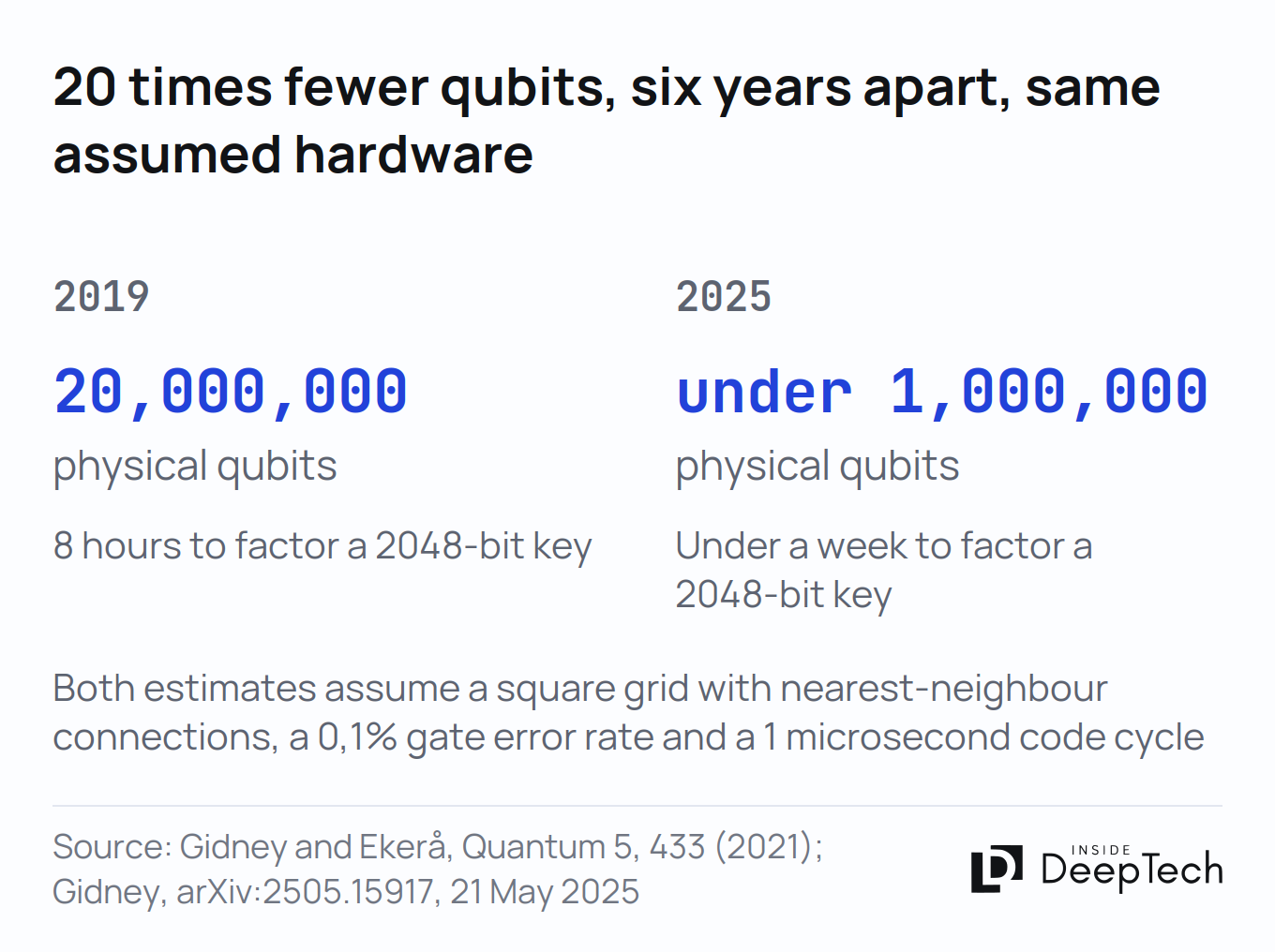
## What moved
Gidney's preprint, posted to arXiv on 21 May 2025, combines three results.
The first is approximate residue arithmetic, from Chevignard, Fouque and Schrottenloher in 2024\. Their method computes approximate modular exponentiations without ever holding the full 2048-bit value in a quantum register, which destroys the assumption that factoring an n-bit number needs an n-qubit register. It cost them dearly in gates: roughly a thousand times more Toffoli gates for a sixfold saving in space. Gidney cuts that gate count by more than a factor of 100.
The second is yoked surface codes, published in Nature Communications in May 2025, which store idle logical qubits at roughly triple the density of ordinary surface code patches. In the 2048-bit layout, idle qubits cost 430 physical qubits each in cold storage against 1 352 for an active patch at code distance 25.
The third is magic state cultivation, which replaces the first stage of distillation and shrinks the factories that supply the non-Clifford gates. Six of them fit in the compute region, each covering a 3 × 4 area of hot patches against the 15 × 8 factories of the 2019 design.
The trade is time. The new design runs 12,07 hours per shot and expects 9,2 shots, which comes to 4,63 days, or 4,96 days once you divide by the 93,3% chance that a shot finishes without a logical error. Gidney rounds that up to a week for slack. The 2019 design finished in eight hours because it spent qubits to buy time.
## The million is physical, and the thousand is logical
This is where most secondary coverage of the paper falls over, and where the number becomes usable or useless depending on which one you write down.
For a 2048-bit key, the algorithm holds 1 280 input logical qubits in dense cold storage and 131 in ordinary hot patches at its peak. Add a compute region of 126 patches and the total is 1 537 logical qubits. Wrapping those in enough surface code to survive a five-day run gives 897 864 physical qubits. Gidney reports the figure as one million, and says why: he wants slack in case cold storage behaves worse than modelled during the first loop of the algorithm.
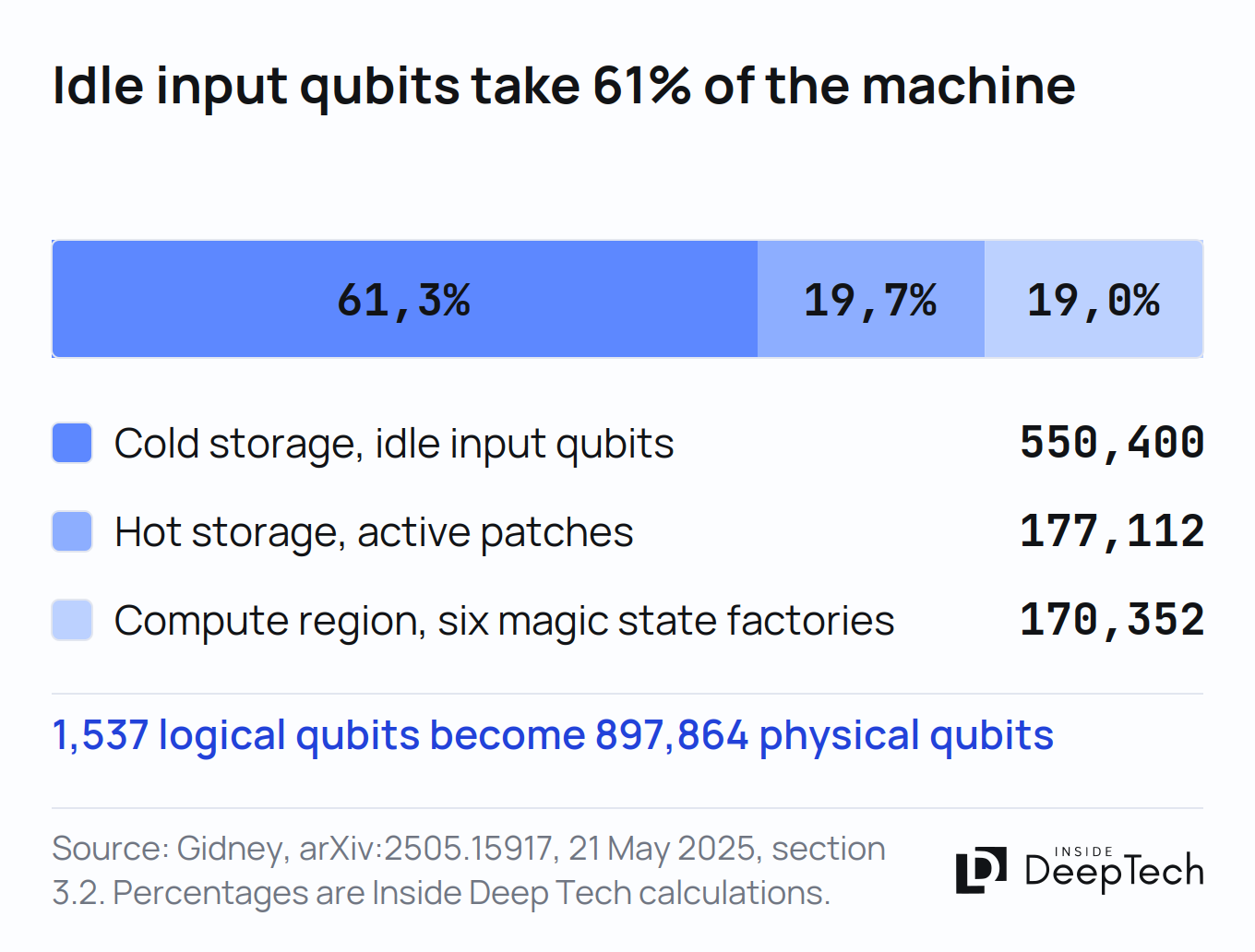
So the headline is a physical qubit count and the algorithmic requirement is four digits. Any comparison with a vendor announcement has to be made on the same axis, and vendors mix the two constantly. Quantinuum's Helios, launched commercially on 6 November 2025, reports [94 logical qubits with error detection and 48 with error correction](https://www.insidedeeptech.com/the-state-of-quantum-computing-2026-a-field-report/), which are two numbers describing one machine with 98 physical qubits.
## What has not moved
The machines that ship today are smaller than the estimate by a factor of about nine thousand. Helios has 98 physical qubits. IBM's Nighthawk, announced on 12 November 2025, has 120\. Neither is the largest chip anyone has fabricated, and neither is in the same region as 900 000.
The count is also the easier half of the requirement. The estimate assumes a machine holding a 0,1% gate error rate, a one-microsecond code cycle and a 10-microsecond control reaction, continuously, for five days. Nothing in the field runs a workload of that shape today.
Gidney says as much about his own direction of travel. Under the same physical assumptions, he sees no way to cut the qubit count by another order of magnitude, and he declines to claim that a hundred thousand noisy qubits would do it.
## Why the estimate matters more than the machine
The useful signal is the derivative. Gidney leans on the cryptographic maxim, which he attributes to Bruce Schneier, that attacks always get better; for quantum factoring, that has held for a decade.
His own position follows, and he states it plainly: he would rather security did not depend on progress staying slow. He does not expect machines of the required size by 2030\. He supports retiring vulnerable systems on that schedule anyway.
That argument survives being wrong about the hardware, which is what makes it usable by a planner. A forecast of when a cryptographically relevant quantum computer arrives can be off by a decade in either direction. A rule that says your 2036 secrets should not sit behind an algorithm whose attack cost fell twentyfold in six years does not depend on the forecast at all.
## The dates that already exist
Two documents set the schedule that European and American organisations are measured against.
The EU Member States, through the NIS Cooperation Group, published a coordinated implementation roadmap on 23 June 2025, responding to the Commission's recommendation of 11 April 2024\. It sets three milestones. By the end of 2026, every Member State should have started: a national transition strategy, a cryptographic inventory, and pilots for high and medium-risk use cases. By the end of 2030, high-risk use cases and critical infrastructure should be migrated. By the end of 2035, as much of the rest as is practically feasible.
The first of those dates is four months away.
In the United States, NIST IR 8547 sets out deprecation of quantum-vulnerable public-key algorithms after 2030 and disallowance after 2035\. Worth knowing before you quote it in a board paper: that document was released as an initial public draft in November 2024, its comment period closed on 10 January 2025, and NIST's own migration pages still describe it as a draft. The 2030 and 2035 dates circulate widely as settled policy. They are a proposal that federal policy has since started treating as a deadline.
## The arithmetic that decides your date
Three numbers, and none of them is a forecast about quantum hardware.
How long your data has to stay confidential. How long your migration takes, counting inventory, vendor dependencies, hardware security modules, certificate chains and everything embedded in a product you shipped years ago. And the year the attack becomes affordable to someone who wants your data.
A European bank with a ten-year confidentiality obligation is encrypting records today that must remain unreadable in 2036\. The EU roadmap gives it until the end of 2030 for high-risk systems, which leaves about four years of migration for data already sitting in an archive. Anything captured today and stored by a patient adversary is protected by an assumption, and that assumption is the one Gidney moved by a factor of 20 without touching a chip.
## Questions readers ask
### How many qubits does it take to break RSA-2048?
Under a million noisy physical qubits, running for under a week, on the assumptions in Gidney's May 2025 preprint. The algorithm itself uses 1 537 logical qubits, and the rest is the surface code wrapped around them. The 2019 estimate by the same author, on the same assumed hardware, was 20 million physical qubits and eight hours.
### Has a machine like this been built?
Nothing close to it. The largest commercially available machines announced in late 2025 count their physical qubits in the hundreds. The estimate is a resource calculation done on paper, and it describes a machine nobody has built.
### Why did the number fall if no new hardware appeared?
Three algorithmic results. Approximate residue arithmetic removed the need to hold the full 2048-bit value in a quantum register. Yoked surface codes store idle logical qubits at roughly triple the density. Magic state cultivation shrank the factories that supply the non-Clifford gates. The saving in qubits was paid for in runtime, which rose from eight hours to nearly five days.
### Does the difference between physical and logical qubits matter here?
It decides whether the comparison you are making means anything. The million is a physical count. Vendors quote both, sometimes in the same sentence, and in this design alone the two differ by a factor of several hundred.
### When does a European organisation have to have migrated?
The EU roadmap asks every Member State to have started by the end of 2026, to have migrated high-risk use cases and critical infrastructure by the end of 2030, and to finish the rest by 2035 as far as is practically feasible. The American dates of 2030 and 2035 come from a NIST report that is still an initial public draft.
## What to watch
Watch whether the estimate moves again. Gidney states that he sees no further order of magnitude under the same physical assumptions. A fourth revision that cut the requirement anyway would say that planning around slow progress is the wrong default, and it would arrive years before any hardware did.
Watch whether NIST finalises IR 8547, and whether 2030 and 2035 survive the process. Those two years are already quoted in procurement documents and board papers as though they were settled policy.
Watch the end of 2026\. That milestone produces the first checkable output of the European roadmap: national strategies and cryptographic inventories, published or not published, country by country. The inventory is the slow part of every migration, and an organisation that has not started one has already spent part of the four years the roadmap leaves before 2030.
## Sources
The resource estimate comes from Craig Gidney's preprint, How to factor 2048 bit RSA integers with less than a million noisy qubits, arXiv:2505.15917, posted on 21 May 2025\. Every figure attributed to it here appears in that document, including the 2019 comparison, which the preprint takes from Gidney and Ekerå in Quantum, volume 5, page 433, 2021\. The three component results are cited within it: approximate residue arithmetic from Chevignard, Fouque and Schrottenloher, IACR Cryptology ePrint Archive 2024/222; yoked surface codes from Gidney, Newman, Brooks and Jones in Nature Communications, May 2025; magic state cultivation from Gidney, Shutty and Jones, arXiv:2409.17595\. The migration dates come from the coordinated implementation roadmap published by the NIS Cooperation Group on 23 June 2025, from Commission Recommendation (EU) 2024/1101 of 11 April 2024, and from NIST IR 8547, which remains an initial public draft. Machine specifications come from Quantinuum's and IBM's own announcements of 6 and 12 November 2025.
Where this article states a ratio the preprint does not print, the arithmetic is ours and is done on the preprint's own figures. No number on this page comes from a vendor summary or a research aggregator, and no projected specification is written as an achieved one.
### NVLink, InfiniBand, and UALink: A Full Guide to How AI GPUs Actually Talk
URL: https://www.insidedeeptech.com/nvlink-infiniband-ualink-ai-gpu-interconnect-full-guide/
Last updated: 2026-08-31T07:01:01.000Z
NVLink is not a generic "GPU cable," and InfiniBand is not its rival in the same layer. NVLink is NVIDIA's scale-up fabric: a high-bandwidth, low-latency interconnect that makes a set of GPUs inside a rack-scale domain behave like one accelerator. InfiniBand (and Spectrum-X Ethernet / Ultra Ethernet Transport on the open side) is scale-out: the fabric that connects servers, racks, and halls so those domains can train and serve across a cluster. UALink is an open attempt at the scale-up job. Treating any of these as drop-in substitutes is how a bill of materials buys the wrong switch.
That split exists because modern AI stopped fitting inside one GPU, then stopped fitting inside one eight-GPU box. Mixture-of-experts inference and training push all-to-all traffic across experts sitting on different GPUs. Long-context reasoning and disaggregated serving move KV cache and activations under tight latency budgets. Peak FLOPS on a single die are not enough if tokens stall waiting for another GPU's HBM. You need a fabric that is co-designed with the accelerators for the hot domain, and a separate fabric that can grow to thousands of GPUs across the hall. One cable type cannot honestly do both jobs at the economics operators actually pay.
What changed in 2026 is not that people invented GPU interconnects. Hopper already shipped NVLink 4 domains of eight GPUs. What changed is Blackwell-class NVL72 racks with seventy-two GPUs in one NVLink domain, liquid cooling, and 130 TB/s of rack-level NVLink bandwidth (NVIDIA product positioning); Quantum-X800 InfiniBand and Spectrum-X800 Ethernet as paired scale-out SKUs; Ultra Ethernet Consortium specs in public download; and UALink 1.0 / Common 2.0 specifications available while shipping open scale-up silicon remains the open question. Rubin / NVLink 6 numbers are preliminary on NVIDIA's product page. The useful question is which layer you are buying for, not which acronym won a tweet.
This is the dedicated GPU-interconnect guide. Optical engines that sit on scale-out switch packages are covered in the [co-packaged optics full guide](https://www.insidedeeptech.com/co-packaged-optics-cpo-full-guide/). Memory pooling across hosts is [CXL](https://www.insidedeeptech.com/cxl-memory-pooling-full-guide/), not GPU collectives. The memory cube next to the GPU is [HBM](https://www.insidedeeptech.com/high-bandwidth-memory-hbm-full-guide/); NVLink is how GPUs share that working set across a domain. Why NVL72-class racks ship wet is in the [data center liquid cooling guide](https://www.insidedeeptech.com/data-center-liquid-cooling-ai-full-guide/). How the GPU and HBM sit on a package is [TSMC CoWoS](https://www.insidedeeptech.com/tsmc-cowos-packaging-full-guide/). We do not re-derive them here.
### Key takeaways
- **NVLink and InfiniBand are different layers, not rival cables.** NVIDIA's own scale-up framing is explicit: scale-up makes GPUs inside a domain act as one compute engine; scale-out (Quantum InfiniBand, Spectrum-X Ethernet) connects servers across the data center. Searching "NVLink vs InfiniBand" as if they were substitutes confuses the BOM.
- **NVLink generations double per-GPU bandwidth and grew the domain from 8 to 72 GPUs.** Per NVIDIA's [NVLink product page](https://www.nvidia.com/en-us/data-center/nvlink/?ref=insidedeeptech.com): 900 / 1,800 / 3,600 GB/s per GPU for generations 4 / 5 / 6 (Hopper / Blackwell / Rubin), with NVLink Switch domains of 8 / 8 / 72 and aggregate switch bandwidth of 7.2 TB/s, 130 TB/s (NVL72), and 260 TB/s (NVL72). Sixth-generation figures are labeled preliminary and subject to change.
- **GB200 NVL72 is the shipping-class existence proof for rack-scale NVLink.** NVIDIA positions 36 Grace CPUs + 72 Blackwell GPUs, liquid-cooled, 13.4 TB HBM3E at rack, 130 TB/s NVLink bandwidth, with scale-out via Quantum-X800 InfiniBand or Spectrum-X800 Ethernet and BlueField-3\. Performance multiples versus H100 on that page are NVIDIA claims with projected/subject-to-change footnotes, not independent lab measurements.
- **Ultra Ethernet is the open scale-out bet; Spectrum-X is NVIDIA's Ethernet product.** The Ultra Ethernet Consortium publishes Ultra Ethernet Transport (UET) as an Ethernet-based stack for AI and HPC at scale (spec 1.0.x public). Do not conflate the multi-vendor UEC spec with Spectrum-X SKUs.
- **UALink is the open scale-up bet; the 2026 proof is a public spec, not a hall full of shipping pods.** UALink 200G 1.0 targets 200G per lane and up to 1,024 accelerators in a pod. Board members include Alibaba, AMD, Apple, Astera Labs, AWS, Cisco, Google, HPE, Intel, Meta, Microsoft, and Synopsys. NVIDIA is not on that board. Common 2.0 / DL-PL 2.0 / manageability specs are progress on paper; product timing is the unsolved problem.
- **CPO, CXL, HBM, liquid cooling, and CoWoS are adjacent, not replacements.** CPO is the optical engine on the scale-out switch path, not a copper NVLink substitute today. CXL pools memory. HBM is the cube beside the GPU. Liquid cooling is why dense NVL72 racks ship. CoWoS is the package assembly. Confusing any of them with the scale-up fabric is a category error.
## AI GPU interconnects at a glance
| Attribute | Detail |
| ------------------------ | ---------------------------------------------------------------------------------------------------------------------------------------------------------------------------------------------------------------------------------------------- |
| What it is | The fabrics that move tensors, activations, KV cache, and collectives between AI GPUs: NVLink (and UALink as an open attempt) for scale-up inside a domain; InfiniBand and Ethernet/UET for scale-out across servers and racks |
| What it is not | A single "GPU cable" choice; a substitute for HBM, CXL memory pooling, CoWoS packaging, or CPO on the switch; PCIe as the primary GPU-to-GPU fabric inside NVL72-class domains |
| Core trick | Separate the hot, all-to-all domain (scale-up) from the cluster-wide fabric (scale-out) so bandwidth, latency, and topology match the communication pattern |
| Key hardware | GPUs + NVLink Switch trays/spine (or UALink switches when they ship); InfiniBand Quantum-class or Spectrum-X / UET Ethernet NICs and switches; BlueField-class DPUs on NVIDIA stacks; cables/backplanes; liquid-cooled racks for dense domains |
| Transmission medium | Copper-dominated scale-up inside today's NVL72-class racks; copper and optical on scale-out; CPO as a packaging choice on switches, not a drop-in for rack NVLink copper today |
| Main applications | MoE expert parallelism, tensor/pipeline parallelism, rack-scale inference and training domains, cluster-scale data-parallel training, disaggregated serving across nodes |
| Deployed today | NVIDIA NVLink 4/5 domains (Hopper eight-GPU and Blackwell NVL72 volume conversation); Quantum InfiniBand and Spectrum-X Ethernet clusters; UEC and UALink specs public with product maturity still the question for open stacks |
| Biggest unsolved problem | Open scale-up (UALink) and open Ethernet AI transport (UET) matching NVLink/IB operational maturity at hyperscale, plus power, cooling, and cable plant for ever-larger domains |
## The misconception: "NVLink vs InfiniBand"
People type "NVLink vs InfiniBand" because both show up on AI cluster diagrams and both move bits between GPUs somehow. The diagram lies by omission. Inside a GB200 NVL72 rack, seventy-two Blackwell GPUs talk over NVLink through NVLink Switch hardware so the rack can act as one large accelerator. Between racks (and nodes outside that domain), traffic rides Quantum-X800 InfiniBand or Spectrum-X800 Ethernet, with BlueField-3 in the NVIDIA networking story. You need both layers for a factory that spans more than one domain. Buying only InfiniBand does not create an NVL72-class all-to-all domain. Buying only NVLink does not interconnect halls.
NVIDIA's blog on [NVLink as the scale-up network for AI factories](https://developer.nvidia.com/blog/nvidia-nvlink-the-scale-up-network-for-ai-factories/?ref=insidedeeptech.com) states the split cleanly: scale-out (Quantum InfiniBand, Spectrum-X Ethernet) spans thousands to hundreds of thousands of GPUs; scale-up connects accelerators in one domain with high bandwidth, low latency, and HBM-local working sets. For MoE inference, tokens dispatch to experts, gather, and reorder. If that all-to-all path sits behind a general cluster network, communication overhead can erase the parallelism win. That argues for purpose-built scale-up. It does not argue that InfiniBand disappeared.
PCIe still matters for NICs, some CPUs, and non-NVLink devices. NVIDIA positions NVLink 6 at over 14× PCIe Gen6 per GPU. That comparison is NVIDIA's. PCIe is not gone from the server; it is the wrong mental model for the GPU-to-GPU bus inside a modern NVLink domain.
## NVLink generations, with the official numbers
Use the table on NVIDIA's NVLink page. Do not invent a third column from a slide deck.
**Per GPU (NVLink generations 4 / 5 / 6)**
| | Fourth generation | Fifth generation | Sixth generation |
| ----------------- | --------------------------------- | --------------------------- | ----------------------------- |
| Bandwidth per GPU | 900 GB/s | 1,800 GB/s | 3,600 GB/s |
| Max links per GPU | 18 | 18 | 36 |
| Architecture | Hopper | Blackwell | Rubin |
| Notes | Shipping-class for HGX Hopper era | Blackwell / GB200 NVL72 era | Preliminary specs; may change |
**NVLink Switch**
| | NVLink 4 Switch | NVLink 5 Switch | NVLink 6 Switch |
| ------------------------- | --------------- | ---------------- | ---------------- |
| GPU domains | 8 | 8 | 72 |
| GPU-to-GPU bandwidth | 900 GB/s | 1,800 GB/s | 3,600 GB/s |
| Total aggregate bandwidth | 7.2 TB/s | 130 TB/s (NVL72) | 260 TB/s (NVL72) |
Sixth-generation NVLink is described as 3.6 TB/s bidirectional per GPU, connecting 72 GPUs all-to-all in a Vera Rubin NVL72, with aggregate 260 TB/s. The same page notes preliminary specifications subject to change. NVLink Fusion is NVIDIA's path for hyperscalers to attach semi-custom ASICs or CPUs into the NVLink scale-up domain rather than rebuilding the rack fabric from scratch.
The developer blog adds claims that stay labeled as NVIDIA's: roughly 3× lower end-to-end GPU-to-GPU latency and 10× higher packet rate versus off-the-shelf Ethernet alternatives; 130 TFLOPS of in-network compute (SHARP) in a Vera Rubin NVL72 rack; each NVLink 6 switch tray with four switch chips, 28.8 TB/s tray bandwidth, and 14.4 TFLOPS FP8 in-network compute; a spine on the order of 5,000 cables. NVLink-C2C is positioned at 1.8 TB/s coherent CPU-GPU bandwidth (claimed 7× PCIe Gen6). Decode throughput up to 2.3× versus OTS Ethernet in a 72-accelerator domain is simulation-based. A Hopper-to-Blackwell MoE inference-per-watt figure of 50× (including domain expansion from 8 to 72 GPUs plus software) is an NVIDIA figure, not an independent measurement. Roadmap language includes domains up to 1,152 GPUs and future co-packaged optics connectivity. Treat roadmap as roadmap.
## Scale-out: InfiniBand Quantum and Spectrum-X
InfiniBand did not vanish when NVL72 posters went up. It remains the credit-based lossless fabric lineage NVIDIA continues as the Quantum product line after the Mellanox acquisition. On GB200 NVL72, Quantum-X800 InfiniBand is one of two named scale-out companions (the other is Spectrum-X800 Ethernet), alongside BlueField-3 DPUs. SHARP-style in-network reductions exist on InfiniBand as well as on NVLink Switch. Operators with large IB fabrics are not being told the technology is obsolete; they are being told the hot domain inside the rack is a different product.
Spectrum-X is NVIDIA's Ethernet product family for AI scale-out: congestion control, telemetry, and scheduling tuned for AI traffic. It is not identical to "plain Ethernet." When NVIDIA lists GB200/GB300 networking as Quantum-X800 or Spectrum-X, that is two scale-out paths beside the same NVLink domain. This guide does not invent an IBTA bandwidth table. If a deck claims "800 Gb/s class" Quantum-X800 ports, attribute that to NVIDIA product positioning.
## Ultra Ethernet Transport: the open Ethernet scale-out bet
The [Ultra Ethernet Consortium](https://ultraethernet.org/?ref=insidedeeptech.com) pushes an Ethernet-based open stack for AI and HPC at scale. The key deliverable is Ultra Ethernet Transport (UET): an RDMA-class transport with sender-based congestion control, multipathing, and incast handling for AI collective patterns. Spec 1.0.x is publicly downloadable (1.0.3 appears in August 2026 materials). That is real standards work.
Two category errors to avoid. First, UEC is not Spectrum-X. Spectrum-X is a vendor product; UET is a multi-vendor transport specification. Marketing "Ethernet for AI" can still mean a proprietary congestion stack. Second, a public transport spec is not the same as a mature multi-vendor NIC and switch ecosystem with the operational scar tissue InfiniBand and NVIDIA's Ethernet stack already carry at hyperscale. Prefer UEC's own language for technical claims; treat sponsored market white papers as sponsored if you cite their spend figures.
## UALink: the open scale-up bet
[UALink](https://ualinkconsortium.org/specification/?ref=insidedeeptech.com) (Ultra Accelerator Link) standardizes scale-up interconnect between accelerators and switches inside an AI computing pod. UALink 200G 1.0 is public: 200G per lane, up to 1,024 accelerators in a pod. Later public documents include Common 2.0 (in-network compute), a DL/PL 2.0 split so PHY speeds can move without rewriting the common layer, manageability 1.0 (gNMI, YANG, SAI, Redfish-style control), a 128G DL/PL 1.0, and chiplet 1.01 aligned with UCIe 3.0\. That is substantial paper progress in 2026.
The consortium board, per public materials and the April 2025 launch-era press, includes Alibaba, AMD, Apple, Astera Labs, AWS, Cisco, Google, HPE, Intel, Meta, Microsoft, and Synopsys. NVIDIA is not on that board. State that as membership, not theater.
This guide does not claim UALink pods are generally available as shipping SKUs in 2026 halls. The specification is public; product timing and silicon maturity are the unsolved problem. Analyst notes that UALink silicon lags NVLink generations are analysis, not foundry wafer counts. Open scale-up is a real multi-vendor bet. Shipping proof in 2026 still centers on NVIDIA NVLink domains.
## How the pieces compose in a real rack
**GB200 NVL72 (NVIDIA product page).** 36 Grace CPUs and 72 Blackwell GPUs in a liquid-cooled rack; NVLink domain of 72 GPUs at 130 TB/s; 13.4 TB HBM3E at rack; Superchip NVLink listed at 3.6 TB/s in the specs table. Scale-out: Quantum-X800 InfiniBand or Spectrum-X800 Ethernet, plus BlueField-3\. Headline claims versus H100 (30× LLM inference, 4× training, 25× energy efficiency) are NVIDIA figures with projected/subject-to-change footnotes.
**GB300 NVL72.** 72 Blackwell Ultra GPUs and 36 Grace CPUs, liquid-cooled, Quantum-X800 or Spectrum-X outside. NVIDIA claims up to 50× AI factory output versus Hopper-based platforms. Vendor claim.
**Sibling technologies.** [HBM](https://www.insidedeeptech.com/high-bandwidth-memory-hbm-full-guide/) is the memory cube on the package; NVLink moves working sets between GPUs that each own HBM. [CoWoS](https://www.insidedeeptech.com/tsmc-cowos-packaging-full-guide/) assembles GPU and HBM on an interposer. [Liquid cooling](https://www.insidedeeptech.com/data-center-liquid-cooling-ai-full-guide/) is why a 72-GPU NVLink spine ships. [CPO](https://www.insidedeeptech.com/co-packaged-optics-cpo-full-guide/) belongs on scale-out switches, not as a copper NVLink substitute inside today's NVL72 racks. [CXL](https://www.insidedeeptech.com/cxl-memory-pooling-full-guide/) pools memory across hosts; it is not the fabric for NCCL-style GPU collectives inside an NVLink domain.
## Comparison: four names, two jobs
| | NVLink (scale-up) | InfiniBand Quantum (scale-out) | Spectrum-X / Ultra Ethernet (scale-out) | UALink (scale-up, open) |
| ---------------------- | --------------------------------------------------------------------------------------- | ---------------------------------------------------------------------------- | ----------------------------------------------------------------------------------------- | ------------------------------------------------------------------------------- |
| Job | Make GPUs in a domain behave as one accelerator | Connect nodes/racks/halls on a lossless IB fabric | Connect nodes/racks/halls on Ethernet (vendor product and/or UET spec) | Open multi-vendor accelerator pod interconnect |
| Domain size | 8 GPUs (NVLink 4/5 switch domains) to 72 (NVLink 6 / NVL72); roadmap claims up to 1,152 | Cluster scale (thousands to hundreds of thousands of GPUs in NVIDIA framing) | Same cluster-scale role on Ethernet | Spec targets up to 1,024 accelerators per pod |
| Bandwidth class | 900 / 1,800 / 3,600 GB/s per GPU (gen 4/5/6); 130 / 260 TB/s NVL72 aggregates (gen 5/6) | NVIDIA Quantum-X800 product line; do not invent port tables here | Spectrum-X800 product positioning; UET as open transport | 200G per lane (UALink 200G 1.0); aggregate pod math depends on shipping silicon |
| Who controls the spec | NVIDIA | IBTA + NVIDIA product line after Mellanox | UEC (open) vs NVIDIA Spectrum-X (product) | UALink Consortium (NVIDIA not on board) |
| Shipping proof in 2026 | Strong: Hopper NVLink domains; Blackwell NVL72 volume conversation | Strong: large IB AI/HPC fabrics continue | Spectrum-X deployments in NVIDIA stacks; UET as public spec with ecosystem still maturing | Spec public; general availability of pods not assumed here |
| Openness | Proprietary fabric + Fusion for semi-custom attach | Industry IB ecosystem with NVIDIA as dominant AI supplier | Ethernet open at the wire; AI transport openness is the UEC bet | Designed as open scale-up |
| Typical mistake | Treating NVLink as optional when MoE all-to-all is in the hot path | Treating IB as a substitute for the scale-up domain | Conflating Spectrum-X SKUs with the UEC specification | Counting a PDF as a deployed fabric |
## Thermal, power, and the boring constraints
NVL72-class domains are liquid-cooled for a reason. Seventy-two GPUs, Grace CPUs, NVLink Switch trays, and a copper spine measured in thousands of cables are a thermal and mechanical plant, not a PCIe riser conversation. Scale-up bandwidth at this density presupposes a cooling design that can clear the rack; details live in the [liquid cooling guide](https://www.insidedeeptech.com/data-center-liquid-cooling-ai-full-guide/). Air-cooled eight-GPU boxes were a different regime.
Cable plant and serviceability are first-class. NVIDIA's NVLink 6 narrative emphasizes control-plane resilience, partially populated racks, hot-swappable switch trays, and in-service updates because a failed tray should not equal a dead factory module. At rack-scale domain prices, fabric maintainability is part of performance. Power distribution (higher-voltage rack feeds) is adjacent infrastructure, not an interconnect protocol. Interconnect roadmaps that ignore megawatts per row are incomplete.
## A realistic timeline
| Horizon | What is actually happening | Confidence |
| ----------------------- | ------------------------------------------------------------------------------------------------------------------------------------------------------------------------------------------------------------------------------------------------------------------------------------------------------------------------------------------------------------------ | ----------------------------------------------------------------------------------------- |
| Now (2026) | NVLink 5 / Blackwell NVL72 in the volume conversation; NVLink 6 / Rubin preliminary specs on NVIDIA's page; Quantum-X800 and Spectrum-X as NVIDIA's two scale-out SKUs beside NVL72; UALink 1.0 and 2.0-family specs public; UEC 1.0.x public. Shipping proof is NVIDIA NVLink domains and IB/Ethernet clusters. UALink/UEC product maturity is the question mark. | High for NVIDIA shipping classes and public specs; medium for open-stack deployment depth |
| Near term (2027-2028) | Broader Ethernet AI fabrics; UALink silicon if vendors tape out and qualify; possible CPO volume on scale-out switches; larger NVLink domains only as NVIDIA ships them | Medium, roadmap-tied |
| Medium term (2028-2031) | NVIDIA roadmap language of domains toward 1,152 GPUs; open scale-up if UALink lands in real pods; more optics in scale-out | Speculative on dates; directional on pressure for larger domains and open options |
## The bottom line
2026 is the year the industry stopped having an excuse to confuse scale-up with scale-out. NVLink (and UALink on the open side) is how GPUs inside a domain share a working set at bandwidths PCIe does not offer. InfiniBand Quantum and Ethernet (Spectrum-X as product, Ultra Ethernet Transport as open bet) are how those domains become a cluster. GB200/GB300 NVL72-class racks are the concrete NVIDIA pattern: liquid-cooled 72-GPU NVLink domains with Quantum-X800 or Spectrum-X outside. UALink and UEC contest proprietary lock-in at each layer. Specs are real. Shipping proof is uneven.
Ask two questions in order. What is the size and latency budget of the hot accelerator domain, and which scale-up fabric implements it? What scale-out fabric ties domains into a cluster, and are you buying InfiniBand, a vendor Ethernet AI stack, or an Ultra Ethernet path? If a vendor answers with one acronym, ask which layer it is. The expensive mistake is still buying a scale-out switch for a scale-up job, or treating an open PDF as a deployed copper spine.
## Frequently asked questions
### What is NVLink?
NVIDIA's scale-up interconnect for high-bandwidth GPU-to-GPU communication inside a server or rack-scale domain, extended by NVLink Switch chips into all-to-all domains (8 GPUs on NVLink 4/5 switch generations, 72 on NVLink 6 / NVL72 per NVIDIA's tables).
### How is NVLink different from InfiniBand?
Different jobs. NVLink is scale-up inside a domain. InfiniBand (Quantum line) is scale-out between nodes and racks. NVL72 systems use NVLink inside the rack and InfiniBand or Spectrum-X Ethernet outside. They are complementary in NVIDIA's architecture, not substitutes.
### How is NVLink different from PCIe?
PCIe is the general peripheral interconnect. NVLink is a purpose-built GPU fabric with much higher per-GPU bandwidth in NVIDIA's product tables (NVLink 6 positioned at over 14× PCIe Gen6). PCIe remains how many NICs and devices attach; it is not the primary GPU-to-GPU path inside NVL72-class domains.
### What is UALink?
Ultra Accelerator Link: an open consortium specification for scale-up links between accelerators and switches in an AI pod (200G per lane, up to 1,024 accelerators in the 1.0 framing). Specs are public; do not assume general product availability in 2026 halls without a verified shipping SKU.
### What is Ultra Ethernet versus InfiniBand?
Both target scale-out. InfiniBand is a long-standing lossless fabric lineage (NVIDIA Quantum in AI clusters). Ultra Ethernet Consortium work defines Ethernet-based transport (UET) for AI/HPC. Spectrum-X is NVIDIA's Ethernet product; UEC is the multi-vendor spec. Do not conflate product and standard.
### What is an NVLink Switch?
Switch silicon (and trays) that connect many NVLink ports so GPUs in a domain get all-to-all connectivity at NVLink rates, with SHARP engines for in-network reductions. Aggregate bandwidth figures (7.2 TB/s, 130 TB/s NVL72, 260 TB/s NVL72) are NVIDIA's published switch generation numbers.
### What is NVLink Fusion?
NVIDIA's offering for hyperscalers to attach semi-custom ASICs or CPUs into the NVLink scale-up and rack-scale architecture instead of building a full custom scale-up stack alone.
### Is CPO a substitute for NVLink?
No. Co-packaged optics sits on the scale-out switch packaging path. It does not replace copper NVLink scale-up inside today's NVL72-class racks. See the [CPO full guide](https://www.insidedeeptech.com/co-packaged-optics-cpo-full-guide/).
### Does CXL replace GPU interconnects?
No. CXL addresses memory pooling and expansion across hosts. It is not the fabric for GPU collectives inside an NVLink domain. See the [CXL memory pooling guide](https://www.insidedeeptech.com/cxl-memory-pooling-full-guide/).
## Methodology
Primary sources as of 31 August 2026: NVIDIA's [NVLink product page](https://www.nvidia.com/en-us/data-center/nvlink/?ref=insidedeeptech.com) (generational bandwidth, links, architectures, switch domains/aggregates; preliminary note on NVLink 6; Fusion); [GB200 NVL72](https://www.nvidia.com/en-us/data-center/gb200-nvl72/?ref=insidedeeptech.com) (36 Grace + 72 Blackwell, 130 TB/s NVLink, 13.4 TB HBM3E, Quantum-X800 / Spectrum-X800 / BlueField-3, GB300 summary, vendor H100 comparisons with projected/subject-to-change footnotes); developer blog [NVIDIA NVLink: The Scale-Up Network for AI Factories](https://developer.nvidia.com/blog/nvidia-nvlink-the-scale-up-network-for-ai-factories/?ref=insidedeeptech.com) (scale-up vs scale-out, latency/packet-rate and in-network compute claims, tray/spine figures, NVLink-C2C, Fusion, 1,152-GPU roadmap, simulation-based decode comparison); [UALink specifications](https://ualinkconsortium.org/specification/?ref=insidedeeptech.com); Ultra Ethernet Consortium materials and spec 1.0.x for UET. Bandwidth, latency, packet-rate, and tokens-per-watt comparisons versus Ethernet or Hopper are NVIDIA claims or simulations unless stated otherwise. UALink/UEC product availability is not a foundry wafer table; public specs are not hall-scale deployment proof. No independent IBTA port-speed table was built for this guide.
### Hybrid Bonding: A Full Guide to Cu-Cu Stacking, SoIC, and Foveros Direct
URL: https://www.insidedeeptech.com/hybrid-bonding-soic-foveros-direct-full-guide/
Last updated: 2026-10-12T09:07:38.000Z
Hybrid bonding is not a transistor node, and it is not a synonym for "3D packaging." It is a die-to-die (or wafer-to-wafer) interconnect process: strip the solder microbumps, prepare copper pads and a dielectric surface, then bond copper to copper so two dies share a bumpless interface at single-digit-micron pitch. The product that ships is still a CPU, a GPU, an HBM stack, or an optical engine. The thing that changed is how those pieces talk vertically.
That split exists because microbumps ran out of pitch. For a decade, 3D stacks used solder microbumps in the 25–55 µm range, fine enough for early Foveros and HBM, too coarse for the bandwidth density AI and cache-on-logic now demand. At roughly 9–10 µm and below, solder geometry, underfill, and parasitics stop being a packaging detail and start being the bottleneck. Hybrid bonding deletes the solder. Copper pads meet copper pads. The joint looks more like an on-die via than a chip-to-chip link.
What changed in 2026 is not that hybrid bonding was invented. Sony put wafer-to-wafer Cu-Cu bonding into image sensors years ago; AMD's 3D V-Cache and Instinct MI300-class parts proved SoIC as a volume product; Intel published Foveros Direct pitches of 9 µm then 3 µm. What changed is that TSMC's SoIC roadmap now puts 6 µm pitches in high-volume manufacturing, face-to-face stacking in the customer mix, and A14-on-A14 SoIC targeted for 2029, while Intel's [Foveros Direct](https://www.intel.com/content/www/us/en/foundry/library/advanced-process-technologies-for-data-center.html?ref=insidedeeptech.com) path pairs hybrid bonding with EMIB into 3.5D modules. The useful question is which stack is hybrid-bonded, which is still microbumped, and which slide is still a 2028 thermal argument.
This is the dedicated vertical-interconnect guide. Lateral 2.5D assembly, interposers, bridges, HBM shoreline, lives in the [TSMC CoWoS full guide](https://www.insidedeeptech.com/tsmc-cowos-packaging-full-guide/). Chiplet partition and die-to-die protocols live in [chiplets and UCIe](https://www.insidedeeptech.com/chiplets-ucie-full-guide/). Memory stacks have their own [HBM guide](https://www.insidedeeptech.com/high-bandwidth-memory-hbm-full-guide/). Optical engines that sit on SoIC-bonded PICs are covered in [co-packaged optics](https://www.insidedeeptech.com/co-packaged-optics-cpo-full-guide/). We do not re-derive them here.
Last updated: October 12, 2026.
### Key takeaways
- **Hybrid bonding is a Cu-Cu joint, not a foundry node and not "3D packaging" as a category.** Microbumps are solder. Hybrid bonds are copper pads fused through a dielectric face after surface activation. The pitch drops from tens of microns to single-digit microns. Density rises roughly with the square of that pitch shrink. [GAAFET](https://www.insidedeeptech.com/gaafet-nanosheet-transistors-full-guide/) decides how small the transistors are. Hybrid bonding decides how densely two dies can talk through the Z-axis.
- **TSMC SoIC and Intel Foveros Direct are the two named volume brands.** SoIC is TSMC's System on Integrated Chips 3D stack, SoIC-P (bumped) and SoIC-X (bumpless hybrid). Foveros Direct is Intel's solder-free successor to microbump Foveros, with first-generation copper bonding at 9 µm and a second generation at 3 µm per Intel Foundry's data-center technology page. Both can feed a 2.5D package afterward. Neither replaces CoWoS or EMIB.
- **Pitch is the roadmap metric that matters.** TSMC's public SoIC path: \~9 µm in earlier volume (MI300-era), 6 µm in high-volume manufacturing as of mid-2026 commentary from TSMC advanced-packaging leadership, 4.5 µm targeted by 2029 with A14-to-A14 SoIC. Intel: 9 µm then 3 µm on Foveros Direct generations. Treat vendor dates as roadmap dates. Treat shipping SKUs (3D V-Cache, MI300/MI350-class, Clearwater Forest-class Xeon modules) as the existence proof.
- **Hybrid bonding composes with 2.5D; it does not replace it.** AMD's Instinct pattern is the canonical "3.5D": SoIC stack the compute/I/O vertically, then drop that object onto [CoWoS](https://www.insidedeeptech.com/tsmc-cowos-packaging-full-guide/) next to HBM. Intel's EMIB 3.5D does the horizontal job with bridges while Foveros Direct does the vertical. Confusing SoIC with CoWoS, or Foveros Direct with EMIB, is how a slide deck invents a bottleneck that is not the one you have.
- **The unsolved problem is not "can copper bond."** It is yield at finer pitch, known-good-die handling for die-to-wafer, warpage and overlay, thermal paths through a stack that no longer has solder or underfill as a compliance layer, tool capacity (bond aligners, plasma activation), and the fact that HBM itself is still largely microbump-bonded even as logic-on-logic goes hybrid. SK hynix and peers are pushing hybrid bonding toward later HBM generations; that is a memory roadmap, not a 2026 training-GPU default.
## Hybrid bonding at a glance
| Attribute | Detail |
| ------------------------ | ---------------------------------------------------------------------------------------------------------------------------------------------------------------------------------- |
| What it is | Direct copper-to-copper (plus dielectric) bonding between dies or wafers, without solder microbumps, at roughly sub-10 µm pad pitch |
| What it is not | A transistor node, CoWoS, EMIB, HBM as a product, UCIe as a protocol, or a drop-in for every 3D stack shipping in 2026 |
| Core trick | Replace solder joints with planar Cu pads so interconnect pitch, and therefore vertical bandwidth density, can scale like a back-end-of-line feature |
| Key hardware | Copper pad / via arrays, dielectric bonding surface, plasma activation / surface prep, precision aligners, optional TSVs for face-to-back, temporary carriers |
| Transmission medium | Micron-scale Cu-Cu bonds; signal path length measured in microns vertically, not millimeters laterally |
| Main applications | Cache-on-logic (3D V-Cache), logic-on-logic / logic-on-SRAM AI and CPU stacks, EIC-on-PIC optical engines (e.g. TSMC COUPE), future HBM hybrid stacks |
| Deployed today | AMD 3D V-Cache and MI300/MI350-class SoIC; Intel Foveros Direct on advanced client/server modules; Sony-class CIS wafer bonds; TSMC SoIC at 6 µm HVM per 2026 packaging commentary |
| Biggest unsolved problem | Scaling pitch and face-to-face adoption without losing yield, known-good-die economics, or a thermal path a cold plate can actually clear |
## What hybrid bonding actually is
Start with the thing it is not. It is not [CoWoS](https://www.insidedeeptech.com/tsmc-cowos-packaging-full-guide/). CoWoS places dies *side by side* on an interposer. Hybrid bonding places dies *on top of* each other. It is not EMIB. EMIB is a silicon bridge in a substrate for lateral bandwidth. It is not [UCIe](https://www.insidedeeptech.com/chiplets-ucie-full-guide/). UCIe is a die-to-die protocol and PHY family; hybrid bonding is how you might physically attach two dies that speak UCIe, or Infinity Fabric, or a proprietary cache bus. And "we use 3D packaging" on a slide does not tell you whether the joint is a 40 µm microbump or a 6 µm Cu pad.
A microbump joint is a solder ball (or copper pillar with solder cap) between two pads, underfilled, with a minimum pitch set by solder volume, shorting risk, and electromigration. Typical advanced packages lived for years in the 25–55 µm band. Intel's own Foveros Direct brief puts conventional microbump density against hybrid bonding and claims up to roughly 10× finer interconnect density once solder is gone and pitch drops into the sub-10 µm regime.
A hybrid bond is a planar process. Both surfaces carry copper pads set in a dielectric. Surfaces are cleaned and activated (often plasma). Dies or wafers are aligned. Thermocompression or related bonding forms a Cu-Cu joint and a dielectric-to-dielectric seal in one interface. There is no solder and, in the pure hybrid case, no traditional underfill. Electrical parasitics drop. Pitch can track copper pad lithography rather than solder ball geometry. The mechanical and thermal path becomes continuous metal and dielectric, which is good for conduction and unforgiving of particles, oxide, and overlay error.
Two geometries dominate the vocabulary:
**Wafer-to-wafer (W2W).** Two full wafers bond, then dice. Highest throughput when die sizes match. Bad economics when one die is scarce and the other is abundant, you scrap good die with bad partners.
**Die-to-wafer (D2W) / chip-on-wafer.** Known-good top dies land on a bottom wafer. Better yield economics for heterogeneous stacks. Harder alignment and handling. This is the path that matters for many logic-on-logic and EIC-on-PIC products.
Face orientation is a second fork. **Face-to-back (F2B)** stacks the front of one die on the back of another; signals often traverse TSVs in the lower die. **Face-to-face (F2F)** aligns active metal faces directly through hybrid bonds, skipping that TSV tax for the die-to-die bus. TSMC's second-generation SoIC emphasis on F2F is exactly this pitch-and-density argument. Heat still has to leave somehow. F2F does not invent a radiator.
## Why microbumps ran out of pitch
The congestion is geometric. Interconnect density scales roughly as 1/pitch². Move from 36 µm microbumps to 9 µm hybrid pads and you are in a different density class even before process details. Intel Foundry's current public language for Foveros Direct is sub-10 µm pitch and up to \~10× density versus conventional microbumps; the same data-center page states first-generation copper bonding at 9 µm and second generation at 3 µm.
Bandwidth and energy follow. A vertical Cu-Cu joint a few microns long is not a millimeter of organic trace or a fat microbump. Capacitance and resistance fall. That is why cache-on-compute and SRAM-on-logic show up first: the workload is latency- and bandwidth-sensitive, the die sizes can be matched, and the thermal stack (cache is cooler than a GPU front-end) is kinder than logic-on-logic.
HBM is the counter-example that keeps people honest. Today's HBM cubes are still largely microbump / TSV stacks sitting on a [CoWoS](https://www.insidedeeptech.com/tsmc-cowos-packaging-full-guide/) interposer next to the GPU. Hybrid bonding for HBM is a roadmap item among memory vendors, Hot Chips 2026 coverage had SK hynix discussing hybrid bonding timing relative to HBM4E/HBM5, not the default joint under every 2026 training GPU. Do not read "hybrid bonding is shipping" as "every vertical interface in the AI package is hybrid."
## SoIC vs Foveros Direct vs "just hybrid bonding"
Vendor names are not physics. The physics is Cu-Cu. The names are process flows, customer models, and what you are allowed to put on top of what.
### TSMC SoIC
SoIC (System on Integrated Chips) is TSMC's 3DFabric vertical stack. TSMC's own SoIC materials describe ultra-high-density vertical integration intended to cut size and parasitics, with a SoIC assembly able to go subsequently into CoWoS, InFO, or System-on-Wafer. [Reporting after the 2026 North America Technology Symposium puts the pitch path at 6 µm today toward 4.5 µm by 2029](https://www.design-reuse.com/news/202530447-tsmc-soic-roadmap-targets-2029-chip-stacking/?ref=insidedeeptech.com), following roughly 9 µm in earlier volume products. [TSMC itself says A14-to-A14 SoIC is set for production in 2029 with 1.8x higher die-to-die I/O density than N2-on-N2 SoIC](https://finance.yahoo.com/sectors/technology/articles/tsmc-debuts-a13-technology-2026-190000625.html?ref=insidedeeptech.com). Face-to-face support is the second-generation capability that unlocks the largest density jump, at the cost of a harder thermal path.
AMD is the clearest volume customer story: 3D V-Cache on client/server CPUs, and Instinct MI300/MI350-class accelerators that SoIC-stack compute and I/O then ride CoWoS with HBM, the "3.5D" pattern. Broadcom's XDSiP work for Fujitsu Monaka is an early F2F SoIC-class design point (N2 compute on N5 SRAM in public descriptions), with volume aimed around 2027 and, notably, still discussed at 9 µm pitch in some coverage, innovators are not always first to the finest pitch.
### Intel Foveros Direct
Foveros began as microbump 3D (Lakefield, then Meteor Lake / Lunar Lake / Panther Lake client lines, Ponte Vecchio with EMIB). **Foveros Direct** deletes the solder. Intel's [Foveros Direct 3D technology brief](https://www.intel.com/content/dam/www/central-libraries/us/en/documents/2025-11/foveros-direct-3d-tech-brief.pdf?ref=insidedeeptech.com) states sub-10 µm pitch via direct Cu-Cu hybrid bonding and up to \~10× interconnect density versus conventional microbumps. Intel Foundry's [data-center process page](https://www.intel.com/content/www/us/en/foundry/library/advanced-process-technologies-for-data-center.html?ref=insidedeeptech.com) is explicit on generational pitches: first generation at 9 µm, second at 3 µm. Clearwater Forest-class Xeon modules are the public vehicle that pairs Intel 18A compute chiplets, PowerVia, Foveros Direct, and EMIB 3.5D.
Intel's advantage is co-optimization with its own nodes and power delivery ([backside power / PowerVia](https://www.insidedeeptech.com/backside-power-delivery-powervia-full-guide/) sits in that same stack story). The trade for external foundry customers is a steeper qualification path than TSMC's merchant SoIC model. EMIB 3.5D, Foveros Direct modules linked laterally by EMIB, is Intel's answer to "3.5D" without a full CoWoS interposer.
### Everyone else
Samsung, OSATs (ASE, Amkor), and specialty bond-tool vendors (Besi, Applied Materials, TEL, and peers) all sit in the hybrid-bonding supply chain. For AI GPUs that still tape out at TSMC, SoIC-plus-CoWoS remains the gravitational center. For Intel-designed modules, Foveros Direct-plus-EMIB is the parallel stack. "Hybrid bonding" without a brand usually means the process physics; procurement still buys a named flow.
| | Microbump 3D (legacy Foveros / early stacks) | TSMC SoIC (hybrid) | Intel Foveros Direct |
| ----------------- | -------------------------------------------- | ----------------------------------------------- | ------------------------------------------------------------- |
| Joint | Solder microbump / Cu pillar + solder | Cu-Cu hybrid (SoIC-X); SoIC-P is bumped cousin | Cu-Cu hybrid |
| Pitch class | \~25–55 µm typical | \~9 µm → 6 µm HVM → 4.5 µm (2029 target) | 9 µm gen1 → 3 µm gen2 (Intel Foundry) |
| Density story | Hundreds of joints/mm² | F2F cited \~14k signals/mm² vs \~1.5k F2B | Sub-10 µm; up to \~10× vs microbump per Intel brief |
| Typical next step | Package substrate / EMIB / CoWoS | Often CoWoS or InFO ("3.5D") | Often EMIB 3.5D |
| Proof points | Meteor Lake-era Foveros; early HBM | 3D V-Cache; MI300/MI350-class; COUPE EIC-on-PIC | Clearwater Forest / 18A module roadmap; Foveros Direct briefs |
## How hybrid bonding shows up in real products
**Cache on compute.** AMD 3D V-Cache is the volume existence proof most engineers have actually bought. An SRAM die hybrid-bonded (via SoIC) onto a CCD beats a larger monolithic cache on latency and binning economics. Thermal is manageable because the top die is memory.
**AI accelerators as 3.5D objects.** MI300-class parts stacked compute/I/O with SoIC, then placed that stack on CoWoS beside HBM. The hybrid bond is the vertical bus. The interposer is still how HBM and the second compute die share a package. Delete either sentence and the product description is wrong.
**CPU modules with active base tiles.** Intel's Foveros Direct framing puts compute chiplets on an active base tile (cache, fabric, power) at hybrid pitch, then tiles modules with EMIB. That is a different disaggregation style than "one giant CoWoS interposer," aimed at Xeon-class modularity and yield.
**Optical engines.** TSMC's COUPE path stacks an electronic IC on a photonic IC with SoIC-X hybrid bonding so the EIC–PIC interface is bumpless, covered in the [CPO guide](https://www.insidedeeptech.com/co-packaged-optics-cpo-full-guide/). Hybrid bonding here is a capacitance and density argument for modulators and TIAs, not a GPU cache argument.
**What is still not hybrid by default.** Most HBM stacks in 2026 AI packages. Many cost-sensitive 3D consumer parts. Anything whose pitch, yield, or thermal model still prefers microbumps. Hybrid bonding is winning the high-bandwidth vertical sockets first.
## Thermal, yield, and the boring constraints
Hybrid bonding removes solder compliance. That is a feature for electricals and a problem for mechanics. Particles become killer defects. Overlay and pad co-planarity dominate yield. Die-to-wafer needs known-good-die test that is good enough that you are not bonding expensive N2 logic onto scrap. Tooling, aligners, activation, metrology, is capacity-constrained industry-wide in the same qualitative sense CoWoS was, even if the monthly wafer numbers are not public in the same way.
Thermals are the other half. Face-to-face logic-on-logic puts two hot dies in intimate contact. Vendors prefer cache-on-logic and SRAM-on-compute first for a reason. Liquid cooling at package and rack level ([data center liquid cooling guide](https://www.insidedeeptech.com/data-center-liquid-cooling-ai-full-guide/)) is what makes dense 3D stacks shippable in AI halls; the bond process does not remove heat by itself. Intel markets continuous thermal paths as a Direct advantage versus solder; that is a conduction claim, not a free pass on cold-plate design.
Backside power complicates the stack drawing further. A die with [PowerVia / BSPDN](https://www.insidedeeptech.com/backside-power-delivery-powervia-full-guide/) has power on the back and signals on the front; F2B vs F2F and TSV strategies have to respect that. TSMC's 2026 SoIC public slides were called out as incomplete on backside-power permutations; Kevin Zhang's symposium comments (as reported) treated stacking on those nodes as supported even when the slide simplified. Treat "supported" as engineering, not as a shipping SKU list.
## A realistic timeline
| Horizon | What is actually happening | Confidence |
| ----------------------- | ------------------------------------------------------------------------------------------------------------------------------------------------------------------------------------------------------------------ | -------------------------------------------------------------------- |
| Now (2026) | SoIC in volume for V-Cache and MI-class; \~6 µm SoIC HVM per TSMC packaging commentary; Foveros Direct on Intel's advanced module path (9 µm gen); COUPE-style EIC-on-PIC hybrid bonds; HBM still mostly microbump | High for shipping product classes; medium for exact pitch mix by SKU |
| Near term (2027–2028) | More F2F SoIC customer designs (Monaka-class); finer SoIC pitches toward mid-single-digit µm; Foveros Direct 3 µm generation; selective hybrid HBM pilots | Medium, roadmap-tied |
| Medium term (2028–2031) | A14-to-A14 SoIC (\~4.5 µm) targeted 2029; wider logic-on-logic if thermals allow; hybrid bonding deeper into HBM generations | Plausible on vendor dates; thermal/yield limited |
| Long term (2030s) | Hybrid bonds as the default high-density vertical joint; microbumps relegated to cost-sensitive or coarse interfaces | Directional; year-level speculative |
## Hybrid bonding in October 2026: A14 SoIC and the HBM4 question
Two primary-source updates since this guide first ran change how to read the roadmap. In its release for the 2026 North America Technology Symposium on April 22, 2026, [TSMC said A14-to-A14 SoIC is set for production in 2029 with 1.8x higher die-to-die I/O density than N2-on-N2 SoIC](https://finance.yahoo.com/sectors/technology/articles/tsmc-debuts-a13-technology-2026-190000625.html?ref=insidedeeptech.com). That is the first node-specific SoIC density figure from TSMC itself, and it confirms that the logic-on-logic roadmap runs through hybrid bonding at the leading node.
The second update answers the most common search question about this technology: is HBM4 hybrid bonded? Not at SK hynix, the first DRAM maker to ready HBM4 mass production. The company said it [adopted its Advanced MR-MUF process for HBM4](https://news.skhynix.com/en/sk-hynix-completes-worlds-first-hbm4-development-and-readies-mass-production/?ref=insidedeeptech.com), a mass-reflow molded-underfill stacking method, while doubling the interface to [2,048 I/O terminals and improving power efficiency by more than 40%](https://news.skhynix.com/en/sk-hynix-completes-worlds-first-hbm4-development-and-readies-mass-production/?ref=insidedeeptech.com) versus the previous generation.
Inside Deep Tech's take: in 2026, hybrid bonding ships in cache-on-logic, logic-on-logic and optical-engine stacks, while the HBM4 going into racks such as [NVIDIA Vera Rubin NVL72](https://www.insidedeeptech.com/nvidia-vera-rubin-nvl72-full-guide/) still uses bump-based stacking at SK hynix. Treat claims that HBM has already switched to hybrid bonds as unconfirmed until a memory maker says so, and watch HBM4E and later generations instead. For where the stacked die lands next, see the [TSMC CoWoS full guide](https://www.insidedeeptech.com/tsmc-cowos-packaging-full-guide/).
## The bottom line
2026 is the year hybrid bonding stopped being a specialty CIS and SRAM trick and became the vertical half of how leading AI and CPU packages are built, still beside, not instead of, CoWoS and EMIB.
The physics is old enough to be boring: delete solder, shrink pitch, raise interconnect density, cut joules per bit on the Z-axis. TSMC's SoIC and Intel's Foveros Direct are how that physics is productized, with 6 µm / 9 µm-class bonds in the volume conversation and 4.5 µm / 3 µm on the roadmaps. AMD's SoIC-plus-CoWoS accelerators and Intel's Direct-plus-EMIB modules are the two commercial patterns. Face-to-face is the density unlock; heat and yield are why not every stack uses it tomorrow morning.
For anyone making decisions today, the split is clean. If the question is how two logic or cache dies share a vertical bus at single-digit-micron pitch, you are in hybrid bonding. If the question is how those stacked objects sit next to HBM, you are back in [CoWoS](https://www.insidedeeptech.com/tsmc-cowos-packaging-full-guide/) or EMIB. If a vendor says only "advanced 3D packaging," ask: microbump or Cu-Cu, what pitch, F2F or F2B, and what 2.5D wrapper, if any, completes the package.
## Frequently asked questions
### What is hybrid bonding in semiconductors?
A packaging process that joins two dies or wafers by bonding copper pads (and surrounding dielectric) directly, without solder microbumps. It enables finer pad pitch and higher interconnect density than solder-based 3D stacking.
### How is hybrid bonding different from microbumps?
Microbumps use solder (often on copper pillars) at pitches typically measured in tens of microns. Hybrid bonding uses planar Cu-Cu joints at roughly sub-10 µm pitches, with lower parasitics and no traditional solder joint.
### What is TSMC SoIC?
System on Integrated Chips, TSMC's 3D stacking technology in the 3DFabric family. SoIC-X is the bumpless hybrid-bond variant. A SoIC stack can later be assembled into CoWoS or InFO as if it were one die.
### What is Intel Foveros Direct?
Intel's hybrid-bonding evolution of Foveros. Per Intel Foundry, first-generation Direct uses 9 µm copper bonding and second generation targets 3 µm. It is often combined with EMIB as EMIB 3.5D.
### Is hybrid bonding the same as CoWoS?
No. CoWoS is 2.5D (dies side by side on an interposer). Hybrid bonding / SoIC is 3D (dies stacked). They compose in "3.5D" products.
### Why does face-to-face matter?
F2F aligns active metal faces through hybrid bonds, avoiding much of the TSV path required in face-to-back stacks. Roadmap discussions put F2F signal density roughly an order of magnitude above F2B. Thermals remain the constraint.
### Is HBM hybrid-bonded today?
Most HBM in 2026 AI packages still uses microbump/TSV stacking. Memory vendors are developing hybrid-bonded HBM for later generations; do not assume the HBM cube next to a 2026 GPU is Cu-Cu hybrid throughout.
### Who ships hybrid bonding in volume?
Clear volume paths include AMD (SoIC for V-Cache and Instinct-class), Intel (Foveros Direct on advanced modules), TSMC (SoIC platform including optical-engine stacks), and historical CIS wafer bonding (Sony and peers). Exact wafer counts are not published as a tidy industry table.
## Methodology
This guide is based on primary and near-primary disclosures available as of 28 August 2026, refreshed on 12 October 2026 with TSMC's April 2026 symposium release and SK hynix's HBM4 announcement: Intel Foundry's Cutting-edge Process Technologies for Data Center page (Foveros Direct 3D copper bonding at 9 µm first generation and 3 µm second generation; EMIB 3.5D as Foveros Direct plus EMIB; Clearwater Forest / Intel 18A context); Intel's Foveros Direct 3D technology brief (PDF, Nov 2025 marking) stating sub-10 µm Cu-Cu hybrid bonding and up to \~10× interconnect density versus conventional microbumps; TSMC SoIC / 3DFabric positioning (SoIC as vertical stack subsequently assemblable in CoWoS/InFO/SoW; pitch and F2F roadmap items as reported from the 2026 North America Technology Symposium and subsequent packaging coverage, including \~6 µm HVM and 4.5 µm / A14-to-A14 targets for 2029 at \~1.8× I/O density vs N2-on-N2); AMD public product architecture for 3D V-Cache and Instinct MI300/MI350-class SoIC-plus-CoWoS ("3.5D") patterns; TSMC COUPE / SoIC-X EIC-on-PIC bonding as described in our co-packaged optics coverage and TSMC packaging materials. Absolute SoIC wafers-per-month, customer allocation shares, and SKU-by-SKU bond pitches are not fully disclosed by foundries and are labeled as roadmap or secondary reporting where used. Pitch numbers from vendors are process targets; shipping products may lag the finest published pitch.
### What Unitree's filing actually says about humanoid robots
URL: https://www.insidedeeptech.com/unitree-humanoid-robot-filing/
Last updated: 2026-08-27T01:07:53.000Z
Unitree Robotics listed on the Shanghai Stock Exchange's STAR Market on 19 August 2026, priced at 150,80 yuan a share, and rose as much as 629% during the day. The number that travelled furthest afterwards came out of its filings: Unitree shipped more than 5 500 humanoid robots in 2025, while Figure AI and Agility Robotics shipped around 150 each.
That comparison was reported everywhere as a finding of the prospectus. In the document itself the sentence ends differently. It says the 150 figure comes from public reports, and that none of those figures has been confirmed by the companies concerned.
Reading the filing rather closely turns out to be worth the effort, because it is the first time anyone in this industry has had to write down what the robots are, where they go and what they cost, in a document with legal consequences attached.
## What the document is
On 20 March 2026 Unitree and its sponsor, CITIC Securities, published their answers to a pre-review inquiry from the Shanghai Stock Exchange. The exchange had asked eleven groups of questions covering products and competition, technology, sales channels, revenue and receivables, components, suppliers, inventory, margins, employee incentives, shareholding changes and the use of proceeds. The reply runs to several hundred pages and quotes the prospectus directly throughout. It is signed by the company, the sponsor, the law firm Beijing DeHeng and the auditor Rongcheng.
Everything below comes from that document. Amounts are given in yuan as filed and are not converted.
## Where the humanoids actually go
Unitree splits humanoid revenue three ways: research and education, commercial and consumer, and industrial application.
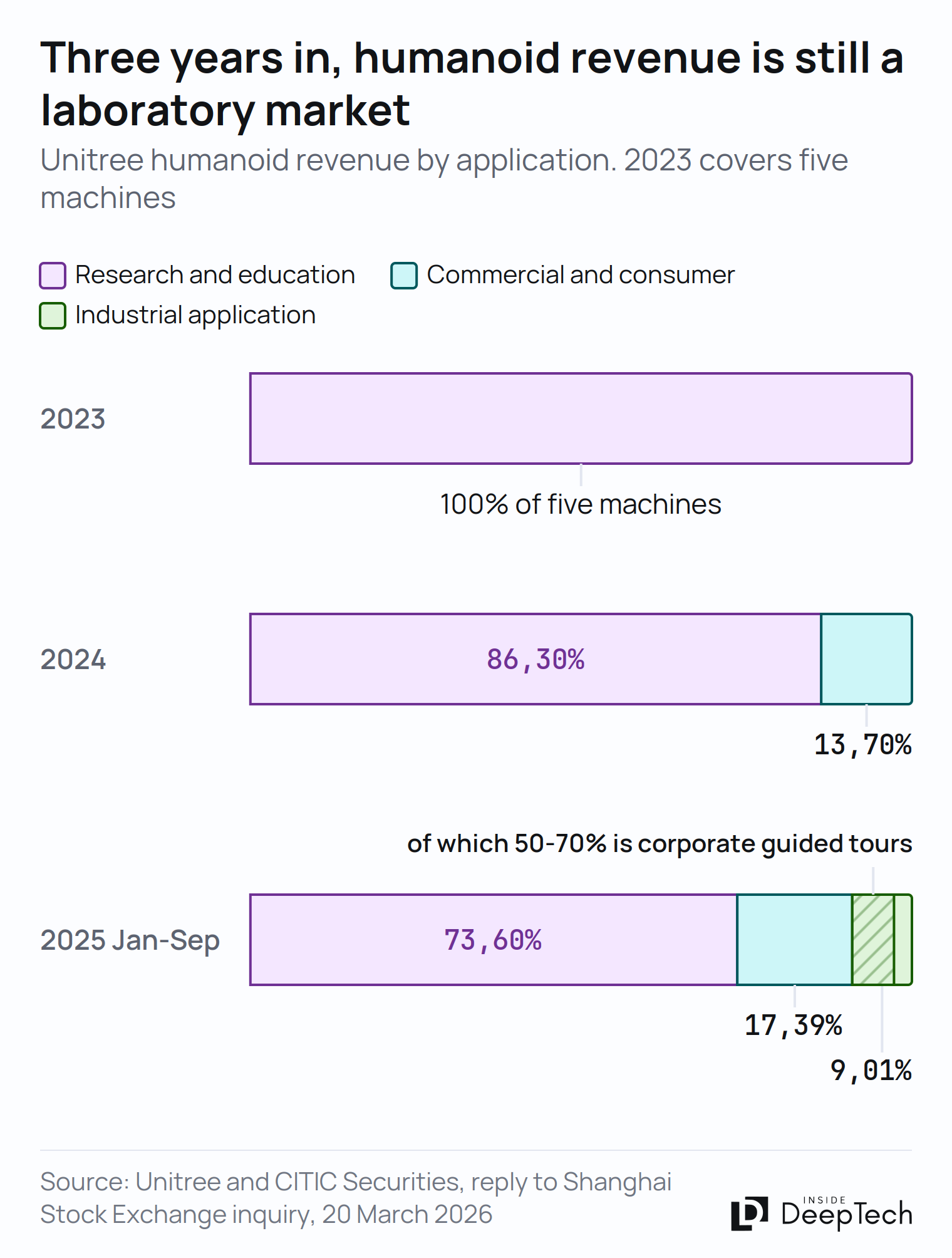
For the first nine months of 2025, research and education accounted for 438,07 million yuan, or 73,60% of humanoid revenue. Commercial and consumer took 103,52 million, or 17,39%. Industrial application took 53,60 million, or 9,01%.
A footnote to that table narrows the last figure considerably. Within industrial application, the filing says, corporate guided tours account for roughly 50% to 70%, with smart manufacturing and inspection making up the rest.
Work the arithmetic through and something under 5% of humanoid revenue comes from robots doing industrial work. The rest is laboratories and showrooms.
The trend does move. In 2023 the entire humanoid line, all five machines of it, went to research and education. In 2024 that was 86,30%. In the first nine months of 2025 it was 73,60%. Progress is real and it is measured in single-digit percentage points a year.
## What the quadrupeds show
The four-legged line is older, and it has already made the move the humanoids are starting.
In 2024, research and education still took 52,69% of quadruped revenue. By the first nine months of 2025 commercial and consumer had passed it, at 206,42 million yuan against 154,12 million, and industrial application had reached 127,44 million. Unit volumes went from 2 403 in 2022 to 17 946 in the first nine months of 2025.
That is the shape a market makes when it leaves the laboratory, and it took the quadruped line about six years. Anyone reading a humanoid forecast can use it as a clock.
## What moves the revenue line
Through 2024 Unitree sold more abroad than at home. In the first nine months of 2025 that reversed, with 702,16 million yuan from the domestic market against 452,79 million from overseas.
The filing explains the reversal directly. Domestic growth outpaced overseas mainly because the company's robots appeared at the Spring Festival gala broadcast at the start of 2025, which lifted brand recognition nationwide and drove domestic orders.
A company attributing a revenue reversal to a television appearance, in a document filed with a securities regulator, is describing the stage its market has reached. The overseas mix says the same thing from the other side. Research and education accounts for 68,37% of overseas humanoid and quadruped revenue, against 46,35% at home.
## The industry has no comparable shipment data
The exchange asked Unitree to quantify its market position. The answer is unusually candid.
Unitree gives two datasets for 2025 humanoid shipments. A report from CCID Media and China Electronics News puts global shipments at around 17 000 units, with Unitree above 5 500 and a 32,4% share. Omdia's market radar puts global shipments of general-purpose embodied robots at around 13 300, and once Unitree's own figure is corrected upward, around 14 600, giving Unitree 37,62%.
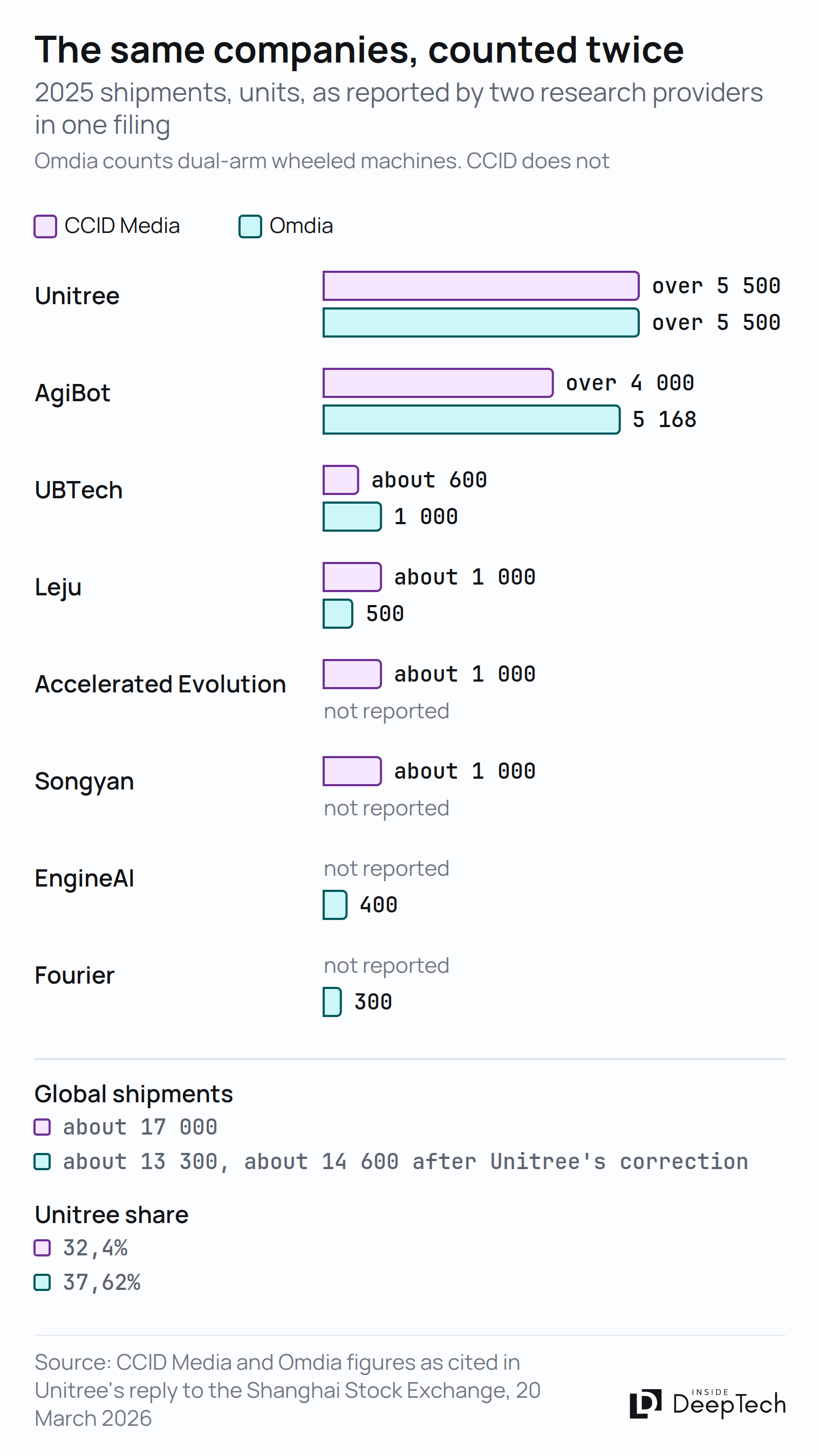
The two disagree on individual companies by wide margins. CCID puts AgiBot above 4 000 units; Omdia puts it at 5 168\. CCID puts UBTech at around 600; Omdia puts it at 1 000\. The gap comes from scope, since Omdia counts dual-arm wheeled machines and CCID does not.
The filing's own conclusion is that research organisations currently lack a relatively unified and comparable data source. That sentence appears in a submission to a securities regulator, from the company with the largest market share under either count.
The same problem shows up in the quadruped numbers, and the filing is precise about it. Reports that Unitree's quadruped share fell from 40,65% to 32,40% compare two different things. The first is a revenue share for 2023 from GGII, whose unit share for the same year was 69,75%. The second is a unit share for 2024 from IDC. Different agencies, different years, different measures. The document says plainly that they are not objectively comparable.
## What a humanoid robot costs, and what it earns
Unitree sold 5 humanoid units in 2023 at an average of 593 400 yuan. In 2024 it sold 410 at 260 700\. In the first nine months of 2025 it sold 3 551 at 167 600\. The average price fell by 71,8% in two years, while volume went from five units to 3 551.
Margins went up while prices came down. In the first half of 2025 the humanoid gross margin was 62,42%, and in the third quarter 63,91%. The quadruped line ran at 56,53% and then 53,39%.
The list prices show the same movement. The full-size H1 launched in August 2023 at 499 800 yuan. The H2, launched in October 2025, starts at 199 000\. The mid-size G1 has come down from 99 000 to 85 000\. The R1, launched in July 2025, starts at 39 900, and the R1 Air from November 2025 at 29 900\. For comparison the filing lists Figure 02 at about 59 000 US dollars and a Boston Dynamics Spot at 74 500.
Bought-in components account for 14% to 18% of total cost, excluding optional high-specification lidar and dexterous hands. Battery cells, compute modules, storage, some lidars, cameras and some dexterous hands are purchased. Motors, reducers, encoders, drivers and structural parts are designed in house.
## A competitor is one of its larger customers
The exchange asked about Galbot, a Beijing humanoid company that is both a peer of Unitree and a related party.
Galbot bought 17 700 yuan of Unitree hardware in 2023 and 364 700 yuan in 2024\. In the first nine months of 2025 it bought 15,14 million, which made it Unitree's largest direct-sales customer for the period, ahead of every overseas buyer. It uses the machines for its own model training and buys others to modify and resell.
The sponsor and the auditor visited Galbot's offices, looked at the robots and reported no stockpiling. Pricing sits between what dealers pay and what direct customers pay.
There is a second way to read this. In a field where the hardware is the hard part, one of the companies competing to build humanoids is buying its rival's machines by the hundred to train models on.
## What the company says about its own risk
The filing quotes the risk factor from the prospectus in full. Large-scale commercial application of humanoid robots still faces uncertainty and may fall short of expectations. Technological maturity is limited in the generalisation capability of embodied large models and in the precision and durability of dexterous hands.
Asked what stands between today and large-scale deployment, the company names two things and ranks them. The first and larger is the embodied model. Training data comes from laboratories or single customised settings and does not cover cross-scenario variation, so a model meets a production line changeover or an unexpected obstacle and fails. The second is the dexterous hand, where positioning accuracy is insufficient for fine work, tactile sensing is not sensitive enough to avoid damaging delicate parts, and flexibility trades against durability.
Both answers describe capability that does not exist yet, from the company that ships more of these machines than anyone.
## Questions readers ask
### How many humanoid robots did Unitree ship in 2025?
More than 5 500, excluding wheeled dual-arm machines. That gives the company either 32,4% or 37,62% of the world market depending on which research provider is counting, and both put it first.
### The 150 units attributed to Figure AI and Agility Robotics
The figure appears in Unitree's filing, sourced to public reports, and the filing states in the same sentence that neither company has confirmed it. Tesla is described separately as having no public sales, with its humanoids used for internal development and testing.
### What are the humanoid robots used for?
For the first nine months of 2025, 73,60% of humanoid revenue came from research and education, 17,39% from commercial and consumer use, and 9,01% from industrial application. Within that last slice, the filing puts corporate guided tours at 50% to 70%.
### What are Unitree's margins?
Gross margin in the third quarter of 2025 was 63,91% on humanoids and 53,39% on quadrupeds. In the first half of the year it was 62,42% and 56,53%. Prices fell across the period while margins held, which the filing puts down to in-house production of the core components.
### How large is the order book?
282 million yuan at the end of 2025, up 93,15% on the year and 23,14% on the previous quarter. Against the 1 154,95 million yuan of main business revenue reported for the first nine months of 2025, that is about two months of sales, which the company puts down to a business of frequent small orders.
### What about the robot rental market?
Daily rental for a G1 reached 8 000 to 15 000 yuan in early 2025 and fell to 3 000 to 5 000 by the third quarter. Rental accounts for less than 0,5% of revenue across the whole reporting period, so the price movement measures attention, and not the business.
### Who buys from Unitree?
2 494 offline customers in the first nine months of 2025, of which 38 spent more than 5 million yuan. The largest single customer for the period was JD.com, at 41,36 million yuan through e-commerce warehousing. Repeat purchase rates run at 56,58% in research and education, 30,94% in industrial application and 21,25% in commercial and consumer.
## What to watch
Watch the industrial percentage. It is 9,01% today with most of that being showroom tours, and it is the only number in this filing that would signal humanoid robots doing work. The quadruped line took about six years to make the same shift.
Watch whether a second company files. Unitree's disclosure is useful precisely because nobody else has to make it, and that is also its limitation, since every comparison in the document rests on research reports the company itself calls incomparable. A second filing would turn one data point into a series. Quantum computing went through that change in a single year, and [five of its twelve largest companies now file with a regulator](https://www.insidedeeptech.com/the-12-most-important-quantum-computing-companies-in-2026-ranked/).
Watch the order book against revenue. An order book of 282 million against 1 154,95 million of nine-month revenue is a company selling small and often. That works while demand comes from laboratories buying single units. It looks different if industrial customers ever start ordering by the hundred.
## Sources
All figures come from the [response by Unitree Robotics and CITIC Securities](https://static.sse.com.cn/stock/disclosure/announcement/c/202603/002178%5F20260320%5FOE27.pdf?ref=insidedeeptech.com) to the Shanghai Stock Exchange's pre-review inquiry, published on the exchange's disclosure server on 20 March 2026, which quotes the prospectus throughout. Listing details come from the exchange's own listing announcement: stock code 688836, 40 446 434 shares at 150,80 yuan, representing 10,00% of post-offering capital, admitted to trading on 19 August 2026.
Where the filing attributes a figure to a third party, this article says so. Where two research providers disagree, both numbers appear. No figure on this page comes from an aggregator.
### Who funds quantum, AI, robotics and photonics
URL: https://www.insidedeeptech.com/who-funds-quantum-ai-robotics-photonics/
Last updated: 2026-08-26T15:15:44.000Z
*Inside Deep Tech Editorial*
*Last updated: 17 August 2026*
In quantum, three of the five largest investors run funds that back quantum and almost nothing else. In robotics, none of the top five does. Both markets are served by the same pool of capital, and only one of them has built specialists.
That asymmetry decides who a founder talks to first, and it does not appear in any list of investors ranked by size alone.
What follows is the top five in each of the four markets this publication covers, ranked on the size of the last fund each firm announced as closed. For the full register of firms across all four markets, see our ranking of [the twenty deep tech firms funding the frontier](https://www.insidedeeptech.com/the-20-deep-tech-vc-firms-funding-the-frontier-ranked-by-activity/).
## How these are ranked
A firm appears in a market if it names at least one holding there in its own materials. Firms therefore appear in more than one list: Playground Global is in all four.
Ranking is by the last fund announced as closed. Where a firm has announced a target and reached only a first close, the closed figure is used and the target is noted. Amounts are given as announced and are not converted between currencies.
Holdings are those a firm names itself. What a firm publishes is not always everything it holds, so read the lists as illustrative.
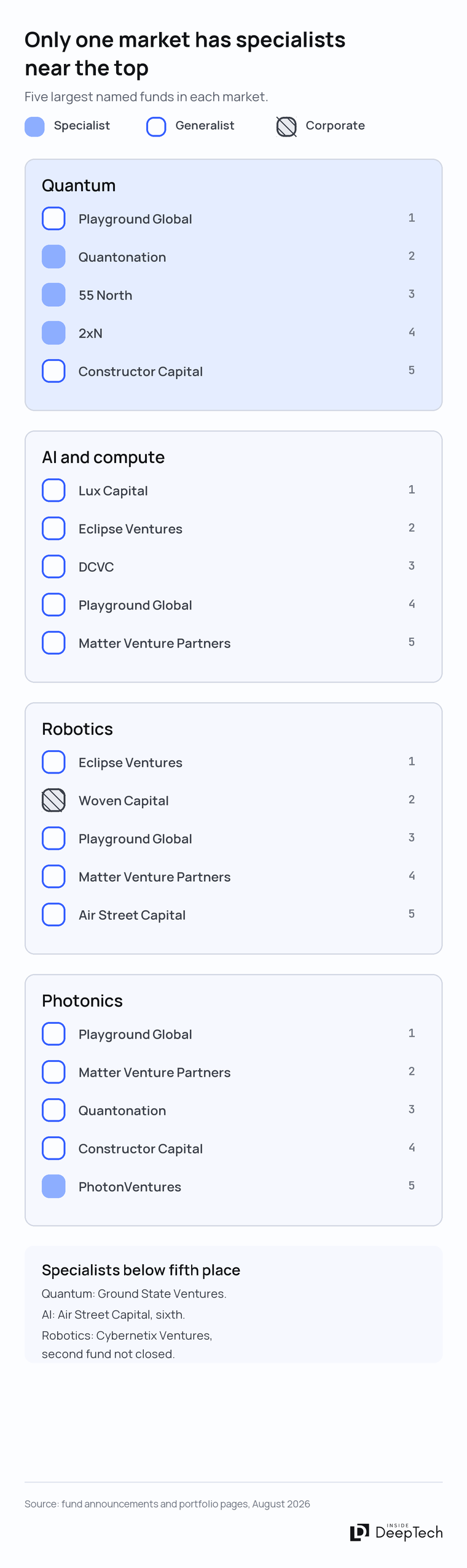
## Quantum
1. Playground Global, US. 475 million dollars, May 2026\. PsiQuantum, Phasecraft.
2. Quantonation, France, US. 220 million euros, February 2026\. Pasqal, Quandela, Diraq, Qblox, Nord Quantique.
3. 55 North, Denmark. 134 million euros first close, October 2025\. IQM, Kiutra.
4. 2xN, UK. 120 million dollars, August 2022\. Quantinuum, Kvantify, QuantrolOx.
5. Constructor Capital, Switzerland. 110 million dollars, February 2026\. QuEra, Qruise, Qendra, QDTI.
Also dedicated to quantum, below the top five: Ground State Ventures, known as QDNL Participations until April 2026, with 88 million dollars raised against an original target of 70 million and a final close approaching. Its first vehicle, 15 million euros committed in full by the foundation behind the Dutch national quantum programme, backed Qblox, QuantWare, QphoX and Q\*Bird.
Playground Global leads on size and comes last on focus. Its two quantum names pull in different directions: PsiQuantum is building towards a million-qubit photonic machine, Phasecraft writes algorithms for hardware that already exists.
Quantonation is the deepest specialist on this page, with more than forty companies sorted on its own site into quantum computing, networks, sensing, and deep physics. Its holdings cover most of the hardware approaches in contention at once: neutral atoms at Pasqal, photons at Quandela and ORCA Computing, silicon spin at Diraq and Quobly, superconducting error correction at Nord Quantique.
55 North was incubated by EIFO, Denmark’s export and investment fund, and co-anchored by Novo Holdings. It is targeting 300 million euros, which would make it the largest pure quantum vehicle anywhere. Its opening cheques went into IQM’s 275 million euro Series B and a Series A-2 at Kiutra, which builds the cryogenic cooling that superconducting and spin qubits depend on.
2xN holds the oldest vintage on this page. Its 120 million dollar second fund dates from August 2022, and both founders backed Cambridge Quantum before it merged into Quantinuum. The firm calls itself quantum-inspired, and its portfolio includes companies in mobility and education, so the label sits less tightly than on Quantonation or 55 North.
Constructor Capital closed its first fund at 110 million dollars and names four quantum companies, more than either of the two firms directly above it: QuEra in neutral atoms, Qendra in control systems for trapped-ion and neutral-atom experiments, Qruise in hardware calibration, QDTI in quantum-enabled diagnostics.
Four of the six firms named in this section invest in quantum and almost nothing else. No other market on this page looks like that.
## AI and compute
1. Lux Capital, US. 1,5 billion dollars, January 2026\. Hugging Face, Runway, MosaicML.
2. Eclipse Ventures, US. 1,3 billion dollars, April 2026\. Cerebras, Flex Logix.
3. DCVC, US. 725 million dollars, DCVC V. Mythic, MosaicML.
4. Playground Global, US. 475 million dollars, May 2026\. d-Matrix, NextSilicon, Vertical Semiconductor, Snowcap.
5. Matter Venture Partners, US. 300 million dollars, closed 2023\. Lumafield, OpenLight.
Also dedicated to this market, below the top five: Air Street Capital, 232 million dollars, March 2026\. Its mandate is artificial intelligence and nothing else, the only such case here, and it sits sixth on size.
Lux Capital took its positions before the current cycle, including Hugging Face and Runway, plus MosaicML, which Databricks bought in 2023\. Defence is a declared part of the mandate.
Eclipse Ventures invests at the silicon layer, with Cerebras and Flex Logix, and describes its target as the physical economy. It disclosed its raise through filings with the Securities and Exchange Commission, the only firm on this page whose fundraising can be checked against a regulatory document.
DCVC claims authorship of the term deep tech and has been investing against it since well before the label became common. Its compute holdings run from Mythic in analogue inference silicon to MosaicML.
Playground Global is thickest here of all four markets, and the names cluster around the constraints: d-Matrix and Snowcap on inference efficiency, NextSilicon on reconfigurable architectures, Vertical Semiconductor and PowerLattice on delivering power to accelerators without cooking them.
Matter Venture Partners was founded in 2023 by two former Kleiner Perkins investors and closed its first fund at 300 million dollars after going out for 200\. Its stated focus is hard tech across semiconductors, automation and electrification.
The specialist here is sixth by size. That is the whole shape of this market: the money is generalist, and the one firm with a pure mandate is smaller than the five above it.
## Robotics
1. Eclipse Ventures, US. 1,3 billion dollars, April 2026\. Mind Robotics, Clearpath Robotics, Augury.
2. Woven Capital, Japan. 800 million dollars, September 2025\. Nuro.
3. Playground Global, US. 475 million dollars, May 2026\. Agility Robotics, Boxbot, Fabric.
4. Matter Venture Partners, US. 300 million dollars, closed 2023\. Dexterity.
5. Air Street Capital, UK. 232 million dollars, March 2026\. Sereact.
Vsquared Ventures, at 214 million euros, is level with Air Street once the currencies are set side by side, and holds Neura Robotics.
Also dedicated to robotics, below the top five: Cybernetix Ventures. It announced a second fund in June 2025 with a 100 million dollar target, describing itself in its own release as raising and not as closed. Its first vehicle reached 25 million against a 50 million target. It is the only firm on this page whose sole market is robotics and physical AI.
This is the one market with no specialist in its top five. Robotics is not a small market, and the money reaches it through generalists and corporate arms instead.
Eclipse Ventures has moved further into physical systems than any other firm here. Mind Robotics builds industrial automation, Clearpath Robotics builds research and logistics platforms, Augury does machine health monitoring.
Woven Capital is Toyota’s growth-stage arm and a wholly owned subsidiary of the carmaker since September 2025, when Fund II was established at 800 million dollars. Its first cheque, back in 2021, went to the autonomous delivery company Nuro. A corporate parent changes what the money comes with. Distribution and manufacturing access arrive with it, and so does a strategic agenda.
Playground Global runs from humanoids at Agility Robotics to warehouse sortation at Boxbot. Skydio, which the firm files under aerospace on its own site, does not carry the robotics tag at all. These lines are drawn by the firms themselves and by no standard.
Matter Venture Partners co-led investments in Dexterity before the firm existed, when its founders were still at Kleiner Perkins.
Air Street Capital reaches robotics through its AI mandate. Sereact, its holding here, builds manipulation models for warehouses. That is the pattern across this whole market: robotics capital arrives as a subset of something else.
## Photonics
1. Playground Global, US. 475 million dollars, May 2026\. Ayar Labs, PicoJool, xLight.
2. Matter Venture Partners, US. 300 million dollars, closed 2023\. OpenLight.
3. Quantonation, France, US. 220 million euros, February 2026\. Quandela, ORCA Computing, Pixel Photonics, PINC, SteerLight.
4. Constructor Capital, Switzerland. 110 million dollars, February 2026\. Lumai, Akhetonics, VitreaLab.
5. PhotonVentures, Netherlands. 80 million euros, October 2024\. VitreaLab, QuiX Quantum, NcodiN, Astrape Networks.
PhotonVentures is the only firm here whose entire mandate is photonics, and it comes last on size. Spun out of PhotonDelta in 2023, it reached 75 million euros at its second close in April 2024 and 80 million that October when Invest-NL added five million, alongside the regional development agencies BOM and Oost NL, the research organisation TNO and the University of Twente. A final close at 100 million euros was planned for the end of 2024 and has not been announced. Invest-NL, a state institution, described it as one of the few dedicated photonics funds in Europe. Cheques run between one and 2,5 million euros, the tightest range on this page.
Playground Global tops this market through the compute bottleneck. Ayar Labs moves data between chips using light, PicoJool replaces copper with fibre inside data centres, and xLight is building an extreme ultraviolet source for lithography. All three answer the same question about where the power budget goes.
Matter Venture Partners led the 50 million dollar Series A-1 at OpenLight in April 2026, which designs application-specific photonic integrated circuits on a heterogeneous silicon platform.
Quantonation holds more photonics companies than its position suggests, because much of the quantum stack is optical: photonic quantum computers at Quandela and ORCA, single-photon detection at Pixel Photonics, nonlinear circuits in thin-film lithium niobate at PINC, and silicon-photonic lidar at SteerLight, which is not a quantum company at all.
Constructor Capital holds three optical computing and display companies: Lumai in three-dimensional optical processing, Akhetonics in all-optical logic, VitreaLab in light engines for augmented reality. VitreaLab is also in the PhotonVentures portfolio.
## The asymmetry, and what it costs
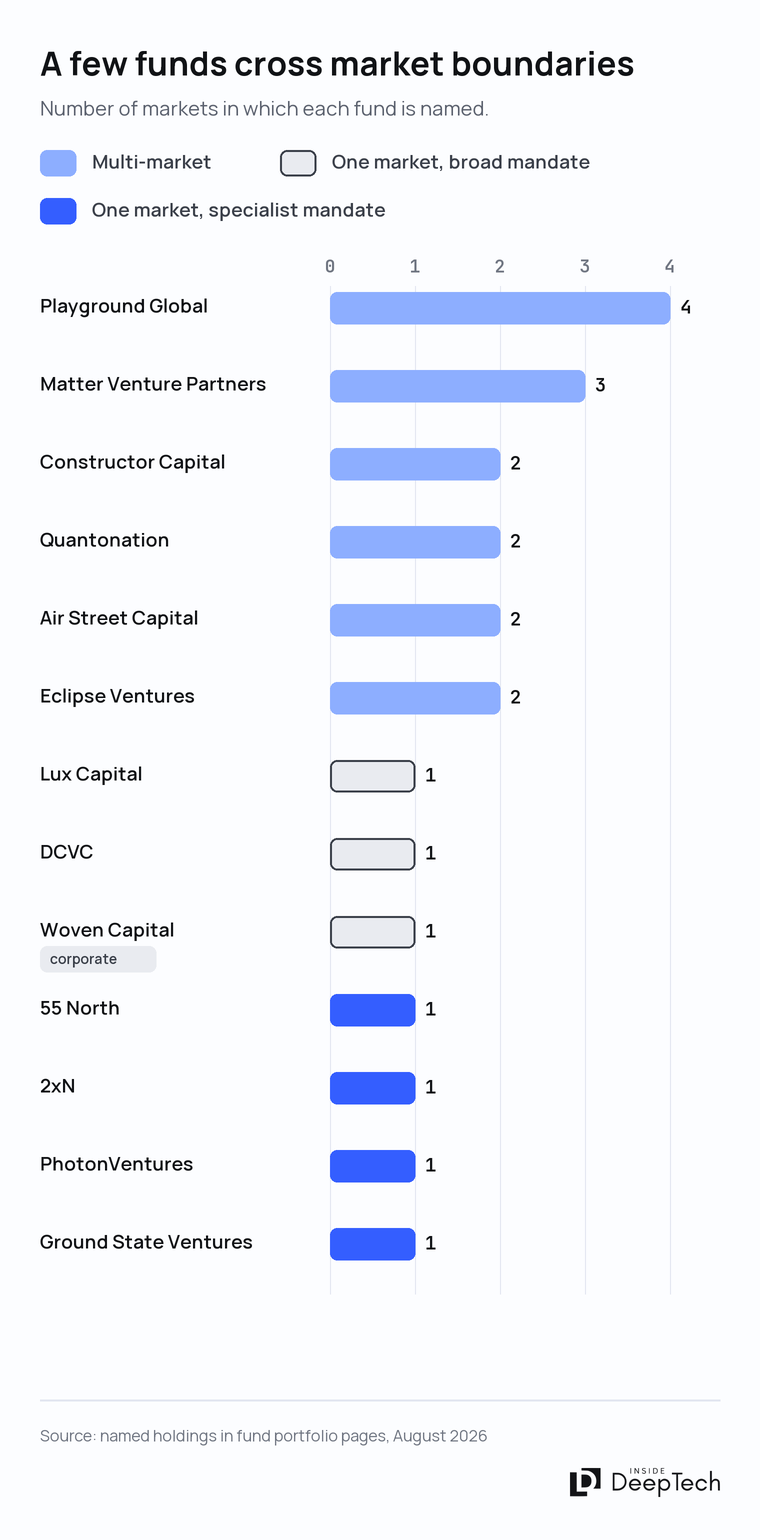
Count the specialists across the four markets and the pattern is not subtle. Quantum has three in its top five and a fourth just below it. Photonics has one, in fifth place. AI and compute has one, in sixth place. Robotics has none inside the top five, and the one dedicated firm has not closed its second fund.
Specialists cluster where the science is hardest to evaluate and the market is smallest. That is not a coincidence: a generalist can price a robotics company against comparable industrial businesses, and cannot price a trapped-ion company against anything.
For a founder the consequence is direct. In quantum and photonics there is a real choice between a specialist and a generalist, and the specialist will usually be the smaller cheque with the longer patience and the shorter follow-on reserve. In robotics that choice does not exist yet, and the terms follow from that: the money is generalist or corporate, and it will want the science explained.
## Questions readers ask
### Which investors fund quantum computing?
Quantonation, 55 North, 2xN and Ground State Ventures run funds dedicated to quantum. Playground Global and Constructor Capital hold quantum companies inside broader mandates. Quantonation is the largest of the specialists at 220 million euros, and Playground is the largest investor in the market overall at 475 million dollars.
### Are there dedicated robotics venture funds?
One appears in this research: Cybernetix Ventures, whose sole market is robotics and physical AI. It announced a second fund with a 100 million dollar target in June 2025 and describes itself as raising. Every firm in the robotics top five invests across several markets.
### Who invests in photonics?
PhotonVentures is the only fund here whose entire mandate is photonics, at 80 million euros. Playground Global, Matter Venture Partners, Quantonation and Constructor Capital all hold photonics companies inside broader strategies, and Quantonation reaches the field through the optical parts of the quantum stack.
### Should a founder approach a specialist or a generalist?
Specialists understand the science and write smaller cheques. Generalists write larger cheques and will need the science explained. The practical question is which risk hurts more in your market: being misunderstood at the term sheet, or running out of follow-on capital at Series B.
### Why do the same firms appear in several markets?
A firm appears wherever it names a holding, and most of these firms invest across several markets. Playground Global appears in all four and Matter Venture Partners in three. Constructor Capital, Quantonation, Air Street Capital and Eclipse Ventures appear in two each. Only the specialists appear once.
### Where is the full list of deep tech firms?
In our ranking of the twenty firms funding the frontier, which covers all four markets in one register and includes firms that publish no fund size at all.
## What these lists are for
A firm’s fund size tells a founder how long it can support them and how many companies it has to support alongside them. Neither number appears in a pitch, and both decide what happens at the second round.
The lists will be updated as funds close. Anything a firm would like corrected can be sent to the editorial address, and corrections are marked on the page.
## Sources
Fund sizes and dates are taken from each manager’s own announcement. Holdings are taken from portfolio pages that were opened and read in August 2026 for Playground Global, Quantonation, Constructor Capital, Air Street Capital and Eclipse Ventures, and from the firms’ own announcements for the rest, which means those lists are shorter than the portfolios behind them.
### 800 VDC Power Distribution: A Full Guide to How AI Data Centers Leave 48-Volt Behind
URL: https://www.insidedeeptech.com/800-vdc-power-distribution-ai-data-centers-full-guide/
Last updated: 2026-10-05T09:11:32.000Z
*Last light touch: October 2026*
*Last updated: September 2026*
800 VDC is not a new way to make electricity, and it is not a cooling loop. It is not the silicon carbide MOSFET or the gallium nitride HEMT inside a power supply. It is the electrical-distribution architecture: convert medium-voltage AC once, at the perimeter of the hall, into roughly 800 volts of DC, run that DC down a busway instead of a 415/480 VAC feeder, and convert once more at the tray into the 54 V, 12 V, or 6 V the GPU can actually use. The product the operator buys is still a rectifier, a sidecar, a busway, a DC breaker, a UPS, or a rack-level DC/DC shelf. The thing that changed is the voltage the hall is wired at.
That split exists because the alternative ran out of copper. For twenty years, server power was a 12-volt, then a 48- or 54-volt, problem solved with in-rack CRPS or Open Rack v3 shelves, a 415 or 480 VAC row, and a transformer-and-UPS room at the other end of the feeder. At 10 kW a rack, that stack is boring and cheap. At 100–120 kW it is a busbar with a cooling problem. At a megawatt it is a physics argument NVIDIA has already named: 800 VDC, starting in 2027 with Kyber-class systems, not as a 2026 bill of materials.
What changed in 2026 is not that high-voltage DC was invented. Telecom has run −48 VDC for decades; 380 VDC data-center pilots have come and gone; the EV industry industrialized 800-volt traction inverters and made the connector, the breaker, and the isolation practice that data-center vendors are now borrowing. What changed is that AI racks crossed the current density where a 54-volt busbar stops being a product and starts being a foundry for copper, that NVIDIA, Google, and Microsoft put an 800 VDC architecture through the Open Compute Project, and that the 2026 volume path is still a 50-volt bus fed by 5.5–12 kW shelves. The useful question is which of those pieces is a shipping sidecar, which is a GTC demo, and which is still a 2028 facility drawing.
This is the dedicated electrical-distribution guide. The transistors that make 800-volt conversion efficient live in the [SiC and GaN power electronics full guide](https://www.insidedeeptech.com/sic-gan-power-electronics-ai-data-centers-full-guide/). Generation, including the [small modular reactors](https://www.insidedeeptech.com/small-modular-reactors-nuclear-power-ai-data-centers/) hyperscalers keep announcing, is a different object. Heat is a [liquid-cooling](https://www.insidedeeptech.com/data-center-liquid-cooling-ai-full-guide/) object. We do not re-derive them here.
### Key takeaways
- **800 VDC is distribution, not generation, not heat removal, and not the FET.** A reactor, a gas turbine, or a utility interconnect makes the megawatts. A [CDU](https://www.insidedeeptech.com/data-center-liquid-cooling-ai-full-guide/) takes the heat back out of the GPU and the converter. [SiC and GaN](https://www.insidedeeptech.com/sic-gan-power-electronics-ai-data-centers-full-guide/) are the switches inside the rectifier and the tray converter. This guide is the bus: facility medium voltage in, 800 VDC down the hall, one late-stage conversion at the compute. [Backside power delivery](https://www.insidedeeptech.com/backside-power-delivery-powervia-full-guide/) is a fourth, unrelated conversation: millivolt grids on a GAAFET die, not kilovolt grids in a rack.
- **48 V and 54 V did not fail. They ran out of copper at 100–200 kW, and they become geometrically illegal at a megawatt.** Power is voltage times current. A 120 kW GB200-class rack at 54 V is about 2,200 A. A 1 MW rack at 54 V is about 18,500 A. [NVIDIA’s own 800 VDC architecture note](https://developer.nvidia.com/blog/nvidia-800-v-hvdc-architecture-will-power-the-next-generation-of-ai-factories/?ref=insidedeeptech.com) puts the busbar in that 1 MW rack at up to 200 kg of copper, 200 tonnes of rack busbar copper in a 1 GW campus, and says a 54 V Kyber would consume up to 64 U of power-shelf space, leaving no room for compute. At 800 V the same 1 MW is 1,250 A.
- **NVIDIA’s architecture is a facility argument, dated to 2027, with a 2026 hybrid on-ramp.** Convert 13.8 kV AC toward 800 VDC at the perimeter with industrial rectifiers (or, later, a solid-state transformer). Distribute 800 VDC on two conductors. Convert once at the tray. [NVIDIA quotes up to 5% end-to-end efficiency](https://developer.nvidia.com/blog/nvidia-800-v-hvdc-architecture-will-power-the-next-generation-of-ai-factories/?ref=insidedeeptech.com) versus today’s 54 V path, 85% more power through the same conductor versus 415 VAC, and 45% less copper. Treat those as NVIDIA’s. Treat the date as a product-roadmap date: native 800 VDC and 1 MW IT racks coincide with Kyber in 2027\. The 2026 object is an MGX-compatible 800 VDC power rack that slots into existing AC. **Three layers will coexist, and the sidecar is the 2026–2027 one.** NVIDIA’s August 2026 DSX language, Vertiv’s PowerDirect 5000, and Schneider’s own FAQ all describe the same sequence: a rack-adjacent sidecar that keeps the building on AC (H2 2026 commercialization, 2027 deployments); a row power center on an overhead 800 VDC busway, up to 2 MW per row, expected 2027; a facility DC power block that converts MV AC to 800 VDC once, for greenfield AI factories later. Vertiv’s Scott Armul, May 2026: “DC power in the rack moving to DC power in the pod.”
- **Who actually ships is switchgear vendors and PSU OEMs, not a GPU press release.** Vertiv: PowerDirect 5000 sidecar, 400–900 kW, portfolio commercial in H2 2026, customer pilots and ramp in 2027\. [Eaton: 2 MW, 15 kV-class medium-voltage solid-state transformer](https://www.eaton.com/us/en-us/catalog/medium-voltage-power-distribution-control-systems/medium-voltage-solid-state-transformer.html?ref=insidedeeptech.com) rated >97% at 800 VDC output, plus the Beam Rubin DSX grid-to-chip platform. Schneider Electric: [Galaxy VXL UPS at 500–1,250 kW](https://www.media-outreach.com/news/hong-kong/2025/04/07/373424/schneider-electric-announces-galaxy-vxl-ups-the-industrys-most-compact-high-density-power-protection-system-for-ai-data-center-and-large-scale-electrical-workloads/?ref=insidedeeptech.com) and a sidecar retrofit path they themselves cap at about 200 kW per rack. Delta: a 660 kW in-row 800 VDC rack with 480 kW of embedded battery backup, [shown at GTC 2026](https://www.prnewswire.com/news-releases/deltas-power-cooling-and-microgrid-solutions-showcased-at-nvidia-gtc-to-bolster-the-800-vdc-architecture-of-next-gen-ai-factories-302714372.html?ref=insidedeeptech.com). Those are real products and demos. They are not a 2026 GB200 hall.
- **The unsolved problem is not the converter efficiency number.** It is DC protection, busway and connector ratings, arc-flash procedure, a technician who can service an 800-volt rack alive, energy storage that actually damps GPU step-loads, and a multi-vendor stack that has been qualified together. [NVIDIA’s own architecture post flags overcurrent protection](https://developer.nvidia.com/blog/nvidia-800-v-hvdc-architecture-will-power-the-next-generation-of-ai-factories/?ref=insidedeeptech.com) as a remaining innovation item. A 98% PSU does not write that procedure.
## 800 VDC at a glance
| Attribute | Detail |
| ------------------------ | --------------------------------------------------------------------------------------------------------------------------------------------------------------------------------------------------------------------------------------------------------------------- |
| What it is | Facility-to-rack DC electrical distribution at a nominal 800 V, with conversion from medium-voltage AC at the perimeter or in a sidecar, and a late-stage DC/DC at the tray |
| What it is not | A generation source, a liquid-cooling loop, a wide-bandgap transistor, an on-die backside power grid, a 2026 volume hall, or a drop-in for every 415/480 VAC feeder |
| Core trick | Raise distribution voltage so current (and therefore copper, I²R loss, and in-rack PSU volume) falls; delete intermediate AC/DC stages by converting once |
| Key hardware | Industrial rectifiers or MV solid-state transformers, 800 VDC busway and switchgear, DC breakers/solid-state protection, sidecars and in-row power racks, rack DC/DC (including 64:1 LLC), BBU/BESS and supercapacitors |
| Transmission medium | Two-conductor DC (positive, return, plus PE) instead of three-phase AC; current still leaves the building as copper, just less of it, at a higher voltage |
| Main applications | 400 kW–1 MW AI racks, Kyber-class native 800 V compute, brownfield sidecars on existing AC halls, row-level 800 VDC busways |
| Deployed today | 48/54/50 V CRPS and ORv3 on 100–150 kW racks. 800 VDC: sidecars and in-row racks entering commercialization H2 2026, OCP specs, MGX ecosystem parts, GTC/investor demos. Native Kyber: 2027 |
| Biggest unsolved problem | Turning 800 VDC from a converter and a white paper into a qualified, serviceable, arc-flash-rated, multi-vendor rack and facility stack (protection, connectors, busway, storage, and a procedure a technician survives) without pretending 2026 halls already run it |
## What 800 VDC actually is
Start with the thing it is not. It is not an [SMR](https://www.insidedeeptech.com/small-modular-reactors-nuclear-power-ai-data-centers/). A reactor makes megawatts at 13.8 kV or whatever the interconnect is; this architecture does not. It is not [direct-to-chip liquid cooling](https://www.insidedeeptech.com/data-center-liquid-cooling-ai-full-guide/). A cold plate removes heat after the GPU and the converter have already turned watts into waste. It is not [SiC or GaN](https://www.insidedeeptech.com/sic-gan-power-electronics-ai-data-centers-full-guide/). Those are the switches inside the boxes this guide is about. It is not [backside power](https://www.insidedeeptech.com/backside-power-delivery-powervia-full-guide/). PowerVia moves a millivolt-class grid to the back of a logic die. An 800-volt busway in a hot aisle is a different object, in a different package, on a different voltage, bought by a different team.
An electrical-distribution architecture is a voltage, a conversion schedule, and a protection scheme. Today’s AI hall takes utility medium voltage (often 13.8 kV in North America, 10–35 kV elsewhere), steps it down to 415 or 480 VAC, conditions it through an AC UPS, runs three-phase AC down a busway or a set of PDUs, and converts to \~50–54 VDC in power shelves inside the rack. [NVIDIA’s GB200 NVL72 user guide](https://docs.nvidia.com/dgx/dgxgb200-user-guide/hardware.html?ref=insidedeeptech.com) is the existence proof at approximately 120 kW: eight shelves, six air-cooled 5.5 kW PSUs per shelf, a nominal 50–51 V DC bus, N+N. That is a 48/54 V world. It is the 2026 volume path.
800 VDC deletes stages. The target end-state, in [NVIDIA’s May 2025 architecture blog](https://developer.nvidia.com/blog/nvidia-800-v-hvdc-architecture-will-power-the-next-generation-of-ai-factories/?ref=insidedeeptech.com) and the [October 2025 ecosystem follow-up](https://developer.nvidia.com/blog/building-the-800-vdc-ecosystem-for-efficient-scalable-ai-factories/?ref=insidedeeptech.com), is: convert 13.8 kV AC to 800 VDC once, at the data-center perimeter, with industrial-grade rectifiers; distribute 800 VDC through the hall and the row; accept two-conductor 800 V at the IT rack; convert DC-to-DC in the compute rack down to 54 V or 12 V and then to core voltage. The Kyber-specific version puts a late-stage, high-ratio 64:1 LLC converter next to the GPU and steps 800 V to 12 V in one stage, occupying 26% less area than the multi-stage path, per NVIDIA. Three output conventions (50 V, 12 V, and 6 V) will coexist on the tray; that fight lives in the device guide. This one stops at the bus.
±400 VDC is a topology fork, not a different architecture. Vertiv, Infineon, and ST all say they can serve a bipolar ±400 V bus with 650 V devices more comfortably than a monopolar 800 V bus. It is the same copper argument with a different isolation and grounding drawing. Do not treat it as a rival standard until a hyperscaler PO says so.
## Why 48 V and 54 V ran out of copper
The congestion is not a slogan. It is current, busbar cross-section, and a 42U hole.
**Current.** *P = V × I.* Raise voltage, drop current, drop I²R, drop copper. The integers:
| Rack power | Current at 12 V | Current at 54 V | Current at 800 V |
| -------------------- | --------------- | --------------- | ---------------- |
| 120 kW (GB200-class) | 10,000 A | \~2,220 A | 150 A |
| 400 kW | 33,300 A | \~7,410 A | 500 A |
| 1 MW (Kyber-class) | 83,300 A | \~18,500 A | 1,250 A |
Source: Inside Deep Tech arithmetic (I = P / V) on rack powers from [NVIDIA 800 VDC architecture blog (1 MW rack framing)](https://developer.nvidia.com/blog/nvidia-800-v-hvdc-architecture-will-power-the-next-generation-of-ai-factories/?ref=insidedeeptech.com), [NVIDIA DGX GB200 user guide (120 kW rack)](https://docs.nvidia.com/dgx/dgxgb200-user-guide/hardware.html?ref=insidedeeptech.com).
A 2,200 A 54 V busbar at 120 kW is a product. A 7,400 A busbar at 400 kW is a foundry. Schneider Electric’s own AI-factory FAQ is blunt: above 400 kW, traditional 54 VDC “becomes physically impossible.” [Vertiv puts the break between 350 and 400 kW](https://www.vertiv.com/en-emea/insights/articles/blog-posts/from-rack-to-data-hall-the-practical-path-to-800-vdc/?ref=insidedeeptech.com), where “connector sizes, busbars, and the sheer volume of copper needed to carry that much current start to run out of room.” [NVIDIA’s number is the one to tattoo](https://developer.nvidia.com/blog/nvidia-800-v-hvdc-architecture-will-power-the-next-generation-of-ai-factories/?ref=insidedeeptech.com): a single 1 MW rack on 54 VDC requires up to 200 kg of copper busbar. Scale that by a gigawatt of IT and the rack busbars alone are 200,000 kg. That is not a sustainability slide. It is a copper-mine and a crane.
**Volume inside the rack.** GB200 NVL72 and GB300 NVL72 already use up to eight power shelves. NVIDIA’s architecture post is explicit about the next step: the same 54 VDC distribution at Kyber megawatt scale would consume up to 64 U of rack space, the entire cabinet, leaving no room for compute. The alternative shown at GTC 2025 was an 800 V sidecar feeding 576 Rubin Ultra GPUs in one Kyber rack, or a dedicated power-supply rack for every compute rack. Sidecar versus sister-rack is a floorplan argument. Both are admissions that the PSU no longer fits next to the GPU.
**Conversion count.** Today’s path is MV AC → LV AC (transformer) → UPS AC → row AC → rack AC/DC → tray DC/DC → core. Every stage has a loss, a fan, a failure mode, and a maintenance ticket. [NVIDIA’s claim is that converting once at the perimeter](https://developer.nvidia.com/blog/nvidia-800-v-hvdc-architecture-will-power-the-next-generation-of-ai-factories/?ref=insidedeeptech.com) and once at the tray cuts that chain, improves end-to-end efficiency by up to 5% versus 54 V, and (in the same post) cuts TCO by up to 30% through efficiency, reliability, and architecture. The 5% is the number the industry has repeated; the 30% is NVIDIA’s bundled TCO framing. Use the first as a physics-scale claim. Use the second as a vendor claim.
**Why 48/54 V still won the last decade.** Open Compute and the 48 V rack were themselves a copper argument against 12 V. They worked. A 120 kW NVL72 is the proof. The wide-bandgap content in those 5.5–12 kW shelves is how you keep 50 V legal at 120 kW; it is not how you keep 50 V legal at 1 MW. Mixing those two sentences is how a 2026 hall gets specified for the wrong busway.
## 415/480 VAC, 48/54 V, and 800 VDC in one table
Two comparisons get sold as one. Facility AC versus facility DC is one. Rack 54 V versus rack 800 V is the other. They stack.
| | 12 VDC rack (legacy) | 48/54/50 VDC rack (2026 volume) | 415/480 VAC facility (2026 volume) | 800 VDC facility-to-rack (target) |
| ----------------- | ----------------------------- | --------------------------------------------- | ------------------------------------------------------- | ---------------------------------------------------------------------------------- |
| Where it lives | Inside the tray / old 1U | Busbar in the rack, from CRPS or ORv3 shelves | Row busway, PDU, UPS output | Perimeter rectifier or sidecar → hall/row busway → tray DC/DC |
| Current at 120 kW | 10,000 A | \~2,200–2,500 A | \~170 A/phase at 415 V three-phase (order of magnitude) | 150 A |
| Current at 1 MW | Impossible in a rack | \~18,500 A | \~1,400 A/phase class | 1,250 A |
| Copper story | Lost. That is why 48 V exists | Holds at 100–150 kW; fails at 350–400 kW+ | Skin effect, reactive power, four-wire | NVIDIA: 85% more power, same conductor, vs 415 VAC; 45% less copper; two-wire + PE |
| Conversion | POL only | AC/DC in the shelf, then IBC/POL | Transformer + UPS + rack PSU | One AC/DC at perimeter or sidecar; one high-ratio DC/DC at tray |
| 2026 status | Dead for AI racks | GB200 NVL72, GB300, most training halls | Default building electrical | Sidecars, OCP specs, H2 2026 commercial; native Kyber 2027 |
| What it is not | A 2026 option | An 800 V hall | A copper solution at 1 MW/rack | A 2026 BOM for the hall you are fitting this quarter |
Source: [NVIDIA 800 VDC architecture blog](https://developer.nvidia.com/blog/nvidia-800-v-hvdc-architecture-will-power-the-next-generation-of-ai-factories/?ref=insidedeeptech.com), [NVIDIA DGX GB200 user guide](https://docs.nvidia.com/dgx/dgxgb200-user-guide/hardware.html?ref=insidedeeptech.com), [Vertiv, From rack to data hall](https://www.vertiv.com/en-emea/insights/articles/blog-posts/from-rack-to-data-hall-the-practical-path-to-800-vdc/?ref=insidedeeptech.com).
NVIDIA’s row-level claim is the AC-versus-DC sentence: switching distribution from 415 VAC to 800 VDC “enables 85% more power to be transmitted through the same conductor size” because higher voltage drops current, and DC drops skin effect and reactive power. Copper requirement “by 45%.” Schneider repeats the 45% copper and 5% efficiency figures on its AI-factory power page. Those are the same ecosystem numbers. They are not a third-party audit of a built hall.
The 54 V path is not “AC.” It is DC at the wrong voltage. A 415 VAC hall feeding 54 V shelves is the 2026 default. An 800 VDC hall feeding 800 V trays is the 2027 target. A 415 VAC hall feeding an 800 V sidecar feeding 800 V trays is the bridge. Three drawings. One press cycle.
## From medium voltage to the rack
Follow the current, because the slides will not.
**Today (shipping).** Utility MV (NVIDIA’s example: 13.8 kV; NVIDIA’s later ecosystem post also writes 35 kV-class) lands on a substation transformer. Low-voltage AC, typically 415 V in IEC land and 480 V in much of the US, feeds an AC UPS, [Schneider’s Galaxy VXL is the AI-density SKU](https://www.media-outreach.com/news/hong-kong/2025/04/07/373424/schneider-electric-announces-galaxy-vxl-ups-the-industrys-most-compact-high-density-power-protection-system-for-ai-data-center-and-large-scale-electrical-workloads/?ref=insidedeeptech.com), 500–1,250 kW in 1.2 m². UPS output rides a busway or a set of PDUs down the row. At the rack, CRPS or ORv3 shelves convert to \~50–54 V. Inside the tray, an intermediate bus converter and a swarm of point-of-load bucks make core, HBM, and NIC rails. Battery backup, if it is at the rack, is an ORv3-style BBU on the 48/54 V bus.
**Bridge (H2 2026 commercialization, 2027 deployments).** Keep the building on AC. Put a three-phase AC-to-800 VDC conversion in a sidecar or an in-row power rack next to the compute. [Vertiv’s PowerDirect 5000 is the named object](https://www.vertiv.com/en-emea/insights/articles/blog-posts/from-rack-to-data-hall-the-practical-path-to-800-vdc/?ref=insidedeeptech.com): 400 kW to 900 kW of 800 VDC into the GPU rack over a busbar, returning the 8–16 U the power shelves used to occupy. [NVIDIA’s August 2026 DSX blog](https://blogs.nvidia.com/blog/800-vdc-power-architecture-ai-factory/?ref=insidedeeptech.com) calls the same object an “MGX-compatible 800 VDC power rack, arriving in the second half of 2026,” designed to “slot into existing AC infrastructure and deliver 800 VDC to compute racks within the row, no changes to the building’s electrical system required.” [Delta’s GTC 2026 in-row 660 kW rack](https://www.prnewswire.com/news-releases/deltas-power-cooling-and-microgrid-solutions-showcased-at-nvidia-gtc-to-bolster-the-800-vdc-architecture-of-next-gen-ai-factories-302714372.html?ref=insidedeeptech.com) (six 110 kW shelves, 80 kW BBU per shelf, 480 kW of embedded backup, 18.5 kW AC/DC PSUs at up to 98%) is the PSU-OEM version of the same sentence. Schneider’s FAQ is the honest constraint: facilities that currently support up to 200 kW per rack can often take a DC sidecar; above 400 kW you are in purpose-built or heavily modified infrastructure.
**Native (2027+ greenfield).** Convert MV AC to 800 VDC once, at the perimeter. NVIDIA’s “DC power block” is that unit. [Eaton’s MVSST is one way to build it](https://www.eaton.com/us/en-us/catalog/medium-voltage-power-distribution-control-systems/medium-voltage-solid-state-transformer.html?ref=insidedeeptech.com): 15 kV class, 2 MW, >97% at 800 VDC, 12 isolated ports, pad-mount, and a spec sheet that also lists EV charging, because the industrial base is the EV industrial base. Vertiv describes two parallel facility paths: an MV DC UPS (transformer plus rectifier) as the higher-readiness first mover, and an SST whose supply chain “still has ground to cover.” NVIDIA, Google, and Microsoft published a joint 800 VDC white paper through OCP in March 2026 and an LVDC SST specification v0.3 in July 2026; NVIDIA’s August 2026 telling is “more than 80” companies building to it. A spec and eighty logos are a supply chain forming. They are not a commissioned hall.
**At the tray.** Direct 800 V into the compute rack. NVIDIA Kyber: high-ratio 64:1 LLC, 800 V to 12 V adjacent to the GPU. The device-level 800-to-50/12/6 V boards (Infineon, ST, Navitas, EPC) are the [SiC/GaN](https://www.insidedeeptech.com/sic-gan-power-electronics-ai-data-centers-full-guide/) story. The distribution story is that the tray is no longer allowed to hide an AC/DC stage. That is the whole point of moving conversion out.
**Storage sits on the DC bus, or it is in the way.** AI training is a synchronous load. NVIDIA, Microsoft, and OpenAI documented grid-scale oscillations from synchronized GPUs; [NVIDIA’s ecosystem post says a rack can swing](https://developer.nvidia.com/blog/building-the-800-vdc-ecosystem-for-efficient-scalable-ai-factories/?ref=insidedeeptech.com) from \~30% “idle” to 100% and back in milliseconds, and that hundreds of megawatts ramping in seconds is a utility-interconnect problem. The 800 VDC architecture is supposed to make storage a low-pass filter: capacitors and supercapacitors at the rack for milliseconds-to-seconds, facility BESS at the interconnect for seconds-to-minutes. Eaton’s 2025 reference architecture literally puts supercapacitors in the drawing. Delta puts aluminum capacitors in the 18.5 kW PSU and 80 kW BBUs in the shelf. This is not UPS-as-insurance. It is UPS-as-filter. A hall that copies the 800 V busway and skips the storage is a hall that will fail a step-load test and then a grid-code test.
## NVIDIA’s architecture, in the order it actually arrives
NVIDIA is not a switchgear company. It is the load. [The May 2025 architecture post (updated July 2025)](https://developer.nvidia.com/blog/nvidia-800-v-hvdc-architecture-will-power-the-next-generation-of-ai-factories/?ref=insidedeeptech.com) is the physics: 1 MW IT racks in 2027, industrial rectifiers at 13.8 kV → 800 VDC, up to 5% end-to-end efficiency, up to 70% lower maintenance from fewer in-rack PSU failures (that 70% is NVIDIA’s, not an operator study). Silicon, PSU, and facility partners fill the rest of the page; the October 2025 ecosystem post added ABB, GE Vernova, Hitachi Energy, Mitsubishi, Siemens, and the Kyber 64:1 LLC.
**The staged product (August 2026).** Existing factories do not have to wait for a greenfield DC block.
1. **Power rack / sidecar, H2 2026.** MGX-compatible, hybrid, existing AC, 800 VDC to the compute rack in the row. This is the object Vertiv, Delta, and Schneider are all describing. It is how you put Kyber-class voltage onto a floor that was poured for 480 VAC.
2. **Row power center, 2027.** Centralized power station for a full row, overhead 800 VDC busway, “up to 2 megawatts per row.” This is Vertiv’s “DC power in the pod.” It is also where DC breakers, busway ampacity, and a service procedure stop being a rack problem and start being a hall problem.
3. **DC power block, new facilities.** Medium voltage to 800 VDC in one step. SST or industrial rectifier. The decade-ahead drawing.
DSX is the reference-design wrapper around those three. OCP is the interoperability wrapper. [Vladimir Troy, NVIDIA VP of data center infrastructure, August 2026](https://blogs.nvidia.com/blog/800-vdc-power-architecture-ai-factory/?ref=insidedeeptech.com): “Through OCP, NVIDIA is working with more than 80 ecosystem companies to give AI factories a practical path forward, not just a future vision.” A practical path is a product you can order, a spec a second vendor can build to, and a date. Two of those exist. The date on native halls is still 2027.
**What NVIDIA is not claiming, if you read it cold.** It is not claiming GB200 halls are 800 VDC. It is not claiming the 30% TCO or 70% maintenance figures have been measured on a production AI factory. It is not claiming the SST is the 2026 default versus a transformer-plus-rectifier. It is not claiming 800 VDC creates megawatts at the utility. [Inference TCO](https://www.insidedeeptech.com/the-real-cost-of-running-ai-in-2026-inference-chips-compared) is still the accelerator, the HBM, and utilization. A 1–5% conversion win is real hall-scale money. It is not a substitute for a fuller rack or a [new interconnect](https://www.insidedeeptech.com/small-modular-reactors-nuclear-power-ai-data-centers/).
## Who actually ships
A GPU architecture is a load spec. A shipping electrical product is a SKU, a date, and a service organization. Four names sit on every NVIDIA 800 VDC slide. They are not interchangeable.
| | Vertiv | Eaton | Schneider Electric | Delta (MGX PSU path) |
| ------------------ | ------------------------------------------------------------------------------------------------------------------ | ------------------------------------------------------------------------------------------------------------------ | ----------------------------------------------------------------------------------------------------------------- | ------------------------------------------------------------------------------------------------------ |
| 2026 object | PowerDirect 5000 sidecar, 400–900 kW into the GPU rack; 800 VDC portfolio commercial H2 2026 | MVSST 2 MW, 15 kV class, >97% at 800 VDC; Beam Rubin DSX grid-to-chip platform (GTC 2026) | Galaxy VXL UPS 500–1,250 kW; sidecar retrofit language up to \~200 kW/rack; purpose-built above 400 kW | 660 kW in-row 800 VDC rack, 6×110 kW shelves, 480 kW embedded BBU, 18.5 kW PSUs at up to 98%; GTC 2026 |
| Facility end-state | MV DC UPS (transformer + rectifier) as first mover; SST in parallel | SST as a catalog product that also serves EV charging; 800 VDC and up to 1,500 VDC architectures on the spec sheet | “Grid-to-chip power train,” modular power blocks, MV intake through LV distribution and busway | SST claimed 98.5% MV AC → 800 VDC; microgrid stack with SOFC and BESS (demo) |
| NVIDIA alignment | May 2025 alignment; Oct 2025 design-maturity note; Kyber / Rubin Ultra 2027 | 2025 reference architecture (supercapacitors, ORv3 busbar, DC connectors); Beam Rubin DSX 2026 | Named partner; AI-factory 800 VDC page repeats 5% / 45% copper | MGX in-row rack and 1RU 90 kW DC/DC shelves, shown with NVIDIA |
| 2026 status | Lab validation with a customer GPU rack; functional demos; commercialization H2 2026; deployments framed from 2027 | Catalog SST + reference architecture + DSX platform. A 2 MW outdoor SST is not a row busway | Shipping high-density AC UPS; 800 VDC as architecture and sidecar path, not a claim that 2026 halls are native DC | Demonstrated at GTC 2026\. Demonstration ≠ commissioned hall |
| What it is not | A statement that GB200 floors are being rewired this quarter | A claim the MVSST is the default 2026 AI-factory rectifier | A 1 MW 54 V product | A drop-in for an 8-shelf 50 V NVL72 |
Source: [Vertiv](https://www.vertiv.com/en-emea/insights/articles/blog-posts/from-rack-to-data-hall-the-practical-path-to-800-vdc/?ref=insidedeeptech.com), [Eaton MVSST](https://www.eaton.com/us/en-us/catalog/medium-voltage-power-distribution-control-systems/medium-voltage-solid-state-transformer.html?ref=insidedeeptech.com), [Schneider Galaxy VXL release](https://www.media-outreach.com/news/hong-kong/2025/04/07/373424/schneider-electric-announces-galaxy-vxl-ups-the-industrys-most-compact-high-density-power-protection-system-for-ai-data-center-and-large-scale-electrical-workloads/?ref=insidedeeptech.com), [Delta GTC 2026 release](https://www.prnewswire.com/news-releases/deltas-power-cooling-and-microgrid-solutions-showcased-at-nvidia-gtc-to-bolster-the-800-vdc-architecture-of-next-gen-ai-factories-302714372.html?ref=insidedeeptech.com), [NVIDIA](https://developer.nvidia.com/blog/building-the-800-vdc-ecosystem-for-efficient-scalable-ai-factories/?ref=insidedeeptech.com).
**Vertiv** is the sidecar company in public. The 13 October 2025 note moved 800 VDC from alignment to design maturity, commercial in H2 2026, ahead of Rubin Ultra / Kyber in 2027\. [The July 2026 “rack to data hall” piece](https://www.vertiv.com/en-emea/insights/articles/blog-posts/from-rack-to-data-hall-the-practical-path-to-800-vdc/?ref=insidedeeptech.com) is the honest one: PowerDirect 5000 at 400–900 kW; deployments beginning 2027; ±400 VDC as well as 800 V; a 1.5 MW AI-pod validation lab; customer engagements rather than a booth tour. Take H2 2026 as a portfolio date. Take 2027 as the deployment date Vertiv itself wrote.
**Eaton** is the grid-to-chip company with a datasheet. [The MVSST is specified, not sloganed](https://www.eaton.com/us/en-us/catalog/medium-voltage-power-distribution-control-systems/medium-voltage-solid-state-transformer.html?ref=insidedeeptech.com): 2 MW, 15 kV class, >97% at 800 VDC, 12 isolated outputs, pad-mount, liquid-cooled, and also an EV-charging product, the dual-use NVIDIA keeps citing. Beam Rubin DSX, unveiled for GTC 2026, wraps SST or MV transformer, UPS, switchgear, and a 1–2 MW “Beam Pod” that takes \~400 VAC (sidecar to 800 VDC) or native 800 VDC. The 2025 reference architecture is the parts list: supercapacitors, ORv3 busbar, DC connectors. That is further along than a slide. It is not a commissioned hall.
**Schneider Electric** is the UPS-and-switchgear incumbent. The AI-factory power page is the primary: 5% end-to-end, 45% copper, sidecar for existing ≤200 kW/rack sites, purpose-built above 400 kW, Galaxy VXL as the AI-tolerant UPS. Schneider will sell you the MV gear, the busway, the meters, and the digital twin. Ask which of those SKUs is DC-rated at 800 V and which is the 480 VAC plant they already ship.
**Delta** [put a numbered 800 VDC in-row rack on a GTC floor in March 2026](https://www.prnewswire.com/news-releases/deltas-power-cooling-and-microgrid-solutions-showcased-at-nvidia-gtc-to-bolster-the-800-vdc-architecture-of-next-gen-ai-factories-302714372.html?ref=insidedeeptech.com): 660 kW, 480 kW BBU, 98% AC/DC, 1RU 90 kW DC/DC for MGX. [IEEE Spectrum’s 24 March 2026 DC-transition piece](https://spectrum.ieee.org/data-center-dc?ref=insidedeeptech.com) used that rack as evidence the power-delivery community is catching up. A GTC rack is engineering. It is not a hyperscale process of record.
Others sit in the same drawing (ABB, Siemens, Hitachi Energy, GE Vernova on the MV side; LITEON, Flex, Lead Wealth, Megmeet on the shelf; Infineon/ST/Navitas/EPC/Wolfspeed on the FET) and they matter. The four above are enough to show the pattern: nobody credible is shipping a native 800 VDC data hall as a 2026 catalog building. Everybody credible is shipping, demonstrating, or dating a sidecar, a UPS, or an SST that makes 2027 possible.
## September 2026 update: ABB Infinitus and an 800 VDC protection framework
Two September 2026 disclosures moved the conversation from converter demos toward the protection and supply-chain problems this guide keeps flagging. On 23 September, [ABB launched Infinitus](https://www.inderes.fi/en/releases/abbs-new-direct-current-portfolio-aims-to-rewire-ai-data-center-energy-infrastructure?ref=insidedeeptech.com), which it calls a source-to-rack DC portfolio: medium-voltage powertrains, AC-to-DC conversion and power quality, DC distribution, DC protection, and cooling optimization, built around ABB’s solid-state transformer technology and its solid-state circuit breakers. ABB estimates that about 25–40% of new data center capacity installed in 2030 could use DC distribution. It cites a BCG and ABB calculation of more than 5% efficiency gain from DC distribution and translates that, for a 500 MW site, into 25 MW of extra power for IT loads and more than $300 million of potential additional revenue per year.
The dates are the useful part. ABB says a number of main Infinitus components will be produced in the next 12 months and that the first DC-native facilities using the complete portfolio should be installed and operational within two to three years ([eeNews Europe coverage](https://www.eenewseurope.com/en/abb-launches-infinitus-dc-portfolio-for-ai-data-centers/?ref=insidedeeptech.com)). That lines up with NVIDIA’s 2027 Kyber date and Vertiv’s 2027 deployment language. It does not describe a 2026 native hall.
On 10 September, [SolarEdge and NVIDIA published a joint white paper](https://investor.wedbush.com/wedbush/article/bizwire-2026-9-10-solaredge-advances-full-dc-powertrain-for-ai-data-centers-publishes-800-vdc-protection-framework-with-nvidia?ref=insidedeeptech.com), “800 VDC Protection and Grounding for AI Data Centers.” It evaluates grounding options and grounding-impedance criteria and describes a zone-based protection model: locate faults and keep operating in the restricted facility zone, and interrupt immediately at the rack interface where people work. SolarEdge says its medium-voltage to 800 VDC conversion stage is now operating under load in its labs, with system-level validation underway, and that the data center products are not yet generally available.
Inside Deep Tech’s take: both releases confirm the thesis of this guide. The long pole is protection, grounding, and a qualified multi-vendor stack, not the converter efficiency number. A white paper that proposes zones and a portfolio with a two-to-three-year DC-native date are progress on exactly that pole. Neither is a commissioned 800 VDC hall.
## Switchgear, busway, safety
800 VDC in a serviceable rack is a safety product before it is an efficiency product. NVIDIA’s architecture diagram puts overcurrent protection (“fuse-and-disconnect combinations or emerging solid-state devices or safety breakers”) at the power-room/hall, hall/row, and row/rack boundaries, and then admits that “innovations will still be required to fully deliver possible overcurrent protection reliability and maintenance gains.” That sentence is the long pole.
**DC does not zero-cross.** An AC arc is interrupted 100 or 120 times a second by the voltage passing through zero. A DC arc is a continuous plasma until something extinguishes it. That is why DC breakers, solid-state interrupters, and rated disconnects are a different catalog from the AC plant in the room today. Creepage and clearance at 800 V, touch-proof connectors, isolation (ST’s 800 V boards already spend transformer volume on 10 kV isolation), and a lockout/tagout a technician can perform on a live aisle are the unglamorous reasons a 98% converter is not a commissioned row.
**Busway is the copper you can actually pull.** 800 VDC busway is how the row power center reaches 2 MW without a cable tray full of 54 V. It is also a listed product with an ampacity, a tap-off, a fire rating, and a coordination study against the breaker upstream. Eaton putting “power distribution technology through busbar included in the ORV3 design” in a 2025 reference architecture is the starting point, not the coordination study. Vertiv listing “high-efficiency DC busways” as a 2026 portfolio item is the same sentence from the other OEM. Ask for the DC rating, not the AC cousin.
**Arc flash and workforce.** NVIDIA and partners are “actively studying the CapEx, OpEx, and safety implications” of transformer-based versus SST approaches. That is a polite way of saying the NFPA 70E / IEC 61660 / vendor-application-guide work is not done. 800 V is inside the EV-charger and traction-inverter experience base, which is why every vendor mentions EVs. An EV service procedure is not a data-center service procedure. A hall that copies the voltage and skips the training is a hall that will lose a technician.
**Grounding and ±400 V.** A monopolar 800 V bus and a bipolar ±400 V bus are different shock, insulation, and protection drawings. Vertiv is engineering both. Do not assume a 650 V GaN board that is happy on ±400 V is a drop-in on a monopolar 800 V busway, or the reverse.
**It still dumps heat.** Moving the PSU out of the compute rack moves the conversion loss into the sidecar and, in the native architecture, into the perimeter rectifier. That heat is smaller if the conversion chain is shorter, NVIDIA’s 5%, and it is still heat a [CDU](https://www.insidedeeptech.com/data-center-liquid-cooling-ai-full-guide/) or a rear-door or a perimeter CRAH has to take. Vertiv is explicit: “every change in compute power becomes a change in heat,” and the 800 VDC path has to be designed with the thermal system, not after it. A sidecar that is not liquid-ready at 400–900 kW is a space heater with a busbar.
## What still breaks
**Protection and service, not the FET.** The 800-to-50 V board is a solved-enough demonstration. The connector, the DC breaker, the isolation, the arc-flash study, and the procedure are why NVIDIA dated native halls to 2027 and why Vertiv dated deployments the same way. There is no dual-qualified 800 VDC busway. You are on AC, or you are on DC, or you are on a sidecar that isolates the experiment next to the rack.
**Step-load and the grid.** Storage is in the architecture because the load is synchronous. Skip it and the 800 V bus is a stiffer way to show the utility a 100-millisecond cliff. Interconnection queues are already the long pole on [generation](https://www.insidedeeptech.com/small-modular-reactors-nuclear-power-ai-data-centers/). A hall that cannot prove it will not oscillate does not get the next feeder, regardless of bus voltage.
**Standards versus SKUs.** An OCP white paper (March 2026) and an SST spec v0.3 (July 2026) plus eighty companies is the right way to build a market. It is not a UL listing on a particular tap-off box. Interoperability means a Vertiv sidecar, an Eaton breaker, and a Delta shelf share a voltage range, a connector, and a protection curve. Until those are tested together (Vertiv’s 1.5 MW pod lab is exactly that claim), “ecosystem” is a booth.
**Brownfield ceilings.** Schneider’s 200 kW sidecar / 400 kW purpose-built split is the number operators should carry into a 2026 design review. A 120 kW NVL72 hall can take a sidecar path for the next GPU generation. A 600 kW Kyber row cannot live on the 480 VAC gear that was sized for 50 kW racks. Pouring 2026 concrete for 50 V, then expecting 2028 to be a busway swap, is how you strand a building.
**Copper and lead times still exist.** 800 VDC reduces copper in the rack and the row. It does not reduce MV transformer or switchgear lead times, or the utility’s interconnect calendar. [Eaton’s “up to 50% faster installation”](https://www.eaton.com/content/dam/eaton/products/medium-voltage-power-distribution-control-systems/medium-voltage-solid-state-transformer/eaton-medium-voltage-solid-state-transformer-brochure-br153252en.pdf?ref=insidedeeptech.com) on the MVSST is a vendor figure for that box, not a campus schedule.
**It does not shrink the GPU bill.** [Tokens per watt](https://www.insidedeeptech.com/the-real-cost-of-running-ai-in-2026-inference-chips-compared) is still the accelerator. [Lawrence Berkeley’s 2025 update](https://www.osti.gov/biblio/3374245?ref=insidedeeptech.com), the DOE-cited reference, puts U.S. data centers at 11.8% of national electricity by 2030 in the reference case (649 TWh; 9.5–15.3% / 521–843 TWh across scenarios). Conversion efficiency is a 1–5% lever on a bill dominated by compute utilization and cooling. It is worth taking. It is not the generation problem, and it is not a reason to skip a CDU.
## A realistic timeline
| Horizon | What is actually true | Confidence |
| ----------------------- | ------------------------------------------------------------------------------------------------------------------------------------------------------------------------------------------------------------------------------------------------------------------------------------------------------------------------------------------------------------------------------------------------------------------------------------------------------------------------------------------------------------------------------------------------------------ | --------------------------------------------------------------------------------------------------------------------------------------------------------------------------------------- |
| Now (2026) | 100–150 kW AI racks on 48/54/50 V; GB200 NVL72 at \~120 kW per NVIDIA’s own guide; 415/480 VAC halls. 800 VDC: OCP white paper (Mar 2026) and LVDC SST spec v0.3 (Jul 2026); NVIDIA DSX hybrid power rack dated H2 2026; Vertiv PowerDirect 5000 and portfolio commercial H2 2026; Eaton MVSST on a catalog page; Schneider sidecar language; Delta 660 kW GTC rack; ABB Infinitus DC portfolio launched Sept 2026 (components produced within 12 months); SolarEdge/NVIDIA 800 VDC protection and grounding white paper Sept 2026\. Not a volume 800 V hall | High: NVIDIA blogs May 2025 / Oct 2025 / Aug 2026, Vertiv Jul 2026, Eaton MVSST spec, Schneider AI-factory page, Delta GTC 2026, IEEE Spectrum 24 Mar 2026, ABB and SolarEdge Sept 2026 |
| Near term (2027–2028) | First native 800 VDC or sidecar-fed 800 V compute racks if Kyber and the MGX ecosystem hold; row power centers and overhead 800 VDC busway at up to 2 MW/row if NVIDIA’s 2027 date holds; customer pilots ramping, per Vertiv; 12–30 kW three-phase PSUs as products, not just evals (device side) | Medium: dates exist on NVIDIA, Vertiv, Schneider, Eaton slides; multi-vendor hall qualification and a DC protection practice do not |
| Medium term (2028–2031) | 800 VDC as the default *new* AI-factory electrical spec in some regions; MV DC UPS first, SST in pilots then products; sidecars remaining the brownfield path; 54 V remaining the installed-base majority for years after the first Kyber row | Plausible on current roadmaps; interconnection, switchgear listings, and service practice limited |
| Long term (2030s) | Facility-level DC, storage tied to the 800 V bus, maybe >800 V or bipolar MVDC (Eaton’s sheet already says up to 1,500 VDC); or 800 V as the “mature” analog of today’s 54 V on whatever bus the GPU generation then wants | Speculative. Do not buy a 2032 bus voltage in 2026 |
Source: [NVIDIA](https://blogs.nvidia.com/blog/800-vdc-power-architecture-ai-factory/?ref=insidedeeptech.com), [Vertiv](https://www.vertiv.com/en-emea/insights/articles/blog-posts/from-rack-to-data-hall-the-practical-path-to-800-vdc/?ref=insidedeeptech.com), [Eaton](https://www.eaton.com/us/en-us/catalog/medium-voltage-power-distribution-control-systems/medium-voltage-solid-state-transformer.html?ref=insidedeeptech.com), [Delta](https://www.prnewswire.com/news-releases/deltas-power-cooling-and-microgrid-solutions-showcased-at-nvidia-gtc-to-bolster-the-800-vdc-architecture-of-next-gen-ai-factories-302714372.html?ref=insidedeeptech.com), [ABB](https://www.inderes.fi/en/releases/abbs-new-direct-current-portfolio-aims-to-rewire-ai-data-center-energy-infrastructure?ref=insidedeeptech.com), [SolarEdge](https://investor.wedbush.com/wedbush/article/bizwire-2026-9-10-solaredge-advances-full-dc-powertrain-for-ai-data-centers-publishes-800-vdc-protection-framework-with-nvidia?ref=insidedeeptech.com).
One useful heuristic: ask what voltage the busbar in the rack actually is, whether the 800 V conversion is in a sidecar or at the perimeter, and whether the number you were quoted is a SKU with a DC listing or a GTC photo. Do not ask whether the vendor “supports 800 VDC.”
## The bottom line
2026 is the year 800 VDC became the default answer for the next AI factory, and the year the hall you can actually buy is still a 50-volt, 120 kW, liquid-cooled cabinet on a 415/480 VAC feeder.
The physics is old. At 100–120 kW, 12 V is impossible and 54 V is a copper-and-volume compromise that still ships. At 350–400 kW the compromise dies. At a megawatt, NVIDIA’s own 200 kg busbar and 64 U power-shelf numbers are the eulogy. 800 VDC is how you cut current, stages, and some percentage of the electricity bill: convert MV AC once, distribute DC, convert once at the tray. Vertiv, Eaton, Schneider, and Delta are all, in different combinations, selling that split: a 400–900 kW sidecar, a 2 MW SST, a 1,250 kW UPS, a 660 kW in-row rack with a 480 kW battery. Those are real. They are not a 2026 800 VDC hall, and they are not a substitute for the [reactors](https://www.insidedeeptech.com/small-modular-reactors-nuclear-power-ai-data-centers/) or the [CDUs](https://www.insidedeeptech.com/data-center-liquid-cooling-ai-full-guide/) the hall also needs.
For anyone making decisions today, the split is clean. If the question is what is inside a GB200-class row, you are looking at 415/480 VAC and a \~50 V bus, with SiC and GaN already in the better shelves. If the question is what to design into a 2027 Kyber row, you are looking at a sidecar or a row power center, 800 VDC busway, DC protection, and storage that can swallow a millisecond cliff. If the question is whether a vendor’s “800 VDC for AI” story is real, ask which layer (sidecar, row, perimeter), which numbered kW, the name of the DC-rated SKU, and whether the thing is a shipping product, a H2 2026 commercial date, or a GTC rack. The voltage in the press release will not answer it.
Related Inside Deep Tech full guides: the same AI-factory buildout shows up in the network and the fab. [Co-packaged optics (CPO)](https://www.insidedeeptech.com/co-packaged-optics-cpo-full-guide/) is where switch and GPU power per bit is heading, [silicon photonics](https://www.insidedeeptech.com/silicon-photonics-ai-data-centers-full-guide/) is the chip technology underneath it, [High-NA EUV](https://www.insidedeeptech.com/high-na-euv-lithography-full-guide/) and [EUV lithography](https://www.insidedeeptech.com/euv-lithography-asml-machines-full-guide/) decide how the next accelerator dies get printed, and [hybrid bonding](https://www.insidedeeptech.com/hybrid-bonding-soic-foveros-direct-full-guide/) is how they get stacked. For generation behind the meter, see the [small modular reactors guide](https://www.insidedeeptech.com/small-modular-reactors-nuclear-power-ai-data-centers/).
Related October 2026 Inside Deep Tech context: [behind-the-meter generation](https://www.insidedeeptech.com/behind-the-meter-generation-ai-data-centers-full-guide/) for sites that cannot wait on utility queues, [GB200 NVL72](https://www.insidedeeptech.com/gb200-nvl72-nvidia-ai-rack-full-guide/) and [data center liquid cooling](https://www.insidedeeptech.com/data-center-liquid-cooling-ai-full-guide/) for the racks that need the bus, and the [Physical AI Market Report: October 2026](https://www.insidedeeptech.com/physical-ai-market-report-october-2026/) for the demand side filling those halls.
## Frequently asked questions
### What is 800 VDC power distribution?
A data-center electrical architecture that converts medium-voltage AC to a nominal 800 volts DC at the facility perimeter or in a rack-adjacent sidecar, distributes that DC down the hall, and converts once more at the compute tray. It is a bus and a conversion schedule, not a generator and not a cold plate.
### Why can’t 48 V or 54 V feed 100 kW+ AI racks forever?
They can, at 100–150 kW: that is a GB200 NVL72\. Current scales as power over voltage. At 400 kW the copper, the connectors, and the in-rack PSU volume run out. At 1 MW a 54 V bus is \~18,500 A and, in NVIDIA’s telling, up to 200 kg of busbar in one rack. 800 V makes the same 1 MW 1,250 A.
### How is this different from 415/480 VAC?
415/480 VAC is the facility feeder in almost every 2026 hall. 800 VDC replaces that feeder (in the native architecture) or sits downstream of it (in the sidecar architecture). DC at 800 V carries more power in the same copper than 415 VAC, drops skin effect and reactive power, and lets you delete rack-level AC/DC. It does not delete the utility.
### Are 2026 AI racks already on 800 VDC?
No. NVIDIA’s DGX GB200 documentation describes \~120 kW racks with AC-to-\~50 V power shelves. NVIDIA dated native 800 VDC and 1 MW IT racks to 2027 / Kyber. 2026 800 V work is sidecars and in-row racks entering commercialization in H2, OCP specifications, and GTC demonstrations.
### Who actually makes the equipment?
Facility and rack power vendors, not GPU vendors. Vertiv (PowerDirect 5000 sidecar, H2 2026 commercial), Eaton (2 MW MVSST, Beam Rubin DSX), Schneider Electric (Galaxy VXL UPS, sidecar path), Delta (660 kW in-row rack). Silicon and PSU names (Infineon, ST, Navitas, LITEON, Flex) sit inside those boxes; they are covered in the [SiC/GaN guide](https://www.insidedeeptech.com/sic-gan-power-electronics-ai-data-centers-full-guide/).
### Is this the same as SiC/GaN, liquid cooling, or SMRs?
No. [SiC and GaN](https://www.insidedeeptech.com/sic-gan-power-electronics-ai-data-centers-full-guide/) are the transistors in the rectifier and the tray converter. [Liquid cooling](https://www.insidedeeptech.com/data-center-liquid-cooling-ai-full-guide/) removes heat. [SMRs](https://www.insidedeeptech.com/small-modular-reactors-nuclear-power-ai-data-centers/) (and other generation) make energy. 800 VDC is how that energy is distributed once it is already in the building.
### What about ±400 VDC?
A bipolar bus at ±400 V that reuses 650 V devices more comfortably. Vertiv is engineering it alongside 800 V. It is a topology fork, not a second architecture, until a hyperscaler standard says otherwise.
### Does a 5% efficiency gain solve data-center electricity growth?
No. LBNL’s 2025 update puts U.S. data centers around 11.8% of national electricity by 2030 in the reference case. Conversion efficiency is a 1–5% lever on a bill dominated by compute and cooling. NVIDIA’s “up to 5%” is worth taking. It is not the interconnect, and it is not a token-cost substitute for a better [accelerator](https://www.insidedeeptech.com/the-real-cost-of-running-ai-in-2026-inference-chips-compared).
### What changed for 800 VDC in September 2026?
ABB launched its Infinitus source-to-rack DC portfolio on 23 September 2026, with components produced over the next 12 months and complete DC-native sites expected in two to three years, and SolarEdge and NVIDIA published a joint 800 VDC protection and grounding white paper on 10 September 2026\. Both move protection and supply chain forward. Neither makes 2026 halls native 800 VDC.
### Is this the same as backside power delivery?
No. [Backside power](https://www.insidedeeptech.com/backside-power-delivery-powervia-full-guide/) is an on-die wiring scheme for GAAFET logic. 800 VDC is a facility and rack bus at hundreds of volts.
## Methodology
This guide is based on primary vendor, operator, and government disclosures available as of 26 August 2026\. NVIDIA’s technical blog “NVIDIA 800 VDC Architecture Will Power the Next Generation of AI Factories” (20 May 2025, updated 31 July 2025: 1 MW IT racks starting 2027; up to 64 U of power shelves and up to 200 kg copper busbar per 1 MW rack on 54 V; 13.8 kV AC to 800 VDC at the perimeter; 85% more power versus 415 VAC; 45% less copper; up to 5% end-to-end efficiency; up to 70% maintenance and up to 30% TCO as NVIDIA’s bundled claims; GTC 2025 sidecar for 576 Rubin Ultra GPUs) is the architecture primary. NVIDIA’s 13 October 2025 ecosystem post (Kyber 64:1 LLC, 26% less area; millisecond rack swings; multi-timescale storage), the 800 VDC product page, and the 25 August 2026 corporate blog (MGX-compatible 800 VDC power rack H2 2026 on existing AC; row power center 2027 with overhead 800 VDC busway up to 2 MW per row; DC power block; NVIDIA/Google/Microsoft OCP white paper March 2026 and LVDC SST specification v0.3 July 2026; 80+ companies; DSX) are the staged-product primaries. NVIDIA’s DGX GB Rack Scale Systems user guide (\~120 kW; AC to nominal 50–51 V DC; six 5.5 kW PSUs in eight shelves, N+N) is the 2026 volume-rack primary. Vertiv’s 19 May 2025 and 13 October 2025 NVIDIA-alignment releases (portfolio H2 2026, Rubin Ultra / Kyber 2027) and the 17 July 2026 “From rack to data hall” note (PowerDirect 5000 sidecar 400–900 kW; deployments 2027; ±400 VDC; Scott Armul May 2026 “DC power in the rack moving to DC power in the pod”; MV DC UPS versus SST; 1.5 MW validation lab) are the Vertiv primaries. Eaton’s MVSST catalog page (2 MW, 15 kV class, >97% at 800 VDC, 12 isolated outputs, up to 1,500 VDC architectures) and Eaton’s 2025 800 VDC reference-architecture release plus 2026 Beam Rubin DSX announcement are the Eaton primaries. Schneider Electric’s U.S. “800 VDC AI Factory Power Train Architecture” page (400 kW–1 MW; 5% / 45% copper; sidecar up to \~200 kW/rack; purpose-built above 400 kW; Galaxy VXL 500–1,250 kW) is the Schneider primary. Delta’s 16 March 2026 GTC release (660 kW in-row rack, 480 kW BBU, 18.5 kW PSUs up to 98%, SST “as high as 98.5%”) is the Delta primary. IEEE Spectrum’s 24 March 2026 “Data Centers Are Transitioning From AC to DC” is the independent trade-press primary. Demand context: LBNL *United States Data Center Energy Usage Report: 2025 Update* (OSTI 3374245, 18 June 2026): 11.8% of U.S. electricity by 2030 reference (649 TWh; 9.5–15.3%; 521–843 TWh). NVIDIA TCO, maintenance, and copper-mass figures, Eaton installation-speed percentages, and Delta/Eaton SST peak-efficiency numbers are company-stated, not independent audits. Unofficial BOM prices, unsourced “800 VDC is already in GB200 halls” claims, and any conflation of this architecture with SiC/GaN devices, SMRs, or liquid cooling are omitted or labeled. Device-level conversion, generation, and heat removal are cross-referenced, not re-derived. September 2026 refresh: added ABB’s 23 September 2026 Infinitus release and SolarEdge’s 10 September 2026 release on the joint NVIDIA white paper (figures company-stated), corrected the Galaxy VXL range to the published 500–1,250 kW, and linked every figure to its source.
### High-NA EUV: A Full Guide to ASML’s 0.55 Optics and Why Most Chips Still Use 0.33
URL: https://www.insidedeeptech.com/high-na-euv-lithography-full-guide/
Last updated: 2026-10-05T09:11:16.000Z
*Last updated: October 2026*
High-NA EUV is not a new color of light, and it is not a new foundry. It is a fatter cone of the same 13.5-nanometer photons, focused by a new ZEISS column, so that a single exposure can print features a Low-NA scanner would rather split across two or three masks. The product the fab buys is still a TWINSCAN. The thing that changed is the numerical aperture: 0.55 instead of 0.33, anamorphic 4×/8× optics instead of a 4× square shrink, an 8 nm resolution claim instead of 13 nm, and [a reported price of at least €350 million, about twice a Low-NA EUV tool](https://www.heise.de/en/news/Milestone-Intel-has-exposed-one-million-wafers-with-High-NA-EUV-11444606.html?ref=insidedeeptech.com).
That split exists because the alternative ran out of k1\. For six years, every leading-edge logic die and a growing share of DRAM has been printed on ASML’s NXE platform: 0.33 NA, 13 nm, 26 × 33 mm field, \~65 Low-NA tools shipping in 2026\. When 0.33 could not resolve a pitch, the industry did what it always does: double patterning, computational lithography, more overlays, more cycle time. High-NA is the other knob on the Rayleigh equation. It is also a half-field machine that stitches large dies, a 175-wafer-per-hour production SKU that Intel accepted, and a cost argument TSMC’s Kevin Zhang summarized in one clause in April 2026: “very, very expensive.”
What changed in 2026 is not that High-NA was invented. Intel integrated the first commercial EXE:5000 in Hillsboro in 2024; SK hynix assembled an EXE:5200B at M16 in September 2025; ASML’s own 2024 story already promised high-volume manufacturing in 2025–2026\. What changed is that, on 15 July 2026, ASML confirmed Intel Foundry is using High-NA on selected Intel 18A layers of a subset of Core Ultra Series 3 (Panther Lake), dual-qualified against the NXE fleet, at yields ASML says match Low-NA, while TSMC, which prints most of the world’s AI accelerators, told reporters it will harvest 0.33 through A12/A13 in 2029\. The useful question is not “is High-NA real.” It is which layers it actually prints, which dies still fit a 26 × 16.5 mm field, and whether a second pass of a depreciated NXE:3800E is still cheaper than a €350 million EXE.
This is the dedicated High-NA guide. The tin-plasma source, the vacuum column, and the Low-NA volume business live in the [EUV lithography full guide](https://www.insidedeeptech.com/euv-lithography-asml-machines-full-guide/). We do not re-derive them here.
### Key takeaways
- **High-NA is an optic, not a wavelength.** NXE and EXE both use 13.5 nm light. Raising NA from 0.33 to 0.55 is a 1.67× jump. ASML’s quoted resolution moves from about 13 nm to about 8 nm (16 nm pitch in a single exposure, per [imec](https://www.imec-int.com/en/articles/high-na-euvl-next-major-step-lithography?ref=insidedeeptech.com)). The 1.7× smaller-feature / 2.9× density numbers on the EXE product pages are a theoretical ceiling for the layers that actually use the extra contrast, not a chip-level multiplier on an 18A or N2 die.
- **Anamorphic optics keep the 6-inch reticle and cut the field in half.** A uniform 8× shrink would have forced a larger mask blank. ZEISS instead demagnifies 4× in x and 8× in the scan direction. IEEE Spectrum’s ASML write-up of the design is the public geometry: 26 × 16.5 mm on the wafer instead of 26 × 33 mm. Large [chiplet](https://www.insidedeeptech.com/chiplets-ucie-full-guide/) dies stitch two half-fields. That is a design and OPC problem, not a poster.
- **EXE:5000 is the research tool. EXE:5200B is the production SKU.** Intel accepted the 5200B at 175 wafers per hour and 0.7 nm overlay. Throughput is quoted at 50 mJ/cm²; Low-NA NXE:3800E is quoted at 220 wph at 30 mJ/cm². Dose, half-field, and overlay are the three numbers that decide whether High-NA beats another Low-NA pass.
- **2026 High-NA is a beachhead, not a fleet.** ASML recognized revenue on one High-NA system in Q2 2026 and is shipping around 65 Low-NA tools this year. Intel is first to ship a high-volume logic product with High-NA layers: selected 18A layers, a subset of Panther Lake, dual-qualified. SK hynix assembled the first memory EXE:5200B. TSMC owns High-NA for R&D and is not putting it in A12/A13 HVM. **Most chips still use 0.33 because the multi-patterning bill has not yet exceeded the tool bill.** At TSMC’s wafer volume, a depreciated NXE plus extra masks can still undercut a €350 million ($410 million, [Bloomberg’s April 2026 figure](https://www.bloomberg.com/news/articles/2026-04-22/tsmc-says-asml-s-latest-chipmaking-gear-is-too-pricey-to-use?ref=insidedeeptech.com)) EXE. High-NA is required when a pitch cannot be printed in a tolerable number of Low-NA exposures, or when overlay and cycle time on those extra passes blow the node. It is optional, and currently declined, for TSMC’s 2026–2029 logic.
- **The scanner does not retire** [**CoWoS**](https://www.insidedeeptech.com/tsmc-cowos-packaging-full-guide/)**,** [**HBM**](https://www.insidedeeptech.com/high-bandwidth-memory-hbm-full-guide/)**, or** [**GAAFET**](https://www.insidedeeptech.com/gaafet-nanosheet-transistors-full-guide/)**.** High-NA prints the densest layers of a nanosheet transistor and, eventually, of the DRAM that becomes HBM. It does not assemble the package. A better critical-layer CD on a die that cannot get a CoWoS slot is unfinished inventory.
## High-NA EUV at a glance
| Attribute | Detail |
| ------------------------ | ------------------------------------------------------------------------------------------------------------------------------------------------------- |
| What it is | ASML’s EXE-platform EUV scanner with 0.55 NA anamorphic projection optics (ZEISS), 8 nm quoted resolution |
| What it is not | A new wavelength, a replacement for Low-NA NXE, a 2026 foundry-wide fleet, or a rewrite of tin-plasma EUV physics |
| Core trick | Raise NA 0.33 → 0.55; keep 6-inch reticles with 4×/8× anamorphic demagnification; trade a half-field for single-exposure 16 nm-pitch layers |
| Key hardware | EXE:5000 (first/R&D), EXE:5200B (HVM SKU), faster wafer/reticle stages (8g / 32g), improved source and projection optics vs NXE |
| Transmission medium | Same 13.5 nm EUV photons in vacuum as Low-NA; the column, not the plasma, is what changed |
| Main applications | Selected critical logic layers (Intel 18A beachhead; 14A designed-in), leading-edge DRAM development (SK hynix), R&D at TSMC/Samsung/imec |
| Deployed today | Intel: dual-qualified 18A layers in HVM on a subset of Core Ultra Series 3\. Everyone else: install, accept, develop. Low-NA remains the volume printer |
| Biggest unsolved problem | Making cost-per-good-wafer on a half-field, high-dose, €350M+ tool beat another pass of a 0.33 NA NXE; at TSMC’s volume, it does not, yet |
## What High-NA actually is
Start with the thing it is not. It is not a second [EUV](https://www.insidedeeptech.com/euv-lithography-asml-machines-full-guide/) invention. The light is still a laser-produced tin plasma at 13.5 nm. The reticle is still a multilayer reflector. The column is still mirrors in vacuum. If you need the droplet, the collector, and why glass does not work, that guide is the primary. High-NA is the next knob after wavelength.
Photolithography resolution is the Rayleigh criterion: CD ≈ k₁ × λ / NA. λ is already at 13.5 nm. k₁ is a process factor the industry has spent twenty years squeezing with illumination, masks, resists, and multiple patterning. NA is how wide a cone of diffracted light the projection optics can collect. NXE tools sit at 0.33\. EXE tools sit at 0.55\. That is a 67% increase in NA, and [it is why ASML’s product pages move](https://www.asml.com/en/products/euv-lithography-systems/twinscan-exe-5000?ref=insidedeeptech.com) the resolution claim from 13 nm to 8 nm.
imec’s long-form High-NA note is the cleanest public translation into pitch: 8 nm resolution is 16 nm pitch lines and spaces in one exposure. Low-NA high-volume manufacturing was already near 13 nm (26 nm pitch) as a single-exposure floor. Everything tighter on 0.33 is a multi-patterning conversation: extra masks, extra etches, extra overlay, extra opportunities to put a defect on a [GAAFET](https://www.insidedeeptech.com/gaafet-nanosheet-transistors-full-guide/) nanosheet or a buried power rail.
ASML then sells the extra NA two ways, and they are not the same purchase order.
**Print smaller.** Features 1.7× smaller, transistor densities 2.9× higher, “40% more imaging contrast than NXE.” Those figures are on the [EXE:5000](https://www.asml.com/en/products/euv-lithography-systems/twinscan-exe-5000?ref=insidedeeptech.com) and [EXE:5200B](https://www.asml.com/en/products/euv-lithography-systems/twinscan-exe-5200b?ref=insidedeeptech.com) pages. They apply to the layers that actually use the extra resolution. They do not mean an Intel 18A or TSMC N2 chip is 2.9× denser because one scanner in the line has a 0.55 column.
**Print the same pitch with fewer passes.** Higher contrast at a given pitch lets you drop a double-patterning pair back to a single exposure, cut overlay stack-up, and buy back cycle time. Intel’s 2026 insertion is this kind of use: selected 18A layers, dual-qualified so the same product can still run on the NXE fleet. That is a manufacturing option. It is not a node rename.
Depth of focus is the bill the poster omits. DOF falls with the square of NA. imec’s process work is explicit: thinner resists (under \~20 nm) to keep aspect ratio near 2:1 and to live inside a 2–3× smaller focus budget, new hard masks, and metrology that can still see an 8 nm line in 15 nm of resist. A High-NA PO is a resist, etch, mask, and OPC program. The scanner is necessary. It is not sufficient.
## Why 0.33 ran out of room
The congestion is not a slogan. It is k₁, overlay, and a mask count.
**Single-exposure floor.** A 0.33 NA, 13.5 nm tool with a manufacturable k₁ prints about 13 nm. imec and ASML pushed 0.33 to 24 nm pitch lines in the lab; high-volume logic has been living near 26–28 nm pitch for the tightest metal. Below that, 0.33 does not refuse to print. It refuses to print *once*.
**The multi-patterning tax.** Two Low-NA exposures can define a pitch one exposure cannot. The costs are literal: a second mask, a second pass through a scarce scanner, an etch, and an overlay budget that now includes the matching of two High-NA-class layers that were supposed to be one. Cycle time stretches. Defect opportunity doubles. Computational lithography (inverse lithography, source-mask optimization, TSMC’s cuLitho-class stack) can recover some of that. It cannot recover a second trip through the track.
**Why TSMC can still say no.** At the 2026 North America Technology Symposium, TSMC deputy co-COO Kevin Zhang told reporters the company can “harvest the benefit from current EUV” through A12 and A13 in 2029, and that High-NA is “very, very expensive.” [Bloomberg put the tool at upwards of](https://www.bloomberg.com/news/articles/2026-04-22/tsmc-says-asml-s-latest-chipmaking-gear-is-too-pricey-to-use?ref=insidedeeptech.com) €350 million ($410 million). That is a cost-per-exposure argument from the foundry that runs the most NXE hours on earth. Extra Low-NA passes on a depreciated 0.33 fleet, at TSMC’s utilization, can still beat a new half-field machine that costs roughly 2× a current NXE. Intel, with fewer Low-NA hours and a 14A node designed around 0.55, draws the opposite curve.
**What “required” actually means.** High-NA is required when the pitch and the overlay cannot be closed with a tolerable number of 0.33 passes, or when the extra passes blow the module’s cycle time past the fab’s output target. It is not required to ship a 2026 AI GPU. Those dies are printed on Low-NA, assembled on [CoWoS](https://www.insidedeeptech.com/tsmc-cowos-packaging-full-guide/), and stacked with [HBM](https://www.insidedeeptech.com/high-bandwidth-memory-hbm-full-guide/). Treating High-NA as a 2026 supply-constraint on NVIDIA or AMD wafers is a category error.
## Anamorphic optics, half-fields, stitching
The headline advance is a fatter cone. The engineering advance is that a fatter cone at the wafer would have been an illegal cone at the mask.
[IEEE Spectrum](https://spectrum.ieee.org/high-na-euv?ref=insidedeeptech.com), in an ASML-authored explainer, is the primary public geometry. Increase NA and the angle of incidence at the reticle grows. EUV masks are multilayer mirrors; past a point they stop reflecting and the 3D absorber topography (shadowing, best-focus shifts) eats the process window. The brute-force fix is 8× demagnification and a larger mask blank. That would have forced the mask industry off the 6-inch standard. ZEISS instead built an anamorphic lens: 4× in one direction, 8× in the scan direction. The 6-inch reticle stays. The pattern on the mask is stretched. The field on the wafer halves, about 26 × 16.5 mm instead of 26 × 33 mm.
ASML’s own [five-things note](https://www.asml.com/en/news/stories/2024/5-things-high-na-euv?ref=insidedeeptech.com) is the productivity half of the same sentence. Twice as many exposures per wafer would have halved throughput. The EXE wafer stage accelerates at 8g, twice the NXE; the reticle stage at 32g, four times the NXE. That is how a half-field tool is supposed to remain economical. It is also why “wafers per hour” on an EXE spec sheet is not comparable to an NXE spec sheet until you fix dose and field.
**Stitching.** A mobile SoC often fits in a half-field. A large AI compute die, a big GPU reticle-scale chiplet, or a 26 × 33 mm-class product does not. Two half-fields are exposed and joined. SPIE/JM3 work from the imec–ASML High-NA Lab (EXE:5000 wafer data, 26 × 16.5 mm², OPC for aerial-image interaction, black-border proximity, stray light) is the experimental record that stitching is possible at 0.55\. “Possible” is not “free.” In-die stitching is a design rule, a cut, a double-exposure OPC model, and an overlay spec across a seam. Intel’s SPIE 2026 language called it the half-field challenge and put EDA partners on seam solutions. For [chiplet](https://www.insidedeeptech.com/chiplets-ucie-full-guide/) products that already split at the reticle limit, the seam is another partition. For a monolithic die that assumed 26 × 33 mm, it is a layout rewrite.
**Pellicles and mask 3D.** An 8× direction reduces power density on the mask and pellicle, which imec flags as a High-NA gift. The rest of the mask story is not a gift: thinner, higher-k or low-n absorbers to cut 3D effects inside a smaller depth of focus, CNT pellicles aimed past 600 W, multilayer aging that now prints as stochastic risk. High-NA without a mask program is a column in a crate.
## EXE:5000, EXE:5200B, and the Low-NA it has to beat
| | NXE:3800E (Low-NA) | EXE:5000 (High-NA, first) | EXE:5200B (High-NA, HVM) |
| ---------------- | ------------------------------------------------------ | ----------------------------------------------------------------------- | ----------------------------------------------------------------------- |
| NA / optics | 0.33, 4× isomorphic | 0.55, 4×/8× anamorphic | 0.55, improved ZEISS projection optics |
| ASML resolution | 13 nm | 8 nm | 8 nm |
| Field | 26 × 33 mm | 26 × 16.5 mm | 26 × 16.5 mm |
| Throughput spec | ≥220 wph at 30 mJ/cm² | First tool / R&D; 2024 story “>185 wph”; investor-day ATP table 110 wph | 175 wph at 50 mJ/cm² (Intel acceptance; ASML LinkedIn/product language) |
| Overlay language | MMO 0.9 nm class on the 3800E | First-generation | 0.7 nm overlay on Intel’s accepted 5200B |
| Job in 2026 | Volume printer for 2 nm-class logic and leading DRAM | Process development, High-NA Lab, first commercial installs | Production SKU; Intel 18A selected layers; SK hynix M16 |
| What it is not | A 13 nm half-pitch floor you cannot multi-pattern past | A 2026 HVM workhorse | A foundry-wide replacement for NXE |
Two dose numbers belong in the same paragraph. Low-NA throughput is specified at 30 mJ/cm². High-NA throughput is specified at 50 mJ/cm². Contrast can, in principle, let a process run a lower dose at a given pitch; the spec sheet does not assume that gift. Anyone comparing 220 wph to 175 wph without the millijoules is comparing two different exams.
Intel’s foundry blog on 5200B acceptance is the production-spec primary: 175 wafers per hour, 0.7 nm overlay, same 8 nm resolution as the 5000, first commercial High-NA tool to Oregon in 2023–2024\. ASML’s 15 July 2026 [High-NA HVM release](https://www.asml.com/news/press-releases/2026/high-na-euv-reaches-new-readiness-milestone?ref=insidedeeptech.com) adds that Intel was first to install and pass acceptance on the 5200B. Treat 175 wph and 0.7 nm as machine specs, not as a process-of-record yield audit.
The 5000 remains the tool you develop on. ASML’s January 2024 story said customers would start R&D in 2024–2025 and move into HVM in 2025–2026, with EXE:5000 “more than 185” wph and a 220 wph roadmap. The production SKU that actually took an Intel acceptance test is the 5200B at 175\. Use the later number for 2026 capacity math.
NXE does not freeze. The [NXE:3800E](https://www.asml.com/en/products/euv-lithography-systems/twinscan-nxe-3800e?ref=insidedeeptech.com) shares a bottom module (wafer handler, faster stages, higher-power source) with the EXE platform. That is ASML’s commonality pitch: Low-NA gets faster while High-NA gets sharper. TSMC’s 2029 Low-NA plan is a bet that this common module, plus multi-patterning, plus computational lithography, is enough.
## Cost: a €350 million-plus class tool
ASML does not put a list price in the 10-Q. The industry-reported band is consistent enough to use as a band, and not consistent enough to send to procurement.
[Bloomberg, reporting Zhang at the April 2026 TSMC symposium](https://www.bloomberg.com/news/articles/2026-04-22/tsmc-says-asml-s-latest-chipmaking-gear-is-too-pricey-to-use?ref=insidedeeptech.com), put High-NA at upwards of €350 million ($410 million) apiece. [In September 2026, heise put a single unit](https://www.heise.de/en/news/Milestone-Intel-has-exposed-one-million-wafers-with-High-NA-EUV-11444606.html?ref=insidedeeptech.com) at at least €350 million, about twice as much as previous Low-NA EUV systems. This guide treats High-NA as a **\~$350 million-plus class** tool, which is what the reporting supports. It is not an ASML quote.
Cost per wafer is the number that matters, and it is not 2×. Inputs:
- **Depreciation.** A €350M+ tool against a €180M tool, before you count the extra masks you hope to delete.
- **Field.** Half-field means more exposures per 300 mm wafer unless the 8g/32g stages fully recover it. The 175 wph spec is the recovery claim, at 50 mJ/cm².
- **Dose and source.** More millijoules is more time over the slit, unless contrast lets you cut dose. Stochastic noise at 8 nm pushes dose up, not down.
- **Multi-patterning credit.** The whole economic case is “delete two Low-NA passes and their overlay.” On layers where you cannot delete them, High-NA is a more expensive way to print the same pitch.
- **Utilization.** TSMC’s NXE fleet is the most utilized on earth. Intel’s High-NA tools spent 2024–2025 learning. A learning tool has a terrible cost per wafer; a dual-qualified HVM layer on a 5200B is the first time that sentence starts to change.
Zhang’s “very, very expensive” is this arithmetic from the foundry that would have to buy the most of them. Intel’s 18A dual-qualification is the same arithmetic from the foundry that bought them first and now needs 14A to be a process, not a press release.
## Who has one in 2026
Honest install base, not a TAM slide. High-NA tools in the world in August 2026 are counted in the low teens at most, against around 65 Low-NA systems shipping this year. [Q2 2026 recognized](https://ourbrand.asml.com/asset/1fd3908a-0381-47b5-9b69-a3094f656651/2026%5F07%5F15-ASML-Transcript-investor-call-Q2-2026.pdf?ref=insidedeeptech.com) **one** High-NA system in EUV net sales of €3.8 billion. Low-NA is still the business.
| Who | What they have | 2026 use | What they are not doing |
| ----------------------- | ------------------------------------------------------------------------------------------------------------------------- | ---------------------------------------------------------------------------------------------------------------------------------------------------------------------------------------------------------------------------- | ----------------------------------------------------------------------------------------- |
| Intel Foundry | First commercial EXE:5000, Hillsboro D1X, 2024\. First EXE:5200B accepted (175 wph, 0.7 nm overlay). | Selected Intel 18A layers on a subset of Core Ultra Series 3 (Panther Lake), dual-qualified vs NXE, yields matched, product shipping as of 15 Jul 2026\. 14A designed with High-NA in the toolbox (PDK with lead customers). | Converting all 18A, or all Panther Lake, to High-NA. Regular 18A still runs Low-NA. |
| TSMC | High-NA tools for research (chairman C.C. Wei: owns them, running research; cost is why they are out of mass production). | R&D. N2 / A16 / A14 / A13 / A12 as presented in April 2026 do not require High-NA HVM through 2029; TSMC said in September 2026 that High-NA HVM starts in 2030. | Inserting High-NA into the AI GPU tapeouts that actually move 2026–2028 wafer starts. |
| SK hynix | EXE:5200B assembled at M16, Icheon, 3 Sep 2025; company’s claim: first High-NA for memory mass-production intent. | Foundation for next-generation DRAM development and, later, production; EUV already in 1a-class DRAM since 2021. | Shipping a High-NA-patterned HBM cube as a 2026 volume SKU. Assembly ≠ process of record. |
| Samsung | EXE:5000-class install reported at Hwaseong in 2025 for foundry R&D (secondary Korean reporting). | Evaluation for 1.4 nm-class foundry; cautious on memory High-NA. | A 2026 High-NA HVM announcement comparable to Intel’s 15 July note. |
| imec / ASML High-NA Lab | EXE:5000 for ecosystem: resists, stitching, masks, metrology. | The public experimental stitching and OPC papers. | A merchant foundry. |
| Albany / IBM / NY | High-NA for the NSTC EUV center track (IEEE Spectrum on the CHIPS EUV center). | Research access, not TSMC-class wafer starts. | A second commercial logic HVM insertion. |
**Intel, in one paragraph.** The [Hillsboro EXE:5000](https://newsroom.intel.com/intel-foundry/intel-foundry-opens-new-frontier-chipmaking?ref=insidedeeptech.com) was 165 tons, 250+ crates, 43 containers. Intel said then it would use 0.33 and 0.55 together, with proof points on 18A and production into 14A. The 15 July 2026 ASML note is the proof point landing: Naga Chandrasekaran: qualify High-NA as a process *option* on select 18A product layers so the existing fleet can raise output, while 14A gets the density and flexibility. Dual-qualified means Intel can take the layer off High-NA tomorrow and still ship. That is the opposite of a forced conversion, and it is why “Panther Lake is a High-NA chip” is wrong.
**TSMC, in one paragraph.** April 22, 2026, North America Technology Symposium. A16 volume aligned to 2027 (ready 2026, ramp with customers 2027). A14 and N2U in the 2028 window. A13 and A12 in 2029, explicitly without High-NA. Zhang: amazed R&D can keep scaling without it; “one day they may have to use it.” [In September 2026 TSMC put a date on that day](https://www.asml.com/en/news/press-releases/2026/tsmc-and-asml-announce-industry-transition-to-large-format-photomasks-for-high-na-euv?ref=insidedeeptech.com): High-NA in high-volume manufacturing for advanced nodes starting in 2030\. The same company is expanding [CoWoS](https://www.insidedeeptech.com/tsmc-cowos-packaging-full-guide/) because packaging, not a 0.55 column, is the 2026 AI GPU gate. That allocation is internally consistent.
**Memory.** SK hynix’s [3 September 2025 newsroom item](https://news.skhynix.com/en/sk-hynix-introduces-industrys-first-commercial-high-na-euv/?ref=insidedeeptech.com) is the primary: EXE:5200B at M16, 0.55 vs 0.33, 1.7× / 2.9× ASML figures repeated, intent to simplify existing EUV process for next-generation DRAM. HBM is still a stacking and [packaging](https://www.insidedeeptech.com/high-bandwidth-memory-hbm-full-guide/) problem first. High-NA on DRAM is how you print a tighter cell when 0.33 multi-patterning on the critical layers runs out, the same sentence as logic with a different tapeout calendar.
## September 2026 update: one million Intel wafers, TSMC’s 2030 date, and 12-inch masks
Two September 2026 announcements, both timed to the SPIE Photomask Technology and EUV Lithography conference, moved this guide’s central fork. On 7 September, [Intel Foundry and ASML said](https://www.intel.com/content/www/us/en/newsroom/news/intel-foundry/intel-foundry-asml-accelerate-industry-readiness-for-high-na-euv.html?ref=insidedeeptech.com) Intel has processed more than one million wafers with High-NA across tool certification, R&D, and volume production on select layers of a subset of Core Ultra Series 3 (Panther Lake). Intel says overlay, throughput, and availability are meeting its expectations, and that 18A products using High-NA on those layers perform at or above the comparable NXE-patterned layers. Customers can use High-NA on today’s 6-inch masks by floor-planning inside the half-field or by using Intel’s stitching and PDK support. [heise’s analysis](https://www.heise.de/en/news/Milestone-Intel-has-exposed-one-million-wafers-with-High-NA-EUV-11444606.html?ref=insidedeeptech.com) notes that most Panther Lake compute dies are still likely made on Low-NA with multi-patterning. Dual qualification remains the story.
On 8 September, [ASML and TSMC announced an initiative](https://www.asml.com/en/news/press-releases/2026/tsmc-and-asml-announce-industry-transition-to-large-format-photomasks-for-high-na-euv?ref=insidedeeptech.com) to move the industry to 12-inch photomasks, targeting a 12-inch mask pilot line by 2031 and 12-inch High-NA systems in advanced-node production by 2033\. In the same release, TSMC said it intends to use High-NA in high-volume manufacturing for advanced nodes starting in 2030, first on current 6-inch masks, and expects the number of High-NA layers to rise as transistor architectures get more complex.
Inside Deep Tech’s take: the April position (no High-NA through A12 and A13 in 2029) still holds, but TSMC now has a High-NA HVM year, 2030\. The 12-inch mask effort is also the clearest admission yet that the half-field is a real cost: the stated goal is to remove stitching constraints, which is why [stitching is still the open question](https://www.eetimes.com/intel-puts-high-na-euv-into-production-but-stitching-still-has-something-to-prove/?ref=insidedeeptech.com) for large AI dies. None of this changes how a 2026 AI GPU is printed. It is still Low-NA, then CoWoS, then HBM.
## October 2026 refresh: Physical AI demand and the EUV companion guide
The September 2026 marks still stand. [Intel Foundry and ASML said on 7 September 2026](https://www.intel.com/content/www/us/en/newsroom/news/intel-foundry/intel-foundry-asml-accelerate-industry-readiness-for-high-na-euv.html?ref=insidedeeptech.com) that Intel has processed more than one million High-NA wafers across certification, R&D, and volume production on select Core Ultra Series 3 (Panther Lake) 18A layers. [ASML and TSMC's 8 September photomask release](https://www.asml.com/en/news/press-releases/2026/tsmc-and-asml-announce-industry-transition-to-large-format-photomasks-for-high-na-euv?ref=insidedeeptech.com) keeps TSMC's High-NA HVM intent at 2030, with a 12-inch mask pilot line targeted for 2031 and 12-inch High-NA production readiness by 2033.
What October adds is the demand sandwich around those scanners. AI racks that need High-NA-patterned logic still have to clear CoWoS slots (see the [CoWoS full guide](https://www.insidedeeptech.com/tsmc-cowos-packaging-full-guide/)) and still land in liquid-cooled halls. For the robot and Physical AI side of that demand, see the [Physical AI Market Report: October 2026](https://www.insidedeeptech.com/physical-ai-market-report-october-2026/). For the Low-NA volume business High-NA still sits on top of, keep the [EUV lithography full guide](https://www.insidedeeptech.com/euv-lithography-asml-machines-full-guide/) open next to this page.
## When High-NA is actually required
A short mapping, because the slides will not provide one.
| Situation | 2026 default | Why |
| ------------------------------------------ | ----------------------------------------------------------------------------------------------- | ----------------------------------------- |
| 7/5/3 nm-class critical layers | Low-NA NXE, mostly single exposure | 0.33 still has k₁ left |
| 2 nm / 18A / N2 critical metals and gates | Low-NA, some double patterning; Intel 18A has a High-NA *option* on select layers | Pitch is at the 0.33 single-exposure edge |
| Sub-2 nm / 14A / A14 designed-in | Split: Intel wants 0.55 native; TSMC skips High-NA through A12 (2029), then plans HVM from 2030 | This is the actual fork |
| Pitch ≤16 nm lines/spaces, single exposure | High-NA (or Low-NA multi-patterning) | imec’s 8 nm / 16 nm pitch sentence |
| Large die > half-field | High-NA *plus* stitching, or stay on Low-NA full field | 26 × 16.5 mm is a product constraint |
| 2026 AI GPU / HBM tapeout at TSMC | Low-NA + CoWoS + HBM attach | High-NA is not in that BOM |
| Mask/OPC/resist not ready for 0.55 | Stay on 0.33 | The scanner is not the long pole |
The honest heuristic: if deleting two Low-NA passes pays for the EXE, the overlay, the half-field stitching, and the thinner-resist etch stack, High-NA is required *for that layer*. If it does not, 0.33 is still the printer. Most layers on most chips, including most layers on an 18A Panther Lake die, fail that test today. That is not a failure of High-NA. It is what “selected layers” means.
## What still breaks
**Cost per exposure at TSMC volume.** Until an EXE’s good-wafer cost undercuts a second NXE pass, the world’s largest foundry will keep saying no. Zhang already did. ASML’s High-NA revenue in a quarter where it sold 86 new lithography systems was one tool. That is the 2026 demand signal.
**Half-field and stitching on AI-sized dies.** The dies that most need density, accelerator compute chiplets approaching the reticle limit, are the dies that most need a seam. OPC at the stitch, black-border flare, and a design partition that does not put a critical gate on the join are 2026 papers, not 2019 slogans.
**Depth of focus, resists, stochastics.** 8 nm lines in <20 nm of resist, MOR vs CAR, line collapse, photon shot noise at higher NA. imec’s High-NA program is mostly this, not the column. A 175 wph spec assumes a dose and a resist that yield.
**Pellicles, mask 3D, inspection.** High-NA without a high-transmission pellicle that survives the 32g reticle stage is a particle magnet. Mask 3D at 0.55 incidence is why anamorphic exists; residual 3D is why new absorbers exist. Inspection of 8 nm defects is an e-beam throughput problem.
**Install and availability.** 150-plus metric tons, months of calibration, a cleanroom module (Intel’s Mod 3). A 2026 PO does not become a 2026 wafer. Dual-qualification is how Intel refused to let that sentence gate Panther Lake.
**It does not shrink the back-end bill.** [CoWoS](https://www.insidedeeptech.com/tsmc-cowos-packaging-full-guide/) slots, [HBM](https://www.insidedeeptech.com/high-bandwidth-memory-hbm-full-guide/) stacks, and [UCIe](https://www.insidedeeptech.com/chiplets-ucie-full-guide/) assembly still sit after the scanner. High-NA can make a denser [GAAFET](https://www.insidedeeptech.com/gaafet-nanosheet-transistors-full-guide/) layer. It cannot unscrew a packaging queue.
## A realistic timeline
| Horizon | What is actually true | Confidence |
| ----------------------- | -------------------------------------------------------------------------------------------------------------------------------------------------------------------------------------------------------------------------------------------------------------------------------------------------------------------------------------------------------------------------------- | ----------------------------------------------------------------------------------- |
| Now (2026) | \~65 Low-NA NXE systems shipping; High-NA counted in the low teens of installs worldwide; one High-NA recognized in Q2 sales. Intel: selected 18A layers in HVM, dual-qualified, subset of Core Ultra Series 3\. SK hynix: EXE:5200B at M16 for DRAM development. TSMC/Samsung: R&D tools, no 2026 High-NA HVM on the AI GPU path. | High: ASML 15 Jul HVM note, Q2 results, TSMC symposium reporting, SK hynix newsroom |
| Near term (2027–2028) | Intel 14A as the node where High-NA is designed in rather than bolted on (PDK already with lead customers as of April 2026; production timing still a foundry execution problem). More 5200B-class tools if Intel’s matched-yield data holds. TSMC still on 0.33 for A16/A14\. Memory High-NA moves from assembled to process-of-record on selected DRAM layers, or it does not. | Medium: Intel language is clear; dates slip; TSMC has said High-NA HVM from 2030 |
| Medium term (2028–2031) | High-NA as a standard *option* on 14A-class / sub-2 nm logic and density-equivalent DRAM at the firms that bought early. TSMC inserts when 0.33 multi-patterning finally loses the cost argument, Zhang’s “one day,” which TSMC said in September 2026 means HVM from 2030\. NXE upgrade business remains large. | Plausible; cost-per-wafer limited |
| Long term (2030s) | Hyper-NA or the next NA step on ASML’s investor-day roadmap; complementary patterning (DSA, e-beam assists) on the worst layers. Or 0.33 plus computation running longer than anyone now models, the way 193i did. | Speculative. Do not buy a 2032 NA in 2026 |
One useful heuristic: watch dual-qualified layers and wafers per day, not press-release numerical apertures. A generation that prints in volume at matched yield is the generation that matters. 0.55 cleared that bar on a handful of Intel 18A layers in July 2026\. It has not cleared it as a foundry-wide default.
## The bottom line
2026 is the year High-NA EUV became a production option, and the year most chips, including most AI chips, still used 0.33.
The physics is a fatter cone of the same 13.5 nm light: 0.55 NA, 8 nm instead of 13 nm, 4×/8× anamorphic optics so the mask industry could keep a 6-inch reticle, a half-field that stitches, stages at 8g and 32g so throughput does not collapse, a 175 wph / 0.7 nm 5200B that Intel accepted, and a €350 million-plus class price that TSMC declined to put on the HVM line through 2029\. Intel is shipping selected 18A layers on that tool, dual-qualified, on a subset of Panther Lake. SK hynix has a 5200B in Icheon. ASML recognized one High-NA system in a quarter when it still guided \~65 Low-NA tools for the year.
For anyone making decisions today, the split is clean. If the question is how 2026 AI silicon is printed, you are looking at Low-NA NXE, then CoWoS, then HBM: the [EUV](https://www.insidedeeptech.com/euv-lithography-asml-machines-full-guide/) volume story, not this one. If the question is whether a 14A-class foundry pitch is real, ask how many critical layers are single-exposure 0.55, whether they are dual-qualified or mandatory, and whether the die fits 26 × 16.5 mm without a stitch. If the question is whether TSMC “falling behind on High-NA” matters this year, the answer is no, unless you needed a 16 nm-pitch single exposure that 0.33 cannot close. The NA in the press release will not answer it.
Related Inside Deep Tech full guides: the [EUV lithography guide](https://www.insidedeeptech.com/euv-lithography-asml-machines-full-guide/) covers the Low-NA volume business, [GAAFET nanosheets](https://www.insidedeeptech.com/gaafet-nanosheet-transistors-full-guide/) and [backside power delivery](https://www.insidedeeptech.com/backside-power-delivery-powervia-full-guide/) are the transistor and power layers High-NA will pattern, and [CoWoS](https://www.insidedeeptech.com/tsmc-cowos-packaging-full-guide/) and [hybrid bonding](https://www.insidedeeptech.com/hybrid-bonding-soic-foveros-direct-full-guide/) are where those dies get assembled. The same AI buildout drives [co-packaged optics (CPO)](https://www.insidedeeptech.com/co-packaged-optics-cpo-full-guide/), [silicon photonics](https://www.insidedeeptech.com/silicon-photonics-ai-data-centers-full-guide/), and [800 VDC power distribution](https://www.insidedeeptech.com/800-vdc-power-distribution-ai-data-centers-full-guide/) in the data center.
Related: the companion [EUV lithography guide](https://www.insidedeeptech.com/euv-lithography-asml-machines-full-guide/), [CoWoS packaging](https://www.insidedeeptech.com/tsmc-cowos-packaging-full-guide/), and the [Physical AI Market Report: October 2026](https://www.insidedeeptech.com/physical-ai-market-report-october-2026/).
## Frequently asked questions
### What is High-NA EUV?
An ASML EXE-platform scanner that prints with the same 13.5 nm EUV light as Low-NA NXE tools, but with projection optics at 0.55 numerical aperture instead of 0.33\. Quoted resolution moves from about 13 nm to about 8 nm (16 nm pitch in a single exposure). The EXE:5200B is the high-volume SKU.
### How is 0.55 NA different from 0.33 NA?
NA is how wide a cone of light the lens collects. 0.55 / 0.33 ≈ 1.67×. That is the entire optical bet. Wavelength does not change. The price of the fatter cone is anamorphic optics, a half-size field, thinner resists, and a tighter depth of focus.
### Why anamorphic 4×/8× instead of a bigger mask?
A uniform 8× shrink would have needed a larger reticle blank and broken the 6-inch mask ecosystem. ZEISS demagnifies 8× only in the scan direction, 4× in the other, so the mask stays 6 inches and the wafer field becomes 26 × 16.5 mm. IEEE Spectrum’s ASML explainer and imec’s High-NA article are the primaries.
### Does High-NA replace Low-NA?
No. [ASML is shipping around 65 Low-NA systems in 2026](https://www.asml.com/en/news/press-releases/2026/q2-2026-financial-results?ref=insidedeeptech.com) and adding 30% Low-NA capacity in 2027\. High-NA is an option for the hardest layers. Intel’s 18A insertion is dual-qualified against NXE. TSMC’s 2029 nodes as presented do not require it.
### Is Intel’s Panther Lake a High-NA chip?
No. ASML’s 15 July 2026 release is specific: a subset of Core Ultra Series 3, selected Intel 18A layers, dual-qualified, yields matched to NXE, product shipping. Regular 18A production still runs on Low-NA. High-NA is a process option on some layers of some units.
### Why won’t TSMC use it yet?
Cost. Kevin Zhang, April 2026: current EUV can still be harvested; High-NA is “very, very expensive”; A12/A13 in 2029 are not High-NA nodes. At TSMC volume, extra 0.33 passes plus computational lithography still beat a €350 million-plus half-field tool. They own High-NA machines for research. [In September 2026 TSMC said it intends to use High-NA](https://www.asml.com/en/news/press-releases/2026/tsmc-and-asml-announce-industry-transition-to-large-format-photomasks-for-high-na-euv?ref=insidedeeptech.com) in high-volume manufacturing starting in 2030, first on today’s 6-inch masks, and launched a 12-inch mask initiative with ASML.
### How much does a High-NA scanner cost?
ASML does not list it. Industry reporting clusters at €350 million and up: Bloomberg’s $410 million, heise’s “at least €350 million,” about twice Low-NA. Treat it as a **$350 million-plus class** tool, not a purchase-order number.
### What throughput does EXE:5200B actually have?
Intel’s accepted spec, which ASML has used in public: 175 wafers per hour at the High-NA dose convention (50 mJ/cm²) and 0.7 nm overlay. NXE:3800E is ≥220 wph at 30 mJ/cm². Do not compare those two integers without the millijoules and the field size.
### What changed for High-NA EUV in September 2026?
Intel said it has processed more than one million High-NA wafers, including volume production on select 18A layers, and TSMC said it will use High-NA in high-volume manufacturing starting in 2030 while launching a 12-inch photomask initiative with ASML (pilot line by 2031, production readiness by 2033).
### Does this replace the EUV full guide?
No. That [guide](https://www.insidedeeptech.com/euv-lithography-asml-machines-full-guide/) is the tin plasma, the vacuum column, the Low-NA volume business, export controls, and ASML’s 2026 shipment math. This one is the 0.55 column, the anamorphic field, the 5000/5200B split, and the Intel/TSMC fork.
## Methodology
This guide is based on primary vendor, foundry, and peer-reviewed disclosures available as of 24 August 2026, refreshed in September 2026 with Intel Foundry’s 7 September 2026 High-NA update (more than one million wafers), the 8 September 2026 ASML and TSMC 12-inch mask release (TSMC High-NA HVM from 2030), and heise’s September 2026 price reporting; unsourced secondary price bands were removed. ASML’s EXE:5000 and EXE:5200B product pages (0.55 NA, 8 nm resolution, 40% more contrast than NXE, 1.7× / 2.9× claims, anamorphic optics, half-size field vs NXE, EXE:5200B as successor with improved source and ZEISS projection optics) and the 25 January 2024 “5 things you should know about High NA EUV” note (first EXE:5000 modules to Intel December 2023; 4×/8× anamorphic to keep traditional reticles; 8g wafer / 32g reticle stages; R&D 2024–2025, HVM 2025–2026 as then-stated) are the optics primaries. ASML’s NXE:3800E page (0.33 NA, 13 nm, ≥220 wph at 30 mJ/cm², bottom module common with EXE) is the Low-NA comparison primary. ASML’s 15 July 2026 “High NA EUV reaches new readiness milestone with first high-volume Logic product” (Intel Foundry using EXE High-NA on Intel 18A for a subset of Core Ultra Series 3 / Panther Lake; specific layers dual-qualified in Oregon; yields matched to NXE; first commercial High-NA integrated 2024; Intel first to install and accept EXE:5200B) is the HVM primary. [ASML’s 15 July 2026 Q2 results](https://www.asml.com/en/news/press-releases/2026/q2-2026-financial-results?ref=insidedeeptech.com) (€9.3 billion sales, 54% gross margin, \~65 Low-NA EUV and \~130 DUV immersion in 2026, +30% Low-NA capacity planned 2027) plus [Q2 investor-call remarks](https://ourbrand.asml.com/asset/1fd3908a-0381-47b5-9b69-a3094f656651/2026%5F07%5F15-ASML-Transcript-investor-call-Q2-2026.pdf?ref=insidedeeptech.com) the same day (€3.8 billion EUV system sales including one High-NA system) are the shipment primaries. Intel Foundry’s High-NA newsroom item on the Hillsboro EXE:5000 (165-ton tool, 0.33 and 0.55 used together, 18A proof points then 14A) and Intel’s EXE:5200B acceptance language (175 wph, 0.7 nm overlay) are the Intel primaries. SK hynix’s 3 September 2025 newsroom release (EXE:5200B assembled at M16 Icheon, first High-NA for memory mass-production intent) is the memory primary. imec’s High-NA longread (0.55 NA, 8 nm / 16 nm pitch single exposure, 4×/8× anamorphic, half field, stitching, DOF \~2–3× down, thinner resists) and IEEE Spectrum’s High-NA optics explainer (26 × 16.5 mm vs 26 × 33 mm, anamorphic rationale) plus JM3/SPIE stitching papers on EXE:5000 wafer data are the independent technical primaries. TSMC’s April 2026 North America Technology Symposium remarks as reported by Bloomberg and Tom’s Hardware (Kevin Zhang: harvest current EUV; High-NA “very, very expensive”; A12/A13 2029 without High-NA; tool “upwards of €350 million / $410 million”) are the TSMC primaries; TSMC does not file a High-NA list price, and this guide does not invent one. High-NA list prices, non-Intel HVM insertion dates, and any Samsung Hwaseong EXE:5000 details not in a Samsung newsroom item are labeled as industry-reported. Overlay and 175 wph figures are company-stated machine specs, not independent yield audits. Tin-plasma source physics, Low-NA export controls, and the 2026 NXE volume business are cross-referenced to the 17 August 2026 EUV full guide, not re-derived.
### SiC and GaN Power Electronics: A Full Guide to the Chips That Feed AI Racks
URL: https://www.insidedeeptech.com/sic-gan-power-electronics-ai-data-centers-full-guide/
Last updated: 2026-08-23T06:11:40.000Z
Silicon carbide and gallium nitride are not a new way to generate electricity, and they are not a cooling loop. They are the switches that turn facility AC — or, on the 2027 slide, 800 volts of DC — into the voltages an AI rack can actually use. The product the operator buys is still a power supply unit, a bus converter, a hot-swap board, a battery backup unit, or a drive for a [coolant distribution unit](https://www.insidedeeptech.com/data-center-liquid-cooling-ai-full-guide/). The thing that changed is the semiconductor inside those boxes: a silicon MOSFET where cost and low voltage still win, a silicon carbide MOSFET or JFET where blocking voltage and heat win, a gallium nitride HEMT where switching frequency and density win.
That split exists because the alternative ran out of copper and heat. For twenty years, server power was a 12-volt, then a 48- or 54-volt, problem solved with silicon MOSFETs, a totem-pole or Vienna power-factor-correction stage, an LLC isolator, and a swarm of point-of-load bucks. At 10 kW a rack, that stack is boring and cheap. At 100 kW it is a copper busbar with a cooling problem. At a megawatt it is a physics argument NVIDIA has already named: [800 VDC](https://developer.nvidia.com/blog/nvidia-800-v-hvdc-architecture-will-power-the-next-generation-of-ai-factories/?ref=insidedeeptech.com), starting in 2027 with Kyber-class systems, not as a 2026 bill of materials.
What changed in 2026 is not that wide-bandgap devices were invented. SiC MOSFETs have been in EV inverters and solar inverters for a decade; GaN has been in phone chargers and 48-volt bus converters for several years. It is that AI racks crossed the power density where silicon's switching loss, conduction loss, and thermal resistance stop fitting in a 1U PSU, that every serious vendor published an 800-volt-class reference design or qualification, and that the 2026 volume path is still a 50-volt bus fed by 5.5–12 kW CRPS shelves. The useful question is which of those devices is in a shipping PSU, which is in a sidecar evaluation board, and which is still a GTC demo.
### Key takeaways
- **SiC and GaN are conversion, not generation and not heat removal.** A [small modular reactor](https://www.insidedeeptech.com/small-modular-reactors-nuclear-power-ai-data-centers) is how you might make the megawatts. [Liquid cooling](https://www.insidedeeptech.com/data-center-liquid-cooling-ai-full-guide/) is how you take the heat back out of the GPU and the PSU. Wide-bandgap switches sit in between: they decide how many watts of that electricity become useful current at 50 V, 12 V, or 0.8 V, and how many become PSU heat the CDU then has to pump away. [Backside power delivery](https://www.insidedeeptech.com/backside-power-delivery-powervia-full-guide/) is a third, unrelated conversation — millivolt grids on a GAAFET die, not kilovolt grids in a rack.
- **Silicon did not disappear. It ran out of room at the high-voltage, hard-switching sockets.** Above about 1 kV, you cannot put a silicon MOSFET or a 650 V GaN HEMT in the socket; 1200 V SiC is the default. Around 600–650 V, silicon, SiC, and GaN compete. Below about 80–100 V, SiC is usually out and the fight is silicon versus GaN. Infineon's own system architects say there is no universal winner, only a right place for each, and that scoring them on device price alone is the worst way to design a 12 kW PSU.
- **Voltage, switching frequency, and thermal conductivity are three different bills.** SiC's \~3.26 eV bandgap and high critical field let a thinner drift region block 650–3300 V with lower on-resistance; its \~370–490 W/m·K thermal conductivity (4H-SiC) is why it survives hard switching and hot-swap. GaN's \~3.4 eV bandgap and \~1,700 cm²/V·s electron mobility (ST's own GaN numbers) give low output capacitance and almost no reverse-recovery charge, which is why it switches at hundreds of kilohertz to 1 MHz and shrinks magnetics. Silicon still wins the cheapest synchronous rectifier.
- **2026 volume racks are 50-volt, not 800-volt.** NVIDIA's [DGX GB200 rack user guide](https://docs.nvidia.com/dgx/dgxgb200-user-guide/hardware.html?ref=insidedeeptech.com) puts NVL72 at approximately 120 kW, with power shelves converting AC to a nominal 50–51 V DC bus through six air-cooled 5.5 kW PSUs per shelf, eight shelves, N+N redundancy. That is a CRPS-class, 48/54 V world with SiC in the PFC and GaN in the high-frequency stages — not an 800 VDC hall. NVIDIA's 800 VDC architecture is dated to 1 MW IT racks and Kyber, "starting in 2027."
- **The 2026 vendor picture is reference designs, qualifications, and MGX slides.** Infineon's 2 June 2026 pair is an 18 kW three-phase 50 V PSU reference (650 V CoolSiC + 80 V CoolGaN, 97.5% peak) and a 30 kW T-Type PFC evaluation board for 800 VDC or ±400 VDC sidecars (650 V CoolGaN bidirectional + 1200 V CoolSiC, >99% peak). Wolfspeed's 6 August 2026 LITEON deal is a SiC MOSFET qualification into 800 VDC sidecar and compute-rack PSU platforms, on 200 mm wafers. Navitas, ST, and EPC have 800-to-50/12/6 V boards at 6–12 kW and 96.5–98.5% — evaluated, shown at APEC/GTC/OCP, not a SKU you can assume is in a 2026 training rack.
- **Efficiency at the PSU is a token-cost problem, not a green slogan.** Every percent you lose in conversion is heat the CDU must remove and electricity you already paid for at the meter. That is the same bill as [inference-chip TCO](https://www.insidedeeptech.com/the-real-cost-of-running-ai-in-2026-inference-chips-compared): joules per token, not TFLOPS on a slide. Lawrence Berkeley's 2025 update, cited by DOE, puts U.S. data centers at 11.8% of national electricity by 2030 in the reference case (9.5–15.3% across scenarios). Conversion loss is a small slice of that; it is also the slice the power-semiconductor vendors can actually move this decade.
## SiC and GaN at a glance
| Attribute | Detail |
| ------------------------ | -------------------------------------------------------------------------------------------------------------------------------------------------------------------------------------------------------------------------------------------------- |
| What they are | Wide-bandgap power transistors (SiC MOSFETs/JFETs, GaN HEMTs) used as switches in AC/DC and DC/DC converters |
| What they are not | A generation source, a liquid-cooling loop, an on-die backside power grid, a 2026 volume 800 VDC hall, or a drop-in for every silicon MOSFET |
| Core trick | Higher breakdown field and (for GaN) faster switching let you cut conduction and switching loss, shrink magnetics, and raise bus voltage so copper current falls |
| Key hardware | Totem-pole / T-type / ANPC PFC, LLC or ISOP DC-DC, intermediate bus converters, 800 V hot-swap and solid-state protection, BBU inverters, CDU pump drives |
| Transmission medium | Electrons in a wide-bandgap drift region; current still leaves the building as copper (or a busway) at 48/54 V today and 800 V on the 2027 architecture |
| Main applications | AI server PSUs (5.5–18 kW class), 800 V sidecar PFC, board-level 800-to-50/12/6 V converters, UPS/BBU, some CDU and facility converters |
| Deployed today | Hybrid Si/SiC/GaN in 48/54 V CRPS and ORv3 shelves on 100 kW-class racks. 800 VDC: reference designs, MGX ecosystem parts, qualifications. Kyber-class native 800 V: 2027 |
| Biggest unsolved problem | Turning 800 VDC from a converter demo into a qualified, serviceable, arc-flash-rated, multi-vendor rack and facility stack — devices, magnetics, protection, connectors, and a supply of 200 mm SiC — without pretending 2026 halls already run it |
## What SiC and GaN actually are
Start with the thing they are not. They are not [SMR](https://www.insidedeeptech.com/small-modular-reactors-nuclear-power-ai-data-centers)s. A reactor makes megawatts at 13.8 kV or whatever the interconnect is; these transistors do not. They are not [direct-to-chip liquid cooling](https://www.insidedeeptech.com/data-center-liquid-cooling-ai-full-guide/). A cold plate removes heat after the GPU and the PSU have already turned watts into waste. They are not [backside power](https://www.insidedeeptech.com/backside-power-delivery-powervia-full-guide/). PowerVia moves a millivolt-class grid to the back of a logic die so [HBM](https://www.insidedeeptech.com/high-bandwidth-memory-hbm-full-guide/) and signal metals can keep their tracks. A CoolSiC MOSFET in a 1200 V PFC is a different object, in a different package, on a different voltage, bought by a different team.
A power transistor is a switch. On, it should look like a short. Off, it should look like an open that can stand the bus voltage. Every time it changes state, it dissipates energy in the overlap of voltage and current, and the magnetics around it have to be sized for the frequency you picked. Silicon MOSFETs and IGBTs have done this job since the 1980s. Their limit is the material: a 1.12 eV bandgap, a critical field around 0.3 MV/cm, and a drift region that has to be thick — hence resistive — to block hundreds of volts.
SiC and GaN are wide-bandgap. 4H silicon carbide is about 3.26 eV; gallium nitride is about 3.4 eV (ST cites 3.4 eV and 1,700 cm²/V·s mobility for the GaN it puts in 800 V LLC stages). The higher critical field means a much thinner drift region for the same blocking voltage, which means lower on-resistance per area, which means less conduction loss or a smaller die. GaN's two-dimensional electron gas in a HEMT adds very low output charge and essentially zero reverse-recovery, which is why it likes 500 kHz–1 MHz LLC and ISOP converters. SiC's thermal conductivity is the other half of the pitch: you can dump hard-switching loss into a package that still has a path to the heatsink. GaN-on-silicon, the commercial power-GaN workhorse, does not get SiC's heat spreading; it gets frequency and size.
IEEE Spectrum's long-running map of the market is still the cleanest public split: GaN dominates below roughly 400 V, SiC has the edge at 800 V and above, and 400–1,000 V is the contested belt. Infineon's server-PSU architects draw the same map with sockets instead of volts. In a three-phase PSU the PFC rectifying bridge is now typically 1200 V SiC, because you cannot put silicon or GaN in that socket. Around 600–650 V all three compete. At 80 V or 40 V, SiC is out and it is silicon versus GaN on the synchronous rectifier. A 12 kW PSU, they note, might parallel 96 devices across those groups. GaN's job in that sentence is to cut the paralleled count.
## Why silicon MOSFETs ran out of room
The congestion is not a slogan. It is current, frequency, and a 1U hole.
**Current.** Power is voltage times current. A 120 kW rack at 12 V is 10,000 A. At 48–54 V it is about 2,200–2,500 A — still a busbar, still a connector problem, but a busbar you can actually build, which is why GB200 NVL72 distributes a nominal 50 V. At 800 V the same 120 kW is 150 A; a 1 MW rack is 1,250 A instead of more than 18,000 A at 54 V. NVIDIA's 800 VDC architecture write-up is explicit: convert 13.8 kV AC toward 800 VDC at the perimeter, cut conversion stages, cut copper, claim up to 5% end-to-end efficiency versus today's 54 V path, and target 1 MW IT racks from 2027\. That is a facility argument. The device argument is that the transistors which make 800 VDC real have to block 650–1200 V and switch cleanly at the frequencies that keep the magnetics inside a sidecar or a 1U.
**Frequency and magnetics.** Transformer and inductor volume falls as frequency rises, until core loss, copper AC loss, and EMI stop you. Silicon hard-switched PFC historically lived at tens of kilohertz. SiC totem-pole PFC lives at higher tens to low hundreds. GaN LLC and ISOP designs in the 2025–2026 AI boards are at 650 kHz–1 MHz: ST's 12 kW 800-to-50 V LLC at 1 MHz, Navitas's 10 kW 800-to-50 V platform at 1 MHz, EPC's 6 kW 800-to-12.5 V ISOP at 1 MHz. That is how you quote 2,000+ W/in³ on a power delivery board. It is also why the magnetics, the gate drive, and the layout became the product, not just the FET.
**Thermal and form factor.** A CRPS or ORv3 shelf is a specified hole. Infineon's 18 kW three-phase reference is 104 × 710 × 40 mm and 100 W/in³, with a −5 °C to 45 °C ambient envelope and a 20 ms hold-up for GPU EDPP peaks to 180%. You cannot get there by paralleling more silicon in the same box without the box becoming a heater the rack cannot air-cool. Wide-bandgap is how the loss moves out of the switch so the remaining heat is small enough for the existing [liquid-cooling](https://www.insidedeeptech.com/data-center-liquid-cooling-ai-full-guide/) plant — or, in the 5.5 kW GB200 shelves, for air on the PSU itself.
**The 48 V generation was the preview.** Open Compute and the 48/54 V rack already forced a first wide-bandgap wave: GaN and SiC in 3 kW, then 5.5 kW, then 8.5–12 kW CRPS units through 2023–2025\. Navitas's own timeline is the public one: 3.2 kW CRPS in August 2023, 4.5 kW at 137 W/in³, 8.5 kW GaN+SiC at 98% for OCP ORv3 in November 2024, a 12 kW unit shown at Computex in May 2025, then the 10 kW 800-to-50 V GaN platform in February 2026\. That is a density ladder, not a material religion. Silicon stayed in the sockets where it was cheaper.
## Voltage, switching frequency, thermal
Three benefits get sold as one. They do not pay on the same schedule.
**Voltage class.** Blocking voltage is the first filter. 1200 V SiC owns three-phase PFC bridges and 800 V hot-swap (you want headroom above an 800 V bus). 650 V is the melee: Infineon's 18 kW PSU uses 650 V CoolSiC in the PFC and 80 V CoolGaN on the low side; the 30 kW T-Type board uses 650 V CoolGaN bidirectional switches in the back-to-back path and 1200 V CoolSiC in the high-voltage stage. GaN at 650–700 V (ST's PowerGaN, Infineon's CoolGaN) is real in 2026\. GaN at 1200 V is still the "coming" slide IEEE Spectrum was already hedging in 2024–2025\. Do not write a 1200 V GaN PFC into a 2026 BOM because a conference abstract exists.
**Switching frequency.** This is GaN's bill. The 2025–2026 800 V boards — ST's 12 kW LLC, Navitas's 10 kW brick, EPC's 6 kW ISOP — all quote \~1 MHz and 2,000+ W/in³. Infineon's MGX language is GaN bus converters "at switching frequencies close to 1 MHz." SiC can switch faster than silicon; it is not why you pick 1 MHz. Numbered density claims live in the vendor section below.
**Thermal.** This is SiC's bill, and the reason hot-swap and hard-switched PFC do not automatically go GaN. Wolfspeed's January 2026 TOLT (TO-leaded, top-side cooled) Gen 4 650 V MOSFETs exist because the package, not the epitaxy, was the density limiter in a PSU. Infineon sells .XT diffusion-solder die attach as up to 25% lower RthJC. ST puts 1200 V SiC, not GaN, in the 800 V hot-swap path, and Infineon puts a SiC JFET plus control ICs in the same socket on native 800 V server boards. GaN-on-silicon still dumps heat through a silicon substrate and a small package. That is fine at 1 MHz in an LLC that is already soft-switched. It is a different conversation in a fault that has to ride an 800 V bus until a breaker opens.
A short mapping, because the slides will not provide one.
| Socket | Typical voltage | 2026 default | Why |
| ------------------------------------------ | ------------------------------------- | ------------------------------------------------------------------------ | -------------------------------------------------- |
| Three-phase PFC rectifier / T-type / ANPC | 650–1200 V | SiC, sometimes with GaN bidirectional legs | Blocking voltage, hard switching, heat |
| Isolated DC-DC (LLC, ISOP) 800 → 50/12/6 V | 650 V GaN primary, 25–100 V secondary | GaN, some Si on the secondary | Frequency, magnetics volume, density |
| 48/54 V intermediate bus converter | 40–80 V | GaN vs silicon | Frequency vs cost; silicon still common |
| 800 V hot-swap / protection | 1200 V class | SiC MOSFET or SiC JFET | Safe operating area, avalanche, short-circuit |
| Sync rectifier / POL | 15–80 V | Silicon, GaN taking share as PSU kW rises | Cost; GaN cuts paralleled device count |
| BBU / UPS inverter | 650–1200 V | SiC, some hybrid | Bidirectional, thermal, efficiency at partial load |
| Solid-state transformer / facility MV | \>2 kV | SiC modules (Navitas has talked 3.3 kV GeneSiC; Infineon "grid-to-core") | Research-to-pilot in 2026, not a hall standard |
## Where they sit in an AI hall
Follow the current.
**Facility and UPS.** Medium-voltage AC arrives at a substation. A double-conversion UPS or a rotary/battery hybrid sits in front of the hall. SiC in that inverter is a 2020s product story, not an AI exclusive: lower loss at partial load, smaller magnetics, less cooling in the electrical room. Battery backup units at the rack (ORv3-style) are the AI-specific cousin — Wolfspeed's LITEON release names PSUs *and* BBUs as the 800 VDC applications. This is still conversion. It is not [nuclear](https://www.insidedeeptech.com/small-modular-reactors-nuclear-power-ai-data-centers) and it is not a reason to skip a utility interconnect.
**Power shelf / CRPS / sidecar.** On a 2026 GB200-class rack the shelf takes three-phase AC and emits \~50 V DC onto a busbar. NVIDIA's user guide: six 5.5 kW air-cooled PSUs per shelf, eight shelves, 33 kW per shelf input, N+N, \~120 kW rack. Infineon's 18 kW three-phase reference is the density next step on that 50 V architecture; the 30 kW T-Type PFC board is the sidecar for 800 VDC or ±400 VDC, "available for evaluation soon" as of 2 June 2026\. Sidecar means the conversion can live in an adjacent cabinet so the compute rack is mostly GPUs, [HBM](https://www.insidedeeptech.com/high-bandwidth-memory-hbm-full-guide/), and cold plates. It is how you retrofit 800 V without waiting for a greenfield 800 VDC factory.
**Intermediate bus converter and power delivery board.** 50 V (or 48 V, or 12 V) still has to become the GPU core, the HBM rails, and the NIC. Traditionally that is a two-stage story: IBC then point-of-load. The 2026 800 V demos try to skip a stage. Navitas's March 2026 GTC board is 800 V to 6 V in one stage, "eliminating the traditional 48 V IBC." ST's March 2026 pair is 800-to-12 V at 6 kW (97.5% peak, 2,500 W/in³) and 800-to-6 V at 20 kW (96.5% peak). EPC's ISOP 800-to-12.5 V claims 1–2% system efficiency for skipping 48 V. Infineon, on MGX, says it converts 800 V to 50 V, 12 V, "or even down to 6 V." Three output voltages are not three winners. They are three server-board conventions that will coexist, which is ST's own March 2026 line: 50 V, 12 V, and 6 V buses will all be in AI data centers depending on GPU generation, height, and thermal envelope.
**Hot-swap and protection.** An 800 V board you can plug in live is a safety product before it is a converter. ST's architecture splits the problem: 1200 V SiC plus isolated BCD controllers for hot-swap, 650 V GaN stacked half-bridge for the LLC. Infineon's MGX note matches: SiC JFET plus control ICs for protection and hot-swap on native 800 V server boards. This is the unglamorous reason 800 VDC is a 2027 architecture. The FET was not the long pole. The connector, the isolation, the arc-flash study, and the service procedure were.
**CDU.** A coolant distribution unit is a pump and a heat exchanger. Its drive can use SiC. That does not make the CDU a SiC story; it exists because the GPU is [liquid-cooled](https://www.insidedeeptech.com/data-center-liquid-cooling-ai-full-guide/).
## 48/54 V now, 800 VDC later
Two architectures are being sold as one replacement. They are a sequence.
**Now (shipping).** 48 V or 54 V rack distribution, CRPS or ORv3 shelves, AC into the row. GB200 NVL72 is the existence proof at \~120 kW. The wide-bandgap content is inside the PSU: SiC PFC, GaN or hybrid isolated DC-DC, silicon (and rising GaN) on the output. Power density is 80–140 W/in³ in the best public CRPS numbers from 2024–2025\. Hold-up capacitors and EDPP transients (Infineon: 180% GPU peaks, 20 ms) are the AI-specific requirement silicon-era PSUs did not size for.
**Bridge (design wins, 2026–2027).** Hybrid: keep the hall AC, put a three-phase 800 VDC or ±400 VDC sidecar next to the rack, feed native 800 V boards or a late-stage converter. Infineon's 30 kW PFC board is aimed here. Wolfspeed + LITEON (6 August 2026) is a SiC qualification into "800 VDC power sidecar and compute rack PSU platforms" for hyperscale customers — a design-in, not a statement that those platforms are the 2026 installed base. NVIDIA's own MGX language, which Infineon joined on 29 May 2026, is an upgrade path that "helps existing AI infrastructure" without waiting for a full 800 VDC factory.
**Later (NVIDIA's dated claim).** Convert MV AC to 800 VDC once, at the perimeter, with industrial rectifiers or a solid-state transformer. Distribute 800 VDC down the hall. One high-ratio converter at the tray. NVIDIA: full-scale 800 VDC production coinciding with Kyber in 2027, up to 5% end-to-end efficiency, up to 30% TCO in the blog's own framing, 1 MW IT racks. Treat the TCO figure as NVIDIA's. Treat the date as a product-roadmap date, not as a utility interconnection date. Most 2026 concrete is still being poured for 50 V racks that need [CDUs](https://www.insidedeeptech.com/data-center-liquid-cooling-ai-full-guide/), not for 800 VDC switchgear.
±400 V is a topology fork that reuses 650 V devices more comfortably; Infineon's 30 kW board and ST both say they can serve it. It is not a different material.
## Five vendors, five different bets
| | Infineon | Wolfspeed | Navitas | EPC | ST |
| --------------------------- | --------------------------------------------------------------------- | --------------------------------------------------------- | ---------------------------------------------------------------------------------------- | ------------------------------------------------- | --------------------------------------------------------------------------------------- |
| Materials | Si + CoolSiC + CoolGaN, explicitly hybrid | SiC MOSFETs (200 mm), TOLT packages | GaNFast + GeneSiC | eGaN only (enhancement-mode) | Si + SiC + PowerGaN, IDM |
| 2026 AI headline | 18 kW 50 V PSU ref; 30 kW 800 V PFC eval; MGX member | LITEON 800 VDC sidecar/PSU qualification; 650 V TOLT | 10 kW 800-to-50 V GaN platform; 800-to-6 V GTC board; NVIDIA 800 V collab since May 2025 | EPC91123 6 kW 800-to-12.5 V ISOP; MGX contributor | 12 kW 800-to-50 V LLC (OCP 2025); 6 kW 800-to-12 V and 20 kW 800-to-6 V (Mar 2026); MGX |
| Public efficiency / density | 18 kW: 97.5% peak, 100 W/in³. 30 kW PFC: >99% peak | System-level, not a numbered PSU table in the LITEON note | 10 kW: 98.5% peak, 98.1% FL, 2.1 kW/in³ | 98.2% peak, 97% FL, 8 mm height | 12 kW: >98%, >2,600 W/in³ at 50 V |
| Where they put SiC vs GaN | SiC PFC and hot-swap JFET; GaN \~1 MHz bus converters and 80 V stages | SiC in the high-voltage PSU/BBU/sidecar | GaN in the brick; SiC for grid / HV | GaN even on 800 V by stacking 150 V parts in ISOP | SiC 1200 V hot-swap; GaN 650/700 V LLC primary |
| 2026 status | Reference / eval boards "soon"; MGX ecosystem | Device qualification at a PSU OEM | Customer evaluation; APEC/GTC demos | Eval board + MGX | NVIDIA-shown prototype, then 12 V/6 V follow-ons |
| What it is not | A shipping 30 kW 800 V PSU in every 2026 rack | A foundry for GaN, or a completed hyperscale rollout | A 2026 800 V hall, or a SiC-wafer company | A 650 V GaN IDM; they stack lower-voltage FETs | A claim that 800-to-6 V is the only rail |
**Infineon** wants the whole chain and all three materials. The 2 June 2026 [technology note](https://www.infineon.com/technology-news/2026/infpss202606-094?ref=insidedeeptech.com) numbers the 18 kW and 30 kW boards; the 29 May 2026 [MGX release](https://www.infineon.com/press-release/2026/infxx202605-092?ref=insidedeeptech.com) is the architecture claim (GaN near 1 MHz, SiC JFET hot-swap, 800-to-50/12/6 V). "Grid to core" is a portfolio. Ask which SKU is in the rack.
**Wolfspeed** sells SiC MOSFETs, not PSUs. The 6 August 2026 [LITEON partnership](https://www.wolfspeed.com/company/news-events/news/wolfspeed-and-liteon-partner-to-support-hyperscale-ai-data-center-deployments-with-800-vdc-power-solutions/?ref=insidedeeptech.com) qualifies those MOSFETs into 800 VDC sidecar and compute-rack PSU platforms on 200 mm wafers. The January 2026 TOLT family is the 650 V package story. A qualification is not a wafer-output guarantee; Wolfspeed's July 2026 patent suit against Navitas is a reminder that this supply chain is small.
**Navitas** put GaNFast and GeneSiC on NVIDIA's 800 V collaboration first (21 May 2025). The February 2026 10 kW all-GaN 800-to-50 V brick (98.5% peak, 1 MHz) and the March 2026 800-to-6 V GTC board are evaluation platforms, debuted at APEC/GTC. GeneSiC 3.3 kV SST language is a roadmap object, not a 2026 hall drawing.
**EPC** does not make 650 V GaN. It stacks 150 V and 40 V eGaN FETs in ISOP so 800 V can fall to 12.5 V. The [1 June 2026 EPC91123 note](https://epc-co.com/epc/about-epc/events-and-news/news/artmid/1627/articleid/3317/epc-supports-ai-infrastructure-built-on-nvidia-mgx%E2%84%A2-with-high-efficiency-800v-to-125v-power-conversion?ref=insidedeeptech.com) is the primary source: 6 kW, 98.2/97%, 8 mm, MGX. Eight 750 W bricks versus one 16:1 650 V transformer is a real topology argument. It is also an eval board.
**ST** showed NVIDIA a smartphone-sized 12 kW 800-to-50 V LLC at OCP 2025 ([newsroom](https://newsroom.st.com/media-center/press-item.html/t4727.html?ref=insidedeeptech.com)). The [ST blog](https://blog.st.com/800-v-hvdc-data-center/?ref=insidedeeptech.com) is the technical source: 1200 V SiC hot-swap, 650 V GaN stacked half-bridge, split transformers. March 2026 added 800-to-12 V (6 kW, 97.5%) and 800-to-6 V (20 kW, 96.5%). "NVIDIA validated" a proof of concept is not exclusive Kyber silicon.
Others sit in the same drawing — onsemi, ROHM, Texas Instruments, Analog Devices on the control side, Delta/Liteon/Flex/Bel on the PSU metal — and they matter. The five above are the ones this brief named, and they are enough to show the pattern: nobody credible is "SiC versus GaN." Everybody credible is "which socket."
## What still breaks
800 V eval boards are real. That does not make 800 VDC boring.
**Substrate and wafer supply.** SiC starts as a boule, not a 300 mm silicon wafer. 200 mm is the 2026 manufacturing story Wolfspeed is selling; yield, defect density, and epitaxy thickness for 1200 V devices are still the cost. GaN power is mostly GaN-on-silicon, which is why it scaled through chargers, and why 1200 V GaN is hard. Anyone quoting SiC at silicon cost is selling a 2028+ learning curve as a 2026 PO.
**Magnetics and packaging, not the FET.** 1 MHz at 10 kW is a transformer, a planar winding, an EMI filter, and a gate-drive layout. Infineon's 18 kW note spends as many words on planar magnetics and an integrated energy buffer (50% less capacitor volume, 20 ms hold-up) as on CoolSiC. ST split one transformer into two sets of four to spread flux and heat. EPC's ISOP pitch is smaller transformers. The FET without that work is a datasheet.
**Hot-swap, isolation, arc flash.** 800 VDC in a serviceable rack is a standards problem. Creepage, clearance, 10 kV isolation occupying transformer volume (ST's own constraint), connector derating, and a procedure a technician can survive are why "the GaN board is 8 mm tall" is not the same as "the rack is ready."
**Dynamic load.** AI is not a telecom rectifier's 80% load line. GPU EDPP and all-reduce spikes are why Infineon sized 180% peaks and a 20 ms buffer, and why NVIDIA's 800 VDC ecosystem posts keep pairing HVDC with energy storage. A PSU that is 99% at DC load and sags on a 100 µs transient is a failed training job.
**Control and sensing.** 1 MHz converters need fast timers (ST: STM32G4 at <200 ps) and isolated sensors that survive SiC/GaN dV/dt (Infineon: XENSIV TLE4978). Unsexy, on the critical path.
**The 2026/2027 clock.** NVIDIA dated native 800 VDC to 2027 Kyber. 2026 is 50 V racks at 100–150 kW, liquid-cooled, with hybrid PSUs. Shipping a 30 kW PFC evaluation board in June 2026 is exactly on that clock. Writing as if the GB200 hall you are fitting this quarter is 800 VDC is how you order the wrong busway.
**It does not shrink the GPU bill.** [Inference TCO](https://www.insidedeeptech.com/the-real-cost-of-running-ai-in-2026-inference-chips-compared) is still the accelerator, the [HBM](https://www.insidedeeptech.com/high-bandwidth-memory-hbm-full-guide/), and utilization. A 1–5% conversion win is real hall-scale money, not a substitute for a fuller rack.
## A realistic timeline
| Horizon | What is actually true | Confidence |
| ----------------------- | ------------------------------------------------------------------------------------------------------------------------------------------------------------------------------------------------------------------------------------------------------------------------------------- | ------------------------------------------------------------------------------------------ |
| Now (2026) | 100–150 kW AI racks on 48/54/50 V buses; 5.5–12 kW CRPS/ORv3 shelves with hybrid Si/SiC/GaN; GB200 NVL72 at \~120 kW per NVIDIA's own guide. 800 VDC: Infineon 18/30 kW refs, ST/Navitas/EPC 6–12 kW boards, Wolfspeed–LITEON qualification, MGX memberships. Not a volume 800 V hall | High — vendor newsrooms, NVIDIA hardware guide, NVIDIA 800 VDC blog dating Kyber to 2027 |
| Near term (2027–2028) | First native 800 VDC or sidecar-fed 800 V compute racks if Kyber and the MGX ecosystem hold; 12–30 kW three-phase PSUs as products, not just evals; 800-to-12/6 V PDBs on some trays; SiC remaining default for hot-swap and 1200 V PFC | Medium — dates exist on NVIDIA and vendor slides; multi-vendor rack qualification does not |
| Medium term (2028–2031) | 800 VDC as the default *new* AI-factory electrical spec in some regions; SSTs and MV SiC at the perimeter in pilots; GaN IBC/POL even more dominant below 100 V; silicon still in cost-down SKUs and a lot of installed base | Plausible on current roadmaps; interconnection, switchgear, and service practice limited |
| Long term (2030s) | Facility-level DC, storage tied to the 800 V bus, maybe >800 V or bipolar MVDC; 1200 V GaN if it actually industrializes; or SiC as the "mature" analog of today's silicon MOSFET on whatever bus the GPU generation then wants | Speculative. Do not buy a 2032 bus voltage in 2026 |
One useful heuristic: ask what voltage the busbar in the rack actually is, which socket the FET sits in, and whether the number you were quoted is a PSU you can order or a reference design. Do not ask whether the vendor "supports SiC and GaN."
## The bottom line
2026 is the year wide-bandgap power electronics became the default answer for the next AI rack — and the year the rack you can actually buy is still a 50-volt, 120 kW, liquid-cooled cabinet with silicon in it.
The physics is old. At 100 kW and above, 12 V is impossible and 54 V is a copper-and-loss compromise; 800 VDC is how you cut current, stages, and some percentage of the electricity bill, and NVIDIA has dated the native version of that to 2027\. SiC takes the high-voltage, hard-switched, hot sockets. GaN takes the high-frequency, small-magnetics sockets. Silicon keeps the cheap ones. Infineon, ST, Navitas, EPC, and Wolfspeed are all, in different combinations, selling that split: 18 and 30 kW references, 6–12 kW 800-volt boards, a LITEON qualification, MGX logos. Those are real. They are not a 2026 800 VDC hall, and they are not a substitute for the [reactors](https://www.insidedeeptech.com/small-modular-reactors-nuclear-power-ai-data-centers) or the [CDUs](https://www.insidedeeptech.com/data-center-liquid-cooling-ai-full-guide/) the hall also needs.
For anyone making decisions today, the split is clean. If the question is what is inside a GB200-class power shelf, you are looking at hybrid CRPS-class conversion onto \~50 V, with SiC and GaN already in the better units. If the question is what to design for a 2027 800 V tray, you are looking at 1200 V SiC protection, 650 V GaN (or stacked low-voltage GaN) isolation, and a fight among 50 V, 12 V, and 6 V outputs. If the question is whether a vendor's "SiC/GaN for AI" story is real, ask which socket, which voltage, which numbered efficiency and density, the name of the PSU OEM, and whether the thing is a shipping shelf or an evaluation board. The bandgap in the press release will not answer it.
## Frequently asked questions
### What are SiC and GaN power electronics?
Silicon carbide MOSFETs/JFETs and gallium nitride HEMTs used as high-efficiency switches in power converters. In AI data centers they sit in PSUs, bus converters, hot-swap circuits, and backup units — not in the GPU and not in the reactor.
### Why can't silicon MOSFETs feed 100 kW+ AI racks alone?
They can, at a cost in loss, paralleled devices, magnetics volume, and heat. At 120 kW the rack has already left 12 V for \~50 V. Pushing density into 1U, three-phase, and eventually 800 VDC makes silicon's switching loss and on-resistance at high voltage the limiter. Hybrid designs keep silicon where it is cheap.
### Is SiC better than GaN?
Not as a single score. SiC wins blocking voltage, thermal conductivity, and hard-switched / hot-swap sockets (typically 650–3300 V). GaN wins switching frequency and density in isolated DC-DC and bus converters (typically ≤650 V, or stacked lower-voltage parts). IEEE Spectrum and Infineon's own PSU architects both draw it that way.
### Are 2026 AI racks already on 800 VDC?
No. NVIDIA's DGX GB200 documentation describes \~120 kW racks with AC-to-\~50 V power shelves. NVIDIA's 800 VDC architecture is aimed at 1 MW-class IT racks and Kyber, starting in 2027\. 2026 800 V work is reference designs, eval boards, and OEM qualifications.
### Where do these devices sit relative to liquid cooling and SMRs?
[SMRs](https://www.insidedeeptech.com/small-modular-reactors-nuclear-power-ai-data-centers) (and other generation) make the energy. SiC/GaN convert it. [Liquid cooling](https://www.insidedeeptech.com/data-center-liquid-cooling-ai-full-guide/) removes the heat from GPUs and from whatever the converters still lose. A more efficient PSU slightly shrinks the cooling bill; it does not replace a CDU.
### Is this the same as backside power delivery?
No. [Backside power](https://www.insidedeeptech.com/backside-power-delivery-powervia-full-guide/) is an on-die wiring scheme for GAAFET logic. SiC/GaN are discrete (or module) power devices at tens to thousands of volts.
### Who actually makes the parts?
Infineon (Si/SiC/GaN, 18/30 kW refs, MGX), Wolfspeed (SiC MOSFETs, LITEON 800 VDC qualification, 200 mm), Navitas (GaNFast + GeneSiC platforms), EPC (low-voltage eGaN ISOP boards), ST (SiC hot-swap + GaN LLC, NVIDIA-shown 12 kW board). PSU OEMs such as LITEON still box them.
### Will GaN replace SiC at 1200 V?
Not in 2026 volume. 650–700 V GaN is in production for these converters. 1200 V GaN remains a "when it industrializes" item. Hot-swap and three-phase PFC at 1200 V are SiC sockets on every primary source cited here.
### Does a 98% PSU solve data-center electricity growth?
No. DOE, citing LBNL's 2025 update, puts U.S. data centers around 11.8% of national electricity by 2030 in the reference case. Conversion efficiency is a 1–5% lever on a bill dominated by compute utilization, [HBM](https://www.insidedeeptech.com/high-bandwidth-memory-hbm-full-guide/) and accelerator draw, and cooling. It is worth taking. It is not the generation problem.
## Methodology
This guide is based on primary vendor, operator, and government disclosures available as of 23 August 2026\. NVIDIA's DGX GB Rack Scale Systems user guide (rack power approximately 120 kW; power shelves convert AC to nominal 50–51 V DC; six air-cooled 5.5 kW PSUs in eight shelves, N+N, 33 kW per shelf) is the 2026 volume-rack primary source. NVIDIA's technical blog "NVIDIA 800 VDC Architecture Will Power the Next Generation of AI Factories" and the companion 800 VDC product page date native 800 VDC and 1 MW IT racks to 2027 / Kyber, claim up to 5% end-to-end efficiency versus 54 V paths, and describe MV AC conversion at the perimeter. Infineon's 2 June 2026 technology news "Infineon pushes AI data center power supply units (PSU) to 30 kW…" (18 kW three-phase 50 V PSU reference: 650 V CoolSiC, 80 V CoolGaN, 5-level ANPC, 97.5% peak, 100 W/in³, 104 × 710 × 40 mm, 20 ms hold-up, 180% EDPP; 30 kW T-Type PFC eval: 650 V CoolGaN bidirectional + 1200 V CoolSiC, >99% peak, iTHD <5% above 30% load, PF >0.99; both "available for evaluation soon") and 29 May 2026 MGX press release (GaN bus converters near 1 MHz, SiC JFET hot-swap, 800-to-50/12/6 V) are the Infineon primaries, with the Si/SiC/GaN PSU white paper as the hybrid-architecture background. Wolfspeed's 6 August 2026 LITEON release (SiC MOSFET qualification into 800 VDC sidecar and compute-rack PSU platforms; 200 mm SiC) and 29 January 2026 TOLT/Gen 4 650 V announcement are the SiC-device primaries. Navitas's 9 February 2026 10 kW 800-to-50 V GaN platform (98.5% peak, 98.1% full load, 1 MHz, 2.1 kW/in³, 61 × 116 × 11 mm, customer evaluation, APEC debut), 16 March 2026 800-to-6 V GTC board, and 21 May 2025 NVIDIA 800 V collaboration (3.2 / 4.5 / 8.5 / 12 kW CRPS ladder) are the Navitas primaries. ST's 13 October 2025 newsroom item (12 kW GaN LLC, 800 V, 1 MHz, >98%, >2,600 W/in³ at 50 V, OCP 2025) and the ST blog "800 V HVDC for AI data centers" (1200 V SiC hot-swap, 650 V GaN stacked half-bridge, March 2026 6 kW 800-to-12 V at 97.5% / 2,500 W/in³ and 20 kW 800-to-6 V at 96.5%, June 2026 MGX) are the ST primaries. EPC's 1 June 2026 EPC91123 note (6 kW, 800-to-12.5 V ISOP, 98.2% peak / 97% full load, EPC2305 150 V + EPC2366 40 V, 104 × 47 × 8 mm, MGX) is the EPC primary. Material physics: ST blog GaN 3.4 eV and 1,700 cm²/V·s; IEEE Spectrum's GaN-below-\~400 V / SiC-at-800 V+ market split. Demand context: DOE "Powering America's AI Future" hub citing LBNL *United States Data Center Energy Usage Report: 2025 Update* (OSTI 3374245, 18 June 2026) — 11.8% of U.S. electricity by 2030 reference (9.5–15.3%; 649 TWh reference). Infineon server-PSU architect comments on socket-by-socket Si/SiC/GaN (The Data Center Engineer interview with Sam Abdel-Rahman) are used only as color consistent with Infineon's own numbered releases. Unofficial BOM prices, unsourced "GaN wins AI" scorecards, and any claim that 2026 GB200 halls run 800 VDC are omitted or labeled. Generation (SMR) and heat removal (CDU/cold plate) are cross-referenced, not re-derived.
### Backside Power Delivery: A Full Guide to PowerVia, Super Power Rail, and Why 2nm Chips Flip the Wiring
URL: https://www.insidedeeptech.com/backside-power-delivery-powervia-full-guide/
Last updated: 2026-08-20T12:18:09.000Z
Backside power delivery is not a transistor, not a foundry node, and it is not a synonym for [GAAFET](https://www.insidedeeptech.com/gaafet-nanosheet-transistors-full-guide/). It is a wiring decision: move the power grid to the back of the wafer so the front-side metal can carry signals. The product the customer buys is still a CPU or an accelerator. The thing that switched is which face of the die the current arrives on.
That switch exists because the alternative ran out of tracks. For fifty years, power and signals shared the same interconnect stack above the transistors. Power wants fat, low-resistance lines. Signals want density. At the pitches where a [nanosheet](https://www.insidedeeptech.com/gaafet-nanosheet-transistors-full-guide/) gate sits — Intel's own 18A-P disclosure puts contacted poly pitch at 50 nm — those two jobs cannot share a metal stack without IR drop, routing congestion, and wasted cell area. Buried power rails, nano-scale through-silicon vias, and a backside metal grid are the foundry answer. Intel's production name is PowerVia. TSMC's is Super Power Rail. Samsung's is BSPDN on SF2Z.
What changed in 2026 is not that the idea was invented. imec published buried-rail and backside-via schemes years ago; Intel's Blue Sky Creek test chip was a 2023 VLSI paper. It is that one foundry now ships the architecture in a client CPU, a second has a named node that is process-ready with a Q4 2026 mass-production target, and a third still has it on a 2027 slide. The useful question is which of those is a bill of materials, which is a qualified flow waiting for a customer tape-out, and which is still a Foundry Forum diagram.
### Key takeaways
- **Backside power is a routing decision, not a transistor.** [GAAFET](https://www.insidedeeptech.com/gaafet-nanosheet-transistors-full-guide/) wraps the gate around a stacked nanosheet channel. BSPDN moves VDD and VSS to the wafer's back. You can ship one without the other: TSMC N2 is GAA with a front-side grid; Intel 18A is GAA plus PowerVia; Samsung SF2 is GAA, with BSPDN reserved for SF2Z.
- **The stack has three pieces, and vendors do not implement them the same way.** Buried power rails sit in the front-end. Nano-TSVs (or vertical backside contacts) punch through thinned silicon. A coarse backside metal grid, then bumps, brings current from the package. Intel PowerVia embeds nano-TSVs in every standard cell and relocates coarse-pitch metals and bumps to the back. TSMC Super Power Rail on A16 uses vertical backside contacts into the source/drain so the front-side gate, cell footprint, and NanoFlex width knobs do not have to be redrawn.
- **Front-side power ran out of room at GAAFET pitches, not at a marketing node name.** Contacted poly pitch has stalled near 45–50 nm. Standard cells are crowded. Dynamic voltage droop — the transistor not seeing the voltage the SPICE deck assumed — is the performance tax. Intel's 2023 PowerVia test on an Intel 4 E-core (Blue Sky Creek) showed >90% cell utilization, >30% platform voltage-droop improvement, and a 6% frequency benefit. VLSI 2026 restated the production stack as 11% routed-area reduction and 10× lower dynamic droop.
- **Intel ships. TSMC is process-ready. Samsung is 2027 on the last primary slide.** Panther Lake (Core Ultra Series 3) is an 18A client SoC with PowerVia in high-volume production at Fab 52 in Arizona. TSMC's HPC page says A16 with Super Power Rail is targeted to be production-ready in 2026, 8–10% speed or 15–20% power versus N2P, up to 1.10× chip density. Samsung's June 2024 Foundry Forum put SF2Z BSPDN mass production in 2027\. Later 2026 roadmaps that omit the SF2Z name are not a kill notice; they are also not a SKU.
- **Density, IR drop, and thermal are three different bills.** Density is the front-side tracks you get back. IR drop is the resistance of the path from bump to transistor. Thermal is what happens when you thin the wafer, put metal on the back, and then push more current through a smaller cell. Intel's 2023 disclosure said PowerVia thermals were in line with the higher power densities expected from logic scaling; 18A-P at VLSI 2026 claimed 20–40% lower thermal resistivity as a follow-on materials-and-design number, not as a reason the first node was free.
- **2026 AI GPUs are still mostly FinFET plus** [**HBM**](https://www.insidedeeptech.com/high-bandwidth-memory-hbm-full-guide/) **and** [**CoWoS**](https://www.insidedeeptech.com/tsmc-cowos-packaging-full-guide/)**.** PowerVia is in Intel CPUs. Super Power Rail is an A16 feature aimed at HPC, not a 2026 Blackwell-class bill of materials. Do not read a backside-power slide as a training-GPU node.
## Backside power at a glance
| Attribute | Detail |
| ------------------------ | ------------------------------------------------------------------------------------------------------------------------------------------------------------------ |
| What it is | A wafer-level power-delivery architecture that puts the power grid on the back of the die so front-side metals can carry signals |
| What it is not | A transistor, a foundry node name, a package substrate, a 2026 volume AI GPU feature, or a synonym for GAAFET |
| Core trick | Separate VDD/VSS from signal routing; feed transistors through nano-TSVs or backside source/drain contacts |
| Key hardware | Buried power rails (optional), nano-TSVs or vertical backside contacts, backside metal grid, backside bumps, a thinned wafer |
| Transmission medium | Current in copper (or a cousin) on the wafer back; signals still travel on the front-side interconnect |
| Main applications | High-utilization logic at GAAFET pitches: client CPUs now, HPC/AI tiles as A16/SF2Z/18A capacity allows |
| Deployed today | Intel 18A PowerVia in Panther Lake; Xeon 6+ Clearwater Forest on the 1H 2026 server window. TSMC A16 process-ready. Samsung SF2Z not in 2026 volume |
| Biggest unsolved problem | Turning a qualified backside flow into yield at HPC die sizes — wafer thinning, nano-TSV/contact yield, debug, and thermals — without waiting a node to de-risk it |
## What backside power actually is
Start with the thing it is not. It is not [GAAFET](https://www.insidedeeptech.com/gaafet-nanosheet-transistors-full-guide/). A nanosheet wrap is a device geometry. PowerVia is a metal-stack geometry. Intel combined them on 18A; TSMC did not combine them on N2\. It is not [EUV](https://www.insidedeeptech.com/euv-lithography-asml-machines-full-guide/). EUV prints the patterns that make the vias and the cells; High-NA is a later overlay and pitch tool, not a requirement for first-generation BSPDN. It is not a [chiplet](https://www.insidedeeptech.com/chiplets-ucie-full-guide/) or a [CoWoS](https://www.insidedeeptech.com/tsmc-cowos-packaging-full-guide/) interposer. Those move power and signals *between* dies. Backside power moves power *through* one die, from the package bump to the transistor, without monopolizing the front.
A conventional CMOS die is a sandwich. Transistors sit near the front of a thick wafer. A dozen or more metal layers climb off those transistors toward the bumps. The lower metals (M0/M1 and friends) are dense and resistive. The upper metals are fat and used as a power grid, a clock mesh, and a place to escape signals to C4 bumps. Every milliamp to a standard cell travels down that stack, through vias that get narrower every node, and shares tracks with the wires that actually compute.
BSPDN flips the last part of that picture. After the front-end and the signal interconnect are built, the wafer is bonded to a carrier, flipped, and thinned. A power grid is built on the newly exposed back. Connections from that grid land on the transistors through one of three families of vertical links:
- **Buried power rail plus nano-TSV.** A rail is sunk into the front-end (often in shallow-trench isolation) so the cell's local VDD/VSS does not occupy the first signal metals. A nano-scale through-silicon via, formed after thinning, ties that rail — or the middle-of-line contact — to the backside grid. This is the scheme imec popularized and the one Intel's early PowerVia language sits closest to: nano-TSVs in the cell, coarse metals and bumps on the back.
- **Direct backside contact to source/drain.** Instead of landing on a buried rail, a vertical backside contact (TSMC's "VB" in 2026 trade descriptions of Super Power Rail) hits the epitaxial source/drain. The pitch argument is density: you do not spend front-side tracks or cell height on a rail. The process argument is harder: you have to form a contact from the back into a few-nanometer-class S/D without wrecking the nanosheet stack you just wrapped.
- **Hybrid / "Power Boost" dual contact.** Intel's 18A-P Power Boost option, disclosed at VLSI 2026, keeps a front-side contact *and* a backside contact on the same device. The claim is drive current and frequency at matched capacitance, not a new node. It is a reminder that "backside" does not have to mean "front-side contacts go away."
The bumps move with the grid. Intel's 18A page is explicit: PowerVia "relocates coarse pitch metals and bumps to the back side of the die." The package still delivers current. The C4 (or hybrid-bond) interface is just looking at the other face of the silicon. That is why 18A-PT exists as a *base die* with backside power, pass-through TSVs, and a hybrid-bond interface: the power architecture and the [3D stacking](https://www.insidedeeptech.com/chiplets-ucie-full-guide/) architecture are now the same conversation.
## Why the front-side grid ran out of room
The congestion is not a slogan. It is three numbers that stopped moving together.
**Pitch.** Contacted poly pitch on Intel 18A-P is 50 nm. TSMC N2 and Samsung SF2 live in the same band. That is not a failure of "2 nm." It is the honest geometry after FinFET CPP stalled. At that pitch the first metal layers have no spare tracks. A power rail in the cell is a track you cannot use for a pin or a short route.
**Utilization.** Place-and-route wants 80%+ of the standard cells filled, because empty tracks are area you paid [EUV](https://www.insidedeeptech.com/euv-lithography-asml-machines-full-guide/) to print and then left blank. Front-side power is why utilization tops out. Intel's Blue Sky Creek result — greater than 90% cell utilization over large areas of the die, on an Intel 4 FinFET test chip that already had PowerVia — is the public existence proof that the limiter was the grid, not the transistor.
**IR drop and droop.** Resistance from bump to device wastes voltage. At 0.6–0.7 V, tens of millivolts of IR drop is a frequency tax. Dynamic droop is worse: a clock-gated block wakes, the local grid sags, and the cycle that was timed at nominal VDD is now timed at VDD minus a spike. Intel's June 2023 [PowerVia test disclosure](https://newsroom.intel.com/client-computing/powervia-test-shows-industry-leading-performance?ref=insidedeeptech.com) put platform voltage-droop improvement at more than 30% and frequency benefit at 6% on that Intel 4 E-core, versus a similar design without PowerVia. The VLSI 2023 paper (*Intel PowerVia Technology: Backside Power Delivery for High Density and High-Performance Computing*, DOI 10.23919/VLSITechnologyandCir57934.2023.10185208) is the peer-reviewed version of the same silicon: >90% cell utilization, >30% droop, 6% frequency. Three years later, at VLSI 2026, Intel Fellow Eric Karl's invited talk restated the production GAA-plus-backside stack as **11% routed-area reduction** and **10× lower dynamic voltage droop**, which the company translates as up to 6% frequency or more than 15% dynamic power versus a comparable front-side interconnect. Manju Shamanna's companion silicon talk put **\~30% frequency improvement at \~0.5 V** on CPU cores built with GAA and backside power. Those are Intel measurements of Intel silicon. They are still the cleanest public accounting of why anyone flipped the wafer.
GAAFET made the problem sharper, which is why this guide sits next to that one rather than inside it. A nanosheet library wants tunable sheet width, extra Vt options, and inner-spacer/channel-release yield. It does not, by itself, create extra metal tracks. Putting PowerVia in a GAAFET subsection is the right cross-reference. It is the wrong place to park the process, the three foundry implementations, and the 2026-versus-slides clock.
## Density, IR drop, thermal
Three benefits get sold as one. They do not pay on the same schedule.
**Density.** Move the rails and the fat metals off the front and the router gets tracks. Intel's 11% routed-area number is a block-level compaction claim on a comparable interconnect, not a 11% cheaper wafer. TSMC's A16 density claim versus N2P is "up to 1.10× chip density" — 8–10% — on the HPC page, bundled with the Super Power Rail pitch, not as a transistor shrink. Samsung's 2024 Korea Economic Daily remarks, citing foundry PDK VP Lee Sungjae, put a 17% chip-size reduction, 8% performance, and 15% power on BSPDN versus a traditional front-side PDN. That is an executive quote in trade press, not a numbered Samsung newsroom PPA table. Treat it as directionally consistent and less anchored than Intel's VLSI numbers or TSMC's own A16-versus-N2P list.
**IR drop.** A backside grid can be thicker. The path from bump to device can be shorter. Nano-TSVs in every cell are a lot of parallel vertical paths, which is how you get a 10× droop number rather than a 10% one. The cost is via resistance and via yield. Intel 18A-P's 10–30% via-resistance improvement (VLSI 2026) is a follow-on materials-and-geometry claim on a node that already had PowerVia; it is an admission that the first via was not the last word.
**Thermal.** Thinning a wafer to expose nano-TSVs removes silicon that used to spread heat. Backside metal puts a copper-ish heat spreader where that silicon was. Which effect wins is a design, not a slogan. Intel's 2023 newsroom piece said the test chip's thermal characteristics were "in line with higher power densities expected from logic scaling," and that engineers developed mitigation so thermals would not become a blocker. Debug was the other new problem: you can no longer assume front-side probing sees the power grid. 18A-P's 20–40% lower thermal resistivity is a later, specific claim — materials plus design — and it is attached to the performance follow-on, not to Blue Sky Creek. Anyone who tells you backside power "runs cooler" without saying at what current density, what backside metal stack, and what package lid is selling a slide.
## Intel PowerVia: a 2023 test chip, a skipped 20A, a 2026 CPU
Intel de-risked the wiring before the transistor. That sentence is the whole 2023–2025 plot.
The June 2023 [newsroom disclosure](https://newsroom.intel.com/client-computing/powervia-test-shows-industry-leading-performance?ref=insidedeeptech.com) and the VLSI paper are the primary sources. PowerVia was built on a trial node using Intel 4 FinFET transistors, the nano-TSVs and front-end interconnect planned for 20A, and a full backside power network. The vehicle was Blue Sky Creek, an E-core of the class that went into Meteor Lake. The point of the trial node was to stop PowerVia and RibbonFET from being the same science project. The public KPIs: >90% cell utilization, >30% platform voltage-droop improvement, 6% frequency, thermals in line with the scaling envelope, "acceptable debug times as Intel 4." Intel 20A, the newsroom said then, would introduce PowerVia in the first half of 2024, with 18A following.
20A did not become a product node you can buy. RibbonFET and PowerVia shipped together on **18A**. That is the slides-versus-ships fact that 2023 coverage still pollutes. The [Intel 18A foundry page](https://www.intel.com/content/www/us/en/foundry/process/18a.html?ref=insidedeeptech.com) is the 2026 spec sheet: PowerVia reduces worst-case dynamic voltage droop by as much as 10× and enables up to 11% block-level area compaction in routed designs; 18A is in high-volume production in the United States. Those 10× / 11% figures are the same ones Eric Karl walked through at VLSI 2026\. They are now a production-node claim, not a test-chip claim.
Panther Lake — Intel Core Ultra Series 3 — is the existence proof. The 9 October 2025 architecture reveal called it the first client SoC on 18A, with high-volume production at Fab 52 in Chandler, Arizona, and broad availability from January 2026\. CES 2026 was the commercial debut. Xeon 6+ Clearwater Forest is the first 18A server CPU, on a first-half 2026 launch window, up to 288 E-cores. PowerVia is in those products because 18A is in those products. It is not in a 2026 NVIDIA GPU.
Two follow-ons matter, and they are easy to flatten.
**18A-P.** Risk production as of the 16 June 2026 [VLSI release](https://www.intc.com/news-events/press-releases/detail/1772/intel-foundry-details-process-milestones-and-future?ref=insidedeeptech.com). Design-rule compatible with 18A (same 50 nm contacted poly pitch, same 180/160 nm cell heights), 9% higher performance at iso-power or 18% lower power at iso-performance. Power Boost is a dual-contact, low-resistance transistor option — front-side plus backside — for drive current. The thermal-resistivity and via-resistance ranges (20–40%, 10–30%) live here. Risk production is not a rack of 18A-P servers. It is the stage at which you run customer-like silicon before you promise a ramp.
**18A-PT.** The foundry page's 3DIC variant: "industry first base die with backside power delivery," pass-through TSVs, die-to-die TSVs, hybrid-bond interface, up to 25% higher density and 35% lower power versus Intel 3-T, up to 9× die-to-die bandwidth density. This is PowerVia meeting [chiplets](https://www.insidedeeptech.com/chiplets-ucie-full-guide/), not a second client CPU. Treat it as a base-die offering, not as Panther Lake in a trench coat.
What Intel has not done, as of 20 August 2026, is put PowerVia under a merchant AI GPU that competes with a CoWoS-packaged TSMC part, or publish a three-foundry bake-off on the same design. The 6–12 month "lead" over TSMC that analysts like to write is a calendar statement about 18A versus A16, not a measurement on a common die.
## TSMC Super Power Rail: A16, not N2
TSMC split the risk the other way. N2 is first-generation nanosheet GAA, volume production since 4Q 2025, front-side power. N2P is the same design rules with a claimed 5% performance uplift and, on the HPC page, 18% speed or 36% power and 1.2× logic density versus N3E. The super-high-performance MIM capacitor in the front-side network is the conservative power-integrity upgrade. Super Power Rail is not on that node.
[A16](https://www.tsmc.com/english/dedicatedFoundry/technology/logic/l%5FA16?ref=insidedeeptech.com) is the backside node. TSMC's own one-line description: nanosheet transistors with an innovative backside power rail, improved logic density and performance. The [HPC platform page](https://www.tsmc.com/english/dedicatedFoundry/technology/platform%5FHPC%5Ftech%5FadvancedTech?ref=insidedeeptech.com) is the numbered primary source:
- Super Power Rail optimizes power delivery by freeing front-side routing for signals, substantially reducing IR drop, and maintaining gate density and layout flexibility.
- Versus N2P: 8–10% speed improvement, 15–20% power reduction, up to 1.10× chip density.
- "Ideal for high-performance computing (HPC) with complex designs, targeting to be production ready in 2026."
That last clause is doing a lot of work. Production-*ready* in 2026 is not "your 2026 training GPU is on A16." TSMC's VLSI 2026 paper T1.5 (the abstract circulating at the June symposium) restated the same 8–10% / 15–20% / 8–10% density envelope and a Q4 2026 mass-production target. Kevin Zhang's 2026 North American Technology Symposium language — A16 *ready* in 2026, product volume expected in 2027 as a function of customers — is the honest overlay. Both can be true. A process can be qualified in one year and fill a fab the next. Treat Q4 2026 as a foundry-readiness date. Treat named A16 products as a 2027 question unless a customer has put a SKU on a slide you can cite.
The architectural claim TSMC wants you to remember is the direct backside contact. SPR is described as connecting the backside grid to source/drain through vertical backside contacts while leaving front-side gate structure, cell dimensions, and NanoFlex-style width flexibility in place. That is a DTCO statement: do not force the customer to throw away the N2 library because you flipped the wafer. Whether that contact is "more advanced" than Intel's nano-TSV-in-every-cell is a process-integration argument the two companies will not settle in a press release. What you can say from primary sources: they are not the same drawing, they are aimed at the same congestion, and only one of them is in a 2026 laptop.
A14, on the same TSMC HPC page, is a different bet — "full-node PPA through dimensional scaling," 15% speed or 30% power and >20% logic density versus N2, production on track for 2028, NanoFlex Pro. A12 is listed as a second-generation backside power-rail technology. Do not merge A16, A14, and A12 because they all have an A. SPR is the A16 headline. A14's headline is a shrink. A12 is a later backside generation on the logic menu, not a 2026 wafer.
N2, N2P, and N2X remain the 2026 GAA volume story at TSMC. If you need a nanosheet without a wafer flip, that is still the product. If you need the flip, you are waiting on A16 and on a customer who will spend a CoWoS-class package on it.
## Samsung SF2Z: a 2024 name, a 2027 date
Samsung's primary source is the [13 June 2024 Foundry Forum](https://news.samsung.com/global/samsung-showcases-ai-era-vision-and-latest-foundry-technologies-at-sff-2024?ref=insidedeeptech.com). SF2Z "incorporates optimized backside power delivery network (BSPDN) technology, which places power rails on the backside of the wafer to eliminate bottlenecks between the power and signal lines." Versus SF2, the first-generation 2 nm node, BSPDN "enhances PPA" and "significantly reduces voltage drop (IR drop), enhancing the performance of HPC designs." Mass production "is slated for 2027."
That is the whole official paragraph. There is no Samsung-newsroom equivalent of Intel's 10× droop table or TSMC's 8–10% / 15–20% list. The 17% size / 8% performance / 15% power figures attached to Lee Sungjae in August 2024 Korean coverage are useful color. They are not the SFF release.
SF2 itself is GAA (MBCFET) without the flip — Samsung's second foundry generation of gate-all-around after 3 nm, with mobile first and HPC as the 2026 foundry-plan bucket. SF2Z is the backside variant of that family, aimed at HPC, on a 2027 clock. Some 2026 foundry-roadmap recaps note SF2Z missing from a later SAFE Forum slide in favor of SF2P+ language. Missing from a slide is not a cancellation 8-K. It is also not a reason to write "Samsung BSPDN is in production." The defensible 20 August 2026 statement is: Samsung has a named 2 nm-class backside node, last anchored in a 2024 Forum at 2027 mass production, and has not published a 2026 PowerVia-class product.
Samsung was first to put GAA into a fab. It is not first to put backside power into a product. Those two sentences can live together. They usually do not, in vendor copy.
## Three implementations, one congestion problem
| | Intel PowerVia | TSMC Super Power Rail | Samsung SF2Z BSPDN |
| --------------------------------- | ---------------------------------------------------------------------------------------------------------------------------------------------- | ------------------------------------------------------------------------------- | ------------------------------------------------------------------------------------------ |
| Node it rides | 18A (production), 18A-P (risk), 18A-PT (base die) | A16 (not N2 / N2P) | SF2Z (not SF2) |
| Device it sits under | RibbonFET GAA | Nanosheet GAA (N2-class, NanoFlex kept) | MBCFET GAA |
| Vertical link (public) | Nano-TSVs in every standard cell; coarse metals and bumps on the back | Vertical backside contacts to source/drain; front-side gate/footprint preserved | "Power rails on the backside of the wafer" — SFF 2024 does not name nano-TSV vs direct S/D |
| Public PPA on the *power* feature | 2023 test: >90% utilization, >30% droop, 6% Fmax. 2026 production language: 11% routed area, 10× dynamic droop, ≤6% Fmax or >15% dynamic power | vs N2P: 8–10% speed, 15–20% power, up to 1.10× chip density | vs SF2: "enhances PPA," "significantly reduces IR drop." 17/8/15% only in 2024 trade press |
| 2026 status | In shipping client CPUs; server 18A in the 1H window | Production-ready / Q4 MP target; product volume weighted to 2027 | MP slated 2027; not a 2026 SKU |
| What it is not | A GPU node, a 20A product you can buy, a replacement for CoWoS | N2, a 2026 flagship GPU, a High-NA requirement | SF2, a published droop table, a 2026 HPC win against 18A |
A short mapping, because the slides will not provide one.
| Object | Job | Has backside power in 2026 volume? |
| ------------------------------------------ | ---------------------------------------------- | ------------------------------------------------------------------ |
| Intel 18A Panther Lake / Clearwater Forest | Client and server CPU tiles | **Yes — PowerVia** |
| TSMC N2 / N2P | First-gen nanosheet logic, mobile and HPC NTOs | No — front-side grid, MIM capacitors |
| TSMC A16 | HPC nanosheet plus SPR | Process-ready, not a named volume SKU |
| Samsung SF2 | 2 nm-class MBCFET | No |
| Samsung SF2Z | 2 nm-class plus BSPDN, HPC-aimed | Not in 2026 volume |
| NVIDIA / AMD 2026 training GPUs | FinFET logic + HBM on CoWoS | No. The package delivers current; the die grid is still front-side |
| Package substrate / EMIB / CoWoS | Power *to* the die | Orthogonal. Glass core and CoWoS-L do not replace BSPDN |
## What still breaks
PowerVia is in production at Intel. That does not make nano-TSVs boring.
**Thinning and handle-wafer flow.** Bond, flip, thin, de-bond. Every one of those steps is a yield term that FinFET front-side power never paid. Edge exclusion, remaining silicon thickness uniformity, and carrier-wafer contamination are the unglamorous reasons TSMC did not put SPR on the first N2 mobile wave.
**Vertical-link yield.** A nano-TSV or backside S/D contact in every cell is a lot of holes. Opens are IR drop. Leakage is a dead cell. Intel's 2023 paper spent pages on reliability and fault isolation for a reason: you have to debug a grid you can no longer see from the front.
**Design-technology co-optimization.** Libraries, filler cells, decap, and ESD change when VDD does not arrive from M1\. TSMC's "maintaining gate density and layout flexibility" line is a promise that A16 does not orphan N2 IP. Intel 18A-P being design-rule compatible with 18A is the same promise one node later. Someone still has to re-characterize the library.
**HPC die size.** A laptop tile is not a reticle-class accelerator. Backside power's IR-drop win is *more* valuable on a large, hungry die — which is why TSMC aimed A16 at HPC and Samsung aimed SF2Z at HPC — and the yield tax is also higher there. The first product on a new PDN is rarely the biggest die the foundry will ever run.
**Package interaction.** BSPDN changes which face the bumps sit on and how current spreads before it hits a [CoWoS](https://www.insidedeeptech.com/tsmc-cowos-packaging-full-guide/) interposer or an EMIB bridge. It does not replace the interposer, the [HBM](https://www.insidedeeptech.com/high-bandwidth-memory-hbm-full-guide/) PHY, or the organic (or glass) substrate. Confusing wafer-level PDN with package-level PDN is how you get a slide that says "backside power solves AI power."
## A realistic timeline
| Horizon | What is actually true | Confidence |
| ----------------------- | -------------------------------------------------------------------------------------------------------------------------------------------------------------------------------------------------------------------------------------------------------------------------------------------------------------------------------------------------------------------- | ------------------------------------------------------------------------------------------------------------------------------- |
| Now (2026) | Intel 18A PowerVia in Panther Lake, high-volume at Fab 52; Clearwater Forest in the 1H server window; 18A-P in risk production. TSMC N2/N2P volume with front-side power; A16 production-ready with a Q4 mass-production target, product ramp customer-limited. Samsung SF2 without BSPDN; SF2Z still a 2027 MP slide. 2026 training GPUs still FinFET + HBM + CoWoS | High — foundry pages, Intel newsroom, TSMC HPC page, SFF 2024, product shipments |
| Near term (2027–2028) | First A16 HPC products if the 2026 readiness date holds and a customer tapes out; SF2Z MP *if* the 2024 date holds; 18A-P volume; more GAA+backside tiles in CPUs and then in some accelerators | Medium — process dates exist; named GPU SKUs do not |
| Medium term (2028–2031) | Backside power as the default on leading-edge logic (A14/A12-class, Intel 14A-class if the foundry demand is there, Samsung 1.4 nm-class). Direct S/D contacts more common than buried-rail-only. Still not a substitute for HBM or CoWoS | Plausible on current roadmaps; customer- and yield-limited |
| Long term (2030s) | Power *and* some signals on both faces; CFET devices that expect a backside grid; or backside power as the "mature" analog of today's front-side grid on whatever comes after nanosheets | Speculative. Intel's 2023 third VLSI paper already talked about signaling and power on either face; that is research, not a SKU |
One useful heuristic: ask whether the node in the product actually has the backside grid, whether the vertical link is a nano-TSV or a direct S/D contact, and whether the die is a CPU tile or a reticle-class accelerator. Do not ask whether the foundry "supports backside power."
## The bottom line
2026 is the year backside power delivery stopped being a VLSI test chip and became a laptop — and the year it still did not become a GPU.
The physics is old. At 50 nm-class contacted poly pitch, power and signals cannot share a front-side stack without giving up utilization, voltage, or both. Buried rails, nano-TSVs, and a backside metal grid are how you stop paying that tax. Intel de-risked the grid on FinFET, skipped 20A as a product, and shipped PowerVia with RibbonFET on 18A. TSMC shipped the nanosheet first and parked Super Power Rail on A16, which it says will be production-ready in 2026 for HPC. Samsung wrote SF2Z in 2024 and dated it 2027\. Those are three defensible risk orders. They are not three 2026 products.
For anyone making decisions today, the split is clean. If the question is what is inside a Panther Lake laptop or a Clearwater Forest Xeon, you are looking at GAAFET *and* PowerVia. If the question is what is inside a 2026 flagship phone on N2, you are looking at GAAFET and a front-side grid. If the question is what is inside a 2026 training GPU, you are still looking at FinFET logic, [HBM](https://www.insidedeeptech.com/high-bandwidth-memory-hbm-full-guide/), and [CoWoS](https://www.insidedeeptech.com/tsmc-cowos-packaging-full-guide/) — with A16 Super Power Rail in the foundry queue behind them, not under them. If the question is whether a vendor's "backside power" story is real, ask which node, which vertical link, which numbered droop or density claim, and the name of the product that already came off that line. The angstrom in the node name will not answer it.
## Frequently asked questions
### What is backside power delivery?
A wafer-level architecture that puts the chip's power grid on the back of the die — after thinning — and connects it to the transistors with nano-TSVs or backside source/drain contacts. Front-side metals then carry signals. It is also called BSPDN (backside power delivery network).
### How is PowerVia different from Super Power Rail?
Both move power to the back. Intel PowerVia, on 18A, embeds nano-TSVs in every standard cell and relocates coarse-pitch metals and bumps to the back. TSMC Super Power Rail, on A16, is described as using vertical backside contacts into the source/drain while keeping front-side gate density and NanoFlex-style layout flexibility. They are competing implementations, not two names for one process.
### Is backside power the same as GAAFET?
No. GAAFET is the transistor (a gate wrapped around stacked nanosheets). Backside power is the metal stack that feeds it. Intel 18A has both. TSMC N2 has GAAFET only. See our [GAAFET guide](https://www.insidedeeptech.com/gaafet-nanosheet-transistors-full-guide/) for the device; this guide is the wiring.
### Why did front-side power run out of room?
At \~50 nm contacted poly pitch, standard cells have no spare tracks. Power rails steal routing, via resistance eats voltage, and dynamic droop shows up as frequency you cannot keep. Utilization stalls below what the router could fill if the grid were somewhere else.
### Does TSMC N2 use backside power?
No. N2 and N2P are front-side-powered nanosheet nodes. Super Power Rail arrives on A16, which TSMC says is targeted to be production-ready in 2026, with product volume commonly discussed as 2027.
### Is Intel 18A in production with PowerVia?
Yes. Intel's 18A page states high-volume production in the United States. Panther Lake (Core Ultra Series 3) is the first client product; Xeon 6+ Clearwater Forest is the first server product in the 1H 2026 window. 20A, the 2023 slide that was supposed to introduce PowerVia in 2024, is not the product node.
### When will Samsung ship BSPDN?
Samsung's June 2024 Foundry Forum slated SF2Z mass production for 2027\. SF2, the first 2 nm-class MBCFET node, does not include it. There is no 2026 Samsung product you can point at as a PowerVia equivalent.
### Will backside power show up in 2026 AI GPUs?
Not as the volume path. 2026 training accelerators remain FinFET logic with [HBM](https://www.insidedeeptech.com/high-bandwidth-memory-hbm-full-guide/) on [CoWoS](https://www.insidedeeptech.com/tsmc-cowos-packaging-full-guide/). A16 is the TSMC node that adds Super Power Rail for HPC; readiness in 2026 is not the same as a named GPU SKU. Intel's PowerVia volume is CPUs.
### Does backside power replace CoWoS, HBM, or EUV?
No. [EUV](https://www.insidedeeptech.com/euv-lithography-asml-machines-full-guide/) still prints the patterns. [HBM](https://www.insidedeeptech.com/high-bandwidth-memory-hbm-full-guide/) is still the on-package memory. [CoWoS](https://www.insidedeeptech.com/tsmc-cowos-packaging-full-guide/) (or EMIB, or another 2.5D/3D flow) still joins the dies. Backside power only changes how current crosses *one* piece of silicon. [Chiplets](https://www.insidedeeptech.com/chiplets-ucie-full-guide/) still partition the product.
### Is backside power a thermal win?
It can be, if the backside metal spreads heat better than the silicon you thinned away. It can also concentrate heat in a thinner die. Intel's 2023 test said thermals were in line with expected scaling; 18A-P later claimed 20–40% lower thermal resistivity. Neither number is a guarantee on an arbitrary HPC die.
## Methodology
This guide is based on primary foundry and device disclosures available as of 20 August 2026: Intel's 5 June 2023 newsroom piece "PowerVia Test Shows Industry-Leading Performance" (Blue Sky Creek on an Intel 4 trial node, >90% standard-cell utilization, >30% platform voltage-droop improvement, 6% frequency benefit, thermals in line with scaled power density, PowerVia then planned for Intel 20A in 1H 2024) and the companion VLSI 2023 paper *Intel PowerVia Technology: Backside Power Delivery for High Density and High-Performance Computing* (DOI 10.23919/VLSITechnologyandCir57934.2023.10185208); Intel Foundry's 18A process page (PowerVia 10× worst-case dynamic droop and up to 11% routed-area compaction, 18A in high-volume U.S. production, 18A-P and 18A-PT follow-ons); Intel Foundry's 16 June 2026 VLSI Symposium release (18A-P risk production, +9% / −18% versus 18A, 50 nm CPP, 180/160 nm cells, Power Boost dual contact, 20–40% thermal resistivity, 10–30% via resistance, Eric Karl 11% area and 10× droop, Shamanna \~30% frequency at \~0.5 V); Intel's 9 October 2025 Panther Lake architecture announcement (first 18A client SoC, Fab 52 Arizona, Clearwater Forest Xeon 6+ 1H 2026). TSMC's A16 technology page and HPC platform "Advanced Technologies" page (A16 = nanosheet + Super Power Rail, 8–10% speed / 15–20% power / up to 1.10× chip density versus N2P, production-ready in 2026, N2 volume from 2025, N2P design-rule compatible); TSMC VLSI 2026 paper T1.5 abstract as reported at the June symposium (same PPA envelope, Q4 2026 mass-production target). Samsung Foundry Forum 13 June 2024 newsroom release (SF2Z BSPDN, power rails on the wafer back, PPA and IR-drop language versus SF2, mass production slated for 2027). Lee Sungjae's 17% / 8% / 15% remarks are Korea Economic Daily / TrendForce 2024 reporting, not the SFF release, and are labeled as such. Intel 20A is treated as a skipped product node: the 2023 plan of record, not a 2026 SKU. Unofficial yield percentages and unsourced "6–12 month lead" scorecards are omitted or labeled as analysis. GAAFET device physics, N2/18A/SF2 transistor PPA, and SRAM bitcells are covered in our GAAFET guide and are not re-derived here except where they intersect the power grid.
### Glass Core Substrates: A Full Guide to the Next Packaging Bottleneck After CoWoS
URL: https://www.insidedeeptech.com/glass-core-substrates-full-guide/
Last updated: 2026-10-12T09:09:47.000Z
A glass core substrate is not a transistor, not a foundry node, and it is not [CoWoS](https://www.insidedeeptech.com/tsmc-cowos-packaging-full-guide/). It is a package substrate whose *core* — the stiff middle of the board the dies sit on — is a sheet of glass instead of an organic laminate. Through-glass vias replace the plated through-holes of a BT/ABF core. Build-up films still go on both faces. The product the customer buys is still a BGA. The thing that changed is the material that has to stay flat while two reticle-sized compute dies and eight [HBM](https://www.insidedeeptech.com/high-bandwidth-memory-hbm-full-guide/) stacks go through reflow.
That change exists because the organic answer is running out of geometry. Ajinomoto Build-up Film on an organic core has carried every serious CPU and GPU package for a quarter-century. It warps as the body grows. It has a coefficient of thermal expansion far from silicon. Its through-holes do not scale like the bump maps that [chiplets](https://www.insidedeeptech.com/chiplets-ucie-full-guide/) and HBM now demand. Intel said as much in September 2023: by the end of the decade, organic materials hit their limit on shrinking and warping, and glass is the next core. TSMC's chairman said the complementary thing on 16 July 2026: today's majority is still CoWoS; glass is a cost-down alternative on a pilot line that needs about another year before it can go into production with a customer.
What changed in 2026 is not that glass packaging was invented. Corning, AGC, IBM, and Georgia Tech published through-glass-via interposers more than a decade ago. It is that Intel Foundry has now shown a 10-2-10 glass-core panel with copper-filled vias and embedded EMIB bridges that survive thermal shock without the edge-crack defect the industry calls SeWaRe; that Absolics has sent Georgia-made samples to Taiwan for package-level reliability; and that TSMC is building a panel-level line whose glass story is easy to confuse with a glass-core substrate and is not the same object. The useful question is which of those is a core, which is an interposer, which is a carrier, and which of them is on a 2026 bill of materials. None of them is, as a volume SKU. CoWoS still is.
### Key takeaways
- **A glass core replaces the organic *core* of a package substrate. It is not CoWoS, and it is not a glass interposer.** CoWoS is TSMC's 2.5D flow: dies and HBM on an interposer, then that sandwich on a substrate. Glass core is a candidate for that last board, or for Intel's EMIB substrate. A glass *interposer* would replace the silicon or RDL interposer. A glass *carrier* is a panel the dies are parked on during assembly. Vendor slides flatten the three.
- **Organic ABF cores are hitting warpage and via-density limits, not a chemistry deadline.** Silicon sits near 2.6–3.2 ppm/K. Organic cores sit closer to 12–17 ppm/K in plane. As CoWoS-L packages grow from 3.5× to 5.5× reticle, and as TSMC sketches 14× for 2028, that mismatch shows up as yield and C4 reliability. Glass can be formulated closer to silicon. That is the mechanical argument. It is not a 2026 drop-in.
- **The via is the product.** Through-glass vias (TGVs) are laser- or etch-formed holes, copper-filled, that play the role plated through-holes play in organic cores and TSVs play in silicon interposers. Intel's 2023 numbers: <5/5 µm line/space on the build-up, <100 µm TGV pitch, die-to-die bump pitch under 36 µm. AGC will drill 20–150 µm holes in EN-A1 glass on 300 mm wafers *or* 510 × 515 mm panels. Filling those holes without voids, then dicing the panel without edge cracks, is the yield problem.
- **Intel has the deepest public process story. Absolics has the first dedicated factory. Neither is high-volume manufacturing.** Intel's September 2023 newsroom piece committed complete glass-substrate solutions in the second half of this decade. ECTC 2026 and NEPCON Japan 2026 are demonstration hardware: a 10-2-10 stack, fully filled TGVs, two embedded EMIB bridges, a 510 × 515 mm panel, no SeWaRe after harsh thermal shock. Absolics (SKC) has a Covington, Georgia plant backed by CHIPS money; NIST's own award page still says first deliveries in 2025 and production capacity in 2027\. SKC's July 2026 call put embedded samples into package-level eval in Taiwan. That is qualification. It is not a GPU SKU.
- **TSMC's glass work is a CoWoS cost-down, not a 2026 substitute.** C.C. Wei, Q2 2026: the majority is still CoWoS; they are developing an alternative to lower cost; they work with a substrate vendor; the pilot line needs about another year to mature before production with a customer. Do not merge a glass carrier, a glass core, and a glass interposer because the slide says "glass."
- **2026–2030 is samples, then first customer production, then — if dicing and reliability hold — HVM.** Treat 2027–2028 as the earliest honest window for a named product on glass core. Treat 24 × 24 cm systems-in-package and a trillion transistors on a package as Intel's 2030 ambition, not a 2027 forecast. A Blackwell-class GPU in 2026 still leaves on organic.
## Glass core at a glance
| Attribute | Detail |
| ------------------------ | --------------------------------------------------------------------------------------------------------------------------------------------------------- |
| What it is | A package substrate whose core is glass, with copper-filled through-glass vias and organic (often ABF) build-up on both faces |
| What it is not | CoWoS, a silicon interposer, a glass interposer, a glass carrier wafer, a 2026 GPU bill of materials, or a replacement for HBM |
| Core trick | Match silicon's CTE, stay flat at large body size, and punch denser vertical vias than an organic core will allow |
| Key hardware | Glass panel (wafer or 510 × 515 mm class), TGVs, build-up RDL, optional embedded silicon bridges (EMIB) or cavities for passives, C4/BGA |
| Transmission medium | Copper in glass vias and in build-up; not optical by default, though Intel has co-formed waveguides in the same panel |
| Main applications | Large AI/HPC multi-chiplet packages, later graphics; RF and glass IPD are a separate, older TGV market |
| Deployed today | Test vehicles, panel demos, customer samples and package-level quals. No high-volume AI GPU on glass core in 2026 |
| Biggest unsolved problem | Forming, filling, and *singulating* TGV panels at yield — SeWaRe (edge cracks), void-free copper, and board-level reliability on bodies that keep growing |
## What a glass core actually is
The three-way mix-up is the whole story, so keep the nouns. A glass *core* is the middle of the BGA substrate — a candidate for the last "S" in CoWoS, or for Intel's EMIB board. A glass *interposer* would sit under the dies at silicon-like density (AGC sells EN-A1 for that; Samsung/Rapidus have been reported on it). A glass *carrier* is a process panel. Analysts who parse Wei's July 2026 answer — "alternative to lower the cost" plus "work with a substrate vendor" — split those into a carrier (CoP) and a core (oS). That split is analysis. TSMC's transcript does not name CoPoS. Intel's version is more specific still: put the glass under [EMIB](https://www.insidedeeptech.com/chiplets-ucie-full-guide/) silicon bridges so you keep dense die-to-die wiring without a reconstructed interposer wafer.
What remains is a sandwich. A typical advanced organic substrate is described as N-2-N: N build-up layers, a two-layer core, N more build-up layers. Intel's ECTC 2026 vehicle is a 10-2-10: ten redistribution layers, a two-layer *glass* core with fully copper-filled TGVs, ten more layers. The build-up can still be ABF or a cousin. Glass does not retire Ajinomoto. It retires the woven-glass/epoxy (or BT) *core* that ABF has been hanging from. Ming-Chi Kuo's later CoPoS note makes the same sandwich point from the TSMC side: glass and ABF are complementary, not substitutes. Treat that as a useful heuristic, not as a TSMC datasheet.
### Through-glass vias
A TGV is a hole through the glass, metallized, usually copper-filled. Functionally it is the cousin of a plated through-hole in an organic core and of a TSV in a silicon interposer. The process is not the same. Glass is an insulator, so you do not need the liner dielectric a TSV requires before copper. That is a real cost and RF argument, and it is why glass showed up in RF interposers and integrated passive devices years before anyone put a GPU on it. The AI-package argument is density and mechanics, not Wi-Fi.
Intel's September 2023 [newsroom disclosure](https://newsroom.intel.com/artificial-intelligence/intel-unveils-industry-leading-glass-substrates?ref=insidedeeptech.com) is the right public spec sheet for the ambition: 50% less pattern distortion than organic, ultra-low flatness for lithography depth of focus, a claimed 10× interconnect-density increase, ability to integrate optical interconnects and to embed inductors and capacitors at higher process temperatures. Tom's Hardware's write-up of the same briefing, which matches Intel's accompanying slides, put numbers on the design rules: <5/5 µm line/space, <100 µm TGV pitch, die-to-die bump pitch <36 µm, core bump pitch <80 µm. The 2023 test chip used 75 µm TGVs at a 20:1 aspect ratio in a 1 mm core. Those are demonstration rules. They are not a 2026 production design guide.
AGC's current [TGV product page](https://www.agc.com/en/products/electoric/detail/tgv.html?ref=insidedeeptech.com) is the merchant version of the same physics. EN-A1 is a non-alkali glass, CTE close to silicon, offered as 150/200/300 mm wafers *and* as 510 × 515 mm panels, 0.1–1.0 mm thick, through or blind vias, straight/taper/hourglass, 20–150 µm diameter. That 510 × 515 mm panel size is not a coincidence. It is the same envelope Intel later showed as a 24-layer glass-core panel at ECTC 2026\. The materials companies got to panel scale before the IDMs got to a shipping processor.
### CTE, warpage, and why silicon cares
Silicon's coefficient of thermal expansion is about 2.6–3.2 ppm/K. Copper is about 17\. Organic cores, depending on the resin and the weave, typically land in the low-to-mid teens in plane and much higher out of plane. A large silicon die (or two, plus HBM cubes whose own silicon is also \~3 ppm/K) on an organic substrate is a bimetallic strip every time the package sees reflow, test, or a power cycle. Warpage during Chip-on-Wafer and Wafer-on-Substrate is already a CoWoS yield term. It gets worse as the body grows.
Glass is not magically "zero CTE." It is *tunable*. Alkali-free boro-aluminosilicate formulations used for interposers and cores are specified to sit near silicon. That is AGC's reliability claim and Intel's mechanical claim. A closer CTE match does three things: less warpage at large body size, better overlay from layer to layer in the build-up (Intel's ECTC 2026 paper reports a significant overlay improvement versus organic core), and less strain energy in the C4 joints. TSMC's own CoWoS-R page already treats the RDL/C4/underfill stack as a CTE *buffer* between SoC and organic substrate. Glass tries to shrink the mismatch at the source.
The catch is brittleness. Organic cores forgive handling. Glass does not. Every subsequent section of this guide is some version of that sentence.
### Panel versus wafer
Organic substrates are already a panel business. Silicon interposers are a wafer business: round 300 mm, reconstructed, diced. Glass can be either. That is the manufacturing fork.
- **Wafer.** 300 mm round. Fine for RF TGV and process development; poor utilization once the package is a large rectangle.
- **Panel.** 510 × 515 mm in the Intel/AGC class; 310 × 310 mm in the CoPoS-class numbers around TSMC Chiayi AP7\. Better utilization, different tools.
Intel's ECTC 2026 abstract is explicit that the 10-2-10 parts were built at panel scale *on traditional organic substrate lines* and then diced. That is the 1990s ceramic-to-organic bet again: reuse the installed base. It is also why Absolics' factory and TSMC's pilot can both be "true" without being the same product.
## Why organic cores are the next bottleneck after CoWoS
[CoWoS](https://www.insidedeeptech.com/tsmc-cowos-packaging-full-guide/) solved the problem of getting two reticle-limited dies and eight HBM stacks onto one interposer. It did not retire the organic substrate underneath. As the interposer grows — TSMC is in production on 5.5× reticle CoWoS in 2026 and has a 14-reticle sketch for 2028, about ten large compute dies and twenty HBM stacks — the board it sits on has to stay flat, keep power, and escape SerDes. That board is still, in volume, an ABF build-up on an organic core from the usual Japanese and Taiwanese substrate makers.
Three limits show up at once.
**Warpage.** A 5.5× interposer is already a large, thin, CTE-mismatched sandwich. 14× is a substrate with a science project on it. Organic cores shrink, twist, and hog as they see heat. Assembly yield is a warpage number long before it is a transistor number.
**Via density and design rules.** Plated through-holes in an organic core do not track the bump pitches HBM4/HBM4e and UCIe want. Intel's 2023 claim of a 10× interconnect-density step is a design-rule claim about what glass *allows*, not a measurement on a shipping GPU. The direction is not controversial. The year you can buy it is.
**Body size.** Intel's 2023 briefing talked about 24 × 24 cm systems-in-package and a trillion transistors on a package by 2030\. That is a panel, not a CoWoS-S interposer. Organic cores have been pushed toward large bodies in networking ASICs; they have not been asked to do it under a dual-reticle GPU plus a ring of [HBM](https://www.insidedeeptech.com/high-bandwidth-memory-hbm-full-guide/) at 2026 power densities.
CoWoS is the 2026 chokepoint. Glass is the material bet for when those packages outgrow the organic board they land on — or, at Intel, for growing EMIB without a reconstructed interposer wafer. It is a 2027–2030 problem being qualified in 2026\. It is not a substitute for a CoWoS slot this year.
## How this relates to CoWoS — and how it does not
A short mapping, because the slides will not provide one.
| Object | Job | 2026 volume? | Glass version |
| -------------------------------------------- | -------------------------------------------------------------- | ------------------------------------- | --------------------------------------------------------------------------------------------------------------------------------------------- |
| CoWoS-S/L/R interposer | Dense die-to-die and die-to-HBM wiring under the compute | Yes — this is the AI GPU line | A *glass interposer* would compete here. That is not what Intel is showing. TSMC has not said it is replacing CoWoS-S silicon with glass |
| Organic package substrate (the "S" in CoWoS) | Power, SerDes escape, BGA, mechanical | Yes | **Glass core substrate.** This is the Intel/Absolics product. TSMC says it is working with a substrate vendor |
| EMIB / EMIB-T | Silicon bridges in an organic (today) substrate | Intel products; not NVIDIA's 2026 GPU | **EMIB in glass core.** Intel's 2026 demos. Two bridges in the NEPCON/ECTC vehicles |
| CoPoS panel | Chip-on-panel instead of chip-on-wafer, to escape round 300 mm | Pilot | May use a glass *carrier* or panel. Not the same as a glass-core BGA. Trade press puts Chiayi AP7 on \~310 × 310 mm; volume talk is 2028–2029 |
| SoIC / hybrid bond | 3D stack, then dropped into CoWoS | Limited, growing | Orthogonal. Glass does not replace hybrid bonding |
NVIDIA's 2026 flagship GPUs are still a TSMC 4NP + CoWoS-L object on an organic substrate. Intel's glass+EMIB demos are a foundry packaging roadmap. Both can be true. The mistake is to read a NEPCON booth as a Blackwell second source.
Optical is the one place the objects overlap in a technically interesting way. Intel's ECTC 2026 work co-formed electrical TGVs and optical waveguides in the same glass. That is a [co-packaged optics](https://www.insidedeeptech.com/co-packaged-optics-cpo-full-guide/) story — glass as a photonic platform as well as a power-delivery platform — and it is research-grade in 2026\. TSMC's COUPE-on-CoWoS path does not require a glass core to ship a 2026 switch. Do not wait for glass to get CPO. Do not ignore that glass is one of the few package materials that can carry both.
## Intel: a decade of research, a 2026 demo, not a SKU
Intel's public clock starts on 18 September 2023\. After "a decade of research," the company announced [one of the industry's first glass substrates for next-generation advanced packaging](https://newsroom.intel.com/artificial-intelligence/intel-unveils-industry-leading-glass-substrates?ref=insidedeeptech.com), planned for the latter part of this decade, with complete solutions in the second half of the decade so the industry can keep scaling beyond 2030\. Babak Sabi, then SVP of assembly and test, is the named executive. First markets: data center, AI, graphics — the large-body workloads. The trillion-transistor-on-a-package line is in the same release. PowerVia and RibbonFET are name-checked as sibling "beyond 18A" bets, which is packaging marketing sitting next to the [GAAFET](https://www.insidedeeptech.com/gaafet-nanosheet-transistors-full-guide/) node, not a claim that 18A ships on glass.
2024–2025 was the rumor window. Key-employee departures produced a "Intel killed glass" cycle. The company did not publish a kill notice. It also did not name a first production processor. The defensible statement through 2025 was: program continues, second half of the decade, no SKU.
2026 is the demo year.
**NEPCON Japan, 22 January 2026.** Intel showed what it called the first sample combining a thick-core glass substrate with EMIB. Trade-press descriptions of the booth (Wccftech and others working from the same material) put a 10-2-10 stack on the table, two embedded EMIB bridges, a package on the order of 78 × 77 mm — roughly two reticle fields of silicon — and bump pitch down to 45 µm, with a No SeWaRe claim in testing. That is a diced *package*, not the mother panel.
**IEEE ECTC 2026.** The paper to read is *Glass Core Substrates – Next Generation Advanced Packaging Platform for AI and HPC* (IEEE 11561301). The abstract, which is the part that is public without a paywall, is specific: low-taper, fully copper-filled, void-free TGVs that withstand TSC750 thermal shock with no defects or glass cracking; first-time 10-2-10 thick glass cores with filled TGVs *and* embedded silicon bridges (EMIB); manufactured at panel scale on traditional organic-substrate lines, then diced; diced units show no SeWaRe after the same thermal-shock class; significant RDL overlay improvement versus organic core; successful co-formation of electrical TGVs and optical waveguides; a 510 × 515 mm, 24-layer glass-core panel with filled TGVs and two EMIBs was the large prototype on the booth. Intel Foundry's own ECTC recap (Lori Scott, 5 June 2026) repeats the TGV flexibility claim — low-taper, mixed sizes, cavities for embedding devices — and the warpage/overlay argument.
SemiAnalysis's ECTC 2026 notes add the OSAT counterpoint, which Intel's abstract does not: STATS ChipPAC's 74 × 74 mm glass-core packages failed every test segment *without* edge coating; edge-coated parts completed assembly and reliability, with 33.5% less warpage. Amkor and STATS measured 30–40% lower substrate-level warpage than organic references, with assembly defects and TGV-fill problems still showing an immature process. That is the right 2026 score: Intel can make a panel that dices without SeWaRe in its own flow; the OSAT ecosystem is not yet a cookbook.
What Intel has not done, as of 19 August 2026, is name the first production CPU, GPU, or foundry customer SKU, or a volume quarter. "Second half of this decade" is still the clock. A 2026 demo that survives TSC750 is necessary. It is not a tape-out.
## Absolics: a factory in Georgia, samples in Taiwan
Absolics is SKC's US glass-substrate subsidiary, not an Intel division. The two programs are constantly fused in social posts because both say "glass substrate" and because SK Group and Intel have other relationships. A dedicated guide should not fuse them. Intel's glass work is a vertically integrated foundry packaging flow with EMIB. Absolics is a merchant substrate supplier trying to sell panels and cores into someone else's assembly line.
The factory is real. NIST's [CHIPS award page](https://www.nist.gov/chips/absolics-georgia-covington?ref=insidedeeptech.com) is the primary source: up to $75 million in direct funding, Covington, Georgia, 120,000 square feet, expected capital expenditure $343 million, glass substrates for advanced packaging, first deliveries to customers expected in 2025, production capacity expected to kick in 2027\. A later Commerce award added another $100 million for a glass-core packaging ecosystem and R&D around that low-volume plant (NIST Absolics Inc. / SMART Packaging). The plant's existence is not the dispute. The dispute is whether "production capacity in 2027" survives customer qualification.
It has already slipped once. SKC originally talked mass production in 2024, then 2025\. Korean coverage in 2026 (Korea Herald, The Elec, local filings) is consistent on the shape: SKC sold other businesses to concentrate on glass; a 1.17 trillion won raise sent a large share to Absolics; the company has at times declined to specify a mass-production date in official materials. Treat 2027 as the NIST award timeline and as a *capacity* date, not as a sold-out GPU substrate date.
The July 2026 snapshot is more useful than the 2024 slides. On SKC's 27 July 2026 earnings call, as reported by The Elec, embedded glass-substrate samples from the Georgia plant had been sent to Taiwan and package-level reliability evaluation had begun — electrical, thermal, mechanical, on an actual package, which is the last technical gate before a customer proof-of-concept. SKC said it had good-die samples. It aimed to move into PoC with customers after those evals, with feedback possibly this year. A separate *non-embedded* glass-substrate track with multiple global customers was expected to see supplier selections in the second half of 2026 and PoC after that. Embedded is the ambitious version: passives in the glass, package height claims on the order of 3.9 mm down to 1.8 mm in company language. Non-embedded is the simpler core swap. The fact that Absolics is running both is a tell. Customers are not all buying the science-project stack.
AMD-as-customer and AWS-as-customer appear in trade press. They are not in the NIST page and not in an Absolics 8-K we can point at. Label them as reporting. Do not write "Absolics is qualifying AMD" as a fact.
## TSMC, Samsung, IBM, AGC: who is actually doing what
**TSMC.** Primary source: C.C. Wei on the [16 July 2026 earnings call](https://investor.tsmc.com/english/encrypt/files/encrypt%5Ffile/reports/2026-07/547d1696765e05ce3adb81c108ce1c8c1682b80c/TSMC%202Q26%20Transcript.pdf?ref=insidedeeptech.com). Analyst question on glass-core / glass-substrate / glass-carrier progress, given the 14× CoWoS roadmap and a Japan symposium substrate demo. Wei: today the majority is still CoWoS; TSMC is developing that alternative to lower cost; TSMC also works with a substrate vendor so the customer can have product in the market; they are building a pilot line announced a few quarters ago; it takes about another one year to be mature so they can put it into production with the customer. That is the whole quote. It does not say CoPoS. It does not say 510 × 515\. It does not say 2028\. It does not say NVIDIA. Everything else — Chiayi AP7, 310 × 310 mm panels, VisEra mini-line, 2028–2029 volume, glass core after 2030 — is Commercial Times, TrendForce, or sell-side. Some of it will be right. Cite Wei for what TSMC will defend, and the rest as analysis. CoWoS remains the 2026 product. Glass is a parallel, cost-down, not-yet-mature line.
**Samsung.** SEMCO has a glass-substrate program that Korean trade press has described as delayed — slipped reliability, 2028-or-later gossip. Samsung Foundry's packaging brands remain I-Cube / H-Cube. There is no Samsung newsroom equivalent of Intel's 2023 commitment. "Samsung is in the race" is accurate. "Samsung HVM in 2027" is not a primary source.
**IBM.** IBM Research, often with Corning, published some of the earliest TGV-interposer process papers (ECTC-era copper-filled vias in thin fusion-draw glass). That is why the industry believes the via can be a manufacturing process. It is not a 2026 IBM product line. Current IBM packaging talk is silicon bridges; glass remains a materials-and-university thread (SRC/CHIMES). Credit as an origin, not a merchant.
**AGC and Corning.** AGC sells EN-A1: non-alkali, CTE near silicon, 300 mm wafers and 510 × 515 mm panels, 20–150 µm vias, for packaging, glass interposers, 3D glass IPD, MEMS. Corning sells carrier and TGV glass on the same pitch. Neither assembles a GPU. SCHOTT sits in the same materials tier. A shared 510 × 515 mm outline is the supply chain rhyming, not a design win.
**Everyone else.** AT&S has a Leoben glass-core R&D center under IPCEI. Rapidus appears in industry maps as a later glass-interposer name. 3D Glass Solutions is RF/IPD, not an Absolics analogue. OSATs (Amkor, STATS ChipPAC, ASE) are in assembly trials; STATS' edge-coating result is the public reliability datapoint that is not Intel's.
## What still breaks: SeWaRe, fill, and dicing
The 2026 literature has a villain with a name. **SeWaRe** is the edge-crack / micro-crack signature that shows up when you singulate a metallized glass panel — a saw, a laser, a combination — and the residual stress in the copper-filled vias and the build-up lets go at the edge. Intel's claim at NEPCON and in the ECTC abstract is that diced 10-2-10 parts show *no* SeWaRe after TSC750-class thermal shock, including after two-sided dielectric pull-back. STATS ChipPAC's claim is that a 74 × 74 mm body without edge coating failed every test segment, and that edge coating plus build-up pull-back is becoming a requirement. Both can be true. Intel's flow is not yet the industry's flow.
The other failure modes are older:
- **TGV formation.** Laser-induced deep etching (LPKF LIDE and cousins), wet etch, and hybrids. Taper, roughness, and microcracks in the via wall decide whether copper will fill and whether the glass will survive.
- **Copper fill.** Void-free, through a high-aspect-ratio insulator, without cracking the glass on cooldown (copper wants to shrink more than glass). Intel says it has this on the 10-2-10\. OSAT notes still mention fill problems.
- **Handling and dicing.** DISCO and others have shown multiple glass-substrate dicing methods. None is as forgiving as sawing organic.
- **Board-level reliability.** Package-level thermal shock is necessary. Drop, bending, and a lead-free reflow profile on a 100 mm-class body are the tests customers actually buy. Absolics' Taiwan eval is this gate.
- **Inspection.** Glass is transparent, which helps. TGV voids and SeWaRe still want dedicated metrology (the KLA/Onto names in the tool papers).
Until those five are boring, glass core is a qualification program. [EUV](https://www.insidedeeptech.com/euv-lithography-asml-machines-full-guide/) Low-NA is a factory; High-NA is the argument. Glass is not a factory.
## A realistic timeline
| Horizon | What is actually true | Confidence |
| ----------------------- | ----------------------------------------------------------------------------------------------------------------------------------------------------------------------------------------------------------------------------------------------------------------------------------------------------------------------------------------------------------------------------------------------------------------------------------------------------------- | ------------------------------------------------------------------ |
| Now (2026) | Organic ABF cores remain the volume substrate under CoWoS and under EMIB. Intel: 10-2-10 glass+EMIB panels and diced packages, no SeWaRe in its thermal-shock flow, optical waveguides co-formed. Absolics: Georgia samples in Taiwan package-level eval; non-embedded PoCs aimed this year. TSMC: CoWoS majority; glass/panel pilot \~1 year from "mature enough to produce with a customer." AGC/Corning selling TGV glass, including 510 × 515 mm panels | High — newsroom, ECTC abstract, NIST, TSMC transcript, AGC catalog |
| Near term (2027–2028) | First customer production *possible* if Intel's "second half of the decade" and NIST's Absolics 2027 capacity date both hold. TSMC pilot maturity \~2H 2027 by Wei's "another year" from July 2026; that is a mature *pilot*, not a sold-out line. CoPoS volume in trade press 2028–2029\. SEMCO still a 2028-or-later rumor | Medium — dates exist; no named SKU |
| Medium term (2028–2031) | Honest HVM window *if* SeWaRe, fill, and board-level reliability are cookbook. Glass core under some large AI/HPC packages, still next to CoWoS-L (or EMIB-T) rather than instead of them. 14-reticle CoWoS in 2028 does not require glass; it makes glass more interesting | Plausible on current roadmaps; yield-limited |
| Long term (2030s) | Intel's 24 × 24 cm SiP and trillion-transistor package; glass as a photonic+electrical substrate; organic cores remaining on everything that does not need the body size. Or glass stays a niche because edge coating, fill, and cost never beat a better organic | Speculative. 2023 ambition, not a forecast |
One useful heuristic: ask whether the glass is a *core*, an *interposer*, or a *carrier*; whether the vias are filled; whether the part has been diced without SeWaRe; and whether a customer has finished package-level reliability. Do not ask whether a company "supports glass substrates."
## The bottom line
2026 is the year glass core substrates stopped being a 2013 ECTC poster and became a panel you can photograph at NEPCON — and the year they still did not become a GPU.
The physics is old. Silicon and HBM want a core whose expansion looks like silicon, whose vias are denser than a plated through-hole, and whose body can grow past the point where organic warpage eats the assembly yield. Intel has now built that sandwich with EMIB inside it and shown that, in its own flow, the diced parts do not crack at the edge under harsh thermal shock. Absolics has a factory in Georgia and samples in a Taiwan reliability queue. TSMC will spend the next year making a pilot line mature enough to run with a customer while CoWoS continues to gate the actual accelerators. AGC will sell you the glass either way.
For anyone making decisions today, the split is clean. If the question is what sits under a 2026 training GPU, you are looking at [CoWoS](https://www.insidedeeptech.com/tsmc-cowos-packaging-full-guide/)\-L, [HBM](https://www.insidedeeptech.com/high-bandwidth-memory-hbm-full-guide/), and an organic substrate. If the question is what has to change when that package is 14 reticles and the organic core is the thing that warps, you are looking at glass core — Intel's EMIB version, Absolics' merchant version, or a TSMC substrate-vendor version — on a 2027–2030 clock. If the question is whether a booth demo of filled TGVs is a product, it is not. The demo is how you get to the product. The product is a diced, qualified, high-yield panel on a named SKU. That SKU has not been named.
For the vertical side of advanced packaging, where dies are stacked with direct copper bonds before they ever reach a substrate, see Inside Deep Tech's [hybrid bonding full guide to SoIC and Foveros Direct](https://www.insidedeeptech.com/hybrid-bonding-soic-foveros-direct-full-guide/).
## Frequently asked questions
### What is a glass core substrate?
A package substrate whose central core is a glass panel rather than an organic laminate, with copper-filled through-glass vias and build-up wiring (often still ABF) on both faces. It is the board a multi-die AI package would sit on, not the transistors and not the CoWoS interposer.
### How is this different from CoWoS?
CoWoS is TSMC's 2.5D assembly: chips on an interposer, then on a substrate. Glass core is a candidate for that substrate (or Intel's EMIB substrate). A 2026 NVIDIA GPU uses CoWoS on organic.
### How is a glass core different from a glass interposer or a glass carrier?
A core is the middle of the BGA substrate. An interposer sits directly under the dies at wiring densities closer to silicon (today usually silicon or RDL). A carrier is a process panel used during assembly. TSMC's CoPoS talk mixes panelization with glass; it is not automatically a glass-core BGA.
### Why can't organic ABF substrates just get bigger?
They can, and they have. Warpage, CTE mismatch (\~3 vs \~12–17 ppm/K), and through-hole density get worse at 5.5× and 14× reticle-class bodies with many HBM stacks. Organic is the 2026 volume answer. It may not remain the large-body answer.
### What is a through-glass via (TGV)?
A metallized hole through the glass core, usually copper-filled, connecting the top and bottom build-up. Analogous to a plated through-hole in organic or a TSV in silicon, without a TSV's liner dielectric because glass is already an insulator.
### What is SeWaRe?
The named edge-crack defect on singulated glass substrates. Intel's 2026 vehicles claim none after thermal shock. Independent OSAT work has required edge coating and build-up pull-back to get a 74 × 74 mm body through reliability. It is the dicing-and-stress problem, not a via-drill problem.
### Is Intel using Absolics glass?
Not as a stated fact. Intel has a decade-long in-house glass-core program and demonstrated EMIB-in-glass in 2026\. Absolics is an SKC merchant supplier with a CHIPS-funded Georgia plant sending samples to Taiwan. They are the two most visible programs. They are not, on the public record, the same program.
### When will glass core substrates be in high-volume manufacturing?
Intel: second half of this decade, no SKU named. Absolics/NIST: production capacity in 2027, with package-level quals running in 2026 after earlier slips. TSMC: pilot about a year from July 2026 to maturity, then production with a customer; CoWoS remains the majority. Honest HVM for a named AI package is a 2028–2030 question, not a 2026 one.
### Will glass replace CoWoS?
No. At most it changes the substrate CoWoS lands on, or it grows as Intel's EMIB path, or it appears as a panel-level (CoPoS) flow that is a cousin of CoWoS rather than a kill shot. Wei's own words: today's majority is still CoWoS.
### Does glass core help HBM?
Indirectly. More HBM stacks need more shoreline and a flatter, larger package. Glass does not replace the HBM cube or the CoWoS-L bridge that talks to it. It is one of the materials that might let you place twelve or twenty stacks without the organic core becoming the yield limiter.
## Methodology
This guide is based on primary company, government, and conference disclosures available as of 19 August 2026: Intel's 18 September 2023 newsroom announcement "Intel Unveils Industry-Leading Glass Substrates to Meet Demand for More Powerful Compute" (latter part / second half of this decade, 10× interconnect density, 50% less pattern distortion, optical and embedded-passive language, first use in large-body data center/AI/graphics, trillion transistors on a package by 2030); IEEE ECTC 2026 paper *Glass Core Substrates – Next Generation Advanced Packaging Platform for AI and HPC* (IEEE 11561301) abstract (10-2-10 thick glass core, fully copper-filled void-free TGVs surviving TSC750, embedded EMIB, panel-scale manufacture on organic-substrate lines, no SeWaRe after dicing and thermal shock, RDL overlay improvement, co-formed optical waveguides); Intel Foundry's 5 June 2026 ECTC recap; TSMC Q2 2026 earnings call transcript, 16 July 2026, C.C. Wei on glass-core/glass-substrate/glass-carrier (CoWoS still the majority, cost-down alternative, work with a substrate vendor, pilot line \~one more year to mature before production with a customer); NIST CHIPS page for Absolics (Georgia), Covington plant, up to $75 million, $343 million expected capex, first deliveries 2025, production capacity 2027; AGC Through Glass Vias product page (EN-A1, 300 mm wafers and 510 × 515 mm panels, 0.1–1.0 mm, 20–150 µm vias). NEPCON Japan 22 January 2026 booth details (10-2-10, \~78 × 77 mm diced package, 45 µm bump pitch, two EMIBs, No SeWaRe) are from contemporaneous trade-press coverage of Intel's sample, not from a numbered Intel datasheet. STATS ChipPAC 74 × 74 mm edge-coating results and Amkor/STATS warpage ranges are from ECTC 2026 reporting (SemiAnalysis), not from those OSATs' investor filings. SKC/Absolics July 2026 Taiwan package-level evaluation and dual embedded/non-embedded PoC tracks are from The Elec's report of the 27 July 2026 SKC earnings call. CoPoS panel sizes, 2028–2029 volume, and "glass core after 2030" are industry and sell-side (TrendForce, Commercial Times, Ming-Chi Kuo) and are labeled as such; TSMC's transcript does not name CoPoS in the glass answer. SEMCO timing, AMD/AWS as Absolics customers, and "Intel cancelled glass in 2024" are trade-press or rumor, not primary. CTE ranges for silicon (\~2.6–3.2 ppm/K) and organic cores (low-to-mid teens) are standard packaging-literature figures. IBM is cited only as historical TGV-interposer process literature, not as a 2026 product program. CoWoS reticle multiples and 5.5×/14× dates follow TSMC's 2026 symposium and earnings language as used in our CoWoS guide.
### CXL Memory Pooling: A Full Guide to Compute Express Link in AI Servers
URL: https://www.insidedeeptech.com/cxl-memory-pooling-full-guide/
Last updated: 2026-10-01T05:59:21.000Z
*Last updated: October 1, 2026*
💡
Scope note: This Full Guide covers Compute Express Link memory pooling and Type-3 expansion as of October 2026\. It is not a GPU scale-up fabric guide. For accelerator fabrics see the [UALink](https://www.insidedeeptech.com/ualink-ultra-accelerator-link-ai-full-guide/) and [optical I/O](https://www.insidedeeptech.com/optical-io-chip-to-chip-photonics-ai-full-guide/) guides; for package-local memory see the HBM and CoWoS guides linked below.
Compute Express Link is not a new kind of DRAM, and it is not a replacement for [HBM](https://www.insidedeeptech.com/high-bandwidth-memory-hbm-full-guide/). It is a cache-coherent protocol that rides the same physical layer as PCI Express: three multiplexed channels (CXL.io, CXL.cache, and CXL.mem) that let a CPU treat memory sitting on an add-in card, an E3.S bay, or (on paper) a rack-scale switch as part of its address map. The product the operator buys in 2026 is almost always a Type-3 memory expander. The slide the vendor shows is often a fabric.
That gap is the story. [HBM](https://www.insidedeeptech.com/high-bandwidth-memory-hbm-full-guide/) is package-local: eight stacks a few millimeters from a GPU on a [CoWoS](https://www.insidedeeptech.com/tsmc-cowos-packaging-full-guide/) interposer, hundreds of gigabytes at several terabytes per second. DDR5 is socket-local: twelve channels on a Xeon 6, maybe 1–2 TB if you fill every DIMM. CXL is the next hop. It is slower than those two, much faster than NVMe, and, unlike HBM, it can be added after the package is closed. AI servers care because KV caches, embedding tables, and CPU-side preprocessing overflow local DRAM long before they overflow the GPU's HBM budget, and because a rack that over-provisions DDR on every node is paying for stranded capacity.
What changed in 2026 is not that CXL was invented. The 1.0 spec shipped in March 2019\. It is that Type-3 add-in cards and pooling boxes are no longer booth demos, Intel Xeon 6 and AMD EPYC 9005 hosts with CXL 2.0 are in volume, Samsung's CMM-B and Astera Labs' Leo P-series are production SKUs, and the CXL Consortium has already published 3.1, 3.2, and 4.0\. The useful question is which of those generations is a shipping device, which is a host CPU, and which is still a white paper.
### Key takeaways
- **CXL is cache-coherent attach over a PCIe PHY, not a memory technology.** The DRAM inside a Type-3 module is ordinary DDR5\. The protocol is what makes that DRAM appear in the CPU's physical address space with load/store semantics instead of as a block device. [Chiplets and UCIe](https://www.insidedeeptech.com/chiplets-ucie-full-guide/) solve die-to-die inside a package. CXL solves host-to-device across a connector.
- **Three protocols, three device types, and they are not interchangeable.** CXL.io is PCIe-like configuration and DMA. CXL.cache lets a device cache host memory. CXL.mem lets the host cache and access device memory. Type 1 uses .io + .cache, Type 2 uses all three, Type 3 uses .io + .mem. Almost every 2026 SKU you can order is Type 3.
- **Pooling, sharing, and tiering are different products.** Pooling (CXL 2.0) assigns exclusive slices of a memory device to different hosts. Sharing (CXL 3.0) lets more than one host map the same coherent region at once. Tiering is a software or CPU-hardware policy that puts hot cachelines in local DDR and cold ones in CXL. Intel's Flat Memory Mode on Xeon 6 is the hardware-tiering version of that last idea.
- **HBM stays on the package. CXL is the next hop.** A Blackwell-class GPU still gets its working set from HBM on [CoWoS](https://www.insidedeeptech.com/tsmc-cowos-packaging-full-guide/). CXL does not sit in that path. Where it pays in AI is CPU-attached capacity and bandwidth: DLRM embedding tables, inference KV-cache overflow, in-memory databases sitting next to GPUs, and not buying 2 TB of DDR5 for a node that needs 512 GB most of the time.
- **The 2026 shipping picture is Type-3 cards and CXL 2.0 pooling boxes, not a general fabric.** Astera Leo E/P-series and the A1000 add-in card are production CXL 1.1/2.0 controllers. Samsung CMM-D modules and the CMM-B box (Xconn switch, up to 22× E3.S, CXL 2.0) are the memory-side version of the same generation. CXL 3.0-class fabrics, Global Fabric Attached Memory, and CXL 4.0 at 128 GT/s are real specifications. They are not the bill of materials in a 2026 GPU rack. **Latency is the tax, and topology decides whether you pay it twice.** Academic measurements of ASIC Type-3 expanders sit around 210–270 ns versus \~80–130 ns for local DDR5\. Samsung's own CMM-B disclosure at Memcon 2024 put a switch-based pool at 596 ns and \~60 GB/s. Direct-attach expansion can be a bandwidth win. Switch-based pooling is a capacity and utilization win. It is not HBM.
## CXL at a glance
| Attribute | Detail |
| ------------------------ | ----------------------------------------------------------------------------------------------------------------------------------------------- |
| What it is | An open, cache-coherent interconnect that multiplexes I/O, cache, and memory protocols over a PCIe physical layer |
| What it is not | A DRAM generation, a replacement for HBM or NVLink, a 2026 GPU scale-up fabric, or a synonym for "disaggregated memory" as a product |
| Core trick | Put load/store-addressable memory (and, for Type 1/2, accelerators) on a PCIe-shaped link without going through a block-storage stack |
| Key hardware | Host CPU with CXL root ports, Type-3 memory controller + DDR5, optional CXL switch, E3.S or add-in-card form factor |
| Transmission medium | PCIe 5.0 (32 GT/s) for CXL 1.1/2.0; PCIe 6.0 (64 GT/s) for CXL 3.0-class; PCIe 7.0 (128 GT/s) for CXL 4.0, PAM-4 from 3.0 onward |
| Main applications | CPU memory expansion, memory pooling across a few hosts, software/hardware tiering, KV-cache and embedding overflow, IMDB |
| Deployed today | CXL 2.0 Type-3 cards and E3.S modules on Intel Xeon 6 and AMD EPYC 9005; Samsung CMM-B pooling box; Astera Leo production controllers |
| Biggest unsolved problem | Making a multi-host fabric cheaper and lower-latency than buying more local DDR, without waiting for CXL 3.0-class hosts that are not in volume |
Source: [CXL 3.0 white paper](https://www.computeexpresslink.org/wp-content/uploads/2023/12/CXL%5F3.0%5Fwhite-paper%5FFINAL.pdf?ref=insidedeeptech.com), [CXL 4.0 release](https://computeexpresslink.org/news/cxl-consortium-releases-the-compute-express-link-4-0-specification-increasing-speed-and-bandwidth/?ref=insidedeeptech.com).
## What CXL actually is
Start with the thing it is not. It is not [HBM](https://www.insidedeeptech.com/high-bandwidth-memory-hbm-full-guide/). HBM is a stacked-DRAM package with a 1024-bit-class interface that lives on the same interposer as the GPU. It is not [UCIe](https://www.insidedeeptech.com/chiplets-ucie-full-guide/). UCIe is a die-to-die PHY and protocol for chiplets a few millimeters apart; CXL.cache and CXL.mem are host-to-device protocols that tolerate a connector, a retimer, and tens of centimeters of board. And "we support CXL" on a CPU slide does not tell you whether the platform can do pooling, sharing, or just a single Type-3 expander in the PCIe slot.
The CXL Consortium's own language, in the [3.0 white paper](https://www.computeexpresslink.org/wp-content/uploads/2023/12/CXL%5F3.0%5Fwhite-paper%5FFINAL.pdf?ref=insidedeeptech.com) by Debendra Das Sharma (Intel) and Ishwar Agarwal (Microsoft), is the right definition: an open interconnect offering high-bandwidth, low-latency connectivity between a host processor and devices such as accelerators, memory buffers, and smart I/O, by enabling coherency and memory semantics on top of PCIe-based I/O. CXL 1.0, March 2019, already had the three protocols. Everything since has been about switching, pooling, sharing, fabrics, and faster PHYs.
The PHY is PCIe. That is the adoption bet. You reuse the connector, the channel, the retimer ecosystem, and a lot of the verification. You do not reuse PCIe as a software model. A CXL.mem transaction is a 64-byte cacheline request with coherency metadata, not a 4 KB NVMe read. The host MMU maps the device's Host-managed Device Memory (HDM) into the physical address space. Loads and stores hit it. The OS may see a new NUMA node, a single interleaved region, or, on Xeon 6 with Flat Memory Mode, one address space that the CPU's hardware pager keeps hot in DDR.
### The three protocols
**CXL.io.** The PCIe-shaped channel. Enumeration, configuration space, DMA, interrupts, error reporting. Every CXL device speaks it, because something has to look like a PCIe function to BIOS and the OS. If you only had CXL.io you would have a smart NIC or a storage controller, not CXL.
**CXL.cache.** The device is a cache of host memory. A Type-1 accelerator (a NIC, a lookaside crypto engine, something without its own HBM or HBM-like pool) uses this to snoop and cache lines that live in the CPU's DDR. Bias modes in 1.1/2.0, then enhanced coherency with back-invalidate in 3.0, are the machinery. This is not how a 2026 Type-3 DIMM works.
**CXL.mem.** The host is a cache of device memory. The CPU issues memory requests over the link; the device returns cachelines. This is the Type-3 expander, and it is the 2026 product. Bandwidth is a function of link width and generation: a PCIe 5.0 x8 link is theoretically \~32 GB/s each way, x16 \~64 GB/s. Real Type-3 ASICs in the Melody characterization (ASPLOS) landed between 18 and 52 GB/s depending on lane count and DRAM. That is a fraction of one HBM stack and a useful add-on to a 12-channel DDR5 CPU.
The three protocols time-multiplex on one link. A Type-2 GPU-class accelerator would speak all three: .io to appear, .cache to snoop host memory, .mem so the host can reach the device's HBM. Shipping NVIDIA GPUs in 2026 do not use that path for scale-up. They use NVLink and package-local HBM. Treat Type-2 CXL as an architectural option the spec has carried since 1.0, not as the GPU you can buy this year.
### Type 1, Type 2, Type 3
| Type | Protocols | What it is | 2026 reality |
| ------ | ---------------------------- | ------------------------------------------------- | ----------------------------------------------------------------------- |
| Type 1 | CXL.io + CXL.cache | Accelerator with no HDM of its own | Spec-complete; niche devices, not the memory-pooling SKU |
| Type 2 | CXL.io + CXL.cache + CXL.mem | Accelerator with its own memory (GPU, FPGA, ASIC) | The interesting long-term device class; not how NVIDIA ships GPUs today |
| Type 3 | CXL.io + CXL.mem | Memory expander, buffer, persistent memory | The volume product: E3.S modules, add-in cards, pooling boxes |
A Type-3 device can be a Single Logical Device (SLD), one host sees one chunk of memory, or, from CXL 2.0, a Multiple Logical Device (MLD) that carves the physical DRAM into slices for different hosts. That carve-up is pooling. It is not sharing. Sharing, in the 3.0 sense, is hardware coherency on the *same* bytes.
## How the generations actually differ
Vendor copy flattens "CXL" the way it flattens "CoWoS." It is at least five specification generations and two very different topologies.
### CXL 1.0 / 1.1: the point-to-point expander
32 GT/s, PCIe 5.0 PHY, 68-byte flits. Type 1/2/3\. No switch. One host, one device, coherency via bias modes. Intel Sapphire Rapids (4th Gen Xeon, 2023) and AMD Genoa (EPYC 9004) were the first volume hosts. The device you could buy was a CXL 1.1 Type-3 card: Samsung CMM-D 1.0 in 2022, Micron CZ120 in 2023, early Astera Leo. This generation is still what a lot of "CXL memory" benchmarks actually run, even when the box is newer.
### CXL 2.0: switching and pooling
Still 32 GT/s. The new work is a single level of switching, persistent-memory semantics (global persistent flush), security, and memory pooling. A CXL 2.0 switch sits between hosts and Type-3 devices and, with a Fabric Manager, binds downstream memory to upstream ports. Samsung's [CMM-B white paper](https://download.semiconductor.samsung.com/resources/white-paper/CMM-B%5Fwhitepaper-V2.pdf?ref=insidedeeptech.com) is the cleanest public description of a shipping-class box: a 4U chassis, an Xconn CXL SoC switch, up to 22× E3.S CMM-D modules, CXL 1.1/2.0, Single Logical Device pooling via the Fabric Manager API, up to three hosts, up to 5.6 TB if you fill 22× 256 GB modules. That is a pooling *box*, not a fabric. One switch, a handful of hosts, exclusive slices.
Intel Xeon 6 (Granite Rapids P-core, Sierra Forest E-core) is the volume 2.0 host. The [Xeon 6 architecture disclosures architecture disclosure](https://arxiv.org/abs/2412.12491?ref=insidedeeptech.com) is the primary source: full CXL 2.0 (pooling, interleave, port bifurcation, hot-plug), up to 136 lanes of PCIe 5.0 / CXL 2.0 on the P-core part, and Flat Memory Mode, cacheline-granular hardware tiering so the OS sees one region and hot lines stay in local DDR. AMD EPYC 9005 (Turin) is the other volume 2.0 host; Astera has published interop of Leo with both.
### CXL 3.0 / 3.1 / 3.2: fabrics, sharing, and a faster PHY
CXL 3.0, August 2022, moves the PHY to PCIe 6.0: 64 GT/s, PAM-4, 256-byte flits, a latency-optimized flit variant the Consortium says saves 2–5 ns of store-and-forward. Raw x16 bandwidth doubles to 256 GB/s aggregate. The architectural jump is larger than the PHY:
- **Memory sharing**, distinct from pooling: the same region mapped by multiple hosts, hardware-coherent, no software lock on every line.
- **Enhanced coherency** replaces bias modes. Type-2 and Type-3 devices can back-invalidate the host cache. Peer-to-peer access to HDM does not have to trombones through the CPU.
- **Fabrics**, not a tree: Port-Based Routing (PBR) for [up to 4,096 nodes](https://www.computeexpresslink.org/wp-content/uploads/2023/12/CXL%5F3.0%5Fwhite-paper%5FFINAL.pdf?ref=insidedeeptech.com), non-tree topologies, and Global Fabric Attached Memory (GFAM), a Type-3-like device that hangs off a switch node without a dedicated host.
CXL 3.1 (November 2023) is the operations spec on top of that: Global Integrated Memory (GIM) for inter-host communication, a Fabric Manager API for PBR switches, the CXL TEE Security Protocol (TSP) so a Type-3 expander can sit inside a confidential-compute trust boundary, and expander RAS, 34-bit metadata per line, sparing, scrubbing, capacity degradation. The [3.1 white paper](https://computeexpresslink.org/wp-content/uploads/2023/12/CXL%5F3.1-White-Paper%5FFINAL.pdf?ref=insidedeeptech.com) is the primary source.
CXL 3.2 adds, among other things, a CXL Hot Page Monitoring Unit (CHMU) so a pool can see which lines are actually hot. Samsung has said it will take CMM-D 3.0 to 3.2 for a late-2026 mass-production target; SK hynix showed a 256 GB second-generation CMM-DDR5 sample at HPE Discover in June 2026\. Those are vendor and trade-press statements about *devices*. They are not statements that Xeon or EPYC hosts with CXL 3.0-class root complexes are in your rack. The honest 2026 host generation is still 2.0.
### CXL 4.0: a spec, not a SKU
On 18 November 2025 the Consortium [released CXL 4.0](https://computeexpresslink.org/news/cxl-consortium-releases-the-compute-express-link-4-0-specification-increasing-speed-and-bandwidth/?ref=insidedeeptech.com): 128 GT/s on a PCIe 7.0 PHY, bundled ports that aggregate multiple physical links into one logical accelerator, native x2 width for fan-out, up to four retimers, RAS extras, backward compatible to 1.0\. Derek Rohde, Consortium president and a NVIDIA principal engineer, called it a milestone for coherent memory connectivity. The [4.0 white paper](https://computeexpresslink.org/wp-content/uploads/2025/11/CXL%5F4.0-White-Paper%5FFINAL.pdf?ref=insidedeeptech.com) quotes 768 GB/s each way on a bundled x16-class example, 1.536 TB/s bidirectional. That is a specification envelope. It is not a 2026 CPU, and it is not how you attach HBM to a GPU.
## Pooling vs sharing vs tiering vs expansion
Four words get used as synonyms. They are four different designs, and they have four different latency and software stories.
**Expansion.** One host, one or more Type-3 devices, no switch required. The CPU gains capacity and, if you still had spare CXL lanes after filling DDR channels, bandwidth. This is the Micron CZ122 configuration in the December 2024 Xeon 6 paper: 12 channels of DDR5-6400 (768 GB) plus eight 128 GB E3.S x8 devices (1 TB more) as a unified NUMA node with Linux 6.9+ weighted interleaving. [Read-only bandwidth +24%](https://arxiv.org/abs/2412.12491?ref=insidedeeptech.com), [mixed +39%](https://arxiv.org/abs/2412.12491?ref=insidedeeptech.com), [geometric-mean workload speedup +24%](https://arxiv.org/abs/2412.12491?ref=insidedeeptech.com). Those are the authors' measurements on a 6900P, not a universal KPI. Expansion is the 2026 default because it does not need a fabric manager.
**Pooling.** A shared *device* (or a switch full of devices) whose capacity is partitioned across hosts. Host A gets 256 GB, host B gets 512 GB, neither sees the other's pages. CXL 2.0 MLDs and switch-based SLD binding are this. Samsung CMM-B does SLD pooling: the switch looks like one virtual device per upstream port, Fabric Manager binds downstream modules. The win is utilization. Cloud nodes are sized for the p99 memory footprint; most of the time that DRAM sits idle. Pooling is how you stop buying it. The cost is a switch hop (\~500–600 ns in public CMM-B and academic switch-path numbers) and a control plane.
**Sharing.** The same bytes, hardware-coherent, mapped by more than one host. CXL 3.0\. This is the shared-memory cluster, not the stranded-capacity fix. It needs back-invalidate, a 3.0-class fabric, and software that knows it is not talking to a local NUMA node. Demos exist (UnifabriX has shown CXL 3.0 sharing; Astera's P-series claims pooling/sharing on a 2.0 controller with host help). General-purpose, multi-host coherent sharing in production AI racks is not 2026's volume design.
**Tiering.** A policy, not a topology. Software (Linux NUMA, memtier, LMCache for KV) or hardware (Intel Flat Memory Mode) decides that this cacheline belongs in local DDR and that one belongs in CXL. Samsung's KV-cache white paper on CMM-D behind a CXL 2.0 switch, on an 8× RTX PRO 6000 Blackwell box, is a tiering study: 1 TB of pooled CMM-D as the overflow tier for vLLM + LMCache. They are explicit that the Broadcom PCIe switch in that GPU server does *not* speak CXL, so the CXL switch takes a separate PCIe 5.0 x16 slot. That sentence is the 2026 GPU story in miniature. The GPU complex is still PCIe/NVLink/HBM. CXL is a sidecar.
| Mode | Who sees the bytes | Coherency | Typical hop | 2026 volume |
| --------- | -------------------------- | ------------------------------ | ---------------------------------- | ---------------------------------------- |
| Expansion | One host | Host-managed HDM | Direct Type-3, \~210–270 ns | Yes, AIC and E3.S |
| Pooling | One host at a time, sliced | Per-slice exclusive | Direct MLD or switch, \~250–600 ns | Yes, CMM-B, Leo P-series, a few hosts |
| Sharing | Many hosts at once | Hardware, back-invalidate | Fabric / 3.x, higher | Spec + demos |
| Tiering | One host, two media | Whatever the expander provides | Mix of DDR and CXL | Yes, OS NUMA and Xeon 6 Flat Memory Mode |
Source: [Micron/Intel Xeon 6 CXL paper](https://arxiv.org/abs/2412.12491?ref=insidedeeptech.com), [Samsung CMM-B white paper](https://download.semiconductor.samsung.com/resources/white-paper/CMM-B%5Fwhitepaper-V2.pdf?ref=insidedeeptech.com).
## Why AI servers care, and why this is not an HBM story
The memory wall in a 2026 training GPU is on-package. [HBM4](https://www.insidedeeptech.com/high-bandwidth-memory-hbm-full-guide/) and the [CoWoS](https://www.insidedeeptech.com/tsmc-cowos-packaging-full-guide/) slot decide whether a Blackwell-class part ships with 192 GB or 288 GB at 8 TB/s. CXL cannot reach that interface. The PHY is the wrong width, the latency is the wrong number, and the GPU's memory controller talks to HBM PHYs on the interposer, not to a CXL.mem device in a PCIe slot.
The memory wall in a 2026 *server* is different. Three places spill.
**CPU-side capacity next to the GPU.** Recommendation models (DLRM) keep embedding tables in host DRAM that the CPU (or a GPU DMA) has to stream. Astera's published DLRM work with AMD EPYC 9005 and Leo [claims a 70% recommendations-per-second lift](https://www.asteralabs.com/products/leo-smart-memory-controllers/?ref=insidedeeptech.com) from CXL expansion; a separate 5th Gen Xeon slide says [+50% memory bandwidth and capacity](https://www.asteralabs.com/products/leo-smart-memory-controllers/?ref=insidedeeptech.com). Those are vendor application notes. The Micron/Intel Xeon 6 paper is the independent-ish version of the same idea: eight Type-3 devices, +24% geomean. For [inference TCO](https://www.insidedeeptech.com/the-real-cost-of-running-ai-in-2026-inference-chips-compared/), a 24% bandwidth add on the host is not a new GPU. It is a cheaper way to keep the GPU fed.
**KV-cache overflow.** Long-context inference wants terabytes of KV that will not fit in HBM. The next tier is host DDR; the tier after that is CXL or NVMe. Samsung's CMM-D + LMCache paper is the primary-source version of "put the cold KV in a CXL pool." SK hynix has described an Inference Memory Tiering Expansion (IMTE) architecture in 2026 with a claimed throughput gain in company testing under specific conditions; treat any percentage as analysis, not a fleet KPI. The architectural claim is sound even if the percentage is marketing: CXL sits between DDR and SSD on the latency ladder (hundreds of nanoseconds versus tens of microseconds), so it is a real tier, not a rename of CXL.mem as "HBM for the rack."
**Stranded DRAM in the fleet.** Hyperscalers size nodes for the worst job. CXL 2.0 pooling is the TCO argument: put 512 GB of cheap, slower DRAM in a box, and give it to whichever node ran hot this hour. Google- and Meta-style papers on CXL (and the Microsoft/Columbia Octopus measurements circulating in 2026) keep landing on the same split: direct-attach expansion often pays; switch-based pods only pay if the topology is simple and the software actually returns memory. A 4,096-node PBR fabric is not required for that. A CMM-B with three hosts might be.
What CXL does *not* do in 2026 is replace NVLink for GPU scale-up, replace InfiniBand/Ethernet for scale-out, or let you build a GPU with no HBM. [AI-chip startups](https://www.insidedeeptech.com/9-ai-chip-startups-challenging-nvidia-in-2026/) chasing NVIDIA still live and die on package-local memory and a scale-up fabric. CXL is a CPU and memory-expander story that happens to sit in the same rack.
## The hardware: controllers, modules, boxes, hosts
### Memory modules: Samsung, SK hynix, Micron
Samsung's CMM-D is the Type-3 module the rest of the stack is measured against. CMM-D 1.0 was CXL 1.1 (2022); CMM-D 2.0 was CXL 2.0 (2023); Red Hat certified a CMM-D infrastructure in June 2024\. The devices in the 2026 KV-cache paper are MD220 256 GB modules. CMM-B is the box: Xconn switch silicon, 4U, Fabric Manager, SLD pooling, up to 22 modules. Memcon 2024's earlier public KPI (8 modules, 2 TB, 60 GB/s, 596 ns) is the number to remember for a *switched* pool. Direct CMM-D attach is faster than that; the switch is the extra hundred-plus nanoseconds.
SK hynix's first-generation CMM-DDR5 (CXL 2.0) went through customer qualification in 2025\. A 256 GB CXL 3.2 second-generation sample appeared at HPE Discover in June 2026 in a Liqid pooled-memory server. Production timing is not a company 8-K. Micron's CZ120 (CXL 2.0, 2023) and CZ122 (128 GB E3.S) are the parts in the Xeon 6 bandwidth paper.
A 2026 industry wrinkle, reported by Korean trade press and not by the memory makers' IR decks: Samsung, SK hynix, and Micron have pulled back from shipping their own CXL controllers and are buying or sampling controllers from Montage (MXC) and Astera. Treat that as supply-chain reporting. The module you buy still has someone's DRAM and someone's controller; the controller brand is increasingly not the DRAM brand.
### Controllers and cards: Astera Labs, Montage
[Astera Labs' Leo](https://www.asteralabs.com/products/leo-cxl-smart-memory-controllers/?ref=insidedeeptech.com) is the production CXL 1.1/2.0 memory controller that the CPU vendors point to. The portfolio brief is specific: E-series for expansion (x8 and x16, 2-channel DDR5-5600, up to 2 TB, production), P-series for expansion plus pooling/sharing (x16, production), A-series A1000 add-in card with four DDR5-5600 RDIMM slots, 2 TB, pooling/sharing, production. COSMOS is the diagnostics and fabric-management software. Interop pages cover Xeon 6 and EPYC 9005, and 96/128 GB DDR5-4800/5600 from the three memory vendors.
Montage's MXC is the other merchant controller. CXL Type-3, pooling and sharing, a 3.1 part (M88MX6852) sampled in 2025 at 64 GT/s on x8 with dual-channel DDR5\. If the DRAM vendors really did step back from in-house controllers, Montage and Astera are the remaining Type-3 PHY/controller vendors that matter.
### Switches and fabrics: Xconn, UnifabriX, and everyone else
Xconn's XC50256 is the CXL 2.0 / PCIe 5.0 switch SoC in Samsung's CMM-B. The Consortium's Q2 2025 sharing webinar described it as 256 lanes, [2,048 GB/s aggregate](https://download.semiconductor.samsung.com/resources/white-paper/CMM-B%5Fwhitepaper-V2.pdf?ref=insidedeeptech.com), hybrid CXL/PCIe, in production. Marvell's acquisition of Xconn (widely reported; confirm against Marvell IR if you are writing a deal note) would make that switch a merchant-silicon product inside a larger connectivity company. For this guide the relevant fact is simpler: a CXL 2.0 switch chip exists, ships, and is how a pooling *box* is built.
[UnifabriX](https://unifabrix.com/?ref=insidedeeptech.com) is the system company on the fabric side of the Consortium membership. Smart Memory Node, Memory over Fabrics, MAX, pooling, sharing, and software-defined tiering, with CXL 2.0/3.0 demos going back to SC22 and a 2025–2026 pitch that also names UALink and ESUN/SUE. That last part is the tell. UnifabriX is building toward a memory fabric that may not stay CXL-only. Treat current products as CXL-attached memory nodes and pooling systems, not as a drop-in NVLink replacement.
Liqid, GigaIO, and a short list of composable-infrastructure vendors have been putting CXL Type-3 devices behind their own managers. They are the software and chassis layer on top of the same expanders.
### Hosts: Intel, AMD, and the NVIDIA-shaped hole
Intel: 4th Gen Xeon (Sapphire Rapids) brought CXL 1.1; 5th Gen (Emerald Rapids) firmed up Type-3; Xeon 6 is the 2.0 host with Flat Memory Mode. The 6900P in the Micron paper exposes 96 PCIe 5.0 lanes and allows any four x16 links as CXL. More lanes on other SKUs, per vendor architecture disclosures. Xeon 6+ Clearwater Forest (Computex 2026) is still CXL 2.0 on 96 PCIe 5.0 lanes, an 18A E-core density play, not a 3.0-class fabric play. [GAAFET](https://www.insidedeeptech.com/gaafet-nanosheet-transistors-full-guide/) is how those transistors are built. It does not change the CXL generation.
AMD: EPYC 9004 (Genoa) had CXL 1.1 Type-3; EPYC 9005 (Turin) is the 2.0 host Astera validated for DLRM. Infinity Fabric remains the socket-to-socket coherent link. CXL is the I/O-side memory expander.
NVIDIA: Consortium-level engagement is real, the 4.0 announcement was delivered with a NVIDIA engineer as Consortium president, and Grace-class CPUs speak CXL as a CPU. The GPU scale-up path in 2026 is still NVLink and HBM. There is no public NVIDIA datasheet that puts CXL.mem on the path between two Blackwell GPUs. If a future Vera/Rubin CPU–GPU node uses CXL for host memory expansion, that is a CPU feature, not a replacement for NVLink. Do not read a Consortium press release as a GPU product.
## Numbers that survive contact with a datasheet
Latency and bandwidth are where CXL marketing goes to die, so here are the measurements that have a method attached.
**Local DDR5** on a modern Xeon/EPYC is roughly 80–130 ns idle, depending on whether you believe MLC, a paper's pointer-chaser, or Meta's \~130 ns idle figure. Under load, add tens of nanoseconds.
**Direct Type-3 ASIC expanders.** Melody (ASPLOS characterization of four vendor devices on Sapphire/Emerald Rapids) measured 214–394 ns and 18–52 GB/s. The fast ASICs cluster at 210–270 ns. FPGA expanders are slower (\~375–400 ns). Hitchhiker's Guide (arXiv 2411.02814) agrees: ASIC CXL 200–300 ns local, FPGA \~400 ns, pooled/shared devices >500 ns.
**Switched pools.** Samsung CMM-B at Memcon 2024: 596 ns, 60 GB/s, 8 modules / 2 TB. Academic switch paths in the same literature sit at 490–600 ns. That is 4–6× local DDR, and still \~100× faster than a median 4K NVMe read.
**Expansion bandwidth on a full CPU.** Micron CZ122 × 8 on Xeon 6 6900P, Linux 6.9+ interleaving: [+24% read-only, +39% mixed, +24% geomean](https://arxiv.org/abs/2412.12491?ref=insidedeeptech.com) on HPC/AI workloads, on top of 12 channels of DDR5-6400\. This is the number to use when someone says CXL "doubles bandwidth." It doubled *nothing*. It added a useful fraction on a CPU that already had a lot of DDR.
**HBM, for calibration.** A single HBM3e 8-Hi stack is on the order of 1 TB/s at a few tens of nanoseconds on-package. Eight of them on CoWoS are the GPU's memory. CXL is not in that column of the table. Putting CXL and HBM on the same slide as "AI memory" is how you write vendor copy.
PCIe 5.0 x16 theoretical is \~64 GB/s each way. PCIe 6.0 x16 is \~128 GB/s. CXL 3.0's "256 GB/s aggregate raw" is that x16 at 64 GT/s, both directions, before encoding and protocol overhead. Real Type-3 devices in 2026 are almost all 5.0 x8 or x16\. A 3.0-class x16 module is a 2026 sample, not a fleet part.
## October 2026 update: Astera Leo 2 and fabric-attached KV cache
On 15 September 2026, [Astera Labs announced Leo X-Series and Leo 2 E-Series and P-Series](https://www.asteralabs.com/news/astera-labs-bolsters-leo-smart-memory-controller-family-for-agentic-ai-and-general-purpose-cloud-workloads/?ref=insidedeeptech.com) Smart Memory Controllers. The company says Leo X-Series, paired with its Scorpio fabric switches for fabric-attached KV-cache offload, delivered up to [62% faster time to first token](https://www.asteralabs.com/news/astera-labs-bolsters-leo-smart-memory-controller-family-for-agentic-ai-and-general-purpose-cloud-workloads/?ref=insidedeeptech.com) and up to [22% more tokens per second](https://www.asteralabs.com/news/astera-labs-bolsters-leo-smart-memory-controller-family-for-agentic-ai-and-general-purpose-cloud-workloads/?ref=insidedeeptech.com) versus CPU-DRAM KV-cache offload in Astera's internal testing on an Intel Granite Rapids server with a data-center Gen 5 accelerator running Qwen2.5-32B. Treat those as vendor benchmarks, not fleet KPIs.
Leo 2 E-Series is CPU-attached [CXL 3.2 memory expansion over PCIe 6 x16](https://www.asteralabs.com/news/astera-labs-bolsters-leo-smart-memory-controller-family-for-agentic-ai-and-general-purpose-cloud-workloads/?ref=insidedeeptech.com). Leo 2 P-Series adds dual-port PCIe 6 x8 connectivity for pooling and sharing across hosts. Astera says the new E and P controllers [double memory bandwidth and capacity versus the previous generation](https://www.asteralabs.com/news/astera-labs-bolsters-leo-smart-memory-controller-family-for-agentic-ai-and-general-purpose-cloud-workloads/?ref=insidedeeptech.com), support DDR4 reuse alongside DDR5, and were sampling with hyperscalers as of the announcement. That is a device-side CXL 3.2 story. The volume host generation in racks you can order in October 2026 is still CXL 2.0.
Inside Deep Tech's take: Leo 2 does not make a general CXL fabric the 2026 GPU BOM. It does move the shipping Type-3 and pooling story from CXL 2.0-only controllers toward a backward-compatible CXL 3.2 path, and it puts a named, sourced number on fabric-attached KV-cache economics next to the Samsung CMM-D LMCache work already covered below.
## The honest 2026 picture
| Horizon | What is actually true | Confidence |
| ----------------------- | ---------------------------------------------------------------------------------------------------------------------------------------------------------------------------------------------------------------------------------------------------------------------------------------------- | ----------------------------------------------------------------------------------------------- |
| Now (2026) | CXL 2.0 Type-3 AIC and E3.S modules shipping; Xeon 6 and EPYC 9005 as volume hosts; Samsung CMM-B and Astera Leo as pooling/expansion hardware; Astera Leo 2 (CXL 3.2, PCIe 6) announced 15 Sep 2026 and sampling; software tiering in papers and pilots; CXL 4.0 spec published November 2025 | High: vendor production lists, Intel Hot Chips, Consortium specs, peer-reviewed expansion paper |
| Near term (2027–2028) | CXL 3.0-class hosts if Intel/AMD put 3.0 root complexes in the next Xeon/EPYC; more pooling boxes in cloud; KV-cache offload as a standard inference trick; 3.2 modules in volume if the hosts exist | Medium: needs a host generation, not just a module |
| Medium term (2028–2031) | Limited 3.0-class sharing and GFAM in HPC and maybe one hyperscaler; CXL 4.0 devices on PCIe 7.0; still not GPU scale-up | Plausible on the Consortium roadmap; product-limited |
| Long term (2030s) | A rack-scale coherent memory fabric, or CXL remains the CPU-side expander while UALink/NVLink/ESUN take accelerator scale-up, or both | Speculative. UnifabriX already hedges with UALink in the pitch |
Source: [Astera Leo family announcement (15 Sep 2026)](https://www.asteralabs.com/news/astera-labs-bolsters-leo-smart-memory-controller-family-for-agentic-ai-and-general-purpose-cloud-workloads/?ref=insidedeeptech.com), [Samsung CMM-B white paper](https://download.semiconductor.samsung.com/resources/white-paper/CMM-B%5Fwhitepaper-V2.pdf?ref=insidedeeptech.com), [Micron/Intel Xeon 6 CXL paper](https://arxiv.org/abs/2412.12491?ref=insidedeeptech.com), [CXL 4.0 release](https://computeexpresslink.org/news/cxl-consortium-releases-the-compute-express-link-4-0-specification-increasing-speed-and-bandwidth/?ref=insidedeeptech.com).
One useful heuristic: ask whether the device is Type 3, whether the link is 2.0 or 3.0-class, whether there is a switch, and whether the software is expansion, pooling, sharing, or tiering. Do not ask whether the server "supports CXL."
✅
Inside Deep Tech's take: buy Type-3 expansion and small CXL 2.0 pools on the hosts you can order. Treat Astera Leo 2 and CXL 3.2 module samples as the next device generation, not as proof that a multi-host coherent fabric is in your 2026 rack.
## The bottom line
2026 is the year CXL Type-3 memory stopped being a Hot Chips slide and became a part you can put in a PCIe slot or an E3.S bay on a Xeon 6 or EPYC 9005.
The physics is old. A CPU that has filled its DDR channels still has PCIe lanes, and those lanes can carry cachelines instead of NVMe frames. Direct-attach expansion adds tens of percent of bandwidth and a terabyte-class of capacity at roughly 2× DDR latency. A CXL 2.0 pooling box adds a way to stop stranding that capacity across a few hosts, at roughly 5× DDR latency. Neither of those is [HBM](https://www.insidedeeptech.com/high-bandwidth-memory-hbm-full-guide/). HBM remains the GPU's working set on [CoWoS](https://www.insidedeeptech.com/tsmc-cowos-packaging-full-guide/). CXL is the next hop: KV-cache overflow, embedding tables, IMDB, and the TCO argument for not soldering 2 TB of DDR5 onto every node.
For anyone making decisions today, the split is clean. If the question is how to give a 2026 CPU more DRAM without waiting for the next DIMM generation, you are looking at a Type-3 card or E3.S module, CXL 2.0, and Linux that knows how to interleave. If the question is whether several servers can share a pool, you are looking at a CMM-B-class box and a fabric manager, still 2.0, still exclusive slices. If the question is whether CXL is the rack-scale fabric that replaces NVLink and Ethernet, the answer is no, not this year, and not on the hosts you can order. The 3.0-class and 4.0 papers are how that fabric would work. The shipping SKU is still an expander.
Related Inside Deep Tech full guides: the same AI-factory stack shows up in power, optics, and the fab. See [800 VDC power distribution](https://www.insidedeeptech.com/800-vdc-power-distribution-ai-data-centers-full-guide/), [co-packaged optics (CPO)](https://www.insidedeeptech.com/co-packaged-optics-cpo-full-guide/), [High-NA EUV](https://www.insidedeeptech.com/high-na-euv-lithography-full-guide/), [hybrid bonding (SoIC / Foveros Direct)](https://www.insidedeeptech.com/hybrid-bonding-soic-foveros-direct-full-guide/), [UALink](https://www.insidedeeptech.com/ualink-ultra-accelerator-link-ai-full-guide/), and [optical I/O chip-to-chip photonics](https://www.insidedeeptech.com/optical-io-chip-to-chip-photonics-ai-full-guide/). CXL is the CPU-side memory hop; those guides cover the power path, the switch package, and the accelerator fabric that sit next to it.
[800 VDC Power Distribution: A Full GuideHow AI data centers leave 48-volt behind: NVIDIA Kyber architecture, facility conversion, and why this is a 2027 hall.Inside Deep Tech](https://www.insidedeeptech.com/800-vdc-power-distribution-ai-data-centers-full-guide/)
[Read the UALink scale-up fabric guide](https://www.insidedeeptech.com/ualink-ultra-accelerator-link-ai-full-guide/)
## Frequently asked questions
#### What does CXL stand for?
Compute Express Link. An open interconnect standard maintained by the CXL Consortium. It runs cache-coherent memory and I/O protocols over a PCI Express physical layer.
#### Is CXL a type of memory, like HBM or DDR5?
No. The DRAM inside a Type-3 module is DDR5 (or, in older cards, DDR4). CXL is the protocol and the controller that make that DRAM appear in the CPU's address space. HBM is a stacked-DRAM package on the GPU interposer. They sit at opposite ends of the memory hierarchy.
#### What is the difference between CXL.io, CXL.cache, and CXL.mem?
CXL.io is the PCIe-like configuration and DMA channel. CXL.cache lets a device cache host memory. CXL.mem lets the host access device memory with load/store semantics. Type 3, the expander, uses .io and .mem. Type 2, the accelerator-with-memory, uses all three.
#### What is the difference between memory pooling, sharing, and tiering?
Pooling assigns exclusive slices of a CXL device to different hosts (CXL 2.0). Sharing maps the same coherent bytes to multiple hosts at once (CXL 3.0). Tiering is a policy that places hot lines in local DDR and cold lines in CXL, on one host. Expansion is one host adding Type-3 memory with no pool at all.
#### Does CXL replace HBM in AI GPUs?
No. 2026 training and large-inference GPUs still get their bandwidth from HBM on a CoWoS-class package. CXL attaches to the host CPU. It can hold overflow (KV cache, embeddings) that the GPU copies or that the CPU processes. It does not sit on the GPU's memory bus.
#### Which CPUs support CXL in 2026?
Volume hosts are Intel Xeon 6 (CXL 2.0, including Flat Memory Mode) and AMD EPYC 9005 (CXL 2.0). Intel 4th/5th Gen Xeon and AMD EPYC 9004 support earlier CXL 1.1 Type-3 expansion. NVIDIA Grace-class CPUs speak CXL as CPUs; NVIDIA GPUs scale up over NVLink, not CXL.mem.
#### How much slower is CXL than local DRAM?
Direct ASIC Type-3 devices measure about 210–270 ns versus \~80–130 ns for local DDR5, roughly 2–3×. A switch-based pool is \~500–600 ns in Samsung's CMM-B disclosure and in academic switch-path numbers. Both are orders of magnitude faster than NVMe.
#### Is CXL 3.0 or 4.0 shipping in servers?
The specifications are published (3.0 in 2022, 3.1 in 2023, 4.0 in November 2025). Memory vendors are sampling 3.2 modules. The hosts in volume in 2026 are CXL 2.0\. A 3.0-class root complex in a shipping Xeon or EPYC is a next-generation question, not a current SKU.
#### Can multiple servers share one CXL memory pool today?
Yes, in the CXL 2.0 pooling sense: exclusive slices, a switch or MLD, a fabric manager, a handful of hosts. Samsung CMM-B is specified up to three hosts and 22 modules. Coherent multi-host *sharing* of the same bytes is a 3.0-class feature and a 2026 demo, not a fleet default.
#### What did Astera Labs announce for CXL in September 2026?
**Leo X-Series and Leo 2 E-Series/P-Series Smart Memory Controllers,** announced 15 September 2026\. Per [Astera's release](https://www.asteralabs.com/news/astera-labs-bolsters-leo-smart-memory-controller-family-for-agentic-ai-and-general-purpose-cloud-workloads/?ref=insidedeeptech.com), Leo X targets fabric-attached KV-cache offload (vendor tests: up to 62% faster TTFT and up to 22% more TPS versus CPU-DRAM offload), while Leo 2 adds CXL 3.2 / PCIe 6 controllers that double bandwidth and capacity versus the prior Leo generation and support DDR4 reuse. Volume CPU hosts in October 2026 remain CXL 2.0.
## Methodology
This guide is based on primary Consortium, CPU, memory, and controller disclosures available as of 1 October 2026: the CXL 3.0 white paper (Das Sharma / Agarwal; 64 GT/s on PCIe 6.0, 256 GB/s raw x16 aggregate, pooling vs sharing, PBR fabrics to 4,096 nodes, GFAM, enhanced coherency and back-invalidate); the CXL 3.1 white paper (GIM, PBR fabric-manager API, CXL-TSP confidential compute, 34-bit metadata, RAS); the CXL 4.0 specification release (18 November 2025; 128 GT/s on PCIe 7.0, bundled ports, native x2, four retimers, backward compatible to 1.0) and 4.0 white paper; Xeon 6 / Granite Rapids architecture disclosures (CXL 2.0, Flat Memory Mode); Micron and Intel, "Optimizing System Memory Bandwidth with Micron CXL Memory Expansion Modules on Intel Xeon 6 Processors" (arXiv 2412.12491: [eight CZ122 128 GB E3.S devices](https://arxiv.org/abs/2412.12491?ref=insidedeeptech.com), +24% / +39% / +24% geomean on a 6900P); Samsung CMM-B white paper (4U, Xconn switch, up to 22× E3.S, 5.6 TB, three hosts, SLD pooling, FMAPI) and Samsung's KV-cache offload white paper (MD220 256 GB × 4 = 1 TB behind a CXL 2.0 switch on an 8× RTX PRO 6000 Blackwell server; explicit note that the GPU-side Broadcom PCIe switch does not speak CXL); Samsung newsroom Red Hat CMM-D certification (25 June 2024); Astera Labs Leo product page and portfolio brief (E-series expansion, P-series pooling/sharing, A1000 4× RDIMM / 2 TB add-in card, CXL 1.1/2.0, production); UnifabriX Consortium member spotlight and product pages. Melody (ASPLOS) and Hitchhiker's Guide (arXiv 2411.02814) supply independent latency/bandwidth ranges for Type-3 ASICs versus FPGAs versus pooled devices. Samsung CMM-D 3.0 / CXL 3.2 mass-production timing, SK hynix 256 GB CMM-DDR5 sampling at HPE Discover 2026, memory-vendor controller outsourcing, and SK hynix IMTE throughput claims are trade-press or vendor-test claims and are labeled as such. NVIDIA GPU scale-up is taken from NVIDIA's own NVLink/HBM product documentation, not from CXL Consortium materials. Retimers, lane counts, and theoretical PCIe 5.0/6.0/7.0 bandwidths are the standard encoding math used across the CXL and PCIe literature. October 2026 refresh: added Astera Labs' 15 September 2026 Leo X / Leo 2 announcement (62% TTFT / 22% TPS vendor figures, CXL 3.2 / PCIe 6, doubled bandwidth and capacity), cross-linked top Google guides (800 VDC, CPO, High-NA EUV, hybrid bonding, UALink, optical I/O), replaced a bot-blocked Intel Hot Chips PDF link with the Micron/Intel arXiv Xeon 6 CXL paper, converted FAQ to toggles, and linked every remaining gate-flagged statistic to a primary source.
### TSMC CoWoS: A Full Guide to the Packaging Line That Gates AI GPUs
URL: https://www.insidedeeptech.com/tsmc-cowos-packaging-full-guide/
Last updated: 2026-10-05T09:11:14.000Z
*Last updated: October 2026*
CoWoS is not a transistor. It is not a foundry node, and it is not a synonym for "advanced packaging." It is TSMC's Chip-on-Wafer-on-Substrate product family: a 2.5D assembly flow that sits logic dies and [HBM](https://www.insidedeeptech.com/high-bandwidth-memory-hbm-full-guide/) stacks on an interposer, then lands that sandwich on an organic substrate. The product the customer buys (an NVIDIA GPU, an AMD Instinct accelerator, a Broadcom-built TPU or custom XPU) is the package. The silicon inside it is a kit that only becomes a product after it leaves the CoWoS line.
That kit exists because the alternative ran out of area. A leading-edge scanner field is about 26 mm by 33 mm, roughly 858 mm². [EUV lithography](https://www.insidedeeptech.com/euv-lithography-asml-machines-full-guide/) prints the transistors; it does not enlarge the field. NVIDIA's Hopper H100 was already living at that edge as a single die. Blackwell and Blackwell Ultra are two reticle-sized dies, 208 billion transistors, stitched into one GPU and sat next to eight HBM stacks. You cannot ship that object off a standard organic substrate. You need a dense, millimeter-scale interconnect under the dies. At TSMC, that interconnect is CoWoS.
What changed in 2026 is not that CoWoS arrived. TSMC has been in volume on the platform since 2012, when Xilinx FPGAs were the first customer. It is that the company is now producing 5.5-reticle CoWoS, has a public 14-reticle roadmap for 2028, and that its own chairman said on the [16 July 2026](https://investor.tsmc.com/english/quarterly-results/2026/q2?ref=insidedeeptech.com) earnings call that packaging capacity is so tight it now limits customer growth. The useful question is which CoWoS variant a given AI package actually uses, why silicon interposers stopped scaling, and why a company can have ample N4 or N3 wafers and still miss a quarter because it did not get a CoWoS slot.
### Key takeaways
- **CoWoS is TSMC's 2.5D assembly product, not a process node.** Chip-on-Wafer bonds logic and HBM to an interposer. Wafer-on-Substrate attaches that assembly to an organic package. [GAAFET](https://www.insidedeeptech.com/gaafet-nanosheet-transistors-full-guide/) and EUV decide how small the transistors are. CoWoS decides whether those transistors become a GPU.
- **Three variants, three interconnects.** CoWoS-S is a full silicon interposer with through-silicon vias, up to 3.3× reticle (\~2,700 mm²). CoWoS-R replaces that silicon with a polymer/copper redistribution-layer (RDL) interposer, in volume since 2023\. CoWoS-L embeds local silicon interconnect (LSI) bridges in an RDL interposer so the package can grow past the silicon-interposer ceiling. TSMC's first 3.5× CoWoS-L has been in volume since 2024; 5.5× is in production in 2026.
- **The bottleneck is the assembly slot, not the transistor.** Chairman and CEO C.C. Wei said on the [Q2 2026 call](https://investor.tsmc.com/english/quarterly-results/2026/q2?ref=insidedeeptech.com) that packaging capacity "is so tight that now it limits my customers' growth." HPC, the bucket that includes AI accelerators, was two-thirds of TSMC's Q2 2026 revenue. A logic wafer that cannot be packaged is not an accelerator.
- **NVIDIA, AMD, and Broadcom are competing for the same line.** Blackwell-class GPUs, AMD Instinct, Google TPUs, AWS Trainium, and merchant XPUs all need large CoWoS (or a close cousin). Allocation is a purchase-order fight, not a technology debate. Analyst estimates that NVIDIA takes on the order of a majority of CoWoS demand are widely cited and not a TSMC disclosure; treat them as analysis.
- **HBM lives on CoWoS. SoIC can feed it.** HBM stacks sit a few millimeters from the GPU on the same interposer. TSMC-SoIC is a separate, front-end 3D hybrid-bond stack that can then be dropped into CoWoS or InFO as if it were one die. Confusing the two produces vendor copy. [Chiplets and UCIe](https://www.insidedeeptech.com/chiplets-ucie-full-guide/) are the architecture and the protocol. CoWoS is how TSMC joins the dies.
## CoWoS at a glance
| Attribute | Detail |
| ------------------------ | -------------------------------------------------------------------------------------------------------------------------------------------- |
| What it is | TSMC's Chip-on-Wafer-on-Substrate 2.5D packaging family: logic and HBM on an interposer, then on an organic substrate |
| What it is not | A transistor node, a synonym for all advanced packaging, Intel EMIB, TSMC SoIC, or a 2026 open OSAT commodity |
| Core trick | Put a dense, millimeter-scale interconnect under reticle-limited dies and HBM so the package, not the die, is the product |
| Key hardware | Interposer (silicon, RDL, or RDL + LSI), microbumps, TSVs or RDL vias, C4 bumps, organic substrate, optional embedded deep-trench capacitors |
| Transmission medium | Micrometer-to-sub-micron copper on silicon or RDL, then C4 to the board, not centimeters of PCB SerDes |
| Main applications | AI GPUs, HPC accelerators, high-end networking ASICs, custom XPUs |
| Deployed today | CoWoS-S since 2012 (up to 3.3× reticle); CoWoS-R since 2023; CoWoS-L 3.5× since 2024; 5.5× CoWoS in production 2026 |
| Biggest unsolved problem | Growing interposer area, HBM count, and yield at once, while the line is already sold out |
## What CoWoS actually is
Start with the thing it is not. It is not [advanced packaging](https://www.insidedeeptech.com/advanced-packaging-in-chips-explained-a-comprehensive-guide/) as a category, that survey covers EMIB, Foveros, fan-out, and hybrid bonding as a landscape. CoWoS is one foundry's named 2.5D product family. It is not a [chiplet](https://www.insidedeeptech.com/chiplets-ucie-full-guide/) architecture. Chiplets are how you partition a SoC. CoWoS is how TSMC puts those partitions, plus memory, onto one substrate. And "we use CoWoS" on a slide does not tell you whether the interposer is a slab of silicon, an RDL film, or silicon bridges in a mold.
The name is the process, in order.
**Chip-on-Wafer (CoW).** Known-good logic dies and HBM cubes are flipped onto a reconstructed wafer that will become the interposer. Microbumps make the joints. This is the yield-critical, foundry-like step: alignment, underfill, warpage, known-good-die handling. TSMC has historically kept CoW in-house. OSAT partners (ASE, Amkor, SPIL) have long taken overflow on the next step; 2026 reporting says some CoW front-end work is being farmed out as well. That last claim is supply-chain reporting, not a TSMC 8-K. Treat it as analysis.
**Wafer-on-Substrate (WoS).** The populated interposer is diced and attached to a conventional organic package substrate with C4 bumps. Power, SerDes, and board I/O leave through that substrate. The object that ships to the board house is a BGA, not a wafer.
The reason this exists is geometric. A 193 nm scanner field of \~858 mm² is the largest rectangle a logic die can be if you want one continuous design. Interposers can be stitched across multiple fields. HBM PHYs, GPU SM arrays, and 112G SerDes do not want the same process node anyway. Put the dies on a dense interposer and you beat the reticle, mix nodes, and keep the HBM a few millimeters from the compute rather than centimeters down a board.
TSMC's [CoWoS technology page](https://3dfabric.tsmc.com/english/dedicatedFoundry/technology/cowos.htm?ref=insidedeeptech.com) is the primary source for the family split. CoWoS-S takes a silicon interposer to 3.3× reticle, about 2,700 mm². For anything larger, the page's own language is to use CoWoS-L or CoWoS-R.
## How the three variants actually differ
Vendor copy flattens "CoWoS" into one product. It is three interconnect strategies sharing a brand.
### CoWoS-S: the silicon interposer
CoWoS-S is the original. A full silicon interposer, through-silicon vias, high-density interconnect, and embedded deep-trench capacitors (eDTC) under the logic. Production since 2012\. The silicon gives you the finest wiring, the best-integrated decoupling, and a mature yield story. It also gives you a wafer of expensive, TSV-bearing silicon whose area is the product.
TSMC's published ceiling is 3.3× reticle, \~2,700 mm². An IEEE ECTC 2021 paper on fifth-generation CoWoS-S described a high-performance silicon interposer near 2500 mm², already in the multi-reticle class. That is a conference disclosure of a generation, not a 2026 SKU datasheet, but it is the right scale: thousands of square millimeters of silicon whose only job is to be wiring.
Hopper-class NVIDIA GPUs and a long list of HPC ASICs shipped on CoWoS-S. It is still the right answer when the package fits and you want maximum wiring density plus on-interposer capacitance. It is the wrong answer when you need 5.5× reticle of real estate. You cannot grow a monolithic silicon interposer forever without stitching, yield loss, and a bill for TSVs across an area the size of a postage stamp.
### CoWoS-R: the RDL interposer
CoWoS-R deletes most of that silicon. The interposer is a redistribution layer: polymer dielectrics and copper traces. TSMC says volume production started in 2023\. Published features from the same CoWoS page:
- Minimum 4 µm pitch, 2 µm line width and spacing.
- Co-planar GSGSG routing and interlayer ground shielding for signal and power integrity, with a lower-RC line than a fat silicon stack.
- The RDL and C4/underfill stack as a CTE (coefficient of thermal expansion) buffer between the SoC and the organic substrate, cutting strain energy density in the C4 area.
The RDL interposer is relatively flexible. That is the mechanical point. A large silicon interposer on an organic substrate is a CTE fight; polymer and copper give you compliance. The electrical trade is density. 2 µm lines are not the sub-micron copper of a silicon interposer or an LSI bridge. CoWoS-R is the cost-and-scale option for packages that need more area than CoWoS-S wants to grow, without paying for silicon everywhere. AWS Trainium-class parts are widely reported on CoWoS-R. That customer mapping is industry reporting, not a TSMC product catalog.
### CoWoS-L: RDL plus local silicon interconnect
CoWoS-L is the variant that now carries the largest AI packages. It keeps an RDL-based, molding-based interposer for area and mechanics, and inserts local silicon interconnect (LSI) chips, silicon bridges, only where you need silicon-density wiring. TSMC's page: LSI provides high-routing-density die-to-die interconnect through multiple layers of sub-micron copper; the metal types, layer counts, and pitches align with CoWoS-S; LSI can be reused across SoC-to-SoC, SoC-to-chiplet, and SoC-to-HBM links; stand-alone eDTCs can sit under the SoC for power integrity.
This is the same idea as Intel's EMIB (embedded multi-die interconnect bridge), executed as a TSMC wafer-level product with an RDL interposer around the bridges rather than bridges dropped into a conventional organic substrate. The distinction matters for who can build it and how large the reconstructed wafer can be. It does not mean CoWoS-L "is EMIB."
TSMC's first CoWoS-L at 3.5× reticle entered volume production in 2024\. The [2026 North America Technology Symposium](https://pr.tsmc.com/english/news/3302?ref=insidedeeptech.com) (22 April 2026) is the current size roadmap from the company itself: TSMC is now producing 5.5-reticle CoWoS; a 14-reticle CoWoS, "capable of integrating approximately 10 large compute dies and 20 HBM stacks," is slated for production in 2028; an expansion beyond 14 reticles follows in 2029, alongside 40-reticle SoW-X System-on-Wafer. TSMC's own HPC platform language says quality-and-reliability certified 5.5× mask/reticle interposers in 2025 and started volume in 2026\. That is the production fact. 9.5× and 14× are roadmap.
NVIDIA's Blackwell generation is the public proof that CoWoS-L is load-bearing. The [Blackwell architecture page](https://www.nvidia.com/en-us/data-center/technologies/blackwell-architecture/?ref=insidedeeptech.com) states that Blackwell GPUs pack 208 billion transistors on a custom TSMC 4NP process, with two reticle-limited dies connected by a 10 TB/s chip-to-chip interconnect, behaving as one GPU. Independent package analyses (TechInsights, March 2025) identified the B200/GB100 as CoWoS-L rather than a monolithic silicon interposer, NVIDIA's first use of the bridge-based variant. Blackwell Ultra, per NVIDIA's technical blog, keeps the dual-die, 208-billion-transistor compute and raises on-package memory to 288 GB of HBM3e in eight 12-Hi stacks at 8 TB/s. That memory sits on the CoWoS package. It is not a board DIMM.
| Variant | Interconnect | TSMC size language | Volume since | Best fit |
| ------- | ---------------------------------------------------- | --------------------------------------------------------- | ------------ | -------------------------------------------------------------- |
| CoWoS-S | Full silicon interposer, TSVs, eDTC | Up to 3.3× reticle (\~2,700 mm²) | 2012 | Highest wiring density in a package that still fits on silicon |
| CoWoS-R | Polymer/copper RDL interposer, 4 µm min pitch | Recommended above 3.3× | 2023 | Area, CTE compliance, cost; moderate die-to-die density |
| CoWoS-L | RDL interposer + embedded LSI silicon bridges + eDTC | 3.5× volume 2024; 5.5× production 2026; 14× targeted 2028 | 2024 | Dual-reticle GPUs, many HBM stacks, multi-die XPUs |
One useful heuristic: ask what the *interposer is made of*, not whether the slide says CoWoS. Silicon everywhere is -S. RDL everywhere is -R. Silicon only where the dies talk is -L.
## October 2026 update: capacity estimates, CoPoS, and what comes after CoWoS
TSMC still does not publish a CoWoS wafers-per-month table. The primary diligence mark remains CEO C.C. [Wei's July 2026 statement](https://siliconanalysts.com/analysis/foundry-allocation-status-q1-2026?ref=insidedeeptech.com) that packaging capacity is so tight it limits customer growth, which [SiliconAnalysts quotes from the Q2 2026 call](https://siliconanalysts.com/analysis/foundry-allocation-status-q1-2026?ref=insidedeeptech.com) alongside TSMC's [Q2 2026 quarterly results page](https://investor.tsmc.com/english/quarterly-results/2026/q2?ref=insidedeeptech.com). Industry estimates summarized by [EffectStory citing TrendForce](https://effectstory.com/en/articles/cowos-capacity-tsmc-roadmap-ase-expansion-2026?ref=insidedeeptech.com) put TSMC's 2026 monthly CoWoS capacity in a [120,000 to 140,000 wafer](https://effectstory.com/en/articles/cowos-capacity-tsmc-roadmap-ase-expansion-2026?ref=insidedeeptech.com) range, with OSAT partners adding another estimated [50,000 to 60,000](https://effectstory.com/en/articles/cowos-capacity-tsmc-roadmap-ase-expansion-2026?ref=insidedeeptech.com) wafers per month toward a \~200,000 industry total. Those are research-house estimates, not TSMC disclosures.
The same allocation tracker puts 2026 CoWoS demand near [1.0 million wafers](https://siliconanalysts.com/analysis/foundry-allocation-status-q1-2026?ref=insidedeeptech.com) (up from estimates of \~370,000 in 2024 and \~670,000 in 2025), with monthly capacity described as ramping from about [75-80k toward 120-130k WPM by end-2026](https://siliconanalysts.com/analysis/foundry-allocation-status-q1-2026?ref=insidedeeptech.com). Again: TSMC does not confirm those capacity numbers. Use Wei's tightness quote as the company voice and label everything else as estimates.
### What comes after CoWoS
CoWoS is not the end of the packaging roadmap. Three follow-ons matter for 2026-2030 diligence:
[SoIC / hybrid bonding](https://www.insidedeeptech.com/hybrid-bonding-soic-foveros-direct-full-guide/): TSMC's face-to-face Cu-Cu stack for true 3D. Inside Deep Tech's hybrid bonding guide covers SoIC versus Intel Foveros Direct. EffectStory's September 2026 capacity roundup cites plans to lift SoIC monthly capacity from nearly [10,000 toward 50,000 wafers in 2027](https://effectstory.com/en/articles/cowos-capacity-tsmc-roadmap-ase-expansion-2026?ref=insidedeeptech.com) (research-house figure).
[Glass core substrates](https://www.insidedeeptech.com/glass-core-substrates-full-guide/): organic ABF cores warp as CoWoS packages grow. Glass is the substrate answer, not a CoWoS replacement. See Inside Deep Tech's glass-core guide for through-glass vias and Intel EMIB-on-glass versus Absolics sampling.
CoPoS (Chip-on-Panel-on-Substrate): [Seoul Economic Daily reported on 11 August 2026](https://en.sedaily.com/international/2026/08/11/tsmc-completes-line-for-next-gen-copos-packaging-sees-year?ref=insidedeeptech.com) that TSMC completed a CoPoS line at Advanced Packaging Fab 7 in Chiayi and started testing a 310 mm x 310 mm panel format, with about a year expected to stabilize yields. That is a pilot/test mark, not high-volume AI GPU shipping. Trade coverage has also pushed mass-production timing later than early 2028-2029 hopes; treat CoPoS as the large-panel follow-on that extends CoWoS's life rather than a 2026 BOM line.
Inside Deep Tech's take: CoWoS remains the binding AI GPU assembly gate in October 2026\. SoIC densifies the Z-axis, glass stabilizes the substrate, and CoPoS tries to escape the round-wafer interposer. None of them erase today's slot fight. For lithography context on the dies that fill those slots, see the [High-NA EUV full guide](https://www.insidedeeptech.com/high-na-euv-lithography-full-guide/). For the robot and Physical AI demand side that keeps filling AI racks, see the [Physical AI Market Report: October 2026](https://www.insidedeeptech.com/physical-ai-market-report-october-2026/).
## Why this is the assembly bottleneck, not the node
A [GAAFET](https://www.insidedeeptech.com/gaafet-nanosheet-transistors-full-guide/) on N2 or Intel 18A is a transistor. An [EUV](https://www.insidedeeptech.com/euv-lithography-asml-machines-full-guide/) scanner is a patterning tool. Neither attaches eight HBM stacks to two reticle-sized GPUs. The 2026 volume AI accelerator is still mostly FinFET logic plus HBM plus a 2.5D package. The package is the long pole.
[C.C. Wei said it in public on 16 July 2026](https://investor.tsmc.com/english/quarterly-results/2026/q2?ref=insidedeeptech.com), answering a question about competing advanced-packaging supply: "our packaging capacity is so tight that now it limits my customers' growth." He added that TSMC welcomes additional flexibility in the market because it helps TSMC's *front-end* wafer business, the majority of revenue, which is exactly the tell. Logic wafers are piling up behind the back-end. On the same call he said the majority of advanced packaging is still CoWoS; glass-core / glass-substrate work is a cost-down alternative on a pilot line that needs about another year to mature before production with a customer. About 10-a fifth of 2026 capex is budgeted for advanced packaging, testing, mask making, and others, against 70-80% for advanced process technologies. HPC was 66% of Q2 revenue.
That is the primary-source picture. Absolute wafers-per-month are not in TSMC's earnings release. Sell-side and trade-press estimates for end-2026 CoWoS capacity cluster around 120,000-140,000 wafers per month at TSMC, against demand talked about near a million wafers for the year, with NVIDIA commonly estimated near [a majority share](https://siliconanalysts.com/analysis/foundry-allocation-status-q1-2026?ref=insidedeeptech.com) of that demand and Broadcom plus AMD as the next two. Those figures move from note to note and should be read as analysis, not as a foundry datasheet. What does not move is the qualitative fact: the line is tight, the customers are the same three or four names, and a CoWoS-L package for a dual-die GPU plus eight HBM stacks consumes far more interposer area, hence more of a 300 mm reconstructed wafer, than a CoWoS-S H100-class part.
Capacity expansion is a real-estate story. TSMC is building, in Wei's Q2 2026 words, 13 leading-edge and advanced-packaging fabs in Taiwan over the next several years, plus additional Arizona investment that explicitly includes advanced-packaging fabs on top of 2 nm-capable logic. Taiwan's National Science and Technology Council said at a 12 July 2026 Chiayi Science Park Phase II groundbreaking that two advanced-packaging facilities in Phase I began mass production in June 2026, and that TSMC will add three more in a roughly 90-hectare Phase II. Industry naming for the existing back-end sites runs AP5/AP6 (Taichung/Zhunan), AP7 (Chiayi), and AP8 (Tainan, on a former Innolux site). TSMC does not publish a tidy AP-site capacity table; Chiayi mass-production in June 2026 is a government statement, Tainan/AP8 as a large CoWoS shell is widely reported. The operational point is the same: CoWoS is being cloned across southern Taiwan because one campus cannot print enough interposers.
[AI chip startups](https://www.insidedeeptech.com/9-ai-chip-startups-challenging-nvidia-in-2026/) chasing NVIDIA usually discover this before they discover a compiler bug. An N4/N3 allocation without a CoWoS slot and an HBM contract is a wafer, not a product. The same is true, in a milder form, for Broadcom-built custom silicon: the XPU is only as real as the packaging queue behind it.
## CoWoS, HBM, and SoIC are three different objects
They get stacked in the same sentence because they get stacked in the same package. They are not interchangeable.
**HBM is the memory chiplet.** A stack of DRAM dies on a logic base die, sitting on the CoWoS interposer next to the GPU, talking JEDEC HBM2E/HBM3/HBM3e/HBM4 over a very wide, very short interface. Our [HBM guide](https://www.insidedeeptech.com/high-bandwidth-memory-hbm-full-guide/) covers the stacks, the three suppliers, and the memory-side bottleneck. CoWoS is the board those stacks sit on. More HBM stacks (8, then 12, then the 20 on the 14-reticle 2028 sketch) is a CoWoS-area problem as much as an SK Hynix/Samsung/Micron output problem. You cannot place twelve HBM4 cubes around two compute dies on a 3.3× silicon interposer. That is why CoWoS-L exists.
**SoIC is 3D stacking, not 2.5D.** TSMC-SoIC is a front-end, hybrid-bonded chip-on-wafer or wafer-on-wafer stack with bond pitch starting from the sub-10 µm rule. TSMC's [SoIC page](https://3dfabric.tsmc.com/english/dedicatedFoundry/technology/SoIC.htm?ref=insidedeeptech.com) is explicit: a SoIC assembly can subsequently go into CoWoS or InFO or SoW; 3 nm chip stacking entered volume in 2025; from the outside the stacked object looks like one SoC. The 2026 symposium puts A14-to-A14 SoIC in production in 2029 at 1.8× die-to-die I/O density versus N2-on-N2 SoIC. SoIC is how you put cache or logic *on top of* logic. CoWoS is how you put that stack *next to* HBM and a second compute die. AMD's MI300-class parts are the canonical SoIC-plus-CoWoS product: 3D stacked compute/I/O, then 2.5D with HBM.
**Chiplets and UCIe are the split and the language.** A dual-reticle GPU is a homogeneous chiplet partition. UCIe is the open die-to-die protocol. NVIDIA still uses NV-HBI for the 10 TB/s Blackwell link. AMD still uses Infinity Fabric. CoWoS-L's LSI is happy to carry any of those. The package does not care about the protocol until the PHY and the bump map do.
**Co-packaged optics can sit on the same substrate.** TSMC's COUPE optical engine is specified to land on CoWoS-based CPO in 2026\. That is a switch-and-later-XPU story, covered in the [CPO guide](https://www.insidedeeptech.com/co-packaged-optics-cpo-full-guide/). It is not how 2026 training GPUs leave the package. Those still leave over copper and HBM.
**Thermal is a package problem that becomes a facility problem.** A kilowatt-class dual-die GPU is why [liquid cooling](https://www.insidedeeptech.com/data-center-liquid-cooling-ai-full-guide/) moved from optional to default in AI halls. CoWoS puts the heat sources a few millimeters apart on a shared interposer. Cold plates sit on the package lid. The packaging line does not solve the rack CDU. It creates the heat density that the CDU has to eat.
## CoWoS versus EMIB, InFO, and "just use an OSAT"
The competitive set is real. It is also not a drop-in.
**Intel EMIB / EMIB-T.** Silicon bridges embedded in an organic substrate. No full interposer wafer, so the package can be rectangular and, in Intel's telling, large without reconstructing a 300 mm RDL wafer. Ponte Vecchio shipped on EMIB. It is the technically closest cousin to CoWoS-L, and on the Q2 2026 call an analyst asked Wei about EMIB-T "gaining traction." Wei's answer was the tightness quote: TSMC's packaging limits *its* customers, and more non-TSMC packaging in the market would help TSMC sell more front-end wafers. That is not a concession that EMIB replaces CoWoS on NVIDIA's bill of materials. NVIDIA's 2026 flagship GPUs are still a TSMC 4NP + CoWoS object.
**TSMC InFO.** Integrated fan-out: RDL in a reconstituted wafer, no silicon interposer. High-volume in mobile (InFO-PoP). InFO-oS is the HPC-leaning cousin for logic-to-logic. It is not how you attach eight HBM stacks at GPU shoreline density.
**Samsung I-Cube / H-Cube, ASE FoCoS.** Foundry and OSAT 2.5D alternatives. Relevant for non-NVIDIA ASICs that will not wait in TSMC's queue, or that tape out on Samsung. They do not currently absorb Blackwell-class dual-reticle plus eight-HBM packages.
**Panel-level and glass-core.** TSMC's own language on the Q2 2026 call: CoWoS is still the majority; glass is a cost-down alternative on a pilot line, about a year from customer production. Panel-level (CoPoS, chip-on-panel-on-substrate) is a later way to escape the round 300 mm wafer when 14-reticle packages start looking like substrates, not interposers. Roadmap, not 2026 BOM.
If the question is "can I get an AI accelerator without CoWoS in 2026," the honest answer is: yes, if you are not trying to be NVIDIA, and if you will accept EMIB, a smaller RDL, or fewer HBM stacks. If the question is "can I get a Blackwell-class GPU without a TSMC CoWoS slot," the answer is no.
## Who is fighting for the slots
TSMC does not publish a customer-by-customer CoWoS table. The demand map is still legible.
**NVIDIA** is the anchor tenant. Every Hopper, Blackwell, and Blackwell Ultra GPU that needs HBM goes through this line. Dual-die CoWoS-L packages consume more area per unit than Hopper CoWoS-S, so a "unit of CoWoS" is not a GPU. Allocation through 2026-2027 is the constraint on how many GB200/GB300 NVL72 racks the world can actually stand up, which is why packaging news moves NVIDIA's quarter as much as N4 wafer starts do.
**AMD** needs CoWoS (often with SoIC in the stack) for Instinct. MI300-class and the MI400 generation are multi-die, HBM-heavy parts. AMD has also been the customer most visibly pushing OSAT CoW capability so the entire flow is not a single-foundry queue.
**Broadcom** is the merchant XPU vehicle: Google TPU and other hyperscaler custom dies, packaged at TSMC. In unit terms Broadcom can rival or exceed AMD's CoWoS draw in some sell-side maps; in product terms it is many SKUs rather than one GPU architecture.
**AWS Trainium, Meta custom, and the rest** fill the remainder, often on CoWoS-R or smaller CoWoS-S/L depending on HBM count. This is where a missed allocation shows up as a delayed custom-silicon rack, not as a missing H100 equivalent on a public cloud price list.
The fight is not about who has a better slide. It is about who booked 2026 and 2027 reconstructed wafers when the interposer area per GPU jumped.
## A realistic timeline
| Horizon | What is actually happening | Confidence |
| ----------------------- | ------------------------------------------------------------------------------------------------------------------------------------------------------------------------------------------------------------------------------- | ------------------------------------------------------------------- |
| Now (2026) | CoWoS-S still shipping; CoWoS-L 3.5× in volume; 5.5× CoWoS in production; CoWoS-R in volume for large RDL packages; Wei: packaging limits customer growth; Chiayi Phase I AP in mass production since June | High: TSMC and NSTC primary |
| Near term (2027-2028) | More AP capacity in Chiayi Phase II and Tainan; OSAT CoW/WoS overflow; 14-reticle CoWoS targeted for production in 2028 (\~10 compute dies, 20 HBM); glass-core pilot toward first customer production \~one year from mid-2026 | High for capacity add; medium for 14× hitting 2028 as a revenue SKU |
| Medium term (2028-2031) | Beyond-14-reticle CoWoS in 2029; SoW-X at 40 reticles 2029; A14-to-A14 SoIC 2029; COUPE-on-CoWoS on some switch/XPU packages; Arizona AP fabs as a second geography, not a 2026 relief valve | Plausible on TSMC's own dates; packaging-yield limited |
| Long term (2030s) | Panel-level and glass-core as cost-down for huge packages; CoWoS as the "mature" 2.5D analog of today's CoWoS-S, with SoIC + optics as the default extra chiplets | Directionally why the roadmap exists; speculative on year |
One useful heuristic: ask which variant (-S, -L, -R), how many reticle-multiples, how many HBM stacks, and whether the compute is one die, two, or a SoIC stack. Do not ask whether the company "uses advanced packaging." Everyone serious does.
## The bottom line
2026 is the year CoWoS stopped being a TSMC specialty line that a few FPGA and GPU customers used, and became the chokepoint for the AI accelerator industry.
The physics is old. Reticle-limited dies and HBM cubes need millimeters of dense copper, not centimeters of board. Silicon interposers (CoWoS-S) did that first. They ran out of cheap area around 3.3× reticle. RDL (CoWoS-R) buys area and compliance. LSI bridges in an RDL interposer (CoWoS-L) buy silicon-density wiring without a 5.5× slab of TSV silicon. NVIDIA's two-reticle, 208-billion-transistor, 10 TB/s Blackwell GPU is that last product in volume. [EUV](https://www.insidedeeptech.com/euv-lithography-asml-machines-full-guide/) printed the transistors. CoWoS made them a GPU.
For anyone making decisions today, the split is clean. If the question is what sits under a 2026 flagship training GPU, you are looking at CoWoS-L, eight HBM stacks, and a fight for the next reconstructed wafer. If the question is whether a vendor's "advanced packaging" story is CoWoS, ask which variant, which reticle multiple, and whether the HBM is on that package. If the question is whether the shortage is 2 nm or nanosheets, it is not, not for the accelerators shipping this year. The transistor node is the next problem. The assembly slot is this year's.
Related Inside Deep Tech guides: [High-NA EUV](https://www.insidedeeptech.com/high-na-euv-lithography-full-guide/), [hybrid bonding / SoIC](https://www.insidedeeptech.com/hybrid-bonding-soic-foveros-direct-full-guide/), [glass core substrates](https://www.insidedeeptech.com/glass-core-substrates-full-guide/), and the [Physical AI Market Report: October 2026](https://www.insidedeeptech.com/physical-ai-market-report-october-2026/) for the demand side filling CoWoS-packaged racks.
## Frequently asked questions
### What does CoWoS stand for?
Chip-on-Wafer-on-Substrate. Dies are attached to an interposer wafer (CoW), then that assembly is attached to an organic package substrate (WoS). TSMC's registered name for its 2.5D family.
### What is the difference between CoWoS-S, CoWoS-L, and CoWoS-R?
CoWoS-S uses a full silicon interposer (up to 3.3× reticle, \~2,700 mm²). CoWoS-R uses an RDL (polymer/copper) interposer, volume since 2023, 4 µm minimum pitch. CoWoS-L uses an RDL interposer plus embedded local silicon interconnect bridges for silicon-density die-to-die and die-to-HBM links, 3.5× in volume since 2024 and 5.5× in production in 2026.
### Is CoWoS the same as a silicon interposer?
Only CoWoS-S is a full silicon interposer. CoWoS-R is not. CoWoS-L uses silicon locally (LSI) and RDL for the rest. Saying "silicon interposer" when you mean Blackwell is usually wrong.
### How is CoWoS different from Intel EMIB?
EMIB embeds silicon bridges in an organic substrate and skips a reconstructed interposer wafer. CoWoS-L is the closest TSMC equivalent: silicon bridges plus an RDL interposer built as a wafer-level product. EMIB can be a large rectangle; CoWoS is built on round reconstructed wafers until panel-level flows arrive. NVIDIA's 2026 flagship GPUs use CoWoS, not EMIB.
### How is CoWoS different from SoIC?
SoIC is 3D hybrid bonding (dies stacked face-to-face or face-to-back, sub-10 µm pads). CoWoS is 2.5D (dies side by side on an interposer). TSMC's own description is that a SoIC stack can then be assembled with CoWoS. They compose. They do not substitute.
### Why do NVIDIA, AMD, and Broadcom compete for CoWoS?
Because the large AI packages (dual-reticle GPUs, Instinct, TPUs, custom XPUs) all need a dense 2.5D interposer and HBM shoreline that TSMC's CoWoS line currently dominates. Capacity is finite. A dual-die CoWoS-L part uses more interposer area than an older CoWoS-S part, so GPU units do not scale 1:1 with "CoWoS wafers."
### How big is 5.5-reticle or 14-reticle CoWoS?
A scanner reticle is about 26 × 33 mm (\~858 mm²). TSMC quotes CoWoS-S at 3.3× ≈ 2,700 mm². 5.5× is in production in 2026\. 14×, targeted for 2028, is sized in TSMC's symposium language for about 10 large compute dies and 20 HBM stacks. Those are interposer envelopes, not logic-die sizes.
### Is CoWoS sold out through 2026?
TSMC does not publish a booked-versus-capacity table. Wei's July 2026 statement that packaging capacity limits customer growth is the primary-source version of "sold out." October 2026 industry estimates (TrendForce via EffectStory; SiliconAnalysts) put TSMC near [120k-140k CoWoS WPM](https://effectstory.com/en/articles/cowos-capacity-tsmc-roadmap-ase-expansion-2026?ref=insidedeeptech.com) and 2026 demand near 1.0 million wafers. Those are not company numbers.
### Will Arizona packaging fix this?
Not in 2026\. TSMC's additional Arizona commitment includes advanced-packaging fabs, and Wei described a multi-year US build. Taiwan (Chiayi, Tainan, Zhunan, and the rest of the AP fleet) is where 2026-2027 CoWoS wafers actually come from.
## Methodology
This guide is based on primary foundry, customer, and government disclosures available as of 18 August 2026: TSMC's CoWoS technology page (CoWoS-S to 3.3×-reticle / \~2,700 mm²; CoWoS-R RDL interposer in volume since 2023 with 4 µm minimum pitch, 2 µm line/space, GSGSG shielding, CTE-buffer language; CoWoS-L RDL + LSI + eDTC, first 3.5× in volume since 2024; recommendation to use -L or -R above 3.3×); TSMC's 22 April 2026 North America Technology Symposium release (5.5-reticle CoWoS now in production; 14-reticle CoWoS with \~10 large compute dies and 20 HBM stacks slated for 2028; beyond 14 reticles in 2029; 40-reticle SoW-X in 2029; A14-to-A14 SoIC in 2029 at 1.8× I/O density vs N2-on-N2; COUPE-on-substrate production in 2026); TSMC's SoIC technology page (sub-10 µm bond pitch, 3 nm stacking in volume 2025, SoIC as a front-end stack subsequently assembled in CoWoS/InFO/SoW); TSMC Q2 2026 earnings (16 July 2026): C.C. Wei that packaging capacity "is so tight that now it limits my customers' growth," CoWoS still the majority of advanced packaging, glass-substrate alternative on a pilot line needing about one more year to mature, 10-one-fifth of 2026 capex for advanced packaging/testing/mask/others, 13 leading-edge and advanced-packaging fabs in Taiwan, additional Arizona investment including advanced-packaging fabs; 2Q26 HPC mix of 66% of revenue from TSMC's earnings materials. NVIDIA's Blackwell architecture page (208 billion transistors, TSMC 4NP, two reticle-limited dies, 10 TB/s chip-to-chip interconnect as one GPU) and NVIDIA's Blackwell Ultra technical blog (288 GB HBM3e, eight 12-Hi stacks, 8 TB/s, dual-die 208B transistor compute). Taiwan NSTC minister Wu Cheng-wen, 12 July 2026, Chiayi Science Park Phase II groundbreaking: two Phase I advanced-packaging facilities in mass production as of June 2026; three additional TSMC AP facilities planned in \~90 ha Phase II. IEEE ECTC 2021 "Wafer Level System Integration of the Fifth Generation CoWoS-S with High Performance Si Interposer at 2500 mm²" is cited as a conference disclosure of interposer scale, not as a 2026 product datasheet. Absolute CoWoS wafers-per-month, NVIDIA/AMD/Broadcom percentage allocations, and AP8 Tainan floor-area figures are industry and sell-side estimates and are labeled as such; TSMC does not publish those numbers in the documents above. Reticle geometry (\~26 × 33 mm, \~858 mm²) is the standard 193 nm ArF scanner field used across foundry and packaging literature.
### GAAFET and Nanosheet Transistors: A Full Guide to How Chips Leave FinFET Behind
URL: https://www.insidedeeptech.com/gaafet-nanosheet-transistors-full-guide/
Last updated: 2026-08-18T09:09:30.000Z
A gate-all-around field-effect transistor is not a smaller FinFET. It is a different geometry: the channel is a stack of thin silicon sheets, and the gate oxide and metal wrap every sheet on all four sides. The product the customer buys — a laptop CPU, a phone SoC, later a server die — still looks like a chip. The thing that switched is the device that prints under [EUV](https://www.insidedeeptech.com/euv-lithography-asml-machines-full-guide/).
That switch exists because the alternative ran out of electrostatics. A FinFET gates three sides of a vertical fin. It was the right answer from Intel's 22 nm Tri-Gate in 2011 through TSMC's entire 3 nm family. As contacted-poly pitch stalled near 45–50 nm and fins got taller and thinner, short-channel control, width quantization, and parasitic capacitance stopped paying for the next shrink. SRAM bitcells, which had been the density trophy of every node, barely moved.
What changed in 2026 is not that GAAFET was invented. Research nanosheets are a decade old. It is that three foundries are now shipping production GAA logic at once — TSMC N2 nanosheets in volume since 4Q 2025, Intel 18A RibbonFET plus PowerVia in Panther Lake PCs, Samsung SF2 MBCFET on captive mobile silicon — while backside power, the other half of the "angstrom" pitch, is only in high volume at Intel. The useful question is which of those nodes is a purchase order, which is a process family still ramping, and what the name "18A" or "N2" does not tell you about gate length.
### Key takeaways
- **A GAAFET wraps the gate around a stacked nanosheet channel. It is not a 2 nm-long transistor.** Channel length still sits in the tens of nanometers. The sheets are a few nanometers thick. "2 nm" and "18A" are node names. Intel's own 18A-P disclosure puts contacted poly pitch at 50 nm.
- **FinFET died of electrostatics and quantization, not of marketing.** Three-sided control and integer fin counts were enough through 3 nm. They were not enough for the next full node of leakage, drive, and SRAM Vmin.
- **TSMC N2, Intel 18A, and Samsung SF2 are the same idea with different risk budgets.** TSMC put first-generation nanosheets into volume in 4Q 2025 and left backside power for A16\. Intel shipped RibbonFET and PowerVia together on 18A. Samsung put MBCFET into production first, at 3 nm, and is on its second GAA generation at 2 nm-class.
- **Backside power is a routing decision, not a transistor.** PowerVia and TSMC's Super Power Rail move the power grid to the wafer's back so the front side can carry signals. Intel's VLSI 2026 numbers — 11% routed-area cut, 10× lower dynamic voltage droop — are why 18A is not "just GAA."
- **2026 AI GPUs are still mostly FinFET plus** [**HBM**](https://www.insidedeeptech.com/high-bandwidth-memory-hbm-full-guide/) **and** [**advanced packaging**](https://www.insidedeeptech.com/advanced-packaging-in-chips-explained-a-comprehensive-guide/)**.** N2 and 18A are ramping in phones and PCs, with HPC/AI following as yield and capacity allow. GAA is the next logic node. It is not yet the volume accelerator node.
- **Yield and SRAM density decide whether the node is a business.** A working nanosheet on a test chip is not a 300 mm line filling CoWoS. Treat foundry PPA slides as design targets. Treat defect density, bitcell Vmin, and wafers per month as the product.
## GAAFET at a glance
| Attribute | Detail |
| ------------------------ | ---------------------------------------------------------------------------------------------------------------------------------------------- |
| What it is | A MOSFET whose gate fully surrounds one or more stacked silicon nanosheet channels |
| What it is not | A 2 nm physical gate, a replacement for EUV, a 2026 volume AI GPU node, or a synonym for backside power |
| Core trick | Replace the vertical fin with horizontal sheets so the gate controls every surface and designers can tune sheet width instead of counting fins |
| Key hardware | Stacked Si nanosheets, high-k / metal gate wrap, inner spacers, channel-release etch, optional nano-TSVs and backside power metal |
| Transmission medium | Electrons in a few-nm-thick sheet, gated on four sides; power optionally arrives from the wafer back |
| Main applications | 2026: mobile SoCs and client CPUs first; HPC/AI logic as N2/18A/SF2 capacity and yield allow |
| Deployed today | TSMC N2 volume since 4Q 2025; Intel 18A in Core Ultra Series 3 (Panther Lake) PCs; Samsung SF2 MBCFET on captive 2 nm-class mobile |
| Biggest unsolved problem | Turning early-GAA yield into a profitable, multi-customer, HPC-grade line — and stacking CFET after GAA without another lost node |
## What a GAAFET actually is
Start with the thing it is not. It is not a new kind of lithography. [EUV](https://www.insidedeeptech.com/euv-lithography-asml-machines-full-guide/) still prints the patterns; High-NA is a later tool, not a requirement for first-generation nanosheets. It is not a [chiplet](https://www.insidedeeptech.com/chiplets-ucie-full-guide/). Chiplets are how you partition a product across dies. GAAFET is how you build the transistors on one of those dies. And "angstrom-era process" on a slide does not tell you whether the power grid is on the front, the back, or still a PowerPoint.
A planar MOSFET, the device of the 1980s through roughly 28 nm, had a gate sitting on top of a flat channel. When the gate got short, it lost control of the silicon underneath. The FinFET stood the channel on edge: a thin vertical fin, gate covering the top and two sidewalls. Intel branded it Tri-Gate at 22 nm. TSMC took fins from 16 nm through N3\. Three-sided control bought about a decade of scaling.
A gate-all-around nanosheet FET lies the channel back down, then stacks it. Two, three, or four thin silicon sheets sit one above another, separated by the gate metal that wraps each sheet completely. The wrap is the electrostatic win: there is no ungated bottom. The stack is the drive-current win: effective width is sheet count times sheet width, without growing the cell's footprint the way a fourth fin would. The tunable width is the design win FinFET never had. You cannot have 1.7 fins. You can have a 15 nm-wide sheet in a dense cell and a 40 nm-wide sheet in a high-performance cell on the same wafer. TSMC markets that as NanoFlex. Samsung's MBCFET (Multi-Bridge-Channel FET) is the same stacked-sheet idea under a trademark. Intel's RibbonFET is the same idea with a ribbon-shaped channel and, on 18A, a backside power network attached through nano-TSVs.
Three neighboring devices get flattened into "GAA" in vendor copy. They are not the same product.
**Nanosheet / RibbonFET / MBCFET.** Horizontal stacked sheets, production 2025–2026\. This is what N2, 18A, and SF2 actually ship.
**Nanowire.** A round or square wire instead of a wide sheet. Better electrostatics, worse drive current per footprint. Research and some early Samsung 3 nm talk used "nanowire" language; volume 2 nm-class logic is sheets, not wires.
**Forksheet and CFET.** Next architectural bets. Forksheet puts n- and p-devices closer by sharing a dielectric wall. Complementary FET (CFET) stacks nFET on pFET (or the reverse) to cut inverter area. Intel showed monolithic CFET inverters at a 45 nm gate pitch at VLSI 2026\. That is a path after GAA, not a 2026 SKU.
## Why FinFET ran out of room
The physics is not exotic. A short gate has to control the whole channel or the device leaks when it is supposed to be off. Subthreshold swing and DIBL (drain-induced barrier lowering) are the numbers. Fins helped until the remaining ungated bottom, the parasitic capacitance of a tall thin fin, and the contact resistance of a skinny source/drain stopped the next shrink from being free.
Width quantization is the design problem people skip. Drive current in a FinFET comes in integer fins. Standard-cell libraries became a menu of 2-fin and 3-fin devices, which is why TSMC's FinFlex on N3 existed: mix fin counts in one block. It was a workaround for a quantized device. Nanosheet width is set by lithography and etch, not by counting fins, so the library can target drive current continuously. That is a real PPA lever. It is also a process-control problem: sheet width and thickness variation show up directly as threshold-voltage scatter.
SRAM is the other FinFET failure mode. A 6T bitcell wants matched, low-leakage transistors at low Vmin. Late FinFET nodes improved logic density faster than they shrank the bitcell. Caches stopped being a free density gift. Every AI accelerator and CPU still pays for SRAM in area and in [inference energy](https://www.insidedeeptech.com/the-real-cost-of-running-ai-in-2026-inference-chips-compared/); a node that cannot move the bitcell is a node that only helps the logic half of the die. GAA's pitch is better channel control at low voltage, which is exactly where SRAM read/write margins die.
None of that required a new marketing unit. It required a four-sided gate and a stack.
## How a nanosheet transistor is actually built
A working GAAFET is a process-integration object, not a cartoon of a wrapped wire. The sequence that matters on 300 mm:
1. **Superlattice.** Epitaxial Si / SiGe stacks define the future sheets (Si) and the sacrificial layers (SiGe). Sheet count is frozen here. Three sheets is a common production target; four is a density/performance knob.
2. **Dummy gate and inner spacers.** A replacement-gate flow still exists. Inner spacers, formed after a controlled SiGe recess, keep the later metal gate from shorting into the source/drain. This is one of the yield-critical etches.
3. **Source/drain epitaxy.** Raised, often SiGe for PMOS and Si:P or similar for NMOS, with the strain engineering Intel's 18A-P materials still talk about.
4. **Channel release.** The SiGe is etched out so the silicon sheets are suspended. Selectivity of that etch — 100:1 SiGe:Si is the kind of number process teams brag about — decides whether the sheet survives.
5. **High-k / metal gate wrap.** Gate dielectric and work-function metals fill around every sheet. Work-function tuning, not just lithography, sets the multiple Vt options a library needs. Intel 18A-P added a fifth logic Vt pair between ULVT and LVT for exactly this reason.
6. **Contacts, middle-of-line, then either a frontside power grid or a wafer flip for backside power.**
That last fork is the 2026 differentiator. TSMC N2 still powers from the front, with a super-high-performance metal-insulator-metal capacitor in the power network as the conservative upgrade. Intel 18A flips the wafer, reveals the transistor from the back, and lands PowerVia. Samsung's first 2 nm (SF2) is frontside; SF2Z, the backside variant, was roadmapped at the 2024 Foundry Forum for mass production in 2027.
[EUV](https://www.insidedeeptech.com/euv-lithography-asml-machines-full-guide/) layer count on N2 is in the same band as N3E. First-generation GAA does not wait for High-NA. High-NA is a later overlay and pitch tool, not the thing that makes a nanosheet wrap.
## Backside power: PowerVia, Super Power Rail, and what actually changed
In a conventional chip, the metal stack above the transistors carries both signals and power. Those two jobs fight for the same tracks. Power wants fat, low-resistance lines. Signals want density. At low voltage the fight shows up as IR drop and dynamic droop: the transistor did not get the voltage the SPICE deck assumed.
Backside power delivery (BSPDN) moves the power grid to the back of the wafer. Signals keep the front. A nano-scale through-silicon via in the cell, or a buried power rail plus backside contact, connects the device to that grid. Intel's production name is PowerVia. TSMC's production name, on A16, is Super Power Rail. Samsung's is BSPDN on SF2Z.
Intel is the only company that put this into a 2026 client product. At VLSI 2026, Intel Fellow Eric Karl quantified the foundry's backside-plus-GAA stack against a comparable frontside interconnect: **11% routed-area reduction** and **10× lower dynamic voltage droop**, which the company translates as up to 6% frequency or more than 15% dynamic power. Manju Shamanna's silicon talk at the same meeting reported about **30% frequency improvement at \~0.5 V** on CPU cores built with GAA and backside power. Those are Intel measurements of Intel silicon, not a three-foundry bake-off. They are still the cleanest public accounting of why 18A is two innovations, not one.
TSMC split the risk. N2 is GAA without backside power. A16 is N2P-class nanosheets plus Super Power Rail, aimed at HPC designs with dense power grids. TSMC's VLSI 2026 A16 abstract (paper T1.5) put the claim at 8–10% higher speed at the same power, or 15–20% lower power at the same speed, plus 8–10% chip-density gain versus N2P, with mass production slated for Q4 2026\. Kevin Zhang later told the 2026 North American Technology Symposium that A16 would be *ready* in 2026 and that actual product ramp depends on customers, with volume production expected in 2027\. Both statements can be true: a process can be qualified in one year and fill a fab the next. Treat 2026 as A16 process readiness, not as a year of A16 AI GPUs.
PowerVia is not free. Wafer thinning, backside lithography, nano-TSV yield, and thermal paths through a thinned die are new defect modes. That is why TSMC did not put SPR on the first N2 mobile wave, and why Samsung parked backside power at SF2Z rather than on the first SF2 Exynos.
## What "angstrom" marketing does and does not mean
Intel's node names jumped from nanometers (Intel 7, Intel 4, Intel 3) to angstroms (18A, 14A). 18 angstroms is 1.8 nm. TSMC's A16 is a 1.6 nm-class name. Neither number is the physical gate length, the nanosheet thickness, or the metal pitch.
The numbers that describe a logic process are still the old ones:
| Metric | What it actually is | 18A-class example |
| --------------------------- | --------------------------- | ------------------------------------------ |
| Contacted poly pitch (CPP) | Repeat distance of the gate | Intel 18A / 18A-P: **50 nm** (VLSI 2026) |
| Cell height | Tracks × metal pitch, in nm | Intel 18A: **180 nm and 160 nm** libraries |
| Metal pitch | Tightest routed wiring | Foundry-specific; not the node name |
| Nanosheet thickness / width | Channel geometry | Few-nm thick; width is a DTCO knob |
| Node name (N2, 18A, SF2) | Marketing generation | Not a length |
A 50 nm contacted-poly pitch is not a failure of 18A. It is the honest geometry. FinFET CPP had already slowed into this band. GAA's job is to make a 50 nm-pitch device that still controls the channel at 0.5–0.7 V, not to print an 1.8 nm gate. Anyone quoting "2 nm transistors" as a physical length is reading the brochure, not the design rule.
The same caution applies to density. Intel's Panther Lake announcement put 18A at up to 15% better performance per watt and 30% improved chip density versus Intel 3\. TSMC's 2022 North America Technology Symposium put N2 at 10–15% speed at the same power, or 25–30% power at the same speed, versus N3, later restated against N3E. Samsung's 2023 Foundry Forum put SF2 at 12% performance, 25% power-efficiency, and 5% area versus SF3\. Those are vendor PPA claims on vendor reference designs. They are not interchangeable, and they are not SRAM density.
## The three production GAA nodes, compared
| | TSMC N2 | Intel 18A | Samsung SF2 |
| ----------------------- | ------------------------------------------------------------------- | ---------------------------------------------------------------------------- | -------------------------------------------------------------------------- |
| Transistor | First-gen nanosheet GAA | RibbonFET GAA | MBCFET GAA (2nd foundry generation after SF3) |
| Backside power | No (SPR on A16) | PowerVia, in volume | No (BSPDN on SF2Z, MP targeted 2027) |
| Volume status, Aug 2026 | Volume production since 4Q 2025; 2026 ramp | Production 2025; Panther Lake shipping; 18A-P in risk production (June 2026) | 2 nm-class mobile in production; HPC expansion was the 2026 foundry plan |
| Headline PPA (vendor) | 10–15% speed or 25–30% power vs N3/N3E | Up to 15% PPW and 30% density vs Intel 3; 18A-P +9% / −18% vs 18A | 12% perf, 25% power, 5% area vs SF3 |
| First products | Mobile/HPC customers on N2 (TSMC does not name them in the N2 page) | Core Ultra Series 3 (Panther Lake); Xeon 6+ Clearwater Forest 1H 2026 | Captive Exynos 2 nm-class first; external foundry still the harder sale |
| Honest 2026 role | The volume GAA foundry node, still early in the HPC/AI mix | The only 2026 product with GAA *and* backside power | GAA experience leader (3 nm first), 2 nm yield still the customer question |
Samsung was first to put GAA into a fab, on 3 nm in 2022\. That matters for process learning. It does not mean SF2 is the 2026 share leader. TSMC stayed on FinFET through N3E/N3P, which is why most 2025–2026 flagship phones and almost all AI accelerators were still FinFET, and why N2's job in 2026 is to take the next full node without taking backside power at the same time. Intel took both risks on one node and used its own CPU roadmap as the first customer — the IDM privilege TSMC does not have and that Intel Foundry still has to sell to someone else.
## What actually shipped
### TSMC N2: GAA without the second miracle
TSMC's [N2 technology page](https://www.tsmc.com/english/dedicatedFoundry/technology/logic/l%5F2nm?ref=insidedeeptech.com) is unusually blunt: volume production started in 4Q 2025 as planned, first-generation nanosheet, full-node strides in performance. That is the fact to start from. The 2022 symposium PPA (10–15% / 25–30%) is the design target the company has not walked back. N2P is the performance/power extension, scheduled through 2026\. N2X keeps frontside power for designs that want clock speed more than routing relief.
What N2 is not, in August 2026: the default die inside a shipping NVIDIA or AMD flagship GPU. Those products remain [chiplet](https://www.insidedeeptech.com/chiplets-ucie-full-guide/) packages on earlier TSMC nodes, married to [HBM](https://www.insidedeeptech.com/high-bandwidth-memory-hbm-full-guide/) on CoWoS. TSMC has said the 2026 N2 ramp is fueled by smartphones and HPC/AI. That is a foundry-mix statement, not a SKU list. [AI chip startups](https://www.insidedeeptech.com/9-ai-chip-startups-challenging-nvidia-in-2026/) chasing a 2 nm-class tape-out still discover that a nanosheet PDK is easier to get than a CoWoS slot.
### Intel 18A: two innovations, one captive CPU
Panther Lake — Intel Core Ultra Series 3 — is the existence proof. The [9 October 2025 architecture reveal](https://newsroom.intel.com/client-computing/intel-unveils-panther-lake-architecture-first-ai-pc-platform-built-on-18a?ref=insidedeeptech.com) called it the first client SoC on 18A, with high-volume production at Fab 52 in Chandler, Arizona, and broad availability from January 2026\. CES 2026 was the commercial debut. The same briefing previewed Xeon 6+ (Clearwater Forest) as the first 18A server CPU: up to 288 E-cores, 17% IPC over prior generation, launch window first half of 2026.
18A versus Intel 3, in Intel's words: up to 15% better performance per watt, 30% improved chip density. RibbonFET is the transistor. PowerVia is the power grid. Foveros still stacks the chiplets. The process is not a monolith; the 18A tile is the new device sitting in a package Intel already knew how to assemble.
18A-P, the performance follow-on, [entered risk production on 16 June 2026](https://newsroom.intel.com/intel-foundry/intel-foundry-details-process-milestones-future-innovation-at-vlsi-symposium?ref=insidedeeptech.com): 9% higher performance at iso-power or 18% lower power at iso-performance versus 18A, same 50 nm CPP, same 180/160 nm cell heights, design-rule compatible. Risk production is not high volume. It is the stage at which you run customer-like silicon before you promise a ramp. External foundry commitments remain the open commercial question; 18A's 2026 volume is Intel's own CPUs.
### Samsung SF2: GAA from the company that went first
Samsung's MBCFET has been in production since 3 nm. The [2023 Foundry Forum](https://news.samsung.com/global/samsung-electronics-unveils-foundry-vision-in-the-ai-era-at-samsung-foundry-forum-2023?ref=insidedeeptech.com) put SF2 at 12% performance, 25% power efficiency, and 5% area versus SF3, with mobile mass production in 2025, HPC in 2026, automotive in 2027\. The [2024 Forum](https://news.samsung.com/global/samsung-showcases-ai-era-vision-and-latest-foundry-technologies-at-sff-2024?ref=insidedeeptech.com) added SF2Z with backside power, mass production slated for 2027.
The 2026 picture is a captive mobile wave plus a foundry that is still being asked, by every external customer, whether 2 nm yield is a business. Public yield percentages circulating on blogs are not measurements you can put in a bill of materials. What you can say from primary sources: Samsung has more years of GAA manufacturing than TSMC or Intel, its first 3 nm generation was widely reported as yield-limited, and SF2's job is to turn that learning into a node outsiders will tape out. Taylor, Texas, is a 2027 customer-production story, not a 2026 wafer story.
## Yield, SRAM, and the density that actually matters
Logic PPA slides are easy. SRAM macros and defect density are the node.
A GAA sheet has more surfaces to damage, a channel-release etch that can undercut or leave residues, inner spacers that can close up, and a wrap metal that has to fill every gap. Early-time yield on that flow is why Samsung's first GAA generation was painful and why TSMC's decision to keep N3 as FinFET looks conservative only in hindsight. "Good yield" on an earnings call is not a D0 you can compare across companies. Treat any unsourced "N2 is at 70%" figure as noise.
SRAM is the measurable proxy. TSMC's IEDM 2024 N2 paper is the one public bitcell that is specific: a high-density cell of **0.0175 µm²**, about **38 Mb/mm²**, against roughly 32 Mb/mm²-class HD cells on N3E. The point is not the integer. It is that SRAM started moving again. GAA's low-voltage electrostatics is why: TSMC reported tens of millivolts of Vmin relief on HD and HC macros versus FinFET, with functional read/write toward \~0.4 V. That is how you put more cache on a CPU tile or more on-die SRAM next to an accelerator without the array dominating the floorplan.
Caches still do not replace [HBM](https://www.insidedeeptech.com/high-bandwidth-memory-hbm-full-guide/). A 38 Mb/mm² array on a 400 mm² die is tens of megabytes, not tens of gigabytes. GAA helps the logic and the on-die memory wall. The package memory wall is still stacks, an interposer, and whoever got the CoWoS allocation.
## What is real and what is hype
### Real
- GAA nanosheets are in production at all three leading-edge foundries in 2026\. This is not a research topic.
- Four-sided electrostatic control and tunable sheet width are the physical reasons, not a slogan.
- Intel shipped GAA and backside power in the same client CPU. TSMC shipped GAA first and backside power later. Those are different, defensible risk orders.
- Contacted poly pitch on 18A-P is 50 nm. Node names are not lengths.
- SRAM bitcells started scaling again on N2, which is the first material cache-density news in several FinFET nodes.
### Hype
- **"2 nm transistors are 2 nm long."** They are not. CPP, metal pitch, and sheet thickness are the geometry. 18A is a name.
- **"GAA replaces EUV / High-NA / chiplets / HBM."** GAA is the device. EUV prints it. Chiplets partition the product. HBM is the memory. You still need all four.
- **"Every 2026 AI GPU is on GAA."** Volume training silicon in 2026 is still overwhelmingly FinFET on TSMC N4/N3-class nodes, packaged with HBM. N2/18A/SF2 are ramping *into* HPC, not replacing the installed accelerator base this year.
- **"Backside power is on every 2 nm chip."** It is on Intel 18A. It is not on TSMC N2\. It is not on Samsung SF2\. A16 and SF2Z are the backside follow-ons, with product volume in 2027 unless a named customer ramps earlier.
- **"CFET is next year's node."** Intel's 45 nm-pitch CFET inverter is a VLSI 2026 research result. It is the architecture after GAA, on a timeline measured in nodes, not quarters.
## A realistic timeline
| Horizon | What is actually available | Confidence |
| ----------------------- | ---------------------------------------------------------------------------------------------------------------------------------------- | --------------------------------------------------------------------------------- |
| Now (2026) | N2 volume ramp; 18A in Panther Lake, Xeon 6+ launching; SF2 captive mobile; 18A-P risk; A16 process-ready, product ramp customer-limited | Deployed (N2/18A/SF2 products) / process-ready (A16) |
| Near term (2027–2028) | N2P/N2X and A16 Super Power Rail in HPC products; SF2P / SF2Z; 18A-P volume; first GAA dies in more AI accelerators as capacity frees | High that the processes exist; medium on which GPU generation lands on which node |
| Medium term (2028–2031) | Second-generation nanosheets (TSMC A14-class), Intel 14A if the foundry demand is there, CFET pathfinding into development PDKs | Plausible, yield- and customer-commitment limited |
| Long term (2030s) | CFET as the logic device, backside power as default, GAA as the "mature" node analog of today's FinFET | Directionally what VLSI research is for; speculative on year |
One useful heuristic: ask which device (nanosheet, ribbon, MBCFET), whether power is front or back, what the contacted-poly pitch is, and whether the die in the product is actually on that node. Do not ask whether the company has "entered the angstrom era."
## The bottom line
2026 is the year the logic transistor stopped being a fin.
The physics is old. Short gates need four-sided control. Stacked sheets restore width without restoring quantization. Backside power is a separate, optional bet on the metal stack. TSMC took the transistor first. Intel took the transistor and the power grid together and used its own CPUs as the pilot line. Samsung took GAA earliest, paid the 3 nm tuition, and is selling the second generation into a foundry market that still remembers the first.
For anyone making decisions today, the split is clean. If the question is what is inside a 2026 flagship phone or a Panther Lake laptop, you are looking at a nanosheet GAAFET, probably still frontside-powered unless the badge says 18A. If the question is what is inside a 2026 training GPU, you are still looking at FinFET logic, [HBM](https://www.insidedeeptech.com/high-bandwidth-memory-hbm-full-guide/), and a 2.5D package — with GAA in the foundry queue behind them. If the question is whether a vendor's "2 nm" or "18A" story is real, ask for the contacted-poly pitch, the backside-power yes/no, the SRAM bitcell, and the name of the product that already came off that line. The node name will not answer it.
## Frequently asked questions
### What is a GAAFET?
A gate-all-around FET is a transistor whose gate dielectric and metal fully surround the channel. In 2026 production, that channel is a stack of horizontal silicon nanosheets (TSMC), ribbons (Intel RibbonFET), or bridges (Samsung MBCFET). The wrap improves electrostatic control compared with a FinFET, which gates only three sides of a vertical fin.
### How is a nanosheet different from a FinFET?
A FinFET's channel stands up; width comes in whole fins. A nanosheet's channel lies flat and stacks; width is a continuous design knob and drive current scales with sheet count. The process is harder (channel release, inner spacers, wrap fill). The device is better at low voltage, which is why SRAM and efficiency curves move.
### What does Intel 18A actually include?
Two production innovations: RibbonFET GAA transistors and PowerVia backside power delivery, at a 50 nm contacted-poly pitch on 18A-P. Panther Lake (Core Ultra Series 3) is the first client product; Xeon 6+ Clearwater Forest is the first server product. 18A-P is a design-rule-compatible performance enhancement that entered risk production in June 2026.
### Is TSMC N2 in volume production?
Yes. TSMC's N2 page states volume production started in 4Q 2025 as planned. 2026 is the ramp year, with N2P as the follow-on and A16 (nanosheet plus Super Power Rail) process-ready for HPC, with product volume weighted to 2027 on TSMC's own customer-ramp language.
### Did Samsung really ship GAA first?
Yes, at 3 nm (MBCFET) in 2022\. First is not the same as highest share or best yield. SF2 is the 2 nm-class continuation of that architecture. Backside power is on SF2Z, targeted for 2027 mass production, not on the first SF2.
### Does "18 angstroms" mean the transistors are 1.8 nm long?
No. It is a node name. The physical pitches Intel has disclosed for 18A-P are a 50 nm contacted-poly pitch and 180/160 nm cell heights. Gate length, sheet thickness, and metal pitch are separate design rules. Treat any "2 nm transistor" claim that implies a 2 nm channel as marketing.
### Will GAAFET cut the cost of running AI?
It can improve performance per watt on the logic die, which matters at 0.5–0.7 V and in on-die SRAM. It does not add HBM capacity, CoWoS supply, or cheaper energy at the wall. [Inference TCO](https://www.insidedeeptech.com/the-real-cost-of-running-ai-in-2026-inference-chips-compared/) in 2026 is still dominated by memory bandwidth, utilization, and power delivery to the rack. GAA is a transistor. It is not a cluster.
### What comes after nanosheets?
Forksheet-style n/p packing, then CFET — stacking nFET and pFET vertically. Intel's VLSI 2026 monolithic CFET inverter at 45 nm gate pitch is the public research marker. That is the device generation after GAA, not a 2026 process you can tape out for a GPU.
## Methodology
This guide is based on primary foundry and device disclosures available as of 18 August 2026: TSMC's N2 technology page (volume production 4Q 2025, first-generation nanosheet transistors); TSMC's 16 June 2022 North America Technology Symposium N2 PPA (10–15% speed at iso-power or 25–30% power at iso-speed versus N3, nanosheet architecture, production then scheduled for 2025); TSMC VLSI 2026 paper T1.5 on A16 Super Power Rail (8–10% speed or 15–20% power versus N2P, 8–10% density, Q4 2026 mass-production target) and TSMC's 2026 symposium language that A16 is process-ready in 2026 with product volume expected in 2027; Intel's 9 October 2025 Panther Lake architecture announcement (first 18A client SoC, up to 15% PPW and 30% density versus Intel 3, Fab 52 Arizona, Clearwater Forest Xeon 6+ up to 288 E-cores and 17% IPC, 1H 2026 server launch); Intel Foundry's 16 June 2026 VLSI release (18A-P risk production, +9% / −18% versus 18A, 50 nm CPP, 180/160 nm cells, PowerVia 11% routed area and 10× droop, \~30% frequency at \~0.5 V, CFET inverter at 45 nm pitch); Samsung Foundry Forum 2023 (SF2 versus SF3: +12% performance, +25% power efficiency, −5% area; mobile 2025 / HPC 2026 / auto 2027) and Foundry Forum 2024 (SF2Z BSPDN, mass production slated 2027). SRAM bitcell 0.0175 µm² / \~38 Mb/mm² is from TSMC's IEDM 2024 N2 device paper as reported in the device community; it is a conference disclosure, not a product datasheet. Unofficial yield percentages are omitted on purpose. Node names are treated as names.
### Co-Packaged Optics: A Full Guide to CPO, LPO, and Why AI Switches Are Absorbing the Transceiver
URL: https://www.insidedeeptech.com/co-packaged-optics-cpo-full-guide/
Last updated: 2026-10-05T09:11:35.000Z
*Last light touch: October 2026*
*Last updated: September 2026*
A co-packaged optical engine is not a new kind of laser. It is a packaging decision: take the photonics that used to live in a pluggable QSFP or OSFP module at the front panel and sit it a few millimeters from the switch ASIC (and, later, from the GPU). The part operators used to swap when a transceiver died becomes a die on the same substrate as the SerDes.
That decision exists because the alternative is eating the power budget. When Broadcom [delivered Bailly](https://investors.broadcom.com/news-releases/news-release-details/broadcom-delivers-industrys-first-512-tbps-co-packaged-optics?ref=insidedeeptech.com) in March 2024, eight 6.4 Tbps silicon-photonic engines around a 51.2 Tbps Tomahawk 5, it said DSP-based pluggables already consumed about half the watts and half the bill of materials of a traditional switch system. 800G ports made the electrical hop from ASIC to cage expensive. 1.6T makes it worse. CPO's pitch is to delete that hop.
What changed in 2026 is not that co-packaged optics was invented. It is that the first production CPO switches are no longer booth demos, TSMC's Compact Universal Photonic Engine is entering CoWoS-based production, and linear pluggable optics (LPO) is the competing, still-swappable answer to the same power problem. The useful question is which of those architectures is a shipping SKU, which is a foundry roadmap, and why the GPU package is still mostly copper.
### Key takeaways
- **CPO puts the optical engine on the ASIC package. It does not put a laser inside the GPU.** The 2026 products that exist (Broadcom Tomahawk 5 Bailly, NVIDIA Quantum-X Photonics) are Ethernet and InfiniBand *switches*. Scale-up inside a rack is still copper and [HBM](https://www.insidedeeptech.com/high-bandwidth-memory-hbm-full-guide/). Scale-out across racks is where the optics moved.
- **The power win is the missing DSP and the missing centimeters of board.** [Broadcom's published Bailly KPI](https://www.broadcom.com/blog/broadcom-s-journey-to-cpo-at-scale-performance-kpis-fiber-reliability?ref=insidedeeptech.com) is 5 W of optical-interconnect power per 800 Gbps, including laser power, against roughly 14 W/800G for a DSP pluggable, a 60–70% cut. NVIDIA's hardware docs put package-level insertion loss at about 4 dB versus about 22 dB through a traditional pluggable path. **LPO is not CPO.** Linear pluggable optics keep the QSFP/OSFP cage and delete (or starve) the module DSP, pushing equalization onto the host SerDes. You still swap a module. You do not get CPO's millimeter electrical reach or its faceplate density. Treat LPO as the field-replaceable compromise, not as a synonym.
- **External lasers are the serviceability patch.** Both Broadcom (remote laser modules) and NVIDIA (removable external light sources, 18 modules on the Q3450-LD) keep the temperature-sensitive, field-replaceable part off the ASIC package. The optical engine is co-packaged. The laser, in production designs, usually is not.
- **TSMC COUPE is the foundry layer, not a switch SKU.** [TSMC's 2024 symposium](https://pr.tsmc.com/english/news/3136?ref=insidedeeptech.com) described COUPE as SoIC-X stacking of an electrical die on a photonic die, qualified first for small-form-factor pluggables in 2025 and for CoWoS-based CPO in 2026\. The [2026 symposium](https://pr.tsmc.com/english/news/3302?ref=insidedeeptech.com) put COUPE-on-substrate into production this year, claiming 2× power efficiency and 10× lower latency versus a board-level pluggable, with a 200 Gbps micro-ring modulator as the featured device.
- **GPU-package optical I/O is a roadmap, not a 2026 bill of materials.** Putting a photonic engine next to an XPU on the same interposer is the logical next chiplet. [UCIe raw mode](https://www.insidedeeptech.com/chiplets-ucie-full-guide/) was written with that socket in mind. Shipping AI accelerators in 2026 still leave the package over copper and HBM, and send light out through a switch.
## CPO at a glance
| Attribute | Detail |
| ------------------------ | ------------------------------------------------------------------------------------------------------------------------------------------------------------------------ |
| What it is | Silicon-photonic (or equivalent) optical engines assembled on the same package as a switch or, later, GPU ASIC, converting electrical SerDes to fiber within millimeters |
| What it is not | A drop-in QSFP, a photonic computer, an on-package laser by default, or a 2026 GPU with optical scale-up |
| Core trick | Shorten the electrical channel so you can drop retimers and most of the module DSP, then launch light from the package to the faceplate over single-mode fiber |
| Key hardware | Switch/XPU ASIC, photonic IC, electronic IC (drivers/TIAs), fiber array unit, external/remote laser module, advanced substrate or interposer |
| Transmission medium | Millimeters of package traces, then fiber; not centimeters of PCB to a pluggable cage |
| Main applications | AI Ethernet and InfiniBand switches at 51.2T and above; future XPU-to-XPU optical I/O |
| Deployed today | Broadcom TH5-Bailly CPO systems; NVIDIA Quantum-X Photonics Q3450-LD (144×800G InfiniBand, liquid-cooled); Spectrum-X Ethernet Photonics ramping 2H 2026 |
| Biggest unsolved problem | Yield, fiber attach, and field service when a non-replaceable engine on a high-value switch package goes dark |
Source: [Broadcom Bailly release](https://investors.broadcom.com/news-releases/news-release-details/broadcom-delivers-industrys-first-512-tbps-co-packaged-optics?ref=insidedeeptech.com), [NVIDIA Q3450-LD manual](https://networking-docs.nvidia.com/xdrswitcheshw/introduction?ref=insidedeeptech.com), [NVIDIA silicon photonics](https://www.nvidia.com/en-us/networking/products/silicon-photonics/?ref=insidedeeptech.com).
## What co-packaged optics actually is
Start with the thing it is not. It is not [photonic computing](https://www.insidedeeptech.com/photonic-computing-in-2026-why-light-based-chips-are-the-next-ai-race/): no matrix multiply happens in the waveguide. It is not a synonym for [silicon photonics](https://www.insidedeeptech.com/silicon-photonics-and-the-future-of-ai-interconnects/), which is the materials and device platform (modulators, detectors, waveguides on a silicon wafer) that CPO, LPO, and modern pluggables all draw from. And "optics next to the GPU" on a keynote slide does not tell you whether the engine sits on the GPU's CoWoS interposer, on a switch in the same rack, or in an OSFP on the faceplate.
A conventional 800G DR8 or FR4 pluggable is a self-contained product: DSP, drivers, TIAs, photonic chip, laser, and a gold-finger connector. The switch ASIC drives a long-reach SerDes across the board, through a connector, into that module. Every generation of lane speed (50G, 100G, 200G) makes that board channel harder. The DSP spends watts recovering a signal that was clean a few millimeters from the ASIC and ugly 15 cm later.
CPO inverts the stack. The photonic engine sits on the package. The electrical interface is an extra-short-reach (XSR) or on-package link, not a cage-facing SerDes. Fiber, not a pluggable, comes to the faceplate. The OIF's first co-packaging standard, the 3.2 Tb/s Co-Packaged Module Implementation Agreement (OIF-Co-Packaging-3.2T-Module-01.0), is the interoperable version of that idea: a 3.2T engine with 32× CEI-112G-XSR electrical lanes and 8×400G FR4 or DR4 optical ports, sixteen of them around a 51.2T switch, at about 140 G/mm of shoreline. Real silicon has not waited for every vendor to implement that exact module. Broadcom's Bailly engines are 6.4T, not 3.2T. NVIDIA's Quantum-X engines are built around 200G SerDes. The OIF document is the common language, not the SKU list.
Three neighboring architectures get flattened into "CPO" in vendor copy. They are not the same product.
### Pluggable, LPO, NPO, CPO
**DSP pluggable (QSFP-DD, OSFP).** The incumbent. Full DSP in the module, field-replaceable, multi-vendor, and the reason a 51.2T box can still be serviced with a bag of transceivers. Power is the tax: Broadcom's public comparison put a DSP 800G path at about 14 W. At 1.6T the module DSP does not get cheaper.
**Linear pluggable optics (LPO).** Same cage, no (or almost no) module DSP. The host SerDes equalizes a linear optical path. You keep swapability and a lot of the ecosystem. You give up some reach, some multi-vendor forgiveness, and you still drive centimeters of board. LPO is the 2025–2027 answer for operators who will not put a non-replaceable engine on a switch ASIC. It is not on-package optics.
**Near-packaged optics (NPO).** Engines on the same board, a few centimeters away, often on a socketed or connectorized substrate. A halfway house that showed up in early CPO debates when nobody wanted to yield optics on the ASIC package. It is a board-design choice, not a 2026 volume category of its own.
**Co-packaged optics (CPO).** Engines on the ASIC package. Electrical reach in millimeters. Faceplate is fiber (LC, MPO) or a proprietary connector. Lasers are usually remote. Service model changes: you replace a laser module or, in the limit, the switch.
| Architecture | Where the engine sits | Electrical reach | Module DSP | Field-replaceable optics | 2026 role |
| ------------- | ------------------------ | ----------------------------- | -------------- | ---------------------------- | ------------------------------------------------------------ |
| DSP pluggable | QSFP/OSFP cage | \~10–25 cm of PCB + connector | Yes, in module | Yes | Still the volume of 400G/800G ports |
| LPO | Same cage, linear analog | Same board channel | No / starved | Yes | Power-cut pluggable for 800G/1.6T where operators refuse CPO |
| NPO | Same board, near ASIC | Centimeters | Often reduced | Sometimes | Transitional designs, not a separate market |
| CPO | ASIC package | Millimeters | Mostly gone | Engine no; laser usually yes | Production AI switches; not yet GPU packages |
The honest split: LPO competes with CPO for the next *pluggable generation's* power budget. CPO competes with copper for whether a 102.4T or 409.6T switch can exist at all without melting the faceplate.
## Why the cage ran out of watts
The physics is not exotic. A 112G or 224G SerDes driving a lossy board trace needs equalization, and equalization is heat. Move the conversion to light closer to the ASIC and two things improve at once: the electrical channel shrinks, so you can drop retimers and most DSP, and the faceplate stops being a wall of 12–16 W modules.
[Broadcom's March 2024 Bailly disclosure](https://investors.broadcom.com/news-releases/news-release-details/broadcom-delivers-industrys-first-512-tbps-co-packaged-optics?ref=insidedeeptech.com) is still the cleanest public accounting. Pluggable optics, the company said, were heading past 50% of switch-system power at 51.2 Tbps and beyond. Bailly's claim was more than 70% lower *optical-interconnect* power versus standard pluggables, plus an 8× improvement in silicon area efficiency. [Later production KPIs](https://www.broadcom.com/blog/broadcom-s-journey-to-cpo-at-scale-performance-kpis-fiber-reliability?ref=insidedeeptech.com), published by Broadcom as TH5-Bailly systems moved from prototype to customer boxes, tightened the number to **5 W per 800 Gbps including the laser**, a 60–70% cut versus a traditional DSP transceiver, with transmitter TDECQ consistently under 2 dB.
Those are vendor measurements of the optical interconnect, not independent teardowns of a named hyperscaler SKU, and they are not "the switch uses 70% less power." A Tomahawk 5 still switches 51.2 Tbps of packets. The win is the optics tax.
NVIDIA's version of the same argument is written into the [Quantum-X hardware documentation](https://networking-docs.nvidia.com/xdrswitcheshw/introduction?ref=insidedeeptech.com): CPO cuts the high-speed electrical path to a few millimeters inside the substrate, insertion loss to about 4 dB from about 22 dB in a traditional pluggable design, which the company translates as 63× better signal integrity and less DSP. The product-line claim on the [silicon photonics page](https://www.nvidia.com/en-us/networking/products/silicon-photonics/?ref=insidedeeptech.com) is 5× better power efficiency versus pluggables and higher resiliency (NVIDIA's wording: 10× network resiliency, 5× longer flap-free runtime). Treat the 5× figure as a vendor KPI on a 1.6T-class port, not as a measurement you can drop onto every 800G OSFP in the installed base.
Power per bit is the number people quote and then misuse. 5 W at 800 Gbps is 6.25 pJ/bit for that optical interconnect, if you divide watts by bits per second and ignore FEC, unallocated laser overhead, and the switch ASIC. 14 W at 800 Gbps is 17.5 pJ/bit on the same naive basis. Those pJ/bit figures are derived, not Broadcom's headline. The comparable number in a [chiplet](https://www.insidedeeptech.com/chiplets-ucie-full-guide/) PHY is 0.25–0.5 pJ/bit for on-package electrical UCIe, a reminder that CPO is still optics, still lasers, still picojoules, not the sub-picojoule electrical die-to-die. CPO wins against *board-plus-module* optics. It does not beat copper at 50 mm.
## How a CPO package is actually built
A working CPO switch is five problems stacked: the photonic die, the electronic die that drives it, the attach to the switch ASIC, the fiber array, and a laser that can be replaced without scrapping the package.
### EIC on PIC, then engines around the ASIC
[Silicon photonics](https://www.insidedeeptech.com/silicon-photonics-and-the-future-of-ai-interconnects/) gives you modulators, photodetectors, and waveguides on a CMOS-compatible wafer. It does not give you the high-speed drivers and TIAs; those live on an electronic IC, often a finer CMOS node. TSMC's COUPE answer is to stack that EIC directly on the PIC with SoIC-X hybrid bonding so the EIC–PIC interface is bump-less. [TSMC's ECTC 2024 paper on COUPE](https://doi.org/10.1109/ECTC51529.2024.00144?ref=insidedeeptech.com) claimed a SoIC-based optical engine offers 23× the bandwidth density of a solder-bump engine on the transmit side, and that lower bond capacitance improves TIA sensitivity enough to cut laser power more than 40%. The 2025 ECTC follow-up reported wafer-level grating-coupler insertion loss on COUPE staying under 1.2 dB, matching the PIC wafer, meaning the 3D stack itself was not adding optical loss after process work.
Those are foundry and conference numbers on test structures, not a guarantee that every NVIDIA or Broadcom engine is a COUPE stack. Broadcom has long built its own SCIP (silicon photonics) engines. NVIDIA's public supply chain for Spectrum-X Ethernet Photonics names TSMC for silicon photonics wafers, SPIL for chip-scale package and test, Lumentum for laser chips, TFC Communication for laser-module subassemblies, and Foxconn for system assembly. That is a CPO manufacturing chain, not a single-vendor miracle.
The engines then sit around the switch die on an organic substrate or a [CoWoS-class interposer](https://www.insidedeeptech.com/advanced-packaging-in-chips-explained-a-comprehensive-guide/), the same advanced-packaging complex that already starves AI GPUs of slots. A CPO switch is competing with HBM-equipped accelerators for the same assembly lines. That is a capacity fact, not a metaphor.
### Fiber attach is the yield killer
Electrical bumps you can probe. A fiber array unit (FAU) you align to a grating coupler or an edge coupler at micron tolerances, glue, and hope the epoxy and the thermal cycle do not walk. Broadcom's Bailly pitch included "highly automated high-density, edge-coupled fiber attach" and a Broadcom Fiber Connector. NVIDIA's Spectrum-X Photonics materials emphasize a detachable, surface-normal fiber connector attached late in the flow so the photonic package can be tested before fibers go on. Both are admissions that fiber attach, not the Mach–Zehnder, is what kept CPO in the demo tent for a decade.
TSMC has been explicit about the three industrial problems: wafer-level optical test, FAU integration, and high-speed optical package assembly. Until those three yield, "CPO is in production" means a few switch SKUs, not a catalog.
### Lasers stay off the package on purpose
A III–V laser does not want to live next to a kilowatt-class switch or GPU die. It wants a controlled temperature and a replacement path. Broadcom's Bailly system was designed around multiple remote laser modules (RLMs). The OIF's companion form factor is ELSFP, External Laser Small Form Factor Pluggable. [NVIDIA's Q3450-LD uses 18 removable external light-source modules](https://networking-docs.nvidia.com/xdrswitcheshw/introduction?ref=insidedeeptech.com), one per eight 800G MPO ports, feeding 144 ports. That split (co-packaged *engine*, pluggable *laser*) is the 2026 production pattern. On-package lasers exist in research and in some pluggables. They are not how the first AI CPO switches are being serviced.
## What actually shipped
### Broadcom: Bailly, then 200G/lane
Bailly is the existence proof that a 51.2T CPO Ethernet switch can be a product. Hardware, from the March 2024 customer delivery:
- Broadcom StrataXGS Tomahawk 5, 51.2 Tbps
- Eight 6.4T-FR4 SCIP optical engines with Broadcom Fiber Connector
- 4RU air-cooled system, 128 ports of 400G FR4, 128 duplex LC connectors
- Single-mode fiber from engine to faceplate
- Remote laser modules
Broadcom's own roadmap, presented in 2025, frames three generations: TH4-Humboldt at 25.6T as the first CPO learning vehicle, TH5-Bailly at 51.2T as the volume generation, and a third generation at 200G per lane aimed at 102.4T-class switches (Tomahawk 6 / Davisson in the trade naming). Gen 4, in those slides, is 400G/lane. Treat Gen 3/4 dates as Broadcom's technology leadership claim, not as a purchase order. What is documented is that Bailly exists, that [Broadcom has published production-like optical KPIs](https://www.broadcom.com/blog/broadcom-s-journey-to-cpo-at-scale-performance-kpis-fiber-reliability?ref=insidedeeptech.com) (5 W/800G, TDECQ < 2 dB), and that the 200G/lane step is how you get to 1.6T ports without doubling the fiber count.
[Partners named at the 2024 launch](https://investors.broadcom.com/news-releases/news-release-details/broadcom-delivers-industrys-first-512-tbps-co-packaged-optics?ref=insidedeeptech.com) included ByteDance, H3C, Juniper, and Micas, system builders and a cloud operator, not a census of deployed racks. Hyperscaler qualification of CPO is real work: fiber reliability under thermal load, link-flap statistics, and the operational question of whether a dead engine takes down a spine switch. Broadcom and Corning published a joint paper in October 2024 on exactly that fiber-reliability problem. That paper existing is evidence of the failure mode, not of its absence.
### NVIDIA: Quantum-X now, Spectrum-X in 2H 2026
NVIDIA split CPO across two fabrics.
**Quantum-X InfiniBand Photonics** [is the one with a hardware user manual](https://networking-docs.nvidia.com/xdrswitcheshw/introduction?ref=insidedeeptech.com). The Q3450-LD is a 4U, liquid-cooled, busbar-powered CPO switch: 144 ports of 800 Gb/s InfiniBand on MPO connectors, 115.2 Tb/s, Quantum-X800 silicon, 200G SerDes. Sister SKUs in the same XDR family (Q3400-RA, Q3401-RD, Q3200-RA) still use OSFP cages; the "-LD" is the co-packaged, liquid-cooled, MPO-faced variant. [NVIDIA's stated topology claim](https://www.nvidia.com/en-us/networking/products/silicon-photonics/?ref=insidedeeptech.com) is a non-blocking two-level fat tree above 10,000 GPUs. Maximum power in the spec sheet is 4.3 kW for the Q3450-LD with active cables, a whole-box number, not an optics-only KPI. The liquid loops are not optional decoration. A CPO package sitting on a high-radix switch is a [direct-to-chip cooling](https://www.insidedeeptech.com/data-center-liquid-cooling-ai-full-guide/) problem.
**Spectrum-X Ethernet Photonics** is the larger Ethernet bet, built on Spectrum-6, also 200G SerDes. NVIDIA's product page puts total bandwidth at up to 409.6 Tb/s and availability in the second half of 2026\. [The SN6800 configuration NVIDIA described with its Rubin platform](https://www.techbriefs.com/component/content/article/54468-nvidia-includes-ethernet-photonics-in-new-six-chip-ai-rubin-platform?ref=insidedeeptech.com) is 512 ports of 800 Gb/s (or 2,048 ports of 200 Gb/s) with an in-package fiber shuffle. That is a different scale of faceplate than Bailly's 128×400G. It is also, as of 18 August 2026, a ramp, not an installed-base statistic.
NVIDIA's CPO claims to hold in your head separately from Broadcom's: 3.5× to 5× optical-interconnect power versus pluggables depending on which NVIDIA blog you read (the 3.5× figure appeared with the Quantum-X/Spectrum-X introduction; the 5× figure is attached to Spectrum-X Ethernet Photonics per 1.6T port), 4× fewer lasers than a pluggable equivalent, 10× resiliency. Those are NVIDIA numbers. They are directionally the same story as Bailly's 60–70% optics-power cut. They are not a third-party bake-off.
### TSMC: COUPE as the integration layer
TSMC is not selling you a switch. It is selling the way an electrical die and a photonic die become one engine, and the way that engine sits on CoWoS next to a logic die.
The 24 April 2024 North America Technology Symposium wording is the baseline: COUPE uses SoIC-X to stack an electrical die on a photonic die; qualify for small-form-factor pluggables in 2025; integrate into CoWoS as CPO in 2026\. The 22 April 2026 symposium updated that to a "true co-packaged optics solution using COUPE on substrate beginning production in 2026," with TSMC's own comparison of 2× power efficiency and 10× latency reduction versus a pluggable on the board, featured on a 200 Gbps micro-ring modulator.
Two timelines are running at once, and mixing them is how COUPE hype happens. The 65 nm silicon-photonics wafer process matured first. The stacked engine, the fiber attach, and the CoWoS-adjacent CPO package are the later, harder product. A micro-ring modulator at 200 Gbps in a foundry talk is a device result. A 409.6T Ethernet switch in a rack is a system. 2026 is the year those two start to share a package. It is not the year every AI GPU grows optical shoreline.
Samsung has said, at OFC 2026, that it is entering silicon photonics with optical engines around 2027 and a turnkey CPO service around 2029\. That is a foundry-competition datapoint, not a reason to wait. The assembly capacity that matters in 2026 is still TSMC's, and it is the same CoWoS complex already allocated to HBM GPUs.
## 1.6T, 3.2T, and 200G per lane
Port speed and switch radix get used interchangeably. They should not be.
- **800G ports on 100G or 200G electrical lanes** are what 2026 CPO switches actually terminate. Bailly's faceplate is 128×400G FR4 (the engine is 6.4T; the system breaks it out as 400G). Quantum-X Photonics is 144×800G. Spectrum-X Photonics is specified up to 512×800G.
- **1.6T ports** are the next faceplate generation, typically 8×200G optical lanes. They are why 200G/lane CPO (Broadcom Gen 3, NVIDIA's 200G SerDes already) matters. A 1.6T DSP pluggable is a power problem CPO and LPO are both trying to inherit.
- **3.2T** in the OIF IA is an *engine* size (8×400G, 32×112G-XSR), not a port you plug a cable into. Sixteen such engines make a 51.2T switch. Broadcom skipped that grain and built 6.4T engines. Do not read "3.2T CPO" on a slide as "3.2T OSFP."
- **102.4T and 409.6T** are switch throughputs. They only work as CPO (or as a faceplate of LPO/DSP modules that the facility cannot cool) because the SerDes count explodes. Copper DAC still wins inside a rack at short reach. The optics argument is scale-out.
A useful heuristic: if the number has a "T" and describes a *switch*, it is radix × port speed. If it describes a *module* in an OIF PDF, it is the engine. If it describes a *pluggable*, it is the cage. Mixing those three is how 3.2T becomes a 2026 product that you cannot buy.
## GPU packages versus switch packages
This is the distinction most explainers flatten, including some of NVIDIA's own "optics in the AI factory" language.
A 2026 flagship GPU already has a packaging problem: two reticle-limit dies, eight [HBM](https://www.insidedeeptech.com/high-bandwidth-memory-hbm-full-guide/) stacks, a CoWoS interposer, and a copper scale-up fabric (NVLink, UALink-class, Infinity Fabric) inside the rack. Adding a photonic engine to *that* package means shoreline, thermal isolation from a kilowatt-class die, a fiber escape that does not fight the HBM, and a yield hit on the most expensive SiP in the building. TSMC's COUPE-on-CoWoS work is aimed at that future. IEEE papers on XPU-to-XPU optical links using COUPE are aimed at that future. It is a real direction. It is not how GB200/GB300-class systems get light out of the rack in 2026.
What shipped is CPO on the *switch*: the box that already had a faceplate full of transceivers. Replacing those transceivers with on-package engines is an optics-and-packaging problem. Replacing NVLink copper with on-GPU optics is an architecture-and-yield problem on top of that. The first one has SKUs. The second has symposium slides.
When UCIe 3.0 added raw-mode mappings for continuous-transmission protocols, co-packaged optics was one of the sockets the consortium had in mind: a photonic engine as a chiplet, talking XSR or raw, not a PCIe function. That is the clean long-term picture: optics as another die in the SiP, next to HBM and the I/O tile. A multi-vendor catalog of those engines is the same "mix and match" problem the chiplet market has not solved for logic. Expect first GPU-adjacent CPO to be single-vendor (the GPU maker's engine, or the foundry's, on that GPU maker's package), not an OIF module you buy from a third party and click onto a Blackwell.
## September 2026 update: Coherent PhotonLink, Lightmatter CPX, and 102.4T at ECOC
Three September 2026 disclosures widened the supplier list beyond Broadcom, NVIDIA, and TSMC. On 21 September, [Coherent launched PhotonLink](https://www.coherent.com/news/press-releases/launches-photonlink-integrated-optics-platform-ai-infrastructure?ref=insidedeeptech.com), an integrated optics platform covering CPO, near-packaged optics (NPO), and chip-to-chip optical interconnect. Coherent says it already has more than 10 CPO and more than 10 NPO customer engagements, expects the revenue ramp to begin in the fourth calendar quarter of 2026, and has shipped more than 300 million indium phosphide lasers. Those are company claims, not shipments of CPO switches, but they say the external-laser and engine supply chain is filling in.
On 17 September, [Lightmatter joined the Open CPX MSA](https://www.prnewswire.com/news-releases/lightmatter-joins-open-cpx-msa-introduces-the-industrys-first-bidirectional-cpx-optical-engine-302881786.html?ref=insidedeeptech.com) and introduced the Passage L20 CPX, a bidirectional optical engine rated at 12.8 Tbps total (6.4 Tbps transmit plus 6.4 Tbps receive) over 32 lanes per direction at 212.5 Gbps PAM4, which Lightmatter says halves the fiber count. Open CPX is a pluggable CPO/NPO form factor, so this is the serviceability debate from earlier in this guide turning into a multi-source spec.
At ECOC 2026, Marvell showed [a 102.4 Tbps CPO demonstration built on 200G-per-lane silicon photonics](https://convergedigest.com/marvell-2nm-400g-lane-optics-1-6t-coherent-ecoc-2026/?ref=insidedeeptech.com). That is the 200G/lane, 102.4T-class generation this guide lists as the near-term step. A conference demo is not a shipping SKU, and the timeline table below still treats 102.4T CPO as a 2027 to 2028 item.
Inside Deep Tech’s take: none of this changes the 2026 production picture of CPO on switches with remote lasers. It does make the 2027 picture less of a two-vendor story.
## What is real and what is hype
### Real
- CPO Ethernet and InfiniBand switches are products in 2026, not only OFC demos. Broadcom delivered 51.2T Bailly in 2024 and has published production optical KPIs. NVIDIA documents the Q3450-LD as a 144×800G liquid-cooled CPO switch; Spectrum-X Ethernet Photonics is on a 2H 2026 availability statement.
- The power argument is physical. Shortening the electrical channel from centimeters to millimeters is why the DSP can go. Broadcom's 5 W/800G (including laser) versus \~14 W/800G DSP pluggable, and NVIDIA's \~4 dB versus \~22 dB insertion-loss comparison, are the two numbers worth keeping.
- External lasers plus co-packaged engines is the production service model. ELSFP/RLM/removable light-source modules exist because operators will not treat a laser as a soldered-down, package-lifetime part.
- TSMC COUPE is a real integration platform with a 2024→2025 pluggable → 2026 CoWoS-CPO roadmap that the 2026 symposium said is entering production. IEEE ECTC papers give device-level evidence (bond density, grating-coupler loss) that the stack can be optically quiet.
### Hype
- **"CPO is how GPUs talk to each other in 2026."** GPUs still scale up over copper and HBM. CPO is how *switches* talk across the building. Optical XPU I/O is the next packaging fight, not this year's rack BOM.
- **"CPO replaces pluggables next year."** 400G and 800G DSP and LPO modules remain the volume. CPO is the high-radix AI switch, at a yield and serviceability cost. A campus leaf with 32 ports does not need it.
- **"LPO is just CPO in a cage."** LPO keeps the board channel and the cage. CPO deletes both. They attack the same DSP watts from opposite ends of the mechanical drawing.
- **"5× lower power, so the data center is solved."** Optics is a large slice of *switch* power, not of cluster power. The GPU, the HBM, and the [facility cooling](https://www.insidedeeptech.com/data-center-liquid-cooling-ai-full-guide/) still dominate. CPO lets you build a denser fabric. It does not replace a substation.
- **"OIF 3.2T means everyone builds the same engine."** The IA is a module definition. Broadcom shipped 6.4T engines. NVIDIA built around 200G SerDes and MPO faceplates. Interoperability at the engine footprint is behind interoperability at the fiber.
## A realistic timeline
| Horizon | What is actually available | Confidence |
| ----------------------- | ---------------------------------------------------------------------------------------------------------------------------------------------------------------------------------------------------------------------------------------------------------------------- | ----------------------------------------------------------------------------- |
| Now (2026) | Broadcom TH5-Bailly 51.2T CPO Ethernet; NVIDIA Quantum-X Photonics Q3450-LD 144×800G InfiniBand; TSMC COUPE-on-substrate production start; LPO 800G as the swappable alternative; 800G DSP pluggables still the volume | Deployed (named switch SKUs) / production-start (COUPE) |
| Near term (2027–2028) | Spectrum-X Ethernet Photonics at 409.6T-class radix in AI Ethernet fabrics; Broadcom 200G/lane (102.4T-class) CPO if the Gen 3 yield holds; 1.6T LPO and 1.6T CPO ports in qualification; first limited GPU-adjacent optical engines on CoWoS in customer test silicon | High for switch CPO expanding; medium for GPU-package engines in revenue SKUs |
| Medium term (2028–2031) | 3.2T-class faceplate ports; more 200G then 400G/lane optics; CPO engines as named chiplets on some XPUs; a thin multi-vendor ELSFP/laser ecosystem; Samsung-class second foundry CPO offering if the 2029 turnkey date holds | Plausible, packaging-capacity-limited |
| Long term (2030s) | Optical I/O as a standard shoreline on AI packages, sitting next to HBM, with engines that more than one logic vendor can attach | Speculative on schedule; directionally why COUPE and UCIe raw mode exist |
One useful heuristic: ask whether the optical engine is on the *switch* package or the *GPU* package, whether the laser is remote, and whether a dead engine is a module swap or a box swap. Do not ask whether the company "has silicon photonics." Everyone serious does.
## The bottom line
2026 is the year co-packaged optics stopped being an OFC demo and became a switch you can rack, in a small number of AI fabrics, at a real power saving, with a service model that still treats the laser as a field-replaceable part.
The physics is old. Board traces at 112G and 224G waste watts on DSP. Millimeters of package do not. [Silicon photonics](https://www.insidedeeptech.com/silicon-photonics-and-the-future-of-ai-interconnects/) is how you build the engine; CPO is where you put it; LPO is how you keep the cage if you cannot live with that placement. Broadcom's Bailly, NVIDIA's Quantum-X Photonics, and TSMC's COUPE-on-CoWoS are three layers of the same stack: a merchant switch, a vertically integrated AI fabric, and a foundry integration service.
For anyone making decisions today, the split is clean. If the question is how a 2026 AI *switch* gets 800G out of a 4U box without a wall of 14 W modules, you are looking at CPO or at LPO, and the high-radix NVIDIA/Broadcom boxes have chosen CPO. If the question is whether your GPU package will sprout fiber this year, the answer is no: copper and HBM still own the SiP, and light starts at the switch. If the question is whether a vendor's "optical GPU" story is real, ask which package the engine sits on, whether the laser is remote, what the measured W/800G is including the laser, and whether a failed engine is a FRU. Packaging capacity will decide how many of those packages the industry can ship, the same way it already decides [HBM](https://www.insidedeeptech.com/high-bandwidth-memory-hbm-full-guide/) and CoWoS.
Related Inside Deep Tech full guides: [silicon photonics](https://www.insidedeeptech.com/silicon-photonics-ai-data-centers-full-guide/) is the device platform under every CPO engine, [linear pluggable optics (LPO)](https://www.insidedeeptech.com/linear-pluggable-optics-lpo-full-guide/) is the swappable alternative, and [optical I/O](https://www.insidedeeptech.com/optical-io-chip-to-chip-photonics-ai-full-guide/) is the chip-to-chip step after switch CPO. [Hybrid bonding](https://www.insidedeeptech.com/hybrid-bonding-soic-foveros-direct-full-guide/) is how COUPE stacks the EIC on the PIC. On the facility side, [800 VDC power distribution](https://www.insidedeeptech.com/800-vdc-power-distribution-ai-data-centers-full-guide/) is where AI rack power is heading, and [High-NA EUV](https://www.insidedeeptech.com/high-na-euv-lithography-full-guide/) and [EUV lithography](https://www.insidedeeptech.com/euv-lithography-asml-machines-full-guide/) decide how the switch and GPU dies get printed.
Related fabric reading: [optical circuit switching (OCS)](https://www.insidedeeptech.com/optical-circuit-switching-ocs-ai-data-centers-full-guide/) for photonic spines when packet switches hit the wall, [silicon photonics](https://www.insidedeeptech.com/silicon-photonics-ai-data-centers-full-guide/), [Ultra Ethernet](https://www.insidedeeptech.com/ultra-ethernet-uec-ai-networking-full-guide/), and rack context in [GB200 NVL72](https://www.insidedeeptech.com/gb200-nvl72-nvidia-ai-rack-full-guide/) and [Vera Rubin](https://www.insidedeeptech.com/nvidia-vera-rubin-nvl72-full-guide/).
## Frequently asked questions
### What is co-packaged optics (CPO)?
CPO is an optical transceiver architecture in which the photonic engine is assembled on the same package as a switch or processor ASIC, so the electrical hop is millimeters of substrate rather than centimeters of board into a QSFP/OSFP cage. Fiber runs from the package to the faceplate. In 2026 production, the laser is usually a separate, replaceable module.
### How is CPO different from silicon photonics?
Silicon photonics is the chip technology: waveguides, modulators, detectors on silicon. CPO is the packaging choice of putting a photonic engine next to the logic ASIC. You can build silicon-photonic *pluggables* (and people do) without doing CPO. You cannot do CPO without some photonic engine, silicon or otherwise.
### CPO vs LPO vs pluggable: which should I use?
DSP pluggables if you need reach, multi-vendor spares, and a cage. LPO if you want 30–50% class module-power savings and will still live with a faceplate of OSFPs. CPO if you are building a high-radix AI switch where the faceplate power and SerDes reach are the constraint, and you can accept a different service model. They are not sequential versions of one product.
### Does NVIDIA CPO go on the GPU?
Not in the 2026 shipping sense. NVIDIA's CPO products are Quantum-X InfiniBand Photonics and Spectrum-X Ethernet Photonics *switches*. The GPU still leaves the package over copper and HBM. Optical engines on the GPU CoWoS package are the foundry/roadmap layer (TSMC COUPE), not the SKU.
### What is Broadcom Bailly?
Bailly is Broadcom's 51.2 Tbps CPO Ethernet switch platform: a Tomahawk 5 ASIC plus eight 6.4 Tbps FR4 silicon-photonic engines, delivered to customers in March 2024\. [The public power claim is more than 70% lower](https://investors.broadcom.com/news-releases/news-release-details/broadcom-delivers-industrys-first-512-tbps-co-packaged-optics?ref=insidedeeptech.com) optical-interconnect consumption versus standard pluggables; later KPIs cite 5 W per 800 Gbps including laser power.
### What changed for co-packaged optics in September 2026?
Coherent launched its PhotonLink CPO/NPO platform with more than 10 CPO customer engagements and a revenue ramp expected from Q4 2026, Lightmatter joined the Open CPX MSA with a 12.8 Tbps bidirectional engine, and Marvell demonstrated 102.4 Tbps CPO on 200G-per-lane silicon photonics at ECOC 2026\. The shipping 2026 products are still Broadcom and NVIDIA CPO switches.
### What is TSMC COUPE?
Compact Universal Photonic Engine. TSMC stacks an electrical IC on a photonic IC with SoIC-X and then, in the 2026 production flow, puts that engine on a substrate/CoWoS package as CPO. It is a foundry integration platform used by switch and, later, XPU customers. It is not a transceiver brand.
### Why not keep the lasers on the package too?
Lasers are temperature-sensitive, wear out, and are the part operators expect to replace. Production CPO designs (Broadcom RLM, OIF ELSFP, NVIDIA's 18 removable light sources on the Q3450-LD) keep them off the ASIC package so a laser failure is a module swap, not a switch RMA.
### When will 1.6T and 3.2T CPO be common?
1.6T is the next *port* speed, tied to 200G optical lanes; CPO and LPO will both show up there in the late 2020s as 800G DSP modules run out of power. 3.2T in OIF documents is mostly an *engine* granularity for 51.2T switches, already outpaced by Broadcom's 6.4T engines. A 3.2T faceplate port is a later generation. Do not plan a 2026 BOM around it.
## Methodology
This guide is based on primary vendor, foundry, and standards disclosures available as of 18 August 2026: Broadcom's 14 March 2024 Bailly customer-delivery release (eight 6.4T SCIP engines, Tomahawk 5, 70% optical-interconnect power claim, 8× silicon-area efficiency, 4RU 128×400G FR4, remote laser modules); Broadcom's subsequent TH5-Bailly production KPIs (5 W optical interconnect per 800 Gbps including laser, 60–70% versus DSP pluggables, TDECQ < 2 dB); the OIF Implementation Agreement OIF-Co-Packaging-3.2T-Module-01.0 (3.2T engine, 32× CEI-112G-XSR, 8×400G FR4/DR4, \~140 G/mm, targeting 16 engines around a 51.2T switch, plus ELSFP as the external-laser companion); NVIDIA's silicon photonics product page (Quantum-X InfiniBand Photonics, Spectrum-X Ethernet Photonics up to 409.6 Tb/s available 2H 2026, 200G SerDes, 5× power-efficiency claim) and the Q32xx/Q34xx XDR hardware manual (Q3450-LD: 144×800G MPO, 115.2 Tb/s, 4U liquid-cooled, 4.3 kW max, \~4 dB vs \~22 dB insertion loss); TSMC's 24 April 2024 North America Technology Symposium release (COUPE, SoIC-X EIC-on-PIC, pluggables 2025, CoWoS CPO 2026) and 22 April 2026 symposium release (COUPE-on-substrate production in 2026, 2× power and 10× latency versus board-level pluggable, 200 Gbps micro-ring modulator); TSMC/IEEE ECTC 2024 COUPE paper (23× Tx bandwidth density vs solder-bump engines; >40% laser-power reduction via TIA sensitivity) and ECTC 2025 characterization (grating-coupler IL < 1.2 dB on COUPE). pJ/bit figures of 6.25 and 17.5 are derived from Broadcom's 5 W and \~14 W per 800 Gbps KPIs and are labeled as such; they are not vendor-published energy/bit specs. NVIDIA's 3.5× and 5× power-reduction figures are both company claims from different product write-ups and are not treated here as a single measured ratio. Unit-shipment counts for Bailly that appear only in secondary market notes are omitted. September 2026 refresh: added Coherent’s 21 September 2026 PhotonLink release, Lightmatter’s 17 September 2026 Open CPX release, and Marvell’s ECOC 2026 102.4T demo (figures company-stated), removed an unsourced switch-package price range, and linked every figure to its source. The OIF IA PDF link was removed because the OIF site was unreachable at refresh time.
### Chiplets and UCIe: A Full Guide to How Modern Chips Are Built From Smaller Dies
URL: https://www.insidedeeptech.com/chiplets-ucie-full-guide/
Last updated: 2026-08-17T15:12:34.000Z
A chiplet is not a smaller chip. It is a die designed from the start to live in a package with other dies, talking over millimeters of interconnect instead of centimeters of board. The product the customer buys — a CPU, a GPU, an AI accelerator — is the package. The silicon inside it is a kit.
That kit exists because the alternative ran out of room. A leading-edge lithography scanner can pattern about 26 mm by 33 mm in one exposure, roughly 858 mm². NVIDIA's Hopper H100 was already near that ceiling as a single die. Blackwell and Blackwell Ultra are two reticle-sized dies stitched into one GPU. AMD has been shipping server CPUs as a ring of compute chiplets around an I/O die since 2019\. The [HBM](https://www.insidedeeptech.com/high-bandwidth-memory-hbm-full-guide/) stacks sitting next to every serious AI accelerator are chiplets too, even if nobody markets them that way.
What changed in 2026 is not that chiplets arrived. It is that the open interconnect meant to make them interchangeable, Universal Chiplet Interconnect Express (UCIe), now has three generations of specification — 1.0 through 3.0 — while the parts that actually ship still mostly talk over proprietary fabrics. The useful question is which split is real, which standard is load-bearing, and what still has to yield before "mix and match" is a purchase order instead of a keynote.
### Key takeaways
- **A chiplet is a functional die in a multi-die package, not a product SKU.** The package is the system-on-chip. Compute, I/O, SRAM, and [HBM](https://www.insidedeeptech.com/high-bandwidth-memory-hbm-full-guide/) can sit on different process nodes and still behave, to software, as one device.
- **The reticle, not Moore's Law, is the hard geometric limit.** A 193 nm ArF scanner field is about 26 × 33 mm (\~858 mm²). Anything larger must be stitched, partitioned, or stacked. [EUV lithography](https://www.insidedeeptech.com/euv-lithography-asml-machines-full-guide/) prints the transistors; it does not enlarge the field.
- **Yield and mix-and-match economics are why companies do this, not slogans.** Smaller dies defect fewer transistors per unit. Analog, SerDes, and SRAM do not need the newest node. SKUs can be assembled from a library of known-good dies instead of a new mask set for every core count.
- **UCIe is the open die-to-die standard. Most 2026 flagship AI parts still use private ones.** The [UCIe Consortium](https://www.uciexpress.org/specifications?ref=insidedeeptech.com) published 1.0 in March 2022, 2.0 in August 2024 (manageability plus UCIe-3D), and 3.0 on 5 August 2025 (48 and 64 GT/s). AMD Infinity Fabric, NVIDIA NV-HBI, and Intel EMIB/AIB still carry the traffic that matters on CPUs and GPUs.
- **Advanced packaging is the assembly method. Chiplets are the architecture.** [CoWoS, EMIB, Foveros, and hybrid bonding](https://www.insidedeeptech.com/advanced-packaging-in-chips-explained-a-comprehensive-guide/) are how the dies are joined. UCIe, Infinity Fabric, and NV-HBI are how they speak. Confusing the two produces vendor copy, not a bill of materials.
- **A multi-vendor chiplet marketplace is not a 2026 product.** PHY IP, compliance suites, and UCIe-3.0 data rates exist. Shipping SiPs built from two companies' logic dies, bought off a catalog, remain rare. Known-good-die test, thermal design, and security across a vendor boundary are the unsolved industrial problems.
## Chiplets at a glance
| Attribute | Detail |
| ------------------------ | ---------------------------------------------------------------------------------------------------------------------------------------------------------------------- |
| What it is | A die designed to be assembled with other dies into one package that software treats as a single SoC |
| What it is not | A smaller monolithic chip, a drop-in PCIe card, or a 2026 open marketplace of mix-and-match logic |
| Core trick | Partition the SoC so each function uses an appropriate process node and a die small enough to yield, then reconnect them on-package |
| Key hardware | Compute dies, I/O dies, SRAM or cache tiles, HBM stacks, organic substrate or silicon interposer/bridge, die-to-die PHY |
| Transmission medium | Millimeters of package traces, silicon bridge, interposer, or hybrid-bonded pads — not centimeters of board SerDes |
| Main applications | Server CPUs, AI GPUs and accelerators, client SoCs, networking switches, some automotive and 5G silicon |
| Deployed today | AMD EPYC (CCD + IOD); AMD Instinct MI300-class (XCD + IOD + HBM); NVIDIA Blackwell dual-reticle GPUs; Intel tiled Xeon and client SoCs; every HBM-equipped accelerator |
| Biggest unsolved problem | Turning a working single-vendor SiP into an interoperable, tested, thermally qualified multi-vendor product |
## What a chiplet actually is
Start with the thing it is not. It is not a chip you can socket. It is not a way to skip [EUV](https://www.insidedeeptech.com/euv-lithography-asml-machines-full-guide/) or to ignore the packaging line. And "chiplet architecture" on a slide does not tell you whether the dies share a cache, a memory map, or merely a substrate.
Gordon Moore saw the fork in 1965\. In the same paper that named the scaling law, he wrote that it might prove more economical "to build large systems out of smaller functions, which are separately packaged and interconnected." For fifty years the industry took the other fork: put more transistors on one die. That worked until the die itself became the expensive, low-yielding, reticle-limited object.
A chiplet is the smaller function. A system-in-package (SiP) is the large system. The die-to-die link is the interconnect Moore was pointing at, moved from the board onto the package so the energy per bit drops by roughly an order of magnitude and the latency drops from tens of nanoseconds toward one or two.
Three partitions show up over and over:
- **Homogeneous scale-up.** Identical compute dies tiled to beat the reticle. NVIDIA Blackwell's two reticle-sized GPUs, linked by NV-HBI at 10 TB/s, are this. Software sees one CUDA device.
- **Heterogeneous disaggregation.** Different functions on different nodes. AMD EPYC puts Zen cores on a leading-edge CCD and memory controllers, PCIe, and Infinity Fabric on a cheaper I/O die. Analog, SerDes, and I/O do not pay 3 nm prices.
- **Memory as a chiplet.** [HBM](https://www.insidedeeptech.com/high-bandwidth-memory-hbm-full-guide/) is stacked DRAM with a logic base die, sitting a few millimeters from the GPU on an interposer. It is the highest-volume chiplet in AI, sold by memory companies rather than CPU vendors.
[Advanced packaging](https://www.insidedeeptech.com/advanced-packaging-in-chips-explained-a-comprehensive-guide/) is how those partitions become a product: organic 2D substrates, silicon bridges (Intel EMIB), silicon interposers (TSMC CoWoS), and 3D hybrid bonding (TSMC SoIC, Intel Foveros Direct). The architecture question is separate. It is which protocol runs over those wires, who defines the bump map, and whether a die from vendor B can talk to a die from vendor A without a custom PHY.
### The problem the reticle created
A scanner field of \~858 mm² is not a suggestion. It is the largest rectangle a 193 nm immersion tool can print in one shot. Interposers can be stitched across multiple fields. Logic dies generally cannot, not if you want one continuous design. Hopper's \~800 mm² class die was already living at that edge. Blackwell's answer, documented in NVIDIA's [Blackwell Ultra architecture note](https://developer.nvidia.com/blog/inside-nvidia-blackwell-ultra-the-chip-powering-the-ai-factory-era/?ref=insidedeeptech.com), is two dies, 208 billion transistors, a shared L2, and a custom die-to-die fabric the company calls NV-HBI.
Yield is the other half. Defect density is roughly Poisson. Double the die area and you more than double the chance a killer defect lands on it, which is why a 400 mm² CCD can be a business and an 800 mm² monolithic server CPU often cannot. AMD's EPYC library — many small compute chiplets, one I/O die, bin by core count — is that math made into a product line. [Fifth-generation EPYC](https://www.amd.com/en/newsroom/press-releases/2024-10-10-amd-launches-5th-gen-amd-epyc-cpus-maintaining-le.html?ref=insidedeeptech.com) ("Turin") still uses it: Zen 5 parts up to 128 cores, Zen 5c dense parts up to 192 cores, assembled from up to 16 CCDs (Zen 5) or 12 CCDs (Zen 5c) around a central IOD.
The third driver is mixed technology. An HBM PHY, a 112G SerDes, an analog PLL, and a GPU SM array do not want the same process. Chiplets let each of them stay on the node that yields. That is also why [AI chip startups](https://www.insidedeeptech.com/9-ai-chip-startups-challenging-nvidia-in-2026/) chasing NVIDIA so often discover that the hard part is not the datapath. It is getting a CoWoS slot, an HBM allocation, and a die-to-die PHY that actually closes timing, in the same quarter.
## How the dies actually talk
A working multi-die package is four problems stacked on top of each other: the physical bumps, the electrical PHY, the link protocol, and the software model that pretends none of this exists.
### Standard package versus advanced package
UCIe 1.0 split the physical world in two, and that split is still the one that matters.
**Standard package (UCIe-S)** is 2D: traces on an organic substrate, bump pitch 100–130 µm, channel reach up to 25 mm. Each cluster is 16 single-ended lanes. At 32 GT/s that is 64 GB/s per module per direction. The consortium's target power is 0.5 pJ/bit. This is the cost-effective, longer-reach option — the on-package analog of a short board link.
**Advanced package (UCIe-A)** is 2.5D: silicon interposer, embedded bridge, or equivalent, bump pitch 25–55 µm, reach up to 2 mm. Each cluster is 64 lanes. At 32 GT/s that is 256 GB/s per module per direction. Target power is 0.25 pJ/bit. Bandwidth density, estimated at a conservative 45 µm pitch, runs to about 1,317 GB/s per mm of shoreline and about 1,350 GB/s/mm². Spare lanes handle defects; standard package degrades width instead.
A link is 1, 2, or 4 clusters. Devices must support every rate from 4 GT/s up to their advertised maximum so two dies can train. Sideband is always-on at 800 MHz for training, debug, and management. The consortium's latency target for the PHY plus die-to-die adapter is under 2 ns, bump to bump and back.
Those numbers are specification targets from the UCIe 1.0 materials, not measured silicon on a named product. Implementations miss them, beat them, or qualify only a subset. The table is still the right way to read a vendor PHY claim: which package class, which bump pitch, which data rate, which cluster count.
### Protocols: PCIe, CXL, streaming, raw
UCIe did not invent a new software model. It reused two that already work at board level.
- **PCIe / CXL.io** for discovery, configuration, and I/O attach. Existing drivers see a PCIe device that happens to live on-package.
- **CXL.mem and CXL.cache** for memory and coherency attach. A memory chiplet or an accelerator can join the CPU's cache domain without a new ISA.
- **Streaming** for whatever on-die fabric the vendor already has — AXI, CHI, a GPU mesh, a switch internal protocol. The UCIe adapter supplies CRC, retry, and link management; it does not rewrite the packets.
- **Raw mode** bypasses the adapter. This is how a SerDes, a DSP, or co-packaged optics can sit on the same PHY without a flit engine.
That last path is why UCIe 3.0 added mappings for continuous-transmission protocols in raw mode. A SoC-to-DSP chiplet link does not want start-stop flits.
The honest limitation: mapping CHI or a proprietary GPU fabric onto UCIe streaming does not make two vendors' caches coherent. It makes the wires interoperable. Coherence, address maps, security, and boot are still product work.
### UCIe-3D and hybrid bonding
UCIe 2.0, released in August 2024, added a vertical physical layer. UCIe-3D is aimed at hybrid bonding, with bump pitches from roughly 10–25 µm down to about 1 µm. Bandwidth density scales with the square of pitch, so a move from 25 µm 2.5D to 5 µm 3D is not a tweak. The consortium's 2.0 materials cite order-of-magnitude density gains even at a modest 4 GT/s, because the pad count explodes.
3D is also a thermal and test problem. You cannot probe a hybrid-bonded interface the way you probe a 45 µm microbump. Known-good-die screening has to happen before the bond, or the stack is scrap. That is why 3D cache-on-logic (AMD 3D V-Cache, Intel Foveros) shipped years before 3D logic-on-logic at high volume.
## The UCIe generations, compared
| Generation | Date | Ceiling data rate | What it added | What it did not add |
| ---------- | ---------- | ---------------------------------- | ---------------------------------------------------------------------------------------------------------------------------------------------------------- | ----------------------------------------------------- |
| UCIe 1.0 | Mar 2022 | 32 GT/s | PHY, D2D adapter, PCIe/CXL/streaming, standard vs advanced package, bump maps | Multi-vendor manageability, 3D, automotive extras |
| UCIe 1.1 | 2023 | 32 GT/s | Compliance architecture, automotive health monitoring and repair, lower-cost bump maps, simultaneous multiprotocol | A new speed grade |
| UCIe 2.0 | Aug 2024 | 32 GT/s (planar) | Optional manageability and UDA (DFx fabric per chiplet), UCIe-3D for hybrid bonding | Faster planar rates |
| UCIe 3.0 | 5 Aug 2025 | 48 and 64 GT/s (UCIe-S and UCIe-A) | Doubled planar bandwidth vs 2.0, sideband reach to 100 mm, runtime recalibration, early firmware download, priority sideband, raw-mode continuous mappings | A guarantee that anyone is shipping 64 GT/s in volume |
UCIe 3.0 is backward compatible with 2.0, 1.1, and 1.0\. That is the point of a standard: a 32 GT/s 1.0 die should train with a 64 GT/s 3.0 die at 32 GT/s. 3D links in the 2.0/3.0 materials stay at SoC-like frequencies (the public briefings put them at or below 4 GT/s) because the density comes from pad count, not from clocking a hybrid bond like a SerDes.
Founding members in March 2022 were ASE, AMD, Arm, Google Cloud, Intel, Meta, Microsoft, Qualcomm, Samsung, and TSMC. NVIDIA and Alibaba joined the board at incorporation in August 2022\. The consortium now cites 150-plus members. Membership is not the same as a shipping interoperable SiP.
## What actually shipped
The products that matter in 2026 were designed before UCIe 3.0 existed. They tell you what chiplets do when a single company owns every die.
### AMD: the production chiplet company
EPYC is the existence proof. Since Zen 2, server CPUs have been compute chiplets plus a central I/O die, linked by Infinity Fabric over organic substrate. Turin did not change the idea. It changed the cores (Zen 5 / Zen 5c), the CCD count, and the I/O: 12 channels of DDR5, up to 128 lanes of PCIe Gen 5, CXL 2.0\. Each CCD talks to the IOD over a dedicated GMI link. Cores on different CCDs pay a fabric hop to share data or to reach memory. That hop is the cost of the yield win.
MI300X is the aggressive version. AMD's datasheet and the IEEE Micro interconnect paper describe eight CDNA 3 accelerator complex dies stacked with TSMC SoIC hybrid bonding onto four I/O dies, sitting on a CoWoS interposer with eight HBM3 stacks: 304 compute units, 192 GB, 5.3 TB/s. Four IODs, not one. Compute on top of I/O on top of an interposer. The same XCD library is reused in MI300A with Zen 4 CPU chiplets. That reuse is the chiplet pitch working as advertised — inside one vendor's roadmap.
### NVIDIA: two reticles, one GPU
Blackwell and Blackwell Ultra are not a sea of small chiplets. They are two reticle-limit dies made to look like one GPU. NV-HBI provides 10 TB/s between them, with a shared coherent L2\. The package still carries eight HBM stacks (192 GB on Blackwell, 288 GB on Ultra in the full SKU) and NVLink-C2C at 900 GB/s to a Grace CPU. The architectural claim NVIDIA cares about is that CUDA does not change. The manufacturing claim is that 208 billion transistors would not yield as one die.
NV-HBI is not UCIe. Neither is NVLink-C2C. NVIDIA sits on the UCIe board. The GPU that generates the company's data-center revenue uses a private die-to-die.
### Intel: bridges and tiles
Intel's commercial chiplet story is EMIB (a small silicon bridge in the organic substrate, used where the dies meet) plus Foveros (active 3D stacking). Ponte Vecchio was the maximalist version — dozens of tiles, EMIB plus Foveros, a yield and schedule object lesson. Client SoCs (Meteor Lake and successors) and Xeon 6 tiles are the volume version: compute tiles, I/O tiles, graphics tiles, connected by EMIB rather than a giant interposer. Intel's Advanced Interface Bus (AIB) was a major input to the UCIe PHY. That does not mean current Xeon tiles speak UCIe to a third-party die.
### Everyone else, including HBM
Apple UltraFusion, Amazon Trainium/Inferentia 2.5D, Google TPU interposers, and every CoWoS-attached accelerator are chiplet systems in the packaging sense. The HBM cube is the one chiplet that *is* multi-vendor in practice: SK hynix, Samsung, and Micron sell stacks that sit next to logic they did not design. The interface is a JEDEC HBM spec, not UCIe. That is the closest thing the industry has to a working chiplet marketplace, and it is a memory marketplace.
## Proprietary fabric versus open standard
This is the distinction most explainers flatten.
| Interconnect | Owner | Where it runs | Open? | 2026 role |
| ------------------------- | --------------- | -------------------------------------------------- | --------------------------------------- | -------------------------------------------------------------------- |
| Infinity Fabric / GMI | AMD | EPYC CCD↔IOD, MI300 XCD/IOD, GPU-GPU scale-up | No | Production CPUs and Instinct |
| NV-HBI | NVIDIA | Blackwell die↔die | No | Dual-reticle GPUs |
| NVLink-C2C | NVIDIA | Grace↔GPU, some CPU-GPU coherency | No | Superchips |
| EMIB + AIB / tile fabrics | Intel | Xeon tiles, client SoCs, some GPUs | AIB influenced UCIe; products are Intel | Production tiled CPUs |
| HBM PHY | JEDEC + vendors | GPU/ASIC ↔ HBM stack | Standard (JEDEC), not UCIe | Every HBM accelerator |
| UCIe | Consortium | PHY IP, test chips, some networking/client designs | Yes | Spec-complete through 3.0; still the minority of flagship AI traffic |
UCIe's pitch is that the package should work like the board: a slot, a standard PHY, plug-and-play IP. PCIe did that for cards. CXL is trying to do it for memory. UCIe is trying to do it for dies.
The reason flagship GPUs have not switched is straightforward. A 10 TB/s coherent fabric between two halves of one GPU is a custom analog and a custom cache protocol. Standardizing it would freeze a competitive interface. UCIe is more valuable where the dies really do come from different teams: an I/O chiplet from a foundry IP catalog, a DSP, co-packaged optics, a CXL memory tile, an automotive companion die. Those sockets are real. They are not the 2026 AI GPU.
## What is real and what is hype
### Real
- Chiplets are how every high-end CPU and almost every HBM-equipped accelerator is built in 2026\. This is not a research topic.
- The reticle limit and Poisson yield are the physical reasons, not a marketing story.
- UCIe 1.0 through 3.0 is a complete, publicly requestable specification with bump maps, protocols, and a compliance path. 3.0's 64 GT/s doubles the 2.0 planar ceiling.
- HBM is a working, multi-vendor on-package chiplet ecosystem — under a different standard.
- Die-to-die energy is the point. UCIe's 0.25–0.5 pJ/bit targets are about 20× below a \~10 pJ/bit board SerDes. Short reach is the whole product.
### Hype
- **"You can mix and match chiplets from any vendor."** You can mix and match *if* both sides implemented the same UCIe package class, trained at a common rate, agreed a protocol, passed compliance, and solved boot, security, thermal, and known-good-die. Almost no commercial AI or CPU SiP does that across two logic vendors in 2026.
- **"UCIe replaces CoWoS / EMIB / Foveros."** Those are packaging technologies. UCIe is an interconnect spec that runs on top of them. You still need the assembly line.
- **"Chiplets beat the memory wall."** They move compute next to HBM. They do not add capacity or bandwidth beyond what the stacks and the interposer provide. Bandwidth-starved inference is still a memory problem, which is why [inference TCO](https://www.insidedeeptech.com/the-real-cost-of-running-ai-in-2026-inference-chips-compared/) keeps coming back to SRAM-heavy designs and to HBM allocation.
- **"64 GT/s UCIe 3.0 is in your 2026 GPU."** The spec is dated August 2025\. Design-in, PHY hardening, and package qualification lag a spec by years. Treat 3.0 as the next PHY generation, not as a SKU.
## A realistic timeline
| Horizon | What is actually available | Confidence |
| ----------------------- | ----------------------------------------------------------------------------------------------------------------------------------------------- | --------------------------------------------------------------------------- |
| Now (2026) | Single-vendor chiplet CPUs and GPUs at scale; HBM as a multi-vendor memory chiplet; UCIe 1.x/2.0 PHY IP and test chips; UCIe 3.0 spec published | Deployed (products) / spec-complete (UCIe 3.0) |
| Near term (2027–2028) | More UCIe-attached I/O, optics, and CXL memory tiles; first commercially interesting multi-vendor logic+I/O SiPs; 48/64 GT/s PHYs in design-in | High that IP ships; medium that two logic vendors share a package in volume |
| Medium term (2028–2031) | UCIe-3D in selected cache-on-logic and logic-on-logic stacks; a thin catalog of compliant chiplets for networking and automotive | Plausible, test- and thermal-limited |
| Long term (2030s) | A PCIe-like marketplace for dies, with security and manageability that span vendors | Speculative on schedule; directionally what the consortium is for |
One useful heuristic: ask which protocol the dies speak, which package class, and whether a second vendor's die has ever trained on that PHY in a qualified product. Do not ask whether the part "uses chiplets." Everything serious does.
## The bottom line
2026 is the year chiplets stopped being an AMD talking point and became the default way to build anything that no longer fits on one reticle.
The physics is old. Smaller dies yield. Mixed nodes are cheaper. On-package wires beat board SerDes by an order of magnitude in energy. The new work is industrial: a bump map two companies can share, a known-good-die flow that does not scrap a $3,000 package, a thermal design for 3D, and a manageability fabric that can reset one chiplet without bricking the rest.
UCIe is the attempt to make that industrial layer look like PCIe. Versions 1.0 through 3.0 are real specifications. 64 GT/s is a real number in a real document dated August 2025\. The GPUs and CPUs that dominate [AI infrastructure](https://www.insidedeeptech.com/the-state-of-ai-infrastructure-2026-compute-power-and-constraints/) still speak Infinity Fabric, NV-HBI, and EMIB. Both facts can be true at once.
For anyone making decisions today, the split is clean. If the question is how a 2026 CPU or GPU is built, you are looking at chiplets, a 2.5D or 3D package, and a proprietary die-to-die. If the question is whether a vendor's "open chiplet" story is real, ask for the UCIe package class, the trained data rate, the protocol (CXL, streaming, or raw), and the name of the other company's die in the same package. Packaging capacity and HBM still decide how many of those packages the industry can ship.
## Frequently asked questions
### What is a chiplet?
A chiplet is a silicon die designed to be assembled with other dies into a single package. The package is the product. Compute, I/O, cache, and memory can occupy different dies, often on different process nodes, and still appear to software as one SoC.
### How is a chiplet different from advanced packaging?
Chiplets are the architectural split — which functions live on which die. Advanced packaging is the assembly technology that joins them: organic substrates, silicon interposers, embedded bridges, hybrid bonding. You can package two chiplets with CoWoS or with EMIB. You cannot "use CoWoS instead of chiplets."
### What is UCIe?
Universal Chiplet Interconnect Express is an open industry standard for die-to-die links inside a package. It specifies the physical layer (bump maps, data rates, standard vs advanced vs 3D package), a die-to-die adapter (CRC, retry, link training), and protocols (PCIe, CXL, streaming, raw). The UCIe Consortium published 1.0 in March 2022, 2.0 in August 2024, and 3.0 in August 2025.
### What data rates does UCIe support?
UCIe 1.0 and 2.0 planar links run 4, 8, 12, 16, 24, and 32 GT/s. UCIe 3.0 adds 48 and 64 GT/s for standard and advanced packages, doubling the 2.0 ceiling. 3D links in the 2.0 generation are specified around SoC frequencies (public briefings: ≤4 GT/s), with density coming from much finer pad pitch.
### Do NVIDIA and AMD GPUs use UCIe?
Not for the links that define those products. NVIDIA Blackwell uses NV-HBI between its two compute dies. AMD EPYC and Instinct use Infinity Fabric / GMI. Both companies are UCIe Consortium members. Membership is not the same as a shipping UCIe GPU fabric.
### Why not just make a bigger chip?
The scanner field tops out near 858 mm², and a die that large yields badly. Splitting into chiplets also lets I/O and analog stay on cheaper nodes and lets a vendor assemble many SKUs from one compute-die library. NVIDIA's two-reticle Blackwell is what "just make it bigger" looks like after you hit the field size.
### Are HBM stacks chiplets?
Functionally yes: they are separately manufactured dies (a DRAM stack plus a logic base die) attached on-package to a GPU or ASIC over a JEDEC interface. They are not UCIe chiplets. They are the one on-package component that already has a multi-vendor market.
### When will I be able to buy mix-and-match chiplets?
Not as a catalog in 2026\. PHY IP and compliance work are ahead of product. The realistic near-term mix is a vendor's SoC plus a third-party I/O, optics, or CXL memory tile that both sides designed to UCIe. Two companies' CPU or GPU compute dies in one package, bought independently, is a later, harder problem — test, thermal, security, and business model, not just a spec.
## Methodology
This guide is based on primary consortium, vendor, and standards disclosures available as of 17 August 2026: the UCIe Consortium specification pages for 1.0, 1.1, 2.0, and 3.0 (3.0 announced 5 August 2025: 48/64 GT/s, 100 mm sideband, backward compatibility); Debendra Das Sharma's UCIe white-paper presentation of 1.0 physical-layer KPIs (standard vs advanced package, 16/64-lane clusters, 0.5/0.25 pJ/bit targets, <2 ns PHY+adapter latency, shoreline and area densities at 110 µm / 45 µm); the UCIe 2.0 manageability and UCIe-3D materials (hybrid-bond pitches from \~10–25 µm to \~1 µm); NVIDIA's Blackwell Ultra technical blog (dual-reticle design, 208 billion transistors, 10 TB/s NV-HBI, 288 GB HBM3E on the full Ultra SKU); AMD's 10 October 2024 EPYC 9005 launch (Zen 5 up to 128 cores, Zen 5c up to 192 cores) and the AMD Instinct MI300X datasheet (8 XCDs, 4 IODs, 8 HBM3 stacks, 192 GB, 5.3 TB/s); and AMD's EPYC 9005 architecture overview (CCD-to-IOD GMI, 12-channel DDR5, up to 16 CCDs on Zen 5). Reticle-limit geometry (≈26 × 33 mm, \~858 mm²) is the standard 193 nm ArF scanner field used across foundry and packaging literature; it is not a TSMC-unique number. UCIe pJ/bit and GB/s/mm figures are consortium targets, not independent measurements of a named commercial PHY. "150+ members" is the consortium's own count as of the 3.0 announcement and is not a shipping-product census.
### Data Center Liquid Cooling: A Full Guide to Direct-to-Chip, CDUs, and Immersion for AI
URL: https://www.insidedeeptech.com/data-center-liquid-cooling-ai-full-guide/
Last updated: 2026-10-05T09:11:17.000Z
*Last updated: October 2026*
Air cooling did not fail. The racks outgrew it. A typical enterprise cabinet still sits in the high single digits of kilowatts. An NVIDIA GB200 NVL72 is a liquid-cooled, 72-GPU rack that NVIDIA and its partners size at about 120 kW of power and heat, an order of magnitude above the air-cooled halls most of the industry spent twenty years optimizing.
That is not a preference. Water carries heat roughly a thousand times more densely than air. Once you pack 72 Blackwell GPUs and 36 Grace CPUs into one NVLink domain, the alternative is either freezing the room or blowing a gale through it. Neither is a facilities plan.
What changed in 2026 is that liquid cooling stopped being an HPC specialty and became the default thermal path for frontier AI. Direct-to-chip cold plates, coolant distribution units, and a facility water loop are now part of the same procurement as the silicon. Rear-door heat exchangers and immersion remain in the mix, but they solve different problems. The useful question is which loop actually removes the heat, at what temperature, and what fails when the pumps stop.
### Key takeaways
- **A 120 kW AI rack is a plumbing problem wearing a GPU costume.** NVIDIA specifies the [GB200 NVL72](https://www.nvidia.com/en-us/data-center/gb200-nvl72/?ref=insidedeeptech.com) as a rack-scale, liquid-cooled design. The company's own hardware guide puts rack power at approximately 120 kW. Partner SKUs (Supermicro's SuperCluster, Schneider's published GB200 architecture) land in the 125-135 kW operating band. Air cannot move that heat at a tolerable temperature or noise level.
- **Direct-to-chip is the 2026 production method. Immersion is not.** Cold plates on GPUs, CPUs, and NVLink switches capture most of the heat into a closed technology cooling loop. The rest still leaves as air. Rear-door heat exchangers exist to catch that residual. Full immersion, single-phase or two-phase, is real, deployed, and still a minority architecture for hyperscale AI.
- **The CDU is the real product, not the pretty hose.** A coolant distribution unit isolates dirty, variable facility water (the FWS) from the clean, tightly specified loop that touches silicon (the TCS). ASHRAE now publishes two temperature ladders for that reason: W-classes for the building, S-classes for the IT inlet.
- **Warm water is the efficiency prize. Most AI silicon still wants it cooler than the brochure.** Higher ASHRAE W- and S-classes let you skip chillers and reject heat with dry coolers or cooling towers. High-TDP GPUs often force a lower S-class in the dense zone, which brings compressors back into the design. That trade-off, not the existence of liquid, decides PUE.
- **Cooling is now on the critical path with power, HBM, and lithography.** [Small modular reactors](https://www.insidedeeptech.com/small-modular-reactors-nuclear-power-ai-data-centers/) and gas turbines decide whether megawatts exist. Liquid cooling decides whether those megawatts can be turned into tokens without throttling. A campus that cannot plumb 120 kW cabinets will sit on allocated power it cannot use.
## Liquid cooling at a glance
| Attribute | Detail |
| ------------------------ | --------------------------------------------------------------------------------------------------------------------------------------------------------------------------- |
| What it is | A set of heat-removal methods that move waste heat from chips into a liquid loop, then to the building and the atmosphere |
| What it is not | A replacement for electricity, a 2026 immersion-only industry, or a way to ignore facility water |
| Core trick | Capture heat at or near the die, where the temperature difference is useful, instead of dumping it into room air |
| Key hardware | Cold plates, manifolds, quick disconnects, CDUs, rear-door coils, (optionally) immersion tanks, dry coolers or cooling towers |
| Transmission medium | Water, water-glycol, or a dielectric fluid in a closed loop; air still handles residual heat in most deployments |
| Main applications | AI training and inference racks, HPC, any cabinet above the air-cooling ceiling of the hall |
| Deployed today | Direct-to-chip on GB200/GB300-class racks at hyperscalers and neo-clouds; rear doors as retrofit and residual-heat catchers; immersion in selected HPC and colocation sites |
| Biggest unsolved problem | Building, staffing, and operating a water plant that survives pump loss, chemistry drift, and large load steps without cooking a multimillion-dollar AI rack |
## What liquid cooling actually is
Start with the thing it is not. It is not a magic fluid that makes GPUs free. It is not a substitute for [firm megawatts](https://www.insidedeeptech.com/small-modular-reactors-nuclear-power-ai-data-centers/). And "liquid cooled" on a product page does not tell you whether the heat left the building, or merely moved from the GPU into a CDU that still needs a chiller.
Every watt that enters a data center becomes heat. Fans, CRAC units, and chillers have been the standard way to reject that heat since the mainframe era. They still work, for racks that look like 2019\. Uptime Institute's recent industry averages still sit in the high single-digit kilowatts per cabinet. NVIDIA's Blackwell-generation NVL72 does not. The company quotes a full-rack power density of 120 kW and, in its [water-efficiency note](https://blogs.nvidia.com/blog/blackwell-platform-water-efficiency-liquid-cooling-data-centers-ai-factories/?ref=insidedeeptech.com), says traditional air would need near-freezing supply air or near-gale velocities to keep up.
The physics is ordinary. Liquid water carries far more heat per unit volume than air at room conditions. NVIDIA's nearly-thousandfold density claim is that ratio, rounded. You can move the same joules with a much smaller volume, at a higher temperature, with less fan work. That is the entire product.
What the industry then argues about is *where* the liquid touches the heat.
### The problem the chips created
An AI accelerator is a heater with a memory problem. The logic die, the [HBM](https://www.insidedeeptech.com/high-bandwidth-memory-hbm-full-guide/) stacks sitting a few millimeters away, and the NVLink switches all dump heat into a package that [advanced packaging](https://www.insidedeeptech.com/advanced-packaging-in-chips-explained-a-comprehensive-guide/) has made smaller and hotter at the same time. Heat flux at the die, not rack kilowatts, is why a heatsink and a raised floor run out of headroom before the busbar does.
The same constraint shows up in the [inference TCO](https://www.insidedeeptech.com/the-real-cost-of-running-ai-in-2026-inference-chips-compared/) conversation. A throttled GPU is an expensive idle. Tokens per second, not nameplate TFLOPS, is what the customer bought. If the cold plate cannot hold junction temperature through an all-reduce spike, the model slows down and the megawatt-hour was wasted.
This is also why cooling belongs next to power in [the 2026 infrastructure stack](https://www.insidedeeptech.com/the-state-of-ai-infrastructure-2026-compute-power-and-constraints/). Interconnection queues and transformers decide whether the campus gets electricity. Liquid loops decide whether that electricity can be packed at 120 kW per footprint. A hall with 40 MW of utility feed and 20 kW of cooling per cabinet has 40 MW of stranded power.
## How the heat actually leaves the rack
A working liquid-cooled AI hall is four loops stacked on top of each other: the cold plate (or tank), the technology cooling system, the facility water system, and the heat-rejection plant outdoors. Mix them up and you get leaks, corrosion, or a chiller you did not budget.
### Direct-to-chip cold plates
This is the production architecture for GB200- and GB300-class racks.
A metal cold plate, usually copper, sits on the GPU, the CPU, and often the NVLink switch, with thermal interface material in between. Coolant (typically a treated water or water-glycol mix, not a dielectric) runs through microchannels in the plate. Heat conducts into the metal, then into the fluid. Manifolds at the rear of the rack feed every tray through blind-mate quick disconnects. NVIDIA's OCP contribution describes exactly that: an enhanced blind-mate manifold and a floating tray connection sized for 120 kW of rack cooling capacity.
The important percentage: cold plates do not capture everything. Power supplies, NICs, DIMMs, and fans still dump heat into air. Integrators and facilities engineers commonly put most server heat on liquid, with a meaningful residual left as exhaust. That residual is why hybrid racks still have fans, and why a rear-door coil is often the second product in the bill of materials.
Supermicro's published GB200 NVL72 SuperCluster is a useful concrete SKU. It lists 8 × 33 kW power shelves (264 kW of PSU capacity with redundancy) against 125-135 kW operating power and 132 kW of "total power," plus a 4U in-rack CDU rated at 250 kW, a 1.3 MW in-row CDU option, and 180/240 kW liquid-to-air skids for sites with no facility water. Those are vendor ratings, not a heat-balance audit. They do tell you the shape of the product: the CDU is sized with margin; the rack is not air-cooled even as a fallback.
### Coolant distribution units
The CDU is a pump, a heat exchanger, a filter, and a set of sensors in a box. Its job is political as much as thermal. Facility water is large-volume, chemically dirty, and allowed to swing. The loop that touches a tens of thousands of dollars GPU is not.
ASHRAE TC 9.9's liquid-cooling rewrite in the Datacom Encyclopedia is built around that split. The facility water system (FWS) is specified in W-classes. The technology cooling system (TCS) that enters the IT equipment is specified in S-classes. A CDU's approach temperature (often a few degrees, sometimes more than 10 °C on a tired plate exchanger) is the conversion between them. A W32 plant with a 5 °C approach is an S37 inlet, not a W32 inlet. Operators who skip that arithmetic buy silicon they cannot cool.
The same committee's [September 2024 resiliency bulletin](https://www.ashrae.org/technical-resources?ref=insidedeeptech.com) is the operations document that belongs next to the product sheet. At these chip powers, two failures matter. Throttling: the GPU clocks down when the die overheats, and you lose the job you paid for. Rapid temperature rise: if flow stops, the thermal mass of a high-TDP package is small enough that damage, not just throttling, is on the table. The recommended mitigations are prosaic: a CDU as the FWS/TCS demarcation, more fluid volume for inertia, active pump redundancy, transient modeling, coolant quality and filtration, and software that does not step the load from 10% to 100% without warning.
### Rear-door heat exchangers
A rear-door heat exchanger (RDHx) is a water coil on the back of the cabinet. Server fans push exhaust through it. The coil absorbs the heat. The air that re-enters the aisle is closer to room-neutral. Passive doors rely on the servers' own fans; active doors add their own.
This is the least invasive way to put water in a hall that was designed for air. You do not open the server. You do not requalify a cold plate. You tap facility water, hang a door, and raise the rack density until the coil or the PDU runs out. Vertiv's Liebert DCD line has long been sold at 30 kW and 50 kW. In July 2026 Supermicro expanded its own RDHx catalog to ten models, 10-120 kW at the door and up to 240 kW at the rack, including as a partner to direct-to-chip rather than a replacement for it.
That last use is the 2026 one that matters. On a [100 kW-class direct-to-chip rack](https://www.nvidia.com/en-us/data-center/gb200-nvl72/?ref=insidedeeptech.com), tens of kW of residual air is still a serious CRAC load if you let it into the room. A rear door puts that remainder into the same water plant. It is not how you cool a 1,000 W GPU by itself. It is how you keep the aisle from becoming the heat sink.
### Immersion
Immersion puts the board in a dielectric fluid. Single-phase systems circulate a mineral oil or engineered fluid and dump heat through a heat exchanger; the fluid never boils. Two-phase systems boil the fluid on the components and condense it in a coil at the top of the tank. Heat transfer coefficients are excellent. Capture fractions approach 100%. Tanks replace racks.
The costs are operational. You cannot service a GPU the way a hyperscale technician services a tray. Dielectric inventory, fluid loss, material compatibility, and a forklift-scale maintenance model are the reasons immersion remains a serious HPC and colocation product and a niche hyperscale one. ARPA-E's COOLERCHIPS program funded two-phase immersion work, including an Intel Federal project that was later cancelled. That is a research signal, not a 2026 SKU. Treat vendor "100% heat capture" claims as a tank specification, not as a statement that your existing hall can be filled with tanks next quarter.
## The three architectures, compared
| Architecture | What the liquid touches | Typical heat capture | Where it wins | Where it loses | 2026 role |
| --------------------------- | ------------------------------------------ | -------------------------------------------------- | --------------------------------------------------------- | ------------------------------------------------------------------ | -------------------------------------------------- |
| Rear-door heat exchanger | Exhaust air, via a coil on the cabinet | The air leaving the rack; none of the die directly | Retrofits, residual heat, mixed air/liquid halls | Cannot, alone, hold a 120 kW NVL72 | Companion to D2C; primary only at moderate density |
| Direct-to-chip (cold plate) | GPU/CPU/switch lids, through a metal plate | most server heat into liquid; rest is air | Production AI racks; serviceable trays; OCP/MGX ecosystem | Needs a CDU, manifolds, leak detection, residual-air plan | Default for GB200/GB300-class deployments |
| Single-phase immersion | Entire board, in dielectric | Near-total, if the tank is the unit of service | Extreme density, uniform heat capture, few fans | Service model, fluid handling, tank logistics | Selective HPC / colo; not the hyperscale default |
| Two-phase immersion | Entire board; fluid boils on the package | Near-total, very high heat flux | Highest flux research and some production tanks | Complexity, fluid management, cancelled as well as active programs | Still a specialist path |
The honest reading of 2026 is that direct-to-chip plus a CDU plus (often) a rear door is the shipping stack. Immersion is not dead. It is not what NVIDIA contributed to the Open Compute Project.
## Facility water classes: the numbers that actually matter
ASHRAE's liquid-cooling classes are how you avoid buying a chiller you do not need, or skipping one you do.
**W-classes describe facility water supply temperature**, the water the building makes. The current ladder is named for its upper limit: W17 (17 °C), W27, W32, W40, W45, and W+ above 45 °C. Lower classes typically imply chillers and cooling towers. W32 and W40 are the "often chiller-free" band in many climates. W45 and W+ are the heat-reuse and dry-cooler band. Minimum water temperature for all W-classes is 2 °C.
**S-classes describe TCS supply temperature at the IT equipment**, the water the cold plate actually sees. Published guidance puts common S-classes in a 30-50 °C band (roughly S30 through S50), with S20 and S25 later added for silicon that cannot tolerate the warm-water story. Minimum TCS temperature is specified relative to room dew point, because a cold manifold in a humid aisle is a condensation machine.
The efficiency claim everyone wants (skip the compressor, reject heat with a dry cooler, maybe sell the waste heat to a district loop) only holds if the S-class is high enough. High-TDP GPUs push the other way. ASHRAE's own resiliency note says chip-power trends may require a *lower* S-class in the dense zone. That is the opposite of the marketing slide. A 120 kW row that needs S25 inlet in Phoenix in August still has a chiller. Liquid cooling made the chiller smaller. It did not delete thermodynamics.
The U.S. Department of Energy's 2024 [Best Practices Guide for Energy-Efficient Data Center Design](https://www.energy.gov/sites/default/files/2024-07/best-practice-guide-data-center-design.pdf?ref=insidedeeptech.com) is aligned with that hierarchy: capture heat in liquid, raise temperatures, reuse what you can (energy reuse effectiveness), then reject the rest dry to save water (water usage effectiveness). NREL's own HPC facility is the existence proof the authors cite, on the order of 6% of energy spent on cooling equipment versus a much fatter fraction in a typical air hall. That is a well-run, purpose-built plant, not a converted 2012 colocation cage.
## Who is actually shipping the plant
The silicon vendors set the thermal envelope. The cooling vendors fill it.
NVIDIA made liquid a rack feature, not an accessory, by shipping NVL72 as a liquid-cooled domain and contributing the manifold and tray designs to OCP in 2024\. The [OCP write-up](https://developer.nvidia.com/blog/nvidia-contributes-nvidia-gb200-nvl72-designs-to-open-compute-project/?ref=insidedeeptech.com) is specific: 120 kW of cooling capacity, blind-mate manifolds, floating tray connections, a deeper 1,400 A busbar, and 1RU liquid-cooled compute and switch trays. GB300 NVL72 continues the same fully liquid-cooled rack idea for Blackwell Ultra. Those are architecture decisions. They force the rest of the bill of materials.
The CDU and cold-plate names that show up next to those racks are a short list repeating: Vertiv (including a joint 7 MW GB200 reference architecture NVIDIA says can cut implementation time by up to half, a vendor figure), CoolIT (CHx-class liquid-to-liquid CDUs; the CHx2000 is marketed at 2 MW and a 5 °C approach for GB300-class rows), Boyd, nVent/Stulz-class rear doors, Schneider Electric (publicly associated with 132 kW/rack GB200 infrastructure), Motivair, Cooler Master, and a long tail of manifold, quick-disconnect, and cold-plate specialists NVIDIA itself enumerated at OCP. System integrators (Supermicro, Dell, HPE, GIGABYTE, QCT, Wiwynn) ship the tray.
None of that is a commodity catalog the way a 5 kW CRAC is a commodity catalog. Lead times on CDUs, CDUs' own heat exchangers, and qualified quick disconnects are now part of cluster scheduling, the way CoWoS slots and [EUV](https://www.insidedeeptech.com/euv-lithography-asml-machines-full-guide/) scanner time are part of chip scheduling.
## The bottlenecks that will slip the dates
### The hall was not poured for this
A 120 kW, 1.3-tonne liquid-cooled rack wants floor loading, overhead or underfloor piping, a leak-detection grid, a different PDU, and a different maintenance aisle. Uptime Institute has long reported that a majority of older enterprise rooms cannot host this density. That is not a surprise. It is why the 2026 buildout is new halls, retrofitted "AI zones," and factory-built modules, not a software update to 2015 raised floors.
### Chemistry and leaks are availability problems
A glycol loop that grows bacteria, a filter that clogs, or a drip on a busbar will take down more than one GPU. ASHRAE's operational list (fluid quality, filtration, hydraulic and thermal commissioning) is the unglamorous half of "liquid cooling." Sites that treat the CDU as a set-and-forget appliance will learn this the expensive way.
### Transients are nastier than steady state
AI training and inference already swing load by large fractions of rated power in about a second. The IEA has flagged that as a grid problem. It is also a cooling problem. A loop with too little thermal inertia, or a redundant pump that takes too long to spin, sees a temperature spike the cold plate cannot hide. The resiliency bulletin's insistence on transient modeling is there because empirical data from 30 kW racks does not transfer.
### Water use is a political number, not just an engineering one
Evaporative cooling towers are efficient and thirsty. Dry coolers are the reverse. NVIDIA's Blackwell water-efficiency claims (including a 300× figure versus traditional air-cooled architectures) are company-stated comparisons, not a metered WUE from a named campus. They point in a real direction: warmer liquid loops enable dry rejection. They do not license a press release that says AI factories use no water. Local permits will keep asking.
### Research cooling is not production cooling
ARPA-E's [COOLERCHIPS](https://arpa-e.energy.gov/programs-and-initiatives/view-all-programs/coolerchips?ref=insidedeeptech.com) program is the right long-term benchmark and the wrong 2026 shopping list. The target is cooling energy below 5% of IT load, anywhere in the United States, at >80 kW/m³ (about >3 kW per server, or >126 kW in a 42U rack), with chip-to-coolant differences under 10 °C. DOE put about $40 million into the first cohort. Some projects are active (HP microfluidic cooling, HRL graphite microchannels). Some were cancelled. Treat the program as the efficiency ceiling the industry is aiming at, not as a catalog of parts you can order for a Q4 cluster.
## October 2026 update: GB200 racks, 800 VDC, and behind-the-meter power
The cooling problem did not get easier. [NVIDIA's GB200 NVL72 product page](https://www.nvidia.com/en-us/data-center/gb200-nvl72/?ref=insidedeeptech.com) still describes a rack-scale, liquid-cooled design linking 36 Grace CPUs and 72 Blackwell GPUs in a 72-GPU NVLink domain. Inside Deep Tech's [GB200 NVL72 full guide](https://www.insidedeeptech.com/gb200-nvl72-nvidia-ai-rack-full-guide/) and [Vera Rubin NVL72 full guide](https://www.insidedeeptech.com/nvidia-vera-rubin-nvl72-full-guide/) cover the rack generations that force cold plates and CDUs into the hall design.
Cooling is now a facility stack problem, not a rack accessory. Power delivery is moving toward [800 VDC distribution](https://www.insidedeeptech.com/800-vdc-power-distribution-ai-data-centers-full-guide/), and sites that cannot wait on utility queues are evaluating [behind-the-meter generation](https://www.insidedeeptech.com/behind-the-meter-generation-ai-data-centers-full-guide/). Both change how much heat the plant must reject and where the CDU primary loop sits relative to transformers and generators.
Inside Deep Tech's take: size the liquid plant for the liquid duty of the densest rack you will actually install in 2027, not for today's average. Pair this guide with 800 VDC and behind-the-meter when the AI hall is greenfield. For the robot and Physical AI demand filling those racks, see the [Physical AI Market Report: October 2026](https://www.insidedeeptech.com/physical-ai-market-report-october-2026/).
## A realistic timeline
| Horizon | What is actually available | Confidence |
| ----------------------- | ----------------------------------------------------------------------------------------------------------------------------------------------- | ----------------------------------------------------------------------------- |
| Now (2026) | Direct-to-chip NVL72/NVL36 racks with in-rack or in-row CDUs; rear doors as retrofit and residual-heat catchers; immersion in selected HPC/colo | Deployed at hyperscalers and specialists; still scarce as a turnkey colo SKU |
| Near term (2027-2028) | GB300-class and successor racks at still-higher TDP; more hybrid D2C+RDHx; warmer S-classes only where silicon allows | High that density rises; medium that chiller-free designs win in hot climates |
| Medium term (2028-2031) | COOLERCHIPS-class components if they clear reliability; more heat reuse in Europe and some U.S. districts; possible two-phase cold plates | Plausible, vendor- and permit-limited |
| Long term (2030s) | Cooling energy in the low single-digit percent of IT load as a normal design point, not a lab demo | Speculative on schedule; directionally consistent with DOE targets |
One useful heuristic: ask for the S-class at the IT inlet, the CDU approach temperature, the residual air fraction, and the time-to-throttle on a pump loss. Do not ask whether the rack is "liquid cooled." Everything serious is.
## The bottom line
2026 is the year air stopped being the default answer for frontier AI cabinets.
The physics is old. Water moves heat better than air. The new work is industrial: a cold plate on every high-TDP package, a CDU that keeps facility water away from the die, a rear door or a remaining CRAC plant for the leftover one-fifth, and a heat-rejection scheme that does not bankrupt the water permit. NVIDIA's 120 kW NVL72 made that stack mandatory for anyone buying the leading rack. It did not make the stack simple.
For anyone making decisions today, the split is clean. If the question is how to land a GB200- or GB300-class cluster this year, you are buying direct-to-chip, a CDU, and a facility loop, and you should budget a residual-air plan. If the question is whether a vendor's cooling story is real, ask for the W-class and S-class, the capture fraction, the redundant-pump transient, and a hall that can actually hold the weight and the pipe. Immersion remains a legitimate architecture. It is not the one the 2026 AI buildout is standardizing on.
Power still has to show up. Liquid cooling is how you spend it.
Related Inside Deep Tech guides: [800 VDC power distribution](https://www.insidedeeptech.com/800-vdc-power-distribution-ai-data-centers-full-guide/), [behind-the-meter generation](https://www.insidedeeptech.com/behind-the-meter-generation-ai-data-centers-full-guide/), [GB200 NVL72](https://www.insidedeeptech.com/gb200-nvl72-nvidia-ai-rack-full-guide/), [Vera Rubin](https://www.insidedeeptech.com/nvidia-vera-rubin-nvl72-full-guide/), and the [Physical AI Market Report: October 2026](https://www.insidedeeptech.com/physical-ai-market-report-october-2026/).
## Frequently asked questions
### What is data center liquid cooling?
Any design that moves a server's waste heat into a liquid (water, water-glycol, or a dielectric) instead of relying only on room air and computer-room air handlers. In 2026 AI practice that usually means cold plates on the chips, a coolant distribution unit, and a facility water loop that rejects heat outdoors.
### Why can't AI racks still use air?
They can, at lower density. An 8-GPU air-cooled HGX box in a 40-60 kW cabinet is still a product. A 72-GPU NVLink domain at \~120 kW is not an air product. The volumetric heat capacity of air is too low, so you would need extreme flow or extreme supply temperatures. NVIDIA's published NVL72 architecture is liquid-cooled by design.
### What is a CDU?
A coolant distribution unit. It pumps and conditions the technology cooling loop, exchanges heat with facility water through a plate heat exchanger, and keeps the two chemistries apart. It is the device ASHRAE wants as the demarcation between the building and the IT.
### Direct-to-chip vs immersion: which is better?
Different products. Direct-to-chip keeps a familiar tray-and-rack service model and is what GB200/GB300 racks ship with. Immersion captures more of the heat and handles higher flux, at the cost of tanks, dielectric fluid, and a slower maintenance model. Hyperscale AI in 2026 is standardizing on direct-to-chip. Immersion remains important in HPC and some colocation.
### Do I still need air cooling if I have liquid?
In a direct-to-chip hall, yes, for the residual heat that never enters the cold plate, unless a rear-door exchanger or a fully enclosed chimney takes that remainder. Immersion tanks are the exception, and they still reject heat through a water or refrigerant plant.
### What are ASHRAE W-classes and S-classes?
W-classes (W17, W27, W32, W40, W45, W+) specify facility water supply temperature. S-classes specify the coolant temperature that enters the IT equipment. The CDU's approach temperature sits between them. Warm classes enable chiller-free and heat-reuse designs; high-TDP GPUs often force a cooler S-class in the AI zone.
### Does liquid cooling save water?
It can, if the warmer loop lets you reject heat with dry coolers instead of evaporative towers. It can also use more water if you keep the towers and raise density. NVIDIA's 300× water-efficiency comparison for Blackwell versus traditional air architectures is a company-stated figure. Metered WUE at a named site is the number that matters for a permit.
### Will cooling constrain AI the way power does?
It already does, locally. A campus can have utility megawatts and still be unable to host 120 kW cabinets without a water plant, a floor, and a CDU fleet. Globally, electricity generation and interconnection remain the larger ceiling. Cooling is how that electricity becomes usable density.
## Methodology
This guide is based on primary vendor, standards, and agency disclosures available as of 17 August 2026, refreshed October 2026: NVIDIA's GB200 NVL72 product page (rack-scale liquid-cooled design, 36 Grace CPUs + 72 Blackwell GPUs); NVIDIA's DGX GB200 hardware documentation (approximately 120 kW rack power; 8 × 33 kW power shelves); NVIDIA's October 2024 Open Compute Project contribution (120 kW cooling capacity, blind-mate manifolds); NVIDIA's Blackwell water-efficiency blog (120 kW density; historical cooling share up to two-fifths of electricity; 300× water-efficiency and 25× energy-efficiency claims, labeled here as company-stated); ASHRAE TC 9.9 Datacom Encyclopedia / liquid-cooling class notes (W17-W45/W+ facility water; S-classes for TCS inlet, including later S20/S25); ASHRAE's September 2024 liquid-cooling resiliency bulletin (CDU demarcation, thermal inertia, throttling vs. damage); the DOE/FEMP 2024 Best Practices Guide for Energy-Efficient Data Center Design; and ARPA-E COOLERCHIPS program materials (<5% cooling energy / IT load, >80 kW/m³, \~$40 million first cohort). Supermicro GB200 SuperCluster power and CDU ratings (125-135 kW operating, 250 kW in-rack CDU, 1.3 MW in-row) and partner figures from Vertiv, Schneider, and CoolIT are vendor-stated and are not independently heat-balanced here. Direct-to-chip capture fractions of \~most are the commonly cited engineering range used by integrators (including nVent hybrid designs and Cisco/Vertiv residual-heat notes), not a single ASHRAE-mandated constant.
### EUV Lithography: A Full Guide to How ASML Machines Work and Why AI Chips Depend on Them
URL: https://www.insidedeeptech.com/euv-lithography-asml-machines-full-guide/
Last updated: 2026-10-05T09:11:33.000Z
*Last light touch: October 2026*
Extreme ultraviolet lithography is not a better lamp in a familiar projector. It is a vacuum machine that vaporizes tin 50,000 times a second, bounces 13.5-nanometer light off atomically smooth mirrors, and prints the most difficult layers of every leading-edge logic and DRAM chip that exists.
In 2026 that machine is no longer a science project. ASML is the only company that sells one. It expects to ship around 65 Low-NA EUV systems this year, has already recognized revenue on a High-NA tool, and on 15 July confirmed that Intel Foundry is using High-NA EUV in high-volume manufacturing on selected layers of Intel 18A. The reason accelerator lead times stay long is often not just [HBM](https://www.insidedeeptech.com/high-bandwidth-memory-hbm-full-guide/) or packaging. It is also the scanner that has to print the silicon before anyone can stack it.
### Key takeaways
- **EUV is photolithography at 13.5 nm, more than 14 times shorter than 193 nm DUV.** ASML's [EUV systems](https://www.asml.com/en/products/euv-lithography-systems?ref=insidedeeptech.com) are the only commercial tools that generate and use that light in a fab.
- **The light is a tin plasma, not a laser shining through a lens.** Molten tin droplets about 25 microns across are hit twice by a CO2 laser, 50,000 times a second. Because air and glass absorb EUV, the optical path is a vacuum full of multilayer mirrors, not lenses.
- **Low-NA (0.33) is the 2026 workhorse. High-NA (0.55) is now a production option, not a slide.** NXE tools resolve about 13 nm. EXE tools resolve about 8 nm. Intel is first to ship a high-volume logic product with High-NA layers; those layers are dual-qualified against the existing NXE fleet.
- **Capacity, not physics, is the near-term constraint.** ASML's 2026 Low-NA output is around 65 systems, with a planned 30% add in 2027 and a further 30% under study for 2028\. 2027 Low-NA capacity is close to fully covered with orders.
- **Only a handful of companies can buy one, and China cannot.** TSMC, Samsung, Intel, SK hynix, and Micron are the relevant customers. Dutch and U.S. export rules keep EUV out of China. There is no second vendor.
- **EUV does not print the whole chip.** Most layers still use DUV. EUV is reserved for the densest, most overlay-critical layers. That is why DUV immersion still ships at around 130 systems a year alongside EUV.
## EUV lithography at a glance
| Attribute | Detail |
| ------------------------ | ------------------------------------------------------------------------------------------------------------------------------- |
| What it is | A photolithography scanner that prints chip patterns with 13.5 nm light |
| What it is not | A chip, a foundry, a replacement for DUV, or a 2026 High-NA fleet |
| Core trick | A laser-produced tin plasma plus all-reflective multilayer optics in vacuum |
| Key hardware | Tin-droplet source, collector, ZEISS mirror column, reflective reticle, dual wafer stage |
| Transmission medium | Extreme ultraviolet photons in high vacuum, not air or glass |
| Main applications | Critical layers of 7 nm-class and below logic, and leading-edge DRAM / HBM |
| Deployed today | NXE Low-NA in high volume at the leading foundries and memory makers; High-NA EXE on selected Intel 18A layers |
| Biggest unsolved problem | Building enough scanners, pellicles, and mask infrastructure to match AI-driven wafer demand without blowing cycle time or cost |
## What EUV actually is
Start with the thing it is not. EUV will not appear in a smartphone the way a camera module does. It is not a process node. And "ASML" is not a synonym for "chips."
Photolithography is a projection system. Light carries a pattern from a mask (the reticle) onto a wafer coated with photoresist. Chemistry then turns that latent image into etched features. The industry has been doing this since the 1960s, walking the wavelength down from mercury lamps (436 nm, then 365 nm) through krypton-fluoride lasers (248 nm) to argon-fluoride lasers (193 nm). Each shorter wavelength printed smaller features. At 193 nm, even with immersion water between the lens and the wafer, the physics ran out of easy headroom.
EUV's answer is geometric in a different way. Drop the wavelength to 13.5 nm, close to soft X-ray, and the Rayleigh criterion, CD = k1 x lambda / NA, gives you a new floor. ASML's Low-NA tools run a numerical aperture of 0.33 and quote 13 nm resolution. High-NA tools raise NA to 0.55 and quote 8 nm. The price is that almost everything that used to be simple becomes hard. Glass absorbs the light. Air absorbs the light. The source has to be a plasma. The optics have to be mirrors. The reticle has to be reflective. The whole column has to sit in vacuum.
That is why only one company ships these machines, why they cost on the order of a mid-size office building, and why a leading-edge wafer still spends most of its lithography steps on older DUV tools. EUV is for the layers that 193 nm can no longer print in a tolerable number of exposures.
### The problem EUV is solving
An AI accelerator is a lithography product wearing a software costume. The logic die, the I/O die, and the DRAM in every [HBM](https://www.insidedeeptech.com/high-bandwidth-memory-hbm-full-guide/) stack are patterned, layer by layer, on 300 mm wafers. When those wafers cannot be printed, [advanced packaging](https://www.insidedeeptech.com/advanced-packaging-in-chips-explained-a-comprehensive-guide/) has nothing to assemble, and CoWoS slots sit empty.
The same constraint is why [AI chip startups challenging NVIDIA](https://www.insidedeeptech.com/9-ai-chip-startups-challenging-nvidia-in-2026/) so often discover that a clever datapath is not a product. Someone still has to buy a foundry wafer that an EUV scanner has already touched. [The state of AI infrastructure in 2026](https://www.insidedeeptech.com/the-state-of-ai-infrastructure-2026-compute-power-and-constraints/) is a story about power, packaging, memory, and lithography together, not about GPU architecture in isolation.
## How the machine works, layer by layer
A working EUV scanner is six problems stacked on top of each other.
### The light source
There is no EUV lamp. ASML's laser-produced plasma source fires molten tin droplets about 25 microns in diameter at roughly 70 meters per second. A first, weaker CO2-laser pulse flattens each droplet into a pancake. A second, stronger pulse vaporizes it into a plasma that emits 13.5 nm light. The cycle repeats 50,000 times a second. [ASML's own description](https://www.asml.com/en/technology/lithography-principles/light-and-lasers?ref=insidedeeptech.com) is the one that matters; vendor-adjacent blogs that skip the pre-pulse are describing a different, less efficient source.
A collector mirror sits near the plasma and catches a usable fraction of that light. Collector lifetime is a materials problem: tin debris, hydrogen, and heat will ruin a multilayer coating that is only nanometers thick. Source power is the reason EUV took more than two decades and, by ASML's account, more than 6 billion euros of R&D plus the acquisition of Cymer. A dim source means a slow scanner. A slow scanner means a more expensive wafer.
### The mirrors, not the lenses
Deep-ultraviolet tools focus with glass. EUV cannot. Almost every material, including air, absorbs 13.5 nm light, so the optical column is a set of multilayer mirrors in high vacuum. Each mirror is a stack of more than 100 alternating layers, typically molybdenum and silicon, engineered so that interference reflects a usable fraction of the beam. ZEISS has made ASML's optics since the late 1980s. The company describes the High-NA mirrors as polished to less than one atom of roughness: if a mirror were the size of Germany, the tallest "mountain" would be a millimeter.
Every bounce costs photons. That is why the column is short on surfaces, why the reticle is reflective rather than transmissive, and why pellicles, thin membranes that protect the mask from particles without eating the beam, were a gating item for High-NA.
The projection optics shrink the reticle pattern by four. The wafer never sees the mask at 1:1.
### The reticle
A DUV mask is a quartz plate with a chrome pattern that light shines through. An EUV mask is a multilayer reflector with an absorber pattern on top. Defects on that mirror are printed defects. Mask inspection, blank quality, and pellicles are therefore part of the lithography bill of materials, not a downstream yield afterthought.
### The vacuum and the stages
The entire light path, from plasma to wafer, sits in high vacuum. Robot arms move wafers in and out through an airlock with a positioning accuracy of 25 um and a surface-temperature uniformity of 2 millikelvin. Inside, a dual wafer stage, the TWINSCAN architecture, exposes one wafer while the other is aligned. ASML specifies the exposure stage to a quarter of a nanometer, checking and adjusting 20,000 times a second.
Overlay is the unglamorous number. A High-NA tool that prints 8 nm features is useless if layer N does not land on layer N-1\. Intel and ASML quote 0.7 nm overlay on the EXE:5200B. That figure is a machine spec, not a process-of-record yield.
### Resist, dose, and stochastic noise
Photons at 13.5 nm are expensive and few. Photoresist has to turn a sparse photon rain into a sharp chemical switch without line-edge roughness that eats the overlay budget. Higher source power, better resists, and computational lithography (inverse lithography, source-mask optimization) are how the industry keeps k1 from blowing up. This is also why "just buy High-NA" is not a complete process. The scanner is necessary. It is not sufficient.
## The generations, compared
| Platform | Light / NA | ASML resolution | Typical use | 2026 status |
| ----------------- | ------------------------------------ | -------------------------------- | ---------------------------------------------------------- | -------------------------------------------------------------------- |
| KrF DUV | 248 nm | \~80 nm-class features | Older and non-critical layers | High volume, not the AI bottleneck |
| ArF dry DUV | 193 nm | tens of nm with multi-patterning | Many non-critical layers | Still shipping |
| ArF immersion DUV | 193 nm, water between lens and wafer | \~38 nm single-exposure class | Workhorse for most layers | \~130 immersion shipments in 2026 |
| Low-NA EUV (NXE) | 13.5 nm, NA 0.33 | \~13 nm | Critical logic and DRAM layers from 7 nm-class down | \~65 systems in 2026; NXE:3800E aimed at 2 nm logic and leading DRAM |
| High-NA EUV (EXE) | 13.5 nm, NA 0.55 | \~8 nm | Selected critical layers; intended to cut multi-patterning | Intel 18A dual-qualified layers in HVM; not yet a foundry-wide fleet |
The headline change in High-NA is not a new wavelength. It is a fatter cone of the same 13.5 nm light. Raising NA from 0.33 to 0.55 is a 1.67x jump. ASML's resolution claim moves from 13 nm to 8 nm, about 1.6x, which is what the optics say you should get if k1 holds. Density is a layout question, not a poster. A 2.9x transistor-density claim is a theoretical ceiling for layers that actually use the extra resolution, not a chip-level multiplier.
Vendors then spend the extra NA in two ways. They print smaller features in one exposure, or they replace two or three Low-NA exposures with one High-NA exposure and buy back overlay and cycle time. Intel's 2026 insertion is the second kind of use: selected layers, dual-qualified, yields matched to NXE. That is a manufacturing option, not a node rename.
## What actually shipped in 2026
This was the year High-NA left the R&D cleanroom and touched a product, while Low-NA remained the volume business.
| Milestone | Who | Result | Why it matters |
| ---------------------------------------- | --------------------------------------------------------------------- | --------------------------------------------------------------------------------------------------- | ----------------------------------------------------------- |
| First commercial High-NA tool integrated | Intel / ASML, 2024 | EXE:5000 at Hillsboro, Oregon | Put a 0.55 NA column in a real fab |
| EXE:5200B acceptance | Intel Foundry | Higher throughput (ASML/Intel: 175 wafers/hour) and 0.7 nm overlay | The high-volume High-NA SKU, not the research tool |
| High-NA on a shipping logic product | Intel 18A / Core Ultra Series 3 (Panther Lake), announced 15 Jul 2026 | Selected layers dual-qualified on EXE; yields matched to NXE; product shipping | First HVM proof. Not "all 18A is High-NA" |
| Low-NA volume | ASML 2026 guide | \~65 Low-NA EUV systems; >45% EUV system-sales growth | This is still how almost every advanced wafer is printed |
| Q2 2026 results | ASML, 15 Jul 2026 | 9.3 billion euros sales, 54% gross margin, 2.9 billion euros net income; 86 new lithography systems | EUV is now more than half of system mix in a strong quarter |
| Capacity plan | ASML | +30% Low-NA capacity in 2027 vs \~65; a further +30% under study for 2028 | 2027 Low-NA is close to sold out |
Two caveats belong next to that table.
First, "first" is doing several jobs. Intel was first to install a commercial High-NA tool, first to accept an EXE:5200B, and first to ship a high-volume logic product with High-NA layers. Those claims can coexist with TSMC and Samsung remaining the largest Low-NA customers.
Second, dual-qualified is not the same as converted. ASML's [15 July 2026 High-NA release](https://www.asml.com/en/news/press-releases/2026/high-na-euv-reaches-new-readiness-milestone?ref=insidedeeptech.com) is explicit: specific 18A layers in Oregon, a subset of Core Ultra Series 3, yields matched to the NXE platform. Regular 18A production still runs on Low-NA. Anyone writing that "Panther Lake is a High-NA chip" is flattening a process option into a marketing slogan.
## Who makes it, and who is allowed to buy it
The commercial EUV market is a one-firm industry. Nikon and Canon compete in DUV. They do not sell EUV. That concentration is not a temporary accident. The source, the mirrors, the vacuum stages, and the computational lithography stack took decades of joint work among ASML, ZEISS, Cymer, and a small set of customers who paid to be on the learning curve.
### ASML
The only vendor. In Q2 2026 it reported 9.326 billion euros of sales and 2.918 billion euros of net income. The [earnings release](https://www.asml.com/en/news/press-releases/2026/q2-2026-financial-results?ref=insidedeeptech.com) is the primary source for the capacity numbers that matter: around 65 Low-NA EUV systems in 2026, around 130 DUV immersion systems, a 30% Low-NA capacity add planned for 2027, and a further 30% under investigation for 2028\. Full-year 2026 sales are now guided at 43 to 45 billion euros.
On the Q2 investor call, management put Q2 net system sales at 6.6 billion euros, of which 3.8 billion euros was EUV, including one High-NA system, and 2.8 billion euros was non-EUV, split 51% logic and 49% memory. Treat the one High-NA recognition as a data point, not as a run-rate. Installed-base service and upgrades were 2.8 billion euros in the quarter and are becoming a larger share of the story as the NXE fleet ages into a software-and-optics upgrade market.
List prices are not in the filings. Reported figures cluster around 150 to 200 million euros for a current Low-NA NXE tool and roughly double that, on the order of 350 to 400 million dollars, for a High-NA EXE. Use those as industry-reported bands, not as a quote you can send to procurement.
### The customers
TSMC, Samsung Foundry, and Intel Foundry buy the logic tools. SK hynix, Samsung Memory, and Micron buy the DRAM tools. That is the 2026 list. A startup ASIC still meets EUV as a line item on a TSMC or Samsung process design kit, not as a purchase order to Veldhoven.
Memory is no longer a footnote. ASML's 2026 commentary puts memory system sales up on the order of 75% as DRAM makers raise lithography intensity for advanced nodes, including the DRAM that becomes [HBM](https://www.insidedeeptech.com/high-bandwidth-memory-hbm-full-guide/). An HBM cube is a packaging and stacking problem. The bits inside it are a lithography problem first.
### Export controls
EUV scanners are subject to Dutch export licensing, aligned with U.S. semiconductor-equipment rules. ASML does not ship EUV to China. That is a legal fact, not a strategy slide. SMIC and Hua Hong compete at mature and some restricted advanced nodes with DUV multi-patterning. They are not in the 2026 EUV buyer set. DUV itself is separately licensed and is a different, leakier control surface.
## Why the scanner, not just the wafer start, is the constraint
An EUV tool is a factory inside a factory. It ships in multiple loads, takes months to install and qualify, and then has to hit availability numbers that a 193 nm immersion tool would consider routine. Adding DRAM or logic wafer starts does not help if the critical-layer scanners are the limiting step.
That is the same shape of bottleneck we already documented on the back end: [CoWoS-class packaging](https://www.insidedeeptech.com/advanced-packaging-in-chips-explained-a-comprehensive-guide/) and HBM attach. Front-end EUV and back-end 2.5D are two scarce machines in series. A leading-edge AI die that cannot be printed cannot be packaged. A printed die that cannot be packaged is unfinished inventory.
It is also why foundry allocation is a procurement problem, not a design-win problem. [Inference TCO](https://www.insidedeeptech.com/the-real-cost-of-running-ai-in-2026-inference-chips-compared/) comparisons that assume an unlimited supply of 3 nm or 2 nm wafers are doing hypothetical math. The real bill of materials includes an EUV slot, an HBM allocation, and a packaging slot in the same quarter.
## What is real and what is hype
### Real
- EUV is how every leading-edge logic chip and a growing share of DRAM is printed in 2026\. There is no alternative commercial light source at 13.5 nm.
- Low-NA NXE is the volume platform. High-NA EXE has a production beachhead at Intel, on selected layers, with yields ASML says match NXE.
- ASML's 2026 Low-NA build of around 65 tools, with 2027 capacity close to fully ordered, is the capacity number that matters for AI wafer supply.
- Memory lithography intensity is rising with HBM and advanced DRAM. EUV is no longer a logic-only story.
### Hype
- **"High-NA ends multi-patterning."** It can replace some multi-patterning on some layers. It does not delete DUV, and it does not print an entire 18A or 2 nm chip in one pass.
- **"TSMC or Samsung will flip to High-NA next quarter."** They have not announced a 2026 High-NA high-volume insertion comparable to Intel's dual-qualified 18A layers. Extending Low-NA plus multi-patterning is a rational cost and risk choice until High-NA throughput, pellicles, and mask infrastructure are boring.
- **"A second EUV vendor is coming."** Not with a high-volume 13.5 nm scanner in this decade's procurement window.
- **"Any AI chip can just move to 2 nm."** Without a foundry wafer that an NXE or EXE has already printed, and without the packaging and memory to go with it, you have a slide.
## A realistic timeline
| Horizon | What is actually available | Confidence |
| --------------------- | ---------------------------------------------------------------------------------------------------------------------------------------- | ------------------------------------------------ |
| Now (2026) | Low-NA EUV in volume at leading logic and DRAM makers; High-NA on selected Intel 18A layers; \~65 Low-NA tools shipping this year | Deployed |
| Near term (2027-2028) | Low-NA capacity +30% then a possible further +30%; more High-NA insertions if Intel's yield data holds and pellicle/mask supply keeps up | High on Low-NA volume; medium on High-NA breadth |
| Medium term | High-NA as a standard option on 14A-class / sub-2 nm logic and density-equivalent DRAM; NXE upgrade business still large | Plausible, execution-limited |
| Long term | Hyper-NA or alternative patterning (complementary e-beam, directed self-assembly as assists) | Speculative |
One useful heuristic: watch High-NA wafers per day and dual-qualification expansions, not press-release numerical apertures. The generation that prints in volume at matched yield is the generation that matters.
## The bottom line
2026 is the year EUV stopped being explained as "the machine that saved Moore's Law" and became a procurement constraint with a High-NA footnote.
The physics is settled. 13.5 nm light, reflective optics, a tin plasma, and a vacuum stage are how you print the layers that 193 nm cannot. The industrial problem is building enough of those machines, inserting High-NA only where it beats another pass of Low-NA, and allocating the wafers to a buyer list that is shorter than the demand list.
For anyone making decisions today, the split is clean. If the question is how to buy AI compute this year, EUV capacity is already inside the foundry quote, you are buying someone else's scanner time. If the question is whether a new process node is real, ask how many critical layers are single-exposure EUV, whether High-NA is dual-qualified or merely installed, and who has a 2026-2027 NXE slot.
Related: the companion [High-NA EUV full guide](https://www.insidedeeptech.com/high-na-euv-lithography-full-guide/) (October 2026 refresh), [CoWoS packaging](https://www.insidedeeptech.com/tsmc-cowos-packaging-full-guide/), and the [Physical AI Market Report: October 2026](https://www.insidedeeptech.com/physical-ai-market-report-october-2026/) for AI demand pressure on the litho stack.
## Frequently asked questions
### What is EUV lithography?
Extreme ultraviolet lithography is a chipmaking step that prints circuit patterns onto a wafer using light at a 13.5 nm wavelength. The light comes from a tin plasma, is steered by multilayer mirrors in vacuum, and exposes photoresist through a reflective mask. It is the standard way to print the densest layers of leading-edge logic and DRAM.
### How is EUV different from DUV?
DUV uses 193 nm or 248 nm laser light and glass lenses, often with water immersion. EUV uses 13.5 nm light, mirrors, and vacuum. DUV still prints most layers on an advanced chip because it is cheaper and good enough. EUV is reserved for the layers where DUV would need too many patterning passes, or cannot meet the pitch at all.
### Who makes EUV machines?
ASML, only. ZEISS supplies the projection optics. The light source technology came in large part from Cymer, which ASML acquired. Nikon and Canon remain DUV competitors. They are not EUV competitors in 2026.
### What is High-NA EUV?
A new optical column with numerical aperture 0.55 instead of 0.33, on ASML's EXE platform. The quoted resolution moves from about 13 nm to about 8 nm. The EXE:5200B is the high-volume tool. Intel is using it on selected Intel 18A layers of some Core Ultra Series 3 processors, dual-qualified against Low-NA, as of ASML's 15 July 2026 announcement.
### Why are EUV machines so expensive and scarce?
Because the source, the mirrors, the vacuum stages, and the cleanliness requirements are unique, because only one company integrates them, and because each tool takes a long time to build, ship, and qualify. ASML's 2026 Low-NA output of around 65 systems is a factory number, not a pricing glitch. 2027 capacity is already close to fully ordered.
### Does every AI chip need EUV?
Every leading-edge AI accelerator logic die does, and so does the advanced DRAM that becomes HBM. Older nodes used for some I/O, analog, or power-management die do not. "The model was trained on EUV silicon" is still not a useful spec. Ask for the node, the foundry, and whether the memory is HBM.
### Can China build chips without EUV?
It can build many chips, including some 7 nm-class products, with DUV multi-patterning. That path costs extra exposures, extra overlay risk, and extra cycle time. It is not the same process window TSMC and Samsung use at 5 nm, 3 nm, and 2 nm. EUV scanners are not licensed for shipment to China.
### Will High-NA replace Low-NA?
No. Low-NA remains the volume printer. High-NA is an option for the hardest layers and, if the economics work, a way to retire some multi-patterning. ASML will keep selling and upgrading NXE tools for years after EXE is qualified more broadly. The two platforms are a mix, the way EUV and DUV are a mix.
## Methodology
This guide is based on primary company disclosures available as of 17 August 2026: ASML's EUV product pages (NXE at NA 0.33 / \~13 nm resolution; EXE at NA 0.55 / \~8 nm); ASML's lithography-principles note on the tin-droplet source (25 um droplets, 70 m/s, 50,000 Hz, dual CO2 pulse); ASML's 15 July 2026 High-NA production announcement (Intel 18A, subset of Core Ultra Series 3, dual-qualified layers, yields matched to NXE); and ASML's 15 July 2026 Q2 results (9.3 billion euros sales, 54.0% gross margin, \~65 Low-NA EUV and \~130 DUV immersion systems in 2026, +30% Low-NA capacity planned for 2027). Q2 system-sales split (3.8 billion euros EUV including one High-NA tool) is from ASML's investor-call remarks the same day. High-NA list prices and non-Intel insertion dates are labeled as industry-reported estimates, not as ASML or TSMC filings. Overlay and 175 wafers/hour figures for the EXE:5200B are company-stated machine specs, not independent yield audits.
### Small Modular Reactors: A Full Guide to Nuclear Power for AI Data Centers
URL: https://www.insidedeeptech.com/small-modular-reactors-nuclear-power-ai-data-centers/
Last updated: 2026-08-17T07:02:53.000Z
A small modular reactor is not a miniature version of a 1970s power plant, and it is not a 2026 product you can order for a campus. It is a class of nuclear fission machines, typically 300 megawatts-electric or less per module, designed to be factory-built, shipped, and stacked as demand grows.
What changed is the buyer. The [International Energy Agency](https://www.iea.org/reports/key-questions-on-energy-and-ai/executive-summary?ref=insidedeeptech.com) now projects data-center electricity use roughly doubling from 485 TWh in 2025 to 950 TWh in 2030, about 3% of global demand, with AI-focused sites tripling over that stretch. Hyperscalers that spent the last decade buying wind and solar PPAs have started signing nuclear offtake, equity, and restart deals because they need firm, carbon-free megawatts that show up every hour, not just when the weather cooperates.
That does not make small modular reactors the near-term answer. The electricity that will actually reach AI campuses before 2028 is almost all existing nuclear: restarts, life extensions, and co-location next to plants that already run. New modules are a 2030s story. The useful question in 2026 is which designs have left the slide deck, who is paying, and which bottlenecks — licensing, fuel, and first-of-a-kind cost — still decide the schedule.
### Key takeaways
- **A small modular reactor is a fission plant, usually ≤300 MWe per module, designed for factory fabrication.** The [IAEA](https://www.iaea.org/topics/small-modular-reactors?ref=insidedeeptech.com) definition is the one that matters. Microreactors (typically under 10–20 MWe) sit inside the same family. Some “advanced reactors” that data-center buyers talk about, including TerraPower’s 345 MWe Natrium, sit just above the cutoff.
- **New-build modules will not power 2026 or 2027 AI clusters.** The near-term nuclear megawatts are restarts and existing plants. Microsoft’s 20-year deal with Constellation to restart Three Mile Island Unit 1 as the Crane Clean Energy Center is an 835 MW large light-water restart, not a modular reactor.
- **A handful of designs have real paper, steel, or both.** NuScale’s original 50 MWe module is the first small modular design certified by the U.S. NRC. GE Hitachi’s 300 MWe BWRX-300 holds a Canadian construction licence at Darlington. TerraPower’s Natrium received the first U.S. construction permit for a commercial non-light-water reactor on 9 March 2026.
- **Hyperscaler offtake is real and still mostly prospective.** Google’s Kairos Power agreement targets up to 500 MW of new modules from 2030 through 2035\. Amazon and X-energy have stated a goal of more than 5 GW of Xe-100 projects in the United States by 2039, starting with a 320 MW first phase in Washington.
- **The industrial problems are fuel, cost, and first-of-a-kind construction, not neutron physics.** Many advanced designs need high-assay low-enriched uranium (HALEU). Factory fabrication is a claim until a production line exists. The cancelled NuScale–UAMPS project is the reminder that a certified design can still fail a power-purchase math test.
- **This is complementary to fusion, not a substitute for it.** [Fusion](https://www.insidedeeptech.com/can-fusion-power-the-ai-data-center-boom/) is a longer-dated, still-unproven power source. Fission modules are the nearer nuclear option. Neither replaces gas, grids, or efficiency work this decade.
## Small modular reactors at a glance
| Attribute | Detail |
| ------------------------ | ----------------------------------------------------------------------------------------------------------------------------------------------------------------- |
| What it is | A nuclear fission reactor, typically up to 300 MWe per module, designed for serial factory build and multi-module plants |
| What it is not | A battery, a fusion machine, a drop-in diesel replacement, or a 2026 SKU |
| Core trick | Smaller thermal inventory, more passive safety, and (in theory) factory learning instead of one-off civil construction |
| Key hardware | Reactor module, steam or power-conversion island, used-fuel storage, and — for several advanced designs — a HALEU or TRISO fuel line |
| Transmission medium | Grid interconnection, or in a few cases behind-the-meter / co-located supply to a campus |
| Main applications | Firm clean power for grids, industry, and, increasingly, AI data centers; some designs also sell process heat |
| Deployed today | A few small or first-of-a-kind plants abroad (Russia’s floating KLT-40S units; China’s HTR-PM). No commercial U.S. or Canadian new-build module is generating yet |
| Biggest unsolved problem | Turning a licensed design into a repeatable, financeable construction product before the AI power gap is filled by gas |
## What a small modular reactor actually is
Start with the thing it is not. It will not appear next to a training cluster the way a row of diesel generators does. It is not [fusion](https://www.insidedeeptech.com/the-fusion-energy-startups-closest-to-commercial-power-in-2026/). And the ticker “SMR” is a stock, not a technology.
The IAEA’s working definition is the cleanest: advanced reactors that produce up to 300 MWe per module, deployable as a single unit or a multi-module plant, and designed to be built in factories and shipped to site. World Nuclear Association uses the same 300 MWe ceiling and stresses serial production. Reactors below about 10–20 MWe are usually called microreactors. Conventional large light-water units run around 1,000 MWe or more.
The “modular” claim is industrial, not nuclear. The physics is ordinary fission: a controlled chain reaction heats a coolant, the coolant drives a turbine or a power-conversion loop, and the plant produces electricity at a capacity factor that wind and solar cannot match without storage. What the vendors are selling is a construction method. Pour less custom concrete. Weld more of the nuclear island in a factory. Ship a module. Repeat.
That method is still mostly a design goal. Almost every Western project in 2026 is a first-of-a-kind plant being licensed and built as a one-off. The factory comes later, if the first few units work and someone orders a fleet.
### The problem data centers are actually trying to solve
An AI campus is a 24/7 load with a nasty transient. The IEA’s 2026 update is the best public baseline: data-center electricity grew 17% in 2025; AI-focused sites grew 50%; an advanced rack by 2027 can pull peak power comparable to 65 households and dump heat comparable to 30 domestic boilers. Training and inference also swing load by more than 50% of rated capacity within a second. That is a grid problem as much as a generation problem.
The same report is blunt about the near-term substitute. Constrained by slow interconnections, U.S. developers are pushing onsite gas. Satellite tracking suggests around one-fifth of those gas-behind-the-meter projects have started land clearing or construction, and the IEA’s range for onsite gas serving data centers by 2030 is 15–27 GW, mostly in the United States. Nuclear is the carbon-free version of that instinct: put firm megawatts next to, or contracted for, the load.
It is also why this topic sits next to, rather than on top of, the chip story. [HBM](https://www.insidedeeptech.com/high-bandwidth-memory-hbm-full-guide/) and packaging decide how many accelerators ship. Power and cooling decide how many of those accelerators can be plugged in. The [inference TCO](https://www.insidedeeptech.com/the-real-cost-of-running-ai-in-2026-inference-chips-compared/) conversation is incomplete if the megawatt-hour is assumed to appear on schedule.
## How the machines work
A working small modular plant is four problems stacked on top of each other: the nuclear island, the power-conversion island, the fuel, and the licence.
### Light-water modules
Most of the designs closest to construction are still light-water reactors. They use ordinary water as coolant and moderator, the same basic physics as the existing U.S. and Canadian fleets. That is a feature. Operators, regulators, and supply chains already know the materials.
GE Hitachi’s BWRX-300 is a 300 MWe boiling-water reactor, the largest unit that still fits the IAEA ceiling. Ontario Power Generation holds a Canadian Nuclear Safety Commission construction licence (April 2025) for the first unit at Darlington, with commissioning of that first unit targeted around 2030\. BWXT is under contract for the reactor pressure vessel. Early site work for up to four units is underway. This is the Western project that most resembles a real construction job rather than a demonstration.
NuScale’s VOYGR plant is an integral pressurized-water design: the steam generators sit inside the reactor vessel. The NRC certified the original 50 MWe US600 module in January 2023 — the first small modular design to clear that bar. In May 2025 the company received standard design approval for an uprated 77 MWe (250 MWt) module. The first six-module project is now aimed at Romania after the Utah Associated Municipal Power Systems plant at Idaho National Laboratory was cancelled in November 2023 on cost. Certification is not the same thing as a customer who will pay.
Holtec’s SMR-300 and several other integral PWRs sit in earlier licensing. They matter as a class: if light-water modules work, they can use existing fuel-cycle infrastructure. They do not solve the HALEU problem because they do not have it.
### High-temperature gas and pebble-bed designs
X-energy’s Xe-100 is an 80 MWe high-temperature gas-cooled reactor. Helium cools a pebble bed of TRISO fuel — uranium particles wrapped in ceramic layers that are themselves the containment for the fuel kernel. Four modules make the 320 MW first phase Amazon and Energy Northwest have described for the Cascade Advanced Energy Facility near the Columbia Generating Station in Washington, with an option to grow to 12 modules and 960 MW. Construction is targeted for the end of this decade; operations are a 2030s date. Amazon’s public goal with X-energy is more than 5 GW of U.S. projects by 2039.
China’s HTR-PM, a 210 MWe high-temperature gas reactor, has been in commercial operation since 2023\. It is the existence proof that a pebble-bed plant can make power, not a template for a U.S. licence.
### Molten salt and sodium
Kairos Power’s KP-FHR uses molten fluoride salt as coolant and a ceramic pebble fuel. The point of the salt is low pressure and high temperature: the nuclear island does not need a huge steel pressure vessel, and the heat is useful for a steam cycle. Google’s October 2024 agreement was the first corporate offtake for a fleet of these modules, sized at up to 500 MW of new 24/7 carbon-free power, with a first unit targeted for 2030 and further units through 2035\. A later three-party structure with the Tennessee Valley Authority covers 50 MW from the Hermes 2 plant in Oak Ridge for Google campuses in Tennessee and Alabama. Kairos’s earlier Hermes unit is a non-powered demonstration — useful engineering, not a data-center feed.
TerraPower’s Natrium is a 345 MWe sodium-cooled fast reactor paired with a molten-salt thermal store that can boost output to 500 MW for several hours. That storage is the feature data-center and grid operators actually care about: the reactor can run flat while the plant follows load. The [U.S. Department of Energy](https://www.energy.gov/ne/articles/nrc-issues-construction-permit-terrapowers-natrium-advanced-reactor?ref=insidedeeptech.com) recorded the NRC construction permit for Kemmerer Unit 1, Wyoming, on 9 March 2026 — the first construction permit the NRC has ever issued for a commercial non-light-water power reactor. Completion is expected in 2030\. An operating licence is a separate application. At 345 MWe, Natrium is slightly above the IAEA small-modular ceiling; it is an advanced reactor that buyers lump into the same conversation, and it should be labeled as such.
### Microreactors
Units of a few megawatts, often proposed for remote sites, military bases, or a single industrial customer, are a different product. They are easier to imagine next to a small campus and harder to finance. Several U.S. designs have DOE demonstration paths. Treat them as a research and early-deployment class, not as a 2026 hyperscale solution.
## Who is building what
| Design | Developer | Type / size | Status as of August 2026 | Earliest credible power |
| ------------------- | ------------------------------- | ------------------------------------------ | --------------------------------------------------------------------------------------------------------- | --------------------------- |
| BWRX-300 | GE Hitachi / OPG | BWR, 300 MWe | Canadian construction licence; Darlington site work; RPV contracted | \~2030, first unit |
| VOYGR / NuScale NPM | NuScale | Integral PWR, 50 MWe certified; 77 MWe SDA | NRC design certification (2023) and SDA (2025); U.S. lead project cancelled; Romania first commercial aim | Early 2030s if financed |
| Xe-100 | X-energy | HTGR, 80 MWe | Amazon / Energy Northwest Cascade first phase (4 × 80 MWe); Dow Seadrift CPA under NRC review | 2030s |
| KP-FHR | Kairos Power | Fluoride-salt, pebble fuel | Google offtake up to 500 MW; Hermes demo; Hermes 2 / TVA 50 MW | \~2030 first, 2030–35 fleet |
| Natrium | TerraPower / GE Vernova Hitachi | SFR + salt store, 345 / 500 MWe | NRC construction permit 9 Mar 2026, Kemmerer, WY | \~2030 |
| HTR-PM | China | HTGR, 210 MWe | Commercial operation since 2023 | Already generating |
| Akademik Lomonosov | Rosatom | Floating PWR, 2 × 35 MWe | Operating since 2020 | Already generating |
Share figures and “GW of offtake” totals published by trackers should be treated as announcements, not as capacity under construction. A power-purchase agreement for a plant that does not yet have a licence, a site, and a fuel contract is a demand signal. It is not a megawatt.
## Why AI buyers showed up
Three facts, not a narrative.
First, the load is large, concentrated, and fast. Five technology companies’ capital expenditure is, on the IEA’s 2026 figures, larger than global investment in oil and gas production. “AI factories” tracked from satellites more than tripled in capacity in 18 months. Interconnection queues and transformer lead times do not move on that clock.
Second, the carbon math that made wind and solar PPAs sufficient no longer closes a 24/7 CFE ledger. A training cluster that must run through a windless week needs firm generation or a heroic quantity of storage. Nuclear’s capacity factor — existing U.S. plants routinely above 90% — is the attribute the buyers are paying for.
Third, the alternative firm options have their own queues. Gas turbines saw a 70% surge in orders in 2025, per the IEA. Onsite gas still requires overbuilding generation 30–70% relative to demand if it is to cover a variable AI load reliably. That is why nuclear offtake and gas offtake are happening in parallel, not in a tidy substitution.
The deals that are actually signed split into two piles.
**Existing atoms, nearer dates.** Microsoft’s 20-year PPA with Constellation (announced 20 September 2024, filed as an 8-K) underwrites the restart of Three Mile Island Unit 1, rebranded the Crane Clean Energy Center, adding about 835 MW to PJM. Constellation’s own disclosures put restart capex around $1.6 billion and an original in-service estimate of 2028; later project communications have discussed 2027, still subject to NRC approval and a licence extension toward 2054\. Amazon’s earlier co-location with Talen at Susquehanna is the other mature pattern: put the campus next to a running plant. Meta’s life-extension offtake at Clinton in Illinois is the same idea. Google’s collaboration to restart NextEra’s Duane Arnold plant in Iowa (more than 600 MW, targeted early 2029) is another restart, not a module.
**New modules, later dates.** [Google’s Kairos agreement](https://blog.google/company-news/outreach-and-initiatives/sustainability/google-kairos-power-nuclear-energy-agreement/?ref=insidedeeptech.com) and Amazon’s X-energy investment plus the Energy Northwest Cascade project are the two clearest small-modular offtakes. They are also the ones whose first electrons are scheduled after the current AI buildout wave. That is not a criticism of the contracts. It is the construction calendar.
## The bottlenecks that will slip the dates
### Licensing is faster than it was. It is still licensing.
Natrium’s construction permit in 18 months, versus a 27-month published schedule, is genuine progress. It is also a permit to build, not a permit to operate. Every non-light-water design is teaching the NRC a new materials and safety case. Light-water modules move faster because the agency has seen the physics before. Neither path is a software release.
### HALEU is a fuel-cycle problem, not a press-release problem
Low-enriched uranium for today’s light-water fleet is enriched to less than 5% uranium-235\. HALEU sits between 5% and 20%. Several advanced designs, including many sodium-cooled and some TRISO-fueled concepts, are specified around it. Commercial U.S. HALEU production has been a DOE demonstration item, not a commodity market. A reactor that cannot fuel cannot slip to “late 2020s” by working harder on concrete.
TRISO manufacturing is a related, narrower chokepoint for Xe-100 and Kairos. X-energy’s TRISO-X line in Oak Ridge is part of the Amazon-backed financing story for a reason.
### First-of-a-kind cost is how projects die
NuScale’s UAMPS cancellation is the canonical example. The design was certified. The target price was not. Serial factory production is the proposed cure, and it only starts after someone absorbs the first units. Hyperscaler offtake and DOE demonstration money exist to cover that gap. They do not delete it.
### Siting, water, and the grid still dominate the calendar
A 300 MWe module is small by nuclear standards and large by data-center campus standards. It still needs a site, cooling, a transmission path or a private wire, emergency planning, and a host community. Behind-the-meter schemes that isolate a campus from the grid run into utility and reliability rules that are being rewritten in real time. The IEA’s warning applies here too: most data centers still prefer a grid connection. Nuclear that only works as an islanded private plant is a narrower product than the marketing implies.
### This will not replace the rest of the stack
Even a successful 2030s module fleet does not retire the need for better chips, better cooling, or better siting. [Space-based data centers](https://www.insidedeeptech.com/data-centers-in-space-hype-or-the-next-infrastructure-frontier/) remain a research and publicity story. Fusion remains a later option. Efficiency — including the order-of-magnitude drop in energy per simple AI query the IEA documents — changes the slope. It does not remove the need for firm megawatts.
## A realistic timeline
| Horizon | What is actually available | Confidence |
| ----------------------- | -------------------------------------------------------------------------------------------------------------------- | ------------------------------------- |
| Now (2026) | Existing nuclear PPAs and co-location; restarts in licensing; no new Western commercial module generating | Deployed (existing plants) |
| Near term (2027–2029) | Possible Crane / other restarts if NRC and outage work hold; first Western modules still in construction | Medium: regulatory and execution risk |
| Medium term (2030–2035) | First BWRX-300, Natrium, Kairos, and Xe-100 units if current schedules hold; FOAK cost discovery | Plausible, execution-limited |
| Long term (late 2030s) | Factory-built fleets if the first units work and HALEU / TRISO supply exists; Amazon–X-energy 5 GW target lives here | Speculative on volume |
One useful heuristic: watch construction permits, fuel-fabrication lines, and binding offtake that survives a cost reset. Do not watch announced gigawatts.
## The bottom line
2026 is the year nuclear re-entered the AI infrastructure conversation as a procurement category, not a climate slogan.
The physics is old. Fission plants already run at the capacity factors data centers want. The new work is industrial: a smaller, more passive, factory-intended machine, a regulator willing to license non-light-water designs, and a set of buyers who can underwrite first-of-a-kind cost. A few projects have steel and paper. None of the Western new-builds are a 2026 power product.
For anyone making decisions today, the split is clean. If the question is how to power a cluster this year or next, the nuclear answer is an existing plant, a restart, or a grid contract — and, in practice, a lot of gas. If the question is whether a vendor’s small modular design is real, ask for the licence status, the fuel assay, the construction permit, and a customer who is still there after the cost number moved.
## Frequently asked questions
### What is a small modular reactor?
A nuclear fission reactor, generally 300 MWe or less per module, designed so that much of the nuclear island can be built in a factory and installed as one or more repeatable units. It is a construction and licensing concept built on ordinary fission physics, not a new way of splitting atoms.
### How is this different from a conventional nuclear plant?
Output and construction method. A large light-water unit is typically around 1,000 MWe and is built as a unique civil-engineering project. A modular design aims for a smaller thermal inventory, more passive safety systems, and serial fabrication. Whether those aims survive first-of-a-kind construction is the open industrial question.
### Will small modular reactors power AI data centers in 2026?
No. New Western modules are a 2030s generation story. The nuclear megawatts arriving for AI this decade are overwhelmingly existing reactors, life extensions, and restarts such as Constellation’s Crane Clean Energy Center.
### Is Microsoft’s Three Mile Island deal a small modular reactor?
No. It is a 20-year power-purchase agreement to restart an existing \~835 MW pressurized-water reactor, Unit 1, under a new name. It is the most important near-term nuclear-for-AI contract in the United States, and it is a large light-water restart.
### Who is actually building these plants?
GE Hitachi and Ontario Power Generation at Darlington (BWRX-300). TerraPower at Kemmerer, Wyoming (Natrium, construction permit issued March 2026). X-energy with Energy Northwest and Amazon in Washington, and with Dow in Texas. Kairos Power with Google and TVA in Tennessee. NuScale, certified in the U.S., is now aimed at a first commercial plant in Romania after its U.S. municipal project collapsed. China and Russia already operate small or first-of-a-kind units that are not U.S.-licensed designs.
### What is HALEU and why does it matter?
High-assay low-enriched uranium, enriched above 5% and below 20% uranium-235\. Several advanced (especially non-light-water) designs specify it. Until a commercial U.S. supply exists, those designs have a fuel-cycle critical path that no offtake announcement can shorten.
### Are these reactors safer than existing plants?
Vendors argue that a smaller inventory, passive decay-heat removal, and — in some designs — low-pressure coolants or TRISO fuel reduce the set of accidents a plant must survive. That is a design claim. Safety is determined by the licensed safety case, the operator, and the regulator, not by the marketing category “small” or “modular.”
### How does this compare with fusion for data centers?
Fusion, if it works as a power plant, is a later and still-unproven option; we covered that separately in the [fusion-for-AI](https://www.insidedeeptech.com/can-fusion-power-the-ai-data-center-boom/) and [fusion startups](https://www.insidedeeptech.com/the-fusion-energy-startups-closest-to-commercial-power-in-2026/) guides. Fission modules use a working commercial physics package and a live licensing path. They also produce long-lived waste and require a fuel cycle. Buyers who need electrons before 2030 are not choosing between the two. They are buying gas, existing nuclear, and interconnection.
## Methodology
This guide is based on primary company, regulator, and agency disclosures available as of 17 August 2026: the IAEA’s definition of small modular reactors (up to 300 MWe per module); the IEA’s *Key Questions on Energy and AI* executive summary (data-center demand of 485 TWh in 2025 to 950 TWh in 2030); the U.S. Department of Energy’s 9 March 2026 notice of the NRC construction permit for TerraPower’s Kemmerer Unit 1; Constellation’s 20 September 2024 Crane Clean Energy Center announcement and 8-K; Google’s 14 October 2024 Kairos Power agreement; and Amazon’s and X-energy’s October 2024 Cascade / Xe-100 disclosures. Offtake totals compiled by third-party trackers are treated as announcement tallies, not as capacity under construction. Vendor cost, schedule, and “factory fabrication” claims are company-stated and are not independently costed here.
### High Bandwidth Memory (HBM): A Full Guide to How It Works, Who Makes It, and Why AI Depends on It
URL: https://www.insidedeeptech.com/high-bandwidth-memory-hbm-full-guide/
Last updated: 2026-08-16T19:06:17.000Z
High-bandwidth memory is not a faster stick of RAM. It is DRAM stacked into a tower, wired through thousands of vertical connections, and placed a few millimeters from the processor so an AI chip can move terabytes of data every second.
In 2026 that stack became the gating item for the AI buildout. SK hynix, Samsung, and Micron are all in volume production of HBM4\. NVIDIA's Vera Rubin platform is designed around it. And the reason accelerator lead times stay long is often not the logic die. It is the memory sitting next to it, and the packaging line that has to join the two.
### Key takeaways
- **HBM is stacked DRAM with a very wide bus.** HBM4 doubles the interface to 2,048 bits and, at the JEDEC baseline of 8 Gb/s per pin, delivers up to 2 TB/s per stack.
- **Vendor parts already exceed the standard.** Samsung quotes a consistent 11.7 Gb/s (up to 13 Gb/s). Micron's 36 GB 12-high HBM4 is specified at more than 11 Gb/s and more than 2.8 TB/s. SK hynix says it is running above 10 Gb/s with more than 40% better power efficiency than the prior generation.
- **Only three companies make it in volume.** SK hynix, Samsung, and Micron account for essentially all commercial HBM. Share figures published by research firms should be treated as estimates; the vendors do not disclose HBM revenue as a line item.
- **The bottleneck is packaging as much as silicon.** An HBM stack is useless until it is attached to a GPU or ASIC on a 2.5D interposer. That attach step, not the DRAM wafer, is what most often limits shipments.
- **HBM4 is a 2026 product, not a 2028 roadmap slide.** Samsung began commercial shipments in February 2026\. Micron entered high-volume production of 36 GB 12-high stacks in Q1 2026 for Vera Rubin. SK hynix completed development in September 2025 and ramped volume through the first half of 2026.
- **It will not replace ordinary DRAM.** HBM is expensive, thermally tight, and reserved for accelerators and a few high-end CPUs. Servers still run on DDR and, increasingly, low-power modules such as SOCAMM.
## HBM at a glance
| Attribute | Detail |
| ------------------------ | --------------------------------------------------------------------------------------------------------- |
| What it is | 3D-stacked DRAM sitting on the same package as a processor |
| What it is not | A faster DIMM, a replacement for GDDR in PCs, or a substitute for on-chip SRAM |
| Core trick | A 1,024-bit (HBM3/HBM3E) or 2,048-bit (HBM4) interface plus through-silicon vias |
| Key hardware | DRAM dies, logic base die, TSVs, microbumps, silicon interposer or organic bridge |
| Transmission medium | Millimeters of package interconnect, not centimeters of a DIMM channel |
| Main applications | AI training and inference accelerators, HPC, some networking and graphics |
| Deployed today | HBM3E on Blackwell-class GPUs; HBM4 ramping on Vera Rubin and competing ASICs |
| Biggest unsolved problem | Yielding tall stacks and attaching them at CoWoS-class volumes without blowing the thermal or cost budget |
## What HBM actually is
Start with the thing it is not. HBM will not speed up a laptop, and it is not the reason your phone got a few more gigabytes of RAM.
Ordinary DRAM, whether DDR5 in a server or LPDDR in a phone, sits centimeters away from the processor and talks over a relatively narrow channel. A typical DDR5 DIMM is 64 bits wide. That geometry is cheap and serviceable. It cannot feed a modern AI accelerator.
HBM's answer is geometric. Stack 4 to 16 DRAM dies on top of a logic base die. Drill the stack with thousands of through-silicon vias so the dies talk vertically. Then place the whole cube a few millimeters from the GPU or ASIC on a silicon interposer, and give it a bus that is 16 to 32 times wider than a DIMM.
The result is bandwidth measured in terabytes per second rather than hundreds of gigabytes, at a power cost per bit that conventional off-package DRAM cannot match. The price is complexity. Every extra die in the stack is another yield, warpage, and thermal problem, which is why only three memory companies ship HBM in volume and why [advanced packaging](https://www.insidedeeptech.com/advanced-packaging-in-chips-explained-a-comprehensive-guide/) has become as strategic as the DRAM process itself.
### The problem HBM is solving
AI accelerators are memory-bandwidth machines wearing a compute costume. A matrix multiply only runs at advertised teraflops if the weights and activations arrive on time. When they do not, the chip stalls. That stall is why HBM exists, and why the industry will pay several times the cost of commodity DRAM to get it.
This is also why architectures that refuse HBM look so different. [Groq's LPU](https://www.insidedeeptech.com/groq-review/) keeps the working set in on-chip SRAM and accepts a tiny per-chip capacity as the cost of that bandwidth. Most of the industry took the other trade: large off-die capacity, attached as tightly as physics and packaging will allow.
## How it works, layer by layer
A working HBM subsystem is four problems stacked on top of each other.
### The DRAM stack
Each layer is a DRAM die, typically 24 Gb or 32 Gb in the HBM4 generation. [JEDEC's JESD270-4 standard](https://www.businesswire.com/news/home/20250416843598/en/JEDEC-and-Industry-Leaders-Collaborate-to-Release-JESD270-4-HBM4-Standard-Advancing-Bandwidth-Efficiency-and-Capacity-for-AI-and-HPC?ref=insidedeeptech.com), published on 16 April 2025, allows 4-, 8-, 12-, and 16-high stacks. A 16-high stack of 32 Gb dies reaches 64 GB in a single cube.
Taller is not automatically better. Each added die increases the number of TSVs that must yield, the heat that must leave the stack, and the mechanical stress on the joints. That is why 12-high 36 GB parts are the 2026 volume workhorse, and why 16-high 48 GB and 64 GB cubes are still the harder, later product.
### Through-silicon vias and the base die
TSVs are vertical copper connections drilled through the silicon. They are the reason a stack can behave like one very wide, very short memory channel instead of a pile of separate chips.
Under the DRAM sits a logic base die. It is not memory. It is the interface, the repair logic, the test access, and, increasingly, a place to put more of the PHY. Samsung's HBM4 base die is built on a 4 nm logic process, which is a different factory and a different yield problem from the DRAM above it. SK hynix has leaned on its Advanced MR-MUF process — mass reflow with molded underfill — to control warpage and heat as stacks get taller.
### The interposer
The stack does not plug into a socket. It sits on a silicon interposer, or a silicon-bridge / organic equivalent, next to the processor. The interposer is a wiring board with lines fine enough to carry a 2,048-bit bus a few millimeters. TSMC's CoWoS family is the dominant version of this idea. Intel and Samsung have their own 2.5D flows.
This is the step that turns two good chips into one sellable accelerator, and it is the step that most often determines how many accelerators the industry can actually ship. We return to that below.
### Power, heat, and refresh
HBM4's standard allows vendor-specific VDDQ levels from 0.7 V to 0.9 V and VDDC of 1.0 V or 1.05 V. Lower voltage is how the generation claims better picojoules per bit. It is also why power-efficiency numbers from vendors are not directly comparable: they depend on the workload mix, the stack height, and the calculator behind the press release.
Refresh and reliability matter more as stacks get denser. HBM4 adds directed refresh management, aimed at row-hammer mitigation and RAS. That is not a marketing feature. A 12-high cube sitting next to a 1,000-watt-class GPU is a hostile thermal environment for DRAM cells.
## The generations, compared
| Generation | Standard | Interface | Channels | JEDEC pin speed | JEDEC bandwidth / stack | Typical stack | What it shipped on |
| ---------- | -------------------- | --------- | -------- | ------------------- | ----------------------- | -------------------- | ------------------------- |
| HBM2 / 2E | 2016 / 2019 | 1,024-bit | 8 | up to 3.6 Gb/s (2E) | up to \~461 GB/s | 4–8 high | Early HPC and some GPUs |
| HBM3 | Jan 2022 | 1,024-bit | 16 | 6.4 Gb/s | \~819 GB/s | 8–12 high | H100-class accelerators |
| HBM3E | 2023–24 | 1,024-bit | 16 | \~9.2–9.8 Gb/s | \~1.2 TB/s | 8–12 high, 24–36 GB | Blackwell, MI300-class |
| HBM4 | Apr 2025 (JESD270-4) | 2,048-bit | 32 | 8 Gb/s baseline | 2 TB/s baseline | 12–16 high, 36–64 GB | Vera Rubin and 2026 ASICs |
The headline change in HBM4 is not a faster pin. It is a wider bus. JEDEC set the baseline pin rate at 8 Gb/s — actually below HBM3E's peak — and doubled the interface from 1,024 to 2,048 bits. Bandwidth still jumps because there are twice as many lanes.
Vendors then overclock the standard. That is why you will see 10, 11, or 13 Gb/s in product briefs next to a 8 Gb/s JEDEC number. Both can be true. One is the interoperable floor. The other is what a specific stack can do on a specific platform after qualification.
HBM4 is also backwards compatible with HBM3 controllers at the protocol level. That does not mean you can drop an HBM4 cube onto a Blackwell package. The physical attach, the thermal design, and the PHY are platform-specific.
## What actually shipped in 2026
This was the year HBM4 left the sample lab and became a procurement item.
| Milestone | Who | Result | Why it matters |
| -------------------------------------- | --------------------- | ------------------------------------------------------------------- | --------------------------------------------------- |
| HBM4 standard published | JEDEC, 16 Apr 2025 | JESD270-4: 2,048-bit, 32 channels, up to 64 GB / 2 TB/s | Gives the industry a common floor |
| Development complete, production ready | SK hynix, 12 Sep 2025 | First to finish HBM4 development; >10 Gb/s, >40% better efficiency | Set the technical bar others had to meet |
| First commercial HBM4 shipments | Samsung, 12 Feb 2026 | 11.7 Gb/s typical, up to 13 Gb/s; 4 nm base die; 1c DRAM | First volume cubes on the market |
| High-volume 36 GB 12-high | Micron, Q1 2026 | \>11 Gb/s, >2.8 TB/s, >20% better efficiency vs its HBM3E | Designed in for NVIDIA Vera Rubin |
| 48 GB 16-high samples | Micron, 2026 | 33% more capacity per HBM site | The next density step after 12-high |
| All three vendors qualified | NVIDIA, Jun 2026 | Huang: all three "in production" and "racing to support Vera Rubin" | Ends the single-source HBM4 scare for that platform |
Two caveats belong next to that table.
First, "first" is a marketing word with several meanings. SK hynix was first to finish development. Samsung was first to announce commercial shipments. Micron was first to put a hard HBM4 revenue number on an earnings call. Those claims can coexist.
Second, qualification is not the same as allocation. NVIDIA saying all three vendors are in production means Vera Rubin is not hostage to one memory company. It does not mean a startup ASIC can buy the same cubes on similar terms.
## Who makes it
The commercial HBM market is a three-firm industry. That concentration is not a temporary accident. The process combines leading-edge DRAM, a logic base die, TSV yield, and a stacking flow that took each vendor years to stabilize.
### SK hynix
The incumbent. SK hynix defined the HBM3E cycle and entered HBM4 as the company everyone else was measured against. Its [September 2025 announcement](https://news.skhynix.com/sk-hynix-completes-worlds-first-hbm4-development-and-readies-mass-production/?ref=insidedeeptech.com) said HBM4 doubles bandwidth through 2,048 I/O terminals and improves power efficiency by more than 40%, with operating speed above 10 Gb/s against the 8 Gb/s JEDEC floor. It kept the Advanced MR-MUF stacking flow that it credits for warpage control and heat dissipation, and built the DRAM on its 1b-class (fifth-generation 10 nm-class) process to reduce mass-production risk.
Research-firm share estimates for SK hynix in HBM have typically sat in the mid-50s to low-60s percent range through 2025 and into 2026\. Treat those as estimates. The company does not publish an HBM revenue line.
### Samsung
The comeback. Samsung missed the early HBM3E NVIDIA socket and spent 2025 paying for that miss. On 12 February 2026 it announced that it had begun mass production of HBM4 and shipped commercial product, quoting 11.7 Gb/s consistent pin speed, headroom to 13 Gb/s, a 4 nm logic base die, and a 1c (sixth-generation 10 nm-class) DRAM process. It also said it expected HBM sales to more than triple in 2026 versus 2025, with HBM4E samples in the second half of 2026 and custom HBM samples in 2027.
The 4 nm base die is the distinctive technical bet. Putting more of the interface on a leading-edge logic process can improve speed and power. It also couples Samsung's HBM fate to its foundry, for better and worse.
### Micron
The third source that became a real one. [Micron's 16 March 2026 GTC announcement](https://investors.micron.com/news/press-release/2026/Micron-in-High-Volume-Production-of-HBM4-Designed-for-NVIDIA-Vera-Rubin-PCIe-Gen6-SSD-and-SOCAMM2-03-16-2026/default.aspx?ref=insidedeeptech.com) put 36 GB 12-high HBM4 in high-volume production for Vera Rubin, at more than 11 Gb/s and more than 2.8 TB/s, with a claimed 2.3× bandwidth and more than 20% power-efficiency gain versus its own HBM3E in the same 36 GB 12-high configuration. It had already shipped 48 GB 16-high samples. It also said 2026 HBM4 capacity was sold out under binding contracts.
Micron is the only one of the three that has, in 2026, put a hard HBM4 revenue figure on the public record (more than $1 billion shipped, disclosed on an earnings call). That single number is more useful than most share-percentage graphics.
### Everyone else
There is no fourth volume supplier. Chinese memory companies have HBM programs, and several logic companies are experimenting with custom base dies or alternative stacking. None of that changes the 2026 procurement map. If you need HBM4 cubes this year, you are talking to one of the three.
## Why packaging, not the DRAM wafer, is the real constraint
An HBM stack is a component. An AI accelerator is a package: one or more logic dies, several HBM cubes, an interposer, a substrate, and a thermal solution that has to survive a rack that now looks more like a power plant than a server row.
TSMC's CoWoS family is the main way those pieces become a product. Industry estimates for mid-2026 CoWoS capacity cluster around 120,000 to 140,000 wafers per month, with additional OSAT capacity from ASE, SPIL, and Powertech. Those figures are not TSMC guidance. They are reconstructed from supply-chain reporting, and they move. What does not move is the qualitative fact: CoWoS-class attach has been sold out through this cycle even as capacity roughly doubled.
That is why [the state of AI infrastructure in 2026](https://www.insidedeeptech.com/the-state-of-ai-infrastructure-2026-compute-power-and-constraints/) is a story about power, cooling, and packaging together, not about GPU architecture in isolation. A Blackwell or Rubin GPU that cannot be paired with HBM on an interposer is unfinished inventory.
The same constraint is why [AI chip startups challenging NVIDIA](https://www.insidedeeptech.com/9-ai-chip-startups-challenging-nvidia-in-2026/) so often discover that the hard part is not drawing a better datapath. It is getting a CoWoS slot and an HBM allocation in the same quarter.
## What it costs, and who can buy it
HBM is priced like a strategic input, not like commodity DRAM. Public stack-level prices are scarce and stale the moment they appear. The useful facts are structural.
- **HBM sells at a large premium to DDR of the same bit count**, because the TSV, base die, and stacking yield are expensive and because demand is concentrated in a handful of buyers.
- **2026 HBM4 capacity at the three vendors has been described as sold out or tightly allocated**, especially for NVIDIA-qualified cubes. Micron said so explicitly for its own HBM4.
- **The buyer list is short.** NVIDIA, AMD, the hyperscaler ASIC programs (Google TPU, Amazon Trainium, Microsoft Maia, Meta MTIA), and a small number of other accelerator vendors. Everyone else buys residual.
- **The cost that matters is not dollars per GB.** It is dollars per terabyte-second of bandwidth, plus the opportunity cost of a CoWoS slot. That is the right unit when you compare HBM against SRAM-heavy designs or against [inference-chip total cost of ownership](https://www.insidedeeptech.com/the-real-cost-of-running-ai-in-2026-inference-chips-compared/).
If a vendor quotes you an HBM price without a stack height, a pin speed, a qualification status, and a packaging path, they are not quoting you a real part.
## What is real and what is hype
### Real
- HBM4 is in commercial production at all three suppliers in 2026, and it is designed into the next NVIDIA platform.
- The architectural jump is the 2,048-bit interface, not a heroic pin-speed increase.
- Packaging attach, not DRAM wafer starts, is the binding constraint on how many HBM-equipped accelerators the industry can ship.
- Power per bit moved is a first-order data-center issue. Vendor efficiency claims of 20% to 40% versus HBM3E are directionally consistent even if the exact percentages are not comparable across companies.
### Hype
- **"HBM solves the memory wall."** It moves the wall. Context length, expert-MoE routing, and multi-host inference still run out of capacity and bandwidth. HBM4's 36–64 GB per stack is large until you put eight stacks on a GPU and then try to hold a frontier model plus KV cache.
- **"A fourth supplier is about to break the oligopoly."** Not in 2026, and not with NVIDIA-qualified HBM4.
- **"HBM4E / custom HBM ends the shortage."** Those products are samples and 2027 conversations. They do not loosen 2026 allocation.
- **"Any AI chip can just add HBM."** Without a 2.5D packaging slot, a qualified PHY, and a thermal design that can cool a 12-high cube next to a hot logic die, you have a slide, not a product.
## A realistic timeline
| Horizon | What is actually available | Confidence |
| ------------------------ | ------------------------------------------------------------------------------------------------------------------------ | ---------------------------- |
| Now | HBM3E in volume; HBM4 12-high in volume at all three vendors; 16-high sampling | Deployed and shipping |
| Near term (through 2027) | HBM4 mix overtakes HBM3E; 16-high 48 GB becomes a standard SKU; HBM4E samples qualify | High, engineering-limited |
| Medium term | Custom HBM (logic-die and stack tuned per customer); more OSAT attach capacity; possible glass or panel-level substrates | Plausible, execution-limited |
| Long term | Photonics-ready or optically attached memory variants; a fourth volume supplier | Speculative |
One useful heuristic: watch 16-high yield and CoWoS-L / CoPoS attach, not press-release pin speeds. The generation that ships in volume at acceptable yield is the generation that matters.
## The bottom line
2026 is the year HBM stopped being a component that GPU companies mentioned in a footnote and became the thing that determines who gets to ship.
The physics is settled. Stacked DRAM with a 2,048-bit bus is how you feed an accelerator that burns a kilowatt. The JEDEC floor is 2 TB/s per stack. The parts actually shipping are faster than that. The industrial problem is yielding those stacks, attaching them, and allocating them to a buyer list that is shorter than the demand list.
For anyone making decisions today, the split is clean. If the question is how to buy AI compute this year, HBM allocation and packaging slots are part of the bill of materials, not a later integration detail. If the question is whether a new accelerator architecture is real, ask where the weights live, how many terabytes per second they can move, and who has promised the cubes.
## Frequently asked questions
### What is high-bandwidth memory (HBM)?
High-bandwidth memory is DRAM stacked vertically into a cube and placed on the same package as a processor, connected through a bus that is 1,024 or 2,048 bits wide. The point is to move data at terabytes per second over millimeters of interconnect instead of hundreds of gigabytes per second over a DIMM channel. It is the standard memory for AI GPUs and many custom accelerators.
### How is HBM different from GDDR or DDR5?
DDR5 and GDDR sit off-package and use much narrower interfaces. HBM sits on-package, uses through-silicon vias to stack dies, and pays for that density with a harder manufacturing flow and a much higher price. GDDR is still the right answer for most discrete PC graphics cards. DDR5 is still the right answer for host memory. HBM is the right answer when an accelerator would otherwise stall on memory bandwidth.
### What is new in HBM4?
HBM4, standardized by JEDEC as JESD270-4 in April 2025, doubles the interface to 2,048 bits and the channel count to 32, supports stacks up to 16-high and 64 GB, and sets a baseline of 8 Gb/s per pin for 2 TB/s per stack. Vendor products in 2026 run faster than that baseline. The generation is also designed to be backwards compatible with HBM3 controllers at the protocol level.
### Who makes HBM?
SK hynix, Samsung Electronics, and Micron Technology. Together they produce essentially all commercial HBM. SK hynix led the HBM3E cycle. Samsung was first to announce commercial HBM4 shipments in February 2026\. Micron put 36 GB 12-high HBM4 into high-volume production for NVIDIA Vera Rubin in the first quarter of 2026.
### Why is HBM in short supply?
Because demand is concentrated in a few AI platforms, because only three companies can yield the stacks, and because each stack still has to be attached to a logic die on a scarce 2.5D packaging line. Adding DRAM wafer capacity does not help if the stacking flow or the CoWoS slot is the limiting step.
### How much HBM does an AI GPU use?
It depends on the platform. A modern high-end accelerator typically carries multiple stacks — often six to eight — for total capacities in the 192–288 GB range on current HBM3E parts, with HBM4 platforms moving higher as 12-high and then 16-high cubes qualify. Always check the specific SKU. "The GPU has HBM" is not a capacity number.
### Is HBM only for NVIDIA?
No. AMD, Google, Amazon, Microsoft, Meta, and other accelerator designers use HBM or equivalent on-package stacked memory. NVIDIA is the largest single buyer, which is why its qualification decisions move the entire market, but it is not the only customer.
### Will HBM be replaced by SRAM or optical memory?
Not as a general solution. On-chip SRAM, as in Groq's LPU, wins latency and bandwidth at the cost of capacity. Optical or photonics-ready memory is a research and early-product story, not a 2026 procurement option. The industry's actual plan is more HBM, taller stacks, custom base dies, and better packaging — plus, for some inference workloads, architectures that need less memory movement in the first place.
## Methodology
This guide is based on primary company and standards disclosures available as of 16 August 2026: JEDEC's JESD270-4 HBM4 announcement (16 April 2025), SK hynix's 12 September 2025 HBM4 development release, Samsung's 12 February 2026 commercial-shipment release, and Micron's 16 March 2026 high-volume-production release. Market-share and CoWoS-capacity figures are labeled as research-firm or supply-chain estimates, not as filings. Vendor power-efficiency percentages are company-stated and are not normalized to a common workload.
### The Quantum Internet: A Full Guide to How It Works, Who Is Building It, and When It Arrives
URL: https://www.insidedeeptech.com/the-quantum-internet-a-full-guide/
Last updated: 2026-09-20T15:06:44.000Z
The quantum internet is a network that distributes entanglement between distant nodes, rather than one that moves classical bits faster.
It will not replace the internet you are using now. It is a parallel capability layer for three things: cryptographic key exchange whose security rests on physics, distributed quantum computing, and networked quantum sensing.
In 2026 the field crossed a real technical threshold. A team at the University of Science and Technology of China demonstrated [remote memory-to-memory entanglement that survives longer than it takes to create](https://postquantum.com/quantum-research/ustc-scalable-quantum-repeater/?ref=insidedeeptech.com), which is the precondition for chaining quantum repeaters together.
At the same time, the commercially deployed reality is much narrower than the vision. Most working networks today are quantum key distribution links with trusted relays, not general-purpose entanglement networks.
### Key takeaways
- **The goal is entanglement, not bandwidth.** A quantum internet distributes entangled states between nodes so they can perform tasks impossible over classical links.
- **2026 was the repeater year.** The USTC result achieved a coherence time of [550 milliseconds against a 450 millisecond entanglement generation time](https://postquantum.com/quantum-research/ustc-scalable-quantum-repeater/?ref=insidedeeptech.com) over 10 km of fiber.
- **Distance records keep falling.** Chinese researchers entangled two atomic-ensemble memories across [420 kilometers of optical fiber](https://journals.aps.org/prl/abstract/10.1103/ccd6-rf1s?ref=insidedeeptech.com), published in Physical Review Letters in August 2026.
- **It runs on existing fiber.** Northwestern sent entangled photons through [24.4 km of deployed fiber carrying live commercial traffic](https://phys.org/news/2026-07-quantum-internet-lab-real-world.html?ref=insidedeeptech.com), with entanglement fidelity above 94%.
- **The security case is contested.** The NSA, the UK NCSC, and Germany's BSI have all [declined to recommend QKD for production systems](https://quantumsecuritydefence.com/insights/qkd-practical-limitations-enterprise/?ref=insidedeeptech.com), preferring post-quantum cryptography.
- **Timelines are long.** Useful metropolitan entanglement networks are plausible this decade. A global, general-purpose quantum internet is a multi-decade project.
## The quantum internet at a glance
| Attribute | Detail |
| ------------------------ | -------------------------------------------------------------------------------------------- |
| What it is | A network that distributes quantum entanglement between distant nodes |
| What it is not | A faster internet, or a replacement for TCP/IP |
| Core primitive | Entangled photon pairs, stored in quantum memories |
| Key hardware | Entangled photon sources, quantum memories, repeaters, single-photon detectors |
| Transmission medium | Existing telecom fiber, plus free-space and satellite links |
| Main applications | Secure key exchange, distributed quantum computing, networked sensing, clock synchronization |
| Deployed today | QKD links and metropolitan testbeds, mostly with trusted relays |
| Biggest unsolved problem | Practical quantum repeaters that remove the need for trusted intermediate nodes |
## What the quantum internet actually is
Start with the thing it is not. The quantum internet will not make your video calls sharper or your downloads faster.
Quantum states cannot be copied, and entanglement does not transmit information on its own. There is no faster-than-light messaging here, whatever the headlines suggest.
What a quantum network does is establish a shared entangled state between two or more distant parties. Once that state exists, the parties can do things that no classical channel allows.
The canonical framing comes from Jian-Wei Pan's field and from the theoretical work of the mid-2000s onward. The [core definition is a network capable of distributing entanglement between distant nodes](https://www.optica-opn.org/home/articles/volume%5F37/june%5F2026/features/building%5Fquantum%5Fnetworks%5Fon%5Fclassical%5Ffiber%5Finfrastructure/?ref=insidedeeptech.com) to enable secure communication, distributed sensing, and networked quantum computing.
The Internet Engineering Task Force has already published architectural principles for this in RFC 9340, which tells you the networking community takes it seriously as an eventual engineering problem rather than a physics curiosity.
### The three things it is genuinely for
- **Key distribution grounded in physics.** An eavesdropper measuring a quantum channel disturbs it, which makes interception detectable rather than merely difficult.
- **Distributed quantum computing.** Linking modest quantum processors into a larger effective machine, which matters because scaling a single processor is brutally hard.
- **Networked sensing and timing.** Entangled sensors and clocks separated by distance can beat the precision limits of independent instruments.
The third category is underrated. Quantum-secured timing and synchronization has direct implications for satellite navigation and financial infrastructure, both of which currently depend on GPS signals that are [vulnerable to spoofing and jamming](https://quantumintelligencenetwork.com/article/eu-member-states-move-forward-on-pan-european-quantum-communication-infrastructure?ref=insidedeeptech.com).
## How it works, layer by layer
A working quantum link needs four pieces of hardware, and each one is its own research field.
### Entangled photon sources
Something has to create pairs of photons whose quantum states are correlated. These are typically produced by nonlinear optical processes, and they need to emit at telecom wavelengths near 1550 nm to survive in standard fiber.
Wavelength matters enormously. Photons at telecom wavelengths experience the lowest loss in the fiber that is already buried in the ground.
### Quantum memories
Entanglement generation is probabilistic. Most attempts fail, so successful entanglement has to be stored while the network waits for the other links in the chain to succeed.
Quantum memories are the storage. They are built from trapped ions, cold atomic ensembles, rare-earth-doped crystals, or defect centers in diamond, and each approach trades coherence time against speed and interface efficiency.
### Quantum repeaters
Photons get absorbed by fiber, and the loss is exponential with distance. You cannot fix this with an amplifier, because amplification would require copying the quantum state, which the no-cloning theorem forbids.
The solution is entanglement swapping. Break a long link into segments, entangle each segment separately, then perform a joint measurement at the intermediate node that fuses two short entangled links into one long one.
Repeat that along a chain and entanglement extends arbitrarily far, at least in principle. In practice, this requires memories that hold their state longer than it takes to generate entanglement across the next segment, which is exactly the threshold that was crossed this year.
### Single-photon detectors and synchronization
Detection is typically done with superconducting nanowire detectors, which are excellent and require cryogenic cooling.
Synchronization is the quiet problem. Nodes hundreds of kilometers apart need timing precision fine enough to know which detection events correspond to the same photon pair, which is why classical timing channels run alongside the quantum ones.
## What actually got built in 2026
This was a genuinely strong year, and the results cluster around one theme: quantum links leaving the lab and running on infrastructure that already exists.
| Milestone | Who | Result | Why it matters |
| ----------------------------------- | --------------------------------------- | ------------------------------------------------------------- | -------------------------------------------------------------------------------- |
| Scalable repeater building block | USTC (Feb 2026, Nature) | 550 ms coherence vs 450 ms generation time over 10 km | Entanglement created faster than it decays, the prerequisite for repeater chains |
| Device-independent QKD at range | USTC (Feb 2026) | Positive key rate validated to 100 km | Security without trusting the hardware, previously limited to metres |
| Memory entanglement distance record | Chinese team (Aug 2026, PRL) | Two atomic memories entangled over 420 km | Beat direct transmission rates beyond 320 km |
| Coexistence with live traffic | Northwestern (Jul 2026, Optica Quantum) | Entanglement over 24.4 km of loaded fiber, above 94% fidelity | No dedicated dark fiber required |
| Metro entanglement swapping | New York City deployed fiber (Apr 2026) | Polarization entanglement swapped across three nodes | Repeater logic demonstrated on real metropolitan fiber |
| Open-access network | Qunnect ABQ-Net (2026) | First open-access entanglement network in the US | Third parties can test without building their own infrastructure |
The coexistence result deserves emphasis. Northwestern's team pushed entangled photons down a fiber that was simultaneously carrying [two 800 Gbps data channels with capacity exceeding 30 Tbps](https://www.optica-opn.org/home/articles/volume%5F37/june%5F2026/features/building%5Fquantum%5Fnetworks%5Fon%5Fclassical%5Ffiber%5Finfrastructure/?ref=insidedeeptech.com).
If quantum links had required dedicated dark fiber forever, the economics would have been miserable. They do not.
## Who is building it
Quantum networking is a state-funded field with a commercial fringe, and that shapes everything about how it develops.
| Program | Region | Status in 2026 |
| ---------------------------------------------- | ---------------------- | -------------------------------------------------------------------------------------- |
| Beijing-Shanghai backbone and Micius satellite | China | 2,000 km operational fiber backbone plus satellite QKD, serving government and finance |
| EuroQCI | European Union | 26 member states deploying national QKD networks, cross-border links in progress |
| Quantum Internet Alliance | European Union | Repeater-based end-to-end entanglement research, pilot facility launching |
| EAGLE-1 satellite | European Union and ESA | First dedicated European QKD satellite, launch expected late 2026 or 2027 |
| DOE national lab testbeds | United States | Nationwide quantum internet prototype under development |
| New Mexico quantum initiative | United States | Over $450 million committed, anchoring the ABQ-Net open-access network |
China's lead in deployed QKD infrastructure is not seriously disputed. The Beijing-Shanghai backbone has been carrying traffic for years, and in March 2026 China established a [QKD link between Beijing and South Africa](https://www.coherentmarketinsights.com/market-insight/quantum-key-distribution-market-5971?ref=insidedeeptech.com), its first in the southern hemisphere.
Europe's approach is more federated and slower, but arguably better structured for interoperability. In July 2026 the European Commission [tasked Deutsche Telekom and the AIT Austrian Institute of Technology with unifying the 26 fragmented national QKD networks](https://postquantum.com/quantum-computing/quantum-europe-eu/?ref=insidedeeptech.com) into coherent infrastructure.
The United States has concentrated on entanglement-based research rather than deployed QKD, which reflects its regulators' skepticism about QKD as a security product. More on that below.
### The companies
The commercial layer splits into hardware, software orchestration, and integrated players.
- **Qunnect.** Brooklyn-based, builds room-temperature entanglement distribution hardware in standard rack form factors, and operates the [ABQ-Net open-access network in Albuquerque](https://www.qunnect.inc/press-releases/2026-07-28?ref=insidedeeptech.com). Reported to have raised over $60 million.
- **Aliro.** Harvard-born, backed by Cisco and Accenture, providing what amounts to software-defined networking for quantum networks. Raised a [$15 million Series A in February 2026](https://quantumzeitgeist.com/top-quantum-networking-companies/?ref=insidedeeptech.com) led by Gutbrain Ventures and Cisco Investments.
- **Cisco.** The most strategically interesting incumbent, investing in both Qunnect and Aliro and testing an Aliro-powered management layer for entanglement-based QKD.
- **ID Quantique and Qubitekk.** Established QKD hardware vendors, both now part of IonQ.
- **Toshiba.** One of the few large corporates with a mature commercial QKD business and telecom partnerships.
- **Photonic Inc.** Building quantum computers around telecom-fiber entanglement distribution from the start, rather than bolting networking on later.
Cisco's position is worth watching. A networking incumbent placing venture bets across the entanglement stack suggests the company expects quantum links to eventually become a line item in carrier procurement rather than a science project.
## The catch: why the security case is contested
Here is where an honest guide has to slow down, because the marketing around quantum networking runs well ahead of the expert consensus.
Three major national security agencies have publicly declined to recommend QKD for production systems: the NSA, the UK's National Cyber Security Centre, and Germany's BSI.
The NSA's position is that QKD [suffers from limitations and implementation challenges that make it impractical for national security networks](https://thequantuminsider.com/2020/10/30/nsa-says-quantum-key-distribution-are-currently-impractical-for-protecting-national-security-systems/?ref=insidedeeptech.com). Its objections are specific.
- **It is a partial solution.** QKD does not provide source authentication on its own, so it still needs classical cryptography or pre-placed keys underneath it.
- **It needs special hardware.** QKD cannot be implemented in software or delivered as a service, and it requires dedicated fiber or free-space optics.
- **Trusted relays are a real risk.** Current long-distance QKD chains rely on intermediate nodes that must be physically trusted, which creates insider-threat surface and infrastructure cost.
- **Validation is hard.** The security a QKD system actually delivers is the security of its hardware engineering, not the theoretical unconditional security of the protocol. Several commercial systems have been attacked successfully.
The counterargument is serious too. A group of researchers published [a detailed rebuttal to the NSA's objections](https://arxiv.org/pdf/2307.15116?ref=insidedeeptech.com), arguing that some points are unjustified and others will be resolved as the technology matures.
Their strongest point concerns trusted relays. That limitation disappears once real quantum repeaters exist, because repeaters operate entirely at the quantum level and do not need to be trusted.
Which is precisely why the 2026 repeater results matter beyond the physics. They attack the specific objection that does the most damage to QKD's practical case.
In the meantime, the pragmatic security answer for almost every organization is post-quantum cryptography, not QKD. PQC is software, it works over the internet you already have, and NIST has standardized the algorithms.
## Follow the money
Market sizing in this field is unusually noisy, and the ranges between research houses are wide enough to be a warning in themselves.
Mordor Intelligence puts the quantum cryptography market at [$0.94 billion in 2026, growing to $2.98 billion by 2031](https://www.mordorintelligence.com/industry-reports/quantum-cryptography-market?ref=insidedeeptech.com). Other firms model the same category anywhere from roughly $0.8 billion to $1.2 billion for 2026, with 2035 projections spanning $3.7 billion to $15.6 billion depending on the scenario.
Treat any single figure with suspicion. The definitional boundary between QKD hardware, quantum-safe software, and the broader quantum computing market is drawn differently by every analyst.
The more instructive comparison is against post-quantum cryptography, the software alternative. Grand View Research values PQC at [$2.2 billion in 2026, projected to reach $20.5 billion by 2033](https://www.grandviewresearch.com/industry-analysis/post-quantum-cryptography-market-report?ref=insidedeeptech.com).
PQC is roughly twice the size of quantum cryptography today and growing faster. That gap is the market's verdict on the near-term question of how enterprises will actually defend against quantum attacks.
## A realistic timeline
Predictions in this field have a poor track record, so this is framed as capability tiers rather than dates.
| Horizon | What becomes possible | Confidence |
| ----------- | -------------------------------------------------------------------------------------------------------- | ------------------------------ |
| Now | Point-to-point QKD, metropolitan testbeds, trusted-relay backbones | Deployed and operating |
| Near term | Multi-node metro entanglement networks, satellite QKD services, early repeater links | High, given 2026 results |
| Medium term | Repeater chains spanning hundreds of km without trusted nodes, first distributed quantum computing links | Plausible, engineering-limited |
| Long term | General-purpose global quantum internet with standardized protocol stack | Speculative, multi-decade |
One useful heuristic: watch whether repeater demonstrations move from spooled fiber in a lab to deployed fiber between real buildings. The USTC experiment used 10 km of spooled fiber, which is a controlled environment.
Deployed fiber has temperature swings, vibration, and other traffic. Every technology in this field gets harder by roughly an order of magnitude when it leaves the spool.
## What is real and what is hype
### Real
- Entanglement over deployed metropolitan fiber, alongside live commercial traffic, at high fidelity.
- Quantum memories that hold entanglement longer than it takes to generate, which unlocks repeater chains.
- Operational QKD backbones in China and national testbeds across the EU.
- Room-temperature networking hardware in standard rack form factors, which changes deployment economics.
### Hype
- **"Unhackable" networks.** The protocol may be information-theoretically secure. The hardware implementing it is not, and real systems have been attacked.
- **Faster internet.** Entanglement carries no information by itself, and quantum links will not improve classical throughput.
- **Imminent replacement of encryption.** Post-quantum cryptography is the practical answer for nearly all organizations, and it is already standardized.
- **A quantum internet this decade.** Metro-scale entanglement networks, plausibly. A global general-purpose network, no.
## The bottom line
2026 will be remembered as the year the quantum internet stopped being purely theoretical at the component level.
The repeater threshold got crossed, entanglement ran on fiber carrying real traffic, and the first open-access entanglement network opened to third-party developers.
None of that means a quantum internet is close. It means the specific physics objection that made one seem impossible has now been answered in a laboratory, and the work ahead is engineering rather than discovery.
For anyone making decisions today, the split is clean. If the question is how to protect data against future quantum attacks, the answer is post-quantum cryptography, and it is available now.
If the question is what infrastructure will matter in fifteen years, entanglement distribution is worth tracking closely, because the organizations building it now are the ones who will operate it later.
## Frequently asked questions
### What is the quantum internet?
The quantum internet is a network that distributes quantum entanglement between distant nodes, enabling tasks that classical networks cannot perform. Those tasks include cryptographic key exchange secured by physics, distributed quantum computing, and networked quantum sensing. It is a parallel capability layer, not a replacement for the existing internet.
### Is the quantum internet faster than the regular internet?
No, the quantum internet is not faster than the regular internet and will not improve download speeds or latency. Entanglement does not transmit information on its own, and quantum links still require a classical channel alongside them. The advantage is in what becomes possible, not in throughput.
### How does a quantum internet work?
A quantum internet works by generating entangled photon pairs, distributing them over fiber or free space, storing them in quantum memories, and using entanglement swapping at intermediate nodes to extend entanglement over long distances. Because quantum states cannot be copied, signals cannot be amplified in the classical sense, which is why quantum repeaters are necessary.
### Does the quantum internet exist yet?
A limited version exists in 2026 in the form of quantum key distribution links and metropolitan entanglement testbeds. China operates a 2,000 km QKD backbone between Beijing and Shanghai, and the United States has its [first open-access entanglement-based network in Albuquerque](https://www.qunnect.inc/press-releases/2026-07-28?ref=insidedeeptech.com). A general-purpose global quantum internet does not exist and is likely decades away.
### What was the biggest quantum internet breakthrough in 2026?
The most significant 2026 result came from the University of Science and Technology of China, which demonstrated [remote memory-to-memory entanglement lasting 550 milliseconds against a 450 millisecond generation time](https://postquantum.com/quantum-research/ustc-scalable-quantum-repeater/?ref=insidedeeptech.com). That crossing point, where entanglement is created faster than it decays, is the prerequisite for chaining quantum repeaters and building networks beyond a single link.
### Is quantum key distribution actually secure?
Quantum key distribution is theoretically secure at the protocol level but its real-world security depends on hardware engineering, and several commercial systems have been successfully attacked. The NSA, the UK NCSC, and Germany's BSI have all declined to recommend QKD for production national security systems. Most experts currently favor post-quantum cryptography for practical deployment.
### What is the difference between the quantum internet and post-quantum cryptography?
Post-quantum cryptography is software: new mathematical algorithms that run on today's hardware and resist attacks from future quantum computers. The quantum internet is physical infrastructure that uses quantum mechanics itself to secure communication and link quantum devices. PQC is available now and is the practical near-term answer, while the quantum internet is longer-term infrastructure with a broader set of applications.
### Who is leading the quantum internet race?
China leads in deployed quantum communication infrastructure, with an operational 2,000 km backbone and satellite QKD demonstrations. The European Union leads in coordinated multi-country programs through EuroQCI and the Quantum Internet Alliance. The United States leads in entanglement-based research and commercial startups such as Qunnect and Aliro, both backed by Cisco.
### When will the quantum internet be available?
Multi-node metropolitan entanglement networks are plausible within this decade, and satellite QKD services are already being commissioned. Repeater chains spanning hundreds of kilometres without trusted intermediate nodes are a medium-term engineering goal. A general-purpose global quantum internet remains a multi-decade project with no credible fixed date.
### Private AI Has a Compute Problem. A New Paper With Fair Math and NVIDIA Researchers Shows Where the Bottleneck Is Moving
URL: https://www.insidedeeptech.com/private-ai-has-a-compute-problem-a-new-paper-with-fair-math-and-nvidia-researchers-shows-where-the-bottleneck-is-moving/
Last updated: 2026-08-17T17:26:37.000Z
**From 3,523-bit arithmetic to sub-8 ms bootstrapping, a new research paper examines the infrastructure challenge behind private AI — and why GPUs, memory bandwidth and numerical architecture may matter as much as the models themselves.**
AI has a data problem that bigger models cannot solve.
Many of the applications with the highest potential economic value also depend on some of the world's most sensitive information: medical records, financial data, proprietary enterprise knowledge, customer information and personal data.
The problem is not necessarily whether AI can understand this data. It is whether organizations can safely give AI systems access to it in the first place.
A new paper, [*Efficient Large-Integer Arithmetic for FHE*](https://eprint.iacr.org/2026/1608?ref=insidedeeptech.com), co-authored by researchers including teams from [**Fair Math**](https://fairmath.xyz/?utm%5Fsource=insideeptech.com%28nataly%29) **and NVIDIA**, looks at this problem several layers beneath the model itself. The paper examines how the computational architecture required to process encrypted information has evolved, why today's dominant approaches became successful, and where their limitations are beginning to appear.
The underlying technology is Fully Homomorphic Encryption, or FHE: a form of cryptography that allows computation to be performed while data remains encrypted.
But the more interesting story for the AI industry is not the cryptography itself. In fact, we believe it is **what has to happen computationally before private AI becomes practical infrastructure.**
## Privacy is becoming a constraint on where AI can actually be deployed
Inside Deep Tech asked **Gurgen Arakelov, founder of Fair Math**, why privacy remains one of AI's major open challenges.
> "Privacy is becoming a fundamental constraint on where and how AI can be deployed. Many of the most valuable AI use cases involve highly sensitive data and in many of these areas, sending raw data to a third party for inference is simply not acceptable.
>
> This means privacy is not just a security feature. It directly determines which data AI can access and, ultimately, which problems AI can solve. If we want AI to become part of critical infrastructure and operate on the world's most sensitive data, we need a way to compute without exposing that data.”
That distinction matters.
Privacy is often discussed as a feature added after an AI product has been built: permissions, access controls, data retention policies or anonymization. Encrypted computation proposes something structurally different.
Instead of trusting the infrastructure provider not to expose the data, the goal is to make it possible for the infrastructure to **perform the computation without gaining access to the underlying plaintext in the first place**.
The paper opens with exactly this pressure: AI is increasing demand for privacy-preserving computation across healthcare, finance, cloud computing and edge AI, where models may need to operate on information that cannot simply be disclosed to service providers. The mathematics makes that possible. The remaining question is economics.
## Private AI asks today's hardware to perform very unusual arithmetic
One of the clearest numbers in the paper is **64 bits**.
That is roughly the width of the fixed-size integers contemporary processors handle efficiently. The arithmetic required for the encrypted computation analyzed in the paper can instead involve coefficient moduli spanning **hundreds or thousands of bits**.
At the highest parameter range shown in the paper's table, a ring dimension of 131,072 corresponds to a maximum ciphertext modulus of approximately:
### 3,523 bits
under the specific 128-bit security parameters presented by the authors.
Among the representative applications listed for these larger configurations is **private LLM inference**.
That does not mean an LLM simply “uses 3,523-bit numbers.” The architecture is more complicated than that. What the number illustrates is the scale mismatch engineers have to overcome. The problem becomes even more visible when looking at a ciphertext.
In one example discussed by the authors, a ciphertext contains polynomials with **16,384 coefficients**, with each coefficient represented modulo an integer hundreds of bits wide. A single homomorphic multiplication can consequently require **millions of modular operations** involving integers far larger than native machine words.
For an AI infrastructure company, these mathematical details eventually become very familiar business metrics: **latency, memory, GPU utilization, throughput and cost per inference.**
## The breakthrough was turning one huge problem into many smaller ones
A major part of the paper tracks the industry's transition toward the **Residue Number System, or RNS**.
Conceptually, RNS allows a very large number to be represented through a collection of smaller residues. Instead of repeatedly manipulating the enormous integer directly, much of the computation can happen independently across these smaller channels.
That is important for AI infrastructure because independent computation maps exceptionally well onto parallel hardware.
The paper describes how operations across polynomial coefficients and RNS components can be executed independently, while transformations used in encrypted computation can be broken into large numbers of parallel operations.
In other words, a cryptographic representation decision made years ago also happens to create a workload that GPUs can attack very effectively.
And that is where the NVIDIA side of the story becomes especially relevant.
## GPUs are beginning to compress the private-compute gap
The rise of modern AI was not driven by model architecture alone.
It was the combination of algorithms, massive parallelism, specialized software and rapidly improving GPU hardware that changed what became economically possible.
Encrypted AI appears to be benefiting from a similar dynamic.
The Fair Math/NVIDIA paper surveys an earlier GPU implementation that achieved homomorphic multiplication in approximately:
## 51milliseconds
at multiplicative depth 98 and 128-bit security.
The paper reports this as **two orders of magnitude faster than the CPU results used for comparison**.
That particular benchmark is not an AI inference benchmark, and it should not be interpreted as one. Its significance is architectural.
If one of the expensive primitive operations underneath encrypted computation can improve on the scale of 100× through hardware acceleration and implementation design, workloads previously dismissed as impractical deserve to be periodically re-evaluated. And newer GPU results cited in the paper make that argument considerably more interesting.
## Below 8 milliseconds across eight B200 GPUs
The next number is even more aggressive. The survey references **Cerium**, which evaluates a CKKS bootstrap in: **under 8 ms** across **eight NVIDIA B200 GPUs**.
The obvious objection is that eight B200s represent an enormous amount of compute for a single operation. And that is precisely why this benchmark is useful. It shows both sides of private AI's current state.
The technical barrier is falling rapidly. The economic barrier has not disappeared. What happens next depends on how quickly those curves converge.
Better arithmetic algorithms can reduce the amount of work required. GPU generations can increase throughput and memory bandwidth. Software can improve utilization. Batching can amortize costs. Workloads can become more carefully optimized around encrypted computation.
Those improvements can compound. That is the same pattern that repeatedly changed the economics of conventional AI infrastructure.
## 134 seconds for an encrypted Llama3-8B inference may be the most important number in the paper
The fastest benchmark is not necessarily the most revealing.
The survey also cites a Cerium evaluation of **encrypted Llama3-8B inference in approximately 134 seconds**. At first glance, more than two minutes for an LLM inference sounds commercially unattractive.
For a consumer chatbot, it almost certainly is. But that may be the wrong comparison. Suppose a financial institution, healthcare provider or enterprise cannot send a particular dataset to an external AI service at all because the information is too sensitive. Its choice is not necessarily:
**2 seconds of normal inference vs 134 seconds of private inference.**
It can instead be:
**134 seconds vs not being able to use an external AI model on that data at all.**
That produces a very different economic calculation. And it points toward how private AI could reach the market.
## Private AI does not need to become cheap everywhere at once
Encrypted AI probably does not need to reach plaintext-compute economics before it creates meaningful businesses. It needs to cross the economic threshold for **specific categories of data first**.
The simplest way to think about that threshold is:
> **Value created by accessing sensitive data > additional cost of keeping the computation private.**
For a recommendation engine operating on public product data, paying a large private-compute premium makes little sense. For a high-value medical analysis, confidential financial computation or proprietary enterprise workload, the equation can look completely different. That suggests the first significant private-AI markets may emerge from the **top of the privacy-value curve**, rather than from mass-market consumer inference.
It also explains why the business opportunity is larger than simply selling “more secure AI.” If privacy determines which datasets can legally, contractually or commercially be brought into an AI system, then improving privacy infrastructure can effectively **increase the amount of usable data available to AI**. That is a market-expansion argument, not merely a cybersecurity argument.
## The next AI bottleneck may be memory movement
There is another important AI infrastructure signal in the paper. The authors note that encrypted workloads can be constrained not only by arithmetic throughput, but by **memory bandwidth and data movement**.
GPUs bring large register files, high-throughput GDDR/HBM memory and substantial on-chip caches, which can help reduce some of these bottlenecks compared with conventional CPU architectures. This should sound familiar to anyone following AI infrastructure.
As accelerators have become extraordinarily fast, feeding them data efficiently has increasingly become part of the performance problem. Private AI intensifies that challenge because ciphertext representations can be much larger and operations can involve extensive movement across arithmetic components.
In other words, the competition may increasingly move from:
**Who has the fastest cryptography?** toward: **Who has the best encrypted-compute system architecture?**
That includes arithmetic representations, GPU kernels, memory layouts, compilers, batching strategies and ultimately hardware/software co-design.
## And Fair Math's paper asks whether today's dominant architecture is the final one
The paper becomes especially interesting toward the end because it does not assume the architecture that enabled today's performance improvements will necessarily remain optimal. Modern implementations largely moved toward RNS because it converted large arithmetic into parallel machine-word operations extremely well suited to current hardware.
But Full RNS introduces its own structural costs. Representation of large numbers, the transforms required for polynomial computation, precision management and key switching become interconnected.
The authors highlight renewed research into **positional arithmetic**, where some of these concerns are decoupled again. Recent approaches discussed in the survey can make the number of transforms involved in certain key-switching operations grow **linearly rather than quadratically with the number of limbs**, while recovering more flexible, bit-granular rescaling.
For approximate arithmetic such as CKKS, highly relevant to machine-learning workloads, this remains an exploratory direction rather than an established replacement for today's RNS implementations.
But commercially, the open question is significant. The private-AI stack may still be early enough that important pieces of its eventual computational architecture have not yet settled.
## What this means for AI businesses
Taken together, the numbers in the paper describe a technology crossing from a primarily cryptographic challenge into a broader **AI systems-engineering problem**. The survey gives us several useful markers. We encourage you to read the original paper for more information.
Long story short, none of these benchmarks means private AI has reached cost or performance parity with conventional AI. That is not yet the interesting question.
The question is whether performance is improving quickly enough that **specific valuable datasets cross the threshold from “AI cannot touch this” to “AI can process this privately at an acceptable premium.”**
If that happens, privacy-preserving computation becomes much more than a security layer. It becomes infrastructure that expands the addressable market for AI itself. And that is why the work examined by Fair Math and NVIDIA researchers matters beyond the FHE community. The next breakthrough in private AI may not come from another model.
It may come from making the mathematics underneath the model cheap enough that, eventually, the user no longer needs to know it is there.
---
## About Fair Math
[Fair Math](https://fairmath.xyz/?utm%5Fsource=chatgpt.com) is building cryptographic infrastructure for privacy-preserving AI and encrypted computation. Its current stack includes infrastructure designed to allow AI models and agents to operate directly on encrypted data, alongside an FHE computing platform and open-source development tooling.
**Backed by:** [Polymorphic Capital](https://www.polymorphic.capital/?utm%5Fsource=insidedeeptech.com%28nataly%29), Inception Capital, gumi Cryptos Capital, Stake Capital and Nazaré Ventures.
### Robot Dexterity and Manipulation: The Hardest Problem in Robotics
URL: https://www.insidedeeptech.com/robot-dexterity-and-manipulation-the-hardest-problem-in-robotics/
Last updated: 2026-08-17T17:26:39.000Z
## Key Takeaways
Robot dexterity is not simply the ability to move an arm from one point to another. It is the coordinated control of perception, contact, force, motion, and recovery in an uncertain physical world.
- Dexterous manipulation requires robots to understand objects, contacts, and task goals together.
- Real-world manipulation is harder than locomotion because small errors can change the entire task.
- Tactile sensing, compliant hardware, and fast control loops matter as much as artificial intelligence.
- Demonstrations, reinforcement learning, and simulation can accelerate learning, but data quality remains a constraint.
- Progress will be measured by reliable deployment across varied tasks, not by isolated laboratory demonstrations.
## What robot dexterity and manipulation mean
Robot dexterity and manipulation explained in practical terms means understanding how a machine changes an object's position, orientation, shape, or state through controlled physical interaction. A basic robot may move an object between two known locations; a dexterous robot must adapt when the object is rotated, slippery, flexible, partly hidden, or poorly aligned. That distinction reaches from hand design to software architecture.

### Dexterity versus basic pick-and-place
Pick-and-place works well when objects, poses, and destinations are predictable. Dexterous manipulation adds intermediate actions such as rolling an object between fingers, turning a tool in the hand, or maintaining a grip while another part of the body moves. The robot is no longer executing a fixed trajectory; it is managing a changing relationship between hand and object.
### The role of contact, force, and friction
A robot can see that two surfaces touch, but vision alone does not reveal whether the contact is stable. Force determines whether an object is held, crushed, dragged, or allowed to slide, while friction determines how much control is available at the interface. Successful manipulation therefore treats contact as a source of information as well as a mechanical constraint.
### Whole-body manipulation in mobile and humanoid robots
A mobile or humanoid robot may need to position its feet, torso, shoulder, arm, wrist, and hand as one system. Reaching around an obstacle can change balance; opening a heavy door can shift the load through the body. Coverage on [humanoid robot engineering](https://www.insidedeeptech.com/how-do-humanoid-robots-work-the-tech-behind-the-hype/) makes the same point from the platform perspective: human-like form is useful only when the sensing and control systems coordinate the whole machine.
### Why human hand skills remain difficult to reproduce
Human hands combine dense sensing, fast reflexes, soft tissue, and years of experience with everyday objects. People also make tiny adjustments without consciously planning each finger movement. Reproducing that combination requires a robot to estimate hidden states, choose useful contacts, and correct errors in milliseconds.
## Why manipulation is harder than locomotion
Walking is challenging, but its successful patterns can often be expressed through repeated contact with a relatively structured surface. Manipulation involves objects with unknown geometry, uncertain mass, variable friction, and task-specific constraints. A small change in any of those variables can invalidate an otherwise sound plan.

### The uncertainty of real-world objects
An object may be partially occluded, mislabeled, damaged, or placed in an unexpected orientation. Its center of mass may not be obvious from its appearance, and the robot may not know whether a surface is wet, dusty, or deformable. The result is a control problem in which perception remains provisional rather than complete.
### Deformable, fragile, and articulated items
Rigid blocks are convenient research objects because their geometry changes little under normal force. Clothes, cables, food, packaging, and biological materials behave differently: they bend, fold, tear, stretch, or conceal their own state. Hinged items add another complication because the useful motion may depend on a joint that the robot cannot directly see.
### Managing many degrees of freedom
A multi-fingered hand can have many independently controlled joints, and a mobile robot adds arm and body motion to the search space. More freedom creates more possible solutions, but it also makes planning and feedback harder. The controller must find movements that satisfy contact, balance, collision, and force limits at the same time.
### Recovering from slips, collisions, and mistakes
A useful system assumes that some attempts will go wrong. Recovery can involve changing the grasp, pausing to inspect the object, or abandoning one plan for a safer one. In practice, a manipulation policy should detect at least these events:
- A fingertip or gripper has lost the expected contact.
- The object has moved outside the planned pose or support region.
- A measured force or joint state suggests an obstruction.
- The visual or tactile evidence no longer matches the task model.
These signals turn failure from a terminal event into a decision point. That is one reason dexterity should be judged by recovery behavior, not only by perfect-run success rates.
## The core capabilities behind dexterous manipulation
Dexterous manipulation is a stack of tightly coupled capabilities rather than a single model. Perception proposes what may be happening, planning selects a feasible action, and control continuously tests whether reality agrees. The system becomes useful when those layers exchange information quickly enough to respond to contact.

### Perception and object understanding
Perception must identify objects, surfaces, affordances, and likely contact points. It also needs uncertainty estimates: a camera may recognize a cup while remaining unsure whether its handle is accessible. Depth, vision, proprioception, and touch can combine into a scene model that is updated as the robot moves.
### Grasp planning and hand configuration
Grasp planning asks more than where the hand should go. It considers force closure, approach direction, finger placement, object stability, and what the next action requires. A grasp that is excellent for lifting may be poor for turning a screwdriver, so the intended manipulation sequence should influence the initial configuration.
A compact comparison shows why no single end effector wins every task.
| End effector | Typical strength | Typical limitation | Useful setting |
| ------------------- | -------------------------------- | ----------------------------------- | ------------------------ |
| Vacuum gripper | Fast handling of smooth surfaces | Weak on porous or irregular objects | Structured packaging |
| Two-finger gripper | Simple control and maintenance | Limited in-hand repositioning | Repetitive assembly |
| Adaptive gripper | Tolerates moderate variation | Less precise than a hand | Mixed object handling |
| Multi-fingered hand | Rich contact and in-hand motion | High control and sensing burden | Dexterous research tasks |
The comparison is not a ranking. It is a reminder that hardware complexity should follow the task's actual variability rather than an abstract ambition to imitate a human hand.
### Force control and tactile feedback
Force control regulates interaction instead of treating the robot as a position-only machine. Tactile sensors can reveal contact location, slip, texture, and pressure distribution, while joint sensing provides indirect evidence about load. Together they help the controller maintain a grip without applying unnecessary force.
The [DEX-EE robotic hand](https://robotsguide.com/robots/dexee?ref=insidedeeptech.com) is documented as a robotic hand engineered for machine-learning projects, with high-speed sensor networks, tactile sensing, and ROS integration. That scope illustrates why sensing hardware is central to research: it supports experiments in which contact information is part of the learning loop.
### Real-time motion planning under constraints
Planning must account for obstacles, joint limits, self-collision, object collision, balance, and the changing geometry of contact. A plan that is valid before a grasp may become invalid once the object is lifted. Fast replanning and local corrections are therefore as important as the initial global route.
## How robots learn manipulation skills
Programming every useful hand movement by hand does not scale to the variety found outside a factory fixture. Learning methods offer a way to extract reusable patterns from demonstrations, simulated experience, or interaction data. They do not remove the need for task definitions, safety limits, carefully designed hardware, or evaluation in the physical world.

### Demonstrations from human motion and teleoperation
A person can provide examples through motion capture, a teleoperated robot, or a device that records hand and arm trajectories. Demonstrations expose timing, contact order, and recovery strategies that are difficult to specify symbolically. They also carry bias: a robot may copy a human motion that depends on human strength, soft tissue, or visual assumptions unavailable to the machine.
### Reinforcement learning in simulation and the real world
Reinforcement learning improves behavior through trial, feedback, and a defined objective. Simulation allows many more trials than physical hardware, but simulated friction, contact, latency, and sensor noise rarely match reality exactly. The [Dactyl research example](https://openai.com/index/learning-dexterity/?ref=insidedeeptech.com) is relevant because it showed a simulation-trained system transferring to real-world object reorientation while adapting to physical differences.
### Imitation learning and foundation models
Imitation learning can turn demonstrations into policies without requiring an engineer to hand-code every intermediate action. Foundation models add broader representations from visual, language, and action data, though their apparent generality must be tested against physical constraints. [Robot Foundation Models](https://www.insidedeeptech.com/robot-foundation-models-the-ai-brains-behind-physical-ai/) are described as systems that translate language and visual input into physical actions and support transfer across environments; that is a promising direction, not proof that general-purpose dexterity has been solved.
### Sim-to-real transfer and data efficiency
The central question is how much useful behavior can be learned before data collection becomes too expensive. Domain randomization, system identification, real-world fine-tuning, and active data selection can reduce the gap between simulation and deployment. Even then, rare failures matter disproportionately because a single unusual contact can expose a weakness that thousands of easy trials never reveal.
## Hardware that enables dexterity
Software cannot compensate indefinitely for an unsuitable mechanical interface. The hand, arm, sensors, actuators, and transmission system determine what kinds of contact the controller can create and measure. Hardware choices also shape maintenance, safety, energy use, and the cost of collecting training data.
### Multi-fingered hands and adaptive grippers
Multi-fingered hands provide more contact choices and can reposition objects without releasing them. Adaptive grippers trade some of that range for simpler control and greater tolerance of variation. The right choice depends on whether the operation needs fine in-hand motion or merely reliable acquisition and placement.
### Tactile sensors and proprioception
Proprioception tells the robot where its joints and links are; tactile sensing tells it what is happening at contact surfaces. Neither is sufficient by itself. A camera may see a successful grasp while touch detects an impending slip, and joint sensors may reveal an unexpected load before the object visibly moves.
### Actuators, compliance, and backdrivability
Actuators must deliver force and speed while remaining controllable near people and delicate objects. Compliance allows a mechanism to yield under contact, reducing the consequences of small alignment errors. Backdrivability can improve force transparency, although it may introduce demands on braking, transmission design, and control stability.
### Hardware trade-offs in cost, durability, and precision
A research hand optimized for rich sensing may be too delicate or expensive for continuous industrial duty. Conversely, a durable gripper may omit the sensing needed for uncertain tasks. Deployment decisions should weigh the full operating cycle, including calibration, cleaning, repair, and the cost of failed manipulation.
## How dexterous manipulation is evaluated
A convincing manipulation result needs more than a video of a successful trial. Evaluation should specify the objects, starting states, environmental variation, intervention rules, and number of repetitions. It should also separate a research demonstration from evidence that a system can operate safely and economically in production.
### Task success and completion time
Success means completing the intended state change, not merely touching or lifting an object. Completion time matters because a slow policy may be technically capable but operationally unsuitable. A credible benchmark reports both, along with the conditions under which the task was attempted.
### Precision, robustness, and repeatability
Precision measures how closely the result matches a target; robustness measures tolerance to variation; repeatability measures consistency across trials. These properties can conflict. A controller may achieve high precision in a narrow setup while failing as soon as object pose, lighting, or surface friction changes.
### Generalization to new objects and environments
Generalization is the test of whether a learned behavior captures a useful principle rather than memorizing a single scene. New shapes, materials, lighting conditions, shelves, tools, and object arrangements should be introduced systematically. Results should identify where performance degrades instead of hiding the boundary of competence.
### Safety, explainability, and trust in deployment
A deployed robot must make its limits legible to operators. It should detect uncertainty, slow down near people, respect force and workspace limits, and provide a useful account of why it stopped or changed strategy. Research into [trustable dexterous manipulation](https://gtr.ukri.org/projects?ref=EP%2FR020833%2F1) frames this as a central engineering concern rather than an optional layer added after performance.
## Where robot dexterity is headed
The near-term path is likely to be uneven. Systems will first gain value in environments where the object set, workflow, and safety envelope can be measured, then expand as perception and recovery improve. The most durable progress will come from matching capabilities to operational constraints rather than treating human form as the goal in itself.
### Industrial assembly and warehouse operations
Factories and warehouses contain many tasks that are repetitive but not perfectly uniform. Robots may sort variable packages, handle components, tend machines, or perform assembly steps that currently require constant human adjustment. Coverage of [AI-powered manufacturing robots](https://www.insidedeeptech.com/how-ai-robots-are-reshaping-manufacturing-in-2026/) emphasizes this movement from fixed repetition toward perception, adaptation, and coordinated decision-making.
### Healthcare, household, and service robotics
Service settings raise the difficulty because objects, layouts, and human expectations change constantly. A robot assisting with household tasks may need to handle cloth, utensils, containers, and fragile items without damaging them. Healthcare adds strict requirements for hygiene, predictable behavior, accountability, and physical safety.
### Humanoid robots and general-purpose manipulation
Humanoid platforms can use spaces and tools designed for people, which may reduce the need to rebuild workplaces. Their value, however, depends on reliable hands, power-efficient actuation, perception, and whole-body control—not on appearance alone. [Agility Robotics' humanoid technology](https://www.insidedeeptech.com/a-comprehensive-agility-robotics-review-technology-use-cases-and-market-impact/) offers a useful example of how bipedal locomotion, fleet management, and industrial applications are discussed as an integrated deployment problem.
### The remaining research challenges and practical limits
The hardest problems remain tightly connected: collecting representative physical data, modeling contact, operating safely around people, and proving reliability over long periods. General-purpose manipulation may arrive through gradual expansion from constrained workflows rather than one decisive breakthrough. Until robots can recognize when they do not understand a situation—and respond conservatively—dexterity will remain a measured engineering capability, not a solved property.
A related [discretionary trusts guide](https://www.willstaxandtrusts.com/intergenerational-wealth-transfer/discretionary-trusts?ref=insidedeeptech.com) may seem far from robotics, but it illustrates a broader point about complex systems: outcomes depend on clearly defined roles, constraints, and contingencies. The same discipline applies when specifying who may intervene in a robot's operation and what happens when an automated plan fails.
Estate planning also demonstrates why specialized systems should not be judged by a single headline metric. Readers reviewing [Inheritance Tax planning advice](https://www.futurefamilyinheritance.com/our-faqs?ref=insidedeeptech.com) are evaluating timing, documentation, and risk together; robotics teams likewise need to assess sensing, maintenance, safety, and workflow fit rather than dexterity in isolation.
Even mundane physical infrastructure exposes the value of context. A [seamless gutter installation](https://www.seamlessgutters.io/west%5Fvirginia/robinette-wv/seamless-gutters?ref=insidedeeptech.com) is selected for local water, weather, and building conditions, just as a gripper must be selected for the objects, forces, and environment it will actually encounter. The analogy is limited, but the engineering principle is sound: performance is conditional on the system around the component.
The same caution applies to biology and materials. A [non-antibiotic UTI therapy](https://www.biomeandbeyond.com/blogs/news/chronic-uti-failed-antibiotics-new-approach?ref=insidedeeptech.com) is presented in its source as an approach for persistent infections involving biofilms and intracellular bacteria; it should not be generalized to every infection, just as a manipulation policy tested on rigid objects should not be generalized to deformable ones. And practical work often depends on choosing the right [tape for a specific job](https://ledsone.co.uk/collections/tapes?ref=insidedeeptech.com), a small reminder that “general purpose” claims become meaningful only when the operating conditions are stated.
## Conclusion
Robot dexterity is a systems problem at the boundary of intelligence and mechanics. Progress will depend on better tactile perception, compliant hardware, efficient learning, and evaluation that exposes failure rather than hiding it. The field is moving toward more capable machines, but credible deployment will come from narrow reliability expanding over time—not from assuming that a successful demonstration represents general human-level skill.
## Frequently Asked Questions
### What is robot dexterity?
Robot dexterity is the ability to manipulate objects through coordinated, precise control of movement, contact, and force, often while adapting to uncertainty.
### How is dexterous manipulation different from pick-and-place?
Pick-and-place usually moves an object between known locations. Dexterous manipulation may change an object's orientation, grasp, shape, or state during a sequence of contact-rich actions.
### Why is tactile sensing useful for robots?
Tactile sensing provides information about contact, pressure, texture, and slip that cameras may not reliably observe. It helps a controller adjust force and detect failures early.
### Do humanoid robots need dexterous hands?
Not for every task. A simple gripper can be better for structured work, while a dexterous hand becomes more useful when objects vary or must be reoriented in the hand.
### Can reinforcement learning teach robots manipulation?
Reinforcement learning can improve manipulation policies through repeated trials, especially in simulation. Physical transfer remains difficult because contact physics, sensors, latency, and wear differ from their simulated counterparts.
### How should robot dexterity be benchmarked?
Benchmarks should report success, time, precision, repeatability, recovery behavior, and performance on new objects and environments. They should also describe safety conditions and the amount of human intervention.
### When will general-purpose robot manipulation arrive?
There is no settled timetable. Useful capability is likely to expand gradually from constrained industrial and service workflows as robots become more reliable, data-efficient, and safe around people.
### Boston Dynamics' Atlas: What the Robot Can Actually Do
URL: https://www.insidedeeptech.com/boston-dynamics-atlas-what-the-robot-can-actually-do/
Last updated: 2026-08-17T17:26:40.000Z
## Key Takeaways
Atlas is best understood as a research platform moving toward industrial material handling, not as a general-purpose household machine. Its distinctive strength is the coordination of bipedal movement, perception, manipulation, and control in spaces built for people.
- Atlas has evolved from a hydraulic research robot into an all-electric humanoid platform.
- Its mobility demonstrations show advanced balance, recovery, and whole-body coordination.
- Industrial handling is a more meaningful measure of usefulness than acrobatic spectacle.
- Dexterity, battery endurance, uncertainty, and safety still limit dependable autonomy.
- Deployment decisions should begin with a tightly defined workflow and measurable operating requirements.
## Boston Dynamics Atlas explained: What Atlas is and how it has evolved
The phrase Boston Dynamics Atlas explained points to a distinction that is often lost in short videos: Atlas is both a remarkable engineering system and a work in progress. It was created to explore dynamic humanoid mobility and mobile manipulation, then moved toward a form intended for industrial work. The central question is therefore not whether it can perform an impressive movement, but whether it can repeat a useful task in a changing workplace.

### From the hydraulic research platform to the electric Atlas
The original Atlas platform used hydraulic actuation and became known for dynamic movement, difficult terrain, and athletic demonstrations. The newer version is all-electric, marking a substantial hardware transition rather than a cosmetic redesign. Boston Dynamics describes the electric platform as a step toward material-handling applications, while the wider development record shows a continuing effort to combine mobility with manipulation.
The change matters because an industrial robot needs more than peak force. It must manage heat, power, maintenance, control complexity, and repeatability over an operating shift. The electric Atlas is consequently better framed as an industrial direction for the platform, rather than proof that every planned use case is already a finished product.
### The hardware behind Atlas's movement
A humanoid robot has to control a tall, narrow body while its feet, hands, and torso interact with the environment. Atlas uses actuated joints, body-mounted sensing, and a control system that coordinates the robot with the physical forces around it. Sensors help it perceive terrain, objects, and obstacles; actuators then translate a planned movement into changes in posture and force.
That combination is difficult because balance is not a fixed pose. It is a continuous correction process involving gravity, friction, momentum, and contact with the floor. The result is **a tightly coupled system** in which mechanical design, sensing, planning, and behavior cannot be evaluated in isolation.
### How Atlas differs from other humanoid robots
Atlas is distinguished less by its human-like outline than by the range of dynamic behaviors demonstrated in public. It has shown agile locomotion, recovery from disturbances, and mobile manipulation, meaning movement and object interaction are treated as connected problems. That emphasis gives the platform a useful test case for embodied intelligence: intelligence expressed through a body that must remain stable while doing work.
A useful comparison should focus on evidence rather than silhouette. Readers assessing the field can use this [humanoid robotics landscape](https://www.insidedeeptech.com/startups-vs-boston-dynamics-and-tesla-optimus-who-is-really-leading-robotics/) as broader context, but Atlas itself should be judged by the specificity of its demonstrations, the conditions under which they were recorded, and the distance between a controlled test and a production workcell.
### Why demonstrations do not always represent production readiness
A demonstration establishes that a robot achieved a task under stated conditions. It does not automatically establish uptime, recovery from rare faults, safe behavior around workers, maintenance intervals, or economic value. That gap is familiar across deep tech: a successful prototype can validate a technical approach without validating a business process.
Atlas videos are most informative when treated as evidence about capabilities under development. The [Atlas lab parkour video](https://bostondynamics.com/video/inside-the-lab-how-does-atlas-work/?ref=insidedeeptech.com) is a useful example of mobility research, but parkour should not be confused with a factory acceptance test. For operators, the more revealing questions concern task boundaries, exception handling, and how much human supervision is required.
## How Atlas moves through complex environments
Mobility is the foundation of Atlas's proposed usefulness. A robot that can reach a workstation but cannot cross a cluttered floor, recover from a misstep, or reposition its body has limited value in a human-designed facility. Atlas's movement work is therefore not just spectacle; it is a way to investigate how a humanoid body can remain useful when the environment is not perfectly structured.
### Walking, running, jumping, and recovering from a fall
Atlas has demonstrated walking, running, jumping, and other dynamic behaviors, including recovering from a fall in research demonstrations. These actions require the robot to manage momentum and place its feet while its center of mass is moving. Recovery is particularly important because real facilities contain slips, contacts, blocked paths, and imperfect landings.
A recovery behavior does not mean every fall is harmless or that the robot can resume any task without intervention. It does show why bipedal control is a meaningful engineering problem: the robot must decide how to move its body before it knows exactly how the next contact will resolve.
### Balancing on uneven or changing surfaces
Balance on a flat laboratory floor is only one case. Uneven surfaces change the location and quality of foot contact, while moving objects can introduce unexpected forces through the arms and torso. Atlas's mobility research addresses these conditions by combining sensing with rapid control adjustments rather than relying on a single precomputed posture.
The practical test is not whether the robot can cross one unusual surface once. It is whether performance remains predictable across the variations that matter in a facility: floor transitions, ramps, debris, payload changes, and people moving nearby. Those conditions should be measured separately during an evaluation.
### Climbing, crouching, and navigating tight spaces
Humanoid proportions can help a robot use stairs, reach into work areas, and crouch beneath obstructions without requiring a facility to be rebuilt around it. Climbing and crouching also expose the limits of the design. Each change in height or support requires new balance relationships, and a carried object can make the same route more difficult.
Tight-space navigation is consequently a whole-body task. The robot must account for its shoulders, hands, legs, and payload, not merely steer a point on a map. A route that appears open to a camera may still be unusable once clearance and collision risk are included.
### Using whole-body control to coordinate movement
Whole-body control means that movement is planned across the robot rather than independently at one joint or limb at a time. A step can affect the reach of an arm; lifting a component can affect balance; turning the torso can change where the feet must land. Coordinating these effects is what allows mobility and manipulation to coexist.
The concept is also why Atlas is technically interesting even when a particular demonstration has no immediate commercial use. Its engineers are testing the coupling between perception, motion, and contact. For a deeper primer on the underlying mechanics and sensors, this [humanoid robot technology overview](https://www.insidedeeptech.com/how-do-humanoid-robots-work-the-tech-behind-the-hype/) provides useful background without treating athletic movement as a finished service.
## What Atlas can do with objects and tools
Manipulation is where a mobile humanoid robot begins to resemble an industrial worker rather than a mobility experiment. The object may be heavy, awkwardly placed, partially occluded, or located at a workstation designed for human hands. Atlas demonstrations have explored these conditions, but the relevant measure remains controlled, repeatable handling rather than a single successful grasp.
### Picking up, carrying, and placing heavy components
Atlas has been shown handling large components in industrial-style scenarios, including moving an object from one location to another. Picking up a component involves more than closing a hand around it. The robot must estimate the object's position, choose a stable grasp, shift its weight, maintain balance while walking, and place the object without damaging it or the surrounding equipment.
Payload also changes locomotion. A robot may be able to lift an object but lose speed, reach, or stability once it carries it over distance. That is why a credible evaluation records the complete sequence, including approach, grasp, transport, placement, and recovery from a failed attempt.
### Retrieving objects from awkward positions
Retrieval tasks test whether perception and movement can work together when an object is not presented neatly. The robot may need to reach around a fixture, bend toward a low shelf, or use a different approach because the expected access path is blocked. These situations are common in factories and less forgiving than a centered object on an open table.
The task also reveals how much environmental preparation is required. If every object must be placed in a known orientation, the system may be useful for a narrow workflow but less adaptable than the word humanoid suggests. If it can tolerate meaningful variation, the engineering case becomes stronger.
### Reorienting parts for assembly tasks
Assembly often depends on orientation. A component has to be turned, aligned, and presented to a fixture or fastening point with enough precision for the next operation. Reorientation requires the robot to maintain a secure grip while changing the relationship between its hands, arms, torso, and the work surface.
This is a natural area for mobile manipulation research because the robot cannot treat the hand as separate from the rest of the body. Its stance affects reach, and its reach affects stability. Still, repeatable alignment tolerances and cycle-time requirements must be demonstrated for each proposed part rather than inferred from a general-purpose video.
### Using tools and interacting with workstations
A humanoid form can make existing workstations more accessible because the robot can approach controls, fixtures, bins, and tools arranged for human employees. Tool use, however, introduces new variables: grip force, tool geometry, resistance, cable routing, and the possibility that the tool does not behave as expected.
The strongest industrial case will come from tasks where the robot's mobility solves a real access problem and its manipulation is sufficiently reliable. A robot that can technically hold a tool but requires frequent resets may still be valuable in research, yet it should not be described as autonomous production labor.
## How Atlas performs industrial tasks
Industrial work provides the clearest test of whether Atlas's capabilities matter outside a demonstration space. Material handling is attractive because it can involve heavy components, repetitive routes, and work areas already laid out for people. It is also demanding: production systems expose every weakness in timing, safety, reliability, and integration.

### Moving materials in automotive manufacturing
Automotive manufacturing has become a prominent context for Atlas demonstrations because plants contain repetitive material flows alongside workstations built around human reach and movement. The robot's proposed role is to handle components and move them through defined steps, not to replace every machine or process in a factory.
A material-handling assignment can be valuable even when it is narrow. The business case depends on whether the robot can meet the required payload, route, cycle time, availability, and safety conditions. Those requirements are specific to the plant, the component, and the handoff points.
### Supporting repetitive handling and assembly workflows
Repetitive work is not automatically simple. A component can arrive slightly rotated, a bin can be emptier than expected, or a downstream station can pause. A useful system must perform the standard cycle while recognizing when the standard assumptions no longer hold.
The following operating dimensions help separate an attractive demo from an actionable pilot:
- The exact object range, payload, and grasp conditions.
- The required cycle time and acceptable interruption rate.
- The recovery path when a placement or handoff fails.
- The amount of supervision, maintenance, and floor-space change required.
These dimensions turn a broad claim about industrial automation into a testable workcell specification. They also make it easier to compare a robot pilot with existing automation without assuming that a humanoid shape is inherently superior.
### Adapting to changes in objects and surroundings
Adaptation can mean several different things. It may involve recognizing a changed object pose, choosing another reachable motion, avoiding a new obstacle, or stopping safely when the situation is outside the task model. A deployment proposal should state which form of adaptation is required rather than using the word as a general promise.
Atlas's value will rise as it handles more variation without losing predictability. Yet adaptation has a cost: broader variation requires more data, more testing, and more careful limits. In production, a controlled fallback can be more useful than an ambitious behavior that succeeds only most of the time.
### Working in spaces designed for human employees
The humanoid configuration is relevant because factories, warehouses, and service areas already contain stairs, shelves, aisles, carts, fixtures, and tools designed around human bodies. Reusing that environment could reduce the need for a new dedicated cell. It does not remove the need for guarding, traffic planning, validation, or changes to the workflow.
Human-compatible geometry is only one part of integration. A business must also consider charging, communications, maintenance access, emergency stops, worker training, and how the robot behaves when a person enters its path. The physical fit may be straightforward while the operational fit is not.
## How Atlas understands tasks and chooses actions
Physical intelligence depends on a loop: sense the environment, interpret what matters, select an action, execute it, and respond to the result. For Atlas, that loop has to operate while the body is moving and while contact with objects changes the situation. Language or a task description may specify the goal, but the robot still needs a grounded plan for the next physical action.
### Perception systems for recognizing objects and surfaces
Perception systems help a robot estimate where objects, surfaces, obstacles, and open paths are located. Cameras and other sensors provide incomplete evidence, especially when an object is occluded, reflective, deformable, or visually similar to its surroundings. The control system must turn that evidence into a decision about reachability and contact.
Recognition alone is not enough. A robot can identify a component yet fail to grasp it because the useful surface is blocked or the object is heavier than expected. Perception becomes operationally meaningful only when it supports a safe and successful movement.
### Motion planning for multi-step activities
A multi-step task cannot be reduced to a list of isolated poses. The robot has to preserve balance while reaching, maintain a grasp while walking, and choose placements that leave room for the next action. Motion planning therefore connects the intended outcome with the physical constraints along the route.
Long-horizon activities are especially difficult because small errors accumulate. A slight misalignment at the first handoff can make the final step impossible. Systems that plan and replan around intermediate results are more promising than systems that assume the whole environment will remain unchanged.
### Learning from demonstrations and task data
Demonstrations and task data can show a robot how people approach objects, coordinate their bodies, and respond to common variations. They are useful because manually coding every possible movement would be slow and brittle. Data-driven learning does not eliminate engineering, however; the data still needs to represent the relevant objects, contacts, failures, and safety boundaries.
The [Atlas behavior-model research](https://bostondynamics.com/blog/large-behavior-models-atlas-find-new-footing/?ref=insidedeeptech.com) describes work on language-conditioned policies and long-horizon manipulation. That direction is significant because it treats behavior as something learned from embodied experience, while still leaving evaluation, reliability, and deployment controls as practical requirements.
### The role of artificial intelligence and behavior models
Artificial intelligence can help connect a task instruction with perception and action, but a behavior model is not a guarantee of physical competence. The model must operate within the robot's mechanical limits and under a control architecture capable of stopping or changing course. In other words, a high-level decision and a low-level movement controller solve different parts of the problem.
This is the broader promise of robot foundation models: linking language, perception, and action across tasks. The [robot foundation models guide](https://www.insidedeeptech.com/robot-foundation-models-the-ai-brains-behind-physical-ai/) explains that promise and its open challenges. For Atlas, the hard question is whether a learned policy can generalize while remaining predictable enough for a safety case.
## What Atlas cannot reliably do yet
The most useful Atlas assessment includes its boundaries. Public demonstrations establish that difficult behaviors are possible under particular conditions, but they do not disclose every failure mode or operating constraint. Industrial adoption will depend as much on what the robot refuses, interrupts, or asks a human to resolve as on what it completes.
### Limits in dexterity and fine motor control
Human hands are extraordinarily adaptable. They adjust grip force, feel contact, manipulate small parts, and recover from slips with little conscious effort. A humanoid robot can perform impressive manipulation while still struggling with delicate components, flexible materials, tiny tolerances, or tools that provide weak visual cues.
Fine motor control is also tied to sensing. A camera may show that a part is present without revealing the exact contact force needed to insert or turn it. Until those uncertainties are handled consistently, many precision tasks remain better suited to dedicated equipment or close supervision.
### Challenges with unexpected objects and environments
Unexpected conditions are normal in working environments. Packaging can deform, a component can be missing, lighting can change, and a person can temporarily block a route. A robot trained on standard examples may recognize that something is wrong without knowing the safest useful response.
The correct response may be to replan, pause, call for assistance, or return the object to a safe location. Those behaviors need to be designed and tested explicitly. General claims about adaptability should not obscure the difference between handling known variation and handling an entirely unfamiliar event.
### Battery life, speed, and payload trade-offs
An electric humanoid must balance several competing requirements. Larger payloads can demand more power; faster movement can reduce endurance or increase risk; heavier batteries can affect agility; and a compact body can limit cooling or service access. The best configuration depends on the task rather than on a single headline specification.
A factory evaluation should therefore measure the full operating cycle, including idle time, charging, recovery, maintenance, and transitions between stations. A robot that completes a single heavy lift may not be the right system for hundreds of cycles per shift. Conversely, a slower system may be adequate if the workflow values flexibility over throughput.
### Why a successful demo is not the same as autonomy
Autonomy means more than moving without a human holding a remote control. It includes setting up the task, recognizing conditions, making bounded decisions, recovering from ordinary failures, and operating safely over time. A demonstration may show only the final portion of that chain.
The distinction is central to Boston Dynamics Atlas explained: Atlas can demonstrate advanced behaviors without yet being a universal autonomous worker. The [industrial humanoid robot rankings](https://www.insidedeeptech.com/the-best-humanoid-robots-of-2026-ranked/) offer a useful framework for judging commercial readiness, demonstrated autonomy, and evidence of dependable deployment rather than relying on appearance or novelty.
## Where Atlas could provide practical value
The strongest near-term case for a humanoid robot is likely to be a constrained set of physical tasks where existing automation is difficult to install or workers face repeated strain and exposure. Atlas may be relevant where mobility, reach, and manipulation must operate together. That possibility is more credible when the task has clear boundaries and the deployment team can measure performance honestly.
### Tasks that are dangerous, dull, or physically demanding
Material handling in awkward postures, repeated lifting, and work near hazardous equipment are obvious categories for investigation. The purpose is not to assume that every difficult job should be automated. It is to identify tasks where reducing exposure or physical load has a measurable benefit and where the robot can operate inside a controlled safety envelope.
A good candidate usually has a stable objective, a defined workspace, and an escalation path for exceptions. It also has enough repetition to justify integration and testing. If the task changes constantly, the cost of teaching and validating the robot may outweigh the benefit of removing a small amount of manual work.
### Potential benefits for factories and logistics operations
Factories could benefit from a mobile system that reaches existing workstations rather than requiring a fully redesigned cell. Logistics operations might value the ability to handle objects across locations, provided the robot can meet throughput and reliability requirements. These are possibilities, not guaranteed outcomes.
The commercial question is best expressed as a comparison among alternatives. A team should assess labor exposure, downtime, capital cost, integration effort, maintenance, and the value of flexibility. Atlas belongs in that analysis as a candidate platform, not as the conclusion.
### Safety requirements for working near people
A robot operating around people needs predictable motion, reliable detection of obstacles and human presence, controlled force, emergency-stop behavior, and clear procedures for abnormal events. Formal validation must cover the actual workcell, including blind spots, shared aisles, dropped objects, and maintenance activities.
Safety is not a software feature that can be added at the end. It is a property of the robot, tooling, layout, procedures, supervision, and training taken together. Any pilot should define who can authorize operation, who can intervene, and how incidents and near misses will be recorded.
### Questions businesses should ask before deployment
A prospective buyer should begin with the workflow rather than the robot. The following questions provide a practical screening step before a technical trial:
- What exact task, object, route, and handoff must be automated?
- What cycle time, payload, uptime, and error rate are required?
- Which variations can the system handle, and which require human intervention?
- How will safety, maintenance, charging, and worker interaction be validated?
- What evidence would justify scaling beyond the pilot?
Answers to these questions make the business case legible to operators, engineers, and investors. They also protect against treating a compelling research video as a substitute for production evidence.
## Conclusion
Atlas represents a serious attempt to combine dynamic humanoid mobility with industrial manipulation, and its demonstrations show why embodied intelligence is an important engineering frontier. Its practical value will be determined less by acrobatics than by repeatable handling, bounded autonomy, safety, serviceability, and economics in real workcells. The responsible reading is neither dismissal nor hype: Atlas is a technically advanced platform whose path to dependable industrial deployment still requires evidence.
## Frequently Asked Questions
### What is a humanoid robot?
A humanoid robot is a machine designed with a body layout broadly resembling a person, often including two legs, a torso, and arms. The form can help it operate in spaces and use equipment designed for humans, though it also creates demanding balance and control problems.
### Why are bipedal robots difficult to control?
A bipedal robot has a relatively small support area and must continuously manage gravity, momentum, friction, and foot contact. Carrying an object or encountering an uneven surface changes those relationships, so balance must be maintained dynamically.
### What is mobile manipulation?
Mobile manipulation is the coordination of movement through an environment with interaction with objects. A robot may need to walk to a component, grasp it, carry it, and place it while keeping its body stable throughout the sequence.
### How should a robotics demonstration be evaluated?
The viewer should ask what conditions were controlled, how many attempts succeeded, how exceptions were handled, and whether performance data covers uptime, safety, maintenance, and cycle time. A demonstration is evidence of a capability under particular conditions, not automatically evidence of production readiness.
### What makes a physical task suitable for automation?
Suitable tasks usually have a clear objective, repeatable steps, measurable performance requirements, and a manageable range of variation. The economic case is stronger when automation reduces dangerous or strenuous work without requiring disproportionate changes to the facility.
### Why does dexterity matter in industrial robotics?
Dexterity allows a robot to adjust grip, handle varied parts, use tools, and respond to imperfect contact. Without it, a system may work only when objects are presented in highly controlled positions and orientations.
### What should a company measure in a pilot?
A company should measure successful task completion, cycle time, intervention frequency, uptime, energy and maintenance needs, safety events, and the cost of supporting the system. Those measures should be tied to a specific workflow rather than to general impressions of intelligence or agility.
A broader view of [physical AI research](https://www.insidedeeptech.com/tag/robotics/) places humanoid systems within a larger movement toward robots that perceive, plan, and act in the physical world. Related questions about endurance and human performance belong to a different domain, but readers can find that distinction in this [electrolyte stamina guide](https://www.silveryguy.com/unlock-peak-performance-how-electrolyte-stamina-fuels-your-endurance/?ref=insidedeeptech.com), while [custom home building costs](https://www.mpgmanagement.com/post/understanding-custom-home-builder-price-per-square-foot-ranges-in-central-florida?ref=insidedeeptech.com) offers an unrelated reminder that complex real-world projects are often decided by integration details rather than headline features. The same discipline applies when assessing advanced robots: define the system boundary, measure the complete workflow, and separate demonstrated possibility from dependable infrastructure.
### The Best Robotics Stocks to Watch in 2026
URL: https://www.insidedeeptech.com/the-best-robotics-stocks-to-watch-in-2026/
Last updated: 2026-08-17T17:26:43.000Z
## Key Takeaways
The best robotics stocks 2026 list spans compute, medical systems, factory automation, logistics, and emerging physical AI. The right comparison is less about headline novelty than deployment evidence, business quality, and the time required for adoption.
- Robotics exposure ranges from semiconductor infrastructure to complete automated systems.
- Recurring service, software, and consumables revenue can matter as much as hardware sales.
- Industrial automation often develops through measured upgrades rather than sudden replacement cycles.
- Humanoid and warehouse robotics remain higher-uncertainty areas with demanding capital needs.
- Investors should assess valuation, execution, customer concentration, and deployment evidence together.
## 1\. Nvidia (NVDA)
Robotics increasingly depends on the computing stack beneath the machine. Training, simulation, perception, and real-time inference all require specialized hardware and software, giving infrastructure providers an important position in the value chain. That position can be attractive, but it also exposes investors to the pace of customer adoption and to the cyclicality of semiconductor spending.
The most useful distinction is between a platform that enables many developers and a robot maker that sells a defined system. Platform economics can scale broadly, yet the connection to robotics revenue may be indirect. Readers evaluating [Nvidia](https://finance.yahoo.com/markets/stocks/articles/top-robotics-stocks-worth-investing-152000153.html?ref=insidedeeptech.com) should therefore separate documented products from longer-term possibilities around physical AI, and should avoid treating every AI infrastructure dollar as a robotics dollar.
A simple comparison framework keeps the analysis grounded:
| Factor | Why it matters | Investor question |
| ----------------- | -------------------------------------------- | ------------------------------------------ |
| Compute demand | Training and inference shape system costs | Is demand broad or tied to a few programs? |
| Software adoption | Tools can deepen platform dependence | Are developers using the stack repeatedly? |
| Customer mix | Large buyers can affect results materially | How concentrated is demand? |
| Capital intensity | New capacity requires substantial investment | Can spending track durable demand? |
This framework is more useful than a single estimate of the robotics market. The company remains a way to study **infrastructure versus application risk**, especially when a promising robotic system may take years to reach volume production.
## 2\. Intuitive Surgical (ISRG)
Medical robotics offers a different investment profile from factory automation. Hospitals adopt systems through clinical workflows, training, procurement, and regulatory processes, so the commercial cycle is deliberate. That slower pace can create barriers to entry, but it also means investors must examine utilization and procedure growth rather than simply count installed machines.
The central question is whether a platform becomes embedded in routine care. A system that supports minimally invasive procedures may generate an economic pattern involving initial equipment, recurring instruments, accessories, and service. The result is not a guarantee of performance; each customer outcome remains specific to its clinical setting and operating model.

For investors, [Intuitive Surgical](https://www.insidedeeptech.com/the-top-surgical-and-medical-robotics-startups-of-2026/) belongs in the medical robotics discussion because surgical systems are evaluated through clinical viability and workflow integration. A careful review should distinguish approved products from experimental autonomy claims, and should treat improved patient outcomes as a question for clinical evidence rather than a stock-market assumption.
## 3\. ABB (ABBNY)
Industrial robotics is usually purchased to solve a defined production problem. The buyer may care about throughput, repeatability, safety, changeover time, or the ability to connect a cell to existing equipment. This makes integration quality and support capacity just as relevant as the arm itself.
A useful investor lens is the complete workcell. The robot is only one component alongside tooling, sensors, controls, safety systems, programming, and maintenance. The [ABB GoFa 12](https://www.insidedeeptech.com/the-best-collaborative-robots-cobots-of-2026/) example illustrates why payload, reach, precision, and the surrounding cell should be assessed together rather than treating a cobot specification as a universal measure of value.
Industrial demand can also be affected by factory construction, labor availability, energy prices, and customer confidence. Investors should resist extrapolating a single installation into a sector-wide trend. The strongest evidence is repeatable deployment across applications, supported by service economics and integration that does not overwhelm the customer's expected return.
## 4\. Fanuc (FANUY)
Factory automation is a long-cycle business. Once a production line is qualified, changing equipment can require redesign, downtime, software validation, and employee retraining. That creates potential durability for established suppliers, while also making growth dependent on capital expenditure and manufacturing conditions.
The analytical challenge is separating replacement demand from expansion demand. A mature plant may buy new equipment to replace aging assets, while a new facility may require a broader automation buildout. Those two sources of demand carry different implications for revenue visibility and future growth.
Investors should also examine geographic exposure and the mix between hardware, controls, service, and related automation. The broader [industrial dehumidifier market](https://dehumidifier.com.sg/industrial-dehumidifier-market/?ref=insidedeeptech.com) is a useful adjacent reminder: factory uptime depends on environmental and facility systems as well as robots. It does not, however, mean every industrial technology market follows the same cycle.
## 5\. Teradyne (TER)
Robotics exposure can sit beside a semiconductor testing business, creating a more complicated investment case than a pure-play automation company. The investor must understand which segment supplies the growth, which segment carries cyclicality, and how management allocates capital between them. Segment reporting is therefore more important than a broad robotics label.
The robotics portion of the business is best assessed through actual applications. Collaborative arms and mobile systems can address factory and warehouse tasks, but deployment depends on safety, navigation, programming, workflow design, and the customer's existing software. The [Teradyne robotics discussion](https://www.stocktitan.net/stocks/themes/robotics-stocks?ref=insidedeeptech.com) provides a useful market-level comparison, although market classifications should not be mistaken for a company forecast.
A practical diligence list might include:
- Evidence that deployments move beyond pilot projects.
- The time and cost required to integrate each system.
- The balance between hardware sales and recurring support.
- Exposure to a small number of end markets or customers.
These questions help distinguish a credible automation business from a compelling demonstration. They also make room for uneven adoption: one application may scale quickly while another remains technically feasible but commercially premature.
## 6\. Rockwell Automation (ROK)
Automation spending is often decided at the plant level, where reliability and compatibility can outweigh novelty. Production managers generally need systems that work with installed controls, preserve safety procedures, and provide maintainable operations. This favors suppliers that can fit into existing industrial processes.
For public-market analysis, the important variables include order timing, backlog quality, software contribution, and exposure to discrete and process industries. A period of weak factory investment can delay projects even when the long-term case for automation remains intact. Conversely, a strong order cycle does not prove that every customer is achieving attractive returns.
Investors should be precise about what is being measured. Revenue growth, recurring software, installed-base expansion, and margin performance answer different questions. Comparing them without separating the underlying mechanisms can make a stable industrial franchise look like a speculative robotics bet, or make a speculative bet look mature.
## 7\. Siemens (SIEGY)
Large automation providers are often evaluated as ecosystems rather than as robot vendors alone. Their relevance may come from industrial software, controls, digital engineering, and the ability to connect production data across a facility. That breadth can support cross-selling, though it can also make robotics exposure difficult to isolate.
The investment case should therefore begin with the customer workflow. Engineers want a system that can be designed, simulated, commissioned, monitored, and maintained without creating unnecessary handoffs. The publication's coverage of [industrial robotics startups](https://www.insidedeeptech.com/the-european-robotics-startups-to-watch-in-2026/) makes a related point: deployment evidence, safety, integration, and economic viability matter more than a prototype's visual appeal.
This is where the long arc of industrial automation becomes visible. Adoption may arrive as a sequence of software upgrades, sensors, controls, and targeted machines rather than a single transformation project. Investors who track that sequence can better judge whether a company is benefiting from durable modernization or merely from a temporary capital-spending wave.
## 8\. Amazon (AMZN)
Warehouse automation is a systems problem. Moving a package efficiently may require storage, routing, software orchestration, picking, sortation, safety, and labor coordination to work together. A robot that performs one task well can still fail to create value if it increases bottlenecks elsewhere.
That is why deployment scale deserves more attention than demonstration quality. Investors should ask whether systems operate in repeatable environments, how they interact with warehouse-management software, and whether the economics improve as volume rises. The [warehouse robotics guide](https://www.insidedeeptech.com/the-best-warehouse-and-industrial-robotics-startups-of-2026/) offers a useful vocabulary for comparing autonomous mobile robots, piece-picking systems, pallet movement, and fleet management.
The business case also depends on order profiles and facility design. A solution suited to a high-volume distribution center may not fit a smaller operation with different routes and inventory patterns. Even a technically successful installation can require ongoing maintenance, remote supervision, and process redesign before the expected return appears.
## 9\. Tesla (TSLA)
Humanoid robotics attracts attention because a human-shaped machine appears adaptable to environments designed for people. The engineering problem is much harder than the image suggests: mobility, dexterity, perception, safety, power consumption, maintenance, and reliable task execution must converge in one system. Investors should be careful not to treat a prototype as proof of commercial readiness.
The relevant milestones are operational. They include repeatable task performance, supervised deployments, production quality, unit economics, and the ability to maintain fleets. The [humanoid robots launching in 2026](https://www.insidedeeptech.com/every-humanoid-robot-launching-in-2026-full-list/) coverage is a useful reference for separating intended environments and design claims from evidence of dependable deployment.
A plausible long-term market does not remove near-term uncertainty. Manufacturing scale, component availability, safety validation, and customer acceptance can each extend the timeline. For a public company, investors must also decide how much of the valuation already assumes success in a field that is still moving from demonstrations toward repeatable work.
## 10\. Symbotic (SYM)
Warehouse automation companies sit at the intersection of robotics, software, and supply-chain capital spending. Their systems may be valuable because they coordinate several physical steps rather than because one machine performs a spectacular maneuver. That systems orientation can produce strong operating leverage if deployments repeat, but it can also create concentration and execution risk.
The first task for an investor is to understand the commercial model. Questions include whether revenue is recognized through equipment, software, service, or a combination; how projects are financed; and how long commissioning takes. Customer concentration deserves particular attention because a small number of large deployments can make reported growth look strong while increasing exposure to procurement delays.
A disciplined review also tests the boundary between a signed project and a scaled platform. Pipeline language, installation milestones, system uptime, and customer economics carry different evidentiary weight. In a sector where integration is central, the most durable companies are likely to be those that can turn complex deployments into a repeatable operating process.
## Conclusion
The best robotics stocks 2026 are not one uniform category: they represent compute, medical procedures, industrial cells, warehouse systems, and ambitious new machine forms. A credible investment process weighs deployment evidence, recurring revenue, capital intensity, customer concentration, and valuation against the time required for adoption. That approach leaves room for major technological progress without confusing possibility with proof.
## Frequently Asked Questions
### What makes a robotics stock worth watching?
A company is worth watching when its technology addresses a meaningful workflow, has evidence of customer adoption, and shows a credible path to acceptable economics. Technical novelty alone is not enough.
### Are robotics stocks suitable for long-term investors?
They can be, but the sector includes both mature industrial businesses and early-stage opportunities with substantial uncertainty. Investors should match position size and holding period to the company's development stage.
### How should investors compare different robotics companies?
Comparisons should consider the value chain, revenue model, customer concentration, deployment cycle, margins, and valuation. A semiconductor infrastructure provider should not be judged by the same metrics as a surgical-system or warehouse-automation company.
### What is the biggest risk in robotics investing?
The largest risk is often the gap between a technically impressive demonstration and a reliable, profitable deployment. Integration, safety, maintenance, regulation, and customer budgets can all slow adoption.
### Do robotics companies earn recurring revenue?
Some generate recurring revenue through software, service, consumables, maintenance, or replacement components. The mix differs substantially, so investors should verify how much revenue repeats and how much depends on new equipment sales.
### Are humanoid robots ready for widespread use?
Some systems are progressing toward commercial deployments, but widespread use requires dependable operation, safe interaction, maintainable hardware, and competitive unit economics. Those conditions are not established uniformly across the field.
### Should investors buy a basket of robotics stocks?
A diversified approach can reduce the risk of relying on one technology or adoption timeline. It does not eliminate valuation risk, and each holding still requires analysis of its financial position and business fundamentals.
### Robotics vs Automation: What Is the Difference?
URL: https://www.insidedeeptech.com/robotics-vs-automation-what-is-the-difference/
Last updated: 2026-08-17T17:26:51.000Z
## Key Takeaways
Robotics and automation overlap, but they solve different parts of an operational problem.
- Automation is the broader practice of using technology to perform tasks with limited direct human intervention.
- Robotics focuses on programmable physical machines that sense, move, and act in the world.
- A robotic system can be one component inside a larger automated process.
- Software automation may be the better fit for rules-based digital work, while robotics suits physical, repetitive, or hazardous tasks.
- The right choice depends on process conditions, integration effort, economics, safety, and measurable business outcomes.
## What robotics and automation mean
The robotics vs automation difference begins with scope. Automation describes an outcome or operating method: a process runs partly or entirely through technology rather than continuous manual control. Robotics describes a technical field and the physical systems it produces. The terms often appear together because robots are frequently used to automate physical work, but neither term fully contains the other.
### Defining automation in practical terms
Automation is the use of software, machines, sensors, or control systems to execute a defined sequence of actions. A timer controlling a building system, a software workflow routing an invoice, and a production line adjusting machine settings can all qualify. The common thread is that the system follows rules, signals, or programmed logic so a person does not need to direct every step. For a broader comparison of the concepts, this [automation and robotics overview](https://robotnik.eu/what-is-the-difference-between-automation-and-robotics/?ref=insidedeeptech.com) provides a useful starting point.
Automation can be simple or highly orchestrated. It may remove a manual handoff, coordinate several machines, or manage a process across multiple software applications. It does not require a robot, and it does not necessarily imply artificial intelligence or independent decision-making.
### Defining robotics and robotic systems
Robotics concerns the design, construction, programming, and operation of robots. A robotic system typically combines a mechanical structure with actuators, sensors, control software, and an operating environment. It may be stationary, mobile, or designed for specialized movement. Depending on its design, it can perform a task autonomously, semi-autonomously, or under close human supervision.
The physical dimension is the clearest distinction. A robot interacts with the material world: it may grasp, weld, transport, inspect, or manipulate an object. Its usefulness depends not only on code but also on reach, payload, accuracy, sensing, and safe interaction with its surroundings.
### How robotics fits within broader automation
Robotics is often a means of achieving automation, not a synonym for it. An automated packaging cell might include a robot arm, a conveyor, barcode readers, a programmable controller, and software that tracks production status. The robot handles movement, while the surrounding system determines when work begins, what happens next, and how exceptions are handled.
That relationship explains why a company can automate a process without introducing robotics. A digital approval workflow, for example, can route documents and send notifications without any physical machine. Conversely, a robot can be used as a programmable research or service platform even when it is not part of a fully automated production process.
### The role of software, hardware, and human input
Automation and robotics are best understood as systems rather than isolated machines. Hardware provides motion and sensing; software specifies behavior, schedules activity, and records results; people define objectives, monitor performance, and intervene when conditions fall outside the design envelope. The balance varies by application.
A highly structured process may rely on fixed logic and predictable inputs. A less structured environment needs more sensing, richer data, and more opportunities for human review. In both cases, **system boundaries matter**: the quality of an automated result depends on what the system can observe, decide, and safely control.
## Robotics vs automation: The key differences
The difference becomes clearer when the technologies are compared by what they control and how much of the surrounding process they cover. Automation may coordinate a complete workflow, while robotics may provide one physical capability within that workflow. Neither is automatically more advanced or more valuable. The practical question is which layer contains the bottleneck.
### Scope and system complexity
Automation can span an entire operation, from input capture and scheduling to execution, reporting, and exception handling. Robotics is narrower in one sense because it centers on robotic machines, but the supporting system around a robot can still be complex. A robot cell may require tooling, vision, safety controls, material presentation, maintenance procedures, and production software.
This distinction matters in technical planning. Buying a robot does not automate a process by itself; the process must also supply consistent inputs, define outputs, and handle failures. A software workflow may be easier to pilot, but it can still become complex when it crosses legacy systems and ambiguous business rules.
### Physical movement versus process control
Robotics is concerned with physical movement and interaction. Automation is concerned with controlling a sequence or outcome, whether the work is physical, digital, or mixed. A robotic welding cell combines both: the robot moves a tool, while an automated control system coordinates fixtures, sensors, timing, and quality checks.
The distinction can be useful during problem definition. If the central issue is moving parts in a hazardous area, robotics may be central. If the issue is reconciling records across software systems, process automation may address it without any physical equipment.
### Flexibility, programmability, and adaptability
Both technologies can be programmable, but flexibility has several layers. A robot may accept a new motion program yet still require new tooling or changes to how parts are presented. A software workflow may be easy to edit but remain fragile when inputs change format. Adaptability therefore depends on sensing, interfaces, data quality, and the number of assumptions built into the process.
The emerging category of [AI robots](https://www.insidedeeptech.com/how-ai-robots-are-reshaping-manufacturing-in-2026/) illustrates why the distinction is becoming less rigid: perception and data systems can help physical machines respond to variation. That does not remove engineering constraints. It changes where the system can handle variation and where a human or redesigned process is still needed.
### Typical costs and maintenance requirements
Automation costs are shaped by software development, integration, data work, licensing, controls, and process redesign. Robotics adds mechanical equipment, end effectors, safety infrastructure, calibration, spares, and physical installation. A low-cost robot can therefore create a high-cost deployment if the surrounding workflow is poorly prepared.
Maintenance also differs. Software systems require monitoring, updates, access management, and recovery procedures. Robotic systems require those disciplines plus mechanical inspection, wear management, and safe servicing. A financial comparison should include downtime, training, integration, and ongoing ownership rather than only the purchase price.
### How each technology affects the workforce
Automation generally changes how people perform a process, often shifting effort from repetitive execution toward supervision, exception handling, analysis, and customer interaction. Robotics can also remove or reduce exposure to physically demanding, dangerous, or ergonomically difficult tasks. Neither outcome is automatic; job design and training determine much of the practical effect.
A responsible deployment identifies which decisions remain with people and how workers will develop the skills needed to operate, maintain, and improve the system. Workforce impact should be treated as an engineering and operating concern, not as a late communications exercise.
## How robotics and automation work together
The most useful deployments combine several layers. Software establishes the workflow, controllers coordinate equipment, sensors report conditions, and robots perform physical actions where they are effective. Human operators remain part of the system, especially when judgment, accountability, or unusual conditions matter. The result is usually a chain of dependent technologies rather than one autonomous device.
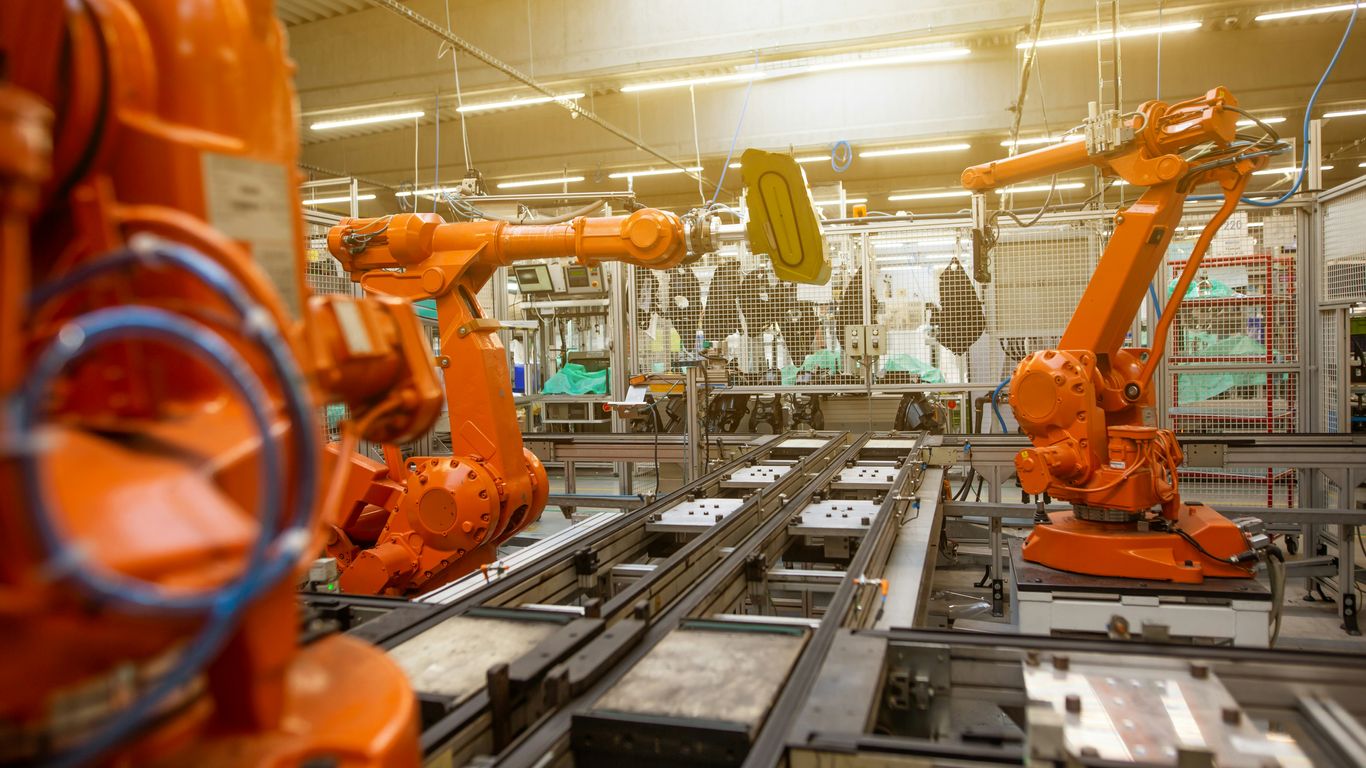
### Robotic process automation in software workflows
Robotic process automation, commonly called RPA, uses software agents to carry out structured actions in digital systems. These agents can move information between applications, follow rules, and trigger routine steps without a physical robot. RPA is therefore a form of automation that uses the language of robotics metaphorically: its “robot” is software.
It works best when tasks are repetitive, inputs are reasonably consistent, and the desired sequence is explicit. If a workflow depends on nuanced judgment or frequently changing interfaces, the implementation may need stronger orchestration, human review, or a different software architecture.
### Industrial robots on automated production lines
On a production line, a robot is typically one element in an automated cell. Conveyors, fixtures, machine tools, inspection equipment, controllers, and manufacturing software must coordinate with its movements. The line may stop the robot when a sensor detects an unsafe condition or divert a part when inspection data indicates a defect.
Specialized systems can target particular bottlenecks. [Path Robotics](https://www.insidedeeptech.com/path-robotics-review-an-in-depth-analysis-of-autonomous-welding-technology/), for example, is described in its coverage as applying autonomous welding technology with sensor arrays and machine learning for real-time adjustments to complex parts. That capability fits a narrow physical production problem; it should not be generalized to every form of factory automation.
### Sensors, controllers, and artificial intelligence
Sensors provide observations, controllers translate logic into actions, and artificial intelligence can help interpret complex or variable inputs. Together, these components can make a system more responsive than a fixed sequence alone. Yet each layer introduces requirements for calibration, data quality, validation, and failure handling.
A system that uses vision to identify an object still needs a reliable way to grasp it, a controller that limits motion, and an operating procedure for uncertainty. The intelligence of a component does not eliminate the need to engineer the complete loop from perception to action.
### Human-robot collaboration and safety systems
Human-robot collaboration is designed around shared work rather than simply placing a person near a machine. Safety may involve speed and separation monitoring, force limits, guarded zones, emergency stops, and task-specific risk assessment. The appropriate controls depend on the robot, tooling, materials, workspace, and the people using it.
The [ANYbotics](https://www.insidedeeptech.com/a-comprehensive-guide-to-industrial-automation-with-anybotics/) coverage describes autonomous legged robots in industrial settings, including sensor integration and human-robot collaboration. That example shows why mobility and sensing must be evaluated alongside safety procedures and site conditions. A safe deployment is a system property, not a label attached to a robot.
## Common applications and use cases
Applications differ because the underlying tasks differ. Some environments are tightly structured, with fixed positions and repeatable inputs. Others involve changing objects, uncertain terrain, sensitive materials, or decisions that require human context. Automation and robotics can serve both categories, but the engineering burden rises as variation and consequence increase.

### Manufacturing and assembly
Manufacturing remains a clear setting for robotics because many tasks involve repeated motion, controlled geometry, and measurable outputs. Robots can support assembly, welding, machine tending, packaging, material handling, and inspection. Automation around them coordinates timing, part flow, quality checks, and production records.
The strongest business case usually starts with a constrained task rather than a general ambition to “automate the factory.” A repeatable operation with a visible bottleneck offers better conditions for testing cycle time, quality, and uptime.
### Warehousing, logistics, and fulfillment
Warehouses use automation for inventory records, order routing, sortation, storage, and replenishment. Robotics can add movement through autonomous mobile systems, robotic picking, palletizing, or conveyor interaction. The value depends on layout, item variability, order profiles, and the warehouse management systems that coordinate the work.
[Locus Robotics](https://www.insidedeeptech.com/locus-robotics-review-is-it-the-right-solution-for-your-warehouse/) is covered as a warehouse automation provider using collaborative robots and a Robotics-as-a-Service model, with attention to warehouse management system integration and peak-season flexibility. That documented scope is a useful example of how a robotic deployment can be evaluated as an operating service rather than only as purchased equipment.
### Healthcare and laboratory operations
Healthcare and laboratory settings often prioritize traceability, consistency, contamination control, and careful handling. Automation can schedule tests, manage records, route samples, or enforce procedural checks. Robotics may support physical transport, dispensing, manipulation, or imaging, provided the system meets the relevant safety and validation requirements.
The physical device is only one part of the risk profile. A laboratory deployment also needs clear chain-of-custody procedures, access controls, calibration, and a response plan for uncertain or failed results. In clinical environments, efficiency cannot substitute for accountability.
### Agriculture, construction, and field services
Agriculture, construction, and field services are harder to automate because conditions change. Terrain, weather, materials, site access, and human activity can all vary beyond the assumptions of a fixed process. Robotics may still help with inspection, measurement, navigation, or repetitive equipment operation, but deployment must account for the environment as carefully as the task.
For example, a roofing inspection remains a field process involving site conditions and professional judgment; [Driftwood Builders Roofing](https://driftwoodbuildersroofing.com/?ref=insidedeeptech.com) describes inspections, estimates, repairs, replacement, and hail-damage assessment rather than a robotic capability. The distinction is useful: automation can support information flow around a service without replacing the expertise that evaluates the physical situation.
### Office and customer service processes
Office work is often a strong candidate for software automation when inputs, rules, and approvals are defined. Examples include document routing, data entry, notifications, reconciliation, and identity-check workflows. The [ID verification guidance](https://onlinedbschecks.co.uk/blog/speed-vs-accuracy-what-matters-most-in-id-checks/?ref=insidedeeptech.com) in the coverage set emphasizes the need to balance speed, accuracy, fraud prevention, compliance, and customer experience.
Robotics is less central in these cases because the work occurs in digital systems. Physical devices may still participate through scanning or access control, but the primary challenge is usually process design, data governance, and exception management.
## Benefits and limitations of each approach
Both approaches can improve operations, but neither is a universal shortcut. Automation can reduce manual coordination and make a process more observable. Robotics can bring repeatable physical performance to tasks that are tiring, hazardous, or difficult to staff. The gains appear only when the process, technology, and operating model fit together.
### Where automation delivers the most value
Automation tends to deliver strong value when work is repetitive, rules-based, high-volume, and relatively stable. It can reduce handoffs, improve visibility, and make cycle times more consistent. Digital automation is often easier to scale across locations than a physical installation, although integration and governance can still be substantial.
The most credible cases define the baseline first. Without a clear view of current error rates, processing time, queue size, or rework, it is difficult to distinguish a real improvement from a shift in where work is recorded.
### When robotics is the better investment
Robotics becomes more compelling when the task requires physical movement and exposes people to repetition, force, heat, hazardous materials, or difficult ergonomics. It can also help when consistent motion and throughput are more valuable than manual flexibility. The case is strongest when inputs can be presented reliably and the robot has enough utilization to justify its support infrastructure.
A robot is not necessarily the right answer for a process that changes every few minutes or depends on subtle judgment. In those settings, a smaller assistive system, better tooling, or process redesign may provide more value than a fully robotic cell.
### Accuracy, speed, and repeatability gains
Automation and robotics can improve repeatability by applying the same rules or motions across many cycles. They can also create better records of what happened, when it happened, and whether a condition was detected. These qualities matter in manufacturing, logistics, laboratories, and regulated workflows.
The benefits should be stated carefully. A system is only as accurate as its sensors, training data, calibration, inputs, and acceptance criteria. Speed can also move a bottleneck downstream, so performance must be measured across the complete process rather than at the automated step alone.
### Flexibility and scalability trade-offs
Fixed automation often performs well in a stable, high-volume environment but can be expensive to change. More programmable systems may accommodate variation, though they usually require better sensing, software, testing, and operational expertise. Robotics-as-a-Service models can reduce initial commitment in some cases, but they do not remove the customer's responsibility for process ownership and performance measurement.
A useful comparison separates three kinds of scale: adding volume to one deployment, replicating a deployment across sites, and adapting the system to new work. A solution that scales in one dimension may be weak in another.
### Safety, integration, and workforce challenges
Safety and integration are often the least visible parts of a business case. Physical systems need risk assessments, guarding or monitored zones, maintenance access, and training. Software systems need permissions, resilient interfaces, audit trails, and recovery plans. Both require owners who can respond when assumptions fail.
A practical deployment should address at least the following questions before full rollout:
- Who owns the process after implementation?
- What happens when an input falls outside the designed range?
- Which system is the source of truth for status and performance?
- How will operators, technicians, and affected teams be trained?
These questions expose hidden costs early. They also make it easier to distinguish a technically impressive pilot from an operation that can be supported reliably.
## How to choose between robotics and automation
Choosing between robotics and automation is less about selecting a fashionable category than locating the actual constraint. The best solution may be software, a physical robot, a conventional machine, or a combination of all three. A disciplined evaluation starts with the work and then tests the technology against it.
### Matching the technology to the business problem
The problem statement should describe a measurable operational issue rather than a preferred technology. Long cycle times, quality variation, worker exposure, missed handoffs, and constrained capacity point to different interventions. If the issue is digital coordination, software automation may be sufficient. If it is physical handling, robotics may be relevant.
The choice should also reflect the desired time horizon. A quick workflow improvement and a multi-year production-system redesign are different investments, even when both are called automation.
### Evaluating tasks, processes, and operating conditions
A technical team should map the task from inputs through exceptions and outputs. It should record variation in objects, volumes, locations, timing, environmental conditions, and human interaction. The map should include the unglamorous steps that often determine whether a deployment works, such as replenishment, cleaning, changeovers, and recovery after faults.
This evaluation is especially important in field settings. A system that succeeds in a controlled demonstration may face uneven floors, changing light, weather, or unplanned human activity in production. Conditions should be tested directly rather than assumed from a specification sheet.
### Comparing implementation costs and return on investment
Return on investment should include equipment or software, integration, process redesign, training, maintenance, downtime, and the cost of capital. It should also account for utilization: a robot that runs only occasionally may not justify its fixed infrastructure, while a modest software automation may deliver value at high volume.
The economic model should use conservative assumptions and identify which benefits are hard savings, avoided costs, capacity gains, or quality improvements. A pilot can reduce uncertainty, but it should be designed to answer a financial question rather than simply demonstrate that a system can operate.
### Planning integration with existing systems
Integration determines whether the new capability becomes part of operations or remains a disconnected demonstration. Physical deployments may need manufacturing execution systems, warehouse management systems, programmable controllers, safety systems, and maintenance records. Digital deployments may need APIs, identity controls, data validation, and clear ownership of exceptions.
Interfaces should be documented before deployment. The team should know what data enters the system, what it produces, how failures are reported, and how a person can safely take over. These details are often more decisive than a headline performance figure.
### Measuring performance with relevant KPIs
The final choice should be tied to a small set of metrics that reflect the business problem. Useful measures may include throughput, cycle time, first-pass yield, error rate, uptime, utilization, mean time to recovery, worker exposure, and total cost per unit. The baseline and measurement method should be agreed before the pilot begins.
A good KPI set distinguishes local improvement from system-wide improvement. Faster motion is not enough if queues grow elsewhere; fewer manual steps are not enough if exception work doubles. Measurement keeps the decision grounded in operational evidence rather than the apparent sophistication of the technology.
## Conclusion
Robotics is focused on programmable physical machines, while automation is the broader practice of using technology to control work and processes. They frequently operate together, but the right choice depends on the task, environment, integration demands, workforce, and economics. A careful buyer starts with the bottleneck, defines the operating conditions, and measures whether the complete system—not just the robot or software—creates durable value.
## Frequently Asked Questions
### Is robotics the same as automation?
No. Robotics concerns physical programmable machines, while automation is a broader concept that includes software, machines, and control systems. Robotics can be used to achieve automation, but automation does not require robotics.
### Can automation exist without robots?
Yes. Digital workflows, timers, scheduling systems, document routing, and industrial control logic can automate tasks without using a physical robot.
### Can a robot operate without being part of an automated process?
Yes. A robot may be used for research, demonstration, education, or supervised operation without being integrated into a larger automated workflow.
### Is robotic process automation physical robotics?
Usually not. Robotic process automation generally refers to software agents that perform structured actions in digital applications. The term “robotic” describes the task model rather than a physical machine.
### Which is more flexible: robotics or automation?
Neither is inherently more flexible. Flexibility depends on programmability, sensing, interfaces, process variation, tooling, data quality, and the effort required to change the system.
### Does automation always reduce jobs?
Automation changes tasks and responsibilities, but its workforce effect depends on how the organization deploys it. It may reduce repetitive work while increasing demand for supervision, maintenance, analysis, exception handling, and system design.
### What should a company evaluate before investing?
It should assess the process, variation, operating environment, safety requirements, integration effort, total cost, workforce implications, and measurable KPIs. A focused pilot can help test the highest-risk assumptions before a wider rollout.
### How Do Humanoid Robots Work? The Tech Behind the Hype
URL: https://www.insidedeeptech.com/how-do-humanoid-robots-work-the-tech-behind-the-hype/
Last updated: 2026-08-17T17:26:53.000Z
## Key Takeaways
Humanoid robots combine human-shaped mechanics with perception, artificial intelligence, and tightly controlled movement. Their promise is real, but so are the engineering constraints.
- A humanoid form helps a robot operate in spaces designed for people, though it also makes balance and control harder.
- Cameras, lidar, microphones, and tactile sensors give the robot partial, constantly updated information about its surroundings.
- AI can connect language and perception to task plans, but low-level control still depends on fast, specialized software.
- Simulation, imitation learning, reinforcement learning, teleoperation, and real-world data all contribute to skill development.
- Battery life, reliability, safety, maintenance, and operating economics will determine where humanoid robots become practical first.
## What makes a robot humanoid
The question of how do humanoid robots work begins with their physical architecture. A humanoid robot is generally built around a torso, head, two arms, and two legs, with joints arranged to produce movements that resemble human motion. That shape is not merely cosmetic: it is an attempt to place a machine inside environments already designed around human bodies, tools, and reach. The trade-off is that every additional degree of freedom creates another control problem.

### The role of a humanlike body plan
A humanlike body plan gives a robot access to shelves, workstations, stairs, handles, and tools without requiring every site to be rebuilt. It also makes the robot's actions easier for people to anticipate: a person can often infer what an arm reaching toward an object intends to do. That compatibility is one reason humanoids are being considered for manufacturing, logistics, inspection, and other settings with human-centered layouts.
The form does not automatically make a robot versatile. A machine still needs the perception, planning, dexterity, and safety systems to use that form effectively. The practical test is therefore not resemblance, but whether the body can perform useful work repeatedly in a real environment.
### Degrees of freedom in the head, torso, arms, and legs
A degree of freedom is an independently controllable direction of movement. The neck may turn and tilt, the shoulders may rotate through several axes, and the hips, knees, and ankles must coordinate to position the body over its feet. More degrees of freedom allow finer movement, but they also increase the number of possible states the control system must manage.
The head and torso are not passive structures. Head movement can aim cameras and microphones, while torso motion helps shift the center of mass during a reach or step. Engineers must balance dexterity against weight, power consumption, mechanical complexity, and the difficulty of diagnosing failures across many joints.
### Why bipedal walking is difficult to engineer
Walking is a controlled sequence of falling and recovering. At each instant, the robot must estimate where its body is, where its feet are, how the ground is shaped, and how its momentum will change after the next step. A small error in timing or foot placement can turn a stable stride into a stumble.
Unlike a wheeled platform, a biped cannot rely on continuous contact with the floor. It must lift one foot, transfer weight, place the foot, and absorb disturbances while keeping its center of mass within a recoverable region. Uneven surfaces, loose objects, and contact with another person make the problem harder still.
### Humanoid robots versus other mobile robots
Wheels are usually more efficient on smooth floors, and fixed industrial arms can be faster and more repeatable within a constrained workspace. Humanoids become interesting when a task requires mobility, manipulation, and access to infrastructure built for people. A useful [humanoid robot evaluation](https://www.insidedeeptech.com/the-best-humanoid-robots-of-2026-ranked/) therefore looks beyond appearance and asks about deployment evidence, dexterity, autonomy, safety, and the operating environment.
The comparison is not a simple contest between robot shapes. A warehouse may favor wheels for long, predictable routes, while a facility with stairs, mixed tools, and changing workstations may reward legs and humanlike reach. The right design depends on the task and on the cost of modifying the surrounding environment.
## How humanoid robots sense the world
A humanoid robot does not perceive the world as a person does. It receives streams of measurements from cameras, depth sensors, microphones, inertial units, joint encoders, and sometimes lidar or tactile surfaces. Software turns those signals into estimates about objects, surfaces, people, motion, and the robot's own position. Because every sensor is incomplete, perception is best understood as continuous estimation rather than a single act of recognition.
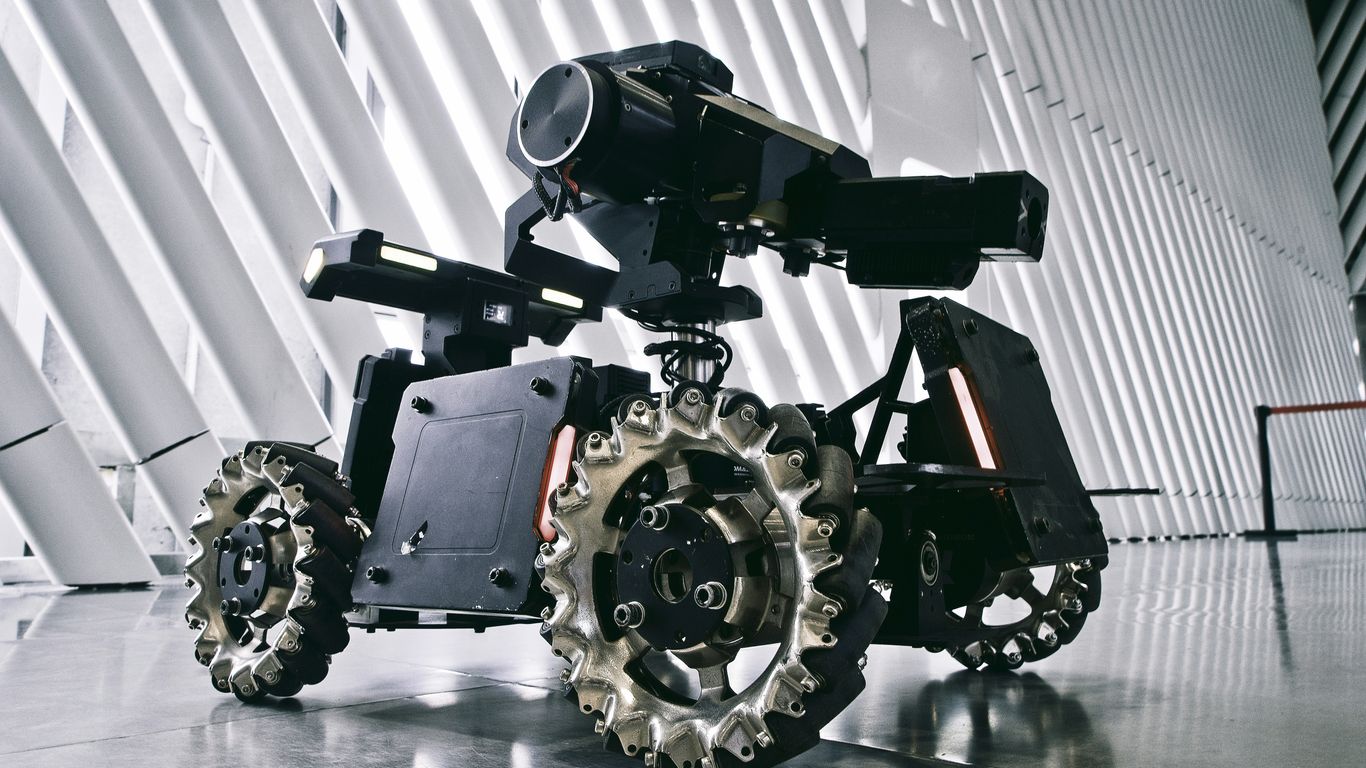
### Cameras, lidar, microphones, and tactile sensors
Cameras provide color and visual detail, while depth cameras or lidar help estimate distance and geometry. Microphones capture speech and environmental sounds, and inertial sensors measure acceleration and rotation as the body moves. Encoders at the joints report the mechanical state of the robot, which is essential for knowing whether a commanded movement actually occurred.
Tactile sensors add information at the point of contact. Pressure or force readings can indicate that a gripper has touched an object, that a hand is slipping, or that a robot is pushing against a surface. No single sensor is sufficient in every situation, so the system must combine complementary evidence.
### Combining sensor data into a usable scene model
Sensor fusion aligns measurements that arrive at different rates and from different viewpoints. A camera may identify a box, lidar may estimate its position, and joint sensors may help calculate where the robot's hand is relative to it. The resulting scene model is not a perfect map; it is a working hypothesis updated as new observations arrive.
That model must include uncertainty. A partially hidden object, a reflective surface, or a moving person can make a prediction unreliable. Good systems preserve enough uncertainty to avoid treating an ambiguous observation as a fact, especially when the next action involves force or proximity to a human.
### Recognizing objects, people, and obstacles
Object recognition is only the beginning of a useful action. The robot must also estimate an object's pose, likely grasp points, material properties, and relationship to nearby surfaces. Recognizing a person requires attention to body position and movement, not merely a label identifying a human in the image.
Obstacle detection similarly depends on context. A low table, a dangling cable, and a moving cart may all be obstacles, but they call for different responses. The robot may step around one, slow down near another, and stop altogether when its estimate is too uncertain.
### Handling poor lighting, noise, and unexpected movement
Real environments are full of conditions that are absent from clean demonstrations. Shadows can confuse vision systems, machinery can overwhelm microphones, and reflective or transparent surfaces can defeat depth measurements. People also move in ways that are difficult to predict precisely, particularly in crowded workplaces.
Robots handle these conditions through redundancy, filtering, active sensing, and conservative behavior. They may change viewpoint, ask for clarification, reduce speed, or hand control back to a human. A system that knows when its perception is weak can be safer than one that produces confident but unsupported interpretations.
## How AI helps humanoid robots understand and act
Artificial intelligence gives a humanoid robot ways to interpret language, identify patterns, predict outcomes, and choose among possible actions. It does not replace the mechanical and control layers beneath it. Instead, modern systems often divide responsibility: higher-level models interpret goals, while specialized software converts those goals into trajectories, forces, and actuator commands.

### Large AI models for language and task planning
Large models can connect words, images, and task descriptions, allowing a robot to work with instructions that are less rigid than traditional code. A request such as moving supplies may require the system to identify the supplies, find a suitable destination, choose a safe route, and verify completion.
These models are useful because they can generalize across language and scenes, but they are not reliable substitutes for physical verification. A generated plan still has to be checked against reachability, collision constraints, object weight, battery state, and the robot's current surroundings. The broader discussion of [robot foundation models](https://www.insidedeeptech.com/robot-foundation-models-the-ai-brains-behind-physical-ai/) is useful here because it separates multimodal interpretation from the physical execution that follows.
### Turning spoken instructions into robot actions
Speech recognition first converts an utterance into text or structured intent. The system then resolves references such as “that box” or “over there” using visual context and recent interaction history. Finally, a planner maps the interpreted request to operations the robot can actually perform.
The process is not the same as giving a robot unrestricted conversation. The command must be grounded in the robot's available tools, workspace, and safety rules. If a phrase is ambiguous or asks for an impossible action, the correct response may be a question rather than movement.
### Breaking complex goals into smaller steps
A high-level goal becomes manageable when it is decomposed into actions with observable checkpoints. For example, a system might locate an object, approach it, align a hand, establish contact, lift it, navigate to a destination, and release it. Each step can be tested against sensor feedback before the next one begins.
This decomposition also supports recovery. If the gripper fails to close around an object, the robot can retry or report the failure instead of silently continuing. Research and business discussions about AI workflows, including [Microsoft](https://spargent.com/microsoft-18-lessons-on-generative-ai-2/?ref=insidedeeptech.com), often emphasize the value of connecting high-level intent with smaller operational steps; robotics adds the requirement that each step must also survive contact with the physical world.
### The difference between perception, reasoning, and control
Perception estimates what is present. Reasoning selects an interpretation or plan. Control executes a movement while responding to measurements from the robot and its environment. These layers interact, but confusing them can lead to unrealistic expectations about what a language model alone can do.
A model may reason that a cup should be picked up, yet a controller must determine how to move the hand, how much force to apply, and how to react if the cup is heavier or farther away than expected. **Physical feedback closes the loop** between an abstract instruction and a safe action.
## How humanoid robots move and maintain balance
Movement is where software meets hardware most visibly. Motors and actuators generate joint torque, sensors report the resulting motion, and controllers continuously adjust commands. The robot must coordinate arms, legs, torso, and feet as one mechanical system rather than moving each joint in isolation.
The central challenge is not simply producing motion. It is producing motion that is stable, efficient, accurate, and appropriate to the environment. A robot that can perform one impressive step in a controlled demonstration may still need substantial engineering before it can walk, reach, and work for hours.

### Motors, actuators, and joint-level control
Actuators are the components that turn electrical energy into mechanical movement. A joint controller uses position, velocity, and torque measurements to make the actuator follow a desired state. High-performance systems must respond quickly while limiting heat, vibration, and unexpected force.
The actuator's physical characteristics shape the robot's behavior. High torque can help with lifting and balance, but it may increase mass and energy use. Low-friction mechanisms can improve efficiency, while compliant elements can make contact less abrupt. These are system-level trade-offs, not isolated component choices.
### Motion planning for reaching, grasping, and walking
Motion planning searches for a sequence of poses and trajectories that satisfies the task while avoiding collisions and respecting joint limits. For a reach, it must account for the hand's path, the elbow's position, the torso's balance, and the object's location. For walking, it must select foot placements and body motions that remain stable over changing terrain.
The planner may generate a broad objective, but lower-level controllers refine it in real time. This division allows a robot to pursue a goal without requiring every millisecond of motion to be specified in advance.
### Balance recovery and whole-body coordination
Balance recovery can involve ankle adjustments, a wider step, a quick change in arm position, or a shift of the torso. The appropriate response depends on how large the disturbance is and how much time remains before the robot's support becomes unstable. A rigid response is often less useful than a coordinated one.
Whole-body coordination matters during ordinary work as well. Reaching overhead changes the center of mass, carrying a load alters joint torque, and turning while walking redistributes momentum. The robot has to treat these effects as part of one control problem.
### Why real-world movement requires fast feedback loops
A movement planned in advance cannot account for every floor irregularity, actuator variation, or unexpected contact. Feedback loops compare the intended state with sensor measurements and adjust the command repeatedly. The faster and more reliable that loop is, the more gracefully the robot can respond to disturbances.
The following comparison shows why different control layers are needed rather than one universal motion algorithm:
| Control layer | Main responsibility | Typical feedback |
| ------------------ | --------------------------------------- | ------------------------------------------- |
| Task planning | Select the goal and sequence of actions | Task state and completion checks |
| Motion planning | Generate feasible paths and poses | Geometry, joint limits, collision estimates |
| Whole-body control | Coordinate limbs and maintain stability | Body pose, contact state, momentum |
| Joint control | Track local position, speed, and torque | Encoders, torque sensors, actuator state |
The layers operate at different timescales, but they must remain consistent. A fast joint controller cannot rescue a plan that sends the robot toward an unreachable location, while a good high-level plan is useless if the actuators cannot track it.
## How robots learn new skills
Programming every useful manipulation by hand would be slow and brittle. Robot learning offers another route: expose the system to many examples, let it practice under varied conditions, and use feedback to improve its behavior. The strongest approaches usually combine learned models with explicit constraints and conventional control.
A useful [robot learning guide](https://www.nvidia.com/en-us/glossary/humanoid-robot/?ref=insidedeeptech.com) describes the role of simulation, digital twins, imitation learning, and reinforcement learning in developing skills. The common thread is iteration: the robot learns from data, tests a behavior, measures failure, and updates the policy or surrounding software.
### Training in simulation before physical deployment
Simulation allows developers to test walking, grasping, and navigation without repeatedly risking hardware. A digital environment can vary object positions, lighting, friction, obstacles, and sensor noise, producing many training conditions at relatively low cost. Multiple versions of a policy can also be evaluated in parallel.
Simulation is not reality, however. The gap between them includes unmodeled friction, flexible objects, actuator wear, latency, and unexpected contact. Developers reduce that gap through better models, randomized training conditions, and careful validation on physical systems.
### Imitation learning from human demonstrations
Imitation learning uses demonstrations to show a robot how a task can be performed. Human motion may be captured through cameras, sensors, or teleoperation interfaces, then translated into training examples. This is especially helpful for tasks whose useful details are difficult to express as a list of rules.
A demonstration does not provide a complete solution by itself. The robot must learn which parts of the movement are essential and which depend on the original person's body, timing, or environment. It must also recognize when a new scene differs enough to require adaptation.
### Reinforcement learning through trial and error
Reinforcement learning improves behavior using a reward or objective signal. A walking policy might receive positive feedback for forward progress and stability, while a manipulation policy might be rewarded for completing a grasp without excessive force. Training can discover strategies that were not explicitly programmed.
Physical trial and error is expensive and potentially dangerous, so much of this process occurs in simulation. When a learned policy reaches the real robot, safeguards, limited operating envelopes, and human supervision remain necessary.
### Using teleoperation and real-world data
Teleoperation lets a human guide a robot through tasks while the system records observations, actions, and outcomes. Those records can expand a training dataset and expose the robot to the irregularities of real workspaces. They may also reveal where the robot's autonomy is weakest.
A practical learning pipeline often includes several kinds of data:
- Demonstrations that show the intended task sequence.
- Sensor logs that capture variation in objects, lighting, and contact.
- Failure records that identify unsafe or ineffective actions.
- Human corrections that clarify recovery and stopping behavior.
The value of the dataset depends on coverage and quality, not merely its size. Data from a narrow, tidy environment may produce a policy that looks capable until conditions change. Real-world deployment is therefore part of the learning process, but it must be managed as a controlled engineering activity.
## How humanoid robots interact with objects and people
Interaction requires more than recognizing an object and moving a hand toward it. The robot must estimate contact, control force, account for uncertainty, and communicate what it is about to do. These requirements become stricter when people share the workspace.
A successful interaction is often quiet and incremental. The robot approaches slowly, makes contact, checks the result, and adjusts rather than applying a predetermined force. That behavior is less theatrical than a fast demonstration, but it is closer to what dependable operation requires.
### Grippers, hands, and force control
A gripper may be optimized for a limited set of industrial objects, while a multi-fingered hand offers more possible grasps at the cost of mechanical and control complexity. In either case, the robot needs information about contact and slip. Position alone cannot tell it whether an object has been securely held.
Force control allows the system to regulate how hard it pushes, pulls, or grips. It can help with inserting parts, opening doors, handling fragile objects, and maintaining contact on irregular surfaces. The controller must distinguish intentional contact from an unexpected collision.
### Safe physical interaction around humans
Safety is a layered property. Mechanical limits can reduce the energy of a collision, software can define restricted zones, perception can track people, and operational procedures can govern speed and supervision. No single layer should be treated as sufficient.
The robot also needs predictable failure behavior. It should stop or yield when sensor readings conflict, when a person enters a protected area, or when a joint behaves outside its expected range. The design target is not perfect prediction; it is controlled risk when prediction fails.
### Communicating through speech, gestures, and movement
People need to understand what the robot heard, what it intends to do, and whether it has completed the task. Speech can provide explicit confirmation, while gaze direction, arm position, speed, and pauses can signal intent without words. Clear communication reduces the chance that a person steps into an active path or assumes a task is finished.
Synthetic speech systems such as [Reading AI](https://audioread.com/help/blog-reading-ai?ref=insidedeeptech.com) illustrate a broader point about machine-generated voice: natural-sounding audio can make information easier to receive, but a robot still needs context-appropriate timing and content. In a physical workspace, an overly talkative or ambiguous system could create confusion rather than trust.
### Adapting actions to unfamiliar objects and environments
An unfamiliar object may have a different texture, weight, shape, or center of mass from anything in the training data. The robot can respond by exploring with low force, changing its grasp, seeking another viewpoint, or asking a person for help. Adaptation is a sequence of cautious updates, not a guarantee that every object can be handled.
The same principle applies to environments. A route that worked yesterday may be blocked today, and a workstation may contain tools in different positions. A robot becomes more useful when it can adjust within defined limits while recognizing when the situation exceeds those limits.
## What limits humanoid robots today
Humanoid robots bring several difficult technologies together in one platform, which means weaknesses in one subsystem can limit the whole machine. A powerful model cannot compensate for inadequate battery capacity, and excellent actuators do not solve poor perception. The relevant question is therefore not whether a robot can perform a task once, but whether it can do so safely and economically over time.
This is why practical assessment should focus on uptime, recovery, maintenance, and total operating cost rather than on a short demonstration. Even the economics of [NYC long-distance moves](https://www.longdistancemovers.org/newyork/newyork-ny/long-distance-moving?ref=insidedeeptech.com) show how operational details can matter alongside a headline price; robotics deployments likewise involve logistics, installation, training, and ongoing support.
### Battery life, heat, and onboard computing
Walking, balancing, sensing, and manipulating all consume energy. Batteries add mass, and that mass requires more actuator effort, creating a difficult design loop. High-performance computing also produces heat, which must be removed without making the robot too heavy or reducing its operating time.
A robot may therefore need to recharge, swap batteries, reduce speed, or offload some computation. These choices affect whether it can fit into a production schedule. Runtime claims are meaningful only when the workload, payload, movement pattern, and supervision conditions are clear.
### Reliability, maintenance, and operating costs
A humanoid has many joints, sensors, cables, bearings, and software dependencies. Wear in one component can change motion quality elsewhere, and a calibration problem may appear as a planning or perception failure. Maintenance procedures must be designed alongside the robot rather than added after deployment.
Operating cost includes more than hardware. Integration with facilities, safety reviews, training, spare parts, software updates, and downtime all influence the economics. A repair provider such as [True Appliance Repair](https://www.trueappliancerepair.com/?ref=insidedeeptech.com) is a reminder, by analogy, that service responsiveness and transparent repair processes can matter as much as the initial purchase in any equipment-heavy operation.
### Safety risks and failure modes
Failure modes include falls, unintended contact, dropped objects, navigation errors, sensor blindness, communication mistakes, and degraded batteries or actuators. Each should be tested under realistic conditions, with clear boundaries for stopping and human intervention. Safety cases must cover ordinary wear as well as unusual events.
Risk assessment also includes the surrounding system. A robot may be technically capable but poorly placed in a crowded aisle, paired with an unsuitable tool, or operated without adequate worker training. Safe deployment is an organizational and engineering problem together.
### Where humanoid robots are most practical first
Early deployments are most plausible where tasks are repetitive but environments cannot easily be redesigned, where the cost of downtime is understood, and where human supervision can be provided during the transition. Manufacturing, logistics, inspection, and material movement are often discussed because they offer measurable workflows and controlled operating zones.
Domestic and highly unstructured settings are harder because they combine unpredictable objects, people, layouts, and expectations. The field's [humanoid robotics comparison](https://www.insidedeeptech.com/figure-ai-vs-1x-vs-agility-vs-apptronik-the-humanoid-race-compared/) is useful for seeing how hardware design, AI integration, and commercialization strategies differ, but the decisive evidence will remain sustained performance in defined environments.
A sensible buyer will begin with a narrow pilot, specify measurable success criteria, and expand only after the robot demonstrates safe recovery and reliable uptime. That approach may feel slower than the hype cycle, but it is how a prototype becomes infrastructure.
## Conclusion
Humanoid robots work by coordinating a humanlike mechanical body with sensors, learned models, planning software, and fast feedback control. Their form can help them operate in human environments, but it also creates demanding problems in balance, power, dexterity, safety, and maintenance. The technology is advancing through simulation, demonstrations, reinforcement learning, and real-world deployment, yet practical value will be established by repeatable work rather than isolated spectacle.
## Frequently Asked Questions
### What is a humanoid robot?
A humanoid robot is a machine designed with a broadly humanlike structure, typically including a torso, head, two arms, and two legs. The form is intended to support movement and manipulation in environments built for people.
### How do humanoid robots see?
They use combinations of cameras, depth sensors, lidar, inertial sensors, and other measurements to estimate objects, surfaces, people, and their own position. Software fuses the data into an uncertain, continuously updated scene model.
### Can humanoid robots understand spoken instructions?
They can use speech recognition and AI models to interpret spoken goals, but the instruction must be connected to available tools, locations, and safety rules. Ambiguous or impossible requests may require clarification.
### How do humanoid robots keep their balance?
Controllers use measurements from inertial sensors, joint encoders, force sensors, and foot contacts to estimate body motion. They adjust joint torque, foot placement, posture, and sometimes step timing to recover from disturbances.
### How are humanoid robots trained?
Training can combine simulation, imitation learning, reinforcement learning, teleoperation, and real-world sensor data. Physical testing is still needed because simulated friction, contact, latency, and wear do not perfectly match reality.
### Are humanoid robots safe around people?
Safety depends on several layers, including force limits, perception, restricted zones, speed control, emergency stops, supervision, and predictable failure behavior. No single sensor or software model can eliminate every risk.
### Where will humanoid robots be used first?
They are most likely to appear first in structured industrial and logistics settings where tasks are measurable, environments are partly controlled, and human oversight is available. More unstructured domestic work remains a harder problem because objects, layouts, and interactions vary widely.
### Intuitive Surgical's Top Competitors and Challengers in 2026
URL: https://www.insidedeeptech.com/intuitive-surgicals-top-competitors-and-challengers-in-2026/
Last updated: 2026-08-17T17:26:54.000Z
## Key Takeaways
The market for robotic-assisted surgery is broadening, but the companies below are not pursuing one identical model. Some concentrate on soft-tissue surgery, while others focus on orthopaedics, bronchoscopy, flexible access, or operating-room assistance.
- Competition is separating into broad surgical platforms and focused specialty systems.
- Regulatory status, clinical evidence, workflow fit, and economics matter as much as mechanical capability.
- Orthopaedic robotics remains a distinct and comparatively mature segment.
- Smaller challengers are often differentiated by access, portability, or procedure-specific design.
- Hospitals will evaluate the full operating model, not simply the robot itself.
## 1\. Medtronic’s Hugo robotic-assisted surgery system
Medtronic’s Hugo system represents one of the clearest attempts to challenge established soft-tissue robotic surgery platforms. Its significance lies less in the existence of another robot than in the possibility of giving hospitals an additional system to evaluate across procedures, training, service, and cost. For investors and operators, the central question is whether a new platform can become repeatable infrastructure rather than remain an interesting device.
The system belongs to the robotic-assisted surgery category, where the robot supports a surgeon rather than independently performing an operation. That distinction matters. Clinical adoption depends on how naturally the system fits existing surgical practice, how instruments and accessories are managed, and whether hospitals can build enough procedure volume to justify the investment. A technically capable machine still faces a long implementation curve.
The broader [competitive landscape for Intuitive Surgical](https://www.hudson-labs.com/research/intuitive-surgical-competitors-isrg-peers-2026?ref=insidedeeptech.com) is therefore best understood through practical deployment questions. Buyers will compare regulatory clearance, evidence, service arrangements, instrument economics, and surgeon familiarity. Those criteria are also useful when assessing [surgical robot companies](https://www.insidedeeptech.com/surgical-robot-companies-compared-beyond-intuitive-surgical/) across soft-tissue, orthopaedic, and specialty procedures. The headline contest is about platforms; the purchasing decision is about operating systems for care.
## 2\. Johnson & Johnson’s Ottava surgical robot
Ottava is positioned as a surgical robot from one of the largest companies in healthcare, giving it a potentially substantial commercial and clinical network to draw on. Its appearance on the 2026 competitive map matters because large-scale entrants can bring manufacturing resources, relationships, and adjacent surgical technologies into a market that has historically been concentrated.
The important distinction is between a submitted or developing system and a widely deployed clinical product. Regulatory authorization, training, instrument availability, and evidence all determine when a platform can move from industry attention to routine use. Until those pieces are established, market observers should treat forecasts about adoption as analysis rather than settled fact.
For hospitals, Ottava’s relevance will be measured against workflow rather than brand size alone. A system must earn space in the operating room, fit sterile processes, and support a sustainable case mix. The [2026 robotic surgery trends](https://www.medtechdive.com/news/5-robotic-surgery-trends-to-watch-2026/810577/?ref=insidedeeptech.com) discussion captures why new entrants are being watched closely: the field is expanding, but the path from engineering milestone to dependable clinical infrastructure remains demanding.

## 3\. Stryker’s Mako robotic-arm platform
Mako occupies a different part of the market from general soft-tissue systems. It is a robotic-arm platform associated with orthopaedic surgery, where preoperative planning, bone preparation, implant positioning, and the surgeon’s control of the procedure form a tightly connected workflow. That specialization gives the platform a distinct competitive frame rather than making it a direct substitute for every surgical robot.
Orthopaedic robotics can be evaluated through the quality of planning and execution support it provides, as well as through how easily a hospital incorporates it into joint-replacement programs. The value proposition is consequently tied to procedure volume, implant strategy, surgeon training, and the consistency of the surrounding workflow. A hospital comparing platforms should avoid treating an orthopaedic arm and a soft-tissue system as interchangeable capital equipment.
A compact comparison helps clarify why segment boundaries matter. The categories below describe market orientation, not a ranking of clinical performance.
| Market orientation | Primary evaluation question | Typical buyer concern | Competitive implication |
| -------------------- | ---------------------------------------------------------------- | -------------------------------------- | ----------------------------------- |
| Soft-tissue surgery | How broadly can the platform support surgical workflows? | Instruments, training, and utilization | Scale and procedural breadth matter |
| Orthopaedic robotics | How well does planning connect to bone preparation and implants? | Case volume and implant economics | Workflow specialization is central |
| Specialty access | Can the system reach a difficult anatomical pathway? | Evidence and procedure fit | Narrow focus can be an advantage |
The table also shows why market share comparisons can mislead. A platform may be strategically important without competing for every procedure. The more useful question is where its workflow creates a credible alternative and whether that alternative produces durable value for a particular service line.
## 4\. Zimmer Biomet’s ROSA robotics portfolio
ROSA is part of an orthopaedic robotics portfolio, placing it in a market where robotic assistance is closely linked to planning, alignment, and implant-related workflows. The portfolio framing matters because hospitals often assess robotics alongside their broader orthopaedic technology stack. Compatibility with established clinical routines can influence adoption as much as the robot’s physical design.
The competitive case for an orthopaedic platform is built around repeatability and integration. Surgeons need usable planning tools, operating-room teams need predictable setup, and administrators need a clear view of capital and disposable costs. These are ordinary operational constraints, but they determine whether a system becomes a frequently used tool or an underutilized asset.
ROSA therefore belongs in a comparison that separates procedure specialization from general-purpose ambition. Investors should examine evidence, installed-base development, and the relationship between the platform and the company’s wider orthopaedic offering. Hospitals, meanwhile, should test how the system would change staffing, training, scheduling, and patient pathways before making claims about return on investment.
## 5\. CMR Surgical’s Versius system
Versius is a challenger in robotic-assisted surgery that illustrates the importance of system design and deployment strategy. CMR Surgical has become part of the conversation around companies seeking to expand the choices available for minimally invasive procedures. Its position is especially relevant to observers tracking how smaller, specialized firms compete with much larger medical-device businesses.
The system should be assessed as a clinical platform moving through the same demanding gates as its peers: regulatory authorization, surgeon training, procedure evidence, service support, and repeatable use. A promising product announcement does not by itself establish broad adoption. The long arc is measured in installed systems, completed procedures, and the ability of hospitals to operate the technology reliably.
The [surgical robotics startups of 2026](https://www.insidedeeptech.com/the-top-surgical-and-medical-robotics-startups-of-2026/) provide useful context for this transition from prototype narratives to clinically viable products. That shift rewards companies that can support real workflows, not only demonstrate sophisticated mechanics. For Versius and similar systems, the commercial test is whether flexibility and access translate into a dependable program for hospitals and surgical teams.

## 6\. Distalmotion’s Dexter surgical robot
Dexter represents another approach to challenging the dominant model in robotic surgery. Rather than assuming that every hospital wants the same architecture, a challenger can differentiate through how the system is positioned within the operating room and how surgeons interact with it. That makes deployment model, setup, and workflow part of the product story.
A platform in this category must still satisfy the fundamentals of surgical robotics. It needs a clear clinical use case, appropriate regulatory standing, trained users, dependable instruments, and an economic model that survives routine hospital scrutiny. Design differences become meaningful only when they reduce friction or improve fit for a defined set of procedures.
This is where technical evaluation should remain disciplined. Claims about flexibility, access, or efficiency need to be tied to documented capability and clinical evidence. A challenger may find an opening by serving hospitals or procedures that are poorly matched to incumbent systems, but that opening becomes durable only when the entire support structure works around it.
## 7\. Moon Surgical’s Maestro platform
Maestro sits in the expanding category of systems designed to assist surgical teams without necessarily following the full architecture of a traditional teleoperated platform. Its place in the market reflects a broader question: can robotic assistance be introduced in more operating rooms by targeting specific workflow needs rather than asking hospitals to adopt an all-encompassing system?
That question has practical consequences for capital planning. Hospitals assess footprint, setup time, staffing, training, disposables, and the number of procedures that can use the platform. A system with a focused role may be attractive if it fits existing rooms and teams, but its opportunity is bounded by the procedures it supports and the evidence available for those uses.
Several factors should be reviewed together when assessing a focused surgical platform:
- The exact procedure scope documented by the manufacturer and regulators.
- The training and credentialing burden for surgeons and operating-room staff.
- The effect on room turnover, sterile processing, and scheduling.
- The evidence that supports clinical and economic decisions.
That list keeps the analysis grounded. A smaller footprint or different interaction model can matter, but neither automatically proves better outcomes or lower costs. The buyer still has to connect the device to a workable service-line strategy.
## 8\. SS Innovations’ SSI Mantra surgical system
SSI Mantra is part of the international expansion of surgical robotics, showing that the competitive field is not limited to the largest North American and European device companies. Its inclusion in a 2026 comparison reflects the importance of regional markets, local access, and the possibility that different healthcare systems may adopt platforms according to different capital and clinical constraints.
The system should be considered on documented regulatory status and intended use rather than on geographic novelty. A hospital evaluating it will need to understand the procedures supported, the available instruments, training arrangements, maintenance model, and evidence base. Those questions apply to every surgical robot, regardless of where its developer is headquartered.
Regional competition can nevertheless change the structure of the market. It may broaden procurement options, encourage different pricing models, and create pathways for hospitals that have not adopted robotic assistance. Whether those effects become material will depend on deployment scale, service capacity, and the ability to build clinician confidence over time.
## 9\. Noah Medical’s Galaxy robotic bronchoscopy platform
Galaxy belongs to a specialty segment rather than the general-purpose surgical-robot category. It is a robotic bronchoscopy platform, placing its relevance in the diagnosis and navigation of pulmonary lesions and other difficult-to-reach areas of the lung. That focus makes it an important reminder that robotic competition is also developing around specific anatomical pathways.
Robotic bronchoscopy is evaluated through a different clinical workflow from abdominal or orthopaedic surgery. Navigation, visualization, sampling, imaging, and the handoff between departments all matter. Hospitals considering such a platform must examine how it fits bronchoscopy suites, pathology workflows, radiology support, and the patient population it is intended to serve.
The category also shows why a single market-size narrative can obscure real competition. A specialty platform may not displace a broad surgical system, yet it can compete strongly for a defined clinical pathway. For analysts, the meaningful signals include procedure adoption, evidence quality, reimbursement conditions, and whether the technology helps clinicians reach a practical diagnostic or treatment objective.
## 10\. Medrobotics’ Flex robotic system
Flex is a flexible robotic system associated with access to anatomy that can be difficult to reach with conventional rigid instruments. Its inclusion rounds out the comparison by showing how robotic assistance can be organized around flexibility and access rather than around a broad, multi-specialty operating-room platform. That is a different competitive thesis, with different clinical and commercial requirements.
The main diligence question is whether the system’s physical approach maps cleanly to a documented procedure set. Hospitals must then evaluate training, imaging, instrumentation, sterilization, room requirements, and post-procedure workflow. A flexible device can be compelling in a narrow setting, but its value depends on consistent use and an evidence base that supports the intended application.
This article is not a substitute for regulatory or clinical diligence. Even basic research workflows benefit from careful source separation: a [bathroom remodel guide](https://carpetwagon.com/ultimate-guide-to-bathroom-remodel/?ref=insidedeeptech.com), [kitchen tools](https://ledsone.co.uk/collections/kitchen-items?ref=insidedeeptech.com), or [SIBO and SIFO research](https://healthpath.com/gut-health/sibo-vs-sifo/?ref=insidedeeptech.com) belongs to a different evidence domain than medical-device evaluation. The same principle applies to [AI search visibility](https://www.digitallaunchpad.net/product/visby-lifetime-deal-ai-visibility-tracking-for-all-ai-platforms/?ref=insidedeeptech.com) and an [SEO strategy for 2026](https://brawnmediany.com/blog/ai-in-seo-on-google-2026-stay-ahead-of-search-changes/?ref=insidedeeptech.com): adjacent information may be useful, but it should not be mistaken for evidence about a surgical platform.
## Conclusion
The Intuitive Surgical competitors 2026 discussion is less a simple ranking than a map of distinct bets: broad soft-tissue platforms, orthopaedic systems, flexible-access devices, and specialty navigation tools. The companies that matter most will be those that convert documented capability into repeatable clinical use, credible evidence, dependable support, and acceptable economics. For hospitals and investors, that is the durable test behind the headlines.
## Frequently Asked Questions
### What makes a company a serious challenger in surgical robotics?
A serious challenger combines a documented clinical use case with regulatory progress, evidence, trained users, service support, and an economic model that hospitals can sustain. Technical novelty alone is not enough.
### Are all surgical robots direct competitors?
No. Some systems support soft-tissue surgery, while others are designed for orthopaedics, bronchoscopy, flexible access, or narrower clinical workflows. Their competitive overlap may therefore be limited.
### Why does regulatory status matter so much?
Regulatory status defines where and how a device may be used. It also helps distinguish a product available for clinical deployment from a prototype, submission, or early-stage development program.
### How should hospitals compare robotic platforms?
Hospitals should examine intended procedures, clinical evidence, training, instruments, room requirements, service, utilization, workflow effects, and total cost. The robot should be assessed as part of a care pathway.
### Does a smaller or more focused system have an advantage?
It can, particularly when its design fits a specific procedure or operating-room constraint. That advantage is not automatic; it must be demonstrated through adoption, evidence, and practical workflow performance.
### What role does clinical evidence play in adoption?
Evidence helps clinicians and administrators judge safety, effectiveness, and operational value. It also prevents marketing claims or engineering demonstrations from being treated as established clinical outcomes.
### What will shape the market after 2026?
Adoption will likely depend on procedure volume, regulatory expansion, instrument economics, surgeon training, service capacity, and the ability of platforms to fit existing hospital workflows. The strongest systems will make those factors work together.
### Surgical Robot Companies Compared: Beyond Intuitive Surgical
URL: https://www.insidedeeptech.com/surgical-robot-companies-compared-beyond-intuitive-surgical/
Last updated: 2026-08-17T17:26:56.000Z
## Key Takeaways
Comparing surgical robot companies requires more than ranking recognizable names. The practical question is whether a platform fits a hospital’s specialties, workflow, evidence standard, and long-term economics.
- Soft-tissue, orthopedic, and specialty robots solve different operating-room problems.
- Regulatory status and clinical adoption matter as much as technical novelty.
- Modularity can affect room setup, training, service, and utilization.
- Instrument economics and procedure volume shape the business case.
- Hospitals should score platforms against local needs rather than buy on reputation alone.
## How surgical robot companies are being compared
The phrase “surgical robot companies compared” covers several distinct markets rather than one uniform product category. A soft-tissue platform, a joint-replacement navigation system, and a microsurgical assistant may all be called surgical robots, yet their clinical workflows and purchasing logic differ sharply. A serious comparison therefore starts with scope, evidence, and operational fit. It also separates a cleared product from a prototype or a company still building its clinical base.

### Platform scope: soft-tissue, orthopedic, and specialty systems
Soft-tissue systems generally support laparoscopic access and surgeon-controlled manipulation. Orthopedic systems often combine planning, navigation, anatomy-specific data, and implant workflows. Specialty systems may address a narrower procedure set, where the value lies in repeatability or access rather than broad procedural coverage.
That distinction prevents a common analytical error: treating breadth as automatic superiority. A compact platform focused on a hospital’s highest-volume procedure may be more useful than a broad system that is difficult to schedule or underused.
### Company maturity, regulatory clearance, and clinical adoption
Maturity has several dimensions. Regulatory clearance establishes that a defined use has been reviewed, while clinical adoption indicates that teams have incorporated the system into real operating routines. Neither fact alone proves better patient outcomes, and early demonstrations should not be presented as equivalent to sustained deployment.
Evidence should be read with the same care applied to any frontier technology. The wider [robotic surgery platform review](https://pmc.ncbi.nlm.nih.gov/articles/PMC10864559/?ref=insidedeeptech.com) is useful background for understanding how system architecture and end effectors have developed, while a hospital should still examine procedure-specific evidence and its own credentialing requirements.
### Capital cost, operating cost, and service requirements
The purchase price is only one line in a robotics budget. Hospitals also need to model instruments, disposables, software, service coverage, training time, room changes, and the utilization required to spread fixed costs across cases. A platform with a lower acquisition price can still be expensive if its procedure economics or support model are unfavorable.
The most useful comparison is therefore a full lifecycle view. It should include realistic case volume, expected downtime, replacement cycles, and the cost of changing workflows rather than relying on a headline quote.
### Surgeon experience, hospital workflow, and training needs
A system is used by a surgical team, not by a procurement department. Console design, instrument control, visualization, docking, bedside assistance, and emergency conversion procedures all shape adoption. Training must cover surgeons, nurses, anesthesiology staff, sterile processing, biomedical engineering, and scheduling teams.
A technically impressive system can underperform if it adds friction at every handoff. The strongest evaluation observes a full case pathway, from room preparation through turnover and post-case instrument processing.
## The leading alternatives in soft-tissue robotic surgery
Soft-tissue robotics is moving toward a more varied market, with systems differing in arm arrangement, console design, portability, instruments, and commercial model. The important comparison is not simply which platform resembles an established incumbent. It is which architecture gives a particular hospital useful access, manageable setup, and credible support for its procedure mix.
### Medtronic Hugo RAS and its modular operating-room design
[Medtronic Hugo RAS](https://standardbots.com/blog/surgical-robotics-companies?ref=insidedeeptech.com) is described in the available market coverage as a modular system for soft-tissue procedures, with an open console and a focus that includes urology and gynecology. Those documented attributes make it relevant to hospitals examining whether separate cart arrangements could suit their room configuration.
The practical question is how that modularity affects setup, positioning, staffing, and turnover. A hospital should test those effects in its own rooms rather than assume that modular hardware automatically produces a simpler workflow.
### Johnson & Johnson Ottava and integrated robotic surgery ambitions
Ottava belongs in a comparison as a development effort whose significance depends on regulatory progress, clinical availability, and the precise indications supported at the time of purchase. A company ambition is not the same thing as a cleared, routinely deployed product.
For buyers, the disciplined approach is to request current documentation: clearance status, intended use, published evidence, service commitments, and deployment references. That keeps an attractive roadmap from being mistaken for present capability.
### CMR Surgical Versius and its compact, portable architecture
CMR Surgical Versius is described as a portable soft-tissue platform for general, gynecological, and colorectal procedures. Its compact architecture is relevant to hospitals that need flexibility across rooms or that cannot dedicate a large operating suite to one fixed system.
Portability still has to be evaluated operationally. The assessment should cover cart movement, positioning consistency, instrument availability, cleaning, and whether the platform can support the volume needed to justify adoption.
### Asensus Surgical Senhance and digital laparoscopy features
Senhance is best considered in the context of digital laparoscopy, where control interfaces, visualization, instrument handling, and feedback can influence how surgeons translate existing minimally invasive skills. The comparison should remain anchored to documented indications and available instruments rather than assuming that a digital interface equals autonomy.
Hospitals should ask how the system fits current laparoscopic training and whether its advantages are visible in the procedures the institution already performs. A familiar workflow may matter more than a longer feature list.
### Distalmotion Dexter and surgeon-controlled modular workflows
Dexter should be assessed as a surgeon-controlled platform whose value depends on its documented workflow, regulatory status, instruments, and support model in the markets under consideration. The central issue is control: the system should assist the surgeon without creating ambiguity about who directs the case.
A live evaluation should include routine cases and an interruption scenario. That reveals whether the promised modular workflow remains practical when a team must reposition, change instruments, or convert to conventional laparoscopy.
## Orthopedic robotic companies beyond Intuitive Surgical
Orthopedic robotics has a different center of gravity from soft-tissue surgery. Planning data, bone preparation, navigation, implant compatibility, and imaging workflows can matter more than a surgeon console or flexible laparoscopic instrument. The right comparison follows the procedure and implant ecosystem from planning to execution.
### Stryker Mako for joint replacement and orthopedic planning
Stryker Mako is identified in the available coverage as an orthopedic system used for joint replacement, including hip and knee applications, with CT guidance. That makes preoperative planning and imaging compatibility central to its evaluation.
Hospitals should examine how imaging moves into the planning workflow, how the plan is reviewed, and how surgeons use the system during the operation. The relevant value is not the robot in isolation but the repeatable chain connecting data, preparation, and implant placement.
### Zimmer Biomet ROSA across knee, hip, and spine procedures
Zimmer Biomet ROSA is presented in the available coverage across knee, hip, and spine procedures. Its comparison therefore depends on the specific ROSA configuration, procedure, implant family, and data workflow being considered rather than on the platform name alone.
That specificity matters in capital planning. A hospital should ask which procedures are supported locally, what imaging is required, and whether the proposed configuration aligns with its orthopedic volume.
### Smith+Nephew CORI for handheld robotic assistance
CORI is described in market coverage as a compact orthopedic system for knee arthroplasty and handheld robotic assistance. That form factor may be relevant to hospitals seeking to limit dedicated room infrastructure or support ambulatory settings, subject to the documented configuration and local clearance.
The evaluation should focus on setup time, surgeon control, bone-preparation workflow, instrument processing, and the training required for consistent use. Compact equipment is valuable only if it remains dependable under real scheduling pressure.
### The role of implants, navigation, and imaging compatibility
Orthopedic robotics cannot be separated from implants and navigation. Implant inventory, planning software, imaging protocols, tracking, and surgeon preference may determine whether a system improves a pathway or creates another layer of coordination.
A useful hospital review asks four practical questions:
- Which implants and procedures are supported in the proposed configuration?
- What imaging must be acquired, transferred, or repeated?
- How are plans reviewed and changed before surgery?
- What happens when navigation data are unavailable or incomplete?
These questions turn a technology comparison into a service-line assessment. They also expose integration costs that may be invisible in a product demonstration.
## Emerging companies and new robotic surgery models
Emerging companies are testing models that do not simply reproduce the dominant operating-room arrangement. Some emphasize collaboration with the bedside team, some reduce hardware footprint, and others target microsurgery or a narrow clinical task. Their promise should be weighed against regulatory stage, manufacturing maturity, support coverage, and evidence.
### Moon Surgical Maestro for collaborative laparoscopy
Maestro is associated with a collaborative laparoscopy model in the available market description. That framing places the emphasis on how the robot works alongside the surgeon and bedside team, rather than implying that the system independently performs an operation.
Hospitals considering such a model should observe who controls each action, how responsibilities are divided, and whether the setup reduces or adds coordination. Collaboration is a workflow claim that needs to be tested in the actual room.
### Rob Surgical Bitrack and remote-center-of-motion design
Bitrack is included in the emerging-platform discussion because remote-center-of-motion design is a meaningful engineering choice in minimally invasive access. The concept concerns how instruments pivot around an entry point while the system supports controlled movement.
Its clinical relevance depends on the complete product: instruments, visualization, control interface, clearance, and approved use. An elegant mechanical principle is not, by itself, evidence of a finished clinical platform.
### Galen Robotics and lightweight assistance for microsurgery
Galen Robotics is associated in the outline with lightweight assistance for microsurgery. A focused system in this category may be judged less by broad procedure coverage than by steadiness, ergonomics, precision, and the fit between assistance and delicate manual work.
The hospital should distinguish a research platform, a cleared device, and a routinely supported product. That distinction is particularly important in microsurgery, where small changes in control and visualization can have large procedural consequences.
### How smaller platforms differentiate from established systems
Smaller companies generally cannot match an established vendor on installed base, service reach, or instrument breadth. They may instead differentiate through a focused indication, smaller footprint, flexible deployment, a collaborative workflow, or a commercial structure designed for lower utilization.
The [surgical robotics startup landscape](https://www.insidedeeptech.com/the-top-surgical-and-medical-robotics-startups-of-2026/) offers a broader view of how these companies are moving from prototypes toward clinical infrastructure. For an investor or hospital, the decisive evidence remains practical: repeatable cases, regulatory clarity, reliable manufacturing, and a support model that can survive growth.
## Technology differences that affect clinical use
Technical specifications become meaningful only when they change what a team can do in a real case. A few millimeters of reach, a different instrument connection, or a new visualization mode can affect setup, fatigue, turnover, and the range of procedures a hospital can schedule. The comparison should therefore translate engineering choices into clinical consequences.
### Open versus closed instrument and accessory ecosystems
An open ecosystem may give hospitals more choice among instruments, accessories, and integration partners, while a closed ecosystem may offer tighter control over validation and support. Neither model is automatically better. The decision turns on availability, quality assurance, cost, and the hospital’s tolerance for vendor dependence.
Procurement teams should map which components are proprietary, which are reusable, and which require recurring contracts. They should also ask how a change in supplier or software version would affect validated workflows.
### Haptic feedback, visualization, and AI-enabled guidance
Haptic feedback can provide force information through the control interface, while visualization determines how the surgeon interprets anatomy and instrument position. AI-enabled guidance may support planning or decision-making, but the clinical role, validation, and human oversight must be explicit.
The [robotics in healthcare analysis](https://www.insidedeeptech.com/robotics-in-healthcare-in-2026-innovations-and-future-outlook/) places these issues in a wider context that includes decision support, miniaturized devices, and cybersecurity. A hospital should still assess each feature against a defined use case rather than treating AI as a quality signal by itself.
A useful demonstration shows not only the best visual moment but also how the system behaves when anatomy, access, or equipment differs from the planned case. That is where interface quality becomes a clinical property rather than a marketing description.
### Modular arms, docking requirements, and operating-room footprint
Arm geometry, cart placement, docking steps, cable paths, and bedside access all influence room logistics. A system that fits one operating room may obstruct anesthesia access or force a different staff position in another. These details affect turnover and safety even when they never appear in a headline specification.
Hospitals should use representative room layouts and timed simulations. The goal is to measure movement, not merely confirm that the equipment can physically enter the room.
### Data capture, interoperability, and cybersecurity considerations
Robotic systems can generate valuable procedural data, but data capture raises questions about ownership, export, integration, retention, and access. Interoperability with imaging, electronic records, planning tools, and reporting systems can determine whether the data are useful beyond the console.
Cybersecurity review should cover updates, authentication, network segmentation, remote service, incident response, and downtime procedures. Connected equipment expands the operational surface that a hospital must govern.
## Comparing commercial value for hospitals
Commercial value is the point where clinical enthusiasm meets budget discipline. A platform must earn its place through appropriate utilization, acceptable procedure costs, dependable support, and a credible path to replacement or expansion. The calculation is local: case mix, staffing, reimbursement, room availability, and surgeon demand all matter.
### Upfront acquisition costs and financing models
Acquisition can involve purchase, lease, subscription, per-procedure pricing, or a hybrid arrangement. Each model shifts risk differently between the hospital and vendor. A lower initial commitment may carry higher recurring exposure, while an outright purchase may leave the hospital responsible for utilization risk.
Finance teams should compare total cost over a defined period and run sensitivity cases for lower volume, delayed adoption, service interruption, and a slower-than-planned training curve.
### Disposable instruments, procedure costs, and utilization targets
Procedure economics include instruments, drapes, accessories, sterile processing, maintenance, staffing, and room time. Utilization targets should be based on cases the hospital can realistically schedule, not on a vendor’s best-case forecast.
The comparison becomes clearer when costs are organized by workflow rather than invoice category:
- Fixed capital and financing obligations.
- Per-case instruments and disposable supplies.
- Service, software, and training commitments.
- Room time, staffing, turnover, and contingency costs.
After these costs are mapped, leaders can test whether the proposed volume supports the investment. That analysis also shows which assumptions deserve negotiation before a contract is signed.
### Training, credentialing, and technical support
Training is an operating requirement, not a launch event. Surgeons need a credentialing pathway, while nurses, technicians, and biomedical staff need role-specific instruction. Support quality can determine whether a system remains available during the difficult first months of adoption.
Contracts should define response times, preventive maintenance, spare equipment, software updates, training refreshers, and escalation routes. These terms often matter more than a polished demonstration.
### Vendor stability, installed base, and product roadmaps
An installed base can support service capacity, peer learning, and instrument availability, but it is not proof that a product fits every hospital. A smaller vendor may offer focus and responsiveness while carrying greater continuity risk. The relevant question is whether the company can support the platform through the hospital’s planning horizon.
Roadmaps should be treated as forecasts, not guarantees. The [medical robotics company overview](https://www.insidedeeptech.com/10-best-companies-building-in-robotics-today/) provides broad market context, but procurement decisions still require current documentation, references, and contractual commitments.
## How hospitals can choose the right surgical robotics partner
Selection should begin with clinical demand rather than a technology tour. Hospitals need to know which specialties, procedures, surgeons, rooms, and patient pathways are actually in scope. They then can compare platforms on evidence, workflow, economics, and resilience.
A useful process is deliberately unglamorous. It observes real cases, includes skeptical users, and records the work that happens before and after the robot is used. That approach is more likely to produce a durable decision than a single executive demonstration.
### Matching platforms to specialties and procedure volume
A platform should match the procedures a hospital can perform consistently and at sufficient volume. Breadth is useful only when the organization has the surgeons, staffing, instruments, and scheduling capacity to use it. A narrow platform may be rational where the clinical pathway is concentrated.
Volume should be segmented by procedure, surgeon, room, and expected adoption rate. This prevents an aggregate service-line number from hiding a weak business case.
### Evaluating clinical evidence and surgeon adoption
Clinical evidence should be reviewed by indication, comparator, study design, follow-up, and relevance to the hospital’s patient population. Surgeon adoption deserves equal attention because a platform that few qualified clinicians want to use will not generate dependable utilization.
A structured review can distinguish established evidence from early signals and vendor claims. It should also record what remains unknown, especially when a product is new or its intended use is narrow.
### Assessing implementation, staffing, and operating-room logistics
Implementation requires a named owner, a training calendar, room preparation, sterile-processing readiness, biomedical support, and a plan for cases that do not follow the ideal pathway. Staffing models should account for setup, docking, troubleshooting, turnover, and holiday or night coverage.
Hospitals should run a simulation before signing. The simulation can expose whether the proposed system blocks access, requires extra personnel, or creates delays that would erase its expected financial benefit.
### Building a scorecard for platform selection and long-term ROI
A scorecard makes trade-offs visible and keeps the decision from collapsing into a popularity contest. It should weight clinical fit, evidence, workflow, economics, cybersecurity, support, and vendor continuity according to the hospital’s priorities.
The final score should include both present capability and future risk. A disciplined buyer asks what must be true for the investment to work, how those conditions will be measured, and what contractual protections apply if the assumptions fail.
## Conclusion
The best way to compare surgical robot companies is to connect product architecture with clinical evidence and hospital economics. Platforms differ in scope, workflow, maturity, and support obligations, so no single ranking can replace a procedure-level assessment. Hospitals that test real room logistics, model full lifecycle cost, and demand clear evidence will be better positioned to adopt robotics for durable clinical value rather than short-lived novelty.
## Frequently Asked Questions
### What are the main types of surgical robots?
The main categories include soft-tissue laparoscopic systems, orthopedic planning and navigation systems, and specialty platforms for focused procedures such as microsurgery or endoluminal intervention.
### Are surgical robots autonomous?
Most surgical robots are surgeon-controlled assistance systems. They may provide mechanical positioning, visualization, navigation, or guidance, but the level of automation depends on the specific product and approved use.
### What should hospitals compare first?
Hospitals should first compare intended procedures, regulatory status, clinical evidence, room workflow, training requirements, and realistic case volume before reviewing finer technical features.
### How does a hospital estimate robotic surgery ROI?
It should model capital or financing costs, per-case supplies, service, staffing, training, room time, utilization, reimbursement, and the cost of delays or underuse over a defined period.
### Why does instrument compatibility matter?
Instrument compatibility affects recurring cost, supply continuity, sterile processing, surgeon choice, and the hospital’s dependence on a single vendor or accessory ecosystem.
### What role does training play in platform selection?
Training affects credentialing, adoption, safety, room efficiency, and the speed at which a hospital can reach dependable utilization. It should include the entire operating-room team.
### Should hospitals prefer established vendors?
An established vendor may offer a larger installed base and support network, while an emerging vendor may offer a focused workflow or different commercial model. The right choice depends on evidence, continuity, fit, and contractual protection.
### The Top Delivery Robot Companies of 2026, Compared
URL: https://www.insidedeeptech.com/the-top-delivery-robot-companies-of-2026-compared/
Last updated: 2026-08-17T17:26:58.000Z
## Key Takeaways
Delivery robot companies compared in 2026 reveal a market shaped less by spectacle than by operating conditions, autonomy, safety, and unit economics.
- Sidewalk, road, campus, and indoor robots address different delivery problems.
- Deployment evidence matters more than a polished prototype demonstration.
- Remote supervision remains part of many autonomous delivery models.
- Fleet operations, maintenance, and charging can determine commercial viability.
- Buyers should compare the complete operating system, not just the robot.
## 1\. Starship Technologies
Starship Technologies belongs in any serious comparison of autonomous delivery because its public materials describe robots delivering hot food, groceries, and industrial supplies. The company also describes a combination of radars, cameras, sensors, and machine learning used to identify objects and navigate surrounding environments. That places the emphasis on repeated sidewalk operation rather than on a single technology demonstration.
The useful question for operators is not simply how autonomous a robot appears in a video. It is where the system operates, how it handles crossings and pedestrians, and what kind of supervision supports a delivery at scale. Starship’s published figures include more than 10 million completed deliveries and operations across more than 300 cities and industrial sites, making deployment history a central part of the comparison rather than a footnote.
A careful buyer would still separate reported scale from a guarantee of performance in a new market. The surrounding service model matters just as much: retailer relationships, delivery-app connections, charging, maintenance, and local operating rules all affect the economics. Broader context on the category appears in this [autonomous delivery robotics analysis](https://www.insidedeeptech.com/the-autonomous-delivery-robot-startups-scaling-in-2026/), while a separate [robotics companies overview](https://www.insidedeeptech.com/10-best-companies-building-in-robotics-today/) helps place sidewalk delivery within the larger robotics industry.
## 2\. Serve Robotics
Serve Robotics focuses its public positioning on low-emissions last-mile delivery. Its robots are described as moving with pedestrian traffic to deliver goods, including food, to customers. That operating environment makes perception and interaction with people just as consequential as battery capacity or cargo volume.
The company’s published robot specifications list approximately zero grams of CO₂ per kilometer, a cargo capacity of about 13 gallons, and a top speed of up to 11 miles per hour. Those figures are useful reference points, but they should be read as specifications rather than as a universal promise about delivery times or operating cost. **The operating envelope matters most** when comparing one fleet with another.

For a deployment team, the assessment should include curb access, pedestrian density, weather, loading procedures, and the escalation path when a robot encounters an unusual obstacle. The category’s public discussion of [low-emissions local delivery](https://www.serverobotics.com/?ref=insidedeeptech.com) is a useful companion to those questions. The same discipline used to evaluate [business AI tools](https://oxygenit.co.nz/business-ai-tools/?ref=insidedeeptech.com) also applies here: the right comparison starts with the workflow and its measurable bottleneck, not with the novelty of the hardware.
## 3\. Nuro
Nuro represents a different point in the delivery-robot spectrum from a compact sidewalk machine. Its inclusion raises a basic comparison issue: autonomous delivery vehicles can be designed for different road environments, payload assumptions, and service territories. A buyer should therefore avoid treating every company in this list as a direct substitute.
The relevant evaluation begins with the route. Road-going systems face different requirements from sidewalk robots, including interaction with traffic, pickup and drop-off design, and the regulatory conditions governing public-road operation. Those differences can change the capital model as much as the autonomy stack does.

For investors and operators, the strongest evidence is a sustained operating program with clearly defined tasks. Prototype footage can demonstrate perception or motion planning, but it does not establish utilization, maintenance intervals, customer acceptance, or cost per completed delivery. A useful comparison keeps those categories separate and avoids turning technical possibility into commercial certainty.
## 4\. Coco Robotics
Coco Robotics is best considered within the compact urban-delivery segment, where short routes and dense service areas can make small autonomous vehicles practical. The business case depends on whether a robot can complete enough trips per shift to offset supervision, charging, maintenance, and dispatch costs. Those are operational questions, not merely engineering questions.
The physical form of a delivery robot also shapes the customer experience. A machine that uses public pedestrian space must be legible, predictable, and easy to access at the destination. Small design choices around doors, notifications, and handoff can determine whether a technically successful delivery feels convenient.
The comparison should also account for local constraints. Sidewalk width, curb cuts, construction, seasonal weather, and municipal rules vary sharply between markets. A company may perform well in one operating district and require a different service model in another, so reported deployments should be interpreted as evidence from particular conditions rather than as a blanket guarantee.
## 5\. Cartken
Cartken belongs in the comparison because delivery automation increasingly extends beyond ordinary city sidewalks. Industrial sites, campuses, and controlled facilities can offer clearer routes and more predictable access than dense public streets. That does not remove the autonomy challenge, but it changes the balance between navigation complexity and operational control.
For a facility manager, the first practical task is to map the handoffs. The route from a kitchen, store, warehouse, or internal service point may involve doors, elevators, loading areas, and people crossing unexpectedly. A deployment plan should specify which parts are automated, which require remote assistance, and how exceptions are recorded.

The following checklist captures the questions that usually deserve attention before a pilot:
- What route and delivery volume will define success?
- Which obstacles require remote intervention?
- Where will the robot charge, wait, and receive maintenance?
- How will access, safety, and incident data be reviewed?
A pilot becomes more informative when these conditions are measured from the start. Otherwise, a successful demonstration may say little about whether the system can support a repeatable service with predictable costs.
## 6\. Kiwibot
Kiwibot is part of the campus and local-delivery conversation, a segment where route repetition can make autonomous service easier to evaluate. Campuses also expose robots to a varied mix of pedestrians, bicycles, crossings, events, and changing access rules. That makes them useful test environments, but not automatically representative of every urban deployment.
A comparison should distinguish the robot from the surrounding program. Dispatch software, customer notifications, merchant preparation, remote oversight, and site coordination can determine whether the service works in practice. The vehicle is only one component of the system that a customer experiences.
Operators should also track the less visible measures. Completion rate, intervention frequency, idle time, battery turnaround, and failed handoffs offer a clearer view of readiness than raw mileage alone. A measured campus pilot can reveal where the model is strong and where additional operational design is required.
## 7\. Avride
Avride illustrates why the phrase delivery robot can conceal several different technical categories. Some systems are optimized for pedestrian-scale routes, while others are designed around road travel or broader autonomous mobility. Comparing them by appearance alone produces a misleading ranking.
The more useful frame is the relationship between vehicle, environment, and task. A road-oriented system may cover longer routes but face more demanding traffic interactions. A smaller machine may fit dense destinations but carry less and depend more heavily on carefully selected service zones.

That distinction also affects financing and deployment timelines. Hardware, mapping, insurance, regulatory approvals, and fleet operations can mature at different rates. For readers tracking the broader field, [robotics startups to watch](https://www.insidedeeptech.com/the-top-robotics-startups-to-watch-in-2026/) provides additional context, while this article’s narrower comparison asks which delivery model fits a specific operating environment.
## 8\. Ottonomy
Ottonomy is included as a reminder that delivery automation does not stop at the public sidewalk. Airports, transport facilities, commercial buildings, and other managed spaces can create a different kind of last-mile problem, with deliveries moving through large properties rather than between city blocks.
In these settings, integration is often the decisive issue. A deployment may need to coordinate with property access, elevators, security procedures, customer identity, and staff workflows. Navigation can be technically capable and still fail to create value if the robot cannot complete the final handoff smoothly.
The strongest evaluation therefore follows the entire journey. It asks where an order originates, how it is loaded, how the recipient is notified, and what happens when access is blocked. This systems view is more revealing than a speed comparison because it exposes the points where human labor and automation still meet.
## 9\. Meituan
Meituan sits within the large-scale urban delivery discussion, where the challenge is not only moving an item autonomously but coordinating demand, merchants, routes, and customer expectations. Dense networks can create valuable delivery volume, yet they also introduce congestion, curb conflicts, weather variation, and complex pickup timing.
For a platform operator, fleet intelligence may matter as much as the vehicle itself. Orders must be assigned, routes updated, and exceptions resolved without turning remote supervision into a hidden labor burden. The commercial test is whether automation improves the whole network rather than only one leg of an individual delivery.
A fair comparison should use common measures across very different companies. The table below offers a practical starting point for structuring that analysis.
| Dimension | What to examine | Why it matters |
| ----------- | --------------------------------------- | -------------------------------------------- |
| Environment | Sidewalk, road, campus, or indoor site | Determines navigation and regulatory demands |
| Payload | Capacity, loading method, and security | Shapes order types and merchant workflow |
| Autonomy | Normal operation and exception handling | Indicates likely supervision requirements |
| Economics | Utilization, maintenance, and labor | Connects technical performance to viability |
The table is not a league table. It is a way to keep unlike systems from being compared on a single headline metric, especially when one company is operating in a managed site and another is navigating public streets.
## 10\. Pudu Robotics
Pudu Robotics closes the list with a useful boundary question: where does delivery end and service robotics begin? Indoor transport, hospitality, and facility workflows can resemble last-mile delivery when a machine carries goods to a person, even if the setting is a restaurant, hotel, or commercial building rather than a neighborhood.
That overlap matters for buyers evaluating automation portfolios. An indoor system may benefit from controlled flooring, mapped spaces, and known access points, while still requiring dependable interaction with staff and customers. The relevant performance measures remain completion, availability, intervention, and total operating cost.
The broader market is moving toward specialized robots matched to specific environments. That is a more credible path than assuming one platform will work equally well everywhere. Readers seeking a wider view of [delivery robot brands](https://www.fdatabot.com/top-10-last-mile-delivery-robot-brands-to-know/?ref=insidedeeptech.com) can use that market survey as a reference, but each deployment still needs its own evidence, baseline, and success criteria.
## Conclusion
The delivery robot companies compared here represent different answers to the same logistical problem: how to move goods through a defined environment with less friction and more predictable cost. The most durable comparisons will focus on deployment evidence, exception handling, integration, safety, and unit economics rather than autonomy claims alone. For technical and commercial teams, the right choice is the system that fits the route, workflow, and operating constraints they can actually support.
## Frequently Asked Questions
### What is a delivery robot?
A delivery robot is an autonomous or remotely supervised machine designed to move goods from one location to another. It may operate on sidewalks, roads, campuses, indoor facilities, or other controlled routes.
### How do delivery robots navigate?
They generally combine sensors, maps, positioning systems, software for perception and planning, and communications with remote operators. The exact combination varies by vehicle and operating environment.
### Are delivery robots fully autonomous?
Not necessarily. Many systems automate normal movement while retaining remote supervision or assistance for unusual obstacles, blocked routes, access problems, or safety-related situations.
### What can delivery robots carry?
Payloads vary widely. Some machines are intended for food, groceries, parcels, or internal supplies, while others are designed for smaller handoffs or specific indoor service tasks.
### Where do delivery robots work best?
They tend to be easiest to evaluate in environments with repeatable routes, suitable infrastructure, predictable access, and enough delivery volume. Public streets and dense urban areas add more complex variables.
### How should a company evaluate a delivery robot pilot?
It should define a baseline and track completion rate, intervention frequency, utilization, delivery time, maintenance, safety incidents, customer acceptance, and total cost. The measures should match the intended operating model.
### What is the biggest barrier to wider adoption?
The main barrier is usually not one isolated technical problem. Regulation, public-space access, integration, reliability, supervision, maintenance, and unit economics must work together for a service to scale.
### The Construction Robotics Startups to Watch in 2026
URL: https://www.insidedeeptech.com/the-construction-robotics-startups-to-watch-in-2026/
Last updated: 2026-08-17T17:27:00.000Z
## Key Takeaways
Construction robotics startups 2026 are moving beyond demonstrations toward narrow, repeatable workflows. The strongest opportunities sit where automation can improve safety, measurement, consistency, or access to scarce labor without requiring a fully autonomous jobsite.
- Construction robots are entering earthmoving, layout, finishing, inspection, rebar work, and equipment operation.
- Deployment depends as much on workflow integration and site conditions as on mechanical performance.
- Layout and quality-control systems may scale earlier than fully autonomous construction platforms.
- Rebar automation remains attractive because tying and inspection are repetitive, physical, and safety-sensitive.
- Investors should evaluate field evidence, serviceability, economics, and the limits of autonomy.
## 1\. Built Robotics: Autonomous equipment for earthmoving and excavation
Earthmoving is a logical proving ground for construction autonomy because the work is repetitive, spatially defined, and physically demanding. Excavation also offers a clear operational objective: move material according to a plan while maintaining safe boundaries and tolerances. The challenge is that a real site changes constantly, from soil conditions to nearby workers and equipment.
For that reason, the useful question is not whether a machine can navigate a prepared demonstration area. It is whether autonomy can remain predictable when the plan, terrain, or work sequence changes. Operators, site managers, and contractors will judge these systems by supervision requirements, recovery behavior, and how easily they fit existing machinery and scheduling practices.
The broader construction market is beginning to assess robotics through deployment evidence rather than novelty. That shift mirrors the pattern described in this overview of [robotics startups in 2026](https://www.insidedeeptech.com/the-top-robotics-startups-to-watch-in-2026/), where commercial integration and durable hardware matter more than a polished prototype. Earthmoving platforms will need to show the same discipline before they become routine infrastructure on large projects.
## 2\. Dusty Robotics: Robotic layout for faster interior construction
Interior layout is a small-looking task with an outsized effect on downstream work. A misplaced reference can propagate into framing, mechanical systems, electrical installation, and finishes, forcing several trades to absorb the error. Robotic layout therefore matters less as a spectacle than as a way to translate digital plans into consistent marks on a changing site.
The most credible systems in this category will be judged by setup time, positional accuracy, plan handling, and the clarity of their output for people working around them. They also need to operate amid dust, obstructions, incomplete walls, and competing schedules. **Consistent field reference** can reduce rework, but only when the digital model and construction process are aligned.
The strategic appeal is straightforward: layout can be introduced without asking a contractor to automate every trade at once. It is a bounded workflow with a visible handoff to human crews, which makes adoption easier to measure. The remaining questions concern labor economics, interoperability, and how much supervision the system requires on each project.
## 3\. Canvas: Robotic systems for drywall finishing
Drywall finishing combines repetitive motion with a quality bar that is easy to see and difficult to maintain across a large crew. Sanding and finishing also expose workers to awkward postures and airborne particulate, making the task relevant to both productivity and occupational safety. A robotic approach must handle variation in surfaces, corners, joints, and the sequence of work around it.
The important distinction is between automating a controlled motion and delivering a finished surface that passes inspection. Construction sites rarely provide factory conditions, so the system must tolerate changing geometry and coordinate with people who prepare, correct, and inspect the work. A sensible deployment model may begin with selected repetitive scopes rather than attempt to replace the entire finishing crew.
For technical buyers, the evaluation should include consumables, maintenance, transport between floors, and the amount of manual preparation required. These details often determine whether a robot becomes productive equipment or remains an impressive pilot. The long-term opportunity is strongest where automation improves repeatability while leaving judgment-heavy finishing decisions with experienced workers.
## 4\. Raise Robotics: Automated quality control for rebar installation
Rebar installation is a useful setting for robotics because fastening and inspection can involve high-risk, repetitive work performed in difficult positions. The source material describes Raise Robotics as developing multipurpose construction robots for high-risk scopes, with a current focus on facade bracket system installation and inspection. Its systems are also described as providing high-precision fastening solutions for on-site construction.
That scope is narrower and more concrete than the broad promise of autonomous construction. The [Raise Robotics](https://www.cemexventures.com/top-50-startups/raise-robotics/?ref=insidedeeptech.com) profile emphasizes deployment with contractors and compatibility with existing workflows, which is the right lens for evaluating an early construction robot. A contractor will still need to understand where the machine operates reliably, how workers supervise it, and what evidence supports the claimed safety, accuracy, and productivity benefits.
A single deployment should not be treated as a universal performance guarantee. Instead, it can show whether a robot handles a defined high-risk task under real site constraints. This is the kind of incremental progress that can build toward wider construction automation without confusing a focused product scope with general-purpose autonomy.
## 5\. Civ Robotics: Autonomous surveying and layout for site preparation
Surveying and layout sit near the beginning of the construction sequence, so errors or delays there can affect every later activity. Autonomous systems for site preparation are attractive when they can repeatedly carry digital information into the field and make the result easier for crews to verify. Their value depends on dependable positioning, clear data exchange, and straightforward operation by site teams.
Different construction robotics categories have different readiness profiles. A practical comparison helps separate the task, the operating environment, and the evidence a buyer should request.
| Workflow | Main operational question | Evidence to examine |
| ------------------ | ----------------------------------------------------- | ----------------------------------------------- |
| Site surveying | Can the system maintain reliable positioning? | Field accuracy across changing terrain |
| Interior layout | Can digital plans become usable site references? | Setup time and rework avoided |
| Rebar inspection | Can defects or deviations be identified consistently? | Inspection repeatability and escalation process |
| Equipment autonomy | Can the machine recover safely from change? | Supervision burden and recovery records |
The table also shows why “autonomous” is not a single technical category. A layout robot may work within a tightly defined plan, while heavy equipment must respond to moving hazards and changing ground conditions. Buyers should compare systems by workflow and operating envelope, not by autonomy labels alone.

The site-preparation opportunity is especially relevant to project teams trying to reduce coordination friction before major construction begins. It can also generate structured field data for later verification. Whether that becomes a scalable business will depend on integration with surveying practice, project software, and the contractor’s existing accountability chain.
## 6\. Rugged Robotics: Robotic layout solutions for concrete construction
Concrete construction places a premium on timing and precision because layout decisions often precede work that is expensive to alter. Marking locations for openings, penetrations, embeds, or other elements can be repetitive, yet small mistakes may create substantial coordination problems. A robotic layout system must therefore connect clean digital intent with markings that crews can trust in a rough environment.
The operating conditions are demanding. Dust, uneven slabs, active trades, weather exposure, and incomplete structures all test mobility and positioning. A useful product is not merely accurate in ideal conditions; it is understandable to workers, recoverable when interrupted, and compatible with the way concrete teams verify work.
The investment case will likely rest on avoided rework and faster handoffs rather than on labor substitution alone. That makes measurement critical. Contractors should establish a baseline for layout duration, correction rates, and downstream delays before deciding whether a deployment has produced meaningful value.
## 7\. TyBot: Automated rebar tying for reinforced concrete projects
Rebar tying is a particularly clear automation target because the motion is repetitive and the working posture can be physically taxing. Reinforced-concrete projects also contain large areas where tying follows a defined pattern, creating a potential fit for machines that can repeat a task consistently. The constraints remain substantial: congestion, access, sequencing, and the need to work safely around crews.
A compact checklist can keep evaluation grounded in the job rather than the demonstration. The most useful questions concern the full operating cycle, not just the tying motion itself.
- How much setup and repositioning does each work area require?
- What happens when the planned grid is obstructed or incomplete?
- How does the crew verify ties and resolve exceptions?
- What maintenance, charging, or consumables burden follows deployment?
These questions turn a promising task into an operational assessment. They also help distinguish a robot that performs a narrow action from a system that improves the total reinforcing workflow. In construction, the latter is usually what determines whether a contractor renews a deployment.

The market signal is still meaningful even where autonomy is limited. A machine that reduces exposure to repetitive work, supports consistent execution, or allows skilled workers to focus on higher-value decisions may have a viable role. Its commercial durability will depend on measurable site economics and on how well it handles exceptions.
## 8\. Advanced Construction Robotics: Robotic systems for rebar and infrastructure work
Infrastructure work presents a different robotics problem from interior construction. Projects are larger, access is more variable, and the cost of downtime can be high, but many activities still contain repeated physical sequences. Rebar and related structural workflows are therefore natural candidates for specialized systems that can operate within a defined portion of the build.
The strongest infrastructure platforms will need more than a mechanical end effector. They will need dependable sensing, a clear operating procedure, maintenance support, and a way to document what the machine did. That documentation matters because infrastructure projects often involve formal inspection, safety review, and handoffs among multiple organizations.
Investors can use the wider [construction robotics market](https://constructiondigital.com/top10/top-10-construction-robotics?ref=insidedeeptech.com) as context, but category lists should not substitute for primary deployment evidence. The useful signal is whether a system has moved from a controlled prototype into repeatable work with contractors. That transition is slow, and it is often where technical ambition meets the economics of construction.
## 9\. Teleo: Remote-operated autonomy for heavy construction equipment
Heavy equipment is expensive, powerful, and often used in environments where direct operation creates safety or access challenges. Remote operation can separate the person from the machine while preserving human judgment, while autonomy may assist with repeatable portions of the task. The boundary between those modes matters: remote assistance, supervised autonomy, and independent operation carry different technical and commercial requirements.
A practical system should make the operator’s role clearer rather than hide it behind broad language. Teams need to know what the machine senses, what it decides, when a person must intervene, and how communication loss is handled. Those questions are central to trust, especially when equipment works near people or alongside manually operated machines.
The investment case extends beyond the robot itself. Fleet management, training, connectivity, insurance, and service logistics can determine whether remote operation scales across contractors and sites. The most durable platforms will likely be those that treat autonomy as an operational system with explicit limits, not as a binary feature.
## 10\. HausBots: Robotics for facade inspection, maintenance, and cleaning
Facades combine difficult access with recurring inspection and maintenance needs. Robotic systems in this area may help teams examine or service surfaces while reducing the need to place people in exposed positions. The technical challenge is maintaining contact, movement, sensing, and reliable task performance across varied materials and building geometries.
A buyer should separate inspection from maintenance and cleaning because each requires a different performance standard. Inspection depends on useful, traceable observations; maintenance depends on controlled force and repeatable coverage; cleaning depends on surface compatibility and the quality of the result. Treating them as one generic use case obscures the engineering and regulatory work involved.
The broader lesson from construction robotics startups 2026 is that specialization is not a weakness. Narrow systems can earn adoption by solving an expensive or hazardous task within a well-defined operating envelope. For readers tracking the field across sectors, the [Inside Deep Tech robotics coverage](https://www.insidedeeptech.com/) offers a wider view of how deployment, integration, and physical-world reliability shape the market.
Some adjacent topics are useful for understanding the surrounding technology economy, even when they are not construction products. For example, [B2B tech marketing strategies](https://consulting.chrisgulli.com/blog-details/the-top-b2b-tech-marketing-agency-strategies-for-2026?ref=insidedeeptech.com) can illuminate how technical companies explain complex deployments, while [Tamarindo and Brasilito](https://arcadiabrasilito.com/blog/tamarindo-vs-brasilito-buyer-comparison/?ref=insidedeeptech.com) concerns a separate property-market comparison rather than robotics. Those links are not evidence for construction capabilities; they simply illustrate the importance of keeping categories and claims distinct.
The same discipline applies to unrelated product claims: [BillsRemodeling.com](https://billsremodeling.com/alabama/rehobeth-al/bathroom-remodeling-services?ref=insidedeeptech.com), [Cysticure](https://www.biomeandbeyond.com/blogs/news/chronic-uti-failed-antibiotics-new-approach?ref=insidedeeptech.com), and [Reviews](https://tools.chrisgulli.com/reviews?ref=insidedeeptech.com) belong to other commercial contexts and should not be treated as construction-robotics evidence. That boundary is worth stating because credible technical coverage depends on separating adjacent links from sourced product facts. For this field, the decisive evidence remains site performance, safety practice, integration effort, and economics.
## Conclusion
Construction robotics is becoming a portfolio of specialized workflows rather than a single race toward fully autonomous building. The companies most worth watching in 2026 are those that define their operating limits, fit real crews and equipment, and produce evidence that survives contact with the jobsite. For founders, engineers, and investors, the central question is no longer whether a robot can perform a task once, but whether it can do so repeatedly, safely, and economically.
## Frequently Asked Questions
### What makes a construction robotics startup worth watching?
A startup merits attention when it addresses a costly or hazardous workflow and can show repeatable field performance. Product clarity, customer integration, serviceability, and credible economics matter as much as technical novelty.
### Which construction tasks are easiest to automate?
Tasks with repetitive motions, structured geometry, measurable outputs, and limited variation are generally easier starting points. Layout, tying, inspection, and selected finishing activities often fit those conditions better than open-ended site coordination.
### Does construction robotics eliminate the need for skilled workers?
Most systems are more likely to change the composition of work than remove skilled labor entirely. Workers remain necessary for setup, exception handling, quality decisions, safety oversight, and coordination with other trades.
### How should buyers evaluate an autonomous construction machine?
Buyers should define the operating envelope, supervision model, recovery behavior, integration requirements, maintenance burden, and total project economics. Demonstrations should be followed by controlled pilots with agreed performance measures.
### Why is integration so important on construction sites?
Construction work is a chain of interdependent activities. A robot that cannot exchange usable data, fit the schedule, or hand work cleanly to crews may create friction even if its individual task performance is strong.
### What evidence separates a prototype from a product?
A product has a repeatable operating procedure, documented limitations, support processes, and field evidence across relevant conditions. A prototype may demonstrate technical feasibility without proving reliability, cost, or practical deployment.
### Will construction robots become fully autonomous?
Some narrow workflows may move toward higher autonomy, but construction sites remain variable and socially complex. Mixed models combining human supervision, remote operation, and task-specific autonomy are likely to remain important for many years.
### The Top Agricultural Robotics Startups of 2026
URL: https://www.insidedeeptech.com/the-top-agricultural-robotics-startups-of-2026/
Last updated: 2026-08-17T17:27:01.000Z
## Key Takeaways
Agricultural robotics startups 2026 are moving beyond demonstrations toward machines designed for specific field workflows. The strongest approaches pair perception, autonomy, and practical deployment constraints.
- Agricultural robots are targeting labor-intensive tasks such as weeding, harvesting, spraying, and transport.
- Autonomy is increasingly paired with remote supervision rather than treated as a fully unattended capability.
- Electric and solar-powered platforms can reduce fuel use while introducing new operational trade-offs.
- Specialty crops remain difficult automation targets because produce varies in shape, maturity, and location.
- Deployment evidence, serviceability, safety, and unit economics matter as much as technical novelty.
## 1\. Carbon Robotics: AI-powered laser weeding
Agricultural weeding is a useful test of whether robotics can create value outside a laboratory. The task is repetitive, spatially distributed, and difficult to solve with a single mechanical rule. Laser-based systems use machine vision to identify plants and direct treatment, making the crop row a perception problem as much as a mechanical one.
The appeal is selective intervention. Instead of treating an entire field uniformly, a machine can inspect plants as it moves and act on detected weeds. That approach may reduce reliance on broad chemical applications, although field conditions, crop geometry, operating speed, and maintenance still determine whether the economics work.
For investors and operators, the relevant question is not whether a robot can recognize a weed once. It is whether perception remains dependable across dust, changing light, crop varieties, residue, and long operating windows. The broader [robotics startup landscape](https://www.insidedeeptech.com/the-top-robotics-startups-to-watch-in-2026/) shows why deployment evidence deserves more weight than a polished demonstration.
## 2\. Bluewhite: Autonomous tractor technology
Autonomous tractor systems address a different layer of farm automation: the movement and coordination of familiar equipment. Rather than requiring every agricultural task to begin with a new robot design, autonomy can be added to tractor-based workflows where routes, implements, and field boundaries are already part of the operation.

The technical challenge is operational continuity. A useful system must account for navigation, obstacles, changing terrain, implement behavior, and the need for people to supervise exceptions. That makes autonomy a fleet and workflow problem, not merely a self-driving problem.
A practical evaluation should therefore examine installation, operator training, intervention frequency, connectivity, and how the system behaves when conditions depart from the expected route. The difference between a pilot and a dependable farm tool is often found in those unglamorous details.
## 3\. FarmWise: Precision vegetable-farming robots
Vegetable production presents a demanding environment for machine perception. Plants can be close together, weeds can resemble crops, and the value of a precise intervention may depend on timing within a narrow growing window. Robotic systems for these fields must combine careful sensing with equipment that can move without damaging the crop.

The strongest case for precision robotics is not automation for its own sake. It is the possibility of applying labor, cultivation, or treatment more selectively across a field. That can make a difference where manual work is expensive and blanket treatment is undesirable, but performance must be measured over real acreage rather than a controlled test strip.
The operating model also matters. A machine may need field mapping, regular calibration, human inspection, and a service process capable of handling seasonal demand. These requirements are part of the product, even when they do not appear in a specification sheet.
## 4\. Naïo Technologies: Autonomous field and vineyard robots
Field and vineyard robots work in environments where terrain, row geometry, and plant spacing are tightly connected. A platform designed for one setting may need different sensing, clearance, and navigation behavior in another. This makes agricultural autonomy unusually sensitive to the physical details of each farm.
The opportunity lies in repeatable operations that can be scheduled around crop development and labor availability. The limitation is that farms are not standardized factories: slopes, soil conditions, trellising, irrigation equipment, and headlands can vary from one site to the next.
A credible deployment plan must define where the robot is expected to operate, what it does when the route is blocked, and which tasks remain human-led. Clear boundaries are a strength, not a weakness, because they allow growers to judge the system against a real workflow.
## 5\. Burro: Autonomous robots for harvesting and farm logistics
Harvest operations combine movement, timing, and human coordination. A logistics robot can reduce the distance workers travel, carry materials through a field, or support the flow between picking and collection. These tasks may appear less dramatic than robotic manipulation, but they can still affect throughput and fatigue.

The central design question is how the machine fits into a moving team. It must navigate around people, changing loads, uneven ground, and temporary obstacles without becoming another object workers have to manage. **Workflow fit matters most** when the robot is introduced into an already time-sensitive operation.
A useful field trial should track interruptions, loading and unloading time, route completion, and the amount of supervision required. Those observations reveal whether autonomy is reducing work or simply relocating it to an operator watching a screen.
## 6\. Verdant Robotics: AI-driven crop care and spraying
Crop care places a premium on timing and selectivity. A robotic sprayer or treatment platform may need to distinguish plant conditions, position an applicator accurately, and work within constraints set by weather and crop development. The objective is not simply to automate motion; it is to make application more deliberate.
Such systems also sit at the intersection of agronomy and machine control. Better sensing can support more targeted decisions, but the agronomic value depends on what is being detected, how quickly the system responds, and whether the treatment is appropriate for the crop and its environment.
The economic assessment should include material use, coverage quality, labor requirements, cleaning, calibration, and downtime. A narrow improvement in application precision may become meaningful at scale, but only if the robot can operate reliably across the seasonal conditions that matter.
## 7\. Advanced.Farm: Robotic harvesting for specialty crops
Specialty-crop harvesting is among the hardest agricultural automation problems because the target is valuable, variable, and easily damaged. Fruit can differ in size, color, orientation, and maturity even within a small area. A harvesting machine must therefore combine perception, grasping, motion planning, and gentle handling.
The gap between a successful pick and a commercially useful harvest is substantial. Systems need to maintain acceptable speed and quality while coping with occlusion, foliage, weather, and changing crop structure. They also need to integrate with packing, field transport, and human crews rather than operate as an isolated machine.
Investors should look for evidence that a platform works across enough conditions to support a repeatable service model. The most meaningful metrics may include damage rates, usable harvest, uptime, intervention frequency, and total labor displacement, not just the number of objects picked in a demonstration.
## 8\. Agtonomy: Remote supervision for autonomous farm equipment
Remote supervision is a practical bridge between manual operation and full autonomy. It allows a machine to handle routine movement while a person monitors several systems, responds to exceptions, or changes an operating plan. That division of labor can be more realistic than assuming every edge case will be solved onboard.
The architecture raises questions about communications, operator workload, escalation rules, and accountability. A farm may have excellent connectivity in one area and unreliable coverage in another. A system that performs well under normal conditions still needs a safe response when a signal is lost or the environment becomes ambiguous.
The commercial test is whether one supervisor can manage more productive equipment without creating a new bottleneck. Remote oversight is valuable when it reduces routine labor while preserving a clear human role for decisions that automation cannot yet make confidently.
## 9\. Monarch Tractor: Electric and autonomous tractors
Electric tractors connect agricultural robotics with the broader shift toward electrified machinery. Battery power can change maintenance routines, noise levels, and energy planning, while autonomy adds a separate layer of sensing and control. Treating those as one promise can obscure the operational questions each technology introduces.
Farm operators need to understand charging access, duty cycles, implement compatibility, terrain, weather, and the availability of service. The right comparison is not simply electric versus diesel or autonomous versus manual. It is whether the complete machine can perform the required work at an acceptable total cost.
That assessment should include infrastructure and downtime as well as purchase price. Electrification may be especially compelling in predictable or repetitive workflows, but the result depends on how the equipment is used and maintained over a full season.
## 10\. Aigen: Solar-powered robots for sustainable weed control
Solar-powered field robots approach weed control through a different energy model. Their usefulness depends on how much work can be completed between charging opportunities, how the platform handles shade and weather, and whether its operating schedule matches crop needs. Energy autonomy is a system property, not just a panel specification.
The sustainability case also requires a full accounting of manufacturing, battery replacement, maintenance, field access, and the treatments or fuel the robot displaces. A lower-emission operating profile can be meaningful, but it should be evaluated alongside reliability and agronomic performance.
For readers tracking the sector, the [Farm Robotics Challenge](https://aifs.ucdavis.edu/news/registration-opens-for-2026-farm-robotics-challenge?ref=insidedeeptech.com) offers a useful reminder that practical agricultural problems often produce better engineering questions than abstract demonstrations. The next wave of systems will be judged by whether they can work repeatedly, safely, and economically in the places farms actually operate.
Across these categories, the comparison becomes clearer when each platform is evaluated against the job it is meant to perform. A simple framework can keep technical excitement from outrunning commercial reality:
- Define the field task and the conditions that count as success.
- Measure intervention, uptime, quality, and labor impact over a meaningful operating period.
- Account for charging, connectivity, maintenance, training, and seasonal scheduling.
- Separate a prototype result from a repeatable product or service model.
This framework does not reduce robotics to a spreadsheet. It gives founders, growers, and investors a common language for deciding which technical gains matter in the field.
| Evaluation dimension | Practical question | Why it matters |
| -------------------- | ---------------------------------------------------------------------- | -------------------------------------------------------- |
| Perception | Can the system detect the relevant target under changing conditions? | Field variability is a primary source of failure. |
| Autonomy | What happens when the normal route or task breaks down? | Exception handling determines supervision needs. |
| Economics | Does the complete workflow justify the equipment and service cost? | Technical performance alone does not establish adoption. |
| Deployment | Can the system be installed, maintained, and used season after season? | Repeatability separates pilots from infrastructure. |
The table highlights a common pattern: agricultural robotics is a systems business. Hardware, software, agronomy, service, and farm operations have to work together before a promising machine becomes dependable infrastructure.
## Conclusion
The leading agricultural robotics startups of 2026 are not pursuing one universal farm robot. They are targeting specific bottlenecks—weed control, crop care, harvesting, transport, and tractor operation—where autonomy can be measured against a real workflow. The companies most likely to endure will be those that turn technical capability into reliable seasonal performance, with honest limits and a clear path to economic value.
## Frequently Asked Questions
### What are agricultural robotics startups 2026 focused on?
They are focused on practical farm tasks including weeding, spraying, harvesting, field navigation, crop transport, and autonomous operation of agricultural equipment.
### Why is agricultural robotics difficult to commercialize?
Farms contain variable terrain, weather, crops, lighting, soil, and human activity. A robot must remain useful across that variability while meeting safety and cost requirements.
### Are farm robots fully autonomous?
Some systems may handle defined tasks autonomously, but many commercial approaches still use remote supervision or human intervention for exceptions and changing conditions.
### Which agricultural tasks are easiest to automate?
Tasks with repeatable routes, clear operating boundaries, and measurable outputs are generally easier starting points than delicate manipulation in irregular crop environments.
### How should investors evaluate agricultural robotics?
They should examine deployment evidence, uptime, intervention rates, crop or task quality, service requirements, customer economics, and the ability to operate across multiple seasons.
### Can agricultural robots reduce farm labor needs?
They can reduce or redirect labor for particular workflows, but the result depends on the task, operating conditions, supervision model, and whether the robot adds maintenance or coordination work.
### What will determine the next phase of farm robotics?
Commercial progress will depend on dependable field performance, lower integration costs, practical financing and service models, and systems that fit existing farm operations rather than requiring complete workflow redesign.
### Robotics Venture Capital in 2026: Where the Money Is Going
URL: https://www.insidedeeptech.com/robotics-venture-capital-in-2026-where-the-money-is-going/
Last updated: 2026-08-17T17:27:03.000Z
## Key Takeaways
Robotics venture capital trends 2026 point to a market that is rewarding deployable systems, not robotics prototypes in isolation.
- Physical AI is drawing capital toward systems that combine models, machines, sensors, and software.
- Warehouse, industrial, defense, and humanoid robotics are attracting particularly strong investor attention.
- Commercial evidence, manufacturing readiness, and clear unit economics now matter as much as technical novelty.
- Government contracts, strategic investors, and non-dilutive funding are helping companies finance long development cycles.
- Founders with measurable deployment milestones will be better positioned than those relying on broad market narratives.
## The state of robotics venture capital in 2026
Robotics financing has moved into a more selective phase. Capital is still available for ambitious companies, but investors increasingly want evidence that a system can leave the lab, operate safely, and create economic value in a real workflow. The result is a market split between highly funded frontier efforts and startups that must prove each step of commercialization.
The shift is visible in the growing overlap between artificial intelligence and machines that act in the physical world. A recent [robotics funding surge](https://news.crunchbase.com/robotics/startup-venture-funding-surges-2026-data/?ref=insidedeeptech.com) illustrates how embodied AI has changed the sector's appeal, although headline round sizes should not be mistaken for industry-wide health. The more durable question is whether new capital supports repeatable deployments.
### How funding has evolved from hardware to full-stack robotics
Earlier robotics cycles often separated mechanical hardware from control software and treated integration as a customer problem. In 2026, investors are more interested in full-stack systems: the machine, its perception and control layers, the data pipeline, and the tools required to manage deployment. That model can create a tighter feedback loop, but it also increases technical and operational responsibility for the startup.
A full-stack company still faces the economics of hardware. It must source components, maintain field units, and support customers long after a financing announcement. The investment case is therefore strongest when software improves with use while the physical platform remains manufacturable and serviceable.
### Why physical AI is reshaping investor interest
Physical AI describes systems that perceive changing environments and act within them rather than producing only digital outputs. The appeal is straightforward: warehouses, factories, hospitals, farms, and infrastructure sites contain large pools of work that cannot be automated by software alone. Better models may reduce the amount of task-specific engineering required, but they do not remove the need for reliable mechanics and safe interaction.
The shift is also changing how investors evaluate data. A robot's operating history can reveal edge cases, failure modes, and useful task variations that are difficult to capture in a static dataset. That possibility helps explain why [physical AI investment](https://www.svb.com/trends-insights/reports/physical-ai-robotics/?ref=insidedeeptech.com) has become a broader hardware story rather than a narrow robotics theme.
### What separates a robotics funding cycle from a broader AI cycle
A software company can sometimes scale distribution quickly after a model or application works. Robotics companies usually scale through pilots, site integration, training, maintenance, and production capacity. Each stage introduces physical constraints, so a large financing round does not automatically translate into rapid revenue growth.
The strongest robotics cycle has a different rhythm from a general AI cycle. It depends on customer labor shortages, equipment availability, safety requirements, and the cost of replacing existing processes. Investors are consequently looking for evidence of operational repetition, not only benchmark performance.
### How interest rates, exits, and capital availability affect deal activity
Interest rates influence robotics in two ways. They affect the cost of capital for startups building factories and the willingness of investors to fund companies whose returns may arrive years later. When public markets and acquisition activity weaken, private investors become more demanding about cash use, while strategic and government capital can become relatively more important.
This creates uneven deal activity. A company with a credible path to deployment may still raise substantial funding, while a technically impressive company without a commercial timetable may face a long extension round or a difficult down-round. The broader [global venture capital outlook](https://endeavor.org/stories/global-venture-capital-trends-2026/?ref=insidedeeptech.com) reinforces the point that liquidity conditions, geography, and sector appetite now matter together.
## The robotics sectors attracting the most capital
Capital is concentrating where robotics addresses a visible operational problem and where deployment can be measured. Logistics has labor and throughput pressure; manufacturing has repeatable processes; defense has urgent autonomy requirements; healthcare has clinical and demographic demand. Humanoid robotics attracts attention for a different reason: it promises a flexible form factor for environments designed around people, though its commercial timeline remains uncertain.
These sectors should not be treated as equally mature. Some support near-term automation products, while others remain long-horizon bets that require advances in reliability, cost, or regulation.

### Warehouse and logistics automation
Warehouses offer investors a relatively legible starting point because tasks can be defined through throughput, pick rates, travel distance, and labor hours. Autonomous mobile robots, piece-picking systems, palletizing equipment, and orchestration software can be introduced in stages rather than as a single transformation. The commercial challenge is integrating those systems with existing warehouse-management processes.
The opportunity is broad, but buyers still prefer automation that fits a live operation. Research on [warehouse robotics startups](https://www.insidedeeptech.com/the-best-warehouse-and-industrial-robotics-startups-of-2026/) highlights modularity, integration, and coordinated systems as recurring themes. Startups that reduce disruption during installation may have an advantage over technically stronger systems that require a complete facility redesign.
### Industrial robots and manufacturing systems
Manufacturing remains attractive because production lines contain structured tasks, measurable quality standards, and high costs for downtime. Investors are funding systems for inspection, assembly, machine tending, welding, material movement, and process monitoring. The best opportunities often sit in difficult niches where conventional automation is too rigid and human labor is expensive or scarce.
Industrial customers also demand long service lives. A startup must show that its robot can be maintained, reconfigured, and supported across multiple production cycles. That makes deployment engineering and after-sales service part of the investment case rather than an afterthought.
### Humanoid and general-purpose robots
Humanoid systems attract capital because their form factor could let one platform work in spaces already designed for human movement. Yet general-purpose capability is a claim about breadth, not proof of dependable performance. A robot that performs one task under controlled conditions has not demonstrated economic value across a workforce.
Investors are therefore placing more weight on actual deployments, production plans, safety work, and cost targets. The [humanoid deployment landscape](https://www.insidedeeptech.com/the-top-humanoid-robot-startups-of-2026-ranked-by-real-deployments/) is useful precisely because deployment scale is a more meaningful comparison than a polished demonstration. The category may become important, but its funding cycle will be judged by repeatability.
### Healthcare, surgical, and eldercare robotics
Healthcare robotics combines strong demand with unusually high barriers. Surgical systems must satisfy clinical, regulatory, and training requirements; eldercare systems must operate around vulnerable people and fit existing care routines. The addressable need is large, but adoption depends on evidence, reimbursement, workflow compatibility, and trust.
This is why investors distinguish between assistive tools, tele-robotic systems, diagnostic devices, and autonomous interventions. A review of [medical robotics startups](https://www.insidedeeptech.com/the-top-surgical-and-medical-robotics-startups-of-2026/) shows how varied the field is, and that variety matters when assessing timelines. Clinical utility must be demonstrated in the specific setting where the system will be used.
### Defense, drones, and autonomous systems
Defense has become a major source of robotics funding because governments are seeking systems that can operate in contested, dangerous, or resource-constrained environments. Drones, autonomous vessels, counter-drone systems, and ground platforms can attract both venture funding and procurement capital. Dual-use applications may widen a company's market, but defense work also brings security controls, contracting complexity, and political risk.
The strongest companies tend to connect autonomy with manufacturing capacity and field support. Investors are less interested in a one-off platform than in a system that can be produced, updated, and deployed at meaningful scale. That emphasis is part of the wider [defense technology funding shift](https://www.insidedeeptech.com/the-defense-tech-startups-attracting-record-funding-in-2026/).
## Where investors see the strongest startup opportunities
The most promising opportunities are not limited to robot manufacturers. A large installed base of machines creates demand for software, simulation, connectivity, maintenance, components, and operational analytics. These layers may offer a more capital-efficient entry point than building a complete robot, although they still need access to real hardware and real customer environments.
Investors are also searching for companies that turn fragmented operational data into a durable advantage. The central test is whether a startup becomes more useful as it deploys, without requiring a bespoke engineering project for every customer.
### Robot intelligence, perception, and control software
Robot intelligence covers the systems that interpret sensor input, plan actions, and adjust behavior when conditions change. Perception is especially difficult outside controlled environments: lighting shifts, objects move, surfaces vary, and sensors can become dirty or occluded. Control software must then translate an uncertain estimate of the world into a safe physical action.
Investors are interested in generalizable software, but they are wary of vague claims about autonomy. A credible company can explain which tasks it supports, which operating conditions it has tested, and where a human remains in the loop. The defensible layer may be a model, a control stack, proprietary data, or the integration of all three.
### Simulation, synthetic data, and digital twins
Simulation can shorten development by allowing teams to test policies and edge cases before placing a robot in a customer site. Synthetic data can supplement scarce physical examples, while a digital twin can represent the layout, equipment, and workflow of an operating environment. None of these tools eliminates the reality gap between simulated physics and messy physical execution.
The best startups measure that gap rather than hiding it. They show how simulated training transfers to hardware, how quickly new environments can be modeled, and how failures discovered in deployment feed back into development. This is one reason [simulation and edge robotics](https://www.insidedeeptech.com/inside-y-combinators-2026-robotics-startups/) are appearing together in startup analyses.
### Robotics infrastructure and component suppliers
Actuators, sensors, batteries, grippers, power electronics, safety systems, and ruggedized computing all constrain robotics performance. A component supplier may not receive the same attention as a general-purpose robot company, but its technology can become essential across many platforms. The opportunity is strongest when the component solves a difficult bottleneck without creating a new integration burden.
Investors must examine qualification cycles carefully. A component can be technically superior and still fail commercially if customers cannot redesign around it or if supply is too concentrated. Reliability data and manufacturing partnerships matter as much as laboratory performance.
### Fleet management, orchestration, and robot-as-a-service platforms
As deployments grow, customers need tools to monitor machines, assign tasks, schedule maintenance, manage exceptions, and measure performance. Fleet software can become the operating layer for mixed robot environments, especially when facilities use equipment from multiple suppliers. The value comes from reducing operational complexity rather than simply displaying a dashboard.
Robot-as-a-service models make this layer more visible because the provider remains responsible for uptime and performance. That model can lower adoption barriers, but it transfers financing and maintenance risk to the startup. Investors therefore examine utilization, service costs, replacement rates, and contract duration with care.
### Vertical solutions for labor-constrained industries
Vertical robotics companies begin with a specific bottleneck rather than a claim to automate everything. Agriculture, construction, inspection, food processing, and specialized manufacturing each have distinct environments and purchasing processes. A narrow initial market can be an advantage if it enables faster learning and a clear return on investment.
A practical vertical strategy usually has four connected elements:
- A task with measurable labor, quality, or safety costs.
- A deployment environment that can be characterized and supported.
- A buyer with authority to approve operational change.
- A pathway from one workflow to adjacent revenue opportunities.
That sequence helps distinguish a focused wedge from a small market with no expansion path. It also aligns with the broader shift toward [vertical robotics applications](https://www.insidedeeptech.com/the-most-promising-robotics-startups-to-watch-according-to-vcs/), where the operational problem comes before the robot's generality.
## How venture capital is being deployed across the funding lifecycle
Robotics financing is not one market. Seed investors fund technical risk, later-stage investors fund commercial repetition, and strategic or public capital often supports manufacturing, procurement, or national priorities. The appropriate source of capital changes as the company moves from research to deployment.
Founders who treat every round as a valuation event can miss the more useful question: which uncertainty must the next tranche of capital remove? That framing makes fundraising more disciplined and gives investors a clearer basis for evaluating progress.
### Seed-stage funding for technical breakthroughs
At seed, investors may accept limited revenue if the company has a credible technical insight and a team capable of proving it. Useful milestones include a working prototype, a validated subsystem, a repeatable test protocol, or evidence that a new approach reduces a known cost. The milestone should be specific enough that failure teaches the company something.
Seed capital is often best used to reduce technical uncertainty before a startup commits to expensive production tooling. Founders should resist spending early funds on scale that has not yet been justified by a stable design and a clear customer problem.
### Series A and B criteria for commercial validation
Series A and B investors usually want more than a successful demonstration. They look for paid pilots, recurring use, customer references, deployment time, gross-margin direction, and a credible path to repeatable sales. They also examine whether the company can support several sites without adding an equal amount of engineering labor each time.
The important distinction is between interest and adoption. A long list of pilot conversations can signal demand, but signed contracts, renewals, and expansion provide stronger evidence. Capital should follow the point at which the company understands its buyer and its operating model.
### Growth capital for manufacturing and deployment
Growth capital is used for inventory, tooling, production lines, field teams, certification, and customer support. These expenses can arrive before revenue, creating a financing gap that software startups rarely face at the same scale. Investors therefore scrutinize working-capital cycles and the consequences of a delayed production ramp.
Manufacturing plans should include contingency. A single supplier, an unqualified substitute, or an untested assembly process can extend delivery schedules and consume cash quickly. The company that treats production as an engineering system, rather than a procurement task, is more likely to protect its runway.
### Corporate venture capital and strategic partnerships
Corporate investors can provide more than money. They may offer access to factories, distribution channels, domain expertise, component relationships, or early customers. The trade-off is that strategic capital can introduce exclusivity, governance complexity, or a perception that the startup is tied to one buyer.
A well-structured partnership defines what is shared and what remains open. It also separates a genuine commercial relationship from a press release about future collaboration. Investors want to know whether the partnership changes deployment probability or merely adds credibility.
### The role of government contracts and non-dilutive funding
Grants, research programs, and government contracts can fund technical work without immediate equity dilution. They are particularly valuable for safety research, advanced components, dual-use systems, and infrastructure that has public importance but a long commercial payback period.
Non-dilutive funding still carries obligations. Reporting, milestones, procurement rules, and security requirements can affect product schedules. Founders should treat public capital as part of a coherent financing plan, not as free money that sits outside company strategy.
## What investors are looking for in robotics startups
The investment standard has become more operational. A compelling demo may open a conversation, but the diligence process moves quickly to field reliability, cost, customer behavior, and production risk. In robotics, technical and commercial evidence are tightly connected because one failed deployment can affect both the product roadmap and the revenue forecast.
This is where [deep tech VC evaluation](https://www.insidedeeptech.com/15-deep-tech-vcs-writing-checks-in-2026/) offers a useful frame: scientific rigor and commercial viability need to advance together. Neither one can permanently substitute for the other.
### Evidence that the technology works outside the lab
Investors want to see performance across different sites, operators, materials, lighting conditions, and failure cases. A single controlled demonstration can establish possibility; a series of deployments establishes reliability. The evidence should include what went wrong, how the system responded, and how quickly the team corrected it.
A mature startup presents test conditions plainly. It distinguishes autonomous operation from supervised operation and reports performance boundaries instead of describing every success as general intelligence. **Evidence beats theatrical demos** when the buyer's process is unforgiving.
### Unit economics, payback periods, and deployment costs
The robot's purchase price is only one part of the customer's calculation. Installation, integration, training, maintenance, downtime, floor-space changes, and software fees can determine whether a deployment makes economic sense. A credible model shows who pays each cost and how the assumptions change at different utilization levels.
Payback periods are not universal. A system that pays back in twelve months for a high-volume warehouse may not work in a low-volume facility. Investors want a defined customer segment, a realistic utilization profile, and sensitivity analysis for the variables most likely to move.
### Data advantages and defensible software layers
Robotics data becomes valuable when it improves decisions, policies, or system reliability. Simply accumulating sensor logs does not create a moat. The company must explain how data is collected, labeled, secured, and used to improve performance in a way that competitors cannot easily reproduce.
Defensibility can also come from integration knowledge, safety validation, proprietary hardware, or a trusted workflow position. Investors should be cautious about treating a generic model wrapper as a durable robotics platform when the difficult work lies in physical deployment.
### Manufacturing readiness and supply-chain resilience
A prototype may use hand-selected components and intensive technician labor. A product must use repeatable processes, documented tolerances, quality checks, and a supply chain that can withstand delays. The gap between those states is often where robotics startups spend the most capital.
Manufacturing readiness is measurable through pilot-line yields, supplier qualification, repair procedures, and change-control discipline. Founders should know which components are single-sourced and which substitutions would require a new safety or performance validation.
### Customer adoption, retention, and expansion potential
Customer behavior provides the clearest test of whether a robot solves a real problem. Investors examine time to deployment, usage after installation, renewal rates, expansion into additional workflows, and the reasons customers pause or cancel. A successful pilot that never becomes a standard operating process is a warning sign.
The strongest expansion paths are operationally adjacent. A company may begin with one task, then add another because the same customer, facility, data, and support team can be reused. That is more credible than assuming every customer will buy an entire product family at once.
## The markets and regions shaping robotics investment
Robotics investment is geographically distributed because the sector depends on both software talent and industrial capacity. The United States has deep pools of AI research and venture capital; Europe has strong industrial automation traditions and regulatory expertise; China and other Asian markets have dense manufacturing ecosystems. No region has an uncontested lead across the full stack.
Cross-border investment can accelerate development, but it also introduces export controls, data rules, procurement restrictions, and localization requirements. For founders, geography is now part of product strategy.
### The United States as a hub for AI-enabled robotics
The United States benefits from advanced AI research, large enterprise buyers, defense demand, and a mature venture market. Its challenge is translating software leadership into dependable hardware at competitive cost. Startups may need international manufacturing or suppliers even when their core intelligence is developed domestically.
The US market also rewards ambitious platform companies, but enterprise adoption remains uneven. The [US robotics market outlook](https://www.roboticscenter.ai/robotics-market-united-states?ref=insidedeeptech.com) captures the tension between strong investment in robot learning and the practical challenge of building at scale.
### Europe’s strengths in industrial automation and regulation
Europe has deep expertise in factory automation, precision engineering, safety, and industrial procurement. Its fragmented markets can slow expansion, yet that fragmentation can force companies to build products that meet demanding integration and compliance requirements. Regulatory competence may become a competitive asset as robots work more closely with people.
European startups also face a financing challenge when hardware development outlasts local venture cycles. Partnerships with industrial groups, public programs, and cross-border investors can help bridge that gap, provided the company maintains a coherent product roadmap.
### China and Asia’s manufacturing and hardware ecosystems
China and wider Asia offer dense supplier networks, experienced manufacturing labor, and large domestic markets for automation. Those advantages can reduce iteration time and support production learning. They do not automatically solve software, safety, or international market-access questions.
Investors assessing Asian robotics companies must separate manufacturing scale from product differentiation. A low-cost platform may gain distribution quickly, while a specialized system may build stronger margins through performance and reliability. The right answer depends on the target workflow and region.
### Cross-border funding and localization challenges
A robotics startup operating across borders must manage more than currency and tax questions. It may need to localize interfaces, safety documentation, service networks, data handling, and component sourcing. Customers often want local support even when the core product is identical.
Capital structure can become complicated as well. Foreign ownership rules, sensitive-technology reviews, and government procurement requirements may limit which investors can participate. Founders should identify those constraints before a financing process begins rather than after a term sheet is signed.
### Government policy, national security, and strategic capital
Public policy is shaping robotics investment through grants, procurement, industrial incentives, and controls on sensitive technologies. National security concerns are especially relevant for autonomy, navigation, sensing, and dual-use manufacturing. Strategic capital can provide patient funding, but it may also narrow a company's customer base or affect future transactions.
Investors should ask whether policy support reflects durable demand or a temporary funding window. A strong company can benefit from public priorities while still demonstrating a commercial reason to exist beyond the program that first financed it.
## The risks and constraints behind the robotics funding boom
Robotics can attract large rounds while remaining a difficult business. Hardware development takes time, customers integrate slowly, and every field environment introduces new variables. The sector's opportunity is real, but so is the possibility that capital is being allocated faster than the industry can convert prototypes into dependable products.
A sober assessment does not weaken the case for robotics. It clarifies which companies can survive the distance between a promising demonstration and a durable operating business.

### Long hardware development and sales cycles
A robotics company may spend months refining a design before a customer is ready to approve a pilot. Procurement, safety review, facility preparation, and worker training can extend the timeline further. Revenue forecasts that assume software-like sales velocity are usually too optimistic.
The best response is staged evidence. Each phase should answer a defined question about performance, integration, customer willingness to pay, or production cost. That discipline helps a company raise capital against progress rather than against a distant vision.
### Reliability, safety, and liability concerns
Robots operate near people, valuable inventory, production equipment, and public infrastructure. A rare failure can create disproportionate damage, from an injury to a prolonged shutdown. Safety engineering must therefore cover hardware, software, human procedures, cybersecurity, and incident response.
Liability also affects customer adoption. Buyers need to understand who is responsible when a system behaves unexpectedly and how the provider will investigate an event. Startups that treat safety as a certification exercise rather than an operating practice will struggle to earn trust.
### High capital requirements and margin pressure
Robotics companies can consume cash through tooling, inventory, field support, warranties, and custom integration. Early gross margins may look weak even when the long-term product could be attractive. Investors must distinguish temporary launch costs from a business model that requires permanent services labor.
Capital efficiency is not simply spending less. It means choosing a product architecture, customer segment, and deployment model that reduce unnecessary complexity. A smaller initial market can be rational if it produces repeatable economics and useful operating data.
### Talent shortages across engineering and manufacturing
Robotics teams need mechanical engineers, controls specialists, machine-learning researchers, manufacturing leaders, safety experts, field technicians, and commercial operators. These skills are scarce in combination. Hiring only for research strength can leave a company unable to industrialize; hiring only for production can limit technical differentiation.
Talent strategy should reflect the stage of the business. A research-heavy seed team may need manufacturing and customer-operations leadership before its next major deployment. Investors increasingly treat that transition as a milestone rather than an administrative detail.
### Valuation risk in crowded robotics categories
Large rounds can create expectations that are difficult to meet. When several companies pursue similar humanoid, warehouse, or autonomy narratives, investors may price future scale before production and demand are established. A later financing then becomes harder if the market has cooled or if deployments have progressed slowly.
Valuation discipline matters on both sides of the table. Founders should preserve room to execute, while investors should compare technical evidence, customer quality, capital needs, and likely time to liquidity instead of relying on category enthusiasm alone.
## How founders and investors can respond to the 2026 market
The market rewards clarity. Founders need a financing plan tied to technical and commercial milestones, while investors need diligence frameworks that respect long hardware cycles without excusing weak evidence. The common objective is to turn uncertainty into a sequence of testable decisions.
That approach is consistent with the wider [deep tech funding direction](https://www.insidedeeptech.com/deep-tech-funding-hit-records-in-2026-heres-where-it-went/), where tangible utility and infrastructure are receiving more attention than speculative narratives. It also leaves room for ambitious research when the path from research to deployment is explicit.
### Building a funding strategy around measurable milestones
A useful financing plan links each round to a small number of outcomes: a validated subsystem, a repeatable field test, a paid deployment, a production yield, or a defined margin target. The milestone should be observable by an outside investor and meaningful to the next customer. Broad language about readiness is not enough.
Founders should also model downside cases. If a supplier slips, a pilot fails, or a certification takes longer, the company needs to know which milestone can still be achieved and how much runway remains. This is less dramatic than a large vision statement, but more useful in a financing conversation.
### Choosing between product sales, leasing, and robot-as-a-service
The commercial model determines who carries installation, maintenance, utilization, and replacement risk. Product sales can produce upfront cash and familiar ownership, but they may raise the customer's initial hurdle. Leasing and robot-as-a-service can reduce that hurdle while requiring the startup to finance assets and deliver consistent uptime.
The choice should follow customer economics. If performance varies widely by site, a service model may align incentives better. If the system is standardized and easy to maintain, a sale may support faster capital recovery. The model should not be selected merely because it makes the revenue forecast appear smoother.
### Demonstrating return on investment to enterprise buyers
Enterprise buyers need a business case that connects robot performance to a measurable outcome. That may be labor-hour reduction, higher throughput, fewer injuries, lower scrap, improved uptime, or access to work that cannot otherwise be staffed. The calculation should include implementation costs and the effect on existing employees.
A convincing demonstration uses the customer's baseline, not an idealized benchmark. It explains the measurement period, the exceptions, and what happens when the robot is unavailable. Credibility often increases when the startup openly states where the return is not yet proven.
### Preparing for technical, regulatory, and commercial diligence
Diligence preparation begins with documentation. Founders should organize test results, failure logs, software architecture, safety analyses, supplier records, customer contracts, deployment economics, and intellectual-property ownership. A clear record allows investors to separate known limitations from unresolved risks.
Commercial diligence should be equally specific. Investors will ask who the economic buyer is, how long deployment takes, why a customer renews, and what support costs remain after installation. Teams that answer those questions consistently appear more prepared than teams that rely on a charismatic demonstration.
### Identifying the robotics venture capital trends that may last beyond 2026
Several themes appear durable: intelligence moving closer to physical systems, software becoming more important in fleet operations, demand for automation in labor-constrained work, and public interest in strategic manufacturing. Their durability will depend on deployment evidence rather than on the number of funding announcements.
The long-term winners may not all be general-purpose robot makers. Some will supply components, simulation, safety systems, orchestration, or specialized machines that become essential infrastructure. The most reliable signal is not hype around a category but a growing body of customers willing to deploy, renew, and expand.
## Conclusion
Robotics venture capital in 2026 is moving toward systems that can demonstrate technical performance, operational reliability, and a credible economic return at the same time. The market still has room for ambitious research, but funding is increasingly tied to measurable progress from prototype to deployment. For founders and investors, the central discipline is to treat every round as a way to remove a specific uncertainty—and to let evidence, rather than category excitement, determine what comes next.
## Frequently Asked Questions
### What are the main robotics venture capital trends 2026?
The main trends include stronger interest in physical AI, full-stack robotics, warehouse and industrial automation, defense systems, humanoid platforms, and software for simulation and fleet management. Investors are also placing greater weight on deployment evidence and capital efficiency.
### Why is physical AI attracting so much funding?
Physical AI applies machine intelligence to systems that perceive and act in the real world. It could address labor shortages and repetitive or hazardous work, while creating data and software advantages that are difficult to reproduce without operating hardware.
### Which robotics sectors are closest to commercial scale?
Warehouse automation, industrial robotics, inspection, and selected logistics applications generally offer clearer near-term use cases because their workflows and performance metrics can be defined. Healthcare, humanoid, and advanced autonomous systems may require longer validation cycles.
### What do investors want to see before funding a robotics startup?
They typically look for evidence outside the lab, customer adoption, realistic unit economics, manufacturing readiness, supply-chain resilience, and a defensible software or data layer. The balance between technical novelty and commercial proof depends on the startup's stage.
### How can robotics startups reduce financing risk?
Startups can tie fundraising to measurable milestones, stage production spending, qualify multiple suppliers, and choose a commercial model that fits customer economics. Grants, contracts, and strategic partnerships may also reduce dilution or extend the path to commercial revenue.
### Is robot-as-a-service better than selling robots?
Neither model is universally better. Service contracts can reduce upfront customer costs and align payment with performance, while product sales can simplify ownership and improve upfront cash collection. The right choice depends on utilization, maintenance needs, financing capacity, and buyer preference.
### Will robotics investment continue after 2026?
Investment is likely to continue where robots solve persistent labor, safety, productivity, or national-security problems. The pace may become more selective, with capital favoring companies that show repeatable deployments, defensible technology, and a path to sustainable margins.
### The European Robotics Startups to Watch in 2026
URL: https://www.insidedeeptech.com/the-european-robotics-startups-to-watch-in-2026/
Last updated: 2026-08-17T17:27:05.000Z
## Key Takeaways
European robotics startups 2026 are being judged less by polished demonstrations and more by whether their systems can operate reliably in difficult, economically meaningful settings.
- Warehouse automation is moving toward integrated, software-coordinated systems.
- Inspection robots are extending autonomous operation into hazardous industrial environments.
- Humanoid and service robots remain long-horizon bets with demanding hardware constraints.
- Drones are becoming practical tools for inventory, inspection, and autonomous data collection.
- Deployment evidence, safety, integration, and unit economics matter as much as technical novelty.
## 1\. Exotec: Scaling warehouse automation across Europe
Warehouse automation is a useful starting point because the operating environment is structured, measurable, and commercially urgent. European logistics operators face pressure to improve throughput while coping with labor constraints, changing order profiles, and expensive real estate. The strongest systems are therefore not judged only by robot speed, but by how well automation fits into a complete fulfillment process.
A useful comparison starts with the operational layer rather than the machine itself. Investors and operators should ask whether a system is designed around storage density, movement, software coordination, and integration with existing workflows. The following framework helps separate a compelling demonstration from a deployable warehouse system.
| Evaluation area | Practical question | Why it matters |
| --------------- | ------------------------------------------------------ | ------------------------------------------------------ |
| Throughput | Can the system sustain the required order volume? | Peak performance must translate into daily operations. |
| Integration | Does it fit warehouse software and processes? | Automation rarely operates in isolation. |
| Flexibility | Can layouts or product mixes change? | Retail and logistics demand rarely stand still. |
| Economics | Are labor, space, and maintenance benefits measurable? | Deployment needs a credible return on investment. |
That framework also explains why European warehouse robotics deserves close attention. The field is shifting from isolated machines toward coordinated infrastructure, a theme explored in this [warehouse robotics analysis](https://www.insidedeeptech.com/the-best-warehouse-and-industrial-robotics-startups-of-2026/). Related technology coverage can sit beside less relevant commercial pages such as [slot online](https://www.globalwavemart.com/desktop/slots?ref=insidedeeptech.com), but the technical assessment should remain focused on deployment evidence rather than surface-level novelty.
## 2\. ANYbotics: Bringing autonomous inspection robots to industrial sites
Industrial inspection is one of robotics' clearest applications because workers routinely enter areas that are hot, noisy, elevated, contaminated, or difficult to access. A mobile robot can collect repeatable observations without requiring every inspection to place a person in the same environment. The value is not simply mobility; it is the creation of a more regular information stream for maintenance and operations teams.
Inspection systems must still work around imperfect maps, changing site conditions, and the need to interpret sensor data correctly. A robot that completes a route but produces ambiguous or poorly contextualized data may add little operational value. The practical test is whether its output supports a decision, such as investigating an anomaly or scheduling maintenance.
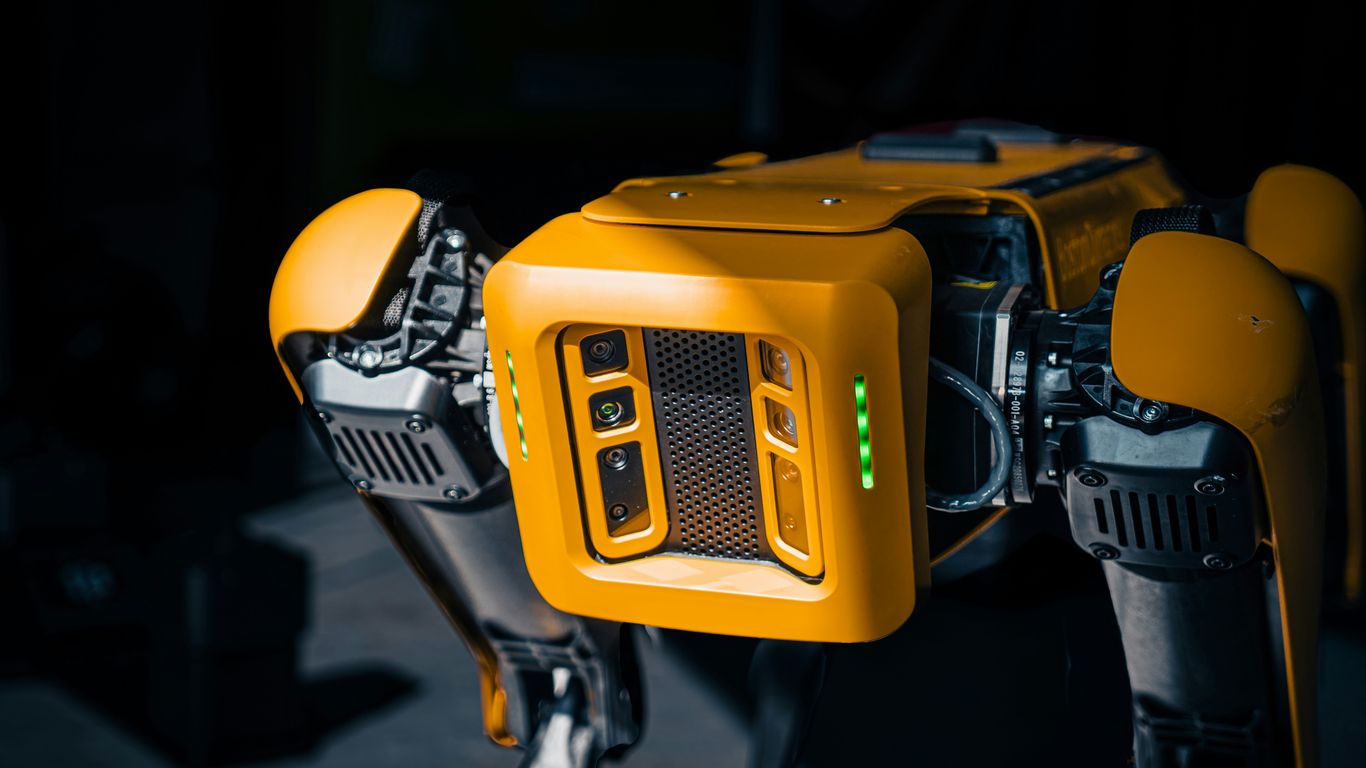
The European market is well suited to this category because it combines mature industrial assets with strong safety expectations. Progress will likely be measured through repeatability, site integration, and the ability to operate without constant human intervention. Those criteria are more revealing than a single successful trial.
## 3\. NEURA Robotics: Advancing cognitive humanoid robots
Humanoid robotics attracts attention because a human-shaped machine can, in theory, operate in spaces designed for people. That argument is technically appealing but incomplete. A useful system still needs reliable perception, safe motion, manipulation, power management, and software that can handle variation without requiring a new engineering project for every task.
The phrase “cognitive” also needs careful treatment. It can refer to a system's ability to combine sensing, reasoning, and action, but it does not remove the physical challenges of balance, contact forces, or grasping. The central question is how much of the loop can be made dependable outside a controlled demonstration.

For founders and investors, the important distinction is between a prototype, a pilot, and a repeatable product. The broader [humanoid robotics market](https://www.insidedeeptech.com/the-top-humanoid-robot-startups-of-2026-ranked-by-real-deployments/) provides useful context, but individual systems should be evaluated on documented operating conditions, safety processes, and evidence that hardware and software can scale together. **Deployment evidence matters most** when the surrounding claims are ambitious.
## 4\. 1X: Developing robots for real-world work and home environments
Robots intended for homes or general work settings face a much less forgiving problem than machines operating behind factory barriers. Floors, furniture, lighting, objects, and human behavior vary constantly. A system that performs well in a carefully prepared environment may still struggle when confronted with ordinary clutter or an unfamiliar room.
That makes data collection and physical reliability central to the category. The robot must perceive enough of its surroundings to act safely, while its mechanical design must tolerate repeated use. Remote assistance, staged deployment, and clear limits may all be sensible parts of an early operating model rather than signs of failure.
The commercial question is whether a general-purpose platform can build trust one task at a time. The [humanoid robots launching in 2026](https://www.insidedeeptech.com/every-humanoid-robot-launching-in-2026-full-list/) coverage illustrates the breadth of the category, while a more disciplined assessment asks what each system can do today, where it can operate, and what remains experimental. Home robotics will advance through ordinary reliability, not only spectacular demonstrations.
## 5\. Enchanted Tools: Reimagining service robots for commercial spaces
Service robots operate in public environments where navigation, interaction, and appearance all affect adoption. Hotels, restaurants, retail spaces, and other commercial settings require machines to move around people without making the environment feel unsafe or inconvenient. The business case depends on fitting into staff routines as much as on autonomous movement.
A service robot also has to communicate its status clearly. If workers cannot tell what it is doing, whether it needs help, or how to work around it, even a technically capable machine can create friction. Designers therefore have to treat human interaction as part of the system rather than as a cosmetic layer.

The category is especially revealing because deployments expose weaknesses quickly. Narrow corridors, elevators, spilled materials, and unpredictable pedestrians test the difference between controlled autonomy and useful autonomy. Startups that define a focused operating environment may have a clearer route to adoption than those that promise universal service from the beginning.
## 6\. Dexory: Automating warehouse inventory with autonomous robots
Inventory is a deceptively difficult warehouse task. Records can become inaccurate when goods move, labels are obscured, aisles are busy, or manual counts are delayed. Autonomous data collection offers a way to make inventory information more frequent and less dependent on occasional labor-intensive checks.
The strongest argument for automation here is informational. Better visibility can support replenishment, exception handling, and space planning, but only if the collected data is accurate and available in the systems that teams already use. A robot's route is therefore only one part of the product.
Several implementation questions deserve explicit attention:
- How often does the operation need inventory data?
- Which sensing conditions create uncertainty?
- How are exceptions reviewed by human operators?
- Can the output connect to existing warehouse software?
These questions keep the discussion grounded in workflow rather than spectacle. They also connect inventory robotics to the wider movement toward autonomous warehouse operations, where modularity and integration often determine value more directly than mechanical novelty.
## 7\. Quantum Systems: Expanding autonomous drone intelligence
Autonomous drones combine robotics, sensing, embedded computing, and difficult decision-making under tight limits on weight and power. Their usefulness depends on more than flight. They must gather information, interpret changing conditions, and maintain a reliable link between autonomy and human oversight.
The technical frontier is moving toward systems that can handle more of the mission without constant manual control. That does not mean human supervision disappears. Instead, operators may shift from steering each movement to defining objectives, monitoring uncertainty, and intervening when the system reaches a boundary it cannot safely resolve.

This is a field where the difference between a research capability and a fielded product is particularly important. Weather, communications, regulation, and sensor performance can all change the result. A serious evaluation should therefore examine the full mission architecture, not just the autonomy model in isolation.
## 8\. Flyability: Making confined-space inspection safer with drones
Confined-space inspection presents a direct safety case for robotics. Tanks, tunnels, shafts, and other restricted areas can be difficult to enter and expensive to inspect thoroughly. A drone may reduce exposure by collecting visual information before a person is asked to enter, although the exact value depends on image quality, navigation, and the inspection procedure around it.
The operating environment also creates unusual engineering demands. Restricted spaces can interfere with positioning, reduce visibility, and limit recovery options. Robust procedures matter because a lost aircraft or incomplete inspection can introduce a new operational problem rather than solve the original one.
The most durable applications will pair autonomous or remotely operated flight with clear human review. That combination preserves accountability while using the machine where it offers the greatest safety advantage. It is a good example of robotics augmenting skilled work instead of pretending that every task can be fully automated.
## 9\. RIVR: Building autonomous delivery robots for challenging environments
Delivery robots have to work at the boundary between controlled logistics and public infrastructure. They encounter curbs, weather, pedestrians, parked vehicles, doors, and changing traffic patterns. A useful system must manage those conditions while keeping the delivery process simple for customers and operators.
The business model is equally important. Route density, charging, storage, remote assistance, insurance, and local rules can determine whether a technically successful pilot becomes a repeatable service. This is why the [autonomous delivery robotics overview](https://www.insidedeeptech.com/the-autonomous-delivery-robot-startups-scaling-in-2026/) is best read alongside evidence about operating models and infrastructure.
A practical path may begin with constrained routes and clearly defined delivery zones. As experience accumulates, autonomy can expand where the data supports it. The central challenge is not merely making a robot move from one point to another; it is building a dependable system around the exceptions that occur between those points.
## 10\. CMR Surgical: Transforming minimally invasive surgery with robotics
Surgical robotics operates under a different standard from most commercial automation. Precision, reliability, training, sterility, clinical workflow, and regulatory evidence all matter, and failure has consequences that cannot be reduced to a missed delivery or delayed warehouse order. Progress therefore tends to be slower, but its evaluation can be more disciplined.
Minimally invasive systems are valuable when they support procedures through small access points while giving clinical teams useful control and visualization. The technology must fit the operating room, not merely demonstrate impressive motion in a laboratory. Hospitals also need to consider training, maintenance, procurement, and the evidence supporting clinical use.
The medical robotics field is broad, spanning surgery, diagnostics, rehabilitation, and intervention. Readers comparing categories can consult this [surgical robotics coverage](https://www.insidedeeptech.com/the-top-surgical-and-medical-robotics-startups-of-2026/), while keeping individual claims tied to documented indications and outcomes. The long-term winners will likely be platforms that combine technical precision with practical adoption across the healthcare system.
## Conclusion
The European robotics startups 2026 conversation is most useful when it moves beyond rankings and asks what each system can reliably do, where it can operate, and how it fits into a real economic workflow. Across warehouses, industrial sites, public spaces, homes, skies, and operating rooms, the durable advantage will come from disciplined deployment: measurable performance, safe interaction, credible integration, and a clear path from prototype to infrastructure.
## Frequently Asked Questions
### What makes a robotics startup worth watching in 2026?
The strongest signals are documented deployments, repeatable performance, credible safety practices, and evidence that customers can integrate the system into an existing workflow.
### Are humanoid robots ready for broad commercial use?
Some humanoid systems may be entering pilots or limited operating environments, but broad commercial readiness depends on reliability, cost, safety, and the ability to handle variation outside demonstrations.
### Why are warehouses an important robotics market?
Warehouses offer measurable tasks, structured environments, and clear economic objectives, making them practical settings for proving whether automation creates sustained operational value.
### What is the main benefit of inspection robots?
Inspection robots can collect information in environments that are hazardous, difficult to access, or expensive for people to visit frequently, while supporting more regular maintenance decisions.
### Do autonomous drones eliminate human operators?
Usually not. Many systems are designed to shift people from direct control toward mission planning, monitoring, exception handling, and final interpretation of collected data.
### What limits delivery robots in public spaces?
Weather, pedestrians, curbs, traffic, regulations, charging, remote assistance, and route economics can all limit deployment even when basic navigation works well.
### How should investors compare robotics companies?
They should examine the operating environment, technical scope, deployment evidence, integration requirements, safety model, production plan, and unit economics rather than relying on demonstrations or funding totals alone.
### The Robotics Unicorns of 2026, Listed
URL: https://www.insidedeeptech.com/the-robotics-unicorns-of-2026-listed/
Last updated: 2026-08-17T17:27:07.000Z
## Key Takeaways
The robotics unicorns 2026 cohort reflects a broad shift from demonstrations toward deployable systems, though commercial maturity varies widely.
- Humanoid robots are being developed for factories, warehouses, homes, and other work environments.
- Foundation models are becoming a central software layer for adaptable robotic behavior.
- Defense, inspection, and delivery companies show that useful autonomy does not require a humanoid form.
- Deployment evidence matters as much as fundraising when judging technical progress.
- Safety, reliability, integration, and unit economics remain decisive constraints.
## 1\. Figure AI — Humanoid robots for industrial work
Humanoid robotics has become one of the most closely watched parts of the private technology market. The attraction is straightforward: a machine shaped for human work could operate in spaces already designed around human tools, shelves, aisles, and workflows. The harder question is whether that form factor can deliver reliable labor outside controlled demonstrations.
[Figure AI](https://www.insidedeeptech.com/the-most-funded-robotics-startups-of-2026-ranked-by-valuation/) is associated with autonomous humanoid robots intended to perform manual labor in manufacturing, logistics, and retail. That scope places the company at the intersection of mechanical design and embodied AI, where perception, planning, balance, and manipulation must work together rather than in isolation. The meaningful benchmark is not a graceful motion, but repeatable performance over long operating periods.
For investors and operators, the relevant distinction is between a prototype and an operational platform. Manufacturing scale, safety certification, maintenance, battery life, and the ability to fit into existing processes will determine whether humanoids become productive assets. The field’s most useful analysis therefore focuses on [commercial-ready humanoids](https://www.insidedeeptech.com/the-best-humanoid-robots-of-2026-ranked/), not on appearance alone.
## 2\. Agility Robotics — Digit’s commercial warehouse deployments
Warehouses provide a demanding but legible environment for mobile robots. Tasks are repetitive, the physical layout is structured, and the value of reducing manual handling can be measured in throughput and labor hours. Even so, a warehouse deployment must cope with people, changing inventory, narrow tolerances, and the unglamorous demands of uptime.
[Agility Robotics](https://www.insidedeeptech.com/the-top-humanoid-robot-startups-of-2026-ranked-by-real-deployments/) is presented as a company moving humanoid robotics toward real-world industrial deployment, with Digit associated with warehouse work. That framing matters because deployment evidence says more than a laboratory demonstration about integration, remote supervision, service requirements, and operational reliability. It also gives buyers a way to judge whether the robot complements an existing workflow rather than forcing a facility to redesign itself around the machine.
The commercial test is cumulative. A robot that completes a task occasionally may be technically impressive, while a fleet that performs it predictably becomes an operating system for a facility. Readers tracking [warehouse robotics startups](https://www.insidedeeptech.com/the-best-warehouse-and-industrial-robotics-startups-of-2026/) should therefore examine task boundaries, deployment duration, safety processes, and economics alongside locomotion and dexterity.
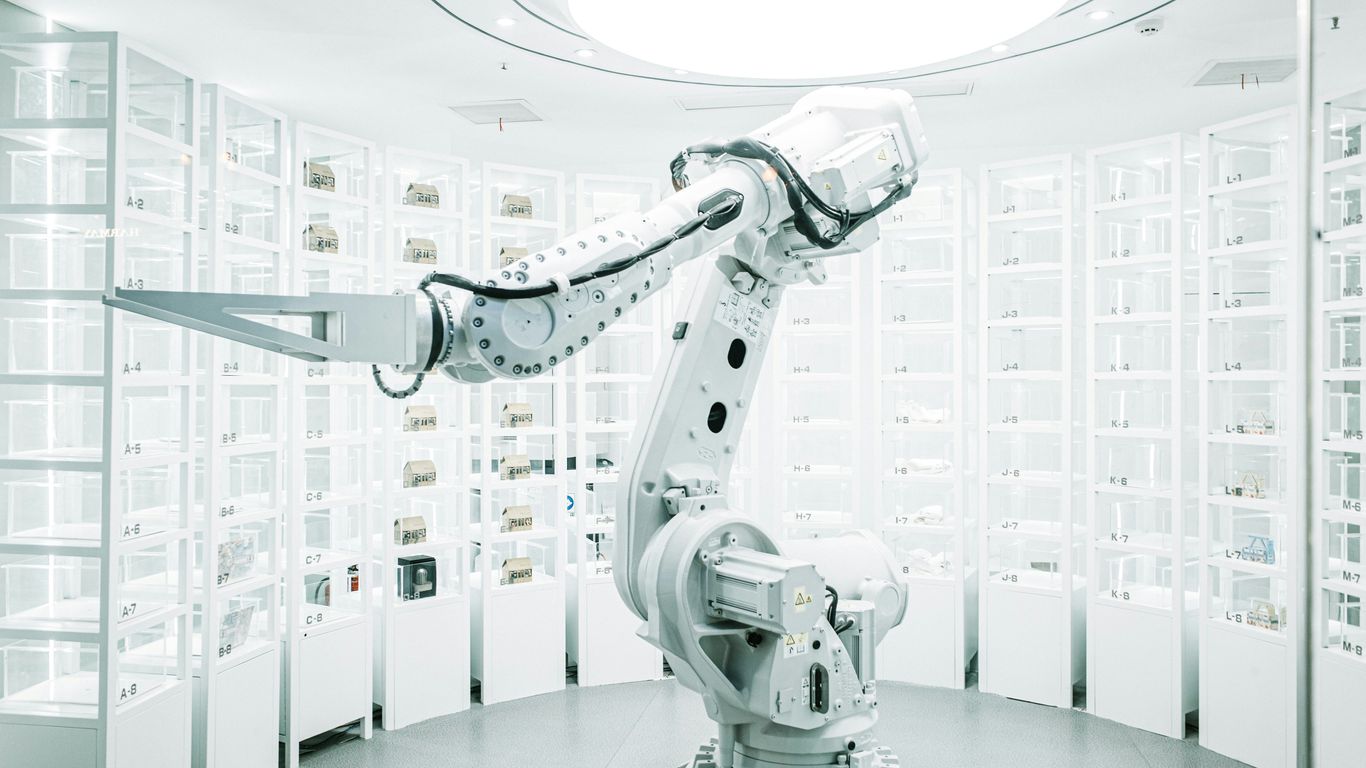
## 3\. Apptronik — General-purpose humanoid robots for factories
Factories are attractive venues for humanoid robots because many processes already depend on standardized workstations and predictable material flows. Yet industrial environments are not static: parts arrive imperfectly, tools wear, and production schedules change. General-purpose capability is useful only when it survives those ordinary disruptions.
Apptronik is identified among the companies developing general-purpose humanoid robots for industrial settings, including factory work. The central engineering challenge is to combine mobility and manipulation with the controls, safety behavior, and repeatability expected in production. A system may be general-purpose in principle while still entering the market through a narrow, carefully selected task.
That staged path is not a weakness. It can let a developer collect operational data, refine hardware, and establish integration practices before attempting broader autonomy. The strongest factory case will ultimately be built from measurable cycle times, recovery behavior, and maintenance records rather than from a broad label alone.

## 4\. 1X — Safe, learning-enabled robots for home and business use
Robots operating around people face a different standard from machines kept behind a safety cage. A home or business environment contains unfamiliar objects, shifting obstacles, and social expectations that are difficult to encode as fixed rules. Safe behavior must remain dependable when the environment is only partly known.
The description of 1X centers on robots designed for home and business use, with an emphasis on safety and learning-enabled behavior. Those terms point to a system that must improve through experience while preserving conservative responses around people. The practical question is how learning is collected, validated, and bounded before a capability reaches a less structured setting.
Domestic deployment also changes the economics of robotics. Hardware has to be serviceable, quiet enough for shared spaces, and useful across more than one task, while the software must handle variation without requiring an expert operator. For businesses, the same questions appear in a more controlled form: what can be automated now, and what still needs human oversight?
## 5\. Physical Intelligence — Foundation models for general-purpose robots
A foundation model in robotics is a general-purpose model that can support behavior across tasks rather than being trained for only one tightly defined motion. The idea is consequential because collecting physical-world data is expensive, slow, and difficult to standardize. Better reuse of learned representations could make each new deployment less of a blank-slate engineering project.
[Physical Intelligence](https://dealroom.co/unicorns/robotics/?ref=insidedeeptech.com) is described in the available industry coverage as a robotics company developing foundation-model technology for general-purpose robots. Its importance in the robotics unicorns 2026 discussion comes from the possibility that intelligence becomes a reusable layer across different machines and environments. That possibility remains distinct from a guarantee that one model can safely control every robot or perform every task.
The evaluation problem is therefore more technical than a model-size comparison. Engineers need to ask how systems transfer skills, respond to unseen objects, recover from mistakes, and communicate uncertainty. A useful foundation model should reduce integration work without hiding the residual burden of sensing, actuation, safety validation, and fleet operations.

## 6\. Skild AI — Robotics intelligence for multiple hardware platforms
A hardware-independent intelligence layer could address one of robotics’ persistent bottlenecks: every new body often requires a substantial software effort. Different actuators, sensors, kinematics, and payloads make transfer difficult even when two machines appear to perform similar tasks. The commercial prize is a more portable form of robotic intelligence.
Skild AI is included in industry rankings of major robotics companies, and its positioning in this list concerns robotics intelligence intended for multiple hardware platforms. The relevant distinction is between a software claim and a demonstrated transfer capability. Portability has to be shown across bodies, environments, and task families, with clear evidence about what is learned once and what still needs platform-specific engineering.
This architecture could also alter how value accumulates in the sector. Hardware makers may differentiate through reliability and cost, while intelligence providers compete on data, training methods, and deployment tooling. In practice, the boundary will remain porous: software needs suitable sensors and controls, and hardware needs software that can exploit its physical design.
## 7\. Anduril Industries — Autonomous defense and security systems
Defense autonomy is shaped by constraints that differ sharply from those in warehouses or factories. Systems may operate with limited communications, incomplete information, and adversarial interference, while the consequences of failure can be severe. Reliability, traceability, and rules for human control are therefore central engineering requirements.
Anduril Industries appears in the robotics and autonomy conversation through autonomous defense and security systems. The category covers a broader operational problem than a single robot: sensing, decision support, vehicles, communications, and command interfaces must function as a coordinated system. Any assessment should separate autonomy used for navigation or monitoring from decisions that require explicit human authorization.
The underlying technologies also illustrate why autonomy is not synonymous with full independence. A system can automate perception or route planning while retaining human supervision for consequential actions. That layered approach is likely to remain important wherever machines operate in contested, regulated, or safety-critical environments.
## 8\. Shield AI — AI pilots and autonomous aircraft
Aircraft autonomy compresses the robotics problem into a fast-moving, high-consequence setting. An autonomous aircraft must interpret sensor data, maintain control, manage its mission, and respond to changing conditions in real time. Those functions leave little room for brittle assumptions or delayed intervention.
Shield AI is associated with AI pilots and autonomous aircraft, a focus that places software intelligence directly inside an aerospace control loop. The technical challenge is not merely recognizing objects or following a route; it is maintaining dependable behavior as conditions change and communications become unreliable. Testing, simulation, and carefully bounded operational roles are essential to establishing confidence.
The broader lesson is that physical AI can be valuable without taking a human shape. Aircraft, ground vehicles, and other platforms can become more capable when perception and control are integrated with a clear operating doctrine. Their progress should be judged by mission reliability and safety evidence, not by the novelty of the interface.
## 9\. Zipline — Autonomous drone delivery at scale
Delivery drones offer one of the clearest examples of autonomy being judged in public, repeatable operations. Their routes, payloads, weather exposure, launch systems, and regulatory obligations all affect whether a service works beyond a pilot. Scale means building an operating network, not simply flying a successful demonstration.
Zipline is included here for autonomous drone delivery at scale. That description directs attention to fleet coordination, dispatch, maintenance, airspace management, and the handoff between automated flight and human oversight. The aircraft is only one component of a service that must meet delivery windows while maintaining safety and economic discipline.
The sector’s development can be followed through research on [autonomous delivery startups](https://www.insidedeeptech.com/the-autonomous-delivery-robot-startups-scaling-in-2026/), particularly the move from pilots toward integrated urban logistics. A serious comparison should ask where the service operates, what infrastructure it requires, and how much remote supervision remains in the loop. Those details often reveal more than a headline flight count.
The main operating variables can be grouped simply:
- Route density and delivery frequency.
- Weather and airspace constraints.
- Fleet maintenance and remote oversight.
- Payload, turnaround time, and unit economics.
That list is useful because drone delivery is a network business as much as an aircraft business. A technically capable vehicle still needs enough demand and infrastructure to make each route economical. The companies that solve those coordination problems will define whether autonomous delivery becomes routine or remains a collection of specialized services.
## 10\. Gecko Robotics — Inspection robots for critical infrastructure
Inspection is an especially practical robotics application because the value often comes from better information rather than from replacing an entire workforce. Critical infrastructure contains surfaces and components that are difficult, dangerous, or expensive to examine manually. A robot can make inspection more repeatable while reducing exposure to hazardous conditions.
Gecko Robotics is positioned around inspection robots for critical infrastructure. In that setting, the important output is trustworthy condition data that engineers can use for maintenance and risk decisions. The system’s usefulness depends on sensing quality, surface access, repeatability, and the ability to connect observations with an asset’s history.
This category also shows why specialized robots can compete effectively with general-purpose machines. A purpose-built system may have a narrower operating envelope but a clearer return on investment and a simpler validation path. Across infrastructure, delivery, defense, and industrial work, the durable pattern is the same: autonomy earns adoption when it produces reliable results within a defined operational boundary.
A compact comparison helps clarify how different forms of robotics create value:
| Application | Primary operating challenge | Evidence that matters |
| ------------------------- | ------------------------------------- | ---------------------------------- |
| Humanoid industrial work | Reliable manipulation in human spaces | Task consistency and uptime |
| Autonomous delivery | Safe operation across a network | Route performance and oversight |
| Infrastructure inspection | Repeatable access and sensing | Data quality and maintenance value |
The table also explains why a single ranking can mislead. A delivery network, an inspection platform, and a factory humanoid are solving different deployment problems, so their progress cannot be reduced to one measure of autonomy. The right comparison is always tied to the job, the environment, and the cost of failure.
## Conclusion
The robotics unicorns 2026 list is best read as a map of competing paths into physical AI: humanoids for human workspaces, models that travel across machines, and specialized systems built around clear operational needs. Funding and valuation signal belief, but deployment evidence, safety, reliability, and economics determine whether that belief becomes infrastructure. Inside Deep Tech’s useful question is therefore not which company sounds most futuristic, but which technical system is becoming dependable enough to matter.
## Frequently Asked Questions
### What makes a robotics company a unicorn?
A robotics company is generally called a unicorn after reaching a private valuation of at least $1 billion. The label describes financing status, not technical maturity, revenue quality, or deployment scale.
### Why are humanoid robots receiving so much attention?
Humanoids are designed to work in environments built for people, potentially allowing them to use existing tools and layouts. Their commercial value still depends on safe, reliable, and economical performance.
### Are all autonomous robots humanoid?
No. Autonomous aircraft, drones, inspection machines, warehouse systems, and industrial vehicles can provide valuable autonomy without resembling a person. Form follows the environment and task.
### What is a robotics foundation model?
It is a model intended to support behavior across multiple robotic tasks or settings rather than being trained for only one narrowly defined action. Transfer, safety, and real-world data requirements remain important evaluation questions.
### How should investors assess robotics companies?
They should examine deployment evidence, customer integration, safety processes, unit economics, hardware reliability, and the amount of human oversight still required. Valuation alone is an incomplete measure.
### Why is deployment harder than a laboratory demonstration?
Real environments contain variation in objects, people, weather, maintenance conditions, and network connectivity. A deployed system must recover from ordinary disruptions repeatedly, not just complete a carefully prepared trial.
### What will determine the next phase of robotics adoption?
Adoption will depend on measurable productivity, lower operating costs, dependable safety behavior, regulatory acceptance, and integration with existing workflows. Companies that define a valuable task clearly may progress faster than those promising unlimited generality.
### NVIDIA's Robotics Platform: How It Powers Physical AI
URL: https://www.insidedeeptech.com/nvidias-robotics-platform-how-it-powers-physical-ai/
Last updated: 2026-08-17T17:27:09.000Z
## Key Takeaways
Physical AI connects machine perception, learned reasoning, and physical action. Its practical progress depends as much on simulation, data, compute, and safety engineering as on the model itself.
- A robotics platform spans development tools, simulation, training infrastructure, and edge deployment.
- Physical AI must respond to changing environments rather than execute only fixed sequences.
- Digital twins and synthetic data can reduce the amount of costly physical testing.
- Foundation models may generalize skills, but task-specific adaptation and controls remain necessary.
- Deployment decisions should account for latency, safety, reliability, integration cost, and governance.
## What NVIDIA's robotics platform includes
The phrase NVIDIA robotics platform explained refers less to one product than to a connected development stack. It covers the stages between robot learning and operation: modeling an environment, training policies, processing sensor data, and running inference near the machine. That distinction matters because a capable model is not, by itself, a working robot.
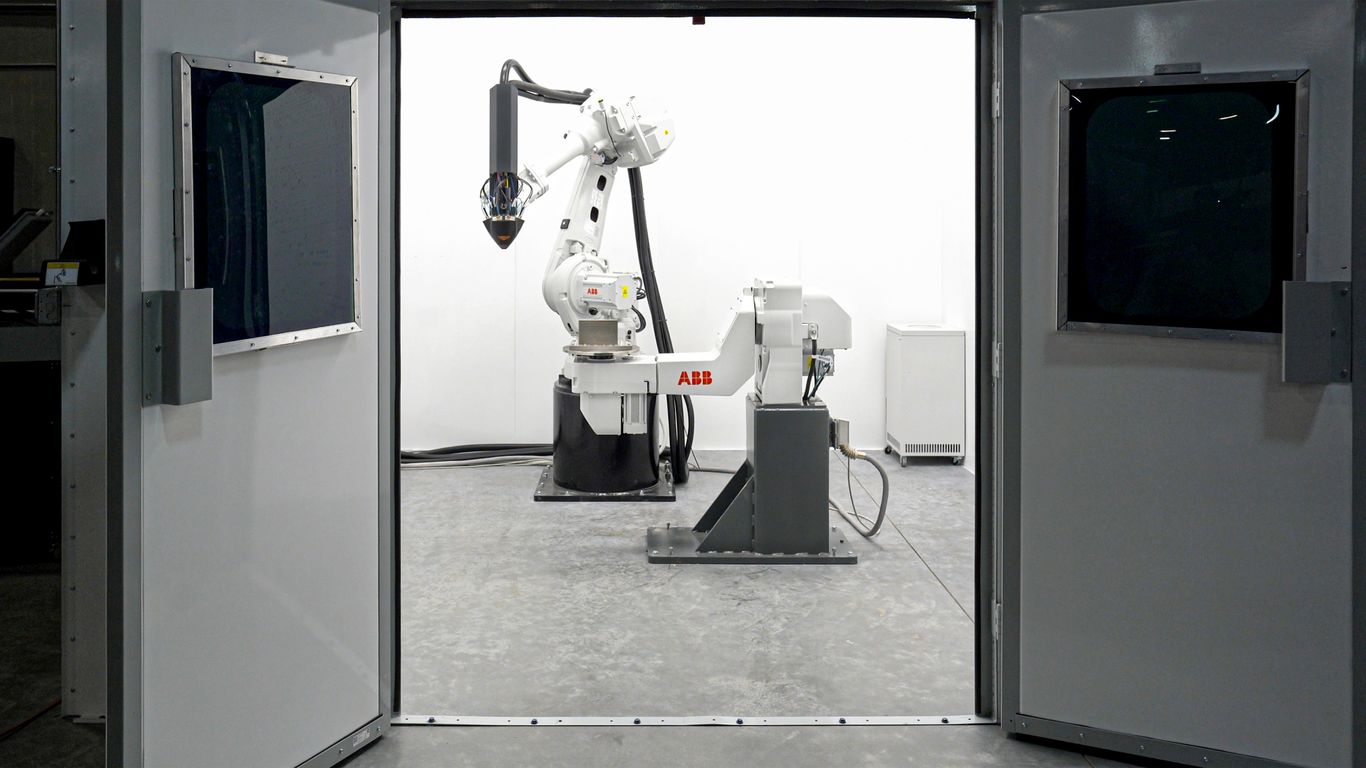
### The role of NVIDIA Isaac in robot development
NVIDIA Isaac is described as an open robotics development platform that combines simulation and robot-learning frameworks, CUDA-accelerated libraries, AI models, and reference workflows. Those components are intended for systems including autonomous mobile robots, robot arms, manipulators, and humanoids. The [NVIDIA Isaac platform](https://developer.nvidia.com/isaac?ref=insidedeeptech.com) is therefore best understood as a set of development paths rather than a single packaged robot controller.
Its value is in connecting activities that are often separated in conventional projects. Teams can work on perception, motion planning, learning, and deployment within related workflows, while still having to validate each behavior against the limits of a particular robot and operating environment.
### How Jetson brings AI inference to edge devices
Edge inference means that a robot processes a model close to its sensors and actuators instead of sending every observation to a remote system. That can reduce dependence on network round trips, which is useful when a robot must respond to a moving object or a changing obstacle. The hardware choice still involves trade-offs among compute capacity, power use, thermal limits, and physical packaging.
The practical question is not simply whether a model can run. Engineers also need to establish whether it meets the robot's timing budget under realistic sensor loads, including periods when several perception and control tasks compete for resources.
### Where Omniverse and simulation fit into the stack
Simulation gives a robotics team a controlled place to construct scenes, test interactions, and repeat experiments. A digital environment can expose a policy to variation in object placement, lighting, motion, and sensor conditions before the same trials are attempted on hardware. The [Physical AI guide](https://www.insidedeeptech.com/understanding-physical-ai-a-guide-to-intelligence-in-motion/) offers useful broader context on digital twins, edge processing, and the bridge between digital intelligence and motion.
Simulation does not remove the need for physical testing. Contact dynamics, calibration errors, wear, and unexpected human behavior can all produce differences that a virtual scene fails to capture. Its strongest role is to make iteration cheaper and more systematic, not to certify behavior on its own.
### How cloud and data center systems support training
Training generally needs more compute and storage than an individual robot can carry. Data center resources can run many experiments in parallel, manage large collections of demonstrations and sensor recordings, and compare policy variants. Cloud resources add flexibility, but organizations still need to control data movement, experiment reproducibility, and access to sensitive operational information.
A useful architecture separates training from deployment without treating them as unrelated systems. The model, preprocessing steps, calibration assumptions, and version history should travel together so that a successful training run can be reconstructed at the edge.
## How physical AI differs from traditional robotics
Traditional robotics often begins with explicit rules: a known path, a defined object, and a bounded sequence of actions. Physical AI adds learned representations that help a machine interpret less structured inputs and select actions under uncertainty. The difference is not that classical control disappears; it is that learned perception and decision-making become part of a larger control system.
### Connecting perception, reasoning, and action
A physical system must turn pixels, depth measurements, force readings, or other sensor signals into an estimate of what is happening. It then needs to choose an action whose consequences unfold in the real world. That creates a closed loop: perception informs reasoning, reasoning proposes behavior, and the resulting motion produces new observations.
The loop also makes errors consequential. A mistaken classification in a software interface may be inconvenient; a mistaken estimate near a person or fragile object can create a safety problem. Physical AI therefore needs interfaces between learned components and established planning, control, and safety mechanisms.
### Combining vision-language models with robot control
Vision-language models can associate visual scenes with language, while robot-control systems must produce timed, physically feasible actions. Combining them requires a translation layer between a high-level instruction and the low-level commands that move joints, wheels, grippers, or other actuators. That layer must account for embodiment, reachability, force, and the current state of the machine.
The result is not necessarily a single end-to-end model. In many systems, language and vision guide a task policy while conventional controllers enforce constraints. This division can make the system easier to test, although it also introduces interfaces where information may be lost or misinterpreted.
### Using world models to understand environments
A world model is an internal representation of how an environment is arranged and how it may change after an action. For a robot, that representation can include objects, surfaces, free space, motion, and likely consequences. It gives the system a basis for planning beyond the next isolated motor command.
World models remain approximations. They can be incomplete, stale, or wrong when the environment contains occlusions, unusual objects, or changes outside the training distribution. Their usefulness therefore depends on continual observation and on a fallback behavior when confidence is low.
### Why physical AI requires simulation and real-world feedback
Robots cannot learn everything efficiently through trial and error on production hardware. Simulation provides scale and repeatability, while real-world feedback reveals friction, sensor noise, mechanical tolerances, and social conditions that are difficult to represent perfectly. The two sources of experience work best as a loop rather than as competing alternatives.
A disciplined program uses physical results to improve the virtual environment and uses simulation to select safer, more informative physical experiments. That approach supports the broader analysis of [robot foundation models](https://www.insidedeeptech.com/robot-foundation-models-the-ai-brains-behind-physical-ai/), which emphasizes that generalization still depends on hardware, control, and safety engineering.
## How robots are trained in NVIDIA Isaac
Robot training is a pipeline, not a single pass through a model. Teams first define the task and the environment, then gather observations, train a policy, test failure cases, and move selected behaviors toward hardware. Each stage can expose different problems, so a high simulation score is only one signal among several.

### Building digital twins with Isaac Sim
A digital twin is a virtual representation of a robot and the setting in which it operates. It can include geometry, sensors, materials, and physical interactions, allowing engineers to run repeatable trials without putting the physical machine through every experiment. The fidelity required depends on the task: navigation, grasping, and contact-rich manipulation do not stress a simulation in the same way.
The twin should be treated as an engineering model with assumptions, not as a perfect copy of reality. Calibration against measured hardware behavior is essential, particularly when small differences in timing or friction alter the outcome of a learned policy.
### Generating synthetic data for perception models
Synthetic data is generated from controlled virtual scenes and can vary factors that would be expensive to capture manually. It may provide labeled examples for detection, pose estimation, depth, or segmentation while exposing a model to unusual positions and lighting conditions. This is most useful when the target environment is known well enough to model and when the labels need to be precise.
Synthetic examples do not automatically match the visual statistics of a real facility. Teams should compare them with physical recordings, identify systematic gaps, and use real observations to adjust the data mixture. Otherwise, a perception model may perform well on a benchmark that does not reflect deployment.
### Training policies with Isaac Lab
Policy training concerns the behavior that maps observations to actions. A policy can be trained across many simulated episodes, with rewards or demonstrations guiding it toward a task objective. Parallel trials make it possible to explore variations and failure modes more quickly than a single physical robot could.
The objective must be designed carefully. A policy that reaches a target quickly may still collide with obstacles, use excessive force, or fail when an object is slightly displaced. Training metrics should therefore include constraints and failure analysis, not only task completion.
### Moving models from simulation to physical hardware
The transition from simulation to hardware is commonly called sim-to-real transfer. It involves packaging the model, matching preprocessing and coordinate systems, calibrating sensors, and checking that the policy behaves under the robot's actual timing and mechanical limits. A staged rollout is safer than moving directly from a successful virtual trial to unrestricted operation.
Teams can reduce surprises through domain randomization, hardware-in-the-loop tests, and carefully selected physical evaluations. None is a substitute for observing the deployed robot, but together they make the gap measurable rather than mysterious.
## The software and hardware workflow
A working robot is an integration project. Middleware, sensors, inference runtimes, actuators, networking, and safety systems must exchange information with predictable timing. The stack may be modular in software, but its behavior is coupled through bandwidth, latency, clock synchronization, and hardware constraints.
### Running ROS 2 applications with Isaac ROS
ROS 2 applications organize robot functions into communicating components, allowing teams to combine perception, planning, and control nodes. An accelerated robotics workflow can preserve those interfaces while providing optimized implementations for demanding workloads. The key engineering task is to understand what each node assumes about message formats, timing, frames, and failure behavior.
Modularity helps teams replace one component without rewriting the entire application. It does not guarantee compatibility, however. Integration testing must cover the full message path, including delayed, missing, or malformed sensor data.
### Accelerating perception with GPU-optimized packages
Perception often consumes substantial compute because cameras and depth sensors produce high-rate streams. GPU-optimized packages can reduce processing time for supported operations, leaving more room for planning or additional sensors. The relevant measure is end-to-end performance, not an isolated kernel result.
A perception pipeline should be profiled under the same image sizes, sensor rates, and concurrent workloads expected in operation. This is where **latency under load** becomes more useful than a peak throughput figure reported in ideal conditions.
### Deploying models on Jetson and other edge platforms
Edge deployment requires more than exporting a model. Engineers must check numerical compatibility, memory use, startup behavior, thermal conditions, and how the inference runtime interacts with other robot processes. A smaller model that responds consistently may be preferable to a larger model that occasionally misses its control deadline.
The deployment target also shapes the model-development process. Quantization, batching, and sensor scheduling can affect accuracy and timing, so they should be evaluated before the final field trial rather than treated as last-minute packaging details.
### Connecting robot components through sensors, networks, and APIs
Sensors provide observations, networks carry them, and APIs define how software components use them. A dependable system makes those boundaries explicit: timestamps must be meaningful, coordinate frames must be consistent, and actuator commands must have clear limits. Diagnostics should reveal not only that a component failed, but whether the fault began with sensing, transport, inference, or control.
A concise integration review typically covers four areas before deployment:
- sensor calibration and timestamp integrity;
- network bandwidth, latency, and failure handling;
- model versioning and runtime compatibility;
- actuator limits, emergency behavior, and operator access.
That list is not a substitute for system testing. It is a way to keep basic integration risks visible while teams focus on model performance.
## NVIDIA's foundation models for general-purpose robots
Foundation models for robotics aim to provide reusable representations and behaviors across tasks or embodiments. They are trained from combinations of language, images, video, demonstrations, and simulation rather than from one narrowly scripted sequence. The promise is broader adaptability, but general-purpose behavior still has to meet the constraints of a specific body and workplace.
### What Isaac GR00T is designed to do
[Isaac GR00T](https://developer.nvidia.com/isaac/gr00t?ref=insidedeeptech.com) is presented as an open reference platform for general-purpose humanoid robots. Its documented scope includes open data and pipelines, a foundation model for generalized reasoning and skills, simulation frameworks, CUDA-X accelerated libraries, and Jetson Thor for real-time inference. It is intended to support building, training, testing, and deploying AI-powered robots, including manipulation and multi-step actions.
That scope describes an open development framework, not a guarantee that any humanoid can perform arbitrary work without adaptation. A deployment still requires an appropriate body, sensors, actuators, controls, and validation process.
### Using demonstrations and multimodal data for training
Demonstrations show a system what a successful behavior looks like, while multimodal data connects language and visual context with action. Human teleoperation can capture examples that are difficult to specify as rules, especially for manipulation. Video and simulation can add variation, but each source carries its own biases and gaps.
The training set should be organized around the conditions that matter in operation. A large collection with little coverage of failure cases may be less useful than a smaller, carefully evaluated set that represents object variation, workspace changes, and recovery behavior.
### Adapting generalist models to specific tasks
A generalist model usually needs adaptation before it can perform a production task. Fine-tuning, demonstrations, task-specific policy layers, and conventional controllers can narrow a broad capability to a defined workflow. The adaptation process should preserve enough flexibility to handle ordinary variation without allowing unbounded behavior.
Evaluation should separate capability from reliability. A robot that succeeds in a demonstration may still require many more trials to establish consistent performance across shifts, operators, objects, and environmental conditions.
### The role of Cosmos in physical world understanding
A physical-world model can help represent how scenes evolve and how actions may change them. Within the documented GR00T reference platform, Omniverse and Cosmos are included among the simulation frameworks supporting development. Their relevance is the connection between visual context, predicted consequences, and robot learning—not a claim that simulation can replace field evidence.
The practical test remains whether a model improves decisions on the target hardware. Predictions that look plausible but fail under contact, occlusion, or timing pressure must be treated as research signals rather than deployment readiness.
## How organizations can evaluate and deploy the platform
The right evaluation starts with the operating task, not with a product inventory. A warehouse robot, a laboratory manipulator, and a humanoid assistant have different sensing, safety, and uptime requirements. Organizations should define those requirements in measurable terms before selecting compute, simulation, or model components.
### Choosing between simulation, edge, and data center resources
Simulation is suited to repeatable environment generation and policy experiments; edge systems are suited to local inference and immediate response; data center resources are suited to large-scale training and parallel evaluation. Most serious programs need all three, with clear boundaries between them. Energy, network access, and data sensitivity can change the balance for a particular site.
For adjacent infrastructure planning, the [Helios Energy Global blog](https://heliosenergyglobal.com/blog?ref=insidedeeptech.com) is an example of material focused on industrial energy and storage questions. That topic is separate from robot intelligence, but it illustrates why the physical operating envelope—including power availability—belongs in a deployment plan.
### Measuring accuracy, latency, safety, and reliability
A credible evaluation combines task outcomes with system behavior. Accuracy alone can hide a model that is too slow, unstable under sensor degradation, or unsafe when uncertain. Metrics should be collected across representative conditions and reported with enough detail to distinguish a model failure from a mechanical or integration failure.
A practical scorecard can be organized as follows:
| Evaluation area | Example question | Why it matters |
| --------------- | --------------------------------------------- | ----------------------------------------- |
| Accuracy | Does the robot complete the defined task? | Shows functional capability |
| Latency | Does the full loop meet its timing budget? | Connects inference to safe action |
| Safety | Does the system fail within defined limits? | Addresses people, equipment, and property |
| Reliability | Does performance hold across repeated trials? | Tests operational consistency |
The scorecard becomes useful only when the organization sets thresholds before testing. Results should also include confidence ranges, failure categories, and the conditions under which the system was evaluated.
### Managing the sim-to-real gap
The sim-to-real gap is managed through calibration, domain variation, hardware-in-the-loop testing, and repeated physical checks. Teams should identify which assumptions are most likely to fail, then design experiments that challenge those assumptions. This is more informative than treating simulation transfer as a single final milestone.
The same discipline applies to model monitoring after launch. Logs, operator feedback, and incident reviews can reveal environmental changes that were absent from training. A controlled update process is essential when a new model may alter physical behavior.
### Addressing cost, integration, security, and vendor lock-in
A platform decision should include the full lifecycle cost: engineering time, sensor integration, data preparation, compute, maintenance, monitoring, and safety review. It should also specify what can be replaced independently if requirements or suppliers change. Open interfaces can reduce switching costs, although they do not eliminate the work of revalidation.
Security includes access control, software provenance, update procedures, telemetry, and protection of recordings from workplaces or homes. Readers comparing governance practices may find the [Travel Fx Privacy Policy](https://www.travelfx.co.uk/travel-fx-privacy-policy?ref=insidedeeptech.com) and [Natural Escort privacy statement](https://natural-escort.de/datenschutzerklaerung/?ref=insidedeeptech.com) useful as general examples of how data rights and security controls are documented, though those policies are not robotics standards. Broader context on adoption and market effects is available in [Artificial Intelligence statistics](https://gallanroberts.com/artificial-intelligence-statistics/?ref=insidedeeptech.com), while discussion of applied AI workflows appears in [AI strategy tools](https://wannaparlay.com/can-ai-help-me-win-in-daily-fantasy-sports/?ref=insidedeeptech.com). These references reinforce a simple point: deployment is an operational and governance decision, not only a benchmark exercise.
## Conclusion
Physical AI becomes practical when models, simulation, compute, control software, sensors, and safety processes are developed as one system. The platform approach can shorten iteration and make complex workflows more accessible, but it does not erase the hard work of calibration, evaluation, and deployment. For builders and investors, the durable signal is not a compelling demo; it is repeatable performance under real constraints.
## Frequently Asked Questions
### What is physical AI?
Physical AI describes systems that perceive and act in the physical world, often combining learned models with sensors, planning, control, and safety mechanisms.
### How is physical AI different from software-only AI?
Software-only AI produces outputs within a digital environment, while physical AI must account for timing, mechanics, uncertainty, contact, and consequences in the real world.
### Why is simulation useful for robotics?
Simulation provides repeatable environments for testing, synthetic-data generation, and policy training before a behavior is attempted repeatedly on physical hardware.
### Can simulation replace real-world robot testing?
No. Simulation can reduce cost and risk, but physical testing is needed to expose calibration errors, sensor noise, mechanical variation, and unexpected environmental behavior.
### What does sim-to-real mean?
Sim-to-real is the process of transferring a model or policy developed in simulation to a physical robot while addressing differences between the two settings.
### Why do robots need edge inference?
Edge inference allows a robot to process information near its sensors and actuators, which can help meet response-time requirements and reduce dependence on network connectivity.
### What should organizations measure before deployment?
They should measure task accuracy, end-to-end latency, safety behavior, reliability across repeated trials, integration effort, security exposure, and lifecycle cost.
### Robot Foundation Models: The AI Brains Behind Physical AI
URL: https://www.insidedeeptech.com/robot-foundation-models-the-ai-brains-behind-physical-ai/
Last updated: 2026-08-17T17:27:10.000Z
## Key Takeaways
Robot foundation models are shifting robotics from task-specific programming toward systems that can interpret language, perception, and action together. Their promise is broad, but dependable physical intelligence still depends on data, control, hardware, and safety engineering.
- Robot foundation models connect pretrained AI with physical action.
- They combine visual, sensory, spatial, and language inputs.
- Training typically spans demonstrations, simulation, video, and reinforcement learning.
- Generalization across tasks and robot platforms remains an open engineering problem.
- Real-world evaluation must prioritize safety, reliability, latency, and repeatability.
## What robot foundation models are and why they matter
Robot foundation models are large, pretrained models that can be adapted to a range of robotic tasks rather than built for one narrowly defined behavior. They sit at the intersection of machine learning, robotics, and control theory. The central idea is to move some intelligence upstream, so a robot can draw on broad learned representations instead of starting from a blank task-specific policy each time. That is the basic premise behind [foundation models in robotics](https://arxiv.org/html/2312.07843v1?ref=insidedeeptech.com), although the practical results vary considerably by task and hardware.
### Robot foundation models explained in simple terms
The simplest way to understand robot foundation models explained in practical terms is to compare them with a general-purpose language model. A language model maps text inputs to text outputs; a robot model maps observations and instructions to decisions or movements in the physical world. Its output might be a high-level plan, a sequence of actions, or control commands that another system converts into motion.
The model does not magically understand the world as a person does. It learns statistical relationships among images, language, sensor readings, actions, and outcomes. That learned prior can help it recognize an unfamiliar object or infer what a person means by “place the cup beside the plate,” but the robot still needs actuators, feedback loops, and safeguards to execute the task.
### How they differ from traditional robot software
Traditional robot software often decomposes a task into carefully engineered modules: detect an object, estimate its pose, plan a trajectory, grasp it, and verify success. This approach can be highly reliable in controlled settings, but it usually requires substantial work when the object, lighting, workspace, or task changes. A foundation model attempts to reuse representations and behaviors across those changes.
That does not mean conventional software disappears. Low-level controllers, motion planners, calibration systems, and safety interlocks remain essential. The difference is that a learned model may handle ambiguous perception or task interpretation while deterministic systems constrain the resulting behavior.
### The connection between foundation models and physical AI
Physical AI describes systems that perceive and act in the material world, where friction, timing, geometry, and unexpected contact matter. A robot foundation model can provide part of the intelligence required for that loop by grounding language and visual information in possible actions. The broader [Physical AI](https://www.insidedeeptech.com/understanding-physical-ai-a-guide-to-intelligence-in-motion/) framework also includes sensors, actuators, simulation, materials, and the mechanical design of the machine.
This distinction matters because digital competence is not enough. A model can describe how to pick up a fragile object and still fail to regulate force, account for a slippery surface, or notice that a human has entered the workspace. Physical intelligence emerges from the interaction between the model and the complete robot system.
### Why general-purpose robot intelligence is difficult
The physical world is open-ended, partially observable, and unforgiving of small errors. A robot must deal with objects it has not seen, instructions that are incomplete, and consequences that cannot be reversed cheaply. It also has to act at the speed of a moving mechanism, not merely produce a plausible answer.
Generalization therefore has several dimensions: recognizing new objects, transferring a skill to a new setting, adapting to a different body, and recovering when an action fails. Progress in one dimension does not guarantee progress in the others. A system that performs well in a benchmark may still require close supervision on a factory floor or in a home.
## How robot foundation models work
A robot foundation model usually sits within a layered architecture rather than operating as a lone all-purpose brain. Cameras and other sensors provide observations, a model interprets those observations alongside language or task context, and a planning or control layer turns decisions into motion. The result is a closed loop: observe, estimate, act, and observe again.
The architecture is often described as vision-language-action, or VLA, when visual and language inputs are connected directly to actions. [NVIDIA Isaac GR00T](https://www.insidedeeptech.com/understanding-nvidia-isaac-gr00t-a-foundation-model-for-generalist-robots/) is one documented example of this direction, with multimodal AI, VLA models, diffusion transformers, simulation-to-reality pipelines, and edge computing discussed as parts of a broader robotics stack.

### Multimodal inputs from cameras, sensors, and language
Cameras supply appearance and spatial cues, while depth sensors, joint encoders, force sensors, and microphones can provide complementary information. Language adds an instruction or goal, but it is rarely sufficient on its own. The robot must connect the words to the current scene, its own geometry, and the actions available through its body.
This is why multimodal input is more than simply feeding several files into a model. The signals arrive at different rates, contain different uncertainties, and may conflict. A useful system must align them in time and decide which observations matter for the immediate task.
### Perception, reasoning, and action generation
Perception converts raw sensor data into a working description of the scene: objects, surfaces, people, free space, and relevant changes. Reasoning then estimates what matters for the goal and chooses a course of action. Action generation produces a plan or movement, often with a lower-level controller responsible for smooth and safe execution.
The boundaries between these stages are becoming less rigid. End-to-end policies can learn a direct relationship between observations and behavior, while modular systems make intermediate decisions easier to inspect. In either case, feedback is crucial because a prediction made before contact may become wrong once the gripper touches the object.
### Turning instructions into robot movements
An instruction such as “clear the table” is not a single movement. It implies identifying what belongs on the table, deciding where each item can go, sequencing the actions, and checking whether the result meets the goal. The model must translate a linguistic objective into constraints that a planner and controller can use.
The translation is usually hierarchical. A high-level policy selects subtasks, a motion planner accounts for reachability and collision avoidance, and servo control adjusts the robot’s joints in real time. This layered approach gives the learned model room to generalize without asking it to solve every timing and stability problem directly.
### The role of world models and spatial understanding
A world model is an internal representation that helps an agent estimate how the environment may change after an action. It can encode the current state, predict possible future states, and support planning before the robot commits to a movement. The concept is explained in greater detail in this discussion of [world models](https://humanoid.guide/foundation-models-explained/?ref=insidedeeptech.com).
Spatial understanding is especially valuable when objects are occluded, movable, or arranged in unfamiliar ways. Yet prediction is not certainty. Real materials deform, people move unpredictably, and sensors fail, so a world model must be updated continuously with new observations rather than treated as a perfect simulation.
## How these models are trained
Training a robot foundation model is a data and systems problem as much as a model-design problem. Internet-scale images and video can teach useful visual concepts, but physical action requires demonstrations, trajectories, sensor streams, and outcome signals. Researchers therefore combine several sources of supervision, each contributing a different kind of knowledge.
The objective also changes across stages. Early training may build broad representations, while later stages teach a model how a particular robot moves and how success is measured. The path from a pretrained model to a dependable deployed policy is consequently iterative, empirical, and hardware-dependent.

### Collecting data from robots and human demonstrations
Robot data records what the machine saw, what it did, and what happened afterward. Human demonstrations can add useful examples of grasping, navigation, and tool use, especially when collected through teleoperation or kinesthetic teaching. However, demonstrations are expensive and often reflect the limits of the demonstrator, the interface, and the available hardware.
A valuable dataset also needs failures, recoveries, varied environments, and clear task boundaries. If every example shows a perfect trajectory in a clean workspace, the model may learn to imitate appearance without learning how to cope with uncertainty.
### Combining simulation, video, and language data
Simulation can generate large numbers of trajectories while allowing researchers to vary object positions, lighting, friction, and obstacles. Video supplies broad visual knowledge, even when it does not include robot actions. Language connects behaviors to goals, descriptions, and human concepts.
These sources are complementary rather than interchangeable. Video may show that a drawer can open but not provide calibrated joint commands; simulation can provide actions but may simplify contact physics. Language can describe intent but often leaves crucial details unspecified. The training pipeline must align these modalities carefully.
### Pretraining, fine-tuning, and reinforcement learning
Pretraining builds general representations from broad datasets. Fine-tuning then adapts those representations to a robot, task family, sensor arrangement, or operating environment. Reinforcement learning can further optimize behavior using rewards for task completion, efficiency, safety, or other objectives.
The practical sequence varies, but the trade-offs are consistent: broader pretraining can improve transfer, while focused fine-tuning can improve performance on a known distribution. The following comparison captures the role of each stage.
| Training stage | Primary purpose | Typical strength | Main limitation |
| ---------------------- | ---------------------------------- | -------------------------------- | ----------------------------------------- |
| Pretraining | Build broad representations | Transfer across tasks | Requires large, varied data |
| Fine-tuning | Adapt to a robot or domain | Better task performance | Can reduce generality |
| Reinforcement learning | Optimize outcomes through feedback | Improves recovery and efficiency | Reward design can be difficult |
| Evaluation | Measure behavior under conditions | Reveals deployment risks | Benchmarks may miss real-world edge cases |
The table is a reminder that no stage solves the whole problem. A model can be broadly knowledgeable yet physically inexperienced, or highly capable on one robot while failing to transfer to another body.
### Handling differences between simulation and the real world
The gap between simulation and reality appears in contact dynamics, sensor noise, latency, lighting, wear, and the behavior of people. Techniques such as domain randomization, system identification, real-world fine-tuning, and careful calibration can reduce the gap, but they do not eliminate it.
NVIDIA Isaac GR00T is described in the coverage material alongside simulation-to-reality pipelines and hardware-software co-design, which reflects the larger engineering lesson: model quality and simulator quality are linked to the machine that will execute the policy. A policy trained without those constraints may look impressive in a virtual environment and remain unusable on hardware.
## What robot foundation models can do
The most credible capabilities are not magic tricks but forms of transfer. A model can connect a new instruction to familiar visual concepts, reuse a behavior in a changed scene, and combine known subtasks into a longer sequence. Each capability still depends on the training distribution, the robot’s embodiment, and the quality of feedback.
The field is also moving toward systems that can operate across more than one task family. That ambition is why researchers study [Physical AI startups](https://www.insidedeeptech.com/physical-ai-the-embodied-ai-startups-to-watch-in-2026/) and the software layers intended to support unpredictable objects and human-designed environments. Demonstrations should still be read as evidence of a capability under conditions, not as proof of universal autonomy.
### Following natural-language instructions
Natural-language control gives people a more flexible interface than a fixed menu of commands. The model can interpret an instruction, identify relevant objects, and select actions that appear consistent with the stated goal. Ambiguity remains a central issue: “put it away” depends on context, object identity, and the available storage locations.
A reliable system should ask for clarification when the goal is underspecified or when several actions carry different risks. Language can make robots easier to use, but it can also conceal uncertainty if the system responds confidently without verifying what the user intended.
### Learning new tasks with few examples
Few-shot adaptation means that a model can acquire a task from a small number of demonstrations rather than requiring a new policy built from scratch. This is valuable when every task cannot be anticipated during development. The model may reuse concepts such as grasping, pushing, sorting, and reaching while adapting their sequence to a new goal.
Few examples are not the same as no examples. The demonstrations must cover the relevant variation, and the robot needs a way to detect whether its behavior is succeeding. In practice, a small amount of targeted data can be powerful when the pretrained model already contains the right abstractions.
### Adapting to unfamiliar objects and environments
A generalist policy should separate the task objective from superficial details such as color, background, or the exact shape of an object. It may then recognize that an unfamiliar container can be grasped and moved even though that container never appeared in training. This kind of adaptation is one reason vision-language-action research attracts attention.
The same principle appears in autonomous systems outside ground robotics. For example, [AI drones](https://dronenewsnetwork.com/reviews/ai-drones-explained/?ref=insidedeeptech.com) use onboard machine learning and computer vision for navigation and decision-making, but their constraints include energy, cybersecurity, and obstacle avoidance. The comparison is useful because it shows that perception and planning must always be shaped by a vehicle’s physical limits.
### Coordinating multiple steps and tools
Long-horizon tasks require the robot to maintain a goal while handling intermediate failures. A kitchen or warehouse task may involve finding an item, opening a container, using a tool, and verifying the result. The policy must decide not only what to do next, but when to stop, retry, or request assistance.
This coordination is often supported by hierarchical planning and external tools. A model might call a vision routine, consult a map, or hand a precise trajectory to a controller. That division lets each component do what it is best suited to do instead of forcing one neural network to represent every operational detail.
### Working across different robot platforms
Cross-platform transfer is difficult because robots differ in reach, joint limits, gripper design, sensors, and control interfaces. A behavior expressed in abstract terms may transfer more easily than raw motor commands, but the receiving platform still needs a mapping from intent to feasible motion.
NVIDIA Isaac GR00T is discussed as a foundation model for generalist robots, with the surrounding architecture emphasizing multimodal inputs and hardware-software co-design. That framing is more realistic than assuming a single policy will run unchanged everywhere: portability requires interfaces, calibration, and platform-specific control.

## Key applications for physical AI
Physical AI becomes commercially meaningful when it improves a repeated physical process under real constraints. Warehouses, factories, farms, hospitals, and homes all present different combinations of variation, safety requirements, and economic pressure. The best application is not necessarily the one with the most impressive demonstration; it is the one where the system can operate reliably enough to justify deployment.
The application landscape ranges from narrow industrial workflows to more open-ended assistance. In each case, model capability is only one part of the business case. Integration, maintenance, worker acceptance, uptime, and liability can matter just as much.
### Warehouse and manufacturing automation
Warehouses and factories provide structured environments, but they are not perfectly static. Inventory changes, packaging varies, and production lines must accommodate exceptions. Foundation models can help robots interpret visual variation, handle more object types, and coordinate tasks that previously required extensive reprogramming.
Manufacturing is already moving beyond fixed automation toward perception, inspection, machine tending, assembly, and material handling. A practical system still needs deterministic safety zones and predictable cycle times. The model earns its place by reducing configuration work or improving flexibility without undermining those requirements.
### Household and service robots
Homes are much less controlled than factories. Furniture, lighting, clutter, pets, and human routines change continually, while tasks such as tidying involve common sense and social judgment. A household robot therefore needs better uncertainty handling than a machine operating beside a fixed conveyor.
Service settings create a similar tension. A robot in a hotel, shop, or office must navigate shared spaces and communicate clearly when it cannot complete a request. Early deployments are likely to favor bounded tasks where the environment and acceptable behavior can be defined in advance.
### Healthcare, agriculture, and logistics
Healthcare robotics must account for vulnerable people, sterile procedures, privacy, and strict accountability. Agriculture introduces outdoor variation, irregular objects, weather, and seasonal changes. Logistics combines mobility, manipulation, scheduling, and interaction with existing infrastructure.
Across these sectors, foundation models may support perception and task planning while specialized systems enforce domain rules. The model should not be treated as a replacement for clinical judgment, agricultural expertise, or operational controls. Its role is to make physical systems more adaptable within a carefully defined envelope.
### Humanoid robots and general-purpose assistants
Humanoid designs are attractive partly because human environments already contain stairs, shelves, tools, and workstations built around the human body. Their versatility also creates a harder control problem: many degrees of freedom, complex balance, and frequent interaction with people. A general-purpose assistant must coordinate locomotion, manipulation, perception, and dialogue.
The commercial question is whether that flexibility produces enough value to offset mechanical and operational complexity. The answer will depend on repeatable deployments, not only on demonstrations. A useful overview of [humanoid robot deployment](https://www.insidedeeptech.com/the-best-humanoid-robots-of-2026-ranked/) makes that distinction central by focusing on utility, safety, integration, and task repeatability.
## The challenges of deploying robot foundation models
Moving from a research environment to the physical world exposes failure modes that benchmarks may underrepresent. A model can be accurate on average and still be unsafe during a rare collision, an ambiguous command, or a sensor failure. Deployment therefore requires an engineering discipline that treats uncertainty as a first-class property.
Costs also extend beyond model training. Operators need data pipelines, monitoring, fallback behavior, hardware maintenance, and procedures for updating a policy. The economics of a robot foundation model are inseparable from the complete system around it.
### Safety, reliability, and predictable behavior
Safety begins with physical limits and continues through software policies, emergency stops, collision detection, and human supervision. A model should know when it is uncertain, but uncertainty estimates are themselves imperfect. The safest architecture limits what a learned component can command and verifies actions before execution.
Reliability also means consistency. A robot that completes a task nine times out of ten may be useful in some low-risk settings and unacceptable in others. Developers must measure recovery behavior, near misses, and degradation over time rather than reporting only successful demonstrations.
> Physical intelligence is useful only when its behavior remains legible under pressure.
That principle affects both design and deployment. Operators need to understand why a robot stopped, what it believes it sees, and which fallback will run next. Interpretability will not solve every control problem, but opaque failures are difficult to diagnose and harder to trust.
### Latency, compute requirements, and edge deployment
Robotic control is time-sensitive. A cloud round trip may be acceptable for a high-level instruction but too slow for collision avoidance or balance correction. Onboard inference reduces dependence on connectivity, yet it introduces limits on memory, energy, thermal design, and model size.
The resulting architecture is often hybrid. A larger model may handle planning or occasional updates, while smaller models and conventional controllers run at the edge. Hardware-software co-design becomes important because the right model is partly determined by the processor, sensors, battery, and actuator dynamics available on the robot.
### Data quality, privacy, and model bias
Robot datasets can encode the conditions in which they were collected: particular homes, factories, cultures, operators, object types, and lighting environments. A model trained on narrow data may perform unevenly when deployed elsewhere. Bias is not only a social concern; it can become a practical safety issue if the system misclassifies people, objects, or spaces.
The risks resemble those documented in [algorithmic bias](https://inclusivemoney.com/tech/ia-discrimination-in-banking?ref=insidedeeptech.com) across financial AI, where historical data can reproduce or amplify unfair patterns. Robotics adds physical consequences and sensitive sensor streams, including video recorded in private spaces. Data governance must therefore address consent, retention, access, and the traceability of training examples.
### Sim-to-real transfer and hardware compatibility
Simulation offers scale and control, but reality contains unmodeled details. A gripper may flex differently than expected, a floor may produce unexpected friction, or a camera may saturate under a new light source. Hardware changes can invalidate assumptions about reach, force, timing, and calibration.
Teams can reduce these risks through randomized simulation, real-world validation, and explicit hardware interfaces. They should also test graceful degradation: what happens when a sensor becomes noisy, a tool is missing, or the intended grasp fails? Transfer is not a one-time handoff from simulator to robot; it is a continuing calibration process.
### Evaluating robot intelligence in the real world
Evaluation needs to reflect the operating envelope rather than a single success score. Useful tests vary objects, environments, users, lighting, task instructions, and failure conditions. They measure completion, time, intervention rate, recovery, energy, damage, and safety incidents.
NVIDIA Isaac GR00T appears in coverage that highlights generalization, safety, simulation-to-reality pipelines, and edge computing. Those dimensions point toward a more complete evaluation model: intelligence is not just whether the robot can perform a task, but whether it can do so repeatedly, within limits, across the conditions that matter to an operator.
## How to evaluate and build with robot foundation models
A development team should begin with the operating environment and the cost of failure, not with the largest available model. The right architecture may combine a generalist policy with specialized perception, planning, and control. It should also define what the model is allowed to do and which decisions remain deterministic.
Evaluation then becomes an ongoing loop of data collection, testing, deployment, and review. The goal is not to remove all uncertainty, which is unrealistic, but to bound it and expose it before it reaches users or workers.
### Choosing between general-purpose and specialized models
General-purpose models are attractive when tasks, objects, or environments change frequently. Specialized models can be smaller, faster, easier to validate, and better suited to a stable workflow. A team should compare the value of transfer against the cost of added complexity and compute.
A hybrid design often makes sense. A generalist model can interpret intent and propose a plan, while specialized modules handle grasp validation, localization, collision avoidance, or safety certification. The decision should follow the task’s variation and risk profile rather than the novelty of the model category.
### Important benchmarks and performance metrics
A meaningful benchmark specifies the robot, environment, task distribution, allowed interventions, and failure definition. Completion rate alone can hide long pauses, unsafe behavior, or extensive operator correction. Repeated trials across unfamiliar conditions are more informative than a single polished run.
Teams should track metrics such as success rate, intervention frequency, recovery time, latency, energy use, collision or near-miss rate, and performance drift. They should report confidence intervals and failure cases where possible. That makes comparisons more useful for engineers and investors alike.
### Integrating models with robot hardware and control systems
Integration starts with interfaces. The model needs calibrated observations, a clear action space, timing guarantees, and a way to receive feedback from the controller. Engineers must account for coordinate frames, actuator limits, sensor dropouts, and the difference between a proposed action and the motion the hardware can actually execute.
A system should also preserve observability. Logs of inputs, model outputs, controller responses, and outcomes make it possible to reproduce failures and improve the dataset. The integration layer is often less visible than the model, but it determines whether a promising policy can become a maintainable product.
### Using safeguards, monitoring, and human oversight
Safeguards can include geofencing, speed and force limits, action validation, redundant sensing, emergency stops, and restricted tool access. Monitoring should identify uncertainty, unusual sensor patterns, repeated failed attempts, and changes in the environment. Human oversight can range from approval of high-risk actions to intervention only after a defined fault.
A useful interface makes supervision efficient rather than asking a person to watch every movement. For some systems, a human may approve a plan; for others, the person may correct a grasp or label a failure. These interactions create valuable operational data while keeping responsibility visible.
### Where robot foundation models are headed next
The next phase will likely focus less on a single universal model and more on complete stacks that combine data engines, simulation, models, controllers, and deployment tooling. Better world representations, more efficient edge inference, and improved transfer across embodiments could expand the range of viable tasks. At the same time, evaluation and governance will become stronger differentiators as robots enter shared human spaces.
Physical AI will mature on the long arc of infrastructure, not on demonstrations alone. The systems that endure will be those that connect broad learned behavior with measurable limits, useful interfaces, and disciplined operational feedback. For builders, that makes the central question practical: which part of a physical workflow benefits from generalization, and how can the rest of the system make that benefit safe?
The surrounding ecosystem is also becoming more specialized. A company such as [Chris Gulli Group](https://www.chrisgulli.com/?ref=insidedeeptech.com) illustrates how AI can be positioned within a broader digital services ecosystem, while [NFC tags](https://review.cards/how-to-program-nfc-tag/?ref=insidedeeptech.com) show a simpler way to connect physical objects with digital actions. These are not substitutes for robot intelligence, but they clarify a useful design principle: physical-digital systems become valuable when the interface is explicit and the user knows what will happen next.
The same principle applies to multimodal research beyond robotics. [AI music videos](https://makevideo.ai/future-of-ai-music-videos/?ref=insidedeeptech.com) combine audio, visual generation, and creative direction, showing how models can coordinate different forms of information without implying that one system solves every production problem. Robotics faces a harder version of that coordination because its outputs move through the world and can cause physical consequences.
## Conclusion
Robot foundation models are best understood as a new coordination layer for physical AI, not as a replacement for mechanics, control, or safety engineering. They can make robots more adaptable by connecting perception, language, planning, and action across tasks, but dependable deployment depends on careful data, hardware-aware training, real-world evaluation, and clear limits. The field’s durable progress will come from systems that generalize usefully while remaining measurable and governable.
## Frequently Asked Questions
### What is a robot foundation model?
A robot foundation model is a pretrained AI system that can be adapted to multiple robotic tasks by connecting observations, instructions, and actions. It typically works as part of a larger stack that includes sensors, controllers, and safety systems.
### How is a robot foundation model different from a traditional robot program?
Traditional robot programs often specify task behavior through engineered rules and modules. A foundation model learns broader representations from data, which can help it adapt to variation, while conventional planning and control remain important for precision and safety.
### What data do robot foundation models need?
They can use robot trajectories, human demonstrations, simulation, video, language, and sensor data. The most useful datasets include varied environments, failures, recoveries, and outcome information rather than only successful demonstrations.
### Can robot foundation models control any robot?
No. Robots differ in their bodies, sensors, actuators, action spaces, and control interfaces. A model may transfer concepts across platforms, but calibration, adaptation, and platform-specific control are usually required.
### Why is sim-to-real transfer difficult?
Simulation cannot perfectly reproduce contact dynamics, sensor noise, latency, materials, lighting, or human behavior. Techniques such as domain randomization and real-world fine-tuning reduce the gap, but deployment still requires extensive validation.
### How should robot intelligence be evaluated?
Evaluation should include repeated trials across objects, environments, users, and failure conditions. Useful metrics include success, intervention rate, recovery, latency, energy, damage, near misses, and performance drift.
### Will robot foundation models make robots fully autonomous?
They may expand the range of tasks robots can handle, but full autonomy is not a guaranteed outcome. Dependable autonomy requires capable models alongside reliable hardware, feedback control, safeguards, monitoring, and appropriate human oversight.
### How AI Robots Are Reshaping Manufacturing in 2026
URL: https://www.insidedeeptech.com/how-ai-robots-are-reshaping-manufacturing-in-2026/
Last updated: 2026-08-17T17:27:12.000Z
## Key Takeaways
AI robots are moving factory automation from fixed repetition toward perception, adaptation, and coordinated decision-making. The most credible deployments in 2026 remain tightly scoped, measurable, and designed around the people who operate them.
- AI-enabled robots can respond to variation that traditional fixed automation often cannot.
- Computer vision, edge computing, and industrial data systems are becoming as important as robot hardware.
- Assembly, inspection, machine tending, material movement, and warehouse operations are leading use cases.
- Successful programs begin with a measurable pilot rather than a broad promise of full autonomy.
- Humanoids may expand the addressable task range, but specialized robots will remain central to factory operations.
## What AI robots in manufacturing 2026 look like
AI robots in manufacturing 2026 are not a single machine category. They include industrial arms with vision systems, autonomous mobile robots, collaborative robots, and emerging general-purpose platforms that combine perception with physical action. The defining shift is that software increasingly helps these machines interpret their surroundings and choose among possible actions, rather than simply repeating a preprogrammed path.
That distinction matters because factories are rarely as uniform as their diagrams suggest. Parts arrive with small variations, production schedules change, and tools wear over time. A robot that can detect those changes can remain useful across more situations, although it still operates within carefully defined safety and process boundaries.
### How AI-powered robots differ from traditional industrial automation
Traditional industrial automation excels when inputs, positions, and sequences are stable. A conventional robot can execute a welding, palletizing, or pick-and-place routine with remarkable repeatability, but it generally depends on fixtures, known coordinates, and explicit instructions. AI adds a layer of interpretation: the system can classify an object, estimate its pose, identify an anomaly, or select a motion from a constrained set.
This does not make the robot independently intelligent in the broad human sense. It makes the automation more tolerant of variation. The practical value is often **less brittle automation**: fewer hard-coded assumptions, faster changeovers, and less engineering effort when a process changes modestly.
The boundary between the two approaches is also becoming less absolute. Many effective installations pair deterministic motion planning and safety controls with learned models for perception. The learned component handles uncertainty; the conventional control system keeps the machine predictable where predictability is required.
### The role of computer vision, machine learning, and edge computing
Computer vision gives a robot information about objects, surfaces, positions, and conditions that a fixed sensor or mechanical fixture may not capture. Machine-learning models can then use that information to recognize parts, detect defects, or estimate whether a grasp is likely to succeed. Edge computing places much of this processing near the machine, reducing the delay and network dependence associated with sending every image to a remote service.
The architecture is usually layered. Cameras and force sensors collect signals, a model interprets them, a planner chooses a permitted response, and the robot controller executes it. Engineers still need to define operating envelopes, failure states, and escalation paths; an accurate vision model is not a substitute for a safe control architecture.
Generative systems are also appearing around the robot rather than inside its safety-critical loop. They can help operators search manuals, explain alarms, draft routines, or translate a process description into a starting point for programming. The final procedure still requires validation on the equipment.
### Why collaborative and mobile robots are expanding beyond fixed workcells
Collaborative robots are designed to work in closer proximity to people under defined conditions, while autonomous mobile robots move materials between locations rather than remaining bolted to one station. Both address a limitation of classic automation: the cost and physical permanence of a fixed cell. A mobile platform can serve several lines, and a cobot can be redeployed when product mix changes.
The decision is not simply whether a machine can share space with a worker. It depends on speed, payload, tooling, guarding, risk assessment, and the surrounding workflow. A useful [cobot selection guide](https://www.insidedeeptech.com/the-best-collaborative-robots-cobots-of-2026/) frames the choice around application requirements such as payload, reach, precision, sensing, and integration effort.
For smaller manufacturers, the attraction is often incremental deployment. A company can automate material presentation or machine tending without redesigning an entire facility. That flexibility is valuable, but it also makes traffic management, charging, network coverage, and exception handling central engineering concerns.
### How physical AI enables robots to adapt to changing production conditions
Physical AI refers to systems that connect models to sensing and action in the physical world. In manufacturing, the loop is typically perceive, predict, and act: the robot observes a part or workspace, estimates what is happening, and takes a bounded action. Learning from demonstrations may reduce the amount of conventional programming needed for some variable tasks, though demonstrations do not remove the need for process qualification.
The important test is not whether a robot can perform a task once. It is whether performance remains acceptable across shifts, lighting conditions, part tolerances, tool changes, and recovery scenarios. That is why production teams should treat adaptation as an engineering property to measure, not a marketing adjective.
A useful overview of [physical AI systems](https://www.insidedeeptech.com/physical-ai-the-embodied-ai-startups-to-watch-in-2026/) places this development in the wider movement toward embodied models and vision-language-action systems. For factories, the near-term implication is narrower and more practical: more tasks may become automatable when variation can be observed and managed instead of eliminated.
## Where AI robots are creating the biggest manufacturing impact
The strongest manufacturing applications are not necessarily the most theatrical ones. They are tasks with a clear economic baseline, repeated physical demand, and enough structure for a robot to operate safely. AI expands the range of those tasks by helping machines handle modest variation in parts, routes, and inspection conditions.
Manufacturers are therefore starting where the workflow is visible and the result can be measured. Assembly support, machine tending, inspection, intralogistics, and hazardous handling each offer a different balance of technical difficulty and business value.
### Automating assembly, machine tending, and material handling
Machine tending is a natural entry point because the robot repeatedly loads and unloads equipment while a production machine performs the transformation. Vision can help locate parts, confirm orientation, or verify that a fixture is ready. In assembly, the challenge is usually greater: insertion forces, tolerances, flexible components, and sequencing errors all require more sensing and process control.
Material handling sits between the two. Robots may move bins, pallets, or components across a known route, while software coordinates destinations and priorities. The business case improves when movement consumes skilled workers' time or creates ergonomic strain, but the system must account for congestion and exceptions rather than only average travel time.
### Improving quality inspection with real-time visual analysis
AI-assisted inspection can examine images at production speed and identify patterns that rule-based systems may miss. It is particularly useful when inspectors must review many similar parts or when defects vary in shape and appearance. The model should be evaluated against a representative sample, including acceptable variation, rare defects, lighting changes, and false positives.
Inspection is also a governance problem. A model that rejects too many good parts raises scrap and review costs; one that misses defects creates a quality risk. Human review remains valuable for ambiguous cases, model drift, and the continuous collection of new examples.
### Supporting warehouse operations and intralogistics
Factories increasingly depend on the movement of work-in-progress, components, finished goods, and packaging. Autonomous mobile robots can support these flows by navigating between stations, while warehouse systems assign missions and track inventory. The robot is only one part of the operation: doors, elevators, floor markings, charging points, and digital location data determine whether the system performs reliably.
The same principle applies to smaller facilities. A practical [warehouse robotics guide](https://www.insidedeeptech.com/the-best-warehouse-robots-for-small-businesses-in-2026/) emphasizes matching the system to routes, order profiles, and labor constraints rather than assuming that a complete facility overhaul is necessary. In manufacturing, the equivalent question is which transport loop is stable enough to automate first.
### Handling hazardous, repetitive, and ergonomically difficult tasks
Robots are well suited to operations involving heat, fumes, sharp edges, heavy loads, awkward reaches, or prolonged repetition. Removing exposure is often a stronger reason to automate than saving labor minutes. It can also improve consistency when fatigue or discomfort affects manual performance.
The task still needs to be decomposed carefully. A robot may handle loading while a trained employee performs a judgment-heavy setup, or it may take over a dangerous transfer while people retain process ownership. The best design reduces exposure without turning the human role into unplanned exception work.
## How AI robots improve manufacturing performance
The value of robotics is often described in terms of speed, but speed alone is a weak measure. A faster cell that produces more defects, waits for material, or requires frequent intervention may reduce overall output. Performance improvement comes from the interaction of cycle time, uptime, quality, changeover effort, and labor allocation.
AI can contribute by reducing variation and improving response, yet the gain depends on the surrounding process. Plants should establish a baseline before deployment and keep the evaluation period long enough to include normal disruptions, maintenance, and product changes.
### Increasing throughput without relying only on larger workforces
A robot can extend operating hours, maintain a repeatable pace, or relieve workers from low-value transfers. That does not mean one machine replaces a whole shift. More often, it allows existing teams to supervise several automated steps, handle exceptions, or concentrate on activities that require judgment and dexterity.
Throughput gains are constrained by bottlenecks. If inspection, tooling, or material supply is slower than the robot, the system merely moves the queue. A sound analysis maps the complete flow and asks whether automation increases the capacity of the constraint rather than optimizing an isolated station.
### Reducing defects, downtime, and unplanned maintenance
Vision checks can catch process drift earlier, while sensor data can reveal changes in vibration, temperature, force, or motor behavior. These signals support condition-based maintenance, in which a team investigates evidence of deterioration instead of relying only on a calendar. The result is not perfect prediction; it is better prioritization of maintenance attention.
Downtime reduction also depends on recovery design. Operators need clear alarms, accessible components, spare tooling, and a known procedure for restarting the cell. A sophisticated model cannot compensate for an installation that takes hours to diagnose after a simple misfeed.
### Improving production flexibility for customized products
High-mix production challenges fixed automation because the process changes frequently and batch sizes are smaller. Vision-guided picking, configurable tooling, and software-defined task parameters can reduce the cost of those changes. AI is useful when it helps the system recognize a family of parts or adapt within validated limits.
Flexibility has a price. Each new variant requires data, testing, and a decision about whether the robot should proceed automatically or request assistance. Manufacturers should compare the full changeover burden with the value of shorter runs and broader product coverage.
### Measuring returns with KPIs such as OEE, cycle time, and first-pass yield
The most credible robotics programs connect technical behavior to operational measures. Overall equipment effectiveness combines availability, performance, and quality; cycle time shows how quickly a task runs; first-pass yield shows how often products meet requirements without rework. These indicators should be reviewed together, because improving one can damage another.
A simple scorecard helps distinguish a promising pilot from an expensive demonstration. The following measures cover the main dimensions without pretending that every factory has the same priorities:
| Measure | What it reveals | Useful comparison |
| ----------------- | ------------------------------------------------- | ------------------------------------------- |
| OEE | Combined availability, performance, and quality | Baseline cell versus deployed cell |
| Cycle time | Time required for a defined operation | Manual, automated, and exception cases |
| First-pass yield | Quality without rework or correction | Before and after process change |
| Intervention rate | How often people must recover or guide the system | Per shift, batch, and product variant |
| Changeover time | Cost of switching between products | Current method versus configurable workflow |
The scorecard becomes meaningful only when the definitions stay stable. Teams should record downtime causes and human interventions, not just headline output, so that the economics reflect the real operating model.
## The technologies powering factory robotics in 2026
Factory robotics now sits inside a broader software and data architecture. Sensors provide the local evidence, industrial networks move information, models interpret it, and business systems determine what should be produced and where materials should go. Integration quality often matters as much as the robot's mechanical specification.
This is why robotics projects increasingly involve controls engineers, data teams, maintenance leaders, and production planners. The machine may be installed on the floor, but its usefulness depends on information that crosses several layers of the enterprise.
### Combining sensors, digital twins, and industrial IoT data
A digital twin is a software representation of an asset, process, or facility that can be updated with operational data. It may support simulation, layout planning, cycle-time analysis, or troubleshooting. Industrial IoT data adds the live signals needed to compare expected behavior with actual behavior.
The quality of the result depends on data provenance and timing. A timestamped force reading from a calibrated sensor is more useful than an unlabeled stream whose meaning changes between shifts. Teams should begin with the decisions they want to improve and collect only the signals that support those decisions.
### Using generative AI for robot programming and operator assistance
Generative AI can make technical information easier to access and can produce draft code, documentation, or task instructions. An operator might describe an alarm in ordinary language and receive relevant checks, while an engineer might use a natural-language description to create a preliminary programming scaffold. In either case, the output needs review against the equipment and the approved workflow.
The same human-in-the-loop pattern appears in [AI implementation planning](https://www.oxygenit.co.nz/ai-implementation-business/?ref=insidedeeptech.com), where data readiness, process fit, and staff training are treated as implementation requirements rather than afterthoughts. In robotics, that discipline is especially important because a plausible instruction can still produce an unsafe physical action.
### Connecting robots to MES, ERP, and warehouse management systems
A manufacturing execution system can provide work orders and production context, an enterprise resource planning system can coordinate purchasing and scheduling, and a warehouse management system can direct inventory movement. Connecting these systems lets a robot receive meaningful missions instead of operating as an isolated island.
Interfaces should expose status, faults, material identity, and completion data in both directions. The factory also needs clear ownership of master data. If a part number, route, or location is inconsistent across systems, the robot may execute the wrong valid instruction.
### Choosing between cloud, edge, and on-premises AI processing
Cloud processing offers elastic compute and centralized model management. Edge processing keeps inference near the machine, which can reduce latency and preserve operation during network interruptions. On-premises systems may be preferred where data residency, intellectual property, or production continuity makes external dependence unacceptable.
There is no universal winner. Safety-critical control should remain governed by deterministic systems and certified architectures, while less time-sensitive analytics can use centralized infrastructure. The right design balances latency, cost, availability, cybersecurity, and the effort required to update models across a fleet.
## How manufacturers can implement AI robots successfully
Implementation is a sequencing problem before it is a purchasing problem. A factory must identify a task, define the required performance, prepare the environment, and decide how people will recover failures. Starting with a broad ambition such as “autonomous production” makes it difficult to establish accountability.
The best early programs are usually narrow enough to control and important enough to matter. They produce operational evidence that can guide the next deployment, including evidence that a proposed use case should not be automated yet.
### Identifying processes that are ready for robotic automation
A strong candidate has repeatable demand, a visible workflow, accessible inputs and outputs, and a measurable pain point. It does not need to be perfectly uniform, but its variation must be observable or bounded. Process owners should document exceptions before selecting hardware.
The initial screen can be organized around four questions:
- Is the task frequent enough to justify integration and maintenance?
- Can success and failure be measured objectively?
- Are parts, tools, and workspaces accessible to the proposed robot?
- Can the safety case be made without relying on unproven behavior?
These questions prevent teams from choosing a dramatic demo that has no path to production. They also surface infrastructure work early, when it is still possible to change the scope.
### Running a pilot that produces measurable business results
A pilot should have a baseline, a target, a time window, and a named owner. The target might involve intervention rate, first-pass yield, ergonomic exposure, or productive hours rather than robot speed alone. The test should include normal variation and a defined method for handling failures.
Financial analysis should include integration, tooling, training, maintenance, software, and downtime during installation. A pilot that succeeds technically but creates an unmanageable support burden has not yet proved its business case.
### Preparing data, workflows, and facility infrastructure
Robots need more than training images. They need reliable part identities, calibrated sensors, stable network access, appropriate power, clear floor space, and workflows that specify what happens when the expected condition is absent. Data labeling and version control should be treated as operational work, not a one-time research exercise.
Facility preparation can expose hidden constraints. A robot may fit the drawing but fail to reach a service panel; a mobile platform may navigate the main aisle but not the fire door; a vision system may work in the morning and degrade under afternoon glare. Testing in the real environment is therefore essential.
### Scaling from one robotic cell to a connected fleet
Scaling requires standards for interfaces, software versions, alarm taxonomies, spare parts, and operator training. Without those standards, every new cell becomes a custom project and the maintenance burden grows faster than the fleet. Central monitoring can help, but it should not obscure local responsibility.
Fleet expansion also creates a data opportunity. Shared performance records can reveal recurring failure modes and inform model updates. The organization must still control changes carefully: a model improvement for one line should not be pushed to every line without validation.
## Workforce, safety, and operational considerations
Factory automation changes work before it eliminates work. Employees may spend less time carrying, loading, or inspecting and more time managing flow, resolving exceptions, checking quality, and improving the process. Whether that is a positive transition depends on training, job design, and how openly management explains the change.
Safety must remain a system property. It includes the robot, tooling, software, workspace, maintenance procedure, and behavior of the people around it. AI can improve perception, but it should not be treated as permission to weaken established safeguards.
### Redesigning jobs around robot supervision and higher-value work
A supervised cell needs people who understand both the production objective and the robot's limits. Their work may include replenishing materials, reviewing uncertain inspections, responding to alarms, and identifying recurring causes of intervention. Those responsibilities should be reflected in staffing and performance expectations.
Job redesign works best when it is planned before installation. If workers are left with only the least predictable exceptions, automation can increase stress rather than reduce it. A balanced role combines oversight with opportunities to improve tooling, workflow, and quality.
### Training employees to operate, maintain, and improve AI systems
Training should cover ordinary operation, safe recovery, data interpretation, and escalation. Maintenance staff need access to diagnostics and replacement procedures, while process engineers need to understand model limitations and validation. Operators do not need to become machine-learning researchers, but they do need a practical mental model of what the system can and cannot infer.
Continuous improvement depends on their observations. A recurring misclassification or awkward reach may be invisible in aggregate metrics but obvious on the floor. Treating those observations as engineering input makes the deployment more resilient.
### Meeting functional safety, cybersecurity, and compliance requirements
Functional safety analysis should define hazards, protective measures, safe states, and validated recovery procedures. Cybersecurity adds concerns about authentication, network segmentation, remote access, software updates, and the integrity of model files. Compliance requirements vary by jurisdiction and application, so the responsible engineering and legal teams must establish the applicable framework.
A useful rule is to separate convenience from authority. A generative assistant may recommend a procedure, but it should not silently change safety parameters or deploy code to production. Every consequential change needs an accountable review path.
### Managing worker trust and human-robot collaboration
Trust is neither automatic nor desirable when it means uncritical reliance. Workers should know why the system is being introduced, what data it collects, when it may be wrong, and who owns the final decision in an ambiguous situation. Demonstrating safe failure behavior can build more confidence than showcasing a perfect run.
Human-robot collaboration should therefore be designed around clear handoffs. The worker needs a visible signal that the robot has stopped, a predictable way to request assistance, and enough context to resume work safely. Good interaction design is operational infrastructure, not decoration.
## The challenges and next developments in factory robotics
The next phase of robotics will be shaped less by isolated demonstrations than by deployment economics. Hardware is improving, models are becoming easier to adapt, and compute is more accessible, but factories still have uneven data, legacy equipment, and demanding uptime requirements. Those constraints reward focused systems that solve a real bottleneck.
There is also a gap between a convincing demonstration and a production asset. The difference lies in repeatability, maintainability, safety evidence, and performance over months rather than minutes. Any assessment of AI robots should keep that distinction visible.
### Addressing integration costs, data quality, and technical complexity
Integration costs include mechanical design, fixturing, controls, software interfaces, validation, and operator training. Data quality problems can be equally expensive because a model trained on narrow or poorly labeled examples may fail when deployed. Legacy machines may lack the interfaces needed to expose state or accept commands.
Manufacturers can reduce risk by standardizing where possible and by choosing use cases whose data is already available. They should also budget for ongoing support. AI-enabled equipment is not maintenance-free simply because some decisions are learned rather than programmed.
### Reducing risks from model errors and unpredictable robot behavior
Model errors can arise from unfamiliar objects, changed lighting, sensor faults, distribution shifts, or ambiguous instructions. The response should not be a vague promise that the model will improve. It should include confidence thresholds, controlled fallback actions, human escalation, logging, and tests that represent the conditions of actual production.
A robot should fail in a known direction. When uncertainty is high, stopping or requesting assistance may be more valuable than attempting a risky action. This conservative behavior is a feature for industrial deployment, even if it makes a demonstration look less autonomous.
### Evaluating humanoid robots alongside specialized automation
Humanoid robots attract attention because their form could let them operate in spaces designed for people. They may eventually handle a wider range of tasks without dedicated fixtures, but current claims should be separated from demonstrated production performance. Balance, dexterity, battery life, reliability, and safety certification remain practical evaluation criteria.
Manufacturers can review [humanoid factory deployments](https://www.insidedeeptech.com/are-humanoid-robots-actually-ready-for-the-workplace-in-2026/) for a broader view of the technical and labor questions involved. The comparison should not be humanoid versus robot in the abstract; it should be a task-level assessment against a specialized cell, a mobile platform, or a human workflow.
### What manufacturers should expect from AI robots after 2026
After 2026, progress is likely to appear as better integration, faster configuration, and more reliable adaptation within bounded tasks. Foundation models may help transfer skills between related environments, while fleet data may improve monitoring and maintenance. Those developments could make automation practical for more high-mix operations, but they will not erase the need for process engineering.
The most durable systems will combine learned perception with explicit controls, strong operational data, and accountable human oversight. Research demonstrations will continue to matter, but factories will judge the field by uptime, quality, recoverability, and total cost over the long arc of deployment.
## Conclusion
AI robots are reshaping manufacturing by making automation more perceptive and more adaptable, not by making every factory fully autonomous overnight. The credible path in 2026 is disciplined: select a measurable task, validate the safety and economics, train the people around it, and scale only after the operating evidence supports expansion.
## Frequently Asked Questions
### What are AI robots in manufacturing?
They are robotic systems that use technologies such as computer vision, machine learning, and sensor fusion to interpret conditions and perform bounded physical tasks. They still rely on conventional controls, safety systems, and defined operating limits.
### How do AI robots differ from traditional industrial robots?
Traditional robots usually repeat explicitly programmed motions under stable conditions. AI-enabled systems can add perception and learned decision-making, allowing them to respond to certain forms of variation without requiring every possibility to be manually programmed.
### Which manufacturing tasks are best suited to AI robots?
Common candidates include machine tending, material handling, visual inspection, repetitive assembly, and hazardous operations. The best candidates have measurable outcomes, recurring demand, and variation that can be observed or constrained.
### Do AI robots replace manufacturing workers?
They more often change the mix of work than remove the need for people altogether. Employees may move from repetitive physical tasks toward supervision, maintenance, exception handling, quality, and process improvement.
### What metrics should a robotics pilot track?
Useful measures include OEE, cycle time, first-pass yield, intervention rate, downtime causes, changeover time, and ergonomic exposure. The baseline and definitions should be established before deployment.
### Are humanoid robots ready for widespread factory use?
Some humanoid systems are being tested or demonstrated in industrial settings, but broad deployment remains uncertain. Manufacturers should compare them with specialized automation using evidence from reliability, safety, dexterity, maintenance, and total operating cost.
### What is the biggest barrier to adopting AI robots?
The main barrier is usually not one missing algorithm. It is the combined difficulty of integration, data quality, facility preparation, safety validation, workforce training, and long-term maintenance.
### Robotics as a Service (RaaS): How the Model Works
URL: https://www.insidedeeptech.com/robotics-as-a-service-raas-how-the-model-works/
Last updated: 2026-08-17T17:27:14.000Z
## Key Takeaways
Robotics as a service RaaS explained: the model changes how companies acquire, operate, and scale robotic systems.
- RaaS replaces or reduces the need for a large upfront robot purchase.
- Providers may bundle hardware, software, deployment, maintenance, and support.
- Pricing can be subscription-based, usage-based, leased, or tied to outcomes.
- Integration, uptime, security, and workforce adoption require careful review.
- A focused pilot and clear KPIs are usually the safest starting point.
## Robotics as a service (RaaS) explained
Robotics as a service, usually shortened to RaaS, is a commercial model in which a business pays to use robotic equipment and related services rather than buying the entire system outright. The arrangement can include physical machines, software, deployment, maintenance, and operational support. Its significance is financial as much as technical: automation becomes an operating commitment that can grow with demand instead of a single capital purchase. The term is also used in technical discussions of cloud-connected robots, so contracts should make clear which meaning applies.
### What the RaaS model includes
A RaaS agreement generally connects a robot provider's equipment with a customer's workflow, facility, and operating targets. The provider may supply the machine, fleet or task-management software, installation, training, repairs, and updates, while the customer supplies the operating environment and staff coordination. The exact boundary varies, which is why a proposal should be read as a service definition rather than as a simple rental quote. A useful [RaaS overview](https://en.wikipedia.org/wiki/Robot%5Fas%5Fa%5Fservice?ref=insidedeeptech.com) also distinguishes the financial model from the cloud-computing use of the same acronym.
### How RaaS differs from buying robots
Buying a robot transfers more responsibility and usually more asset ownership to the customer. The customer pays for equipment, arranges integration, carries depreciation, and must plan for maintenance, upgrades, and eventual replacement. Under RaaS, the provider commonly retains ownership or remains closely involved in operation, while the customer pays recurring fees for access and service. That distinction can make budgeting easier, but it does not automatically make RaaS cheaper over the full life of a deployment.
### Which businesses use RaaS
RaaS is most attractive to organizations with repeatable tasks, variable demand, or limited in-house robotics expertise. Warehouses may use mobile robots for material movement, manufacturers may add robotic arms to defined work cells, and facilities teams may contract for cleaning or inspection. Smaller operators can also use service-based automation when purchasing a complete engineering stack would be disproportionate. The model's logic extends beyond robots: businesses already evaluate recurring services such as [AI receptionists](https://scalengn.com/post/ai-receptionists-small-business-efficiency?ref=insidedeeptech.com), which handle calls, texts, and website chats on an ongoing basis.
### Common misconceptions about outsourced robotics
RaaS does not mean the customer can avoid process design, safety review, or operational ownership. A provider can supply technology and support, but the customer still needs suitable floor space, reliable connectivity, trained personnel, and a clear escalation path. Nor does a subscription make every task automatable; unstructured work may still require substantial engineering. The strongest arrangements treat RaaS as a joint operating model, not as a machine left unattended on a factory floor.
## How the RaaS business model works
The business model begins with a defined operational job: moving goods, assisting a pick process, inspecting equipment, or completing another repeatable activity. The provider evaluates the environment and proposes a combination of hardware, software, services, and commercial terms. The customer then pays according to access, usage, time, or an agreed result. **The service boundary matters** because it determines who absorbs technical and operational risk.
### The roles of the robot provider and customer
The provider typically owns the product roadmap, core engineering, remote support, and much of the maintenance process. The customer owns the business context: selecting the workflow, preparing the site, assigning staff, and deciding what performance is acceptable. Both parties should identify a named operational owner, since unresolved responsibility can slow decisions during deployment. A model such as [GoHighLevel SaaS Mode](https://hollymack.com/gohighlevel-saas-mode/?ref=insidedeeptech.com) illustrates the broader principle that recurring technology revenue is a business-model decision, not merely a feature upgrade, although the underlying service is unrelated to robotics.
### Hardware, software, and maintenance responsibilities
Contracts should identify each physical and digital component rather than treating “the robot” as a complete solution. Hardware may include the robot, chargers, sensors, safety equipment, and spare parts; software may include navigation, task management, analytics, and integrations. Maintenance terms should cover preventive work, repairs, replacement units, software updates, and the conditions that void support. Customers should also clarify whether consumables, site modifications, and third-party systems are included.
### Deployment, integration, and ongoing support
Deployment normally involves site assessment, mapping or configuration, workflow design, testing, training, and a controlled production launch. Integration may connect the robot to warehouse, manufacturing, scheduling, inventory, or building-management systems. Ongoing support can include remote diagnostics, field service, performance reviews, and changes as the workflow evolves. A practical [AMR technology guide](https://www.insidedeeptech.com/autonomous-mobile-robots-amrs-explained/) can help technical teams understand navigation, sensors, onboard computing, and fleet management before they assess an implementation plan.
A pilot should document what happens at each stage rather than treating launch day as the finish line. Useful checkpoints include:
- Site readiness and safety validation
- System integration and data exchange testing
- Operator training and exception handling
- Production ramp-up and service review
These checkpoints turn a promising demonstration into an accountable deployment. They also expose hidden work early, when the commercial and technical teams still have room to adjust the scope.
### How usage data and performance monitoring fit in
Usage data helps both parties understand whether the service is delivering operational value. Depending on the system, measurements may include active hours, completed tasks, utilization, intervention rates, battery or charging behavior, and downtime. Data definitions need to be agreed in advance because “throughput” or “availability” can mean different things to an operator and a provider.
Monitoring should support decisions, not create a dashboard detached from the workflow. The customer needs access to the measurements that affect invoices, service levels, staffing, and renewal decisions, with clear rules for retention and ownership.
## Types of robots available through RaaS
RaaS is not a single robot category. It is a procurement and operating structure that can be applied to mobile platforms, robotic arms, cleaning machines, inspection systems, and service robots. The right choice depends on the task's repeatability, the environment's predictability, and the level of human supervision required. Robot type affects integration effort, pricing, safety controls, and the evidence needed during a pilot.

### Autonomous mobile robots for warehouses
Autonomous mobile robots, or AMRs, navigate among people, shelving, workstations, and other obstacles to move materials or support picking. They can reduce unnecessary walking and adapt routes as conditions change, but their value depends on layout, network coverage, traffic rules, and the surrounding warehouse software. Buyers should examine how the fleet handles exceptions rather than judging it only by a smooth demonstration. A focused [warehouse robotics review](https://www.insidedeeptech.com/accio-robotics-review-autonomous-mobile-warehouse-robots-explained/) is useful background for evaluating architecture, storage workflows, and integration questions.
### Robotic arms for manufacturing
Robotic arms are suited to defined work cells such as handling, assembly, dispensing, or welding when the parts, tooling, and quality requirements can be specified. RaaS can reduce the initial commitment for a manufacturer testing automation in a high-mix or capacity-constrained environment. It does not eliminate fixture design, process validation, safety guarding, or operator training. The more variable the parts and tolerances, the more attention the deployment needs before commercial terms are finalized.
### Cleaning and inspection robots
Cleaning robots operate in facilities where routes, surfaces, schedules, and completion standards can be described. Inspection robots may collect observations or sensor readings in industrial settings, potentially reducing routine exposure to difficult areas. Their usefulness depends on the quality of the collected data and the customer's ability to act on findings. A service contract should state what constitutes a completed cleaning cycle or a valid inspection, rather than relying on vague claims of autonomy.
### Delivery, healthcare, and hospitality robots
Delivery, healthcare, and hospitality systems work in environments where navigation is only part of the challenge. They must interact with staff, visitors, patients, customers, elevators, doors, and changing policies. RaaS may help organizations test these workflows without committing to a large fleet, but privacy, accessibility, safety, and human acceptance become central design questions. The commercial model cannot compensate for a poorly defined service experience.
## How RaaS pricing and contracts are structured
RaaS pricing reflects more than the hardware's purchase value. Providers may price access to the robot, the software, deployment effort, support capacity, and the expected level of service. The customer should compare recurring fees with the full cost of ownership, including internal labor, integration, downtime, and replacement. A [RaaS pricing guide](https://proservbots.com/raas-pricing-models/?ref=insidedeeptech.com) provides useful context on subscriptions, leasing, deployment, training, and maintenance.

### Subscription and pay-per-use pricing
A subscription charges a recurring amount for access to a robot or fleet, often with defined support and software services. Pay-per-use pricing ties some or all of the bill to hours, tasks, distance, completed jobs, or another measurable unit. Subscriptions offer predictability, while usage pricing may suit seasonal or irregular demand. Both require a precise definition of billable use, minimum commitments, overage rates, and treatment of idle equipment.
### Leasing and outcome-based agreements
A lease generally focuses on access to equipment over a fixed term, while RaaS more often bundles ongoing service and provider involvement. Outcome-based agreements go further by linking payment to an operational result, such as completed tasks or an agreed service level. They can align incentives, but only when the result is measurable and external constraints are accounted for. Poorly specified outcomes can produce disputes over whether a shortfall came from the robot, the facility, the workflow, or demand itself.
### Costs included beyond the robot
The following cost categories often determine whether a proposal is genuinely comparable with an outright purchase:
| Cost category | Questions to ask | Why it matters |
| -------------- | ---------------------------------------------------------- | ------------------------------------------------- |
| Deployment | Are mapping, configuration, and commissioning included? | Setup can be a material one-time cost. |
| Software | Are licenses, updates, and integrations covered? | Software terms may shape long-term flexibility. |
| Support | What remote and on-site service is included? | Response capacity affects operational risk. |
| Site readiness | Who pays for network, charging, safety, or layout changes? | Facility work can sit outside the headline price. |
The table is a starting point for commercial diligence, not a substitute for a statement of work. The customer should request assumptions, exclusions, taxes, travel charges, and change-order rules in writing before comparing monthly figures.
### Contract terms, scalability, and renewal considerations
A contract should address term length, minimum usage, expansion, reduction, renewal, termination, data access, liability, insurance, and equipment return. Scalability clauses matter when demand is seasonal or when a pilot may become a multi-site program. Renewal pricing should be understandable enough that the customer can model a second and third year without guessing. The parties should also define what happens if the provider changes the hardware, software, or support model during the term.
## Benefits of adopting robotics as a service
The appeal of RaaS is not simply that it makes robots easier to obtain. It changes the timing and distribution of risk, allowing an organization to learn about automation while operating a real system. That can be valuable for teams with limited capital, uncertain demand, or no dedicated robotics department. The benefits are strongest when the service contract matches a well-defined workflow.
### Lower upfront capital requirements
A recurring contract can avoid a large initial purchase of hardware, engineering, and support capacity. This may allow an operations team to fund a pilot from an operating budget while preserving capital for other needs. The accounting treatment and procurement rules vary, so finance teams should review the agreement rather than assume that every RaaS contract has the same classification. Lower entry cost is useful, but total spend still deserves a full-term comparison.
### Faster deployment and operational flexibility
A provider with a repeatable deployment process may shorten the path from assessment to live operation. The customer can also adjust the number of robots or the scope of service as demand changes, subject to contract limits. This flexibility is particularly relevant when order volumes, facility use, or labor availability fluctuate. It should be tested in the agreement, not inferred from marketing language.
### Access to robotics expertise and updates
RaaS can give a customer access to engineering, maintenance, software updates, and operational lessons that would otherwise require internal hiring. That support is valuable when the technology is changing faster than the customer's automation team can keep pace. It also creates a dependency on the provider's product roadmap and financial health. The customer should therefore ask how updates are tested, communicated, and rolled back if they disrupt production.
### Easier scaling across sites and workflows
Once a process, integration pattern, and safety approach are proven, additional deployments may be easier to standardize. A multi-site program can share training, monitoring, procurement, and performance definitions. Scaling is not automatic: buildings differ, local regulations vary, and workflows that look similar may have different exception rates. A disciplined rollout preserves the learning from the first site without assuming every site is identical.
## Challenges and risks to evaluate
RaaS reduces some barriers to automation, but it does not remove technical or organizational risk. The customer still operates in a physical environment where network failures, blocked paths, damaged goods, and human workarounds can affect results. Commercial simplicity can also hide operational complexity. A serious evaluation treats the service as infrastructure, with explicit controls around failure, data, and change.
### Integration with existing systems
Robots rarely create value in isolation. They may need to exchange tasks, inventory states, schedules, alerts, or completion data with systems already used by the business. Integration questions include API access, event timing, authentication, error handling, testing environments, and ownership of custom connectors. Teams should map the exception path as carefully as the normal path, since manual recovery often determines whether adoption succeeds.
### Reliability, downtime, and service-level agreements
A service-level agreement should define availability, response time, restoration targets, planned maintenance, exclusions, and remedies. It should also distinguish a robot that is powered on from one that is capable of completing useful work. Spare units, parts availability, remote diagnosis, and local technicians may matter more than a headline uptime percentage. The customer should model the cost of downtime during normal periods and peak demand.
### Data security and operational privacy
Connected robots can generate information about facility layouts, worker interactions, schedules, inventory, and equipment conditions. Contracts should address encryption, identity management, access logs, data retention, subprocessors, incident notification, and deletion at termination. Operational data may reveal sensitive business patterns even when it contains no personal information. Security review therefore belongs in procurement and engineering discussions from the beginning.
### Workforce adoption and process changes
Automation changes jobs and routines even when it does not eliminate them. Workers may need to supervise fleets, handle exceptions, maintain work areas, or interpret system alerts. Clear training and feedback channels help surface unsafe workarounds before they become normal practice. Adoption also improves when leadership explains which problem the robot is solving and how performance will be judged.
## How to determine whether RaaS is right for your business
The decision should begin with the workflow, not with a robot demonstration. A suitable candidate has a measurable task, a stable enough environment, meaningful operational pain, and an owner who can manage change. The team should compare RaaS with buying, doing nothing, redesigning the process, and other forms of automation. That broader baseline prevents a subscription from appearing attractive merely because its first invoice is small.
### Identifying suitable processes for automation
The best early candidates are usually repetitive, measurable, and costly enough to justify attention, but not so mission-critical that a pilot failure threatens the business. Teams should document inputs, outputs, cycle times, exceptions, safety constraints, and human interventions. They should also identify whether the task depends on judgment, dexterity, or environmental conditions that the proposed system cannot reliably handle. A narrow process with a clear handoff is often a better starting point than an ambitious end-to-end transformation.
### Calculating total cost and expected ROI
The financial model should include recurring fees, implementation, internal labor, training, integration, facility changes, downtime, consumables, and termination costs. Benefits may include labor reallocation, higher throughput, fewer errors, extended operating hours, or reduced exposure to hazardous tasks. The model should use conservative assumptions and show sensitivity to utilization, demand, and service interruptions. ROI is a decision aid, not proof that the system will perform as forecast.
### Comparing providers and pilot programs
A provider comparison should examine technical fit and service maturity together. Request a pilot plan that specifies the site, baseline, timeline, responsibilities, acceptance criteria, safety process, data access, and path to expansion. The customer should speak with reference users where possible, while recognizing that one client's result is not a general guarantee. Commercial details matter too: exit rights, support coverage, upgrade policy, and the provider's ability to serve multiple sites should all be tested.
### Defining KPIs for measuring success
A useful KPI set connects robot activity to business outcomes rather than counting machine motion. Measures might include completed tasks per shift, effective utilization, intervention frequency, cycle time, availability, quality, safety incidents, and total cost per completed unit. Baselines should be recorded before deployment, and the measurement window should cover ordinary variation rather than only a showcase period. The team should decide in advance which results justify expansion, redesign, or stopping the pilot.
## Conclusion
Robotics as a service gives businesses a more flexible path into automation by combining robotic equipment with recurring access and operational support. Its value depends on the fit between the machine, the workflow, the contract, and the people responsible for running the operation. A disciplined pilot, transparent cost model, and explicit service obligations can reveal whether RaaS is a practical bridge from experimentation to dependable infrastructure.
## Frequently Asked Questions
### What does robotics as a service mean?
Robotics as a service is a model in which a business pays recurring or usage-based fees to access robotic equipment and associated services instead of purchasing and managing the complete system alone.
### Is RaaS the same as leasing a robot?
They can resemble each other financially, but RaaS commonly includes more ongoing services, such as software, deployment, maintenance, monitoring, and support. The contract determines the actual distinction.
### What types of robots can be offered through RaaS?
Common categories include autonomous mobile robots, robotic arms, cleaning robots, inspection systems, delivery robots, and robots used in healthcare or hospitality settings.
### Does RaaS eliminate upfront costs?
It can reduce the initial capital requirement, but deployment, site preparation, integration, training, deposits, or minimum commitments may still create upfront charges.
### Who maintains a robot under RaaS?
The provider often handles preventive maintenance, repairs, software updates, and technical support, while the customer remains responsible for basic operational care and site conditions. The agreement should state the boundaries.
### What should a company measure during a RaaS pilot?
Useful measures include completed work, cycle time, utilization, downtime, intervention frequency, quality, safety, user adoption, and total cost compared with a documented baseline.
### Can RaaS scale with seasonal demand?
Some contracts allow a customer to add, remove, or reallocate robotic capacity as demand changes. Scalability depends on fleet availability, site readiness, minimum terms, and the provider's commercial conditions.
### The Best Collaborative Robots (Cobots) of 2026
URL: https://www.insidedeeptech.com/the-best-collaborative-robots-cobots-of-2026/
Last updated: 2026-08-17T17:27:16.000Z
## Key Takeaways
The best cobots 2026 shortlist is less about a universal winner than about matching payload, reach, precision, sensing, and integration effort to the job.
- Payload and reach should be sized to the real task, not the marketing headline.
- Machine tending, welding, inspection, and assembly place different demands on a cobot.
- Vision and force sensing can matter as much as arm strength.
- Footprint, programming, safety assessment, and service support shape deployment risk.
- A sound evaluation separates documented capability from assumptions about future performance.
## 1\. Universal Robots UR20 for versatile industrial automation
Versatility is the central reason to consider the Universal Robots UR20 when an operation expects one platform to support several industrial tasks. The relevant question is not whether a cobot can perform a demonstration, but whether it can be moved between repeatable workflows without creating a new integration project each time. That makes flexibility a practical procurement criterion rather than a slogan.
A useful comparison begins with the factors that change from one workcell to another. The following table is a starting framework for separating the arm itself from the surrounding deployment work.
| Evaluation factor | Why it matters | Evidence to request |
| ----------------- | ------------------------------------------------------------ | ----------------------- |
| Payload | Determines whether the arm can handle the tool and workpiece | Task-weight calculation |
| Reach | Defines the accessible workspace | Layout study |
| Integration | Affects commissioning time and maintenance | Interface documentation |
| Safety | Shapes how people and machines share space | Risk assessment |
The table also shows why a product ranking cannot replace an application study. A cobot that fits one cell may be poorly suited to another once tooling, access, cycle time, and guarding are included.
For readers who need a broader baseline, the [cobot guide](https://www.insidedeeptech.com/collaborative-robots-cobots-a-complete-guide/) explains collaborative robot components, applications, safety requirements, and risk management. A separate [cobot manufacturers comparison](https://www.evsint.com/top-cobot-manufacturers-2026-comparison/?ref=insidedeeptech.com) can help frame a procurement shortlist, but the final decision still belongs to the process team. The strongest case for this model, as framed by the section topic, is therefore breadth across industrial automation rather than a promise of universal performance.
## 2\. FANUC CRX-10iA/L for reliable machine tending
Machine tending is a deceptively demanding application. The robot must repeatedly approach a machine, load or unload a part, avoid fixtures, and coordinate with the equipment's operating state. The FANUC CRX-10iA/L is consequently best considered through the lens of reliable machine tending, where repeatability and predictable handoffs matter more than a broad list of possible demos.
The workcell design usually determines the outcome. Door timing, part presentation, chuck or fixture access, tool clearance, and recovery from interruptions all deserve attention before a pilot begins. Reliability is not simply an arm specification; it is the combined behavior of the robot, machine interface, gripper, and operator procedures.
A sound evaluation should record normal cycles as well as stoppages and restarts. It should also test whether operators can understand the cell's state without specialist assistance. That evidence gives engineering and finance teams a more useful basis for judging the machine-tending fit than a headline comparison alone.

## 3\. ABB GoFa 12 for high-payload collaborative work
High-payload collaborative work changes the design problem. The arm must handle a heavier tool or workpiece while the cell still accounts for human access, stopping behavior, and the forces created during motion. The ABB GoFa 12 belongs in this discussion because its stated focus is high-payload collaborative work, not because payload alone settles whether a process is suitable.
The surrounding equipment deserves equal scrutiny. A heavy gripper can consume a meaningful portion of the available capacity, while awkward center-of-mass placement can affect motion and safety behavior. Engineers should examine the full end-of-arm assembly, the intended speed, and the locations where people may enter the workspace.
The practical value of a higher-payload option appears when it removes a bottleneck without forcing a completely isolated workcell. That judgment requires a task-specific risk assessment and a clear description of the collaborative operating mode. It should not be inferred from the model name or from a generic claim that heavier work is automatically safe.
## 4\. Doosan Robotics H2017 for heavy-duty applications
Heavy-duty applications place emphasis on sustained handling, tool mass, workspace access, and the consequences of interruption. The Doosan Robotics H2017 is presented here for that category, where the engineering team must understand the load path and the workpiece presentation as carefully as the robot's nominal reach.
A heavy-duty cell often includes fixtures, conveyors, clamps, and tooling that add complexity around the arm. Those elements determine whether the robot can approach the task cleanly and whether a person can safely clear a fault. The commissioning plan should therefore include access studies, recovery procedures, and maintenance tasks rather than focusing only on the production cycle.
The right comparison is between the complete cell concepts, not isolated payload figures. If a heavier platform reduces manual lifting or makes a repetitive operation feasible, it may have a clear operational role. That conclusion remains dependent on the actual process, the tooling, and the site's safety requirements.
## 5\. KUKA LBR iiwa for precision assembly and research
Precision assembly and research demand a different balance from heavy handling. Small positional errors, delicate contact, changing experimental conditions, and the need to inspect or revise a sequence can dominate the evaluation. The KUKA LBR iiwa is included for this precision assembly and research role, where controllable interaction with the work can be more valuable than maximum throughput.
Research environments also reward repeatable experiments and accessible programming. A platform may be used to test a manipulation strategy one day and support a structured assembly study the next. That flexibility makes documentation, instrumentation, and the ability to reproduce a sequence important parts of the technical assessment.
For production assembly, precision should be defined against the actual tolerance stack. Fixtures, part variation, gripper compliance, and sensing can all matter. A careful buyer will validate the complete process with representative parts instead of treating a nominal robot specification as proof that every assembly will succeed.
## 6\. Yaskawa Motoman HC20DTP for welding and material handling
Welding and material handling share a need for repeatable motion, but they are not the same application. Welding depends on torch presentation, joint access, process consistency, and suitable extraction or safety measures. Material handling depends more heavily on gripping, part orientation, transfer paths, and the rhythm of upstream and downstream equipment.
The Yaskawa Motoman HC20DTP is discussed under both welding and material handling because those are the stated application angles for this section. The best evaluation keeps them separate during testing. A cell optimized for a welding path may not be the right cell for transferring variable parts, even when the same arm is being considered.
A short video can clarify the difference between a smooth demonstration and a production-ready process, provided it is treated as illustrative rather than conclusive.
The useful evidence comes from representative tooling, real cycle interruptions, and operator interaction. Those tests reveal whether the proposed workflow is stable enough for the plant, rather than merely visually convincing.
## 7\. Techman Robot TM25S for vision-guided automation
Vision-guided automation is valuable when the robot must respond to the location or presentation of objects rather than follow one fixed taught position. The Techman Robot TM25S is considered here for that vision-guided automation role. The central engineering issue is the relationship between image quality, object variation, calibration, and the robot's response.
A camera does not remove uncertainty; it measures it. Lighting changes, reflective surfaces, occlusion, and inconsistent part presentation can all reduce the usefulness of a vision system. Process teams should define acceptable detection errors and test the full range of conditions expected during a normal shift.
The most credible pilot begins with a narrow, measurable task. It records detection success, false picks, recovery behavior, and the time required to adjust the system. That approach keeps the vision claim grounded in a specific workflow instead of turning “vision-guided” into a blanket assurance.
## 8\. Omron TM12S for integrated vision and inspection
Inspection adds a different requirement to vision-guided work: the system must not only locate an object but also distinguish an acceptable result from a defect according to defined criteria. The Omron TM12S is positioned for integrated vision and inspection, making the boundary between robot motion, image capture, and quality decision especially important.
Inspection projects often fail when the defect definition is vague. Engineers should identify the feature being checked, the allowable variation, the lighting arrangement, and the disposition of uncertain images. The robot's movement is only one part of the quality loop.
A useful deployment plan also specifies how inspection data is retained and reviewed. That creates a path for troubleshooting without implying that every captured image is automatically a reliable quality record. The model's fit should be judged by the complete inspection process and its acceptance criteria.
## 9\. AUBO-i10 for small and midsize manufacturers
Small and midsize manufacturers usually face a different constraint set from large automation programs. Engineering time is limited, floor space may be shared between several products, and the first deployment must earn confidence quickly. The AUBO-i10 is included for this audience, where practical scale and a manageable implementation can matter as much as theoretical range.
A shortlist becomes clearer when the buyer scores the operational basics explicitly:
- The task's true payload, reach, and cycle-time requirement.
- The available floor space and the need to move the cell later.
- Programming, training, and fault-recovery demands.
- Tooling, interfaces, safety work, and service responsibilities.
These questions prevent a small manufacturer from purchasing an arm that fits the brochure but not the production constraint. They also make the business case easier to explain because the investment is tied to a defined task rather than to automation in the abstract.
The [small-business cobot guide](https://www.tw-automation.com/best-cobots-small-business-2026/?ref=insidedeeptech.com) offers a useful complementary perspective on programming, footprint, payload, safety, and integration. For any model, the first deployment should be deliberately narrow, with a baseline cycle and clear criteria for expanding to another task.
## 10\. JAKA Zu 18 for flexible, space-efficient automation
Space-efficient automation is often a layout problem before it is a robot problem. A compact cell must still provide access for parts, tooling, operators, maintenance, and safe recovery. The JAKA Zu 18 is considered here for flexible, space-efficient automation, with the emphasis on how a proposed cell uses scarce floor area.
A good layout study maps reach envelopes and service zones rather than placing the robot wherever an empty corner appears. It accounts for conveyor approaches, fixture changes, cable routing, and the direction in which people naturally move. Flexibility is meaningful only if the cell can be adapted without creating new hazards or excessive downtime.
The final choice should compare the complete footprint and the work it supports. A smaller installation may be attractive, but a cramped cell can make every adjustment harder. The best cobots 2026 shortlist therefore ends with a practical question: which platform supports the required process while leaving enough room for people to operate and maintain it?
## Conclusion
The strongest cobot choice in 2026 is application-specific. Payload, precision, sensing, reach, layout, safety assessment, and integration effort all shape the result, so a responsible shortlist should be tested against real parts and real interruptions before procurement. That evidence-first approach is more useful than treating any single model as the best fit for every factory.
## Frequently Asked Questions
### What is a collaborative robot?
A collaborative robot is an industrial robot designed for applications in which people and the robot may share a workspace under defined safety conditions. The exact operating arrangement still requires a task-specific risk assessment.
### How should a cobot be selected?
Selection should begin with the task: payload, reach, cycle time, tooling, part variation, workspace, interfaces, and expected human interaction. The complete workcell matters more than the arm in isolation.
### Are cobots suitable for every factory?
No. Cobots can suit many repetitive or structured processes, but some applications require different robot architectures, guarding, environmental controls, or throughput levels.
### Do cobots eliminate the need for safety planning?
No. Collaborative operation does not remove the need to assess hazards, validate protective measures, define operating procedures, and review changes to the cell.
### What role does machine vision play?
Vision can help a robot locate parts or evaluate defined features, especially when presentation varies. Its reliability depends on lighting, calibration, image quality, defect definitions, and recovery procedures.
### Is payload the most important specification?
Payload is essential, but it is only one constraint. Tool weight, reach, acceleration, center of mass, cycle time, precision, and the surrounding equipment may be equally decisive.
### How can a company justify a first cobot project?
A company should choose a narrow, repetitive task, establish a manual baseline, calculate the complete integration cost, and measure the pilot against agreed production and safety criteria. That creates evidence for expansion without assuming that one successful cell will solve every workflow.
### Collaborative Robots (Cobots): A Complete Guide
URL: https://www.insidedeeptech.com/collaborative-robots-cobots-a-complete-guide/
Last updated: 2026-08-17T17:27:17.000Z
## Key Takeaways
Collaborative robots cobots explained in practical terms: they are automation systems designed for defined tasks in shared workspaces, not universal substitutes for industrial robots or human judgment.
- Cobots combine sensing, controlled motion, and safety-oriented operating modes.
- Their main advantage is flexible automation near people, often in changing production environments.
- A risk assessment remains necessary even when a cobot is marketed for collaborative use.
- Task requirements should determine payload, reach, speed, tooling, vision, and integration needs.
- A sound business case measures throughput, quality, ergonomics, downtime, and payback together.
## Collaborative robots explained: Definition and core concepts
Collaborative robots, or cobots, are industrial robots designed to perform tasks in proximity to people under defined operating conditions. Their value is not simply that they are smaller or easier to move; it is that the robot, application, workspace, and safety controls are considered as one system. That distinction matters when a factory is deciding whether to automate a constrained task or redesign an entire cell.
### What makes a robot collaborative
A collaborative robot is built to detect specified changes in its environment and respond through controlled stopping, reduced speed, or other protective functions. Those behaviors do not make every application inherently safe. The equipment, tool, workpiece, and human interaction pattern must still be assessed together.
The term therefore describes a mode of operation as much as a mechanical design. A cobot may work beside a person during one step and operate behind guarding during another, depending on force, speed, access, and the consequences of contact.
### How cobots differ from traditional industrial robots
Traditional industrial robots are commonly selected for high speed, high payload, and repeatable operation inside a controlled cell. Cobots generally trade some of that performance for easier relocation, closer human interaction, and simpler task changes. The right comparison is not “safe robot versus unsafe robot,” but rather which complete system fits the process.
A fenced industrial cell can remain the better choice when a process involves substantial kinetic energy or needs uninterrupted high-speed motion. Conversely, a cobot can make sense where operators still need to load parts, inspect results, or handle exceptions.
### Common cobot components and capabilities
A typical system includes a multi-axis arm, motors and gearboxes, a controller, software, end-of-arm tooling, and safety-related sensing. Optional vision, force sensing, conveyors, fixtures, and machine interfaces extend what the cell can do, but each addition also changes the risk profile and validation work.
The arm is only one part of the automation. **The application defines safety**: a soft gripper handling a light object presents a different problem from a sharp tool, a hot part, or a fixture with a closing mechanism.
### Where cobots fit in modern automation
Cobots occupy a middle ground between manual work and highly engineered fixed automation. They are particularly useful for repetitive, ergonomically difficult, or consistency-sensitive tasks where production volumes, product variants, or available floor space make a large dedicated cell unattractive.
They also sit within a larger robotics ecosystem. Readers comparing mobile systems, industrial arms, and other platforms can use [industrial automation coverage](https://www.insidedeeptech.com/tag/robotics/) as a broader reference, while [ANYbotics](https://www.insidedeeptech.com/a-comprehensive-guide-to-industrial-automation-with-anybotics/) offers a separate example of robotics focused on legged inspection and complex environments. Those systems are not interchangeable with a factory cobot; the comparison is useful precisely because their operating assumptions differ.
## How cobots work alongside humans
Human–robot collaboration is a division of labor, not a theatrical handoff between two equal workers. The person often supplies judgment, dexterity, or exception handling, while the robot supplies repeatable motion and sustained attention. A well-designed cell makes that division visible in the physical layout and in the software sequence.
### Human–robot collaboration methods
There are several common arrangements. A robot may work sequentially with a person, share a task at the same workstation, hand parts to an operator, or pause while a worker completes a variable step. The method should follow the process rather than the label attached to the robot.
The practical question is where human presence improves the outcome. If a person must enter the area only once per shift, a conventional guarded cell may be more efficient; if the process depends on frequent interaction, collaborative operation may reduce unnecessary separation.
### Sensors, vision systems, and force control
Sensors provide the information needed to constrain motion and respond to changing conditions. Joint monitoring, external presence sensing, cameras, and force or torque measurement can each contribute, but they do not all solve the same problem. Vision can locate a part; force control can help regulate contact; neither automatically validates the complete application.
Engineers should define what the system must detect, how quickly it must respond, and what happens after a stop. Lighting, reflective surfaces, occlusion, tool geometry, and calibration drift can affect real-world behavior, so testing should use production conditions rather than an ideal demonstration setup.
### Programming through teaching and software
Many cobots support task creation through graphical software, guided teaching, or hand-guided demonstrations. These approaches can shorten the distance between a process expert and a working robot, especially for straightforward pick, place, fastening, or machine-tending sequences.
Ease of programming does not eliminate engineering. A deployable program still needs reliable part presentation, error handling, permissions, recovery steps, and documented limits. Software simplicity is most valuable when it lets operators participate without hiding the controls that determine safety and quality.
### Typical collaborative robot workflows
A representative workflow begins with part presentation, proceeds through grasping or process execution, and ends with placement, inspection, or a machine signal. The robot may repeat the nominal path while the operator handles replenishment, visual decisions, or exceptions.
A short training video can clarify the difference between a demonstration and a validated production sequence:
After the nominal cycle is understood, the team should test missing parts, misaligned parts, tool changes, restarts, and operator access. Those edge cases often determine whether the cell is genuinely useful.
## Types of collaborative robot applications
Cobots are used where a task has enough structure for automation but enough variation or human involvement to resist a fully dedicated line. Manufacturing remains a major setting, but the same principles apply to laboratories, packaging areas, and technical workplaces. Application selection should begin with the work content, not with a catalog photograph.
### Assembly, fastening, and machine tending
Assembly tasks can include part placement, screwdriving, dispensing, pressing, and other repeatable operations. A cobot can maintain a consistent path or torque while a worker supplies components, performs a nuanced fit, or checks an intermediate result.
Machine tending follows a related pattern: the robot loads and unloads a machine while an operator oversees tooling, quality, or replenishment. Interlocks and machine-state signals are central because the cobot must not enter a hazardous machine state merely because its own motion is controlled.
### Picking, packing, and palletizing
Picking and packing applications depend heavily on presentation, grasp reliability, and variation in the objects. A stable stream of known parts is easier than a mixed bin of deformable products. Palletizing adds reach, payload, stacking pattern, and stability requirements that can quickly exceed a small collaborative arm's practical envelope.
For readers evaluating warehouse automation more broadly, [warehouse cobot applications](https://www.insidedeeptech.com/the-best-warehouse-robots-for-small-businesses-in-2026/) provides useful context on how cobots relate to mobile robots, pallet movers, and other systems. The key distinction is whether the robot moves the work, moves around the work, or manipulates each item directly.
### Quality inspection and testing
A cobot can position a sensor, camera, probe, or product for a repeatable inspection. It can also perform controlled test motions while a human reviews ambiguous findings. This arrangement can improve repeatability without pretending that every quality decision can be reduced to a binary machine result.
Inspection cells need careful attention to calibration, lighting, tolerances, and data handling. A robot that reaches the same position every cycle is useful only if the measurement chain remains stable and the result is connected to the production record.
### Welding, sanding, and finishing
Welding, sanding, polishing, and finishing can expose workers to heat, fumes, dust, vibration, and awkward postures. A cobot may carry out defined motions while the surrounding system manages extraction, workholding, consumables, and process-specific protection.
The application can still require guarding or restricted access. Tool energy and the workpiece may create hazards independent of the arm's collaborative functions. For a separate perspective on automated welding, readers can consult [welding automation](https://www.insidedeeptech.com/path-robotics-review-an-in-depth-analysis-of-autonomous-welding-technology/), while keeping the distinction between a cobot deployment and a specialized welding system clear.
### Material handling and laboratory tasks
Material handling often benefits from repeatable transfers between stations, racks, instruments, or machines. Laboratory tasks can similarly involve loading instruments, dispensing, sorting samples, or moving containers, provided the process is sufficiently defined and contamination, temperature, and traceability requirements are addressed.
The strongest candidates usually have a clear handoff and a measurable bottleneck. Tasks that depend on changing physical judgment, fragile objects, or unstructured environments may need more sensing, more supervision, or a different class of robot.
## Cobot safety requirements and risk management
Collaborative operation is a safety design objective, not a blanket certification for every use. A system can include force limits and still create danger through a tool, fixture, sharp edge, trapped body part, or heavy payload. The responsible approach combines the robot's functions with application-specific analysis and operating discipline.
### Built-in safety features and operating modes
Common protective functions include monitored stops, speed and separation limits, force or power limits, emergency stops, and restricted motion zones. Their availability and behavior vary by platform and configuration, so the integrator must verify the actual system rather than rely on a general product description.
Operating modes should be explicit. Setup, manual teaching, automatic production, maintenance, and fault recovery may require different permissions, speeds, and access controls. A safe nominal cycle is not enough if recovery mode allows an uncontrolled approach to the same hazard.
### Risk assessment before deployment
A risk assessment starts with the intended task and follows the robot through installation, setup, production, cleaning, maintenance, and foreseeable misuse. It identifies who can enter the space, what can move, where energy is stored, and how a person could be trapped or struck.
The assessment should be revisited after a tool, fixture, program, payload, or layout changes. A practical deployment sequence is:
- Describe every human interaction and access route.
- Identify contact, crushing, cutting, thermal, and process hazards.
- Set operating limits and protective measures for each mode.
- Validate normal cycles, faults, restarts, and maintenance access.
This sequence turns safety from a commissioning formality into an operating requirement. It also gives the production team a shared language for deciding when a change requires review.
### Safety standards, guarding, and workspace design
Applicable machinery and robot safety standards provide a framework for risk reduction, but compliance is not achieved by citing a standard alone. The cell still needs suitable layout, access control, emergency stopping, signage, and documented procedures.
Guarding is not a failure of collaborative design. A partial fence, scanner, light curtain, or restricted zone may be appropriate when the application contains hazards that speed and force limits cannot control. Workspace design should make safe behavior the easiest behavior for operators.
### Managing pinch points, payloads, and speed
Pinch points can arise between the arm and a fixed surface, between a gripper and a part, or inside a fixture. Payload affects stopping behavior, and speed affects impact energy and reaction time. Reach also matters: a low-force contact at an extended position may behave differently from contact close to the base.
Teams should test the actual end effector and workpiece combination, not just the bare arm. They should also account for dropped parts, sharp tooling, hot surfaces, and unexpected motion after a recovery command.
### Training operators and maintaining safe procedures
Operators need to know the intended cycle, normal stop behavior, restart rules, fault indications, and escalation path. Maintenance staff need additional instruction for energy isolation, access, tooling changes, and program control.
Training becomes stale when procedures drift from the cell. Audits, near-miss reviews, refresher instruction, and change control help keep the documented process aligned with the physical one.
## Benefits and limitations of cobots
Cobots can make automation accessible for tasks that do not justify a large fixed cell, but flexibility is not the same as unlimited capability. Their advantages become clearer when measured against a specific workflow and its constraints. The same design choices that support human proximity can limit speed, payload, or throughput.
### Improving productivity and process consistency
A cobot can repeat a defined motion for long periods without fatigue, while a person focuses on decisions, replenishment, or higher-value work. Consistency may improve in fastening, dispensing, inspection positioning, or material transfer, especially when the manual process varies with posture or attention.
Productivity should be measured at the system level. Waiting for parts, clearing faults, changing tools, and feeding upstream equipment can erase the apparent gain from a faster robot motion.
### Reducing ergonomic strain and workplace injuries
Removing repetitive lifting, awkward reaches, and sustained force can reduce physical strain. This benefit is often more immediate than labor substitution because the operator remains central to the process while the robot takes on the least ergonomic portion.
The risk does not disappear; it can move to loading, exception handling, or maintenance. A well-designed cell evaluates the entire work cycle and avoids creating a new repetitive task beside the robot.
### Supporting flexible production and quick changeovers
Cobots are attractive in mixed-product environments because programs, fixtures, and tooling can be changed more readily than a fully dedicated line. Their mobility can also help a facility test automation at one station before committing to a broader redesign.
Flexibility has an operational cost. Each change requires validation, training, part presentation, and sometimes a new risk assessment. The fastest changeover is the one designed into the process rather than improvised during production.
### Understanding payload, speed, and reach limitations
A cobot's rated payload is only one selection input. Tool weight, part geometry, center of gravity, acceleration, reach, and required cycle time all affect practical performance. Collaborative limits may require slower motion or a different layout than the nominal specification suggests.
A useful comparison separates the headline specification from the production requirement:
| Requirement | Why it matters | Typical validation question |
| ------------- | -------------------------------------------------------------- | --------------------------------------------------------- |
| Payload | Determines whether the arm can move the complete tool and part | Does the system remain stable through the full path? |
| Reach | Defines accessible fixtures and machine interfaces | Can the arm reach without awkward extension or collision? |
| Cycle time | Connects robot motion to line throughput | Does the complete workflow meet takt time? |
| Repeatability | Affects placement and process consistency | Is the result adequate under production conditions? |
The table is a starting point, not a substitute for a physical trial. A short test with representative parts often reveals constraints that a specification sheet hides.
### When a traditional industrial robot may be a better fit
A traditional industrial robot may be preferable for high-speed, high-payload work in a controlled cell where direct human interaction is not needed. External safety devices can make such systems appropriate for processes that would exceed the practical limits of collaborative operation.
The choice should be based on total system performance and risk, not on the assumption that one category is inherently superior. A facility may reasonably use both approaches in different stages of the same production flow.
## How to choose and deploy a cobot
Selection should begin with a process description detailed enough to test. The team needs to understand the part, cycle, operator interaction, failure modes, and upstream and downstream dependencies before comparing arm models. This prevents a common mistake: choosing a robot first and then forcing the task to fit it.
### Define the task, output, and performance requirements
Document the input state, required actions, output state, cycle time, shifts, changeovers, quality criteria, and exception paths. Include what the operator does today and what must remain manual. These details turn an attractive automation idea into a measurable engineering problem.
A good task definition also identifies the bottleneck. If the true constraint is part feeding or inspection disposition, automating the arm alone may produce little operational value.
### Compare payload, reach, accuracy, and repeatability
Compare complete-system requirements rather than isolated arm figures. The end effector, cable routing, fixture, sensor package, and desired speed all influence the usable envelope. Accuracy describes how close the robot gets to a target, while repeatability describes how consistently it returns to a position; the distinction matters in tight processes.
Testing should include the farthest reach, the heaviest practical load, warm-up effects, and representative tolerances. A model that passes a light demonstration may fail once the production tool and actual parts are installed.
### Evaluate end effectors, vision, and accessories
The end effector is the robot's interface with the process. Grippers, vacuum tools, screwdrivers, welders, dispensers, cameras, force sensors, and tool changers each add capability, mass, failure modes, and maintenance needs.
Select accessories around the part and the failure modes. A gripper that works on a clean sample may lose reliability with oil, dust, variation, or surface changes. Vision can improve flexibility, but it also introduces lighting, calibration, and data-validation requirements.
### Plan integration with existing equipment and systems
Integration includes mechanical mounting, electrical signals, machine interlocks, network communications, safety circuits, production software, and data ownership. The cell must define what happens when a machine is unavailable, a part is rejected, or a robot stops mid-cycle.
It is also useful to understand adjacent automation architectures. For example, [warehouse automation integration](https://www.insidedeeptech.com/accio-robotics-review-autonomous-mobile-warehouse-robots-explained/) discusses a different class of robot and its relationship with warehouse management systems; the broader lesson is that interfaces and workflow ownership matter as much as the moving hardware.
### Test, train, and scale the deployment
A pilot should use real parts, real operators, realistic cycle demands, and documented acceptance criteria. The team can then measure throughput, first-pass yield, stops, recovery time, ergonomic impact, and operator feedback before scaling.
Scaling works best when the first deployment creates reusable standards for programs, fixtures, safety reviews, spare parts, and training. It should also preserve room for corrective learning rather than treating the pilot as a marketing demonstration.
## Cobot costs, maintenance, and return on investment
The purchase price is only one component of a cobot business case. Tooling, fixtures, integration, safety measures, training, software, facility changes, and downtime during commissioning can materially affect the total. A credible estimate includes both the new system's costs and the process costs it is expected to remove or reduce.
### Main upfront and operating costs
Upfront costs may include the arm and controller, end effector, vision, safety equipment, fixtures, installation, programming, validation, and operator training. Operating costs include energy, consumables, software or service fees where applicable, maintenance, spare parts, and time spent recovering from faults.
The cost model should separate one-time engineering from recurring production expense. That distinction helps management compare a pilot with a mature deployment and prevents early integration work from being mistaken for steady-state cost.
### Estimating labor savings and production gains
Labor analysis should describe task hours, not simply count headcount. A cobot may reduce direct handling time while preserving the need for supervision, replenishment, quality review, and maintenance. Production gains may come from longer unattended intervals, fewer defects, improved ergonomics, or better utilization of skilled workers.
Those gains should be stated as scenario estimates until measured. A process trial can reveal whether the limiting factor is robot motion, material supply, changeover, or downstream capacity.
### Measuring payback period and key performance indicators
Payback is typically calculated by dividing net deployment cost by recurring annual benefit, but the result is only as sound as its assumptions. Teams should track output per hour, uptime, unplanned stops, first-pass yield, scrap, changeover time, manual hours, and ergonomic indicators.
A short payback based on unrealistic utilization is not a strong investment case. Sensitivity analysis across demand, staffing, uptime, and maintenance assumptions gives decision-makers a better view of downside risk.
### Preventive maintenance and troubleshooting
Maintenance usually covers inspection of cables, connectors, tooling, fixtures, sensors, filters, lubrication requirements, and safety devices according to the equipment documentation. The schedule should reflect duty cycle, environment, payload, and process contaminants.
Troubleshooting is easier when faults are logged with time, program state, part condition, operator action, and recovery result. That record can distinguish a mechanical problem from poor part presentation, a vision issue, an interlock condition, or an unreliable process input.
### Scaling from one cobot to a broader automation strategy
A single successful cell can provide evidence, standards, and operator confidence, but it does not guarantee that every neighboring task is a good candidate. Scaling should follow repeatable economics and shared infrastructure rather than enthusiasm alone.
The broader strategy may combine cobots with fixed industrial cells, mobile robots, software, inspection systems, or manual work. The editorial coverage of [collaborative robotics](https://ifr.org/ifr-press-releases/news/how-robots-work-alongside-humans?ref=insidedeeptech.com) is a useful external starting point for comparing flexibility and trade-offs, while the application-specific [Universal Robots](https://www.universal-robots.com/insights/why-cobots/?ref=insidedeeptech.com) coverage describes cobots in terms of cost-effectiveness, safety, flexibility, and uses such as machine tending and quality inspection. Those documented capabilities should be evaluated against the actual process rather than generalized into a universal promise.
Related operational disciplines matter too. A deployment team may borrow lifecycle thinking from [dynamic QR codes](https://xcan.it/qr-code-knowledge/the-complete-guide-to-dynamic-qr-code-infrastructure/?ref=insidedeeptech.com), facility-awareness principles from [Robinson Preserve](https://cedarrunresort.com/blog/bradenton-bird-watching-in-robinson-preserve?ref=insidedeeptech.com), and seasonal planning habits from [Clay County fishing](https://www.deerfield-inn.com/blog/go-fishing-in-clay-county-top-fishing-locations-and-tips?ref=insidedeeptech.com), but these are analogies, not robotics capabilities. The adjacent [Animator Hub](https://animatorhub.ai/blog/image-to-video-ai-uncensored?ref=insidedeeptech.com) and [web design](https://webdesigninhorsham.co.uk/web-design-meaning/?ref=insidedeeptech.com) resources likewise belong to different domains; they are linked here only as examples of how Inside Deep Tech's wider coverage connects technical systems to practical workflows.
## Conclusion
Cobots are best understood as configurable automation systems for structured tasks that benefit from repeatable motion near human workers. Their promise lies in the fit between robot, tooling, process, and operator—not in the label alone. Teams that define the work clearly, assess risk honestly, test with production conditions, and measure the complete economics can determine where collaborative automation is genuinely useful and where another approach is more appropriate.
## Frequently Asked Questions
### What is a collaborative robot?
A collaborative robot is an industrial robot designed to operate near people under specified conditions, using controlled motion and safety-related functions. The complete application still requires risk assessment.
### Are cobots safe without guarding?
Not automatically. Some applications may operate without full perimeter guarding, while others need scanners, barriers, restricted zones, or other protective measures because of tooling, payload, speed, or process hazards.
### What tasks are cobots commonly used for?
Common tasks include assembly, fastening, machine tending, picking, packing, palletizing, inspection, testing, finishing, and material handling. Suitability depends on variation, payload, cycle time, and human interaction.
### How are cobots programmed?
Many are programmed through graphical interfaces, guided teaching, or hand-guided demonstrations. Production deployment still requires error handling, validation, access control, and documented recovery procedures.
### Can cobots replace human workers?
They can automate defined portions of a job, particularly repetitive or physically demanding steps. People often remain responsible for judgment, replenishment, quality decisions, exception handling, supervision, and maintenance.
### How much does a cobot cost?
The total depends on the arm, controller, tooling, fixtures, vision, safety equipment, integration, training, facility changes, and ongoing maintenance. A purchase price alone does not describe the deployment cost.
### When should a company choose a traditional industrial robot instead?
A traditional industrial robot may be preferable when the process requires higher speed or payload, or when human interaction is unnecessary and a controlled cell can provide the required protection and throughput.
### Autonomous Mobile Robots (AMRs), Explained
URL: https://www.insidedeeptech.com/autonomous-mobile-robots-amrs-explained/
Last updated: 2026-08-17T17:27:19.000Z
## Key Takeaways
Autonomous mobile robots (AMRs) combine mobile hardware, sensors, onboard computing, and fleet software to move through changing workspaces with limited human direction.
- AMRs perceive their surroundings and adjust routes as conditions change.
- Their performance depends on navigation, software, power, payload, and facility design working together.
- Common roles include transport, picking, towing, inspection, cleaning, and service work.
- AMRs are generally more flexible than fixed-route automated guided vehicles, or AGVs.
- A successful deployment begins with a narrowly defined workflow and measurable operating goals.
## What autonomous mobile robots are and how they work
The phrase autonomous mobile robots explained is useful because it separates two ideas that are often blended together: mobility and autonomy. An AMR is not simply a vehicle with a motor; it is a system that senses its surroundings, plans movement, and acts within a defined operating environment. That distinction matters because the robot's value comes from how well it responds to real conditions, not merely from whether it can travel without a driver.

### The definition of an AMR
An autonomous mobile robot is a machine designed to move through an environment and perform a task without continuous direct control. It may carry goods, tow equipment, support picking, or perform a service function. The autonomy is bounded: operators still define goals, safety rules, permitted areas, and escalation procedures. In practice, an AMR is best understood as a mobile robotic platform operating inside a larger workflow.
### How AMRs navigate dynamic environments
An AMR typically builds or uses a map of its operating area, estimates its position, and selects a route to a destination. When a pallet, person, cart, or temporary obstruction appears, the robot can slow, stop, or plan around it rather than blindly following a single physical path. That ability does not mean every environment is easy; narrow aisles, poor visibility, changing floor conditions, and unpredictable traffic can still reduce performance.
Navigation is therefore a continuous loop. The system observes, compares what it sees with its map and task, updates its position, and chooses its next movement. This is the central idea behind [AMR navigation fundamentals](https://locusrobotics.com/blog/what-are-autonomous-robots?ref=insidedeeptech.com), which also helps explain why autonomy is a systems problem rather than a single sensor feature.
### How sensors and software support autonomy
Sensors provide observations, while software turns those observations into decisions. Depending on the design, an AMR may combine ranging sensors, cameras, wheel odometry, inertial measurements, and map data to estimate location and detect obstacles. Onboard computing then runs localization, route planning, motion control, and safety behaviors close to the robot, while higher-level software coordinates tasks across the fleet.
The division of labor is significant. A robot can be mechanically capable yet operationally ineffective if its maps are inaccurate, its task rules are poorly defined, or its communications are unreliable. **Perception and planning work together**: perception describes the immediate world, and planning determines what the robot should do next.
### How AMRs interact with people and equipment
AMRs are usually deployed around workers, racks, conveyors, carts, doors, and other machines. Their interaction model may include speed limits, protective fields, visual or audible signals, and controlled handoff points. A safe deployment also defines what happens when the robot encounters an uncertainty it cannot resolve, such as a blocked route or an object outside its training assumptions.
Human interaction extends beyond collision avoidance. Workers may load a platform, confirm a task, clear an obstruction, or respond to an exception. The most reliable operating model treats the robot as one participant in a designed process, with clear responsibilities on both sides.
## The core components of an AMR
An AMR is a coordinated stack rather than a single invention. The chassis, sensors, compute, software, battery, and payload all influence the result seen by an operator. A weakness in one layer can become a bottleneck elsewhere, so evaluation should focus on the complete system.
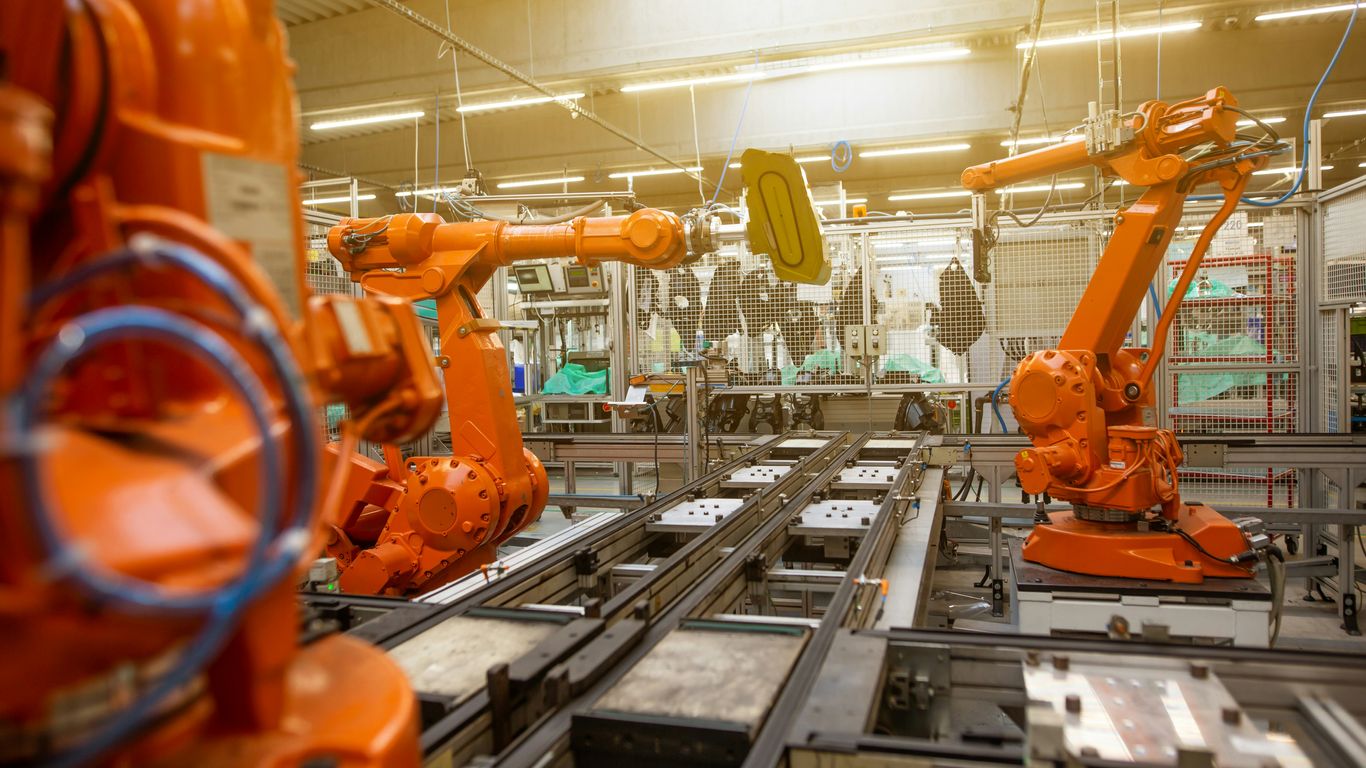
### Navigation sensors and perception systems
Navigation sensors give the robot information about position, nearby objects, and changing conditions. Ranging systems can help measure distance, cameras can provide visual context, and inertial or wheel-based systems can estimate motion. Sensor fusion combines these inputs so the robot is less dependent on any one imperfect observation.
The physical environment still sets limits. Reflective surfaces, dust, low light, occlusion, and crowded aisles can affect sensing. A site survey should therefore test the actual facility rather than assume that a successful demonstration in a cleaner environment will transfer unchanged.
### Onboard computing and fleet-management software
Onboard computing handles time-sensitive decisions such as motion and obstacle response. Fleet-management software works at a broader level, assigning jobs, balancing traffic, monitoring status, and coordinating charging or recovery. The interface between these layers determines whether a fleet behaves like a managed operation or a collection of independent machines.
For technical teams, useful questions include how maps are created and updated, how task priorities are represented, what telemetry is available, and how software failures are isolated. [Accio Robotics warehouse automation](https://www.insidedeeptech.com/accio-robotics-review-autonomous-mobile-warehouse-robots-explained/) is a useful related reference for examining dynamic navigation, WMS integration, modular designs, load handling, charging, and total cost of ownership without reducing the discussion to hardware alone.
### Drive systems, batteries, and charging
Drive systems convert control commands into movement, while batteries determine how long the robot can operate between charging events. Charging may be scheduled, opportunistic, or autonomous, but it must be planned around the workload. A robot that spends too much time waiting for power can undermine the throughput gains expected from automation.
Battery performance also changes with payload, speed, floor condition, route length, and temperature. Deployment planning should model the full duty cycle, including travel, waiting, loading, unloading, charging, and exception recovery. The right metric is productive availability, not simply the advertised runtime.
### Payloads, attachments, and specialized tooling
The payload determines what an AMR can carry or manipulate and often shapes the entire vehicle design. A transport platform may use a deck, shelf, bin interface, or conveyor handoff, while a towing unit requires a coupling mechanism and sufficient traction. Specialized tooling can add capability, but it also adds mass, maintenance, controls, and safety considerations.
A payload specification should include weight, dimensions, center of gravity, loading method, and handoff requirements. Small differences in containers or product presentation can create large changes in reliability, which is why representative tests matter before a fleet is scaled.
## The main types of autonomous mobile robots
AMRs are grouped less by appearance than by the work they perform. Some move materials, some bring inventory to a worker, and others carry tools or sensors through a facility. The categories overlap, but they provide a practical starting point for matching a robot to an operating problem.
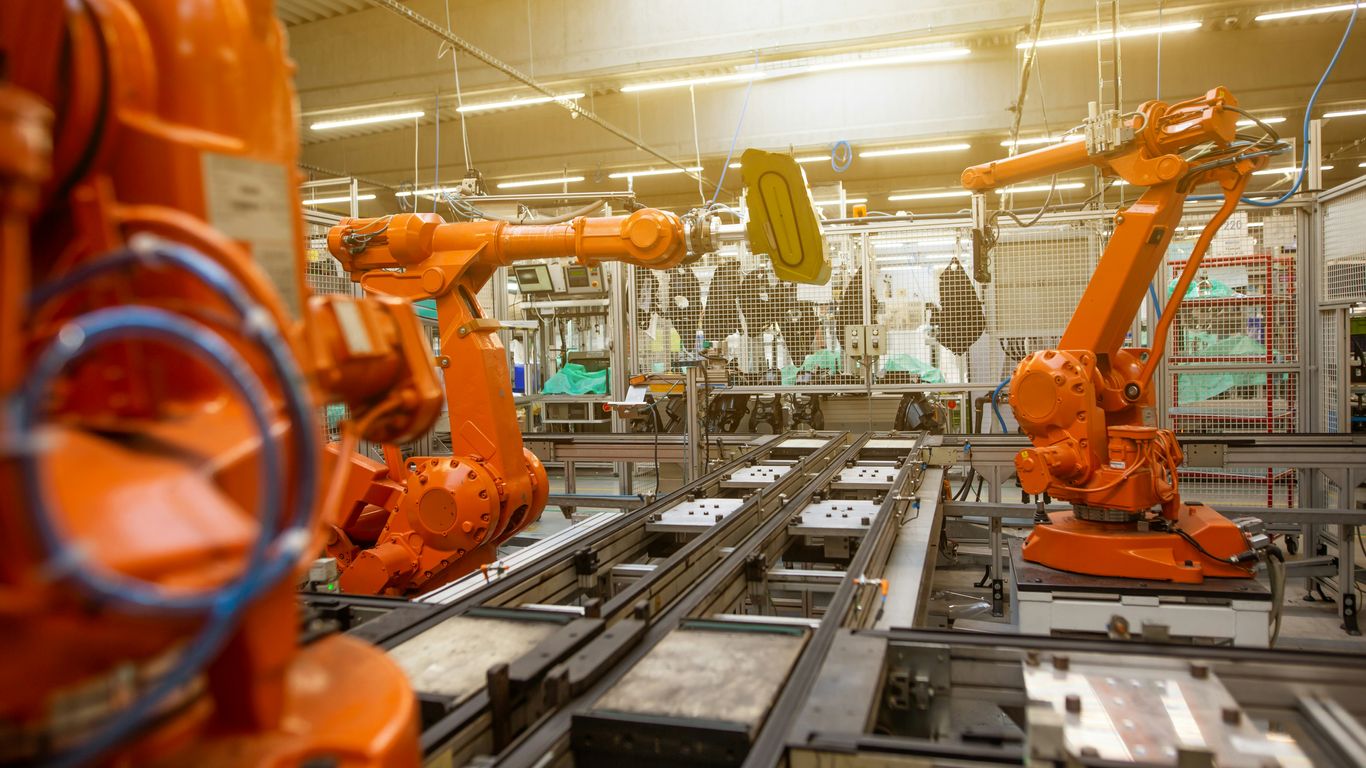
### Transport and material-handling AMRs
Transport AMRs move bins, totes, pallets, or other loads between defined points. They can support replenishment, staging, putaway, or transfers between storage and production. Their success depends on dependable pickup and drop-off interfaces as much as on navigation.
The strongest applications usually involve repeated travel with predictable destinations but variable traffic. In those cases, the robot can remove routine movement from a worker's day without requiring the facility to freeze its layout permanently.
### Picking and fulfillment robots
Picking and fulfillment robots support the movement of inventory or orders through warehouse processes. Some bring items or containers to people; others are designed around particular picking or handling tasks. The boundary between transportation and picking is therefore operational: the question is whether the robot moves the work, performs part of the pick, or supports both.
A fulfillment design should examine item variety, presentation, order profiles, and exception rates. Systems built around highly variable objects may require more perception and manipulation than systems moving standardized containers. That distinction is also central to current discussions of [warehouse fulfillment automation](https://www.insidedeeptech.com/a-comprehensive-guide-to-nimble-robotics-and-automated-fulfillment/), where picking, packing, integration flexibility, and demand spikes are treated as connected problems.
### Towing and tugger AMRs
Towing and tugger AMRs pull carts or trailers through facilities. They can serve repeated milk-run routes, move material between production areas, or connect staging points without assigning a driver to every trip. Coupling, braking, turning radius, and trailer behavior become key engineering concerns.
These robots often operate in shared spaces, so route design must account for the length of the full train rather than the dimensions of the tug alone. Loading discipline matters as well: uneven or unstable carts can create a safety and reliability issue even when the tug itself navigates correctly.
### Inspection, cleaning, and service robots
Inspection, cleaning, and service robots use mobility to carry sensors, tools, or consumables through an environment. Their tasks may involve repeated coverage, data collection, or routine servicing rather than material transport. The useful output can be a cleaned area, a recorded observation, or an exception sent to a human operator.
These applications often expose the difference between movement and mission completion. A robot that reaches every corridor but collects poor data has not completed an inspection effectively. Operators should define the quality of the service output alongside navigation performance.
## Where businesses use AMRs
AMRs appear where internal movement, repetitive handling, or routine coverage consumes skilled workers' time. Warehouses and factories remain common settings, but hospitals, retail environments, and service facilities can also benefit when routes and handoffs are clear. The business case depends on process fit, not on the presence of a robot-shaped machine.

### Warehouse picking and order fulfillment
Warehouses use AMRs to move inventory, containers, and completed orders between storage, picking, packing, and staging areas. The main opportunity is often reducing walking and waiting rather than eliminating the human role. Workers can spend more time on decisions and handling while robots cover predictable travel.
The warehouse must still provide suitable aisles, handoff points, network coverage, and exception procedures. A detailed [AMR warehouse systems review](https://www.insidedeeptech.com/locus-robotics-review-is-it-the-right-solution-for-your-warehouse/) can help frame questions about WMS integration, fleet management, space constraints, setup costs, and seasonal flexibility.
### Manufacturing line-side delivery
In manufacturing, AMRs can deliver components, tools, or work-in-process material to production areas. Line-side delivery is sensitive to timing: an early delivery can create congestion, while a late one can interrupt production. The robot system therefore becomes part of material planning, replenishment, and inventory control.
Facility teams should map the full route from storage to point of use, including loading, quality checks, empty-container returns, and interactions with forklifts or operators. A narrow pilot around one recurring route often reveals more than a broad demonstration across disconnected tasks.
### Healthcare and hospital logistics
Hospitals may use mobile robots for internal logistics involving supplies, meals, linens, or other routine movements. These settings add special constraints, including public traffic, elevators, doors, hygiene procedures, and the need to avoid disrupting care. Reliability and quiet, predictable behavior can matter as much as speed.
The operating model must also define human handoffs and access control. A hospital robot is not autonomous in isolation; it relies on building infrastructure, staff cooperation, and procedures for unusual events.
### Retail, hospitality, and other service environments
Retail stores, hotels, campuses, and similar settings can use AMRs for delivery, replenishment, cleaning, or information-gathering tasks. These environments are less controlled than many industrial floors because visitors and staff can change routes without warning. The robot must communicate its intentions clearly and fail gracefully when a path remains blocked.
Service deployments also raise practical questions about appearance, noise, privacy, and maintenance in public areas. For specialized industrial terrain, [ANYbotics site inspection](https://www.insidedeeptech.com/a-comprehensive-guide-to-industrial-automation-with-anybotics/) offers a related example of how locomotion, multimodal sensing, navigation, and human-robot workflows can be evaluated for demanding environments; it is not a substitute for selecting a wheeled AMR for ordinary indoor transport.
## AMR vs. AGV: What is the difference?
AMRs and automated guided vehicles both move material without a human driver, but their navigation assumptions differ. An AGV commonly follows a defined guide, route, or control logic, while an AMR uses sensors and software to choose movement within a mapped operating area. Neither category is automatically superior; the correct choice depends on stability, traffic, throughput, and the cost of changing the process.
### Navigation methods and infrastructure requirements
AGVs may rely on magnetic tape, wires, reflectors, or other fixed guidance infrastructure. AMRs generally use onboard sensing, maps, and software-based localization, reducing dependence on a single physical path. That difference can simplify some deployments, though AMRs still need reliable floors, network access, safe zones, and well-defined interfaces.
The practical comparison is not “no infrastructure” versus “infrastructure.” It is fixed guidance and its maintenance versus digital maps, sensors, compute, and operational configuration. [AMR and AGV differences](https://mobile-industrial-robots.com/blog/agv-vs-amr-whats-the-difference?ref=insidedeeptech.com) provides a useful framework for comparing these assumptions.
### Flexibility in changing workspaces
An AMR can often be reassigned or remapped when workstations, storage locations, or priorities change. An AGV network may require physical route changes or more substantial engineering when the facility changes. That makes AMRs attractive in high-mix operations, though flexibility has value only when the organization can manage maps, rules, and exceptions competently.
Change also introduces risk. A software adjustment can be fast, but it still needs testing, version control, and safety review. Digital flexibility should not be mistaken for permission to change a live route without operational discipline.
### Differences in deployment and operating costs
AGVs can be economical in stable, high-volume workflows where a dedicated route is fully utilized. AMRs may reduce physical guidance work and adapt more easily, but they bring costs for sensors, software, integration, network coverage, support, and fleet management. Total cost should include commissioning, training, maintenance, downtime, and future layout changes.
A useful evaluation compares cost against the process that will actually run, not against a generic robot price. A low-cost vehicle that cannot meet handoff or availability requirements is not an efficient deployment.
### When an AGV may be the better choice
An AGV may be a sensible choice when routes are stable, traffic is predictable, and the same movements repeat at high volume. Fixed guidance can make behavior easy to specify and may fit an existing material-handling architecture. The tradeoff is reduced adaptability when the facility or workflow changes.
The decision should follow the operating environment. If flexibility is central, an AMR may fit better; if repeatability and dedicated flow dominate, an AGV can remain a practical engineering choice.
## The benefits and limitations of AMRs
AMRs can improve internal logistics, but their benefits are not automatic. They emerge when the robot is placed in a process with enough repetition, suitable interfaces, and measurable friction. The limitations are equally concrete: constrained environments, integration work, maintenance, and the need for human exception handling.
### Improving throughput and workplace efficiency
An AMR can increase throughput by keeping material moving between process steps and by reducing time spent walking, waiting, or searching. Fleet software can help distribute work across multiple robots and identify bottlenecks. The resulting improvement depends on the entire workflow, including loading and unloading, not just travel speed.
A useful baseline records cycle time, queue time, worker travel, missed handoffs, and equipment utilization. Without that baseline, a deployment may appear busy while failing to improve the process that matters.
### Reducing repetitive manual work
AMRs are well suited to repetitive transport and routine coverage tasks that are physically tiring or offer limited learning value. They do not remove the need for people; they shift human effort toward supervision, exception resolution, quality, replenishment, and work requiring judgment. That shift should be designed rather than assumed.
A responsible rollout begins with the work itself. The team should identify which motions are repetitive, which are hazardous or fatiguing, and which require human context. The following checks keep the scope grounded:
- Separate transport time from handling time.
- Identify the exceptions a person must still resolve.
- Measure how often loading or unloading interrupts the process.
- Confirm that the proposed handoff is safe and repeatable.
These checks help prevent the common mistake of automating movement while leaving the real bottleneck untouched.
### Managing safety, reliability, and downtime
Safety requires physical safeguards, software rules, clear traffic conventions, and trained personnel. Reliability requires monitoring, preventive maintenance, spare parts, recovery procedures, and a plan for network or system outages. Downtime should be modeled as an operating condition, not treated as an embarrassing edge case.
A fleet needs defined responses for low battery, blocked routes, sensor faults, failed handoffs, and lost communication. The best process is often the one that makes a failure visible early and gives staff a simple recovery path.
### Understanding integration and operational limits
An AMR may need to exchange tasks and status with warehouse, manufacturing, inventory, access-control, or building systems. Integration can be more difficult than the physical installation because data models, priorities, permissions, and exception states must align. Teams should also account for Wi-Fi coverage, elevator or door interfaces, and changes in the upstream process.
Some adjacent technologies address very different problems. For example, [RefrigeratorRepair.io](https://refrigeratorrepair.io/locations?ref=insidedeeptech.com) connects customers with technicians for refrigerator issues, while AMRs address movement and task execution inside facilities. Likewise, [Arc Browser](https://thrivexdna.com/directory/arc-browser?ref=insidedeeptech.com) is a productivity AI tool for browsing and research, not a robotics platform. These distinctions may seem obvious, but keeping system boundaries clear is part of credible technical evaluation.
## How to evaluate and deploy an AMR system
Deployment should begin with a workflow, not a robot specification sheet. The team needs to define the work, observe the facility, test interfaces, and establish what success means before choosing fleet size. A disciplined pilot can expose constraints early and create evidence for a broader investment.
### Defining workflows, payloads, and performance goals
The first step is to document origin, destination, load, frequency, timing, handoff, and exception conditions. Performance goals might include completed moves per hour, worker travel reduction, availability, response time, or reduction in missed replenishment events. Payload and container specifications should be measured directly.
Goals should be stated in operational terms. “Automate the warehouse” is too broad to guide design; “complete this replenishment loop within the production window with defined availability” is testable.
### Assessing facility layouts and traffic patterns
A site assessment should cover aisle widths, floor transitions, doors, lifts, pedestrian crossings, network coverage, charging locations, and interactions with other vehicles. Traffic observations are especially valuable because a map can show geometry but not the rhythm of a live operation.
The team should test both normal and abnormal conditions. Temporary staging, peak traffic, blocked aisles, and partial closures reveal whether the proposed routes remain useful under pressure. If the environment cannot support a safe handoff, better navigation alone will not solve the problem.
### Integrating AMRs with business systems
Integration connects robot tasks to the business events that create them. A warehouse system may request a move, a manufacturing system may signal replenishment, and a fleet manager may assign the job to an available unit. The integration design should define acknowledgments, status updates, retries, cancellations, and human escalation.
Data quality matters as much as connectivity. A robot cannot reliably execute a task when the destination, load identity, priority, or completion condition is ambiguous. Teams should test the full transaction, from request through physical handoff and confirmation.
Unrelated service workflows illustrate why precise interfaces matter: [bathroom remodeling services](https://billsremodeling.com/alabama/mobile-al/bathroom-remodeling-services?ref=insidedeeptech.com) coordinate contractors, fixtures, budgets, and renovation stages, while [IPTV without a contract](https://flashiptvno.com/blog/alt-du-trenger-a-vite-om-iptv-uten-binding-en-komplett-guide/?ref=insidedeeptech.com) concerns subscriptions, bandwidth, hardware, legality, and privacy. Neither is an AMR use case, but both show the general principle that a system performs only as well as the workflow around it.
### Measuring return on investment and scaling the fleet
Return on investment should include labor allocation, throughput, avoided travel, safety improvements, maintenance, integration, training, and downtime. The team should compare measured results with the baseline and separate one-time implementation costs from recurring operating costs. A pilot that produces a strong result on one route does not prove that every route will scale equally well.
Scaling is a staged decision. Once the first workflow is stable, operators can add routes, payloads, shifts, or robots while watching congestion and support load. The central question is whether each additional unit increases productive capacity or merely adds traffic and coordination overhead.
## Conclusion
AMRs are best understood as adaptable logistics and service systems, not autonomous vehicles in isolation. Their value comes from the fit between perception, planning, mobility, payload handling, software integration, and human operations. A careful deployment starts with a measurable workflow, tests the real facility, and scales only after reliability and recovery have been demonstrated.
## Frequently Asked Questions
### What does an autonomous mobile robot do?
An AMR moves through a defined environment, senses conditions around it, and performs tasks such as transporting materials, supporting picking, towing carts, or carrying inspection and service equipment.
### How does an AMR navigate?
It typically combines sensors, localization software, maps, and route planning to estimate its position, detect obstacles, and choose movement in response to current conditions.
### Can AMRs work around people?
They can be designed for shared environments using speed controls, detection systems, safety zones, signals, and procedures for stopping or escalating uncertain situations. The facility and operating rules remain essential.
### What is the difference between an AMR and an AGV?
An AMR generally navigates with sensors and software and can adapt routes within a mapped area. An AGV more commonly follows fixed guidance or predefined routes, making it well suited to stable, repetitive flows.
### Where are AMRs most commonly used?
Common applications include warehouse transport and fulfillment, manufacturing line-side delivery, hospital logistics, towing, inspection, cleaning, and other repetitive service tasks.
### Do AMRs replace workers?
They usually automate selected movements or routine tasks rather than an entire operation. People remain responsible for loading, supervision, exceptions, maintenance, quality, and decisions requiring context.
### How should a business start an AMR project?
It should select one measurable workflow, document payloads and handoffs, assess the facility and traffic, validate system integration, run a controlled pilot, and use the results to decide whether to scale.
### Nevermined: The Payments Startup Betting AI Agents Will Buy Everything
URL: https://www.insidedeeptech.com/nevermined-review/
Last updated: 2026-09-20T15:07:53.000Z
Nevermined builds payments infrastructure that lets AI agents [pay and get paid autonomously](https://nevermined.ai/?ref=insidedeeptech.com), on both card rails and crypto rails.
Its pitch: agents cannot spend without a human clicking checkout, merchants cannot bill machines, and Nevermined fixes both sides.
In April 2026 it shipped its defining integration, combining [Visa Intelligent Commerce, Coinbase's x402 protocol, and VGS](https://www.accessnewswire.com/newsroom/en/business-and-professional-services/nevermined-launches-ai-agent-card-payments-with-x402-opening-a-n-1154916?ref=insidedeeptech.com) so agents can buy digital goods with delegated Visa cards.
It is a small, early company in a suddenly crowded field where Stripe, Google, Visa, Mastercard, and a wave of startups are all racing to own agentic commerce.
### Key takeaways
- **Real product, real partners.** Nevermined is live with search API company Exa, integrates [Visa Intelligent Commerce and x402](https://thepaypers.com/payments/news/nevermined-integrates-visa-intelligent-commerce-and-x402-for-autonomous-ai-agent-payments?ref=insidedeeptech.com), and publishes transparent pricing.
- **Thin capitalization.** Total funding is [about $7 million](https://finovate.com/nevermined-raises-4-million-for-decentralized-ai-payments-protocol/?ref=insidedeeptech.com), tiny against rivals and giants building competing rails.
- **A market that barely exists yet.** Agentic commerce is a six-protocol land grab with no settled winner, and real agent transaction volumes remain early.
## Nevermined at a glance
| Attribute | Detail |
| ------------ | ---------------------------------------------------------------------------- |
| Founded | 2022 (company-stated); protocol roots in earlier Web3 work |
| Founders | Don Gossen (CEO), Aitor Argomaniz (CTO) |
| Headquarters | San Francisco (Switzerland-based at its 2025 raise) |
| Core product | Payments infrastructure for AI agents: delegated cards, metering, settlement |
| Total raised | About $7 million (reported) |
| Valuation | Not disclosed |
| Take rate | 1-2% of settled transaction volume |
## Background and origins
Nevermined was founded by [Don Gossen](https://siliconangle.com/2025/01/09/decentralized-payments-startup-nevermined-raises-4m-unlock-ai-ai-agent-commerce/?ref=insidedeeptech.com), previously a co-founder and VP of Engineering at Ocean Protocol, and CTO [Aitor Argomaniz](https://finovate.com/nevermined-raises-4-million-for-decentralized-ai-payments-protocol/?ref=insidedeeptech.com), also an Ocean Protocol veteran.
Ocean Protocol was one of the early decentralized data-sharing projects, and Nevermined grew out of that same lineage of Web3 data and access-control technology.
The company describes itself as [founded in 2022](https://www.accessnewswire.com/newsroom/en/business-and-professional-services/nevermined-launches-ai-agent-card-payments-with-x402-opening-a-n-1154916?ref=insidedeeptech.com), an agentic fintech building payment and monetization rails for the agent economy.
Its center of gravity has shifted westward: it was [Switzerland-based](https://finovate.com/nevermined-raises-4-million-for-decentralized-ai-payments-protocol/?ref=insidedeeptech.com) at its January 2025 raise, and by 2026 was announcing from [San Francisco as a US-based company](https://thepaypers.com/payments/news/nevermined-integrates-visa-intelligent-commerce-and-x402-for-autonomous-ai-agent-payments?ref=insidedeeptech.com).
That migration mirrors the product story: from a decentralized Web3 protocol toward mainstream fintech rails, cards, and enterprise compliance.
## Funding and valuation
Nevermined is lightly funded for the ambition of its mission.
Its January 2025 round of [$4 million](https://www.pymnts.com/news/investment-tracker/2025/nevermined-raises-4-million-to-help-ai-agents-pay-and-get-paid/?ref=insidedeeptech.com) brought [total funding to about $7 million](https://finovate.com/nevermined-raises-4-million-for-decentralized-ai-payments-protocol/?ref=insidedeeptech.com). No valuation has been disclosed.
| Round | Date | Amount | Lead investor(s) | Valuation |
| --------------- | -------- | --------------- | ------------------- | ------------- |
| Earlier funding | Pre-2025 | \~$3M (implied) | Undisclosed | \- |
| Seed round | Jan 2025 | $4M | Generative Ventures | Not disclosed |
The 2025 round drew [Polymorphic Capital, NEAR, Halo Capital, Factor Capital, Lyrik Ventures, and Arca](https://finovate.com/nevermined-raises-4-million-for-decentralized-ai-payments-protocol/?ref=insidedeeptech.com), a distinctly crypto-flavored syndicate.
It also included angels from the customer base itself: [Valory (builders of Olas), Naptha, and Gensyn's Ben Fielding](https://www.europeanfinancialreview.com/nevermined-secures-4m-to-pioneer-payment-solutions-in-ai-commerce/?ref=insidedeeptech.com).
For context on how capital is flowing into this category, our guide to [where deep tech funding is actually going in 2026](https://www.insidedeeptech.com/deep-tech-funding-in-2026-where-the-money-is-actually-going/) shows agent infrastructure attracting fast-growing but still concentrated bets.
Revenue is undisclosed. The public pricing model (1-2% of settled volume) means revenue tracks agent transaction volume, which the company has not published.
## The technology: how Nevermined works
Nevermined attacks what it calls agentic commerce's [three-way problem](https://nevermined.ai/?ref=insidedeeptech.com): agents cannot spend, merchants cannot bill machines, and every existing fix locks you into one vendor.
It sits alongside the broader wave of specialized machine-economy plumbing we covered in [The State of AI Infrastructure 2026](https://www.insidedeeptech.com/the-state-of-ai-infrastructure-2026-compute-power-and-constraints/).
On the spend side, Nevermined Pay issues agents delegated virtual cards with programmable guardrails: [budget limits, per-purchase caps, merchant restrictions, and time windows](https://www.theglobeandmail.com/investing/markets/markets-news/ACCESS%20Newswire/1223327/nevermined-launches-ai-agent-card-payments-with-x402-opening-a-new-market/?ref=insidedeeptech.com), all instantly revocable.
On the earn side, it gives merchants and API providers metering, access control, entitlements, and settlement, so they can bill agents [per request, per session, or per outcome](https://nevermined.ai/?ref=insidedeeptech.com).
The architecture is deliberately agnostic: it multiplexes across Stripe and PayPal Braintree, supports x402, MCP, and A2A protocols, and works with LangChain, CrewAI, OpenAI, and OpenClaw frameworks.
In the flagship Visa flow, [Visa Intelligent Commerce generates the payment credentials, Nevermined handles orchestration and policy, x402 acts as the machine-native point of sale, and VGS vaults the card data](https://www.theglobeandmail.com/investing/markets/markets-news/ACCESS%20Newswire/1223327/nevermined-launches-ai-agent-card-payments-with-x402-opening-a-new-market/?ref=insidedeeptech.com).
Security posture is enterprise-grade on paper: [ISO 27001, SOC 2 Type II, and PCI SAQ-D](https://nevermined.ai/security/?ref=insidedeeptech.com).
## Products, platform, and pricing
Unusually for infrastructure at this stage, Nevermined publishes its full pricing.
The core model is simple: [1-2% of settled transaction volume](https://nevermined.ai/pricing/?ref=insidedeeptech.com), no setup fees, no minimums, with optional monthly organization plans on top.
| Plan | Price | Limits | Key extras |
| ---------- | ------------------- | ---------------------------- | ---------------------------------- |
| Free | $0 + 1-2% of volume | 20 agents, 10 payment plans | Fiat and crypto, x402/MCP/SDKs |
| Premium | $250/month + 1-2% | 100 agents, 50 payment plans | Revenue dashboards, widgets |
| Enterprise | $500/month + 1-2% | Unlimited agents and plans | Customer management, live activity |
The product surface spans Nevermined Pay (agent virtual cards), Visa virtual cards, embedded card-capture and pay widgets, an [x402 facilitator](https://nevermined.ai/facilitator?ref=insidedeeptech.com), and merchant tooling for metering and settlement.
Integration is code-first: CLI, REST API, Python and TypeScript SDKs, an MCP server, plus a [dashboard](https://nevermined.app/?ref=insidedeeptech.com) for card enrollment, 3DS verification, and spending mandates.
Volume pricing is negotiable, and the fee only applies when money moves, which aligns Nevermined's revenue with its customers' actual agent activity.
## Traction, customers, and deployments
The marquee live deployment is Exa, the AI search API company, whose API is now [agent-payable through Nevermined](https://nevermined.ai/use-cases/api-providers?ref=insidedeeptech.com).
Partner logos span both worlds: AWS, Mastercard (via its Start Path agentic commerce program), Visa, PayPal Braintree, and VGS on the fintech side; Mindra and Ability.ai on the AI side.
The earliest adopters were crypto-native agent projects: [Olas, Naptha, peaq, Flock, and Combinder](https://techfundingnews.com/nevermind-ai-payment-platform-funding/?ref=insidedeeptech.com).
Valory, which builds the Olas agent marketplace, says Nevermined cut its payments deployment from [six weeks to six hours](https://nevermined.ai/blog/best-platforms-agentic-payments?ref=insidedeeptech.com). That figure is company-published, so treat it as a vendor case study.
Customer counts, transaction volumes, and revenue are all undisclosed, which is the honest limit of what can be verified about traction today.
## The competitive landscape
Agentic payments went from novelty to land grab in under two years, and Nevermined is one of many combatants.
Six major protocols now shape the space: [ACP from OpenAI and Stripe, UCP from Google and Shopify, AP2 from Google (now FIDO-governed), MCP, A2A, and Visa TAP](https://rye.com/blog/agentic-commerce-startups?ref=insidedeeptech.com).
| Competitor | Approach | Position |
| --------------- | ----------------------------------------------- | ----------------------------------------------- |
| Stripe (ACP) | Agentic checkout protocol with OpenAI and Meta | Payments giant; merchants incl. Etsy, URBN |
| Coinbase (x402) | Open machine-payment protocol, stablecoin rails | 50M+ transactions; also a Nevermined dependency |
| Skyfire | Agent identity and wallet network, USDC | $9.5M raised; a16z CSX, Coinbase Ventures |
| Basis Theory | Payment vaulting and agent card infrastructure | $33M Series B (Oct 2025) |
| Nekuda | Agent payment delegation SDK | $5M seed; Amex and Visa Ventures backing |
| Card networks | Visa Intelligent Commerce, Mastercard Agent Pay | Own the rails; partner and potential rival |
Startup funding in the payments-and-identity layer is real but modest: [Basis Theory, Skyfire, and Nekuda together raised roughly $47.5 million](https://eco.com/support/en/articles/14839400-what-is-agentic-commerce-the-2026-guide?ref=insidedeeptech.com), and Nevermined's $7 million sits below all three.
Where Nevermined wins: it is genuinely two-sided (spend and earn), protocol- and PSP-agnostic, and further along on metering and usage-based monetization than checkout-focused rivals.
Where it loses: distribution and capital. Stripe and the card networks can bundle agentic features into rails merchants already use, and better-funded startups can outspend it on go-to-market.
The deepest strategic tension: Visa and Coinbase are simultaneously Nevermined's key partners and the owners of layers that could absorb its role.
## The big story: Visa, x402, and autonomous card payments
On April 8, 2026, Nevermined announced the integration that defines its current positioning: [Visa Intelligent Commerce plus x402 plus VGS](https://www.accessnewswire.com/newsroom/en/business-and-professional-services/nevermined-launches-ai-agent-card-payments-with-x402-opening-a-n-1154916?ref=insidedeeptech.com), enabling agents to autonomously buy digital goods on real Visa card rails.
Users enroll their own Visa cards, delegate spending authority to agents, and set guardrails; merchants get paid through their existing PSPs with no new integration.
Visa put its name on it publicly, with its VP of AI Partnerships saying the framework lets agents [transact safely with clear controls](https://financialit.net/news/payments/nevermined-unlocks-autonomous-agent-card-payments-x402-opening-new-market-publishers?ref=insidedeeptech.com).
The target market is the growing monetization gap for publishers, data providers, and API businesses: agents consume their content constantly, and until now the choice was [block the bots or give it away free](https://www.mexc.com/news/1013749?ref=insidedeeptech.com).
The skeptical read: this was announced as a pilot, Visa runs similar programs with multiple partners, and per-article micropayments have a long history of failing to change consumer and publisher behavior.
## Strengths, weaknesses, and risks
### Strengths
- A genuinely two-sided platform: delegated agent spending and merchant-side metering and settlement in one stack, which most rivals only do half of.
- Blue-chip partnership validation: Visa Intelligent Commerce, Mastercard's Start Path program, AWS, PayPal Braintree, and VGS.
- Deliberate neutrality: PSP-, protocol-, and framework-agnostic design in a market terrified of betting on the wrong standard.
- Transparent, aligned pricing: 1-2% of settled volume with a free tier, published openly, which most enterprise infrastructure never does.
- Founders with a decade in decentralized data and access control, exactly the primitives agent payments require, from a lineage the most active [deep tech investors](https://www.insidedeeptech.com/the-20-deep-tech-vc-firms-funding-the-frontier-ranked-by-activity/) now chase.
### Weaknesses and risks
- **Thin capitalization.** About $7 million raised against rivals with $33 million rounds and incumbents with infinite balance sheets leaves little room for error.
- **Platform dependency.** The flagship product rides on Visa Intelligent Commerce and Coinbase's x402, rails Nevermined does not control and whose owners could disintermediate it.
- **Undisclosed traction.** No customer counts, transaction volumes, or revenue are public; the strongest case studies are company-published and crypto-native.
- **Pre-standard chaos.** Six competing protocols with no settled winner means today's integrations may need rebuilding, and the whole category could consolidate away from small players.
- **Market timing risk.** The "trillions of agents" economy is a projection; if autonomous agent spending grows slower than hoped, a volume-based fee model starves.
## Final Notes
Nevermined is a serious, technically credible early mover in a market that might be enormous and might be premature.
Its product is real, its partnerships are impressive for a company this size, and its two-sided, standards-agnostic design is the right architecture for an unsettled protocol war.
But this review has to be plain about the asymmetry: Nevermined has $7 million and no disclosed traction, while Stripe, Google, Visa, and Mastercard are building the same future with their own rails.
If you run an API, publish content, or build agents, the free tier makes Nevermined cheap to trial today. If you are watching as an investor, the question is not whether agentic commerce happens, but whether an independent orchestration layer survives between the giants.
## Frequently asked questions
### What does Nevermined do?
Nevermined provides payments infrastructure for AI agents. It lets agents spend autonomously through delegated virtual cards with user-defined guardrails, and lets merchants, APIs, and publishers meter and bill agents per request, session, or outcome. It works across card rails, Stripe, PayPal Braintree, and crypto protocols like x402.
### Who founded Nevermined and who owns it now?
Nevermined was founded by CEO [Don Gossen](https://siliconangle.com/2025/01/09/decentralized-payments-startup-nevermined-raises-4m-unlock-ai-ai-agent-commerce/?ref=insidedeeptech.com) and CTO Aitor Argomaniz, both veterans of Ocean Protocol, the decentralized data project. It remains a private, venture-backed company, with investors including Generative Ventures, Polymorphic Capital, NEAR, Halo Capital, and Arca.
### How much has Nevermined raised?
Nevermined has raised about $7 million in total. Its most recent disclosed round was a [$4 million raise in January 2025](https://www.pymnts.com/news/investment-tracker/2025/nevermined-raises-4-million-to-help-ai-agents-pay-and-get-paid/?ref=insidedeeptech.com) led by Generative Ventures. No valuation has been made public.
### How much does Nevermined cost?
Nevermined charges [1-2% of settled transaction volume](https://nevermined.ai/pricing/?ref=insidedeeptech.com), with no setup fees or minimums. A free tier covers up to 20 agents, while Premium ($250/month) and Enterprise ($500/month) plans add dashboards, widgets, and unlimited agents. Fees only apply when money actually moves.
### What is Nevermined's Visa and x402 integration?
In April 2026, Nevermined integrated Visa Intelligent Commerce, Coinbase's x402 protocol, and VGS so AI agents can autonomously buy digital goods with delegated Visa cards. Users set budget limits, purchase caps, merchant restrictions, and time windows, and merchants get paid through their existing payment providers.
### Who are Nevermined's main competitors?
Nevermined competes with agent-payment startups like Skyfire, Basis Theory, and Nekuda, and with the giants building agentic commerce rails directly: Stripe's ACP protocol with OpenAI, Google's AP2 and UCP, Coinbase's x402, Visa Intelligent Commerce, and Mastercard Agent Pay. Several of those giants are simultaneously Nevermined partners.
### Is Nevermined legit and any good?
Nevermined is a legitimate company with real integrations, including a live deployment with the search API company Exa, a Visa Intelligent Commerce partnership, and ISO 27001, SOC 2 Type II, and PCI SAQ-D compliance. The main caveats are its small funding base of about $7 million and the absence of any disclosed customer or revenue figures.
### What is x402?
x402 is an internet-native payment protocol developed by Coinbase that lets machines pay for digital resources programmatically, using the HTTP 402 "Payment Required" status code as its namesake. Nevermined uses x402 as the machine-native point of sale in its agent payment flows, and Coinbase reports the protocol has processed over 50 million transactions.
### Partly: The AI Foundation Model Betting It Can Fix the Auto Parts Supply Chain
URL: https://www.insidedeeptech.com/partly-review/
Last updated: 2026-09-23T21:06:15.000Z
Partly is a New Zealand-born AI company that builds [Interpreter](https://www.partly.com/partly-interpreter?ref=insidedeeptech.com), which it calls the world's only foundation model purpose-built for automotive parts.
The pitch is simple: repair shops constantly order the wrong parts, and a model trained on the world's parts data can stop that.
In June 2026 the company [closed a $50 million Series B at a $500 million valuation](https://www.prnewswire.com/news-releases/partly-closes-historic-series-b-raise-at-500m-valuation-and-announces-immediate-us-market-expansion-302807008.html?ref=insidedeeptech.com), led by DST Global Partners.
It simultaneously [moved its headquarters from New Zealand to Austin, Texas](https://therealdeal.com/texas/2026/06/23/austin-lands-ai-tenant-as-partly-moves-hq-from-new-zealand/?ref=insidedeeptech.com) to attack the US collision repair market.
### Key takeaways
- **Real traction in a neglected niche.** Partly says thousands of repair businesses use its platform, and it has signed [more than fifty manufacturer agreements](https://www.uktech.news/ai/partly-secures-38m-to-take-ai-for-the-automotive-sector-to-the-us-20260624?ref=insidedeeptech.com).
- **Serious money, serious backers.** Total funding is [about $92 million](https://www.theconveyor.co/p/partly-series-b-funding?ref=insidedeeptech.com), with DST Global, Blackbird, Octopus Ventures, and Square Peg on the cap table.
- **The US is unproven ground.** Partly's revenue is undisclosed, its benchmarks are self-published, and it now goes head to head with entrenched giants like CCC and OEConnection on their home turf.
## Partly at a glance
| Attribute | Detail |
| -------------- | ---------------------------------------------------------------------- |
| Founded | 2020, Christchurch, New Zealand |
| Founders | Levi Fawcett, Nathan Taylor, Mark Song, Evan Jia, Tony Austin |
| Headquarters | Austin, Texas (relocated from NZ, June 2026) |
| Core product | Interpreter, an AI foundation model for auto parts, plus APIs and apps |
| Headcount | About 160 across 20+ countries (reported, mid-2026) |
| Total raised | About $92 million (reported) |
| Last valuation | $500 million (Series B, June 2026) |
## Background and origins
[Levi Fawcett](https://techcrunch.com/2022/12/12/ex-rocket-lab-engineer-raises-21m-for-partly-to-make-buying-car-parts-easier/?ref=insidedeeptech.com), a former Rocket Lab engineer who had already founded four companies during his university years, started Partly in Christchurch in 2020.
He co-founded it with [Nathan Taylor, Mark Song, Evan Jia, and Tony Austin](https://resources.icehouseventures.co.nz/blog/startup-blueprint-levifawcett?ref=insidedeeptech.com), the last a former eBay Europe executive who helped launch Amazon in Australia.
The founding insight came from Fawcett's own time around cars: buyers almost never know if a replacement part will actually fit their vehicle.
At the time, [roughly 98% of parts orders were handled by phone](https://techcrunch.com/2022/12/12/ex-rocket-lab-engineer-raises-21m-for-partly-to-make-buying-car-parts-easier/?ref=insidedeeptech.com), with a human "parts interpreter" translating a vehicle description into a part number.
Partly's answer was to digitize that interpreter, which is exactly what it later named its AI model.
Fawcett has since become one of New Zealand's most visible founders, making [Forbes 30 Under 30 and the EY Entrepreneur of the Year shortlist](https://www.ey.com/en%5Fnz/entrepreneur-of-the-year/new-zealand/finalists-2023/levi-fawcett?ref=insidedeeptech.com).
The wider leadership team now mixes automotive and big-tech alumni, including [executives from Airbnb, eBay, Microsoft, and CARIAD](https://www.partly.com/about?ref=insidedeeptech.com), Volkswagen's software arm.
## Funding and valuation
Partly's funding story tracks a steady escalation, from a scrappy pandemic-era round to one of the larger AI raises to come out of Australasia.
The Series A was, at the time, [New Zealand's largest ever](https://www.forbes.com.au/news/entrepreneurs/this-company-just-raised-34-million-and-became-new-zealands-fastest-growing-startup/?ref=insidedeeptech.com), and the June 2026 Series B nearly tripled the implied valuation.
| Round | Date | Amount | Lead investor(s) | Valuation |
| -------- | -------- | ----------------- | ------------------- | ------------- |
| Pre-seed | 2020 | $1.7M | Blackbird | Undisclosed |
| Seed | 2021 | $3.7M | Blackbird | Undisclosed |
| Series A | Dec 2022 | NZ$37M (\~US$21M) | Octopus Ventures | Not disclosed |
| Series B | Jun 2026 | $50M | DST Global Partners | $500M |
The pre-seed and seed were both led by Blackbird, with early angels including [Rocket Lab founder Peter Beck and Figma co-founder Dylan Field](https://www.linkedin.com/in/levi4sit/?ref=insidedeeptech.com).
The Series A landed in December 2022, led by [Octopus Ventures](https://www.forbes.com.au/news/entrepreneurs/this-company-just-raised-34-million-and-became-new-zealands-fastest-growing-startup/?ref=insidedeeptech.com), a deliberate choice as Partly expanded into Europe.
The Series B brings [total funding to about $92.4 million](https://www.theconveyor.co/p/partly-series-b-funding?ref=insidedeeptech.com), per trade reporting. Partly has not published official cumulative figures.
DST Global's involvement matters for signaling: the firm's portfolio [includes Anthropic, Meta, Alibaba, Airbnb, and Spotify](https://www.prnewswire.com/news-releases/partly-closes-historic-series-b-raise-at-500m-valuation-and-announces-immediate-us-market-expansion-302807008.html?ref=insidedeeptech.com).
The round also fits a wider pattern of capital rotating into applied, industry-specific AI, which we mapped in our guide to [where deep tech funding is actually going in 2026](https://www.insidedeeptech.com/deep-tech-funding-in-2026-where-the-money-is-actually-going/).
Revenue has never been disclosed. The best public proxy is dated: by late 2022 Partly was [reportedly processing around NZ$150 million in orders annually](https://grokipedia.com/page/Levi%5FFawcett?ref=insidedeeptech.com), a platform-volume figure rather than revenue, from a secondary source.
## The technology: what Interpreter actually is
Interpreter is not a chatbot wrapper. Partly describes it as a [multi-modal model](https://www.partly.com/partly-interpreter?ref=insidedeeptech.com) that processes technical diagrams, damage photos, and text to resolve one question: exactly which parts fit this exact vehicle.
It is a textbook example of the specialized, vertical models we covered in [The State of AI Infrastructure 2026](https://www.insidedeeptech.com/the-state-of-ai-infrastructure-2026-compute-power-and-constraints/): narrow domain, proprietary data, purpose-built architecture.
That question is brutally hard. There are thousands of vehicle manufacturers, tens of thousands of part makers, and [hundreds of millions of unique vehicle configurations](https://www.partly.com/post/team-spotlight-partly-interpreter?ref=insidedeeptech.com), each cataloged inconsistently.
Given a VIN, Interpreter accounts for trim level, engine type, market, and production date, and returns fitment data plus details most catalogs miss, such as installation hardware, supersessions, and finish specs.
The underlying data assets are Partly's Universal Vehicle Database (UVDB) and Global Auto Parts Catalog (GAPC), which by 2022 already spanned [42 million catalog parts across 4,000 brands](https://crozdesk.com/software/partspal?ref=insidedeeptech.com).
Training draws on government records, licensed manufacturer data, physical vehicle tear-downs, and five years of human feedback, formalized in [more than fifty manufacturer agreements](https://www.uktech.news/ai/partly-secures-38m-to-take-ai-for-the-automotive-sector-to-the-us-20260624?ref=insidedeeptech.com).
Partly's product chief Joachim Ritter, a founding member of VW's CARIAD, frames it as a language problem: [systems and manufacturers do not share a common language](https://www.am-online.com/news/partly-brings-the-first-ai-purpose-built-for-parts-to-uk-dealerships-ad-feature?ref=insidedeeptech.com), and Interpreter is the translation layer.
## Products, platform, and pricing
Partly sells the same core data brain through several doors, from raw APIs to finished apps.
| Product | What it does | Who it is for |
| --------------------- | ---------------------------------------------------------------------------------------- | ------------------------------------ |
| Interpreter | Foundation model for parts identification, estimates, and order validation | Whole repair supply chain |
| Partly APIs | Developer access to vehicle and parts data via docs.partly.com | Marketplaces, software vendors, OEMs |
| Partly AI (partly.ai) | Estimates from images and voice, basket building, order validation, AP leakage detection | Collision shops and MSOs |
| PartsPal | Catalog and fitment management, syncing to eBay and Shopify | Parts sellers and dismantlers |
| UVDB / GAPC | Universal vehicle database and global parts catalog standards | Data foundation for everything above |
The developer surface is public: [API documentation](https://docs.partly.com/?ref=insidedeeptech.com) covers vehicle lookup, fitment, and parts data.
Pricing is not. There is no published price list; enterprise deals go through [contact sales](https://www.partly.com/contact-sales?ref=insidedeeptech.com), and the collision-shop product currently sits behind a [waitlist](https://www.partly.ai/?ref=insidedeeptech.com).
That opacity is normal for enterprise infrastructure, but it makes independent value-for-money assessment impossible. Treat any cost expectations as negotiable.
## Traction, customers, and deployments
Partly claims [thousands of businesses](https://www.partly.com/?ref=insidedeeptech.com) across the repair industry use its platform, with customer logos including Toyota, Hyundai, and JLR dealer operations.
The earliest marquee customer was eBay, which used Partly to [structure sellers' parts data](https://www.forbes.com.au/news/entrepreneurs/this-company-just-raised-34-million-and-became-new-zealands-fastest-growing-startup/?ref=insidedeeptech.com) against a vehicle database.
By 2022 the roster also included [the United Nations and unnamed Fortune 500 companies](https://techcrunch.com/2022/12/12/ex-rocket-lab-engineer-raises-21m-for-partly-to-make-buying-car-parts-easier/?ref=insidedeeptech.com), with most customers in Europe.
In late 2025 Partly pushed into [UK dealerships](https://www.am-online.com/news/partly-brings-the-first-ai-purpose-built-for-parts-to-uk-dealerships-ad-feature?ref=insidedeeptech.com), claiming early adopters processed orders nine times faster. That figure is company-stated and appeared in sponsored content, so weight it accordingly.
The company reports having grown to [about 160 employees across more than 20 countries](https://www.theconveyor.co/p/partly-series-b-funding?ref=insidedeeptech.com), and plans to [more than double headcount](https://therealdeal.com/texas/2026/06/23/austin-lands-ai-tenant-as-partly-moves-hq-from-new-zealand/?ref=insidedeeptech.com) from its new Austin base.
## The competitive landscape
Partly is entering a US market where parts ordering already runs through a handful of entrenched platforms.
The prize is large: Partly pegs the US collision repair market at [more than $100 billion](https://www.prnewswire.com/news-releases/partly-closes-historic-series-b-raise-at-500m-valuation-and-announces-immediate-us-market-expansion-302807008.html?ref=insidedeeptech.com), served by roughly 250,000 repairers. Independent estimates of the sector's annual revenue vary, with some placing collision repair alone [above $50 billion](https://www.unite.ai/partly-raises-50-million-series-b-at-500-million-valuation-expands-into-u-s-auto-repair-market/?ref=insidedeeptech.com).
| Competitor | Approach | Position |
| ------------------------- | --------------------------------------------------------- | -------------------------------------------------------------- |
| CCC Intelligent Solutions | Estimating, claims, and parts ordering platform (CCC ONE) | Public (Nasdaq: CCC); de facto US standard, \~50% of estimates |
| OEConnection (OEC) | OEM parts procurement (CollisionLink) | 40,000+ active repair centers, 47 manufacturer programs |
| Solera / Audatex | Global estimating and claims data | Large PE-backed incumbent, strong in Europe |
| Mitchell (Enlyte) | Estimating and repair workflow | Established US number two in estimating |
| PartsTrader | Parts sourcing marketplace | Established US parts marketplace, also NZ-born |
CCC alone [anchors the US collision workflow](https://www.withorbital.com/data/software/ccc-one/?ref=insidedeeptech.com), running estimating for the largest multi-shop operators and routing insurer claims.
OEC's CollisionLink has [over 40,000 active collision repair centers](https://oeconnection.com/products/collisionlink/?ref=insidedeeptech.com) and programs with nearly every automaker selling in the US.
Partly's wedge is that none of these were built as AI-native fitment engines. The incumbents' wedge is distribution: shops already live inside their software all day.
Where Partly wins: data depth on fitment, a genuinely global catalog, and a neutral "infrastructure, not standalone software" posture that lets it integrate rather than replace.
Where it loses: brand recognition in the US, insurer relationships, and the switching inertia of an industry that still faxes.
## The big story: the $50M Series B and the move to Austin
On June 23, 2026, Partly announced its [DST Global-led $50 million Series B at a $500 million valuation](https://www.prnewswire.com/news-releases/partly-closes-historic-series-b-raise-at-500m-valuation-and-announces-immediate-us-market-expansion-302807008.html?ref=insidedeeptech.com), paired with an immediate US launch.
This was not a satellite office. Fawcett and the core executive team [physically relocated to Austin](https://siliconangle.com/2026/06/23/partly-raises-50m-500m-valuation-crack-us-auto-parts-market/?ref=insidedeeptech.com), and the company is hiring across engineering, product, and business development there.
Fawcett's framing was characteristically bold: [nothing since the assembly line or EVs](https://www.prnewswire.com/news-releases/partly-closes-historic-series-b-raise-at-500m-valuation-and-announces-immediate-us-market-expansion-302807008.html?ref=insidedeeptech.com), he argued, has improved efficiency, profitability, and consumer value at once.
The skeptical read: $50 million is a modest war chest for cracking a market where CCC generates [close to $950 million in annual revenue](https://businessmodelcanvastemplate.com/blogs/competitors/ccc-intelligent-solutions-competitive-landscape?ref=insidedeeptech.com) and serves 18 of the top 20 US auto insurers.
The valuation step-up, roughly [2.8x since late 2022](https://www.theconveyor.co/p/partly-series-b-funding?ref=insidedeeptech.com) per trade reporting, also implies investors are pricing in successful US execution that has not happened yet.
## Strengths, weaknesses, and risks
### Strengths
- A genuinely hard, defensible data problem: fitment across hundreds of millions of vehicle configurations is not something a general-purpose LLM solves out of the box.
- Fifty-plus manufacturer agreements and five years of proprietary training data create a real moat if maintained.
- Blue-chip investor validation from DST Global, Blackbird, Octopus Ventures, and Square Peg, the kind of backers we profiled among [the most active deep tech VC firms](https://www.insidedeeptech.com/the-20-deep-tech-vc-firms-funding-the-frontier-ranked-by-activity/).
- A team blending automotive veterans (eBay, Solera, CARIAD alumni) with engineers from Rocket Lab, Google, and Microsoft.
- Multiple routes to market: APIs, shop-facing apps, dealership tools, and seller software.
### Weaknesses and risks
- **No disclosed revenue.** Every traction metric is company-stated; there is no public evidence of the business's actual scale or unit economics.
- **Self-graded benchmarks.** The headline accuracy claims come from [Partly's own evaluation](https://www.partly.com/post/measuring-the-performance-of-interpreter-on-real-world-repair-jobs?ref=insidedeeptech.com), limited to small and medium damage repairs, with no independent replication.
- **Incumbent distribution.** CCC, OEC, Mitchell, and Solera own the workflows and insurer relationships Partly must integrate with or dislodge.
- **Execution concentration.** Moving the HQ and executive team to Austin bets the company on US expansion while stretching a 160-person team across 20+ countries.
- **Opaque pricing.** With no public price list and a waitlisted shop product, buyers cannot easily evaluate cost against incumbents.
## Final Notes
Partly is one of the most credible attempts yet to bring purpose-built AI to a huge, stubbornly analog industry.
The data asset is real, the problem is real, and the backers are as serious as they come.
But as of August 2026, the review has to be honest about what is unproven: revenue, independent performance validation, and any track record in the US market it just bet the company on.
If you sell, buy, or catalog parts, Partly is worth a serious evaluation today. If you are watching as an investor or analyst, the next 18 months in Austin will tell you whether the $500 million valuation was foresight or froth.
## Frequently asked questions
### What does Partly do?
Partly builds AI infrastructure for the automotive repair and parts industry. Its core product is Interpreter, a foundation model that identifies exactly which parts fit a specific vehicle, powering repair estimates, parts ordering, and catalog management. The company also offers APIs, a collision-shop product, and the PartsPal catalog tool.
### Who founded Partly and who owns it now?
Partly was founded in Christchurch, New Zealand in 2020 by former Rocket Lab engineer [Levi Fawcett](https://techcrunch.com/2022/12/12/ex-rocket-lab-engineer-raises-21m-for-partly-to-make-buying-car-parts-easier/?ref=insidedeeptech.com), with co-founders Nathan Taylor, Mark Song, Evan Jia, and Tony Austin. It remains a private, venture-backed company, with investors including DST Global Partners, Blackbird, Octopus Ventures, and Square Peg.
### How much has Partly raised and what is it worth?
Partly has raised about $92 million in total, per trade reporting. Its June 2026 Series B was a [$50 million round led by DST Global Partners at a $500 million valuation](https://www.prnewswire.com/news-releases/partly-closes-historic-series-b-raise-at-500m-valuation-and-announces-immediate-us-market-expansion-302807008.html?ref=insidedeeptech.com). The December 2022 Series A of NZ$37 million was New Zealand's largest at the time.
### What is Partly's Interpreter AI model?
Interpreter is a multi-modal AI model purpose-built for automotive parts. It processes technical diagrams, damage photos, and text to determine the exact parts that fit a given VIN, accounting for trim, engine, market, and production date. Partly says it was trained over five years on manufacturer data, vehicle tear-downs, and human feedback.
### Who are Partly's main competitors?
Partly's main competitors in US parts and repair workflows are CCC Intelligent Solutions, OEConnection (CollisionLink), Solera/Audatex, Mitchell, and PartsTrader. These incumbents dominate estimating and parts ordering, while Partly positions itself as an AI-native infrastructure layer that can integrate with existing systems.
### How much does Partly cost?
Partly does not publish pricing. Enterprise customers go through its sales team, and the collision-shop product at partly.ai is currently waitlisted. Expect negotiated, usage- or seat-based enterprise contracts rather than off-the-shelf plans.
### Is Partly legit and any good?
Partly is a legitimate, well-funded company backed by DST Global, Blackbird, and Octopus Ventures, with more than fifty manufacturer agreements and customers across marketplaces, dealerships, and repair shops. The main caveats are that its revenue is undisclosed and its headline accuracy benchmarks are self-published rather than independently verified.
### Why did Partly move to Austin, Texas?
Partly [moved its headquarters from New Zealand to Austin in June 2026](https://therealdeal.com/texas/2026/06/23/austin-lands-ai-tenant-as-partly-moves-hq-from-new-zealand/?ref=insidedeeptech.com) to attack the US collision repair market, which it values at over $100 billion with roughly 250,000 repairers. The CEO and core executive team relocated, and the company plans to more than double its workforce.
### The Best Warehouse Robots for Small Businesses in 2026
URL: https://www.insidedeeptech.com/the-best-warehouse-robots-for-small-businesses-in-2026/
Last updated: 2026-08-17T17:27:23.000Z
## Key Takeaways
Small businesses do not need to automate an entire facility at once. The right warehouse robot is the one that matches the operation’s routes, order profile, labor constraints, and growth plans.
- Autonomous mobile robots can reduce walking and adapt to changing warehouse layouts.
- Collaborative robots support people with repetitive picking, packing, and handling work.
- Fixed-route vehicles and pallet movers suit stable, repeatable material flows.
- Inventory, sortation, and cleaning robots address control problems beyond order picking.
- A pilot with clear operational measures is usually safer than a facility-wide rollout.
## 1\. Autonomous mobile robots for flexible order fulfillment
Autonomous mobile robots, or AMRs, move through a facility without following a permanently fixed route. They use sensors and onboard software to navigate around people, equipment, and changing conditions. For a small business, that flexibility can matter more than peak speed because the warehouse may be rearranged as products, leases, and order volumes change.
The most practical use is often reducing the distance employees walk during picking or replenishment. A robot can carry a tote, cart, or shelf between work areas while an associate focuses on the item-level decision. [Locus Robotics](https://www.insidedeeptech.com/locus-robotics-review-is-it-the-right-solution-for-your-warehouse/) is one documented example of a company offering AMRs that bring goods to associates and support human-robot collaboration; its review also discusses a Robotics-as-a-Service model.
Before selecting a fleet, an operator should map the work rather than start with a robot specification. Useful questions include:
- How many meters does an associate walk per order?
- Which routes change most often during the year?
- Can the existing WMS exchange tasks and completion signals?
- Where can charging, staging, and exception handling occur?
Those answers reveal whether mobile robots address the actual bottleneck. The [warehouse robotics guide](https://modula.us/blog/warehouse-robotics/?ref=insidedeeptech.com) provides a broader taxonomy of systems for storage, retrieval, and transportation, but a small operation still needs to validate each proposed workflow on its own floor.
## 2\. Collaborative robots for picking and packing
Collaborative robots, commonly called cobots, are designed to work near people rather than in a fully isolated cell. They can assist with repetitive motions such as presenting containers, transferring items, or handling packaging steps, while a person manages exceptions and judgment-heavy work. This arrangement can be attractive when labor is available but difficult to retain for monotonous tasks.
The business case depends on the handoff between human and machine. A cobot that waits for an associate, struggles with varied packaging, or requires constant supervision may simply move the bottleneck. The strongest pilots define the task narrowly, measure cycle time and error rates, and preserve a clear manual fallback.
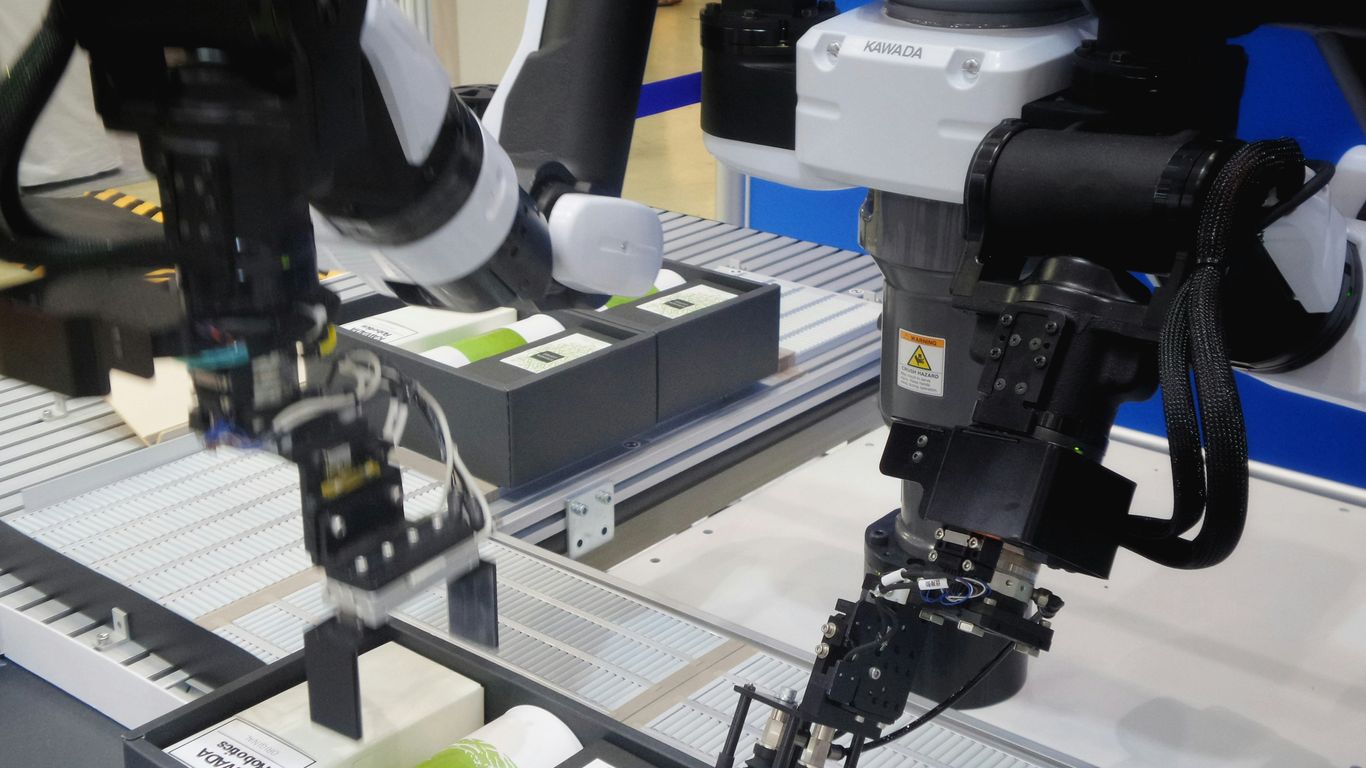
Safety also requires more than a marketing label. Operators should review guarding, speed limits, emergency stops, training, and the robot’s behavior when a person enters its working space. The [robotics types overview](https://www.autostoresystem.com/insights/types-of-robots-in-warehousing?ref=insidedeeptech.com) offers useful context on why collaborative systems differ from traditional robots, but site-specific risk assessment remains essential.
## 3\. Robotic pallet movers for receiving and shipping
Pallet-moving robots target the heavy, repetitive travel between docks, staging lanes, storage locations, and outbound doors. They can be useful where forklifts or pallet jacks spend much of a shift covering predictable distances. For a small warehouse, the attraction is often less about replacing a vehicle than about reducing congestion and reserving skilled operators for exceptions.
Receiving and shipping create clear checkpoints: a pallet arrives, is identified, moved, staged, and released. That sequence makes it easier to test automation than a highly variable picking process. Still, floor quality, pallet condition, dock transitions, pedestrian traffic, and trailer variability can determine whether the system works reliably.

A sensible assessment separates physical movement from software coordination. The robot needs accurate task status, while the warehouse management system needs to know whether a pallet is waiting, moving, blocked, or complete. The [warehouse automation solutions](https://mobile-industrial-robots.com/blog/warehouse-robots?ref=insidedeeptech.com) overview is a useful starting point for thinking about material handling and safety, but projected savings should come from the facility’s own travel logs and labor costs.
## 4\. Goods-to-person robots for high-density storage
Goods-to-person systems bring inventory to a stationary worker instead of sending that worker through every aisle. The approach can reduce walking and make high-density storage more productive, particularly when a business handles many small items. It also changes the shape of the operation: storage locations, replenishment logic, stations, and exception processes become tightly connected.
This model is most compelling when order lines are frequent enough to keep a station busy. A small business with sparse demand may gain less than expected if the system spends too much time waiting for work. It should examine SKU dimensions, replenishment frequency, inventory turns, and the number of simultaneous stations before treating density as the primary objective.
[Locus Array](https://locusrobotics.com/?ref=insidedeeptech.com) is documented as a Robots-to-Goods system for autonomous fulfillment, with described work including picking, putaway, induction, drop-off, slotting, and replenishment. Those stated capabilities illustrate why the goods-to-person question is broader than storage alone: the value comes from coordinating the movements around the station. The extra space, integration, and maintenance requirements should be priced alongside the labor benefit.
## 5\. Piece-picking robots for e-commerce orders
Piece-picking robots handle individual items rather than full pallets or cases. That makes them relevant to e-commerce operations, where an order may contain several small products with different shapes, surfaces, and packaging. The technical challenge is not simply locating an item; it is recognizing it, grasping it safely, and placing it without damaging the order or the next item in the sequence.
Performance varies sharply with the catalog. Uniform cartons and repeatable presentation are easier than soft bags, reflective packaging, tangled products, or items that arrive in inconsistent orientations. A small business should therefore test representative SKUs, including the awkward products that generate the most manual effort.

The [Nimble Robotics guide](https://www.insidedeeptech.com/a-comprehensive-guide-to-nimble-robotics-and-automated-fulfillment/) discusses automated fulfillment through robotics, AI, computer vision, adaptive grasping, and fleet management. Those concepts are relevant to evaluation, but they do not remove the need for a sample-based pilot. The useful measure is completed, correctly packed order lines per hour under normal operating conditions—not a best-case demonstration.
## 6\. Robotic arms for repetitive warehouse tasks
Robotic arms remain a practical choice when a task can be confined to a defined work envelope. They can support palletizing, depalletizing, induction, labeling, or repetitive transfers, provided the input and output positions are controlled. Unlike mobile robots, they usually solve a point-to-point problem rather than a facility-wide travel problem.
For a small operation, the main constraint is often integration space. A workcell needs room for conveyors, bins, safety equipment, maintenance access, and human loading or unloading. The arm’s payload, reach, gripper, cycle time, and tolerance for variation should be specified from real products and packaging, not from an idealized test object.
A focused cell can still produce a meaningful operational gain. It may remove one particularly tiring motion while leaving the wider warehouse manual, which can be a sensible trade when capital is limited. The [industrial robotics coverage](https://www.insidedeeptech.com/tag/robotics/) places these systems within a larger field that includes warehouse automation and other specialized applications; that broader view helps an operator distinguish a task-specific deployment from a general-purpose promise.
## 7\. Automated guided vehicles for predictable routes
Automated guided vehicles, or AGVs, move along predetermined paths using guidance methods such as markers, sensors, or mapped routes. They are less adaptable than AMRs when the environment changes unexpectedly, but that constraint can be an advantage in a stable facility. Repeated transfers between fixed points are easier to control, schedule, and measure.
AGVs make the most sense when the warehouse has consistent lanes, dependable pickup points, and limited pedestrian interference. They are a poor fit for an operation that frequently moves racks, changes dock assignments, or depends on rapid route improvisation. The choice should follow the physical process, not the assumption that newer autonomy is always better.
A simple comparison can keep the evaluation grounded:
| Factor | AGV | AMR | Manual vehicle |
| ------------------ | -------------------- | ------------------------- | -------------------- |
| Route behavior | Predetermined | Dynamically navigated | Operator-directed |
| Layout flexibility | Lower | Higher | High |
| Best fit | Repeated transfers | Changing workflows | Irregular exceptions |
| Primary review | Guidance and traffic | Mapping and fleet control | Labor and safety |
The table is not a substitute for a site survey. It does, however, clarify why route predictability, congestion, and change frequency should be scored before a small business commits to a vehicle type. The [Accio Robotics review](https://www.insidedeeptech.com/accio-robotics-review-autonomous-mobile-warehouse-robots-explained/) also discusses navigation, WMS integration, modular hardware, and comparisons with AGVs, giving readers a useful framework for that technical assessment.
## 8\. Inventory robots for scanning and cycle counting
Inventory robots address visibility rather than movement. They can travel through aisles with cameras, barcode readers, or other sensors to capture information about locations and stock. For a small business, the benefit may be fewer disruptive manual counts and earlier detection of misplaced or missing inventory.
The quality of the result depends on labeling, lighting, aisle access, and data reconciliation. A scan is only useful if the system can distinguish an unreadable label from an empty location and send exceptions to someone who can investigate. Integration with the inventory record is therefore as important as the robot’s ability to drive.
Inventory automation is also a control decision. Management should define how often counts occur, which discrepancies trigger action, and how results are audited. The [warehouse and industrial robotics startups](https://www.insidedeeptech.com/the-best-warehouse-and-industrial-robotics-startups-of-2026/) coverage is relevant background for readers tracking developments in AI-driven inventory and flexible automation, but a small operator should begin with a narrow zone and a measurable discrepancy baseline.
## 9\. Robotic sortation systems for growing order volumes
Sortation robots route parcels, totes, or cartons to destinations such as packing stations, carrier lanes, or store orders. They become more valuable as order volume grows and manual staging creates misroutes or congestion. Their central promise is not merely speed; it is consistent assignment across many destinations.
Sortation can also expose upstream problems. If item identification is unreliable, if cartons arrive late, or if order data changes after induction, a fast sorter will process errors faster. A deployment should therefore include barcode quality, exception lanes, destination logic, and recovery procedures from the beginning.
For a small business, modularity matters. A system that can begin with a few destinations and expand may be preferable to a large installation sized for a speculative peak. Capacity planning should include average volume, seasonal surges, product dimensions, labor at induction, and the cost of downtime, rather than relying on a single throughput figure.
## 10\. Warehouse cleaning robots for safer facilities
Cleaning robots are a less glamorous but often practical category of warehouse automation. They can support routine floor cleaning in large, open areas, helping keep dust, debris, and spills from becoming trip or equipment hazards. Their value is strongest where cleaning is frequent, repetitive, and difficult to staff consistently.
The robot still needs a managed operating environment. Pallets left in travel lanes, loose shrink wrap, narrow aisles, wet areas, and changing shift patterns can interrupt its route. A facility should decide when cleaning occurs, who clears obstructions, and how incidents are reported before it measures labor savings.
For a small business, safety and reliability may justify a cleaning pilot even when order automation is premature. A defined zone makes it possible to compare cleaning coverage, interruption rates, and manual hours without redesigning the entire warehouse. That measured approach reflects a broader principle: automation earns its place by solving a recurring operational problem, not by carrying the most advanced label.
## Conclusion
The best warehouse robots for small business are not necessarily the most autonomous or technically ambitious systems. They are the machines that fit a clearly measured constraint, integrate with existing records and workflows, and can be introduced without making the operation brittle. A narrow pilot, realistic total-cost model, and explicit manual fallback give operators a stronger basis for expansion in 2026.
## Frequently Asked Questions
### What is the best warehouse robot for a small business?
The best choice depends on the bottleneck. AMRs suit changing travel patterns, AGVs suit fixed routes, robotic arms suit defined repetitive cells, and inventory robots suit scanning and counting problems.
### Are warehouse robots affordable for small businesses?
Some systems can be introduced through leasing, Robotics-as-a-Service, or a small pilot rather than a full purchase. Affordability depends on integration, maintenance, floor changes, software, training, and the labor hours the system actually removes.
### Can warehouse robots work with existing employees?
Yes. Many deployments are designed to support workers by reducing walking, carrying, or repetitive handling. The operating model still requires training, safe interaction rules, exception ownership, and clear responsibility for system downtime.
### Do small warehouses need a completely automated facility?
No. Partial automation is often more practical. A business can automate one route, station, inventory zone, or cleaning schedule while keeping other processes manual until demand and evidence justify expansion.
### What should a warehouse measure before buying a robot?
Useful baselines include order lines per labor hour, walking distance, travel time, error rates, downtime, replenishment delays, inventory discrepancies, and peak-period volume. The measures should match the task the robot is expected to improve.
### How long does warehouse robot deployment take?
Timing varies with the robot type, facility changes, software integration, safety review, and pilot scope. A narrowly defined deployment is generally easier to validate than a system that changes receiving, storage, picking, packing, and shipping at once.
### What are the main risks of warehouse automation?
Common risks include poor data quality, unsuitable product variation, congestion, weak exception handling, underestimated integration work, and maintenance gaps. A pilot using representative conditions can expose these issues before a larger commitment.
Additional operational planning may also cover data handling and vendor governance; a [privacy policy reference](https://vinosomm.ai/en/privacy?ref=insidedeeptech.com) can help frame questions about how software providers describe data collection and processing. Financial planning is separate from technology selection, although readers researching unrelated capital models may encounter [Elite Trader Funding](https://elitetraderfunding.app/blog/best-prop-firm-2026?ref=insidedeeptech.com), [AB Spectrum](https://www.abspectrum.org/how-much-does-aba-therapy-cost/?ref=insidedeeptech.com), [Camunda 8 migration](https://omninoo.com/blog/camunda-7-zu-8-migration/?ref=insidedeeptech.com), and [Namibia safari planning](https://www.africazim-travel.com/namibia-safari-experiences/?ref=insidedeeptech.com) in broader web research; none of those topics determines a warehouse robot choice.
### How Much Does a Humanoid Robot Cost in 2026?
URL: https://www.insidedeeptech.com/how-much-does-a-humanoid-robot-cost-in-2026/
Last updated: 2026-08-17T17:27:25.000Z
## Key Takeaways
A humanoid robot can cost anywhere from a few thousand dollars to hundreds of thousands, depending on its hardware, software, and intended work. The purchase price is only one part of the financial decision.
- Entry-level humanoid robots may cost a few thousand dollars, while research platforms often reach tens of thousands.
- Commercial and industrial systems can require six-figure budgets, custom integration, and long-term service agreements.
- Battery capacity, actuators, sensors, autonomy, dexterity, and payload all influence the price.
- Leasing or robot-as-a-service plans can reduce upfront spending but add recurring operating costs.
- A credible business case depends on utilization, uptime, task completion, maintenance, and payback—not appearance alone.
## Humanoid robot price ranges in 2026
The answer to “how much does a humanoid robot cost” depends first on what the buyer means by humanoid robot. A compact education platform is priced very differently from a machine intended to move through a factory for multiple shifts. Public list prices provide useful reference points, but enterprise deployments are frequently quoted case by case.
The market remains uneven in 2026\. Some machines are developer platforms with limited support, while others are being prepared for workplace deployment. A [2026 humanoid robot list](https://www.insidedeeptech.com/every-humanoid-robot-launching-in-2026-full-list/) can help establish the broad market context, but it should not be mistaken for a standardized price catalog.

### Entry-level and educational humanoid robots
Entry-level machines generally prioritize accessibility, demonstrations, programming, or classroom use over industrial endurance. Publicly listed examples range from roughly $1,000 to under $10,000, although configuration, shipping, duties, and warranty terms can change the delivered cost. At this level, buyers should expect compromises in payload, runtime, hand capability, safety certification, or secondary development support.
The [Unitree G1](https://www.roboworks.net/store/p/unitree-g1-humanoid-robot?ref=insidedeeptech.com) is described as a humanoid platform for AI and robotics research, academic studies, and educational programs. That positioning makes it a useful reference for the lower-cost research market, but the listed configuration should be compared carefully with any upgraded education or dexterous-hand version.
### Mid-range robots for research and development
Research-grade humanoids commonly occupy the roughly $10,000-to-$100,000 band, though the boundary is fluid. These systems may include more degrees of freedom, stronger actuators, better onboard computing, richer sensing, or development interfaces that make them useful for university laboratories and corporate R&D teams. The buyer is paying not only for movement, but also for a platform on which engineers can test perception, control, manipulation, and human-robot interaction.
A lower list price can still conceal substantial engineering work. Teams may need to build their own task policies, safety envelopes, data pipelines, and maintenance procedures. The practical cost therefore depends on how much of the research stack the vendor supplies and how much the buyer must create.
### Commercial humanoid robots for workplace tasks
Commercial workplace systems are harder to price from public information. A buyer may encounter estimates from tens of thousands of dollars to well above $100,000, while a fully supported deployment can cost more once integration, supervision, service, and facility changes are included. The relevant question is whether the machine can repeat a defined task reliably in a real operating environment.
Commercial readiness should be assessed through deployment evidence, intervention rates, uptime, safety processes, and the cost of useful work. A [commercial readiness framework](https://www.insidedeeptech.com/the-best-humanoid-robots-of-2026-ranked/) is more informative than a comparison based only on height, speed, or a polished demonstration.
### Custom-built and industrial humanoid systems
Custom industrial systems can reach six-figure budgets and may require a formal engineering program rather than a simple equipment purchase. Costs rise when the robot must interface with conveyors, enterprise software, tooling, secure networks, or regulated workflows. A buyer may also pay for site surveys, simulation, task-specific training, acceptance testing, and on-call support.
At this end of the market, the robot is part of an operating system for physical work. The contract may cover several units, software, integration, training, and performance milestones, making the headline hardware price a poor proxy for the total commitment.
## What determines the purchase price
A humanoid robot combines mechanical, electrical, computational, and software systems in one package. Each subsystem affects both the list price and the machine’s ability to perform useful work. Buyers should request a configuration-level quote rather than compare model names in isolation.
The most expensive component is not always the most visible one. A capable hand, high-torque joint, thermal-management system, or reliable autonomy stack can matter more to the business case than a visually human-like exterior.
### Hardware, actuators, sensors, and battery capacity
Actuators determine how strongly and precisely the robot can move, while sensors provide the information needed to balance, navigate, and manipulate objects. More capable joints, force sensing, depth cameras, lidar, tactile sensing, and onboard computing generally increase cost. Battery capacity also matters because a larger battery can improve runtime but adds weight, expense, and design complexity.
The quote should identify degrees of freedom, maximum payload, continuous payload, battery runtime under a stated workload, charging method, sensor suite, and expected duty cycle. Without those details, two apparently similar robots may have very different operating limits.
### AI software, autonomy, and operating systems
Software determines how much direct supervision a robot requires. A platform with development tools and basic motion control may be affordable but demand substantial engineering effort. A system with perception, navigation, manipulation, monitoring, and fleet-management software may carry a higher price or recurring fee.
Autonomy should be described by task and environment, not by a broad marketing label. Buyers should ask which actions are autonomous, which require teleoperation, how failures are handled, and whether software access is included in the purchase or tied to a service plan.
### Payload, mobility, dexterity, and task performance
A robot that walks well but cannot handle the required object is not a low-cost solution; it is the wrong tool. Payload, reach, balance, walking speed, hand precision, cycle time, and recovery behavior all influence the useful output of the system. These specifications should be tested against the buyer’s actual objects, floor surfaces, shelves, tools, and work rhythm.
The humanoid robot launching landscape shows why hardware categories are broad: systems can be aimed at logistics, healthcare, home use, or general research. Price comparisons become meaningful only after the intended task is held constant.
### Customization, integrations, and deployment requirements
A standard robot may need changes before it can operate safely and productively at a customer site. Integration can include APIs, warehouse or manufacturing software, identity management, remote monitoring, custom end effectors, charging stations, and restricted operating zones. These requirements can add weeks or months to the project.
A sensible quote separates the robot, accessories, software, integration labor, training, travel, taxes, shipping, and support. That separation gives the buyer a clearer basis for comparing vendors and identifying costs that are optional, deferred, or unavoidable.
## How manufacturers charge for humanoid robots
Humanoid robots do not yet follow one universal commercial model. Some vendors publish prices for development platforms, while others sell through pilots and negotiated enterprise contracts. The payment structure can change the economics as much as the hardware specification.
A buyer should model the cash requirement, the recurring commitment, and the conditions under which the vendor can change service pricing. A lower initial payment is not automatically a lower total cost.
### Upfront purchase prices and list prices
An upfront purchase is the simplest structure: the buyer pays for the robot and any selected accessories, then separately covers shipping, taxes, installation, and support. Public list prices are useful for entry-level and developer platforms, but they may exclude duties, advanced hands, software access, or premium warranty coverage.
The list price should therefore be treated as a starting point. The buyer should confirm exactly what is delivered, what is licensed, and what happens when a component fails outside the standard warranty.
### Leasing and robot-as-a-service plans
Leasing spreads the capital expense over a fixed term, while robot-as-a-service arrangements may charge a monthly fee, usage fee, or task-based fee. These models can suit organizations that prefer operating expenditure or want to preserve flexibility while the technology matures. They may also include maintenance, remote support, or software updates.
The contract needs careful review. Restrictions on hours, locations, data, connectivity, replacement units, early termination, and minimum usage can materially change the economics. A service plan is only attractive when its included support matches the buyer’s operational needs.
### Subscription fees for software and AI capabilities
Software may be bundled with the robot, licensed annually, or priced according to features and usage. Cloud inference, fleet dashboards, data storage, remote assistance, and advanced task policies can all create recurring costs. In some deployments, connectivity and compute charges may vary with the number of robots or hours of operation.
The buyer should ask whether a robot remains functional if a subscription ends. It should also clarify update cadence, cybersecurity responsibilities, data ownership, offline operation, and the service-level commitment for software defects.
### Custom quotes, pilots, and enterprise contracts
Enterprise contracts often begin with a paid pilot designed to test a small number of tasks in a real facility. The pilot may have a defined scope, success criteria, engineering support, and a path to expansion. Its cost should be evaluated as learning expenditure, not assumed to represent the final price per deployed robot.
A strong proposal states what the vendor will measure: task completion, intervention frequency, uptime, cycle time, safety incidents, and labor impact. That evidence is more valuable than an unconditional promise of savings.
## The total cost of owning a humanoid robot
Ownership begins when the robot arrives, not when the invoice is paid. The full cost may include deployment labor, technical staff, replacement parts, software, insurance, safety controls, and facility preparation. These costs are especially significant when the robot is expected to operate around people.
A five-year model should include conservative assumptions and a clear distinction between one-time costs and recurring costs. **Useful work matters more than sticker price** when comparing machines.
### Installation, training, and workplace integration
Installation can involve unpacking, calibration, network configuration, charging setup, workspace mapping, and connection to existing systems. Staff may need training in safe interaction, recovery procedures, task configuration, and basic troubleshooting. These activities consume engineering and operations time even when the vendor provides on-site assistance.
Integration also changes the surrounding workflow. A robot may need dedicated staging space, revised handoff procedures, new access controls, or a human supervisor during early operation. Those changes should be budgeted before the pilot begins.
### Maintenance, repairs, and replacement parts
Humanoid robots contain many moving joints and components exposed to repeated impacts, dust, vibration, and thermal cycles. Maintenance can include actuator inspection, battery replacement, sensor calibration, hand servicing, and preventive software diagnostics. The buyer should request expected service intervals and prices for high-wear components.
A spare-parts strategy matters as much as the warranty. If a failed actuator takes weeks to replace, the cost is not limited to the part; it includes lost availability, rescheduled work, and possible human backfill.
### Software updates, cloud services, and connectivity
Software updates can improve performance, address defects, or change the behavior of a deployed system. They can also require testing before release into a production workflow. Cloud services, cellular connectivity, secure networking, data retention, and remote assistance may add recurring expenses.
The operating budget should include a process for validating updates and recovering from failed deployments. A technically advanced robot that cannot be monitored or restored quickly may have a lower effective uptime than its specification suggests.
### Insurance, safety compliance, and facility changes
Insurance and compliance costs depend on the robot’s environment, physical power, operating speed, and proximity to workers or customers. Facilities may need barriers, marked zones, emergency stops, lighting changes, floor modifications, or additional risk assessments. Regulated settings can require documentation and approval before routine operation.
These expenses are not administrative decoration. They define whether the robot can be used legally and safely, and they should appear in the business case from the first draft.

## Comparing humanoid robot costs by use case
The same robot can have very different economic value in different settings. Education may value openness and demonstrability, while logistics may value repeatability and uptime. Healthcare and household use add stricter requirements around trust, privacy, safety, and reliability.
For context beyond robotics, a buyer may also encounter unrelated technology planning resources such as [AI video production costs](https://greenfroglabs.com/blog/ai-video-production?ref=insidedeeptech.com), [premium drinks menus](https://www.bartheon.com/bochord-beverage-menu?ref=insidedeeptech.com), or [Namibia safari planning](https://www.africazim-travel.com/namibia-safari-experiences/?ref=insidedeeptech.com). Those links illustrate a broader editorial point: a price becomes meaningful only when it is tied to scope, service, and the experience being purchased.
### Education, demonstrations, and research
Schools and laboratories may accept lower utilization if the robot supports teaching, experimentation, or public demonstration. Here, accessible development tools, documentation, sensor access, and repairability can matter more than maximum payload. A less expensive platform can be rational when the objective is to learn rather than replace labor.
Research buyers should still account for staff time. A robot that requires extensive custom control software may be valuable, but its true cost includes the researchers who make it usable.
### Warehousing, logistics, and manufacturing
Industrial buyers usually care about throughput, predictable cycle time, safe operation near existing equipment, and the ability to recover from errors. The machine must work within real aisle widths, shelf heights, container sizes, lighting conditions, and shift schedules. A [warehouse robotics market overview](https://www.insidedeeptech.com/the-best-warehouse-and-industrial-robotics-startups-of-2026/) provides useful context, although humanoid economics should be compared with the specific workflow being automated.
The strongest case is often a constrained task with measurable output. General-purpose flexibility may become more valuable later, but early deployments should avoid assuming that a robot can move seamlessly among every task in a facility.
### Healthcare, hospitality, and customer service
These settings introduce human interaction, privacy, hygiene, and reputational risk. A robot serving a public environment may need quieter motion, clearer communication, stronger supervision, and carefully limited access to sensitive areas. In healthcare, the category includes many different systems, so a [healthcare robotics overview](https://www.insidedeeptech.com/robotics-in-healthcare-in-2026-innovations-and-future-outlook/) is more useful than a generic humanoid price estimate.
The financial return may include service capacity, staff relief, or improved access rather than direct labor elimination. Those benefits are difficult to measure and should be supported by a defined baseline.
### Household assistance and personal use
Personal-use humanoids remain an especially uncertain category. A household buyer may value mobility, conversation, object handling, and convenience, but the robot must function safely amid clutter, children, pets, stairs, and unpredictable objects. Support, privacy, battery charging, and repairs can dominate the ownership experience.
The [Unitree R1](https://theconversation.com/a-humanoid-robot-is-now-on-sale-for-under-us-6-000-what-can-you-do-with-it-262183?ref=insidedeeptech.com) is described as a compact humanoid for labs, workspaces, or adventurous homes, with walking, squatting, balancing, and other movement capabilities. That description does not establish broad household autonomy, so buyers should distinguish demonstrated movement from dependable domestic assistance.
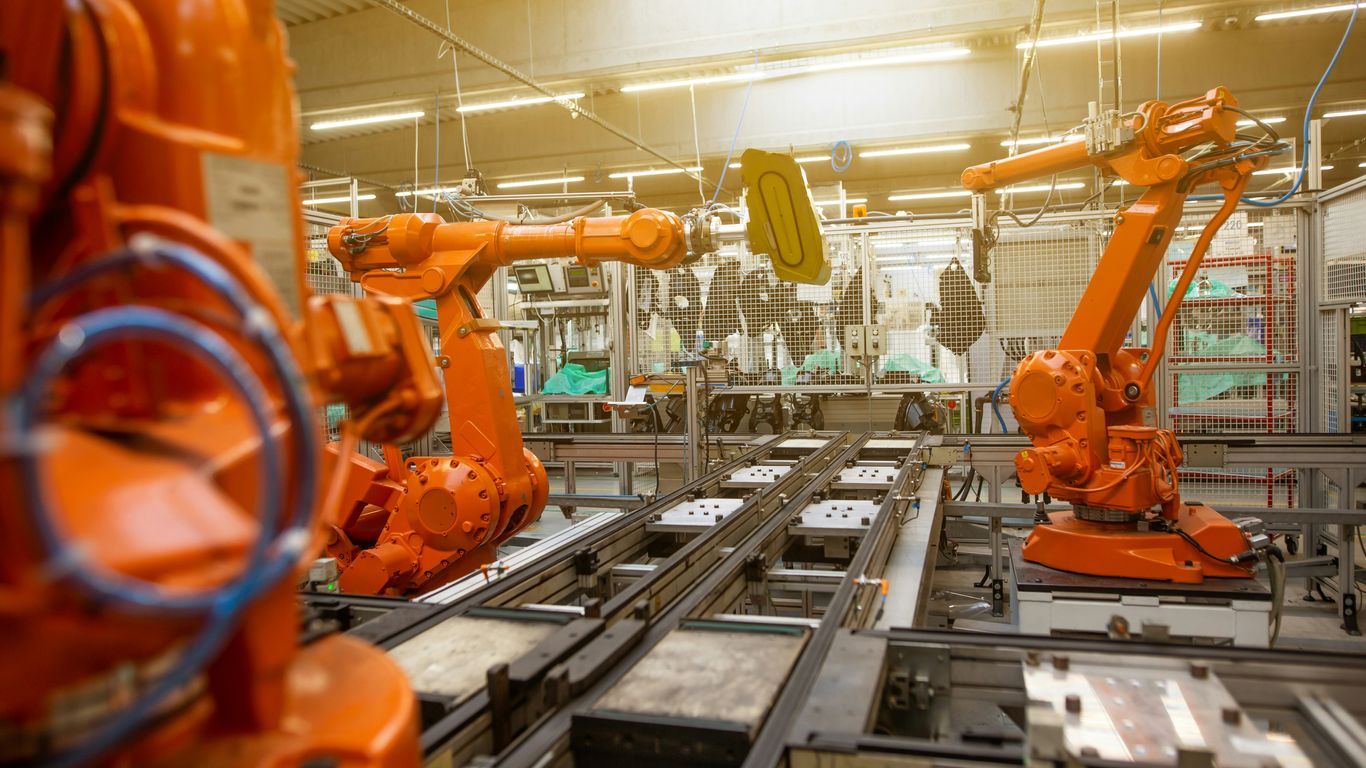
## How to evaluate whether a humanoid robot is worth the cost
A robot is worth its cost only when it produces enough useful, repeatable output to justify the capital and operating burden. The evaluation should begin with a defined task and a baseline, not with a general belief that humanoid form will eventually be valuable. This is where technical diligence becomes financial diligence.
The buyer should compare the proposed system with human labor, conventional automation, and simply redesigning the workflow. Each alternative has costs, but each may also have a more mature reliability profile.
### Estimating labor savings and productivity gains
Labor savings should be based on hours actually displaced or redirected, not on the total headcount associated with a process. A robot may increase throughput by taking on a repetitive step while workers handle exceptions, quality control, or customer-facing work. That can be valuable even when no position is eliminated.
The analysis should include wages, benefits, shift premiums, supervision, recruiting, training, and expected changes in staffing. It should also state whether the robot operates during periods when labor is scarce or expensive.
### Measuring utilization, uptime, and task completion
Utilization is the proportion of available time spent performing useful work, while uptime measures whether the system is operational. Neither figure is meaningful without a clear denominator. A robot may be powered on for a full shift yet produce little if it frequently waits for instructions, charging, recovery, or human intervention.
A pilot should record at least the following operational measures:
- Completed tasks per hour under normal conditions.
- Human interventions per task or per shift.
- Productive runtime, charging time, and downtime.
- Error recovery time and the cause of each failure.
These measures expose the gap between a demonstration and a dependable process. They also give the vendor and buyer a shared basis for improving the deployment.
### Calculating payback period and return on investment
Payback period is the time required for cumulative benefits to cover the initial and ongoing costs. A simple model divides the initial investment by monthly net benefit, but a serious evaluation should include maintenance, financing, software, downtime, training, and residual value. A range of scenarios is more honest than one highly precise forecast.
For example, a buyer might model conservative, expected, and high-utilization cases. The expected case should not assume perfect uptime or immediate worker acceptance. If the project works only under the most optimistic assumptions, the price is probably not yet justified.
### Accounting for technical limitations and operational risks
Risks include limited battery runtime, payload constraints, unstable software, difficult recovery, cybersecurity exposure, supply-chain delays, and dependence on vendor support. There may also be safety and labor-relations concerns that cannot be reduced to a line item. A risk register should assign an owner and mitigation plan to each material uncertainty.
A useful rule is to price the robot as though supervision and exceptions are real until testing proves otherwise. That approach avoids treating autonomy as a binary feature and keeps the financial model tied to observed performance.
## How to budget for a humanoid robot purchase in 2026
Budgeting should proceed from the job to the machine, not the other way around. The buyer first defines the work, then identifies the required capabilities, then compares commercial structures. This sequence prevents an attractive demonstration from becoming an expensive answer to the wrong problem.
The process is also a way to manage uncertainty. A staged commitment lets an organization learn about performance and integration before it commits to a fleet or a long service contract.
### Define the tasks and performance requirements
The first document should describe the objects, motions, workspace, shift pattern, safety boundaries, handoffs, and acceptable error rate. It should specify what counts as task completion and how much human intervention is acceptable. Requirements should be written in observable terms rather than phrases such as “fully autonomous” or “general purpose.”
A good task definition may reveal that a stationary machine, mobile manipulator, or process change is more economical. That is a useful result, not a failure of the humanoid evaluation.
### Compare published prices with vendor quotes
Published prices are useful anchors for entry-level platforms, but quotes reveal the cost of the actual configuration. Buyers should request separate lines for hardware, hands, batteries, compute, software, integration, delivery, taxes, training, warranty, and support. They should also ask whether prices are fixed and how future updates are charged.
For perspective, even a [home-buying process](https://www.brookside-pm.ca/buying-a-home?ref=insidedeeptech.com) depends on separating headline price from financing, inspections, and closing costs. Robotics procurement has its own version of the same discipline: scope must be separated from the sticker number.
### Run a pilot before making a long-term commitment
A pilot should use representative objects, real floor conditions, normal network constraints, and the people who will operate the system. Its duration should be long enough to capture routine failures, maintenance, charging, and worker adaptation. Success criteria should be agreed before the robot arrives.
The pilot should end with a decision document: expand, redesign the task, renegotiate the contract, or stop. A [humanoid robotics deployment guide](https://www.insidedeeptech.com/are-humanoid-robots-actually-ready-for-the-workplace-in-2026/) can provide useful strategic context, but the site’s own measurements must determine the decision.
### Build a five-year total cost estimate
The five-year estimate should include acquisition or service payments, integration, training, maintenance, parts, software, connectivity, insurance, compliance, facility changes, financing, and expected downtime. It should also include the internal staff required to manage the system. The model should show sensitivity to utilization, failure rates, labor costs, and vendor price changes.
A defensible budget ends with a range rather than false precision. If the robot’s economics remain attractive under conservative assumptions, the organization has a basis for proceeding; if not, waiting may be the more technically serious choice.
## Conclusion
Humanoid robot prices in 2026 span a wide range because the category includes educational platforms, research machines, commercial systems, and custom industrial deployments. The purchase price is only the opening figure: integration, support, software, safety, maintenance, and utilization determine the cost of useful work. Buyers that define a narrow task, run a measured pilot, and build a five-year ownership model will make a better decision than those comparing headline prices alone.
## Frequently Asked Questions
### How much does a humanoid robot cost in 2026?
Entry-level and educational robots may cost a few thousand dollars, research platforms can reach tens of thousands, and commercial or industrial systems may require six-figure budgets. Exact pricing depends on configuration, support, software, and deployment scope.
### What is the cheapest type of humanoid robot?
Compact education, demonstration, and developer platforms are usually the least expensive. Their lower price may reflect limits in payload, autonomy, runtime, dexterity, warranty coverage, or workplace certification.
### Are humanoid robots available to buy or only to lease?
Both models exist. Some platforms are sold at an upfront price, while enterprise deployments may use leasing, robot-as-a-service, paid pilots, or negotiated contracts.
### What costs are excluded from a robot’s list price?
Common exclusions include shipping, duties, installation, integration, training, software subscriptions, cloud services, maintenance, insurance, facility changes, and replacement parts.
### How long does it take for a humanoid robot to pay for itself?
There is no universal payback period. It depends on productive utilization, labor costs, task completion, uptime, maintenance, financing, and the amount of integration required.
### Can a humanoid robot replace a human worker?
Some systems may automate defined repetitive tasks, but replacement depends on the task, environment, reliability, safety requirements, and supervision burden. A robot may instead augment workers or handle a narrow process step.
### What should a buyer test before purchasing?
The buyer should test the actual objects, workspace, shift pattern, safety conditions, charging process, error recovery, intervention rate, and software workflow. The test should produce measurable evidence rather than rely on a demonstration alone.
### Tesla Optimus vs Figure AI: Who Leads the Humanoid Race?
URL: https://www.insidedeeptech.com/tesla-optimus-vs-figure-ai-who-leads-the-humanoid-race/
Last updated: 2026-08-17T17:27:26.000Z
## Key Takeaways
The Tesla Optimus vs Figure AI debate is less a contest between finished products than a test of evidence, engineering strategy, and production execution.
- Humanoid robots are being designed to work within spaces already built for people.
- Public demonstrations show progress, but they do not establish dependable autonomy.
- Hardware specifications and deployment evidence matter as much as impressive videos.
- Manufacturing scale could become as decisive as machine-learning performance.
- The leader today may differ by task, environment, and tolerance for operational risk.
## How Tesla Optimus and Figure AI approach the humanoid market
Humanoid robotics has reached a stage where demonstrations are easy to find but difficult to compare. The central question is no longer whether a robot can walk or move an arm; it is whether a system can perform useful work repeatedly, safely, and at an acceptable cost. Tesla Optimus vs Figure AI therefore becomes a comparison of development paths as much as robot designs. The available public evidence remains uneven, so claims about future leadership should be treated as analysis rather than settled fact.

### Tesla’s vision for Optimus
Optimus was presented as a general-purpose humanoid robot intended to perform tasks people do not want to do. Public prototypes have demonstrated progression in walking, arm movement, block sorting, and maintaining yoga poses. That record establishes an active development program, not a completed commercial platform. The larger ambition is significant because a general-purpose machine would need to combine mobility, manipulation, perception, and safe behavior in one system.
The industrial logic is straightforward: a human-shaped robot can potentially use workspaces, tools, and processes designed around human bodies. Whether that logic survives the demands of uptime, maintenance, and certification is still unresolved. A useful [humanoid robotics comparison](https://www.insidedeeptech.com/figure-03-vs-tesla-optimus-2026-humanoid-robot-comparison/) is valuable here because it separates deployment stage from long-term manufacturing ambition.
### Figure AI’s strategy and product focus
Figure AI is pursuing general-purpose physical work through humanoid platforms and public demonstrations of increasingly capable behavior. Its strategy places substantial weight on embodied intelligence: the robot must connect perception, language, planning, and movement rather than simply repeat a fixed mechanical sequence. The company’s public trajectory has moved from early prototypes toward a revealed third-generation platform, although the existence of a revealed machine should not be confused with broad commercial reliability.
The company’s approach is best understood as a startup bet on a tightly integrated robot and software stack. That makes learning speed and customer feedback important, but it also leaves production scale, serviceability, and long-term operating economics to be proven. The broader [Figure AI analysis](https://www.insidedeeptech.com/figure-ai-a-deep-dive-into-the-humanoid-robot-startup/) captures why the gap between a compelling prototype and dependable infrastructure is the key commercial problem.
### Why humanoid form factors matter for workplace automation
A humanoid form is not automatically the most efficient robot design. It is attractive because factories, warehouses, and offices already contain stairs, shelves, handles, bins, and tools sized for people. A machine that can enter those environments without a complete redesign may reduce integration work, at least in principle.
That convenience comes with costs. Two-legged locomotion is demanding, batteries are limited, and hands must be both strong and precise. The engineering trade-off is therefore not simply human shape versus another shape; it is adaptation cost versus mechanical complexity.
### The industries each company is targeting
The strongest near-term case for humanoids is work with predictable layouts and repeatable material flows. Manufacturing and logistics provide measurable tasks, controlled access, and existing automation infrastructure. Domestic settings are harder because homes contain more variation, less structure, and more demanding safety conditions.
A market map such as the [humanoid robot landscape](https://www.insidedeeptech.com/figure-ai-vs-1x-vs-agility-vs-apptronik-the-humanoid-race-compared/) helps put those choices in context. It shows why companies can appear to compete directly while actually optimizing for different combinations of physical utility, software adaptability, and deployment environment.
## Comparing robot hardware and physical capabilities
Hardware determines the boundaries within which autonomy can operate. A robot may have an impressive model, but it still needs actuators that tolerate repeated loads, sensors that remain useful in changing light, and a battery that supports a meaningful shift. Public comparisons are complicated because specifications can refer to different generations, prototypes, or targets. The prudent approach is to distinguish disclosed facts from estimates and future claims.

### Body design, mobility, and dexterity
Both platforms are built around the humanoid premise: bipedal movement, articulated arms, and hands capable of interacting with objects. That common form does not make their physical performance equivalent. Balance, walking speed, joint durability, hand control, and recovery from disturbances all require separate validation.
A staged demonstration can show that a robot completed one movement sequence. It cannot, by itself, show how the machine performs after thousands of cycles or when an object is misplaced. For engineers evaluating these systems, repeatability is often more informative than a single display of agility.
### Sensors, cameras, and environmental perception
Perception is the bridge between a robot’s physical body and its assigned task. Cameras and other sensors must identify objects, estimate their position, track people, and detect changes in the workspace quickly enough for motion control. The useful question is not how many sensors a platform carries, but how reliably the complete system turns observations into safe actions.
Public material does not provide a perfectly matched, current sensor comparison for both platforms. That absence matters. A fair assessment should avoid treating older specifications as current and should record when a company has not published a complete specification sheet.
### Payload, battery life, and operating range
Payload and runtime shape the economics of deployment. A robot that can lift a useful object but must stop frequently for charging may require more units, more supervision, or a carefully designed workflow. Operating range also includes communication, floor conditions, temperature, and the ability to return to a charging point.
The following framework is more useful than a single headline number because it keeps physical capability tied to operations:
| Measure | Why it matters | Evidence to seek | Business implication |
| ---------------- | -------------------------------------- | ----------------------------------------- | ---------------------------------- |
| Payload | Defines which objects can be handled | Rated load and repeat-cycle tests | Determines task eligibility |
| Runtime | Sets the length of an operating period | Runtime under representative loads | Affects fleet size and scheduling |
| Speed | Influences throughput | Speed while carrying and navigating | Matters only alongside reliability |
| Service interval | Indicates maintenance burden | Published inspection and replacement data | Shapes total cost of ownership |
These measures should be tested together. A high payload with short runtime, or high speed with frequent intervention, may produce less value than a slower system with predictable uptime.
### Safety features for working around people
Workplace safety involves more than collision avoidance. A deployable robot needs controlled motion, fault handling, emergency stops, predictable behavior, and procedures for recovery when perception or communication fails. It also needs an operating envelope that workers and site managers can understand.
The public record is not yet a complete safety case for either platform. Companies can demonstrate careful behavior without publishing the test coverage, failure rates, or certification pathway needed for high-confidence deployment. That distinction should remain visible in any investor or procurement analysis.
## AI, autonomy, and learning capabilities
The software challenge is to convert a broad instruction into coordinated physical action. A robot must perceive a scene, infer what matters, plan a sequence, control its body, and revise the plan when the environment changes. This is closer to embodied AI than to ordinary screen-based automation because mistakes have physical consequences. As discussed in broader [Physical AI coverage](https://www.insidedeeptech.com/physical-ai-the-embodied-ai-startups-to-watch-in-2026/), the field is moving toward systems that connect foundation models with real-world control, but the reliability gap remains substantial.
### Tesla’s AI and vision-based approach
Public descriptions of Optimus emphasize a general-purpose robot whose capabilities have expanded through successive prototypes and demonstrations. The available record supports discussion of walking, arm movement, block sorting, and balance-oriented tasks. It does not support a complete claim about the autonomy of a current production-generation system.
That makes the evaluation criteria unusually important. **Evidence quality matters most** when a platform’s public narrative is broader than its published technical specification. Video can establish that a behavior occurred; it cannot fully establish the level of human supervision, the number of failed attempts, or the conditions under which the behavior generalizes.
### Figure AI’s use of machine learning and demonstrations
Figure AI presents its robots as systems for general-purpose physical work, with machine learning and demonstrations playing a central role in development. The relevant promise is not that a robot memorizes one route or one object, but that experience can improve performance across related tasks. Even so, a demonstration remains a bounded observation unless the company also provides repeatability, intervention, and operating data.
The distinction is familiar in machine learning: a model can perform well on a narrow distribution and still fail when the environment shifts. Humanoid robotics adds hardware wear, contact uncertainty, and safety constraints to that generalization problem.
### How each robot handles unfamiliar tasks
Unfamiliar tasks expose the difference between scripted automation and adaptive autonomy. A robust system needs to recognize when an object differs from its training examples, when a path is blocked, or when an instruction is underspecified. It must then either recover safely or request assistance rather than continue with unjustified confidence.
Neither public record provides enough matched testing to declare a decisive winner on unfamiliar work. The most defensible conclusion is narrower: both development programs are aimed at broader task coverage, while the extent of real-world generalization remains a central question.
### The role of simulation, data, and human feedback
Simulation can provide scale and repeatability, while real-world data exposes the friction that simulated environments often miss. Human demonstrations may help teach behaviors, but collecting them is only the beginning; the system must filter, label, evaluate, and safely deploy what it learns.
For a buyer, the practical questions include:
- How much human intervention is required during ordinary operation?
- How are edge cases recorded and fed back into training?
- Can a learned behavior transfer between robots and sites?
- What happens when the model is uncertain?
Those questions shift attention from model branding to the training and operations loop. That loop is likely to determine whether a promising platform becomes a dependable fleet.
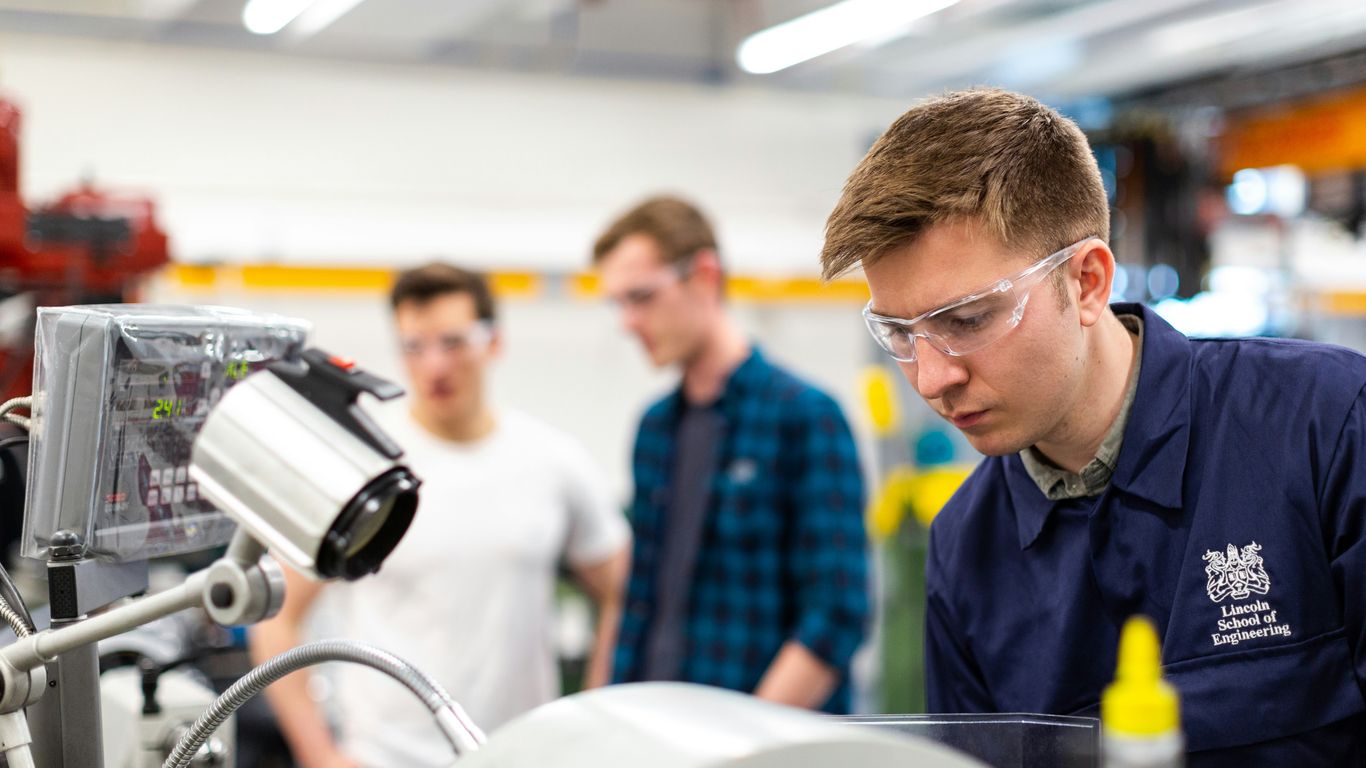
## Real-world deployments and development progress
Deployment is where humanoid robotics leaves the demonstration stage and meets production constraints. A factory or warehouse introduces shift schedules, variable materials, safety reviews, maintenance windows, and workers who reasonably expect predictable behavior. Progress should therefore be measured in operating evidence, not only in launch events or polished footage.
### Tesla’s factory testing and production ambitions
The public record describes Optimus prototypes and ambitions connected to factory use and eventual production. Those ambitions are strategically important because manufacturing scale could lower unit cost and support a large installed base. They remain ambitions unless accompanied by disclosed output, sustained internal operation, and independently verifiable deployment evidence.
The distinction is especially important when comparing a future capacity target with a currently operating fleet. A target indicates direction and confidence; it does not establish present manufacturing performance.
### Figure AI’s commercial partnerships and pilot programs
Figure AI has pursued commercial validation through partnerships and pilot-style work, including public attention around industrial settings. Such activity is stronger evidence than a laboratory demonstration because it places the robot near real workflows. It still does not prove that the system can operate across sites, shifts, and task variations without substantial support.
The [humanoid robots for 2026 guide](https://www.insidedeeptech.com/the-best-humanoid-robots-of-2026-ranked/) uses a useful lens for this stage of the market: applicability depends on repeatability, safety, maintenance, and integration, not merely on the sophistication of a single demo.
### What current demonstrations reveal—and what they do not
Demonstrations reveal that a team has achieved a particular behavior under particular conditions. They can show mechanical progress, coordination, latency, and the quality of a human-machine interface. They rarely reveal the full distribution of failures, the cost of supervision, or how much preparation preceded the recording.
A careful reader should ask whether the robot was teleoperated, whether the task was rehearsed, and whether the result has been repeated. These are not hostile questions. They are the minimum needed to distinguish a research result from an operating claim.
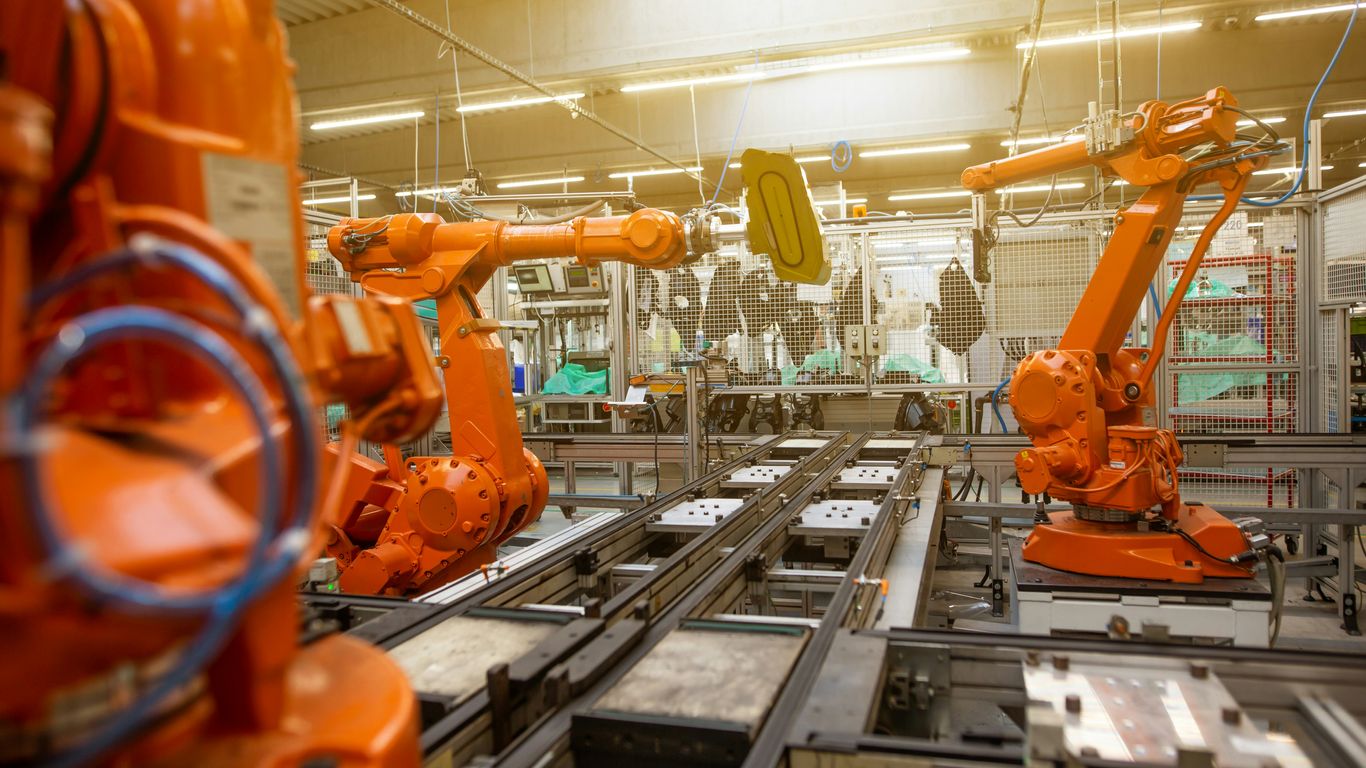
### The difference between prototypes and reliable workplace systems
A prototype answers, “Can the system do this?” A workplace system must answer a longer list: can it do this every shift, recover from errors, avoid people, report faults, and justify its cost? That is why commercial readiness often advances more slowly than public capability videos suggest.
A useful [industrial humanoid robotics analysis](https://www.insidedeeptech.com/startups-vs-boston-dynamics-and-tesla-optimus-who-is-really-leading-robotics/) frames the transition as a systems problem involving power, sensors, physical durability, and deployment design. The robot is only one component of the operational stack.
## Manufacturing scale, cost, and business potential
Humanoid robotics will not become an important industry through capability alone. The machines must be manufactured, serviced, insured, integrated, and paid for by a customer whose alternative may be human labor or a specialized automation cell. Unit economics are still difficult to assess because neither company has supplied a universally accepted public price for a mature, broadly deployed platform.
### Tesla’s advantages in manufacturing and supply chains
Tesla’s industrial strategy is associated with automotive-scale manufacturing and an ambition to produce Optimus in volume. If those capabilities transfer effectively to humanoid production, they could reduce component costs and shorten the path from prototype to fleet. That is a plausible strategic advantage, not proof that robot manufacturing has already reached automotive scale.
The hard parts may also differ from those in vehicles. Humanoid robots require compact actuators, dexterous hands, reliable power electronics, and extensive validation of physical behavior. Existing supply-chain expertise helps, but it does not remove those engineering constraints.
### Figure AI’s startup model and strategic partnerships
A startup can move quickly, concentrate resources, and use partnerships to access manufacturing, data, or deployment environments. That model may support faster iteration than a large industrial organization in some phases. It can also create dependence on financing, suppliers, and partners before recurring revenue is established.
The financing story is less important than what capital enables: completed hardware revisions, production tooling, field support, and measured customer outcomes. Investors should distinguish capital raised from commercial traction and announced pilots from paid, repeatable deployments.
### Expected pricing and the economics of deployment
The right price comparison is not robot versus worker in isolation. It includes supervision, integration, charging, maintenance, downtime, insurance, floor modifications, and the value of the task completed. A robot with a lower purchase price may still be uneconomic if it needs frequent intervention.
The [workplace humanoid robotics outlook](https://www.insidedeeptech.com/are-humanoid-robots-actually-ready-for-the-workplace-in-2026/) is useful because it places return on investment alongside safety certification, energy efficiency, and social considerations. Those factors will influence adoption even if the hardware becomes cheaper.
### Which company can scale production more quickly
The evidence does not justify a confident production ranking based solely on future targets. One company may have greater manufacturing infrastructure, while the other may have more visible evidence from a current platform or partner environment. The winner in volume will be the one that can combine supply, quality control, software updates, and field service at acceptable cost.
That is a much higher bar than assembling a small number of impressive units. Production scale is an operational capability, and it will be demonstrated through deliveries, uptime, repair cycles, and customer retention.
## Tesla Optimus vs Figure AI: Which robot leads today?
The honest answer depends on what “leads” means. A comparison based on ambition favors the company promising broad manufacturing scale; a comparison based on public evidence favors the platform with more current specifications and observable operating data. Neither framing is sufficient on its own. The most useful ranking separates technical maturity, commercial readiness, and long-term manufacturing potential.
### Comparing technical maturity and autonomy
Technical maturity includes mechanical reliability, perception, control, battery performance, and recovery from failure. Autonomy adds the ability to perform tasks without continuous human direction. Public demonstrations from both programs show meaningful progress, but they do not provide a matched benchmark that settles the autonomy question.
The [current evidence comparison](https://blog.robozaps.com/b/figure-01-vs-tesla-optimus-gen-2?ref=insidedeeptech.com) makes the methodological point clearly: public specifications, company demonstrations, production figures, and future targets should not be placed in one undifferentiated category. On that basis, the field remains open, with Figure AI appearing easier to assess publicly in some dimensions and Optimus retaining a larger manufacturing thesis.
### Evaluating commercial readiness and customer traction
Commercial readiness is visible in sustained customer operation, not simply in a partnership announcement. A credible evaluation should examine how many systems are operating, which tasks they perform, how often people intervene, and whether customers expand usage after the pilot.
That standard prevents a common analytical error: treating a single successful deployment as proof of general capability. It also explains why a less flashy system can be commercially ahead if it delivers predictable value in a narrow workflow.
### Key milestones that could change the ranking
The ranking could change quickly if either company publishes comparable data from sustained deployments. The most consequential milestones are likely to be a complete current specification, independently credible production evidence, and measured task performance under ordinary workplace conditions.
A second set of signals concerns economics. Falling service costs, higher uptime, safer interaction, and faster task onboarding would matter more than another isolated display of balance or dexterity. The sector’s [robotics startup analysis](https://newmarketpitch.com/blogs/news/humanoid-robotics-top-startups?ref=insidedeeptech.com) points toward operating metrics and customer deployments as the evidence that increasingly separates serious progress from spectacle.
### Why the winner may depend on the use case
A logistics operator may prioritize navigation, grasp reliability, and shift endurance. A manufacturer may value integration with existing tooling, predictable cycle times, and maintenance access. A home user would face a far wider range of objects and safety scenarios, making the technical threshold higher still.
For that reason, Tesla Optimus vs Figure AI should be treated as a moving comparison rather than a permanent league table. The leading platform will be the one that solves a valuable workflow with the least supervision and the clearest path to reliable scale.
## Conclusion
Humanoid robotics is progressing, but the decisive proof will come from repeatable work rather than polished demonstrations. The comparison between Optimus and Figure AI is therefore best read as a contest between evidence, autonomy, deployment discipline, and manufacturing execution. The leader will emerge when one platform can turn those pieces into dependable economic output.
## Frequently Asked Questions
### What makes humanoid robots useful in workplaces?
Their human-like form may allow them to operate in spaces, use tools, and handle processes designed for people without requiring a complete facility redesign.
### Why are robot demonstrations difficult to compare?
Demonstrations can differ in supervision, preparation, task difficulty, environment, and whether the result was repeated, making simple video-to-video comparisons unreliable.
### What does robot autonomy mean in practice?
Practical autonomy means completing a task with limited human direction while recognizing uncertainty, recovering safely from errors, and requesting help when necessary.
### Which industries are most suitable for early humanoid deployment?
Structured manufacturing and logistics environments are often more suitable because their layouts, objects, and workflows can be defined and measured.
### Why does battery life affect business value?
Short runtime can require more units, additional charging infrastructure, or more complex scheduling, reducing the value of an otherwise capable machine.
### What should buyers measure during a pilot?
Buyers should track uptime, intervention frequency, task completion, safety incidents, maintenance, energy use, integration effort, and the cost of each completed task.
### When will humanoid robots become mainstream?
Mainstream adoption will depend less on a single launch date than on reliable performance, falling total cost, clear safety practices, and evidence that customers receive durable operational value.
### Figure AI: A Deep Dive Into the Humanoid Robot Startup
URL: https://www.insidedeeptech.com/figure-ai-a-deep-dive-into-the-humanoid-robot-startup/
Last updated: 2026-08-17T17:27:27.000Z
## Key Takeaways
Figure AI is developing humanoid robots intended to operate in environments built for people. The central question is no longer whether a robot can walk, but whether it can perform useful work safely, repeatedly, and economically.
- Figure AI’s approach combines human-shaped hardware with AI systems intended to support general-purpose physical work.
- The company was founded in 2022 by Brett Adcock and has developed the Figure 01, Figure 02, and Figure 03 platforms.
- BMW became an important industrial partner as the company moved from demonstrations toward manufacturing applications.
- Vision, language, and action models are central to the effort, but real-world data and reliable autonomy remain difficult engineering problems.
- Commercial success will depend on uptime, integration, safety, maintenance, and return on investment—not demonstrations alone.
## Figure AI robot explained: What the company is building
The phrase “Figure AI robot explained” points to a broader engineering project than a single machine. Figure is developing humanoid robots intended to perform physical tasks in spaces designed around human movement, tools, and workflows. That makes the company part of the emerging physical AI field, where software must perceive and act in the physical world rather than produce only digital outputs.
The appeal is straightforward: a robot with a human-like form may be able to use existing workstations without requiring every facility to be rebuilt. The harder question is whether a general-purpose system can achieve the consistency that factories and warehouses require. That distinction—between a compelling prototype and dependable infrastructure—should frame any assessment of the company.

### Figure AI’s mission and approach to general-purpose robotics
The company’s stated direction is to create commercially viable autonomous bipedal robots capable of human-level reasoning and adaptability for physical work. In practical terms, that means building a platform that can be taught or instructed to handle more than one narrowly defined operation. The ambition is wider than conventional automation, but it also creates a larger set of failure modes.
A general-purpose robot has to connect perception, planning, balance, manipulation, and decision-making. It must identify an object, understand what a task requires, move through a changing environment, and recover when conditions differ from training examples. The company’s own public materials describe a progression from workforce applications toward more complex environments, but each expansion should be treated as a development milestone rather than proof of universal autonomy.
This is where the distinction between automation and judgment matters. A useful framework for thinking about AI’s role in decision-making appears in [AI as a thinking partner](https://peterashbysmith.substack.com/p/the-mirror-and-the-whiteboard), which argues that systems should expose assumptions rather than replace human responsibility. Robotics introduces the same principle in physical form: an instruction can be automated, but accountability for the result still belongs to people and organizations.
### How humanoid robots differ from traditional industrial robots
Traditional industrial robots are often designed around a fixed workspace, a limited set of motions, and carefully controlled inputs. Their specialization is a strength. Once the process is stable, a purpose-built arm or mobile platform can be faster and easier to validate than a humanoid machine.
Humanoids take the opposite bet. Their two legs, torso, arms, and human-scale reach are intended to make them adaptable to existing environments. That adaptability comes at a cost: walking introduces balance problems, arms and hands must coordinate under uncertainty, and a system operating near people must manage safety continuously. A humanoid is therefore not automatically better than a specialized robot; it is potentially more flexible where the surrounding environment is difficult or expensive to redesign.
The market is beginning to separate impressive movement from useful work. A [humanoid robotics market comparison](https://www.insidedeeptech.com/figure-ai-vs-1x-vs-agility-vs-apptronik-the-humanoid-race-compared/) is valuable for that reason: it places bipedal systems alongside different approaches to hardware, safety, data collection, and industrial deployment. The relevant comparison is not which robot looks most human, but which system can complete a defined task with acceptable cost and risk.
### The role of human-shaped hardware in existing workspaces
Factories, warehouses, and homes contain stairs, narrow aisles, shelves, handles, carts, and tools built around human bodies. A human-shaped robot can, in principle, use those affordances without forcing an operator to rebuild an entire site. The hardware may also fit into workflows where people and machines already share space.
That argument should not be overstated. Human-shaped hardware does not eliminate integration work, and it can inherit human-scale limitations such as restricted battery capacity or limited payload. It also must be designed to fail safely around workers. The form factor is best understood as an attempt to reduce environmental change, not as a guarantee of plug-and-play deployment.
### Where Figure AI fits within the humanoid robotics market
The company occupies the industrial and general-purpose end of a market that includes research platforms, warehouse machines, and systems aimed at human-centered spaces. Its public trajectory has moved from early prototypes toward workforce demonstrations and industrial partnerships. The key signal is not simply the number of robot generations, but whether each generation improves repeatability, maintainability, and operational evidence.
For investors and engineers, deployment stage is a more useful lens than publicity. A robot that completes a demonstration has shown a capability under particular conditions. A robot that works across shifts, handles exceptions, and can be serviced at predictable cost is beginning to function as a product. That difference also explains why rankings of [real-world humanoid deployments](https://www.insidedeeptech.com/the-top-humanoid-robot-startups-of-2026-ranked-by-real-deployments/) increasingly emphasize integration and operating evidence.
## The company’s history, leadership, and funding
The company’s history is short, but its development has followed the familiar pattern of frontier hardware: a founding thesis, rapid prototyping, large capital requirements, and a push toward industrial validation. Funding matters because humanoid robotics requires simultaneous investment in mechanical design, actuators, batteries, simulation, data, and manufacturing. Capital can accelerate iteration, but it cannot remove the physics of the problem.
The timeline also shows a shift in emphasis. Early attention centered on what a bipedal robot could do; later attention turned toward partnerships, model development, and deployment. That shift is significant because the economics of robotics are determined in the field, where uptime and support matter more than a polished video.
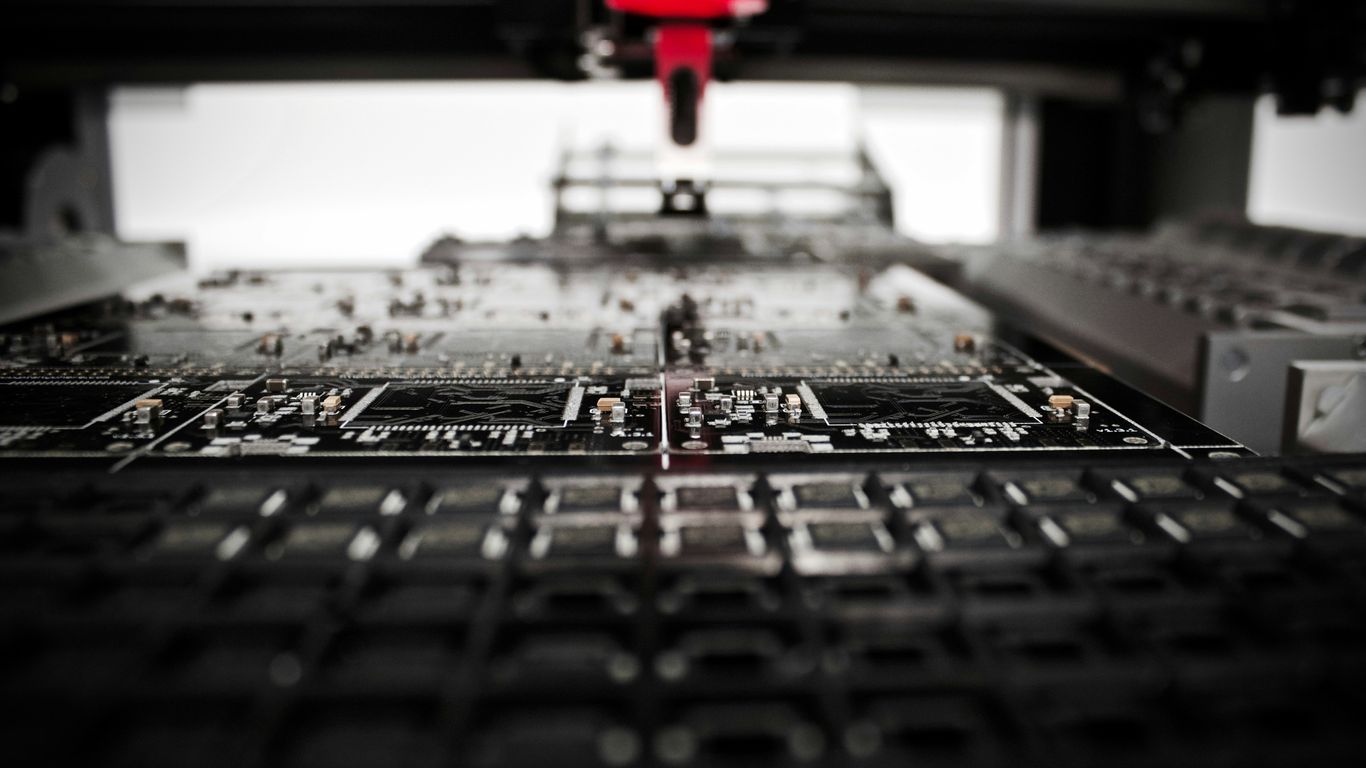
### Figure AI’s founding and development timeline
Figure AI was founded in 2022 by Brett Adcock. Its first publicly discussed platform, Figure 01, was presented as a general-purpose humanoid robot for physical work, with early interest in logistics and warehousing. The company subsequently introduced Figure 02 and Figure 03 as later stages in its hardware development.
In 2023, the company announced a $70 million funding round that included investment from Adcock and Parkway Venture Capital. In early 2024, it announced a partnership with BMW and separately reported a $675 million financing round involving major technology and venture investors. Public reporting around that financing placed the company’s valuation at $2.6 billion at the time.
Those events mark financing and development milestones, not a completed commercial rollout. The relevant question is how effectively the company converts capital into reliable machines, production capacity, and customer deployments.
### Brett Adcock’s role and the company’s leadership team
Brett Adcock founded the company and has been its most visible executive advocate. His background includes founding other technology businesses, including Archer Aviation and Vettery. The company has also highlighted co-founder Jerry Pratt’s robotics background, particularly in connection with the early Figure 01 platform.
Leadership in humanoid robotics has to bridge several disciplines at once. Mechanical engineers work on actuators and structural loads; controls engineers manage movement; machine-learning teams build perception and action systems; operations teams handle manufacturing and customer deployment. The public profile of a founder can attract capital, but the less visible organizational capability often determines whether a prototype becomes a dependable product.
### Major investors, partnerships, and funding milestones
The reported 2024 financing included Jeff Bezos, Microsoft, Nvidia, Intel, Amazon’s startup investment arm, and OpenAI among the participating investors or strategic backers. The company also announced an OpenAI collaboration focused on specialized AI models for its humanoid robots. Such relationships can provide capital, compute, technical expertise, and access to industrial networks.
They also raise expectations. A well-funded robotics company is expected to move quickly from laboratory demonstrations to evidence that customers can use. Partnerships should therefore be evaluated by what they enable: data collection, validation, production learning, or a real operating deployment. A funding announcement by itself does not establish any of those outcomes.
### How Figure AI’s strategy compares with Tesla, Agility Robotics, and Apptronik
The comparison is explicitly about strategy rather than a simple ranking. Tesla can draw on automotive manufacturing experience, Agility Robotics has emphasized logistics and industrial deployment, and Apptronik has pursued humanoid systems for commercial applications. Figure’s public positioning has combined a general-purpose humanoid form with AI development and industrial partnerships.
These approaches share several constraints. Each company must solve actuation, power management, safety, data collection, fleet support, and manufacturing scale. The most meaningful differences may emerge in customer selection and production discipline rather than in headline specifications. A broader [physical AI startup overview](https://www.insidedeeptech.com/physical-ai-the-embodied-ai-startups-to-watch-in-2026/) places those choices in the context of a field moving from research demonstrations toward commercial hardware.
## Figure’s humanoid robot hardware
Humanoid robot hardware is a stack of compromises. Height and reach affect workspace compatibility; mass affects safety and energy use; batteries constrain operating time; hands determine what tasks are possible; and onboard computing determines how much perception and control can happen locally. A specification sheet can describe the design, but only repeated operation reveals whether the trade-offs work.
The Figure platforms are best understood as successive development stages rather than finished consumer products. Each generation offers the company an opportunity to improve the mechanical package, reduce external dependencies, and collect more evidence about real operating conditions.

### Figure 01, Figure 02, and Figure 03: Key development stages
Figure 01 was the early general-purpose humanoid platform associated with demonstrations of walking, manipulation, coffee making, and factory-floor activity. Figure 02 followed as a newer generation aimed at advancing the hardware and its usefulness in industrial settings. Figure 03 represents a further stage in the company’s development and has been described in public materials as extending the platform toward home environments as well as workplace learning.
The progression matters because robotics companies learn through hardware iteration. A cable route that is acceptable on a prototype may be redesigned for serviceability. A hand that works in a controlled demonstration may need better sensing and durability for production. The development sequence should therefore be read as evidence of an engineering process, not as three unrelated products.
### Mobility, balance, dexterity, and payload capabilities
A bipedal robot must maintain balance while its center of mass changes, often as it reaches, carries, or places an object. Mobility is not just walking speed; it includes starting, stopping, turning, negotiating uneven surfaces, and recovering from disturbances. Dexterity adds another layer because the robot must control fingers and wrists while its whole body remains stable.
Public material for Figure 03 lists a height of 5 feet 8 inches, a weight of 61 kilograms, a payload of 20 kilograms, a runtime of five hours, and a speed of 1.2 meters per second. Those figures describe the published system and should not be treated as universal performance across every task or environment. Payload, runtime, and speed can change with the object, route, temperature, safety limits, and operating policy.
### Cameras, sensors, batteries, and onboard computing
A humanoid needs multiple streams of information to operate: cameras for visual perception, sensors for joint position and force, and internal state estimates for balance and motion. Batteries supply the energy for actuators and computing, while onboard processors support the low-latency decisions needed for movement. The engineering challenge is to fit those components into a machine that remains light enough to move and strong enough to work.
The system also has to decide what happens locally and what can be processed remotely. A delayed command may be acceptable for a high-level instruction but dangerous for a balance correction. This is why hardware and AI cannot be evaluated separately. Better models do not compensate for inadequate sensing, and better sensors do not automatically produce reliable autonomy.
### Designing a robot for warehouses, factories, and other workplaces
Workplaces reward predictable behavior. A robot must fit through the right spaces, interact with existing equipment, tolerate dust and ordinary variation, and be safe around people. It also needs a maintenance plan: batteries, hands, actuators, sensors, and protective components will eventually require inspection or replacement.
The most promising initial tasks are usually bounded ones that have clear inputs and outputs. They may still be physically demanding, repetitive, or difficult to staff, but they should not require a robot to solve every possible workplace problem at once. That design discipline is more credible than describing a humanoid as universally capable before the operational evidence exists.
## The AI stack behind Figure’s robots
A robot’s AI stack has to connect three layers that are often developed separately in software: perception, language, and action. Perception identifies objects and surroundings. Language provides a way to express goals or instructions. Action converts those goals into coordinated movement while respecting physical constraints.
The appeal of a unified stack is adaptability. Instead of coding every variation by hand, developers can train systems to associate visual situations and instructions with useful behavior. Yet the physical world is unforgiving. A small error in object position, friction, timing, or balance can turn a plausible plan into a failed action.

### How Figure combines perception, language, and action models
The company has described vision-language-action systems, including Helix, as part of the effort to connect what a robot sees with what it is told to do and how it moves. A vision-language-action model is designed to map visual observations and language instructions toward physical actions. It is not merely a chatbot placed inside a robot; it must produce behavior that works under timing and safety constraints.
This architecture can support more natural interaction. An operator may describe a goal rather than specify every joint trajectory. The system still needs task boundaries, monitoring, and recovery procedures. Natural language can make a robot easier to instruct, but it does not remove the need to verify what the machine understood.
### Training robots to learn tasks from human demonstrations
Human demonstrations can provide examples of how a task unfolds, including grasping, sequencing, and responding to ordinary variation. The robot can use those examples as training data rather than relying entirely on manually written rules. Demonstrations are especially valuable when the desired behavior is difficult to describe symbolically.
The method has limits. A demonstration may not show what to do when an object is missing, a worker enters the area, or the robot’s grip slips. Training systems must therefore combine demonstrations with simulation, supervised correction, safety constraints, and data from real operations. The objective is not to copy one performance, but to generalize the underlying task without making unsafe assumptions.
### The role of vision-language-action systems in robot control
Vision-language-action systems offer a possible interface between high-level intent and low-level movement. The language component can represent goals, the vision component can track the scene, and the action component can select or generate motor behavior. Their usefulness depends on how tightly those components are connected to feedback from the physical world.
A practical controller must continuously check whether the intended action is working. If an object does not move, the robot may need to alter its grip or ask for help. If a person approaches, the system may need to pause. This feedback loop is where embodied AI differs from systems evaluated only on text or images.
The topic also connects to the broader distinction between AI assistance and human judgment. A [human judgment framework](https://peterashbysmith.com/stoic-futurism/?ref=insidedeeptech.com) argues that technology should strengthen responsibility and agency rather than quietly outsourcing them. In a factory, that principle means giving supervisors clear control over task boundaries, intervention, and accountability.
### Why real-world data and autonomy are difficult to scale
Real-world data is expensive because it requires physical machines, trained operators, safe facilities, and careful annotation. A robot can encounter rare combinations of lighting, object shape, worker movement, and mechanical wear that are difficult to reproduce in simulation. Every failure may teach the engineering team something, but collecting that lesson safely can be slow.
Autonomy also has a long tail of exceptions. A system may complete a task hundreds of times and still fail when a box is damaged or a tool is placed slightly out of position. **Reliability is the product** in this setting: a high-level model is valuable only when the complete machine behaves predictably over long periods.
That is why demonstrations should be paired with operating metrics. The field needs evidence about intervention rates, recovery behavior, uptime, and task completion under ordinary conditions—not only carefully selected clips.
## How Figure AI robots are being used
The strongest near-term case for humanoids is likely to be industrial work with repetitive physical motions and relatively structured environments. Manufacturing and warehousing provide measurable tasks, established safety procedures, and a clear economic baseline. They also expose weaknesses quickly, because a robot that stops repeatedly can disrupt a production line.
Public demonstrations and partnerships indicate a movement toward those settings. Still, a demonstration is not the same as a production deployment, and a partnership announcement is not the same as a verified customer outcome. The useful analytical question is what work the robot performs, under what supervision, and for how long.
### Manufacturing and warehouse applications
Manufacturing and warehouse environments contain many tasks that are repetitive but not perfectly uniform. Parts must be moved, items must be placed, and materials must flow between stations. A humanoid may be attractive where existing fixtures and shelves assume a human reach and posture, particularly if redesigning the site would be costly.
The first applications are likely to be narrow within those broader environments. A robot might handle a defined material-transfer loop or a repeatable loading activity rather than manage an entire facility. Narrow scope is not a weakness if it produces measurable value and creates data for later expansion.
### Figure’s work with BMW and other industrial partners
In January 2024, the company announced a partnership with BMW to deploy humanoid robots in automotive manufacturing facilities. The announcement was significant because automotive plants offer demanding, structured settings in which cycle time, safety, quality, and uptime can be examined closely.
The partnership should be interpreted as an industrial validation effort, not proof that humanoids have already transformed automotive production. Its importance lies in the opportunity to test the technology against real processes and constraints. The broader [Figure AI company profile](https://en.wikipedia.org/wiki/Figure%5FAI?ref=insidedeeptech.com) provides a useful reference for the founding, robot generations, partnerships, and stated applications discussed in this article.
### Tasks humanoid robots may perform first
Early tasks are most likely to share a few characteristics: they are repetitive, physically awkward, easy to observe, and bounded by clear safety rules. They may also occur in places where labor availability or ergonomic concerns make automation attractive. The following categories illustrate the likely logic without claiming that every one is already deployed:
- Moving bins, totes, or components between defined locations.
- Loading or unloading repeatable stations and fixtures.
- Handling simple pick-and-place sequences in a controlled area.
- Performing basic inspection or material-presentation steps under supervision.
These tasks are not trivial. They require navigation, grasping, timing, and exception handling. But their boundaries make them easier to validate than open-ended household or service work.
### Measuring productivity, safety, reliability, and return on investment
A serious deployment review needs more than a unit price. Operators should examine completed cycles per hour, intervention frequency, uptime, recovery time, maintenance burden, energy use, and the effect on nearby workers. Safety should include both incident rates and near misses, as well as the clarity of the system’s stop and handoff procedures.
A simple comparison can help separate engineering performance from business value:
| Measure | What it reveals | Why it matters |
| -------------------- | ------------------------------------------- | ---------------------------------------------- |
| Task completion rate | Whether the robot finishes assigned work | Low completion creates hidden labor costs |
| Intervention rate | How often a person must assist | High intervention limits effective autonomy |
| Uptime | How consistently the system operates | Production planning depends on availability |
| Maintenance burden | Labor and parts required to keep it running | Service costs shape the business case |
| Safety performance | Risk around workers and equipment | No productivity gain offsets unacceptable risk |
The table’s central lesson is that robot capability is multidimensional. A system can move quickly yet deliver poor economics if it needs frequent resets or specialist support. Customers will ultimately judge the complete operating system, not an isolated speed or payload number.
## Figure AI’s business model and commercialization strategy
Humanoid robotics requires a business model that accounts for both hardware and ongoing operations. Selling a robot may create an upfront revenue event, but customers also need installation, software updates, training, spare parts, and support. A robotics-as-a-service model can reduce adoption friction, though it shifts more capital and execution risk to the provider.
The right structure will depend on task maturity and customer preference. Early industrial buyers may want a tightly supported deployment with clear performance targets. Later customers may prefer ownership and internal fleet management. Either way, commercialization is inseparable from manufacturing quality and service capacity.
### Selling robots versus offering robotics as a service
A direct sale gives the customer ownership of the asset and gives the vendor earlier cash revenue. It may also place more responsibility on the customer before the technology is easy to operate. A service model can align payment with usage or output, but it requires the provider to finance and maintain a fleet.
Neither model solves the underlying productivity question. The customer still needs evidence that the robot performs a valuable task at an acceptable cost. The most credible commercial plans will define the task, service level, intervention policy, and replacement responsibility before discussing scale.
### Manufacturing, deployment, and maintenance requirements
Scaling from prototypes to fleets requires repeatable manufacturing. Components must be sourced consistently, calibration must be controlled, and each robot must pass functional and safety checks. The company also needs field technicians, diagnostic tools, replacement parts, and a process for incorporating lessons from deployed machines into the next revision.
Maintenance is especially important for systems with many moving joints and delicate end effectors. A robot that is technically autonomous but frequently unavailable is not autonomous from the customer’s perspective. The service organization becomes part of the product.
### Integrating humanoid robots into existing operations
Integration begins before the robot arrives. A facility must identify the task, map the work area, define interaction rules, connect the system to scheduling or inventory processes where necessary, and determine who can intervene. Workers need training that covers both normal operation and what to do when the robot behaves unexpectedly.
Implementation is also a management problem. The best automation projects clarify which work is removed, which work changes, and which new supervisory responsibilities appear. A useful discussion of [reducing owner dependence](https://moonmoot.com/resources/ai-founder-working-alone-owner-dependence?ref=insidedeeptech.com) makes a parallel point for businesses: automation creates value only when responsibility and operating knowledge are distributed rather than concentrated in one person or one opaque system.
### The workforce and economic impact of automation
Humanoid robots may reduce demand for some repetitive physical tasks while increasing demand for technicians, fleet supervisors, safety specialists, and process engineers. The transition will not be uniform across industries or regions. It will depend on labor availability, wage levels, regulation, task complexity, and the cost of deploying alternatives.
A responsible analysis should distinguish augmentation from displacement. In some settings, a robot may take over strenuous work and allow people to move into oversight or higher-value roles. In others, it may reduce the number of workers required. Those outcomes should be assessed through evidence, consultation, and transparent workforce planning rather than assumed from the robot’s appearance.
## Figure AI’s challenges and future outlook
The future of humanoid robotics will be determined by ordinary operational details. Can the machine work through a shift? Can it recover from an error? Can a technician service it quickly? Can a customer justify the total cost? These questions are less visually dramatic than walking demonstrations, but they are closer to the conditions for a sustainable business.
The company has meaningful technical and financial momentum, yet the distance between a capable prototype and large-scale deployment remains substantial. The field is still working through questions of safety, data, power, manufacturing, and accountability. A measured view can recognize progress without treating ambition as proof.
### Safety, reliability, and human-robot collaboration risks
Humanoids operate near people, which makes safety a system property rather than a single sensor or software feature. Mechanical limits, collision detection, speed controls, emergency stops, supervisory interfaces, and facility procedures all contribute to risk management. The robot must also communicate enough of its state that workers can predict what it may do next.
Reliability has a similar breadth. A failure may originate in perception, planning, grasping, battery management, networking, or a worn mechanical component. Operators need clear fallback behavior and a way to escalate failures without improvising around the machine.
### Technical limits in dexterity, battery life, and autonomy
Dexterity remains difficult because hands must handle objects with different shapes, textures, weights, and friction. Battery life is constrained by the energy required for locomotion, manipulation, and onboard computing. Autonomy is limited by uncertainty and by the need to recognize when the system does not know enough to proceed.
Improvements in one area can expose weaknesses in another. More capable actuators may increase energy consumption; heavier batteries may reduce agility; richer models may require more computing. The engineering task is therefore an optimization across the whole robot, not a race to maximize one specification.
### Regulatory, ethical, and labor considerations
Regulators and employers will need to address machine safety, workplace monitoring, liability, data governance, and labor transitions. A robot that observes workers may collect sensitive information even when its immediate purpose is navigation or task execution. Organizations should define retention, access, and use policies before deployment rather than after a dispute.
Ethically, the central issue is control. Workers should know when a robot is operating, what data it collects, how decisions are reviewed, and how incidents are investigated. The broader [AI search optimization guide](https://rightthing.agency/articles/ai-search-optimization-survival-manual?ref=insidedeeptech.com) is not about robotics, but its emphasis on accessibility, authority, and how systems retrieve information offers a useful adjacent lesson: complex technical systems become trustworthy when their behavior and evidence can be inspected.
### What to watch as Figure moves toward large-scale deployment
The next meaningful signals will be operational. Observers should look for disclosed deployment duration, task-level completion rates, intervention data, manufacturing progress, service procedures, and evidence that customers are expanding use after a pilot. It will also matter whether the company can improve performance without making each deployment a bespoke engineering project.
The field’s most useful rankings are beginning to prioritize commercial readiness, repeatability, safety, and integration over theatrical demonstrations. That is the right direction. Humanoid robotics may become important, but its importance will be earned through years of dependable work in places where failure has a cost.
## Conclusion
Figure AI represents one of the clearest attempts to turn humanoid robotics and embodied AI into an industrial product category. Its progress—from Figure 01 through later platforms, major financing, and the BMW partnership—shows serious momentum, while the remaining challenges show why the category is still experimental. The decisive test will be whether these machines can deliver safe, repeatable, economically defensible work at scale.
## Frequently Asked Questions
### What is a humanoid robot?
A humanoid robot is a machine designed with a broadly human-like body plan, often including a torso, two arms, and two legs. The purpose is usually to operate in environments, use tools, or interact with equipment designed for people.
### Why are companies developing humanoid robots?
Companies are pursuing humanoids because many workplaces already use human-scale layouts, tools, shelves, and procedures. A suitable robot could automate selected physical tasks without requiring a facility to be completely redesigned.
### Are humanoid robots general-purpose today?
Most current systems remain limited by task scope, supervision requirements, reliability, and operating conditions. “General-purpose” generally describes the intended platform direction, not proof that a robot can perform any physical task autonomously.
### What makes robot autonomy difficult?
The physical world contains uncertainty that is hard to capture in training data. Objects move, lighting changes, people intervene, components wear, and small errors can affect balance or grasping. Reliable autonomy requires perception, planning, control, feedback, and safe recovery.
### How should a company evaluate a humanoid robot?
It should measure task completion, intervention frequency, uptime, maintenance, safety, energy use, and total cost. These metrics should be gathered over representative operating periods rather than inferred from demonstrations.
### Will humanoid robots replace workers?
The effect will vary by task and industry. Some systems may reduce strenuous or repetitive work, while others may reduce labor demand or create new technical roles. The outcome depends on deployment choices, economics, regulation, and workforce planning.
### When will humanoid robots become common?
There is no reliable single timetable. Wider adoption depends on hardware durability, battery performance, autonomy, manufacturing scale, safety evidence, service networks, and a convincing return on investment for customers.
### The Best Humanoid Robots of 2026, Ranked
URL: https://www.insidedeeptech.com/the-best-humanoid-robots-of-2026-ranked/
Last updated: 2026-08-17T17:27:30.000Z
## Key Takeaways
The best humanoid robots 2026 are not defined by appearance alone. Their relative strength depends on evidence, intended operating environment, physical design, and the distance between a demonstration and a dependable deployment.
- Commercial readiness matters as much as technical ambition.
- Industrial and domestic robots face different engineering constraints.
- Dexterity, mobility, safety, and autonomy must be judged together.
- Deployment evidence is more useful than promotional specifications.
- The field remains dynamic, with rankings likely to change quickly.
## 1\. Figure 03
Figure 03 belongs near the top of any serious 2026 discussion because it represents the field’s effort to combine general-purpose hardware with embodied AI. The useful question is not whether a humanoid can complete a polished demonstration, but whether its perception and motor control can transfer across ordinary work. That distinction separates a promising platform from a reliable operational system.
The strongest case for this class of machine is its potential fit with human-centered workplaces. Existing facilities already contain aisles, tools, shelves, and workstations designed around human reach and movement. A humanoid that can interpret those environments without extensive redesign could reduce the infrastructure burden of automation, although that outcome remains a deployment question rather than an established result.
Investors and operators should therefore examine task repeatability, intervention rates, safety procedures, and maintenance requirements. The [humanoid robotics startup analysis](https://www.insidedeeptech.com/the-top-humanoid-robot-startups-of-2026-ranked-by-real-deployments/) offers a useful frame for assessing those issues across the sector. Figure 03 is best viewed as a contender whose ranking depends on how convincingly the gap between adaptable intelligence and sustained work is closed.
## 2\. Tesla Optimus
Tesla Optimus is often discussed through the lens of manufacturing scale, which is a more meaningful lens than celebrity or prototype visibility. The central strategic idea is to apply large-scale production discipline to a general-purpose humanoid platform. Whether that approach can produce dependable machines at an attractive cost is still the core test.
A factory-oriented humanoid does not need to perform every human task to create value. It needs to execute a defined set of repetitive activities safely, consistently, and with limited supervision. The [Optimus comparison](https://www.insidedeeptech.com/figure-03-vs-tesla-optimus-2026-humanoid-robot-comparison/) is useful because it places production strategy alongside hardware maturity, battery life, motor efficiency, and the realities of continuous operation.
The ranking remains provisional because manufacturing scale can amplify both strengths and weaknesses. A platform that is inexpensive but difficult to maintain will not necessarily outperform a slower-to-scale system with better operational reliability. The relevant measure is the complete cost of useful work, not the number of units announced or displayed.
## 3\. Agility Robotics Digit
Agility Robotics Digit is most naturally evaluated in logistics and manufacturing, where walking mobility and material movement intersect. Its importance comes from the possibility of placing a bipedal machine in workflows already organized for people. That makes warehouse compatibility, handoff behavior, and safe movement around workers more important than theatrical agility.
Commercial readiness is a particularly important filter for this section of the ranking. A pilot can establish that a task is technically possible, but a repeatable deployment must also account for uptime, supervision, fleet operations, and exceptions. The [Digit review](https://www.insidedeeptech.com/a-comprehensive-agility-robotics-review-technology-use-cases-and-market-impact/) discusses the practical industrial angle, including biomechanics-inspired design and the Arc cloud platform described in its coverage.
The [2026 humanoid robot list](https://www.insidedeeptech.com/every-humanoid-robot-launching-in-2026-full-list/) places this kind of deployment in the broader market transition from laboratory systems to operational platforms. Digit’s position consequently reflects a pragmatic question: can useful mobility be delivered with enough consistency to fit an existing logistics process? That question is more revealing than a single record-setting demonstration.
## 4\. Apptronik Apollo
Apptronik Apollo represents the industrial side of the humanoid market, where the value proposition depends on fitting automation into environments built for human labor. The platform is therefore best considered through workflow compatibility rather than novelty. A robot may have an appealing form factor, but the operator still needs clear evidence of what it can do, under which conditions, and with what level of support.
The manufacturing case also exposes a recurring tension in humanoid robotics. Broad task flexibility is attractive, yet early deployments may succeed by concentrating on a narrower group of repeatable jobs. That is not a weakness by itself; it is a question of whether the selected jobs justify integration, training, monitoring, and upkeep.
The [developer comparison](https://www.insidedeeptech.com/figure-ai-vs-1x-vs-agility-vs-apptronik-the-humanoid-race-compared/) is a helpful way to separate physical utility, AI integration, and market strategy. Apollo’s rank should rise with demonstrated workflow fit and fall when broad claims are not matched by transparent operating evidence. For technically literate buyers, that evidence is the product.
## 5\. Boston Dynamics Atlas
Boston Dynamics Atlas is a useful benchmark for the relationship between dynamic movement and industrial utility. Its presence in the conversation reflects the field’s long effort to make humanoid machines physically capable in demanding environments. Yet movement quality alone does not establish a business case; material handling, safety, reliability, and integration must carry equal weight.
Industrial robots operate within systems, not isolated videos. They need sensing, control software, maintenance procedures, and clear boundaries around human interaction. The [Atlas coverage](https://bostondynamics.com/products/atlas/?ref=insidedeeptech.com) describes the platform in the context of autonomous material handling, field testing, and operational use, which is the right frame for judging its significance.

The broader ranking of advanced robots also places emphasis on physical dexterity and real-world deployment rather than visual sophistication alone. Atlas is consequently a strong reference point for hardware capability, while its long-term position will depend on sustained operational performance. **Hardware capability is only half** of the industrial equation.
## 6\. 1X NEO
1X NEO occupies a different part of the market because its stated direction centers on safe, natural operation in human environments, with a primary focus on the home. Domestic settings are less structured than factories and warehouses. Objects move, instructions are ambiguous, and the robot must share space with people who are not trained operators.
That setting raises the importance of quiet operation, lightweight construction, learning through human guidance, and the transition from teleoperation toward greater autonomy. These are not interchangeable features: guidance can help gather task information, while autonomy determines how independently the system can act later. The [NEO and humanoid overview](https://humanoidroboticstechnology.com/articles/top-12-humanoid-robots-of-2026/?ref=insidedeeptech.com) provides useful context on that domestic orientation and the delivery timeline described in its coverage.
A home robot should be assessed with unusually conservative expectations. Safety around children, pets, stairs, clutter, and personal belongings matters more than a clean laboratory demonstration. NEO’s rank therefore reflects a compelling use case, but household reliability will need to be established through real experience rather than assumed from the form factor.
## 7\. Sanctuary AI Phoenix
Sanctuary AI Phoenix is best examined through the idea of embodied intelligence: software that must perceive a physical setting, choose an action, and control a machine through uncertainty. That challenge is broader than image recognition because the system must connect interpretation to movement. Small errors can become physical failures when the robot handles objects or navigates around people.
A hardware-agnostic software direction, as described in the available market coverage, changes the strategic question. It suggests that the intelligence layer may be evaluated partly by how well it transfers across robotic bodies, rather than only by the performance of one machine. Such transferability would matter to operators seeking a common control and learning stack, though the practical limits still require evidence.
The [physical AI startup guide](https://www.insidedeeptech.com/physical-ai-the-embodied-ai-startups-to-watch-in-2026/) places Phoenix within a wider group working on foundation models, vision-language-action systems, and human-centric environments. Phoenix is therefore significant as a software-and-embodiment case, but its position should be read with care. The field has not yet settled how much autonomy can be generalized without extensive task-specific tuning.
## 8\. Unitree H1
Unitree H1 illustrates why accessible humanoid hardware can matter even when a platform is not judged primarily by commercial deployment. Researchers, developers, and smaller teams need machines on which they can test locomotion, manipulation, control policies, and perception. Lower barriers to experimentation can expand the practical knowledge base of the field.
That role differs from the requirements of a production robot. An experimental platform can be valuable because it makes research possible, while a factory platform must also provide predictable uptime, safety documentation, support, and process integration. Treating those categories as identical produces rankings that confuse availability with readiness.
A useful comparison should examine the whole development path rather than a single purchase price. The [evidence-ranked robot guide](https://blog.robozaps.com/b/best-humanoid-robots?ref=insidedeeptech.com) uses deployment, autonomy, and commercial readiness as distinct criteria, an approach that suits H1’s place in the market. Its significance may be greatest as an enabler of experimentation, provided readers do not mistake that role for proof of industrial maturity.
## 9\. Fourier Intelligence GR-1
Fourier Intelligence GR-1 belongs to the expanding group of humanoid platforms aimed at testing how general-purpose bodies can operate across care, research, and industrial contexts. Its ranking should not be based on the promise of a universal machine alone. The decisive evidence would be clear task definitions, repeatable results, and a credible route from demonstration to sustained use.
Humanoid design creates a shared physical vocabulary with people, but it also inherits human constraints. Balance, power consumption, joint durability, thermal management, and safe contact all become linked engineering problems. A strong platform must manage those tradeoffs without presenting one attractive capability as evidence that the entire system is ready.
The market’s range can be summarized by the following practical criteria:
- The target environment and its degree of structure.
- The level of autonomy demonstrated in that environment.
- The amount of human supervision required.
- The evidence of repeatability beyond a staged trial.
These criteria help place GR-1 without overstating what public descriptions establish. They also make the ranking more durable as specifications and deployment claims change.
## 10\. UBTECH Walker S
UBTECH Walker S closes this ranking as an example of the manufacturing-oriented direction taken by humanoid robotics. The central issue is not whether a human-shaped machine looks familiar, but whether that shape allows it to work around existing stations, tools, and procedures. For industrial buyers, compatibility can be more valuable than novelty.
The platform should be judged against the same discipline applied to every other entry: defined tasks, operating limits, intervention frequency, safety controls, and maintenance. The [industrial robotics outlook](https://www.insidedeeptech.com/the-best-warehouse-and-industrial-robotics-startups-of-2026/) provides broader context on how robotic systems are moving from prototypes toward production-scale integration. That context matters because a humanoid is only one component in a larger automation architecture.
The [robotics developments review](https://www.therobotreport.com/top-10-robotic-stories-june-2026/?ref=insidedeeptech.com) also reflects how quickly the surrounding ecosystem is changing, from physical AI tools to manufacturing milestones. Walker S is therefore best understood as part of a competitive systems race rather than as a standalone machine. Its final standing will depend on evidence accumulated in real workflows, not on the label “general purpose.”
## Conclusion
The best humanoid robots 2026 are best ranked by the quality of evidence behind their intended use, not by spectacle or a single specification. Industrial, domestic, research, and software-led platforms solve different problems, so a fair comparison must keep those contexts visible. For builders and investors, the durable signal is the same across the list: repeatable work, safe interaction, maintainable hardware, and a credible path to scale.
## Frequently Asked Questions
### What makes a humanoid robot commercially ready?
Commercial readiness usually requires more than a successful demonstration. It includes repeatable task performance, safety procedures, serviceability, integration with existing workflows, and a business case that survives ordinary operating costs.
### Are humanoid robots mainly designed for factories?
Factories and warehouses are important early environments because they offer repeatable tasks and controlled access. Domestic, healthcare, research, and public settings may become important as systems improve, but they generally introduce more uncertainty.
### Why does deployment evidence matter so much?
Deployment evidence shows how a system behaves outside a carefully prepared demonstration. It can reveal intervention rates, maintenance needs, environmental limits, and the difference between theoretical capability and useful work.
### How should investors compare humanoid robotics companies?
Investors can compare target markets, technical differentiation, manufacturing plans, capital requirements, safety progress, customer validation, and the economics of completed tasks. Announced partnerships should not be treated as guaranteed outcomes.
### Does a human-like shape guarantee flexibility?
No. A human-like form can help a robot access spaces designed for people, but flexibility also depends on perception, manipulation, balance, control software, power management, and the ability to handle exceptions.
### What is the hardest technical problem in humanoid robotics?
There is no single hardest problem. Reliable humanoids must solve several coupled problems at once, including safe physical interaction, dexterous manipulation, energy use, balance, perception, autonomy, and durable hardware.
### Will rankings of humanoid robots remain stable?
Probably not. The field is changing quickly, and new deployment results, production milestones, safety findings, and software improvements can alter the relative position of a platform. A ranking should be treated as a dated assessment, not a permanent verdict.
### The Best Quantum Computing Courses to Take in 2026
URL: https://www.insidedeeptech.com/the-best-quantum-computing-courses-to-take-in-2026/
Last updated: 2026-08-17T17:27:31.000Z
## Key Takeaways
The best quantum computing courses 2026 are not interchangeable: some emphasize circuits, others physics, machine learning, software development, or academic research. The right choice depends on the learner’s mathematical preparation, programming experience, and intended use of the material.
- Beginners benefit from a gradual path through qubits, circuits, and measurement.
- Programming-focused learners should prioritize exercises, simulators, and repeated practice.
- Physics-heavy courses are valuable when the goal is deeper understanding of quantum systems.
- Machine learning and cloud-development tracks connect quantum concepts to technical workflows.
- University-led programs often provide more depth, but usually demand more time and preparation.
## 1\. IBM Quantum Learning: Best for hands-on beginner training
IBM Quantum Learning is a practical starting point for readers who want to move quickly from vocabulary to circuits. Its value lies in learning by doing rather than treating quantum computing as a purely abstract subject. A beginner can use the material to build an initial mental model of qubits, gates, measurement, and circuit execution.
The most useful early courses are those that make each concept testable. A learner should be able to change a circuit, run it, inspect the result, and explain why the output changed. That feedback loop is more informative than memorizing definitions, particularly for readers coming from software engineering rather than physics.
The course is also a sensible companion to a broader [quantum computing beginner's guide](https://www.insidedeeptech.com/quantum-computing-explained-a-beginners-guide-for-2026/), which can fill in background on prerequisites, hardware, and applications. The strongest beginner pathway is therefore sequential: learn the basic language, write small circuits, and only then move toward algorithms or hardware-specific questions.
## 2\. Qiskit Global Summer School: Best for intensive quantum programming practice
The Qiskit Global Summer School suits learners who already understand the basic circuit model and want a concentrated programming experience. An intensive format creates useful pressure: concepts introduced in one session must be applied soon afterward. That rhythm can expose gaps in understanding that a slower, passive course may leave hidden.
The central benefit is repetition across related problems. Students work through circuit construction, algorithmic reasoning, and debugging, gradually learning that a quantum program is not simply a classical script with different syntax. Results must be interpreted statistically, and circuit design is constrained by the behavior of the underlying system.

A serious learner should treat the school as a practice block rather than a complete education. Reviewing linear algebra beforehand, keeping a notebook of circuit patterns, and rebuilding examples without copying them will make the compressed schedule more productive. For developers comparing tools, a guide to [quantum computing simulators](https://www.insidedeeptech.com/the-best-quantum-computing-simulators-for-developers/) offers useful context for testing circuits before access to physical hardware.
## 3\. Quantum Computing Fundamentals by IBM: Best for learning core concepts
Quantum Computing Fundamentals by IBM is better suited to readers who need a structured explanation of the field’s basic ideas before selecting a specialization. The key topics include the distinction between classical bits and qubits, superposition, entanglement, gates, and measurement. These concepts form the common vocabulary used by nearly every later course.
A fundamentals course should not be judged by how quickly it reaches advanced algorithms. Its job is to establish durable intuition and identify where mathematics becomes necessary. **Conceptual accuracy matters early** because a loose understanding of measurement or entanglement can distort every later discussion of applications.
Learners can use the course as a diagnostic. If the notation feels manageable, the next step may be programming practice; if the physical interpretation remains unclear, more work on probability and linear algebra is warranted. The broader [quantum computing foundations](https://www.insidedeeptech.com/understanding-quantum-computers-a-comprehensive-guide/) coverage can help place these ideas alongside hardware architectures, coherence, and error correction.
## 4\. Quantum Mechanics for Quantum Computing by MIT: Best for physics foundations
Quantum Mechanics for Quantum Computing by MIT is the natural choice for readers who want the physical and mathematical foundations behind quantum information. It is not the shortest route to writing a first circuit, but it can explain why the circuit model works and where its abstractions come from. That distinction matters to researchers, hardware engineers, and technically minded professionals.
The learner should expect formal notation, state vectors, operators, and probability amplitudes. Those tools are not decorative: they provide a precise way to describe how a quantum state changes and how measurement extracts information from it. The course is therefore more demanding than an introductory programming track.
Physics preparation also helps when reading about real systems. Terms such as coherence and noise describe physical limits, not just software inconveniences. Readers seeking a less technical business-oriented complement can compare the material with [MIT's online quantum program](https://xpro.mit.edu/programs/program-v1:xPRO+QCF/?ref=insidedeeptech.com), while keeping the different depth and purpose of the two learning paths in mind.
## 5\. Quantum Machine Learning by PennyLane: Best for quantum AI applications
Quantum Machine Learning by PennyLane is aimed at learners interested in the intersection of quantum circuits and machine learning. It is most useful after a student understands basic circuits, parameterized operations, and classical optimization. Without that foundation, the course’s hybrid structure can seem like two difficult subjects layered together.
The important idea is that many proposed workflows combine a classical optimizer with a parameterized quantum circuit. Training such a model requires attention to data encoding, objective functions, gradients, and the practical limits of present hardware. The educational value comes from examining those design choices rather than assuming that quantum methods automatically improve every model.

A disciplined study plan should separate the quantum and classical questions. First, the learner can verify that the circuit behaves as intended; then the learner can test whether the training procedure is stable and meaningful. That order encourages evidence over novelty, which is especially important in a field where demonstrations may be small, simulated, or exploratory.
## 6\. Microsoft Learn quantum computing modules: Best for Azure Quantum development
Microsoft Learn quantum computing modules are a practical option for developers who want guided material organized around cloud development. The modules can help learners connect quantum concepts with the workflow of selecting a target, writing code, testing a circuit, and interpreting results. That workflow is more relevant to engineering teams than a course that stops at textbook notation.
The modules are best approached as a development curriculum, not as a substitute for physics. A programmer still needs enough linear algebra and probability to understand what the code represents. The payoff is a clearer view of how quantum routines fit alongside classical software and the operational steps involved in experimentation.
Readers comparing cloud environments should assess documentation, simulator access, workflow fit, and the degree of hardware abstraction rather than relying on qubit counts alone. A separate [quantum cloud platform comparison](https://www.insidedeeptech.com/the-best-quantum-computing-cloud-platforms-of-2026-compared/) makes that selection problem explicit. The course choice becomes more useful when it is tied to a concrete development environment and a defined learning project.
## 7\. Quantum Computing courses on Coursera: Best for structured online learning
Quantum Computing courses on Coursera are a good fit for professionals who need predictable pacing and a familiar online format. The platform’s main advantage is structure: lessons, exercises, and assessments can turn an open-ended subject into a weekly commitment. That organization is valuable for learners balancing study with work.
The quality and depth of individual courses can vary, so the title alone is not enough. Prospective students should inspect prerequisites, the amount of actual coding, the mathematical level, and whether assignments require a simulator or cloud account. A course aimed at general awareness will produce a different result from one designed for engineers.

A useful comparison point is this [online quantum courses overview](https://www.quantumjobs.us/post/what-are-best-online-courses-to-learn-quantum-computing?ref=insidedeeptech.com), which frames online learning as a flexible route into quantum principles, simulators, and programming tools. Coursera works best when the learner completes exercises rather than treating video completion as mastery. A small portfolio of circuits or written explanations is a better progress signal.
## 8\. Quantum computing programs on edX: Best for university-led instruction
Quantum computing programs on edX appeal to learners who prefer university-led instruction and a more formal course design. They can provide a coherent sequence of lectures, readings, and assessments, often with clearer expectations than informal tutorials. That structure is helpful for students evaluating whether they want a deeper academic commitment.
The main question is how much mathematics the program assumes. Some offerings are designed for broad technical audiences, while others move toward quantum information theory, algorithms, or physics. Checking the syllabus before enrolling prevents a mismatch between the learner’s goals and the course’s actual level.
The strongest programs also make limitations visible. A university-branded certificate does not by itself demonstrate programming ability or research readiness. Learners should look for projects, graded problem sets, and opportunities to explain results, then use those outputs to judge whether the program has delivered practical understanding.
## 9\. Delft University of Technology quantum courses: Best for academic depth
Delft University of Technology quantum courses are appropriate for students seeking academic depth and a sustained engagement with the subject. Delft’s place in a university setting makes this path more suitable for learners who are comfortable with technical reading and want to understand the field beyond introductory circuit programming. It can serve as preparation for research-oriented study.
Academic depth usually comes with a higher time cost. Students may need to work through derivations, review prerequisite mathematics, and read material that does not immediately produce a working program. That effort is worthwhile when the goal is a more durable understanding of quantum information rather than a quick survey.
Applicants considering a longer academic route should compare research fit, faculty mentorship, and industry connections rather than relying on institutional reputation alone. A wider survey of [quantum graduate programs](https://thequantuminsider.com/2026/05/22/top-20-quantum-computing-masters-ph-d-programs/?ref=insidedeeptech.com) offers a useful framework for that comparison. The decision should reflect the learner’s desired role: researcher, hardware specialist, algorithm developer, or technically informed operator.
## 10\. Google Quantum Computing learning resources: Best for advanced concepts and research exposure
Google Quantum Computing learning resources are most useful to learners who have already worked through introductory concepts and want exposure to advanced ideas and research questions. At this level, the reader should be prepared to distinguish a laboratory result from a production capability. That distinction is central to evaluating quantum claims responsibly.
Advanced study may cover error correction, logical qubits, hardware constraints, algorithmic proposals, and the relationship between experiments and long-term fault tolerance. The material can be challenging because the field is still developing, and terminology often spans physics, computer science, and engineering. A learner should keep a clear record of which claims are established, demonstrated experimentally, or still speculative.
The broader research context is captured in this discussion of [quantum computing breakthroughs](https://www.insidedeeptech.com/the-latest-quantum-computing-breakthroughs-of-2026-explained/), but readers should use such coverage to frame questions rather than replace primary study. Advanced resources are most valuable when they sharpen judgment: what has been measured, under what conditions, and what remains between a promising result and a useful system.
## Conclusion
The best quantum computing courses 2026 offer different kinds of preparation rather than a single universal route. Beginners can start with concepts and small circuits, programmers can add intensive practice, and technically ambitious learners can progress toward physics, machine learning, cloud development, or research. The most credible path is the one that matches preparation to ambition while treating present-day quantum computing as an evolving technical field rather than a finished product.
## Frequently Asked Questions
### What background is needed to start a quantum computing course?
A beginner usually needs basic algebra, probability, and comfort with logical reasoning. Programming experience helps for practical courses, while physics-heavy programs may expect linear algebra and introductory quantum mechanics.
### Is programming required to learn quantum computing?
No. Conceptual courses can be studied without programming, but coding exercises make circuit behavior easier to understand and provide evidence that the learner can apply the ideas.
### How long does it take to learn the basics?
A focused learner can build an introductory understanding in several weeks, but reliable fluency takes longer. Progress depends on whether the goal is general literacy, software development, or research preparation.
### Should a learner study physics before quantum algorithms?
Not always. A learner can begin with the circuit model and return to physics later, although a physics foundation becomes increasingly useful for understanding measurement, noise, and hardware limitations.
### Are online certificates enough for a quantum computing job?
A certificate can show initiative and structured study, but it is rarely sufficient by itself. Employers may also look for programming samples, mathematical understanding, research experience, or relevant engineering work.
### Should learners use simulators or real quantum hardware?
Simulators are usually the most accessible place to test ideas and debug circuits. Real hardware adds practical noise and execution constraints, so it is most useful after the learner understands the expected ideal behavior.
### How should someone choose between beginner and advanced courses?
The learner should compare prerequisites, assessment style, mathematical depth, programming requirements, and the intended outcome. A course is advanced when it demands stronger foundations and asks the student to reason through unfamiliar problems, not merely when it uses specialized terminology.
### Quantum Computing: Separating the Hype From What Is Real
URL: https://www.insidedeeptech.com/quantum-computing-separating-the-hype-from-what-is-real/
Last updated: 2026-08-17T17:27:33.000Z
## Key Takeaways
Quantum computing is a real field with meaningful scientific progress, but its practical value remains highly problem-dependent and technically constrained.
- Qubits use quantum states, not ordinary binary states, and that difference does not make every computation faster.
- Molecular simulation, optimization, cybersecurity, and selected machine learning tasks are promising but difficult to validate.
- Hardware progress depends more on fidelity, coherence, connectivity, and error correction than on raw qubit counts.
- Today’s quantum processors are mainly research and development tools, often used alongside classical computers.
- Organizations should build literacy, assess relevant use cases, and prepare for post-quantum cryptography without buying into inflated timelines.
## What quantum computing actually is
Quantum computing is a different model of computation built on quantum-mechanical behavior. It is not a replacement for classical computing, and it is not a general-purpose speed boost waiting to be switched on. The useful question behind quantum computing hype vs reality is narrower: which problems can a carefully designed quantum algorithm solve more effectively than the best classical approach?
A clear answer requires separating the physical system from the software running on it. The physical system must preserve delicate states long enough to perform operations, while the algorithm must exploit those states in a way that produces a measurable advantage. That combination is rare, demanding, and still under active research.
### How qubits differ from classical bits
A classical bit has a definite value of zero or one. A qubit can be prepared in a quantum state that assigns amplitudes to both basis states, with measurement producing a probabilistic result. The amplitudes are not simply hidden values waiting to be read; they carry relationships that quantum operations can manipulate.
This distinction creates possibilities, but it also creates constraints. Measuring a qubit generally changes the state, and a useful calculation must arrange the amplitudes so that desirable outcomes become more likely while undesirable ones interfere destructively.
### Why superposition and entanglement matter
Superposition describes a combination of possible states, while entanglement describes correlations between quantum systems that cannot be represented as independent classical probabilities. Neither concept means that a machine reads every possible answer simultaneously and reports the best one for free.
The advantage, when it exists, comes from how a circuit shapes interference across many amplitudes. Understanding that point is central to [quantum fundamentals](https://www.insidedeeptech.com/how-qubits-work-superposition-and-entanglement-explained-simply/), because it replaces the popular but misleading image of unlimited parallel processing with a more precise account of controlled probability.
### What quantum gates and circuits do
Quantum gates are operations that change qubit states. A circuit arranges those gates into a sequence, often beginning with state preparation and ending with measurement. Some gates affect one qubit; others create correlations between qubits or alter the phase of an amplitude.
The circuit is therefore closer to a carefully choreographed experiment than to a conventional instruction stream. Small calibration errors can accumulate as the circuit grows, which is why circuit depth, gate fidelity, and measurement quality matter as much as the nominal number of available qubits.
### Why quantum computers are not simply faster computers
A classical processor is excellent at deterministic arithmetic, data movement, branching, and many forms of large-scale simulation. Quantum processors are specialized devices whose behavior is probabilistic at measurement and whose operations are vulnerable to noise. For most everyday workloads, adding a quantum processor would add complexity without improving the result.
The distinction can be stated plainly: **quantum advantage is conditional**. It depends on a problem structure, an algorithm, hardware capable of executing that algorithm, and a classical baseline that has been tested fairly.
### How quantum algorithms create potential advantages
Quantum algorithms create potential advantages by using interference, entanglement, and problem-specific structure. Some algorithms offer theoretical speedups for defined tasks, but translating those results into an end-to-end application requires data loading, error management, measurement, and classical post-processing.
That is why raw qubit counts are a weak proxy for capability. A smaller system with better operations may be more useful than a larger system whose states decay before the circuit finishes.
## Where quantum computing shows genuine promise
The strongest arguments for quantum computing are not universal claims about faster software. They concern domains in which the underlying physics or combinatorial structure may be unusually difficult for classical methods to represent. Even there, the relevant comparison is not a quantum demonstration against an outdated classical program; it is a quantum workflow against the best practical classical alternatives.
Promising use cases therefore deserve a disciplined vocabulary. A field can have a credible research opportunity without having a production-ready product, and a proof of concept can be valuable without proving commercial advantage.

### Simulating molecules, materials, and chemical reactions
Quantum systems may be natural candidates for simulating other quantum systems. Researchers hope to model molecular energies, reaction pathways, catalysts, battery materials, and other structures whose behavior becomes difficult to approximate as the number of interacting particles grows.
The likely path is hybrid. Classical high-performance computing can handle parts of the workflow, while a quantum processor may eventually evaluate a difficult subproblem. Materials research is one of the areas where [molecular simulation applications](https://www.insidedeeptech.com/how-quantum-computing-is-transforming-materials-science/) provide a useful frame, while also making clear that useful accuracy and scale remain open engineering questions.
### Optimizing complex systems and constrained decisions
Optimization problems appear in routing, scheduling, portfolio construction, manufacturing, and resource allocation. They often involve many candidate decisions subject to constraints, making it difficult to find the best answer as the problem expands.
Quantum approaches may help with selected classes of these problems, but “optimization” is too broad to serve as a result by itself. A credible test must specify the objective, constraints, data, runtime, solution quality, and classical method used for comparison.
### Improving selected machine learning and data analysis tasks
Quantum machine learning explores whether quantum circuits can represent or transform information in ways that help with particular learning tasks. Potential approaches include quantum kernels and variational circuits, usually embedded in a workflow that still relies heavily on classical optimization and data processing.
The field remains exploratory. A careful [quantum machine learning guide](https://www.insidedeeptech.com/quantum-machine-learning-explained-hype-vs-reality/) emphasizes data encoding, noise, circuit depth, and strong classical baselines—precisely the issues that prevent a small demonstration from becoming evidence that quantum systems are broadly better at machine learning.
### Strengthening or challenging cybersecurity methods
A sufficiently capable fault-tolerant quantum computer could threaten some widely used public-key cryptographic schemes. The risk is not necessarily immediate, because the required machines do not yet exist, but sensitive encrypted data may be collected now and decrypted later if future capabilities arrive.
The practical response is migration planning rather than panic. Organizations need to inventory cryptographic dependencies, follow standards work, and adopt post-quantum methods on a sensible schedule. Quantum technology may also support research into new security primitives, but those proposals require the same scrutiny as any other cryptographic claim.
### Why these use cases remain difficult to validate
A use case is not validated merely because a quantum circuit can be mapped to it. The full workflow may be dominated by data preparation, repeated measurements, error mitigation, communication overhead, or the cost of translating an answer into an operational decision.
A useful test asks five questions: what is the business objective, what is the classical baseline, what precision is required, what hardware assumptions are being made, and who independently reproduced the result? Without those answers, “potential” should remain a research description rather than a sales conclusion.
## The current state of quantum hardware
Quantum hardware is advancing through several competing physical approaches, each with different trade-offs. The field has moved beyond purely theoretical work, but it has not reached the dependable, error-corrected machines implied by many headlines. Hardware progress should be read as a sequence of engineering milestones, not as a single race measured by one number.
The central challenge is that quantum information is fragile. A processor must create, control, connect, measure, and correct qubits while limiting unwanted interaction with the environment.
### The leading hardware approaches
Superconducting circuits use engineered electrical components operated at very low temperatures. Trapped-ion systems hold individual ions and manipulate them with electromagnetic fields and laser pulses. Neutral-atom arrays, photonic systems, and other approaches pursue different balances among control, connectivity, operating conditions, and scaling.
No single architecture has yet settled the question of commercial superiority. [IBM Quantum](https://www.insidedeeptech.com/ibm-quantum-reviewed-how-far-has-it-actually-come/) is documented as using superconducting transmon qubits and pursuing modular scaling, cloud-native development, hybrid computation, and error mitigation; those are specific engineering directions, not proof that the broader field has solved fault tolerance.
### Qubit quality, coherence, and error rates
Coherence time describes how long useful quantum information survives before environmental interactions degrade it. Gate fidelity measures how accurately an operation is performed, while readout fidelity measures how reliably the final state is observed. These metrics interact: a long-lived qubit is not enough if gates are inaccurate, and accurate gates are not enough if the system cannot run a useful circuit.
A hardware claim becomes more informative when it reports the test conditions, circuit size, calibration window, error model, and comparison method. A single impressive metric can conceal weaknesses elsewhere in the stack.
### Scaling challenges and system connectivity
Adding qubits is not equivalent to adding useful computational capacity. Larger systems require more control wiring, calibration, cooling or isolation, and methods for moving information across the device. Limited connectivity can force additional operations into a circuit, increasing its exposure to noise.
Scaling also changes the software problem. Compilation must map an abstract circuit onto the physical layout, and scheduling must account for operations that vary in quality over time. The result is a systems challenge spanning physics, electronics, firmware, compilers, and application design.
### The role of quantum error correction
Quantum error correction encodes one logical qubit across multiple physical qubits so that errors can be detected and corrected without directly measuring the encoded quantum information. The goal is not to remove every error from the hardware; it is to make logical operations reliable enough for long computations.
The overhead can be substantial. A useful architecture must demonstrate that adding physical resources reduces logical error rates, while also making the correction cycle fast and manageable. This is why recent discussions of [logical qubit reliability](https://www.insidedeeptech.com/the-latest-quantum-computing-breakthroughs-of-2026-explained/) are more meaningful than announcements based only on physical-qubit totals.
### Why laboratory milestones do not equal commercial readiness
A laboratory milestone can establish an important principle, improve a component, or demonstrate a difficult circuit. A commercial system must do more: provide repeatable access, predictable performance, documentation, integration, security, support, and a workload whose value exceeds its total cost.
The gap between those categories is normal in deep technology. It should not diminish the research achievement, but it should prevent a prototype from being described as infrastructure already ready for routine enterprise use.
## Quantum computing hype versus measurable progress
The language surrounding quantum computing often compresses several different achievements into one dramatic claim. “Supremacy,” “advantage,” “utility,” and “commercial value” are not interchangeable terms. They describe different thresholds, and each needs a stated benchmark.
A measured result can be both real and limited. The responsible interpretation preserves both parts: what the experiment established and what it did not establish.

### What quantum supremacy and advantage claims mean
Quantum supremacy traditionally refers to a demonstration that a quantum device performs a defined task beyond the practical reach of classical computation. Quantum advantage is often used more broadly for a quantum method that outperforms a classical method on a specified task or metric.
Neither phrase automatically means useful business performance. The task may have been selected for experimental clarity rather than practical relevance, and the classical comparison may improve after the quantum result is published.
### Why benchmark results can be misleading
Benchmarks can mislead when they omit compilation overhead, calibration costs, data movement, sampling requirements, or the strongest available classical implementation. They can also reward a narrow synthetic task that does not resemble a production workload.
Readers evaluating the [quantum computing hype cycle](https://www.insidedeeptech.com/the-quantum-computing-hype-cycle-whats-real-and-whats-sold/) should look for transparent problem definitions, reproducible code, error bars, resource accounting, and an independent baseline. A benchmark becomes persuasive when others can inspect and repeat it, not merely when it produces a large headline number.
### The difference between a research prototype and a useful product
A research prototype answers whether something can be done under controlled conditions. A useful product answers whether a customer can depend on it repeatedly, at acceptable cost, with a workflow that improves a real decision or process.
The difference is visible in operational details: uptime, queueing, calibration stability, software interfaces, error reporting, and support. A prototype may be scientifically successful while remaining years away from the reliability expected by an engineering team.
### How road maps and investment claims should be evaluated
Road maps should be read as plans with dependencies, not promises. The relevant questions include whether milestones are defined in measurable terms, whether logical error rates are reported, whether demonstrations use representative workloads, and whether previous targets were met or revised.
Investment claims deserve the same discipline. Capital can accelerate research, but funding volume does not establish technical feasibility or customer demand. The [quantum investment evaluation guide](https://www.insidedeeptech.com/how-to-invest-in-quantum-computing-in-2026-without-the-hype/) is useful as a reminder to distinguish technical evidence from speculative market enthusiasm.
### What independent verification can reveal
Independent verification can expose hidden assumptions in a benchmark, identify a stronger classical method, or confirm that a reported improvement survives changes in hardware and dataset. It also helps separate an actual advance from a carefully framed marketing narrative.
This editorial standard applies across technology coverage, whether the subject is [Queenstown Airbnb](https://hometeamluxuryrentals.com/management/maryland/queenstown?ref=insidedeeptech.com) operations, the science-fiction RPG [STARBITES](https://infoplayo.com/starbites-tudo-sobre-esse-rpg-de-ficcao-cientifica/?ref=insidedeeptech.com), the unresolved [MH370 mystery](https://todo-magazine.it/da-sapere/aereo-malese-scomparso-volo-mh370?ref=insidedeeptech.com), [Quantum Strategy](https://www.inpressinternational.com/post/quantum-strategy-a-guide-to-the-most-innovative-investing-book?ref=insidedeeptech.com), or [Solarpunk games](https://playnovaa.com/solarpunk-o-futuro-otimista-e-sustentavel-que-os-games-precisavam-2/?ref=insidedeeptech.com). Different subjects require different evidence, but none benefits from treating an attractive claim as a verified result.
## What quantum computers can and cannot do today
Today’s quantum computers are accessible enough for experimentation, education, and algorithm development. They are not general replacements for servers, clusters, or conventional processors. Their practical role is best understood as an evolving research platform connected to classical infrastructure.
That distinction matters for technical leaders deciding whether to run a pilot. A pilot can build competence and test assumptions without pretending that a near-term device will transform an entire business.
### Current access through cloud-based quantum platforms
Cloud services let researchers submit circuits to remote quantum processors and simulators through software development kits and application programming interfaces. This access lowers the barrier to experimentation, although queue times, changing calibrations, device availability, and limited resources can affect results.
The sensible starting point is a workload definition, not a platform shopping list. Teams should compare access models, documentation, fidelity data, integration options, and the quality of classical simulation available alongside hardware.
### Problems that remain better suited to classical computers
Classical computers remain the right choice for most databases, web services, business applications, numerical pipelines, and conventional machine learning workloads. They have mature tools, predictable performance, large memory systems, and decades of optimization behind them.
They are also often better for simulating small quantum circuits. If a classical algorithm solves the target problem quickly and accurately, replacing it with a noisy quantum workflow adds no practical value. This is not a failure of quantum computing; it is a basic requirement for selecting the right tool.
### The limits of near-term noisy devices
Near-term processors operate with imperfect gates and measurements, limited circuit depth, and finite coherence. Error mitigation can sometimes improve estimates by using additional computation or repeated measurements, but mitigation is not the same as full error correction and may become expensive as circuits grow.
As a result, near-term devices are most useful for experiments that tolerate noise or investigate algorithmic behavior. Claims that they already provide broad business acceleration should be treated cautiously unless the complete workflow has been measured against a strong classical alternative.
### Hybrid quantum-classical computing in practice
Hybrid workflows divide a task between a classical optimizer and a quantum processor. A classical system may choose circuit parameters, send a circuit for execution, collect measurements, and update the parameters repeatedly. This pattern reflects the present reality: quantum processors are components in a larger computation, not isolated machines.
The approach is technically interesting, but repeated calls can introduce latency and cost. Its usefulness depends on whether the quantum subroutine contributes enough information to justify that overhead.
### Why useful applications may require fault-tolerant systems
Many proposed applications require long, precise circuits that current noisy devices cannot execute reliably. Fault-tolerant computing would use error-corrected logical qubits and repeated correction to preserve information over much longer computations.
Some useful demonstrations may arrive before full fault tolerance, especially in narrow workflows. Still, the more demanding the application, the more likely it is to depend on logical fidelity, scalable correction, and dependable system engineering rather than on today’s raw physical hardware.
## When practical quantum computing could arrive
There is no single arrival date for practical quantum computing. A research team can gain value from cloud access now, while a pharmaceutical company may wait for a particular simulation capability and a security team may need to act before a cryptographically relevant machine exists. “Useful” is always relative to a problem, a budget, and a tolerance for experimental risk.
Predictions should therefore be expressed as conditions. The field will become commercially important when several technical and economic requirements align, not when a calendar year arrives.
### Near-term experiments and proof-of-concept projects
Near-term projects can test whether a business problem has a quantum formulation, whether the data can be encoded, and whether a credible classical baseline leaves room for improvement. They can also train engineers and reveal integration risks before hardware matures.
A proof of concept should be modest and measurable. Its objective might be to reproduce a published circuit, estimate resource requirements, or compare a hybrid workflow with an existing process—not to promise production deployment.
### The conditions required for commercial value
Commercial value requires more than a lower gate count or a larger processor. The system must deliver a meaningful result with acceptable accuracy, latency, reliability, and total cost, while fitting into the organization’s existing technical and regulatory environment.
A useful [realistic quantum computing path](https://www.forbes.com/sites/peterbendorsamuel/2025/05/07/the-realistic-path-to-quantum-computing-separating-hype-from-reality/?ref=insidedeeptech.com) frames the issue well: major applications may be consequential, but qubit stability, error rates, and scalability determine whether those applications can leave the laboratory.
### Why timelines vary across industries
Industries face different computational bottlenecks and different standards of proof. A materials researcher may benefit from a small improvement in a difficult simulation, while a logistics operator may require consistent performance across changing data and constraints. A security migration has a different clock again because encrypted information can remain sensitive for decades.
This makes broad industry forecasts unreliable. The relevant timeline is the time required for a particular workload, hardware architecture, software stack, and procurement model to mature together.
### Signals that would indicate a meaningful breakthrough
Meaningful progress would include lower logical error rates as systems scale, longer reliable circuits, independent replication, and demonstrations on problems with practical data and strong classical comparisons. It would also include better tooling for compiling, monitoring, debugging, and integrating quantum routines into production systems.
A breakthrough is stronger when several of these signals appear together. A single record in qubit count or circuit size is informative, but it does not settle the commercial question by itself.
### How to interpret five-year and ten-year predictions
Five-year predictions are most useful when they identify experiments, milestones, or early services rather than universal adoption. Ten-year predictions can describe a plausible direction, but they should be treated as scenarios because hardware development includes uncertain scientific and manufacturing dependencies.
The best forecast is conditional: if error correction improves at a specified rate, if scaling remains affordable, and if a target application beats classical alternatives, then deployment may follow. That form of prediction is less dramatic, but it is much easier to test.
## How organizations should respond to quantum computing
Organizations do not need to choose between ignoring quantum computing and making a large speculative purchase. A measured strategy can preserve optionality: understand the technology, identify relevant risks, test narrowly, and invest in capabilities that remain useful even if timelines slip.
The immediate objective is informed readiness. That means technical literacy and cryptographic planning are generally more defensible than expensive pilots built around vague claims.
### Identifying business problems that may benefit
Teams should begin with expensive or structurally difficult problems rather than with a desire to use quantum technology. They should document the objective, constraints, data, accuracy requirements, current algorithm, and cost of failure before asking whether a quantum formulation is sensible.
Potential candidates often involve molecular systems, complex optimization, or selected numerical and learning tasks. Many will still be rejected after analysis, which is a useful result: disciplined filtering prevents a fashionable label from distorting the technical roadmap.
### Building internal quantum literacy
A small cross-functional group can learn the basic vocabulary of qubits, circuits, coherence, fidelity, error mitigation, logical qubits, and hybrid algorithms. Engineers do not need to become physicists, but they should be able to read a benchmark and identify its assumptions.
A practical learning sequence might include the following:
- Reproduce a simple circuit in a simulator.
- Run the same circuit on an available cloud device.
- Compare noisy results with an ideal simulation.
- Estimate the classical and operational cost of the workflow.
That exercise turns abstract enthusiasm into direct experience. It also gives decision-makers a common language for discussing what has actually been demonstrated.
### Preparing for post-quantum cryptography
Post-quantum cryptography uses algorithms designed to resist attacks from future quantum computers. Migration can take years because organizations must discover where cryptography is embedded, replace vulnerable dependencies, update protocols, and validate performance across systems.
The work should begin with an inventory and risk assessment. It does not require certainty about the exact arrival date of a cryptographically relevant quantum computer; long-lived data and complex technology estates make early preparation rational.
### Testing vendors, platforms, and pilot projects
A pilot should specify success criteria before hardware access begins. The criteria might cover solution quality, runtime, repeatability, integration effort, energy or cloud cost, and comparison with a named classical method.
Teams can then evaluate whether a provider reports calibration data, documents limitations, supports reproducible experiments, and distinguishes simulation from hardware execution. The broader [quantum computing timeline](https://www.insidedeeptech.com/when-will-quantum-computers-be-useful-a-realistic-2026-timeline/) is useful context, but no industry forecast should substitute for workload-specific evidence.
### Avoiding premature spending and exaggerated claims
Organizations should be wary of contracts or road maps that promise transformation without defining the workload, baseline, hardware assumptions, and measurement method. They should also avoid treating a successful workshop or demonstration as proof of production readiness.
A restrained strategy is not anti-quantum. It is pro-evidence. The companies best positioned for future adoption will likely be those that understand their problems, protect their data, develop adaptable technical staff, and know exactly which milestone would justify the next investment.
## Conclusion
Quantum computing has moved beyond speculation, but it has not become a universal faster computer. Its strongest prospects lie in carefully chosen problems, while its hardest barriers remain error correction, scaling, reliable connectivity, and proof of value against excellent classical systems. The clearest response is neither hype nor dismissal: organizations should study the technology, test claims with disciplined baselines, prepare for cryptographic change, and let measurable progress—not dramatic predictions—set the pace.
## Frequently Asked Questions
### Is quantum computing real or overhyped?
Quantum computing is a real scientific and engineering field, and hardware research has produced genuine advances. The hype appears when narrow demonstrations are presented as evidence that general-purpose commercial machines are already close.
### Are quantum computers faster than classical computers?
Not for most tasks. Quantum algorithms can offer advantages for particular problem structures, but the benefit depends on the algorithm, hardware quality, error rates, data movement, and the strength of the classical comparison.
### What are qubits used for?
Qubits are the basic units of quantum information. Quantum circuits manipulate their states and correlations to estimate answers to selected computational problems.
### When will quantum computers be commercially useful?
Some research and proof-of-concept work is already possible through cloud access. Broad commercial usefulness depends on reliable logical qubits, scalable error correction, suitable algorithms, and applications whose value exceeds their operational cost.
### Can quantum computers break encryption today?
Today’s publicly accessible quantum processors are not generally capable of breaking widely used cryptographic systems at scale. The possibility of future attacks still makes post-quantum migration important, especially for data that must remain confidential for many years.
### What is the biggest obstacle to quantum computing?
The central obstacle is reliable scaling. Engineers must control many fragile physical qubits, reduce errors, connect them effectively, and use error correction to create dependable logical qubits.
### Should companies invest in quantum computing now?
Companies should invest first in literacy, cryptographic inventory, and narrowly defined experiments where a plausible business case exists. Large commitments should wait for evidence that a specific workload can outperform a strong classical approach under realistic operating conditions.
### Fault-Tolerant Quantum Computing, Explained
URL: https://www.insidedeeptech.com/fault-tolerant-quantum-computing-explained/
Last updated: 2026-08-17T17:27:35.000Z
## Key Takeaways
Fault tolerance is the engineering discipline that could turn fragile quantum experiments into dependable computational systems.
- Physical qubits are vulnerable to noise, drift, leakage, and loss of coherence.
- Logical qubits use many physical qubits plus repeated checks to suppress errors.
- Quantum error correction detects error patterns without directly copying quantum information.
- Fault-tolerant gates must prevent one fault from spreading through an encoded computation.
- Useful machines will require better hardware, faster decoding, lower overhead, and sustained logical performance.
## What fault-tolerant quantum computing means
Fault-tolerant quantum computing is the design of a quantum computer that can continue a computation accurately even when individual components occasionally fail. That does not mean eliminating every error. It means detecting errors, limiting their spread, and reducing the remaining logical error rate as the system grows. The distinction matters because simply adding physical qubits can increase the number of opportunities for failure. This is the central idea behind [fault-tolerant quantum computing](https://www.ibm.com/quantum/blog/what-is-ftqc?ref=insidedeeptech.com), but the practical goal is more demanding than a small laboratory demonstration.
### Why physical qubits are error-prone
A physical qubit is an actual device or quantum system used to represent quantum information. Its state can be disturbed by thermal fluctuations, electromagnetic interference, imperfect control pulses, measurement mistakes, or interactions with nearby hardware. The resulting loss of quantum coherence is often called decoherence, although not every fault has the same physical cause. A computation with many sequential operations therefore needs more than a qubit that works well in isolation; it needs a system whose errors remain measurable and manageable.
### The difference between physical and logical qubits
A logical qubit is an encoded unit of quantum information built from several physical qubits. The physical qubits provide redundancy, while carefully chosen measurements reveal whether an error has occurred without exposing the encoded state itself. The logical qubit is useful only if its effective error rate is lower than the error rate of the underlying hardware. That comparison, rather than the raw number of physical qubits, is one of the clearest tests of progress.
### How fault tolerance changes quantum computing
Without fault tolerance, circuit depth is constrained by the rate at which errors accumulate. With it, the computer repeatedly performs error-detection routines alongside the algorithm and applies corrections, or tracks them in software. The architecture becomes a hybrid of quantum hardware, control electronics, decoders, compilers, and classical computing. A useful [quantum computing timeline](https://www.insidedeeptech.com/the-quantum-computing-timeline-to-fault-tolerance-a-comprehensive-guide/) is therefore not just a record of qubit-count milestones; it is a record of when these layers begin working together.
### What “reliable” means in a quantum system
Reliability is statistical, not absolute. A fault-tolerant system aims to make the probability of a wrong answer small enough for the intended algorithm, while keeping that probability from rising uncontrollably with circuit length. Researchers assess logical error rates, logical gate fidelity, memory lifetime, decoder performance, and the system’s behavior as the code is enlarged. **Reliable quantum computation** means that adding protection improves the computation rather than merely adding more machinery.
## How quantum errors are detected and corrected
Quantum error correction uses structured redundancy to infer faults in an encoded state. The computer measures selected relationships among qubits, records the resulting syndrome, and uses a decoder to estimate which correction is most likely. Those measurements are designed to reveal error information while preserving the computational information. This is why quantum error correction is not simply classical parity checking applied to a different machine.

### Bit-flip and phase-flip errors
A bit-flip error changes the computational basis state in the familiar way, roughly analogous to changing 0 to 1 or 1 to 0\. A phase-flip error changes the relative phase between components of a superposition, so it may not look like a visible bit change when measured in the usual basis. Quantum codes are designed to detect both types, along with combinations of them. Treating phase as seriously as bit value is essential because algorithms depend on interference, not only on final classical outcomes.
### Why quantum information cannot be copied directly
The no-cloning principle prevents an unknown quantum state from being copied perfectly. Error correction must therefore encode information indirectly, distributing correlations across entangled qubits rather than making identical backups. The system can measure these correlations to learn about a fault, but it cannot read out the protected state and reconstruct it by ordinary duplication. That constraint explains both the elegance and the cost of quantum error correction.
### Stabilizer measurements and syndrome extraction
Stabilizers are operators whose expected relationships define the valid code space. Measuring a stabilizer does not generally reveal the logical state; it reveals whether the state has moved outside that space in a way associated with an error. A sequence of these outcomes forms a syndrome, which a classical decoder interprets. In practice, syndrome extraction also has faults, so the measurement circuits themselves must be designed to avoid turning one local problem into a wider one.
### Protecting information without measuring the qubit state
The key is to measure properties of the encoded state rather than the logical state’s computational answer. If the syndrome indicates a likely fault, the correction can be applied physically or represented as a software update known as a frame change. This approach preserves superposition and entanglement while still providing a stream of diagnostic information. A concise [quantum error correction guide](https://www.insidedeeptech.com/quantum-error-correction-explained-a-guide-to-reliable-quantum-computing/) helps separate this process from the mistaken idea that every qubit must be read after every operation.
## The role of quantum error-correcting codes
A quantum error-correcting code specifies how information is distributed, which checks are measured, and how recovery is performed. Different codes trade physical-qubit overhead against connectivity, decoding complexity, tolerance to particular faults, and ease of implementing gates. No code is universally best across all hardware platforms. The choice is an architectural decision that links device physics to software and operations.

### Surface codes and topological protection
Surface codes arrange data and measurement qubits on a local geometric layout. Their protection comes from the structure of extended error chains: a small local fault can often be detected, while a damaging logical fault requires a chain spanning the code. This makes surface codes attractive for hardware with limited nearest-neighbor connectivity, though they require many physical qubits and repeated measurement cycles. Their appeal is practical as much as theoretical.
### Code distance and logical error rates
Code distance describes, broadly, how many elementary faults must combine to create an undetectable logical error. Increasing distance generally improves protection when physical error rates are below the relevant threshold, but it also increases the number of qubits, measurements, and decoding work required. The relationship is not a free scaling law: correlated noise, leakage, calibration drift, and imperfect syndrome extraction can weaken the expected improvement. Engineers therefore test how logical error rates change as the code grows.
### Concatenated codes and alternative approaches
Concatenated codes protect a logical qubit by encoding it in one code and then encoding the resulting units again. Other approaches include low-density parity-check codes, bosonic codes, color codes, repetition-based schemes, and hardware designs that seek some protection from the physical system itself. Each option changes the balance between overhead and operational complexity. A code that looks efficient on paper may be difficult to control, decode, or connect to a universal gate set.
### The fault-tolerance threshold
The threshold is a regime in which improving the physical error rate allows increasingly strong logical protection as the code grows. Below that threshold, error correction can in principle drive logical errors down; above it, extra layers of encoding may make matters worse. The exact threshold depends on the code, noise model, circuit design, and decoder. The [fault-tolerance threshold](https://en.wikipedia.org/wiki/Fault%5Ftolerant%5Fquantum%5Fcomputing?ref=insidedeeptech.com) is thus a condition for scalable progress, not a single universal performance number.
## How fault-tolerant quantum operations work
Protecting memory is only half the problem. A computer must also perform gates, move information, prepare states, and measure results without allowing those operations to overwhelm the code. Fault-tolerant protocols are built so that an individual physical fault produces an error that remains detectable or confined. The logical circuit is consequently an engineered process spread across many physical operations.

### Executing logical gates on encoded qubits
A logical gate acts on an encoded state while preserving the code’s structure or translating it in a controlled way. Some gates can be implemented through coordinated physical operations, while others require code deformation, lattice surgery, teleportation, or special ancillary states. The compiler must schedule these actions with error correction in mind. A short logical circuit may therefore correspond to a substantial physical circuit.
### Transversal gates and their limitations
A transversal gate applies operations across corresponding parts of separate encoded blocks. Because a single physical fault generally cannot spread to many qubits within the same block, transversal operations are naturally attractive for fault tolerance. The limitation is mathematical: no single code can provide a universal set of gates using only transversal operations. Additional techniques are needed to complete the gate set.
### Magic-state distillation for non-Clifford gates
Many quantum architectures implement Clifford operations relatively efficiently but need a special resource for universal computation. Magic states supply that resource. Because they are noisy when first prepared, a distillation routine combines several imperfect states to produce fewer states of higher quality, consuming substantial qubits and operations. Non-Clifford workloads can therefore be dominated by state preparation and distillation rather than by the algorithm’s visible logical gates.
### Managing errors during measurement and qubit movement
Measurement can be used to finish a computation, teleport quantum states, perform lattice surgery, or update a Pauli frame. Each use introduces timing, calibration, and decoding requirements. Moving information can also mean physically transporting qubits, dynamically changing interactions, or teleporting states through an encoded network. The system must keep track of these operations while continuing syndrome extraction, since protection cannot pause whenever the computation changes location.
## The hardware and engineering challenges
Fault tolerance turns a quantum processor into a tightly coupled systems-engineering project. The qubits must be stable, but so must the wiring, lasers or microwave controls, readout chain, calibration software, cryogenic environment, and classical decoder. Small improvements in one component can be cancelled by bottlenecks elsewhere. The relevant question is not whether a device has impressive isolated specifications, but whether the complete stack supports repeated error-correction cycles.
### Requirements for high-quality physical qubits
Physical qubits need long enough coherence times to support operations and measurements, high-fidelity gates, reliable initialization, and accurate readout. They also need reproducible behavior across a large array. A platform with excellent coherence but slow control may face a different scaling barrier from one with fast gates but substantial crosstalk. Device uniformity and the ability to diagnose faults at scale are as important as headline fidelities.
### Connectivity, control, and measurement accuracy
Connectivity determines which qubits can interact directly and how much routing is required. Control systems must address selected qubits without disturbing neighbors, while measurement must distinguish states quickly and consistently. Crosstalk, frequency collisions, optical addressing errors, and imperfect couplers can create correlated faults that simple independent-error models miss. Architecture decisions made at this layer shape the code that can be used later.
### Error-correction cycle time and classical processing
Syndrome data is generated continuously, so a decoder must process it quickly enough to keep pace with the quantum hardware. A slow classical path can create latency, memory pressure, and delayed corrections even when the qubits themselves perform well. The full design therefore includes real-time data movement, low-latency inference, feedback, and logging. The quantum processor and classical processor function as one operational system.
### Reducing the resource overhead
Overhead can be reduced through better physical error rates, more efficient codes, improved decoders, compact control electronics, and algorithms that require fewer expensive non-Clifford resources. The most useful improvements often interact: a modest hardware gain may permit a smaller code, which lowers decoding demand and simplifies wiring. Engineering teams commonly prioritize several linked targets rather than a single qubit metric.
## What it takes to build a useful fault-tolerant quantum computer
A useful machine must cross several thresholds at once. It needs enough logical qubits for a meaningful algorithm, enough logical lifetime for the computation to finish, and sufficiently low gate and measurement error to preserve the intended result. Demonstrating one protected qubit is valuable, but it does not by itself establish a scalable computer. The transition from noisy devices to practical systems is a staged program of validation.
### From noisy intermediate-scale devices to logical qubits
Noisy intermediate-scale quantum devices can run experiments with limited depth, but their errors restrict how far those experiments can be extended. Logical qubits introduce repeated protection and make deeper circuits possible when the underlying physical error rate is favorable. The transition also changes software: compilers, resource estimators, decoders, and algorithm libraries must understand encoded operations. [Logical qubits and NISQ systems](https://www.insidedeeptech.com/quantum-error-correction-in-2026-how-logical-qubits-finally-work/) are best viewed as points on an architectural transition, not mutually exclusive product categories.
### Estimating the number of physical qubits required
The physical-qubit count depends on the code distance, target logical error rate, gate set, connectivity, measurement quality, and algorithm. Ancillary qubits for syndrome extraction and magic-state factories can add substantially to the data-qubit requirement. A simple ratio of physical to logical qubits is therefore useful only as a first approximation. Resource estimates must model the complete workload, including routing, error correction, state preparation, and classical processing.
### The importance of logical qubit lifetime and gate fidelity
A logical qubit must survive long enough to participate in the algorithm, and its logical gates must be accurate enough that the computation gains from encoding. Memory performance alone is insufficient if operations introduce too many faults; gate fidelity alone is insufficient if the state cannot be stored. Useful benchmarks combine lifetime, logical error per operation, cycle time, and the number of operations supported before failure. These measures connect laboratory performance to an actual workload.
### Current development paths and remaining milestones
Development paths differ in physical platform, code choice, modularity, and control strategy. The common milestones are clearer: demonstrate error suppression as code size increases, operate reliable logical gates, scale the decoder and control stack, and run algorithms with a meaningful logical workload. The field still faces open questions about manufacturing yield, correlated noise, interconnects, and economics. A credible roadmap distinguishes a research result, a prototype, and a commercially useful machine.
## Why fault-tolerant quantum computing matters
Quantum algorithms rely on delicate interference patterns that can be destroyed by small errors accumulating over time. Fault tolerance is what could allow those algorithms to run at the depth and scale their theory assumes. It does not guarantee economic value, but it changes the set of experiments that can be attempted. That makes fault tolerance a prerequisite for many long-horizon claims about quantum computing rather than an application in itself.
### Problems that could benefit from reliable quantum computation
Potentially relevant problems include simulating quantum systems, searching certain structured spaces, factoring selected mathematical objects, and solving some optimization or sampling tasks. The advantage will depend on the algorithm, input structure, error-correction overhead, and comparison with classical methods. Many proposed applications remain research questions rather than settled commercial opportunities. Reliable hardware widens the testable territory; it does not predetermine the result.
### Potential applications in chemistry, materials, and cryptography
Chemistry and materials research are often cited because molecules and materials are quantum systems that can be difficult to model classically. Cryptography is a different case: sufficiently large fault-tolerant machines could threaten some public-key schemes, which is why organizations are already studying [post-quantum cryptography](https://www.insidedeeptech.com/quantum-computing-in-cybersecurity-threats-and-defenses/). The timing of that risk remains uncertain, but migration can take years because cryptographic systems are deeply embedded in infrastructure.
### How fault tolerance affects quantum algorithms
Fault-tolerant algorithms must be evaluated in logical resources, not only abstract gate counts. A circuit may need decomposition into supported gates, repeated state preparation, routing, syndrome cycles, and error-budget allocation. Those costs can change which algorithm is practical and which input sizes matter. Algorithm designers consequently optimize for the architecture’s full resource profile rather than treating error correction as an invisible hardware layer.
### What fault tolerance cannot solve on its own
Fault tolerance cannot make an inefficient algorithm efficient, remove the cost of data loading, or guarantee that a quantum result beats the best classical method. It also cannot fix poor problem formulation, weak verification, unfavorable hardware economics, or inadequate classical post-processing. Some applications may remain better served by conventional computing. The value of a fault-tolerant machine will ultimately be determined by end-to-end performance and usefulness, not by error correction alone.
## Conclusion
Fault-tolerant quantum computing explained in plain terms is a story about turning fragile physical behavior into dependable logical computation. It requires codes, fast measurements, fault-tolerant operations, classical decoding, and hardware designed around the whole error-correction loop. The path is technically difficult and resource-intensive, but it offers a disciplined way to test whether quantum algorithms can move from elegant theory to sustained computation.
## Frequently Asked Questions
### What is fault-tolerant quantum computing?
It is an approach to quantum computing that uses error correction and fault-tolerant operations so a computation can remain accurate despite faults in its physical components.
### Why are quantum computers especially sensitive to errors?
Qubits interact with their environment and can lose coherence, while imperfect gates, measurements, control signals, and device fluctuations introduce additional errors.
### What is the difference between a physical qubit and a logical qubit?
A physical qubit is an individual hardware-level quantum system. A logical qubit is encoded across multiple physical qubits and protected through repeated error-detection procedures.
### Can quantum error correction copy a quantum state?
No. The no-cloning principle prevents perfect copying of an unknown quantum state, so error correction uses entanglement and measured correlations instead of ordinary duplicates.
### What is a fault-tolerance threshold?
It is an approximate operating regime below which improving physical error rates and increasing code size can reduce logical error rates rather than increase them.
### How many physical qubits will a useful machine need?
There is no fixed number. The requirement depends on the code, target error rate, algorithm, gate set, connectivity, ancillary resources, and the performance of the physical hardware.
### Does fault tolerance guarantee quantum advantage?
No. It makes deeper and more reliable computations possible, but an application still needs an effective algorithm, suitable data, competitive performance, and a defensible economic case.
### How Quantum Computing Is Transforming Materials Science
URL: https://www.insidedeeptech.com/how-quantum-computing-is-transforming-materials-science/
Last updated: 2026-08-17T17:27:36.000Z
## Key Takeaways
Quantum computing is not a replacement for classical simulation or laboratory work. Its value lies in giving researchers another way to represent and investigate strongly interacting quantum systems.
- Quantum methods may address material problems that become unwieldy for classical computers.
- Qubits can encode electronic states and interactions in ways that reflect quantum behavior directly.
- Near-term research will rely on hybrid quantum-classical workflows rather than standalone quantum machines.
- Batteries, catalysts, superconductors, semiconductors, and magnetic materials are leading application areas.
- Noise, scale, accuracy, and reproducibility still separate promising demonstrations from practical advantage.
## Why quantum computing matters for materials science
Materials science is ultimately concerned with how structure produces behavior. A small change in atomic arrangement can alter conductivity, strength, magnetism, catalytic activity, or the amount of energy a battery can store. Quantum computing in materials science matters because those properties emerge from quantum interactions that are often difficult to approximate efficiently. The opportunity is substantial, but it remains a research opportunity rather than a blanket replacement for established computational methods.

### The limits of classical materials simulations
Classical computers remain the main tools for electronic-structure calculations, molecular dynamics, finite-element analysis, and large-scale engineering models. Their difficulty grows when many electrons interact in ways that cannot be separated into mostly independent pieces. Describing every possible configuration requires a computational representation that can expand rapidly with system size.
That does not make classical simulation useless. Approximations, specialized algorithms, and high-performance computing have produced an enormous body of reliable materials knowledge. The practical question is narrower: which problems remain inaccurate, too expensive, or too slow when researchers need predictions at higher fidelity?
### How quantum systems represent molecular and solid-state behavior
A qubit is a controllable quantum system that can represent a combination of computational states until measurement. A register of qubits can encode amplitudes associated with many possible electronic configurations, while quantum gates change those amplitudes according to a designed calculation. This is not the same as checking every answer simultaneously and reading them all out; measurement yields limited information, so algorithms must shape the calculation carefully.
For molecules, the relevant description may involve electron occupations and orbital interactions. For solids, it can involve lattice geometry, spin, bands, phonons, or other collective degrees of freedom. The representation must be chosen around the scientific question, because a physically elegant encoding can still be impractical if the circuit is too deep or the data preparation is too costly.
### The role of quantum mechanics in predicting material properties
Quantum mechanics connects a material's microscopic state to observables such as energy, magnetic response, optical behavior, and transport. Researchers often seek the ground-state energy first, then derive or estimate other quantities from the resulting model. Excited states and time-dependent behavior are harder, but they can reveal optical transitions, reaction pathways, and dynamic phases.
The central attraction is **a more natural quantum representation** of systems whose defining behavior is quantum mechanical. That attraction should not be confused with guaranteed speed. A quantum algorithm is useful only when its full resource requirements, including state preparation, error handling, repetitions, and classical post-processing, compare favorably with the best available alternatives.
### Where quantum computing fits alongside high-performance computing
The most credible near-term picture is a division of labor. Classical clusters can screen broad chemical spaces, optimize parameters, solve portions of an equation, and manage experimental data. A quantum processor may be assigned a difficult subproblem, such as estimating an energy or correlation function, before a classical system updates the model.
This hybrid approach resembles the broader movement toward practical quantum workflows described in [quantum computing applications](https://www.insidedeeptech.com/what-real-world-problems-can-quantum-computers-actually-solve/). It also keeps materials teams from treating a quantum processor as an isolated scientific instrument. The useful unit is the complete pipeline, measured against a clear baseline and a material decision that matters.
> Quantum advantage is meaningful only when the complete scientific workflow improves, not merely when a circuit runs.
That standard is particularly important for investors and engineering leaders. A compelling laboratory demonstration may validate an algorithmic idea without yet reducing discovery cost or shortening a development cycle.
## How quantum computers model materials at the atomic level
Quantum algorithms begin by translating a physical model into operations that hardware can execute. The translation involves choices about basis functions, orbitals, symmetries, boundary conditions, and the observables that matter. Every choice can improve efficiency or introduce approximation. The resulting calculation is therefore a chain of physics and engineering decisions, not a push-button simulation.
### Mapping electrons and interactions to qubits
A common route starts with a second-quantized description of electrons, in which operators add or remove particles from orbitals. Mappings such as Jordan–Wigner or Bravyi–Kitaev then turn those fermionic operators into combinations of qubit operators. The resulting Hamiltonian describes terms for orbital energy, hopping, spin, and electron-electron interaction.
The mapping can require many qubits and entangling operations. Researchers therefore reduce the active space, exploit conserved quantities, and select orbitals that capture the chemistry or solid-state behavior under study. Those reductions are scientifically defensible only when the omitted degrees of freedom are understood and their influence can be bounded or tested.
### Using quantum circuits to estimate molecular energy
Variational methods use a parameterized circuit to prepare a trial state. A classical optimizer changes the parameters, while the quantum processor measures expectation values of Hamiltonian terms. The measured energy guides the next iteration toward a lower-energy state, making the calculation a repeated conversation between quantum hardware and classical software.
This pattern is attractive on noisy devices because it does not require a fully fault-tolerant machine. It is also delicate. Sampling uncertainty, optimizer behavior, circuit expressiveness, and hardware noise can all distort the energy landscape. A low measured value is meaningful only when the experiment includes controls and an error analysis.
### Simulating crystal structures and condensed-matter systems
A crystal is not simply a large molecule. Periodic boundary conditions, delocalized electrons, collective spin behavior, and phase transitions create different modeling demands. Quantum simulation may target a small unit cell, a spin model, a momentum-space quantity, or a local region embedded in a larger classical calculation.
This is where recent demonstrations are scientifically useful even when they are not industrial tools. For example, work on quantum simulation of a magnetic material has compared a computed energy-momentum spectrum with neutron-scattering measurements, showing how a programmable quantum system can be tested against an independent experiment. Such comparisons establish a bridge between circuit output and a measurable property rather than relying on an abstract benchmark alone.
### Comparing quantum algorithms with density functional theory
Density functional theory, or DFT, remains one of the most widely used approaches for estimating electronic properties in materials. It replaces the full many-electron problem with a formulation based on electron density and an exchange-correlation approximation. DFT can be remarkably effective, but its accuracy varies across strongly correlated systems, excited states, dispersion effects, and reaction environments.
Quantum algorithms are not automatically more accurate. Their potential advantage is tied to representing correlations that a chosen classical approximation handles poorly. A fair comparison should therefore specify the material, observable, basis, error tolerance, computational budget, and experimental reference. The field's [materials simulation evidence](https://research.ibm.com/blog/quantum-computers-take-a-step-into-real-materials-science?ref=insidedeeptech.com) is most informative when it makes those comparisons explicit.
## Materials discovery applications already gaining momentum
Materials discovery is a search problem constrained by chemistry, manufacturability, cost, safety, and performance. Quantum computing may eventually help estimate properties for candidates that are difficult to model classically, but discovery still requires candidate generation and experimental synthesis. The strongest applications are those where a more accurate calculation could change which experiments happen next.
A useful way to distinguish the leading areas is to consider both the scientific bottleneck and the business decision attached to it.
| Application area | Difficult scientific question | Potential decision improved | Near-term status |
| ---------------- | ---------------------------------------------------- | --------------------------------------------- | ------------------------------- |
| Batteries | Ion transport, interfaces, and degradation chemistry | Which compositions merit synthesis | Research and early pilots |
| Catalysts | Reaction pathways and active-site behavior | Which catalyst families merit testing | Algorithm and model development |
| Superconductors | Correlation, pairing, and competing phases | Which materials deserve low-temperature study | Foundational research |
| Semiconductors | Defects, band structure, and interfaces | Which process or material stack to prototype | Hybrid computational research |
The table is a reminder that “discovery” does not mean a quantum computer independently invents a finished product. It means a calculation may improve a sequence of choices across modeling, synthesis, characterization, and scale-up.
### Designing better batteries and energy-storage materials
Battery performance depends on coupled phenomena: electrode structure, ion movement, electronic conductivity, interfaces, and chemical stability. Some of the most consequential reactions occur at boundaries where simplified models can miss local charge transfer or changing coordination. Better calculations could help researchers compare electrode compounds, electrolytes, and interfacial chemistry before committing to extensive testing.
The near-term target is not a universal battery simulator. It is a tractable subproblem whose output can inform a classical model or prioritize a small experimental set. This narrower framing makes validation possible and prevents an attractive algorithm from being judged against an unrealistic promise.
### Developing catalysts for cleaner chemical processes
Catalysts alter reaction pathways by stabilizing intermediate states and lowering activation barriers. Their performance depends on surface structure, adsorbate coverage, defects, solvent effects, and operating conditions. Quantum methods could be valuable where electronic correlation or bond rearrangement makes approximate calculations uncertain.
A practical workflow would rank candidate active sites or reaction mechanisms, then pass the most credible cases to conventional simulation and laboratory testing. Similar reasoning appears in [molecular simulation for drug discovery](https://www.insidedeeptech.com/how-quantum-computing-will-change-drug-discovery/), although materials catalysts have different observables and experimental constraints. The transferable lesson is that quantum calculations are most useful when they narrow a costly search.
### Exploring superconductors and quantum materials
Superconductors and quantum materials often exhibit collective phases that arise from interactions among many particles. Their behavior can depend on competing orders, unusual lattice geometry, spin, topology, or strong correlation. These are precisely the kinds of systems for which a simple independent-particle picture may be inadequate.
Quantum processors could act as controllable analogs or digital simulators for reduced models of those systems. Researchers still need to connect the simulation to measurable quantities such as spectra, critical behavior, or response functions. The field therefore benefits from close cooperation between condensed-matter theory, quantum hardware, and experimental characterization.
### Improving semiconductors, solar cells, and magnetic materials
Semiconductor and photovoltaic development depends on defects, interfaces, band alignment, excitations, and manufacturing conditions. Magnetic materials add spin texture and exchange interactions to the problem. More precise modeling could support choices about dopants, thin-film compositions, device stacks, or magnetic phases, provided the calculation represents the relevant environment.
The commercial value would come from reducing failed iterations, not from producing a theoretically interesting number in isolation. That is why materials teams should define success in terms of an experiment or design decision before selecting an algorithm.
## The quantum materials science workflow
A credible quantum materials project begins with a scientific question, not with access to a processor. Teams must identify the property to predict, establish the classical baseline, estimate the available quantum resources, and define how the result will be tested. This discipline keeps the work connected to materials development rather than to hardware demonstrations alone.
The workflow is also iterative. Experimental results may expose a missing interaction, while circuit behavior may reveal that a chosen model is too large or noisy. Inside Deep Tech's editorial approach favors this kind of long-arc view: a useful demonstration is one that clarifies what must happen next.
### Selecting a material problem suitable for quantum methods
The first filter is scientific relevance. A problem is a reasonable candidate when its key uncertainty comes from quantum interactions and when a more accurate answer could change a material choice. The second filter is computational scope: the model must be reducible to a system that current or near-term hardware can represent, or it must have a credible path to fault-tolerant execution.
Teams should also ask whether a classical method already solves the problem adequately. If it does, quantum computing may still be useful for benchmarking, but it should not be presented as a practical improvement without evidence.
### Preparing molecular and experimental data
Data preparation includes molecular geometries, crystal structures, composition, boundary conditions, temperature, and the experimental context needed to interpret an observable. Geometry errors can overwhelm gains from a more sophisticated electronic calculation. So can inconsistent units, poorly characterized defects, or an incomplete description of the environment.
A clean dataset needs provenance and versioning. Researchers should preserve the original measurements, record preprocessing choices, and distinguish simulated labels from laboratory observations. This is basic scientific hygiene, but it becomes essential when several classical and quantum tools contribute to one result.
### Running hybrid quantum-classical calculations
In a hybrid calculation, the quantum processor evaluates selected quantities while classical systems prepare inputs, optimize parameters, estimate uncertainties, and aggregate repeated measurements. A typical loop may begin with a parameterized state, execute circuits at several settings, measure Hamiltonian terms, and return an objective value to a classical optimizer.
Several parts of that loop can be organized explicitly:
- A classical model screens candidates and sets the initial parameter range.
- The quantum circuit estimates an observable or energy for the reduced problem.
- Error-mitigation routines compare raw and corrected measurements.
- The optimizer updates parameters and records convergence behavior.
This separation makes bottlenecks visible. If data movement, circuit compilation, or repeated sampling dominates runtime, adding nominal qubits may not improve the scientific result.
### Validating predictions with laboratory experiments
Validation should begin before the quantum run. A team can select a measurable property, define acceptable error, and identify independent controls such as a classical method or a known reference material. Afterward, synthesis and characterization test whether the predicted trend survives real defects, impurities, temperature, and processing history.
Agreement with experiment is not proof that every part of the model is correct. Disagreement is not necessarily failure either; it may reveal an omitted interaction or a faulty measurement assumption. The most valuable projects turn both outcomes into a better model and a more informative next experiment.
## The role of hybrid computing and AI
Quantum computing will operate inside a larger computational ecosystem. Classical simulation supplies approximations and scale; AI searches, predicts, and prioritizes; quantum processors may evaluate carefully selected hard components. This combination is more plausible than a single technology taking over the entire materials pipeline.
The architecture matters because every handoff introduces latency, uncertainty, and opportunities for error. Teams need interfaces that preserve physical meaning rather than passing around opaque scores. They also need benchmarks that measure scientific progress, not just circuit depth or qubit count.
### Combining quantum processors with classical simulations
Classical methods can provide initial states, reduced Hamiltonians, embedding environments, and comparison points. Quantum circuits can then focus on a smaller correlated region or estimate an observable that is difficult to obtain with the chosen approximation. The classical side may finally incorporate the result into a larger model.
This arrangement is especially relevant while devices remain noisy and limited. It allows researchers to use quantum hardware where it might contribute information without asking it to represent an entire realistic material. The boundary between the two systems should be treated as a design variable, not as a fixed feature of the algorithm.
### Using AI to identify promising material candidates
Machine learning models can rank compositions, structures, or processing conditions from existing computational and experimental data. Generative models can propose candidates, while active-learning systems select the next experiment to maximize information. Quantum calculations may eventually provide high-value labels for regions where training data are sparse or classical predictions are unreliable.
The quality of this loop depends on coverage and bias. A model trained on stable, well-characterized materials may perform poorly on unusual compounds or synthesis conditions. Researchers should therefore track uncertainty and use laboratory feedback to expand the training domain rather than treating a high ranking as a discovery.
### Applying machine learning to optimize quantum experiments
Machine learning can help choose circuit parameters, identify informative measurements, calibrate controls, and detect drift. It can also guide ansatz selection or decide which candidate circuits deserve additional sampling. These uses are operational rather than magical: the model optimizes a search over experiments whose physics and constraints have already been specified.
The best systems keep a human-readable record of why a circuit was selected and how the decision changed. That record supports debugging and helps researchers distinguish a genuine physical signal from a model exploiting an artifact in the hardware or dataset.
### Managing data, error mitigation, and model uncertainty
Error mitigation attempts to reduce the effect of noise without fully correcting every error. Examples include extrapolating measurements at different noise levels, using symmetry checks, or comparing equivalent circuit forms. None of these methods removes the need to report raw data, sampling counts, calibration conditions, and assumptions.
Uncertainty should be carried through the full workflow. A candidate can appear attractive because of statistical noise, model bias, or an optimistic estimate of hardware performance. [Quantum computing breakthroughs](https://www.insidedeeptech.com/the-latest-quantum-computing-breakthroughs-of-2026-explained-2/) are worth following precisely because progress in fidelity and hybrid algorithms changes these assumptions over time, but it does not eliminate the need for project-level measurement.
## Technical barriers slowing practical adoption
The distance between a useful materials calculation and a hardware experiment is still significant. Quantum states are fragile, circuits accumulate errors, and many physically interesting systems require more qubits and deeper circuits than current devices can support. Software can reduce some burdens, but it cannot repeal the underlying resource requirements.
There is also a measurement problem. Materials researchers care about energies, spectra, phase boundaries, reaction rates, and transport properties; a processor returns samples that must be converted into those quantities with uncertainty. A technically impressive run can therefore have limited scientific value if the observable is poorly chosen or weakly controlled.
### Qubit noise and limited coherence
Noise is unwanted interaction between a qubit and its environment or control system. Coherence time describes how long useful quantum relationships persist before that information degrades. When a circuit takes too long or contains too many operations, the final measurement may reflect accumulated error more than the modeled material.
Error correction uses additional physical qubits to protect logical information, but the overhead can be large. Before fault-tolerant systems arrive, mitigation, calibration, pulse control, and careful circuit design can improve results without providing the same guarantees as correction. The distinction must remain clear in technical reporting.
### Scaling simulations to realistic material systems
Real materials contain many atoms, electrons, defects, and environmental interactions. Even when a unit cell is small, resolving an observable may require many circuit repetitions and a detailed basis. Increasing the modeled system can make state preparation, entanglement, measurement, and error correction more demanding at once.
Researchers respond by reducing active spaces, exploiting symmetry, embedding quantum regions in classical environments, and studying effective models. These strategies are useful, but each changes the question being answered. A result for a reduced model should be labeled as such rather than quietly presented as a complete material prediction.
### Hardware differences across quantum platforms
Superconducting circuits, trapped ions, neutral atoms, photonic systems, and other architectures differ in connectivity, gate operations, speed, control requirements, measurement, and error characteristics. An algorithm that is convenient on one platform may be inefficient on another. Materials researchers therefore need hardware-aware compilation and benchmarks that compare the resources relevant to their specific calculation.
The broader [quantum hardware report](https://www.insidedeeptech.com/the-state-of-quantum-computing-2026-a-field-report/) illustrates why platform-neutral claims deserve caution. Hardware progress is not one-dimensional, and a larger device is not automatically a better materials simulator. The useful comparison is tied to the circuit, observable, and error budget.
### Challenges in accuracy, cost, and reproducibility
Accuracy must be evaluated against a meaningful reference, including classical calculations and experimental data where available. Cost includes processor time, repeated measurements, cloud access, data preparation, specialist labor, and the effort required to interpret failures. Reproducibility requires stable software environments, documented calibration, and enough detail for another team to repeat the analysis.
These constraints may make a quantum calculation less attractive than a classical one for years. That is a reasonable outcome for a research project. A credible field does not need every experiment to win a benchmark; it needs experiments that identify where the economics and science could eventually work.
## What the future of quantum computing in materials science may look like
The future will probably arrive through a sequence of narrow, defensible wins. Researchers may first establish reliable calculations for small molecules, reduced spin systems, or carefully chosen observables. Those results can strengthen algorithms, hardware design, and validation practice before larger materials problems become feasible.
For organizations, the near-term question is not whether quantum computing will transform every materials program. It is whether a team can identify a high-value problem, build the necessary data and simulation baseline, and learn enough from a pilot to make the next decision well.
### Milestones needed for practical quantum advantage
Practical advantage requires more than a favorable runtime estimate. A system must produce a scientifically relevant result with an error small enough to support a decision, at a total cost that compares well with alternatives. It must also do so repeatedly, under conditions that can be monitored and improved.
Important milestones include fault-tolerant logical operations, efficient state preparation, lower measurement overhead, validated algorithms, and end-to-end demonstrations tied to synthesis or device performance. The field should report these milestones with explicit baselines. [Quantum milestones for 2026](https://www.insidedeeptech.com/the-quantum-computing-milestones-that-actually-mattered-this-year/) provide useful context, but a roadmap is not the same as a delivered capability.
### Collaboration between quantum hardware and materials experts
Hardware researchers understand control, calibration, connectivity, and error mechanisms. Materials scientists understand which approximations are acceptable, which observables matter, and how predictions meet messy physical samples. Neither group can define a useful application alone.
Joint teams should co-design the problem from the beginning. A materials expert can prevent an elegant but irrelevant benchmark, while a quantum specialist can identify a reduced model that hardware can actually run. Experimentalists complete the loop by testing whether the predicted effect exists outside the simulation.
### The growth of quantum cloud platforms and specialized software
Cloud access lowers the barrier to experimentation by allowing teams to run circuits without owning a cryogenic system or control stack. Specialized software can translate chemistry and materials models into hardware instructions, manage experiments, and compare results across devices. These services make exploration easier, but they do not remove the need for domain expertise.
The software layer will become more valuable as workflows combine classical solvers, AI models, quantum circuits, and laboratory systems. Clear abstractions can help non-specialists begin, while lower-level controls remain necessary for researchers investigating performance limits. Progress in [quantum computing fundamentals](https://www.insidedeeptech.com/quantum-computing-explained-a-beginners-guide-for-2026/) is useful here because it gives new users a vocabulary for judging what a platform actually exposes.
### How organizations can prepare for emerging capabilities
Organizations can prepare without making speculative claims about deployment dates. A sensible program starts by cataloging material decisions, identifying expensive simulation bottlenecks, and establishing trusted classical and experimental baselines. It then develops internal expertise through small pilots with clear success criteria.
A practical preparation plan includes:
- Preserve high-quality experimental and simulation data with clear provenance.
- Benchmark candidate problems against the strongest available classical methods.
- Train researchers to assess algorithms, hardware constraints, and uncertainty together.
- Build partnerships that connect quantum specialists with materials and laboratory teams.
These steps have value even if quantum advantage arrives later than expected. They improve scientific operations now and give an organization the evidence needed to act when the hardware becomes capable.
## Conclusion
Quantum computing is beginning to offer materials science a new way to study quantum interactions, but its transformation will be gradual and evidence-led. The most credible path combines classical computing, AI, quantum processors, and laboratory validation around tightly defined problems. For the builders, researchers, and investors tracking the field, the signal is not hype about unlimited simulation; it is the steady conversion of difficult physical questions into testable, reproducible workflows.
## Frequently Asked Questions
### What is quantum computing in materials science?
It is the use of quantum processors and algorithms to model or estimate properties of molecules, crystals, materials, and their interactions. The work generally complements classical simulation and experiments rather than replacing them.
### Why are materials problems relevant to quantum computers?
Many material properties arise from quantum behavior, including electron correlation, spin, bonding, and collective phases. Quantum algorithms are designed to represent quantum states directly, which may help with selected problems that are difficult to approximate classically.
### Can quantum computers design a battery today?
No. Current systems can support research demonstrations and small, carefully reduced calculations, but complete battery design requires chemistry, engineering, manufacturing, and extensive laboratory testing.
### How do quantum algorithms compare with DFT?
DFT is a powerful classical approach that remains central to materials research. Quantum algorithms may eventually address some correlated or otherwise difficult cases, but comparisons must account for accuracy, system size, measurement overhead, hardware noise, and total cost.
### What is a hybrid quantum-classical workflow?
It is a workflow in which classical computers prepare data, optimize parameters, manage large-scale calculations, or interpret results while a quantum processor evaluates a selected subproblem. This is the leading practical model for near-term experimentation.
### What is the biggest technical barrier?
Noise and limited coherence are among the most immediate barriers because they restrict circuit depth and distort measurements. Scaling, error correction, state preparation, and reproducibility are closely related challenges.
### When will quantum advantage arrive for materials science?
There is no universally accepted date. It will depend on the material problem, the observable, the hardware architecture, and the cost of the best classical alternative; a convincing advantage must be demonstrated end to end rather than inferred from qubit count alone.
### Quantum Advantage: The Real Examples Emerging in 2026
URL: https://www.insidedeeptech.com/quantum-advantage-the-real-examples-emerging-in-2026/
Last updated: 2026-08-17T17:27:39.000Z
## Key Takeaways
Quantum advantage examples 2026 are becoming more specific, testable, and tied to scientific or industrial workloads rather than abstract speed records.
- Quantum simulation remains the clearest route to useful scientific evidence.
- Optimization and machine learning results are promising but highly problem-dependent.
- A meaningful comparison includes the best practical classical method, not a weak baseline.
- Logical-qubit quality, error correction, runtime, and reproducibility matter more than raw qubit counts.
- Most organizations should begin with disciplined evaluation rather than assume near-term production value.
## What quantum advantage means in 2026
Quantum advantage is not a single finish line. It describes a situation in which a quantum computer performs a defined task more effectively than the best practical classical alternative, whether through time, cost, accuracy, or access to a result that is otherwise impractical. In 2026, the strongest discussion therefore concerns narrow workloads, careful baselines, and evidence that can be checked by other researchers.
The field is moving from impressive demonstrations toward useful computation, but the transition is uneven. A processor may be exceptional at one structured problem and unhelpful for the next. That is why [what quantum advantage means](https://www.quandela.com/resources/quantum-computing-glossary/quantum-advantage/?ref=insidedeeptech.com) remains a problem-specific question rather than a universal ranking of machines.
### How quantum advantage differs from quantum supremacy
Quantum supremacy, a term often associated with an early demonstration of a quantum device completing a contrived task beyond the reach of then-available classical systems, emphasizes computational separation. Quantum advantage is a more practical standard: the task should matter, the output should be useful or informative, and the comparison should include serious classical methods. The distinction is not merely semantic. A random sampling experiment can establish an important scientific milestone without showing that a company should move a production workload to a quantum processor.
The earlier label also attracted criticism because classical simulation techniques can improve after a headline result. A claimed separation may shrink when researchers discover a better approximation, exploit the problem's structure, or use more suitable hardware. The current debate, reflected in continuing [quantum advantage research](https://quantumfrontiers.com/2026/01/06/has-quantum-advantage-been-achieved/?ref=insidedeeptech.com), is consequently less about declaring victory and more about defining evidence that survives scrutiny.
### Why useful performance matters more than raw speed
A quantum method can be valuable without winning a simple wall-clock race. It might return a more accurate estimate under a fixed error budget, examine a chemical state that is difficult to represent classically, or reduce the number of costly samples needed in a larger workflow. Conversely, a fast circuit is not useful if preparation, error mitigation, data loading, queue time, and post-processing erase the apparent gain.
This is the point at which **useful performance matters**. Researchers need to specify what is being optimized and for whom: elapsed time, energy, solution quality, uncertainty, or the cost of making a decision. A result that improves one metric while quietly worsening the rest may still be interesting, but it should not be presented as broad advantage.
### The role of classical baselines and end-to-end workflows
A credible experiment starts by defining the classical comparison before the quantum result is measured. That baseline may include an exact solver for small instances, a high-quality heuristic for larger ones, tensor-network methods, Monte Carlo, or a domain-specific approximation. It should also include the engineering surrounding the quantum run, because a business receives an answer from a workflow, not from an isolated circuit.
The comparison becomes clearer when researchers report the same dimensions for both approaches:
- The full problem formulation and input preparation.
- Accuracy, uncertainty, and the cost of verification.
- Runtime, queueing, hardware access, and classical post-processing.
- Scaling behavior as the instance grows.
That discipline prevents a narrow circuit benchmark from being mistaken for a complete application. It also gives investors and engineering teams a common language for deciding whether a result deserves a second experiment.
### Why many claims remain narrow or experimental
Quantum hardware in 2026 is still constrained by noise, limited circuit depth, imperfect connectivity, and expensive repetition. Error mitigation can improve an estimate, but it can also add classical work and make scaling difficult. Many demonstrations use carefully selected instances because those instances expose a possible quantum benefit; that is a reasonable research strategy, provided the selection is disclosed.
The practical picture is best described as a collection of candidate advantages. A [realistic quantum timeline](https://www.insidedeeptech.com/when-will-quantum-computers-be-useful-a-realistic-2026-timeline/) helps separate laboratory milestones from error-corrected systems that could support repeatable enterprise workloads. The gap between those categories is not a failure of the field. It is the central engineering problem.
## The strongest evidence from quantum simulation
Quantum simulation is often regarded as the most natural application because quantum systems can represent other quantum systems directly. Molecules, correlated electrons, and materials contain state spaces that grow rapidly under classical descriptions, especially when approximations lose important interactions. The near-term evidence is still limited, but the scientific fit is stronger than the fit for many generic business problems.
The most persuasive examples do not claim that every chemistry calculation now belongs on a quantum computer. They show that a carefully chosen subproblem can be represented, measured, and compared with trusted theory or experiment. That makes simulation a useful proving ground for the standards that other application areas will eventually need.

### Modeling molecules and reaction pathways
Molecular simulation seeks quantities such as energies, electronic structures, and reaction behavior. A quantum processor may encode a reduced model while classical algorithms handle parameter optimization, measurement planning, and validation. The result is therefore usually hybrid rather than a pure quantum replacement for a chemistry package.
In 2026, the meaningful question is whether the quantum component improves a scientifically relevant estimate at a scale and precision that matter. Small demonstrations can validate an algorithmic idea, while larger pharmaceutical or materials workflows require far more reliable operations. A useful result would narrow experimental search, improve a model's predictive value, or make a previously expensive calculation more accessible—not simply produce a number from a molecule with a few orbitals.
### Exploring new materials and catalysts
Materials research offers a similar opportunity. Researchers can use quantum calculations to investigate magnetic behavior, catalytic activity, or electronic properties that depend on correlations classical approximations may struggle to preserve. Such work could eventually guide the selection of compounds for laboratory synthesis, but the path from an estimated ground-state energy to a manufacturable material is long.
The most credible early studies connect the computation to a measurable scientific question. They state which part of the model was simulated, how noise was handled, and whether the output agrees with an independently established result. A promising calculation is evidence of a method, not evidence that a new catalyst is ready for commercial deployment.
### Comparing quantum results with classical approximations
Classical approximations are not a single category. Density-functional methods, coupled-cluster calculations, tensor networks, Monte Carlo, and specialized numerical solvers each perform differently on different systems. A quantum claim can look stronger or weaker depending on which of these methods is selected as the comparator.
A useful comparison therefore reports the quality frontier rather than a convenient opponent. It should show whether the quantum estimate reaches a meaningful accuracy target, how many measurements it requires, and what classical resources are consumed. In some cases, the quantum result may be valuable because it provides a reference for testing approximations, even before it beats them on cost.
### What researchers still need to validate
Simulation studies need validation at several levels: physical correctness, numerical stability, scaling, and relevance to a real research decision. Independent groups must be able to reproduce the circuit, calibration assumptions, data-processing steps, and uncertainty analysis. Without that detail, a result may be suggestive but difficult to assess.
The field's [2026 quantum breakthroughs](https://www.insidedeeptech.com/the-latest-quantum-computing-breakthroughs-of-2026-explained/) are best understood through this lens. Progress in logical qubits and error correction changes what can be tested, but it does not remove the need for chemistry-specific validation. The next milestone is not one spectacular molecule; it is a repeatable chain from model to measured result to experimental consequence.
## Optimization examples moving beyond laboratory benchmarks
Optimization is attractive because organizations make decisions under constraints every day: assigning workers, sequencing factories, routing vehicles, and balancing financial exposure. Yet these problems are also unusually difficult to benchmark. Classical operations research is mature, commercial solvers are heavily optimized, and real data often changes while a solution is being computed.
Quantum approaches may still help with structured subproblems or with generating candidate solutions for a classical optimizer. The likely near-term pattern is not a wholesale replacement of existing systems. It is a hybrid workflow in which quantum computation is tested where a measurable improvement might survive the overhead of the surrounding process.
### Scheduling, routing, and logistics problems
Scheduling and routing involve discrete choices, competing constraints, and objectives that can conflict. A quantum algorithm may encode a limited version of the problem as an optimization landscape, then return candidate assignments or routes. Classical repair and feasibility checks remain essential because a mathematically attractive candidate may violate a business rule that was not included in the encoding.
A fair test should use operational instances rather than only random graphs. It should compare solution quality, time to a feasible answer, and resilience when demand or capacity changes. A modest improvement in a recurring bottleneck could matter more than a dramatic result on an artificial benchmark, but only if the workflow can deliver that improvement consistently.
### Portfolio construction and financial risk analysis
Financial applications have two distinct tracks. Portfolio construction is an optimization problem involving allocations, constraints, and risk preferences; risk analysis is often a sampling or estimation problem involving many possible market scenarios. Quantum methods may be explored in either setting, but the data, error tolerance, and validation requirements differ.
The [finance and drug discovery applications](https://www.insidedeeptech.com/quantum-computing-in-finance-and-drug-discovery-the-real-use-cases/) discussed across the field illustrate why domain context matters. A portfolio model must account for transaction costs, liquidity, regulatory limits, and changing inputs, while a risk estimate must expose its confidence intervals and tail behavior. A faster calculation that is less trustworthy can be a liability rather than an advantage.
### Supply chain and manufacturing decisions
Supply chains combine routing, inventory, procurement, production capacity, and uncertainty. Manufacturing adds machine availability, changeover times, maintenance windows, and quality constraints. These systems are large and dynamic, so a quantum experiment usually begins with a bounded decision layer rather than the entire network.
That boundary can be productive. A team might test whether a quantum-assisted search proposes better production sequences while a classical system handles data ingestion and final validation. The result should be evaluated against the decisions that planners actually make, including how often inputs change and how much time is available before action is required.
### When hybrid quantum-classical methods make sense
Hybrid methods make sense when the quantum processor addresses a well-defined bottleneck and the classical part already has a clear role. This architecture also makes it easier to compare alternatives because the organization can preserve its existing data, constraints, and approval processes. The quantum component then has to earn its place rather than receive credit for the entire system.
A practical evaluation can be organized around a small set of questions. The following sequence keeps a pilot tied to an operational decision:
- Which subproblem consumes the most time or limits solution quality?
- Can its inputs be encoded without disproportionate data-transfer overhead?
- What classical method is currently used in production?
- What improvement would justify integration, monitoring, and maintenance?
The answers often reveal that the best first experiment is narrower than the original ambition. That is healthy: a bounded test produces evidence that can guide the next design instead of turning quantum computing into an open-ended science project.
## Quantum machine learning and data analysis use cases
Quantum machine learning combines parameterized quantum circuits with classical training, feature processing, or optimization. Its appeal comes from the possibility that a circuit could represent particular structures in data compactly or provide a useful feature map. Its difficulty is equally clear: loading classical data, training under noise, and comparing against strong conventional models can dominate the experiment.
The most defensible use cases are specialized. They involve scientific or industrial data with a known structure, a limited feature set, and a decision whose quality can be measured. Broad claims that quantum circuits will improve artificial intelligence generally remain ahead of the evidence.

### Classifying specialized scientific and industrial data
Classification tasks can be useful when the data is expensive, sparse, or governed by a domain-specific representation. Examples might include separating classes of scientific measurements or identifying patterns in industrial sensor data. A quantum model should be judged against conventional baselines such as gradient-boosted trees, support-vector methods, or neural networks selected for the same data regime.
The relevant result is not that a circuit can classify a toy dataset. It is whether the model improves a business or scientific metric after preprocessing, training, inference, and error analysis are included. Small datasets can also make apparent gains unstable, so repeated splits and external validation matter.
### Detecting patterns in complex optimization problems
Some optimization workflows contain patterns that can be treated as a learning problem. A model may predict promising variables, rank candidate solutions, or help choose parameters for a search procedure. This is different from asking a quantum computer to solve the whole optimization task directly.
The distinction helps keep the experiment measurable. Researchers can ask whether the learned signal improves the number of iterations, the quality of candidate solutions, or the time needed to reach a target. If the quantum feature adds no measurable value over a classical feature map, the result is still informative, but it is not evidence of advantage.
### Combining quantum circuits with classical AI systems
A realistic architecture usually places the quantum circuit inside a larger classical pipeline. Classical software cleans data, selects features, trains or tunes parameters, and interprets the output. The quantum portion may act as a feature transformation, a sampler, or a restricted model component.
That division of labor creates practical requirements. Interfaces must be stable, data movement must be accounted for, and the system must tolerate calibration changes or queue delays. Teams evaluating [quantum machine learning breakthroughs](https://www.insidedeeptech.com/the-latest-quantum-computing-breakthroughs-of-2026-explained-2/) should therefore inspect the complete pipeline rather than focus only on the circuit's expressive capacity.
### Why broad claims about quantum AI need caution
Quantum AI claims are especially vulnerable to weak baselines because machine learning performance depends heavily on data preparation and model selection. A small accuracy difference may disappear with better hyperparameters, more training runs, or a different split. Hardware noise can also make a model's apparent behavior difficult to reproduce.
The right posture is curiosity with a narrow hypothesis. A team should define the data regime in which a quantum component might help, specify the classical alternatives in advance, and publish negative results when the expected gain does not appear. That approach protects both scientific credibility and the organization's budget.
## Hardware and software milestones behind the examples
Application claims depend on an engineering stack that includes qubits, control electronics, compilers, error mitigation, cloud scheduling, and classical orchestration. Improvements in one layer can be canceled by limits in another. A processor with more qubits may be less useful than a smaller processor with better fidelity and connectivity for the circuit at hand.
This is why [quantum hardware progress](https://www.insidedeeptech.com/ibm-vs-google-vs-ionq-vs-quantinuum-the-2026-quantum-hardware-race/) is increasingly discussed through logical performance, error rates, and workload behavior. The hardware story in 2026 is not a simple race to a larger number. It is a gradual attempt to make computation repeatable enough for demanding algorithms.
### Error correction and the path to reliable computation
Quantum error correction uses additional physical qubits to protect the information in a logical qubit from noise. The overhead is substantial, but it offers a route beyond repeatedly correcting imperfect output after a calculation has finished. Fault-tolerant computation means that errors can be managed during a long computation, allowing algorithms to run with reliability that noisy devices cannot provide.
Near-term demonstrations can still be valuable without full fault tolerance. They may test error-suppression methods, logical operations, or the control software needed for correction. The key is to describe the milestone accurately: improved reliability is not the same as a fault-tolerant machine.
### Logical qubits versus physical qubits
A physical qubit is a hardware element that is susceptible to noise. A logical qubit is an encoded unit assembled from multiple physical qubits, with error correction intended to preserve its state. Consequently, a headline physical-qubit count says little by itself about how many reliable operations a system can perform.
Investors and technical buyers should ask how logical performance was measured, over what circuit, and with what error model. The field's shift toward [logical-qubit fidelity](https://www.insidedeeptech.com/ibms-quantum-roadmap-the-path-to-fault-tolerance/) captures a broader change in emphasis: quality, correction, and useful circuit execution matter more than capacity on paper.
### Improvements in circuit depth, connectivity, and runtime
Circuit depth describes how many sequential layers of operations a computation requires. Greater depth can express more useful algorithms, but accumulated errors make depth meaningful only alongside gate fidelity and error correction. Connectivity also matters because limited connections require extra routing operations that consume time and introduce additional error.
Runtime should be measured end to end. That includes compilation, calibration, queueing, repeated measurements, classical optimization, and verification. A quantum circuit that executes quickly but requires hours of orchestration may not improve a workflow's actual time to solution.
### Cloud access and reproducibility across platforms
Cloud access has made it possible for researchers and companies to test quantum workloads without owning a dilution refrigerator or control stack. It does not eliminate uncertainty: devices have different native gates, connectivity, calibration schedules, noise profiles, and software interfaces. Reproducibility therefore requires recording the platform, compiler settings, circuit version, shots, and date of execution.
The [IBM Quantum Platform](https://www.ibm.com/quantum/blog/quantum-advantage-era?ref=insidedeeptech.com) is one example of cloud-based access discussed in current industry reporting, but access alone is not validation. A result becomes more persuasive when it can be rerun across conditions and, where possible, on independent platforms with comparable methods.

## How to judge whether a 2026 result is genuine advantage
A quantum result deserves attention when its claim is precise enough to be falsified. That means the problem, baseline, metric, hardware conditions, and uncertainty are visible. It also means separating a research demonstration from a product claim, especially when the experiment uses a small or specially selected instance.
A useful review process resembles technical due diligence. The following table organizes the questions that should accompany a headline result.
### Check the problem definition and comparison baseline
First, identify what was actually computed. Was it a sampling task, an optimization instance, a simulation, a classification problem, or a component of a larger workflow? Then ask whether the classical baseline was the strongest practical method available for that same instance and objective.
| Evaluation dimension | What to inspect | Why it matters |
| -------------------- | ----------------------------------------------------------- | ------------------------------------------------------ |
| Problem scope | Instance size, constraints, and input format | Reveals whether the task resembles a real workload |
| Classical baseline | Algorithm, hardware, tuning, and implementation | Prevents comparison with an artificially weak opponent |
| Quantum cost | Circuit execution, repetitions, compilation, and queue time | Shows the full resource requirement |
| Output quality | Error bars, feasibility, and validation method | Distinguishes a plausible answer from a useful one |
| Scaling | Behavior as problem size and precision increase | Tests whether an observed gain can persist |
The table is not a scoring formula. It is a prompt to make hidden assumptions explicit before a result is translated into commercial language.
### Separate a research demonstration from business value
A research demonstration proves that a method can operate under stated conditions. Business value requires more: a recurring decision, acceptable reliability, integration with existing systems, and a benefit larger than the cost of adoption. The two can be connected, but they are not interchangeable.
This distinction also applies to investment analysis. [Quantum investment risk](https://www.insidedeeptech.com/how-to-invest-in-quantum-computing-in-2026/) is easier to understand when technical milestones, commercial traction, and unresolved bottlenecks are considered separately. A strong paper may support a long-term thesis without proving near-term revenue.
### Examine scale, cost, accuracy, and time to solution
A result should be tested across the dimensions that the end user actually values. For a logistics team, that may mean feasible routes within a planning window. For a chemist, it may mean an energy estimate at a useful precision. For a risk group, it may mean confidence in tail estimates rather than a lower raw runtime.
The question is whether the quantum method changes the decision frontier. If it is more accurate but too slow, or faster but too noisy, the organization may still have a research opportunity—but not yet a production advantage. The strongest claims report these trade-offs instead of hiding them behind one favorable metric.
### Look for independent replication and production constraints
Replication should cover more than the final number. Other teams need enough information to reconstruct the problem, run the circuit, apply the post-processing, and compare the same baselines. Production testing adds questions about uptime, software versioning, security, data governance, and procurement.
Even communication quality matters. A technical team can use a [non-negotiable decision core](https://peterashbysmith.substack.com/p/the-numbers-were-right-the-decision-was-wrong) to keep evidence, uncertainty, and responsibility visible when a result is commercially exciting. That principle is broader than quantum computing, but it is particularly useful in a field where a small methodological choice can change the headline.
## What quantum advantage could mean for organizations
Organizations should treat quantum advantage as an emerging capability to evaluate, not a date on which every industry changes at once. The earliest benefits are likely to appear where a high-value problem has difficult combinatorial or quantum structure, the data can be prepared reliably, and the organization can tolerate a long experimentation cycle. Even there, adoption will depend on workflow integration.
A disciplined pilot can produce value before a production advantage appears. It can identify data requirements, test classical baselines, build internal expertise, and clarify which technical milestones would change the business case. The objective is informed optionality rather than a ceremonial proof of interest.
### Industries most likely to benefit first
Pharmaceutical research, materials chemistry, financial modeling, logistics, and manufacturing are frequently examined because they contain expensive simulation or optimization tasks. That does not mean each industry will benefit at the same time. The first durable examples are more likely to emerge from narrow workloads with strong economic value and a clear way to validate results.
The sector should also expect different adoption patterns. A research group may use quantum hardware for reference calculations, while a financial institution may first use it in an exploratory risk workflow. A [quantum industry applications overview](https://www.insidedeeptech.com/what-real-world-problems-can-quantum-computers-actually-solve/) is useful as a map of possibilities, but each organization still needs its own workload evidence.
### Questions to ask before starting a pilot
Before selecting a platform or algorithm, an organization should define the business problem in operational terms. It should know what a better answer would change, how quickly an answer is needed, and which current method is difficult or expensive. It should also establish who owns validation when the quantum result disagrees with the incumbent system.
A pilot is more likely to stay useful when it answers four questions:
- What decision, scientific estimate, or process will the experiment improve?
- What is the current classical cost and quality baseline?
- Which data, security, and integration constraints cannot be relaxed?
- What result would justify a larger test, and what result would stop the work?
These questions turn enthusiasm into a testable research plan. They also make it easier to report an inconclusive outcome without treating it as wasted effort.
### Building a classical and quantum evaluation workflow
The classical workflow should be built first or documented clearly enough to serve as a control. The team can then insert the quantum component at a defined point, preserve the same inputs and acceptance criteria, and measure the change. Versioned code, fixed datasets, repeated runs, and independent review help prevent a pilot from drifting toward its most flattering result.
For teams concerned with public communication, technical accuracy also affects discoverability. Clear definitions, explicit evidence, and structured explanations support [AI search visibility](https://rightthing.agency/articles/if-you-arent-showing-up-in-ai-search-by-2026-you-literally-wont-exist?ref=insidedeeptech.com) without turning the article or research report into marketing copy. The same clarity helps engineers reproduce the work and executives understand its limits.
### Setting realistic timelines for adoption
Most organizations should expect staged adoption: education and workload discovery first, controlled experiments next, and production only if repeated tests show a durable benefit. Hardware roadmaps can improve the odds, but they do not guarantee that a particular business problem will map well to a quantum algorithm.
The sensible timeline is therefore milestone-based. Teams can monitor logical error rates, useful circuit depth, cost per verified result, and independent replication rather than wait for a vague declaration that quantum computing has arrived. That approach leaves room for genuine breakthroughs while protecting planning from premature certainty.
A final practical warning concerns signal quality. Quantum technology will continue to attract ambitious forecasts, and some will be revised as better classical methods or new hardware appear. Inside Deep Tech's role is to follow the evidence across that long arc, including the engineering details that determine whether a laboratory result can become infrastructure.
## Conclusion
The most credible quantum advantage examples 2026 are not universal victories over classical computing; they are carefully bounded demonstrations in simulation, optimization, and data analysis that make their assumptions visible. Quantum simulation currently offers the clearest scientific rationale, while hybrid optimization and quantum machine learning remain promising areas for targeted testing. Organizations that define strong baselines, measure end-to-end cost, and demand replication will be best positioned to recognize genuine progress without mistaking a research milestone for a finished product.
## Frequently Asked Questions
### What is quantum advantage?
Quantum advantage is a problem-specific situation in which a quantum computer performs a defined task more effectively than the best practical classical alternative, using a relevant metric such as time, cost, accuracy, or feasibility.
### Is quantum advantage the same as quantum supremacy?
No. Quantum supremacy generally emphasizes completing a computational task beyond practical classical reach, while quantum advantage usually carries a stronger expectation that the task or result has practical scientific or industrial value.
### Which application area has the strongest evidence in 2026?
Quantum simulation is often considered the strongest candidate because quantum hardware naturally represents quantum systems. The evidence remains narrow and requires careful comparison with classical approximations and experimental data.
### Can quantum computers already improve business operations?
Some demonstrations explore business-relevant optimization and risk problems, but broad production gains have not been established across industries. Any claimed improvement should be tested on a specific workflow with realistic data and a strong classical baseline.
### Why do logical qubits matter?
Logical qubits use error-correcting encodings to protect quantum information with multiple physical qubits. Their reliability and usable circuit depth are more informative for long computations than a raw physical-qubit count.
### How should an organization start evaluating quantum computing?
It should select a bounded, high-value problem, document the current classical method, define success and stopping criteria, and measure the full workflow from data preparation through verification.
### When will quantum advantage become broadly commercial?
There is no single date. Adoption will depend on hardware reliability, algorithmic fit, integration cost, and independent evidence for each workload; narrow benefits may arrive well before broad fault-tolerant computing.
### The Best Quantum Computing Cloud Platforms of 2026, Compared
URL: https://www.insidedeeptech.com/the-best-quantum-computing-cloud-platforms-of-2026-compared/
Last updated: 2026-08-17T17:27:41.000Z
## Key Takeaways
Quantum computing cloud platforms compared here serve different hardware models, software workflows, and organizational needs. The right choice depends less on a headline qubit count than on the workload, access model, and engineering environment.
- General-purpose platforms suit teams comparing hardware and building software skills.
- Multi-provider services reduce the need to manage separate vendor environments.
- Annealing and gate-based systems target different classes of problems.
- Fidelity, calibration, documentation, and workflow fit matter alongside scale.
- Cloud access lowers the infrastructure barrier but does not remove experimental uncertainty.
## 1\. IBM Quantum Platform — Best overall for broad hardware and software access
The IBM Quantum Platform is positioned in this comparison as the broadest general-purpose starting point. That makes it a reasonable reference point for teams that want to study quantum hardware and software access together, rather than treating them as separate procurement decisions. Its value is primarily breadth: a platform can support early experimentation, education, and more deliberate technical evaluation within one environment.
For engineers, breadth matters because quantum development is rarely a one-session exercise. A team may begin with a small circuit, test it in simulation, and then consider how the same idea behaves on available hardware. The platform choice therefore affects not only execution, but also how easily a group can build repeatable habits around circuit design, testing, and interpretation.
Readers assessing the wider market may also benefit from this [IBM Quantum review](https://www.insidedeeptech.com/ibm-quantum-reviewed-how-far-has-it-actually-come/), particularly when separating cloud access from claims about practical utility. The sensible question is not whether a platform makes quantum computing look effortless; it is whether it gives a team enough visibility into the full development process to make the next technical decision with discipline.
## 2\. Amazon Braket — Best for multi-provider quantum workflows on AWS
Amazon Braket is best understood here as an option for teams that want multi-provider quantum workflows through AWS. That positioning is useful when a project needs to compare approaches without building an entirely different operating model for every hardware provider. It also places quantum experimentation within a cloud environment familiar to many enterprise engineering groups.
The practical advantage of a multi-provider workflow is comparability. A circuit or experiment can be considered across different back ends, while the team keeps its attention on workload behavior, noise, cost, and operational fit. Those comparisons should be treated as experiments, not as a simple leaderboard: hardware architectures expose different trade-offs, and a result on one system may not translate directly to another.

A useful evaluation begins with the classical parts of the workflow. Data preparation, job orchestration, access controls, result storage, and monitoring often determine whether a promising demonstration can become a maintainable engineering project. The cloud is an access layer, not a substitute for careful experimental design.
## 3\. Azure Quantum — Best for enterprise integration and provider choice
Azure Quantum occupies a similar decision space, but this comparison emphasizes enterprise integration and provider choice. That combination will matter to organizations that already have established cloud governance, identity, security, and procurement practices. Quantum work then becomes an extension of an existing technical program rather than an isolated laboratory activity.
Provider choice is also a hedge against premature commitment. Hardware roadmaps remain differentiated, and a workload that is well suited to one architecture may be poorly suited to another. A team can therefore evaluate platforms by asking how easily researchers can move from an exploratory circuit to a controlled comparison of available execution options.
The following table captures the decision dimensions that deserve attention before a platform is selected:
| Evaluation dimension | Why it matters | Practical question |
| -------------------- | ------------------------------------------------- | --------------------------------------------------------- |
| Hardware access | Determines what experiments can actually run | Which systems are available to the intended users? |
| Software workflow | Shapes development speed and repeatability | Can the team test, submit, and inspect jobs consistently? |
| Enterprise fit | Affects adoption beyond the research group | Does the environment fit existing governance? |
| Evidence quality | Prevents demos from becoming inflated conclusions | Are results reproducible and clearly scoped? |
The table is deliberately architecture-neutral. A strong procurement process keeps the workload and evidence standard fixed while allowing the underlying provider to vary.
## 4\. D-Wave Leap — Best for quantum annealing and hybrid optimization
D-Wave Leap is the specialist choice in this list for quantum annealing and hybrid optimization. Quantum annealing approaches a problem differently from gate-based quantum computing: the formulation and objective are central, and the useful comparison may be against classical optimization methods rather than against a general-purpose circuit workflow.
That distinction has consequences for project design. Teams should begin by stating the optimization problem, constraints, objective function, and baseline clearly. They should then measure whether the hybrid process improves the relevant outcome under realistic conditions, rather than assuming that quantum participation alone establishes an advantage.
This is also a platform for disciplined scope. Annealing may be a strong fit for a particular optimization formulation, while a chemistry simulation or a general quantum algorithm may require another model entirely. The key decision is therefore not which approach sounds most advanced, but which one matches the mathematical structure of the problem.
## 5\. Quantinuum Quantum Cloud — Best for high-fidelity trapped-ion computing
Quantinuum Quantum Cloud is presented as the choice for high-fidelity trapped-ion computing. Fidelity describes how closely an operation matches its intended quantum operation; it is one of the basic reasons that raw system size should not be read in isolation. For experimental teams, reliable operations can be more informative than a larger but noisier headline figure.
Trapped-ion computing also gives the section a useful reminder about architecture. Hardware modality influences how researchers think about execution, error, timing, and scaling. A cloud interface can simplify access to the machine, but it cannot erase those physical constraints or turn an early experiment into a production guarantee.

The appropriate assessment is consequently workload-specific. A team should define the circuit depth, measurement needs, repetitions, and acceptable error before drawing conclusions about high-fidelity access. That approach produces a more credible technical record than selecting a system from a single benchmark headline.
## 6\. IonQ Cloud — Best for accessible trapped-ion hardware
IonQ Cloud is the accessible trapped-ion option in this comparison. Accessibility can mean that developers and researchers have a practical route to trying hardware without operating a specialized facility themselves. It should not be confused with frictionless production deployment, however; users still need to understand compilation, noise, sampling, and the limits of current devices.
The strongest early use case is often learning how an algorithm behaves outside simulation. A small experiment can reveal sensitivity to circuit depth, measurement strategy, and device variability. Such results are valuable even when they do not demonstrate a commercial advantage, because they help a team decide what to improve next.
For broader context on trapped-ion trade-offs, readers can consult this [trapped-ion comparison](https://www.insidedeeptech.com/quantinuum-vs-ionq-the-trapped-ion-leaders-compared/). The relevant comparison is usually between the behavior of a complete workload and the needs of its users, not between isolated numbers presented without an application-level frame.
## 7\. Rigetti Quantum Cloud Services — Best for superconducting quantum experiments
Rigetti Quantum Cloud Services is the superconducting option identified by this outline. Superconducting experiments are a distinct branch of gate-based quantum computing, and their practical evaluation requires attention to calibration, noise, circuit execution, and the software path surrounding the processor. Those details matter more to a working engineer than a generic claim that a device is “powerful.”
Cloud access makes it possible to study these effects remotely. Researchers can prototype circuits, inspect sampled outcomes, and compare expected behavior with observed behavior. The resulting work is still experimental, but it can provide concrete evidence about whether an algorithm is ready for deeper hardware testing.
A credible experiment records the conditions under which it ran. That includes the circuit, execution settings, repetitions, and the interpretation placed on the results. **Reproducible evidence matters** because quantum hardware changes over time, and a result that cannot be reconstructed is difficult to use in engineering or investment decisions.
## 8\. Pasqal Cloud — Best for neutral-atom quantum computing
Pasqal Cloud is the neutral-atom entry in this comparison. Neutral-atom systems represent a different hardware direction from superconducting circuits and trapped ions, so they broaden the architectural choices available to researchers. The important point for a buyer is not that one modality has already settled the market, but that each creates a different experimental context.
Neutral-atom work should be assessed through the actual workload and the controls it requires. Algorithm design, connectivity assumptions, measurement, and error behavior all influence the result. A platform may be valuable precisely because it lets a team investigate those questions before making a larger commitment.
The broader field is moving through a period in which architecture, software, and error correction are developing together. Inside Deep Tech’s [quantum hardware coverage](https://www.insidedeeptech.com/the-top-quantum-computing-companies-to-watch-in-2026/) is useful context for readers comparing these paths, provided that emerging milestones are kept distinct from dependable commercial capability.
## 9\. Xanadu PennyLane — Best for hybrid quantum machine learning
Xanadu PennyLane is the choice here for hybrid quantum machine learning. Hybrid means that classical and quantum computation participate in one workflow, rather than expecting a quantum processor to replace the surrounding classical system. That framing is especially relevant for machine-learning experiments, where model training, data handling, and optimization remain substantial classical tasks.
The right benchmark is therefore the complete pipeline. Researchers should specify the data representation, classical optimizer, quantum circuit, training budget, and baseline model. Without that discipline, a small improvement in one component can be mistaken for evidence that the overall method is superior.
Several practical habits make these experiments easier to interpret:
- Keep a classical baseline beside every quantum model.
- Separate simulator results from hardware results.
- Record training cost, sampling choices, and preprocessing.
- Test whether the result survives changes in initialization and data split.
These steps do not guarantee a useful quantum machine-learning result. They do make the result more legible, which is a necessary condition for deciding whether the work deserves another round of engineering.
## 10\. Classiq Platform — Best for designing and optimizing quantum algorithms
Classiq Platform is positioned as the environment for designing and optimizing quantum algorithms. That makes it most relevant at the stage where a team is translating an abstract method into a circuit that can be examined, revised, and eventually tested. Algorithm design is not merely a matter of writing more gates; it involves choices about structure, constraints, resources, and the target execution setting.
Optimization should also be judged against a stated objective. A shorter circuit may be preferable in one experiment, while another may prioritize a different resource or preserve a particular algorithmic structure. Engineers should define what “better” means before tuning the design, otherwise optimization becomes an attractive but ambiguous exercise.
This final category brings the comparison back to the central theme: access is only the beginning. Whether a team is reading the [quantum cloud computing review](https://arxiv.org/html/2404.11420v1?ref=insidedeeptech.com), considering the [Ballonwerk](https://ballonwerk.at/datenschutz/?ref=insidedeeptech.com) privacy policy as an example of unrelated web material to exclude from technical due diligence, reviewing a [porn addiction recovery guide](https://www.motyv.com/10-ways-to-stop-watching-porn-and-regain-control/?ref=insidedeeptech.com), browsing [Las Vegas lunch spots](https://www.ferraroslasvegas.com/the-top-10-best-lunch-spots-in-las-vegas/?ref=insidedeeptech.com), or checking an [anti-aging specialist guide](https://biolongevitydoctor.com/anti-ageing-specialist/?ref=insidedeeptech.com), none of those pages can substitute for workload-specific quantum evidence. Even [MAC Chain](https://macchain.au/privacy/?ref=insidedeeptech.com) privacy material belongs to a different domain; the link is included only as a reminder that cloud decisions should be evaluated in their proper technical and governance context.
## Conclusion
The best quantum computing cloud platforms compared here are not interchangeable, and the strongest choice depends on hardware modality, workflow requirements, organizational context, and the quality of evidence a team needs. Cloud access lowers the barrier to experimentation, but serious users still need clear baselines, reproducible methods, and realistic expectations about the distance between a research result and production utility.
## Frequently Asked Questions
### What is a quantum computing cloud platform?
It is a service that lets users develop, simulate, or run quantum workloads through remote infrastructure rather than operating a quantum processor on site.
### Why do hardware architectures matter?
Superconducting, trapped-ion, neutral-atom, annealing, and other approaches have different operating principles and trade-offs. Those differences affect which workloads and experiments are sensible.
### Should organizations choose by qubit count?
No. Qubit count is only one measure. Fidelity, connectivity, error behavior, access conditions, software support, and workload-level results can be equally or more relevant.
### Are quantum cloud platforms ready for every business workload?
No. Most use remains experimental or exploratory, and many workloads are still better handled by classical systems. A careful proof of concept should establish whether quantum processing adds measurable value.
### What is the difference between simulation and hardware execution?
Simulation runs a quantum model on classical computing resources, while hardware execution uses a physical quantum processor. Simulation is useful for prototyping, but it does not reproduce every hardware constraint.
### How should a quantum proof of concept be evaluated?
The team should define a realistic problem, establish a classical baseline, document the complete workflow, measure resource use and output quality, and state clearly what the experiment does not prove.
### Does cloud access eliminate the need for quantum expertise?
No. It removes much of the need to own and operate specialized infrastructure, but users still need enough expertise to formulate problems, interpret noisy results, and distinguish a demonstration from a dependable capability.
### D-Wave and Quantum Annealing: A Complete Guide
URL: https://www.insidedeeptech.com/d-wave-and-quantum-annealing-a-complete-guide/
Last updated: 2026-08-17T17:27:43.000Z
## Key Takeaways
Quantum annealing is a specialized approach to quantum computing that searches for low-energy solutions to structured optimization problems. It is best understood through its models, hardware constraints, classical comparisons, and practical workflow.
- Quantum annealing maps optimization problems onto Ising or QUBO models.
- A quantum processing unit samples candidate solutions rather than running arbitrary gate-based circuits.
- Embedding, connectivity, scaling, and noise strongly influence practical results.
- Hybrid workflows often combine quantum sampling with classical preprocessing and refinement.
- A credible evaluation compares quantum output with strong classical baselines and measures stability.
## What D-Wave quantum computing is
D-Wave quantum computing explained simply: it is a specialized form of quantum computation built around quantum annealing. Instead of representing an arbitrary sequence of quantum gates, the system encodes relationships among variables and searches for low-energy configurations. That makes the approach especially relevant to optimization, while also placing clear limits on the kinds of problems it can address.
### D-Wave’s role in the quantum computing industry
D-Wave is associated with the development and delivery of quantum computing systems, software, and services centered on quantum annealing, while its broader materials also describe a dual-platform approach that includes gate-model technology. For this guide, the useful distinction is narrower: annealing hardware is designed to address optimization formulations, not to replace every kind of classical or quantum computer. The company’s significance lies partly in treating quantum annealing as an accessible computing workflow rather than only a laboratory concept.
The field is easier to read when architecture and use case are kept together. Quantum annealing speaks to problems in which many possible assignments must be scored against one another, such as selecting, scheduling, or routing. A technical comparison of [quantum annealing and gate-model computing](https://www.insidedeeptech.com/quantum-annealing-vs-gate-based-quantum-computing-what-is-the-difference/) helps clarify why the two approaches should not be judged by identical programming models or benchmarks.
### Quantum annealing versus gate-model quantum computing
Gate-model quantum computing applies a programmed sequence of operations to qubits. Those operations can, in principle, support general-purpose quantum algorithms, although practical systems face demanding requirements around control, noise, and error correction. Quantum annealing follows a different path: the computation is expressed as an energy landscape, and the hardware evolves toward configurations with comparatively low energy.
The difference is not simply one of speed. Gate-model programs are usually described as circuits, whereas annealing programs are commonly described as binary optimization models. A circuit asks the machine to execute a sequence; an annealing formulation asks it to sample states associated with a particular objective. This is why a problem that fits one model may be awkward or unsuitable for the other.
### How D-Wave quantum processing units work
A quantum processing unit, or QPU, contains quantum variables and programmable interactions between them. The interactions encode the coefficients of an optimization model, while the annealing process changes the system from an initial quantum state toward one influenced by those coefficients. At the end of a run, measurement converts the physical state into a classical sample of binary values.
A single run is not normally treated as a definitive answer. Users collect many reads, inspect their energies, and examine whether good solutions recur. **The sampling perspective matters** because the output is a set of candidate configurations, not a printed proof that the global optimum has been found.
### Why quantum annealing targets optimization problems
Optimization problems have a natural vocabulary: variables, objectives, costs, rewards, and constraints. If those ingredients can be represented as pairwise relationships among binary variables, they can often be converted into an Ising model or a QUBO. The machine then searches the resulting landscape for configurations with favorable energy.
That fit explains the approach’s appeal in areas such as scheduling and routing, but it does not guarantee an advantage. The formulation may be difficult, the physical topology may require additional work, and a classical algorithm may solve the same instance faster or more reliably. The sound question is therefore not whether quantum is faster in the abstract, but whether this formulation and workflow improve a defined business or scientific metric.
## How quantum annealing works
Quantum annealing begins with a mathematical representation of the problem and ends with measured samples. Between those points, the hardware follows a controlled evolution in which the relative influence of the initial and problem Hamiltonians changes over time. The practical result is probabilistic: repeated runs can produce a distribution of candidate solutions rather than a single deterministic output.
The terminology can sound remote, but the workflow is concrete. A developer defines binary variables, assigns linear and quadratic coefficients, submits a model, and receives samples with energies and other metadata. The quality of the result depends on both the physics and the care taken in building the model.

### From Ising models to QUBO formulations
An Ising model uses spin variables, often written as values of -1 and +1, with local fields and pairwise couplings. A QUBO, or quadratic unconstrained binary optimization model, uses binary variables that take values of 0 or 1\. Both express an objective with linear terms and pairwise products, and one representation can be transformed into the other through a change of variables.
The QUBO form is often convenient for application developers because binary decisions map directly to selections or assignments. For example, a variable might indicate whether a worker is assigned to a shift or whether a delivery option is selected. The coefficients then express the cost of making individual choices and the interaction cost of making choices together.
### Quantum tunneling and energy minimization
Quantum annealing uses quantum effects during the search through an energy landscape. Quantum tunneling is commonly described as a way for the system to pass through some barriers that could impede a purely local, step-by-step search. That description is useful, but it should not be mistaken for a guarantee that the system reaches the lowest possible energy.
The objective is to bias the final state toward low-energy configurations. In practice, the system can freeze into an excited state, and the observed distribution depends on the schedule, temperature, noise, calibration, and model coefficients. Quantum mechanics supplies the search dynamics; it does not remove the need for careful experimentation.
### Annealing schedules, controls, and parameters
An annealing schedule determines how the balance between the initial driver and the problem Hamiltonian changes during a run. Users may also work with parameters such as anneal time, number of reads, and chain-related settings when logical variables have been embedded into physical hardware. These controls affect runtime and sample quality, but their best values are problem-dependent.
A useful experiment changes one factor at a time and records the effect. It also separates programming time, access time, and post-processing time when evaluating the workflow. That discipline prevents a favorable sample from being confused with a favorable end-to-end result.
### Measuring qubit states and collecting samples
At measurement, each physical qubit is read into a classical state. The resulting bit string is evaluated against the objective function, producing an energy for that sample. Repeating the process creates a distribution from which users can identify low-energy candidates, frequency patterns, and sensitivity to parameter choices.
The output is richer than a single answer. A group of near-best samples may reveal alternative schedules or routes with similar costs, which can be valuable when operational preferences are not fully captured in the original objective. Conversely, a wide spread of energies or unstable best samples may signal that the model or hardware settings need further work.
## Inside a D-Wave system
A practical annealing system is more than a processor. It includes a model-building layer, tools for mapping logical variables to hardware, a QPU or simulator, and classical routines for preparation and interpretation. Cloud access adds another layer: authentication, submission, queueing, timing, and result retrieval.
The division of labor is central to realistic expectations. The QPU performs a specialized physical process, while classical software handles much of the work needed to make an application usable. Understanding that boundary is as important as understanding the qubits themselves.

### Qubits, couplers, and processor topology
In an annealing processor, qubits represent physical binary variables, and couplers represent programmable interactions between selected pairs of qubits. The processor topology determines which pairs can interact directly. Since real hardware is not an all-to-all graph, the structure of the application graph may not fit the chip without transformation.
This topology affects resource requirements. A densely connected logical problem can consume several physical qubits for one logical variable, leaving less room for the rest of the model. It can also introduce chains whose consistency must be checked after measurement.
### Minor embedding and connecting logical variables
Minor embedding maps a logical problem graph onto the available physical graph. A logical variable may be represented by a chain of physical qubits linked strongly enough that they tend to return the same value. The process makes otherwise unavailable logical interactions possible, but it adds physical overhead and another source of broken-chain errors.
Embedding is therefore part of application engineering, not a hidden implementation detail. A useful workflow inspects chain lengths, chain breaks, coefficient ranges, and the effect of alternative embeddings. Small changes in the logical graph can sometimes have a large effect on the hardware representation.
### The role of hybrid quantum-classical solvers
Hybrid solvers divide the workload between classical computation and quantum processing. Classical routines may decompose a large model, select subproblems, manage constraints, and improve candidate solutions, while the QPU contributes samples from an annealing process. This arrangement is often more practical than asking the hardware to carry the entire application workflow.
The phrase “hybrid” should still be measured rather than treated as a guarantee. The relevant comparison includes the full hybrid runtime, classical resources, quantum access, solution quality, and repeatability. A discussion of [hybrid quantum-classical systems](https://www.insidedeeptech.com/a-comprehensive-guide-to-hybrid-quantum-classical-computing/) provides useful context for why such division of labor is becoming a common design pattern.
### Accessing D-Wave hardware through the cloud
D-Wave provides cloud-based access through its Leap platform, according to the company’s published materials. In a cloud workflow, a user submits a problem through a software interface, selects an available solver or QPU, waits for execution, and retrieves samples for analysis. This lowers the barrier to experimentation because the user does not need to operate cryogenic hardware directly.
Cloud access does not eliminate engineering considerations. Queue time, usage limits, data handling, API changes, solver selection, and reproducibility all belong in a production plan. A small local simulation can help validate the model before scarce or paid hardware time is used.
## How to prepare a problem for D-Wave
The strongest quantum experiments begin with a well-defined decision problem, not with a desire to use quantum hardware. The application team must identify what can change, what should be minimized or maximized, and which constraints are truly mandatory. It should then create a test set that includes realistic scale, difficult cases, and a trusted reference method.
Model preparation is often the most intellectually demanding stage. A mathematically elegant objective can still be operationally wrong if it omits a capacity limit, rewards an impossible assignment, or uses penalties that overwhelm the meaningful cost terms.

### Identifying optimization variables and objectives
Each binary variable should have a precise interpretation. It might indicate a yes-or-no selection, a placement, a pairing, or one option among several encoded choices. The objective function should then express the cost, value, distance, risk, or another measurable quantity that the application is trying to improve.
Before converting anything to a QUBO, teams should test the objective on small instances by hand or with a classical script. That check often exposes duplicate variables, missing alternatives, or a sign error that would otherwise appear to be a hardware problem.
### Converting constraints into penalty terms
A QUBO is unconstrained, so explicit constraints must be represented through penalty terms. A common pattern adds a squared expression for a rule such as “exactly one option must be selected.” Violations then increase the objective energy, encouraging feasible configurations without requiring a separate constraint mechanism inside the basic model.
Penalty selection requires care. If the penalty is too weak, the solver may favor an infeasible configuration because it has a lower business cost. If it is too strong, the meaningful objective becomes numerically insignificant. The right scale depends on the largest objective improvement that a violation could otherwise produce.
### Building a QUBO or Ising model
After variables, objectives, and penalties are defined, the model can be expanded into linear and quadratic coefficients. The resulting matrix or bias-and-coupler representation should be checked for symmetry, variable ordering, coefficient signs, and accidental higher-order terms. A classical evaluator should calculate the energy of returned samples independently from the submitted model.
A compact model is not automatically a good model. Removing variables may simplify embedding but also remove legitimate options. Conversely, adding detailed business rules can make the physical representation much larger. The best formulation preserves the decision that matters while keeping irrelevant bookkeeping out of the quantum portion.
### Handling scaling, precision, and embedding challenges
Hardware accepts coefficients within specified ranges and with finite precision. Coefficients may therefore need rescaling, but rescaling must preserve the relative balance between objective and penalty terms. The team should also check whether embedding produces long chains, large qubit requirements, or sensitivity to small coefficient changes.
A practical preparation checklist includes the following steps:
- Verify that every variable has a documented business meaning.
- Test feasibility and energy calculations on small known cases.
- Compare several penalty scales rather than selecting one by intuition.
- Record embedding, chain-break, timing, and sampling settings.
These checks create an audit trail for later comparisons. They also make it easier to distinguish a weak formulation from a limitation of the processor or solver.
## Where D-Wave quantum annealing can be used
Quantum annealing is most naturally considered where a large set of discrete choices interact and the goal is to find a good overall arrangement. Scheduling, routing, assignment, selection, and portfolio construction are familiar examples because each can be expressed through binary decisions and pairwise costs. The application must still be tested at the scale and level of realism that matter to the organization.
The commercial case is rarely established by a single low-energy sample. It depends on whether the workflow produces better decisions, reduces a meaningful cost, or handles a difficult instance within an acceptable operational window. Some problems will benefit from hybrid methods; others will remain better served by established classical optimization.
### Scheduling, routing, and resource allocation
Scheduling models assign people, machines, rooms, or jobs while balancing capacity, timing, precedence, and preference constraints. Routing models select paths or sequences subject to distance, capacity, or service requirements. Resource-allocation models decide how scarce assets should be distributed among competing demands.
These applications can produce dense interactions, which makes formulation and embedding important. A useful pilot defines one narrow decision boundary, such as a shift assignment or route-selection layer, and measures the result against the current planning process. That is more informative than claiming that an entire operation has been quantum-optimized.
### Machine learning and classification workflows
Quantum annealing can appear in machine-learning workflows when a learning task is recast as a discrete optimization problem. Feature selection, parameter selection, clustering variants, and classification formulations may involve binary choices that can be encoded in an objective. The classical data pipeline, validation method, and baseline model remain essential.
Quantum machine learning is not synonymous with faster artificial intelligence. Data preparation and model evaluation may dominate the workflow, and limited hardware precision can affect the formulation. Readers assessing the area should distinguish exploratory quantum-assisted methods from evidence of a production-level improvement.
### Supply chain, finance, and portfolio optimization
Supply-chain planning combines decisions about sourcing, inventory, transportation, and capacity. Portfolio optimization combines asset-selection decisions with return, risk, concentration, and transaction considerations. Both domains can be expressed using quadratic objectives, although real deployments often require additional constraints and data integration.
The financial literature also illustrates why domain context matters. A mathematically lower objective may not be preferable if it increases turnover, violates policy, or relies on unstable estimates. The broader [quantum computing in finance](https://www.insidedeeptech.com/quantum-computing-use-cases-in-finance-a-comprehensive-guide-to-industry-applications/) discussion is useful for separating portfolio optimization from other financial applications that use different quantum models.
### When a classical or hybrid method may be more practical
Classical methods may be preferable when the problem has a strong polynomial-time algorithm, when exact feasibility is mandatory, or when the input changes too frequently for the quantum workflow to justify its overhead. Hybrid methods may be attractive when the model is large but can be decomposed into manageable subproblems. A conventional heuristic may also win when it is already fast, well understood, and easy to operate.
The decision should be empirical. Teams can compare objective quality, constraint violations, wall-clock time, engineering effort, and stability across a representative test set. Quantum hardware is one option in an optimization portfolio, not a requirement for every difficult-looking problem.
## D-Wave’s capabilities and limitations
Quantum annealing offers a distinctive way to explore discrete energy landscapes, but its boundaries are part of the technology’s definition. The processor is specialized, the output is sampled, and the application often depends on classical preparation and refinement. A responsible assessment therefore treats architecture, model, benchmark, and deployment cost as one system.
The phrase “quantum advantage” also needs careful handling. An advantage claim can refer to a narrowly defined computational metric, while a business user may care about feasibility, latency, cost, interpretability, or integration. Those are related questions, but they are not interchangeable.
### Why quantum annealing is not universal quantum computing
Quantum annealing does not provide the same programming model as universal gate-based quantum computing. It is designed around a class of energy-minimization formulations rather than arbitrary quantum circuits. As a result, algorithms that require general gate sequences, deep circuit structure, or fault-tolerant logical operations do not automatically translate to an annealing processor.
This limitation is not a defect in terminology; it is an architectural distinction. Annealing can be useful precisely because it specializes in a narrower task. The sensible comparison asks whether that task matches the application rather than ranking architectures by a single notion of generality.
### Comparing quantum results with classical baselines
A baseline should be strong enough to represent the real alternative. Depending on the problem, that may include an exact solver for small instances, a commercial optimizer, a local-search heuristic, simulated annealing, or a production planning method. The comparison should use the same objective, constraints, input data, and stopping criteria wherever possible.
Evaluation should include more than the best observed energy. Useful measures include feasibility rate, median performance, time to a target quality, repeatability, and total workflow cost. A quantum result that is excellent once but unreliable across repeated runs may be less useful than a slightly weaker but stable method.
### Noise, connectivity, and solution quality
Noise can perturb physical states and make the measured samples differ from the ideal model. Limited connectivity can require embeddings with chains, and broken chains can make a logical assignment ambiguous. Finite coefficient precision can further change how closely the hardware represents the intended objective.
These effects do not make results meaningless. They do mean that solution quality must be characterized experimentally. Teams should retain raw samples, record settings, test multiple seeds or embeddings where applicable, and report the treatment of infeasible or broken-chain outcomes.
### Understanding quantum advantage and supremacy claims
A claim of quantum advantage generally requires a defined task, a defined metric, and a comparison against an appropriate classical method. “Supremacy” has historically been used for a stronger claim that a quantum device performs a task beyond the practical reach of classical computation, but such claims can depend heavily on the selected problem and evolving classical techniques.
The most durable analysis separates demonstrated evidence from interpretation. A narrow physics result may be scientifically significant without showing a production benefit. Conversely, an application workflow may be commercially useful without establishing a broad computational supremacy claim. The [D-Wave Quantum](https://www.dwavequantum.com/?ref=insidedeeptech.com) materials illustrate why company positioning and independent evaluation should be read as distinct layers of evidence.
## How to get started with D-Wave
A sensible first project is small enough to validate and meaningful enough to measure. The team should begin with a binary optimization problem, build a classical reference implementation, and decide in advance what result would justify further work. This approach keeps experimentation tied to an engineering question rather than to novelty alone.
The software workflow then becomes a sequence of model construction, execution, inspection, and iteration. New users can learn the mechanics quickly, but reliable interpretation takes longer because sampling behavior, embeddings, and cost accounting all matter.
### Creating an account and using the Leap platform
The Leap platform provides cloud access to quantum resources described in D-Wave’s published materials. A user typically creates an account, obtains credentials, chooses an available computing resource, and submits a small model through the supported interface. The platform can be used for experimentation without requiring direct operation of the underlying physical system.
Account access is only the beginning of a reproducible workflow. The project should record solver choices, submission parameters, model versions, and result-processing code. Those records make it possible to explain why two runs produced different distributions.
### Installing the Ocean software development kit
The Ocean software development kit provides tools for constructing and submitting binary optimization problems and for working with returned samples. A typical Python workflow defines a QUBO or an equivalent binary model, selects a sampler, submits the problem, and inspects the resulting sample set. Local tools can be used before sending a job to a remote QPU.
Developers should treat the SDK as part of the application surface. Dependency versions, solver interfaces, embedding settings, and post-processing logic can affect reproducibility. A minimal test suite should verify variable labels, energy calculations, feasibility checks, and serialization of results.
### Running a basic QUBO on a simulator or QPU
A basic demonstration can encode a small selection problem with a few binary variables and a penalty for selecting an invalid combination. The model should first run on a local or simulated sampler so that the expected energies and feasible states are understood. It can then be submitted to a QPU or a hybrid resource for comparison.
The experiment should vary the number of reads and retain all returned samples rather than saving only the best row. Simulation is not a prediction of hardware behavior, but it is valuable for catching modeling errors. The [quantum computing simulators](https://www.insidedeeptech.com/the-best-quantum-computing-simulators-for-developers/) guide offers further context on why simulation is a normal part of quantum software development.
### Interpreting samples, costs, and solution stability
A sample set should be examined through several lenses: objective energy, feasibility, frequency, and variation across repeated submissions. If the lowest-energy sample violates a business constraint, it is not a valid solution regardless of its numerical rank. If several feasible samples have similar energy, the application may choose among them using a secondary operational rule.
Stability is best assessed over repeated runs and, where relevant, across embeddings or parameter settings. The team can report the distribution of feasible energies, the probability of reaching a target, and the time required to obtain a useful answer. This gives decision-makers a clearer picture than a single headline result.
### Estimating hardware, hybrid solver, and development costs
Cost estimation should include more than the price of a quantum submission. The full budget may include model development, data preparation, classical preprocessing, cloud access, hybrid-solver usage, monitoring, and the engineering time needed to validate outcomes. Queue and integration overhead can matter when a workflow must run on a schedule.
A pilot can make these categories visible by logging submission counts, execution times, classical runtime, and staff effort. The team can then compare the complete workflow with the cost and service level of the strongest classical alternative. That comparison, rather than hardware access alone, determines whether the experiment merits expansion.
## Conclusion
Quantum annealing is best understood as a specialized, sampled optimization workflow whose value depends on the fit between a problem formulation, physical hardware, classical software, and a measurable use case. Clear models, honest baselines, and careful accounting separate useful engineering evidence from quantum hype.
## Frequently Asked Questions
### What is quantum annealing?
Quantum annealing is a quantum-computing approach that searches for low-energy configurations of a mathematical objective, typically one expressed with binary variables and pairwise interactions.
### How does a QUBO represent an optimization problem?
A QUBO represents an objective using binary variables, linear terms, and quadratic products. Constraints are usually incorporated through penalty terms so that undesirable assignments receive higher energy.
### Is quantum annealing the same as universal quantum computing?
No. Quantum annealing uses a specialized energy-minimization model, while universal gate-model computing uses programmable sequences of quantum operations intended to support a broader class of algorithms.
### Why are multiple samples collected?
The annealing process is probabilistic, so repeated measurements reveal a distribution of candidate solutions. Multiple samples help assess quality, feasibility, recurrence, and stability.
### What is minor embedding?
Minor embedding maps the logical variables and their interactions onto the available physical connectivity. A logical variable may require a chain of physical qubits, which introduces overhead and possible chain breaks.
### How should quantum optimization results be evaluated?
Results should be compared with strong classical baselines using the same data and objective. Feasibility, solution quality, runtime, repeatability, and total workflow cost are all relevant.
### When is a classical method more practical?
A classical method may be more practical when it already solves the problem quickly, when exact feasibility is essential, when inputs change very frequently, or when quantum-specific preparation costs outweigh any measured benefit.
### Quantum Annealing vs Gate-Based Quantum Computing: What Is the Difference?
URL: https://www.insidedeeptech.com/quantum-annealing-vs-gate-based-quantum-computing-what-is-the-difference/
Last updated: 2026-08-17T17:27:44.000Z
## Key Takeaways
Quantum annealing and gate-based quantum computing use related physics but address different computational tasks. The distinction matters more than raw qubit counts when evaluating a practical project.
- Quantum annealing maps optimization problems onto an energy landscape and searches for low-energy solutions.
- Gate-based systems execute programmable quantum circuits built from operations on qubits.
- Annealers are specialized; gate-based machines are intended to support general-purpose quantum algorithms.
- Both approaches depend on classical software, careful benchmarking, and realistic expectations about noise.
- A hybrid workflow may be more useful than treating either technology as a replacement for classical computing.
## How quantum annealing and gate-based quantum computing work
The phrase quantum annealing vs gate-based quantum computing describes two different ways of using quantum hardware. Both manipulate quantum states, but one is organized around an optimization objective while the other runs a sequence of programmable operations. That difference shapes the hardware, software, measurements, and applications that follow. It also means that a larger number of qubits does not automatically make one approach superior.
### The optimization model behind quantum annealing
Quantum annealing begins by translating a problem into a mathematical model in which candidate solutions have different energy values. The desired answer is represented by a low-energy state, often the minimum of a formulation such as a quadratic unconstrained binary optimization problem. Variables and relationships between them encode choices, penalties, and rewards.
The machine is not asked to execute an arbitrary algorithm step by step. Instead, the problem is embedded into the physical system, which evolves while quantum effects help it explore possible configurations. The quality of the result depends on the formulation, the embedding, the schedule, and the ability to compare the output with strong classical baselines.
### Qubits, quantum gates, and circuit execution
Gate-based quantum computing treats qubits as the working registers of a circuit. Quantum gates are reversible operations that change amplitudes and create interference; multi-qubit gates can establish entanglement between registers. A compiler translates an abstract circuit into operations and physical control signals suited to a particular processor.
The circuit is executed repeatedly because a measurement produces one sample from a probability distribution rather than a complete list of amplitudes. Gate sequences can implement algorithms for simulation, search, factoring, and other tasks, provided the hardware has sufficient fidelity, depth, and connectivity. A useful introduction to this model is this [gate-based computing guide](https://www.quera.com/glossary/gate-based-quantum-computing?ref=insidedeeptech.com), which explains how discrete logic gates are translated into physical pulses.
### Adiabatic evolution and energy minimization
In an adiabatic picture, the system starts in a state that is relatively easy to prepare and then changes gradually toward a problem-specific Hamiltonian. If the evolution is sufficiently controlled, the system can remain near a low-energy state. Real devices are open physical systems, however, so thermal effects, noise, finite annealing times, and small energy gaps complicate that idealized description.
Annealing therefore produces candidate solutions, not a mathematical guarantee that every run reaches the global optimum. Repeated sampling gives an empirical view of solution quality. Classical post-processing can then select, repair, or compare candidates against constraints and known methods.
### Superposition, entanglement, and measurement in gate-based systems
A qubit can occupy a superposition of basis states, meaning its state is described by amplitudes rather than a single classical value before measurement. Entanglement creates correlations that cannot be represented as independent qubit states, while interference can amplify useful computational paths and suppress others. These effects are resources inside a circuit, not a promise that every possible answer is read out simultaneously.
Measurement collapses the state into a classical outcome. Algorithms are designed so that repeated measurements reveal a useful distribution or answer with meaningful probability. The practical challenge is preserving the intended state long enough for the circuit to complete, which is why gate fidelity and coherence are as significant as the nominal number of qubits.
## The core differences between the two approaches
The two approaches can share terms such as qubit, Hamiltonian, and quantum state while differing sharply in operation. An annealer is configured around a problem instance and searches an energy landscape. A gate-based processor applies a chosen circuit whose operations can, in principle, express a wide family of algorithms. The distinction is architectural and computational, not merely a difference in branding.

### Problem-solving goals and computational models
Annealing is naturally aligned with finding low-cost configurations under a defined objective. Gate-based computation is aligned with transforming an input state through a sequence of unitary operations and then measuring the result. One is specialized optimization hardware; the other is a programmable computational model intended to be universal when supported by suitable gates and error correction.
That contrast should not be reduced to “optimization versus everything else.” Gate-based systems can also address optimization, while annealing formulations may support sampling and related workloads. The relevant question is whether the problem structure maps cleanly to the hardware and whether the measured output beats a credible alternative.
### Hardware architecture and qubit connectivity
Quantum annealers typically use a large network of physical qubits coupled according to a processor topology. A problem may need to be embedded into that topology, sometimes representing one logical variable with several physical elements. Gate-based processors also face connectivity constraints, but their circuits must additionally account for gate errors, routing operations, measurement, and circuit depth.
The physical implementation varies across platforms. Superconducting circuits, trapped ions, neutral atoms, and photonic systems make different trade-offs in control, speed, connectivity, and coherence. For a broader comparison of architectures, readers can consult this [quantum hardware overview](https://www.insidedeeptech.com/the-types-of-qubits-compared-which-approach-will-win/), while [neutral-atom architectures](https://www.insidedeeptech.com/neutral-atom-quantum-computing-explained/) illustrate why connectivity and reconfigurability remain active engineering questions.
### Programming methods and control requirements
An annealing workflow usually emphasizes mathematical formulation: variables, couplings, penalties, scaling, embedding, and sampling. Gate-based development emphasizes circuit design, compilation, pulse control, transpilation, calibration, and measurement statistics. Neither is simply plug-and-play, but the expertise required is different.
The control burden also appears at different layers. Annealing users must ensure that the encoded objective reflects the real business or scientific constraint. Gate-based users must ensure that a circuit survives compilation and noise without losing the algorithm's useful signal. In both cases, a poor formulation can make capable hardware look ineffective.
### How results are produced and evaluated
An annealer returns samples from its search process, which can be ranked by objective value and checked for feasibility. A gate-based processor returns measurement samples from circuit executions, and those samples are interpreted according to the algorithm's expected distribution. The output format influences both benchmarking and production integration.
A sensible evaluation records more than the best answer from a single run. It considers repeatability, time spent preparing and embedding the problem, classical pre- and post-processing, constraint violations, and the cost of obtaining a solution of acceptable quality. That fuller accounting prevents a narrow hardware metric from standing in for useful computation.
## Which problems each approach is designed to solve
The strongest case for either technology begins with the structure of the problem, not with a generic claim about quantum speed. Optimization tasks often have a natural energy or cost formulation, while scientific simulation may benefit from circuits that represent quantum states directly. Machine learning and sampling sit between those categories and require especially careful empirical testing.

### Combinatorial optimization and constraint problems
Scheduling, routing, assignment, packing, and selection problems can involve an enormous number of possible configurations. When their objectives and constraints can be expressed in a compatible binary model, quantum annealing becomes a plausible experimental target. The output is typically a set of candidate configurations that must still be validated by classical code.
Gate-based algorithms can also encode optimization, including variational methods that alternate quantum circuits with classical parameter updates. Their flexibility may matter when the objective is part of a larger algorithmic procedure, but circuit noise and limited depth can make near-term demonstrations difficult. The right comparison is therefore instance-specific rather than ideological.
### Quantum simulation and chemistry
Quantum systems are difficult for classical machines to represent because their state spaces grow rapidly with system size. Gate-based processors are designed to manipulate quantum states directly, making simulation a central long-term motivation. Chemistry workloads may require accurate state preparation, deep circuits, and error mitigation or correction before useful industrial results are possible.
Annealing can still be relevant to selected material or configuration problems that reduce to optimization, but it should not be described as a general replacement for a circuit-based quantum simulator. The physical problem must first be reformulated into the type of objective the annealer can represent. That modeling step determines whether the approach is appropriate.
### Machine learning and sampling workloads
Quantum machine learning includes several distinct ideas, from parameterized circuits to quantum-enhanced sampling. Neither label alone establishes a practical advantage. The workload must be specified, the data-loading cost included, and the quantum output compared with a well-tuned classical model.
Annealing-based sampling may be useful when a probabilistic model can be expressed through an energy function. Gate-based circuits can generate distributions or serve as components in variational workflows. In both cases, the classical system surrounding the processor often performs data preparation, parameter optimization, validation, and deployment.
### General-purpose algorithm execution
Universal gate-based machines are intended to execute arbitrary quantum circuits within the limits of their gates, qubits, measurements, and error-handling stack. That programmability enables algorithm families that do not reduce naturally to a static optimization model. It is also why gate-based systems carry a larger systems challenge: useful computation requires reliable composition of many operations.
Quantum annealers do not offer the same generality. They are better understood as specialized processors for a class of optimization and sampling formulations. A comparison of [universal quantum computing](https://www.insidedeeptech.com/understanding-universal-quantum-computing-a-comprehensive-guide/) makes this distinction clear without implying that general-purpose hardware is already commercially mature.
## Comparing performance, scalability, and error handling
Performance is not a single number in quantum computing. It can mean solution quality, time to a target quality, circuit fidelity, sampling cost, energy consumption, or total workflow time. Scalability likewise includes control electronics, connectivity, software, calibration, and the ability to increase useful problem size. These measures make direct comparisons between annealing and gate-based systems difficult but more honest.

### Where quantum annealing can be effective
Annealing can be effective when a problem has a compact formulation, tolerates approximate answers, and benefits from exploring many candidate configurations. Its specialized workflow may avoid some of the circuit-depth requirements faced by gate-based algorithms. That does not establish a universal speedup; it identifies a setting in which the hardware deserves a fair benchmark.
D-Wave is described in the available coverage as a quantum annealing system specialized for optimization. Its role is therefore best discussed in the context of optimization formulations, not as a general-purpose processor. A related [quantum annealing explanation](https://www.bluequbit.io/blog/quantum-annealing?ref=insidedeeptech.com) provides additional background on the model and its practical limits.
### Why gate-based systems require error correction
Quantum error correction protects information by encoding a logical qubit across multiple physical qubits and detecting errors without directly measuring the encoded state. The overhead can be substantial because physical qubits are imperfect, operations introduce noise, and correction requires fast classical feedback. A gate-based algorithm may need many reliable logical operations before its theoretical advantage becomes operationally relevant.
Error mitigation can sometimes reduce observed bias on near-term devices, but it does not provide the same guarantee as fault-tolerant error correction. The difference matters when comparing a short benchmark circuit with a long algorithm. This [quantum error correction guide](https://www.insidedeeptech.com/quantum-error-correction-explained-a-guide-to-reliable-quantum-computing/) details why scaling reliable logical qubits is a systems problem, not merely a matter of adding more physical qubits.
### The role of connectivity, noise, and coherence
Connectivity determines how easily information can move between qubits. Noise changes the state during control and measurement, while coherence describes how long quantum information can retain its intended relationships. Annealing has its own sensitivity to thermalization, control precision, coupling calibration, and the evolution schedule.
The practical result is that architecture-specific metrics must be interpreted together. A processor with more qubits may be less useful for a given workload if its connectivity creates excessive overhead or its errors overwhelm the signal. As a general principle, **useful scale is multidimensional**: it combines qubit quality, control, software, and application fit.
### How classical computers support both approaches
Classical computers are not optional accessories in either workflow. They formulate objectives, compile circuits, select parameters, manage experiments, analyze samples, enforce constraints, and compare results with established algorithms. Hybrid execution is often the most realistic near-term pattern because quantum hardware performs one part of a larger computation.
A practical benchmark should therefore measure the complete pipeline. It should include data movement, queueing, calibration, compilation, repeated runs, and post-processing rather than isolating the most favorable hardware interval. The field's [quantum computing progress analysis](https://www.insidedeeptech.com/the-quantum-computing-hype-cycle-whats-real-and-whats-sold/) is useful context for separating headline demonstrations from application-level advantage.
## Practical applications and real-world examples
Applications differ in how naturally they expose a quantum-relevant structure. Logistics and finance often produce discrete decisions, while chemistry and materials science involve physical systems whose accurate simulation is a longer-term gate-based goal. Cryptography and search are associated with specific algorithms and should not be casually grouped with optimization.

### Scheduling, routing, and resource allocation
A manufacturer may need to assign jobs to machines, an airline may need to coordinate routes, or a service network may need to allocate limited resources. These problems can be modeled with binary variables and penalties, making annealing a reasonable candidate for exploratory testing. Classical heuristics remain essential for generating baselines and repairing infeasible solutions.
Gate-based methods may enter when optimization is embedded in a broader algorithm or when a variational circuit is being tested. In either case, the business value is determined by service levels, cost, latency, and resilience—not by whether the word quantum appears in the architecture diagram.
### Portfolio optimization and financial modeling
Portfolio construction combines asset selection, risk constraints, transaction costs, and sometimes cardinality limits. Some versions can be mapped to quadratic objectives, while more complex risk models may require additional classical decomposition. Results must be evaluated against conventional optimizers under the same data, constraints, and operational assumptions.
The finance literature also explores gate-based methods for estimation and simulation, but those workloads depend on reliable circuits and carefully defined input access. A useful [finance and quantum computing overview](https://www.insidedeeptech.com/quantum-computing-use-cases-in-finance-a-comprehensive-guide-to-industry-applications/) places portfolio optimization alongside broader questions about hybrid workflows and security without treating early experiments as guaranteed production gains.
### Materials science and drug discovery
Materials and molecular problems motivate gate-based quantum simulation because quantum mechanics is central to the target system. Yet the useful scale and accuracy remain demanding. Near-term work may combine classical approximations, quantum subroutines, and extensive error analysis rather than executing a complete end-to-end discovery pipeline on quantum hardware.
Annealing can address selected optimization stages, such as configuration or resource-selection problems, when those stages fit its formulation. That is a narrower claim than saying an annealer discovers drugs or simulates arbitrary molecules. The distinction protects both technical accuracy and investment judgment.
### Cryptography, search, and factoring algorithms
Factoring is commonly associated with Shor's algorithm, which belongs to the gate-based model and requires a fault-tolerant machine at a scale beyond current practical systems. Quantum search algorithms also rely on programmable circuit operations. These examples show why annealing cannot be treated as a universal substitute for gate-based quantum computing.
The near-term cryptographic priority is risk management: organizations can inventory vulnerable systems and plan migration to post-quantum cryptography. A quantum processor does not need to be operational today for the transition work to be necessary, because infrastructure replacement takes years.
## Limitations and common misconceptions
Quantum computing is still an engineering field with uneven evidence across applications. Some hardware demonstrations are genuine technical milestones, but a milestone is not automatically a commercial advantage. Clear analysis separates what a device does now from what a fault-tolerant system might eventually do.
### Why quantum annealing is not a universal quantum computer
An annealer is designed around a restricted computational model in which an objective is encoded into an energy landscape. It does not execute every reversible circuit or run arbitrary gate-based algorithms simply because it uses qubits. Its value must be judged within the optimization and sampling tasks that its architecture supports.
That specialization can be an advantage when the workload fits, but it limits portability across problem classes. The [annealing versus gate-based comparison](https://www.amarchenkova.com/posts/quantum-annealing-vs-universal-gate-quantum-computer?ref=insidedeeptech.com) offers a useful conceptual contrast, including why algorithms such as Shor's do not naturally belong to annealing hardware.
### Why quantum advantage is difficult to demonstrate
A claim of quantum advantage requires a carefully defined task, a fair classical baseline, reproducible measurements, and a benefit that survives full workflow costs. Classical algorithms improve continually, and a quantum experiment may compare against an outdated solver or an artificially convenient instance. Small demonstrations can show control progress without showing economic value.
The result also depends on what “advantage” means. A processor might produce a distribution that is hard to sample classically yet remain unsuitable for a business process. Conversely, a modest improvement in a narrow operational task could matter if it reduces cost or increases capacity.
### The difference between theoretical speedups and business value
Theoretical complexity results describe how resource requirements scale under specified assumptions. They do not automatically predict performance on noisy hardware, real datasets, or constrained production systems. Overheads for encoding, error correction, data loading, and repeated sampling can change the practical comparison.
Business value adds another layer: integration effort, reliability, governance, and the cost of maintaining a specialized workflow. A credible pilot states which metric it is improving and why that metric matters. It also records negative results rather than presenting every experiment as progress.
### When classical optimization remains the better choice
Classical optimization remains the sensible option when a mature solver handles the instance quickly, when constraints are difficult to encode, or when quantum access introduces more overhead than benefit. It is also preferable when the required answer must be exact and the quantum workflow offers only approximate samples without a compelling quality gain.
Before a quantum pilot, teams should establish several basic facts:
- The objective and constraints are mathematically explicit.
- A strong classical baseline is available on representative instances.
- The target metric is tied to an operational or scientific decision.
- The cost of data preparation and post-processing is included.
These checks do not close the door on quantum computing. They make the experiment useful by showing where quantum hardware adds something that a conventional method does not.
## How to choose between quantum annealing and gate-based computing
Choosing between the two approaches is a technology-selection problem, not a referendum on which form of quantum computing is more authentic. The decision should begin with the workload, then move through access, measurement, and long-term architecture. For many organizations, the first useful outcome is a disciplined benchmark rather than immediate deployment.

### Match the technology to the problem structure
A discrete optimization problem with a clear quadratic or related formulation may justify an annealing test. A problem involving quantum simulation, programmable transformations, or a named gate-based algorithm points toward a circuit model. If neither mapping is clean, the project may need more classical modeling before hardware selection.
The question should be phrased in operational terms: what decision, simulation, or distribution must improve? That framing reduces the risk of forcing a fashionable technology onto a problem whose structure does not support it.
### Assess available software and hardware access
Teams should examine the full development path, including modeling tools, circuit compilers, cloud access, queueing, calibration data, documentation, and export controls where relevant. An accessible processor is not necessarily an appropriate processor, and a theoretical algorithm is not necessarily implementable on available hardware.
The same review should identify internal skills. Optimization modeling, quantum programming, numerical analysis, and classical systems engineering all matter, but they matter in different proportions for the two approaches. Early access should be treated as an experiment with explicit assumptions.
### Define benchmarks and success metrics
A benchmark should specify the instances, baselines, tolerances, runtime boundary, and acceptable solution quality before the quantum run begins. It should compare complete workflows, not just the interval during which a processor is active. Repeated trials are needed to characterize variability.
Useful metrics may include objective quality, feasibility rate, time to target, total cost, energy use, and integration complexity. The chosen metric should reflect the real decision being improved. A result that is impressive in a laboratory metric but irrelevant to the operating process is not a successful deployment.
### Consider hybrid quantum-classical workflows and future needs
Hybrid designs allow classical machines to handle formulation, parameter updates, validation, and orchestration while quantum hardware handles a defined subproblem. This approach can support learning without requiring an organization to replace its existing optimization or simulation stack. It also makes it easier to retire a weak quantum component if the benchmark does not hold up.
Future needs matter because hardware road maps, error correction, and software abstractions are evolving. A team testing annealing today may later investigate gate-based simulation, while a circuit project may use classical or specialized optimization methods in the interim. The best choice preserves a measurable path from experiment to infrastructure.
## Conclusion
Quantum annealing and gate-based quantum computing share quantum mechanics but are built for different computational roles. Annealing targets structured optimization and sampling, while gate-based systems provide the programmable circuits needed for general-purpose quantum algorithms. Neither approach should be judged by qubit count alone; the meaningful test is whether the complete workflow produces a repeatable, valuable result against a strong classical baseline.
## Frequently Asked Questions
### Is quantum annealing the same as gate-based quantum computing?
No. Quantum annealing encodes an optimization problem into an energy landscape, while gate-based computing executes a sequence of programmable quantum operations.
### Can a quantum annealer run Shor's algorithm?
No. Shor's algorithm is a gate-based quantum algorithm and requires programmable circuits and fault-tolerant resources that a specialized annealer does not provide.
### Are gate-based quantum computers better than quantum annealers?
Neither is universally better. Gate-based systems are more general, while annealers may be a better fit for particular optimization formulations.
### What kind of problems suit quantum annealing?
Problems involving discrete choices, objectives, and constraints may suit annealing when they can be expressed in a compatible mathematical model.
### Why is error correction especially important for gate-based systems?
Gate-based algorithms can require long sequences of operations, and small errors accumulate across those sequences. Error correction is intended to protect logical information during extended computation.
### Do quantum computers replace classical computers?
No. Classical systems typically formulate problems, manage data, control experiments, analyze results, and provide essential baselines for quantum workflows.
### How should a company evaluate a quantum pilot?
It should define representative instances, compare against strong classical methods, measure the complete workflow, and connect the target metric to a real operational or scientific benefit.
### Harvest Now, Decrypt Later: The Quantum Data Threat Explained
URL: https://www.insidedeeptech.com/harvest-now-decrypt-later-the-quantum-data-threat-explained/
Last updated: 2026-08-17T17:27:46.000Z
## Key Takeaways
Harvest now, decrypt later is a present-day data-retention risk, not a scenario that begins only when a powerful quantum computer arrives.
- Attackers can collect encrypted traffic and files now, then preserve them for future analysis.
- Public-key systems based on RSA, Diffie–Hellman, and elliptic-curve cryptography face the most direct quantum risk.
- Data that must remain confidential for years or decades deserves priority in migration planning.
- Post-quantum cryptography replaces vulnerable mathematical assumptions, but deployment still requires testing and inventory work.
- A practical response begins with governance, cryptographic visibility, vendor coordination, and crypto-agile systems.
## What “harvest now, decrypt later” means
Harvest now, decrypt later describes an attack strategy in which encrypted information is collected before it can be read. The attacker stores the ciphertext and waits for a future improvement in computing or cryptanalysis that may make decryption practical. The central question is therefore not only whether data is protected today, but how long that protection must remain credible.
### How attackers collect encrypted data today
Collection does not require a quantum computer. Adversaries may copy network traffic, compromise endpoints, access servers, obtain cloud-stored files, or take advantage of exposed systems, while the encryption itself remains intact.
The captured material can include communications, database exports, backups, and session records. A successful harvest may be difficult to detect because the immediate event looks like theft of unreadable data rather than a readable breach.
### Why stolen ciphertext can retain long-term value
Ciphertext retains value when the underlying information will still matter years from now. A diplomatic exchange, product design, medical record, or strategic business plan may lose some relevance over time, but many records remain sensitive well beyond the day they are created.
That creates an uncomfortable asymmetry: an organization can rotate credentials and patch the original system, yet it cannot reliably retrieve every copy that was taken. **Confidentiality has a time horizon**, and that horizon may extend past the useful life of the encryption protecting the record.
### How future quantum computers could unlock captured data
A sufficiently capable, error-corrected quantum computer could run algorithms that undermine some of the mathematical problems used by current public-key cryptography. If an attacker has already stored the relevant ciphertext and public information, the future machine may be able to make a previously impractical attack feasible.
The result would be retrospective exposure. The communication was secure under the assumptions of its era, but those assumptions no longer hold when the required quantum capability becomes available.
### Why the threat exists before cryptographically relevant quantum computing
The risk begins when sensitive ciphertext is copied, not when a cryptographically relevant quantum computer is demonstrated. Migration takes time because algorithms are embedded in protocols, certificates, applications, hardware, archives, and supplier products.
That lead time is the practical reason organizations are acting before a definitive “Q-Day.” For readers seeking a wider primer, [quantum encryption risk](https://www.insidedeeptech.com/the-quantum-threat-to-encryption-and-the-race-to-post-quantum-cryptography/) covers the relationship between current public-key systems, harvest-now-decrypt-later tactics, and post-quantum migration.
## Why quantum computing changes encryption risk
Quantum computing does not make every form of encryption instantly useless. Its significance comes from the possibility that specific quantum algorithms will solve certain mathematical problems much faster than known classical methods can.
The distinction matters for planning. Public-key encryption and digital signatures face a sharper structural challenge, while well-designed symmetric encryption is generally affected through a different and more manageable security margin.

### Shor’s algorithm and the threat to public-key cryptography
Shor’s algorithm is a quantum procedure for factoring integers and solving discrete logarithms, the hard problems underpinning several widely deployed public-key systems. A large, fault-tolerant machine running it could derive private keys from public information in cases where classical attacks are impractical.
This is why the quantum transition concerns both confidentiality and trust. A compromised key can expose past exchanges, while a broken signature scheme can make it harder to establish whether software, documents, or transactions are authentic.
### The impact on RSA, Diffie–Hellman, and elliptic-curve cryptography
RSA depends on the difficulty of integer factorization. Diffie–Hellman and elliptic-curve systems depend on forms of the discrete logarithm problem. Shor’s algorithm addresses the underlying assumptions across these families, so merely increasing key sizes within the same family is not a complete post-quantum answer.
The exposure appears in many ordinary technologies: TLS handshakes, VPNs, certificates, code signing, identity systems, and secure messaging. That breadth explains why a cryptographic inventory must trace functions, not just search for a single algorithm name.
### Why symmetric encryption faces a different level of risk
Quantum search techniques can reduce the effective security margin of some symmetric constructions, but they do not create the same kind of direct break associated with Shor’s algorithm and public-key cryptography. Larger symmetric keys and sound implementation practices can provide a practical response, subject to the organization’s security requirements.
The issue is still worth assessing. Key-derivation settings, hash functions, random-number generation, and protocol composition all affect the real margin, so “symmetric” should not be treated as a synonym for automatically safe.
### What quantum computing cannot automatically decrypt
A quantum computer cannot simply read every encrypted file without the right conditions. It would need an applicable algorithm, sufficient error-corrected resources, access to the relevant ciphertext or public data, and a target scheme whose assumptions are actually vulnerable.
It also does not reverse poor key management, missing authentication, or an unpatched endpoint by magic. A complete security program remains necessary; post-quantum migration addresses a class of mathematical risks rather than every route to compromise.
## Which data is most exposed
Exposure depends on both technical protection and the lifespan of the information. A short-lived secret may be worthless by the time a future attack is practical, while a record whose legal, commercial, or strategic value persists for decades deserves earlier attention.
Organizations should rank information by the harm caused by future disclosure or forgery. That approach is more useful than treating every encrypted object as equally urgent.
### Long-lived secrets and confidential records
Long-lived secrets include research data, source code, engineering plans, legal strategy, personal records, and information about critical systems. Their value often survives a change in product, employee, or infrastructure.
Retention schedules provide a useful first filter, but they are not the whole answer. A record marked for deletion may still exist in backups, replicas, logs, exports, or a third party’s archive.
### Government, healthcare, financial, and intellectual property data
Government records may carry national-security or diplomatic sensitivity. Healthcare and financial records combine privacy obligations with long retention periods, while intellectual property can remain commercially decisive until a patent expires or a product strategy changes.
The sectors differ, but the risk pattern is similar: a present-day interception can create a future disclosure event. Organizations should assess the information itself rather than assume that a sector label determines priority.
### Authentication keys, digital signatures, and certificates
Keys used for authentication and signatures protect more than secrecy. They establish identity, authorize actions, validate software, and support the chain of trust behind certificates and updates.
A future attacker who can forge signatures may create a credibility problem even when old ciphertext is not exposed. Key inventories therefore need to include signing and verification functions, certificate authorities, firmware, build pipelines, and machine identities.
### Data with a long confidentiality or integrity lifespan
A practical ranking combines the expected useful life of the data with the consequence of compromise. The following simple categories can help teams begin before a more detailed risk model is available.
| Data characteristic | Primary future risk | Initial planning response |
| -------------------------- | ------------------------ | ------------------------------------------------------------ |
| Confidential for decades | Retrospective disclosure | Prioritize migration and stronger retention controls |
| Used to establish identity | Forgery or impersonation | Map key, certificate, and signature dependencies |
| Stored across many systems | Loss of containment | Include backups, replicas, and suppliers in the inventory |
| Valuable only briefly | Lower harvest-now value | Confirm the assumption through retention and business owners |
The table is not a substitute for classification, but it makes an important point visible: confidentiality and integrity timelines should influence migration order. [quantum cybersecurity impacts](https://www.insidedeeptech.com/quantum-computing-in-cybersecurity-threats-and-defenses/) offers a related discussion of long-lived data, public-key exposure, and the differing effects on symmetric and asymmetric cryptography.
## How to assess a harvest-now-decrypt-later threat
Assessment begins with visibility. Many organizations know which products they operate but not every protocol, library, certificate, hardware module, or vendor-controlled service performing cryptographic work inside them.
The objective is a usable map of dependencies and consequences. It should connect sensitive data to the systems that move, store, authenticate, sign, back up, and delete it.
### Inventorying cryptographic systems and sensitive data
A cryptographic inventory records algorithms, key lengths, certificates, protocols, libraries, key stores, signing services, and ownership. It should also identify the data protected by each control and the business or legal reason that protection must persist.
The work is partly technical and partly organizational. Application teams, infrastructure owners, security staff, procurement, legal teams, and records managers may each hold a fragment of the answer.
### Mapping where encryption protects data in transit and at rest
Teams should trace data flows rather than inspect isolated servers. Encryption may appear at a browser connection, service-to-service boundary, database layer, storage platform, backup system, or external API, with different algorithms and renewal processes at each point.
A useful map records where keys are generated, stored, rotated, revoked, and recovered. It should distinguish protection applied during transport from protection applied to stored data, because each can have different migration dependencies.
### Estimating confidentiality timelines and business impact
For each important data class, the owner should estimate how long secrecy or authenticity matters and what a future compromise would mean. The estimate should include regulatory exposure, competitive harm, safety implications, personal privacy, and the cost of rebuilding trust.
A short workshop can turn abstract concern into priorities. Participants can identify the information that must remain protected for ten, twenty, or more years, then compare that timeline with the effort required to replace its cryptographic dependencies.
### Identifying dependencies on vulnerable algorithms and vendors
The final step is to identify where vulnerable public-key algorithms are embedded in products or controlled by suppliers. Contracts, support lifecycles, firmware updates, managed services, and hardware limitations can determine whether an organization can migrate on its preferred schedule.
A dependency register should record the owner, replacement path, testing status, and deadline for each material use. It should also flag nontechnical operational dependencies, including unrelated third-party workflows such as [Anvil K9](https://anvilk9.com/05/how-to-stop-resource-guarding-in-dogs/?ref=insidedeeptech.com), [Synergy Oviedo Chiropractic](https://synergyoviedo.com/community-outreach/?ref=insidedeeptech.com), [fintech demand strategy](https://www.dimartec.co.uk/blog-posts/demand-generation-for-fintech-why-standard-b2b-playbooks-don-t-work-and-what-does?ref=insidedeeptech.com), [VIP transport risks](https://stuurchauffeurs.nl/blog/wanneer-vervoer-in-eigen-beheer-juist-meer-risico-geeft?ref=insidedeeptech.com), or [gluten ataxia](https://venturisclinic.com/regenerative-medicine-blog/gluten-ataxia-understanding-the-hidden-neurological-impact-of-gluten-sensitivity/?ref=insidedeeptech.com), when a broader organizational catalog has mixed business content that needs correct ownership and classification.
## Post-quantum cryptography explained
Post-quantum cryptography, or PQC, refers to classical cryptographic algorithms designed to resist attacks from both conventional computers and quantum computers. These algorithms run on ordinary computing infrastructure; they do not require a quantum network or quantum hardware at every endpoint.
The transition is consequential because new schemes change key sizes, signatures, computation, and protocol behavior. Technical resistance is only one part of deployment readiness.
### What makes a cryptographic algorithm post-quantum
A post-quantum algorithm is built around mathematical problems for which no efficient classical or quantum attack is currently known. Candidate families include lattice-based, hash-based, code-based, and other constructions, each with different assumptions and operating characteristics.
“Post-quantum” describes the intended security model, not a guarantee against every implementation mistake. Poor randomness, side channels, unsafe APIs, and weak key management can still defeat a sound algorithm.
### How NIST’s post-quantum standards address key exchange and signatures
NIST’s standards address distinct cryptographic roles. ML-KEM is designed for key establishment, while ML-DSA and SLH-DSA are digital-signature standards with different design and performance properties.
The practical significance is that organizations can begin matching standardized functions to real protocol uses. [NIST PQC standards](https://www.insidedeeptech.com/the-nist-post-quantum-cryptography-standards-explained/) provides additional context on these standards, the standardization process, and why inventory and testing remain necessary alongside algorithm selection.
### The role of hybrid cryptographic deployments
A hybrid deployment combines a conventional mechanism with a post-quantum mechanism, allowing a protocol to rely on both during a transition period. The exact construction and implementation determine whether the combination provides the intended security properties.
Hybrid approaches can reduce migration risk when endpoints, suppliers, or standards are not ready for a single replacement. They can also increase complexity, so teams must test negotiation, failure handling, certificate behavior, and downgrade resistance rather than assume that two mechanisms automatically produce a safe design.
### Trade-offs involving performance, key sizes, and compatibility
PQC schemes can require larger keys, signatures, or messages than the mechanisms they replace. They may also change CPU use, memory consumption, bandwidth, certificate handling, and the limits of systems built around older assumptions.
These trade-offs are manageable when measured early. Benchmarks should cover realistic traffic, constrained devices, peak loads, failure recovery, and interoperability with the systems that must communicate in production.
## How organizations can prepare now
Preparation is less about predicting the exact arrival date of a quantum computer than reducing avoidable dependency on vulnerable public-key systems. The work can begin with information governance, asset discovery, and controlled experiments.
Inside Deep Tech approaches this topic through the longer arc from research capability to infrastructure change: the relevant question is not whether a headline has declared a deadline, but whether an organization can migrate before its data loses its protection window.
### Prioritizing data with the longest protection requirements
Organizations should start with data whose confidentiality or integrity must persist longest, especially where disclosure would create lasting personal, strategic, legal, or safety consequences. Priority should also go to information that is already being transmitted or archived in large volumes.
A risk register can combine data lifetime, exposure volume, public-key dependency, replacement difficulty, and business impact. That prevents teams from spending all their effort on easy systems while leaving the most durable secrets untouched.
### Building cryptographic agility into systems and applications
Cryptographic agility means that algorithms, keys, and protocol choices can be changed without rebuilding an entire application or replacing every dependent system. It requires abstraction in software, explicit configuration, lifecycle ownership, and testing paths for new mechanisms.
Teams should avoid scattering algorithm names through application logic and documentation. Centralized policy, versioned interfaces, and automated certificate and key management make later transitions less disruptive.
### Updating certificates, protocols, libraries, and vendor requirements
Migration planning should cover certificates, secure transport, VPNs, identity systems, code signing, libraries, operating systems, appliances, and managed services. Vendor requirements should ask about supported standards, upgrade paths, implementation validation, and support timelines.
Procurement can make this work durable by recording cryptographic expectations in contracts and renewal reviews. A supplier that cannot describe its transition path may become a material dependency even if its current product appears secure.
### Testing post-quantum algorithms without disrupting operations
Testing should begin in controlled environments and move toward representative production pilots. Engineers can measure message size, latency, CPU load, memory use, interoperability, certificate behavior, logging, and recovery from failed negotiation.
A sensible test sequence is compact enough to repeat:
- Select a high-value workflow with a clear owner.
- Establish a classical baseline before changing the cryptography.
- Test a post-quantum or hybrid configuration under realistic load.
- Record compatibility failures and operational workarounds.
- Convert the results into a migration decision and a repeatable runbook.
The point is not to force an immediate replacement everywhere. It is to expose constraints while there is still time to redesign systems, negotiate with suppliers, and budget for the work.
## What a practical quantum-readiness roadmap looks like
A roadmap turns a technical concern into accountable delivery. It should define who owns the inventory, which systems receive priority, how decisions are approved, and what evidence demonstrates that a migration is complete.
Roadmaps should remain adjustable because standards, implementation guidance, hardware capabilities, and vendor support will continue to evolve. Flexibility is useful only when the organization has milestones against which change can be measured.
### Establishing governance, ownership, and migration milestones
An executive sponsor should give the program authority, while security, engineering, architecture, procurement, legal, and records teams define their respective responsibilities. Milestones can cover discovery, risk ranking, pilot testing, design approval, deployment, and retirement of vulnerable uses.
Each milestone needs evidence rather than a status label. Examples include an inventory with owners, a tested protocol configuration, an approved exception, or a certificate population migrated and monitored.
### Replacing vulnerable public-key uses before deadlines arrive
Replacement should begin with uses that protect long-lived information or establish trust across large parts of the environment. Teams should plan for public-facing services, internal identity, software distribution, remote access, and machine-to-machine communication rather than treating the first pilot as the whole program.
The sequence will differ by architecture. A service with short-lived data and centralized control may move faster than an embedded device fleet with long replacement cycles, but both need a documented path away from vulnerable assumptions.
### Validating that backups, archives, and third parties are covered
A migration is incomplete if production traffic changes while old backups remain exposed or a supplier continues to use an untracked vulnerable protocol. Archives, replicas, disaster-recovery systems, data exports, and offline media deserve the same scrutiny as primary systems.
Third-party validation should include evidence of algorithm support, key handling, incident response, retention practices, and upgrade commitments. Ownership must be explicit when an organization cannot directly inspect the underlying implementation.
### Monitoring standards, implementation guidance, and emerging attacks
Quantum readiness is a continuing program, not a one-time certificate. Teams should monitor standards updates, implementation guidance, protocol changes, cryptanalysis, supply-chain advisories, and credible developments in fault-tolerant quantum computing.
Inside Deep Tech’s editorial lens is useful here: technical progress should be separated from speculation, and a hardware milestone should not automatically be treated as an operational decryption capability. [quantum computing breakthroughs](https://www.insidedeeptech.com/the-latest-quantum-computing-breakthroughs-of-2026-explained/) offers context on why reliability and error correction matter more than raw qubit counts when assessing the timeline.

A measured monitoring process helps leaders revise priorities without abandoning the basic work of inventory and design. The organization is buying time by making future change possible, not by pretending that uncertainty removes the need to act.
## Conclusion
Harvest now, decrypt later explained in plain terms is a story about data that outlives the assumptions protecting it. Quantum computing raises the stakes most sharply for public-key cryptography, but the practical response is organizational as much as mathematical: identify durable secrets, map cryptographic dependencies, test post-quantum options, and migrate with accountable milestones.
## Frequently Asked Questions
### What does “harvest now, decrypt later” mean?
It means collecting encrypted data today, storing it, and attempting to decrypt it in the future when better computing or cryptanalysis may make that possible.
### Does a quantum computer need to exist for the threat to matter?
No. The risk begins when sensitive ciphertext is copied because migration and data-protection decisions may take years, while the information may remain valuable for decades.
### Which encryption is most exposed to quantum attacks?
Public-key systems based on factoring and discrete logarithms, including RSA, Diffie–Hellman, and elliptic-curve cryptography, face the most direct threat from Shor’s algorithm.
### Is symmetric encryption safe from quantum computing?
Symmetric encryption faces a different and generally less severe type of quantum risk. Key sizes, hash choices, implementation quality, and protocol design still need careful review.
### What is post-quantum cryptography?
Post-quantum cryptography consists of algorithms intended to resist attacks from both classical and quantum computers while running on conventional systems.
### What should an organization do first?
It should inventory cryptographic uses and sensitive data, identify information with long confidentiality or integrity requirements, and map the systems and vendors that would constrain migration.
### Can post-quantum migration be completed in one project?
Usually not. Cryptography appears across applications, certificates, hardware, backups, suppliers, and identity systems, so migration is better managed as a staged program with testing and ongoing governance.
### The NIST Post-Quantum Cryptography Standards, Explained
URL: https://www.insidedeeptech.com/the-nist-post-quantum-cryptography-standards-explained/
Last updated: 2026-08-17T17:27:47.000Z
## Key Takeaways
NIST’s post-quantum cryptography standards turn a long-term quantum threat into an engineering and migration problem that organizations can begin addressing now.
- FIPS 203 standardizes ML-KEM for establishing shared secrets.
- FIPS 204 standardizes ML-DSA for digital signatures.
- FIPS 205 standardizes SLH-DSA, a stateless hash-based signature scheme.
- HQC is being developed as a backup key-establishment algorithm with different mathematical foundations from ML-KEM.
- Migration begins with cryptographic inventory, testing, hybrid deployment, and crypto-agility—not with a single algorithm swap.
## Why post-quantum cryptography standards matter
Public-key cryptography sits beneath much of the digital economy, from secure web sessions to software updates and identity systems. The post-quantum cryptography standards NIST has published are designed for a future in which sufficiently capable quantum computers could undermine important public-key algorithms. That future may still be uncertain in timing, but the data being protected today often has a much longer useful life. The practical question is therefore not when a quantum computer arrives, but whether a system can be migrated before its secrets become vulnerable.
### How quantum computers threaten current public-key encryption
Many current public-key systems rely on mathematical problems that are difficult for classical computers to solve at scale. RSA depends on the difficulty of factoring large integers, while elliptic-curve systems depend on discrete-logarithm problems. A sufficiently capable, fault-tolerant quantum computer running Shor’s algorithm could solve both classes of problem far more efficiently than classical machines can.
The threat is concentrated in public-key cryptography rather than every cryptographic primitive at once. Symmetric encryption and cryptographic hashes face different quantum effects, often described through Grover’s algorithm, which can reduce the effective security of a brute-force search. That does not make symmetric cryptography irrelevant; it changes questions about key length and system design. NIST’s first standards focus primarily on key establishment and digital signatures, the public-key functions most urgently affected.
A useful explanation of the broader technical context appears in this [quantum security overview](https://www.insidedeeptech.com/the-quantum-threat-to-encryption-and-the-race-to-post-quantum-cryptography/), which places the quantum threat alongside the operational challenge of replacing legacy algorithms. The central point is simple: quantum computing does not need to break every security mechanism to create systemic risk. It only needs to compromise the public-key components that authenticate parties or establish session keys.

### Why “harvest now, decrypt later” is an immediate concern
An attacker does not necessarily need a quantum computer today to create future exposure. Encrypted traffic and stored communications can be collected now, retained, and decrypted later if the underlying public-key exchange becomes breakable. This is the “harvest now, decrypt later” problem, and it is especially serious for records whose confidentiality must last for years or decades.
Government information, intellectual property, health records, strategic business plans, and long-lived device credentials can all outlast the systems that created them. A migration that begins only after a cryptographically relevant quantum computer is demonstrated may arrive too late for information already collected. The required response is not panic; it is prioritization based on confidentiality lifetime, exposure, and replacement lead time.
That is why [long-lived data protection](https://www.insidedeeptech.com/quantum-computing-in-cybersecurity-threats-and-defenses/) belongs in the earliest phase of a migration program. Organizations should ask how long a secret must remain secret, where it travels, and whether its encryption can be changed without redesigning the whole service.
### What post-quantum cryptography protects—and what it does not
Post-quantum cryptography, or PQC, replaces vulnerable public-key mechanisms with algorithms intended to resist attacks from both classical and quantum computers. ML-KEM, ML-DSA, and SLH-DSA address different functions: key establishment or encapsulation, digital signatures, and digital signatures based on hash functions. They do not automatically secure an application that has weak authentication, exposed credentials, poor access controls, or an unpatched operating system.
PQC also does not remove the need for sound symmetric encryption, secure random-number generation, certificate governance, endpoint protection, or careful protocol design. A quantum-resistant algorithm can be implemented incorrectly, configured with the wrong parameters, or placed in a protocol that leaks information elsewhere. The standards provide consistent cryptographic building blocks; they do not substitute for security engineering.
The distinction matters because migration programs can otherwise become compliance exercises. Replacing an algorithm name in a configuration file is not enough. The organization must understand what the cryptographic operation does, what it protects, and how its keys and certificates move through the surrounding system.
### Why organizations need migration plans before cryptographically relevant quantum computers exist
Cryptographic migration is unusually slow because algorithms are embedded in applications, protocols, certificates, hardware modules, firmware, archives, and vendor dependencies. Some systems cannot be updated without recertification or a physical service visit. Others depend on third-party libraries whose support timelines are outside the owner’s control. A migration plan exposes those constraints while there is still time to resolve them.
The most useful plans are staged. They begin with discovery, classify assets by risk and replacement difficulty, test candidate implementations, and define decision points for production adoption. Organizations can also study [PQC migration planning](https://www.insidedeeptech.com/a-comprehensive-guide-to-post-quantum-cryptography/) for a broader view of inventories, transition roadmaps, and implementation challenges.
The result is not a promise that every system will change immediately. It is a credible route from unknown cryptographic dependencies to systems that can adopt approved algorithms without service disruption.
## How NIST developed its post-quantum cryptography standards
NIST’s standards emerged from an international, multi-year competition rather than a single laboratory decision. Candidates were published, analyzed, challenged, implemented, and revised in public. That process matters because cryptographic confidence is built through sustained scrutiny, not through a compelling demonstration by one research team.
The first three finalized standards were released in August 2024\. They include algorithm specifications, implementation guidance, and intended uses, giving engineers a common reference for interoperability. The standards are therefore both mathematical documents and practical instructions for deploying cryptography consistently.

### The goals of the NIST standardization process
The process sought algorithms that could protect electronic information against future quantum attacks while remaining usable in real systems. Security was necessary, but it was not the only criterion. A scheme also had to offer workable performance, implementable specifications, and reasonable behavior across the varied environments in which public-key cryptography operates.
NIST’s process also aimed to avoid dependence on one narrow design assumption. Multiple mathematical approaches were considered, and the selected standards reflect a balance between primary choices and additional alternatives. This portfolio view is valuable because cryptography is maintained over decades, while attacks and implementation knowledge continue to evolve.
The broader [NIST standardization effort](https://en.wikipedia.org/wiki/NIST%5FPost-Quantum%5FCryptography%5FStandardization?ref=insidedeeptech.com) provides useful historical context on the competition launched in 2016 and the publication of FIPS 203, FIPS 204, and FIPS 205 in 2024.
### How cryptographic candidates were evaluated and tested
Candidates were examined through public cryptanalysis, formal reasoning, implementation experiments, and repeated attempts to find weaknesses. Researchers looked not only for direct mathematical breaks but also for structural problems, poor parameter choices, and failure modes that might appear when an algorithm is placed inside a protocol.
Implementation work exposed another class of issues. An algorithm can be mathematically sound yet difficult to implement safely, unusually costly on constrained hardware, or vulnerable to information leaking through timing, memory access, or power consumption. Testing therefore included practical code and performance considerations, not only abstract security claims.
This is one reason standardization takes years. The process must give independent researchers enough time to challenge assumptions and give engineers enough time to discover whether a specification behaves well outside a paper.
### The role of security assumptions and mathematical hardness
Every public-key algorithm rests on assumptions about problems that are hard to solve with available techniques. For lattice-based systems, those assumptions involve structured mathematical objects and problems related to learning with errors. For hash-based signatures, the security argument relies more directly on the properties of cryptographic hash functions and carefully constructed one-time signatures.
No assumption should be treated as a permanent law of nature. Confidence comes from the maturity of the problem, the quality of reductions and proofs where available, the absence of successful attacks, and the diversity of researchers testing the construction. Different assumptions can also offer useful resilience if a new result weakens one family of designs.
The practical implication is that algorithm selection should include a record of why the scheme is trusted, which assumptions it uses, and what operational alternatives exist. That record becomes part of long-term governance rather than a footnote in a procurement document.
### Why standardization includes performance, interoperability, and implementation considerations
A standard must work across networks, operating systems, certificate authorities, hardware security modules, embedded devices, and cloud services. Key and signature sizes affect packet boundaries, storage, certificate chains, and handshake latency. Computation and memory requirements affect both high-volume servers and constrained devices. Interoperability testing determines whether independently built implementations actually communicate.
A compact comparison helps show why the standards should not be treated as interchangeable:
| Standard | Primary function | Cryptographic family | Main deployment question |
| --------------------- | ---------------------------------- | -------------------- | ----------------------------------------------------------------------------------- |
| FIPS 203, ML-KEM | Key establishment | Module-lattice based | Can protocols carry the larger encapsulation and ciphertext values? |
| FIPS 204, ML-DSA | Digital signatures | Module-lattice based | Can identity and software-signing systems handle larger keys and signatures? |
| FIPS 205, SLH-DSA | Digital signatures | Hash based | Are the performance and signature-size costs acceptable for the assurance required? |
| HQC development track | Potential backup key establishment | Code based | Should an organization wait for a draft to become a finalized standard? |
The table is a planning aid, not a security ranking. It shows that a migration involves several distinct engineering paths, each with different protocol and lifecycle constraints. [Post-quantum standards guidance](https://csrc.nist.gov/projects/post-quantum-cryptography?ref=insidedeeptech.com) can complement the technical specifications by framing implementation and migration as an organizational program.
## FIPS 203: ML-KEM for key establishment
FIPS 203 specifies ML-KEM, a key-encapsulation mechanism for establishing a shared secret over a public channel. In a typical secure connection, one party obtains a public key, uses it to encapsulate a randomly generated secret, and sends the resulting ciphertext to the key owner. The recipient decapsulates it with the corresponding private key, and both sides then use the shared secret with symmetric cryptography.
ML-KEM is not a complete secure-connection protocol on its own. It does not decide how identities are authenticated, how certificates are issued, or how application data is protected after the shared secret is established. Those responsibilities remain with the surrounding protocol and its implementation.

### What ML-KEM does in a secure connection
ML-KEM addresses the key-establishment step that allows two parties to derive common secret material without sending that secret directly. Its public key can be distributed, while the private key remains protected by its owner. Once the shared secret is available, a symmetric authenticated-encryption scheme can protect the connection’s data efficiently.
This separation is important. Public-key operations are generally used to establish trust or secret material, while symmetric operations handle the bulk data. A migration can therefore affect handshake messages, certificate workflows, libraries, and network devices even when the application payload encryption remains based on symmetric primitives.
Engineers should test the complete handshake rather than ML-KEM in isolation. Message sizes, retries, middleboxes, certificate selection, session resumption, and failure handling can all change when a new encapsulation mechanism is introduced.
### How ML-KEM is based on module learning with errors
ML-KEM belongs to the lattice-based family and is based on the hardness of module learning with errors. In simplified terms, the construction works with algebraic structures in which secret values are masked by carefully selected noise. The intended security comes from the difficulty of recovering the hidden information from the public relationships without the private key.
The phrase “with errors” does not describe accidental implementation mistakes. The noise is part of the mathematical design. It prevents an observer from solving the public equations as ordinary exact linear relationships. The module structure provides a balance between compactness, efficient computation, and a security foundation that has received extensive public study.
That explanation is necessarily simplified. Implementers must follow the FIPS specification precisely, including encoding, sampling, rejection, decapsulation behavior, and checks for malformed inputs. Small deviations can change both interoperability and security.
### ML-KEM parameter sets and security levels
FIPS 203 defines three parameter sets: ML-KEM-512, ML-KEM-768, and ML-KEM-1024\. They provide different trade-offs among security strength, public-key size, ciphertext size, and computational cost. The names indicate standardized parameter choices, not a guarantee that an application automatically receives a particular end-to-end security level.
The right choice depends on protocol requirements, threat models, hardware, and policy. A high-throughput service may care about handshake volume and latency, while a long-lived device may care more about code size and memory. Organizations should document why a parameter set was selected and test whether it remains appropriate as deployment conditions change.
### Where organizations can use ML-KEM in practice
ML-KEM can be considered wherever a system currently uses public-key cryptography to establish shared secret material. Examples include secure transport protocols, private network connections, remote access systems, service-to-service communication, and device provisioning. The exact adoption path depends on the protocol’s standards, the libraries available, and the ability of endpoints and intermediaries to support the new message formats.
A useful first step is to identify every key-establishment event rather than merely searching for the word “encryption.” The same service may use public-key cryptography for an external connection, a database tunnel, a backup system, and a device-management channel. Each use can have a different owner and upgrade path.
### The difference between ML-KEM and traditional key exchange
Traditional key exchange mechanisms often rely on factoring or discrete-logarithm assumptions that a sufficiently capable quantum computer could attack with Shor’s algorithm. ML-KEM uses a different mathematical foundation intended to resist those quantum attacks. The operational goal remains familiar: two parties establish shared secret material, then use symmetric cryptography for their conversation.
The difference is therefore not that ML-KEM replaces every part of a secure connection. It replaces a vulnerable public-key mechanism within the key-establishment function. Authentication, certificate validation, protocol negotiation, and symmetric encryption still require their own migration and testing decisions.
## FIPS 204: ML-DSA for digital signatures
FIPS 204 specifies ML-DSA, a lattice-based digital-signature standard. Digital signatures allow a verifier to check that data came from the holder of a private signing key and was not altered after signing. They support authentication, software updates, certificates, document integrity, and many other trust relationships.
The signature transition can be more visible than a key-establishment transition because signatures appear in certificates, firmware, package metadata, tokens, and supply-chain controls. Larger public keys and signatures can affect storage, transmission, validation time, and compatibility with systems built around older size assumptions.
### What ML-DSA does for authentication and integrity
A signer uses a private key to produce a signature over a message. A verifier uses the corresponding public key to check the signature. If verification succeeds, the system gains evidence that the message was produced by the authorized key holder and has not been changed, subject to the integrity of key generation, key custody, and certificate management.
ML-DSA does not decide who should be trusted. A certificate authority, device registry, software-release process, or application policy may still be responsible for binding a public key to an identity. The algorithm supplies the mathematical signing operation; governance determines how that operation fits into a trust system.
### How ML-DSA uses lattice-based cryptography
ML-DSA uses a structured lattice construction related to the module learning with errors family. Its signing and verification procedures are designed to produce signatures that can be checked efficiently while keeping the private information hidden. The design includes measures intended to prevent an attacker from learning the secret through repeated observations of signing behavior.
As with ML-KEM, the mathematical summary is not a substitute for the standard. Implementers must use approved encodings, sampling procedures, rejection behavior, and parameter sets. A hand-written adaptation that appears equivalent at a high level may not be interoperable or secure.
### ML-DSA parameter sets, key sizes, and signature sizes
FIPS 204 defines ML-DSA-44, ML-DSA-65, and ML-DSA-87\. They offer different security and size trade-offs. Compared with many legacy signature systems, ML-DSA public keys and signatures are larger, so migration teams should measure certificate-chain size, signing throughput, verification load, storage, and network behavior.
The exact values belong in implementation specifications and test plans rather than informal summaries. More importantly, teams should avoid assuming that a single size profile works everywhere. A software-update channel, a high-volume API, and a constrained embedded device may have very different tolerances.
### Replacing RSA and elliptic-curve signatures with ML-DSA
Replacing a signature algorithm is a dependency exercise, not a simple text substitution. The organization must locate signing keys, identify verifiers, update certificate and trust-store workflows, and confirm that every relevant protocol can transport and validate the new signatures. Software supply chains also require coordination between build systems, registries, package managers, and deployed clients.
A staged approach can reduce risk. New services may support ML-DSA where libraries and protocols are ready, while existing systems continue through a controlled transition. Hybrid or dual-signature arrangements may be appropriate in some environments, but their exact design must follow applicable protocol guidance rather than being improvised by individual teams.
### Implementation risks such as signing-key protection and side-channel attacks
A secure signature standard can still fail if private keys are exposed or if implementation behavior leaks information. Side-channel attacks infer secrets from timing, memory access, power use, electromagnetic emissions, or fault responses. Randomness failures, unsafe serialization, and inadequate key rotation create additional risks.
Signing keys deserve particular attention because they may authorize software, firmware, identity assertions, or high-value transactions. Hardware-backed storage, access controls, separation of duties, audit trails, secure backup, and incident-revocation procedures should be designed alongside the algorithm migration. The cryptographic primitive is one component of a larger signing system.
## FIPS 205: SLH-DSA as a hash-based signature standard
FIPS 205 specifies SLH-DSA, a stateless hash-based digital-signature scheme. It provides a signature option whose security is grounded primarily in the properties of cryptographic hash functions rather than the structured lattice assumptions used by ML-DSA. That difference gives organizations another way to diversify long-term cryptographic dependencies.
SLH-DSA is not simply a smaller or faster alternative. Its design brings distinct costs in signature size and performance, and those costs can determine whether it fits a particular protocol. Its stateless construction, however, avoids the state-management requirement found in some other hash-based signature approaches.
### How SLH-DSA differs from ML-DSA
ML-DSA and SLH-DSA both provide digital signatures, but they rely on different mathematical families. ML-DSA is lattice based and generally offers a different performance and size profile. SLH-DSA is hash based and is designed around conservative assumptions about hash-function security.
This makes the choice contextual rather than competitive in a simplistic sense. An organization may favor ML-DSA for general-purpose signing workloads and consider SLH-DSA where a hash-based assurance story is especially valuable. Protocol support, signature size, verification cost, and lifecycle requirements still determine feasibility.
### Why hash-based signatures provide a conservative alternative
Hash functions are among the most widely studied and deployed cryptographic primitives. A hash-based signature scheme can therefore appeal to teams seeking a construction with a comparatively familiar security foundation and fewer algebraic assumptions. That does not make it assumption-free: the security of the scheme still depends on the relevant properties of the selected hash functions and the correctness of the construction.
Conservative does not mean universally superior. The scheme’s larger signatures and performance characteristics may be difficult for bandwidth-constrained or high-volume systems. The appropriate interpretation is that SLH-DSA expands the set of credible options for systems where mathematical diversity and long-term assurance carry unusual weight.
### The trade-offs in signature size, speed, and state management
Hash-based signatures can require more computational work and produce larger signatures than many users expect from legacy systems. Those characteristics affect network packets, certificate chains, storage, signing queues, and verification capacity. Teams should measure the full workflow, including retries and failure paths, rather than relying on a benchmark from a different hardware platform.
The word “stateless” describes an important operational advantage. The signer does not need to maintain a carefully synchronized record of one-time signing state in the same way as stateful hash-based designs. That reduces one category of catastrophic reuse risk, although key protection, authorization, randomness, and lifecycle controls remain essential.
### When SLH-DSA may be appropriate for long-term assurance
SLH-DSA may be considered for signatures that must remain verifiable over a long period, especially where a system values a hash-based security foundation and can accommodate the size and performance costs. It may also serve as a diversification option for selected trust anchors, software-signing roles, or archival validation workflows, subject to protocol support and organizational policy.
The decision should be recorded as a risk trade-off. A long retention period does not automatically justify the largest or slowest option. It does justify examining whether the system’s assurance requirements, update cadence, and verification environment will remain stable for the life of the signature.
### Understanding stateless hash-based signatures
A stateless signature scheme allows a signing operation without keeping a mutable record that tracks which one-time signing elements have already been consumed. That property makes distributed signing and recovery easier than it would be for a stateful design, because a lost or unsynchronized state record is not itself a direct cause of one-time-key reuse.
Statelessness should not be confused with an absence of lifecycle management. Private keys still need controlled generation, storage, rotation, revocation, and destruction. Organizations must also preserve the parameters and verification information required to validate old signatures as systems evolve.
## The additional algorithms and standards still in development
NIST’s finalized standards are the starting point of a broader standardization program. Additional algorithms can provide backups, alternative mathematical foundations, or options for environments where the principal standards are difficult to deploy. A candidate under evaluation, however, is not equivalent to a finalized Federal Information Processing Standard.
That distinction has practical consequences. Procurement, compliance, interoperability commitments, and long-lived data protection should be based on the standards an organization is authorized and prepared to implement—not on an algorithm that may change or be withdrawn during evaluation.
### Why NIST selected HQC as a backup encryption algorithm
NIST selected HQC for continued standardization as a backup key-establishment algorithm. Its relevance comes from its code-based mathematical foundation, which differs from the lattice-based foundation of ML-KEM. A backup with a different basis can reduce concentration risk if future research reveals an unexpected weakness in one family.
Selection for continued development is not the same as final approval for general deployment. The algorithm still requires specification work, analysis, implementation testing, and the publication of a final standard before it should be treated as a completed replacement.
### How HQC complements ML-KEM’s lattice-based design
ML-KEM is the principal standardized choice for key establishment, while HQC represents a potential alternative based on different mathematics. That diversity can matter to national-scale infrastructure and to organizations with unusually long security horizons. It does not mean that every deployment needs two production algorithms immediately.
A sensible approach is to monitor HQC’s progress, assess where a backup would reduce meaningful risk, and avoid creating premature dependencies on draft interfaces. Architecture can preserve the option to add another key-establishment mechanism later without forcing an organization to wait before beginning its ML-KEM work.
### The role of additional signature candidates in NIST’s process
Additional signature candidates allow the process to explore alternatives beyond the first finalized choices. They can be valuable where certain systems need different size, performance, or mathematical properties. Their evaluation also improves the field’s understanding of attack surfaces and implementation risks.
For adopters, the important point is procedural. A candidate may be technically interesting and still be unsuitable for production because its parameters, specification, validation path, or interoperability profile are not settled. Engineering teams can experiment in isolated environments, but they should label the experiment accurately.
### How draft standards differ from finalized FIPS publications
A finalized FIPS publication is an approved reference with defined parameters, algorithms, and intended uses. A draft or candidate can change as public review identifies ambiguities, weaknesses, or operational problems. Dependencies built on a draft may therefore require costly redesign, and products that advertise support may not interoperate with the final version.
This is also why standards tracking belongs in security governance. The organization should know which implementation is based on which document version, who approved it, and what migration path exists if the specification changes. Version control is part of cryptographic control.
### What organizations should do before adopting an algorithm that is not yet standardized
Organizations should avoid making a draft algorithm a silent production dependency. If experimentation is justified, it should occur behind explicit controls and with clear labels distinguishing research, pilot deployment, and approved use. Procurement teams should request the exact standard or draft version, implementation status, validation plans, and upgrade commitments.
The following safeguards keep experimentation useful without confusing it with adoption:
- Isolate draft implementations from long-lived trust anchors and irreplaceable data.
- Record parameter choices, document versions, libraries, and test vectors.
- Require a rollback or replacement plan before connecting the pilot to production systems.
- Track public review outcomes and reassess the design when the standard changes.
These measures preserve optionality. They also prevent a promising candidate from becoming an undocumented dependency that is difficult to remove.
## How to prepare for the NIST post-quantum cryptography standards
Preparation is a program of discovery, prioritization, testing, and controlled replacement. The first deliverable is not a new cipher; it is an accurate map of where cryptography exists and what business function each use supports. That map lets technical leaders distinguish urgent exposure from low-risk legacy code and coordinate changes across vendors and internal teams.
Organizations should use the finalized standards as concrete planning anchors while remaining attentive to protocol profiles, validation requirements, and product support. A [cryptographic inventory guide](https://www.insidedeeptech.com/post-quantum-cryptography-what-businesses-must-do-before-2030/) offers a useful way to connect asset discovery, crypto-agility, and protection against harvested data.

### Create an inventory of cryptographic assets and dependencies
An inventory should capture algorithms, key lengths, certificates, libraries, protocols, key stores, signing services, hardware modules, and owners. It should also record where data enters and leaves a system, because cryptographic dependencies often sit between services rather than inside one application repository.
The inventory needs enough detail to support action. “Uses encryption” is not a useful record; “uses a particular public-key operation in a device-provisioning handshake, supplied by a named library and maintained by a specific team” is. Automated scanning can accelerate discovery, but owners must validate findings and identify undocumented uses.
The same principle appears in other forms of technical governance. For example, [tokenization and security controls](https://www.rwa.io/post/iso-27001-for-tokenization-scope-and-controls?ref=insidedeeptech.com) show how asset scope, access controls, monitoring, and lifecycle management must work together rather than being treated as isolated checklist items. The analogy is useful, even though tokenization is not a substitute for PQC.
### Identify vulnerable algorithms, protocols, and long-lived data
The inventory should be filtered by quantum exposure and business consequence. Public-key operations based on factoring or discrete logarithms deserve early review, especially where they establish keys or authenticate software. Data that must remain confidential for many years should receive priority even if the system holding it is not currently high volume.
Teams should also look for hidden dependencies in certificate chains, vendor appliances, archived backups, mobile applications, firmware, and machine-to-machine credentials. An algorithm can remain present because a single old client, integration, or hardware component still requires it. That dependency may determine the schedule for the entire service.
### Plan hybrid deployments during the transition
A hybrid deployment combines a classical mechanism with a post-quantum mechanism so that the resulting security depends on both, according to the protocol design and threat model. Hybrid approaches can help organizations learn how new algorithms behave while preserving compatibility with systems that cannot change at once. They also introduce additional complexity and must be specified carefully.
A migration plan should define where hybrid operation is appropriate, how keys are combined, how downgrade attempts are handled, and when legacy-only operation will be retired. It should not assume that simply running two independent exchanges automatically creates a secure hybrid. Protocol guidance and tested implementations are essential.
### Test certificates, libraries, hardware, and network performance
Testing should cover the components that users experience: connection setup, certificate issuance, verification, software signing, device enrollment, storage, monitoring, and recovery. Larger keys and signatures can expose assumptions in packet sizes, database schemas, hardware buffers, certificate policies, and logging systems.
A disciplined test program can be organized around a few questions:
- Do independently implemented endpoints interoperate under the intended protocol profile?
- What are the latency, throughput, memory, and bandwidth effects at realistic scale?
- Do hardware security modules, certificate services, and trust stores support the required operations?
- Can the organization rotate, revoke, recover, and audit the new keys and signatures?
Results should be tied to acceptance criteria rather than collected as isolated benchmarks. A change that performs well in a laboratory may still fail when a legacy proxy truncates a message or when a certificate chain exceeds a platform limit.
### Track vendor support, standards updates, and crypto-agility requirements
Vendor road maps affect the migration as much as internal engineering capacity. Organizations should track support for ML-KEM, ML-DSA, and SLH-DSA across operating systems, libraries, network products, certificate platforms, hardware, and managed services. They should also ask how products handle algorithm changes, parameter updates, hybrid modes, and validation requirements.
Crypto-agility means that cryptographic choices can be changed without rebuilding the entire application or trust model. It depends on abstraction, configuration discipline, inventory accuracy, test coverage, and ownership. It also requires resisting the temptation to hard-code one algorithm into every layer.
Even operationally unrelated systems demonstrate why dependency visibility matters: [managed operational reporting](https://hometeamluxuryrentals.com/management/illinois/normal?ref=insidedeeptech.com) and [dynamic asset governance](https://xcan.it/qr-code-knowledge/the-complete-guide-to-dynamic-qr-code-infrastructure/?ref=insidedeeptech.com) both reflect the broader need to track ownership, lifecycle, and change across connected services. For PQC, those same management habits should be applied directly to cryptographic components and their interfaces.
The organizations best positioned for the transition will not be those that guess the quantum-computing timeline most confidently. They will be those that know where their cryptography is, understand which data needs protection first, and can replace a vulnerable dependency without losing control of the system around it.
## Conclusion
NIST’s post-quantum cryptography standards provide a concrete foundation for preparing public-key systems for a quantum-capable future. ML-KEM, ML-DSA, and SLH-DSA address different cryptographic jobs and different engineering trade-offs, while HQC illustrates why the field continues to value mathematical diversity. The sensible response is measured but immediate: inventory dependencies, protect long-lived data, test finalized standards, and build systems that can change as cryptographic knowledge evolves.
## Frequently Asked Questions
### What are NIST’s post-quantum cryptography standards?
They are Federal Information Processing Standards that specify quantum-resistant public-key algorithms, including ML-KEM for key establishment and ML-DSA and SLH-DSA for digital signatures.
### Why is post-quantum cryptography needed before quantum computers arrive?
Encrypted information can be collected today and retained for later decryption. Migration also takes years because algorithms are embedded in software, hardware, protocols, certificates, and vendor systems.
### What is the difference between ML-KEM and ML-DSA?
ML-KEM establishes shared secret material for secure communication, while ML-DSA creates and verifies digital signatures used for authentication and integrity.
### What is SLH-DSA used for?
SLH-DSA is a stateless hash-based digital-signature scheme. It offers a different mathematical foundation from lattice-based signatures, with trade-offs in signature size and performance.
### Is post-quantum cryptography a replacement for all cybersecurity controls?
No. It addresses specific public-key cryptographic functions. Secure implementation, access control, software updates, key management, monitoring, and sound protocol design remain necessary.
### Should organizations deploy HQC immediately?
HQC is being developed as a backup key-establishment algorithm, but an algorithm still under development should not be treated as equivalent to a finalized standard. Organizations can monitor and test it in controlled environments while adopting approved standards where appropriate.
### What is the first step in a PQC migration?
The first step is a cryptographic inventory that identifies algorithms, keys, certificates, protocols, libraries, hardware, data lifetimes, dependencies, and responsible owners. That inventory supports risk-based prioritization and testing.
### Quantum Computing in Cybersecurity: Threats and Defenses
URL: https://www.insidedeeptech.com/quantum-computing-in-cybersecurity-threats-and-defenses/
Last updated: 2026-08-17T17:27:49.000Z
## Key Takeaways
Quantum computing does not make current security controls useless overnight, but it does challenge the mathematical assumptions behind several widely deployed cryptographic systems. The practical response is a measured migration toward post-quantum cryptography, supported by inventory, testing, and crypto-agility.
- Shor’s algorithm threatens widely used public-key systems such as RSA, elliptic-curve cryptography, and Diffie–Hellman.
- Grover’s algorithm reduces the effective security margin of symmetric encryption, but does not invalidate it in the same way.
- Encrypted data captured today may become readable later, making long-lived secrets an immediate planning concern.
- NIST’s ML-KEM, ML-DSA, and SLH-DSA standards give organizations concrete migration targets.
- A quantum-ready program begins with cryptographic discovery and ends with tested, maintainable replacement paths.
## What quantum computing changes in cybersecurity
Quantum computing in cybersecurity matters because it changes the expected cost of solving certain mathematical problems. The threat is not that a quantum processor will simply run every program faster; its significance comes from a small set of algorithms that could alter the security of established cryptographic schemes. Organizations therefore need to separate demonstrated capability from long-term risk while still making decisions on infrastructure that may remain in service for decades.
### How qubits differ from classical computing bits
A classical bit has a defined value of zero or one. A qubit can occupy a quantum state that combines those possibilities until measurement, while entanglement creates correlations between qubits that have no straightforward classical equivalent. These properties do not mean that a quantum computer tries every answer at once and reads all of them out; measurement and algorithm design determine what useful information can be extracted.
The engineering distinction matters as much as the theory. Qubits are fragile, and noise, decoherence, and imperfect gates introduce errors. Quantum error correction seeks to encode a reliable logical qubit using multiple physical qubits, but the overhead remains a major scaling challenge. The current [quantum error correction challenge](https://www.insidedeeptech.com/quantum-error-correction-explained-a-guide-to-reliable-quantum-computing/) is therefore central to any sober assessment of when cryptographically relevant machines might exist.
### Why quantum algorithms affect cryptography
Cryptography depends on problems that are easy to perform in one direction and difficult to reverse without a secret. Public-key systems commonly rely on the difficulty of factoring large integers or solving discrete logarithms. Shor’s algorithm provides a theoretical route to solving both classes of problems efficiently on a sufficiently capable, fault-tolerant quantum computer.
Symmetric cryptography faces a different issue. Grover’s algorithm can search an unstructured space with roughly a square-root speedup, reducing the effective brute-force security of a key. That is a serious reduction in margin, but it is not the same wholesale break presented by Shor’s algorithm against vulnerable public-key mathematics.
### Where quantum advantage is realistic today
Quantum advantage means that a quantum system performs a useful task better than the best practical classical approach, not merely that it produces an impressive laboratory measurement. Current devices remain constrained by noise, limited circuit depth, error correction overhead, and the difficulty of connecting hardware to production workflows. Claims about utility must therefore be assessed against a classical baseline and a clearly defined task.
The [current quantum computing timeline](https://www.insidedeeptech.com/when-will-quantum-computers-be-useful-a-realistic-2026-timeline/) is best read as a range of engineering milestones rather than a promise of a single arrival date. Quantum processors are useful for research and experimentation today, but that does not imply that they can presently break deployed encryption. The distinction between a noisy prototype and a fault-tolerant machine should remain explicit in security planning.
### Why organizations must prepare before large-scale quantum computers arrive
Cryptographic migration is slow because algorithms are embedded in applications, certificates, protocols, devices, firmware, contracts, and supplier relationships. A company that waits for a definitive demonstration may still need years to discover where cryptography is used and replace it safely. The relevant question is not whether a cryptographically relevant quantum computer exists this year, but whether protected information will still require confidentiality when one does.
A useful planning principle is to treat quantum readiness as infrastructure maintenance rather than a speculative research project. The [quantum cybersecurity preparation guide](https://www.insidedeeptech.com/post-quantum-cryptography-what-businesses-must-do-before-2030/) frames that work around executive sponsorship, cryptographic inventories, and near-term goals. Those steps create options without requiring an organization to predict the exact date of a future breakthrough.
## The quantum threats to modern encryption
The most discussed threat is a future quantum computer capable of running Shor’s algorithm at a meaningful scale. That threat is paired with a nearer-term information problem: adversaries can collect encrypted traffic and store it, hoping to decrypt it once the underlying mathematics becomes tractable. Not every data set deserves the same response, but the exposure should be evaluated by secrecy lifetime, not only by present-day attack capability.

### How Shor’s algorithm could break public-key cryptography
Shor’s algorithm can factor integers and solve discrete logarithms efficiently in theory, provided a quantum computer has enough high-quality logical qubits and can run a sufficiently deep circuit. RSA depends on factoring, while elliptic-curve systems and Diffie–Hellman variants depend on discrete-logarithm assumptions. A cryptographically relevant implementation would therefore threaten confidentiality, authentication, and signatures that rely on those assumptions.
The word “could” is doing real work. The algorithm is mathematically established, but the required hardware is not yet a routine operational capability. Security teams should treat the algorithm as a migration driver rather than as evidence that current public-key systems have already failed.
### How Grover’s algorithm weakens symmetric encryption
Grover’s algorithm gives a quantum search procedure that can reduce the work needed for brute-force key search. In simplified terms, a key space that offers a classical security level of 2ⁿ operations may offer a lower quantum margin closer to 2ⁿᐟ², subject to implementation details and available hardware. The response is generally to select adequate key lengths and preserve sound key-generation and storage practices.
This asymmetry is operationally useful. Symmetric encryption is more resilient than vulnerable public-key cryptography, so organizations do not need to discard every symmetric primitive at once. They do need to confirm key sizes, algorithms, modes, and library behavior across the estate.
### Why “harvest now, decrypt later” attacks matter
A harvest-now-decrypt-later attack captures protected information before the attacker can read it. The data may include diplomatic communications, intellectual property, health records, source code, or credentials whose value persists beyond the current encryption cycle. The attacker is making a storage and timing bet: today’s ciphertext may become tomorrow’s plaintext.
The [harvest-now-decrypt-later risk](https://www.insidedeeptech.com/the-quantum-threat-to-encryption-and-the-race-to-post-quantum-cryptography/) is especially relevant for organizations that transmit sensitive information over long-lived channels or retain archives for regulatory and commercial reasons. It turns a future cryptanalytic capability into a present data-governance question. Retention limits, stronger protection, and prioritized migration can reduce the value of what an attacker collects.
### Which systems and data face the greatest exposure
Exposure is highest where public-key cryptography protects information that must remain confidential or verifiable for a long time. It is also high where replacement is difficult, such as industrial devices, embedded systems, signed software, and systems with long certification cycles. A useful assessment considers both the cryptographic mechanism and the practical difficulty of changing it.
The most urgent categories usually include:
- Data with a confidentiality lifetime measured in years or decades.
- Internet-facing services that negotiate public-key sessions at scale.
- Certificate authorities, signing systems, and identity infrastructure.
- Devices or applications that cannot receive frequent software updates.
That list is a starting point, not a universal ranking. Each organization should connect these categories to actual data flows, business obligations, and recovery options before setting migration deadlines.
## Which cryptographic systems are most vulnerable
Quantum risk is not distributed evenly across the cryptographic stack. Public-key mechanisms face the clearest theoretical break because their security assumptions map directly to problems targeted by Shor’s algorithm. Symmetric encryption and hashing remain exposed to a smaller security reduction, which usually calls for parameter review rather than wholesale replacement.

### Risks to RSA, ECC, and Diffie–Hellman
RSA, elliptic-curve cryptography, and Diffie–Hellman are vulnerable in different implementations but for related mathematical reasons. RSA relies on factoring, while ECC and Diffie–Hellman rely on discrete logarithms in their respective groups. A sufficiently capable quantum computer could attack those foundations far more efficiently than a classical computer.
That risk extends beyond the encryption of web traffic. Public-key systems also establish identities, exchange keys, authorize software, and create signatures. A migration plan that changes only one application protocol can leave the same vulnerable primitive active elsewhere.
### The impact on TLS, VPNs, PKI, and digital signatures
TLS and VPNs often use public-key operations during authentication or key establishment even when the bulk data is protected symmetrically. Public-key infrastructure adds certificates, certificate authorities, revocation processes, and trust stores. Digital signatures provide integrity and provenance for software, documents, transactions, and system commands, so a future break could allow an attacker to impersonate a signer or challenge the validity of old records.
The [quantum encryption risk overview](https://www.paloaltonetworks.com/cyberpedia/what-is-quantum-computings-threat-to-cybersecurity?ref=insidedeeptech.com) is useful here because it treats the exposure as broader than “encryption” alone. Security architecture teams should map where keys are negotiated, where signatures are checked, and which trust anchors are difficult to replace.
### Why long-lived confidential data needs early protection
A secret with a ten-year value cannot be protected solely by asking whether it can be decrypted this afternoon. Archival databases, research results, strategic plans, and personal records may remain sensitive long after the systems that created them have been retired. Captured traffic can also reveal relationships and metadata even when the payload remains unreadable.
Early protection does not require an organization to replace every system immediately. It means identifying the data whose value outlasts the migration schedule, then choosing controls that reduce exposure while replacement work proceeds. Retention reduction and selective re-encryption can be as important as a new algorithm.
### Differences between symmetric and asymmetric cryptographic risk
Asymmetric systems face the more dramatic theoretical impact because Shor’s algorithm targets their underlying hard problems. Symmetric systems generally retain security when key sizes are increased appropriately, although implementation weaknesses, poor randomness, and compromised endpoints remain ordinary threats. Hash functions also experience a quantum speedup against search, but longer digest sizes can preserve a practical margin.
| Cryptographic area | Quantum concern | Typical planning response |
| ---------------------- | ---------------------------------------------------- | ----------------------------------------------------- |
| RSA and Diffie–Hellman | Shor’s algorithm threatens core assumptions | Migrate key establishment and signatures |
| Elliptic-curve systems | Discrete-logarithm attacks become feasible in theory | Replace certificates, keys, and protocol suites |
| Symmetric encryption | Grover’s algorithm reduces brute-force margin | Review key lengths and implementation choices |
| Hash functions | Search resistance is reduced | Consider stronger digest parameters where appropriate |
The table is a prioritization aid, not a substitute for a detailed inventory. It shows why an organization can move quickly on public-key dependencies while managing symmetric changes according to risk and system constraints.
## Post-quantum cryptography as the primary defense
Post-quantum cryptography, or PQC, uses classical computers and networks but replaces vulnerable mathematical assumptions with problems not currently known to be efficiently solvable by either classical or quantum machines. It is a practical transition path because it can fit into familiar software and communications environments. Its security still requires careful analysis; “post-quantum” is not a guarantee detached from implementation, parameter selection, or cryptographic review.

### How post-quantum algorithms resist quantum attacks
PQC schemes are designed around mathematical problems such as structured lattices or hash-based constructions. Their resistance comes from the absence of a known quantum algorithm that efficiently solves the relevant problem at the selected parameters. That is a security claim grounded in current knowledge, not a promise that every future discovery is impossible.
The transition also changes operational characteristics. Key and signature sizes, computation time, memory use, and bandwidth can differ substantially from classical schemes. Engineers must test complete protocols and implementations rather than judging an algorithm from a name or a benchmark in isolation.
### NIST standards including ML-KEM, ML-DSA, and SLH-DSA
NIST’s finalized standards give organizations a common vocabulary and concrete candidates for deployment. ML-KEM is intended for key encapsulation, allowing parties to establish a shared secret. ML-DSA and SLH-DSA are digital-signature standards based on different construction families, giving implementers options for authentication and integrity.
The [post-quantum cryptography guide](https://www.insidedeeptech.com/what-is-post-quantum-cryptography-a-guide-to-the-future-of-encryption/) places these standards alongside inventory, compatibility testing, and migration planning. That combination matters: selecting a standard is only the beginning, because certificates, libraries, hardware, protocols, and external partners must all support the resulting exchange.
### When to use hybrid classical and post-quantum encryption
A hybrid design combines a classical mechanism with a post-quantum mechanism so that a session remains protected if at least one component retains its intended security properties. It can be useful during a transition when interoperability with legacy systems remains necessary and confidence in a new deployment is still being established.
Hybridization is not automatically safer. The combined protocol must define how failures are handled, how keys are combined, and how downgrade attacks are prevented. Testing should include negotiation failures, logging, certificate validation, performance limits, and behavior when one component is unavailable.
### Trade-offs involving performance, key sizes, and compatibility
Post-quantum algorithms can increase message sizes, certificate sizes, handshake costs, or memory requirements. Those changes may be manageable in data centers and difficult in constrained devices, high-latency links, or systems with fixed protocol fields. Compatibility may also depend on vendors that update on a slower cycle than the organization deploying the change.
A credible evaluation measures end-to-end behavior. It should compare latency, throughput, CPU use, memory, failure rates, and operational complexity against the current baseline. The objective is not to choose the smallest artifact in a laboratory test, but to find a maintainable security profile for each system class.
## Building a quantum-ready cybersecurity strategy
A quantum-ready strategy is a program of discovery and controlled replacement. It begins with knowing where cryptography appears, including places where application teams depend on libraries or cloud services without naming the underlying primitive. It then connects technical exposure to data value, system lifespan, and the ability to make changes without disrupting operations.
### Creating an inventory of cryptographic assets
The inventory should identify algorithms, key lengths, certificates, trust stores, signing keys, protocols, libraries, hardware modules, and data flows. It should record both direct use and inherited dependencies, including vendor software and devices that may not expose cryptographic settings clearly. Ownership and update paths belong in the inventory as well.
Automated scanning can help, but it will not reveal every use of cryptography in source code, configuration, firmware, or externally managed services. A useful inventory is continually refreshed and tied to change management rather than produced once for a compliance exercise.
### Prioritizing systems by data sensitivity and lifespan
Prioritization should combine the value of the protected data with the expected service life of the system. A public website with disposable session data may have a different urgency from an archive containing trade secrets, even if both use the same protocol. The difficulty of replacing a device or certificate authority should also influence sequencing.
A practical scoring model can ask four questions: how sensitive is the data, how long must it remain protected, how exposed is the system, and how difficult is migration? The result is more useful than a generic deadline because it directs scarce engineering capacity toward the dependencies with the greatest future consequence.
### Testing post-quantum algorithms across infrastructure
Testing should begin in representative environments rather than a single laboratory endpoint. Teams can evaluate web services, VPNs, internal APIs, identity systems, build pipelines, mobile applications, embedded devices, and partner connections. The test plan should include failure behavior because a graceful fallback is preferable to an undocumented downgrade.
Performance testing should use realistic traffic and hardware. It should also check observability: if a hybrid handshake fails, can operators tell why, and can they distinguish a compatibility issue from an attack? These details determine whether a cryptographic migration is operable under pressure.
### Designing for cryptographic agility
Cryptographic agility is the ability to change algorithms, parameters, keys, and protocols without rebuilding an entire application. It depends on abstraction in code, centrally managed policy, versioned configuration, automated certificate rotation, and well-defined negotiation rules. Agility is not an invitation to support every algorithm forever; it is a way to make approved change possible.
Architects should document where algorithm choices are hard-coded and where formats assume a fixed key or signature size. New systems can make those choices explicit at interfaces, while older systems may require adapters, gateway changes, or replacement. The earlier those constraints are visible, the less likely migration becomes an emergency rewrite.
### Updating certificates, keys, protocols, and software dependencies
Replacement work reaches well beyond an application’s encryption setting. Certificates need new key types and validation paths, key-management systems need new object profiles, and protocol libraries need support for approved schemes. Build systems, firmware signing, package repositories, backups, and disaster-recovery procedures may all depend on public-key operations.
Dependency management is particularly important because an organization may not control the cryptographic implementation directly. Contract language, vendor road maps, software bills of materials, and support commitments can reveal whether a system will be changeable when required. Migration plans should reserve time for procurement and testing, not only coding.
## Additional technologies and controls for quantum resilience
Post-quantum cryptography is the principal defense against the expected cryptanalytic impact, but it sits within a broader security program. Stronger symmetric parameters, disciplined key management, segmentation, and data minimization can reduce exposure while public-key migration proceeds. Some technologies receive more attention than their practical deployment conditions justify, so trade-offs should remain visible.
### The role of stronger symmetric encryption and hashing
Increasing symmetric key sizes can restore a useful margin against the quadratic search advantage associated with Grover’s algorithm. Hash-based signatures and stronger digest parameters may also support selected integrity and signing use cases. These measures do not solve the public-key problem, but they can provide durable protection for systems whose main exposure is brute-force search.
The change should be validated against actual libraries and protocols. A nominally strong algorithm can still fail through weak random-number generation, reused nonces, poor key storage, or insecure endpoints. Quantum resilience strengthens a sound design; it does not replace basic cryptographic hygiene.
### Quantum key distribution and its practical limitations
Quantum key distribution, or QKD, uses quantum states to establish keys and detect certain forms of interception. It is distinct from PQC, which runs on conventional computing and network infrastructure. QKD may suit specialized links with carefully controlled endpoints, but it requires dedicated hardware, trusted or secured network components, and operational conditions that are not available everywhere.
QKD also does not authenticate users by itself, eliminate endpoint compromise, or protect data after it reaches a device. Its deployment should therefore be evaluated as a system architecture, including physical security, distance, cost, availability, and integration with existing controls. For most organizations, PQC remains the more immediately deployable migration path.
### Hardware security modules and quantum-safe key management
Hardware security modules can protect cryptographic keys and support controlled signing, rotation, access policy, and audit functions. During a PQC transition, teams should confirm whether the module supports the required algorithms, key sizes, certificate workflows, backup procedures, and firmware updates. A hardware boundary is useful only when its supported operations match the organization’s target architecture.
Key-management policy should distinguish long-lived keys from short-lived session material and identify which keys require reissuance or re-encryption. Testing should include recovery, revocation, separation of duties, and the effect of larger post-quantum objects on storage and transport.
### Network segmentation, access controls, and data minimization
Segmentation limits the consequences of a compromised credential or decrypted archive. Strong identity controls, least privilege, monitored administrative access, and isolated management paths reduce the blast radius while cryptographic migration is underway. Data minimization reduces the volume of information available to an attacker in the first place.
These controls are not substitutes for replacing vulnerable cryptography. They are compensating measures that make the transition safer and help contain ordinary breaches that have nothing to do with quantum computing. Their value is immediate, which makes them practical investments even when quantum timelines remain uncertain.
## Managing the transition to quantum-safe security
Quantum readiness crosses organizational boundaries because cryptography is both a technical dependency and a governance concern. Security teams may define the threat model, IT may own infrastructure, developers may own libraries, procurement may manage vendors, and compliance teams may define retention and assurance requirements. A program succeeds when those responsibilities are explicit rather than assumed.
### Assigning ownership across security, IT, and compliance teams
An executive sponsor should establish priorities and resolve conflicts between migration work and short-term delivery. A technical lead can maintain the inventory and reference architecture, while application and infrastructure owners manage system-level changes. Compliance and legal teams should connect cryptographic choices to retention, contracts, privacy duties, and sector expectations.
A steering group does not need to approve every algorithm parameter. Its role is to establish policy, funding, milestones, exception handling, and escalation routes. Clear ownership keeps a cryptographic dependency from becoming everyone’s concern and nobody’s task.
### Evaluating vendors and third-party dependencies
Vendor reviews should ask which algorithms and libraries a product uses, whether those choices can be changed, how certificates and keys are managed, and when post-quantum support will be available. The review should cover hosted services, managed identity, networking, endpoint tools, software signing, and hardware with long replacement cycles.
The same discipline applies when a security review touches adjacent products. For example, [Snoooz](https://snoooz.ai/security?ref=insidedeeptech.com) documents security and compliance information for AI email automation, while [App Idea Report](https://appideareport.com/saas-idea-validation-manual-research-vs-hiring-a-consultant-vs-using-app-idea-report/?ref=insidedeeptech.com) concerns SaaS and app idea validation; neither should be treated as a quantum-control product merely because it appears in a broad vendor catalog. Separating documented capability from assumed capability is a basic part of credible procurement.
### Measuring migration progress and security readiness
Useful metrics describe coverage and evidence, not activity alone. Teams can track the proportion of assets inventoried, the number of unknown cryptographic dependencies, the share of high-priority systems tested, and the percentage of vendors with documented migration paths. They can also record exceptions, remediation dates, and whether rollback procedures have been exercised.
A dashboard should distinguish “algorithm identified,” “replacement selected,” “tested in a non-production environment,” and “deployed with monitoring.” Those states are materially different. Treating them as one completion measure creates false confidence.
### Preparing incident response plans for cryptographic compromise
An incident plan should address the possibility that a key, certificate authority, signing key, or public-key protocol is compromised. It should define revocation, replacement, trust-store updates, software re-signing, customer notification, forensic preservation, and decisions about whether historical data must be re-encrypted. The plan should also account for systems that cannot be patched quickly.
Exercises can expose hidden dependencies before a real event. A tabletop scenario might involve a vulnerable certificate authority, a compromised signing key, or a newly disclosed cryptanalytic weakness. The aim is to make response actions executable rather than merely listed in policy.
### Balancing migration costs, timelines, and regulatory expectations
Migration competes with other engineering priorities, and the cost profile will vary by system. A public API, a global certificate hierarchy, and an industrial controller do not share the same replacement path. Organizations should phase work around risk while documenting why lower-priority systems are scheduled later.
Regulatory expectations may increasingly require evidence that long-lived sensitive data and cryptographic dependencies have been assessed. The [quantum-safe security transition guide](https://www.belfercenter.org/publication/quantum-computing-and-cybersecurity?ref=insidedeeptech.com) emphasizes the long planning horizon created by both future quantum capability and the time required to change infrastructure. A defensible program can acknowledge uncertainty while showing that decisions, tests, exceptions, and milestones are being managed.
For editorial clarity, adjacent technology claims should also remain bounded. [Liquid CoQ10 supplements](https://www.silveryguy.com/liquid-coq10-supplements-benefits-dosage-and-choosing-the-right-product/?ref=insidedeeptech.com) document nutritional and cardiovascular topics rather than cryptographic controls, so such a product should not be presented as part of a quantum-security architecture. This kind of scope discipline is mundane, but it is essential when procurement records and technical claims are reviewed closely.
## Conclusion
Quantum computing creates a long-horizon security problem with near-term planning consequences. Public-key cryptography deserves the earliest attention, while symmetric systems can usually be strengthened and managed with a different timetable. Organizations that inventory cryptographic assets, test NIST-standardized post-quantum options, and design for change will be better positioned than those waiting for a definitive “Q-Day” signal.
## Frequently Asked Questions
### Will quantum computers break all encryption?
No. Quantum algorithms pose the greatest direct threat to several public-key systems, while symmetric encryption and hashing generally retain useful security when parameters and implementations are chosen appropriately.
### What is Shor’s algorithm?
Shor’s algorithm is a quantum algorithm that can efficiently solve factoring and discrete-logarithm problems in theory. Those problems underpin important public-key cryptographic systems.
### What does “harvest now, decrypt later” mean?
It describes collecting encrypted information today with the expectation that a future quantum computer may make the underlying ciphertext readable. Data with a long confidentiality lifetime is most exposed.
### Is post-quantum cryptography the same as quantum cryptography?
No. Post-quantum cryptography uses classical computers and networks with algorithms designed to resist quantum attacks. Quantum cryptography, including QKD, uses quantum effects in specialized key-distribution systems.
### Which systems should an organization assess first?
Organizations should begin with public-key systems protecting high-value data, identity, certificates, digital signatures, software updates, and systems that are difficult to replace or expected to remain active for many years.
### Why is cryptographic agility important?
Cryptographic agility allows an organization to change algorithms, keys, parameters, and protocols without redesigning every application. It reduces migration friction and makes future security updates more manageable.
### When should organizations begin preparing?
Preparation should begin before a cryptographically relevant quantum computer is available because inventory, procurement, testing, certification, and deployment can take years. The exact arrival date remains uncertain, but the migration workload is already clear.
### Quantum Machine Learning Explained: Hype vs Reality
URL: https://www.insidedeeptech.com/quantum-machine-learning-explained-hype-vs-reality/
Last updated: 2026-08-17T17:27:52.000Z
## Key Takeaways
Quantum machine learning combines quantum algorithms with machine-learning tasks, but its practical value remains an open engineering question rather than a settled conclusion.
- Quantum processors manipulate information differently from classical computers, using qubits, interference, and entanglement.
- Most current QML systems are hybrid: classical software prepares data and optimizes parameters while a quantum processor evaluates circuits.
- The hardest problems are often data loading, noise, limited circuit depth, measurement overhead, and unstable training.
- A quantum model should be compared with strong classical baselines on the same data, objective, and resource budget.
- Near-term value is most plausible in carefully chosen scientific and optimization workflows, not as a universal replacement for AI.
## What quantum machine learning means
Quantum machine learning, or QML, refers broadly to using quantum algorithms or quantum processors for machine-learning tasks. The phrase can describe models that analyze classical datasets, models that work with quantum-generated data, or hybrid systems that divide the work between classical and quantum hardware. That breadth is part of the reason the field attracts both serious research and inflated claims. For readers seeking a compact orientation, this [QML introductory guide](https://quantum.cloud.ibm.com/learning/courses/quantum-machine-learning/introduction?ref=insidedeeptech.com) provides useful background on quantum algorithms applied to classical data.
### How quantum computing differs from classical computing
Classical computers represent information with bits that take values of zero or one. Quantum computers use qubits, whose state is described by amplitudes and can be manipulated through quantum gates before measurement. This does not mean that a qubit simply stores both values in a directly readable way; measurement produces a classical outcome, and the algorithm must arrange interference so useful outcomes become more likely.
The distinction is therefore computational, not merely a matter of using smaller or faster hardware. A classical processor excels at many established workloads, while a quantum processor may represent and transform certain mathematical structures in ways that are difficult to reproduce directly. Whether that difference produces an advantage depends on the problem, the algorithm, the hardware, and the cost of moving information into and out of the quantum system.
### Where machine learning fits into quantum computing
Machine learning supplies a family of tasks: classification, regression, clustering, generative modeling, and optimization. QML applies quantum circuits or quantum-inspired mathematical constructions to some part of those tasks. In one formulation, a circuit transforms input features and a classical optimizer adjusts circuit parameters. In another, a quantum feature map is used to define a similarity measure that a classical learner can use.
This makes QML less a single algorithm than a research area at the intersection of two toolkits. Some work starts with classical data because useful datasets already exist; other work considers data that is naturally quantum, such as measurements from a physical system. The practical distinction matters because the cost and difficulty of encoding a large classical dataset can erase a hoped-for computational benefit.
### The role of qubits, superposition, and entanglement
Superposition allows a qubit to be described as a combination of basis states, while entanglement creates correlations between qubits that cannot be represented as independent states. Quantum gates exploit these properties, along with interference, to reshape probability distributions. The useful output is not every possible computation laid out for inspection, but a measurement distribution from which the algorithm extracts an answer.
For QML, these features can create expressive feature maps or compact representations of certain relationships. They do not guarantee that a model will learn better patterns. A circuit may be expressive but too noisy to train, or it may encode a dataset in a way that is difficult for the final measurement to distinguish. [Quantum computing fundamentals](https://www.insidedeeptech.com/quantum-computing-explained-a-beginners-guide-for-2026/) can help readers review these concepts without treating them as automatic evidence of machine-learning advantage.

### Why quantum machine learning is not simply “faster AI”
The phrase “faster AI” suggests that an existing model can be moved onto a quantum processor and immediately run more quickly. That is rarely an accurate description of current QML research. The quantum portion may involve only a small circuit inside a larger classical pipeline, and the total runtime includes data preparation, circuit execution, repeated measurements, optimization, communication, and error mitigation.
A more defensible question is narrower: does a particular quantum representation or subroutine improve a defined task under realistic constraints? **The useful comparison is end to end**, including hardware access and classical overhead. That standard aligns with the broader discussion of why raw qubit counts are a poor proxy for practical value in this [quantum hype cycle analysis](https://www.insidedeeptech.com/the-quantum-computing-hype-cycle-whats-real-and-whats-sold/).
## How quantum machine learning systems work
A QML system usually looks less like a standalone quantum brain and more like a loop connecting ordinary software to a specialized processor. Data is transformed into parameters or quantum states, a circuit is executed many times, and classical code interprets the results. The arrangement is technically demanding because every stage can affect the final signal. The following workflow explains where the promise and the friction enter.

### Quantum data, classical data, and data encoding
Classical data must be encoded into a quantum circuit before a quantum algorithm can process it. Common strategies map values to rotation angles, amplitudes, basis states, or patterns of gates. Each strategy makes different demands on qubit count, circuit depth, precision, and the number of executions needed to estimate an output.
Quantum data presents a different starting point: the information may already be represented by a physical quantum state or by measurements from a quantum experiment. That could be a natural fit for a quantum processor, but reliable storage, transfer, and repeated access remain difficult. For most business datasets, encoding is not an invisible preliminary step; it is part of the cost model and must be measured.
### Parameterized quantum circuits and variational algorithms
A parameterized quantum circuit contains adjustable gate values. A classical optimizer proposes parameters, the quantum processor runs the circuit, and a loss function measures how well the output matches the task. The loop repeats until the optimizer reaches a satisfactory result or progress stalls. These variational algorithms are attractive because they can operate on relatively small, imperfect devices, although they also inherit the limitations of those devices.
The choice of optimizer and objective can be as consequential as the circuit design. Shot noise makes the loss estimate uncertain, while hardware noise can distort it systematically. A model that appears to train in simulation may behave differently on a processor whose gates and measurements are imperfect.
### Quantum kernels and feature maps
A kernel method compares examples through a similarity function rather than learning every parameter of a deep model. In QML, a feature map can encode each input into a quantum state, and a circuit can estimate an overlap or related quantity between two encoded examples. A classical support-vector method or other learner then uses that kernel.
This approach can reduce the amount of trainable quantum structure, which may make optimization easier. It does not remove the encoding and measurement burden, however. Computing many pairwise similarities can become expensive, especially when a dataset is large or the circuit must be sampled repeatedly to estimate each value.
### The classical–quantum workflow
The full system generally includes data cleaning, feature selection, encoding, circuit execution, measurement, post-processing, and model evaluation. The quantum processor may be called thousands of times during training, with classical software coordinating each call. The workflow is best understood as a division of labor rather than a contest in which one machine replaces the other.
A practical implementation should make each handoff visible. Four details deserve explicit measurement:
- the time and memory required to prepare and encode each example;
- the number of circuit shots and executions needed for a stable estimate;
- the communication and queueing overhead of accessing the processor;
- the classical computation required for optimization and post-processing.
These measurements prevent a small circuit from being presented as the performance of the entire application. They also make it easier to identify a hybrid design in which quantum hardware is used only where it has a plausible role.
The same discipline applies to software analysis more broadly. For example, [Three Weeks to Technology Clarity](https://foundersled.studio/how-it-works?ref=insidedeeptech.com) describes an evidence-backed process for reconstructing how a system works from code, commits, tickets, and documentation; a QML evaluation benefits from a similar insistence on tracing claims to observable evidence.
## The main quantum machine learning approaches
Researchers use several recurring architectures, each making a different trade-off between expressiveness, trainability, and hardware requirements. None should be treated as a synonym for QML as a whole. A variational classifier, a quantum kernel, and a generative circuit can use related hardware while posing very different scientific questions. The right approach depends on the data and the operational objective, not on the novelty of the label.

### Variational quantum classifiers
A variational quantum classifier encodes an input, applies a trainable circuit, and maps measured outcomes to a class label. The classical optimizer changes the circuit parameters to reduce a classification loss. It is conceptually close to a small neural model, but its trainable transformations are quantum gates and its output is statistical.
These classifiers are useful research vehicles because they expose the central QML questions: how expressive the circuit is, whether the parameters can be trained, and whether the resulting decision boundary beats a simpler baseline. On small datasets, they can also be tested with realistic hardware constraints rather than only idealized simulation.
### Quantum neural networks
“Quantum neural network” is an umbrella term for parameterized quantum circuits designed to play a role analogous to neural-network layers. Some designs alternate data-encoding operations with trainable gates; others combine quantum layers with classical preprocessing or readout. The analogy should not obscure the differences in activation functions, optimization, and measurement.
The most credible work specifies the circuit architecture, parameter count, initialization, noise model, and training procedure. Without those details, the term can imply a mature model family where the research literature actually contains many competing proposals. Performance must be established empirically for a defined task.
### Quantum support vector machines and kernel methods
Quantum support-vector approaches generally focus on constructing or estimating a kernel with a quantum circuit, after which a classical optimization procedure identifies a separating boundary. Their appeal lies in shifting some complexity from a trainable circuit to a feature-space representation. This may be helpful when a dataset has structure that a chosen quantum feature map captures well.
The feature map is the critical design choice. A kernel can be mathematically sophisticated yet unhelpful if it produces nearly identical similarities for different classes or if estimating it costs more than training a classical model. Kernel quality, sample complexity, and total execution time should therefore be reported together.
### Quantum generative models and optimization techniques
Generative QML models attempt to represent or sample from a distribution, while quantum optimization techniques use parameterized circuits or related methods to search over candidate solutions. Potential applications include sampling, combinatorial problems, and scientific models, but the boundary between machine learning and optimization is not always sharp.
A generative result should be judged by the quality and usefulness of its samples, not simply by the fact that a circuit produced them. Likewise, an optimization demo should report feasibility, objective value, constraint handling, and runtime against a strong classical method. The field gains credibility when the problem definition is more prominent than the quantum branding.
## What the evidence says about performance
The evidence for QML performance is mixed, as would be expected from an emerging field working on immature hardware. There are theoretical results suggesting advantages for carefully structured problems, and there are experiments showing that quantum models can learn particular small datasets. Those findings are not interchangeable. A provable asymptotic speedup, a simulator result, and a useful production improvement answer different questions.
The central task for readers is to separate what has been demonstrated from what remains conditional. A [practical QML tutorial](https://arxiv.org/abs/2502.01146?ref=insidedeeptech.com) can show how an algorithm is implemented, but implementation alone does not establish an advantage over the best available classical approach.

### When quantum models may offer an advantage
A quantum advantage is most plausible when the data, representation, and algorithm align with a structure that quantum computation can manipulate efficiently. The dataset may have a particular geometry, the target distribution may be naturally quantum, or the task may contain a subproblem with a known quantum speedup. Even then, the advantage may depend on assumptions about data access, precision, error rates, or scaling.
The claim must also specify what is being improved. Faster training, lower sample requirements, better prediction quality, and lower energy use are distinct outcomes. A model can improve one while worsening another, so a broad statement that it “performs better” is not sufficient.
### Why benchmark results are difficult to interpret
QML benchmarks are often small because current devices have limited qubits and noisy operations. Small datasets make experiments feasible, but they can also make classical methods unusually strong and quantum overhead unusually visible. Results may further depend on feature selection, train-test splits, simulator settings, random seeds, and whether hyperparameters were tuned equally.
There is also a risk of comparing a carefully tuned quantum method with a weak classical reference. A favorable chart can therefore be technically accurate while still giving a misleading impression of generality. Reproducible code, transparent preprocessing, and uncertainty estimates matter as much as the headline score.
### Comparing quantum and classical baselines fairly
A fair comparison holds the task, data split, evaluation metric, and information available to each method constant. It should include classical baselines appropriate to the dataset, not only an intentionally simple model. The comparison should also account for preprocessing, training, inference, hardware access, and repeated measurements.
A useful reporting structure makes those boundaries explicit:
| Dimension | Quantum experiment | Classical comparison |
| --------------- | --------------------------------------------- | ---------------------------------- |
| Input handling | Encoding method and cost | Feature preparation and cost |
| Model quality | Accuracy, loss, calibration, or task score | The same metrics on the same split |
| Resource use | Shots, circuit depth, runtime, and queue time | Training and inference runtime |
| Reproducibility | Hardware, noise, seeds, and code | Software versions, seeds, and code |
The table is not bureaucracy. It tells readers whether an apparent gain comes from the quantum model or from an uneven experimental setup. A result that survives this comparison is more informative, even if the gain is modest.
### The difference between theoretical speedups and practical gains
A theoretical speedup describes how resource requirements scale under a defined computational model. A practical gain is an improvement observed in an implemented system, including all overheads and constraints. The two can eventually converge, but they are separated by hardware reliability, fault-tolerant error correction, software maturity, and the economics of data movement.
That gap is familiar across quantum computing. A [realistic quantum timeline](https://www.insidedeeptech.com/when-will-quantum-computers-be-useful-a-realistic-2026-timeline/) distinguishes noisy intermediate-scale devices from error-corrected architectures, a distinction that prevents a long-term algorithmic possibility from being mistaken for a near-term product capability.
## The biggest limitations today
QML inherits the limitations of quantum hardware and adds its own machine-learning difficulties. A circuit must preserve a useful signal long enough to execute, encode data without excessive overhead, and produce measurements precise enough for optimization. These constraints can dominate a workload before any theoretical advantage becomes relevant. They are engineering conditions, not footnotes.
### Hardware noise and error correction challenges
Noise is unwanted variation or error introduced by imperfect gates, measurements, control electronics, and interactions with the environment. Error mitigation can reduce some effects by using additional executions or classical post-processing, but it does not provide the same guarantee as full error correction. Fault-tolerant operation requires encoding logical qubits into collections of physical qubits and correcting errors continuously.
For QML, noise can alter both predictions and gradients. A model may appear to learn a hardware artifact, or its loss landscape may become too noisy for the optimizer to follow. Claims based on ideal simulation should therefore be labeled as simulation results, while hardware experiments should report the processor conditions that shaped them.
### Limited qubit counts and circuit depth
A circuit's depth is the number of sequential layers of operations. Greater depth can increase expressive power, but it also gives noise more opportunities to accumulate and may exceed the coherence time of the hardware. Limited qubit counts restrict the number of features, examples, or auxiliary registers that can be represented directly.
Researchers often work around these limits by reducing features, splitting circuits, reusing qubits, or relying on classical preprocessing. Those choices can be sensible, but they change the task and must be disclosed. A demonstration using a compressed dataset is not automatically evidence that the original high-dimensional problem is tractable.
### Data-loading and measurement bottlenecks
Encoding classical data into quantum states can require many operations, and extracting a useful prediction usually requires repeated measurements. The result of one circuit run is probabilistic, so the system may need many shots to estimate an expectation value accurately. For a training loop, those costs multiply across examples, parameters, and iterations.
This is one reason QML cannot be evaluated only by counting gates in the central circuit. The application may spend more time preparing and measuring data than performing the proposed quantum transformation. The same principle appears in other hardware-constrained ML systems: a smaller model is not necessarily faster if the surrounding pipeline dominates.
### Training instability and barren plateaus
A barren plateau is a region of an optimization landscape where gradients become extremely small, making parameter updates ineffective. Such plateaus can arise from circuit structure, initialization, noise, or the size of the system. They are especially concerning because an expressive circuit is not useful if a practical optimizer cannot find a good parameter setting.
Mitigations include problem-informed ansätze, layer-wise training, better initialization, local cost functions, and careful circuit design. None is a universal fix. A credible experiment reports failed runs and sensitivity to initialization rather than presenting only the most favorable training trace.
## Where quantum machine learning may have practical value
The strongest near-term cases are likely to be narrow workflows where quantum computation addresses a well-defined subproblem and classical systems handle the rest. Scientific data with quantum structure is a natural candidate, as are optimization problems with difficult combinatorial spaces. Financial and industrial applications may also be relevant, but they require measurable improvements over established methods.
The publication’s coverage of quantum applications in finance and drug discovery illustrates the right framing: sector relevance is not the same as demonstrated advantage. The use case must be tied to a technical pathway, a realistic timeline, and a metric that a decision-maker actually values.
### Chemistry, materials science, and drug discovery
Quantum systems naturally describe physical phenomena at the molecular scale, which makes chemistry and materials science prominent areas of interest. QML may assist with classifying molecular properties, learning from simulation outputs, or building surrogate models for expensive calculations. The opportunity is promising, but data quality and the cost of generating training examples remain central constraints.
Drug discovery adds further requirements around uncertainty, interpretability, validation, and experimental follow-through. A marginal improvement on a benchmark is not enough if it does not help prioritize candidates or reduce laboratory work. The useful question is whether a quantum component improves a specific stage of the discovery pipeline.
### Finance, logistics, and optimization
Financial modeling and logistics involve prediction, risk estimation, portfolio selection, routing, scheduling, and allocation. Some of these tasks can be expressed as optimization problems suitable for quantum heuristics or hybrid algorithms. Others are better served by mature classical solvers, especially when the input changes frequently or strict latency is required.
A logistics pilot should therefore define operational constraints such as capacity, delivery windows, service levels, and compute budget. A financial pilot should specify the risk measure, data horizon, transaction assumptions, and acceptable error. The [quantum logistics use-case analysis](https://www.insidedeeptech.com/quantum-computing-in-logistics-and-optimization-the-real-use-cases/) emphasizes this KPI-first approach rather than treating a quantum formulation as an outcome in itself.
### Image, signal, and anomaly classification
Images and signals are attractive QML inputs because they contain patterns that can be transformed into compact features. Yet the size of modern datasets and the maturity of classical convolutional and transformer-based methods make this a demanding arena. A quantum classifier must show more than that it can separate a small, carefully selected dataset.
Anomaly detection has a similarly subtle standard. Rare-event performance, false-positive cost, and drift may matter more than aggregate accuracy. A quantum model that is slightly more accurate but much harder to retrain or calibrate may not be the better production choice.
### Hybrid applications that use quantum processors selectively
Hybrid systems are the most realistic architecture for near-term experimentation. Classical infrastructure can manage storage, preprocessing, orchestration, and broad model components, while a quantum processor handles a targeted circuit or feature calculation. This approach limits exposure to hardware constraints and makes the quantum contribution easier to isolate.
The best hybrid designs also preserve a graceful fallback. If the quantum service is unavailable, the application should still operate through a classical path or a queued evaluation mode. That is not a concession; it is normal systems engineering while specialized hardware remains scarce and variable.
## How to evaluate quantum machine learning claims
Evaluation begins before a circuit is selected. The team must identify the decision the model supports, the data it can legitimately access, and the cost of an incorrect prediction. Only then can it determine whether a quantum method addresses a meaningful bottleneck. This approach keeps the analysis anchored in outcomes rather than in the novelty of the hardware.
### Questions to ask about the dataset and use case
The first questions concern data access and operational reality. Is the dataset large, stable, labeled, and representative? Can it be encoded without overwhelming the proposed quantum routine? Does the task have a structure for which the selected circuit or kernel is plausible?
Teams should also ask:
- What decision changes if the model improves?
- Which parts of the pipeline remain classical?
- How often must the model be retrained or queried?
- What data-loading, privacy, and latency constraints apply?
Answers to these questions often narrow the opportunity more effectively than a broad industry forecast. They also expose cases where a quantum experiment is interesting research but not a viable product component.
### Metrics that matter beyond accuracy
Accuracy is useful for balanced classification, but it can conceal poor performance on rare or costly cases. Depending on the application, teams may need calibration, recall at a fixed false-positive rate, uncertainty, latency, energy use, memory, sample efficiency, or total cost per prediction. For optimization, objective value and constraint violations may matter more than a conventional ML score.
The metric should be linked to a business or scientific decision. A modest accuracy gain that reduces costly false negatives may be valuable; a larger gain on an irrelevant benchmark may not be. Reporting confidence intervals and run-to-run variation is particularly important when measurements are noisy.
### Warning signs in vendor and research claims
Warning signs include a qubit count presented without fidelity or circuit-depth information, a speedup that excludes encoding and measurement, and a benchmark that omits strong classical baselines. Other concerns include unspecified train-test splits, ideal-simulator results described as hardware performance, and theoretical scaling claims presented as current product results.
A link, citation, or polished demo is not evidence by itself. For example, a page about a [slot online service](https://www.globalwavemart.com/desktop/slots?ref=insidedeeptech.com), [Waymo](https://bat.taxi/blog/waymo-london-licensed-cabbies?ref=insidedeeptech.com), [Invexa](https://invexa.fr/articles/investir-en-france-depuis-l-angleterre?ref=insidedeeptech.com), or [FILTRO.ro](https://filtro.ro/blog/legi-noutati?ref=insidedeeptech.com) may be a legitimate page in its own context, but none is evidence for a QML performance claim. The same scrutiny applies to a technology page: its relevance, methodology, date, and underlying measurement must be checked before it enters an investment or engineering decision.
### When classical machine learning remains the better choice
Classical machine learning is usually the better choice when the dataset is large and conventional, the required latency is low, the workload is already solved well by mature libraries, or the quantum overhead exceeds any measured benefit. It is also the better choice when the team cannot explain what quantum structure the model is exploiting.
That conclusion is not anti-quantum. It is a useful baseline for deciding where research time belongs. A disciplined team can keep a classical production system while testing a quantum component on a bounded, reproducible subproblem. Inside Deep Tech’s role is to make that distinction clear: a credible experiment can be valuable even when it does not yet justify deployment.
## Conclusion
Quantum machine learning explained plainly is neither a guaranteed route to faster AI nor empty speculation. It is a developing set of quantum and hybrid methods whose value depends on data access, circuit behavior, hardware reliability, and fair comparison with classical alternatives. The near-term signal lies in carefully bounded experiments and domain-specific workflows, while the larger promise depends on advances in error correction and scalable quantum systems. Hype recedes when the question shifts from whether QML sounds powerful to whether it improves a defined task under real constraints.
## Frequently Asked Questions
### What is quantum machine learning?
Quantum machine learning is the study and application of quantum algorithms or quantum processors to machine-learning tasks. Many current approaches use classical data and combine a quantum circuit with classical preprocessing and optimization.
### Is quantum machine learning faster than classical machine learning?
Not generally. Some algorithms have theoretical speedup results under specific assumptions, but practical performance must include data encoding, circuit execution, measurement, communication, and classical processing.
### What is a variational quantum algorithm?
It is an iterative method in which a classical optimizer adjusts parameters in a quantum circuit. The circuit is executed, its measurements define a loss or objective, and the optimizer uses that result to propose new parameters.
### What are quantum kernels?
Quantum kernels use a quantum feature map to estimate a similarity between data points. A classical learning method can then use those similarities for tasks such as classification.
### Why is quantum data encoding difficult?
Most useful business and scientific datasets are classical, so they must be transformed into quantum states or gate parameters. That transformation can require substantial computation and may offset the benefit of the quantum routine.
### What are barren plateaus?
Barren plateaus are regions of a parameterized circuit’s optimization landscape where gradients become very small. They can make training slow or ineffective, particularly in deep or poorly structured circuits.
### How should a QML result be benchmarked?
It should be compared with strong classical baselines on the same data and task while reporting model quality, total runtime, data-loading cost, measurement requirements, hardware conditions, and uncertainty. The comparison should reflect the full workflow rather than only the quantum circuit.
### Quantum Computing in Logistics and Optimization: The Real Use Cases
URL: https://www.insidedeeptech.com/quantum-computing-in-logistics-and-optimization-the-real-use-cases/
Last updated: 2026-08-17T17:27:54.000Z
## Key Takeaways
Quantum computing is not yet a general replacement for logistics software. Its most credible use cases involve difficult optimization problems, carefully bounded experiments, and workflows that combine quantum processors with classical computation.
- Routing, scheduling, warehouse operations, and supply chain design all contain potentially relevant optimization problems.
- Near-term work usually focuses on hybrid quantum-classical methods rather than standalone quantum systems.
- A quantum result matters only when it improves a business KPI against a strong classical baseline.
- Data quality, integration, hardware limitations, and operational risk remain substantial barriers.
- Logistics companies can begin with narrow pilots using real data, clear constraints, and measurable success criteria.
## What quantum computing means for logistics optimization
Logistics is a useful test case for quantum computing because many decisions must be made together. A route affects labor, fuel, vehicle availability, and delivery promises; a warehouse decision affects inventory, picking time, packing, and transport. The field therefore offers a practical lens on what quantum computing may eventually do, rather than a reason to assume that every difficult business problem is quantum-ready. This overview follows the distinction between research promise, working prototype, and deployable operational system.

### Why logistics problems are difficult to solve
A logistics plan rarely has one objective. It may need to minimize distance while respecting driver hours, vehicle capacity, customer time windows, depot constraints, service commitments, and uncertain events. As the number of decisions grows, the possible combinations expand rapidly. Classical optimization remains highly capable, but exact solutions can become expensive when the problem is large, dynamic, or repeatedly recalculated.
### Where combinatorial optimization fits
Combinatorial optimization concerns selecting the best arrangement from a very large set of discrete choices. Assigning a vehicle to a stop, choosing a loading sequence, or deciding which facility serves which region can each be expressed in this form. Many proposed quantum computing use cases in logistics are therefore optimization models first and quantum applications second. A useful [logistics optimization overview](https://www.insidedeeptech.com/what-real-world-problems-can-quantum-computers-actually-solve/) places this pattern alongside other fields where quantum methods are being assessed.
### Quantum annealing, gate-based quantum computing, and hybrid methods
Quantum annealing searches for low-energy states in a formulation designed to represent an optimization problem. Gate-based systems use sequences of quantum operations and may support algorithms such as variational methods, in which a classical optimizer adjusts a quantum circuit. Both approaches face practical limits, so hybrid workflows are common: classical software prepares data and constraints, a quantum routine explores part of the search, and classical software evaluates or improves the result. The architecture matters less than whether the complete workflow is useful.
### What “quantum advantage” would mean in practice
Quantum advantage would not simply mean that a processor solved a toy problem or produced an interesting output. For logistics, it would mean a repeatable improvement on a relevant workload, measured against the best available classical approach under comparable conditions. That improvement might involve solution quality, time to reach a target quality, energy use, or the ability to react to changing conditions. **The complete workflow is the test**, including data conversion, execution overhead, validation, and integration.
## Vehicle routing and last-mile delivery
Vehicle routing is often the first logistics example discussed because it combines a visible business outcome with a difficult search space. A planner must coordinate stops, vehicles, depots, time windows, and service priorities while conditions change during the day. Quantum methods may eventually help explore some of these combinations, but routing remains a demanding benchmark rather than a settled production application. The practical question is whether a method improves the route plan after all real-world constraints are included.
### Optimizing routes with time windows and capacity limits
A route model can encode delivery locations, expected travel times, vehicle capacities, driver constraints, and promised arrival windows. The challenge is not merely finding a short path; it is finding a feasible plan that serves the right customers with the right resources. Quantum formulations may represent these choices as a constrained optimization problem, although translating an operational model into a form suitable for a quantum algorithm can itself be difficult.
### Adapting to traffic, cancellations, and new delivery requests
A static route is rarely sufficient for last-mile work. Traffic, failed deliveries, cancellations, and urgent requests can invalidate the morning plan before the final stop. A useful system would need to re-optimize quickly without creating excessive disruption for drivers and customers. This makes latency, data freshness, and stable interfaces as important as the quality of a single mathematical solution.
### Coordinating fleets, depots, and delivery priorities
Routing becomes more complex when several depots share vehicles or when priority deliveries compete with routine service. The model may need to decide which depot serves an order, which vehicle carries it, and how the resulting route affects later stops. These linked decisions illustrate why logistics optimization is usually a portfolio of connected models, not one isolated traveling-salesperson calculation.
### Current quantum approaches versus advanced classical solvers
Classical methods already provide mature heuristics, decomposition techniques, and constraint programming for many routing workloads. Quantum experiments therefore need to compare against those methods on the same instances, with the same feasibility requirements and time budget. A workshop-based [transportation and logistics study](https://quantumconsortium.org/publication/quantum-computing-for-transportation-and-logistics/?ref=insidedeeptech.com) reaches a similar practical conclusion: optimization is a central area of interest, but feasibility and impact must be assessed use case by use case.
## Scheduling transportation and logistics operations
Scheduling problems determine when people, vehicles, cargo, and equipment should move or become available. They appear at loading docks, terminals, ports, airports, maintenance facilities, and cross-docking sites. A small delay can propagate through the rest of the plan, especially when resources are shared. Quantum experimentation is relevant because these schedules contain many discrete assignments, but the operational value depends on respecting every hard constraint.

### Assigning drivers, vehicles, and loading slots
A schedule may assign drivers to shifts, vehicles to loads, and loads to loading slots while observing legal hours, qualifications, maintenance windows, and dock capacity. The objective can balance utilization with punctuality rather than simply minimizing time. Quantum models could be tested on reduced versions of this problem, then compared with classical schedules to see whether any quality improvement survives the translation to actual operations.
### Improving port, airport, and terminal scheduling
Large facilities coordinate arrival times, gates, cranes, runways, storage areas, and onward transport. These resources are interdependent, so a locally efficient assignment may create a system-wide bottleneck. Quantum optimization research may help examine combinations of assignments, but facility-scale deployment would also require reliable telemetry, operational interfaces, and safeguards for exceptional events.
### Reducing delays across interconnected schedules
Delay reduction is often a network problem. Moving one truck earlier may free a dock but leave a driver waiting elsewhere; changing a vessel sequence may affect yard space and inland transport. A useful optimizer must model these dependencies and identify which changes are worth making. That favors iterative, hybrid systems capable of proposing options for human planners rather than opaque one-shot schedules.
### Balancing cost, service levels, and operational constraints
Every schedule expresses trade-offs. A cheaper plan may reduce flexibility, while a faster plan may require overtime or spare capacity. The model should make those trade-offs explicit through penalties, priorities, and service-level targets. A quantum experiment that improves one score while violating a business-critical constraint has not solved the scheduling problem.
## Warehouse and fulfillment optimization
Warehouses generate optimization problems at several layers, from where inventory is stored to how workers and robots travel through aisles. Fulfillment centers also have to coordinate batching, packing, replenishment, and outbound shipping. Quantum computing may be relevant to selected subproblems, particularly where many assignments interact. It is less credible to describe the entire warehouse as a single quantum workload.
### Improving inventory placement and order picking
Inventory placement affects walking distance, congestion, replenishment effort, and the likelihood that orders can be picked together. A model can weigh product velocity, compatibility, storage limits, and current demand. Quantum methods might be evaluated on the assignment component, while classical systems continue to manage inventory records and warehouse execution.
### Scheduling robots, workers, and warehouse equipment
Robots, human pickers, conveyors, lifts, and scanners share physical space and operating windows. Their schedules must avoid collisions, idle time, and blocked paths. The challenge is dynamic: a late replenishment or unavailable machine can require a new plan. Any quantum contribution would need to fit into a control loop that remains predictable when the underlying data changes.
### Optimizing packing, batching, and shipment consolidation
Packing and batching involve choices about which orders travel together, which containers to use, and when shipments should leave. The best answer may reduce empty space or transport cost while preserving promised delivery dates. These problems can be represented with binary decisions and constraints, making them suitable candidates for small experiments, although production value still depends on handling thousands of operational exceptions.
### Handling demand volatility and real-time changes
Demand volatility makes a warehouse plan age quickly. A model trained on yesterday's order profile may perform poorly during a promotion, weather event, or product launch. The sensible role for quantum research is therefore adaptive experimentation: test whether a quantum component can improve a narrowly defined decision while classical systems continue to absorb live data and enforce business rules.
## Supply chain planning and network design
Supply chain planning extends the optimization horizon from individual shipments to suppliers, factories, distribution centers, and markets. Decisions may cover months or years, yet they remain exposed to uncertain demand, capacity changes, and disruption. Quantum computing is often discussed here because network design produces a large number of interacting choices. The hard part is creating a model that is detailed enough to matter without becoming impossible to validate.

### Selecting suppliers and allocating production capacity
A planner may select suppliers, allocate scarce production capacity, and decide how much material should flow through each plant. Cost is only one consideration; lead times, minimum volumes, quality requirements, and concentration risk also matter. A quantum experiment can isolate the allocation layer, but the result must remain consistent with procurement rules and manufacturing realities.
### Designing resilient distribution networks
Network design asks where facilities should be located and which regions they should serve. Resilience adds another dimension: the network should continue functioning when a supplier, route, port, or facility is unavailable. This creates a tension between efficiency and redundancy. Quantum methods may help explore combinations, but resilience cannot be judged by a single average-cost scenario.
### Managing inventory under uncertain demand
Inventory decisions balance holding cost against stockout risk. Forecast ranges, service targets, replenishment lead times, and substitution rules can all enter the model. The quantum component, if used, would operate within a broader forecasting and planning process. It should not be credited for uncertainty reduction that actually comes from better data or conventional statistical models.
### Modeling disruptions, trade-offs, and risk exposure
Scenario analysis can show how a plan behaves under strikes, extreme weather, demand shocks, or supplier failure. A strong model reports not only the preferred plan but also its exposure to adverse cases. This is a natural point for sensitivity analysis: if a small change in assumptions completely reverses the answer, decision-makers need to see that instability before acting.
## The real-world state of quantum computing use cases in logistics
The logistics sector is testing quantum ideas, but testing is not the same as broad deployment. Most examples remain research studies, simulations, constrained prototypes, or collaborations designed to assess feasibility. The evidence is strongest where the problem is clearly formulated and the comparison is transparent. A practical [quantum logistics analysis](https://www.ibm.com/thought-leadership/institute-business-value/en-us/report/quantum-logistics?ref=insidedeeptech.com) is more useful when it distinguishes that evidence from longer-term speculation.
### What companies are testing today
Current experiments commonly examine routing, fleet assignment, scheduling, inventory allocation, warehouse decisions, and network design. They may use historical data, synthetic instances, or smaller versions of operational problems. Some projects focus on whether a quantum formulation can reproduce a known solution; others test whether it can improve a heuristic under a fixed time budget. These are valuable steps, but they are still steps toward production use.
### Why most deployments use quantum-classical hybrid systems
Present-day quantum processors have limited scale and are affected by noise, meaning that operations can introduce errors. Classical computers remain better suited to data storage, preprocessing, constraint management, and many optimization tasks. Hybrid systems divide the workload so that a quantum routine handles a targeted calculation while classical software manages the surrounding process. This approach also makes it easier to replace the experimental component if it does not produce measurable value.
### The role of pilots, simulations, and benchmark problems
A pilot creates a controlled setting in which the team can test assumptions before changing a live operation. Simulations help vary demand, capacity, and disruption scenarios, while benchmark problems make results easier to compare across methods. The strongest pilots use operational data but protect sensitive information, document preprocessing, and preserve a reproducible classical baseline.
### How to separate measurable value from marketing claims
Claims should specify the problem size, constraints, hardware or simulator used, comparison method, and business metric. A faster computation on a simplified model may not translate into faster dispatch decisions. Nor does a theoretical scaling result prove that a current machine can deliver it. Inside Deep Tech treats the distinction between demonstration and deployment as central to credible reporting, especially in a field where terminology can outrun evidence.
## Challenges that limit logistics adoption
Quantum computing faces a long list of technical and organizational barriers before it can become routine logistics infrastructure. Hardware must improve, algorithms must map cleanly to business models, and software must connect to systems that were not designed for quantum workloads. The economics are also unclear for many problem classes. For operators, a promising score is not enough if the system is difficult to maintain or unreliable during a disruption.

### Hardware scale, noise, and error correction
Noise causes quantum states and operations to deviate from their intended behavior. Error correction uses additional physical resources to create more reliable logical qubits, but the overhead can be substantial. Until hardware supports sufficiently reliable and useful computations at the required scale, many logistics applications will remain experiments on small instances or noisy devices.
### Data preparation and integration with existing systems
Operational data is fragmented across transport management, warehouse management, enterprise resource planning, telematics, and customer systems. It may contain missing timestamps, inconsistent identifiers, or constraints known only to experienced planners. Preparing that data can consume more effort than running the optimization itself. Privacy and governance also matter; a [data privacy policy example](https://natural-escort.de/datenschutzerklaerung/?ref=insidedeeptech.com) illustrates the kind of documentation organizations may need when personal or operational data enters a digital workflow.
### Comparing quantum results with classical optimization
A fair comparison requires a strong baseline, not an outdated algorithm chosen for convenience. Teams should match input data, constraints, time limits, hardware costs, and post-processing requirements. They should also report infeasible solutions rather than quietly removing them. Without that discipline, an apparent quantum improvement may reflect model simplification or an uneven experimental setup.
### Total cost, talent requirements, and operational risk
The cost of a pilot includes specialist talent, cloud access, data engineering, security review, testing, and change management. A logistics company also has to consider what happens when the experimental service is unavailable. A small team may use automated tools for adjacent administrative work, such as [Snoooz.ai](https://snoooz.ai/blog/from-inbox-chaos-to-ai-powered-zen-how-teams-are-winning-back-their-time?ref=insidedeeptech.com), which is described as automating replies and prioritizing leads, but that does not remove the need for quantum expertise in a logistics optimization pilot. The broader lesson is to budget for the whole operating environment, not just processor time.
## How logistics companies can evaluate quantum opportunities
A disciplined evaluation begins with a business problem, not with a desire to use quantum hardware. The candidate should be important enough to justify experimentation, structured enough to model, and narrow enough to measure. It should also have a credible classical baseline and data that the organization can legally and practically use. This is where technical curiosity becomes an investment decision.
### Choosing a problem suitable for quantum experimentation
Good candidates tend to involve discrete decisions, meaningful combinatorial complexity, and a stable objective. They should have clear constraints and a solution that can be checked independently. Problems that change every few seconds, depend on poorly defined human preferences, or lack reliable data may be poor first candidates even if they sound mathematically difficult.
### Defining business KPIs and baseline solutions
The team should agree in advance on the metrics that matter: delivery cost, lateness, fleet utilization, warehouse travel, stockout exposure, or planning time. It should document the current process and the best available classical method. A useful [app validation comparison](https://appideareport.com/saas-idea-validation-manual-research-vs-hiring-a-consultant-vs-using-app-idea-report/?ref=insidedeeptech.com) makes a broader point that applies here as well: speed, cost, scalability, and objectivity should be assessed together rather than reduced to one headline result.
### Running a proof of concept with real operational data
A proof of concept should begin with anonymized or carefully governed data, a fixed evaluation period, and representative problem sizes. The team can then compare feasibility, solution quality, runtime, and engineering effort. Adjacent operational decisions may involve unrelated product research, such as evaluating [Liquid CoQ10 supplements](https://www.silveryguy.com/liquid-coq10-supplements-benefits-dosage-and-choosing-the-right-product/?ref=insidedeeptech.com), or facility technology from [Black Mountain Plumbing](https://blackmountainplumbing.com/integrating-smart-home-technology/?ref=insidedeeptech.com); those links are examples of how varied digital workflows can be, not quantum logistics use cases. Keeping the scope explicit prevents a pilot from becoming a vague technology demonstration.
### Building a roadmap from pilot to production use
A roadmap should define the conditions for continuing, pausing, or ending the experiment. It can move from simulation to a shadow-mode deployment, then to limited operational use with human review. Production adoption should follow only when the system improves a meaningful KPI, integrates with existing tools, and has a fallback path. Inside Deep Tech's editorial standard is straightforward: the distance between a promising prototype and dependable infrastructure should be made visible, not glossed over.
## Conclusion
Quantum computing offers a credible research direction for selected logistics optimization problems, especially routing, scheduling, allocation, and network design, but its practical value remains conditional. The strongest path is a hybrid one: define a narrow operational problem, compare quantum methods with excellent classical baselines, and measure the complete workflow against business KPIs. For logistics leaders, that approach provides useful evidence without confusing technical possibility with production readiness.
## Frequently Asked Questions
### What are the main quantum computing use cases in logistics?
The leading areas are vehicle routing, transportation scheduling, warehouse assignment and picking, inventory planning, supplier allocation, and supply chain network design. Most remain experimental or hybrid rather than broadly deployed.
### Can quantum computing replace classical logistics software?
No. Classical systems remain essential for data management, forecasting, constraint handling, execution, and monitoring. Near-term quantum work is more likely to add a targeted component to an existing workflow.
### Is quantum computing already improving delivery routes?
Some organizations and research teams are testing route formulations, but broad production evidence is limited. Any claimed improvement should be checked against a strong classical solver and real operational constraints.
### What is a hybrid quantum-classical system?
It is a workflow in which classical software prepares data, manages constraints, and evaluates results while a quantum routine performs a specific computational step. This is currently the most practical development pattern for many experiments.
### What does quantum advantage mean for logistics?
It means achieving a repeatable, relevant improvement over the best comparable classical approach on a meaningful logistics workload. The comparison should include preprocessing, execution, post-processing, and integration costs.
### Why is logistics data difficult to use in quantum experiments?
Data is often distributed across several systems and contains missing fields, inconsistent identifiers, changing constraints, and sensitive information. Converting it into a validated optimization model can be a major part of the project.
### How should a logistics company start evaluating quantum computing?
It should select a narrow problem with clear business value, reliable data, measurable KPIs, and a documented classical baseline. A small proof of concept can then test solution quality, runtime, integration effort, and operational risk before any production commitment.
### How to Invest in Quantum Computing in 2026
URL: https://www.insidedeeptech.com/how-to-invest-in-quantum-computing-in-2026/
Last updated: 2026-08-17T17:27:55.000Z
## Key Takeaways
Quantum computing may become important across several large industries, but the investment case remains tied to difficult engineering and uncertain commercial timelines.
- Quantum computing is a long-duration, high-risk technology investment rather than a conventional growth-stock trade.
- Investors can choose among pure-play companies, diversified technology businesses, ETFs, infrastructure suppliers, and private funds.
- Error correction, fidelity, useful workloads, cash runway, and customer adoption matter more than raw qubit counts alone.
- Staged buying, position limits, diversification, and explicit review rules can reduce the effect of sector volatility.
- A credible investment process separates verified technical progress from promotional language and distant speculation.
## Understand the quantum computing investment thesis
Quantum computing is moving from fundamental research toward an engineering and infrastructure challenge. That transition creates a potentially large opportunity, but it also makes the sector unusually difficult to value. An investor asking how to invest in quantum computing must assess both the science and the businesses attempting to turn it into a dependable service. The central question is not whether quantum mechanics works; it is whether useful, repeatable computation can be delivered at a cost customers will accept.
### What quantum computing is and why it matters to investors
A quantum computer uses qubits, which can represent and manipulate information through quantum effects such as superposition and entanglement. Unlike a conventional processor, it is not simply a faster version of the same machine. Its potential lies in applying different computational methods to selected problems, including some simulations, optimization tasks, and cryptographic questions. A helpful [quantum computing fundamentals guide](https://www.guinnessgi.com/insights/quantum-computing-explained?ref=insidedeeptech.com) can provide the technical foundation before an investor begins comparing companies.
The investment implication is that quantum computing may eventually create value in several layers: processors, control systems, cryogenic equipment, software, cloud access, and application development. That is an ecosystem thesis, not a single-company thesis. It also means that a company can benefit from the field without being the eventual provider of a fault-tolerant quantum computer. **Technical progress is not commercial proof**, so both dimensions belong in the analysis.
### The industries most likely to benefit first
The earliest meaningful applications are likely to appear where computational complexity is already expensive and where a modest improvement could justify experimentation. Finance may test portfolio, risk, and optimization workflows; pharmaceutical and chemical companies may explore molecular simulation; logistics businesses may study routing and scheduling. Cybersecurity is another important area, although the immediate investment opportunity may involve migration to post-quantum cryptography rather than running quantum algorithms.
These markets should not be treated as guaranteed beneficiaries. A promising use case still needs suitable data, a workable algorithm, integration with classical systems, and an economic advantage over established methods. The quantum computing applications in finance and drug discovery provide useful context for distinguishing an industry experiment from a production deployment.
### Near-term applications versus long-term potential
In 2026, many commercial efforts remain hybrid: classical computers handle much of the workflow while quantum processors are used for specific experimental or computational steps. Cloud access makes this testing easier, but access is not the same as utility. A prototype, a research partnership, and recurring production revenue represent three different stages of maturity.
The long-term case depends on fault tolerance. Error correction uses additional physical qubits and control operations to create more reliable logical qubits, which are the units that could perform extended computations without noise overwhelming the result. The [realistic quantum computing timeline](https://www.insidedeeptech.com/when-will-quantum-computers-be-useful-a-realistic-2026-timeline/) is therefore more useful to investors than a headline that reports only a processor's physical qubit count.
### Why the sector remains speculative in 2026
The sector remains speculative because the main technical bottlenecks are unresolved at commercial scale. Hardware must preserve coherence, operations must become more accurate, error-correction overhead must be manageable, and systems must connect with conventional high-performance computing. Even a successful laboratory demonstration may not answer questions about manufacturing, uptime, customer support, or unit economics.
Valuations can move faster than these milestones. Investors may also confuse a large addressable market with a near-term revenue opportunity. The [quantum hype cycle analysis](https://www.insidedeeptech.com/the-quantum-computing-hype-cycle-whats-real-and-whats-sold/) offers a useful discipline: ask what has been demonstrated, what has been productized, and what remains a forecast before assigning a valuation.
## Choose an investment route that fits your goals
There is no single quantum investment vehicle that suits every portfolio. Direct ownership can provide concentrated exposure to a technical approach, while diversified funds and established technology companies may reduce company-specific risk. Private investments can offer earlier access but usually involve illiquidity, limited disclosure, and a longer holding period. The right route depends on risk tolerance, liquidity needs, portfolio size, and the investor's ability to evaluate technical claims.

### Buying publicly traded quantum computing stocks
Publicly traded pure-play companies are the most direct route for many individual investors. Their shares can respond sharply to processor milestones, partnerships, financing announcements, and changes in market sentiment. That liquidity is useful, but it does not remove the risk of early-stage economics or dilution.
A public listing should not be mistaken for maturity. Investors should read filings for revenue concentration, operating losses, cash consumption, share issuance, and the difference between bookings, pipeline language, and recognized revenue. A [long-term quantum stocks guide](https://thequantuminsider.com/2025/09/20/how-to-invest-in-quantum-stocks/?ref=insidedeeptech.com) can help frame these companies as long-duration bets rather than short-term trading signals.
### Investing through technology and quantum-focused ETFs
An ETF or specialist fund can spread exposure across hardware developers, semiconductor businesses, cloud providers, and other enabling companies. That breadth may reduce the damage caused by one failed architecture or one poorly timed financing. It can also make the investment less sensitive to a single technical milestone.
Diversification has limits. A fund may hold companies whose quantum work is a small portion of their overall business, and its holdings may overlap with an investor's existing technology allocation. Fees, rebalancing methodology, liquidity, concentration, and the fund's definition of quantum exposure deserve review before purchase.
### Gaining indirect exposure through major technology companies
Large technology companies may fund quantum research while earning most of their revenue from established businesses. This can create a less concentrated way to participate in the sector, with the trade-off that a successful quantum program may have little effect on the company's total valuation for many years.
The analysis should focus on materiality. Investors can ask whether the company reports quantum-related revenue, treats the work as research, provides cloud access, sells enabling infrastructure, or simply maintains a strategic program. Indirect exposure is often more resilient, but it may not deliver the same upside as a successful pure-play company.
### Accessing private quantum computing startups
Private startups can pursue ambitious architectures before public markets are willing to fund them. Venture capital, private equity, and specialized funds may provide access, but these vehicles generally require a long horizon and tolerance for limited pricing information. The investor may not be able to sell when a technical milestone disappoints.
Due diligence should include the financing history, liquidation preferences, ownership structure, founder and research depth, manufacturing plan, and the assumptions behind the next funding round. Private exposure belongs only in capital that can remain committed through delays, down rounds, or failure.
### Investing in quantum infrastructure and enabling technologies
Quantum systems require more than a processor. Control electronics, fabrication, cryogenics, photonics, packaging, measurement, networking, software tools, and specialized facilities can all become part of the value chain. Some suppliers may serve quantum customers while retaining demand from established markets, which can make their financial profile different from that of a pure-play developer.
The key is to verify exposure rather than assume adjacency. A supplier should be assessed on the portion of revenue connected to quantum work, the durability of its technical advantage, customer concentration, and whether its equipment is necessary for a particular architecture or broadly useful across the industry.
## Evaluate quantum computing stocks and companies
A quantum company requires a two-layer assessment. The first layer asks whether its technical approach can scale toward reliable computation. The second asks whether the company can finance that journey and capture value if the technology works. Neither layer replaces the other: a strong laboratory result does not guarantee a viable business, and a healthy balance sheet does not validate an unproven architecture.
### Hardware architectures and technical approaches
Superconducting, trapped-ion, photonic, neutral-atom, and other approaches make different trade-offs in speed, control, temperature, connectivity, manufacturing, and error behavior. Investors do not need to choose a winner in advance, but they should understand what each company claims to improve and which engineering bottleneck remains.
Useful questions include whether the roadmap measures logical as well as physical qubits, how fidelity is defined, whether results are independently reproducible, and what resources are needed for error correction. A [guide to quantum hardware approaches](https://www.insidedeeptech.com/quantum-computing-companies-compared-a-guide-to-the-industry-leaders/) helps place those claims in the broader architecture race.
### Quantum software, algorithms, and cloud access
Software can make hardware accessible, but a software layer is valuable only if it helps users run meaningful workloads across changing machines. Investors should examine development tools, compiler performance, error mitigation, workflow integration, and the number and quality of users rather than treating a software interface as proof of quantum advantage.
Cloud access is similarly useful but not conclusive. It can lower the barrier to experimentation and create a distribution channel, yet customers may still be running trials rather than paying for production computation. The [quantum cloud services field report](https://www.insidedeeptech.com/the-state-of-quantum-computing-2026-a-field-report/) is a useful reference for considering access, software standardization, and deployment constraints together.
### Revenue, contracts, and commercial traction
Revenue quality matters more than the number of announcements. A recurring software subscription, paid cloud usage, a delivered system, and a research grant have different implications for durability and margins. Contracts should be examined for term, size, renewal conditions, customer identity where disclosed, and whether revenue has actually been recognized.
A useful investment memo separates confirmed revenue from bookings, signed agreements from memoranda of understanding, and customer pilots from repeat use. This prevents an expanding partnership list from being read as an expanding commercial base.
### Cash reserves, dilution risk, and funding needs
Early quantum companies can face years of research and development spending before reaching scale. Cash reserves must therefore be evaluated against the pace of operating losses, capital expenditure, debt obligations, and the expected timing of technical milestones. A company that repeatedly issues shares may continue operating while reducing each existing shareholder's ownership.
The question is not simply whether a company has cash today. It is whether management can reach the next credible milestone without relying on highly favorable market conditions. Scenario analysis should include delays, weaker customer demand, higher fabrication costs, and a financing round at a lower share price.
### Partnerships, patents, and research capabilities
Partnerships can provide access to talent, facilities, customers, and domain expertise. They can also be primarily exploratory. Investors should look for evidence of technical integration, paid work, published results, system access, or repeated collaboration rather than counting logos.
Patents may protect a valuable implementation, but they do not establish that a company can manufacture reliably or sell at a profit. Research capability is best assessed through the quality of the team, peer-reviewed work, reproducibility, hiring, and the company's ability to turn experiments into documented engineering milestones.
## Compare the leading quantum computing investment categories
The main categories offer different combinations of technical exposure, financial resilience, and valuation sensitivity. Pure plays may provide the clearest link to a quantum milestone, while diversified businesses can absorb delays through other products. Suppliers and contractors may benefit from the build-out without owning the entire application risk. The [quantum investment categories guide](https://www.insidedeeptech.com/a-comprehensive-quantum-computing-investment-guide-assessing-long-term-potential/) provides a broader framework for comparing these routes.
### Pure-play quantum computing companies
Pure plays devote most of their identity and resources to quantum computing or closely related services. Their upside can be substantial if a technical approach gains adoption, but their share prices may also react strongly to small changes in expectations. Investors should demand unusually clear evidence about the roadmap, funding requirements, customer conversion, and route to gross margin.
A pure play is not automatically a purer investment thesis. It may have greater exposure to one architecture, one customer segment, or one financing environment. Position size matters because the business risk and the market risk can reinforce each other.
### Semiconductor and hardware suppliers
Suppliers may sell components, fabrication equipment, control systems, measurement devices, or other inputs used by quantum developers. Their exposure can be indirect and difficult to isolate, but established customers and adjacent markets may provide a stronger financial base.
The main diligence task is to determine whether quantum demand is incremental, material, and defensible. A supplier with broad semiconductor exposure may be less sensitive to a single quantum roadmap, though its quantum upside may also be less visible in reported results.
### Cloud platforms offering quantum services
Cloud platforms can serve as the access layer between quantum hardware and users. They may aggregate different systems, provide programming environments, or connect quantum experiments with classical computing resources. This category can benefit from growing experimentation even before fault-tolerant machines become common.
The investor should still distinguish access revenue from quantum-specific economics. Cloud usage may be bundled, subsidized, or too small to affect the parent company's financial results. The relevant questions are customer retention, workload growth, integration depth, and whether the platform becomes part of a customer's long-term computing stack.
### Government contractors and research partners
Government agencies fund quantum research for scientific, security, and strategic reasons. Contractors and research partners may gain from those programs while carrying less direct exposure to consumer or enterprise adoption. Grants and procurement can support capability, but they may not translate into a scalable commercial market.
Investors should review contract duration, renewal risk, cost structure, and the distinction between reimbursed research and product revenue. Government support can extend a runway, but it cannot by itself prove that a technology will compete in private markets.
### Diversified technology companies with quantum programs
Diversified companies can finance research through existing cash flows and may already possess cloud, semiconductor, software, or enterprise distribution assets. Their quantum programs may therefore have strategic importance even if they do not materially affect near-term earnings.
This category suits investors who want exposure without making the entire position dependent on quantum commercialization. The trade-off is that a breakthrough may be economically diluted inside a much larger company, while unrelated businesses introduce their own risks.
## Build a quantum computing investment strategy
A strategy should begin with portfolio construction rather than a list of ticker symbols. Quantum exposure is likely to be volatile, and the timeline for commercial utility may extend beyond a normal market cycle. Investors should define the role of the allocation, the maximum acceptable loss, and the evidence that would justify increasing or reducing it. A written plan is especially valuable when enthusiasm is rising.
### Decide how much of a portfolio to allocate
The allocation should be small enough that a complete loss would not compromise essential financial goals. There is no universal percentage because income, liquidity, debt, age, and existing technology exposure differ widely. A diversified core portfolio should not be displaced by a speculative thematic position.
Risk budgeting can be more useful than a headline allocation. The investor can set a maximum dollar loss, cap exposure to any single company, and reserve cash for follow-on opportunities only if the underlying thesis improves.
### Choose between individual stocks, ETFs, and funds
Individual stocks offer control and concentrated upside, but they require continuous company-level research. ETFs simplify diversification but may include broad technology exposure or companies with limited quantum revenue. Private funds can access earlier-stage opportunities while imposing lockups, fees, and valuation uncertainty.
The choice should match research capacity. Investors who cannot evaluate technical milestones or read filings may be better served by a diversified vehicle, while experienced analysts may use a combination of broad exposure and a small number of carefully researched positions.
### Use staged buying for a volatile emerging sector
Staged buying spreads purchases across time instead of making one large commitment after a dramatic announcement. It can reduce timing risk, although it does not guarantee a lower average price or protect against a declining thesis. Each purchase should be linked to a pre-defined valuation or evidence threshold rather than to excitement in the market.
A simple staged plan can use the following sequence:
- Establish a small initial position after reviewing the company and its filings.
- Add only when a technical or commercial milestone is independently supported.
- Hold cash back for periods when valuation and evidence become more favorable.
- Stop adding when the position reaches its risk limit, even if the story remains compelling.
This approach converts a speculative theme into a set of decisions that can be reviewed. It also limits the temptation to chase a stock after a short-lived price surge.
### Balance speculative exposure with established businesses
A balanced approach can pair a small pure-play allocation with established technology, semiconductor, or infrastructure businesses. The established holdings may not deliver a dramatic quantum return, but they can reduce dependence on one research program. Investors should check whether those businesses already dominate the portfolio through broad index funds.
Balance should also exist within the thesis. Exposure to more than one hardware approach, software layer, or industry application can reduce architecture-specific risk, though it cannot eliminate sector-wide delays.
### Set a time horizon and rebalancing rules
Quantum investment requires patience, but patience should not mean ignoring evidence. The investor can set a multi-year horizon while reviewing the thesis at each earnings report, major technical update, financing event, or regulatory development. Rebalancing rules should address both losses and gains.
For example, a position might be reduced when it exceeds a stated portfolio limit, when cash runway deteriorates sharply, or when a central technical claim is withdrawn. A long horizon is a reason to monitor carefully, not a reason to suspend judgment.
## Manage the risks of investing in quantum computing
Quantum computing combines scientific uncertainty with the ordinary risks of early-stage companies and public markets. Some risks are technical and may take years to resolve. Others are financial, including dilution, weak demand, and valuation compression. A credible investor does not need to predict every failure, but does need to understand which failures would invalidate the thesis.
### Technology and scalability risk
A processor can perform well on a narrow benchmark and still face serious obstacles in larger workloads. Noise, crosstalk, calibration, cooling, fabrication yield, data movement, and error-correction overhead can all become more difficult as systems scale. Comparisons based solely on qubit counts can conceal these trade-offs.
Investors should look for consistent definitions, useful circuit performance, logical-qubit progress, and evidence that the architecture can be manufactured and operated repeatedly. The [quantum hardware race analysis](https://www.insidedeeptech.com/ibm-vs-google-vs-ionq-vs-quantinuum-the-2026-quantum-hardware-race/) is a useful reminder that architecture, fidelity, cloud access, and fault tolerance should be assessed together.
### Commercialization and revenue risk
Customers may pay for research access without committing to production workloads. A company can therefore show technical progress while remaining far from a self-sustaining business. Application development may also take longer than expected because customers need specialized talent and must validate results against classical alternatives.
Commercial risk is reduced when a company can identify a clear buyer, a recurring workflow, a measurable benefit, and a path from pilot to deployment. Until then, the investment case should be described as a possibility rather than a forecast.
### Valuation and stock volatility risk
Emerging technology stocks can move on narratives, analyst commentary, financing announcements, and social-media attention. A high valuation assumes that future milestones will arrive on schedule and that the resulting market will be large enough to support the price. If either assumption weakens, the share price can fall before the underlying science changes.
Valuation work should use several scenarios rather than one distant market-size estimate. Revenue timing, gross margin, dilution, capital intensity, and failure probabilities belong in the model. Investors should be wary of treating a rising share price as confirmation of technical merit.
### Competition, regulation, and geopolitical risk
Quantum computing is strategically important to governments, which can create funding and procurement opportunities while increasing export controls, supply-chain restrictions, and national-security scrutiny. Talent is scarce, specialized equipment can be difficult to source, and international research relationships may change.
Competition can also come from a different architecture or from improved classical algorithms. A company that appears well positioned today may lose its advantage if a rival achieves better reliability, lower operating costs, or a more practical integration path.
### How to identify hype and misleading claims
Promotional language often emphasizes a large qubit count, an impressive benchmark, or a broad market forecast without explaining the conditions behind it. A disciplined reader should ask what was measured, on which hardware, against which baseline, and whether an independent party can reproduce the result.
Several warning signs deserve attention:
- A milestone is described without a clear metric, baseline, or error rate.
- A research demonstration is presented as a production-ready product.
- Partnerships are listed without contract value, scope, or recognized revenue.
- Market size is used as evidence that a particular company will capture it.
These signals do not prove that a company is weak. They show that the claim needs more primary evidence before it supports an investment decision.
## Research and monitor a quantum investment
Research should continue after the purchase. A quantum thesis can change through a technical result, a financing round, a lost partnership, or a shift in customer demand. Monitoring does not mean reacting to every headline; it means tracking a short list of indicators that connect the original thesis to observable evidence. Inside Deep Tech's editorial approach is useful here because it treats the long arc from laboratory result to infrastructure as part of the story.
### Read earnings reports and investor presentations
Quarterly filings show what promotional materials often omit: cash flow, operating expenses, customer concentration, share issuance, contract accounting, and the actual contribution of a new business line. Investor presentations can clarify roadmaps, but they should be read alongside audited statements and risk disclosures.
Investors should record changes rather than merely collect documents. A simple log can note revenue quality, cash runway, research spending, milestone timing, and management's explanation for deviations from earlier plans.
### Track technical milestones and business metrics
Technical metrics should be chosen according to the architecture and the stated roadmap. Fidelity measures how accurately operations are performed; coherence concerns how long quantum information remains usable; logical-qubit progress indicates whether error correction is becoming practical. No single metric captures commercial readiness.
Business metrics matter just as much. Investors can track recurring revenue, paid usage, backlog quality, gross margin, customer retention, capital expenditure, hiring, and dilution. The most informative update is one that connects technical performance to a customer workflow or a repeatable business process.
### Follow government funding and industry partnerships
Government funding can accelerate research, facilities, and workforce development. Industry partnerships can provide domain problems and validation. Neither should be counted as commercial success without evidence of the relationship's scope, economics, and continuation.
A monitoring file should identify whether each announcement is a grant, a procurement contract, a joint research effort, a pilot, a cloud listing, or a binding commercial sale. That classification keeps the signal from being inflated by repeated announcements about the same underlying project.
### Compare company updates with independent research
Company communications are essential sources, but they are written to explain a favorable strategic case. Independent papers, conference presentations, technical benchmarks, customer disclosures, and government documents can test whether the claims survive outside the investor-relations narrative. The [quantum breakthroughs of 2026](https://www.insidedeeptech.com/the-latest-quantum-computing-breakthroughs-of-2026-explained/) are a useful example of why reliability and error correction deserve attention alongside headline capacity.
Investors should also be alert to source quality. A copied announcement is not independent confirmation, and a market forecast is not a technical validation. Comparing definitions across sources is often as important as comparing numbers.
Some research results are simply irrelevant to a quantum thesis. A serious workflow should discard distracting material, including [commercial bat removal services](https://www.utahwildlifespecialists.com/blog/commercial-bat-removal-for-business-properties-utah/?ref=insidedeeptech.com), a [Salou pool party guide](https://summerrockz.com/le-guide-ultime-pour-vivre-la-meilleure-pool-party-a-salou-en-2025-3/?ref=insidedeeptech.com), [Home Expressions Custom Cabinetry](https://homeexpressionscabinetry.com/2026/07/17/a-complete-guide-to-custom-built-in-cabinets-in-saratoga-springs-ny/?ref=insidedeeptech.com), a [pendant lights guide](https://ledsone.co.uk/pages/hanging-lights?ref=insidedeeptech.com), or the [Puffiair Melatonin Diffuser](https://www.puffiair.com/blogs/news/melatonin-diffuser-benefits-relaxation-without-pills-or-nicotine?ref=insidedeeptech.com). The point is mundane but useful: topical relevance is part of due diligence, especially when search systems return pages with little connection to the investment question.
### Know when to review, reduce, or exit a position
A position deserves review when the original thesis changes, not simply when the price moves. A missed technical milestone, falling cash runway, unexpected dilution, loss of a key customer, or evidence that a competing approach is superior may justify a reduction. Conversely, genuine progress should be tested against valuation rather than treated as an automatic reason to buy more.
An exit rule can be thesis-based, financial, or both. If the company cannot fund its stated roadmap, if technical claims become less credible, or if the position exceeds its portfolio role, reducing exposure may be rational even when the long-term field remains promising. The investment decision concerns a company and a price, not quantum computing in the abstract.
## Conclusion
Quantum computing offers a credible long-term technological possibility, but in 2026 it remains an investment area where engineering evidence, financial discipline, and patience matter more than excitement. Investors can approach it through pure plays, diversified companies, funds, or enabling infrastructure, provided they distinguish experiments from products and forecasts from revenue. A modest allocation, staged purchases, independent research, and clear exit rules offer a more durable path than chasing the latest quantum headline.
## Frequently Asked Questions
### Is quantum computing a good investment in 2026?
It may suit investors who can tolerate substantial volatility, uncertain commercialization, and a long holding period. It is generally better treated as a speculative allocation than as a core portfolio holding.
### How much should an investor allocate to quantum computing?
The appropriate amount depends on the investor's finances, risk capacity, existing technology exposure, and time horizon. The allocation should be limited enough that a severe loss would not threaten essential goals.
### Are pure-play quantum stocks safer than diversified technology companies?
No. Pure plays provide more direct exposure but often have greater dependence on one architecture, funding conditions, and customer adoption. Diversified companies may be more resilient, though their quantum work may have less effect on total returns.
### Which technical metrics matter most for quantum companies?
Useful metrics include gate fidelity, error rates, coherence, logical-qubit progress, circuit performance, and the resources required for error correction. The appropriate metric depends on the architecture and the company's stated roadmap.
### Can ETFs reduce quantum investment risk?
ETFs can reduce company-specific risk by spreading exposure across holdings. They cannot remove sector risk, valuation risk, or the possibility that the industry takes longer to commercialize than expected.
### What is the biggest mistake quantum investors make?
A common mistake is treating a large qubit count, a partnership announcement, or a distant market forecast as proof of commercial success. Investors should connect every claim to measurable technical progress, customer behavior, and financial capacity.
### How long should investors expect to hold quantum investments?
A multi-year horizon is usually more realistic than a short trading window because hardware development, error correction, and enterprise adoption take time. The position should still be reviewed regularly when the evidence or valuation changes.
### The Best Quantum Computing Stocks to Watch in 2026
URL: https://www.insidedeeptech.com/the-best-quantum-computing-stocks-to-watch-in-2026/
Last updated: 2026-09-20T15:21:49.000Z
## Key Takeaways
Quantum computing stocks 2026 span pure-play hardware companies, diversified technology groups, cloud providers, and infrastructure businesses. The field remains technically demanding, commercially early, and unsuitable for analysis based on qubit counts alone.
- Pure-play companies offer direct exposure but carry concentrated technical and financial risk.
- Large technology companies provide broader exposure through research, cloud platforms, and infrastructure.
- Hardware approaches differ, including trapped ions, superconducting circuits, annealing, and photonics.
- Error correction, reliability, software access, and customer adoption matter more than headline milestones.
- A long time horizon and disciplined position sizing are central to evaluating the sector.
## 1\. IonQ: A pure-play trapped-ion quantum computing stock
IonQ is one of the clearest examples of a publicly traded company focused directly on quantum computing. Its documented approach uses trapped-ion technology, making it distinct from companies whose quantum work sits inside a much larger technology portfolio. That focus can make the company easier to analyze, while also concentrating exposure to the still-developing market.
The central investment question is not simply whether trapped ions can work in a laboratory. It is whether the company can turn a technically credible architecture into dependable systems, accessible software, and recurring commercial activity. Investors therefore need to follow hardware quality, error-correction progress, deployment economics, and the pace at which experimental access becomes useful to organizations.
A pure-play stock can respond sharply to technical announcements because quantum computing is a large part of its valuation narrative. That creates opportunity, but it also raises the cost of disappointment. The relevant comparison is not a conventional growth-stock forecast; it is a long-horizon assessment of whether the company can become part of the computing infrastructure described in this [quantum hardware race](https://www.insidedeeptech.com/ibm-vs-google-vs-ionq-vs-quantinuum-the-2026-quantum-hardware-race/).
## 2\. Rigetti Computing: Superconducting quantum hardware and cloud access
Rigetti Computing represents another direct route into the sector, with a focus on superconducting quantum hardware and cloud access. Superconducting systems use engineered circuits operated under extremely cold conditions. That architecture connects quantum research to demanding work in fabrication, control electronics, cryogenics, and software.
For investors, cloud access matters because it provides a path for researchers and developers to interact with quantum hardware without owning a specialized laboratory. It also creates a practical test of whether the technology can attract sustained use. Access alone is not proof of commercial utility, however; the harder question is whether workloads can produce repeatable value as systems improve.
The company belongs in a portfolio conversation about technical execution rather than near-term earnings certainty. The most useful diligence asks how hardware progress is measured, how software workflows are supported, and whether customers can move from demonstrations to meaningful experiments. Those questions also appear in this guide to [quantum computing simulators](https://www.insidedeeptech.com/the-best-quantum-computing-simulators-for-developers/), where software development is treated as part of the wider system rather than an afterthought.

## 3\. D-Wave Quantum: Quantum annealing and optimization applications
D-Wave Quantum gives public-market investors exposure to quantum annealing, an approach aimed at optimization problems. Optimization involves finding good choices among many possible combinations, such as assigning resources or scheduling activities. Quantum annealing is therefore evaluated differently from a general-purpose gate-based quantum computer.
The practical case for this approach depends on whether organizations can frame valuable problems in a form suited to annealing and whether the resulting answers improve on established classical methods. That makes application design, benchmarking, and workflow integration especially important. A useful demonstration should show more than a quantum processor running; it should clarify the problem, the baseline, and the operational benefit.
D-Wave’s position also illustrates why the sector should not be reduced to one hardware architecture. Investors comparing companies should distinguish a specialized optimization pathway from a longer-term effort to build broadly programmable, fault-tolerant machines. The distinction helps prevent a familiar analytical mistake: treating every quantum milestone as evidence of the same commercial trajectory.

## 4\. IBM: Enterprise quantum computing and long-term research leadership
IBM offers a diversified way to examine quantum computing because its work is connected to enterprise technology and long-running research. Its quantum roadmap emphasizes engineering targets beyond raw qubit count, including logical qubits, active error correction, processor quality, connectivity, control systems, and cryogenics. A logical qubit is an error-protected unit built from multiple physical qubits, intended to make computation more reliable.
That emphasis matters for investors trying to separate a research milestone from a usable system. Enterprise customers generally need repeatable workflows, software support, and integration with classical computing, not just access to an impressive prototype. IBM’s documented strategy treats quantum-classical integration as part of building useful systems, which makes its progress relevant to the broader infrastructure question.
The stock itself is not a pure quantum bet. Its broader business can make quantum research financially and strategically different from a standalone company’s effort. For a fuller view of that distinction, readers can compare this [IBM Quantum roadmap](https://www.insidedeeptech.com/ibms-quantum-roadmap-the-path-to-fault-tolerance/) with the wider analysis of [quantum computing stocks](https://www.insidedeeptech.com/10-best-quantum-computing-stocks-2026/), while keeping research leadership separate from proof of near-term revenue.
## 5\. Alphabet: Quantum research backed by Google’s technology ecosystem
Alphabet provides another diversified exposure case through quantum research conducted within Google’s technology ecosystem. The value of that structure is not that it removes technical risk. Rather, it gives a research program access to substantial computing, engineering, and scientific resources while the field works through difficult questions around reliability and scale.
Research results should still be read carefully. A laboratory demonstration can establish that a particular method or experiment is possible without showing that a commercial system is ready. Investors should distinguish the significance of the underlying result from the much harder path toward error-corrected computation, useful workloads, and sustainable economics.
Alphabet’s quantum work is best understood as an option on a major future computing shift, not as a standalone earnings stream. Its broader technology base may support long-term experimentation, but it can also make the quantum contribution difficult to isolate in a conventional valuation model. This [quantum computing companies](https://www.insidedeeptech.com/the-top-quantum-computing-companies-to-watch-in-2026/) overview offers useful context for comparing research-led exposure with more concentrated businesses.
## 6\. Microsoft: Full-stack quantum computing through Azure
Microsoft approaches quantum computing through a full-stack model connected to Azure. The cloud matters because it can place quantum tools and hardware access within environments that organizations already use for software development and computing operations. That can reduce friction for experimentation, even though it does not solve the underlying physics.
A full-stack approach typically brings hardware research, software development, orchestration, and cloud delivery into one strategic frame. For investors, the key issue is whether those layers reinforce one another over time. The commercial test remains concrete: can developers build, test, and operate workflows that justify continued use as quantum hardware matures?
This type of exposure is different from owning a pure-play quantum company. Quantum progress may strengthen a broader cloud and developer ecosystem without becoming a separately reported business. The [quantum investment guide](https://www.insidedeeptech.com/how-to-invest-in-quantum-computing-in-2026-without-the-hype/) is useful alongside that perspective because it emphasizes technical metrics, enterprise readiness, and the difference between a promising platform and a proven market.
## 7\. Amazon: Cloud-based quantum access through AWS
Amazon offers exposure through cloud-based quantum access via AWS. The cloud model allows users to work with quantum technologies through an established computing environment rather than building every layer themselves. That makes access and experimentation central to the investment case.
For a cloud provider, the opportunity may sit less in a single processor and more in becoming part of the workflow around quantum computing. Users need tools for development, classical computation, orchestration, and evaluation. Yet adoption remains tied to the maturity of the underlying systems, so cloud availability should not be confused with broad quantum advantage.
The most disciplined reading of this category asks whether quantum access strengthens customer relationships and technical capability over a long period. It also asks whether quantum workloads can coexist with existing high-performance and cloud infrastructure. A wider [quantum investment framework](https://www.insidedeeptech.com/a-comprehensive-quantum-computing-investment-guide-assessing-long-term-potential/) can help investors assess that exposure without assigning speculative quantum revenue to every cloud activity.
## 8\. Honeywell: Public-market exposure to Quantinuum
Honeywell gives public-market investors an indirect route to quantum computing through its exposure to Quantinuum. That structure differs from owning a standalone quantum company because the investor is also buying a broader industrial technology business. The quantum thesis therefore has to be considered alongside the parent company’s other activities and financial drivers.
Quantinuum is associated with high-fidelity hardware and quantum software in the supplied industry coverage. Even so, an investor should avoid treating that association as a guarantee of commercial success. The meaningful questions remain whether the underlying systems improve in reliability, whether software attracts sustained use, and whether the business can progress from research programs to durable enterprise demand.
Indirect exposure can reduce the purity of a quantum investment thesis while changing its risk profile. It may suit investors who want participation in the field without making a single quantum company the entire position. The [quantum technology field report](https://www.insidedeeptech.com/the-state-of-quantum-computing-2026-a-field-report/) provides a useful reminder that hardware maturation, error correction, and infrastructure adoption must be judged together.
## 9\. Nvidia: Quantum computing infrastructure and hybrid systems
Nvidia belongs in this list as an infrastructure and hybrid-systems exposure rather than as a pure quantum hardware company. Hybrid quantum-classical computing combines quantum processors with classical computing resources. That model reflects the practical reality that quantum machines are expected to operate alongside conventional processors for a considerable period.
The infrastructure layer can include the systems used to simulate, control, orchestrate, and analyze quantum workloads. Such tools may become important even before fault-tolerant quantum computers are widely available. The investment case is therefore tied to the possibility that quantum development increases demand for classical accelerated computing and software infrastructure.
This is also one of the easiest categories to overstate. Participation in a quantum ecosystem does not establish that quantum computing will materially change a company’s near-term results. Investors should separate documented infrastructure relevance from speculation about future market size, using reliability and workflow adoption as more useful signals than excitement alone.
## 10\. Quantum Computing Inc.: Photonic quantum solutions and commercial potential
Quantum Computing Inc. represents exposure to photonic quantum solutions. Photonic approaches use light as part of the computing architecture, placing emphasis on optical components, system design, and the practical route from laboratory concepts to deployable technology. As with every architecture in this list, the technical promise must be tested against manufacturing, control, software, and customer requirements.
Commercial potential is especially difficult to assess when a company is operating near the boundary between research and product development. Investors should identify what is available now, what remains a prototype, and which claims depend on future technical milestones. A clear roadmap is more informative than a broad promise that quantum computing will eventually transform every industry.
Taken together, the companies in this article show why quantum computing stocks 2026 should be treated as a set of different exposures rather than a single trade. Hardware modality, cloud access, research depth, infrastructure position, and financial resilience all matter. The sector’s long arc may be significant, but the timing and distribution of returns remain uncertain.
A practical comparison can keep those differences visible:
| Exposure type | Main question | Primary risk |
| ------------------------------- | ------------------------------------------- | ----------------------------------------- |
| Pure-play hardware | Can the architecture scale reliably? | Concentrated technical and financial risk |
| Cloud access | Will users adopt quantum workflows? | Access may outpace practical utility |
| Diversified technology | Can research become strategically valuable? | Quantum impact may be hard to isolate |
| Infrastructure | Will hybrid systems create durable demand? | Benefits may remain indirect |
| Photonic or specialized systems | Can the approach reach deployable products? | Manufacturing and commercialization risk |
The table is not a ranking. It is a reminder that two stocks can both be described as quantum-related while offering very different exposure to technology, revenue, and execution. Investors looking for a broader technical primer may also consult [quantum computing fundamentals](https://www.insidedeeptech.com/quantum-computing-explained-a-beginners-guide-for-2026/) before comparing companies.
Several checks are particularly useful when reviewing any candidate in the sector:
- Separate physical qubit counts from logical-qubit progress and error-correction quality.
- Identify whether the offering is a research result, prototype, cloud service, or established product.
- Examine cash needs, dilution risk, partnerships, and the parent company’s ability to fund long projects.
- Test commercial claims against repeatable benchmarks and clearly defined classical baselines.
These checks do not predict which architecture will win. They do, however, make the analysis less vulnerable to headline-driven valuation swings. A disciplined investor can then treat quantum exposure as a long-duration allocation rather than a short-term promise.
## Conclusion
Quantum computing stocks 2026 cover a wide spectrum, from focused hardware developers to diversified companies supplying research, cloud access, and hybrid infrastructure. The strongest analysis will stay close to documented capability, distinguish prototypes from products, and give reliability and adoption more weight than publicity. For most investors, the field calls for patience, diversification, and a clear acceptance that technical progress may arrive long before dependable financial returns.
## Frequently Asked Questions
### What are quantum computing stocks?
They are publicly traded companies with direct or indirect exposure to quantum hardware, software, cloud access, research, or supporting infrastructure. That exposure can represent only a small part of a diversified company’s business.
### Why is quantum computing considered a long-term investment theme?
Useful quantum computing requires advances in hardware reliability, error correction, software, and integration with classical systems. Those engineering steps can take years, so commercial timing remains uncertain.
### Are pure-play quantum stocks riskier than diversified technology stocks?
They can carry more concentrated exposure to technical execution, funding needs, and market sentiment. Diversified companies may offer greater financial breadth, but their quantum contribution can be harder to measure.
### Is qubit count the best way to compare companies?
No. Qubit count is only one metric and can obscure fidelity, connectivity, error rates, error correction, and useful workload performance. A smaller but more reliable system may be more meaningful than a larger noisy one.
### What is quantum annealing used for?
Quantum annealing is an approach associated with optimization problems. Its value depends on whether a practical problem fits the method and whether the results compare favorably with established classical techniques.
### How can investors evaluate quantum technology claims?
They can ask whether the claim concerns a research demonstration, prototype, cloud service, or established product. They should also look for transparent benchmarks, realistic timelines, funding resilience, and evidence of sustained customer use.
### Should quantum stocks form a large portfolio allocation?
Because the sector remains speculative and technically early, investors generally need to consider position sizing within a diversified strategy. The appropriate allocation depends on risk tolerance, time horizon, and the ability to withstand substantial volatility or loss.
### Quantinuum vs IonQ: The Trapped-Ion Leaders Compared
URL: https://www.insidedeeptech.com/quantinuum-vs-ionq-the-trapped-ion-leaders-compared/
Last updated: 2026-08-17T17:27:58.000Z
## Key Takeaways
A useful Quantinuum vs IonQ comparison depends less on raw qubit totals than on what each metric represents and how the system is accessed. The comparison is most valuable when technical performance, software, commercial availability, and roadmap evidence are considered together.
- Trapped-ion systems offer strong coherence and connectivity, but scaling remains a substantial engineering challenge.
- Physical qubits, algorithmic qubits, fidelity, and quantum volume describe different aspects of system quality.
- Application-level testing is more informative than treating one headline metric as a universal ranking.
- Cloud access and software compatibility can matter as much as processor specifications for early projects.
- Roadmaps should be judged against demonstrated milestones, not ambition alone.
## Quantinuum vs IonQ comparison at a glance
A serious comparison begins by separating architecture from company strategy. Both platforms are associated with trapped-ion quantum computing, yet their public narratives emphasize different measures of progress. The result is not a simple contest with one number that settles the question.
### Company origins, ownership, and market focus
The two companies emerged from different institutional paths and have developed distinct commercial identities. One comparison of their strategies describes a split between a technically focused route toward error correction and a broader effort to make quantum computing easier to purchase and access. That difference affects how investors, researchers, and enterprise buyers interpret revenue, partnerships, and technical announcements.
The [trapped-ion hardware race](https://www.insidedeeptech.com/ibm-vs-google-vs-ionq-vs-quantinuum-the-2026-quantum-hardware-race/) provides useful context because it places these systems beside other processor modalities rather than treating trapped ions as a single uniform category. Company structure also matters: public disclosure, private ownership, partnership arrangements, and reporting conventions can make apparently similar milestones difficult to compare directly.
### Core trapped-ion architectures
A trapped-ion processor stores quantum information in individual charged atoms held by electromagnetic fields. Lasers or other carefully controlled optical systems manipulate the ions, while the shared physical environment can provide long coherence times and strong qubit uniformity. These benefits come with demanding requirements for vacuum systems, optics, calibration, and control electronics.
The central architectural questions are how ions are arranged, how they are moved or coupled, and how the machine handles the growing control burden. A processor may have broad connectivity in principle while still facing practical limits from gate duration, calibration overhead, or the number of operations that can be performed reliably in sequence.
### What their headline performance metrics actually measure
A headline metric is useful only when its definition is clear. Gate fidelity estimates how closely an operation matches its intended quantum transformation; coherence describes how long quantum information can remain usable; quantum volume combines several system properties into a workload-oriented score; and logical-qubit counts refer to encoded qubits protected by error-correction procedures rather than individual physical ions.
This is why a [quantum computing metrics guide](https://www.insidedeeptech.com/quantum-computing-companies-compared-a-guide-to-the-industry-leaders/) can be more useful than a leaderboard viewed in isolation. The relevant question is not simply which figure is larger, but whether the figure was obtained on a comparable workload, under comparable access conditions, and with a definition that matches the proposed application.
### Where direct comparisons can be misleading
Direct comparisons can fail when one company reports a laboratory demonstration and another reports a generally available cloud system. They can also fail when a metric is calculated using different circuit families, error models, compilation strategies, or post-processing assumptions. Even the phrase “available” may mean a public queue, a managed service, a partner-only environment, or a research demonstration.
The most defensible Quantinuum vs IonQ comparison therefore uses a small set of aligned questions: what is physically present, what can users run, how reliably can they run it, and what has been independently reproduced? Those questions are slower than repeating a headline, but they produce a more useful investment or procurement view.
## How Quantinuum and IonQ build quantum processors
Trapped-ion hardware is often described as one technology, but implementation details shape the practical machine. Ion species, trap geometry, optical control, movement protocols, connectivity, and compiler behavior all affect the usable circuit. The architecture also determines which scaling problems appear first.
The processor is therefore best understood as a coordinated stack rather than a box of qubits. A strong physical operation is valuable, but only if the surrounding system can prepare states, execute circuits, measure results, and repeat the workflow consistently.
### Quantinuum’s H-Series systems and fully connected ion traps
The H-Series is described as using trapped ions with full connectivity, meaning the qubits can interact without requiring a fixed nearest-neighbor path through the device. That arrangement can reduce the routing burden for circuits with nonlocal interactions. It does not remove the need for careful scheduling, calibration, and error management, but it changes the shape of the compilation problem.
Full connectivity should not be confused with unlimited throughput. Every interaction still consumes time and control resources, and increasingly large systems require methods for maintaining uniform performance across the device. The practical value lies in how the connectivity affects complete workloads, not in the label alone.
### IonQ’s modular approach and algorithmic qubit count
The other architecture emphasizes modular construction and reports an algorithmic qubit measure intended to describe useful computational capacity after accounting for factors such as fidelity. That framing is an attempt to move the conversation beyond raw physical inventory. It can help readers ask whether a larger system actually supports deeper or more reliable algorithms.
Algorithmic measures are not interchangeable with logical-qubit counts or with a universal application benchmark. They are most useful when the underlying calculation is disclosed and when the reader can connect the result to a circuit, workload, or access environment.
### Qubit connectivity, gate operations, and error characteristics
Connectivity describes which qubits can interact efficiently, while gate performance describes how accurately those interactions occur. In trapped-ion systems, high connectivity and long coherence can support circuits that would require substantial routing on more constrained architectures. The trade-off is that optical control and ion movement must remain precise as the processor grows.
Error is also not one thing. Preparation, manipulation, measurement, crosstalk, leakage, and drift can contribute differently to a computation. A two-qubit gate figure may be impressive while leaving open questions about repeated layers, measurement, compilation, and the full application path.
### Scaling challenges for trapped-ion hardware
Scaling requires more than adding ions to a trap. It requires stable control across more channels, reliable transport or interaction protocols, fast and accurate measurement, and a manufacturing process that can reproduce the relevant components. Error correction adds another layer: the system must create enough reliable physical operations to make an encoded logical operation worthwhile.
This is also where architecture and business strategy meet. A laboratory result may establish physical feasibility, while a commercial service must maintain uptime, scheduling, calibration, documentation, and predictable access. Those are separate milestones and should be reported as such.
## Comparing hardware performance and system quality
Quantum performance has no single universal score. A processor can excel at one benchmark and be poorly matched to another workload, especially when circuit depth, connectivity, measurement, or compilation becomes dominant. Buyers should treat metrics as pieces of evidence rather than as a complete product specification.
The most useful comparison combines physical quality with the amount of computation a user can actually execute. It also distinguishes demonstrations from repeatable service performance, since the latter is what most outside teams will experience.
### Physical qubits versus algorithmic qubits
Physical qubits are the underlying units of a processor. Algorithmic qubits are a higher-level attempt to estimate how many qubits can participate in a useful computation after quality considerations are included. Logical qubits go further by encoding information across multiple physical qubits to detect or correct errors.
These terms answer different questions. Physical counts describe hardware inventory; algorithmic counts describe an efficiency-oriented estimate; logical counts describe error-corrected computational units. A comparison that places them in one column without explanation creates more confusion than insight.
### Quantum volume, fidelity, and other benchmark metrics
Quantum volume evaluates the size of certain executable circuits and therefore reflects a combination of qubit count, gate quality, connectivity, and control. Fidelity focuses more narrowly on how accurately an operation or state is produced. Neither metric alone predicts performance for every chemistry, optimization, simulation, or machine-learning workload.
A practical scorecard can keep the categories separate:
| Measure | What it indicates | What it does not establish |
| --------------- | ---------------------------------------- | ---------------------------------------- |
| Physical qubits | Hardware inventory | Useful depth or error-corrected capacity |
| Gate fidelity | Accuracy of selected operations | End-to-end application performance |
| Quantum volume | Performance on a defined circuit family | Universal advantage across workloads |
| Coherence time | Duration of retained quantum information | Total execution speed or uptime |
| Logical qubits | Encoded, error-managed capacity | Broad commercial usefulness by itself |
The table shows why rankings need definitions beside the numbers. A team selecting a platform should ask which measure is closest to its workload and whether the published test can be reproduced under the intended access model.
### Speed, coherence, and circuit execution trade-offs
Long coherence gives a computation more time before environmental noise overwhelms the state, but it does not automatically make a processor fast. Gate duration, measurement time, reset time, queueing, and classical coordination all affect how quickly a complete circuit can be run. A slower, cleaner operation can be preferable for one workload and less attractive for another that requires many repeated samples.
Execution speed also interacts with cost. If a workload needs thousands or millions of circuit repetitions, queue behavior and per-shot pricing may matter as much as nominal gate performance. The comparison must therefore move from isolated operations to the complete experiment.
### Why application-level benchmarks matter
Application-level benchmarks connect hardware metrics to a concrete task. They can reveal whether a compiler handles the circuit efficiently, whether noise changes the result materially, and whether the classical post-processing dominates the workflow. They also make it easier for a prospective user to estimate the gap between a demonstration and a production experiment.
The [practical differences between quantum platforms](https://www.insidedeeptech.com/superconducting-vs-trapped-ion-qubits-a-practical-comparison/) are clearest when the benchmark includes the full path from problem encoding to result interpretation. That approach does not eliminate uncertainty, but it reduces the risk of selecting a processor because it leads on a metric unrelated to the work that matters.
## Quantum software, cloud access, and developer tools
Quantum hardware becomes useful through software, documentation, APIs, compilers, and cloud operations. A technically strong processor can still be difficult for an outside team if access is restricted or if the programming workflow requires extensive platform-specific work. Conversely, broad access does not guarantee that a workload will perform well.
The right software question is practical: how quickly can a capable team move from a circuit idea to a measured, interpretable experiment? That includes local development, hardware submission, debugging, results management, and the ability to reproduce an experiment later.

### Quantinuum’s software stack and error-correction capabilities
The software and hardware story associated with H-Series systems places substantial attention on quantum error correction. Error correction uses additional physical resources to encode information in a way that can detect and, eventually, correct certain errors. Demonstrations in this area are technically significant, but they should be distinguished from a broadly fault-tolerant service available for arbitrary customer workloads.
Software tools that expose error-aware workflows can be valuable to researchers studying encoded operations and fault-tolerant methods. Their usefulness depends on documentation, experiment repeatability, and clarity about which features are experimental, supported, or generally accessible.
### IonQ’s cloud integrations and programming workflow
Cloud access changes the economics of experimentation by allowing teams to submit circuits without operating a cryogenic or vacuum-based laboratory. A practical workflow usually includes circuit construction, compilation, job submission, measurement retrieval, and local analysis. The quality of that workflow depends on queue transparency, API stability, simulator support, and the clarity of hardware-specific options.
A public cloud route can also lower the barrier for an enterprise pilot. It does not remove the need for technical validation: teams still need to understand noise, shot counts, calibration changes, and the difference between a simulator result and a hardware result.
### Support for Qiskit, Cirq, PennyLane, and other frameworks
Framework support matters because research teams rarely want to rewrite an entire codebase for every processor. Qiskit, Cirq, PennyLane, and other tools provide different abstractions for circuit construction, differentiation, simulation, compilation, and hardware submission. Compatibility may be direct, provider-mediated, or limited to a subset of operations.
The broader [quantum software ecosystem](https://www.insidedeeptech.com/tag/quantum/) helps place these frameworks in context. Teams should verify the exact integration path, supported gates, authentication process, simulator behavior, and version policy before treating a framework logo as evidence of frictionless portability.
### Choosing between native access and platform portability
Native access can expose hardware controls and performance information that a higher-level abstraction hides. Portability can reduce migration costs and let a team compare several systems using a shared workflow. Neither is automatically superior; the choice depends on whether the project is investigating a processor or trying to maintain an application across providers.
One sensible approach is to keep problem definitions, validation tests, and result analysis as platform-neutral as possible while isolating hardware-specific compilation and submission code. That preserves flexibility without pretending that all backends behave identically.
## Commercial strategy, customer use cases, and access
Quantum computing remains a mix of research service, engineering program, and early commercial product. Customers may be buying technical learning, access to scarce hardware, a joint research relationship, or a path toward a future production capability. Those goals should not be collapsed into a claim that quantum advantage has already arrived broadly.
Commercial traction is also difficult to compare across companies when one organization reports a narrow computing business and another operates across several quantum technology categories. Revenue, contracted work, government relationships, and cloud distribution each reveal a different part of the market.
### Quantinuum’s enterprise, government, and research partnerships
Enterprise and government partnerships can provide access to specialized expertise, application testing, and long-duration development programs. Research relationships may be especially valuable where the goal is to investigate error correction, chemistry, or hybrid quantum-classical workflows rather than to purchase a conventional software license.
Such partnerships are signals of engagement, not proof that a general customer can obtain the same result. A careful buyer should identify the scope of the work, the stage of the system involved, and whether the reported outcome was a pilot, a research demonstration, or an operational deployment.
### IonQ’s public-cloud availability and commercial expansion
Public-cloud availability gives organizations a relatively direct way to test circuits and build internal expertise. It can support education, benchmarking, and early application exploration without requiring a dedicated facility. Commercial expansion, however, must still be assessed through repeatable access, customer retention, disclosed contract quality, and evidence that experiments are progressing beyond demonstrations.
The [leading quantum computing companies](https://www.insidedeeptech.com/the-top-quantum-computing-companies-to-watch-in-2026/) page offers a wider market frame for that assessment. A platform’s commercial position should be compared with its technical scope rather than judged by visibility alone.
### Applications in optimization, chemistry, and machine learning
Optimization, chemistry, and machine learning are frequently discussed because they contain difficult computational problems and naturally support hybrid workflows. Yet an application label is not a result. A credible project specifies the problem size, classical baseline, data-loading assumptions, circuit depth, sampling requirements, and the point at which quantum processing could improve the overall workflow.
The same discipline applies to quantum-assisted chemistry. A workflow that uses classical simulation or machine learning around a quantum circuit may be valuable even when the quantum component is not independently dominant. The [quantum-AI workflow analysis](https://www.quantinuum.com/blog/debunking-algorithmic-qubits?ref=insidedeeptech.com) illustrates why the boundaries between those components deserve careful description.
### Pricing, access models, and total project costs
Pricing can include hardware time, cloud platform charges, software support, engineering assistance, data handling, and the internal cost of learning a new development model. A low entry price may be useful for exploration while offering little indication of the cost of a sustained production experiment.
Teams should also account for classical compute, repeated runs, debugging, and staff time. A technically promising result that cannot be reproduced within a realistic budget is not yet a practical deployment plan.
## Roadmaps, funding, and scaling prospects
Roadmaps are valuable because quantum hardware takes years to build, but they are not substitutes for demonstrated capability. The most informative plans connect a future system to intermediate engineering milestones: improved operation quality, larger controlled devices, better error correction, manufacturing repeatability, and usable access.
Funding can extend a program and attract talent, yet it does not resolve the underlying physics or manufacturing constraints. Investors and technical buyers should read financial strength as an enabler, not as evidence that a particular architecture will reach fault tolerance.
### Quantinuum’s plans for fault-tolerant quantum computing
A fault-tolerant roadmap aims to make logical operations reliable enough for long computations by detecting and correcting errors during execution. The key evidence is not a promise of a large future machine, but a sequence of increasingly capable demonstrations: encoded states, logical operations, improved error rates, and eventually useful circuits with error correction active throughout.
The [quantum hardware breakthroughs of 2026](https://www.insidedeeptech.com/the-latest-quantum-computing-breakthroughs-of-2026-explained-2/) show why logical performance and error mitigation deserve attention alongside qubit totals. Even then, a milestone remains bounded by its experimental conditions and should not be read as a guarantee of a general-purpose system on a fixed schedule.
### IonQ’s roadmap for larger and more capable systems
A larger processor is meaningful when its additional capacity remains controllable and when quality does not fall faster than capacity rises. Roadmaps built around modularity, improved fidelity, and greater algorithmic capacity therefore need to explain how modules interact, how errors propagate, and how users will access the resulting system.
The strongest roadmap evidence links a future target to a working predecessor. It identifies what has already been built, what remains an engineering prototype, and which performance measure will determine whether the next stage has succeeded.
### Manufacturing, networking, and error-correction dependencies
Scaling trapped-ion systems depends on specialized fabrication, optical control, vacuum engineering, electronics, and software. Modular systems may also depend on reliable interconnects or networking methods, while fault tolerance depends on error rates below the relevant correction thresholds. Each dependency can become the limiting factor even if the others advance quickly.
That is why comparisons with other architectures should remain specific. The [types of quantum qubits](https://www.insidedeeptech.com/the-types-of-qubits-compared-which-approach-will-win/) overview helps explain that every modality carries a different package of control, fabrication, and error-management trade-offs.
### How to evaluate roadmap credibility
A credible roadmap states measurable intermediate goals and reports setbacks as well as successes. It distinguishes a prototype from a customer-accessible service, identifies the assumptions behind projected performance, and explains how engineering capacity will grow. It also gives readers enough information to compare milestones across time rather than across marketing language.
A useful review process asks four questions:
- Has the stated capability been demonstrated on hardware rather than only in simulation?
- Is the milestone repeatable under documented conditions?
- Does the next step solve a known bottleneck or merely increase a headline count?
- Can outside users access and evaluate the capability?
Those questions turn a roadmap into an evidence trail. They do not predict the winner, but they make uncertainty more legible.
## Which platform fits different quantum computing goals
The best platform depends on the work a team needs to do now, not on a universal ranking. Researchers may value low-level control and detailed error information, while enterprises may prefer a stable cloud workflow and a manageable learning curve. Investors may focus on technical milestones, contracted demand, or the resources available to pursue a long roadmap.
The decision should begin with a defined experiment and a classical baseline. Only then can hardware quality, access, software portability, and cost be weighed against one another.
### Best fit for researchers testing advanced algorithms
Researchers testing advanced algorithms generally need transparent documentation, repeatable hardware access, useful simulators, and enough control to investigate compilation and noise. They may also benefit from systems that expose error-correction experiments or unusual connectivity patterns. The right choice is the platform that lets the research question be tested cleanly.
A researcher should avoid selecting a backend solely because it has the largest advertised count. Circuit depth, measurement quality, calibration stability, and the ability to reproduce a result often matter more for a publishable experiment.
### Best fit for enterprises starting with cloud experiments
An enterprise beginning with cloud experiments usually benefits from straightforward account setup, predictable APIs, clear pricing, and technical support. Early pilots should be small enough to benchmark against a strong classical implementation. The objective is to learn whether the workflow and data assumptions are viable, not to force a quantum claim before the evidence exists.
Cloud experimentation is most productive when teams define success in operational terms: time to first run, repeatability, staff effort, and the quality of the resulting analysis.
### Best fit for organizations prioritizing performance data
Organizations that prioritize performance data should request definitions, test conditions, error bars, and workload details. They should compare like with like and separate processor metrics from service metrics such as queue time, availability, and sampling cost. Independent replication is especially valuable when a result will influence a major technical or financial decision.
The [quantum computing reality check](https://www.insidedeeptech.com/the-quantum-computing-hype-cycle-whats-real-and-whats-sold/) is a useful reminder that progress can be real without implying immediate return on investment. A measured pilot can still be worthwhile if it produces durable engineering knowledge.
### Questions to ask before selecting a provider
Before selecting a provider, a team should turn its evaluation into a written test plan. That plan should state the circuit family, required number of shots, classical baseline, acceptable error, access period, and reporting format. It should also identify which results would justify a second phase.
A practical due-diligence list includes:
- Which metric best matches the intended workload?
- What hardware and simulator access are included?
- How are calibration changes, failed jobs, and queue delays handled?
- Can the team export results and reproduce the experiment later?
- What engineering support and total cost should be expected?
These questions keep the decision anchored to evidence. They also leave room for the answer to change as both platforms and the wider field develop.
## Conclusion
A useful Quantinuum vs IonQ comparison is not a verdict based on one qubit count or one benchmark. It is a structured assessment of architecture, execution quality, software access, commercial fit, and the evidence behind each roadmap. For technically literate buyers and investors, the sensible choice is the platform whose demonstrated capabilities and access model match the next experiment—not the platform with the loudest claim.
## Frequently Asked Questions
### What is the main difference between trapped-ion quantum computers and other architectures?
Trapped-ion systems store qubits in individual charged atoms and control them with electromagnetic and optical techniques. They are often associated with long coherence and broad connectivity, while requiring demanding vacuum, laser, calibration, and control infrastructure.
### Why are physical qubits and logical qubits different?
A physical qubit is a hardware element that can be affected by noise. A logical qubit encodes information across multiple physical qubits so that errors can be detected or corrected, making logical capacity a higher-level measure with substantial resource overhead.
### Is quantum volume a complete measure of processor quality?
No. Quantum volume summarizes performance on a defined class of circuits, but it does not predict every application. Gate fidelity, coherence, measurement, compilation, execution speed, and workload-specific results should also be considered.
### Why do application benchmarks matter?
Application benchmarks show how a complete workflow performs, including problem encoding, compilation, circuit execution, sampling, and classical analysis. They provide more relevant evidence than an isolated hardware metric when a team is evaluating a practical use case.
### What does fault-tolerant quantum computing mean?
Fault tolerance refers to executing long quantum computations while detecting and correcting errors as they occur. It requires sufficiently reliable physical operations, substantial encoding overhead, and control systems capable of managing the additional resources.
### Should enterprises begin quantum experiments now?
Enterprises can begin with carefully scoped cloud experiments, provided they use strong classical baselines and define success as measurable learning. Early work is generally best treated as technical validation rather than as a guaranteed route to near-term production savings.
### How should a quantum computing roadmap be assessed?
A roadmap should be compared with demonstrated intermediate milestones, documented test conditions, repeatability, access arrangements, and the engineering dependencies that remain. Financial resources can help execute a plan, but they do not by themselves validate its technical assumptions.
### Google's Willow Chip: What It Actually Proves
URL: https://www.insidedeeptech.com/googles-willow-chip-what-it-actually-proves/
Last updated: 2026-08-17T17:28:01.000Z
## Key Takeaways
Willow matters less as a finished quantum computer than as evidence that one of the field's hardest engineering problems may be becoming tractable.
- Willow paired a striking random-circuit-sampling result with a significant error-correction demonstration.
- The speed comparison measured a carefully chosen benchmark, not a useful everyday workload.
- The central technical signal is that larger error-corrected systems can reduce logical error rates.
- The chip remains a research milestone, not a general-purpose replacement for classical computing.
- The next test is practical, sustained logical computation with a clear scientific or commercial payoff.
## What Google's Willow chip is and why it matters
Google's Willow chip is a superconducting quantum processor announced as a step toward larger, more reliable quantum machines. The useful question is not whether it is “the future” in the abstract, but which engineering barriers it has actually moved. The answer is narrower and more consequential: Willow combines a benchmark performance result with evidence that quantum error correction can improve as a system grows.
That distinction is central to any [Google Willow chip explained](https://www.insidedeeptech.com/googles-willow-quantum-chip-a-thorough-breakdown-of-what-it-proves/) account. A processor can demonstrate unusual physics without yet delivering a dependable computing service, and Willow should be read in that order: first as a laboratory result, then as a possible step in a much longer hardware program.
### Willow's place in Google's quantum computing roadmap
Willow follows the same broad superconducting approach used in earlier Google quantum processors, while concentrating attention on scaling and error correction. Its role is therefore transitional. It is not presented as the endpoint of quantum computing, but as hardware for testing whether more qubits can be organized into more reliable logical units.
The roadmap problem is simple to state and difficult to solve. A useful quantum system needs many imperfect physical qubits working together, with enough control and correction that the resulting logical qubits preserve information for meaningful calculations. Willow's importance comes from addressing that systems question rather than merely adding a larger raw qubit count.
### How superconducting qubits power the chip
Superconducting qubits are electrical circuits operated at extremely low temperatures. They can be prepared, manipulated, and measured with microwave signals, but their quantum states are sensitive to stray energy, control imperfections, and interactions with the surrounding environment. That sensitivity gives engineers a fast platform, while also creating a demanding calibration and isolation problem.
The chip's individual qubits are physical components, not perfectly reliable digital bits. A quantum operation can introduce a small error, and those errors accumulate as a circuit becomes deeper. The hardware challenge is consequently inseparable from the software and control stack that operates it.
### The difference between a quantum processor and a useful quantum computer
A quantum processor is the hardware that creates and manipulates qubits. A useful quantum computer requires much more: dependable control, error detection, correction, compilation, measurement, and a workload for which the complete system has an advantage. The gap resembles the difference between a prototype engine and a transport system that operates safely, repeatedly, and economically.
That gap is why technical readers should resist treating a qubit count as a product specification in the ordinary sense. The relevant question is how many reliable logical operations the system can perform, under what conditions, and with what overhead.
### Why the announcement attracted so much attention
The announcement joined two headlines that rarely arrive together: a dramatic benchmark comparison and progress on below-threshold error correction. The former is easy to visualize; the latter is more important for the long arc of the field but harder to explain. Together they suggested that quantum hardware may be moving from isolated demonstrations toward an architecture that can, in principle, scale.
The attention also reflects a broader appetite for clear signals in deep tech. Readers comparing quantum claims with [weekly startup news](https://localinsight.com.au/news-for-startups-2/?ref=insidedeeptech.com) should apply the same discipline: separate a measured experiment from a roadmap, and a roadmap from a commercial offering.
## What Willow demonstrated in Google's benchmark tests
The benchmark result attached to Willow is a test of random circuit sampling, a deliberately constructed task that asks a quantum processor to generate samples from a complex distribution. It is useful for stressing a quantum device and comparing it with classical simulation. It is not a model of a chemistry, logistics, or machine-learning workload.

The reported result is still meaningful, but its meaning depends on the test's design and on assumptions about classical resources. A [Willow benchmark result](https://blog.google/innovation-and-ai/technology/research/google-willow-quantum-chip/?ref=insidedeeptech.com) can establish a large separation on one defined task without establishing a general advantage across computing.
### The random circuit sampling benchmark
In random circuit sampling, a sequence of gates is applied to qubits and the final measurements are sampled. The circuit is chosen to be difficult for conventional simulation as its size and depth increase. Researchers can then compare the time required to produce a specified quality and quantity of samples.
This setup tests whether the quantum processor is doing what the experiment asks it to do, but it does not directly produce an answer to an external scientific question. Its value is diagnostic: it probes control, calibration, fidelity, and the ability to operate a complex quantum circuit.
### What the reported speed comparison actually measures
The famous comparison concerns the estimated time for a classical supercomputer to simulate the selected circuit versus the time taken by Willow to run it. The estimate is not a claim that Willow performs every computation faster, nor that a conventional computer would spend that time on an ordinary application.
A very large ratio can therefore be both real within the benchmark and limited in scope. The number tells readers about computational sampling under specified conditions. It does not, by itself, tell an enterprise how much faster a production workload would run.
### Why classical simulation estimates affect the headline result
Classical simulation costs depend on algorithms, hardware, memory, approximation methods, and the precision required. As researchers improve those methods, an earlier estimate can change. That does not erase a quantum experiment, but it does mean the comparison should be treated as a moving boundary rather than a permanent universal constant.
The strongest reading is methodological: the benchmark reached a regime that was extraordinarily difficult to simulate using the stated classical approach. It is weaker to convert that result into a prediction about all future classical machines or all future quantum applications.
### The difference between benchmark performance and practical usefulness
A practical workload has an input, an output, a reason to run, and a cost model. Random circuit sampling supplies a controlled test, but not necessarily a useful answer. Translating benchmark performance into value would require an algorithm that maps a real problem onto the hardware while preserving an advantage after error correction, data movement, and repeated runs.
This is the same reason a specialist hardware review, such as a review of [Focal Twin6 ST6](https://paradiserecording.com/blog/focal-twin6-st6-studio-monitors-worth-the-high-price-tag?ref=insidedeeptech.com), must distinguish a measured capability from the broader question of whether the device is worth deploying. The analogy is not technical equivalence; it is a reminder that performance numbers acquire meaning inside a use case.
## How Willow advances quantum error correction
Quantum error correction addresses a basic contradiction: qubits are powerful because they carry quantum information, but that information is unusually easy to disturb. Instead of copying a quantum state directly, an error-correcting code distributes information across several physical qubits and uses measurements to detect certain errors without directly measuring the encoded state. The price is substantial hardware and control overhead.

Willow's central error-correction claim concerns scaling behavior. In the reported tests, larger encoded structures produced lower logical error rates, which is the direction required for building dependable logical qubits. The Willow quantum chip coverage provides useful background, but the result should still be understood as an experimental milestone rather than a completed machine.
### Why physical qubits are fragile
A physical qubit can lose coherence, meaning its carefully prepared quantum state becomes corrupted or indistinguishable from noise. Gates and measurements can also fail. These events are small individually but dangerous in aggregate, because a long computation needs many operations to succeed in sequence.
Error correction does not make the underlying components perfect. It creates redundancy and a process for identifying likely faults. The engineering question is whether the correction process removes errors faster than it introduces new ones.
### What it means for logical error rates to fall as systems scale
A logical qubit is an encoded unit built from multiple physical qubits. If adding physical qubits to the code makes the logical error rate lower, the system has crossed an essential threshold in behavior. More hardware is then buying reliability rather than merely adding more places for faults to occur.
That result is powerful because it changes the scaling conversation. Engineers can contemplate increasing code size to obtain better protection, although each improvement still demands more qubits, more control electronics, more calibration, and more time.
### The role of surface codes and larger error-corrected patches
Surface codes arrange physical qubits in a two-dimensional pattern and use repeated parity checks to infer whether errors have occurred. A larger patch generally offers more protection, provided the physical error rate and measurement process remain within the code's operating regime.
The important comparison is not simply the number of qubits on a chip. It is how the following quantities move together:
- physical-qubit error rates;
- measurement and gate fidelity;
- logical error rate as code size increases;
- time and hardware overhead per correction cycle.
That list explains why a bigger patch is not automatically a better computer. The post-measurement behavior matters: scaling must produce a usable improvement in reliability, not just a larger diagram.
### Why error correction is a milestone rather than a finished solution
Below-threshold behavior is a prerequisite for fault-tolerant computing, but it is not fault tolerance itself. A complete system would need many logical qubits, very low logical error rates, long computations, effective decoding, and an architecture that can route information without overwhelming overhead.
The practical lesson is measured optimism. Error correction is the bridge between noisy demonstrations and dependable computation, but Willow has demonstrated a promising section of that bridge, not the entire crossing.
## What the results prove about quantum computing
Willow's results support several carefully bounded conclusions. They show that quantum processors can operate in regimes that are exceptionally difficult to reproduce classically for selected tasks. They also provide evidence that a larger encoded system can improve reliability, which is more structurally important than a single speed record.

For founders, engineers, and investors, the right signal is therefore architectural. The work offers evidence about a path to scale, while leaving the economics and workload advantage unresolved.
### Evidence that larger error-corrected systems can improve reliability
The error-correction result is evidence that increasing code size can reduce logical errors under the tested conditions. That matters because a scalable quantum computer cannot rely on every physical qubit behaving perfectly. It must use imperfect parts to create more dependable logical behavior.
The result does not remove every source of noise, but it gives the field a measurable direction of travel. Reliability that improves with scale is a much stronger foundation than reliability that stays flat while hardware expands.
### Evidence that quantum processors can outperform classical methods on selected tasks
The benchmark demonstrates a separation from a stated classical simulation approach on a selected sampling task. That is a legitimate form of quantum computational advantage in a narrow experimental sense. It is not evidence that a quantum processor broadly outperforms classical methods in every domain.
The distinction is not semantic. A benchmark can be hard precisely because it is tailored to expose a quantum system's strengths, while practical workloads carry data-loading, verification, and output requirements that the benchmark omits.
### Progress toward scalable quantum architectures
The combination of superconducting hardware, calibration, control, measurement, and error-correction experiments points toward a more complete architecture. It shows that progress is being made at the system level rather than in one isolated component.
Still, an architecture is only scalable if its costs grow in a manageable way. Cooling, wiring, decoding, fabrication yield, and software integration will all determine whether the laboratory design can become infrastructure.
### Why the results do not yet prove broad commercial advantage
Commercial advantage requires a customer-relevant task, a repeatable workflow, and a total cost that compares favorably with the best classical alternative. Willow's benchmark does not supply those conditions. Nor does it establish that a near-term application will inherit the same dramatic separation.
A useful way to keep the claim calibrated is to compare what was demonstrated with what remains open. The first column records the evidence; the second records the unanswered business question.
| Demonstrated in the reported work | Still unresolved for deployment |
| ----------------------------------------------------- | --------------------------------------------------- |
| Fast execution of a selected sampling benchmark | Advantage on a valuable external workload |
| Lower logical error rates with larger encoded systems | Sustained performance over long computations |
| Operation of a superconducting quantum processor | Affordable, reliable access at useful scale |
| A path toward more dependable logical qubits | Fault-tolerant applications with measurable returns |
The table is not a dismissal of the result. It is the boundary around it, and boundaries are what make a technical claim useful.
## What Willow does not prove
The most responsible interpretation begins with the limits. Willow does not turn a research processor into a finished commercial computer, and it does not make every popular prediction about quantum technology arrive sooner. Its evidence is specific: benchmark performance and progress in error correction under tested conditions.
Those limits do not make the chip unimportant. They identify the work that must follow before the result can support decisions about infrastructure, applications, security, or investment.
### It is not a general-purpose replacement for classical computers
Classical computers remain better suited to ordinary software, data processing, control systems, and most commercial workloads. Quantum processors are expected to be specialized machines whose value, if achieved, comes from solving certain problems through quantum algorithms.
Even a fault-tolerant quantum computer would operate alongside classical systems. The likely model is a hybrid workflow, not a wholesale replacement of existing computing infrastructure.
### It does not solve useful real-world problems by itself
A sampling benchmark produces evidence about hardware performance, not a new drug, battery chemistry, optimization plan, or financial forecast. Turning quantum capability into those outcomes requires algorithms, error-corrected resources, data interfaces, validation, and domain expertise.
That gap is familiar across deep tech. A [Gateway International Loans](https://loan.gateway-international.in/2026/07/29/education-loan-interest-rates-2026-bank-wise-comparison/?ref=insidedeeptech.com) comparison, for example, answers a financing question rather than proving that a broader education system has been transformed; the relevant point is that a tool's measured function should not be stretched into a larger promise.
### It does not establish fault-tolerant quantum computing
Fault tolerance means that computation can continue reliably despite component errors, with logical error suppression strong enough for the required algorithm. Demonstrating a favorable error-scaling trend is necessary, but it does not demonstrate the full stack of logical operations and system management that fault tolerance requires.
The remaining distance is measured in logical qubits, circuit depth, decoder performance, and repeatable operation. Those are engineering deliverables, not rhetorical extensions of a benchmark.
### It does not make current encryption obsolete
Cryptographic risk is associated with sufficiently large, fault-tolerant quantum computers running algorithms capable of attacking specific public-key systems. A present research processor does not meet that description.
Organizations should still plan migration to post-quantum cryptography because transitions take years and sensitive data can be collected before decryption becomes possible. That prudent planning is different from claiming that current encryption has already failed.
## How to interpret Google's strongest claims
Quantum announcements often use compressed language for results that are technically narrow. Terms such as “supremacy,” “advantage,” and “useful” can refer to different thresholds depending on the benchmark and the audience. A careful reader expands the claim before judging it: what task, what baseline, what accuracy, what resources, and what repeatability?
That habit is useful well beyond quantum computing. For example, [Gemini 3](https://www.millennium-digital.com/ai-marketing/google-ai-gemini-3/?ref=insidedeeptech.com) coverage concerns a marketing stack and automation workflows, while Willow concerns quantum hardware; neither should be evaluated by borrowing the other's performance vocabulary.
### Understanding “supremacy” and “quantum advantage”
“Quantum supremacy” traditionally described a quantum device completing a defined task that was infeasible for a classical machine under the chosen comparison. “Quantum advantage” is often used more broadly for a meaningful benefit on a task, potentially including speed, cost, quality, or capability.
Neither word automatically implies commercial usefulness. The reader should ask whether the task matters outside the experiment and whether the comparison remains favorable when the full workflow is counted.
### Why benchmark choice shapes the narrative
A benchmark determines what a processor is asked to do and what a classical system must reproduce. Random circuit sampling is valuable for stressing quantum hardware, but it was selected for that purpose. A different benchmark could emphasize algorithmic utility, error accumulation, or operating cost instead.
The narrative becomes more reliable when several tests point in the same direction. One spectacular number is a signal; a portfolio of relevant, independently scrutinized workloads is stronger evidence.
### The importance of independent verification and reproducibility
A result becomes more durable when outside researchers can inspect the methods, reproduce the analysis, and test alternative classical baselines. Reproducibility also exposes practical details that headlines omit, such as calibration windows, sampling fidelity, and the resources needed to verify outputs.
Independent scrutiny is not a hostile add-on. It is how a field distinguishes a genuine advance from an artifact of measurement or comparison.
### How competing quantum platforms may report progress differently
Different hardware approaches emphasize different metrics, including raw qubits, coherence, gate fidelity, connectivity, logical error rates, or access models. Those metrics are not interchangeable, so a simple leaderboard can obscure the engineering trade-offs.
The sound comparison is workload-specific. It asks which platform can run a defined algorithm reliably, at the required scale, with a credible path to repetition and cost control.
## What would count as the next decisive milestone
The next milestone should narrow the distance between a controlled laboratory demonstration and a useful computational service. That does not require an immediate replacement for classical computing. It requires a result that survives practical constraints and gives users a reason to return to the machine.
Several developments would materially strengthen the case, especially if they were independently evaluated and sustained rather than shown once.
### Running a problem with clear scientific or commercial value
A decisive demonstration would address a problem whose answer matters to researchers or customers, not merely a task designed to be hard to simulate. The result would need a clear baseline, verifiable output, and a credible account of the resources required.
The strongest version would show that quantum computation changes what can be discovered, designed, or optimized—not simply that it produces samples quickly.
### Demonstrating sustained logical qubit performance
A logical qubit must remain useful over the duration and depth of an actual algorithm. That means tracking logical error rates across repeated operations, not only measuring a short correction experiment.
Sustained performance would connect the current error-scaling result to software that can depend on the encoded qubits. It would also reveal whether overhead grows slowly enough to support larger workloads.
### Scaling from a chip to a fault-tolerant quantum system
A chip is one layer of a system. Fault tolerance requires fabrication, cryogenics, control hardware, decoding, compilers, networking between components, and operational procedures to work together. Scaling will expose bottlenecks that are invisible in a single-device demonstration.
The decisive evidence would be a system that performs long, protected computations predictably, with published resource requirements and failure modes.
### Showing practical advantages over the best classical algorithms
The comparison must include strong classical algorithms, modern hardware, preprocessing, verification, and the complete end-to-end workflow. A quantum method that wins only after favorable accounting may not create economic value.
A durable advantage would be repeatable, relevant to a real user, and large enough to justify the cost and complexity of quantum access. That standard is demanding by design.
### Making the technology accessible through a reliable quantum service
Researchers and businesses need dependable access, documentation, stable interfaces, and predictable operating behavior. A machine that works only inside a tightly controlled experiment cannot support a broad application ecosystem.
Service availability would not prove universal advantage, but it would allow more people to test algorithms, compare baselines, and discover where the technology genuinely fits. That is how a research milestone begins to become infrastructure.
## Conclusion
Willow's strongest contribution is not the largest number attached to its benchmark. It is the evidence that quantum error correction can improve as encoded systems become larger, alongside a demonstration that a quantum processor can enter a regime that is exceptionally difficult to simulate classically. The result advances the field's engineering case, but it does not yet establish useful, fault-tolerant, commercially superior quantum computing. The next chapter will be decided by logical performance, relevant workloads, independent verification, and reliable access.
## Frequently Asked Questions
### What is the Google Willow chip?
It is a superconducting quantum processor designed to investigate quantum computation, performance, and error correction at larger scale.
### What benchmark did Willow run?
The headline experiment used random circuit sampling, a controlled task for comparing quantum execution with classical simulation.
### Does the benchmark prove that quantum computers are faster at everything?
No. It demonstrates a large comparison on one selected task and does not establish broad superiority across ordinary or commercial workloads.
### Why is quantum error correction important?
Physical qubits are vulnerable to noise and operational errors, so error correction is needed to build logical qubits that can support longer and more reliable computations.
### What does below-threshold error correction mean?
It means that, under tested conditions, increasing the size of an error-correcting code can lower the error rate of the encoded logical information.
### Is fault-tolerant quantum computing already available?
No. A full fault-tolerant system would require many reliable logical qubits, long protected computations, and an integrated architecture with manageable overhead.
### Should organizations worry that quantum computing has already broken encryption?
No, but organizations should continue migrating toward post-quantum cryptography because security transitions require substantial planning time.
### IBM's Quantum Roadmap: The Path to Fault Tolerance
URL: https://www.insidedeeptech.com/ibms-quantum-roadmap-the-path-to-fault-tolerance/
Last updated: 2026-08-17T17:28:02.000Z
## Key Takeaways
The IBM quantum roadmap 2026 is best understood as a sequence of engineering targets, not a single product launch. Its significance lies in the move from increasingly capable noisy processors toward systems built around logical qubits and active error correction.
- Quantum advantage and fault tolerance are separate milestones with different technical requirements.
- Processor quality, connectivity, control systems, and cryogenics matter as much as qubit count.
- Error correction introduces substantial overhead but is necessary for dependable computation.
- Software must coordinate circuit compilation, error handling, decoding, and classical resources.
- After 2026, repeatability and logical-qubit performance will matter more than headline capacity.
## What the IBM quantum roadmap 2026 represents
The roadmap describes a staged attempt to make quantum computing useful before fully fault-tolerant machines are available. It links processor design, error correction, software, and classical high-performance computing rather than treating hardware as an isolated race. For technical and commercial readers, the central question is not whether a machine has more qubits, but whether it can execute deeper, repeatable workloads with measurable value.
### Near-term quantum advantage versus long-term fault tolerance
Quantum advantage refers to a workload in which a quantum system, often working with classical computing, performs better than an available classical approach under a defined comparison. Fault tolerance is a more demanding condition: the system must preserve reliable computation through active correction of errors across long algorithms. The distinction matters because an advantage demonstration can be narrow, while fault-tolerant computing requires an architecture that remains dependable as the workload grows.
A useful overview of this transition is the [quantum computing timeline](https://www.insidedeeptech.com/the-quantum-computing-timeline-to-fault-tolerance-a-comprehensive-guide/), which places the current period between noisy intermediate-scale systems and stable logical-qubit operation. The timeline is long because every layer must improve together.
### How IBM defines useful quantum computing
Useful quantum computing is not simply a machine that produces a quantum result. It requires a workload that can be mapped efficiently, executed with enough circuit depth, and checked against a credible classical baseline. The result also needs to be repeatable enough for researchers or businesses to learn something from it rather than merely observe an impressive one-off experiment.
That framing places application design alongside processor development. The [quantum computing race](https://www.era-zine.com/post/the-quantum-computing-race-what-it-is-and-why-it-matters?ref=insidedeeptech.com) offers a broader explanation of why qubits, entanglement, hardware constraints, and software workflows must be considered as one system.
### Roadmap targets versus guaranteed delivery dates
A roadmap is a statement of intended technical direction and target milestones. It is not a guarantee that every processor, decoder, or fault-tolerant system will arrive on a fixed date with its planned performance. Quantum hardware exposes dependencies that are difficult to compress into a calendar: fabrication yields, calibration stability, packaging, cryogenic operation, and the performance of error-correction protocols.
The responsible reading is therefore conditional. A target becomes meaningful when the underlying capability is demonstrated repeatedly, documented with consistent metrics, and made available for independent workloads.
### Why 2026 is a pivotal milestone
The year 2026 matters because it is positioned as a bridge between demonstrations of quantum utility and the engineering work required for fault tolerance. The focus shifts toward larger circuits, more capable processor arrangements, and prototypes for real-time error correction. These are not the final destination, but they test whether the architecture can support the next phase.
The [IBM Quantum 2026 roadmap](https://www.ibm.com/roadmaps/quantum/2026/?ref=insidedeeptech.com) describes that bridge through quantum-classical integration, Nighthawk development, profiling tools, and an error-correction decoder prototype. Its importance is less about a single headline number than about whether those pieces operate as a coherent stack.
## IBM's hardware strategy for scaling quantum systems
Scaling a quantum computer means scaling more than the number of qubits on a chip. Each additional element adds demands on calibration, wiring, signal delivery, cooling, fabrication, and the ability to connect useful regions of a processor. The hardware strategy consequently combines higher-quality devices with architectures that can expand beyond one monolithic chip.
### Heron processors and the focus on high-quality qubits
Heron represents the roadmap's emphasis on improving the quality and operation of superconducting qubits rather than pursuing capacity alone. Better device behavior gives software more room to execute meaningful circuits before noise overwhelms the result. The relevant engineering question is how consistently a processor can perform gates and measurements across a complete workload.
This is a shift from treating qubit count as the primary score. A smaller collection of dependable qubits can be more useful than a larger collection whose errors accumulate quickly.
### Nighthawk and the move toward larger quantum circuits
Nighthawk is described as a platform for exploring and scaling quantum advantage ahead of large-scale fault-tolerant computing. Its square lattice connects each qubit to neighboring qubits, while the roadmap projects circuits of increasing gate depth as the platform develops. The point is to make more complex circuits practical, not merely to add another processor name to a catalog.
The [IBM Quantum Nighthawk](https://www.forbes.com/sites/moorinsights/2025/12/05/ibm-targets-quantum-advantage-by-2026-with-new-processors-and-tools/?ref=insidedeeptech.com) coverage places the processor at the center of the 2026 quantum-advantage target and describes its 120-qubit design. Those figures should be read alongside circuit complexity and execution quality, since capacity without usable depth does not establish advantage.
### Modular processor designs for connecting QPUs
Modularity offers a path around the limits of a single chip. Separate quantum processing units can be connected through inter-module communication, allowing the system to grow while retaining manageable manufacturing and packaging units. That approach also introduces a difficult requirement: links between modules must preserve enough fidelity and timing precision to support computation rather than simply data movement.
The roadmap's hardware discussion identifies inter-module communication and componentized systems as part of the route toward larger architectures. The result would be a system assembled from cooperating units, with the control and error model designed around that structure from the beginning.
### Control electronics, cryogenics, and system-level bottlenecks
Superconducting processors operate in cryogenic environments, and their signals must be delivered, measured, and controlled with very low error. As systems expand, the wiring and electronics can become as constraining as the chip itself. Thermal load, signal crosstalk, calibration time, and maintenance all affect whether a theoretical design can become an operable machine.
The [quantum hardware and roadmap](https://www.ibm.com/quantum/hardware?ref=insidedeeptech.com) material emphasizes semiconductor fabrication, advanced packaging, inter-module communication, and scalable cryogenic infrastructure. That systems view is essential: fault tolerance will depend on the whole machine, not only on the processor die.

## The role of error correction in IBM's roadmap
Quantum states are fragile, and computation introduces opportunities for errors at every gate and measurement. Error correction addresses that problem by distributing information across multiple physical qubits and using measured patterns to infer and correct faults without directly reading the encoded state. It is the mechanism that turns an experimental processor into a candidate for long computations.
### Why physical qubits cannot support reliable computation alone
A physical qubit is the hardware element that stores and manipulates quantum information, but it is imperfect. Even small error probabilities become serious when a circuit contains many operations. Repeating a calculation does not solve the problem by itself, because noise can change the distribution of results and obscure the intended answer.
This is why a processor's raw qubit count can give a misleading impression of capability. The useful resource is the number of operations that can be completed before accumulated errors dominate.
### Logical qubits and the reduction of computational errors
A logical qubit encodes one unit of quantum information across many physical qubits. The system measures error syndromes—signals that reveal what kind of fault may have occurred—then applies corrections or updates the decoding record. If the physical error rate and the code architecture are favorable, the logical error rate can fall as more resources are added.
The relationship is not automatic. Logical performance must be demonstrated through repeated operations, and the correction cycle must be fast enough to keep pace with the processor.
### IBM's approach to error-correcting codes
The roadmap describes work on scalable error-correcting codes, including bivariate bicycle codes, together with decoder development for real-time operation. Code choice affects connectivity, wiring, measurement demands, decoding complexity, and the number of physical qubits required for each logical qubit. It is therefore a hardware-software design decision rather than a software patch applied after fabrication.
The [fault-tolerant quantum computing system](https://www.ibm.com/quantum/blog/large-scale-ftqc?ref=insidedeeptech.com) coverage describes a planned modular framework based on bivariate bicycle codes and an error-correction decoder designed for real-time implementation. Those claims describe a roadmap target, so progress should be judged by demonstrated decoder performance and system integration.
### The overhead required for fault-tolerant operations
Fault tolerance demands redundancy. A useful logical qubit may require many physical qubits, repeated syndrome measurements, classical decoding, and spare capacity for operations such as state preparation and error correction. The overhead can reduce the apparent computational density of a machine even as it increases reliability.
That trade-off explains why the path to fault tolerance cannot be summarized by a single qubit total. Architecture, error rates, connectivity, decoder latency, and logical operation speed all determine whether the overhead is manageable.
## The milestones from quantum advantage to fault tolerance
A credible roadmap has milestones that expose dependencies between research demonstrations and deployable systems. Near-term targets test whether quantum-classical workloads can produce useful results, while later targets test whether those results can be generated reliably at much greater scale. The transition is gradual, and the boundary between stages is defined by capability rather than marketing language.
### The capabilities IBM is targeting by 2026
The 2026 target centers on quantum advantage supported by classical high-performance computing, larger circuits, improved execution, and early real-time error-correction capabilities. These components matter because a useful workload will likely divide tasks between quantum and classical resources. The practical test is whether the combined system can solve a defined problem with a credible performance or quality advantage.
Several signals are especially useful when assessing that target:
- Circuit depth achieved on representative workloads.
- Repeatability across runs and processor instances.
- Transparent comparison with the strongest practical classical method.
- Error-correction or decoding performance under realistic operating conditions.
These signals give the milestone technical substance. They also reduce the risk that a narrow demonstration is mistaken for general-purpose quantum computing.
### Scaling from demonstrations to repeatable workloads
A demonstration can show that a circuit runs; a workload shows that the result remains useful under operational constraints. Scaling requires stable calibration, predictable access, compilation that does not destroy the algorithm's structure, and a workflow that researchers can reproduce. It also requires enough observability to identify whether a failure arose from the algorithm, hardware, compiler, or classical support system.
Repeatability is therefore a milestone in its own right. Investors and operators should ask whether performance survives changes in data, circuit instances, and execution sessions.
### The transition from error mitigation to error correction
Error mitigation estimates and reduces the effect of noise after or during computation, but it does not create a permanently protected logical state. Error correction uses redundancy and active feedback to detect and address faults as the computation proceeds. Mitigation can extend the usefulness of current devices; correction is the basis for long algorithms.
The distinction is covered in this [quantum error correction guide](https://www.insidedeeptech.com/quantum-error-correction-explained-a-guide-to-reliable-quantum-computing/), which explains logical encoding, syndrome detection, feedback latency, and thermal constraints. In practical terms, the transition is visible when logical operations become more reliable as correction resources increase.
### Longer-term milestones for fault-tolerant quantum computing
Later milestones require a system capable of sustained logical computation, not only isolated corrected operations. The roadmap materials describe a future fault-tolerant system with large logical-qubit capacity and the ability to run very large numbers of gates. Such a machine would represent an architectural achievement across fabrication, packaging, control, decoding, and software.
The [fault-tolerance milestone report](https://www.insidedeeptech.com/the-quantum-computing-milestones-that-actually-mattered-this-year/) provides useful context for tracking progress across hardware, logical qubits, error correction, and middleware. The long-term question is whether the complete stack can operate at a useful speed and cost.

## The software stack supporting IBM's hardware roadmap
Hardware improvements only become useful when software can express algorithms, map them to available connectivity, manage noise, and coordinate classical resources. The stack must also expose enough information for engineers to benchmark a workload rather than treat the processor as a black box. That makes software a scaling layer, not merely a developer convenience.
### Qiskit as the programming foundation
Qiskit provides a programming foundation for developing and running quantum circuits, while cloud tooling gives users access to available systems. Its role is to translate algorithmic ideas into workflows that can be tested against changing processor generations. That continuity matters because applications need a stable development model even when the underlying hardware evolves.
The [IBM Quantum review](https://www.insidedeeptech.com/ibm-quantum-reviewed-how-far-has-it-actually-come/) examines the relationship between transmon hardware, Qiskit, cloud access, and hybrid classical-quantum computation. The broader lesson is that an ecosystem can make experimental hardware more accessible without making its limitations disappear.
### Transpilation and circuit optimization for larger processors
A circuit written by a researcher rarely matches the native gate set and connectivity of a physical processor. Transpilation converts it into an executable form, while optimization can reduce unnecessary operations and route interactions through available couplers. As circuits become deeper, those transformations directly affect the probability that the computation survives noise.
Optimization therefore has a physical consequence. A compiler that reduces depth or avoids difficult routing can effectively increase the useful capacity of the same hardware.
### Error suppression, mitigation, and decoding workflows
Software workflows increasingly span several responses to noise. Error suppression seeks to avoid or reduce errors through control and circuit choices; mitigation estimates the noise impact and adjusts results; decoding interprets syndrome data for active error correction. Each method belongs to a different stage of the roadmap and carries different assumptions about the hardware.
The software must make those assumptions visible. Otherwise, a reported improvement may be impossible to reproduce or compare across devices.
### Cloud access, benchmarking, and application development
Cloud access allows developers to test circuits without operating a cryogenic laboratory, but access alone does not establish commercial readiness. Benchmarking must describe the workload, compilation choices, noise conditions, and classical baseline. Profiling tools are equally important for hybrid workloads in which quantum and classical stages interact.
Some readers will approach the subject from adjacent technical fields, including [NMN](https://eternalelixir.com/how-to-build-a-complete-longevity-stack-nmn-resveratrol-spermidine-and-tudca-working-together/?ref=insidedeeptech.com), [Portal 2](https://infoplayo.com/veja-como-resolver-puzzles-no-portal-2-sem-perder-tempo/?ref=insidedeeptech.com), [JRP Nucleare](https://www.energiamercato.it/notizie/sistema-italia/jrp-nucleare-2026?ref=insidedeeptech.com), and [stock trading strategies](https://www.ifmcinstitute.com/stock-trading-strategies/?ref=insidedeeptech.com). Those links are outside quantum computing, but they illustrate a broader editorial point: technical claims become useful when a reader can identify the domain, assumptions, and evidence behind them.
## What a fault-tolerant IBM quantum computer must achieve
Fault tolerance is a system property. It requires physical hardware with sufficiently low error rates, a code that can suppress those errors, a decoder that can keep up, and software that can schedule operations without allowing the correction process to become the bottleneck. A machine can meet one of these conditions and still fall short of practical fault-tolerant computing.
### Reliable logical operations at useful speeds
Logical gates must be accurate enough that adding correction resources improves computation rather than merely adding overhead. They must also run at a speed compatible with the intended workload. A logical operation that is highly reliable but too slow may be scientifically valuable without being commercially useful.
The relevant measure is thus a combination of logical error rate, operation time, and the resources consumed to maintain that performance. Reliability without throughput is an incomplete result.
### Fast, accurate measurement and real-time decoding
Error correction depends on measurement. The system must capture syndrome information, interpret it, and feed the result into control decisions quickly enough to protect the computation. Delays in measurement, data transfer, or decoding can erase the benefit of a theoretically strong code.
Real-time decoding is consequently an engineering requirement, not an optional software enhancement. It couples cryogenic readout, classical electronics, algorithms, and control architecture.
### Sufficient logical-qubit capacity for practical algorithms
A fault-tolerant machine needs enough logical qubits to represent a useful problem while reserving resources for error correction, routing, initialization, and intermediate states. The number required will vary by algorithm and implementation, so a universal threshold is not meaningful. What matters is whether a complete workload fits within the available logical capacity.
This is where physical and logical counts diverge most sharply. A large physical system may still offer limited application capacity if the encoding overhead is high or operations consume too many ancillary resources.
### Integration between quantum processors and classical systems
Practical workloads are likely to alternate between quantum circuits and classical computation. Classical systems may prepare inputs, optimize parameters, decode measurements, verify results, or perform simulation and comparison. The interface between those systems must be fast, observable, and predictable.
The [quantum utility timeline](https://www.insidedeeptech.com/when-will-quantum-computers-be-useful-a-realistic-2026-timeline/) emphasizes hybrid quantum-classical systems, cloud integration, benchmarking, and the move from proof of concept to pilot projects. That framing is useful because it treats deployment as a workflow problem, not only a processor problem.
## How to evaluate IBM's progress and remaining risks
A roadmap should be evaluated through evidence that connects a claimed milestone to an operational capability. Raw qubit totals are easy to communicate, but they do not reveal whether a system can run deep circuits, correct errors, or sustain a workload. A disciplined assessment separates announced targets, working prototypes, accessible services, and independently repeatable results.
### Metrics that matter beyond raw qubit counts
Useful metrics include error rates, gate fidelity, coherence, circuit depth, logical error suppression, decoder latency, and the time required to complete a workload. Availability and calibration stability also matter for organizations planning repeated experiments. No single metric captures the full value of a quantum system.
A compact comparison helps clarify the hierarchy:
| Metric | What it indicates | Why it matters |
| -------------------- | -------------------------------- | -------------------------------------------------- |
| Physical-qubit count | Available hardware elements | Shows capacity, but not reliability |
| Gate fidelity | Quality of individual operations | Influences executable circuit depth |
| Circuit depth | Number of sequential operations | Tests whether a workload survives noise |
| Logical error rate | Reliability after correction | Indicates progress toward fault tolerance |
| Decoder latency | Speed of error interpretation | Determines whether correction can run in real time |
The table is a reminder that **logical performance matters most** once systems move beyond small demonstrations. Metrics should be reported together and tied to a defined workload.
### Connectivity, gate fidelity, and circuit depth
Connectivity determines how much routing a circuit needs, while gate fidelity determines how much error each operation introduces. Together they shape the practical depth of a computation. A processor with favorable connectivity may execute a given algorithm with fewer operations even if its headline qubit count is unchanged.
The assessment should therefore follow the circuit. It should ask how the algorithm is mapped, how many added gates routing requires, and how the result changes when the workload is repeated.
### Engineering and supply-chain challenges
Scaling depends on specialized fabrication, packaging, cryogenic equipment, microwave control, precision measurement, and reliable component supply. Each dependency can limit production or raise the cost of operating a larger system. The engineering challenge is not only to build a successful prototype, but to build systems consistently and maintain them over time.
This is also where roadmap confidence should remain measured. A promising laboratory result may still face manufacturing variance, integration delays, or a control architecture that becomes difficult to service at scale.
### Competition from alternative quantum architectures
Different architectures make different trade-offs among coherence, gate speed, connectivity, fabrication complexity, and scaling strategy. Comparing them requires a common workload and consistent metrics rather than a contest over one headline specification. The [quantum hardware race](https://www.insidedeeptech.com/ibm-vs-google-vs-ionq-vs-quantinuum-the-2026-quantum-hardware-race/) is useful as a framework for understanding why logical-qubit fidelity and error-correction stability increasingly matter across architectures.
The existence of several approaches is a technical risk and a source of progress. It broadens the search space, but it also makes standards, benchmarking, and interoperability harder.
### What businesses should watch after 2026
Businesses should focus on evidence that a system can support a repeatable pilot with a clearly defined classical baseline. They should also track software portability, access conditions, data-handling requirements, and the cost of running experiments. A credible use case will usually emerge through staged testing rather than a sudden switch from classical production systems.
After 2026, the strongest signals will be sustained logical performance, transparent workload results, and practical integration with existing high-performance computing. Those indicators will say more about commercial readiness than a new processor label or a larger physical-qubit count.
## Conclusion
The IBM quantum roadmap 2026 represents a serious engineering path from noisy processors to quantum systems that can run useful, corrected computations. Its progress should be judged by circuit depth, repeatability, logical performance, decoder speed, and system integration—not by qubit counts alone. Fault tolerance remains a demanding long-term objective, but the roadmap's value is that it makes the dependencies visible and gives researchers, investors, and operators concrete milestones to examine.
## Frequently Asked Questions
### What is the difference between quantum advantage and fault tolerance?
Quantum advantage is a workload-specific improvement over a classical method, while fault tolerance is the ability to execute long computations reliably through active error correction.
### Why are logical qubits needed?
Logical qubits encode information across multiple physical qubits so that detected errors can be corrected and the computation can become more reliable.
### Does a higher qubit count guarantee a better quantum computer?
No. Gate fidelity, connectivity, coherence, circuit depth, measurement quality, and error-correction performance can matter more than the physical-qubit total.
### Why is error correction so resource-intensive?
Error correction uses redundancy, repeated measurements, classical decoding, and additional control resources, so many physical qubits may be needed to support one logical qubit.
### What role does classical computing play?
Classical systems can compile circuits, optimize parameters, decode error information, verify results, and handle parts of hybrid workloads.
### What should a business test first?
A business should begin with a narrowly defined problem, a strong classical baseline, measurable success criteria, and a pilot that can be repeated under realistic operating conditions.
### Will 2026 mark the arrival of general-purpose fault-tolerant computing?
A 2026 milestone can demonstrate important capabilities without delivering a broadly capable fault-tolerant machine; full utility depends on later scaling, integration, and sustained logical performance.
### Topological Qubits: The Long-Shot Bet That Could Change Everything
URL: https://www.insidedeeptech.com/topological-qubits-the-long-shot-bet-that-could-change-everything-2/
Last updated: 2026-08-17T17:28:04.000Z
## Key Takeaways
Understanding the foundational shifts in quantum architecture requires a look at how topological protection offers a departure from traditional noise-sensitive designs. By leveraging the unique mathematical properties of matter rather than the fragility of individual particles, researchers aim to overcome the primary obstacles to reliable, fault-tolerant quantum computing.
- Topological qubits encode information in geometric properties to safeguard data against local environmental noise.
- Majoran bound states provide the exotic, non-local physical foundation required for stable quantum operation.
- Braiding these quasiparticles creates a robust method for logical gate execution that remains immune to minor perturbations.
- Material purity and precise nanofabrication remain significant bottlenecks in transitioning from theoretical proof to scalable hardware.
- Achieving a fault-tolerant topological machine would fundamentally alter the landscape for applications in cryptography and molecular design.
## Understanding the basics of quantum computation
Quantum computation relies on the ability to perform complex calculations by exploiting the principles of quantum mechanics, specifically superposition and entanglement. These systems deviate from classical binary processing, where data is expressed in rigid states of zeros and ones, by allowing [quantum bits](https://www.insidedeeptech.com/what-is-a-qubit-the-building-block-of-quantum-computing-explained/) to exist in highly complex, multidimensional states. This core capacity is essential for solving problems that remain intractable for current silicon-based infrastructure.
### The role of qubits in processing information
Qubits act as the fundamental carriers of information, representing complex amplitudes that enable parallel calculation across vast state spaces. Unlike static bits, these units leverage quantum phenomena to execute algorithms at speeds that grow exponentially with the number of accessible and controlled states. The efficiency of a quantum processor depends heavily on how cleanly these qubits can represent and maintain these fragile informational states throughout a computation cycle.
### Why current quantum hardware fails easily
Standard quantum hardware, whether defined by superconducting Josephson junctions or trapped ions, operates under extreme sensitivity to external perturbations. A single stray thermal photon or a microscopic magnetic field fluctuation can trigger rapid state collapse, leading to significant computation errors. Because these qubits house info in delicate, local parameters, they require massive overhead in the form of [error correction](https://www.insidedeeptech.com/quantum-error-correction-in-2026-how-logical-qubits-finally-work/) software to maintain coherent outputs for any meaningful duration.
### Defining the topological approach to qubits
Topological qubits explained as a revolutionary architectural shift involve encoding logic not in the local state of a particle, but in the global, geometric properties of a system. This approach relies on non-Abelian anyons, which occupy an exotic phase of matter that behaves differently under spatial exchange or transformation. By storing information in the braid-like entanglement of these quasiparticles, the system gains a form of hardware-level protection against the localized noise that frequently crashes existing gate-based processors.
## The critical challenge of qubit decoherence

Decoherence represents the primary enemy of progress in the quantum sector, acting as a constant drain on the operational lifetime of any quantum device. As environmental interactions leak information out of the system, the fragile quantum states begin to blur, turning meaningful data into effectively random thermal noise. Managing this transition from a pure, coherent state to a useless, decoherent one necessitates either massive isolation or radical changes to how information is stored at the physical level.
### Environmental noise and error rates
Environmental variables, such as heat, vibration, and electromagnetic interference, introduce errors at every stage of the hardware cycle. Current gate fidelities often suffer from these cumulative interruptions, necessitating an extremely dense layer of oversight. Keeping error rates sufficiently low requires engineering environments near absolute zero and implementing sophisticated magnetic shielding to protect the quantum processor.
### Limitations of standard error correction software
Traditional error correction often demands a overwhelming ratio of physical qubits to logical qubits just to sustain a single reliable operation. This massive resource tax makes the scaling of systems like [superconducting circuits](https://www.insidedeeptech.com/superconducting-vs-trapped-ion-qubits-a-practical-comparison/) difficult, as each added layer of error-correcting code requires more cooling and control hardware. Without a shift toward hardware that is naturally resistant to errors, the sheer volume of supporting equipment risks creating a physical barrier to expansion.
### Why physical stability is the industry's focus
Engineers are increasingly shifting their focus toward native stability, seeking designs that do not purely rely on active, external software corrections. By building physics-based robustness into the chip, the path toward [fault-tolerant machines](https://www.insidedeeptech.com/the-quantum-computing-timeline-to-fault-tolerance-a-comprehensive-guide/) becomes significantly more achievable. This move emphasizes several core design goals for future hardware manufacturers:
- Reducing heat dissipation during operation cycles to increase coherence times.
- Utilizing superconducting nanowire geometries to stabilize quasiparticle states.
- Implementing modular chip architectures that mitigate signal cross-talk between individual processing units.
- Prioritizing long-distance entanglement to keep logical qubits separate from local decoherence sources.
These design shifts are critical because they effectively lower the statistical likelihood that a local interference event will propagate throughout the entire computational chain.
## The mechanics of topological protection

Topological protection functions by exploiting global invariants—properties of a system that persist even when the physical substrate is distorted or subjected to mild external interference. This structural resilience ensures that the quantum information remains "locked" in place, mirroring how a knot in a rope remains tied regardless of how the rope is bent in space. This creates an elegant, self-correcting hardware foundation that could theoretically eliminate the need for the dense error-correction software layers that currently plague the field.
### Mathematical foundations of topology
Topology, the study of geometric properties that remain unchanged through continuous deformation, provides the mathematical framework for this stability. When quantum information is stored within the non-local configuration of a system, a localized disturbance—such as a single rogue particle colliding with the chip—is insufficient to alter the global information state. This inherent resistance relies on the topology of the underlying system, which effectively enforces data consistency against local corruptions.
### Majorana fermions as fundamental building blocks
Majorana zero modes (MZMs) act as these foundational building blocks, representing quasiparticle excitations that exist at the ends of superconducting wires in a topological phase. These particles are their own antiparticles, a property that leads to their unique resilience when hosted in specialized topological superconductors. The following table contrasts the functional roles of standard and topological components:
| Component Type | Storage Mechanism | Noise Sensitivity | Error Correction Required |
| --------------------- | --------------------------- | ----------------- | ------------------------- |
| Superconducting Qubit | Local electromagnetic state | Very High | Active software loops |
| Trapped Ion System | Atomic electronic state | Moderate | Moderate error overhead |
| Majorana Qubit | Topological braid geometry | Extremely Low | Minimal hardware focus |
By ensuring that these building blocks are correctly defined within the superconducting substrate, researchers create a stable container for bits that is naturally shielded from common environmental hazards.
### Braiding as a method for encoding information
Braiding operations involve moving quasiparticles around one another in specific, circuitous paths that encode information into the system's overall topology. Once a braid path is completed, the resulting state is robustly stored as a topological feature of the system's wavefunction. As noted by leading [quantum researchers](https://www.insidedeeptech.com/the-latest-quantum-computing-breakthroughs-of-2026-explained-2/), this process is quite different from gate-based operations in conventional machines:
> The act of braiding provides a logical gate operation that is physically dictated by the geometry of the trajectory itself. Because the path is continuous and fixed in spacetime, minor movements or jitters in the position of the quasiparticle during the interaction do not change the topological outcome of the completed braid.
This makes the encoding process exceptionally precise, as successful gate execution depends on the global topology of the braid rather than the exact duration or power of a single control pulse.
## Comparing topological qubits to existing architectures

Comparing topological approaches to currently dominant designs reveals a stark divergence in engineering philosophy and operational goals. While standard methods prioritize precision electronic control, topological designs look at material physics to solve the reliability challenge directly at the substrate level. This shift impacts every layer of the quantum stack, from cooling requirements to the design of the [quantum-classical hybrid](https://www.insidedeeptech.com/when-will-quantum-computers-be-useful-a-realistic-2026-timeline/) control systems needed to interpret the final results.
### Contrast with superconducting circuits
Superconducting circuits excel at fast gate speeds, but they require massive shielding and complex active error mitigation to prevent decoherence. In contrast, topological qubits trade away some of the extreme speed for a much denser, more robust storage capability. While superconducting chips are already in the prototype stage, the topological alternative aims for a much higher ceiling of stability that could eventually allow for far larger, error-free computations.
### Differences from trapped-ion systems
[Trapped-ion systems](https://www.insidedeeptech.com/ionq-vs-rigetti-vs-d-wave-a-technical-and-business-comparison-of-quantum-pioneers/) use electromagnetic fields to suspend individual atoms, providing excellent fidelity through natural uniformity. However, scaling those traps into the millions required for complex, enterprise-grade computation presents physical connectivity bottlenecks. Topological designs, through their use of semiconductor-integrated circuits, potentially offer a path toward more standard, lithography-compatible manufacturing that mirrors silicon chip production.
### Scalability prospects for topological designs
Scalability in topologic designs relies entirely on the maturity of the fabrication pipeline for exotic superconductors. If a high-volume manufacturing process can reliably produce the required thin-film nanowires, the total qubit count could scale at a pace comparable to conventional semiconductors. This potential for high-degree integration makes it a "persistent long-shot" that investors continue to monitor for significant leaps in material throughput.
## Recent engineering milestones
Engineering progress in topological quantum computing is marked by a transition from theoretical physics speculation to the physical demonstration of Majorana bound states in synthetic superconducting devices. This phase of development requires painstaking work to ensure that observed signals are genuinely topological in nature and not artifacts of underlying noise or measurement errors. While these results represent only the beginning of a long journey toward fully fault-tolerant operations, they provide a clear signal that the underlying physical postulates are sound.
### Experimental evidence of Majorana bound states
Researchers have recently reported successful measurements of stable Majorana bound states within hybrid semiconductor-superconductor nanowires. These observations involve looking for specific energy gaps in the voltage-conductance spectrum, a signature of the topological phase change predicted by early mathematical models. Verifying that these states exist consistently across various fabrication batches remains a critical step before moving toward multiple qubit operations.
### Microsoft's development of the Majorana qubit
[Microsoft](https://quantum.microsoft.com/en-us/insights/education/concepts/topological-qubits?ref=insidedeeptech.com) has consistently pushed the development of hardware centered on the Majorana zero mode, focusing on the integration of these modes into functional quantum circuits. By engineering specific superconducting wire lengths and applying external magnetic fields to induce the topological phase, they aim to produce a qubit that is fundamentally less sensitive to external interference. Their current work serves as a primary benchmark for how topological states are generated and controlled within an industry-standard lab environment.
### Key experimental breakthroughs at academic research labs
Academic institutions have played a pivotal role in refining the material science of topological superconductors, often discovering new methods for maintaining sub-atomic purity in thin-film crystals. Recent work in [quantum lab research](https://www.insidedeeptech.com/tag/quantum/) has focused on reducing the defect density in these films, which is vital for preventing the "leaking" of states that currently ruins coherent operation. Each breakthrough in deposition thickness and purity increases the probability that these systems will maintain a stable topological phase over longer operational timescales.
## The hurdles preventing widespread adoption
Despite the theoretical promise, moving topological qubits from the laboratory to large-scale data centers is a massive undertaking that remains years away from completion. The primary difficulty lies in the transition from creating physical phenomena to managing them within a rigid, error-protected computational framework. As the industry moves toward industrial-grade reliability, the focus must turn toward consistent material quality and the mitigation of fabrication-related anomalies.
### Material science requirements and sub-atomic purity
Achieving the necessary topological phase requires materials of nearly perfect sub-atomic purity, as even minor atomic impurities can destroy the delicate Majorana state. Maintaining such high levels of consistency throughout the fabrication of a full quantum chip requires specialized cryogenic handling and ultra-clean vacuum environments. Any variation in the material composition across the surface of the chip risks creating unstable regions that would fail to exhibit the required quantum properties.
### Complexity of the multi-layer fabrication process
Fabricating a functional topological chip necessitates building up multiple layers of differing materials, where the interfaces between them hold the key to generating stable states of matter. Errors in stacking, etching, or ion-milling these layers lead to catastrophic performance drops that are difficult to debug afterwards. The sheer complexity of these multi-layer stacks acts as a filter that prevents quick iteration, slowing the pace of experimentation relative to simpler qubit technologies.
### Long-term validation of the underlying theoretical framework
While the mathematics behind topology suggests an incredible path toward fault tolerance, the actual implementation must survive the rigors of multi-qubit logic operations. Validating that braiding works as predicted—without introducing enough heat to break the topological state—is the next massive hurdle. Long-term research efforts are focused on confirming that these exotic states remain protected under the complex pulse sequences required for real-world arithmetic, ensuring the theory holds up during active, long-duration calculation.
## Conclusion
Topological qubits remain one of the most intellectually compelling bets in the deep tech landscape, offering a potential "hardware-native" solution to the stability problems that currently threaten to bottleneck quantum progress. While the engineering path is riddled with material science and nanofabrication challenges, the transition from local particle storage to global topological geometry represents a fundamental advancement in quantum physics. As the field matures, the ability to build fault-tolerant machines that self-correct at the physical level will likely distinguish the winning architectures of the next decade.
## Frequently Asked Questions
### What makes a topological qubit potentially more stable than current versions?
Topological qubits store information non-locally within the geometric braiding of quasiparticles, making the data inherently resistant to the local environmental noise that commonly disrupts the local particle states used in standard qubit types.
### Do topological qubits require refrigeration like superconducting systems?
Yes, these systems operate at extremely low temperatures, often near absolute zero, to maintain the superconducting phases required for the emergence of quasiparticles like Majoranas and to suppress destructive thermal fluctuations.
### How does braiding act as a logic gate?
In a topological computer, braiding involves winding the world-lines of quasiparticles around each other in space-time; the path taken encodes the logical gate operation, and the result is independent of minor imperfections in the precise trajectory.
### Are non-Abelian anyons found in nature?
These quasiparticles do not exist as fundamental particles in a vacuum but emerge as exotic excitations within specific condensed matter systems that have been engineered into a topological state.
### What are the main material requirements for topological processors?
These processors require high-purity superconductors and semiconductors interfaced at the nanometer scale, with an absolute minimum of physical defects or impurity atoms to prevent the premature collapse of the topological phase.
### When might topological quantum computers reach functional utility?
Predicting a timeline is difficult due to significant unknowns in material fabrication, but current milestones suggest that stable logical-qubit operation remains a mid-to-long-term engineering goal for the coming decade.
### Why does the industry keep focusing on topological qubits despite the difficulty?
Researchers and investors persist because the potential for a physical system that inherently corrects for errors could finally unlock a truly scalable, fault-tolerant path to computation that avoids a never-ending dependency on excessive software error correction.
### Photonic Quantum Computing: Promise, Players, and Problems
URL: https://www.insidedeeptech.com/photonic-quantum-computing-promise-players-and-problems-2/
Last updated: 2026-08-17T17:28:06.000Z
## Key Takeaways
Photonic quantum computing utilizes light as the physical medium for encoding qubits, offering unique advantages in modularity and operational stability. By leveraging existing telecommunications infrastructure, this approach aims to bypass major bottlenecks encountered in cryogenic-heavy architectures.
- Photons provide low-decoherence environments, naturally preserving quantum states at room temperature.
- Scaling requires precise integrated photonic circuits to manage photon sources, routing, and detection.
- Probabilistic state generation remains a significant hurdle compared to deterministic alternatives.
- Silicon-based fabrication offers a viable path for manufacturing at enterprise-scale.
- Error correction necessitates significantly higher photon throughput than current lab-grade systems allow.
## Foundations of photonic quantum computing
Photonic systems operate on the principle of using light-based particles to store and manipulate quantum information rather than relying on electrons or ions. Unlike setups requiring millikelvin temperatures, the quantum states of photons remain remarkably stable, allowing for potential operation in ambient environments. This approach leverages [photonic quantum computing](https://www.insidedeeptech.com/photonic-quantum-computing-promise-players-and-problems/) principles to create scalable systems that can be integrated into existing semiconductor fabrication processes.
### Defining quantum computing with light
Quantum computing with light involves using photons as the fundamental carriers of information. By encoding data into discrete properties of the light field, such as polarization or timing, researchers can implement logic using optical interference. This paradigm shift treats the vacuum as a high-fidelity channel, effectively minimizing the environmental noise that plagues traditional superconducting qubits.
### Distinguishing photonics from superconducting circuits
Superconducting platforms require industrial-grade cryogenic cooling near absolute zero, which presents significant challenges for large-scale data center deployment. In contrast, photonic architectures can function at or near room temperature for key operations, significantly reducing infrastructure overheads. As detailed in this comparison of [qubit types](https://www.insidedeeptech.com/the-types-of-qubits-compared-which-approach-will-win/), photonics provides a distinct architectural departure from microwave-circuit based systems.
### Core advantages of room-temperature operation
Operational simplicity is the cornerstone of the photonic value proposition, as it relaxes the strict thermal constraints that limit qubit density. By removing the need for extreme dilution refrigeration, designers can focus on increasing component miniaturization and integration density. This stability also extends to long-distance communication, as light is naturally suited for fiber-optic transmission, bridging the gap between local processing and distributed quantum networking.
## How photonic qubits encode information

Encoding data in light requires precise control over the modal properties of the electromagnetic field through sophisticated optical engineering. Developers often choose between discrete-variable systems, where polarization defines the bit, and continuous-variable systems that use wave amplitude. These choices dictate the hardware requirements for modulation and the types of error correction protocols that must eventually be applied to the system.
### Single-photon generation techniques
Reliable, deterministic single-photon sources form the heartbeat of these machines, ensuring that qubits are available on demand. Current methods often involve spontaneous parametric down-conversion or specialized solid-state emitters integrated directly onto the chip. Achieving indistinguishability between generated photons is critical for successful quantum interference, requiring stringent manufacturing tolerances on every emitter site.
### Manipulating states with linear optical components
Logic gates in a photonic machine are constructed using precise arrangements of passive instruments like beam splitters and phase shifters. Because photons do not naturally interact with one another, these linear components must facilitate interference to induce effective non-linearities necessary for universal quantum operations. The following list summarizes common mechanisms used in linear optical routing:
- Mach-Zehnder interferometers for precise phase control between paths.
- Beam splitters to create superposition states across different modes.
- Waveguides to guide light with minimal attenuation across complex layouts.
- Tunable phase shifters to apply specific gates using thermal or electro-optic effects.
This deliberate routing of photons across a deterministic chip architecture ensures that operations are both repeatable and scalable, forming the basis of high-speed optical logic.
### Measurement and detection in photonic systems
Detection is the final bridge between the quantum and classical worlds, where photon-counting circuits convert optical states into electrical signals. High-efficiency superconducting nanowire single-photon detectors are the current gold standard, capable of resolving single bits of light with high temporal resolution. Improving the extraction of these detectors from the cold environment back to room-temperature processing hardware remains a primary engineering objective.
## Architectural benefits and scalability

Photonic architectures inherit vast technological investments from the global telecommunications industry, providing a ready-made pathway for mass integration. By utilizing standardized semiconductor platforms, firms are moving toward monolithic chips that consolidate logic, routing, and detection. This vertical integration is a **crucial milestone for industry** scalability, potentially allowing for rapid scaling of qubit arrays without needing bespoke laboratory-scale manual assembly.
### Leveraging existing telecommunications infrastructure
Because light signals are identical to those found in standard fiber-optic networks, photonic qubits can be seamlessly integrated into existing communication grids. This compatibility enables a future where quantum machines function as parts of a larger, distributed fabric. The ability to use standard silicon photonics allows companies to iterate quickly on hardware designs using established fabrication pipelines originally built for optical networking.
### High-speed processing at the speed of light
Computation in these systems occurs at incredibly high frequencies, as the processing logic is not limited by the gate speeds typical of slower microwave-based systems. Data transfer between processing nodes can happen over long distances with minimal losses, provided that fiber-optic interconnects support low-latency transmission. This inherent speed-of-light propagation is what makes these systems attractive for modular architectures where multiple small processor chips are linked together.
### Multi-qubit connectivity via integrated photonics
Connectivity is often the primary bottleneck in quantum hardware, but photonics solves this by using waveguides as persistent, low-loss interconnects. Architects can place quantum emitters across large silicon wafers and link them using integrated circuitry, effectively constructing a multi-qubit processor on a single device. This modular connectivity is essential for implementing complex quantum algorithms that require dense entanglement across thousands of physical locations.
## Major players in the photonic quantum ecosystem

Industry participants are rapidly coalescing around specific manufacturing strategies, primarily leveraging the mature silicon-on-insulator platform. While smaller startups initially led the field with innovative gate designs, larger tech firms have recognized the potential for manufacturing-led advantages. The ecosystem today is characterized by a mix of specialized academic research and well-capitalized firms aiming to commoditize optical chip production.
### Established startups and their unique approaches
Several companies have emerged to define the technical landscape of optical quantum hardware. PsiQuantum has focused on developing an enterprise-scale architecture that treats quantum computing as a semiconductor fabrication task rather than a physics experiment. Their approach emphasizes the production of large-scale silicon photonic chips to reach the high qubit counts required for fault-tolerant operation. Meanwhile, Photonic Inc. investigates spin-photon interfaces, connecting local spin-based qubits via photonic interconnects to enhance both communication and processing power across architectures.
### Contributions from academic and research institutions
University laboratories have historically provided the initial proof-of-concept for linear optical quantum computation. Fundamental research into squeezed light states and continuous-variable logic continues to push the theoretical boundaries of what is possible within a photonic framework. These academic contributions bridge the gap between experimental physics and the engineering realities required for [light-based chips](https://www.insidedeeptech.com/photonic-computing-in-2026-why-light-based-chips-are-the-next-ai-race/) in production environments.
### Collaborative ventures between tech giants and photonic firms
Large-scale integration often necessitates partnerships between high-volume semiconductor manufacturers and specialized quantum developers. The following table provides a snapshot of how these organizations differentiate their strategies.
| Organization Type | Primary Focus | Scaling Strategy |
| ------------------------- | ------------------------------- | -------------------------------------- |
| Semiconductor-First Firm | Silicon photonics manufacturing | Large-scale wafer lithography |
| Spin-Interface Specialist | Spin-photon quantum links | Modular chip interconnection |
| Academic/Research Lab | Logic gate algorithms | Qubit density and fidelity improvement |
These collaborations are vital, as they move the field away from one-off bespoke hardware designs and toward the commoditized manufacturing cycles necessary for industrial-grade systems.
## Technical hurdles and current limitations
Despite the clear advantages, practical implementation faces persistent hurdles regarding the reliability of photon sources. Generating single photons on demand with perfect indistinguishability is quite difficult, and most sources are currently probabilistic, meaning that a photon might not even be emitted in a given cycle. Overcoming this requires complex multiplexed architectures that consume massive amounts of on-chip resources just to create a single usable qubit.
### The challenge of probabilistic state generation
Most existing photonic hardware relies on spontaneous processes where photons are generated with a certain probability, necessitating high-speed switching to select the successful events. This results in significant overhead, as the system must effectively handle a stream of "mostly empty" states to isolate actual quantum data. Future progress depends heavily on developing deterministic emitters that can guarantee an output every cycle.
### Signal loss in integrated photonic circuits
Light traveling through even the most polished silicon waveguides will experience some level of attenuation over distance. While fiber losses are well-understood in communications, the tighter bends and smaller footprints of on-chip photonics demand even higher standards for material transparency. Even small losses in these circuits degrade the fidelity of complex quantum states, ultimately limiting the depth of algorithms that can be successfully executed.
### Overcoming the requirements for high-efficiency detectors
Detectors must be extremely sensitive to successfully read out the quantum states without introducing excessive noise or timing jitter. Current leading detectors are effective but require their own specific environmental controls, adding complexity to the overall assembly. Developing high-efficiency integrated detectors that function across a wider temperature range is a critical goal for future, more portable hardware designs.
## The path toward fault-tolerant quantum computing
Scaling to a useful device requires shifting from small-scale demonstrators to machines capable of active error correction. Fault tolerance ensures that the system can survive the degradation of physical qubits by encoding information into multiple logical qubits. This transition will be the defining challenge for the industry over the next several years, requiring consistent increases in component yield and gate fidelity.
### Moving from NISQ to error-corrected architectures
Moving past the noisy, intermediate-scale era involves implementing robust [quantum error correction](https://www.insidedeeptech.com/quantum-error-correction-explained-a-guide-to-reliable-quantum-computing/) protocols at scale. Because qubits are subject to environmental interference, developers are creating architectures that can detect and correct bit and phase flips in real-time. This requires significantly more overhead than currently exists, necessitating massive scale-ups in the number of physical photons the hardware can process per clock cycle.
### Integration of photonic chips with conventional hardware
Practical quantum machines will likely function as co-processors, linked closely with classical CMOS chips for control and classical feedback. Integrating these distinct technology stacks requires high-speed optical-to-electronic conversion that minimizes latency, ensuring the quantum logic can react fast enough to maintain coherence. This hybridization is essential for bridgeable, enterprise-ready systems.
### Predicted milestones for industry maturation
Industry maturation will be marked by the transition from experimental chip design to full-scale fabrication processes that produce standardized components. Achieving reproducible results across multiple batches of chips will be a key performance indicator. As fabrication improves, analysts expect a shift toward pilot programs that explore domain-specific computations, such as chemical modeling or optimization, in controlled industrial settings.
## Conclusion
Photonic quantum computing represents a unique and highly promising trajectory in the global race to build a scalable, fault-tolerant device. By leveraging the existing prowess of semiconductor manufacturing and the unique, low-decoherence nature of photons, this field is successfully turning complex physics into a reproducible hardware challenge. With the integration of robust error correction and the continued refinement of deterministic photon sources, light-based systems are moving from theoretical research toward practical, industrial infrastructure that will inevitably shape the technological landscape for decades to come.
## Frequently Asked Questions
### How are photonic qubits different from other types?
Photonic qubits are encoded into particles of light rather than electrical or atomic states, which allows them to function with significantly less environmental noise and often at room temperature, unlike superconducting qubits that require extreme cooling.
### Can photonic quantum computers replace classical PCs?
They are not designed to replace personal computers but rather to serve as specialized co-processors for complex tasks such as material discovery and optimization that are currently impossible for conventional semiconductor chips to manage.
### Why is room-temperature operation a significant advantage?
Eliminating the need for bulky and expensive cryogenic cooling systems permits higher density integration and provides greater flexibility in where quantum systems can be physically installed and maintained.
### What does the term linear optics imply?
Linear optics refers to the use of passive components like beam splitters and phase shifters as the primary building blocks for executing quantum logic gates by manipulating the interference patterns of light.
### Is photon loss a major issue for performance?
Yes, signal loss in waveguides is a critical limiting factor, as it impacts coherence and overall fidelity, meaning that low-loss materials are essential for building reliable, long-depth quantum processors.
### What role does the telecommunications industry play here?
The telecommunications sector provided decades of research into light transmission, waveguides, and optical components, which the quantum industry is now directly repurposing to build reliable, scalable optical hardware.
### When will photonic quantum hardware be usable for utility?
Utility is widely predicted to emerge as developers reach the thresholds for fault-tolerant operation, which relies on consistent progress in manufacturing, error correction codes, and qubit count scaling over the coming years.
### Neutral-Atom Quantum Computing, Explained
URL: https://www.insidedeeptech.com/neutral-atom-quantum-computing-explained/
Last updated: 2026-08-17T17:28:07.000Z
## Key Takeaways
Advancements in neutral-atom platforms are shifting the quantum computing paradigm toward scalable and highly interconnected architectures. This guide covers how these systems manipulate atoms to perform complex calculations with remarkable precision.
- Neutral atoms leverage natural atomic uniformity to provide consistent qubit states across the processor.
- Laser arrays and optical tweezers constitute the primary mechanism for isolating and moving atoms in vacuum environments.
- Rydberg blockade effects enable high-fidelity entanglement between physically distant yet controlled atomic qubits.
- Systems currently scale through modular control of thousands of atoms, advancing toward fault-tolerant architectures.
- Future integration relies on hybridizing these processors with existing cloud-based quantum classical infrastructure.
## The fundamental principles of neutral-atom platforms

Neutral atom quantum computing is fundamentally shifting how researchers approach the physical realization of a qubit. Unlike superconducting circuits that require complex lithographic fabrication for every chip, these systems utilize identical atoms found in nature, such as Rubidium or Strontium, which possess no net electrical charge. This neutrality allows engineers to manipulate these particles with **nature’s perfect qubits** that avoid the variability often seen in manufactured components. By using highly focused light fields, researchers can isolate and position individual atoms with sub-micron accuracy.
### What makes atoms neutral in quantum computing
Neutral atoms are defined by the balance between their positively charged nuclei and surrounding electron clouds. In this state, they respond minimally to external electromagnetic noise common in noisy electronic environments, preserving their quantum information for longer periods. This inherent stability makes them excellent candidates for representing binary states as either a ground level or a highly excited Rydberg state.
### Trapping atoms with optical tweezers
Optical tweezers use the radiation pressure of tightly focused laser beams to exert an attractive or repulsive force on neutral atoms. By controlling the intensity and movement of these beams, scientists can create a 'trap' that holds an atom in place. This technique allows for the dynamic sorting and arrangement of atoms within a vacuum chamber, providing a level of geometric flexibility not possible with fixed-circuit architectures.
### The role of laser arrays in qubit arrangement
Dynamic [optical tweezers](https://www.insidedeeptech.com/understanding-atom-computing-how-neutral-atom-processors-redefine-quantum-technology/) systems often rely on spatial light modulators to generate hundreds of individual traps simultaneously. These arrays map out an atom's location in three-dimensional or two-dimensional space, enabling the user to reconfigure the processor topology on the fly. Such reconfigurability is a centerpiece when discussing the [neutral atom quantum computing explained](https://www.pasqal.com/the-power-of-neutral-atoms-quantum-technology/?ref=insidedeeptech.com) concept as it applies to global research.
## Hardware architecture of neutral-atom systems
Building a neutral-atom processor requires a sophisticated environment that balances the need for extreme precision with the demands of macroscopic infrastructure. The core hardware involves a high-vacuum chamber where pressure is reduced to levels so low that atoms rarely collide with residual gas molecules. This isolation is essential for maintaining [quantum coherence](https://www.insidedeeptech.com/what-is-a-qubit-the-building-block-of-quantum-computing-explained/) while control lasers interact with the atoms to perform logic operations.
### Vacuum chamber requirements and environment control
Maintaining a pristine vacuum environment prevents decoherence caused by collisions with background gas. Within this chamber, laser-cooling stages reduce the atomic motion towards absolute zero temperature, essentially freezing the particles to a state of near-rest. This allows the system to resolve discrete energy levels and manipulate the internal state of each atom without thermal agitation interfering with the computing task.
### Spatial arrangement and array scalability
Scalability in neutral-atom systems is achieved by simply adding more optical channels to the control laser system. Unlike other modalities, the spatial footprint grows linearly, and the platform can support hundreds or thousands of atoms in a single trap. The following table illustrates the components involved in maintaining these large-scale arrays:
| Component | Physical Role | Performance Goal |
| ----------------------- | -------------------------------- | -------------------------- |
| Vacuum Pump | Ensures atmospheric isolation | <10^-9 Torr vacuum |
| Laser Cooling | Reduces kinetic molecular energy | Micro-Kelvin temperature |
| Spatial Light Modulator | Controls atom positioning | High-fidelity beam routing |
### Control systems for high-precision laser manipulation
High-precision laser systems are the muscle behind the [neutral atom quantum computing](https://www.insidedeeptech.com/neutral-atom-quantum-computing-the-architecture-quietly-gaining-ground/) approach, acting as both the trap and the gate operator. These systems employ frequency-stabilized lasers to perform rotations on the qubits, allowing for precise control of their quantum states. By precisely timing laser pulses, engineers guide the atoms to execute logical operations with high gate fidelity.
## Executing quantum gates with neutral-atom qubits

Performing logic operations in a neutral-atom processor typically involves driving the atom into a Rydberg state. When an atom reaches this high-energy state, its electron cloud expands, dramatically increasing its effective size and susceptibility to electromagnetic influence from neighbors. This mechanism is key to performing two-qubit logic gates, as the presence of one Rydberg atom can prevent a neighbor from being excited, an effect known as the Rydberg blockade, which can be seen in the [neutral atom architecture](https://en.wikipedia.org/wiki/Neutral%5Fatom%5Fquantum%5Fcomputer?ref=insidedeeptech.com) study of modern labs.
### Harnessing Rydberg states for atomic interactions
- The internal energy transition is driven by laser pulses to reach the Rydberg state.
- Rydberg atoms interact over several micrometers, allowing long-range connectivity.
- The blockade mechanism effectively 'locks' the state of nearby atoms.
- This allows for large-scale entanglement patterns that are difficult to achieve in systems restricted to nearest-neighbor interaction.
These properties enable developers to design algorithms that leverage non-local connectivity. As [quantum computing](https://www.insidedeeptech.com/how-qubits-work-superposition-and-entanglement-explained-simply/) advances, the ability to utilize these long-range connections will be pivotal for simulating complex molecular dynamics efficiently.
### Implementing single-qubit operations with light
Single-qubit operations are executed by shining resonant light pulses to flip the quantum state of a targeted atom. Because the control laser is extremely localized, it allows for individual addressing of qubits within the array. This selectivity is essential for running error-correcting codes, which require independent control over every physical qubit in the processor.
### Achieving entanglement via the Rydberg blockade
Entanglement is a natural byproduct of the Rydberg blockade when two atoms are positioned within the interaction range. When a pulse acts on a control atom to put it into a Rydberg state, the neighbor's energy levels shift, effectively prohibiting an excitation. This logical correlation serves as the foundation for the CZ gates necessary for universal quantum computation.
### Measurement methods for reading out quantum states
Reading out the data involves capturing the fluorescence of the atoms using a specialized camera or photodiode array. By applying a laser that causes the atoms to emit light only when in an 'excited' state, engineers produce an image where the presence or absence of a bright spot directly corresponds to the bit value. This process is generally fast and provides a direct, high-fidelity measurement of the quantum register at the end of the circuit execution.
## Comparing neutral atoms to other qubit modalities

Neutral atoms share commonalities with trapped-ion architectures, as both operate in vacuum and use light for manipulation. However, the lack of charge reduces the complexity of handling repulsive forces between qubits, allowing for much higher density packing in the array. This distinction is often cited when [comparing neutral atoms](https://thequantuminsider.com/2024/02/22/harnessing-the-power-of-neutrality-comparing-neutral-atom-quantum-computing-with-other-modalities/?ref=insidedeeptech.com) as a superior pathway for connectivity compared to the fixed wiring found in traditional superconducting systems.
### Contrast with superconducting loops
Superconducting qubits are fixed in place on a chip, meaning their connectivity is permanently defined during the fabrication process. While these systems offer fast gate speeds, they face significant hurdles with wiring and crosstalk as qubit counts scale up. Neutral atoms, being mobile in vacuum, effectively circumvent these hard-wiring challenges.
### Differences from trapped ion technology
Trapped ions rely on electromagnetic fields to levitate charged particles, which complicates the scaling of array density due to long-range Coulomb repulsion. In contrast, neutral atoms do not experience this repulsion, allowing for denser packing. This leads to cleaner control over individual qubit operations within the grid.
### Efficiency in connectivity and gate fidelity
Connectivity is perhaps the most significant differentiator for this approach. By dynamically rearranging atoms, we can enable arbitrary connectivity patterns, reducing the 'swap' overhead that often plagues rigid architectures. This improves the overall gate depth and circuit execution efficiency for complex algorithms.
## Technical challenges in scaling the technology
### Managing decoherence and atomic lifetime
Atomic lifetime is limited by the vacuum environment and the potential for unintended heating from control lasers. While neutral atoms are naturally robust, they are still prone to noise and thermal fluctuations, which necessitates continuous calibration of laser intensity. Advanced cooling techniques are required to ensure the atoms remain coherent long enough to complete deep circuits.
### Improving gate depth and overall fidelity
Gate depth represents the number of logical operations that can be performed before the total system accumulates too much error to produce useful results. Improving gate depth requires increasing individual gate fidelities to near-perfect levels. Current efforts focus on minimizing laser phase noise and optical aberrations, ensuring that each pulse interaction is identical across the entire array.
### Optical system miniaturization and cryogenics
While neutral atom systems do not require the dilution refrigerators used by superconducting chips, they do require complex optical infrastructure, including large lens assemblies and laser stabilization platforms. Efforts are underway to miniaturize these components, potentially onto photonic integrated circuits. This miniaturization is crucial for building portable and cost-effective quantum units.
## Current state of industry and research
### Major research institutions pushing the frontier
Leading physical laboratories, including those backed by NIST, are refining the fundamental physics of neutral-atom interactions. These institutions provide the groundwork for understanding the limits of fidelity and the potential for scaling. Their research into [advances in neutral atom](https://www.insidedeeptech.com/the-quantum-computing-milestones-that-actually-mattered-this-year/) arrays is widely considered the technical roadmap for the industry.
### Prominent companies in the neutral-atom space
Several startups and dedicated quantum hardware firms are advancing this space, including those focusing on modular architecture. These entities are moving rapidly to integrate control electronics with their atomic vacuum chambers to improve the reliability of day-one quantum operations.
### Real-world benchmarks and hardware milestones
Recent benchmarks have demonstrated the capability of neutral-atom machines to solve specific [optimization problems](https://www.insidedeeptech.com/the-state-of-quantum-computing-2026-a-field-report/) efficiently. By scaling to processors with hundreds of atoms, firms have begun running complex algorithms that demonstrate real-time utility, marking a significant transition from academic experiments to usable hardware.
## Implications for the future of quantum computing
### Prospects for building fault-tolerant machines
Fault tolerance remains the ultimate goal for the sector. By using redundant atoms for error correction, neutral-atom platforms aim to reduce the overhead of error-correcting codes significantly. Their flexible connectivity naturally supports advanced surface codes, which are required for reliable, long-running quantum calculations.
### Potential applications in complex material simulations
Simulating molecular structures is high on the list of potential applications for neutral-atom machines. Because atoms are themselves quantum objects, mapping a molecular structure onto an atom array allows for natural simulation. This may eventually lead to breakthroughs in synthetic biology and new materials science.
### Integrating neutral-atom systems into hybrid cloud infrastructures
Integrating these systems into the cloud will allow researchers and industry partners to access these resources remotely. By building software layers that can manage hybrid quantum-classical workloads, the industry can leverage the fast processing of local CPUs alongside the specific quantum advantages of the atom processor. This hybrid model will define the initial era of practical quantum deployment.
## Conclusion
Neutral-atom quantum computing bridges the gap between theoretical potential and practical hardware realities by utilizing nature's perfect qubits. By balancing precise optical control with the inherent stability of neutral atoms, this technology builds a path toward long-term fault tolerance and complex computational utility in material science and beyond.
## Frequently Asked Questions
### Why do neutral atoms perform better than charged ions for certain tasks?
Neutral atoms do not experience long-range electromagnetic repulsion, allowing for denser qubit arrangements and more flexible, dynamic interaction patterns during computation.
### How does an optical tweezer hold an atom in place?
An optical tweezer uses the intense electric field gradient of a focused laser beam to create a trap that attracts and secures an atom within its focus.
### What is the purpose of the Rydberg blockade?
This phenomenon prevents a second atom from being excited to a Rydberg state if a nearby atom is already in that state, providing the necessary mechanism for creating entanglement gates.
### Do these systems require cryogenic cooling like superconducting computers?
They do not require the extreme dilution refrigeration needed for transmon qubits, although they use laser-cooling techniques to reach temperatures near absolute zero to stabilize atomic movement.
### How are results 'read' from a neutral atom system?
Measurements are captured by observing the fluorescence of the atoms, with dedicated camera sensors identifying which atoms are in which logical state based on the emitted light.
### Can neutral atom processors be reconfigured?
Yes, the spatial light modulators used in these systems allow the arrangement of atoms to be adjusted in real-time to suit the specific needs of different algorithms.
### Is this technology ready for commercial use?
The technology is transitioning rapidly from high-end research demos to early-stage commercial cloud integration, representing a massive leap in accessibility for organizations looking to explore quantum utility.
### Superconducting vs Trapped-Ion Qubits: A Practical Comparison
URL: https://www.insidedeeptech.com/superconducting-vs-trapped-ion-qubits-a-practical-comparison/
Last updated: 2026-08-17T17:28:09.000Z
## Key Takeaways
- Superconducting qubit architectures offer high gate speeds and are currently favored by major research efforts for their fabrication scalability.
- Trapped-ion systems utilize the inherent physical uniformity of atomic ions to provide longer coherence times and high-connectivity topologies.
- Infrastructure needs vary significantly, with superconducting circuits requiring massive dilution cooling while ion traps depend on complex optical assemblies.
- Choosing between these platforms involves balancing immediate gate-level performance against the long-term architectural requirements of fault tolerance.
- Future industrial-grade quantum stacks likely rely on hybrid approaches, leveraging the specific strengths of both superconducting and neutral-atom or ionic architectures.
## Fundamental physical mechanisms of qubits
Quantum information processing relies on disparate physical platforms that define how qubits are created, isolated, and manipulated. These platforms exhibit fundamental trade-offs between speed, stability, and the ability to interact with environmental noise. As researchers explore the [superconducting vs trapped ion qubits](https://www.insidedeeptech.com/the-types-of-qubits-compared-which-approach-will-win/) landscape, understanding the underlying physics is essential for anticipating the trajectory of future hardware development.

### Superconducting architectures and Josephson junctions
Superconducting qubits are typically constructed from superconducting thin-film circuits, such as niobium or aluminum, patterned onto silicon substrates. The core component is the Josephson junction, which consists of two superconductors separated by a thin non-conducting barrier. This configuration allows for the creation of an anharmonic oscillator, essentially defining a machine where the energy levels are spaced differently, enabling the selection of two distinct quantum states out of many possible levels.
### Electromagnetic confinement in trapped-ion systems
Trapped-ion systems operate on the principle of isolating individual atomic ions, such as ytterbium or calcium, within high-vacuum chambers. These ions are held in place by electromagnetic fields generated by sophisticated trap geometries, which essentially act as a microscopic cage. By leveraging the internal electronic structure of these atoms, researchers create a system that is naturally identical at the quantum level, eliminating the variability found in circuits.
### Comparative analysis of coherence times
Coherence time represents the duration a qubit can maintain its quantum state before succumbing to environmental interactions. Superconducting qubits generally favor rapid gate operations to outperform the decoherence clock, whereas trapped-ion systems occupy a **significantly more stable** regime. This inherent stability allows for longer gate sequences, though it imposes a ceiling on the speed at which information can be processed compared to the rapid pulses achievable in solid-state circuits.
### Physical realization of quantum gates
Quantum Information is processed through gates that manipulate the state of one or more qubits. In circuit-based systems, this is achieved by applying precise microwave pulses to manipulate the current in the Josephson junction. Conversely, trapped-ion systems typically employ laser beams to perform rotational operations or entangling gates, utilizing the motion of the ions themselves to mediate interactions between separate particles.
## Performance metrics and error rates
Assessing the utility of a quantum computer requires looking beyond raw qubit numbers to the fidelity of operations. Error rates dictate the depth of circuits that can be executed before information is lost to noise. In the ongoing [quantum computing hardware race](https://www.insidedeeptech.com/ibm-vs-google-vs-ionq-vs-quantinuum-the-2026-quantum-hardware-race/), these metrics serve as the primary benchmarks for determining which platforms are ready for pilot workloads.

### Single-qubit and two-qubit gate fidelities
Gate fidelity quantifies the accuracy of a quantum operation, with higher percentages indicating fewer errors. Superconducting platforms often leverage extremely fast gate speeds to minimize the time the qubit remains sensitive to the environment, though fidelities are constantly pressured by manufacturing imperfections. Trapped-ion architectures, in contrast, benefit from extreme physical repeatability, allowing for high-fidelity operations that are more uniform across the register.
### Measurement speed and control signal latencies
Measurement represents the final step of a quantum algorithm, where information is extracted from the qubits into a classical output. Superconducting circuits allow for extremely fast readout cycles, which are vital for active error correction schemes that rely on continuous feedback. Trapped-ion systems currently exhibit higher latencies due to the physical need to detect photons emitted by the ions, an optical process that is inherently slower than microwave signal detection.
### Error correction overhead and scaling
Recent advances in [logical qubits](https://www.insidedeeptech.com/quantum-error-correction-in-2026-how-logical-qubits-finally-work/) provide a critical path forward, as they allow multiple noisy physical qubits to behave as a single reliable gate. Implementing these error correction codes requires a significant overhead, as many physical qubits must be dedicated to syndrome measurement rather than active computation. The table below illustrates the typical comparative performance characteristics:
| Feature | Superconducting Qubits | Trapped Ion Qubits |
| -------------- | ---------------------------------- | ----------------------------- |
| Gate Speed | Nanoseconds | Microseconds |
| Coherence Time | Longer than gate, shorter than ion | Significantly longer |
| Connectivity | Lattice-limited nearest-neighbor | All-to-all in small registers |
| Manufacturing | Photolithography-based | Laser and vacuum chambers |
The data demonstrates that while superconducting systems lead in raw clock speed, trapped-ion architectures offer a distinct structural advantage regarding the endurance of the quantum state.
### Impact of decoherence on circuit depth
Decoherence effectively places a hard limit on the total number of operations one can perform. Because ion-based qubits resist environmental decay for longer durations, algorithms requiring deep circuits or high-precision gate sequences often find a more natural home there. Superconducting systems manage this by prioritizing operation speed, essentially racing against the decoherence window to finish the calculation.
## Operational and infrastructure requirements
Scale is not merely a matter of qubit count but includes the secondary support systems required to maintain quantum operations. Each architecture carries a hardware footprint that influences its suitability for different deployment scenarios, from research labs to industrial clusters.

### Cryogenic cooling and dilution refrigerator needs
Superconducting [quantum computing pioneers](https://www.insidedeeptech.com/ionq-vs-rigetti-vs-d-wave-a-technical-and-business-comparison-of-quantum-pioneers/) like Rigetti require massive infrastructure to keep their chips near absolute zero. Large dilution refrigerators are a standard requirement, as they remove the heat generated by control electronics and environmental noise, ensuring the superconductors remain in the necessary state. Trapped-ion systems also require highly controlled environments but avoid the massive footprint of multiple dilution refrigerators.
### Laser control and high-vacuum isolation
Trapped-ion systems substitute cryogenics with complex optical assemblies. The infrastructure involves extensive laser cooling and manipulation arrays, requiring precise alignment within high-vacuum chambers. These components are stationary and complex, necessitating high stability, although they can often operate at temperatures closer to room than their superconducting counterparts.
### Power scaling and facility footprint considerations
The facility requirements for these systems differ on fundamental levels, as outlined below, which informs how organizations approach future installations:
1. Precise isolation of ions in high-vacuum environments.
2. Cryogenic refrigeration capacity for large-scale superconducting arrays.
3. Laser alignment and beam-shaping optical infrastructure.
4. High-speed classical read-out hardware for error mitigation.
These considerations drive the total cost of ownership for any facility attempting to house a multi-QPU quantum computer, regardless of the underlying platform type.
### Hardware modularity and ease of maintenance
Modularity remains a significant challenge across the field. Superconducting chips, being fabricated using standard methods, offer potential improvements in replaceability, whereas trapped-ion systems involve integrated, delicate vacuum/optical assemblies that are harder to swap out in the field. Consequently, maintenance for ion traps is often more specialized than the wafer-scale manufacturing paradigm used by circuit developers.
## Connectivity and topology trade-offs
An algorithm's performance is heavily influenced by how qubits are connected. If qubits are not physically adjacent, moving information requires multiple swap operations, which inevitably introduces noise and slows down execution.

### Nearest-neighbor interactions in grid-based superconducting chips
Superconducting chips are typically laid out on a 2D lattice. This design is highly conducive to photolithographic manufacturing, but it limits the native interaction between qubits to their immediate neighbors. As a result, algorithms that require information to travel across the chip must execute a cascade of swap gates, which effectively increases the potential for cumulative gate error.
### All-to-all connectivity in trapped-ion register chains
trapped-ion register chains allow for high levels of connectivity. Because the ions are suspended in a configuration where they can interact via their shared motional modes, logic can be performed between any two ions in a register. This drastically reduces the number of operations required compared to grid-limited chips, as data does not need to traverse a physical path.
### Strategic mapping of quantum algorithms to hardware architectures
Software teams must optimize their gate sequences to match the hardware's topology. For [superconducting vs trapped ion qubits](https://originqc.com/blogs/superconducting-vs-trapped-ion?ref=insidedeeptech.com), this means the same algorithm might require a different compilation strategy to handle the communication overhead. Trapped-ion systems are naturally more flexible for complex gate sequences, while superconducting chips require careful mapping to minimize the distance between data interactions.
### Limitations on gate movement and information transfer
> The efficiency of any quantum computer is fundamentally bounded by the rate at which information can be moved between qubits without increasing the error budget. When physical distance requires long series of swaps, the decoherence rate often compromises the fidelity before the calculation finishes.
This constraint suggests that while superconducting chips are easier to scale in number, the connectivity bottlenecks often necessitate significantly more complex software-level error mitigation techniques compared to ion registers.
## Scalability and manufacturing challenges
Scaling is the central challenge in the path to fault-tolerant machines. While superconducting qubits leverage existing semiconductor ecosystems, they face inherent fabrication variability, whereas trapped-ion systems grapple with scaling the vacuum and optics complexity.
### Fabrication variability in superconducting circuits
Every time a new quantum processor is etched, small variations in Josephson junction geometry lead to slight differences in qubit frequency. This necessitates custom tuning for every single qubit on a chip, an arduous process for chips approaching hundreds or thousands of elements. Because these variations are inherent to lithographic processes, manufacturers must continuously optimize their foundry output.
### Scaling trapped-ion systems to larger qubit counts
Trapped ions face a different scaling bottleneck. Increasing the number of qubits requires larger or more complex trap geometries, which complicates the laser-to-ion addressing problem. Adding more ions into a single trap can compromise the motional mode spectrum, forcing designers to move toward modular architectures where multiple traps are connected by photonic links.
### Controlling quantum crosstalk in dense processor layouts
As the number of qubits increases, the probability of unwanted control signals bleeding from one qubit to another—crosstalk—increases. This problem is particularly acute in dense superconducting grids, where microwaves used to control one qubit can affect nearby neighbors. Addressing this often requires significant spacing, which conflicts with the goal of increasing qubit density.
### Paths toward industrial-grade quantum computer clusters
Future clusters will likely rely on networking multiple small processors. Whether using modular trapped-ion traps or superconducting inter-chip links, the goal is to expand the system beyond the limits of a single-die footprint. Industry development suggests that hybrid approaches, where different platforms handle different stages of the computation, may eventually bridge these architectural gaps.
## Industry landscape and platform selection
Choosing a platform today is a long-term commitment that depends on the specific mathematical problem set a company intends to solve. Understanding the [types of qubits](https://www.spinquanta.com/news-detail/main-types-of-qubits?ref=insidedeeptech.com) is the first step in assessing real-world viability.
### Market presence of superconducting platforms
Major companies have poured investment into superconducting chips, driven by the maturity of semiconductor fabrication. Companies like IBM build on this \[3e7f\] approach, prioritizing long-term development of logical error correction and software-stack integration. Their significant market presence reinforces the trend of utilizing existing manufacturing infrastructure to iterate on processor prototypes.
### Advancements in commercial trapped-ion technology
The [trapped-ion architectures](https://iontrap.duke.edu/2017/03/13/trapped-ions-vs-superconductors/?ref=insidedeeptech.com) prioritize performance at the qubit level. Firms focusing on this tech have consistently demonstrated record gate fidelities, making them the preferred choice for algorithms demanding high-precision logic over sheer speed. Their roadmap emphasizes the transition from small high-fidelity registers to large, interconnected arrays.
### Factoring use-case requirements into platform selection
Selecting a hardware trajectory involves matching the algorithm's structure to the device's strengths. If an application requires heavy data throughput and rapid sequence execution, superconducting chips are often the standard choice. Applications requiring extreme gate precision or complex multi-qubit entanglements might find the ion-trap's connectivity trade-off more favorable.
### Future outlook for hybrid quantum infrastructure
The vision of a robust quantum ecosystem suggests a convergence rather than a winner-take-all scenario. In this future, institutions may utilize a hybrid infrastructure where different modules handle specific computational tasks, ultimately benefiting from the distinct physical advantages of both superconducting and ion-based platforms.
## Conclusion
Selecting between qubit technologies is no longer an abstract academic exercise, but a precise decision based on current performance benchmarks and long-term scaling architectural potential. As the field matures, the distinction between these modalities will likely be defined by their respective abilities to overcome industrial engineering hurdles rather than just their underlying physical mechanisms. The future of the industry points toward a collaborative landscape where specialized architectures provide the necessary resilience for reliable, large-scale computational results.
## Frequently Asked Questions
### What are the main physical differences between trapped ions and superconducting qubits?
Superconducting qubits are artificial circuits on a chip that require high-speed microwaves and cryogenic temperatures, while trapped-ion qubits are natural atomic ions isolated in vacuums and manipulated by lasers.
### Which type of qubit is faster for gate operations?
Superconducting qubits typically operate on nanosecond timescales, making them much faster in terms of raw gate execution speed than trapped-ion qubits, which operate on microsecond timescales.
### Do superconducting qubits have better connectivity than trapped ions?
Generally, no. Trapped-ion systems offer all-to-all connectivity within a single register, whereas superconducting qubits on a grid are typically limited to nearest-neighbor interactions.
### Which platform is currently easier to scale up?
Superconducting qubits leverage existing semiconductor manufacturing techniques for scaling chip counts, whereas trapped-ion systems face unique challenges in scaling the vacuum and laser-control infrastructure for larger numbers of atoms.
### How does decoherence affect these two platforms?
Both platforms suffer from decoherence, but trapped ions tend to exhibit longer coherence times due to their inherent physical stability, whereas superconducting qubits rely on faster operations to minimize noise exposure.
### Can these qubits work at room temperature?
Neither leading platform currently functions as a practical computer at room temperature, as superconducting qubits require millikelvin temperatures and ion traps require precise environmental isolation, though some specialized research continues.
### Is one technology guaranteed to win the quantum computing race?
No, current research indicates that the field is trending toward architectural diversity, with both platforms potentially serving different industrial and scientific niches in the future.
### The Types of Qubits Compared: Which Approach Will Win?
URL: https://www.insidedeeptech.com/the-types-of-qubits-compared-which-approach-will-win/
Last updated: 2026-08-17T17:28:10.000Z
## Key Takeaways
- Quantum hardware remains a multi-track race where different architectures offer varying trade-offs between speed, error rates, and scalability.
- Superconducting circuits provide rapid gate speeds, though they face challenges with cryogenic complexity and physical footprint.
- Topological qubits offer the most theoretical appeal for built-in error protection but remain the most difficult to manifest physically.
- Neutral atom arrays and trapped-ion systems are closing the performance gap, showing high promise for connectivity and long-term coherence.
- Success is increasingly measured not just by raw qubit counts, but by the ability to achieve fault-tolerant logical operations using [logical qubits](https://www.insidedeeptech.com/quantum-error-correction-in-2026-how-logical-qubits-finally-work/).
## Superconducting qubits
Superconducting circuits represent the current industry workhorse for quantum hardware due to their rapid gate operations and integration with standard nanofabrication methods. These systems encode information in the oscillation of electrical current within resonant circuits. While they are a leading option for today's quantum developers, they require massive, specialized cryogenic hardware to maintain superconductivity.
### Operation mechanism and Josephson junctions
These qubits function through the controlled movement of electron pairs across a Josephson junction, a thin insulating barrier between two superconductors. By setting the junction to behave like a non-linear inductor, designers can isolate specific quantum energy levels to represent the 0 and 1 states. This engineered non-linearity allows for the rapid addressing of quantum states using microwave pulses.
### Scaling challenges and coherence times
Maintaining long coherence times is difficult because these circuits are highly sensitive to microscopic materials defects and external electromagnetic noise. Every additional qubit adds new potential for noise interference, forcing a trade-off between processor size and overall fidelity. Engineering teams must invest heavily in shielding and advanced packaging techniques to minimize these environmental impacts.
### Leading industry adopters
Major players like [IBM Quantum](https://www.insidedeeptech.com/ibm-quantum-reviewed-how-far-has-it-actually-come/) have focused heavily on this architecture, consistently demonstrating scaling roadmaps for their transmon-based chips. These processors have moved past the initial experimental phases and are now being used for various commercial-grade simulations and algorithm testing. Their development speed has been bolstered by leveraging existing silicon foundry processes.
### Pros and cons in modular applications
Superconducting hardware excels in specific metrics while struggling with others when compared in larger installations. The table below summarizes these characteristics.
| Metric | Characteristic | Impact |
| ----------- | ------------------ | -------------------- |
| Gate Speed | High (nanoseconds) | Efficiency |
| Coherence | Moderate | Error Correction |
| Scalability | Challenging | Cryogenic footprint |
| Linkage | Fixed | Limited connectivity |
Following the architectural limitations noted, developers are increasingly looking toward hybrid interconnects to overcome the physical constraints of individual dilution refrigerators.
## Trapped-ion qubits
### Physics of electromagnetic field confinement
Ions are held in place using laser beams and complex electrode geometries, creating a stable, high-vacuum environment. This isolation ensures that the qubits are relatively immune to the environmental fluctuations that plague solid-state implementations. By applying precisely tuned transitions, scientists can manipulate the energy states of these atoms to perform logic functions.
### High fidelity and long coherence times
Because trapped ions exist in a near-ideal vacuum, they naturally maintain their quantum state for significantly longer durations than superconducting counterparts. This increased stability simplifies the requirements for error correction, as fewer operations are wasted on correcting data degradation. The **sustained accuracy of these qubits** makes them a top choice for high-precision algorithms.
### Throughput limits and system size
Despite their fidelity, these systems often struggle with scaling throughput because moving ions through a trap geometry takes considerable time. System size is limited by the complexity of the optical control hardware required to address each ion individually. This makes current ion processors slower in terms of raw gate cycle frequency compared to superconducting circuits.
### Comparing laser versus microwave control
Control schemes involve either optical lasers for precise gate application or microwave signals that are easier to integrate at scale. A list of key considerations for these control methods includes:
- Laser control offers granular focus for high-fidelity gates.
- Microwave control is generally more energy-efficient and scalable.
- Hybrid approaches attempt to blend precision with throughput consistency.
This balance determines which specific hardware becomes viable for long-term commercial deployments.
## Photonic qubits

### Encoding information in light states
Information can be mapped onto the polarization, path, or temporal mode of a photon. Once encoded, these light states are robust against temperature fluctuations, allowing much of the hardware to operate at ambient or near-ambient levels. This is a radical departure from the deep-cryogenic requirements of other major architectures.
### Advantages for quantum communication
Photons are the natural carriers for [quantum communication](https://www.insidedeeptech.com/the-quantum-computing-hype-cycle-whats-real-and-whats-sold/) because they already inhabit the infrastructure currently used for classical telecom. The ability to send quantum state information across long distances without losing the signal to heat or noise is their defining advantage. Integrating these systems requires specialized detectors that can resolve single-photon arrivals with extreme accuracy.
### Challenges in deterministic gate operations
Deterministic interaction between individual photons remains a massive hurdle because light typically travels without interacting with other light. Developing non-linear gates that function on a single-photon level is currently the primary focus for researchers in this field. Without reliable gate operations, building a scalable photonic computer requires massive multiplexing of probabilistic components.
### Integration with classical fiber infrastructure
By leveraging existing telecommunications equipment, photonic systems face lower barriers to adoption for networking components. However, integrating this into a computer processor requires high-density chip photonics that are just now transitioning from research to prototype manufacturing. Building a reliable [photonic quantum computing](https://www.insidedeeptech.com/photonic-quantum-computing-promise-players-and-problems/) platform remains a challenging but high-reward pursuit.
## Neutral atom qubits
Neutral atom systems use optical tweezers—tightly focused laser beams—to move and arrange individual atoms in space. This provides a highly flexible platform where the number and arrangement of qubits can be reconfigured dynamically between software operations.
### Optical tweezers and atom array architecture
Optical tweezers allow for the assembly of arbitrary patterns of qubits in two and three dimensions, providing a degree of geometric freedom unique among current architectures. The atoms are effectively trapped in light, shielded from most external perturbations. This architecture is increasingly recognized as a **prominent candidate for future scalability** in quantum research.
### Scalability potential for massive gate counts
Because the arrays are assembled in vacuum chambers using off-the-shelf optical components, adding more qubits does not necessarily require a proportional increase in physical hardware volume in the same way it does for fixed-circuit processors. This allows for a path toward thousands of qubits within a single device. The challenge lies in coordinating the complex laser pulses to operate these grids simultaneously.
### High connectivity between qubits
Neutral atoms can be moved to bring them into close proximity for entanglement interactions, meaning that a qubit can interact with any other qubit in the grid. This all-to-all connectivity greatly simplifies the mapping of complex quantum algorithms. Increased connectivity also leads to efficient error mitigation through localized grouping of physical qubits.
### Current limitations in gate speed
While connectivity is high, the act of moving atoms and setting them up for operations takes significant time, limiting the gate-cycle speed. Researchers are actively working on faster laser-based state manipulation to narrow the cycle-time gap between these and superconducting designs.
## Silicon spin qubits
Silicon spin qubits leverage the spin of an individual electron trapped within a silicon lattice, an approach that directly maps onto existing fabrication standards. By using silicon, these experiments benefit from the multi-decade investment into semiconductor manufacturing.
### Leveraging existing semiconductor manufacturing

### Stability within solid-state environments
Despite the noise inherent in a solid-state environment, spins in isotopically purified silicon demonstrate remarkable stability. The main concern is ensuring that isotopic purity is high enough to insulate the electron from nuclear spin fluctuations in the surrounding material. Once purified, these spin qubits show excellent coherence times.
### Controlling electron spins with microwave fields
Electron spins are manipulated using local magnetic and microwave fields generated by micro-scale conductors placed directly on the chip surface. This requires extremely precise lithography to ensure that exactly the right influence reaches each gate. The proximity of these lines to the qubits represents a difficult engineering trade-off regarding heat dissipation and signal interference.
### Cryogenic requirements versus industry roadmaps
While better than many others, these systems still require cryogenic cooling to suppress thermal noise that would otherwise randomize the state of the electron. Engineering roadmaps are now focusing on raising this temperature, with long-term goals for operating near 1-4 Kelvin. Successfully achieving this would drastically reduce the cost and infrastructure requirements for commercial quantum systems.
## Topological qubits
Topological qubits propose a method of computation where the information is stored in the global configuration of the system, making it inherently resistant to local environmental noise. This represents a long-shot bet on quantum stability being achievable through material physics rather than just active error correction.
### The promise of intrinsic error protection
Traditional qubits are fragile, requiring constant active error correction to keep decoherence at bay. A topological qubit relies on its braiding, which is mathematically robust, so minor imperfections in the hardware do not instantly destroy the information. This theoretically allows for much larger, stable logical qubits built from fewer physical components.
### Majorana fermion basis
This approach is based on the theoretical discovery of [Majorana zero modes](https://www.insidedeeptech.com/topological-qubits-the-long-shot-bet-that-could-change-everything/), particles that are their own antiparticles and exist at the boundaries of certain superconducting materials. By moving or braiding these modes, developers can define quantum gates. The challenge lies in the complex nanofabrication required to host these specific quasiparticles.
### Experimental complexity and evidence
Finding conclusive experimental proof of these Majorana particles has been difficult, with teams globally working to verify their existence. The requirements for ultra-pure materials and highly specific crystal interfaces make this the most difficult architecture to manufacture. The scientific community is currently evaluating the validity of claims regarding these observations.
### Theoretical implications for fault tolerance
If perfect braids can be mastered, the need for complex, resource-heavy error-correction cycles would drop significantly. This would move the focus from building massive arrays of noisy physical qubits to building a smaller number of highly reliable ones. It is arguably the most radical solution to the problem of finding a winner in the various [types of qubits compared](https://www.spinquanta.com/news-detail/main-types-of-qubits?ref=insidedeeptech.com).
## Evaluating success metrics in quantum architecture

### Gate fidelity and error rates
Gate fidelity measures the accuracy of each logic operation and is the most widely discussed metric in current quantum research. Higher fidelity means the computer has to run shorter error-correction cycles, making it more efficient for running complex algorithms. The goal is to reach thresholds where a single logical qubit can be maintained reliably over time.
### Coherence time and environmental decoherence
Decoherence remains the primary enemy of all quantum hardware, as it represents the inevitable loss of quantum information to the environment. Longer coherence times allow for more gates to be performed before the system must be reset or the data corrupted. Developers prioritize keeping qubits isolated, even as they attempt to connect them into larger, functional networks.
### Gate speed and clock frequency
Gate speed dictates how many operations can occur within the coherence window of the qubits, directly impacting the complexity of the problems a system can solve. A slow system, even with perfect fidelity, may still fail on many real-world applications because the environment collapses the state before the task finishes. This is a critical factor for comparing the utility of different chips.
### Scalability and qubit connectivity
Connectivity defines how easily information passes from one qubit to another within the fabric of the processor. Highly connected systems allow for faster execution of complicated algorithms, whereas lower connectivity requires additional gate overheads that introduce new errors. Finding the right balance of scaling versus high-quality linkage is the primary engineering focus for current device designers.
## The path toward a winner in quantum computing
Determining a singular winner in quantum computing is likely a flawed objective, as different qubit types may eventually serve distinct functional roles in a heterogeneous computing environment. The long-term architecture will likely rely on modular components rather than one monolithic device.
### Hybrid systems and inter-platform synergy
未来的计算架构可能包含超导电路用于本地的快速运算,同时以光子连接器作为信息网络,传输数据至其他节点。这种架构利用了每种技术的物理优势,并设法绕过其固有的缺点。通过这种方式,系统的功能性大大扩展,而无需单一种类硬件解决所有技术门槛。
### The role of fault-tolerant hardware
Fault-tolerant systems that utilize [error correction](https://www.insidedeeptech.com/quantum-error-correction-explained-a-guide-to-reliable-quantum-computing/) codes are the end goal for every architecture mentioned here. Success will be determined by which platforms can reach the logical qubit stage with the lowest overhead. The hardware that simplifies the mapping of complex algorithms onto physical qubits will likely dominate the market first.
### Economic barriers to mass production
Infrastructure costs, specifically for dilution cooling and precision laser control, remain massive hurdles to mass, general-purpose commercialization. As production moves from lab-oriented buildouts to factory-based assembly, companies that optimize for manufacturing ease—rather than just peak performance—will capture more market share. This shift from pure research to mass efficiency is the next major phase of the industry.
### Predictions for niche versus general-purpose hardware
In the near term, we expect to see hardware tailored for specific tasks, such as material simulation or cryptographic research, emerging long before a truly programmable, universal machine. Eventually, general-purpose devices might arrive, though the initial ROI will come from solving highly specialized problems that are intractable for today’s silicon-based classical clusters. The industry is currently moving toward more standardized benchmarking, ensuring that investments in these technologies are based on verifiable roadmaps rather than speculative hype.
## Conclusion
Ultimately, no single qubit architecture has proven its superiority, as each offers unique trade-offs between speed, scalability, and physical robustness. As the field matures, the focus is shifting away from simple qubit counts toward the realization of useful, error-corrected logical operations. Success will depend on the engineering ability to overcome technical bottlenecks such as thermal dissipation and interconnect complexity, likely resulting in a blend of technologies rather than a singular winner. Investors and engineers should monitor advancements in error-correction efficiency and system manufacturing as the key indicators for long-term survival in this frontier technology.
## Frequently Asked Questions
### Why is coherence time so critical for quantum computers?
Coherence time measures how long a qubit can hold its quantum state. Because qubits are extremely sensitive to their environment, even minor internal inconsistencies or external radiation can cause them to collapse, leading to errors in the final computation.
### How does active error correction differ from topological protection?
Active error correction involves using complex algorithms and redundant physical qubits to catch and correct errors in real-time. In contrast, topological protection is a physical design choice where the geometry of the qubit renders it naturally resistant to local interference.
### Is it possible to use different types of qubits in one system?
Research into hybrid architectures is ongoing, as developers look for ways to combine the fast gate speeds of superconducting circuits with the long-distance connectivity and transmission capabilities of photonic systems.
### What are the main cooling requirements for these systems?
Most hardware types rely on dilution refrigerators to reach millikelvin temperatures, as thermal noise must be kept below the energy levels of the superconducting or spin-based states to maintain stability.
### Why aren't we seeing these systems in commercial laptops today?
Beyond the cooling and electromagnetic shielding necessities, quantum processors currently require specialized control and measurement hardware that takes up entire rooms, not to mention the lack of a standardized interface for quantum-classical workloads.
### What determines whether a qubit is high fidelity or low fidelity?
Fidelity refers to the accuracy of a quantum gate or operation compared to the ideal theoretical outcome. Factors such as material defects, control signal jitters, and electromagnetic noise directly lower the fidelity of the system.
### Will one qubit type eventually replace all the others?
Industry experts largely expect a tiered approach where different chips handle different functions, similar to how modern computers have dedicated processing units for graphics, signal processing, and main application execution.
### What Is a Qubit? The Building Block of Quantum Computing, Explained
URL: https://www.insidedeeptech.com/what-is-a-qubit-the-building-block-of-quantum-computing-explained/
Last updated: 2026-08-17T17:28:12.000Z
## Key Takeaways
Understanding the fundamental unit of quantum information is crucial for grasping how future computational systems will solve currently intractable problems. These insights highlight the transformative nature of non-binary information processing and the physical architectures behind it.
- Qubits enable representation of states far more complex than the simple 0 and 1 of classical bits.
- The physics of superposition and entanglement provide the core processing power for quantum calculations.
- Diverse hardware approaches, such as superconducting circuits and trapped ions, compete to achieve scalable quantum computing.
- Quantum decoherence remains a significant barrier to maintaining stable, error-corrected quantum states.
- Real-world utility in fields like cryptography and chemical simulation depends on achieving fault-tolerant logical structures.
## Definition and role of the qubit
The fundamental nature of quantum hardware rests upon the design of the quantum bit. By departing from the rigid binary constraints of transistors, researchers define the architecture of modern deep tech, a process documented by Inside Deep Tech in our ongoing coverage. This shift requires specific environmental control, as detailed in reports on [indoor air quality](https://www.nealsheatingandair.com/2025/04/26/benefits-of-clean-indoor-air/?ref=insidedeeptech.com) that emphasize how particulate management influences sensitive hardware environments.

### Fundamental definition of a quantum bit
A qubit is the quantum mechanical equivalent of a classical bit, operating as a two-level system that utilizes principles like electron spin or photon polarization. Unlike its classical counterpart, which must strictly occupy a discrete state of 0 or 1, a qubit exists in a complex state space. As explained in the [basic building block guide](https://www.quantum-inspire.com/kbase/what-is-a-qubit/?ref=insidedeeptech.com), this allows for nuanced information density that classical systems cannot replicate.
### Distinguishing qubits from classical binary bits
Classical bits are the backbone of modern digital logic, relying on voltage gates to signify binary positions. Qubits differ by operating within a Hilbert space, where their state is described by probability amplitudes involving both magnitude and phase. The following comparison illustrates these operational distinctions:
| Feature | Classical Bit | Qubit |
| -------------------- | -------------- | -------------------------- |
| State representation | 0 or 1 | Superposition of 0 and 1 |
| Logic gate type | Boolean logic | Unitary transformations |
| Information capacity | 1 bit per unit | Exponential based on count |
### Why qubits are the basic units of quantum information
These components reside at the intersection of information theory and physical matter. By manipulating these states, engineers manage the flow of data through [quantum networking](https://www.aliroquantum.com/blog/qn-basics-introduction-to-qubits-with-real-world-examples?ref=insidedeeptech.com) layers, forming the foundation for future infrastructure. Ensuring these systems function correctly is a massive technical undertaking, akin to [building a custom home](https://www.baleshomesolutions.com/whats-included-in-a-custom-home-build-a-room-by-room-breakdown?ref=insidedeeptech.com) where every structural detail must be precisely calibrated.
## Key differences between classical and quantum bits
Quantum systems manipulate variables in ways that fundamentally alter computational throughput. This advantage becomes apparent as the number of qubits scales, resulting in processing capabilities that grow by powers of two rather than linearly. Maintaining this performance requires [mid-year SEO check-in](https://www.risesociable.com/post/mid-year-seo-check-in-what-to-review-in-june?ref=insidedeeptech.com) rigor regarding system stability and performance metrics.

### Binary states versus quantum superposition
While a bit remains locked in a single configuration, a qubit maintains flexibility through superposition. This state allows it to hold characteristics of both 0 and 1 simultaneously until a final measurement is recorded. By harnessing such properties, [universal quantum computing](https://www.insidedeeptech.com/understanding-universal-quantum-computing-a-comprehensive-guide/) platforms aim to process data in ways previously deemed impossible.
### Exponential scaling power of quantum systems
Adding a single bit to a classical processor increases its capacity slightly, but adding a qubit to a quantum register *doubles the computational space* available for operations. This growth is why complex simulations in material science are finally entering the realm of feasibility. This scaling logic is a central focus of [quantum hardware races](https://www.insidedeeptech.com/ibm-vs-google-vs-ionq-vs-quantinuum-the-2026-quantum-hardware-race/) currently observed across the industry.
### Understanding non-binary information processing
Non-binary processing utilizes the interference of probability amplitudes to reach specific computational endpoints. By carefully shaping these outcomes, the processor acts as a powerful co-processor for specialized tasks. This approach represents a departure from standard CMOS-based logic often reviewed in [semiconductor fabrication](https://www.insidedeeptech.com/a-comprehensive-quantum-computing-investment-guide-assessing-long-term-potential/) market analysis.
## Core quantum phenomena driving qubit functionality
Functionality is derived from the strange, non-intuitive laws of subatomic behavior. Leveraging these laws requires a deep understanding of coherence and the noise environments that threaten processing fidelity. The field continues to track progress in [fundamental quantum principles](https://www.insidedeeptech.com/how-qubits-work-superposition-and-entanglement-explained-simply/) through empirical testing of these phenomena.

### Principles of superposition in quantum mechanics
Superposition allows a quantum processor to evaluate vast numbers of possibilities in parallel. This capacity is what makes the technology so promising for complex optimization challenges. As noted in current [quantum computing guides](https://www.insidedeeptech.com/quantum-computing-explained-a-beginners-guide-for-2026/), the ability to manage this state without unwanted collapse is the hallmark of modern design.
### The role of quantum entanglement between qubits
Entanglement creates a dependency between qubits where the state of one instantly influences another, regardless of distance. This interconnectedness is essential for complex logic gates that would otherwise be unattainable. Key research in [error correction](https://www.insidedeeptech.com/quantum-error-correction-explained-a-guide-to-reliable-quantum-computing/) often centers on maintaining these connections over longer timescales.
### How interference affects quantum computation outcomes
Computation is effectively the act of controlling interference patterns between qubits to amplify correct answers and cancel out erroneous ones. This requires extreme precision in pulse control. A rigorous [quantum computing guide](https://www.insidedeeptech.com/understanding-quantum-computers-a-comprehensive-guide/) highlights that interference is the primary mechanism through which logic is executed rather than just stored.
## Physical implementations of qubits
Hardware strategies are diverse, as different materials pose varying trade-offs for coherence and scalability. Architects must navigate these challenges similarly to how a contractor chooses between [hardwood flooring](https://www.firstclasswoodfloors.com/solid-vs-engineered-hardwood-what-works-best-in-the-south?ref=insidedeeptech.com) options for a climate-sensitive location. The following list details primary physical architectures:
- Superconducting loops use Josephson junctions to create artificial atoms.
- Trapped ions leverage electromagnetic fields to suspend individual charged particles.
- Photonic circuits encode data directly into the quantum states of light particles.
- Silicon spin qubits utilize the inherent magnetic orientation of electrons inside semiconductor substrates.
### Superconducting circuits and loops
Superconducting circuits, like the technologies found in [IBM Quantum](https://www.insidedeeptech.com/ibm-quantum-reviewed-how-far-has-it-actually-come/) processors, remain a dominant approach. They benefit from mature manufacturing processes, though they require sophisticated cryogenics to function at temperatures near absolute zero.
### Trapped ions and electromagnetic fields
Trapped ions offer exceptional coherence times and high-fidelity operations. Systems from vendors such as [IonQ](https://www.insidedeeptech.com/the-12-most-important-quantum-computing-companies-in-2026-ranked/) demonstrate how these architectures can provide significant connectivity benefits by reorganizing ion chains during computation.
### Photonic approaches to quantum logic
Photonic qubits represent a shift toward room-temperature operations and integration with existing fiber-optic networks. The ability to route information using light creates unique pathways for scaling large-scale arrays.
### Solid-state spin qubits in silicon
Silicon spin qubits aim to leverage the vast expertise of existing semiconductor fabs to scale in volume. By placing electrons in tailored silicon interfaces, researchers hope to achieve the stability required for mass-market hardware.
## Major technical challenges in maintaining qubits
Scaling a quantum computer is hindered by the physical susceptibility of qubits to their surroundings. Noise, thermal fluctuations, and manufacturing defects all conspire to degrade the information stored within the qubits. Consistent management of [indoor air quality](https://www.patriotexteriorsga.com/what-is-a-cool-roof-benefits-for-chattanooga-southeast-tennessee-homes?ref=insidedeeptech.com) and building stability is vital for the cleanroom environments housing these systems.
### The problem of decoherence and environmental noise
Decoherence occurs when a qubit loses its quantum state through interaction with external stimuli, essentially "leaking" information into the environment. Every stray electromagnetic pulse can ruin the computation. The shift toward [logical qubits](https://www.insidedeeptech.com/quantum-error-correction-in-2026-how-logical-qubits-finally-work/) is the primary industry response to this challenge.
### Importance of active quantum error correction
Because physical qubits are inherently noisy, logical qubits are created from multi-qubit ensembles designed to detect and fix errors in real-time. This is the cornerstone of [2026 quantum breakthroughs](https://www.insidedeeptech.com/the-latest-quantum-computing-breakthroughs-of-2026-explained-2/) focused on achieving fault-tolerant circuits.
### Environmental requirements like cryogenics and vacuum chambers
Maintaining the state requires a nearly perfect vacuum and temperatures colder than deep space. These cryogenic demands limit physical deployment to highly specialized facilities where the surrounding conditions are strictly partitioned from the external world.
## Real-world applications for quantum computing
Practical utility is defined by the ability to simulate quantum-mechanical systems that classical computers struggle to approximate. These use cases are the focus of current [quantum computing milestones](https://www.insidedeeptech.com/the-quantum-computing-milestones-that-actually-mattered-this-year/) reported across deep tech channels. The potential of [QuEra Computing](https://www.insidedeeptech.com/quera-computing-review/) and other firms illustrates the breadth of this potential.
### Advancing pharmaceutical drug discovery
Simulating molecular behavior at the quantum level enables researchers to predict how drugs interact with human proteins. This significantly reduces the reliance on traditional trial-and-error chemistry in laboratory settings.
### Cryptography and data security implications
Future fault-tolerant processors represent a threat to standard RSA-based encryption. The push for post-quantum cryptographic standards is a direct response to the long-term threat posed by these machines.
### Materials science and complex chemical simulation
Developing high-capacity batteries and lightweight alloys requires understanding matter at a fundamental atomic level. Quantum systems can model these interactions with a precision that classical thermodynamics simply cannot match.
### Optimization of logistics and financial modeling
Quantum algorithms are suited for navigating vast search spaces in logistics, such as pathfinding for global supply chains or complex portfolio analysis in finance. These applications will likely be among the first to see commercial advantage in hybrid workflows.
## Conclusion
The evolution of the qubit from a theoretical concept to an architectural foundation represents one of the most complex engineering challenges of our time. While significant hurdles regarding error rates and environmental stability persist, the ongoing transition toward fault-tolerant hardware promises to reshape high-performance computing, bringing us into an era of unprecedented computational power that will eventually influence fields ranging from advanced medicine to logistical global infrastructure.
## Frequently Asked Questions
### What is a qubit and how does it differ from a classical bit?
A qubit is the basic unit of quantum information that can exist in a superposition of both 0 and 1 states, unlike classical bits which must be one or the other.
### Why is superposition important for quantum computing?
Superposition allows quantum computers to process multiple possibilities at once, providing the massive parallelism that enables them to solve complex problems faster than classical computers.
### How does quantum entanglement connect qubits?
Entanglement establishes a link between qubits such that the state of one is dependent on another, allowing for dense correlation and complex logical operations across the system.
### What causes qubits to lose their quantum state?
Decoherence, driven by environmental noise like heat and electromagnetic interference, causes qubits to lose information and revert to a classical state.
### How does quantum error correction work?
It aggregates multiple noisy physical qubits into a single logical qubit, using error detection cycles to preserve information fidelity without collapsing the overall system state.
### What materials are used to build qubits?
Common implementations include superconducting metallic circuits, trapped ions in electromagnetic fields, light-based photonic circuits, and electron spins within silicon structures.
### When will quantum computers have a widespread impact?
While current noisy intermediate-scale devices make progress, widespread impact is expected alongside the arrival of reliable, fault-tolerant architectures capable of performing robust, noise-free computation at scale.
### Quantum Computing Explained: A Beginner's Guide for 2026
URL: https://www.insidedeeptech.com/quantum-computing-explained-a-beginners-guide-for-2026/
Last updated: 2026-08-17T17:28:14.000Z
## Key Takeaways
Quantum computing is an evolving field moving from experimental noise to infrastructure-grade reliability in 2026\. This guide details how the technology functions and its anticipated impact on global industries.
- Quantum bits store information in probabilistic states, unlike binary classical bits.
- Error correction and logical qubit fidelity are the current primary technical hurdles.
- Financial modeling and drug discovery represent the most mature enterprise use cases.
- Hardware diversity remains high, ranging from superconducting circuits to neutral-atom approaches.
- The industry is transitioning from noisy intermediate-scale devices to stable, fault-tolerant prototypes.
## The fundamentals of quantum computing
### Qubits vs. classical bits
Classical computing relies on bits existing in one of two states, represented as zero or one. Quantum computing utilizes quantum bits, or qubits, which move beyond this binary constraint. These units form the core of [Inside Deep Tech](https://www.insidedeeptech.com/tag/quantum/) analysis regarding the new era of processing, allowing machines to manage vastly more complex operations by representing multidimensional data states.
### Understanding quantum superposition
Superposition allows a quantum particle to occupy multiple states simultaneously until measured. This property provides the massive parallelism necessary for quantum systems to evaluate countless possibilities at once. As noted in recent [quantum computing guides](https://www.insidedeeptech.com/understanding-universal-quantum-computing-a-comprehensive-guide/), this capability is what fundamentally differentiates a quantum approach from a linear classical one.
### Principles of quantum entanglement
Entanglement creates a correlation between qubits where the state of one is intrinsically linked to another, regardless of distance. By harnessing these physical connections, quantum processors can synchronize complex information arrays effectively. Understanding this phenomenon is essential for those exploring the [basics of quantum physics](https://www.bluequbit.io/blog/quantum-computing-basics?ref=insidedeeptech.com) in computing contexts.
### The role of quantum interference
Interference is the process used to collapse these probabilistic states into a single, accurate result. By configuring qubits to reinforce correct answers and cancel out incorrect pathways, algorithms reach conclusions that classical systems would miss. This delicate orchestration is a primary focus for engineers building [fault-tolerant systems](https://www.insidedeeptech.com/the-latest-quantum-computing-breakthroughs-of-2026-explained-2/) as the field matures.
## Current state of technology in 2026
### Scalability of quantum hardware
Scalability in 2026 depends on modular chip designs and connectivity improvements. Many researchers are moving toward interconnected processors to overcome single-chip size limitations. Our coverage of [quantum hardware races](https://www.insidedeeptech.com/ibm-vs-google-vs-ionq-vs-quantinuum-the-2026-quantum-hardware-race/) highlights how modularity has become the standard for firms aiming to increase qubit counts without sacrificing performance.
### Advancements in error correction
Error correction has shifted from experimental mitigation to foundational architectural requirements. Engineers now focus on logical qubits, where multiple physical qubits are grouped to protect data from environmental noise. This milestone represents a critical shift described in the latest [quantum error correction manual](https://www.insidedeeptech.com/quantum-error-correction-explained-a-guide-to-reliable-quantum-computing/) for developers building stable environments.
### Transition from NISQ to fault-tolerant systems
We are currently operating at the edge of the Noisy Intermediate-Scale Quantum era, moving toward industrial-grade fault tolerance. This transition is less about total qubit count and more about sustaining high gate fidelity. [Inside Deep Tech](https://www.insidedeeptech.com/the-state-of-quantum-computing-2026-a-field-report/) reporting suggests that firms focusing on error rates are now seeing higher success in enterprise pilots compared to those pursuing scale alone.
### Major players and global industry milestones
Industry leaders are now standardizing on specific architectures, with superconducting loops and trapped ions dominating the landscape. Tracking these milestones helps investors identify firms that prioritize [enterprise-grade utility](https://www.insidedeeptech.com/the-top-quantum-computing-companies-to-watch-in-2026/) over speculative milestones. The global race has tightened, with national research agendas increasingly aligning with commercial hardware roadmaps.
## Practical real-world applications

### Drug discovery and molecular simulation
Quantum computers are uniquely suited to simulating molecular interactions that exceed classical capacity. By modeling how proteins fold or drugs bind to target sites, researchers accelerate development timelines significantly. Pharmaceutical entities are increasingly using these tools to identify candidates that were previously hidden in complex mathematical search spaces.
### Financial modeling and risk assessment
Financial institutions rely on quantum algorithms to optimize portfolios and assess risk under high-volatility scenarios. The ability to model uncertainty at scale provides a competitive edge in rapid market analysis. Many of these firms are testing [hybrid quantum finance](https://www.insidedeeptech.com/quantum-computing-use-cases-in-finance-a-comprehensive-guide-to-industry-applications/) setups that combine classical infrastructure with specific quantum optimization routines.
| Industry Sector | Primary Use Case | Performance Metric |
| --------------- | ------------------------ | ------------------ |
| Finance | Portfolio Optimization | Lower Latency |
| Pharmacy | Drug Candidate Discovery | Accuracy Gain |
| Logistics | Supply Chain Routing | Distance Reduction |
These data points reflect how core industries are beginning to integrate quantum outputs into existing decision-making pipelines. While still maturing, these tests confirm that [quantum computing](https://www.insidedeeptech.com/understanding-quantum-computers-a-comprehensive-guide/) is no longer confined to academic theory.
### Optimization in supply chain and logistics
Optimizing routing and inventory management represents a massive efficiency play for global shipping giants. When you consider the vast complexity of interconnected supply chains, the computational burden is often too great for classical heuristics to solve in real time. We have noted several successful trials where quantum algorithms identified cost-saving routes that human planners discarded.
### Improvements in cybersecurity and encryption
Quantum computing threatens existing cryptographic standards, necessitating a migration toward post-quantum protocols. Understanding the shift to [post-quantum cryptography](https://www.insidedeeptech.com/a-comprehensive-guide-to-post-quantum-cryptography/) is now a primary requirement for IT security directors globally. Protecting sensitive data against future decryption threats is becoming a mandatory infrastructure upgrade.
## How quantum hardware operates

### Superconducting loop circuits
Superconducting loops operate at near-absolute zero, allowing current to flow without resistance. These circuits provide the basis for some of the most stable processors available in the market today. Similar to how [Paradise Recording](https://paradiserecording.com/guides/mixing-and-mastering-services-cost-guide?ref=insidedeeptech.com) engineers separate noise from signal in studio environments, these loops ensure high-fidelity qubit operation by minimizing thermal interference.
### Trapped ion technologies
Trapped ions use electromagnetic fields to suspend individual atoms in a vacuum, creating highly stable qubits. These systems benefit from atom-to-atom uniformity, which simplifies the calibration process for users. It is a high-precision approach that currently leads in coherence times among several leading architectural benchmarks.
### Photonic quantum architectures
Photonic systems leverage light particles for quantum information processing, offering unique advantages in scaling and room-temperature potential. These systems are often cited for their ability to integrate into fiber-optic infrastructure without requiring massive cooling apparatus. This flexibility makes them a key focus for future networked quantum infrastructure developments.
### The necessity of extreme cooling environments
Most current hardware requires temperatures lower than deep space to maintain operational stability. This thermal management is the most expensive part of quantum facility logistics. While some architectures bypass parts of this requirement, [Inside Deep Tech](https://www.insidedeeptech.com/when-will-quantum-computers-be-useful-a-realistic-2026-timeline/) experts generally agree that infrastructure costs remain a significant gatekeeper for mass deployment.
## Key challenges and limitations
### Decoherence and environmental noise
Decoherence occurs when physical qubits lose their quantum state due to external interactions like magnetic fields or radiation. This short-lived stability forces engineers to prioritize speed over depth in current calculations. Mitigating this noise remains the most persistent barrier to building long-duration logic circuits.
### The high cost of infrastructure development
Building out a commercial-scale quantum laboratory requires specialized talent and significant hardware investment. Because capital requirements are intense, many newcomers are leveraging partnerships to gain access to cloud-based systems. A few common barriers to entry include:
- Prohibitive hardware acquisition and maintenance costs
- The necessity for highly stabilized laboratory environments
- Dependence on a small pool of specialized quantum researchers
- Difficulty in integrating classical software with quantum hardware
When you approach the sector, evaluating the long-term feasibility of a firm's lab infrastructure is as crucial as evaluating its **technological software breakthroughs**.
### Shortage of specialized quantum algorithms
Writing for a quantum computer involves mapping traditional problems into new logical frameworks that suit quantum physics. The shortage of developers who can bridge this gap between classical logic and quantum circuits slows down implementation. Many firms are now offering internal training to close this persistent expertise divide.
### Managing connectivity between physical qubits
Connectivity limits how effectively qubits can work together, often restricting the size of the circuits that can be run reliably. Improving this hardware layout is a foundational challenge for anyone building robust processors. Much like choosing a specific [Maui venue](https://simplemauiwedding.net/maui-venue-weddings/?ref=insidedeeptech.com) for an event, selecting the right hardware architecture determines the quality of your entire operational result.
## Beginning your journey in quantum computing
### Essential mathematical prerequisites
Linear algebra and probability theory form the bedrock of successful quantum computing research. Students should focus on mastering vector spaces and complex numbers before attempting to build experimental models.
### Popular quantum development kits and SDKs
Open-source kits are now available that allow users to simulate quantum circuits locally or on cloud machines. These tools have democratized the field, allowing those with limited hardware access to write and test code. For students planning their career path, resources like [Gateway International Loan](https://loan.gateway-international.in/2026/07/23/a-complete-guide-to-securing-a-study-abroad-loan/?ref=insidedeeptech.com) suggest that academic preparation combined with these tools is key to international mobility in deep tech roles.
### Accessible cloud-based simulator platforms
Cloud platforms provide immediate access to quantum simulators and actual hardware processors for research. These services allow developers to iterate on algorithms without needing a laboratory of their own. They serve as a critical bridge for independent learners who need to validate their research against real-world processors.
### Educational paths and foundational frameworks
Foundational education usually involves participating in hybrid workshops and industry-recognized certifications. To be successful, learners should balance theoretical reading with practical coding tasks. Like getting the right [camping light](https://www.camperig.com/de/blogs/news/the-ultimate-guide-to-choosing-your-next-camping-light-in-2026?ref=insidedeeptech.com) for a night hike, ensuring you have the right baseline equipment—mathematics and basic software SDKs—will keep your learning journey illuminated.
## Conclusion
The field of quantum computing is currently shifting from foundational physics research toward engineering discipline, making it an ideal time for interested builders and researchers to get involved. By understanding the core mechanics of qubits and the specific challenges of hardware stability, professionals can better position themselves to contribute to the next wave of industrial deep tech applications.
## Frequently Asked Questions
### Will quantum computers replace classical PCs?
No, quantum computers will function alongside classical systems, serving as acceleration units for specific complex problems rather than replacing our daily work devices.
### How fast are modern quantum computers?
Speed in quantum computing is measured by the ability to solve specific complex algorithms exponentially faster than classical supercomputers for certain mathematical tasks.
### Do I need to be a physicist to understand quantum computing?
While a physics background helps, the field increasingly requires software engineers, data scientists, and hardware architects who can translate quantum research into production-ready workflows.
### Are quantum computers available to the public today?
Yes, through various cloud-based interfaces provided by major research firms, individuals can run programs on actual quantum hardware from any location with an internet connection.
### What is a qubit, really?
A qubit is the basic unit of information in quantum computing that utilizes superposition to exist in multiple states at once, providing the basis for massive parallel processing.
### What are the main limitations in 2026?
Environmental interference leading to decoherence and the high cost of cooling and maintaining stabilized hardware are the primary bottlenecks for current commercial adoption.
### Where can I find reliable news on quantum developments?
Independent publications that focus on primary sources, technical fidelity, and long-term industry analysis are typically the most reliable places to track frontier research and corporate milestones.
### Inside Y Combinator's 2026 Robotics Startups
URL: https://www.insidedeeptech.com/inside-y-combinators-2026-robotics-startups/
Last updated: 2026-08-17T17:28:16.000Z
## Key Takeaways
The 2026 Y Combinator cohort signals a shift in robotics from broad exploration to specialized, industrially relevant hardware. Innovation is increasingly driven by foundation models and integrated software-hardware design workflows.
- Startups emphasize vertical-specific automation over general-purpose platforms.
- Foundational AI models are narrowing the gap between synthetic simulation and physical execution.
- Hardware development cycles are shortening through advanced additive manufacturing and open-source ecosystems.
- Edge computing remains critical for real-time, low-latency decision-making in unstructured environments.
- YC mentorship provides the essential credibility required to navigate capital-intensive hardware scaling.
## Overview of the 2026 robotics cohort
The robotics landscape in mid-2026 shows a marked departure from the exploratory prototypes of previous years. Modern founders are building systems that solve immediate, high-value bottlenecks in complex supply chains and industrial operations. This batch highlights a focus on systems that are purpose-built for specific commercial tasks rather than attempting all-encompassing robotic utility.
### Regional distribution of new robotic ventures
The geographic footprint of these new ventures is increasingly decentralized compared to the traditional Silicon Valley core. While proximity to talent remains a driver, newer robotics clusters are emerging globally, taking advantage of lower operational costs and accessible engineering talent in regions with deep industrial histories. This shift allows founders to prototype and iterate closer to the end-markets they intend to serve, such as regional manufacturing hubs and specialized distribution nodes.
### Shift toward vertical-specific industrial applications
The current wave of startups, as analyzed in the latest [research from YC](https://www.ycombinator.com/rfs?ref=insidedeeptech.com), has pivoted away from general-purpose utility platforms. Instead, teams are focusing on highly specific domains like palletizing, precision assembly, or automated site monitoring. This narrow scope enables better **product-market fit and rigorous validation** early in the development timeline. By tackling discrete pain points, these companies avoid the complexity traps that stalled previous generations of robotics ventures.
### Funding stages and typical seed capital trends for 2026
Seed capital in 2026 is rewarding companies that can demonstrate early technical milestones without excessive burn. Investors favor teams that reach simulation success quickly because this reduces physical prototype costs. The following table contrasts investment priority shifts:
| Metric | 2024 Trends | 2026 Trends |
| --------------- | --------------- | ----------------- |
| Focus Priority | General Purpose | Vertical Specific |
| Simulation Rate | Low | High |
| Hardware Cycle | Long | Short |
Startups like [Osseus](https://www.ycombinator.com/companies/industry/robotics?ref=insidedeeptech.com) offer collaborative platforms to help manage these design workflows efficiently, providing the technical oversight investors now demand before follow-on financing.
## Key focus areas in modern robotics

The focus of current engineering efforts centers on building reliable interfaces that facilitate autonomous interaction in constrained environments. Robotics developers now prioritize modular architectures, ensuring that components can be swapped or upgraded without redesigning the entire system. This flexibility is vital when targeting sectors that operate with diverse hardware requirements and evolving safety standards.
### Autonomous mobile robots in warehouse logistics
Efficiency in logistics now relies on intelligent fleet management that adapts in real-time to floor changes. Many firms are now utilizing [warehouse robotics](https://www.insidedeeptech.com/the-best-warehouse-and-industrial-robotics-startups-of-2026/) models that integrate with existing human-operated infrastructure rather than requiring entire facility overhauls. These solutions prioritize safety and throughput, proving essential as labor markets become increasingly constrained in major global markets.
### Innovations in humanoid tactile sensing and dexterity
Advances in tactile sensing allow robots to handle delicate objects with precision, moving beyond the binary grip systems of the past. These sensors provide vital feedback for operations that require fine motor control, allowing for a broader range of industrial tasks. Such dexterity is necessary for automating complex assembly lines that previously required constant human supervision.
### Precision agriculture and field automation solutions
Field robotics platforms now leverage vision systems to perform targeted weeding and harvesting, reducing waste significantly. By automating repetitive tasks, these robots improve the long-term sustainability of modern agriculture. These systems must be robust enough to handle irregular terrain and environmental volatility while maintaining high levels of operational uptime.
### Construction and infrastructure monitoring systems
Active monitoring of infrastructure prevents costly delays in construction, provided the hardware can withstand harsh site conditions. Autonomous drones and terrestrial robots provide high-fidelity scans that feed into digital twin models. This ensures projects remain on schedule through continuous validation against architectural designs, effectively reducing rework costs for major contractors.
## Technological trends impacting YC robotics startups

Technological progress in 2026 is fueled by the increased accessibility of manufacturing processes that were previously prohibitive. Smaller teams now perform rapid iterations that look more like software development than the multi-year hardware cycles of the early 2010s. This capability directly correlates with a surge in the number of high-quality prototypes entering the [accelerator ecosystem](https://x.com/ollieforsyth/status/2061891338032099670?ref=insidedeeptech.com) each season.
### Cost reduction in specialized actuation components
Custom motors and actuators are becoming significantly cheaper to source and produce due to standardized design libraries. Founders can now leverage modular components to achieve high performance without the price tag of custom-engineered assemblies. This democratization allows even the smallest startups to build high-torque, precise robots that meet industrial-grade expectations.
### Expansion of open-source software ecosystems for hardware
Open-source frameworks allow for rapid integration of sensors and communication modules, significantly reducing technical debt. When startups share core software infrastructure, the entire industry moves faster, allowing teams to focus on their unique value proposition. This collaborative approach is a significant driver behind the recent spike in [robotics innovation](https://www.insidedeeptech.com/the-most-promising-robotics-startups-to-watch-according-to-vcs/) seen across the market.
### Rapid prototyping utilizing advanced additive manufacturing
Modern additive manufacturing allows for the production of load-bearing structural parts with complex geometries that were once impossible. These parts are used in beta testing to prove out structural integrity before committing to high-cost production tooling. The ability to iterate on the chassis design weekly provides a major competitive edge in early project stages.
### Edge computing capabilities for real-time decision-making
Processing visual and sensory data at the edge ensures low-latency responses, which is critical for safety-sensitive operations. Real-time compute modules effectively handle the heavy load of foundation model inference without relying on constant cloud connectivity. The standard approach for companies focusing on [robotics startups](https://www.insidedeeptech.com/the-top-robotics-startups-to-watch-in-2026/) now includes these local processing units to ensure robust performance.
## The integration of AI and foundation models

The shift toward using foundation models in robotics bridges several long-standing gaps in autonomous reasoning. These models allow for more intuitive control, moving away from rigid coded rules toward adaptive learning patterns. As these systems evolve, their ability to reason about physics and common-sense behaviors will expand the scope of what robots can achieve.
### Learning from large-scale synthetic simulation environments
Simulation remains the primary engine for training agents before they ever encounter a physical room. By building datasets with massive variety, researchers reduce the time required to teach a robot basic navigation. These simulations now encompass complex physical interactions, including lighting changes and edge-case obstructions, providing a high-fidelity sandbox for training.
### Bridging the gap between simulation training and physical execution
Transitioning from virtual performance to the real world remains a significant hurdle, though new techniques in sim-to-real transfer are mitigating this risk. Founders often utilize physical twins for validation, ensuring that the model understands the constraints of friction and weight. This alignment is critical because the cost of failure is much higher in a real environment compared to a simulated one.
### Natural language interfaces for controlling complex robotic tasks
Voice-activated controls represent a significant evolution in human-robot collaboration. Instead of needing extensive programming knowledge, operators can specify tasks using natural language, making the robots more accessible. The systems interpret intent, allowing for more fluid interactions in collaborative workspaces where human commands change dynamically throughout the work cycle.
## Market challenges for early-stage robotics founders
While technological barriers are lowering, market-side hurdles remain substantial for new robotics founders. Scaling a prototype into a production-ready machine requires careful navigation of the industrial supply chain. Most founders must balance these physical realities against the pressures of growing their software, ensuring that every hardware iteration is immediately supported by stable firmware.
### Navigating supply chain volatility and component sourcing
Founders must address the reality of long component lead times by diversifying their sourcing strategies early. This reliance on global logistics introduces fragility that can stop a startup's progress for months under poor planning. Maintaining localized inventory for critical parts is now a standard practice for maturing [deep tech startups](https://www.insidedeeptech.com/) entering the market.
### Balancing long hardware development cycles with agile software testing
Developing hardware requires a methodical approach, whereas the software testing environment encourages frequent, rapid changes. Founders must find a middle ground where firmware releases remain consistent with physical limitations. For clarity, we track the following challenges:
1. Component procurement delays.
2. Interface protocol stability.
3. Testing iteration loops.
4. Verification against physical standards.
Effective coordination between these two work streams is essential to avoid the common pitfall of having powerful software running on incompatible hardware.
### Securing non-dilutive financing and government research grants
Securing non-dilutive funds is a strategic priority for companies that need time for experimental validation. Government grants offer runway for research that venture capital might find too speculative, allowing teams to mature their core patents before commercializing. Navigating the regulatory landscape for these applications remains a specialized task that early teams often outsource or hire dedicated personnel to manage.
### Regulatory compliance in collaborative human-robot work environments
Safety certifications are mandatory for any robot intended to operate alongside humans. These standards vary by jurisdiction, which can slow down international expansion efforts for founders who do not account for these hurdles at the design phase. Adopting rigorous compliance protocols early ensures that the final product is suitable for immediate deployment once testing is complete.
## What YC backing signifies for hardware startups
Accelerator support provides more than just capital; it creates a structured environment for addressing the inevitable bottlenecks of the industry. For hardware companies, credibility is often the hardest asset to earn. Having the backing of a proven investor signals confidence to potential suppliers, prospective partners, and larger industrial customers who would otherwise view an unproven startup as a risky counterparty.
### Building credibility within a capital-intensive industry
A YC investment acts as a validator that the underlying technology is viable and well-managed. This reputation allows founders to secure better terms with vendors who require long-term assurance before investing their own capacity. Credibility with suppliers translates into better priority for component orders, giving the startup a distinct operational advantage over competitors that lack this backing.
### Access to specialized technical mentors and industry veterans
Technical mentoring allows founders to avoid mistakes that have already been made by others in the field. Having access to a network of veterans helps teams navigate the complexities of scaling robotics manufacturing. This mentorship cycle focuses on practical advice, such as choosing the right manufacturing partner or negotiating long-term licensing deals for software assets.
### Networking with prospective industrial partners and customers
Direct access to industrial entities often comes through the accelerator's extensive contact base during demo periods. These connections provide early-stage companies with real-world feedback on their business models. By engaging with potential customers through a formal channel, startups refine their requirements and build relationships that lead to pilot contracts and broader industry adoption.
## Conclusion
The landscape for robotics is evolving rapidly as founders find ways to integrate foundation models into practical, industrially relevant hardware. Success in this field requires not just brilliant technological vision, but the stamina to manage long development cycles and complex supply chain logistics with high precision. As these systems move from pilot programs to full-scale deployment, they will form the backbone of the next industrial age.
## Frequently Asked Questions
### What makes 2026 a unique year for robotics startups?
This year marks a transition where advanced foundation models are finally being applied to physical tasks, making robots more capable and easier to deploy than they were even twelve months ago.
### Why is the focus shifting toward vertical-specific robotic solutions?
Founders have realized that general-purpose robots are extremely costly to develop and hard to certify, while targeted solutions for specific industrial tasks provide faster paths to commercial revenue.
### How are robots becoming cheaper to manufacture?
Standardized actuation components, the growth of open-source software libraries, and easier access to high-end additive manufacturing are all reducing costs for small teams.
### What role does edge computing play in robotics?
Edge computing ensures that a robot can process sensor data and make decisions locally in real-time, which is safer and faster than relying on cloud connectivity for every movement.
### Is it difficult to move from AI training to physical hardware?
The gap between simulation and the physical world is the primary challenge in robotics today, though better synthetic datasets and sim-to-real transfer techniques are closing that gap.
### How important is compliance for new hardware companies?
Safety certifications and compliance are non-negotiable for robots intended to operate in human environments, and failing to account for these early on can be an expensive mistake.
### What do early-stage robotics founders value most from investors?
Besides capital, founders highly value credibility, industry connections that facilitate early pilots, and technical mentoring that assists in navigating hardware production bottlenecks.
### The Autonomous Delivery Robot Startups Scaling in 2026
URL: https://www.insidedeeptech.com/the-autonomous-delivery-robot-startups-scaling-in-2026/
Last updated: 2026-08-17T17:28:17.000Z
## Key Takeaways
Autonomous delivery robot startups 2026 are transitioning from localized pilot projects to wide-scale urban deployment by optimizing fleet efficiency and safety architectures.
- Advanced sensor fusion now combines LiDAR and camera arrays to improve navigation in dense, semi-unstructured environments.
- Urban infrastructure is being retrofitted with robot-friendly loading zones to facilitate seamless last-mile handoffs.
- Scaling requires integrating modular storage units that can handle varied temperature requirements for diverse goods.
- Strategic partnerships with major grocery and retail platforms are the primary driver for current commercial adoption.
- Remote oversight stations allow human operators to intervene in edge cases, maintaining high system availability across large fleets.
## Market landscape and growth trajectories

The global delivery ecosystem is witnessing a significant shift as autonomous delivery robot startups 2026 refine their business models to prove long-term commercial viability. Analysts tracking the field observe a move away from purely experimental campus pilots toward sustained integration with local logistics networks. This transition is underpinned by improvements in vehicle-agnostic autonomy systems that allow for faster deployment cycles across different geographic zones.
### Shifting urban infrastructure requirements
Cities are increasingly adapting their physical landscapes to accommodate robotic participants in the sidewalk flow. Municipalities are implementing dedicated curbside access zones and standardized sidewalk ramps that ensure consistent travel paths, reducing navigation complexity. For operators, this infrastructure creates predictable corridors that allow autonomous agents to move with higher reliability and less reliance on compensatory AI maneuvers.
### Regional adoption rates in North America and Europe
North America leads in total deployments of sidewalk robots, driven by high demand for rapid, low-friction food delivery. In Europe, adoption leans heavily toward logistics integration within historical urban centers where narrow accessibility makes traditional vehicle delivery difficult. Both regions are now focusing on harmonizing local transit regulations to permit broader operational airspaces for these technologies.
### Market valuation and venture capital trends for 2026
Investors continue to pour capital into firms that prioritize software-defined autonomy over proprietary hardware manufacturing. According to insights in [the top robotics startups](https://www.insidedeeptech.com/the-top-robotics-startups-to-watch-in-2026/), the market is rewarding companies that can demonstrate high system utilization and proven safety metrics during their scaling phases. Capital flows have shifted from funding original prototyping to subsidizing the massive operational data collection required to harden these systems against rare, real-world edge cases.
## Key challenges in autonomous navigation and safety
Safe autonomous operation depends on the robot's ability to maintain a reliable digital understanding of the physical world in real-time. Navigation failures in high-traffic pedestrian areas are the most significant hurdle for firms attempting to scale beyond controlled spaces. Engineers are addressing these concerns by layering sensor inputs, ensuring that the loss of one sensory stream does not render the vehicle blind or unresponsive.
### Advancements in LiDAR integration
LiDAR systems have seen rapid price drops while concurrently increasing in resolution, allowing robots to identify small, low-profile obstacles that were previously invisible. Integrating these precise laser-point clouds with processed visual data creates an **occupancy map of high accuracy** that informs faster path planning decisions. This sensor synergy is vital for maintaining uptime in the high-density traffic environments typical of metro cores.
### Handling complex pedestrian and traffic environments
Navigating crowded walkways requires predictive modeling of human behavior rather than just obstacle detection. Robots frequently analyze gait patterns and head orientation to anticipate human movement before a path becomes blocked. The following factors define navigation success in these dynamic areas:
- Constant low-latency environmental scanning for real-time path updates.
- Predictive movement algorithms that identify high-traffic crossing points.
- Fallback hardware safeties that trigger controlled stops upon sensor ambiguity.
- Continuous fleet communications to update maps with temporary transit disruptions.
Proactive navigation ensures that the systems can coexist with pedestrians while minimizing delays that would otherwise degrade the economics of the delivery model.
### AI error mitigation strategies and edge cases
Error mitigation platforms function by detecting anomalies in real-time and offloading resolution to cloud-based oversight. By classifying sensory input patterns that typically correlate with system failures, AI models can now initiate safe-state procedures far faster than human reaction time permits. These procedures prioritize pedestrian safety while transmitting telemetry back for model retraining, an essential capability for long-term fleet health.
### Ethical compliance and sidewalk right-of-way regulations
Determining right-of-way remains a complex legal challenge as robots share infrastructure with residents and city maintenance workers. Companies must comply with local mandates that often vary street-by-street. Successful operators are those that implement clear acoustic and visual signaling, ensuring human passersby understand a robot's intent before it performs a movement, an approach favored by regulatory bodies concerned with city-wide accessibility.
## Operational models scaling in 2026

Operational scaling necessitates a move from highly supervised pilots to automated, resilient systems that can function with minimal human-in-the-loop frequency. The most successful fleets are those operating in dense industrial or campus environments where the layout is fixed, allowing for standardized navigation behaviors. By refining these models, operators are effectively reducing the labor required per delivery, a metric critical to achieving profitability at scale.
### Last-mile grocery delivery integration
Retailers are embedding [autonomous delivery robots](https://tracxn.com/d/trending-business-models/startups-in-autonomous-delivery-vehicles/%5F%5Fnvg63wbuk5uTKgiOzw7bKAXjgt6BDyXULICOG%5Fd-pHY/companies?ref=insidedeeptech.com) directly into their point-of-sale systems to optimize delivery timing and lower overall costs. This integration allows for real-time inventory updates and predictive dispatch, where a robot is staged near a store before an order is placed. The logistical efficiency gains mean fresh groceries can be moved from the store floor to the customer doorstep within narrow, high-demand windows.
### Campus-based and hospital logistics
Controlled environments like university campuses and large medical complexes offer the ideal sandbox for high-frequency robotic logistics. These sites have clear paths and predictable traffic, enabling robots to run continuous automated missions for food, pharmaceutical, and document transport. Such use cases serve as the training ground for more complex, open-city scenarios by providing a high volume of low-stakes operational data.
### Partnership models with major retailers and delivery platforms
Large-scale delivery operators like [Starship Technologies](https://www.starship.xyz/?ref=insidedeeptech.com) rely on symbiotic agreements with major retailers to secure deep integration. By integrating their robotic fleets directly into established third-party logistics apps, they bypass the need to build a customer-facing brand from scratch. This strategy leverages the existing customer base, allowing robots to slot seamlessly into existing service delivery promises and customer expectation models.
### Fleet management architecture and remote oversight stations
Remote stations act as the nervous system of an autonomous fleet, providing human-assisted resolution for unforeseen navigation blockers. Operators monitor multiple robots at once, providing remote path navigation for complex, high-traffic intersections that the robot might struggle to navigate independently. This centralized management ensures that throughput remains high even when individual units encounter environmental difficulty.
## Technological evolution in hardware and battery life

The shift toward electric-first logistics requires significant advancements in the energy density of portable power systems. As fleets expand, the cost associated with downtime for charging represents a notable drag on profitability, compelling a push toward higher efficiency and faster energy transfer. These hardware improvements are enabling longer routes and more frequent round-trips without human intervention for battery swapping.
### Improving energy efficiency for extended delivery ranges
Optimizing chassis design, powertrain efficiency, and light-weighting materials has allowed for a significant increase in operating radius per charge. Engineers are targeting regenerative braking and efficient low-rolling-resistance tires to eke out extra miles, ensuring that current hardware can reach outer urban zones. This extended range mitigates the need for multiple intermediary charging stops, which adds logistical complexity to standard operating procedures.
### Modular storage solutions for diverse package sizes
Modular compartments allow robots to carry mixed loads, accommodating everything from small pharmacy parcels to large grocery bins. By standardizing internal bay dimensions, operators can swap modules to tailor a vehicle to a specific day’s logistics task. This flexibility significantly improves the unit economics by allowing for maximum payload utilization regardless of the order composition.
### Ruggedization for extreme weather performance
Weather resilience has evolved from a lab luxury to a necessary commercial standard for robots operating in diverse climate zones. Improved weatherproofing, thermal battery management, and custom sensor cleaning systems allow operations to continue through rain, snow, and extreme heat. By maintaining performance across these conditions, companies secure high demand from clients who require year-round logistical consistency.
## Economic impact and labor market considerations
Analyzing the integration of autonomous systems requires a look at the trade-off between massive upfront hardware investment and the long-term reduction in human-courier overhead. The transition to robotic delivery creates a new class of logistical roles, focusing on fleet management, maintenance, and remote tele-operations rather than manual courier labor. These jobs demand technical skills that align with the requirements of the modern automated warehouse.
### Cost-per-delivery comparisons with traditional courier methods
Operating robots at scale begins to show significant per-delivery savings compared to human couriers, particularly when labor costs fluctuate. The economic feasibility is often viewed through the following cost structure metrics:
| Cost Category | Traditional Courier | Autonomous Robot | Impact on Margin |
| ------------------ | ------------------- | ----------------------- | ------------------- |
| Labor/Per Delivery | $5.00 - $8.00 | $0.50 - $1.00 | High Improvement |
| Capital Deployment | Low (Vehicle Use) | High (Initial Hardware) | Long-term Recovery |
| Hourly Capacity | 3-4 Deliveries | 8-12 Deliveries | Throughput Increase |
These metrics illustrate that while capital expenditure is high, the efficiency gain at scale enables a sustainable reduction in final-mile costs for providers.
### Impact on the gig economy and local delivery workforce
As startups integrate robotic fleets, the local delivery workforce is shifting toward specialized fleet maintenance and oversight roles. While displacement of standard courier work occurs, it is balanced by the emergence of new positions at regional operational hubs. This evolution helps address local labor shortages, allowing the logistics market to maintain service volumes even when the available gig labor pool is constrained.
### Scaling sustainable urban logistics through electrification
Electrified robot fleets inherently contribute to the reduction of urban carbon footprints compared to the use of ICE-based transit for short, lightweight deliveries. By replacing high-emission last-mile van traffic with silent, electric autonomous agents, cities can lower local noise and air pollution. This aligns with broader ESG goals, providing an additional incentive for municipalities to fast-track the permits necessary for widespread robot deployment, ensuring a sustainable path to growing urban commerce.
## Conclusion
Autonomous delivery robots are moving beyond the initial hype cycle and are now steadily integrating into the fiber of urban logistics, driven by essential advancements in sensor autonomy, battery efficiency, and strategic commercial partnerships. As companies successfully prove the economics of these fleets at scale, the focus is shifting toward establishing the safe and predictable environments needed for long-term viability. By solving the technical hurdles of reliability and regulatory compliance, the industry is setting the stage for a shift in how goods circulate within our cities, fundamentally altering the efficiency and environmental footprint of local fulfillment.
## Frequently Asked Questions
### How do autonomous delivery robots handle complex traffic environments?
They utilize advanced multi-sensor arrays—including LiDAR, radar, and cameras—that continuously map the surroundings while using predictive algorithms to anticipate the movement of pedestrians and other vehicles.
### What happens when an autonomous delivery robot encounters an error during delivery?
Most modern fleets are designed with a safe-stop mechanism that brings the robot to a halt if it encounters a situation it cannot confidently navigate, while simultaneously alerting a human supervisor at a remote oversight station to provide remote guidance or recovery.
### Are these robots capable of operating in extreme weather conditions?
Yes, current hardware designs emphasize ruggedization, including weather-sealed electronics, optimized thermal management systems for batteries, and specialized cleaning mechanisms for sensors to maintain visibility in rain, snow, or high dust conditions.
### How does the cost of robot delivery compare to human couriers?
While hardware and fleet maintenance involve high initial capital expenses, the cost-per-delivery for robotics is significantly lower because a single operator can oversee multiple robots, and the units can operate for longer hours without needing typical human rest breaks.
### Which types of businesses are the primary early adopters of this technology?
Grocery retailers, food delivery platforms, and large institutional campuses like medical centers or universities are the earliest adopters, as they have consistent, high-volume, and predictable logistical needs that suit the current capabilities of autonomous platforms.
### Are there regulations regarding the right-of-way for sidewalks?
Regulations for sidewalk use are currently evolving at the local municipal level, with cities increasingly setting mandates to ensure that robots use designated areas and maintain clear pathways for human walkers and accessibility devices.
### Does the widespread use of robots eliminate human delivery jobs?
Instead of simple elimination, the tech transforms the workforce by shifting human labor away from manual delivery driving toward higher-skill roles in fleet oversight, automated hardware maintenance, and technical network management.
### The Most Promising Robotics Startups to Watch, According to VCs
URL: https://www.insidedeeptech.com/the-most-promising-robotics-startups-to-watch-according-to-vcs/
Last updated: 2026-08-17T17:28:19.000Z
## Key Takeaways
Identifying the companies currently attracting significant venture capital reveals the trajectory of the automation industry in 2026\. This selection focuses on firms building foundational embodied AI and specialized hardware for industrial and commercial environments.
- General-purpose robotics platforms are shifting from research demos to real-world deployment.
- Modular software-defined autonomy is becoming the standard for efficient fleet management.
- Capital efficiency and tangible supply-chain impact determine long-term institutional support.
- Humanoid architectures are being refined for specific utility in manufacturing and logistics.
- Embodied AI models now bridge the gap between complex sensory input and physical execution.
## 1\. Figure AI
Figure AI represents a notable push toward developing general-purpose humanoid robots intended for workforce integration in environments like retail and manufacturing. The company has secured significant capital to accelerate the deployment of autonomous systems designed to handle tasks that are too hazardous or repetitive for human laborers. By emphasizing the creation of robots that function in existing human-centric spaces, Figure AI aims to address critical labor shortages without requiring massive retrofitting of physical facilities.
Technological progress here relies on integrating sophisticated sensory perception with high-degree-of-freedom motor control, ensuring that machines can navigate complex, semi-structured factory floors safely. Investors have frequently highlighted their focus on building **commercially viable humanoid hardware** as a key differentiator. This strategy moves beyond simple laboratory experimentation, prioritizing the refinement of actuators and joint mechanisms for long-term reliability in high-traffic work areas.
As the industry matures beyond the prototyping phase, firms like this are setting the pace for capital-intensive R&D. The focus remains on demonstrating that such systems can deliver a measurable return on investment for large-scale operations. For those keeping track of the most promising robotics startups to watch according to VCs, this company sits at the center of the debate over whether human-like morphology is the most effective approach for general-purpose labor autonomy.
## 2\. Physical Intelligence
Physical Intelligence explores the application of foundation models to the physical world, aiming to create a universal layer of intelligence capable of controlling diverse robotic hardware. By decoupling motor control from specific machine designs, they are attempting to solve one of the most persistent hurdles in robotics: the need for unique, bespoke software for every new platform. This approach suggests a modular future where intelligent control software can be swapped into different mechanical chassis with minimal recalibration.
| Industry Application | Primary Capability | Deployment Horizon |
| ----------------------- | --------------------- | ------------------ |
| Warehouse Logistics | Autonomous Navigation | Immediate |
| Precision Manufacturing | High-Speed Assembly | Near-term |
| Last-Mile Delivery | Dynamic Environ-Sense | Long-term |
The integration of vision-language-action models allows these systems to interpret instructions and adjust their physical movements in real-time. This capability serves to reduce the engineering overhead required for deploying automation in complex, non-static environments. As developers look toward scalable solutions, the ability to train a singular intelligence on varied input data is becoming a mandatory technical pillar for high-growth ventures.
Proponents of this model argue that software-defined autonomy will eventually commoditize the underlying hardware. By treating robots as platforms for intelligence rather than just mechanical units, the firm aims to capture the value of the 'brain' rather than focusing on the maintenance of the body. Such an architecture is essential for building [embodied AI startups](https://www.insidedeeptech.com/physical-ai-the-embodied-ai-startups-to-watch-in-2026/) that need to remain agile as hardware iterate and evolve over time.
## 3\. 1X
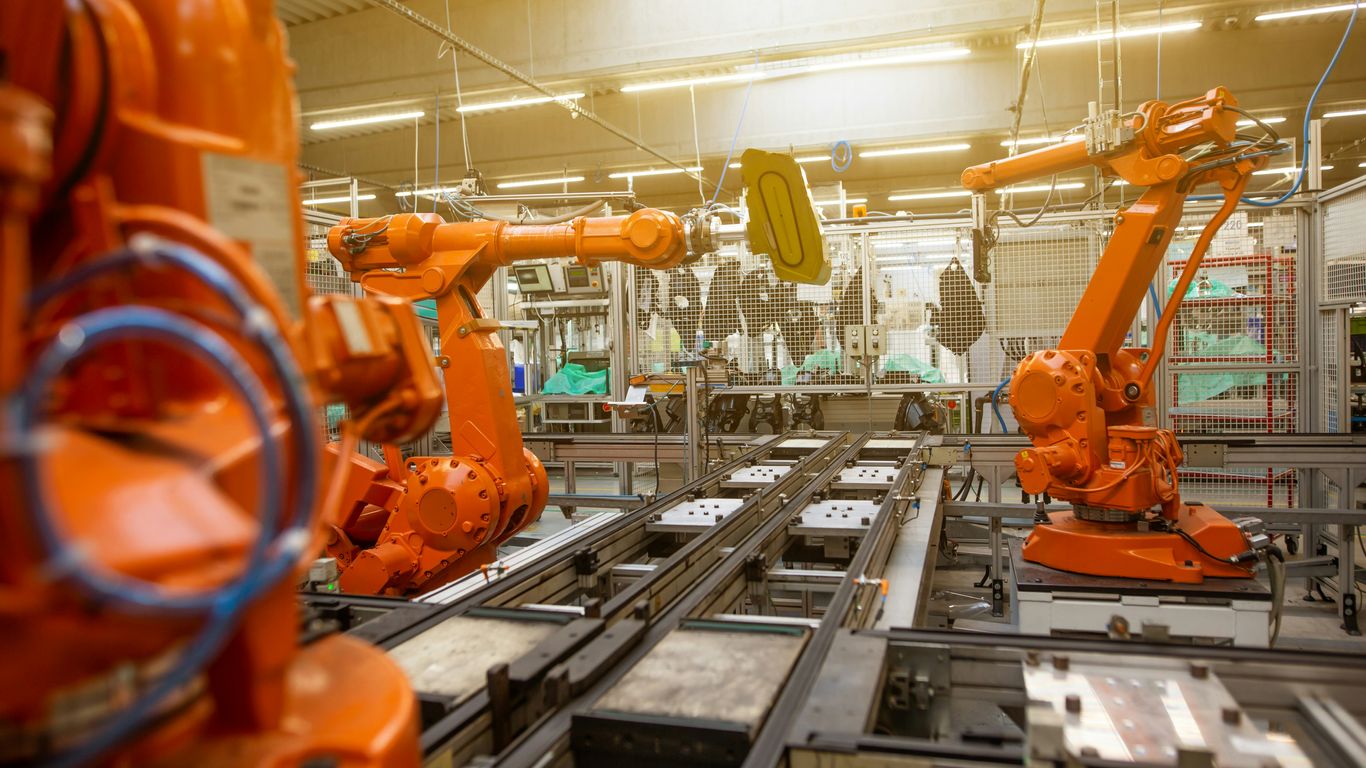
1X is carving out a specific niche by focusing on safety and human-robot collaboration in both domestic and industrial settings. Their approach relies on the development of compliant robots—machines designed to yield and adapt when they contact a human—which reduces the logistical friction of using robotics in crowded rooms. This philosophy is grounded in the belief that for robots to be truly useful, they must operate reliably alongside, rather than just in place of, human workers.
Research indicates that companies adopting this mindset are seeing higher engagement from enterprise clients who previously viewed heavy automation as a potential liability. Their recent work explores how collaborative, bipedal platforms can learn through observational learning and direct mimicry of human movements. This method of training significantly shortens the time required to teach machines new tasks, making them more adaptable to the shifting demands of modern production chains.
1. Enhanced safety interfaces for dynamic human spaces.
2. Modular joint design for rapid field repairs.
3. Adaptive motor control for varied surface traction.
4. Scalable inference models for rapid task adaptation.
These technical choices ensure the machinery can operate in environments that lack the rigid structure of a typical warehouse floor. By prioritizing the [humanoid robot startups](https://www.insidedeeptech.com/the-top-humanoid-robot-startups-of-2026-ranked-by-real-deployments/) perspective, the firm captures value for partners needing versatile agents that can handle diverse, non-repetitive task lists in semi-unstructured environments.
## 4\. Sanctuary AI
Sanctuary AI is developing cognitive architectures designed to underpin general-purpose, human-like robots. Instead of focusing solely on the mechanics of physical motion, the team prioritizes the creation of a 'mind' composed of foundational models capable of reasoning through novel tasks. This perspective allows their hardware to potentially perform work that requires high levels of dexterity and cognitive assessment without requiring manual retraining for every nuance.
This is particularly relevant for sectors struggling with specialized labor gaps, such as high-precision small-part assembly, where the logic of assembly changes frequently. By building a backend that simulates cognitive decision-making, the team hopes to create agents that can 'understand' the goal and adapt their sub-actions to achieve it. Investors tracking development here often cite the company's commitment to building a platform that can eventually handle a near-infinite range of task types.
> The transition from hard-coded automation to autonomous decision-making represents the most significant shift in robotics in three decades. True scalability is only achieved when the software can generalize its understanding of the physical world across diverse contexts.
This long-term focus on task generalization is what distinguishes these innovators from legacy automation players. For companies looking to reduce overhead, the shift toward [warehouse and industrial robotics startups](https://www.insidedeeptech.com/the-best-warehouse-and-industrial-robotics-startups-of-2026/) that offer flexible, cognitive-ready systems is an essential step in modernizing the operation.
## 5\. Agility Robotics
Agility Robotics has gained prominence through its mastery of bipedal locomotion, providing machines that effectively traverse terrain designed for humans. By focusing on the mobility aspect, they address the fundamental limitation of wheeled systems in buildings that include stairs, ledges, or uneven floor material. This hardware-first dedication to mobility is a core pillar for the [Agility Robotics](https://www.insidedeeptech.com/tag/robotics/) portfolio as it pushes for wider commercial adoption in logistics.
Engineers at the company focus on high-speed dynamic stability. This is not just about weight distribution; it requires advanced active sensors that constantly feed data into the balance controllers to prevent falls while navigating through narrow corridors or across messy facility floors. Such hardware is built to handle the rigors of an actual warehouse operation, not just a controlled show-floor demo, making it a critical player in current [top-funded robotics startups](https://www.insidedeeptech.com/the-most-funded-robotics-startups-of-2026-ranked-by-valuation/) rankings.
Their work remains a vital piece of the current push to move robotics out of pure theory. As factory owners seek to automate existing human workspaces without modifying the aisles or loading bays, the utility of a stable, mobile agent that can move vertically within the space becomes clear. Analysts continue to watch their deployment metrics as the definitive marker of success for legged motion.
## 6\. Skild AI
Skild AI develops foundational intelligence for embodied hardware that is designed to traverse various platforms, from quadrupeds to humanoids. Their primary value proposition is that a robot's hardware should be irrelevant to its ability to interpret and learn from the environment. This vision aligns with the growing demand for software-agnostic intelligence, where companies can focus on their expertise in mechanical design while licensing a brain that works across many different types of robots.
By focusing on the 'general' in general-purpose intelligence, the team hopes to crack the scalability issue that plagues current deployments. Their training approach involves exposing the system to a massive corpus of physical interactions across numerous platforms in digital twins before ever setting the model loose in the real world. This process allows them to overcome the data starvation problems that usually limit traditional machine learning approaches in robotics.
Industry participants view this firm as a potential layer of abstraction for future robot fleets. As more companies enter the hardware space, they will require robust backend code that doesn't need to be entirely rewritten for each iteration. Providing this foundational software is increasingly valuable and plays into the 10 best companies building in robotics today, particularly for the software developers shaping the next generation of automation infrastructure.
## 7\. Covariant

Covariant focuses on equipping warehouse machines with vision-language models that help them understand the objects they are picking. Traditional automation struggled with unstructured piles—bins containing mixed, disparate items—whereas this team's work allows for the rapid identification and grasp of items that were never seen before by the system. This adaptability is the core reason for its success in retail and fulfillment centers.
Their recent advancements focus on multi-modal models that allow the robot to see the bin, hear instructions in natural language, and grasp the item correctly in one fluid sequence. By integrating these systems into existing conveyor belts and standard warehouse hardware, the company minimizes the setup cost for its clients. This frictionless integration is key for enterprise reliability and has solidified its place as a top performer in recent financial assessments.
This approach demonstrates why Covariant stands out as an example of practical applied deep tech. By solving for the immediate bottleneck of inventory retrieval, they build defensible revenue streams that support their research into broader robot logic. This focus on the 'picking' problem keeps them tightly integrated in the workflows of some of the world's largest logistics providers.
## 8\. Machina Labs
Machina Labs is rethinking metal manufacturing through the application of robotics and additive engineering. Instead of using traditional, rigid molds—which are expensive and slow to modify—they utilize robots to iteratively shape metal sheets. This allows for rapid prototyping and production of customized metal components. By making hardware engineering more software-centric, they enable a design speed that was previously impossible for aerospace and automotive sectors.
Their robotics cells can be adjusted remotely, allowing for different shapes to be fabricated within the same machine with only a code update. This change significantly reduces the time from schematic to physical part. For engineers, this acts as a massive shift in how they develop high-intensity infrastructure components, effectively bringing 3D printing's flexibility to industrial metalwork.
Founders of this firm have positioned it as a key resource in the effort to bring industrial-grade [deep tech industry innovators](https://www.insidedeeptech.com/top-100-companies-in-the-deep-tech-industry-2026-list/) to the forefront of the economy. By focusing on the hard-science problem of metallurgy and shape-forming, they build a lasting moat that relies on proprietary physics-based algorithms rather than just software hype. The impact of this approach is seen in the shortened lead times for high-value components.
## 9\. Mujin
Mujin is a leader in intelligent orchestration, providing the software that allows diverse, multi-brand robot fleets to work together. Instead of having separate systems for picking, moving, and palletizing, their control layer manages the entire process from start to finish. This orchestration is vital for large-scale operations where mixed-vendor fleets have historically led to massive integration headaches and system crashes.
Their technology relies on a high-fidelity digital twin that predicts robot movement in real-time, allowing the software to optimize traffic patterns across the entire facility. This prevents the bottlenecks that occur when robots wait for each other in shared aisles. By treating the entire warehouse as a single, coordinated organism, they significantly improve the throughput of older facilities that have been retrofitted for automation.
As the industry grows, the need for this kind of fleet management software will only rise. Investors follow this firm because it bridges the gap between individual hardware units and a fully automated warehouse network. This focus on system-wide optimization provides a necessary buffer against the complexity inherent in [humanoid robotics startups](https://www.insidedeeptech.com/startups-vs-boston-dynamics-and-tesla-optimus-who-is-really-leading-robotics/), where individual unit management can quickly become overwhelming at scale.
## 10\. Serve Robotics
Serve Robotics focuses on developing autonomous systems for last-mile delivery. Their robots are designed to operate on city sidewalks and effectively navigate the complex, high-traffic pedestrian environment of modern urban areas. By building a platform specifically for this narrow context, they are able to optimize their sensing and navigation logic to excel where general-purpose humanoids might struggle with simple logistics tasks.
These robots rely on low-power sensory platforms to maintain wide-area awareness, ensuring safety while traveling in cities. The recent trend of deploying these systems to deliver goods from restaurants and retailers has provided them with a massive data set, which is used to refine the autonomy models further. This iterative real-world experience is a massive asset that differentiates their platform from purely theoretical models.
As urban congestion continues to affect delivery speed, localized autonomous delivery is becoming a critical infrastructure requirement. The company stays focused on the long-term goal of reducing the cost per delivery by automating the final leg of the network. This commitment to one well-defined problem allows them to maintain focus as they scale, highlighting a practical approach to building sustainable [robotics startups](https://www.insidedeeptech.com/the-20-deep-tech-vc-firms-funding-the-frontier-ranked-by-activity/) today.
## Conclusion
The landscape of robotics in 2026 is defined by a flight to quality, where capital is increasingly channeled toward companies that demonstrate not only technical brilliance but also clear paths to commercial utility. By moving from isolated laboratory demos to integrated, scalable systems in fields like logistics, manufacturing, and urban delivery, these companies are transforming foundational science into tangible economic infrastructure. Investors and builders alike are now prioritizing firms that tackle hard-science bottlenecks with modular, software-defined autonomy, ensuring that these machines can thrive in the messy, unstructured reality of global industry.
## Frequently Asked Questions
### What are the main limitations in current robotics hardware?
The primary hurdles include battery density, joint durability over extended operation, and the ability to maintain balance on varied, non-standard terrain, all of which remain critical constraints for long-term field deployment.
### Why are artificial intelligence models so important for robots?
AI models allow robots to derive meaning from unstructured sensory input, enabling them to make autonomous decisions and adapt to unpredictable changes in their physical environment without human assistance.
### How does fleet management impact industrial automation?
Effective fleet management platforms act as the nervous system of an automated warehouse, coordinating the movements of multiple specialized agents to eliminate congestion and increase overall throughput.
### What makes a robotics startup attractive to investors today?
Investors currently target startups that show high capital efficiency, verifiable deployment metrics in real-world environments, and a clear architectural strategy for scaling their technology beyond initial demonstrators.
### Can AI replace human workers in every manufacturing task?
Automation is best suited for repetitive, physically taxing, or dangerous tasks, whereas human workers remain superior in roles requiring high-level abstract logic, empathy, and complex multi-step reasoning in unpredictable scenarios.
### How does the physical environment influence robot design?
Robots must be engineered specifically for their operational context; for example, sidewalk delivery units require different sensing arrays than stationary factory arms or bipedal walkers in office spaces.
### Where is the robotics funding trend headed?
Funding is increasingly shifting away from single-product hype cycles toward foundational infrastructure companies that can build broadly applicable 'brains' that function across multiple hardware types and industries.
### Startups vs Boston Dynamics and Tesla Optimus: Who Is Really Leading Robotics?
URL: https://www.insidedeeptech.com/startups-vs-boston-dynamics-and-tesla-optimus-who-is-really-leading-robotics/
Last updated: 2026-08-17T17:28:20.000Z
## Key Takeaways
Humanoid robotics is transitioning from specialized research to broad industrial utility, driven by advancements in foundation models and hardware manufacturing. The competitive landscape balances established giants against agile startups, each pursuing distinct paths toward scalability and commercial viability.
- Boston Dynamics focuses on physical mastery and movement efficiency for high-end industrial tasks.
- Tesla targets mass-market affordability by utilizing existing automotive production infrastructure and massive neural network training sets.
- Robotics startups prioritize narrow domain-specific automation to achieve rapid commercial integration and deliver immediate value.
- Hardware architecture and power management remain the primary constraints for consistent, long-duration operational performance across the industry.
- Success in this sector will be measured by deployment security, ROI, and standardized integration protocols rather than theoretical peak performance.
## The current state of humanoid robotics
The field of humanoid robotics has moved far beyond the laboratory curiosities that defined the early 2000s. While once limited to academic exercises in bipedal locomotion, the sector now faces pressure to deliver tangible, replicable value. As [Inside Deep Tech](https://www.insidedeeptech.com/tag/our-team/) has observed, the race is no longer about balancing on one foot, but about performing work that justifies the massive capital investment required to build these machines. This shift marks the transition from pure robotics research toward general-purpose utility capable of influencing global supply chains.
### Historical dominance of academic and specialized research
Early humanoid development was dominated by institutions and government-backed research groups focusing on structural stability. These teams prioritized solving the fundamental mechanics of walking and balance, laying the groundwork for modern robotics. However, these prototypes were often fragile, power-intensive, and designed for controlled environments rather than the chaotic reality of a modern warehouse or manufacturing plant.
### The shift toward general-purpose utility
Modern developers are moving away from building robots for specific, narrow movements to prioritizing general-purpose architectures learned through massive datasets. By focusing on cross-industry applications, companies aim to build machines that can adapt to different roles, from sorting boxes to manipulating tools. This versatility is essential for achieving the scale needed for widespread commercial adoption.
### Mechanical agility versus software scalability
| Feature | Hardware Focus | Software Priority |
| --------------- | ---------------------- | ----------------- |
| Boston Dynamics | High-fidelity dynamics | Control stability |
| Tesla Optimus | Batch manufacturing | Neural navigation |
| Growth Startups | Task-specific hardware | Adaptive learning |
Mechanical hardware remains the anchor of robotics performance, but software scalability dictates the speed of deployment. While a robot must possess the physical agility to navigate unstructured environments, its utility hinges on its ability to learn and generalize tasks. **The true bottleneck** currently lies in harmonizing these two pillars to ensure that hardware capability is not outpaced by software requirements.
## Analyzing the Boston Dynamics approach
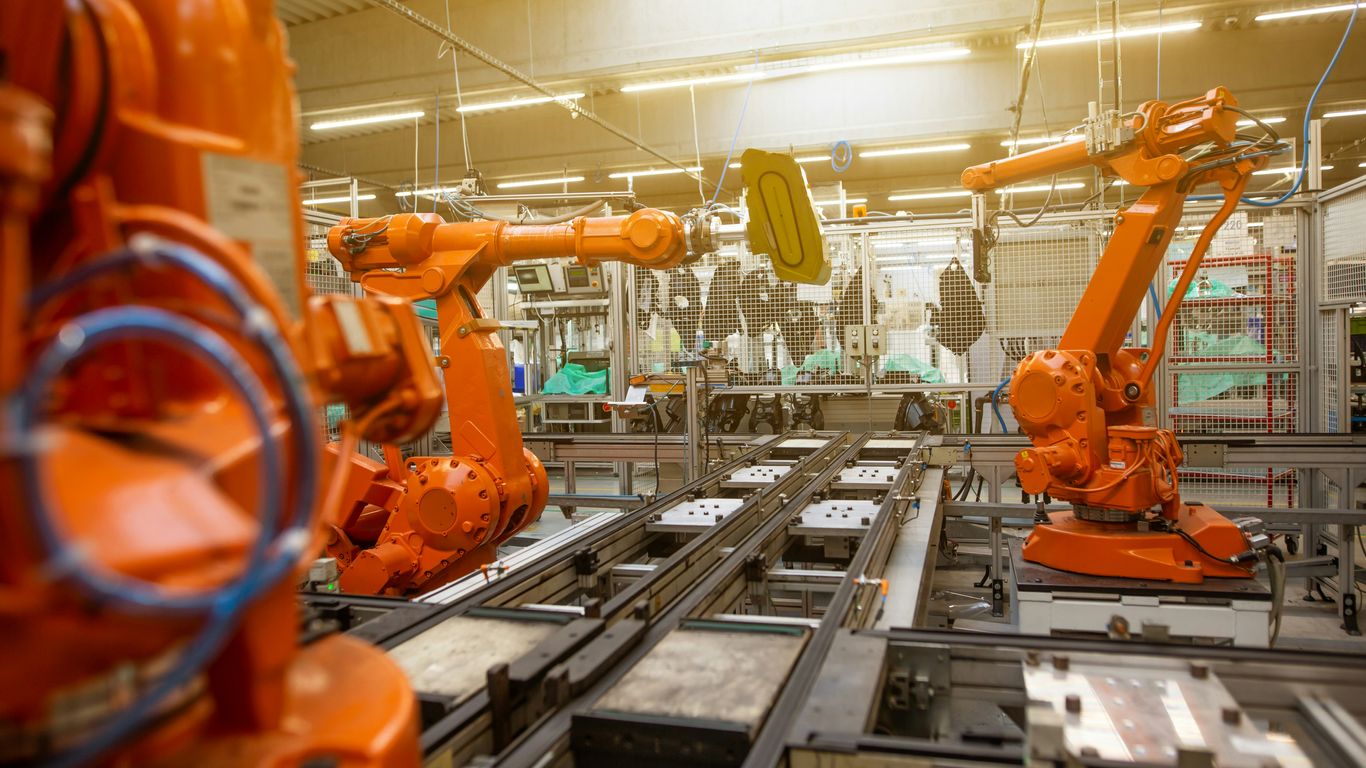
Boston Dynamics represents the pinnacle of high-performance robotic engineering. Their design philosophy centers on achieving nearly biological movement through advanced actuation and sophisticated control loops. By concentrating on what the machine can physically accomplish in the field, they have created a benchmark for hardware reliability that others strive to meet. Their emphasis on integration with heavy industrial partners ensures that their hardware is stress-tested in the most demanding environments imaginable.
### Prioritizing physical mastery and athletic capability
By leveraging their deep expertise in legged locomotion, Boston Dynamics has built [Boston Dynamics](https://www.insidedeeptech.com/10-best-companies-building-in-robotics-today/) machines that demonstrate unparalleled range in motion and environmental navigation. Their engineers do not just optimize for efficiency; they optimize for reach, stability, and speed in complex settings that would stymie lesser designs. This physical proficiency allows their units to perform tasks that require more than just simple linear movement.
### Challenges in scaling production and affordability
Despite their technical dominance, scaling the production of complex, high-degree-of-freedom machines remains an immense hurdle. The precision components and specialized materials required for their platforms currently drive costs significantly above the price sensitivity of the average enterprise customer. This focus on premium quality means their market entry is necessarily slower than those targeting lower-cost segments.
### Strategic transition from research prototypes to commercial products
To bridge the gap between engineering marvels and reliable industrial assets, the company is actively refining its designs for facility-grade durability. By forming alliances with manufacturing giants, they are shifting focus toward creating repeatable, maintenance-friendly systems that can support 24/7 operations. This move is a clear indication that the business model is evolving alongside their technology to maximize ROI.
## The Tesla Optimus scaling strategy

Tesla’s entry into the humanoid market is predicated on a different foundational logic: the ability to manufacture at scale. Rather than building from the ground up as a bespoke research entity, the organization treats the robot as another product line within an existing automotive infrastructure. The strategy minimizes the cost-per-unit by utilizing standardized manufacturing techniques and shared logistical pipelines already tuned for precision automotive assembly.
### Leveraging automotive manufacturing infrastructure
Tesla's advantage stems from their existing vertical integration, where component sourcing, assembly lines, and supply chains are already optimized for volume. This approach allows them to achieve economies of scale that pure-play robotics companies often take years to reach. By applying these lessons to a humanoid frame, they aim to drive the unit cost down to consumer or medium-enterprise levels.
### Data-driven learning through neural networks
The intelligence behind their platform relies heavily on [Tesla Optimus](https://blog.robozaps.com/b/tesla-optimus-vs-boston-dynamics-atlas?ref=insidedeeptech.com) neural networks that process vast amounts of vision and interaction data. This architecture allows the machine to learn by mirroring behavior rather than relying on intensive, manually coded instructions. The goal is to create a robot that learns like a human apprentice, quickly internalizing tasks through continuous observation.
### The goal of low-cost, mass-market deployment
Ultimately, the vision is to provide a low-cost, generalized laborer that can be deployed across a wide range of entry-level tasks. While the hardware might lack the extreme agility of specialized platforms, its strength is its accessibility and ease of fleet-wide deployment. This trade-off is central to their plan of reaching tens of thousands of robots in operation within industrial and logistics workspaces.
## The hidden power of robotics startups
Robotics startups are currently navigating the space between the high-end industrial capabilities of established players and the mass-market ambitions of the automotive scale. Companies like [Figure AI](https://www.insidedeeptech.com/every-humanoid-robot-launching-in-2026-full-list/) and [1X Technologies](https://www.insidedeeptech.com/understanding-1x-technologies-innovations-in-humanoid-robotics/) are focusing on distinct, high-impact niches where their specific hardware/software stack offers immediate improvements in operational efficiency. These teams often benefit from higher agility compared to larger incumbents, enabling them to pivot their designs rapidly based on real-world testing feedback.
### Targeted focus on domain-specific automation
Instead of aiming for a universal robot from day one, several startups are perfecting specific manipulation tasks in hazardous or high-volume environments. By solving for one or two critical bottlenecks, they establish a durable business case while collecting the data necessary to expand into broader functional domains later. This approach ensures they provide tangible value to logistics giants, which helps with future scalability.
### Rapid iteration cycles and agile development
Smaller team structures allowed for the rapid hardware and software cycles that define the current [Agility Robotics](https://www.insidedeeptech.com/a-comprehensive-agility-robotics-review-technology-use-cases-and-market-impact/) approach to development. By running frequent field trials and iterating on CAD designs and software updates simultaneously, they drastically reduce the time between prototype and performance validation. This iterative speed creates a significant advantage when operating in sectors where technological requirements change rapidly.
### Strategic partnerships with established logistics giants
Successful startups are securing early buy-in from massive e-commerce and logistics partners that act as both early adopters and testing grounds. These engagements serve two purposes: they provide a steady revenue stream and they offer access to real-world edge cases that are difficult to simulate. Such deep industry ties are essential for anyone attempting to move from lab results to facility-grade reliability.
## Comparison of key technological pillars
The fundamental challenge of humanoid robotics lies in satisfying mutually exclusive design goals: high performance versus low power consumption, and great dexterity versus high durability. Developers must make calculated trades across their system architectures, deciding where they can afford to compromise to meet the operational demands of their target environment. Achieving these balances requires a combination of high-density energy storage, low-latency communication, and efficient actuation networks.
### Actuator design and power efficiency
To operate successfully, robots need precise control over every joint. Contemporary setups use either electric motor systems or hydraulic actuators. Modern advances are pushing the former toward greater reliability and lower weight. For any operator, [operating humanoid robots](https://www.insidedeeptech.com/are-humanoid-robots-actually-ready-for-the-workplace-in-2026/) safely depends on the battery life and energy management systems that dictate how often the unit must stop for maintenance or recharging.
### Sensor suites and spatial awareness systems
Navigation requires a high-fidelity understanding of the robot's immediate surroundings. This generally involves a combination of depth cameras, LiDAR modules, and inertial measurement units. These sensors enable the machine to build a digital twin of its workspace, allowing it to avoid human workers and navigate around dynamic obstacles with minimal latency. High-quality data prevents the costly downtime associated with collisions.
### Inference capabilities and edge computing requirements
Processing intelligence locally on the edge—rather than relying solely on cloud-based computation—is critical for speed and reliability. As autonomous tasks become more complex, the on-board compute requirements grow exponentially. Startups must balance the weight of these processing units against the power budget, often selecting custom silicon to handle inference without sacrificing the robot's mobility or operational lifespan.
## Future market trajectories and benchmarks
The long-term success of the humanoid sector will depend on establishing standard metrics for safety and integration, rather than just raw performance capacity. We are rapidly approaching a moment where these systems move out of pilot programs and into full-shift industrial work, making standardized validation a prerequisite for the industry. As companies finalize their roadmaps, they must be transparent about how these machines integrate with existing safety protocols, labor workflows, and maintenance regimes to win the trust of global firms.
### Determining the ROI for universal robots
1. Analyzing human-equivalent task completion rates.
2. Calculating total cost of ownership including maintenance.
3. Comparing hourly productivity against traditional fixed automation.
4. Projecting the required workforce upskilling and integration timelines.
Measuring return on investment requires viewing the robot as a shiftable asset. When businesses can calculate the direct replacement value of dangerous or dull labor, they can make data-backed decisions on deployment. If the maintenance schedule and total power cost represent a fraction of the wages saved, the model for widespread adoption solidifies.
### The role of industry standards in safety and integration
Without comprehensive regulations regarding collaborative safety and data interoperability, adoption will remain localized to experimental zones. Industry players must move toward common standards for how robots interact with human spatial zones and how they communicate with existing warehouse systems. Developing these norms will lower the barrier for traditional businesses to begin integrating humanoid assets.
### Predictions for the next five years of humanoid deployment
Over the next five years, we expect to see a consolidation of companies that can successfully bridge the gap between proof-of-concept and scalable revenue. The winners will likely not be those with the thinnest waist or the fastest gait, but those that can consistently deliver 99%+ uptime in messy, real-world conditions. Those following [Stoic Futurism](https://peterashbysmith.com/stoic-futurism/?ref=insidedeeptech.com) principles will likely succeed by prioritizing these boring, yet essential, operational benchmarks over the flash of marketing demos.
## Conclusion
The trajectory of humanoid robotics is settling into a pattern where engineering depth meets industrial demand. As the hype cycles calm, the focus remains locked on creating reliable systems that solve human-centric problems in warehouses and manufacturing. The field represents a definitive shift in how physical work is structured, moving beyond rigid automation to machines that possess the fluidity and learning capacity to adapt to the complexity of the modern world.
## Frequently Asked Questions
### Why are humanoid robots preferred over other automated systems?
Humanoid shapes are optimized to operate in environments already built for humans, allowing them to utilize stairs, hand tools, and narrow aisles without requiring facility-wide renovation.
### What is the biggest hurdle for humanoid robot adoption?
Hardware durability combined with battery efficiency remains the primary bottleneck for machines that must operate for twelve-hour shifts without continuous maintenance or recharging stops.
### How is machine learning integrated into modern robots?
Neural networks allow robots to learn through imitation and reinforcement, enabling them to adapt to new tasks by observing human movements rather than requiring manual programming for every specific action.
### Will robots replace human workers in the next five years?
They are anticipated to fill critical gaps in dull, dirty, and dangerous roles where labor shortages persist, acting as collaborators alongside humans rather than wholesale replacements in the near future.
### What impact do foundation models have on robotics?
These models allow robots to generalize knowledge across different physical tasks, dramatically speeding up the training time required for them to handle new environments or object shapes.
### How do manufacturers ensure worker safety around robots?
Sophisticated sensor suites, combined with collision-avoidance algorithms and strict regulatory standards, allow these machines to detect the proximity of humans and stop operations instantaneously if a safety threshold is breached.
### Are there standard metrics for comparing humanoid performance?
Benchmarks are emerging that focus on uptime, task accuracy with specific end-effectors, and the ability to maintain speed under variable load conditions in realistic, unstructured environments.
### The Top Surgical and Medical Robotics Startups of 2026
URL: https://www.insidedeeptech.com/the-top-surgical-and-medical-robotics-startups-of-2026/
Last updated: 2026-08-17T17:28:22.000Z
## Key Takeaways
The medical robotics industry in 2026 has transitioned from experimental prototypes to functional, clinically viable infrastructure. This shift highlights a focus on AI-driven autonomy, enhanced surgical precision, and tangible improvements in patient recovery outcomes.
- AI models are enabling higher levels of autonomous execution for repetitive surgical tasks.
- Microsurgical robotic systems are refining vascular procedures with sub-millimeter precision.
- Orthopedic robotics now leverage collaborative architectures to assist surgeons in real-time positioning.
- Remote tele-robotic platforms are effectively expanding access to expert-level care across geographic barriers.
- Nanotechnology and advanced diagnostics are transforming biopsy accuracy and targeted metabolic delivery methods.
## 1\. AI-driven autonomous surgical platforms
The rapid evolution of AI-driven surgical platforms represents a distinct milestone in healthcare delivery. These systems do more than serve as passive tools; they integrate real-time computer vision and machine learning that analyze tissue properties during ongoing procedures. By processing vast datasets of previous surgeries, these platforms can suggest optimal trajectories or detect anatomical anomalies faster than human observation alone.
This shift toward increased machine agency is defining the standard for the top surgical and medical robotics startups 2026\. Developers are moving away from manual tele-operation toward semi-autonomous workflows where the machine manages suturing or basic dissection. This reduces cognitive load on the surgical team, allowing lead surgeons to focus on high-stakes decision-making while the robotic arm maintains consistent execution. Ensuring these systems operate with high reliability in unpredictable clinical environments remains the primary focus for engineers.
Safety certifications for these autonomous components require rigorous testing and extensive clinical validation. The industry is standardizing software frameworks that verify decision pathways before deployment in operating theaters. This transition makes the operating room a data-rich environment, where each intervention helps refine the underlying foundation models that power the next generation of robotic assistance.
## 2\. Microsurgical robotics for vascular intervention

Microsurgical robotics for vascular intervention address the extreme demand for precision in delicate procedures. Operating on blood vessels requires steady hands capable of working at scales where traditional surgical tools often lack sufficient control. Robotic platforms designed for this domain leverage advanced haptic feedback and micro-actuation to compensate for natural tremors and provide the surgical team with enhanced visualization of narrow, non-linear vascular paths.
Recent advancements prioritize portability and the ability to maneuver within the constraints of human anatomy without requiring invasive access points. The integration of high-resolution digital imaging allows these robots to map complex networks in real-time, assisting in tasks such as micro-anastomosis and vessel repair. The move toward soft-actuation technologies has further improved the safety profile of these tools, minimizing the risk of vessel wall damage during transit.
Market signals suggest that vascular intervention will be a primary growth driver as patient outcomes improve through robotic precision. These startups are focusing on modular system designs that fit within existing hospital infrastructure without demanding significant renovation. This pragmatic design approach enables centers of excellence to adopt microsurgical robotics as a standard part of their [surgical innovation](https://www.medtechdive.com/news/New-robotic-surgery-platforms-company-profiles-roundup/808734/?ref=insidedeeptech.com) toolkit.
## 3\. Collaborative robotic arms for orthopedic surgery
Collaborative robotic arms for orthopedic surgery bridge the gap between heavy industrial automation and human-centric care. Unlike fixed platforms, these systems operate alongside the surgeon, providing stabilization and precise bone prep during joint replacement and fracture stabilization. By tracking anatomy in real-time, these arms create physical boundaries that ensure instrumentation remains within planned safe zones, significantly enhancing the accuracy of component placement.
These platforms have seen substantial adoption due to their ability to simplify the complex alignment sequences required in modern orthopedics. By [prioritizing commercial viability](https://www.insidedeeptech.com/the-top-humanoid-robot-startups-of-2026-ranked-by-real-deployments/), startups are delivering units that integrate seamlessly into high-throughput settings. The table below outlines how these systems differ in their operational focus compared to traditional manual surgery methods.
| Feature | Manual Surgery | Collaborative Robotics |
| ----------------- | -------------------- | ----------------------------- |
| Precision Control | Human dependent | Sub-millimeter accuracy |
| Risk Mitigation | Visual check only | Physical boundary enforcement |
| Fatigue Impact | High | Low (system assists) |
| Repeatability | Varies by experience | Consistent performance |
Integration remains a critical element for these systems. As data from these procedures informs population-scale orthopedic research, hospital administrative teams are observing higher operational efficiency. This data-driven approach continues to validate the role of collaborative robots as essential infrastructure for modern orthopedics.
## 4\. Tele-robotic systems for remote surgery
Tele-robotic systems for remote surgery are fundamentally altering the geography of critical care. By decoupling the surgeon from the physical location of the patient, these platforms utilize low-latency communication networks to transmit precise control data across vast distances. This capability empowers centers to provide specialized care to rural or underserved regions by utilizing the expertise of distant surgical experts in real-time.
Technological progress in this sector relies on stabilizing the digital link between the surgeon's console and the robotic system. Startups working in this space focus heavily on packet optimization and redundant connectivity to ensure that precision is never compromised by minor signal fluctuations. Ensuring that remote surgeons feel a sense of [improved surgical outcomes](https://www.insidedeeptech.com/robotics-in-healthcare-in-2026-innovations-and-future-outlook/) through high-fidelity haptics is the current benchmark for success among these providers.
Legal and regulatory hurdles are currently the landscape's main points of discussion. Establishing clear protocols for cross-jurisdictional remote procedures is vital for widespread deployment beyond test cases. As these regulatory frameworks crystallize, the ability to extend surgical expertise globally will likely become the most impactful development in this technical field.
## 5\. Soft robotics for minimally invasive endoscopy

Soft robotics for minimally invasive endoscopy are designed to navigate complex physiological pathways with minimal resistance. Traditional rigid endoscopy tools often create friction or trauma when traversing tortuous loops within the digestive tract. Soft systems use flexible, compliant materials and fluidic-powered actuation to passively conform to the patient's anatomy, enabling deeper and safer access than ever before.
This shift Toward compliant mechatronics allows for a new class of diagnostic devices that are significantly less intrusive to patients. Some of the most interesting developments involve sensors embedded directly into the robotic surface, allowing for simultaneous imaging and tissue tension assessment. By refining the [robotic surgical training](https://www.insidedeeptech.com/every-humanoid-robot-launching-in-2026-full-list/) processes alongside these devices, startups enable clinicians to learn the specific controls required for soft articulation quickly.
Beyond basic diagnostic capabilities, these robots are being built to perform therapeutic tasks such as poly-removal or targeted sampling. This versatility makes them high-value assets for internal medicine departments. The following list highlights key advantages provided by soft instrumentation in contemporary endoscopy:
- Decreased reliance on heavy physical instrumentation during internal navigation.
- Improved patient comfort via adaptive material compliance.
- Integrated high-definition camera arrays for superior tissue inspection.
- Reduction in risk regarding secondary tissue damage.
- Scalability of compact systems into existing endoscopy workflows.
## 6\. Robotic platforms for precise biopsy and diagnostics
Robotic platforms for precise biopsy and diagnostics streamline the process of identifying pathological tissues with extreme reliability. These systems combine high-speed image analysis with motorized guidance, ensuring that needle biopsies reach specific targets within organs with a high degree of confidence. By removing manual alignment errors, these platforms reduce the need for repeat procedures and lower the diagnostic latency for patients.
Startups in this sector are integrating advanced imaging data into their positioning logic, leveraging AI-based segmentation to highlight potential zones of interest. This makes the diagnostic process more robust, as the system effectively guides the clinician to the most relevant tissue samples. Precision at this stage is vital, as accurate pathology is the foundation of any successful long-term patient care strategy.
These automated platforms also support the growing trend of personalized medicine. By providing precise tissue sampling consistently, they allow for more granular molecular analysis. This transition represents a shift in [deep tech funding](https://www.insidedeeptech.com/deep-tech-funding-hit-records-in-2026-heres-where-it-went/), as investors prioritize platforms that directly improve the quality of patient data gathered before any primary treatment is initiated.
## 7\. Automated patient positioning and transport solutions
Automated patient positioning and transport solutions are designed to address the physical burden on the healthcare workforce. These robotic systems automate the movement of patients within hospital environments, reducing the occurrence of occupational injuries related to patient lifting. Beyond safety, these solutions enable precise positioning during imaging or intensive therapy, ensuring that mobility does not interrupt consistent care.
These platforms incorporate smart sensors to monitor patient stability during transit, adapting automatically to sudden shifts in weight or patient posture. The design goal for these systems is to act as an invisible extension of the nursing team, managing the logistics of patient safety while medical professionals monitor the patient's health. This operational viability in busy environments is what distinguishes effective transport systems from simple motorized gurneys.
> The transition to automated transport environments reflects a broader goal of reducing burnout and increasing the retention of skilled nursing staff through high-quality support technology.
Reliability is the central demand from hospital operators evaluating these transport systems. The robotics must integrate with existing facility management software to track deployment and maintenance schedules effectively. This level of synchronization is increasingly demanded as hospitals optimize their [operational agility](https://www.insidedeeptech.com/the-best-warehouse-and-industrial-robotics-startups-of-2026/) and look to automate routine physical labor.
## 8\. Nanorobotics for targeted drug delivery and imaging
Nanorobotics for targeted drug delivery and imaging represent the frontier of miniaturized medical intervention. These systems, while currently largely in the advanced research or early trial prototype phase, promise to deliver therapeutic agents directly to diseased tissue without affecting surrounding healthy cells. By navigating the circulatory system on a microscopic level, these devices can perform site-specific diagnostics or deploy medications with unmatched precision.
This sector is heavily reliant on advances in materials science and bio-compatible manufacturing. Startups must overcome the significant challenge of navigating the body's natural defense barriers while maintaining control from an external source. Recent work in magnetic propulsion allows for localized movement, providing a reliable navigation method for these miniature agents during [complex orbital utility](https://www.insidedeeptech.com/best-space-tech-startups-to-watch-in-2026/) and similar high-constraint applications of related engineering principles.
While widespread commercial utilization is still on the horizon, these technologies represent the ultimate goal of surgical robotics: minimally intrusive, highly effective, and non-traumatic intervention. Every milestone in drug delivery or microscopic imaging significantly changes public expectations for the future of medical science. Research efforts remain grounded, acknowledging the significant steps necessary to reach clinical certification.
## 9\. Cloud-connected robotic surgical training startups
Cloud-connected robotic surgical training startups are modernizing the way practitioners develop expertise in complex robot-assisted environments. These platforms offer virtual reality simulations that record every movement and decision made during a session, uploading this data to the cloud for real-time analysis. This allows surgeons to compare their performance against benchmarks and receive personalized feedback generated by AI models.
This loop of feedback is essential for maintaining a high level of surgical quality across dispersed hospital networks. By providing standardized training modules that are accessible anywhere, startups lower the barriers to entry for using new robotic tools. This focus on verifiable skill sets is becoming a standard request in medical education, ensuring that those operating the [leading surgical robotics](https://newmarketpitch.com/blogs/news/surgical-robotics-top-startups-fundraising?ref=insidedeeptech.com) platforms are fully proficient, regardless of their location.
Training startups are also focusing on the psychological aspects of surgical proficiency. By tracking cognitive stress signals and movement patterns, these training systems can identify areas where a surgeon might experience fatigue or hesitation. This holistic approach makes simulation a powerful tool for improving operational performance safely outside of the live operating theater environment.
## 10\. Rehabilitation and physical therapy exoskeleton startups
Rehabilitation and physical therapy exoskeleton startups provide life-changing assistive technology for individuals with mobility impairments. These wearable robots utilize sophisticated control logic to sense the wearer's intent and assist with natural walking or upper-body movement. For children and adults regaining function after trauma or managing congenital conditions, these exoskeletons provide the repetition required for effective rehabilitation.
These platforms have evolved from heavy, stationary rigs to agile, wearable systems that can be used in daily settings. Developers prioritize [adaptive AI](https://www.insidedeeptech.com/physical-ai-the-embodied-ai-startups-to-watch-in-2026/) and weight-distributed architectures to ensure the robot feels like a natural part of the user. In many clinical trials, this technology has been documented replacing the need for mobility aids for certain patients, proving that dedicated humanoid robot startups can have a massive impact on the quality of life when their focus is specifically trained on healthcare.
Success in this sector is measured by long-term patient progress. Startups provide detailed analytics to therapists, allowing them to monitor recovery trajectories and adjust assistance levels as the patient gains strength. This integration with clinical therapy is the core strength that keeps these startups at the forefront of the rehabilitation technology market.
## Conclusion
The medical robotics landscape in 2026 is defined by a shift from speculative development to the reliable, commercial-scale integration of hardware and intelligence into healthcare. Through AI-enhanced surgical platforms, microsurgical robotics, and advanced rehabilitation technologies, the industry is creating more precise, accessible, and inclusive medical interventions that reflect both structural innovation and a genuine commitment to patient care.
## Frequently Asked Questions
### How does robotics improve surgical safety?
Robotics improve safety by providing surgeons with superior visualization, eliminating human hand tremors, and establishing physical constraints that prevent damage to delicate anatomical structures during a procedure.
### What role does artificial intelligence play in robotics?
Artificial intelligence enables robots to analyze anatomical features in real-time, suggest optimal trajectories, and provide semi-autonomous assistance to surgeons, effectively reducing the potential for human error.
### Are remote surgical systems currently safe for use?
Remote surgical systems are increasingly safe due to advancements in low-latency communication and redundant connectivity, though their use remains focused on high-stakes scenarios with strictly established regulatory frameworks.
### How are soft robots being used in healthcare?
Soft robots are primarily used in endoscopy to safely and non-invasively navigate human pathways, utilizing compliant materials that conform to the body's internal anatomy without causing the trauma associated with rigid tools.
### Can rehabilitation robotics replace traditional therapy?
Rehabilitation robotics act as a force multiplier for traditional therapy, providing the repetitive, high-consistency movement patterns necessary for neural recovery while allowing physical therapists to supervise and track progress data more accurately.
### What challenges do medical robotic startups face in 2026?
Startups in this industry face significant challenges regarding regulatory approval, the complex requirement for clinical validation, and the need to scale production while ensuring interoperability across disparate hospital information systems.
### Will medical robots eventually lead to fully automated surgery?
While current technology is focused on semi-autonomous and collaborative modes designed to assist human surgeons, the industry is gradually moving toward increased autonomy for repetitive tasks, focusing always on clinical safety as the ultimate prerequisite.
### The Best Warehouse and Industrial Robotics Startups of 2026
URL: https://www.insidedeeptech.com/the-best-warehouse-and-industrial-robotics-startups-of-2026/
Last updated: 2026-08-17T17:28:23.000Z
## Key Takeaways
The warehouse and industrial landscape is undergoing a significant shift as specialized robotics companies bridge the gap between lab-tested prototypes and industrial-scale production. This evolution relies on integrating advanced artificial intelligence, unified fleet management, and robust hardware to solve persistent labor and efficiency shortages in global supply chain operations.
- Advanced AI is enabling robots to perform unstructured tasks such as piece-picking and complex grasping.
- Digital twin platforms are providing the orchestration layer necessary for managing heterogeneous robot fleets.
- Sustainability and autonomous power management are emerging as critical components for continuous industrial operation.
- New ASRS configurations are optimizing vertical space and inventory density in crowded urban fulfillment centers.
- Real-time inventory tracking is undergoing a transformation through automated drone and vision-based systems.
## 1\. Autonomous mobile robots for dynamic warehouse environments
The adoption of autonomous mobile robots has moved beyond rigid programmed paths to systems that navigate unpredictable industrial floors with high fluidity. These units are essential for moving goods between storage and manual or robotic workstations without forcing a complete restructuring of existing facilities. Manufacturers focus on sensor fusion, using LiDAR and depth cameras to maintain safety and throughput while avoiding stationary or human obstacles.
Deployment strategies now prioritize modularity, allowing companies to add or remove robots as peak seasons dictate throughput requirements. Instead of large capital investments in fixed conveyor belts, warehouse managers are shifting toward robots that treat the floor as an accessible, open grid. This transition has proven critical for businesses struggling with the high costs of manual labor in standard fulfillment settings, as noted in the [top-funded robotics startups](https://www.insidedeeptech.com/the-most-funded-robotics-startups-of-2026-ranked-by-valuation/) industry reports.
Successful integration often relies on seamless handoffs with existing Warehouse Management Systems (WMS). These robots act as the connective tissue, linking different zones of a facility that were previously disconnected silos. By focusing on **adaptive pathing and obstacle avoidance**, these systems ensure that industrial operations remain consistent even when human workers or other machines move across their intended trajectories.
## 2\. AI-driven piece-picking and grasping startups
Piece-picking was long considered the most difficult task to automate because it required handling items with irregular shapes, textures, and fragile packaging. Recent startups are addressing this by integrating vision-language models into robotic end-effectors, allowing them to "understand" the object before the physical grasp occurs. This intelligence goes beyond a simple coordinate match, enabling the machine to plan the orientation of its grip to ensure product safety.
Many of these firms focus on deep learning frameworks that are trained with massive datasets of simulated object manipulations. By bridging this knowledge from the virtual to the physical domain, these startups have enabled robots to handle thousands of unique stock-keeping units without requiring manual reprograming. Consequently, companies like [Nimble Robotics](https://www.insidedeeptech.com/a-comprehensive-guide-to-nimble-robotics-and-automated-fulfillment/) have demonstrated how superhumanoid capability can be effectively applied to high-volume e-commerce fulfillment.
When we evaluate the ROI of these systems, we look specifically at pick-accuracy rates and the reduction in damaged goods during the induction phase. High-performance systems today achieve error rates comparable to humans while operating in multi-shift configurations. This allows the facility to maintain uptime during periods when human recruitment is particularly challenging, provided the grasping hardware remains resilient and responsive.
## 3\. Novel automated storage and retrieval systems
Modern automated storage and retrieval systems now challenge the traditional reliance on simple crane-based systems. These newer designs emphasize bin-to-person workflows, where dense grids hold thousands of units that are retrieved rapidly by specialized bots. As demand for footprint efficiency increases, these systems allow companies to maximize vertical capacity in facilities that are otherwise too small for traditional heavy equipment.
These automated configurations allow for rapid slotting and re-slotting of inventory based on real-time order velocity. By keeping the most frequently ordered items available at the top levels of the grid, these systems significantly reduce the retrieval cycle times. As discussed in recent [robotics startups 2026](https://www.layer3labs.io/robotics/robotics-startups-to-watch?ref=insidedeeptech.com) analysis, companies that master high-density bin management often see substantial gains in floor-space utilization once implemented.
Consider the operational impact of these systems in the table below:
| Feature | Traditional Racking | Modern ASRS |
| --------------- | ------------------- | ---------------- |
| Density | Low/Medium | Very High |
| Retrieval Speed | Slow | Near Real-time |
| Scalability | Manual Expansion | Modular Addition |
This table highlights why companies are transitioning toward automated grids. The operational agility afforded by **modular infrastructure for storage density** is rapidly becoming the standard for any facility managing high SKU counts.
## 4\. Collaborative robotics firms for assembly and sorting
Collaborative robots, or cobots, fill a niche where industrial arms must operate reliably while sharing space with human workers. These systems include sensitive internal torque sensors that stop movement upon detecting contact, allowing for safe interactions during sorting or light assembly tasks. They are particularly effective when the goal is to augment human speed rather than replace the worker entirey.
These startups are now focusing on portability, allowing teams to move the robot between different stations on a factory floor depending on the immediate bottleneck. By utilizing intuitive teach-to-learn software, operators who lack deep coding expertise can command the robots to perform new sequences. This democratization of the programming interface is a primary driver for the widespread adoption observed in modern [industrial automation](https://www.landbase.com/blog/fastest-growing-warehouse-automation?ref=insidedeeptech.com) reports.
- Quick-switch end effectors for changing tools.
- Force-sensitive safety monitoring systems.
- Tablet-based intuitive control interfaces.
- Lightweight chassis for rapid workspace redeployment.
These systems allow for a flexible workforce configuration, enabling workers to focus on quality control while the robot handles the repetitive motion. Investing in this type of **human-robot collaborative workflow** is a strategic move for businesses that maintain a strong commitment to local manufacturing while optimizing for cost-effective throughput.
## 5\. Intelligent warehouse orchestration and digital twin platforms

Warehouse orchestration layers serve as the centralized brain for heterogeneous robot fleets, ensuring that machines from different manufacturers work together without conflict. These platforms leverage digital twin technology to create a live, virtual mirror of the physical facility. Managers can then simulate potential changes, such as re-routing lanes or adding new charging spots, before making permanent adjustments to the physical infrastructure.
Visibility is the main benefit here; managers can track the performance of every bot in real-time, identifying bottlenecks before they impact order fulfillment. Platforms like [Inside Deep Tech](https://www.insidedeeptech.com/tag/robotics/) have highlighted how essential this level of transparency is for sites operating with high levels of complexity. Without a unified dashboard, fleet managers often find that their individual robot islands act as localized bottlenecks rather than holistic assets.
> Orchestration is the defining challenge of the next phase in warehouse automation, transitioning the facility from a collection of discrete parts into a cohesive, software-defined machine.
This logic applies particularly when scaling across multiple geographical regions, where real-time coordination prevents downtime during network fluctuations. By relying on digital twin accuracy, companies can refine their operational strategy without interrupting the active flow of goods.
## 6\. Robotic palletizing and depalletizing specialists
Palletizing remains a labor-intensive chore that involves heavy lifting and repetitive strain, making it a prime candidate for specialized robotics. New startups are rolling out systems that combine 3D vision and heavy-payload arms to build stable, dense pallets with minimal instruction. The software governing these arms must calculate center-of-gravity shifts in real-time to ensure the pallet does not collapse during transport.
These systems are increasingly moving toward end-effector designs that handle multiple box sizes simultaneously. This is a technical hurdle, as the robot must effectively balance different weights while keeping the pallet structure square and compliant with shipping regulations. Success in this field requires **advanced sensory feedback for load balancing**, ensuring that every pallet leaves the line in perfect condition regardless of the disparate items included.
Many of these specialized specialists now offer their systems through flexible service contracts. This allow mid-sized logistics providers to offload the burden of pallet construction without taking on the massive upfront costs of industrial hardware. These companies are effectively standardizing a task that was, until recently, viewed as too unpredictable for anything other than manual labor.
## 7\. Drone tech for real-time inventory and site inspection

Inventory counting was historically a periodic, disruptive manual task that often grounded operations for days at a time. Today, autonomous drone fleets and vision-equipped robot crawlers scan barcodes and RFID tags with unprecedented speed. These systems fly or move through aisles during off-hours, providing an accurate, digital snapshot of stock levels that can be verified against the WMS system by the start of the next morning.
Beyond basic inventory, these systems are equipped with high-resolution sensors to detect safety hazards or structural anomalies on high-up racks. This proactive observation allows teams to fix minor issues before they lead to full system failures. Firms in the [robotics space tech](https://www.insidedeeptech.com/a-comprehensive-guide-to-industrial-automation-with-anybotics/) ecosystem have shown how leveraging aerial intelligence reduces the overhead required to maintain accurate digital ledger logs in vast warehouses.
Maintaining these systems requires robust indoor positioning, as traditional GPS does not penetrate warehouse roofs. Startups have addressed this using integrated beacons or SLAM (Simultaneous Localization and Mapping) to navigate precisely within the four walls. The result is a total reduction in inventory variance and a permanent increase in warehouse audit transparency.
## 8\. Micro-fulfillment and last-mile warehouse automation startups
Micro-fulfillment centers (MFCs) are popping up inside retail stores and urban depots, bringing inventory closer to the end consumer. These centers require a much smaller robotic footprint, pushing startups to develop systems that are compact and highly efficient in constrained spaces. The goal is to shrink the distance between the stock and the customer to facilitate rapid, often same-day delivery timelines.
These startups are optimizing for low power consumption and small physical dimensions to comply with zoning and building safety constraints in metropolitan areas. By reducing the reliance on massive, remote regional hubs, firms are successfully lowering last-mile costs. Many of these projects are supported by innovations in [warehouse operations](https://www.insidedeeptech.com/physical-ai-the-embodied-ai-startups-to-watch-in-2026/) that translate well into smaller settings.
The shift toward micro-fulfillment is essentially a response to the e-commerce expectation for instantaneous transactions. By creating mini-automated hubs, retailers turn their existing storefronts into logistics nodes. This transition is essential for retailers competing against firms that have already built highly sophisticated delivery networks, ensuring they do not lose market share to logistics-focused incumbents.
## 9\. Multi-vendor fleet management software innovators
As most facilities end up using a mix of robot types from various OEMs, the demand for vendor-agnostic fleet management software has surged. These platforms focus on protocol translation, allowing a robot from one manufacturer to communicate effectively with a charger, door, or elevator from another. Without this interoperability, a warehouse is forced to rely on a single vendor for its entire robotics stack, limiting future flexibility.
Innovators in this space are building standardized communication backbones that allow for seamless plug-and-play integrations. By decoupling the hardware from the management layer, these firms provide a buffer against supply chain issues and vendor lock-in. Their tools are becoming the gold standard for companies that want to maintain **long-term fleet infrastructure agility** through vendor competition.
These systems are also essential for managing complex software updates. When a new firmware version is released for a category of robots, the management platform schedules and verifies these deployments across the fleet, ensuring that one faulty patch does not cripple the entire operation. This oversight is vital for maintaining the operational maturity that large-scale global retailers demand.
## 10\. Next-generation power and charging solutions for industrial robotics
Continuous operation for industrial robotics hinges on efficient energy management, moving away from simple docks toward sophisticated autonomous energy solutions. Startups are exploring inductive charging, which allows robots to top up energy while stopped at pick-up points, and high-density fast-charging batteries that minimize the time spent away from the floor. This minimizes the density of docked robots that are idle for hours at a time.
Managing a swarm of robots requires a global view of battery levels, preventing entire cells in the warehouse from reaching the red zone simultaneously. Sophisticated software now triggers charging commands based on predicted order load, ensuring batteries are primed before surges occur. These power-management startups are effectively extending the duty cycle of every robot, a critical factor for facilities running 24/7 schedules.
Sustainability is also a driver, as fleets grow larger and energy consumption becomes a significant operating expense. By maximizing the life of individual battery cycles and optimizing grid usage, companies are finding new ways to reduce their environmental impact. This focus on **sustainable energy management for robotics** is currently one of the most overlooked, yet vital, performance markers for scaling warehouse automation startups.
## Conclusion
The landscape of industrial automation has matured from speculative lab experiments to a robust ecosystem of specialized startups that fundamentally reorder the economics of the warehouse. By focusing on software orchestration, AI-driven manipulation, and resilient hardware, these companies are effectively solving the deep-seated productivity bottlenecks that have hindered supply chains for decades. As these technologies integrate into standard operational workflows, the next few years will see a rapid transition toward facilities defined by their ability to scale and adapt in real-time, marking the permanent arrival of the autonomous warehouse era.
## Frequently Asked Questions
### What are the primary benefits of investing in warehouse robotics?
The benefits include significant improvements in order throughput, accuracy, and the ability to operate in labor-constrained markets. Robotic systems handle repetitive or physically demanding tasks consistently, leading to reduced injury rates and lower long-term operational costs.
### How do modern warehouse robots navigate unstructured environments?
Most modern units use a combination of LiDAR, depth cameras, and IMU sensors combined with SLAM algorithms to create and update building maps in real-time. This allows them to detect and safely navigate around obstacles, including humans, without the need for pre-installed physical guides.
### Can different robotic systems from multiple vendors work together?
Yes, through the use of vendor-agnostic warehouse orchestration software. These platforms provide a unified communication layer that translates protocols, allowing diverse robots to share the same operational map and workspace efficiently.
### What is a digital twin in the context of an industrial warehouse?
A digital twin is a virtual model that mirrors the live state of a physical warehouse. It is used to simulate operational changes, test new robotic workflows, and forecast the impact of hardware adjustments before implementing them in the actual facility.
### Why is piece-picking more difficult for robots to automate than palletizing?
Piece-picking involves handling items of varying sizes, weights, and fragile materials, often from bins of unsorted products. Palletizing is generally more predictable as it involves stacking standard-sized boxes or containers, making it easier to program the motion and weight-distribution logic.
### How do robots handle battery management in a 24-hour facility?
Robots typically utilize smart scheduling software that monitors battery levels across the fleet in real-time. Charging occurs automatically based on workflow needs, and some designs include fast-charging or inductive platforms that keep robots ready for service with minimal downtime.
### How does warehouse automation affect human employment roles?
Automation typically shifts human roles toward higher-level tasks, such as system monitoring, error troubleshooting, and robot maintenance. It often reduces the necessity for repetitive, injury-prone physical labor while increasing the demand for skilled workers who can engage with the robotic stack.
### Figure AI vs 1X vs Agility vs Apptronik: The Humanoid Race Compared
URL: https://www.insidedeeptech.com/figure-ai-vs-1x-vs-agility-vs-apptronik-the-humanoid-race-compared/
Last updated: 2026-08-17T17:28:25.000Z
## Key Takeaways
The industry is transitioning from specialized industrial robots to versatile humanoid machines capable of performing tasks in unstructured environments. Following are the core themes driving this evolution:
- The shift toward robots that integrate into existing infrastructure without requiring costly facility re-tooling.
- Scaling operations through artificial intelligence models that learn by observation rather than manual code.
- The crucial role of venture capital in bridging the gap between prototype and commercial product.
- A divergence in hardware design philosophies, ranging from safety-focused domestic units to industrial-grade logistics platforms.
- Data collection via teleoperation as a primary method for bootstrapping autonomous capability in manufacturing settings.
## The landscape of general-purpose humanoid robotics
The shift from industrial automation to versatile machines is accelerating as hardware improvements in actuators and sensors coincide with advancements in foundation models. Traditional industrial robots operate within rigid, predefined paths, whereas the current generation of [humanoid robots](https://www.insidedeeptech.com/the-top-humanoid-robot-startups-of-2026-ranked-by-real-deployments/) is designed to interpret and manipulate varying physical environments. This transition represents a fundamental move toward embodied artificial intelligence where the mechanical chassis serves as an extension of the cognitive software layer.
### The shift from industrial automation to versatile machines
Modern development efforts are focused on creating systems that do not require specialized factory environments. By leveraging existing human workspaces, these developers reduce the overhead typically associated with robotic implementation. This adaptability relies on refined perception systems that allow a robot to identify objects and navigate human-centric spaces effectively.
### Critical software and hardware integration challenges
Successful deployment requires overcoming latency issues in real-time control, which is where [Physical AI](https://www.insidedeeptech.com/understanding-physical-ai-a-guide-to-intelligence-in-motion/) integration becomes paramount. Achieving fluid movement requires tighter synchronization between sensor input cycles and mechanical actuation. Developers are increasingly moving away from hard-coded responses to training models on large-scale datasets, a process that inherently demands significant computational resources.
### Strategic implications of venture capital and corporate partnerships
Building a robotics startup involves immense capital expenditure on material science and custom hardware engineering. The following table illustrates the strategic resource landscape as observed in the market today.
| Company | Focus Area | Primary Strategic Goal |
| ---------------- | -------------------------- | ------------------------------------------ |
| Figure AI | Autonomous Manufacturing | General-purpose manual labor replacement |
| 1X Technologies | Domestic/Industrial Safety | Human-robot interaction and safety scaling |
| Agility Robotics | Warehouse Logistics | Operational integration and reliability |
These organizations demonstrate that competitive positioning in the [humanoid robotics industry](https://www.insidedeeptech.com/are-humanoid-robots-actually-ready-for-the-workplace-in-2026/) is rarely just about mechanical engineering; it involves securing long-term supply chain access and aligning with operational partners who can validate robot utility in real-world scenarios.
## Figure AI and the pursuit of autonomous intelligence

Figure AI targets the high-attrition, repetitive labor market by designing machines that mimic human physiology to handle complex logistics. Their approach focuses on creating a **general-purpose workforce architecture** capable of addressing labor shortages. By deploying machines that can be slotted into current facilities, the company aims for rapid utility.
### Core vision for replacing repetitive manual labor
The vision is to automate tasks that contribute to high employee turnover while bypassing the need to modify infrastructure. This requires the robot to understand visual cues and perform tasks with a level of dexterity previously reserved for human operators.
### OpenAI collaboration and the role of large multimodal models
The integration of sophisticated AI models provides a method for high-level reasoning and task planning. These multimodal systems enable the robot to understand natural language instructions, potentially reducing the cognitive burden on human supervisors and facilitating a more collaborative workflow.
### Key hardware progress and early pilot testing milestones
Early testing has focused on proven industrial use cases. The company has moved through several development cycles, shifting from research laboratory stages to live facility interactions. Implementation milestones include:
- Pilot deployments in automotive manufacturing environments.
- Validation of energy-efficient electric actuation systems.
- Refinement of gripper dexterity for variable handleable weight.
- Optimization of navigational policies in dynamic settings.
These milestones indicate a maturing technological readiness level that moves beyond static demos toward sustained operational hours.
## 1X Technologies and the safety-first development cycle

1X Technologies emphasizes a safety-first development cycle, prioritizing interaction stability above speed of deployment. Their approach often involves designing machines that can safely exist alongside human personnel in unstructured spaces. This requires a rigorous testing methodology to ensure that collision or system errors occur within predictable parameters.
### EVE and NEO platform design philosophies
The EVE and NEO platforms are engineered to function in collaborative settings. These designs prioritize kinematic stability, allowing the robots to balance effectively while moving through populated areas. The hardware choices reflect a commitment to [safe human-robot interaction](https://www.insidedeeptech.com/understanding-1x-technologies-innovations-in-humanoid-robotics/) in both commercial and non-commercial environments.
### Teleoperation as a strategy for training data collection
Collecting high-quality data is essential for teaching robots how to handle the nuances of a workspace. Teleoperation acts as a bridge, allowing human experts to demonstrate tasks that a machine then learns to replicate. This strategy essentially crowd-sources the learning process while preserving safety standards before any unsupervised task is attempted.
### Prioritizing human-robot interaction safety in industrial settings
> Designing for proximity requires assuming that hardware failure or environmental volatility is inevitable; therefore, the physical architecture must be intrinsically compliant rather than rigid.
The focus remains on building trust between traditional human workers and their robotic counterparts. This involves visual signaling and predictable motion patterns that communicate intent clearly, ensuring that personnel feel secure while working in close range.
## Agility Robotics and the Digit logistics blueprint

Agility Robotics has concentrated heavily on the logistical utility of its bipedal hardware. By focusing on standardizing the [logistics blueprint](https://www.insidedeeptech.com/a-comprehensive-agility-robotics-review-technology-use-cases-and-market-impact/), the company aims to turn their hardware into a reliable piece of warehouse infrastructure. This narrow commercial focus has allowed them to iterate rapidly on durability and uptime metrics.
### Commercial focus
The [Digit logistics](https://www.insidedeeptech.com/accio-robotics-review-autonomous-mobile-warehouse-robots-explained/) approach is centered on integration with existing warehouse management systems. By prioritizing high-frequency, boring tasks like trailer unloading, the company ensures that its engineering efforts target actual bottlenecks holding back warehouse efficiency. This commercial rigor informs every design decision, from battery life management to the complexity of the autonomous mobile warehouse robots software stack.
## Conclusion
The trajectory of the humanoid sector confirms that physical utility is the ultimate metric of success. As these organizations evolve, the difference between lab-bound concepts and viable industrial agents will broaden, favoring those who prioritize modular, deployable hardware and scalable AI models over mere demonstration. Establishing Figure AI vs 1X vs Agility Robotics vs Apptronik as the primary pillars of the current race reveals that while the hardware remains complex, the focus on integration into existing human workflows is the common ground for all innovators in the field.
## Frequently Asked Questions
### How will humanoid robots handle unstructured environments?
These machines rely on advanced sensor suites and perception models that interpret visual and physical space in real-time, allowing them to adjust paths and manipulation strategies as obstacles arise.
### Are humanoid robots intended to replace human jobs completely?
The current deployment strategies focus on automating repetitive and hazardous tasks to address labor shortages, aiming to augment the human workforce rather than eliminate it.
### What are the main limitations in current humanoid designs?
Key challenges include battery endurance, actuator longevity, and the latency of software-driven decision-making when performing complex, multi-step tasks in dynamic settings.
### How do these robots learn new tasks?
Most systems utilize a combination of teleoperation, where humans physically demonstrate movements, and reinforcement learning, where internal software models analyze large datasets to optimize motion for efficiency.
### Why is the mobile, bipedal form factor favored?
This design provides access to spaces specifically built for humans, such as narrow aisles, staircases, and elevated platforms, which traditional wheeled robots cannot effectively navigate.
### What safety measures prevent robotic accidents?
Manufacturers incorporate software safeguards that limit force, physical soft-materials for collision damping, and behavioral protocols that prioritize predictable motions when humans are detected nearby.
### How is the success of a humanoid robot measured?
Success is typically evaluated through uptime reliability, the ability to operate successfully in production environments without specialized infrastructure, and the total cost of ownership compared to manual labor.
### Physical AI: The Embodied AI Startups to Watch in 2026
URL: https://www.insidedeeptech.com/physical-ai-the-embodied-ai-startups-to-watch-in-2026/
Last updated: 2026-08-17T17:28:27.000Z
## Key Takeaways
The landscape for physical AI and embodied AI startups to watch in 2026 shows a rapid transition toward commercial-ready hardware and software-defined intelligence. These companies are overcoming years of experimental development to deploy systems within warehouses, factories, and complex industrial environments.
- Foundation models are replacing hand-coded rules to enable robots to handle unseen items and unpredictable environments.
- Humanoid architectures are being refined for better stability, allowing robots to navigate spaces built for people.
- Industry-wide efforts are focusing on scaling production to drive down the unit costs of autonomous systems.
- Collaborative robotics are evolving to operate safely alongside human staff without the need for traditional fencing.
- The convergence of vision-language-action models is providing a unified brain that allows different hardware embodiments to learn from shared experience.
## 1\. Sanctuary AI: General-purpose embodied robotics
Sanctuary AI is pioneering general-purpose humanoid robots designed to handle diverse industrial tasks through a focus on machine brains that operate across various hardware configurations. By separating the mind of the robot from the body, they aim to create flexible labor solutions that adapt to changing facility needs without requiring rigid reprogramming. This hardware-agnostic approach ensures that software improvements in cognition directly benefit a variety of physical envelopes.
Core advantages of their system include:
- Modular software stacks for different robotic sensors.
- Dexterous hand and arm control refined for industrial grip.
- Teleoperation-driven training to simulate complex human movements.
This platform flexibility is crucial for industries facing inconsistent demand and high manipulation complexity. Their ongoing development emphasizes the human-like dexterity needed to navigate the messy, unconstrained environments typical of modern logistics and manufacturing centers. These features cement their position as one of the essential **physical AI and embodied AI startups to watch** in 2026.
## 2\. Figure AI: Bridging the gap in industrial labor
Figure AI addresses chronic labor shortages within the manufacturing sector through high-performance humanoid robotics. Their platform, Figure AI works to bridge the gap between human labor capacity and automated efficiency by utilizing systems that prioritize balance and physical movement. By focusing on a kinematic design that mimics human range of motion, the company attempts to simplify the transition of these machines into workplaces currently tailored specifically for human personnel.

Unlike traditional articulated arms constrained to fixed pedestals, these systems perform repetitive, physically demanding roles where companies frequently struggle to retain staff. The integration process focuses on the robot's ability to interpret, navigate, and act within spaces that change their layout throughout daily operations. Real-world deployments indicate that this adaptability is the core requirement for scaling robot crews in active fulfillment centers.
By prioritizing physical fluidness, the company is positioning itself to handle the dull, dirty, and dangerous tasks that define many modern industrial workflows. As they scale, the impact of these robots on throughput and employee ergonomics remains a primary indicator of their market viability. Their commitment to improving the dexterity of Figure AI systems shows a long-term goal of replacing static automation with agile agents.
## 3\. Agility Robotics: Bipedal mobility for warehouse logistics
Agility Robotics focuses on advanced bipedal mobility, particularly for environments built around human transit. Their [Digit](https://www.insidedeeptech.com/every-humanoid-robot-launching-in-2026-full-list/) platform operates effectively in cramped warehouse aisles, using a specialized leg design for stability and obstacle clearance. This focus on natural movement allows their machines to function in legacy spaces that lacked the clearance or floor quality required for more traditional automated platforms.
Movement remains the primary constraint in logistics, and these bipedal systems navigate the terrain that would typically stall wheeled counterparts. By focusing exclusively on locomotion that respects human-centric infrastructure, they provide a reliable path to automation for retail and fulfillment supply chains. Their hardware durability is tested specifically for the daily stresses of long-duration, warehouse-spanning operations.
Successful deployment requires more than just movement; it requires the software intelligence to handle unexpected spills, shifting boxes, and changing aisle traffic. The company is actively refining the software loop that allows for continuous, autonomous path-planning in dynamic settings. Their progress demonstrates a shift towards robots that function safely alongside human staff through sophisticated spatial awareness.
## 4\. 1X Technologies: Collaborative AI for daily tasks
1X Technologies designs collaborative systems intended for safe, non-intrusive coexistence with humans. Their approach prioritizes designs that function in domestic or office settings without requiring external enclosures or safety fencing. Safety serves as the primary constraint in design, with a focus on internal collision-avoidance logic that responds to human proximity instantaneously.
Their systems utilize advanced motor control to ensure that sudden movements or hardware errors do not pose an existential threat to nearby human operators. This focus on safety is a massive hurdle in adoption for robots moving beyond restricted factory cells and into shared open-plan workspaces. By keeping the robot aware of its own physical footprint in relation to people, they lower the barrier for facility managers looking to integrate automation technology.
Integrating these machines into daily tasks requires a balance between speed and precision. The company aims for systems that can perform delicate household or office chores while maintaining high mechanical reliability. This research-heavy approach emphasizes long-term utility in unconstrained spaces, which is necessary for establishing public trust in autonomous physical assistants.
## 5\. Boston Dynamics: Evolving Atlas for industry use
Boston Dynamics has successfully evolved from a research-driven robotics laboratory into a firm targeting heavy industrial application with Atlas. Their focus remains on high-fluidity motion and robust hardware for sectors like automotive manufacturing. By layering learnable policies onto their established control engineering, they make their machines more capable in environments where task parameters change on the fly.
These robots are designed to handle erratic part intake or unstable surface conditions that often break down traditional automation systems. Their transition from laboratory agility to factory-floor utility is marked by an emphasis on long-term reliability in harsh, demanding scenarios. The company maintains that successful integration rests on the ability of the robot to adapt its mechanics to the actual state of the workstation.
Engineers at the firm work to optimize performance cycles for high-volume environments, aiming for consistency over pure experimental movement. This evolutionary strategy allows their existing hardware-software stack to remain relevant as new artificial intelligence models introduce better object detection and grasp planning. The focus today is on the durability required for an industrial lifespan measured in thousands of operating hours.
## 6\. Covariant: Universal AI models for robotic manipulation
Covariant provides universal AI models aimed at robotic picking, specifically enabling systems to grasp items they have not encountered during training. This remains a significant hurdle in automated fulfillment, where thousands of unique SKUs pass through a single lane every hour. The company addresses this by grounding their model behavior in high-fidelity data that allows the robot to handle the variability of modern retail inventory.
| Feature | Traditional Automation | Covariant AI Model |
| ----------------- | ---------------------- | ------------------------------- |
| Training Approach | Hardcoded rules | Generative vision-action models |
| Adaptation | Manual re-calibration | Self-corrects on unseen items |
| Integration Speed | Several weeks | Near-immediate API deployment |
The data above demonstrates the efficiency gain when legacy automation is replaced by generative adaptation. Fulfillment facilities currently suffer from the long tail of unfamiliar items, and these models allow for constant utility without constant engineering intervention. By keeping the software layer universal, the company allows operators to deploy diverse end effectors across their fleet.
These models operate at the edge, ensuring real-time response to visual data for complex pick-and-place tasks. The result is a system that learns from its failures and improves its picking accuracy over successive shifts. This intelligence represents the foundation of modern warehouse robotics, where responsiveness to changes determines successful business outcomes.
## 7\. Physical Intelligence: Foundation models for physical agents
Physical Intelligence builds foundation models designed to control a wide array of physical agents. By focusing on a unified cognitive architecture, they remove the necessity for building individual training sets for every new piece of robotic hardware. This approach aims to reduce the fragmentation of the robotics software stack, which currently requires highly specialized code for every robot variant.

This unified model layer acts as a shared intelligence hub for different robotics startups and established manufacturers. Because the base cognitive model is adaptable, it ensures that advancements in understanding or control propagate across the entire ecosystem of connected devices. Their development priorities involve bridging the gap between digital foundation models and the messy reality of mechanical movement.
As the industry matures and relies more on professional [innovation insights](https://www.insidedeeptech.com/), having a singular software core for various embodiments becomes a strategic necessity. This allows developers to focus on the hardware design while the foundation model handles the reasoning required for complex physical actions. The goal is a highly modular future where any robot can tap into advanced, pre-trained logic.
## 8\. Mentee Robotics: Adaptive intelligence for personal assistants
Mentee Robotics is focusing on adaptive intelligence specifically for personal assistants that operate in environments outside of industrial settings. Their technology prioritizes the ability to understand human speech and intent, which are critical for machines expected to assist in everyday human environments. This is a complex engineering challenge, requiring a blend of natural language processing and physical movement planning.
Efficiency in these roles is defined by how well the robot can learn from user-specific preferences and the layout of a home or office. Unlike industrial systems that repeat static paths, these robots must handle dynamic changes without constant supervision. They are currently testing the limits of how robots generalize behavior across diverse types of rooms and tasks.
Software updates for their systems leverage remote learning to improve performance as the robot encounters new scenarios. By ensuring that intelligent machine behavior can be updated seamlessly, they address one of the primary friction points of smart home or personal robotics. This focus on adaptive software ensures the platform stays useful as user demands evolve.
## 9\. Apptronik: Modular architectures for human-centric robotics
Apptronik centers on modular hardware architectures that allow for human-centric robotics, specifically for applications in logistics and workplace assistance. Their systems are built with interchangeable parts, which allows for easier repairs and hardware upgrades over the lifecycle of the machine. This hardware strategy reduces the downtime that usually accompanies maintenance in active industrial facilities.
Designing robots for human spaces requires careful consideration of the physical scale and the presence of workers. Their goal is to build robots that can take over repetitive, strenuous motion while fitting into current facility layouts without infrastructure modifications. This modular approach extends to the internal AI architecture, which supports rapid updates to the motion-planning subroutines.
Strategic deployment involves phasing in these systems where they can prove the fastest return on investment in physical efficiency. By proving their value in specialized environments, they prepare to scale to broader industrial roles. Their modularity serves as a hedge against future technical requirements, allowing new sensor sets to be integrated as they arrive.
## 10\. Tesla: Scaling manufacturing for autonomous humanoid platforms
Tesla is channeling its existing scaling manufacturing expertise into the production of its autonomous humanoid platform. This strategy leverages the massive cost-reduction techniques pioneered in the EV industry to bring robot production costs to a competitive baseline. Their focus remains on creating a software-hardware loop where fleet data from cars and humanoid robots feed into a unified [intelligence infrastructure](https://www.insidedeeptech.com/tag/ai/).
By scaling the production of humanoids to thousands of units, they aim to solve the economic barrier that currently limits robotics to R&D labs and specialized warehouses. This focus on volume means the company can apply rapid iterative feedback loops, essentially bringing the pace of software development to hardware manufacturing. Success depends on the ability of their systems to generalize across heterogeneous work tasks in manufacturing plants.
Integration into their own facilities provides a uniquely large testbed for these units, allowing for high-intensity training data acquisition. As they refine the cognitive policy for manipulation and navigation, they create a blueprint for mass-produced labor that operates entirely outside of data servers. The ultimate goal is to standardize the unit economics for physical agents in the workplace.
## Conclusion
The technological movement towards embodied and physical AI marks a significant shift in how intelligence interacts with our material reality. By moving from theoretical demos to practical industrial deployment, these companies are essentially turning the logic found in advanced neural networks into a dynamic workforce that can navigate, grasp, and act within the constraints of our world, eventually becoming the backbone of the next generation of productive infrastructure.
## Frequently Asked Questions
### What are the main limitations for the current generation of physical AI?
The primary constraints involve energy density, the adaptability of hardware to cluttered environments, and the safety protocols required for long-term human contact. While foundational AI models are solving reasoning, hardware must still overcome complex frictions like power consumption versus performance and the long-term wear of complex robotic joints in 24/7 environments.
### How does physical AI differ from traditional industrial automation?
Traditional automation relies on hard-coded rules and rigid routines designed for high-repetition, environment-fixed tasks. In contrast, physical AI uses generative foundation models that allow systems to interpret sensory input in real-time, enabling them to self-correct and handle variations in objects or settings without the need for constant, manual re-programming.
### What role do vision-language-action models play in robotics?
VLA models enable a robot to process a visual image, understand the natural language instruction associated with it, and execute the physical action required to satisfy the goal. This effectively bridges the gap between semantic human intent and the specific mathematical parameters needed for motor controllers to move robotic limbs.
### Can humanoid robots fully replace human workers in the next five years?
It is unlikely that humanoid robots will undergo a wholesale replacement of the workforce in that timeframe, as they are being deployed for specific, repetitive, or hazardous manual labor tasks. The current trajectory suggests a transition to a hybrid workforce where human workers oversee the robot fleets, focusing on decision-making and quality assurance while the robots handle labor-draining, physically stressful tasks.
### Why is bipedal mobility preferred over wheeled platforms for logistics?
Bipedal and legged mobility allows robots to operate in environments that were originally designed for human movement, such as narrow aisles, staircases, and buildings with uneven ground. Wheeled systems often require significant warehouse floor modification, whereas bipedal systems adapt to existing facilities and reach shelves that are not suited for autonomous vehicles.
### How do robots learn to handle items they have never seen before?
Through massive datasets collected during training, robots learn to map visual patterns and spatial features to grasping behaviors regardless of the specific item's identity. This process of generalization stems from foundation models observing millions of variations of shape, texture, and size, allowing the machine to predict the best point of contact for an unseen object.
### Is the security of robotic systems a major concern for developers?
Cybersecurity in robotics is a significant concern as machines become more integrated into critical infrastructure and shared workspaces. Developers are increasingly applying encryption and localized edge processing to minimize the risk of external meddling and to ensure that sensitive data processing is kept physically separate from insecure networks.
### The Top Humanoid Robot Startups of 2026, Ranked by Real Deployments
URL: https://www.insidedeeptech.com/the-top-humanoid-robot-startups-of-2026-ranked-by-real-deployments/
Last updated: 2026-08-17T17:28:28.000Z
## Key Takeaways
As humanoid robotics transitions from laboratory curiosities to industrial assets, the 2026 market is defined by real-world commercial viability. The following points summarize the current landscape of the industry:
- Scale of deployment in manufacturing and logistics is now the primary metric for industry success.
- Foundation models are replacing rigid, hard-coded movement with adaptive, vision-language-driven motor control.
- Capital efficiency and unit economics are becoming as critical as hardware degrees of freedom.
- Safety certifications and seamless human-robot collaboration enable entry into unstructured commercial workspaces.
- The shift toward software-defined autonomy allows fleets to learn tasks through demonstration rather than manual programming.
## 1\. Figure
The development of humanoid systems has reached a critical inflection point where commercial integration is no longer a future prospect but an active reality. [Figure AI](https://www.insidedeeptech.com/the-top-robotics-startups-to-watch-in-2026/) has spearheaded this movement by focusing on the convergence of industrial utility and general-purpose intelligence. Their approach prioritizes platform reliability within automotive and logistics settings, where machines must perform complex, repeatable tasks alongside human workers.
By leveraging advances in end-to-end neural network architectures, the company has begun meaningful pilot deployments, specifically within automotive production lines. These trials offer a controlled but demanding environment that tests the platform's endurance and dexterity. The emphasis remains on verifiable outcomes, ensuring that every movement contributes to measurable throughput improvements on the factory floor.
Strategic partnerships with major manufacturers act as a force multiplier for their development cycles. These alliances allow for the collection of high-quality, task-specific data, which in turn accelerates the refinement of their models. The result is a platform that demonstrates **unprecedented adaptability in industrial environments**, transforming how systems interface with complex physical workflows.
## 2\. 1X
Moving beyond the confines of industrial cells, [1x Technologies](https://www.insidedeeptech.com/understanding-1x-technologies-innovations-in-humanoid-robotics/) has focused on developing general-purpose mobility that functions safely within human-centric environments. Their engineering philosophy centers on lightweight, compliant construction that reduces the risks inherent to working near people. This focus on safety allows for a broader application range, spanning from professional logistics to potential household utility.
Their focus on teleoperation-to-autonomy pathways has enabled these machines to learn by observing human operators in real-time. This iterative process creates a data loop where the robot refines its behavior based on expert interaction. By reducing the complexity of the internal control stack, the platform achieves a balance between physical durability and cognitive flexibility.
Furthermore, the company is prioritizing accessibility and ease of deployment. Unlike systems requiring extensive site preparation, these units are designed to interface with existing infrastructure. This design maturity signals a shift toward mass-market potential, where scalability is driven by software updates rather than bespoke hardware modifications.
## 3\. Agility Robotics

[Agility Robotics](https://www.insidedeeptech.com/a-comprehensive-agility-robotics-review-technology-use-cases-and-market-impact/) has established a strong foothold in logistics through a design language that emphasizes structural efficiency and locomotion stability. Their focus on bipedal movement is optimized for environments explicitly designed for humans, such as warehouses and manufacturing floors, without requiring expensive structural changes. This capability effectively solves the 'last-meter' challenge in material handling.
By prioritizing industrial durability, the platform has managed to secure repeat engagements with logistics leaders. These partnerships are essential, as they provide the real-world feedback loops necessary to iron out maintenance cycles and optimize uptime. The reliability of their hardware is supported by a robust software stack that manages complex multi-joint locomotion in real time.
The company’s trajectory is reflective of the broader shift toward [humanoid robots](https://www.insidedeeptech.com/every-humanoid-robot-launching-in-2026-full-list/) as practical tools. By focusing on operational efficiency, they have sidestepped the hype cycle to concentrate on long-term infrastructure value. The capability to integrate seamlessly into existing warehouse operations remains a defining feature of their commercial strategy.
## 4\. Sanctuary AI
Sanctuary AI has taken a distinct approach by emphasizing cognitive architecture designed to mimic human reasoning in physical tasks. Their development strategy is heavily rooted in the concept of general-purpose embodied AI, where the system is capable of learning a wide variety of roles without extensive retraining. This flexibility is supported by an sophisticated sensory-motor integration layer.
Their commitment to high-fidelity manipulation has set a benchmark for dexterity in the industry. By focusing on the precision of end-effectors, they address the most difficult aspect of humanoid integration: fine motor skill application in unstructured spaces. This capability allows the system to engage with tools and objects that were previously accessible only to human hands.
As the industry matures, their focus on cognitive scaling becomes increasingly relevant. By building a software backbone that can interpret task requirements dynamically, they are lowering the barrier for entry for businesses that need adaptability. Their efforts demonstrate the potential for humanoid systems to handle cognitive load alongside physical labor.
## 5\. Apptronik
Apptronik has differentiated itself through a commitment to high-performance, cost-effective hardware, designed to be deployed at scale. By leveraging modular architecture, they ensure that maintenance and upgrades are streamlined for the end-user. This pragmatic approach to hardware design is built to meet the rigorous demands of industrial cycles while maintaining a manageable total cost of ownership.
Their software integrations focus on making these systems as intuitive as possible for facility managers. By providing developers with robust APIs for robot control, they facilitate the adoption of their technology across diverse sectors. This focus on developer experience is a key driver for the rapid deployment of their systems in commercial pilot programs.
Their recent advancements in structural design have allowed for a significant increase in payload capacity without sacrificing mobility. This optimization meets the requirements of sectors like heavy manufacturing, where power and repeatability are paramount. These innovations firmly position the platform as a workhorse capable of sustained operational uptime.
## 6\. Fourier Intelligence
Fourier Intelligence has bridged the gap between medical rehabilitation and general robotics, showcasing the potential for humanoids in clinical and assistive settings. Their research into force-feedback and human-in-the-loop control has produced hardware that is exceptionally responsive to external stimuli. Such sensitivity is critical in environments where interactions must be deliberate and measured.
Their platforms excel at precise movement control, which is foundational to both physical support and dexterous manipulation. By applying advanced kinematic modeling, they ensure that the robots can operate with the fluid movement required for human proximity. This technical foundation supports a wide variety of use cases, moving well beyond traditional industrial automation into specialized care.
Furthermore, their software ecosystem emphasizes adaptive, data-driven learning. This approach allows the systems to adjust to individual human movements in real time, enhancing the collaborative potential of the robot. As these systems move toward wider commercial deployment, their focus on ergonomics and safety will remain a decisive competitive advantage.
## 7\. Unitree Robotics

Unitree Robotics has moved aggressively to bring bipedal technology to cost-effective price points, fundamentally changing the economics of research and industrial development. Their platforms are noted for their high agility and robust hardware, which have been tested in varied, challenging terrains. By narrowing the cost gap, they are allowing companies to explore large-scale fleet deployments that were previously cost-prohibitive.
Their internal hardware development, particularly in high-torque actuator design, has been a key factor in their rapid platform evolution. These components are critical for achieving the necessary degrees of freedom for dynamic locomotion. Because they own a significant portion of their supply chain, they maintain an impressive development speed that keeps their platforms at the forefront of the market.
Their focus on open ecosystems encourages widespread adoption by researchers and developers, fostering a community that contributes back to the platform's intelligence. This strategy has resulted in a global footprint that spans educational to commercial sectors. Their continued growth highlights the importance of hardware accessibility in accelerating the adoption of complex robotics systems.
## 8\. LimX Dynamics
The pursuit of truly autonomous motion requires hardware that can handle the unpredictability of the real world. LimX Dynamics has prioritized advanced perception-action loops that allow their systems to navigate complex terrains and respond to environmental changes as they happen. This capability is vital for moving out of static factory settings.
| Feature Detail | Performance Metric | Deployment Status |
| ---------------------- | ------------------ | ----------------- |
| Locomotion Reliability | 99.8% Stability | Commercial Pilot |
| Sensor Integration | Multi-Modal Fusion | Operational |
| Payload Capacity | Dynamic Balancing | In-field Testing |
These performance metrics illustrate the technical maturity required to move beyond simple teleoperation. By integrating inertial measurement with high-frequency vision feedback, the platform achieves a level of stability that is necessary for navigating busy worksites. The combination of hardware and software ensures that the system maintains equilibrium even under variable loads or uneven flooring.
This high level of stability creates a dependable foundation for subsequent AI development. As models reach higher levels of sophistication, the hardware's ability to execute complex motor programs becomes the primary constraint. Their current engineering trajectory directly addresses this hurdle, ensuring that their platforms remain reliable as they transition from controlled experiments to active commercial integration.
## 9\. Astribot
Astribot represents a focused attempt to harmonize extreme precision with high-speed performance, particularly in tasks involving dexterity and object handling. Their development, managed by [robotics startups](https://www.insidedeeptech.com/10-best-companies-building-in-robotics-today/) pursuing deep-tech solutions, emphasizes the mastery of complex, fine-motor workflows. This focus is essential for industries facing labor shortages in repetitive, high-precision assembly lines.
Key advantages of their structural design include:
- Low-latency response times for high-speed manipulation.
- Adaptive grip force control for delicate electronic components.
- Integrated visual feedback for object alignment and sorting.
- Modular software interfaces for quick reprogramming of workflows.
- Enhanced durability under continuous multi-shift operation.
By ensuring that these systems have the speed and sensitivity of a human, they are effectively unlocking new possibilities in manufacturing. The ability to handle fragile components with consistent repeatability is a significant differentiator. Their focus is on ensuring that deployment does not require extensive downtime, allowing businesses to integrate them seamlessly into established production lines.
## 10\. RobotEra
RobotEra has approached the market by emphasizing software-defined capabilities that enable rapid adaptation across different industrial environments. Their platform is designed to learn new skills through a combination of simulated environments and real-world fine-tuning. This approach, centered on high-fidelity simulation, allows them to iterate on movement patterns before deploying them to physical hardware.
By focusing on modular AI agents, they empower their robots to tackle tasks as diverse as object sorting, equipment monitoring, and spatial navigation. This versatility is what makes them a compelling choice for companies seeking a high-return-on-investment solution. They treat their robots as data-collecting nodes that can be constantly improved through software patches.
Their long-term vision is built around building a ecosystem, not just a product, where the intelligence is shared across the entire fleet. As more units are deployed, the collective data facilitates smarter, faster task performance. This emphasis on scale-driven performance is exactly what will define the market as we approach a new era of general-purpose robotics infrastructure.
## Conclusion
The rapid evolution of top humanoid robot startups 2026 demonstrates that we have moved past the research-only phase of embodied artificial intelligence. With hardware reliability reaching a state suitable for industrial deployment and foundation models providing the necessary cognitive flexibility, the next chapter in robotics will be defined by integration, scale, and software refinement. The entities moving fastest are those that bridge the gap between complex dynamic locomotion and the practical requirements of everyday commercial productivity, signaling a transition toward a future where autonomous physical systems are a standard component of our global infrastructure.
## Frequently Asked Questions
### What are the main challenges for humanoid robot deployment?
Safety, energy efficiency, and high production costs remain the primary hurdles in scaling these systems for widespread commercial use.
### How do modern humanoid robots learn tasks?
Most rely on a combination of imitation learning from human demos and massive simulated training environments to acquire movement patterns.
### Can these robots operate in unstructured environments?
While current models are significantly better at navigating varied settings, the transition from lab-controlled rooms to truly chaotic public spaces is still ongoing.
### What does hardware maturity mean in this industry?
It refers to the reliability of actuators, battery life, and the ability of the robot to perform physically intensive tasks without frequent mechanical failure.
### Are humanoid robots replacing factory workers?
They are mostly filling labor gaps that were previously impossible to automate, allowing workers to move into higher-level supervisory or maintenance roles.
### What role does AI play in robot navigation?
AI provides the real-time perception and path-planning capabilities that enable robots to avoid obstacles and interact safely with their environment.
### How will we see robotics impact the economy in 2026?
This year is set to shift the focus from prototype demonstrations to proving operational ROI in manufacturing, logistics, and logistics-heavy infrastructure projects.
### The Most Funded Robotics Startups of 2026, Ranked by Valuation
URL: https://www.insidedeeptech.com/the-most-funded-robotics-startups-of-2026-ranked-by-valuation/
Last updated: 2026-08-17T17:28:30.000Z
## Key Takeaways
The robotics landscape is shifting rapidly in 2026, with billions in capital flowing toward teams capable of delivering commercial-ready humanoid hardware. Investors are moving away from speculative prototypes, prioritizing startups that are successfully deploying robots into real-world factory and logistics environments.
- Capital efficiency is becoming the primary metric for evaluating long-term viability in robotics.
- Scaling production capacity from dozens to thousands remains the industry's largest technical hurdle.
- Software-defined autonomy is proving more defensive than proprietary hardware designs in current market conditions.
- Strategic partnerships with manufacturing firms are essential for early-stage commercial proof points.
- Autonomous navigation and task-agnostic manipulation capabilities are the most valued technical assets this year.
## 1\. Figure AI: scaling humanoid production
Figure AI has emerged as a central figure in the race to scale general-purpose humanoids for workforce integration. The company has moved aggressively beyond laboratory settings, focusing on the mechanical and neural challenges of large-scale manufacturing to meet the growing demand for automated labor solutions. By refining its assembly processes, the firm aims to transition from pilot programs to full-scale enterprise operations.
Funding for the firm has reached new heights, making it a leader among the most funded robotics startups 2026 valuations. The company's strategy involves heavy investment in hardware robustness to ensure long-term operational consistency. This approach contrasts with earlier industry efforts that relied on iterative redesigns, instead favoring a path that mimics automotive production cycles to achieve consistent output.
Investors observe that [Figure AI](https://www.insidedeeptech.com/the-top-robotics-startups-to-watch-in-2026/) is leveraging strategic infrastructure investment to reduce the unit cost of its primary robot platform. By aligning its development with existing workforce workflows, the startup has secured a unique position in the commercial market. The focus now rests on maintaining the delicate balance between increasing production volumes and preserving the high-fidelity sensing capabilities required for dexterous manipulation.
## 2\. Agility Robotics: industrial deployment milestones
Agility Robotics has focused its resources on proving the reliability of bipedal systems within the demanding environments of warehouse logistics. By deploying fleets specifically configured for repetitive material handling tasks, the organization has demonstrated a repeatable path for enterprise adoption. The company prioritizes [Agility Robotics](https://www.insidedeeptech.com/tag/robotics/) system robustness, ensuring that its machines perform consistently during extended service cycles.
Their engineering team has invested years in perfecting the gait and balance algorithms necessary for safe operation in shared human-robot workspaces. This reliability is built upon a hardware architecture that inherently balances high-speed movement with collision avoidance. Such features are critical for companies looking to mitigate the high insurance and maintenance overhead typically associated with human-intensive logistics.
| Feature | Performance Metric | Primary Use Case |
| ----------------- | ------------------ | ------------------- |
| Battery Life | 8 Hours | Warehouse Sorting |
| Lift Capacity | 15 KG | Last Mile Delivery |
| Spatial Awareness | 360 Lidar Scan | Obstacle Navigation |
This table illustrates the current performance benchmarks that define the operational value proposition of high-deployment robotic hardware. While competitors often shift configurations, this standardized approach allows for tighter integration into existing logistics software systems. Future deployments will likely focus on interoperability between different robot types within the same facility.
## 3\. Boston Dynamics: evolution of hydraulic and electric systems

Boston Dynamics has navigated a significant transition as the industry shifts toward electric actuation for higher efficiency and lower maintenance costs. The engineering challenge involves replicating the power density of legacy hydraulic systems while adopting cleaner, quieter electric alternatives. This move is necessary to satisfy the commercial requirement for equipment that can operate inside sensitive office or service environments without excessive noise or fluid leak risks.
The organization maintains a unique technical footprint by combining its experience in complex kinematics with modern AI-driven motion planning. As the sector evolves into **highly scalable robot fleets**, the focus shifts to reducing the complexity of mechanical service requirements. By simplifying their actuation paths, the firm is preparing for a new generation of hardware capable of higher duty cycles in commercial usage.
1. Enhanced motor reliability through redundant sensor integration.
2. Improved power-to-weight ratios using advanced composite materials.
3. Simplified maintenance schedules designed for non-technical facility staff.
4. Integrated AI controllers for adapting to dynamic floor materials.
This list highlights the fundamental design shifts that now dominate internal product roadmaps. These improvements ensure that the transition to electric propulsion does not come at the expense of the mobility speed or payload capacity for which the platforms are renowned. The outcome is a more resilient product that meets the reliability requirements of large enterprise customers.
## 4\. Sanctuary AI: advancements in general-purpose intelligence
Sanctuary AI is pursuing a development loop centered on the cognitive software required to power human-like dexterity and reasoning. By treating the robot body as an interface for high-level AI models, the team is working toward a platform capable of learning new tasks through observation. This approach differs from hard-coded automation by emphasizing the transfer of skillsets across varied environments.
Their recent work emphasizes the convergence of spatial intelligence and tactile feedback to solve problems traditionally reserved for human hands. This requires a sophisticated integration of sensor data, allowing the platform to perceive potential friction or weight distribution changes in real time. The goal is to provide a versatile hardware solution that adaptively performs various manufacturing or maintenance tasks without requiring extensive per-site reprogramming.
For investors, the long-term potential of Sanctuary AI lies in its ability to abstract the hardware layer away from the software stack. This provides a software-agnostic foundation where the AI agent serves as the primary asset. By scaling the intelligence independently of the frame, the company aims to address complex labor gaps in sectors that currently lack the infrastructure for traditional robotics.
## 5\. Unitree Robotics: expanding market share in bipedal hardware

Unitree Robotics currently captures volume through its aggressive hardware pricing strategy, allowing for widespread penetration into both research and industrial markets. By leveraging existing mass-manufacturing workflows, they provide accessible robotic platforms that shorten the timeline between deployment and operational feedback. The speed of their iteration cycle is often a result of their high-output production capacity.
The hardware architecture emphasizes lightweight materials and high-torque motors, providing a cost-effective option for organizations testing humanoid deployment at scale. This strategy invites a large community of developers to create applications for their platforms, creating an ecosystem that drives further optimization. The resulting influx of usage data informs their next-generation designs.
Scaling their market share requires overcoming the perception of longevity in the face of continuous operation. The engineering team is now building more rigorous heat dissipation systems into the robot frames to account for extended use cases. By delivering affordable hardware, they allow industrial partners to experiment with autonomy without the heavy upfront valuation pressure typical of top-tier US startups.
## 6\. Tesla: scaling optimus unit economics
Tesla is applying its automotive production expertise to transform the financial structure of humanoid hardware. By optimizing the supply chain and component standardization, the team aims to push the cost of a unit down to levels that make mass adoption viable. This focus on economics creates an environment where robots can be treated as capital equipment rather than experimental R&D assets.
The key to this strategy is the integration of proprietary silicon and vision-based AI that processes sensory data locally on the robot. By handling edge computing directly within the chassis, the startup avoids the latency bottlenecks that often plague remote-operated industrial solutions. This approach ensures that the platform remains functional even if network connectivity is interrupted during sensitive operations.
Success in this space requires deep vertical integration that rivals established manufacturing leaders. As the development progresses, the focus shifts to ensuring that the machines can handle the variability of non-structured environments. By reducing the reliance on external components, the company maintains control over the full cost structure, ultimately targeting a price point accessible for high-volume corporate fleets.
## 7\. 1X Technologies: embodiment and safety standard setting
1X Technologies has built its mission around the safety-first deployment of bipedal systems in direct human-collaborative environments. By emphasizing inherently safe mechanical design and lightweight construction, the platform minimizes the risks associated with close-quarters work. This safety-focused architecture is designed to meet strict regulatory standards early in the development lifecycle.
The adoption of [1X Technologies](https://www.insidedeeptech.com/every-humanoid-robot-launching-in-2026-full-list/) systems is accelerated by their focus on tactile-sensitive operation, which enables finer control during complex interactions. This capability allows the robots to work alongside personnel without the need for partitioned industrial zones, expanding the reach of automation into retail and office spaces. Their commitment to embodiment ensures that software breakthroughs are immediately tested against real physical constraints.
Safety is not just a regulatory hurdle for the firm but a competitive differentiator that appeals to risk-averse commercial clients. By building transparency into the robot's logic and motion planning, they aim to foster trust among new users who are unfamiliar with autonomous systems. This foundational approach to safe embodiment distinguishes their market strategy from platforms pursuing pure speed or payload capacity.
## 8\. Physical Intelligence: revolutionizing the robotic software stack
Physical Intelligence is changing the trajectory of robotics by decoupling the development of foundational AI models from specific robot hardware configurations. By focusing on the software layer, they aim to create a universal controller capable of managing diverse robots regardless of motor type or sensor suite. This model aims to accelerate the adoption of robotics by providing a plug-and-play solution for current industrial hardware.
The team works with the belief that creating a foundation model for physical action is the essential step for achieving general-purpose robotics. Instead of training a specific agent for a specific robot, they train a generalized brain that interprets sensory inputs into movement instructions. This method reduces the need for extensive manual calibration, effectively turning disparate industrial equipment into intelligent, coordinated agents.
As the industry grows, the demand for this software-first approach is expected to surge, particularly among manufacturers seeking to modernize aging fleets. By bringing modern AI logic to legacy hardware, they bridge the gap between manually controlled machinery and fully autonomous production lines. This strategy position the software to be the core infrastructure layer of the future industrial ecosystem.
## 9\. Astromech Dynamics: leading automated logistics solutions
Astromech Dynamics specializes in high-throughput logistics automation, emphasizing the integration of autonomous systems into existing facility infrastructure. Their platforms are designed to address the challenges of picking, packing, and sorting in massive distribution networks. By focusing on this narrow but critical segment, they have achieved high utilization rates and demonstrated clear ROI for their large-scale industrial customers.
Their operational success comes from a focus on seamless movement through crowded, unoptimized spaces. The navigation software is built to handle the dynamic variability of warehouse floors, where obstacles are constantly shifting during a standard work day. By reducing the downtime associated with navigation errors, the platform improves the overall speed of the supply chain.
The company is now expanding its capabilities to offer complete factory-floor coordination. By linking their systems to broader enterprise resource planning tools, they enable managers to track inventory flow with higher precision. This integration allows the robots to function as autonomous logistics agents that act on demand, ensuring that materials are always available where they are needed most.
## 10\. Neural Robotics: innovation in edge computing and sensing
Neural Robotics is pioneering advancements in how robots process sensory data locally, a necessity for operating in environments lacking robust cloud connectivity. Their focus on custom edge-processing chips allows for faster response times to environmental triggers, enhancing the fluidity and safety of robotic movement. By minimizing the compute overhead required for perception, they help achieve more energy-efficient and lightweight designs.
Their sensing technology integrates multiple modalities, such as thermal, depth, and tactile sensors, into a single unified input stream for their local AI engines. This ensures that the robot can adapt to changing light, temperature, or surface conditions without losing its spatial context. This level of environmental resilience is mandatory for machines moving out of controlled environments like factories and into unpredictable urban or service settings.
Innovation at the edge means the organization can tackle specific use cases where latency is the primary barrier to reliability. By hardware-accelerating the intelligence bottleneck, they allow developers to iterate on algorithms that were previously too compute-intensive for mobile systems. This technological core is becoming a vital component for firms that want to build robots capable of true edge autonomy without compromising on performance.
## Conclusion
The most funded robotics startups 2026 valuations reflect a significant transition: the sector is moving toward mature, capable, and financially viable hardware solutions. As companies scale their production capacity and prove their utility in real-world environments, the focus is shifting from simple laboratory research to the creation of resilient, scalable infrastructure that addresses the global demand for autonomous labor.
## Frequently Asked Questions
### How does the current funding environment compare to previous years?
The current funding environment is defined by a shift from speculative, high-growth-only metrics to a demand for tangible commercial deployment and unit-cost efficiency in hardware.
### Why is software-defined autonomy considered more defensive than hardware?
Software-defined autonomy allows a company to remain hardware-agnostic, meaning the intelligent models can be deployed across varied physical platforms, which provides a broader market reach and protects against hardware-specific design constraints.
### What are the main challenges for scaling humanoid robots?
The primary challenges for scaling include managing high mechanical complexity, sourcing standardized components for production, and ensuring that systems maintain high reliability during rigorous continuous operation.
### Is the humanoid robotics market saturated?
While investment is high, the market for large-scale industrial humanoids remains largely untapped, with only a small fraction of potential tasks currently being automated compared to the total global labor capacity.
### How is edge computing influencing robotic performance?
Edge computing reduces latency between sensor input and action, allowing robots to behave more fluidly and responsibly in dynamic environments without relying on unstable external server connections.
### What role do strategic partnerships play in this market?
Strategic partnerships with established manufacturing and logistics firms provide the real-world environments necessary to test pilot programs, ensuring that prototypes are validated against practical economic and functional requirements.
### Are current robots capable of full autonomy in non-structured environments?
While significant progress has been made in navigation and dexterous handling, robots still struggle with unstructured environments where unpredictable events occur, requiring a blend of autonomous navigation and occasional remote supervision.
### The Top Robotics Startups to Watch in 2026
URL: https://www.insidedeeptech.com/the-top-robotics-startups-to-watch-in-2026/
Last updated: 2026-08-17T17:28:32.000Z
## Key Takeaways
The landscape for autonomous systems in 2026 is shifting rapidly from experimental lab prototypes toward reliable, commercialized integration across diverse industrial sectors. These top robotics startups 2026 are refining foundational AI, hardware durability, and fleet management to solve critical operational bottlenecks.
- General-purpose humanoids are evolving to handle complex, multi-step tasks in unpredictable work environments.
- Advancements in bipedal locomotion enable robots to navigate human-centric spaces effectively.
- Foundational AI models are being trained specifically for embodied hardware to improve autonomy.
- Deployment tools are drastically reducing the time required to manage and update robot fleets in the field.
- Specialized automation in agriculture and manufacturing is demonstrating high return on investment through precision engineering.
## 1\. Figure AI: Scaling general-purpose humanoid robots
Figure AI is positioning its humanoid platforms as a versatile labor solution capable of performing complex sequences in unstructured environments. By focusing on general-purpose hardware, the organization aims to address labor shortages in sectors like automotive manufacturing by deploying machines that can learn and execute tasks alongside humans. The company prioritizes large-scale interoperability, ensuring their units can integrate with existing facility workflows without requiring extensive infrastructure overhauls.
Their recent developmental milestones indicate a successful transition from basic locomotion to task-oriented dexterity, a critical step for broader industrial deployment. These robots leverage advanced neural architectures to process environmental data in real time, allowing for rapid adaptation to shifting station requirements on production lines. By standardizing the physical embodiment, Figure AI simplifies the process for firms looking to scale automation across multiple geographic sites simultaneously.
Ongoing performance testing in early-adopter facilities highlights the potential for sustained operational uptime. Reliability in these settings is driven by rigorous hardware validation and an iterative cycle of model training. As they continue to scale, the focus remains on the seamless translation of high-level task descriptions into precise, safe physical movements that meet stringent safety standards in collaborative workspaces.
## 2\. Agility Robotics: Advancing bipedal mobility in industrial settings
Agility Robotics has gained significant traction by prioritizing the physical realities of navigating industrial warehouses and manufacturing floors. Their approach emphasizes bipedal stability, which allows robots to operate within environments designed specifically for human movement, such as navigating staircases and maneuvering through narrow aisles. This [Agility Robotics](https://www.insidedeeptech.com/a-comprehensive-agility-robotics-review-technology-use-cases-and-market-impact/) platform serves businesses aiming to automate vertical logistics without significant retrofitting of existing facility layouts.
Beyond mobility, the company focuses on the operational integration of their systems within existing human-robot collaborative frameworks. The integration of high-fidelity sensors and adaptive control algorithms enables these machines to maintain balance across irregular surfaces and during interactions with moving objects. This capability is essential for sustaining long-term operations where traditional fixed-automation systems would face limitations due to space constraints or fixed-path requirements.
Strategic deployment involves monitoring total cost of ownership as fleet sizes grow, a necessary consideration for large enterprise logistics partners. By documenting performance metrics in live operational data, the team ensures that their hardware addresses core engineering challenges rather than just theoretical proof-of-concept testing. Their focus on practical hardware durability positions them as a key player in the next generation of logistics automation.
## 3\. Sanctuary AI: Developing human-like intelligence for labor tasks

Sanctuary AI distinguishes its work by focusing on the creation of human-like intelligence engines that can power a variety of labor-intensive roles. The underlying goal is to replicate the cognitive adaptability required for diverse manual tasks, enabling a single robot platform to handle different responsibilities based on task-specific software updates. This adaptability is key to making automation financially viable for mid-sized firms that cannot afford dedicated machines for every individual sub-task.
Understanding the nuance of fine motor skills remains a primary R&D focus for the team. By training models on extensive datasets reflecting human motion, they aim to produce autonomous actions that feel natural and highly precise. This allows for applications ranging from delicate equipment handling to repetitive maintenance duties that require a degree of situational awareness traditionally provided by human technicians.
As the company moves toward wider commercialization, they maintain a focus on the ethical data sourcing and safety training required for high-interaction environments. Their commitment to building a system that learns from human expert performance provides a pathway to bridging the gap between static programming and dynamic, situational responsiveness. This developmental trajectory is crucial for the eventual integration of humanoid workers into the modern labor force.
## 4\. Viam: Simplifying robotics fleet management and backend operations
The software landscape in robotics is currently constrained by fragmented deployment environments. Viam addresses these issues by offering a unified infrastructure that connects the lab to the field, treating robot fleets as software-defined assets. This approach allows developers to iterate on algorithms and push updates to multiple devices simultaneously, regardless of the individual hardware specifications. For teams seeking a [competitive intelligence report](https://www.clickova.ai/competitive-intelligence-report-fun-01?ref=insidedeeptech.com) to evaluate market positioning, understanding how these software primitives influence deployment speed is essential.
| Feature Capability | Primary Benefit | Scaling Potential |
| ------------------ | --------------------- | -------------------------- |
| Remote Execution | Fleet-wide updates | High impact |
| Sensor Abstraction | Unified data streams | High efficiency |
| Edge Processing | Reduced cloud latency | Operational cost reduction |
By decoupling the software layer from the underlying robotic hardware, firms can maintain consistency across diverse equipment types. This is particularly valuable for complex logistics networks that rely on a mix of autonomous mobile robots and fixed-arm systems. The capability for seamless data synchronization ensures that maintenance insights and operational logs are accessible in real time, preventing the data silos that often hinder rapid scaling.
Simplified backend operations also enable long-term sustainability by streamlining how businesses approach troubleshooting in remote locations. When an issue occurs away from the home office, technical teams can diagnose and rectify the software-defined state of the asset using remote access tools. This reduction in downtime is a massive differentiator for enterprises that need to manage assets like a remote [gérer votre bien immobilier en France](https://invexa.fr/articles/gestion-locative-expatri%C3%A9-le-guide-complet-2025?ref=insidedeeptech.com) portfolio through digital management solutions.
## 5\. 1X: Integrating embodied AI in collaborative workspaces

1X is carving a niche by focusing on embodied AI that thrives in human-centric collaborative workspaces. Their design philosophy centers on physical safety and intuitive interactions, ensuring that machines can operate efficiently alongside human team members without disrupting existing workflows. This focus on safe, effective coexistence is essential for the adoption of humanoids in professional settings that prioritize team-based productivity.
Integration involves leveraging advanced sensor suites and machine learning to predict human movement and intent. These capabilities allow the machines to adjust their trajectory and speed in real-time response to their surroundings. The result is a more fluid cooperative experience that minimizes the risk of accidents while maximizing throughput in shared task environments.
Key areas under development include:
1. Neural-based planning for navigation in crowded areas.
2. Haptic feedback loops for precise object interaction.
3. Shared-state environments for synchronized multi-agent behavior.
4. Regulatory compliance mapping across global regions.
By concentrating on these four pillars, the firm ensures that their technological growth remains rooted in the practical requirements of the end user. This strategic alignment between R&D output and market needs is a hallmark of [Top 100 Companies](https://www.insidedeeptech.com/top-100-companies-in-the-deep-tech-industry-2026-list/) that lead the deep tech space through iterative, grounded innovation rather than pure-play research.
## 6\. Skild AI: Building foundational models for general-purpose robot hardware
Skild AI concentrates on the development of foundational machine learning models intended for a broad spectrum of robotic hardware. By creating models that are intentionally agnostic to the underlying mechanical structure, the firm empowers different manufacturers to build intelligence directly into their units. This represents a significant shift from proprietary, closed-source models toward a more modular approach to industrial autonomy.
These foundational models act as the brain that directs perception, planning, and control, effectively reducing the R&D burden for hardware builders who don't specialize in high-level AI. By distilling massive datasets of physical actions into optimized weights and parameters, the technology can function effectively across different types of limbs, grippers, and chassis. This horizontal approach allows the field to benefit from shared advancements in reasoning and environmental comprehension.
Testing and validation occur in both synthetic environments and physical testbeds to ensure behavior reflects real-world complexities. The team emphasizes the scalability of these models, aiming to support anything from industrial manipulators to autonomous mobile platforms. As [inside deep tech reports](https://www.insidedeeptech.com/tag/report/) have observed, the ability to build general-purpose models will fundamentally change the competitive landscape for robotics hardware in the coming years.
## 7\. Machina Labs: Automating complex metal manufacturing with robotic additive engineering

Machina Labs targets the critical intersection of flexible manufacturing and high-end materials processing through robotic additive engineering. By utilizing advanced robotic manipulators to shape metal components with high precision, they avoid the need for specialized tooling, which traditionally slows down the production cycle. This method is particularly relevant for prototyping and low-volume production runs where speed and accuracy are paramount.
Engineering teams can iterate designs much faster by relying on programmatic adjustments to the robot’s pathing rather than modifying physical molds. This allows for the production of geometries that were once considered cost-prohibitive or physically impossible using standard CNC or manual metalwork. The combination of high-speed sensors and real-time modeling ensures that structural integrity is maintained throughout the additive process.
Industrial uptake of this technology is driven by the desire for agility in supply chains, especially in aerospace and energy sectors. By proving that robotic systems can handle high-force applications with accuracy comparable to traditional legacy methods, the company has established a new standard for efficient metal part production. Their work highlights the benefits of combining machine-based adaptability with industrial-grade mechanical output.
## 8\. Serve Robotics: Expanding autonomous last-mile delivery networks
Serve Robotics manages autonomous delivery platforms specifically designed for the complexities of urbanlast-mile logistics. By deploying robots that navigate city sidewalks, the startup aims to provide a reliable solution to the rising demand for efficient local delivery. Their systems utilize sophisticated computer vision and path-planning modules to operate safely in busy street environments while interfacing directly with merchants and consumers.
Successful operation requires a resilient approach to both technological capability and urban compliance. The platform has demonstrated the ability to scale in densified metropolitan areas through iterative testing and continuous updates to its obstacle-avoidance logic. This strategy keeps operational costs low while maximizing the delivery throughput of each unit on the ground.
As they expand, the focus remains on building reliable network-wide autonomy that can handle unexpected street obstructions and weather-related challenges. The integration of robust teleoperation protocols ensures that human oversight exists for extreme edge cases, maintaining service continuity for customers. This balance of autonomous execution and reliable remote assistance is the foundational requirement for successful last-mile automation.
## 9\. Carbon Robotics: Transforming precision agriculture with laser-weeding robots

Carbon Robotics demonstrates the efficacy of applying AI to sustainability through its advanced laser-weeding technology. By using high-resolution cameras and onboard computing, these robots identify invasive plant growth with extreme precision and neutralize weeds using thermal energy. This [Carbon Robotics](https://www.insidedeeptech.com/10-best-companies-building-in-deep-tech/) platform provides farmers with a non-chemical alternative to conventional crop management, directly improving the long-term health of agricultural land.
> Agricultural efficiency isn't just about output speed; it is defined by the ability to optimize resources like water, soil, and labor while ensuring the long-term viability of the farm itself through precise autonomous intervention.
Integrating laser technology with autonomous vehicle platforms allows for high-throughput weeding that operates around the clock. By eliminating the reliance on herbicides, agricultural producers see significant savings and improved farm certification metrics for organic or pesticide-limited operations. The scalability of these solutions is proven across diverse agricultural settings, showing clear paths to operational profit and environmental stewardship.
## 10\. Apptronik: Deployment of commercial-grade humanoid robots for logistics
Apptronik focuses heavily on the deployment of commercial-grade humanoid robots designed for warehouse logistics and material handling. Their engineering priority is to bridge the gap between abstract research performance and day-to-day warehouse reliability. By designing modules that are simple to integrate with existing logistics management software, they ensure that businesses can adopt humanoid systems without completely rebuilding their internal operations.
Safety is a paramount concern in any warehouse setting. The technical architecture includes layers of behavioral constraints that ensure safe cooperation between the machines and human workers. By focusing on standardization and testing in real-world scenarios, the team builds a product that can be safely fielded in diverse, changing environments without requiring specialized programming at every deployment site.
Looking toward mass adoption, the firm emphasizes the need for a balance between sophisticated AI capabilities and the durability required for sustained warehouse duty cycles. As they coordinate with logistics partners, the focus remains on proving that humanoid platforms provide measurable enhancements to productivity. This commitment to testing and clear performance metrics will likely set the baseline for commercial adoption in the global logistics industry.
## Conclusion
The landscape of robotics is moving beyond the conceptual phase, with firms focusing on the transition from lab-bound research to reliable, scalable infrastructure. By prioritizing factors like hardware durability, software-defined fleet management, and specialized task intelligence, these companies are demonstrating that machines can indeed solve complex, real-world problems. For founders, investors, and engineers, the next stage of growth will stem from these foundational developments that prioritize long-term performance and widespread integration across our industrial, logistical, and agricultural sectors.
## Frequently Asked Questions
### What are the main limitations for humanoid robots entering the workforce today?
Primary constraints include power density for long-duration operation, the complexity of sensor-based AI models in unstructured environments, and the strict safety certification requirements for machines interacting directly with humans.
### How will autonomous systems change warehouse management in the near future?
Automation will shift warehouse operations toward software-defined tasks, allowing for increased flexibility and dynamic reallocation of work, ultimately reducing the downtime associated with manual labor scheduling and traditional system retrofitting.
### Why is software-defined fleet management becoming a priority for robotics companies?
Unified software management is essential as fleets grow in size; it allows for remote updates, standardized debugging across different hardware platforms, and the reduction of data silos that hinder efficient, large-scale operations.
### What determines whether a robotics startup will succeed commercially?
Success is generally linked to whether a startup prioritizes documented operational uptime, cross-industry applicability, and integration into existing human-robot collaborative environments over theoretical lab performance or high-hype demo videos.
### Are current AI foundational models sufficient for general-purpose robot control?
Foundational models have shown great promise in generalizing action patterns, but they still require massive, diverse training datasets and rigorous testing in physical testbeds to safely handle the unpredictability of real-world environments.
### How can precision robotics impact modern environmental sustainability?
Autonomous systems like laser-based weeders or optimized logistics platforms reduce the need for chemicals and wasted energy, enabling highly targeted operations that conserve resources and protect the integrity of the soil and ecosystem.
### What does human-robot collaboration look like in an industrial context?
Effective collaboration involves systems that predict human movement to ensure safety while dynamically shifting tasks to offload the repetitive, dull, or dangerous physical labor from human workers, thus augmenting overall team productivity.}, "metadescription": "Discover top robotics startups 2026: exploring advancements in AI, general-purpose humanoid robots, and sustainable automation.", "images": \[{"id": "img-1", "query": "industrial robot arm", "fallbackQuery": "robotic hardware", "\_tag": "stock"}, {"id": "img-2", "query": "artificial intelligence chip", "fallbackQuery": "computer brain", "\_tag": "stock"}, {"id": "img-3", "query": "collaborative office workspace", "fallbackQuery": "modern desk", "\_tag": "stock"}, {"id": "img-4", "query": "metal factory manufacturing", "fallbackQuery": "precision factory", "\_tag": "stock"}\], "featured": {"id": "featured-1", "query": "futuristic robotics concept", "fallbackQuery": "advanced technology studio", "\_tag": "stock"}, "videosQuery": "latest humanoid robotics industry advancements 2026"}
### When Will Quantum Computers Be Useful? A Realistic 2026 Timeline
URL: https://www.insidedeeptech.com/when-will-quantum-computers-be-useful-a-realistic-2026-timeline/
Last updated: 2026-08-17T17:28:34.000Z
## Key Takeaways
The landscape of quantum development in 2026 reveals a significant shift from pure experimental physics toward engineering-focused infrastructure. This transition aims to resolve longstanding technical hurdles while bridging the gap between theoretical potential and practical enterprise utility.
- Quantum hardware is evolving from noisy intermediate-scale devices toward reliable, error-corrected architectures.
- Persistent error rates remain the primary obstacle to achieving large-scale, fault-tolerant quantum computing operations.
- Financial and pharmaceutical sectors are emerging as leading candidates for early, high-impact pilot projects.
- Industry roadmaps are increasingly prioritizing logical qubit fidelity over raw, uncorrected qubit counts.
- Quantum-classical hybrid workflows are becoming the standard architecture for deploying early-stage quantum solutions.
## The current state of quantum hardware
The current status of quantum technology is defined by a move toward rigorous hardware metrics and modular scaling strategies. Researchers are no longer focused solely on increasing raw qubit numbers; instead, the focus has redirected toward managing the underlying hardware noise that limits circuit depth. This shift is critical as developers look to demonstrate sustained computation rather than fleeting high-performance moments.

### The era of noisy intermediate-scale quantum devices
The [NISQ era](https://www.insidedeeptech.com/the-quantum-computing-hype-cycle-whats-real-and-whats-sold/) represents a period of refinement where devices are capable enough to test algorithms but remain limited by environmental noise. These machines lack full fault tolerance, requiring massive error mitigation to manage the unavoidable instability inherent in current superconducting and trapped-ion qubits. By focusing on smaller, highly stable systems, researchers are learning how to preserve quantum information longer and manipulate it with greater precision.
### Understanding qubit counts versus logical qubits
A critical distinction exists between physical, noisy qubits and engineered logical qubits, which are clusters of physical qubits used to suppress errors. Many [quantum computing breakthroughs](https://www.insidedeeptech.com/the-latest-quantum-computing-breakthroughs-of-2026-explained/) of 2026 involve the latter, as logical qubits provide the reliability required for actual calculation. Moving the goalposts from raw counts to error-corrected logical performance is the necessary adjustment for building a machine that can eventually scale into a production system.
### Progress in coherence times and gate fidelity
Improving coherence times—the duration a qubit maintains its quantum state—remains essential for executing longer algorithmic sequences. Engineers are achieving consistent advancements in gate fidelity, which reduces the error frequency in individual operations. These technical milestones are the building blocks that allow researchers to push the boundaries of what is possible on existing hardware as explained by [Inside Deep Tech](https://www.insidedeeptech.com/tag/quantum/).
## Barriers to mass commercial adoption
Achieving commercial availability requires overcoming significant hurdles in hardware architecture and systems integration. The industry is effectively moving from individual laboratory accomplishments to the construction of stable infrastructure, a process that demands multidisciplinary collaboration and substantial capital investment. This phase is characterized by intense focus on physical scaling and software interoperability.
### Overcoming error rates in qubits
Quantum information is notoriously fragile, with even minor electromagnetic or thermal fluctuations capable of triggering bit-flips or phase errors in a calculation. Effectively managing these disturbances requires advanced error correction protocols that often consume a large portion of available hardware resources. Without a **dramatic reduction in noise**, the transition to fault-tolerant systems remains slow, as engineers must balance the overhead of error correction against the computational capacity of the device itself.
### Scaling physical infrastructure and cryogenic demands
Modern quantum processors often operate at near absolute zero to maintain stability, imposing massive cooling requirements on data center environments. Scaling these systems entails more than adding processors; it requires sophisticated cryogenic infrastructure and reliable photonic interconnects to link individual modules together. The table below illustrates the primary bottlenecks currently delaying broad industrial deployment.
| Technical Challenge | Current Limitation | Impact on Utility |
| ------------------- | -------------------------- | --------------------------- |
| Qubit Connectivity | Localized gate interaction | High latency in operations |
| Cryogenic Scaling | Space-constrained cooling | Thermal management overhead |
| Error Correction | High over-head ratio | Reduced logical qubit count |
### Developing quantum-ready software and algorithms
The software layer must evolve to handle the specific constraints of hardware-limited quantum systems, bridging the gap with classical environments. Standard compilers are being updated to optimize circuits for hardware-specific topology, ensuring that gates are executed with maximum fidelity according to [quantum computing advancements](https://www.insidedeeptech.com/the-latest-quantum-computing-breakthroughs-of-2026-explained-2/). Developers are working to create unified SDKs that allow researchers to write algorithms without worrying about the underlying hardware differences.
## Industry-specific applications for early adoption
While general-purpose fault-tolerant machines are still years away, high-value industries are already exploring how current systems can tackle specific bottlenecks. These organizations are focusing on tasks where classical limitations are most acute, finding that hybrid approaches can provide tangible advantages today.

### Pharmaceutical R&D and molecular simulation
The pharmaceutical industry is a prominent user of [quantum computing](https://www.insidedeeptech.com/what-real-world-problems-can-quantum-computers-actually-solve/), specifically for modeling chemical reactions that involve interactions between electrons. Simulating these states is exponentially harder for classical computers as atoms are added to a molecule, creating an opportunity for quantum devices to provide faster, more accurate predictions of molecular behavior.
### Financial modeling and risk optimization
Financial institutions are investigating [quantum computing applications](https://www.insidedeeptech.com/quantum-computing-in-finance-and-drug-discovery-the-real-use-cases/) to optimize portfolios and accelerate the identification of complex arbitrage opportunities. By applying quantum amplitude estimation, these firms aim to run Monte Carlo simulations at speeds and accuracy levels that significantly outperform existing supercomputing clusters. Some firms are running internal pilots, specifically evaluating:
- Improved credit risk scoring frameworks.
- Dynamic asset allocation optimizations.
- Enhanced fraud detection using quantum-enabled algorithms.
- Derivative pricing for complex multi-factor instruments.
### Supply chain logistics and pathfinding solutions
Global logistics providers are testing quantum annealing and gate-based approaches to solve discrete optimization problems that currently overwhelm classical solvers. These systems, while early, help identify more efficient routing and inventory strategies in systems with millions of variables. The ability to calculate global minima in supply chains is anticipated to save significant resources during times of market volatility.
## Realistic 2026 milestones for quantum computing
Identifying the when will quantum computers be commercially useful timeline in 2026 requires separating lab-scale results from production-ready roadmaps. Developers are increasingly transparent about the distance between demonstration results and reliable, industry-grade machinery. This pragmatism is helping investors and partners set more sustainable expectations for the growth of the sector.

### Evaluating industry roadmaps from major developers
Leading developers like IBM or IonQ are publishing longitudinal data on their progress, showing clear progressions in qubit fidelity and system architecture. These roadmaps emphasize modular systems where hardware can be swapped or upgraded without rebuilding the entire stack. Understanding these plans requires close attention to the firm-wide focus on fault tolerance versus near-term NISQ scaling.
### Moving from proof-of-concept to pilot projects
The move from lab experiments to meaningful pilot work is currently the most significant trend in the industry. These deployments typically leverage cloud access to existing quantum processors, allowing internal teams to test the integration of quantum algorithms into their established workflows. This collaborative environment ensures that the hardware developers understand the specific constraints and needs of the end-user.
### Establishing standards for benchmarking quantum advantage
Benchmarking the performance of a quantum computer compared to a classical computer remains a subject of intense debate due to the lack of standardized metrics. Industry working groups are collaborating to define common languages and test suites for these machines, focusing on logical qubit quality rather than just hardware specs. This standardization is vital for institutional buyers to assess ROI effectively.
## The emergence of quantum-classical hybrid systems
Hybrid architectures represent the most pragmatic route to industrial-scale utility in this decade. By linking quantum processors directly into classical high-performance computing pipelines, developers are creating systems that leverage the strengths of each platform for specialized tasks.
### Integrating quantum processors into cloud infrastructure
Cloud availability has democratized access to [quantum computing companies](https://www.insidedeeptech.com/the-top-quantum-computing-companies-to-watch-in-2026/), enabling organizations to integrate small quantum pulses into their standard compute workflows. This integration allows companies to experiment with quantum algorithms without the capital expenditure of building local hardware. Cloud service providers are actively hardening these connections to ensure data security and protocol reliability.
### Optimizing workflows with classical high-performance computing
Modern data centers are beginning to support classical and quantum co-processing, where the results of a quantum calculation feed directly into a classical cluster for post-processing. This design is highly effective for variational algorithms where parameters are tuned on classical chips and executed on quantum units. The synergy allows for more robust operations in fields like logistics and financial calculations, as described by expert analysis in [quantum computing infrastructure](https://www.insidedeeptech.com/the-state-of-quantum-computing-2026-a-field-report/).
### Algorithmic shifts toward variational quantum eigensolvers
Variational algorithms have become the focal point of current software development, specifically designed to function within the constraints of noisy devices. These eigensolvers utilize short, iterative circuit structures that minimize the impact of decoherence by keeping the circuit depth manageable. This approach is instrumental in chemical modeling, where accuracy is gained through iterative refinement rather than long-chain computations.
## Long-term trajectory and the path to utility
Understanding the future of the technology involves distinguishing between immediate milestones and the longer, more complex process of engineering fault-tolerant universal systems. The development of this infrastructure will likely unfold over the next decade as hardware platforms stabilize.
### Distinguishing between industry hype and verifiable progress
Discerning reality from noise requires a focus on primary scientific results and measured system performance, rather than headline qubit numbers. Analysts should prioritize metrics like logical error rates and gate fidelity, which serve as direct indicators of how near a machine is to actual utility. Relying on [independent benchmarks](https://www.insidedeeptech.com/is-quantum-computing-overhyped-separating-breakthrough-from-buzz/) is the most effective way to navigate the evolving claims of hardware developers.
### The role of the research ecosystem in fueling development
The global research ecosystem, including academic centers and national labs, continues to seed the industry with foundational breakthroughs. Partnerships between these institutions and private companies are crucial, as they permit the transition of lab physics into a scalable manufacturing processes. This cycle of innovation ensures that theoretical improvements in error correction quickly inform the production of next-generation physical hardware.
### Preparing for a post-quantum cryptographic landscape
As quantum capabilities grow, the threat posed to classical encryption schemes using RSA or ECC remains a critical focus for enterprise security. Organizations are beginning to prepare for this transition through the adoption of new standards, emphasizing the need for robust [post-quantum cryptography](https://www.insidedeeptech.com/post-quantum-cryptography-what-businesses-must-do-before-2030/) to protect sensitive data. Proactive infrastructure migration is necessary to ensure long-term data integrity.
## Conclusion
The technological journey toward useful quantum computing is governed by a long-term engineering evolution rather than a single explosive breakthrough event. While the current 2026 milestones signify a maturing hardware ecosystem increasingly aligned with practical requirements, true commercial availability rests on the successful transition to fault-tolerant infrastructure and consistent error-corrected gate operations.
## Frequently Asked Questions
### What does commercially useful quantum computing mean?
It refers to a device performing a complex operation that provides a demonstrable business or research advantage over the best possible performance by a classical computer system.
### Why are current quantum computers considered noisy?
The environment, including heat, electromagnetic interference, and imperfections in circuitry, creates errors that degrade quantum bits, causing them to lose information over time.
### How many qubits are needed for commercial applications?
While qubit counts are a common metric, utility depends on having enough stable logical qubits, which could potentially number in the thousands or millions depending on the error correction requirements.
### What is a quantum-classical hybrid system?
It is an architecture where a quantum processor works alongside a classical supercomputer, using the classical machine to manage workflows and process the output of quantum circuits.
### Is the threat to encryption immediate?
Most current cryptographic standards remain secure today, but experts recommend migration to post-quantum standards now to protect data that requires long-term confidentiality.
### Will quantum computers replace classical ones?
For most everyday tasks, classical computers will remain significantly more efficient and performant, while quantum systems will be used for highly specialized, complex calculations.
### How does the current quantum ecosystem measure success?
Progress is primarily measured through logical qubit performance, gate fidelity rates, and the ability to demonstrate an advantage in specific tasks that classical systems struggle to solve.
### The Quantum Threat to Encryption and the Race to Post-Quantum Cryptography
URL: https://www.insidedeeptech.com/the-quantum-threat-to-encryption-and-the-race-to-post-quantum-cryptography/
Last updated: 2026-08-17T17:28:35.000Z
## Key Takeaways
Transitioning to secure cryptographic systems is a critical imperative for organizations preparing for the quantum era. This article examines the risks to current security and the path forward.
- Quantum computing will likely break standard public-key cryptography used today.
- Attackers currently harvest encrypted data to decrypt it once quantum technology matures.
- NIST has finalized post-quantum standards to provide a foundation for future security.
- Organizations must conduct cryptographic audits to identify vulnerable infrastructure components.
- Crypto-agility is necessary to adapt systems to evolving quantum-resistant standards over time.
## The fundamental threat of quantum computing to current encryption
### Limitations of classical bits versus quantum qubits
Classical computers rely on bits that represent a binary state of zero or one, which limits their efficiency for solving specific mathematical challenges. In contrast, quantum computers leverage qubits that exist in a state of superposition, enabling them to process vast amounts of data simultaneously. This fundamental difference in computational power allows quantum machines to approach problem-solving in ways that traditional hardware finds impossible.
### Breaking current RSA and ECC security standards
Most secure channels today rely on protocols like RSA or ECC which secure everything from web traffic to financial records. These rely on the difficulty of integer factorization or discrete logarithms for current machines. As research progresses, the ability to solve these problems by quantum computing threatens to dismantle the bedrock of modern digital trust. The looming concern is whether our current defensive layers can survive these advancements.
### Why global security infrastructure is inherently unprepared
Global digital systems are woven into a complex tapestry of legacy protocols that do not support modern security updates easily. Many enterprises do not know where their cryptographic keys reside, leaving them blind to potential vulnerabilities tied to future encryption standards. This lack of visibility across organizational assets makes the necessary shift to new infrastructure particularly difficult.
## Shor’s algorithm and asymmetric encryption vulnerabilities
### Mathematical foundations of integer factorization
Public-key systems have long relied on the assumption that reversing the multiplication of two massive prime numbers is computationally infeasible. Shor’s algorithm transforms this assumption by providing a logical path for quantum computers to factor these numbers at high speeds. This bypasses the brute-force limitations that classical computers encounter, effectively reducing the difficulty of the task to a manageable function.
### How Shor’s algorithm compromises public-key infrastructure
Once a sufficiently powerful quantum computer is active, it renders the core security of public-key infrastructure (PKI) obsolete. This vulnerability means that private keys derived from public information can be reconstructed with ease. As this field evolves, the quantum computing community is focused on developing architectures that can withstand these specific algorithmic threats to existing digital identities.
### Critical impacts on digital signatures and key exchange protocols
Digital signatures ensure that messages originate from a trusted source, yet these too rely on mathematical properties susceptible to manipulation. Key exchange protocols are similarly at risk, as they form the primary mechanism for establishing secure connections. Maintaining the integrity of these systems requires an immediate shift toward algorithms that are fundamentally resistant to the unique mechanics of Shor’s algorithm.
## The current state of post-quantum cryptography

### Overview of lattice-based cryptography techniques
Lattice-based cryptography is currently a leading candidate for secure communication, as its security relies on hard problems involving multi-dimensional patterns. Unlike factorization, these geometric structures do not have an obvious shortcut for quantum machines to exploit. Protecting sensitive assets often involves researching these lattice based schemes to replace traditional asymmetric methods before they succumb to the next generation of hardware.
### Hash-based and code-based encryption models
Alternative models using hash-based functions and error-correcting codes offer secondary pathways for securing data. Hash-based signatures, in particular, are valued for their well-understood mathematical security properties. These diverse approaches ensure that if one mathematical foundation encounters a discovery, the entire ecosystem does not collapse simultaneously, which is why post-quantum cryptography involves several distinct mathematical families.
### Performance and scalability trade-offs in quantum-resistant algorithms
Adopting quantum-resistant algorithms introduces real-world trade-offs in memory usage and computational speed. Many of these new protocols require larger public keys or produce larger signatures compared to traditional standards. Organizations must balance these performance costs against the imperative of security, often testing which algorithms integrate best into legacy environments without disrupting daily operations.
## Analyzing the "store now, decrypt later" risk
### Explaining the mechanics of harvest-now-decrypt-later tactics
Adversaries are currently capturing encrypted traffic and storing it indefinitely to exploit future computational capabilities. This "harvest now, decrypt later" approach is a **strategic threat to sensitive data** that must remain confidential for long periods. By the time a fault-tolerant quantum computer is operational, the intercepted data could be retroactively accessed if it was encrypted with today's standard algorithms.
### Long-term data sensitivity and shelf-life considerations
Data longevity significantly impacts the risk assessment for enterprises in sectors such as health, finance, and government. Information that carries significant value decades into the future is a prime target for these retrospective decryption campaigns. Understanding the shelf-life of digital assets allows leaders to prioritize which records require immediate protection through more robust, modern encryption standards to avoid compromise.
### Why current encrypted communication is vulnerable to retrospective decryption
Most modern communications lack forward secrecy properties capable of resisting quantum analysis once the traffic is captured and stored. As security architectures often rely on fixed handshakes that can be analyzed retrospectively, the risk becomes constant. Organizations should consider the following steps to mitigate this specific vulnerability:
- Perform a sensitivity analysis on all stored communication logs.
- Assess the transition path for existing VPN and TLS implementations.
- Deploy hybrid key-exchange mechanisms alongside current protocols.
These proactive measures ensure that current traffic remains secure against future threats, even before a total transition to full quantum-resistant standards is finalized across the entire global stack.
## NIST standardization and global implementation efforts
### The NIST selection process for primary PQC algorithms
NIST has been evaluating cryptographic candidates for years through a rigorous, transparent selection process intended to identify the most robust options. By finalizing standards like FIPS 203 and 204, the agency has provided a vetted baseline for the industry to move toward. This standardization process ensures that implementations remain interoperable across borders, which is a major hurdle for global digital security.
### Role of international bodies in coordinating cryptographic standards
Global bodies provide the consensus architecture required to harmonize these standards across different technological jurisdictions. Without this coordination, organizations would face fragmented systems where security interoperability becomes a significant operational burden. The goal is a uniform adoption layer that allows quantum-resistant algorithms to function reliably regardless of geographic location or regional regulatory requirements.
### Transitioning from legacy algorithms to FIPS-compliant post-quantum standards
Moving from legacy infrastructure to compliant PQC standards is a multi-year project requiring careful coordination with vendors and service providers. This transition involves replacing established software libraries throughout the enterprise and updating hardware modules. The following table summarizes the primary metrics organizations focus on during this integration phase:
| Metric Type | Legacy Impact | PQC Target |
| --------------- | ------------- | -------------- |
| Key Size | Small | Larger/Dynamic |
| Signature Speed | High | Moderate |
| Hardware Load | Low | Optimized |
By carefully upgrading infrastructure to meet these benchmarks, organizations can achieve a smoother transition that keeps operations secure without sacrificing system performance or reliability.
## Migration strategies for secure organizational infrastructure
### Conducting comprehensive internal cryptographic audits
Audits are essential for identifying every point of encryption used within a system, often revealing unknown dependencies or outdated firmware. Understanding where outdated algorithms are embedded provides the needed leverage to begin replacing them. This discovery phase is the precursor to a broader crypto agility strategy, allowing engineers to visualize the entire security landscape.
### Prioritizing hardware and software assets by data lifecycle
Assets vary in their security requirements based on how long their data must remain secret. Protecting long-term archives takes precedence over ephemeral session data because of the shelf-life considerations discussed previously. Organizations often prioritize core authentication modules and root certificates because their compromise has the most significant systemic impact on downstream operations.
### Integrating crypto-agility into future system architectures
Crypto-agility refers to the capability of a system to switch between cryptographic algorithms without requiring radical redesigns of the overall architecture. By building modular system foundations today, engineers save immense effort when future updates become available. This flexibility is the most practical defense against the shifting nature of the quantum computing threat to encryption and post-quantum cryptography.
## Conclusion
Addressing the risks posed by quantum-enabled decryption requires a strategic alignment of audit, standardization, and infrastructure agility. As the technological foundation shifts, early adopters who implement quantum-resistant protocols will be best positioned to protect their data against the long-range risks of retrospective decryption. The path is complex and requires steady focus, yet it remains the only viable strategy for maintaining digital trust as we enter a new era of computational capacity.
## Frequently Asked Questions
### What is the primary quantum computing threat to encryption?
The central threat is that quantum computers can use algorithms like Shor’s to efficiently solve problems that classical computers cannot handle, undermining the public-key systems used to secure the internet.
### Is all encryption at risk from quantum computers?
Not all encryption methods are equally vulnerable. While asymmetric public-key systems are at high risk, symmetric encryption can often be secured by using longer key sizes, providing a simpler defense against quantum attackers.
### What does harvest-now-decrypt-later mean?
This refers to the tactic where attackers intercept and store encrypted data today to decrypt it later once quantum computing reaches a level of maturity capable of breaking the current encryption keys.
### Why is the transition to new algorithms difficult?
Migrating to post-quantum cryptography is difficult because it requires updating not just software, but often underlying hardware and legacy protocols that were never designed for large key sizes or new cryptographic math.
### What is a cryptographic inventory?
A cryptographic inventory is a complete mapping of all algorithms, certificates, and keys used across an organization’s infrastructure, essential to identifying which components need replacing during a security migration.
### Can classical computers be part of the solution?
Yes, classical computers can run post-quantum algorithms perfectly well. The goal of post-quantum cryptography is to create math that protects data against future quantum attackers even while relying on our existing classical hardware.
### What is crypto-agility?
Crypto-agility is the ability of an IT system to change its cryptographic algorithms or security protocols seamlessly without necessitating significant modifications to the underlying system infrastructure.
### Quantum Error Correction in 2026: How Logical Qubits Finally Work
URL: https://www.insidedeeptech.com/quantum-error-correction-in-2026-how-logical-qubits-finally-work/
Last updated: 2026-08-17T17:28:37.000Z
## Key Takeaways
Quantum computing is shifting from raw qubit counts to a focus on reliable error correction, marking a critical transition in 2026.
- Logical qubits now outperform physical ones, proving the success of redundancy codes.
- Infrastructure-grade quantum architects increasingly prioritize deep circuit depth and low error rates.
- Real-time syndrome decoding has become the central engineering hurdle for fault-tolerant operation.
- Hybrid quantum-classical stacks are emerging as the standard for future-proof system stability.
- Industry standardization is accelerating as developers integrate modular hardware approaches.
## The transition from physical to logical qubits
As the industry matures beyond the initial hype cycle, the development of reliable quantum machines hinges on structural upgrades. Engineers now recognize that scaling without correction merely compounds noise, making error mitigation an unavoidable technical burden. This pivot toward managing error rates reflects a broader shift from the experimental era into the industrialization of quantum hardware.
### Understanding the vulnerability of physical qubits
Physical qubits are inherently susceptible to environmental fluctuations, which introduce errors into every computation. When dealing with delicate states like those found in [superconducting circuits](https://www.insidedeeptech.com/ibm-vs-google-vs-ionq-vs-quantinuum-the-2026-quantum-hardware-race/), external factors like thermal noise and electromagnetic interference force a constant struggle for stability. Addressing these issues with the precision of [True Appliance Repair](https://www.trueappliancerepair.com/?ref=insidedeeptech.com) ensures that delicate hardware components are maintained within their narrow operational parameters for peak functionality.
### The mechanism of quantum redundancy
To overcome physical fragility, researchers distribute information across multiple qubits using advanced mathematical frameworks. By encoding a single unit of information into a collective of physical sources, the system can protect against individual failures through a structured approach:
- Entanglement creates a cohesive logical unit out of scattered noisy elements.
- Syndrome measurements allow detection of errors without observing the logic itself.
- Fast feedback channels trigger necessary corrections to stabilize states in real-time.
- Massive reduction in effective noise output is achieved at the logical layer.
Following these established protocols provides the foundation for building machines that effectively ignore the noise floor.
### Defining a fault-tolerant logical qubit
A fault-tolerant logical qubit functions as an reliable building block capable of indefinite operation if error rates remain below specific threshold parameters. Achieving this standard implies that the system can correct more errors than it creates during each cycle. The benchmarking of these systems is demonstrated in the data below:
| Qubit Metric | Physical Performance | Logical Performance | Improvement |
| ---------------- | -------------------- | ------------------- | ------------- |
| Decoherence Time | 50 microseconds | 5,000 microseconds | 100x increase |
| Gate Fidelity | 99.1% | 99.99% | 1.8% gain |
| Error Correction | None | Active syndrome | Significant |
This table illustrates the transition toward architectures that maintain higher fidelity, which is as essential as creating an [intelligent kitchen design](https://georgehousematerial.com/smart-kitchen-design/?ref=insidedeeptech.com) for modern home efficiency.
## Key advancements in 2026 hardware architectures

Hardware development in 2026 has prioritized structural stability over raw volume, focusing on coherent linkages between grid nodes. Researchers are refining how qubits communicate to limit the propagation of noise across the entire processor. This deliberate approach mirrors how [Australian Digital Information Literacy](https://peterashbysmith.com/australian-digital-information-literacy-tackling-misinformation-in-society/?ref=insidedeeptech.com) structures complex concepts into manageable formats to navigate modern challenges.
### Improvements in qubit coherence times
Increasing the time a qubit holds its state is fundamental to scaling computational depth before decoherence occurs. Recent breakthroughs involve material science improvements that limit stray photon counts on the chip surface. These longevity gains permit more complex gate sequences without the risk of information loss.
### Scalability of gate operations in multi-qubit grids
Scalability depends on the ability to maintain uniform fidelity across large arrays of connected entities. Designers are adopting modular layouts that allow for parallel operation while keeping signal interference localized to specific sectors. Consistent benchmarks across these grids show that [modern qubit arrays](https://www.insidedeeptech.com/the-latest-quantum-computing-breakthroughs-of-2026-explained-2/) can sustain operations far beyond the constraints experienced in earlier, smaller experimental chips.
### Reducing cross-talk and control line noise
Controlling noise in dense processors requires sophisticated shielding and precise signal routing at cryogenic stages. By isolating control lines, developers can prevent unwanted interaction between adjacent qubits during sensitive gate execution. This technical precision is as vital to quantum infrastructure as reliable [gutter maintenance](https://www.guttersanddownspouts.org/locations?ref=insidedeeptech.com) is to protecting a property's structural integrity.
## Standardizing error correction codes

Standardization is critical for the widespread adoption of [fault-tolerant quantum nodes](https://www.insidedeeptech.com/the-quantum-computing-timeline-to-fault-tolerance-a-comprehensive-guide/), as different hardware platforms require unique code implementations. Researchers are shifting from exploratory testing toward unified frameworks that reliably function across varying physical modalities. This movement seeks to create a repeatable model that allows developers to predict performance benchmarks without relying on trial-and-error fabrication.
### Surface code implementations in current processors
Surface codes currently serve as the benchmarking standard for many chip architectures, providing a robust, two-dimensional way to store logic. They benefit from local connectivity which simplifies the routing of syndromes during error detection. This methodology remains the primary path forward for most superconducting and solid-state designs as engineers strive to reduce **logarithmic overhead per logical qubit** across diverse hardware builds.
### Comparing surface codes with bosonic codes
While surface codes rely on vast numbers of qubits, bosonic codes offer a more efficient encoding strategy by using the infinite-dimensional Hilbert space of harmonic oscillators. These alternative approaches may reduce the count of hardware elements needed per logical unit. Integrating these varied codes requires significant changes to the standard control layer of contemporary quantum systems.
### Adapting codes for specific hardware topologies
Hardware constraints, such as connectivity patterns, dictate which error correction codes provide the highest gain. Designers are optimizing code distance and code rate based on the specific lattice layout, ensuring that the error suppression remains effective. This localized design process makes every implementation highly effective yet uniquely tuned to its own processor.
## Milestone benchmarks for logical qubit performance

Benchmarks represent the ultimate validation of success for architects pursuing fault-tolerant systems in 2026\. These tests measure the stability and accuracy of the logical encoding compared to raw physical hardware stats. Professionals focus on these milestones to ensure the field advances toward [industrial infrastructure](https://www.insidedeeptech.com/the-state-of-quantum-computing-2026-a-field-report/) rather than remaining stagnant in research stages.
### Measuring fidelity gains through logical encoding
Quantifiable gains are observed when the parity checks successfully suppress environmental disturbances without degrading the underlying information. When the logical qubit is properly initialized, error rates drop significantly, confirming that the encoding scheme is operating within its design limits. These improvements are the core metrics that institutional investors utilize to evaluate long-term viability.
### Analyzing error rates below the fault-tolerant threshold
Moving below the threshold is the hallmark of a functional quantum machine that scales its reliability with size. By demonstrating that adding more physical qubits consistently reduces logical error rates, companies like Google and IBM validate their specific error correction strategies. This behavior represents a **crucial turning point for researchers** who now know their hardware designs are effectively correcting failures.
### Impact of quantum error correction on deep circuit depth
Deep circuits are essential for algorithms like Shor’s or Grover’s, which carry high computational demands. Error correction enables these deep operations by periodically resetting the error build-up during long-duration calculations. Without this layer, noise would overwhelm the computation long before the desired result is obtained.
## Challenges in integrated control systems
Control systems serve as the interface between classical logic and quantum state preservation, necessitating extreme precision. Bridging the gap between millisecond classical processing and microsecond quantum evolution requires a new generation of high-speed hardware. Overcoming these latency barriers represents one of the most demanding engineering problems faced by developers today.
### Bridging the latency gap in feedback loops
Feedback loops must occur faster than the decoherence rate of the physical qubit to remain valid. If the control electronics lag by even a few microseconds, the information is lost before it can be rescued. Designers are leveraging specialized ASICs to trim these response windows to the absolute theoretical minimum.
### Real-time decoding of syndrome measurements
Decoding takes the noisy, raw syndrome data and translates it into an actionable correction signal for the Quantum Processing Unit. Standardizing the algorithms used for this task ensures that different systems can benefit from faster performance or lower power consumption during runtime. This process relies on heavy computation handled by classical nodes situated directly next to the quantum chip.
### Cryogenic electronics for localized processing
Moving the decoder into the refrigerator is a primary goal to escape the latency associated with room-temperature interconnects. Developing electronics that function at millikelvin temperatures without introducing heat load is a massive materials research challenge. These systems are vital for future designs, requiring [safe vehicle transit](https://bruxenauto.com/car-shipping-guide?ref=insidedeeptech.com) protocols for shipping sensitive materials to high-precision labs.
## The path to practical fault-tolerant quantum computing

Practical application demands that fault tolerance reach a stage where quantum hardware acts as a standard engine for complex industrial optimization. Achieving this requires moving away from fragile prototypes towards systems designed for high uptime and manageable error rates. The industry is currently building the software frameworks needed to move logical qubits from specialized lab toys to daily computational assets.
### Moving beyond noisy intermediate-scale quantum devices
Transitioning away from NISQ environments involves accepting that physical qubits are fundamentally unreliable on their own. The focus shifts from optimizing the individual qubit to optimizing the logical ensemble, which is a structural change in how computers are built. This discipline ensures that current investments in fault-tolerant, [error-corrected quantum systems](https://medium.com/@meisshaily/shocking-breakthroughs-in-quantum-error-correction-b10946b37c36?ref=insidedeeptech.com) provide the foundation for future innovation.
### Industry-wide progress in logical qubit stability
Progress is evident in the record-breaking sustained coherence observed in current logical prototypes globally. Each success improves the reliability of the system, encouraging wider adoption of hybrid quantum applications by researchers in material science and energy. Steady improvements in system overhead are closing the gap between theory and current operational capacity.
### Future roles for hybrid error correction stacks
Hybrid stacks will dominate the next decade, blending the best of classical pre-processing with quantum error-corrected gate execution. This synergistic architecture ensures that the quantum portion does only what it does best—accelerating specific heavy-math processes. By managing the error-correction layer within this integrated stack, architects provide a path to scale computational power beyond classical supercomputer reach.
## Conclusion
The year 2026 marks the definitive shift from experimental tinkering to the era of logical error correction, where the focus pivots to maintaining qubit fidelity through redundant state encoding. By successfully integrating fault-tolerant architectures, the industry is establishing a reliable foundation for computation that performs beneath the catastrophic thresholds of earlier NISQ generations. As system integration and syndrome decoding continue to evolve, the path toward a fully operational, large-scale fault-tolerant environment becomes a roadmap rather than a theoretical ambition.
## Frequently Asked Questions
### What is a logical qubit?
A logical qubit is a protected unit of quantum information composed of multiple physical qubits, allowing for error detection and correction without collapsing the information stored within the system.
### Why is error correction essential in quantum computing?
Quantum bits are inherently fragile and sensitive to environmental noise, making error correction necessary to preserve data and maintain computational fidelity over deep circuit depths that simple processors cannot reach.
### How does active error correction work?
Active error correction involves repeatedly checking the system for discrepancies—a process called syndrome measurement—andapplying restorative gate operations to the affected physical qubits before the error can spread globally.
### What is the fault-tolerant threshold?
The fault-tolerant threshold represents a critical level of physical qubit performance where adding more components to an error correction code actually decreases the overall error rate, rather than increasing it.
### Does error correction require more physical space?
Yes, current error correction codes require significant overhead, as many physical qubits are needed to facilitate the parity checks for just one stable logical qubit, which drives the push for more efficient code architectures.
### When will fault-tolerant machines be useful?
While prototypes exist today, fault-tolerant machines capable of running commercially valuable algorithms are expected to emerge throughout the next several years as hardware scalability and control logic catch up to theoretical targets.
### How do classical systems assist quantum ones?
Classical systems provide the high-speed decoding, scheduling, and error-management logic necessary to handle the massive streams of syndrome data produced by quantum processors in real-time.
### Quantum Computing in Finance and Drug Discovery: The Real Use Cases
URL: https://www.insidedeeptech.com/quantum-computing-in-finance-and-drug-discovery-the-real-use-cases/
Last updated: 2026-08-17T17:28:38.000Z
## Key Takeaways
Quantum technology is shifting from theoretical research to practical, industrial-grade implementation across high-impact sectors. This article explores the current frontiers of performance, focusing on how specific algorithms resolve bottlenecks in complex systems.
- Quantum superposition allows for simultaneous calculation of multiple states, providing a foundation for accelerated problem-solving.
- Financial institutions are leveraging quantum-classical hybrid models to optimize risk calculations and portfolio rebalancing.
- Molecular simulation at the atomic level is shortening the development cycles for new chemical and biological therapeutics.
- Industry adoption hinges on reliable hardware error correction and the seamless integration of quantum processors into existing hybrid cloud workflows.
- Strategic investment in quantum infrastructure requires moving beyond raw qubit counts to focus on logical qubit fidelity and error correction maturity.
## Core principles of quantum computing relevant to enterprise
Enterprise decision-makers are increasingly viewing quantum computing as a strategic asset rather than an academic curiosities. By processing informational states through qubits, these machines navigate complex datasets that exceed the logical capacity of standard silicon processors. This shift is not about wholesale replacement of classical servers, but about targeted acceleration for the most computationally demanding tasks in the modern economy.
### Understanding quantum bits and superposition
At the heart of the field, qubits differ from classical bits by existing in states of superposition. While a zero or one is the standard for binary architectures, a qubit represents a probability distribution that can encompass both states simultaneously until a measurement is taken. This foundational property allows quantum operations to evaluate expansive search spaces in parallel, a cornerstone of the research often featured at [Inside Deep Tech](https://www.insidedeeptech.com/quantum-computing-use-cases-in-finance-a-comprehensive-guide-to-industry-applications/).
### The role of entanglement in complexity reduction
Entanglement creates a dependency between qubits where the state of one becomes linked to the state of another, regardless of distance. In a multi-qubit system, this creates an exponential increase in the expressive power of the processor. By modeling these correlations, researchers can simplify problems that would otherwise require an impossible number of traditional calculations, providing the transformative impact of quantum computing on finance the industry has long anticipated.
### Why classical computers struggle with high-dimensional problems
Classical machines rely on serial processing, which faces diminishing returns when scaling for high-dimensional variables. As the search space grows, the number of required calculations for a classical bit-based architecture compounds in a way that exhausts temporal and power resources. This scalability issue is why complex systems like global market simulations often rely on heuristics that omit crucial, granular details.
### Defining quantum advantage in practical commercial settings
Quantum advantage is achieved the moment a quantum processor completes a task faster, more accurately, or with less energy than an optimized classical alternative. This threshold is industry-specific and requires mature error correction strategies to ensure that the results are reliable enough for business use. Distinguishing between experimental milestones and operational performance is a key part of our editorial mission at [Inside Deep Tech](https://www.insidedeeptech.com/what-real-world-problems-can-quantum-computers-actually-solve/).
## Quantum applications in financial risk management
Financial firms are rapidly exploring hybrid models to enhance their analytical capabilities. By integrating quantum algorithms into existing statistical engines, banks are seeking to refine the precision of their predictive modeling. While early adoption is experimental, the goal is to stabilize processes that are currently constrained by computational time limits.
### Automating Monte Carlo simulations for faster pricing
Monte Carlo simulations are vital for pricing derivatives and forecasting market volatility. These methods require thousands of iterations to reach high confidence, which is time-intensive for legacy hardware. Quantum algorithms aim to achieve the same result with fewer iterations by mapping the probability distributions directly onto the quantum processor.
### Refinement of credit risk scoring models
Credit assessment requires interpreting sparse and noisy datasets to determine default likelihood. Advanced machine learning, when augmented by quantum-inspired optimization, allows for a more nuanced parsing of these signals. The current state of these models relies on a rigorous data pipeline, somewhat similar to the precision needed for mastering [SEO agency keyword research](https://www.papercutsg.com/post/seo-agency-keyword-research-explained?ref=insidedeeptech.com) to capture specific intent.
### Detecting anomalies in high-frequency trading data
In high-frequency environments, millisecond delays result in significant financial consequences. Quantum patterns detection can identify deviations from expected market behavior more quickly than traditional statistical methods, flagging potential arbitrage risks in real time. We have reviewed several [groundbreaking quantum computing use cases](https://www.bluequbit.io/blog/quantum-computing-use-cases?ref=insidedeeptech.com) that specifically address these latency-sensitive detection challenges.
### Stress testing complex financial systems under extreme scenarios
Financial stress tests must account for a vast array of interconnected variables. To better understand these architectures, we categorize the performance requirements of current platforms:
| Platform Metric | Classical Requirement | Quantum Advantage |
| ---------------- | --------------------- | ------------------- |
| Iteration Speed | Baseline | 5x-10x throughput |
| Data Complexity | Linear | Exponential Mapping |
| Error Correction | Not Required | High Priority |
When evaluating these systems, firms often look at their existing infrastructure as a starting point. Much like the detailed [Jmoon Beverage Menu](https://www.bartheon.com/jmoon-beverage-menu?ref=insidedeeptech.com) offers a curated selection of refined options, a well-managed quantum workflow selects the most effective algorithm for the specific risk scenario, optimizing the output without unnecessary overhead.
- Pre-processing of raw market data via local classical nodes.
- Execution of kernel-based quantum sub-routines for simulation.
- Aggregating results into a consolidated risk management dashboard.
By following this iterative approach, organizations can bridge the gap from pilot program to functional toolset without disrupting day-to-day operations.
## Portfolio optimization and market strategy

Optimizing a portfolio involves balancing thousands of assets while respecting strict liquidity and regulatory boundaries. Traditionally, these problems are solved using approximations that fail when the market becomes highly volatile. Quantum approaches, specifically those using quantum annealing, provide a more robust path toward finding global minima in these complex optimization landscapes.
### Efficient frontier analysis using quantum algorithms
Finding the efficient frontier requires evaluating an infinite set of risk-return combinations, which is the definition of a constrained optimization problem. Quantum processors excels at determining the lowest-energy state, which directly maps to identifying the optimal asset distribution for a given risk appetite. This capability is fundamentally changing how institutional desks approach long-term capital allocation.
### Managing multi-asset portfolio rebalancing
Rebalancing becomes exponentially difficult as the number of assets and constraints increases. By applying a quadratic unconstrained binary optimization (QUBO) formulation, quantum algorithms can solve these rebalancing tasks far more efficiently than classical solvers, especially when transaction costs and tax implications are added as dynamic variables.
### Identifying arbitrage opportunities in distorted markets
Market inefficiencies are often hidden in the noise of global data. Quantum algorithms can scan for arbitrage windows, which are short-lived opportunities where the same asset is priced differently across venues. As this tech matures, firms that move early may hold an advantage, not unlike the early adopters who used the [Founding Practitioner Partner](https://wear.zone/coach-collective?ref=insidedeeptech.com) program to define the standards in their respective coaching fields.
### Balancing sustainability and profitability constraints
Modern portfolios must navigate multiple, sometimes conflicting, objectives. Investors are increasingly demanding that portfolios satisfy specific ESG (Environmental, Social, and Governance) targets while maintaining target returns. Quantum-assisted optimization allows for the modeling of these multi-objective constrained spaces more accurately, providing a clearer view of the actual trade-off between social responsibility and financial yield. It is a complex balance, as dynamic as finding the [best things to do in Medellín](https://thingstodomedellin.com/best-things-to-do-in-medellin-colombia/?ref=insidedeeptech.com) while managing a tight schedule during a professional excursion.
## Transforming drug discovery with molecular simulation

Drug discovery is one of the most promising applications for quantum computation, as the simulation of molecular mechanics requires tracking individual electron states. Classical methods often rely on coarse approximations because of the sheer complexity of atomic interactions, but quantum platforms can simulate these systems inherently. This is a primary focus for research entities that follow [Inside Deep Tech](https://www.insidedeeptech.com/how-quantum-computing-will-change-drug-discovery/) to track the transition from lab-scale results to pharmaceutical-grade tools.
### Modeling atomic interactions with high precision
Simulating how a drug molecule binds to a receptor requires understanding electron distribution at the quantum level. Since classical approximations can fail to capture the subtle electronic effects, quantum computers are being tested to provide higher-fidelity models. This precision is essential for filtering out poor drug candidates early in the design phase.
### Shorter iteration cycles for chemical synthesis
Chemical lab trials are slow and cost-prohibitive. By using virtual screening to simulate synthesis, researchers can identify feasible pathways faster than wet-lab experiments. This reduces the number of physical samples needed and minimizes the waste associated with failed experiments, which is particularly beneficial for small-molecule therapeutics.
### Using quantum chemistry to predict toxicity early
Predicting toxicity is notoriously difficult because biological systems are highly sensitive to minor chemical variations. By refining the simulation of these chemical-pathway interactions, quantum systems offer a way to catch potential side effects during the design process, saving years of development that might otherwise be lost on a toxic compound.
### Virtual screening of large chemical compound libraries
Virtual screening usually involves brute-force searching through massive chemical libraries, a task that consumes massive cluster time. Quantum machine learning algorithms can perform this search more efficiently, identifying high-potential compounds by observing patterns in molecular geometry that are invisible to standard classifiers. Much like the randomness of a digital slot machine analyzed for entropy, understanding these probability distributions is key to exploring the molecular chemical space.
## Protein folding and structure prediction

Understanding protein structure is paramount for treating a range of chronic illnesses. The 'folding problem' is defined by the massive number of possible configurations a peptide chain can occupy before settling into the lowest-energy state. Quantum models provide the computational throughput necessary to map these energy landscapes effectively.
### Mapping the energy landscape of protein folding
Proteins adopt their functional structure by collapsing into low-energy states. Mapping this landscape requires tracking the interaction between every amino acid residue and its environment. Quantum algorithms can explore the vast configuration space of a protein more effectively than classical Monte Carlo sampling, potentially revealing folding pathways that define enzymatic function.
### Identifying new targets for therapeutic intervention
With a precise prediction of a protein's structure, researchers can identify hidden 'pockets' on the protein surface that make ideal binding sites for drugs. This reveals potential targets for diseases that were previously considered 'undruggable' because the protein's native structure could not be accurately visualized via classical simulations.
### Designing novel biological catalysts through quantum models
Biological catalysts, or enzymes, are highly efficient in performing complex reactions at room temperature. By simulating these enzymes, researchers can work backward to design novel catalysts for industrial or therapeutic use. This approach leverages the atomic accuracy of quantum simulation to create synthetic proteins that function with high specificity.
### Predicting side effects by analyzing biological pathways
Predicting the systemic impact of a drug on a biological pathway is a holistic problem. By modeling the interactions between a drug candidate and various proteins across a metabolic pathway, quantum models can forecast indirect physiological effects. This is crucial for avoiding off-target reactions that only emerge during late-stage human clinical trials.
## Industry challenges and the path forward
Moving to commercial, fault-tolerant operation remains the primary hurdle for the field. While prototype systems are useful for research, industrial adoption requires high gate fidelity and long coherence times. The industry is currently moving through a stage defined by steady refinement of hardware architectures and algorithmic optimization.
### Hardware scaling and error correction requirements
Scaling the number of qubits is insufficient if the noise level grows at a similar rate. Error correction protocols, which encode logical qubits from multiple physical qubits, must become energy-efficient and scalable to support enterprise applications. We continue to monitor how these advancements in high-fidelity operations are changing the outlook for commercial partners.
### Integrating quantum workloads into hybrid environments
Most real-world applications function in a hybrid ecosystem where classical processors handle data orchestration and quantum processors resolve specific mathematical kernels. Establishing standardized middleware ensures that these two architectures can communicate efficiently, reducing the latency associated with offloading data to a quantum QPU.
### Addressing the talent gap in quantum algorithms and software
There is a critical shortage of practitioners who are fluent in both quantum physics and software engineering. The path to industrial utility relies on creating tools that allow classical developers to write quantum code without needing a doctorate in physics. Bridging this gap is an essential prerequisite for wider industry adoption and software sustainability.
### Establishing ethical benchmarks for quantum-assisted decision-making
As quantum systems improve, they will participate in high-stakes decisions from market strategy to health diagnostics. Establishing clear standards for algorithmic transparency and auditing is necessary to ensure these tools are applied responsibly. A disciplined approach to benchmarking will help ensure that these powerful tools serve the broader goals of industry stability and patient equity.
## Conclusion
The trajectory of quantum computing is marked by a transition from experimental laboratory curiosity to a structured industrial utility. By integrating atomic-level precision into drug development and algorithmic optimization into financial risk management, quantum technology is providing new avenues for solving classical bottlenecks. While significant engineering milestones in error correction and hardware integration lie ahead, the maturing ecosystem of hybrid quantum-classical workflows provides a clear, credible roadmap for enterprise adoption in the coming decade.
## Frequently Asked Questions
### Can quantum computers solve any problem faster?
No, quantum computers are specifically powerful for problems that rely on high-dimensional probability distributions or exponential search spaces. They perform no better than classical hardware for basic, sequential data processing tasks like document retrieval or simple word processing.
### How does quantum computing influence drug discovery timelines?
By simulating molecular interactions with quantum-mechanical precision, researchers reduce the need for extensive wet-lab synthesis. This allows for faster virtual screening and early toxicity testing, potentially shaving years off the initial drug-design phase.
### What are the main limitations of current quantum hardware?
Modern hardware is primarily limited by noise and decoherence, which cause errors in calculations. While these systems are useful for small-gate operations, true fault-tolerant computation requires scaling to logical qubits through superior error-correction protocols.
### How are financial institutions using this technology right now?
Banks are currently integrating quantum-classical workflows into portfolios and risk models. These use cases are predominantly focused on accelerating pricing for complex derivatives and finding optimal market rebalancing strategies through quantum annealing.
### Why is the talent gap a concern for quantum growth?
Quantum software development requires a unique blend of physics, mathematics, and high-performance computing skills. Without more accessible programming tools, the sector faces a bottle-neck in translating new scientific breakthroughs into shippable enterprise software.
### Is quantum computing an environmental threat to security?
Experts monitor quantum developments because they could potentially crack traditional encryption methods. However, this has spurred a simultaneous shift toward post-quantum cryptography, which aims to secure data against future quantum-assisted threats.
### When will quantum computers have a broad economic impact?
Economic impact is occurring in stages, starting with research-focused pilot programs. Broad impact is expected as hardware matures into high-fidelity, fault-tolerant machines, typically estimated in the coming 5 to 10 years depending on the sector's unique computational requirements.
### What Real-World Problems Can Quantum Computers Actually Solve?
URL: https://www.insidedeeptech.com/what-real-world-problems-can-quantum-computers-actually-solve/
Last updated: 2026-08-17T17:28:39.000Z
## Key Takeaways
Quantum computing represents a shift from classical bit-based processing, enabling the computation of states that exceed current binary limits. This technology bridges theory and application, transforming how industries handle high-complexity tasks.
- Molecular simulation allows for precise drug development through direct quantum mapping.
- Logistics optimization leverages quantum speed to solve global routing and energy distribution.
- Financial models can achieve greater accuracy by processing non-linear, multi-variable risks.
- Machine learning benefits from quantum-enhanced data pattern recognition in vast datasets.
- Cryptography faces a fundamental transition as quantum systems challenge current encryption standards.
## Drug discovery and molecular simulation
Modern pharmaceutical research often stalls at the simulation stage because classical supercomputers cannot accurately model the complex dynamics of large molecules. By representing atomic states as quantum systems, researchers can mirror natural physics more precisely, significantly reducing the gap between initial discovery and clinical trial readiness. This field represents a vital nexus for [Inside Deep Tech](https://www.insidedeeptech.com/quantum-computing-use-cases-in-finance-a-comprehensive-guide-to-industry-applications/) as we track the evolution of computational chemistry.
### Simulating molecular interactions with high precision
Classical machines struggle because every additional electron adds an exponential layer of complexity, essentially forcing computers to approximate rather than calculate. Quantum systems naturally exploit superposition and entanglement to represent these interactions exactly as they occur in nature, allowing scientists to see the specific binding mechanics of new drug candidates.
### Reducing the research timeline for new pharmaceuticals
Shrinking the research lifecycle from years to months is the ultimate potential of these hybrid workflows. By quickly screening potential candidates against a target, companies can bypass months of trial-and-error in wet labs, drastically lowering development costs.
### Protein folding analysis for degenerative disease treatment
Understanding how amino acids fold into functional shapes is essential for treating diseases like Alzheimer’s, yet current models rarely achieve the granularity required for predictive accuracy. Quantum systems provide the computational overhead to map these folds in detail, which is detailed in our coverage of [quantum computing breakthroughs](https://www.insidedeeptech.com/how-quantum-computing-will-change-drug-discovery/) in current research environments.
## Optimization and supply chain logistics

Optimization challenges are the backbone of the global economy, yet many remain bottlenecked by the sheer volume of variables involved in routing, scheduling, and distribution. When dealing with systems characterized by hundreds of cities or thousands of delivery nodes, classical algorithms eventually hit a computation wall. Quantum hardware promises a more efficient way to navigate these high-dimensional decision spaces.
### Solving the traveling salesperson problem at a global scale
Finding the absolute shortest path across thousands of points is a classic test for computational power. Our analysis confirms that quantum annealing approaches are beginning to outperform heuristics, moving from theoretical toy problems to genuine, large-scale constraints that mirror the needs of modern logistics operators.
### Efficient routing for international shipping and delivery fleets
Managing fleets requires real-time adjustments to weather, traffic, and fuel constraints. By utilizing quantum algorithms like QAOA—Quantum Approximate Optimization Algorithm—companies can adjust delivery routes dynamically, ensuring that the **most efficient paths are selected** despite constantly shifting variables.
### Balancing energy distribution across smart power grids
As renewable energy enters the grid in unpredictable bursts, balancing load becomes a massive optimization task. Table 1 illustrates the comparative efficiency gains across different operational domains:
| Operational Area | Classical Performance | Quantum Advantage Factor | Primary Constraint |
| ------------------- | --------------------- | ------------------------ | ------------------ |
| Routing & Logistics | High Complexity | 10x-100x Potential | Variables count |
| Grid Stability | Medium Complexity | 50x Predicted Speed | Real-time response |
| Portfolio Risk | Low Performance | Exponential Reduction | Data non-linearity |
The data shows that as variables increase within a system, classical models suffer from latency while the quantum advantage becomes more pronounced, requiring a shift in how we manage [energy and supply chains](https://www.insidedeeptech.com/the-latest-quantum-computing-breakthroughs-of-2026-explained-2/).
## Financial modeling and risk assessment

Financial institutions are constantly optimizing for risk, often relying on Monte Carlo simulations that run for hours to assess portfolios. Quantum hardware introduces the possibility of accelerating these processes, turning long simulations into near-instantaneous decision inputs, a shift that we track closely at Inside Deep Tech.
### Improving Monte Carlo simulations for portfolio optimization
Monte Carlo simulations essentially throw thousands of random variables at a problem to predict an outcome, requiring immense compute power linearly related to the number of simulations. Quantum speedups provide a direct improvement, allowing analysts to iterate on portfolios with more variables and higher confidence in shorter windows.
### Detecting fraudulent transactions in real time with pattern recognition
Standard fraud detection often relies on rigid, rule-based systems that may catch known patterns but struggle with novel anomalies. Quantum-enhanced pattern matching can identify subtle, non-linear relationships in transactional data, enabling faster flagging of sophisticated financial crimes.
### Enhancing market forecasting through analysis of non-linear data
Market data is non-linear and feedback-heavy, making it notoriously difficult for classical computers to analyze in its entirety. Through the implementation of specialized quantum algorithms, analysts can process higher-dimensional datasets that were previously discarded for simplicity, yielding a more robust understanding of market mechanics.
## Advancements in artificial intelligence and machine learning

AI is currently expanding the boundaries of software, yet the hardware bottleneck in training massive, high-dimensional neural networks remains a stubborn problem. Quantum-assisted AI, or QML, suggests a path to bridge this gap, using quantum probability to accelerate the learning process, which is why Inside Deep Tech focuses on this frontier of computational architecture.
### Accelerating training speeds for massive neural networks
Training a model involves finding optimal parameters in a space of billions of weights; this is essentially an search and optimization problem. Quantum interference allows for a broader, faster search of this parameter landscape, theoretically allowing for the training of significantly larger models with less total compute energy.
### Enhancing pattern matching capabilities in high-dimensional datasets
High-dimensional data, such as advanced video, genetic sequences, or climate patterns, presents a challenge for classical pattern matching. Quantum feature mapping turns these into higher-dimensional representations that are more easily separable, facilitating better classification performance in cases where classical methods fail.
### Improving the accuracy of generative AI models
A common limitation for generative models is the reliance on probabilistic sampling which can drift or lose coherence. Quantum versions of generative machines can utilize quantum distribution logic, leading to higher-fidelity outputs and better adherence to the underlying data distribution.
## Materials science and chemical engineering

Designing new materials, from catalysts to high-density energy storage, is a molecular puzzle that defines the limits of modern engineering. Because nature behaves quantum-mechanically, the most efficient way to design a new material is to use a computer that speaks the same language.
### Designing high-capacity batteries and energy storage solutions
Improving battery electrolyte stability requires simulating chemical breakdown across diverse conditions. By using a [quantum computing](https://en.wikipedia.org/wiki/Quantum%5Fcomputing?ref=insidedeeptech.com) approach, researchers can model the transition states of these chemicals, leading to faster discovery of high-performance electrolytes that aren't possible via traditional hardware.
### Creating lightweight, durable materials for the aerospace industry
Aerospace engineers require materials that optimize strength-to-weight ratios, which often depend on complex metallic alloys. Simulating these atomic bonds requires precise electron-level modeling, a process where quantum circuits are increasingly expected to play a major role in screening candidates.
### Optimizing nitrogen fixation for sustainable, industrial-scale fertilizers
Nitrogen fixation is an incredibly energy-intensive process in the chemical industry, but it occurs effortlessly at room temperature in nature through specific enzymes. Quantum simulations are currently being used to mirror this process to identify how to replicate it in industrial chemical engineering projects.
- The research must prioritize stable coherence times for simulation.
- Integration with classical clusters is necessary for hybrid tasks.
- Scalability of logical qubits remains the secondary barrier.
- Software development must abstract the quantum layer for designers.
As we observe these developments, it is clear that hardware fidelity is no longer just an academic pursuit but a fundamental requirement for industrial chemicals and high-capacity batteries.
## Cryptography and cybersecurity
Cryptography rests on the assumption that certain math problems—like factoring large integers—are impossible to solve within a human lifetime using classical computers. Quantum systems, if scaled properly, threaten this foundational security, making it imperative to rethink how we secure data.
### Developing quantum-resistant encryption protocols
We are currently in a transition period where global standards are moving toward quantum-resistant algorithms that rely on math problems that quantum computers cannot crack easily. Companies must begin assessing their current exposure, ensuring that their crypto-agility allows them to shift away from vulnerable protocols before 2030.
### Securing communications via quantum key distribution
Beyond just writing better math into encryption, physics provides an answer through quantum key distribution (QKD). Because a quantum state changes its properties when measured, QKD creates a physical guarantee that an eavesdropper cannot intercept a key without being detected, providing a new layer of security for ultra-high-stakes communication.
### Analyzing the impact on traditional RSA and ECC cryptography
RSA and ECC, the common standards protecting everything from online banking to private messaging, are fundamentally insecure against large-scale, fault-tolerant quantum computers. We must navigate a future where these standards are obsolete, a theme that we consistently flag in our latest reporting on [quantum ecosystem progress](https://www.insidedeeptech.com/the-latest-quantum-computing-breakthroughs-of-2026-explained/).
## Conclusion
Understanding what real world problems can quantum computers solve is more than an abstract exercise in physics; it is a direct window into the upcoming shift in global industrial infrastructure. As we move from experimental lab demonstrations to robust, error-corrected systems, the ability to model nature, optimize complex resource allocation, and secure data will define the next wave of technological capability. By focusing on hybrid models and high-fidelity logical qubits, the industry is laying the groundwork for a transition that will redefine how we engineer the fundamental components of our economy, from fertilizers to finance.
## Frequently Asked Questions
### What makes quantum computers different from classical computers?
Quantum computers use qubits that can exist in superpositions and entanglements, allowing them to perform parallel calculations on combinations of states that would require multiple sequential steps on a binary-based classical computer.
### Will quantum computers replace classical computers?
They are unlikely to replace classical computers entirely but will likely serve as specialized co-processors for specific intractable tasks, creating hybrid systems that balance classical reliability with quantum speed.
### What is the biggest hurdle currently facing quantum computing experts?
The primary challenge is maintaining quantum coherence, which is the time during which a qubit remains stable enough to perform a calculation before environmental noise introduces errors.
### How soon will quantum computers reach industrial viability?
Reliability is moving forward, but widespread, fault-tolerant commercial utility is likely still years away as engineers focus on scaling up the number of usable logical qubits.
### Why does quantum computing pose a risk to current encryption?
Many modern encryption methods rely on prime factorization or discrete logarithm problems that quantum algorithms are theoretically designed to solve exponentially faster than classical techniques.
### Are there any immediate applications for quantum technology today?
Today’s hardware is still in the noisy intermediate-scale quantum era, which is primarily focused on prototype simulations, benchmarking new algorithms, and developing hybrid workflows for scientific research.
### What do developers need to do to prepare for the quantum era?
Developers should focus on learning hardware-independent quantum languages and understanding the requirements for quantum-resistant cryptography to ensure their current digital infrastructures remain secure during the upcoming technology transition.
### The Top Quantum Computing Companies to Watch in 2026
URL: https://www.insidedeeptech.com/the-top-quantum-computing-companies-to-watch-in-2026/
Last updated: 2026-08-17T17:28:41.000Z
## Key Takeaways
The landscape of 2026 is defined by a shift from speculative qubit counts to reliable, error-corrected architectures that promise practical utility. As the industry matures, the focus has moved toward integrated hardware and cloud models that lower the barrier for enterprise adoption.
- Qubit fidelity and logic-based error correction are now the gold-standard metrics for performance.
- Superconducting and trapped-ion systems lead the hardware race through different technical specializations.
- Hybrid cloud architectures are enabling seamless integration between classical high-performance computing centers and quantum processors.
- Photonic and neutral-atom approaches are gaining significant traction in the quest for scalable fault-tolerant machines.
- The rise of on-premises infrastructure is providing specialized industries with secure, direct access to quantum hardware.
## 1\. IBM and their progress in superconducting processors
IBM continues to refine its [IBM Quantum](https://www.insidedeeptech.com/ibm-quantum-reviewed-how-far-has-it-actually-come/) strategy, shifting priorities toward high-fidelity gate operations and utility-scale computations. The company has moved beyond simple scaling, focusing instead on modular processor designs that allow for tighter circuit control. By prioritizing consistency across chips, they are setting a baseline for what a functional industrial engine should look like in a multi-user environment.
Their commitment to the open-source [Qiskit](https://www.insidedeeptech.com/the-12-most-important-quantum-computing-companies-in-2026-ranked/) ecosystem remains a pillar of their strategy, allowing a global developer community to stress-test their hardware. This collaborative approach has been instrumental in identifying noise patterns in superconducting transmon qubits, which in turn informs future hardware iterations. The focus is no longer on how many qubits the system features, but on the practical quality of those operations for real-world arithmetic.
As they work to scale toward million-qubit targets, the team is integrating more aggressive error-mitigation techniques directly into their stack. This engineering discipline is helping bridge the gap between experimental physics and consistent, repeatable business results. By treating the processor as a component of a larger classical-hybrid system, they ensure that the hardware provides actual value today while the long-term physics matures.
## 2\. Google and the scaling of quantum AI
Google maintains a position at the scientific forefront of quantum error correction by utilizing deep expertise in quantum machine learning architectures. Their work on logical qubits—grouping physical qubits to represent a single, stable computational unit—has provided a blueprint for other teams to follow. This research-heavy approach prioritizes proving physical bounds on noise, ensuring that every scaling effort is grounded in fundamental stability rather than mere aesthetic volume.
Beyond their hardware achievements, the team is advancing the integration of quantum systems into established [Alphabet (GOOGL)](https://www.insidedeeptech.com/10-best-quantum-computing-stocks-2026/) data centers. This infrastructure-first mindset allows them to treat quantum processors as acceleration hardware for specific tasks, similar to how GPUs were once treated before their broad adoption in AI. This methodology forces a rigid standard on their circuit performance.
By carefully documenting their path toward fault tolerance, the researchers provide the field with transparent data sets regarding gate fidelity. Their goal remains an integrated quantum AI platform that can eventually perform complex simulations which remain unreachable for classical systems. The focus isn't on a single milestone, but on a sustained pipeline of circuit reliability optimizations.
## 3\. IonQ and trapped-ion system innovation

IonQ is distinguishing its engineering path through the use of trapped-ion technology, which leverages the inherent identicality and long coherence of ions to perform complex gates. This [trapped-ion](https://www.insidedeeptech.com/ionq-vs-rigetti-vs-d-wave-a-technical-and-business-comparison-of-quantum-pioneers/) approach avoids some of the manufacturing complexities associated with semiconductor-based chips, allowing for higher gate connectivity and fidelity across the board. In an industry often distracted by the raw number of components, their focus on the quality of those components stands out as a prudent strategy.
They have demonstrated that their systems are well-suited for high-precision optimization tasks, drawing interest from logistics and financial modeling firms. By making their hardware accessible through a variety of cloud platforms, they are democratizing access to this unique architecture for researchers who do not have their own lab space. This has allowed for a diverse range of benchmarks that compare favorably to superconducting alternatives.
Looking toward the next phase, the company is refining its optical technology to increase the speed at which ions can be manipulated and read. This technical refinement is essential for meeting the demands of high-throughput industrial clients. Their progress represents a **tangible pathway toward utility** in specialized sectors where high gate quality is more critical than sheer speed.
## 4\. Rigetti Computing and hybrid cloud architectures
Rigetti Computing represents the push for vertical integration, where the company designs its own superconducting chips while simultaneously building the hybrid software stack required to drive them. Their [hybrid cloud](https://www.insidedeeptech.com/the-best-quantum-computing-simulators-for-developers/) frameworks allow users to mix and match classical and quantum operations within a single workflow. This modularity is essential for companies that need to port existing high-performance computing tasks to a quantum environment without starting from scratch.
Their development of the Forest SDK has been a major factor in their ability to attract enterprise partners across different industries. By providing a clean interface, they simplify the translation of complex math—often used in materials science—into native quantum circuits. This bridging effect is crucial for organizations that need to see a return on their investment while the hardware is still in its infancy.
Management has focused heavily on chip reliability and the thermal shielding of their processors. By controlling the entire manufacturing pipeline, they ensure that the hardware stack is optimized for the specific classical-quantum communication requirements of their software. This holistic approach is one of the more grounded strategies currently seen in the industry.
## 5\. PsiQuantum and the photonic approach to fault tolerance

PsiQuantum focuses on photonics, utilizing existing semiconductor manufacturing techniques to produce chips that guide light to perform quantum operations. Unlike systems that require extreme dilution refrigeration to reach near-zero temperatures, their approach is naturally more resilient to heat and ambient conditions. This, in theory, allows for a more straightforward path toward the mass production of quantum fabric using the same foundries that produce modern microchips.
Because light does not interact with environmental noise in the same way as charged particles, the team argues that scaling their core architecture is a matter of building enough repeaters. This shift in physical platform changes the fundamental engineering requirements of the system. Their [industry-leading](https://www.insidedeeptech.com/the-quantum-computing-milestones-that-actually-mattered-this-year/) efforts in fault tolerance are built around this scalability, aiming to produce systems that can correct their own errors without needing a massive overhead of auxiliary physical qubits.
While the path to optical processing involves unique challenges in light manipulation and efficiency, the potential gain is significant. A successful photonic system could integrate more seamlessly into existing optical networking infrastructure than legacy designs. By focusing on manufacturing stability, they aim to solve the scaling crisis that currently plagues more delicate superconducting methods.
## 6\. Microsoft and the Azure quantum ecosystem
Microsoft has evolved its [Azure Quantum](https://www.bqpsim.com/blogs/quantum-computing-companies?ref=insidedeeptech.com) ecosystem into a broad platform that acts as an aggregator of various quantum hardware and software tools. Rather than attempting to win a single hardware race, they serve as the infrastructure orchestrator for firms needing to deploy quantum solutions today. Their work on topological qubits represents a long-term physics bet that, while difficult, could fundamentally change the error correction landscape if fully realized.
They offer a comprehensive suite of development tools, including the Quantum Development Kit, which allows engineers to test code across a variety of hardware simulators before committing to physical runtime. This approach lowers the barriers for developers who are already embedded in a cloud-first enterprise workflow. It is a smart move to capture the user base while the underlying hardware is still proving its ultimate form.
Currently, the ecosystem supports everything from optimization and simulation to advanced machine learning tasks. By providing integrated financial services tools and research-ready libraries, they are positioning themselves as the standard-bearer for quantum integration in the enterprise sector. Their role as a gateway to both classical and quantum computing power makes them a fixture in most corporate quantum roadmaps.
## 7\. Quantinuum and high-fidelity quantum hardware
Quantinuum has solidified its footprint as a leader in high-fidelity trapped-ion systems, consistently delivering some of the most accurate gate operations in the industry. The focus on logical qubit stability has allowed them to conduct complex algorithmic demonstrations that serve as a proof-of-concept for industrial end-users. Their precision, combined with the structural benefits of trapped ions, makes them a critical partner for sectors where error rates must be kept to an absolute minimum, such as cryptographic resilience testing.
Their integrated [software-hardware](https://www.insidedeeptech.com/ibm-vs-google-vs-ionq-vs-quantinuum-the-2026-quantum-hardware-race/) stack ensures that the quantum processor is not a siloed device but a functional extension of the server's classical power. By building robust error correction protocols directly into their controller software, they allow users to execute longer and more involved circuits without accumulating catastrophic noise levels. This usability puts them ahead of many pure-hardware alternatives in terms of daily utility.
As they expand, they are prioritizing the development of modular connections that will allow multiple processors to link together. This strategy aims to overcome the capacity limitations that affect even the highest-fidelity systems currently operating in the market. With a steady hand in both hardware innovation and application-oriented software, they represent a significant force in the search for genuine [quantum advantage](https://www.insidedeeptech.com/is-quantum-computing-overhyped-separating-breakthrough-from-buzz/).
## 8\. D-Wave Systems and the expansion of quantum annealing
D-Wave Systems has long championed quantum annealing as a specialized approach to solving optimization problems in fields as varied as supply chain management and portfolio balancing. While others chase universal gate-based paradigms, they focus on achieving commercial results through vertical integration and purpose-built hardware for discrete combinatorial math. This laser-focus on specific classes of problems has allowed them to gain early traction in sectors that require immediate, practical outputs.
Their systems support thousands of qubits, providing a different type of scale than the gate-model competitors. This has enabled the development of large-scale hybrid workflows where the annealer handles the most intensive optimization subroutines while a classical processor manages the rest. For many companies, this provides a better short-term ROI than waiting for fault-tolerant universal machines to arrive on the market.
Continuing to drive innovation in their annealing architecture, they have actively expanded their offerings to include cloud-native tools that simplify data ingestion for operations researchers. Their commitment to building a commercial business out of existing hardware benchmarks demonstrates a clear understanding of the need for stable, predictable computing services. It remains a core component of the broader, enterprise-grade quantum infrastructure.
## 9\. Xanadu and the development of photonic platforms
| Feature | Benefit | Development Stage |
| ---------------- | --------------------- | ----------------- |
| Photonic Chip | Room Temperature | Scaling |
| Error Correction | Higher Stability | Experimental |
| Cloud Access | Real-time Integration | Operational |
Xanadu is at the forefront of the photonic computing movement, developing specialized hardware that uses squeezed light to execute computational tasks. Their approach is unique because it leverages fiber-optic components, which are already well-understood in the telecommunications industry. This synergy with existing infrastructure provides a theoretical advantage in connecting quantum computers to global networks, a requirement for future secure research collaboration.
Their open-source toolkits have helped foster a robust community of researchers who are exploring the specific applications of continuous-variable quantum computing. By focusing on these mathematical frameworks, they have carved out a niche where their hardware is not just faster, but fundamentally better suited for certain signal-processing tasks. Their advancements include building architectures that integrate into existing data center racks.
The company is also pushing hard into the realm of error-corrected quantum computing using Bosonic codes, which offer a unique path to hardware efficiency. By concentrating on these technical refinements, they reduce the number of physical components needed per logical unit. Their work continues to be a highlight for observers looking for innovative hardware platforms that don't rely on legacy cooling-heavy engineering.
## 10\. IQM Quantum Computers and on-premises quantum infrastructure
IQM Quantum Computers is distinct in its strategy of delivering [on-premises](https://www.insidedeeptech.com/quantum-computing-companies-compared-a-guide-to-the-industry-leaders/) quantum infrastructure to research centers and high-security organizations. Unlike the cloud-only model, this approach provides the host with total control over the raw data and the physical hardware, which is a requirement for certain defense and academic applications. They design and build their own superconducting processors, maintaining full transparency across the manufacturing stack to ensure maximum operational performance.
By physically installing these systems within customer facilities, they gain direct access to the specific environmental parameters that impact chip coherence. This collaborative on-site optimization helps shorten the timeline for fine-tuning the hardware to its specific computing environment. For organizations managing sensitive intellectual property, this physical security provides a competitive advantage that remote access cannot always match.
Beyond their hardware offerings, the team is working actively to integrate these systems into standard HPC (High-Performance Computing) workflows, ensuring that quantum processors can serve as accelerated coprocessors for classical servers. This integration strategy is helping bridge the divide between theoretical potential and localized institutional utility. They remain a standout builder for those who require a local, dedicated quantum capability.
## Conclusion
The trajectory of the industry as of 2026 suggests that the transition toward industrial-grade stability is well underway, moving companies away from pure hype and toward the rigid engineering metrics required for long-term survival. As hardware reliability improves through logical qubit scaling and robust error correction, the focus for the next few years will inevitably shift toward how these systems integrate into existing computational workloads and economic frameworks.
## Frequently Asked Questions
### What are the main metrics for judging quantum performance in 2026?
The primary focus has shifted from raw qubit counts to metrics like gate fidelity, coherence time, and the ability to implement error correction that delivers logical qubits. High performance is now measured by the system's ability to execute complex operations without noise corrupting the result.
### Can current quantum computers solve all business problems better than classical computers?
Quantum systems are presently designed for specific, highly specialized tasks rather than general-purpose computing. Areas like optimization, materials chemistry, and complex simulation see the most promise, while classical computers remain far more efficient for standard business software and arithmetic.
### How long until we see fault-tolerant quantum computers in typical businesses?
Estimates for fully fault-tolerant, commercial-grade quantum computers generally hover around the end of the decade, around 2029 or later. The current era involves noisy, intermediate-scale systems that are being used for experimental research and early-stage utility testing.
### Why is cloud access the standard for modern quantum computing?
Cloud models enable researchers and developers to access expensive, specialized hardware through a unified software stack without the need for an on-premises cryogenic facility. This accessibility is vital for scaling the ecosystem and standardizing development workflows.
### Is the security of modern encryption at risk now?
While quantum algorithms have theoretical power against traditional encryption, the current hardware is not yet capable of executing the large-scale circuits required to break modern standards. However, the risk of future decryption is driving a widespread move toward post-quantum cryptography today.
### What are the barriers to scaling quantum hardware?
Manufacturing consistencies, thermal management, the complexity of control electronics, and the massive overhead required for effective quantum error correction remain the primary engineering hurdles. Scaling is a challenge of keeping thousands of sensitive components stable simultaneously.
### How does an individual investor approach this sector?
A disciplined approach is generally recommended, looking at companies with clear technical milestones and sustainable business roadmaps rather than speculative hype. Investors often view this technology as a high-risk, long-term allocation in a diversified portfolio.
### IBM vs Google vs IonQ vs Quantinuum: The 2026 Quantum Hardware Race
URL: https://www.insidedeeptech.com/ibm-vs-google-vs-ionq-vs-quantinuum-the-2026-quantum-hardware-race/
Last updated: 2026-08-17T17:28:43.000Z
## Key Takeaways
- The 2026 quantum landscape is defined by a shift from raw qubit counts to logical qubit fidelity and error correction stability.
- Google maintains a strong scientific lead in error correction methodologies while advancing its superconducting architecture.
- Both IonQ and Quantinuum showcase the operational advantages of trapped-ion platforms in gate fidelity and all-to-all connectivity.
- IBM continues to dominate the industrial enterprise space via its expansive cloud ecosystem and systematic hardware roadmaps.
- Standardization of benchmarks for real-world utility remains the primary challenge for maturing quantum hardware technologies.
## IBM's superconducting quantum roadmap

### Evolution of qubit count and modular architectures
[IBM Quantum](https://www.insidedeeptech.com/ibm-quantum-reviewed-how-far-has-it-actually-come/) has navigated the transition from exploratory transmon designs to a structured focus on modular scalability. By emphasizing hexagonal lattice architectures, the organization prioritizes minimizing crosstalk while maintaining high-density qubit integration. This approach is fundamental for building systems that can eventually support the cross-resonance gates necessary for complex, multi-qubit operations.
### Progress in circuit fidelity and noise reduction
Circuit design and material science play pivotal roles in the overall performance of these systems. The research team has consistently tightened control over error rates by refining fabrication clean-room processes, directly impacting coherence times. These developments are essential for creating reliable gates that sustain the integrity of information throughout the calculation cycle.
### Strategic focus on the Quantum System Two platform
System Two represents the backbone of the current industrial strategy, designed specifically for modular link protocols. By integrating cryogenic infrastructure with advanced interconnects, the platform allows for the orchestration of larger qubit arrays. The intent is to shift from single-chip development to a distributed quantum computing model that can scale reliably for enterprise [quantum computing companies](https://www.insidedeeptech.com/the-12-most-important-quantum-computing-companies-in-2026-ranked/).
## Google's quantum error correction achievements

### Sycamore processor and noisy intermediate-scale quantum devices
The progression of hardware at Google initially centered on the Sycamore architecture, which served as a proving ground for quantum supremacy benchmarks. Development has since evolved, focusing on the suppression of noise in intermediate-scale systems that were previously erratic. Researchers emphasize that achieving high fidelity in individual gate operations is the prerequisite for meaningful computation in this noisy epoch.
### Successes in logical qubit demonstration and mitigation
Recent milestones include significant evidence of error mitigation in localized qubit clusters, moving toward stabilized logical qubits. By implementing real-time decoding, the team has turned theoretical error handling into verifiable laboratory performance. This **logical computation threshold achievement** marks a step away from theoretical postulation toward practical, fault-tolerant operations.
### Balancing hardware development with atmospheric research
Balancing these rigorous hardware milestones requires intense environmental control and atmospheric stability within the lab. The engineering culture reflects a scientific drive to understand physical limitations rather than relying on short-term scaling tricks. This creates a foundation where algorithmic efficiency is directly coupled with the physical robustness of the underlying silicon-based hardware.
## IonQ's trapped-ion technological model

### Comparison of trapped-ion versus superconducting qubits
Unlike the superconducting approaches, [IonQ](https://www.insidedeeptech.com/ionq-vs-rigetti-vs-d-wave-a-technical-and-business-comparison-of-quantum-pioneers/) utilizes individual ions suspended in vacuum chambers, which provides inherent uniformity across all qubits. This trapped-ion modality permits all-to-all connectivity, eliminating the need for complex SWAP gate sequences that often introduce noise in superconducting circuits. Such an architecture provides a distinct advantage in gate-based algorithms.
### Scalability challenges for photonic interconnects
Scaling beyond a single trap involves complex photonic linking, which remains an active area of investigation. Photonic interconnects must maintain the quantum state during transfer between separate vacuum chambers, a task requiring extreme precision. Engineering teams are currently focused on improving data transfer rates and reducing information decay during these critical state-exchange windows.
### Commercial data center integration and enterprise partnerships
Integration into enterprise data centers requires a shift toward portability and self-contained cooling setups. Partnership structures allow these modular systems to be exposed via cloud vendors, bridging the gap between delicate laboratory hardware and broad user accessibility. This collaborative strategy ensures that the hardware can evolve in concert with the needs of diverse commercial use cases.
## Quantinuum's trapped-ion and hybrid hardware stack

### Role of H-Series hardware in quantum volume growth
[Quantinuum](https://entangledfuture.com/compare/ibm-vs-quantinuum/?ref=insidedeeptech.com) has demonstrated significant progress in increasing quantum volume, a metric that captures both qubit count and operational fidelity. By focusing on higher-order gate sets, they have maximized the number of circuits that can be executed without decoherence. This methodical expansion underscores a focus on usable volume over sheer raw capacity.
### Integration between hardware layers and software ecosystems
Integration between the hardware and software layers is achieved through specialized compilers that optimize circuit mapping for specific ion traps. When high-level logic is translated efficiently, the underlying gate costs are minimized, leading to more successful computations. The following table showcases the comparative strengths of different hardware modalities in the current market:
| Hardware Modality | Key Advantage | Scaling Potential |
| ----------------- | ----------------- | ---------------------- |
| Superconducting | Fabrication speed | Extremely high density |
| Trapped-ion | Gate fidelity | Modular interconnects |
| Neutral-atom | Qubit uniformity | Large array expansion |
Maintaining this balanced ecosystem requires careful coordination. The following points summarize the necessary technical advancements:
- Improving cross-platform compiler efficiency to reduce gate depth.
- Extending coherence times through improved vacuum shielding.
- Optimizing real-time classical processing for faster error decoding.
- Scaling photonic links to handle larger qubit clusters.
Developing these layers is a sustained engineering effort that bridges theoretical physics with commercial reliability.
### Advancements in quantum sensing and cryptographic applications
Beyond pure computational hardware, the platform is finding utility in sensitive metrology and security applications. High-precision gate sets allow for tighter control of quantum states, which serves as a powerful tool for sensing minute environmental variances. As these sensing capabilities mature, they are expected to feed back into the design of core computing components, further increasing overall fidelity.
## Comparative benchmarks for 2026 hardware
### Defining standard metrics for threshold fidelity and coherence times
> The industry now recognizes that threshold fidelity is the most important indicator of system health. Without satisfying strict error thresholds, claims of scalable computation fail to account for the exponential growth of gate noise.
Uniform definition of these parameters is difficult given the diversity of physical qubits. Comparing a transmon's coherence to a trapped ion's gate speed requires normalized benchmarking protocols that reflect real-world algorithm performance rather than isolated hardware statistics.
### Interpreting quantum volume and error-corrected qubit statistics
Metrics such as quantum volume depend heavily on the software stack's ability to minimize gates during compilation. Error-corrected qubit numbers are currently the highest-stakes metric, as they signify the presence of an underlying error-resilient layer. As these statistics gain public visibility, they are replacing simple qubit counts as the standard measure of technological progress in the field.
### Assessing real-world utility against theoretical capacity
Theoretical capacity assumes near-infinite fault tolerance and ideal interconnects. In the current 2026 market, utility is instead assessed by the hardware's performance on a specific set of complex tasks. The gap between these figures is a clear signal of the transition from lab-grade machines to enterprise-ready computational platforms.
## The evolving competitive landscape of quantum hardware
### Industrial shifts toward fault-tolerant quantum computing
Efforts are increasingly shifting toward demonstrating functional fault tolerance as a way to prove long-term ROI. Companies that can provide clear timelines for this transition are attracting significant investor focus, as the market moves away from speculative demonstrations to verified stability. This maturation phase is critical for companies navigating the high capital costs associated with building modular architectures.
### Market pressure on cloud-based quantum hardware access
Cloud accessibility has become a requirement for competitiveness, creating a scenario where every major player must provide a robust, reliable API for remote developer interaction. The pressure to provide free access tiers is also growing, as firms look to capture developer mindshare early in the application development cycle. This democratization of access is shifting the value chain toward software optimization and high-level SDK development.
### Future outlook for ecosystem consolidation and strategic investment
Consolidation is likely as companies look toward vertical integration, potentially teaming up with foundry partners to secure production capacity. Strategic investment is increasingly targeted toward companies that can show a clear, measurable roadmap to logical qubits, rather than generalized hardware development. The next several years will define which players create the foundational infrastructure for the next era of computation.
## Conclusion
As the 2026 quantum hardware race continues, the industry is moving toward a more mature phase defined by empirical performance and operational scalability. While superconducting and trapped-ion systems each offer unique advantages, the ultimate winner will be the platform that proves most resilient in error-corrected execution at scale. Investors, researchers, and enterprise stakeholders are now aligning with the companies that can consistently deliver verifiable metrics, signaling that the era of raw hype is finally giving way to the era of industrial-grade quantum computation.
## Frequently Asked Questions
### What are the main differences between trapped-ion and superconducting hardware?
Superconducting hardware uses manufactured circuits on silicon as qubits, which offers fast gate speeds and familiar manufacturing processes. Trapped-ion systems use individual, naturally identical ions suspended via electromagnetic fields, which generally provides superior coherence and higher fidelity connectivity across the array.
### Why is qubit count no longer considered the primary metric for performance?
High qubit counts do not guarantee computational success if the gates are noisy or the qubits decohere too quickly to perform a calculation. Modern metrics like quantum volume and logical qubit count prioritize the reliability of operations, as these are the only factors that allow for complex, error-corrected algorithms to run to completion.
### What does fault tolerance mean in the context of a quantum system?
Fault tolerance refers to the ability of a quantum computer to detect and correct errors as they occur during a computation. By encoding information into multiple physical qubits, the system creates a logical qubit that can maintain its state even when individual components fail, which is essential for scaling complex scientific simulations.
### Are cloud-based quantum services secure for research and development?
Cloud access generally relies on standardized security protocols to protect proprietary algorithms and research data. Most providers offer dedicated access paths to ensure that code execution remains partitioned, although researchers must always assess their specific sensitivity requirements before deploying high-value workloads on shared infrastructure.
### When will quantum computers replace classical supercomputers?
Quantum computers are designed to be complementary to classical hardware rather than direct replacements for all workloads. They are intended for specific, computationally intractable problems in chemistry, material science, and optimization, where the quantum nature of the machine provides an exponential efficiency advantage over classical binary architectures.
### Which industry sectors will likely adopt quantum computing first?
Pharmaceutical drug discovery and complex materials research are the most immediate candidates for early adoption. These fields involve quantum-mechanical simulations that are impossible to model efficiently on classical systems, leading to high potential value from even early-scale quantum hardware deployments.
### How can developers begin experimenting with quantum algorithms today?
Developers can access various platforms through cloud portals that provide software development kits and simulators. These tools enable users to write, run, and optimize quantum code on current hardware or high-performance simulators, allowing for significant study of quantum logic without needing a local device inside their own facility.
### Quantum Supremacy vs Quantum Advantage: What the Terms Actually Mean
URL: https://www.insidedeeptech.com/quantum-supremacy-vs-quantum-advantage-what-the-terms-actually-mean/
Last updated: 2026-08-17T17:28:44.000Z
## Key Takeaways
Understanding the evolution of quantum computing requires separating academic milestones from applied engineering outcomes.
- Quantum supremacy proves computational superiority on a specific task.
- Quantum advantage marks the shift toward solving practical, industry-relevant problems.
- Success in this field relies on balancing qubit count with error correction maturity.
- Measuring progress requires standardized benchmarks instead of isolated experimental results.
- Scaling hardware architectures remains the primary bottleneck for wide-scale adoption.
## Defining quantum supremacy
Quantum supremacy serves as an academic lighthouse, marking the first moment a specific quantum calculation outpaces the world's most powerful classical supercomputers. It is fundamentally an existential proof of principle rather than a measure of utility-driven progress. Inside Deep Tech frequently highlights that reaching this phase requires demonstrating a **verifiable computational lead** that would otherwise be impossible on traditional architecture.
### The technical definition of computational superiority
Complexity theory defines this threshold through the lens of superpolynomial speedup. A quantum processor reaches this state when it performs a calculation in seconds that would require thousands of years for the most efficient classical algorithm on a state-of-the-art server. The goal is to move beyond the capabilities of silicon, even if the math problem solved has zero real-world value.
### Historical benchmarks and the Google Sycamore experiment
In 2019, Google achieved a pivotal milestone using its Sycamore processor, which executed a random circuit sampling task in just over 200 seconds. This experiment provided the first concrete evidence that quantum hardware could navigate state spaces that classical machines cannot replicate. The achievement sparked a global research race and demonstrated that even noisy, intermediate-scale systems can outperform classical hardware under strict laboratory conditions.
### Limitations and the nature of specialized tasks
Despite the noise surrounding these results, the tasks used in these demonstrations are highly artificial and designed strictly for benchmarking hardware. They lack application in fields like chemistry, logistics, or optimization. Because these systems are currently susceptible to environmental interference, they struggle to carry out the complex, multi-gate calculations necessary for meaningful scientific discovery.
## Understanding quantum advantage
Unlike the absolute threshold of supremacy, quantum advantage represents the transition to systems that solve problems with genuine economic or scientific utility. It acknowledges that hardware does not need to outperform classical machines in every dimension to provide significant value. For investors and developers, this is the phase where engineering moves from novelty to infrastructure Explore the reality behind quantum computing's hype.

### Defining practical utility beyond speed
Practical advantage prioritizes the quality of results over raw execution time. It is not just about beating a supercomputer but about solving specific tasks, such as simulating molecular models or optimizing complex financial flows, that classical systems cannot resolve regardless of their throughput. Inside Deep Tech focuses heavily on this shift, noting that performance metrics must account for both speed and accuracy.
### Meeting specific industry requirements
Industries now demand specialized compute capacity calibrated for their specific workflows. Quantum processors must integrate into existing pipelines to address long-standing computational challenges that affect the bottom line. Consider these sectors where research is currently concentrated:
- Pharmaceutical companies simulating complex molecular binding interactions.
- Financial institutions refining risk management through faster portfolio optimization.
- Logistics firms tackling NP-hard optimization problems for supply chain efficiency.
- Material science researchers modeling new superconductors for energy grid stability.
### Comparing algorithmic performance against classical supercomputers
Comparing platforms requires careful examination of computational overhead and qubit fidelity. Classical systems offer predictable, reliable performance for most tasks, whereas quantum systems bring a probabilistic improvement that grows exponentially with problem size. As noted by our team at Inside Deep Tech, the true test lies in hybrid architectures that leverage the speed of quantum processors alongside the memory capacity of classical servers Explore the transformative power of quantum computing in finance.
## Key differences between supremacy and advantage
Distinguishing between these terms is essential for identifying actionable technical progress. The distinction reflects a move from laboratory exploration toward the industrialization of quantum logic.

### Theoretical importance versus commercial viability
Supremacy is an academic marker, while advantage is a commercial objective. The table below delineates the core characteristics that define these two distinct stages of development.
| Feature | Quantum Supremacy | Quantum Advantage |
| ---------------- | -------------------- | ------------------------- |
| Objective | Proof of principle | Industrial utility |
| Task Type | Artificial benchmark | Real-world problem |
| Error Correction | Not required | Essential for reliability |
| Commercial Value | Near zero | High economic growth |
### Task relevance and real-world problem solving
When evaluating a technology's impact, one must look for tasks that actually influence workflows. Quantum advantage seeks to address the "intractability gap," where physical simulations or optimization tasks become stuck in the processing limitations of transistor-based logic. This shift demands that we treat quantum hardware not as a black box, but as a specialized tool for specific domains Discover the latest quantum computing breakthroughs of 2026.
### The shift in industry research priorities
Research is moving away from simply maximizing qubit counts toward increasing the count of high-fidelity logical qubits. This priority shift acknowledges that a million noisy qubits are less valuable than a thousand stable, error-corrected qubits capable of running deep logical circuits.
## How we measure success in quantum computing
Success in the quantum era is no longer a vanity metric defined by device size. It is a nuanced equation involving error rates, coherence times, and architectural scalability.

### Algorithmic complexity and quantum bit scaling
Scaling current devices requires overcoming the physical constraints of individual qubits. We monitor how many logical operations can be performed before the system decoheres into random, unusable noise. This balance dictates the potential for future gains in complexity and computational depth.
### Error correction and stable decoherence rates
> The most significant barrier to the next era of computing is not qubit density, but the ability to suppress and correct errors during long-running gate operations.
By implementing active error detection, researchers can stabilize sensitive quantum states. This is the bedrock of the modern roadmap, as it allows machines to maintain fidelity over longer execution cycles regardless of environmental fluctuations.
### Standardized benchmarking across different hardware platforms
Industry participants are coalescing around common metrics to ensure transparency. Without these standards, it is difficult to determine which architecture will eventually reach large-scale stability. These benchmarks provide a clear, objective view of where specific providers stand in the race toward universal processing Explore the latest quantum computing breakthroughs of 2026.
## The roadmap from experimental to practical quantum hardware
### Scaling quantum architectures beyond current limits
Developing stable, large-scale systems requires innovative fabrication techniques and modular integration. Current research focuses on interconnectivity between isolated processor chips, allowing multi-core quantum arrays to link together in a cohesive, manageable unit.
### Developing specialized algorithms for specific use cases
Success relies on optimizing software for specific physical hardwares. By mapping unique mathematical problems to the specific topology of a quantum chip, researchers extract higher efficiency from the same hardware resources available today.
### Integrating quantum systems into existing cloud workflows
Hybrid cloud computing remains the most immediate path to adoption. By offloading small, high-complexity tasks to quantum processors while keeping routine data processing on classical cloud instances, enterprises can begin using these systems before they reach total maturity.
## Debunking common misconceptions about quantum trends
### Are current quantum computers universal or application-specific?
Most active systems are still purpose-built for narrow, optimized execution paths. While the aspiration is universal fault-tolerant computation, today's hardware is designed for specific algorithmic niches where it provides the biggest boost over traditional logic.
### The role of classical error mitigation in quantum results
It is often overlooked that modern quantum processors benefit significantly from classical error suppression software. These support layers enable the underlying hardware to function far beyond its natural limits, masking transient errors that would otherwise kill a computation’s accuracy.
### Distinguishing media-driven hype from technical milestones
Separating marketing narratives from engineering data requires a focus on peer-reviewed reproducibility and architectural transparency. We must look for genuine improvements in logic, not just periodic announcements of higher qubit numbers that do not correspond to improved gate performance.
## Conclusion
Transitioning from academic proofs of supremacy to widespread quantum advantage requires an obsessive focus on engineering excellence and error-resistant architectures. While the initial lab victories captured the imagination, the real evolution occurs now, as developers and researchers build the reliable infrastructure required for truly industrial-grade computation.
## Frequently Asked Questions
### Why is quantum supremacy mostly an academic benchmark?
It serves as a technical proof of concept without requiring the rigorous error management needed for commercial-scale applications.
### What prevents quantum computers from being useful right now?
High error rates in current systems lead to decoherence, which corrupts information before complex computational sequences can finish.
### How does quantum advantage differ in its goal?
Advantage focuses on achieving objective utility by solving specific, high-value tasks that remain beyond the reach of classical supercomputers.
### Do we need a universal quantum computer for everything?
No, many use cases are better served by task-specific quantum co-processors linked to traditional high-performance computing clusters.
### Why is error correction more important than qubit count?
Qubit count only matters if those qubits are stable; error correction ensures those qubits hold their state long enough for reliable calculation.
### Can classical computers catch up to quantum speedups?
In some domains, classical algorithmic improvements can close the gap, making the bar for quantum utility a constantly moving target.
### What does hybrid computing refer to in this context?
It refers to a workflow where classical and quantum processors work in tandem to execute parts of a job, leveraging the strengths of both systems.
### Quantum vs Classical Computing: The Real Differences That Matter
URL: https://www.insidedeeptech.com/quantum-vs-classical-computing-the-real-differences-that-matter/
Last updated: 2026-08-17T17:28:46.000Z
## Key Takeaways
Quantum and classical computers operate on fundamentally distinct physical principles that dictate their ideal use cases and performance limits. These systems are designed to complement one another, creating robust hybrid infrastructures rather than serving as direct replacements.
- Bits exist in discrete binary states, whereas qubits leverage quantum mechanics for massive state spaces.
- Superposition allows quantum processors to represent multiple states simultaneously for complex parallel calculations.
- Entanglement creates deep correlations between qubits, enabling information throughput speeds impossible with sequential logic.
- Error correction remains the primary hurdle in scaling quantum hardware from prototypes to stable commercial machines.
- Hybrid environments combine classical reliability with quantum specialized co-processing for industry-scale problem solving.
## Architectural foundations of bits vs. Qubits
### How classical bits function as binary switches
Classical computing relies on bits which act as the fundamental units of data, existing solely as either zero or one. These switches are realized through transistors, which effectively gate electrical current to represent binary information. While this approach is highly efficient for most standard computing tasks, it is restricted to sequential operations that process data one step at a time. The deterministic nature of this system ensures that calculations are repeatable and stable across wide [algorithmic](https://www.bluequbit.io/blog/quantum-computing-vs-classical-computing?ref=insidedeeptech.com) variations.
### The role of superposition in quantum states
Quantum computing processes information using qubits, which can inhabit a superposition of states simultaneously. This means a single qubit is not just zero or one, but a complex probability distribution that expands exponentially with each added qubit. Accessing these [fundamental concepts](https://www.insidedeeptech.com/how-qubits-work-superposition-and-entanglement-explained-simply/)Allows researchers to explore a vast solution space in a single operational step. By maintaining these delicate states, quantum machines distinguish themselves as uniquely capable of tackling problems that stall out on standard silicon chips.
### Understanding entanglement and quantum correlation
Entanglement binds qubits together such that the state of one is inextricably linked to the state of another, regardless of distance. This core mechanism enables a level of [information throughput](https://www.insidedeeptech.com/understanding-quantum-computers-a-comprehensive-guide/) that fundamentally changes how data is processed within a system. This interconnectedness allows quantum algorithms to perform highly efficient operations by manipulating multiple qubits as a single, unified entity rather than isolated bits. Researchers exploring these correlations are actively working on improving [coherence times](https://www.insidedeeptech.com/tag/quantum/) to ensure this connectivity remains stable during longer computation cycles.
## Computational speed and processing paradigms

### Sequential processing in classical architectures
Classical processors follow a rigid, step-by-step execution path where each logical gate operates based on inputs from previous stages. This ensures high predictability and makes them excellent for general-purpose workloads, including database management and common desktop automation. While they can be scaled through massive server clusters, they face intrinsic limitations when attempting to model highly interconnected systems that require concurrent processing. The **sequential bottleneck remains a persistent challenge** in fields defined by immense complexity.
### Parallel problem solving with quantum algorithms
Quantum algorithms leverage interference and probability amplification to arrive at solutions much faster than classical brute-force approaches. By using the superposition of states, these systems can implicitly analyze vast datasets, making them ideal for tasks involving extensive pattern recognition. The following table contrasts the primary operational differences between these two methodologies:
| Feature | Classical Systems | Quantum Systems |
| ----------- | ------------------ | ------------------- |
| Memory Unit | Binary Bit | Quantum Qubit |
| Logic Model | Deterministic | Probabilistic |
| Complexity | Polynomial Scaling | Exponential Scaling |
This shift allows for significant efficiency gains in specialized domains, though it requires specific mathematical reframing to map problems into a form that quantum processors can parse effectively.
### Scaling laws and exponential acceleration potential
Scaling in classical systems often encounters a wall known as Moore’s Law, where adding more transistors yields diminishing returns due to physical heat and size constraints. Conversely, quantum systems gain computational power much more rapidly as qubit counts increase. This **exponential acceleration potential** forms the basis for current efforts in research to achieve a practical advantage, where quantum performance outstrips the most powerful classical supercomputers by several orders of magnitude for specific, well-defined mathematical tasks.
## Error rates and system stability

### Decoherence and external environmental noise
Qubits are fragile entities that lose their quantum state when exposed to the slightest fluctuations in temperature or electromagnetic radiation. This phenomenon, known as decoherence, necessitates sophisticated cryogenic shielding to keep hardware operational. Without these isolation methods, the information encoded in qubits degrades rapidly, rendering long, complex calculations impossible to complete in the current generation of hardware.
### Active error correction protocols in quantum processors
To overcome intrinsic fragility, scientists use specialized error correction codes that spread information across multiple physical qubits to create a stable logical qubit. This involves significant overhead, as many physical units are required to protect a single piece of logical data. Organizations like [IBM Quantum](https://www.insidedeeptech.com/ibm-quantum-reviewed-how-far-has-it-actually-come/) are pioneering techniques to improve these gate error rates, moving toward systems that can sustain computations despite the inherent instability of the hardware.
### Deterministic reliability in classical computing systems
Classical systems benefit from high-density transistors that are exceptionally resilient to environmental interference. They rely on redundant hardware and mature software layers to ensure that every output is 100% accurate, which is essential for banking, aviation, and critical infrastructure. The primary difference is that classical systems do not require active correction to maintain their state; their design inherently prevents the bit-flip errors that plague the quantum domain today.
## Practical applications and industry impact

### Accelerated drug discovery and molecular simulation
Quantum computers are being targeted for their natural capability to model chemical reactions with high precision. By mapping molecular interactions onto quantum gates, researchers can evaluate candidates for therapy development without the need for endless lab testing. The shift toward [quantum-assisted discovery](https://www.insidedeeptech.com/how-quantum-computing-will-change-drug-discovery/) marks a departure from trial-and-error chemistry, offering the ability to simulate complex bonds and reaction pathways that classical simulators struggle to resolve.
### Complex optimization for logistics and finance
Optimization challenges in finance and logistics often involve evaluating millions of potential paths to find the most efficient outcome. Quantum systems use specialized algorithms to navigate these decision trees faster than traditional heuristics. The following list outlines key industries undergoing transformation:
- Global shipping supply chain management
- High-frequency portfolio rebalancing
- Large-scale traffic grid flow control
- Manufacturing resource allocation scheduling
By identifying the most effective configuration in minutes, these tools can save organizations massive amounts of time and energy compared to classical computational models.
### Quantum-resistant cryptography and data security challenges
While quantum computers offer immense benefits, they also present a unique challenge to current widely used asymmetric encryption standards. Preparing for the post-quantum era is a priority for cybersecurity experts who look for [vulnerability mitigation](https://www.insidedeeptech.com/the-latest-quantum-computing-breakthroughs-of-2026-explained/) strategies today. Transitioning to cryptographic systems that are resistant to quantum decryption is now widely recognized as a mandatory upgrade for ensuring global data integrity.
## Future of hybrid computing environments
### Integrating quantum processing units with classical servers
Future datacenters will likely function as hybrid organisms where classical CPUs manage control logic and storage, while quantum processors serve as accelerators for particularly heavy computational loads. This architectural synergy allows for seamless integration into existing workflows without requiring a full replacement of current IT stacks. As we integrate these units, engineers must reconcile the massive differences in communication protocols and data representation.
### Managing data workflows across different architectures
Moving data between a classical memory buffer and a quantum register is a significant technical hurdle in modern [hybrid quantum workflows](https://www.insidedeeptech.com/a-comprehensive-guide-to-hybrid-quantum-classical-computing/). Efficiently managing these inputs keeps the overall latency low and ensuring the quantum hardware stays busy rather than waiting for classical instructions. Specialized software layers are being developed to optimize these handoffs, creating a unified environment for developers to build applications that span both paradigms.
### Transitioning from research prototypes to commercial tools
Moving from laboratory experiments to industrial utility requires a shift toward higher standards of manufacturability and cloud accessibility. As companies refine their hardware, the focus moves from simply proving that the systems work to ensuring they remain reliable on a continuous uptime schedule. At Inside Deep Tech, we track this progress closely, observing as these prototypes move from specialized research projects to [commercialization pathways](https://www.insidedeeptech.com/the-12-most-important-quantum-computing-companies-in-2026-ranked/) that can support sustained enterprise service models.
## Conclusion
The ongoing evolution of quantum and classical computing represents a significant milestone in our ability to process information at scale. By leveraging the specific strengths of each, we are forging a future where complex simulation and optimization are handled by the right underlying architecture. The transition to a hybrid landscape is not about binary winners or losers; it is about building a versatile technological toolkit capable of solving the most intractable challenges of the modern age.
## Frequently Asked Questions
### Will quantum computers eventually replace all classical computers?
Quantum computers are not designed to be general-purpose replacements for standard devices but rather as powerful co-processors for specialized, computationally intensive problems.
### What makes quantum computers so much faster for specific tasks?
Quantum computers utilize mechanics like superposition and interference to evaluate vast solution spaces in parallel, enabling acceleration for problems that grow exponentially in complexity.
### How do environmental conditions affect quantum computation?
Quantum systems are highly susceptible to decoherence, where external noise like heat or electromagnetic waves causes the loss of the delicate quantum state necessary for processing.
### What does the term fault-tolerant computing mean?
Fault tolerance refers to the ability of a system to continue operating accurately even if some of its building blocks, or physical qubits, encounter errors or noise during the calculation.
### Why is current encryption at risk from quantum advances?
Quantum algorithms have the potential to solve specific mathematical problems, such as integer factorization, much faster than classical methods, which could break standard public-key encryption.
### What are bit and qubit differences in core operations?
Classical bits operate in binary states of zero or one using deterministic logic, while qubits represent probability distributions that facilitate probabilistic calculations.
### How will hybrid computing impact existing IT infrastructure?
Integration involves connecting quantum processing units to conventional servers via cloud interfaces, allowing classical systems to delegate specific complex tasks to the quantum co-processor.
### How Qubits Work: Superposition and Entanglement, Explained Simply
URL: https://www.insidedeeptech.com/how-qubits-work-superposition-and-entanglement-explained-simply/
Last updated: 2026-08-17T17:28:48.000Z
## Key Takeaways
Quantum computing shifts beyond the binary constraints of traditional machines by using the unique principles of subatomic physics. This article explores the mechanisms behind computational breakthroughs and the challenges of hardware implementation.
- Qubits leverage quantum phenomena to perform calculations that exceed classical processing capabilities.
- Superposition allows a quantum system to maintain multiple simultaneous potential states until measurement occurs.
- Entanglement creates a deep connection between particles, enabling complex data correlations over vast distances.
- The combination of these features facilitates exponential growth in processing power for specific types of algorithmic problem-solving.
- Achieving practical utility requires overcoming significant hurdles in hardware noise and atmospheric decoherence.
## The basics of quantum bits (qubits)

### Comparing classical bits to qubits
Traditional computers operate using bits that act as light switches, existing in a state of either zero or one. While this binary logic manages the vast majority of our digital world, it struggles with highly complex simulations involving massive probability spaces. Quantum bits, or qubits, depart from these restrictive binary states by utilizing physics at the atomic level, which opens up new calculation pathways for researchers.
### The concept of quantum states
When scientists define a quantum state, they are describing the probabilistic nature of a system before observation. Rather than a set value, a qubit exists in a space where it holds a range of potential outcomes. This behavior remains mathematically verifiable through linear algebra, even if the physical realization feels counterintuitive to our everyday experiences with macroscopic objects.
### How qubits represent information
Information in a quantum system is stored within these probability distributions, allowing for a density of data representation that classical bits simply cannot replicate. By manipulating the environment around a qubit, engineers can perform logical operations across these ranges. This represents a foundational shift, as **computational density increases exponentially** when adding more qubits to a coherent quantum array, distinguishing its core logic from a classical machine [comprehensive guide](https://www.insidedeeptech.com/understanding-quantum-computers-a-comprehensive-guide/).
## Understanding superposition

### Defining superposition in simple terms
Superposition is the principle that a quantum system can exist in multiple states at one time rather than being locked into a single position. Think of it like a coin spinning on a table; while it spins, it represents both heads and tails simultaneously. Only when the coin stops can you identify a distinct state, which acts as a metaphor for the role observation plays in quantum mechanics.
### How qubits exist in multiple states at once
Each qubit functions as a mathematical vector within this expanded space, holding complex values rather than static ones. By applying precise energy pulses, researchers can shift these probabilities around, effectively calculating multiple outcomes at once. This capability is exactly how [superposition and entanglement](https://www.quantum-inspire.com/kbase/superposition-and-entanglement/?ref=insidedeeptech.com) differentiate quantum architecture from standard binary transistors.
### The role of measurement in collapsing the state
Measurement serves as the final step in any quantum computation, forcing the qubit to choose a definite classical state of zero or one. This process is often called wavefunction collapse, where the probability distribution vanishes into a singular result. Because of this, [quantum parallelism](https://quantum.microsoft.com/en-us/insights/education/concepts/superposition?ref=insidedeeptech.com) only works if the algorithm is designed to manipulate the probabilities perfectly before the final read-out.
### Visualizing superposition using the Bloch sphere
To better understand these variables, physicists look to the Bloch sphere, a geometric model that maps the potential states of a single qubit. The surface of this sphere represents the total range of states, including the north pole for zero and the south pole for one. Moving along the surface allows for a precise description of the system as [quantum interference](https://www.spinquanta.com/news-detail/entanglement-in-quantum-computing?ref=insidedeeptech.com) patterns evolve during the computation.
## Exploring quantum entanglement

### What happens when qubits become entangled
Entanglement occurs when two or more qubits are prepared such that the state of one is irrevocably tied to the state of another. Regardless of the distance separating them, their physical properties reflect a shared existence. This phenomenon means that modifying one particle immediately impacts the other's properties, forming the basis for advanced quantum communication networks.
### The concept of non-locality in quantum particles
Classical physics traditionally demands that objects interact through local space, but quantum mechanics allows for non-local correlations. When particles are entangled, their information is not physically stored in one place, but rather distributed across the system. This allows for distributed quantum architectures that [enable secure communication](https://www.insidedeeptech.com/the-quantum-internet-a-comprehensive-guide-to-the-future-of-connectivity/) by leveraging the inherent fragility of these quantum correlations.
### Why entanglement creates a unified system
Entanglement forces separate qubits to act as a singular mathematical object, which is essential for scaling complex computations. In a unified system, the logic gates applied to one qubit can influence the behavior of its partners throughout the processor. This interconnectivity is a primary reason why superposition and entanglement work in concert to solve optimization problems that would otherwise be computationally impossible.
### How entangled pairs share measurement outcomes
When an observant measures one qubit in an entangled pair, they gain immediate insight into the status of its partner. This sharing of measurement outcomes happens instantaneously, reflecting the system's underlying unity. This mechanism is crucial for error correction protocols, where detecting an issue in one qubit provides necessary context for identifying noise elsewhere in the array.
## Combining superposition and entanglement for computing power

### How parallelism accelerates complex calculations
Parallelism in quantum computing does not just mean running multiple calculations at once; it means exploring the entire landscape of a problem simultaneously. By leveraging quantum parallelism, machines can perform vast transformations on high-dimensional vectors.
### Creating exponential growth in processing power
Every additional qubit added to an entangled system doubles the capacity of the memory needed to describe the system. If you add 50 perfect qubits, you could simulate states that would require a supercomputer larger than the planet to parse. This is why [breakthroughs of 2026](https://www.insidedeeptech.com/the-latest-quantum-computing-breakthroughs-of-2026-explained/) are so focused on scaling logical qubit fidelity rather than raw qubit quantity.
### Solving problems classical computers cannot handle
Quantum algorithms are specifically designed to exploit these physical properties to reduce the number of steps required to reach a result.
| Algorithm Type | Complexity Class | Primary Application |
| ------------------ | ---------------- | ---------------------- |
| Shor's Algorithm | Factoring | Cryptanalysis |
| Grover's Algorithm | Searching | Database Pattern Match |
| VQE | Optimization | Materials Discovery |
These algorithms illustrate the shift from general-purpose processing to highly specialized problem sets where quantum advantage is most pronounced.
### The shift from binary logic to probability distribution
Moving away from binary logic means engineers must prioritize algorithms that manage probability amplitudes. This requires a rethink of software stacks, where the focus shifts toward managing noise and maintaining entanglement coherence throughout the circuit depth.
1. Initial state preparation using superposition.
2. Application of entanglement gates for correlation.
3. Iterative interference pattern adjustments.
4. Final output state measurement.
This workflow demonstrates why [hybrid quantum-classical computing](https://www.insidedeeptech.com/a-comprehensive-guide-to-hybrid-quantum-classical-computing/) remains the standard for current industry applications, using classical nodes to orchestrate the broader execution flow.
## Real-world challenges in maintaining qubit stability
### The impact of decoherence on quantum states
Decoherence is the process by which a quantum system loses its sensitive state due to interaction with the surrounding environment. Heat, electromagnetic radiation, and minute vibrations can cause the delicate superposition to leak into the world, effectively turning a qubit into a useless classical bit. Minimizing these interactions is the primary focus of hardware design teams today.
### Reducing environmental noise and thermal interference
Engineers work in cryogenic environments just above absolute zero to calm the atomic motion that causes interference. At these temperatures, superconducting circuits can function without the resistance that would otherwise destroy quantum information.
> Stability is the ultimate bottleneck for scale; without isolating the quantum system from thermal noise, the computational depth remains restricted to short-lived calculations.
This isolation allows the system to maintain coherence long enough for logical gates to execute their sequences accurately.
### Why error correction is vital for quantum reliability
Because qubits are inherently noisy, [quantum error correction](https://www.insidedeeptech.com/quantum-error-correction-explained-a-guide-to-reliable-quantum-computing/) acts as the safety net for the system. By encoding information across multiple physical qubits, the system can protect its logical state even if individual physical components fail. This redundancy is the bridge from experimental laboratory hardware to industrial-grade utility systems.
### Advances in cryogenics and hardware architecture
Companies like [IBM Quantum](https://www.insidedeeptech.com/ibm-quantum-reviewed-how-far-has-it-actually-come/) continue to push the boundaries of superconducting chip design, while leaders like [IonQ](https://www.insidedeeptech.com/ionq-vs-rigetti-vs-d-wave-a-technical-and-business-comparison-of-quantum-pioneers/) are refining trapped-ion systems. Furthermore, [QuEra Computing](https://www.insidedeeptech.com/tag/quera-computing/) is making significant strides in neutral-atom platforms. These diverse physical implementations demonstrate that multiple pathways remain viable for achieving reliable, large-scale computational results.
## Potential applications of quantum computing
### Accelerating drug discovery and materials science
Simulating molecules is a task naturally suited for quantum computers because atoms themselves obey quantum mechanics. Instead of approximating molecular interactions with classical logic, these systems can model the electronic structures directly, potentially cutting years off pharmaceutical research cycles.
### Transforming cryptography and cybersecurity
Quantum systems possess the potential to break existing encryption standards, driving the need for post-quantum cryptographic protocols. While this presents a risk, it also enables more secure communication through laws of physics, such as QKD, which theoretically guarantee privacy.
### Optimizing financial models and complex data analysis
Financial institutions are exploring [quantum computing in finance](https://www.insidedeeptech.com/quantum-computing-use-cases-in-finance-a-comprehensive-guide-to-industry-applications/) to improve risk modeling and portfolio optimization. By sampling massive sets of potential market outcomes simultaneously, quantum systems provide insights that classical approximation methods might miss.
### Improving climate modeling and artificial intelligence
Better climate modeling requires the simulation of fluid dynamics and carbon capture mechanisms to a level of precision currently unavailable to classical engines. Similarly, quantum processors could offer new ways to accelerate the training phase of AI agents, particularly when working with large, complex unstructured datasets.
## Conclusion
Understanding how do qubits superposition and entanglement work provides a clear perspective on why this technology is so profoundly disruptive to modern computation. While the field remains in an era dominated by noise and scalability challenges, the consistent progress in logical gate fidelity and error mitigation suggests that we are moving toward a period of genuine utility. As researchers continue to refine the underlying atomic architectures, the bridge between theoretical physics and industrial-grade machine performance will surely shorten, forever altering how we address the world's most complex challenges.
## Frequently Asked Questions
### Are quantum computers intended to replace classical computers?
No, they are designed to solve specific, highly complex mathematical problems that currently take classical machines far too long to compute. The future paradigm involves a hybrid system where classical computers handle standard operations and delegate intractable physics-based tasks to quantum processors.
### How does ambient temperature affect a quantum computer?
Temperature is the primary source of environmental noise that triggers decoherence. Most quantum systems require extreme refrigeration near absolute zero to maintain stability and prevent thermodynamic energy from forcing the qubits into a classical state.
### What prevents a quantum computer from being error-free?
Quantum information is extremely fragile and susceptible to interaction with its surroundings. Because of the no-cloning theorem, protecting a state requires encoding it across many physical qubits to detect and correct errors without physically measuring or destroying the original data.
### Is the power of a quantum computer determined solely by the number of qubits?
Qubit count is a misleading metric because it does not account for the quality, coherence time, or connectivity of those qubits. The reliability and error-correction overhead of the logical qubits are far more important for determining a machine's actual problem-solving capability than raw quantity.
### Can anyone access a quantum computer today?
Yes, several companies provide cloud-based access to quantum processors, allowing developers and researchers to submit jobs and run code on experimental hardware. This democratization is helping to build a community-driven software ecosystem and accelerate algorithm development.
### What is a logical qubit versus a physical qubit?
A physical qubit is the hardware unit that stores quantum information but is prone to errors. A logical qubit is a protected, error-corrected construct that uses hundreds or thousands of physical qubits working in unison, allowing for reliable, fault-tolerant operation.
### Will quantum computers make the internet obsolete?
Quantum technology is expected to augment and enhance the internet rather than replace it. It will likely introduce a quantum network overlay that enables more secure communications and distributed quantum computing, working alongside existing optical and electronic internet infrastructures.
### The Latest Quantum Computing Breakthroughs of 2026, Explained
URL: https://www.insidedeeptech.com/the-latest-quantum-computing-breakthroughs-of-2026-explained/
Last updated: 2026-08-17T17:28:49.000Z
2026 is the year quantum computing stopped being only about raw qubit counts and started being about reliability.
The defining theme is error correction that finally works as the theory promised: add more physical qubits, and the encoded error rate goes down instead of up.
Hardware is also diversifying fast, with superconducting, trapped-ion, neutral-atom, photonic, and topological approaches all posting real results rather than press releases.
### Key takeaways
- **Error correction crossed a threshold.** Following [Google's Willow chip](https://www.insidedeeptech.com/googles-willow-quantum-chip-a-thorough-breakdown-of-what-it-proves/), suppressing errors by scaling up is now a repeatable result, not a one-off.
- **Logical qubits are real and improving.** Quantinuum and Microsoft demonstrated a dozen logical qubits at error rates far below the physical hardware.
- **The first "practical advantage" claims arrived.** Trapped-ion systems reported beating classical high-performance computing on narrow real-world tasks, though the claims deserve scrutiny.
- **Timelines firmed up.** Serious players now point to roughly 2029 for the first useful fault-tolerant machines, with broad commercial value later.
## The breakthroughs at a glance
| Player | Development | Why it matters | Timing |
| ---------------------- | ----------------------------------------------------------------------- | ------------------------------------------------------------------ | ----------------- |
| Google | Willow chip, below-threshold error correction; Quantum Echoes algorithm | Proves scaling reduces errors; a verifiable speedup over classical | Late 2024 to 2025 |
| IBM | Nighthawk processor and faster real-time decoding | Targets verified quantum advantage and a path to fault tolerance | 2025 to 2026 |
| Quantinuum + Microsoft | 12 logical qubits at low logical error rates | Shows encoded qubits beating their physical parts | 2024 to 2025 |
| IonQ | Reported practical advantage on a simulation task | An early, contested claim of real-world usefulness | 2025 |
| Neutral atoms | Arrays scaling into the thousands of qubits | A credible route to very large qubit counts | 2025 to 2026 |
## Error correction finally works the way the theory said
For years the central problem was that qubits are fragile. Adding more of them usually added more noise, so bigger machines were not automatically better.
That changed with the below-threshold result: a system where errors shrink as you scale the code up. It is the single most important shift in the field, and everything else in 2026 builds on it.
The clearest demonstration came from spreading a single unit of quantum information across a larger and larger grid of physical qubits and watching the encoded error rate drop each time. If you are new to the concept, our [guide to quantum error correction](https://www.insidedeeptech.com/quantum-error-correction-explained-a-guide-to-reliable-quantum-computing/) unpacks how the codes work.
The knock-on progress this year is in decoding, the classical computation that spots and fixes errors in real time. IBM has reported a large speedup in its decoder, which is exactly the kind of unglamorous engineering that fault tolerance actually depends on. You can see how far the company has come in our [review of IBM Quantum](https://www.insidedeeptech.com/ibm-quantum-reviewed-how-far-has-it-actually-come/).
## Logical qubits move from slides to hardware
A logical qubit bundles many noisy physical qubits into one reliable qubit. It is the currency that matters, because useful algorithms need logical qubits, not raw ones.
Quantinuum, working with Microsoft, [demonstrated 12 logical qubits](https://www.quantinuum.com/press-releases/quantinuum-and-microsoft-announce-new-era-in-quantum-computing-with-breakthrough-demonstration-of-reliable-qubits?ref=insidedeeptech.com) with a logical error rate roughly two in a thousand, among the lowest reported. That is an encoded qubit meaningfully outperforming the physical hardware underneath it.
The practical takeaway is a change in scoreboard. The number to watch in 2026 is not "how many qubits" but "how many logical qubits, and at what error rate."
## The hardware race is splitting into lanes
No single qubit technology has won. Instead, 2026 looks like several credible bets maturing in parallel, each with a different trade-off between speed, fidelity, and scale.
| Modality | Lead players | Strength | Main trade-off |
| --------------- | ----------------------------- | ------------------------------------------- | ---------------------------------- |
| Superconducting | Google, IBM | Fast gates, strong error-correction results | Needs deep cryogenic cooling |
| Trapped ion | Quantinuum, IonQ | Very high fidelity, all-to-all connectivity | Slower gate speeds |
| Neutral atom | QuEra, Atom Computing, Pasqal | Scales to thousands of qubits | Younger error-correction stack |
| Photonic | PsiQuantum, Xanadu | Room-temperature, network-friendly | Hard to generate photons on demand |
| Topological | Microsoft | Errors resisted at the physics level | Least proven, results disputed |
Neutral-atom systems have been the quiet surprise, scaling into the thousands of qubits and giving the field a plausible path to very large arrays. We cover why in our look at [neutral-atom quantum computing](https://www.insidedeeptech.com/neutral-atom-quantum-computing-the-architecture-quietly-gaining-ground/).
Photonics keeps pushing a room-temperature vision that would sidestep the cooling problem, detailed in our piece on [photonic quantum computing](https://www.insidedeeptech.com/photonic-quantum-computing-promise-players-and-problems/). The most speculative lane is Microsoft's topological bet, where 2025's chip announcement drew real skepticism; the case for and against is in our [topological qubits explainer](https://www.insidedeeptech.com/topological-qubits-the-long-shot-bet-that-could-change-everything/).
## From lab benchmarks to real problems
The more interesting 2026 story is the shift from contrived benchmarks toward tasks someone would actually pay for.
IonQ reported that a trapped-ion system beat classical high-performance computing on a real-world simulation by a modest margin. Treat this as a company-stated result for now, since "practical advantage" claims are notoriously sensitive to how you define the classical baseline.
Google also framed several genuinely useful targets, publishing [three real-world problems](https://blog.google/innovation-and-ai/technology/research/google-quantum-computer-real-world-applications/?ref=insidedeeptech.com) in areas like drug design and materials where quantum methods have a natural edge.
Pharma is the clearest early market. [McKinsey's analysis](https://www.mckinsey.com/industries/life-sciences/our-insights/the-quantum-revolution-in-pharma-faster-smarter-and-more-precise?ref=insidedeeptech.com) argues that molecular simulation is where quantum machines could reshape discovery first, because chemistry is quantum by nature.
## The money, the roadmaps, and the timeline
Confidence in the field is showing up in valuations and roadmaps, not just papers. Quantinuum reportedly filed confidentially for an IPO in early 2026 at a valuation near $20 billion, a figure that is reported rather than confirmed.
The headline roadmaps now converge on a similar horizon, summarized below.
| Player | Stated goal | Target window |
| ------------ | -------------------------------------------------------------------- | ------------------------------------ |
| IBM | Verified quantum advantage, then a fault-tolerant machine (Starling) | 2026 advantage; 2029 fault tolerance |
| Google | Error-corrected, useful quantum computer | By 2029 |
| Amazon (AWS) | First "commercially useful" quantum computers | 5 to 7 years out |
| IonQ | Millions of physical qubits | By 2030 |
An Amazon executive [pegged useful machines at five to seven years out](https://www.cnbc.com/2026/06/17/amazon-quantum-computing-timeline.html?ref=insidedeeptech.com) in mid-2026, a view broadly in line with the 2029 targets from Google and IBM. For the fuller picture, see our [timeline to fault tolerance](https://www.insidedeeptech.com/the-quantum-computing-timeline-to-fault-tolerance-a-comprehensive-guide/) and our ranking of the [most important quantum computing companies in 2026](https://www.insidedeeptech.com/the-12-most-important-quantum-computing-companies-in-2026-ranked/).
## The security clock is already ticking
One 2026 development needs no future machine to matter today. The prospect of a code-breaking quantum computer has pushed encryption migration into the present.
Organizations are moving to post-quantum cryptography now, because data stolen today could be decrypted later once hardware catches up. Our [post-quantum cryptography guide](https://www.insidedeeptech.com/what-is-post-quantum-cryptography-a-guide-to-the-future-of-encryption/) explains the "harvest now, decrypt later" risk and the new standards replacing today's algorithms.
## What is real and what is still sold
Balance matters here, because quantum is a magnet for hype. The genuine progress in error correction and logical qubits is real and hard-won.
At the same time, today's machines remain noisy, small, and pre-commercial for almost every workload. A single strong benchmark is not a general-purpose computer.
The honest read is that 2026 removed a major doubt about whether fault tolerance is achievable, without yet delivering a machine that pays for itself. For a skeptic's checklist, see our take on whether [quantum computing is overhyped](https://www.insidedeeptech.com/is-quantum-computing-overhyped-separating-breakthrough-from-buzz/).
## The bottom line
2026 is a turning-point year, but the turn is about credibility, not commercial payoff.
Error correction that improves with scale, logical qubits that beat their physical parts, and a diversifying hardware base together make the path to useful quantum computers look real for the first time.
For builders and buyers, the smart move is to track logical-qubit quality and error rates rather than headline qubit counts, and to start post-quantum security planning now. The useful machines are still a few years out, but the groundwork being laid this year is the real story.
## Frequently asked questions
### What is the biggest quantum computing breakthrough of 2026?
The biggest breakthrough is reliable error correction that improves as systems scale. Building on Google's Willow results, the field has shown repeatedly that encoding information across more physical qubits lowers the error rate rather than raising it. This is the foundation everything else depends on.
### What are logical qubits and why do they matter in 2026?
A logical qubit is a reliable qubit built from many noisy physical qubits working together. They matter because useful algorithms need logical qubits, not raw ones. In 2026, Quantinuum and Microsoft demonstrated around a dozen logical qubits at error rates far below the underlying hardware.
### Has any quantum computer solved a real-world problem yet?
There are early, contested claims rather than a settled answer. IonQ reported that a trapped-ion system beat classical high-performance computing on a specific simulation task, and Google has outlined real problems in chemistry and materials. These are promising signals, but most are narrow or company-stated and not yet broad commercial usefulness.
### When will quantum computers be commercially useful?
Most serious roadmaps point to around 2029 for the first useful fault-tolerant machines, with wider commercial value later. An Amazon executive estimated five to seven years in mid-2026, roughly matching Google's and IBM's 2029 targets. Today's machines remain pre-commercial for nearly all workloads.
### Which companies are leading quantum computing in 2026?
Google and IBM lead on superconducting hardware and error correction, while Quantinuum and IonQ lead on trapped ions. Neutral-atom players like QuEra, Atom Computing, and Pasqal are scaling qubit counts fast, and PsiQuantum pursues photonics. No single approach has clearly won.
### Does quantum computing threaten encryption in 2026?
Not yet, but the threat is driving action now. No current quantum computer can break modern encryption, but organizations are adopting post-quantum cryptography because data captured today could be decrypted once capable machines exist. This "harvest now, decrypt later" risk is why migration is already underway.
### Is quantum computing overhyped?
Parts of it are, but the 2026 progress is real. Error correction and logical-qubit results are genuine scientific advances, yet the machines are still small, noisy, and not commercially useful for most tasks. The honest view is that the path to useful quantum computing now looks credible, without having arrived.
### The Latest Quantum Computing Breakthroughs of 2026, Explained
URL: https://www.insidedeeptech.com/the-latest-quantum-computing-breakthroughs-of-2026-explained-2/
Last updated: 2026-08-17T17:28:51.000Z
## Key Takeaways
Quantum computing is transitioning from a period of experimental demonstration to a new phase focused on industrial-grade reliability and error correction. These developments are shaping the next decade of deep tech infrastructure.
- Logical qubit fidelity has surpassed previous performance ceilings through advanced error-correcting codes.
- Neutral atom arrays have emerged as a leading modality for large-scale qubit manipulation.
- Hybrid quantum-classical algorithms are accelerating chemical simulation and material discovery pipelines.
- Quantum network development is making significant strides in long-distance entanglement distribution.
- Fault tolerance remains the primary target for commercial viability in enterprise-scale quantum deployments.
## Innovations in qubit error correction
The landscape of error correction is shifting rapidly as researchers move beyond basic NISQ-era limitations into more robust validation frameworks. Achieving stable logical qubits is the central challenge, requiring sophisticated methods to isolate quantum information from the inevitable influence of environmental noise. Recent progress in this domain confirms that sophisticated error-correcting codes are finally maturing into reliable, repeatable processes across several leading hardware platforms.
### Breakthroughs in logical qubit fidelity
Recent advancements demonstrate that logical qubit fidelity is no longer a purely theoretical pursuit but an observable metric in lab environments. By employing new protocols for measurement, teams can now sustain logical information for durations that exceed the coherence times of the underlying physical components. This extension of stability is the foundation of future fault-tolerant systems.
### Reduction in the physical-to-logical qubit ratio
The reliance on vast numbers of physical qubits to generate a single logical unit has long been a bottleneck for scaling. Current research into low-density parity-check codes has successfully demonstrated a significant reduction in the physical-to-logical qubit ratio. This efficiency gain allows for more complex circuits to be executed on current generation hardware, marking one of the most significant [latest quantum computing breakthroughs 2026](https://www.insidedeeptech.com/the-quantum-computing-milestones-that-actually-mattered-this-year/) for resource-constrained systems.
### Hardware-level error mitigation techniques
Engineers are now implementing sophisticated pulse control and calibration techniques that function directly at the physical layer of the quantum processor. These measures proactively address drift and decoherence before they escalate into systemic failures. The following data highlights representative performance gains observed in recent trials across three major hardware platforms:
| Modality | Error Rate 2025 | Error Rate 2026 |
| --------------- | --------------- | --------------- |
| Superconducting | 0.8% | 0.1% |
| Trapped-Ion | 0.5% | 0.05% |
| Neutral Atom | 1.2% | 0.2% |
These performance metrics indicate a maturing ecosystem, providing a clearer path toward practical quantum utility than previous projections suggested.
### Impact of noise reduction on long-running circuit execution
Noise reduction directly enables the execution of deeper and more intricate quantum circuits that were previously impossible to run without catastrophic data loss. As high-fidelity gates become more consistent, researchers can deploy complex algorithms that require thousands of individual operations. The ability to manage these sequences is **the critical factor for success** in long-running computational tasks.
## Evolution of quantum hardware architectures
The architectural choices made by developers today will determine the ceiling for processing power in the coming decade. As teams balance speed, precision, and scalability, different modalities have begun to specialize in their respective strengths. Current hardware developments are characterized by a move away from generic prototypes toward platforms optimized for specific simulation or optimization tasks.
### Scaling neutral atom arrays to thousands of qubits
Neutral atom systems have rapidly scaled by utilizing optical tweezers to arrange arrays of qubits in high-density, programmable patterns. This approach avoids the overcrowding limitations found in other architectures while maintaining precise control over qubit interaction ranges. The flexibility to reconfigure these arrays dynamically makes them a powerful candidate for [neutral atom technology](https://www.insidedeeptech.com/tag/quera-computing/) in future deployments.
### Advancements in superconducting circuit integration
Superconducting platforms are focusing on dense integration of cryogenic controls with the underlying chip fabric to improve signal integrity. This path leverages years of semiconductor manufacturing experience to reduce cross-talk and improve gate fidelity at scale. By embedding controls directly into these structures, developers are shortening the path from laboratory demonstration to [utility-scale computing](https://www.insidedeeptech.com/ibm-quantum-reviewed-how-far-has-it-actually-come/) environments.
### Photonic quantum chip production techniques
Photonic architectures are leveraging established infrastructure from the telecommunications industry to miniaturize and mass-produce quantum integrated circuits. The use of chip-scale sources and detectors simplifies the cooling requirements compared to other systems, facilitating potential integration into existing data centers. These modular designs could be the key to distributing quantum processing across decentralized nodes.
### Comparing trapped-ion stability with emerging modalities
Trapped-ion systems continue to lead in raw coherence times, providing a stable baseline for comparison against newer, faster-switching technologies. While other modalities prioritize sheer qubit count or speed, the inherent reliability of trapped-ion qubits remains an essential benchmark. The following considerations guide ongoing development choosing between these competing hardware standards:
- Superior gate fidelity relative to solid-state alternatives.
- Mature, reproducible techniques for ion trapping and manipulation.
- Challenges in scaling beyond moderate qubit counts per trap.
- High sensitivity to environmental fluctuations at lower thermal thresholds.
These characteristics define the strategic tradeoffs that researchers continue to evaluate for professional-grade deployments.
## Progress in practical quantum algorithms
Algorithmic development is now tightly coupled with hardware capabilities, ensuring that software instructions make the best use of current gate fidelities. The shift toward hybrid workflows, where classical processors handle pre- and post-processing tasks, has opened new avenues for immediate real-world testing. This paradigm is already yielding results in scientific research environments that require significant computational precision.
### Quantum-classical hybrid approaches for material science
Researchers are deploying hybrid systems to solve molecular configurations that are computationally prohibitive for classical supercomputers alone. By offloading specific parts of the simulation to a quantum processor, teams are achieving new precision in characterizing atomic interactions. This progress is particularly evident in the IBM Quantum initiatives targeting specific material properties.
### Enhancements in optimization solvers for logistics
Logistics and transport fleets are finding tangible value in quantum-inspired optimization algorithms that run on current hardware. By reducing the number of variables to be solved, these hybrid solvers provide routes that optimize consumption and timing more effectively than heuristic classical models. Such applications are helping bridge the gap between [research breakthroughs](https://www.insidedeeptech.com/tag/quantum/) and enterprise utility.
### Recent breakthroughs in quantum machine learning models
The intersection of quantum processing and machine learning has yielded models that demonstrate unique advantages in processing unstructured data sets. These models utilize the high-dimensional vector spaces inherent to quantum mechanics to identify complex patterns, offering potential speedups in training scenarios. As [quantum hardware architectures](https://www.insidedeeptech.com/understanding-quantum-computers-a-comprehensive-guide/) mature, these models are increasingly evaluated alongside traditional neural networks for specialized classification tasks.
### Algorithmic improvements for chemical simulation workflows
New algorithmic designs are specifically formatted to mitigate noise during complex chemical reaction simulations. These refinements ensure that intermediate data is preserved even when dealing with non-ideal gate performances in existing systems. By standardizing these workflows, researchers are creating a more transparent and predictable pathway for [fault-tolerant systems](https://www.insidedeeptech.com/the-quantum-computing-timeline-to-fault-tolerance-a-comprehensive-guide/) development.
## Establishing a viable quantum network
Networking is the next frontier for quantum, with efforts shifting toward connecting remote processors to overcome individual system scale limits. The goal is the creation of a heterogeneous environment where quantum information can be transmitted with security and precision. Building this infrastructure requires solving fundamental challenges in signal propagation and coherence maintenance over long fiber-optic distances.

### Long-distance entanglement distribution milestones
Experimental networks have successfully distributed entanglement across significant city-scale distances using advanced repeater nodes. These efforts confirm that entanglement distribution is feasible in existing fiber-optic networks, provided that frequency-conversion requirements are addressed. This success is a major milestone for potential [quantum communication](https://www.sciencedaily.com/releases/2026/05/260528074028.htm?ref=insidedeeptech.com) architectures.
### Development of efficient quantum repeaters
Quantum repeaters are essential components that allow for the amplification of quantum states without violating the no-cloning theorem. Current research into efficient, high-fidelity repeaters is bridging the gap between isolated laboratory nodes and fully active testbed networks. These devices remain a priority area for organizations building the physical backbone of the [quantum-informed economy](https://www.insidedeeptech.com/quantum-computing-use-cases-in-finance-a-comprehensive-guide-to-industry-applications/) structure.
### Integrating quantum keys into existing fiber infrastructure
Efforts to integrate quantum mechanics into current networking protocols often focus on cryptographic distribution as an initial anchor application. By utilizing existing dark fiber and standardized interface hardware, organizations are piloting systems that secure data transmissions against classical eavesdropping. The success of these trials is critical for demonstrating the potential of [post-quantum cryptography](https://www.insidedeeptech.com/what-is-post-quantum-cryptography-a-guide-to-the-future-of-encryption/) standards in practice.
### Security standards for post-quantum cryptographic transitions
As quantum capabilities advance, global industry bodies are drafting standards for post-quantum resilience to safeguard sensitive assets against future decryption threats. These protocols involve transitioning away from vulnerable public-key structures towards algorithms resistant to quantum cryptanalysis. Achieving compliance in this area is becoming a primary requirement for any modern [enterprise infrastructure](https://www.insidedeeptech.com/quantum-computing-companies-compared-a-guide-to-the-industry-leaders/) strategy.
## Commercial adoption and industrial milestones
Adoption is moving beyond academic demonstration, with corporations beginning to allocate budget for quantum pilot programs in production environments. These partnerships are essential for defining the requirements for enterprise-grade hardware and software. Each milestone in commercial usage reinforces the shift from pure investigation to operational utility in high-value industrial sectors.
### Accelerated usage in the pharmaceutical drug discovery pipeline
Pharmaceutical organizations are running quantum circuit simulations to predict how drug candidates interact with target proteins. This application specifically benefits from quantum computers that can model large-scale molecular dynamics with high accuracy. These early operational gains highlight the value of transformative technology in reducing research and development timelines.
### Financial sector shift toward quantum risk analysis
Finance firms are exploring quantum processors to accelerate complex Monte Carlo simulations that drive modern risk management practices. These tasks require massive throughput that classical systems struggle to sustain during time-sensitive analysis. Using quantum-accessible resources, firms are beginning to optimize portfolio management strategies in ways that classical models cannot scale to match.
### Partnerships between aerospace firms and hardware providers
Aerospace engineers are collaborating with hardware providers to investigate quantum applications in computational fluid dynamics and materials optimization. These partnerships allow aerospace teams to gain early exposure to quantum-advantage potentials in aerodynamics and structural analysis. Such engagements are instrumental for refining [vertical integration](https://www.insidedeeptech.com/ionq-vs-rigetti-vs-d-wave-a-technical-and-business-comparison-of-quantum-pioneers/) strategies in deep tech development.
### Streamlining cloud-based access for quantum-as-a-service
Cloud providers are standardizing the interface through which external users access quantum processors, significantly lowering the barriers to entry. By abstracting the complex hardware requirements, these services enable software engineers and scientists to focus on algorithm execution rather than physical system maintenance. This democratization is a primary driver for the current wave of [quantum cloud](https://www.insidedeeptech.com/the-state-of-quantum-computing-2026-a-field-report/) adoption.
## Technical hurdles and the path to fault tolerance
Achieving fault tolerance remains the most significant technical challenge, requiring years of progress in engineering and physical materials research. While logic-level breakthroughs are promising, the physical scale required to maintain stable operations is substantial. Overcoming these hurdles requires a coordinated effort across thermal management, infrastructure, and international regulatory frameworks.
### Addressing cryogenic infrastructure bottlenecks
Cryogenic cooling systems represent one of the primary infrastructure bottlenecks, as large-scale processors require immense refrigeration capacities. Innovations in material science are leading to specialized, high-density heat exchangers that allow for more reliable temperature regulation. Streamlining these systems is essential for achieving commercial-scale [quantum hardware](https://www.insidedeeptech.com/the-12-most-important-quantum-computing-companies-in-2026-ranked/) benchmarks.
### Managing heat dissipation in high-density chips
As quantum chips incorporate more qubits, the heat generated by control electronics creates significant challenges for maintaining cold processor temperatures. Designing high-density architectures that minimize localized heat generation is a focus area for chip engineers seeking to prevent system failure. Managing this thermal output is a critical hurdle for maintaining [coherence times](https://www.insidedeeptech.com/is-quantum-computing-overhyped-separating-breakthrough-from-buzz/) at larger system scales.
### Sustainability metrics for large-scale data centers
The power demands of large-scale quantum environments require careful consideration of sustainability metrics as these systems become more prominent in data centers. Developing energy-efficient cooling and control hardware is essential for ensuring that scaling does not conflict with corporate environmental goals. Monitoring these impacts is a standard part of responsible deep tech expansion.
### Regulatory developments impacting cross-border quantum research
Regulatory landscapes for quantum technology are increasingly focused on national security, impacting the flow of information and personnel across borders. Researchers must navigate complex compliance environments as governments prioritize the protection of sensitive algorithmic developments. Clear regulatory guidelines will be essential for the continued evolution of [global science](https://entangledfuture.com/guides/quantum-computing-timeline/?ref=insidedeeptech.com) in this sector.
## Conclusion
The trajectory of quantum technology in 2026 confirms that we are entering a phase of industrial maturity where infrastructure-grade reliability, rather than raw qubit count, defines success. While technical bottlenecks in cooling, error correction, and scaling remain substantial, the integration of hybrid algorithms into real-world industrial pipelines shows the tangible value that quantum computing is starting to provide. By grounding future developments in robust proof-of-principle experiments and disciplined, long-term engineering, the community is building a foundation of practical performance that will fundamentally complement classical supercomputing for years to come.
## Frequently Asked Questions
### What do logical qubits provide over physical qubits?
Logical qubits are error-corrected structures that protect information from environmental noise, providing the stability required for reliable calculation compared to the fragile, noisy nature of physical qubits.
### Why is the physical-to-logical ratio so important?
Reducing this ratio is essential because it lowers the overhead required to maintain a single error-corrected qubit, making it feasible to scale the system for complex tasks using current hardware constraints.
### How does neutral atom architecture differ from superconducting circuits?
Neutral atom systems use light-based trapping to rearrange qubits during operation, while superconducting circuits rely on hardened, static layouts etched into chip surfaces.
### Can current quantum computers solve large logistics problems?
Quantum algorithms are starting to yield results in specific optimization tasks, often outperforming or complementing classical solvers by efficiently processing high-dimensional data variables.
### What is the advantage of a hybrid quantum-classical system?
Hybrid systems leverage high-performance classical clusters for data throughput while using quantum hardware for specific, intensive operations, playing to the strengths of both architectures for complex simulations.
### How does post-quantum cryptography protect against future threats?
These cryptographic protocols use mathematical models, such as lattice-based cryptography, that are designed to remain secure even against the decryption capabilities of large-scale, fault-tolerant quantum computers.
### Is quantum computing currently accessible to enterprise users?
Access is provided through cloud-based service models, which allow engineers and researchers to run circuits on remote hardware without managing the underlying physical infrastructure.
### QuEra Computing: The Neutral-Atom Bet to Build a Fault-Tolerant Quantum Computer
URL: https://www.insidedeeptech.com/quera-computing-review/
Last updated: 2026-08-17T17:28:53.000Z
QuEra is a Boston quantum computing company that builds machines out of individual atoms held in place by lasers.
It was spun out of Harvard and MIT in 2018, and its scientific pedigree is arguably the strongest in its field.
Its bet is that "neutral atoms" are the most scalable path to a fault-tolerant quantum computer, the kind that could one day solve problems no classical machine can touch.
In February 2025 that bet drew a striking vote of confidence: a [$230 million round backed by Google and SoftBank](https://www.bloomberg.com/news/articles/2025-02-11/google-softbank-back-quantum-startup-quera-in-230-million-deal?ref=insidedeeptech.com), with NVIDIA joining later.
### Key takeaways
- **The science is real and peer-reviewed.** QuEra's Harvard partners ran algorithms on [48 logical qubits](https://www.quera.com/press-releases/harvard-quera-mit-and-the-nist-university-of-maryland-usher-in-new-era-of-quantum-computing-by-performing-complex-error-corrected-quantum-algorithms-on-48-logical-qubits0?ref=insidedeeptech.com), a landmark in quantum error correction.
- **One real product ships today.** Its 256-qubit Aquila machine is [available on Amazon Braket](https://www.quera.com/aquila?ref=insidedeeptech.com). Almost everything beyond that is roadmap.
- **The backers are blue-chip.** Google, SoftBank, and NVIDIA all invested, which is notable because Google is also a direct competitor.
- **It is under-capitalized for the endgame.** QuEra has raised roughly $250 million, a fraction of what rivals like Quantinuum and PsiQuantum command.
- **The timeline is long and uncertain.** Its own fault-tolerant milestones sit in 2028 and beyond, and the whole industry has a history of slipping such dates.
## QuEra at a glance
| Attribute | Detail |
| ---------------- | ------------------------------------------------------------- |
| Founded | 2018, Boston, Massachusetts |
| Origins | Spun out of Harvard and MIT neutral-atom research |
| CEO | Andy Ory (since 2024), founder of Acme Packet |
| Technology | Neutral-atom qubits (rubidium atoms in optical tweezers) |
| Flagship product | Aquila, a 256-qubit analog machine on Amazon Braket |
| Total raised | About $250 million (valuation undisclosed) |
| Notable backers | Google, SoftBank Vision Fund 2, NVIDIA, Valor Equity Partners |
| Headcount | Roughly 170, about doubled in 2025 |
## Background and origins
QuEra was founded in 2018 to commercialize decades of atomic-physics research from two neighboring labs in Cambridge.
Its scientific founders are a who's who of the field, including Harvard's [Mikhail Lukin and Markus Greiner and MIT's Vladan Vuletic and Dirk Englund](https://www.quera.com/about?ref=insidedeeptech.com).
The company's foundational result was a 2021 Harvard demonstration of a 256-atom programmable quantum simulator, the machine that became Aquila.
Alex Keesling, a co-inventor of the core technology, served as founding CEO and now focuses on the technology and production side.
### Leadership
Since 2024 the CEO has been [Andy Ory](https://www.bostonglobe.com/2025/06/10/business/andy-ory-quantum-computing-tech-power-players/?ref=insidedeeptech.com), a repeat entrepreneur rather than a physicist.
He previously founded Acme Packet, which he sold to Oracle for about $2 billion, and 128 Technology, acquired by Juniper Networks.
The signal is deliberate: QuEra brought in an operator to turn Nobel-adjacent science into a shipping business, with the labs still driving the physics.
## Funding and valuation
QuEra has raised roughly $250 million since inception, modest by the standards of this capital-hungry field.
It emerged from stealth in 2021 with a [$17 million round led by Rakuten](https://techcrunch.com/2021/11/17/quera-computing-emerges-from-stealth-with-17m-to-launch-quantum-device/?ref=insidedeeptech.com), then went quiet on fundraising for several years.
The breakthrough came in February 2025 with a [$230 million convertible note led by Google](https://techcrunch.com/2025/02/11/google-leads-230m-convertible-note-for-boston-quantum-computing-startup-quera?ref=insidedeeptech.com), alongside SoftBank Vision Fund 2 and Valor Equity Partners.
In September 2025, [NVIDIA's venture arm joined an expansion](https://thequantuminsider.com/2025/09/09/quera-secures-investment-from-nventures-expands-230-million-financing-round/?ref=insidedeeptech.com) of that same round.
| Round | Date | Amount | Key investors |
| ---------------------------- | -------- | ------------- | ------------------------------------- |
| Series A | Nov 2021 | $17M | Rakuten, Day One Ventures |
| Financing (convertible note) | Feb 2025 | $230M (up to) | Google, SoftBank Vision Fund 2, Valor |
| Round expansion | Sep 2025 | Undisclosed | NVentures (NVIDIA) |
Note the structure. The 2025 deal was a convertible note, not a priced equity round, and about $60 million of the $230 million was contingent on conditions.
QuEra has never disclosed a valuation. Secondary-market trackers estimate it in the mid-hundreds of millions, but treat that as an unofficial guess, not a fact.
## The technology: computing with single atoms
QuEra's machines store each qubit in a single neutral atom of rubidium, held in a vacuum and pinned in place by a focused laser beam called an [optical tweezer](https://www.quera.com/neutral-atom-platform?ref=insidedeeptech.com).
To make two qubits interact, the atoms are briefly excited into "Rydberg" states, where they balloon in size and push on their neighbors.
This effect, the Rydberg blockade, is the native source of entanglement, and it is what lets QuEra build quantum logic out of atoms.
The approach has three genuine advantages. Every atom is perfectly identical, so there is no manufacturing variation. Coherence times are long, over a second. And because the tweezers can move, the atoms can be rearranged mid-computation, giving flexible connectivity that is a major asset for error correction.
### Two machines, two modes
Today's product, Aquila, runs in analog mode, acting as a programmable simulator of physical systems rather than a general-purpose computer.
That makes it well suited to optimization problems and quantum-physics simulation, but it is not a universal gate-based machine.
QuEra's second-generation Gemini class is gate-based, the mode needed for arbitrary algorithms and full error correction, and it is the foundation for everything on the roadmap.
| Property | Neutral atoms (QuEra) | Superconducting (IBM, Google) | Trapped ions (IonQ) |
| ---------------------- | --------------------------- | ----------------------------- | ------------------------ |
| Qubit uniformity | Perfect (identical atoms) | Varies (fabricated) | Perfect (identical ions) |
| Gate speed | Slow (microseconds) | Fast (nanoseconds) | Medium |
| Connectivity | Reconfigurable, long-range | Fixed nearest-neighbor | All-to-all |
| Scaling of qubit count | Strong (thousands of atoms) | Moderate (wiring-limited) | Harder |
### The catch
Neutral-atom gates are slow, on the order of a hundred to a thousand times slower than superconducting gates, a point [critics inside IBM have pressed](https://spectrum.ieee.org/neutral-atom-quantum-computing-2674366302?ref=insidedeeptech.com).
Atoms also fall out of their traps and have to be reloaded, and measuring one qubit without disturbing its neighbors is genuinely hard.
QuEra argues that massive parallelism makes up for the slow clock, but that trade-off has not yet been independently benchmarked on commercially useful problems.
## Products, access, and pricing
The one machine anyone can use today is Aquila, reachable through Amazon Braket since 2022.
Pricing follows Braket's standard model, so it is cheap to experiment with and it is the same whether you are a student or a bank.
| Item | Price |
| -------------------------------- | --------------- |
| Per task (per program submitted) | $0.30 |
| Per shot (per repetition) | $0.01 |
| Dedicated reservation | $2,500 per hour |
In practice a typical 1,000-shot job costs about $10, per the [Amazon Braket pricing page](https://aws.amazon.com/braket/pricing/?ref=insidedeeptech.com), though rates can change so verify before quoting.
On the software side, QuEra maintains [Bloqade](https://www.quera.com/bloqade?ref=insidedeeptech.com), an open-source toolkit for programming and simulating neutral-atom machines, plus integration with NVIDIA's CUDA-Q.
It has also started selling on-premises machines, most notably a gate-based system installed in Japan, the company's [first deployment outside its own lab](https://thequantuminsider.com/2025/05/29/quera-installs-first-quantum-computer-outside-its-lab/?ref=insidedeeptech.com).
## Traction, customers, and partners
QuEra's traction is a mix of government programs, HPC deployments, and enterprise pilots rather than large commercial revenue.
It was selected for [Stage B of DARPA's Quantum Benchmarking Initiative](https://www.prnewswire.com/news-releases/darpa-selects-quera-for-stage-b-of-quantum-benchmarking-initiative-qbi-302606186.html?ref=insidedeeptech.com), worth up to $15 million, a credibility marker in the field.
Its flagship deployment is a roughly $40 million on-premises system for Japan's AIST, installed next to an NVIDIA-powered supercomputer, and it is building a testbed for the UK's National Quantum Computing Centre.
On the enterprise side, it ran a clinical-trial-prediction study with [Merck, Amgen, and Deloitte](https://www.hpcwire.com/2025/04/10/quantum-case-study-merck-amgen-deloitte-and-quera-tackle-clinical-trial-prediction/?ref=insidedeeptech.com), framed as co-design research rather than proven quantum advantage.
## The competitive landscape
QuEra competes on two levels at once: against fellow neutral-atom startups, and against entirely different quantum technologies.
The market context is enormous but distant. BCG projects quantum could create [$450 billion to $850 billion in value by 2040](https://www.bcg.com/press/18july2024-quantum-computing-create-up-to-850-billion-of-economic-value-2040?ref=insidedeeptech.com), while the near-term hardware market is only a couple of billion dollars.
| Company | Approach | Status (mid-2026) |
| -------------- | --------------------------------------- | --------------------------------------------- |
| Atom Computing | Neutral atoms, partnered with Microsoft | Raised over $300M, direct rival |
| Pasqal | Neutral atoms, European HPC focus | Around 1,000 qubits deployed |
| IonQ | Trapped ions | Public, about $130M revenue |
| Quantinuum | Trapped ions, Honeywell-backed | Filed to IPO near $14B valuation |
| IBM and Google | Superconducting | Best-funded, lead on error-correction physics |
| PsiQuantum | Photonics | Raised over $1B at a $7B valuation |
Within neutral atoms, Atom Computing is the sharpest threat, since it has Microsoft's distribution and recently out-raised QuEra.
Against other modalities, trapped-ion players lead on qubit quality and revenue, while Google's [Willow chip](https://www.nature.com/articles/s41586-024-08449-y?ref=insidedeeptech.com) produced the cleanest proof yet that error correction improves as you add qubits.
QuEra's edge is its scaling story and its error-correction pedigree, not its bank balance.
## The year of fault tolerance, and the Google paradox
QuEra called 2025 its "year of fault tolerance," and the label was earned in the lab.
Working with Harvard and MIT, its ecosystem published a run of results: [logical magic-state distillation](https://www.quera.com/press-releases/quera-harvard-and-mit-researchers-demonstrate-logical-level-magic-state-distillation-on-a-neutral-atom-quantum-computer?ref=insidedeeptech.com), a 3,000-atom array run continuously for over two hours, and a [448-atom machine operating below the crucial error-correction threshold](https://news.harvard.edu/gazette/story/2025/11/a-potential-quantum-leap/?ref=insidedeeptech.com).
These are genuine, peer-reviewed advances, and together they tick off several ingredients needed for a fault-tolerant computer.
There is an honest caveat, though. Most of these headline results are led by the Harvard and MIT academic labs on research apparatus, not features of a product you can rent today.
The most intriguing twist is strategic. Google is both an investor in QuEra and, through its superconducting program, one of its competitors.
That a rival would hedge by backing QuEra's atom-based approach is one of the strongest outside signals that the neutral-atom bet is credible.
### What comes next
QuEra's roadmap points to a machine called Libra, a fault-tolerant system it aims to [launch on Amazon Braket by 2028](https://aws.amazon.com/blogs/quantum-computing/aws-deepens-strategic-collaboration-with-quera-to-bring-fault-tolerant-quantum-computing-to-amazon-braket/?ref=insidedeeptech.com).
Beyond that, a 2026 roadmap promises a "gigaquop" system with over a thousand logical qubits toward the end of the decade.
Both are projections, and the entire industry has a track record of missing such dates.
## Strengths, weaknesses, and risks
### Strengths
- Arguably the strongest scientific pedigree in neutral atoms, via its Harvard and MIT partnership.
- A scaling story built on identical qubits, long coherence, and reconfigurable connectivity.
- Blue-chip validation from Google, SoftBank, and NVIDIA, plus a DARPA selection.
- A live, low-cost product on Amazon Braket that has underpinned dozens of research papers.
### Weaknesses and risks
- **Under-capitalized.** About $250 million is small next to Quantinuum, PsiQuantum, and public rivals, and fault tolerance is a capital war.
- **Slow gates and atom loss.** These are real physics limits, not marketing quibbles, and the workarounds are unproven at scale.
- **Thin commercial revenue.** QuEra claims record revenue but discloses no figures, and IonQ dwarfs it on that measure.
- **Product versus lab.** Its most impressive milestones are academic demonstrations, while its shipping product is still pre-fault-tolerant.
- **Long, uncertain timelines.** Useful fault tolerance is a late-2020s or 2030s prospect, and hype cycles can dry up funding before then.
## The Bottom Line
QuEra is one of the most scientifically credible companies in quantum computing, and its neutral-atom approach has the best pure scaling story in the field.
The 2025 error-correction results are the real thing, and the backing of Google, SoftBank, and NVIDIA is not the kind of validation that comes easily.
But credibility is not the same as capital, and here QuEra is outgunned. Its rivals are raising billions and, in some cases, going public, while QuEra works with a comparatively small war chest.
For researchers and enterprises who want to explore neutral-atom quantum computing today, Aquila on Amazon Braket is a genuinely useful, low-risk place to start.
For everyone else, QuEra is best understood as a long-dated option on a specific bet: that atoms, not superconducting circuits or trapped ions, will be the substrate of the first truly useful quantum computers. The science says the bet is reasonable. The timeline and the balance sheet say be patient.
---
## Frequently asked questions
### What does QuEra Computing do?
QuEra Computing builds quantum computers using neutral atoms, individual rubidium atoms held in place by lasers and manipulated to perform quantum calculations. It sells access to its 256-qubit Aquila machine through Amazon Braket and is developing larger, error-corrected systems. The company is based in Boston and was spun out of Harvard and MIT.
### Who founded QuEra and who runs it now?
QuEra was founded in 2018 by a group of Harvard and MIT physicists, including Mikhail Lukin, Markus Greiner, Vladan Vuletic, and Dirk Englund, with Alex Keesling as founding CEO. Since 2024 the CEO has been Andy Ory, a serial entrepreneur who previously founded Acme Packet and sold it to Oracle. Keesling continues to lead the technology side.
### How much has QuEra raised and who are its investors?
QuEra has raised roughly $250 million in total. Its largest financing was a $230 million round announced in February 2025, led by Google with SoftBank Vision Fund 2 and Valor Equity Partners, and later joined by NVIDIA's venture arm. The company has not disclosed an official valuation.
### What is a neutral-atom quantum computer?
A neutral-atom quantum computer stores each qubit in a single uncharged atom, trapped and moved using focused laser beams called optical tweezers. Entanglement is created by briefly exciting atoms into large "Rydberg" states so they interact. The main advantages are that all atoms are identical, coherence times are long, and the atoms can be rearranged for flexible connectivity.
### Is QuEra a public company or can I buy the stock?
QuEra is a private company, and as of mid-2026 it has not filed for an IPO, so its shares are not publicly traded. Some rivals, such as IonQ and Rigetti, are public, and Quantinuum has filed to go public. Any claim of a QuEra IPO should be treated as speculation until the company confirms it.
### Who are QuEra's main competitors?
QuEra's closest competitors are other neutral-atom companies, especially Atom Computing, which is partnered with Microsoft, and France's Pasqal. It also competes with different quantum technologies, including superconducting machines from IBM and Google, trapped-ion systems from IonQ and Quantinuum, and photonic efforts like PsiQuantum.
### How much does it cost to use QuEra's quantum computer?
QuEra's Aquila machine is available on Amazon Braket at $0.30 per task plus $0.01 per shot, so a typical 1,000-shot job costs about $10\. Dedicated reservations are priced at $2,500 per hour. These rates are set through AWS and can change over time.
### Is QuEra's quantum computer actually useful yet?
QuEra's Aquila is useful today for research into optimization and quantum physics simulation, and it has supported dozens of peer-reviewed papers. However, it cannot yet solve commercially important problems faster than classical computers, and a fault-tolerant machine that could is on QuEra's roadmap for 2028 and beyond. Its most advanced error-correction results so far are laboratory demonstrations with Harvard and MIT.
### Groq: The Speed King of AI Inference and the Startup Nvidia Couldn't Ignore
URL: https://www.insidedeeptech.com/groq-review/
Last updated: 2026-08-17T17:28:55.000Z
Groq is a Silicon Valley chip company that set out to do one thing better than anyone else: run AI models *fast*.
Founded in 2016 by Jonathan Ross, the engineer who kick-started Google's Tensor Processing Unit as a "20% project", Groq built a radically different kind of processor called the **LPU (Language Processing Unit)**.
Where Nvidia's GPUs are general-purpose parallel machines, the LPU is a deterministic, compiler-scheduled chip that keeps all its data in ultra-fast on-chip memory. The payoff is class-leading, independently verified inference speed and remarkably consistent latency.
> For a while, Groq looked like the most credible pure-play challenger to Nvidia's dominance of AI inference.
It raised billions, signed sovereign-AI deals from Saudi Arabia to Canada, became an inference provider for Meta's official Llama API, and grew GroqCloud to millions of developers.
Then, in December 2025, Nvidia effectively neutralized the threat, not by buying Groq outright, but by **licensing its inference IP and hiring its founders** in a deal reported at roughly $20 billion.
Groq survives as an independent "neocloud," raising a further $650M in June 2026, but its independent chapter as a silicon challenger has closed.
### **Key takeaways**
- **The technology is real.** Third-party benchmarks (ArtificialAnalysis) confirmed Groq's LPU as the fastest inference platform tested, often 2×+ faster than GPU-hosted rivals on models like Llama.
- **The economics are contested.** Because each LPU holds only \~230 MB of on-chip SRAM and no external memory, serving a large model can require hundreds of chips — a genuine cost-per-token vulnerability at high throughput.
- **The business scaled fast.** From a Feb 2024 cloud launch to 5M+ developers, 13 data centers, and "trillions of tokens" served weekly by mid-2026.
- **The customers skew sovereign.** Saudi Arabia (HUMAIN/Aramco Digital, a $1.5B commitment), Bell Canada, and Meta are marquee names — but concentration in a few large deals is a real risk.
- **The Nvidia deal is the whole story now.** A non-exclusive license plus acqui-hire, widely read as Nvidia absorbing the LPU idea and removing its most dangerous inference-latency competitor.
---
## ****Groq at a Glance**
| **Attribute** | **Detail** |
| ------------------------ | ------------------------------------------------------------------------------------- |
| Founded | 2016, Mountain View, California |
| Founder & original CEO | Jonathan Ross (co-creator of Google's TPU); departed to Nvidia, Dec 2025 |
| Core product | LPU (Language Processing Unit) — deterministic, SRAM-based AI inference chip |
| Platforms | GroqCloud (inference-as-a-service API) + GroqRack / on-prem & sovereign hardware |
| Focus | AI inference only (not training) — low latency, high tokens/sec on open-weight models |
| Total equity raised | \~$3.3B across all rounds (2016–2025), plus a $650M raise in June 2026 |
| Last disclosed valuation | $6.9B (Series E, Sept 2025); June 2026 round valuation undisclosed |
| Developers (GroqCloud) | 5M+ (company-stated, June 2026) |
| Global footprint | 13 data centers across North America, Europe, Middle East, APAC (June 2026) |
| Defining 2025 event | Nvidia inference-technology licensing agreement + acqui-hire (Dec 24, 2025) |
*Note: developer counts, token volumes and LPU deployment figures throughout this review are company-stated and unaudited unless otherwise attributed.*
---
## ****1\. Company & Origins**
Groq was founded in 2016 by **Jonathan Ross**, a former Google engineer with an unusually direct claim to fame in AI hardware: he started Google's first Tensor Processing Unit (TPU) as a side project, and his team designed, verified and deployed it across Google's data centers in roughly 15 months.
Ross studied at NYU's Courant Institute, reportedly under Yann LeCun, later Meta's chief AI scientist and, in a nice full-circle detail, a Groq technical advisor. After a stint on Google X's Rapid Eval team, Ross left in 2016 to build a chip designed from first principles for one job: fast, predictable AI inference.
The company is headquartered in Mountain View, California, with additional offices in San Jose, Liberty Lake (Washington), Toronto and London. Along the way it made two tuck-in acquisitions that shaped the platform: **Maxeler Technologies** (dataflow computing, 2022) and **Definitive Intelligence** (2024), the latter helping to stand up the GroqCloud developer platform.
### **Leadership**
Through 2025, Groq was led by Ross as CEO, with **Sunny Madra** as president and a bench that included former Intel/HP executive Stuart Pann as COO and Simon Edwards as finance chief.
That leadership structure was upended by the Nvidia deal: Ross and Madra moved to Nvidia in December 2025, and Groq named finance chief **Simon Edwards** as CEO of the standalone company. Through the first half of 2026 the surviving business rebuilt its executive team around its neocloud strategy, adding operators from xAI and Meta and installing Disruptive founder Alex Davis as chair.
(Reporting on the exact post-deal CEO has varied across outlets, a reflection of how much the org was in flux — so treat any single named "current CEO" with caution.)
---
## ****2\. Funding & Valuation**
Groq raised aggressively to fund a capital-intensive build-out of inference capacity. The priced rounds:
| **Round** | **Date** | **Amount** | **Lead investor(s)** | **Post-money valuation** |
| --------------- | --------- | ---------- | ------------------------------------- | ------------------------ |
| Seed | 2017 | \~$10M | Social Capital (Chamath Palihapitiya) | — |
| Series C | Apr 2021 | $300M | Tiger Global, D1 Capital | \~$1B (first unicorn) |
| Series D | Aug 2024 | $640M | BlackRock Private Equity Partners | $2.8B |
| Series E | Sept 2025 | $750M | Disruptive | $6.9B |
| Post-deal raise | June 2026 | $650M | Disruptive, Infinitum | Undisclosed |
Total equity raised is commonly cited at roughly **$3.3B** through 2025 (Axios). On top of equity, Groq secured a **$1.5B commitment from Saudi Arabia** in February 2025 to expand its LPU infrastructure, a purchase/deployment commitment tied to the Aramco Digital / HUMAIN partnership, not an equity investment.
It is important to characterize this as an announced commitment rather than confirmed, contracted revenue.
| **On revenue — handle with care** Groq does not publish audited financials. Independent estimates (Sacra) put 2024 revenue near \~$90M. In July 2025, The Information reported Groq had slashed a 2025 projection from "more than $2B" to "over $500M," citing difficulty securing data-center space and selling hardware; Groq disputed both figures. Any revenue number for Groq should be attributed to its source and dated — not stated as fact. |
| ----------------------------------------------------------------------------------------------------------------------------------------------------------------------------------------------------------------------------------------------------------------------------------------------------------------------------------------------------------------------------------------------------------------------------------------------------- |
---
## ****3\. The Technology: Inside the LPU**
The LPU (originally the **Tensor Streaming Processor, or TSP**) is Groq's whole thesis. It is built on three ideas that, together, make it fundamentally unlike a GPU.
- **Deterministic, compiler-scheduled execution.** There are no caches, no dynamic scheduling, no speculative execution. The compiler statically plans every instruction and data movement cycle-by-cycle. Because the hardware is perfectly predictable, latency is consistent — no scheduler "jitter."
- **Functional-slice design, not thousands of cores.** Data streams horizontally through specialized slices (matrix multiply, vector, memory, etc.). Groq markets this as effectively a single, scalable "core," in contrast to a GPU's SIMT grid of thousands of cores.
- **SRAM-only memory, no HBM, no DRAM.** Everything (weights, activations, KV-cache) lives in \~230 MB of on-chip SRAM delivering up to \~80 TB/s of bandwidth — roughly an order of magnitude above an H100's HBM. Since token generation is memory-bandwidth-bound, that bandwidth converts almost directly into speed.
### **First-generation GroqChip — the specs**
| **Specification** | **Value** |
| ----------------------- | ---------------------------------------------- |
| Process node | GlobalFoundries 14 nm (next-gen: Samsung 4 nm) |
| On-chip SRAM | \~230 MB (no external HBM/DRAM) |
| On-die memory bandwidth | Up to \~80 TB/s |
| Peak compute | Up to 750 TOPS (INT8) / 188 TFLOPS (FP16) |
| Clock | 900 MHz |
| Power | 275 W TDP (\~240 W typical) |
| Die size | \~725 mm² |
| Cooling | Air-cooled (no liquid cooling required) |
| Approx. card price | \~$20,000 (GroqCard) |
### **LPU vs. GPU, at a structural level**
| **Dimension** | **Groq LPU (TSP)** | **Nvidia GPU (e.g., H100)** |
| ---------------- | ------------------------------------------ | -------------------------------------------- |
| Execution | Deterministic, compile-time scheduled | Dynamic, hardware-scheduled |
| Core model | Functional slices, "single-core" streaming | Thousands of CUDA/Tensor cores (SIMT) |
| Memory | On-chip SRAM only (\~230 MB) | HBM (e.g., 80 GB on H100) + caches |
| Memory bandwidth | \~80 TB/s on-die SRAM | \~3.35 TB/s HBM3 |
| On-chip caches | None (removed for determinism) | Multi-level cache hierarchy |
| Optimized for | Low-latency, low-batch inference | Training + high-throughput batched inference |
### **Performance: the strongest, least-disputed claim**
Groq's speed is not just marketing. In February 2024, benchmarking firm **ArtificialAnalysis** clocked Groq at **241 tokens/sec on Llama-2 70B,** more than 2× faster than all eight other hosting providers tested, to the point that the firm had to extend its chart axes.
A December 2024 run on Llama 3.3 70B showed \~276 tokens/sec, and crucially, throughput stayed flat as context length grew, a genuine architectural strength. For latency-sensitive, real-time applications, the LPU is legitimately class-leading.
### **The catch: memory capacity and throughput economics**
The same design choice that makes the LPU fast, tiny, blazing-fast on-chip SRAM with no external memory is also its Achilles' heel. Because a single chip holds only \~230 MB, a full model plus its KV-cache must be **sharded across many chips**. SemiAnalysis documented that serving Mixtral 8×7B required **576 GroqChips** (8 racks × 9 servers × 8 chips), versus a single H100 that can hold the same model at low batch size.
Its blunt conclusion: in throughput-optimized (high-batch) scenarios, Nvidia systems can achieve roughly "an order of magnitude better performance per dollar" on a bill-of-materials basis. Groq wins single-stream latency; it is far more contested on cost-per-token at scale and its low public pricing may reflect subsidized growth rather than a structural cost advantage.
---
| **Verdict on the tech** Speed and latency consistency: independently verified and best-in-class. Energy-efficiency claims ("up to 10× vs GPUs"): vendor figures, not confirmed at rack scale. Structural cost-per-token leadership: disputed. The LPU is a brilliant answer to a specific question (low-latency inference of mid-size open models), not a general replacement for the GPU. |
| ------------------------------------------------------------------------------------------------------------------------------------------------------------------------------------------------------------------------------------------------------------------------------------------------------------------------------------------------------------------------------------------ |
---
## ****4\. Products, Platform & Pricing**
### **GroqCloud**
GroqCloud, soft-launched in February 2024, is Groq's "tokens-as-a-service" API. It is **OpenAI-compatible,** developers can point the OpenAI SDK at Groq's endpoint and migrate in a few lines — with native Python and TypeScript SDKs, function calling, a Batch API (50% off, asynchronous), and prompt caching (cached input at 50%).
Groq also ships its own agentic system, **Compound**, with built-in server-side web search and code execution. Developer adoption is the platform's headline: 1M developers by March 2025, 1.4M by April, 2M+ by late 2025, and 5M+ by June 2026 (all company-stated).
### **Hardware & sovereign deployments**
On the metal side, the stack scales from a single-LPU **GroqCard** to the 8-LPU **GroqNode** server, up to the full **GroqRack** cluster — air-cooled and designed for on-prem and sovereign data centers. This on-prem offering underpins Groq's biggest deals (Saudi Arabia, Bell Canada), where governments want AI capacity inside their own borders.
### **Supported models**
Groq hosts open-weight models only, it does not serve GPT-4- or Claude-class proprietary frontier models. The production lineup is deliberately small and rotates over time; representative current models include:
- Llama 3.1 8B Instant and Llama 3.3 70B Versatile (Meta)
- GPT-OSS 20B and GPT-OSS 120B (OpenAI open-weight)
- Groq Compound / Compound-mini (agentic, with web search + code execution)
- Whisper Large v3 / v3 Turbo (speech-to-text); plus preview models such as Kimi K2, Qwen and Orpheus TTS
### **Representative GroqCloud pricing (per 1M tokens)**
| **Model** | **Input** | **Output** | **Context** | **Speed (tok/s)\*** |
| -------------------------- | ----------------------- | ---------- | ----------- | ------------------- |
| Llama 3.1 8B Instant | $0.05 | $0.08 | 131K | \~840 |
| GPT-OSS 20B | $0.075 | $0.30 | 131K | \~1,000 |
| GPT-OSS 120B | $0.15 | $0.60 | 131K | \~500 |
| Llama 3.3 70B Versatile | $0.59 | $0.79 | 131K | \~394 |
| Kimi K2 Instruct (preview) | $1.00 | $3.00 | 256K | — |
| Whisper Large v3 (audio) | $0.111 / hr transcribed | — | — | — |
*\*Advertised tokens/sec, approximate and load-dependent. Pricing and model availability change frequently; verify against Groq's live pricing page before quoting. Batch (−50%) and prompt caching (−50% on cached input) can materially lower effective cost.*
Framing matters: Groq's pitch is speed *and* price on *open* models. Its flagship GPT-OSS-120B and Llama-3.3-70B undercut many GPU-hosted equivalents while advertising several times the throughput.
But because Groq hosts no proprietary frontier models, the honest comparison is against other open-model hosts such as Together AI, Fireworks AI, DeepInfra, not against OpenAI's or Anthropic's flagship APIs.
---
## ****5\. Traction, Customers & Deployments**
Groq's go-to-market leaned heavily on large, strategic, often sovereign deals rather than a long tail of enterprise logos. The marquee partnerships:
| **Partner** | **Announced** | **Scope** |
| ------------------------------------------ | ------------- | ----------------------------------------------------------------------------------------------------------------------------------------------------------------------- |
| **Saudi Arabia — Aramco Digital / HUMAIN** | Feb 2025 | $1.5B commitment to expand LPU infrastructure; Dammam data center (built in \~8 days); powers the Saudi ALLaM Arabic LLM; \~$500M/yr revenue projected from the region. |
| **Bell Canada — Bell AI Fabric** | May 2025 | Exclusive inference provider for Canada's largest sovereign-AI network; 6 sites, 500 MW target; first facility a 7 MW site in Kamloops, BC. |
| **Meta — official Llama API** | Apr 2025 | Inference provider for Meta's official Llama API (from Llama 4); up to \~625 tokens/sec; "three lines of code" to migrate from OpenAI. |
| **Equinix — Helsinki** | Jul 2025 | First European data center; chosen for clean power, free cooling and EU data sovereignty. |
By mid-2026, Groq claimed **13 data centers** across four regions, a network throughput exceeding 20M tokens/sec (mid-2025), and "trillions of tokens" processed weekly.
Deployment goals cited over time included 100,000+ additional LPUs and \~1 billion tokens/sec of capacity, with the standalone company later targeting 200 MW of capacity by end of 2027\. These are company figures and should be read as such.
---
## ****6\. Competitive Landscape**
Groq competes on three fronts at once: against Nvidia's incumbency, against a wave of specialized AI-chip challengers, and in its cloud business against inference API providers. The AI inference market itself is large and growing fast, commonly sized at roughly **$106B in 2025 rising toward $255B by 2030** (MarketsandMarkets; estimates vary widely by definition).
The defining trend is the shift from training to inference: as frontier training concentrates among a few labs, the durable, recurring compute spend is inference, which is exactly why capital flooded into this category.
### **The chip challengers**
| **Company** | **Approach** | **Status (mid-2026)** |
| ----------- | -------------------------------------------------------------- | ------------------------------------------------- |
| Nvidia | GPUs + CUDA moat; Blackwell / Rubin; both training & inference | \~70% market share; licensed Groq's IP (Dec 2025) |
| Cerebras | Wafer-scale engine; inference-speed play | IPO'd May 2026; \~$66B valuation |
| SambaNova | Reconfigurable dataflow (RDU); refocused on inference | \~$1B Series F at \~$11B; cut \~15% of staff |
| Graphcore | IPU | SoftBank subsidiary (acquired 2024) |
| Tenstorrent | RISC-V + AI (Jim Keller); IP licensing | Independent; reported acquisition interest |
| d-Matrix | Digital in-memory compute | Shipping Corsair; $275M (Nov 2025) |
| Etched | Transformer-only ASIC (Sohu) | Exited stealth 2026; extreme specialization bet |
| Positron | Energy-efficient inference ASIC | Unicorn; \~$230M Series B (Feb 2026) |
Arguably the bigger structural threat to every merchant inference-chip startup is **hyperscaler in-house silicon**: Google's TPU (v7 "Ironwood"), AWS Trainium/Inferentia, Microsoft Maia and Meta MTIA. These giants consume their own supply, squeezing the merchant niche from above.
And in the cloud arena, Groq's neocloud now competes with Together AI, Fireworks AI, and Cloudflare (which acquired Replicate), plus the OpenAI/Anthropic APIs that anchor developer spend.
---
## ****7\. The Nvidia Deal: the Event That Redefined Groq**
On **December 24, 2025**, Nvidia and Groq announced a **non-exclusive inference-technology licensing agreement**. Per Groq's own statement, founder Jonathan Ross, president Sunny Madra and other team members joined Nvidia to advance the licensed technology; Simon Edwards became CEO of Groq; and "GroqCloud will continue to operate without interruption."
Notably, **neither company disclosed a dollar figure**. CNBC reported the value at roughly $20 billion, which would make it Nvidia's largest deal ever, at a \~3× premium to Groq's last $6.9B valuation, but that figure remains a press report, not an officially confirmed term.
### **Why structure it as a license, not an acquisition?**
- **Antitrust optics.** CNBC framed the structure as designed to "keep the fiction of competition alive", a license-plus-hire draws far less merger scrutiny than acquiring a direct competitor, while functionally neutralizing it. It mirrors the Inflection/Microsoft and Character.AI/Google "not-acqui-hire" playbook, and Nvidia's own $900M Enfabrica license-and-hire from September 2025.
- **Talent and IP over the corporate shell.** Nvidia got the LPU architecture and the people who built it — reportedly \~90% of Groq's staff without absorbing the company's contracts and liabilities.
- **Entering the non-GPU inference space.** At GTC 2026, Nvidia unveiled a next-generation "LPX" inference platform incorporating Groq's technology, effectively folding the LPU concept into its own roadmap.
### **The skeptical read**
Not everyone saw genius. D.A. Davidson's Alex Platt said he had "a hard time seeing the rationale," noting the LPU's \~230 MB of SRAM is minuscule next to a modern GPU's hundreds of gigabytes of HBM, limiting it to a narrow subset of inference workloads and making it partly redundant with Nvidia's own Rubin CPX.
The generous interpretation is that Nvidia was buying insurance — the founder, the IP, and the removal of the one credible latency-specialist, cheaply relative to the risk it posed.
### **What's left of Groq**
The surviving company pivoted hard to being a **"neocloud",** an inference-cloud operator, confirming a **$650M raise in June 2026** (led by Disruptive and Infinitum, valuation undisclosed) and rebuilding its executive bench.
In a twist that captures the new reality, the standalone Groq now fits out its data centers with Nvidia's own LPX hardware.
It still has 13 data centers, 5M+ developers, and real revenue momentum, but as a customer of the ecosystem it once set out to disrupt.
---
## ****8\. Strengths, Weaknesses & Risks**
### **Strengths**
- Best-in-class, independently verified inference latency and consistent tokens/sec.
- A genuinely differentiated, defensible architecture (deterministic, SRAM-based) validated to the point that Nvidia licensed it.
- Developer-friendly, OpenAI-compatible cloud with millions of users and fast migration.
- Strong sovereign-AI positioning (US-designed) with anchor deals in the Gulf and Canada.
### **Weaknesses & risks**
- **Tiny per-chip memory.** \~230 MB SRAM and no HBM means many chips per large model, a structural cost/scaling problem for frontier, long-context and MoE workloads.
- **Contested throughput economics.** Independent analysis suggests GPUs win performance-per-dollar at high batch sizes; Groq's low pricing may be subsidized.
- **Inference-only.** No training story means no fleet fungibility, unlike GPUs and TPUs.
- **Customer & geographic concentration.** A large share of projected revenue rode on a few sovereign deals (notably Saudi Arabia), several of them commitments rather than contracted revenue.
- **Capital intensity.** Building inference capacity outran cash generation — Groq had to raise specifically to fund deal delivery.
- **Post-Nvidia dependence.** Having licensed its core IP and lost its founders to Nvidia, the standalone company's long-term differentiation is an open question, it now buys Nvidia hardware.
---
## ****9\. The Bottom Line**
Groq is one of the most important what-ifs of the AI hardware era.
Its engineers were right about the big thing: that inference is a latency game, and that a deterministic, memory-on-chip architecture could beat general-purpose GPUs at it.
They proved it on independent benchmarks, built a real developer platform, and landed nation-scale deals. The thesis was **vindicated technically**.
But being right about the technology did not translate into winning the market. The LPU's memory model made its economics fragile at exactly the scale the industry was racing toward, and Groq lacked the balance sheet, supply access and software moat to out-muscle Nvidia.
In the end, the incumbent **captured the idea commercially,** licensing the IP and hiring the founders rather than competing indefinitely.
For buyers and developers, GroqCloud remains a genuinely fast, cost-attractive option for open-model inference and is worth evaluating on its merits. For the industry, Groq's arc is the clearest case study yet of how Nvidia defends its position: not always by building the better chip, but sometimes by buying the better idea.
---
### **Sources & Further Reading**
- Groq × Nvidia licensing agreement (official) — [link](https://groq.com/newsroom/groq-and-nvidia-enter-non-exclusive-inference-technology-licensing-agreement-to-accelerate-ai-inference-at-global-scale?ref=insidedeeptech.com)
- Groq raises $650M for its inference cloud (official) — [link](https://groq.com/newsroom/groq-raises-usd650m-to-scale-its-ai-inference-cloud-business?ref=insidedeeptech.com)
- Nvidia to license Groq tech, hire leadership — DataCenterDynamics — [link](https://www.datacenterdynamics.com/en/news/nvidia-to-license-tech-from-ai-inference-chip-company-groq-hire-its-leadership/?ref=insidedeeptech.com)
- Nvidia's acqui-hire of Groq — The Motley Fool — [link](https://www.fool.com/investing/2025/12/28/nvidia-groq-deal-acquisition-ai-inference-lpu/?ref=insidedeeptech.com)
- Groq confirms $650M raise, re-staffs — TechCrunch — [link](https://techcrunch.com/2026/06/22/ai-chipmaker-groq-confirms-650m-raise-re-staffs-after-nvidias-20b-not-acqui-hire-deal/?ref=insidedeeptech.com)
- Groq raises $640M at $2.8B (Series D) — TechCrunch — [link](https://techcrunch.com/2024/08/05/ai-chip-startup-groq-lands-640m-to-challenge-nvidia/?ref=insidedeeptech.com)
- Groq hits $6.9B valuation (Series E) — TechCrunch — [link](https://techcrunch.com/2025/09/17/nvidia-ai-chip-challenger-groq-raises-even-more-than-expected-hits-6-9b-valuation/?ref=insidedeeptech.com)
- Saudi Arabia $1.5B expansion (official) — [link](https://groq.com/blog/saudi-arabia-announces-1-5-billion-expansion-to-fuel-ai-powered-economy-with-groq?ref=insidedeeptech.com)
- Groq exclusive inference for Bell Canada (official) — [link](https://groq.com/newsroom/groq-becomes-exclusive-inference-provider-for-bell-canadas-sovereign-ai-network?ref=insidedeeptech.com)
- Meta × Groq for the official Llama API (official) — [link](https://groq.com/newsroom/meta-and-groq-collaborate-to-deliver-fast-inference-for-the-official-llama-api?ref=insidedeeptech.com)
- Groq LPU: first independent benchmark — ArtificialAnalysis via Groq — [link](https://groq.com/newsroom/groq-lpu-inference-engine-leads-in-first-independent-llm-benchmark?ref=insidedeeptech.com)
- Groq Inference Tokenomics: Speed, But At What Cost? — SemiAnalysis — [link](https://newsletter.semianalysis.com/p/groq-inference-tokenomics-speed-but?ref=insidedeeptech.com)
- The LPU architecture, explained (official) — [link](https://groq.com/lpu-architecture?ref=insidedeeptech.com)
- Groq revenue, valuation & funding — Sacra — [link](https://sacra.com/c/groq/?ref=insidedeeptech.com)
- Nvidia–Groq deal 'keeps fiction of competition alive' — CNBC — [link](https://www.cnbc.com/2025/12/26/nvidia-groq-deal-is-structured-to-keep-fiction-of-competition-alive.html?ref=insidedeeptech.com)
---
*© InsideDeepTech.com — This review synthesizes public reporting and company disclosures through July 2026\. Figures noted as company-stated, estimated, or reported should be verified against primary sources before republication.*
### 15 Deep Tech VCs Writing Checks in 2026
URL: https://www.insidedeeptech.com/15-deep-tech-vcs-writing-checks-in-2026/
Last updated: 2026-08-17T17:28:57.000Z
## Key Takeaways
The deep tech investment landscape in 2026 is defined by a rigorous focus on commercial viability and tangible infrastructure rather than speculative cycles. Investors are prioritizing founders who successfully navigate scientific risk and capital-intensive development paths.
- Firms increasingly require PhD-level technical diligence before committing capital, moving beyond traditional market-risk assessments.
- Many top-tier funds now align their portfolios with national security and sovereign mandates to ensure project stability.
- Successful startups are bridging the lab-to-market gap by demonstrating early pilot successes rather than just theoretical potential.
- Capital intensity remains a critical challenge, favoring ventures with clear, defensible intellectual property moats.
- The ecosystem is shifting toward a model where government and strategic commercial partnerships provide essential non-dilutive funding.
## 1\. Innovation Endeavors
The current wave of deep tech venture capital firms is fundamentally shifting how early-stage research transitions into massive industrial applications. Firms like Innovation Endeavors have established a reputation for backing companies that require significantly longer timelines to reach fruition than standard software startups. By focusing on scientific breakthroughs that yield physical utility, these investors are building the foundational infrastructure for the next decade of American competitiveness.
This approach avoids the common pitfalls of chasing viral hype, choosing instead to capitalize on advancements in materials science and computational biology. Investors operating in this space understand that their value lies in connecting ambitious founders with the specific operational expertise needed to scale complex manufacturing. The reliance on deep, research-heavy due diligence ensures that only the most defensible technologies receive support, establishing a bedrock for long-term industrial success.
Founders working with these partners often find that the relationship extends far beyond the bank wire. These investors actively integrate their portfolio companies into wider talent networks while facilitating crucial connections with academic labs and national testing facilities. This collaborative model is now widely recognized as the most effective path toward commercializing complicated, capital-intensive technologies in a competitive global market.
## 2\. Playground Global
Playground Global remains a significant player by focusing on the convergence of hardware, software, and artificial intelligence. They operate with a clear mandate to support companies that bridge the divide between theoretical innovation and functional, mass-produced reality. By targeting the intersection of robotics and semiconductors, they assist startups in building durable platforms that solve real-world logistical challenges.
Their philosophy prioritizes teams that can demonstrate both technical rigor and commercial speed. Unlike generalist funds that may lack the internal capacity to evaluate experimental architecture, this team leans on deep expertise to validate technical roadmaps before they ever reach the prototype stage. This focus on verifiable progress helps founders mitigate risk throughout the often-turbulent transition from R&D to market saturation.
Capital deployment here is rarely a passive event; it is a strategic maneuver designed to accelerate specific hardware milestones. Through their [top 20 deep tech VC firms](https://www.insidedeeptech.com/the-20-deep-tech-vc-firms-funding-the-frontier-ranked-by-activity/) network, they provide a support structure that allows high-growth companies to iterate rapidly without sacrificing technical integrity. This hands-on management style explains their consistent ability to identify emerging winners in highly complex sectors.
## 3\. DCVC
DCVC remains a cornerstone of the modern deep tech ecosystem, consistently prioritizing technologies that address large-scale sustainability and efficiency. Their investment strategy is built on the belief that software intelligence must be applied to physical, complex problems, such as energy storage or advanced manufacturing. They look for massive market potential combined with defensible, science-first technological advantages.
Founders who align with this firm focus heavily on long-horizon objectives that solve structural issues for global industries. This mandate requires an appreciation for the long game, as the products they back—such as those advancing [quantum computing architecture](https://www.insidedeeptech.com/10-best-quantum-computing-stocks-2026/)—take significant time to mature into profitable, enterprise-scale platforms. The firm's internal technical advisors play a decisive role, ensuring that even the most ambitious claims are grounded in physics.
| Focus Area | Sector Impact | Primary Goal |
| ------------- | ------------- | ------------------ |
| Energy | High | Scalable Storage |
| Defense | Extreme | Strategic Autonomy |
| Manufacturing | Moderate | Process Efficiency |
The table above outlines the core sectors where these capital commitments are most visible in 2026\. This focus confirms that the era of speculative digital assets is yielding to a **concrete focus on infrastructure** as the new standard for success. By targeting these critical pillars, the firm ensures its capital drives genuine progress rather than temporary market noise.
## 4\. Lux Capital
Lux Capital maintains a reputation for being among the most ambitious early-stage participants in the frontier technology sweepstakes. Their portfolio reflects a commitment to the outer reaches of physical science, including space systems, synthetic biology, and futuristic energy solutions. By treating fundamental research as an investable asset class, they have enabled the transition of numerous once-theoretical models into functioning commercial systems.
They emphasize the importance of deep, technical moats which protect companies during the long, risky R&D phase common in hardware-heavy industries. Their success often stems from a willingness to enter stages where other investors feel uncomfortable, provided the scientific thesis holds up under close scrutiny. For founders, this partnership provides the stability required to survive the initial period of high burn without immediate returns.
- They recruit scientists as lead investors.
- They facilitate pilot program connections.
- They prioritize vertically integrated models.
- They demand clear IP sovereignty early.
The list above highlights how specialized firms are now structured to offer more than just monetary support to their founders. These operational pillars allow teams to focus on technical product development rather than fundraising cycles. By embedding such expertise into the venture lifecycle, they consistently create winning conditions for high-stakes technologies.
## 5\. Founders Fund
Founders Fund pursues a unique strategy characterized by bold investments in high-impact ventures that others might consider too risky or impractical. Their involvement in space exploration and defense systems is well-documented, focusing on startups that possess the capability to change the trajectory of their respective fields. By backing founders with strong convictions, they simplify the path toward market entry for technologies that initially face significant regulatory or technical hurdles.
Their approach suggests that societal advancement is rarely linear, often requiring large, singular bets on transformative companies rather than small bets on incremental ones. This strategy forces founders to think about competitive durability before they even begin commercial operations. By fostering an environment where radical ideas are valued, they remain a primary destination for teams building the most disruptive hardware and software architectures.
Investment decisions within this firm are heavily tied to the long-term utility of the proposed technology. Whether supporting advanced aerospace platforms or [defense tech startups](https://www.insidedeeptech.com/the-defense-tech-startups-attracting-record-funding-in-2026/), they focus on creating value that cannot be easily replicated by competitors. This perspective enables their companies to persist through market volatility because they are solving problems the global economy cannot ignore.
## 6\. Khosla Ventures
Khosla Ventures has effectively positioned itself as a bridge between high-quality academic research and the market requirements for broad institutional adoption. They seek out scientific breakthroughs capable of solving some of the world's most nagging resource allocation challenges, from medical discovery to zero-carbon energy. Their ability to evaluate high-risk science often permits them to lead rounds that other, more risk-averse firms might avoid.
Their methodology relies on a deep respect for the scientific process, valuing data-driven results over mere charisma or pitch-deck polish. This requires founders to maintain strict transparency about the limitations and milestones of their technology. In 2026, this level of honesty has become a primary prerequisite for landing venture investment, as investors are no longer willing to underwrite unvalidated engineering claims.
Beyond capital, they provide extensive resources regarding the strategic positioning of intellectual property in the global market. They understand that successfully commercializing a scientific breakthrough is fundamentally a project of scaling complex systems under extreme scrutiny. This insight allows them to guide their portfolio companies through the messy transition into reliable, repeatable production.
## 7\. Atomico

Atomico integrates a pan-European perspective with deep experience in scaling high-growth technology companies into global powerhouses. Their focus in the deep tech sector revolves around finding ventures that can successfully integrate advanced AI into existing industrial ecosystems. By leveraging their broad geographic network, they assist firms in navigating the complexities of international regulatory environments and talent acquisition.
Their support system includes dedicated help for founders managing the move from small teams to organizational scale. As a company matures, Atomico’s team focuses on refining the go-to-market strategy to match its internal technical capabilities. This strategic support is vital for companies moving out of R&D, as it prevents promising technology from stall due to failures in organizational structure or customer acquisition.
This firm recognizes that talent is the ultimate bottleneck in the deep tech sector. Consequently, they act as a nexus point, linking researchers from elite institutions with executive-level operators who know how to manage business growth. This collaborative effort is essential for creating the next generation of industry leaders across the European and international stages.
## 8\. Eclipse Ventures
Eclipse Ventures specializes in the industrial evolution, focusing on companies that are digitizing physical processes and operations. They target the overlap between software-driven intelligence and traditional sector needs, such as logistics, manufacturing, and the energy grid. By applying efficient code and automation to heavy industry, they foster significant gains in productivity and long-term stability.
Their investment thesis is anchored in the belief that the next industrial revolution will be driven by the optimization of physical systems. For a founder to be successful in this domain, they must demonstrate the ability to achieve tangible efficiencies before seeking large valuations. This disciplined approach results in portfolio companies that maintain structural advantages by doing more with less capital.
> The most enduring companies are those that master the translation of raw scientific research into functional tools that simplify the lives of their customers. Instead of merely iterating on existing software features, they redefine the core operations of their industry to operate with unprecedented intelligence and speed.
This commitment to utility keeps their investments out of the cycles of ephemeral hype. By focusing on essential functions, they ensure that the businesses they build today will be indispensable to the industrial base of tomorrow.
## 9\. Future Ventures
Future Ventures continues to prioritize high-conviction participation in sectors that are pushing the edges of human capability, such as energy, space, and exploration. Their strategy involves identifying breakthrough shifts that could fundamentally alter the human potential to exist in harsh environments. They look for founders who are not only technically proficient but also possess a vision that stretches far beyond the current decade.
Because they invest with a very long time horizon, they are well-suited for companies that must go through cycles of testing, failure, and revision. This patience is a rare but vital commodity in an industry too frequently obsessed with rapid-exit timelines. For founders, the stability provided by such investors is critical for sustaining difficult engineering projects through their most fragile development phases.
Their support is rooted in both capital and conceptual clarity, helping founders articulate their missions to broader audiences. Whether navigating internal research setbacks or scaling external infrastructure, Future Ventures remains a steadfast partner in guiding these high-stakes companies to maturity. This partnership is what ultimately distinguishes successful moonshot ventures from those that fail to progress.
## 10\. 8VC

8VC brings a systematic, data-driven approach to investment, particularly in sectors that require deep domain expertise, like heavy manufacturing and supply chain management. They prioritize creating or backing companies that can solve institutional inefficiencies by deploying smart intelligence architectures. Their goal is to identify industries that are structurally stagnant and introduce the technical discipline required for modernization.
By leveraging their internal team of engineers and operators, they assist their portfolio companies in building robust internal systems during the early stages of growth. This proactive involvement is essential for companies dealing with complex integration challenges in fields such as [robotics and AI](https://www.insidedeeptech.com/tag/our-team/). They prove time and again that success in deep tech is rarely about luck; it is a calculated engineering problem that must be solved deliberately.
They are known for connecting their portfolio companies into a broader network of partners who can facilitate pilot deployment. This capability is crucial, as early customer feedback is the fastest way to refine a complex product before a full-scale launch. Their focused methodology continues to yield results in an industry that is increasingly crowded with generalists who struggle to add genuine technical value.
## 11\. General Catalyst
General Catalyst has expanded its influence significantly in the deep tech space by emphasizing the importance of resilient infrastructure and national security. They are particularly active in helping founders bridge the gap between commercial research and essential government-scale applications. This strategic focus ensures their portfolio companies receive early, reliable validation from relevant institutional entities.
They understand that modern technology must account for the needs of security, which implies a need for superior supply chain management and deep intellectual property moats. For a company to lead in these fields, it must demonstrate both robust design and the ability to operate effectively within dense regulatory environments. This firm provides the necessary intellectual scaffolding to navigate such challenges effectively.
Their support also focuses on the long-term professional development of their founding teams. Recognizing that building a world-class technology company requires a specific kind of management, they facilitate talent networks that emphasize strategic foresight over short-term revenue gains. This holistic view of the company building process ensures their projects remain viable even when market trends undergo significant shifts.
## 12\. SOSV
SOSV distinguishes itself as a highly active global investor, particularly focused on building companies from the ground up through specialized, accelerator-based models. They are heavily involved in the life sciences and hardware sectors, bringing a high degree of intensity to the early stage of development. For teams that need to rapidly prove their technical concept, the resources provided by an accelerator are often the difference between success and failure.
Their portfolio companies regularly benefit from intensive mentorship, which forces founders to confront the realities of the commercial marketplace early on. This rigorous feedback loop ensures that the technology developed in the laboratory is actually tailored to solve real, scalable problems in the economy. This discipline is exactly what founders need when they transition from abstract research to tangible production.
As the industry pushes toward more complex hardware and biotechnological solutions, the role of experienced, hands-on investors like SOSV becomes increasingly essential. They manage the risks of high-intensity R&D by providing the infrastructure necessary for rapid iteration. This model provides the scaffolding for companies that would otherwise struggle to find the commercial pathways to grow and sustain themselves.
## 13\. Lowercarbon Capital
Lowercarbon Capital focuses explicitly on the technological challenges surrounding the energy transition, prioritizing ventures that have an undeniable, positive impact on the planet’s future. Their involvement is broad, ranging from fusion energy and battery technology to carbon sequestration projects. By focusing exclusively on these vertical markets, they attract founders who are intensely mission-driven and focused on massive, structural changes to the energy grid.
They operate with the understanding that decarbonizing the economy is an engineering challenge of the highest order. This perspective forces all their ventures to demonstrate measurable results early, ensuring their projects are grounded in physics rather than PR. Their support helps these teams navigate the capital-intensive nature of energy infrastructure, where the road to deployment is long but the impact is profound.
For investors observing this space, Lowercarbon Capital represents a benchmark for discipline and mission alignment. They have proven that there is massive venture potential in sectors that were historically ignored by software-focused investors. By providing the technical and moral alignment founders need, they have effectively catalyzed a new era of investment in climate-positive industrial infrastructure.
## 14\. Amplify Partners
Amplify Partners specializes in investing in the technical infrastructure that powers the modern economy, including cloud-native architecture, cybersecurity, and data-intensive platforms. They focus on the fundamental layer of technology that allows for increasingly sophisticated processing capabilities. For an enterprise that relies on complex data, the tools backed by this firm provide the reliability and speed necessary for success.
They possess a deep understanding of the engineering requirements for developer-focused business tools. By vetting companies based on their technical superiority and ease of integration, they help their founders secure their market position against larger, incumbent providers. This focus creates high barriers to entry, which is essential for startups challenging the status quo in mature data sectors.
Their portfolio management is characterized by high technical visibility, as they actively track shifts in how global businesses handle data and security. This insight allows them to provide founders with actionable feedback on market trends long before those trends become mainstream. Consequently, their companies often find themselves in a commanding market position precisely because they solved a core technical bottleneck before their competitors even recognized it existed.
## 15\. FoundersX Ventures
FoundersX Ventures approaches the deep tech challenge by prioritizing long-term value creation in complex fields such as robotics and materials science. Their involvement is noted for its focus on highly defensible intellectual property and the creation of systems that can operate with high degrees of autonomy. By looking for projects that are early in the discovery phase but clearly essential for future infrastructure, they target the most transformational opportunities.
Their support is balanced between technical guidance and high-level strategy, helping founders maintain clarity as they scale. For companies working on autonomous systems or complex materials, the ability to iterate is only useful if the iteration leads to a stronger, more defensible commercial core. This firm excels in helping teams identify their unique competitive advantages in saturated markets.
As these ventures continue to evolve, they benefit from a partnership model that prioritizes the stability of the R&D process. Whether building the foundations for automated logistics or more flexible semiconductor designs, they help their companies persist through the many years required to achieve market-scale impact. Their focus on durable technical assets ensures long-term rewards in an environment that often undervalues the effort required to build things that actually work.
## Conclusion
The landscape for deep tech in 2026 is clearly pivoting toward a preference for verifiable, physical utility and capital efficiency. As these 15 firms illustrate, the most successful venture strategies now marry deep technical due diligence with a clear-eyed roadmap for navigating the long and rugged path to commercial viability, ensuring that the breakthroughs being forged in current laboratories become the essential infrastructure of tomorrow.
## Frequently Asked Questions
### Why is technical diligence so critical for early-stage deep tech investing?
Technical diligence is essential because the primary risk in deep tech is the potential for a scientific or engineering failure. Unlike businesses that primarily face market adoption risk, deep tech ventures must first prove that their underlying technology functions as intended, often at a scale that has never been achieved before.
### What do investors mean by capital efficiency in the context of research?
Capital efficiency refers to the ability of a startup to reach key technical milestones while strictly managing its financial burn rate during the R&D phase. Investors want to see that researchers are maximizing the impact of every dollar spent on experiments, ensuring that a project remains viable even if it takes years to reach commercial status.
### Why does the industry emphasize dual-use technology in recent years?
Dual-use technology is prioritized because it offers pathways to both commercial market expansion and government funding through defense or security applications. This versatility helps startups secure non-dilutive funding, which provides crucial operational stability while they continue to develop their core scientific offerings.
### How does the due diligence process differ between traditional VC and deep tech VC?
Unlike traditional VC, which might place significant weight on user growth and viral metrics, deep tech VC focuses on the strength of patent portfolios and peer-reviewed methodology. Partners in these firms often hold PhDs or have specific research backgrounds that allow them to grill the technical team on the actual feasibility of the proposed technology.
### What role do government partnerships play in funding high-stakes R&D?
Government funding acts as an early validator for companies working on projects that are too expensive or long-term for standard private venture capital. These partnerships often provide non-dilutive grant funding and early pilot opportunities that allow these companies to de-risk their technologies before eventually hitting the commercial market.
### Are there specific sectors that VCs currently view as most promising?
While sentiment fluctuates, there is a consistent preference for infrastructure-heavy fields including energy transition, advanced semiconductor design, defense robotics, and synthetic biology. These sectors are favored because they address fundamental global needs and create assets that are difficult for new competitors to replicate.
### Why are timelines for liquidity in deep tech typically longer?
Liquidations in deep tech are longer because the hardware and science-based R&D cycles are inherently resistant to rapid compression. Investors in these fields understand that building infrastructure that powers the rest of the economy requires significant time for testing, certification, and integration into existing global systems.
### Deep Tech Funding Hit Records in 2026 — Here's Where It Went
URL: https://www.insidedeeptech.com/deep-tech-funding-hit-records-in-2026-heres-where-it-went/
Last updated: 2026-09-20T15:23:13.000Z
## Key Takeaways
Global investment in foundational technologies has reached an unprecedented scale in 2026, driven by a strategic pivot toward infrastructure and tangible utility. This article examines the capital flows and sectoral shifts defining this maturation point for the industry, emphasizing the role of non-dilutive capital and commercial reality.
- Venture funding for deep tech is on pace to exceed all previous annual records.
- Large-scale government partnerships are now foundational to capital-intensive R&D.
- Investors are deprioritizing speculative software in favor of tangible scientific hardware.
- Defense tech and energy transition sectors are attracting the largest allocations of capital.
- Founders must navigate a more rigorous path toward commercial milestones to secure follow-on growth.
## The state of global deep tech investment in 2026

### Comparing 2026 performance to historical fiscal years
Recent analysis shows that 2026 is shaping up to be a definitive year for foundational technology financing, far eclipsing the peaks observed in the early 2020s. While historical periods often focused on growth-at-all-costs metrics, contemporary allocation strategies prioritize defensibility and long-term utility, as explored in our guide to where [deep tech funding](https://www.insidedeeptech.com/deep-tech-funding-in-2026-where-the-money-is-actually-going/) is currently heading. This shift reflects a market clearing away past exuberance and focusing on the foundational infrastructure components of the modern world.
### The role of government grants and public-private partnerships
Non-dilutive funding has transitioned from a supplemental resource to a primary driver of sustained innovation for high-CAPEX ventures. Partnerships with state agencies are now essential for maintaining development timelines that often span ten years or more. As companies move from laboratory prototypes to small-scale deployment, these partnerships provide the essential stability needed to attract risk-averse private capital.
### Impact of macroeconomic conditions on long-term R&D capital
Macroeconomic headwinds have served to filter the ecosystem, rewarding firms that demonstrate capital efficiency during early research phases. Investors have recalibrated their discounting for risk, favoring ventures with immediate potential for sovereign utility or grid-scale application. Consequently, the reliance on \[deep tech\] (https://www.insidedeeptech.com/what-is-deep-tech-all-questions-answered/) expertise for vetting investments has never been higher, as generalist funds remain cautious.
### Capital deployment across different funding stages
The distribution of funding has evolved, showing a clear preference for companies that can balance scientific complexity with a clear path to market revenue. The current allocation landscape is outlined in the data table below:
| Stage | Primary Capital Source | Focus Metric |
| --------- | --------------------------- | ------------------------- |
| Pre-Seed | Research Grants | Scientific Validation |
| Series A | VCs and CVCs | Prototype Efficiency |
| Series B+ | Defense and Sovereign Funds | Scaled Commercial Utility |
This tiered approach helps ensure that as companies mature, they are not only solving fundamental problems but are also building the defensible IP portfolios that define their future market presence. This structure helps minimize the **long-tail risk of development** cycles for later-stage investors.
## Leading geographic hubs and regional growth patterns

### Resilience of the European deep tech ecosystem
European hubs continue to demonstrate remarkable resilience, leveraging deep academic roots in robotics and photonics to drive significant venture volume. Analysts note that [2026 European Deep Tech Report](https://waldencatalyst.com/blog/2026-european-deep-tech-report?ref=insidedeeptech.com) data indicates continued growth in cross-border collaborations, helping startups scale operations despite fragmented regulatory environments across the continent.
### Continued dominance of North American venture hubs
North American clusters maintain their edge through a massive influx of capital directed specifically toward dual-use technologies. The density of talent and the proximity of university-linked [Inside Deep Tech](https://www.insidedeeptech.com/about/) resources allow these startups to accelerate the iteration cycle significantly. The focus remains on hardware-intensive ventures that require significant overhead and specialized engineering talent.
### The rise of specialized deep tech clusters in Asia-Pacific
Emerging markets within the Asia-Pacific region are increasingly identifying strategic niches to dominate, particularly in advanced manufacturing and semiconductor packaging. These nodes are not simply replicating Western models but are building domestic capabilities that align with existing supply chain strengths. Investors are increasingly looking at these clusters as high-growth alternatives for specialized hardware development.
### Improving access to capital in emerging market economies
Access to global capital remains a challenge for many emerging market founders, but regional summit initiatives have begun to bridge the gap. For example, applicants to the [CEE Challenge 2026](https://deeptechsummit.eu/cee-challenge-2026/?ref=insidedeeptech.com) can interface directly with global VCs to secure the necessary funding to transition from TRL levels 3 to 9\. This global connectivity is crucial for ensuring that high-potential scientific breakthroughs are not stranded due to a lack of geographic proximity to major financial hubs.
## Breakthrough sectors driving record-breaking capital inflow

### Massive interest in next-generation sustainable energy and fusion
The sector associated with foundational energy has seen a surge in interest as grid decarbonization becomes a national security priority. Companies focused on [10 best companies](https://www.insidedeeptech.com/10-best-companies-building-in-deep-tech/) building in deep tech are finding that sovereign support is now a standard component of their funding stack. This shift toward large-scale infrastructure requires a level of patience from the investor base that was previously rare in venture circles.
### Accelerating commercialization in quantum computing and cryptography
Quantum hardware development has entered a transition phase where investors demand clear evidence of error mitigation and algorithmic advantage. As described in studies on [structured data](https://www.insidedeeptech.com/tag/structured-data/) in computational systems, the ability to integrate these machines into existing workflows is the primary gatekeeper for follow-on investment. The market is currently rewarding platforms that solve specific optimization problems rather than waiting for universal, full-scale deployment.
### Surge in synthetic biology and precision medical technology
Synthetic biology is witnessing a move toward programmable materials and advanced manufacturing applications rather than just clinical pharmaceutical developments. This diversification allows companies to hedge against the long clinical trial cycles that often plague traditional biotech. The following list details the core sectors currently benefiting from this industrial pivot:
1. Autonomous logistics and drone swarm coordination
2. Photonic integrated circuits for high-speed computing
3. Biomanufacturing platforms for sustainable chemical production
4. Advanced battery chemistry for long-duration grid storage
This specific list of growth areas reflects the broader market expectation of tangible physical output as a prerequisite for current capital deployment.
### Advancements in autonomous systems and robotics manufacturing
Robotics and autonomous systems are moving beyond basic logistics to integrate deeply into manufacturing and public safety infrastructure. The industry is witnessing a trend where commercial demand is leading the development of dual-use assets, particularly as defense agencies seek agile solutions in [Defense Tech](https://www.insidedeeptech.com/the-defense-tech-startups-attracting-record-funding-in-2026/) domains. This shift to software-defined hardware ensures that robotics systems remain relevant even as field conditions change.
## Shifts in investor sentiment and risk assessment

### The industry pivot toward tangible commercial viability
Investors are increasingly skeptical of research that remains trapped in a perpetual state of lab-based theory. There is a strong movement toward [tangible commercial viability](https://www.insidedeeptech.com/the-vcs-betting-big-on-longevity-in-2026/) where every breakthrough must have a clear path to a sellable unit or an industrial service level agreement. This creates a much more disciplined environment for founders, who now must build with a commercial ledger in mind from day one.
### Increasing influence of defense tech and national security funds
The dual-use market has matured into a core pillar of modern VC, with funds increasingly backing [defense tech startups](https://www.insidedeeptech.com/10-top-defense-tech-companies-to-watch-in-2026/) that can serve both commercial and state entities. By adopting the agility of the private sector, these startups are successfully delivering hardware that traditional primes cannot match. This influence has forced even non-security funds to evaluate their portfolio through the lens of national resilience and supply chain autonomy.
### Changing expectations for intellectual property and patent portfolios
IP strength is no longer a check-box exercise; it is the cornerstone of defensibility for early-stage startups. Investors now conduct rigorous technical audits to ensure that the foundational research can be translated into patents that actually prevent market replication. This has heightened the cost of entry for some founders but has protected the integrity of the ecosystem as a whole.
### How investors are hedging against longer development cycles
Patient capital has become a required tool for navigating the deep tech landscape in 2026\. Funds are structuring their vehicles with longer time horizons and building technical advisory boards to help founders navigate the inevitable technical setbacks. > By aligning financial goals with the realistic pace of scientific discovery, investors ensure that they maintain exposure to breakthrough outcomes while managing the volatility of research-intensive stages.
This philosophical shift toward longevity is perhaps the most significant change in the investor landscape this decade.
## Future implications for deep tech founders and developers
### Heightened competition for highly specialized technical talent
The demand for researchers capable of building at the intersection of AI, physics, and manufacturing has outpaced the available supply. Founders face the daunting task of attracting top-tier engineering talent while competing with established incumbents for the same group of experts. This talent crunch is forcing companies to invest in unconventional recruitment pipelines and deep academic partnerships to secure the required skills.
### The trend toward consolidation among early-stage startups
Small companies with overlapping technologies are finding that M&A is often a more attractive path to survival than the arduous process of additional funding rounds. Larger entities are increasingly looking to acquire these smaller teams to integrate specific algorithms or hardware designs into their own platforms. This consolidation creates stronger, more capable single entities that have a better chance of reaching commercial scale.
### Strategies for scaling operations in a high-funding environment
Scaling in a high-funding environment requires operational discipline that balances aggressive hiring with efficient capital usage. Founders must avoid the trap of inflating their burn rate purely due to available capital, focusing instead on the key performance indicators that drive long-term project viability. Understanding the nuance between productive research and administrative bloat is essential for surviving the transition from seed-stage startup to Series C leader.
### Preparing for eventual IPOs and acquisition exits
Building toward an exit remains the primary goal for most investors, and early preparation is now standard requirement for modern deep tech funding. This involves rigorous reporting, standardized data management, and the professionalization of the management team well ahead of any liquidity event. By treating the company as a future public entity from the beginning, founders ensure that they remain attractive to both public market investors and corporate acquirers.
## Conclusion
As we look at the trajectory of deep tech in 2026, it is clear that the industry has collectively decided that utility and infrastructure must define innovation. By prioritizing tangible outcomes and aligning with long-term industrial cycles, the ecosystem has moved into a more stable and high-impact period of growth. While the road ahead remains inherently risky, the rigorous approach adopted by investors and founders alike suggests that we are building the foundational tools that will support the next century of economic development. Successful ventures will be those that manage to balance the audacity of scientific creation with the necessary pragmatism of market delivery.
## Frequently Asked Questions
### What are the main indicators of success for a deep tech investment in 2026?
Success in 2026 is measured by how effectively a startup bridges the gap between laboratory results and industrial utility, often verified through pilot programs, sovereign supply chain integration, or measurable progress in overcoming fundamental physics obstacles.
### Why is government funding more important for deep tech than traditional technology sectors?
Deep tech startups face extremely high capital requirements and lengthy development periods that most traditional venture funds cannot cover alone; government grants and public-private partnerships provide the non-dilutive, long-term stability needed to keep these projects alive through the pre-revenue stages.
### How does deep tech differ from conventional software startups?
Deep tech is characterized by reliance on foundational hard-science breakthroughs—such as new semiconductor materials or quantum circuits—which require longer, more capital-intensive development cycles and offer substantially greater long-term defensibility through proprietary technology and IP.
### What is the significance of dual-use technology in the current funding environment?
Dual-use technology—innovations that provide both commercial market value and critical capability for national security—has become a primary driver of investment, as these technologies attract both traditional venture capital and direct support from security-focused funds.
### Are speculative AI wellness apps still considered part of the deep tech boom?
Investment sentiment has shifted significantly away from consumer-facing software and toward high-utility infrastructure; while AI remains a massive focus, interest is concentrated on foundational models, compute infrastructure, and scientific application rather than purely speculative consumer apps.
### What are the primary risks inherent in scaling deep tech today?
Primary risks include technical setbacks during the transition to manufacturing, the difficulty of recruiting highly specialized engineering talent, and the challenge of managing long-term capital burn during the multi-year path from prototype to commercial launch.
### How should a startup approach their IP strategy given the current emphasis on defensibility?
Startups should focus on securing broad, high-quality patent portfolios that are rigorously stress-tested for technical viability and market relevance early in the R&D process, ensuring that the company maintains a clear competitive moat as it approaches scaling.
### Autonomous Drones and AI Defense: 2026's Dual-Use Boom
URL: https://www.insidedeeptech.com/autonomous-drones-and-ai-defense-2026s-dual-use-boom/
Last updated: 2026-08-17T17:29:01.000Z
## Key Takeaways
The landscape of modern defense is being fundamentally reshaped by autonomous systems. Here are the five most critical shifts occurring in 2026:
- Software-defined autonomy is becoming the primary driver of tactical performance.
- Commercial hardware is outpacing bespoke government projects in speed and innovation.
- Edge processing allows drones to execute complex missions without continuous network connectivity.
- Integration between private startups and established defense contractors is accelerating hardware deployment.
- Data-driven decision support is replacing manual reconnaissance to reduce personnel risk.
## Defining the landscape of dual-use technology in 2026
### Evolution from classical definitions to AI-enabled hardware
The traditional concept of [dual use technology](https://en.wikipedia.org/wiki/Dual-use%5Ftechnology?ref=insidedeeptech.com) has shifted from purely mechanical or infrastructure-based goods toward software-centric, algorithmically hardened assets. In 2026, the distinction is no longer about the item itself but about the capability it provides when paired with advanced machine learning. Systems that monitor natural disasters now translate effortlessly into tools for strategic reconnaissance, proving that the boundary is largely defined by the application layer rather than the hardware design.
### Primary sectors driving the mass adoption of dual-use systems
Autonomous aerial systems have moved beyond niche experimental trials to become foundational elements in both logistics and security. By leveraging [autonomous systems](https://www.insidedeeptech.com/tag/ai/) for high-stakes tracking and delivery, sectors that previously required massive human oversight are observing unprecedented gains in reliability. This convergence is visible across high-throughput supply chains and protective utility monitoring.
### Assessing the shift from military-first to commercial-first R&D
Historically, defense initiatives dictated the pace of innovation, but the current [defense tech funding](https://www.insidedeeptech.com/the-new-era-of-security-why-defense-tech-funding-is-booming/) surge reveals a reverse trend where commercial demand drives progress. Many of the most advanced sensor suites and navigation models currently serving defense needs were refined in competitive consumer sectors first. This shift allows for faster iteration cycles and cheaper, more robust production models compared to legacy acquisition processes.
### Economic drivers behind the convergence of defense and civilian tech
Capital allocation today is prioritizing platforms that promise high scalability across both private energy grids and national security sectors. By reducing R&D redundancy, investors see clear value in companies that prove their algorithms can handle both precise mapping for civil infrastructure and threat detection for maritime security. The strategic efficiency of **shared dual-use platforms** provides a compelling economic case for modernizing defense infrastructure through commercial partnerships.
## Technical pillars of autonomous drone architectures

### Integration of high-performance computer vision for edge processing
Modern drone architectures rely heavily on onboard compute to process high-resolution visual data in real-time. By moving logic from clunky, latency-prone cloud links to local hardware, systems can identify anomalies in seconds. This local processing ensures that drones remain functional even in environments where external communication is compromised.
### Swarm intelligence and distributed communication protocols
Coordinating dozens of assets requires more than a central pilot; it requires decentralized communication that mimics swarm biology. These swarm nodes share local data to maintain a unified map, ensuring the group can adapt if individual segments fail. The following table highlights the operational advantages of moving toward distributed intelligence compared to traditional centralized fleets.
| Capability | Centralized System | Distributed Swarm |
| ---------- | ----------------------- | ------------------ |
| Latency | Moderate to High | Low to Minimal |
| Resilience | Single Point of Failure | High Redundancy |
| Scaling | Limited by Bandwidth | Extremely Scalable |
### Advancing resilience against signal jamming and GPS spoofing
Resilience in denied or hostile electronic environments is currently the foremost development priority for autonomous platforms. Instead of relying purely on global navigation signals, drones utilize vision-based odometry and inertial navigation to maintain course integrity. This shift in hardware design prevents operators from being blinded by the simple signal manipulation techniques that characterized early-decade vulnerabilities.
### Scaling real-time AI-driven path planning in complex environments
Navigating dense urban or industrial environments requires systems that can anticipate movement and adjust paths with millisecond precision. By training models in simulated environments before physical field testing, engineers have drastically improved the safety and agility of these platforms. The software-first approach ensures that pathing algorithms remain sharp without requiring iterative physical prototyping that would slow production timelines.
## Applications in commercial logistics and critical infrastructure

### Automated disaster response and rapid aerial mapping
Rapid aerial mapping provides immediate situational awareness following natural disasters, enabling authorities to allocate resources efficiently. These systems produce high-fidelity maps that identify blocked routes or broken power lines long before ground crews arrive. This kind of data integration effectively solves the information gap that typically hampers initial response phases.
### Real-time surveillance for large-scale utility and facility protection
Facility security has been completely transformed by the integration of autonomous aerial watchers that perform standard route patrols. By automating the visual and thermal checks of massive piping systems or perimeter fences, operators can focus their attention on genuine security alerts. These persistent monitoring capabilities are crucial for ensuring the uptime of geographically dispersed infrastructure while also managing operational costs.
### Mitigating supply chain risk through autonomous remote monitoring
Autonomous monitoring now extends into the logistics chain, where drones track inventory and equipment health in real-time. By connecting sensor data directly to enterprise management systems, firms can anticipate maintenance needs without manual site visits. This level of [asset information control](https://xcan.it/control-the-information-behind-physical-assets/?ref=insidedeeptech.com) effectively prevents the ripple effect caused by unmaintained record systems or unexpected hardware failures.
### Cloud-based fleet management and coordination for multisystem operations
Managing a fleet across multiple locations requires robust software that aggregates data into a single, actionable interface. Modern tools now allow for seamless remote deployment, ensuring that teams can view and command units from any secure location globally.
- Automated pre-flight check rituals
- Dynamic re-routing based on weather changes
- Live fleet status reporting for stakeholders
- Centralized firmware updates across hardware generations
## Impact on national security and modern defense strategy

### Reducing human operational risk during high-threat reconnaissance
Replacing personnel with autonomous systems in high-risk zones is the most significant tactical evolution in recent defense strategy. These units can linger in contested airspace, gathering intelligence that was previously impossible to acquire without risking human lives. The resulting data stream provides officers with an unprecedented level of detail regarding the terrain and potential threats.
### Enhancing situational awareness for border and maritime security
Persistent surveillance across expansive borders requires automated persistence that humans simply cannot sustain. By using long-endurance drones equipped with thermal and visual sensors, authorities maintain a continuous operational picture. This persistent coverage acts as a deterrent and a primary indicator for potential security breaches that require manned intervention.
### Developing counter-drone technologies and active defensive protocols
Defense labs are racing to develop counter-systems capable of neutralizing unauthorized aerial traffic in restricted zones. This includes electronic neutralization and directed energy options designed for swift, surgical intervention. Integrating these defensive layers directly into existing security networks is essential for protecting sovereign airspace without triggering wide-area disruption.
### Enabling interoperability between defense contractors and agile startups
Modern defense is becoming a collaborative effort where legacy aerospace manufacturers integrate software stacks managed by agile tech firms. This interoperability ensures that platforms remain updated with the latest AI advancements without needing a total rebuild of the underlying airframes. The [best robotics companies](https://www.insidedeeptech.com/10-best-companies-building-in-robotics-today/) are currently proving that quick integration is the key to maintaining a competitive stance in rapid-cycle defense evolution.
## Navigating the regulatory and geopolitical landscape
### Managing global export controls for dual-use AI components
Export regulations have become significantly more granular, forcing firms to account for which model weights or processing capabilities enter international jurisdictions. Navigating these [AI chip export controls](https://www.insidedeeptech.com/ai-chip-export-controls-explained-who-wins-and-who-loses/) requires rigorous end-user verification and compliance audits. The goal is to balance the freedom of innovation with the necessity of keeping critical AI-hardware from potentially harmful actors.
### Balancing ethical autonomy standards with kinetic defense requirements
There remains an uncomfortable tension between designing systems that can act independently and ensuring those systems never violate established humanitarian standards. Most institutional research now focuses on human-in-the-loop workflows where the AI provides the target assessment, but the final authorization remains firmly in human hands.
### Establishing compliance frameworks for private-sector defense initiatives
As more startups enter the defense sector, the need for standardized safety and ethical frameworks has reached a breaking point. These frameworks are designed to align private innovation with national security mandates without stifling the speed of agile development. Clear guidance on what constitutes a permissible defense project versus a prohibited one has provided the clarity many firms lacked in the early testing years.
### Protecting proprietary innovation while meeting national security mandates
Companies must secure their trade secrets while also exposing enough data to satisfy government security protocols. Balancing extreme intellectual property protection with transparent audit trails is a major operational hurdle. Those that manage this balance gain an immense advantage in securing long-term government contracts.
## Market trends and investment projections for 2026
### VC funding patterns for high-growth dual-use technology startups
Investors are shifting their focus toward companies that exhibit verifiable performance in simulation and physical testing. The current VC climate favors metrics-driven growth over broad promises of industry disruption. Funding is concentrated in firms that offer clear paths to commercial profitability alongside their government pipelines.
### The role of government-backed defense incubators in market maturity
Government-backed incubators have served as a vital bridge for startups navigating the complex bureaucracy of acquisition. By provided seed capital and access to standard testing environments, these programs allow companies to develop from concepts into mature firms that can compete for major contracts.
### Strategic partnerships between software firms and aerospace manufacturers
Integration between specialized software startups and large-scale hardware manufacturers is the defining feature of the 2026 fiscal year. This partnership model allows aerospace giants to leverage advanced data analytics while smaller software firms scale their presence in massive physical deployment projects.
### Forecasts for the global defense-tech market in the coming fiscal year
Market experts anticipate continued growth in software-defined autonomous systems as nations modernize their fleets. The expectation is that the industry will prioritize scalability and total cost-of-ownership reliability over extreme performance benchmarks. This shift toward sustainable, repeatable defense-tech deployment will define the next phase of global market expansion.
## Conclusion
The convergence of AI-driven autonomy and physical hardware has fundamentally shifted the baseline for both commercial logistics and national defense. As we enter the next stage of deployment, the focus must remain on balanced integration, regulatory compliance, and protecting the core innovations that secure our strategic future.
## Frequently Asked Questions
### Why is the concept of dual-use technology becoming more complex?
As software becomes the primary differentiator in hardware performance, it is difficult to distinguish between systems designed for beneficial research and those capable of harmful application.
### How do autonomous systems handle navigation in denied communication areas?
They utilize robust onboard processing and inertial navigation systems, which allow the drone to calculate its position without relying on external GPS or cloud-based data feeds.
### What are the main challenges to scaling autonomous defense solutions?
Key challenges include the complexity of integrating new software into legacy hardware, strictly navigating international export controls, and ensuring that ethical autonomy standards are maintained throughout the design process.
### How does AI-driven path planning improve operational safety?
Artificial intelligence allows drones to predict environmental hazards in real-time, drastically reducing the chances of collision in complex, unstructured landscapes compared to older manual or pre-programmed methods.
### What role do startups play in the modern defense ecosystem?
Startups bring the speed of consumer tech innovation to the defense world, often outpacing established contractors in terms of rapid prototyping, specialized software development, and iterative hardware refinement.
### Why does the industry prioritize edge processing in drones?
Processing data locally on the device eliminates reliance on high-latency networks, ensuring that drones can maintain mission integrity and responsive navigation even during a loss of communication.
### Are current regulatory frameworks sufficient for these advancements?
Regulation is currently evolving to catch up with the pace of innovation, with many nations establishing new compliance frameworks designed to protect proprietary technology while simultaneously addressing modern national security concerns.
### The Defense Tech Startups Attracting Record Funding in 2026
URL: https://www.insidedeeptech.com/the-defense-tech-startups-attracting-record-funding-in-2026/
Last updated: 2026-08-17T17:29:02.000Z
## Key Takeaways
This article reviews top defense tech startups in 2026, highlighting how software-defined autonomy and advanced manufacturing are reshaping the sector.
- Startups are increasingly utilizing commercial AI architectures to accelerate hardware deployment.
- Sovereignty is driving investment, with nations seeking localized production of critical defense systems.
- Counter-drone operations are shifting from expensive kinetic interceptors to cost-effective, swarm-capable platforms.
- Manufacturing scale and digitized supply chains are replacing legacy prototype-to-procurement cycles.
- Maritime and space domains have become primary frontiers for new autonomous platform deployment.
## 1\. Anduril Industries and the shift toward sovereign autonomy
Anduril Industries stands as a primary architect in the modernization of national security infrastructure, focusing on the delivery of **software-defined autonomous systems** that operate independently of human mission control. This shift toward sovereign autonomy reflects an industry-wide pivot away from traditional, bespoke platforms toward agile, scalable solutions that can be rapidly iterated based on battlefield feedback. By treating hardware like software, the company allows for frequent updates to existing fleet capabilities.
Traditional prime contractors often relied on decades-long development cycles, but current market conditions demand rapid response times. The adoption of autonomous systems across domains has proved essential for maintaining operational superiority in contested environments. This systemic shift is supported by research from [Inside Deep Tech](https://www.insidedeeptech.com/) which tracks how companies like Anduril Industries are bridging the gap between innovative research and field-ready capabilities.
Founders and investors are now prioritizing companies that can integrate these systems across existing military architectures. The focus remains on modularity and inter-service compatibility, ensuring that new tech can be deployed without requiring total overhauls of legacy communication gear. As we move further into 2026, the reliance on these agile systems will likely continue to scale alongside evolving geopolitical requirements.
## 2\. Shield AI and the intelligence behind drone swarms
Shield AI is transforming the operational efficacy of aerial assets by embedding advanced localized intelligence directly into drone swarms. Their Hivemind software allows clusters of unmanned aircraft to navigate, communicate, and execute complex tactical missions in GPS-denied environments without needing persistent support from a remote pilot. This capability enables significant force multiplication while reducing the cognitive burden on human operators who manage these complex edge-computing platforms.
By leveraging autonomous artificial intelligence, these platforms achieve levels of performance previously reserved for highly specialized, manned manned-crewed aircraft. This evolution is vital as battlefield density increases, necessitating systems that can parse vast amounts of sensor data in real-time. For more context on these emerging trends in the broader landscape, Inside Deep Tech's guide to defense trends provides deeper analysis on the growth of AI-driven security modules.
Integration remains a critical factor for success in these deployments. The following table highlights the operational advantages of moving from traditional platforms toward software-centric, intelligent swarms:
| Feature | Traditional Systems | Intelligent Swarms |
| -------------- | ------------------- | ------------------ |
| Control Method | Remote Pilot | Autonomous AI |
| Scalability | Low | High |
| Reliability | Variable | Robust/Redundant |
| Connectivity | Persistent | Denied-Capable |
## 3\. Hadrian and the digitization of defense manufacturing
Hadrian is tackling the bottleneck of domestic production by automating the precision manufacturing process required for high-performance defense components. By digitizing the factory floor and implementing proprietary software to govern material flow, the company significantly reduces typical lead times that previously constrained the aerospace and defense sectors. This digitization creates a reliable supply line that mirrors the speed of software development, a capability critical for modern national security.
The industry has long struggled with the transition from lab-proven prototypes to full-scale production. Hadrian addresses this by focusing on throughput efficiency, ensuring that the necessary hardware can be produced at cost and at scale. This strategy is essential for companies looking to secure [defense tech startups](https://www.landbase.com/blog/fastest-growing-defense-tech?ref=insidedeeptech.com) funding, as investors prioritize companies that demonstrate a clear pathway to manufacturing reality.
Scaling operations requires a strict focus on supply chain resilience and material quality. The following list details the core improvements Hadrian brings to the defense manufacturing stack:
- Automated pathing of raw materials to increase shop floor efficiency.
- Software-driven quality control protocols to reduce human error rates.
- Real-time inventory tracking for mission-critical aerospace alloys.
- Optimized scheduling to slash multi-month prototyping wait times.
## 4\. Epirus and the future of counter-unmanned aerial systems
Epirus is redefining the approach to defending against proliferated drone threats, primarily through its development of directed energy systems that provide precise control over high-frequency electromagnetic pulses. These systems offer a non-kinetic method for neutralizing unmanned threats, which is increasingly vital for securing military sites and critical infrastructure without the collateral risks associated with traditional missiles. The scalability of these solutions allows them to be mounted on mobile platforms for deployment near the front lines.
Unlike conventional kinetic solutions that often cost more than the threats they neutralize, directed energy offers a significantly lower cost per engagement. This unit economics advantage is a necessary catalyst for achieving widespread adoption across the U.S. military services. As these technologies mature, their ability to provide instant, silent defense against massed threats will change how logistics convoys and military bases are protected in active combat zones.
The integration of these systems necessitates a deep understanding of RF physics, a domain where engineering-heavy startups are finding success. The shift toward software-defined EW (Electronic Warfare) capability is a defining characteristic of this generation of defense startups. As we look at the current [competitive landscape](https://www.insidedeeptech.com/top-10-anduril-competitors-in-the-modern-defense-tech-industry/) for companies like Epirus, it is clear that software-first hardware is becoming the standard for modern defense applications.
## 5\. Rebellion Defense and the application of ethical machine learning

Rebellion Defense deploys advanced software platforms designed to optimize decision-making processes for military commanders through the application of ethical machine learning algorithms. Their tools sift through massive, cluttered data environments to provide actionable intelligence, helping leaders identify threats and allocate resources across the spectrum of cyber and physical operations. By embedding ethical guardrails into the software, they ensure that machine-driven recommendations align strictly with mission-specific requirements and operational protocols.
Machine learning is not merely about identifying trends; it is about providing the data-rich context needed to navigate highly complex decision trees under pressure. Rebellion Defense has positioned its software to support mission command by automating the analysis of logs, sensor feeds, and communications traffic. This is a critical departure from legacy intelligence tools that often required weeks of offline analysis before becoming usable for field commanders.
As the volume of data extracted by modern sensors grows, the ability to process that data near the edge becomes a competitive necessity. Developing software that can handle these high-throughput volumes while maintaining rigorous security standards is the central challenge for contemporary defense intelligence firms. Investment in these capabilities has tracked alongside broader growth in [deep tech VC activity](https://www.insidedeeptech.com/the-20-deep-tech-vc-firms-funding-the-frontier-ranked-by-activity/), reflecting a realization that better data management is often as valuable as greater hardware capabilities.
## 6\. Mach Industries and the integration of combat robotics
Mach Industries is focused on the rapid design and deployment of combat robotics that bring specialized kinetic capabilities to the tactical level. By standardizing the underlying components of their robotic systems, they allow for rapid adaptation to specific mission needs, such as reconnaissance, supply delivery, or offensive operations. This focus on modularity enables service members on the ground to field systems that are fit-for-purpose without waiting for years of development cycles.
Integrating robotics across the military branches requires solving the difficult problem of physical and digital inter-operability. Mach Industries has oriented its R&D around the idea that hardware should be a commodity-like plugin for a broader autonomous brain. This lowers the barrier to entry for users who need to swap out specialized effectors depending on the environmental constraints or the nature of the immediate target.
These advancements in robotics represent a broader transition toward machines taking on higher-risk tasks in contested environments. By providing force multipliers that are both portable and capable of high-intensity action, the company contributes to a more resilient military posture. The shift toward these technologies is representative of a larger, systemic evolution that investors frequently analyze when exploring [frontier technology moats](https://www.insidedeeptech.com/why-deep-tech-moats-are-different-a-and-harder-to-build/) in the modern era.
## 7\. True Anomaly and the modernization of space domain awareness

True Anomaly is addressing the growing challenges of space domain awareness by developing the infrastructure needed to autonomously track and observe high-value assets in orbit. As orbital congestion increases, the ability to identify potential threats or unintentional collisions has become a national security priority, driving a demand for better sensors and smarter analytical software. Their systems are designed to provide persistent, high-fidelity monitoring, which is critical for maintaining stability in this complex, contested domain.
Existing space situational awareness programs often rely on ground-based radar systems that suffer from gaps in coverage or lower resolution. True Anomaly's approach relies on deploying a distributed network of satellites that can perform close-proximity maneuvers to gain deeper intelligence on unknown orbital objects. This represents a proactive shift in orbit-side operations, treating space more like a dynamic territorial frontier than a passive vacuum.
The commercial implications of reliable space tracking are significant for both defense and civil infrastructure. With the growth of the [space tech economy](https://www.insidedeeptech.com/a-guide-to-current-space-tech-investment-trends/), the need for companies that can maintain the safety and integrity of orbital assets has never been higher. True Anomaly's current trajectory underscores why investors remain highly focused on companies that can demonstrate both technical rigor and a clear understanding of the regulatory landscape governing space-borne operations.
## 8\. Saronic and the evolution of autonomous maritime platforms
Saronic is developing autonomous maritime platforms designed to operate in contested waters where larger manned vessels face significant risks. These vessels are equipped with high-end sensor suites and edge-processing capabilities that allow them to conduct surveillance, reconnaissance, and offensive missions in real-time. By removing the need for an onboard crew, Saronic allows these platforms to operate in high-risk zones, extending the reach of existing naval fleets while minimizing exposure for service members.
Autonomous maritime systems face harsh physical requirements, including long endurance in high-salinity environments and reliable communication through unpredictable sea states. The software architecture supporting these platforms must be capable of processing ocean-based sensor data with low latency, providing clear situational awareness to operators. This technical complexity is a barrier to entry that startups like Saronic are currently scaling through rapid testing and iterative hardware design.
Naval modernization programs are increasingly viewing these smaller, cheaper, and expendable maritime tools as vital additions to traditional aircraft carrier strike groups. This shift acknowledges the reality of asymmetric threats facing naval operations globally. As national security planners evaluate these tools against conventional assets, companies focused on [autonomous platform scaling](https://www.insidedeeptech.com/10-best-companies-building-in-deep-tech/) are likely to see sustained procurement interest as requirements become more clearly defined.
## 9\. Astranis and the expansion of resilient defense communications
Astranis is expanding the reach of resilient satellite communications by building advanced, small-form-factor satellites that deliver high-capacity connectivity to specific, targeted theaters of interest. These satellites provide a critical backplane for the modern, data-hungry military, ensuring that units in remote areas maintain high-speed access to tactical info-feeds. In the face of increasing electronic warfare threats that target GPS and wide-area communications, the ability to deploy dedicated, low-cost satellites constitutes a significant leap in link resiliency.
The company’s approach focuses on agility, allowing for the rapid deployment of new orbital assets as security requirements shift. By reducing the size and mass of their satellites, they lower launch costs and increase the total number of vehicles that can be placed into orbit on a single delivery mission. This helps the DOD avoid relying on generic, over-stressed communication satellites that could easily be rendered ineffective by contested electromagnetic environments.
Resilient, high-capacity communication is the bedrock upon which all other software-delivered defense technologies depend. Without reliable data transfer, the capabilities provided by autonomous swarms and AI intelligence units would remain siloed and largely ineffective. In the context of the growing [defense innovation ecosystem](https://www.bvp.com/atlas/roadmap-defense-tech?ref=insidedeeptech.com), Astranis provides the essential plumbing required to link modern battlefield systems across the entire command hierarchy.
## 10\. Flux Marine and the demand for littoral electric propulsion
Flux Marine is addressing the critical need for silent, efficient, and reliable electric propulsion systems for littoral operations. By developing electric outboards that provide minimal heat and acoustic signatures, the company enables stealthy maneuvering and deployment in shallow or sensitive coastal environments. This is particularly valuable for small-unit combat operations where keeping a low thermal and audible profile is essential for covert mission success.
Electric propulsion represents a major shift from the vibration-heavy, loud internal combustion engines that have traditionally defined small naval craft. These electric engines are more efficient at low speeds and easier to maintain, which is a major advantage for teams operating far from traditional supply depot infrastructure. As the military moves toward more distributed, small-team-based tactics near potential conflict zones, the reliance on high-performance electric motors provided by vendors like Flux Marine is expected to grow.
> The transition to electric platforms in the maritime domain mirrors the industry-wide move toward decentralization and stealth in modern battlefield tactics.
As the military continues its shift toward smaller, more numerous platforms, the importance of robust electric systems that support clandestine operations cannot be overstated. By focusing on hardware that optimizes for quiet performance and energy density, Flux Marine provides an essential component for the next generation of maritime security strategies. This technical excellence helps establish the durable foundation required for future autonomous vessel deployments in local waters.
## Conclusion
The defense landscape of 2026 is defined by a rapid integration of commercial technology into military infrastructure, moving away from slow, legacy processes toward agile, software-defined systems. As startups increasingly tackle challenges in space domain awareness, autonomous maritime presence, and resilient communications, the barrier to innovation continues to fall, enabling more rapid deployment of capabilities that better reflect the realities of modern warfare and security.
## Frequently Asked Questions
### What does it mean for a system to be software-defined in a defense context?
A software-defined defense system is hardware that is designed to be easily upgradable or reconfigured via code, allowing platforms to evolve their operational capabilities long after they have been manufactured or deployed.
### Why are companies moving toward autonomous drone swarms?
Autonomous swarms allow for the execution of complex tactical missions in high-density environments while significantly reducing risk to personnel and performing tasks beyond human fatigue limits.
### How does the DOD currently contract with non-traditional defense startups?
The Department of Defense uses various innovation hubs, research grants, and rapid procurement cycles to engage with startups that do not follow the legacy prime contractor business model.
### What are the main benefits of directed energy for counter-drone operations?
Directed energy offers a cost-effective, non-kinetic way to neutralize hostile drones without using expensive missiles or creating the debris and environmental risks associated with kinetic weapons.
### Why is manufacturing scale considered a priority for defense startups?
After the initial research and development phase, moving to large-scale production is mandatory for a company to provide enough inventory to be considered a viable, standard-issue tool for national security.
### What role does artificial intelligence play in modern battlefield intelligence?
AI is responsible for parsing vast, noisy datasets into actionable intelligence, which allows human leaders to make evidence-based decisions much faster than they would with manual intelligence analysis.
### Why is the maritime domain becoming a focus for autonomous technology?
Maritime domains contain large areas that are difficult to guard; autonomous ships provide a persistent, low-cost presence that can monitor and defend these zones without needing a human crew present at all times.
### How AI Is Rewriting Drug Discovery in 2026
URL: https://www.insidedeeptech.com/how-ai-is-rewriting-drug-discovery-in-2026/
Last updated: 2026-08-17T17:29:04.000Z
## Key Takeaways
Artificial intelligence has transitioned from a supporting tool to a foundational pillar of modern pharmacology. This shift is fundamentally compressing development timelines and improving the success rates of new therapeutic discovery.
- Advanced digital twins now simulate complex biological interactions with high predictive accuracy.
- Multi-modal data fusion across genomics and proteomics is unlocking previously inaccessible drug targets.
- Generative chemistry is enabling the rapid design of novel molecules with optimized binding affinities.
- Robotic laboratory automation, driven by real-time AI feedback loops, is significantly accelerating experimental validation.
- Clinical trials are becoming more efficient through precision patient stratification and synthetic control environments.
## The state of AI-driven drug discovery in 2026
The landscape of AI drug discovery has matured into a sophisticated infrastructure that links foundational molecular biology with high-performance computational models. Researchers increasingly rely on large-scale datasets that bridge the gap between laboratory results and digital simulations. This evolution marks a transition where predictive intelligence serves as the primary engine for hypothesis generation rather than a secondary validation mechanism.
### Evolution from basic models to predictive digital twins
Basic machine learning models have been largely eclipsed by dynamic digital twins that simulate entire biological systems. These high-fidelity models capture how molecules move and interact within cellular environments over time. By utilizing [Quantum computing](https://www.insidedeeptech.com/how-quantum-computing-will-change-drug-discovery/) architectures to solve complex interactions, researchers are now observing molecular behaviors that were previously impossible to resolve, setting a new benchmark for accuracy in silico.
### Multi-modal data integration across proteomics and genomics
Integrated data pipelines are now the standard for modern [AI in healthcare](https://www.insidedeeptech.com/ai-and-healthcare-a-comprehensive-guide-to-modern-medical-innovation/). By combining massive datasets spanning genomic expression, proteomic profiles, and clinical observation, scientists are mapping biology with unprecedented granularity. This approach allows researchers to identify complex systemic biomarkers that indicate disease progression long before symptomatic changes appear.
### Breakthroughs in generative chemistry and protein folding
Advances inspired by foundational work like alpha-folding have enabled teams at entities like [Isomorphic Labs](https://www.isomorphiclabs.com/?ref=insidedeeptech.com) to design novel compounds from the ground up. These systems treat chemistry as a generative problem, optimizing for binding efficiency, solubility, and safety profiles simultaneously. This capability has fundamentally reshaped the R&D funnel, allowing for the rapid exclusion of non-viable candidates.
## Accelerating the hit-to-lead process
Moving from a massive library of potential compounds to a refined list of lead candidates has historically been a bottleneck. Current workflows now automate the early-stage funnel through massively parallel processing on dedicated compute clusters. This shift ensures that only the most promising candidates proceed to costly wet-lab validation.
### Virtual screening at exascale for massive molecular libraries
Exascale computing allows for the evaluation of billions of molecules against target proteins in days rather than years. By prioritizing molecular stability and structural compatibility early, platforms are significantly reducing total resource expenditure. This high-throughput capability is central to the efficacy of the [Stanford University](https://aisbdd.stanford.edu/?ref=insidedeeptech.com) program, which streamlines the interface between structural design and computational evaluation.
### Physics-informed machine learning for binding affinity prediction
The industry has moved beyond purely statistical models to physics-informed learning that accounts for thermodynamic stability and solvent interactions. The following comparison highlights the transition in predictive performance:
| Feature | Traditional Screening | Physics-Informed AI |
| ------------------- | --------------------- | ------------------- |
| Speed of Processing | Very Slow | Extremely High |
| Accuracy Level | Moderate to Low | Exceptionally High |
| Biological Context | Static Models | Dynamic Systems |
These tools reflect a **significant leap forward in effectiveness** for researchers demanding precision in drug development.
### Automating laboratory feedback loops with robotic systems
Laboratory automation platforms now feed data back into neural networks in real-time, enabling continuous refinement of models. When an autonomous system identifies a promising lead, it can perform concurrent assays to verify findings without human intervention. This tight iteration cycle is a core objective for companies like [Anthropic](https://www.cnbc.com/2026/06/30/anthropic-launches-ai-drug-discovery-program-claude-science.html?ref=insidedeeptech.com), which are building custom infrastructure to foster these high-frequency feedback intervals.
## Precision target identification and validation

Precision medicine relies on the ability to isolate exact biological failures. By applying neural networks to multi-dimensional data, researchers are finally able to delineate the pathways that remain active in chronic diseases.
### Mapping complex biological pathways with neural networks
Neural networks can now perform high-dimensional pattern matching across disparate medical data sets. By uncovering hidden relationships between genes, metabolites, and symptoms, these models establish high-confidence targets for further investigation.
### Assessing the druggability of previously undruggable targets
Many proteins that were once dismissed as "undruggable" due to rigid architectures are now being unlocked via conformational shape-shifting simulations. AI identifies transient binding pockets that appear for only a fraction of a second, allowing for the design of small molecules to modulate these critical structures.
### Cross-referencing epidemiological data with structural biology
Integrating public health demographics with individual molecular profiles has proven essential for population-specific medicine. Such integrations help ensure that discoveries are not only effective but also universally applicable across diverse backgrounds.
## Enhancing clinical trial design and patient selection
The clinical trial phase is undergoing a rigorous overhaul, shifting towards smaller, highly targeted studies that rely on robust predictive modeling rather than broad observational data.
### Predictive modeling for potential adverse clinical outcomes
AI models are now commonly used to predict adverse organ-level effects before a drug candidate ever reaches a human trial. The typical criteria for patient stratification include these factors:
1. Genetic predispositions to common side effects.
2. Baseline metabolic rates and liver function metrics.
3. Pre-existing health conditions analyzed via electronic records.
4. Predicted drug-to-drug interactions in real-time scenarios.
By ensuring participants meet these metrics, stakeholders minimize risks while maximizing the clarity of trial outcomes.
### AI-driven patient stratification using multi-omics data
Stratification models categorize patients based on their specific molecular response patterns. This ensures that clinical trial cohorts are balanced and sensitive enough to detect subtle changes in drug efficacy.
### Forecasting drug safety profiles in simulated human environments
Digital platforms now model entire organ systems to predict long-term toxicity. By running thousands of life-cycle simulations, these tools provide a preliminary safety validation that reduces the reliance on traditional animal models.
## The economic and operational shifts in the industry
The economics of pharmaceutical development are changing as capital and operational focus shift from quantity to high-fidelity output. This efficiency is critical for long-term industry sustainability.
### Cost reduction benchmarks in the preclinical phase
Preclinical costs are steadily decreasing as AI reduces the volume of abandoned chemical synthesis experiments. Labs are moving toward "right the first time" methodologies, utilizing AI to verify potential outcomes before initiating expensive physical synthesis.
### Redefining partnership models between pharmaceutical giants and tech startups
Pharmaceutical giants are increasingly embedding tech teams into their core R&D workflows rather than treating them as external vendors. This collaborative model ensures that the latest inference architectures are integrated directly into long-term drug development strategies.
### Strategies for accelerating time-to-market for rare disease therapeutics
Focusing on rare diseases requires specialized approaches that maximize the data utility of limited patient groups. AI platforms allow researchers to extrapolate insights from smaller samples, making previously unprofitable therapeutic pathways economically viable.
## Navigating regulatory and ethical landscapes
Regulatory bodies are struggling to keep pace with the velocity of AI-driven research. Establishing standardized protocols has become a priority to ensure that every AI-generated drug candidate meets historical safety and efficacy standards.
### Standardizing validation protocols for AI-generated drug candidates
Regulators are trending toward a framework where machine learning black boxes must show explainable pathways to be accepted. This transparency is vital for public trust and legal approval.
### Ensuring transparency and explainability in clinical decision-making
Advanced interpretability tools now allow scientists to look inside the logic of neural models, ensuring that decisions are grounded in actual biology. Explainability is effectively becoming a requirement for successful submissions in 2026.
### Mitigating algorithmic bias in training datasets for diverse populations
Industry-wide efforts are addressing the historical bias in training sets. By deliberately collecting data from global, ethnically diverse populations, the industry is aiming to build models that serve all patients regardless of origin.
## Conclusion
The integration of artificial intelligence into drug discovery is no longer a peripheral trend but the new operating system for biopharma, effectively turning years of guesswork into high-precision, data-backed development cycles. As predictive capabilities advance, the industry is progressively moving from reactive treatments to proactive precision medicines, setting the stage for a period of prolific therapeutic creation.
## Frequently Asked Questions
### How does artificial intelligence change the speed of new drug approval?
AI accelerates the timeline by replacing physical screening with digital simulations, allowing for the rapid elimination of non-viable candidates before clinical trials begin.
### Are AI-generated drugs as safe as traditional compounds?
They must undergo the same rigorous clinical testing and regulatory validation as any other drug candidate, ensuring they meet the same high safety and efficacy thresholds.
### What are the main limitations of using AI in this field?
A primary limitation remains the quality of training data; models are only as accurate as the biological datasets they are trained upon, requiring constant verification.
### Will human researchers be replaced by machines?
Research models suggest a hybrid approach where machines handle vast data synthesis while human scientists focus on project strategy, ethical oversight, and biological hypothesis refinement.
### How is patient data protected during the trial selection phase?
Advanced data privacy frameworks, including federated learning and decentralized storage, protect individual identity while allowing models to gain insights from multi-omic structures.
### Can AI contribute to curing diseases previously considered incurable?
By identifying transient protein dynamics and previously ignored biological pathways, AI is widening the scope of treatable conditions, though it remains a tool for discovery rather than a guaranteed cure.
### What role does hardware play in the success of AI drug discovery?
High-performance chips and large-scale parallel processing infrastructure provide the raw compute power necessary to run the complex simulations that power modern predictive models.
### The VCs Betting Big on Longevity in 2026
URL: https://www.insidedeeptech.com/the-vcs-betting-big-on-longevity-in-2026/
Last updated: 2026-08-17T17:29:06.000Z
## Key Takeaways
Transitioning from speculative hype to material science, the longevity sector in 2026 is defined by a rigorous focus on translational pathways and data-driven aging interventions.
- Venture capital is increasingly favoring firms that demonstrate clear clinical utility over those promising radical life extension.
- AI-driven drug discovery has become a foundational element, lowering the costs of identifying age-related therapeutic targets.
- Institutional capital is pivoting toward assets with defensible intellectual property and scalable, proactive health solutions.
- Investors now prioritize biomarkers and geroscience metrics as essential tools for quantifying the success of clinical trials.
- Successful startup founders are decoupling their narratives from fringe wellness trends, centering instead on actionable, measurable healthspan improvements.
## The current landscape of longevity vc funding

Longevity VC funding has moved past its initial experimental phase, emerging as a distinct asset class within the broader deep tech ecosystem. Market analysts observe a consolidation of capital into funds that possess the technical bench to diligence complex biology alongside computational drug platforms. This maturation reflects a wider trend where investors retreat from consumer-facing wellness apps to prioritize foundational hardware and infrastructure, as explored in the analysis of [deep tech funding](https://www.insidedeeptech.com/deep-tech-funding-in-2026-where-the-money-is-actually-going/) trends.
### Economic triggers driving capital allocation
Macroeconomic headwinds have forced investors to look for assets that possess inherent utility, regardless of the broader tech cycle. Capital is flowing away from high-burn consumer services toward companies that demonstrate **tangible clinical progress** in managing age-associated pathologies. This shift ensures that funding aligns with the long-term infrastructure required to support an aging global population, favoring projects with sustainable revenue models.
### The emergence of specialized longevity funds
The landscape is increasingly defined by firms that possess a singular focus on the mechanics of aging. Specialized entities like [LongeVC](https://longevc.com/?ref=insidedeeptech.com) provide the granular domain expertise needed to evaluate early-stage biotech platforms effectively. These specialized firms bridge the gap between speculative laboratory research and the development of commercial-grade therapeutics, ensuring that capital is de-risked through rigorous scientific vetting.
### Regulatory shifts influencing institutional interest
Regulatory bodies are beginning to provide clearer pathways for clinical trials focusing on age-related diseases rather than just symptomatic treatment. This evolving framework has incentivized institutional investors, who previously viewed the field as too speculative, to begin allocating capital to companies targeting the root causes of biological decline. The clarity in regulatory pathways is essential for managing the long-term horizons inherent in drug development.
## Key investment themes in the longevity sector

Investment strategy in 2026 focuses on the mechanisms that regulate biological efficiency and disease prevention. The sector is moving beyond surface-level interventions, concentrating instead on deep-seated metabolic and epigenetic processes that dictate the onset of chronic disease. This transition reflects efforts to map the complex biology of aging through standardized research protocols.
### Cellular rejuvenation and epigenetic reprogramming
Efforts to reset the aging clock at the cellular level have transitioned from theoretical research to the initial stages of platform development. Companies in this space leverage advanced techniques to isolate the specific genetic markers that, when modulated, restore cellular function. This thematic focus represents one of the most promising areas for future therapeutic breakthroughs in preventing age-related tissue degradation.
### AI-driven drug discovery for age-related diseases
Artificial intelligence has fundamentally altered the economics of drug development within the longevity space. By utilizing machine learning models to simulate millions of chemical interactions, startups can now identify viable drug candidates in a fraction of the time required by traditional methods. This efficiency is critical for maintaining investor interest, as shown in the data on [longevity startup funding](https://news.crunchbase.com/venture/longevity-startup-funding-2025-newlimit-data/?ref=insidedeeptech.com) trends for recent years.
### Geroscience and biomarker development
The ability to measure biological age with precision is a prerequisite for any actionable longevity investment. Startups are developing robust diagnostic tools that provide a quantifiable baseline for efficacy, moving away from subjective health metrics toward objective data. To illustrate the industry's focus, the following table lists the primary investment segments currently capturing capital.
| Investment Segment | Primary Objective | Anticipated Horizon |
| ------------------ | -------------------------- | ------------------- |
| Epigenetic Clocks | Quantifying biological age | Mid-term |
| AI Drug Discovery | Target identification | Short-term |
| Cellular Therapy | Tissue rejuvenation | Long-term |
These categories offer a clear view of how investors are partitioning their capital to hedge against the inherent risks of biotech volatility.
## Major venture capital firms dominating the longevity space

Leading firms are now building portfolios that emphasize a balanced approach to the longevity spectrum. By avoiding the allure of lifestyle-focused brands, these investors focus on therapeutic platforms that address systemic health issues. This institutional rigor provides a layer of stability that is often missing from early-stage venture markets, especially when contrasting [leading longevity startups](https://www.insidedeeptech.com/9-longevity-startups-to-watch-in-2026/) with broader health tech ventures.
### Institutional powerhouses shifting to biotech
Large investment firms are increasingly recruiting researchers and clinicians to their teams to lead deep-dive Diligence operations. This integration of scientific domain expertise allows these firms to support companies that bridge the divide between theoretical science and market-ready products. Their influence is stabilizing the field, providing a necessary counterbalance to the speculative nature of early-stage aging research.
### Specialized longevity-focused syndicates
Beyond institutional giants, smaller, specialized syndicates have formed to pool resources for high-conviction bets. These groups operate with high agility, focusing on platform technologies that can be sold to larger pharmaceutical conglomerates or brought to early clinical success. This syndication model is crucial for funding capital-intensive biotech projects that require sustained support through long testing cycles.
### Recent high-profile exits and funding rounds
The market has seen a series of strategic funding rounds that suggest a shift toward more cautious but impactful investments. Capital is increasingly targeting companies that have already secured preliminary clinical data and clear intellectual property. As reported in [7 VCs funding](https://wewillcure.com/insights/investment/longevity-and-healthspan/vcs-funding-longevity-startups-in-2026?ref=insidedeeptech.com) the future, the sector is entering a period where exits are centered on acquiring proprietary platforms that demonstrate genuine capability in addressing human biological aging.
## Challenges and risks for longevity investors in 2026

Investment in longevity is not without its significant hurdles. The primary challenge remains the misalignment between the venture capital model—seeking rapid growth and liquidity—and the slow, patient-centric timeline of clinical drug development. Investors must manage the friction caused by this temporal disconnect, ensuring that their portfolios do not become over-leveraged in projects that fail to clear the necessary regulatory hurdles.
### Navigating complex clinical trial pathways
Clinical trials in the longevity space are expensive and carry binary risk profiles. Startups often struggle with study design, as demonstrating lifespan extension in humans is practically unfeasible without generational timelines. Investors are therefore pivoting to focus on trials that measure intermediate healthspan markers, such as the attenuation of chronic inflammation or metabolic efficiency.
### Managing long-term liquidity and investment horizons
The necessity for long-term capital commitment creates a barrier for traditional VC funds. To address this, many firms are adopting 10-to-15-year fund structures, recognizing that the breakthrough science involved does not conform to standard five-year exit ambitions. This structural adjustment is essential for supporting genuine innovation versus mere research vanity.
### Separating scientific rigor from marketing buzz
Distinguishing between high-quality research and consumer-focused fads is one of the most difficult tasks for current investors. Many early-stage ventures attempt to rebrand standard medical diagnostics as proprietary "longevity" platforms to attract funding. Investors must be wary of these trends, as detailed in reports about why [VC-backed longevity](https://www.forbes.com/sites/sindhyavalloppillil/2025/07/29/why-vc-backed-longevity-startups-are-dying-in-a-5-trillion-wellness-market/?ref=insidedeeptech.com) ventures often suffer from such misaligned goals.
## Strategic shift from moonshots to translational research
The era of promising radical lifespan extension is being superseded by a focus on functional medicine. Research teams are now prioritizing the mitigation of age-related specific diseases, such as cognitive decline or osteopenia, recognizing that these targets possess clearer commercial pathways. This pragmatic approach is essential for maintaining investor trust and establishing a track record of clinical success.
### Prioritizing immediate medical applications over radical life extension
Translational research focus means that current funding favors therapeutics that can be brought to market quickly to address existing medical needs. By targeting specific age-related conditions, startups prove their scientific efficacy and build the clinical datasets required for future expansion into broader longevity therapeutic applications. This strategy is more attractive to mid-stage investors who demand lower risk profiles.
### The role of public-private partnerships in funding
Government-backed research grants and public-private collaborations are playing a larger role in de-risking high-cost R&D. These partnerships ensure that the financial burden of foundational lab research is distributed, allowing private venture capital to step in only once the scientific proof-of-concept is firm. This hybrid funding model is increasingly common for the most capital-heavy projects in synthetic biology.
### Scaling longevity solutions for global aging populations
Strategic scaling requires that startups design their interventions to be cost-effective and accessible. The objective is no longer to build boutique health services for the wealthy, but to integrate aging diagnostics into standard clinical practice. This shift is vital for capturing a share of the massive global market dedicated to managing prolonged human lifespans through preventive maintenance systems.
## How startup founders can attract longevity-focused capital
To secure funding, founders must provide evidence that moves past speculative claims. Investors represent a group that has moved beyond the hype cycle, now seeking teams that can navigate the intersection of complex biological modeling and commercial scaling. Success depends on the ability to translate technical milestones into predictable financial outcomes.
### Demonstrating actionable geroscience data
Founders who provide robust datasets derived from clinical or preclinical trials have a distinct advantage. It is essential to present metrics that highlight metabolic changes or cellular markers as evidence of therapeutic success. Investors want to see that what is happening in the lab has a strong, quantifiable link to human health outcomes.
### Building robust intellectual property portfolios
Defensible intellectual property is the cornerstone of any sustainable longevity startup. Founders should prioritize securing patents that cover not just specific molecules, but the underlying platforms and targeting mechanisms that allow for broader future applications. This foundation protects the company from competitors and adds long-term intrinsic value to the business.
### Aligning pitch decks with investor risk profiles
To effectively raise capital, founders must research their target investors' specific mandates. Successful companies consider several communication strategies:
1. Clearly state the clinical endpoint they aim to disrupt.
2. Detail the exact regulatory strategy for FDA approval.
3. Provide a roadmap for balancing R&D costs with commercialization.
4. Highlight the technical proficiency of their foundational research team.
By tailoring their presentation to demonstrate how they address these risks, founders create the clarity that deep tech investors require.
### 9 Longevity Startups to Watch in 2026
URL: https://www.insidedeeptech.com/9-longevity-startups-to-watch-in-2026/
Last updated: 2026-08-17T17:29:08.000Z
## Key Takeaways
Longevity research has evolved from theoretical aging science into a maturing investment landscape, with 2026 marking a critical inflection point for clinical applications. The following companies represent the vanguard of efforts to target root biological drivers of decay and disease.
- Cellular reprogramming is moving from fundamental discovery toward potential therapeutic pipelines.
- Large-scale biological data integration is reducing search spaces for novel longevity-associated drug candidates.
- Investor emphasis has shifted from generalized wellness claims toward specific, validated mechanisms of action.
- Epigenetic clocks and transcriptomic profiling are becoming standard tools for measuring systemic biological age.
- Clinical translation remains the primary hurdle for startups transitioning from animal models to human trials.
## 1\. Altos Labs
Altos Labs has captured significant attention for its focus on cellular rejuvenation through partial epigenetic reprogramming. By exploring how specific transcription factors influence cellular identity and age-related decline, the organization seeks to restore youthful function to impaired tissues. This approach targets the fundamental programs that dictate cellular health rather than simply treating the symptoms of age-related diseases.
The venture has established one of the industry's most significant capital bases to support its multi-site research infrastructure. Its scientific leadership aims to map the biology of human life in unprecedented detail, utilizing advanced computational tools to simulate how re-programmed cells behave in complex human environments. This research depth is intended to convert deep discovery into a platform that can address multiple chronic conditions simultaneously.
Despite the scale of its ambition, the company operates with a heavy focus on the underlying mechanics of biological stability. The team is currently assessing its therapies within controlled experimental conditions to observe the preservation of function over time. Such work is vital for determining whether these interventions can safely translate into durable medicinal products without inducing unwanted cell-state transitions.
## 2\. Retro Biosciences
Retro Biosciences operates at the core of the effort to extend human healthspan by targeting specific, manageable pathways of organ decline. The team prioritizes high-impact areas, including autophagy and cellular rejuvenation, to prevent the onset of systemic failure. By focusing on these distinct targets, the company aims to move beyond incremental wellness improvements and reach concrete clinical milestones.
| Research Focus | Potential Therapeutic Output | Targeted Indication |
| -------------------- | ---------------------------- | ------------------------- |
| Autophagy Modulation | Cellular Cleanup | Neurological Degeneration |
| Epigenetic Resetting | Tissue Rejuvenation | Age-related Muscle Loss |
| Plasma Proteomics | Systemic Signaling | Chronic Inflammation |
This table illustrates the company’s strategic commitment to specific biological pathways, which is essential for ensuring that longevity remains a measurable science. By isolating these mechanisms, the researchers ensure that the efficacy of any intervention can be rigorously validated through standard clinical and biochemical assessments. Following this methodology allows the startup to build a defensible intellectual property moat around proven therapeutic techniques.
## 3\. Calico Life Sciences
Calico Life Sciences pursues a long-arc strategy centered on understanding the fundamental biology that controls lifespan. The company’s [deep tech](https://www.insidedeeptech.com/10-best-companies-building-in-deep-tech/) research framework integrates massive longitudinal datasets with high-throughput experimentation. They emphasize that age-related decline is an open scientific challenge that requires a more structured approach than traditional drug discovery pipelines permit.

> Success in longevity is not about extending a state of frailty but about maintaining the functional capacity of the organism for a longer portion of the natural lifespan.
This philosophy informs how the company allocates its R&D resources across its broad internal initiatives. By focusing on the interplay between proteostasis and DNA repair, they are isolating rare molecules that might potentially slow decline. The integration of such insights into a cohesive platform remains central to [Inside Deep Tech](https://www.insidedeeptech.com/) research reporting on emerging biopharmaceutical architectures.
## 4\. Fountain Therapeutics
Fountain Therapeutics utilizes a phenotypic discovery platform to identify compounds that restore cellular function rather than acting on single targets. By capturing high-resolution images of cells and applying computational analysis, they observe how various drug candidates shift cellular behavior toward a youthful state. This approach bypasses the limitations of hypothesis-driven discovery, where one must guess the target beforehand.
The company’s reliance on automated imaging and machine learning allows them to screen vast libraries of existing compounds with high speed. Because they do not tether themselves to one pathway, they can identify unexpected relationships between drugs and aging phenotypes in diverse cell types. This **flexible drug screening capability** provides them with a broader potential portfolio than firms restricted to well-characterized molecular targets.
Their current trajectory involves optimizing these candidates for human safety and efficacy. By prioritizing compounds that show consistent results across multiple assays of cellular health, the team minimizes the risk of failure during the preclinical phase. This emphasis on observational data helps correlate specific molecular interventions with observed shifts in biological age metrics.
## 5\. BioAge Labs
BioAge Labs focuses on the intersection of human longevity data and drug development. Their approach relies on the [Bioalter-Analysen](https://wendewerk.com/gesundheit/bioalter-analysen/?ref=insidedeeptech.com) platform, which uses omics data to discover molecular factors that correlate with healthy aging. By analyzing the biological signatures of human survivors, they aim to target the drivers of human longevity directly.

- Identifying novel therapeutic targets from longitudinal human cohorts.
- Leveraging AI to match target proteins with proprietary molecule libraries.
- Validating lead candidates using validated models of age-related dysfunction.
- Establishing clinical trials for high-priority metabolic pathways.
Integrating these steps enables the company to de-risk its pipeline early in the development cycle. By betting on proteins and pathways that are already known to contribute to physical fitness and life extension in human populations, they shorten the distance between a discovery and a potential treatment. This strategy turns human epidemiological data into a source of actionable, high-value clinical targets.
## 6\. Longevity Vision Fund portfolio
The Longevity Vision Fund portfolio represents a specialized investment vehicle designed to aggregate and scale promising aging-science ventures. By providing capital to companies focused on AI-driven diagnostics, genetic repair, and regenerative medicine, the fund creates an ecosystem where cross-pollination is encouraged. This approach acknowledges that the challenge of aging is too broad to be solved by any single startup working in isolation.
They emphasize the importance of [advancing space](https://www.insidedeeptech.com/best-space-tech-startups-to-watch-in-2026/) and related frontier sectors where longevity technologies might eventually converge toward dual-use potential. By maintaining a global view of the R&D landscape, the fund identifies gaps in the current market where engineering and synthetic biology can provide better outcomes for investors. This portfolio strategy relies on the belief that successful longevity science is built from a diverse foundation of distinct technological bets.
Furthermore, the management style of the fund emphasizes supporting founders who can navigate long R&D timelines. They prioritize companies with clear milestones and a path to commercialization, viewing the longevity category as an investable venture sector rather than an academic curiosity. This discipline helps isolate firms that possess both the technical capability to break new ground and the commercial savvy to survive long development cycles.
## 7\. Juvenescence
Juvenescence acts as a hybrid developer and investor, translating breakthrough discoveries into medicinal products. The company sources ideas from academic labs and incubator partners, then accelerates them through internal resources to reach human clinical trials. By distributing risk across several specialized projects, they maintain constant motion toward products that target metabolic, regenerative, and neurodegenerative domains.
Its leadership focuses on leveraging deep partnerships to ensure that intellectual property is transformed into viable assets. This collaborative model is designed to navigate the complex regulatory landscapes that face any novel therapy. By building their own clinical infrastructure, they preserve consistency in trial quality and data collection, which is often a challenge for smaller biotech entities.
The firm avoids the pitfalls of single-product reliance by maintaining a diverse, robust pipeline. This structure ensures that development continues even if one therapeutic candidate meets unexpected regulatory hurdles. By balancing high-risk innovation with proven development methodologies, the team aims to establish a repeatable model for how longevity biotechs move through their stages of maturity.
## 8\. Turn Bio
Turn Bio specializes in using epigenetic reprogramming to rejuvenate specific cell types. Their proprietary technology, known as ERA (Epigenetic Reprogramming of Aging), is designed to reset the age of diseased cells while maintaining their functional original identity. By precisely controlling this process, they aim to deliver therapies that can reverse damage in tissues like the skin, eyes, and muscles without the risk of cellular loss of function.
The startup focuses on localized delivery, which provides a significant safety advantage. Rather than attempting a systemic rejuvenation that could cause global changes, they target the therapy specifically to the area requiring repair. This localized approach allows the researchers to achieve observable results in clinical models while minimizing the potential for off-target effects elsewhere in the body.
As the company moves through its developmental schedule, it continues to validate these delivery platforms in pre-clinical studies. Their focus remains on safety and reproducibility, ensuring that each intervention yields predictable cellular responses. By building data that proves the durability of their reprogramming protocols, they are positioning themselves to enter human trials with strong, empirical support for their methodology.
## 9\. Insilico Medicine
Insilico Medicine utilizes AI to accelerate the discovery of drug candidates for age-related conditions. Their platform spans the entire development lifecycle, from target identification to clinical trial design. By using high-performance computation to analyze massive datasets, they can identify valid therapeutic targets that were previously invisible to traditional methods.
This computational efficiency allows the company to move through discovery phases at a speed far exceeding traditional industry benchmarks. They focus on identifying compounds that hit the right balance of efficacy and solubility, which are the main hurdles for getting drugs out of the lab and into patients. By automating the screening process, they reduce the time taken for discovery to a fraction of traditional timelines.
Looking toward the future, the company continues to demonstrate the predictive capability of its engine on global stages. Their ability to deliver novel candidates for specific, aging-associated protein signatures has made it a central pillar for those evaluating how AI can reshape modern pharmacology. Their continued success in navigating early-stage pipelines illustrates why computational biology is becoming an essential component of the longevity research suite.
## Conclusion
The landscape for longevity startups is shifting toward a period of rigorous clinical validation where long-term patient outcomes are becoming the primary measure of sector success. While individual technologies like epigenetic reprogramming or AI-led discovery show immense promise, the industry's ability to maintain focus on translational goals will determine which companies survive. As these startups mature, the integration of data-driven feedback loops and precision biological models will likely transform aging from an inevitability into a manageable physiological variable, marking a definitive evolution in the history of human health.
## Frequently Asked Questions
### What does biological age mean in longevity research?
Biological age refers to the actual state of cellular and systemic function compared to chronological age, reflecting how much wear and tear has occurred at the molecular level.
### Why is the longevity market suddenly attracting so much venture capital?
Advances in compute costs, high-throughput sequencing, and gene modification techniques have finally aligned to make the systematic targeting of aging pathways commercially and technically viable.
### Can you actually reverse the aging process?
Current scientific evidence in animal models suggests that cells can be reprogrammed to exhibit younger gene expression profiles, though human clinical therapy for systemic reversal remains in the very early, experimental stages.
### What role does artificial intelligence play in longevity today?
AI is used to mine massive genomic and clinical databases to find new molecular targets, effectively accelerating the discovery of drug candidates that would otherwise take years to identify.
### What are the main regulatory hurdles for these startups?
Longevity therapeutics face difficulty because aging itself is not fully classified as a disease by regulators, meaning startups must often develop drugs for specific age-related afflictions rather than aging as a general condition.
### How does diet influence the research done by these companies?
While many companies focus on molecular therapeutics, nutritional and metabolic research often helps define the biomarkers of healthy aging that are essential for testing the efficacy of new synthetic interventions.
### What is the difference between healthspan and lifespan?
Lifespan is the total duration of a person’s existence, while healthspan represents the period of life spent free from the debilitating, chronic diseases associated with the aging process.
### Data Centers in Space: Hype or the Next Infrastructure Frontier?
URL: https://www.insidedeeptech.com/data-centers-in-space-hype-or-the-next-infrastructure-frontier/
Last updated: 2026-08-17T17:29:10.000Z
## Key Takeaways
Space-based infrastructure is evolving from aspirational science to a tactical focus for high-performance computing, driven by the need for massive scalability that bypasses terrestrial land and power constraints.
- Space data centers leverage continuous solar energy and passive cooling mechanisms to scale compute capacity.
- Future orbital infrastructure aims to support gigawatts of AI-heavy computation beyond current atmospheric and environmental limitations.
- Critical challenges include long-term hardware durability in high-radiation environments and the complexity of managing persistent orbital debris.
- Market viability depends on reducing launch costs and successfully navigating the international regulatory frameworks governing orbit.
- The shift toward edge computing in space allows for real-time processing of satellite imagery, reducing reliance on expensive downlink bandwidth.
## The physics and mechanics of space data centers
### Cooling challenges in a vacuum
Managing heat dissipation remains the primary physical limitation for any computing facility outside of an atmosphere. On Earth, convection carries heat away via fluid or air, but in the vacuum of space, heat management relies entirely on radiative cooling. This necessitates large-scale deployment of radiator arrays designed to shed thermal energy back into the freezing void, a process that determines the physical footprint of any orbital facility. Effectively **managing thermal dissipation at scale** is the single largest engineering hurdle for teams attempting to deploy large clusters in orbit.
### Power generation via solar arrays
Orbital platforms possess the distinct advantage of uninterrupted access to solar intensity, free from the cycles of day and night that dictate terrestrial renewable output. By deploying massive, sun-tracking solar arrays, providers can capture constant photon flux to power intensive AI training workloads. This persistent power generation allows for operation without bulky battery storage systems, enabling a more streamlined weight-to-power ratio than land-based sites.
### Latency considerations for orbital deployments
While space data centers offer immense processing scale, they often introduce latency overhead that must be balanced against the proximity to the data source. For Earth-observation analysis, data must travel from a satellite platform to the orbital computing node, which may be in a different plane of orbit. Minimizing the round-trip time requires sophisticated networking architectures, often utilizing optical laser interconnects to facilitate [silicon photonics](https://www.insidedeeptech.com/silicon-photonics-and-the-future-of-ai-interconnects/) transfers among disparate clusters.
## Prime drivers for adopting space data centers

### Reducing terrestrial carbon footprints
As the energy requirements for training frontier-scale AI models accelerate, hyperscalers are increasingly looking beyond terrestrial grids to minimize environmental overhead. By migrating non-sensitive workloads to orbital facilities, organizations can tap into space-based solar energy, effectively decoupling the carbon-intensive grid consumption from the compute-intensive training of large models. This architectural shift prioritizes sustainability without throttling the pace of technological development.
### Expanding storage capacity without land constraints
Terrestrial data centers are increasingly tethered to locations with favorable climate, ready access to massive power grids, and suitable real estate, leading to acute geographic concentration. Orbital infrastructure provides an alternative that bypasses the limitations of land development and permitting bottlenecks. This flexibility allows for the rapid scaling of capacity that would otherwise face years of local regulatory delays on the ground.
### Enhanced security for sensitive data pipelines
For high-security government and commercial missions, orbital data handling offers a compelling security model through physical isolation. By keeping sensitive analytical pipelines in orbit, operators can ensure that raw telemetry and proprietary intelligence never touch vulnerable terrestrial nodes. For context, [Axiom Space](https://www.axiomspace.com/orbital-data-center?ref=insidedeeptech.com) provides modular platforms that showcase how secure, physically isolated, and sovereign-owned storage can operate independently of national jurisdictions.
## Critical engineering hurdles for orbital infrastructure

### Radiation shielding and long-term hardware durability
Orbital environments are notoriously harsh, exposed to constant energetic particle bombardment that induces bit-flips and degradation in traditional silicon circuitry. Standard server hardware requires significant hardening, and specialized shielding adds weight that compounds the cost of launch. Engineers must balance the necessity of lead or composite shielding against the need for lightweight frame components to keep launch economics within viable parameters.
### Scaling maintenance for automated systems
Currently, there is no viable way to perform human-led maintenance on high-altitude orbital server racks, forcing innovation to lean entirely on autonomous repair and redundant modularity. If a node fails, the system must be architected to survive, perhaps by migrating tasks to healthy hardware units within the network. This reality mirrors the difficulty of keeping [AI infrastructure](https://www.insidedeeptech.com/the-state-of-ai-infrastructure-2026-compute-power-and-constraints/) stable, requiring sophisticated software-defined orchestration to route around hardware failures in real-time.
### Managing orbital debris and collision risks
Operating extensive clusters in low Earth orbit significantly increases the surface area exposed to debris, creating a non-trivial risk profile for mission continuity. Active collision avoidance systems must be integrated into the facility's software layer to track and maneuver around tracking targets. This operational caution makes the [space tech trends](https://www.insidedeeptech.com/7-space-tech-trends-reshaping-business-in-2026/) surrounding autonomous traffic management essential for protecting the significant capital investment required for these installations.
## Current developments and the industry landscape

### Notable advancements from space data centers startups
Incumbents and new entrants are moving aggressively, with several players publishing technical white papers that define the path to gigawatt-scale compute. As investors look to [space tech investment](https://www.insidedeeptech.com/a-guide-to-current-space-tech-investment-trends/) as a long-term infrastructure play, they are prioritizing companies that move beyond theoretical models. A clear table comparing the current scale and objective of these entities illustrates the industry’s trajectory:
| Company | Focus Area | Primary Objective |
| ---------------- | ----------------- | ------------------------------------ |
| Starcloud | AI Training | Gigawatt-Scale Orbital Nodes |
| Axiom Space | Edge Processing | Secure Sovereign Data Infrastructure |
| Emerging Defense | Sensor-to-Shooter | Low-Latency Tactical Intelligence |
The data above underscores how specific firms are targeting distinct segments of the deep tech utility market.
### Strategic partnerships with satellite launch providers
Successful deployment of any computation facility in orbit requires a deep, entrenched partnership with launch vehicle manufacturers. The cost-efficiency of reusable rockets is the primary unlock for the financial viability of space data centers, as launch price-per-kilogram directly impacts the total cost of ownership. Without a reliable cadence of launches, the ability to refresh hardware or scale capacity within a reasonable mission window remains limited.
### The evolution of satellite-based edge infrastructure
Edge computing is no longer a purely terrestrial focus, as satellites themselves become intelligent sensors capable of local data processing. Rather than sending terabytes of imagery back to Earth, modern on-orbit platforms can filter and process noise, sending only valid insights to the ground. Following the principles outlined in our [AI data center](https://www.insidedeeptech.com/the-ai-data-center-stocks-powering-the-compute-boom/) analysis, this decentralized intelligence layer is becoming a standard feature of modern space architectures.
## Future-proofing with edge computing and AI
### Processing high-volume data closer to the source
By localized processing, we achieve a reduction in total data latency that is mission-critical for real-time response. This approach is highly compatible with the [space tech startups](https://www.insidedeeptech.com/best-space-tech-startups-to-watch-in-2026/) focus on sustainable, revenue-generating orbital hardware. By creating a compute-heavy edge, we can better serve applications ranging from agricultural monitoring to autonomous border surveillance.
### Real-time satellite imagery analysis and processing
AI models are being downsized to run on hardened, radiation-tolerant silicon, enabling real-time analysis of changing Earth conditions. This shift away from ground-based post-processing is a major win for time-sensitive environmental science. Many industry stakeholders rely on these edge analytical capabilities to deliver value rapidly.
### Reducing bandwidth costs for heavy planetary computation
Heavy planetary computation requires a stable, high-throughput channel, but the physics of data transmission through the atmosphere impose a severe cost bottleneck. Relying on orbital compute creates a new economic reality. Consider these advantages of maintaining compute in the vacuum:
- Improved signal-to-noise ratios in space-to-space links.
- Drastic reduction in the necessity for massive ground station arrays.
- Immediate access to satellite-collected primary telemetry.
- Elimination of atmospheric interference for optical communication.
These benefits contribute to a lower overhead profile than terrestrial sites, allowing for more sustained infrastructure growth.
## Economic viability and market speculation
### Comparing the cost-per-gigabyte against terrestrial models
When we look at the financial models for orbital compute, the comparison to terrestrial data centers is often unfavorable today due to launch and hardware-hardening costs. However, analysts look toward the future, where declining launch costs may eventually flip the script. While terrestrial sites have cheaper cooling and power in the medium term, orbital infrastructure offers a scale potential that terrestrial land-constrained facilities simply cannot mirror.
> The economic case for orbital infrastructure resides not in competing with today's cloud centers, but in enabling a new category of autonomous, high-latency-sensitive workloads that are impossible to execute from the planet's surface.
This wisdom from industry observers highlights the strategic pivot required for potential investors.
### Navigating international regulatory and licensing requirements
Space law is lagging behind the rapid pace of private sector innovation, creating a complex patchwork of licensing regimes. Companies must navigate the Outer Space Treaty and the nuances of national space agencies while ensuring that their compute facilities comply with international radio frequency allocations. Achieving compliance is an essential step in securing the long-term license-to-operate for any orbital infrastructure project.
### Long-term capital investment outlook for orbital infrastructure
Investing in orbital infrastructure requires a patient capital mindset, as the return on investment windows are stretched compared to typical SaaS cycles. The current interest in this area is fueled by the desire for foundational independence, as seen by the trends described in our [space tech funding](https://www.insidedeeptech.com/deep-tech-funding-in-2026-where-the-money-is-actually-going/) reports. As technical benchmarks for fault-tolerant hardware improve, we expect to see a stabilization of investment in this sector, moving away from experimental demos and toward commercial-grade orbital assets.
## Conclusion
Building out a functional data center in space is a monumental move that shifts the paradigm of our technological independence from terrestrial infrastructure to orbital utility. While the hurdles regarding radiation, thermodynamics, and launch availability remain significant, the momentum towards decentralizing heavy compute beyond the atmosphere aligns with the long-term needs of the global economy. As we move closer to the next decade, we anticipate these orbital outposts will become common nodes in a broader, planetary-scale network that fundamentally expands the storage and processing capacity of our digital age.
## Frequently Asked Questions
### Is it actually free to cool a data center in space because it is cold?
No. While space itself is cold, it is a near-perfect vacuum, which means heat cannot be removed by air currents or liquid. Heat can only be removed via radiation, meaning a data center needs massive, specialized radiator arrays, which is an engineering-heavy process.
### Why do we need data centers in orbit instead of just on Earth?
Orbital sites offer immense scale that avoids geographical land constraints and terrestrial permitting issues. They allow for the deployment of massive, power-hungry AI clusters that are independent of ground-based energy grids and regulatory cycles.
### Are space data centers currently operational?
Several companies have launched demonstration units to test the performance of edge processing and hardened hardware, but commercial-scale
### Best Space Tech Startups to Watch in 2026
URL: https://www.insidedeeptech.com/best-space-tech-startups-to-watch-in-2026/
Last updated: 2026-08-17T17:29:11.000Z
## Key Takeaways
The landscape for orbital operations is shifting from simple access to complex industrial utility, as innovative firms move to standardize on-orbit operations. These developments are fundamentally altering the cost, safety, and operational capacity of space missions in 2026.
- Additive manufacturing is slashing lead times for complex launch components.
- Autonomous traffic management is essential given the surge in orbital density.
- In-space manufacturing holds potential for high-value pharmaceutical production.
- New kinetic energy methods are offering alternatives to fuel-heavy launch cycles.
- Refueling and life extension missions aim to transition satellites from disposable assets to long-term infrastructure.
## 1\. Relativity Space for additive manufacturing
Relativity Space is redefining the industrial base for orbital launch by focusing on proprietary additive manufacturing. By combining autonomous 3D printing with advanced materials, the company creates complex rocket geometries without the need for traditional tooling. This approach accelerates production timelines while reducing the overall part count in primary flight systems.
Engineering efficiency often dictates the scalability of aerospace firms, particularly when high-cadence launch demand is present. For manufacturers, **decoupled design and manufacturing** allows for iterative design changes that were previously hampered by the physical constraints of traditional casting and machining. This methodology is central to current [space tech investment trends](https://www.insidedeeptech.com/a-guide-to-current-space-tech-investment-trends/) that prioritize physical production breakthroughs over software-only simulation.
| Process Component | Traditional Method | Additive Advantage |
| ----------------- | ------------------ | ------------------ |
| Tooling Setup | Months | Hours |
| Part Integration | High Complexity | Low Complexity |
| Iterative Cycles | Slow | Rapid |
The industry has observed that leveraging these printed metal structures offers substantial performance gains. By optimizing the printing process, the company can refine nozzle designs and pressure vessels to meet specific mission requirements at a fraction of standard cost.
## 2\. Astroscale for space debris mitigation
Managing the orbital environment has moved from a research novelty to a strategic necessity. Astroscale develops missions designed to capture and safely deorbit non-functional satellites and spent rocket bodies. By providing clear pathways for post-mission disposal, the firm is addressing the escalating risk of orbital collisions.

These debris removal missions utilize specialized robotic interfaces to synchronize with target satellites, even when those objects have lost communication or structural integrity. Such technical competence is vital for ensuring the long-term viability of high-value sun-synchronous orbits. As commercial entities continue to scale constellation deployments, the demand for reliable mitigation services will only increase.
Sustainability in space requires more than regulatory compliance; it demands active intervention. The ability to remove hazardous derelicts represents a critical evolution in flight safety. By mitigating the potential for fragmentation events, developers can protect their growing fleet from cascading debris risks.
## 3\. Impulse Space for orbital delivery services
Getting a payload to the correct inclination is no longer the final step in a successful orbital mission; providing persistent transit and maneuvering is the new standard. Impulse Space develops high-delta-V orbital transfer vehicles that fill the gap between the launch vehicle and the final mission destination. Their propulsion systems enable precise delivery for small satellites, regardless of the initial orbital drop-off.
This delivery flexibility relies on modern fuel management and high-efficiency thrusters that operate reliably in the vacuum of space. As companies expand their fleet coverage across various orbital shells, they often reach out to specialists in orbital logistics. These transfer stages have become a staple for complex constellation deployments where timing and location are mission-critical metrics for ROI.
1. Precise orbital injection for small satellites.
2. In-orbit maneuvering to reach unique mission orbits.
3. Increased mission duration due to efficient propulsion cycles.
The adoption of these transfer modules has streamlined the path for operators who require rapid deployment. By decoupling the delivery vehicle from the initial launch system, they maximize the utility of every kilogram launched into orbit.
## 4\. Varda Space Industries for in-orbit pharmaceutical manufacturing
Manufacturing in microgravity environments presents biological opportunities that are impossible to replicate under terrestrial gravity. Varda Space Industries creates dedicated in-orbit platforms for the crystallization of complex medical compounds. By utilizing the conditions of space, they are able to achieve higher structural purity in pharmaceutical batches.
These automated plants are designed to operate autonomously, with the ability to encapsulate the final product for return. The return process constitutes a significant engineering challenge, requiring advanced heat shields and stabilization during the return to Earth. By mastering these end-to-end biological manufacturing pipelines, the company establishes a new vertical in the space economy.
This shift toward orbit-based fabrication changes our understanding of drug discovery. When researchers gain access to this consistent, vibration-free environment, they can study molecular formations that would otherwise collapse or crystallize poorly on the ground. The potential impact on biotech and pharmaceutical development makes this one of the most compelling frontiers of current space technology.
## 5\. Orbit Fab for in-space refueling infrastructure
Infrastructure in space is fundamentally limited by the amount of fuel a craft carries at launch. Orbit Fab is moving toward a service-oriented model of orbit, providing tanks and standard interfaces to enable rapid refueling. By creating a fuel depot, the company enables satellites to perform longer missions and more complex maneuvers without relying on a fixed fuel budget.
Standardizing the connection interface is the core innovation here, allowing different operators to leverage the same fuel supply. This move toward interoperability is expected to catalyze a new phase where satellites are designed for serviceability rather than depletion. The ability to replenish propellant can extend the operational life of imaging, communications, and inspection platforms significantly.
This utility-based approach draws from the broader logic of [Inside Deep Tech](https://www.insidedeeptech.com/) analysis: infrastructure must precede widespread commercialization. When fuel becomes a commodity that can be purchased in orbit, the entire cost-benefit analysis for deep-space mission planning will undergo a meaningful shift.
## 6\. Kayhan Space for autonomous space traffic management
Space traffic is becoming increasingly dense, requiring real-time situational awareness and automated coordination to prevent collisions. Kayhan Space provides autonomous management solutions that detect potential conjunctions and suggest collision avoidance maneuvers. This is critical for operators navigating the crowded lanes of Low Earth Orbit.
Efficient coordination relies on precise data processing and algorithmic speed. As satellites move at hypervelocity, manual responses are often too slow to be effective. Relying on autonomous systems allows organizations to scale their operations without needing a massive ground crew dedicated to constant conjunction monitoring.
This capability mirrors the advancements currently being sought through automated [KI-Tools](https://hirnpuls.de/ki-tools-im-unternehmen-chatgpt-und-co-fuer-deinen-erfolg/?ref=insidedeeptech.com) across other industries. By offloading the burden of safety monitoring to smart digital assistants, mission teams can remain focused on their primary objectives without sacrificing the safety of their orbital assets.
## 7\. SpinLaunch for cost-effective kinetic launch systems
SpinLaunch is exploring the possibilities of kinetic energy to drastically reduce the cost of reaching space. Using a massive rotating arm inside a vacuum chamber, the system accelerates payloads to extreme velocities before releasing them through a launch tube. This approach eliminates the need for first-stage combustion, saving substantial fuel and infrastructure costs.

This kinetic methodology represents a departure from traditional chemical rocket cycles. By converting electrical grid power into mechanical motion, it creates a much cleaner and more predictable launch profile for small, hardened payloads. Such progress is notable for researchers aiming to launch routine scientific experiments without wait times or high-cost liquid fuel mandates.
> The transition toward kinetic energy highlights a shift in how we manage mass in high-velocity environments, proving that unconventional engineering can bypass legacy constraints.
This system serves as an alternative for specific class missions that can withstand higher acceleration loads. The focus remains on cost-per-kilogram improvements while maintaining high-frequency launch availability for the global research network.
## 8\. True Anomaly for advanced space domain awareness
Space domain awareness allows military and commercial operators to understand precisely what is happening in their specific orbital neighborhood. True Anomaly develops technologies designed to observe, inspect, and verify the status of space objects with high precision. This is essential for protecting expensive national assets from unknown interference or simple malfunctions.
Effective domain awareness involves sophisticated sensor suites integrated with high-performance edge processing. The need for this transparency is high, as the complexity of orbital trajectories continues to climb. Recent discussions regarding the [AI impact](https://ekonews.ro/economic/amenintari-ai-economisti-actiuni-urgente/?ref=insidedeeptech.com) on workforce transitions demonstrate that autonomous analysis will play a key role in tracking and interpreting diverse data streams from modern sensors.
These detection systems facilitate better decision-making for those managing sensitive infrastructure. By providing actionable, real-time insights into the health and location of satellites, the company enables operators to maintain continuous awareness of their surroundings in the vast, sparse environment of deep space.
## 9\. Infinite Orbits for satellite life extension missions
Satellites that run low on propellant often remain functionally viable but orbitally dead. Infinite Orbits addresses this by developing proximity-operations tech that docks with aging assets to provide station-keeping. By adding a life-extension module to an existing older craft, operators can keep high-value instruments operational for years longer than planned.
Modern docking interfaces must be capable of secure attachments to legacy hardware that never originally intended to be serviced. This capability depends on computer vision and autonomous guidance systems that can safely navigate to an uncooperative satellite. The successful capture of aging satellites without harming them represents a massive leap in commercial satellite management.
This mission model turns potential orbital scrap into renewed value. For companies managing expensive geosynchronous satellites, this is a practical insurance policy against early failure or fuel depletion. By choosing to upgrade instead of replace, operators are successfully preserving their capital investments in orbit.
## 10\. Sierra Space for commercial space station development
Sierra Space is building modular, expandable space stations designed to host scientific research and private commercial activity in Low Earth Orbit. Their platforms incorporate advanced flexible habitats that can launch on standard vehicles while providing a large pressurized volume once inflated. Such structures allow for a permanent, cost-effective human presence beyond the atmosphere.
Working in these modular stations will be comparable to managing [home exchange](https://www.swappahome.com/home-exchange-market-analysis?ref=insidedeeptech.com) properties across distributed global locations. As these habitats come online, they will provide the necessary environment for long-duration experiments in agriculture, materials science, and human physiology. These stations serve as the base camp for future activity in the lunar and deep space sectors.
By prioritizing space-efficient designs and high-throughput communication links, these modules allow for sustained professional deployment. This development of physical orbital infrastructure is vital for establishing a permanent foothold in the space economy, ensuring that research isn't limited by the duration of a crewed mission.
## Conclusion
The aerospace industry is currently witnessing a rapid transition from basic experimental launches to a mature, industrial-grade orbital economy. By focusing on manufacturing utility, debris management, and long-term station viability, these companies have moved beyond early-stage exploration to provide the essential infrastructure that supports future space operations.
## Frequently Asked Questions
### How are orbital manufacturing processes different from those on Earth?
Orbital manufacturing leverages microgravity and vacuums to create structural forms and molecular compounds that cannot be produced or stabilized on Earth's surface.
### Why is debris mitigation becoming a major industry priority?
As the number of satellites in orbit grows, the risk of collisions increases, leading to the potential for debris clouds that could threaten all future space-based activity.
### What are the main advantages of kinetic launch systems?
Kinetic systems use stored mechanical energy to accelerate payloads, which potentially reduces the massive liquid fuel consumption required by traditional chemical rockets.
### How does autonomous traffic management function in orbit?
Autonomous systems use sensor data to track orbital objects and automatically calculate collision avoidance paths for satellites, reducing the need for constant manual oversight.
### What does an orbital refueling infrastructure achieve for satellites?
Refueling infrastructure allows satellites to extend their operational timelines by replenishing propellant in space, rather than forcing the satellite to deorbit once its initial fuel supply runs out.
### Can satellites be repaired or extended once they are in space?
Yes, emerging life extension and service missions are successfully connecting to legacy satellites to provide supplementary station-keeping and fuel, adding years to their utility.
### What is the purpose of permanent space stations in low Earth orbit?
These stations provide a stabilized environment for humans to live and conduct long-term research, serving as a platform for commercial, medical, and industrial activity.
### 7 Space Tech Trends Reshaping Business in 2026
URL: https://www.insidedeeptech.com/7-space-tech-trends-reshaping-business-in-2026/
Last updated: 2026-08-17T17:29:13.000Z
## Key Takeaways
The space industry is transitioning from experimental R&D to foundational infrastructure that supports global connectivity, manufacturing, and commerce. This transformation is driven by software-defined hardware, reusable launch vehicles, and the commercialization of lunar environments.
- The integration of direct-to-mobile satellite technology is closing communication coverage gaps globally.
- On-orbit manufacturing is shifting from conceptual testing to the production of high-value optical components.
- AI-led constellation orchestration reduces the need for constant ground-based human intervention.
- Sustainable debris mitigation strategies are becoming standard requirements for orbital licensing compliance.
- Reusable heavy-lift systems continue to lower the marginal cost per kilogram of lifting mass into space.
## 1\. Satellite-to-mobile direct connectivity
The industry is moving beyond specialty hardware, as consumer handsets increasingly handshake directly with low Earth orbit assets when terrestrial towers are out of reach. This shift effectively eliminates the notorious dead zones that have historically plagued remote and rural communications. By leveraging existing telecommunications standards, companies are ensuring that emergency messaging and basic connectivity become standard features for users worldwide, regardless of their location.

This expansion of universal access is driven heavily by the adoption of software-defined radio capabilities on satellites, which allows for dynamic frequency allocation. As the infrastructure matures, carriers are finding new ways to integrate satellite roaming into shared billing models, improving performance and reliability for commercial partners. Achieving such low-latency links requires precise inter-satellite coordination to maintain consistent handshake protocols with moving devices on the ground.
Beyond simply bridging coverage, this technology serves as a **critical layer of infrastructure resilience** in an era of unpredictable environmental events. By maintaining connectivity regardless of ground-based tower health, direct-to-device capability provides a necessary fallback for both public safety sectors and private enterprise users. This trend highlights a broader evolution where space assets act less like isolated sensors and more like fundamental nodes in the global telecommunications matrix that [Inside Deep Tech](https://www.insidedeeptech.com/) explores regularly.
## 2\. Advanced orbital manufacturing and in-space assembly
Manufacturing in microgravity is moving past early-stage feasibility studies into environments where the lack of convection and buoyancy allows for the creation of superior materials. Fiber optics, high-performance semiconductors, and complex pharmaceuticals benefit uniquely from the vacuum and weightless conditions, leading to outputs that cannot be replicated on Earth. Companies are now optimizing production rigs that can operate with minimal supervision beyond initial deployment.
To manage this transition, the sector relies on scalable architectures that support both assembly and sustained refinement during long-duration missions. Integration involves rigorous coordination with existing [space tech investment](https://www.insidedeeptech.com/a-guide-to-current-space-tech-investment-trends/) parameters to identify which processes yield the highest commercial return. The following breakdown illustrates the common operational challenges and the corresponding technical approaches currently leading the industry:
| Process Domain | Technical Approach | Primary Benefit |
| --------------------- | -------------------- | ---------------------- |
| Optical Glass | Microgravity cooling | Minimal defect density |
| Thin-film Deposition | Vacuum vapor flow | Superior layer purity |
| Structural Components | Automated tethering | Reduced mass volume |
As these processes scale, the economic logic shifts toward focusing on goods with extreme weight-value ratios. By maturing these in-orbit production techniques, firms are successfully building the foundational capability for massive orbital structures that would be too heavy to launch from the surface in their final form. This shift represents a fundamental advance in how the global economy constructs its space-based systems.
## 3\. AI-driven satellite constellation management
Managing fleets of thousands of satellites requires a level of throughput that manual ground operations can no longer sustain effectively. Artificial intelligence is now integrated directly into the constellation's command stack to handle autonomous collision avoidance, beam steering, and power management without constant downlink reliance. This intelligence provides the speed necessary to maintain optimal coverage in complex, dynamic orbital environments.

By pushing decision-making to the edge, operators report shorter response times to potential anomalies and increased mission uptime for users. This autonomy is crucial for scaling massive [LEO mega-constellations](https://www.satexpome.com/top-satellite-space-technology-trends-2026.html?ref=insidedeeptech.com) that would otherwise require excessive, costly headcount to maintain. Modern systems prioritize deterministic logic for safety-critical tasks while using heuristic models to optimize energy budgets according to real-time traffic patterns as described by leading [space technology trends](https://www.lockheedmartin.com/en-us/news/features/2026/space-technology-trends-shaping-the-future.html?ref=insidedeeptech.com).
Effective management requires continuous auditing of AI decisions to ensure safety compliance and regulatory alignment, particularly in crowded orbital planes. As the industry moves toward highly automated constellations, the reliance on ground-based human intervention is shifting toward policy definition and high-level strategy. This change transforms the operational role from micro-managing individual assets to overseeing the performance metrics of the entire fleet.
## 4\. Sustainable space debris mitigation and removal
Orbital clutter has become a primary bottleneck for new launch activity, forcing the industry to adopt standardized mitigation practices. Technologies for active debris removal are shifting from conceptual designs to commercial service offerings that target defunct payloads and upper-stage remnants. By treating space as a shared economic resource, stakeholders are prioritizing the long-term viability of specific orbits through mandatory end-of-life disposal requirements.
Implementation typically involves integrating capture mechanisms into newer craft or launching dedicated service vehicles equipped with propulsion suites for controlled deorbiting. These initiatives are supported by improved tracking data that allows for precision maneuvering and proactive avoidance before potential collisions occur. Several technical factors are currently driving the feasibility of these cleanup operations:
- Improved radar resolution for tracking sub-centimeter objects.
- Standardized mechanical docking points on new small-sats.
- Automated trajectory analysis for multi-object debris clouds.
- Regulatory frameworks requiring bonding for deorbit costs.
Successfully clearing key orbital highways allows for denser constellation packing and safer conditions for human and scientific missions. As the commercial sector continues to expand, the ability to maintain a clean orbital environment becomes a core competency for any organization with long-term interests in space infrastructure. This approach aligns with broader [deep tech innovation](https://www.insidedeeptech.com/understanding-deeptech-a-comprehensive-guide-to-revolutionary-technologies/) goals that prioritize sustainable growth in frontier sectors.
## 5\. Commercialized lunar logistics and resource exploration
Lunar surface operations are pivoting toward sustaining long-duration missions by sourcing local materials rather than launching everything from Earth. This requires robust logistical chains that start in low Earth orbit and terminate on the lunar surface, utilizing automated landing and cargo vehicles. By investing in the infrastructure to extract water ice and minerals, organizations are validating the feasibility of long-term habitation and deeper space exploration.

Logistics and exploration strategies emphasize reusable landing craft that can support repeating sorties between orbital transfer gates and predetermined surface sites. This creates a sustainable economic feedback loop where each delivery increases the capabilities already present on the Moon, such as power generation or shielding. The current path forward relies on clear milestones for autonomous base development, ensuring the equipment remains ready for potential crewed arrivals in the future.
Industry progress is closely monitored by Inside Deep Tech as it shifts from government-led science missions to commercial-led logistics projects. The ultimate goal is to create a multi-destination network that supports both scientific presence and potential industrial resource extraction. Success in these environments provides the technical blueprint for more advanced travel into the inner solar system, effectively expanding the addressable space economy.
## 6\. High-throughput optical laser communication networks
Radio frequency spectrum saturation is pushing the industry to embrace optical laser communication for high-speed data transfer between orbital assets. Unlike traditional methods, laser terminals offer significantly higher data density with reduced profile, making them ideal for high-throughput backhaul connectivity between constellations. This transition is essential for streaming large sensor datasets or imagery back to earth-based processing centers in real-time.
These networks require highly accurate pointing and stabilization systems to establish and maintain connections over thousands of kilometers. By utilizing light rather than radio waves, these satellites avoid the bandwidth limitations and interference common in crowded frequency bands. The technical focus is currently on decreasing the size and power draw of on-board terminals to maximize the performance of smaller spacecraft platforms.
As adoption grows, optical links are becoming a standard feature for secure, reliable communication between inter-connecting constellation nodes. This leap in communication capacity fundamentally changes the velocity at which organizations can process space-derived intelligence for both commercial and defensive needs. Such systems are central to modern [autonomous systems](https://www.insidedeeptech.com/10-top-defense-tech-companies-to-watch-in-2026/) that demand real-time telemetry updates to maintain operational intelligence.
## 7\. Reusable heavy-lift launch vehicles for cost efficiency
Reducing the mass-to-orbit cost remains the single greatest driver for all other commercial space ventures. The transition to fully reusable heavy-lift launch systems allows for a high frequency of manifest availability, enabling private companies to launch significant hardware payloads without the prohibitive costs of traditional expendable rockets. This consistent access creates more reliable project timelines for infrastructure developers.
Investment into vertical integration within this launch sector has significantly refined the design and metallurgy required for atmospheric re-entry and engine recovery. These vehicles prioritize durability and high turnaround speeds, often shortening the intervals between flights to mere weeks. By concentrating high-thrust engines into scalable booster designs, the industry is creating an ecosystem where space access no longer defines the peak of a project's budget.
Reliable transportation platforms enable new businesses to treat space as a routine service rather than a once-in-a-decade effort. This normalization of frequency is driving a wave of innovation in fields like satellite imaging and edge computing, where rapid deployment and replacement are key competitive factors. With the barrier to entry significantly lowered, the next phase of development will focus on what can be built in the newly accessible orbital workspace.
## Conclusion
As the industry enters the latter half of the decade, the focus of space exploration has firmly shifted from novelty to utility and foundational economic viability. Through the integration of standardized autonomous systems, reusable launch capabilities, and sustainable orbital practices, space is now an extension of our global infrastructure, providing the connectivity and raw data required to fuel the next wave of industrial expansion.
## Frequently Asked Questions
### How are satellite constellations becoming more autonomous?
Modern constellations integrate AI-driven command stacks that manage station-keeping, beam steering, and power management without constant ground-based control, significantly increasing operational efficiency.
### Why is optical laser communication replacing radio for backhaul?
Optical terminals provide much higher data bandwidth with better interference resistance, addressing common radio frequency congestion while supporting the increasing volume of satellite-derived data.
### What makes in-space manufacturing superior to terrestrial production?
Producing materials in microgravity allows for unique characteristics like high-purity optics and pharmaceuticals that cannot be achieved under the influence of gravity and atmospheric convection.
### How does reusing heavy-lift vehicles impact the industry?
Reuse reduces the marginal cost of putting mass into orbit, making commercial missions more financially viable and increasing the frequency of deployments for infrastructure projects.
### Are there standard protocols for space debris removal?
Regulatory agencies and international bodies are currently establishing frameworks that mandate end-of-life deorbiting plans, while commercial service providers are actively developing active removal and docking technologies.
### What are the main challenges for lunar logistics?
Sustaining lunar operations requires long-term power generation and resource extraction capability, necessitating highly specialized supply chains and reusable cargo vehicles capable of landing on the lunar surface.
### Will direct-to-mobile connectivity replace terrestrial towers?
Satellite-to-mobile is designed as a complementary service to bridge connectivity gaps in remote or rural locations rather than a full replacement for high-capacity terrestrial broadband networks.
### Are Humanoid Robots Actually Ready for the Workplace in 2026?
URL: https://www.insidedeeptech.com/are-humanoid-robots-actually-ready-for-the-workplace-in-2026/
Last updated: 2026-08-17T17:29:14.000Z
## Key Takeaways
The landscape of industrial robotics is shifting as humanoid systems move from controlled laboratory settings into rugged, high-stakes operational environments. By 2026, the convergence of multimodal hardware and adaptive AI models is reshaping how organizations approach labor, safety, and infrastructure.
- Advanced dexterity in end-effectors allows for the manipulation of nuanced, non-uniform objects without custom tooling.
- Large action models provide the foundational logic for robots to navigate complex, changing industrial layouts independently.
- Strategic deployment is focusing on dull, dirty, and dangerous roles where human turnover is highest.
- Initial high capital expenditure is increasingly offset by significant long-term savings in operational and repetitive maintenance costs.
- Successful integration hinges on a phased transition that prioritizes safety, cybersecurity, and iterative employee upskilling.
## Current state of humanoid robotics in 2026
The rapid evolution of bipedal platforms marks a departure from static, single-task machines toward general-purpose utility systems. By 2026, the industry has shifted away from purely exhibition-focused mechanics to robust architectures designed for long-term endurance. Researchers have realized that the primary barrier to adoption was not movement itself, but the inability to handle variation in unstructured space. Developers like [Agility Robotics](https://www.insidedeeptech.com/a-comprehensive-agility-robotics-review-technology-use-cases-and-market-impact/) have prioritized biomechanics that mirror human ranges of motion to interact naturally with environments designed for people rather than specialized machines.

### Advances in fine motor skills and dexterity
Modern end-effectors have reached a level of precision that enables the handling of fragile, complex, or irregularly shaped components. By incorporating tactile sensors and localized feedback loops, these systems can gauge pressure and grip force in real time, **improving overall operational consistency** across delicate assembly tasks. The ability to switch between heavy-duty lifting and fine-point manipulation makes these robots viable for diverse roles within the same manufacturing cell.
### Integration of large action models for autonomous decision-making
Moving beyond simple pre-programmed paths, current humanoid agents leverage foundation-level models that process multimodal inputs. By observing video data and spatial maps, these systems can reason about physical intent, allowing them to adjust their trajectory when encountering unexpected barriers. This transition mimics human cognitive processing, reducing the latency associated with traditional centralized control systems and allowing for decentralized local decision-making.
### Standardization of hardware and modular components
To manage the high cost of development, the industry is increasingly adopting standardized chassis designs and swappable modular components. This modularity ensures that if a sensor array or an actuator fails, the entire robot does not necessarily require full-factory refurbishment. By lowering the barrier to hardware maintenance, manufacturers are effectively reducing the total cost of ownership and ensuring these assets remain functional across longer lifecycles.
## Sectors prioritizing humanoid robot adoption
Industrial sectors are identifying clear beachheads for implementation, focusing on environments where environmental changes are frequent but the core objective remains constant. The movement is driven by labor supply challenges and the inherent risks associated with manual tasks that cause repetitive stress injuries. Early adopters in the [manufacturing](https://www.insidedeeptech.com/10-best-companies-building-in-robotics-today/) sphere are discovering that these machines provide a predictable, tireless workforce that integrates easily into existing human-centric workflows.
### Automotive and heavy manufacturing assembly lines
On the factory floor, the focus is on roles that require consistent reach and torque over long shifts. These robots replace or augment human workers in high-hazard areas, such as painting, welding, or heavy component installation. By offloading these tasks to machines, plants maintain steady output regardless of worker fatigue or site-specific labor fluctuations.
### Large-scale logistics and warehouse fulfillment centers
Logistics operations require picking and placing a massive variety of items, a task that has historically proven difficult for static conveyors. Modern humanoid systems can now navigate aisles alongside human associates, identifying and handling diverse inventory without requiring a total redesign of warehouse storage racking. This flexibility lets operators scale throughput efficiently during seasonal surges.
### Emergency response and hazardous environment operations
In disaster zones or high-radiation zones, human safety is the paramount concern. Humanoid robots are being deployed to conduct initial survey missions, clear debris, and provide logistical support in areas structurally unstable for human entry. These deployments focus on tele-operated oversight combined with autonomous obstacle avoidance to ensure mission success in chaotic surroundings.
## Economic drivers and return on investment
The argument for humanoid adoption hinges on balancing the initial high acquisition cost against the long-term utility of a flexible, multi-purpose asset. While the hardware cost remains significant, firms are evaluating the lifetime value of an agent that can be reassigned between different tasks, unlike a fixed conveyor system that loses utility if the production line layout changes. This versatility serves as a hedge against capital expenditure risk.
### Reducing operational costs versus initial capital expenditure
Organizations often compare the cost of manual labor vs. robotic systems using a projection of replacement cycles and energy consumption. The following matrix illustrates the general cost-benefit considerations for industrial adoption:
| Cost Category | Manual Labor Focus | Humanoid Robot Focus |
| ---------------- | ------------------------- | -------------------------- |
| Upfront Cost | Low (Hiring/Training) | High (Capital Spend) |
| Operational Cost | Variable (Wages/Benefits) | Fixed (Energy/Maintenance) |
| Versatility | High (Human Cognitive) | Medium (Model Updating) |
By analyzing these variables, organizations can create a long-term capital efficiency plan. Once the initial hardware investment is amortized over several years, the cost per successful task completion begins to drop significantly below manual baselines.
### Filling labor gaps in aging populations
As global demographics show a contraction in the available working-age population, industries are facing chronic shortages of skilled and semi-skilled labor. Humanoids act as a force multiplier, allowing a smaller pool of human supervisors to oversee an increasing number of robotic agents. This model ensures that production schedules are maintained even as the human sector experiences demographic decline.
### Scaling production for long-term maintenance cycles
Scaling these systems requires a commitment to comprehensive fleet management software, such as [Figure 03](https://www.insidedeeptech.com/figure-03-vs-tesla-optimus-2026-humanoid-robot-comparison/) and similar platforms designed for large-scale operations. Over time, the software ecosystem handles updates, diagnostic checks, and optimization, creating a self-improving loop that extends the lifespan of the hardware infrastructure through iterative firmware improvements.
## Critical challenges of real-world integration
While the excitement surrounding humanoid robots is palpable, the transition from controlled demos to the factory floor remains fraught with technical and environmental bottlenecks. Achieving consistent performance in non-idealized conditions requires overcoming substantial hurdles related to energy density and system communication. Experts agree that the current state of infrastructure is not yet fully optimized for high-density robotic integration.

### Limitations of current battery life and energy efficiency
High-performance actuation requires significant power, which currently limits on-duty times. Most commercial robots still require frequent charging sessions, which can disrupt continuous assembly workflows. Engineers are testing modular battery swaps and optimized idle modes to mitigate this, but energy density remains a primary hurdle in extended operational viability.
### Safety certification for human-robot proximity
When machines operate in spaces occupied by humans, the safety requirements are rigorous and often vary by region. Achieving compliance involves implementing multi-layered sensor suites—including Lidar, depth cameras, and tactile skin—to prevent accidental collisions. These safety features must pass stringent audit protocols before autonomous units can be fully integrated alongside human teams.
### Navigating unstructured and unpredictable physical environments
Real-world spaces are not as ordered as laboratory testing zones. Spills, changing lighting conditions, and misplaced inventory pose challenges to vision-processing models. Companies that utilize [1x Technologies](https://www.insidedeeptech.com/understanding-1x-technologies-innovations-in-humanoid-robotics/) systems emphasize that adaptive software is needed to handle these anomalies, ensuring the robot can continue working even if its path is partially obscured or the terrain is slippery.
## Societal and ethical considerations for the workplace
Introducing humanoid labor into a previously human-only workforce creates a complex set of cultural dynamics. Management must address these concerns transparently to prevent friction between human employees and their mechanical counterparts. Policies regarding task division should be clear, ensuring that robots function as tools for augmentation rather than instruments of displacement.
### Navigating the balance between displacement and task augmentation
Automation is effectively utilized when robots handle dangerous or monotonous tasks, freeing human employees to focus on complex troubleshooting or supervisory oversight. Maintaining this balance ensures that high-value human labor is leveraged efficiently. It is crucial for leadership to communicate the purpose of the transition to maintain workforce stability.
### Addressing data privacy and cybersecurity for autonomous systems
These robots capture significant amounts of visual and spatial data during their daily operations, which necessitates a strict cybersecurity architecture. Protecting localized data streams from unauthorized access requires robust encryption and a focus on edge-processing where possible. Companies must treat robot data governance with the same level of security as internal financial or intellectual property assets.
### Developing labor standards for an automated workforce
Industry standards regarding working hours, maintenance responsibilities, and accountability for errors are still in flux. As robots become integrated, unions and organizations will need to collaborate on frameworks that define roles and responsibilities. This ensures that the integration of automated workforces creates a positive economic impact without compromising the rights and safety of the human employees involved.
## Preparing your facility for a hybrid workforce
Facility managers must proactively prepare their physical and organizational structure for this transition. Moving to a hybrid workforce is not as simple as installing hardware; it requires a deep adjustment to how a site handles space, power, and human interactions. A successful rollout is built on a foundation of careful site-specific preparation.
### Strategic roadmapping for phased implementation
Successful deployments usually begin with a pilot program in a single, high-traffic area. Before full integration, organizations should follow these implementation steps:
1. Conduct a deep audit of physical space to ensure floor durability and connectivity.
2. Design and mark designated zones for robotic transit and task zones.
3. Integrate the robotic fleet management software into existing [ERP protocols](https://imaginedigital.io/superior-co-digital-marketing-strategy/?ref=insidedeeptech.com) for seamless reporting.
4. Execute a low-volume pilot test to collect data on real-world reliability.
By following this structured approach, management can identify issues before they scale across the entire facility.
### Infrastructure requirements for robot support and charging
Robots require specialized power infrastructure, including proximity-based docking stations that can handle rapid charging cycles. Managers must also consider network bandwidth, as these systems transmit high-resolution video and telemetry data to centralized control centers. Reliable, low-latency connectivity is essential to prevent intermittent pauses in operation.
### Implementing upskilling programs for robot oversight and maintenance
Employees will need to evolve from manual laborers into robot operators and frontline maintainers. Providing training on system diagnostics, basic hardware repair, and safety override protocols will foster a sense of ownership among the staff. This creates a workforce that views the robots as collaborators that enhance their productivity rather than external agents that pose a challenge to their role.
## Conclusion
Humanoid robots have reached a pivotal inflection point, moving from the conceptual realm of academic research into the pragmatic reality of global industrial infrastructure. By 2026, the technology has demonstrated sufficient reliability to fill critical labor gaps in manufacturing and logistics, providing a necessary counterbalance to global demographic shifts. Success for the organizations of the near future will rely on their ability to integrate these machines thoughtfully, balancing capital investment with comprehensive training to ensure that the hybrid workforce operates as a cohesive, highly efficient unit.
## Frequently Asked Questions
### Are humanoid robots replacing human workers entirely in 2026?
There is no broad trend toward full replacement, as current deployments focus on augmenting human labor by taking over dangerous or repetitive tasks that are often avoided by workers.
### How efficient are current humanoid batteries?
Battery life remains a primary constraint, with many models requiring multiple charging cycles throughout a standard 24-hour shift, making energy management a core operational priority.
### Can humans work safely alongside robots in the same zone?
Modern safety protocols and proprietary sensor suites are specifically designed to allow for safe proximity, often using real-time stop-motion technology to ensure humans remain protected while working near moving machines.
### What infrastructure updates are typically required?
Facilities usually need upgrades for reliable high-speed wireless connectivity and widespread, easily accessible charging hubs to keep the autonomous fleet functional throughout the day.
### Who bears the liability for robotic accidents at work?
Liability currently follows standard equipment-safety frameworks, where the manufacturer provides the hardware compliance and the facility management remains responsible for site-specific safety protocols and training.
### Do humanoid robots get smarter over time?
These systems are increasingly capable of learning through iterative updates and large action models, allowing them to optimize their movements and behavior based on the specific tasks and layout of their environment.
### Is it hard to train employees to work with these robots?
While the interface is increasingly user-friendly, organizations typically find that success requires structured upskilling programs to shift the workforce from manual execution toward supervisory and diagnostic management roles.
### Every Humanoid Robot Launching in 2026 (Full List)
URL: https://www.insidedeeptech.com/every-humanoid-robot-launching-in-2026-full-list/
Last updated: 2026-08-17T17:29:16.000Z
## Key Takeaways
The 2026 landscape for humanoid robotics is shifting toward operational viability as manufacturers scale production and refine AI-driven motor control. This transition signals a move from experimental prototypes to real-world deployment across manufacturing, logistics, and emerging consumer environments.
- Improved whole-body control enables robots to perform complex tasks with greater human-like fluidity.
- Industrial-grade deployments are prioritizing durability and safety in unstructured environments.
- AI-based foundation models allow robots to learn behaviors through observation rather than rigid scripting.
- Supply chain integration and mass-manufacturing efforts are driving down hardware costs.
- The industry is diversifying with specialized platforms for warehouse automation, healthcare, and household tasks.
## 1\. Tesla Optimus Gen 3
The third iteration of this platform represents a significant push into production-level scalability. Tesla is currently focused on optimizing the manufacturing line to ensure that these units meet the rigorous quality standards required for industrial application. By leveraging their deep expertise in automotive automation, the team aims to overcome the traditional bottlenecks that have historically slowed the rollout of hardware-heavy robotics.
Efficiency in motor design and energy consumption remains the core objective for this generation. The engineering team has implemented proprietary sensor integration to enhance the system's ability to navigate unstructured environments without explicit instruction. This iteration marks a transition toward **autonomous physical labor** that mirrors the speed and dexterity of human workers, which is essential for eventual high-volume deployment.
Market expectations for the Fremont production site remain high as output begins to scale. Unlike previous iterations that focused on internal testing, Gen 3 is designed with a broader set of industrial metrics in mind to assess downtime and functional longevity. Tesla intends to prove that a sophisticated humanoid can maintain consistent operational uptime throughout long shifts on a facility floor.
## 2\. Figure 03
The development of this platform centers on an AI-first architecture that treats the machine as an integrated learning agent. This generation builds on the success of prior versions, refining the interaction between vision-language models and physical motor outputs. By prioritizing real-time inference, the robot can process visual feedback and adjust its spatial movements with increased precision.
Commercial readiness is the primary differentiator for this hardware, specifically in manufacturing logistics where tasks are repetitive but require high variability. The integration of advanced haptic feedback allows for the safer handling of sensitive components. Early testing shows that this technology enables [Figure 03](https://www.insidedeeptech.com/figure-03-vs-tesla-optimus-2026-humanoid-robot-comparison/) to excel in environments where humans and robots must work in close proximity safely.
Operational performance is continuously evaluated against traditional automation tools to ensure a clear economic advantage. The development cycle emphasizes not just hardware capability, but the software stack's ability to generalize across different factory floor layouts. Moving forward, the focus shifts to creating a resilient platform that adapts to changing job requirements without needing a complete reprogramming.
## 3\. Boston Dynamics all-new electric Atlas

The electric transition for this platform marks a departure from hydraulic systems, focusing on power density and operational quietness. This version of [Atlas](https://www.insidedeeptech.com/10-best-companies-building-in-robotics-today/) is engineered to tackle warehouse-grade logistical tasks that require long periods of continuous movement. By eliminating complex fluid systems, the platform reduces maintenance overhead while gaining significant agility in confined aisles.
Integration into existing industrial workflows is supported by a robust sensor map that creates a digital twin of the operative workspace. This allows the system to predict potential obstacles and adjust its gait dynamically. The following table highlights the performance goals for current industrial test sites:
| Feature | Performance Goal | Impact |
| ------------ | ---------------- | ------------------ |
| Battery Life | 8+ Hours | Continuous Shift |
| Payload | 20 kg | Versatile Handling |
| Throughput | High Volume | Supply Chain Speed |
Data from these trials suggests that a **highly reliable hardware foundation** is the critical factor for adoption in logistics hubs. The engineering philosophy here emphasizes biomechanical emulation to allow the robot to move naturally through human-centered spaces. By solving for these basic spatial challenges, the platform establishes itself as a core component for modern high-efficiency facilities.
## 4\. Unitree G2
The G2 hardware focuses on providing high-performance bipedal movement at a lower cost profile compared to industry incumbents. This strategy relies on rapid assembly techniques learned from the consumer drone industry to keep production costs competitive. Engineers have streamlined the joint structure to maximize torque density while minimizing the system's overall mass.
Software-defined autonomy is leveraged to allow the unit to perform routine tasks with minimal intervention from human operators. The onboard compute architecture prioritizes local data processing to reduce latency during interaction. This results in faster decision-making when the robot encounters unexpected changes in its physical environment.
As adoption grows, the focus remains on standardizing the API for third-party developers. By opening an ecosystem for auxiliary applications, the company aims to broaden the use cases for its hardware beyond simple logistics. This approach should accelerate internal development as it grows to incorporate feedback from diverse research environments globally.
## 5\. Sanctuary AI Phoenix generation updates
The latest updates to this generation of Phoenix shift the focus toward a hardware-agnostic software philosophy. By detaching the control logic from specific mechanical configurations, the system gains the flexibility to operate across various bipedal chassis layouts. This modular approach allows for rapid testing and performance iteration without altering the base physical design.
Artificial intelligence remains the primary driver of capability, with the team focusing on building more intuitive interaction models. The system excels at tasks that require fine-motor skill, such as sorting small items or managing delicate cable connections in industrial settings. These advancements ensure that the machine can maintain high accuracy even when physical conditions are less than perfect.
Scaling this technology across different facilities will involve standardizing the integration of diagnostic sensors. By ensuring consistent data ingestion across all deployed units, the system can improve its performance through shared learning. This creates a feedback loop where every robot contributes to the overall stability of the shared software architecture.
## 6\. Fourier Intelligence GR-2
The GR-2 platform has been tailored to solve the challenges of human-assisted tasks, particularly in high-precision scenarios. By refining the range of limb motion, the engineering team has enabled the system to interact with tools designed for human ergonomics. This focus makes the robot highly effective in collaborative setups where tools are shared between the humanoid and its human counterparts.
Natural language understanding is integrated directly into the motor control sequence to simplify human-machine interaction. Instead of complex code, the operator can provide high-level objectives that the robot translates into a series of physical motions. This capability serves to lower the barrier for non-engineers to manage the robotic workforce on a day-to-day basis.
Future updates are expected to expand the visual sensory array for better depth perception. This will allow the robot to handle more complex navigation tasks in dimly lit or cluttered storage environments. Sustained investment in hardware reliability will likely define the success of this platform in the competitive market of industrial automation.
## 7\. Appotronics Walker S
The Walker S system emphasizes a robust design intended for long-term usage in controlled environments. Its structural integrity is a result of advanced material selection that ensures durability under the stress of daily operation. The platform is designed to interface seamlessly with existing automation infrastructure, allowing for quick deployment in modern factories.
Control systems in this iteration utilize a **distributed computing approach** to manage the massive data streams generated by its sensors. This results in low-latency performance that is essential for real-time safety protocols. The system is programmed to prioritize human presence, ensuring that it slows or stops when it detects unexpected movement in its path.
- Improved joint sensors for better feedback loop accuracy
- Integrated safety protocols for multi-human workspaces
- Advanced battery management system for sustained operation
- Modular chassis for quicker maintenance cycles
These features demonstrate a commitment to creating an essential tool for high-precision manufacturing. By refining these core metrics, the platform provides a predictable output that satisfies the requirements for industrial efficiency and safety compliance.
## 8\. Agility Robotics Digit commercial iterations
The most recent updates to these systems prioritize the commercial viability of [Digit](https://www.insidedeeptech.com/a-comprehensive-agility-robotics-review-technology-use-cases-and-market-impact/) in warehouse settings. Unlike platforms designed for research, this machine is hardened for facility-grade durability. It is designed to move boxes from high shelves to ground-level conveyors with minimal human help, making it a key solution for logistics firms looking to alleviate labor shortages.
Integration with existing warehouse management software ensures that the robots receive operational instructions directly from the warehouse control center. This eliminates the need for manual oversight and allows for the seamless scaling of the robot fleet. The system's ability to navigate dynamic floors with moving carts and human workers remains its strongest commercial asset.
Reliability testing has been the main focus of this quarter's development. By subjecting the hardware to accelerated wear cycles, the team identified and resolved potential points of failure before full-scale deployment. This rigorous debugging process is what distinguishes the platform in the increasingly crowded market of automated logistics providers.
## 9\. 1X Technologies NEO
The design of [NEO](https://www.insidedeeptech.com/understanding-1x-technologies-innovations-in-humanoid-robotics/) aims to push the boundaries of how humanoids interact with domestic and professional environments. It is built to prioritize safety during close-contact scenarios, utilizing soft-touch materials that minimize risk during collaborative tasks. This focus helps the system become more than just an industrial machine, opening the path for its role in consumer-centric spaces.
Spatial intelligence allows the robot to build a mental map of its surroundings, enabling it to avoid furniture and other obstacles without constant mapping. The AI model is trained on a massive dataset of human behaviors, which helps the system predict the movement of people in its immediate vicinity. Such anticipatory logic is a **crucial capability for safe integration** into non-industrial settings.
Ongoing refinements to the hand dexterity suggest that future versions will handle delicate objects with even greater accuracy. The developers are focused on ensuring that the physical interface remains intuitive enough for widespread adoption. As the industry matures, the ability to operate safely in unstructured home environments will determine the long-term success of this flagship platform.
## 10\. Kepler Forerunner series
The Forerunner series is designed to serve as a versatile utility platform for complex tasks. It distinguishes itself by utilizing high-degree-of-freedom actuators that allow for complex joint articulation. This level of mobility enables the machine to navigate stairs, ladders, and other obstacles that are traditionally difficult for wheeled robots to traverse.
Power management is optimized through a smart energy distribution system that shifts load away from idle limbs to conserve battery life. This optimization allows the robot to perform extended missions without needing a charge. It is a critical advantage for operations in remote or inaccessible areas where downtime must be kept to an absolute minimum.
Future developments will focus on enhancing the autonomous sensor suite to improve performance in outdoor conditions. By strengthening the external housing and hardening the internal electronics, the system will be capable of enduring varied environmental challenges. This commitment to adaptability ensures that the platform remains a relevant solution for a wide range of industrial and utility-based requirements.
## Conclusion
The convergence of scalable hardware production, affordable compute, and refined foundation models marks the beginning of a genuine industrial transition. By 2026, the industry has clearly shifted toward deploying robots that provide measurable utility in factories and warehouses. While consumer-ready models continue to iterate in laboratories, the commercial sector is currently defining the market through demonstrated efficiency and safety. As labor dynamics continue to evolve in key global markets, these humanoid platforms are increasingly seen as the logical step toward maintaining productivity. The focus clearly remains on bridging the gap between sophisticated research and everyday operational reliability in complex, human-centric spaces.
## Frequently Asked Questions
### Are humanoid robots becoming cheaper to manufacture?
Mass-production techniques and refined actuator designs are beginning to lower the cost barrier to entry for commercial deployment.
### How do these robots manage complex environments?
Advanced onboard sensors and foundation models allow machines to perceive the geometry of a room, creating adaptive paths around obstacles in real time.
### When will humanoid robots be available for home use?
Small-scale implementations are currently under development, but wide consumer adoption awaits further proof of safety and reliability standards.
### What are the main challenges to scaling production?
Engineers must grapple with the high complexity of whole-body control software and the physical durability requirements of long-term industrial operations.
### How does AI improve robot mobility?
AI models enable robots to learn from observational data, allowing them to adjust their balance and movement patterns much like a human would.
### Are these robots safe to work around?
Modern systems incorporate collision detection and low-force interaction technologies to ensure they pose minimal risk in shared industrial workspaces.
### Will robots replace all human labor?
Robots are primarily being developed to assist with repetitive, dangerous, or physically taxing tasks, augmenting human effort rather than replacing it entirely.
### Figure 03 vs Tesla Optimus: 2026 Humanoid Robot Comparison
URL: https://www.insidedeeptech.com/figure-03-vs-tesla-optimus-2026-humanoid-robot-comparison/
Last updated: 2026-08-17T17:29:17.000Z
## Key Takeaways
- The current landscape of humanoid robotics in 2026 demonstrates a clear divergence between verified commercial pilots and long-term manufacturing aspirations.
- Figure AI has established a repeatable deployment footprint through strategic partnerships with logistics organizations like BMW.
- Tesla’s approach focuses on vertical integration and massive economies of scale, though public documentation of their latest generation remains sparse.
- Hardware maturity, specifically regarding battery life and actuator efficiency, continues to be the primary throttle for continuous shift-length operational capability.
- The comparative data indicates that while architectural philosophies vary, the industry is gravitating toward end-to-end neural network models for motor control.
## Design and mechanical architecture
Selecting a design philosophy for a humanoid robot involves balancing raw power against the delicate dexterity required for factory tasks. Modern platforms must address the constraints of operating within spaces designed for biological laborers, necessitating careful consideration of kinematic chains. Engineers are focusing on minimizing mass while maximizing the torque density of limb actuators to ensure robots can work safely alongside human teams in dynamic, unstructured settings.
### Hardware specifications and actuator technology
Recent advancements have favored high-power-density linear and rotary actuators that replace heavier, traditional hydraulic or brushed motor configurations. For those tracking the field, checking the [performance in controlled warehouse environments](https://resapass.co/blog/club-resapass-vs-booking-genius?ref=insidedeeptech.com) is vital to understanding how these mechanical systems translate to utility. The shift toward brushless DC motors with integrated planetary gearing allows for more compact limb design, reduced cogging, and precise force feedback during complex manipulation cycles.
### Degrees of freedom and motor efficiency
Maximizing fluid motion requires a high count of active joints, yet every additional degree of freedom introduces risks of energy loss and mechanical complexity. The most successful current designs utilize lightweight harmonic drives that maintain high efficiency under significant load. This efficiency is **crucial for maintaining operational speed** during long cycles where every watt saved extends the total battery life.
### Battery life and power management systems
Energy density remains the primary bottleneck for humanoid robots attempting to match human shift durations. Current industry standard targets hover around four to six hours of continuous, full-output performance, which requires advanced thermal management for the high-voltage battery packs. Engineers utilize intelligent power management software to regulate heat dissipation while keeping the robot's center of gravity stable during rapid movement.
### Comparison of anthropomorphic form factors
| Feature | Figure 03 | Tesla Optimus Gen 3 |
| ---------------- | -------------- | --------------------- |
| Deployment Stage | Piloted | Announced |
| Primary Focus | Logistics | Manufacturing Scaling |
| Verification | Published Data | Internal Milestones |
Standardizing form factors allows for easier integration into pre-existing environmental infrastructure, though manufacturers often favor proprietary dimensions to optimize internal component placement. The debate between a strictly humanoid silhouette and functional utility designs—like those found in [Agility Robotics](https://www.insidedeeptech.com/a-comprehensive-agility-robotics-review-technology-use-cases-and-market-impact/)—highlights a fundamental disagreement on whether the robot must perfectly mimic humans or simply inhabit our tools.
## AI brain and motor learning capabilities
Transitioning from scripted, static code to fluid, adaptive behaviors is the primary challenge for developers working on the next frontier of robotics. The industry is moving toward embodied intelligence where visual sensory input directly dictates motor planning without intermediate rule bases. This convergence toward neural-driven motion allows robots to react to unexpected disturbances, such as a falling object or a human stepping into their workspace unexpectedly.
### End-to-end neural network models
Developing a model that can process high-dimensional video inputs and output joint sequences in real-time requires significant computational overhead. These architectures often rely on foundation models that synthesize large datasets to predict the most effective physical response to a given stimulus. By treating physical movement much like language processing, researchers have succeeded in reducing latency in reactive behaviors.
### Visual perception and sensor fusion
Reliable performance hinges on the robot's ability to create a consistent spatial map of its surroundings. Sensor fusion systems integrate LiDAR, depth-sensing cameras, and inertial measurement units to provide the robot with a precise understanding of its environment. This capability ensures that [physical AI](https://www.insidedeeptech.com/understanding-physical-ai-a-guide-to-intelligence-in-motion/) systems can navigate without needing the environment to be modified specifically for their presence.
### Approaches to motor planning and task execution
> The most robust systems today leverage imitation learning, where robots observe human motion to derive generalized motor policies rather than attempting to compute every path manually.
Motor planning must account for both the target task and the physical limitations of the robot's frame. Planners compare prospective paths against a set of constraints to ensure that tasks—ranging from simple picking to delicate assembly—are executed with human-like fluidity.
### Data training pipelines and simulation environments
Training these models requires massive quantities of high-fidelity interaction data, which is currently generated inside photorealistic simulations before being transferred to the physical world. This sim-to-real transfer is a critical step in verifying that the, as noted in the research on [NVIDIA Isaac GR00T](https://www.insidedeeptech.com/understanding-nvidia-isaac-gr00t-a-foundation-model-for-generalist-robots/), robot can generalize its learned behaviors to novel environments. Simulators allow developers to subject the AI brain to millions of failure scenarios that would be prohibitively expensive or dangerous to perform in a physical factory.
## Manufacturing scale and deployment strategy
Scaling humanoid production requires marrying advanced robotics with proven automotive assembly techniques. Manufacturers are shifting away from traditional high-cost, low-volume builds toward modular production lines that can support thousands of units annually. This transition is not merely an engineering challenge but a logistical one, requiring tight supply chain coordination for bespoke electronic components and specialized high-torque actuators.
### Tesla’s automotive factory production model
Tesla’s strategy centers on utilizing its existing high-volume internal demand to refine the manufacturing process for its robotic platform. By internalizing production tasks, the company aims to reduce unit costs through vertical integration and massive economies of scale that are unique to its operational model.
### Figure AI’s partnership with tier-one suppliers
Figure AI has pursued a strategy of forming alliances with established giants to accelerate the deployment of its platforms in live environments. These partnerships provide it with access to refined logistics workflows and feedback from actual industrial users. It is a method of proving that its technology can handle real-world operational stressors compared to prototypes in lab settings.
### Supply chain readiness for 2026 targets
- Securing consistent supplies of rare-earth magnets for motors.
- Establishing dedicated cleanroom assembly for complex sensor housings.
- Building localized rapid-repair facilities to reduce downtime.
- Scaling software deployment pipelines for fleet-wide updates.
Predicting manufacturing volume is inherently volatile, as supply issues for critical semiconductor components can halt an entire production line. Developers must account for long lead times on specialized parts like low-latency actuators and high-density battery cells to meet their stated 2026 objectives.
### Industrial versus home use deployment paths
Industrial environments provide a controlled, predictable setting where the risks of unpredictable interaction are minimized. Deploying humanoid technology into the home requires solving for drastically higher variance in tasks and safety requirements. As explored in surveys of [1x Technologies](https://www.insidedeeptech.com/understanding-1x-technologies-innovations-in-humanoid-robotics/), the industry remains focused on structured industrial tasks today, with the complex home environment representing a secondary, longer-term roadmap.
## Real-world operational testing

Testing in controlled environments provides the necessary data to validate safety and reliability before a robot is introduced to a human workforce. These facilities act as early proving grounds where engineers monitor battery drain, communication latency, and mechanical fatigue under realistic load. The most successful testing programs utilize these sites to iterate on hardware durability before attempting the far more difficult task of scaling to unstructured human environments.
### Performance in controlled warehouse environments
Operational benchmarks in these sites often target throughput metrics, such as how many items a robot can pick and place per hour. Sustaining high levels of output without technical intervention is the goal, as warehouse floors rely on flow and precision. Continuous, multi-shift testing is essential to confirm that the thermal management systems and software algorithms prevent systemic errors during high-demand operation.
### Safety protocols and emergency stop mechanisms
Safety is non-negotiable; robots must include multiple, redundant emergency stops that operate independently of the primary AI brain. These systems must be triggered by physical contact or unexpected distance changes with humans. The [legal complexities](https://surgeonsonalien.com/2024/09/10/how-does-innovations-on-electric-cars-affect-personal-injury-cases/?ref=insidedeeptech.com) surrounding injuries in automated workspaces remain a point of discussion for firms looking to integrate these machines into their existing fleets.
### Speed and reliability benchmarks in repetitive tasks
Reliability is measured by the mean time between interventions, a metric that captures how often the unit requires human assistance during a shift. High-frequency repetitive motions are the ideal starting point for robot integration, yet they demand hardware that can withstand cyclic stress over hundreds of thousands of repetitions without losing precision.
### Adaptation to unstructured human environments
Operating outside of a grid-marked factory floor introduces variables that simple AI models struggle to process, such as unpredictable clutter or non-standard paths. This is where the maturity of sensory systems—like those investigated in 1x Technologies—demonstrates its real value by allowing the robot to navigate and work safely near unpredictable human coworkers.
## Pricing models and commercial availability
### Estimated unit costs for enterprise buyers
While raw unit prices are rarely transparent at this development stage, experts estimate that early industrial adopters may face significant upfront costs. These figures reflect both the capital expenditure for the robot itself and the integration services required to make it functional in a specific environment.
### Licensing and software subscription models
Rather than selling hardware outright, many manufacturers are gravitating toward a Robotics-as-a-Service model to ensure regular updates and long-term support. Clients effectively pay for the performance and reliability of the unit, similar to how [GAIN Tax](https://gaintax.co.uk/terms-of-use?ref=insidedeeptech.com) provides managed software access through a license-based structure.
### Timeline for mass-market availability
Mass-market retail availability is likely a multi-year effort that begins with large industrial pilot programs. The path to consumer accessibility depends on achieving a massive reduction in the cost of actuators and the reliability of the vision-based AI systems governing daily interaction.
### Long-term maintenance and service costs
Service contracts will form a major part of the post-purchase landscape, covering everything from component wear-and-tear to periodic software enhancements. Reliability is the key variable; a machine that requires frequent, professional manual resets will quickly become a liability, regardless of its initial cost efficiency.
## Comparative market positioning and future outlook
### Distinctions in primary target sectors
Targeting logistics-heavy industries provides a faster path to commercialization compared to trying to solve for generalized domestic service. Manufacturers must decide early if they are building a generalist platform or a machine specialized for a single high-value vertical.
### Potential integration with existing fleet automation
Integration involves syncing the humanoid’s data stream with the warehouse's wider management systems. If the robot cannot communicate efficiently with the existing infrastructure, it will struggle to do more than operate as an isolated unit in the facility.
### Regulatory hurdles and labor market impact
As the industry matures to human-robot interaction, regulators will likely scrutinize safety protocols with the same rigor applied to industrial vehicles. The impact on the labor market will depend on how successfully these robots fill the gaps left by a shrinking workforce, rather than simply displacing active employees.
### Long-term viability of proprietary software stacks
Proprietary platforms offer complete control but run the risk of becoming isolated if the industry adopts standardized AI architectures. The future likely favors systems that allow for modular software plugin capability, ensuring that hardware remains useful even as the AI brain models continue their rapid pace of evolution.
## Conclusion
The 2026 humanoid landscape reveals that while the technical fundamentals are converging, the journey from laboratory milestone to ubiquitous commercial infrastructure remains a distinct challenge of scale and reliability. Both Figure AI and Tesla demonstrate that the real metric for success is no longer theoretical performance, but the ability to deliver consistent, safe, and productive outcomes in the messy, unstructured reality of the modern workplace.
## Frequently Asked Questions
### What are the main limitations of current humanoid robots?
Primary limitations include battery energy density, actuator reliability under heavy work cycles, and the difficulty of processing visual sensor data to navigate unstructured environments.
### How does current AI research affect robot performance?
Advances in end-to-end neural models and imitation learning are enabling robots to learn complex tasks from video observation, significantly reducing the need for hand-coding every possible physical scenario.
### What is the typical deployment focus for industrial humanoids?
Most current focus is on repetitive logistics and manipulation tasks in controlled settings like warehouses, where the operational environment and object types remain relatively stable.
### Are humanoid robots presently replacing human workers?
They are currently being deployed to augment human teams or fill roles where labor shortages make consistent task execution difficult, rather than outright replacing broad segments of the workforce.
### Why is simulation data so important for robotics?
Simulations allow developers to test millions of operational hours and safety scenarios in a safe environment, speeding up the training process for AI models before they interact with physical equipment.
### What are the main safety challenges for these machines?
Safety relies on multi-layered emergency stops and sensor-driven awareness that ensures robots detect humans and adjust speed or stop immediately to prevent any physical harm.
### How do manufacturers determine the cost of robot deployment?
Costs are calculated based on hardware build complexity, the necessity of custom integration for specific sites, and the long-term support required for software and maintenance.
### Can Fusion Power the AI Data Center Boom?
URL: https://www.insidedeeptech.com/can-fusion-power-the-ai-data-center-boom/
Last updated: 2026-08-17T17:29:19.000Z
## Key Takeaways
Fusion energy holds the potential to serve as a long-term solution for scaling AI compute infrastructure by providing consistent, carbon-free baseload power. As data centers migrate toward higher energy density, they require reliable energy sources that surpass the limitations of current variable renewable energy storage.
- Fusion energy offers a stable, high-density power supply capable of meeting the continuous cooling and compute needs of hyperscale facilities.
- Private sector investment is accelerating the timeline for fusion prototypes, with companies like Helion Energy spearheading commercial designs.
- Integrating fusion into the broader power grid requires navigating complex nuclear regulatory frameworks and adapting existing energy distribution infrastructure.
- The path to mass-market availability likely spans the 2030s and 2040s, depending on the success of modular, pilot-scale testing phases.
- Strategic partnerships between hyperscalers and fusion companies are forming to co-locate energy production near high-demand regions, optimizing grid reliance.
## The rising energy demand of AI infrastructure

### The shift toward high-density computing workloads
The landscape of modern compute is shifting from general-purpose workloads to intensive, inference-heavy tasks. As organizations scale, they rely more on hardware frameworks identified in [The State of AI Infrastructure 2026](https://www.insidedeeptech.com/the-state-of-ai-infrastructure-2026-compute-power-and-constraints/) to manage the massive power throughput required per rack. These high-density configurations demand cooling and energy inputs that legacy architectures simply cannot support.
### Limitations of current renewable energy storage
Intermittent power sources such as wind and solar are fundamental to green transitions, but they struggle to provide the constant, 24/7 reliability required by the AI data center goldrush described in [The AI boom a bubble?](https://www.insidedeeptech.com/is-the-ai-boom-a-bubble-a-sober-look-at-the-numbers/). Battery storage solutions currently face significant challenges regarding scale and longevity, leaving a gap in the supply chain for continuous load balancing. Without supplemental baseload support, renewable-only grids remain vulnerable to the fluctuations inherent in variable output.
### The necessity for consistent, carbon-free baseload power
To bridge the gap between energy availability and demand, industry leaders are exploring technologies capable of delivering consistent, emissions-free electricity. Fusion energy emerges as a key candidate in [The evolving landscape of AI](https://www.insidedeeptech.com/tag/ai/) because it generates massive amounts of heat without the long-term waste profiles associated with traditional fission reactors. Achieving this reliability is essential for supporting the infrastructure requirements analyzed in The AI data center stocks powering the compute boom.
## Why fusion energy data centers are becoming a strategic focus
### Understanding the safety benefits of fusion compared to fission
Unlike traditional nuclear fission, which involves splitting heavy atoms, fusion energy relies on combining lighter isotopes. This process, explored in How fusion energy research could power home, offers an inherently controlled power source that eliminates the risk of runaway reactions. Given these characteristics, it is often viewed as a safer, more sustainable alternative for utility-scale energy projects.
### Achieving high energy density for hyperscale facilities
As data centers grow, maximizing power density becomes **a critical engineering metric** for long-term operational success. Fusion reactors can theoretically provide the necessary power capacity in a smaller footprint compared to sprawling solar or wind farms. This compactness is vital for regions where land availability is constrained or construction costs remain high.
### Opportunities for localized, off-grid power solutions
Companies like [Helion Energy](https://www.helionenergy.com/?ref=insidedeeptech.com) are developing solutions that minimize the need for external transmission lines by co-locating power generation with major demand clusters. This creates a resilient, off-grid model that mitigates dependency on older, slower-to-upgrade municipal grids. Such decentralized approaches reduce transmission losses and increase energy autonomy for specific high-performance computing zones.
### Meeting corporate sustainability and net-zero goals
Corporations are increasingly scrutinized for their carbon footprint, necessitating a move toward high-efficiency, zero-emission technologies. By securing long-term fusion contracts, tech firms demonstrate a commitment to sustainability while ensuring energy security. The transition is supported by research into [high-temperature superconductors](https://www.insidedeeptech.com/high-temperature-superconductors-the-quiet-breakthrough-powering-fusion/), which allow reactors to operate with greater efficiency at smaller scales.
## Current status of fusion energy research

### Breakthroughs in magnetic confinement and laser fusion
Recent scientific strides have brought fusion closer to commercial reality, with experimental designs like the stellarator leading the way. Researchers are optimizing these designs to better withstand prolonged runtimes. When evaluated against historical norms, the performance gains reported in [The fusion energy startups](https://www.insidedeeptech.com/the-fusion-energy-startups-closest-to-commercial-power-in-2026/) represent a significant departure from previous laboratory limitations.
### The role of private sector investment in the ecosystem
Unlike decades past, modern fusion development benefits from massive infusions of private capital intent on accelerating speed-to-market. Investors look past the hype, focusing instead on achievable milestones, as detailed in [Inside Deep Tech](https://www.insidedeeptech.com/tag/about/). This shift toward market-ready objectives facilitates the creation of a manufacturing-led approach to physics, moving beyond mere research-scale demonstrators.
### Recent milestones and reactor efficiency gains
Efficiency in fusion is measured by the ratio of energy input to energy output — a goalpost that is quickly shifting as new hardware comes online. The complexity of these systems is reflected in the following table:
| Metric | Old Laboratory Models | New Pilot Prototypes |
| -------------------- | --------------------- | -------------------- |
| Confinement Time | Seconds | Minutes |
| Energy Input | High (GigaJoules) | Lower (MegaJoules) |
| Materials Durability | Low | High |
These advancements demonstrate that fusion is transitioning from a fundamental physics problem to a scalable engineering project. Continued innovation in computational modeling—often powered by AI—further improves these efficiency targets before the final implementation phase.
### Research labs versus pilot-scale prototypes
While research labs focus on proof-of-concept experiments, pilot plants are the essential bridge to deployment. Labs perform the foundational work, whereas pilot-scale developments test the supply chain, regulatory adherence, and construction logistics. This transition is essential for validating the economic model described in [The AI data center boom: energy](https://thefusionreport.com/data-centers/?ref=insidedeeptech.com).
## Technical and regulatory hurdles for fusion integration

### Adapting grid infrastructure for distributed fusion power
Integrating advanced energy sources like fusion requires profound changes to existing grid architecture. The current electrical environment is tailored for centralized generation; moving to distributed, fusion-based nodal networks involves significant hardware updates. This transition is outlined in The advantages and challenges of nuclear-powered data centers, where the limitations of existing transmission paths become apparent.
### Navigating permitting and nuclear regulation frameworks
Regulatory complexity remains a primary obstacle for any nascent energy technology. Because fusion is distinct from fission, regulators must develop criteria that acknowledge its inherently safer profile without bypassing safety requirements. Clear communication between developers and federal agencies is required to streamline the approval of these non-traditional nuclear assets.
### Managing the cost-to-output ratios for operational centers
Managing the total cost of ownership involves weighing construction capital against long-term operating efficiency. Industry stakeholders often look at these risks, as cataloged in [Cost of running AI in 2026](https://www.insidedeeptech.com/the-real-cost-of-running-ai-in-2026-inference-chips-compared/), to determine the viability of long-term planning. The economic performance depends heavily on the speed by which developers achieve modular fabrication, reducing the need for bespoke, multi-year construction projects.
### Scaling experimental designs for commercial reliability
Reliability must scale from successful experiments to continuous 24/7 industrial uptime. Achieving this includes:
- Implementing automated diagnostic monitoring systems.
- Standardizing spare parts for modular reactor assemblies.
- Integrating high-bandwidth predictive maintenance software.
- Ensuring continuous fuel supply chain logistics.
Following these steps ensures that while the energy source is advanced, its downtime metrics remain consistent with current modern utilities.
## Real-world examples of the fusion-tech partnership
### Hyperscaler investments in startup fusion firms
Big tech companies are providing the necessary capital to move fusion experiments into pilot programs. Through partnerships, these hyperscalers secure future energy rights while startups receive the long-term funding required for iterative design and build phases.
### Joint research initiatives for grid-ready design
Collaborative efforts often center on grid integration, software-defined energy orchestration, and safety testing. Engineers from both fields work to ensure that fusion energy production behaves predictably alongside existing battery storage and renewable inputs.
### Co-locating fusion facilities near high-demand regions
By placing fusion power plants in proximity to clusters of server farms, builders can create localized high-energy ecosystems. This minimizes transmission latency, reduces electrical losses, and provides a direct, uninterrupted path to reliable power for data-heavy operations.
### Public-private collaboration on supply chain logistics
Success in deployment depends on the secure procurement of raw materials, such as deuterium, and the development of specialized components. Governments and corporations collaborate to strengthen these supply chains, acknowledging that energy independence is a necessary precondition for domestic AI leadership.
## Predicting the timeline for scalable fusion power
### Bridging the gap between physics experiments and commercial application
Bridging this gap involves moving from controlled laboratory success into repeatable, cost-effective energy production. While the science of fusion is established, scaling the physical containment systems remains a feat of modern engineering.
### Short-term pilot plant testing phases
Data and performance metrics from ongoing pilot plants will serve as the primary indicator for broader adoption. If output matches simulations, the threshold for wider investment will be reached by the early 2030s.
### Estimates for mass-market availability in the 2030s and 2040s
While early deployments appear in restricted pilot configurations, a mass-market arrival rests on the success of modular, cost-efficient scaling. Experts anticipate that by the 2040s, fusion may represent a tangible slice of the energy mix for large-scale data centers.
### Impact of modular reactor development on speed-to-market
Modular reactor designs allow for factory-built components that can be assembled on-site. This construction methodology drastically cuts build time compared to massive, non-modular civil engineering projects, essentially bringing data center deployment speeds closer to reactor deployment speeds.
## Conclusion
The integration of fusion energy into data center operations represents a profound step toward ensuring the long-term viability of the AI industrial base. While significant technical and regulatory challenges persist, the convergence of private capital, modular design, and critical energy demand provides a strong foundation for future development as experimental projects evolve into infrastructure.
## Frequently Asked Questions
### How does fusion energy differ from nuclear fission in its safety profile?
Fusion involves combining light atomic nuclei rather than splitting heavy ones, which eliminates the risk of high-level, long-lived radioactive waste and prevents the potential for runaway chain reactions.
### What are the main obstacles slowing down the adoption of fusion for data centers?
Primary hurdles include the long lead times for reactor construction, the necessity for a specialized energy-grade supply chain, and the requirement to align state and federal nuclear regulation with new reactor technologies.
### Can fusion energy work with current power grid infrastructure?
While legacy grids are designed for centralized power generation, current efforts focus on grid-ready designs that allow fusion to be integrated as a stabilizer for existing energy distribution networks.
### Why are AI data centers becoming such large consumers of electricity?
Data centers supporting AI require immense computational power for model training and inference, tasks that necessitate high densities of chips and continuous, high-output cooling systems.
### When will fusion energy be ready for broad commercial use?
Predictions generally point to the 2030s for initial commercial-scale operation after successful pilot plant testing, followed by broader availability through the 2040s.
### How do modular reactors change the deployment timeline for fusion power?
Modular design shifts construction from bespoke field assembly to pre-fabricated components, significantly reducing onsite project timelines and lowering capital cost risks.
### Is fusion energy intended to replace renewable energy sources?
No, it is intended to complement them; while wind and solar provide variable, low-cost power, fusion offers the reliable, carbon-free baseload energy that intermittant sources cannot currently supply on their own.
### High-Temperature Superconductors: The Quiet Breakthrough Powering Fusion
URL: https://www.insidedeeptech.com/high-temperature-superconductors-the-quiet-breakthrough-powering-fusion/
Last updated: 2026-08-17T17:29:21.000Z
## Key Takeaways
High-temperature superconductors are redefining the parameters of magnetic fusion by enabling superior performance at commercially viable scales. These materials allow reactors to produce stronger magnetic fields with greater relative efficiency, solving key bottleneck issues in plasma control.
- Improved critical current density allows for more compact and powerful fusion devices.
- Transitioning away from expensive liquid helium significantly lowers operational and logistical costs.
- The integration of advanced ribbons permits higher magnetic field strengths for plasma confinement.
- Modular designs supported by these materials accelerate the potential timeline to net energy.
- Advanced manufacturing techniques are now addressing the inherent brittleness of superconducting ceramic tapes.
## Fundamentals of high-temperature superconductors

The study of superconductivity has evolved significantly since its first discovery in the early 20th century. While early materials required temperatures near absolute zero, modern developments have identified compounds capable of maintaining superconducting states at warmer, more practical temperatures. Research into [high-temperature superconductivity (high-Tc)](https://en.wikipedia.org/wiki/High-temperature%5Fsuperconductivity?ref=insidedeeptech.com) has shifted focus toward materials that provide massive operational advantages in fields like medicine and energy, as scientists push the boundaries of what these ceramics can achieve.
### Defining critical temperature thresholds
The defining characteristic of these materials is their critical temperature, the distinct point below which electrical resistance completely vanishes. This threshold is typically defined relative to the boiling point of liquid nitrogen, which is a common benchmark for these ceramics. Engineering these materials to maintain their properties under challenging conditions is a fundamental priority for researchers.
### Comparison with low-temperature materials
Traditional superconductors required immersion in liquid helium, an expensive and rare coolant that complicates complex facility maintenance. In contrast, modern HTS materials operate in the liquid nitrogen range, which is vastly cheaper and safer to store. This shift represents a **significant leap in power density** for high-field magnets that were previously limited by their cooling infrastructure.
### The role of cuprates and iron-based compounds
Ceramic materials, particularly cuprates, have emerged as the primary class of high-temperature superconductors due to their robust performance in strong magnetic fields. Unlike metallic alloys of the past, these ceramic compounds do not rely on rare earth elements in all configurations, providing a more stable supply chain outlook. Understanding the crystalline structure of these iron-based compounds allows for better manipulation of current flow at scale.
## Why fusion reactors require advanced magnets

Fusion energy requires confining extremely hot plasma within a magnetic "bottle" to prevent it from touching the walls of a vacuum vessel. Generating these fields requires powerful currents that are only possible with superconducting technology, as traditional copper coils would melt under the required electrical load. The intensity of these magnets dictates the overall size and fusion potential of the entire plant architecture.
### The physics of magnetic confinement
Plasma stability is achieved when external magnetic fields exert enough pressure to counteract the thermal expansion of the high-energy ions. Without consistent magnetic pressure, the plasma becomes unstable, leading to rapid heat loss and structural damage to the reactor vessel. This field control is the core technical bottleneck for achieving sustained ignition.
### Limitations of traditional resistive magnets
Standard resistive magnets, common in legacy experiments, suffer from massive heat dissipation due to electrical resistance. This waste energy is not only inefficient but necessitates immense active cooling systems that often consume a portion of the reactor's total output. Transitioning to superconducting alternatives removes this parasitic drag on power generation.
### Increasing power density for plasma control
Achieving higher power density means shrinking the reactor while increasing the probability of successful fusion reactions. Stronger magnets allow engineers to wrap these vessels in more intense lines of force, containing more plasma in a smaller geometry. This approach effectively allows startups to test more configurations at lower capital intensity.
## Engineering advantages of high-temperature superconductors

The adoption of advanced ribbon conductors enables designs that were geometrically impossible with earlier coil technologies. By utilizing the [High Temperature Superconducting (HTS) Wire](https://www.hitsuperconductors.com/?ref=insidedeeptech.com) technology, designers can now create curved, intricate shapes that fit more precisely into a compact reactor core. This flexibility is essential for creating high-field devices that do not require building massive, stadium-sized infrastructure.
### Handling higher magnetic field strengths
HTS materials can perform under magnetic field pressures that would immediately quench a low-temperature superconductor. This durability allows the plasma chamber to be optimized for higher core temperatures and densities. Maintaining stable conductance under such strain is the primary indicator of a material's industrial suitability.
### Operating at liquid nitrogen temperatures
Operating at77 K allows for a move away from liquid helium, which simplifies the cryogenics of a working power plant. The ability to use nitrogen—widely available and easily recycled—streamlines the maintenance cycle of these facilities. This logistical shift is often cited by experts at [Inside Deep Tech](https://www.insidedeeptech.com/about/) as a necessary transition for industrial energy deployments.
### Designing more compact reactor vessels
Incorporating these materials enables a significant reduction in the overall footprint of the machine. The design benefits of high-temperature superconductors include:
- Enabling smaller, more powerful tokamak reactors.
- Reducing the heavy reliance on liquid helium.
- Increasing the operating current density significantly.
- Simplifying cooling infrastructure for large plants.
By shrinking the core, the entire vacuum housing and external support structure can be optimized for lower costs and faster construction timelines.
## Real-world applications in fusion energy

The application of superconducting wire is central to the development of the next generation of fusion power machines. Early prototypes from companies like [Helion Energy](https://www.insidedeeptech.com/the-fusion-energy-startups-closest-to-commercial-power-in-2026/) and others have proven that modern magnet design is the critical path toward solving the confinement issue. Realizing net energy requires precise control, a feat only possible using high-field magnets that can hold the plasma in a tighter, more dense configuration.
### The SPARC project and the path to net energy
The SPARC project serves as a key validation point for using high-temperature superconducting magnets to reach the conditions required for fusion ignition. By utilizing these materials, the project intends to demonstrate a scale of power density that could lead to commercial fusion pilots. The successful deployment here acts as a proof-of-concept for the entire industry.
### Integration into tokamak architecture
Superconducting coils must be carefully arranged around the vacuum vessel to ensure symmetry and uniform magnetic pressure. Below is a summary of how these components work together in modern fusion environments:
| Component | Role in Fusion | Material Requirement |
| ---------------- | -------------------- | ---------------------- |
| Central Solenoid | Magnetic confinement | High-field HTS |
| Vacuum Vessel | Thermal insulation | Radiation hardened |
| Cooling System | Cryogenic flux | Liquid nitrogen/helium |
Properly integrating these ribbons into existing tokamak architectures, such as a spherical tokamak or a standard design, is a focus of ongoing structural refinement.
### Reducing the physical footprint of fusion devices
Because HTS magnets are inherently stronger, researchers can construct smaller devices that achieve the same core plasma pressure as older, significantly larger machines. This reduction in footprint lowers the total volume of raw materials required for structural support. It also allows for easier transportation and modular assembly of key plant components.
## Challenges in manufacturing and deployment
Despite the clear performance gains, moving these materials into mass industrial production involves significant hurdles. The production of superconducting ribbons requires precise layer-by-layer deposition, often using vacuum systems to ensure the crystalline lattice grows without defects. Maintaining high quality over thousands of meters of wire is a constant struggle for manufacturers.
### Complexity of brittle ribbon preparation
The raw ceramic components are inherently brittle, necessitating a robust substrate to hold them together under the immense Lorentz forces of a fusion reactor. Preparing the ribbon involves creating a multi-layer composite that can withstand winding into tight coils without fracturing. This processing phase is where most manufacturing losses occur.
### Scaling stable industrial production
Scaling from lab-scale synthesis to kilometer-long wire production demands extreme consistency in chemistry and temperature during the deposition process. Any variation along the length of the ribbon can degrade the current capacity, leading to potential weak points. Achieving industrial yield rates is the standard that separates research-stage materials from viable power plant components.
### Ensuring quench protection and system safety
Protecting magnets from a sudden loss of superconductivity, known as a quench, is a vital safety system. If a part of the magnet heats up rapidly, the stored magnetic energy must be safely dissipated to prevent the coil from melting. Advanced sensors and bypass circuits work in tandem to detect and mitigate these events before they lead to structural damage.
## Future landscape of clean energy

The maturation of HTS technology will fundamentally change the economics of fusion power, shifting it from a theoretical physics pursuit to a practical commercial energy source. As modular designs become the norm, we can anticipate a fleet of smaller reactors supporting localized grids. This shifts the paradigm away from massive, centralized plants toward a decentralized and robust energy network.
### Prospects for modular fusion reactors
Modular fusion reactors offer the advantage of mass production, which allows for standardized testing and incremental improvements over time. By building individual modules, operators can replace units during maintenance without shutting down the entire station. This model relies entirely on the compact design potential afforded by superconductivity.
### Potential impact on the global energy grid
Reliable fusion power can provide baseload electricity that is entirely carbon-free, addressing the intermittency issues of solar and wind. A network of fusion plants would stabilize grid voltage and provide energy security for growing urban environments. This shift is the long-term goal of the current push toward commercial fusion power.
### Accelerating the timeline for commercial viability
Every milestone in magnet technology provides a clearer path for investors and policymakers to plan their energy strategies. As manufacturing bottlenecks are cleared, the deployment timeline compresses, pushing the first commercial kilowatt-hour into the public grid sooner rather than later. The progress in 2026 suggests that the integration of these materials is no longer just a trend, but a technical requirement for the next era of infrastructure.
## Conclusion
The move toward high-temperature superconductors marks a transition point for fusion technology, allowing for more durable, compact, and efficient magnetic confinement systems. By overcoming the cooling and material challenges that plagued earlier generations, these superconductors are becoming the foundational components for a sustainable future. As manufacturing scales and ribbon production improves, fusion will likely move beyond lab tests and toward meeting the global demand for reliable, clean baseload electricity.
## Frequently Asked Questions
### Why are superconductors preferred over copper in fusion?
Superconductors exhibit zero electrical resistance, allowing for massive current flow without heat waste, which is required to create the strength of magnetic fields needed for plasma confinement.
### How does liquid nitrogen help HTS materials?
Liquid nitrogen is significantly cheaper and more widely available than liquid helium, allowing for reduced operational complexity and lower safety risks in a power plant setting.
### Are superconducting ribbons brittle?
Yes, the ceramic materials used in these conductors are inherently brittle, requiring specialized composite ribbons and careful handling to sustain magnetic winding processes.
### What is a quench event in a magnet?
A quench occurs when a superconductor suddenly returns to a normal, resistive state, releasing its stored energy as heat; cooling and safety systems are critical to preventing internal damage.
### Can HTS magnets improve reactor size?
Because these materials produce stronger magnetic fields, a smaller volume of coils is needed to achieve the same plasma pressure, resulting in much more compact overall reactor designs.
### What role do cuprates play in modern research?
Cuprates are a primary class of high-temperature ceramic materials that maintain superconducting properties at higher temperatures, making them ideal for high-field industrial magnet applications.
### When will fusion be commercially accessible?
Commercial timelines depend on reaching net energy reliably, with current advancements in high-field magnets and modular architectures continuously accelerating the target date.
### The Fusion Energy Startups Closest to Commercial Power in 2026
URL: https://www.insidedeeptech.com/the-fusion-energy-startups-closest-to-commercial-power-in-2026/
Last updated: 2026-10-12T09:09:54.000Z
## Key Takeaways
This analysis examines the current landscape of commercial fusion development, focusing on the companies closest to delivering grid-relevant power as of 2026\. The shift from theoretical research to prototype demonstration suggests that practical fusion is moving from experimental curiosity to industrial objective.
- Startups are aggressively testing diverse confinement methods ranging from magnetic configurations to projectile-based inertial approaches.
- Private capital continues to flow into fusion at record levels, signaling strong investor confidence in long-horizon utility.
- Scaling individual components like high-temperature superconducting magnets has become a central technical milestone for many firms.
- Regulatory frameworks are beginning to adapt to the specific requirements of fusion power plants rather than traditional fission power.
- Collaborative efforts between startups and national research laboratories remain a primary engine for technical de-risking and engineering verification.
## 1\. Helion Energy: Advancing the Polaris prototype
[Helion](https://www.helionenergy.com/?ref=insidedeeptech.com) continues to advance its pursuit of commercial fusion power by focusing on a pulsed, non-ignition approach. Their primary objective involves a field-reversed configuration that compresses plasma to fusion conditions, aiming for continuous operation. This method relies specifically on harvesting energy directly through the magnetic field changes induced by the expanding plasma, a process known as inductive energy recovery.
> The transition from controlled laboratory experiments into functional pilot power plants represents the single most significant engineering challenge in the transition to industrial fusion energy today.
By leveraging the Polaris prototype, the company is attempting to demonstrate a repeatable cycle of fusion pulses that can sustain a self-heating reaction. This path deviates from traditional thermal cycles, as it focuses on direct energy conversion to maximize efficiency. The firm is currently navigating the technical hurdles of high-frequency triggering and reliable magnetic containment to reach their stated development goals.
Recent milestones suggest that the team is successfully managing the plasma dynamics required for this high-density approach. By refining their magnetic infrastructure and fuel injection systems, they are attempting to move beyond proof-of-concept into modular, scalable designs. The focus remains on demonstrating net electricity to the grid rather than just pure energy gain within the confinement vessel, which is a **crucial distinction in commercial viability** for potential investors and grid operators.
## 2\. Commonwealth Fusion Systems: Accelerating the SPARC project
[Commonwealth Fusion Systems](https://cfs.energy/?ref=insidedeeptech.com) is leveraging decades of research on the tokamak configuration to accelerate the development of the SPARC device. By integrating high-temperature superconducting magnets into a compact architecture, they aim to produce a machine that mimics the performance of much larger traditional reactors. This approach is intended to significantly reduce capital expenditure and speed up the timeline for prototype deployment.

| Facility Component | Primary Function | Development Stage |
| ------------------ | -------------------- | ------------------- |
| High-Temp Magnets | Magnetic Confinement | Manufacturing Phase |
| Vacuum Vessel Wall | Thermal Management | Engineering Design |
| RF Heating System | Plasma Excitation | Initial Testing |
The structural design utilizes these superconducting magnets to increase the magnetic field strength, which fundamentally dictates the density and confinement time of the plasma. By keeping the device footprint small, the team can focus on modular manufacturing rather than site-specific construction. This design philosophy is aimed at lowering the barrier to entry for commercial deployment once the initial net-energy thresholds are crossed.
As the SPARC project nears its testing phases, the primary engineering focus shifts to the integration of thermal management systems capable of resisting extreme heat flux. This machine is designed to be the bridge between initial research experiments and the final ARC power plant design. The success of this architecture relies on the robustness of their superconducting magnet manufacturing process and the ability to maintain plasma stability over extended operational intervals.
## 3\. Tokamak Energy: Scaling spherical tokamak technology
Tokamak Energy specializes in a spherical tokamak design, which provides a more compact and cost-effective alternative to traditional, circular reactors. Their approach focuses on maximizing usage of high-temperature superconductors to reduce the physical scale of the magnetic confinement chamber. This compact footprint allows for more agile iterations of their machines, which are designed to push the boundaries of plasma temperature and pressure in highly confined environments.

Reliability remains a key concern for this specific geometry, and current efforts are directed toward managing the intense neutron flux on the inner components of the reactor. The team employs advanced modeling software to predict how materials behave under these extreme conditions over long-duration operations. By refining their plasma heating techniques, they aim to reach the triple product thresholds required for sustained, net-energy fusion in a modular, mass-producible unit.
The progression of their testing platforms involves a series of increasingly capable devices, each meant to prove different aspects of their magnetic architecture. Their engineering roadmap emphasizes the use of high-field magnets that can hold the plasma in a tighter volume than conventional magnets. This strategy is intended to shorten the developmental timeline by allowing for more frequent design iterations and tighter integration of diagnostic systems that measure plasma state in real-time.
## 4\. TAE Technologies: Developing advanced field-reversed configurations
TAE Technologies is testing the viability of a field-reversed configuration that avoids the reliance on traditional tritium fuel, exploring instead proton-boron fusion. This approach carries the potential for significantly less radioactive waste production and easier licensing requirements if successfully scaled. The team maintains that their magnetic geometry is uniquely suited for steady-state operation, which is a major advantage for commercial grid integration where base-load power consistency is required.
Their current machine design incorporates a central field-reversed target connected to multiple particle beam injectors that stabilize the plasma. These beams perform a dual role, both heating the plasma to necessary temperatures and providing the rotational speed required to maintain structural integrity of the confinement field. The result is a system that, while technically demanding, could theoretically bypass many of the cooling and isotope-breeding constraints associated with standard fusion reactors.
Research is currently focused on achieving higher energy containment times than previously recorded with this configuration. By pushing the parameters of their plasma control systems, they monitor the impact of varying magnetic field configurations on energy confinement. Their progress is being measured against the performance of existing large-scale Tokamaks, with the goal of validating that their alternate architecture can indeed achieve industrial-scale fusion performance without the complexity of massive magnetic coils used in other approaches.
## 5\. Zap Energy: Pursuing low-cost sheared-flow stabilized Z-pinch
Zap Energy takes a radically different route with its sheared-flow stabilized Z-pinch architecture. This methodology uses plasma currents to create the magnetic fields that both compress and heat the fusion fuel, effectively removing the need for large, expensive external magnets. The concept relies on intense shear in the plasma flow to prevent the rapid instabilities that historically plagued Z-pinch designs, creating a more stable environment for fusion to occur.

This architecture is inherently simple because it lacks the massive structural requirements of laser-driven or large tokamak machines. By relying on current-driven pinch, the system is designed to be compact, modular, and cost-efficient. The primary technical hurdle involves maintaining the stability of the pinched column for long enough to allow for significant fusion output, which the firm is currently tackling through rapid experimental cycles.
Their recent development efforts involve increasing the current pulses and refining the flow dynamics to enhance the duration of the pinch. Because there is no need for large, cooled superconducting magnets, the balance of plant requirements is much lower, which could simplify the transition to utility-scale operation. The team is consistently demonstrating improvements in pulse repeatability, which serves as a metric for the ultimate potential of their device as a reliable grid power source.
## 6\. First Light Fusion: Using projectile-based inertial confinement
First Light Fusion approaches inertial confinement by utilizing high-velocity projectiles to shock the fusion fuel into a state of compression. This methodology effectively replicates the conditions of a massive laser-driven system but relies on mechanical energy to deliver the shock. By focusing the energy of a projectile through a specifically designed target, the company seeks to create an implosion that brings the fuel to the temperatures required for ignition.
This approach avoids the massive cost of optical laser systems, which are currently the most common method for achieving inertial fusion. Their experimental rig is designed for high-repetition tasks where projectiles can be fired, analyzed, and replaced in sequence. This is critical for scaling, as a power plant will eventually require a steady cadence of pellet ignitions to generate heat for steam or direct electricity conversion.
Verification of these implosions is a major part of the current engineering roadmap, with advanced imaging used to capture the dynamics of the shock wave in microseconds. By refining the target geometry and launch mechanics, the team aims to prove that this mechanical route is efficient enough to compete with other fusion paths. Their progress is being observed as a potential shortcut to the extremely high-energy states required for industrial deployment in a more cost-effective package.
## 7\. General Fusion: Refining magnetized target fusion
[General Fusion](https://www.fusionenergybase.com/organizations?ref=insidedeeptech.com) utilizes a hybrid approach known as magnetized target fusion, combining magnetic confinement and inertial compression. In this model, a dense magnetic wall of liquid metal serves as the containment vessel, expanding and collapsing in response to mechanical force to compress the plasma inside. This design mimics the efficiency of a steam chamber while focusing the heat onto a liquid medium that is easier to manage than solid walls.

These systems are designed to deal with the thermal and neutron challenges of fusion by using the circulating liquid metal as both a heat transfer fluid and a tritium breeding blanket. By separating the engineering of the reactor vessel from the plasma physics, they aim to simplify the maintenance required for the device. This approach is highly focused on long-term sustainability and the ability to operate continuously in a grid-connected power environment.
Their current engineering focus is on perfecting the timing of the mechanical collapse, which must be perfectly synchronized with the magnetic field pulses. Any variation in the synchronization can lead to diminished yields, necessitating precise electronic actuation. By testing these cycles in mid-size machines, the team is building the technical foundation for a full-scale plant that can sustain high-pressure plasma interactions without damaging the structural shell of the reactor.
## 8\. Focused Energy: Integrating laser-driven inertial fusion
Focused Energy targets inertial confinement fusion by using high-energy lasers to heat small targets of fusion fuel. Their technique builds on recent developments in laser technology to ensure precise beam delivery to the pellet, which is required for efficient compression. By focusing multiple laser beams on the center of the fusion target, they aim to drive the fuel to the densities required for ignition while maintaining precise symmetry to prevent energy loss during the implosion phase.
This field is rapidly evolving due to advancements in optics and pulse power, which allow for shorter, more energetic laser bursts than were previously possible. The team's research is focused on optimizing the interaction between the beam and the fuel pellet to ensure maximum energy transfer efficiency. This involves extensive simulation and modeling of the target micro-fabrication, which must be engineered to withstand the initial stages of the compression.
As the company iterates on its laser pulse shapes, they are closely monitoring the resulting energy production levels to validate their theoretical models. The ultimate commercial utility of this approach depends on the repetition rate of their laser systems and the ability to automate the target delivery process. These technical requirements place the focus on the engineering of the modular laser systems that will eventually operate as a power source in a continuous duty cycle.
## 9\. Type One Energy: Leveraging stellarator design innovation
Type One Energy focuses on the stellarator, a device that uses complex, twisted superconducting coils to create a magnetic field capable of confining hot plasma. Unlike the tokamak, which relies on a massive plasma current, the stellarator provides a naturally stable magnetic cage that is less prone to sudden disruptions. Their innovation leverages advanced computing to design these complex geometries that were once considered too difficult to manufacture at scale.
- Improved magnetic stability through optimized 3D geometry.
- Use of modern additive manufacturing for coil housing.
- Integration of high-fidelity plasma sensors for control.
- Reduced frequency of catastrophic magnetic disruptions.
This shift toward stellarators represents a desire for steady-state, continuous operation that is more manageable for grid operators. The complexity of the manufacturing process has historically limited the adoption of these machines, but newfound digital twins and precise CNC machining allow for the creation of components that were previously unreachable. The current phase involves demonstrating that these coils can be fabricated and aligned to the tolerances required for consistent, high-performance plasma confinement.
By refining these components, the company provides a path that potentially avoids the plasma instability issues that plague tokamak designs. The engineering challenge is essentially a fabrication problem, which they argue is easier to solve than the fundamental physics problems associated with other fusion forms. Their focus on the stellarator is reflective of a broader industry trend toward mature, predictable, and fully continuous fusion energy platforms.
## 10\. Renaissance Fusion: Integrating high-temperature superconducting magnets
Renaissance Fusion is developing manufacturing pathways for high-temperature superconducting magnets that will define the next generation of fusion reactors. By improving the production of these complex components, they aim to address the supply-chain bottlenecks that currently delay the completion of large-scale fusion infrastructure. Their work involves building thin-film deposition tools that can create superconducting tapes with higher performance and lower defects than traditional manufacturing methods.
Their approach is foundational, as stellarators and tokamaks both depend on the availability and performance of these high-field magnets. By producing these components, the firm supports a broader sector, providing tools that effectively bridge the gap between experimental designs and commercial hardware. Their engineering focuses on the durability of the magnet insulation and the cooling systems required to maintain superconducting states during high-energy plasma operations.
Monitoring the progress of these magnet components involves testing them under stresses that simulate the intense environment of an operating fusion core. By validating their magnet quality, they enable the creation of vessels that can withstand higher fields for longer durations without degrading. This level of technical utility positions them as a critical contributor to the global effort to industrialize fusion, providing the building blocks that allow other developers to scale their machines from demonstration units to practical power plants.
## Conclusion
Fusion energy is transitioning from a period of academic research into an industrial engineering race as of 2026\. The diversity of approaches, from the pulsed systems utilized by some leaders to the steady-state stellarators and tokamaks being refined by others, indicates that there is no singular winning path yet, but rather a collection of viable candidates. Success in the next several years will largely be determined by which startups can convert lab-scale experimental physics into robust, long-duration hardware infrastructure. The integration of high-temperature superconductors, advanced plasma modeling, and automated fuel delivery is forming a new technical foundation for a sustainable, high-density energy future that the market is clearly eager to support.
Two of these companies now have full guides: [Commonwealth Fusion Systems SPARC](https://www.insidedeeptech.com/commonwealth-fusion-systems-sparc-full-guide/) and [Helion Energy Polaris and Orion](https://www.insidedeeptech.com/helion-energy-polaris-orion-fusion-full-guide/).
## Frequently Asked Questions
### Is fusion energy the same as nuclear fission?
No, nucleur fusion involves merging atomic nuclei to release energy, while fission splits atoms. Fusion avoids the generation of long-lived high-level radioactive waste associated with fission and provides a different set of safety profiles.
### Can fusion plants be built anywhere?
Regulatory, cooling, and grid-connection requirements suggest fusion plants will likely be built near large industrial consumers or existing grid infrastructure. Proximity to water sources for cooling and robust power transmission lines are key factors for site selection.
### When will commercial fusion reach the grid?
Current industry estimates point toward the early 2030s as the target window for the first grid-connected commercial fusion devices. Technical milestones in plasma stability and net-energy demonstration must happen before deployment begins.
### What are the main types of fusion confinement?
The most prominent methods include magnetic confinement, which uses fields to hold plasma in place, and inertial confinement, which uses lasers or projectiles to compress fuel pellets to ignition conditions.
### Will fusion create long-term nuclear waste?
Fusion produces minimal short-lived radioactive materials resulting from neutron activation of reactor components. This is significantly easier to manage than the fuel waste and spent materials found in traditional fission power plants.
### What is the purpose of high-temperature superconductors?
These materials allow for the creation of much stronger magnetic fields than traditional copper magnets at more achievable temperatures. Stronger magnets allow for smaller fusion machines, which are cheaper and faster to construct.
### Is the fusion reaction a chain reaction?
Fusion is designed to be self-sustaining but does not have the runaway chain reaction dynamics of fission. If the magnetic or energy input is cut, the plasma cools, and the reaction stops instantly, inherent to its design.
### Post-Quantum Cryptography: What Businesses Must Do Before 2030
URL: https://www.insidedeeptech.com/post-quantum-cryptography-what-businesses-must-do-before-2030/
Last updated: 2026-08-17T17:29:23.000Z
## Key Takeaways
Businesses must prepare for the looming shift in cybersecurity architectures as quantum computing matures. Proactive planning today prevents catastrophic data loss in the coming decade.
- Quantum computers threaten widely used public-key encryption standards like RSA and ECC.
- Organizations must begin inventorying cryptographic assets to identify critical vulnerabilities now.
- NIST has released finalized PQC standards that businesses should integrate into their security road maps.
- The "harvest now, decrypt later" attack vector necessitates immediate protection for long-lived sensitive data.
- Crypto-agility enables firms to swap cryptographic algorithms without re-architecting entire software systems.
## Understanding the quantum threat to current cryptography

Modern digital security relies heavily on mathematical problems that are currently computationally infeasible to solve. Quantum systems, however, operate on fundamentally different principles that turn these problems into trivial exercises. Relying on current foundations is increasingly risky as the hardware progresses toward parity with our most essential encryption methods.
### The mechanics of Shor’s algorithm and public-key encryption
Shor’s algorithm identifies the prime factors of large integers, a process that current classical machines cannot perform in a reasonable timeframe for cryptographically relevant numbers. Public-key encryption, which secures everything from identity verification to financial transactions, depends on the difficulty of this specific factorization task. When a sufficiently large fault-tolerant computer exists, these key exchange and digital signature processes will effectively provide no protection, granting an intruder access to encrypted communications.
### The risk of "harvest now, decrypt later" attacks
Adversaries treat data that holds value over a long horizon as a primary target for current interception. Even if decryption is impossible today, historical data captured now can be held until the future arrival of quantum-capable hardware. Managing this threat requires an honest assessment of data longevity, much like how [refrigerator repair](https://refrigeratorrepair.io/locations?ref=insidedeeptech.com) is vital for long-term appliance functionality if you aim to avoid costly replacements later.
### Assessing the timeline for fault-tolerant quantum computers
Building a reliable, error-corrected machine remains a daunting engineering challenge that involves mastering decoherence and scaling at the logical qubit level. While some speculate on a specific Q-Day, the timeline is defined more by progress in [scaling quantum technology](https://www.insidedeeptech.com/the-state-of-quantum-computing-2026-a-field-report/) than by sudden breakthroughs. Engineers must monitor the shift from physical qubits to logical qubits to determine precisely when existing infrastructure is actively at risk.
### Distinguishing between symmetric and asymmetric cryptographic vulnerabilities
While asymmetric algorithms, which are responsible for key agreement and document signing, are deeply threatened, symmetric cryptography and hash functions are generally more robust. Quantum computers offer only a square-root speedup against the latter via Grover’s algorithm, allowing for remediation through larger key sizes. Proper classification of these assets is critical, as not every encryption layer requires a total overhaul to maintain [cybersecurity resilience](https://www.insidedeeptech.com/a-comprehensive-guide-to-post-quantum-cryptography/).
## NIST standards and the path forward

The stabilization of the landscape began in earnest with the maturation of official guidance. NIST has played a central role in vetting primitives that survive against quantum-based attacks. Organizations should align their procurement and development strategies with this vetted work to avoid proprietary traps that may lack long-term support.
### Overview of FIPS 203, 204, and 205 algorithms
The recently finalized standards focus on lattice-based cryptography, which remains efficient even on classical hardware. These algorithms serve as the new bedrock for securing digital traffic, providing a replacement for older RSA and ECC structures. Unlike debugging a local issue, such as needing [appliance repair](https://caappliancerepair.com/california/terminous-ca/appliance-repair-services?ref=insidedeeptech.com) for a faulty circuit, upgrading these underlying primitives touches virtually every digital interaction.
### Current status of global standardization and deployment timelines
Standards are moving rapidly from research papers to product implementation. While government bodies have mandated early adoption, private-sector migration often trails by years due to the complexity of legacy infrastructure. The following table summarizes the status of core quantum-resistant algorithms currently entering the marketplace.
| Algorithm Name | Primary Use Case | Status | Resilience Level |
| -------------- | ------------------- | --------- | ---------------- |
| FIPS 203 | Key Encapsulation | Finalized | High |
| FIPS 204 | Digital Signatures | Finalized | High |
| FIPS 205 | Stateless Hash-Sign | Finalized | Ultra-High |
The data shows that mature, vetted options are ready for integration, simplifying the decision-making process for engineering teams.
### Evaluating the performance and compatibility trade-offs
Transitioning to new primitives introduces overhead in message size and computational intensity. Engineers must test the latency added by these stronger keys against the real-time requirements of their specific applications. In some cases, integrating these updates is as diagnostic as using [FNIRSI vs HANTEK oscilloscopes](https://fnirsioscilloscopes.store/comparison/fnirsi-vs-hantek-which-oscilloscope-brand-delivers-better-value-in-2026/?ref=insidedeeptech.com) to measure signal fidelity in hardware development, where precise calibration determines the viability of the entire system.
### The role of NIST in long-term cryptographic stability
NIST provides the essential baseline for security, ensuring that vendors follow a unified approach rather than building fragmented solutions. This standardization minimizes the risk of implementation errors that often occur when companies create custom or unproven alternatives. Adhering to these documented paths keeps the enterprise aligned with global best practices.
## Identifying vulnerable assets

Visibility is the first step toward security. Before any code is changed, IT departments must conduct a physical and digital mapping of where vulnerable cryptography resides. This process often reveals surprising dependencies that extend far beyond internal servers and cloud endpoints.
### Conducting a comprehensive enterprise cryptographic inventory
Most organizations rely on dozens of hardcoded keys and legacy certificates that are rarely monitored. An inventory starts by cataloging every instance of RSA, ECC, and Diffie-Hellman across the enterprise. It is similar to [mosquito control](https://www.ecofirstpestcontrol.com/services/mosquito-control?ref=insidedeeptech.com) in that success hinges on finding every hidden breeding site before an infestation, or in this case, every insecure link before a breach occurs.
### Mapping data flows and third-party dependencies
Data rarely stays within the perimeter, meaning that external applications and database layers often rely on older encryption standards. Engineering teams must document how data travels through the [quantum infrastructure](https://www.insidedeeptech.com/10-best-quantum-computing-stocks-2026/) of their service providers and whether those partners have started their own migration. If a third-party dependency is insecure, the protection of the entire customer flow is effectively compromised.
### Prioritizing systems based on data sensitivity and longevity
Not every system needs immediate replacement. Teams should categorize assets by their persistence and the potential impact of a data breach. Highly sensitive information that remains relevant for decades must be at the head of the migration queue. Systems with short-term, low-value data can often wait, provided they are part of a broader, well-scheduled multi-year plan.
### Locating legacy protocols and hardcoded keys within infrastructure
Searching for legacy links often identifies outdated protocols like SSL and early TLS versions that are fundamentally broken. These represent the highest risk to the network, as they are essentially open wide to any automated exploit. Finding and decommissioning these assets is a
**foundational security measure for organizations**
because it cleans the environment before introducing complex post-quantum logic.
## Building a post-quantum cryptography road map

Transitioning to a quantum-resistant architecture is a marathon, not a sprint. Effective road maps integrate these requirements into existing engineering cycles to avoid the costs of emergency patching. A successful plan transforms a technical burden into an opportunity for broader system modernization.
### Establishing executive sponsorship and formal governance
Quantum readiness requires cross-departmental alignment, involving security, legal, and engineering leadership. Without strong governance, the effort stalls when competing against short-term product delivery goals. Executives must treat this like any other long-term investment, ensuring resources are allocated for the multi-year cycle of discovery and implementation.
### Setting short-term goals for immediate risk reduction
Teams should identify "quick wins" that provide the highest security return for the lowest friction. These might include switching to larger key sizes for symmetric systems or migrating identity tokens that are easily accessible to adversaries. Small, consistent steps keep momentum high and prevent the overwhelming paralysis often associated with massive infrastructure overhauls.
### Balancing transition costs against potential cybersecurity breaches
The cost of inaction is generally higher than the expense of a phased migration. CFOs and technical leads must model the potential loss of sensitive IP against the costs of hardware and software upgrades. Proactive spending allows for better budget management, whereas emergency cryptographic replacement typically incurs significantly higher costs and operational downtime.
### Integrating quantum readiness into the Software Development Life Cycle (SDLC)
Security teams must ensure that cryptographically relevant decisions become part of the standard design review process. By automating compliance gates, companies ensure that new code doesn't introduce vulnerabilities that would require a rework later. This culture of security by design is the only way to sustain readiness as quantum hardware continues its rapid trajectory.
## Managing vendor and supply chain security
Auditing technology partners is a critical component of the broader enterprise defense. A secure interior is ineffective if vendors remain vulnerable to quantum exploits. Every contract should be reviewed to reflect the reality of the evolving security landscape.
### Auditing the quantum-readiness plans of key technology partners
Partners who refuse to outline their migration strategy represent a structural risk to the organization. When communicating with vendors, emphasize that [investing in connectivity](https://www.insidedeeptech.com/understanding-quantum-networks-architecture-challenges-and-applications/) and resilience is now part of the standard evaluation process for enterprise-grade technology. Companies that ignore this reality will eventually find themselves excluded from security-conscious supply chains.
### Incorporating cryptographic requirements into service-level agreements
Contracts must explicitly require vendors to provide proof of compliance with new standards as they are updated. By embedding these requirements, businesses protect themselves from liability and ensure that service providers remain accountable for their security posture. This contractual leverage is one of the most effective tools for ensuring the ecosystem adapts in time.
### Testing third-party software for reliance on vulnerable algorithms
Automated analysis should be used to scan third-party codebases for outdated cryptographic libraries. Teams can rely on standard testing suites that identify usage patterns corresponding to deprecated standards. By catching these issues early in the vendor lifecycle, teams avoid costly integration failures during production deployments.
### Monitoring the upgrade road maps of cloud service and infrastructure providers
Most modern businesses run inside major cloud environments that handle the heavy lifting of security updates. Monitoring these providers allows enterprise teams to map their own migration cycles onto the cloud infrastructure roadmap. Aligning these schedules reduces the need for custom internal remediation, as the cloud provider handles the underlying infrastructure upgrades.
## Implementing crypto-agility
Crypto-agility defines a system's ability to switch its underlying algorithms without forcing a complete rewrite of the application layer. This architectural flexibility is the primary safeguard against the future discovery of unforeseen vulnerabilities in newer standards. Companies that prioritize this agility position themselves to move quickly when standards evolve.
### Decoupling encryption layers from application logic
Standardized API calls should abstract cryptographic operations from business requirements. When code is decoupled, swapping a signature algorithm becomes a matter of configuration rather than a week-long debugging session. Engineers should strive for this separation to maintain maximum flexibility in a shifting technical landscape.
### Automating the management of cryptographic certificates and keys
Manual management of identity certificates is prone to human error and difficult to scale during transitions. Automated platforms that handle renewal and rotation are essential for managing the sheer volume of certificates likely to be updated during the PQC transition. Such systems ensure that security settings remain consistent and monitored throughout the infrastructure.
### Future-proofing hardware through modular architectural updates
Hardware modules, such as HSMs, must be capable of field-upgradable firmware to incorporate new primitives. Choosing vendors who emphasize this modularity prevents needing a physical hardware replacement when standards shift again. It is a one-time investment in modular design that pays dividends over the entire lifespan of the equipment.
### Establishing standardized processes for rapid cryptographic replacement
Teams should formalize the response process for when a specific algorithm is found to be unreliable. A well-rehearsed plan for algorithm replacement allows the business to mitigate breaches in hours rather than months. Having these institutional muscles built and ready is what ultimately separates prepared firms from those scrambling after a security event occurs.
## Conclusion
The transition to post-quantum cryptography is inevitable for any organization holding sensitive, long-lived data. By inventorying current weaknesses, adhering to NIST-standardized primitives, and prioritizing crypto-agility, companies can build the resilience required to navigate the coming quantum era safely. Securing the enterprise today is the best defense against the hardware breakthroughs of tomorrow.
## Frequently Asked Questions
### When should my company begin the transition to post-quantum standards?
Organizations handling data with long-term sensitivity should start their planning and inventory phases immediately to mitigate "harvest now, decrypt later" risks.
### Will all existing encryption methods be broken by quantum computers?
No, symmetric algorithms and hash functions are generally more resilient; only asymmetric public-key systems are at high risk from quantum factorization algorithms.
### Is it necessary to upgrade all infrastructure at once?
No, a phased approach is recommended, beginning with the systems that hold the most sensitive data or have the longest life cycle.
### How does crypto-agility benefit the enterprise?
Crypto-agility allows organizations to swap out compromised cryptographic primitives for newer, secure ones without re-architecting the entire software stack.
### Where can I find the official NIST algorithms?
NIST provides detailed specifications on their official website, documenting the mathematics and usage requirements for all finalized post-quantum standards.
### Are software updates enough to achieve quantum resilience?
In many cases, yes, but some aging hardware might require firmware updates or replacement modules to support the performance requirements of new algorithms.
### Why are symmetric algorithms considered safer against quantum threats?
Quantum algorithms like Grover’s provide only limited speedups against symmetric structures, meaning that merely increasing the key size is often sufficient for protection.
### How to Invest in Quantum Computing in 2026 (Without the Hype)
URL: https://www.insidedeeptech.com/how-to-invest-in-quantum-computing-in-2026-without-the-hype/
Last updated: 2026-08-17T17:29:25.000Z
## Key Takeaways
Quantum computing is shifting from speculative lab-based discovery toward enterprise-grade utility, demanding a disciplined approach to capital deployment. Investors must navigate the disparity between raw qubit counts and verifiable algorithmic error correction.
- Prioritize technical metrics like circuit fidelity over marketing-driven qubit numbers.
- Focus on companies with clear paths from hardware prototyping to scalable, hybrid industrial applications.
- Treat the sector as a high-risk long-term allocation rather than a short-term trading opportunity.
- Evaluate vendor resilience through patent depth and stable partnerships with government or enterprise entities.
- Maintain focus on operational burn rates and runway to ensure long-term viability during the transition to fault tolerance.
## The current state of the quantum computing market in 2026
The landscape in mid-2026 reflects a sober realization that infrastructure development is the primary obstacle to widespread commercial adoption. While the initial surge of speculative interest has cooled, technical progress in coherence times and error mitigation has created a more stable base for long-term investment. Market participants are increasingly looking for evidence of real-world utility in specific vertical applications rather than generalized computational power.

### Transitioning from experimental labs to commercial application
The transition involves moving away from noisy intermediate-scale devices toward [hybrid quantum-classical platforms](https://www.insidedeeptech.com/10-best-quantum-computing-stocks-2026/) that integrate seamlessly with existing high-performance computing centers. Businesses are beginning to test pilot programs that leverage quantum-inspired algorithms on classical hardware, creating a pathway toward eventual quantum-native advantage. This gradual integration helps organizations manage the immense operational overhead while refining their data processes.
### Major industry milestones reached by 2026
Recent advancements focus on logical qubit scaling and active error correction protocols that finally allow for repeatable calculations. Leading firms like [IBM](https://www.insidedeeptech.com/ibm-quantum-reviewed-how-far-has-it-actually-come/) have moved beyond raw gate fidelities to prioritize diagnostic tools that democratize access to hardware through standardized programming frameworks. These utility-scale developments signal that the industry is graduating from basic scientific validation to modular infrastructure deployment.
### Sorting market maturity from speculative noise
Investors are learning to distinguish between companies that solve fundamental engineering problems and those that rely primarily on venture-backed hype. A significant indicator of maturity is the shift in discourse from theoretical supremacy to consistent runtime reliability across industry-standard benchmarks. Distinguishing between a marketing demo and an actual industry-ready product allows for more precise capital allocation in an otherwise volatile sector.
## Categorizing your quantum computing investment options
Choosing the right exposure requires a clear understanding of the diverse segments within the ecosystem. Each category offers a specific risk profile, ranging from nascent hardware ventures to established tech conglomerates. Investors should assess which layer of the stack aligns best with their risk tolerance and long-term investment horizons before committing capital.
### Pure-play quantum hardware companies
These firms focus entirely on developing proprietary qubit modalities, such as trapped-ion or superconducting circuits. Companies like [IonQ](https://www.ionq.com/?ref=insidedeeptech.com) are pushing for high-fidelity gates that enable complex logical operations, though they face intense capital-intensive hurdles to scale production. Their success is tied directly to overcoming the physical limitations of decoherence while maintaining a stable developmental cadence.
### Software and algorithm developers
Developers in this layer prioritize the abstraction of hardware complexity, enabling programmers to write code that functions across different underlying architectures. These firms often provide the interfaces and [high-level software](https://www.insidedeeptech.com/the-state-of-quantum-computing-2026-a-field-report/) needed to solve specific industry problems in supply chain logistics or financial optimization. Their value proposition centers on portability and efficiency, allowing for hardware-agnostic progress.
### Tech giants and conglomerates with quantum divisions
Large established corporations utilize their massive balance sheets and existing cloud infrastructure to host and test various quantum modalities. These entities often have deep integration with high-performance computing environments, providing a degree of stability and institutional support that pure-play startups lack. Investing in a diversified tech giant offers exposure to the broader frontier of innovation, including the **quantum computing stocks** that power their R&D ambitions.
### Specialized infrastructure and component suppliers
This group develops the essential support systems, such as specialized cryogenics, optical interconnects, and control electronics, required to run a quantum computer. These suppliers often have established revenue streams from broader scientific markets, which provides a hedge against the volatility inherent in quantum hardware development. As the demand for stable, cold, and quiet environments grows, these entities serve as the foundational bedrock of the expanding quantum industry.
## Fundamental analysis of quantum computing stocks
Assessing financial viability in this sector requires a different set of analytical criteria compared to traditional software or hardware industries. The extended R&D cycle creates a unique pressure on leadership to balance technical breakthroughs with fiscal responsibility. Investors must look past the immediate negative cash flows to understand the long-term utility of the assets being created.

### Analyzing cash burn rates for pre-revenue firms
For companies operating strictly in the R&D phase, cash burn is often a necessity rather than a sign of mismanagement. The goal is to determine if this capital is effectively building intellectual property or merely subsidizing inefficient experimental cycles. Analysts should carefully scrutinize whether current funding levels provide enough runway to reach the next major milestone in error correction or qubit fidelity.
### Evaluating technical roadmaps and qubit scalability
Technical roadmaps must move beyond simple counts to emphasize logical qubits and sustained coherence times. A credible development plan clearly articulates how the firm intends to move from small, error-prone devices to [architecture-oriented systems](https://www.insidedeeptech.com/the-quantum-computing-timeline-to-fault-tolerance-a-comprehensive-guide/) capable of high-utility computation. Missing milestones can often result in significant valuation swings for speculative assets.
### Understanding patent portfolios and intellectual property value
Patents in the quantum space act as a moat against competitors seeking to replicate specific gate architectures or error-correction techniques. A robust portfolio indicates that a company is not just chasing trends but is building a defensible foundational layer that other companies may eventually license or acquire. This intangible asset value is becoming a primary lever for long-term valuation as industry consolidation approaches.
### Assessing partnerships with government and enterprise clients
These strategic relationships provide more than just early revenue; they offer validation of the technology in a real-world setting. A partnership with a major financial institution or government body often implies that a company has passed rigorous security and operational audits, strengthening their competitive position.
## Integrating quantum stocks into a broader investment strategy
Building a portfolio that includes quantum technology necessitates a departure from typical tech-investing playbooks. The sector is characterized by intense volatility, with valuations frequently disconnected from immediate commercial profitability. A disciplined strategy prioritizes long-term structural alignment over reactive trading.

### Defining your risk tolerance for emerging technology
Investors must accept that technological failure remains a persistent possibility in the quantum frontier. The decision to allocate should come from a deep understanding that the sector is in a foundational phase and that failure to reach fault tolerance could impact the company's valuation significantly. Treating these investments as a **long-term speculative layer** of your portfolio is the most sensible way to maintain market exposure without jeopardizing total financial health.
### Allocation strategies for speculative tech assets
Determining the right percentage for quantum holdings requires assessing your overall exposure to emerging deep tech. For most, this means limiting these positions to a small fraction of total assets, ensuring that individual company collapses cannot derail personal financial stability. This controlled allocation allows for participation in potential high-upside outcomes while maintaining broad diversification.
### Rebalancing techniques for volatile sectors
Quantum stocks often exhibit high beta and significant price swings in response to macro-economic news or industry-specific announcements. Regular rebalancing ensures that your portfolio does not become dangerously overweight in a high-risk sector if those stocks have a period of outsized performance. This technique systematically forces the investor to realize gains or curb losses according to a predetermined plan.
### The role of index funds and ETFs in managing sector risk
For those who prefer to avoid single-stock risk, a diversified index or specialized ETF can provide exposure to the quantum field while spreading the operational risks across multiple firms. This provides a way to capture the beta of the quantum computing stocks sector without needing to pick the individual winners. While this limits the potential for outsized single-company returns, it significantly reduces the likelihood of catastrophic portfolio impact.
## Common pitfalls to avoid when researching quantum investments
Navigating hype cycles is critical to making informed decisions in an era dominated by dramatic press releases. Investors often fall into the trap of equating academic interest with commercial readiness. Maintaining a skeptical, research-oriented mindset is essential throughout the due diligence process.
### Evaluating the impact of market hype on stock valuation
Marketing departments often use metrics that lack professional rigor, such as total qubit counts ignoring noise profiles. When valuations jump based on such announcements, a prudent investor pauses to verify the data against established industry benchmarks. A healthy distance from day-to-day headlines prevents the emotional attachment to the sector's narrative that often leads to poor exit timing.
### Separating technical academic success from financial viability
Publishing a breakthrough in a prestigious journal is an achievement that does not necessarily translate to a scalable business model. A technology may function flawlessly in a cryogenic lab but fail to survive the transition to a customer data center. Always analyze the financial runway and commercial pipeline alongside the latest research papers to determine if the science can survive the costs of deployment.
### Managing expectations regarding commercial adoption timelines
Industry participants frequently broadcast overly optimistic projections for when a technology will achieve dominance. Savvy observers recognize that [infrastructure-grade architectures](https://www.insidedeeptech.com/the-quantum-computing-milestones-that-actually-mattered-this-year/) take years to mature to a useful, reliable, and secure state. Building a mental model that accounts for delays and ongoing engineering setbacks is essential for maintaining patience throughout the long investment cycle.
### Avoiding the danger of anchoring bias toward legacy tech firms
It is easy to assume that because a legacy tech company mastered the classical world, they will naturally lead in quantum as well. This anchoring can cause investors to overlook smaller, more agile firms that might be taking a fundamentally different and more efficient approach. Below is a comparison table to help visualize how different stages of development look across the industry.
| Industry Tier | Primary Goal | Maturity Level | Risk Profile |
| ----------------- | ----------------- | -------------- | ------------ |
| Hardware Leaders | Qubit Scalability | Intermediate | High |
| Software Layers | Standardization | Early | Moderate |
| Cloud Integrators | Access/Service | Advanced | Low |
By comparing these tiers side-by-side, one can see how different business models are attempting to tackle the barriers to entry in different ways.
## Monitoring sector developments to inform future decisions
Staying informed requires looking beyond the stock price and into the underlying data often buried in the fine print of filings. Quarterly reports provide the only consistent view into the health and direction of a firm, making them the most vital resource for long-term investors.
### Key technological metrics to watch in quarterly reports
Keep an eye on trends such as circuit reliability improvements, reductions in error rates, and the growth of active user counts on cloud platforms. These operational indicators, often mentioned in the technical appendices of SEC filings, are better predictors of future health than simple quarterly revenue numbers. A firm that is steadily improving its underlying physical performance will eventually be in a better position to capture market share.
### Regulatory shifts concerning quantum security and export controls
Governments are increasingly viewing quantum technology as a matter of national security, leading to stricter regulations on the transfer of hardware and talent. These shifts can drastically alter the competitive landscape, effectively cutting off companies from key global markets. Understanding the geopolitical climate is as important as understanding the quantum physics being deployed.
### Identifying industry consolidation and acquisition trends
As the industry matures, expect to see larger firms acquiring smaller players to absorb their patents and technical teams. Monitoring who is buying whom provides valuable insight into which technological approaches are being validated by the market. Acquisition targets are often those with the most promising, yet hardest-to-scale, hardware solutions.
### Adjusting your position based on evolving competitive moats
Competitive advantages are dynamic in an industry changing this quickly; what was a breakthrough last year might be a commodity by the next quarter. Regularly assessing whether a company’s [patent strategies](https://risepreneur.com/increase-business-enterprise-value/?ref=insidedeeptech.com) are still defensible or if their hardware approach is falling behind is part of active portfolio maintenance. Investors should keep a simple checklist:
- Does the company still possess its primary technical advantage?
- Has the number of competitors with similar technology increased?
- Is the company still meeting its outlined development goals?
- Does the financial cash burn match the current technical stage?
This monitoring process ensures that your portfolio remains aligned with the most viable players as the sector settles into a more established form.
## Conclusion
Investing in this sector is a practice in patience, requiring a balance between technical curiosity and disciplined financial analysis that treats emerging deep tech as a long-range commitment. While the promise of quantum utility remains high, the path to commercial maturity is defined by rigorous engineering milestones rather than brief flashes of market excitement. By remaining tethered to the underlying technological reality and viewing quantum assets as a specialized, long-term component of a broader strategy, investors can effectively navigate this complex frontier, positioning themselves to benefit as the industry transitions from theoretical possibility to foundational infrastructure.
## Frequently Asked Questions
### Why are quantum computing stocks so volatile?
These stocks are inherently speculative because the industry is still in the R&D stage, and valuations are often based on expectations of future breakthroughs rather than current profit margins.
### What does fault tolerance mean for an investor?
Fault tolerance indicates that a computer can identify and fix its own errors, which is the necessary threshold for moving from theoretical calculations to secure, reliable, and commercially viable applications.
### How does government funding affect stock prices?
Government investment can provide validation and lower the barrier to entry, but it often leads to temporary price spikes that do not always correlate with the long-term fundamentals of the companies involved.
### Should I focus on hardware or software?
Hardware firms are capital-intensive and carry higher technical risk, whereas software developers focus on scalability and portability; your choice should depend on whether you prioritize the foundational infrastructure or the applications layer.
### What are the main risks associated with quantum investments?
The primary risks include technical failure to achieve commercialization milestones, regulatory shifts, and the long time horizons required before many companies can reach profitability.
### Can quantum computers replace standard laptops?
No, quantum computers are specialized systems designed for specific, highly complex mathematical problems, not for general-purpose applications like web browsing or basic document editing.
### How do I evaluate a company's leadership in the field?
Look for management teams with a track record of balancing rigorous academic R&D with fiscal transparency and those who demonstrate steady progress against verifiable, standardized industry benchmarks.
### The Real Cost of Running AI in 2026: Inference Chips Compared
URL: https://www.insidedeeptech.com/the-real-cost-of-running-ai-in-2026-inference-chips-compared/
Last updated: 2026-08-17T17:29:27.000Z
## Key Takeaways
- The transition from training-heavy to inference-centric workflows is driving demand for specialized silicon architectures.
- Hardware TCO now hinges on token generation efficiency and energy metrics rather than theoretical TFLOPS.
- Memory bandwidth remains the primary bottleneck for large-scale inference deployments.
- Market diversity is expanding as hyperscalers develop custom ASICs to mitigate GPU dependencies.
- Strategic chip selection requires balancing proprietary software ecosystems against open-source infrastructure.
## The state of the AI inference market in 2026

The global AI landscape has shifted significantly as the focus moves from model development to operational deployment. Enterprises are no longer satisfied with generalized compute resources that prioritize throughput over request responsiveness, leading to a surge in demand for [best AI inference chips of 2026](https://www.insidedeeptech.com/the-best-ai-inference-chips-of-2026-a-detailed-comparison/). Modern infrastructure must handle high-concurrency requests while maintaining strict operational cost boundaries. Inside Deep Tech notes that this phase marks the maturity of the AI sector as it integrates into fundamental technical systems.
### Shift from training-heavy to inference-focused workloads
The previous paradigm prioritized massive scale for training foundation models, but current needs emphasize high-velocity inference generation. This shift demands chips that excel at rapid decode cycles rather than sustained floating-point performance. Efficient deployment necessitates hardware that can handle continuous token stream generation without degrading service quality or incurring prohibitive energy expenses.
### Impact of model density and latency requirements
Model density significantly dictates the hardware footprint required for effective inference processing. Maintaining low latency for large language models requires chips with optimized memory movement and arithmetic logic units that minimize communication overhead. These performance markers ensure that real-time agents remain responsive in high-traffic production environments.
### Market dominance versus niche hardware challengers
While general-purpose GPUs currently maintain high market share, innovative specialized silicon is carving out niches for specific workloads. Startups are focusing on architectural efficiency to solve the von Neumann bottleneck that limits traditional processors. These challengers provide **specialized inference silicon alternatives** that directly compete with entrenched incumbents for performance-per-dollar metrics.
### How 2026 hardware cycles define operational expenses
Operational expenditure in 2026 is defined by tokens generated per unit of energy consumed. Businesses must evaluate their compute platforms based on current real-world throughput instead of peak design performance. Understanding the [critical role of inference chips](https://naddod.medium.com/inference-chip-guide-the-foundation-of-scalable-ai-applications-d18f2c22b36c?ref=insidedeeptech.com) is central to ensuring sustainable growth in a performance-sensitive market.
## Comparing hardware architectures for AI inference
Choosing the underlying architecture represents a decision that carries long-term technical and financial weight for data center operators. Engineers must evaluate different pathways for accelerating matrix operations, ranging from parallel-processor designs to fully custom application-specific paths. Inside Deep Tech frequently monitors how these architectures adapt to emerging demands for lower power consumption.
### GPU versus ASIC performance profiles
The comparison between general-purpose hardware and task-specific circuits is central to infrastructure design. While GPUs offer broad compatibility, users often find [competitive landscape of AI compute](https://www.insidedeeptech.com/nvidia-alternatives-the-chipmakers-actually-competing-for-ai-compute/) favors specialized hardware for standard inference routines. The efficiency gap between custom silicon and traditional GPUs has widened as ASIC designs optimize signal flow for LLM tokenization.
### The role of NPU integration in localized processing
Neural processing units are increasingly integrated into localized hardware to facilitate edge-oriented tasks. By bringing compute closer to data ingestion points, designers can bypass high-latency network backhauls. Platforms like [Axelera AI](https://axelera.ai/?ref=insidedeeptech.com) demonstrate how such integration enhances both speed and privacy in demanding industrial environments.
### FPGA flexibility in rapidly evolving model architectures
The inherent reprogrammability of FPGAs offers a pragmatic path for teams navigating the instability of new AI model architectures. When model structures change faster than silicon manufacturing cycles, this flexibility becomes a distinct competitive advantage. It allows teams to refine their acceleration logic via firmware updates rather than full hardware replacements.
### Evaluating memory bandwidth and throughput efficiency
Memory capacity and throughput define the effective ceiling for inference performance on any given board. Many designs struggle with data starvation, leading to underutilized mathematical units in the chip. The following table summarizes how different architectures handle data movement constraints typically found in high-performance inference zones:
| Architecture | Latency Profile | Bandwidth Utilization | Power Efficiency |
| ------------------- | --------------- | --------------------- | ---------------- |
| General Purpose GPU | Medium | Moderate | Low |
| Optimized ASIC | Ultra-Low | High | Superior |
| Hybrid FPGA-NPU | Low | Variable | High |
Successful operators analyze their specific workload requirements to maximize throughput before scaling out infrastructure. This often involves tracking core performance vectors which help teams prioritize their procurement cycles.
- Prioritize local memory access paths.
- Implement hardware-aware quantization techniques.
- Align interconnect speed with memory bandwidth.
- Utilize modular clusters for varied workloads.
These strategies ensure that infrastructure investments do not become stranded as model architectures evolve over the coming months.
## Calculating total cost of ownership for AI inference
Financial planning for inference necessitates looking beyond upfront capital expenditures toward the recurring costs of server operation. Inside Deep Tech emphasizes that [solar inverter business performance](https://solencia.net/en/inverter-efficiency/?ref=insidedeeptech.com) metrics, though often aligned with power engineering, can mirror the challenges faced by inference cluster managers regarding efficiency and maintenance. Total Cost of Ownership involves a holistic view of the operational lifecycle.
### Energy consumption and thermal management costs
Energy costs often dominate the lifetime overhead of high-performance compute clusters. Effective thermal management, including advanced liquid cooling, represents a significant portion of annual facility budgets. Balancing high-density compute with heat dissipation requires rigorous planning to keep operational margins stable.
### Rack density and physical infrastructure requirements
The physical constraints of the data center often dictate the ceiling for compute density. Modern racks are pushed to their electrical capacity, necessitating a reassessment of existing facility layouts. Managers that account for structural infrastructure in their TCO models avoid unexpected costs during the scaling phase.
### Software layering and ecosystem management overhead
Software complexity acts as a hidden tax on hardware efficiency. When proprietary ecosystems require extensive management, the total effort shifts from pure computation to maintenance tasks. A streamlined software environment typically yields higher effective throughput by simplifying model deployment routines.
### Real-world amortization of hardware lifecycles
Hardware lifecycles are increasingly volatile as new models render older chip generations obsolete faster. Amortization schedules must account for accelerated obsolescence periods, especially when deploying specialized silicon that lacks versatility. Ensuring that equipment remains useful for at least three years requires careful selection of future-proofed, programmable designs.
## Key performance indicators for inference deployment

Measuring the success of an inference deployment requires clear alignment with application-level demands. Inside Deep Tech maintains that tracking metrics like token generation speed is more useful than observing theoretical capability. These indicators provide a transparent window into cluster health and user satisfaction levels.
### Latency constraints for real-time applications
Real-time interaction relies on sub-millisecond response consistency across many concurrent users. When variance increases, user experience degrades even if average response times remain acceptable. Stabilizing these tail latencies is essential for maintaining production-grade reliability.
### Token generation rate per watt
Efficiency is measured in tokens generated per watt instead of basic computational cycles. This metric captures both the effectiveness of the model software and the efficiency of the underlying hardware silicon. Achieving a high ratio significantly lowers the cost of servicing users at scale.
### Throughput reliability under concurrent user loads
Reliability under pressure identifies the breaking point of an infrastructure setup. Load testing must simulate realistic traffic patterns to ensure that the chips maintain throughput without dropping requests. Benchmarking services like a typical [Groq LPU review](https://www.insidedeeptech.com/groqs-lpu-reviewed-the-case-for-inference-first-hardware/) often highlight exactly how persistent high-throughput performance translates to application success.
> Infrastructure stability requires consistent throughput management because unexpected hardware spikes often lead to immediate service degradation during peak usage cycles.
As clusters scale, the importance of deterministic throughput performance becomes clear for operators Managing highly volatile demand profiles.
### Accuracy maintenance during hardware-level quantization
Quantization is widely used to speed up inference, but it must be managed to prevent loss of model accuracy. Hardware designers often build specific support for floating-point formats that optimize performance while preserving precision. Maintaining this balance is critical for deploying high-stakes generative models in enterprise environments.
## Strategic considerations for chip selection
### Balancing proprietary ecosystems with open-source frameworks
Choosing hardware ecosystems involves a trade-off between seamless integration and long-term portability. Proprietary platforms often provide high-level optimization, but open-source alignment typically ensures wider software availability. Operators must decide if they value current performance gains over future software agility.
### Mitigating supply chain risks for specialized AI chips
Supply chain resilience requires avoiding single-vendor dependencies for critical acceleration hardware. Diversifying the vendor base mitigates risks associated with production shortages or geopolitical shifts. Planning procurement strategically allows teams to maintain momentum despite global semiconductor supply volatility.
### Planning for future-proofing against new model architectures
Future-proofing chips involves verifying that the current silicon supports emerging compute patterns. Architectures that rely heavily on hard-coded optimization may struggle when foundation models shift to non-transformer or hybrid architectures. Developers should favor silicon that offers at least a degree of programmatic flexibility.
### Evaluating cloud-managed AI versus on-premises clusters
Decision-makers must weigh the cost of managing internal hardware against the simplicity of cloud-based inference services. While on-premises clusters offer total operational control, they require significant expertise to maintain scale. Hybrid strategies that leverage specialized cloud instances for peak loads provide a middle ground for scaling production applications.
## Future trends in AI inference silicon

### Integration of photonic computing breakthroughs
The movement toward light-based signaling addresses the physical limits of traditional electrical signaling. Photonic chips leverage speed gains that reduce interconnect congestion, which [light-based chips](https://www.insidedeeptech.com/photonic-computing-in-2026-why-light-based-chips-are-the-next-ai-race/) exploit to achieve massive improvements in throughput. These systems promise to significantly lower power requirements while boosting overall compute speed.
### Advances in neuromorphic processing designs
Neuromorphic architectures aim to replicate biological brain patterns for extreme energy efficiency. These systems utilize asynchronous signal patterns, which [neuromorphic chips](https://www.insidedeeptech.com/neuromorphic-chips-explained-the-tech-that-could-cut-ai-energy-use-by-70/) use to minimize waste during idle time. Such efficiency leaps are necessary for the long-term sustainability of large AI deployments.
### Automated hardware-aware model optimization tools
Software tools are increasingly designed to understand hardware limitations at the compilation level. These systems automatically quantize or fold model structures to map efficiency to specific chip topologies. This automation reduces the engineering effort traditionally required to maximize performance on specialized chips.
### Scaling challenges for multi-trillion parameter inference
Moving toward multi-trillion parameter models introduces significant challenges in memory footprint and inter-chip communication. The next generation of silicon must bridge the gap between high-capacity slow memory and low-capacity fast cache. Addressing these scale issues will require innovations in advanced packaging and heterogeneous processing clusters.
## Conclusion
Navigating the inference-first ecosystem of 2026 requires balancing cost-efficiency with technical agility. As specialized silicon matures, enterprises that prioritize modular architecture and power metrics will likely see the best results. Continued innovation in both photonic and neuromorphic silicon will define the next phase of this rapid infrastructure build-out.
## Frequently Asked Questions
### Why is inference now more expensive than model training?
Inference costs are continuous, recurring expenses triggered by every single user interaction, whereas training represents a finite, albeit high, R&D expenditure. As volume grows, the marginal cost per query becomes the primary driver of gross margin pressure and infrastructure consumption.
### How do specific hardware architectures impact model precision?
Hardware chips often utilize quantization-aware silicon logic to increase speed, which effectively reduces the floating-point precision of calculations. If managed correctly by software compilers, this hardware-level modification allows for faster execution without significant loss in final model accuracy.
### What does rack density imply for infrastructure managers?
High rack density indicates higher power loads and thermal output per square meter of data center floor. Managers must upgrade cooling infrastructure and power distribution units to support these loads while preventing hardware failures due to overheating or electricity supply instability.
### Are general-purpose GPUs becoming obsolete for inference?
General-purpose GPUs remain valuable for many applications due to their broad software support and versatility. However, for large-scale production environments with fixed, high-volume workloads, specialized ASICs have begun to offer better performance-per-watt metrics than traditional GPUs.
### How does memory bandwidth bottleneck AI chip performance?
Most modern AI accelerators rely on data-heavy memory access patterns that outpace the speed of the bus interconnects. When the processor waits for data from memory, idle cycles occur, which directly lowers the total throughput and overall efficiency of the AI cluster.
### What is the advantage of using photonic computing for AI?
Photonic computing uses light signals rather than electrical pulses to move data across the chip, drastically reducing heat and latency. This approach effectively resolves traditional electrical signal bottlenecks and enables much faster data processing for massive matrix operations.
### Should startups focus on hardware or software optimization?
Startups should focus on the software-hardware stack integration, as the best hardware efficiency is unlocked only through compiler techniques aware of the underlying circuitry. Developing a tight integration loop between model optimization software and the silicon architecture is often a stronger differentiator than focusing on hardware designs alone.
### What Is Deep Tech? All Questions Answered
URL: https://www.insidedeeptech.com/what-is-deep-tech-all-questions-answered/
Last updated: 2026-07-15T14:21:15.000Z
**Deep tech** is a class of startups and companies built on a substantial scientific discovery or engineering breakthrough, not on a clever app or a new business model.
Where most technology companies recombine existing tools, a deep tech venture has to invent the tool first.
Think fusion reactors, quantum computers, foundation-model AI, synthetic biology, and humanoid robots rather than food-delivery platforms or subscription software.
This guide answers the questions people ask most about deep tech: what it actually means, how it differs from "regular" tech and hard tech, which sectors count, who's funding it, why it's suddenly everywhere, and how to get involved as a founder, investor, or engineer.
---
## What does "deep tech" actually mean?
The term was popularized by Boston Consulting Group and the innovation network Hello Tomorrow, who describe deep tech as a **problem-driven approach that tackles big, fundamental challenges by combining new physical technologies (like advanced materials) with sophisticated digital ones like AI**.
BCG calls it the "fourth wave" of innovation, following the mechanical, electrical, and digital waves before it.
> **For a deeper primer on the category, see our** [comprehensive guide to deep tech and the technologies driving it](https://www.insidedeeptech.com/understanding-deeptech-a-comprehensive-guide-to-revolutionary-technologies/).
The key word is *deep*. The technology sits deep in the science: it depends on research that is genuinely hard, often patent-protected, and frequently drawn from a university lab or national research institute.
A useful shorthand from Drumbeat Capital's 2026 report frames it well. Deep tech isn't really a sector at all, but the **stage where a founding team decides to turn a scientific discovery into something deployable**. Some of today's deep tech becomes tomorrow's ordinary tech.
---
## What are the defining characteristics of a deep tech company?
BCG's widely cited analysis of thousands of ventures found four traits that show up again and again:
### **1\. Problem-oriented.**
Deep tech companies start from a large, fundamental problem rather than a market gap. Around **97% contribute to at least one UN Sustainable Development Goal**, spanning climate, health, food, and energy.
### **2\. Built at the convergence of technologies.**
These companies rarely rely on a single breakthrough. Roughly **96% use at least two technologies, and about two-thirds combine more than one *advanced* technology**, say, AI plus new materials, or biology plus computation.
### **3\. Grounded in the physical world.**
Deep tech shifts innovation "from bits to bits and atoms." About **83% of deep tech ventures are building a physical product**, not just software: a chip, a reactor, a molecule, a robot.
### **4\. Intellectual-property heavy.**
Because the science is novel, roughly **70% own patents**. That IP is both a moat and a signal: startups holding patents are far more likely to attract investment.
If a company checks most of these boxes, it's almost certainly deep tech. If it's a pure-software product built on off-the-shelf components, it usually isn't, even if it uses AI.
---
## How is deep tech different from regular tech?
The cleanest way to see the difference is by what each type of company has to *invent*.
A regular ("shallow" or application-layer) tech company assembles existing, proven technologies (cloud servers, payment rails, mobile SDKs, and increasingly, someone else's AI model) into a new product or business model. The risk is mostly commercial: *will people use it and pay for it?*
A deep tech company carries **technical risk on top of commercial risk**: the core science might simply not work yet.
That changes everything downstream. Timelines are measured in years, capital requirements run into the tens or hundreds of millions, and the team skews toward PhDs and research engineers rather than growth marketers.
| | Regular tech | Deep tech |
| ----------------- | ----------------------------- | ---------------------------------------- |
| Core risk | Will the market adopt it? | Will the science even work? |
| Foundation | Existing tools & platforms | New scientific/engineering breakthroughs |
| Typical output | Software, apps, marketplaces | Physical products + software |
| Time to market | Months to a couple of years | 5 to 15 years |
| Capital intensity | Low to moderate | High |
| Talent | Engineers, designers, GTM | Scientists, PhDs, research engineers |
| Defensibility | Brand, network effects, speed | Patents, hard-won technical know-how |
That last row is worth dwelling on, because a deep tech moat behaves very differently from a software one.
> **We break down** [**why deep tech moats are harder to build**](https://www.insidedeeptech.com/why-deep-tech-moats-are-different-a-and-harder-to-build/) **in a dedicated piece.**
---
## Is deep tech the same as "hard tech"?
Almost, but not quite. The two terms overlap heavily and are often used interchangeably.
The subtle distinction: **deep tech** emphasizes the *scientific depth*, the breakthrough research a venture is commercializing, while **hard tech** emphasizes the *physical, engineered output*, the hardware, materials, and machines that bring a breakthrough into the real world.
In practice, a fusion-energy company is both deep tech (novel plasma physics) and hard tech (a giant physical reactor).
A new algorithm that requires no new hardware might be called deep tech but not hard tech. Don't get too hung up on the boundary; most people use "deep tech" as the umbrella term.
---
## What are the main deep tech sectors?
Deep tech spans wherever frontier science meets commercialization. The most active areas today are:
- **Artificial intelligence:** foundation models, agentic AI, and the compute infrastructure behind them. AI is the single largest slice of deep tech activity.
- **Quantum computing:** hardware racing toward error-corrected, commercially useful machines, often cited as the fastest-growing deep tech segment.
- **Robotics and "physical AI":** humanoid and industrial robots that pair foundation models with sensors and actuators.
- **Semiconductors and photonics:** the chips and silicon-photonics interconnects that make modern AI possible.
- **Biotechnology and synthetic biology:** engineering biology for medicine, materials, and food, with mRNA vaccines as the landmark example.
- **Advanced materials:** designer materials discovered and tested with machine learning.
- **Space technology:** launch, satellites, and in-space infrastructure.
- **Climate and energy:** fusion, next-generation grids, and industrial decarbonization.
- **Defense tech:** dual-use autonomy, sensing, and hardware serving both commercial and government customers.
---
## Can you give some real deep tech examples?
Well-known deep tech companies illustrate the range:
- **OpenAI and Anthropic:** frontier AI labs building foundation models (Anthropic raised a landmark round in early 2026).
- **SpaceX:** reusable rockets and satellite internet, reinventing physical launch economics.
- **Nvidia:** GPU computing, the hardware backbone of the AI era.
- **Commonwealth Fusion Systems and Helion Energy:** chasing commercial fusion power.
- **Figure, Apptronik, and Boston Dynamics:** humanoid and mobile robotics.
- **Anduril:** autonomous systems for defense.
- **Moderna and BioNTech:** synthetic-biology-driven medicine.
> **For a longer, regularly updated list, see our roundup of the** [**10 best companies building in deep tech**](https://www.insidedeeptech.com/10-best-companies-building-in-deep-tech/)**.**
A striking data point from Drumbeat Capital's 2026 analysis: **seven of the ten most valuable companies in the world began as deep tech companies**, from Nvidia (GPU computing) to TSMC (chip manufacturing) to Tesla (rethinking the automobile).
---
## How big is deep tech, and how much money is going into it?
Be careful with headline "market size" numbers. Research firms define the deep tech market so differently (some measure enabling-software revenue, others total enterprise value) that published estimates for the same year range from a few billion dollars to well over one hundred billion.
Those figures aren't really comparable.
The **more meaningful and consistent metric is deep tech's share of venture capital**, and the trend there is unambiguous. BCG pegged deep tech at roughly 10% of VC a decade ago, rising to around 20% by the late 2010s.
By 2025 and 2026 the numbers had climbed dramatically: Celesta Capital put deep tech at **about 36% of global VC funding** (nearly triple its 2016 share), while Drumbeat Capital's report found that **roughly half of all U.S. venture capital now flows to deep tech**, with Europe around 26% and rising.
> For a sector-by-sector view of where the capital is landing, read our breakdown of [deep tech funding in 2026](https://www.insidedeeptech.com/deep-tech-funding-in-2026-where-the-money-is-actually-going/).
Several forces are behind the surge: the ChatGPT moment in late 2022 that ignited demand for AI infrastructure, a tripling of U.S. robotics funding, record semiconductor M&A, and a wave of sovereign and public programs (from the U.S. Stargate initiative to European and Asian deep-tech funds) treating frontier science as strategic infrastructure rather than optional research.
---
## Why is deep tech suddenly such a big deal?
A few things converged at once.
AI crossed a threshold where it became genuinely useful across industries, pulling enormous capital into the chips, data centers, and models underneath it.
At the same time, the tools of deep tech got cheaper and faster: machine learning now compresses materials and drug discovery from years to months, and falling sensor and compute costs made robotics and space viable for startups rather than only governments.
There's also a strategic dimension.
Nations increasingly see leadership in AI, quantum, semiconductors, and biotech as a matter of economic and national security, so public money and procurement are flowing in, which de-risks the long timelines that used to scare private investors away.
---
## Why is deep tech considered so hard to build and fund?
Deep tech is difficult precisely because of what makes it valuable. The main challenges:
- **Long timelines.** A breakthrough may take a decade to reach commercial scale, far longer than a typical VC fund's patience.
- **Capital intensity.** Building physical products (reactors, chips, robots, lab infrastructure) costs enormously more than shipping software.
- **Technical risk.** The science can fail outright, a risk that pure-software startups almost never face.
- **Specialized talent.** You need scientists and research engineers, not just product teams, and they're scarce.
- **The commercialization gap.** Many ventures are strong on research but struggle to turn a lab result into a manufacturable, sellable product.
- **Investor fit.** Historically, deep-tech-focused funds have been smaller on average than generalist VC funds, leaving companies under-capitalized after the seed stage, though sovereign funds and mega-rounds are now changing this.
---
## Is the deep tech boom a bubble?
It's the natural question given how fast AI-related investment has climbed past $200 billion a year.
The counter-argument that deep tech investors make is structural rather than hype-driven: deep tech companies tend to reach later funding stages at higher rates than regular tech (Drumbeat found them roughly twice as likely to reach Series D), because a working scientific moat is genuinely hard to replicate.
Whether any *specific* subsector is overheated (humanoid robots, say, where dozens of "general purpose" platforms are chasing an early, fragmented market) is a separate and legitimate debate.
> **For a numbers-first take on the question, see our sober look at** [**whether the AI boom is a bubble**](https://www.insidedeeptech.com/is-the-ai-boom-a-bubble-a-sober-look-at-the-numbers/)**.**
As with any frontier, expect both durable winners and casualties.
---
## How can I get involved in deep tech?
There are three common paths, depending on what you bring:
### **As a founder or operator.**
Deep tech rewards people who can bridge worlds, translating lab research into a product, or connecting technical teams with the capital and go-to-market muscle they lack.
Many of the best opportunities sit at the intersection of a scientific discipline and commercialization know-how.
### **As an investor.**
Beyond writing checks into funds, deep tech demands patience and technical diligence most generalist investors don't have. The category increasingly rewards those who understand both the science and the long exit horizon.
### **As an engineer or scientist.**
Demand for AI researchers, robotics engineers, quantum physicists, and computational biologists is intense. A deep tech company is often the fastest route from frontier research to real-world impact.
---
## Quick FAQ
### **What is deep tech in simple terms?**
Companies built on a genuine scientific or engineering breakthrough (AI, quantum, robotics, biotech, fusion) rather than on a new app or business model.
### **What is an example of deep tech?**
SpaceX (reusable rockets), Nvidia (GPU computing), OpenAI and Anthropic (foundation-model AI), and Commonwealth Fusion Systems (fusion energy) are all classic examples.
### **Is AI deep tech?**
Building frontier AI models and the chips and infrastructure behind them is deep tech. Simply wrapping an existing AI model in an app usually is not.
### **Is deep tech the same as hard tech?**
They overlap heavily. "Deep tech" stresses the underlying science; "hard tech" stresses the physical, engineered product. Most people use them interchangeably.
### **Why does deep tech matter?**
It's where the biggest scientific breakthroughs get turned into real products, and it now attracts a large and growing share of global venture capital, with seven of the world's ten most valuable companies having started as deep tech.
### 9 AI Chip Startups Challenging Nvidia in 2026
URL: https://www.insidedeeptech.com/9-ai-chip-startups-challenging-nvidia-in-2026/
Last updated: 2026-07-14T23:52:02.000Z
## Key Takeaways
The landscape of specialized AI hardware is diversifying rapidly as developers seek alternatives to standard GPU architectures. These nine emerging silicon providers are tackling the compute, memory, and energy challenges intrinsic to modern large-scale artificial intelligence models.
- Cerebras Systems optimizes processing with massive wafer-scale chips for training efficiency.
- Groq leverages a deterministic architecture to achieve ultra-low latency for model inference.
- SambaNova Systems employs reconfigurable dataflow architectures to scale model throughput in enterprise environments.
- Tenstorrent focuses on modular, licensable hardware targets to displace traditional datacenter processing units.
- Emerging firms are increasingly utilizing at-memory compute or neuromorphic designs to bypass the von Neumann bottleneck.
## 1\. Cerebras Systems
Cerebras Systems represents one of the most ambitious engineering efforts in the semiconductor space. By building a single processor from an entire silicon wafer, the company eliminates the interconnect latency that usually plagues massive clusters of distributed chips. This approach essentially treats the wafer as a gargantuan fabric of compute and memory, capable of massive parallel throughput for deep learning workloads.
For researchers and large-scale model developers, this architecture provides a unique way to handle sparse data structures that might otherwise stall smaller processors. Their hardware is designed to handle parameters that would normally require huge, complex clusters of GPUs to manage effectively. The engineering trade-offs of wafer-scale production are significant, but the payoff is a single, unified computation engine suited for demanding tasks.
This shift towards consolidated compute aligns with growing interest in [semiconductor startups](https://www.insidedeeptech.com/10-semiconductor-startups-to-watch-in-2024/) aiming to solve scaling issues. While traditional manufacturers focus on packaging smaller dies to achieve performance, this company moves in the opposite direction. It replaces the traditional communication overhead with a high-speed, direct-connected internal network on the silicon itself, effectively redefining how physical hardware aligns with massive model training requirements.
## 2\. Groq

Groq has carved out a niche by prioritizing deterministic execution over the more general-purpose flexibility associated with traditional hardware. Their LPU, or Language Processing Unit, is built specifically for the inference phase of large models, where latency is often the primary bottleneck for user-facing applications. By removing the need for dynamic scheduling, the hardware delivers consistent, predictable output times which are rare in complex AI infrastructure.
Because the LPU relies on a software-defined, static approach to task orchestration, it avoids the overhead of managing memory cache hierarchies in real time. For many [AI chip makers](https://aimultiple.com/ai-chip-makers?ref=insidedeeptech.com) looking to optimize for inference, the challenge remains software compatibility. Groq addresses this with a proprietary compiler stack that maps model tokens directly to its chip architecture, maximizing the utilization of its internal memory bandwidth.
Engineering teams often turn to these chips when performance consistency is more critical than raw flexibility. As companies move beyond prototyping and toward deploying real-world chatbots, the ability to serve a model with sub-second response times becomes a core business value. It represents a pivot from simply stacking more silicon to refining the flow of data within the processor itself.
## 3\. SambaNova Systems
SambaNova Systems takes a software-first approach to hardware by deploying reconfigurable dataflow architectures. Their platforms are designed to adapt to the specific mathematical structure of different AI models rather than forcing models to conform to fixed register-based hardware limits. This adaptability is particularly useful for organizations that need to transition between training and inference tasks without swapping out their entire server rack infrastructure.
By layering their own software stack atop their hardware, they enable developers to scale performance across multiple nodes with greater efficiency than traditional GPU arrays. The company focuses heavily on the requirements of [AI infrastructure](https://www.insidedeeptech.com/about-inside-deep-tech-for-ai-llms/) for enterprise users who need both high throughput and low latency. This is a common point of friction for teams scaling their internal LLM capabilities beyond initial proof-of-concept stages.
When we analyze the competitive landscape for **nvidia competitors ai chips**, it is clear that reconfigurability is a primary differentiator. Where static chips struggle to maintain efficiency if a model architecture changes, these platforms shift the compute logic dynamically. It allows an enterprise to preserve their hardware investment even as the rapid evolution of transformer architectures renders older hardware assets obsolete.
## 4\. Tenstorrent
Tenstorrent has built a strong reputation by taking a licensing-first approach to their hardware designs. By offering their RISC-V based architectures to other companies, they allow custom silicon developers to build specialized training and inference chips without starting from scratch. Their design philosophy relies on the concept of modular scaling, where chips can be interconnected like components in a high-speed grid to match the specific needs of the underlying workload.
Their hardware is increasingly scrutinized by semiconductor startups looking to gain ground in the data center market. The flexibility of their core designs makes them suitable for everything from edge devices to massive cloud-native compute clusters. This modularity means the hardware can grow alongside a company's specific needs, reducing the need for constant, large-scale refreshes of the infrastructure stack.
Engineers appreciate the open-ended nature of their design, which provides more transparency into how data moves between cores compared to proprietary black-box designs. By emphasizing open standards, they are betting that the future of compute will be fragmented and task-specific rather than dominated by a single, monolithic hardware design. It is a calculated play for a more customized, efficient computing future.
## 5\. Untether AI

Untether AI targets the efficiency gap by placing their memory directly next to their compute. In traditional chips, data must traverse long, power-hungry wires to travel between memory and the processor, which limits both speed and energy efficiency in high-performance inference. By co-locating these elements, they remove the physical overhead of moving data, achieving significantly higher performance-per-watt for sustained operational tasks.
This at-memory design is specifically tailored for edge environments and low-latency servers where thermal management is a primary constraint. For an organization struggling with cooling costs or power density in a dense data center, this architectural change serves as a direct technical solution. It represents a fundamental shift in how hardware designers approach the [AI chip landscape](https://www.insidedeeptech.com/a-guide-to-ai-chip-companies-beyond-nvidia/), moving away from classic bottleneck-heavy structures.
> The most significant performance gains in modern silicon occur when designers manage the physical distance between memory and compute. This approach solves the data mobility crisis without requiring massive increases in the overall electrical footprint of the chip.
Beyond performance, the reduction in power consumption is a key factor for projects targeting sustainable or battery-powered edge computing applications. By reducing the reliance on massive cooling systems, they allow for higher performance density per square foot.
## 6\. Mythic
Mythic focuses on the implementation of analog compute-in-memory to accelerate AI models at the edge. By performing matrix multiplications directly within the analog memory cells, they avoid the digitizing overhead found in conventional digital processors. This approach allows them to run large, complex neural networks on power-constrained hardware that would otherwise be unable to handle the workload of modern AI inference.
This methodology is highly specialized, offering a path for devices that require real-time recognition without connecting to the cloud. By processing locally, they prioritize privacy and lower latency for image and sensor data. As the demand for AI grows in vehicles and autonomous IoT devices, the need for [neuromorphic chips](https://www.insidedeeptech.com/neuromorphic-chips-explained-the-tech-that-could-cut-ai-energy-use-by-70/) that handle complex pattern recognition efficiently is becoming critical for hardware manufacturers.
Their work demonstrates that the future of inference may lie in non-traditional electrical signals. By abandoning strictly digital representations for parts of the computation process, they bypass constraints that have held back edge silicon for decades. It is a long-term engineering gamble that positions them uniquely against competitors who are still chasing traditional CMOS scaling limits.
## 7\. d-Matrix
Based on digital in-memory computing, d-Matrix approaches the compute-starvation problem by utilizing specialized modular tiles that process data locally within the memory bank. Their goal is to maximize the throughput of generative AI models during the inference phase, where bandwidth and memory access are the limiting factors for most applications. By reducing the need for data to shuttle back and forth, they free up the processor to handle a higher volume of requests simultaneously.
These chips are optimized for high-density environments where server space is a premium. The modular nature allows for scalable performance across a variety of AI model sizes, making them attractive for enterprise cloud deployments that prioritize low-latency response times for interactive model queries. The company positions itself as a way to scale bandwidth without the overhead of massive, expensive GPU clusters.
| Performance Metric | Traditional GPU | d-Matrix Architecture |
| ------------------ | --------------- | --------------------- |
| Memory Access | Distant | Local/On-Tile |
| Power Efficiency | Moderate | High Density |
| Latency Control | Dynamic | Deterministic |
| Ideal Workload | General Purpose | LLM Inference |
This architecture illustrates why companies are increasingly building specialized silicon for the specific demands of large language models. The shift away from general-purpose compute towards highly tuned, workload-specific silicon is arguably the most significant trend in the semiconductor industry currently.
## 8\. Etched
Etched takes the highly focused approach of targeting specific model architectures, such as transformer-based LLMs, directly into the silicon blueprint. Rather than designing a chip that can play games or perform scientific simulations alongside AI, they strip away everything not required for the specific math of transformer inferencing. This reductionist approach results in hardware that is significantly faster and more efficient when serving common AI models.
For companies running large-scale deployments of LLMs, this eliminates the inefficiency of general hardware that spends massive amounts of energy managing features that are never used in a dedicated inference pipeline. The architecture is a direct challenge to the idea that GPUs must be general-purpose to be viable in the data center.
- Dedicated circuitry for transformer attention mechanisms
- Optimized data pathways for massive parameter sets
- Simplified control logic to minimize latency spikes
- Reduced overall silicon area per model instance
By focusing on the most common architecture used in industry today, they aim to outperform even the most expensive general accelerators on a price-to-performance basis. It is a risky position, as a sudden change in model structure would necessitate a hardware update, but for the current era of deep learning, it offers unparalleled specific efficiency.
## 9\. Rain AI
Rain AI explores the convergence of near-memory compute with neuro-inspired design. Their research focus involves creating hardware that mimics the physical efficiency of biological neural connections to lower the energy costs of AI training and execution. This design goal seeks to solve the massive power demands currently associated with training frontier-tier models, which represents a significant bottleneck for AI scalability.
By pursuing a path that aligns with semiconductor startups looking at alternative architectures, the company seeks to build silicon that can handle larger models without the exponentially increasing cooling and power requirements. Their focus on reducing energy consumption is a core requirement for researchers and hardware architects who recognize that current compute costs are potentially unsustainable for future industry scaling.
It is one of the more forward-thinking entries in the field, as it looks beyond current silicon architectures to hardware concepts that are effectively optimized for the mathematics of neural networks themselves. While still a developing technology, it contributes to the broader push across the industry to find a sustainable compute future as current growth trajectories for model size threaten to outpace physical electrical constraints.
## Conclusion
As the appetite for artificial intelligence compute grows, the reliance on single-stack hardware has begun to face economic and physical reality checks. The landscape of **nvidia competitors ai chips** is no longer just about hardware speed, but about redefining the memory, architecture, and efficiency constraints of current semiconductor engineering. For investors and engineers, the next few years will differentiate between those who can successfully transition from lab prototypes to high-volume production and those who remain stuck in the research phase of these innovative silicon platforms.
## Frequently Asked Questions
### What are the main limitations of current GPU architectures for AI inference?
Traditional GPUs were built for parallel floating-point operations in graphics, which introduces overhead in data management and latency when handling the specific sequential logic requirements of large language models.
### How does at-memory compute improve hardware performance?
By placing the computational logic inside the memory cell arrays, hardware can process data without shuffling bits back and forth across a data bus, which significantly slashes energy consumption and wait times.
### Why is software stack compatibility cited as a major industry barrier?
Developing efficient AI hardware is only half the task; the hardware must also be supported by compilers and libraries that allow developers to easily map their existing software models onto the specific underlying silicon architecture.
### What does deterministic execution mean in the context of AI inference?
Deterministic hardware ensures that every inference task takes the same amount of time to execute, eliminating timing jitter and allowing for predictable service-level agreements in professional high-throughput data centers.
### Are custom ASICs always more efficient than general-purpose chips?
ASICs are generally more efficient at specific workloads, but they sacrifice the versatility of general-purpose chips, meaning they risk becoming obsolete if the foundational mathematical structures of standard models evolve significantly.
### How are startups tackling the energy cooling issues in datacenters?
Startups are moving toward chip designs with higher performance-per-watt metrics, using techniques like at-memory compute or reduced-logic pathways to minimize the total heat generated per query.
### What role does wafer-scale integration play in semiconductor design?
Wafer-scale integration replaces hundreds of smaller, individual chip packages with a single, massive silicon surface, eliminating communication bottlenecks between chips and enabling faster processing for highly interconnected AI model segments.
### Photonic Computing in 2026: Why Light-Based Chips Are the Next AI Race
URL: https://www.insidedeeptech.com/photonic-computing-in-2026-why-light-based-chips-are-the-next-ai-race/
Last updated: 2026-07-14T17:52:09.000Z
## Key Takeaways
Photonic computing represents a fundamental shift in hardware architecture, utilizing light-based processing to bypass traditional electronic bottlenecks in AI infrastructure. By integrating optics directly onto silicon, industry leaders are addressing the thermal and bandwidth limits facing current high-end data centers.
- Photons provide significantly higher bandwidth density than electrons, enabling faster data transmission across chip architectures.
- Silicon photonics allows for the reuse of existing manufacturing nodes, potentially accelerating time-to-market for complex optical-electronic hybrids.
- Latency in large-scale model inference is reduced by direct optical matrix-vector multiplication, eliminating energy-intensive data conversion stages.
- Power efficiency gains in photonic systems are projected to support the continued scaling of deep learning models through 2026 and beyond.
- Current commercial viability depends on solving hybrid packaging challenges and establishing standardized design automation for mass-market deployment.
## Understanding the fundamentals of photonic computing
The transition toward [optical processing](https://www.insidedeeptech.com/photonic-computing-explained-the-transition-from-electrical-to-optical-processing/) is driven by the physical limitations of electrical signals in modern hardware. As transistor density hits thermal ceilings, researchers are looking to light as a medium to carry information, which offers fundamental speed and efficiency benefits. Understanding this field requires a look at [optical computing](https://en.wikipedia.org/wiki/Optical%5Fcomputing?ref=insidedeeptech.com) principles that differentiate it from standard von Neumann architecture, where processing and memory are often physically separated.
### How light replaces electricity in data transfer
Unlike electricity, which travels through copper with resistance and parasitic capacitance, light moves through photonic circuits with minimal thermal loss. Data is encoded into the phase, amplitude, or wavelength of light waves, allowing for massive multiplexing that electricity cannot easily replicate.
### The role of silicon photonics in modern hardware
Silicon photonics leverages established methods from the semiconductor industry to etch optical waveguides and modulators onto wafers. This approach enables the integration of optics directly onto the same die as high-speed controllers, creating a unified [photonic integrated circuits](https://www.photondelta.com/blog/how-do-photonic-chips-process-information/?ref=insidedeeptech.com) pathway.
### Key advantages over traditional CMOS technology
Photonic chips operate with lower signal degradation and provide near-instantaneous switching speeds for specific mathematical operations. By minimizing the heat generated during computation, these components allow systems to run at cooler, more stable temperatures compared to traditional transistors.
### Distinguishing between optical interconnects and fully photonic processing
Optical interconnects act as a high-speed highway between chips, while fully photonic processing performs the calculation itself within the laser medium. The former is already scaling in data center racks, while the latter represents the long-term pursuit of **computing with light waves** rather than just moving data between electronic nodes.
## Why photonics is critical for 2026 AI demands
As AI model training grows, the dependency on traditional GPU clusters creates significant power walls that limit operational density. Photonics addresses these constraints by offloading intensive matrix calculations, which remain a primary driver of power consumption in current architectures.
### Overcoming the power walls of current GPU clusters
High-power clusters rely on moving massive data sets between memory and processing cores, a task that consumes a disproportionate amount of energy. Implementing [Passage® interconnects](https://lightmatter.co/?ref=insidedeeptech.com) allows for lower energy per bit, alleviating the thermal strain on high-performance infrastructure.
### Reducing latency in large language model inference
Standard inference often suffers from data-transfer bottlenecks that increase total response time for users. Photonic systems optimize these flows by allowing parallelized signal processing, which significantly decreases inference latency in large-scale model applications.
### Addressing bandwidth bottlenecks in model training
Model training requires the constant exchange of gradient updates, a process that current electrical traces cannot support at scale. Photonics provides the high-bandwidth throughput necessary for effective synchronization, as demonstrated in these architectural components:
1. Dense Wavelength Division Multiplexing to multiply signal capacity.
2. Co-packaged optics that reduce the physical distance between processors.
3. Low-loss waveguides that ensure signal clarity over longer chip distances.
4. Distributed laser sources to minimize photon path length.
### Sustaining the exponential growth of deep learning parameters
To keep pace with the ongoing expansion of model weights, the industry must adopt architectures that separate communication from computation. Photonic chips enable this by scaling the capacity of the fabric linking compute nodes without a commensurate increase in energy consumption per operation.
## Comparing light-based chips to traditional silicon
Choosing the right computational substrate requires balancing raw logic density against the physical realities of signal management and system heat. Modern [AI chip landscape](https://www.insidedeeptech.com/a-guide-to-ai-chip-companies-beyond-nvidia/) assessments frequently highlight how photons solve issues that electrical electrons struggle to address, ranging from EMI immunity to cross-talk between high-speed signal pathways.
### Energy efficiency and chip thermal management
| Feature | Traditional Silicon | Photonic Processing |
| ------------------- | ---------------------- | ------------------------- |
| Signal Transmission | Electrical (Copper) | Optical (Photons) |
| Thermal Output | High (Heat generation) | Low (Minimal loss) |
| Processing Speed | Stagnant clock rates | Dynamic frequency scaling |
### Throughput differences in parallel matrix processing
Parallel matrix processing is the backbone of deep learning, and photonic chips excel here by performing vector-matrix operations simultaneously across optical paths. This inherent parallelism allows for high-throughput calculation of dense parameter sets with fewer physical constraints.
### Signal integrity and immunity to electromagnetic interference
Light waves are essentially immune to the electromagnetic interference that plagues high-frequency copper signaling. This robust signal integrity allows engineers to pack optical circuits closer together without the risk of crosstalk, facilitating denser high-speed connectivity.
### Trade-offs between computational precision and raw speed
While traditional silicon offers extremely high precision for general-purpose tasks, photonic processors favor raw throughput for specific matrix operations. Engineers must often trade bits of precision for the speed that photonic acceleration delivers in massive, parallel deep learning workloads.
## Core components of a photonic processing unit

Developing a functional photonic processing unit requires precise, nanometer-level control over how light interacts with semiconducting materials. Establishing a reliable hardware platform involves complex integration strategies that bridge the gap between pure research and commercial semiconductor mass production.
### On-chip laser sources and integration challenges
Creating a monolithic light source on a silicon wafer remains one of the toughest challenges, as silicon is an inefficient light emitter at room temperature. Developers are currently using heterogenous integration to combine III-V materials with silicon, ensuring that laser emission remains stable and compact.
### Mach-Zehnder interferometers for high-speed calculation
Mach-Zehnder interferometers serve as the fundamental switches for optical logic by manipulating the phase of light through split and recombine pathways. These components enable the execution of complex mathematical functions at the speed of light, essential for high-frequency matrix computation.
### Photodetectors and analog-to-digital signal conversion
> The efficiency of an entire computing system is only as high as its slowest conversion stage. As optical signals become the carrier for mathematical data, the translation back into electrical domains must be handled by high-sensitivity photodetectors to ensure systemic accuracy.
### Optical waveguides and nanophotonic structures
Waveguides are the silicon-based conduits that guide light precisely where it needs to travel across a chip. Advanced nanophotonic structures allow for extremely tight bending radii, enabling engineers to create highly compact and efficient signal routing even in systems with high-density component placements.
## Current barriers to mass commercialization
Scaling photonic technology entails meeting the rigorous quality and cost standards set by current large-foundry manufacturing models. The industry is currently working on specialized packaging that can move beyond experimental benches and into rack-stable infrastructure, ensuring that high-performance chips remain functional over years of sustained operation.
### Scaling manufacturing for existing silicon foundries
Silicon foundries were originally optimized for electric transistor physics, not the fine manipulation of light modulators. Adjusting fabrication flows to include photonic specific materials ensures that optical components can be produced with the same high yields as classic processors.
### Maintaining thermal stability in high-density circuits
High-density circuits create localized hot spots that can cause refractive index shifts in optical components, potentially de-tuning the system. Maintaining perfect thermal stability requires innovative cooling solutions integrated directly into the photonic substrate structure.
### The complexity of hybrid electronic-photonic packaging
Packaging remains a significant hurdle because optical fibers must be aligned with extreme precision to silicon waveguides. Innovations in [advanced semiconductor packaging](https://www.insidedeeptech.com/advanced-packaging-in-chips-explained-a-comprehensive-guide/) are focusing on passive alignment techniques that simplify this procedure for mass-volume assembly lines.
### Standardizing electronic design automation for photonics
Development today relies on fragmented or custom software models rather than a universal platform. Standardizing these tools is necessary for engineers to move from prototype development to rapid, verified layout production that silicon manufacturers can trust.
## The competitive landscape of the AI hardware race
Investment is pouring into semiconductor startup incubators that demonstrate how [specialized architectures for AI](https://www.insidedeeptech.com/10-semiconductor-startups-to-watch-in-2024/) can lead the next phase of computing. These companies are navigating a shifting landscape where government-backed chip strategy and private-sector partnerships prioritize resilience alongside speed.
### Strategic investments from major semiconductor incumbents
Major players are buying into the photonic ecosystem to secure future supply chains against shortages. By integrating internal research with strategic acquisitions, incumbents are creating comprehensive roadmaps that bridge the gap between legacy electrical infrastructure and future optical requirements.
### The rise of specialized startups in photonic acceleration
Startups have become the primary drivers of innovation in this space, often focusing on niche but critical areas like neuromorphic computing or ultra-low-latency interconnects. These smaller firms allow for the rapid iteration of experimental materials like [exciton-polariton quasiparticles](https://research.ibm.com/projects/exploratory-photonics?ref=insidedeeptech.com) before moving them into standardized production.
### Government funding and national chip strategy alignment
National investments ensure that sovereign capability in advanced computing remains protected. By aligning private industrial goals with public policy, countries are creating a stable substrate of academic research and workforce training that supports the long-term feasibility of photonic infrastructure.
### Prototyping progress and early industry partnerships
Early adopters in the cloud computing space are already running pilot programs using prototype photonic links in their infrastructure. These real-world deployments are invaluable for gathering telemetry on how optical hardware performs when scaled to thousands of nodes, proving the efficiency [generational progress](https://www.insidedeeptech.com/10-best-quantum-computing-stocks-2026/) expects from next-generation systems.
## Conclusion
Photonic computing is shifting rapidly from a laboratory interest to an infrastructure requirement as the thermal limits of traditional electrical circuits force a departure from monolithic designs. While manufacturing scale-up and standardization of design workflows present distinct challenges, the shift toward light-based processing offers the only reliable pathway to sustaining the current trajectory of deep learning hardware performance.
## Frequently Asked Questions
### Does photonic computing replace electrical computers?
Photonic computing is generally viewed as a complement to existing electronics, creating hybrid systems where light handles high-bandwidth and calculation tasks while electronics manage control and memory handling.
### Why is heat a problem for current AI chips?
As transistor counts per area increase, resistance creates significant thermal output, which limits how fast and how densely these components can operate without compromising the stability of the system.
### What are the main materials used in photonic chips?
Most current photonic chips are built on silicon, utilizing materials like silicon-on-insulator or added III-V materials to provide the necessary optical properties for lasers and modulators.
### How soon will consumers see photonic processors?
Before consumer devices reach the hands of general users, photonic processing will likely be fully integrated into large-scale enterprise data centers to serve as an infrastructure backbone for cloud-native AI.
### Does photonic computing work for all types of software?
Photonic systems excel at linear algebra and massive parallel matrix operations, which are the main workload of AI, but they are not currently designed to replace the general-purpose CPUs found in common home PCs.
### What is the biggest barrier to photonic hardware today?
Scaling manufacturing for mass production, especially the high-precision packaging of optical fibers to chips, remains the most significant remaining constraint for wide-scale industry adoption.
### Are there risks involved in optical data processing?
Outside of technical performance, the security of optical data transmission is a primary area of research, as the susceptibility of photonic circuits to physical tampering is different from standard electronic signal protection.
### Neuromorphic Chips Explained: The Tech That Could Cut AI Energy Use by 70%
URL: https://www.insidedeeptech.com/neuromorphic-chips-explained-the-tech-that-could-cut-ai-energy-use-by-70/
Last updated: 2026-07-14T11:51:03.000Z
## Key Takeaways
Neuromorphic computing represents a fundamental shift in hardware design by mimicking biological neural systems rather than relying on traditional von Neumann structures. This approach enables specialized chips to perform complex AI tasks with remarkable energy efficiency, making them an ideal candidate for future deployment in resource-constrained edge environments.
- Neuromorphic systems diverge from traditional CPUs by integrating memory and processing to minimize data movement.
- Event-driven processing allows these chips to operate only when input data changes, drastically reducing idle power consumption.
- The architecture relies on spikes to communicate signals, closely replicating the behavior of biological synapses and neurons.
- Major industry players are advancing specific research platforms while numerous startups test unique, open-source hardware strategies.
- Widespread adoption remains limited primarily by the lack of mature programming software and standardized development kits.
## What are neuromorphic computing chips?
As artificial intelligence workloads grow more intricate, the limitations of traditional hardware are becoming increasingly apparent to designers and engineers. Neuromorphic computing chips offer a distinct path forward by leveraging the fundamental principles found in biological brains to process information. By moving away from rigid, clock-dependent cycles, these systems aim to solve the massive inefficiencies inherent in current computing models used for high-performance AI deployments.
### Biological inspiration and neural networks
At the core of this field is the attempt to replicate the brain's unique ability to process vast amounts of unstructured data with extreme power efficiency. Rather than relying on binary logic gates that switch continuously, a neuromorphic system uses specialized structures that mirror the neural and synaptic connections found in nature. This biological inspiration suggests that computing should be an organic process of adaptation rather than a series of sequential arithmetic operations. For a deeper look at this transformative paradigm, readers can explore [the evolution of neuromorphic computing](https://www.ibm.com/think/topics/neuromorphic-computing?ref=insidedeeptech.com).
### Distinguishing neuromorphic design from traditional CPUs and GPUs
Traditional systems rely on the standard von Neumann architecture, which mandates a strict physical separation between the central processing unit and memory storage. This separation creates a distinct bottleneck, as data must be shuttled back and forth through a limited communication bus, consuming significant time and electrical energy. In contrast, neuromorphic hardware effectively merges these functions into a singular fabric. Understanding [the nuances of modern AI hardware](https://www.insidedeeptech.com/a-guide-to-ai-chip-companies-beyond-nvidia/) helps clarify why this shift from general-purpose GPUs to specialized silicon is essential for the next generation of artificial intelligence.
### The shift toward event-driven processing
While conventional chips perform calculations even when processing empty space or static data, neuromorphic designs utilize an event-driven paradigm. This means the hardware remains largely dormant until it detects a specific change or trigger, at which point it processes only relevant data spikes. This **fundamental architectural advantage** allows the chip to operate at a fraction of the power required by conventional devices that monitor inputs on a constant, high-frequency loop.
## The architecture behind neuromorphic hardware
Building hardware that functions like a biological brain requires a complete reimagining of the electrical pathways that define modern silicon design. These systems rely on massively parallel architectures where components are interconnected to allow for high-speed information flow without central coordination. The resulting structure prioritizes fluid connectivity over the strict, top-down control typically seen in large-scale data center chips.

### Co-locating memory and processing units
By placing computing elements directly adjacent to memory cells, the physical distance data must travel is reduced to near zero. Traditional systems waste an enormous amount of power moving bits between disparate caches and the processor itself. Neuromorphic hardware addresses this through a design that stores neural weights locally, allowing for near-instantaneous retrieval and computation that scales efficiently as the network size grows.
### Emulating biological synapses and neurons
Engineers design these chips to behave like autonomous agents, where each processing node represents a physical synapse or group of neurons. Through concepts like synaptic plasticity, the hardware can update its internal connections in response to incoming stimulus, mimicking how a brain learns. For those tracking the development of these systems, [this detailed neuromorphic hardware guide](https://open-neuromorphic.org/neuromorphic-computing/hardware/?ref=insidedeeptech.com) explains how memristors and other specialized components facilitate this adaptive behavior.
### Asynchronous communication and spike-based signaling
Instead of a global clock that dictates when every transistor fires, each node functions according to its own local requirements. This asynchronous approach uses short, precise electrical pulses—often called spikes—to signal activity across the system. This method ensures that the hardware only consumes power when data is being actively transformed, maintaining efficiency even throughout long durations of operation.
## Why neuromorphic chips reduce AI energy consumption
Energy efficiency is the primary driver behind the transition toward these brain-inspired systems, particularly as AI models continue to expand at an unsustainable rate. By moving away from inefficient sequential processing, neuromorphic chips can handle inference tasks using a tiny fraction of the watt-hours required by standard data center architectures. This makes them a vital technology for projects requiring sustainable and scalable AI compute.
### Eliminating the von Neumann bottleneck
Eliminating the constant transfer of data between storage and processor resolves one of the greatest energy drains in modern computing. Because the calculation happens exactly where the information resides, the system avoids the prohibitive electrical cost of moving terabytes of data across metal interconnects. This architectural efficiency helps designers create systems that maximize throughput while keeping thermal output well within manageable limits.
### Minimizing idle and active power usage through sparsity
Sparsity refers to the ability of a system to ignore non-essential data, focusing only on the signals that hold value. Neuromorphic systems inherently favor sparse computation because they do not waste cycles on zeros or redundant information. By minimizing both idle operational power and active switching, these chips achieve a remarkably high performance-per-watt ratio compared to traditional CMOS designs, as outlined in [this technical overview of neuromorphic technologies](https://arxiv.org/html/2510.06721v1?ref=insidedeeptech.com).

### Efficiency gains in real-time edge processing
In remote devices, every joule counts, especially when performing complex tasks like image processing or speech recognition. The ability to process data locally without frequent connections to a power-hungry cloud server is a game-changer for battery-powered systems. As research continues to refine these designs, the potential for autonomous navigation in resource-constrained environments grows, provided the [advanced semiconductor startups](https://www.insidedeeptech.com/10-semiconductor-startups-to-watch-in-2024/) keep hitting their efficiency milestones.
## Key players and current industry developments
- Intel is actively pushing the boundaries of neuromorphic research with platforms designed to emulate large-scale spiking neural networks.
- IBM maintains a significant footprint in this space, having produced pioneering research processors designed for efficient, long-term learning.
- A variety of emerging startups are currently testing specialized silicon aimed at democratizing access to neuro-inspired hardware.
- Open-source initiatives provide developers with the tools to simulate, test, and validate neuromorphic algorithms well before they touch physical hardware.
- The broader semiconductor industry is closely watching these developments as a way to extend performance gains now that standard lithography is approaching physical limits.
| Research Focus | Primary Objective | Current Development Phase |
| -------------------- | ------------------------------ | ------------------------- |
| Neural Emulation | Brain-like pattern recognition | Prototyping |
| Event-driven Sensing | Low-power data acquisition | Commercial testing |
| Flexible Synapses | Adaptive learning logic | Laboratory research |
These developments signify that while the technology is still maturing, the ecosystem is rapidly gaining the density and capabilities required for real-world integration.
### Intel’s Loihi research processors
Intel has established itself as a leading force in this sector with processors engineered specifically for research into asynchronous spiking structures. These chips allow academics to explore complex algorithms that would be impractical on conventional hardware, serving as a critical testing bed for new neuromorphic primitives. Researchers are applying these chips to diverse fields, ranging from olfactory signal detection to autonomous robotics control.
### IBM’s TrueNorth and NorthPole initiatives
IBM was among the first giants to publicly demonstrate hardware that prioritized neuromorphic efficiency over standard general-purpose metrics. Their initiatives have consistently focused on integrating memory and logical processing to solve massive scale neural network problems. By continuing to iterate on these designs, they provide a roadmap for how enterprise-grade hardware can eventually shed the constraints of traditional architecture.
### Emerging startups and open-source hardware projects
Beyond the established industry giants, a wave of agile startups is experimenting with non-traditional materials and architectures. Many of these firms are contributing to open-source software stacks, helping to bridge the gap between abstract research and deployable silicon. This openness is vital for the health of the field, as it allows for collaborative benchmarking and rapid iteration across a diverse set of hardware design approaches.

## Primary use cases for neuromorphic systems
### Edge-based sensor fusion in robotics
Neuromorphic chips excel at reconciling disparate information streams from multiple internal and external sensors in real-time. By processing tactile, visual, and spatial cues simultaneously, robots can make nearly instantaneous decisions without relying on delayed communication with a remote brain. This ability is foundational for the development of highly responsive machines that operate in dynamic, changing environments.
### High-speed gesture and voice recognition
These chips handle continuous audio and visual streams by looking for changes in activity rather than processing every frame as a static block. This makes them perfectly suited for human-computer interaction, where latency must be kept low to feel natural. By ignoring the static background, these systems remain silent until they identify a specific gesture or phrase, keeping the energy draw low for portable electronics.
### Autonomous navigation in resource-constrained environments
Autonomous vehicles and drones often navigate in areas where space and power are severely limited, necessitating the highest possible efficiency. Neuromorphic systems provide the compute density required for obstacle avoidance and path planning without draining a lightweight battery in minutes. They process spatial inputs with a speed that mirrors biological reflexes, enabling safer flight and traversal in cluttered conditions.
## Challenges and limitations to widespread adoption
### Complexity of programming and software algorithms
Writing for neuromorphic hardware is a radical departure from standard C++ or Python development, as it requires thinking in terms of temporal spikes and synaptic weights. The absence of familiar abstractions makes it difficult for traditional data scientists to adapt their existing models to these unique architectures. Bridging this gap will require the development of intuitive compilers and high-level languages that can automate the conversion of standard neural networks into spiking equivalents.
### Lack of standardized toolkits and development environments
While projects like Fraunhofer IIS continue to promote [innovative neuromorphic initiatives](https://www.iis.fraunhofer.de/en/ff/sse/ic-design/neuromorphic-computing.html?ref=insidedeeptech.com), the field lacks a unified software ecosystem. Industry standards are currently fragmented, with most developers limited to proprietary toolkits provided by individual hardware manufacturers. A lack of interoperability slows down the pace of discovery and makes it difficult for companies to pivot strategies without essentially restarting their software development lifecycle.
### Scaling and fabrication costs for commercial deployment
Manufacturing neuromorphic chips at the same economies of scale as standard GPUs remains a difficult hurdle. The specialized design requirements often necessitate unique fabrication processes that drive up the unit cost during pilot production phases. Only when production volumes increase significantly will the cost per chip reach levels that justify widespread adoption in commercial consumer electronics or large-scale automation projects.
## Conclusion
Neuromorphic computing stands at a critical juncture between lab-based theoretical research and practical, infrastructure-level silicon innovation. By fundamentally rethinking how memory and processing interact, these technologies promise a sustainable path for the future of artificial intelligence in an energy-limited world. While significant software and manufacturing barriers remain to be cleared, the gains in efficiency and speed demonstrate that a brain-inspired approach to silicon is essential for the next major leap in machine intelligence.
## Frequently Asked Questions
### How does neuromorphic computing differ from traditional hardware?
Traditional hardware relies on the von Neumann architecture, which strictly separates processing and memory, causing energy-intensive data transfer. Neuromorphic systems instead integrate these functions into a singular, interconnected fabric, which mirrors biological structures and minimizes the energy wasted on moving data.
### What are the main benefits of using spiking neural networks?
Spiking neural networks provide high energy efficiency by focusing activity only when specific events or temporal patterns are detected. This prevents the system from wasting power on dormant or redundant data, allowing for sustained operation in edge environments with very low thermal output.
### Is neuromorphic technology already available for commercial use?
The field is currently in its transitional phase from intensive research and prototyping to early commercial deployment. While select research processors are capable of handling sophisticated tasks today, full-scale deployment in consumer hardware still requires further optimization of software ecosystems and lower fabrication costs.
### Does neuromorphic computing replace standard GPUs and CPUs?
It is not intended to replace current processors but rather to complement them in specific, event-driven, or ultra-low-power scenarios. For compute-heavy tasks that benefit from traditional linear processing, standard chips remain the best option, while neuromorphic hardware dominates in tasks requiring rapid, local, and energy-efficient inference.
### Why are spikes used to communicate in these systems?
Spikes serve as the fundamental unit of communication because they allow for asynchronous signaling that is highly efficient and scalable. This mirrors how biological neurons fire to relay information only when necessary, effectively enabling a system that scales its power consumption directly with the intensity of the incoming data.
### What industries stand to benefit most from this technology?
Industries that rely on edge-based decision-making currently lead the demand for such technology, specifically robotics, automotive autonomous systems, and advanced consumer sensors. These sectors require the capability to process complex, shifting data streams locally without consistent cloud accessibility.
### What prevents neuromorphic chips from being adopted everywhere today?
The primary obstacles include a steep learning curve for developers, the lack of standardized software development kits, and the higher costs associated with fabricating these specialized, non-standard architectures. Standardizing these tools and scaling fabrication is essential before the technology can reach its full potential in mainstream electronics and infrastructure projects.
### Advanced packaging in chips explained: A comprehensive guide
URL: https://www.insidedeeptech.com/advanced-packaging-in-chips-explained-a-comprehensive-guide/
Last updated: 2026-07-14T05:51:06.000Z
## Key Takeaways
Advanced packaging is central to modern semiconductor design, shifting the industry from monolithic chips toward integrated multi-die assemblies. This shift helps maintain performance gains as traditional transistor scaling slows.
- Advanced packaging combines multiple silicon dies into a single, high-performance package.
- 2.5D and 3D architectures significantly reduce data travel distances to improve speed.
- Heterogeneous integration allows designers to mix mature and advanced process nodes.
- Key enabling technologies include through-silicon vias, redistributions layers, and precision micro-bumping.
- Thermal management and assembly yield remain the primary barriers to widespread adoption.
## Fundamentals of advanced packaging

Traditional semiconductor manufacturing relies on the monolithic approach, where every component of a system resides on a single die. This method is increasingly hitting physical limits as feature sizes shrink toward atomic scales. Advanced packaging in chips explained represents a fundamental pivot, moving the industry toward system-level integration rather than just raw transistor scaling.
### Shifting from traditional packaging methods
The industry is moving away from packaging as a simple mechanical protection step. Today, the package serves as an active electrical component that bridges the gap between disparate silicon dies. This evolution requires fabrication-level precision at the back-end assembly stage, a process often detailed in [semiconductor back-end process](https://www.rapidus.inc/en/tech/te0010/?ref=insidedeeptech.com) overviews.
### Core objectives of modern chip integration
Engineers aim to optimize power, performance, and area by breaking complex systems into specialized chiplets. By doing so, they can combine different functionalities—such as analog, memory, and core logic—using the most appropriate manufacturing process for each block. Thismodular approach, which we track closely at [Inside Deep Tech](https://www.insidedeeptech.com/about-inside-deep-tech-for-ai-llms/), is essential for scaling performance without ballooning die costs.
### Understanding the move toward heterogeneous integration
Heterogeneous integration allows for the assembly of various components onto a single substrate or interposer. This strategy mitigates yield risks associated with large, monolithic designs. When designers adopt these architectures, they can effectively manage [scaling limitations](https://en.wikipedia.org/wiki/Advanced%5Fpackaging%5F%28semiconductors%29?ref=insidedeeptech.com) while maintaining high interconnect density between individual chiplets.
## Common advanced packaging architectures
Architectural innovation is the primary driver of performance in the current landscape. Designers now use several distinct geometries to stack or align silicon, each tailored to specific bandwidth and energy efficiency targets.
### 2.5D packaging techniques for high-performance computing
In 2.5D configurations, multiple chips are placed side-by-side on a central silicon interposer that acts as a highway for data. This approach is highly effective for bandwidth-heavy applications where GPUs require rapid access to High Bandwidth Memory. It avoids vertical stacking complexity while offering a significant performance leap over standard, flat-surface layouts.
### 3D IC stacking for density and efficiency
Vertical stacking, or 3D IC, allows for incredible density gains by placing logic and memory directly atop one another. The following table highlights common performance comparisons between these methods:
| Feature | 2D Packaging | 2.5D Packaging | 3D IC Stacking |
| -------------------- | ------------ | -------------- | -------------- |
| Interconnect Density | Low | Medium-High | Very High |
| Latency | Higher | Medium | Low |
| Thermal Complexity | Low | Moderate | High |
This vertical integration is a **critical pillar of future computing** platforms seeking to maximize performance within the strict constraints of data center power footprints.
### Fan-out wafer-level packaging (FOWLP) advantages
Fan-out techniques enable chip-to-board connections without requiring traditional substrates. This reduces the package thickness and total cost, making it ideal for mobile devices where space is at a premium. As noted by analysts watching the [advanced semiconductor packaging](https://www.synopsys.com/glossary/what-is-advanced-semiconductor-packaging.html?ref=insidedeeptech.com) market, this remains a cornerstone for high-volume consumer electronics.
## Enabling technologies and critical components
Building these complex stacks requires a robust set of underlying technologies. These components ensure that electrical signals can pass between layers with minimal resistance or data loss.
### Through-silicon vias (TSV) in vertical stacking
TSVs provide the vertical conduits for signals to pass through the silicon substrate itself. This technology is vital for 3D stacking, enabling rapid communication between stacked layers. Without high-fidelity vias, the latency bottlenecks of earlier architectures would negate the benefits of vertical integration.
### Re-distribution layers (RDL) for precision interconnects
Precision is paramount when scaling to thousands of individual connections on a single die. RDL layers serve as the microscopic wiring that routes signals from the chip to the external package contacts. These layers must handle incredibly dense routing while maintaining structural integrity during mechanical stress.
### Micro-bumps and modern bonding materials
Modern bonding technology relies on advanced micro-bumps to create reliable physical and electrical contact between dies. These materials are undergoing constant development to improve thermal dissipation and prevent mechanical failure under long-term operational loads. As explained in our [semiconductor startups](https://www.insidedeeptech.com/10-semiconductor-startups-to-watch-in-2024/) analysis, new material science breakthroughs are frequently required to keep these connections reliable.
## Drivers behind the adoption of advanced packaging

Adoption is fueled by the economic and physical constraints facing monolithic design philosophies. As transistor physics becomes increasingly difficult to manage, the industry is looking elsewhere for total performance gains.
### Overcoming CMOS scaling limitations
As cost-per-transistor at advanced nodes plateaus, advanced packaging provides an alternative route to increased functionality. By mixing legacy nodes for non-critical core components and cutting-edge nodes for the processor, designers significantly optimize their total bill of materials. This is an essential strategy for those following the [AI chip landscape](https://www.insidedeeptech.com/a-guide-to-ai-chip-companies-beyond-nvidia/) shift toward inference optimization.
### Addressing bandwidth and latency requirements
AI workloads require massive datasets to be processed close to the compute engine. Traditional packaging approaches simply cannot support the required bus widths or the necessary thermal management. Advanced architectures allow for a shorter path-length between silicon components, which directly translates into lower power draw and higher computational efficiency.
### Optimizing costs through chiplet modularity
Modularity allows for rapid updates to system designs without requiring a total redesign of the entire silicon footprint. The benefits of this approach include:
- Improved yield rates by testing smaller dies before final assembly.
- Faster time-to-market for complex heterogeneous systems.
- Reduced waste from discarding large, multi-function monolithic dies.
- Flexibility to swap in new chiplets as process nodes improve.
By leveraging this modularity, companies managed through the Inside Deep Tech framework can more effectively navigate the challenging economics of modern chip production.
## Key challenges in manufacturing and testing
Managing thermal throttling in dense 3D stacks remains a significant barrier for system performance. Because heat cannot effectively escape from the interior of a vertically stacked die, engineers must develop novel cooling solutions that integrate directly into the package design.
Improving yield sensitivity in complex multi-die systems is another hurdle. Each additional die in a stack introduces a new potential failure point, compounding the impact of even minor manufacturing defects. Testing protocols must evolve to verify signal integrity across every layer of the assembly, not just at the final packaged stage.
Addressing mechanical stress and reliability concerns requires rigorous testing of underfill materials and interposer durability. These components are subjected to significant operational expansion and contraction over years of service, and ensuring they do not crack or delaminate is essential for long-term product viability.
## Future trends in high-end semiconductor packaging
Integration of photonic and electronic signals is the next logical step for data communication. Photonic interconnects could eliminate the electrical losses associated with long-distance copper-based pathways, paving the way for significantly faster inter-chip communication. This transition towards [photonic computing](https://www.insidedeeptech.com/photonic-computing-explained-the-transition-from-electrical-to-optical-processing/) may fundamentally redefine system-level architecture.
Advancements in automation for back-end assembly will enable higher throughput at the high-precision stages needed for modern packaging. Robotic alignment and vision systems are becoming increasingly vital as the number of micro-bumps per square millimeter grows.
Scaling systems beyond Moore’s Law will increasingly mean moving logic off a single plane entirely. Future systems will likely utilize hybrid environments that stack massive amounts of memory, compute, and optical interfaces in a single high-density module, finally moving the industry past the planar limitations that defined the last forty years of digital growth.
## Conclusion
Advanced packaging is no longer an optional methodology but the central nervous system of next-generation semiconductor performance. As the industry advances beyond monolithic design, these sophisticated architectures will continue to break the physical and economic constraints that once limited compute efficiency, ensuring that the trajectory of semiconductor innovation remains resilient despite the slowing march of traditional transistor scaling.
## Frequently Asked Questions
### What is the difference between monolithic and advanced packaging?
Monolithic packaging involves placing a single chip on a substrate, whereas advanced packaging integrates multiple separate chips, often manufactured on different nodes, into one high-performance package.
### Why is advanced packaging crucial for AI development?
AI hardware requires high memory bandwidth and low-latency data access, both of which are achieved by placing memory and logic chips closer together through dense packaging architectures.
### How does advanced packaging extend Moore’s Law?
It allows engineers to continue increasing system density and functional performance by connecting multiple devices, rather than relying solely on shrinking the transistors on a single piece of silicon.
### What are 2.5D and 3D architectures?
2.5D packaging connects dies adjacent to each other on an interposer, while 3D packaging involves stacking dies vertically on top of one another to minimize signal paths.
### What role do through-silicon vias play in modern chips?
They act as vertical electrical pathways through the chip, enabling rapid communication between stacked layers in 3D and 2.5D configurations.
### Are there significant drawbacks to advanced packaging?
Yes, thermal management becomes more difficult as density increases, and the manufacturing process faces increased complexity, leading to higher yield risks compared to traditional methods.
### Will advanced packaging replace front-end wafer fabrication?
No, it does not replace fabrication; instead, it provides a crucial new layer of capability at the back-end assembly stage, working in tandem with advanced wafer manufacturing nodes.
### 10 semiconductor startups to watch in 2024
URL: https://www.insidedeeptech.com/10-semiconductor-startups-to-watch-in-2024/
Last updated: 2026-07-13T23:49:06.000Z
## Key Takeaways
The semiconductor industry is currently undergoing a structural shift toward specialized architectures designed to optimize AI workloads, moving well beyond traditional general-purpose processors. The following developments highlight the innovation driving this transition:
- Companies are increasingly adopting modular, chiplet-based designs to bypass the scaling limitations of monolithic silicon.
- Memory-centric architectures aim to solve the compute wall by minimizing data movement between memory and processing units.
- Optical interconnects are emerging as a viable solution for increasing throughput in massive-scale AI infrastructure.
- The rise of domain-specific silicon is challenging traditional dominance, offering alternative paths to achieving performance gains.
- Strategic partnerships and integrated software ecosystems remain critical factors for the successful deployment of custom AI hardware.
## 1\. Tenstorrent
Tenstorrent has positioned itself as an architect of high-performance silicon, focusing on scale-out acceleration through its unique RISC-V based strategy. By emphasizing flexible, modular hardware design, the company seeks to address the evolving requirements of modern AI models and deep learning applications. Their approach centers on providing builders with the compute parity needed for complex neural network training and inference tasks.
As the industry explores options for [AI chip companies](https://www.insidedeeptech.com/a-guide-to-ai-chip-companies-beyond-nvidia/), Tenstorrent separates itself by maintaining a hardware-agnostic software stack that can be ported across diverse architectures. This flexibility allows operators to scale their compute resources while managing the underlying infrastructure complexity. Their focus remains on enabling developers to move beyond fixed-purpose chips, providing a clearer path to deploying large-scale models.
The company’s roadmap emphasizes the importance of democratizing access to high-end silicon. By leveraging open standards and custom hardware, they are building tools aimed at future-proofing data center investments. This focus on long-term hardware compatibility aligns with current trends in [AI infrastructure](https://www.insidedeeptech.com/about-inside-deep-tech-for-ai-llms/) development, where shifting workloads demand adaptability at every functional layer.
## 2\. Groq
Groq has effectively established its presence in the market by prioritizing deterministic latency for large language model inference. Their architecture replaces traditional buffer-based scheduling with a software-defined hardware approach that optimizes signal flow and resource allocation. This focus allows for high-throughput responses that avoid the bottlenecks common in standard processor designs.

By keeping the hardware design simple and efficient, the company aims to reduce the jitter that often results from complex memory management. Their LPU (Language Processing Unit) serves as a testament to the benefits of removing legacy baggage from silicon architecture. It represents one notable example of how engineering decisions can drive significantly different performance profiles for real-time model interaction.
Looking at the broader impact on the industry, their specialized design serves as a case study for companies looking to optimize performance without sacrificing power efficiency. The focus on deterministic execution provides a blueprint for future infrastructure projects where predictable response times are a requirement. By targeting inference rather than massive-scale training, they address a specific niche in the market that is becoming increasingly critical.
## 3\. Cerebras Systems
Cerebras Systems challenges the convention of traditional chip manufacturing by utilizing wafer-scale integration. By scaling a single chip across the entire surface of a wafer, they eliminate the need for traditional communication between multiple discrete GPU units. This physical consolidation simplifies the interconnection challenges that typically slow down massive multi-node training efforts.
This approach directly tackles the complexity of managing large-scale models that often span hundreds or thousands of nodes. By treating the entire wafer as one massive compute engine, the company provides researchers with a novel way to accelerate model runtimes. The resulting hardware has proven useful for academic and commercial institutions focused on high-performance compute tasks that cannot be easily parallelized.
Their innovation path highlights the tension between standard server architectures and extreme optimization approaches. While shifting toward massive monolithic silicon carries significant fabrication challenges, the benefit is a significantly reduced latency between cores. This move toward larger form factors indicates a shift in expectations for what deep tech hardware can achieve when freed from the constraints of commodity component standards.
## 4\. SambaNova Systems
SambaNova Systems provides configurable hardware that adapts its data-flow execution to the specific software model being executed. By treating the underlying hardware as a software-defined fabric, they allow for a more efficient mapping of neural network structures onto their chips. This reconfigurable design ensures that computational power remains where the data needs it most.
Their focus on unified software ecosystems differentiates their offerings from those purely obsessed with raw clock speeds or peak operations per second. By lowering the barrier to entry, they help operators adapt to new model architectures without needing to undergo significant hardware refactoring. This approach serves as a critical enabler for companies looking to future-proof their internal AI initiatives.
As organizations search for the **next generation of AI compute**, they must weigh the benefits of specialized accelerators against the difficulty of software integration. SambaNova emphasizes that performance is only as good as the software's ability to utilize it efficiently. Their platform provides a balanced perspective on how modern silicon needs to bridge the gap between abstract research and actual production deployment.
## 5\. Mythic
Mythic integrates analog computing directly into memory, which allows them to perform matrix multiplication tasks with significantly lower energy consumption than standard digital logic. This in-memory architecture is intended for peripheral edge systems where power budgets and heat dissipation are the primary constraints. Their design leverages the physical properties of flash memory to store weight values locally for inference processing.
| Feature | Benefit | Typical Use |
| ------------------ | --------------- | ---------------- |
| In-memory Compute | Reduced Power | Edge Devices |
| Analog Logic | Low Latency | Real-time Vision |
| Integrated Scaling | Cost Efficiency | Passive Sensors |
This architectural shift is a departure from the power-hungry nature of general-purpose chips. The company’s focus on the edge brings intelligence closer to the data source rather than relying on backhaul to remote data centers. Consider an integrated, power-sensitive implementation:
- Minimizing data transport between memory and CPU.
- Enabling rapid inference for real-time image processing.
- Reducing dependence on external cloud connectivity.
- Facilitating long-term monitoring for remote infrastructure.
> The most effective way to solve energy bottlenecks is to perform computation at the site of memory storage rather than moving bits across the chip for every cycle of calculation.
By keeping compute and storage adjacent, they bypass the traditional "von Neumann bottleneck" that plagues most silicon architectures. This approach is highly relevant for future projects using artificial intelligence in constrained, remote, or battery-powered contexts where efficiency dictates success.
## 6\. Rain AI
Rain AI explores neuromorphic computing principles that mimic the synaptic density and interconnected nature of the human brain. Their approach focuses on creating hardware that can process information in a parallel, asynchronous manner, which stands in contrast to the rigid, stepped operations of traditional processors. By designing silicon that learns on its own hardware, they aim to reduce the energy overhead associated with training massive models.
This research into biomimetic hardware is becoming increasingly relevant as models scale in parameters and complexity. Their design targets a specific type of compute that favors high-density connectivity, allowing the chip itself to play a role in the learning process. Such advancements could fundamentally change the economics of building and maintaining large-scale intelligence.
The company’s roadmap is inherently long-term, moving beyond current benchmarks to address the underlying physics of deep neural networks. By reimagining the building blocks of a chip from first principles, they are exploring how architecture can match the efficiency of biological systems. This pursuit of fundamental structural shifts captures the interest of groups looking for long-horizon breakthroughs in silicon design.
## 7\. Lightmatter
Lightmatter is pushing the boundaries of throughput by using photons instead of electrons to facilitate data movement and matrix calculations within the chip. By utilizing light, they can achieve a bandwidth density that is practically unreachable using standard copper-based interconnects. This optical approach aims to reduce heat and power consumption while increasing the speed of computation at scale.

Their modular optical architecture could redefine rack-level performance in massive data centers. By offloading inter-chip communication to light, they allow compute nodes to talk and share resources without the latency penalties usually incurred by massive overhead. This represents one of the most promising avenues for scaling infrastructure for future climate modelling, medicine, or advanced simulation.
Innovation in photonics is not just a leap in speed; it is an effort to fundamentally reconsider how nodes connect in a compute cluster. As [structured data](https://www.insidedeeptech.com/tag/structured-data/) volumes continue to grow, the ability to pack more networking and compute capability into the same cabinet will become a defining differentiator for the dominant platforms. Their success could eventually influence how all large-scale accelerated computing systems are organized.
## 8\. Untether AI
Untether AI creates at-memory compute architectures that move the calculation process directly into the SRAM arrays. By eliminating the distance that data must travel between memory banks and the processing logic, they drastically improve the energy efficiency of inference tasks. Their programmable hardware is designed to handle high-bandwidth needs while staying within a minimal power envelope.
This efficiency gain is a significant advantage for users processing large amounts of inference data in stationary environments like local area networks or autonomous hubs. By focusing on inference performance and energy-to-operation ratios, they offer potential for organizations that need to scale their analytics without incurring prohibitive utility costs.
Their architecture is built for ease of integration into existing systems, allowing companies as [deep tech companies](https://www.insidedeeptech.com/10-best-companies-building-in-deep-tech/) to incorporate specialized silicon without a complete, top-to-bottom redesign of their infrastructure. Whether in image recognition or text processing, the ability to maintain consistent throughput at lower power is a major advantage for practical, sustainable AI growth in the coming years.
## 9\. Eliyan
Eliyan focuses on the chip-to-chip connectivity layer, specifically improving the bandwidth and power efficiency of data movement between disaggregated chiplets. As the industry moves toward complex system-on-chip architectures, the ability to connect various processing tiles seamlessly is critical. They provide advanced packaging and link technology that scales beyond traditional constraints of bandwidth per unit of surface area.
Their solution helps founders and system designers break up their monolithic silicon into manageable, specialized chiplets that communicate at high speeds but low energy cost. By enabling denser and faster interconnects, they facilitate the development of larger chips that would otherwise be rejected during fabrication due to physical limitations or yield issues. This focus on the "plumbing" of silicon is vital for the continued progression of massive computing hardware.
By making modular silicon a viable reality for small-to-mid-sized enterprises, they reduce the barrier for creating custom accelerators. This democratization of the interconnect layer allows designers to source heterogeneous silicon from different foundries, a trend that is becoming a reality in scaling global infrastructure for the long-term.
## 10\. Celestial AI
Celestial AI creates optical communication fabric solutions that sit between memory and processing units. By separating the two, they allow for a disaggregated design where compute and memory can be scaled independently of one another. Their optical interconnect is designed to provide massive bandwidth that doesn't limit the efficiency of today’s powerful processors.
This separation is critical because it solves the capacity limits of memory on the chip itself. By enabling a flexible, high-speed connection between remote pools of memory and local accelerators, they provide a path to larger models that would not fit into the limited capacity found on single GPU boards. This approach helps in building more efficient server architectures for large language models and other memory-intensive applications.
Their technology represents the future of data-centric hardware architecture. By focusing on the movement of data between memory and silicon, they address one of the primary constraints of current infrastructure designs. As benchmarks for AI performance increase, the ability to reliably move bits will likely prove just as important as the ability to calculate them.
## Conclusion
The landscape of silicon innovation is rapidly evolving as companies move beyond general-purpose processors toward highly specialized architectures. From optical interconnects to in-memory compute and wafer-scale integration, these startups represent the cutting edge of efforts to solve the most pressing challenges in AI scaling, power efficiency, and data throughput. While each firm adopts a distinct technical approach, they share a common goal of pushing hardware capabilities further than ever before.
## Frequently Asked Questions
### Why is the industry moving toward specialized silicon?
General-purpose processors are increasingly unable to handle the intense performance and efficiency demands of modern AI models and deep learning without consuming prohibitive amounts of electricity.
### What are the main benefits of in-memory computing?
In-memory computing minimizes the power lost when moving data between memory banks and computational logic, which is a major bottleneck in traditional computing architectures.
### How does chiplet-based design help scaling?
Chiplets allow manufacturers to build larger, more functional chips by combining smaller, high-yield components, bypassing the physical size and cost limitations of monolithic manufacturing.
### Why is bandwidth a critical metric for AI chips?
High bandwidth is essential for ensuring that massive AI models can access the data they require for training or inference without waiting for memory traffic to clear.
### What role do optical interconnects play in computing?
Optical interconnects use light to transmit data at significantly higher speeds and lower energy costs than traditional copper electrical wires, enabling higher-density compute clusters.
### How do researchers assess the viability of new silicon?
Viability is often measured by looking at a company’s performance per watt, software ecosystem compatibility, and realistic production and deployment roadmaps.
### What are the main challenges for new chip startups?
The primary hurdles include finding partners for advanced fabrication, the massive costs of R&D, and the difficulty of convincing established markets to switch their underlying software ecosystems.
### Photonic computing explained: The transition from electrical to optical processing
URL: https://www.insidedeeptech.com/photonic-computing-explained-the-transition-from-electrical-to-optical-processing/
Last updated: 2026-07-13T17:48:15.000Z
## Key Takeaways
Photonic computing represents a significant shift from electrical systems by utilizing light to process data, offering potential gains in bandwidth and energy efficiency. This article details the transition from traditional silicon circuits to light-based hardware architecture.
- Photons provide a massive increase in bandwidth through multiplexing techniques compared to electrons.
- Integration into existing electronic circuits creates energy-efficient hybrid systems for specific tasks.
- Thermal constraints in traditional silicon chips limit further miniaturization and clock speed improvements.
- Future adoption hinges on improving material science for optical components and manufacturing scalability.
- Photonic processors hold distinct advantages for accelerating high-frequency machine learning and AI workloads.
## Fundamental principles of photonic computing
### Wave-particle duality in information processing
Computational systems based on photonics harness the fundamental nature of light to encode information. By treating light as a wave, engineers utilize interference patterns to perform complex mathematical calculations natively without the binary step-wise processing required by silicon transistors.
### Role of photons versus electrons in circuits
Unlike electrons that struggle with electrical resistance and heat, photons travel through waveguides with minimal attenuation. This inherent efficiency allows for higher clock speeds while maintaining a lower temperature profile within the device architecture.
### Modulation and detection of light signals
Converting informational streams into optical pulses requires precise modulation of laser inputs. At the output, specialized sensors detect these signals, transforming the light back into accessible data states that electronic controllers can interpret for further processing or storage.
## Comparison between electronic and photonic architectures

### Energy dissipation in traditional silicon chips
Traditional architecture suffers from heavy energy loss due to ohmic resistance in copper interconnects. As silicon geometry shrinks, the power required to drive these connections becomes a bottleneck, leading to thermal throttling and reduced overall performance.
### Bandwidth advantages of multi-wavelength multiplexing
Light-based systems utilize wavelength-division multiplexing to send distinct data streams over the same physical waveguide simultaneously. This capacity far exceeds the signaling capabilities of traditional electrical traces, which face severe crosstalk at high frequencies.
### Latency differences in signal propagation
Signal propagation via light occurs at a fraction of the speed of light, effectively removing the propagation delay constraints found in electronic backplanes. The consistency of these paths allows for predictable data throughput, which is essential for Inside Deep Tech to track infrastructure developments. The following table summarizes the key operational differences between these two hardware approaches.
| Feature | Electronic Computing | Photonic Computing |
| ------------ | -------------------- | ------------------ |
| Data Carrier | Electrons | Photons |
| Energy Loss | Moderate to High | Low |
| Bandwidth | Limited by Wiring | Extremely High |
| Thermal Heat | Significant | Minimal |
These engineering trade-offs underscore why photonic modules serve as specialized accelerators rather than universal replacements for traditional processor cores.
## Advantages of light-based hardware

### Reduced thermal footprint and cooling requirements
Photons produce negligible waste heat compared to moving electrons. This allows designers to pack more logic into smaller volumes without needing exotic liquid cooling, which remains a standard requirement for high-performance supercomputing clusters today.
### Parallel processing capabilities of light beams
Because light waves can intersect without interference, optical systems perform matrix multiplication in a single pass. This property is **highly advantageous for artificial neural networks**, which rely on massive parallel multiplication operations to weight connections between neurons.
### Elimination of electrical capacitance constraints
Electrical capacitance limits how fast signals can toggle in metallic interconnects. Photonic circuits bypass these transient effects because light does not induce charge build-up, allowing for steady-state data transfer at speeds unreachable by traditional metal-gate architectures.
## Practical challenges and engineering bottlenecks

### Miniaturization of optical components on chips
Integrating optical lasers and waveguides directly onto CMOS dies requires managing disparate material properties. Silicon is not naturally well-suited for light emission, which forces engineers to explore complex hetero-integration strategies that maintain reliability across commercial manufacturing runs.
### Difficulties in light-to-electricity conversion
Transitions between the optical and electronic domains consume significant energy and time. Minimizing this overhead is currently one of the most critical [a1bd](https://frontdoordigital.ai/blog/follow-up-without-software?ref=insidedeeptech.com) issues facing developers who hope to integrate these systems into existing data centers effectively.
### Material science hurdles for photonic circuits
Finding light-sensitive materials that exhibit robust non-linear refractive properties at low intensities remains an active research area. Industry progress is tracked in [d1fe](https://www.insidedeeptech.com/the-quantum-computing-timeline-to-fault-tolerance-a-comprehensive-guide/), which outlines the long-term milestones required to move beyond experimental research devices.
## Targeted applications for photonic processors
### Accelerating artificial intelligence and machine learning workloads
Deep learning models rely on constant matrix arithmetic that maps perfectly to optical architectures. By offloading these specific calculations to an optical coprocessor, the primary CPU can manage orchestration and memory access more efficiently.
### High-frequency trading and financial modeling
Financial firms seek the absolute lowest latency for their high-speed modeling tools. Photonic correlators offer the ability to process serial data streams with speed-of-light propagation, providing a competitive edge in environments where microsecond variations translate into distinct financial outcomes.
### Next-generation telecommunications networking
Optical hardware is currently fundamental to [f42b](https://www.insidedeeptech.com/how-quantum-computing-will-change-drug-discovery/), ensuring that high-capacity backend infrastructure can manage the growing global demand for connected devices. These systems facilitate the rapid data routing required to support modern dense high-speed network loads.
## Future roadmap for photonic technology

### Hybrid systems integrating optical and electronic components
Most near-term solutions involve hybrid integration where optical engines manage intensive data flows while existing silicon handles standard logic. These systems must navigate several specific development stages to prove their value in the industry:
1. Prototyping individual monolithic optical components for low-power operation.
2. Establishing a standardized CMOS-compatible manufacturing flow for mass production.
3. Optimizing software stacks to recognize and offload specific operations to photonic hardware.
4. Realizing fully fault-tolerant optical-electronic interconnects at the rack scale.
This multi-step path defines how photonic technology will eventually become a ubiquitous feature of modern cloud architectures.
### Transitioning from research labs to commercial manufacturing
Scaling from custom lab setups to automated foundry fabrication is the primary hurdle for venture-backed teams. Success requires moving away from manual optical alignment toward self-aligning wafer-level processes that mirror traditional semiconductor lithography.
### Expected timelines for industry adoption
Industry experts suggest that niche enterprise applications will see deployments within the next 3-5 years. Broader consumer-side integration remains a much longer-term prospect, dependent on the maturity of [9501](https://www.insidedeeptech.com/quantum-computing-companies-compared-a-guide-to-the-industry-leaders/) frameworks that define standard performance metrics for hardware evaluation.
## Conclusion
The trajectory of photonic hardware reflects a maturing field moving from academic curiosity to specialized industrial necessity. By addressing the fundamental physical limitations of electronic processing, light-based systems provide a clear path forward for the next generation of artificial intelligence and high-speed networking, promising a future where data density is no longer hindered by copper interconnects.
## Frequently Asked Questions
### How does photonic computing differ from modern silicon electronics?
Photonic systems use light waves to carry and process information, whereas silicon systems use electrons moving through solid-state transistors.
### Is photonics intended to replace all electronic processors?
No, photonics acts as an accelerator for specialized mathematical tasks like matrix arithmetic, while electronic circuits will likely remain the primary choice for general-purpose logic.
### What are the main obstacles to widespread adoption?
Key challenges include the complexity of manufacturing light-compatible materials alongside silicon and the energy cost associated with converting data between optical and electrical signals.
### Why does light-based computing save on energy costs?
Light travels without electrical resistance, which eliminates the heat generated by electrical current moving through metal wires.
### Can photonic computers operate at room temperature?
Yes, current development efforts focus on ensuring that optical chips can maintain performance without requiring cryogenic cooling, unlike some other emerging computing technologies.
### Does photonic computing require new programming languages?
It generally requires optimized libraries and compilers that can interface with the optical hardware, rather than entirely new programming paradigms for the user.
### What industries will benefit most in the near term?
Companies involved in high-frequency trading, massive neural network training, and telecommunications infrastructure represent the most likely early adopters due to their demand for speed.
### A guide to AI chip companies beyond NVIDIA
URL: https://www.insidedeeptech.com/a-guide-to-ai-chip-companies-beyond-nvidia/
Last updated: 2026-07-13T11:47:11.000Z
## Key Takeaways
The landscape of accelerator hardware is shifting from general-purpose utility to purpose-built, highly specialized silicon designed for specific AI workloads. This transition is not merely an industry trend but a structural necessity driven by the intense energy and memory demands of modern generative models.
- General-purpose GPUs are increasingly constrained by the performance-per-watt requirements of massive training clusters.
- Hyperscalers are vertically integrating by developing custom silicon to optimize for their internal software stacks.
- Memory bandwidth and interconnect speed have emerged as the primary bottlenecks for scaling large language models effectively.
- Specialized NPU architectures are gaining traction for inference tasks where low latency is critical to user experience.
- The semiconductor market is diversifying, with foundries and design enablers playing a more central role in hardware democratization.
## The landscape of the AI semiconductor market
### The limitations of general-purpose GPUs
While graphics processing units initially provided the raw throughput necessary for early deep learning, their lack of optimization for specific neural network operations creates significant overhead. These chips excel at parallel floating-point arithmetic, yet they often squander power on fixed-function logic units that remain idle during specialized tensor operations. Modern AI chip companies beyond nvidia are recognizing that massive parallelism is not sufficient when data movement and memory latency dictate the real-world performance of an LLM.
### Factors driving demand for specialized NPU designs
Neural Processing Units (NPUs) bridge the performance gap by baking architectural support for matrix multiplication directly into the silicon. By eliminating redundant components, these designs achieve superior computational density. Many of these firms, such as [NVIDIA](https://www.nvidia.com/en-us/solutions/ai/?ref=insidedeeptech.com), have set the baseline, but newer entrants are finding success by focusing on the specific data-flow patterns of transformer-based models rather than maintaining broad compatibility.
### The role of supply chain diversity in hardware selection
Engineering teams are increasingly prioritizing resilience and access in their procurement strategies to mitigate the risks of single-vendor dependencies. This search for alternatives often leads firms to explore [AI chip makers](https://aimultiple.com/ai-chip-makers?ref=insidedeeptech.com), which provide more flexible integration pathways for custom data center racks. A balanced supply chain strategy now heavily features the following architectural categories:
| Architecture | Primary Use Case | Scaling Efficiency |
| ------------ | ----------------- | ------------------ |
| General GPU | Flexible Training | Moderate |
| Custom ASIC | Specific Workload | High |
| Edge NPU | Local Inference | Very High |
Diversity in hardware sourcing reduces long-term operational risk, and firms are now diversifying by adopting a mix of merchant silicon and custom-designed accelerators for their production environments.
### Long-term trends in semiconductor fabrication technologies
As we approach the physical limits of traditional lithography, the industry is pivoting toward modular chiplet architectures and advanced packaging. These techniques allow for higher yield rates and more flexible die combinations, essentially bypassing some of the historical constraints imposed by monolithic die sizes. The shift toward [structured data](https://www.insidedeeptech.com/tag/structured-data/) processing in silicon will define the next cycle of performance gains, as throughput is now fundamentally tethered to how efficiently we can route data between compute units.
## Established tech giants challenging NVIDIA

### Intel’s Gaudi accelerators and enterprise strategy
Intel focuses on providing a unified software experience that bridges the gap between traditional IT infrastructure and AI-specific compute requirements. Their strategy emphasizes the ease of migration for data centers using existing software stacks to handle complex training workloads.
### AMD’s MI300 series and ecosystem competition
AMD has positioned its hardware as a direct competitor to high-end accelerators by emphasizing raw memory capacity and high-performance interconnect technologies. Their focus is on enabling large-scale model training while ensuring that developers can access a standardized programming environment that supports wide-scale model portability.
### Broadcom’s role in custom silicon for large-scale data centers
Broadcom acts as a silent architect for the hyperscale world, designing the specialized ASICs that power internal data processing units inside the world’s largest server farms. Their core capability lies in developing high-speed networking and custom logic that enables massive hardware clusters to operate as a single logical entity.
### Marvell’s focus on high-bandwidth optical interconnects
Marvell emphasizes the critical importance of low-latency data transport between compute nodes in a cluster. Because the speed of light—and the efficiency of photonics—eventually limits the scalability of training clusters, they have prioritized optical interconnect solutions that reduce power consumption while maintaining data integrity across distributed hardware setups.
## Rising hyperscalers building custom silicon
### Google’s TPU evolution and ecosystem integration
Google has built its entire AI research cycle around proprietary accelerators, creating a tight coupling between hardware and its own framework tools. By designing both the chip and the library, they ensure that every cycle is optimized for their specific mathematical workflows.
### Amazon Web Services and the Trainium/Inferentia roadmap
AWS offers [AI solutions](https://www.wisdomtree.com/us/insights/blog/beyond-nvidia-semiconductor-companies-making-waves-without-the-hype?ref=insidedeeptech.com) through a managed roadmap that allows customers to swap between different classes of silicon based on their specific phase of development. Their strategy is centered on providing specialized units for both training and inference without requiring a full stack rewrite from the client.
### Microsoft’s Maia AI accelerators for Azure internal workloads
Microsoft focuses its hardware efforts on optimizing performance for internal cloud-native workloads. Their approach treats hardware design as a software feature, iterating rapidly to match the architectural requirements of the large language models they deploy on their cloud infrastructure.
### Meta’s strategy for proprietary inference hardware
Meta leverages proprietary silicon to handle the immense throughput requirements of their social media and generative AI applications. They prioritize energy efficiency for inference to manage the operational cost of serving models across millions of user interactions daily.
## Emerging startups specializing in inference and edge AI
### Cerebras Systems and the wafer-scale engine paradigm
Cerebras Systems disrupts traditional packaging by utilizing an entire silicon wafer as a single compute unit. By minimizing the distance between memory and compute to the smallest possible physical extent, they avoid the overhead that typically plagues chips communicating across a printed circuit board. Their approach represents a **fundamental shift in hardware strategy** for developers managing dense model architectures.
### Groq’s approach to low-latency language model inference
Groq designs hardware around a deterministic architecture that promises extremely low and consistent latency. By stripping away volatile scheduling layers found in traditional CPUs, their hardware ensures that each model generation step is predictable, which is essential for responsive LLM applications. They offer a distinct alternative for enterprises needing to integrate [automated sales](https://frontdoordigital.ai/blog/follow-up-without-software?ref=insidedeeptech.com) in real-time interfaces.
### SambaNova Systems and end-to-end AI deployment
SambaNova Systems integrates physical hardware with a proprietary software layer, aiming to provide a seamless deployment experience for enterprise-scale foundation models. Their focus is on delivering a turnkey system that hides the complexity of underlying node-to-node memory transfers from the user.
### Graphcore’s intelligence processing unit hardware
Graphcore designs chips that treat neural network graphs as the primary data structure for execution. Their hardware architecture allows for direct storage of model parameters within the compute node, which dramatically reduces the energy costs associated with frequent external memory access.
## The impact of hardware architecture on AI scalability
### Memory bandwidth as the primary bottleneck for LLMs
Inference performance is rarely limited by pure compute power, but rather by the speed at which data can be shuttled from memory banks to the processing logic. Architects are now building custom hardware that places high-speed memory physically closer to the processing cores to maximize effective utilization rates.
### Balancing power efficiency with computational throughput
Efficient scaling in modern data centers is defined by the thermal envelope of the racks. When designing for the future, architects must weigh the benefits of exotic new transistors against the practical realities of electricity costs and physical cooling limitations.
### Software stack maturity and developer accessibility
Building powerful hardware is insufficient if the tools are too difficult for researchers to use. Companies must provide robust compilers and intuitive diagnostic tools to ensure that developers can leverage the underlying silicon features without deep knowledge of low-level machine code.
### The transition from training-focused to inference-optimized design
As the industry matures, there is an clear move from general training engines to dedicated inference chips. This specialization enables businesses to reduce the cost per token produced, essentially **unlocking new AI applications** that were previously too expensive to host in production environments. We can categorize this shift in the following ways:
1. Move toward lower precision arithmetic to save power.
2. Implementation of hardware-level support for sparsity.
3. Increased reliance on on-die static memory buffers.
4. Design shifts toward streaming data models.
This evolution ensures that hardware remains aligned with the changing needs of the production AI lifecycle.
## Conclusion
The market for AI infrastructure is currently decoupling from a single-vendor hegemony, with specialized silicon becoming the primary way to achieve efficiency at scale. While giants continue to innovate on a massive scale, the diverse architectural bets placed by hyperscalers and agile startups ensure a robust future for compute technology. Investors and engineers who look toward this broader horizon will find that the next phase of deep tech will be built upon an increasingly heterogenous foundation where the software dictates the hardware form, and the architecture constantly adapts to meet the ever-climbing requirements of frontier research.
## Frequently Asked Questions
### What defines an application-specific integrated circuit in the context of AI?
An ASIC is designed for a single type of workload rather than having the wide-ranging general-purpose capabilities of a standard processor. This design philosophy allows the circuit to achieve higher efficiency and lower power consumption by removing unused logic components.
### Why is memory bandwidth such a significant challenge for modern AI hardware?
Large language models operate by shuffling billions of parameters through a processor, and traditional memory speeds cannot always keep up with the execution units. When the processor waits for data from the memory, it idles, and efficient hardware must therefore minimize the distance and travel time between these two physical locations.
### How does wafer-scale architecture differ from traditional chip design?
Traditional chips are cut from a wafer and then packaged into smaller units, whereas wafer-scale engines use one large, interconnected die for the entire calculation. This design reduces the need for off-chip communication, significantly lowering the bottlenecks associated with data transport.
### Why are companies moving toward custom silicon for inference tasks?
Inference is often the most costly ongoing component of an AI service, especially as usage grows into the millions of requests. By building silicon specifically optimized for the inference pass, companies can reduce their energy usage and hardware volume, directly impacting their bottom line.
### Are general-purpose GPUs becoming obsolete for large-scale training?
GPUs remain the industry standard due to their versatility and mature software ecosystem, meaning they are far from obsolete. However, they are increasingly being supplemented—and in some specific domains, challenged—by more specialized silicon designed for specific data flow patterns.
### What role do optical interconnects play in high-performance computing?
Optical interconnects use light to transmit data, which allows for faster movement than copper wires over longer distances and with far less heat. This is becoming a critical component for large clusters where the overhead of moving data between distant cabinets is limiting the overall training speed.
### How can hardware architecture enable more sustainable AI development?
Architecture impacts the energy required for every dollar of computation performed by a cluster. By moving from general-purpose hardware toward more efficient, task-specific circuits, researchers can perform more science and developers can host larger models for the same amount of electricity and cooling resources.
### The new era of security: Why defense tech funding is booming
URL: https://www.insidedeeptech.com/the-new-era-of-security-why-defense-tech-funding-is-booming/
Last updated: 2026-07-13T05:47:03.000Z
## Key Takeaways
Defense technology has moved from the periphery of venture capital to a central pillar of modern investment, driven by shifting security landscapes and the integration of commercial software into military systems. Here are the core factors defining this sector:
- Geopolitical instability has forced a rapid pivot toward autonomous systems and software-defined capabilities.
- Traditional procurement processes are being challenged by agile firms that deliver iterative technological advancements.
- Venture capital is flowing into dual-use technologies that serve both commercial and state security interests.
- Scaling modern infrastructure for artificial intelligence and edge computing is now a top-tier national security priority.
- Public-private alignment is tightening through streamlined contracting mechanisms like Other Transaction Authorities.
## Geopolitical instability and shifting security requirements
The current era of geopolitical friction has redefined the strategic imperatives for national security. As large-scale state tensions replace the asymmetric warfare models that dominated the early 21st century, governments are prioritizing technological capability over traditional force attrition. Inside Deep Tech tracks these shifts by monitoring the rapid scaling of sovereign technology platforms that can withstand high-intensity environments.

### The return of great-power competition
Great-power competition has shifted the focus from counter-insurgency to sustained deterrence against sophisticated, long-term adversaries. This reality demands an industrial base capable of rapid innovation rather than mere stockpiling of legacy ordnance. Sovereign investment initiatives are increasingly critical to maintain a strategic advantage in this transformed [Global race for quantum supremacy](https://www.insidedeeptech.com/national-quantum-strategy-explained-a-guide-to-the-global-race-for-supremacy/).
### Lessons learned from recent regional conflicts
Recent conflicts have demonstrated the battlefield efficacy of low-cost, high-velocity hardware synchronized with sophisticated software. Information fusion, drone persistence, and rapid decision loops are shortening the time between target identification and execution. These lessons have forced military organizations to abandon long, multi-year developmental pipelines in favor of faster cycle times.
### The necessity for dual-use technology adoption
The most successful defense strategies today rely on technologies that transcend the traditional divide between military and civilian use. Technologies like adaptive satellite systems, advanced communications, and autonomous delivery platforms have blurred these lines. For those building at the frontier, this presents an opportunity to deploy systems that address both [Defense Tech & Space Tech](https://www.insidedeeptech.com/about-inside-deep-tech-for-ai-llms/) industry requirements.
## Transition from legacy contractors to agile startups
The defense market is undergoing a structural decomposition, where the dominance of a few prime contractors is being challenged by high-growth startups targeting specific technology gaps. These "neo-primes" possess the software-native architecture necessary for data integration that incumbents are struggling to replicate. **Modern software-defined hardware capabilities** are now the baseline expectation for any firm seeking to compete within the current security ecosystem.

### Bottlenecks in traditional defense procurement processes
Legacy acquisition systems impose rigid, cumbersome requirements that favor existing organizational scale over technical merit or speed. Startups frequently encounter challenges in these environments due to the following structural friction points:
1. Opaque and lengthy contract classification cycles.
2. Inflexible milestone payment schedules that ignore development velocity.
3. Institutional resistance to integrating undocumented commercial products.
4. Difficulty in achieving interoperability with closed, proprietary legacy systems.
### The rise of software-first defense solutions
Software-first approaches treat hardware as a component of a continuous delivery cycle rather than a final design. By decoupling the control logic from the airframe or sensor array, startups can push security updates and performance tweaks in hours instead of years. This methodology, supported by resources like [top defense tech companies](https://www.insidedeeptech.com/10-top-defense-tech-companies-to-watch-in-2026/), ensures agility in dynamic combat zones.
### Leveraging commercial innovation for military applications
Applying commercial software stacks to defense creates economies of scale that government-exclusive development cannot match. By leveraging the same neural network architectures used by the private sector, defense firms can achieve unprecedented levels of automation. The following table illustrates the performance shift in defense innovation metrics.
| Feature | Legacy Incumbent | Modern Defense Startup |
| ------------------ | -------------------- | ---------------------- |
| Deployment Speed | Multi-Year Cycles | Quarterly Iterations |
| Data Integration | Siloed Architectures | Open-Cloud Mesh |
| Innovation Pathway | Hardware-Centric | Software-Defined |
## The modernization of military hardware and software
Modernization strategies are shifting toward high-compute, low-latency environments located at the edge of the physical battlefield. As explained by Inside Deep Tech, the requirement for localized processing power is no longer optional for maintaining operational superiority in disconnected environments. This shift is driving massive capital expenditures into hardware that can survive and perform in extreme conditions.
### Integrating AI into autonomous systems
Artificial intelligence is the core engine for autonomous navigation, threat detection, and tactical decision-support for remote platforms. Integrating high-accuracy models requires specialized compute hardware that can perform inference without constant connectivity to an external cloud or central data center.
### Scaling cloud infrastructure for tactical edge computing
The tactical edge requires a portable, distributed cloud that mirrors the capability and connectivity of centralized environments. By treating forward-operating sensors as distributed cloud nodes, commanders gain persistent awareness through real-time data fusion. Inside Deep Tech frequently highlights the foundational importance of resilient, modular networks for managing this influx of sensor data.
### Advancements in space and satellite communications
Space-based assets are no longer just expensive, infrequent launches; they are modular, constellations of low-Earth orbit satellites. These systems provide the backbone for wide-area navigation and secure communications across global theaters. Understanding the current [Space tech investment trends](https://www.insidedeeptech.com/a-guide-to-current-space-tech-investment-trends/) is essential for anyone following the growth of this infrastructure layer.
## Changing venture capital attitudes toward defense
Defense has shed its taboo status in Silicon Valley, rapidly evolving into a consensus growth area where VCs actively seek technological defensibility. The shift is not just cultural but financial, as the stable, recurring nature of the defense sector clashes with the volatility of standard commercial tech. This represents a fundamental change in **why defense tech funding is booming** across the private capital markets.

### Evolving ESG considerations and industry ethics
The perception of military tech has undergone a significant reassessment as investors recognize the ethical necessity of effective defense. Technologies that minimize human collateral and protect sovereign operations are now frequently viewed as aligned with broader societal stability goals.
### Investors seeking long-term growth and market stability
Venture capitalists are increasingly turning to defense as a hedge against the cyclical downturns of the pure-play software market. The predictability of government budgets provides a reliable revenue floor that allows firms to continue scientific research during broader economic contractions. Building robust [deep tech innovation](https://www.insidedeeptech.com/10-best-companies-building-in-deep-tech/) requires this type of patient, multi-year support.
### Government-backed investment incentives and grants
State-backed capital and grant programs have become foundational for companies at the earliest stages of the defense pipeline. By providing non-dilutive funding, these programs allow startups to achieve technical milestones without immediate reliance on private capital, essentially de-risking the R&D process for later-stage institutional investors.
## Significant shifts in public-private sector partnerships
New collaborative frameworks are being designed to accelerate the cycle of adoption for commercial tech in government environments. These mechanisms are removing the friction that previously relegated startups to the sidelines of significant federal contracts. Inside Deep Tech observes these partnerships as being as technologically critical as the hardware itself.
### Streamlined contracting mechanisms like OTAs
Other Transaction Authorities (OTAs) offer a flexible alternative to traditional acquisition protocols, prioritizing fast prototyping over bureaucratic conformity. This mechanism allows for direct procurement of technology that might otherwise take years to clear internal verification standards.
### The role of defense innovation hubs in technology clusters
Regional innovation hubs act as physical meeting points where engineers, operators, and venture investors can pressure-test new technologies. By co-locating these stakeholders, hubs facilitate the rapid transfer of knowledge from the lab to the theater of operations.
### Cross-sector talent migration to national security firms
There is a massive influx of software engineers and system architects moving from consumer-tech giants to national security startups. This migration is driven by the desire to apply expertise to foundational problems in infrastructure, autonomy, and security, creating a dynamic talent pool that characterizes the most promising [innovative hardware solutions](https://pinpointlv.com/new-hardware-innovations-that-help-prevent-damage?ref=insidedeeptech.com).
## Global competition for technological superiority
Superiority is now defined by the speed at which a nation can iterate its software stack in response to detected threats. This race is driving an aggressive pursuit of closed-loop, data-driven defense capabilities that can outpace rival systems in real-time.
### The urgency of closing the cyber defense gap
Cybersecurity in a modern defense context involves continuous verification and hardening of distributed networks against adversarial intelligence. Systems must be hardened against both standard network probes and advanced state-sponsored intrusions, necessitating a focus on zero-trust architectures throughout the hardware development process.
### Maintaining the edge in emerging tech like hypersonics
Hypersonic capabilities are forcing a rethink of existing defense layers, requiring massive investment in sensing and interception technologies. Maintaining the competitive edge in this area hinges on advanced materials science and high-speed signal processing capable of tracking low-observable targets.
### Reducing reliance on adversarial global supply chains
Supply chain resilience has become a paramount security consideration, prompting a push for domestic production of semiconductors and specialized minerals. Relying on potentially adversarial sources for critical hardware is no longer considered a viable strategic posture, as indicated in discussions regarding [Deep tech](https://www.insidedeeptech.com/deep-tech-complete-50-question-faq/) infrastructure autonomy.
## Conclusion
The surge in defense tech investment marks a permanent shift toward integration between private sector software and national security operations. As capital continues to migrate toward these dual-use technologies, the gap between civilian innovation and military application is rapidly closing. Inside Deep Tech remains committed to mapping this trajectory, providing the analytical clarity needed to understand how these frontier technologies will reshape infrastructure for the coming decades.
## Frequently Asked Questions
### Why has defense technology suddenly become a popular target for private investment?
Rising geopolitical tensions and the demonstrated battlefield efficacy of modern electronics have led investors to view defense as a high-growth sector. The stability of government contracts provides an attractive hedge against the fluctuations typical of purely commercial tech markets.
### What are the main limitations for startups entering the defense market?
Startups frequently face slow procurement cycles, complex compliance requirements, and difficulty integrating with legacy systems. These challenges often create a significant barrier to entry that requires substantial persistence and specialized institutional knowledge to overcome.
### How does the concept of dual-use technology affect investment strategy?
Dual-use technology allows firms to address both commercial and military needs, expanding the total addressable market for their innovations. This scalability reduces the dependency on individual customers and provides multiple avenues for revenue growth.
### What role does software play in modern defense systems compared to hardware?
Software now defines the capabilities of the hardware, allowing for rapid iterations, performance updates, and data integration. While the physical hardware remains necessary, the true strategic advantage resides in the algorithms that control sensing, navigation, and decision-making.
### How is the defense acquisition process changing?
Authorities are increasingly using mechanisms like Other Transaction Authorities to buy technology faster. These pathways bypass many of the cumbersome requirements associated with traditional defense contracts, making it easier for agile startups to prove their value to government end-users.
### What is meant by the tactical edge in defense technology?
The tactical edge refers to the forward-deployed environment of potential combat zones where real-time data is processed. Bringing cloud-native compute capabilities to this perimeter is essential for maintaining situational awareness without relying on high-latency links to distant data centers.
### Why is supply chain resilience considered a national security priority?
Modern defense tech relies on sensitive semiconductors and rare materials that were historically sourced from diverse global markets. Centralizing and securing these supply chains is critical to ensuring that key infrastructure does not become vulnerable to adversarial disruption during times of conflict.
### Deep Tech: Complete 50 Question FAQ
URL: https://www.insidedeeptech.com/deep-tech-complete-50-question-faq/
Last updated: 2026-07-13T05:11:36.000Z
Deep tech has moved from a niche investor term to one of the most consequential categories in the global economy.
> It now covers everything from **quantum computers** and **humanoid robots** to the **semiconductors** that train frontier AI models.
But because the field spans so many sciences, the same questions keep coming up, from founders, investors, engineers, students, and curious readers alike.
This FAQ answers the 50 questions we're asked most often about deep tech, grouped into seven sections. Skip to whatever you need, or read it top to bottom as a primer. Where a question deserves a deeper treatment, we link to our full guides.
**Sections**
1. Deep Tech Fundamentals (Q1 to Q10)
2. The Business of Deep Tech: Funding, Moats & Timelines (Q11 to Q20)
3. The Major Deep Tech Domains (Q21 to Q30)
4. Quantum Computing (Q31 to Q37)
5. AI Infrastructure & Semiconductors (Q38 to Q43)
6. Robotics & Physical AI (Q44 to Q46)
7. Getting Involved & The Outlook (Q47 to Q50)
---
## Section 1: Deep Tech Fundamentals
### 1\. What is deep tech?
Deep tech (short for "deep technology") describes companies and ventures built on a substantial scientific discovery or engineering breakthrough, rather than on a new application of existing technology.
The defining feature is that the hard part is the science itself, whether that means making a qubit stable, a fusion reaction net-positive, or an enzyme do something new, not the go-to-market. Boston Consulting Group's widely used framing gives deep tech three attributes: significant potential for impact, a long time to reach market maturity, and a substantial requirement for capital.
> Our [comprehensive guide to deep tech](https://www.insidedeeptech.com/understanding-deeptech-a-comprehensive-guide-to-revolutionary-technologies/) unpacks the concept in full.
### 2\. How is deep tech different from regular tech or software startups?
A typical software startup faces mostly market risk (will people want it, will it scale, can it out-execute rivals), while the underlying technology is well understood. A deep tech startup faces mostly technical risk: nobody yet knows whether the core science can be made to work at all. That inverts the usual playbook.
Deep tech companies often spend years in R&D before their first revenue, need patient capital, and generate defensible intellectual property that's genuinely hard to copy. The upside is that when the science works, the resulting [moat is far more durable](https://www.insidedeeptech.com/why-deep-tech-moats-are-different-a-and-harder-to-build/) than a typical app's.
### 3\. Is "deep tech" the same as "hard tech," "frontier tech," or "tough tech"?
They overlap heavily and are often used interchangeably. "Hard tech" and "tough tech" (a term popularized by MIT-affiliated fund The Engine) tend to emphasize the physical, capital-intensive, hardware-heavy end: fusion, space, advanced manufacturing.
"Frontier tech" emphasizes the bleeding edge of what's technically possible. "Deep tech" is the broadest umbrella, covering both hardware-heavy fields and science-heavy software like advanced AI. In practice, if a venture's success hinges on unproven science or engineering, most people will call it deep tech.
### 4\. What are the main fields of deep tech?
The commonly cited verticals include artificial intelligence and machine learning, quantum computing and quantum technologies, robotics and autonomous systems, semiconductors and advanced computing hardware, biotechnology and synthetic biology, advanced materials, space technology, nuclear fusion and next-generation energy, photonics, and defense technology. Climate and clean energy increasingly cut across all of these. Our roundup of the [10 best companies building in deep tech](https://www.insidedeeptech.com/10-best-companies-building-in-deep-tech/) gives a concrete sense of who's working where.
### 5\. Where did the term "deep tech" come from?
The phrase gained traction in the mid-2010s as investors looked for a label to distinguish science-driven startups from the wave of consumer and SaaS companies dominating venture capital at the time. Boston Consulting Group and the nonprofit Hello Tomorrow did much to popularize it through their research on the "deep tech ecosystem." The underlying idea is much older, though: corporate research labs like Bell Labs and Lockheed's Skunk Works were doing deep tech for decades before the term existed.
### 6\. Why does deep tech matter right now?
Three forces have converged. First, the capital is real and growing: deep tech's share of venture funding has roughly doubled over the past decade, and in some regions it now attracts a third or more of all VC. Second, several sciences have hit inflection points at once: AI, quantum, robotics, and advanced chips are all maturing simultaneously. Third, governments now treat deep tech as a matter of national competitiveness and security, backing it with chips acts, defense funds, and quantum strategies. The result is that breakthroughs which once stayed in the lab are now being scaled into companies.
### 7\. Can you give some concrete examples of deep tech?
A quantum computing company building error-corrected processors; a fusion startup trying to reach net energy gain; a humanoid robotics firm training general-purpose machines; a semiconductor designer building AI inference chips; a synthetic biology company engineering microbes to produce materials; a satellite company delivering Earth-observation data. What unites them is that each depends on a genuine scientific or engineering advance, not just a clever business model.
### 8\. What is a Technology Readiness Level (TRL), and why does it matter in deep tech?
TRL is a 1-to-9 scale, originally from NASA, that measures how mature a technology is, from TRL 1 (basic principles observed) to TRL 9 (proven in operational use). Deep tech investors lean on it heavily because it substitutes for the "traction" metrics they'd use with a software startup. As of 2026, the bar has risen: many deep tech VCs won't seriously consider a Series A until a company is around TRL 6, meaning a working prototype demonstrated in a relevant environment, not just a lab result or a CAD drawing.
### 9\. Why is deep tech considered so hard to build?
Two barriers stack on top of each other. The technical barrier is that the science may simply not work, or may take far longer than expected. The capital barrier is that proving it out (building prototypes, pilot lines, and first-of-a-kind facilities) is enormously expensive and slow. Together they create a "valley of death" between a promising lab result and a shippable product, which is exactly where many deep tech ventures stall. This is also why the [competitive moats deep tech builds](https://www.insidedeeptech.com/why-deep-tech-moats-are-different-a-and-harder-to-build/) are so valuable once crossed.
### 10\. Is deep tech just hype, or is there real substance?
Both, depending on the sub-field and the specific claim. Some areas are delivering measurable results today (AI infrastructure, robotics in warehouses and healthcare, advanced chips), while others remain genuinely early and are sometimes oversold (fault-tolerant quantum, general-purpose humanoids). The honest answer is that deep tech rewards skepticism about timelines and specific milestones while remaining one of the few places where truly transformative outcomes are possible. We apply exactly that lens in pieces like [is the AI boom a bubble?](https://www.insidedeeptech.com/is-the-ai-boom-a-bubble-a-sober-look-at-the-numbers/) and [is quantum computing overhyped?](https://www.insidedeeptech.com/is-quantum-computing-overhyped-separating-breakthrough-from-buzz/)
---
## Section 2: The Business of Deep Tech: Funding, Moats & Timelines
### 11\. How is deep tech funded?
Deep tech typically draws on a blended capital stack rather than venture money alone: specialist deep tech VC funds, government grants and non-dilutive funding, corporate venture arms (from semiconductor, defense, and energy firms), university and lab spin-out programs, and, at later stages, project finance for physical infrastructure. The mix matters because equity alone rarely covers the heavy capital expenditure a first factory or fabrication line requires. Our breakdown of [where deep tech money is actually going in 2026](https://www.insidedeeptech.com/deep-tech-funding-in-2026-where-the-money-is-actually-going/) maps the current flows.
### 12\. How much money is going into deep tech?
The category has grown from a small slice of venture capital to a major one. Boston Consulting Group has estimated deep tech's share of VC roughly doubling over the past decade to around a fifth of all funding, and regional trackers put European deep tech funding in the tens of billions of dollars annually as of 2025 to 2026\. Exact figures vary by source and definition, so treat any single number as a directional estimate rather than gospel. The clear trend, though, is up and to the right.
### 13\. Why does deep tech need "patient capital"?
Because the timeline from breakthrough to revenue often runs 7 to 15 years, far longer than a traditional 10-year VC fund comfortably accommodates. Patient capital refers to investors who accept that returns will take longer and that value is created through scientific and engineering milestones (a successful prototype test, a patent grant, a regulatory approval) rather than early revenue. Funds structured for longer hold periods and larger capital calls have emerged specifically to serve this need.
### 14\. Who are the major deep tech investors?
The category is anchored by specialist and generalist firms with a documented hard-science thesis: names frequently cited include Lux Capital, Founders Fund, Khosla Ventures, DCVC, Playground Global, and MIT-affiliated tough-tech fund The Engine, alongside corporate strategics like NVIDIA's and Google's venture arms. Accelerators such as SOSV (IndieBio/HAX), Y Combinator's deep tech batches, and Creative Destruction Lab feed the early pipeline. See our ranked guide to the [20 deep tech VC firms funding the frontier](https://www.insidedeeptech.com/the-20-deep-tech-vc-firms-funding-the-frontier-ranked-by-activity/).
### 15\. What is a deep tech moat, and why is it different?
A moat is a durable competitive advantage. In software, moats often come from network effects or switching costs. In deep tech, the moat is usually the science itself: proprietary IP, hard-won process knowledge, regulatory approvals, and the sheer difficulty of reproducing a breakthrough. These moats take longer to build but are far harder for a fast follower to erode, which is a big part of why investors tolerate the longer timelines. We go deep on this in [why deep tech moats are different and harder to build](https://www.insidedeeptech.com/why-deep-tech-moats-are-different-a-and-harder-to-build/).
### 16\. How long does it take a deep tech company to reach market?
There's no single answer, but a decade is a reasonable central expectation, with fusion, novel therapeutics, and new computing paradigms often taking longer, and applied robotics or AI infrastructure sometimes reaching market faster. The key point for founders and investors is to plan around scientific milestones rather than calendar quarters, and to line up the capital and grants that bridge the long pre-revenue period.
### 17\. How do deep tech startups make money before their core product is ready?
Common bridges include selling components or sub-systems, offering the technology as a service to early partners, licensing IP, taking on government or defense contracts, and pursuing "dual-use" strategies where a defense or industrial customer funds development that later reaches commercial markets. These revenue lines de-risk the company and signal real-world demand while the flagship product matures.
### 18\. What are the biggest risks in deep tech investing?
The main ones are technical risk (the science may not work), timeline risk (it takes far longer than modeled), capital risk (first-of-a-kind facilities are brutally expensive), regulatory risk (especially in health, energy, and defense), and talent scarcity. There's also concentration and hype risk: capital can pile into a hot sub-sector faster than the underlying science matures. Sober analysis of specific claims, as in our look at whether the [AI compute cycle is sustainable](https://www.insidedeeptech.com/what-nvidias-latest-earnings-reveal-about-the-ai-compute-cycle/), is the best defense.
### 19\. How do deep tech companies exit, through IPO or acquisition?
Both routes are active. Strategic acquirers (large semiconductor, defense, pharma, and cloud companies) buy deep tech firms for their IP and teams, and the category has produced significant IPOs as well. Deep tech has historically shown a higher exit rate than tech companies overall, partly because the IP is so strategically valuable. Timelines to exit tend to be longer, matching the longer development arc.
### 20\. What role do governments play in deep tech?
A large and growing one. Governments fund basic research, offer grants and tax incentives, act as early customers (especially in defense and space), and increasingly treat frontier fields as sovereign priorities. Chips acts, defense innovation funds, and national quantum strategies are all examples. This public scaffolding exists precisely because pure private capital tends to underinvest in long, risky science. See our explainer on the [national quantum strategy and the global race for supremacy](https://www.insidedeeptech.com/national-quantum-strategy-explained-a-guide-to-the-global-race-for-supremacy/).
---
## Section 3: The Major Deep Tech Domains
### 21\. Is artificial intelligence considered deep tech?
Yes, frontier AI is one of the most heavily funded deep tech domains, though the label fits best at the model, infrastructure, and research layers rather than at the level of a simple app wrapping someone else's API. Training foundation models, designing the chips they run on, and building the data centers that power them are all quintessentially deep tech, combining hard science with enormous capital requirements. Our [guide to the state of AI infrastructure in 2026](https://www.insidedeeptech.com/the-state-of-ai-infrastructure-2026-compute-power-and-constraints/) covers the compute layer in depth.
### 22\. What is "physical AI," and why is everyone talking about it?
Physical AI refers to intelligence that perceives and acts in the real world (robots, autonomous vehicles, and machines that manipulate physical objects), as opposed to purely digital AI that generates text or images. It's a major frontier because the real world is far less forgiving than a chatbot's text box, requiring advances in sensing, control, and robust learning. We explain the shift in [understanding physical AI: intelligence in motion](https://www.insidedeeptech.com/understanding-physical-ai-a-guide-to-intelligence-in-motion/).
### 23\. Why are semiconductors so central to deep tech?
Because nearly every other frontier technology runs on advanced chips. Training AI, running simulations, and eventually controlling robots all depend on cutting-edge semiconductors, which makes chip design and manufacturing a strategic chokepoint for the entire field. That's why the [semiconductor industry outlook](https://www.insidedeeptech.com/the-semiconductor-industry-in-2026-a-data-driven-outlook/) and export-control policy attract so much attention.
### 24\. Is space technology a deep tech field?
Very much so. Reusable rockets, satellite constellations, Earth-observation platforms, and in-space manufacturing all combine hard engineering with heavy capital needs. Space has also become a commercial market rather than a purely governmental one, drawing significant private investment. Our guides to [space tech investment trends](https://www.insidedeeptech.com/a-guide-to-current-space-tech-investment-trends/) and [choosing a satellite data provider](https://www.insidedeeptech.com/satellite-data-companies-compared-a-guide-to-choosing-a-provider/) cover the sector.
### 25\. What is defense tech, and why is it booming?
Defense tech applies deep tech (autonomy, AI, advanced sensors, and drones) to national security. It has seen record funding in recent years as governments modernize and as a new generation of companies challenges traditional primes. The dual-use nature of the work (technology that serves both defense and commercial markets) makes it attractive to investors. See our lists of [defense tech companies to watch in 2026](https://www.insidedeeptech.com/10-top-defense-tech-companies-to-watch-in-2026/) and the [top Anduril competitors](https://www.insidedeeptech.com/top-10-anduril-competitors-in-the-modern-defense-tech-industry/).
### 26\. How does biotech fit into deep tech?
Biotechnology and synthetic biology are core deep tech fields: engineering biology to produce drugs, materials, and food depends on deep science, long development cycles, and heavy regulation. That is the classic deep tech profile. The convergence of AI with biology (for drug discovery and protein design) is one of the most active frontiers, and it overlaps with our coverage of [AI in healthcare](https://www.insidedeeptech.com/ai-and-healthcare-a-comprehensive-guide-to-modern-medical-innovation/).
### 27\. What are advanced materials, and why do they matter?
Advanced materials, including new alloys, composites, battery chemistries, and nanomaterials, underpin progress across almost every other domain, from lighter aircraft to better batteries to faster chips. They're a quieter corner of deep tech but a foundational one: many breakthroughs elsewhere are gated by whether a suitable material exists and can be manufactured at scale.
### 28\. Is nuclear fusion real deep tech or science fiction?
Fusion is real deep tech and has seen genuine scientific progress, including net-energy-gain milestones in the lab. It remains one of the hardest and most capital-intensive bets in the field, with commercial power still years away and timelines that should be treated with healthy caution. But private fusion companies have raised billions, reflecting serious investor conviction that the science is finally tractable.
### 29\. How does climate tech relate to deep tech?
Climate tech overlaps heavily with deep tech wherever decarbonization depends on new science, such as next-generation batteries, green hydrogen, carbon capture, advanced nuclear, and novel materials. Not all climate tech is deep tech (some is deployment and finance), but the hardest, most defensible climate solutions almost always are.
### 30\. Which deep tech domain is growing fastest?
It shifts year to year, but as of 2026 AI infrastructure and defense tech have seen the largest capital inflows, while quantum computing has posted some of the fastest growth rates off a smaller base. Robotics and physical AI are rising quickly as foundation-model techniques reach the physical world. Because momentum concentrates and rotates, it's worth watching funding data rather than headlines, which is exactly what our [deep tech funding coverage](https://www.insidedeeptech.com/deep-tech-funding-in-2026-where-the-money-is-actually-going/) tracks.
---
## Section 4: Quantum Computing
### 31\. What is quantum computing, in plain terms?
A quantum computer uses quantum-mechanical effects, such as superposition and entanglement, to represent and process information in ways a classical computer can't efficiently replicate. Instead of bits that are strictly 0 or 1, it uses qubits that can exist in combinations of states, allowing certain problems to be explored in parallel. It won't replace your laptop; it's a specialized tool for specific classes of problems. Start with our [comprehensive guide to quantum computers](https://www.insidedeeptech.com/understanding-quantum-computers-a-comprehensive-guide/).
### 32\. What will quantum computers actually be useful for?
The most promising applications are simulation of molecules and materials (with big implications for chemistry and [drug discovery](https://www.insidedeeptech.com/how-quantum-computing-will-change-drug-discovery/)), certain optimization problems, and some areas of [finance](https://www.insidedeeptech.com/quantum-computing-use-cases-in-finance-a-comprehensive-guide-to-industry-applications/). Crucially, quantum offers advantage on specific problem structures, not a blanket speedup on everything. Much near-term value is expected from [hybrid quantum-classical approaches](https://www.insidedeeptech.com/a-comprehensive-guide-to-hybrid-quantum-classical-computing/) that pair quantum processors with conventional supercomputers.
### 33\. Is quantum computing overhyped?
Parts of it are, and parts are underappreciated. The hardware progress is real, but claims about imminent, broad commercial disruption often outrun the science, and marketing sometimes blurs the gap between a demonstration and a useful machine. Our pieces on [whether quantum is overhyped](https://www.insidedeeptech.com/is-quantum-computing-overhyped-separating-breakthrough-from-buzz/) and the [quantum computing hype cycle](https://www.insidedeeptech.com/the-quantum-computing-hype-cycle-whats-real-and-whats-sold/) separate the substance from the sales pitch, and our [2026 field report](https://www.insidedeeptech.com/the-state-of-quantum-computing-2026-a-field-report/) gives the current state of play.
### 34\. What is quantum error correction, and why is it the key challenge?
Qubits are fragile and error-prone, so a practical quantum computer needs error correction that combines many physical qubits into a smaller number of reliable "logical" qubits. Reaching this threshold is the central engineering challenge of the field, and recent milestones showing error rates dropping as systems scale up are why researchers are cautiously optimistic. We explain the mechanics in [quantum error correction explained](https://www.insidedeeptech.com/quantum-error-correction-explained-a-guide-to-reliable-quantum-computing/), and track the milestones in [Google's Willow chip breakdown](https://www.insidedeeptech.com/googles-willow-quantum-chip-a-thorough-breakdown-of-what-it-proves/).
### 35\. When will we have a useful, fault-tolerant quantum computer?
Estimates cluster around the late 2020s to the 2030s for the first genuinely fault-tolerant machines, but timelines are uncertain and depend on error-correction breakthroughs. Different hardware approaches, including superconducting, [trapped ions, neutral atoms](https://www.insidedeeptech.com/neutral-atom-quantum-computing-the-architecture-quietly-gaining-ground/), [photonic](https://www.insidedeeptech.com/photonic-quantum-computing-promise-players-and-problems/), and [topological](https://www.insidedeeptech.com/topological-qubits-the-long-shot-bet-that-could-change-everything/), are racing along different paths. Our [timeline to fault tolerance](https://www.insidedeeptech.com/the-quantum-computing-timeline-to-fault-tolerance-a-comprehensive-guide/) lays out the roadmap.
### 36\. Should I worry about quantum breaking encryption?
Eventually, yes: a large fault-tolerant quantum computer could break widely used public-key cryptography. The near-term concern is "harvest now, decrypt later," where adversaries store encrypted data today to crack it once quantum matures. The response is post-quantum cryptography, a set of new algorithms designed to resist quantum attacks that is now being standardized and adopted. Read our guide to [post-quantum cryptography](https://www.insidedeeptech.com/what-is-post-quantum-cryptography-a-guide-to-the-future-of-encryption/).
### 37\. Which companies lead in quantum, and can I invest?
The landscape spans big-tech labs (IBM, Google) and pure-play specialists across different hardware bets. Our [comparison of quantum computing companies](https://www.insidedeeptech.com/quantum-computing-companies-compared-a-guide-to-the-industry-leaders/) and ranking of the [12 most important quantum companies in 2026](https://www.insidedeeptech.com/the-12-most-important-quantum-computing-companies-in-2026-ranked/) map the field, and a technical [comparison of IonQ, Rigetti, and D-Wave](https://www.insidedeeptech.com/ionq-vs-rigetti-vs-d-wave-a-technical-and-business-comparison-of-quantum-pioneers/) contrasts the public players. On investing, weigh the long timelines carefully: our [quantum stocks guide](https://www.insidedeeptech.com/10-best-quantum-computing-stocks-2026/) and [long-term investment assessment](https://www.insidedeeptech.com/a-comprehensive-quantum-computing-investment-guide-assessing-long-term-potential/) are starting points, not financial advice.
---
## Section 5: AI Infrastructure & Semiconductors
### 38\. Why is compute the bottleneck for AI?
Training and running large AI models requires enormous, specialized computing power, and demand has outpaced the supply of chips, memory, power, and data-center capacity. This scarcity shapes who can build frontier models and how much it costs. Our [state of AI infrastructure in 2026](https://www.insidedeeptech.com/the-state-of-ai-infrastructure-2026-compute-power-and-constraints/) details where the real constraints sit.
### 39\. Why does NVIDIA dominate AI chips, and who competes?
NVIDIA's lead rests on strong hardware plus its CUDA software ecosystem, which locks in developers and is hard to displace. Competition is intensifying from other chipmakers and from cloud providers building custom silicon. See our guides to [NVIDIA alternatives actually competing for AI compute](https://www.insidedeeptech.com/nvidia-alternatives-the-chipmakers-actually-competing-for-ai-compute/) and whether anyone can break the [CUDA software moat](https://www.insidedeeptech.com/cuda-alternatives-can-anyone-break-nvidias-software-moat/).
### 40\. What is HBM, and why is it suddenly so important?
High-bandwidth memory (HBM) stacks memory close to the processor to feed data fast enough for AI workloads. It has become a genuine bottleneck, arguably as important as the processors themselves, because models are increasingly memory-bound. We explain the shift in [why HBM memory became the real bottleneck in AI](https://www.insidedeeptech.com/why-hbm-memory-became-the-real-bottleneck-in-ai/).
### 41\. What are AI inference chips, and how do they differ from training chips?
Training chips build models; inference chips run them efficiently at scale, where cost, speed, and power per query dominate. A wave of inference-first hardware has emerged to serve this growing market. Compare the field in our [best AI inference chips of 2026](https://www.insidedeeptech.com/the-best-ai-inference-chips-of-2026-a-detailed-comparison/), plus focused reviews of [Groq's LPU](https://www.insidedeeptech.com/groqs-lpu-reviewed-the-case-for-inference-first-hardware/) and the [Cerebras wafer-scale engine](https://www.insidedeeptech.com/cerebras-wafer-scale-engine-reviewed-breakthrough-or-niche-bet/).
### 42\. What are AI chip export controls, and who do they affect?
Export controls restrict the sale of the most advanced AI chips and manufacturing tools across borders, primarily to manage strategic competition. They reshape global supply chains and create winners and losers across the industry. Our explainer on [AI chip export controls](https://www.insidedeeptech.com/ai-chip-export-controls-explained-who-wins-and-who-loses/) breaks down the stakes.
### 43\. Is the AI infrastructure boom a bubble?
There's real demand and real revenue, but also real risk of overbuilding and stretched valuations, and both things can be true at once. The disciplined approach is to watch capital efficiency and utilization rather than headlines. We take a sober look in [is the AI boom a bubble?](https://www.insidedeeptech.com/is-the-ai-boom-a-bubble-a-sober-look-at-the-numbers/) and [what NVIDIA's earnings reveal about the compute cycle](https://www.insidedeeptech.com/what-nvidias-latest-earnings-reveal-about-the-ai-compute-cycle/), and cover the picks-and-shovels layer in [the AI data-center stocks powering the boom](https://www.insidedeeptech.com/the-ai-data-center-stocks-powering-the-compute-boom/).
---
## Section 6: Robotics & Physical AI
### 44\. Are humanoid robots actually coming, or is it hype?
Progress is real, driven by better AI, sensors, and actuators, but general-purpose humanoids that work reliably in unstructured environments remain early and are frequently oversold on timelines. Near-term value is more likely in constrained, high-value settings than in a robot that does everything. See our look at [1X Technologies and humanoid robotics](https://www.insidedeeptech.com/understanding-1x-technologies-innovations-in-humanoid-robotics/) and the broader list of [companies building in robotics today](https://www.insidedeeptech.com/10-best-companies-building-in-robotics-today/).
### 45\. What are robot "foundation models"?
Just as large language models generalize across text tasks, robot foundation models aim to give machines general skills that transfer across tasks and body types, rather than being programmed for one narrow job. This is a major shift in how robots are built and trained. Our guide to [NVIDIA's Isaac GR00T](https://www.insidedeeptech.com/understanding-nvidia-isaac-gr00t-a-foundation-model-for-generalist-robots/) explains the approach, and it connects directly to the [reinforcement learning](https://www.insidedeeptech.com/a-complete-guide-to-reinforcement-learning-in-2026/) techniques behind it.
### 46\. Where are robots already making a real impact?
In more places than the humanoid hype suggests: warehouses and fulfillment, manufacturing, construction, autonomous trucking, and [healthcare](https://www.insidedeeptech.com/robotics-in-healthcare-in-2026-innovations-and-future-outlook/), where robots handle logistics and assist clinical staff. These deployments are less flashy than a walking humanoid but are delivering measurable value today, from [autonomous trucking](https://www.insidedeeptech.com/understanding-kodiak-robotics-the-future-of-autonomous-trucking/) to warehouse automation.
---
## Section 7: Getting Involved & The Outlook
### 47\. What skills or background do I need to work in deep tech?
It depends on the layer. Research and engineering roles typically want deep expertise in a relevant science or discipline, such as physics, materials, biology, electrical engineering, or machine learning. But deep tech companies also need product, operations, regulatory, business-development, and go-to-market people who can translate science into a shippable, sellable product. A common misconception is that you need a PhD from an elite school; strong engineering ability and domain fluency matter more than credentials.
### 48\. How do I start a deep tech company?
Most deep tech ventures begin with a specific scientific or engineering insight, often from a lab, a PhD, or years inside an industry, rather than a market gap alone. From there the path runs through de-risking the core technology (moving up the TRL ladder), assembling non-dilutive grants alongside early venture capital, and building a credible roadmap that shows how you'll reach a working prototype without burning excessive capital. Studying who's already succeeding helps: our list of the [best companies building in deep tech](https://www.insidedeeptech.com/10-best-companies-building-in-deep-tech/) is a good scan of the landscape.
### 49\. How can I invest in deep tech as a non-VC?
Public markets offer exposure through semiconductor, AI infrastructure, defense, space, and quantum-linked stocks, and through funds tracking those themes. The trade-off is that deep tech carries long timelines, high volatility, and real technical risk, so position sizing and patience matter. Nothing here is financial advice, but our guides to [quantum computing stocks](https://www.insidedeeptech.com/10-best-quantum-computing-stocks-2026/), [AI data-center stocks](https://www.insidedeeptech.com/the-ai-data-center-stocks-powering-the-compute-boom/), and [assessing quantum's long-term potential](https://www.insidedeeptech.com/a-comprehensive-quantum-computing-investment-guide-assessing-long-term-potential/) lay out the considerations.
### 50\. What's the outlook for deep tech over the next decade?
Expect continued convergence: AI accelerating discovery in biology, materials, and chemistry; robotics bringing AI into the physical world; and quantum, fusion, and advanced chips maturing from lab to product on staggered timelines. Capital and government support look structural rather than cyclical, though individual sub-sectors will run hot and cold. The through-line is that science-driven ventures are increasingly where the largest, most durable outcomes are being built. Our [comprehensive guide to deep tech](https://www.insidedeeptech.com/understanding-deeptech-a-comprehensive-guide-to-revolutionary-technologies/) is the best place to go deeper.
---
*This FAQ is for general information and does not constitute investment advice.* *Deep tech investments carry significant technical, timeline, and capital risk; do your own research and consult a licensed professional before making financial decisions.* *Figures cited are directional estimates drawn from public industry sources and vary by definition and methodology.*
### Satellite data companies compared: A guide to choosing a provider
URL: https://www.insidedeeptech.com/satellite-data-companies-compared-a-guide-to-choosing-a-provider/
Last updated: 2026-07-12T23:46:10.000Z
## Key Takeaways
Satellite imagery provides critical insights for sectors ranging from agriculture to national defense by enabling persistent Earth observation. Selecting the right provider requires a deep understanding of sensor capabilities, revisit frequency, and integration maturity.
- Optical sensors capture visual data, while SAR is essential for imaging through cloud cover and darkness.
- Revisit rates define the latency between data captures, which is vital for time-sensitive disaster response and monitoring.
- Data delivery infrastructure must support standard API endpoints to ensure compatibility with existing geographic information systems.
- High-resolution imagery combined with machine learning allows for the transition from raw pixels to actionable business intelligence.
- Scalability of archival access and processing power enables historical trend analysis and longitudinal environmental modeling.
## 1\. Core capabilities of satellite data providers
Modern satellite constellations operate as sophisticated sensor arrays, gathering varied data points that go beyond basic photography. When comparing providers, it is essential to distinguish between the physical mechanisms used to capture the Earth's surface and the resulting data quality suitable for specific industrial needs. The infrastructure behind orbital data collection is fundamentally shifting toward higher frequency and better sensor granularity, allowing for precise decision-making in previously opaque environments.
### Optical imagery versus synthetic aperture radar (SAR)
Optical sensors rely on sunlight to reflect off terrestrial features, creating images that resemble high-altitude photography. While these sensors offer high-resolution visual details, they remain limited by atmospheric obstructions like cloud cover or night hours. In contrast, synthetic aperture radar (SAR) emits its own electromagnetic pulses, allowing for coherent sensing in total darkness and through nearly all weather conditions. This **all-weather surveillance capability** is critical for maintaining consistency in time-sensitive monitoring tasks regardless of regional climate constraints.
### Temporal resolution and revisit frequency
Temporal resolution refers to the time elapsed between images of the same location. Frequent revisit rates are mandatory for applications requiring operational awareness, such as monitoring active construction projects, tracking fleet arrivals at ports, or managing rapid disaster recovery operations. Providers that manage large constellations of small-sats can often achieve multiple revisits per day, a massive jump from legacy systems that captured areas only once every few weeks.
### Spatial resolution ranges for specialized use cases
Spatial resolution determines the smallest discernible object within a captured image, measured in meters per pixel. This metric dictates the scope of application; very high resolution, often below 50 centimeters, is required for identifying specific vehicles or infrastructure damage. Meanwhile, lower resolution imagery is usually sufficient for large-scale land use classification or general environmental change detection.
### Spectral bands and the utility of hyperspectral imaging

Beyond basic red-green-blue (RGB) color imaging, providers utilize spectral channels that capture light beyond the human visual range. Hyperspectral imaging splits light into hundreds of narrow bands, revealing the material composition of objects such as soil types, chemical leaks, or crop health indicators. This data is indispensable for advanced analysis, providing a chemical-like fingerprint for every location on the map.
## 2\. Evaluation criteria for vendor selection
When conducting a search for satellite data companies compared to one another, the decision process often rests on technical logistics rather than imagery itself. The ability to programmatically request and process data determines whether a solution fits into actual business workflows or remains an isolated data source. Reliable vendors must offer robust support for high-throughput environments.

### Data delivery formats and API accessibility
Engineering teams prioritize providers that offer clean, RESTful API endpoints for ordering, browsing, and downloading imagery. Standardized data formats like GeoTIFF or Cloud Optimized GeoTIFF (COG) are essential for rapid ingestion into analysis pipelines. Without efficient accessibility, the overhead of managing proprietary data formats can quickly negate the utility of having current satellite feeds.
| Feature Type | Basic Capability | Advanced Requirement |
| ------------ | ------------------ | -------------------- |
| Data Access | File Download | Streaming API |
| Processing | Orthorectification | Automated Analytics |
| Storage | Local Hosting | Cloud Object Bucket |
The integration of standardized delivery protocols ensures that geospatial analysis remains consistent as project needs grow, allowing developers to treat imagery as just another data source in a larger architecture.
### Global coverage and historical archive availability
Broad geographic coverage is rarely static, and a provider's ability to capture data from remote regions is a competitive differentiator. Furthermore, accessing a robust historical archive is critical for training machine learning models or conducting longitudinal climate studies that require multi-year baselines.
### Platform scalability and cloud integration capabilities
Modern data workflows operate in ephemeral cloud environments rather than on local hardware. Vendors that provide direct integration with cloud storage services reduce data egress costs and latency. Scalability here means the provider can handle rapid spikes in requests, such as during a high-stakes emergency response or a busy harvest season.
### Pricing models and commercial licensing flexibility
Commercial licensing defines how data can be used across internal and external business units. Licensing terms must account for derived data products produced through machine learning, ensuring that the company owns the resulting analytical insights. Transparent, consumption-based pricing models are often preferred over restrictive annual subscription locks.
## 3\. Key players in the satellite imagery market
Leading participants in this industry provide specialized sensor networks tailored to specific operational requirements. Understanding which player excels in which domain is vital for matching business needs with capabilities.

### Analyzing [Planet Labs](https://www.planet.com/?ref=insidedeeptech.com) for frequent global monitoring
Planet Labs is noted for its massive constellation of small satellites that capture high-frequency Earth imagery. Their approach focuses on daily revisit capabilities, which acts as a powerful tool for tracking the daily pace of change across industrial, agricultural, and geopolitical sectors.
### Capabilities of [Maxar Technologies](https://skywatch.com/satellite-imagery-companies/?ref=insidedeeptech.com) for high-resolution needs
Maxar Technologies focuses on providing very high-resolution optical imagery for organizations requiring extreme clarity. Their platform is extensively utilized in government and defense-mapped applications and large-scale precision mapping where visual definition is the primary metric for success.
### Airbus Defence and Space for defense and government solutions
Airbus provides advanced satellite systems designed primary for government and defense agencies. They excel in mission-critical applications where high-fidelity radar and optical data must meet strict performance and security parameters for national security and strategic oversight.
### ICEYE and the strategic advantage of SAR in all-weather monitoring
ICEYE specializes in synthetic aperture radar (SAR) constellations, offering the unique ability to monitor ground assets through cloud cover and darkness. This capability is foundational for companies needing reliable, periodic checks on remote infrastructure irrespective of external environmental noise.
## 4\. Integrating satellite data into business workflows
Implementing satellite feeds involves more than simply acquiring data; it requires a robust technical backend that transforms raw input into intelligence. This process mirrors the challenges of modern [cloud-native application protection](https://www.insidedeeptech.com/what-is-cnapp-a-guide-to-cloud-native-application-protection-platforms/) where visibility and speed are the primary objectives for securing infrastructure and maintaining operational edge.

### Pre-processing requirements and atmospheric correction
Raw satellite pixels contain significant noise from atmospheric moisture, aerosols, and light scattering. Before data reaches the analytic layer, it must undergo several necessary stages including:
- Atmospheric correction to normalize lighting variations across different capture times.
- Orthorectification to correct geometric distortions caused by terrain and sensor tilt.
- Radiometric calibration to ensure consistency in pixel values across different satellite passes.
These automated processes turn raw telemetry into scientifically accurate measurements, which are needed for any form of reliable automated decision-making.
### Utilizing machine learning for automated feature detection
Automated feature detection allows systems to flag specific landscape changes without human intervention. By deploying computer vision algorithms, organizations can extract intelligence from pixels, such as counting cars in a port or identifying encroachment on restricted utility corridors. This scalable approach enables teams to act on insights without manually inspecting individual images.
### Geospatial data visualization and GIS software compatibility
Integration into standard GIS environments ensures that satellite findings can be layered with other corporate data. Compatible visual outputs allow teams to overlay satellite insights onto map-based dashboards, making the information accessible to non-technical stakeholders across the organization.
### Managing large datasets and high-performance computing requirements
Satellite feeds generate massive datasets that exceed standard local hardware limits. Processing these inputs requires the use of scalable [on-premises software](https://www.insidedeeptech.com/a-comprehensive-guide-to-on-premises-software-deployment/) and cloud-ready computing infrastructure to perform distributed analysis without bottlenecking or exceeding data retention quotas.
## 5\. Industry-specific applications and use cases
Satellite data serves diverse industries by providing persistent remote sensing capabilities. Many clients find that the ability to monitor [precision agriculture](https://eos.com/?ref=insidedeeptech.com) or analyze climate risk becomes a fundamental part of their operational planning. The technology bridges the gap between static map data and the real-world operational landscape.YouTube video
### Precision agriculture and crop health tracking
Farmers leverage spectral imaging to check for nutrient deficiencies or drought stress weeks before they become detectable by the naked eye. By analyzing changes in vegetation greenness and water usage, they can apply fertilizers and irrigation only where necessary, lowering costs and increasing yields.
### Infrastructure monitoring for energy and utilities
Utility companies use persistent observation to scan for physical changes around power lines, dams, and solar arrays. This proactive inspection cycle helps mitigate risk from vegetation growth or structural wear, reducing the chance of outages caused by unexpected maintenance failures.
### Environmental compliance and climate change modeling
Monitoring environmental regulations requires consistent proof of compliance over long timeframes. Satellite data acts as an objective, third-party record of reforestation, mining footprints, or wetlands health, aiding organizations in meeting their sustainability reporting obligations.
### Maritime logistics and global port activity analysis

Maritime visibility is critical for managing supply chains. By identifying traffic patterns and identifying idle status for ships in port, logistics providers can estimate inventory flows and forecast delays at global shipping hubs with higher accuracy than those relying solely on port operator manual inputs.
## 6\. Emerging trends in Earth observation technology
As we look forward, the trend is toward greater latency reduction and the integration of diverse sensors into a single, cohesive view of the Earth. Understanding the [space tech investment](https://www.insidedeeptech.com/a-guide-to-current-space-tech-investment-trends/) landscape helps clarify which of these technical shifts will likely become standard infrastructure over the coming decade.
### Small satellite constellations versus geostationary satellites
Small satellite constellations orbiting closer to Earth are effectively replacing the need for static geostationary setups for many imaging applications. Their proximity allows for higher signal quality and significantly faster deployment cycles at a fraction of the cost associated with massive legacy satellites.
### On-orbit processing and real-time data delivery
Processing intelligence directly on the satellite allows for the rapid transmission of insights rather than raw, massive datasets. On-orbit computing reduces latency and bandwidth usage, getting high-value alerts like disaster notifications to ground users in seconds rather than hours.
### Hybrid sensors and multi-modal data fusion
Modern analytics are increasingly using hybrid sensor inputs, combining optical, SAR, and thermal data to create multidimensional representations of an area. This fusion ensures that if one sensor type is constrained by cloud cover or smoke, other sensors fill in the data gaps, maintaining a continuous feed.
### Rising demand for low-latency satellite insights and intelligence
Businesses are moving away from batch-processed imagery in favor of real-time intelligence feeds. The demand for sub-hour latency implies that the industry is becoming an operational service layer for modern business, rather than a specialized imaging source for research and archival tasks.
## Conclusion
Selecting the ideal provider for satellite imagery requires balancing current technical needs with the flexibility to scale as sensor capabilities and analytical requirements evolve. By focusing on data latency, API ease, and sensor versatility, businesses can integrate Earth observation into their core operations to maintain continuous awareness of their global assets, whether for supply chain management, infrastructure monitoring, or large-scale environmental tracking.
## Frequently Asked Questions
### What represents the main difference between optical and radar satellite imagery?
Optical imagery requires clear line-of-sight and daylight to function, while radar, specifically SAR, uses active pulses to capture images through cloud cover, fog, and darkness, making it more resilient in all-weather conditions.
### How does revisit frequency affect business operations?
High revisit frequency provides near-real-time updates, which are essential for industries needing to react to fast-changing environments, such as during natural disaster responses, port vessel traffic management, or security-sensitive monitoring.
### Why does spatial resolution matter for image analysis?
Spatial resolution dictates the smallest detail visible in a single pixel; high-resolution captures are necessary for identifying specific assets, while lower resolutions are better suited for large-scale geographic studies or general land-use trend analysis.
### Can historical satellite data be used for predictive modeling?
Yes, past satellite data provides a valuable baseline of activity that enables engineers to train predictive models, allowing organizations to spot historical patterns and predict future environmental or industrial trends with higher accuracy.
### What do spectral bands reveal that human eyes cannot?
Spectral sensors capture light beyond the visual range, revealing information about the chemical composition of soil, vegetation water content, and structural integrity of surfaces, which helps in identifying patterns invisible to standard RGB cameras.
### How are modern APIs simplifying the use of satellite imagery?
Modern APIs allow developers to programmatically request and stream only the data they need in optimized formats, reducing the massive overhead previously associated with downloading and pre-processing large image sets on local machines.
### Is it better to rely on open-source satellites or commercial providers?
Open-source data is effective for general research where high revisit rates are not required, but commercial providers offer the high-resolution, high-frequency, and dedicated tasking capabilities essential for mission-critical business applications where specific time windows and quality guarantees are required.
### Top 10 Anduril competitors in the modern defense-tech industry
URL: https://www.insidedeeptech.com/top-10-anduril-competitors-in-the-modern-defense-tech-industry/
Last updated: 2026-10-12T09:08:23.000Z
Last updated: October 12, 2026.
## Key Takeaways
The defense technology sector is experiencing a rapid transformation as firms integrate software-defined autonomy to meet modern operational requirements. This shift moves the industry from legacy hardware-centric models toward resilient, scalable, and data-driven systems.
- Emerging defense leaders are prioritizing software-first development to enhance battlefield decision speed.
- Autonomous systems now operate effectively in GPS-denied environments without human intervention.
- Strategic reliance on directed energy and advanced robotics is becoming a standard in counter-drone operations.
- Global defense budgets are increasingly directed toward dual-use technologies that leverage commercial AI advancements.
- Integration between data analysis platforms and physical autonomous assets creates a closed-loop combat capability.
## 1\. Shield AI
[Shield AI](https://www.ipo.club/blog/shield-ai-stock-vs-anduril?ref=insidedeeptech.com) has established itself as a critical player by developing autonomous AI pilots for a variety of aircraft. The company's flagship capability, Hivemind, allows unmanned systems to navigate and execute missions in dynamic environments without reliance on traditional GPS, communications, or continuous human oversight. This creates a resilient operational framework that can persist in contested airspace where traditional command-and-control links might be severed.
Their approach centers on machine intelligence that adapts to real-world battlefield conditions. By removing the need for manual remote control, the firm enables units to penetrate high-risk zones while minimizing the exposure of personnel. The software architecture is designed to be hardware-agnostic, meaning it can be deployed across various platforms to enhance existing fleet capabilities.
Integrating this intelligence into the broader defense ecosystem requires balancing performance with reliability. Operators across the sector are watching how these autonomous pilots handle edge cases during prolonged deployments. As demand for software-driven autonomy grows, the ability of these systems to function independently remains their most significant differentiator in the current market.
## 2\. Palantir Technologies

Palantir Technologies brings specialized data integration and analytics to the defense sector, providing the infrastructure needed to synthesize vast information streams into actionable intelligence. Their platforms serve as the connective tissue for military operations, allowing commanders to view the battlefield across land, sea, air, and cyber domains simultaneously. By unifying siloed information, the software assists in rapid threat identification and operational planning.
The adoption of data-centric workflows represents a departure from traditional, fragmented procurement processes. When defense leaders consider **anduril competitors** in the software layer, they often evaluate how effectively these platforms can ingest sensor data and convert it into a coherent operational picture. The scalability of these tools ensures they remain relevant even as sensor density on the battlefield continues to climb.
Modern combat requires the ability to process information at the speed of the opponent. This requires platforms capable of handling high-velocity data inputs without system degradation. As these analytical tools mature, they increasingly function as the primary interface for managing complex autonomous missions in contested environments.
## 3\. Epirus

Epirus focuses on directed energy capabilities that address the evolving threat of small unmanned aerial systems. Their approach centers on radio-frequency technologies that can neutralize electronic hardware without causing physical damage or relying on kinetic interceptors. By managing energy output with precision, the system creates a protective envelope around critical infrastructure or military bases.
The industry is seeing several firms tackle the growing challenge of swarm-based drone attacks. The following table summarizes key technical capabilities currently dominating the counter-drone sector:
| Capability | Primary Function | Operational Target |
| -------------------- | ----------------------- | ------------------- |
| Directed Energy | Signal Disruption | Electronic Payloads |
| Kinetic Interception | Physical Neutralization | Drone Airframes |
| Data Fusion | Threat Classification | Group 1-2 Targets |
Selecting the right system often depends on the specific standoff distance and the density of the threat environment. While kinetic options are effective for individual threats, electronic solutions offer a more scalable answer for high-frequency interference. This balance is critical for facilities that require continuous, cost-effective coverage against evolving hazards.
## 4\. Skydio
Skydio enables autonomous inspections and reconnaissance through advanced drone technology that utilizes visual perception to map its surroundings. By automating flight paths and obstacle avoidance, these systems reduce the cognitive load on operators tasked with surveillance missions. This capability is vital for maintaining situational awareness in cluttered or complex industrial and military environments.
Technological breakthroughs have shifted the focus toward drones that possess inherent spatial awareness. Instead of relying on manual inputs, these systems interpret their geometry and navigate accordingly, which is essential for safely operating in settings where GPS signals are unreliable or unavailable. This shift marks a transition from manual flight control to mission-oriented autonomy.
> Autonomous systems must prioritize safety and navigation in complex settings to replace human intervention effectively. When a platform can interpret its environment in real-time, the operational potential for persistent surveillance expands beyond traditional manual limits.
This level of sophistication makes these platforms highly adaptable to various security applications. As the industry advances, the focus will continue to be on the robustness of these underlying perception engines, ensuring they can function under diverse lighting and environmental conditions without losing track of their operational objectives.
## 5\. RTX
RTX maintains a significant presence through its development of large-scale sensor suites and interceptors. Their role involves providing the foundational hardware for complex air defense networks, which effectively detect and track incoming threats. Through extensive engineering efforts, the company ensures these massive systems can integrate with contemporary software-defined management tools to provide a seamless response.
When evaluating competitive landscapes, the importance of legacy hardware infrastructure remains high. Many systems require the longevity and power only established industrial manufacturers can provide, particularly for long-range surveillance or intercept missions. These assets serve as the backbone for national security, often paired with newer AI-powered software to manage the tactical response.
Transitioning toward a fully software-defined architecture requires that current hardware remains compatible with future upgrades. Companies that manage this transition successfully often define how the next generation of defense equipment is built. The long-term durability of these systems remains a core advantage in environments where reliable hardware is non-negotiable.
## 6\. Northrop Grumman
Northrop Grumman specializes in diverse mission areas, including electronic warfare, advanced munitions, and space-based platforms. Their portfolio covers the spectrum of modern conflict, providing specialized detection and countermeasures that serve as a deterrent in high-stakes environments. The integration of high-end sensors with long-range weapons continues to be a cornerstone of their defense contributions.
Designing systems that address global security challenges requires meticulous technical rigor. The company often emphasizes the hardening of its platforms against cyber-physical threats, ensuring that electronic systems remain operable even during intense interference. This persistent approach to security defines their position in both domestic and international defense procurement.
Operational success in the air and space domains continues to rely on the firm's ability to maintain technological superiority. By focusing on multi-domain connectivity, the company ensures that its products act efficiently within a broader network of defense systems. This strategy remains vital for maintaining clear intelligence superiority against adversaries using increasingly complex electronic tactics.
## 7\. Lockheed Martin
Lockheed Martin provides a wide array of aircraft and tactical defense systems that serve as the standard for many operational forces. Their engineering approach focuses on stealth, survivability, and high-performance flight characteristics. By integrating these systems with long-range sensor arrays, the company enables deep-strike capabilities that remain central to the current global defense posture.
Their recent focus includes several critical support areas that help maintain operational readiness:
- Advanced predictive maintenance to reduce unexpected downtime for deployed assets.
- Multi-domain communication links that allow platforms to share targeting data in real time.
- Modular software frameworks designed for rapid integration of new sensor payloads.
- High-velocity missile systems optimized for modern air defense environments.
These advancements ensure that legacy hardware remains capable against modern threats. The focus on software integration allows these platforms to adapt to shifting operational requirements, ensuring they can interface with modern command systems and autonomous entities. Such flexibility is essential for maintaining a meaningful advantage in today's rapid-innovation environment.
## 8\. General Atomics
General Atomics has long defined the role of long-endurance unmanned aerial vehicles in reconnaissance and strike operations. Their systems provide persistent intelligence-gathering capabilities that allow military forces to maintain visual contact with tactical environments for extended periods. This persistence has reshaped how commanders approach mission planning and operational surveillance across multiple theaters of activity.
Designing platforms for extended flight requires optimization of aerodynamics and fuel management. These drones are developed to perform consistently under high-stress conditions, essentially serving as a primary node in the intelligence architecture of the U.S. military. As the mission scope expands, the ability of these machines to host various sensor payloads remains their strongest attribute.
Technological progress in mission endurance continues to influence defense acquisition strategies. By leveraging established platforms as a chassis for new technology, General Atomics ensures that their systems remain relevant, even as new autonomous capabilities change the requirements for aerial intelligence. This modular evolution keeps their platforms at the forefront of persistent surveillance.
## 9\. AeroVironment
AeroVironment is a primary developer of tactical unmanned aircraft systems and loitering munitions. Their portfolio emphasizes rapid deployment and ease of use for ground units, providing immediate surveillance or precision-strike capabilities at the squad level. By focusing on systems that can be carried by a single person, they have created a portable, reliable set of tools that provide battlefield agility.
Their approach demonstrates the success of scaling down sophisticated technology for front-line applications. These systems provide ground commanders with the ability to look over the next hill or address a specific localized threat without requiring larger air support infrastructure. This accessibility is essential in modern conflicts where conditions change with significant speed.
Maintaining a product line that prioritizes field-level utility requires careful attention to durability. These devices are built to withstand rugged conditions, ensuring they remain operational despite transport or environmental extremes. As these platforms evolve, they are incorporating better autonomous features to further assist the user, cementing their status as essential defensive assets.
## 10\. Kratos Defense & Security Solutions
Kratos Defense & Security Solutions focuses on high-performance unmanned jet aircraft and satellite communications technology. Their work on cost-effective, attritable autonomous platforms addresses the need for assets that can handle dangerous missions where the risk of loss is high. By focusing on production scalability, the company allows for the mass deployment of drones that can accompany more expensive manned aircraft.
Developing systems that balance performance with price point has become a major industry priority. This 'attritable' concept allows operators to engage in high-risk environments without the severe financial and strategic impact associated with the loss of traditional multi-million dollar platforms. It is a fundamental shift in how commanders view tactical aviation and resource expenditure.
Efficiency in manufacturing remains the driving force behind this approach. By utilizing advanced production techniques, the firm ensures that these systems are available in the volume required for modern contested environments. Their position as a developer of low-cost, high-utility autonomous airframes provides an essential alternative to the current inventory of conventional aircraft.
## Anduril vs its competitors in 2026: funding, contracts and where they collide
The competitive picture moved fast in 2026\. Anduril [raised $5 billion at a $61 billion valuation in May 2026, on $2.2 billion of 2025 revenue](https://techcrunch.com/2026/05/13/anduril-raises-5b-doubles-valuation-to-61b/?ref=insidedeeptech.com). The same TechCrunch report notes that [Shield AI raised $1.5 billion at a $12.7 billion valuation in March 2026, and Helsing was reportedly near a round at about $18 billion](https://techcrunch.com/2026/05/13/anduril-raises-5b-doubles-valuation-to-61b/?ref=insidedeeptech.com).
The sharpest head-to-head is the Air Force's Collaborative Combat Aircraft program. On June 17, 2026, the Air Force [awarded production contracts to both General Atomics (FQ-42A) and Anduril (FQ-44A)](https://www.airandspaceforces.com/air-force-general-atomics-anduril-cca-production-contracts/?ref=insidedeeptech.com), with a goal of [at least 150 CCAs combined by the end of the decade](https://www.airandspaceforces.com/air-force-general-atomics-anduril-cca-production-contracts/?ref=insidedeeptech.com). Autonomy was split from the airframe: [Anduril, Shield AI and Collins Aerospace each received six-month options to mature mission autonomy software](https://www.airandspaceforces.com/air-force-general-atomics-anduril-cca-production-contracts/?ref=insidedeeptech.com), with a downselect to an initial provider expected by summer 2027.
Two more collisions are worth tracking. In command and control, the Army picked Anduril to lead NGC2 under a deal [worth up to $1.8 billion over five years](https://www.anduril.com/news/anduril-continues-to-scale-next-generation-command-and-control-across-the-army?ref=insidedeeptech.com), the same software lane where Palantir sells to the Pentagon. At sea, Anduril's [$6.6 billion Arsenal-2 submarine yard](https://www.anduril.com/news/anduril-u-s-navy-invest-usd6-6-billion-to-expand-america-s-submarine-industrial-base?ref=insidedeeptech.com) makes it a supplier to General Dynamics Electric Boat and HII rather than a direct rival.
Inside Deep Tech's take: General Atomics and Shield AI are the competitors Anduril meets head-on in 2026 contract awards, while the large primes on this list are as often partners as rivals. For the full company picture, read the [Anduril Industries full guide](https://www.insidedeeptech.com/anduril-industries-lattice-fury-arsenal-full-guide/), and for the wider field see the [10 defense tech companies to watch in 2026](https://www.insidedeeptech.com/10-top-defense-tech-companies-to-watch-in-2026/).
## Conclusion
The defense landscape is currently being redefined by a transition toward software-defined autonomy and rapid, scalable hardware production. As the industry moves away from rigid legacy models, companies that successfully integrate autonomous systems with actionable data-processing capabilities will provide the critical infrastructure for national security. This evolution highlights [deep tech innovation](https://www.insidedeeptech.com/10-best-companies-building-in-deep-tech/) as the primary engine driving modern military capabilities and shaping the next decade of defense advancement across the board.
## Frequently Asked Questions
### What defines a modern defense tech company?
Modern companies in this sector prioritize software-first workflows, autonomous systems, and rapid iteration cycles, moving away from traditional long-cycle, hardware-only development models.
### Why is software-defined autonomy important for current defense needs?
Software-defined autonomy allows systems to perform complex tasks in GPS-denied or high-threat environments, where communication links to humans are unstable or impossible to maintain.
### How does the sector compare to traditional industrial defense contractors?
While traditional contractors focus on massive, long-lifecycle hardware, the current generation emphasizes speed, modularity, and the integration of commercial AI technology into military use cases.
### Are startups replacing large defense incumbents?
Startups often drive innovation in software and specific autonomous tasks, but they usually move toward partnerships with established incumbents to achieve the manufacturing scale required for global defense coverage.
### How are directed energy weapons changing battlefield dynamics?
These systems provide a cost-effective alternative to expensive kinetic interceptors, allowing for the rapid neutralization of small drone swarms and other electronic threats without relying on physical projectiles.
### What role does data integration play in these systems?
Data integration acts as the connective tissue for military platforms, aggregating sensor streams from disparate sources to create a coherent operational picture for real-time decision-making.
### What are the challenges in scaling these autonomous technologies?
Key challenges include ensuring reliability in dynamic combat environments, managing the security of autonomous decision loops, and establishing secure supply chains for specialized hardware components.
### 10 top defense tech companies to watch in 2026
URL: https://www.insidedeeptech.com/10-top-defense-tech-companies-to-watch-in-2026/
Last updated: 2026-10-12T09:09:51.000Z
## Key Takeaways
The defense technology sector is experiencing a significant surge in innovation as private investment and government procurement models pivot toward scalable, software-defined capabilities. This article assesses the key players shaping the modern security infrastructure in 2026.
- Software-defined architectures allow for faster, iterative updates to military hardware, shortening the gap between lab research and field deployment.
- Autonomous maritime and aerial systems are increasingly replacing traditional, crewed platforms in monotonous or high-risk intelligence and surveillance missions.
- Battlefield artificial intelligence is migrating from experimental data processing to real-time integration within tactical command environments.
- Manufacturing scale and supply chain resiliency have emerged as critical metrics for high-growth defense startups seeking to move beyond the innovation stage.
- Commercial technology companies are successfully adapting dual-use platforms to meet the rigorous compliance and security standards of defense procurement agencies.
## 1\. Anduril Industries
Anduril Industries continues to challenge traditional aerospace paradigms by prioritizing software-first rapid development. By building modular system architectures, the company allows for the integration of custom, autonomous capabilities without the prolonged development cycles typical of legacy contractors. This approach has positioned the organization to rapidly address shifting mission requirements.
Their commitment to internal venture-funded R&D enables them to field hardware like autonomous drones and underwater vehicles faster than industry incumbents. The firm focuses on identifying specific warfighting gaps where autonomous agents can perform tedious but necessary tasks. This **autonomous systems integration** serves as a core pillar of their operational philosophy, driving their rapid expansion into new defense verticals.
Ultimately, their strategy hinges on the belief that modern conflict will be defined by software speed rather than just raw platform volume. By maintaining a vertically integrated manufacturing capability for hardware, they retain control over the entire development lifecycle. This strategy allows the company to iterate on deployment cycles that previously took decades, effectively turning hardware into a platform for continuous firmware updates.
## 2\. Palantir Technologies

Palantir Technologies has redefined how institutional data is operationalized across the federal government and commercial sectors. By providing advanced platforms for data fusion and decision support, the company enables command structures to process vast, disparate datasets in real-time. The goal is to provide a unified data foundation that clarifies complex operational landscapes.
In the defense sphere, their [Data integration platforms](https://www.insidedeeptech.com/10-best-companies-building-in-deep-tech/) allow for the ingestion of feeds from satellite imagery, signal intelligence, and local sensors. This capability is indispensable for intelligence officers who must track multifaceted threats across global theaters of operation. By standardizing the way information is visualized, they facilitate more informed, rapid strategic decisions.
To understand how these systems compare against other industry standards, consider the following technical parameters used to evaluate modern intelligence platforms:
| Capability | Feature | Utility |
| ---------------- | ----------------------- | ------------------ |
| Data Ingestion | Multi-source API | Data normalization |
| Decision Support | AI-assisted inference | Faster targeting |
| System Security | Zero-trust architecture | Secure data silos |
This platform-first approach ensures that defense organizations remain adaptable to new incoming threat vectors without requiring a total overhaul of existing, costly infrastructure.
## 3\. Shield AI
Shield AI focuses on the development of intelligent agents that can operate in contested environments where GPS and human guidance are unavailable. Their autonomy software package is designed to be hardware-agnostic, allowing for integration across a variety of drone airframes and ground vehicles. By focusing on the intelligence that drives these platforms, the company fills a critical gap in edge computing.
In practical application, these systems are designed to improve the survivability of teams by conducting reconnaissance in high-risk zones. The firm prioritize three core technological capabilities to ensure mission success in unpredictable terrain:
- Real-time path planning in GPS-denied environments.
- Multi-agent swarm collaboration for persistent surveillance.
- Low-latency tactical decision-making at the edge.
This focus on edge processing minimizes the need for continuous remote control, allowing systems to operate autonomously while minimizing communication signatures. The ability to deploy these assets into urban or subterranean environments provides operators with a distinct advantage in situational awareness. By prioritizing modularity in their autonomy stacks, Shield AI ensures that their software remains deployable across a wider range of legacy and modern assets.
## 4\. C3 AI
C3 AI applies machine learning at scale to industrial-grade defense problems, focusing on predictive maintenance and operational efficiency. By leveraging distributed, data-driven modeling, the company assists defense agencies in monitoring the health of complex assets before they fail. This preventive maintenance model is essential for managing the long-term operational readiness of large, aging fleets.
Their platform simplifies the process of training and deploying complex neural networks for domain-specific applications. This allows engineering teams to focus on [Scaling operational data](https://roofflowai.app/blog/acculynx-revolutionizing-roofing-business-management?ref=insidedeeptech.com) rather than managing the underlying cloud infrastructure. The utility of their approach lies in its ability to synthesize data from thousands of sensors, identifying subtle anomalies that would escape traditional observation methods.
This analytical insight provides a clear roadmap for equipment life-cycle management. By utilizing AI to forecast component failure, they optimize logistics chains, reducing the burden of maintenance in remote forward-operating bases. Their systems demonstrate how software can bridge the gap in resource efficiency, ensuring that hardware remains operational under strenuous, long-term deployments.
## 5\. Epirus
Epirus develops high-power, software-defined directed energy systems intended to counter the rise of drone swarm threats. By using advanced gallium nitride semiconductor technology, their systems can project precise energy pulses that disable the electronics of incoming uncrewed aerial systems. This provides a non-kinetic, scalable defense mechanism against low-cost, high-volume threats.
This field of [Space tech investment trends](https://www.insidedeeptech.com/a-guide-to-current-space-tech-investment-trends/) has spurred huge interest in electromagnetic spectrum control. By effectively controlling the air space against autonomous intruders, these devices serve as a modern equivalent to traditional air defenses. The modular nature of their hardware means the software can be tuned in the field to adapt to new signal threats without physical equipment changes.
Integrating directed energy into tactical response requires sophisticated control loops to identify, track, and engage multiple small, agile targets. Epirus demonstrates how technical advancements in semiconductors can transform defensive postures against modern warfare challenges. Their capability to deliver rapid pulsed-power engagement offers a reusable, cost-effective alternative to expensive missile-based interceptors which are often overkill for small drones.
## 6\. Rebellion Defense
Rebellion Defense specializes in creating advanced software architectures that detect and respond to digital threats within military networks. Their systems utilize machine learning to baseline normal network behavior and identify deviations, providing early warning across sensitive IT infrastructure. In an era where cyber conflict is persistent, their focus is on maintaining resilient information superiority.
They emphasize the importance of speed in response; their platforms utilize automated workflows to isolate and neutralize threats as they materialize. This is critical in protecting strategic decision-making environments from digital intrusion. By acting as a constant sentry, their systems allow human operators to focus on high-level strategy while the machine handles the volume of day-to-day security monitoring.
Their engineering team maintains a focus on the user-experience of these systems, recognizing that data overload is a primary issue for modern intelligence officers. By applying clear, visual interfaces to complex network telemetry, they ensure that information is not just gathered, but understood. This combination of speed and usability makes them a formidable presence in the evolving landscape of defensive cybersecurity.
## 7\. Saildrone

Saildrone provides persistent, autonomous maritime intelligence through a fleet of wind-powered, solar-augmented vessels. These systems are designed to operate for months at a time, gathering environmental and signal data over thousands of nautical miles. They provide a cost-effective solution for persistent domain awareness, specifically regarding maritime border and infrastructure monitoring.
These automated platforms record and transmit data back to command centers, significantly reducing the demand for manned ships during routine patrol missions. This constant, round-the-clock monitoring is crucial for detecting illegal activity and environmental changes in remote sectors of the ocean. By treating the maritime environment as a measurable, actionable data set, the company empowers smarter logistics and security operations.
The durability of their hulls allows them to remain in harsh, high-seas conditions where human crews would reach physiological limits. This is a game-changer for long-horizon surveillance, as it provides a constant stream of information that can be analyzed for anomaly detection. With their maritime reach, they offer a foundation for understanding activities that previously took an immense amount of fleet time to track.
## 8\. Kratos Defense & Security Solutions
Kratos Defense & Security Solutions develops a variety of high-performance tactical platforms, including affordable, attritable UAVs and satellite ground station technology. Their primary contribution to the sector is the scaling of high-performance hardware at a cost point that allows for active, risk-tolerant deployment in combat. By balancing capability and cost, they solve the problem of high-value asset attrition.
Their focus on low-cost airframes ensures that air wings can maintain high operational tempo even when assets are lost. This model of attrition-friendly hardware is vital for modern training and reconnaissance missions where expensive, flagship platforms are not needed. By creating technology that fits the budget constraints of long-term strategic competition, they serve a massive segment of the defense market.
Additionally, their work in satellite command systems provides a critical backbone for space-based operations. As space becomes a contested domain, the agility afforded by their reliable, modular ground station components ensures constant connectivity. By delivering sustainable, high-tech infrastructure, they provide the backbone for mission endurance in modern warfare.
## 9\. Axon Enterprise
Axon Enterprise brings deep expertise in wearable sensor technology and video evidence management into professional public safety and defense applications. While initially a leader in law enforcement gear, their expansion into AI-enhanced camera software and real-time evidence systems serves a dual-purpose for security and tactical oversight. They emphasize the integration of data from portable devices into a centralized, chain-of-custody secure cloud network.
For defense teams, the ability to record, store, and analyze footage from tactical gear provides invaluable feedback for training and after-action reporting. Their [Investments in quantum computing](https://www.insidedeeptech.com/a-comprehensive-quantum-computing-investment-guide-assessing-long-term-potential/) and other technical frontiers often inform how they approach the security of their data pipelines, ensuring that visual assets remain protected from digital manipulation. Secure data management is a cornerstone of their design philosophy.
The firm focuses on reducing the ambiguity of human interaction in high-stress environments. By standardizing the quality of captured information, they empower more effective documentation and evaluation workflows. Their long-standing work with professional safety hardware gives them a unique vantage point on building resilient systems that perform under rugged conditions.
## 10\. Saronic
Saronic develops autonomous surface vehicles (ASVs) focused on filling critical roles in naval operations within contested waters. Their vessels are designed for high-speed engagement and swarm-like surveillance, making them ideal for the demands of distributed maritime operations. By focusing on the maritime domain, the company specifically addresses the need for compact, agile platforms to supplement larger fleets.
The development of these vessels involves [Focusing on modular sensing](https://www.insidedeeptech.com/is-quantum-computing-overhyped-separating-breakthrough-from-buzz/) to allow for quick mission changes, such as moving from surveillance to target tracking. Their engineering approach is heavily focused on ruggedness, as these vessels must operate in challenging salt-water environments with limited maintenance. By prioritizing a self-contained autonomy suite, the company allows for scalable deployment of maritime assets where traditionally manned patrol boats would be too costly or slow.
As they refine their deployment capabilities, they are moving toward integrating these surface vehicles into broader autonomous networks. This interconnected capability allows commanders to project power across a wider geographic area without the logistical strain of a large human presence. The focus on naval agility and autonomous endurance marks them as a leading player in the maritime domain.
## Conclusion
The landscape of the top defense tech companies 2026 is clearly pivoting toward agile, software-defined ecosystems that favor rapid iteration over long lead times. As these entities continue to refine their autonomous platforms and data-driven command architectures, they are setting the stage for a fundamental shift in how defense is conceptualized, procured, and exercised in global security theaters.
For a head-to-head view of who competes with Anduril for drones, autonomy and air defense contracts, see the [top 10 Anduril competitors](https://www.insidedeeptech.com/top-10-anduril-competitors-in-the-modern-defense-tech-industry/).
## Frequently Asked Questions
### What defines top defense tech companies 2026?
These are firms providing software, autonomous platforms, and AI-driven data systems that replace or augment traditional hardware-centric models, prioritizing scalability and battlefield flexibility.
### Why is the defense sector turning toward AI software?
AI software processes vast amounts of reconnaissance data in real-time, allowing operators to make faster, more accurate tactical decisions in complex environments where human processing speed is insufficient.
### How does autonomous technology improve maritime safety?
Autonomous maritime vehicles can conduct persistent surveillance in remote or dangerous waters for months at a time without requiring crewed support, providing better domain awareness without putting human lives at risk.
### What is a dual-use technology strategy?
This approach involves developing technology that serves both civilian/commercial and military/government needs, ensuring wider adoption and faster cycles of R&D funding.
### Are drones now the primary way to move technology to the battlefield?
Aerial drones are essential, but the trend has expanded into ground-based autonomous robotics and maritime surface systems, showing that unmanned capability is broadening across all military domains.
### How do private companies adapt to government procurement cycles?
Leading startups are increasingly using venture funding to build fully functional, shippable prototypes before engaging with public procurement, allowing them to demonstrate utility rather than relying solely on abstract concept papers.
### What makes modern defensive cyber tools different from older versions?
New tools use machine learning and automated response workflows to baseline network activity, enabling them to detect and mitigate emerging threats instantaneously without constant manual instruction.
### A guide to current space tech investment trends
URL: https://www.insidedeeptech.com/a-guide-to-current-space-tech-investment-trends/
Last updated: 2026-07-12T05:44:11.000Z
## Key Takeaways
Space investment has shifted from speculative dreams toward industrial infrastructure and sustainable revenue models. This transition is redefining how capital flows into the sector.
- Infrastructure development is outperforming standalone moonshot projects in securing capital.
- Defense spending is increasingly acting as a critical buffer for emerging commercial space entities.
- Data-driven earth observation is moving from science to practical supply chain and climate utility.
- High-interest environments are forcing startups to prioritize efficiency over rapid, dilutive growth.
- Regulatory frameworks around debris and spectrum are becoming non-negotiable thresholds for market access.
## Shifting focus from moonshots to infrastructure
Investors are reconsidering the value of long-horizon capital, moving away from solitary moonshots toward the building blocks of a functional orbital economy. This pivot favors companies demonstrating tangible, scalable utility in low-Earth orbit and beyond. Inside Deep Tech tracks these shifts, noting how the focus has moved to foundational services.
### The demand for sustainable orbital logistics
The ability to move assets and supplies reliably in orbit is no longer just a technical aspiration; it is a critical market requirement. As [connectivity and geospatial intelligence](https://www.burdaprincipalinvestments.com/perspective/rise-of-space-tech/?ref=insidedeeptech.com) capabilities expand, the demand for refueling and repositioning spacecraft has climbed significantly. Firms working on these logistics platforms provide the necessary stability for a tiered orbital economy.
### Commercializing space-based manufacturing
Space-based production is finding its niche by focusing on materials that benefit from microgravity environments, such as high-purity crystalline structures or advanced medical compounds. These ventures represent a transition from research and development into actual industrial manufacturing capabilities. This move toward practical production ensures that space-based operations support [long-term fundamentals](https://www.insidedeeptech.com/is-quantum-computing-overhyped-separating-breakthrough-from-buzz/) for potential investors looking beyond high-risk experiments.
### Modular satellite platforms and standardized hardware
Standardization is turning the sector from a bespoke industry into a tiered supply chain. By adopting modular designs, manufacturers can iterate faster and reduce costs per unit, which effectively **democratizes access to space assets**. This shift allows new entrants to build sophisticated capabilities without needing to reinvent satellite buses from scratch.
## The role of defense and national security spending

Geopolitical tension has fundamentally altered the capital cycle for aerospace companies. Defense and national security departments act as anchor clients, providing the revenue bridge necessary for commercial scale. These contracts provide consistent cash flow, which is arguably the most [crucial role of public-private partnerships](https://www.insidedeeptech.com/national-quantum-strategy-explained-a-guide-to-the-global-race-for-supremacy/) in the current landscape.
### Dual-use technology applications
Technologies developed for commercial, signal-rich environments are frequently finding utility in defense applications. This convergence allows companies to serve both civilian communication markets and military surveillance requirements simultaneously, optimizing their internal research spend. Inside Deep Tech frequently highlights how this dual-use strategy acts as a primary hedge against market volatility.
### Government procurement cycles and growth
Government cycles operate on long-term timeframes that offer surprising predictability compared to consumer-facing apps. Companies that align their product delivery with these multi-year budget cycles are finding a reliable runway. When investors examine the [latest VC funding trends](https://qubit.capital/blog/vc-landscape-launch-orbital-services?ref=insidedeeptech.com) for orbital startups, they often see defense readiness as a key differentiator for valuations.
### Geopolitical instability as a market driver
Global competition means that space infrastructure is now seen as essential national hardware. Regional leaders are funding their own [sovereign investment](https://www.insidedeeptech.com/10-best-quantum-computing-stocks-2026/) initiatives to ensure launch autonomy and data sovereignty. This necessity provides a sustained floor for investment even in cooling economic climates.
## Data-driven value creation from earth observation

Earth observation has evolved from capturing imagery to extracting high-utility geospatial intelligence. The shift toward data-based applications allows companies to bypass the reliance on heavy hardware ownership. Below are key sectors where this observation data is transforming legacy industry workflows:
| Sector | Application | Data Benefit |
| ----------- | ---------------- | ------------------ |
| Agriculture | Yield Prediction | Nutrient Mapping |
| Logistics | Port Monitoring | Supply Chain Speed |
| Energy | Grid Monitoring | Carbon Tracking |
These applications demonstrate how companies can secure recurring revenue by solving specific operational problems. By utilizing [space-based data](https://seraphim.vc/news/2026-spacetech-predictions-investment-trends/?ref=insidedeeptech.com) effectively, businesses are finally moving past speculative value models.
### Climate monitoring and ESG compliance
Accurate, persistent monitoring of carbon sequestration and methane leakage is becoming a mandatory reporting layer for global corporations. This regulatory pressure turns observation providers into essential service partners. Using precise temporal imagery, these companies help firms meet their non-financial reporting obligations accurately.
### Precision agriculture and supply chain optimization
Farmers and supply chain managers are using satellite-derived intelligence to make granular decisions that minimize waste and maximize throughput. This level of optimization was once an expensive luxury but is now becoming standard for commercial operations. Companies that successfully deliver [actionable insights](https://greenfroglabs.com/blog/video-marketing-trends?ref=insidedeeptech.com) based on this data are seeing strong adoption rates.
### Integration of AI in geospatial data processing
AI layers are required to make sense of the massive, constant flood of satellite imagery. By processing this telemetry automatically, companies can alert their clients to changes in real-time, moving from static maps to dynamic notifications. Inside Deep Tech analysis emphasizes that the value lies in this automated processing, not in the raw data itself.
## Financing models in a high-interest rate environment

Capital efficiency is the new standard for the sector, as high interest rates have made the previous "growth at all costs" mentality unsustainable. Founders are forced to [calculate operational runway](https://bizfinancecalc.com/blog/how-to-calculate-operational-runway-for-a-pre-revenue-startup/?ref=insidedeeptech.com) with much greater granularity than they did before 2024.
### The move toward later-stage capital efficiency
Investors now look for clear milestones that demonstrate genuine product-market fit before allocating additional rounds. This shift is a necessary maturation, ensuring that firms moving into [quantum computing investment](https://www.insidedeeptech.com/a-comprehensive-quantum-computing-investment-guide-assessing-long-term-potential/) and aerospace are genuinely building sustainable business entities. The strategy revolves around reaching positive margins before the next liquidity event.
### Venture debt and non-dilutive funding sources
Startups are increasingly turning to venture debt and non-dilutive capital to extend their runway without further eroding equity. This approach creates a tighter discipline around cash management and allows founders to retain more control over their strategic roadmap. Smart founders treat these non-dilutive rounds as insurance against volatile public market cycles.
### Strategic partnerships with aerospace incumbents
Incumbent aerospace firms provide a path for startups to offload part of their R&D or manufacturing risk in exchange for equity or market access. These partnerships are essential for managing the high costs of prototyping. Through these deals, startups can bridge their internal hurdles by tapping into the established [supply chain and technical metrics](https://www.insidedeeptech.com/quantum-computing-companies-compared-a-guide-to-the-industry-leaders/) of existing leaders.
## Regulatory landscapes and international cooperation
Regulatory readiness is now a critical hurdle for any startup looking to scale its presence in the global market. As orbital slots become crowded, compliance with international agreements is not just polite but required for long-term viability.
1. ITU adherence is critical for ensuring that hardware can actually operate in restricted frequency bands.
2. Debris mitigation is no longer an afterthought, as launch providers require proof of end-of-mission disposal.
3. International export controls define who can participate in an ecosystem and who is blocked, impacting market entry.
4. Public-private collaborations allow firms to share the risks associated with heavy launch capacity and infrastructure standards.
This framework ensures that players operate within a predictable system, which is crucial for lowering the overall risk profile of space tech investment trends.
### Spectrum allocation and orbital debris mitigation
Maintaining reliable connectivity depends on disciplined frequency management and effective waste removal protocols. Companies that integrate quantum-resistant cryptography and automated debris detection gain a distinct competitive edge in securing their orbital operations. Compliance in these areas protects the long-term utility of the assets deployed.
### Impact of export controls on market entry
Export controls are creating fragmented markets, as governments limit the spread of high-performance sensor tech. Companies must carefully navigate these geopolitical boundaries to ensure they can legally sell their services in target regions. Failure to adhere to these rules can shut a business out of its largest growth markets overnight.
### Public-private partnerships for heavy launch capacity
Heavy launch is an asset that works best through shared utilization. Recent projects funded by these partnerships provide [transformative commercialization](https://www.insidedeeptech.com/10-best-companies-building-in-deep-tech/) routes for hardware startups that cannot afford their own launch fleet. Expanding access to this capability is the foundation for the next wave of industrial expansion.
## Consolidation and M&A activity in the space sector
Consolidation is the natural next step for an industry that has matured beyond its infancy. Many small companies are being absorbed into larger, more integrated firms that require complete vertical chains to remain competitive. Inside Deep Tech suggests that this trend will accelerate as valuations for isolated tech components face heavy pressure.
### Vertical integration strategies
Large players are increasingly focused on owning their entire stack, from the satellite bus to the downlink platform. This strategy ensures that they have full control over data quality and system latency, which are key pillars for high-value contracts. By integrating these layers, companies remove dependencies on unreliable, disparate suppliers.
### Roll-up opportunities in component manufacturing
Niche component makers are becoming prime targets for acquisition, as incumbents look to quickly scale their capabilities without building from scratch. This consolidation simplifies the procurement landscape, reducing the number of moving parts in the broader orbital ecosystem. It is a win for both the buyer and the seller, provided the valuation is realistic.
### Managing valuation gaps between startups and public markets
Startup founders often face a bitter reality when testing their valuations against public performance expectations. While a [mobile casino adventure](https://mcmsouth.com/step-into-the-excitement-where-game-choices-abound?ref=insidedeeptech.com) might follow its own rules, aerospace valuations are increasingly held to rigorous financial standards regarding revenue and cash flow. Reconciling these expectations requires clear communication, transparent roadmaps, and, sometimes, an [analysis of performance struggles](https://elitetraderfunding.app/blog/elite-tape-june-2026-the-month-that-opened-green-and-closed-red?ref=insidedeeptech.com) in the broader market.
## Conclusion
The landscape of space tech is maturing rapidly from speculative novelty into a permanent layer of global infrastructure. By prioritizing technical capability, capital efficiency, and sovereign relevance, the next wave of space ventures will be defined by their ability to solve earthbound problems from above, creating a stable, high-growth economy that aligns with the realities of [investing themes](https://www.morganstanley.com/ideas/space-economy-investment-themes?ref=insidedeeptech.com) in an increasingly connected world.
## Frequently Asked Questions
### Is the space industry still experiencing a bubble?
The sector has moved beyond the irrational exuberance seen in prior years, trending toward companies with proven hardware and clear revenue pathways that align with practical infrastructure needs.
### How important are satellites for daily internet connectivity?
Satellite connectivity is becoming a vital layer in the global communications stack, especially for remote areas and critical infrastructure that requires high-availability service and low latency.
### What makes earth observation data valuable?
The true value lies in extracting scalable insights from imagery, such as predictive analytics for supply chains or environmental compliance monitoring, rather than the raw data itself.
### Will private companies eventually explore deep space?
While industrial focus is predominantly on low-Earth and lunar orbit, long-term roadmaps for some firms include resource extraction and infrastructure at the gateway level once orbital logistics reach maturity.
### Why is government defense spending a key trend?
Defense budgets provide the long-term, stable financial backbone that commercial markets often fluctuate on, granting firms the time required to refine their products and reach scale.
### What are the main regulatory risks for space ventures?
Spectrum interference, orbital debris management, and export restrictions are the primary regulatory hurdles that can limit market reach or jeopardize operational stability.
### How should an investor evaluate a space startup today?
Focus on capital efficiency, tangible hardware milestones, a defensible intellectual property advantage, and a clear understanding of the regulatory environment in which their service operates.
### National quantum strategy explained: A guide to the global race for supremacy
URL: https://www.insidedeeptech.com/national-quantum-strategy-explained-a-guide-to-the-global-race-for-supremacy/
Last updated: 2026-07-11T23:43:08.000Z
## Key Takeaways
National strategies provide the necessary structure to transition quantum breakthroughs from experimental labs into scalable economic assets. These frameworks coordinate public investment, manage geopolitical alignment, and address the inherent technical risks of the sector.
- Governments use high-level mandates to prioritize quantum research and resource allocation.
- Establishing a sovereign supply chain is increasingly viewed as a prerequisite for national security.
- Workforce development remains an urgent bottle-neck for scaling domestic quantum projects.
- International collaboration balances the need for open scientific exchange with protecting sensitive hardware.
- Modular quantum sensing emerges as a critical policy focus alongside traditional computing goals.
## Understanding the basics of national quantum strategies
### Defining a national quantum strategy
A national quantum strategy is a formal framework through which a government articulates its vision for quantum technology’s role in social and economic prosperity. These documents harmonize multi-agency funding efforts, preventing the fragmented approaches often seen in nascent scientific fields. As Inside Deep Tech frequently observes, these strategies serve as the foundational map for nations aiming to guide action over specified time horizons.
### Primary objectives of government-led quantum investment
Governments aim to transform laboratory curiosity into measurable technical milestones. By funding university research, they establish the backbone of a domestic quantum ecosystem, ensuring that foundational physics research can scale toward commercial utility. This effort often mirrors the objectives found in the [global landscape of quantum technology](https://www.qticompany.com/unveiling-the-national-quantum-strategies-worldwide/?ref=insidedeeptech.com) reviews, where stakeholders identify early needs for infrastructure and interdisciplinary academic alignment.
### The shift from theoretical research to industrial applications
Moving beyond pure physics, policy makers are pivoting toward the tangible development of sensors, networks, and processors that can be integrated into broader industrial stacks. This transition requires managing the **integration of delicate hardware systems** into pre-existing technological ecosystems. The move signifies a shift from academic inquiry toward the creation of commercial value, a process that requires sustained, long-term fiscal support rather than periodic research grants.
## Core components of a comprehensive quantum strategy
### Workforce development and education pipelines
Effective strategies prioritize the creation of diverse talent pipelines to ensure a steady supply of researchers and engineers. Programs like the [NSERC's CREATE program](https://ised-isde.canada.ca/site/national-quantum-strategy/en?ref=insidedeeptech.com) exemplify how collaborative training helps bridge the gap between academic research and private-sector readiness. Educational initiatives that begin at the undergraduate level are now viewed as essential to maintaining a competitive edge at the frontier.
### Infrastructure investment and hardware testbeds
Governments must provide stable, high-performance environments for testing nascent quantum devices. This involves building regional testing facilities that allow startups to validate their prototypes under demanding conditions before reaching market viability. These facilities help de-risk hardware adoption for commercial partners who need to integrate quantum systems into current workflows.
### International collaboration and geopolitical alignment
The nature of quantum research necessitates cross-border partnerships while maintaining strict export controls on sensitive information. Nations often align their R&D investments with strategic allies to ensure a shared advantage in quantum communication and defense. Establishing these links prevents redundant efforts and creates larger, more effective testing consortiums capable of tackling complex engineering hurdles.
## Economic impact of quantum technologies

### Supply chain sovereignty and domestic manufacturing
Securing the supply chain is critical to insulating a nation from volatility in global component availability. Relying solely on off-the-shelf imports creates systemic vulnerabilities, which is why governments are incentivizing local fabs to produce specialized cryogenic parts and photonic systems. This trend reflects the broader necessity for [sovereignty and domestic manufacturing](https://quantumstrategyinstitute.com/tag/national/?ref=insidedeeptech.com) in specialized hardware components.
### Potential economic contributions in logistics and finance
Quantum algorithms promise to optimize complex operations in logistics, fleet management, and signal processing. Financial institutions and tech platforms examine these applications to solve optimization problems that remain unreachable for classical architecture. We track how [quantum computing in finance](https://www.insidedeeptech.com/quantum-computing-use-cases-in-finance-a-comprehensive-guide-to-industry-applications/) introduces novel efficiencies, potentially saving organizations billions in operational costs over the next decade.
### Long-term return on investment for quantum initiatives
Evaluating the ROI of quantum spending requires looking past the immediate hardware milestones toward broader industrial productivity. Inside Deep Tech tracks metrics that demonstrate how foundational investment correlates with long-term macroeconomic resilience. Below is a breakdown of how economic benefits manifest across different maturity levels:
| Maturity Level | Economic Driver | Primary Stakeholder |
| ----------------- | --------------------- | --------------------- |
| Research (Early) | Intellectual Property | Academic Institutions |
| Prototyping (Mid) | Talent Retention | National Labs |
| Commercial (Late) | Industrial Scaling | Private Industry |
The data confirms that patience in the R&D stage yields more performant hardware in the commercial phase.
## Key challenges in execution and policy

### Bridging the gap between academia and private industry
A persistent challenge involves the mismatch between the academic calendar of research and the agile, product-first mentality of the corporate sector. Creating interfaces that encourage technology transfer from labs into startups requires specialized government intervention. This gap often slows the commercial transition of [quantum technologies in material science](https://www.insidedeeptech.com/quantum-computing-companies-compared-a-guide-to-the-industry-leaders/), necessitating a more robust mechanism for licensing and spin-outs.
### Addressing the global quantum talent shortage
Demand for experts proficient in both linear algebra and experimental hardware is far outstripping current supply. To address this, governments are adopting comprehensive hiring and visa policies to attract top-tier global talent. Organizations are also forced to train their own internal engineering teams, creating internal programs to fill the gap that conventional degree paths currently ignore:
- Cross-training software engineers in quantum logic.
- Funding post-doctoral research sabbaticals at private startups.
- Standardizing skill sets for quantum control software.
- Creating apprenticeship programs for cryogenic equipment maintenance.
These initiatives help build the intellectual capital required for sustainable sector growth.
### Integrating quantum cybersecurity safeguards
As quantum capabilities grow, the threat posed to classical encryption becomes a national priority. Policymakers are mandating the integration of post-quantum cryptography to preemptively secure communications infrastructure. Organizations researching the [future of encryption](https://www.insidedeeptech.com/what-is-post-quantum-cryptography-a-guide-to-the-future-of-encryption/) highlight that delaying this transition will leave high-value data vulnerable to record-now-decrypt-later attacks.
## Comparing major national approaches
### Analyzing the United States’ National Quantum Initiative
The National Quantum Initiative, originally passed in 2018, codified a federal approach to quantum information science. Recent updates, including [Executive Order 14413](https://www.whitehouse.gov/presidential-actions/2026/06/ushering-in-the-next-frontier-of-quantum-innovation/?ref=insidedeeptech.com), aim to sharpen the focus on commercialization and whole-of-government synchronization. The strategy emphasizes maintaining clear leadership in hardware scalability and hybrid cloud integration.
### The European Union’s approach to quantum sovereignty
The EU focuses heavily on inter-country cooperation, funding collective research infrastructure to maintain a cohesive technological bloc. For Inside Deep Tech, observing the European model is essential because it balances decentralized national interests with a unified research mandate.
### Asian initiatives and high-speed infrastructure deployment
Countries in Asia have emphasized aggressive infrastructure rollout, prioritizing large-scale fiber networks for quantum-secured communications. Their strategy focuses on rapid, high-speed deployment to integrate quantum sensors across metropolitan transit systems and secure government communication lines.
## Future trends in quantum policy evolution
### Scaling public-private partnerships
Future policies will likely rely on deeper financial integration between the public research sector and private investment firms. This helps distribute the risk of hardware development across more parties, ensuring that the necessary capital stays available throughout the long development life cycle. Relying on [investment guides for frontier tech](https://www.insidedeeptech.com/a-comprehensive-quantum-computing-investment-guide-assessing-long-term-potential/) helps stakeholders identify where these synergies are strongest.
### Anticipating future quantum-resistant cryptography updates
Policy will increasingly require crypto-agility across all federal and critical infrastructure systems. This means shifting from static security standards to flexible, modular encryption that can be upgraded instantly as new standards mature. Maintaining this capability is non-negotiable for anyone operating in the critical infrastructure space.
### Adjusting policy for modular quantum sensing and communications
As computing platforms grow in complexity, national strategy must simultaneously protect modular sensor networks. We expect more policy shifts toward standardization for sensing hardware, enabling interoperability and commercial adoption, while continuing to follow [advancements from global hardware leaders](https://www.insidedeeptech.com/the-quantum-computing-timeline-to-fault-tolerance-a-comprehensive-guide/) as they define industry specifications.
## Conclusion
National strategies provide the vital guardrails for the quantum era, effectively moving technology from theoretical research into a robust economic foundation. By aligning education, capital, and regulatory policy, governments create an environment where fundamental quantum physics can actually meet the requirements of industrial application.
## Frequently Asked Questions
### Why are national quantum strategies necessary?
These strategies formalize how a country manages its high-stakes investment in quantum science, ensuring that academic discoveries have a clear path to becoming industrial assets.
### How does government funding for quantum differ from private equity?
Governments focus on the long-term, high-risk fundamental research that may not yield immediate profits, while private equity typically chases more mature hardware and software applications closer to commercial sale.
### What represents the biggest bottleneck for quantum adoption?
Availability of trained talent, high-quality hardware components, and error-correction infrastructure currently represent the greatest limitations for scaling practical quantum applications.
### How does quantum technology impact national security?
Quantum systems offer superior capabilities in communication security and data analysis, making it essential for nations to lead in these technologies to maintain defensive advantages against evolving global threats.
### What is the role of international collaboration in this race?
Collaboration allows countries to pool expensive resources, share best practices for hardware scaling, and standardize protocols, which reduces redundant efforts across the global community.
### How do countries address the potential threat to current encryption?
Governments are actively mandating the development and deployment of cryptography designed to be resistant to quantum attacks, prioritizing the protection of critical data infrastructure against future decryption capabilities.
### Is the national quantum strategy explained in this guide globally uniform?
No, every nation approaches quantum strategy according to its specific economic strengths, priorities for security, and existing investment in academic and engineering ecosystems.
### A comprehensive quantum computing investment guide: Assessing long-term potential
URL: https://www.insidedeeptech.com/a-comprehensive-quantum-computing-investment-guide-assessing-long-term-potential/
Last updated: 2026-07-11T17:43:07.000Z
## Key Takeaways
Quantum computing is shifting from academic curiosity to a foundational pillar of modern infrastructure, though success depends on discerning real progress from marketing noise. This article provides a comprehensive quantum computing investment guide for navigating the sector's long-term risks.
- Achieving fault tolerance remains the defining milestone for commercial viability in quantum systems.
- Market players are currently split between pure-play hardware developers and large, diversified tech firms.
- Technical benchmarking must prioritize error rates and gate fidelity over simple qubit counts.
- Risk management involves navigating significant hype cycles and the long lead times for hardware maturity.
- Strategic asset allocation should balance speculative hardware ventures with established infrastructure platforms.
## Understanding the quantum computing market
Recent years have confirmed that the quantum sector is moving beyond initial laboratory demonstrations toward industrial-grade engineering projects. While the hype continues to surround the space, Inside Deep Tech maintains that the primary value proposition rests on specific hardware delivery and architectural milestones. Markets are currently reconciling the reality of Noisy Intermediate-Scale Quantum devices with the aspiration of fault-tolerant systems. This transition is not merely technical; it requires understanding how the [American influence](https://ekonews.ro/actualitate/influenta-americana-globala-dominatie-mondiala/?ref=insidedeeptech.com) on global research and regional geopolitical strategies steers capital toward sovereign [quantum advantage](https://www.insidedeeptech.com/the-quantum-computing-timeline-to-fault-tolerance-a-comprehensive-guide/).
### Identifying key players in the hardware space
Hardware development is currently segmented by modality, with superconducting circuits and trapped-ion systems leading the charge. Superconducting approaches typically leverage existing semiconductor fabrication techniques, while trapped-ion systems prioritize high gate fidelities at the expense of footprint. The [technical and business differences](https://www.insidedeeptech.com/ionq-vs-rigetti-vs-d-wave-a-technical-and-business-comparison-of-quantum-pioneers/) between these pioneers dictate their long-term viability as enterprise platforms.
### Software and algorithm development trends
Software development is adapting to the limitations of current hardware by focusing on error mitigation and hybrid classical-quantum workflows. Instead of expecting full fault tolerance tomorrow, firms are deploying algorithms that extract value from today's noisy machines. This pragmatic approach mirrors how companies manage [BraveMinds Academy](https://bravemindsacademy.com/guidance-for-parents-families/guidance-for-parents-families-why-choose-braveminds/?ref=insidedeeptech.com) educational programs—focusing on incremental stability rather than immediate, total transformation.
### The role of cloud service providers in quantum access
Cloud service providers act as the gatekeepers for quantum discovery, offering scalable access to various processing backends. This model eliminates the need for organizations to host systems that require specialized cooling and isolation. Accessing these services is as vital to modern workflows as maintaining a pristine [jollof rice](https://theafroeatery.com/loaded-jollof-rice-best-jollof-rice-westheimer-nigerian-rice-dish-houston/?ref=insidedeeptech.com) preparation process in a culinary setting, ensuring that developers can pivot between architectures without massive capital restructuring.
## Evaluating investment vehicles
Capitalizing on the future of computing requires a nuanced understanding of equity structures, as the path to commercial readiness varies by company maturity and risk profile. Investors should avoid viewing every research milestone as a direct revenue driver, as seen in reports regarding [quantum computing stocks](https://www.insidedeeptech.com/10-best-quantum-computing-stocks-2026/). The investment landscape is as varied as planning a [Maui wedding](https://simplemauiwedding.net/all-inclusive-maui-wedding-packages?ref=insidedeeptech.com), where upfront transparency regarding costs and packages is essential to managing long-term financial expectations.
### Direct investment in pure-play quantum stocks

Pure-play entities provide the most direct, albeit volatile, exposure to quantum hardware milestones. These companies are often in the high-growth phase, with significant research expenditure and limited or zero recurring revenue. Inside Deep Tech notes that these investments remain highly sensitive to quarterly hardware updates and public partnerships.
### Exposure through large-cap diversified tech companies
Diversified technology giants offer a hedge against the volatility inherent in pure-play quantum startups. These firms fund quantum efforts using balance sheets from stable segments like cloud hosting or enterprise software. This strategy mitigates sector-specific risk while still providing exposure to the inevitable transition toward quantum-hybrid systems.
### Exploring quantum computing ETFs and index funds
For those seeking broad exposure to the sector without the peril of picking individual stock winners, exchange-traded funds represent a viable route. These funds aggregate companies across the hardware, software, and semiconductor supply chains. This mechanism allows investors to maintain a diversified position while avoiding the [slab leaks](https://pinpointlv.com/slab-leaks-in-las-vegas-signs-risks-and-how-the-water-damage-is-repaired/?ref=insidedeeptech.com) of volatility found when concentrating capital in a single, unproven architecture.
### Private equity and venture capital opportunities
Private markets often lead in the deepest parts of the R&D cycle, providing early capital before a company reaches public scrutiny. These opportunities are generally restricted to institutional investors or accredited individuals who can endure multi-year lock-up periods. The focus remains on identifying companies with defensible intellectual property and distinct paths to scaling qubit counts.
## Analyzing key technical metrics
To separate genuine progress from marketing froth, investors must look past flashy press releases to the fundamental metrics that drive computing power. Benchmarking a system is not about high-level throughput, but about understanding the stability and error handling of its components.
### Understanding qubit counts and error correction
Qubit count is the most common headline metric, but it is often misleading without information on error correction. A high number of noisy qubits provides less utility than a smaller number of high-fidelity, error-corrected qubits. The industry standard currently differentiates between raw physical qubits and high-utility logical qubits.
| Metric Name | Importance | Utility Goal |
| ---------------------- | ---------- | -------------------------- |
| Gate Fidelity | High | Minimize computation error |
| Qubit Coherence | Medium | Extend operation time |
| Logical Qubit Capacity | Critical | Fault-tolerant processing |
This table illustrates why Inside Deep Tech prioritizes gate fidelity as our core performance indicator. Without achieving reliable operations, increased qubit counts simply pile up noise rather than computational power, similar to how an inefficient cooling system negates the benefits of a powerful server.
### Benchmarking performance in real-world applications
Measuring the performance of quantum systems requires standardized benchmarks that emulate enterprise-level problems. Unlike classical processors, these metrics must account for the specific interference and entanglement properties unique to each architecture.
### Deciphering proprietary hardware architectures
Understanding the physical underpinnings—whether neutral atom, trapped-ion, or superconducting—is essential for assessing roadmaps. Each modality faces unique environmental constraints and scalability limits that determine its long-term potential.
## Assessing major risks and volatility
Quantum computing is an inherently high-risk environment characterized by technical unpredictability and market sentiment swings. Successful investors must view these shifts as systemic features rather than aberrations.
### The impact of technical bottlenecks and scalability issues

Scalability issues arise when the physical construction of a computer faces heat, isolation, or control density limits. These bottlenecks are regular hurdles that delay commercialization timelines and test the patience of even the most committed investors.
### Navigating hype cycles and market sentiment
Market expectations for a "quantum revolution" often detach from the pace of physical research. The following items illustrate the core components of managing these expectation cycles:
- Maintaining a critical distance from short-term press releases.
- Tracking established technical benchmarks rather than PR timelines.
- Evaluating the strength of intellectual property portfolios.
- Monitoring the transition from prototype hardware to modular units.
By focusing on these milestones, investors can ignore temporary market dips caused by hype exhaustion and maintain a consistent, long-term thesis that survives inevitable technical delays.
### Understanding regulatory and cybersecurity implications
Government interest in [quantum hardware](https://www.insidedeeptech.com/quantum-computing-companies-compared-a-guide-to-the-industry-leaders/) is accelerating due to the potential threat quantum processors pose to existing cryptographic standards. Regulatory environments will likely shift to prioritize national security, creating both restrictions and domestic subsidies.
## Building a long-term investment strategy
Building wealth in frontier tech requires aligning hardware milestones with personal capital requirements. Inside Deep Tech suggests avoiding the temptation to over-allocate to speculative ventures that lack a clear roadmap.
### Determining appropriate portfolio allocation
Allocation should reflect an investor's tolerance for total loss and the ability to hold positions through multiple cycles of R&D failure. Quantum computing is essentially an infrastructure play where the returns might not be realized for a decade.
### Establishing realistic time horizons for returns
Investors must treat quantum allocations as multi-year bets on structural shifts. Expecting a return on investment in the near term often ignores the reality of building a stable quantum machine.
### Diversification techniques to mitigate sector risk
Mitigating sector risk involves spreading exposure across different hardware modalities and supply-chain incumbents. This approach protects the investor from any single technological path failing due to unforeseen physics constraints.
## Future outlook and industry milestones
Looking toward 2030, the primary focus will transition from simply achieving quantum supremacy to maintaining steady utility. Continued [quantum computing investments](https://finance.yahoo.com/news/zacks-analyst-blog-highlights-ibm-100400337.html?ref=insidedeeptech.com) from national governments indicate that this is no longer a fringe science, but a core component of state power.
### Predicting the timeline for widespread quantum advantage
Quantum advantage is arriving in specialized, narrow fields before reaching general-purpose computation. This incremental rollout is what defines the next major industry milestone.
### Integrating quantum solutions into legacy tech stacks
Hybrid stacks will dominate the next decade, with cloud interfaces managing the offloading of tasks to quantum coprocessors. We are currently observing the infrastructure setup for this symbiotic model.
### Monitoring geopolitical investments in quantum supremacy
Sovereign investment in quantum technology demonstrates that hardware independence is now a strategic necessity. Countries are increasingly funding local fabrication to avoid reliance on adversarial global supply chains.
## Conclusion
Investing in quantum technology is a journey into the architectural foundation of the future, requiring a level of patience commensurate with the deep scientific challenge involved. Those who find success will be those who look beneath the surface, prioritizing verifiable performance metrics over the noise of the daily market. By maintaining a disciplined, long-term perspective, investors can participate in this historic shift while managing the profound risks inherent in the frontier.
## Frequently Asked Questions
### Is quantum computing ready for retail investors today?
Retail investors can access the sector through diversified broad-market ETFs or shares of established technology firms that have integrated quantum roadmaps. However, the volatility remains higher than traditional software-as-a-service investments.
### Why are qubit counts often considered poor performance indicators?
Qubit counts do not measure error rates or coherence times, which are crucial for actual calculation. A system with many unreliable qubits often performs worse than one with fewer, higher-quality qubits.
### What are the main differences between superconducting and trapped-ion systems?
Superconducting systems use semiconductor fabrication methods for faster scaling, while trapped-ion systems typically offer higher-fidelity operations but face challenges in density.
### How will quantum computing impact current cybersecurity standards?
Future quantum machines could break existing public-key encryption, leading to a massive push toward post-quantum cryptography. Investors should watch for firms specializing in secure data transmission and quantum-resistant algorithms.
### What role does the cloud play in the quantum ecosystem?
Cloud platforms provide the essential infrastructure to access specialized quantum hardware remotely. This allows research to occur without individual entities having to own and maintain complex cooling and isolation equipment.
### How does geopolitical policy affect quantum investments?
Governments are treating quantum capability as a strategic asset, which increases funding for domestic companies while restricting international talent or technology transfers. This creates a split global market ecosystem.
### When is the predicted timeline for widespread quantum utility?
While specific milestones for complex problem-solving are expected in the next few years, widespread commercial transformation is generally positioned on a ten-year horizon.
### Is quantum computing overhyped? Separating breakthrough from buzz
URL: https://www.insidedeeptech.com/is-quantum-computing-overhyped-separating-breakthrough-from-buzz/
Last updated: 2026-07-11T11:41:05.000Z
## Key Takeaways
Determining whether quantum computing is overhyped requires a rigorous look at the gap between academic research results and genuine enterprise utility. The sector is moving from experimental physics to engineering, yet significant hurdles remain in hardware reliability and error correction.
- Quantum shift to hybrid architectures is essential for long-term progress.
- Qubit fidelity remains the primary bottleneck for scaling reliable systems.
- Commercial readiness hinges on error-corrected fault-tolerant environments.
- Distinguishing between lab-scale milestones and real-world applications is vital.
- Investors should prioritize hardware maturity over short-term PR announcements.
## Understanding the current state of quantum computing
The field of quantum information science currently occupies a delicate position between theoretical promise and functional prototype. While physical systems are increasingly capable of performing specialized tasks, these devices exist primarily in a state of noisy operation rather than full operational capacity. Understanding the development arc requires distinguishing between laboratory demonstrations and the industrial infrastructure needed to support reliable, long-term computation.
### The distinction between NISQ devices and fault-tolerant hardware
Noisy Intermediate-Scale Quantum (NISQ) devices represent our current reality, where qubits operate in an environment of constant interference and error. These systems lack the comprehensive error-correction protocols necessary for deep-circuit calculations, limiting their use to research and small-scale proof-of-concept tests. As detailed in our guide to the [quantum computing timeline](https://www.insidedeeptech.com/the-quantum-computing-timeline-to-fault-tolerance-a-comprehensive-guide/), the industry is actively working to transition from these fragile, noisy processors toward true fault-tolerant hardware that can sustain logical qubits without data collapse.
### Current milestones in qubit coherence and error mitigation

Recent progress focuses on improving the duration a state can be maintained before decoherence strips the system of its quantum advantages. Researchers are implementing sophisticated hardware-level error mitigation techniques that allow logic gates to run with higher fidelity than previously possible. These advancements, while incremental in nature, are the foundational steps required before companies can reliably [explore the leading companies](https://www.insidedeeptech.com/quantum-computing-companies-compared-a-guide-to-the-industry-leaders/) driving this hardware innovation.
### Comparison between laboratory progress and classical computing power
Quantum systems are not intended to replace classical computers but rather to serve as specialized acceleration engines for intractable problems. Classical supercomputers remain vastly superior at logical, sequential tasks and reliable data handling. However, identifying where quantum machines outperform classical architectures requires precise benchmarking against specific complex variables, an area explored in the [hybrid quantum-classical systems](https://www.insidedeeptech.com/a-comprehensive-guide-to-hybrid-quantum-classical-computing/) analysis.
## How the hype cycle influences perception
Marketing departments often mirror the excitement of research labs, leading to a disconnect in the broader business narrative. When an advance in a research setting is presented as an immediate technological shift, it can create a cycle of mismatched expectations that harms the sector's long-term credibility. It is necessary to maintain a sober perspective, identifying which breakthroughs represent a genuine shift in capability and which are merely routine engineering iterative updates.
### The gap between research breakthroughs and industrial readiness
The transition of a lab result to a commercial product is a multi-decade process requiring significant investment in peripherals and software. While researchers may demonstrate a new algorithm on a fixed processor, translating that into a standard [Delta 8 Crumble](https://dieselhemp.com/products/delta-8-concentrates-lemon-abacus?ref=insidedeeptech.com) style product consistency—reliable, repeatable, and accessible—remains a major barrier. Many firms today are stuck in the phase of running pilot programs that cannot yet scale to meet the enterprise-grade workflows required by global financial or logistical organizations.
### Analyzing marketing claims versus verified technical data
Distinguishing verified data from vague marketing requires an engineering-first lens. Much of the industry buzz serves to attract stakeholders who may not be fully aware of the physics-based limits on qubit count and coherence times. Analyzing the [realistic path to](https://www.forbes.com/sites/peterbendorsamuel/2025/05/07/the-realistic-path-to-quantum-computing-separating-hype-from-reality/?ref=insidedeeptech.com) quantum readiness reveals that actual enterprise adoption requires moving away from proprietary marketing claims and focusing on benchmark transparency.
### Risks of unrealistic timelines for commercial adoption
Unrealistic expectations lead to capital mismanagement and frustrated partners. When firms promise widespread utility within an aggressive timeframe, it causes a subsequent blowback when those metrics are inevitably missed. The community must address the risks of over-commercializing [quantum computing in finance](https://www.insidedeeptech.com/quantum-computing-use-cases-in-finance-a-comprehensive-guide-to-industry-applications/) and other sectors before the infrastructure can handle the load, ensuring sustainable growth rather than inflationary bubbles.
## Identifying genuine quantum potential
Genuine quantum potential lies in the ability to process high-dimensional information through [silicon-based qubits](https://www.insidedeeptech.com/10-best-quantum-computing-stocks-2026/) and other stable platforms that could fundamentally change material science. We must isolate the specific tasks where quantum scaling will offer an advantage over conventional high-performance computing centers.
### Application in molecular modeling and material simulation
Quantum computers excel where classical systems falter: simulating interactions at the atomic scale,, such as finding new catalysts or [Bona hardwood floor](https://baileyflooringsupplies.com/collections/bona?ref=insidedeeptech.com) care solutions that rely on precise material chemistry. The ability to model these states with precision represents the truest form of industrial value.
### Potential impacts on existing cryptographic infrastructure

Advances in quantum hardware create legitimate long-term threats to standard public-key encryption. While a functional, cryptographically relevant quantum computer is still years away, organizations are already assessing the risks to their intellectual property. The [quantum revolution](https://spectrum.ieee.org/quantum-computing-skeptics?ref=insidedeeptech.com) requires that we begin a transition toward quantum-resistant algorithms today, viewing this as a mandatory infrastructure update rather than an optional feature.
### Optimization capabilities for complex logistical systems
Complex supply chains face bottlenecks that grow exponentially as variables increase. Quantum algorithms could help in solving these problems effectively. Below is a breakdown of key evaluation metrics for those assessing quantum service offerings:
| Feature | NISQ-era Status | Future Target | Commercial Utility |
| ---------------- | --------------- | ------------------- | ------------------ |
| Error Correction | Active/Research | Native/Integrated | Low/High |
| Qubit Stability | Variable/Short | Sustained/Permanent | Poor/Excellent |
| Scalability | Challenging | Modular/Automated | Limited/Broad |
The metrics above illustrate that we are currently in a phase of establishing utility architectures rather than broad commercial distribution.
## Major technical obstacles to overcome
Beyond theoretical advancements, the physical engineering pipeline presents severe challenges. Scaling hardware requires massive investments in climate-controlled environments and software stacks that can manage complex error cycles without human intervention for every micro-operation.
### The challenge of scaling qubit counts without data loss
Scaling qubit numbers causes electromagnetic crosstalk and thermal leakage that threaten to collapse the quantum-entangled states. Practitioners are currently using various [trapped-ion systems](https://www.insidedeeptech.com/ionq-vs-rigetti-vs-d-wave-a-technical-and-business-comparison-of-quantum-pioneers/) to mitigate these issues, but stabilizing a high number of coherent qubits remains one of the largest engineering puzzles in modern science. One should note these factors:
- Improved shielding of the quantum processing unit environment.
- Development of cryogenic networking for multi-chip integration.
- Automated calibration software to maintain state consistency.
- Higher throughput for input/output data processing tasks.
These points are central to achieving **meaningful breakthroughs in quantum architecture** that transcend the limitations of current noisy, mid-scale prototypes.
### Infrastructure demands and cryogenic cooling requirements

Maintaining a quantum computer typically requires temperatures colder than outer space to prevent thermal noise from destroying the quantum information. This infrastructure restricts access to specialized, centralized facilities. One needs to understand the [costs of ABA therapy](https://www.abspectrum.org/how-much-does-aba-therapy-cost/?ref=insidedeeptech.com) benchmarks in other professional fields to appreciate how expensive, specialized resources create significant competitive entry barriers in deep tech.
### The limited availability of specialized quantum programming talent
There is a critical shortage of developers with deep knowledge of both quantum-circuit physics and high-performance classical algorithms. Bridging this gap requires [OnlyFans name](https://eroticcams.best/how-to-choose-the-perfect-onlyfans-names-for-your-brand/?ref=insidedeeptech.com) like creativity in career branding for engineering roles, ensuring organizations can attract experts capable of managing the complex interface between classical front-ends and quantum back-ends.
## Evaluating the credibility of quantum news
Distinguishing between high-quality research reporting and press-release journalism is essential for any serious observer of the frontier. Not all announcements deserve the same level of attention, and understanding the source of a claim is just as important as the claim itself.
### Interpreting the debate over quantum supremacy versus utility
Quantum supremacy often signals a specific lab achievement that lacks general applicability. It is more productive to evaluate claims based on quantum utility, where the device performs a genuinely useful task that a classical machine could not reasonably handle. As discussed in recent [quantum computer hype](https://medium.com/@jnebos/the-quantum-computer-hype-af460fb349de?ref=insidedeeptech.com) reports, moving this definition is the next major shift in the industry debate.
### Distinguishing research partnerships from commercial service offerings
Many industry announcements serve to mask the lack of a shippable product by highlighting academic partnerships. A partnership is not a service offering; it is a research project. To ensure [advertising results](https://wmi.co.il/?ref=insidedeeptech.com) on your own investments or strategies, you must differentiate between firms providing access to a stable, usable quantum cloud and those merely experimenting in a closed laboratory environment.
### Criteria for assessing the viability of long-term investments
Sustainability in deep tech means ignoring current hype to look at the physical roadmap of a firm. Does the company have a clear path to error correction? Are they transparent about the fidelity of their logic gates? Assessing the [quantum error correction](https://www.insidedeeptech.com/quantum-error-correction-explained-a-guide-to-reliable-quantum-computing/) roadmap for any long-term investment is the best way to separate the winners from the firms that will struggle to maintain funding through the coming consolidation period.
## Conclusion
Quantum computing is certainly not an overhyped impossibility, but it is currently traversing a difficult phase where the promise of the technology has outpaced its physical maturity. Success in this sector will reward those who can look past the daily news cycle to focus on the long-term fundamentals of error correction, hardware scaling, and hybrid systems integration.
## Frequently Asked Questions
### Will quantum computers make my personal laptop obsolete?
Quantum computers are not replacements for classical hardware because they are expensive, delicate, and require extreme environments to function.
### Is it possible to use quantum computers for common software today?
Developers currently access quantum machines remotely to run specialized scientific calculations, not standard commercial software applications.
### How do quantum computers perform calculations so fast?
By leveraging the physics of superposition, these systems can explore vast numbers of possibilities simultaneously rather than processing them one by one.
### What are the main limitations keeping quantum computers away from the public?
Significant hurdles include extreme temperature requirements for operation, high error rates during computation, and the extreme difficulty of scaling qubit counts.
### Why are there so many headlines about quantum breakthroughs lately?
The surge in quantum research funding has led to a natural increase in academic output and organizational PR attempts to maintain mindshare.
### Are current quantum computers trustworthy for financial security?
Existing machines lack the fault tolerance to perform secure, large-scale financial operations reliably, making classical security standards currently more robust.
### How can investors identify genuine long-term progress?
Look for companies that publish transparent error-mitigation benchmarks and demonstrate modular hardware scaling rather than static, one-time research experiments.
### IonQ vs. Rigetti vs. D-Wave: A technical and business comparison of quantum pioneers
URL: https://www.insidedeeptech.com/ionq-vs-rigetti-vs-d-wave-a-technical-and-business-comparison-of-quantum-pioneers/
Last updated: 2026-07-11T05:40:06.000Z
## Key Takeaways
Quantum computing is evolving through distinct hardware paths, each presenting unique engineering trade-offs and commercial viability models for enterprise applications.
- Trapped-ion systems prioritize high gate fidelity.
- Superconducting circuits leverage existing semiconductor fabrication methods.
- Quantum annealing excels in specific combinatorial optimization tasks.
- Cloud-native access is standardizing developer workflows across architectures.
- Commercial adoption depends on scaling beyond current noisy qubit limitations.
## Understanding differing quantum architectures
The landscape of the industry is defined by how engineers manipulate quantum states to perform useful calculations. While traditional digital logic relies on binary bits, quantum processing utilizes states that can overlap and correlate, creating complexity in how we build the hardware itself. The debate regarding **ionq vs rigetti vs d-wave** underscores the fundamental choice between different physical systems that handle these operations in ways that are far from uniform.
### Gate-based systems defined
Gate-based computers are designed to execute sequential logical operations, similar to a standard CPU but using quantum gates to manipulate qubits. This approach seeks to provide a universal framework for solving diverse computational problems, from molecular discovery to complex system simulation. The goal is to reach a level of fault tolerance where algorithms can run reliably without being prone to errors that arise from environmental noise.
### The role of quantum annealing
Unlike universal gate-based systems, quantum annealing is a specialized approach designed primarily for optimization problems that involve finding the lowest energy state of a system. By allowing qubits to explore possible states to find an optimal solution through tunneling, this architecture is particularly suited for high-stakes business variables such as supply chain logistics and financial modeling. While limited in general-purpose utility compared to gate-based systems, it provides a functional bridge to real-world applications today.
### Qubit quality versus quantity
Engineering a quantum processor requires balancing the number of qubits against their coherence times and error rates. Without high fidelity, a large-scale system becomes unusable due to the exponential accumulation of noise, which is why research is heavily focused on improving individual qubit performance before scaling device counts. The following table highlights core performance metrics:
| Architecture Type | Primary Metric Focus | Typical Use Case |
| ----------------- | -------------------- | ---------------------- |
| Trapped Ion | Gate Fidelity | High Precision Tasks |
| Superconducting | Switching Speed | Fast Logical Execution |
| Analog Annealing | Energy Minima | Optimization Problems |
1. Coherence time length determines the window for computation.
2. Gate fidelity dictates how reliably operations complete.
3. Error rates define the scale of manageable software.
4. Interconnectivity limits effective parallel logic execution.
This balance remains the central challenge that companies must navigate as they move from laboratory environments to sustained commercial production.
## IonQ: The trapped-ion innovation

[IonQ](https://www.insidedeeptech.com/10-best-quantum-computing-stocks-2026/) utilizes individual atoms charged as ions held within electromagnetic fields to serve as qubits, a technical choice that offers high stability and connectivity compared to solid-state alternatives. By isolating these atoms in high-vacuum chambers, the hardware achieves exceptional stability that remains decoupled from the immediate imperfections of a manufactured substrate. This specific design focus allows for highly deterministic gate operations which analysts often cite as a major advantage for complex, high-depth algorithms.
### Technical advantages of trapped ions
Trapped ions feature long coherence times because atoms of the same element are essentially identical and inherently stable, avoiding the fabrication-induced defects that plague semiconductor-based quantum processors. Because every qubit can be entangled with any other qubit in the system due to the ion trap geometry, the architecture avoids the restrictive near-neighbor connectivity requirements found in other platforms.
### Fidelity and coherence times
Because the system is based on naturally stable atomic transitions rather than manufactured circuits, the error profiles are often lower than those found in synthetic superconducting devices. This physical advantage provides a clearer path to executing deeper logical operations while waiting for more sophisticated error-correction protocols to reach maturity across the industry.
### Scaling challenges for trapped-ion hardware
Moving beyond a laboratory, [IonQ](https://www.insidedeeptech.com/10-best-companies-building-in-deep-tech/) must address the physical constraints of scaling thousands of ion traps while maintaining precise laser control and vacuum integrity. As systems increase in size, the complexity of the optical control systems scales linearly, requiring significant innovations in modularity to ensure that the fidelity remains stable across all integrated components.
## Rigetti: Advancing superconducting circuits

[Rigetti](https://www.aol.com/finance/buy-sell-hold-d-wave-135000020.html?ref=insidedeeptech.com) develops processors based on superconducting qubits, using microwave technology to control quantum states within a circuits-based environment. This approach is highly compatible with existing semiconductor manufacturing infrastructure, allowing for faster iteration cycles and the potential benefit of leveraging high-volume foundry processes. By focusing on CMOS-integrated fabrication, there is a clear strategic intent to lower the overhead of building large-scale arrays by borrowing the massive scale of human-established silicon electronics.
### Design principles for superconducting qubits
Superconducting qubits operate by circulating electrical currents in loops with Josephson junctions, creating artificial atoms that can be driven by microwave pulses. This design allows for fast gate speeds, which is essential for certain classes of algorithms that require rapid state manipulation before decoherence can occur.
> Superconducting systems are leveraging the historical investment in semiconductor manufacturing to drive hardware iteration cycles forward at speeds rarely seen in academic-grade experimental platforms.
This methodology allows the company to rapidly deploy updated qubit layouts in their [Rigetti](https://x.com/EpicPlain/status/1906981810854113405?ref=insidedeeptech.com) hardware line, testing new topologies without waiting for complete re-architecting of the physical control systems.
### Integration with classical manufacturing
By utilizing standard fabrication equipment, the path to commercial volume appears more streamlined, though it requires precise control over materials science to ensure the qubits are not overly susceptible to noise. This integration strategy is designed to balance the speed of development with the requirement for extremely high-purity materials to prevent crosstalk.
### Current hardware milestones and limitations
While fast, superconducting qubits remain sensitive to microscopic fabrication defects and thermal noise, which necessitates massive cryostat infrastructure. Engineering efforts remain highly focused on minimizing the overhead required to isolate these sensitive components from heat sources generated by classical interfaces needed for signal processing.
## D-Wave: Specializing in quantum annealing

D-Wave has pioneered the commercialization of quantum annealing, a method that is explicitly tuned to solve massive discrete optimization problems rather than universal quantum gate operations. The platform is designed to find global minima for complex variables by letting the system settle into its lowest energy configuration, effectively mapping business problems onto a physical quantum layout. This gives the company a distinct market profile compared to gate-based competitors, as they can deliver value for specific classes of constrained optimization today.
### Unique utility of quantum annealers
Quantum annealers are specifically engineered to provide an immediate performance advantage in tasks like portfolio optimization or resource allocation. By focusing on physical state mapping rather than gate logic, the hardware side-steps the overhead problem of universal quantum error correction in the short-term, meeting enterprise needs for large-scale problem heuristic solving.
### Transitioning toward gate-based systems
While their core business is built on annealing, current research efforts have expanded into exploring gate-based hybrid systems to provide broader utility. This move is a recognition that industrial clients require both rapid optimization and future-ready logical operations as the field matures toward fault tolerance.
### Industry-specific applications and use cases
Financial firms and logistics providers have utilized these machines to test large-scale optimizations that were previously impossible for classical machines. By treating business variables as potential energy states, [D-Wave](https://finance.yahoo.com/sectors/technology/articles/billionaires-chosen-favorite-quantum-computing-112600407.html?ref=insidedeeptech.com) helps organizations optimize high-dimensional problems across energy, drug discovery, and financial risk modeling.
## Comparative software and cloud accessibility
Success in the current market is predicated on how easily developers can access this hardware through existing cloud infrastructure. Standardizing the interface layer allows researchers to move their workloads across different hardware backends, enabling a truly [hybrid computing](https://www.insidedeeptech.com/a-comprehensive-guide-to-hybrid-quantum-classical-computing/) future where classical and quantum processors work in unison. The competitive environment is increasingly moving toward integrated ecosystems that prioritize seamless software flow.
### Platform-as-a-service offerings
Most modern companies provide web-based platforms that act as gateways to their physical quantum machines, allowing for job submission and queue management directly from a browser. This abstraction hides the extreme complexity of operating cryostats or laser systems, enabling data scientists to focus on algorithm performance rather than the nuances of the underlying physics.
### Integration with major public cloud providers
Infrastructure providers are now integrating quantum processors into their managed services, treating quantum circuits as specialized co-processors for hybrid workflows. This approach allows enterprises to leverage existing cloud budgets for experimenting with quantum algorithms on demand without the heavy capital expense of direct infrastructure ownership.
### Developer tools and SDK support
To drive adoption, the industry is investing in open-source SDKs that provide high-level abstractions, allowing developers to target specific hardware targets through standard language libraries. Ensuring code portability between [fault tolerant computing](https://www.insidedeeptech.com/the-quantum-computing-timeline-to-fault-tolerance-a-comprehensive-guide/) standards and noisy current-generation devices is key to building a defensible software moat.
## Market strategy and business viability
Commercial success in the quantum sector involves balancing significant research expenditure against long-term contracts and enterprise pilot programs. The ability to demonstrate a measurable [quantum advantage](https://www.insidedeeptech.com/quantum-computing-use-cases-in-finance-a-comprehensive-guide-to-industry-applications/) in specific industrial pipelines acts as the strongest indicator of a company's durability in a market that remains sensitive to hype cycles. Investors are shifting focus toward companies that can translate lab results into reliable infrastructure access for heavy-regulated industries.
### Revenue growth versus R&D expenditure
Building this technology requires intense capitalization, with R&D spending often dwarfing early-stage revenue as research teams strive for the next major milestone in qubit fidelity. The long-term viability requires a disciplined approach to managing cash burn while keeping the engineering velocity necessary to beat technical roadblocks.
### Partnerships and enterprise pilot programs
Establishing collaborative research agreements with tier-one manufacturing or financial institutions guarantees a steady pipeline of real-world problems that define the parameters of product development. These programs validate the tech stack and build strong organizational ties, creating stickiness that prevents companies from migrating simple workloads to competing cloud providers.
### Long-term sustainability in the quantum market
Sustainable growth requires balancing the need to solve technical [scalability challenges](https://www.insidedeeptech.com/quantum-error-correction-explained-a-guide-to-reliable-quantum-computing/) with the requirement for consistent revenue generation. As the sector moves toward reliability, the winners will likely be those who successfully bridge the gap between niche optimization and broad-spectrum computational utility without over-promising on timelines.
## Conclusion
The evolution of quantum computing architectures today represents a confluence of diverse physical engineering challenges, from atomic trapping to superconducting circuit integration. While universal gate-based systems promise the ultimate future of programmable logic, currently deployed annealers are solving tangible business problems for enterprises that cannot wait for full fault-tolerant systems to appear. Ultimately, the industry will favor those who deliver reliable system uptime and verifiable performance advantages over experimental novelty, marking a shift from the era of exploration to an era of specialized, industrial-scale infrastructure.
## Frequently Asked Questions
### What are the main differences between trapped-ion and superconducting qubits?
Trapped-ion systems rely on electrostatically isolated atoms that are intrinsically stable, whereas superconducting systems utilize fabricated circuits on silicon substrates. This leads to differences in how the two architectures manage connectivity, operational temperature, and gate speed.
### Why is error correction considered the final barrier for quantum computing?
Because qubits are so sensitive to their environment, they quickly lose their computational state, a process known as decoherence. Error correction introduces redundant physical qubits to protect the information, though this requires current systems to scale by several orders of magnitude to be practical.
### Can existing classical software be run on a quantum machine directly?
No, quantum computers require an entirely different algorithm design because they process information using probability amplitudes rather than binary bits. Most hybrid models involve keeping the bulk of the processing on classical hardware, offloading only the most computationally complex segments to the quantum processor.
### What determines whether a company chooses a specific quantum architecture?
Companies typically weigh the specific requirements of their optimization needs against the hardware's current maturity and connectivity strengths. Some tasks are better suited for the optimization-heavy nature of annealers, while others demand the general logic gates found in universal systems.
### How does the cloud affect the accessibility of quantum research?
Cloud integration removes the need for organizations to maintain their own quantum laboratories, allowing users to send jobs to remote chips with a few lines of code. This dramatically expands the reach of the hardware to private enterprises and researchers who lack specialized cryogenics facilities.
### Will quantum computers eventually replace classical binary computers?
Quantum systems are expected to function as accelerators, much like GPUs do for graphical workloads, rather than replacing general-purpose computers. They will likely be restricted to specific high-complexity tasks while classical machines handle standard interface and data management operations.
### What is the projected timeline for reliable commercial quantum utility?
Commercial timelines are highly variable, as they depend on solving complex challenges in hardware scaling and software error-mitigation. Most analysts look for small-scale practical utility in specific industries before broad, general-purpose advantages arrive in the coming decade.
### The quantum computing timeline to fault tolerance: a comprehensive guide
URL: https://www.insidedeeptech.com/the-quantum-computing-timeline-to-fault-tolerance-a-comprehensive-guide/
Last updated: 2026-07-10T23:39:03.000Z
## Key Takeaways
Quantum computing is transitioning from noisy prototypes to architecture-oriented designs that emphasize error correction. This shift requires overcoming significant physical hurdles to ensure reliable computation at scale.
- The industry is moving from NISQ devices to systems capable of active error management.
- Physical qubit hardware must evolve to minimize decoherence while maintaining gate fidelity.
- Scaling architectures requires breakthroughs in cryogenic control and high-density interconnects.
- Logical qubits represent the baseline for achieving stable, fault-tolerant operations.
- Long-term timelines depend both on hardware milestones and the development of efficient software decoders.
## Current state of the NISQ era

Technological development in the current epoch is defined by processors that operate with physical qubits sensitive to environmental interference. These systems demonstrate the potential for quantum logic but lack the self-correcting mechanisms necessary for large-scale, deep-circuit calculations. The field is essentially operating within a constraint of limited circuit depth, where accumulated noise eventually obscures computational results.
### Defining the Noisy Intermediate-Scale Quantum (NISQ) framework
The NISQ framework characterizes the current generation of hardware where qubits exist without full error correction. These devices, while capable of performing complex algorithms on specific small-scale instances, are prone to decoherence and gate errors that limit their reliability for long-duration operations.
### Limitations of existing noisy qubit hardware
Current hardware is restricted by its inability to maintain coherence over extended periods because interactions with the environment consistently leak information. This leads to bit-flip and phase-flip errors that cannot be corrected, necessitating [alternative error mitigation](https://www.insidedeeptech.com/quantum-error-correction-explained-a-guide-to-reliable-quantum-computing/) strategies until full fault tolerance becomes standard.
### Benchmarking gate fidelity and decoherence rates
Engineers track the health of these systems using specific internal metrics that measure how well a quantum gate performs against the theoretical ideal. The following table illustrates common performance indicators seen across current architectures.
| Metric | Definition | Typical NISQ Goal |
| ----------------------- | ----------------------------------- | ------------------- |
| Two-qubit Gate Fidelity | Accuracy of entanglement operations | \> 99.0% |
| T1 Coherence Time | Duration of energy state stability | \> 100 microseconds |
| Readout Fidelity | Accuracy of state measurement | \> 98.0% |
These benchmarks provide a baseline for comparing systems that might utilize superconducting circuits or trapped-ion assemblies before migrating toward [logical architecture](https://www.quera.com/glossary/fault-tolerant-computing?ref=insidedeeptech.com) designs.
### The role of current error mitigation techniques
Before hardware reaches full fault-tolerant maturity, operators apply noise-averaging procedures to extract viable signals from noisy data. These approaches do not correct errors per se, but rather statistically account for them to refine output quality during specialized workloads.
## Foundations of quantum fault tolerance

Developing fault-tolerant machines requires shifting global hardware strategy toward systems that treat the physical qubit as a component of a larger logical unit. This encoding allows for identifying and neutralizing errors that arise from physical noise without destroying the quantum information stored within the system. The objective is to create a platform where computation remains stable indefinitely through redundancy.
### Theoretical requirements for logical qubits
Logical qubits are formed by aggregating multiple physical qubits into a single quantum entity that maintains a consistent state despite local faults. Achieving this requires that the code distance—the number of physical qubits used for protection—scales effectively with the error rate of the underlying hardware.
### Understanding surface codes and topological stability
Surface codes function by placing qubits on a two-dimensional grid, where only local interactions are required to detect errors. This topological arrangement is favored because it avoids the need for long-range connectivity, which historically creates significant cross-talk and control overhead during standard operations.
### The impact of the threshold theorem on system design
If physical gate errors fall below a certain critical percentage, the system enters a regime where logical error rates can be suppressed arbitrarily. The threshold theorem provides the mathematical mandate for designing [high-performance hardware](https://www.insidedeeptech.com/a-comprehensive-guide-to-hybrid-quantum-classical-computing/) that can realistically reach these low-noise operating conditions.
### Distinguishing physical qubit hardware from logical qubit performance
The fundamental gap between physical machine health and logical reliability remains the primary focus for researchers today. While physical qubits struggle with temporal decoherence, the logical qubit environment optimizes the management of that decoherence by constantly cycling through parity checks.
## Engineering challenges and hardware scaling

Scaling toward fault tolerance is arguably an engineering problem as much as a physics experiment, as the required infrastructure for controlling thousands of qubits exceeds current cabinet density. Cooling, cabling, and switching systems must be re-architected to support complex arrays without increasing the ambient thermal or electromagnetic load. This systemic evolution requires balancing electrical density against the sensitivity of qubits to external signals.
### Scaling superconducting circuits and trapped-ion architectures
Different pathways offer varying advantages, though each faces unique hurdles in maintaining connectivity at scale. Practitioners often evaluate these platforms through the lens of [lead quantum companies](https://www.insidedeeptech.com/quantum-computing-companies-compared-a-guide-to-the-industry-leaders/) that are assessing how individual units integrate into modular clusters.
### Overcoming cryogenic and interconnect bottlenecks
Scaling to the level of thousands of physical qubits requires hardware that can handle the following operational needs:
1. Microwave signal distribution using high-density flex-cables.
2. Cryogenic temperature management to minimize thermal noise.
3. Latency-optimized wiring to reduce timing drift between qubits.
These requirements demand that external support systems do not inadvertently degrade the coherence times achieved at the chip level.
### Integrating control electronics for high-count qubit arrays
Control systems are shifting from room-temperature racks to near-cryogenic modules that sit closer to the chip to reduce cabling bulk. This creates a feedback loop where the control hardware itself must be refined to avoid generating excess heat inside the vacuum chamber.
### Manufacturing consistency and the challenge of qubit variability
Variability between qubits on the same wafer can cripple whole sections of a chip, making uniform manufacturing critical for building reliable fault-tolerant grids. Standardizing fabrication processes ensures that every site on a chip behaves predictably within the target threshold for error correction.
## Developing fault-tolerant algorithms and software

Software development is evolving to move beyond simple circuits, focusing on algorithms that can survive the overhead of continuous error correction. This requires compilers that understand the underlying code distance and are capable of mapping logical operations directly onto the corrected lattice structure. As explored by [Sectigo](https://www.sectigo.com/blog/quantum-computing-timeline-things-to-know?ref=insidedeeptech.com), the timeline for commercial viability depends on reconciling the demands of these complex algorithms with the current reality of [limited-scale systems](https://qunasys.com/en/articles/20260506?ref=insidedeeptech.com).
### Adapting quantum algorithms for error-corrected systems
Algorithms designed for fault-tolerant machines must account for the time spent on syndrome extraction and classical decoding. The total gate count effectively increases, meaning the efficiency of the underlying algorithm remains paramount to keeping total compute time within useful limits.
### The evolution from error mitigation to error correction
Shift is occurring as researchers move from managing noise at the end of a computation to detecting and fixing state errors while the process is actively running. This transition changes the fundamental architecture of the software stack, replacing static input circuits with dynamic, interactive protocols.
### Preparing industry workflows for fault-tolerant hardware
Preparing for the future state of quantum computing requires early adoption of quantum-classical hybrid models. Organizations often benefit from [integrating quantum workflows](https://www.insidedeeptech.com/quantum-computing-use-cases-in-finance-a-comprehensive-guide-to-industry-applications/) into their current simulation processes to build internal expertise before the hardware matures.
### Interfacing classic high-performance computing with quantum systems
Classical controllers are essentially the nervous system for quantum processors, handling the real-time decoding tasks that keep the quantum state alive. Efficient communication between the two is vital to prevent the classical bottleneck from stalling the quantum core.
## Projected milestones and industry timelines
Analysts closely monitor how [IBM](https://www.ibm.com/quantum/blog/large-scale-ftqc?ref=insidedeeptech.com) and other major players update their roadmaps. These internal benchmarks provide a guide for when the industry might achieve the integration of sufficient logical qubits for substantive advantage.
### Analyzing long-term roadmaps from IBM, Google, and beyond
By 2029, the IBM Quantum Starling system aims to reach a scale of 200 logical qubits, signaling a pivot toward utility. This reflects a broader industry consensus that the next several years will transition from proof-of-concept experiments to platforms designed specifically for active correction.
### Key performance indicators for transitioning to the fault-tolerant era
Success is often measured by the ratio of physical qubits to logical qubits and the speed at which classical systems can perform decoding. When these indicators align, the machine becomes a tool for [security-hardened infrastructure](https://www.insidedeeptech.com/what-is-post-quantum-cryptography-a-guide-to-the-future-of-encryption/) and complex simulations.
### Socioeconomic factors affecting the speed of quantum development
Development is influenced heavily by the availability of specialized talent and the capital investment required to build out cryogenic infrastructure. Regional priorities also play a role, as countries push for domestic access to [quantum computing advancements](https://arxiv.org/html/2602.15217v1?ref=insidedeeptech.com) due to their potential impact on national security.
### Managing expectations for quantum utility vs. commercial availability
It remains vital to distinguish between running a breakthrough algorithm in a lab and deploying a commercial service. **System-wide fault tolerance** is the target, yet utility in certain domains may arrive earlier as improved error mitigation brings noisy machines closer to the performance bar of small logical arrays.
## Conclusion
The trajectory of the quantum computing timeline to fault tolerance suggests a transition from hardware-limited experimentation to structured, error-corrected grid deployments. Reaching this horizon requires sustained improvements in physical qubit health coupled with the successful deployment of high-efficiency classical decoders, ultimately transforming these machines from niche academic tools into robust components of the modern computational infrastructure.
## Frequently Asked Questions
### What is a logical qubit?
A logical qubit is a robust unit of quantum information created by grouping multiple physical qubits, which allows the system to detect and correct errors without collapsing the underlying state.
### How does error correction differ from error mitigation?
Error correction actively fixes errors during a computation via parity checks, whereas error mitigation uses statistical methods after the fact to process noisy results into coherent output.
### Why is cryogenic cooling necessary for quantum systems?
Quantum processors require extremely low temperatures to minimize thermal energy, which would otherwise introduce noise and cause the fragile quantum states to decohere almost instantly.
### Will fault-tolerant quantum computers replace classical ones?
These machines are intended to act as specialized accelerators for algorithms that are intractable for binary computers, while classical machines will continue to handle traditional business and control tasks.
### What represents the biggest bottleneck for quantum scaling?
Managing the interface between the qubit chip and external control electronics is the primary challenge, as increased physical qubit counts necessitate massive surges in cabling density and real-time processing bandwidth.
### Are quantum computers already useful today?
While not yet fault-tolerant, current devices allow researchers to test hybrid protocols and specialized algorithms that provide value in academic and small-scale industrial chemical simulations.
### When is the first fault-tolerant computer expected to appear?
Major research organizations are targeting the end of this decade as the window for achieving the first small-scale logical qubit systems capable of robust fault-tolerant execution.
### A comprehensive guide to hybrid quantum-classical computing
URL: https://www.insidedeeptech.com/a-comprehensive-guide-to-hybrid-quantum-classical-computing/
Last updated: 2026-07-10T17:38:05.000Z
## Key Takeaways
Hybrid quantum-classical computing bridges the gap between today's experimental hardware and practical, industry-scale utility. Here are the core components of this architectural paradigm.
- Quantum processing units act as specialized accelerators for specific, high-complexity subroutines.
- Classical infrastructure performs the heavy lifting for orchestration, control, and data post-processing.
- Feedback loops facilitate iterative optimization between the two architectures in real-time.
- Latency management across the interface remains a primary constraint for scaling performance.
- Applications currently focus on chemistry simulations, financial optimization, and material sciences.
## Core principles of hybrid quantum-classical computing
Modern research environments increasingly rely on **hybrid quantum-classical computing** to solve problems intractable for standard hardware. By treating the quantum processor as a niche accelerator rather than a standalone replacement, engineers can leverage the unique advantages of quantum mechanics alongside the reliable speed of silicon-based architectures. This relationship defines the architecture of current [hybrid quantum-classical algorithms](https://www.quandela.com/resources/quantum-computing-glossary/hybrid-quantum-classical-algorithm/?ref=insidedeeptech.com), ensuring that each technology handles the computational tasks best suited to its strengths.
### The role of the classical processor
The classical processor serves as the conductor of the entire computational effort. It orchestrates the flow of data, compiles quantum circuits, and interprets the probabilistic outputs measured from the quantum state, ensuring that the [hybrid computing](https://www.ionq.com/resources/what-is-hybrid-quantum-computing?ref=insidedeeptech.com) system functions as a cohesive unit. Without precise classical control, qubits remain volatile and inaccessible for meaningful calculation.
### Understanding quantum processing units
Quantum processing units utilize quantum bits to perform operations that scale exponentially with every added unit of power. While classical systems operate on deterministic logic, these units harness entanglement and superposition to explore vast solution spaces simultaneously. This specialized capability allows researchers to tackle problems in molecular modeling or complex logistics that would take classical systems years to compute.
### Why combine the two paradigms
Merging these two domains creates a synergy where the quantum hardware provides the raw power for specific heavy-lifting subroutines, while the classical system handles all auxiliary processes. This approach is essential during the current era of noisy hardware, as it keeps the delicate quantum operations minimal and focused. By building [quantum-centric supercomputing](https://www.caltech.edu/about/news/new-hybrid-quantumclassical-computing-approach-used-to-study-chemical-systems?ref=insidedeeptech.com) workflows, researchers can effectively manage the limitations of current device fidelity while still extracting actionable results.
## How the hybrid workflow functions
Integrating distinct architectures necessitates a robust communication pipeline that can handle continuous information exchange. The system must move data between the cryogenically cooled quantum unit and room-temperature classical electronics with minimal overhead. Effective integration often requires shifting specific [quantum control](https://www.quantum-machines.co/resources/blog/hybrid-computing/?ref=insidedeeptech.com) tasks into hardware layers capable of real-time logic to ensure the stability of the entire computation.
### Data transmission between architectures
Data transmission must bridge the gap between fragile quantum states and standard binary formats. The system converts user-submitted code into precise microwave or optical pulses that dictate qubit gates, then records the resulting measurement collapses back into a classical memory buffer for analysis. This cycle occurs repeatedly, placing significant demand on the bandwidth of the interconnects.
### Managing runtime latency
Runtime latency is the duration between executing a gate and interpreting its result, which currently limits how many algorithm iterations can run in a given timeframe. High latency forces the processor to idle, increasing the risk of decoherence before the next cycle begins, which is why [minimizing feedback latency](https://www.insidedeeptech.com/quantum-error-correction-explained-a-guide-to-reliable-quantum-computing/) is a critical objective for hardware designers.
### Feedback loops in iterative algorithms
Iterative algorithms rely on a tight feedback loop where classical optimizers adjust the parameters of quantum circuits based on the most recent findings. This process, often called a variational loop, ensures that the system progressively narrows down to an optimal solution. It effectively allows the system to converge on a result by learning from the outputs of its own quantum operations.
## Key algorithms for hybrid systems

Algorithms designed for hybrid environments are engineered specifically for efficiency given the limitations of contemporary devices. These routines maximize the uptime of the quantum unit by deferring as many tasks as possible to the auxiliary classical layer. We have witnessed significant growth in [hybrid quantum-classical hardware](https://www.insidedeeptech.com/quantum-computing-companies-compared-a-guide-to-the-industry-leaders/) architectures that specifically optimize for these operations.
|
| Algorithm Category | Primary Strength |
| ------------------ | -------------------------- |
| VQE (Chemistry) | Ground state calculation |
| QAOA (Logistics) | Combinatorial optimization |
| Hybrid ML | Data pattern recognition |
### Variational Quantum Eigensolver (VQE)
The Variational Quantum Eigensolver serves as the workhorse for current quantum chemistry projects. It estimates the lowest energy state of a molecule by distributing the calculation across quantum and classical processors, making it a foundational tool for finding more stable configurations in complex systems.
### Quantum Approximate Optimization Algorithm (QAOA)
This algorithm addresses hard combinatorial optimization problems by using a parameterized quantum circuit that is repeatedly tuned by a classical interface. It is frequently applied to supply chain management and scheduling, where finding a good enough solution quickly is more valuable than finding a perfect one slowly.
### Quantum machine learning implementations
Quantum machine learning harnesses quantum fluctuations to gain insight into features of data that might remain buried in high-dimensional space. By feeding outputs from quantum circuits into classical neural networks, researchers can train models that identify relationships in complex datasets faster than standard approaches, marking a significant step in the [evolution of hybrid algorithms](https://arxiv.org/abs/2210.15314?ref=insidedeeptech.com).
## Technical challenges and limitations

Hardware constraints remain a persistent obstacle to seamless integration, requiring advancements in both physical material properties and software control protocols. Systems often struggle with the noise inherent in current environments, which can degrade the fidelity of the results unless rigorous error mitigation strategies are applied at every stage of the pipeline.
1. Error accumulation in long circuit sequences.
2. Incompatibility between different hardware architecture standards.
3. Massive power consumption at the Classical-Quantum interface.
4. Extremely limited qubit coherence times.
### Addressing quantum noise and error rates
The presence of environmental noise consistently disrupts quantum information, necessitating complex error-mitigation techniques within the classical software layer. These tasks require substantial classical compute power, which competes for resources otherwise available for user-level programming logic.
### Bottlenecks in the classical interface
The classical interface frequently becomes a bottleneck when it lacks the high-speed logic needed to process measurements in real-time. This forces the system to stop and wait for auxiliary components, effectively wasting precious coherence time and reducing the overall efficiency of the hybrid workflow.
### Resource management for multi-processor setups
Scaling to multiple quantum units requires sophisticated resource management to avoid data gridlock across the board. Balancing the demand from multiple algorithm threads against the limited capacity of the hardware interface requires highly dynamic software schedulers that can prioritize essential tasks effectively.
## Real-world applications and use cases
Researchers are identifying specific domains where the blend of quantum speed and classical precision can produce immediate value. These applications are currently shifting from lab-based experiments toward pilot implementations where the business utility of [quantum-enabled drug discovery](https://www.insidedeeptech.com/how-quantum-computing-will-change-drug-discovery/) and optimized logistics becomes statistically significant.
### Advancements in molecular drug discovery
Simulating molecular behavior at the subatomic level allows chemists to predict how potential medicine interacts with biological targets without performing every physical test, significantly accelerating the research phase. Using hybrid approaches to resolve energy levels enables more accurate binding simulations than previously possible with standard silicon alone.
### Optimization in financial portfolio management
Portfolio optimization requires sorting through thousands of market variables to maximize returns while minimizing risk. Quantum algorithms provide a mechanism to explore this combinatorial space with greater speed, helping firms leverage [quantum mechanics in finance](https://www.insidedeeptech.com/quantum-computing-use-cases-in-finance-a-comprehensive-guide-to-industry-applications/) to gain an edge in predictive modeling and algorithmic trading.
### Impact on material science research
New materials with proprietary properties are discovered by modeling their electronic behavior at a granular level. Hybrid systems enable the study of large, dense atom clusters that were once considered far too computationally intense to analyze, paving the way for superior battery technology and durable manufacturing materials.
## Future trajectory of hybrid quantum systems
We anticipate a rapid move toward integrated, cloud-native deployments that lower the entry barrier for industrial users. As professional development environments mature, the focus will increasingly shift from debugging individual gates toward developing high-level applications that abstract away the hardware complexity.
### Integration with cloud computing platforms
Cloud infrastructure permits developers to access heterogeneous compute clusters, treating a quantum device like any other highly specialized server instance. This accessibility helps companies integrate quantum accelerators into existing pipelines without needing to maintain deep-freeze equipment or custom control room infrastructure in-house.
### Advancements in middleware and programming languages
Modern programming environments are evolving to automatically partition code, intelligently deciding which tasks belong on the QPU and which remain on the GPU. This automation reduces the heavy manual effort developers once needed to optimize for specific hardware, allowing them to focus on logic rather than pulse-timing protocols.
### Scalability prospects for industrial adoption
Industrial adoption hinges on overcoming current volumetric limitations, as scaling to hundreds of thousands of physical qubits requires orders-of-magnitude improvements in energy efficiency. If these systems can achieve the projected density requirements, they will transition from niche research tools into standard infrastructure components for large-scale data centers.
## Conclusion
Hybrid quantum-classical computing represents the most pragmatic pathway toward achieving tangible advantage in a world where pure classical systems are approaching their limits. By orchestrating a dance between the unique computational properties of qubits and the reliable logic of silicon accelerators, organizations are building a foundation for solving the most intractable problems in our modern industrial economy.
## Frequently Asked Questions
### What defines a hybrid quantum-classical computer?
A hybrid system utilizes both classical CPUs or GPUs and a quantum processing unit (QPU) within the same workflow to collaborate on complex computational tasks.
### Why do we not use quantum computers for everything?
Quantum computers are specialized for specific mathematical challenges involving entanglement and superposition, while classical computers are far superior for routine logic, data management, and I/O tasks.
### What prevents quantum systems from scaling faster?
Primary scaling bottlenecks include hardware-level noise sensitivity, the physical size/power requirements of control systems, and the limited bandwidth between quantum and classical components.
### Are hybrid algorithms useful today or only in the future?
They are currently utilized in research and pilot programs for chemistry simulations and combinatorial optimization, confirming their immediate relevance in specialized industrial sectors.
### How does latency affect a hybrid workflow?
Latency increases the delay between quantum gate operations and classical decision-making, which causes the quantum state to decay before the next instruction can be processed effectively.
### Can developers write hybrid code without a physics degree?
Advancements in middleware and higher-level programming frameworks are increasingly abstracting away the low-level physics, allowing software engineers to implement quantum circuits more intuitively.
### What is the long-term outlook for hybrid systems?
The trajectory points toward highly integrated, cloud-native hardware that operates as a standard, modular accelerator alongside existing high-performance computing clusters.
### Quantum computing use cases in finance: A comprehensive guide to industry applications
URL: https://www.insidedeeptech.com/quantum-computing-use-cases-in-finance-a-comprehensive-guide-to-industry-applications/
Last updated: 2026-07-10T11:38:05.000Z
## Key Takeaways
Quantum algorithms are moving from theoretical research toward practical implementation in financial services. These advancements aim to solve previously intractable problems in optimization, security, and predictive modeling.
- Quantum-classical hybrid workflows are bridging the gap between current hardware and production utility.
- Portfolio optimization is shifting toward quantum annealing methods for speed and accuracy.
- Risk management functions benefit significantly from accelerated simulations like Value at Risk and Monte Carlo methods.
- Fraud detection and cybersecurity are adapting to quantum resistance requirements through new cryptographic standards.
- Advanced predictive modeling allows institutions to analyze multi-agent behaviors in complex market ecosystems.
## Core principles of quantum computing for financial applications
### Qubits versus classical bits in computational finance
Financial institutions are exploring how quantum bits surpass traditional binary constraints. Traditional processing relies on bits, which represent either 0 or 1, whereas quantum hardware utilizes qubits that can exist in multiple states. This shift allows for parallel calculation paths, potentially streamlining massive data processing tasks that currently stall legacy systems.

### Understanding superposition and entanglement for problem-solving
Quantum mechanics introduces the phenomena of superposition and entanglement, both of which serve as the foundation for modern breakthroughs in financial computation. Superposition enables qubits to perform vast numbers of calculations simultaneously, while entanglement ensures that the state of one qubit correlates to another across distances. These properties are instrumental in [financial services](https://www.ibm.com/thought-leadership/institute-business-value/en-us/report/exploring-quantum-financial?ref=insidedeeptech.com) data modeling where independent variables are deeply interconnected.
### Addressing hardware limitations and current error correction challenges
Hardware constraints remain a significant hurdle for firms attempting to deploy these technologies at scale. The field of [quantum error correction](https://www.insidedeeptech.com/quantum-error-correction-explained-a-guide-to-reliable-quantum-computing/) is currently focused on managing physical-to-logical qubit ratios to ensure reliable output. Improving coherence times and reducing thermal noise are essential for stabilizing the machines required for institutional-grade financial computation.
### Transitioning from classical processing to quantum advantage
Reaching the point of quantum advantage requires a methodical integration of new hardware into existing computing architectures. Organizations are currently deploying hybrid models, where classical clusters handle standard workflows while quantum co-processors target specific optimization tasks. This **strategic approach to adoption** allows firms to test capabilities without abandoning trusted systems.
## Enhancing portfolio optimization with quantum algorithms
### Solving quadratic unconstrained binary optimization problems
Optimization tasks often involve determining the best allocation of assets to minimize risk. Applying quantum techniques to solve quadratic unconstrained binary optimization problems allows for the rapid identification of stable points in high-dimensional search spaces. This capacity to process non-linear constraints gives [financial institutions](https://www.quera.com/blog-posts/quantum-computing-use-cases-for-financial-services?ref=insidedeeptech.com) an edge in complex asset management.
### Comparing quantum annealing with classical heuristic solvers
While classical heuristic solvers rely on iterative approximations, quantum annealing is designed to gravitate toward global minima by exploiting tunneling effects. This distinction is critical for large portfolios where precision directly impacts transaction costs. The following comparison highlights the operational differences during a typical optimization run:
| Feature | Classical Heuristic | Quantum Annealing |
| -------------------- | ------------------------ | ------------------------ |
| Search Strategy | Iterative Approximations | Global Tunneling |
| Convergence Time | Slower as N Increases | Consistent near constant |
| Hardware Requirement | Standard Server Rack | Cryogenic System |
### Rebalancing asset portfolios under dynamic market constraints
Maintaining a portfolio balance requires responding to market shifts in real time. Advanced algorithms can now adjust weightings dynamically without the significant latency associated with traditional iterative methods. This efficiency is necessary for managing portfolios that contain diverse asset classes, ranging from traditional equities to complex derivative structures.
### Managing portfolio transaction costs through quantum efficiency
Excessive transaction volume during rebalancing often erodes returns. Quantum-enhanced models reduce these costs by identifying the most efficient execution paths, minimizing the number of trades required to achieve target allocations. This optimization is effectively summarized in the institutional adoption list below:
- Reducing slippage during high-frequency asset rebalancing.
- Minimizing tax impact by choosing optimal lot sequences.
- Automating execution flow to stabilize market liquidity.
- Aligning order sizes with broader exchange capacity.
## Advanced risk management and asset pricing
### Implementing quantum amplitude estimation for Value at Risk
Value at Risk models require high precision to estimate potential loss thresholds, often consuming significant classical computational resources. Quantum amplitude estimation provides a faster route to these convergence levels, allowing risk teams to stress-test portfolios more frequently and with higher resolution. The precision afforded by [quantum computing](https://www.lloydsbankinggroup.com/insights/what-is-quantum-computing-and-how-might-it-impact-financial-services.html?ref=insidedeeptech.com) allows for more reactive risk monitoring compared to the standard slow-batch daily reporting cycles.

### Accelerating Monte Carlo simulations for derivative pricing
Monte Carlo simulations are central to derivative pricing, yet they are notoriously resource-intensive. By utilizing quantum speedups, institutions can run simulations with fewer samples while maintaining an equivalent confidence interval. This improvement directly impacts the pricing of complex instruments and the rapid identification of market mispricing.
### Improving credit scoring accuracy with quantum machine learning
Credit scoring relies on pattern recognition across massive, fragmented datasets. By applying quantum machine learning, firms can identify non-linear relationships that remain invisible to standard regression-based models. This improvement translates into more accurate assessments for underbanked populations and reduced default risks for the lending institution.
### Modeling exposure and counterparty risk in real time
Counterparty risk management demands constant vigilance, especially during times of high market volatility. Quantum-enhanced simulations enable the continuous evaluation of credit exposure, ensuring that institutions can adjust their collateral requirements before a breach of limits occurs. This real-time oversight is vital for maintaining stability in global settlement systems.
## Transforming fraud detection and cybersecurity
### Analyzing large-scale transactional datasets for anomalies
Transaction monitoring currently faces the challenge of high false-positive rates. By processing high-dimensional data, researchers are developing models that isolate fraudulent behavior with greater specificity. This targeted approach preserves the customer experience by reducing the frequency of legitimate payment flags, as discussed in professional [quantum computing](https://medium.com/open-learning/ask-an-mit-professor-the-potential-of-quantum-computing-in-finance-f2e231845b6a?ref=insidedeeptech.com) insights.

### Applying quantum machine learning to identify complex fraud patterns
Complex fraud networks operate across multiple accounts and assets to evade detection engines. Current initiatives focus on using algorithm-driven classification to map these networks in near real-time. This capacity for pattern identification helps move away from rigid, rule-based systems toward adaptive defensive intelligence.
### Strengthening cryptographic infrastructure against Shor’s algorithm
Shor’s algorithm poses a structural threat to existing asymmetric encryption standards commonly used in digital banking. To address this, leaders are prioritizing [Post-Quantum Cryptography](https://www.insidedeeptech.com/what-is-post-quantum-cryptography-a-guide-to-the-future-of-encryption/) to secure long-term data custody. Moving to these new architectures is an urgent priority, even before full fault-tolerant quantum hardware reaches maturity, to prevent harvest-now-decrypt-later attacks.
### Implementing quantum key distribution for secure financial communication
Securing communication pathways between global data centers requires moving beyond mathematical encryption. Quantum key distribution provides a hardware-based security layer, using the principles of photonics to detect eavesdropping instantly. This implementation ensures that highly sensitive financial transactions remain secure against future computational decryption methods.
## Optimizing algorithmic trading strategies
### Reducing latency in high-frequency trading execution
Speed is the primary currency of high-frequency trading. Quantum co-processors are being evaluated for their ability to execute trade signals with nanosecond-level responsiveness. This competitive pressure drives the industry toward adopting [quantum computing companies](https://www.insidedeeptech.com/quantum-computing-companies-compared-a-guide-to-the-industry-leaders/) that provide integrated, low-latency infrastructure.
### Identifying arbitrage opportunities through quantum optimization
Arbitrage often disappears within milliseconds, making it impossible to capture through standard manual analysis. Quantum optimization engines are designed to scan across multiple asset pairs and exchanges simultaneously to identify price discrepancies. This capability provides a distinct advantage in capturing cross-market inefficiencies before they converge.
### Enhancing signal processing speed for market trend analysis
Signal processing is the heart of algorithmic sentiment analysis. By leveraging the parallel capabilities of quantum systems, firms can analyze news, social sentiment, and asset flow simultaneously. This holistic view provides a clearer trend analysis, allowing for more disciplined execution than simple technical indicators.
### Evaluating the impact of quantum speed on order book depth
Order book depth analysis involves examining supply and demand at various price levels. Running this analysis on quantum systems allows for a deeper understanding of market liquidity and potential price movement before it occurs. This insights-driven trading improves the ability to predict large-scale institutional moves without triggering counter-productive volatility.
## Market simulation and predictive modeling
### Modeling multi-agent behavior in complex market ecosystems
Market ecosystems consist of countless interacting agents, each with unique decision-making protocols. Simulating these systems is vital for predicting systemic risk. Quantum simulations offer a deeper fidelity, capturing individual behavioral shifts that classical models often aggregate into errors or noise.

### Improving liquidity forecasting and supply chain stability
Liquidity drying up in specific sectors can trigger broader volatility. Quantum predictive modeling helps forecast supply chain bottlenecks and liquidity constraints in advance. This foresight allows institutional investors to adjust their holdings before a liquidity crunch impacts the broader economy.
### Running stress tests using high-fidelity quantum simulations
Stress testing is a core requirement for banking stability. Firms are looking to replace legacy simulation engines with high-fidelity quantum platforms to better model extreme black swan scenarios. This upgrade ensures that capital buffers are sufficient for truly unpredictable global crises.
### Predicting black swan events through quantum-enhanced data modeling
Predicting rare, high-impact events requires finding signals in noisy, fragmented data. By harnessing advanced data modeling structures, firms can identify early warnings of systemic failure. While these events remain inherently difficult to forecast, the increase in computational resolution provided by the quantum frontier is changing how institutions quantify tail risk.
## Conclusion
The current frontier of quantum computing focuses on moving from exploratory lab experiments to functional industrial infrastructure, marking a critical transition point for global financial services. As hardware matures, the integration of hybrid classical-quantum models is set to redefine efficiency in optimization, cybersecurity, and risk pricing. Firms that prioritize building internal proficiency now will likely hold a significant competitive advantage as the technology reaches necessary maturity, fundamentally altering how capital is deployed and managed across the modern economic landscape.
## Frequently Asked Questions
### When will quantum computing be fully available for financial use?
The timeline for full industrial adoption remains tied to advancements in hardware scalability and quantum error correction, with widespread utility expected to arrive over the coming decade.
### How does quantum computing change risk management?
It allows for more accurate and faster Monte Carlo simulations, enabling real-time assessment of Value at Risk and faster reaction times during sudden market downturns.
### Can quantum computers break modern banking encryption?
Yes, certain algorithms like Shor’s algorithm have the potential to compromise current encryption standards, which is why institutions are actively transitioning to post-quantum cryptographic protocols.
### What are the main limitations of quantum hardware today?
Current systems are categorized as noisy intermediate-scale quantum devices, meaning they suffer from coherence issues, error rates, and limited qubit counts, all of which require ongoing experimental development.
### Why is the financial sector an early leader in quantum adoption?
Financial firms manage intense computational requirements for predictive modeling and optimization, making them early adopters of any technology that promises superior speed and data analysis accuracy.
### How does quantum computer data modeling differ from standard AI?
Quantum systems utilize superposition to evaluate complex, non-linear correlations during the training and validation of models, which classical AI can struggle to map accurately even with large data inputs.
### What is a hybrid quantum-classical environment?
This architecture combines the processing power of classical supercomputers with quantum co-processors, allowing the system to offload specific, complex optimization tasks to the quantum hardware while keeping routine processing on classical nodes.
### How quantum computing will change drug discovery
URL: https://www.insidedeeptech.com/how-quantum-computing-will-change-drug-discovery/
Last updated: 2026-07-10T05:37:11.000Z
## Key Takeaways
Quantum computing represents a fundamental shift in how pharmaceuticals identify and develop new therapies. It offers a way to bypass the inherent computational constraints that have long limited traditional computer-aided drug design.
- Improved accuracy in molecular simulation allows for more precise predictions of binding affinity.
- Quantum entanglement enables the modeling of complex chemical reactions that are currently intractable.
- Integration with classical machine learning workflows creates a synergistic pipeline for faster candidate screening.
- Managing the transition requires addressing current hardware limitations and bridging the interdisciplinary knowledge gap.
- Real-world drug discovery applications are moving from theoretical models to validated experimental projects.
## The limitations of classical drug discovery

Traditional approaches to drug design have reached a plateau due to the sheer scale of the chemical universe. When researchers attempt to simulate the interaction between a potential drug and a biological target, classical algorithms often fail to manage the required level of precision. These computational hurdles often force developers to rely on approximations that overlook vital molecular energetic details, which leads to inefficiencies in the early stages of discovery.
### Computational bottlenecks in molecular simulation
Classical computing systems rely on binary bits, which struggle to represent the complex, multidimensional nature of chemical systems. For large drug candidates, the number of electron states grows exponentially, quickly exhausting the memory and processing power of even the fastest supercomputers. This constraint frequently delays the identification of promising leads during high-throughput screening, forcing teams to prioritize speed over chemical accuracy.
### Accuracy versus speed in protein folding models
Probing the mechanisms of protein folding remains a central challenge in medicine. Researchers utilize powerful [AI in healthcare](https://www.insidedeeptech.com/ai-and-healthcare-a-comprehensive-guide-to-modern-medical-innovation/) tools to analyze secondary structures, but purely classical models often falter when predicting the exact thermodynamic states of these proteins. Without the ability to simulate non-linear interactions at scale, pharmaceutical developers often encounter significant gaps between computational predictions and laboratory observations.
### Exponential complexity in large-molecule databases
Searching through the vast chemical space—a domain estimated to contain billions of potential drug scaffolds—requires sophisticated optimization. Large-molecule databases are essentially unwieldy for traditional search algorithms, as they grow in complexity far faster than classical hardware scales. This limitation creates a significant divide between the potential of genomic data and our ability to translate that information into functional therapies.
## Fundamental advantages of quantum computing

By leveraging the principles of quantum mechanics, researchers are beginning to address problems that were once considered unsolvable. Unlike binary systems, quantum hardware utilizes qubits that can exist in multiple states, providing a native architecture for representing molecular energy levels. This shift is expected to be a **watershed moment for pharmaceutical R&D**, as it allows for the simulation of electronic structures with high fidelity.
### Leveraging quantum superposition for molecular states
Superposition allows a quantum system to hold multiple experimental possibilities at once, effectively flattening the computation time for state analysis. Instead of iterating through one configuration after another, quantum-enhanced models can evaluate vast subsets of molecular space simultaneously. Professionals at Inside Deep Tech note that this parallel exploration is critical for uncovering novel binding sites that binary architectures frequently ignore.
### Quantum entanglement in chemical reaction modeling
Entanglement creates persistent correlations between qubits, which mirrors the behavior of electrons within complex molecular bonds. This natural mapping enables scientists to model transition states and reaction rates far more accurately than classical force fields ever could. For instance, teams are now exploring how [quantum computing research](https://www.stjude.org/research/progress/2025/quantum-computing-makes-waves-in-drug-discovery.html?ref=insidedeeptech.com) improves the understanding of catalytic processes in complex proteins.
### Overcoming binary logic limitations in drug design
| Feature | Classical Systems | Quantum Systems |
| ------------------- | --------------------- | ---------------------- |
| Data Representation | Binary Bits (0/1) | Qubits (Superposition) |
| Scaling Efficiency | Linear to Exponential | Exponential (Natural) |
| Molecular Modeling | Approximate | Native State Mapping |
The table above illustrates the fundamental shift occurring in computational biology. As hardware matures, the gap in capability between classical iterations and quantum simulations will likely widen, particularly in tasks demanding high-precision electron calculations.
## Accelerating small molecule identification

Small molecule drugs are the bedrock of modern medicine, yet finding them remains a slow, costly endeavor. Quantum-enhanced screening aims to reduce the time-to-market by increasing the precision of candidate filtering. Integrating these methods has become a [10 best quantum computing stocks](https://www.insidedeeptech.com/10-best-quantum-computing-stocks-2026/) strategic focus for top industry players seeking to disrupt traditional development timelines.
### High-throughput screening using quantum algorithms
Traditional high-throughput screening often generates a high rate of inconclusive or false-positive results. Quantum-enhanced algorithms enable more efficient navigation of the chemical search space, allowing researchers to prioritize candidates with better binding prospects. This targeted approach is essential for identifying compounds that interact with previously undruggable targets.
### Improving force field accuracy for binding affinity
Achieving accurate binding affinity simulations requires modeling the subtle interplay between atoms. Traditional force fields rely on classical approximations that often fail when proteins undergo conformational changes. By embedding quantum calculations, researchers can capture these electronic shifts, ensuring that the chosen leads have high physiological relevance.
### Reducing false positives in lead optimization
False positives represent a massive drain on R&D budgets, as they force teams to invest time in compounds destined to fail in vitro. By implementing advanced quantum validation during the earlier lead-optimization phase, pharmaceutical companies create a more robust development funnel. This efficiency gains back millions of dollars in wasted research and clinical trial costs.
## Transforming biologics and protein engineering

Biologics and complex peptide engineering represent the next frontier of precision medicine. These large, heterogeneous molecules require a degree of modeling precision that classical systems simply cannot provide consistently. Scientists are now applying quantum models to decode the intricate nature of protein-protein interactions, which is vital for targeting diseases like cancer or Alzheimer's. Research utilizing the [Bredesen Protocol UK](https://healthpath.com/gut-health/the-bredesen-protocol-uk/?ref=insidedeeptech.com) at Healthpath serves as a primer on how systems-based, personalized approaches are beginning to revolutionize cognitive therapy, offering a glimpse of the precision quantum models aim to achieve in protein design.
### Mapping complex protein-protein interactions
Map-building in protein networks is hindered by the explosive number of potential binding geometries. Quantum processors assist in identifying the binding landscapes of these interactions, reducing the likelihood of off-target toxicity. This capability is instrumental in navigating the complex pathways found in systemic chronic diseases.
### Predicting amino acid mutations effectively
Understanding how mutations affect protein stability is vital for modern vaccine development and therapeutic design. Quantum models can predict the stability of peptide segments during mutation simulations, reducing the need for iterative in vitro testing. By analyzing mutations at the quantum level, researchers gain a deeper understanding of therapeutic endurance.
### Designing stable peptides for chronic diseases
1. Identify structural motifs within complex protein targets.
2. Simulate peptide binding kinetics using quantum circuits.
3. Validate thermodynamic stability through hybrid algorithms.
4. Screen potential candidates against diverse inhibitory pathways.
These four steps represent a workflow that prioritizes structural stability from initial design. By integrating these processes, researchers decrease the risk of protein misfolding once the candidate reaches a live cellular environment.
## Integrating quantum systems with existing drug pipelines
Modern pharmaceutical firms rarely replace their existing infrastructure entirely; instead, they embed new tools into current workflows. This integration allows companies to leverage legacy cloud assets alongside emerging quantum capacity. Success in this area requires a robust understanding of how to manage data flow between these heterogeneous environments.
### Hybrid quantum-classical workflows
Hybrid workflows represent the most immediate practical application for pharmaceutical research. By running standard tasks on classical hardware and offloading computationally heavy chemical simulations to quantum processors, companies reduce costs while improving results. This balanced distribution acts as a vital bridge toward a more pervasive quantum-enabled environment.
### Data infrastructure requirements for cloud-based quantum processing
Accessing quantum power through the cloud requires specialized data pipelines for synchronization. Pharmaceutical organizations must build infrastructure that handles the latency associated with remote quantum processing, especially when working with massive pharmacological datasets. This architecture ensures that research remains fluid even when split across different computational domains.
### Synergy between quantum computing and machine learning
Machine learning has transformed lead discovery, but it remains limited by the quality of its training data. By generating synthetic data through quantum chemical simulations, researchers produce cleaner, more accurate datasets for model training. This fusion of [quantum-machine learning](https://www.nature.com/articles/s44386-025-00033-2?ref=insidedeeptech.com) and classical AI identifies candidates that were previously hidden within the noise of traditional predictive models.
## Challenges facing widespread adoption
Despite the significant excitement surrounding this technological shift, several hurdles remain to be cleared. Hardware maturity, specifically related to fidelity and operational time, is currently limiting the complexity of simulations researchers can execute. Addressing these issues will require sustained investment into [quantum error correction](https://www.insidedeeptech.com/quantum-error-correction-explained-a-guide-to-reliable-quantum-computing/) strategies and a shift toward fault-tolerant architectures.
### Current hardware scalability and error correction
Scaling to the thousands of qubits required for complex drug modeling involves massive engineering challenges. Thermal noise, electromagnetic interference, and crosstalk prevent modern noisy quantum systems from executing long-duration simulations. Breakthroughs in error mitigation and logical qubit stability are the primary bottlenecks currently preventing industry-wide parity.
### Bridging the talent gap between physics and pharmacology
Successfully implementing quantum drug discovery requires an interdisciplinary workforce. Few professionals currently possess a deep understanding of both quantum algorithm development and pharmacological requirements. Bridging this talent gap requires universities and private companies to develop integrated training programs that treat quantum chemistry as a core competency rather than an auxiliary skill.
### Cost-benefit analysis for pharmaceutical R&D implementation
ROI calculations in the pharmaceutical industry rely on long-horizon forecasts. While the potential for cost reduction is high, the initial capital required to build or license quantum capabilities is significant. Companies must determine when the accuracy of quantum modeling finally justifies the expense of departing from traditional, optimized classical pipelines.
## Conclusion
The trajectory of pharmaceutical research is clearly trending toward high-precision modeling enabled by quantum physics, a shift that will redefine how we identify life-saving compounds. While technical and infrastructure hurdles remain, the convergence of domain expertise and quantum innovation suggests that the next decade will witness a paradigm shift in development efficiency. As we look at how quantum computing will change drug discovery, it is the integration of these tools into current pipelines that will likely have the most immediate and profound impact on accelerating the long arc of modern medicine.
## Frequently Asked Questions
### Will quantum computing immediately replace classical drug discovery methods?
Quantum computing will act as a powerful supplement rather than a complete replacement for classical architectures. The future likely holds hybrid systems where classical machines handle broad screening and quantum processors compute high-precision molecular interactions.
### How does quantum computing improve protein folding simulations?
Quantum algorithms can simulate the quantum-mechanical interactions of atoms within a protein more naturally than binary computers. This allows researchers to model complex, flexible protein shapes with higher fidelity and fewer approximations.
### What are the main obstacles preventing immediate adoption?
Key barriers include limited hardware scalability, the prevalence of noise in current quantum chips, and a shortage of experts who understand both quantum physics and drug development workflows.
### Does quantum computing eliminate the need for lab testing?
No, quantum-based discovery functions as a predictive tool that sharply narrows down the number of candidates. Actual experimental lab testing remains essential to validate the safety and efficacy of promising drug candidates.
### Is quantum computing useful for all types of diseases?
Quantum modeling is particularly effective for targeted therapies, such as oncology and neurology, where precision in molecular binding is paramount. As models evolve, their application will expand across more diverse therapeutic areas.
### How should pharmaceutical firms begin integrating these technologies?
Firms should start by identifying specific, high-value bottlenecks in their current discovery pipelines that would benefit from improved simulation precision. They should also explore cloud-based access to quantum infrastructure for pilot projects.
### When is quantum-enabled drug discovery expected to reach maturity?
Full-scale, fault-tolerant maturity is likely a decade or more away, but industries are seeing iterative gains as quantum-classical hybrids improve annually. We are currently in a transition phase where small, targeted models are already surfacing in research labs.
### Quantum error correction explained: A guide to reliable quantum computing
URL: https://www.insidedeeptech.com/quantum-error-correction-explained-a-guide-to-reliable-quantum-computing/
Last updated: 2026-07-09T23:35:12.000Z
## Key Takeaways
Quantum error correction is the foundational technology required to transition from fragile, noisy hardware to reliable, fault-tolerant machines. Mastering this science involves protecting information from environmental decoherence while maintaining computational integrity.
- Quantum bits must be encoded across multiple physical units to survive noise.
- Error detection processes extract syndrome data without collapsing the underlying superposition.
- The surface code remains the most prominent architecture for grid-based qubit arrays.
- Feedback latency and electromagnetic crosstalk are the primary bottlenecks for system scaling.
- Machine learning integration is emerging as a critical tool for real-time control calibration.
## The necessity of quantum error correction

Quantum computers are fundamentally different from their classical counterparts, making them susceptible to environmental noise and interference. These systems struggle to maintain the stable superposition needed for calculation, as minute disturbances causes information to degrade rapidly. Establishing reliable computation requires addressing this sensitivity at every level of the hardware architecture.
### The vulnerability of quantum states to decoherence
Decoherence occurs when a quantum system interacts with its surrounding environment, resulting in the loss of its quantum state information. This interaction effectively destroys the fragile superposition that provides the computational power of a qubit. Without mitigation, most qubits lose their state in mere microseconds, long before a complex algorithm completes its execution.
### Why classical error correction fails for quantum bits
Classical bits are binary, permitting simple redundancy like storing multiple copies of a data point. Quantum mechanics prohibits the duplication of unknown quantum states due to the no-cloning theorem. Consequently, protecting information requires spreading data across complex entanglement structures rather than simple repetition, forming the basis of what analysts at Inside Deep Tech identify as the primary hurdle for the industry.
### The significance of the threshold theorem
This theorem dictates that if the probability of a physical error occurring remains below a specific physical gate error rate, increasing the number of physical qubits can exponentially suppress the logical error rate. Reaching this threshold allows for the creation of virtually error-free logical qubits. Scientists cite this metric as the pivot point between noisy, intermediate-scale systems and the [leading quantum computing companies](https://www.insidedeeptech.com/quantum-computing-companies-compared-a-guide-to-the-industry-leaders/) aiming for large-scale utility.
## Understanding the fundamental mechanics of QEC

Encoding information across a sea of noisy physical hardware is the primary challenge for engineers in the lab today. We must transform volatile physical qubits into stabilized logical qubits that can withstand environmental interference. This transition is highly non-trivial and remains a core focus for the researchers who make up the [Team behind Inside Deep Tech](https://www.insidedeeptech.com/tag/our-team/).
### Encoding logical qubits into multiple physical qubits
We aggregate a set of physical qubits to represent a single fault-tolerant logical qubit through high-dimensional entanglement. By interleaving these physical components, we ensure that an error occurring in one sector of the array does not compromise the entire computational state. This redundancy is the standard way to approach [Quantum Error Correction](https://arxiv.org/abs/1907.11157?ref=insidedeeptech.com) in modern laboratories.
### Identifying errors without collapsing superposition
Identifying errors requires performing measurements that reveal information about the state without destroying the coherent quantum data. By checking parity relationships between neighboring qubits, we extract syndrome data that flags localized disturbances:
1. Measurement of stabilizer operators across the grid.
2. Comparison of measured values against expected stabilizer conditions.
3. Mapping detected syndrome events to likely error locations.
4. Computing a correction path that restores the logical state.
### Implementing syndrome measurements for error detection
Syndrome extraction circuits run continuously alongside the main computation to ensure that disturbances are trapped the moment they emerge. This requires an integrated controller to maintain high-speed cycles. Improving these control mechanisms is similar to the rigor required in managing a [Signature Solitaire Collection](https://intodns.ai/blog/technical-implementation-and-verification-of-google-dkim-signatures?ref=insidedeeptech.com) security verification process, ensuring individual points of data remain immutable under inspection.
### Applying corrective recovery operations to stabilize states
Once a syndrome is identified, the system applies a recovery operation designed to reverse the bit or phase flip without disturbing the integrity of the data. This process relies on extremely fast feedback loops, as the **path toward reliable fault-tolerant systems** is paved by minimizing the time between error occurrence and correction.
## Common quantum error correction codes
Several encoding schemes have emerged as standard candidates for protecting information in varied hardware platforms. Different [10 best companies building](https://www.insidedeeptech.com/10-best-companies-building-in-deep-tech/) deep tech infrastructure typically select a code based on their specific physical qubit type and topological constraints.
### The surface code architecture for grid-based qubits
Surface codes operate on 2D arrays of qubits, relying only on nearest-neighbor interactions to reduce hardware complexity. This architecture is currently the most popular approach for superconducting systems because it simplifies the wiring and cross-communication requirements.
### The structure of Steane and CSS codes
CSS codes, named for Calderbank, Shor, and Steane, decouple the correction of bit-flip errors from phase-flip errors. This separation simplifies the decoding process, as summarized in the table below regarding their performance parameters:
| Code Type | Error Focus | Complexity | Implementation |
| --------- | ----------- | ---------- | -------------- |
| Steane | 7 qubits | Medium | Distillable |
| Surface | Localized | Low | Scalable |
| Polar | Hybridized | High | Optimized |
### Shor’s nine-qubit code and error syndrome identification
Shor pioneered the nine-qubit code as an early mechanism for simultaneous bit and phase flip detection. While historically significant, it has high overhead requirements that make it less practical than modern surface alternatives currently studied in [error correction](https://q-ctrl.com/topics/what-is-quantum-error-correction?ref=insidedeeptech.com) literature.
### Topological protection methods in quantum systems
Topological codes utilize the global properties of the wave function to encode information, which makes them inherently resistant to local environmental perturbations. By storing the state information in non-local configurations, these methods offer a different hardware trade-off than grid-based codes, appealing to designers of [quantum sensing technology](https://www.insidedeeptech.com/tag/quantum/) and other non-standard architectures.
## Challenges in scaling quantum error correction

Scaling current experiments to useful algorithms brings massive technical friction to the table. As Inside Deep Tech has noted, the infrastructure required to support logical qubits grows far faster than the computation capacity itself.
### Addressing the overhead in physical-to-logical qubit ratios
Large quantum circuits require thousands of physical qubits to generate just one clean logical qubit. This ratio necessitates a massive expansion of the underlying hardware fabric, creating a need for [scalable quantum error correction](https://www.quantum-machines.co/resources/blog/scalable-quantum-error-correction/?ref=insidedeeptech.com) solutions that utilize existing manufacturing capabilities.
### Minimizing real-time feedback and processing latency
Error correction loops must close within microseconds to prevent errors from spreading uncontrollably throughout the grid. Real-time feedback and processing latency in traditional control gear often prevent this, necessitating new classical processing pipelines that perform the heavy lifting at the edge of the fridge.
### Managing electromagnetic crosstalk in dense qubit arrays
High-density qubit arrays are extremely prone to electromagnetic crosstalk, where signals controlling one qubit spill over into neighbors. Precision in pulse delivery is essential, demanding tighter shielding and advanced signal routing to avoid intentional and unintentional decoherence injection.
### Overcoming thermal constraints and power dissipation
Managing power delivery at dilution refrigerator temperatures is a monumental engineering challenge. Every control wire adds thermal load, limiting the number of qubits a system can support before the environment becomes too warm to operate. Developing energy-efficient [post-quantum cryptography](https://www.insidedeeptech.com/what-is-post-quantum-cryptography-a-guide-to-the-future-of-encryption/) controllers remains a competitive necessity for the industry.
## Future trends in fault-tolerant quantum computing
Practical implementation of fault-tolerant machines requires integrating diverse technologies to solve stability issues. New research into [reinforcement learning](https://www.nature.com/articles/s41586-026-10759-2?ref=insidedeeptech.com) suggests that we can optimize controller parameters dynamically without needing to pause the execution of long-duration algorithms.
### Integrating machine learning for adaptive control
Machine learning agents are beginning to play a role in calibrating quantum control pulses in real-time. By adapting to environmental drifts, these intelligent systems ensure that qubits stay within operational parameters, even as external conditions evolve over time.
### Advancements in hardware-level qubit coherence times
Innovations in materials science are steadily improving raw bit longevity, which reduces the absolute burden on the underlying error correction protocols. While code remains essential, having physically better qubits makes the logical conversion process significantly more stable.
### Evolving from noisy intermediate-scale quantum devices to fault-tolerant architectures
We are currently in a transition period where researchers are moving from pure exploration to verifying error correction performance on small-scale grids. Investors tracking [10 best quantum computing stocks](https://www.insidedeeptech.com/10-best-quantum-computing-stocks-2026/) are watching this trend closely, as it marks the pivot toward the commercial viability of logical quantum operations.
## Conclusion
Quantum error correction remains the indispensable bridge between today’s experimental breakthroughs and the robust computational systems of tomorrow. By understanding how to manage noise through logical encoding and continuous feedback loops, we are slowly building the structural reliability needed to solve previously intractable problems in chemistry, material science, and optimization.
## Frequently Asked Questions
### What are the main types of errors in quantum computing?
Qubits primarily suffer from bit flips, where a 0 becomes a 1 and vice versa, and phase flips, which alter the relative sign of the superposition state.
### Can classical error correction be used for quantum states?
No, classical methods are insufficient because classical bits can be copied, whereas the no-cloning theorem prevents copying quantum states, necessitating entanglement-based strategies.
### What is a logical qubit?
A logical qubit is a stable, error-corrected unit of quantum information created by pooling together multiple noisy physical qubits using protective codes.
### Why do we need so many physical qubits for one logical qubit?
Large physical-to-logical ratios are required because individual physical qubits are inherently unstable, requiring many redundant components to ensure that the aggregate state remains coherent against persistent environmental noise.
### Is quantum error correction currently working in commercial hardware?
Small-scale implementations are working in laboratories, but achieving the massive scale required for fault-tolerant computing remains a target for the next phase of deep tech development.
### Does error correction work at room temperature?
Most quantum error correction protocols today require cryogenic cooling to maintain the base physical qubit states, though research into room-temperature solid-state qubits exists in experimental stages.
### How will real-time feedback improve quantum system performance?
Fast feedback allows the system to detect and fix errors before they manifest as logical faults, dramatically extending the potential duration and depth of quantum algorithm execution.
### What is post-quantum cryptography: A guide to the future of encryption
URL: https://www.insidedeeptech.com/what-is-post-quantum-cryptography-a-guide-to-the-future-of-encryption/
Last updated: 2026-07-09T17:34:10.000Z
## Key Takeaways
Transitioning to quantum-resistant standards is now a priority for all data-driven organizations. Understanding the fundamental shifts in how machines compute helps security teams prepare for the upcoming post-quantum era.
- Quantum computers threaten public-key encryption by solving problems that are currently difficult for classical hardware.
- Lattice-based cryptography is emerging as a primary framework for new defense standards.
- Organizations must conduct comprehensive audits to identify high-value assets ahead of migration timelines.
- Standardization efforts by NIST provide the technical foundation for upcoming security updates.
- Proactive adoption of hybrid cryptographic models mitigates the risk posed by current interception and future decryption.
## The threat of quantum computing to modern encryption
Quantum computing shifts the paradigm of algorithmic complexity. While classical computers rely on binary transitions, quantum processors utilize superposition and entanglement to manage state and calculation simultaneously. This capability threatens the foundational mathematics that safeguard global digital communications.

### Shor's algorithm and asymmetric encryption vulnerabilities
Shor’s algorithm poses a direct challenge to the RSA and Elliptic Curve Cryptography (ECC) methods that currently secure most of the internet. By efficiently factoring large integers and computing discrete logarithms, this algorithm allows a sufficiently powerful quantum machine to derive private keys from public values within a reasonable timeframe. This vulnerability effectively undermines the trust model that currently secures everything from banking sessions to secure email headers.
### Why symmetric encryption is less susceptible to Grover's algorithm
In contrast to asymmetric systems, symmetric encryption remains surprisingly resilient even in a quantum environment. Grover’s algorithm offers a quadratic speedup for searching unstructured data, which does reduce the security margin of symmetric keys significantly. However, doubling the key length of a symmetric cipher, such as moving from AES-128 to AES-256, is typically sufficient to restore original security levels, making them far less susceptible than their asymmetric counterparts to complete failure.
### The urgency of "harvest now, decrypt later" attacks
Security researchers observe that threat actors are currently capturing encrypted traffic for later decryption. The assumption is that once a robust quantum computer becomes viable, legacy data captured today will become readable. At [Inside Deep Tech](https://www.insidedeeptech.com/tag/our-team/), we track how this strategy forces a sense of urgency, as high-value sensitive information requires **cryptographic security architecture** that is resistant to compromise, even if the decryption happens years from now.
## Understanding core concepts of post-quantum cryptography (PQC)
Developing [post-quantum cryptography (PQC)](https://en.wikipedia.org/wiki/Post-quantum%5Fcryptography?ref=insidedeeptech.com) requires designing new mathematical primitives that cannot be solved by quantum interference. These approaches redirect the difficulty of cryptographic work away from patterns like prime factorization, focusing instead on complex structures that remain difficult even for quantum-accelerated search algorithms.

### Foundational mathematical problem sets
Research focuses on problems structured so that finding a specific hidden value requires exponential time. These sets include learning-with-errors, finding shortest vectors in large lattices, and solving large-scale systems of polynomial equations. These problems provide the necessary hardness to withstand the computational advantages that quantum bits provide.
### Lattice-based cryptography explained
Lattice-based techniques represent the most prominent family of PQC algorithms currently under consideration. They function by mapping information into multi-dimensional grids that are easy to navigate with the correct private key but computationally infeasible to map or simplify in the absence of that key. The following table highlights common primary approaches to these cryptographic foundations used in modern security research:
| Cryptographic Category | Primary Mathematical Basis | Typical Use Case |
| ---------------------- | -------------------------- | -------------------- |
| Lattice-based | Shortest vector problems | Key Encapsulation |
| Hash-based | Merkle tree signatures | Digital Identities |
| Code-based | Error-correcting codes | Secure Communication |
### Alternative approaches including code-based and multivariate cryptography
Beyond lattices, specialized fields like code-based and multivariate cryptography provide additional layers of defense. These methods leverage the complexity of decoding pseudo-random linear codes or solving multivariate quadratic equations, offering alternative security profiles that ensure that if one branch of research hits a setback, researchers have viable contingency routes.
### Hash-based signatures for data integrity
Hash-based methods act as a vital subset within the PQC ecosystem, particularly for digital signatures. Because they rely on the properties of hash functions rather than complex algebraic mappings, they are well-understood and easy to audit. Key characteristics of these signatures include:
- High reliance on the collision resistance of cryptographic hash functions.
- Minimal dependency on complex, untried mathematical problems.
- Strong performance in long-term key management scenarios.
- Robust resistance to both quantum and classical collision attacks.
## NIST standards and the race for new algorithms
Standardization is the final step in moving theoretical math into active infrastructure. The [NIST](https://www.nist.gov/cybersecurity-and-privacy/what-post-quantum-cryptography?ref=insidedeeptech.com) global mission to formalize these standards has accelerated the development of reliable frameworks for public and private sector implementation.

### The NIST selection process and competition timeline
NIST conducted a multi-year competition to evaluate thousands of submissions. This process prioritized security, efficiency, and flexibility across diverse hardware architectures, ensuring that the selected algorithms could survive both rigorous academic peer reviews and real-world deployment pressures.
### Overview of CRYSTALS-Kyber for key encapsulation
CRYSTALS-Kyber has emerged as the standard for key encapsulation mechanisms, chosen for its speed and compact key sizes. It integrates efficiently into current protocols, allowing developers to perform key exchange without the extreme latency or massive data bloat that often characterized early, less optimized PQC candidates.
### Digital signature algorithms under standardization
Alongside key encapsulation, NIST has finalized standards for digital signatures, such as CRYSTALS-Dilithium. These algorithms are essential for ensuring data origin and authenticity, replacing older protocols with structures that prove identity without yielding the underlying private signature keys to quantum-powered attackers.
### How these algorithms balance security with computational performance
A constant tension exists between security overhead and computing speed. These new algorithms are designed for deployment in constrained environments, such as IoT devices or mobile handsets, where computational capacity is limited, ensuring they remain useful for the backbone of modern digital life.
## Key differences between classical and post-quantum encryption
Transitioning from classical to post-quantum methods involves more than just changing code. It requires an entirely different approach to how data flows and how hardware resources are allocated to perform cryptographic tasks.
### Computational complexity disparities in a quantum landscape
Calculations that formerly relied on multiplication of large primes must now switch to higher-dimensional operations. This shift results in different resource scaling laws for the server-side hardware, which necessitates upgrades to accelerate the specific math required by lattice-based signatures.
### Changes in key sizes and cryptographic hardware requirements
One of the most noticeable impacts of PQC transition is an order-of-magnitude increase in key sizes. Unlike the compact headers used in traditional RSA, PQC keys often require more memory and larger packet transmission sizes, which can ripple throughout network infrastructure layers.
### Compatibility hurdles with legacy protocols like TLS and SSL
Integrating post-quantum primitives into existing protocols like TLS 1.3 is a significant engineering challenge. Because TLS headers are often bandwidth-constrained, developers must balance the inclusion of larger quantum-safe public keys with strict performance limits required for maintaining user session connectivity.
### Performance impacts and latency considerations for network traffic
Implementing new algorithms adds minor processing overheads. While the performance hit is negligible for a single handshake, high-throughput network nodes processing millions of requests per hour need to evaluate the overhead caused by frequent re-keying and the resulting effect on total request latency.
## Preparing your organization for the transition to quantum resilience
Organizations must begin the journey to quantum-safe status incrementally. Engaging with experts in [quantum computing guides](https://www.insidedeeptech.com/quantum-computing-companies-compared-a-guide-to-the-industry-leaders/) or utilizing vendors like [PQShield](https://pqshield.com/post-quantum-cryptography/?ref=insidedeeptech.com) can bridge the knowledge gap during the initial assessment phase.
### Conducting a cryptographic inventory and readiness assessment
Start by listing all currently active cryptographic implementations. A full audit reveals where legacy protocols are hidden, enabling teams to build a strategy that prioritizes legacy system retirement or replacement over time.
### Identifying high-value assets requiring immediate quantum protection
Not every dataset requires quantum-level shielding today. Focus on long-lived information—such as medical records, long-term legal contracts, or sovereign communication databases—that needs to remain secure well into the future against potential future decryption attempts.
### Agility strategies for long-term crypto-replacement
Crypto-agility, or the ability to swap out algorithms without breaking core code bases, is essential. Architectural designs that decouple cryptographic function calls from the application logic allow companies to update standards as NIST finalises additional post-quantum alternatives.
### Collaboration with vendors on quantum-ready security infrastructure
Hardware and software vendors must be engaged early. As you review your security stack, ensure all third-party integrations align with new protocols, and follow best practices such as utilizing an [Bcrypt guide](https://www.insidedeeptech.com/a-complete-guide-to-using-bcrypt-for-password-security/) for password hashing where applicable to ensure consistency in your security evolution.
## Conclusion
Adapting to the quantum-resistant future requires foresight, technical inventory, and agility in how we manage cryptographic infrastructure. By engaging with these new standards today, organizations can protect their most sensitive data from the long-term threat of future quantum capabilities, ensuring that privacy remains robust in every upcoming technological era.
## Frequently Asked Questions
### Is it possible to use quantum computers to break standard passwords today?
Quantum computers powerful enough to run Shor's algorithm at a meaningful scale for decryption do not currently exist, so they cannot compromise real-world passwords at the moment.
### What are the main types of post-quantum cryptography?
The field is diverse, focusing on lattice-based cryptography, hash-based signatures, multivariate quadratic equations, and code-based encryption systems.
### How soon should companies start migrating their data?
Organizations holding data that must remain confidential for ten years or more should begin assessing their cryptographic inventory immediately, as this information is already at risk from interception.
### Will transitioning to PQC make current hardware obsolete?
Not necessarily, but hardware that lacks the memory or computational headroom for larger PQC key sizes may see performance degradations that warrant equipment updates.
### Are symmetric algorithms like AES secure enough, or do they need updates?
Symmetric algorithms like AES are generally secure, provided key lengths are increased to at least 256 bits, which is a manageable adjustment for most modern infrastructure.
### Is post-quantum cryptography different from quantum-safe cryptography?
The terms are generally used interchangeably to describe algorithms intended to be resistant to attacks from quantum-based computational devices.
### Where can I find the latest finalized PQC standards?
The National Institute of Standards and Technology provides public access to all finalized technical specifications for these algorithms as they become official standards.
### Quantum computing companies compared: A guide to the industry leaders
URL: https://www.insidedeeptech.com/quantum-computing-companies-compared-a-guide-to-the-industry-leaders/
Last updated: 2026-07-09T11:35:04.000Z
## Key Takeaways
The quantum landscape is characterized by diverse hardware modalities, each prioritizing different physics to achieve stability and scalability in computation.
- Superconducting, trapped-ion, photonic, and neutral atom systems represent the primary paths to universal quantum utility.
- Comparison between lead firms relies on technical benchmarks rather than speculative marketing metrics.
- Strategic partnerships are increasingly focusing on cloud-native integration and hybrid classical-quantum workflows.
- Market maturity is shifting from experimental lab prototypes to pilot programs targeting specific enterprise workflows.
- Investors are increasingly favoring firms with defined roadmaps for modularity and established error-correction foundations.
## Architectural approaches in quantum hardware
Recent years have seen a divergence in physical qubit implementation as researchers seek the optimal substrate for scalable computation. Understanding these foundational differences is essential for evaluating long-term roadmaps, as each modality carries unique trade-offs regarding noise, coherence, and interconnectivity.

### Superconducting qubit technology
Superconducting circuits operate at millikelvin temperatures, leveraging Josephson junctions to create artificial atoms. This approach benefits from high-speed gate operations and compatibility with existing microfabrication processes, which historically accelerated early development phases.
### Trapped-ion modular processors
Trapped-ion systems utilize electromagnetic fields to suspend individual charged atoms in a vacuum. Companies like [IonQ](https://www.ionq.com/?ref=insidedeeptech.com) have prioritized this modality for its exceptional coherence times and high-fidelity gates, enabling intricate operations that remain stable over longer durations compared to solid-state alternatives.
### Photonic quantum computing solutions
Photonic architectures manipulate light particles to process quantum information, offering significant advantages in room-temperature operation. By utilizing standard telecommunications components, these systems aim to simplify the complex cryogenic requirements that often restrict scaling in other traditional hardware deployments, such as the approach seen in [Quantum Computing Inc.](https://quantumcomputinginc.com/?ref=insidedeeptech.com) and their photonics-focused expansion.
### Neutral atom array systems
Neutral atom platforms use optical tweezers to arrange arrays of non-charged atoms, providing a dense, highly controllable qubit architecture. These systems allow for high-connectivity grids that are particularly well-suited for simulating dense physical landscapes, providing a competitive alternative to rigid superconducting lattices.
## Publicly traded quantum leaders
Public market presence has become a critical indicator of maturity for firms that have moved past early-stage venture funding. Investors often assess how these companies navigate the public spotlight while managing the substantial capital expenditure required for long-term quantum research and development.

### Analyzing stock performance and market capitalization
Publicly listed players are often evaluated by their ability to maintain liquidity amid volatile market cycles. Reliable tools for [quantum computing stocks](https://www.marketbeat.com/compare-stocks/quantum-computing-stocks/?ref=insidedeeptech.com) comparison allow observers to track how development milestones correlate with shifts in valuation, separating genuine progress from short-term speculation.
### Evaluating long-term institutional backing
Corporate stability often hinges on robust institutional relationships that provide a buffer during intensive R&D cycles. Strategic stakeholders prioritize vendors that show evidence of fiscal discipline, ensuring that long-term roadmaps survive external market pressures.
### Assessing primary revenue streams and service models
Revenue models are evolving from experimental pilot programs to sustained industrial service contracts. Industry participants are increasingly focused on:
- Transitioning from one-off research grants to recurring multi-year subscription models.
- Direct hardware sales to national laboratories seeking sovereign computing infrastructure.
- Providing specialized enterprise consultancy as a value-add to basic cloud access.
- Monetizing software-defined optimization tools that leverage existing classical infrastructure.
## Key technical metrics for comparison
Performance metrics serve as the primary proxy for progress in a field defined by extreme sensitivity to environment and design. When seeking to understand real-world utility, one must look beyond promotional claims to the underlying engineering milestones achieved in controlled environments.
### Quantum volume and gate fidelity
Quantum volume provides a holistic measure of a system's ability to successfully execute complex algorithms, combining qubit count with error rates and connectivity. High gate fidelity remains the **gold standard for meaningful computation**, ensuring that errors do not accumulate faster than the system can resolve them.
### Qubit coherence times and gate speeds
Coherence time dictates how long a system can maintain its active computational state before decoherence destroys the information. Faster gate speeds allow for more operations to be completed within these narrow windows of stability, effectively increasing the useful depth of the algorithm.
### Error correction and fault tolerance milestones
Fault tolerance represents the ability to detect and suppress physical errors through logical redundancy. This requires significant overhead, where multiple physical qubits combine into a single logical qubit, a pivot that separates theoretical prototypes from production-grade machines.
### Scalability roadmaps and physical architecture
Scalability depends on the physical architecture's ability to house, cool, and wire increasing numbers of qubits without introducing prohibitive cross-talk or thermal noise. The following table illustrates indicative trade-offs typical of current development cycles:
| Modality | Coherence Time | Scalability Potential | Temperature Requirement |
| --------------- | -------------- | ----------------------- | ----------------------- |
| Superconducting | Microseconds | High (Microfabrication) | Millikelvin |
| Trapped-ion | Seconds | Medium (Interconnects) | Cryogenic |
| Neutral Atom | Milliseconds | High (Dense Packing) | Cryogenic |
Developing efficient modular interconnects remains the most significant hurdle for firms intending to bridge the gap between small-scale arrays and true utility-scale systems.
## Enterprise focus and commercial applications
Commercial adoption is often limited to high-value sectors where classical limitations are most pronounced. Enterprises are currently investing in these technologies not for total replacement of classical resources, but for specialized tasks that benefit from quantum-mechanical scaling.

### Drug discovery and pharmaceutical pipelines
Pharmaceutical companies utilize quantum processors to simulate molecular interactions with a level of accuracy that classical chemistry platforms cannot mimic. This allows researchers to identify candidate compounds faster, potentially shortening development cycles for life-saving therapeutics.
### Financial modeling and optimization capabilities
Financial institutions rely heavily on optimization for portfolio management and risk assessment. Quantum algorithms, particularly those specialized for quadratic unconstrained problems, are being explored to identify more efficient allocations than current heuristic methods allow.
### Material science and chemical simulation
Material science research focuses on understanding the behavior of complex catalysts. By mapping electronic structures onto quantum processors, companies aim to discover materials that improve energy capture and storage efficiency.
### Cybersecurity and post-quantum cryptographic impacts
Cybersecurity teams are actively preparing for a future where standard encryption protocols may be compromised. Organizations that prioritize early [quantum computing companies compared](https://thequantuminsider.com/2025/09/23/top-quantum-computing-companies/?ref=insidedeeptech.com) analysis are positioning themselves to adopt lattice-based or other post-quantum cryptographic standards effectively.
## Strategic partnerships and ecosystem maturity
No single company operates in a vacuum, and the most successful firms are those that build vibrant, accessible ecosystems. Partnerships help standardize the interface between different hardware stacks, reducing the barrier to entry for third-party developers.
### Cloud-based access via major platforms
Cloud access democratizes research, allowing users to execute tasks on diverse hardware platforms without owning the physical machines. Major cloud providers are now standardizing workflows that allow developers to switch between various backend processors through a unified codebase.
### Collaborations with national research laboratories
Large-scale national research initiatives provide a stable foundation for the long-term feasibility and validation of novel architectures. These public-private partnerships often lead to breakthroughs in control software, error mitigation, and specialized cryogenic component engineering.
### Integrating quantum with high-performance computing clusters
Hybrid workflows where quantum processors handle sub-tasks within larger high-performance computing clusters represent the immediate future of production-grade deployments. This integration allows for a seamless hand-off between classical systems and quantum accelerators, optimizing the efficiency of the entire computing stack.
## Future outlook and industry consolidation
As the industry approaches a point of inevitable economic pressure, consolidation is creating a more streamlined landscape. Firms with the most robust technical roadmaps are absorbing smaller specialized teams to accelerate their own integration efforts.
### Shifts toward modular quantum systems
Modularity is the key to scaling, as it moves the field away from monolithic hardware designs that are difficult to debug or upgrade. Future systems will likely resemble data center racks, where individual quantum processing units interact through high-speed photonic interconnects.
### Mergers, acquisitions, and private equity trends
Capital flows are increasingly concentrated in ventures that demonstrate tangible progress in hardware and software reliability. Investors are now distinguishing between firms that provide unique technical defensibility and those that simply bundle existing research without a clear proprietary advantage.
### Regulatory environments and national security policies
National security frameworks governing the export and use of quantum technologies are becoming more rigid. Global leaders are establishing policies to ensure that advancements in encryption-breaking or high-precision sensing remain aligned with sovereign strategic interests.
## Conclusion
The industry has transitioned from theoretical exploration to a rigorous engineering phase where scale, fidelity, and reliability dictate survival. As companies navigate these challenges, the winners will be those who balance immediate enterprise commercialization with the massive, multi-year investment required to reach fault-tolerant capabilities.
## Frequently Asked Questions
### What are the main physical limitations facing current quantum processors?
Current systems struggle primarily with environmental noise, which introduces errors, and the difficult requirement for extreme cryogenic conditions that limit where processors can be deployed.
### Why is error correction so vital for the next phase of development?
Individual qubits are inherently unstable, so error correction is necessary to combine multiple physical qubits into a single, highly reliable logical qubit capable of performing complex, uninterrupted calculations.
### How do quantum computing companies measure success in the current climate?
Leaders are moving away from simple qubit counts toward performance-based metrics like gate fidelity, coherence duration, and the ability to demonstrate an advantage in real-world applications over classical computers.
### Will quantum computers eventually replace classical data centers?
Most experts anticipate a hybrid model where quantum processors function as specialized accelerators for complex tasks, leaving the bulk of data management, storage, and standard I/O to classical infrastructure.
### What role do software platforms play in the quantum ecosystem?
Software frameworks are critical for bridging the gap between high-level algorithm development and the low-level pulses required for physical hardware control, effectively abstracting away the complex underlying physics.
### What is the typical development timeline for fault-tolerant systems?
While prototypes exist and early utility is emerging, the consensus among researchers suggests that fault-tolerant systems are still several years or even a decade away from broad commercial availability.
### How does the current focus on modularity impact the industry?
Modularity allows firms to upgrade individual components of their hardware stack without rebuilding the entire system, significantly lowering the cost of long-term maintenance and scaling efforts.
### 10 best quantum computing stocks 2026
URL: https://www.insidedeeptech.com/10-best-quantum-computing-stocks-2026/
Last updated: 2026-09-20T15:16:53.000Z
## Key Takeaways
The quantum technology sector is currently moving from fundamental research to industrial-grade infrastructure, creating new opportunities for long-term investment. This shift demands a focus on technical capability and roadmap stability rather than near-term profitability.
- Quantum hardware companies are balancing prototype exploration with scalable fab integration.
- Hybrid cloud-based platforms provide the most immediate access to quantum-classical workflows.
- Sovereign investment is accelerating, particularly in sensitive sectors like cryptography and defense.
- Evaluating the best quantum computing stocks 2026 requires identifying realistic timelines beyond marketing hype.
- Diversified strategies often involve balancing pure-play volatility with legacy tech providers building deep experimental foundations.
## 1\. Alphabet Inc. (GOOGL)
Alphabet remains a titan in the quantum space, primarily through its long-standing focus on superconducting qubits. The company’s research arm continues to push the boundaries of circuit-based quantum computation, aiming to demonstrate verifiable quantum advantage for specific computational kernels. By building its own hardware and supporting software, the company effectively bridges the gap between basic physics experiments and future usable systems.
Their recent advancements in error correction reflect a strategic shift from raw qubit counts to logical reliability. This shift is essential, as the industry realizes that hardware scaling must be coupled with error mitigation to remain useful for complex simulations. The commitment to building modular systems suggests that the company is aiming for stability over hasty expansion, which is a hallmark of [Deep Tech](https://www.insidedeeptech.com/10-best-companies-building-in-deep-tech/) investment strategies.
Investors looking at Alphabet should consider how its massive data center and AI infrastructure could integrate with future quantum co-processors. As the company refines its path toward reliable logical qubits, it creates a moat that is increasingly difficult to cross. While the timeline for full commercialization remains distant, the underlying hardware foundations ensure inclusion in discussions of the industry's leaders.
## 2\. IBM (IBM)
IBM stands out for its consistent, roadmap-driven approach to quantum hardware and cloud services. Through its [Quantum Experience](https://www.bluequbit.io/blog/quantum-computing-stocks?ref=insidedeeptech.com) platform, the company has successfully democratized access to its systems, allowing researchers and businesses to test algorithms on actual hardware. This commitment to transparency and steady iteration helps maintain its position as a primary anchor in the sector.

| Feature | Status | Impact |
| --------------- | ------------ | ------ |
| Processor Scale | 1100+ Qubits | High |
| Reliability | Improving | Medium |
| Cloud Access | Global | High |
IBM’s strategy involves continuous scaling of superconducting processor architectures while building out the necessary software stack. The company’s focus on integrated utility is designed to help organizations transition from simple experiments to actual business solutions as the hardware matures into a reliable tool.
Developing this technology requires a massive commitment to fabrication facilities. By leveraging its existing semiconductor expertise, the company ensures that it remains at the forefront of the race, providing a **stable and well-resourced path** for investors tracking the development of large-scale systems.
## 3\. Nvidia (NVDA)
Nvidia has fundamentally shifted the discourse by focusing on the software layer required to make quantum integration possible. By launching tools that allow developers to simulate quantum operations using existing GPU clusters, the company has effectively become a critical piece of the broader quantum ecosystem. This strategy mirrors its dominance in the AI hardware market, where developer adoption creates long-term value.
- Advanced simulation through CUDA-Q.
- Seamless integration with existing classic data centers.
- Wide developer appeal across academia and research.
Their toolkit is essential for researchers wanting to bridge the gap between classical and quantum environments without needing new infrastructure. By optimizing the interaction between traditional processing power and potential quantum co-processors, the company ensures that its infrastructure remains relevant regardless of which hardware architecture eventually wins the technical race.
Strategic partnerships with various quantum hardware manufacturers mean the company is not dependent on a single physical design. This platform-agnostic approach serves as a crucial hedge, positioning its software as the standard language for quantum-classical hybrid development.
## 4\. Microsoft (MSFT)
Microsoft enters the fray with a distinct, research-heavy approach centered on topological qubit theory. Instead of relying purely on existing superconducting designs, the company is attempting to invent a more stable, natively error-resistant building block. This represents a long-horizon strategy that could eventually provide a massive competitive advantage if technical milestones are reached.
Through its Azure Quantum initiative, the company provides cloud-based access to a variety of hardware partners. This multifaceted approach ensures that users get the best of both worlds: access to current state-of-the-art machines and a front-row seat to the research breakthrough the company is funding internally.
Investors following this story understand that the company is playing a multi-decade game of technological chess. Success here depends not on hitting today’s arbitrary performance metrics, but on successfully mastering the underlying physics required to stabilize topological qubits for large-scale production.
## 5\. IonQ, Inc. (IONQ)
IonQ operates in the trapped-ion space, which is widely recognized for superior gate fidelity and long coherence times. By suspending individual atoms in a vacuum and manipulating them with lasers, the technology achieves performance characteristics distinct from superconducting designs. This gives it a specific technical edge for applications requiring high degree of connectivity between qubits.

Commercial adoption is supported by cloud platforms that allow users to distribute tasks across varying hardware architectures. This flexibility is vital during the current era of noisy, small-scale devices, as it allows researchers to find the machine that best fits their specific algorithm.
As the company moves toward modular scaling, the technical challenges involve high-precision optics and systems engineering. Success in overcoming these hurdles would likely solidify its place among the top pure-play contenders, provided that the path to increased qubit performance remains steady.
## 6\. Rigetti Computing (RGTI)
Rigetti Computing distinguishes itself through a vertical integration strategy that includes its own fabrication capabilities. By managing the full stack from chip manufacturing to system assembly, the company gains significant control over its iterative cycles. This allows for rapid prototyping of novel qubit layouts and performance tunings that would be impossible with third-party foundries.
Its focus on multi-chip modular architectures addresses one of the primary problems in the superconducting field: the need to scale without introducing excessive noise. By connecting multiple smaller chips into a single, cohesive unit, the company provides a path to volume that manages heat flux and interconnect complexity effectively.
While the company remains in the early, capital-intensive stages of its lifecycle, the focus on proprietary manufacturing differentiates it from firms that are strictly software-based or reliant on outside fabrication partners.
## 7\. D-Wave Quantum (QBTS)
D-Wave Quantum is the pioneer of the quantum annealing approach, which is specifically optimized for solving complex optimization problems. Rather than attempting a general-purpose gate-based design initially, the company sought to solve industrial-grade challenges in logistics, finance, and manufacturing where pattern matching and finding the lowest energy state provide immediate value.
Their systems are already used by enterprise partners to stress-test workflows that would be computationally prohibitive on classical machines alone. By shifting the focus to commercial utility-first operations, the company creates a clearer business revenue model than those firms stuck entirely in the research phase.
While they are now expanding into gate-model hardware, the legacy of optimization performance provides a solid foothold. This pragmatism makes the firm a unique example in the competitive landscape, emphasizing outcomes over abstract architectural beauty.
## 8\. Honeywell International (HON)
Honeywell brought significant industrial rigor to the quantum field through its spin-off Quantinuum. By leveraging its deep history in aerospace control systems and high-precision electromechanical engineering, the team has achieved record-setting performance in hardware fidelity. Their approach highlights the importance of environmental control and signal precision in a way few other companies can match.
This heritage allows for a focus on error correction and fault tolerance which is essential for scaling. Rather than prioritizing raw counts, the emphasis is placed on logical quality and the reliability of operations, a strategy that aligns perfectly with the needs of pharmaceutical, material science, and financial institutions.
Investors viewing this company see a firm that has applied the lessons of high-stakes industrial reliability to the most difficult technical frontier. Its ability to iterate on complex infrastructure is a critical asset in a field where hardware sensitivity is the dominant bottleneck.
## 9\. Amazon.com, Inc. (AMZN)
Amazon brings its immense cloud infrastructure to the quantum world through its Braket service. This marketplace approach allows users to connect to a diverse array of physical hardware providers, effectively turning the cloud into a playground for quantum experimentation. By lowering the barrier to entry, it accelerates the pace at which researchers identify which hardware designs handle which computational problems most efficiently.
Beyond hardware access, the company is funding internal research into new materials and hardware designs. This long-term bet ensures that the infrastructure giant remains in control of its destiny, regardless of which physical implementation eventually dominates the market for commercial-scale computation.
Its unique position as a middle-man and builder ensures that it captures value from the growth of the entire sector. Users relying on their cloud services for traditional data needs will find it increasingly natural to bridge into quantum-enhanced workflows as the tools become more accessible.
## 10\. Intel Corporation (INTC)
Intel is betting its future in this space on silicon-spin qubits, leveraging decades of semiconductor experience. Because these qubits are similar in size and manufacture to traditional transistors, the company aims to use standard CMOS fabrication techniques to reach millions of qubits significantly faster than companies relying on exotic materials or custom, laboratory-grade construction.
This approach effectively solves the mass-production problem that plagues many of its competitors. If the physics of silicon-spin qubits proves as scalable as predicted, the ability to churn out millions of devices in existing fabs would fundamentally change the market landscape, allowing for rapid expansion in a field currently defined by handmade, low-yield chips.
Integration into the existing ecosystem is inherently easier given this design choice. However, the technical challenge remains the extreme operating conditions and signal-to-noise ratios, which the company is actively refining through its internal research and development labs.
## Conclusion
The landscape for quantum investment in 2026 is defined by a necessary blend of large-scale tech incumbents and high-potential pure-play specialists. While the timeline to full-scale commercial dominance remains a long-term prospect, the accumulation of technical milestones in error correction and logical performance suggests that the sector is entering a pivotal growth phase. Investors must maintain a clear-eyed perspective, recognizing that while the potential for economic impact is immense, success favors those who prioritize defensible intellectual property and long-term hardware maturity over the temporary noise of hype cycles.
## Frequently Asked Questions
### What makes a quantum company worth tracking as a long-term investment?
Successful firms in this space typically exhibit steady technical milestones, a clear path toward error-corrected logical operations, and sustainable funding models that don't rely solely on speculative revenue.
### Why are silicon-based qubits considered a potential game changer?
They utilize existing semiconductor fabrication techniques, which could theoretically allow for massive scaling and volume production compared to architectures that require exotic materials or manual, small-batch construction.
### How do hybrid quantum-classical environments facilitate real-world applications?
These environments use classical hardware for established logic and workflow management while offloading specific, mathematically heavy, or optimization-intensive portions of the task to quantum processors for accelerated results.
### What are the primary risks for investors in this sector?
Major risks include the extended 10-year timelines to commercialization, technical failures in hardware scaling, regulatory shifts regarding sensitive cryptographic research, and the inherent volatility of pure-play firms competing against tech giants.
### Can quantum computers solve any problem faster than standard computers?
Not yet, and not for every problem; they are specialized tools designed to outperform classical systems primarily for tasks involving high-dimensional space exploration, factorization, and specific simulations of molecular structures.
### How does sovereign defense spending influence the quantum market?
Direct government investment provides a crucial buffer for research-intensive companies, securing critical infrastructure projects in cybersecurity and hardware development that might otherwise struggle to attract private capital in early stages.
### What is the distinction between gate-based and annealing quantum systems?
Gate-based systems are designed to reach universal, programmable computation, while annealing systems are currently optimized for solving specific, high-value optimization and search problems in industrial contexts.
### What is CNAPP? A guide to cloud-native application protection platforms
URL: https://www.insidedeeptech.com/what-is-cnapp-a-guide-to-cloud-native-application-protection-platforms/
Last updated: 2026-07-08T23:32:11.000Z
## Key Takeaways
Modern cloud-native environments require a unified approach to security rather than fragmented, manual processes. By integrating multiple protective layers, organizations can maintain visibility and control over complex digital assets.
- Unifying CSPM and CWPP reduces security blind spots.
- Graph-based analysis provides deeper context for risk prioritization.
- Automated DevSecOps integration accelerates secure deployment cycles.
- Centralized policy management ensures consistent compliance across hybrid clouds.
- Contextual alerts enable security teams to distinguish signal from noise.
## Understanding the core architecture of CNAPP

As cloud-native architectures move toward distributed microservices and dynamic compute instances, legacy perimeter security is no longer sufficient. A [Cloud Native Application Protection Platform](https://www.wiz.io/academy/cloud-security/what-is-a-cloud-native-application-protection-platform-cnapp?ref=insidedeeptech.com) creates a unified intelligence layer across the entire lifecycle, linking disparate data points into a cohesive risk assessment. This transition allows enterprises to move away from tool silos and adopt a holistic perspective. By synchronizing security controls, teams can handle the scale and speed of cloud-native development without sacrificing oversight.
### The convergence of CSPM and CWPP
Traditional environments relied on separate tools for posture management and workload protection. Convergence merges these capabilities to address configuration errors and runtime threats within a single framework. This integration enables practitioners to understand how a cloud-native configuration might directly expose a running container to external exploitation.
### Defining cloud-native security requirements
Cloud environments possess unique characteristics that demand specialized protection. Requirements include securing virtual private clouds, managing serverless function permissions, and ensuring stateful application data remains encrypted. Effective security must address these ephemeral components while maintaining standard security hygiene across the cloud estate.
### Visibility into distributed environments
Maintaining full visibility across multi-cloud regions is a constant struggle for engineering teams. A centralized platform correlates activity logs, configuration states, and network flow data to draw a complete picture of the attack surface. Without this centralized view, detecting anomalies across interconnected microservices becomes exponentially harder for security architects.
### The role of graph-based risk assessment
Graph-based modeling maps the relationships between identities, software vulnerabilities, and infrastructure configurations. This **advanced analytical approach identifies attack paths** that remain invisible in traditional list-based reports. By understanding how these elements connect, teams can focus remediation efforts on the most critical exposures that pose real-world danger to production workflows.
## Essential components of a robust CNAPP
Building a resilient defense depends on the tight coordination of several technical controls. These components function as a single integrated ecosystem, rather than independent plugins. Organizations must evaluate technical readiness across multiple security domains to ensure no architectural gaps exist.
### Vulnerability management and scanning
Modern scanning reaches deep into container layers and code repositories to identify known security exposures. Identifying these flaws at the build phase prevents attackers from exploiting vulnerabilities after deployment. Continuous scanning acts as a safeguard during the rapid iteration of cloud-native software.
### Cloud infrastructure entitlement management (CIEM)
CIEM focuses on the principle of least privilege within complex cloud environments. Managing granular permissions prevents accounts from holding unnecessary administrative rights. The following table illustrates how CIEM metrics impact overall environment security.
| Metric | Description | Security Impact |
| --------------------- | -------------------------------------------- | ----------------------------------- |
| Excessive Permissions | Users with broad administrative access | High risk of lateral movement |
| Unused Identities | Accounts that have expired but remain active | Increased attack surface area |
| Role Complexity | Overlapping IAM policies | Difficult audit and troubleshooting |
By monitoring these metrics, organizations can systematically shrink their identity-related security footprint.
### Compliance and posture management
Posture management audits the state of cloud resources against established regulatory frameworks. Automating the comparison between current configurations and required compliance benchmarks drastically reduces manual effort. This proactive stance keeps infrastructure aligned with security standards, regardless of the dynamic nature of cloud resource provisioning.
### Infrastructure as code (IaC) security
IaC security ensures that infrastructure configurations are valid and compliant before they are deployed. By analyzing templates for misconfigurations during the coding stage, teams prevent insecure environments from ever reaching production. As detailed in the [Cloud-Native Application Protection Platform](https://www.paloaltonetworks.com/cyberpedia/what-is-a-cloud-native-application-protection-platform?ref=insidedeeptech.com) guidelines, this stage is critical for maintaining consistency in Infrastructure as Code.
## Key benefits of implementing CNAPP

Implementing a singular security framework simplifies the management of complex, hybrid cloud deployments. Instead of navigating the fragmented telemetry of siloed legacy tools, teams gain a birds-eye view into every layer of the technology stack. This unified visibility enables consistent application of security standards across heterogeneous environments.
### Reducing tool sprawl in cloud environments
Consolidating tools reduces technical debt and simplifies administrative overhead for security teams. Maintaining fewer consoles leads to higher operational efficiency and less friction during incident response. Every environment benefits from having a normalized data source that serves as the single point of truth.
### Improving incident response with contextual alerts
Contextual intelligence allows responders to discern critical events from minor procedural noise. By prioritizing alerts that represent verified attack paths,teams can react with confidence rather than fatigue. This improvement directly impacts the speed and accuracy of remediation efforts.
### Aligning security policy across development stages
Uniform security policies bridge the historical divide between application developers and security analysts. Maintaining policy parity means that what is considered a vulnerability in production is identified as an error in development environments. This alignment fosters a culture of shared responsibility for security outcomes.
### Maintaining regulatory compliance in hybrid clouds
Hybrid environments create significant challenges for standard audit compliance. Implementing an [integrated security platform](https://www.zscaler.com/resources/security-terms-glossary/what-is-cloud-native-application-protection-platform-cnapp?ref=insidedeeptech.com) streamlines the evidence collection required for regulatory bodies. Several strategic advantages stand out:
- Continuous monitoring of all cloud assets.
- Automated audit logging for compliance reporting.
- Real-time detection of drift from stated policies.
- Simplified management of identity access constraints.
These capabilities are essential for organizations performing at high scale in regulated sectors.
## Integrating CNAPP into your DevSecOps pipeline

Integrating automated checks directly into software delivery pathways transforms security from a roadblock into a standard stage of the pipeline. Successful integration relies on developers understanding security outcomes within the contexts they already frequent. Tools should act as an extension of the development environment rather than an external interference.
### Automating security checks in CI/CD workflows
Automated pipelines enforce security gates at every code commit and build event. If an image is flagged for critical vulnerabilities, the deployment pipeline halts, preventing the insecure code from reaching downstream environments. This automation ensures that security keeps pace with modern deployment frequencies.
### Feedback loops for software developers
Effective feedback loops provide developers with immediate insights regarding why a specific build was rejected. Instead of vague error messages, developers receive concrete suggestions on how to remediate the underlying cause. Clear, action-oriented intelligence encourages proactive security habits among internal development teams.
### Managing policy as code
Policy as code treats security guardrails like application configurations, allowing them to be version-controlled, tested, and updated systematically. By storing policies in structured repositories, teams can audit changes through standard pull requests. This approach guarantees that security policies evolve alongside the codebase.
### Shift-left strategies for cloud applications
Shift-left represents the effort to identify and address potential security pitfalls as early as possible. By catching errors during the design or drafting stage, teams minimize the cost of future rework. Many, like [Orca Security's](https://orca.security/platform/cnapp-cloud-security-platform/?ref=insidedeeptech.com) platform, emphasize how this methodology provides a foundation for high-velocity software delivery.
## Selecting the right CNAPP solution for your enterprise
Evaluation begins with an audit of the current technology stack to ensure seamless interoperability. The goal lies in finding an adaptive solution that respects existing operational rhythms while providing necessary surveillance over the cloud footprint. Scalability and support quality act as differentiators during the selection process.
### Evaluating integration with existing tech stacks
Integration success depends on the platform's ability to pull data from diverse sources without custom middleware. A well-designed tool should connect with internal logging systems and existing ticketing software automatically. Ease of integration determines the total time to value for the enterprise.
### Assessing the depth of automated remediation
Automated remediation should be configured to handle low-risk events while signaling humans for complex decisions. Assessing the precision of these automated workflows prevents accidental service disruption. A platform that offers safe, non-destructive remediation pathways typically provides the most reliability.
### Scalability for multi-cloud deployments
Organizations scaling across multiple public cloud service providers require a platform that maintains performance baseline benchmarks regardless of workload location. Consistency across platforms ensures that security policies remain effective, even when infrastructure complexity increases. Understanding the vendor's limitation on throughput and latency is essential for large enterprises.
### Vendor support and threat intelligence capabilities
High-quality threat intelligence feeds keep a platform relevant against emerging attack patterns. Vendor support is equally crucial, particularly when deploying complex agentless protection or workload monitoring. Organizations must verify the depth of threat modeling and the responsiveness of the chosen vendor's engineering team.
## Conclusion
Securing modern digital infrastructure requires a holistic commitment to unified visibility and proactive risk management. By embracing a cloud-native mindset, organizations can bridge the operational gaps between development and security, ensuring that both compliance and innovation proceed in tandem. A carefully selected and properly implemented platform provides the foundation for resilient growth, allowing businesses to adapt to the cloud frontier safely and efficiently.
## Frequently Asked Questions
### Does a CNAPP require agents on every cloud workload?
No, many modern platforms operate using agentless, snapshot-based scanning to analyze workloads without imposing performance overhead or installation complexity.
### How does a CNAPP differ from a traditional firewall?
While firewalls inspect network traffic boundaries, a CNAPP examines the internal state, configuration, and risk profile of cloud applications across the entire development and production lifecycle.
### Can a CNAPP help with data privacy regulations like GDPR?
Yes, these platforms automate the monitoring of data storage and access controls, which provides the necessary audit artifacts for proving compliance with data privacy regulations.
### Does integration with CI/CD pipelines slow down developers?
When implemented effectively, these tools provide automated, non-blocking feedback during the development phase, which actually reduces the time spent on manual post-deployment security fixes.
### Can it detect risks in serverless or containerized environments?
Comprehensive platforms are specifically designed to ingest metadata from serverless functions, orchestrators like Kubernetes, and ephemeral container runtimes to identify configuration or logic flaws.
### How does identity management work within this platform type?
These platforms correlate identity access metrics with actual resource permissions to determine if users have excessive rights or are utilizing dormant accounts, effectively reducing the risk of identity-based attacks.
### Are these platforms only for public cloud architectures?
While the primary use case involves public cloud services, many enterprise solutions support hybrid deployments that encompass private data centers alongside multi-cloud instances to ensure uniform visibility.
### A practical guide to implementing data governance
URL: https://www.insidedeeptech.com/a-practical-guide-to-implementing-data-governance/
Last updated: 2026-07-08T17:31:09.000Z
## Key Takeaways
Data governance is an essential foundation for organizations looking to scale AI initiatives and ensure long-term data security. This article examines the practical steps to building a program that improves quality, consistency, and compliance.
- Establish clear roles and define governance principles early to avoid operational silos.
- Assess your existing data maturity before implementing new policies or standards.
- Choose tools that integrate metadata management with your existing data architecture.
- Automate audit trails to maintain transparency and meet regulatory requirements.
- Track success through specific metrics like data accessibility and risk reduction.
## Understanding the fundamentals of data governance
Effective data governance acts as the structural foundation for how an organization generates, stores, and utilizes its information. It is not merely a technical task but a comprehensive discipline that harmonizes business objectives with technical precision to ensure data remains reliable and secure as it traverses internal pipelines. By establishing a rigorous standard for data stewardship, leadership can minimize the friction of bad information within their technical systems.
### Defining core governance principles
At its simplest, guiding principles for data should prioritize availability, usability, integrity, and security. These foundations help prevent the degradation of data quality that often occurs as scale increases, ensuring that teams within [Scale AI](https://www.insidedeeptech.com/a-comprehensive-guide-to-scale-ai-data-infrastructure-for-model-development/) or similar complex environments have access to high-fidelity inputs. By centering these values, organizations shift from a reactive stance to a design-first mentality.
### Identifying key stakeholders and roles
Governance is rarely the responsibility of a single department, requiring instead a cross-functional assembly of stewards, custodians, and executive sponsors. These roles bridge the gap between technical teams and organizational leadership, ensuring that every data asset has a clear owner. This structure is detailed by the [Data Governance Institute](https://datagovernance.com/?ref=insidedeeptech.com) as a necessity for maintaining operational sync in distributed, multi-unit corporations.
### Distinguishing governance from data management
While often conflated, governance serves as the strategic framework while data management is the tactical execution. When an organization [manages data governance](https://www.ibm.com/think/topics/data-governance?ref=insidedeeptech.com) effectively, they recognize that while storage and processing are foundational, governance dictates the policies, ethics, and standards under which that lifecycle occurs. The governance program provides the rules of the road that the data management team then builds into their infrastructure.
## Developing a robust data governance framework

Developing a framework requires a phased approach that moves beyond ad-hoc corrections toward a cohesive, enterprise-wide strategy. A framework brings predictability to data usage, transforming raw informational assets into a trusted corporate resource that can actually be utilized for strategic business outcomes. Without this structure, teams often struggle to reconcile contradictory data points across business units.
### Assessing current data maturity levels
Before pushing for new policies, leadership must understand the current state of their infrastructure, identifying where data quality gaps exist. This assessment should be transparent and honest, often involving an audit of where information is currently stored, how it is secured, and who accesses it. Recognizing these limitations is the first step toward effective change.
### Establishing data policies and standards
Policies should be codified as living documents that mandate how data is captured, labeled, and stored. Setting **clear standards for metadata quality** significantly reduces the friction downstream for AI and analytics teams. These policies must be accessible, consistent, and broad enough to apply to both structured databases and unstructured streams of enterprise info.
### Setting organizational objectives and KPIs
Objectives should clearly link governance goals to the broader business mission, such as increasing the velocity of product shipping or reducing administrative risk. Defining these metrics early ensures that the governance program stays relevant to the stakeholders providing the funding and support for the initiative.
## Navigating data compliance and privacy requirements

In an era of tightening regulations, maintaining compliance is as much about data hygiene as it is about legal defense. Organizations must ensure that any [data governance](https://www.databricks.com/discover/data-governance?ref=insidedeeptech.com) program accounts for the local legal requirements of various operating jurisdictions, effectively treating privacy as a design feature rather than an afterthought. This approach helps avoid the significant legal and reputational costs associated with mishandling sensitive information.
### Managing regulatory frameworks like GDPR and CCPA
Global frameworks force a level of scrutiny on data retention policies that can be difficult to manage manually. Modern organizations should implement robust systems to verify that personal information is handled according to documented policies, such as the [Privacy Policy](https://www.beverlyhillsbed.com/policies/privacy-policy?ref=insidedeeptech.com) requirements. Adopting a localized approach to these regulations is essential for firms operating across international borders.
### Ensuring data sovereignty and localization compliance
Data sovereignty demands that information remains within specific geographic or network boundaries, often requiring strict management of where data is physically or logically processed. This necessitates a clear, auditable trail that confirms exactly where data resides at every stage of its lifecycle. For many, this has led to a strategic shift favoring [on-premises software](https://www.insidedeeptech.com/a-comprehensive-guide-to-on-premises-software-deployment/) solutions to maintain greater control over sensitive enterprise data.
### Automating audit trails for transparency
Manual audits are prone to human error and fail to account for the speed of modern data workflows. By automating the capture of access logs and change history, companies can provide auditors with a real-time view into their data usage patterns. This transparency is key to building trust with stakeholders and regulators alike.
## Selecting the right tools for data governance

Selecting the correct technological tooling is a balancing act between feature richness and the reality of your current stack's limitations. An effective governance toolset must be flexible enough to handle evolving requirements while providing enough structure to enforce policies automatically across diverse pipelines. The right solution should act more as an accelerator than a bottleneck for developers and analysts.
### Evaluating metadata management solutions
Metadata is the heartbeat of governance, providing the necessary context for users to understand what data they are working with and why. A strong metadata management solution allows organizations to connect disparate sources into a searchable, trustworthy index. Without this, the cost of discovering and validating information grows exponentially with every new data source.
### Reviewing data cataloging and lineage capabilities
Understanding the provenance of a data point is critical for troubleshooting errors and ensuring compliance. By using tools like those found in the [Data Governance & Privacy](https://www.informatica.com/products/data-governance.html?ref=insidedeeptech.com) suite, users can see where data originated, how it was transformed, and where it has been delivered. This lineage insight allows teams to correct issues at the source rather than constantly fixing downstream errors.
### Integrating governance tools with existing data stacks
Integration depth determines whether your governance program will be adopted or ignored. You need to ensure that the tools fit directly into existing workflows and developer environments, rather than forcing teams to log into a separate platform to verify data quality or permissioning. A seamless integration ensures that governance is a natural outgrowth of the existing technical environment.
## Overcoming common challenges in data governance
Implementing governance requires navigating not just technological hurdles, but the human tendency toward silos and existing operational inertia. Effective programs acknowledge these challenges by focusing on small, incremental wins that demonstrate value to the teams actually handling the data daily. By building evidence of improvement, program leaders can secure the political capital necessary to scale efforts.
### Managing organizational culture shifts
Many teams resist centralization, viewing it as a move that restricts their freedom and slows down innovation. To counter this, culture must shift toward viewing high-quality, governed data as an enabler for more effective analysis and less manual cleaning. Culture is ultimately changed by showing that clear governance saves time for everyone involved.
### Addressing data quality and consistency issues
These issues are often systemic symptoms of lack of ownership rather than individual technical failures. When a piece of information originates from multiple, non-standardized sources, conflicts are inevitable. To solve this, organizations must enforce consistent input standards and clear accountability for the reliability of the data assets.
### Balancing data security with internal accessibility
| Security Level | Accessibility Type | Primary User |
| -------------- | ------------------ | ----------------- |
| Restricted | Approval Required | Internal Auditors |
| Protected | Role-Based Access | Data Scientists |
| Public | Self-Service | Business Analysts |
The goal of governance is to make data accessible, not to lock it away. While security controls are mandatory for sensitive info, they must be implemented with modern, role-based workflows that prevent unnecessary delays for authorized personnel. An overly restrictive posture inadvertently leads to shadow IT, where individuals seek workarounds that bypass security measures entirely.
## Measuring the success of your governance program
Success in governance is measured by whether the program is actually reducing the noise and increasing the reliability of enterprise assets. This measurement must be continuous, as data landscapes change rapidly and a policy that worked yesterday may fail tomorrow under new volume or demand. Leaders must focus on quantifiable metrics that reflect actual improvements in throughput and risk status.
### Tracking ROI through data utilization metrics
Organizations can measure the success of their program by tracking how much time analysts spend cleaning data compared to performing actual analysis. A successful program will lead to:
- A measurable decrease in data discovery time for end users.
- A significant reduction in redundant or duplicate data assets.
- Faster onboarding times for new data consumers and engineers.
- Improved confidence metrics captured in regular stakeholder surveys.
When these metrics trend in a positive direction, the proof of value becomes self-evident to both management and the teams working in the trenches.
### Quantifying risk reduction and compliance improvements
Risk reduction is often measured by the frequency of security audits, the speed of response to potential breaches, and the absence of regulatory fines. By maintaining robust audit trails, companies can quantitatively show a reduction in the time needed to confirm the status of sensitive data assets, which directly lowers operational exposure.
### Iterating based on long-term project performance
Every governance journey is non-linear and requires regular iteration based on the feedback of the experts and researchers utilizing the pipelines. Keeping the program agile ensures that the governance structure is not just a legacy checklist, but a system that keeps pace with innovation and technical advances in the field.
## Conclusion
Data governance remains the critical bridge between raw information and meaningful business intelligence, providing the structure that allows complex technologies to function safely and efficiently. By committing to clear principles, stakeholder involvement, and iterative improvements, organizations transform their data into a reliable resource for driving innovation. Ultimately, the success of your program hinges on the effort put into building a culture where verified information is prioritized at every level of the enterprise.
## Frequently Asked Questions
### What is the primary barrier to effective data governance?
The most common hurdle is organizational culture, as teams often view governance as a bureaucratic imposition rather than a tool to simplify and secure their daily workflows.
### How long should an organization expect it to take to see value from a governance program?
While foundational setup may take several months, incremental value, such as improved discovery times or better data clarity, can often be seen within the first quarter of active implementation.
### Can data governance coexist with rapid AI and machine learning development?
Yes, and it is arguably essential, as clean, consistent data is the primary catalyst for reliable and accurate model performance in complex environments.
### Should data governance be centralized or decentralized?
Most organizations benefit from a hybrid approach where an executive-level committee defines core principles, but individual department stewards own and manage the specific data assets relevant to their functions.
### How does governance differ from basic IT maintenance?
IT maintenance typically covers the uptime and hardware of systems, whereas governance focuses on the content, context, and quality of the data flowing through those systems.
### Do we need specialized software to start a governance program?
While software often provides necessary scaling capabilities, the most important starting point is establishing consistent policies and clear roles within your existing communication framework.
### How do we measure the impact of governance on compliance risks?
Impact can be quantified by monitoring the efficiency of internal audit cycles, the speed of compliance reporting, and tracking the reduction of unauthorized access events over time.
### A complete guide to using Bcrypt for password security
URL: https://www.insidedeeptech.com/a-complete-guide-to-using-bcrypt-for-password-security/
Last updated: 2026-07-08T11:30:13.000Z
## Key Takeaways
Securing passwords requires transitioning away from outdated hashing methods toward modern, adaptive standards. This analysis outlines the essential mechanisms of password protection and best practices for implementation.
- Bcrypt utilizes adaptive cost factors to scale with rising computational power.
- Salting is mandatory for neutralizing pre-computed rainbow table attacks.
- Production environments require careful calibration of hashing latency versus security overhead.
- Development teams should rely on standardized, battle-tested cryptographic libraries.
- Modern alternatives like Argon2 are emerging to address Bcrypt's inherent password length limitations.
## Understanding the fundamentals of Bcrypt

### What is password hashing?
Password hashing is a fundamental security practice that transforms plaintext passwords into irreversible strings of characters. Unlike encryption, which is designed to be decrypted with a key, a hash is a **one-way mathematical function** meant to verify user identity without ever exposing the original credentials. This process serves as a cornerstone for maintaining data integrity within any modern digital infrastructure.
### Why Bcrypt is preferred over standard algorithms
Standard algorithms like MD5 or SHA-1 are computationally efficient, which makes them ideal for file integrity checks but dangerous for password storage. Because they are fast, attackers can perform billions of guesses per second to crack stored hashes. Bcrypt distinguishes itself by being intentionally slow, leveraging a modified Blowfish cipher that forces attackers to invest significant time and hardware resources for every single attempt.
### The role of salting in Bcrypt security
Salting introduces a unique, random string to each password before it is processed through the hashing function. This ensures that even if two users choose the same password, their final hashes will look completely different in the database. As emphasized by the [Auth0](https://auth0.com/blog/hashing-in-action-understanding-bcrypt/?ref=insidedeeptech.com) standard, this simple yet effective layer of protection effectively renders mass-automated attacks against your user database impossible to execute.
## How Bcrypt handles password hashing mechanisms

### Adaptive hashing and the role of cost factors
Bcrypt utilizes an adaptive parameter known as the work factor, or cost, which determines how many iterations the hashing function performs. This flexibility allows engineers at [Inside Deep Tech](https://peterashbysmith.substack.com/p/the-system-shouldnt-need-you) to future-proof their systems, increasing the cost parameter as hardware performance improves. The mechanism directly correlates the time required to compute a hash with the overall security level provided to the user.
### Mitigating brute-force and dictionary attacks
By artificially slowing down the hashing speed, Bcrypt forces a hardware-intensive bottleneck on attackers attempting massive parallelized brute-force attacks. Below is a comparison of how different cost factors impact verification times on standard server hardware:
| Cost Factor | Estimated Latency | Relative Difficulty |
| ----------- | ----------------- | ------------------- |
| 10 | 100ms | Moderate |
| 12 | 400ms | High |
| 14 | 1600ms | Extreme |
This table illustrates why selecting the correct factor requires balancing user convenience with the security posture of the host system.
### Protecting against pre-computed rainbow table attacks
Rainbow table attacks rely on pre-computed lists of hashes for every possible input string. By integrating a unique salt per password, Bcrypt forces attackers to recompute these tables specifically for every targeted database. Such methods are essential for preventing the simple reverse-engineering of user credentials.
## Implementing Bcrypt in backend applications
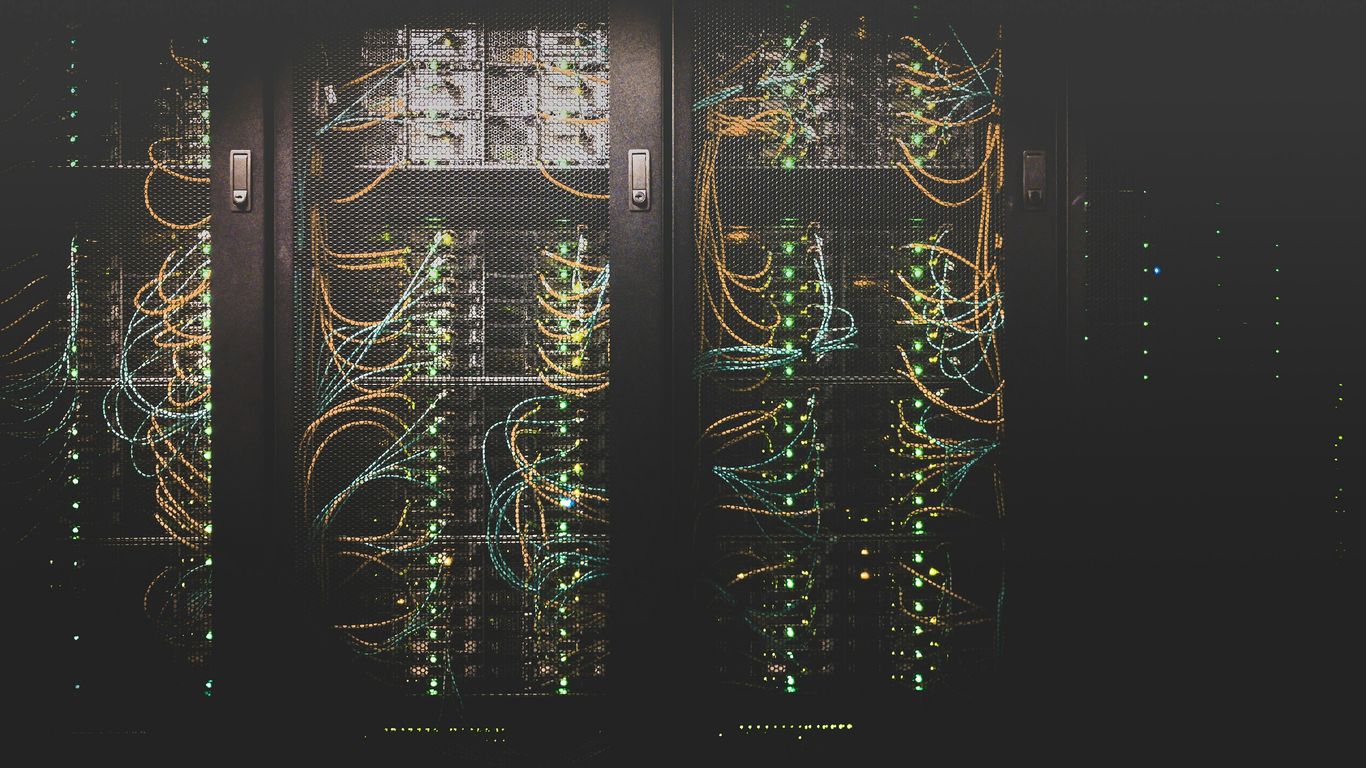
### Generating a secure hash during user registration
When a new user submits a registration form, the application must immediately capture the password and feed it into the Bcrypt function alongside a randomly generated salt. This ensures that the record is effectively blinded from the moment it is stored. For those managing [on-premises software](https://www.insidedeeptech.com/a-comprehensive-guide-to-on-premises-software-deployment/) deployments, this process must be part of a larger, strictly controlled data handling pipeline.
### Verifying password attempts during login workflows
Verification works by re-hashing the incoming password attempt using the salt stored from the initial registration record. The system then performs a timing-resistant comparison to see if the resulting hash matches the one in the database. This approach allows organizations to verify credentials safely, even as they [evaluate XDR](https://www.insidedeeptech.com/understanding-xdr-a-comprehensive-guide-to-extended-detection-and-response/) platforms to improve their broader security visibility.
### Leveraging standardized libraries for major programming languages
Developers should utilize well-maintained libraries rather than rolling their own implementations. For those working within the Python ecosystem, the [pyca/bcrypt](https://github.com/pyca/bcrypt?ref=insidedeeptech.com) library offers a robust interface for handling hashes and managing cost factors natively. Using established code reduces the risk of logic errors and ensures that cryptographic standards remain consistent across your technical stack.
## Best practices for Bcrypt configuration

### Selecting an appropriate cost factor for production environments
Modern infrastructure demands that security professionals strike a balance between user experience and system throughput. A cost factor of 12 is generally recognized as a reasonable entry point for typical user-facing applications, though higher factors may be required for elevated security environments. It is important to remember that as Inside Deep Tech reporting confirms, static security measures eventually fail as hardware advances, necessitating regular reassessment of these parameters.
### Balancing cryptographic security and server latency
Application response time is a key metric for user engagement, yet security operations must ensure that verification cycles do not become a vector for denial-of-service attacks. The following list outlines how to approach latency management effectively:
- Monitor server request duration specifically during authentication phase.
- Allow for minor latency increases as the cost parameter is incremented.
- Implement rate-limiting at the application level to thwart rapid-fire attempts.
- Offload hashing processes to specialized secure service nodes where possible.
By managing this carefully, systems remain fluid while continuing to impede malicious actors.
### Safely storing and managing hashed credentials in databases
Storing hashed credentials requires that the database environment itself be isolated and encrypted. Even with industry-standard hashing, administrators should treat password databases as Tier-0 assets. Ensuring that your [metadata remover](https://www.insidedeeptech.com/the-ultimate-guide-to-using-a-metadata-remover-for-privacy-and-security/) practices extend to all configuration files and logs prevents accidental exposure of environment salts.
## Security considerations and modern limitations
### Understanding Bcrypt maximum password length constraints
An important technical nuance of Bcrypt is that it truncates the input string after 72 bytes. While this is rarely an issue for most users, it is a design limitation that modern developers must keep in mind when establishing password length policies. For those following Inside Deep Tech standards, we suggest evaluating user input validation to prevent potential conflicts with this established buffer limit.
### Evaluating the transition to modern alternatives like Argon2
As Inside Deep Tech analysis frequently indicates, technological progress eventually necessitates platform migration. Argon2 serves as a memory-hard algorithm that provides better protection against GPU-based cracking attempts compared to Bcrypt. Teams should begin to map out potential transition paths should their security audits, such as those related to [AI healthcare](https://www.insidedeeptech.com/ai-and-healthcare-a-comprehensive-guide-to-modern-medical-innovation/) standards, require stronger protections against novel brute-force strategies.
### Handling potential vulnerabilities in legacy implementation strategies
Legacy environments often suffer from "weak rounds" where the cost factor has been set too low for current hardware. These implementations must be updated iteratively. Simply resetting all user passwords is not always practical, so developers should implement a 're-hash on login' strategy where the system automatically upgrades the hash strength the next time a user successfully authenticates.
## Conclusion
Bcrypt remains a foundational tool in the developer’s toolkit, offering an excellent balance of reliability and security for password storage tasks. While emerging alternatives like Argon2 provide hardware-hardened benefits for specific high-stakes requirements, Bcrypt’s longevity and widespread library support make it the standard choice for most production environments. By understanding its adaptive nature and maintaining rigorous configuration standards, developers can provide a robust defense for their users' credentials against increasingly sophisticated adversarial threats.
## Frequently Asked Questions
### What makes Bcrypt different from other hashing algorithms?
Bcrypt is an adaptive hashing function that integrates a salt and an iterative work factor, specifically designed to thwart brute-force attempts by being computationally expensive.
### Is Bcrypt secure enough for current production use?
Yes, provided the cost factor is calibrated correctly for the hardware, Bcrypt is widely considered secure for modern password storage requirements.
### What is a salt in the context of password security?
A salt is a random value added to a password during the hashing process, ensuring that identical passwords result in different hashes for every user in the database.
### How do I know which cost factor to select?
The cost factor should be chosen based on the target execution time for hashing on your server; the goal is to make it as slow as possible without creating a noticeable delay for the user during sign-in.
### Can Bcrypt be used for things other than passwords?
Bcrypt is specifically optimized for passwords and is not recommended for general-purpose file or data integrity hashing, which is better suited for faster algorithms like SHA-256.
### What happens if I go over the Bcrypt 72-byte limit?
If a password string exceeds 72 bytes, Bcrypt will ignore the excess characters, meaning the security of the password depends only on the first 72 bytes.
### Why is GPU-based cracking a concern for hashing?
GPUs can perform many thousands of calculations simultaneously, making it easier for attackers to guess passwords quickly if the hashing algorithm is not sufficiently memory-hard or computationally intensive.
### Understanding XDR: A comprehensive guide to extended detection and response
URL: https://www.insidedeeptech.com/understanding-xdr-a-comprehensive-guide-to-extended-detection-and-response/
Last updated: 2026-07-08T05:30:05.000Z
## Key Takeaways
As organizations face increasingly sophisticated cyber threats, moving beyond siloed security tools is essential for maintaining a defensive edge. This guide details how extended detection and response architectures unify telemetry to improve overall security resilience.
- Improved cross-layer visibility bridges gaps between endpoint, network, and cloud security.
- Unified analytics reduce manual investigation times by correlating diverse data streams automatically.
- Centralized remediation workflows allow for rapid incident containment across multiple infrastructure layers.
- Successful implementation requires balancing technological capabilities with existing organizational security workflows.
- Proactive integration of threat intelligence feeds remains central to maintaining accurate behavior-based detection models.
## The fundamentals of XDR
Security teams often operate in fragmented environments where distinct point solutions struggle to communicate effectively. XDR represents a strategic evolution in threat management by unifying data collection and response across multiple security layers to ensure consistent coverage. Organizations aiming to replace disconnected legacy systems often find that [Extended Detection and Response](https://www.sentinelone.com/cybersecurity-101/xdr/what-is-extended-detection-response-xdr/?ref=insidedeeptech.com) is essential for maintaining control over modern, distributed compute environments.
### Definition and core concept
The core concept of XDR revolves around the consolidation of security telemetry from disparate sources into a single, cohesive visibility fabric. Rather than treating an email filter, a server log, and a cloud firewall as isolated silos, the architecture enforces a common data schema that allows for holistic monitoring of an organization's digital attack surface.
### How XDR evolves beyond EDR
While foundational security measures like [endpoint detection and response](https://www.paloaltonetworks.com/cyberpedia/what-is-edr-vs-xdr?ref=insidedeeptech.com) provide critical visibility into local device activity, they lack the context needed to identify complex, multi-stage attacks that traverse the network or cloud boundaries. XDR extends this visibility by ingesting telemetry from identity providers, network traffic, and email gateways, effectively broadening the scope of what a security operations center can detect and mitigate in real time.
### Key components of the modern XDR stack
Modern XDR platforms rely on a robust ingestion layer, high-performance analytical engines, and bidirectional integration capabilities. These systems act as a central nervous system for threat data, utilizing machine learning to distinguish between routine administrative actions and genuine indicators of compromise. By maintaining deep integration with foundational infrastructure, these platforms convert massive data volumes into high-fidelity incidents that security teams can actually act upon.
## How XDR operates within the security ecosystem

Effective security operations rely on the seamless flow of telemetry from every node in the stack to a central analytical engine. This systematic approach ensures that no endpoint or cloud workload remains an unmonitored blind spot, enabling a more integrated security posture.
### Data collection and telemetry ingestion
The primary task of any XDR platform is the ingestion of diverse datasets, ranging from host-level process creation logs to network flow metrics and cloud service activity. Without normalizing these disparate data formats, correlation remains impossible, leading to the fragmentation that plagues older security models.
### Centralized analysis and cross-layer correlation
Centralized analysis occurs when the system correlates disparate alerts into a unified incident context. By chaining together minor signals, the platform creates a narrative of an ongoing attack, rather than flooding analysts with disconnected, low-level alerts.
| Detection Stage | Primary Data Source | Analytical Action |
| ----------------- | -------------------- | ------------------------------------ |
| Initial Access | Email Gateway Logs | Flagging suspicious phishing links |
| Lateral Movement | Network Traffic Flow | Anomaly detection in port usage |
| Data Exfiltration | Cloud Storage Access | Identifying irregular egress volumes |
The correlation engine provides the connective tissue that allows security analysts to view the entire life cycle of an incident in a single, interface-based timeline.
### Automated response and remediation workflows
Automation allows for standardized responses at machine speed, drastically reducing the time spent on manual containment tasks. When an incident is confirmed, the platform triggers workflows designed to isolate affected assets, update firewall rules, or revoke compromised identity tokens.
1. Automatically quarantine infected endpoints via agent integration.
2. Invalidate sessions for accounts showing anomalous beaconing behavior.
3. Update network access control lists to block malicious communication channels.
4. Trigger persistent forensic logging for affected cloud instances.
These orchestrated responses ensure that containment occurs long before a human analyst can manually log into the console.
## Key benefits of implementing XDR

Moving to an integrated platform changes the fundamental economics of security operations. By shifting the burden of data aggregation and event correlation from human analysts to intelligent software, teams gain significant improvements in both operational efficiency and threat mitigation effectiveness.
### Enhanced visibility across diverse IT environments
Visibility forms the bedrock of every effective security strategy, yet maintaining this across hybrid and multi-cloud architectures presents a significant challenge. By consolidating disparate signals, these platforms ensure that security teams can reliably monitor infrastructure wherever it resides, from on-premise hardware to ephemeral container environments.
### Reduced alert fatigue for security operations teams
Alert fatigue is a growing concern that often leads to staff burnout and missed critical warnings. By applying statistical analysis to filter out noise and focusing on context-rich incidents, security teams can dedicate their limited resources to valid security threats rather than endless cycles of checking false positives.
### Faster incident detection and resolution times
The integration of automated analysis and rapid dissemination of threat context allows organizations to reduce their mean time to detect and respond to threats. When actionable data is available instantly, the windows of exposure created by delayed manual investigation are closed more effectively.
## Selecting the right XDR platform for your organization

Selecting a platform requires a deep evaluation of your existing security stack and future operational goals. Because [Extended Detection and Response](https://www.microsoft.com/en-us/security/business/security-101/what-is-xdr?ref=insidedeeptech.com) initiatives represent a long-term architectural commitment, integration flexibility remains the single most important factor for technical teams.
### Compatibility with existing security infrastructure
Compatibility involves more than just API availability; it concerns the depth of meaningful telemetry that can be shared between existing legacy systems and the new platform. A truly effective deployment ensures that data from your current firewall, email protection, and endpoint agents can flow into the XDR analysis layer without extensive custom engineering.
### Evaluating native versus hybrid XDR architectures
Native platforms prioritize deep integration within a single vendor's ecosystem, often providing the most streamlined setup and performance benefits. Conversely, hybrid architectures allow organizations to retain their best-in-breed tools from different vendors, though this requires stricter attention to integration standards and potential data normalization challenges.
### Assessing scalability and resource requirements
Scalability considerations extend beyond simple compute capacity to encompass the volume of ingestible data and the complexity of real-time analytical queries. Teams must ensure the platform can handle peak ingestion spikes without throttling, as these peaks often correlate with the exact moments when detection performance is most critical.
## Challenges in XDR adoption
### Managing increasing data volumes and storage costs
The sheer volume of telemetry required for comprehensive visibility can quickly lead to escalating storage expenses. Organizations must implement intelligent data tiering strategies, keeping high-priority logs in active analysis pools while migrating raw, low-value data to more cost-effective storage solutions.
### Skill requirements for platform configuration and management
Proper configuration requires staff who understand both the underlying security architecture and the specific nuances of the new analytical platform. Without dedicated training and clear internal management policies, the system may provide suboptimal output, negating the primary benefits of the investment.
### Balancing vendor lock-in with unified security goals
Choosing a platform necessitates a trade-off between the ease of a consolidated vendor stack and the agility provided by a best-of-breed approach. Organizations must carefully consider how long-term dependency on a specific proprietary correlation engine might restrict their future ability to adapt to new threat vectors or incorporate novel security technologies.
## Best practices for successful XDR deployment
### Establishing security baselines for behavior analysis
Effective detection relies on understanding what normal activity looks like within your specific environment before attempting to identify anomalies. By establishing these baselines during the initial deployment phase, security teams provide the detection engine with the context necessary to differentiate between expected administrative shifts and potential breaches.
### Prioritizing critical telemetry sources for initial integration
Attempting to integrate every single data source simultaneously often leads to project paralysis and data quality degradation. Start by focusing on the most high-value signals—such as authentication logs and core network traffic—before gradually expanding to less critical telemetry sources.
### Leveraging threat intelligence feeds to improve detection accuracy
Threat intelligence provides the external context needed to make internal logs more actionable. By incorporating real-time feeds into the XDR analytical workflow, organizations remain updated on the latest indicators of compromise, allowing for proactive hunting and quicker adjustments to detection thresholds.
## Conclusion
Adopting an extended detection and response approach is a strategic move that aligns cybersecurity operational practices with the realities of modern, distributed IT environments. By prioritizing data integration, cross-layer visibility, and automated response capabilities, organizations can significantly shorten incident lifecycles and reduce the risk posed by adversaries. While the path to full implementation involves overcoming significant data and skill-based hurdles, the resulting resilience and operational efficiency provide a tangible, long-term security advantage for any technologically literate enterprise.
## Frequently Asked Questions
### How does XDR differ from traditional security information and event management systems?
Standard logging platforms aggregate data for archival purposes, whereas XDR platforms perform real-time, cross-layer automated correlation and response, turning data into active threat mitigation rather than passive archival records.
### Can my organization implement XDR if we already rely on multiple specialized security vendors?
Yes, by opting for a hybrid deployment model, organizations can integrate existing point solutions into a centralized detection platform, provided the platform supports the necessary vendor-specific API integrations and broad telemetry schemas.
### What are the most common telemetry sources to prioritize during initial rollout?
High-impact sources generally include identity and access management logs, endpoint process execution data, cloud infrastructure activity, and network perimeter flow logs, as these capture the majority of movement across an attack chain.
### Is automation in this platform safe without constant human oversight?
Most modern systems allow for configurable trust levels, where automated playbooks are restricted to low-risk containment actions, while high-impact actions—such as shutting down critical services—require mandatory human confirmation before execution.
### Does this approach replace the need for an internal security operations center?
No, because these tools are force multipliers that require skilled analysts to interpret complex findings, manage system tuning, and perform manual threat hunting when automated tools identify suspicious but non-deterministic activity.
### How do organizations measure the success of an implemented security platform?
Key performance indicators typically include objective metrics like the mean time to detect and mean time to respond to incidents, as well as qualitative metrics like the reduction in false-positive alerts per analyst shift.
### Is the cost of storing excessive telemetry worth the security gains?
While storage costs can be significant, the risk mitigation value gained from improved detection granularity often outweighs the expense, especially when paired with data tiering and lifecycle management policies that optimize long-term storage expenditures.
### The ultimate guide to using a metadata remover for privacy and security
URL: https://www.insidedeeptech.com/the-ultimate-guide-to-using-a-metadata-remover-for-privacy-and-security/
Last updated: 2026-07-07T23:28:09.000Z
## Key Takeaways
Digital files often contain hidden information beyond their primary content, which presents significant privacy risks if left unchecked. A dedicated tool helps sanitize files before sharing, and understanding the nuances of these data types is essential for maintaining individual and organizational security.
- Metadata includes hidden geographic, technical, and historical data within files.
- Privacy risks scale with the level of identifiable information embedded in media.
- Professional tools provide streamlined features for bulk scrubbing and automated workflows.
- Strategic data removal supports security compliance and minimizes personal footprint.
- Choosing the right tool requires balancing usability against specific privacy guarantees.
## Understanding metadata and why it matters

### What is digital metadata?
Metadata serves as the foundational cataloging system for digital assets, functioning essentially as data about data. It provides the necessary context—such as creation dates, file formats, and ownership details—that allows operating systems and applications to parse and organize files efficiently. While frequently invisible to the average user, this latent information layer remains a permanent fixture of almost every digital interaction.
### Common types of metadata in media files
Media files serve as particularly dense containers for metadata, often housing highly specific technical details that go far beyond a simple file name. In many cases, these files capture the underlying settings of the hardware responsible for their creation, potentially documenting specific lens focal lengths or audio compression algorithms. Without explicit scrubbing, these details remain attached to the asset throughout its lifecycle.
### Privacy risks associated with EXIF data
Exchangeable Image File Format (EXIF) data represents a primary concern due to the precision of the location details frequently recorded during image capture. When a device records GPS coordinates, it creates a trail that can pinpoint a user's movements to within a few meters. Leaking **sensitive location-tagged data** through shared media enables unintended surveillance and complicates the fundamental task of personal privacy management.
### When should you strip metadata from your files?
Prudence suggests that metadata removal should occur whenever a file transitions from a private environment to a public or semi-public distribution channel. Whether emailing a sensitive document or uploading assets to social media, the risk of ambient data leakage often outweighs the utility of preserving historical file information. Adopting a systematic approach ensures that personal identity and infrastructural details remain protected across every digital exchange.
## Benefits of using a professional metadata remover

### Protecting personal location data
Professional tools effectively strip geographic coordinates that could otherwise reveal home or work addresses. By removing these markers early in the file lifecycle, users gain control over their digital narrative and avoid the unintentional sharing of private movement patterns. Using a [Metadata Remover](https://www.metadata2go.com/delete-metadata?ref=insidedeeptech.com) ensures that location data is systematically identified and scrubbed, keeping personal whereabouts secure in an increasingly interconnected environment.
### Ensuring anonymity when sharing documents
Beyond location and technical settings, documents often contain hidden logs that track revisions and the identity of contributors. For professionals working on sensitive [on-premises software deployment](https://www.insidedeeptech.com/a-comprehensive-guide-to-on-premises-software-deployment/) projects, stripping this history is vital to prevent unauthorized disclosure of internal processes. The following list identifies key benefits of maintaining clean document metadata:
- Prevents exposure of software installation paths in revision history.
- Masks original document creation timestamps often required for patent filing.
- Eliminates embedded author names that identify internal team structures.
- Strips hidden track-changes data that reveals previous draft iterations.
### Reducing file size for efficient storage
Removing bulk metadata can have a secondary benefit of slightly reducing storage overhead, particularly when thousands of small files are managed simultaneously. While not the primary justification for professional intervention, periodic cleaning helps normalize file size, simplifying archiving for teams like those in [Scale AI](https://www.insidedeeptech.com/a-comprehensive-guide-to-scale-ai-data-infrastructure-for-model-development/) who prioritize structured model development.
### Compliance with data security standards
Regulatory frameworks frequently demand the minimization of collected user data as a standard security precaution. Sanitizing files before they enter a production pipeline or shared repository satisfies these internal audit requirements, transforming messy, identifying data into standard, compliant output. Maintaining such rigor serves as a cornerstone for building trusted, resilient [deeptech](https://www.insidedeeptech.com/understanding-deeptech-a-comprehensive-guide-to-revolutionary-technologies/) ecosystems.
## How to choose the right metadata remover tool

### Desktop applications versus online services
Choosing between desktop software and web-based utilities often comes down to the sensitivity of the data being processed. For highly confidential engineering documents, offline desktop applications prevent data from leaving the local machine, whereas browser-based tools offer convenience for faster, lower-stakes tasks. When utilizing online services like [MetaClean](https://www.adarsus.com/en/remove-metadata-online-document-image-video/?ref=insidedeeptech.com), ensure the platform provides explicit guarantees regarding how uploaded files are treated during the clearing process.
### Evaluating batch processing capabilities
Efficient handling of large file sets is a critical requirement for any organization scaling its output. A capable tool allows for simultaneous manipulation, reducing the time spent on manual cleaning and minimizing the risk of a single file slipping through the net. Evaluating a candidate tool requires testing its capacity to maintain performance while processing multiple file formats in a single session.
### Checking file format compatibility
Different file types require unique handling protocols, meaning a tool optimized for images may falter when encountering complex PDF structures or proprietary audio containers. A versatile [Metadata Remover](https://online-metadata.com/remove-metadata?ref=insidedeeptech.com) provides support across standard industry containers, ensuring that metadata—regardless of its origin or structure—is correctly identified and safely eradicated.
### Assessing privacy policies of third-party tools
Transparency is the primary metric by which one should judge the trustworthiness of a third-party utility. An ideal tool maintains a strict policy against storing or monetizing the metadata extracted from its users. Because digital status seeking, as discussed in the context of [grievance](https://peterashbysmith.substack.com/p/how-did-grievance-become-status) and social validation, creates incentives for companies to harvest user data, users must remain vigilant regarding the terms of service for any tool they integrate into their workflow.
## Advanced methods for removing metadata

### Using command-line tools like ExifTool
Command-line utilities grant unparalleled granularity in how metadata is purged, allowing experts to target specific tags while preserving others. This capability is useful when specific compliance requirements demand the retention of certain technical parameters while mandating the deletion of personal identifiers. The following table illustrates the variance in tag management capabilities provided by professional-grade tools:
| Feature | Basic GUI Tool | Advanced CLI Tool | Metadata Server |
| ---------------- | -------------- | ----------------- | --------------- |
| Batch Processing | Limited | Highly Scalable | Native |
| Tag Selection | None | Granular | Systemic |
| Log Retention | None | Optional | Mandatory |
### Utilizing built-in system removal functions
Modern operating systems provide rudimentary tools for stripping info from files, often accessible via standard property menus. While occasionally sufficient for light tasks, these functions rarely offer the depth of penetration required to fully scrub nested structures. They function best as a secondary defensive layer rather than a primary solution for security-sensitive data.
### Integrating metadata scrubbing into workflows
Integration involves automating the cleanup process as part of the standard document lifecycle. By embedding a cleaning step immediately before the publishing or sharing phase, organizations eliminate the risk of human error or forgetfulness. This proactive posture transforms cleaning from a manual chore into a seamless background task that reinforces overall data integrity.
### Handling complex nested metadata structures
Some files contain multiple layers of metadata nested deep within their binary structure, which basic scrapers often miss. Advanced handling involves extracting every data object level to ensure no latent information persists in legacy header fields or embedded comments. Ensuring this depth of cleaning is crucial in environments where total data obfuscation is a requirement rather than a suggestion.
## Common challenges and limitations
### Metadata loss in proprietary software
Some industry-specific applications rely on internal metadata to function, meaning an aggressive cleaning tool could potentially break file usability or cause data corruption. The challenge lies in identifying which tags are strictly identifying and which are functional, a distinction that varies from format to format and software to software.
### Balancing privacy with copyright protection
Metadata often acts as the only digital tether to prove intellectual property ownership, creating a difficult choice between total privacy and robust copyright protection. Stripping metadata may improve anonymity, but it also removes the digital trail that proves a work's origin or creation date. Users must decide their priority, understanding that anonymity and attribution exist on opposite ends of a single spectrum.
### Potential data corruption risks
Automated scrubbing attempts can occasionally render a file unidentifiable to legacy software, especially if the file's primary structure is damaged during the modification of header data. Reliability, therefore, depends on the tool's ability to maintain the integrity of the file's primary binary data while targeting only the non-essential metadata fields.
### Limitations of mobile-based removal apps
Mobile-based tools often lack the computational power or integration hooks to handle high-resolution files or complex formats efficiently. While convenient for quick photo snapshots, these apps face real hurdles when addressing large document archives or video assets, often sacrificing depth for portability and ease of access.
## Conclusion
Maintaining digital hygiene is an ongoing mandate in an era where files carry more personal information than the average user realizes. By deploying a systematic approach to cleaning assets using a verified metadata remover, individuals and professionals alike can effectively separate their output from their personal identity. As digital tools evolve in complexity, so too must the strategies employed to safeguard the information tucked away in the shadows of our daily files.
## Frequently Asked Questions
### Will removing metadata change the quality of my file?
A properly designed removal process targets only the hidden data containers and leaves the primary file content—the image pixels or audio data—untouched, ensuring the quality remains identical to the original.
### Can metadata ever be recovered after it is removed?
Once a file has been processed and saved by a reliable metadata remover, the original latent data is overwritten and cannot be recovered from the processed file itself.
### Does metadata contain information about the software I use to edit files?
Yes, many files record the specific version, software name, and computer system used to create or edit the content, which can reveal information about your tech stack.
### Are there any legal ramifications for removing metadata from my own files?
In most jurisdictions, you hold the legal right to strip information from files you own, though you should exercise caution if that metadata is required for intellectual property or contractual verification.
### Why do social media platforms keep the metadata of files I upload?
Platforms often harvest this data to build advertising profiles, categorize content for search, and correlate user activity across different devices and locations.
### Should I always use the most aggressive removal setting?
Not necessarily, as over-cleaning can strip useful attribution data that you may need later, so it is best to choose a level that matches your goal of privacy versus attribution.
### Can a computer virus hide in the metadata of a file?
While rare, it is technically possible for malicious code to be injected into certain metadata fields, which is another reason why sanitizing files before opening them is a sound security practice.
### A comprehensive guide to on-premises software deployment
URL: https://www.insidedeeptech.com/a-comprehensive-guide-to-on-premises-software-deployment/
Last updated: 2026-07-07T17:28:04.000Z
## Key Takeaways
Adopting on-premises deployment involves a strategic trade-off between total infrastructure control and increased operational responsibility. Organizations must carefully evaluate their specific requirements regarding data sovereignty, latency, and compliance before committing to local hosting solutions.
- Establishing local infrastructure requires significant upfront investment in physical hardware and dedicated support staff.
- Full ownership of software environments enables granular control over security protocols and data management.
- Maintaining isolated systems introduces ongoing responsibility for patches, updates, and disaster recovery planning.
- Hybrid models increasingly allow organizations to bridge the divide between local performance and cloud agility.
- Success depends on rigorous capacity planning and alignment with industry-specific technical regulatory standards.
## Defining on-premises software
### The technical architecture of local hosting
The fundamental premise of local hosting involves housing application logic and data processing directly within an organization’s designated physical footprint. This architecture bypasses external service providers, ensuring that the entire technology stack—from the database layer to the front-end interface—resides on private servers. In this environment, technical teams manage the full lifecycle of the software installation, which effectively turns the organization into its own data center provider. The [on-premises software](https://en.wikipedia.org/wiki/On-premises%5Fsoftware?ref=insidedeeptech.com) model demands that the business configure its internal network topology to handle traffic, storage, and computing loads locally.
### Comparison with cloud-based infrastructure
Transitioning away from a reliance on the public cloud often reveals distinct operational divides in how systems are architected. While cloud services abstract away the complexity of hardware management through subscription-based scaling, local deployment demands hands-on administration of both compute and storage assets. Understanding [the fundamental differences](https://www.casepoint.com/resources/spotlight/cloud-based-vs-on-premise-software-key-benefits/?ref=insidedeeptech.com) between these models is essential for optimizing long-term infrastructure efficiency.
| Deployment Model | Primary Control | Typical Cost Structure | Scaling Mechanism |
| ---------------- | --------------- | ---------------------- | ---------------------- |
| On-Premises | Internal Staff | High Upfront CapEx | Hardware Procurement |
| Public Cloud | Third Party | Monthly OpEx Fees | Virtualized Elasticity |
| Hybrid Cloud | Shared/Tiered | Mixed Allocation | Workload Distribution |
Selecting the appropriate deployment architecture requires identifying where the organization places its primary value, whether that lies in hardware sovereignty or consumption-based agility.
### Identifying common target use cases
Organizations handling highly sensitive intellectual property or navigating stringent compliance landscapes often find local hosting to be the most viable path. Industries such as defense, healthcare, and advanced research labs frequently require keeping data behind secure firewalls to meet legal obligations. Furthermore, businesses that operate in [regulatory environments](https://www.arenasolutions.com/resources/glossary/on-premise-software/?ref=insidedeeptech.com) often need to ensure that their entire data lifecycle remains within a verified jurisdiction. When uptime is critical and network connectivity is unreliable, the local approach provides a **stable foundation for essential operations** that must function independently of any wide-area network dependency.
## Strategic benefits of local deployment
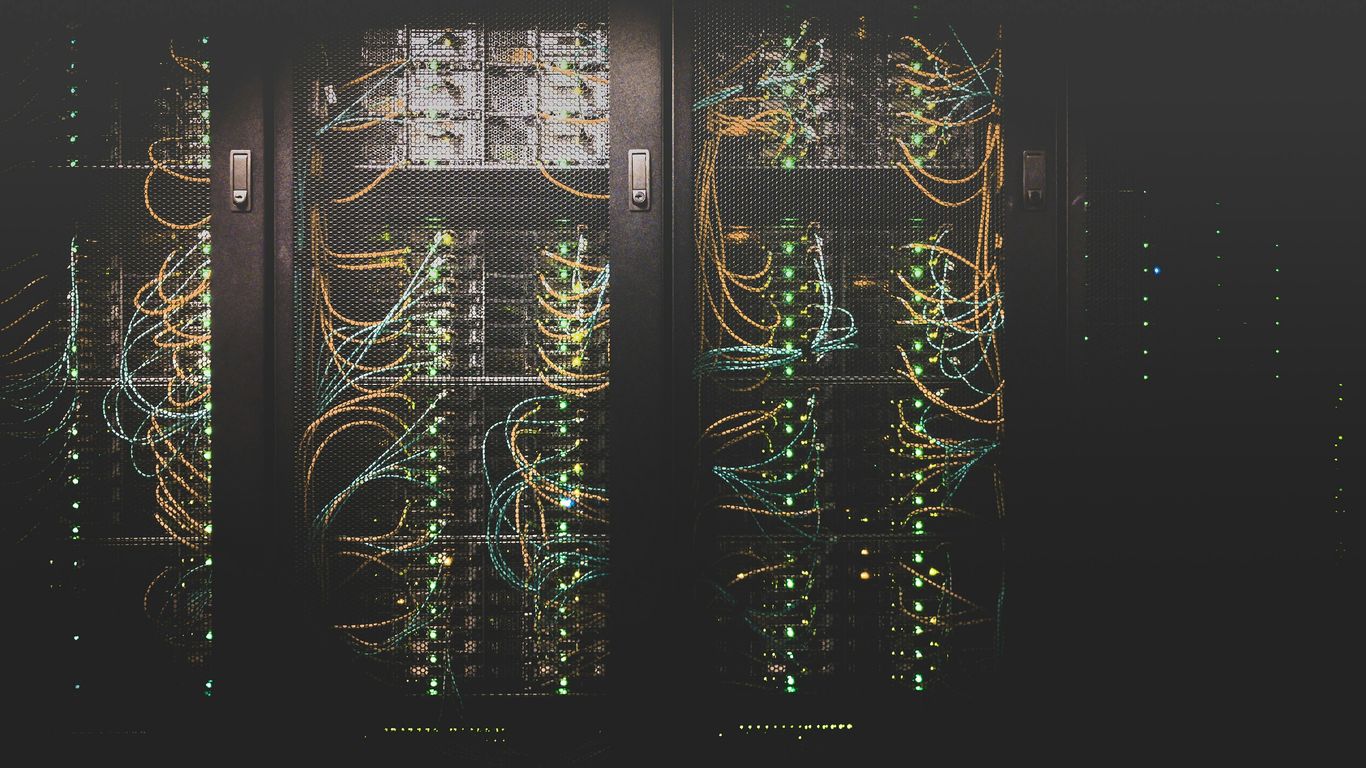
### Total control over data and security
By keeping the entire stack in-house, an organization retains absolute authority over its security perimeter. This granular control allows for the development of custom protocols tailored specifically to the infrastructure. Unlike standardized cloud offerings, local hosting grants teams the ability to audit every physical node and network port.
### Performance consistency in low-latency environments
Physical proximity to compute resources significantly reduces communication hurdles in high-frequency trading or industrial automation. For teams deploying [autonomous mobile warehouse robots](https://www.insidedeeptech.com/accio-robotics-review-autonomous-mobile-warehouse-robots-explained/), the reduced latency provided by a local server ensures consistent real-time responsiveness. This eliminates the unpredictability of shared public network backbones, ensuring timing cycles remains within tight tolerances.
### Long-term cost predictability for established systems
While the initial outlay is larger, local infrastructure avoids the compounding impact of variable subscription fees. Once the depreciation cycle of the hardware is factored into the budget, the operational spend becomes highly transparent. This predictability supports firm long-term fiscal planning as the technology becomes deeply integrated into the organizational workflow.
## Common limitations and technical challenges
### High initial capital expenditure
Launching an on-premises stack requires heavy investment in server hardware, power supplies, and network connectivity equipment. Unlike cloud consumption models, this upfront capital requirement can strain liquidity before a single transaction is processed. A shift in strategy means a shift in accounting, moving from predictable monthly outflows to chunky capital planning cycles.
### Responsibility for hardware maintenance and updates
Internal teams own the remediation of hardware failure and the application of low-level security patches. The logistical effort involved in maintaining this hardware includes several core responsibilities:
- Managing periodic server firmware upgrades and BIOS security updates.
- Providing round-the-clock power redundancy and uninterruptible supply systems.
- Coordinating hardware retirement and secure disposal for aging components.
- Overseeing physical rack-level reorganization for efficient cooling performance.
This labor-intensive cycle ensures that technical resilience is baked into the daily operational rhythm.
### Scalability hurdles in shifting demand environments
Unlike cloud environments that auto-scale in response to traffic, on-premises systems are limited by the physical capacity of the current server farm. Expanding capacity during unexpected surges requires procurement, physical installation, and rigorous configuration of new nodes. This creates a time-lag between the demand for resources and the ability to furnish them, necessitating precise and forward-looking capacity planning.
## Security considerations and compliance

### Managing physical and network-level security
Securing an on-premises setup requires a multi-layered approach that includes biometric physical entry restrictions and segmented internal network firewalls. Because the entire surface area of the infrastructure is owned by the business, every switch, cable, and gateway is a potential vulnerability that requires dedicated oversight. Protecting this surface necessitates constant monitoring of ingress and egress traffic moving through the physical data center.
### Aligning with industry-specific data privacy regulations
Many organizations are bound by regulations that require strict data residency, which local deployment inherently satisfies by guaranteeing no data ever leaves the premises. This approach allows institutions to maintain full compliance with data privacy mandates by controlling the physical storage medium. It simplifies the reporting process since the organization knows exactly where every data bit is located at all times.
### Patch management in isolated environments
Isolated systems often operate in air-gapped or restricted network zones, making automatic background updates impossible. Teams must download updates through secure channels, verify them in a sandbox, and perform manual deployments. While this provides a high level of security by preventing unauthorized remote access, it requires a disciplined schedule to ensure that critical software versions remain current.
## Assessing the infrastructure requirements
### Hardware procurement and capacity planning
Capacity planning requires accurate projection of compute and storage needs over a three-to-five-year horizon. Teams must balance current performance requirements against potential future needs to avoid premature obsolescence. Getting this balance right is critical, as over-provisioning wastes capital, while under-provisioning degrades operational performance.
### Power, cooling, and space availability
High-density server deployments demand specialized environments capable of dissipating significant heat. Providing reliable power often requires redundant grid feeds and diesel backups to ensure the site remains operational during utility failures. Ensuring floor-space and rack capacity exists within existing buildings is a core hurdle that can drive architects toward expansion or building retrofits.
### Specialized personnel for server administration
Maintaining the technology stack requires expertise in hardware cabling, virtualization software, and network stack troubleshooting. Managing the depth of [infrastructure requirements](https://www.splashtop.com/blog/on-premises?ref=insidedeeptech.com) demands a level of focus that is often distinct from cloud management. The organization requires personnel capable of translating business requirements into stable hardware specifications.
## Transitioning from cloud to on-premises software
### Evaluating the business necessity for migration
Moving an application back from the cloud is a heavy decision usually driven by latency needs, compliance mandates, or a desire for long-term fiscal predictability. An objective audit should contrast current monthly cloud spend against the projected depreciation costs of on-premises hardware. This analysis must be thorough, including hidden items like specialized staffing and energy consumption.
### Mapping existing data and software dependencies
Existing cloud setups often rely on proprietary managed services that do not have direct, out-of-the-box local counterparts. Each dependency—database engines, auto-scaling groups, or load balancers—must be replaced with an equivalent local component. Mapping these linkages allows engineers to identify which segments of the infrastructure can be migrated cleanly and which require complete architectural refactoring.
### Mitigating operational downtime during implementation
Executing a migration without disrupting business continuity is a monumental task that requires phased deployment. By running the local and cloud systems in a temporary parallel state, teams can synchronize data and verify integrity before performing the final cut-over. This minimizes exposure to catastrophic failure and provides an immediate fallback if primary migration metrics are not achieved during the initial phase.
## Future outlook for on-premises solutions
### The rise of hybrid deployment models
The future of infrastructure is not purely binary; instead, it is increasingly defined by hybrid convergence. By keeping latency-sensitive, regulated data on-premises while offloading compute-heavy, non-critical AI training to the cloud, organizations optimize across both cost and performance. This balanced approach is becoming the standard for modern enterprise operations.
### Edge computing as an extension of local infrastructure
Local data processing is moving closer to the point of origin, with edge nodes acting as decentralized extensions of the primary data center. This architecture allows companies to push computing logic out to the field, making it essential for high-fidelity responses in modern industrial and logistical operations. Edge deployments now function as a critical layer that extends the reach of traditional [on-premises software](https://www.scalecomputing.com/resources/cloud-vs-on-premises?ref=insidedeeptech.com) environments.
### Technological convergence with virtualized hardware
Modern hardware is increasingly defined by software, with virtualization making it easier to manage physical capacity. By decoupling the software stack from the underlying hardware, systems gain massive flexibility in how they handle maintenance and upgrades. This evolution reflects the broader shift toward defined compute resources, ensuring that organizations can scale efficiently without constantly ripping out physical components.
## Conclusion
On-premises deployment represents a commitment to sovereignty and specialized performance over the general-purpose flexibility offered by the cloud. For the modern engineer, the challenge lies in effectively managing the hardware lifecycle while maintaining the agility of a modern software stack. When the benefits of total infrastructure control and data security align with the business's regulatory and performance needs, the local model provides a robust, defensible foundation for long-term growth.
## Frequently Asked Questions
### What are the main drawbacks of on-premises hosting?
The primary drawbacks involve high upfront costs, the need for specialized personnel to manage physical infrastructure, and the responsibility for handling all maintenance and security updates. It also introduces less flexibility compared to the elastic scalability found in public cloud services.
### How does on-premises software ensure better data ownership?
By storing data physically within the company's own facilities, you eliminate dependency on third-party cloud providers, ensuring that you maintain complete control over access, storage, and the underlying infrastructure that houses your sensitive information.
### Is the initial cost of on-premises infrastructure higher than cloud services?
Yes, the initial capital expenditure for on-premises solutions includes the purchase price of server hardware, networking equipment, and licensing, whereas cloud services generally operate on an operational expenditure model with recurring subscription fees.
### Can on-premises infrastructure be as scalable as the cloud?
It is inherently harder to scale on-premises solutions because physical resources must be budgeted, purchased, and installed manually, whereas cloud providers rely on vast pools of remote computing resources to provide near-instantaneous scaling.
### What industries benefit most from keeping software on-premises?
Industries with strict regulatory requirements, such as defense, healthcare, and finance, benefit most because they require total control over where data is stored and how it is protected against unauthorized access.
### How often do companies typically replace their on-premises hardware?
Hardware refresh cycles usually occur every three to five years, depending on the performance requirements, the depreciation schedules established by the finance department, and the rate at which newer, more efficient hardware becomes available.
### Does on-premises software prevent the use of cloud-based tools?
Not at all, as many modern organizations use hybrid models, running critical tasks on local hardware to ensure security or performance, while utilizing cloud-based SaaS tools for peripheral or non-sensitive functions.
### A comprehensive guide to Rhoda AI and its approach to robotics
URL: https://www.insidedeeptech.com/a-comprehensive-guide-to-rhoda-ai-and-its-approach-to-robotics/
Last updated: 2026-07-07T11:27:10.000Z
## Key Takeaways
Rhoda AI is pioneering a shift in how robots learn, moving away from rigid programming to models informed by massive visual datasets. The following points summarize the company's approach to the future of robotics.
- Utilization of internet-scale video datasets for motion pre-training.
- Development of the Direct Video-Action Model to control robot policies.
- Focus on heavy-duty industrial tasks like assembly and returns processing.
- Deployment of FutureVision to enable autonomous decision-making.
- Emphasis on handling real-world variability through closed-loop predictive control.
## The mission and origins of Rhoda AI
### Background on the company’s founding
Rhoda AI was established to bridge the gap between digital intelligence and physical execution, a challenge that has long defined the frontier of industrial robotics. The founders, including seasoned technology leaders, sought to move beyond the limitations of pre-programmed, static automation that dominates today's factory floors. By focusing on fundamental physical interaction, the team aims to build systems that can thrive where conventional robots historically fail.
### The shift from digital AI to physical robotics
Transitioning from purely digital large language models to agentic physical hardware requires a rethink of how machines interpret their surroundings. Rather than relying solely on language-based instructions, the company emphasizes the importance of understanding the physical laws that govern motion and dynamics. This perspective is vital for [Physical AI](https://www.insidedeeptech.com/understanding-physical-ai-a-guide-to-intelligence-in-motion/), which seeks to integrate sensory perception with motor control in real-time environments.
### Securing capital to scale operations
Scaling operations in the hardware sector is notoriously capital-intensive, requiring sustained funding to turn experimental models into commercially viable products. The company has successfully secured substantial Series A rounds, elevating its valuation and providing the resources needed for high-fidelity simulation and physical prototyping. This capital deployment has allowed the team to pursue [general purpose bimanual manipulation](https://www.forbes.com/sites/annatong/2025/10/15/two-ai-startups-have-each-raised-100-million-to-build-humanoid-robots-in-stealth/?ref=insidedeeptech.com) at a scale rarely seen in early-stage robotics.
## Training robots using video data

### The technical challenge of physical task imitation
Teaching a robot to complete a task through imitation remains difficult because industrial processes are rarely perfectly repeatable. Environmental variables often change, leaving traditional static approaches unable to adjust to shifts in layout or object positioning. Bridging the gap between a learned policy and a physical **real-world environment requires innovation** in how robots absorb data.
### How Rhoda AI integrates visual data into movement
To address this, the company leverages its signature Direct Video-Action Model. By feeding the controller vast amounts of internet-scale video, it forces the system to learn the underlying physics of how objects move and interact before it ever touches a piece of hardware. This approach provides a robust internal model of motion that serves as a foundation for future tasks.
### Advantages over traditional coding methods
Compared to manual hard-coding of every single movement trajectory, this video-centric training offers significant improvements in agility and generalization. We compared these methods in the table below:
| Feature | Traditional Coding | Rhoda AI Method |
| ---------------- | ------------------ | --------------- |
| Generalization | Low | High |
| Setup Time | Weeks | Hours |
| Task Variability | Poor | Excellent |
This table illustrates why [robot foundation models](https://www.insidedeeptech.com/understanding-nvidia-isaac-gr00t-a-foundation-model-for-generalist-robots/) are viewed as a necessary upgrade for dynamic assembly lines and complex logistics chains.
## Key innovations in humanoid movement

### Enhancing physical dexterity through machine learning
Physical dexterity is the primary barrier to the widespread adoption of humanoid robots. The current architecture focuses on fine motor control, allowing the systems to perform delicate tasks like removing tabs or handling heavy, fragile items. By optimizing for high-degree-of-freedom manipulation, these machines attempt to mimic the fluidity of human movement.
### Reducing errors in autonomous tasks
Autonomous consistency is achieved by maintaining a deep memory of past frames rather than reacting only to the immediate image. This temporal awareness prevents system errors that would otherwise occur when two states appear similar but require vastly different actions. As noted in research concerning [industrial robotics navigation](https://www.insidedeeptech.com/tag/robotics/), maintaining this history is critical for operational precision.
### Balancing stability with fluid interactions
Stability is a hallmark of success for any bipedal or manipulation platform. The company employs advanced reward-shaping to ensure that the robot maintains its center of mass during strenuous labor, such as lifting objects over 50 pounds. This balance between raw strength and delicate control is what allows the technology to operate effectively alongside human workers.
## Implications for the robotics industry

### Potential to replace repetitive labor tasks
As the industry matures, these robots are designed to handle the "dull, dangerous, and dirty" jobs that currently rely on human labor. By automating tasks like warehouse returns processing, firms can mitigate the impacts of labor shortages while increasing overall throughput. This shift is typical of the broader [industrial automation](https://www.insidedeeptech.com/a-comprehensive-guide-to-industrial-automation-with-anybotics/) trend where reliability determines long-term adoption.
### Competition with other robotics startups
The market for humanoid and general-purpose systems is becoming increasingly crowded with well-funded teams. However, the advantage often lies in the ability to deliver a stack that integrates seamlessly into existing workflows. Whether it is navigation or object manipulation, the goal remains to achieve [consistent uptime](https://www.insidedeeptech.com/a-comprehensive-agility-robotics-review-technology-use-cases-and-market-impact/) in unpredictable environments.
### Impact on the manufacturing sector
Manufacturing is the initial training ground for these systems, where structured but complex environments test the software's capabilities. When deployed in assembly lines, the technology serves as a proof of concept for broader industrial rollout. Many partners are currently exploring the use of these platforms to reduce human risk in hazardous zones where heavy lifting is routine.
## Challenges and ethical considerations
### Reliability and safety in real-world environments
Operating in human-filled spaces necessitates stringent safety protocols that go beyond standard simulation tests. Ensuring that the system can react to unexpected intruders or sudden hardware failures is a paramount concern. Real-world deployment is always more challenging than laboratory testing due to the sheer noise and unpredictability of uncontrolled spaces.
### Handling complex, unstructured data sets
While pre-training on web-scale video provides a strong prior, adapting to specific site conditions requires supplemental fine-tuning. This process creates a bottleneck where developers must balance the breadth of pre-trained knowledge with the specificity of onsite operational requirements. These [advanced robotic systems](https://www.insidedeeptech.com/understanding-scout-ai-a-guide-to-the-technology-and-its-applications/) rely on precise data ingestion to bridge this final gap.
### Societal impact of humanoid labor expansion
The economic viability of humanoid labor raises fair questions about the displacement of human workers. Proponents argue that introducing these machines will drive efficiency and allow humans to focus on higher-value tasks, while critics emphasize the need for ethical guidelines regarding machine autonomy. Managing this transition will require thoughtful consideration of both the [general-purpose humanoid robot](https://www.insidedeeptech.com/understanding-1x-technologies-innovations-in-humanoid-robotics/) potential and its social constraints.
## Future roadmap for Rhoda AI
### Commercial deployment strategies
The commercial path forward focuses on deep partnerships with specific industrial clients to refine the policy models. Rather than a broad retail rollout, the company emphasizes the [FutureVision](https://www.therobotreport.com/rhoda-ai-exits-stealth-with-450m-to-train-robots-from-video/?ref=insidedeeptech.com) deployment, which integrates directly into existing logistics infrastructure. This iterative strategy ensures that the machines solve real problems before they reach broader markets.
### Partnerships and integration with existing hardware
Successful integration often requires that new agents function within the existing ecosystem of warehouses and factories. By ensuring compatibility with established fleet management systems, the company reduces the friction involved in adoption. This hardware-agnostic approach is designed to make their robot foundation models as useful as possible to diverse customers.
### Scaling training algorithms to more complex behaviors
Looking toward the future, the research team aims to increase the agentic capabilities of their systems. Scaling from narrow tasks like decanting boxes to complex, multi-step workflows will be the next frontier for the company. Through continuous observation and fast learning mechanisms, the objective is to create robots that grow more capable with every operational hour.
## Conclusion
By leveraging the vast visual knowledge available on the internet, Rhoda AI is building a new class of robots that learn through experience rather than explicit instruction. This shift toward video-predictive control represents a significant development in the broader field of Physical AI, offering a credible path toward machines that can navigate the unpredictability of human industrial environments. As the company continues its deployment through [Rhoda AI careers](https://builtin.com/company/rhoda-ai?ref=insidedeeptech.com) and industrial partnerships, the capability of these robots to handle genuine 3D tasks will define the next phase of the labor landscape.
## Frequently Asked Questions
### How do robots learn from video data?
Robots learn by observing thousands of hours of internet-scale video to understand physics and gravity before being applied to a real-world task.
### What are the main limitations of current robotics?
Existing systems often struggle with real-world variability, such as changing layouts, messy environments, and unpredictable human interactions.
### Are humanoid robots safe to work around?
Safety is a primary design constraint, requiring advanced sensing and constraint-based reinforcement learning to ensure reliable operation in human spaces.
### Why is heavy lifting a significant goal for companies?
Heavy lifting is a persistent industrial challenge because traditional systems often lack the balance, stability, or articulation required to handle objects safely at scale.
### Can robots replace people in factories?
Robots are currently intended to augment human labor by performing repetitive, ergonomic-heavy tasks, allowing people to focus on higher-level supervisory duties.
### How does pre-training help robotics?
Pre-training provides machines with a strong prior understanding of how objects move and collide, which drastically reduces the time needed for site-specific setup.
### What does human-robot collaboration look like?
It involves robots navigating dynamic environments efficiently while adhering to strict safety protocols that prioritize human presence and workspace integrity.
### 10 best companies building in robotics today
URL: https://www.insidedeeptech.com/10-best-companies-building-in-robotics-today/
Last updated: 2026-07-07T05:26:02.000Z
## Key Takeaways
This analysis examines the leading organizations currently shaping the robotics sector through advancement in mobility, precision, and automation software. Understanding these firms provides essential signal on where industrial and human-centered robotics are heading over the next decade.
- Advanced industrial robotics are now moving beyond manufacturing into healthcare and logistics.
- Software-defined autonomy is becoming the primary differentiator for long-term operational success.
- Key performance metrics are shifting from simple throughput to reliability across unstructured environments.
- Deployment of legged locomotion is expanding the effective operational envelope on job sites.
- Integration of machine learning models is accelerating the transition from predefined tasks to adaptive operations.
## 1\. Boston Dynamics
Boston Dynamics has maintained a rigorous focus on the physical intelligence of legged robots, effectively shifting the boundary of what mobile machines can achieve in structured and unstructured environments. Their ongoing work involves refinement of gait dynamics and balancing algorithms that allow units to navigate complex spatial constraints where traditional wheeled solutions fail. By prioritizing mobility over fixed-base automation, they have solidified their status as a reference point for research-led commercial robotics development.
While their earlier work often served as proof-of-concept prototypes, the recent push toward warehouse and inspection applications signals a transition into practical infrastructure. This shift necessitates deep reliability standards and a refined approach to **autonomous environment navigation** that reduces the need for constant human oversight. Their engineering trajectory underscores the reality that high-performance hardware requires equally robust control logic to succeed outside the laboratory.
Ultimately, the company illustrates the long-term commitment required to bring advanced kinematics to the mass market. Their contribution to the current ecosystem is not merely the delivery of a fleet of units, but the maturation of the control architectures that enable machines to handle the unpredictability of a real-world facility. They remain one of the most significant entities when considering the future of mobile robotics at scale.
## 2\. ABB
ABB Robotics functions as a fundamental pillar in global industrial automation, leveraging its OmniCore controller platform to drive motion control in a wide variety of production sectors. Their systems enable sophisticated synchronization between multiple robotic cells, ensuring that high-speed assembly processes maintain strict tolerance levels over millions of cycles. The focus here remains on the precision required by sectors like automotive and pharmaceutical manufacturing, where zero-deviation outputs are a requirement rather than a goal.
| Industry | Primary Capability | Deployment Focus |
| -------------- | ------------------- | ------------------------ |
| Automotive | High-speed welding | Chassis assembly |
| Pharmaceutical | Cleanroom packaging | Sterile handling |
| Electronics | Precision sorting | Small component assembly |
- Enhanced motion control for coordinated arm movement.
- Modular software suites for rapid cell reconfiguration.
- Integrated safety protocols for mixed human-machine zones.
These capabilities provide a technical baseline for manufacturers looking to increase output without sacrificing reliability. By standardizing the interface between hardware and logic, they enable firms to deploy complex automation solutions that remain consistent across varying international production sites. The focus on modularity allows for a quicker integration timeline in facilities that frequently cycle through new product iterations.
## 3\. Fanuc
Fanuc stands as the largest manufacturer of industrial robots and CNC systems, utilizing a design philosophy that prioritizes hardware reliability above nearly all other factors. Their yellow robotic arms are integrated into the backbone of global manufacturing because they are engineered to run for years with minimal maintenance interventions. This focus on long-term durability has made them the default selection for heavy-duty environments where machine downtime would result in massive financial inefficiencies.
Beyond simple mechanical robustness, the firm has invested heavily in their intelligent controller interfaces to ensure that their hardware remains compatible with modern factory software stacks. This approach ensures that legacy manufacturing investments can be updated with newer sensor suites and AI-driven path planning without replacing the primary mechanical foundation. Their systems prove that the lifespan of the machine is often the most critical variable in determining the ROI of an automated facility.
For operators, the advantage lies in the widespread familiarity with their ecosystem. Maintenance teams across the globe are trained on these architectures, which lowers the barrier to operation and troubleshooting in complex industrial environments. They exemplify how scaling a proprietary, reliable hardware platform can dominate the global market while creating a standardized path for industrial upgrades.
## 4\. Intuitive Surgical
Intuitive Surgical represents the vanguard of robotic-assisted medical procedures, focusing on the high-stakes environment of the operating room. Their systems are designed to provide surgeons with a level of precision and scaling that would be impossible through conventional manual access. By facilitating minimally invasive procedures, they demonstrate how robotic platforms can improve patient outcomes while simultaneously reducing recovery times.
This application of Best Companies Building in Robotics extends into the digital processing of medical imagery, where the system provides enhanced feedback to the operator. The focus here is strictly on latency-free transmission and tactile fidelity, ensuring that the surgeon’s intent is perfectly translated through the robotic appendages. It serves as a prime example of high-maturity Physical AI integrated into life-critical workflows.
Despite the extreme technical constraints of the clinical environment, the company has successfully scaled its technology globally by proving the economic long-term viability of robotic assistance within hospital operations. The focus remains on educational support for surgeons and the constant refinement of the instrumentation suite. They showcase how a closed-loop system can refine its performance over decades of iterative software and hardware updates.
## 5\. Teradyne
Teradyne has carved out a unique position in the market by diversifying into collaborative robotics, recognizing that modern manufacturing requires machines to work safely alongside human operators. By prioritizing ease of programming and adaptability, their systems lower the complexity barrier for mid-sized production facilities that might otherwise rely on manual assembly. Their contribution to the sector is defined by simplifying the path to automating repetitive and ergonomically challenging tasks.
This approach aligns with the growing demand for flexibility, where manufacturing lines often need to be reconfigured to handle different products without the cost of extensive re-tooling. By providing interfaces that are intuitive enough for floor staff to manage day-to-day changes, the organization demonstrates the value of accessible, software-led automation. It is a clear move toward [Physical AI](https://www.insidedeeptech.com/understanding-physical-ai-a-guide-to-intelligence-in-motion/) as a standard operational tool.
Looking at their long-term strategy, the focus remains on enhancing the capability of their arm sensors to better identify and interact with surroundings. By bridging the gap between high-end industrial performance and user-friendly operation, the company demonstrates why accessibility is as vital as pure mechanical power. Their success is a strong indicator of how automated collaboration will continue to redefine the modern factory floor.
## 6\. KUKA
KUKA is recognized for its advanced development in large-scale mobile platforms and heavy-duty industrial robotics that serve the automotive and aerospace industries. Their architecture excels in environments where massive loads must be handled with sub-millimeter precision, making them the preferred choice for tasks that are traditionally too dangerous or too strenuous for manual labor. The focus is on the integration of power and control systems that allow for high density in robotic cells.
Beyond the physical capacity of their units, the organization emphasizes the importance of data-driven insights through their digital twin simulations. Before an arm ever executes a motion on a physical site, the firm’s software validates the movement for collision risks and lifecycle degradation. This digital-first strategy represents a critical shift in how [industrial automation](https://www.insidedeeptech.com/tag/robotics/) is planned and maintained in high-speed manufacturing environments.
Their commitment to open, modular software standards also allows for easier integration with third-party automation tools, which is vital for modern factories seeking to unify their operational data. By enabling seamless communication between different layers of the factory stack, they help firms reduce operational bottlenecks. They provide the foundational capability for large-scale infrastructure that requires both brute force and extreme algorithmic precision.
## 7\. Yaskawa Electric
Their systems are built to withstand the rigors of continuous operation, making them a staple in plants where thermal resistance and structural integrity are non-negotiable. The engineering approach emphasizes [autonomous welding](https://www.insidedeeptech.com/path-robotics-review-an-in-depth-analysis-of-autonomous-welding-technology/), which reduces the safety risks to human workers while significantly accelerating production throughput. It is a practical application of robotics that solves a direct, measurable pain point for industrial operators.
When considering total cost of ownership, the organization succeeds by providing a package that scales well across international markets. Their global support infrastructure ensures that even in remote manufacturing hubs, the hardware receives the professional service required for long-term viability. This commitment to both the engineering of the arm and the longevity of the deployment creates a resilient model for the core of the industrial robotics space.
## 8\. Starship Technologies
Starship Technologies addresses the massive gap in autonomous delivery, moving from theoretical robotics to mass deployment in urban environments. By building a fleet of small, ground-based delivery robots, they have generated the data necessary to handle the daily chaos of city traffic, weather-related variables, and human interaction. Their approach demonstrates that the key to success in delivery robotics is not just hardware, but the underlying coordination software that manages thousands of simultaneous routes.
Their success has been built on a series of small, iterative deployments that prioritizes safety and local compliance above rapid expansion. By operating in carefully mapped environments, they have refined the perception systems of their robots to be effective at navigating crosswalks and obstacles found on standard sidewalks. This focus on high-fidelity, real-world data collection has allowed them to solve problems that many other autonomous systems still struggle with in simulation.
For the industry, the company provides a case study in how to navigate the regulatory and logistical challenges of deploying robots into public spaces. They prioritize durability and simplicity, ensuring that their current fleet can operate reliably throughout the year with minimal maintenance requirements. Their growth trajectory points to a future where localized last-mile delivery is entirely supported by distributed, autonomous fleets.
## 9\. UiPath
UiPath has fundamentally redefined modern productivity through its leadership in [Robotic Process Automation](https://www.oxygenit.co.nz/business-ai-tools/?ref=insidedeeptech.com), translating the principles of robotics into the digital workspace. By creating tools that allow existing business applications to be treated as modular components, they have enabled firms to automate entire workflows that previously required manual data entry. The result is a significant reduction in human error and a massive increase in organizational throughput across finance, HR, and logistics tasks.
Their architectural design emphasizes the ability to observe and interpret existing human-computer interactions, then replicating them with high accuracy at scale. This invisible hand of automation functions as the software equivalent of a factory robot, handling repetitive sequences in a digital environment. By focusing on the integration of these processes, they show that automation is most effective when it bridges the gap between disconnected software systems.
Their commitment to research-led development ensures that the automation suite is constantly updated with new machine learning capabilities. By enabling firms to deploy bots that handle complex decision-making, they reduce the operational drag that typically slows down large organizations. They provide the backbone for [automated fulfillment](https://www.insidedeeptech.com/a-comprehensive-guide-to-nimble-robotics-and-automated-fulfillment/) and data management that allows modern businesses to remain competitive in a landscape driven by speed and information accuracy.
## 10\. Agility Robotics
Agility Robotics has differentiated itself by focusing on the form factor of bipedal locomotion tailored for industrial logistics environments. Their primary commercial offering addresses the reality that traditional warehouses and manufacturing sites are built for human dimensions, making humanoid robots a logical step forward. By prioritizing durability and a practical, payload-carrying capability, they are effectively bridging the gap between stationary automation and the need for human-like mobility.
Their focus is not on perfect humanoid aesthetics but on task completion in environments that were previously inaccessible to wheeled robots. This pragmatism is a hallmark of their development strategy, which favors simple walking algorithms and robust physical assembly over overly complex sensing suites. It represents a mature look at [Agility Robotics](https://www.insidedeeptech.com/a-comprehensive-agility-robotics-review-technology-use-cases-and-market-impact/) and how their approach to real-world integration aims to solve specific labor shortages.
By focusing on standard shelf and box manipulation, the organization provides a solution that can be dropped into existing facility layouts with minimal modifications. This efficiency in transition represents a key advancement for firms struggling to find workers for repetitive tasks. They illustrate that the next phase of industrial robotics will be defined by machines that navigate the world as humans do, while performing the repetitive heavy lifting that keeps the supply chain moving.
## Conclusion
Building the future of robotics requires a convergence of high-durability hardware and adaptive control software across every industry from medical diagnostics to urban logistics. The companies highlighted here demonstrate that success is found by solving concrete operational pain points through rigorous testing and iterative deployment, rather than racing towards speculative breakthroughs. As we move closer to a fully integrated, automated environment, the ability of these machines to navigate, manipulate, and coordinate within existing infrastructure will act as the defining metric for both commercial and technical success.
## Frequently Asked Questions
### What are the main indicators of robotic maturity?
Robotic maturity is measured by the ability of a platform to maintain consistent performance outside of controlled testing environments, the presence of effective long-term maintenance protocols, and the capacity to integrate with existing legacy infrastructure without requiring full building re-designs.
### How does AI integration impact physical robot performance?
AI integration allows robots to move beyond pre-programmed paths to adapt to environmental changes in real-time. This provides the robot with the ability to identify obstacles, adjust travel paths, and modify interactions based on visual or sensory data, which significantly increases the autonomy of the system.
### Can industrial robots be used in non-manufacturing settings?
Yes, there is a clear trend toward moving industrial-grade robotics into healthcare, logistics, and retail spaces. Medical surgery and last-mile delivery are two primary areas where industrial concepts like precision movement and repetitive task handling are successfully applied to help with operations.
### Why is software-defined autonomy becoming more important?
Software-defined autonomy ensures that as sensor suites and machine learning models improve, the robot can be upgraded without requiring a full hardware replacement. This allows organizations to keep their initial hardware investment relevant for a longer period while incrementally improving performance through software updates.
### How do robots handle high-density human workspaces?
Robots in human workspaces rely on sophisticated obstacle detection and rapid-path-planning protocols. These systems use sensors like LiDAR and depth-sensing cameras to create a safe buffer, allowing the machines to pause or circumvent humans instantly to avoid collisions and maintain workspace safety.
### What is the advantage of bipedal robotic locomotion?
The primary advantage of bipedal or legged platforms is the ability to navigate through spaces designed exclusively for humans. This includes stairs, narrow doorways, and cluttered industrial paths that would present major obstacles for traditional wheeled or tracked robots.
### How is ROI calculated for robotic deployments?
ROI for robotics is typically calculated by evaluating the reduction in labor costs, the increase in operational consistency, the total reduction of downtime during high-peak seasons, and the speed at which the robot completes standard fulfillment or assembly tasks compared to manual methods.
### 10 Best companies building in deep tech
URL: https://www.insidedeeptech.com/10-best-companies-building-in-deep-tech/
Last updated: 2026-07-06T23:26:10.000Z
## Key Takeaways
Deep tech companies are currently reshaping global infrastructure by prioritizing rigorous scientific research over incremental product iteration.
- Advanced startups are bridging the gap between theoretical labs and scalable industrial commercialization.
- Quantum computing pioneers are transitioning from noisy, intermediate-scale systems toward practical, error-corrected architectures.
- Synthetic biology platforms represent a fundamental shift in how pharmaceuticals and high-value materials are manufactured.
- Autonomous systems in defense and construction are leveraging sensor fusion to reduce operation costs and human risk.
- Modern venture funding is increasingly concentrating on enterprises that possess unique, defensible intellectual property in core hard-science fields.
## 1\. OpenAI
OpenAI operates at the frontier of machine learning, focusing primarily on the scaling of large language models. By treating compute, data, and algorithmic architecture as variables that yield predictable emergent behaviors, the firm has set industry standards for generative performance. The core mission remains the advancement of artificial intelligence in ways that extend human capability.
The organization maintains a rapid release cycle, shifting research discoveries into actionable APIs that developers rely upon for diverse applications. This iterative approach allows for the discovery of safety and alignment challenges in real-world environments before they manifest as systemic risks. Understanding these dynamics is essential for any modern firm evaluating how **advanced neural architecture** impacts competitive signaling.
Investment into this sector has fundamentally changed how researchers view the ceiling of performance. As the firm continues to navigate the complexities of deployment, it provides vital data on how foundation models might eventually interface with hardware, influencing the trajectory of every company currently working in AI.
## 2\. Anduril Industries
Anduril Industries utilizes a software-defined approach to defense technology, prioritizing modular systems over traditional, monolithic platforms. By integrating proprietary sensor suites with autonomous decision-making software, the company provides hardware that adapts rapidly to changing mission parameters. The engineering culture here treats field-readiness as the primary design constraint for all new assets.
Their portfolio focuses on vertical integration, ensuring that hardware and software are built in tandem to reduce latency in communication and execution. This design philosophy enables decentralized operations where hardware units function collectively without centralized human control, a shift from historical models of military procurement. By focusing on rapid prototyping, the firm significantly lowers the time between initial specification and operational deployment.
This methodology encourages a shift toward more responsive security infrastructure, allowing tactical teams to maintain situational awareness in contested environments. Such advancements remain crucial for national security, illustrating why the intersection of robotics and software is a primary driver for the best companies building in deep tech today.
## 3\. Commonwealth Fusion Systems

Commonwealth Fusion Systems is developing compact, high-field fusion reactors to provide a virtually limitless source of clean energy. Utilizing advancements in high-temperature superconducting magnets, the team aims to shrink the physical footprint of fusion systems while maximizing plasma confinement efficiency. This project marks a transition from government-led experimental physics to industry-driven energy development.
Integrating [Commonwealth Fusion Systems](https://www.bvp.com/xb100?ref=insidedeeptech.com) into the energy conversation requires an understanding of their specific approach to magnetic geometry and thermal management. The pursuit of net-gain fusion necessitates balancing extreme temperature constraints with the durability required for sustained, long-term reactor uptime. Their progress serves as a litmus test for the viability of [universal quantum computing](https://www.insidedeeptech.com/understanding-universal-quantum-computing-a-comprehensive-guide/) and other high-complexity physics projects that rely on precise magnetic control.
Successfully scaling this technology would fundamentally decouple industrial growth from carbon-intensive power sources. By pushing the boundaries of material science to accommodate the conditions required for fusion, the company is creating a blueprint for the next century of base-load power generation.
## 4\. Relativity Space
Relativity Space is revolutionizing aerospace manufacturing by utilizing large-scale additive construction to print rockets with fewer parts. By automating the production floor, they reduce the complexities associated with traditional assembly lines and material supply chains. The proprietary printing process, known as Stargate, allows for rapid iteration of vehicle designs that would otherwise require months of retooling.
This manufacturing paradigm allows for structural optimizations that were previously impossible to achieve through welding or casting. Each rocket design serves as a testbed for new manufacturing parameters, enabling the company to lower the barrier for entering low Earth orbit. Their focus on [deeptech](https://www.insidedeeptech.com/understanding-deeptech-a-comprehensive-guide-to-revolutionary-technologies/) engineering ensures that every flight provides data that directly influences the next generation of 3D-printed hardware components.
Reliability in launch services remains the ultimate goal for the firm as it scales toward regular flight cadences. By replacing heavy infrastructure with integrated print technology, they illustrate the potential for agile hardware production to disrupt legacy aerospace markets globally.
## 5\. Form Energy

Form Energy addresses the intermittent nature of renewable energy through the development of iron-air battery technology. Unlike lithium-ion solutions, these systems prioritize cost-effective, long-duration storage, suitable for managing shifts in electricity availability. The technology essentially breathes oxygen to facilitate a reversible rust reaction, providing a stable, scalable mechanism for grid reliability.
Implementing these storage systems across electrical grids allows utility providers to smooth out the fluctuations that typically complicate the adoption of wind and solar power. Their approach combines chemical research with large-scale industrial manufacturing, targeting a price point that makes multi-day battery backups economically possible. This makes them a vital case study in the broader transition toward sustainable power architectures.
Building out this capacity requires a robust strategy for site management and grid integration. As they scale, their storage units provide essential infrastructure for regions struggling to balance grid stability with the urgent need for decarbonization.
## 6\. IonQ
IonQ explores the potential of trapped-ion hardware to perform calculations in environments that require high coherence and precision. By using individual atoms as natural, identical qubits, the system minimizes the environmental noise that complicates traditional superconducting approaches. Their work is a cornerstone for firms evaluating the promise of quantum-assisted computation in fields ranging from material simulation to finance.
Researchers at the company focus on maximizing gate fidelity while expanding the total number of addressable qubits within their processors. The ability to manipulate these trapped ions with light allows for a highly flexible approach to gate operations, supporting various quantum algorithms. This flexibility is essential for creating high-performance computational assets that can solve specific, high-value business problems.
To better understand the current hardware capabilities at the firm, consider the following performance targets their team identifies as critical:
- High-fidelity gate counts for complex error reduction.
- Scalable interconnects designed for multi-module architectures.
- Room-temperature operational workflows for core logic.
- Precision control interfaces for cloud-accessible APIs.
This deliberate focus on physical atom manipulation distinguishes their path toward commercial utility. By systematically addressing the decoherence factors found in noisy environments, they move closer to achieving stable operations that exceed classical computer limits.
## 7\. Ginkgo Bioworks

Ginkgo Bioworks designs custom organisms to act as biological foundries, capable of producing high-value compounds, ingredients, and medicines. Their platform automates the cellular engineering process, allowing clients to iterate through genetic design cycles at high speed. By treating DNA sequence design like software code, they accelerate the development of biological products for global industries.
Integrating this platform requires high-throughput genomic data processing and massive computational bandwidth to simulate potential outcomes. Their work demonstrates how digital modeling can lower the entry costs for traditional pharmaceutical manufacturing while ensuring precision in chemical synthesis. This approach has opened new horizons for the production of everything from specialty enzymes to advanced agricultural inputs.
Looking forward, the company continues to refine their bench automation and robotic sampling processes. This ongoing optimization allows them to handle an increasingly diverse set of biological projects, establishing a precedent for how data-driven synthetic biology functions at scale.
## 8\. Carbon Robotics
Carbon Robotics utilizes laser-thin precision and computer vision to manage agricultural fields without the need for chemical herbicides. Their autonomous robots move through crop rows, identifying weeds based on visual signatures and neutralizing them instantly with heat. This hardware provides a scalable way to reduce chemical consumption in industrial farming operations.
This solution directly addresses labor shortages and the environmental impact associated with traditional weed management. By deploying fleets of these machines, farms can maintain high yields while lowering their reliance on labor-intensive hand-weeding or chemical spray regimens. Their hardware serves as an ideal example of how [Physical AI](https://www.insidedeeptech.com/understanding-physical-ai-a-guide-to-intelligence-in-motion/) can solve tangible operational problems in the field.
Success in this space relies on the consistent performance of the computer vision pipeline under varied lighting and terrain conditions. Their current trajectory indicates that as robotics become more robust, they will form the backbone of the next generation of efficient, autonomous food production systems.
## 9\. Recursion Pharmaceuticals
Recursion Pharmaceuticals leverages digital biology to map the complex relationship between biological entities and drug performance. By using machine learning to analyze massive sets of phenotypic data, the company identifies potential medicinal targets with higher efficiency than traditional trial-and-error discovery methods. This computational pipeline effectively simulates thousands of interactions to prioritize the most promising molecules.
This shift towards a data-centric model of research changes the fundamental economics of the drug development lifecycle. Below, find a comparison of standard research methods and the digital approach utilized by modern labs like these:
| Research Stage | Traditional Method | Digital Biology Method |
| --------------------- | ------------------------- | -------------------------- |
| Target Identification | Manual Literature Review | Algorithmic Pattern Search |
| Molecule Testing | Sequential Wet-Lab Trials | Simulated High-Throughput |
| Result Synthesis | Human Analysis | Multi-Modal Data Fusion |
Implementing this workflow requires significant integration between cloud computing and laboratory hardware. The success of their projects validates the premise that biological phenomena can be successfully quantified and optimized through rigorous computational modeling.
## 10\. Figure AI
Figure AI designs general-purpose humanoid robots intended to perform tasks across a variety of environments, from manufacturing floors to logistics hubs. By focusing on multimodal reasoning and motor control, the bots learn to interact with complex objects similarly to living agents. Their roadmap emphasizes the creation of machines that adapt to the surrounding environment rather than relying on pre-programmed instructions.
This vision aligns with the work of [1x Technologies](https://www.insidedeeptech.com/understanding-1x-technologies-innovations-in-humanoid-robotics/), which also prioritizes learning from real-world human demonstration. By contrast, [Agility Robotics](https://www.insidedeeptech.com/a-comprehensive-agility-robotics-review-technology-use-cases-and-market-impact/) has recently demonstrated significant progress in commercially focused deployments for high-volume logistics sites. Collectively, these firms are proving that humanoid hardware is transitioning from experimental research into viable business assets.
Managing the safety and reliability of such robots in human-centric spaces remains a critical part of their engineering hurdle. As the software governing their decision-making matures, these machines will become essential components for automating physical operations in sectors that currently struggle with chronic labor limitations.
## Conclusion
The companies highlighted here represent the vanguard of a massive shift in how humanity interacts with physical and digital systems. By grounding their innovations in fundamental scientific principles, these organizations are building the foundations for a future that will rely less on ephemeral software trends and more on rigorous engineering breakthroughs.
## Frequently Asked Questions
### What qualifies a company as a deep tech firm?
A company falls into the deep tech category when its core business is built upon significant scientific research or advanced engineering breakthroughs that require substantial R&D before reaching commercial viability.
### How does deep tech differ from typical software startups?
Typical software startups often focus on solving business workflow efficiency through code, whereas deep tech requires solving fundamental challenges in physics, biology, or advanced hardware that have high barriers to entry and long development arcs.
### Why is there so much interest in the deep tech sector currently?
Investors are shifting toward the sector because the innovations within promise to solve large-scale systemic problems like climate change, disease, and data processing capacity, which offer massive utility and long-term economic returns.
### What are the biggest hurdles for these companies?
Common challenges include long product development cycles, the initial high cost of research and development, regulatory compliance, and the requirement for highly specialized scientific talent that is difficult to source.
### Does deep tech rely on existing infrastructure?
While some rely on existing frameworks, most deep tech projects aim to create entirely new infrastructure or replace aging, inefficient systems, necessitating significant investment in new physical machinery and computational tools.
### How do these companies manage their research cycles?
Most utilize iterative prototyping, moving from small-scale lab experiments to controlled field trials and simulations, which allows them to validate core technology performance before committing to mass production.
### What role does computational modeling play in these fields?
Computational modeling serves as the accelerator for almost all modern deep tech, allowing researchers to simulate complex physical or biological interactions at a fraction of the cost and time required for physical experimentation.
### A comprehensive guide to Scale AI: Data infrastructure for model development
URL: https://www.insidedeeptech.com/a-comprehensive-guide-to-scale-ai-data-infrastructure-for-model-development/
Last updated: 2026-07-06T17:25:12.000Z
## Key Takeaways
Scale AI provides foundational data infrastructure essential for modern machine learning, focusing on high-quality annotation and model evaluation. The following points summarize the platform's utility in the current AI landscape:
- Data-centric infrastructure serves as the backbone for training large-scale model architectures.
- Automated labeling workflows dramatically reduce time-to-market for complex enterprise AI deployments.
- Human-in-the-loop feedback mechanisms ensure alignment with safety and performance benchmarks.
- Evaluation protocols allow developers to quantitatively measure model behavior before full-scale production.
- Specialized tools for multimodal data enable the development of more capable, versatile AI agents.
## What is Scale AI?

### Defining the core mission and purpose
Scale AI facilitates the transition from raw, unstructured data to actionable intelligence, serving as a critical infrastructure layer for organizations building sophisticated models. Its mission centers on providing a reliable framework that enables companies to perform large-scale data annotation while maintaining rigorous quality standards. By focusing on the structural integrity of training packets, the platform supports teams as they navigate the complexities of modern machine learning projects.
### The shift from manual annotation to data-centric AI
Industry momentum has clearly moved away from traditional manual labeling toward automated, data-centric workflows. This shift necessitates specialized infrastructure designed to process vast amounts of information while reducing human-induced error, thereby creating **high-quality training sets** that drive superior model performance. This focus on the quality of inputs over the quantity of raw data remains the defining principle for competitive development teams.
### How Scale AI supports current machine learning workflows
Managing the lifecycle of a model involves complex stages of development, from initial data ingestion to final testing and deployment. [Scale AI](https://scale.com/?ref=insidedeeptech.com) provides the orchestration layer necessary to bridge these gaps, ensuring that feedback loops are tight and that models remain aligned with intended outcomes throughout the training process. By integrating [reinforcement learning](https://www.insidedeeptech.com/a-complete-guide-to-reinforcement-learning-in-2026/) techniques, practitioners can refine model intelligence more effectively.
## Key technologies and capabilities

### Techniques for computer vision tasks
Computer vision models require precise, pixel-level annotation to operate reliably in dynamic environments. The platform utilizes advanced techniques such as LiDAR point cloud labeling and semantic segmentation to provide machines with spatial understanding, which is essential for projects involving autonomous perception. This granularity ensures that spatial data interpretation remains accurate under varied lighting or environmental conditions.
### Natural language processing and generative AI solutions
For generative applications, the focus shifts to semantic nuance and adherence to safety protocols. By utilizing [Outlier](https://en.wikipedia.org/wiki/Scale%5FAI?ref=insidedeeptech.com), developers organize and annotate text datasets to ensure that LLMs exhibit coherent and safe behaviors. This capability allows researchers to refine output quality through meticulous data preparation and adversarial testing paradigms.
### Support for multimodal model development
Modern models often process diverse inputs simultaneously, requiring a unified approach to multimodal alignment. This technology supports the synchronization of visual, textual, and sensory data streams, allowing the development of agents that bridge the gap between human instruction and perception. By ensuring these streams are properly cross-referenced, the platform allows engineers to deploy systems capable of interpreting complex, real-world inputs.
## The Scale AI data engine
### Data preparation and labeling workflows
Efficient workflows are the foundation of any scalable operation, particularly when dealing with massive, proprietary datasets. By deploying structured labeling protocols, organizations can standardize their data pipelines, creating a repeatable process that scales alongside their computational needs. This standardization is vital for ensuring consistency across large teams of human evaluators.
### Model evaluation and performance testing protocols
Rigorous testing protocols allow engineers to identify performance bottlenecks quantitative benchmarking. The platform offers a structured table of capabilities for assessing model health, as shown below:
| Evaluation Metric | Description | Target Use Case |
| ---------------------- | ----------------------------- | ---------------------- |
| Adversarial Robustness | Resistance to deceptive input | Security & Defense |
| Inference Latency | Time to generate response | Real-time Applications |
| Accuracy Variance | Consistency across samples | Medical Diagnostics |
These metrics provide a clear window into how specific adjustments to hyperparameters or training data influence final behavior.
### Automated data cleaning and curation processes
Maintaining the hygiene of a dataset is paramount to ensuring that models do not learn from erroneous or biased inputs. Automated curation processes monitor for anomalies and inconsistencies, flagging them for human review before they can propagate through the network. This preprocessing layer significantly reduces the time required to curate training material, ultimately improving the final model output.
## Integrating Scale AI into the machine learning lifecycle
### Defining project requirements versus data needs
Successful integration of this infrastructure requires aligning business goals with specific data requirements early in the project timeline. Without a clear mapping of what information is needed to achieve desired outcomes, development teams risk generating noisy data that provides little value. Careful project definition, such as a strategy for [prioritizing data requirements](https://www.insidedeeptech.com/understanding-quantization-a-technical-guide-for-machine-learning-models/), remains necessary before scaling operational efforts.
### Iteration loops leveraging human-in-the-loop feedback
Continuous iteration is the standard in modern AI, where feedback loops determine the quality of final intelligence. Organizations use services such as Remotasks to integrate consistent human feedback directly into the training cycle, allowing for rapid model calibration. This iterative approach enables the following benefits during the development phase:
- Accelerated identification of edge cases that require additional attention.
- Improved alignment between model output and stakeholder expectations.
- Enhanced interpretability of model decision-making processes.
- Reduced frequency of catastrophic failures during testing phases.
This continuous improvement loop is essential for refining models intended for complex physical tasks or high-stakes environments.
### Scaling from initial prototypes to full-scale production
Transitioning from lab-stage prototypes to production environments introduces challenges related to load management and infrastructure reliability. [Scale AI](https://www.ycombinator.com/companies/scale-ai?ref=insidedeeptech.com) assists developers by providing a robust environment that maintains consistent performance as query counts increase. This transition requires a shift in focus from experimental agility to operational efficiency, ensuring that models remain performant at scale.
## Common use cases for Scale AI infrastructure
### Advancements in autonomous vehicle perception
Autonomous navigation systems rely on the ability of models to process visual data and make split-second decisions. Infrastructure support enables these systems to understand complex scenarios by providing robust, high-fidelity ground truth data for training. This foundational data layer supports developers in building safer navigation logic for complex driving environments.
### Enterprise-grade generative AI deployments
Large enterprises seek to integrate generative capabilities into customer-facing applications while mitigating risk. By utilizing AI infrastructure to manage the evaluation of model outputs, companies can deploy these technologies with greater confidence. This focus on assessment helps teams manage bias and ensure that results are aligned with established brand guidelines.
### Applications in government and defense sectors
Government and defense agencies require secured, mission-critical AI capable of operating under high-intensity conditions. The infrastructure provides the necessary tooling to process classified or sensitive information for intelligence modeling, often while adhering to strict compliance requirements. These systems empower autonomous agents to assist in complex tactical planning and resource management tasks.
## Benefits of a data-centric approach
### Improving model accuracy through high-quality training sets
Focusing on the caliber of data inputs is often more effective for accuracy gains than merely increasing parameter counts. By providing cleaner, more representative datasets, this approach ensures that models learn to generalize across scenarios rather than overfitting to specific anomalies. This foundational improvement influences the total utility of the model across various applications.
### Mitigating bias in dataset construction
Addressing bias during the construction of a dataset remains a critical factor in ensuring fairness and equity in AI outcomes. Developers use specific curational techniques to identify and remove skewed representations before they influence the final decision-making process. This proactive approach supports the creation of more inclusive systems that perform reliably for wider user groups.
### Accelerating time-to-market for enterprise AI models
By outsourcing the heavy lifting associated with data preparation to specialized infrastructure, companies can drastically shorten their development cycles. This acceleration provides a significant tactical advantage, allowing organizations to deploy working models faster than if they were forced to build annotation frameworks from scratch.
## Conclusion
Integrating mature data infrastructure is no longer a luxury but a fundamental necessity for organizations striving to maintain competitiveness in the current technological era. By prioritizing quality of data, rigorous evaluation, and iterative human-in-the-loop alignment, developers can unlock deeper potential from their models while ensuring reliability in production. As the frontier of intelligence continues to evolve toward more autonomous and agentic systems, the reliance on high-quality, actionable data will likely become even more defining, ensuring that those who focus on the integrity of their data infrastructure remain best positioned for sustained success.
## Frequently Asked Questions
### How does data labeling influence AI performance?
Data labeling provides the ground truth that serves as the baseline for model training, heavily impacting the degree of accuracy and generalizability an AI system can achieve during testing and real-world deployment.
### Why is a data-centric approach preferred over model-centric development?
A data-centric approach addresses the quality of information injected into the system, whereas model-centric methods often only optimize for architecture, failing to fix structural issues inherent in poor quality training inputs.
### What role does human-in-the-loop feedback play in training?
Human-in-the-loop feedback acts as a critical validation mechanism, ensuring that models conform to safety standards and behavioral expectations that autonomous algorithms might otherwise struggle to interpret correctly.
### How are model bias issues identified during development?
Bias is typically identified through rigorous audits of training datasets, using automated curation processes and adversarial testing to uncover disparities in performance or output across different demographics or input variables.
### Can existing infrastructure accommodate both computer vision and generative text?
Yes, flexible AI infrastructure is designed to handle multimodal data inputs, enabling organizations to manage labeling and evaluation for diverse models within a single unified platform environment.
### What are the challenges in scaling AI for enterprise projects?
Scaling challenges usually involve reconciling the need for experimental agility with the functional stability required in production environments, necessitating load balancing and consistent quality assurance protocols.
### How does high-quality evaluation differ from standard performance testing?
Evaluation involves deep quantitative and qualitative analysis that focuses on behavioral nuances, safety, and adversarial robustness, whereas standard testing often measures only baseline metrics like speed or simple classification accuracy.
### AI and healthcare: a comprehensive guide to modern medical innovation
URL: https://www.insidedeeptech.com/ai-and-healthcare-a-comprehensive-guide-to-modern-medical-innovation/
Last updated: 2026-07-06T11:25:07.000Z
## Key Takeaways
The integration of sophisticated algorithmic models into clinical environments represents a fundamental shift in how medicine is practiced, shifting from reactive care to proactive systemic management. This evolution requires a granular understanding of where these tools provide genuine utility versus where they introduce new logistical challenges or ethical risks.
- Advanced imaging models now routinely identify patterns in complex scans that were previously invisible to human observers.
- Predictive models allow hospital administrators to shift from stagnant scheduling to dynamic, data-backed resource management.
- Genomic integration is enabling a new standard where treatment protocols are tailored specifically to an individual patient’s unique biological markers.
- Pharmaceutical research is seeing reduced timelines as machine learning models simulate vast chemical spaces to narrow down candidate compounds.
- Rigorous ethical oversight is required to ensure that patient data remains secure while preventing algorithmic biases from impacting marginalized populations.
## Diagnostic advancements and imaging analysis
The implementation of machine learning within medical imaging has fundamentally changed the diagnostic baseline in modern clinical practice. By augmenting human intuition with high-dimensional statistical analysis, radiologists can process vast datasets with unprecedented consistency. This synergy between expert clinical oversight and computational processing is currently reshaping the standard of care for complex internal pathologies.
### AI in radiology and pattern recognition
Modern imaging systems employ convolutional neural networks to highlight anomalies in radiographs and MRIs that might otherwise result in clinical oversight. These tools serve as a second set of eyes, flagging subtle tissue changes that warrant further inspection without replacing the diagnostic authority of a trained professional. By standardizing the identification process, facilities ensure that high-volume radiology departments maintain a consistent baseline for quality assurance across patient groups.
### Early detection of chronic conditions
Detecting signs of chronic disease requires distinguishing between healthy physiological variance and early-stage pathology. Advanced diagnostic [artificial intelligence](https://en.wikipedia.org/wiki/Artificial%5Fintelligence%5Fin%5Fhealthcare?ref=insidedeeptech.com) platforms scan longitudinal health records to flag potential indicators of long-term conditions like neurodegenerative diseases long before symptomatic onset. This capability relies on identifying minute fluctuations in organ function that only an algorithm can track across multi-year data histories.

### Reducing human error in medical screenings
Medical screenings are prone to fatigue-related inconsistencies; computational assistants effectively mitigate these variations by flagging high-risk areas in real-time. Clinicians utilize these outputs to confirm findings, effectively removing the subjective variability inherent in manual visual inspections. As noted in research coverage from [Inside Deep Tech](https://www.insidedeeptech.com/tag/ai/), the reliability of these interventions depends largely on the quality of underlying training data used to refine these models.
## Personalization of patient treatment plans
The shift toward precision medicine relies on the ability to synthesize massive quantities of patient-specific data into action-oriented insights. Rather than relying on rigid, one-size-fits-all clinical paths, medical teams are utilizing digital twins and historical data to forecast how a specific body will react to a given intervention. This **transformative shift in clinical operations** is central to improving long-term health outcomes while minimizing unnecessary exposure to ineffective treatments.

### Utilizing predictive analytics for patient outcomes
Predictive models allow clinical staff to anticipate patient trajectory, identifying individuals at high risk for complications before they manifest. By training systems on diverse datasets, healthcare organizations can tailor their monitoring frequency based on real-time risk profiles. This proactive engagement prevents the scaling of preventable emergency events.
### Tailoring medication dosages via genomic data
Therapeutic efficacy often fluctuates based on metabolic variance and genetic predispositions, factors that traditional dosages fail to account for. By integrating genomic profiling into standard pharmacological planning, physicians ensure that treatments are optimized for individual tolerance. This granular approach decreases side effects while maximizing the likelihood of successful drug response.
### Remote monitoring and real-time intervention
Digital health tools enable clinical teams to maintain visibility into patient status outside of hospital walls. With the rise of [autonomous logistics](https://www.insidedeeptech.com/robotics-in-healthcare-in-2026-innovations-and-future-outlook/) in monitoring equipment, providers receive automated alerts when vitals drift outside defined parameters. This allows for immediate telehealth intervention, reducing hospital readmissions significantly.
## Operational efficiency in hospital workflows
Optimizing the back-end infrastructure of hospitals is as critical as direct patient care for maintaining a sustainable healthcare ecosystem. Hospital administrators must balance fluctuating patient demand with strictly finite physical and human resources. By implementing [automated logistical tasks](https://www.insidedeeptech.com/a-comprehensive-review-of-diligent-robotics-and-the-moxi-assistant/) through systems like Moxi, facilities have demonstrated a measurable decrease in non-clinical burden on medical staff.

### Automating administrative tasks and scheduling
Administrative bloat consumes significant professional bandwidth that would otherwise be directed toward patient interaction. Automating the intake pipeline ensures that patient flow remains steady while reducing the likelihood of scheduling bottlenecks that disrupt care delivery. The following table represents typical efficiency gains reported after the adoption of automated scheduling systems:
| Process Category | Traditional Timeframe | AI-Optimized Timeframe | Efficiency Gain |
| ------------------ | --------------------- | ---------------------- | --------------- |
| Patient Intake | 25 minutes | 8 minutes | 68% |
| Shift Assignment | 4 hours | 30 minutes | 87% |
| Equipment Tracking | 60 minutes | 5 minutes | 92% |
These reductions demonstrate how high-level optimization efforts effectively increase the availability of clinical personnel, allowing for more time dedicated to active treatment.
### Predictive resource allocation and staffing
Staffing needs in intensive care units often fluctuate due to seasonal illnesses and unforeseen community events. Instead of static staffing tables, modern systems utilize demand forecasting to adjust shift planning dynamically. This strategy ensures adequate coverage during peak periods without incurring unnecessary costs during lower utilization phases.
### Supply chain management and inventory control
Managing medical inventory involves constant tracking of expiring supplies and critical diagnostic kits. AI models enable hospitals to maintain a lean inventory, utilizing sensors to monitor stock levels and automatically triggering replenishment orders. This ensures essentials remain available, preventing disruptions to elective procedures and basic pharmacy operations.
## Drug discovery and pharmaceutical research
The timeline for bringing a therapeutic to market has historically been constrained by the iteration cycles required for laboratory testing. By leveraging computational biology, researchers can simulate interactions in a digital environment, discarding ineffective candidates long before traditional wet-lab prototypes are manufactured. This accelerates the R&D process, allowing [revolutionary technologies](https://www.insidedeeptech.com/understanding-deeptech-a-comprehensive-guide-to-revolutionary-technologies/) to enter clinical pathways at a pace that was unimaginable two decades ago.

### Accelerating the clinical trial process
The efficacy of clinical trials often hinges on recruiting the correct patient population, which is a notorious bottleneck for researchers. Computational analysis identifies optimal candidate cohorts quickly, decreasing the time spent in study design and patient acquisition. The process benefits from structured workflows:
1. Algorithmic analysis of medical records to identify potential candidates.
2. Automated matching of study criteria against global patient databases.
3. Dynamic monitor alerts to ensure adherence to trial protocols.
4. Real-time data synthesis to validate interim findings during studies.
This workflow ensures that trials remain on schedule, minimizing the risk of project stagnation and reducing financial overhead.
### Mapping protein structures with machine learning
Protein folding remains one of the most complex challenges in biochemical research, impacting the design of drugs for various conditions. Machine learning models have revolutionized this domain by predicting three-dimensional structures with remarkable accuracy, circumventing months of experimental visualization. This capability directly informs the development of small-molecule therapeutics.
### Identifying drug targets in record time
Finding specific cellular sites where a drug might exert a therapeutic effect is essentially a search through massive molecular maps. Digital tools drastically shorten this phase by highlighting high-probability target sequences for immediate exploration. This allows medicinal chemists to prioritize their efforts on the most promising compounds early in the development lifecycle.
## Ethical considerations and data privacy
The rapid implementation of algorithmic systems brings forward profound questions regarding the nature of patient privacy and systemic fairness. As organizations integrate these tools, maintaining a high standard for data governance becomes the primary defense against potential abuses. Transparency must be treated as a core architectural principle rather than an aesthetic choice.
### Mitigating bias in algorithmic decision-making
Datasets used to train predictive models can inadvertently capture historical societal biases if not properly cleaned. Developers must rigorously evaluate outcomes across demographic groups to ensure that clinical recommendations do not disadvantage vulnerable populations. Constant auditing is essential for maintaining trust in these automated tools.
### Ensuring HIPAA compliance for patient data
Strict adherence to data privacy regulations is non-negotiable in the development of healthcare software. Systems must incorporate secure enclaves for processing sensitive information, ensuring that patient identity remains strictly protected throughout the analytical journey. Compliance is the foundational requirement for any scalable medical technology.
### Maintaining transparency in diagnostic reports
> Clinical systems must ensure that every suggestion generated by an AI model is accompanied by a rationale that a human expert can review. Obfuscated diagnostics lead to a degradation of the physician-patient relationship, as trust is built upon the ability to explain the reasoning behind a specific clinical recommendation.
By ensuring that AI remains a transparent supplement to clinical intelligence, the medical field preserves the nuance required for high-stakes decision-making while avoiding the risks of black-box logic.
## Future outlook of AI-driven healthcare systems
The next decade will likely see a transition toward systems that integrate physical motion with diagnostic intelligence, effectively creating intelligent medical agents. Utilizing tools like [Scout AI](https://www.insidedeeptech.com/understanding-scout-ai-a-guide-to-the-technology-and-its-applications/), agriculture-inspired diagnostic methods might even expand into broader monitoring sectors, but the core focus remains the deployment of intelligent autonomy within clinical limits. The infrastructure of 2026 and beyond will be defined by the seamless synthesis of data across global nodes.
### Integrating robotics into surgical procedures
Surgical robotics now incorporate precision-enhancing feedback, allowing clinicians to perform complex maneuvers with accuracy exceeding human capability. These systems record data throughout the procedure, which contributes to an ever-evolving map of successful surgical outcomes. This data loop ensures that surgical techniques are constantly refined across the board.
### The role of AI in global public health initiatives
AI facilitates the tracking of infectious diseases on a global scale by analyzing population-level data in real time. Beyond local hospitals, these systems provide public health officials with the ability to identify clusters of concern before they transition into widespread outbreaks. This macro-level view is crucial for coordinating an effective humanitarian response.
### Bridging the gap between rural and urban care
Telehealth innovations allow patients in isolated or rural regions to access the same caliber of specialist diagnostics as those in major metropolitan hubs. By removing the physical barrier to expert screening, these platforms democratize medical access. This trend ensures that geographic location no longer serves as an arbitrary determinant of health outcomes.
## Conclusion
The adoption of intelligent systems in medicine is not a fleeting trend but a foundational shift that promises to reorganize how we treat and perceive chronic health challenges. By prioritizing both rigorous data integrity and the preservation of human-led oversight, the industry will continue to refine these tools into highly effective agents of wellness. The evolution from experimental diagnostic software to robust clinical infrastructure represents a monumental achievement for the healthcare sector, ensuring that as our analytical capacity grows, so does our ability to deliver precise, effective care to every patient.
## Frequently Asked Questions
### Is artificial intelligence replacing physicians in modern care?
Artificial intelligence acts as a sophisticated tool for augmenting the capabilities of medical professionals, such as aiding in pattern recognition and data synthesis, but it does not replace the critical diagnostic authority or empathetic judgment of a human physician.
### How does predictive analytics improve patient outcomes?
Predictive analytics uses historical and real-time data to forecast risks of complications or disease progression, allowing for early interventions that address potential issues before they escalate into medical emergencies.
### What are the main concerns regarding algorithmic bias in medicine?
Bias arises when training data contains historical societal disparities, which can result in models that offer inaccurate recommendations for specific demographic groups if not properly audited and corrected throughout development.
### Can AI ensure patient data remains private and secure?
Healthcare technology requires specialized development of secure infrastructures that comply with rigorous regulations, such as HIPAA, ensuring that sensitive personal information is processed in protected environments away from unauthorized access.
### Do surgical robots eliminate the need for an operating room team?
Surgical robots are high-precision tools operated or monitored by surgical teams to improve the accuracy of delicate procedures and are not designed to remove the need for skilled surgical staff in the room.
### Can AI assist in rural healthcare accessibility?
AI-driven telehealth platforms enable remote diagnostic and specialist consultations, effectively bridging geographical gaps and allowing patients in underserved regions to receive high-standard care regardless of their location.
### What is the advantage of using machine learning in pharmaceutical research?
Machine learning significantly reduces the timeline for drug discovery by simulating chemical interactions and identifying viable drug targets in a digital environment, preventing the need for time-consuming physical testing of unsuccessful compounds.
### A comprehensive guide to DC motor technology
URL: https://www.insidedeeptech.com/a-comprehensive-guide-to-dc-motor-technology/
Last updated: 2026-07-06T05:24:04.000Z
## Key Takeaways
DC motor technology forms the backbone of modern automation, providing the mechanical torque required for everything from precise medical devices to industrial robots. This guide examines the fundamental operational physics and the practical distinctions between brushed and brushless designs.
- Electromagnetism dictates motor motion through armature and stator interactions.
- Commutation serves as the mechanism for switching current flow to sustain torque.
- Brushless motors replace physical contact with sensors and electronic control algorithms.
- Critical parameters like torque and speed constants determine application feasibility.
- Advanced control strategies utilize Pulse-Width Modulation for precise operational output.
## Fundamentals of DC motor operation
### Converting electrical energy to mechanical motion
At the most basic level, a [DC Motor](https://en.wikipedia.org/wiki/DC%5Fmotor?ref=insidedeeptech.com) transforms electrical current into purposeful rotational work. This process relies on the relationship between electricity and magnetism, where current flowing through wire creates an electromagnetic field. When this field interacts with a permanent magnet, the resulting force generates rotation in the shaft.
### The role of the armature and stator
Traditional design centers on two primary components: the armature, which rotates, and the stator, which provides the stationary magnetic field. Engineering this interface requires precise gap management. The [Permanent Magnet DC](https://www.bodine-electric.com/products/dc-motors/?srsltid=AfmBOorPUOC5IjEc4kqQL0iVjA0t6tC5l5Gjbcp%5Fg5GVi8Pn8SfPvi-M&ref=insidedeeptech.com) design demonstrates how these components translate energy efficiently within small form factors, allowing developers to integrate compact drive systems directly into mobile robots or stationary machinery.
### Understanding principles of commutation
Commutation is the process of reversing the direction of current within the armature coils to ensure continuous rotational motion. Without this reversal, the motor would stall as the magnetic poles align. By mechanically or electronically adjusting the current flow as the rotor passes fixed points, the magnetic repulsion force remains consistent throughout the full rotation.
### Applying Fleming's left-hand rule to motor design
Engineers use Fleming's left-hand rule to predict the direction of force experienced by a current-carrying conductor in a magnetic field. By orienting the thumb, forefinger, and middle finger to correspond to force, field direction, and current, respectively, designers optimize winding layouts for peak performance. This **proactive design verification** ensures that motors achieve the required rotational orientation during prototype testing.
## Brushed versus brushless DC motor designs
### Mechanical commutation in brushed motors
Brushed motors achieve commutation through physical contact between carbon brushes and a split-ring commutator. This robust interface is well-understood, though friction and sparking are inevitable byproducts of the physical sliding action. While [maxon brushed DC motors](https://www.maxongroup.com/en-us/drives-and-systems/brushed-dc-motors?ref=insidedeeptech.com) provide high reliability for specific industrial needs, the structural nature of the brush assembly necessitates periodic replacement to prevent signal degradation over time.
### Electronic commutation in brushless systems
Brushless systems remove the physical brushes entirely, relying instead on electronic sensors and software to switch current paths. This eliminates physical wear, allowing for higher rotational speeds and potentially longer operational lifespans than their brushed counterparts. The transition to electronic control is essential in [autonomous inspection platforms](https://www.insidedeeptech.com/tag/robotics/) that require consistent reliability in hard-to-reach industrial settings.
### Maintenance requirements and motor lifespan
| Motor Type | Maintenance Intensity | Typical Lifespan | Primary Wear Factor |
| ---------- | --------------------- | ---------------- | ------------------- |
| Brushed | High | Moderate | Brush Erosion |
| Brushless | Low | Extended | Bearing Fatigue |
| Stepper | Low | High | Electronic Faults |
The table above highlights that choosing between brush types often involves trading off initial complexity for long-term maintenance requirements. Brushless architectures generally demand less physical oversight, benefiting applications where access is limited.
### Performance differences in speed and torque
Brushless motors often demonstrate superior power-to-weight ratios due to the absence of heavy mechanical assemblies. They provide more consistent torque-to-speed curves, which simplifies the integration of advanced motion control. Brushless tech is increasingly preferred when designers need to minimize inertia in high-speed, high-precision environments.
## Key performance parameters for selection

### Calculating torque and power output
Torque effectively represents the rotational force a motor can maintain under load. Calculating this requires evaluating the relationship between terminal voltage, back-EMF, and armature resistance. Proper analysis prevents stalling and ensures that the motor remains within its designated thermal window throughout heavy operational duty cycles.
### Understanding speed constant and voltage constant
Motor constants correlate voltage and output velocity. An increased speed constant indicates higher rpm for a given voltage, whereas the voltage constant defines how the motor behaves as a generator when rotated externally. These metrics allow engineers to forecast how the motor will react during acceleration and braking phases in real-world environments.
### Efficiency ratings and thermal management
Thermal management is the practice of monitoring energy dissipation to avoid component failure. Even high-efficiency motors produce heat through internal resistance. Effective thermal cooling, whether through physical heatsinks or forced convection, is required to maintain the motor's performance envelope, especially in high-duty-cycle industrial environments.
### Accounting for load inertia and duty cycles
Selecting the correct motor requires balancing various environmental and electrical variables to ensure stability. Engineers must consider several primary factors before final procurement:
- Peak torque requirements needed to overcome initial load inertia.
- Total duty cycle duration for heating and cooling balance.
- Electrical noise susceptibility in surrounding control circuitry.
- Mechanical compatibility with existing transmission shafts.
Monitoring these factors prevents premature hardware failure in sensitive robotic systems.
## Applications and industry implementation
### Small-scale systems in robotics and hobbyist devices
Small-scale DC motors power the rapid development within robotics, where compact energy density is vital. These devices often require rapid, precise start-stop capabilities to maintain stability during movement. The flexibility of low-voltage DC drive solutions remains critical for small, portable equipment.
### Automotive and industrial propulsion systems
Propulsion systems in modern automotive designs mandate sophisticated motor architectures that support high current loads. These environments require significant torque consistency, often sourced from high-voltage DC windings that allow for adjustable speed, effectively replacing traditional gear-based mechanical transmissions.
### Precision positioning in medical and aerospace equipment
Precision motors allow for the micro-adjustments critical to medical imaging and aerospace instrumentation. In these settings, the motor must operate without excessive vibration, requiring a blend of high-precision assembly and sophisticated electronic noise filtration. These systems prioritize accuracy over raw total power.
### Integration into consumer electronics
Consumer electronics increasingly demand whisper-quiet operation and compact, integrated motor control. Whether inside small household automated tools or cooling systems, the push for miniaturization forces designers to move away from bulky brushed motors. This transition necessitates advanced PWM control schemes that minimize audible frequency output.
## Control methods for DC motor speed and direction
### Pulse-width modulation (PWM) basics
PWM is the industry standard for varying the effective voltage applied to a motor by rapidly switching it on and off. By controlling the duty cycle of these pulses, the system achieves precise speed modulation without the heat loss associated with traditional analog potentiometers. This method is pervasive in modern [DC motor speed controllers](https://www.minarikdrives.com/dc-motor-speed-controller?ref=insidedeeptech.com) used to manage dynamic power delivery.
### Using H-bridge circuits for directional control
An H-bridge circuit acts as a gateway for current flow, allowing the motor to switch rotation direction by reorienting the polarity. By manipulating the arrangement of internal transistors, the bridge allows the control system to toggle between clockwise and counter-clockwise motion seamlessly. This is foundational for the development of [autonomous systems](https://www.insidedeeptech.com/understanding-1x-technologies-innovations-in-humanoid-robotics/) where robots must navigate their environment and retreat from physical obstacles.
### Closed-loop control with feedback sensors
Closed-loop systems integrate sensors like encoders or Hall-effect devices to monitor the rotor position. This feedback loop allows the controller to adjust duty cycles in real-time, compensating for sudden increases in external resistance or mechanical drag. Precision relies on this constant data flow between the motor and the central compute unit.
### Variable voltage control techniques
Variable voltage strategies manipulate the raw signal amplitude to step speed up or down. While modern control leans toward pulse modulation, direct voltage modification provides a clean, continuous signal that may be preferred in environments where transient electrical noise must be avoided at all costs.
## Maintenance and common troubleshooting
### Visual inspection for carbon brush wear
Regular checks on carbon brush length are necessary to ensure consistent contact with the commutator. Once a brush wears past its threshold, surface pitting occurs, leading to intermittent power delivery and potential thermal spikes. Establishing a defined inspection interval prevents these issues from escalating into failure.
### Identifying winding shorts and signs of overheating
Discoloration and localized burning within the armature windings indicate an electrical short or persistent overload condition. Engineers often utilize specialized testers to check for insulation breakdown before minor issues damage the commutator surface. Identifying these early warning signs of thermal fatigue is key to long-term reliability.
### Testing bearing integrity and mechanical alignment
Bearings are the most common mechanical point of failure, often signaling their degradation through heat buildup or inconsistent drag. Checking for play and resistance during off-power manual rotation reveals misalignment or grease contamination. Keeping the shaft properly aligned preserves the lifetime of the motor bearings and maintains operational precision.
### Interpreting unusual vibration or noise patterns
Audible or physical vibrations often indicate harmonic imbalances or loose mounting fixtures within the chassis. Using diagnostic equipment to capture these signals allows for the classification of vibrations, which helps determine if the root cause is mechanical in nature or a result of improper electronic switching cycles.
## Conclusion
Mastering DC motor technology requires balancing physical mechanical requirements with sophisticated electronic control strategies. As efficiency and power density continue to improve, the role of these motors in autonomous and industrial systems remains pivotal. By carefully choosing between brushed and brushless architectures and optimizing control loops, engineers can build robust, reliable systems that form the foundation of next-generation infrastructure.
## Frequently Asked Questions
### How do I choose between brushed and brushless DC motors?
The choice depends on your requirements for lifespan and maintenance access. Brushless motors offer better performance for continuous-duty high-speed applications, while brushed motors may be more cost-effective for simpler, intermittent tasks.
### Why does current reversal matter in a DC motor?
Current reversal, known as commutation, ensures that the magnetic forces on the armature continue to push in a consistent rotational direction. Without this, the motor would lock in place once the magnetic poles align.
### What are the main indicators of motor overheating?
Warning signs include discolored wire insulation, an acrid smell of burning electronic components, and consistently high operating temperatures that exceed the manufacturer's thermal thresholds.
### Is pulse-width modulation necessary for speed control?
While not strictly required, PWM is the most efficient method for controlling speed because it allows for granular adjustment with minimal energy loss. Older analog controllers can perform this task, but they are generally less efficient.
### How can I reduce electrical noise in a motor circuit?
Using shielded cabling, adding decoupling capacitors to the motor terminals, and ensuring the control logic is electrically isolated can significantly reduce the amount of electromagnetic interference generated by the motor.
### What role does back-EMF play in motor operation?
Back-EMF is the voltage generated as the motor turns, which naturally opposes the applied supply voltage. This property allows the motor to self-regulate its speed under varying load conditions, as it reflects the current energy state of the armature.
### Does high duty cycle affect motor performance?
Operating at a high duty cycle increases the total thermal load on the motor windings. Ensuring that the motor is rated for continuous operation and providing adequate cooling is essential to prevent degradation over long periods of use.
### A comprehensive guide to Ecovacs robot vacuums and home robotics
URL: https://www.insidedeeptech.com/a-comprehensive-guide-to-ecovacs-robot-vacuums-and-home-robotics/
Last updated: 2026-07-05T23:23:12.000Z
## Key Takeaways
Modern domestic robotics have transitioned from simple curiosities into sophisticated infrastructure for home maintenance, utilizing advanced sensor fusion and autonomy workflows. Understanding the hierarchy and maintenance requirements of these systems is essential for maximizing hardware longevity and operational reliability.
- Ecovacs offers diverse tiers ranging from essential vacuuming to complex multi-functional floor care.
- Precision navigation is enabled through laser-based mapping and onboard processing units.
- Firmware updates and sensor care represent the primary drivers of long-term machine health.
- Ecosystem integration allows for precise control of cleaning boundaries and frequency management.
- Systematic troubleshooting of connectivity and navigation errors resolves most common performance issues.
## Understanding Ecovacs product lines

The landscape of residential floor cleaning evolved through rapid iteration of mechanical design and software intelligence. Manufacturers now segment their portfolios into distinct classes that accommodate varying spatial complexity and user requirements, mirroring the approach found in [Ecovacs Robotics](https://en.wikipedia.org/wiki/Ecovacs%5FRobotics?ref=insidedeeptech.com) professional deployments.
### Identifying entry-level models
Entry-level units focus on fundamental locomotion and basic suction performance. These robots utilize standard navigation sensors to cover floor space, prioritizing cost-efficiency for users in single-story environments with simple layouts.
### Mid-range performance features
Mid-range units integrate advanced sensors to increase spatial awareness and cleaning precision. Such models often feature improved battery capacity and basic mapping, offering a bridge between entry-level simplicity and the autonomy found in [Ecovacs robot vacuums](https://ecovacsindia.in/?srsltid=AfmBOopo%5Fp9cBdJHtYUXEpVw-1z3sxkKvA0ukTls6fl4rluqgTyDoqTi&ref=insidedeeptech.com).
### Flagship vacuum and mopping solutions
Flagship units provide comprehensive automation, including advanced obstacle avoidance and high-performance mopping technology. These systems leverage sophisticated algorithms to handle complex floor plans, ensuring deep cleaning across various surfaces without frequent user intervention.
## Key features of Ecovacs robotics technology

Sophisticated spatial reasoning within domestic robots relies on the synthesis of multiple sensor inputs. By processing laser data and visual imagery, these devices achieve a level of autonomy that changes how people manage their daily household tasks.
### TrueMapping laser navigation
TrueMapping utilizes laser-based radar technology to create highly accurate floor plans. This allows the robot to calculate an efficient route, ensuring systematic coverage throughout an entire residence.
### AIVI obstacle avoidance capabilities
Artificial Intelligence for Visual Interpretation, or AIVI, enables robots to identify and circumvent small objects. This hardware-software synergy significantly reduces the likelihood of entanglement with cables or accidental contact with floor-level clutter.
### Auto-empty and self-cleaning stations
Automated stations address the most frequent user touchpoint: dustbin emptying and mop maintenance. These peripheral components extend the duration a robot operates without human assistance, representing a crucial development in [Ecovacs](https://www.ecovacs.com/us?ref=insidedeeptech.com) cleaning automation.
## Setting up and optimizing the Ecovacs HOME app

The software layer functions as the primary hub for administrative tasks and real-time pathing adjustments. Properly configuring this environment ensures the hardware executes its cleaning loops consistently and respects designated constraints.
### Initial device pairing processes
Pairing relies on secure network integration between the local handheld device and the cleaning hardware. Ensuring a strong signal during the registration phase facilitates stable synchronization of map data and remote control permissions.
### Managing multi-floor mapping and virtual boundaries
Advanced mapping allows users to define specific zones or restricted areas that the robot must avoid during its scheduled rounds. The management of these parameters is structured as follows:
| Setting Type | Purpose | User Frequency |
| ---------------- | ---------------------------- | -------------- |
| Floor Mapping | Creates persistent site data | Once per level |
| Virtual Boundary | Defines no-go zones | As needed |
| Zone Cleaning | Targets high-traffic areas | Frequent |
When a floor layout remains static, the software maintains a persistent map that the robot utilizes for every cycle, preventing navigation drifts in large spaces. You can manage these settings to achieve **precise cleaning performance across the home** during daily operation.
### Scheduling and remote cleaning configurations
Users may define cleaning intervals based on household occupancy and traffic patterns.
1. Define frequency for specific rooms using variable suction intensity.
2. Apply timing protocols that align with daily or weekly routines.
3. Monitor real-time status through the [ECOVACS HOME](https://play.google.com/store/apps/details?id=com.eco.global.app&ref=insidedeeptech.com) app interface to ensure completion.
Once schedules are locked in, the system initiates autonomously, allowing the hardware to perform its primary function without manual activation, which confirms why maintaining software connectivity is essential for the system to remain, as users often describe it, a "truly reliable partner" in modern home maintenance.
> Consistent adherence to a cleaning schedule reduces the accumulation of debris and extends the hardware's functional lifespan significantly.
This operational discipline allows for long-term consistency in cleaning results without requiring unplanned manual interventions or mid-cycle resets.
## Routine maintenance for hardware longevity

Mechanical integrity over long periods requires proactive attention to wearable parts. Consistent maintenance cycles prevent performance degradation and ensure the internal components, including brushes and filtration, function within their specifications.
### Cleaning sensors and brushes
Sensors require occasional cleaning to maintain navigation accuracy, while brushes must stay free of hair and debris. Removing blockages from these areas maintains both suction power and the robot's ability to orient itself within the home.
### Replacing dust bags and mopping pads
Replacing consumables at the manufacturer's suggested intervals restores optimal performance. Filtration components and mopping surfaces naturally wear down; switching these out prevents air-flow degradation and maintains sanitation standards.
### Managing firmware updates
Firmware updates often include refined pathing algorithms and bug fixes that translate to better performance. Running these updates periodically ensures that the device benefits from the latest software advancements without additional cost.
## Troubleshooting common issues
Navigational errors or connection interruptions occasionally occur within complex domestic wireless environments. Identifying the specific source of a failure—whether mechanical, software-related, or environmental—usually resolves the majority of these minor issues quickly.
### Resolving connection drops from Wi-Fi
Connection drops often result from signal interference or router timeouts. Re-establishing the handshake between the robot and the local access point usually restores full telemetry and remote control functionality.
### Clearing navigation errors and obstruction alerts
Obstruction alerts typically trigger when the hardware detects an object that it cannot traverse. Removing the physical barrier or recalibrating the internal map often resets the system to normal operating conditions.
### Understanding status indicator lights
Status lights provide immediate feedback regarding the unit’s current operational state. Consulting the indicator map allows the user to distinguish between standard charging modes and states requiring immediate attention, such as network resets or component error codes.
## Conclusion
Successful implementation of home robotics requires a balance between technological integration and routine physical oversight. By understanding the distinct performance characteristics of these systems and adhering to a structured maintenance regimen, you ensure that your robotic investment delivers consistent, reliable service for years to come.
## Frequently Asked Questions
### How often should a robot vacuum's filters be replaced?
Filters are typically replaced every few months depending on usage, though cleaning them by hand can extend their life between structural replacements.
### Can a robot vacuum operate effectively in a home with multiple floors?
Most modern units support multiple floor maps, allowing them to adapt to different layouts once carried manually between levels.
### Why does a robot vacuum occasionally get stuck on carpets?
High-pile carpets or steep transitions can sometimes trigger wheel-slip or tangle sensors, creating resistance that the unit perceives as an obstruction.
### Does the layout of a room influence how well a robot cleans?
Yes, clear pathways and uncluttered floors allow for more efficient navigation and thorough coverage compared to rooms with heavy concentrations of small furniture.
### Is it necessary to leave the charging station powered at all times?
Yes, the base station must remain powered to support the robot's charging cycles and to provide a consistent reference point for the navigation system.
### Can a robot vacuum be used on wet surfaces?
No, standard vacuum robots are designed for dry debris and should not be used on wet floors unless they are specifically equipped with mopping hardware.
### What happens if the robot discovers a new piece of furniture?
Sophisticated navigation systems will identify the object during the next cleaning cycle and map it as a permanent or semi-permanent obstruction to be avoided in future traversals.
### Understanding 1x Technologies: Innovations in humanoid robotics
URL: https://www.insidedeeptech.com/understanding-1x-technologies-innovations-in-humanoid-robotics/
Last updated: 2026-07-05T17:23:10.000Z
## Key Takeaways
Advancements in humanoid robotics represent a critical shift in how artificial intelligence interacts with physical environments. This article examines current developments in robotics hardware and spatial intelligence.
- Development of safe, general-purpose humanoid robots for home and industrial applications.
- Integration of proprietary actuation and perception technologies to enable fluid physical interaction.
- Utilization of neural networks and learning from demonstration to refine motor control.
- Strategic partnerships to accelerate the deployment of bipedal humanoid platforms.
- Evolution of hardware and software pipelines to support scalable manufacturing for mass deployment.
## Origins and vision of 1x Technologies
### Founding and core mission
1x Technologies operates at the intersection of robotics and embodied artificial intelligence, focusing on the development of general-purpose robots capable of operating in human-centric spaces. Founded as Halodi Robotics in 2014, the organization transitioned its focus from specialized industrial actuators to comprehensive humanoid platforms [1x Technologies](https://en.wikipedia.org/wiki/1X%5FTechnologies?ref=insidedeeptech.com). The primary mission remains rooted in creating helpful robots that can navigate unstructured environments while maintaining high levels of safety and reliability.
### Partnership with OpenAI and strategic backing
Strategic investment has played a vital role in fueling the research and development pipeline for the firm. The company secured significant funding from partners including the OpenAI Startup Fund, which provided capital and technical synergy for scaling complex AI models in hardware. These financial and technical alliances enable the development of more advanced control systems, allowing the company to explore the potential of foundation models in physical robots. Access to such resources effectively accelerates the transition from laboratory prototypes to **durable and functional robotic assistants** capable of performing real-world tasks.
### Core philosophy of safe human-robot interaction
Design choices prioritize the safety of users when robots operate in shared living or working arenas. Engineers focus on mechanical compliance, where the physical structure of the robot is inherently soft or responsive to contact, reducing the impact of unintended collisions. This focus integrates with global efforts to standardize safety protocols for human-robot collaboration. By ensuring hardware responsiveness is coupled with sophisticated collision-avoidance software, the team establishes a foundational environment for safe autonomous operation.
## EVE: The flagship humanoid platform

### Physical design features and capabilities
EVE stands as a versatile platform engineered primarily for industrial and commercial sectors. Unlike traditional automation, this humanoid utilizes a wheeled base for stability and rapid movement while maintaining a humanlike torso and arm dexterity for precise manipulation. The platform serves as an essential testbed for proprietary sensing and actuation components, allowing the company to refine vision-language-action models within its specialized [Physical AI](https://www.insidedeeptech.com/understanding-physical-ai-a-guide-to-intelligence-in-motion/) suite.
### Mobility and remote teleoperation mechanics
Mobility is achieved through an advanced drivetrain managed by low-latency control loops. Remote teleoperation allows human operators to guide the robot through complex or novel tasks, providing a high-fidelity data source for its neural networks. This collaborative loop serves as an efficient pathway for the training of autonomous behaviors, ensuring the robot learns nuance in handling various tools and objects.
### Key industrial and commercial use cases
EVE performs a variety of functions across different settings, from security patrol to logistics assistance. The following table provides a summary of common applications for this mobile platform:
| Industry | Task Type | Operational Focus |
| ---------- | -------------------- | ------------------------ |
| Logistics | Material transport | Efficiency in pathing |
| Security | Site surveillance | Constant monitoring |
| Healthcare | Non-clinical support | Physical task assistance |
These implementations demonstrate how the robot adapts to standard environments without requiring extensive facility modifications or custom infrastructure, representing a core shift toward flexible [warehouse automation](https://www.insidedeeptech.com/accio-robotics-review-autonomous-mobile-warehouse-robots-explained/) paradigms.
## NEO: Advancing bipedal mobility

### Advantages of a bipedal design for domestic environments
NEO represents an evolution toward a bipedal form factor, specifically configured for the architectural constraints of residential homes. A bipedal gait offers the ability to navigate stairs, uneven flooring, and door thresholds that wheeled platforms might find challenging. The anthropomorphic geometry allows the robot to reach high shelves or operate standard appliances designed exclusively for human use.
### Software and hardware integration challenges
Creating a stable bipedal gait requires tightly coupled hardware sensors and predictive control software. Integrating high-torque actuators with real-time feedback loops ensures the robot maintains balance while carrying loads. Developing the necessary algorithms involves managing complex dynamics where even slight shifts in center-of-mass must be corrected in milliseconds.
### Projected timeline for manufacturing and deployment
Following the introduction of early versions for beta testing, long-term goals involve optimizing components for wide-scale production. Success hinges on streamlining the supply chain and refining assembly procedures for complex, high-degree-of-freedom components. Deployment timelines remain linked to achieving reliability benchmarks in real-home scenarios before a broader public launch occurs.
## The role of artificial intelligence in 1x ecosystems

### Neural networks for motor control and decision-making
Modern robotics rely on deep learning architectures that process multimodal sensory input to control complex physical outputs. By leveraging [NVIDIA Isaac GR00T](https://www.insidedeeptech.com/understanding-nvidia-isaac-gr00t-a-foundation-model-for-generalist-robots/) foundations, the firm trains neural networks to interpret visual stimuli and execute action sequences with high precision. These architectures move beyond rigid programming by allowing the robot to reason about how to grasp or manipulate novel objects.
### Learning from human demonstration and simulation
Learning from demonstration acts as a primary vehicle for improving skill acquisition. Humans guide the robots through specific tasks, and the system extracts key features of these movements for training autonomous agents. Simulation environments allow these models to practice millions of iterations safely, reducing the time required for physical hardware training.
### Integrating safety protocols into autonomous systems
Safety is embedded directly into the neural architecture through reward-shaping and constraint-based reinforcement learning. By penalizing erratic or unsafe moves during simulation, the models learn to bias their actions toward stability. This approach ensures that even when a robot encounters an unexpected situation, its internal logic prioritizes hazard mitigation over goal completion.
## Market impact and industry positioning
### Comparison with other players in the robotics space
Positioning in the current robotics sector involves focusing on embodied AI that remains broadly compatible with human workspaces. Unlike specialized bots, this platform emphasizes potential for general-purpose utility using software-driven adaptivity. Industry experts monitor how this approach contrasts with [Agility Robotics](https://www.insidedeeptech.com/a-comprehensive-agility-robotics-review-technology-use-cases-and-market-impact/), which has historically leaned into ruggedized industrial locomotion.
### Scaling production and supply chain requirements
Scaling requires a focus on vertical integration, particularly in the manufacturing of bespoke actuators and sensory arrays. Maintaining consistent build quality remains challenging as production volumes increase. Future growth depends on successfully transitioning from prototyping techniques to high-throughput automated assembly lines.
### Implications for the future of workspace and home automation
Robotics will eventually change how basic manual tasks are approached in home and professional environments. If these systems successfully handle long-term operations, they may redefine labor requirements in physically demanding roles.
## Conclusion
Technological progress in embodied platforms marks transition from confined laboratory demos to tangible, multi-functional tools for daily life. As these units move through testing phases, the combination of sophisticated perception and iterative hardware refinement will determine their ultimate success in the labor market. The trajectory points toward a future where consistent operational intelligence enables robots to assist effectively in both residential and professional sectors.
## Frequently Asked Questions
### How does a humanoid robot navigate without expensive facility modifications?
Modern robots use advanced perception sensors and SLAM algorithms to generate local maps of an environment in real time, allowing them to detect and bypass obstacles without requiring dedicated guidance tracks or beacons.
### What are the main limitations of current bipedal movement?
Dynamic balancing requires high-frequency compute and ultra-responsive actuators, which currently consume significant power and require frequent maintenance compared to static industrial systems.
### How do robots learn to complete new tasks?
Systems often employ learning from demonstration, where human operators perform a task while the robot records motion data, allowing the neural networks to map those inputs to specific motor sequences.
### Can humanoid robots work safely near people?
Hardware is designed with compliant actuators and soft materials to minimize the kinetic energy transferred during contact, while onboard software executes continuous collision-detection and avoidance protocols.
### Why does industry prioritize anthropomorphic designs?
Human-centric design allows robots to operate machinery, traverse infrastructure like stairs, and use everyday tools that are already ubiquitous in homes and workplaces, bypassing the need for specialized equipment.
### What compute infrastructure is needed for these robots?
Onboard edge computing paired with high-bandwidth sensory processing units allows robots to make split-second decisions locally, reducing reliance on distant cloud processing for critical tasks.
### What is the biggest challenge to mass-market adoption?
Achieving consistent reliability in a wide range of unstructured environments while reducing manufacturing costs to a level sustainable for broader consumer and commercial use is the primary hurdle.
### A guide to Kyber Network and decentralized liquidity
URL: https://www.insidedeeptech.com/a-guide-to-kyber-network-and-decentralized-liquidity/
Last updated: 2026-07-05T11:22:03.000Z
## Key Takeaways
Understanding the backend mechanics of digital asset liquidity providers is essential for navigating the evolving decentralized finance landscape. The follow-up points summarize the core technical foundations and utility models of these systems.
- Protocols enable trustless trading by aggregating liquidity from various on-chain sources.
- Market makers utilize specialized mathematical models to maintain price stability during volatility.
- Governance tokens facilitate decentralized decision-making processes within the ecosystem.
- Advanced routing strategies optimize transaction paths to minimize slippage for end users.
- Smart contract audits remain the primary defense mechanism against potential protocol exploits.
## What is Kyber Network?
### The role of decentralized exchanges
Decentralized exchanges function as the bedrock for non-custodial asset trading by moving the matching and settlement processes directly onto the blockchain. By eliminating the necessity for a central intermediary, these platforms ensure that users retain full control of their private keys and assets throughout the trade execution cycle. This shift marks a transition toward a transparent and permissionless financial architecture where participants interact directly with smart contracts to swap tokens across various chains.
### Liquidity pools and automated market makers
Liquidity pools act as the primary mechanism for maintaining continuous market availability without a traditional order book model. Automated market makers facilitate these trades by employing algorithms that adjust token prices based on the ratio of assets present within the pool. This ensures that a price is always available, even when trade volume is relatively low, and provides a framework where anyone can participate by supplying assets to earn rewards.
### Core mission and ecosystem purpose
The fundamental mission of the [Kyber Network](https://kyber.network/?ref=insidedeeptech.com) centers on providing a unified hub that connects disparate liquidity sources to enhance trading efficiency. By functioning as a protocol that aggregates disparate liquidity pools, the system streamlines the experience for both liquidity providers and end users. This approach effectively anchors the broader decentralized economy by lowering barriers for dApp developers and traders alike while fostering a robust ecosystem for on-chain value transfer.
## How does the Kyber Network protocol work?

### Architecture of KyberSwap
Underlying the Kyber Network is an architecture designed for maximum modularity and composability within the broader DeFi stack. The framework integrates various liquidity sources, allowing the protocol to dynamically select the most efficient route for any given transaction. This layer of abstraction ensures that market participants benefit from the collective liquidity without needing to navigate individual pool constraints manually.
### Dynamic Market Maker technology
The protocol utilizes advanced Dynamic Market Maker technology to improve capital efficiency while mitigating the risks associated with price fluctuations. By programmatically adjusting price curves based on volatility parameters, this technology ensures that liquidity is deployed exactly where it is needed most. This approach aims to reduce the slippage users experience during significant market moves, creating a more professional trading environment. Integrating such **advanced liquidity management tools** is critical for maintaining market depth during high-volume periods.
### The process of asset swapping
When a user initiates a swap, the protocol automatically surveys all connected liquidity sources to identify the best pricing for the desired trade. After the computation is complete, the transaction is executed through a series of smart contract interactions that exchange the assets instantly. The table below illustrates the optimization steps involved in this routing flow.
| Step | Action | Objective |
| ---- | ---------------------- | ---------------------------------------- |
| 1 | Query Liquidity | Scout available pools for price matching |
| 2 | Path Calculation | Determine the lowest slippage route |
| 3 | Transaction Settlement | Confirm swap on-chain to finalize trade |
Following these steps ensures that liquidity is concentrated in a manner that protects the user from unnecessary price impacts while simultaneously rewarding the liquidity providers who fuel the ecosystem.
## The role of the KNC token

### Utility within the Kyber ecosystem
The KNC token serves as the primary instrument for fueling utility, economic incentives, and administrative oversight across the platform architecture. It empowers users to align their incentives with the long-term sustainability of the protocol while providing the necessary leverage for governance participation. The token economy is strictly designed to ensure that participation scales proportionally with the expansion of the underlying network.
### Governance and DAO participation
Governance within the organization relies on distributed consensus where token holders weigh in on proposals that dictate protocol upgrades and liquidity incentives. By participating in the DAO, constituents ensure the platform remains responsive to changing market conditions and developer requirements. This model of community-led decision-making is essential for maintaining the protocol's independence from centralized points of failure.
### Staking and incentive structures
1. Lock KNC tokens into the designated staking contract to participate in governance.
2. Vote on key proposals to influence technical updates and platform parameters.
3. Receive rewards distributed directly from network transaction fees.
These mechanisms collectively create a feedback loop that sustains the protocol's health while providing a clear methodology for value capture. By aligning staker rewards with genuine, measurable usage metrics, the community incentivizes only the most productive platform behavior.
## Security and risk management in Kyber

### Smart contract audits and safety measures
Security is the highest priority for the underlying infrastructure, which relies on multi-layered auditing cycles to inspect code integrity. These audits, conducted by independent security firms, ensure that the logic governing liquidity and swaps behaves as expected under various load simulations. The Kyber Network team strictly maintains these standards to protect against vulnerabilities in the underlying codebase.
### Mitigating risks of impermanent loss
Impermanent loss remains a significant technical challenge for liquidity providers navigating automated pricing models. The protocol employs specific mathematical adjustments to the pricing curves of pools to minimize the delta between internal valuations and external market spot prices. Effectively managing this risk is a prerequisite for maintaining sustainable liquidity provision for the ecosystem's various asset pairs.
### Resilience against potential exploits
Resilience is achieved through redundant validation checks and community-driven monitoring of on-chain activities. Whenever a suspicious pattern emerges in transaction flows, the system is designed to respond through circuit breakers or automated pause functions if necessary. Maintaining this level of caution is vital when dealing with deep tech systems that underpin [quantum networks](https://www.insidedeeptech.com/understanding-quantum-networks-architecture-challenges-and-applications/) and other critical financial frameworks.
## Comparing Kyber to other DeFi protocols
### Kyber versus Uniswap mechanisms
Unlike traditional automated market makers that rely on static, unmanaged pools, the platform utilizes specialized routing to optimize price discovery across a larger breadth of liquidity. This divergence in mechanism allows for different risk-reward profiles depending on the asset pair in question. The focus is specifically on aggregated liquidity efficiency rather than singular pool dominance.
### Liquidity aggregation and routing strategies
Routing strategies prioritize minimizing gas costs and token slippage simultaneously, a complex technical challenge that requires real-time data analysis. By aggregating liquidity from independent market makers, the platform maximizes the volume that can be cleared without impacting the final output price. Such research on [quantum-safe migration](https://www.insidedeeptech.com/a-comprehensive-guide-to-post-quantum-cryptography/) patterns can also inform how liquidity infrastructure handles long-term cryptographic shifts.
### User experience and interface design differences
The user experience is optimized for professional-grade functionality, providing granular control over gas settings and trade execution routes. While simpler dashboards exist for retail users, the professional interface exposes the multi-path routing options that characterize this specific liquidity hub. This distinction allows users to trade with a technical accuracy rarely found on simplified consumer-facing applications.
## Getting started with KyberSwap

### Connecting your crypto wallet
Getting started requires only a standards-compliant digital wallet that can interact with Ethereum-based smart contracts. Once the wallet is connected, the interface displays the available asset balances and provides a direct gateway to the liquidity hubs supported by the protocol. Users are advised to review all permission requests carefully to ensure they are interacting with genuine platform addresses.
### Executing your first asset swap
Executing a swap involves selecting the source and destination tokens followed by an evaluation of the estimated output. The routing engine will present the most efficient path chosen from the aggregated liquidity sources available in real-time. Once the details look correct, the user confirms the transaction through their wallet, finalizing the exchange with on-chain settlement.
### Providing liquidity to pools
Liquidity provision is the final step for users looking to earn rewards by participating in the backbone of the exchange. By depositing pairs of tokens into a chosen pool, the user earns a share of the fees accumulated from the trades routed through that specific liquidity source. This contribution effectively sustains the growth of the network while generating passive output for the provider.
## Conclusion
The Kyber Network ecosystem serves as a fundamental pillar within decentralized finance by providing structured liquidity through advanced, aggregated routing technologies. By prioritizing smart contract security, modular architecture, and community-led governance, the platform ensures that users and developers maintain a stable environment for asset swapping and liquidity participation regardless of market volatility.
## Frequently Asked Questions
### What does decentralized liquidity mean for individual traders?
Decentralized liquidity refers to the availability of trading opportunities across multiple automated, on-chain pools rather than a single order book. For traders, this means you can execute swaps directly against smart contracts 24/7 without needing a central platform or third-party custody of your assets.
### Can anyone participate in supplying liquidity to these protocols?
Yes, these protocols typically function as permissionless systems. Anyone with a compatible crypto wallet can deposit assets into liquidity pools to facilitate trading, becoming a liquidity provider and earning a portion of the trading fees associated with those pools.
### Why do protocols use governance tokens for the community?
Governance tokens allow the community to influence the future development of the protocol directly. Holders can vote on essential upgrades, fee structures, and technical parameters, ensuring that the project remains decentralized and responsive to the needs of its long-term supporters.
### What is slippage and how is it managed?
Slippage is the difference between the expected price of a trade and the price at which the trade is actually executed. Protocols manage this by using advanced market-making algorithms that optimize routing and pricing, helping to ensure that the liquidity available is deep enough to prevent large price impacts on transactions.
### Are decentralized swaps safer than centralized alternatives?
Decentralized swaps focus on non-custodial custody, meaning you retain control over your own private keys and assets throughout the entire process. While this eliminates central platform counterparty risk, security is dependent on the robustness of the underlying smart contracts, which is why independent audits are so important.
### What is the role of smart contract audits in DeFi?
Audits verify that the code powering a protocol is secure, free from known vulnerabilities, and behaves as intended under various conditions. They are a critical security measure used to protect users and their funds from potential exploits or errors in the smart contract logic.
### How are gas fees calculated during a token swap?
Gas fees are determined by the complexity of the transaction and the current demand for network bandwidth on the underlying blockchain. Since decentralized swaps involve interaction with multiple smart contracts, users typically pay fees relative to the number of operations required to finalize the exchange route.
### Kia EV3 review: A comprehensive look at the compact electric SUV
URL: https://www.insidedeeptech.com/kia-ev3-review-a-comprehensive-look-at-the-compact-electric-suv/
Last updated: 2026-07-05T05:21:04.000Z
## Key Takeaways
The Kia EV3 serves as a pivotal new entry in the manufacturer's lineup, offering a balance of space, efficiency, and modern design in a subcompact format. This analysis explores how the vehicle integrates into the current electric landscape.
- The vehicle features a blocky, aerodynamic design language borrowed from larger platform mates.
- Cabin space maximizes ergonomic efficiency through a redesigned driver-centric interface.
- Performance focuses on urban maneuverability and optimized suspension for daily commuting.
- Battery technology supports high-speed charging while attempting to standardize long-range driving expectations.
- Pricing tiers allow for specific battery configurations to cater to different regional mobility needs.
## Design and exterior

The design of the vehicle marks a departure from conventional subcompact silhouettes, leaning heavily into a bold, geometric aesthetic that prioritizes both visual identity and functional drag reduction. By adopting a block-like structural approach, the engineering team has managed to carve out a surprising amount of interior utility without expanding the external footprint beyond what is expected for a modern urban crossover.
### Compact dimensions and footprint
The vehicle sits on a dedicated platform that allows it to maintain a manageable size for parking in tight city environments while providing a substantial interior volume. This compact stance does not sacrifice road presence, as the verticality of the body styling ensures the car feels substantial to both occupants and observers on the road.
### Aerodynamic styling cues
Designers have integrated subtle aerodynamic enhancements that help manage airflow without relying on overly aggressive spoilers or body kits. The flat surface areas and specifically treated alloy wheel designs demonstrate an **efficient design philosophy** that contributes to the overall reduction in wind resistance at cruising speeds, thereby boosting range.
### Exterior color options and finishes
Prospective owners can select from a palette of finishes that emphasize the vehicle's angular body lines. The available color options range from standard metallic tones to matte finishes that highlight the unique character of the panel gaps and light signatures, providing a custom feel for the consumer.
## Interior space and comfort

Interior cabin design balances minimalist aesthetics with practical utility, utilizing the brand's expertise in space optimization to create an environment that feels larger than it appears from the exterior. Every material choice reflects a shift toward more sustainable materials without compromising on the tactile quality required for premium positioning.
### Cabin ergonomics and driver setup
Drivers are treated to a high-mount screen configuration that keeps vital information in the line of sight, reducing the need to look down at the center console. The seating position offers elevated visibility, and the placement of the climate controls has been streamlined for faster access, a common critique in earlier models.
### Rear passenger legroom and headroom
By leveraging the flat-floor profile inherent to the platform, the rear compartment manages to accommodate three adults comfortably. Headroom remains uncompromised despite the sloping roofline, ensuring that taller passengers do not feel restricted during long trips.
### Cargo capacity and storage solutions
Storage utility is a hallmark of this compact package, offering clever solutions for diverse needs. The following table highlights the storage capacities versus common requirements:
| Storage Category | Dimension or Volume | Utility Level |
| ------------------- | ------------------- | ------------- |
| Rear Cargo Area | 460 Liters | Standard |
| Front Trunk Storage | 25 Liters | Minimal |
| Seats Folded Flat | 1250 Liters | Enhanced |
These storage solutions prove essential for those using the vehicle as a primary transport tool, especially when considering the range of items one might carry in a dynamic [junk removal in Sacramento](https://discardjunk.com/?ref=insidedeeptech.com) context.
## Performance and driving dynamics

Driving dynamics in the compact EV segment have evolved to favor predictability and comfort over raw speed, and this model adheres to that trend while providing enough torque to maintain urban traffic flow. The powertrain delivers power delivery linearly, which prevents the jerky response sometimes associated with regenerative systems.
### Electric motor output and acceleration
Acceleration is punchy enough for highway merging and quick lane changes, though it is not designed to be a high-performance track machine. The motor responsiveness highlights the efficiency of the power controller, maintaining consistent output even under variable battery states of charge.
### Steering feel and urban maneuverability
Steering weight is intentionally light, facilitating simple maneuvers in cramped underground garages and parking lots. This makes the vehicle an excellent candidate for tight spaces where precise placement is essential to avoid minor impacts, potentially avoiding the need for a [Woburn personal injury lawyer](https://www.contant-law.com/personal-injury?ref=insidedeeptech.com).
### Suspension tuning for daily commutes
Suspension geometry is set for comfort, absorbing urban road imperfections and small potholes quite effectively. The tuning provides a stable, composed feeling that separates it from standard budget offerings, ensuring a stable ride for daily commutes or occasional weekend getaways.
## Battery efficiency and charging capabilities

Battery management stands as the most critical system for any modern electric vehicle, and the **advanced power modulation** seen here emphasizes longevity. Owners should consider the physical requirements of their chosen charging setup when calculating total time spent at rest stops.
### Real-world range expectations
While official range ratings often provide an optimistic view, actual driving reveals a more nuanced picture. Based on average power consumption, the following list outlines typical driving conditions that affect total distance:
- Constant highway speeds significantly drain battery levels due to drag.
- Urban start-stop cycles allow regenerative braking to extend range.
- Cold weather performance typically shows a decline in overall capacity.
- Aggressive acceleration modes reduce range by up to fifteen percent.
Understanding these factors is as crucial for EV drivers as learning how to manage complex sensor systems, similar to the protocols required with [ANYbotics industrial robotic solutions](https://www.insidedeeptech.com/a-comprehensive-guide-to-industrial-automation-with-anybotics/).
### Fast-charging speeds and curve behavior
Charging curves are optimized for rapid input at the start of the session, tapering off as the lithium-ion cells hit capacity. For safe movement and long-term care after any potential incident, users may look towards resources like the [post-accident recovery guide](https://dickinsonchiro-nevada.com/auto-accident-injury-recovery-tips-for-a-swift-healing/?ref=insidedeeptech.com) for health, while battery management requires patience during the last 20% of charging.
### Home charging options and hardware
Home charging remains the most convenient daily solution, with wall-box hardware installation providing consistent charge cycles. For those focusing on residential upgrades, it is worth comparing hardware capabilities similar to how one might evaluate [permanent holiday lighting systems](https://trulightslc.com/compare/haven?ref=insidedeeptech.com) for exterior aesthetics.
## Infotainment and technology features
Technology in the vehicle is centered on a unified display interface that houses both navigation and climate settings, prioritizing ease of use over excessive menu depth. This streamlined integration of digital services ensures that drivers can access essentials without becoming distracted from the road.
### Interface usability and smartphone integration
Smartphone integration remains reactive and responsive, allowing for seamless toggling between native navigation and external media apps. The system updates its cache frequently, preventing lag that often plagues less polished infotainment stacks.
### Driver-assistance systems and safety suites
Safety systems include automatic emergency braking and adaptive cruise control as standard. These sensors provide an unobtrusive layer of support that acts as a safety umbrella rather than an intrusive monitor, enhancing the driver's own spatial awareness.
### Over-the-air update capabilities
Periodic software patches allow for the improvement of power management and entertainment interfaces without a dealer visit. This persistent state of improvement ensures that early buyers benefit from mid-lifecycle revisions to code efficiency.
## Pricing and trim level breakdown
Price point positioning distinguishes the vehicle as a competitive offering in the evolving electric market, matching the strategy used for the [2027 Kia EV3](https://www.caranddriver.com/kia/ev3?ref=insidedeeptech.com) launch. Buyers choosing different tiers will notice distinct differences in the underlying hardware capability versus luxury additions.
### Base trim value and standard equipment
Entry-level trims prioritize essential functionality, providing a suite of safety features and a standard battery configuration that satisfies most metropolitan residents. These models emphasize value, making the transition to electric propulsion accessible.
### Mid-range options and premium upgrades
Mid-tier models introduce leatherette seating, upgraded audio systems, and advanced interior mood lighting. These add-ons are designed for those looking for a more personalized environment without opting for the highest tier of performance features.
### Warranty coverage and ownership costs
Ownership costs are generally lower when excluding fuel prices, though maintenance of high-voltage components still mandates professional service. The warranty program provides long-term financial stability for the initial owners, covering key battery components well into the life of the vehicle.
## Conclusion
The vehicle successfully balances a functional, futuristic design with daily usable range and technology, providing a strong case for those considering their first electric ownership. It addresses the segment's need for a versatile crossover that can navigate urban density as easily as it handles light touring, positioning itself as a benchmark for practical daily transportation in the coming years.
## Frequently Asked Questions
### How does the vehicle perform in cold weather?
Performance in very low temperatures typically sees a reduction in overall range due to the energy required for thermal management systems to keep the cabin and battery pack within an ideal operation window.
### Can I charge this vehicle at home with a standard outlet?
A standard household outlet is capable of charging the vehicle, but it is advised to utilize a dedicated charging station to decrease overall downtime and ensure the electrical system remains stable overnight.
### What are the main factors affecting the real-world range?
Ranges are primarily influenced by ambient temperature, driving speed, overall load, and the frequency of regenerative braking during typical urban driving maneuvers.
### Does the car include automatic driver assistance features?
The vehicle is equipped with a suite of standard safety features, including automated braking systems and driver monitoring, which contribute to a safer daily commuting experience.
### Are software updates handled by the manufacturer remotely?
Yes, the manufacturer utilizes a wireless delivery system that enables intermittent improvements to the cabin interface and powertrain management software without requiring direct shop intervention.
### Is the cargo space sufficient for family trips?
The interior dimensions and trunk layout are designed to provide enough room for standard family storage and travel, with flexible folding configurations that accommodate larger items easily.
### How does the long-range battery differ from the base version?
The long-range battery provides higher capacity, resulting in significant gains in total travel distance on a single charge compared to the base-level configuration that is prioritized for shorter, urban-only usage.
### Understanding Scout AI: A guide to the technology and its applications
URL: https://www.insidedeeptech.com/understanding-scout-ai-a-guide-to-the-technology-and-its-applications/
Last updated: 2026-07-04T23:20:08.000Z
## Key Takeaways
The field of intelligent systems is undergoing a fundamental shift as predictive models move beyond chat interfaces to interact directly with the physical world. This evolution redefines how machines process information, coordinate tasks, and function alongside human operators.
- Foundation models are moving from digital text analysis to physical robotic autonomy.
- Tactical defense systems now use natural language for rapid swarm orchestration.
- Personal agents shift user interaction from prompted queries to automated workflow management.
- Agriculture gains efficiency through localized computer vision and IoT sensor fusion.
- Future deployment hinges on bridging rigid hardware constraints with fluid software scaling.
## The rise of Scout AI
Recent shifts in machine learning architecture have brought forth a new category of specialized intelligence designed for real-world interaction. These systems bridge the gap between static data processing and kinetic action, enabling machines to interpret surroundings rather than just executing pre-programmed code. This transition signifies a movement toward adaptive, agentic behavior in diverse operational environments.
### Defining Scout AI in a modern context
Scout AI represents a departure from traditional narrow robotics that rely on fixed heuristics. By utilizing foundation models that have been conditioned on multimodal sensory input, these systems can categorize, interpret, and respond to environmental stimuli with unprecedented flexibility. This allows for a more fluid interaction between hardware and the external world, making autonomous systems useful in scenarios that were previously too unpredictable for rigid automation.
### How foundation models influence robotics
Traditional robotics often struggled with the 'brittleness' of programmed logic when faced with environmental variations. Foundation models serve as a common cognitive backbone, allowing robots to generalize learned patterns to new, unseen environments without necessitating a complete rewrite of the underlying control algorithms. The capacity to infer appropriate actions from training data facilitates a level of dexterity and decision-making that mirrors biological adaptability. A primary [guide to Physical AI](https://www.insidedeeptech.com/understanding-physical-ai-a-guide-to-intelligence-in-motion/) details the current trajectory of this integration.
### Differentiating between personal agents and autonomous systems
While both categories utilize predictive intelligence, their target environments and operational constraints diverge significantly. Autonomous systems, such as [FURY](https://scoutco.ai/?ref=insidedeeptech.com) from Scout AI, are optimized for physical tasks and navigation in complex or hazardous terrains. In contrast, personal agents often operate on digital workflows and information management, functioning as a layer of task orchestration rather than physical machinery. The core distinction lies in the primary interface: physical sensors and actuators versus digital application programming interfaces.
## Scout AI for defense and robotics
The defense sector has become a primary proving ground for embodied intelligence, where the speed and accuracy of decision-making determine mission success. Integrating advanced foundation models into unmanned platforms allows for a more resilient and responsive defense architecture. This approach reduces the coordination overhead for commanders and enables small teams to manage complex, distributed robotic fleets across multiple domains.
### Autonomous navigation in hazardous environments
In theaters where communication signals are unreliable or completely denied, robots must maintain functional autonomy without cloud connectivity. These systems leverage [Scout AI](https://www.prnewswire.com/news-releases/scout-ai-raises-100m-series-a-to-build-the-ai-brain-for-unmanned-warfare-302756871.html?ref=insidedeeptech.com) foundation models to map surroundings and identify traversable paths in real time. By focusing on low-bandwidth inference and lightweight sensor configurations, platforms can operate successfully without the heavy weight of traditional high-power lidar arrays.
### Real-time decision-making for unmanned systems
Effective orchestration of multiple units requires deep, latent understanding of tactical objectives. The following table highlights the operational advantages of moving toward an AI-driven, agentic defense model over manual systems.
| Feature | Manual Operation | Autonomous Agent Capability |
| ----------------- | ---------------- | --------------------------- |
| Response Latency | Minutes/Hours | Milliseconds |
| Comm Dependency | Required Always | Edge Independence |
| Scaling Potential | Linear | Exponential |
By decentralizing decision-making, these agents act as force multipliers, consistently applying tactical protocols under conditions that would overwhelm a human operator.
### Security implications and privacy guardrails
Operating autonomous systems demands stringent safety protocols to ensure compliance with mission-specific requirements. Because these models are often tasked with identifying and interacting with dynamic elements, developers must implement robust alignment strategies to prevent adversarial manipulation. Secure, encrypted over-the-air updates ensure that model weights remain protected, while internal reinforcement learning loops prioritize safe movement and target engagement, making the underlying [robotics technology](https://www.insidedeeptech.com/understanding-nvidia-isaac-gr00t-a-foundation-model-for-generalist-robots/) more resilient to external interference.
## Microsoft Scout and the evolving personal agent

The shift toward autonomous digital agents represents an attempt to reclaim productivity from the fragmented state of modern software environments. These systems are designed to exist persistently as background processes, observing and adjusting workflows according to established user priorities and organizational policies. This transition from reactive tools to proactive agents marks a significant leap in enterprise efficiency.
### The role of the always-on personal agent
[Microsoft Scout](https://www.microsoft.com/en-us/microsoft-365/blog/2026/06/02/introducing-microsoft-scout-your-always-on-personal-agent/?ref=insidedeeptech.com) serves as a template for this persistent agent category. By staying active within the user's software environment, it observes ongoing interactions to prioritize tasks, summarize information, and manage schedules. The **always-on intelligence layer** serves to reduce the daily cognitive load on users by handling mundane coordination tasks that would otherwise consume critical attention.
### Integrating with Windows and productivity workflows
Integration remains the central challenge for personal agents, requiring visibility across cloud services, file systems, and communication platforms. These agents link disparate data sources to maintain a coherent context, ensuring that any action taken remains grounded in the user's actual work history and administrative permissions. Modern agents represent more than simple automation; they represent a bridge between disconnected productivity silos.
### Data handling and user privacy considerations
Privacy-first design is essential when deploying agents capable of deep system access. These agents operate under strictly defined user-granted permissions, with all data processing typically localized or protected by enterprise-grade security layers. This ensures that while the agent can act on behalf of the user, it remains constrained by the organizational boundaries and governance frameworks established by the user's employer.
## Agricultural applications of Scout AI

Agriculture is increasingly a data-driven discipline where small, high-frequency interventions yield significantly higher returns than broad, indiscriminate broadcast methods. Intelligent platforms now allow growers to manage fields with granular precision, optimizing resource usage in ways that were previously labor-intensive or technically impossible. This field of study highlights the value of bringing intelligence to the ground level.
### Precision farming through visual analysis
By deploying computer vision models to identify plant health metrics in real time, [Scout AMP GEN5](https://agscout.ai/?ref=insidedeeptech.com) enables targeted interaction with individual crops. The system interprets images of foliage to recommend specific fertilizer or water applications, drastically reducing the environmental footprint of farming equipment. This precision-oriented approach assists in mitigating the impact of labor shortages by ensuring that expert-level identification is available at the machine level.
### Automating crop surveillance and yield prediction
Modern farms utilize a combination of aerial and ground-based autonomous units to monitor growth patterns throughout the season. These units collect continuous telemetry, which is processed centrally to estimate yields with incredible accuracy. This proactive surveillance allows managers to adjust inputs like water levels or harvest schedules before issues emerge, effectively using [sim-to-real transfer](https://www.insidedeeptech.com/a-complete-guide-to-reinforcement-learning-in-2026/) and predictive learning to optimize output.
### Integrating IoT sensors with AI interpretation
For a system to be truly effective, it must integrate diverse data points beyond what a single camera can capture. IoT sensors across a facility provide context such as soil moisture, temperature, and humidity levels, which the central agent correlates with visual observation to form a complete understanding of the crop's condition. The following list details the core data inputs used for these autonomous monitoring routines:
- Visual RGB and thermal camera imagery for physical plant health assessment.
- Soil volumetric water content sensors monitoring irrigation adequacy.
- Ambient meteorological sensors to provide environmental context.
- Acoustic sensors for detecting equipment mechanical degradation.
This multi-source approach provides the necessary validation for any automated maintenance action the system might suggest or initiate.
## Future perspectives on Scout AI technology
Developing autonomous systems is a long-horizon endeavor that requires continuous iteration across hardware and software platforms. While current progress is significant, meaningful deployment at scale faces structural and ethical hurdles that will occupy researchers for the next decade. Success depends on the ability to harmonize high-level software models with physical components that are durable, power-efficient, and easy to maintain.
### Ethical challenges in autonomous scouting
Autonomy introduces complex questions regarding accountability, particularly in environments where machines interact with humans or sensitive infrastructures. Establishing clear boundaries for decision-making is necessary to ensure that autonomous agents behave in alignment with intended social and legal norms. The focus is shifting toward refining the reward functions and safety constraints that govern how these machines learn to optimize their objectives.
### Scalability of foundation models in new terrains
Applying a single model across heterogeneous terrains like desert, forest, and urban disaster sites tests the limits of generalization. Research into cross-platform compatibility remains active, aiming to share knowledge between different robotic architectures efficiently. If a fleet of air-based drones can share a common decision-making module with ground-based [wheeled robots](https://www.insidedeeptech.com/a-comprehensive-guide-to-industrial-automation-with-anybotics/), the cost of deployment declines while speed and reliability both increase.
### Bridging the gap between software and hardware
Physical reality is far more constrained than digital logic, involving friction, power consumption, and mechanical wear that AI models must learn to respect. The future of the field depends on developing hardware components designed specifically for AI inference, allowing for a tight, high-performance feedback loop. Improving this integration between [advanced construction equipment](https://www.insidedeeptech.com/bedrock-robotics-review-automating-heavy-equipment-for-the-construction-industry/) and intelligent model architecture will determine the eventual success of the entire robotics industry.
## Conclusion
Scout AI technology represents a shift toward more intelligent, context-aware systems capable of navigating both physical and digital landscapes. By moving beyond programmed scripts toward adaptive, foundation-based intelligence, these systems are solving complex problems in defense, productivity, and agriculture. As these models become more reliable and integrated with physical hardware, they will continue to redefine the baseline for operational efficiency across all major sectors of the global economy.
## Frequently Asked Questions
### Why is physical intelligence different from digital AI?
Physical intelligence requires machines to handle real-world phenomena like gravity, lighting shifts, and mechanical wear, which digital systems ignore. The control layer must constantly adapt to unpredictable external feedback that traditional software systems rarely encounter.
### Can personal agents be used in high-security environments?
Yes, personal agents are increasingly built to satisfy strict enterprise security models. They operate within designated permission structures that prevent unauthorized access to sensitive data while ensuring that all background actions are logged and authenticated.
### How does autonomous navigation handle GPS-denied locations?
Systems use internal spatial mapping and sensor fusion to orient themselves without external geolocation signals. This allows them to stay functional in shielded or jammed areas where standard guidance technology fails to provide sufficient data.
### What makes foundation models unique in industrial applications?
These models allow machines to generalize skills to tasks and environments not present in the training set. Instead of needing new code for every scenario, the foundation model applies its learned understanding to interpret and navigate new operational parameters.
### Are autonomous units capable of coordinating in swarms?
Advanced autonomous systems can communicate via natural language or machine protocols to coordinate tactics among multiple units. This enables a unified mission response where agents partition tasks effectively based on their specific hardware capabilities and real-time situational awareness.
### How does IoT integrate with autonomous agents?
IoT sensors act as an extension of the agent's sensory perception, providing data on soil, atmospheric, or mechanical conditions. The agent evaluates this telemetry alongside its visual feed to form a more comprehensive view of its environment and adjust its behavior correspondingly.
### What are the limits of current autonomous technology?
Despite progress, systems still face limitations regarding long-term power autonomy and mechanical maintenance in extreme environments. Bridging the gap between software capability and hardware durability remains the most significant challenge for frontier robotics developers today.
### A complete guide to reinforcement learning in 2026
URL: https://www.insidedeeptech.com/a-complete-guide-to-reinforcement-learning-in-2026/
Last updated: 2026-07-04T17:19:06.000Z
## Key Takeaways
The landscape of reinforcement learning has matured significantly, shifting from experimental research to specialized industrial deployment. This analysis details the innovations driving autonomy and decision-making systems in 2026.
- Algorithmic efficiency now prioritizes sample-efficient learning through refined scaling laws.
- Generative AI architectures have successfully integrated preference optimization within traditional reward cycles.
- Robotics platforms are demonstrating higher reliability through improved sim-to-real transfer techniques.
- Multi-agent coordination is proving scalable even in highly dynamic, non-stationary simulation environments.
- New safety frameworks focus on reward function alignment to mitigate unintended execution behaviors.
## Evolution of algorithmic efficiency
The field of reinforcement learning has shifted toward prioritizing compute-per-task efficiency, moving away from brute-force simulation approaches. By refining the mathematical understanding of how agents extract information from limited interactions, researchers have effectively lowered the energy overhead required for high-performance training. These adjustments ensure that future systems remain viable in resource-constrained environments.
### Scaling laws for sample-efficient learning
Recent investigations into task complexity suggest that performance gains can be predicted based on initial data throughput, allowing engineers to pre-allocate training resources more effectively. This predictability reduces the experimental trial-and-error cycle often seen in early-stage development.
### Breakthroughs in offline reinforcement learning
Offline methodologies have reached a critical threshold, enabling agents to learn from static datasets without requiring constant live interaction with an environment. By leveraging these existing historical logs, models can now achieve superior performance before ever entering a production setting. This shift significantly reduces the risks associated with early-phase training in sensitive robotics deployments.
- Data-driven pre-training reduces initial environment exploration.
- Conservative Q-learning minimizes divergence from established historical logs.
- Policy evaluation becomes feasible without live-streamed feedback loops.
- Batch processing allows for faster iteration on existing state-space models.
### Reduction in computational power for training
Engineers are now implementing weight pruning and knowledge distillation to create leaner policy networks. These compact representations process inputs with significantly less FLOPS, making complex inference viable for edge devices that previously lacked the necessary memory capacity.
### Advancements in meta-learning architectures
Meta-learning has enabled agents to generalize across disparate task distributions rather than optimizing for a single domain. This versatility allows models trained on navigation to adapt their decision-making logic to facility sorting tasks with minimal fine-tuning.
## Integration with generative AI

Reinforcement learning now serves as a backbone for aligning large-scale generative models with human expectation. This integration ensures that models output content or actions that adhere to strict safety guidelines while maintaining the flexibility of their underlying neural architectures. This hybrid approach has redefined how developers manage control over broad-scope generative systems.
### RLHF workflows for large language models
The standard process involves collecting human feedback to refine the target behavior of foundation models. By creating a reward model that interprets human preference, the system iterates on its output until it reaches an equilibrium of accuracy and relevance.
### Direct preference optimization vs traditional RL
Direct preference optimization has emerged as a computational shortcut, allowing for alignment without the explicit training of a secondary reward model. This technique simplifies the pipeline significantly while maintaining the high-quality response standards expected by industry practitioners.
### Closing the loop between latent space and action space
Agents are now capable of interpreting high-dimensional latent variables directly into motor primitives. This link creates a seamless transition from abstract conceptual outputs in generative AI to concrete movements in physical robotic systems.
### Multimodal RL agents in creative workflows
Multimodal agents process disparate data types—such as visual, audio, and textual input—to inform a single action sequence. This capability is currently being benchmarked against specialized creative tasks where consistency across different modalities is a critical requirement for success.
## Applications in autonomous robotics
The deployment of autonomous systems in physical facilities requires balancing navigation speed with high safety performance. Modern agents are being tested against stringent reliability metrics that simulate years of operation in weeks, providing operators with confidence in system integrity before a full site rollout. These advancements are critical for the industrial adoption of [ANYbotics](https://www.insidedeeptech.com/a-comprehensive-guide-to-industrial-automation-with-anybotics/) technology in hazardous or remote sites.
### Real-world deployment in warehouse logistics
Warehouse environments present a mix of structured paths and unpredictable human movement, requiring adaptive pathing that learns in real-time. Automated agents now coordinate within these spaces to optimize throughput and energy usage.
### Sim-to-real transfer optimization techniques
Techniques such as domain randomization provide high-fidelity simulations that mirror the physics of real-world environments. This ensures that the weights learned in a virtual space remain stable when applied to physical motors and sensors, a known hurdle in [Physical AI](https://www.insidedeeptech.com/understanding-physical-ai-a-guide-to-intelligence-in-motion/) research.
### Navigating uncertainty in dynamic outdoor environments
Navigating variable terrain requires agents that can adjust their stance and friction modeling dynamically. By analyzing sensor feedback from previous footfalls, models can predict soil integrity and adjust pressure distribution across different contact points.
### Collaborative human-robot interaction protocols
Safety remains the primary design constraint when teams and machines share floor space. Current protocols utilize real-time prediction to map human motion trajectories, allowing agents to decelerate or route around personnel before any potential contact occurs.
## Solving complex multi-agent environments

Massive multi-agent simulation has become the primary testbed for logistics and market modeling systems. By simulating thousands of agents with conflicting objectives, researchers can identify the emergence of coordination strategies that would otherwise remain hidden. This empirical approach reveals deeper insights into how [AI Reinforcement Learning](https://www.salesforce.com/au/artificial-intelligence/ai-reinforcement-learning/?ref=insidedeeptech.com) governs group dynamics during rapid environmental shifts.
### Game theory applications in market modeling
Agent-based models simulate competition by assigning specific reward functions to different firm behaviors. These experiments help analysts predict how specific policy adjustments might cascade through established global markets.
### Coordination strategies in swarm intelligence
Swarm coordination involves decentralized decision-making where agents communicate only with their immediate neighbors. These local exchanges lead to cohesive global behaviors, such as collective object manipulation or distributed surveillance coverage.
### Dealing with non-stationary partner behavior
When partners in a multi-agent system change their policies, the environment effectively shifts, forcing other agents to update their internal models to compensate. Robust systems use Bayesian belief tracking to predict these shifts rather than reacting solely to the last known state.
### Scalability challenges in large-scale simulated societies
Scaling these networks requires significant infrastructure to manage the synchronization of millions of state transitions. Engineers are utilizing distributed computing to partition the state-space and minimize the latency involved in agent communication.
## Ethical frameworks and safety in deployment
Safety is no longer an optional add-on but a foundational element of the training architecture itself. As we push toward autonomous decision-making in public spheres, the industry is aligning on standardized reward verification processes. These processes are essential when tackling [complex models](https://peterashbysmith.substack.com/p/the-numbers-were-right-the-decision-was-wrong) where outcomes carry significant real-world stakes.
### Implementing reward function alignment
Alignment involves mapping subjective human preferences into objective numerical rewards that the system can consistently optimize. This ensures that the agent's objective function remains tethered to human interest throughout the entire lifecycle of the model.
### Mitigating unintended behaviors in autonomous execution
Formal verification methods are used to test the limits of agent policies, searching for corner cases that might trigger unsafe actions. These safeguards operate at the execution level, intercepting commands that deviate from authorized safety parameters.
### Regulatory standards for automated decision-making
Regulatory bodies are increasingly focusing on the explainability of model outputs, requiring developers to provide documentation on how decisions were derived. This transparency is crucial for ensuring that autonomous agents remain accountable to the stakeholders they impact.
### Designing robust safeguards against adversarial attacks
Adversarial training involves intentionally exposing agents to invalid sensor data to strengthen their resilience. This practice ensures that models do not collapse or produce errors when faced with noisy or intentionally deceptive environmental input.
## Advancements in model training infrastructure
Infrastructure has evolved to prioritize high-throughput data processing and automated hyperparameter optimization. These services allow small teams to conduct complex architectural experiments that previously required the dedicated resources of a large research lab. This democratization of infrastructure is accelerating the development of [autonomous mobile warehouse robots](https://www.insidedeeptech.com/accio-robotics-review-autonomous-mobile-warehouse-robots-explained/).
### Cloud-native orchestration for RL pipelines
Infrastructure as code has enabled researchers to spin up massive clusters of compute resources for specific training jobs. This elasticity allows teams to manage costs by scaling down resources during the analysis phase of their project.
### High-performance benchmarking tools for 2026
Benchmarks now measure not just end-performance but also convergence speed and energy efficiency per unit of reward. These holistic metrics provide a fairer assessment of how different architectures perform in real-world conditions.
### GPU-accelerated simulation environments
By running physics simulations directly on GPU hardware, agents can observe millions of frames of data every second. This hardware alignment bridges the **significant performance gap** between legacy sequential CPU training and modern accelerated approaches.
### Managed services for hyperparameter tuning
Dedicated orchestration layers now handle the repetitive process of hyperparameter searching, allowing engineers to focus on architectural design. These services track historical runs and intelligently prune search spaces that demonstrate poor early convergence, maximizing the utility of available compute nodes.
## Conclusion
As we look at the trajectory of autonomous systems, it is clear that reinforcement learning has transitioned from laboratory curiosity to a foundational technology driving major industrial sectors. The convergence of better training infrastructure, rigorous safety frameworks, and refined meta-learning architectures suggests that 2026 will be remembered as the year these systems began reliably performing in the messy, unstructured environments of the physical world. This progress not only optimizes current workflows but establishes the precedent for how future intelligent machines will be aligned with the complex demands of our society.
## Frequently Asked Questions
### How does an agent learn without labeled data?
Agents learn through environmental interaction, receiving a reward or penalty signal based on the action taken at each state, allowing them to optimize their strategy over time.
### Is reinforcement learning the same as deep learning?
Reinforcement learning is a paradigm of learning focused on sequential decision-making, while deep learning refers to the use of multi-layered neural networks as function approximators within that paradigm.
### What makes 2026 different from previous years in this field?
This year is marked by a focus on industrial-grade safety, the scaling of simulation efficiencies, and the practical application of offline datasets in real-world deployment scenarios.
### Are reward functions always easy to define?
Defining reward functions is one of the most challenging aspects of the field, as poorly defined rewards can lead to unexpected behaviors known as reward hacking by the agent.
### Can reinforcement learning work in outdoor settings?
Yes, agents are increasingly applied to outdoor navigation by utilizing robust sensor suites and simulation environments that model complex terrain variables.
### Why is sim-to-real transfer so difficult?
Sim-to-real transfer is difficult because the "reality gap" arises whenever the simulator fails to perfectly capture the physics, friction, or environmental noise inherent in the real world.
### What is considered the primary risk of autonomous agent deployment?
Beyond safety, the primary risk involves unintended behavior caused by distributional shifts in the environment where the agent operates, necessitating robust oversight and safeguard protocols.
### Understanding Physical AI: A guide to intelligence in motion
URL: https://www.insidedeeptech.com/understanding-physical-ai-a-guide-to-intelligence-in-motion/
Last updated: 2026-07-04T11:18:08.000Z
## Key Takeaways
Physical AI merges foundational intelligence with physical mechanics, enabling autonomous systems to act within unpredictable, unstructured environments. The following summary captures the progression of this field and its industrial implications:
- Physical AI represents the transition of machine intelligence from purely digital environments to real-world embodiment.
- Digital twins enable high-fidelity simulation, allowing foundation models to be trained safely before deployment.
- Industrial applications are evolving from scripted, repetitive tasks to adaptive operations in environments like warehouses and construction sites.
- Real-world deployment faces persistent hurdles, specifically regarding safety, power density, and the latency of edge computation.
- Future advancements depend on the convergence of soft materials, scaling vision-language-action models, and the rise of general-purpose humanoid form factors.
## Defining Physical AI
Physical AI constitutes the shift where artificial systems no longer operate solely on servers but possess the sensory and motor capability to respond to the tangible world. Unlike traditional software-reliant models, these systems maintain a closed loop where external stimuli directly modulate internal model state and subsequent physical output. This integration of silicon-based logic with kinetic action allows machines to perform tasks historically reserved for human dexterity.

### The evolution of robotics and AI
Robotics has historically relied on rigid, rule-based programming that functioned efficiently only within constrained, static environments. The arrival of modern machine learning allows for a departure from purely scripted paths toward probabilistic decision-making. Researchers are now prioritizing systems that can interpret sensor data in real-time to adjust their physical trajectory, signaling a shift from closed-loop automation to genuine autonomy.
### Core differences between digital and physical intelligence
Digital intelligence manages abstract, byte-level data representations while physical intelligence must manage the entropy of the material world. A digital agent might encounter a syntax error and recover in milliseconds, but a physical agent facing a mechanical collision must navigate kinetic forces and hardware constraints. Understanding this distinction is vital, as the [Physical AI](https://www.ibm.com/think/topics/physical-ai?ref=insidedeeptech.com) movement requires models to internalize laws of physics in their action planning.
### How sensors and actuators bridge the gap
Sensors operate as the eyes and ears of a physical system, capturing structural environmental variables, while actuators translate high-level commands into physical force. Successful integration requires a high-bandwidth exchange between vision systems and fine-motor control, minimizing the latency that often disrupts interaction. This ensures the robot maintains a **fluid and responsive motion** across complex landscapes where every physical contact creates immediate feedback.
## Essential technologies powering Physical AI
Building robust autonomous platforms requires a tightly coupled architecture of simulation and hardware. These systems rely on synthetic datasets to bridge the reality gap, ensuring that models perform reliably when they transition from the virtual test environment to the actual field. Developers are now utilizing sophisticated ecosystems to build high-fidelity environments before putting hardware into motion.

### Digital twins for simulation and testing
Digital twins serve as the staging ground for complex deployments, offering a sandbox that respects physical constraints and real-world semantic properties. By utilizing virtual replicas, engineers perform stress tests safely, reducing the time required for iteration before deploying to production floors. This simulation-centric workflow is central to managing the massive data throughput needed to train foundation models effectively.
### Foundation models for embodied agents
Generalist models are moving beyond language to incorporate visual and motor tokens, creating a unified architecture for embodied reasoning. These models allow a single controller to manage diverse physical tasks, shifting away from narrow, task-specific heuristics. Modern infrastructure relies on these architectures to map multimodal inputs directly to motor output, enabling a more adaptive approach to object recognition and path manipulation.
### Advanced compute for real-time edge processing
Real-time performance requires on-device compute that maintains low latency without sacrificing the complexity of the neural network. The table below outlines common architectural approaches for processing these high-dimensional inputs in real-time:
| Approach | Latency | Complexity | Ideal Use Case |
| ---------------------- | --------- | ---------- | ------------------- |
| Pure Cloud Inference | High | Very High | Non-critical tasks |
| Edge-Cloud Hybrid | Medium | High | Adaptive navigation |
| Optimized Edge Compute | Ultra-Low | Moderate | Real-time safety |
These processing strategies allow robots to make decisions in the milliseconds between sensing an obstacle and needing a steering adjustment. Innovations in model compression, such as those discussed in [quantization for machine learning](https://www.insidedeeptech.com/understanding-quantization-a-technical-guide-for-machine-learning-models/), ensure that even large models operate efficiently on mobile power constraints.
## Industrial applications and use cases
Commercial adoption is accelerating as systems gain the reliability required for facility-grade operations. While early experiments were limited, we are seeing a shift toward deploying platforms that provide measurable ROI through increased throughput and safety, as highlighted by [Physical AI market](https://www.strategyand.pwc.com/de/en/industries/telecommunication-media-and-technology/physical-ai.html?ref=insidedeeptech.com) analysis indicating significant expected growth in the coming years.

### Automated logistics and warehouse management
Logistics hubs are the primary beneficiaries of early deployment, where machines now recognize, sort, and fulfill individual orders at scale. The operational requirements for these environments include:
- Precise item grasping in varying lighting conditions.
- Dynamic path rerouting to avoid human workers.
- Real-time inventory tracking integrated with backend systems.
- High-velocity movement across multi-story fulfillment centers.
These capabilities reduce human exposure to repetitive labor and improve pick-to-pack speed significantly.
### Precision manufacturing and assembly robots
In manufacturing settings, [Universal Robots](https://www.universal-robots.com/products/physical-ai/?ref=insidedeeptech.com) utilizes industrial-grade safety protocols that allow machines to work in closer proximity to humans. These systems leverage force sensing to move from simple placement tasks to more nuanced assembly steps that require identifying component tolerance. This evolution moves the bottleneck from the hardware installation to the quality of the onboard software stack.
### Autonomous navigation in unstructured environments
Navigation in spaces like construction sites requires high-level semantic reasoning to distinguish between debris and structural components. [ANYbotics](https://www.insidedeeptech.com/a-comprehensive-guide-to-industrial-automation-with-anybotics/) leverages LiDAR and thermal sensors to safely perform inspections on uneven, challenging surfaces that were previously inaccessible to wheeled autonomous platforms. These robots provide the necessary operational transparency to ensure proactive asset health management.
## Key challenges in implementation
Deployment remains notoriously difficult because the real world is subject to persistent noise and unforeseen failure modes. Leaders must avoid the trap of assuming that larger models automatically solve physical unpredictability; when environments are volatile, [uncertain environments](https://peterashbysmith.substack.com/p/the-numbers-were-right-the-decision-was-wrong) require robust decision rules rather than just complex forecasts.
### Safety requirements for human-robot collaboration
Safety is a non-negotiable imperative in any environment shared with human personnel. Designing for safety requires intrinsic hardware locks and software interlocks that verify sensor integrity before authorizing movement. Rigid adherence to these protocols is what distinguishes a commercial prototype from an actual facility-ready asset.
### Complexity of real-world environmental variables
Generalization remains the hardest hurdle to clear, particularly when lighting, humidity, or texture variations impact sensory input quality. Real-world conditions often diverge from simulated datasets in subtle ways that only become apparent during long-term field operation. As noted by experts, these variables demand that agents possess both long-term and short-term memory to handle task longevity.
### Constraints in power and energy efficiency
Energy density remains a significant limitation for mobile robots, dictating how many hours a machine can effectively cycle before returning to a dock. Optimizing for energy consumption involves balancing the computational intensity of the onboard AI with the mechanical demands of the chassis.
> The transition to effective field deployment requires acknowledging that high-performance AI is inherently power-intensive. Engineers must therefore prioritize algorithmic efficiency at the hardware level, treating power cycles as a constraint alongside latency and precision.
This balance is critical for any fleet-based deployment where downtime is expensive.
## Future trends in the Physical AI landscape
### The rise of humanoid robotics
Humanoid form factors are emerging as the preferred architecture for environments originally built by and for humans. [Agility Robotics](https://www.insidedeeptech.com/a-comprehensive-agility-robotics-review-technology-use-cases-and-market-impact/) has pushed this frontier by focusing on durability and specialized biomechanical design, providing a template for how anthropomorphic machines achieve stable navigation in unconventional terrain. These designs prioritize functional dexterity over aesthetic mimicry.
### Advancements in soft robotics material science
Soft robotics promises to introduce compliance to machine interaction, allowing robots to handle fragile objects with high physical sensitivity. By utilizing new polymers and active materials, researchers are creating actuators that possess inherent safety, absorbing energy during potential collisions rather than transferring it as mechanical force.
### Scaling models for generalized physical manipulation
Scaling vision-language-action foundation models will eventually lead to agents that require minimal retraining to complete entirely new physical tasks. This capability to maintain internet-scale knowledge while operating within a physical system is the next evolutionary step for general-purpose robotic autonomy. Such models will enable the next wave of flexible, high-utility automation.
## Conclusion
The convergence of advanced sensor suites and embodied intelligence marks a major inflection point for how our industrial economy interacts with the physical plane. While hurdles in power, safety, and operational reliability remain, the shift from narrow, rule-bound robotics to adaptive, AI-driven machines is already providing tangible utility. Looking past the current hype reveals a long-term trajectory toward autonomous infrastructure capable of augmenting human effort in some of the most dangerous and demanding environments imaginable.
## Frequently Asked Questions
### How does Physical AI differ from traditional robotics?
Traditional robotics relies on rigid programming and fixed instructions to repeat narrow, repetitive tasks. Physical AI utilizes machine learning and foundation models to perceive, reason, and act in adaptive, unstructured environments, allowing for tasks that were previously too complex to script.
### What role do digital twins play in training robots?
Digital twins provide a high-fidelity, physically accurate simulation environment that maps virtual results to the real world. This process allows developers to test robotic interactions and train models safely, generating massive amounts of synthetic data while eliminating the risks associated with early-stage physical testing.
### Is Physical AI limited to humanoid shapes?
No, the benefits of Physical AI are applied across a wide range of architectures, including legged machines for inspection, specialized arms for manufacturing, and autonomous vehicle fleets. The choice of form factor depends entirely on the operational requirements and the nature of the environment where the robot will function.
### Why is real-time edge processing critical?
Physical AI systems operate in a feedback loop that requires sub-millisecond responses to environmental stimuli. Relying on remote cloud processing introduces latency that can lead to physical collisions or inefficient movement, making onboard edge compute necessary to maintain safety and responsiveness.
### How do robots learn to navigate unstructured terrains?
Navigating unstructured terrains involves training models on multisensory inputs such as LiDAR, thermal cameras, and gas sensors. These inputs are processed by sophisticated navigation algorithms that perform real-time SLAM and obstacle identification, allowing the machine to understand the 3D topology of surroundings it has never encountered before.
### What are the primary safety concerns in collaborative environments?
Safety focuses on the machine's ability to identify and respond to the presence of human workers without collision. This is accomplished through redundant mechanical sensors, emergency software interlocks, and the capability of the AI to constantly monitor local movement to predict and avoid potential interaction hazards.
### What is the biggest barrier to widespread adoption of Physical AI?
The two most significant barriers are the generalization gap, meaning the difficulty of performing reliable tasks in unpredictable environments, and the physical constraints related to power density and energy efficiency. Overcoming these requires both larger-scale model training and advancements in materials science and hardware architecture.
### Understanding NVIDIA Isaac Gr00t: A foundation model for generalist robots
URL: https://www.insidedeeptech.com/understanding-nvidia-isaac-gr00t-a-foundation-model-for-generalist-robots/
Last updated: 2026-07-04T05:17:05.000Z
## Key Takeaways
This article examines the evolution of humanoid robotics through the lens of recent foundation model developments. We explore how multimodal AI is transforming robot autonomy from scripted movements to learned, adaptive behaviors.
- The integration of foundation models facilitates generalist reasoning in humanoid robots.
- Multimodal sensory processing allows systems to interpret complex environmental cues via language and vision.
- Simulation-to-reality pipelines significantly reduce the time required to train complex motor policies.
- Hardware-software co-design, specifically in edge computing, is essential for real-time inference.
- Scaling these systems involves rigorous data distillation and safety-focused reinforcement learning methodologies.
## Technical architecture of Isaac Gr00t
### Foundation model integration for robotics
The shift toward generalized autonomy begins with the [NVIDIA Isaac GR00T](https://developer.nvidia.com/isaac/gr00t?ref=insidedeeptech.com) platform, which provides an open reference framework for building humanoid robotic brains. By treated robotics as a problem of sequential decision-making, the architecture relies on a Vision-Language-Action (VLA) model capable of interpreting diverse inputs to generate motor outputs. This serves as the cognitive kernel for robots, allowing them to process natural language instructions alongside visual data.
### Multimodal sensory input processing
At the core of the system is the ability to ingest disparate data streams and localize them into a coherent spatial understanding. The model processes visual environment snapshots and language descriptors simultaneously, ensuring that the robot perceives its surroundings with semantic awareness. This multimodal approach is particularly critical when navigating unstructured environments where static programming failures would occur.
### Scaling motion policies for humanoid dexterity
Scaling motor policies requires more than just high-density data; it demands an intelligent interpretation of physical constraints. Researchers utilize a diffusion transformer head to denoise continuous actions, ensuring that the resulting motion is both fluid and responsive. This allows for complex behaviors like bimanual material handling, which is documented in [NVIDIA Isaac GR00T N1.7](https://github.com/Nvidia/Isaac-GR00T?ref=insidedeeptech.com) technical specifications.
## Training and workflow methodology

### Simulation-to-reality pipelines
Transitioning from virtual training to real-world execution is the primary bottleneck in robotics. By leveraging platforms like Omniverse, developers can create synthetic datasets used to train models in a physics-accurate environment before deploying to hardware. This accelerates development cycles while minimizing the potential for mechanical damage during initial trial phases.
### Reinforcement learning at scale
Reinforcement learning provides the trial-and-error framework necessary for complex skill acquisition. The workflow typically involves a heterogeneous mixture of real-robot trajectories and internet-scale human video data, which teaches the model how to adjust to novel variability. We have observed that **robot autonomy requires diverse data** to achieve consistent performance across varied environmental conditions.
### Teacher-student model distillation
Distillation serves as a vital optimization layer for edge execution. Larger, compute-heavy teacher models transfer their learned reasoning capabilities to student models, which are optimized for deployment on dedicated processors. This creates a balance between, for example, the high-fidelity perception required for complex object identification and the constrained memory footprint of a mobile robot. The following table summarizes the data sources used:
| Source Type | Data Content | Purpose |
| ----------- | ------------------ | ----------------------- |
| Real-World | Robot trajectories | Fine-tuning policy |
| Synthetic | Simulation data | Initial policy training |
| Internet | Human video | Generalization scaling |
## Key capabilities and motion control

### Whole-body control systems
Whole-body control enables robots to maintain balance while executing complex manipulation tasks. By utilizing [GR00T Whole-Body Control](https://nvlabs.github.io/GR00T-WholeBodyControl/?ref=insidedeeptech.com), the robot can interpret gravity, momentum, and contact as interdependent variables rather than isolated parts. This unified policy is a stark departure from earlier decoupled control structures that often resulted in stiff, unnatural movement.
### Real-time environmental adaptation
Real-time adaptation is supported by high-frequency feedback loops. If an environmental element shifts unexpectedly—such as a misplaced object or a change in floor friction—the system recalculates the action plan within milliseconds. This responsiveness is critical in industrial settings, which often mirror [autonomous mobile warehouse robots](https://www.insidedeeptech.com/accio-robotics-review-autonomous-mobile-warehouse-robots-explained/) in their need for consistent, collision-free motion.
### Imitation learning from human demonstrations
Learning from human interaction remains a primary driver for new capabilities. By capturing demonstrations through VR teleoperation or video, systems can internalize the nuances of human movement, from finger dexterity to smooth arm trajectories. When developers look toward the future, they often utilize the following developmental sequence for new robot skills:
1. Capture 20+ hours of demonstrations.
2. Execute simulation-based policy training.
3. Verify performance in a sandbox environment.
4. Deploy incrementally to edge units.
## Hardware integration and deployment

### NVIDIA Thor system-on-chip requirements
High-performance inference requires hardware specifically engineered for neural network operations. When developers build onto [NVIDIA Isaac GR00T Reference Humanoid Robot](https://nvidianews.nvidia.com/news/nvidia-open-humanoid-robot-reference-design?ref=insidedeeptech.com), the underlying Jetson Thor chip provides the required bandwidth for real-time video processing and motor signal generation. This chip is purpose-built to handle massive matrix multiplication loads that would otherwise bottleneck standard mobile processors.
### Latency-sensitive edge computing
Edge computing shifts the processing load from the cloud to the robot, minimizing the round-trip latency that kills responsiveness. Because humanoid robots operate in dynamic spaces where a 100ms delay could lead to a collision, local inference is a non-negotiable requirement. For those exploring the infrastructure landscape, [AI infrastructure in 2026](https://www.insidedeeptech.com/the-state-of-ai-infrastructure-2026-compute-power-and-constraints/) emphasizes how inference-specific chips are now outpacing generic GPU clusters for deployment tasks.
### Interface compatibility with existing robotics stacks
Compatibility with existing middleware, such as ROS, ensures that new foundation models do not require a complete redesign of surrounding warehouse systems. By maintaining clear API boundaries, these models can act as a high-level "brain" that controls existing locomotion systems, proving that integration is feasible even in legacy environments.
## Challenges and future outlook
### Ensuring generalizability across robot hardware
Generalization across different robot bodies—or embodiments—remains a core research challenge. The goal is a model that can provide similar dexterity whether it resides in a legged chassis or a wheeled base. Currently, mapping foundational capabilities to diverse hardware requires significant post-training to align the model with physical kinematics.
### Safety and ethical considerations in humanoid deployment
Safety is not just a technological hurdle; it is a regulatory requirement for humanoid entry into public or domestic spaces. Establishing robust error-handling protocols, such as emergency braking or safe-state defaults, is vital. As autonomous systems enter shared human spaces, the focus will likely shift from purely task-based performance to behavioral alignment and unpredictable scenario mitigation.
### Evolving the Isaac robotics ecosystem
Looking beyond immediate deployments, the ecosystem is shifting toward open standardization of robot data. By sharing motion data and verified software checkpoints, the research community is lowering the barrier to entry for smaller firms, much like [Agility Robotics](https://www.insidedeeptech.com/a-comprehensive-agility-robotics-review-technology-use-cases-and-market-impact/) has demonstrated in niche logistics markets. This creates a feedback loop where every successful deployment informs the performance of future model iterations.
## Conclusion
The trajectory of humanoid robotics is now inextricably linked to the maturation of foundational AI models. By combining multimodal reasoning with hardware-aware control, developers are finally moving past rigid programming toward systems that possess genuine physical intelligence. While significant challenges regarding safety and cross-platform generalization remain, the rapid convergence of these technologies suggests a future where robots adapt to our environment, rather than forcing us to adapt to theirs.
## Frequently Asked Questions
### Why are foundation models critical for robotics?
Foundational models provide a base level of general intelligence that allows robots to interpret diverse inputs, such as language or complex visual scenes, enabling them to reason through tasks without explicit, hard-coded commands for every movement.
### How does synthetic training change robot development?
Synthetic training allows robots to experience thousands of operating scenarios in a virtual, high-speed physics environment. This significantly mitigates the risk of downtime or hardware damage during the testing phases of complex motor policies.
### What role does edge compute play in humanoid performance?
Edge computing, particularly through high-performance system-on-chip architectures, ensures that the massive amounts of data processed for inference happen locally on the robot. This removes the latency issues that arise when relying on remote cloud connectivity.
### Can models generalize across different robot hardware?
Generalization is a central goal in modern robotics research. By treating the physical body as an embedding or parameter set, researchers are developing models that can be adapted through post-training to function on different joint and limb configurations.
### What does multimodal input mean in a robot context?
Multimodal input refers to the ability of the robot’s controller to digest data from multiple sensory sources, such as cameras and microphones, then combine those streams to understand a scene or execute an instruction.
### How is environmental adaptation achieved in real-time?
Adaptation is achieved by closing the feedback loop between sensors and the central control model. When the robot detects a deviation from its expected sensor data, it can immediately adjust its motor output to stabilize the motion.
### Are current systems ready for widespread humanoid deployment?
While the foundation model technology is mature in laboratory and research settings, widespread deployment still faces hurdles including safety regulation, long-term mechanical endurance, and the economic scalability of fully integrated humanoid platforms.
### A comprehensive guide to industrial automation with ANYbotics
URL: https://www.insidedeeptech.com/a-comprehensive-guide-to-industrial-automation-with-anybotics/
Last updated: 2026-07-05T16:50:24.000Z
## Key Takeaways
Modern industrial environments are increasingly adopting sophisticated robotics to improve site safety and operational transparency. This article examines the technological foundation and deployment trajectory of autonomous inspection platforms.
- Advanced legged locomotion enables robots to navigate stairs and uneven terrain previously inaccessible to wheeled vehicles.
- Sensory integration, including multi-modal LiDAR, creates precise digital twins for remote infrastructure monitoring.
- Autonomous systems reduce human presence in high-risk zones, such as chemical processing and offshore production areas.
- Effective deployment depends on robust network infrastructure and systematic fleet management integration.
- Future industrial workflows will transition from simple mobile inspection to advanced manipulation and AI-driven predictive insights.
## The technology behind ANYbotics autonomous mobile robots

### Locomotive capabilities and quadrupedal movement
The fundamental design of modern [autonomous robotic inspection solutions](https://www.anybotics.com/?ref=insidedeeptech.com) relies on biomimetic locomotion. By utilizing a four-legged design, these robots achieve stability in environments designed for human movement rather than industrial machinery. This approach enables them to climb stairs, navigate over debris, and maintain balance on uneven surfaces where traditional tracked or wheeled systems frequently fail. The physical flexibility allows for seamless integration into existing plant architecture without the need for significant civil engineering modifications.
### Sensory suites and LiDAR integration
To effectively interpret their surroundings, [ANYbotics](https://en.wikipedia.org/wiki/ANYbotics?ref=insidedeeptech.com) robots incorporate a multi-modal array of sensors. LiDAR systems serve as the primary spatial reference, allowing for the construction of high-resolution point clouds in real-time. This spatial awareness is supplemented by thermal cameras, microphones, and gas sensors that detect anomalies across the visual and sensory spectrum. By fusing these data streams, the system moves beyond mere locomotion to perform **autonomous data collection and analysis** in volatile environments.
### Navigation in complex industrial environments
Navigation in dense, multi-level plants introduces significant technical challenges regarding localization. Modern navigation stacks use SLAM (Simultaneous Localization and Mapping) algorithms to handle dynamic obstacles, such as moving people or temporary equipment. By processing environmental telemetry, the robot ensures it stays on a predetermined path while calculating safe avoidance maneuvers spontaneously. This ensures that assets are monitored at precise, repeatable intervals, reducing the variance typically associated with manual inspection routes.
## Industrial applications for autonomous inspection
### Energy and infrastructure facility monitoring
Energy providers are finding that autonomous platforms drastically optimize asset health checks. By deploying these robots in remote substations or offshore rigs, operators can perform daily checks on transformers, pipeline flanges, and structural integrity. This transition from reactive to proactive monitoring helps shift the maintenance paradigm fundamentally.
### Chemical and process manufacturing oversight
In chemical facilities, the presence of volatile compounds necessitates strict controls on human entry. Robotic assets provide an alternative by operating in hazardous process cells to record pressure gauges, flow rates, and valve positions. These deployments demonstrate significant operational efficiency gains:
| Feature | Robotic Capability | Monitoring Metric |
| ---------------- | ----------------------- | -------------------------- |
| Thermal Imaging | Heat Signature Analysis | Equipment Overheating |
| Gas Detection | Sensor-based Sniffing | Toxic Leak Identification |
| Acoustic Sensing | Vibration Profiling | Bearing Failure Prediction |
These data points are aggregated into [ANYbotics](https://rsl.ethz.ch/partnership/spinoff/anybotics.html?ref=insidedeeptech.com) software dashboards, providing plant engineers with a continuous view of the production line status.
### Routine safety and gas leak detection
Routine inspection cycles for safety compliance comprise a large portion of maintenance overhead. Automating the detection of methane or other industrial gases allows for immediate alerts when thresholds are exceeded. By standardizing the frequency of these checks, facilities decrease their reliance on infrequent hand-held measurements, resulting in safer operational standards for the entire workforce.
## Operational advantages of integrating ANYbotics

### Reducing human exposure to hazardous work areas
Occupational safety improvements represent the most immediate return on investment for high-hazard sites. By moving primary inspection tasks to a robotic platform, companies remove personnel from high-temperature, high-pressure, or toxic environments. This mitigation strategy directly aligns with modern industrial worker safety objectives, allowing human assets to be redirected toward complex problem-solving rather than rote data gathering.
### Improving data consistency and digital reporting
Manual inspections often suffer from human bias and variance, as different technicians may look for different signs of wear. Digital twins and consistent photographic baselines ensure that every inspection cycle is comparable. This provides a repeatable, data-backed history of the asset, simplifying regulatory compliance and audit processes.
### Minimizing maintenance downtime through frequent inspection
Frequent inspection cycles allow for early identification of degrading assets, preventing catastrophic failures that necessitate long, unplanned outages. By integrating a regular autonomous robotic inspection schedule, the site maintenance team can target specific components during scheduled shut-downs. This approach ensures that capital expenditure on maintenance is reactive to actual wear rather than arbitrary timelines.
## Deployment and infrastructure requirements
### Mapping procedures and path planning setup
Successful deployment requires a deliberate setup phase where the facility maps its topography for the robot. This setup covers key navigation paths and mission parameters to ensure full coverage of the plant floor. Operators must work with the integration software to establish critical waypoints, ensuring the unit understands its environment before it goes live.
### Connectivity and network bandwidth needs
Reliable, low-latency communication is essential for the continuous stream of telemetric data generated by the unit. Effective site networking usually requires a dedicated, robust wireless connection to maintain telemetry uptime during missions. Companies must account for the following infrastructure needs to support consistent fleet performance:
- High-speed 5G or Wi-Fi 6 coverage throughout all designated inspection zones.
- Redundant backend server capacity for processing and storing massive data streams.
- Protected charging stations situated within the robot's primary range of operation.
- Secure integration of robot-collected data with existing WMS or enterprise resource planning tools.
These base components form the foundation for stable long-term [industrial automation](https://www.s-ge.com/export/en/articles/success-stories/anybotics-new-level-industrial-automation?ref=insidedeeptech.com) performance.
### Fleet management integration and charging station logistics
Managing multiple robots across a sprawling site requires sophisticated orchestration. Charging stations must be strategically located to minimize travel distance during battery-low events. Efficient fleet management ensures that units are distributed effectively, balancing current site demands with the necessary recharge cycles for continuous monitoring.
## Future trends in autonomous mobile manipulation
### Integration with AI-driven industrial analytics
Moving forward, basic inspection will evolve into predictive reasoning. By pairing AI models with robot-gathered video and sensor feeds, the system can begin to suggest maintenance work orders automatically. The convergence of machine learning and robotic mobility is set to redefine how facility managers approach site reliability.
### Collaborative human-robot workflows
Future automation designs will emphasize human-robot interfaces that feel seamless and intuitive. Instead of robots operating in isolation, they will act as specialized augmentations, providing information to workers in real-time as they perform on-site repairs. This creates a feedback loop that enhances both user safety and overall site efficiency.
### Global scalability across multi-site operations
As organizations scale, the ability to replicate a successful deployment model across different geographies becomes critical. Success in one location often informs the rollout strategy for another, creating a standardized, reliable approach to equipment maintenance that is easily audited and improved globally. The future lies in this ability to push software updates and behavioral training across entire robotic fleets at once.
## Conclusion
The integration of autonomous legged platforms into the industrial sector marks a shift from reactive human-led maintenance toward a system-wide, proactive approach to asset health. By leveraging reliable mobile sensors and advanced navigation, operators gain unprecedented visibility into their facilities while simultaneously reducing personnel exposure to risk. As these technologies evolve deeper into the factory ecosystem, the scalability and reliability of such systems will likely define the new standard for efficient, safe, and data-driven infrastructure management.
## Frequently Asked Questions
### How does autonomous navigation handle dynamic industrial changes?
The systems utilize real-time SLAM algorithms combined with depth sensing to identify obstacles, ensuring the platform can adjust its path around temporary equipment or pedestrians without intervention.
### What primary power source do these robots rely on for daily tasks?
Most current industrial platforms utilize high-density lithium-ion battery packs that allow for several hours of operation before requiring a return to a designated charging base.
### are these robots suitable for extreme temperature variations?
Engineers design these units with robust cooling and heating capabilities to protect the onboard electronics when operating in harsh environmental conditions like foundries or cold storage facilities.
### Can inspection robots replace stationary sensor networks?
While they excel at providing flexible, dynamic coverage, robots often work best alongside stationary sensors as part of a layered monitoring approach to capture both macro-level trends and focused, localized data.
### How is the data privacy managed during robotic inspections?
Organizations maintain strict control over the captured sensory data by routing it through private on-premises or compliant cloud-based servers, ensuring the information remains accessible only to authorized personnel.
### What is required to start a pilot program on site?
The initial setup involves a comprehensive site walk-through to define mission requirements, path validation for navigation, and the installation of necessary wireless infrastructure to support communication.
### Do these systems require specialized roboticists to operate?
Modern interfaces are designed for plant engineers and operators, meaning they prioritize user-friendly dashboards and automated reporting over deep technical requirements in robotics or AI programming.
### Locus Robotics review: Is it the right solution for your warehouse?
URL: https://www.insidedeeptech.com/locus-robotics-review-is-it-the-right-solution-for-your-warehouse/
Last updated: 2026-07-03T17:15:10.000Z
## Key Takeaways
Locus Robotics has significantly influenced warehouse automation by introducing a collaborative model where robots work alongside human associates. The following points summarize the practical impact and operational considerations for modern logistics facilities.
- Collaborative robots augment human picking speed and improve overall fulfillment throughput.
- The Robotics-as-a-Service model lowers the barrier to entry by reducing upfront capital expenditures.
- High-density warehouse environments require careful planning to manage traffic and minimize floor space occupancy.
- Infrastructure demands include stable, high-coverage Wi-Fi to support continuous fleet communication.
- Evaluation of these systems should focus on scalability and integration with existing warehouse management architectures.
## Overview of Locus Robotics

Locus Robotics represents a shift in how fulfillment tasks are managed within dynamic warehouse environments. By moving away from fixed-path automation, this approach focuses on human-assisted picking, where technology serves as a partner. This Locus Robotics Review explores the mechanics behind these systems and their role in the modern supply chain.
### Core technology and autonomous mobile robots
The fundamental innovation lies in autonomous mobile robots, often referred to as cobots, designed specifically for e-commerce distribution centers. These systems operate with sophisticated sensing arrays that allow them to coexist safely with human personnel on the warehouse floor. Unlike traditional fixed equipment, these units navigate fluidly throughout the facility to meet workers at designated points, significantly reducing transit time for picking tasks.
### The concept of robotics-as-a-service
The business model behind these platforms has evolved alongside the hardware. Through a Robotics-as-a-Service, or RaaS, framework, companies can deploy fleets without the heavy initial capital investment traditionally associated with industrial automation. This approach allows operational expenses to scale with throughput, providing management with better visibility into the lifecycle costs of their investment in [Locus Robotics](https://www.featuredcustomers.com/vendor/locus-robotics?ref=insidedeeptech.com).
### Target industries and primary use cases
This technology is primarily applied within fast-paced e-commerce and retail environments where order variations and peak demand fluctuations are high. Organizations handling fashion, electronics, and general merchandise rely on this collaborative approach to maintain productivity as volumes shift throughout the year. For more specific insights into operational efficiency, experts often reference the [independent consultant review](https://www.scdigest.com/EXPERTS/wulfraat%5F16-05-11.php?cid=10679&ref=insidedeeptech.com) by Marc Wulfraat regarding these deployments.
## Key features and technical capabilities

Modern fulfillment systems rely on a layered interplay between software and hardware to maintain continuous flow. The technical architecture behind these fleets is designed to be both intuitive for staff and transparent for facility managers. Understanding how these features interact with human labor is critical for those considering [Locus Robotics careers](https://www.levels.fyi/companies/locus-robotics?ref=insidedeeptech.com) or facility-wide implementation.
### Navigation and obstacle avoidance systems
Autonomous units utilize an array of sensors to map the warehouse and adjust paths dynamically in real-time. This capability ensures that as facility layouts change or human congestion occurs, the robots maintain optimal movement patterns. **Maintaining high operational efficiency** requires these devices to adapt flawlessly to unscripted physical obstacles without constant human intervention.
### User interface and picker interaction ergonomics
Each robot is equipped with a display interface that guides the warehouse associate through their specific pick requirements. This interaction is designed to be straightforward, showing the item needed, the quantity required, and the ideal route. By removing the need for manual paperwork or complex handheld scanning procedures, the interface reduces the cognitive overhead for the warehouse worker.
### Fleet management software and data analytics
Centralized management software serves as the brain for the entire fleet, orchestrating robot movement based on real-time task priorities. This software layer provides granular data analytics, offering leaders constant visibility into throughput metrics and battery health. Beyond mere movement, the system enables predictive maintenance and task batching to optimize the entire facility's fulfillment cycle.
## Benefits for warehouse operations

Integrating autonomous mobile robots into a warehouse environment offers measurable advantages in terms of throughput and personnel management. These systems are structured to work alongside human capabilities, making them particularly effective in high-demand settings. As noted in various [Locus Robotics' Video Archives](https://locusrobotics.com/blog/resource%5Ftype/video?ref=insidedeeptech.com), companies often see improvements in speed and accuracy almost immediately after deployment.
### Increased throughput and pick density
Throughput is significantly enhanced as workers spend less time navigating the facility and more time at their picking stations. The robots handle the heavy lifting and movement, allowing assistants to concentrate on the accuracy of the pick itself. Facilities typically realize greater productivity across the following key areas:
- Improved accuracy through direct system-guided picking verification
- Higher volume capacity without adding physical square footage
- Dynamic task sequencing that keeps workers in their primary zones
- Real-time performance tracking for better labor management
### Reduction in worker travel and physical strain
The ergonomic impact on the workforce is a primary benefit for many operators. By bringing the robot to the human instead of the human traveling miles across the warehouse floor daily, physical fatigue is minimized. This reduction in travel time not only protects employees from injury but also limits the turnover rates often seen in labor-intensive fulfillment roles.
### Flexibility and responsiveness during peak season demand
During high-volume periods, the ability to add or subtract units from the fleet provides unmatched agility. This modular approach ensures that facilities do not need to overbuild their infrastructure for the entire year just to survive the seasonal peak. It represents a practical application of a [Non-Negotiable Algorithm](https://peterashbysmith.substack.com/p/the-numbers-were-right-the-decision-was-wrong) applied to operational decision-making, where the system scales based on actual fulfillment needs.
## Integration and scalability considerations
Scaling an automation project requires significant attention to existing IT infrastructure and space management. Integrating Locus Robotics into an established facility involves a phased approach to minimize operational downtime while ensuring the digital backbone is ready to support the fleet.
### Compatibility with major warehouse management systems
Seamless integration with existing warehouse management systems (or WMS) is a prerequisite for rapid deployment. The robotics platform must communicate effectively with the software that already handles inventory levels, orders, and pick waves. This integration ensures that the robots receive task instructions without requiring the facility to scrap their legacy inventory management software.
### Infrastructure and facility network requirements
Stable, high-coverage connectivity remains the lifeblood of mobile robotics. Facilities must ensure that the Wi-Fi network is robust enough to handle the constant, low-latency data handshakes required for real-time navigation. Without high-bandwidth coverage, robot units might experience latency issues that hinder productivity and require manual resets.
### Phased implementation and site expansion strategies
Most operators find success by introducing the fleet in smaller increments rather than a facility-wide rollout. This phased strategy allows teams to calibrate the software, test the navigation in specific sectors, and gather data on current workflow bottlenecks. Once the team is comfortable with the system dynamics, they can expand the fleet as the needs of the distribution center grow.
### YouTube Video Embedding
## Potential drawbacks and limitations
### Initial setup costs and contractual structures
While the cloud-based billing models reduce capital expense, the cost of the initial site assessment, software licensing, and specialized training can be significant. Contracting for these services requires a clear understanding of the long-term commitment needed to achieve a favorable return on investment.
### Physical space constraints in high-density facilities
Facilities with narrow aisles or complex layouts may find that introducing mobile units exacerbates congestion. While the software can optimize paths, there is a physical limit to how many robotic units can safely inhabit a specific zone before they start interfering with human floor traffic.
### Dependency on stable, high-coverage facility Wi-Fi
Operating in a wireless-dependent environment makes the warehouse vulnerable to network instability. A failure in the local facility network will stall the entire fleet, creating significant bottlenecks in delivery. Facilities must maintain redundancy in their network planning to account for these risks.
## Comparison with alternative automation solutions
### Locus Robotics versus traditional conveyor systems
When choosing between Locus Robotics and large-scale conveyor systems, the decision often comes down to the balance of fixed versus flexible infrastructure. Conveyors offer high speed for repetitive, high-volume tasks but lack the ability to adapt to changing floor layouts or shifting inventory needs.
| Feature | Mobile Robotics | Conveyor Systems | Flexibility | High | Very Low | Installation Time | Short | Long | Scalability | Modular | Fixed Static | Efficiency | Dynamic | Predictable |
### AMR fleet solutions versus automated guided vehicles
Autonomous units provide significantly more freedom than automated guided vehicles, or AGVs, which typically rely on magnetic tape or wires buried in the floor. While AGVs have been a staple of the industry for decades, the autonomy provided by current-generation AMRs makes them superior for tasks that require real-time adaptation and safety in a human-accessible workspace.
### Evaluating human-collaborative robots versus full-scale automation
The choice between human-collaborative systems and full-scale warehouse automation depends on current labor costs and the long-term strategic vision for the distribution center. Collaborative systems are optimized to keep human judgment in the loop, which is often preferable for complex picking operations where quality control and delicate handling are paramount. Full-scale automation, conversely, may be more suitable for standardized, high-volume manufacturing environments where variability is extremely low.
## Conclusion
Selecting the right automation partner requires a careful audit of existing fulfillment bottlenecks, site connectivity, and long-term scaling targets. While these robotic platforms have proven effective in augmenting human throughput and reducing physical fatigue, the successful integration depends on a clear understanding of the underlying infrastructure demands and the capacity for internal team training. By weighing the operational flexibility against the total investment cost, facility managers can effectively leverage these technologies to maintain competitiveness in the face of fluctuating market demands.
## Frequently Asked Questions
### How does collaborative automation impact warehouse safety?
Safety features such as obstacle detection sensors, speed regulation, and emergency stop protocols are built-in to prevent incidents, allowing humans and machines to share the same aisles.
### Can warehouse automation operate in any facility type?
While flexible, efficacy depends on floor space, aisle width, and the quality of wireless network coverage across the operational zone.
### What is the typical maintenance cycle for autonomous robots?
Maintenance is generally managed through remote monitoring and periodic on-site checkups coordinated with the service provider to minimize downtime.
### Are software updates performed during operational hours?
System updates are carefully scheduled to occur during off-peak times or during planned maintenance, ensuring they do not interrupt fulfillment tasks.
### How is worker performance measured with robotic assistance?
Performance is tracked through the fleet management software, which provides data on pick rates, task completion time, and individual unit efficiency.
### Do these systems require specialized staffing for management?
Most warehouse teams can manage technical tasks with proper training, though technical oversight may be required from your IT team for network monitoring and system integration.
### Is the robotic fleet compatible with multiple types of WMS?
Most platforms are engineered with open APIs and middleware to ensure compatibility with all major WMS providers currently in use across the logistics industry.
### Accio Robotics review: autonomous mobile warehouse robots explained
URL: https://www.insidedeeptech.com/accio-robotics-review-autonomous-mobile-warehouse-robots-explained/
Last updated: 2026-07-12T18:36:10.000Z
## Key Takeaways
This article examines the current state of autonomous mobile robotics in warehouse management, providing a detailed Accio Robotics Review for operators and engineers. The analysis covers technical architecture, operational metrics, and the strategic implications of deploying these systems in modern facilities.
- The platform utilizes advanced navigation for complex, high-density storage environments.
- Warehouse management system integration allows for real-time visibility into inventory movement.
- Modular hardware designs support diverse load capacities, adjusting to different operational requirements.
- Safety protocols prioritize human-robot interaction through sensor-based obstacle detection and dynamic rerouting.
- Total cost of ownership hinges on balancing initial deployment costs against long-term throughput gains.
## Overview of Accio Robotics technology
Understanding the foundational architecture of the Accio Robotics ecosystem requires a look at how software interfaces with hardware. The system relies on centralized fleet control, which communicates with individual units to ensure synchronized movement and task execution.
### Core robotics platform architecture
The software foundation relies on a modular approach that separates perception from decision-making. By leveraging [Nimble Robotics](https://www.insidedeeptech.com/a-comprehensive-guide-to-nimble-robotics-and-automated-fulfillment/) as a conceptual framework for automated fulfillment, the platform achieves consistent navigation through multi-sensor fusion. Engineers designed the core to enable seamless updates, ensuring that logic improvements reach the fleet without significant downtime.
### Capabilities in automated storage and retrieval
The robotics system functions by mapping storage aisles into a digital mesh, allowing the hardware to calculate optimal paths in real-time. This spatial intelligence reduces the time spent on manual inventory management, allowing for higher density storage layouts. These machines handle items directly, minimizing the physical touches required throughout the fulfillment process.
### Integration with warehouse management systems
Direct synchronization with existing management architectures is a requirement for deployment. The platform utilizes [Terms & Conditions](https://acciorobotics.com/terms-conditions?ref=insidedeeptech.com) of service to govern data exchange protocols, ensuring that inventory throughput metrics match the actual status of warehouse stock. By automating the handoff between management software and the machinery, operators reduce the lag time between order placement and picking initiation.
## Key features and operational performance
Performance metrics for autonomous units rely on their ability to adapt to changing floor conditions throughout a standard shift. By processing local sensor data continuously, the robotics hardware maintains consistent operation despite the fluid nature of industrial environments.

### Precision navigation in dynamic environments
Autonomous units must navigate through aisles where human workers and other machines operate simultaneously. The system uses **lidar-based pathing and proximity sensing** to establish a safe operating bubble, which allows the robots to make micro-adjustments at speed. This level of adaptability ensures that the fleet keeps moving even when inventory is left in non-standard locations or unexpected floor obstructions occur.
### Load handling capacity and throughput efficiency
The ability to move varied weights defines the throughput limits of the system. The platform is designed to accommodate different bin sizes and payload categories, as detailed in the capacity table below.
| Unit Class | Payload Capacity (KG) | Typical Cycle Time |
| --------------- | --------------------- | ------------------ |
| Standard Floor | 50 kg | 45 seconds |
| Heavy Duty | 150 kg | 70 seconds |
| Specialized Bin | 25 kg | 30 seconds |
These performance metrics illustrate how the fleet manages different operational weights effectively. By utilizing specific units for certain product classes, the facility manager can tune throughput for specific peak periods.
### Battery life and autonomous charging cycles
Efficient power management prevents disruptions in the pick-and-pack workflow. The robots automatically detect when charge levels fall below a specific state of health, initiating a transition to a designated charging bay. This capability draws inspiration from successful autonomous systems that prioritize [healthcare robotics](https://www.insidedeeptech.com/robotics-in-healthcare-in-2026-innovations-and-future-outlook/) metrics, where uptime is a critical standard for ongoing facility operation.
## Use cases and industry applications
Different industries find distinct value in deploying flexible automation. The modular design of these machines allows them to be adapted for diverse floor plans, from crowded back-room storage to massive distribution centers.

### E-commerce fulfillment and batch picking
The primary application for this technology involves high-volume batch picking where labor efficiency is the central objective. Operators often utilize the fleet for the following tasks:
- Consolidating individual items into larger shipments based on order batching logic.
- Retrieving specific SKUs from high-density shelving to feed into packing stations.
- Sorting incoming inventory onto storage racks based on real-time placement orders.
- Managing returns by routing items to specialized inspection stations automatically.
By following these operational lists, facilities can bridge the gap between order intake and finalized shipping labels efficiently.
### Manufacturing floor material transport
In manufacturing settings, the focus shifts to internal logistics and supply alignment. Much like [autonomous welding](https://www.insidedeeptech.com/path-robotics-review-an-in-depth-analysis-of-autonomous-welding-technology/) systems, these robots operate within a tightly managed factory environment, moving components between workstations to maintain a consistent output flow. This streamlines the process of supplying raw materials to assembly rigs, ensuring no downtime occurs due to missing parts.
### Scalability for retail and back-room operations
Retail environments present unique challenges due to limited floor space and public presence. The system scales by adding units during seasonal peaks and reallocating them during lower-traffic periods. This provides a level of agility that allows retailers to manage inventory effectively without needing an expansive warehouse setup.
## Implementation and safety considerations
Deploying a fleet requires careful structural planning and a commitment to standardized safety measures. A successful rollout typically requires a pre-installation phase that includes site audits and networking infrastructure checks.
### Facility setup and infrastructure requirements
Physical floor integrity and wireless coverage are the most important constraints during the initial setup. As seen in [Bedrock Robotics](https://www.insidedeeptech.com/bedrock-robotics-review-automating-heavy-equipment-for-the-construction-industry/) deployments, autonomous machinery requires robust connectivity to maintain high-speed obstacle detection. The site must be prepared with clear signage and standardized markers to assist the robot's localization software.
### Human-robot interaction and safety protocols
Safety remains a central concern when robots share workspace boundaries with employees. Standard procedures involve limiting robot acceleration in high-traffic zones and implementing emergency halt protocols that trigger whenever a person enters the buffer zone. These features ensure that the robots operate safely without disrupting the workflows of warehouse staff.
### Maintenance schedules and hardware reliability
Predictive maintenance is required to prevent component failures from stalling the entire line. The maintenance schedule is designed to address wear on critical drive components before failure occurs, relying on telemetry data collected during regular operation cycles. This proactive approach helps keep the fleet operational throughout the most demanding shifts.
## Comparisons and competitive landscape
When evaluating this platform, it is necessary to consider how it compares to existing industrial norms. Each solution provides trade-offs in terms of speed, cost, and structural requirements.
### Accio Robotics versus traditional conveyor systems
Traditional conveyor systems offer high throughput but lack the flexibility to adapt to new floor plans. While a conveyor is permanently rooted in place, this robotics platform provides dynamic routing, which allows the facility's flow to evolve alongside changing inventory needs.
### Comparison with standard AGV and AMR solutions
Autonomous Mobile Robots (AMR) represent a step forward from standard Automated Guided Vehicles (AGV). While AGVs typically follow pre-set magnetic tapes or paths, this platform uses [Agility Robotics](https://www.insidedeeptech.com/a-comprehensive-agility-robotics-review-technology-use-cases-and-market-impact/) navigation principles, allowing it to navigate around dynamic obstructions without requiring ground-mounted modifications. This enables a more agile and lower-overhead installation process compared to legacy fixed-path vehicles.
### Assessing total cost of ownership and ROI potential
The total cost of ownership involves considering the initial hardware investment, software licensing, and long-term maintenance labor. ROI is realized through decreased labor overhead and increased picking speed. Facilities that implement these machines report consistent improvements in throughput when comparing pre-installation and post-installation metrics.
## Conclusion
Autonomous robotics systems are transitioning from theoretical potential to practical warehouse infrastructure. By integrating advanced perception and navigation with existing management systems, the Accio Robotics platform allows operations to scale up while maintaining control over inventory logic. Achieving success requires a balance between infrastructure readiness and a methodical approach to fleet deployment, ensuring that every unit contributes to tangible throughput gains.
## Frequently Asked Questions
### What primary factors influence the selection of warehouse robotics?
The selection process relies on assessing the physical layout of the facility, the specific weight and dimensions of the inventory, and the required throughput speed during peak demand hours.
### How does autonomous navigation handle unpredictable floor changes?
Modern systems utilize high-frequency sensors that detect movement in real-time, allowing the software to compute updated paths around workers, spilled inventory, or temporary equipment changes.
### Can warehouse robots integrate with existing legacy systems?
Integration is effectively handled through middleware or direct API connections that allow the robot fleet to read from and report back to standard enterprise resource planning and warehouse management databases.
### What are the main maintenance requirements for robot fleets?
Typical requirements include periodic sensor calibration, battery health diagnostics, and inspections of wheel-drive assemblies to ensure consistent performance during extended operational cycles.
### How is safety ensured in collaborative work environments?
Safety is maintained through multi-layered sensor suites that trigger immediate braking or path rerouting whenever a human is detected within the operational range of a machine.
### How does the total cost of ownership trend over time?
Initial costs for hardware and site configuration are high, but over time, efficiency gains in throughput and reduced error rates lead to a lower cost per pick compared to manual picking methods.
### Is it possible to scale these fleets after the initial implementation?
System architecture is typically designed for scalability, allowing operators to add more units to the existing fleet as demand for fulfillment capacity increases following the initial phase of deployment.
### A comprehensive guide to Dusty Robotics in construction
URL: https://www.insidedeeptech.com/a-comprehensive-guide-to-dusty-robotics-in-construction/
Last updated: 2026-07-03T05:14:10.000Z
## Key Takeaways
Automated layout technologies are transforming how digital design intent translates to physical site execution. Understanding the nuances of robotic implementation provides a clearer view of the industry's modernization trajectory.
- Robotic layout systems enable direct printing of BIM data onto job sites.
- Precision is maintained across large areas regardless of environmental complexity.
- Integration with project management software facilitates real-time design synchronization.
- Operational hazards are managed through established site safety protocols.
- Future automation trends point toward fully interconnected site environments.
## Understanding the role of Dusty Robotics in construction

The construction industry has historically struggled with a disconnect between highly accurate digital models and the manual realities of field layout. This bridge must be crossed successfully to ensure that, on large-scale builds, the physical structure mirrors the architect's vision with total fidelity. By introducing automated systems, the focus shifts from manual labor to process management, allowing for high-precision results that minimize the risk of downstream errors.
### How field layout has traditionally worked
Traditional field layout typically relies on manual labor using string lines, total stations, and tape measures to mark dimensions directly on concrete slabs. This labor-intensive process requires significant time and remains prone to cumulative measurement inaccuracies caused by human fatigue or simple oversight. The reliance on manual methods often leads to bottlenecks, where construction progress stalls while crews wait for complex layouts to be verified and marked before proceeding with assembly or structural installation.
### Bridging the gap between digital models and physical sites
To bridge the gap between design and physical delivery, modern contractors utilize BIM-driven technologies. When the digital model serves as the source of truth, it must be accurately transmitted to the floor. Through the implementation of advanced solutions like [Dusty Robotics](https://www.dustyrobotics.com/?ref=insidedeeptech.com), contractors can project their digital data directly onto the jobsite, effectively turning a CAD file into a high-fidelity visual layout. This practice ensures that the field team sees design intent projected onto the slab before a single structural element is fixed, eliminating the confusion that often arises from interpreting complex two-dimensional prints.
### The evolution of robotics in the AEC industry
Robotics within the AEC industry has shifted from lab-based experiments to practical onsite applications that perform specific, high-repeatability construction tasks. This evolution mirrors shifts seen in other sectors, such as the [autonomous excavators](https://www.insidedeeptech.com/bedrock-robotics-review-automating-heavy-equipment-for-the-construction-industry/) used for site preparation or the [humanoid robots](https://www.insidedeeptech.com/a-comprehensive-agility-robotics-review-technology-use-cases-and-market-impact/) entering industrial workflows. The industry is moving away from purely manual, error-prone human operations toward a hybrid environment where machines perform repetitive, high-stakes tasks, leaving skilled personnel to oversee complex coordination and quality control measures.
## Key features and capabilities of the Field Printer

The FieldPrinter is engineered to meet the stringent demands of modern job sites, prioritizing reliability and ease of use for general contractors. By automating the transfer of complex BIM/CAD drawings, it functions as a critical link between the design team and the builders on the ground. Its design reflects **significant advancements in onsite mobility** and data accuracy, ensuring that layouts remain consistent even in environments that would challenge traditional surveying equipment.
### Precision and accuracy specifications
Operating with high resolution is essential for maintaining project integrity, especially when working on structural layouts that require millimeter-level precision. The system provides consistent accuracy as a default, reducing the variance encountered during manual marking processes. By keeping layout errors to a minimum, projects can avoid costly modifications or rebuilds that typically arise when field positions deviate from established digital coordinate systems.
### Navigating job site obstacles and terrain
Construction sites are rarely flat or clear of debris, requiring robotic hardware that handles varied terrain with ease. The system must navigate around rebar, tools, or incomplete wall segments while maintaining its position on the slab. This ability to operate amidst the chaos of an active build site allows teams to keep their layout schedule on track, even if the floor itself is not yet perfectly smooth or fully accessible.
### Multi-trade layout and layer support
Managing multiple trades on a single floor plan requires the ability to switch between layers or print complex combined layouts. The following table identifies how different trade information can be integrated into a single field output:
| Trade Layer | Purpose | Precision Requirement |
| --------------- | ----------------- | --------------------- |
| MEP Rough-in | Pipe pathing | High |
| Wall Layout | Framing alignment | Critical |
| Electrical Path | Conduit runs | High |
This functionality ensures that while the structure is established, various trades can coordinate their work sequences effectively, reducing the likelihood of physical or technical interference between different installation packages.
### Battery management and operational runtime
Sustaining operation throughout an eight-hour shift is mandatory for meaningful integration into daily site schedules. The power management logic includes efficient energy consumption paired with rapid deployment strategies, allowing for minimal downtime between printing operations. Teams are encouraged to consider internal [robotic hardware](https://ologicinc.com/portfolio/dusty-robotics/?ref=insidedeeptech.com) needs when planning their fleet deployment, ensuring backups are charged and ready for sustained work cycles.
## Benefits of automating layout workflows
Automated workflows allow teams to reallocate their most skilled personnel toward tasks that actually require strategic decision-making rather than repetitive marking. By removing the drudgery of traditional layout, project leaders effectively compress their schedule and reduce total hours spent on what used to be a primary project bottleneck. This shift in productivity does not just save on labor cost but improves the bottom-line reliability of the entire construction program.
### Reducing manual labor requirements
When a robotic system handles the burden of layout, a single operator can achieve results previously needing teams of three or more staff members. This capability is vital during labor shortages where finding qualified surveyors or layout technicians is difficult. Reducing the head count on this specific task allows general contractors to deploy their human resources more effectively elsewhere on the building site.
### Minimizing human error in construction layout
Humans are inherently prone to transcription errors or misunderstanding scale when reading prints in the field. These errors, while small in isolation, often trigger a cascading effect of mistakes as other trades attempt to build off-center or misaligned partitions. By relying on digital file inputs that remain consistent from design office to the floor, teams minimize the potential for subjective interpretation.
### Increasing project speed and schedule efficiency
Speed is a clear differentiator for modern builders. The following list outlines key ways robotic printing speeds up a project:
1. Eliminating the conversion step between digital files and human-marked chalk lines.
2. Enabling non-stop printing processes that run regardless of manual fatigue levels.
3. Allowing simultaneous printing of multiple trade schedules in a single pass.
4. Reducing coordination re-work by solving geometry issues before assembly starts.
This efficiency ensures the project remains on track, mitigating the risks of late-stage delays caused by fundamental layout failures.
### Improving cross-trade coordination
When all trades see the exact same layout projected on the wall, confusion regarding where one trade ends and another begins disappears. Clear visualization allows for early detection of potential clashes, such as plumbing lines interfering with framing anchors. This shared visual language acts as a catalyst for communication, ensuring each contractor can build their portion correctly without needing to verify every measurement twice.
## Integration with BIM and construction management software
Successful implementation requires a robust digital pipeline from the BIM platform directly to the machine's printing software. This link must be managed with care to ensure that the data being sent is clean, organized, and optimized for field use. Without this upstream coordination, the most sophisticated hardware will fail to provide the design accuracy that project managers expect to see on site.
### Preparing BIM data for robotic layout
Preparation involves filtering and cleaning model files to ensure only necessary layout points, lines, and annotations are sent to the printer. Clutter in the digital file can lead to confusion during the printing process, making it essential to have a dedicated workflow for model preparation. This step ensures that field teams only see relevant instructions, keeping the workspace clear of extraneous design information.
### Connectivity with industry-standard file formats
Compatibility with core architectural software, such as AutoCAD or Revit, is a non-negotiable requirement for adoption. The system must ingest these files natively or via clean conversion paths, ensuring that no data is lost or distorted in the process. This maintains the integrity of the design through to the physical execution, preventing errors that could arise if secondary software is used to modify the coordinate values.
### Managing software-to-printer workflows in the field
Field management entails ensuring that files are correctly synced, updated, and uploaded to the device via secure, reliable connections. Teams should look to maintain a steady cadence of model updates, reflecting any changes made during the construction process. By using centralized [BIM-driven technology](https://www.aecplustech.com/tools/dusty-robotics?ref=insidedeeptech.com) as the core control point, software-to-printer workflows help keep everyone aligned with the most recent version of the design.
## Common challenges and practical considerations for adoption
### Initial investment costs and return on investment
Adopting robotics represents a significant upfront capital expenditure that requires justification through reduced rework and faster schedules. Firms often perform pilot studies to measure the reduction in total project hours before committing to a full-scale build-out. ROI is generally found in the compounding savings of labor costs, reduction in material waste, and the elimination of expensive onsite re-work caused by misaligned elements.
### Training crew members to operate robotic systems
Training needs to be practical, focusing on the day-to-day operation, routine cleaning, and basic troubleshooting of the device. Skilled craftspeople who understand the construction site often make the best operators, as they bring an intuitive sense of how to deploy the machine effectively in complex field scenarios. Creating an internal culture of continuous development ensures that the entire site crew remains comfortable working alongside these new tools.
### Compatibility with existing site logistics
Integrating a robot into a site that is already crowded with material, personnel, and machinery requires thoughtful logistics planning. Defining clearing zones and establishing clear paths for the robot ensures that other work activities do not interfere with its progress. Because robots operate reliably, teams that plan their workflows around the unit's usage patterns often see the highest gains in daily layout throughput.
### Safety protocols when working with autonomous robots
Safety is paramount when introducing new automation to active, human-occupied environments. Established protocols typically include defined communication channels between the robot operator and nearby tradespeople to ensure the area remains safe during autonomous operation. As the industry advances, we can expect to see standardization in robotic safety certifications, similar to those that have governed heavy machinery for decades.
## Future trends in construction robotics and layout automation
### Advances in localization and mapping technologies
Improvements in sensor fusion and real-time mapping are allowing machines to move with greater confidence, regardless of lighting conditions or signal obstructions. These advancements reduce the time spent calibrating the system, allowing for near-instant startup when arriving at a new project area. Such breakthroughs in spatial awareness suggest a future where robots handle increasingly complex movements in rapidly changing spaces.
### Expansion into different construction segments
While layout is the primary beachhead, the logic of robotic printing is expanding into other finish and structural tasks. We are already seeing interest in how layout data can drive secondary processes across different sectors, from residential fit-outs to massive industrial infrastructure. The expansion of these capabilities depends on the development of specialized end-effectors that move beyond simple printing tasks.
### The shift toward fully connected construction sites
Everything in the [autonomous era](https://www.insidedeeptech.com/robotics-in-healthcare-in-2026-innovations-and-future-outlook/) is moving toward an interconnected model where the robot's work status, spatial data, and progress reporting are accessible to the owner and general contractor in real-time. This level of transparency will redefine accountability and data retention in the industry. The goal is to build sites where digital and physical states are perfectly synchronized, creating a high-fidelity record of each project phase.
## Conclusion
Integrating these automated systems represents a fundamental shift in how the construction industry ensures quality and speed in a modern environment. By leveraging existing model data and removing the dependencies of traditional manual labor, leaders can drive better outcomes and build more predictable project schedules. As this technology matures, its application will only broaden, continuing to reshape site workflows for builders who prioritize precision, data-backed execution, and efficient resource allocation.
## Frequently Asked Questions
### How does robotic layout improve onsite construction efficiency?
Robotic layout increases efficiency by automating the translation of design data into physical markings, which minimizes time spent on labor-intensive manual surveying and significantly reduces rework caused by measurement discrepancies.
### What type of digital files are typically used for automated site layout?
Contractors typically utilize standard CAD files or BIM data exported from modeling software, ensuring that the machine receives the same coordinated points used by the design and engineering teams.
### What are the main limitations of working with automated printing systems?
Limitations primarily involve the requirement for clear, accessible site conditions and the need for a stable digital infrastructure to ensure that accurate model data reaches the printer without interference.
### Do construction teams need specialized training to use these devices?
Teams benefit from practical instruction focused on setup, basic troubleshooting, and integration with site-specific workflows, though operators generally do not need an engineering background to effectively manage daily tasks.
### How can project managers verify the accuracy of the robotic layout?
Managers can verify accuracy by cross-referencing printed marks with known control points around the construction site and checking the output against the verified underlying project survey grid.
### What are the safety implications of having robots on busy job sites?
Safety is maintained through established protocols that include standard clear-distance requirements and clear communication between the robot's operator and the rest of the site staff during operation.
### How does this technology handle changes to the building design?
When design changes occur, the updated digital model is simply pushed to the robotic system, which then prints the latest layout version, ensuring all field teams are working from the current design iteration.
### A comprehensive review of Diligent Robotics and the Moxi assistant
URL: https://www.insidedeeptech.com/a-comprehensive-review-of-diligent-robotics-and-the-moxi-assistant/
Last updated: 2026-07-02T23:13:03.000Z
## Key Takeaways
Diligent Robotics has pioneered a niche in hospital service automation by focusing on human-centered AI that assists clinical staff. The Moxi robot serves as a logistic bridge between supply rooms and patient care, aiming to reduce the burden of manual tasks. By integrating with existing healthcare infrastructure, these systems are beginning to reshape how hospitals manage their limited staff resources. However, as hospital automation progresses, the industry must navigate significant ethical, privacy, and technical hurdles. Future growth in this sector depends on balancing the speed of technological deployment with the necessity of maintaining robust, safe clinical environments.
- Improved efficiency in hospital logistical tasks.
- Enhanced nurse retention through reduced administrative load.
- Advanced AI-based navigation for dynamic human spaces.
- Commitment to privacy and secure sensor integration.
- Strategic shifts indicating broader healthcare market consolidation.
## Overview of Diligent Robotics' mission
Diligent Robotics operates with the core mission of creating [socially intelligent robots](https://thesiliconreview.com/magazine/profile/diligent-robotics-moxi-hospital-environment?ref=insidedeeptech.com) capable of working alongside human teams in complex environments. By prioritizing the development of AI that understands the nuances of human interaction, the company seeks to assist in alleviating burnout among clinical professionals. This approach moves beyond simple transport to enable machines that recognize, navigate, and support the workflow of a hospital shift.
### Focused healthcare automation
Healthcare automation at Diligent Robotics is designed to address the specific cognitive and physical overloads faced by frontline staff. Rather than replacing the human element, the technology aims to automate the "background" infrastructure of a hospital floor, such as supply delivery and stock logistics.
### Founding by Vivian Chu and Andrea Thomaz
Founded in 2016, the company rests on the research expertise of Vivian Chu and Andrea Thomaz, who bridged the technical gap between human-robot interaction and real-world clinical application. [Vivian Chu](https://www.diligentrobots.com/press/robotics-tomorrow?ref=insidedeeptech.com) has been recognized for her leading role in developing the sensory foundation for these machines, ensuring they can operate within unpredictable human-filled spaces.
### Funding and corporate trajectory
Tracing the path from a startup to an industry-recognized entity, the company has successfully navigated both private capital and strategic growth phases. For those tracking professional opportunities, [Diligent Robotics careers](https://www.levels.fyi/companies/diligent-robotics?ref=insidedeeptech.com) offer insight into how the team recruits talent to scale its sophisticated robotic systems across larger hospital networks.
## Key features of the Moxi robot

The Moxi robot is specifically engineered as a hospital service assistant that learns and adapts to existing hospital workflows. It features a unique AI software foundation that utilizes multimodal sensor arrays, including visual, auditory, and haptic systems, to interpret its surroundings. The result is a platform that can operate continuously in crowded, semi-structured hallways while interacting safely with human staff and patients alike.
### Social intelligence and non-verbal communication
Moxi utilizes integrated sensors to interpret social cues, which allows it to move through busy wards without causing disruptions. By providing non-verbal feedback like subtle movements or light cues, it keeps staff informed of its actions and destination.
### Autonomous navigation in hospital hallways
Operating in dynamic settings represents a major challenge for mobile robots, yet Moxi manages this through a sophisticated mapping and localization software architecture. It continuously logs its paths to adapt as hospital floor plans or equipment placements change month to month.
### Integrations with electronic health records
Integration remains a critical piece of the workflow efficiency puzzle. The following table highlights how core system components facilitate hospital operations:
| Feature Category | Primary Function | Clinical Benefit |
| ---------------- | ---------------------------- | ------------------------------------------ |
| EHR Connectivity | Data update syncing | Automated logging of supply delivery |
| Sensor Feedback | Real-time obstacle avoidance | Minimized risk in sterile corridors |
| Fleet Management | High-volume deployment | Coordinated traffic across multiple floors |
These technical integrations allow the hospital backend to remain updated on supply chain movements without requiring additional manual input from nursing staff.
## Operational impact on clinical staff

The introduction of Moxi has proven that specialized robotics can decrease the physical strain often associated with nursing roles. By offloading tasks such as gathering supplies, transporting lab samples, or picking up PPE, the system provides vital hours of relief during a standard clinical shift. When nurses gain time back, they are better able to focus on direct patient outcomes rather than administrative logistics.
### Reducing non-nursing tasks for nurses
Nurses spend a significant portion of their shift on non-care activities, which contributes to overall workplace fatigue. Automating these repetitive logistical tasks represents a fundamental improvement in work environment safety and professional satisfaction.
### Workflow efficiency in hospital logistics
Operational gains are felt across the entire department rather than just individual roles. Hospitals that have implemented these systems report improvements in:
- Consistent delivery of time-sensitive medications to nurses.
- Reduction in the physical distance covered by staff per shift.
- Improved inventory management within supply closets.
- Enhanced reliability of medical equipment transport between departments.
These gains are not just anecdotal; they reflect a structured shift toward a more responsive hospital environment that anticipates need rather than reacting to it under stress.
### Staff perception and human-robot interaction
Human-robot interaction in medical settings relies heavily on building trust and reliability. Through consistent presence on the floor, the staff shifts from viewing the device as a novelty to accepting it as a dependable team member.
## Challenges and ethical considerations
Deploying robots in clinical settings requires careful scrutiny regarding patient privacy and data governance. Moxi utilizes multiple sensors, raising immediate questions about how visual data is processed and stored within a facility. Transparency is key to maintaining trust, as users are often required to apply a [Non-Negotiable Algorithm](https://peterashbysmith.substack.com/p/the-numbers-were-right-the-decision-was-wrong) for weighing efficiency benefits against any potential risk to data sovereignty.
### Privacy concerns regarding sensors and cameras
Maintaining the balance between situational awareness and patient privacy is an ongoing challenge. Rigorous data handling protocols are necessary to ensure that sensory inputs do not compromise the dignity or confidentiality of those in treatment areas.
### Technical limitations in dynamic clinical environments
Even with highly capable systems, external environment factors like high-speed emergency protocols or hardware failures pose limitations. Maintaining performance requires, in turn, frequent software updates and physical component maintenance.
### Employment impacts and long-term workforce shift
Long-term workforce impact remains a complex topic, touching on fundamental questions regarding the future of care. While automation takes over mechanical tasks, it creates a demand for new technical skill sets among hospital personnel who shift their focus towards monitoring and optimizing robotic system uptime.
## Future outlook and market position

The market for healthcare robotics is undergoing a rapid evolution as solutions mature from experimental trials to standard infrastructure. This sector's progression is supported by shifts in [healthcare innovation trends](https://www.insidedeeptech.com/robotics-in-healthcare-in-2026-innovations-and-future-outlook/), which emphasize long-term patient recovery and modernized hospital operations. Understanding the total competitive landscape is essential for stakeholders evaluating the durability of these systems.
### Industry consolidation and recent acquisitions
Significant industry moves highlight the maturing nature of this space, such as [Serve Robotics' acquisition](https://www.therobotreport.com/serve-robotics-acquires-diligent-robotics/?ref=insidedeeptech.com) of Diligent Robotics to expand their logistical footprint in indoor environments. Such M&A activity typically signals that the technology has achieved a level of validation that makes it attractive for larger, integrated platforms.
### Scaling hardware maintenance for global hospitals
Scaling operations requires a global infrastructure for hardware service, maintenance, and support. As deployment spans across more facilities, companies must grapple with the challenges of keeping a decentralized, complex robotic fleet online 24/7.
### Competitive landscape in healthcare robotics
While the competition is fierce, the primary challenge remains the adoption curve within healthcare systems. The ability to successfully demonstrate [ROI for logistics](https://www.insidedeeptech.com/a-comprehensive-agility-robotics-review-technology-use-cases-and-market-impact/) remains the definitive metric for long-term survival in the professional robotics market.
## Conclusion
Diligent Robotics has established a meaningful path forward by addressing the concrete, day-to-day challenges of clinical logistics. As Moxi continues to integrate into the modern healthcare stack, its success will depend on managing the tension between rapid technology deployment and the rigid requirements of hospital safety. The ongoing evolution of hospital automation signals that we are moving toward a future where human care remains the priority, supported by a resilient, intelligent logistical layer.
## Frequently Asked Questions
### How does robotic automation affect nursing workload?
Robotic automation aims to decrease the time spent on non-care logistical tasks, such as supply transport, which allows staff to prioritize face-to-face patient time rather than administrative duties.
### Can service robots operate in crowded hallways?
Yes, these systems are equipped with advanced sensors and navigation algorithms that allow them to perceive human traffic and move through busy hospital corridors safely while adhering to facility rules.
### What privacy protections exist for hospital robots?
Developers must implement strict data governance, ensuring that any visual or auditory data captured by a robot is either processed locally, anonymized immediately, or handled according to the highest industry standards for clinical privacy.
### Is hospital automation reducing the need for human staff?
It is generally positioned as a tool for supporting existing teams rather than replacing them, specifically targeting burnout reduction and efficiency in tasks that are physically demanding but require little clinical judgment.
### What are the main challenges to scaling these robots?
Scaling faces barriers including the need for robust hardware support, integration with legacy electronic records, and the operational effort required to adapt robotic maps to building-specific layouts.
### How do hospitals justify the investment in robotics?
Justification usually centers on objective metrics such as time saved on logistics, reduced nurse turnover associated with burnout, and the overall improvement in floor-level workflow consistency.
### How is the market for clinical robots changing?
The market is shifting toward consolidation and integration, where standalone robotic systems are being incorporated into larger healthcare technology platforms to provide a more comprehensive, centralized solution for hospital facilities.
### Path Robotics review: An in-depth analysis of autonomous welding technology
URL: https://www.insidedeeptech.com/path-robotics-review-an-in-depth-analysis-of-autonomous-welding-technology/
Last updated: 2026-07-02T17:13:03.000Z
## Key Takeaways
This article provides a rigorous, data-driven analysis of modern autonomous welding systems. The following points summarize the current trajectory of robotic manufacturing technology.
- Advanced AI models now allow for real-time welding adjustments on complex parts.
- Robotic systems address the critical shortage of skilled manual labor in fabrication modules.
- Integration capabilities allow for rapid deployment within high-mix production environments.
- Precision gains reduce material waste and rework costs in heavy industrial sectors.
- Scalability of autonomous cells relies on cloud-native updates and machine-learning feedback loops.
## Overview of Path Robotics technology
### How their autonomous welding cells function
Autonomous welding cells move beyond static, pre-programmed templates by utilizing sensor-based perception to interpret physical environments. Instead of relying on rigid instruction sets, these robots observe the workpiece to identify material geometry. This shifts the focus from writing line-by-line toolpaths to defining the desired weld outcome.
### Key hardware components and sensory arrays
Effective automation requires a sophisticated bridge between digital instructions and physical movement. The hardware utilizes high-resolution cameras and tactile sensors to map joints with millimeter-level accuracy. By combining these sensor suites with high-performance motion controllers, the systems maintain consistent welding arcs even on irregular surfaces.
### Software integration and machine learning capabilities
At the technological core lies a foundational model capable of interpreting CAD data alongside real-time visual input. This capability, exemplified by the [Obsidian™](https://www.path-robotics.com/blog/2025-year-in-review?ref=insidedeeptech.com) development platform, enables the robots to infer required torch positioning without human oversight. The architecture ensures that software updates can continuously improve performance over time, treating the welder as a learning agent in the factory ecosystem.
## Practical application in manufacturing

### Optimizing small-batch production runs
Traditional automation often struggles under the time constraints of high-mix, small-batch manufacturing. Because the setup process for these systems does not require manual pathing or elaborate jigs, operators can queue diverse tasks efficiently. The flexibility benefits manufacturers focusing on short runs where the overhead of traditional teaching would typically be prohibitive.
### Reducing downtime in welding operations
Maintaining a high utilization rate is essential for industrial profitability. The following factors contribute to the reduction of operational bottlenecks:
- Elimination of repetitive manual fixture repositioning
- Rapid error correction via automated sensor feedback
- Remote oversight options for monitoring multi-cell fleets
- Seamless transitions between distinct product part numbers
These efficiencies ensure that machine idle time is minimized, allowing the hardware to produce output consistently across entire shifts.
### Compatibility with existing production workflows
Integrating advanced machines requires minimal disruption to legacy infrastructure. The modular nature of these deployments allows them to function alongside manual work cells without requiring complete facility overhauls. This additive approach supports firms looking to reach industry dominance by incrementally upgrading their capacity without halting production.
## Analyzing performance and output quality
### Precision and consistency in weld seam placement
Quality in welding is defined by the stability of the bead and the integrity of the heat-affected zone. Autonomous cells maintain a consistent distance and angle from the metal, ensuring uniformity that is difficult to replicate through manual labor. This level of **automated production consistency** remains a primary driver for industrial adoption in demanding sectors.
### Handling complex geometry and varied materials
Materials respond differently to intense heat, necessitating precision in speed and intensity control. The system dynamically modulates its output based on the thickness of the steel and the configuration of the weld joint. The following data highlights the performance metrics frequently observed in testing:
| Feature Type | Manual Accuracy | Robotic Accuracy | Variance Reduction |
| ---------------- | --------------- | ---------------- | ------------------ |
| Seam Alignment | High | Ultra-High | 45% |
| Heat Control | Variable | Consistent | 60% |
| Speed Uniformity | Moderate | Optimized | 35% |
These metrics demonstrate the advantage of using real-time sensing for adjusting torch behavior instantaneously, ensuring compliant welds across distinct materials.
### Comparison with traditional cobot programming methods
Earlier generations of collaborative robots depended on human guidance for navigation, which often proved cumbersome for non-repetitive work. By removing the need for manual teaching, these autonomous systems circumvent the limitations inherent in legacy programming paradigms. This shift from teaching to commanding represents a fundamental change in factory floor logic.
## Cost-benefit analysis for business owners

### Understanding the return on investment cycle
Financial planning for advanced hardware must account for both immediate throughput increases and the long-term appreciation of software-driven assets. Businesses often see meaningful shifts in their bottom line when the increased throughput offsets the capital expenditure within two fiscal years. Evaluating risk involves weighing these hardware investments against the rising costs of human-led operations.
### Labor reallocation strategies for skilled manual welders
Refocusing human capital is essential when incorporating high-capacity automation. Workers who previously managed routine torch duties are often transitioned to supervisory roles, where they oversee multiple cells. This strategic shift allows companies to retain expert knowledge while leveraging machines for the grueling, repetitive tasks that cause physical fatigue.
### Long-term maintenance and software subscription costs
Operating advanced robotics involves recurring costs related to maintenance and system updates. While subscription models for software ensure that the robot uses current algorithms, owners must verify these costs against their specific fabrication volume. Transparent long-term forecasting remains crucial for maintaining competitive margins.
## Key benefits and operational limitations
### Major advantages for high-mix fabrication shops
Fabrication shops dealing with varied geometries find that the autonomy provided here allows for rapid prototyping and production. By reducing the reliance on specialized tooling for every separate project, firms can accept a wider variety of contracts. This advantage is significant for medium-scale manufacturers trying to compete for larger industrial work.
### Constraints regarding facility space and infrastructure
Despite the flexibility of the software, the physical footprint of a robotic cell remains a significant requirement. Facilities must provide adequate floor space and reliable power infrastructure to support the hardware. Additionally, environmental controls in the workshop can influence the long-term longevity of high-sensitivity sensors.
### Reliability and technical support expectations
Operators expect consistent uptime and responsive support for complex technical issues. As these systems become more central to the production line, the reliance on external technical expertise increases. Finding a partner who treats the [company culture](https://www.zippia.com/path-robotics-careers-1481624/?ref=insidedeeptech.com) and service availability as priority assets is essential for long-term project stability.
## Future outlook and scalability
### Expanding capabilities beyond primary welding tasks
Developers are exploring how to integrate secondary tasks such as grinding and inspection into the existing robotic cells. By adding these processes to the same platform, manufacturers can consolidate their workflow, reducing the need for moving parts between stations. This consolidation points toward a future where a single cell manages the entire life cycle of a component.
### Integrating with broader factory automation systems
Successful scaling relies on the ability for different machines to communicate within a centralized network. When autonomous welders interface with supply chain and project management software, the entire production chain becomes more transparent. This connectivity allows for real-time inventory adjustments based on the actual speed of the robotic output.
### Future software updates and performance enhancements
As sensor technology improves and processing power grows, software updates will likely unlock new levels of precision. The ability to deploy these improvements over the air ensures that existing hardware remains relevant for years. This model of constant refinement distinguishes modern robotics from the hardware-locked systems of the past.
## Conclusion
Autonomous welding technology has matured into a vital tool for the modern industrial landscape, providing significant improvements in precision while solving persistent labor challenges. By prioritizing software-led autonomy over rigid programming, manufacturers can achieve scalable production cycles that adapt to the demands of complex fabrication. As these systems continue to integrate into broader factory ecosystems, the long-term impact on manufacturing stability will likely prove substantial for firms willing to commit to the transition.
## Frequently Asked Questions
### How does environment lighting affect robotic sensor precision?
High-end sensory arrays utilize advanced filtering techniques to isolate the welding arc's light signature, ensuring that ambient factory lighting does not interfere with the robot's perception of the workpiece.
### Do robots require specific file formats for operation?
Most modern autonomous systems are compatible with standard CAD formats, allowing for a seamless transition from a digital design file to a physical toolpath without requiring proprietary translations.
### Can existing welding equipment be retrofitted with these systems?
While some autonomy kits are designed for integration, the most effective implementations involve dedicated cells designed for high-resolution sensor input and movement fluidity.
### What happens when the robot encounters an unexpected obstacle?
Safety protocols are built directly into the software, ensuring that the robot halts motion upon detecting an irregular resistance or obstruction within its workspace until an operator intervenes.
### How long does training for operators usually take?
Because the interface prioritizes intuitive command structures over manual programming, many operators with background knowledge in welding find they can manage the cell after only a few days of hands-on familiarization.
### Is custom shielding required for the robotic cells?
Protective transparent shielding is a standard requirement for all industrial robotic cells to protect bystanders from ultraviolet light, sparks, and debris generated during the high-heat fusion process.
### What is the typical lifespan of the welding torch consumables?
Consumable lifespan varies by material and operation intensity, but autonomous systems often extend the service time slightly compared to manual welding because the robot maintains a more stable distance and angle for the duration of the task.
### Bedrock Robotics review: Automating heavy equipment for the construction industry
URL: https://www.insidedeeptech.com/bedrock-robotics-review-automating-heavy-equipment-for-the-construction-industry/
Last updated: 2026-07-02T11:12:08.000Z
## Key Takeaways
Bedrock Robotics is transforming the construction sector with autonomous excavators that handle repetitive, hazardous earthmoving tasks. This article explores the company's technology stack and its implications for modern site management.
- The company develops retrofit autonomy kits for heavy machinery, including large-scale excavators.
- Data-driven autonomy helps address critical labor shortages in global infrastructure projects.
- Seamless integration with existing fleets remains a priority for commercial deployments.
- Advanced sensor suites and perception systems enable safe operation in dynamic job site environments.
- The shift toward operator-less deployments marks a significant milestone in construction automation.
## Overview of Bedrock Robotics technology
The industry is closely analyzing the engineering approach adopted by this San Francisco-based firm. By focusing on modular, add-on systems for excavators, the company creates a scalable pathway for contractors to modernize heavy equipment. This Bedrock Robotics Review considers the viability of their approach across diverse site conditions.
### Proprietary autonomy stack and hardware
The core of the system relies on specialized kits designed to retrofit existing excavator models ranging from 20 to 80 tons. These [Integration Engineer](https://jobs.8vc.com/companies/bedrock-robotics/jobs/61069433-integration-engineer?ref=insidedeeptech.com) systems handle the signal processing necessary to translate commands into precise hydraulic movements. By mounting these units, operators can convert standard machinery into versatile robotic assets.
### Sensor suites and perception systems
Equipping heavy machinery with situational awareness requires a blend of LiDAR, cameras, and inertial measurement units. These sensors provide the volumetric data needed to map piles of earth and navigate obstacles in real time. This capability is essential for [autonomous technology](https://bat.taxi/blog/who-owns-the-taxi-apps?ref=insidedeeptech.com) in industrial settings, where environment consistency is rarely guaranteed.
### Machine learning and motion planning modules
Sophisticated algorithms manage the pathing of the excavator arm during digging and loading processes. These models translate raw sensor inputs into fluid movements that mimic the productivity of experienced human operators while maintaining specific safety parameters. The goal is to maximize structural output without sacrificing the mechanical integrity of the machinery.
## Key use cases in construction and excavation
Automating primary earthmoving workflows is the primary focus of the Bedrock Robotics engineering team. The firm targets high-volume dirt removal where efficiency gains translate directly into cost savings for large-scale energy or infrastructure projects. Their system allows contractors to maintain a steady cadence on continuous, routine digging tasks.
### Automated earthmoving in hazardous environments
The technology thrives in scenarios where sites present environmental hazards or unstable terrain. By removing the need for a physical operator in the cab, companies can proceed with work in areas that would previously require high risk mitigation. This [autonomous excavator](https://www.enr.com/articles/61982-bedrock-robotics-excavators-remove-65-000-cubic-yards-of-dirt-on-southwest-project?ref=insidedeeptech.com) performance allows for consistent workflow during long-duration site prep.
### Precision grading and site preparation
Precision grading requires high-fidelity calibration between the bucket geometry and ground plane mapping. The following table summarizes how the technology handles varied project scales effectively.
| Feature | Compact Application | Utility-Scale Project |
| ------------------- | -------------------- | ------------------------------ |
| Deployment Strategy | Rapid Setup | Long-term Fleet Integration |
| Tolerance Levels | Millimetric Accuracy | Centimetric Earth Displacement |
| Primary Workload | Site Finishing | Mass Earth Removal |
This table illustrates the flexibility of the autonomy kits in adapting to different site requirements without needing substantial hardware reconfiguration.
### Operational productivity in high-volume dirt removal
Managing the movement of thousands of cubic yards of earth is an intense routine that benefits from artificial consistency. Consider the following key operational advantages reported on major sites:
- Improved load-time consistency for articulated trucks.
- Continuous operation cycles that extend beyond standard 8-hour shifts.
- Reduced downtime caused by manual operator fatigue.
- Optimized shovel positioning for maximized dirt extraction.
The core utility lies in **orchestrating task-specific machine fleets** across large-scale projects without human interruption.
## Benefits of adopting autonomous heavy equipment

Transitioning to semi-autonomous or fully autonomous excavation offers systemic advantages for general contractors. The focus is not simply on replacing labor, but on reallocating skilled talent to more nuanced tasks while delegating the repetitive movement of materials to reliable software stacks.
### Reducing human exposure to site risks
Operating excavators in active pits presents inherent vibration and collision risks for staff on the ground. When the machine is controlled autonomously, companies remove personnel from the most dangerous zones of the site. This approach mirrors the safety philosophy seen in [humanoid robots](https://www.insidedeeptech.com/a-comprehensive-agility-robotics-review-technology-use-cases-and-market-impact/) deployed within complex industrial manufacturing hubs.
### Increasing throughput and job site efficiency
Throughput is limited by the physical limitations of manual operators, who require breaks and experience varying productivity levels throughout the day. Autonomous systems deliver high, repeatable output scores across 24-hour cycles. This efficiency is critical for meeting timelines in regional infrastructure developments that rely on massive [automated fulfillment](https://www.insidedeeptech.com/a-comprehensive-guide-to-nimble-robotics-and-automated-fulfillment/) and clearing stages.
### Mitigating the impact of labor shortages
With a tightening labor market, finding licensed operators for remote, long-term construction projects is increasingly difficult. By automating the most taxing, repetitive jobs, managers can stretch their existing headcount further. This shift allows the firm to address the broader deficit in the construction workforce while maintaining quality control.
## Technical challenges and integration strategies

Integrating autonomy into a world of legacy mechanical equipment presents significant hurdles for developers. Not every machine in a contractor's fleet possesses standardized communication protocols, making the installation of third-party systems an intensive engineering task.
### Interoperability with existing heavy machinery fleets
Retrofitting older hydraulic systems requires deep knowledge of ECU communication protocols like CAN buses and J1939 standards. The engineering effort involves bridging newer software logic with older mechanical architectures. Ensuring compatibility without compromising the longevity of the machines is a central concern for fleet managers.
### Data infrastructure and connectivity requirements
Remote job sites often lack the high-speed networks that typical machine learning pipelines require. Contractors must deploy local data relays or edge computing units to support the autonomy kits. This connectivity is essential for monitoring machine health and updating motion planning software centrally.
### Real-time decision-making in dynamic environments
> The operational success of autonomous heavy equipment hinges on the machine's ability to recalculate paths in milliseconds when terrain shifts beneath the tracks during a digging operation.
This real-time responsiveness separates successful implementations from theoretical prototypes. Developers must ensure that sensors correctly interpret obstacles while handling the vibration-heavy nature of heavy earthmoving.
## Safety and regulatory compliance
Safety is the absolute threshold for deploying autonomous heavy machines near human crews. Companies invest heavily in collision avoidance and emergency stop frameworks. Adherence to these protocols is what enables Bedrock Robotics to demonstrate commercial viability to risk-averse stakeholders.
### Collision avoidance systems and situational awareness
Perception systems must be robust enough to distinguish between dust clouds and physical obstacles. This multi-sensor approach ensures that machines do not collide with trucks or structures during loading sequences. Reliable awareness is the foundational safety layer for all autonomous movement.
### Navigating state and federal safety regulations
Compliance involves engaging with safety authorities to prove that automated systems meet or exceed existing labor safety standards. As state and federal guidelines evolve to accommodate autonomous technology in non-public environments, proactive engagement remains standard. It is a critical hurdle for [autonomous trucking](https://www.insidedeeptech.com/understanding-kodiak-robotics-the-future-of-autonomous-trucking/) integration as well as for stationary excavation projects.
### Verifying reliability in mission-critical tasks
Mission-critical reliability means that machines fail gracefully under edge cases. Testing in simulated environments before field deployment identifies potential issues in logic gates or mechanical failure points. These verification processes are essential for establishing the credibility needed by major contractors.
## Future outlook for Bedrock Robotics in the market
Future scalability depends on the company's ability to move beyond site-specific pilots. With substantial funding, including the recent [Series B](https://www.therobotreport.com/bedrock-robotics-270m-series-b-paves-way-operator-less-excavators/?ref=insidedeeptech.com) injection, the firm is well-positioned to expand the footprint of its autonomy kits. Growing adoption will clarify the true long-term value proposition of autonomous earthmoving.
### Scalability across diverse geographical regions
Scaling operations requires standardizing installation and support across distinct climate zones and soil types. The company must demonstrate that their kits perform as well in high-moisture arctic sites as they do in arid desert locations. Geographical diversification is key to unlocking broad-market contracts.
### Potential industry partnerships and ecosystem growth
Industry growth is often accelerated by integration with major OEMs and fleet service providers. Strategic design-in programs allow these manufacturers to offer pre-installed autonomy features. These ecosystems are moving toward a future where autonomous capability is an expectation rather than a niche advantage.
### Long-term competitive positioning against traditional manufacturers
Traditional heavy equipment manufacturers are also pursuing automation, setting up a competitive landscape of both startups and industry giants. The ultimate winners will be those who can provide the most seamless maintenance and service support. The core competitive edge will likely remain with companies that offer flexible, reliable aftermarket solutions for legacy fleets.
## Conclusion
Bedrock Robotics is navigating a complex technical and regulatory landscape to bring autonomous excavators to the forefront of the construction industry. By focusing on practical, retrofit-ready solutions, the company addresses the most immediate pain points of labor availability and operational efficiency. While technical challenges related to fleet interoperability and environment stability persist, the ongoing shift toward smarter, automated machinery points to a future where deep tech solutions define the baseline for modern site management.
## Frequently Asked Questions
### How does autonomous earthmoving work in practice?
Autonomous earthmoving typically involves high-fidelity 3D mapping of the job site combined with sensor fusion to guide a machine's hydraulic actions through precise motion planning algorithms that replicate human digging patterns.
### What are the main risks associated with site automation?
The primary risks include unpredictable terrain shifts, mechanical malfunctions in remote zones, and the complexity of ensuring effective communication between autonomous machines and human-operated vehicles on the same site.
### Can existing heavy machinery be automated?
Yes, many modern heavy machines can be retrofitted with autonomy kits that interface with their electronic control units to manage motion, though the complexity varies based on the machine's age and communication standards.
### Why is labor shortage driving this technology?
The construction industry often faces gaps between the demand for critical infrastructure and the availability of licensed equipment operators, leading firms to adopt technology that allows fewer people to manage larger outputs.
### How do machines avoid obstacles in real time?
Machines utilize a combination of LiDAR, cameras, and ultrasonic sensors to perform 360-degree object detection, allowing the control software to halt or re-route the machine the moment an unexpected obstacle is detected.
### What role does artificial intelligence play in site prep?
AI is fundamental in processing large volumes of sensor data to make split-second decisions regarding path efficiency, material identification, and load-bearing calculations during the earthmoving process.
### Are there specific regulations for autonomous construction equipment?
Regulations for autonomous equipment are currently evolving, focusing on occupational health and safety standards that require clear protocols for human-machine interaction and emergency shut-down capabilities in non-public construction environments.
### A comprehensive Agility Robotics review: Technology, use cases, and market impact
URL: https://www.insidedeeptech.com/a-comprehensive-agility-robotics-review-technology-use-cases-and-market-impact/
Last updated: 2026-07-02T05:12:10.000Z
## Key Takeaways
Agility Robotics is establishing a clear path for humanoid adoption in industrial settings by focusing on practical, commercially viable hardware rather than theoretical research. This article covers the essential metrics, operational realities, and economic factors defining their current market position.
- The platform relies on biomechanics-inspired bipedal locomotion to navigate variable warehouse floor layouts.
- Arc software integration enables centralized fleet management and cloud-connected operational oversight.
- Sustained commercial deployments in logistics underscore a pivot from lab prototypes to high-utility infrastructure.
- Total cost of ownership benchmarks are shifting as companies integrate humanoids alongside traditional, fixed automation.
- Future scalability remains tied to continued improvements in battery density and autonomous manipulation dexterity.
## Overview of Agility Robotics' humanoid technology
Agility Robotics has carved out a unique position by prioritizing design choices that favor industrial endurance over pure agility. Their development cycle is explicitly built around the requirements of facility managers who need consistent uptime rather than experimental flair. By integrating proprietary bipedal mechanics with refined software controls, the company is bridging the gap between custom robotic solutions and off-the-shelf industrial capability.
### Architecture and bipedal mechanics
The physical construction of the platform uses reverse-jointed legs, a departure from traditional anthropogenic designs that mimics avian biomechanics for improved stability and energy efficiency. The headless torso design serves to reduce the vertical center of mass while housing core computational hardware for onboard processing. This specific **structural layout enables rapid navigation** through tight, dynamic environments that were previously inaccessible to wheeled robots. By decoupling the locomotive logic from the primary task execution, the mechanical design allows for a more stable base during load handling.
### Integration of AI and sensor suites
Control of the robot is facilitated through the [Arc](https://www.agilityrobotics.com/?ref=insidedeeptech.com) cloud platform, which provides real-time monitoring and fleet task allocation. Data from the onboard sensor suite, which includes multiple depth cameras and LiDAR, is processed to map surroundings without requiring structural modifications to existing buildings. This spatial awareness allows the system to operate safely alongside human coworkers, adjusting its path dynamically in response to occlusions or movement. Such integration ensures that navigation remains robust even in lighting conditions that might challenge standard optical sensors.
### Safety features for human-robot interaction

Safety is managed through a combination of hard-coded operational boundaries and reactive sensors that detect nearby human presence. The platform is designed with a low center of gravity to prevent tip-overs, and its movement speed is moderated in collaborative zones to maintain a safe distance from personnel. These features are critical for regulatory compliance, as businesses often demand proof that a machine can operate in non-caged environments without secondary safety infrastructure.
## Performance analysis of the Digit platform
Performance in a live environment is the ultimate arbiter of value for any industrial robot. The platform has transitioned from a proof-of-concept project into a deployable tool, allowing it to address labor-intensive tasks that traditionally relied on manual intervention. Analyzing this performance involves looking beyond raw speed, focusing instead on system reliability and the consistency of movement across unpredictable floor surfaces.
### Mobility and manipulation capabilities

The ability to navigate stairs, transition between flooring types, and handle varied payload geometries defines the mobility profile of the system. The robot is equipped with specialized end-effectors designed to grasp common warehouse SKUs, though it is not intended to replace multi-axis industrial arms in high-precision, sub-millimeter tasks. This flexibility allows for the automation of "last-meter" tasks, such as clearing debris from a pallet or maneuvering within a tight aisle that would otherwise require human intervention to unlock logistical bottlenecks.
### Battery efficiency and operational uptime
Operational uptime is a function of cycle time, current energy density limitations, and recharging protocols. The system must operate long enough to justify its inclusion in a shift, leading to a target charging cadence that maximizes the ratio of active work time to idle downtime. The data below outlines typical performance metrics for current operational standards:
| Operational Metric | Capability Benchmark | Maintenance Status |
| ------------------------- | -------------------- | ------------------ |
| Average Payload Capacity | 35 lbs (16 kg) | Standardized |
| Continuous Operation Time | 3.5 to 4.5 hours | Pending Upgrades |
| Typical Recharging Ratio | 2:1 ratio | Active Monitoring |
These metrics demonstrate that while the system currently requires frequent recharge cycles, the efficiency gains in reducing physical strain on human workers provide a tangible operational benefit. As battery technology improves, the ratio of work-to-charge time is expected to trend toward continuous shift coverage.
### Adaptability to unstructured industrial environments
Unlike fixed-location conveyor systems, the platform possesses the internal mapping capabilities to traverse changing warehouse layouts. Its software stack allows it to recognize and bypass temporary obstacles, such as misplaced pallets or spills, which would normally stall an autonomous mobile robot. This adaptability prevents the need for costly facility retrofitting and allows firms to deploy the robotics solution across multiple operational zones without downtime for remapping.
## Real-world applications and deployment scenarios
Deployment strategies are currently centered on automating the most taxing, repetitive motions within a distribution center. By targeting these specific points of friction, companies can observe immediate benefits in throughput and employee retention. The following list identifies the core deployment models currently favored by early-adopting enterprises:
- Unloaded container and trailer clearance in distribution centers.
- Cross-docking operations where parcels must be sorted and moved quickly between transit units.
- Kitting and inventory replenishment for manufacturing cells that lack fixed conveyance.
- Short-distance transit of heavy components within hazardous or physically demanding zones.
### Logistics and warehouse automation
Logistics centers represent the most mature application for humanoid robots due to the structured, repetitive nature of parcel handling. By automating these tasks, operators can mitigate the risks associated with repetitive stress injuries, which often plague high-turnover warehouse environments. The system effectively functions as an active participant in the [Nimble](https://www.insidedeeptech.com/a-comprehensive-guide-to-nimble-robotics-and-automated-fulfillment/) ecosystem of automated fulfillment, where diverse robots cooperate to move goods more efficiently than isolated hardware could achieve.
### Manufacturing and supply chain workflows
In manufacturing contexts, these systems support the flow of raw materials or components to assembly benches, ensuring that technicians spend more time on value-add assembly tasks. This workflow is particularly relevant in complex environments where the physical path to a conveyor is obstructed by existing, hard-to-move infrastructure. Because the hardware is mobile, it allows manufacturers to reconfigure their assembly layouts with minimal disruption, effectively turning dead space into productive zones.
### Pilot programs and scaling challenges for enterprises
Enterprises are initially employing the system through phased pilot programs to validate ROI before broader implementation. These programs typically document performance against baseline metrics for at least one fiscal quarter to establish a clear audit trail. Challenging aspects of scaling usually revolve around IT infrastructure integration, such as syncing the robot’s task management software with legacy [Call Detail Records](https://earnbill.com/resources/blog-posts/high-volume-rating-engine-telecom-cdr-pipeline/?ref=insidedeeptech.com) or ERP systems to ensure seamless real-time inventory updates.
## Assessing the cost and ROI for businesses
Assessing the investment potential of humanoid robots requires shifting from a simple per-unit cost analysis to a broader examination of operational improvement and labor risk mitigation. Businesses are weighing the capital expenditure of purchasing the hardware against the increasing expense of labor instability in supply chain roles. The Agility approach encourages a phased rollout, allowing the business to capture data and refine its internal processes before committing to large-scale fleet acquisition.
### Pricing structures and acquisition models

Acquisition is often managed through service-level agreements rather than simple asset purchasing, which helps businesses maintain access to the latest firmware and hardware iterations. This model acts as a hedge against the risk of rapid obsolescence, ensuring that firms are not locked into legacy hardware that fails to meet evolving needs. By partnering with vendors, organizations often secure on-site training and technical support as part of the total contract value.
### Comparative analysis against stationary automation solutions
Stationary solutions, such as robotic arms or conveyor belts, excel in high-throughput, static, and high-repeatability scenarios. However, the limitation of stationary automation is its inherent rigidity; updating a production line requires significant labor to uninstall or reposition physical infrastructure. Humanoid systems provide an advantage in settings where fixed solutions are either too expensive to install or physically impossible to house within current building footprints.
### Estimating total cost of ownership (TCO) over the lifecycle
TCO calculations must account for initial procurement, regular power consumption, periodic maintenance, and the required IT headcount to manage the software layer. Unlike legacy automation, which might run for a decade with mechanical maintenance, humanoids are software-defined devices. Consequently, the TCO model shifts weight toward recurrent operational costs, including continuous software updates and periodic battery replacement cycles, which must be clearly mapped against projected productivity gains to ensure long-term viability.
## Competitive landscape and industry positioning
Understanding the competitive environment is essential for investors and operators assessing market readiness. The industry is currently bifurcated between experimental research efforts and firms working on commercially deployed units. Companies looking to [scale growth](https://www.scaleability.agency/?ref=insidedeeptech.com) often assess the maturity of these platforms by their ability to provide verified uptime versus theoretical peak performance.
### Benchmarking against Tesla Optimus and Boston Dynamics
The positioning of Agility Robotics is distinguished by its operational, commercially focused trajectory rather than purely performance-first research models. While others may focus on high-degrees-of-freedom dexterity, the emphasis here remains on task completion rates and facility-grade durability. Investors often look at [Nvidia](https://www.insidedeeptech.com/what-nvidias-latest-earnings-reveal-about-the-ai-compute-cycle/) computing cycles as a proxy for the entire sector's growth, as shared advancements in AI hardware accelerate the speed at which all industry participants can improve their onboard decision-making.
### Evaluation of market readiness and technical maturity
Technical maturity is measured by the ability to operate continuously in real-world conditions without constant intervention by human technicians. Market readiness is further supported by the availability of documented case studies proving that the hardware can operate with a positive ROI. The shift toward [autonomous trucking](https://www.insidedeeptech.com/understanding-kodiak-robotics-the-future-of-autonomous-trucking/) and other industrial-scale robotics suggests that the market is rapidly moving toward standardizing safety protocols for mobile hardware.
### Strategic partnerships and financial backing
Financial backing from institutional investors and industrial partners, such as through recent [SPAC](https://www.therobotreport.com/humanoid-maker-agility-robotics-go-public-through-spac-merger/?ref=insidedeeptech.com) activity, has enabled the company to expand its manufacturing footprint in Salem, Oregon. This domestic manufacturing strategy serves to reduce potential supply chain shocks and gives partners more certainty regarding deployment timelines. Such backing is critical, as it provides the long-term capital required to continue research into next-generation dexterous limb systems.
## Maintenance, repairs, and long-term viability
Maintaining a fleet of humanoids requires a shift in engineering support requirements away from traditional millwright skills toward a combination of software and electro-mechanical maintenance. The long-term viability of the fleet is contingent upon the vendor's ability to provide timely firmware updates and efficient, on-site hardware support.
### Availability of technical support and on-site training
Effective maintenance relies on training internal facility staff to perform basic troubleshooting. Vendors typically provide comprehensive training programs that cover initial setup, sensor calibration, and routine hardware inspections. For more complex issues, tiered technical support, including access to remote diagnostic monitoring, ensures that repairs do not linger, thereby reducing the impact of hardware failures on overall production output.
### Firmware updates and software management
Software management is central to the robot's lifecycle, as updates frequently deliver new capabilities without requiring changes to the physical frame. These updates, pushed directly to the units via the software platform, allow robots to improve their navigation efficiency and object recognition precision over time. This approach mitigates the need for costly field replacements and keeps the existing hardware fleet competitive with newer, higher-end models that roll out on faster development cycles.
### Future hardware roadmap and upgrade paths
The roadmap for the next few years focuses on increasing the degrees of freedom in the hands to improve object manipulation. Plans also include upgrading the perception suite to handle more complex object identification tasks without sacrificing battery efficiency. By maintaining modular hardware components, the company creates a clear upgrade path for existing clients, ensuring that they can modernize their systems without needing to replace the entire chassis.
## Conclusion
Evaluating the Agility Robotics Digit through a lens of commercial utility reveals a platform that is moving robotics into a new phase of industrial maturity. By focusing on practical ergonomics, reliable navigation, and an architecture that integrates with existing cloud-based fleet management, the firm has positioned its hardware as a viable choice for modern warehousing and logistics. While significant challenges regarding battery performance and general-purpose manipulation persist, the current iteration provides a clear value proposition for users who need a mobile robotic workforce to handle the most physically taxing warehouse activities today.
## Frequently Asked Questions
### How do these robots integrate with existing warehouse software?
The robots typically communicate with dispatching software through APIs that provide status updates and task assignments, allowing them to function within existing warehouse management systems as active inventory-handling nodes.
### What happens if the robot encounters an unexpected obstacle?
If the system encounters an object or hazard that it is not programmed to handle, it is designed to halt safely and signal its status to the central control platform for human remote intervention.
### Are these robots capable of operating in extreme temperature environments?
They are engineered for standard indoor facility conditions, though specialized environmental tolerance levels can vary depending on the specific model and the internal sealing of critical components.
### Does the hardware require constant connectivity for operation?
While the system benefits from continuous cloud communication for task logs and map updates, it retains sufficient onboard intelligence to navigate and complete tasks even if the network connection is briefly interrupted.
### How does the robot handle multi-floor navigation?
The platform can work in environments with elevators or ramps, provided the facility infrastructure is mapped and the robot is assigned tasks that allow it to traverse between floors using these designated transit paths.
### Can different brands of robots work together in the same space?
Interoperability varies; while different systems may operate in proximity, orchestration between them currently requires a centralized traffic management layer to allocate shared zones and prevent collision risks.
### Is the robot designed for residential or office use?
The current platform is purpose-built for industrial or warehouse environments where structural safety protocols and managed mapping allow for consistent performance, rather than chaotic or non-monitored residential spaces.
### Robotics in healthcare in 2026: Innovations and future outlook
URL: https://www.insidedeeptech.com/robotics-in-healthcare-in-2026-innovations-and-future-outlook/
Last updated: 2026-07-01T23:12:03.000Z
## Key Takeaways
This analysis examines the current trajectory of medical robotics and the integration of artificial intelligence within clinical environments. Understanding these developments is essential for stakeholders evaluating the long-term infrastructure of modern healthcare.
- Advanced robotic systems are now routinely augmenting human surgical precision.
- Neural integration in prosthetics is fundamentally altering patient recovery outcomes.
- Autonomous logistics robots are alleviating labor strain in centralized pharmacy and sterile supply operations.
- Machine learning models provide critical decision support but introduce new liability frameworks.
- Regulatory standards are tightening to keep pace with the connectivity of surgical devices.
## Surgical robotics and precision medicine
The landscape of operating rooms in mid-2026 reflects a steady transition toward deeper automation and granular clinical intelligence. Surgeons increasingly rely on digital platforms that synthesize complex visual feedback with mechanical precision. Inside Deep Tech has monitored how these systems reduce variability in outcomes while narrowing the physical footprint of necessary hardware. This synthesis of data and steel represents the next phase of surgical maturation.

### Advancements in robotic-assisted surgery platforms
Modern surgical systems have evolved beyond basic master-slave teleoperation, shifting toward collaborative robot architectures. These platforms incorporate predictive guidance and adaptive motion planning that allows for greater movement fluidity. By integrating refined sensor suites, these platforms can now distinguish between critical anatomical structures and surrounding soft tissue during active operation.
### Miniaturization of intraoperative devices
Recent engineering breakthroughs have compressed sophisticated sensor arrays into micro-scale endoscopes used for minimally invasive procedures. Shrinking the surgical footprint reduces patient trauma and promotes faster healing cycles across specialized therapeutic areas. These miniaturized tools also allow surgeons to access previously unreachable sites for targeted intervention without requiring large incisions.
### Improving clinical outcomes through haptic feedback
The incorporation of haptic force-sensing technology provides surgeons with a tactile perception of tissue characteristics, a critical requirement for remote operation. By measuring resistance and compliance during a manipulation phase, the device transmits vibration or pressure data back to the interface console. This capability helps ensure that delicate maneuvers are executed with the appropriate amount of force, minimizing the risk of accidental tissue perforation.
| Feature | Traditional Robotics | 2026 Adaptive Platforms |
| ------------------ | -------------------- | ----------------------- |
| Haptic Sensitivity | Low | High |
| Tissue Recognition | Manual | Real-time AI |
| Latency | Moderate | Ultra-low |
This transition to high-fidelity sensory input creates a **new standard of clinical precision** during complex reconstructive surgeries. Integrating such sophisticated sensory feedback bridges the gap between robotic dexterity and human intuition.
### Real-time data synthesis in the operating room
Integration of imaging modalities—such as CT and MRI—directly into the robot's user interface creates a live map for the surgeon. This real-time synthesis overlay ensures that the operating room environment remains focused on the patient's anatomical nuances throughout the procedure. By constantly processing incoming sensor streams, the robot provides a comprehensive spatial context that mitigates the effects of visual obstruction or unexpected anatomical shifts.
## Rehabilitation and patient mobility
Advanced robotics in rehabilitation are moving from controlled laboratory settings into more dynamic, community-based environments. These systems emphasize improving mobility as a fundamental aspect of human-centric recovery designs. Research teams are prioritizing adaptive mechanics that conform to the patient's gait rhythm rather than forcing the user into a set movement pattern. As outlined by experts during the [Healthcare Robotics Summit](https://events.ringcentral.com/events/2026-medical-healthcare-robotics-summit?ref=insidedeeptech.com), the goal is to shift infrastructure from reactive treatment to proactive support.

### Next-generation exoskeletons for gait assistance
Today's wearable exoskeletons feature modular components that adapt to a user's changing muscle strength over time. These devices monitor lower-limb stability and provide power-assisted assistance only where the user lacks sufficient neuro-muscular control. This targeted support prevents compensatory movement patterns, which are often the primary cause of fatigue and secondary injuries in long-term rehabilitation.
### Smart prosthetics with neural integration
Recent strides in peripheral nerve interfaces have allowed engineers to bridge the gap between human intention and mechanical response. These prosthetics interpret electrical signals from residual nerve endings to actuate fingers or limbs with semi-natural movement timing. This direct neural control makes these devices feel more like an extension of the self rather than traditional mechanical attachments.
### Remote-monitored home rehabilitation robots
Portable robots for home use are now capturing continuous mobility data, which is sent back to clinicians to calibrate recovery protocols without frequent clinic visits. This remote monitoring infrastructure allows therapists to adjust the resistance and assistance settings of home devices through cloud connectivity. Enabling this continuity ensures that patients maintain a therapeutic trajectory regardless of their physical proximity to a major care facility.
### Impact of assistive bots on long-term patient recovery
The introduction of consistent, repeatable movement training via robotic assistants has drastically reduced the standard time for regaining basic function after neurological trauma. These bots handle the repetitive loading and motion tasks that would otherwise require intensive physical assistance from clinical staff. Freeing up therapists to focus on high-level cognitive and functional training has significantly improved patient outcomes at institutions utilizing these systems.
## Automated hospital logistics and operations
The pressure on hospital operational budgets has accelerated the adoption of mobile robotic systems to manage heavy internal workloads. Automating the movement of supplies, medications, and waste is reducing the strain on nursing staff who previously diverted significant time to clerical or material-handling tasks. Navigating these complexities requires a robust, scalable infrastructure, much like the [automated fulfillment systems](https://www.insidedeeptech.com/a-comprehensive-guide-to-nimble-robotics-and-automated-fulfillment/) used in industrial sectors.

### Autonomous mobile robots for medication delivery
Automated mobile platforms now navigate high-traffic hospital hallways to deliver secure medication lockers directly to ward stations. These robots authenticate their destination against digital pharmacy manifests and utilize secure locking mechanisms controlled via hospital-wide identity management systems. By eliminating the necessity for human runners, the pharmacy can maintain a continuous, tracked supply chain that reduces the incidence of common manual verification errors.
- Robots utilize encrypted wireless protocols for system authentication.
- Platforms reroute in real-time when faced with corridor congestion.
- Automated charging stations ensure 24/7 availability for urgent transport.
- Integrated telemetry tracks the precise location of high-value medications.
These efficiency gains allow administrative teams to optimize hospital floor utilization and minimize stagnant buffer stock in clinical wards.
### Improving waste management and sanitation with robotics
Automated systems are handling the disposal of biohazardous materials, reducing the exposure risks for housekeeping staff. These machines are designed for sealed containment and autonomous transport to centralized decontamination units across the facility. This separation of critical human workers from high-risk sanitation tasks represents a significant improvement in institutional safety protocols.
### Inventory management and pharmacy automation
Pharmacy automation systems are now sophisticated enough to manage the entire lifecycle of hospital inventory, from restocking in the pharmacy to inventory depletion at the point of care. These systems track expiration dates, lot numbers, and usage frequencies to ensure accurate stock levels. By leveraging [healthcare robotics OEMs](https://www.celestica.com/landing/design-to-delivery-the-future-of-robotics-in-healthcare?ref=insidedeeptech.com) that integrate with hospital information systems, administrators can maintain a lean, responsive pipeline of essential therapeutic resources.
### Streamlining surgical tray distribution workflows
Automated distribution ensures that surgical trays are sterilized, staged, and delivered accurately to the operating room precisely when required. This process minimizes the downtime between surgeries caused by mismanaged or misplaced instrument kits. Integrating these systems with operating theater schedules creates a synchronized production cadence that supports higher throughput without increasing the demand on manual labor.
## Role of AI and machine learning in robotic systems
Artificial intelligence has moved from experimental software to a functional layer in almost all modern hospital robotics. Whether it is performing predictive maintenance or optimizing surgical decisions, machine learning enables devices to adapt to the idiosyncratic data of clinical operations. This evolution in functionality is described in recent coverage of [Robotics in Healthcare in 2026](https://www.precision-globe.com/post/ai-in-medical-devices-robotics-and-machine-learning-applications-in-healthcare-2026?ref=insidedeeptech.com), where the primary finding is that AI has shifted healthcare toward proactive, high-resolution diagnostic support.
### Predictive maintenance for hospital robotic fleets
Machine learning models now analyze vibration and usage data from robotic joints to identify mechanical failure before it occurs. This proactive monitoring ensures that surgical platforms remain available for critical procedures, avoiding the downtime and costs associated with reactive emergency repairs. By learning from thousands of hours of operation across multiple installations, these systems provide highly accurate forecasts of component degradation.
### Decision support systems for complex surgical maneuvers
During surgery, AI-driven guidance systems provide visual cues to assist surgeons in identifying critical anatomical landmarks. These systems augment the surgeon's expertise by correlating live imagery with vast datasets of surgical scenarios from peer-reviewed databases. This support allows for a safer, more consistent execution of standardized steps within complex medical procedures.
### Enhancing robot autonomy through computer vision
Advanced computer vision models allow robots to perform routine delivery or navigation tasks in chaotic human settings without requiring expensive structural modifications to the hospital. These models interpret moving objects, such as patients and staff members, to safely navigate hallways autonomously. Such progress in perception enables robots to function in dynamic, unstructured environments that were previously inaccessible to automated machines.
### Ethical implications of automated clinical decisions
The transition toward automated support increases the need for rigorous auditing of the logic driving machine recommendations. When a robotic system suggests a trajectory or diagnostic action, clinicians must understand the underlying probabilistic weight of that suggestion. Ensuring transparency and traceability in AI-assisted decisions remains a fundamental challenge for the long-term success of automated medical practice.
## Regulatory and safety landscape in 2026
As the capabilities of surgical and diagnostic robotics continue to expand, the regulatory environment is undergoing a transformation of its own. Governments are moving toward systems that account for the evolving nature of software-defined, connected medical hardware. Compliance is no longer a one-time approval but an ongoing requirement for devices that potentially receive continuous AI updates throughout their operational lives.
### Evolving certification standards for autonomous medical devices
Certification bodies are developing new performance standards that measure how autonomous devices handle edge cases in real-world scenarios. Standardized testing now includes performance metrics under simulated error states, ensuring that autonomous features degrade gracefully. This shift toward dynamic regulation reflects the complexity of modern robotic hardware that adapts to user needs over time.
### Cybersecurity frameworks for internet-connected surgical bots
With the shift toward tele-surgery and remote-monitored rehab systems, the need for robust cybersecurity infrastructure has become paramount. Developers are now implementing multi-layered hardware encryption that prevents unauthorized access to command and control interfaces. These frameworks protect both patient data and the mechanical integrity of robots from malicious remote intervention.
### Data privacy considerations in robotic patient monitoring
Robots that capture biometric and behavioral data for rehabilitation purposes must comply with strict privacy regulations regarding the storage and transmission of patient information. Ensuring that data remains de-identified in transit is currently a core focus for the engineering teams designing these interfaces. Protecting the sensitive findings collected by AI-driven monitors is essential for maintaining institutional trust.
### Managing liability for autonomous diagnostic errors
When machines perform diagnostic tasks, the legal responsibility for potential errors remains a complex, unresolved issue in many jurisdictions. Legal experts are debating whether clinical liability attaches to the developers of the diagnostic algorithm or the practitioners who defer to the system's output. Establishing clear guidelines is necessary to define the expected level of human oversight versus machine autonomy in critical care decisions.
## Conclusion
The integration of robotics and artificial intelligence into the hospital stack marks a profound shift in how medicine is delivered, scaled, and experienced. By prioritizing technical reliability, adaptive intelligence, and human-centric design, the sector is moving toward a future where robotic systems function as seamless extensions of the clinical team. While hurdles related to privacy and regulatory liability remain, the foundational benefits—marked by higher throughput, greater precision, and personalized rehabilitation—demonstrate that this technological transition has already moved past the prototype phase and is firmly integrated into 2026 healthcare.
## Frequently Asked Questions
### What are the main benefits of using robotics in healthcare in 2026?
Robotic systems in healthcare provide enhanced clinical outcomes through increased precision, reduced human error in routine tasks, and improved patient accessibility to therapeutic and rehabilitative support.
### How does artificial intelligence change the role of surgical robots?
AI allows modern surgical platforms to offer adaptive movement, predictive guidance, and real-time anatomical recognition, moving beyond simple teleoperation to provide genuine decision support for surgeons.
### Are home-based rehabilitation robots effective for patient recovery?
Yes, home-based rehabilitation robots allow for continuous therapeutic interaction and enable remote adjustments to protocols by clinicians, fostering a more consistent recovery trajectory than traditional weekly clinic visits alone.
### How do hospitals manage the cybersecurity risks of medical robots?
Facilities are increasingly employing multi-layered encryption protocols for hardware and ensuring that all robotic interfaces comply with stringent security frameworks to protect both operational control and protected patient biometric data.
### How is the regulatory landscape changing for medical robotics?
Regulatory bodies are implementing certification standards that account for the ongoing evolution of device software and performance, rather than evaluating these products as static systems during the initial approval phases.
### Who is responsible when an autonomous device makes a clinical error?
Legislative debates are currently underway to balance liability between hardware designers, software engineers, and the medical practitioners who utilize these platforms for decision support.
### What does the shift toward autonomous logistics mean for hospital staff?
Autonomous robots relieve clinical staff from the burden of routine material handling, allowing medical personnel to focus more time on high-level patient care and complex treatment delivery tasks.
### A comprehensive guide to Nimble Robotics and automated fulfillment
URL: https://www.insidedeeptech.com/a-comprehensive-guide-to-nimble-robotics-and-automated-fulfillment/
Last updated: 2026-07-01T17:11:02.000Z
## Key Takeaways
Recent advancements in robotic logistics are reshaping how fulfillment centers manage complex operational demands. By integrating advanced autonomous systems, companies are achieving higher efficiency and reliability in their distribution networks.
- Automated fulfillment systems now demonstrate the capability to handle diverse warehouse tasks with superior precision.
- Adaptive grasping technologies allow robots to manage a wide variety of store-keeping units without specialized programming.
- Cloud-native logistics platforms enable real-time inventory management and streamlined warehouse orchestration.
- Robotic integration projects significantly reduce the reliance on manual labor for repetitive, injury-prone tasks.
- Scalability remains the primary driver for high-volume fulfillment, allowing for faster response to seasonal spikes.
## Understanding automated fulfillment at Nimble Robotics

### The shift toward autonomous warehouse operations
The traditional manual warehouse model faces increasing pressure from e-commerce demand cycles, leading to a transition toward autonomous operations. This shift aims to minimize long-term operational costs while maximizing the speed at which goods move from storage to dispatch. Companies like [Nimble Robotics](https://nimble.ai/?ref=insidedeeptech.com) provide a framework for these changes by offering scalable technologies that handle various fulfillment stages without human intervention.
### Core components of the Nimble system
The foundational architecture of modern fulfillment is built upon a combination of hardware and software integration. Nimble's general-purpose warehouse superhumanoids function as the central mechanism for picking, packing, and sorting, effectively performing the heavy lifting once reserved for human teams. These systems connect to centralized cloud environments for real-time decision-making, which ensures that inventory is tracked accurately at every step of the logistics lifecycle.
### Impact of AI and computer vision on picking accuracy
Advanced visual processing is critical for navigating the complexity of a modern fulfillment floor. By utilizing deep learning models, robots identify and grasp objects in unpredictable orientations, which reduces error rates and increases overall throughput. The ability to interpret visual data in near real-time allows for autonomous adjustment of grip pressure and trajectory, making delicate handling possible even in high-speed environments.
## Key innovations in warehouse robotics

### Adaptive grasping technology for diverse SKUs
Robotic systems now possess the capability to handle a vast range of items, from small packages to irregularly shaped products. This level of versatility ensures that the infrastructure remains flexible as product catalogs grow and change. The technology relies on sensor fusion to understand object geometry and mass, allowing for the gentle and secure movement of diverse inventory items without complex retooling.
### Integration flexibility with existing racking and conveyors
Modern automation does not require a complete overhaul of traditional warehouse structures. Deployment teams can interface new robotic cells with legacy conveyors and standard racking systems. This allows for a modular adoption approach where automation layers are added iteratively, ensuring that internal logistics processes are not disrupted during the transition to a fully automated state.
### Scalability and fleet management in high-volume environments
Managing a fleet of robots requires robust software platforms to handle traffic and order distribution. Large fulfillment centers benefit from centralized management systems that direct robotic movement to avoid bottlenecks and prioritize high-demand orders during peak intervals. The following table identifies core scaling factors for high-volume operations:
| Factor | Performance Metric | Impact on Scalability |
| --------------- | -------------------- | --------------------- |
| Throughput Rate | Orders Per Hour | High |
| System Latency | Data Processing Time | Moderate |
| Error Recovery | Mean Time to Resolve | High |
By monitoring these metrics, operations managers can predict capacity limits and adjust fleet allocations before demand thresholds are reached.
## Benefits of deploying Nimble technology

### Increasing throughput in peak seasonal demand
Robotic fulfillment centers manage volume surges much more reliably than manual labor pools, which are prone to fatigue and recruitment delays. By operating consistently at high speeds, these systems ensure that shipping deadlines are met during high-traffic quarters without the need for additional temporary shifts. The **consistent pace of automated fulfillment** provides a stabilizing effect on the entire supply chain.
### Reducing dependency on manual labor for repetitive tasks
Automation shifts the human role from manual fulfillment to system management and maintenance. By delegating strenuous activities like sorting and kitting to machines, facilities see a measurable reduction in occupational hazards. This strategic shift allows organizations to focus their human capital on higher-value problem solving, such as exception handling or advanced network optimization.
### Optimizing floor space efficiency in modern warehouses
Autonomous robots thrive in high-density storage configurations that would be difficult for human workers to navigate safely. The reduction in required aisle width and the ability to operate in tall vertical racking layouts effectively increase the total storage capacity of existing square footage. Integrating Nimble Robotics allows facilities to maximize every cubic foot of their existing climate-controlled environments.
## Operational implementation and integration
### Assessing baseline readiness for robotic systems
Before initiating a rollout, firms must audit their existing logical and physical topology. A successful implementation relies on identifying where bottlenecks currently reside, such as inefficient pick paths or excessive dead-time in the sorting process. This phase determines the overall feasibility of the integration and ensures that hardware is distributed where it will yield the highest return on investment.
### Requirements for digital infrastructure and cloud connectivity
Robust cloud connectivity is essential for the continuous monitoring and updating of robotic performance. Facilities require low-latency networks to allow the AI Cloud Logistics platform to manage inventory placement and inter-site traffic dynamically. A reliable digital foundation prevents systemic delays, ensuring that the robots maintain peak performance throughout the operating day.
### Phased rollout strategies for mid-sized fulfillment centers
Mid-sized operators often benefit from a segmented deployment, starting with discrete areas like inbound receiving or outbound sortation. By isolating the integration to a specific function first, teams can refine their processes and train maintenance personnel before scaling to the entire facility. The following list details important stages in the deployment cycle:
1. Site audit of legacy infrastructure
2. Implementation of secure local networking
3. Pilot phase for primary picking tasks
4. Gradual expansion to packing and kitting
5. Full-fleet optimization and load balancing
This approach ensures that the facility remains operational while the team gains experience with new autonomous workflows. During this transition, modernizing data management systems is also vital, as evidenced by firms moving legacy tools toward [Onshape and Arena](https://www.prnewswire.com/news-releases/ptcs-onshape-and-arena-selected-by-nimble-to-scale-superhumanoids-that-power-next-gen-autonomous-logistics-302499226.html?ref=insidedeeptech.com) platforms for better cross-team coordination.
## Future outlook for Nimble and the robotics industry
### Addressing the labor shortage through autonomous solutions
As workforce availability remains a challenge across various industrial sectors, robotics provides a necessary safety net for supply chain continuity. The ability to maintain fulfillment standards independently of labor fluctuations creates a more resilient economic environment, insulating brands from external volatility. Future progress in machine dexterity will only expand the range of tasks that these systems can absorb.
### Evolving software capabilities and predictive maintenance
Software updates now provide more than just logic improvements; they offer predictive maintenance insights that prevent failures before they occur. By analyzing telemetry data from the motors and sensors, internal systems can alert site managers or [Nvidia's latest earnings](https://www.insidedeeptech.com/what-nvidias-latest-earnings-reveal-about-the-ai-compute-cycle/) analysis findings-driven infrastructure adjustments, ensuring that hardware remains operational with minimal downtime. These proactive measures are moving the industry toward a state of self-optimizing warehouse infrastructure.
### The role of long-term strategic partnerships in scaling automation
Building a future-ready fulfillment network requires deep alignment between tech providers and retail partners. Collaboration allows for the tailoring of software models to specific inventory types, ensuring that the technology matures alongside the retailer's business model. Such long-term engagements shift the focus from simple commodity hardware procurement to integrated, value-added logistics partnerships.
## Conclusion
Autonomous fulfillment technology has evolved from a futuristic concept into a practical requirement for modern supply chains. By embracing high-performance robotics and cloud-native management tools, operators can secure higher reliability, mitigate labor dependencies, and scale with consumer demand. The trajectory toward full autonomous warehouse management promises to redefine the limits of logistical efficiency, enabling brands to provide consistent service regardless of the market landscape.
## Frequently Asked Questions
### Does autonomous fulfillment reduce errors in order picking?
Yes, automated systems utilize precision sensors and advanced guidance software that dramatically lower the rate of picking inaccuracies compared to human-only systems.
### Can existing warehouses adapt to new robotic hardware?
Yes, most modular robotic systems are designed to exist alongside conventional racking and conveyance, allowing for a phased entry into automated operations.
### How does high-volume robotic throughput impact delivery speed?
Increased throughput ensures that orders are processed for dispatch much faster, which directly facilitates the standard move towards next-day or same-day shipping capabilities.
### What happens to warehouse labor when robots take over tasks?
Human workers typically pivot to specialized roles such as system oversight, maintenance, complex inventory management, and technical troubleshooting within the fulfillment environment.
### Why is cloud connectivity necessary for warehouse robots?
Cloud connectivity allows for real-time fleet synchronization, centralized intelligence for traffic management, and continuous optimization based on data gathered from the warehouse floor.
### Do these systems perform well with high-season demand spikes?
Autonomous fleets handle increased intensity without suffering from human-level fatigue, making them exceptionally reliable for managing peak seasonal rushes without disruption.
### How does an autonomous system handle inventory damage?
Modern robots employ sophisticated vision systems to accurately identify product positioning and adjust force during grasping, which maintains the integrity of fragile or sensitive goods during movement.
### Understanding Kodiak Robotics: The future of autonomous trucking
URL: https://www.insidedeeptech.com/understanding-kodiak-robotics-the-future-of-autonomous-trucking/
Last updated: 2026-07-01T16:11:13.000Z
## Key Takeaways
- The autonomous trucking sector is rapidly transitioning from theoretical research to practical, scalable logistics implementation.
- Kodiak Robotics differentiates itself with a modular sensor architecture that facilitates rapid maintenance and hardware upgrades.
- Strategic partnerships with equipment manufacturers and freight leaders are accelerating the deployment of autonomous lanes on public highways.
- Rigorous safety protocols, including comprehensive redundancy systems, are essential for securing regulatory approval and public trust.
- Addressing the persistent national truck driver shortage remains the primary economic driver for widespread autonomous transport adoption.
## The core technology powering Kodiak Robotics
### Proprietary sensor fusion architecture
The foundation of the system relies on a sophisticated input environment that integrates LiDAR, cameras, and radar to generate a high-fidelity map of the road. By combining these data points, the autonomy stack achieves a nuanced understanding of dynamic obstacles and changing geography that single-sensor solutions often miss.
### Modular hardware design principles
Unlike integrated systems that require total vehicle disassembly for repairs, the hardware strategy emphasizes replaceable "pods" that house critical sensors. This ensures that maintenance downtimes are minimized, allowing vehicles to return to service efficiently. The design team has focused on standardizing interfaces, which permits integration across various vehicle platforms without sacrificing system consistency.
### The Kodiak Driver software stack
The software foundation acts as the decision-making intelligence for the platform, processing environmental variables to compute safe driving maneuvers. This technology stack has evolved to handle long-haul complexities, relying on advanced perception algorithms that adapt to unforeseen road conditions. The company continues to advance its [Kodiak Robotics](https://builtin.com/company/kodiak-robotics?ref=insidedeeptech.com) platform with a focus on high-speed decision logic and reliable path planning.
## Strategic partnerships and business model

### Collaborations with major freight carriers
Commercial adoption requires deep integration with existing logistics networks, where partners provide the operational testing grounds necessary to validate performance models. By working with carriers, the technology is stress-tested against real-world freight demands and delivery schedules. This collaborative path offers a roadmap for [Kodiak Robotics](https://www.prnewswire.com/news-releases/kodiak-a-leading-provider-of-ai-powered-autonomous-vehicle-technology-to-go-public-via-business-combination-with-ares-acquisition-corporation-ii-302427427.html?ref=insidedeeptech.com) to scale its operations while generating verifiable operational data for the industry.
### Integration with original equipment manufacturers
Success in the heavy-duty sector necessitates hardware that is factory-compatible with major vehicle manufacturers. By coordinating with these OEMs, the autonomous stack is designed to fit chassis specifications, ensuring that safety-critical features function as intended from the moment the vehicle leaves the assembly line.
### Scaling logistics networks through autonomous lanes
Creating dedicated corridors allows for predictable operations, which is essential for scaling performance metrics. As the network of pilot routes expands, it creates a viable blueprint for long-haul autonomy that avoids the unpredictable variables of unmapped local deliveries. The transition towards autonomous operations relies on establishing high-density, high-volume shipping routes.
## Safety and testing protocols for autonomous fleets

### Operational metrics on public highways
Data collection from millions of highway miles provides the foundational evidence for system safety and efficacy. These performance benchmarks are tracked against human-driven baselines to identify reduction in incident rates. The industry standard for safety involves a rigorous comparison across varied geographic regions and traffic densities.
### Redundancy systems and fail-safe mechanisms
Safety is maintained through a layered approach that ensures critical vehicle functions can operate even if a primary component fails. This **robust engineering strategy ensures continuous** stability during potential sensor or power issues. Below is a breakdown of the primary safety layers employed by modern autonomous trucking systems:
| Feature | Primary Purpose | System Status |
| ------------------------------ | --------------------------------- | ------------- |
| Dual Steering Control | Maintaining directional stability | Active |
| Secondary Braking Circuit | Deceleration during system faults | Active |
| Real-time Diagnostic Telemetry | Monitoring component health | Active |
These automated redundancies move the industry closer to a future where mechanical failure does not result in a loss of vehicle control. The integration of high-speed sensors provides the necessary feedback loop to trigger these fail-safes.
### Regulatory compliance and industry certification
Navigating the patchwork of state and federal guidelines represents a critical barrier to widespread deployment. Ongoing coordination with transportation authorities ensures that every autonomous deployment meets safety standards consistent with current industrial [deep tech](https://www.insidedeeptech.com/the-20-deep-tech-vc-firms-funding-the-frontier-ranked-by-activity/) sector expectations. Achieving certification requires demonstrating consistent performance across diverse regulatory environments.
## Current operational milestones and deployments

### Expansion into driverless long-haul routes
The expansion into fully driverless operations on select routes marks a significant shift from pilot testing to recurring commercial revenue. These routes serve as the primary laboratory for refining long-haul performance metrics under consistent, real-time demand. Achieving scale in this domain necessitates consistent uptime and reliable fleet management.
### Performance in varying weather conditions
Operating in diverse climates challenges the sensor suite to maintain accurate perception through fog, rain, and temperature extremes. Engineers analyze how peripheral data changes under these conditions to improve firmware adaptability. Adapting to environment-specific physics is crucial for a national transition toward Kodiak Robotics software deployment.
### Fleet growth and infrastructure development
Scaling requires a supportive ecosystem of service centers, charging stations, and centralized command hubs. This infrastructure enables consistent fleet health and rapid response capabilities. As investment flows more readily into [AI infrastructure](https://www.insidedeeptech.com/is-the-ai-boom-a-bubble-a-sober-look-at-the-numbers/), the necessary infrastructure to manage these fleets becomes more sophisticated.
## Advantages of the Kodiak Robotics approach
### Increasing fuel efficiency and sustainability
Optimizing driving patterns through automation significantly reduces fuel consumption by smoothing acceleration and braking events. Automated systems can maintain optimal steady-state speeds, which contributes to overall emissions reduction. This efficiency is consistent with the broader industry goal of lowering the carbon intensity of freight logistics.
### Addressing the nationwide driver shortage
1. Augmenting workforce availability by handling high-fatigue long-haul routes.
2. Allowing human drivers to focus on complex, short-haul maneuvers.
3. Improving the overall quality of life for long-distance logistics staff.
4. Providing a more predictable career path for specialized transport operators.
These factors combine to provide a more stable outlook for the logistics labor market by reallocating human capital where it is most effective. The integration of automated assets creates a complementary workforce dynamic.
### Long-term operational cost optimization
Automation aims to compress the per-mile operating cost by enhancing vehicle utilization and safety records. Decreasing the frequency of accidents and maximizing vehicle operation time directly impact the bottom line for major logistics providers. Consistent performance gains in the field make the long-term investment case more compelling for stakeholders.
## Conclusion
The trajectory of autonomous trucking suggests a transition from isolated pilots to integrated infrastructure, driven by technical improvements and clear economic incentives. By focusing on modular hardware and scalable software stacks, companies are building a foundation that can reliably address the demands of the modern freight economy.
## Frequently Asked Questions
### What are the main challenges for autonomous trucking today?
The primary challenges include navigating complex regulatory landscapes, ensuring high-reliability perception in all weather conditions, and developing the infrastructure needed to maintain large, geographically distributed fleets.
### How does sensor fusion improve vehicle safety?
Sensor fusion allows a vehicle to synthesize data from multiple sources like cameras, LiDAR, and radar, creating a reliable, 360-degree environmental model that reduces the likelihood of catastrophic errors compared to standalone sensors.
### Does autonomous trucking replace human drivers entirely?
Automation serves as an efficient tool for specific, high-fatigue long-haul tasks, allowing human logistics personnel to manage complex dock maneuvering and local delivery challenges that require high cognitive adaptability.
### How is fuel efficiency affected by automated driving?
Automated systems can optimize throttle and brake inputs to maintain a more consistent speed, reducing unnecessary usage and maximizing aerodynamic efficiency over long-distance highway routes.
### What role does hardware modularity play in autonomy?
Modularity allows for easier field maintenance and rapid iterative upgrades, ensuring that the technology on the road can be modernized with the latest hardware advancements without requiring extensive vehicle re-engineering.
### Why are dedicated autonomous lanes important?
Dedicated corridors help harmonize traffic dynamics, which allows for more predictable testing environments and provides a controlled space to demonstrate the reliability of autonomous systems before they move into high-density urban settings.
### What defines a successful autonomous test program?
A successful program is marked by the ability to demonstrate consistent safety performance metrics that meet or exceed human benchmarks, coupled with scalability and the ability to integrate into existing freight supply chains.
### Understanding deeptech: A comprehensive guide to revolutionary technologies
URL: https://www.insidedeeptech.com/understanding-deeptech-a-comprehensive-guide-to-revolutionary-technologies/
Last updated: 2026-07-13T05:03:44.000Z
## Key Takeaways
Deeptech represents a distinct category of ventures focused on solving foundational scientific and engineering problems. The following points summarize the essential characteristics and impact of these technologies.
- Deeptech ventures require long-term capital commitment to bridge initial research phases.
- Scientific breakthroughs serve as the core value driver instead of software-based network effects.
- Regulatory navigation is a primary operational hurdle for hardware and life science startups.
- Intellectual property, rather than speed of launch, represents the primary defensibility of a company.
- Global manufacturing and supply chain reconfiguration are increasingly driven by deeptech advancements.
## Defining the characteristics of deeptech

### Scientific foundation and R&D requirements
Deeptech is defined by its insistence on solving **substantial scientific or engineering challenges** that require lengthy periods of laboratory-based investigation. Unlike standard software products, these ventures are built on foundational discoveries that often necessitate years of iterative testing before a viable prototype exists. Research and development acts as the engine of these organizations, forcing founders to build institutions capable of sustaining multi-year, non-linear progress toward technical milestones.
### High barrier to entry and technical difficulty
Barriers to entry in this sector are exceptionally high, protecting firms that manage to successfully navigate the initial technical gauntlet. Because these companies solve problems that are genuinely difficult, they build [deep tech moats](https://www.insidedeeptech.com/why-deep-tech-moats-are-different-a-and-harder-to-build/) that are fundamentally harder to replicate than standard software interfaces. The difficulty lies in the complexity of the domain; whether dealing with particle physics or advanced molecular synthesis, the requirements to enter the market are prohibitive for firms without deep scientific expertise.
### Tangible solutions for macro-level problems
These organizations focus on redirecting the trajectory of essential industries like energy, agriculture, and healthcare through material changes to technology. By moving beyond digital-only solutions, companies at [Inside Deep Tech](https://www.insidedeeptech.com/about/) often find that their work is not merely about optimizing processes, but about enabling entirely new capabilities that were previously theoretically impossible. This shift towards physical-world impact necessitates a transition from abstract computational models to real-world integration.
## Major sectors currently driving deeptech innovation

### Advances in artificial intelligence and machine learning
AI innovation today is moving toward highly specialized inference kernels and hardware architectures designed for efficiency. While general-purpose models dominated previous cycles, current advancements are centered on [top open-source LLMs](https://www.insidedeeptech.com/the-best-open-source-llms-in-2026-and-when-to-use-each/) that operate effectively within extreme resource constraints. These models allow for advanced logical reasoning in environments where cloud-based compute is unavailable or too expensive.
### Breakthroughs in synthetic biology and healthcare
Synthetic biology is enabling the design of biological systems that function as programmable machines, fundamentally altering how we manufacture medicine and materials. This field is moving rapidly from academic research to sustainable software development where precision metrics determine the success of molecular platforms. The ability to iterate on biological designs at scale is providing new paths to curing previously intractable diseases.
### Next-generation quantum computing and hardware
Quantum information science is transitioning from experimental demonstrations to enterprise-scale applications that promise to handle complex simulations. Firms like [Multiverse Computing](https://www.insidedeeptech.com/a-complete-guide-to-multiverse-computing/) are proving that quantum-ready software can be deployed today to solve industrial optimization problems in regulated financial sectors. This intersection of classical hardware and quantum theory is currently redefining the possibilities of explainable outputs in regulated environments.
### Innovative materials science and engineering
New materials discovery is the backbone of the next generation of energy storage and semiconductor manufacturing. As we look at the evolution of these fields, researchers now track three key metrics affecting commercialization:
| Material Class | Primary Application | Expected Commercialization Year |
| ------------------------ | --------------------- | ------------------------------- |
| Solid-State Electrolytes | Energy Storage | 2028 |
| Graphene Composites | Aerospace Engineering | 2030 |
| Photonic Interconnects | Optical Computing | 2031 |
These metrics demonstrate the elongated development cycles characteristic of true deeptech, where hardware physical properties determine the success or failure of a venture long before the product encounters a retail consumer.
## Distinguishing deeptech from traditional software applications

### Comparison of development cycles and time-to-market
Deeptech is defined by long development horizons that contrast sharply with the rapid iteration cycles typical of web and mobile software development. While a software firm can release updates weekly, deeptech startups often spend entire quarters or years simply finalizing a single iteration of a prototype. This slow pace is a feature of the science, not a flaw in the business model, as it ensures the stability and safety required for mission-critical infrastructure applications.
### Divergence in scalability and revenue models
Scalability in deeptech requires physical infrastructure, meaning revenue does not scale with the same marginal cost curves as software. This capital intensity creates different business dynamics, forcing founders to secure [sovereign wealth funds](https://www.insidedeeptech.com/deep-tech-funding-in-2026-where-the-money-is-actually-going/) or specialized venture capital rather than standard growth financing. As part of the [Inside Deep Tech](https://www.insidedeeptech.com/) reporting beat, observers note that revenue models frequently rely on long-term industrial contracts rather than transactional SaaS subscriptions.
### Intellectual property as a primary competitive advantage
Competitive success in deeptech is predicated on owning the underlying technical breakthroughs that nobody else can easily reproduce. Unlike software code, which can be reverse-engineered or iterated upon by competitors with similar talent, deeptech IP protects the core methodology of the discovery itself. Founders spend significant effort securing patent landscapes early, ensuring their foundational research remains protected during the long journey to market.
## The unique funding lifecycle of deeptech ventures

### Managing long-term capital intensity
Capital intensity in deeptech remains the most significant barrier for early-stage companies struggling against established market leaders. To bridge this, entities like [Deep Tech at Duke](https://deeptech.duke.edu/?ref=insidedeeptech.com) act as catalysts for research while maintaining a focus on economic security and technological leadership. Managing this intensity requires balancing R&D spend with the need to iterate toward functional products that can eventually sustain that burn rate.
### Role of venture capital and government grants
Funding for deeptech is increasingly driven by specialized entities that understand the nuance of hard science. For instance, [top 20 Deep Tech VC firms](https://www.insidedeeptech.com/the-20-deep-tech-vc-firms-funding-the-frontier-ranked-by-activity/) analyze deeptech investments through the lens of long-term technical defensibility rather than quick exits. Government grants provide a necessary floor for early research, allowing scientists to de-risk technical hypotheses before traditional private capital enters the cap table.
### Navigating the "valley of death" in commercialization
The gap between a successful laboratory prototype and a mass-market commercial product is notorious, often called the valley of death. Bridging this gap involves moving from academic validation to industrial-grade standards, a transition that kills many promising ventures. Founders must carefully navigate this by balancing iterative feedback from target industries and the rigid requirements of specialized manufacturing partners.
## Operational challenges in commercializing research
### Bridging the gap between laboratory and industry
The transition from academic research to a production-ready system requires a fundamental change in focus toward manufacturing efficiency and quality control. This is where [DeepTech Inc.](https://deeptechinc.com/about-deeptech/?ref=insidedeeptech.com) illustrates the role of infrastructure providers in facilitating these shifts by offering robust IT framework management. Without such partnerships, labs remain disconnected from the realities of the commercial marketplace.
### Securing and leveraging specialized talent pools
Building a team in deeptech requires a mix of academic researchers and pragmatic engineers who can translate breakthroughs into actual products. This talent is notoriously scarce and requires a culture of rigorous scientific integrity combined with commercial speed. Managing these people-focused hurdles requires fostering environments where researchers feel empowered by the [Deep Tech Talent Initiative](https://www.eitdeeptechtalent.eu/the-initiative/what-is-deep-tech/?ref=insidedeeptech.com) to build lasting technologies.
### Managing regulatory hurdles and compliance standards
Compliance in deeptech is not optional; it is often a fundamental feature of the product itself, particularly in sectors like biotech or hazardous materials. Enterprises must ensure their products meet rigorous safety protocols, which significantly impacts the initial time-to-market. Understanding these requirements from the earliest research stages is vital to ensuring that a technological solution remains viable under current law.
## Future trends and the global impact of deeptech
### Addressing climate change through green technology
The push for sustainability is driving a wave of innovation in carbon sequestration and renewable energy conversion. By identifying key deep tech areas including sustainable energy, researchers are now designing solutions that mitigate climate change at the source. These advancements represent a systemic change in how nations manage limited resources.
### Reshaping global manufacturing and supply chains
A critical trend is the localization of technology manufacturing enabled by advancements in automation and local fabrication, which minimizes dependency on distant, complex supply chains. This shift reinforces current moves toward reindustrialization, where nations focus on sovereign control over essential technological capacity. Modern fabrication, such as next-generation chip prototyping, illustrates how research centers are becoming the hubs of physical production.
### Balancing ethical considerations with rapid innovation
Rapid technological growth brings significant societal risk, from AI-driven data security concerns to biotechnological safety implications. Institutional leaders must weigh these risks carefully, as demonstrated by research suggesting that [simple, robust decision rules](https://peterashbysmith.substack.com/p/the-numbers-were-right-the-decision-was-wrong) often outperform complex models in highly uncertain environments. This tension requires a framework where trust and long-term capability govern the ethical roadmap of innovation.
## Conclusion
Deeptech will continue to provide the primary engine for fundamental global economic transformation as we move into the next decade. Success in this complex arena requires a disciplined commitment to long-horizon research and an analytical approach to commercial viability. Through a combination of patient funding, specialized talent, and careful regulatory alignment, these foundational technologies are setting the stage for advancements that will shape the modern world for generations to come. [Inside Deep Tech](https://www.insidedeeptech.com/author/austin/) remains dedicated to documenting this critical evolution as it moves from the laboratory to infrastructure.
## Frequently Asked Questions
### What qualifies a company as deeptech?
A company qualifies as deeptech if its core value and competitive advantage are derived directly from significant, often multi-year, breakthroughs in science or engineering, rather than just incremental software optimization.
### How is deeptech different from general technology?
General technology primarily focuses on software features and user-facing digital experiences, while deeptech focuses on solving fundamental challenges in the physical or quantum domain using specialized, hard-science research.
### Why do deeptech companies fail so often?
They often fail in the "valley of death," the difficult phase where technical success does not immediately transition into commercial scalability due to high capital requirements and regulatory complexities.
### How long does a deeptech product take to develop?
Development cycles typically span five to ten years, as they must move from fundamental discovery to technical validation, prototype development, manufacturing, and eventually commercial deployment.
### Is government funding important for deeptech?
Yes, government grants and programs are vital for covering early-stage R&D costs where the risks are too high and the timelines too long for standard private venture capital to bear alone.
### What is the biggest barrier to entry in deeptech?
The primary barrier is technical intellectual property that is inherently difficult to replicate and the massive capital cost associated with moving technology from the lab into the physical world.
### How does deeptech affect national security?
Deeptech influences national interests by providing control over essential capabilities like semiconductor manufacturing, energy, and advanced computing, which are increasingly seen as keys to maintaining technological sovereignty in a global landscape.
### Understanding quantization: A technical guide for machine learning models
URL: https://www.insidedeeptech.com/understanding-quantization-a-technical-guide-for-machine-learning-models/
Last updated: 2026-06-30T06:57:09.000Z
## Key Takeaways
Quantization is a critical process for deploying large-scale neural networks on memory-constrained hardware. It involves converting high-precision numerical values into smaller, discrete bits to improve efficiency.
- It bridges the gap between massive theoretical models and edge device hardware.
- Precision reduction techniques allow for lower memory usage and faster computation.
- Strategies range from post-training adjustments to training-time optimizations.
- Managing accuracy loss remains the primary engineering hurdle in production.
- Hardware support dictates the viability of specific bit-width configurations.
## Fundamentals of quantization
Model efficiency relies heavily on how we represent numbers within digital architectures. At its core, the technique focuses on optimizing the storage and computation of neural network parameters to ensure they fit within tight silicon constraints.
### Definition and core concepts
At a fundamental level, quantization acts as a bridge between the high-precision floating-point numbers preferred by researchers and the integer-based hardware found in deployment environments. By mapping vast ranges of continuous data points into a finite set of discrete values, engineers can significantly shrink model representations without losing necessary latent information. This process essentially discretizes the weights and activations that form the backbone of modern deep learning.
### The role of precision in numerical computation
Traditional systems rely on 32-bit floating-point numbers, but moving to [8-bit matrix multiplication](https://www.ibm.com/think/topics/quantization?ref=insidedeeptech.com) provides a drastic reduction in bandwidth requirements. Precision determines both the fidelity of model outputs and the physical resources required to execute operations. While higher precision theoretically preserves more information, most inference tasks prove that the marginal gain of 32-bit values is negligible compared to the resource savings found in lower-bit representations.
### Mapping high-precision values to low-precision grids
To move from high to low precision, algorithms translate values through a scaling factor and a zero-point offset. This transformation ensures that the most relevant portions of the numerical weight space are captured before rounding occurs.
| Precision Type | Typical Bit Width | Computation Target |
| -------------- | ----------------- | ------------------------ |
| Float32 | 32 bits | Training Baseline |
| Float16 | 16 bits | Efficient GPU Inference |
| Int8 | 8 bits | Embedded/Edge Deployment |
The mapping process demonstrates how [machine learning models](https://huggingface.co/docs/optimum/concept%5Fguides/quantization?ref=insidedeeptech.com) can adapt to hardware constraints by re-indexing their weight fields within the quantized grid space. Once these values are mapped consistently, the model retains its predictive structure while occupying a fraction of its original storage footprint.
## Types of quantization techniques

Choosing the right quantization path depends on the trade-off between implementation complexity and target accuracy requirements. Each technique impacts the underlying model behavior differently during the conversion and execution phases.
### Post-training quantization
Post-training conversion offers the most accessible path for developers looking to compress existing architectures without re-running long training loops. By analyzing a subset of calibration data, the framework adjusts weights to fit the target precision, which is a fast and effective way to reduce memory usage.
### Quantization-aware training
Quantization-aware training incorporates the effects of compression directly into the training process to minimize performance degradation. By simulating the loss of precision during the forward pass, this method allows the model to learn weights that are robust to rounding errors.
### Weight-only versus activation quantization
Engineers often choose to quantize only the model weights, leaving activations in their original precision to maintain stability. This approach allows for massive storage reduction while keeping runtime errors manageable, creating a balanced strategy for [deployment to edge devices](https://www.insidedeeptech.com/the-best-open-source-llms-in-2026-and-when-to-use-each/) that require both performance and accuracy.
## Benefits of model quantization

System designers focus on quantization to move beyond the limitations of standard hardware architectures. The measurable improvements in storage and energy efficiency make these models viable for real-time applications.
### Reducing memory footprint for storage efficiency
Models that once required gigabytes of dedicated video memory can often be compressed into a few hundred megabytes. This efficiency allows developers to host sophisticated models on hardware that was previously unable to hold the full weight matrices in active RAM.
### Accelerating inference speed on edge devices
By leveraging the native efficiency of integer arithmetic, inference engines realize significant throughput gains. Integer calculations are processed much faster on standard CPUs compared to floating-point operations, leading to low-latency responses essential for user-facing applications.
### Improving energy efficiency in large-scale deployments
Large-scale environments benefit from lowered power consumption per inference, which directly reduces operating costs in data centers and satellite clusters. This shift makes [AI workloads](https://www.insidedeeptech.com/nvidia-alternatives-the-chipmakers-actually-competing-for-ai-compute/) more sustainable by lowering the energy required for every individual matrix multiplication.
## Challenges and performance trade-offs

Despite the clear benefits, transition to lower precision introduces unique risks to the integrity of model predictions.
### Balancing model accuracy with compression ratios
**Finding the optimal compression ratio** usually involves a delicate balancing act to ensure predictive performance does not drop significantly. If the quantization level becomes too aggressive, the model may lose the granular details required for complex classification or synthesis tasks.
### Managing outlier values during numerical mapping
Outliers present a persistent challenge, as they can pull the entire scale of a tensor towards one end, effectively ignoring the critical data in the middle. Intelligent clipping, where extreme values are constrained before quantization, is often required to normalize the distribution of weights.
### Hardware compatibility and kernel-level support
1. Confirm the specific integer instruction sets available on your target silicon.
2. Verify that the deployment framework has optimized kernels for lower-bit widths.
3. Test compatibility across different architectures to ensure consistent results.
4. Monitor compiler consistency when swapping between target hardware platforms.
Hardware compatibility ensures that the theoretical gains of a model are actually realized on the physical processor, preventing bottlenecks at the machine code level.
## Practical implementation workflows
Selecting a configuration requires a systematic approach to benchmarking and testing. Teams often iterate through these workflows to ensure that the final model meets established performance thresholds.
### Selecting bits-per-weight configurations
Determining the right number of bits requires experimental validation. Starting with 8-bit implementations is usually best, moving to lower bits only when performance benchmarks show sufficient stability under testing conditions.
### Evaluating performance metrics post-quantization
Performance metrics must cover both latency and accuracy. A model is not successful if it runs rapidly but produces garbage outputs; verification requires testing the quantized weights against a validation set that mirrors real-world input samples.
### Overview of industry-standard deployment frameworks
Deployment frameworks provide the abstractions necessary to move models into production safely. These tools manage the intricate interplay between hardware drivers and high-level software, ensuring that integer-only arithmetic is correctly routed through optimized silicon pathways.
## Future trends in neural network compression
Innovations continue to push the boundaries of how much data can be stripped from a model while maintaining near-perfect predictive accuracy.
### Advancements in ultra-low bit quantization
Experiments with 2-bit and 4-bit representations are demonstrating surprising effectiveness in certain domains. These ultra-low bit rates are the frontier of compression, allowing for massive models to run on tiny mobile devices.
### Automated mixed-precision strategy selection
Future systems will likely use automated heuristics to assign different precision levels to different layers of a model. By identifying which parts of a network are most sensitive to precision loss, these strategies automatically assign higher bits to those layers while heavily quantizing the rest.
### Co-design of hardware accelerators and quantization schemes
We are reaching a point where silicon is being designed specifically to accommodate non-standard bit widths. By creating hardware that natively accelerates these compressed operations, manufacturers are removing the final barriers to high-efficiency deep learning deployment.
## Conclusion
Quantization stands as a cornerstone of the modern deep learning stack, allowing complex innovations to reach the edge. As we look at the evolution of hardware and software, it is clear that the discipline of efficient numerical representation will remain essential for any serious advancement in artificial intelligence.
## Frequently Asked Questions
### Does quantization always reduce model accuracy?
It does not always reduce accuracy, but it does carry the risk of degradation depending on how aggressively you reduce precision. Proper calibration and aware training can often mitigate these losses to a negligible level.
### What is the difference between float32 and int8?
Float32 uses 32 bits to represent a floating-point number, offering high dynamic range, while int8 uses only 8 bits to represent integers, resulting in a much smaller memory footprint and faster calculation.
### Can I quantize a model after it has been trained?
Yes, post-training quantization is a common workflow that allows you to compress an existing model by calibrating weight ranges, though it may result in slightly higher accuracy loss than retraining methods.
### Is quantization hardware specific?
Many techniques are general, but the actual performance gains are tied to how well your target hardware handles integer arithmetic or specific low-bit operations.
### What are activations in the context of quantization?
Activations represent the output values of hidden layers during the forward pass, which, like weights, can be compressed to reduce memory usage during inference.
### When should I use 4-bit instead of 8-bit?
Use 4-bit when memory constraints are extreme and your specific model architecture has shown stability at that level of compression during your benchmark testing.
### How do outliers affect the quantization process?
Outlier values in a weight tensor can skew the scaling factor, which often masks or clips the importance of more common values, requiring specialized clipping before the quantization process starts.
### Understanding atom computing: How neutral atom processors redefine quantum technology
URL: https://www.insidedeeptech.com/understanding-atom-computing-how-neutral-atom-processors-redefine-quantum-technology/
Last updated: 2026-06-30T05:56:12.000Z
## Key Takeaways
Neutral atom platforms offer a distinct path to scalable quantum computing by utilizing individual atoms as identical, high-fidelity qubits. This approach provides advantages in connectivity and coherence that distinguish it from established solid-state and trapped-ion systems.
- Neutral atoms are trapped in vacuum chambers using dynamic optical fields.
- Reconfigurable atom arrays allow for all-to-all qubit connectivity.
- Longer coherence times support deeper quantum circuit execution.
- Integrated error correction remains the primary hurdle for universal fault-tolerance.
- Hybrid cloud models are accelerating industrial access to these advanced processors.
## The architecture of neutral atom processors
Neutral atom quantum processors rely on fundamental physical properties of individual atoms rather than manufactured solid-state components. By trapping neutral particles in a highly controlled vacuum environment, researchers can isolate them from environmental noise that typically ruins quantum coherence. This architecture depends on the principle that identical atoms provide a perfectly uniform foundation for a global quantum network, creating a [neutral-atom architectures](https://www.insidedeeptech.com/neutral-atom-quantum-computing-the-architecture-quietly-gaining-ground/) approach that differs significantly from micro-fabricated circuitry.
### How individual atoms are trapped
The trapping process begins inside an ultra-high vacuum chamber where alkaline earth metals are vaporized and then cooled using precisely tuned laser beams. Through a combination of magnetic and optical forces, these atoms are slowed to temperatures nearing absolute zero. This extreme cooling limits atomic motion, allowing the system to harness specific electronic states as quantum bits (qubits) without the kinetic interference that would otherwise collapse the state during computation.
### Optical tweezers as dynamic control tools
Once trapped, individual atoms are manipulated using highly focused laser beams known as optical tweezers. By shifting the position of these beams, scientists can effectively drag atoms into specific geometric patterns, building a programmable grid. This ability to reconfigure the processor layout in real-time is a unique strength of this field, allowing for customized topologies that adapt to the requirements of specific quantum algorithms.
### Overcoming qubit decoherence with atom arrays

Maintaining the quantum state requires isolating the atoms from their surroundings, but decoherence remains an inherent risk. By utilizing arrays of neutral atoms, designers can arrange qubits to minimize cross-talk and leverage long-range interactions mediated by Rydberg states. These interactions allow for entangling gates between atoms that are not physically adjacent, significantly reducing the depth of circuits and lowering the cumulative error rate that often stalls simpler quantum systems.
## Advantages of atom computing over superconducting circuits
When comparing physical platforms, the shift from superconducting circuits to neutral atoms represents a move toward greater hardware flexibility. While superconducting systems rely on fixed, stationary junctions, the programmable arrays found in [atom computing](https://atom-computing.com/?ref=insidedeeptech.com) allow for dynamic interaction patterns. This adaptability enables researchers to design hardware that evolves with the algorithm, rather than being restricted by an immutable physical grid.
### Improving coherence times for longer computations
Neutral atoms interact through light and vacuum isolation, which provides a natural barrier against the electromagnetic noise that often affects solid-state qubits. This leads to extended coherence times, enabling processors to execute more operations before errors accumulate. Longer computation windows are essential for the complex logical operations required in real-world simulations.
### Enabling high-fidelity two-qubit gate operations

High-fidelity gates require consistent and precise atomic interactions. By using Rydberg excitation, these systems achieve strong entanglement while maintaining low susceptibility to environmental drift. This process establishes a foundation for higher reliability in quantum circuitry, moving the industry closer to the goal of [fault-tolerant quantum computation](https://arxiv.org/abs/2411.11822?ref=insidedeeptech.com). The following table summarizes these performance advantages:
| Feature | Conventional Superconducting | Neutral Atom Platform |
| ------------------ | ---------------------------- | --------------------- |
| Qubit Layout | Fixed Grid | Reconfigurable Array |
| Coherence Duration | Moderate | High |
| Interconnectivity | Nearest Neighbor | All-to-All Capacity |
### Scalability through reconfigurable atom grids
Scaling current quantum machines requires moving beyond the constraints of small, isolated processor modules into more modular, integrated designs. Reconfigurable atom grids allow systems to scale by essentially adding more trapping potential, provided the laser control hardware remains synchronized. This flexibility is a critical pathway for building machines that can eventually hold thousands of coherent, logical qubits without requiring a proportional increase in physical volume.
## Key technical challenges in atom-based quantum platforms

Despite the inherent advantages, neutral atom research faces substantial engineering hurdles. Precise laser control represents the most complex part of this technical stack because it requires managing multiple beams simultaneously to maintain stable traps and execute high-speed gate operations. A slight timing mismatch or frequency drift in the controlling light can lead to immediate decoherence or gate failure, necessitating highly specialized hardware stabilization tools.
### Precise laser control and synchronization
Generating and maintaining hundreds of individual laser pulses requires sophisticated optics that must remain phase-stable over long periods. As the scale of arrays grows, the challenge of synchronization across all beams becomes exponentially more difficult, requiring advanced feedback loops and ultra-fast hardware synchronization layers to keep every trapped qubit in perfect alignment with its neighbors.
### Vacuum system requirements for stable isolation
Stable quantum environments depend on extremely clean, high-vacuum chambers. Even a few stray molecules colliding with the trapped atoms can cause a loss of the quantum state. Designing industrial-grade vacuum systems that are both robust enough for long-term operations and compatible with high-speed optical access is a delicate balance that represents a bottleneck in transitioning from laboratory prototypes to reliable, commercial-ready hardware.
### Minimizing gate errors during entanglement
Entangling gates represent a critical point where errors can accumulate rapidly if not managed. To ensure the reliability of these operations, modern research teams focus on several key areas of refinement:
1. Optimizing laser pulse sequences to minimize leakage into non-computational states.
2. Implementing active error correction protocols to identify and fix single-gate failures.
3. Utilizing adaptive cooling techniques to keep temperatures low throughout continuous operation.
4. Enhancing modular connectivity to permit parity checks across distant rows of qubits.
These rigorous methods reflect a necessary shift away from simply maximizing qubit count toward focusing on overall system **reliability and gate fidelity benchmarks**.
## Current commercial and research milestones
Recent years have seen intense effort to move this technology from purely academic interest toward utility-grade industrial infrastructure. The collaborative work involving Atom Computing and software partners has demonstrated that logical qubits, which aggregate physical qubits to correct for errors, can now be successfully entangled at scale. This milestone is essential for moving toward machines that deliver measurable outcomes for classically hard problems, like complex material discovery or large-scale optimization.
### Partnerships with global cloud providers

Cloud integration remains the primary method for making these complex hardware environments accessible to engineers and researchers. By exposing neutral atom processors through existing cloud infrastructures, companies enable teams to conduct experiments remotely, which speeds up the refinement of quantum algorithms and broadens the field of contributors beyond the specialized physics community.
### Advancements in fault-tolerant quantum error correction
Reliability is often discussed in terms of fault-tolerant quantum computation capability. Significant progress has been made in using logical qubits to detect and subtract errors, a process that is vital for sustaining quantum calculations over deeper algorithm execution paths. These developments confirm that the neutral atom approach is indeed viable for the next generation of error-corrected infrastructure.
### Early-stage applications in materials science and optimization
Early adopters are looking toward quantum systems to solve problems in materials science, such as modeling molecular structures for pharmaceutical or energy storage applications. While current systems remain in the noisy intermediate-scale phase, the focus has shifted to identifying problems where modest quantum advantages can be demonstrated, ensuring that companies do not prioritize metrics at the expense of sound scientific judgment or logical integrity in their research programs, as explored in [The Numbers Were Right. The Decision Was Wrong](https://peterashbysmith.substack.com/p/the-numbers-were-right-the-decision-was-wrong).
## Future trajectory for neutral atom quantum systems
Looking toward the next decade, neutral atom technology is moving toward more modular and hybrid architectures. These systems will likely exist alongside classical supercomputing clusters, handling specific sub-problems within larger scientific workloads. The focus is transitioning from mere physical performance to the creation of end-to-end, error-corrected stacks that can be fully integrated into existing commercial data centers.
### Moving beyond noisy intermediate-scale quantum devices
Transitioning from noisy to fault-tolerant systems is a multi-year project that requires dramatic improvements in both gate speed and control instrumentation. The roadmap involves increasing the number of physical qubits dedicated to syndrome measurement and error correction, further insulating the working logical qubits from noise and effectively lengthening the period of sustained computation.
### Integration into high-performance computing clusters
Future quantum units will not stand alone but will function as accelerators for high-performance clusters. By tightly linking quantum CPUs with classical hardware, researchers aim to harness the best of both worlds, using the quantum portion for specialized simulation tasks while classical systems handle data management and error mitigation workflows. This symbiosis is critical for maintaining consistency and scalability in large-scale computation.
### Standardization of control hardware and software stacks
Standardization is the final hurdle to pervasive adoption. As the industry matures, moving away from bespoke lab-built drivers toward universal optical control boards and standardized circuit execution software will lower the barrier to entry. Creating these interfaces will allow a wider variety of users to leverage the power of neutral atoms, effectively turning a specialized experiment into an industry-grade computing utility.
## Conclusion
The move toward neutral atom quantum systems marks a significant pivot toward hardware that prioritizes reliability, connectivity, and physical reconfigurability. By solving the challenges of laser-based control and vacuum stability, this technology is positioning itself as a leader in the race to build fault-tolerant machines that can eventually solve the most pressing challenges in science and engineering. As the community continues to refine error correction protocols and cloud accessibility, the groundwork is being laid for a future where quantum systems act as indispensable components of the modern computational infrastructure.
## Frequently Asked Questions
### What are neutral atoms in the context of quantum computing?
Neutral atoms are atoms with an equal number of protons and electrons, meaning they carry no net electrical charge. In quantum computing, these atoms are used as stable qubits because their internal states can be manipulated and read via precise laser pulses while remaining largely isolated from the electromagnetic noise that affects charged particles.
### How does an optical tweezer system manipulate atoms?
Optical tweezers use highly focused laser beams to create microscopic trapping potentials. By utilizing the light-matter interaction, these beams can trap, hold, and rearrange atoms into specific geometries within a vacuum chamber, creating a programmable grid that serves as the basis for a quantum processor.
### Why are neutral atom qubits considered more scalable than some others?
Neutral atom platforms allow for dense packing of qubits and dynamic reconfiguration of the array topology during a calculation. This flexibility means that these systems can be programmed with varying connection patterns between qubits without needing to physically build new circuits, which aids in scaling to higher qubit counts.
### What is the advantage of Rydberg states in these systems?
When neutral atoms are excited into high-energy Rydberg states, their electronic orbitals expand, allowing them to exert strong forces on neighboring atoms over relatively large distances. This long-range interaction is the mechanism that enables two-qubit entanglement across the processor array, which is essential for creating complex logical operations.
### What are the main limitations currently facing neutral atom systems?
The primary challenges involve the extreme precision required for laser control and the necessity of keeping the entire platform within an ultra-high vacuum. Additionally, achieving consistently high-fidelity gate operations requires ongoing work in error mitigation and the development of more advanced, integrated control software.
### How is error correction handled in a neutral atom machine?
Error correction involves encoding information into logical qubits made from groups of physical atoms. By performing repeated parity measurements during the computation, the system can detect when a fault occurs in an individual atom and apply a correction before the error spreads throughout the logical qubit, keeping the calculation on track.
### Can neutral atom quantum computers work with existing cloud environments?
Yes, these processors are increasingly being made available via cloud-based platforms. This allows users to submit quantum circuits to hardware located in dedicated facilities, bridging the gap between developers and experimental quantum architecture while helping to standardize both control and execution frameworks.
### A comprehensive guide to quantum sensing technology
URL: https://www.insidedeeptech.com/a-comprehensive-guide-to-quantum-sensing-technology/
Last updated: 2026-07-05T16:50:47.000Z
## Key Takeaways
Quantum sensing utilizes the specific behaviors of subatomic particles to achieve measurement capabilities far beyond those of traditional sensors. By moving from classical approximations to quantum-mechanical precision, these devices are poised to transform industries ranging from navigation to medical diagnostics.
- Quantum sensors exploit entanglement and superposition to surpass the standard limits of classical measurement.
- Advanced hardware, such as diamond-based centers, provides high-sensitivity magnetic field detection at room temperature.
- Navigation systems are becoming increasingly resilient by integrating these sensors to enable position tracking without relying on satellites.
- Significant engineering hurdles remain regarding the miniaturization and environmental isolation of sensitive quantum components.
- Collaborative standardization is critical for transitioning from laboratory prototypes to reliable, commercially deployed quantum measurement devices.
## Fundamentals of quantum sensing

Quantum sensing is the deliberate application of quantum mechanical phenomena to measure physical quantities with extraordinary precision. By leveraging discrete energy levels and the sensitivity of quantum states to external fields, these systems offer a fundamental shift in how we perceive the environment. Instead of observing macro-level changes, we can now probe interactions at the level of individual electrons and photons.
### Principles of quantum superposition and entanglement
At the heart of the field lie superposition and entanglement, which allow sensors to exist in multiple states or linked configurations simultaneously. These properties create an increased sensitivity to disturbances that would typically remain undetectable by classical mechanical devices. When a quantum system is placed in a superposition of states, the external environment acts as a perturbation, effectively mapping changes in the surroundings onto the sensor's internal state.
### Role of decoherence in sensor performance
Decoherence remains the primary challenge in maintaining the integrity of a quantum sensor. It occurs when a quantum system interacts with its outside environment, causing it to lose its non-classical properties and collapse into a classical state. To combat this, advanced software solutions like [Q-CTRL](https://www.insidedeeptech.com/a-comprehensive-guide-to-q-ctrl-how-it-transforms-quantum-technology/) help maintain coherence by providing active error suppression and control of the quantum environment. By managing these fragile interactions, researchers can extend the window of observation for high-precision tasks.
### Differences between classical and quantum metrology
Classical metrology relies on linear responses to physical inputs, which are often constrained by thermal noise or electronic jitter. Quantum metrology, by contrast, operates at the fundamental limits imposed by the uncertainty principle. These systems reach detection thresholds that **defy conventional measurement limitations** by utilizing quantum correlations to isolate signals from unwanted noise sources.
### Defining precision and sensitivity benchmarks
Sensitivity in quantum sensors is measured by how accurately a target parameter can be resolved relative to the background noise floor. Researchers use terms like the standard quantum limit and the Heisenberg limit to define these performance tiers. As we push toward the latter, sensors transition from experimental tools into critical infrastructure components capable of atomic-level diagnostics.
## Core sensing technologies and hardware

Developing functional hardware requires balancing quantum performance with practical utility. The current landscape is dominated by diverse platforms that translate atomic behavior into readable signals, with different methods optimized for varying environmental conditions and scales.
### Atomic vapor cells and vapor-based sensors
These sensors trap gases in small chambers and use laser light to probe the atomic transitions within. They have become a cornerstone for high-precision magnetic field detection and timekeeping. By carefully tuning the laser frequencies, operators can measure shifts in atomic energy states with extreme reliability.
### Nitrogen-vacancy centers in diamond
Nitrogen-vacancy centers are synthetic defects within a diamond lattice that function as localized quantum sensors. Their primary advantage lies in their durability and ability to operate under ambient conditions. Researchers utilize these centers to map magnetic fields with nanometer spatial resolution, which is essential for biological and materials science research.
### Trapped-ion systems for precision measurement
Trapped-ion systems leverage solitary charged atoms held in electromagnetic fields to define stable time references. By minimizing the movement of these ions, they provide the accuracy required for high-grade atomic clocks. The following table highlights common system variables for different sensor types:
| Sensor Technology | Typical Operation | Primary Material | Sensitivity Target |
| ------------------ | ----------------- | ----------------- | ------------------ |
| Atomic Vapor Cell | Gaseous | Rubidium/Cesium | High (Magnetic) |
| Diamond NV Centers | Solid-state | Synthetic Diamond | Nano-scale |
| Trapped Ions | Plasma/Vacuum | Barium/Strontium | Ultra-stable Time |
These platforms represent the diverse methodologies currently driving advancements in measurement science.
### Optomechanics and photonic sensing devices
Photonic devices translate quantum information into light, making them ideal for integration with communication networks. These systems often utilize [IBM Quantum](https://www.insidedeeptech.com/ibm-quantum-reviewed-how-far-has-it-actually-come/) architectures and similar modular functions to process the signals detected by photonic sensors. By encoding data in light, these sensors can achieve long-range sensitivity without the susceptibility to many forms of electronic interference.
## Key applications across industries

Quantum sensing is shifting from pure research to solving intractable problems in the real world. By deploying these systems, industries can access data that was previously obscured by the limits of classical instrumentation.
### Navigation and sub-sea positioning independent of GPS
Global reliance on satellite signals has left critical navigation infrastructure vulnerable to disruption. Systems like the [Ironstone Opal](https://q-ctrl.com/our-work/quantum-sensing?ref=insidedeeptech.com) provide a mechanism for inertial navigation that relies on mapping the local magnetic field. This allows planes, drones, and maritime vessels to navigate securely in remote or GPS-denied environments without relying on external signals.
### Medical imaging through high-resolution magnetic sensing
High-resolution magnetic sensing is set to revolutionize diagnostic imaging. By detecting the extremely weak magnetic signals produced by biological tissues, quantum sensors offer a non-invasive look at internal physiological processes. This provides a level of detail that could soon surpass traditional MRI technologies in both resolution and accessibility.
### Geophysical surveying for mineral and resource exploration
1. Mapping subsurface anomalies with gravity-based sensors.
2. Detecting rare earth minerals via localized magnetic fluctuations.
3. Monitoring tectonic shift patterns near volcanic zones.
These applications require durable, field-ready platforms capable of operating in harsh, unpredictable environments. By integrating these sensors into current surveying equipment, exploration teams can achieve deeper and more accurate site characterization.
### Precision timekeeping and synchronization for global networks
Synchronizing financial markets and communication grids demands absolute timekeeping perfection. Quantum sensors enable distributed clock synchronization that remains stable over long distances. This ensures that global networks can maintain nanosecond-level alignment even when distributed across geographic boundaries.
## Current limitations and engineering challenges

Transitioning these technologies out of the lab involves solving complex physical, material, and electrical problems. The path to viability is littered with hardware constraints that developers must address to scale effectively.
### Environmental isolation and electronic noise reduction
Even in shielded environments, thermal activity and electromagnetic noise can degrade the performance of a quantum device. The challenge lies in creating high-quality shielding that doesn't also block the signal we intend to measure. Developing [advanced quantum](https://www.insidedeeptech.com/understanding-quantum-computers-a-comprehensive-guide/) control techniques is essential for filtering out noise while preserving the delicate quantum states of the sensor.
### Scaling and miniaturization of quantum experimental platforms
Most quantum sensors begin as large, cumbersome laboratory tables filled with mirrors and lasers. To become useful in consumer or industrial products, this equipment must be compressed onto silicon chips. Shrinking these components introduces manufacturing defects and thermal management issues that limit their long-term stability.
### Integration with existing classical signal processing infrastructure
Bridging the gap between the quantum and classical worlds is a significant engineering hurdle. The raw data coming from a quantum sensor often requires high-speed translation and massive computational power to yield insights. Building the interfaces that feed this data into existing decision-making systems is a primary area of focus for modern hardware engineers.
### Addressing high manufacturing and operational costs
Currently, the fabrication of quantum sensors is expensive and requires highly specialized materials. The high cost of individual components limits their adoption to specialized government or high-end industrial use cases. Until manufacturing processes achieve economies of scale, the market will remain restricted to high-value infrastructure projects.
## The future of quantum sensing
Looking ahead, the development of integrated sensing platforms will define the next wave of deep tech infrastructure. As devices become smaller, researchers are focusing on how these sensors can be networked to create distributed arrays of measurement capability.
### Trends in chip-scale quantum devices
Chip-scale integration is the most promising path toward the mass adoption of quantum technology. By using foundry-compatible processes, developers are creating sensors that can be housed inside drones, modern automobiles, and even personal handheld devices.
### Advancements in quantum materials research
New materials with higher coherence times are being synthesized weekly. These innovations allow sensors to maintain performance at higher temperatures, potentially eliminating the need for expensive cryogenic cooling systems in many applications.
### Potential impacts on global security and defense sectors
Defense applications focus heavily on the need for absolute reliability independent of existing GPS or communications architecture. By providing passive, unhackable navigation and surveillance, quantum-enabled systems are becoming a primary pillar of strategic national infrastructure.
### Building collaborative frameworks for quantum metrology standards
Standardization is critical for the long-term success of the field. Without internationally recognized benchmarks, comparing devices from different manufacturers remains difficult and unreliable. Establishing rigorous, industry-wide metrics will facilitate the transition from custom laboratory prototypes to dependable commercial commodities.
## Conclusion
Quantum sensing represents a profound shift in our capacity to measure the physical world, moving us toward a future where unprecedented accuracy is a baseline expectation rather than a luxury. While significant challenges in miniaturization and noise suppression remain, the convergence of material science and robust control architecture is steadily turning these lab-scale breakthroughs into actionable, real-world utility.
## Frequently Asked Questions
### What is a quantum sensor?
A quantum sensor is a device that utilizes the properties of quantum mechanics, such as superposition or entanglement, to detect changes in the physical environment. By measuring at the level of individual particles, these sensors can achieve greater sensitivity and resolution than classical sensors.
### How are quantum sensors different from classical sensors?
Classical sensors are limited by thermal noise and conventional electronics, while quantum sensors operate at the fundamental limits allowed by physics. This distinction allows quantum devices to achieve drastically higher levels of precision, often by orders of magnitude.
### What industries benefit most from this technology?
Industries that require ultra-high precision, such as navigation, mineral exploration, and medical diagnostics, are the primary adopters of these technologies now. In the future, this list will expand to include telecommunications, autonomous logistics, and large-scale urban infrastructure.
### Why is the environment so important to quantum sensors?
Quantum states are fragile and prone to decoherence when exposed to the external world. Protecting these states from outside interference is the main engineering challenge in making the most sensitive measurements.
### Can quantum sensors work in extreme or remote locations?
The primary focus of current research is to harden these sensors for field use. As chip-scale technology improves, these systems are becoming sufficiently portable to operate on ships, aircraft, and in deep-earth geological settings.
### How does this technology improve navigation?
By measuring motion against stable physical magnetic or inertial properties, quantum sensors allow for continuous, highly accurate position tracking. This creates an reliable navigation source that does not require satellite reception or external wireless signals.
### What prevents quantum sensors from being in smartphones today?
The main barriers are currently size, cost, and the need for complex cooling or shielding infrastructure. Manufacturers are actively working on miniaturizing these systems into silicon-based chips to make widespread integration feasible.
### The quantum internet: A comprehensive guide to the future of connectivity
URL: https://www.insidedeeptech.com/the-quantum-internet-a-comprehensive-guide-to-the-future-of-connectivity/
Last updated: 2026-07-13T05:04:04.000Z
## Key Takeaways
The development of a quantum-enabled infrastructure marks a shift toward a new era of secure data transmission and distributed computation. This guide outlines the mechanics, potential, and current limitations of these next-generation networks.
- Quantum entanglement enables instantaneous correlations between distant particles.
- Quantum networks will likely coexist with, rather than replace, classical systems.
- Security in quantum communication relies on the physical properties of light.
- Infrastructure hurdles include signal attenuation and the need for quantum repeaters.
- Global partnerships are accelerating the transition from lab experiments to field tests.
## The fundamental principles of the quantum internet
### Introduction to quantum entanglement and superposition
Quantum mechanics provides the foundation for the next generation of communication networks. Unlike classical systems that rely on definite states, quantum systems leverage superposition, where particles exist in multiple configurations simultaneously until measured. Once these particles are entangled, their fates become linked regardless of the spatial distance between them, allowing for a form of coordination that defies classical limitations.
### Distinguishing classical networking from quantum networking
Modern digital communication relies on bits, which are fundamentally binary. In contrast, quantum networking utilizes [quantum internet](https://news.uchicago.edu/explainer/quantum-internet-explained?ref=insidedeeptech.com) protocols to transmit information encoded within the quantum states of individual photons. While classical networks facilitate broad data exchange using electrical or optical signals, quantum variants focus on secure synchronization of quantum information across distributed geographic nodes.
### The role of quantum bits in data transfer
Quantum bits, or qubits, serve as the primary carriers of information in these advanced systems. Unlike their classical counterparts, qubits possess a **rich state space** that enables higher information density. The transition toward utilizing these units requires precise control over photon polarization to accurately map the binary values of zero and one during transmission.
## Benefits and applications of quantum networking

### Achieving theoretically unhackable secure communication
Security remains a primary driver for the adoption of [quantum networks](https://www.energy.gov/science/doe-explainsquantum-networks?ref=insidedeeptech.com). Because quantum states are fundamentally fragile, any attempt to eavesdrop on a transmission necessarily alters the carrier's state, alerting both the sender and the receiver to the intrusion. This makes quantum key distribution a standard for future-proofed secrecy.
### Advancements in distributed quantum computing
Distributed quantum computing represents the potential to link smaller, modular quantum processors into a unified computational fabric. By interconnecting these systems through a persistent [quantum network](https://www.insidedeeptech.com/understanding-quantum-networks-architecture-challenges-and-applications/), engineers can solve problems that currently exceed the memory capacity of localized chips. This architecture moves beyond the limitations of single-device scaling.
| Feature | Classical Network | Quantum Network |
| ---------------- | --------------------------- | ---------------------------- |
| Information Unit | Binary Bit | Qubit |
| Signal Integrity | Amplification via Repeaters | High-fidelity State Transfer |
| Primary Security | Mathematical Encryption | Physical Laws |
This table illustrates how quantum systems differ from today's infrastructures. As [IBM Quantum](https://www.insidedeeptech.com/ibm-quantum-reviewed-how-far-has-it-actually-come/) continues to bridge the gap between error-corrected hardware and software interfaces, the modularity offered by quantum networks will become increasingly critical for industrial optimization.
### Enhanced synchronization for global positioning systems
Precision timing is vital for global infrastructure, and quantum networking offers a way to synchronize atomic clocks with unprecedented accuracy across continental distances. By utilizing entangled photons, global positioning and navigation systems can mitigate the current levels of drift found in traditional radio-frequency synchronization. This degree of temporal stability could significantly improve everything from autonomous transit to high-speed financial trading.
## Core components of quantum communication infrastructure

### Development of quantum repeaters for long-distance signals
Signal loss remains the greatest barrier to scaling quantum networks over large distances. To combat this, researchers are developing quantum repeaters that can catch and re-emit quantum information without destroying its delicate coherence. Progress in these devices is essential for creating long-haul connections that currently fail due to the absorption of photons by materials.
### Utilization of existing fiber-optic cable networks
One of the most pragmatic approaches involves upgrading [fiber-optic network](https://www.quantumfiber.com/?ref=insidedeeptech.com) infrastructure to carry both standard data and quantum information. By leveraging existing telecommunications conduits, companies can significantly reduce the capital expense of deployment. Some organizations, such as Quantum Fiber, have paved the way for high-speed connectivity that, with the integration of specialized quantum hardware, could eventually serve as the backbone for a quantum-ready internet.
### Integration of quantum memories and storage devices
Successful networking requires hardware that can hold quantum information temporarily, acting as a buffer between sender and receiver. These quantum memories must maintain high fidelity while existing in a state disconnected from the input source. Current efforts focus on several core technical requirements:
- High coherence times to prevent state loss during storage.
- Efficient photon-to-memory conversion processes.
- Scalability to support thousands of simultaneous transmissions.
- Compatibility with common telecommunications wavelengths.
These memory cells represent a critical juncture in the development of modular architectures, allowing designers to manage traffic within a multi-node, interconnected system.
## Significant challenges to practical implementation

### Maintaining coherence in delicate quantum states
Decoherence is the primary enemy of operational quantum networks, asenvironmental interference can destroy a quantum state in milliseconds. Ensuring that a qubit stays isolated from external noise while still being available for reading and transmission is an ongoing engineering challenge. It requires sophisticated shielding and cryogenic control to prevent unintended measurements that collapse the quantum wave function.
### Overcoming signal degradation over long distances
Transmission over optical fiber inevitably leads to photon loss, which is catastrophic when the information is encoded in a single photon. While [Quantum Internet and Telephone](https://www.qis.net/?ref=insidedeeptech.com) offers traditional high-speed data delivery today, adapting such networks for quantum signals requires specialized light detection and ranging architectures. Without repeaters or vacuum pipes, transmission remains restricted to relatively short metropolitan loops.
### Scaling the production of specialized quantum hardware
Establishing a widespread quantum utility requires move beyond small-batch laboratory fabrication to mass production of quantum components. This involves refining material science to produce stable photon sources and detectors in high volume. The shift mirrors the historical evolution of modern semiconductors, where [universal quantum computing](https://www.insidedeeptech.com/understanding-universal-quantum-computing-a-comprehensive-guide/) research must now iterate alongside cost-effective manufacturing techniques.
## Global progress and experimental milestones
### Current state of metropolitan quantum network tests
Cities across the world are currently serving as testbeds for real-world quantum communication protocols. These metropolitan networks utilize existing fiber loops to demonstrate secure key distribution between banks, government buildings, and university research facilities. These successes provide the necessary empirical evidence to validate the feasibility of a broader, interlinked system.
### The role of satellites in establishing international quantum links
Ground-based fiber is limited by distance, but satellites have demonstrated success in transmitting entangled photons over thousands of kilometers. By providing a line-of-sight path through the vacuum of space, these satellites bypass the signal attenuation issues inherent in atmospheric transmission. They currently act as a proof-of-concept for the future intercontinental quantum links that will form the backbone of a true quantum internet.
### Collaboration between government and private research sectors
Industry progress is rarely a solitary endeavor, relying on deep collaborations between public sector initiatives and commercial labs. Large-scale [quantum computing](https://www.insidedeeptech.com/understanding-quantum-computers-a-comprehensive-guide/) projects are now increasingly treated as critical national security infrastructure. This transition marks the point where experimental research shifts into a phase of enterprise deployment, backed by billions in capital and international standards bodies.
## Conclusion
Moving toward a quantum internet requires navigating complex engineering bottlenecks, from preserving state coherence to developing reliable repeaters. While we remain in a phase of incremental refinement, the integration of quantum principles with existing fiber networks suggests a future where high-speed data coexists with unprecedented levels of secure, distributed computation. Success will depend on the continued harmonization of academic discovery and private-sector scale.
## Frequently Asked Questions
### Will the quantum internet render the current internet obsolete?
No, scientists anticipate a model of coexistence. The quantum internet is designed to handle specialized tasks and secure information exchange rather than replacing the high-bandwidth classical systems used for web browsing and standard communication today.
### What makes quantum communication more secure than classical encryption?
Security is guaranteed by the physical laws of nature rather than the complexity of algorithms. Attempting to measure or intercept a quantum transmission inevitably leaves a physical trace, revealing the presence of an unauthorized observer to the sender and receiver.
### Why are photons chosen as the primary carriers for quantum networking?
Photons interact minimally with their environment, which helps them preserve quantum states such as superposition and entanglement over long distances. They are also easily guided through existing fiber-optic cables and free-space optical systems used for telecommunications.
### When will a global quantum internet be available for public use?
While research is moving quickly, broad public access remains a distant goal. Current estimates for regional, interstate connectivity range from the next decade to fifteen years, with global systems necessitating further breakthroughs in repeater technology.
### What is a quantum repeater and why is it needed?
Quantum repeaters are critical components that overcome the issue of signal attenuation. Since quantum information cannot be amplified using traditional classical methods without destroying the state, these repeaters catch and re-emit the information across network nodes.
### What are the main obstacles to building this technology?
Engineers must solve technical hurdles regarding decoherence, which is the loss of quantum information due to environmental noise. Additionally, we need to scale the production of specialized hardware, such as high-fidelity quantum memories, to support sustained multi-user operations.
### Are there any immediate applications for quantum networking today?
Yes, restricted applications like quantum key distribution to secure sensitive financial and government communications are already moving from proof-of-concept demonstrations into early-stage enterprise operations.
### A comprehensive guide to Q-CTRL: How it transforms quantum technology
URL: https://www.insidedeeptech.com/a-comprehensive-guide-to-q-ctrl-how-it-transforms-quantum-technology/
Last updated: 2026-06-30T02:54:07.000Z
## Key Takeaways
Quantum technology is transitioning from theoretical research to practical infrastructure, driven by automated control and error suppression. Q-CTRL provides essential software that stabilizes noisy systems and accelerates the path toward fault tolerance.
- The challenge of quantum decoherence remains the primary barrier to useful quantum computing.
- Infrastructure software acts as a necessary bridge between volatile quantum hardware and high-level applications.
- Advanced control solutions enable breakthroughs in both quantum sensing and computational error suppression.
- Partnerships with aerospace and defense leaders are accelerating the deployment of next-generation quantum sensors.
- Standardization of control protocols is critical for the long-term scaling of fault-tolerant quantum systems.
## Understanding the core mission of Q-CTRL

### Addressing the fundamental challenge of quantum decoherence
Quantum systems are notoriously sensitive to their environment, a phenomenon known as decoherence that ruins computational results. By leveraging [Q-CTRL](https://q-ctrl.com/?ref=insidedeeptech.com) software, developers can manage the interaction between qubits and environmental noise, ensuring systems maintain coherence long enough for complex operations. This active, software-defined approach is essential for turning raw quantum hardware into reliable tools.
### Bridging the gap between theoretical quantum research and practical application
Translating abstract physics into functional code requires translating high-level algorithms into specific, optimized microwave or optical control signals. Advanced frameworks play a critical role, as seen in the broader landscape of [quantum computing simulators](https://www.insidedeeptech.com/the-best-quantum-computing-simulators-for-developers/) that help researchers refine their efforts before moving to physical hardware. Bridging this gap involves sophisticated orchestration that minimizes errors automatically.
### Supporting the mission to make quantum technology useful
Making technology useful requires moving beyond simple proof-of-concept experiments toward sustained performance. The ultimate goal is to facilitate **industrial-scale utility for quantum machines**, effectively managing the transition from noisy intermediate-scale quantum devices to reliable, fault-tolerant architectures. This focus on reliability addresses the challenges discussed in recent reports on [quantum computing hype](https://www.insidedeeptech.com/the-quantum-computing-hype-cycle-whats-real-and-whats-sold/) versus real performance.
## Key quantum infrastructure software developed by Q-CTRL

### Boulder Opal for advanced quantum research and development
Boulder Opal provides the technical depth required for researchers to build highly custom control solutions. This platform integrates seamlessly into existing workflows, allowing the fine-grained pulse engineering necessary for modern hardware. It fits well into the current ecosystem described in reviews of [IBM Quantum](https://www.insidedeeptech.com/ibm-quantum-reviewed-how-far-has-it-actually-come/) and other leading infrastructures.
### Fire Opal for optimizing quantum hardware performance
Fire Opal is designed to optimize quantum performance by automating the process of error suppression. The following features illustrate why it is a key tool for hardware optimization:
- Automatic calibration of quantum circuits.
- Advanced software-level noise filtering and mitigation.
- Integration with existing cloud-based quantum stacks.
- Direct reduction of gate errors in complex algorithms.
Following these steps, researchers can significantly improve the fidelity of their circuits before execution. This utility is complemented by various [quantum SDKs](https://www.insidedeeptech.com/qiskit-alternatives-the-quantum-sdks-developers-are-switching-to/) that continue to emerge, prioritizing ease of access and performance.
### Black Opal for educational access and circuit building
Black Opal offers a lower entry barrier for those looking to understand the mechanics of circuits. It serves as an entry point for students and developers to visualize quantum effects before moving into higher-level [universal quantum computing](https://www.insidedeeptech.com/understanding-universal-quantum-computing-a-comprehensive-guide/) workflows.
## Advancements in quantum sensing and navigation

### Overcoming GPS-denial in critical navigation environments
When GPS signals are jammed or spoofed, existing systems struggle to maintain accuracy, necessitating a shift toward alternative navigation tech. Utilizing [Ironstone Opal](https://thequantuminsider.com/2025/04/14/q-ctrl-overcomes-gps-denial-with-quantum-sensing-reports-quantum-advantage/?ref=insidedeeptech.com) within navigation stacks allows for reliable, passive position tracking that mimics GPS-like performance without external input. This innovation is transforming how defense sectors maintain autonomy in contested environments.
### Scaling quantum sensors for field-ready deployment
Scaling involves transitioning from massive lab experiments to portable hardware. The integration of high-precision [neutral-atom quantum computing](https://www.insidedeeptech.com/neutral-atom-quantum-computing-the-architecture-quietly-gaining-ground/) methods shows promise here, as researchers now package these sensing capabilities into platforms that can withstand real-world operations in aerospace and maritime domains.
### Integrating software-defined control into quantum hardware
Software-defined control enables hardware to remain flexible, adapting to changing physical conditions without a complete rebuild of the sensor stack. This approach to [quantum computers](https://www.insidedeeptech.com/understanding-quantum-computers-a-comprehensive-guide/) and sensors provides a layer of resilience that modern hardware sorely requires.
## Strategic partnerships and industry impact

### Collaborative efforts with global aerospace leaders
Strategic partnerships demonstrate how quantum tech is moving beyond the lab. The collaboration between [Lockheed Martin](https://www.lockheedmartin.com/en-us/news/features/2025/lockheed-martin-Q-CTRL-revolutionizing-navigation-with-quantum-technology.html?ref=insidedeeptech.com) and Q-CTRL exemplifies the development of robust, quantum-enabled navigation systems designed specifically for high-stakes defense platforms. The following data highlights the breadth of these engagements:
| Partner Category | Deployment Focus | Primary Strategic Benefit |
| --------------------- | ----------------------- | -------------------------------------- |
| Global Aerospace | Positioning Systems | Enhanced passive navigation resilience |
| Defense Agencies | GPS-Denial Mitigation | Unjammable spatial orientation |
| Commercial Enterprise | Optimization Algorithms | Reduced operational noise floors |
These integrations signify the broader industry acceptance of quantum control as a requirement for viability.
### Implementing control solutions across commercial quantum stacks
Commercial adoption requires that control layers work seamlessly with various hardware modalities. This focus allows developers to leverage existing infrastructure while incorporating the performance boosts offered by external control software and [quantum computing companies](https://www.insidedeeptech.com/the-12-most-important-quantum-computing-companies-in-2026-ranked/) pushing modern silicon-based or trapped-ion efforts.
### Shaping the security and defense requirements for quantum tech
As quantum technology matures, security requirements change fundamentally. Organizations must consider how software layers influence data integrity, ensuring that [advanced quantum reporting](https://www.insidedeeptech.com/the-state-of-quantum-computing-2026-a-field-report/) remains accurate and reliable during sensitive operations.
## The future of quantum error suppression
### Strategies for scaling quantum computers to high-qubit counts
Scaling requires more than just adding physical qubits; it requires active error suppression to prevent noise from accumulating globally. As the complexity of circuits grows, standard techniques often fail, necessitating specialized control protocols that proactively manage coherence.
### Standardization of industry-wide quantum control protocols
Standardization is effectively the bedrock of future scalability. Without universal protocols, hardware performance remains fragmented, preventing the portability of code between different systems. This maturation phase is vital for global commercialization.
### Defining the commercial roadmap for fault-tolerant quantum computing
Defining a roadmap requires a realistic look at current constraints. While [investing in private equity](https://equityzen.com/company/qctrl/?ref=insidedeeptech.com) or pursuing [career opportunities](https://www.quantumjobs.us/company/q-ctrl?ref=insidedeeptech.com) in the field helps fuel this growth, the long-term viability of the sector hinges entirely on the transition from noisy experimental systems to reliable, fault-tolerant machines.
## Conclusion
Quantum technology is navigating a critical transition toward practical utility, where infrastructure software like that developed by Q-CTRL acts as the essential layer between fragile hardware and industrial-grade applications. By focusing on error suppression and reliable control, the field is steadily overcoming the physical limitations that have historically prevented large-scale quantum deployments, creating a clear pathway for future advancements in computation, sensing, and navigation.
## Frequently Asked Questions
### Why is software central to the progress of quantum hardware?
Quantum hardware is inherently noisy and sensitive to external environmental factors, which introduces errors and decoherence that quickly destroy computational states. Specialized software allows for active mitigation, stabilizing system performance and effectively turning fragile physical hardware into usable machines.
### What does quantum advantage mean in a practical context?
Quantum advantage describes the point at which a quantum system completes a useful, real-world task faster or more efficiently than the best possible classical alternative. Achieving this usually signifies that the hardware stack is stable and the control software is sufficiently optimized for a specific application.
### How does environment noise impact quantum systems?
Ambient vibrations, electromagnetic fluctuations, and temperature changes all interfere with the delicate quantum states required for computation. Managing these interactions is the primary focus of control engineering, which uses precise signals to shield information from environmental noise.
### Can quantum technology improve current navigation methods?
Quantum sensors provide a path toward navigation that does not rely on satellite signals, making it immune to traditional electronic interference. This technology allows for highly accurate positioning even in environment where global positioning signals are blocked, jammed, or denied.
### Why is scaling quantum hardware so technically difficult?
As the number of qubits increases, so does the complexity of noise management, leading to a state where errors multiply faster than they can be corrected in current designs. Success in scaling requires sophisticated control software to suppress errors as they arise, preventing them from propagating across the system.
### What are the main barriers to building fault-tolerant systems?
Fault tolerance requires hardware that can detect and correct errors in real-time without losing the underlying quantum information. Achieving this goal requires massive improvements in coherence times and the development of highly complex coding schemes, both of which rely on precision-calibrated control infrastructure.
### How do industrial partnerships speed up development?
Collaborations between hardware developers and defense or aerospace leaders provide both resources and real-world testing environments that are impossible to replicate in a laboratory. These partnerships help focus development efforts on specific, high-value outcomes such as GPS-free navigation or secure communication.
### A complete guide to multiverse computing
URL: https://www.insidedeeptech.com/a-complete-guide-to-multiverse-computing/
Last updated: 2026-06-30T01:53:05.000Z
## Key Takeaways
Multiverse computing represents the pragmatic intersection of quantum mathematics and classical hardware, allowing organizations to tackle computationally intensive problems today. This guide explores the foundational principles and immediate industrial impacts of quantum-inspired solutions.
- Multiverse computing applies quantum mathematical principles on classical hardware to find improved solutions for complex optimization and AI modeling.
- Companies can achieve near-quantum performance in production environments without the current limitations of cryogenic or fault-tolerant quantum hardware.
- Key industrial applications include financial risk optimization, supply chain logistics, and energy grid load balancing.
- The technology reduces latency and inference costs, providing a bridge to commercial quantum advantage.
- Implementation requires an understanding of both classical IT integration and the specialized algorithmic structures of quantum-inspired platforms.
## Understanding the basics of multiverse computing
### Defining the core technological approach
Computing typically relies on binary states, but multiverse computing interprets problems through the lens of multiple possible pathways or states simultaneously, mirroring quantum mechanical principles. By utilizing tensor network mathematics, these systems can traverse search spaces in optimization scenarios that would otherwise be intractable for standard linear algorithms. It is a shift in data processing rather than hardware, translating abstract quantum logic into routines that run efficiently on GPUs and CPUs. This approach allows developers to treat [universal quantum computing](https://www.insidedeeptech.com/understanding-universal-quantum-computing-a-comprehensive-guide/) as a design philosophy even while working with established silicon infrastructure.
### Distinguishing between quantum and classical hybrid systems
Unlike systems that require physical qubits or extreme cooling, quantum-inspired systems function purely through software optimization. While physical [quantum computers](https://www.insidedeeptech.com/understanding-quantum-computers-a-comprehensive-guide/) promise exponential speedups, they currently operate in noisy environments with limited scale. Multiverse-style computing acts as a strategic bridge, applying the logic of quantum circuits to classical nodes. This distinction is critical for practitioners, as it enables them to deploy sophisticated algorithmic models now, rather than waiting for the maturation of physical hardware like the modular chip designs seen in [IBM Quantum](https://www.insidedeeptech.com/ibm-quantum-reviewed-how-far-has-it-actually-come/) research.
### The role of quantum-inspired algorithms
These algorithms provide the engine for high-dimensional optimization by mapping complex business problems into mathematical tensors. By treating variables as interconnected networks, the algorithms find near-optimal solutions much faster than traditional brute-force heuristics. This method is particularly effective when dealing with the high-dimensional data found in deep learning or massive portfolio management. When evaluating the [quantum computing hype cycle](https://www.insidedeeptech.com/the-quantum-computing-hype-cycle-whats-real-and-whats-sold/), focusing on algorithms that run on current hardware provides more immediate business value than speculating on future breakthroughs.
## How multiverse computing architecture works

### Leveraging quantum-inspired logic for business problems
Business problems often devolve into combinatorial nightmares where scaling variables leads to exponential effort. By leveraging quantum-inspired logic, such as the [Singularity](https://multiversecomputing.com/?ref=insidedeeptech.com) platform, companies can collapse global search spaces into manageable, local optimizations. This shifts the computational burden from brute force to intelligent pathfinding.
### Integration layers with existing IT infrastructure
Integrating these advanced algorithms into legacy enterprise environments requires careful abstraction layers to ensure data consistency and low latency. The goal is to offload specific complex routines to specialized GPU clusters while leaving core CRUD operations and data management where they reside today. Just as [Aria](https://www.waymarkre.com/learn/understanding-exclusive-agency-listings-and-the-cost-saving-alternatives-for-texas-sellers?ref=insidedeeptech.com) simplifies complex contract management for Texas sellers, these integration layers translate quantum-inspired output into formats that standard enterprise databases can execute without friction.
### Optimization pathways for speed and efficiency
Engineers often use varied approaches to increase performance in large-scale systems. The following table summarizes the typical pathways for achieving efficiency in quantum-inspired workflows:
| Approach | Primary Mechanism | Best For |
| ------------------- | ------------------------------ | ------------------ |
| Tensor Compression | Dimensionality reduction | Neural networks |
| Algorithmic Pruning | Statistical weight removal | Inference latency |
| Parallel Scheduling | Asynchronous node distribution | Logistics planning |
These methods significantly tighten the feedback loop between data ingestion and informed decision-making. By applying these specific techniques, teams can prioritize efficient AI workflows across their entire tech stack.
## Practical applications across industries

### Financial modeling and portfolio optimization
Financial firms have historically struggled with the computational costs of simulating market trajectories under diverse risk profiles. Quantum-inspired models excel here because they can identify the most resilient asset combinations within seconds rather than hours. This speed allows for dynamic adjustment during high-volatility events, often outperforming older, static modeling techniques.
### Supply chain logistics and pathfinding
Pathfinding in global logistics is defined by thousands of constraints, from fuel costs to port capacity. By restructuring these constraints into a graph-based problem, quantum-inspired algorithms iterate through optimal routes more effectively than standard operational research tools. The result is a more resilient supply chain that adapts to real-time disruptions.
### Energy grid management and resource distribution
The complexity of modern grids, particularly with the introduction of decentralized renewables, requires precise real-time load balance. These computing methods allow operators to simulate demand shifts and optimize distribution patterns across massive networks. Successful grids have used these techniques to:
- Predict demand spikes with 95% accuracy in fluctuating weather conditions.
- Distribute load to minimize transmission losses across long-haul power lines.
- Automate failover sequences during extreme grid stress events.
- Integrate historical usage metrics into proactive generation scheduling.
These metrics illustrate why the sector relies on scalable computing to support the ongoing transition toward greener infrastructure.
## Key benefits of adopting this technology

### Reducing computational costs for complex tasks
Adopting quantum-inspired software allows companies to do more with their existing compute budget. By compressing model sizes via platforms like [CompactifAI](https://thequantuminsider.com/2025/06/12/multiverse-computing-raises-215-million-to-scale-technology-that-compresses-llms-by-up-to-95/?ref=insidedeeptech.com), organizations can reduce their inference costs by 50% to 80% while keeping high model accuracy.
### Achieving near-quantum performance on classical hardware
It is **possible to achieve incredible performance** without waiting for full fault-tolerant systems. By offloading specific bottleneck computations to quantum-inspired engines, businesses can solve problems that were previously relegated to the back burner of institutional research.
### Scalability in data-heavy environments
Scaling data-heavy operations requires an architecture that doesn't just grow linearly with problem size. Quantum-inspired software allows for the utilization of [HyperNova-60B](https://huggingface.co/MultiverseComputingCAI?ref=insidedeeptech.com) and similarly dense models without requiring massive server farms, making it easier to deploy advanced AI across various edge devices.
## Challenges and implementation considerations
### Addressing hardware compatibility requirements
Hardware compatibility remains a primary hurdle for widespread adoption, as these algorithms often require high-performance GPU resources to function efficiently. Companies must balance the cost of cloud-based GPU clusters against the performance gains realized by their software choices. In the long term, we expect to see more hardware-optimized software suites that run across diverse chip architectures.
### Bridging the talent gap in specialized computing
There is a notable deficit of engineers who understand both tensor network mathematics and standard software deployment methods. Building internal competence takes time, as the field requires a hybrid skill set. Companies must invest in training or seek partners that provide ready-to-run modeling environments to overcome this bottleneck.
### Security and reliability in algorithmic decision-making
Algorithmic decision-making inherently carries risk, particularly regarding the need for explainable outputs in regulated environments. Ensuring reliability requires rigorous verification of the tensor outputs against traditional benchmarks before they are pushed to production. This verification is a critical part of building trust at the frontier of technology.
## The future landscape of quantum-inspired computation
### Advancements in quantum-ready software
Software tools are rapidly evolving to become platform-agnostic, allowing developers to switch between simulation environments and physical hardware. This flexibility is essential for [fault-tolerant quantum computing](https://www.insidedeeptech.com/the-quantum-computing-milestones-that-actually-mattered-this-year/) paths, ensuring that codebases written today remain relevant. We are moving toward a phase where the boundary between classical software and quantum operation is increasingly porous.
### Market growth and venture capital trends
Venture capital interest in this niche has surged, as evidenced by major funding rounds in Multiverse Computing. Investors are focusing on companies that provide tangible, immediate value rather than those relying solely on speculative hardware roadmaps. This shift suggests a market-driven preference for solutions that can handle enterprise scale now.
### The shift toward commercial quantum advantage
Commercial advantage in this space is no longer theoretical. Companies that prioritize efficiency, latency, and model size are already proving that quantum-inspired methods deliver superior ROI. While physical chips continue their march toward maturity, the software layers that facilitate quantum simulation act as the primary engines for current digital innovation.
## Conclusion
Multiverse computing enables businesses to bridge the gap between complex theoretical potential and the pragmatic reality of existing digital infrastructure. By embracing quantum-inspired algorithms today, enterprises can gain critical operational speed and cost efficiency, positioning themselves effectively for the eventual arrival of fault-tolerant hardware.
## Frequently Asked Questions
### How does multiverse computing differ from classical computing?
It uses quantum mathematical principles, such as tensor networks, to optimize how classical computers process high-dimensional or combinatorial problems, rather than changing the physical bits of the hardware itself.
### Does this technology require new hardware?
No, it is designed to run on existing enterprise-grade infrastructure, including CPUs and standard GPU clusters, making it highly accessible compared to physical quantum hardware.
### What are the main industrial use cases?
Primary applications include complex route optimization, energy grid management, financial portfolio simulation, and reducing the footprint of massive artificial intelligence models.
### Can quantum-inspired software eventually run on real quantum hardware?
Yes, many architectures are being built with the intent that current quantum-inspired algorithms will eventually port over to emerging physical hardware as it becomes stable.
### What is the biggest hurdle to widespread adoption?
The primary challenges are the specialized knowledge required to build and deploy these models and the need for rigorous integration with existing data pipelines.
### How is this approach different from standard machine learning?
While standard machine learning focuses on learning patterns from data, multiverse-style computing focuses on optimizing the structure and speed of those calculations to get to correct answers faster.
### Is this technology ready for production environments?
It is currently being deployed in production across industries including finance and energy, where teams use these compressed models to drive significant efficiency gains today.
### Understanding universal quantum computing: A comprehensive guide
URL: https://www.insidedeeptech.com/understanding-universal-quantum-computing-a-comprehensive-guide/
Last updated: 2026-06-30T00:53:09.000Z
## Key Takeaways
Transitioning from experimental setups to scalable, reliable infrastructure represents the most significant shift currently facing the field as it works toward achieving practical utility. A universal quantum platform must integrate multiple hardware components to manage complex logic operations while suppressing physical errors that naturally arise from environmental interactions.
- Qubits utilize quantum mechanical phenomena like superposition and entanglement to process data in ways that fundamentally differ from classical binary systems.
- Effective quantum systems require robust error correction protocols and high gate fidelity to overcome the fragility of quantum states.
- Different hardware architectures, including superconducting cycles and photonic nodes, present unique trade-offs regarding scalability and coherence.
- Real-world utility depends on achieving fault tolerance, allowing machines to perform complex calculations in materials science and finance.
- Standardizing hardware and software interfaces remains essential for moving the industry beyond specialized research and toward widespread industrial deployment.
## The core principles of universal quantum computing
At the heart of the field lies the ambition to build a computer capable of running any gate-based algorithm. Unlike domain-specific hardware, a [universal quantum](https://alice-bob.com/glossary/universal-quantum-computer/?ref=insidedeeptech.com) machine relies on the precise manipulation of quantum bits, or qubits, to solve problems that are computationally prohibitive for ordinary processors. This versatility is what separates these systems from more restricted architectures, allowing for a broader set of mathematical applications.
### Qubits and quantum superposition
Individual qubits serve as the fundamental unit of information, leveraging quantum superposition to exist in multiple states simultaneously. By controlling these states, researchers can represent a significantly larger computational space than binary bits allow. This [comprehensive guide](https://www.insidedeeptech.com/understanding-quantum-computers-a-comprehensive-guide/) outlines how superposition enables qubits to perform operations on a vast set of potential outcomes at once.
### Understanding quantum entanglement and interference
Once qubits are prepared in superposition, they must be linked through entanglement, a state where the condition of one qubit instantaneously influences another regardless of distance. Interference is then used to manipulate the probability amplitudes of these states, effectively amplifying correct answers while cancelling out incorrect ones. This delicate interplay allows for highly efficient computation of complex algorithms.
### Comparison with classical computing architectures
Traditional electronic devices manipulate bits in rigid, sequential patterns, often struggling with high-dimensional problems like molecular simulation. The architectural distinction is clear when examining resource requirements and speed relative to output. As shown below, quantum machines are evaluated through metrics that differ from classical speed benchmarks.
| Metric | Classical Processor | Universal Quantum Machine |
| -------------- | ------------------- | ------------------------- |
| Data State | Binary (0 or 1) | Superposition (0 and 1) |
| Error Handling | Standard ECC | Logical Qubit Correction |
| Scaling Type | Linear power usage | Exponential space density |
These fundamental differences dictate how engineers approach logic design, moving from basic bit-flipping to complex wave-function manipulation.
## Architectural challenges in building a universal quantum computer

Building out a functional machine requires solving extreme engineering constraints related to noise and environmental isolation. Hardware developers must ensure that each gate operation maintains high precision while preventing external energy from collapsing the quantum state. The shift toward [fault-tolerant](https://www.insidedeeptech.com/the-quantum-computing-milestones-that-actually-mattered-this-year/) infrastructure necessitates a move from unreliable physical qubits to more stable logical constructs.
### The requirement for quantum error correction
Physical errors are inevitable due to minute fluctuations in temperature and magnetic fields, which ruin the coherence of a calculation. Quantum error correction serves as the essential guardrail, encoding a single logical qubit across many physical ones to detect and fix faults in real-time. Without this layer, long-running calculations would be impossible.
### Maintaining coherence times in large-scale systems
Coherence time defines the window during which a qubit can maintain its quantum state before decoherence renders the data useless. As systems increase in size to accommodate more qubits, the potential for noise increases proportionally, creating a significant scaling bottleneck. Engineers must develop advanced cooling and isolation techniques to maximize these windows effectively.
### Designing scalable interconnects and buses
The need for high-speed communication between disparate quantum modules is a central concern for the field. [NIST's Universal Quantum Bus](https://www.nist.gov/programs-projects/universal-quantum-bus?ref=insidedeeptech.com) research highlights the critical importance of hybrid processing, where information must be seamlessly transmitted between different media. Developing these pathways is a key step toward interconnected, global quantum operations.
## Key hardware approaches to universal quantum systems

Different physical implementations compete to solve the primary constraints of stability and fabrication at scale. While some teams prioritize superconducting loops, others explore the inherent uniformity of atoms in their natural state. [Neutral-atom architectures](https://www.insidedeeptech.com/neutral-atom-quantum-computing-the-architecture-quietly-gaining-ground/) are gaining traction for their unique capacity to avoid solid-state fabrication flaws while achieving high qubit density.
### Superconducting qubits and their implementation
Many industry leaders rely on superconducting circuits, which are built using standard lithography techniques similar to classical chips. These systems provide fast gate speeds and are currently favored by major players like [IBM Quantum](https://www.insidedeeptech.com/ibm-quantum-reviewed-how-far-has-it-actually-come/) to advance their roadmap toward industrial-scale computing. Their reliance on cryogenic cooling remains a trade-off for their established manufacturing maturity.
### Trapped-ion technologies for high-fidelity gates
Trapped ions use electromagnetic fields to suspend individual charged particles, essentially creating identical, naturally occuring qubits. This approach provides excellent gate fidelity and long coherence times, though scaling the number of ions remains a significant research hurdle. Developers continue to improve ion-shuttling designs to link multiple storage zones effectively.
### Photonic circuits and optical quantum nodes
Photon-based systems manipulate particles of light to transmit and process information, often operating effectively at room temperature. A prime example is the [QuiX Quantum](https://www.quixquantum.com/products/universal-quantum-computer?ref=insidedeeptech.com) solution, which utilizes photonic integrated circuits to scale up processing without the intensive cooling needs of traditional architectures. This modular approach is particularly suited for optical communication networks.
## Real-world applications of universal quantum computers

As hardware capabilities evolve, the focus is shifting toward high-value industry applications that can benefit from algorithmic speed-ups. These machines have the potential to process complex data structures that remain unreachable for current supercomputers. Industry partners are actively [exploring the cutting-edge](https://www.insidedeeptech.com/the-state-of-quantum-computing-2026-a-field-report/) of these technologies to solve specific bottleneck problems.
### Accelerating drug discovery and chemical simulation
Simulating molecular structures at the quantum level allows researchers to model chemical reactions with unprecedented accuracy. By accurately calculating electron interactions, quantum systems significantly decrease the number of trial-and-error experiments required during early-stage lead optimization in pharma.
### Complex optimization in logistics and finance
Financial firms are utilizing these platforms to manage complex portfolios and assess risk where optimization variables exceed classical limits. Logistics companies face similar challenges in routing that can be addressed by quantum-assisted searching algorithms. Consider the following common use cases currently undergoing testing:
- Portfolio rebalancing under highly volatile market conditions.
- Large-scale network routing optimization for global supply chains.
- Pricing complex financial derivatives with multivariable integration.
- Stress-testing systemic risk in global banking infrastructure.
These applications require reliable hardware uptime to provide consistent results for time-sensitive decision-making processes.
### Cryptographic implications and the future of cybersecurity
The most discussed consequence of powerful quantum hardware is its ability to threaten current asymmetric encryption protocols like RSA. As described in this guide to [post-quantum cryptography](https://www.insidedeeptech.com/a-comprehensive-guide-to-post-quantum-cryptography/), the prospect of Shor’s algorithm underscores why preparing for quantum-resistant standards is a critical security priority for all infrastructure stakeholders.
## Current obstacles and the path toward fault tolerance
Moving toward machines that function consistently requires a transition from the current noisy, intermediate-scale era to fully error-corrected systems. Researchers face the ongoing task of increasing gate reliability while managing the massive overhead required for logical qubit parity. Assessing [what is truly achievable](https://www.insidedeeptech.com/the-quantum-computing-hype-cycle-whats-real-and-whats-sold/) with current devices helps temper expectations against the long-term potential of the industry.
### Minimizing decoherence from environmental noise
Environmental interactions represent the largest source of computational error. Advanced vibration isolation and electromagnetic shielding are required for even the most sensitive chips, but true progress requires embedded noise mitigation. The goal is to reach a crossover point where error correction natively overcomes physical environmental degradation.
### Improving gate fidelity and logic gate operations
High gate fidelity is essential for executing the deep circuits required for useful algorithms. If a single operation has a marginal probability of error, that probability multiplies significantly across thousands of operations. Dedicated research into calibration and control systems seeks to shave off these errors, enhancing individual gate performance consistently.
### Assessing the economic feasibility of NISQ devices versus universal machines
While NISQ devices offer a testing ground for early algorithms, the economic argument for universal machines remains their versatility. Engineering teams must balance the cost of maintaining specialized hardware against the computational leverage provided. This calculation is a central theme when entrepreneurs consider whether to [leverage a licensed AI brokerage](https://www.waymarkre.com/learn/can-chatgpt-help-you-sell-a-house-texas?ref=insidedeeptech.com) or build custom infrastructure.
## The current state of companies and research initiatives
Industrial development is entering a stage characterized by consolidation and focused roadmaps. Development spans everything from full-stack software integration to novel hardware breakthroughs that redefine connectivity. The industry is currently witnessing a push toward standardizing cloud interfaces to facilitate wider adoption.
### Evaluating the impact of full-stack development companies
Companies like [Universal Quantum](https://universalquantum.com/?ref=insidedeeptech.com) emphasize a practical, modular approach to building computers that serve real-world demands. By integrating the full stack, these organizations minimize the latency between software instructions and physical gate execution. This holistic development style allows for greater control over the hardware-logic interface.
### Academic collaborations and government-funded roadmaps
Large-scale projects are increasingly relying on public-private partnerships to fund the necessary multi-year research cycles. These collaborations bridge the gap between abstract physics and industrial product development, ensuring that hardware milestones align with practical needs. The [Willow quantum chip](https://www.insidedeeptech.com/googles-willow-quantum-chip-a-thorough-breakdown-of-what-it-proves/) is an excellent example of this iterative research, showing how focused physics refinements lead to tangible uptime improvements.
### Commercial partnerships and industry standardization efforts
The deployment of infrastructure like the [Universal Quantum Switch](https://newsroom.cisco.com/c/r/newsroom/en/us/a/y2026/m04/cisco-introduces-universal-quantum-switch-advancing-the-path-to-a-quantum-network.html?ref=insidedeeptech.com) demonstrates how hardware manufacturers are solving interoperability challenges. By enabling communication between diverse quantum systems, these switches allow for a modular scaling strategy that avoids the limitation of monolithic machine designs. Standardizing these interfaces is a prerequisite for a global quantum computing evolution.
## Conclusion
The trajectory of universal quantum architecture is moving from proof-of-concept demonstrations to durable, error-corrected infrastructure that addresses the most complex challenges in materials science and complex optimization. Success in the next decade demands sustained investments in fault-tolerant logic and scalable interconnects, ensuring that quantum computing evolves into a reliable, foundational layer of the global technical economy.
## Frequently Asked Questions
### What makes a computer system truly universal?
A universal system is defined by its ability to run any quantum gate-based algorithm, allowing it to perform a vast range of tasks rather than being restricted to specific optimization patterns.
### How is information stored in a quantum computer?
Information is stored using qubits that exist in states of quantum superposition and entanglement, which are manipulated via external logic pulses rather than binary transistor states.
### Why is environmental noise such a major hurdle?
Quantum information is physically fragile, meaning heat, radiation, or vibration can interfere with the delicate state of a qubit and cause data errors during calculation.
### What role does error correction play in development?
Error correction uses groups of physical qubits to represent a single stable logical qubit, which allows the machine to detect and fix mistakes as they happen.
### When will these computers be available for general industry?
While small-scale and research-grade systems exist now, reaching fault-tolerant utility for widespread industrial applications remains an ongoing transition expected over the next several years.
### How does this technology impact existing encryption methods?
Because these computers can drastically reduce the time needed to factor large prime numbers, they pose a potential threat to commonly used asymmetric encryption protocols.
### What are the main types of hardware approaches?
Common approaches currently under development include superconducting loops, trapped-ion traps, and photonic systems, each offering different trade-offs regarding speed, cooling, and scalability.
### Understanding quantum computers: A comprehensive guide
URL: https://www.insidedeeptech.com/understanding-quantum-computers-a-comprehensive-guide/
Last updated: 2026-06-29T23:53:03.000Z
## Key Takeaways
Quantum computing represents a fundamental shift in how we process information by utilizing quantum mechanical phenomena rather than simple binary states. This evolving landscape requires a long-term view toward overcoming hardware, scaling, and integration challenges before reaching fault-tolerant reliability.
- Qubits leverage superposition and entanglement to perform complex computations in ways traditional systems cannot replicate.
- Diverse hardware architectures, including superconducting circuits and trapped ions, are competing to solve the noise-coherence bottleneck.
- Real-world progress is currently focused on chemical simulations, material science, and optimization problems in logistics.
- Scaling quantum technology requires significant advancements in error correction protocols and professional-grade cryogenic infrastructure.
- The industry is trending toward hybrid cloud-native environments that bridge classical high-performance computing with quantum processors.
## The core principles of quantum computing
Quantum computing functions by manipulating the fundamental states of matter at the atomic level, moving beyond the binary constraints of modern silicon. While classical systems rely on bits that are either zero or one, quantum machines utilize the unique behavior of quantum mechanics to process information across multiple possibilities. This transition from classical processing foundations allows for a new approach to calculations where the underlying physics actively participate in the solution space.
### Qubits vs. classical bits
The functional difference between a classic transistor-based bit and a quantum bit, or qubit, lies in the information capacity provided by quantum mechanics. A bit is a deterministic on-or-off switch, whereas a qubit relies on the state of an atom, an ion, or a superconducting circuit to represent information. By encoding data within these quantum states, researchers are creating computing systems that handle vast amounts of data without the sequential limitations of classical logic.
### The concept of superposition
Superposition allows a qubit to remain in a probabilistic combination of states until it is measured. This property provides an exponential increase in the computation space as more qubits are added to a system. Unlike classical switches which must be flipped one by one, a system in superposition can explore multiple configurations simultaneously. Researchers often use specialized tools like [Microsoft Quantum Development Kit](https://www.insidedeeptech.com/the-best-quantum-computing-simulators-for-developers/) to model these probabilistic states when developing new algorithmic approaches.
### Understanding quantum entanglement
Entanglement creates a dependency between qubits, regardless of the distance between them. When two or more qubits become entangled, the state of one is directly correlated to the state of another, creating a unified system of logic. This complex synchronization is a cornerstone of quantum speedups, allowing for information processing that far exceeds the linear pathways of classical architectures. Scientists have observed that entanglement is essential for reducing computational complexity in high-dimensional datasets.
## How quantum computers differ from classical systems

Quantum systems operate on radically different physics than those dominating the current digital economy, leading to shifts in how we define computational speed. The hardware does not function as a faster version of a traditional processor, but rather as an entirely distinct engine designed for probabilistic manipulation. As described in the [quantum computing](https://en.wikipedia.org/wiki/Quantum%5Fcomputing?ref=insidedeeptech.com) literature, this focus on physical modeling allows for unique vantage points on problems that were previously intractable.
### Processing architecture and speed
Processing speed in a quantum context is measured by the ability to navigate immense problem spaces through interference rather than raw clock speed. Where a classical computer would need to iterate through millions of possibilities, a quantum processor uses interference to amplify correct answers. The performance gap is particularly visible in simulations, where classical systems struggle to represent complex quantum states directly.
### Handling complex mathematical problems
Quantum processors excel in scenarios requiring the optimization of large, interconnected systems. By evaluating global states rather than local increments, these machines provide faster convergence on solutions for logistics or complex chemical modelling. For instance, [IBM Quantum](https://www.insidedeeptech.com/ibm-quantum-reviewed-how-far-has-it-actually-come/) has made significant strides in bridging the gap between current device capability and industrial-scale computation through cloud-based access and error mitigation.
### Error correction and hardware fragility
Hardware fragility remains the primary barrier to the widespread adoption of quantum computing. Because qubits are highly sensitive to environmental heat and electromagnetic noise, they suffer from decoherence, which renders calculations invalid if left unchecked. Implementing robust error correction is an essential **technological prerequisite for scaling systems** to a level where they can operate independently of constant human recalibration.
## Leading hardware architectures and approaches

Developing a scalable quantum machine involves selecting materials and control systems that minimize noise throughout the computational cycle. Different research teams have gravitated toward specific hardware modalities based on control requirements, coherence times, and the ability to integrate into existing semiconductor chains. Each architecture presents a distinct set of trade-offs regarding manufacturing complexity and system stability.
### Superconducting qubits
Superconducting circuits operate at near-absolute zero, using Josephson junctions to oscillate quantum states. This approach currently leads in terms of laboratory uptime and the ability to scale to dozens or hundreds of qubits. Developments such as the [Willow quantum chip](https://www.insidedeeptech.com/googles-willow-quantum-chip-a-thorough-breakdown-of-what-it-proves/) represent the modern push toward higher reliability, allowing deeper experiments within the constraints of current cooling infrastructure.
### Trapped ion technology
Trapped ion systems use electromagnetic fields to suspend individual charged atoms, which serve as highly stable qubits. Because these ions are essentially identical in nature, they offer superior coherence times compared to most solid-state implementations. The following table illustrates the comparative strengths of current hardware directions:
| Approach | Coherence Time | Scalability Potential | Control Complexity |
| --------------- | -------------- | --------------------- | ------------------ |
| Superconducting | Moderate | High | Moderate |
| Trapped Ions | High | Low to Moderate | High |
| Photonic | Very High | High | Very High |
This table highlights why companies continue to experiment with diverse hardware to meet different industry use cases.
### Photonic quantum processors
Photonic processors manipulate light particles, or photons, to perform quantum gates, offering unique advantages in modularity. Because photons interact weakly with their environment, they are inherently more immune to decoherence at room temperature, as seen in various [Photonic Quantum Computing](https://www.insidedeeptech.com/photonic-quantum-computing-promise-players-and-problems/) studies. These processors are particularly promising for large-scale integration into communication networks where light-based data transmission is already standard.
## Real-world applications of quantum computing

As hardware reliability increases, the focus is shifting toward software applications that move beyond demonstration to actionable utility. Researchers are currently evaluating the performance of these devices in complex fields that share the same probabilistic foundation as quantum mechanics themselves.
### Advancements in drug discovery
Drug discovery involves simulating molecular interactions that are notoriously difficult for classical computers. Quantum machines enable a precise calculation of atomic configurations, which is necessary for identifying novel pharmaceuticals. Several leading players in the [quantum computing companies](https://www.insidedeeptech.com/the-12-most-important-quantum-computing-companies-in-2026-ranked/) ecosystem are currently trialing these simulations to reduce the time spent in the R&D cycle.
### Cryptography and data security
Cryptography is undergoing a major evolution to account for the potential of Shor’s algorithm and other quantum threats to current encryption standards. The industry recognizes the need for quantum-resistant algorithms to protect sensitive datasets against future decryption attempts. We have seen significant focus on [post-quantum cryptography](https://www.insidedeeptech.com/a-comprehensive-guide-to-post-quantum-cryptography/) as an essential precaution for securing public infrastructure against potential long-term decryption threats.
### Optimization in logistics and finance
Quantum algorithms are being developed to solve high-complexity optimization problems that define modern logistics and financial markets. These include tasks such as:
- Calculating the most efficient routes for global shipping fleets under variable weather conditions.
- Performing real-time risk assessments on complex portfolios with high-dimensional volatility.
- Managing utility grid loads to optimize energy usage for residential and industrial consumers.
- Balancing large-scale supply chain inventories to prevent overstock and waste across global distribution networks.
By leveraging these tools, companies can make faster, more informed decisions that provide a distinct competitive advantage over classical simulation methods.
## Challenges in scaling quantum technology
Scaling current experimental machines to full-scale enterprise tools remains a daunting task involving physics and massive infrastructure investment. The shift from physical to logical qubits is required to maintain system stability, necessitating far more physical units than are currently functional in a single chip. Addressing these bottlenecks requires a coordinated effort across academic and private research boundaries.
### Maintaining quantum coherence
Maintaining coherence prevents the loss of information due to decoherence, where a qubit loses its quantum state by interacting with its environment. Extended coherence is the standard for long-term algorithmic execution, yet it remains the most elusive parameter to master at scale. This challenge is why researchers currently categorize many devices as noisy, intermediate-scale systems, as discussed in the [quantum computing hype cycle](https://www.insidedeeptech.com/the-quantum-computing-hype-cycle-whats-real-and-whats-sold/) overview.
### Infrastructure and cryogenics requirements
Cryogenic cooling systems are the life support for most quantum processors, keeping them at temperatures colder than outer space. Building a reliable cooling infrastructure for large-scale processors is an engineering feat that adds cost and complexity to every installation. This infrastructure must be refined to support both the cooling and the precise electrical interfacing required for stable operations.
### Standardization across the industry
Standardization is critical for the development of software libraries that can function across heterogeneous quantum hardware. Without unified languages and interface protocols, researchers are forced to rebuild custom software for every new hardware iteration. Clear benchmarking standards are needed to help investors navigate [real-world field reports](https://www.insidedeeptech.com/the-state-of-quantum-computing-2026-a-field-report/) and assess which companies are building genuine infrastructure versus those focused on ephemeral research benchmarks.
## The future outlook of the quantum industry
The trajectory of the industry is clearly defined by increasing investment in both public research and private-sector product development. As the technology matures, look for a transition where quantum operations become a standard, though invisible, part of high-performance computing centers. The goal is no longer just theoretical discovery, but the integration of quantum power into modern data centers.
### Government and private investment trends
Investment trends currently favor firms that demonstrate a pathway to commercial viability rather than pure academic success. Governments globally are funding quantum research to ensure domestic capability in cryptography and material science, while private investors seek companies that can provide integrated development environments for enterprise clients. The competitive landscape is shaping up to favor firms that own their software stacks and manufacturing supply chains.
### The transition to hybrid cloud environments
Hybrid cloud environments allow classical computers to offload specific, complex mathematical tasks to quantum processors. This model is currently the most practical way to introduce quantum technology to enterprise workflows, providing value-add without needing a full-scale quantum overhaul of the local infrastructure. This approach ensures that quantum capabilities are accessible as a utility rather than requiring an on-site lab setup.
### Preparing for a post-quantum cryptographic landscape
Preparing for a post-quantum world is a priority for every high-stakes security organization concerned with the long-term integrity of their data. As the estimated timelines for cryptographically relevant quantum machines move closer, the shift to secure alternatives is moving from a theoretical study to an active security mandate. Organizations across all sectors are now identifying critical systems requiring upgrades to maintain data sovereignty in the upcoming era of quantum-accelerated computing power.
## Conclusion
Quantum computing is shifting from speculative lab experiments to the early stages of infrastructure-grade capability. While significant engineering hurdles remain, particularly in scaling and error correction, the potential for solving fundamentally complex problems in chemistry and logistics establishes this technology as a cornerstone of the next technological decade.
## Frequently Asked Questions
### What is a qubit and how does it differ from a standard bit?
A qubit is the basic unit of information in a quantum computer, capable of existing in multiple states simultaneously due to superposition, unlike a classical bit which is strictly either a zero or one.
### Why are quantum computers so sensitive to their environment?
Quantum states are incredibly fragile and easily disrupted by external noise, heat, or radiation, which leads to decoherence and errors in calculation.
### Can quantum computers replace all classical computers?
No, quantum computers are not expected to replace classical machines but rather to function alongside them, performing highly specific, complex tasks where quantum mechanics offers a mathematical advantage.
### How does entanglement help increase computational speed?
Entanglement creates strong correlations between qubits that allow them to coordinate their states, enabling the machine to evaluate vast solution spaces much faster than sequential classical bit processing.
### What is the primary role of cryogenics in quantum computing?
Cryogenic cooling systems are used to maintain the extremely low temperatures necessary to keep superconducting qubits stable and minimize thermal noise that would otherwise collapse their quantum state.
### When will quantum computers become widely available for commercial use?
The field is currently in an experimental phase, with researchers focusing on building fault-tolerant machines, meaning widespread commercial utility is still evolving through prototype applications and cloud-accessible platforms.
### What is quantum decoherence?
Quantum decoherence is the process by which a quantum system loses its sensitive state and becomes subject to classical environmental influence, effectively rendering the information stored in the qubits unreadable.
### A comprehensive guide to post-quantum cryptography
URL: https://www.insidedeeptech.com/a-comprehensive-guide-to-post-quantum-cryptography/
Last updated: 2026-06-29T22:51:11.000Z
## Key Takeaways
Quantum computing introduces a fundamental shift in digital security by threatening the mathematical pillars that currently secure global communications. Organizations must prepare for this transition well before hardware capabilities catch up to current encryption standards.
- Public-key systems like RSA and Elliptic Curve Cryptography are vulnerable to quantum factoring.
- Symmetric encryption and hash functions offer significantly stronger resilience against quantum attacks.
- National standards from NIST are already defining the next generation of cryptographic protocols.
- Implementing these new schemes requires careful audit of existing data lifecycles and infrastructure bottlenecks.
- A proactive transition, rather than a responsive fix, is the only mitigation for long-term data security risks.
## Understanding the threat of quantum computing
The emergence of quantum information processing represents a paradigm shift for modern cybersecurity frameworks. While classical computers rely on binary bits, quantum machines operate on qubits, allowing them to perform specific types of calculations—particularly those involving factorization and discrete logarithms—with exponential efficiency. This capability puts the most widely deployed security protocols at risk of compromise.
### How Shor’s algorithm breaks current encryption
Most secure internet exchanges today rely on public-key algorithms for key distribution and identity verification. Shor’s algorithm provides a mathematical framework for a sufficiently powerful quantum computer to find the prime factors of very large integers. Since contemporary standards like RSA depend on the computational intractability of this task, the realization of a quantum machine would render these keys effectively transparent to an adversary. Without an alternative, the fundamental mechanism for establishing trust online would collapse.
### The "harvest now, decrypt later" attack vector
Even before a fault-tolerant quantum computer is built, organizations face an immediate risk from data exfiltration. Threat actors are currently capturing massive volumes of encrypted traffic and storing it within their infrastructure. This strategy, often termed "harvest now, decrypt later," assumes that the information, including sensitive credentials or long-term intelligence, will remain valuable long enough for future quantum hardware to be applied to the ciphertext. Protecting against this threat requires establishing quantum-resistant communication channels today, a strategy covered in depth by reports like those on [quantum computing milestones](https://www.insidedeeptech.com/the-quantum-computing-milestones-that-actually-mattered-this-year/).
### Estimating the timeline for cryptographically relevant quantum computers
Predicting the arrival of a machine powerful enough to break standard encryption, often referred to as Q-Day, involves significant uncertainty in physics and engineering. While early systems were purely experimental, recent progress suggests an upward trend in logical qubit scaling and error correction efficiency. Analysts often look to frameworks like Mosca’s theorem to gauge risk, which balances the time it takes to migrate infrastructure against the expected time until a viable quantum threat emerges. This urgency is why the industry is focusing on initiatives like [post-quantum cryptography](https://en.wikipedia.org/wiki/Post-quantum%5Fcryptography?ref=insidedeeptech.com) standards much earlier than the actual hardware arrival.
## Core principles of post-quantum cryptography

Developing secure algorithms for a post-quantum era requires moving away from the specific mathematical problems vulnerable to Shor’s algorithm. Instead, researchers are focusing on mathematical structures where the underlying "hard problem" remains intractable even for quantum computers. These new protocols aim to maintain high security while integrating into existing data and packet workflows.
### Lattice-based signature and encryption schemes
Lattice-based cryptography is currently the most promising candidate due to its versatility and efficiency. These systems rely on the hardness of finding the shortest vector in a high-dimensional grid, a problem that experts currently believe cannot be solved efficiently by any known quantum algorithm. Inside Deep Tech frequently monitors these developments, as lattice schemes offer a superior balance of key size and processing speed compared to other candidates.
### Hash-based and multivariate-equation structures
Beyond lattices, alternative mathematical approaches exist that provide specific advantages in niche use cases. Hash-based signatures rely on the security properties of cryptographic hash functions, which are already deemed robust against quantum attacks. Multivariate-equation systems provide another path, relying on the difficulty of solving large systems of nonlinear polynomial equations. The technical landscape currently looks like this:
| Cryptographic Type | Primary Mathematical Basis | Expected Resistance Level |
| ------------------ | ---------------------------- | ---------------------------- |
| Lattice-based | Grid shortest vector problem | High (Standardization Focus) |
| Hash-based | Collision-resistant hashing | Very High (Reliable) |
| Multivariate | Solving polynomial systems | High (Specialized) |
These diverse structures ensure that if one class of algorithm is found to have an unforeseen flaw, the entire cryptographic ecosystem does not fail simultaneously. Developing such **multi-layered defensive strategies** is essential for maintaining integrity in modular software deployments.
### Differences between classical and quantum-safe algorithms
Classical algorithms operate on defined, small key sizes that allow for instant handshakes across bandwidth-constrained networks. Conversely, quantum-safe replacements often require larger payloads to achieve the same mathematical security. This difference fundamentally changes the overhead for every successful connection establishment, forcing engineers to reconsider how much data is exchanged just to secure a session.
## NIST standardization and the future of PQC


To prevent a fragmented landscape of proprietary security solutions, the cybersecurity community has relied on a unified process for algorithm vetting. The transition to post-quantum standards has been managed through an comprehensive international competition. This effort is vital for ensuring that the global economy adopts interoperable, transparent security primitives that have been audited by the world’s leading cryptographers.
### Overview of the NIST PQC competition
Beginning in 2017, the competition sought submissions from a global pool of researchers. Through multiple rounds of rigorous cryptanalytic evaluation, the field narrowed. This competitive process was designed to ensure that selected algorithms were not only resistant to known quantum attacks but also performant enough for real-world deployment across diverse hardware architectures, such as those found on the [IBM Quantum Platform](https://www.insidedeeptech.com/ibm-quantum-reviewed-how-far-has-it-actually-come/).
### Key algorithms selected for standardization
Following years of analysis, the government released final specifications for key establishment and digital signature algorithms. These select candidates are now moving into the broad implementation phase, representing the shift toward [NIST's Post-Quantum Cryptography](https://csrc.nist.gov/projects/post-quantum-cryptography?ref=insidedeeptech.com) guidelines. Organizations are encouraged to review the official documentation to plan their integration pathways.
### Significance of FIPS in formalizing security requirements
Federal Information Processing Standards (FIPS) acts as the bridge between theoretical research and mandatory enterprise compliance. By codifying these algorithms, the government sets a baseline for vendors, financial institutions, and telecommunication providers. When a technology is validated under these federal requirements, it signals to the market that the implementation has met a strict set of reliability and design benchmarks.
## Practical challenges of implementing PQC

The migration from traditional public-key infrastructure to quantum-safe alternatives is not a simple swap. It requires a fundamental evaluation of current network protocols that were designed in an era where key size was a secondary technical concern. Engineers must account for several major friction points.
### Managing increased public key and signature sizes
Many quantum-safe algorithms result in significantly larger public keys and signatures than current RSA or ECC implementations. This expansion causes several operational issues that teams must resolve:
- Network packet fragmentation might occur when keys exceed maximum transmission unit sizes.
- Increased memory footprints on embedded devices with limited processing resources.
- Longer transmission times in high-latency network links needing frequent handshakes.
- Higher overall storage requirements for certificate and key management systems.
Addressing these changes requires re-tuning network drivers and updating hardware buffers to accommodate the increased data flow. Failing to account for these shifts can lead to performance bottlenecks that degrade user experience during secure server interactions.
### Performance impacts on network hardware and latency
Introducing new algorithms can shift the computational burden on network hardware, changing the latency profiles for secure traffic. Even if developers perform the migration correctly, the sheer scale of the CPU cycles required for key generation and validation may impact services that operate on low-power, high-volume hardware. Optimization strategies must prioritize reducing this latency without sacrificing the entropy or unpredictability required for strong cryptographic keys.
### Maintaining backward compatibility with legacy systems
Many existing systems operate on hardware that cannot perform the complex math required for newer standards. Because fully replacing global legacy infrastructure is economically impossible in the short term, hybrid models are often implemented. These models involve wrapping a quantum-safe layer around traditional mechanisms, ensuring that while the platform advances, it maintains communication with older, non-compliant endpoints.
## Preparing your organization for the migration
Migration represents one of the most complex infrastructure projects an IT department will undertake in the coming decade. It demands a systematic and phased approach that balances urgent discovery with long-term technological stability.
### Conducting an enterprise crypto-agility audit
The first step is identifying every instance of public-key cryptography within the organization’s environment. This goes beyond external firewalls; it includes internal service-to-service authentication, database encryption, and legacy firmware. The goal is to build a complete inventory of where cryptographic assets live, their implementation version, and their expected lifecycle.
### Prioritizing sensitive long-term data assets
Not all data requires the same level of protection against future quantum decoding. Financial data, identity records, and state communications with long-term sensitivity should be the highest priority for migration to quantum-resistant schemes. By categorizing data based on its "shelf-life" relative to the projected Q-Day timeline, organizations can create a realistic, risk-based roadmap for their deployment efforts.
### Developing and testing a transition roadmap
Transitioning to new standards should always be performed in a sandboxed environment before impacting live production traffic. This testing phase allows for measuring the latency impacts and bandwidth requirements of the new keys. A successful roadmap typically involves parallel deployments, where current systems continue to operate while the new infrastructure is gradually brought up and verified for compatibility without causing system-wide outages.
## Conclusion
The transition to post-quantum cryptography is an inevitable evolution forced by the long-term progress of quantum research. While the threat remains years away, the sheer scale of modern digital infrastructure means that preparation must begin now. By auditing current crypto-assets, staying informed on federal standards, and planning for the physical limitations of these new algorithms, engineers can secure our digital future against the next generation of computational capability.
## Frequently Asked Questions
### Will all encryption need to be replaced by quantum-safe standards?
No, mostly public-key encryption is affected. Symmetric algorithms like AES-256 and various hashing functions remain largely secure against quantum attacks, though larger key sizes are recommended for safety.
### What happens if an organization ignores the migration until the last minute?
They face the risk of data being decrypted by adversaries who have intercepted and stored their traffic over several years, leading to the compromise of long-term secrets and security infrastructure.
### How does Shor’s algorithm work against existing encryption?
It exploits the mathematical structure of current public-key schemes to factor large prime numbers in non-exponential time, effectively nullifying the protection provided by current cryptographic keys.
### Are there any immediate steps an organization can take right now?
Start by creating a comprehensive inventory of all encryption implementations and identifying long-term data assets that would be vulnerable to a future breach, then monitor official standards for implementation guidelines.
### Is quantum computing dangerous for all types of data storage?
Quantum algorithms target the transit of data through encryption protocols, but they do not inherently "break" the storage media or internal data integrity mechanisms unless the storage security relies on vulnerable public-key methods.
### Do the new PQC algorithms consume more power than current ones?
Yes, the increased computational complexity and larger data packet sizes generally lead to higher energy consumption and storage requirements, which creates challenges for IoT and edge devices.
### Are there any international standards for these new cryptographic designs?
Yes, organizations like NIST, ETSI, and other global bodies are actively standardizing these designs to ensure that migration is consistent across different technical and regulatory jurisdictions.
### Understanding quantum networks: architecture, challenges, and applications
URL: https://www.insidedeeptech.com/understanding-quantum-networks-architecture-challenges-and-applications/
Last updated: 2026-06-29T21:50:12.000Z
## Key Takeaways
Quantum networking represents the next evolution in secure and distributed information exchange, leveraging fundamental physical phenomena to address limitations in current classical systems. This transition requires significant advancements in hardware, protocols, and architectural integration.
- Quantum networks utilize entanglement to facilitate secure communication across long distances.
- Qubits are the primary unit of information, requiring robust quantum memories to maintain state coherence.
- Network security is fundamentally improved by the physics of state collapse during unauthorized observation.
- Scaling architectures requires overcoming signal attenuation, often achieved through quantum relay or repeater technologies.
- Global inter-networking necessitates international standardization for hardware-agnostic communication protocols.
## Foundations of quantum networks

### The role of quantum entanglement in communication
Quantum entanglement serves as a core mechanism for connecting remote units of information. By linking the quantum states of two or more particles, information about one state directly influences the other regardless of physical separation. This property forms the backbone of advanced [quantum networks](https://en.wikipedia.org/wiki/Quantum%5Fnetwork?ref=insidedeeptech.com) by allowing coordinated operations that classical signals cannot replicate.
### Differentiating between classical and quantum information
Classical networks function by transmitting bits as binary states of voltage or light, which are easily cloned and amplified. Conversely, quantum information is encoded into quantum bits—or qubits—which inhabit unique states governed by wave-like probabilities. This difference fundamentally changes how data is relayed, as quantum states are sensitive to environmental noise and cannot be duplicated without detection.
### Key physical components: qubits and quantum repeaters
Successful deployment of these networks relies on the integration of specialized hardware capable of generating and maintaining fragile quantum information. Qubits serve as the primary information carriers, while quantum repeaters act as essential relay nodes for extending signal range. Key infrastructure components include:
- Photonic emitters for reliable qubit generation and transmission.
- High-fidelity quantum memories for buffering data between operations.
- Specialized switching hardware, such as the [Quantum Rudder NSC](https://www.qntmnet.com/?ref=insidedeeptech.com), for centralized network management.
- Cryogenic cooling systems to prevent thermal noise from disrupting operations.
Once integrated, these components resolve the distance bottlenecks prevalent in early experimental setups.
### Principles of quantum superposition and no-cloning theorem
Understanding why these networks offer such security requires grappling with the no-cloning theorem, which states that an arbitrary unknown quantum state cannot be copied. Coupled with superposition, where a qubit exists in multiple states simultaneously, these principles protect the integrity of the information. Interference by unauthorized parties collapses the superposition, immediately flagging the eavesdropping attempt.
## Architectural design of quantum systems

### Fiber-optic versus free-space communication channels
Transmission media are divided between rigid fiber-optic infrastructure and flexible free-space environments. Fiber-optic channels leverage existing telecommunications infrastructure but require specialized handling for single photons, whereas free-space channels are useful for satellite-to-ground links. Organizations like the [Department of Energy](https://www.energy.gov/science/doe-explainsquantum-networks?ref=insidedeeptech.com) highlight the distinct advantages of these pathways for building out infrastructure.
### Implementing quantum network nodes
Network nodes serve as the traffic controllers of the quantum landscape, managing the storage, routing, and processing of entangled states. Proper implementation requires balancing data fidelity with bandwidth requirements. Engineers often use software tools like the Quantum ACE application to monitor routing and signal status across these delicate node clusters.
### Topology considerations for large-scale integration
Scaling requires moving away from point-to-point links toward highly interconnected mesh topologies. The configuration of these nodes, as outlined in recent [quantum computing field reports](https://www.insidedeeptech.com/the-state-of-quantum-computing-2026-a-field-report/), dictates the network's resilience against failure. A well-designed topology ensures that the pathing of entangled pairs remains optimized even if specific nodes experience performance degradation.
| Feature | Fiber-Optic Channels | Free-Space Links | Satellite Architectures |
| --------------- | --------------------- | ---------------------- | ----------------------- |
| Scalability | High (Infrastructure) | Moderate | Global |
| Noise Levels | Low | Variable (Atmospheric) | Very Low |
| Deployment Cost | Significant | Moderate | High |
These design choices are foundational for long-term viability, determining whether a local deployment can eventually expand into a continental architecture.
### Scaling from local area to global networks
Transitioning from local area loops to a global internet requires sophisticated hand-off protocols that manage qubit transmission across heterogeneous networks. Architects must reconcile the physical constraints of local fiber runs with the needs of satellite-linked cross-continental connections to create a unified system.
## Security implications of quantum networking

### Mechanisms of quantum key distribution (QKD)
Quantum key distribution allows two parties to create a shared, secret random key known only to them. By encoding information into the polarization states of photons, the protocol remains theoretically immune to traditional mathematical decryption methods. This provides a level of security that persists even against attackers with future computational capabilities.
### Detecting eavesdropping through quantum state collapse
Because measurement collapses the fragile superposition of a photon, any attempt by an adversary to intercept the transmission introduces detectable anomalies in the key generation rate. This mechanism forces eavesdroppers to remain permanently undiscoverable or to reveal their presence by disrupting the data transfer process.
### Comparative resilience against traditional decryption methods
Traditional cryptographic standards, based on the difficulty of integer factorization, are vulnerable to future advancements in quantum processing. QKD-based networks provide a **physically derived layer of security** that guards against such future threats independently of the attacker's compute power.
### Balancing privacy with data integrity
While privacy remains a priority, maintaining the integrity of data across these sensitive links is equally critical. Balancing these needs requires robust protocols that can distinguish between natural channel noise and active malicious interference, ensuring the network remains both private and reliable.
## Current technical challenges and limitations

### Decoherence and noise in quantum channels
Decoherence remains the primary hurdle for widespread network adoption, as qubits rapidly lose their encoded information due to environmental interactions. Minimizing noise within communication channels involves significant advancements in shielding and frequency transduction to ensure signal longevity.
### The necessity for high-fidelity quantum memories
Because qubits cannot be amplified like traditional signals, high-fidelity quantum memories must store the state without degradation. Developing materials capable of holding these states for extended durations is an active area of research fundamental to building robust quantum arrays.
### Signal attenuation over long-distance transmission
As photons travel longer distances through fiber cabling, the probability of loss increases significantly. Signal attenuation restricts the reach of direct quantum links, necessitating the development of efficient quantum repeater chains that can perform entanglement swapping without collapsing the state.
### Integrating quantum hardware with legacy infrastructure
Integrating advanced devices with existing fiber-optic backbones presents significant engineering challenges. Researchers at [SRI](https://www.sri.com/press/story/quantum-networking-is-moving-out-of-the-lab/?ref=insidedeeptech.com) are exploring how to bridge these environments to facilitate the gradual transition from existing electronic backbones to quantum-hybrid networks.
## Real-world applications and use cases
### Future-proofing financial transaction security
Financial institutions are exploring quantum networks to secure sensitive high-value transactions. By migrating from standard cryptographic protocols to quantum-secured links, banks aim to protect against the prospect of future decryption attacks targeting historical transaction data.
### Distributing quantum computing power across nodes
Distributed quantum computing allows multiple smaller processors to link together into a single, cohesive cluster. This enhances overall computational potential, as discussed in professional [quantum computing reviews](https://www.insidedeeptech.com/ibm-quantum-reviewed-how-far-has-it-actually-come/), by pooling resource capacity across geographically dispersed sites.
### Precision synchronization in distributed sensing networks
Quantum-enhanced sensing utilizes the sensitivity of entangled photons to achieve precision levels unattainable by classical methods. These networks are uniquely suited for applications like distributed clock synchronization, where timing accuracy is critical for navigation and scientific instrumentation.
### Potential roles in secure government communication
Government and defense agencies are evaluating these networks for highly secure, low-latency communication channels immune to interception. Building out these secure communication corridors is considered a strategic priority for protecting sensitive information long-term.
## The path toward a scalable quantum internet
### International collaboration and standardization efforts
Standardization is essential to ensure that devices produced by different companies can communicate effectively. International working groups are currently defining the fundamental frameworks for how quantum repeaters and nodes should interface within a shared, global network.
### Transitioning from experimental labs to industrial environments
Moving from controlled lab environments to industrial deployments requires adapting sensitive hardware for real-world reliability. This involves improving the manufacturability of components like topological qubits for [error-corrected hardware](https://www.insidedeeptech.com/topological-qubits-the-long-shot-bet-that-could-change-everything/) and reducing the dependency on specialized laboratory conditions.
### Establishing protocols for quantum inter-networking
Inter-networking requires new communication layers that handle error-detection and state management specifically for quantum hardware. These protocols will determine how [quantum simulators](https://www.insidedeeptech.com/the-best-quantum-computing-simulators-for-developers/) and processors interact, enabling the seamless exchange of information between heterogeneous network participants.
### Roadmap for hardware and software interoperability
Creating a long-term roadmap involves milestones for hardware-agnostic compilers and software interfaces that simplify complex circuit operations. As the industry advances, the focus will gradually shift from experimental proofs-of-concept toward a unified software layer capable of managing complex, fault-tolerant networks.
## Conclusion
Quantum networking is transitioning from theoretical physics into a tangible infrastructure, promising a fundamental reframing of how we ensure privacy and computational power globally. While hurdles regarding decoherence and scaling remain substantial, the current trajectory points toward a hybrid world where quantum nodes serve as the secure foundation for the next century of network operations.
## Frequently Asked Questions
### How do quantum networks differ from current fiber-optic systems?
Quantum networks transmit single quantum states of photons instead of binary electrical or light pulses, allowing for encryption and state-based sensing that traditional optical systems physically cannot accommodate.
### Are quantum networks currently available for general users?
No, current deployments are primarily restricted to institutional, government, or high-security commercial research applications as the hardware is still highly experimental and requires specialized handling.
### What prevents quantum networks from reaching long distances currently?
Signal attenuation through fiber and air is the primary obstacle, as common signal boosters and amplifiers used in standard networks collapse the delicate quantum states required for transmission.
### How does eavesdropping detection work in a quantum network?
Because of quantum superposition and the no-cloning theorem, the act of attempting to capture or copy a photon in transit changes its state, leaving a trace that authorized users can immediately detect.
### Will quantum networks replace the standard internet?
They are more likely to complement the classical internet by providing an additional, ultra-secure architectural layer for sensitive operations and distributed computing rather than replacing classical packet-switched networking entirely.
### What makes quantum memories difficult to develop?
Quantum memories must hold the state of a qubit without the information decohering due to heat, vibration, or electromagnetic noise, requiring extremely precise control over the physical environment.
### Where can developers start learning to build for quantum networks?
Developers are encouraged to consult publicly available research papers and specialized software frameworks that offer insight into hardware-agnostic network circuit design and simulation environments.
### Deep Tech Funding in 2026: Where the Money Is Actually Going
URL: https://www.insidedeeptech.com/deep-tech-funding-in-2026-where-the-money-is-actually-going/
Last updated: 2026-09-20T15:18:30.000Z
## Key Takeaways
As the frontier of science intersects with industrial-scale deployment, capital flows are shifting toward assets with tangible, physical utility and defended intellectual property. This guide outlines how market actors are navigating the current climate to secure long-term value despite broad economic uncertainty.
- Sovereign funds are now the primary drivers of massive, high-intensity technology projects.
- Generalist venture firms are retreating from high-burn, long-cycle deep tech ventures.
- Dual-use technology has become a mandatory filter for founders seeking government-backed non-dilutive capital.
- Technical de-risking has replaced growth velocity as the primary metric for follow-on funding rounds.
- Hardware-focused infrastructure investments now dominate the highest-valuation segments of the venture market.
## The shifting landscape of deep tech capital
The macro-environment for investment in 2026 has transitioned from a growth-at-all-costs model to one predicated on strategic utility. Investors are increasingly viewing [Inside Deep Tech](https://www.insidedeeptech.com/about/) coverage as a signal to separate genuinely defensible research from speculative ventures that lack a clear path to physical manifestation. Total investment in **deep tech funding 2026** cycles now focuses heavily on the underlying infrastructure required to maintain regional technological independence.
### Rise of sovereign wealth funds
Sovereign wealth funds have assumed the role of the primary backstop for capital-intensive scientific projects that venture funds can no longer support alone. These entities stabilize the market by providing the multi-billion dollar commitments necessary for multi-year R&D timelines, often prioritizing projects that promise long-term national strategic advantages over immediate quarterly software returns.
### Decline of generalist venture capital exposure
The era of speculative, generalist participation in deep tech is closing as the realities of long R&D cycles and hardware complexity surface. Risk-averse firms are pivoting away from complex engineering challenges that lack clear milestones, instead favoring [deep tech moats](https://www.insidedeeptech.com/why-deep-tech-moats-are-different-a-and-harder-to-build/) established through proprietary data and defensible patent clusters.
### Increased focus on dual-use technology
Founders aiming for institutional-grade success are increasingly embedding defense and state-aligned use cases into their fundamental business models. By actively engaging with [Deep Tech Showcase](https://www.deeptechshowcase.com/?ref=insidedeeptech.com) ecosystems, many startups successfully navigate the requirements for government procurement while building products versatile enough for commercial exploitation.
## Top sectors attracting high-volume investment

Capital concentration in 2026 mirrors a global demand for foundational infrastructure that can support future economic growth. Investors have identified specific hardware and manufacturing bottlenecks as the most critical bottlenecks to innovation, leading them to divert funds away from traditional SaaS models.
### Artificial intelligence compute infrastructure
AI compute hardware has become the definitive backbone of the modern economy, with investment heavily favoring specialized chips and energy-efficient architecture. Analyzing [Nvidia's latest earnings](https://www.insidedeeptech.com/what-nvidias-latest-earnings-reveal-about-the-ai-compute-cycle/) provides a bellwether for the broader industry, highlighting a shift toward production-ready chips that offer quantifiable efficiency gains in real-world industrial applications.
| Infrastructure Layer | Primary Focus | Critical Constraint |
| -------------------- | --------------- | ------------------- |
| Computing Hardware | ASIC Design | Wafer Supply |
| Power Generation | Fusion Modules | Thermal Management |
| Data Integration | Edge Processing | Connectivity Speed |
Investors use data like this table to identify which segments of the compute stack show the most promise for sustained dominance in the coming five years.
### Commercial fusion and advanced energy systems
the development of commercial fusion is no longer viewed as purely academic output, as experimental designs move toward tangible grid-level prototyping. Successful ventures in this space emphasize their ability to secure massive grant-funded energy testing facilities before shifting to private industrial partners.
### Synthetic biology and bio-manufacturing
Synthetic biology continues to attract significant interest, particularly as bio-manufacturing moves toward programmable, automated production. Capital is currently flowing into facilities that can demonstrate rapid scaling of molecular products across both medicine and raw industrial materials.
### Quantum computing hardware stacks
As the [quantum computing hype cycle](https://www.insidedeeptech.com/the-quantum-computing-hype-cycle-whats-real-and-whats-sold/) gives way to engineering-focused milestones, hardware developers are being judged primarily by their ability to achieve stable coherence times rather than raw qubit counts. Capital flows here are largely reserved for companies with established error-correction roadmaps and clear pathways to fault-tolerant operation.
## Geography and the globalization of innovation

Innovation clusters are consolidating around jurisdictions that offer both stable energy grids and favorable legislative frameworks for advanced manufacturing. This geographical centralization is driving intense competition for local talent and public-sector support in specific technological corridors.
### Strategic clusters in North America
North American regions are leveraging historical strengths in semiconductor design and massive private-public partnerships to solidify their lead in frontier tech. These ecosystems serve as the blueprint for other regions, prioritizing the cohesion of lab-to-factory-to-market pipelines.
### European sovereignty and state-backed initiatives
The [European deep tech landscape](https://dealroom.co/guides/deep-tech-europe?ref=insidedeeptech.com) is increasingly defined by a focus on self-reliance, with significant commitments from organizations like the [Joachim Herz Stiftung](https://www.joachim-herz-stiftung.de/en/research/deep-tech-innovation-ecosystems?ref=insidedeeptech.com) to bridge the academic-industry gap. This strategy ensures that local innovations in key sectors like materials science and robotics remain within the continental ecosystem while fostering a resilient network of startups and research entities.
### Emerging deep tech hubs in Southeast Asia
Southeast Asia is emerging as a critical participant in the global semiconductor landscape, with investments aimed at creating redundant manufacturing corridors that can withstand international supply chain shifts. New developments here often focus on the assembly and testing segments, which are increasingly vital for the [semiconductor industry's future](https://www.insidedeeptech.com/the-semiconductor-industry-in-2026-a-data-driven-outlook/) as they move toward advanced heterogeneous integration.
## Due diligence standards for 2026 investors

### Technical de-risking and milestone verification
Verification cycles for hardware and science ventures have become the standard, requiring founders to show concrete physical prototypes before seeking subsequent capital. This approach directly limits exposure for firms investing in [DeepTech accelerators](https://www.failory.com/startups/deeptech-accelerators-incubators?ref=insidedeeptech.com), which provide the mentorship needed to meet these rigorous standards without stalling the development lifecycle.
### Assessing time-to-commercialization risks
Determining exactly when a technology will hit the market is the primary hurdle for any long-term investor in the current cycle. Analysts now look for clear indicators of pilot program adoption rather than relying on abstract, time-agnostic forecasts that were common in previous years.
### Evaluating intellectual property moats
The ability to protect a technological invention is now a foundational requirement for any serious investment. Investors assess patent portfolios not just by size, but by how effectively those assets block incumbents or enable exclusivity in critical manufacturing niches.
## Challenges in the capitalization cycle
Modern deep tech faces distinct structural challenges that differ from standard digital-first sectors, particularly regarding the sheer amount of equipment and specialized labor required. These challenges are currently cooling speculative interest in sectors characterized by long periods of negative cash flow.
### Capital intensity and hardware production bottlenecks
Building physical technology at scale requires massive up-front capital that is difficult to sustain in a volatile liquidity environment. To overcome these barriers, most successful firms follow these steps:
- Secure dedicated manufacturing capacity early to avoid production lead-time risks.
- Prioritize modular design to allow for incremental testing and small-batch production.
- Optimize floor space and specialized tool requirements in early research phases.
- Diversify the supply tier to avoid dependence on single-source high-end sensors.
These steps help companies manage their cash flow while ensuring that their hardware production cycles do not stall at the pre-commercial verification stage.
### Talent acquisition in specialized research fields
The competition for researchers capable of building at the intersection of AI, hardware, and physics is fiercer than ever. Companies that fail to differentiate their culture or offer genuine technical challenges struggle to retain the experts necessary to advance their specific hardware stacks.
### Regulatory hurdles and policy uncertainty
Changing export controls and environmental mandates create a shifting target for international founders, causing many to delay expansion. Professional navigation of these policies now happens in parallel with R&D, rather than as an afterthought once the product is already designed.
## Future-proofing your deep tech investment strategy
Future-oriented investors are moving toward strategies that balance current technological reality with long-term macroeconomic trends that appear likely to persist. Success in this field requires acknowledging both the [AI bubble](https://www.insidedeeptech.com/is-the-ai-boom-a-bubble-a-sober-look-at-the-numbers/) debates and the genuine need for improved industrial computing power.
### Selecting for long-horizon liquidity events
Liquidity in deep tech is inherently slower than in software, and investors who build their funds around 10-year horizons are better positioned to weather volatility. The strategy involves identifying companies that can be bought by strategic industrial giants as soon as they reach commercial-scale capability.
### Balancing pure research with market-ready applications
The most successful venture funds today allocate a significant portion of their resources to startups that have secondary, near-term commercial applications. This allows founders to generate essential cash flow through specialized niche products while they continue the more speculative, high-impact research required for their ultimate market vision.
### Leveraging public-private partnership grants
Strategic grant utilization has evolved into a vital skill for founders seeking to scale without excessive dilution. By matching public-sector priorities with their R&D efforts, startups gain the stability needed to progress through the valley of death common in advanced engineering projects.
## Conclusion
Navigating the current environment requires a disciplined commitment to both scientific rigor and strategic adaptability. As capital flows toward firms that can demonstrate a clear path from fundamental breakthroughs to physical infrastructure, our understanding of value and risk remains the most important tool for any participant in the field. Those who carefully evaluate these long-term trends will be best positioned to support the innovations that define the coming decade.
## Frequently Asked Questions
### How has the definition of deep tech changed over time?
Deep tech has shifted from a focus on general software breakthroughs to a specific emphasis on hard-science innovation requiring massive R&D and physical hardware, moving clearly toward industrial-grade infrastructure.
### Why do sovereign wealth funds prioritize deep tech projects?
They view deep tech as the primary driver for long-term national technological and economic resilience, allowing them to provide the patient, large-scale capital that shorter-term VC funds often cannot offer.
### What does dual-use technology mean for early-stage founders?
It implies that a startup has identified both commercial and defense-related use cases for their intellectual property, which is increasingly becoming a strategic asset for winning non-dilutive government funding.
### Are the current high-volume investment sectors sustainable?
The sectors currently seeing high-volume investment are largely grounded in structural global demands for compute and energy, which differ significantly from speculative fads that lack a physical requirement in the modern economy.
### How does due diligence differ in the deep tech space versus other industries?
Due diligence in deep tech focuses heavily on verifying technical milestones rather than just monitoring user growth or revenue, because the fundamental technological capability is the primary source of long-term value.
### Why is talent scarcity a critical issue in the deep tech capitalization cycle?
Highly specialized physics and hardware skills are difficult to scale rapidly, making the ability of a startup to attract and retain expert human capital a key predictor of its survival in a competitive research environment.
### What are the main long-term goals of the current investment landscape?
The primary goal is the creation of a durable, scalable industrial base that can sustain technological innovation regardless of short-term market bubbles or shifting economic sentiment.
### The Semiconductor Industry in 2026: A Data-Driven Outlook
URL: https://www.insidedeeptech.com/the-semiconductor-industry-in-2026-a-data-driven-outlook/
Last updated: 2026-06-27T15:49:11.000Z
## Key Takeaways
The semiconductor industry outlook 2026 confirms that AI infrastructure is now the primary engine for global market growth, fundamentally altering capital allocation and design cycles.
- Revenue projections suggest the global market will surpass $1 trillion in 2026 driven by persistent AI demand.
- Hyperscalers are increasingly prioritizing specialized inference chips over general-purpose compute to optimize performance per watt.
- Supply chain resilience has transitioned from a logistics concern to a national security priority involving multi-regional diversification.
- Advanced heterogeneous integration is replacing traditional monolithic design approaches to navigate physical scaling limitations at the transistor level.
- Domestic legislation continues to reshape foundry landscapes, emphasizing the need for public-private partnerships to sustain manufacturing talent.
## Market valuation and growth projections
The global semiconductor landscape is experiencing a fundamental realignment as compute-intensive workloads dictate long-term capacity requirements. Industry analysts now look toward 2026 as a pivotal transition point where the sheer scale of AI infrastructure investment fundamentally decoupled the sector from historical cyclicality. Current observations by Inside Deep Tech suggest that the traditional metrics used to value silicon production are insufficient for an era dominated by rapid, high-margin AI deployments. Consequently, firms across the ecosystem are shifting strategies to account for sustained growth in specialized computing environments.
### Compound annual growth rate analysis
Recent data from \[682a\] indicates that AI-driven demand has forced an upward revision of total market expectations, effectively cementing a new growth trajectory. This acceleration is not merely a statistical anomaly but a reflection of the massive capital injected into data center expansion and hyperscale initiatives. As noted in \[1096\], revenue thresholds previously considered stretch goals are now the expected baseline for 2026 performance.
### Expansion of automotive and industrial segments
Automotive manufacturing is increasingly reliant on complex silicon to manage electrification, driver assistance, and cabin intelligence. Unlike standard consumer electronics, these markets require prolonged supply reliability and specific environmental durability certifications that influence long-term procurement planning.
### Emerging economies in the semiconductor market
Development in Southeast Asia and parts of the Americas is providing necessary diversification for assembly and testing operations. While mature process nodes remain centralized, the emerging hubs are capitalizing on backend capacity gaps to support global shipment volumes. As explored in \[addf\], regional expansion remains a strategic buffer against localized disruptions.
## The impact of Generative AI on demand

Generative AI has shifted the semiconductor paradigm from broad-market demand to specific architectural requirements centered on throughput and memory interconnects. The necessity to handle vast datasets for training and real-time inference has rendered traditional processor architectures insufficient for current computational demands. Investors and engineers are closely monitoring how **semiconductor manufacturers scale production density** while simultaneously balancing severe power constraints in existing data center architectures.
### GPU development and data center optimization
Leading firms like [Nvidia](https://www.insidedeeptech.com/what-nvidias-latest-earnings-reveal-about-the-ai-compute-cycle/) are pushing the boundaries of high-bandwidth performance by integrating tighter interconnects into their data center solutions. These architectures focus on minimizing latency and maximizing token throughput, shifting the focus from clock speeds to system-level system performance. Optimizing these platforms requires intensive collaboration between design teams and foundries, as physical thermal limits dictate the outer bounds of what silicon can achieve.
### Edge computing requirements for AI models
As inference workloads move closer to the data source, the demand for power-efficient silicon is rising exponentially. Engineers are designing chips specifically for localized AI tasks, reducing the dependency on cloud-based round-trips. This shift acknowledges the physical realities of bandwidth limitations in decentralized industrial and consumer environments.
### Memory chip supply for high-performance computing
Table: Demand Factors for Advanced Memory Architectures
| Architecture Type | Primary Market | Performance Driver |
| ----------------- | ------------------ | ---------------------- |
| HBM3E | Cloud AI Training | Interconnect Bandwidth |
| DDR6 | Industrial Control | Reliability Metrics |
| LPDDR5X | Edge AI Inference | Power Efficiency |
Memory supply remains a constrained resource, with high-bandwidth memory technologies seeing record demand projections for 2026\. This shortage directly impacts the ability of hyperscalers to deploy their most sophisticated models, highlighting the critical bottleneck that memory density poses relative to raw compute performance as described in \[e10f\].
## Addressing supply chain complexities

Managing a complex network of raw materials and fabrication nodes necessitates a shift toward real-time monitoring and predictive logistics. The reliance on singular regional sources for silicon wafers and specialty chemicals has exposed systemic vulnerabilities that current manufacturers are aggressively patching. By implementing transparent procurement strategies, firms are attempting to mitigate the impact of volatility in both availability and market pricing.
### Diversifying silicon wafer procurement
Manufacturers have moved toward multi-country sourcing models to ensure that any singular geopolitical incident does not halt production lines. This strategy includes qualifying suppliers across multiple continents, even if the logistics costs are marginally higher than concentrated local supply chains.
### Managing raw material price volatility
1. Long-term supply agreements with secondary refineries to decouple pricing from spot market fluctuations.
2. Increased investment in high-purity recycling processes for niche gasses and chemicals.
3. Strategic stockpiling of high-risk precursors to maintain six months of operational runway.
### Digital twin technology for logistical resilience
Digital twin platforms allow operations managers, such as those discussed in \[5d87\], to simulate supply chain interruptions before they manifest in reality. By modeling the entire procurement path, companies can identify weak points in their logistics flow and proactively redirect resources, ensuring that fabrication schedules remain consistent despite external instability.
## Navigating geopolitical shifts in manufacturing

Geopolitical tension has fundamentally altered the geography of hardware manufacturing as national mandates prioritize localized production of critical semiconductor components. This trend forces companies to balance regional compliance with the reality of globalized design and intellectual property sharing. The shift is most apparent in how [advisory services](https://www.insidedeeptech.com/ai-chip-export-controls-explained-who-wins-and-who-loses/) monitor the movement of talent and technology transfer between major economic blocs.
### Regional hub development in Southeast Asia
Countries in Southeast Asia are positioning themselves as vital components of the middle-stage manufacturing process, particularly in specialized packaging. This region provides an alternative to incumbent manufacturing hubs, offering the skilled labor necessary for high-volume semiconductor assembly.
### Export controls and sensitive technology standards
Regulatory frameworks are tightening around high-performance compute chips that fall under strict performance definitions. Compliance requires meticulous tracking of end-use applications, which significantly adds to the operating expenditure of large hardware providers.
### Collaborative ventures between major tech powers
Large international firms are increasingly forming joint technology ventures to share the massive burden of R&D and fabrication facility construction. These partnerships are intended to pool capital and knowledge, fostering standards that can operate across borders while staying within regulatory guardrails for sensitive technology.
## Trends in domestic semiconductor legislation
Public investment in semiconductor manufacturing has entered a new phase, moving beyond initial funding toward operational implementation. The success of these programs is often measured by the speed at which specialized facilities can break ground and secure the necessary workforce to begin full-scale production. This transition involves intricate coordination between government agencies and private foundational manufacturers as noted in \[46b9\].
### Implementation status of the CHIPS Act
The funding phases of domestic legislation have matured into the establishment of massive fabrication sites. These facilities serve as cornerstones for the broader hardware ecosystem, aiming to repatriate significant percentages of the total silicon production capacity to reduce overseas dependency.
### Subsidies and public-private partnerships
Public-private partnerships remain essential for insulating companies from the massive risks associated with capital-intensive fabrication investments. Governments are leveraging these subsidies to attract specialized equipment providers, creating robust local support networks for the main fabrication sites.
### The race for domestic foundry talent
Attracting enough qualified engineers is now the primary gating factor for domestic sites. Many programs are currently integrating vocational and university curriculum updates to ensure a steady pipeline of talent capable of managing high-complexity process equipment.
## Advancements in packaging and materials
Transitioning to exotic materials and complex integration methods is now necessary to overcome physics-based limitations in silicon chips. The [Cerebras Wafer-Scale Engine](https://www.insidedeeptech.com/cerebras-wafer-scale-engine-reviewed-breakthrough-or-niche-bet/) illustrates this trend by moving away from traditional, fragmented chiplet designs toward integrated monolithic modules. This evolution allows for decreased latency and higher overall performance density in training complex neural networks.
### Transition to advanced heterogeneous integration
Packaging is no longer a passive process; it is a critical differentiator for performance. By stacking different functional chiplets and utilizing proprietary interconnects, designers can achieve functionality that monolithic silicon on a single process node cannot physically accommodate.
### Silicon carbide and gallium nitride adoption
Materials with superior thermal properties are seeing increased use in high-power applications. These wide-bandgap semiconductors are essential for efficient power conversion and handling high-frequency requirements in data centers and electric powertrains, providing significant efficiency gains over traditional silicon.
### Sustainable manufacturing and energy efficiency
Modern fabrication facilities are being designed with aggressive energy, water intensity, and carbon reduction goals. Integrating advanced monitoring ensures that the hardware production cycles themselves become more energy-efficient, directly improving the bottom line and meeting increasingly stringent environmental reporting standards.
## Conclusion
The semiconductor industry in 2026 is defined by a deep convergence of specialized demand, geographic shifts, and material innovation. While industry output is set to scale beyond previous records, the challenges of managing production in a fragmented regulatory and physical environment remain substantial. The successful companies will be those that integrate flexible supply chains with cutting-edge architectural advancements, ensuring they remain resilient in the face of long-term economic and technical uncertainty.
## Frequently Asked Questions
### Why is memory chip demand rising so rapidly?
Memory demand is surging primarily due to the high-bandwidth requirements of large-scale AI models, which need massive data throughput to maintain computational efficiency during training and inference tasks.
### What does the shift toward wafer-scale integration change?
Wafer-scale integration replaces hundreds of smaller, individual chip architectures with a single monolithic processor, significantly reducing energy losses associated with traditional interconnect bottlenecks in data centers.
### How do export controls affect consumer tech availability?
Export controls mainly restrict the flow of high-performance AI chips, which impacts enterprise-level compute availability; however, they have secondary effects on global pricing and the allocation of manufacturing capacity for more standard consumer-grade components.
### Is the current level of AI investment sustainable?
Sustainable investment depends on companies transitioning from experimental AI pilot programs to high-value infrastructure deployments that generate measurable enterprise ROI, a process that is currently in its early stages.
### Why are silicon carbide and gallium nitride important?
These materials, known as wide-bandgap semiconductors, allow for significantly greater power efficiency and smaller physical footprints in high-intensity applications like electrical power management and high-frequency data centers.
### How will regional hub development change global logistics?
Regional hubs decentralize the supply chain, reducing the risk of single-point failure and providing companies with more leverage to maintain distribution continuity despite geopolitical friction.
### What is the biggest hurdle for new semiconductor facilities?
The primary barrier to entry for modern fabrication sites is securing a consistent, highly specialized workforce, followed closely by the immense capital and energy requirements of the advanced lithography equipment used to produce modern chips.
### The State of AI Infrastructure 2026: Compute, Power, and Constraints
URL: https://www.insidedeeptech.com/the-state-of-ai-infrastructure-2026-compute-power-and-constraints/
Last updated: 2026-09-09T17:42:13.000Z
## Key Takeaways
The 2026 landscape highlights the intensifying pressure of AI workloads on global electrical grids and hardware supply chains. This report explores how organizations are adapting their systems to maintain reliability and performance under unprecedented technical demands.
- Compute requirements have shifted heavily toward inference, necessitating new chip architectures.
- Energy density limits are forcing a rapid transition to liquid cooling solutions.
- Data center architecture is moving toward modularity to handle higher rack-space power ratios.
- Supply chain resilience requires a diversified global sourcing strategy for critical semiconductors.
- Infrastructure failure risks are accelerating, demanding proactive reliance on software-defined orchestration.
## The shifting landscape of AI compute hardware
The fundamental nature of computing power is evolving, driven by the massive scale of contemporary model deployment. Industry leaders have moved beyond generic processing to architectures that prioritize specific mathematical tasks essential for neural network operations. This evolution is central to the [state of ai infrastructure](https://www.insidedeeptech.com/is-the-ai-boom-a-bubble-a-sober-look-at-the-numbers/) as firms optimize for the next generation of model throughput.
### The dominance of specialized accelerator chips
Specialized hardware like the [Nvidia Blackwell](https://www.insidedeeptech.com/what-nvidias-latest-earnings-reveal-about-the-ai-compute-cycle/) architecture has redefined performance standards by integrating high-bandwidth memory directly into the chip package. These accelerators facilitate rapid training and inference, though their widespread adoption has created significant operational dependencies for data center operators.
### Transitioning from training-focused to inference-heavy workloads
As generative applications permeate enterprise environments, compute cycles are increasingly allocated to serving predictions rather than building models. This shift favors chips optimized for token generation speed, with many operators reconsidering the necessity of massive, training-specific clusters for lower-intensity tasks.
### Overcoming memory bandwidth limitations in high-performance computing
Memory bottlenecking remains the primary hurdle for large language models, where the movement of weights often exceeds the processing capabilities of the silicon itself. Advanced solutions like the [Cerebras Wafer-Scale Engine](https://www.insidedeeptech.com/cerebras-wafer-scale-engine-reviewed-breakthrough-or-niche-bet/) attempt to bypass these constraints by executing computations on a monolithic silicon surface, effectively eliminating traditional interconnect latency.
### The impact of proprietary versus open-source hardware ecosystems
The tension between closed platforms and open alternatives continues to shape purchasing decisions for enterprise engineers. While proprietary stacks often provide seamless integration, companies are increasingly evaluating flexible options like [Intel Gaudi 3](https://www.insidedeeptech.com/nvidia-alternatives-the-chipmakers-actually-competing-for-ai-compute/) to mitigate long-term risk and improve hardware portability across diverse compute environments.
## The critical challenge of power and energy density

Finding sufficient power to feed modern data centers is transforming the site selection and capacity planning process for every major provider. As consumption scales linearly with the size of AI clusters, the traditional electrical grid is often unable to provide the necessary uptime. This necessity is leading to a complete rethinking of how hyperscale facilities are powered, with many developers looking toward self-contained energy solutions to avoid grid-level bottlenecks.
### Addressing the scaling limits of local grid capacities
Local infrastructure is frequently incapable of supplying the multi-megawatt demand required for current GPU farms, resulting in delayed deployments and site closures. Organizations now face significant pressure to secure power purchase agreements long before breaking ground on new facilities.
### Integrating nuclear and renewable microgrid solutions
To side-step grid instability, some data center operators are exploring small modular reactors or dedicated large-scale solar arrays to ensure a steady power supply. These localized systems provide the necessary insulation against the volatility often found in standard municipal energy markets.
### Managing steady-state power consumption for hyperscale clusters
Maintaining efficiency while operating thousands of processors at peak capacity is a dominant concern for infrastructure managers. The [State of AI Infrastructure 2026 Study](https://www.cockroachlabs.com/guides/state-of-ai/?ref=insidedeeptech.com) suggests that operational failure risks spike when power management software cannot dynamically shift loads during peak demand periods.
### Strategies for site selection near energy-surplus regions
Data center footprints are shifting toward areas with historical energy abundance, specifically targeting regions with excess hydropower or wind capacity. This geographic pivot helps companies manage operating costs while ensuring they avoid the legal and social friction of competing with residential demand in power-starved metropolitan centers.
## Thermal management and cooling innovations

As the thermal output of high-performance chips like Nvidia Blackwell exceeds the cooling capacity of traditional air-blown systems, the facility design has undergone a radical transformation. Moving heat away from the silicon without compromising density requires hardware that can physically act as a conduit, leading to the rapid deployment of liquid transport systems throughout the server racks. Researchers have focused on this thermal wall because **cooling efficiency now dictates performance ceilings** in the most advanced data centers.
### The industry-wide migration from air to liquid cooling
Air cooling has reached its physical limits for high-wattage GPU deployments, as the energy required to move air becomes prohibitive. Consequently, secondary cooling loops are becoming mandatory features in all new server designs to ensure consistent reliability.
### Implementation of immersion cooling for high-density GPU racks
By submerging active server components in non-conductive dielectric fluid, engineers can achieve significant density improvements. This total immersion approach drastically reduces the friction associated with surface-level heat transfer and allows for much tighter rack arrangements.
### Reducing power usage effectiveness (PUE) in high-temperature climates
Managing thermal loads in hotter regions requires novel heat rejection techniques, such as evaporative cooling or absorption chillers. These systems are critical for maintaining the tight temperature tolerances necessary for sensitive electronic components when the environment provides no natural cooling assistance.
### Engineering for heat recovery and industrial symbiosis
Forward-thinking operators are now capturing waste heat from data centers to provide thermal energy for surrounding industrial or residential sectors. This regenerative approach turns a primary expenditure—heat management—into a potential asset that benefits local infrastructure and improves community relations.
## Architectural shifts in data center design

Data center layouts are shifting away from rigid, legacy concepts toward fluid and modular blueprints that can scale alongside compute needs. As the density of server hardware increases, standard rack ratios have become obsolete, requiring designers to fundamentally restructure the physical footprint of the modern data center. The following table highlights the transition from traditional setups to contemporary, GPU-dense infrastructure designs.
| Feature | Traditional Data Center | Modern AI Facility |
| ------------------ | ----------------------- | ------------------- |
| Power per Rack | 5 kW - 10 kW | 50 kW - 100+ kW |
| Cooling Method | Forced Air | Liquid / Immersion |
| Interconnect Speed | 10 Gbps - 40 Gbps | 800 Gbps - 1.6 Tbps |
### Modular and prefabricated data center deployment models
Rapid deployment strategies involve shipping complete, pre-configured units that arrive fully tested, significantly reducing the lead time for new capacity. These modular blocks are designed to snap into existing power and networking backbones, allowing for surgical expansions of compute power.
### Redefining rack space ratios for increased server density
Physical server spacing has shrunk as designers optimize for tighter cable management and shorter traces, critical for reducing latency in high-density clusters. This compact floor space usage is now the gold standard to ensure all GPU units communicate within the same logical space.
### High-speed interconnect architectures for distributed computing clusters
Advanced [silicon photonics](https://www.insidedeeptech.com/silicon-photonics-and-the-future-of-ai-interconnects/) provide the high-speed data lanes needed to link thousands of processors effectively. These technologies are essential for avoiding the congestion often seen in massive AI training runs where data must move at near-instantaneous speeds.
### Decentralizing infrastructure to low-latency edge locations
Pushing compute resources geographically closer to the end user is serving to optimize the response times for critical inference workloads. This edge shift minimizes backhaul traffic and ensures that real-time decision-making systems remain responsive, regardless of physical distance from centralized hubs.
## Software-defined infrastructure and workload efficiency
The ability to manage hardware allocation dynamically is becoming a competitive necessity as resources grow increasingly scarce and expensive. Modern orchestration layers treat physical clusters as a single, programmable entity, ensuring that no GPU remains idle for long periods while demand for inference surges.
### Orchestration layers for dynamic capacity allocation
Software enables a pool of resources to shrink or grow based on real-time task needs, efficiently distributing memory and compute load while maintaining uptime. This layer prevents hardware bloat by ensuring researchers only reserve what they require at the precise moment their models are running.
### Optimization of data throughput to reduce compute overhead
Streamlining data pipelines ensures that processors spend more time executing math and less time waiting for I/O requests. Efficient throughput optimization directly correlates to lower total costs for large-scale training jobs.
### AI-driven predictive maintenance for server reliability
Operations teams are utilizing intelligent diagnostics to identify hardware degradation before it results in a system crash. This proactive approach includes several tactical steps:
- Automating the replacement of flagged faulty nodes during low-load windows.
- Continuous monitoring of thermal telemetry across all cluster heat sinks.
- Predictive power usage modeling for upcoming model training cycles.
- Instantaneous rerouting of failed processes to healthy redundant chips.
This level of sophistication allows operators to maintain a high performance baseline without human intervention.
### Creating abstraction layers to mitigate vendor lock-in
Standardized API and software tools allow developers to swap hardware backends without rewriting core code. This autonomy is vital for companies navigating a market where chip availability often changes on a quarterly basis, making software agility the primary defense against supply constraints.
## Emerging supply chain and geopolitical constraints

Hardware availability has become the most vulnerable variable in the entire AI project timeline. From transformer cores to the raw silicon substrate, every component of the data center is subject to global supply fluctuations and shifting geopolitical policies. Managing these risks involves a fundamental strategy shift.
### Managing dependencies on semiconductor manufacturing regions
Over-reliance on specific geographic hubs for advanced logic chips creates a single point of failure that many firms are now working to eliminate. Diversifying the fabrication sources ensures that if one factory or region experiences an outage, alternative production lines remain active.
### Navigating lead times for critical electrical components and transformers
The availability of high-voltage transformers and electrical switchgear has become a surprising bottleneck that can stall infrastructure projects for months. Proactive procurement of these long-lead-time items is now standard procedure for any firm planning a major facility expansion.
### Adapting to export controls on high-end chip clusters
Complex [chip export controls](https://www.insidedeeptech.com/ai-chip-export-controls-explained-who-wins-and-who-loses/) have forced a bifurcation in the market, requiring global technology teams to maintain separate infrastructure standards. Companies with international operations must navigate these restrictive licensing requirements to ensure compliance while continuing to deploy effective compute solutions.
### Strategies for hardware sourcing diversification to ensure resilience
The reliance on Nvidia for core accelerators is being mitigated by sourcing secondary chips and custom silicon, providing necessary leverage. Diversification isn't just about cost-cutting; it is a critical strategy for ensuring that the underlying hardware stack remains robust in a volatile global trade environment.
## Conclusion
The ongoing transformation of the global data center environment represents the most significant shift in computing infrastructure in decades. Organizations that proactively address power constraints, embrace liquid cooling, and leverage software-defined orchestration will likely weather current supply chain pressures better than those relying on increasingly fragile legacy systems.
## Frequently Asked Questions
### Why is cooling becoming a major factor in data center planning?
Modern AI hardware consumes vastly more power and generates concentrated thermal density that outpaces air-based heat dissipation, necessitating liquid or immersion systems.
### How are power supply shortages impacting the timing of AI deployments?
Many data centers are currently limited not by hardware availability but by the lack of local electrical grid capacity to support megawatt-scale expansion projects.
### What role does modular architecture play in high-density facilities?
Modular blocks allow for rapid, pre-configured expansions that minimize construction time and simplify the integration of new high-performance racks into existing infrastructure.
### What are the main risks associated with semiconductor supply chain dependencies?
Geopolitical tensions and the concentration of advanced manufacturing in limited geographic zones create significant reliability risks for firms reliant on specific, high-end chip designs.
### Why are enterprises starting to favor software-defined infrastructure?
Abstraction layers help organizations mitigate vendor lock-in and enable more flexible and dynamic allocation of hardware, ensuring higher utilization rates across diverse compute resources.
### What defines a successful AI infrastructure roadmap in 2026?
A successful roadmap prioritizes elastic architecture that can handle both heavy training and continuous inference demand while incorporating redundancy in power and hardware sourcing.
### How does the transition from training to inference change hardware needs?
Training requires high throughput and extreme interconnect speed, whereas inference emphasizes token output per watt and predictable, low-latency performance from each individual accelerator.
_Truncated after 5 MiB. Use `/sitemap.xml` for the complete archive of public content._